 filings.tools
Textron 10-K 2021-01-02
Filed 2021-02-19. 21 sections, 388K characters. Original on sec.gov · Markdown · JSON
Cover and table of contents
UNITED STATES SECURITIES AND EXCHANGE COMMISSION
Washington, D.C. 20549
Form 10-K
| ☒ | ANNUAL REPORT PURSUANT TO SECTION 13 OR 15(d) OF THE SECURITIES EXCHANGE ACT OF 1934 |
For the fiscal year ended January 2, 2021
or
| ☐ | TRANSITION REPORT PURSUANT TO SECTION 13 OR 15(d) OF THE SECURITIES EXCHANGE ACT OF 1934 |
For the transition period from to .
Commission File Number 1-5480
Textron Inc.
(Exact name of registrant as specified in its charter)
| Delaware | 05-0315468 | |||||||
| (State or other jurisdiction of incorporation or organization) | (I.R.S. Employer Identification No.) | |||||||
| 40 Westminster Street, Providence, RI | 02903 | |||||||
| (Address of principal executive offices) | (Zip code) |
Registrant’s Telephone Number, Including Area Code: (401) 421-2800
Securities registered pursuant to Section 12(b) of the Act:
| Title of Each Class | Trading Symbol(s) | Name of Each Exchange on Which Registered | ||||||
| Common Stock — par value $0.125 | TXT | New York Stock Exchange |
Securities registered pursuant to Section 12(g) of the Act: None
Indicate by check mark if the registrant is a well-known seasoned issuer, as defined in Rule 405 of the Securities Act. xYes ¨ No
Indicate by check mark if the registrant is not required to file reports pursuant to Section 13 or Section 15(d) of the Act . ¨ Yes x No
Indicate by check mark whether the registrant (1) has filed all reports required to be filed by Section 13 or 15(d) of the Securities Exchange Act of 1934 during the preceding 12 months (or for such shorter period that the registrant was required to file such reports), and (2) has been subject to such filing requirements for the past 90 days. x Yes ¨ No
Indicate by check mark whether the registrant has submitted electronically every Interactive Data File required to be submitted pursuant to Rule 405 of Regulation S-T during the preceding 12 months (or for such shorter period that the registrant was required to submit such files). x Yes ¨No
Indicate by check mark whether the registrant is a large accelerated filer, an accelerated filer, a non-accelerated filer, smaller reporting company, or an emerging growth company. See definitions of “large accelerated filer,” “accelerated filer,” “smaller reporting company” and “emerging growth company” in Rule 12b-2 of the Exchange Act (Check one):
| Large accelerated filer | x | Accelerated filer | ☐ | ||||||||||||||
| Non-accelerated filer | ☐ | Smaller reporting company | ☐ | Emerging growth company | ☐ |
If an emerging growth company, indicate by check mark if the registrant has elected not to use the extended transition period for complying with any new or revised financial accounting standards provided pursuant to Section 13(a) of the Exchange Act. ◻
Indicate by check mark whether the registrant has filed a report on and attestation to its management’s assessment of the effectiveness of its internal control over financial reporting under Section 404(b) of the Sarbanes-Oxley Act (15 U.S.C. 7262(b)) by the registered public accounting firm that prepared or issued its audit report. ☒ Yes ¨No
Indicate by check mark whether the registrant is a shell company (as defined in Rule 12b-2 of the Act). ☐ Yes ☒ No
The aggregate market value of the registrant’s Common Stock held by non-affiliates at July 4, 2020 was approximately $7.4 billion based on the New York Stock Exchange closing price for such shares on that date. The registrant has no non-voting common equity.
At February 6, 2021, 226,284,488 shares of Common Stock were outstanding.
| Documents Incorporated by Reference |
Part III of this Report incorporates information from certain portions of the registrant’s Definitive Proxy Statement for its Annual Meeting of Shareholders to be held on April 28, 2021.
Textron Inc.
Index to Annual Report on Form 10-K
For the Fiscal Year Ended January 2, 2021
PART I
Item 1. Business
Textron Inc. is a multi-industry company that leverages its global network of aircraft, defense, industrial and finance businesses to provide customers with innovative products and services around the world. References to “Textron Inc.,” the “Company,” “we,” “our” and “us” in this Annual Report on Form 10-K, unless otherwise indicated, refer to Textron Inc. and its consolidated subsidiaries.
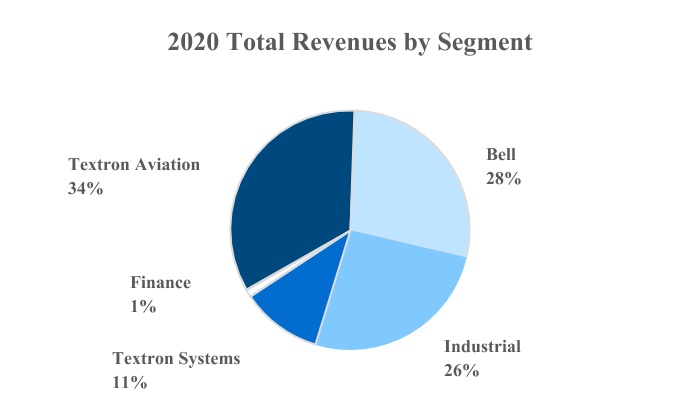
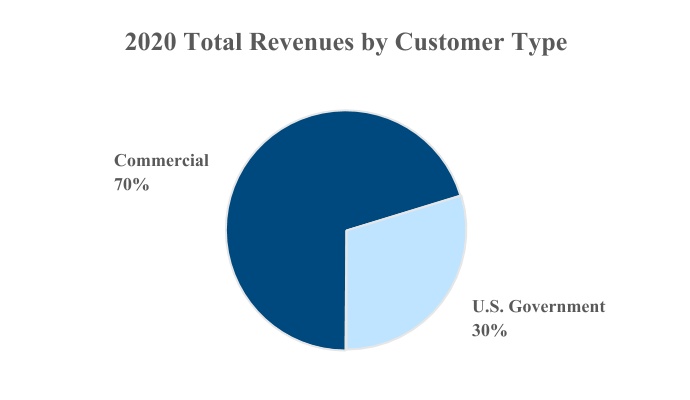
We conduct our business through five operating segments: Textron Aviation, Bell, Textron Systems and Industrial, which represent our manufacturing businesses, and Finance, which represents our captive finance business. Our segments include operations that are unincorporated divisions of Textron Inc. and others that are separately incorporated subsidiaries. Total revenues by segment and customer type for 2020 are presented below.
The following description of our business and operating segments should be read in conjunction with Item 7. Management’s Discussion and Analysis of Financial Condition and Results of Operations.
Textron Aviation Segment
Textron Aviation is a leader in general aviation. Textron Aviation manufactures, sells and services Beechcraft and Cessna aircraft, and services the Hawker brand of business jets. The segment has two principal product lines: aircraft and aftermarket parts and services. Aircraft includes sales of business jets, turboprop aircraft, military trainer and defense aircraft and piston engine aircraft. Aftermarket parts and services includes commercial parts sales, and maintenance, inspection and repair services. Textron Aviation markets its products worldwide through its own sales force, as well as through a network of authorized independent sales representatives.
The family of jets currently offered by Textron Aviation includes the Citation M2, Citation CJ3+, Citation CJ4, Citation XLS+, Citation Latitude and the Citation Longitude. Textron Aviation’s turboprop aircraft include the Beechcraft King Air 260, King Air 360ER and King Air 360, and the Cessna Caravan and Grand Caravan EX. In addition, Textron Aviation’s military trainer and defense aircraft include the T-6 trainer, which has been used to train pilots from more than 20 countries, and the AT-6 light attack military aircraft. Textron Aviation also offers piston engine aircraft including the Beechcraft Baron and Bonanza, and the Cessna Skyhawk, Skylane, and the Turbo Stationair HD.
In support of its family of aircraft, Textron Aviation operates a global network of 20 service centers, two of which are co-located with Bell, along with more than 300 authorized independent service centers located throughout the world. Textron Aviation-owned service centers provide customers with 24-hour service and maintenance. Textron Aviation also provides its customers with around-the-clock parts support and offers a mobile support program with approximately 70 mobile service units. In addition, Able Aerospace Services, Inc., a subsidiary of Textron Aviation, provides component and maintenance, repair and overhaul services in support of commercial and military fixed- and rotor-wing aircraft.
Product Development Programs
Textron Aviation is developing the Cessna Skycourier, a twin-engine, high-wing, large-utility turboprop aircraft, which achieved its first flight in May 2020. The Denali, a high-performance single engine turboprop aircraft under development, is expected to achieve its first flight in 2021.
Bell Segment
Bell is one of the leading suppliers of military and commercial helicopters, tiltrotor aircraft, and related spare parts and services in the world.
Bell supplies advanced military helicopters and provides parts and support services to the U.S. Government and to military customers outside the United States. Bell’s primary U.S. Government programs are for the production and support of the V-22 tiltrotor aircraft and the H-1 helicopters. Bell is one of the leading suppliers of helicopters to the U.S. Government and, in association with The Boeing Company (Boeing), the only supplier of military tiltrotor aircraft. Tiltrotor aircraft are designed to provide the benefits of both helicopters and fixed-wing aircraft. Through its strategic alliance with Boeing, Bell produces and supports the V-22 tiltrotor aircraft primarily for the U.S. Department of Defense, and also offers this aircraft to other countries under the U.S. Government-sponsored foreign military sales program. The H-1 helicopter program includes a utility model, the UH-1Y, and an advanced attack model, the AH-1Z, which have 84% parts commonality between them. While the U.S. Marine Corps is the primary customer for H-1 helicopters, we also sell these helicopters under the U.S. Government-sponsored foreign military sales program.
Through its commercial business, Bell is a leading supplier of commercially certified helicopters and support to corporate, private, law enforcement, utility and emergency medical helicopter operators, and the U.S. and foreign governments. Bell produces a variety of commercial aircraft types, including light single- and twin-engine helicopters and medium twin-engine helicopters, along with other related products. The commercial helicopters currently offered by Bell include the 429, 407GXi, 412EPX, 412EPI, 412EP, 505 Jet Ranger X and Huey II.
For both its military programs and its commercial products, Bell provides post-sale support and service for an installed base of approximately 13,000 helicopters through a network of six Company-operated service centers, four global parts distribution centers and nearly 100 independent service centers located in over 35 countries. Collectively, these service sites offer a complete range of logistics support, including parts, support equipment, technical data, training devices, pilot and maintenance training, component repair and overhaul, engine repair and overhaul, aircraft modifications, aircraft customizing, accessory manufacturing, contractor maintenance, field service and product support engineering.
Product Development Programs
In October 2019, Bell announced a new rotorcraft, the Bell 360 Invictus, which it is developing as its entrant for the U.S. Army's Future Attack Reconnaissance Aircraft (FARA) Competitive Prototype Program, part of the U.S. government's Future Vertical Lift (FVL) family of programs. The FARA program was initiated by the U.S. Army to develop a successor to the retired Bell OH-58D Kiowa Warrior helicopter. In March 2020, the U.S. Army selected the 360 Invictus to move to the second phase of the Competitive Prototype Program.
Bell continues its development and refinement of the V-280 Valor, a next generation vertical lift aircraft as part of the Joint Multi Role Technology Demonstrator (JMR-TD) initiative. The JMR-TD program is the science and technology precursor to the FVL program. The V-280 achieved its first flight in December 2017 and its first cruise mode flight in May 2018. In March 2020, the U.S. Army awarded Bell a Competitive Demonstration and Risk Reduction contract for the next stage of its Future Long Range Assault Aircraft program.
Bell’s first super medium commercial helicopter, the 525 Relentless, is currently in the certification process with the Federal Aviation Administration (FAA).
Textron Systems Segment
Textron Systems is a supplier to the defense, aerospace and general aviation markets. This segment sells products to U.S. Government customers and to customers outside the U.S. through foreign military sales sponsored by the U.S. Government and directly through commercial sales channels. Textron Systems’ operating units are reported under the following product lines: Unmanned Systems, Marine and Land Systems and Simulation, Training and Other.
Our Unmanned Systems product line includes unmanned aircraft systems, unmanned surface systems, mission command hardware and solutions, and worldwide customer support and logistics. Unmanned aircraft systems includes the Shadow, the U.S. Army’s premier tactical unmanned aircraft system, which has surpassed one million flight hours since its introduction, and the Aerosonde Small Unmanned Aircraft System, a multi-mission capable unmanned aircraft system that has amassed more than 500,000 flight hours in commercial and military operations around the world. Unmanned Systems also provides complete systems solutions to its government and commercial customers through comprehensive program management, operational and maintenance training, technical assistance and logistics support, and end-to-end turnkey mission support.
Our Marine and Land Systems product line includes advanced marine craft, armored vehicles and specialty vehicles supporting fire and rescue applications. These products are in service with U.S. and international militaries, special operations forces, police forces and civilian entities. Marine and Land Systems’ primary U.S. Government program is for the development and production of the U.S. Navy’s next generation Landing Craft Air Cushion as part of the Ship-to-Shore Connector program.
The Simulation, Training and Other product line includes the following operating units and businesses: Electronic Systems, Weapons and Sensors Systems, Lycoming, Airborne Tactical Advantage Company (ATAC) and TRU Simulation + Training (TRU). Electronic Systems provides high technology test equipment, electronic warfare test and training solutions and intelligence software solutions for U.S. and international defense, intelligence and law enforcement communities. Weapons and Sensors Systems offers advanced precision guided weapons systems, airborne and ground-based sensors and surveillance systems, and protection systems for the defense and aerospace industries. Lycoming specializes in the engineering, manufacture, service and support of piston aircraft engines for the general aviation and remotely piloted aircraft markets. ATAC focuses on live military air-to-air and air-to-ship training and support services for U.S. Navy, Marine and Air Force personnel. TRU designs, develops, manufactures, installs, and provides maintenance of advanced flight training devices, including full flight simulators, for commercial airlines, aircraft original equipment manufacturers (OEMs), flight training centers and training organizations. On January 25, 2021, we sold TRU Simulation + Training Canada Inc., which manufactured and maintained flight simulators for commercial airlines.
Industrial Segment
Our Industrial segment designs and manufactures a variety of products within the Fuel Systems and Functional Components and Specialized Vehicles product lines.
Our Fuel Systems and Functional Components product line is produced by our Kautex business unit which is headquartered in Bonn, Germany. Kautex is a leader in designing and manufacturing plastic fuel systems for automobiles and light trucks, including blow-molded solutions for conventional plastic fuel tanks and pressurized plastic fuel tanks for hybrid vehicle applications. Kautex also develops and manufactures clear-vision systems for automotive safety and advanced driver assistance systems (ADAS). Our cleaning systems are comprised of nozzles, reservoirs, inlets and pumps to support onboard cleaning for windscreens, headlamps and ADAS cameras and sensors. In addition, Kautex produces plastic tanks for selective catalytic reduction systems used to reduce emissions from diesel engines and other fuel system components.
Kautex’s business model is focused on developing and maintaining long-term customer relationships with leading global OEMs. Kautex operates over 30 plants in 14 countries in close proximity to our customers, along with 10 engineering/research and development locations around the world.
Our Specialized Vehicles product line includes products sold by the Textron Specialized Vehicles businesses under our E-Z-GO, Arctic Cat, TUG Technologies, Douglas Equipment, Premier, Safeaero, Ransomes, Jacobsen and Cushman brands. These businesses design, manufacture and sell golf cars, off-road utility vehicles, recreational side-by-side and all-terrain vehicles, snowmobiles, light transportation vehicles, aviation ground support equipment and professional turf-maintenance equipment, as well as specialized turf-care vehicles. Their diversified customer base includes golf courses and resorts, government agencies and municipalities, consumers, outdoor enthusiasts, and commercial and industrial users such as factories, warehouses, airlines, planned communities, hunting preserves, educational and corporate campuses, sporting venues, municipalities and landscaping professionals. Sales are made through a combination of a network of independent distributors and dealers worldwide, the Bass Pro Shops and Cabela’s retail outlets, which sell our products under the Tracker Off-Road brand, and factory direct resources.
Finance Segment
Our Finance segment, or the Finance group, is a commercial finance business that consists of Textron Financial Corporation (TFC) and its consolidated subsidiaries. The Finance segment provides financing primarily to purchasers of new and pre-owned Textron Aviation aircraft and Bell helicopters. A substantial number of the originations in our finance receivable portfolio are cross-border transactions for aircraft sold outside of the U.S. In 2020 and 2019, our Finance group paid our Manufacturing group $195 million and $184 million, respectively, related to the sale of Textron-manufactured products to third parties that were financed by the Finance group.
Our Finance segment’s largest business risk is the collectability of its finance receivable portfolio. See Finance Segment section in Item 7. Management’s Discussion and Analysis of Financial Condition and Results of Operations for information about the Finance segment’s credit performance.
Backlog
Backlog represents amounts allocated to contracts that we expect to recognize as revenue in future periods when we perform under the contracts. Backlog excludes unexercised contract options and potential orders under ordering-type contracts, such as Indefinite Delivery, Indefinite Quantity contracts.
Our backlog at the end of 2020 and 2019 is summarized below:
| (In millions) | January 2, 2021 | January 4, 2020 | ||||||
| Bell | $ | 5,342 | $ | 6,902 | ||||
| Textron Aviation | 1,603 | 1,714 | ||||||
| Textron Systems | 2,556 | 1,211 | ||||||
| Total backlog | $ | 9,501 | $ | 9,827 |
U.S. Government Contracts and Other Governmental Regulation
Our operations, products and services are subject to various government regulations, including regulations related to U.S. government business, international regulation of aviation products and services, and environmental regulations.
Contracts with the U.S. Government, including contracts under the U.S. Government-sponsored foreign military sales program, generated approximately 30% of our consolidated revenues in 2020, primarily in our Bell and Textron Systems segments. We must comply with and are affected by laws and regulations relating to the formation, administration and performance of U.S. Government contracts. These laws and regulations, among other things, require certification and disclosure of all cost and pricing data in connection with contract negotiation; define allowable and unallowable costs and otherwise govern our right to reimbursement under certain cost-based U.S. Government contracts; and safeguard and restrict the use and dissemination of classified and covered defense information and the exportation of certain products and technical data. New laws, regulations or procurement requirements, or changes to current ones, can significantly increase our costs, reducing our profitability.
Our contracts with the U.S. Government generally may be terminated by the U.S. Government for convenience or if we default in whole or in part by failing to perform under the terms of the applicable contract. If the U.S. Government terminates a contract for convenience, we normally will be entitled to payment for the cost of contract work performed before the effective date of termination, including, if applicable, reasonable profit on such work, as well as reasonable termination costs. If, however, the U.S. Government terminates a contract for default, generally: (a) we will be paid the contract price for completed supplies delivered and accepted and services rendered, an agreed-upon amount for manufacturing materials delivered and accepted and for the protection and preservation of property, and an amount for partially completed products accepted by the U.S. Government; (b) the U.S. Government may not be liable for our costs with respect to unaccepted items and may be entitled to repayment of advance payments and progress payments related to the terminated portions of the contract; (c) the U.S. Government may not be liable for assets we own and utilize to provide services under the “fee-for-service” contracts; and (d) we may be liable for excess costs incurred by the U.S. Government in procuring undelivered items from another source. See Aerospace and Defense Industry section in Item 1A. Risk Factors for additional information related to regulation of U.S. Government business herein.
Commercial aircraft products manufactured by our Textron Aviation and Bell segments are required to comply with FAA regulations in the U.S. and the regulations of other similar aviation regulatory governing authorities internationally, including, the European Aviation Safety Agency. Maintenance facilities and aftermarket services must also comply with FAA and international regulations. These regulations address production and quality systems, airworthiness and installation approvals, repair procedures and continuing operational safety. For an aircraft to be manufactured and sold, the model must receive a type certificate from the appropriate aviation authority, and each aircraft must receive a certificate of airworthiness. Aircraft outfitting and completions also require approval by the appropriate aviation authority. See Strategic Risks section in Item 1A. Risk Factors for additional information with respect to risks related to obtaining certification of new aircraft products.
Our operations are subject to numerous laws and regulations designed to protect the environment. For additional information regarding environmental matters, see Note 19 to the Consolidated Financial Statements in Item 8. Financial Statements and Supplementary Data, and Business and Operational Risks and Risks Related to Regulatory and Legal Matters sections in Item 1A. Risk Factors.
Based on current information and the applicable laws and regulations currently in effect, compliance with government regulations, including environmental regulations, has not had, and we do not expect it to have, a material effect on our capital expenditures, earnings or competitive position. However, laws and regulations may be changed or adopted that impose additional compliance requirements which could necessitate capital expenditures or otherwise increase our costs of doing business, reducing our profitability and negatively impacting our operating results.
Human Capital Resources
At January 2, 2021, we employed approximately 33,000 employees worldwide, with approximately 75% located in the U.S. and the remainder located outside of the U.S. Approximately 6,800, or 28%, of our U.S. employees, most of whom work for our Bell and Textron Aviation segments, are represented by unions under collective bargaining agreements, and certain of our non-U.S. employees are represented by organized works councils. From time to time our collective bargaining agreements expire and come up for renegotiation.
Our success is highly dependent upon our ability to maintain a workforce with the skills necessary for our businesses to succeed. We need highly skilled personnel in multiple areas including, among others, engineering, manufacturing, information technology, cybersecurity, flight operations, business development and strategy and management. In order to attract and retain highly skilled employees, we are committed to ensuring a safe and healthy work environment, offering comprehensive compensation and benefit programs, creating great career opportunities and building an engaging, inclusive environment where all employees are treated with dignity and respect.
Health and Safety
To maintain and enhance the safety of our employees, we promote a culture of continuous improvement and individual accountability to provide safe workplaces. We use an annual goal setting process to drive injury rate improvements, and the injury rate reduction goal is a performance metric that is reported to Textron’s Audit Committee and is tracked and reported to senior leadership.
The safety of our employees has been a priority throughout our response to the COVID-19 pandemic. Our enterprise-wide pandemic response teams, formed early in the pandemic, guided our operations in the processes and procedures to comply with applicable government-imposed health and safety-related operating restrictions, to enhance the safety of our facilities to protect the health of our employees and to monitor trends in infection rates at locations where we have facilities. These teams continue to operate, updating enterprise guidance as the pandemic has continued and the medical science and government guidance and orders have evolved. Our businesses continue to enforce COVID-19 health and safety protocols and have implemented protocols to address actual and suspected cases of COVID-19 and resulting contact tracing and quarantine requirements. Throughout the pandemic, we have been communicating regularly with our employees and monitoring their views on issues related to COVID-19 and the workplace as well as general levels of engagement through regular pulse surveys. In addition, management has regularly updated our Board of Directors on our COVID-19 status and response, including with respect to employee safety.
Talent and Career Development
Our talent development programs are designed to prepare our employees at all levels to take on new career and growth opportunities at Textron. Leadership, professional and functional training courses are tailored for employees at each stage of their careers and include a mix of enterprise-wide and business unit-specific programs. Textron University, an internal corporate function, provides (i) facilitated face-to-face professional and leadership development, (ii) web-based general and specialized functional and technical courses and (iii) an online portal to access advanced skills technical training, manage recertification of existing qualifications and other career planning tools and resources.
The current and future talent needs of each of our businesses are assessed annually through a formal talent review process which enables us to develop leadership succession plans and provide our employees with potential new career opportunities. In addition, leaders from functional areas within each business belong to enterprise-wide councils which conduct annual talent reviews. These processes enable us to fill talent needs by matching employees who are ready to assume significant leadership roles with opportunities that best fit their career path, which may be in other businesses within the enterprise.
Diversity and Inclusion
Textron is committed to having a diverse workforce and inclusive workplaces throughout our global operations. We believe by employing highly talented, diverse employees, who feel valued, respected and are able to contribute fully, we will improve performance, innovation and collaboration and drive talent retention, all of which contribute to stronger business results and reinforce our reputation as leaders in our industries and communities.
For over a decade, Textron has allocated five percent of annual incentive compensation for management-level employees toward achievement of diversity goals. Beginning in 2020, we focused these goals specifically on hiring diversity. To improve our outreach to diverse candidates, we have increased our recruiting efforts at historically black colleges and universities, enhanced our partnerships with diverse professional organizations and participated in diverse STEM conferences. In addition, we provide inclusion and unconscious bias training to our employees and recruiters to improve diversity in recruiting.
For discussion of certain risks relating to human capital management, see Risks Related to Human Capital section in Item 1A. Risk Factors.
Patents and Trademarks
We own, or are licensed under, numerous patents throughout the world relating to products, services and methods of manufacturing. Patents developed while under contract with the U.S. Government may be subject to use by the U.S. Government. We also own or license active trademark registrations and pending trademark applications in the U.S. and in various foreign countries or regions, as well as trade names and service marks. While our intellectual property rights in the aggregate are important to the operation of our business, we do not believe that any existing patent, license, trademark or other intellectual property right is of such importance that its loss or termination would have a material adverse effect on our business taken as a whole.
Information about our Executive Officers
The following table sets forth certain information concerning our executive officers as of February 19, 2021.
| Name | Age | Current Position with Textron Inc. | ||||||
| Scott C. Donnelly | 59 | Chairman, President and Chief Executive Officer | ||||||
| Frank T. Connor | 61 | Executive Vice President and Chief Financial Officer | ||||||
| Julie G. Duffy | 55 | Executive Vice President, Human Resources | ||||||
| E. Robert Lupone | 61 | Executive Vice President, General Counsel, Secretary and Chief Compliance Officer |
Mr. Donnelly joined Textron in June 2008 as Executive Vice President and Chief Operating Officer and was promoted to President and Chief Operating Officer in January 2009. He was appointed to the Board of Directors in October 2009 and became Chief Executive Officer of Textron in December 2009. In July 2010, Mr. Donnelly was appointed Chairman of the Board of Directors effective September 1, 2010. Previously, Mr. Donnelly was the President and CEO of General Electric Company’s Aviation business unit, a position he had held since July 2005. GE’s Aviation business unit is a leading maker of commercial and military jet engines and components, as well as integrated digital, electric power and mechanical systems for aircraft. Prior to July 2005, Mr. Donnelly served as Senior Vice President of GE Global Research, one of the world’s largest and most diversified industrial research organizations with facilities in the U.S., India, China and Germany and held various other management positions since joining General Electric in 1989.
Mr. Connor joined Textron in August 2009 as Executive Vice President and Chief Financial Officer. Previously, Mr. Connor was head of Telecom Investment Banking at Goldman, Sachs & Co. from 2003 to 2008. Prior to that position, he served as Chief Operating Officer of Telecom, Technology and Media Investment Banking at Goldman, Sachs & Co. from 1998 to 2003. Mr. Connor joined the Corporate Finance Department of Goldman, Sachs & Co. in 1986 and became a Vice President in 1990 and a Managing Director in 1996.
Ms. Duffy was named Executive Vice President, Human Resources in July 2017. Ms. Duffy joined Textron in 1997 as a member of the corporate legal team and has since held positions of increasing responsibility within the Company’s legal function, previously serving as Vice President and Deputy General Counsel-Litigation, a position she had held since 2011. In that role she was responsible for managing the corporate litigation staff with primary oversight of litigation throughout Textron. She has also played an active role in developing, implementing and standardizing human resources policies across the Company and served as the senior legal advisor on employment and benefits issues.
Mr. Lupone joined Textron in February 2012 as Executive Vice President, General Counsel, Secretary and Chief Compliance Officer. Previously, he was senior vice president and general counsel of Siemens Corporation (U.S.) since 1999 and general counsel of Siemens AG for the Americas since 2008. Prior to joining Siemens in 1992, Mr. Lupone was vice president and general counsel of Price Communications Corporation.
Available Information
We make available free of charge on our Internet Web site (www.textron.com) our Annual Report on Form 10-K, Quarterly Reports on Form 10-Q, Current Reports on Form 8-K and amendments to those reports filed or furnished pursuant to Section 13(a) or 15(d) of the Securities Exchange Act of 1934 as soon as reasonably practicable after we electronically file such material with, or furnish it to, the Securities and Exchange Commission.
Forward-Looking Information
Certain statements in this Annual Report on Form 10-K and other oral and written statements made by us from time to time are “forward-looking statements” within the meaning of the Private Securities Litigation Reform Act of 1995. These forward-looking statements, which may describe strategies, goals, outlook or other non-historical matters, or project revenues, income, returns or other financial measures, often include words such as “believe,” “expect,” “anticipate,” “intend,” “plan,” “estimate,” “guidance,” “project,” “target,” “potential,” “will,” “should,” “could,” “likely” or “may” and similar expressions intended to identify forward-looking statements. These statements are only predictions and involve known and unknown risks, uncertainties, and other factors that may cause our actual results to differ materially from those expressed or implied by such forward-looking statements. Given these uncertainties, you should not place undue reliance on these forward-looking statements. Forward-looking statements speak only as of the date on which they are made, and we undertake no obligation to update or revise any forward-looking statements. In addition to those factors described herein under “Risk Factors,” among the factors that could cause actual results to differ materially from past and projected future results are the following:
-
Interruptions in the U.S. Government’s ability to fund its activities and/or pay its obligations;
-
Changing priorities or reductions in the U.S. Government defense budget, including those related to military operations in foreign countries;
-
Our ability to perform as anticipated and to control costs under contracts with the U.S. Government;
-
The U.S. Government’s ability to unilaterally modify or terminate its contracts with us for the U.S. Government’s convenience or for our failure to perform, to change applicable procurement and accounting policies, or, under certain circumstances, to withhold payment or suspend or debar us as a contractor eligible to receive future contract awards;
-
Changes in foreign military funding priorities or budget constraints and determinations, or changes in government regulations or policies on the export and import of military and commercial products;
-
Volatility in the global economy or changes in worldwide political conditions that adversely impact demand for our products;
-
Volatility in interest rates or foreign exchange rates;
-
Risks related to our international business, including establishing and maintaining facilities in locations around the world and relying on joint venture partners, subcontractors, suppliers, representatives, consultants and other business partners in connection with international business, including in emerging market countries;
-
Our Finance segment’s ability to maintain portfolio credit quality or to realize full value of receivables;
-
Performance issues with key suppliers or subcontractors;
-
Legislative or regulatory actions, both domestic and foreign, impacting our operations or demand for our products;
-
Our ability to control costs and successfully implement various cost-reduction activities;
-
The efficacy of research and development investments to develop new products or unanticipated expenses in connection with the launching of significant new products or programs;
-
The timing of our new product launches or certifications of our new aircraft products;
-
Our ability to keep pace with our competitors in the introduction of new products and upgrades with features and technologies desired by our customers;
-
Pension plan assumptions and future contributions;
-
Demand softness or volatility in the markets in which we do business;
-
Cybersecurity threats, including the potential misappropriation of assets or sensitive information, corruption of data or operational disruption;
-
Difficulty or unanticipated expenses in connection with integrating acquired businesses;
-
The risk that acquisitions do not perform as planned, including, for example, the risk that acquired businesses will not achieve revenues and profit projections;
-
The impact of changes in tax legislation; and
-
Risks and uncertainties related to the impact of the COVID-19 pandemic on our business and operations.
Item 1A. Risk Factors
Our business, financial condition and results of operations are subject to various risks, including those discussed below, which may affect the value of our securities. The risks discussed below are those that we believe currently are the most significant to our business.
Risks Related to the COVID-19 Pandemic
Our business is being adversely impacted, and is expected to continue to be adversely impacted, by the coronavirus (COVID-19) pandemic.
Our businesses have experienced and continue to experience various degrees of disruption and reduced demand for certain of our products due to the unprecedented conditions surrounding the COVID-19 pandemic. The effects of COVID-19 have included and could continue to include disruption of the operation or temporary closure of certain of our facilities or the facilities of our
customers, suppliers or business partners as well as other disruptions in our supply chains. Challenges resulting from the pandemic have impacted, and may continue to impact, the ability of many of our employees to work effectively, due to illness, quarantines, facility closures, changes in manufacturing processes to accommodate social distancing guidelines, remote working arrangements, or other government-imposed operating restrictions. We have experienced and may continue to experience increased costs as a result of these business and production disruptions. Likewise, we have incurred and may continue to incur additional expenses related to implementing processes and procedures to comply with required operating restrictions and to enhance the safety of our facilities to protect the health of our employees.
Our commercial businesses have been and may continue to be adversely impacted due to a general slowdown in demand for our general aviation products and services, recreational and other specialized vehicles and automotive products. We have experienced a decline in orders for our aviation products and services, as well as lower deliveries of commercial helicopters and fixed-wing aircraft because of reduced demand and travel restrictions imposed in response to the pandemic. Economic and other impacts from the pandemic may also result in future weak demand for our aviation and commercial helicopter products and services, the delay or cancellation of existing orders by our customers and lower flight hours, and consequently, lower demand for parts and maintenance. In addition, new regulations by U.S. or foreign governments and government agencies addressed to the aviation or travel industry could impose additional regulatory, aircraft security, travel restrictions or other requirements or restrictions related to the pandemic that could adversely impact demand for aircraft and rotorcraft or significantly reduce hours flown. As a result, our costs may further increase as a result of the COVID-19 outbreak. These cost increases may not be fully recoverable, negatively impacting our profitability, and may continue even after the business environment has improved.
It is possible that the continued spread of COVID-19 and actions taken by various governmental authorities and other third parties in response to the outbreak could also further cause disruption in our supply chain or in the operations of our business partners, impacting their ability to perform their obligations, which could impact our ability to perform our contractual obligations; cause delay by, or limit the ability of, the U.S. Government and other customers to perform, including in making timely payments to us; and cause other unpredictable events. Limitations on government operations could impact regulatory approvals such as export licenses that are needed for international sales and deliveries. In addition, there may be changes in our U.S. and foreign government customers’ priorities as they confront competing budget priorities and more limited resources. These changes may impact current and future programs, government payments and other practices, procurements and funding decisions.
The outbreak of COVID-19 has resulted in a widespread health crisis that is adversely affecting the economies and financial markets of many countries. The resulting economic downturn, the severity and length of which cannot be predicted, may cause continued reduced demand for our products, delays or cancellations of customer orders, the inability of customers to obtain financing to purchase our products, bankruptcies of our suppliers, customers or other business partners, adverse impact to investment performance of our pension plans and continued volatility in the global capital markets adversely impacting our access to capital. The extent to which the pandemic could impact our business, results of operations, financial condition and liquidity is highly uncertain and also will depend on future developments, most of which are outside our control. Such developments may include the geographic spread and duration of the virus, the severity of the disease, the development of treatments or vaccines, and the effects of actions that have been or may be taken by various governmental authorities and other third parties in response to the outbreak.
See also risks related to our Finance Segment under Financial Risks section below.
Aerospace and Defense Industry Risks
Demand for our aircraft products is cyclical and lower demand adversely affects our financial results.
Demand for business jets, turbo props and commercial helicopters has been cyclical and difficult to forecast. Unexpected events, such as the COVID-19 pandemic, have adversely impacted demand for our aircraft products and may continue to do so. Therefore, future demand for these products could be significantly and unexpectedly less than anticipated and/or less than previous period deliveries. Similarly, there is uncertainty as to when or whether our existing commercial backlog for aircraft products will convert to revenues as the conversion depends on production capacity, customer needs and credit availability. Changes in economic conditions has in the past caused, and in the future may cause, customers to request that firm orders be rescheduled, deferred or cancelled. Reduced demand for our aircraft products or delays or cancellations of orders previously has had and, in the future, could have a material adverse effect on our cash flows, results of operations and financial condition.
We have customer concentration with the U.S. Government; reduction in U.S. Government defense spending can adversely affect our results of operations and financial condition.
During 2020, we derived approximately 30% of our revenues from sales to a variety of U.S. Government entities. Our revenues from the U.S. Government largely result from contracts awarded to us under various U.S. Government defense-related programs. The funding of these programs is subject to congressional appropriation decisions and the U.S. Government budget process which includes enacting relevant legislation, such as appropriations bills and accords on the debt ceiling. Although multiple-year contracts may be planned in connection with major procurements, Congress generally appropriates funds on a fiscal year basis
even though a program may continue for several years. Consequently, programs often are only partially funded initially, and additional funds are committed only as Congress makes further appropriations. Further uncertainty with respect to ongoing programs could also result in the event that the U.S. Government finances its operations through temporary funding measures such as “continuing resolutions” rather than full-year appropriations. If we incur costs in advance or in excess of funds committed on a contract, we are at risk for non-reimbursement of those costs until additional funds are appropriated. The reduction, termination or delay in the timing of funding for U.S. Government programs for which we currently provide or propose to provide products or services from time to time has resulted and, in the future, may result in a loss of anticipated revenues. A loss of such revenues could materially and adversely impact our results of operations and financial condition. Significant changes in national and international policies or priorities for defense spending, as well as the potential impact of sequestration, could affect the funding, or the timing of funding, of our programs, which could negatively impact our results of operations and financial condition. In addition, because our U.S. Government contracts generally require us to continue to perform even if the U.S. Government is unable to make timely payments, we may need to finance our continued performance for the impacted contracts from our other resources on an interim basis. An extended delay in the timely payment by the U.S. Government could have a material adverse effect on our liquidity.
U.S. Government contracts can be terminated at any time and may contain other unfavorable provisions.
The U.S. Government typically can terminate or modify any of its contracts with us either for its convenience or if we default by failing to perform under the terms of the applicable contract. In the event of termination for the U.S. Government’s convenience, contractors are generally protected by provisions covering reimbursement for costs incurred on the contracts and profit on those costs but not the anticipated profit that would have been earned had the contract been completed. A termination arising out of our default for failure to perform could expose us to liability, including but not limited to, all costs incurred under the contract plus potential liability for re-procurement costs in excess of the total original contract amount, less the value of work performed and accepted by the customer under the contract. Such an event could also have an adverse effect on our ability to compete for future contracts and orders. If any of our contracts are terminated by the U.S. Government whether for convenience or default, our backlog would be reduced by the expected value of the remaining work under such contracts. We also enter into “fee for service” contracts with the U.S. Government where we retain ownership of, and consequently the risk of loss on, aircraft and equipment supplied to perform under these contracts. Termination of these contracts could materially and adversely impact our results of operations. On contracts for which we are teamed with others and are not the prime contractor, the U.S. Government could terminate a prime contract under which we are a subcontractor, irrespective of the quality of our products and services as a subcontractor. In addition, in the event that the U.S. Government is unable to make timely payments, failure to continue contract performance places the contractor at risk of termination for default. Any such event could have a material adverse effect on our cash flows, results of operations and financial condition.
As a U.S. Government contractor, we are subject to procurement rules and regulations; our failure to comply with these rules and regulations could adversely affect our business.
We must comply with and are affected by laws and regulations relating to the formation, administration and performance of U.S. Government contracts. These laws and regulations, among other things, require certification and disclosure of all cost and pricing data in connection with contract negotiation, define allowable and unallowable costs and otherwise govern our right to reimbursement under certain cost-based U.S. Government contracts, and safeguard and restrict the use and dissemination of classified information, covered defense information, and the exportation of certain products and technical data. New laws, regulations or procurement requirements or changes to current ones (including, for example, regulations related to cybersecurity) can significantly increase our costs, reducing our profitability. Our failure to comply with procurement regulations and requirements could allow the U.S. Government to suspend or debar us from receiving new contracts for a period of time, reduce the value of existing contracts, issue modifications to a contract, withhold cash on contract payments, and control and potentially prohibit the export of our products, services and associated materials, any of which could negatively impact our results of operations, financial condition or liquidity. A number of our U.S. Government contracts contain provisions that require us to make disclosure to the Inspector General of the agency that is our customer if we have credible evidence that we have violated U.S. criminal laws involving fraud, conflict of interest, or bribery; the U.S. civil False Claims Act; or received a significant overpayment under a U.S. Government contract. Failure to properly and timely make disclosures under these provisions may result in a termination for default or cause, suspension and/or debarment, and potential fines.
As a U.S. Government contractor, our businesses and systems are subject to audit and review by the Defense Contract Audit Agency (DCAA) and the Defense Contract Management Agency (DCMA).
We operate in a highly regulated environment and are routinely audited and reviewed by the U.S. Government and its agencies such as the DCAA and DCMA. These agencies review our performance under contracts, our cost structure and our compliance with laws and regulations applicable to U.S. Government contractors. The systems that are subject to review include, but are not limited to, our accounting, estimating, material management and accounting, earned value management, purchasing and government property systems. If an audit uncovers improper or illegal activities, we may be subject to civil and criminal penalties and administrative sanctions that may include the termination of our contracts, forfeiture or reduction of profits, suspension or
reduction of payments, fines, and, under certain circumstances, suspension or debarment from future contracts for a period of time. Whether or not illegal activities are alleged, the U.S. Government also has the ability to decrease or withhold certain payments when it deems systems subject to its review to be inadequate. These laws and regulations affect how we conduct business with our government customers and, in some instances, impose added costs on our business.
The use of multi-award contracts by the U.S. Government increases competition, pricing pressure and cost.
The U.S. Government increasingly relies upon competitive contract award types, including indefinite-delivery, indefinite-quantity and multi-award contracts, which have the potential to create greater competition and increased pricing pressure, as well as to increase our cost by requiring that we submit multiple bids. In addition, multi-award contracts increase our cost as they require that we make sustained efforts to obtain task orders and delivery orders under the contract. Further, the competitive bidding process is costly and demands managerial time to prepare bids and proposals for contracts that may not be awarded to us or may be split among competitors.
Our profitability and cash flow varies depending on the mix of our government contracts and our ability to control costs**.**
Under fixed-price contracts, generally we receive a fixed price irrespective of the actual costs we incur, and, consequently, any costs in excess of the fixed price are absorbed by us. Changes in underlying assumptions, circumstances or estimates used in developing the pricing for such contracts can adversely affect our results of operations. Additionally, fixed-price contracts generally require progress payments rather than performance-based payments which can delay our ability to recover a significant amount of costs incurred on a contract and thus affect the timing of our cash flows. Under fixed-price incentive contracts, we share with the U.S. Government cost underrun savings, which are derived from total cost being less than target costs; we also share in cost overruns, which occur when total costs exceed target costs up to a negotiated cost ceiling, but are solely responsible for costs above the ceiling. Under time and materials contracts, we are paid for labor at negotiated hourly billing rates and for certain expenses. Under cost-reimbursement contracts that are subject to a contract-ceiling amount, we are reimbursed for allowable costs and paid a fee, which may be fixed or performance based, however, if our costs exceed the contract ceiling or are not allowable under the provisions of the contract or applicable regulations, we may not be able to obtain reimbursement for all such costs. Due to the nature of our work under government contracts, we sometimes experience unforeseen technological difficulties and cost overruns. Under each type of contract, if we are unable to control costs or if our initial cost estimates are incorrect, our cash flows, results of operations and financial condition could be adversely affected. Cost overruns also may adversely affect our ability to sustain existing programs and obtain future contract awards.
Strategic Risks
Developing new products and technologies entails significant risks and uncertainties.
To continue to grow our revenues and segment profit, we must successfully develop new products and technologies or modify our existing products and technologies for our current and future markets. Our future performance depends, in part, on our ability to identify emerging technological trends and customer requirements and to develop and maintain competitive products and services. Delays or cost overruns in the development and acceptance of new products or certification of new aircraft and other products occur from time to time and could adversely affect our results of operations. These delays could be caused by unanticipated technological hurdles, production changes to meet customer demands, unanticipated difficulties in obtaining required regulatory certifications of new aircraft or other products, coordination with joint venture partners or failure on the part of our suppliers to deliver components as agreed. We also could be adversely affected if our research and development efforts are less successful than expected or if we do not adequately protect the intellectual property developed through these efforts. Likewise, new products and technologies could generate unanticipated safety or other concerns resulting in expanded product liability risks, potential product recalls and other regulatory issues that could have an adverse impact on us. Furthermore, because of the lengthy research and development cycle involved in bringing certain of our products to market, we cannot predict the economic conditions that will exist when any new product is complete. A reduction in capital spending in the aerospace or defense industries could have a significant effect on the demand for new products and technologies under development, which could have an adverse effect on our financial condition and results of operations. In addition, our investments in equipment or technology that we believe will enable us to obtain future service contracts for our U.S. Government or other customers may not result in contracts or revenues sufficient to offset such investment. The market for our product offerings does not always develop or continue to expand as we anticipate. Furthermore, we cannot be sure that our competitors will not develop competing technologies which gain superior market acceptance compared to our products. A significant failure in our new product development efforts or the failure of our products or services to achieve market acceptance relative to our competitors’ products or services could have an adverse effect on our financial condition and results of operations.
We have made and may continue to make acquisitions that increase the risks of our business.
We enter into acquisitions in an effort to expand our business and enhance shareholder value. Acquisitions involve risks and uncertainties that, in some cases, have resulted, and, in the future, could result in our not achieving expected benefits. Such risks include difficulties in integrating newly acquired businesses and operations in an efficient and cost-effective manner; challenges in achieving expected strategic objectives, cost savings and other benefits; the risk that the acquired businesses’ markets do not evolve as anticipated and that the acquired businesses’ products and technologies do not prove to be those needed to be successful in those markets; the risk that our due diligence reviews of the acquired business do not identify or adequately assess all of the material issues which impact valuation of the business or result in costs or liabilities in excess of what we anticipated; the risk that we pay a purchase price that exceeds what the future results of operations would have merited; the risk that the acquired business may have significant internal control deficiencies or exposure to regulatory sanctions; and the potential loss of key customers, suppliers and employees of the acquired businesses.
Business and Operational Risks
Our business could be negatively impacted by information technology disruptions and security threats.
Our information technology (IT) and related systems are critical to the efficient operation of our business and essential to our ability to perform day to day processes. From time to time, we update and/or replace IT systems used by our businesses. The implementation of new systems can present temporary disruptions of business activities as existing processes are transitioned to the new systems, resulting in productivity issues, including delays in production, shipments or other business operations. We also outsource certain support functions, including certain global IT infrastructure services, to third-party service providers, and any disruption of such outsourced processes or functions could have a material adverse effect on our operations. In addition, as a U.S. defense contractor, we face certain security threats, including threats to our IT infrastructure and unlawful attempts to gain access to our information via phishing / malware campaigns and other cyberattack methods, as well as threats to the physical security of our facilities and employees, as do our customers, suppliers, subcontractors and joint venture partners. Attempts to gain unauthorized access to our confidential, classified or otherwise proprietary information or that of our employees or customers, as well as other security breaches, are persistent, continue to evolve and require highly skilled IT resources.
We maintain Information Systems Incident Management Standards applicable to all our businesses intended to ensure information security events and weaknesses associated with information systems are communicated and acted on in a timely manner. Our enterprise risk management program includes cyber risk/network protection mitigation plans, and our disclosure controls and procedures address cybersecurity and include processes intended to ensure that security breaches are analyzed for potential disclosure. Additionally, we conduct periodic training for our employees regarding the protection of sensitive information which includes training intended to prevent the success of cyberattacks. Further, our insider trading compliance program addresses restrictions against trading while in possession of material, nonpublic information in connection with a cybersecurity incident.
While we have experienced cybersecurity attacks, we have not suffered any material losses relating to such attacks, and we believe our threat detection and mitigation processes and procedures are robust. Due to the evolving nature of security threats, the possibility of future material incidents cannot be completely mitigated, and we may not always be successful in detecting, reporting or responding to cyber incidents. Future attacks or breaches of data security, whether of our systems or the systems of our service providers or other third parties who may have access to our data for business purposes, could disrupt our operations, cause the loss of business information or compromise confidential information, exposing us to liability or regulatory action. Such an incident also could require significant management attention and resources, increase costs that may not be covered by insurance, and result in reputational damage, potentially adversely affecting our competitiveness and our results of operations. Products and services that we provide to our customers may themselves be subject to cyberthreats which may not be detected or effectively mitigated, resulting in potential losses that could adversely affect us and our customers. In addition, our customers, including the U.S. Government, are increasingly requiring cybersecurity protections and mandating cybersecurity standards in our products, and we may incur additional costs to comply with such demands.
Failure to perform by our subcontractors or suppliers could adversely affect our performance.
We rely on other companies to provide raw materials, major components and subsystems for our products. Subcontractors also perform services that we provide to our customers in certain circumstances. We depend on these suppliers and subcontractors to meet our contractual obligations to our customers and conduct our operations. Our ability to meet our obligations to our customers could be adversely affected if suppliers or subcontractors do not provide the agreed-upon supplies or perform the agreed-upon services in compliance with customer requirements and in a timely and cost-effective manner. Likewise, the quality of our products could be adversely impacted if companies to whom we delegate manufacture of major components or subsystems for our products, or from whom we acquire such items, do not provide components or subsystems which meet required specifications and perform to our and our customers’ expectations. Our suppliers may be less likely than us to be able to quickly recover from natural disasters and other events beyond their control and may be subject to additional risks such as financial problems that limit their ability to conduct their operations. The risk of these adverse effects would likely be greater in circumstances where we rely on only one or two subcontractors or suppliers for a particular raw material, product or service. In particular, in the aircraft
industry, most vendor parts are certified by the regulatory agencies as part of the overall Type Certificate for the aircraft being produced by the manufacturer. If a vendor does not or cannot supply its parts, then the manufacturer’s production line may be stopped until the manufacturer can design, manufacture and certify a similar part itself or identify and certify another similar vendor’s part, resulting in significant delays in the completion of aircraft. Such events may adversely affect our financial results, damage our reputation and relationships with our customers, and result in regulatory actions and/or litigation.
We are subject to the risks of doing business in foreign countries that could adversely impact our business.
During 2020, we derived approximately 32% of our revenues from international business, including U.S. exports. Conducting business internationally exposes us to additional risks than if we conducted our business solely within the U.S. We maintain manufacturing facilities, service centers, supply centers and other facilities worldwide, including in various emerging market countries. Risks related to international operations include import, export, economic sanctions and other trade restrictions; changing U.S. and foreign procurement policies and practices; changes in international trade policies, including higher tariffs on imported goods and materials and renegotiation of free trade agreements; potential retaliatory tariffs imposed by foreign countries against U.S. goods; impacts related to the voluntary exit of the United Kingdom from the European Union (Brexit); restrictions on technology transfer; difficulties in protecting intellectual property; increasing complexity of employment and environmental, health and safety regulations; foreign investment laws; exchange controls; repatriation of earnings or cash settlement challenges; compliance with increasingly rigorous data privacy and protection laws; competition from foreign and multinational firms with home country advantages; economic and government instability, acts of terrorism and related safety concerns. The impact of any one or more of these or other factors could adversely affect our business, financial condition or operating results.
Additionally, some international government customers require contractors to agree to specific in-country purchases, technology transfers, manufacturing agreements or financial support arrangements, known as offsets, as a condition for a contract award. These contracts generally extend over several years and may include penalties if we fail to perform in accordance with the offset requirements which are often subjective. We also are exposed to risks associated with using foreign representatives and consultants for international sales and operations and teaming with international subcontractors and suppliers in connection with international programs. In many foreign countries, particularly in those with developing economies, it is common to engage in business practices that are prohibited by laws and regulations applicable to us, such as the Foreign Corrupt Practices Act. Although we maintain policies and procedures designed to facilitate compliance with these laws, a violation of such laws by any of our international representatives, consultants, joint ventures, business partners, subcontractors or suppliers, even if prohibited by our policies, could have an adverse effect on our business and reputation.
Natural disasters or other events outside of our control may disrupt our operations, adversely affect our results of operations and financial condition, and may not be fully covered by insurance.
Natural disasters, including hurricanes, fires, tornados, floods and other forms of severe weather, the intensity and frequency of which are being exacerbated by climate change, other impacts of climate change, such as rising sea waters, as well as other events outside of our control including public health crises or pandemics, power outages and industrial accidents, have in the past and could in the future disrupt our operations and adversely affect our business. Any of these events could result in physical damage to and/or complete or partial closure of one or more of our facilities, temporary or long-term disruption of our operations or the operations of our suppliers by causing business interruptions or by impacting the availability and cost of materials needed for manufacturing or otherwise impacting our ability to deliver products and services to our customers. Existing insurance arrangements may not provide full protection for the costs that may arise from such events. The occurrence of any of these events could materially increase our costs and expenses and have a material adverse effect on our business, financial condition and results of operations.
Financial Risks
If our Finance segment has difficulty collecting on its finance receivables, our financial performance could be adversely affected.
The financial performance of our Finance segment depends on the quality of loans, leases and other assets in its portfolio. Portfolio quality can be adversely affected by several factors, including finance receivable underwriting procedures, collateral value, geographic or industry concentrations, and the effect of general economic conditions such as the recent deterioration of the economy due to the impact from the COVID-19 pandemic. The pandemic has resulted in disruptions in the ability of many of our customers to conduct business effectively because of illness, quarantines, government shut-down orders, facility closures, reduced customer demand or other restrictions. As a result, our Finance segment has modified a significant number of the loans in its portfolio in order to provide temporary payment relief to its customers. In addition, the Finance segment has provided extended payment relief to certain customers. These modifications will delay our ultimate recovery on these assets. In addition, a substantial number of the originations in our finance receivable portfolio are cross-border transactions for aircraft sold outside of the U.S. Cross-border transactions present additional challenges and risks in the event of borrower default, which can result in difficulty or delay in collecting on the related finance receivables. Should current economic conditions persist or worsen, our
Finance segment may have difficulty successfully collecting on its finance receivable portfolio, and as a result our cash flow, results of operations and financial condition could be adversely affected.
We periodically need to obtain financing and such financing may not be available to us on satisfactory terms, if at all.
We periodically need to obtain financing in order to meet our debt obligations as they come due, to support our operations and/or to make acquisitions. Our access to the debt capital markets and the cost of borrowings are affected by a number of factors including market conditions and the strength of our credit ratings. If we cannot obtain adequate sources of credit on favorable terms, or at all, our business, operating results, and financial condition could be adversely affected.
Unanticipated changes in our tax rates or exposure to additional income tax liabilities could affect our profitability.
We are subject to income taxes in the U.S. and various non-U.S. jurisdictions, and our domestic and international tax liabilities are subject to the location of income among these different jurisdictions. Our effective tax rate could be adversely affected by changes in the mix of earnings in countries with differing statutory tax rates, changes in the valuation of deferred tax assets and liabilities, changes in the amount of earnings indefinitely reinvested offshore, changes to unrecognized tax benefits or changes in tax laws, which could affect our profitability. In particular, the carrying value of deferred tax assets is dependent on our ability to generate future taxable income, as well as changes to applicable statutory tax rates. In addition, the amount of income taxes we pay is subject to audits in various jurisdictions, and a material assessment by a tax authority could affect our profitability.
Risks Related to Regulatory and Legal Matters
We are subject to increasing compliance risks that could adversely affect our operating results.
As a global business, we are subject to laws and regulations in the U.S. and other countries in which we operate. International sales and global operations require importing and exporting goods, software and technology, some of which have military applications subjecting them to more stringent import-export controls across international borders on a regular basis. For example, we sometimes initially must obtain licenses and authorizations from various U.S. Government agencies before we are permitted to sell certain of our aerospace and defense products outside the U.S., and we are not always successful in obtaining these licenses or authorizations in a timely manner. Both U.S. and foreign laws and regulations applicable to us have been increasing in scope and complexity. For example, both U.S. and foreign governments and government agencies regulate the aviation industry, and they have previously and may in the future impose new regulations for additional aircraft security or other requirements or restrictions, including, for example, restrictions and/or fees related to carbon emissions levels. Changes in environmental and climate change laws and regulations, including laws relating to greenhouse gas emissions, could lead to the necessity for new or additional investment in product designs or manufacturing processes and could increase environmental compliance expenditures, including costs to defend regulatory reviews. New or changing laws and regulations or related interpretation and policies could increase our costs of doing business, affect how we conduct our operations, adversely impact demand for our products, and/or limit our ability to sell our products and services. Compliance with laws and regulations of increasing scope and complexity is even more challenging in our current business environment in which reducing our operating costs is often necessary to remain competitive. In addition, a violation of U.S. and/or foreign laws by one of our employees or business partners could subject us or our employees to civil or criminal penalties, including material monetary fines, or other adverse actions, such as denial of import or export privileges and/or debarment as a government contractor which could damage our reputation and have an adverse effect on our business.
Certain of our products are subject to laws regulating consumer products and could be subject to repurchase or recall as a result of safety issues.
As a distributor of consumer products in the U.S., certain of our products are subject to the Consumer Product Safety Act, which empowers the U.S. Consumer Product Safety Commission (CPSC) to exclude from the market products that are found to be unsafe or hazardous. Under certain circumstances, the CPSC could require us to repair, replace or refund the purchase price of one or more of our products, or potentially even discontinue entire product lines. We also may voluntarily take such action and, from time to time, have done so, but within strictures recommended by the CPSC. The CPSC also can impose fines or penalties on a manufacturer for non-compliance with its requirements. Furthermore, failure to timely notify the CPSC of a potential safety hazard can result in significant fines being assessed against us. Any repurchases or recalls of our products or an imposition of fines or penalties could be costly to us and could damage the reputation or the value of our brands. Additionally, laws regulating certain consumer products exist in some states, as well as in other countries in which we sell our products, and more restrictive laws and regulations could be adopted in the future.
Increased regulation related to global climate change could negatively affect our business.
Increased public awareness and concern regarding global climate change may result in more international, regional and/or federal requirements to reduce or mitigate global warming and these regulations could mandate stricter limits on greenhouse gas emissions. If environmental or climate change laws or regulations are either changed or adopted and impose significant operational restrictions and compliance requirements upon our business or our products, they could negatively impact our business, capital expenditures, results of operations, financial condition and competitive position.
We are subject to legal proceedings and other claims.
We are subject to legal proceedings and other claims arising out of the conduct of our business, including proceedings and claims relating to commercial and financial transactions; government contracts; alleged lack of compliance with applicable laws and regulations; production partners; product liability; patent and trademark infringement; employment disputes; and environmental, safety and health matters. Due to the nature of our manufacturing business, we are regularly subject to liability claims arising from accidents involving our products, including claims for serious personal injuries or death caused by weather or by pilot, driver or user error. In the case of litigation matters for which reserves have not been established because the loss is not deemed probable, it is reasonably possible that such claims could be decided against us and could require us to pay damages or make other expenditures in amounts that are not presently estimable. In addition, we cannot be certain that our reserves are adequate and that our insurance coverage will be sufficient to cover one or more substantial claims. Furthermore, we may not be able to obtain insurance coverage at acceptable levels and costs in the future. Litigation is inherently unpredictable, and we could incur judgments, receive adverse arbitration awards or enter into settlements for current or future claims that could adversely affect our results of operations in any particular period.
Intellectual property infringement claims of others and the inability to protect our intellectual property rights could harm our business and our customers.
Intellectual property infringement claims are, from time to time, asserted by third parties against us or our customers. Any related indemnification payments or legal costs we are obliged to pay on behalf of our businesses, our customers or other third parties can be costly. Infringement claims also have resulted in legal restrictions on our businesses engaging in sales of allegedly infringing products. If such a restriction were imposed upon a material product line, our business and results of operations could be adversely impacted. In addition, we own the rights to many patents, trademarks, brand names, trade names and trade secrets that are important to our business. The inability to enforce these intellectual property rights could have an adverse effect on our results of operations. Additionally, our intellectual property could be at risk due to cybersecurity threats.
Risks Related to Human Capital
Our success is highly dependent on our ability to maintain a qualified workforce.
Our success is highly dependent upon our ability to maintain a workforce with the skills necessary for our businesses to succeed. We need highly skilled personnel in multiple areas including, among others, engineering, manufacturing, information technology, cybersecurity, flight operations, business development and strategy and management. From time to time we face challenges that may impact employee retention such as workforce reductions and facility consolidations and closures. In addition, some of our most experienced employees are retirement-eligible. To the extent that we lose experienced personnel through retirement or otherwise, it is critical for us to develop other employees, hire new qualified employees and successfully manage the transfer of critical knowledge. Competition for skilled employees is intense, and we may incur higher labor, recruiting and/or training costs in order to attract and retain employees with the requisite skills. We may not be successful in hiring or retaining such employees which could adversely impact our business and results of operations.
The increasing costs of certain employee and retiree benefits could adversely affect our results.
Our results of operations and cash flows may be adversely impacted by increasing costs and funding requirements related to our employee benefit plans. The obligation for our defined benefit pension plans is driven by, among other things, our assumptions of the expected long-term rate of return on plan assets and the discount rate used for future payment obligations. Additionally, as part of our annual evaluation of these plans, significant changes in our assumptions, due to changes in economic, legislative and/or demographic experience or circumstances, or changes in our actual investment returns could negatively impact the funded status of our plans requiring us to substantially increase our pension liability with a resulting decrease in shareholders’ equity. Also, changes in pension legislation and regulations could increase the cost associated with our defined benefit pension plans.
Our business could be adversely affected by strikes or work stoppages and other labor issues.
Approximately 6,800, or 28%, of our U.S. employees are unionized, and many of our non-U.S. employees are represented by organized councils. As a result, from time to time we experience work stoppages, which can negatively impact our ability to manufacture our products on a timely basis, resulting in strain on our relationships with our customers, loss or delay of revenues and/or increased cost. The presence of unions also may limit our flexibility in responding to competitive pressures in the marketplace. In addition, the workforces of many of our suppliers and customers are represented by labor unions. Work stoppages or strikes at the plants of our key suppliers could disrupt our manufacturing processes; similar actions at the plants of our customers could result in delayed or canceled orders for our products. Any of these events could adversely affect our results of operations.
Item 1B. Unresolved Staff Comments
Item 2. Properties
On January 2, 2021, we operated a total of 54 plants located throughout the U.S. and 49 plants outside the U.S. We own 59 plants and lease the remainder for a total manufacturing space of approximately 23.9 million square feet. We consider the productive capacity of the plants operated by each of our business segments to be adequate. We also own or lease offices, warehouses, training and service centers and other space at various locations. In general, our facilities are in good condition, are considered to be adequate for the uses to which they are being put and are substantially in regular use.
Item 3. Legal Proceedings
As previously reported in Textron’s Annual Report on Form 10-K for the fiscal year ended January 4, 2020, on August 22, 2019, a purported shareholder class action lawsuit was filed in the United States District Court in the Southern District of New York against Textron, its Chairman and Chief Executive Officer and its Chief Financial Officer. The suit, filed by Building Trades Pension Fund of Western Pennsylvania, alleges that the defendants violated the federal securities laws by making materially false and misleading statements and concealing material adverse facts related to the Arctic Cat acquisition and integration. The complaint seeks unspecified compensatory damages. On November 12, 2019, the Court appointed IWA Forest Industry Pension Fund (IWA) as the sole lead plaintiff in the case. On December 24, 2019, IWA filed an Amended Complaint in the now entitled In re Textron Inc. Securities Litigation. On February 14, 2020, IWA filed a Second Amended Complaint, and on March 6, 2020, Textron filed a motion to dismiss the Second Amended Complaint. On July 20, 2020, the Court granted Textron’s motion to dismiss and closed the case. On August 18, 2020, plaintiffs filed a notice of appeal contesting the dismissal, which Textron has opposed. That appeal remains pending.
As previously reported in Textron’s Annual Report on Form 10-K for the fiscal year ended December 31, 2016, on February 7, 2012, a lawsuit was filed in the United States Bankruptcy Court, Northern District of Ohio, Eastern Division (Akron) by Brian A. Bash, Chapter 7 Trustee for Fair Finance Company against Textron Financial Corporation (TFC), Fortress Credit Corp. and Fair Facility I, LLC. TFC provided a revolving line of credit of up to $17.5 million to Fair Finance Company from 2002 through 2007. The complaint alleges numerous counts against TFC, as Fair Finance Company’s working capital lender, including receipt of fraudulent transfers and assisting in fraud perpetrated on Fair Finance investors. The Trustee seeks avoidance and recovery of alleged fraudulent transfers in the amount of $316 million as well as damages of $223 million on the other claims. On November 9, 2012, the Court dismissed all claims against TFC. The trustee appealed, and on August 23, 2016, the 6th Circuit Court of Appeals reversed the dismissal in part and remanded certain claims back to the trial court. On September 27, 2018, after reconsidering the remanded claims which were based upon civil conspiracy and intentional fraudulent transfer, the trial court granted partial summary judgment in favor of TFC, dismissing the Trustee’s civil conspiracy claim, as well as a portion of the Trustee’s claim for intentional fraudulent transfer, leaving only a portion of the intentional fraudulent transfer claim to be adjudicated. A trial for this matter was held in February 2020, and on March 10, 2020, the jury returned a verdict in favor of TFC and against the Trustee. On the same day, the Court entered judgment in TFC's favor. On March 23, 2020, the Trustee filed a notice of appeal, which Textron has opposed. That appeal remains pending.
We also are subject to actual and threatened legal proceedings and other claims arising out of the conduct of our business, including proceedings and claims relating to commercial and financial transactions; government contracts; alleged lack of compliance with applicable laws and regulations; production partners; product liability; patent and trademark infringement; employment disputes; and environmental, health and safety matters. Some of these legal proceedings and claims seek damages, fines or penalties in substantial amounts or remediation of environmental contamination. As a government contractor, we are subject to audits, reviews and investigations to determine whether our operations are being conducted in accordance with applicable regulatory requirements. Under federal government procurement regulations, certain claims brought by the U.S. Government could result in our suspension or debarment from U.S. Government contracting for a period of time. On the basis of information presently available, we do not believe that existing proceedings and claims will have a material effect on our financial position or results of operations.
Item 4. Mine Safety Disclosures
Item 5. Market for Registrant’s Common Equity, Related Stockholder Matters and Issuer Purchases of Equity Securities
The principal market on which our common stock is traded is the New York Stock Exchange under the symbol "TXT." At January 2, 2021, there were approximately 7,600 record holders of Textron common stock.
Issuer Repurchases of Equity Securities
The following provides information about our fourth quarter 2020 repurchases of equity securities that are registered pursuant to Section 12 of the Securities Exchange Act of 1934, as amended:
| Period (shares in thousands) | **Total Number of Shares Purchased *** | Average Price Paid per Share (excluding commissions) | **Total Number of Shares Purchased as part of Publicly Announced Plan *** | Maximum Number of Shares that may yet be Purchased under the Plan | ||||||||||
| October 4, 2020 – November 7, 2020 | 75 | $ | 38.60 | 75 | 24,050 | |||||||||
| November 8, 2020 – December 5, 2020 | 1,205 | 43.56 | 1,205 | 22,845 | ||||||||||
| December 6, 2020 – January 2, 2021 | 1,555 | 47.49 | 1,555 | 21,290 | ||||||||||
| Total | 2,835 | $ | 45.58 | 2,835 |
** These shares were purchased pursuant to a plan authorizing the repurchase of up to 25 million shares of Textron common stock that was announced on February 25,2020, which had no expiration date.*
Stock Performance Graph
The following graph compares the total return on a cumulative basis at the end of each year of $100 invested in our common stock on December 31, 2015 with the Standard & Poor’s (S&P) 500 Stock Index, the S&P 500 Aerospace & Defense (A&D) Index and the S&P 500 Industrials Index, all of which include Textron. The values calculated assume dividend reinvestment.
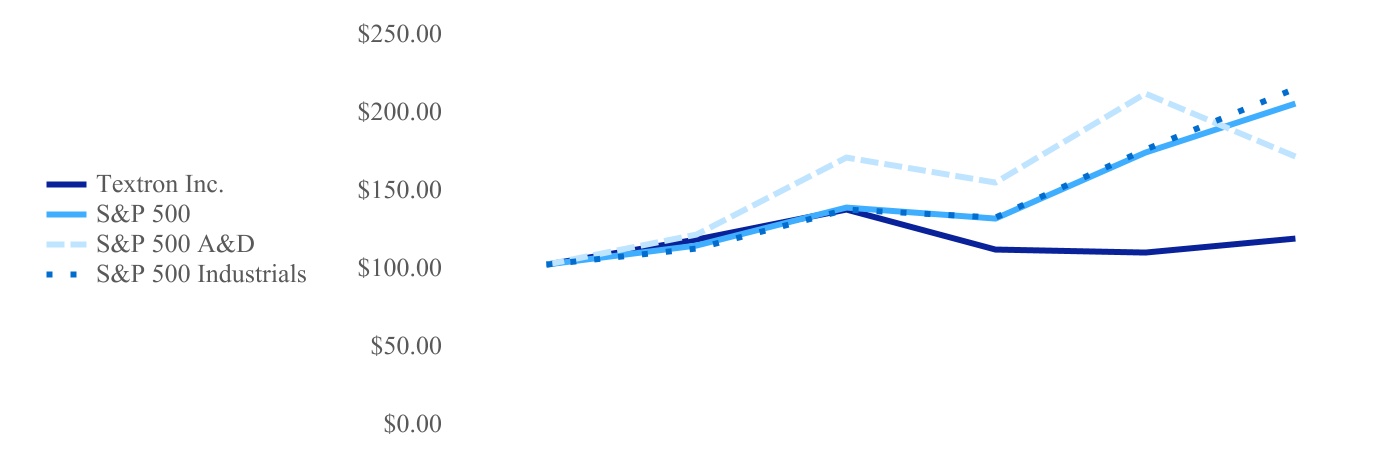
| 2015 | 2016 | 2017 | 2018 | 2019 | 2020 | |||||||||||||||
| Textron Inc. | $ | 100.00 | $ | 115.82 | $ | 135.19 | $ | 109.20 | $ | 107.20 | $ | 116.07 | ||||||||
| S&P 500 | 100.00 | 111.96 | 136.40 | 129.31 | 171.74 | 203.04 | ||||||||||||||
| S&P 500 A&D | 100.00 | 118.90 | 168.11 | 152.51 | 209.19 | 169.05 | ||||||||||||||
| S&P 500 Industrials | 100.00 | 110.12 | 134.97 | 129.69 | 173.16 | 212.71 |
Item 6. Selected Financial Data
| (Dollars in millions, except per share amounts) | 2020 | 2019 | 2018 | 2017 | 2016 | ||||||||||||
| Revenues (a) | |||||||||||||||||
| Textron Aviation | $ | 3,974 | $ | 5,187 | $ | 4,971 | $ | 4,686 | $ | 4,921 | |||||||
| Bell | 3,309 | 3,254 | 3,180 | 3,317 | 3,239 | ||||||||||||
| Textron Systems | 1,313 | 1,325 | 1,464 | 1,840 | 1,756 | ||||||||||||
| Industrial | 3,000 | 3,798 | 4,291 | 4,286 | 3,794 | ||||||||||||
| Finance | 55 | 66 | 66 | 69 | 78 | ||||||||||||
| Total revenues | $ | 11,651 | $ | 13,630 | $ | 13,972 | $ | 14,198 | $ | 13,788 | |||||||
| Segment profit | |||||||||||||||||
| Textron Aviation | $ | 16 | $ | 449 | $ | 445 | $ | 303 | $ | 389 | |||||||
| Bell | 462 | 435 | 425 | 415 | 386 | ||||||||||||
| Textron Systems | 152 | 141 | 156 | 139 | 186 | ||||||||||||
| Industrial | 111 | 217 | 218 | 290 | 329 | ||||||||||||
| Finance | 10 | 28 | 23 | 22 | 19 | ||||||||||||
| Total segment profit | 751 | 1,270 | 1,267 | 1,169 | 1,309 | ||||||||||||
| Corporate expenses and other, net | (122) | (110) | (119) | (132) | (172) | ||||||||||||
| Interest expense, net for Manufacturing group | (145) | (146) | (135) | (145) | (138) | ||||||||||||
| Special charges (b) | (147) | (72) | (73) | (130) | (123) | ||||||||||||
| Inventory charge (c) | (55) | — | — | — | — | ||||||||||||
| Gain on business disposition (d) | — | — | 444 | — | — | ||||||||||||
| Income tax (expense) benefit (e) | 27 | (127) | (162) | (456) | (33) | ||||||||||||
| Income from continuing operations | $ | 309 | $ | 815 | $ | 1,222 | $ | 306 | $ | 843 | |||||||
| Earnings per share | |||||||||||||||||
| Basic earnings per share — continuing operations | $ | 1.35 | $ | 3.52 | $ | 4.88 | $ | 1.15 | $ | 3.11 | |||||||
| Diluted earnings per share — continuing operations | $ | 1.35 | $ | 3.50 | $ | 4.83 | $ | 1.14 | $ | 3.09 | |||||||
| Basic average shares outstanding (in thousands) | 228,536 | 231,315 | 250,196 | 266,380 | 270,774 | ||||||||||||
| Diluted average shares outstanding (in thousands) | 228,979 | 232,709 | 253,237 | 268,750 | 272,365 | ||||||||||||
| Common stock information | |||||||||||||||||
| Dividends declared per share | $ | 0.08 | $ | 0.08 | $ | 0.08 | $ | 0.08 | $ | 0.08 | |||||||
| Book value at year-end | $ | 25.81 | $ | 24.21 | $ | 22.04 | $ | 21.60 | $ | 20.62 | |||||||
| Price at year-end | $ | 48.33 | $ | 44.74 | $ | 45.65 | $ | 56.59 | $ | 48.56 | |||||||
| Financial position | |||||||||||||||||
| Total assets | $ | 15,443 | $ | 15,018 | $ | 14,264 | $ | 15,340 | $ | 15,358 | |||||||
| Manufacturing group debt | $ | 3,707 | $ | 3,124 | $ | 3,066 | $ | 3,088 | $ | 2,777 | |||||||
| Finance group debt | $ | 662 | $ | 686 | $ | 718 | $ | 824 | $ | 903 | |||||||
| Shareholders’ equity | $ | 5,845 | $ | 5,518 | $ | 5,192 | $ | 5,647 | $ | 5,574 | |||||||
| Manufacturing group debt-to-capital (net of cash) | 21% | 26% | 29% | 26% | 23% | ||||||||||||
| Manufacturing group debt-to-capital | 39% | 36% | 37% | 35% | 33% | ||||||||||||
| Investment data | |||||||||||||||||
| Capital expenditures | $ | 317 | $ | 339 | $ | 369 | $ | 423 | $ | 446 | |||||||
| Manufacturing group depreciation | $ | 325 | $ | 346 | $ | 358 | $ | 362 | $ | 368 |
*(a)*At the beginning of 2018, we adopted ASC 606 using a modified retrospective basis and as a result, the comparative information has not been restated and is reported under the accounting standards in effect for these years.
*(b)*In 2020, special charges included $108 million recorded under a restructuring plan, primarily impacting the TRU Simulation + Training (TRU) business within the Textron Systems segment, and the Textron Aviation and Industrial segments, and $39 million of charges related to the impairment of indefinite-lived trade name intangible assets, primarily in the Textron Aviation segment. In 2019, $72 million was recorded under a restructuring plan principally impacting the Industrial and Textron Aviation segments. In 2018, $73 million was recorded under a restructuring plan for the Specialized Vehicles businesses within our Industrial segment. In 2017 and 2016, special charges included $90 million and $123 million, respectively, related to our 2016 restructuring plan and $40 million in 2017, for a restructuring plan related to the Arctic Cat acquisition.
*(c)*In connection with the 2020 restructuring plan, we ceased manufacturing at TRU's facility in Montreal, Canada, resulting in the production suspension of its commercial air transport simulators. As a result of market conditions and the cessation of manufacturing at this facility, we incurred a $55 million charge to write-down the related inventory to its net realizable value.
*(d)*In 2018, we completed the sale of the Tools and Test Equipment product line which resulted in an after-tax gain of $419 million.
*(e)*In 2017, income tax expense included a $266 million charge to reflect our provisional estimate of the net impact of the Tax Cuts and Jobs Act. We completed our analysis of this legislation in the fourth quarter of 2018 and recorded a $14 million benefit. In 2016, we recognized a benefit of $319 million, inclusive of interest, of which $206 million is attributable to continuing operations and $113 million is attributable to discontinued operations. This benefit was a result of the final settlement with the Internal Revenue Service Office of Appeals for our 1998 to 2008 tax years.
Item 7. Management’s Discussion and Analysis of Financial Condition and Results of Operations
Overview
During 2020, the global pandemic caused by the novel coronavirus, known as “COVID-19”, led to worldwide facility closures, workforce disruptions, supply chain destabilizations, reduced demand for many products and services, volatility in the capital markets and uncertainty in the economic outlook. Our operations experienced and continue to experience various degrees of disruption due to the unprecedented conditions surrounding the pandemic. While some of our commercial manufacturing facilities had temporarily closed during the first quarter of 2020 through the latter part of the second quarter due to reduced demand for certain of our products, substantially all manufacturing activities had resumed in the third quarter. In the second half of the year, our commercial businesses have generally experienced an increase in customer demand compared with the first half of 2020. However, demand has not returned to pre-pandemic levels.
In the first quarter of 2020, following the onset of the pandemic, we strengthened our cash position by issuing $650 million in senior debt and by borrowing $500 million under a new 364-Day Term Loan Credit Agreement. We also temporarily suspended share repurchases and took other measures to reduce costs and conserve cash, including employee furloughs at many of our commercial businesses and at corporate headquarters, reducing capital expenditures and delaying certain research and development projects. In the second quarter, we continued most of the measures taken in the first quarter to reduce costs and conserve cash and initiated a restructuring plan at certain of our businesses to further reduce costs. During the remainder of the year, we continued our focus on managing our businesses through the impacts of the pandemic while investing in future products and technologies. Key financial highlights for 2020 include:
-
Generated $833 million of net cash from operating activities from our manufacturing businesses.
-
Maintained a strong cash position with $2.3 billion in cash and equivalents at the end of the year.
-
Invested $317 million in capital expenditures and $549 million in research and development projects.
-
Repurchased 4.1 million shares of our common stock.
While we expect our commercial businesses, which have been adversely impacted by the pandemic, to slowly recover with the broader economic recovery, we cannot reasonably estimate when customer demand for our products and services may return to pre-pandemic levels. There are many uncertainties regarding the pandemic, and we continue to closely monitor the impact of the pandemic on all aspects of our business, including how it is impacting our customers, employees, suppliers, vendors, business partners and distribution channels. See Item 1A. Risk Factors for additional risks and uncertainties related to the pandemic’s impact on our business. The ultimate extent of the effects of the pandemic on the company and our consolidated financial position is uncertain and will depend on future developments, including the length and severity of the pandemic, and such effects could exist for an extended period of time, even after the pandemic ends.
For an overview of our business segments, including a discussion of our major products and services, refer to Item 1. Business. A discussion of our financial condition and operating results for 2020 compared with 2019 is provided below, while a discussion of 2019 compared with 2018 can be found in Item 7. Management’s Discussion and Analysis of Financial Condition and Results of Operations of our Annual Report on Form 10-K for the year ended January 4, 2020. The following discussion should be read in conjunction with our Consolidated Financial Statements and related Notes included in Item 8. Financial Statements and Supplementary Data.
Consolidated Results of Operations
| % Change | |||||||||||||||||
| (Dollars in millions) | 2020 | 2019 | 2018 | 2020 | 2019 | ||||||||||||
| Revenues | $ | 11,651 | $ | 13,630 | $ | 13,972 | (15)% | (2)% | |||||||||
| Cost of sales | 10,094 | 11,406 | 11,594 | (12)% | (2)% | ||||||||||||
| Gross margin as a percentage of Manufacturing revenues | 13.0% | 15.9% | 16.6% | ||||||||||||||
| Selling and administrative expense | 1,045 | 1,152 | 1,275 | (9)% | (10)% | ||||||||||||
| Interest expense | 166 | 171 | 166 | (3)% | 3% |
Revenues
Revenues decreased $2.0 billion, 15%, in 2020, compared with 2019. The revenue decrease included the following factors:
-
Textron Aviation revenues were lower by $1.2 billion, largely due to lower Citation jet and commercial turboprop volume of $916 million, reflecting a decline in demand related to the pandemic, and lower aftermarket volume of $337 million, reflecting lower aircraft utilization resulting from the pandemic.
-
Industrial revenues were lower by $798 million, largely due to lower volume in the Fuel Systems and Functional Components product line, primarily due to manufacturing facility closures in the first half of 2020, and lower volume and mix in the Specialized Vehicles product line, primarily reflecting a decline in demand related to the pandemic.
-
Bell revenues were higher by $55 million, due to higher military revenues of $225 million, largely reflecting spares and logistics support, partially offset by lower commercial revenues.
Cost of Sales and Selling and Administrative Expense
Cost of sales decreased $1.3 billion, 12%, in 2020, compared with 2019, largely due to lower net volume and mix described above. The decrease in cost of sales was partially offset by idle facility costs of $142 million, primarily at the Textron Aviation segment, reflecting unfavorable absorption of manufacturing costs attributable to abnormally low production levels resulting from the pandemic and temporary manufacturing facility closures, and a $55 million inventory charge related to the TRU business discussed in Note 17 to the Consolidated Financial Statements in Item 8. Financial Statements and Supplementary Data. Gross margin as a percentage of Manufacturing revenues decreased 290 basis points in 2020, compared with 2019, primarily due to lower margin at the Textron Aviation segment reflecting unfavorable impacts from the pandemic, including the idle facility costs and inventory valuation charges.
Selling and administrative expense decreased $107 million, 9%, in 2020, compared with 2019, primarily due to cost reduction activities across our manufacturing segments, principally at the Textron Aviation and Industrial segments.
Special Charges
Special charges of $147 million and $72 million in 2020 and 2019, respectively, primarily include restructuring activities and intangible asset impairment charges as described in Note 17 to the Consolidated Financial Statements in Item 8. Financial Statements and Supplementary Data.
Income Taxes
| 2020 | 2019 | 2018 | |||||||||
| Effective tax rate | (9.6%) | 13.5% | 11.7% |
In 2020, the effective tax rate of (9.6)% was lower than the U.S. federal statutory tax rate of 21%, primarily due to an audit settlement with respect to certain state income tax returns that resulted in a $52 million benefit and the favorable impact of research credits. In 2019, the effective tax rate of 13.5% was lower than the U.S. federal statutory tax rate of 21%, primarily due to
Showing the first 8K of 60K characters. Open the full section
Item 7A. Quantitative and Qualitative Disclosures About Market Risk
Foreign Currency Exchange Risk
Our financial results are affected by changes in foreign currency exchange rates in the various countries in which our products are manufactured and/or sold. For our manufacturing operations, we manage our foreign currency transaction exposures by entering into foreign currency exchange contracts. These contracts generally are used to fix the local currency cost of purchased goods or services or selling prices denominated in currencies other than the functional currency. The notional amount of outstanding foreign currency exchange contracts was $318 million and $342 million at January 2, 2021 and January 4, 2020, respectively. We also may hedge exposures to certain of our foreign currency assets and earnings by funding those asset positions with debt in the same foreign currency so the exposures are naturally offset.
Interest Rate Risk
Our financial results are affected by changes in interest rates. As part of managing this risk, we seek to achieve a prudent balance between floating- and fixed-rate exposures. We continually monitor our mix of these exposures and adjust the mix, as necessary. For our Finance group, we generally limit our risk to changes in interest rates with a strategy of matching floating-rate assets with floating-rate liabilities. This strategy includes the use of interest rate swap agreements. At the end of 2020, we had an interest rate swap agreement for a notional amount of $294 million, which effectively converted certain floating-rate debt to a fixed-rate equivalent.
Quantitative Risk Measures
In the normal course of business, we enter into financial instruments for purposes other than trading. The financial instruments that are subject to market risk include finance receivables (excluding leases), debt (excluding finance lease obligations) and foreign currency exchange contracts. To quantify the market risk inherent in these financial instruments, we utilize a sensitivity analysis that includes a hypothetical change in fair value assuming a 10% decrease in interest rates and a 10% strengthening in foreign exchange rates against the U.S. dollar. The fair value of these financial instruments is estimated using discounted cash flow analysis and indicative market pricing as reported by leading financial news and data providers.
At the end of each year, the table below provides the carrying and fair values of these financial instruments along with the sensitivity of fair value to the hypothetical changes discussed above. This sensitivity analysis is most likely not indicative of actual results in the future.
| January 2, 2021 | January 4, 2020 | |||||||||||||||||||
| (In millions) | Carrying Value* | Fair Value* | Sensitivity of Fair Value to a 10% Change | Carrying Value* | Fair Value* | Sensitivity of Fair Value to a 10% Change | ||||||||||||||
| Manufacturing group | ||||||||||||||||||||
| Foreign currency exchange risk | ||||||||||||||||||||
| Debt | $ | (10) | $ | (10) | $ | (1) | $ | (210) | $ | (212) | $ | (21) | ||||||||
| Foreign currency exchange contracts | 3 | 3 | 22 | (1) | (1) | 20 | ||||||||||||||
| $ | (7) | $ | (7) | $ | 21 | $ | (211) | $ | (213) | $ | (1) | |||||||||
| Interest rate risk | ||||||||||||||||||||
| Debt | $ | (3,690) | $ | (3,986) | $ | (16) | $ | (3,097) | $ | (3,249) | $ | (21) | ||||||||
| Finance group | ||||||||||||||||||||
| Interest rate risk | ||||||||||||||||||||
| Finance receivables | $ | 549 | $ | 599 | $ | 9 | $ | 493 | $ | 527 | $ | 9 | ||||||||
| Debt | (662) | (587) | — | (686) | (634) | 1 |
** The value represents an asset or (liability).*
Item 8. Financial Statements and Supplementary Data
Our Consolidated Financial Statements and the related report of our independent registered public accounting firm thereon are included in this Annual Report on Form 10-K on the pages indicated below:
All other schedules are omitted either because they are not applicable or not required or because the required information is included in the financial statements or notes thereto.
Consolidated Statements of Operations
For each of the years in the three-year period ended January 2, 2021
| (In millions, except per share data) | 2020 | 2019 | 2018 | ||||||||
| Revenues | |||||||||||
| Manufacturing revenues | $ | 11,596 | $ | 13,564 | $ | 13,906 | |||||
| Finance revenues | 55 | 66 | 66 | ||||||||
| Total revenues | 11,651 | 13,630 | 13,972 | ||||||||
| Costs, expenses and other | |||||||||||
| Cost of sales | 10,094 | 11,406 | 11,594 | ||||||||
| Selling and administrative expense | 1,045 | 1,152 | 1,275 | ||||||||
| Interest expense | 166 | 171 | 166 | ||||||||
| Special charges | 147 | 72 | 73 | ||||||||
| Non-service components of pension and postretirement income, net | (83) | (113) | (76) | ||||||||
| Gain on business di |
Showing the first 8K of 182K characters. Open the full section
Item 9. Changes In and Disagreements With Accountants on Accounting and Financial Disclosure
None.
Item 9A. Controls and Procedures
Disclosure Controls and Procedures
We performed an evaluation of the effectiveness of our disclosure controls and procedures as of January 2, 2021. The evaluation was performed with the participation of senior management of each business segment and key Corporate functions, under the supervision of our Chairman, President and Chief Executive Officer (CEO) and our Executive Vice President and Chief Financial Officer (CFO). Based on this evaluation, the CEO and CFO concluded that our disclosure controls and procedures were operating and effective as of January 2, 2021.
Changes in Internal Controls Over Financial Reporting
There were no changes in our internal control over financial reporting during the fourth quarter of the fiscal year covered by this report that materially affected, or are reasonably likely to materially affect, our internal control over financial reporting.
Management’s Report on Internal Control Over Financial Reporting
Management is responsible for establishing and maintaining adequate internal control over financial reporting for Textron Inc. as such term is defined in Exchange Act Rules 13a-15(f). Our internal control structure is designed to provide reasonable assurance, at appropriate cost, that assets are safeguarded and that transactions are properly executed and recorded. The internal control structure includes, among other things, established policies and procedures, an internal audit function, the selection and training of qualified personnel as well as management oversight.
With the participation of our management, we performed an evaluation of the effectiveness of our internal control over financial reporting based on criteria established in Internal Control – Integrated Framework issued by the Committee of Sponsoring Organizations of the Treadway Commission (2013 Framework). Based on our evaluation under the 2013 Framework, we have concluded that Textron Inc. maintained, in all material respects, effective internal control over financial reporting as of January 2, 2021.
The independent registered public accounting firm, Ernst & Young LLP, has audited the Consolidated Financial Statements of Textron Inc. and has issued an attestation report on Textron’s internal controls over financial reporting as of January 2, 2021, as stated in its report, which is included herein.
Report of Independent Registered Public Accounting Firm
To the Shareholders and the Board of Directors of Textron Inc.
Opinion on Internal Control over Financial Reporting
We have audited Textron Inc.’s internal control over financial reporting as of January 2, 2021, based on criteria established in Internal Control— Integrated Framework issued by the Committee of Sponsoring Organizations of the Treadway Commission (2013 Framework), (the COSO criteria). In our opinion, Textron, Inc. (the Company) maintained, in all material respects, effective internal control over financial reporting as of January 2, 2021, based on the COSO criteria.
We also have audited, in accordance with the standards of the Public Company Accounting Oversight Board (United States) (PCAOB), the Consolidated Balance Sheets of the Company as of January 2, 2021 and January 4, 2020, and the related Consolidated Statements of Operations, Comprehensive Income, Shareholder’s Equity and Cash Flows for each of the three years in the period ended January 2, 2021, and the related notes and the financial statement schedule contained on page 73, of the Company and our report dated February 19, 2021 expressed an unqualified opinion thereon.
Basis for Opinion
The Company’s management is responsible for maintaining effective internal control over financial reporting and for its assessment of the effectiveness of internal control over financial reporting included in the accompanying Management’s Report on Internal Control Over Financial Reporting. Our responsibility is to express an opinion on the Company’s internal control over financial reporting based on our audit. We are a public accounting firm registered with the PCAOB and are required to be independent with respect to the Company in accordance with the U.S. federal securities laws and the applicable rules and regulations of the Securities and Exchange Commission and the PCAOB.
We conducted our audit in accordance with the standards of the PCAOB. Those standards require that we plan and perform the audit to obtain reasonable assurance about whether effective internal control over financial reporting was maintained in all material respects.
Our audit included obtaining an understanding of internal control over financial reporting, assessing the risk that a material weakness exists, testing and evaluating the design and operating effectiveness of internal control based on the assessed risk, and performing such other procedures as we considered necessary in the circumstances. We believe that our audit provides a reasonable basis for our opinion.
Definition and Limitations of Internal Control Over Financial Reporting
A company’s internal control over financial reporting is a process designed to provide reasonable assurance regarding the reliability of financial reporting and the preparation of financial statements for external purposes in accordance with generally accepted accounting principles. A company’s internal control over financial reporting includes those policies and procedures that (1) pertain to the maintenance of records that, in reasonable detail, accurately and fairly reflect the transactions and dispositions of the assets of the company; (2) provide reasonable assurance that transactions are recorded as necessary to permit preparation of financial statements in accordance with generally accepted accounting principles, and that receipts and expenditures of the company are being made only in accordance with authorizations of management and directors of the company; and (3) provide reasonable assurance regarding prevention or timely detection of unauthorized acquisition, use, or disposition of the company’s assets that could have a material effect on the financial statements.
Because of its inherent limitations, internal control over financial reporting may not prevent or detect misstatements. Also, projections of any evaluation of effectiveness to future periods are subject to the risk that controls may become inadequate because of changes in conditions, or that the degree of compliance with the policies or procedures may deteriorate.
/s/ Ernst & Young LLP
Boston, Massachusetts
February 19, 2021
PART III
Item 10. Directors, Executive Officers and Corporate Governance
The information appearing under “ELECTION OF DIRECTORS — Nominees for Director,” “CORPORATE GOVERNANCE — Corporate Governance Guidelines and Policies,” “— Code of Ethics,” and “— Board Committees — Audit Committee,” in the Proxy Statement for our 2021 Annual Meeting of Shareholders is incorporated by reference into this Annual Report on Form 10-K.
Information regarding our executive officers is contained in Part I of this Annual Report on Form 10-K.
Item 11. Executive Compensation
The information appearing under “CORPORATE GOVERNANCE — Compensation of Directors,” “COMPENSATION COMMITTEE REPORT,” “COMPENSATION DISCUSSION AND ANALYSIS” and “EXECUTIVE COMPENSATION” in the Proxy Statement for our 2021 Annual Meeting of Shareholders is incorporated by reference into this Annual Report on Form 10-K.
Item 12. Security Ownership of Certain Beneficial Owners and Management and Related Stockholder Matters
The information appearing under “SECURITY OWNERSHIP” and “EXECUTIVE COMPENSATION – Equity Compensation Plan Information” in the Proxy Statement for our 2021 Annual Meeting of Shareholders is incorporated by reference into this Annual Report on Form 10-K.
Item 13. Certain Relationships and Related Transactions and Director Independence
The information appearing under “CORPORATE GOVERNANCE — Director Independence” and “EXECUTIVE COMPENSATION — Transactions with Related Persons” in the Proxy Statement for our 2021 Annual Meeting of Shareholders is incorporated by reference into this Annual Report on Form 10-K.
Item 14. Principal Accountant Fees and Services
The information appearing under “RATIFICATION OF APPOINTMENT OF INDEPENDENT REGISTERED PUBLIC ACCOUNTING FIRM — Fees to Independent Auditors” in the Proxy Statement for our 2021 Annual Meeting of Shareholders is incorporated by reference into this Annual Report on Form 10-K.
PART IV
Item 15. Exhibits and Financial Statement Schedules
Financial Statements and Schedules — See Index on Page 34.
Item 16. Form 10-K Summary
Not applicable.
Signatures
Pursuant to the requirement of Section 13 or 15(d) of the Securities Exchange Act of 1934, the registrant has duly caused this Annual Report on Form 10-K to be signed on its behalf by the undersigned, thereunto duly authorized on this 19th day of February 2021.
| TEXTRON INC. | ||||||||
| Registrant | ||||||||
| By: | /s/ Frank T. Connor | |||||||
| Frank T. Connor Executive Vice President and Chief Financial Officer |
Pursuant to the requirements of the Securities Exchange Act of 1934, this Annual Report on Form 10-K has been signed below on this 19th day of February 2021 by the following persons on behalf of the registrant and in the capacities indicated:
| Name | Title | ||||||||||
| /s/ Scott C. Donnelly | |||||||||||
| Scott C. Donnelly | Chairman, President and Chief Executive Officer (principal executive officer) | ||||||||||
| * | |||||||||||
| Kathleen M. Bader | Director | ||||||||||
| * | |||||||||||
| R. Kerry Clark | Director | ||||||||||
| * | |||||||||||
| James T. Conway | Director | ||||||||||
| * | |||||||||||
| Paul E. Gagné | Director | ||||||||||
| * | |||||||||||
| Ralph D. Heath | Director | ||||||||||
| * | |||||||||||
| Deborah Lee James | Director | ||||||||||
| * | |||||||||||
| Lionel L. Nowell III | Director | ||||||||||
| * | |||||||||||
| James L. Ziemer | Director | ||||||||||
| * | |||||||||||
| Maria T. Zuber | Director | ||||||||||
| /s/ Frank T. Connor | |||||||||||
| Frank T. Connor | Executive Vice President and Chief Financial Officer (principal financial officer) | ||||||||||
| /s/ Mark S. Bamford | |||||||||||
| Mark S. Bamford | Vice President and Corporate Controller (principal accounting officer) | ||||||||||
| *By: | /s/ Jayne M. Donegan | ||||||||||
| Jayne M. Donegan, Attorney-in-fact |