 filings.tools
Item 1. Business
31K characters. Original on sec.gov · Markdown
Item 1. Business
Textron Inc. is a multi-industry company that leverages its global network of aircraft, defense, industrial and finance businesses to provide customers with innovative products and services around the world. References to “Textron Inc.,” the “Company,” “we,” “our” and “us” in this Annual Report on Form 10-K, unless otherwise indicated, refer to Textron Inc. and its consolidated subsidiaries.
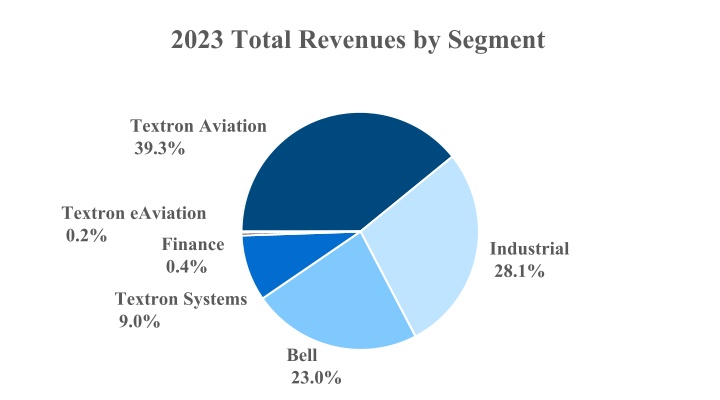
We conduct our business through six operating segments: Textron Aviation, Bell, Textron Systems, Industrial and Textron eAviation, which represent our manufacturing businesses, and Finance, which represents our captive finance business. Our segments include numerous separately incorporated subsidiaries. Total revenues for 2023 were $13.7 billion and are presented below by segment and customer type.

The following description of our business and operating segments should be read in conjunction with Item 7. Management’s Discussion and Analysis of Financial Condition and Results of Operations.
Textron Aviation Segment
Textron Aviation is a leader in general aviation. Textron Aviation manufactures, sells and services Cessna and Beechcraft aircraft, and services the Hawker brand of business jets. The segment has two principal product lines: aircraft and aftermarket parts and services. Aircraft includes sales of business jets, turboprop aircraft, military trainer and defense aircraft and piston engine aircraft. Aftermarket parts and services includes commercial parts sales and maintenance, inspection and repair services.
Textron Aviation's business jets include the Cessna Citation M2 Gen2, Citation CJ3 Gen2, Citation CJ4 Gen2, Citation XLS Gen2, Citation Latitude and the Citation Longitude. Textron Aviation’s turboprop aircraft include the Beechcraft King Air 260, King Air 360ER and King Air 360, and the Cessna Caravan, Grand Caravan EX and SkyCourier. In addition, Textron Aviation’s military trainer and defense aircraft include the Beechcraft T-6 trainer, which has been used to train pilots from more than 40 countries, and the AT-6 light attack military aircraft, which has achieved military type certification from the U.S. Air Force. Textron Aviation also offers piston engine aircraft including the Beechcraft Baron G58 and Bonanza G36, and the Cessna Skyhawk, Skylane, Turbo Skylane, and Turbo Stationair HD.
Textron Aviation markets its products worldwide through its own sales force, as well as through a network of authorized independent sales representatives. With a product lineup ranging from introductory training aircraft through super mid-size business jets, Textron Aviation’s diverse customer base includes fractional aircraft businesses, charter and fleet operators, corporate aviation, individual buyers, training schools, airlines, and special mission, military and government operators.
In support of its family of aircraft, Textron Aviation operates a global network of more than 20 service centers, two of which are co-located with Bell. In addition, more than 300 authorized independent service centers are located throughout the world. Textron Aviation-owned service centers provide customers with 24-hour service and maintenance. Textron Aviation also provides its customers with around-the-clock parts support and offers a mobile support program with over 80 mobile service units.
Textron Aviation is developing the Citation Ascend, a high-performance midsize business jet, which is expected to enter into service in 2025. The Beechcraft Denali, a high-performance single engine turboprop aircraft also under development, achieved its first flight in November 2021 and is in the certification process with the Federal Aviation Administration (FAA). The Denali will be powered by an engine expected to be up to 20% more efficient than similarly sized engines.
Bell Segment
Bell is one of the leading suppliers of military and commercial helicopters, tiltrotor aircraft, and related spare parts and services in the world. Tiltrotor aircraft are designed to provide the benefits of both helicopters and fixed-wing aircraft.
Bell supplies advanced military helicopters and provides parts and support services to the U.S. Government and to military customers outside the United States. Bell’s major U.S. Government programs are for the production and support of V-22 tiltrotor aircraft, primarily for the U.S. Department of Defense; the development of the V-280 Valor, a next generation tiltrotor aircraft for the U.S. Army’s Future Long Range Assault Aircraft (FLRAA) program; and production and support of H-1 helicopters for the U.S. Marine Corps. Under the U.S. Government-sponsored foreign military sales program, Bell offers the V-22 tiltrotor aircraft and H-1 helicopter products for sale to other countries.
The FLRAA development contract was awarded to Bell in December 2022 as part of the U.S. Army’s Future Vertical Lift (FVL) initiative. Bell is developing a tiltrotor aircraft, based on the V-280 Valor, to meet U.S. Army weapon system requirements. The V-280 Valor first flew in December 2017 and has conducted over 200 hours of flight testing.
Bell is also developing a new rotorcraft, the Bell 360 Invictus, for the U.S. Army's Future Attack Reconnaissance Aircraft (FARA) Competitive Prototype Program, which is part of the U.S. government's FVL initiative. In March 2020, the U.S. Army selected the 360 Invictus to move to the second phase of the Competitive Prototype Program. Bell continues to progress on its development of the 360 Invictus Prototype under this phase of the cost-share program. On February 8, 2024, as part of plans to rebalance its aviation modernization investments, the U.S. Army announced plans to discontinue development of the FARA at the conclusion of FY24 prototyping activities.
Through its commercial business, Bell is a leading supplier of commercially certified helicopters and support to corporate, private, law enforcement, utility, public safety and emergency medical helicopter operators, and U.S. and foreign governments. Bell produces a variety of commercial aircraft types, including light single- and twin-engine helicopters and medium twin-engine helicopters, along with other related products. The commercial helicopters currently offered by Bell include the 429, 407GXi, 412EPX and 505 Jet Ranger X. Bell’s first super medium commercial helicopter, the 525 Relentless, is currently in the certification process with the FAA.
For both its military programs and its commercial products, Bell provides post-sale support and service for an installed base of approximately 13,000 helicopters. Bell operates a global network of eight Company-operated service centers, two of which are co-located with Textron Aviation, and four global parts distribution centers. In addition, approximately 85 independent service centers are located in about 35 countries. Collectively, these service sites offer a complete range of logistics support, including parts, support equipment, technical data, training devices, pilot and maintenance training, component repair and overhaul, engine repair and overhaul, aircraft modifications, aircraft customizing, accessory manufacturing, contractor maintenance, field service and product support engineering.
Textron Systems Segment
The businesses in our Textron Systems segment develop, manufacture and integrate a variety of products and services for U.S. and international military, government and commercial customers to support defense, homeland security, aerospace, infrastructure protection and other customer missions. Product and service offerings of this segment include electronic systems and solutions, advanced marine craft, piston aircraft engines, live military air-to-air and air-to-ship training, weapons and related components, unmanned aircraft systems and both manned and unmanned armored and specialty vehicles.
Notable products developed and produced by the Textron Systems segment include the Ship-to-Shore Connector, the U.S. Navy's next generation of Landing Craft Air Cushion vehicles; a family of test and simulation products; Shadow, the U.S. Army's premier tactical unmanned aircraft system; the Aerosonde Small Unmanned Aircraft System, a multi-mission capable unmanned aircraft system for commercial and military operations; and piston aircraft engines under the Lycoming brand. Notable service offerings of the segment include fee-for-service programs, using unmanned aircraft systems, and live military air-to-air and air-to-ship training and support services for U.S. Navy, Marine and Air Force personnel provided by Airborne Tactical Advantage Company.
Industrial Segment
Our Industrial segment designs and manufactures a variety of products within the Kautex and Specialized Vehicles product lines.
Kautex is a leader in designing and manufacturing plastic fuel systems for automobiles and light trucks, including blow-molded solutions for conventional plastic fuel tanks and pressurized plastic fuel tanks for hybrid vehicle applications. Kautex also develops and manufactures clear-vision systems for automotive safety and advanced driver assistance systems (ADAS). Our cleaning systems are comprised of nozzles, reservoirs, inlets and pumps to support onboard cleaning for windscreens, headlamps and ADAS cameras and sensors. In addition, Kautex produces plastic tanks for selective catalytic reduction systems used to
reduce emissions from diesel engines, and other fuel system components. Kautex has also developed and begun to offer lightweight, composite Pentatonic battery systems, which include enclosures, underbody protection and thermal management systems, for use in electric vehicles, from hybrid to full battery-powered.
Kautex’s business model is focused on developing and maintaining long-term customer relationships with leading global original equipment manufacturers (OEMs). Kautex, which is headquartered in Bonn, Germany, operates over 30 plants in 13 countries in close proximity to its customers, along with 9 engineering/research and development locations around the world.
Our Specialized Vehicles product line includes products sold by the Textron Specialized Vehicles businesses under our E-Z-GO, Arctic Cat, TUG Technologies, Douglas Equipment, Premier, Safeaero, Ransomes, Jacobsen and Cushman brands. These businesses design, manufacture and sell golf cars; off-road utility vehicles; powersports products; light transportation vehicles; aviation ground support equipment; professional turf-maintenance equipment; and specialized turf-care vehicles. A significant portion of the products sold by these businesses are powered with lithium batteries, greatly reducing the products’ impact on the environment.
The diversified customer base for the Specialized Vehicles product line includes golf courses and resorts, government agencies and municipalities, consumers, outdoor enthusiasts, and commercial and industrial users such as factories, warehouses, airlines, planned communities, hunting preserves, educational and corporate campuses, sporting venues and landscaping professionals. Sales are made through a network of independent distributors and dealers worldwide and the Bass Pro Shops and Cabela's retail outlets, which sell our products under the Tracker Off Road brand, as well as factory direct resources. In addition, we also manufacture products for OEMs for resale to customers under the OEM’s branding.
Textron eAviation Segment
Our Textron eAviation segment includes Pipistrel, a manufacturer of light aircraft, along with other research and development initiatives related to sustainable aviation solutions. Pipistrel offers a family of light aircraft and gliders with both electric and combustion engines. Pipistrel’s Velis Electro is the world’s first, and currently only, electric aircraft to receive full type certification from the European Union Aviation Safety Agency and from the UK Civil Aviation Authority.
Finance Segment
Our Finance segment, or the Finance group, is a commercial finance business that consists of Textron Financial Corporation (TFC) and its consolidated subsidiaries. The Finance segment provides financing primarily to purchasers of new and pre-owned Textron Aviation aircraft and Bell helicopters. A substantial number of the originations in our finance receivable portfolio are cross-border transactions for aircraft sold outside of the U.S. In 2023 and 2022, our Finance group made payments of $160 million and $92 million, respectively, to finance the Manufacturing group's sale of Textron-manufactured products to third parties.
Backlog
Backlog represents amounts allocated to contracts that we expect to recognize as revenue in future periods when we perform under the contracts. Backlog excludes unexercised contract options and potential orders under ordering-type contracts, such as Indefinite Delivery, Indefinite Quantity contracts.
Our backlog at the end of 2023 and 2022 is summarized below:
| (In millions) | December 30, 2023 | December 31, 2022 | ||||||
| Textron Aviation | $ | 7,169 | $ | 6,387 | ||||
| Bell | 4,780 | 4,781 | ||||||
| Textron Systems | 1,950 | 2,098 | ||||||
| Total backlog | $ | 13,899 | $ | 13,266 |
U.S. Government Contracts and Other Governmental Regulation
Our operations, products and services are subject to various government regulations, including regulations related to U.S. government business, international regulation of aviation products and services, and environmental regulations.
Contracts with the U.S. Government, including contracts under the U.S. Government-sponsored foreign military sales program, generated approximately 21% of our consolidated revenues in 2023, primarily in our Bell and Textron Systems segments. We must comply with and are affected by laws and regulations relating to the formation, administration and performance of U.S. Government contracts. These laws and regulations, among other things, require certification and disclosure of all cost and pricing data in connection with contract negotiation; define allowable and unallowable costs and otherwise govern our right to reimbursement under certain cost-based U.S. Government contracts; and safeguard and restrict the use and dissemination of
classified and covered defense information and the export of certain products and technical data. New laws, regulations or procurement requirements, or changes to current ones, can significantly increase our costs, reducing our profitability.
Our contracts with the U.S. Government generally may be terminated by the U.S. Government for convenience or if we default in whole or in part by failing to perform under the terms of the applicable contract. If the U.S. Government terminates a contract for convenience, we normally will be entitled to payment for the cost of contract work performed before the effective date of termination, including, if applicable, reasonable profit on such work, as well as reasonable termination costs. If, however, the U.S. Government terminates a contract for default, generally: (a) we will be paid the contract price for completed supplies delivered and accepted and services rendered, an agreed-upon amount for manufacturing materials delivered and accepted and for the protection and preservation of property, and an amount for partially completed products accepted by the U.S. Government; (b) the U.S. Government may not be liable for our costs with respect to unaccepted items and may be entitled to repayment of advance payments and progress payments related to the terminated portions of the contract; (c) the U.S. Government may not be liable for assets we own and utilize to provide services under the “fee-for-service” contracts; and (d) we may be liable for excess costs incurred by the U.S. Government in procuring undelivered items from another source. See Aerospace and Defense Industry section in Item 1A. Risk Factors for additional information related to regulation of U.S. Government business.
Our commercial aircraft manufacturing businesses are regulated by the FAA in the U.S. and by similar aviation regulatory governing authorities internationally, including, the European Aviation Safety Agency. Maintenance facilities and aftermarket services must also comply with FAA and international regulations. These regulations address production and quality systems, airworthiness and installation approvals, repair procedures and continuing operational safety. For an aircraft to be manufactured and sold, the model must receive a type certificate from the appropriate aviation authority, and each aircraft must receive a certificate of airworthiness. Aircraft outfitting and completions also require approval by the appropriate aviation authority. See Strategic Risks section in Item 1A. Risk Factors for additional information with respect to risks related to obtaining certification of new aircraft products.
Our operations are subject to numerous laws and regulations designed to protect the environment. For additional information regarding environmental matters, see Note 18 to the Consolidated Financial Statements in Item 8. Financial Statements and Supplementary Data, and Business and Operational Risks and Risks Related to Regulatory, Legal and Other Matters sections in Item 1A. Risk Factors.
Based on current information and the applicable laws and regulations currently in effect, compliance with government regulations, including environmental regulations, has not had, and we do not expect it to have, a material effect on our capital expenditures, earnings or competitive position. However, laws and regulations may be changed or adopted that impose additional compliance requirements which could necessitate capital expenditures or otherwise increase our costs of doing business, reducing our profitability and negatively impacting our operating results.
Human Capital Resources
At December 30, 2023, we employed approximately 35,000 employees worldwide, with approximately 80% located in the U.S. and the remainder located outside of the U.S. Approximately 7,400, or 27%, of our U.S. employees, most of whom work for our Bell and Textron Aviation segments, are represented by unions under collective bargaining agreements, and certain of our non-U.S. employees are represented by organized works councils. From time to time our collective bargaining agreements expire. Historically, we have been successful in negotiating renewals to expiring agreements without any material disruption of operating activities, and management considers employee relations to be good.
Our success is highly dependent upon our ability to hire and retain a workforce with the skills necessary for our businesses to develop and manufacture the products desired by our customers. We need highly skilled personnel in multiple areas including, among others, engineering, manufacturing, information technology, cybersecurity, flight operations, business development and strategy and management. In order to attract and retain highly skilled employees, we offer comprehensive compensation and benefit programs, career opportunities and an engaging, inclusive environment where all employees are treated with dignity and respect.
Health and Safety
The health and safety of our employees, contractors and communities is a priority, and we strive to provide our employees with healthy working conditions and safe facilities. To maintain and enhance the safety of our employees, we promote a workplace safety culture of continuous improvement, shared responsibility, and individual accountability We use an annual goal setting process to drive injury rate improvements, and the injury rate reduction goal is a performance metric that is tracked and reported to senior leadership and the Audit Committee of the Board of Directors.
Talent and Career Development
Our talent development programs are designed to prepare our employees at all levels to take on new career and growth opportunities at Textron. Leadership, professional and functional training courses are tailored for employees at each stage of their careers and include a mix of enterprise-wide and business unit-specific programs. Textron University, an internal corporate function, provides (i) facilitated face-to-face professional and leadership development programs, (ii) web-based general and specialized functional and technical courses and (iii) an online portal to access advanced skills technical training, manage recertification of existing qualifications and other career planning tools and resources.
The current and future talent needs of each of our businesses are assessed annually through a formal talent review process which enables us to develop leadership succession plans and provide our employees with potential new career opportunities. In addition, leaders from functional areas within each business belong to enterprise-wide councils which conduct annual talent reviews. These processes enable us to fill talent needs by matching employees who are ready to assume significant leadership roles with opportunities that best fit their career path, which may be in other businesses within the enterprise.
Textron is committed to having a diverse workforce and inclusive workplaces throughout our global operations. We believe by employing highly talented employees, who feel valued, respected and are able to contribute fully, we will improve performance, innovation, collaboration and talent retention, all of which contributes to stronger business results and reinforces our reputation as leaders in our industries and communities.
For discussion of certain risks relating to human capital management, see Risks Related to Human Capital section in Item 1A. Risk Factors.
Patents and Trademarks
We own, or are licensed under, numerous patents throughout the world relating to products, services and methods of manufacturing. Patents developed while under contract with the U.S. Government may be subject to use by the U.S. Government. We also own or license active trademark registrations and pending trademark applications in the U.S. and in various foreign countries or regions, as well as trade names and service marks. While our intellectual property rights in the aggregate are important to the operation of our business, we do not believe that any existing patent, license, trademark or other intellectual property right is of such importance that its loss or termination would have a material adverse effect on our business taken as a whole.
Information about our Executive Officers
The following table sets forth certain information concerning our executive officers as of February 12, 2024.
| Name | Age | Current Position with Textron Inc. | ||||||
| Scott C. Donnelly | 62 | Chairman, President and Chief Executive Officer | ||||||
| Frank T. Connor | 64 | Executive Vice President and Chief Financial Officer | ||||||
| Julie G. Duffy | 58 | Executive Vice President and Chief Human Resources Officer | ||||||
| E. Robert Lupone | 64 | Executive Vice President, General Counsel, Secretary and Chief Compliance Officer |
Mr. Donnelly joined Textron in June 2008 as Executive Vice President and Chief Operating Officer and was promoted to President and Chief Operating Officer in January 2009. He was appointed to the Board of Directors in October 2009 and became Chief Executive Officer of Textron in December 2009. In July 2010, Mr. Donnelly was appointed Chairman of the Board of Directors effective September 1, 2010. Previously, Mr. Donnelly was the President and CEO of General Electric Company’s Aviation business unit, a position he had held since July 2005. GE’s Aviation business unit is a leading maker of commercial and military jet engines and components, as well as integrated digital, electric power and mechanical systems for aircraft. Prior to July 2005, Mr. Donnelly served as Senior Vice President of GE Global Research, one of the world’s largest and most diversified industrial research organizations with facilities in the U.S., India, China and Germany and held various other management positions since joining General Electric in 1989.
Mr. Connor joined Textron in August 2009 as Executive Vice President and Chief Financial Officer. Previously, Mr. Connor was head of Telecom Investment Banking at Goldman, Sachs & Co. from 2003 to 2008. Prior to that position, he served as Chief Operating Officer of Telecom, Technology and Media Investment Banking at Goldman, Sachs & Co. from 1998 to 2003. Mr. Connor joined the Corporate Finance Department of Goldman, Sachs & Co. in 1986 and became a Vice President in 1990 and a Managing Director in 1996.
Ms. Duffy was named Executive Vice President, Human Resources in July 2017 and Executive Vice President and Chief Human Resources Officer in April 2022. Ms. Duffy joined Textron in 1997 as a member of the corporate legal team and has since held positions of increasing responsibility within the Company’s legal function, previously serving as Vice President and Deputy General Counsel-Litigation, a position she had held since 2011. In that role she was responsible for managing the corporate
litigation staff with primary oversight of litigation throughout Textron. She has also played an active role in developing, implementing and standardizing human resources policies across the Company and served as the senior legal advisor on employment and benefits issues.
Mr. Lupone joined Textron in February 2012 as Executive Vice President, General Counsel, Secretary and Chief Compliance Officer. Previously, he was senior vice president and general counsel of Siemens Corporation (U.S.) since 1999 and general counsel of Siemens AG for the Americas since 2008. Prior to joining Siemens in 1992, Mr. Lupone was vice president and general counsel of Price Communications Corporation.
Available Information
We make available free of charge on our Internet Web site (www.textron.com) our Annual Report on Form 10-K, Quarterly Reports on Form 10-Q, Current Reports on Form 8-K and amendments to those reports filed or furnished pursuant to Section 13(a) or 15(d) of the Securities Exchange Act of 1934 as soon as reasonably practicable after we electronically file such material with, or furnish it to, the Securities and Exchange Commission.
Forward-Looking Information
Certain statements in this Annual Report on Form 10-K and other oral and written statements made by us from time to time are “forward-looking statements” within the meaning of the Private Securities Litigation Reform Act of 1995. These forward-looking statements, which may describe strategies, goals, outlook or other non-historical matters, or project revenues, income, returns or other financial measures, often include words such as “believe,” “expect,” “anticipate,” “intend,” “plan,” “estimate,” “guidance,” “project,” “target,” “potential,” “will,” “should,” “could,” “likely” or “may” and similar expressions intended to identify forward-looking statements. These statements are only predictions and involve known and unknown risks, uncertainties, and other factors that may cause our actual results to differ materially from those expressed or implied by such forward-looking statements. Given these uncertainties, you should not place undue reliance on these forward-looking statements. Forward-looking statements speak only as of the date on which they are made, and we undertake no obligation to update or revise any forward-looking statements. In addition to those factors described herein under “Risk Factors,” among the factors that could cause actual results to differ materially from past and projected future results are the following:
-
Interruptions in the U.S. Government’s ability to fund its activities and/or pay its obligations;
-
Changing priorities or reductions in the U.S. Government defense budget, including those related to military operations in foreign countries;
-
Our ability to perform as anticipated and to control costs under contracts with the U.S. Government;
-
The U.S. Government’s ability to unilaterally modify or terminate its contracts with us for the U.S. Government’s convenience or for our failure to perform, to change applicable procurement and accounting policies, or, under certain circumstances, to withhold payment or suspend or debar us as a contractor eligible to receive future contract awards;
-
Changes in foreign military funding priorities or budget constraints and determinations, or changes in government regulations or policies on the export and import of military and commercial products;
-
Volatility in the global economy or changes in worldwide political conditions that adversely impact demand for our products;
-
Volatility in interest rates or foreign exchange rates and inflationary pressures;
-
Risks related to our international business, including establishing and maintaining facilities in locations around the world and relying on joint venture partners, subcontractors, suppliers, representatives, consultants and other business partners in connection with international business, including in emerging market countries;
-
Our Finance segment’s ability to maintain portfolio credit quality or to realize full value of receivables;
-
Performance issues with key suppliers or subcontractors;
-
Legislative or regulatory actions, both domestic and foreign, impacting our operations or demand for our products;
-
Our ability to control costs and successfully implement various cost-reduction activities;
-
The efficacy of research and development investments to develop new products or unanticipated expenses in connection with the launching of significant new products or programs;
-
The timing of our new product launches or certifications of our new aircraft products;
-
Our ability to keep pace with our competitors in the introduction of new products and upgrades with features and technologies desired by our customers;
-
Pension plan assumptions and future contributions;
-
Demand softness or volatility in the markets in which we do business;
-
Cybersecurity threats, including the potential misappropriation of assets or sensitive information, corruption of data or operational disruption;
-
Difficulty or unanticipated expenses in connection with integrating acquired businesses;
-
The risk that acquisitions do not perform as planned, including, for example, the risk that acquired businesses will not achieve revenue and profit projections;
-
The impact of changes in tax legislation;
-
The risk of disruptions to our business and the business of our suppliers, customers and other business partners due to unexpected events, such as pandemics, natural disasters, acts of war, strikes, terrorism, social unrest or other societal or political conditions; and
-
The ability of our businesses to hire and retain the highly skilled personnel necessary for our businesses to succeed.
Previous: Cover and table of contents · Next: Item 1A. Risk Factors