 filings.tools
Tyler Technologies 10-K 2021-12-31
Filed 2022-02-23. 16 sections, 402K characters. Original on sec.gov · Markdown · JSON
Cover and table of contents
UNITED STATES
SECURITIES AND EXCHANGE COMMISSION
WASHINGTON, D.C. 20549
| FORM | 10-K |
| ☒ | ANNUAL REPORT PURSUANT TO SECTION 13 OR 15(d) OF THE SECURITIES AND EXCHANGE ACT OF 1934 |
For the Fiscal Year Ended December 31, 2021
OR
| ☐ | TRANSITION REPORT PURSUANT TO SECTION 13 OR 15(d) OF THE SECURITIES EXCHANGE ACT OF 1934 |
Commission File Number 1-10485
| TYLER TECHNOLOGIES, INC. | ||
| (Exact name of registrant as specified in its charter) |
| Delaware | 75-2303920 | |||||||
| (State or other jurisdiction of incorporation or organization) | (I.R.S. employer identification no.) | |||||||
| 5101 Tennyson Parkway | ||||||||
| Plano, | Texas | 75024 | ||||||
| (Address of principal executive offices) | (Zip code) |
Registrant’s telephone number, including area code: (972) 713-3700
Securities registered pursuant to Section 12(b) of the Act:
| Title of each class | Trading symbol | Name of each exchange on which registered | ||||||
| COMMON STOCK, $0.01 PAR VALUE | TYL | New York Stock Exchange |
Securities registered pursuant to Section 12(g) of the Act:
| NONE |
Indicate by check mark if the registrant is a well-known seasoned issuer, as defined in Rule 405 of the Securities Act. Yes ☐ No ☒
Indicate by check mark if the registrant is not required to file reports pursuant to Section 13 or 15(d) of the Act. Yes ☐ No ☒
Indicate by check mark whether the registrant (1) has filed all reports required to be filed by Section 13 or 15(d) of the Securities Exchange Act of 1934 during the preceding 12 months (or for such shorter period that the registrant was required to file such reports), and (2) has been subject to such filing requirements for the past 90 days. Yes ☒ No ☐
Indicate by check mark if disclosure of delinquent filer pursuant to Item 405 of Regulation S-K is not contained herein, and will not be contained, to the best of the registrant’s knowledge, in definitive proxy or information statements incorporated by reference in Part III of the Form 10-K or any amendment to the Form 10-K. Yes ☐ No ☒
Indicate by check mark whether the registrant has submitted electronically and posted on its corporate Web site, if any, every Interactive Data file required to be submitted and posted pursuant to Rule 405 of Regulation S-T during the preceding 12 months (or for such shorter period that the registrant was required to submit and post such files). Yes ☒ No ☐
Indicate by check mark whether the registrant is a large accelerated filer, an accelerated filer, a non-accelerated filer, smaller reporting company, or an emerging growth company. See the definitions of “large accelerated filer", "accelerated filer”, "smaller reporting company", and "emerging growth company" in Rule 12b-2 of the Exchange Act. (Check one):
| Large accelerated filer | ☒ | Accelerated Filer | ☐ | |||||||||||||||||
| Non-accelerated Filer (Do not check if smaller reporting company) | ☐ | Smaller Reporting Company | ☐ | |||||||||||||||||
| Emerging Growth Company | ☐ | |||||||||||||||||||
| If an emerging growth company, indicate by check mark if the registrant has elected not to use the extended transition period for complying with any new or revised financial accounting standards provided pursuant to Section 13(a) of the Exchange Act. | ☐ |
Indicate by check mark whether the registrant is a shell company (as defined in Rule 12b-2 of the Act.) Yes ☐ No ☒
Indicate by check mark whether the registrant has filed a report on and attestation to its management’s assessment of the effectiveness of its internal control over financial reporting under Section 404(b) of the Sarbanes-Oxley Act (15 U.S.C. 7262(b)) by the registered public accounting firm that prepared or issued its audit report Yes ☒ No ☐
The aggregate market value of the voting stock held by non-affiliates of the registrant was $18,292,141,436 based on the reported last sale price of common stock on June 30, 2021, which is the last business day of the registrant’s most recently completed second fiscal quarter.
The number of shares of common stock of the registrant outstanding on February 22, 2022 was 41,348,917
DOCUMENTS INCORPORATED BY REFERENCE
Certain information required by Part III of this annual report is incorporated by reference from the registrant’s definitive proxy statement for its annual meeting of stockholders to be held on May 12, 2022.
TYLER TECHNOLOGIES, INC.
FORM 10-K
TABLE OF CONTENTS
PART I
Item 1. BUSINESS.
DESCRIPTION OF BUSINESS
Tyler Technologies, Inc. (“Tyler”) is a major provider of integrated information management solutions and services for the public sector. We partner with clients to make government more accessible to the public, more responsive to the needs of citizens and more efficient in its operations. We have a broad line of software solutions and services to address the information technology (“IT”) needs of major areas of operations for cities, counties, schools and other government entities. We offer our clients on-premises software solutions and for clients who prefer not to physically acquire the software and hardware, most of our software applications can be delivered as software as a service (“SaaS”). We provide professional IT services to our clients, including software and hardware installation, data conversion, training and, at times, product modifications. In addition, we are the nation’s largest provider of outsourced property appraisal services for taxing jurisdictions. We also provide continuing client support services to ensure product performance and reliability, which provides us with long-term client relationships and a significant base of recurring maintenance revenue. We provide electronic document filing (“e-filing”) solutions, which simplify the filing and management of court documents. In addition, we provide digital government services and payment solutions.
MARKET OVERVIEW
The state and local government market is one of the largest and most decentralized IT markets in the country, consisting of all 50 states, approximately 3,000 counties, 36,000 cities and towns and 12,900 school districts. This market is also comprised of approximately 38,000 special districts and other agencies, each with specialized delegated responsibilities and unique information management requirements.
Traditionally, local government bodies and agencies performed state-mandated duties, including property assessment, record keeping, road maintenance, law enforcement, administration of election and judicial functions, and the provision of welfare assistance. Today, a host of emerging and urgent issues are confronting local governments, each of which demands a service response. These areas include criminal justice and corrections, administration and finance, public safety, health and human services, planning, regulatory and maintenance and records and document management. Transfers of responsibility from the federal and state governments to county and municipal governments and agencies in these and other areas also place additional service and financial requirements on these local government units. In addition, constituents of local governments are increasingly demanding improved service and better access to information from public entities. As a result, local governments recognize the increasing value of information management systems and services to, among other things, improve revenue collection, provide increased access to information, and streamline delivery of services to their constituents. Local government bodies are now recognizing that “e-government” is an additional responsibility for community development. From integrated tax systems to integrated civil and criminal justice information systems, many counties and cities have benefited significantly from the implementation of jurisdiction-wide systems that allow different agencies or government offices to share data and provide a more comprehensive approach to information management. Many city and county governmental agencies also have unique individual information management requirements, which must be tailored to the specific functions of each particular office.
Many local governments also have difficulties attracting and retaining the staff necessary to support their IT functions. As a result, they seek to establish long-term relationships with reliable providers of high quality IT products and services such as Tyler.
Although local governments often face budgetary constraints in their operations, their primary revenue sources are usually property taxes, and to a lesser extent, utility billings and other fees, which historically tend to be relatively stable. In addition, the acquisition of new technology typically enables local governments to operate more efficiently, more securely, and often provides a measurable return on investment that justifies the purchase of software and related services.
Gartner, Inc., a leading information technology research and advisory company, estimates that state and local government application and vertical specific software spending will grow from $23.6 billion in 2022 to $32.3 billion in 2025. The professional services and support segments of the market are expected to expand from $32.0 billion in 2022 to $38.4 billion in 2025. Application and vertical specific software sales in the primary and secondary education segments of the market is expected to expand from $4.9 billion in 2022 to $6.0 billion in 2025 while professional services and support are expected to grow from $5.1 billion in 2022 to $6.3 billion in 2025. For the national and international government markets, application and vertical specific software sales is expected to expand from $38.5 billion in 2022 to $53.8 billion in 2025 while professional services and support are expected to grow from $63.1 billion in 2022 to $74.4 billion in 2025.
PRODUCTS AND SERVICES
We provide a comprehensive and flexible suite of products and services that addresses the information technology needs of cities, counties, states, schools, federal agencies, and other government entities.
We design, develop, market and support a broad range of software solutions to serve mission-critical “back-office” functions of the public sector. Many of our software applications include Internet-accessible solutions that allow for real-time public access to a variety of information or that allow the public to transact business with governments online. Our software solutions and services are generally grouped in nine major areas:
-
Financial Management and Education
-
Courts and Justice
-
Public Safety
-
Property Appraisal and Tax
-
Planning, Regulatory and Maintenance
-
Land and Vital Records Management
-
Data and Insights
-
Platform Technologies
-
NIC Digital Government Services
Each of our core software systems consists of several fully integrated applications. For clients who acquire software for use on premises, we generally license our systems under standard perpetual license agreements that provide the client with a fully paid, nonexclusive, nontransferable right to use the software. In some of the product areas, such as financial management and education and property appraisal and tax, we offer multiple solutions designed to meet the needs of different sized governments.
We also offer SaaS arrangements for clients who do not wish to maintain, update and operate these systems or to make up-front capital expenditures to implement these advanced technologies. For these clients, the software and client data are hosted at our data centers or at third-party locations, and clients typically sign multi-year contracts for these subscription-based services.
A description of our suites of products and services follows:
Financial Management and Education
Our financial management and education solutions are enterprise resource planning systems for the public sector, which integrate information across all facets of a client organization. Our financial management solutions include modular fund accounting systems that can be tailored to meet the needs of virtually any government agency or not-for-profit entity. Our financial management systems include modules for general ledger, budget preparation, fixed assets, requisitions, purchase orders, bid management, accounts payable, contract management, accounts receivable, investment management, inventory control, project and grant accounting, work orders, job costing, GASB reporting, payroll and human resources. All of our financial management systems are intended to conform to government auditing and financial reporting requirements and generally accepted accounting principles.
We sell utility billing systems that support the billing and collection of metered and non-metered services, along with multiple billing cycles. Our Web-enabled utility billing solutions allow clients to access information online such as average consumption and transaction history. In addition, our systems can accept secured Internet payments via credit cards and checks.
We also offer specialized products that automate numerous city and county functions, including municipal courts, parking tickets, equipment and project costing, animal licenses, business licenses, permits and inspections, code enforcement, citizen complaint tracking, ambulance billing, fleet maintenance, and cemetery records management.
In addition to providing financial management systems to K-12 schools, we sell student information systems for K-12 schools, which manage such activities as scheduling, grades and attendance. We also offer student transportation solutions to manage school bus routing optimization, fleet management, field trips and other related functions.
Tyler’s financial management and education solutions include Web components that enhance governments’ service capabilities by facilitating online access to information for both employees and citizens and enabling online transactions.
Courts and Justice
We offer a complete, fully integrated suite of judicial solutions designed to handle complex, multi-jurisdictional county or statewide implementations as well as single county systems. Our solutions help eliminate duplicate data entry, promote more effective business procedures, and improve efficiency across the entire justice process.
Our unified court case management system is designed to automate the tracking and management of information involved in all case types, including criminal, traffic, civil, family, probate and juvenile courts. It also tracks the status of cases, processes fines and fees and generates the specialized judgment and sentencing documents, notices and forms required in the court process. Documents received by the court can be scanned into the electronic case file and easily retrieved for viewing. Documents generated by the court can be electronically signed and automatically attached to the electronic case file. Additional modules automate the management of court calendars, coordinate judges' schedules and generate court dockets. Our targeted courtroom technologies allow courts to rapidly review calendars, cases and view documents in the courtroom. Courts may also take advantage of our related jury management system. We also offer a solution for online dispute resolution that automates the flow and resolution of common and historically time-consuming disputes including debt, landlord, tenant, small claims, child custody and other case types.
Our court and law enforcement systems allow the public to access, via the Internet, a variety of information, including non-confidential criminal and civil court records, jail booking and release information, bond and bondsmen information, and court calendars and dockets. In addition, our systems allow cities and counties to accept payments for traffic and parking tickets over the Internet, with a seamless and automatic interface to back-office justice and financial systems.
Our prosecutor system enables state attorney offices to track and manage criminal cases, including detailed victim information and private case notes. Investigative reports and charging instrument documents can be generated and stored for later viewing. Prosecutors can schedule and record the outcome of grand jury hearings. When integrated with the court system, prosecutors can view the electronic case file and related documents, as well as manage witness lists and subpoenas needed for court hearings.
Our supervision system allows pre-trial and probation offices to manage offender caseloads. Supervision officers can track contact schedules, risk/needs assessments and reassessments, detailed drug test results, employment histories, compliance with conditions and payments of fees and restitution. Documents and forms, like pre-sentence investigations or revocation orders, can be generated and stored for easy viewing. When integrated with the jail and court systems, supervision officers obtain easy access and quick notification of offenders that have court hearings scheduled, are arrested locally, and have new warrants issued.
We also offer a court case management solution that automates and tracks all aspects of municipal courts and offices. It is a fully integrated, graphical application that provides effective case management, document processing and cash/bond management. This system complies with all state reporting and conviction reports and includes electronic reporting and also integrates with certain of our financial management solutions and public safety solutions.
Also our product solutions provide a suite of financial and communications applications ranging from deposit technologies for commissary, ordering, and warehouse technology to a host of informational, electronic communications, security, accounting, and financial trust management components for correctional facilities.
Public Safety
Our public safety software is a fully unified and comprehensive solution for law enforcement, fire and EMS, including 911 / computer aided dispatch (“CAD”), records management, mobile computing, corrections management, Web-based information sharing and decision support. The modules are fully integrated, utilizing a common database and providing full functionality between modules, reducing data entry. The software provides fast, efficient dispatching, and quick access to records, reports and actionable information from an agency’s database.
Our 911 / CAD solutions provide real-time, critical response dispatch functions in either single- or multi-jurisdictional environments. When integrated with our records management software, a vital link exists between dispatch and the most comprehensive records database available. Within seconds, the dispatch operator and the officer in the field can access critical information, such as prior incidents and outstanding warrants, increasing officer knowledge and safety. The solutions offer strong geographic information systems integration to help dispatchers quickly locate and send the best response during an emergency. Our 911 / CAD solutions dramatically improve performance, response time and unit safety.
Our records management solutions for law enforcement and fire track statistical, operational, investigative and management data for inquiry and reporting. The systems create an efficient case processing workflow and help solve crimes with an accessible database that maintains central files on people, places, property, vehicles and criminal activity. Our public safety records management solutions enable easy access to information and simplify reporting.
Our mobile computing solutions for law enforcement and fire provide instant access to local, state, regional and federal databases via mobile devices. Officers and firefighters can experience the benefits of obtaining critical, real-time information in the field, while saving time by preparing reports directly in their vehicles.
Our jail management systems document and manage information that meets the requirements of a modern jail facility. This includes the booking and housing of persons in custody, supervising defendants on a pre-trial release, maintaining offenders sentenced to local incarceration and billing other agencies for housing inmates. Searching, reporting and tracking features are integrated, allowing reliable, up-to-date access to current arrest and incarceration data, including digital mug shots. Our systems also provide warrant checks for visitors or book-ins, inmate classification and risk assessment, commissary, property and medical processing, automation of statistics, and state and federal reporting.
Our civil processing solutions manage civil process needs from document receipt through service, payment process and final closeout. We also have a mobile electronic citation solution through which law enforcement officers can easily enter citation information in a mobile device, which is automatically uploaded into the court or public safety records management systems, rather than hand-writing citations that must be re-entered into the systems.
Property Appraisal and Tax
We provide systems and software that automate the appraisal and assessment of real and personal property, including record keeping, mass appraisal, inquiry and protest tracking, appraisal and tax roll generation, tax statement processing, and electronic state-level reporting. These systems are image and video-enabled to facilitate the storage of and access to the many property-related documents and for the online storage of digital photographs of properties for use in defending values in protest situations. Other related tax applications are available for agencies that bill and collect taxes, including cities, counties, school tax offices, and special taxing and collection agencies. These systems support billing, collections, lock box operations, mortgage company electronic payments, and various reporting requirements.
Planning, Regulatory and Maintenance
Our planning, regulatory and maintenance software solutions are designed for public sector agencies such as community development, planning, building, code enforcement, tax and revenues, public works, transportation, land control, environmental, fire safety, storm water management, regulatory controls and engineering. These solutions help public sector agencies better manage their day-to-day business functions while streamlining and automating the many aspects of their land management, permitting and planning systems. Our mobile solutions extend automation to the field and Web access brings online services to citizens 24 hours a day, 365 days a year.
Land and Vital Records Management
We also offer a number of specialized software applications designed to help local governments enhance and automate operations involving records and document management. These systems record, scan and index information for the many documents maintained by local governments, such as deeds, mortgages, liens, UCC financing statements and vital records (birth, death and marriage certificates). These applications include fully integrated imaging systems with batch and scan processing capabilities and fully integrated receipting and cashiering systems, as well as Web-enabled public access.
Our content management solutions allow state and local governments and school districts to capture, deliver, manage and archive electronic information. These solutions streamline the flow of digital information throughout the organization to increase efficiency by transforming paper forms and documents into electronic images that drive key business processes.
Data and Insights
Our data and insights solutions make existing government data discoverable, usable, and actionable for government workers and the people they serve. The data and insights solution includes a data-as-a-service platform and cloud applications for open data and citizen engagement, exclusively for city, county, state, and federal government organizations. Our data and insights solutions allow government to analyze, visualize, and securely share data across multiple departments and programs. These solutions deliver data-driven innovation and cost-savings by bringing together disparate systems and leveraging the cloud to dramatically enhance the effectiveness of government programs, to improve quality of life for residents, to positively impact local economies, and to achieve excellence in government operations.
Platform Technologies
We offer a low-code application development platform solution for case management and business process management. Whether based on premises or in the cloud, its Data-First™ approach allows the application to be implemented immediately and configured continuously, enabling clients to get to work quickly while keeping costs low. Our low code application platform allows government agencies the ability to track, collaborate, and report on the data that drives activities forward.
NIC Digital Government Services
On April 21, 2021, we acquired NIC, Inc. (“NIC”). NIC delivers user-friendly digital services that make it easier and more efficient for citizens and businesses to interact with government providing valuable conveniences like applying for unemployment insurance, submitting business filings, renewing licenses, accessing information and making secure payments without visiting a government office. NIC digital government services designs, builds, and operates digital government services on an enterprise-wide basis on behalf of state and local governments desiring to provide access to government information and to complete secure government-based transactions through multiple digital channels. These digital government services consist of websites and applications NIC has built that allow consumers, such as businesses and citizens, to access government information, complete transactions and make electronic payments. NIC also provides payment processing services, software development and digital government services, other than those services provided under state enterprise contracts, to federal agencies as well as state and local governments.
We derive our revenues from five primary sources:
-
Software licenses and royalties
-
Subscription-based services
-
Software services
-
Maintenance and support
-
Appraisal services
Software Licenses and Royalties
Many of our software arrangements involve “off-the-shelf” software. We recognize the revenue allocable to “off-the-shelf” software licenses and specified upgrades at a point in time when control of the software license transfers to the customer, unless the software is not considered distinct. We consider "off-the-shelf" software to be distinct when it can be added to an arrangement with minor changes in the underlying code, it can be used by the customer for the customer’s purpose upon installation, and remaining services such as training are not considered highly interdependent or interrelated to the product's functionality.
For arrangements that involve significant production, modification or customization of the software, or where software services are otherwise not considered distinct, we recognize revenue over time by measuring progress-to-completion. We measure progress-to-completion primarily using labor hours incurred as it best depicts the transfer of control to the customer which occurs as we incur costs on our contracts. These arrangements are often implemented over an extended period and occasionally require us to revise total cost estimates. Amounts recognized in revenue are calculated using the progress-to-completion measurement after giving effect to any changes in our cost estimates. Changes to total estimated contract costs, if any, are recorded in the period they are determined. Estimated losses on uncompleted contracts are recorded in the period in which we first determine that a loss is apparent.
Software license fees are billed in accordance with the contract terms. Typically, a majority of the fee is due when access to the software license is made available to the customer and the remainder of the fee due over a passage of time stipulated by the contract. We record amounts that have been invoiced in accounts receivable and in deferred revenue or revenues, depending on whether the revenue recognition criteria have been met.
We recognize royalty revenue when the sale occurs under the terms of our third-party royalty arrangements. Currently, our third-party royalties are recognized on an estimated basis and adjusted if needed, when we receive notice of amounts we are entitled to receive. We typically receive notice of royalty revenues we are entitled to and billed on a quarterly basis in the quarter immediately following the royalty reporting period and adjustments have not been significant.
Subscription-Based Services
Subscription-based revenue is primarily derived from our SaaS arrangements, which generally utilize the Tyler private cloud, as well as our transaction-based offerings such as e-filing solutions, online dispute resolution solutions, and online payment services.
We are able to provide the majority of our software products through our SaaS model. The clients who choose this model typically do not wish to maintain, update and operate these systems or make up-front capital expenditures to implement these advanced technologies. The contract terms for these arrangements range from one to 10 years but are typically contracted for initial periods of three to five years. The majority of our SaaS or hosting arrangements include additional professional services as well as maintenance and support services. In certain arrangements, the client may also acquire a license to the software.
As part of our subscription-based services, we provide e-filing solutions that simplify the filing and management of court related documents for courts and law offices. Revenues for e-filing are included in subscription-based revenues and are derived from transaction fees and in some cases, fixed fee arrangements. Other transaction-based fees primarily relate to digital government services and online payment services, which are sometimes offered with the assistance of third-party vendors, and online dispute resolution solutions.
Software Services
We provide a variety of professional services to clients who utilize our software products. Virtually all of our clients contract with us for installation, training, and data conversion services in connection with their implementation of Tyler’s software solutions. The complete implementation process for a typical system includes planning, design, data conversion, set-up and testing. At the culmination of the implementation process, a data implementation team is generally onsite at the client’s facility or available via remote video conferencing to ensure the smooth go-live with the new system. Implementation fees are charged separately to clients on either a fixed-fee or hourly charge basis, depending on the contract.
Both in connection with the installation of new systems and on an ongoing basis, we provide extensive training services and programs related to our products and services. Training can be provided in our training centers, onsite at clients’ locations, at meetings and conferences, or remotely, and can be customized to meet clients’ requirements. The vast majority of our clients contract with us for training services, both to improve their employees’ proficiency and productivity and to fully utilize the functionality of our systems. Training services are generally billed on an hourly or daily basis, along with travel and other expenses.
Maintenance and Support
Following the implementation of our software systems, we provide ongoing software support services to assist our clients in operating the systems and to periodically update the software. Support is provided to clients over the phone or via the Web through help desks staffed by our client support representatives. For more complicated issues, our staff, with the clients' permission, can log on to clients’ systems remotely. We maintain our clients’ software largely through releases that contain improvements and incremental additions of features and functionality, along with updates necessary because of legislative or regulatory changes.
Virtually all of our software clients contract with us for maintenance and support, which provides us with a significant source of recurring revenue. We generally provide maintenance and support for our on-premises clients under annual, or in some cases, multi-year contracts, with a typical fee based on a percentage of the software product’s license fee. These fees can generally be increased on renewal and may also increase as new license fees increase. Maintenance and support fees are generally paid annually in advance. Most maintenance contracts automatically renew unless the client or Tyler gives notice of termination prior to expiration. Similar support is provided to our SaaS clients and is included in their subscription fees, which are classified as subscription-based revenues.
Appraisal Services
We are the nation’s largest provider of property appraisal outsourcing services for local government taxing authorities. These services include:
-
The physical inspection of commercial and residential properties
-
Data collection and processing
-
Sophisticated computer analyses for property valuation
-
Preparation of tax rolls
-
Community education regarding the assessment process
-
Arbitration between taxpayers and the assessing jurisdiction
Local government taxing authorities normally reappraise properties from time to time to update values for tax assessment purposes and to maintain equity in the taxing process. In some jurisdictions, law mandates reassessment cycles; in others, they are discretionary. While some taxing jurisdictions perform reappraisals in-house, many local governments outsource this function because of its cyclical nature and because of the specialized knowledge and expertise requirements associated with it. Our appraisal services business unit has operated in this business since 1938.
In some instances, we also provide property tax and / or appraisal software products in connection with appraisal outsourcing projects, while other clients may only engage us to provide appraisal services. Appraisal outsourcing services are somewhat seasonal in nature to the extent that winter weather conditions reduce the productivity of data collection activities in connection with those projects.
STRATEGY
Our objective is to grow our revenue and earnings organically, supplemented by focused strategic acquisitions. The key components of our business strategy are to:
-
Provide high quality, value–added products and services to our clients. We compete on the basis of, among other things, delivering to clients our deep domain expertise in government operations through the highest value products and services in the market. We believe we have achieved a reputation as a premium product and service provider to the government market.
-
Continue to expand our product and service offerings. While we already have what we believe to be the broadest line of software products for local governments, we continually upgrade our core software applications and expand our complementary product and service offerings to respond to technological advancements and the changing needs of our clients. We regularly add new products and services to our portfolio through internal product development as well as acquisitions. We believe that the addition of new features and applications enhances the market appeal of our core products. We have also broadened our offerings of consulting and business process reengineering services.
-
Accelerate our move to the cloud. We have offered most of our core products in both an on-premises license model and a cloud-based subscription model for several years and have seen a steady increase in the percentage of new software clients choosing our cloud model in recent years. Beginning in late 2019, we moved our approach to sales from “cloud-neutral” to “cloud-first,” with an increasing preference to provide our solutions in the cloud. We are making significant investments in optimizing our products to be deployed efficiently in the public cloud and over a multi-year period are transitioning from hosting clients in Tyler’s own data centers to utilizing Amazon Web Services (“AWS”) for cloud hosting.
-
Expand our client base. We seek to establish long-term relationships with new clients primarily through our sales and marketing efforts. While we currently have clients in all 50 states, Canada, the Caribbean, the United Kingdom, Australia, and other international locations, some of our solutions have not fully achieved nationwide geographic penetration. We intend to continue to expand into new geographic markets by adding sales staff and targeting marketing efforts by solutions in those areas. We also intend to continue to expand our customer base to include larger jurisdictions. While our traditional market focus has primarily been on small and mid-sized governments, our increased size and market presence, together with the technological advances and improved scalability of certain of our solutions, are allowing us to achieve increasing success in selling to larger clients. We also expect to expand our presence in international markets by leveraging our leadership position in the United States through the disciplined pursuit of selected opportunities in other countries.
-
Expand our existing client relationships. Our existing customer base offers significant opportunities for additional sales of solutions and services that we currently offer, but that existing clients do not fully utilize. Add-on sales to existing clients typically involve lower sales and marketing expenses than sales to new clients. In particular, we believe that the acquisition of NIC in April 2021 provides us with significant opportunities to sell Tyler software products into NIC’s client base and to provide NIC’s payment services to Tyler’s client base.
-
Grow recurring revenues. We have a large recurring revenue base from maintenance and support and subscription-based services, which generated revenues of $1.3 billion, or 79% of total revenues, in 2021. We have historically experienced very low customer turnover (approximately 2% annually) and recurring revenues continue to grow as the installed customer base increases. Subscription-based revenues have been our fastest growing revenue category over the past five years, increasing from $173.5 million in 2017 to $784.4 million in 2021.
-
Maximize economies of scale and take advantage of financial leverage in our business. We seek to build and maintain a larger client base to create economies of scale, enabling us to provide value-added products and services to our clients while expanding our operating margins. In addition, we believe that we have a marketing and administrative infrastructure in place that can be leveraged to accommodate significant long-term growth without proportionately increasing selling, general and administrative expenses.
-
Attract and retain highly qualified employees. We believe that the depth and quality of our management and staff is one of our significant strengths, and that the ability to retain such employees is crucial to our continued growth and success. We believe that our stable management team, financial strength and growth opportunities, as well as our leadership position in the public sector market, enhance our attractiveness as an employer for highly skilled employees.
-
Pursue strategic acquisitions. We selectively pursue strategic acquisitions that provide us with one or more of the following:
-
New products and services to complement our existing offerings
-
Entry into new markets related to the public sector
-
New clients and/or geographic expansion
-
Establish strategic alliances. In October 2019, we announced a strategic collaboration agreement with Amazon Web Services ("AWS") for cloud hosting services. This agreement brings together Tyler, the nation's largest software company exclusively focused on the public sector, and AWS, the broadest and deepest cloud platform. Specifically, the agreement with AWS provides the framework for development, training and collaboration in order to support next-generation applications that have the scalability, resiliency, and security AWS offers. AWS is assisting us in accelerating innovation and the development of strategic initiatives. These initiatives will bring the most advanced cloud-native services to Tyler clients, improving the flow of information and providing a better experience for state, local, and federal governments.
SALES, MARKETING AND CLIENTS
We market our products and services primarily through direct sales and marketing personnel located throughout the United States. Other in-house sales staff focus on add-on sales, professional services and support. For certain products we also utilize a partner network for both sales and professional services, primarily in the state and federal markets.
Sales of new systems are typically generated from referrals from other government offices or departments within a county or municipality, referrals from other local governments, relationships established between sales representatives and county or local officials, contacts at trade shows, direct mailings, and direct contact from prospects already familiar with us. We are active in numerous national, state, county, and local government associations and participate in annual meetings, trade shows, and educational events.
Clients consist primarily of federal, state, county and municipal agencies, school districts and other local government offices. In counties, clients include the auditor, treasurer, tax assessor/collector, county clerk, district clerk, county and district court judges, probation officers, sheriff, and county appraiser. At municipal government sites, clients include directors from various departments, including administration, finance, utilities, public works, code enforcement, personnel, purchasing, taxation, municipal court and police. At the state and federal levels, clients include Chief Information Officers and agency heads. Contracts for software products and services are generally implemented over periods of three months to one year, although some complex implementations may span multiple years, with annually renewing maintenance and support update agreements thereafter. Although either the client or we can terminate these agreements, historically almost all support and maintenance agreements are automatically renewed annually. During 2021, approximately 30% of our revenue was attributable to ongoing support and maintenance agreements.
COMPETITION
We compete with numerous local, regional, and national firms that provide or offer some or many of the same solutions and services that we provide. Many of these competitors are smaller companies that may offer less expensive solutions than ours. Many of these firms operate within a specific geographic area and / or in a narrow product or service niche. We also compete with national firms, some of which have greater financial and technical resources than we do, including Oracle Corporation, Infor, SAP AG, Workday, Inc., CentralSquare Technologies, Thomson Reuters Corporation, Motorola Solutions, Inc., Axon Enterprise, Inc., and Constellation Software, Inc. In addition, we sometimes compete with consulting and systems integration firms, which develop custom systems, primarily for larger governments. We also occasionally compete with central internal information service departments of governments, which requires us to persuade the end-user department to discontinue service by its own personnel and outsource the service to us.
We compete on a variety of factors, including price, service, name recognition, reputation, technological capabilities, and the ability to modify existing products and services to accommodate the individual requirements of the client. Our ability to offer an integrated system of applications for several offices or departments is often a competitive advantage. Governmental units often are required to seek competitive proposals through a request for proposal process and some prospective clients use consultants to assist them with the proposal and vendor selection process.
SUPPLIERS
Substantially all of the computers, peripherals, printers, scanners, operating system software, office automation software, and other equipment necessary for the implementation and provision of our software systems and services are presently available from several third-party sources. Hardware is purchased on original equipment manufacturer or distributor terms at discounts from retail. We have not experienced any significant supply problems.
BACKLOG
At December 31, 2021, our revenue backlog was approximately $1.80 billion, compared to $1.59 billion at December 31, 2020. The backlog generally represents signed contracts under which the revenue has not been recognized. Approximately $840 million, or 47%, of the backlog is expected to be recognized during 2022.
INTELLECTUAL PROPERTY, PROPRIETARY RIGHTS, AND LICENSES
We regard certain features of our internal operations, software, and documentation as confidential and proprietary and rely on a combination of contractual restrictions, trade secret laws and other measures to protect our proprietary intellectual property. We generally do not rely on patents. We believe that, due to the rapid rate of technological change in the computer software industry, trade secrets and copyright protection are less significant than factors such as knowledge, ability and experience of our employees, frequent product enhancements, and timeliness and quality of support services. We typically license our software products under non-exclusive license agreements, which are generally non-transferable and have a perpetual term.
HUMAN CAPITAL RESOURCES
Human Capital
Our experienced, collaborative team is one of the most significant contributors to our success in empowering the public sector to create smarter, safer, and stronger communities. Our effectiveness in attracting and developing talented team members, many of whom spend the majority of their careers at Tyler serving our public sector clients, demonstrates our commitment to providing a welcoming and safe workplace, with a culture, benefits, and opportunities for our team members to continually grow and develop their careers within Tyler.
As of December 31, 2021, we had approximately 6,800 team members. Approximately 280 of these team members are located in Canada and the Philippines; the remainder work remotely in the U.S. or are based in one of our nearly 90 U.S. offices. No Tyler employees are represented by unions. We believe our efforts in managing and supporting our workforce are effective, as evidenced by current levels of applicants, team member tenure, and high levels of engagement reported through continuous survey feedback from Tyler team members. The majority of Tyler team members worked remotely for most of 2021 until we officially returned to our offices on January 24, 2022. Our team continues to work collaboratively with and for our clients and partners across multiple work arrangements: fully office-based, fully remote and a blended approach of office-based and remote work each week which we refer to as flex-work. Regardless of where team members work, we do so together to develop for, sell to, implement and support our public sector clients.
At the end of 2021, Tyler’s U.S. workforce was 63% male and 37% female, and women represented 31% of Tyler’s leadership. In the U.S. our workforce was comprised as follows: 75% White, 8% Asian, 4% Hispanic or Latino, 5% Black or African American, and 8% Other. For our U.S. leadership, the breakdown was 97% White, 1% Asian, 0% Hispanic or Latino, 1% Black or African American, and 1% Other. We define leadership as positions which are one or two levels removed from our CEO with management responsibility. Race and gender reporting are based on information provided by team members. Voluntary workforce turnover (rolling 12-month attrition) was 12.5% as of December 31, 2021. This represents an increase over 2020 turnover which decreased during the pandemic. The average tenure of our team members is approximately seven years and approximately 26% of our employees have been employed by Tyler for more than ten years. The most frequent factor cited by team members leaving Tyler in 2021 was career change with a notable number of team members returning to roles in the public sector or taking roles in the education or healthcare sector. Compensation was also cited as a factor. Job offer compensation levels for roles in the tech sector continued to increase in the last half of 2021 at levels we have not experienced in well over a decade.
Investments in Talent
We are committed to providing Tyler team members with career growth opportunities and the training and resources necessary to continually strengthen their skills. Our talent assessment and development programs provide managers and employees with the resources needed to achieve career goals, build management skills and lead their teams.
For example, in 2021:
-
1,100 Tyler team members participated in over 16,600 hours of AWS cloud certification training and achieved over 90 certifications and 600 accreditations as we continue to invest in developing the cloud skills of our team members.
-
Over 200 Tyler managers participated in our 9-month New Manager Development program which includes targeted content and sessions focused on the core aspects of managing a team, 360-degree feedback, team and individual coaching, and a dedicated mentor.
-
Division Presidents and Corporate Function Executives conducted annual leadership assessment and talent reviews with their HR leaders and leadership teams and identified talent development priorities within their teams.
-
Our TylerU online training platform was utilized by over 6,400 team members who took advantage of content to support continuous learning, professional training and development.
Oversight and Management
Our Human Resources team is tasked with leading and supporting our organization in managing employment-related matters, including recruiting and hiring, onboarding and training, compensation planning, talent management and development. Our executive team is responsible for periodically reviewing team member programs and initiatives, including healthcare and other benefits, as well as our management development and succession planning practices and our Diversity, Equity and Inclusion (“DEI”) efforts. Management periodically reports to the Board and its committees human capital measures and results that guide how we attract, retain and develop a workforce to enable our business strategies.
Health & Safety
We invest in the well-being of Tyler team members and their families. We provide a range of offerings in support of mental and emotional, financial, and physical health and wellness not only for our team members, but also for the family members who depend on them. The prolonged stressors of the COVID-19 pandemic continued in 2021, and we extended the new benefits introduced in 2020, including enhanced mental health and telehealth benefits, unlimited paid time off and full coverage for COVID illness and vaccinations.
Diversity and Inclusion
We believe that a diverse workforce is critical to our success, and we continue to monitor and improve the application of our hiring, retention, compensation and advancement processes for women and underrepresented populations across our workforce, including our team members of color, veterans and members of our LGBTQ community. Our Women’s Leadership Network, Veteran’s Employee Resource group (ERG), and local office diversity councils, among other programs, serve to enhance our inclusive and diverse culture.
INTERNET WEBSITE AND AVAILABILITY OF PUBLIC FILINGS
We file annual, quarterly, current and other reports, proxy statements and other information with the Securities and Exchange Commission, or SEC, pursuant to the Securities Exchange Act. You may read and copy any materials we file with the SEC at the SEC’s Public Reference Room by calling the SEC at 1-800-732-0330. The SEC maintains an Internet site that contains reports, proxy and other information statements, and other information regarding issuers, including us, that file electronically with the SEC. The address of this site is http://www.sec.gov.
We also maintain a website at www.tylertech.com. We make available free of charge through this site our Annual Report on Form 10-K, Quarterly Reports on Form 10-Q, Forms 4 and 5, Current Reports on Form 8-K, and amendments to those reports filed or furnished pursuant to Section 13(a) or 15(d) of the Exchange Act as soon as reasonably practicable after we electronically file such material with, or furnish it to the SEC. In addition, copies of our annual report will be made available, free of charge, upon written request.
Our “Code of Business Conduct and Ethics” is also available on our website. We intend to satisfy the disclosure requirements regarding amendments to, or waivers from, a provision of our Code of Business Conduct and Ethics by posting such information on our website.
Item 1A. RISK FACTORS.
An investment in our common stock involves a high degree of risk. Investors evaluating our company should carefully consider the factors described below and all other information contained in this Annual Report. Any of the following factors could materially harm our business, operating results, and financial condition. Additional factors and uncertainties not currently known to us or that we currently consider immaterial could also harm our business, operating results, and financial condition. This section should be read in conjunction with the Financial Statements and related Notes and Management’s Discussion and Analysis of Financial Condition and Results of Operations included in this Annual Report. We may make forward-looking statements from time to time, both written and oral. We undertake no obligation to revise or publicly release the results of any revisions to these forward-looking statements. Our actual results may differ materially from those projected in any such forward-looking statements due to a number of factors, including those set forth below and elsewhere in this Annual Report.
Risks Associated with Our Business, Including Our Software Products
Cyber-attacks and security vulnerabilities can disrupt our business and harm our competitive position.
Threats to IT security can take a variety of forms. Individuals and groups of hackers, and sophisticated organizations including state-sponsored organizations, may take steps that pose threats to our clients and our IT. They may, for example, develop and deploy malicious software to attack our products and services and/or gain access to our networks and data centers or act in a coordinated manner to launch distributed denial of service or other coordinated attacks. Cyber threats are constantly evolving, thereby increasing the difficulty of detecting and successfully defending against them. Cyber threats can have cascading impacts that unfold with increasing speed across our internal networks and systems and those of our partners and clients. Breaches of our network or data security could disrupt the security of our internal systems and business applications, impair our ability to provide services to our clients and protect the privacy of their data, result in product development delays, compromise confidential or technical business information harming our competitive position, result in theft or misuse of our intellectual property or other assets, require us to allocate more resources to improve technologies, or otherwise adversely affect our business. Our business policies and internal security controls may not keep pace with these evolving threats. Despite the network and application security, internal control measures, and physical security procedures we employ to safeguard our systems, we may still be vulnerable to a security breach, intrusion, loss or theft of confidential client data and transaction data or proprietary company information, which may harm our business, reputation and future financial results. The lost revenue and containment, remediation, investigation, legal and other costs
could be significant and may exceed our insurance policy limits or may not be covered by insurance at all. Further, we may be subject to regulatory enforcement actions and litigation that could result in financial judgments or the payment of settlement amounts, and disputes with insurance carriers concerning coverage.
In September 2020, we filed a Current Report on Form 8-K reporting a security incident (the "Incident") involving ransomware disrupting access to some of our internal IT systems and telephone systems. We promptly notified our clients of the Incident and provided timely updates to our clients through direct communications and updates to our website. There is no evidence that the environments where we host client applications were affected, and our hosting services to those clients were not interrupted. There was also no evidence of malicious activity on client networks associated with the Incident. We contained the Incident and recovered from it, resuming normal operations with our clients. We deployed supplemental remediation efforts as necessary and cooperated with law enforcement’s investigation.
Although we completed our investigation into the Incident and believe we contained and recovered from the Incident, we are subject to risk and uncertainties as a result of the Incident. There can be no assurance as to what the ongoing impact of the Incident will be, if any. We maintain cybersecurity insurance coverage in an amount that we believe is adequate.
Disclosure of personally identifiable information and/or other sensitive client data could result in liability and harm our reputation.
We store and process increasingly large amounts of personally identifiable information and other confidential information of our clients. The continued occurrence of high-profile data breaches provides evidence of an external environment increasingly hostile to information security. Despite our efforts to improve security controls, it is possible our security controls over personal data, our training of employees on data security, and other practices we follow may not prevent the improper disclosure of sensitive client data that we store and manage. Disclosure of personally identifiable information and/or other sensitive client data could result in liability and harm our reputation.
We depend on third parties with whom we engage or collaborate for certain projects, deliverables, and/or financial transaction processes. If these parties fail to satisfy their obligations to us or we are unable to maintain these relationships, our operating results and business prospects could be adversely affected.
To satisfy our obligations under client contracts, we often engage third parties to provide certain deliverables or fulfill certain requirements. We may also use third parties to ensure that our services and solutions integrate with the software, systems, or infrastructure requirements of other vendors and service providers. Our ability to serve our clients and deliver our solutions in a timely manner depends on our ability to retain and maintain relationships with third-party vendors and service providers and the ability of these third parties to meet their obligations in a timely manner, as well as on our effective oversight of their performance. If any third party fails to perform on a timely basis the agreed-upon services, our ability to fulfill our obligations may be jeopardized. Third-party performance deficiencies could result in breaches of our obligations with respect to, or the termination for default of, one or more of our client contracts. A breach or termination for default could expose us to liability for damages and have an adverse effect on our business prospects, results of operations, cash flows and financial condition and our ability to compete for future contracts and orders. A global economic slowdown, the COVID-19 pandemic, or similar circumstances could also adversely affect the businesses of our third-party providers, hindering their ability to provide the services on which we rely. Our agreements with third parties typically are non-exclusive and do not prohibit them from working with our competitors. If we are unsuccessful in establishing or maintaining our relationships with these third parties, our ability to compete in the marketplace or to grow our revenues could be impaired and our business, operating results or financial condition could be adversely affected.
In addition, we may act as subcontractor to a third-party prime contractor to secure new projects. Subcontracting arrangements where we are not the prime contractor pose unique risks to us because we may not have control over the customer relationship, and our ability to generate revenue under such subcontracts may depend on the prime contractor, its performance and relationship with the customer, and its relationship with us. We could suffer losses in the event a prime contract under which we serve as a subcontractor is terminated, whether for non-performance by the prime contractor or otherwise. Upon a termination of the prime contract, our subcontract would similarly terminate, and the resulting contract loss could have an adverse effect on our business prospects, results of operations, cash flows, and financial condition and our ability to compete for future contracts and orders.
We rely on third-party providers—including Amazon Web Services—for hosting services and other technology-related services needed to deliver certain of our cloud solutions. Any disruption in the services provided by such third-party providers could adversely affect our business and subject us to liability.
A material portion of our business is provided through software hosting services, which are sometimes hosted from and use computing infrastructure provided by third parties, including Amazon Web Services. These hosting services depend on the uninterrupted operation of data centers and the ability to protect computer equipment and information stored in these data centers against damage that may be caused by natural disaster, fire, power loss, telecommunications or Internet failure, acts of terrorism, unauthorized intrusion, computer viruses, and other similar damaging events. If any of our data centers were to become inoperable for an extended period, we might be unable to fulfill our contractual commitments. Although we take what we believe to be reasonable precautions against such occurrences, we can give no assurance that damaging events such as these will not result in a prolonged interruption of our services, which could result in client dissatisfaction, loss of revenue, and damage to our business.
Third-party hosting service providers have no obligation to renew their agreements with us on commercially reasonable terms or at all. If we are unable to renew these agreements on commercially reasonable terms, we may be required to transition to a new provider and we may incur significant costs and possible service interruption in connection with doing so. In addition, such service providers could decide to close their facilities or change or suspend their service offerings without adequate notice to us. Moreover, any financial difficulties, such as bankruptcy, faced by such service providers may have negative effects on our business, the nature and extent of which are difficult to predict. Because we cannot easily switch third-party hosting service providers, any disruption with respect to our current providers would impact our operations and our business could be adversely impacted. Problems faced by our hosting service providers could adversely affect the experience of our customers. For example, Amazon Web Services has experienced significant service outages in the past and may do so again in the future. In addition, the ongoing COVID-19 pandemic has disrupted and may continue to disrupt the supply chain of hardware needed to maintain these third-party systems or to run our business.
Material portions of our business require the Internet infrastructure to be reliable.
Part of our future success continues to depend on the use of the Internet as a means to access public information and perform transactions electronically, including, for example, electronic filing of court documents. This in part requires ongoing maintenance of the Internet infrastructure, especially to prevent interruptions in service, as well as additional development of that infrastructure. This requires a reliable network backbone with the necessary speed, data capacity, security, and timely development of complementary products for providing reliable Internet access and services. If this infrastructure fails to be sufficiently developed or be adequately maintained, our business would be harmed because users may not be able to access our government portals.
We employ third-party licensed software and software components for use in or with our solutions, and the inability to maintain these licenses or the presence of errors or security vulnerabilities in the software we license could limit the functionality of our products and result in increased costs or reduced service levels, which would adversely affect our business.
We incorporate and include third-party software into and with certain of our products and solutions. We also use third-party software and tools in certain areas of the development process for our solutions. We anticipate that we will continue to rely on such third-party software and development tools in the future. In addition, there can be no assurance that these third parties will continue to make their software or tools available to us on acceptable terms, or at all, not make their products available to our competitors on more favorable terms, invest the appropriate levels of resources in their products and services to maintain and enhance the capabilities of their software, or remain in business. Any impairment in our relationship with these third parties or our ability to license or otherwise use their software or tools could have a material adverse effect on our business, results of operations, cash flow, and financial condition. Although we believe that there are commercially reasonable alternatives to the third-party software and tools we currently license, this may not always be the case, or they may be difficult, time-consuming, or costly to replace. In addition, although we maintain a supplier security evaluation process, if the third-party software or tools we use has or have errors, security vulnerabilities, or otherwise malfunctions, the functionality of our solutions may be negatively impacted, our customers may experience reduced service levels, and our business may suffer.
Certain of our solutions utilize open source software, and any failure to comply with the terms of one or more of these open source licenses could adversely affect our business.
Certain of our solutions include software covered by open source licenses. The terms of various open source licenses have not been interpreted by U.S. courts, and there is a risk that such licenses could be construed in a manner that imposes unanticipated conditions or restrictions on our ability to market our solutions. It is possible under the terms of certain open source licenses, if we combine our proprietary software with open source software in a certain manner, that we could be required to release the source code of our proprietary software and make our proprietary software available under open source licenses. In the event that portions of our proprietary software are determined to be subject to an open source license, we could be required to publicly release the affected portions of our source code, re-engineer all or a portion of our solutions, or otherwise be limited in the licensing of our solutions, each of which could reduce or eliminate the value of our solutions. In addition to risks related to license requirements, use of open source
software can lead to greater risks than use of third-party commercial software, as open source licensors generally do not provide warranties or controls on the origin of the software. Many of the risks associated with the use of open source software cannot be eliminated and could adversely affect our business.
We run the risk of errors or defects with new products or enhancements to existing products.
Our software products are complex and may contain errors or defects, especially when first introduced or when new versions or enhancements are released. Any such defects could result in a loss of revenues or delay market acceptance. Our license agreements typically contain provisions designed to limit our exposure to potential liability. However, it is possible we may not always successfully negotiate such provisions in our client contracts or the limitation of liability provisions may not be effective due to existing or future federal, state, or local laws, ordinances, or judicial decisions. Although we maintain errors and omissions and general liability insurance, and we try to structure contracts to limit liability, we cannot assure you that a successful claim could not be made or would not have a material adverse effect on our future operating results.
We must timely respond to technological changes to be competitive.
The market for our products is characterized by technological change, evolving industry standards in software technology, changes in client requirements, and frequent new product introductions and enhancements. The introduction of products embodying new technologies and the emergence of new industry standards can render existing products obsolete and unmarketable. As a result, our future success will depend, in part, upon our ability to enhance existing products and develop and introduce new products that keep pace with technological developments, satisfy increasingly sophisticated client requirements, and achieve market acceptance. We cannot assure you that we will successfully identify new product opportunities and develop and bring new products to market in a timely and cost-effective manner. The products, capabilities, or technologies developed by others could also render our products or technologies obsolete or noncompetitive. Our business may be adversely affected if we are unable to develop or acquire new software products or develop enhancements to existing products on a timely and cost-effective basis, or if such new products or enhancements do not achieve market acceptance.
We may be unable to protect our proprietary rights.
Many of our product and service offerings incorporate proprietary information, trade secrets, know-how, and other intellectual property rights. We rely on a combination of contracts, copyrights, and trade secret laws to establish and protect our proprietary rights in our technology. We cannot be certain that we have taken all appropriate steps to deter misappropriation of our intellectual property. There has also been an apparent evolution in the legal standards and regulations courts and the U.S. patent office may apply in favorably evaluating software patent rights. We are not currently involved in any material intellectual property litigation; however, we may be a party to such litigation in the future to protect our proprietary information, trade secrets, know-how, and other intellectual property rights. We cannot assure you that third parties will not assert infringement or misappropriation claims against us with respect to current or future products. Any claims or litigation, with or without merit, could be time-consuming, costly, and a diversion to management. Any such claims and litigation could also cause product shipment delays or require us to enter into royalty or licensing arrangements. Such royalty or licensing arrangements, if required, may not be available on terms acceptable to us, if at all. Therefore, litigation to defend and enforce our intellectual property rights could have a material adverse effect on our business, regardless of the final outcome of such litigation.
Clients may elect to terminate our maintenance contracts and manage operations internally.
It is possible that our clients may elect to not renew maintenance contracts for our software, trying instead to maintain and operate the software themselves using their perpetual license rights (excluding software applications that we provide on a hosted or cloud basis). Alternatively, clients may elect to drop maintenance on certain modules that they ultimately decide not to use. This could adversely affect our revenues and profits. Additionally, they may inadvertently allow our intellectual property or other information to fall into the hands of third parties, including our competitors, which could adversely affect our business.
Risks Associated with Selling Products and Services into the Public Sector Marketplace
Selling products and services into the public sector poses unique challenges.
We derive substantially all of our revenues from sales of software and services to state, county, and city governments, other federal or municipal agencies, and other public entities. We expect that sales to public sector clients will continue to account for substantially all of our revenues in the future. We face many risks and challenges associated with contracting with governmental entities, including:
-
Resource limitations caused by budgetary constraints, which may provide for a termination of executed contracts due to a lack of future funding
-
Long and complex sales cycles
-
Contract payments at times being subject to achieving implementation milestones, and we may have differences with clients as to whether milestones have been achieved
-
Political resistance to the concept of contracting with third parties to provide IT solutions
-
Legislative changes affecting a local government’s authority to contract with third parties
-
Varying bid procedures and internal processes for bid acceptance
-
Various other political factors, including changes in governmental administrations and personnel
Each of these risks is outside our control. If we fail to adequately adapt to these risks and uncertainties, our financial performance could be adversely affected.
COVID-19 may adversely affect our business and results of operations.
We expect that the continued global spread of COVID-19 may negatively impact our business and financial results in fiscal year 2022. As the virus continues to spread, it has resulted in authorities implementing ongoing measures to contain the virus, including travel bans and restrictions, quarantines, and business limitations and shutdowns. While we are unable to accurately predict the full impact that COVID-19 will continue to have on our results from operations, financial condition, liquidity and cash flows due to numerous uncertainties, including the duration and severity of the pandemic and containment measures and associated compliance, we do expect the pandemic may negatively impact our revenues and other financial results.
Because an increasing portion of our revenues are recurring, the effect of COVID-19 on our results of operations may also not be fully reflected for some time. We may see some more immediate impact on our business should there be new delays in government procurement processes and uncertainty around public sector budgets, or new delays in implementations caused by travel restrictions, closed offices, or clients shifting focus to more pressing issues.
Appraisal and software implementations projects may be delayed if clients put projects on hold or slow projects by extending go-live dates. While we have the ability to deliver most of our professional services remotely, some of our professional services, including appraisal assessments, are more effective when performed on-site, and certain clients may continue to insist on on-site services in any event. In addition, our delivery of some professional services requires the availability of client personnel. There may be a negative impact on our revenues if we are unable to deliver these services. Also, we expect software licenses and subscriptions revenues to be negatively affected if there are delays in procurement processes. Some clients could request changes to payment terms, negatively impacting the timing of collections of accounts receivables in future periods. For the twelve months ended December 31, 2021, 79% of our total revenue and earnings are relatively predictable as a result of our subscription and maintenance revenue, which is recurring in nature; thus the effect of the COVID-19 pandemic may not be fully reflected in our results of operations and overall financial performance until future periods.
We have historically evaluated goodwill for impairment annually as of April 1, or more frequently if impairment indicators arose. During the second quarter 2021, we voluntarily changed the date of our annual assessment of goodwill to October 1 for all reporting units. The change in testing date for goodwill impairment is a change in accounting principle, which management believes is preferable as the new date of the assessment better aligns with our annual planning process. Subsequent to our annual goodwill impairment analysis, we monitor for any events or changes in circumstances, such as significant adverse changes in business climate or operating results, changes in management’s business strategy, an inability to successfully introduce new products in the marketplace, an inability to successfully achieve internal forecasts or significant declines in our stock price, which may represent an indicator of impairment. The occurrence of any of these events, which could be caused or impacted by the COVID-19 pandemic, may require us to record future goodwill impairment charges.
A prolonged economic slowdown could harm our operations.
A prolonged economic slowdown or recession could reduce demand for our software products and services. Governments may face financial pressures that could in turn affect our growth rate and profitability in the future. There is no assurance that government spending levels will be unaffected by declining or stagnant general economic conditions, and if budget shortfalls occur, they may negatively impact government IT spending and could adversely affect our business.
The open bidding process creates uncertainty in predicting future contract awards.
Many governmental agencies purchase products and services through an open bidding process. Generally, a governmental entity will publish an established list of requirements requesting potential vendors to propose solutions for the established requirements. To respond successfully to these requests for proposals, we must accurately estimate our cost structure for servicing a proposed contract, the time required to establish operations for the proposed client, and the likely terms of any other third-party proposals submitted. We cannot guarantee that we will win any bids in the future through the request for proposal process, or that any winning bids will ultimately result in contracts on favorable terms. Our failure to secure contracts through the open bidding process, or to secure such contracts on favorable terms, may adversely affect our revenue and gross margins.
We face significant competition from other vendors and potential new entrants into our markets.
We believe we are a leading provider of integrated solutions for the public sector. However, we face competition from a variety of software vendors that offer products and services similar to those offered by us, as well as from companies offering to develop custom software. We compete based on a number of factors, including:
-
The attractiveness of our “evergreen” business model
-
The breadth, depth, and quality of our product and service offerings
-
The ability to modify our offerings to accommodate particular clients’ needs
-
Technological innovation
-
Name recognition, reputation and references
-
Price
-
Our financial strength and stability
Our market is highly fragmented with a large number of competitors that vary in size, product platform, and product scope. Our competitors include consulting firms, publicly held companies that focus on selected segments of the public sector market, and a significant number of smaller, privately held companies. Certain competitors have greater technical, marketing, and financial resources than we do. We cannot assure you that such competitors will not develop products or offer services that are superior to our products or services or that achieve greater market acceptance.
We also compete with internal, centralized IT departments of governmental entities, which requires us to persuade the end-user to stop the internal service and outsource to us. In addition, our clients and prospective clients could elect to provide information management services internally through new or existing departments, which could reduce the market for our services.
We could face additional competition as other established and emerging companies enter the public sector software market and new products and technologies are introduced. Increased competition could result in pricing pressure, fewer client orders, reduced gross margins, and loss of market share. Current and potential competitors may make strategic acquisitions or establish cooperative relationships among themselves or with third parties, thereby increasing the ability of their products to address the needs of our prospective clients. It is possible that new competitors or alliances may emerge and rapidly gain significant market share. We cannot assure you that we will be able to compete successfully against current and future competitors, and the failure to do so would have a material adverse effect upon our business.
Fixed-price contracts may affect our profits.
Some of our contracts are structured on a fixed-price basis, which can lead to various risks, including:
-
The failure to accurately estimate the resources and time required for an engagement
-
The failure to effectively manage our clients’ expectations regarding the scope of services delivered for a fixed fee
-
The failure to timely and satisfactorily complete fixed-price engagements within budget
If we do not adequately assess and manage these and other risks, we may be subject to cost overruns and penalties, which may harm our financial performance.
Changes in the insurance markets may affect our business.
Some of our clients, primarily those for our property appraisal services, require that we secure performance bonds before they will select us as their vendor. In addition, we have in the past been required to provide letters of credit as security for the issuance of a performance bond. We cannot guarantee that we will be able to secure such performance bonds in the future on terms that are favorable to us, if at all. Our inability to obtain performance bonds on favorable terms or at all could impact our future ability to win some contract awards, particularly large property appraisal services contracts, which could negatively impact revenues. In addition, the general insurance markets may experience volatility and/or restrictive coverage trends, which may lead to future increases in our general and administrative expenses and negatively impact our operating results.
Risks Related to Our Indebtedness
Servicing our indebtedness requires a significant amount of cash. We may not have sufficient cash flow from our business to pay our indebtedness, and we may not otherwise have the ability to raise the funds necessary to settle for cash conversions of the Convertible Senior Notes or to repurchase the Convertible Senior Notes upon a fundamental change, or to repay our indebtedness obligations under our 2021 Credit Agreement, each of which could adversely affect our business and results of operations.
As of December 31, 2021, we had outstanding an aggregate principal amount of $600 million of our Convertible Senior Notes and $755 million under our 2021 Credit Agreement. In April 2021, we entered into the 2021 Credit Agreement with significantly increased borrowing capacity of up to $1.4 billion and on the closing of the acquisition of NIC on April 21, 2021, we borrowed initial loans in
the aggregate principal amount of $1.15 billion. The 2021 Credit Agreement also has an option to increase the amount available up to an additional $500 million subject to our leverage and other factors. The proceeds from the issuance of our Convertible Senior Notes and from loans under the 2021 Credit Agreement were used as sources of funding for the acquisition of NIC. Our indebtedness may increase our vulnerability to any generally adverse economic and industry conditions, and we and our subsidiaries may, subject to the limitations in the terms of our existing and future indebtedness, incur additional debt, secure existing or future debt or recapitalize our debt. If we incur additional indebtedness, the risks related to our business would increase and our ability to service or repay our indebtedness may be adversely impacted.
Pursuant to their terms, holders may convert their Convertible Senior Notes at their option prior to the scheduled maturities of their Convertible Senior Notes under certain circumstances. Upon conversion of the Convertible Senior Notes, unless we elect to deliver solely shares of our common stock to settle such conversion (other than paying cash in lieu of delivering any fractional share), we will be obligated to make cash payments. In addition, holders of our Convertible Senior Notes will have the right to require us to repurchase their Convertible Senior Notes upon the occurrence of a fundamental change (as defined in the Indenture, dated as of March 9, 2021, between the Company and U.S. Bank National Association, as trustee (the “Trustee”) (the “Indenture”), at a repurchase price equal to 100% of the principal amount of the Convertible Senior Notes to be repurchased, plus accrued and unpaid interest, if any. Although it is our intention, and we currently expect to have the ability, to settle the Convertible Senior Notes in cash, there is a risk that we may not have enough available cash or be able to obtain financing at the time we are required to make repurchases of Convertible Senior Notes surrendered or Convertible Senior Notes being converted. In addition, our ability to make payments may be limited by law, by regulatory authority, or by agreements governing our future indebtedness. Our failure to repurchase Convertible Senior Notes at a time when the repurchase is required by the Indenture or to pay any cash payable on future conversions of the Convertible Senior Notes as required by the Indenture would constitute a default under the Indenture. A default under the Indenture or the fundamental change itself could also lead to a default under agreements governing our other existing or future indebtedness. If the repayment of other indebtedness were to be accelerated after any applicable notice or grace periods, we may not have sufficient funds to repay the other indebtedness and repurchase the Convertible Senior Notes or make cash payments upon conversions thereof.
Our ability to make scheduled payments of the principal and interest on our indebtedness when due or to make payments upon conversion or repurchase demands with respect to our Convertible Senior Notes, or to refinance our indebtedness as we may need or desire, depends on our future performance, which is subject to economic, financial, competitive, and other factors beyond our control. Our business may not continue to generate cash flow from operations in the future sufficient to satisfy our obligations under our existing indebtedness, and any future indebtedness we may incur, and to make necessary capital expenditures. If we are unable to generate such cash flow, we may be required to adopt one or more alternatives, such as reducing or delaying investments or capital expenditures, selling assets, refinancing, or obtaining additional equity capital on terms that may be onerous or highly dilutive. Our ability to refinance existing or future indebtedness will depend on the capital markets and our financial condition at such time. We may not be able to engage in any of these activities or engage in these activities on desirable terms, which could result in a default on our existing or future indebtedness and have a material adverse effect on our business, results of operations, and financial condition.
Covenant restrictions under our indebtedness may limit our ability to operate our business and may adversely affect our financial condition, results of operations, and earnings per share.
The Indenture governing the Notes and the 2021 Credit Agreement do, and our future indebtedness agreements may, contain covenants that may restrict our ability to finance future operations or capital needs or to engage in other business activities. Subject to customary carve-outs, thresholds and baskets, the 2021 Credit Agreement (and the Indenture by means of a cross-default) restricts, absent consent of the agent and lenders under the 2021 Credit Agreement, our ability and the ability of our restricted subsidiaries to, among other things:
-
Incur additional indebtedness,
-
Permit liens on our assets,
-
Make certain investments, acquisitions and dispositions,
-
Make certain specified fundamental changes, and
-
Make certain restricted payments.
In addition, the 2021 Credit Agreement (and the Indenture by means of a cross-default) contains other customary affirmative and negative covenants, and events of default. The 2021 Credit Agreement is unsecured but requires us to maintain certain financial ratios regarding our total leverage and interest coverage and other financial conditions in addition to the restrictions described above. Events beyond our control, including changes in general economic and business conditions, may result in a breach of any of these covenants and result in a default under the 2021 Credit Agreement that may, in turn, result in a default under the Indenture. If an event of default under the 2021 Credit Agreement occurs, the lenders could terminate all commitments to lend and elect to declare all amounts outstanding thereunder, together with accrued interest, to be immediately due and payable. If we were unable to pay such amounts, the lenders could proceed against the guarantees by our direct and indirect material domestic subsidiaries. Should the lenders proceed
against the guarantees, we cannot give assurance that we would have sufficient assets to pay amounts due on the 2021 Credit Agreement and the Convertible Senior Notes.
Variable rate indebtedness subjects the Company to interest rate risk, which could cause our debt service obligations to increase significantly.
Our borrowings under the 2021 Credit Agreement are, and are expected to continue to be, at variable rates of interest and expose Tyler to interest rate risk. If interest rates increase, our debt service obligations on the variable rate indebtedness would increase even though the amount borrowed remained the same, and our net income would decrease. Revolving credit facility loans and Term A-1 Loans under the 2021 Credit Agreement bear interest at a per annum rate equal to, at our option, either (1) the administrative agent’s prime commercial lending rate (subject to certain higher rate determinations) (the “Base Rate”) plus a margin of 0.125% to 0.75% or (2) the one-, three-, six-, or, subject to approval by all lenders, twelve-month LIBOR rate plus a margin of 1.125% to 1.75%. Our Term A-2 Loans bear interest, at our option, at a per annum rate of either (1) the Base Rate plus a margin of 0.00% to 0.50% or (2) the one-, three-, six-, or, subject to approval by all lenders, twelve-month LIBOR rate plus a margin of 0.875% to 1.50%. The margin in each case is based upon our total net leverage ratio, as determined pursuant to the 2021 Credit Agreement. Based on the debt under the 2021 Credit Agreement, the aggregate principal outstanding balance as of December 31, 2021 is $755.0 million, and each quarter point change in interest rates would result in a $1.9 million change in annual interest expense.
The conditional conversion feature of the Convertible Senior Notes, if triggered, may adversely affect our financial condition and results of operations.
In the event the conditional conversion feature of the notes is triggered, holders of our Convertible Senior Notes will be entitled to convert the Convertible Senior Notes at any time during specified periods at their option. If one or more holders elect to convert their Convertible Senior Notes, unless we elect to satisfy our conversion obligation by delivering solely shares of our common stock (other than paying cash in lieu of delivering any fractional share), we would be required to settle a portion or all of our conversion obligation through the payment of cash, which could adversely affect our liquidity. In addition, even if holders do not elect to convert their Convertible Senior Notes, we could be required under applicable accounting rules to reclassify all or a portion of the outstanding principal of the notes as a current rather than long-term liability, which would result in a material reduction of our net working capital.
Transactions relating to our Convertible Senior Notes may affect the value of our common stock.
Our Convertible Senior Notes may become convertible in the future at the option of their holders under certain circumstances. If holders of our Convertible Senior Notes elect to convert their notes, we may settle our conversion obligation by delivering to them a significant number of shares of our common stock, which would cause dilution to our existing shareholders.
Risks Associated with Our Periodic Results and Stock Price
Fluctuations in quarterly revenue could adversely impact our operating results and stock price.
Our revenues and operating results are difficult to predict and may fluctuate substantially from quarter to quarter for a variety of reasons, including:
-
The size of license transactions can vary significantly
-
Clients may unexpectedly postpone or cancel procurement processes due to changes in strategic priorities, project objectives, budget, or personnel
-
Client purchasing processes vary significantly and a client’s internal approval, expenditure authorization, and contract negotiation processes can be difficult and time consuming to complete, even after selection of a vendor
-
The number, timing, and significance of software product enhancements and new software product announcements by us and our competitors may affect purchase decisions
-
We may have to defer revenues under our revenue recognition policies and GAAP
-
Clients may elect subscription-based arrangements, which result in lower software license revenues in the initial year as compared to traditional, on-premise software license arrangements, but generate higher recurring revenues over the term of the contract
In each fiscal quarter, our expense levels, operating costs, and hiring plans are based to some extent on projections of future revenues and are relatively fixed. If our actual revenues fall below expectations, we could experience a reduction in operating results. Also, if actual revenues or earnings for any given quarter fall below expectations, it may lead to a decline in our stock price.
Increases in investment in research and development could decrease overall margins.
An important element of our corporate strategy is to continue to dedicate a significant amount of resources to research and development and related product and service opportunities both through internal investments and the acquisition of intellectual property from companies that we have acquired. We believe that we must continue to dedicate a significant amount of resources to our research and development efforts to maintain our competitive position and research and development expenses could adversely affect operating margins.
Our stock price may be volatile.
The market price of our common stock may be volatile. Examples of factors that may significantly impact our stock price include:
-
Actual or anticipated fluctuations in our operating results
-
Announcements of technological innovations, new products, or new contracts by us or our competitors
-
Developments with respect to patents, copyrights, or other proprietary rights
-
Conditions and trends in the software and other technology industries
-
Changes in financial estimates by securities analysts
-
General market conditions and other factors
In addition, the stock market has from time to time experienced significant price and volume fluctuations that have particularly affected the market prices of technology company stocks and may in the future adversely affect the market price of our stock. Sometimes, securities class action litigation is filed following periods of volatility in the market price of a particular company’s securities. We cannot assure you that similar litigation will not occur in the future with respect to us. Such litigation could result in substantial costs and a diversion of management’s attention and resources, which could have a material adverse effect upon our financial performance.
Our financial outlook may not be realized.
From time to time, in press releases and otherwise, we may publish forecasts or other forward-looking statements regarding our results, including estimated revenues or earnings. Any forecast of our future performance reflects various assumptions. These assumptions are subject to significant uncertainties, and as a matter of course, any number of them may prove to be incorrect. Further, the achievement of any forecast depends on numerous risks and other factors (including those described in this discussion), many of which are beyond our control. As a result, we cannot be certain that our performance will be consistent with any management forecasts or that the variation from such forecasts will not be material and adverse. Current and potential stockholders are cautioned not to base their entire analysis of our business and prospects upon isolated predictions, but instead are encouraged to utilize our entire publicly available mix of historical and forward-looking information, as well as other available information regarding us, our products and services, and the software industry when evaluating our prospective results of operations.
Risks Associated with Our Growth Strategy and Other General Corporate Risks
We may experience difficulties in executing our acquisition strategy.
A material portion of our historical growth has resulted from strategic acquisitions. Although our focus is on internal growth, we will continue to identify and pursue strategic acquisitions with suitable candidates. These transactions involve significant challenges and risks, including risks that a transaction does not advance our business strategy; that we do not achieve the expected return on our investment; that we have difficulty integrating business systems and technology; that we have difficulty retaining or integrating new employees; that the transactions distract management from our other businesses; that we acquire unforeseen liabilities; and other unanticipated events. Our future success will depend, in part, on our ability to successfully integrate future acquisitions into our operations. It may take longer than expected to realize the full benefits of these transactions, such as increased revenue, enhanced efficiencies, or increased market share, or the benefits may be ultimately less than we expected. Although we conduct due diligence reviews of potential acquisition candidates, we may not identify all material liabilities or risks related to acquisition candidates. There can be no assurance that any such strategic acquisitions will be accomplished on favorable terms or will result in profitable operations.
Our failure to properly manage growth could adversely affect our business.
We continue to expand our operations by pursuing existing and potential market opportunities. This growth places significant demands on management and operational resources. In order to manage growth effectively, we must implement and improve our operational systems, procedures, and controls on a timely basis. If we fail to implement these systems, our business may be materially adversely affected.
We may be unable to hire, integrate, and retain qualified personnel.
Our continued success will depend upon the availability and performance of our key management, sales, marketing, client support, and product development personnel. The loss of key management or technical personnel could adversely affect us. We believe that our continued success will depend in large part upon our ability to attract, integrate, and retain such personnel. We have at times experienced and continue to experience challenges, in recruiting qualified personnel. Competition for qualified software development, sales, and other personnel is intense, and we cannot assure you that we will be successful in attracting and retaining such personnel. In addition, competitive job markets may increase our costs relating to compensation packages due to higher salary expectations and pressures.
Compliance with changing regulation of corporate governance may result in additional expenses.
Changing laws, regulations, and standards relating to corporate governance, compliance, and public disclosure can create uncertainty for public companies. The costs required to comply with such evolving laws across the various states and at the federal level are difficult to predict and/or harmonize. To maintain high standards of corporate governance, compliance, and public disclosure, we intend to invest all reasonably necessary resources to comply with evolving standards. This investment may result in an unforeseen increase in general and administrative expenses and a diversion of management’s time and attention from revenue-generating activities, which may harm our operating results.
We don’t foresee paying dividends on our common stock.
We have not declared nor paid a cash dividend since we entered the business of providing software solutions and services to the public sector in 1998. We intend to retain earnings for use in the operation and expansion of our business. We do not anticipate paying any cash dividends on our common stock in the foreseeable future.
Provisions in our certificate of incorporation, bylaws, and Delaware law could deter takeover attempts.
Our board of directors may issue up to 1,000,000 shares of preferred stock and may determine the price, rights, preferences, privileges, and restrictions, including voting and conversion rights, of these preferred shares. These determinations may be made without any further vote or action by our stockholders. The rights of the holders of our common stock will be subject to, and may be adversely affected by, the rights of the holders of any preferred stock that may be issued in the future. The issuance of preferred stock may make it more difficult for a third-party to acquire a majority of our outstanding voting stock. In addition, some provisions of our Certificate of Incorporation, Bylaws, and the Delaware General Corporation Law could also delay, prevent, or make more difficult a merger, tender offer, or proxy contest involving us.
Item 1B. UNRESOLVED STAFF COMMENTS.
Not applicable.
Item 2. PROPERTIES.
We occupy a total of approximately 1.4 million square feet of office space, of which approximately 746,000 square feet is in various office facilities we own. We own or lease offices for our major operations in the states of Arizona, Arkansas, California, Colorado, Connecticut, Georgia, Illinois, Iowa, Kansas, Maine, Massachusetts, Michigan, Missouri, Montana, New Hampshire, New York, North Carolina, Ohio, Tennessee, Texas, Virginia, Washington, Washington D.C., Wisconsin, Ontario and British Columbia, Canada, the Philippines and the Bahamas.
Item 3. LEGAL PROCEEDINGS.
Other than routine litigation incidental to our business, there are no material legal proceedings pending to which we are party or to which any of our properties are subject.
Item 4. SUBMISSION OF MATTERS TO A VOTE OF SECURITY HOLDERS.
Not applicable.
PART II
Item 5. MARKET FOR REGISTRANT’S COMMON EQUITY, RELATED STOCKHOLDER MATTERS AND ISSUER PURCHASES OF EQUITY SECURITIES.
Our common stock is traded on the New York Stock Exchange under the symbol “TYL”. At December 31, 2021, we had approximately 1,090 stockholders of record. Most of our stockholders hold their shares in street name; therefore, there are substantially more than 1,090 beneficial owners of our common stock.
We did not pay any cash dividends in 2021 or 2020. Our bank credit agreement contains restrictions on the payment of cash dividends. We intend to retain earnings for use in the operation and expansion of our business and do not anticipate paying a cash dividend in the foreseeable future.
The following table summarizes certain information related to our stock incentive plan, restricted stock units and our employee stock purchase plan. There are no warrants or rights related to our equity compensation plans as of December 31, 2021.
| Number of securities to be issued upon exercise of outstanding options, warrants, purchase rights and vesting of restricted stock units as of December 31, 2021 | Weighted average exercise price of outstanding options and unvested restricted stock units | Number of securities remaining available for future issuance under equity compensation plans (excluding securities reflected in initial column as of December 31, 2021) | |||||||||||||||
| Plan Category | |||||||||||||||||
| Equity compensation plans approved by security shareholders: | |||||||||||||||||
| 2018 Incentive Stock Plan | 1,777,620 | $ | 234.87 | 1,867,041 | |||||||||||||
| Employee Stock Purchase Plan | 8,044 | 457.26 | 628,719 | ||||||||||||||
| Equity compensation plans not approved by security shareholders | — | — | — | ||||||||||||||
| 1,785,664 | $ | 235.87 | 2,495,760 |
As of December 31, 2021, we had authorization to repurchase up to approximately 2.4 million additional shares of Tyler common stock. During 2021, we purchased approximately 33,000 shares of our common stock for an aggregate purchase price of $13.0 million.
A summary of the repurchase activity during 2021 is as follows:
| Period | Total number of shares repurchased | Additional number of shares authorized that may be repurchased | Average price paid per share | Maximum number of shares that may be repurchased under current authorization | ||||||||||||||||||||||
| Three months ended March 31 | — | — | $ | — | 2,447,176 | |||||||||||||||||||||
| Three months ended June 30 | 32,600 | — | 398.00 | 2,414,576 | ||||||||||||||||||||||
| Three months ended September 30 | — | — | — | 2,414,576 | ||||||||||||||||||||||
| October 1 through October 31 | — | — | — | 2,414,576 | ||||||||||||||||||||||
| November 1 through November 30 | 3 | — | 541.89 | 2,414,579 | ||||||||||||||||||||||
| December 1 through December 31 | — | — | — | 2,414,579 | ||||||||||||||||||||||
| 32,603 | — | $ | 398.01 |
The repurchase program, which was approved by our board of directors, was announced in October 2002, and was amended at various times from 2003 through 2019. There is no expiration date specified for the authorization, and we intend to repurchase stock under the program from time to time.
As of February 23, 2022, we had remaining authorization to repurchase up to 2.4 million additional shares of our common stock.
Performance Graph
The following Performance Graph and related information shall not be deemed “soliciting material” or to be “filed” with the Securities and Exchange Commission, nor shall such information be incorporated by reference into any future filing under the Securities Act of 1933 or Securities Exchange Act of 1934, each as amended, except to the extent that we specifically incorporate it by reference into such filing.
The following table compares total shareholder returns for Tyler over the last five years to the Standard and Poor’s 500 Stock Index and the Standard and Poor’s 600 Information Technology Index assuming a $100 investment made on December 31, 2016. Each of the three measures of cumulative total return assumes reinvestment of dividends. The stock performance shown on the graph below is not necessarily indicative of future price performance.
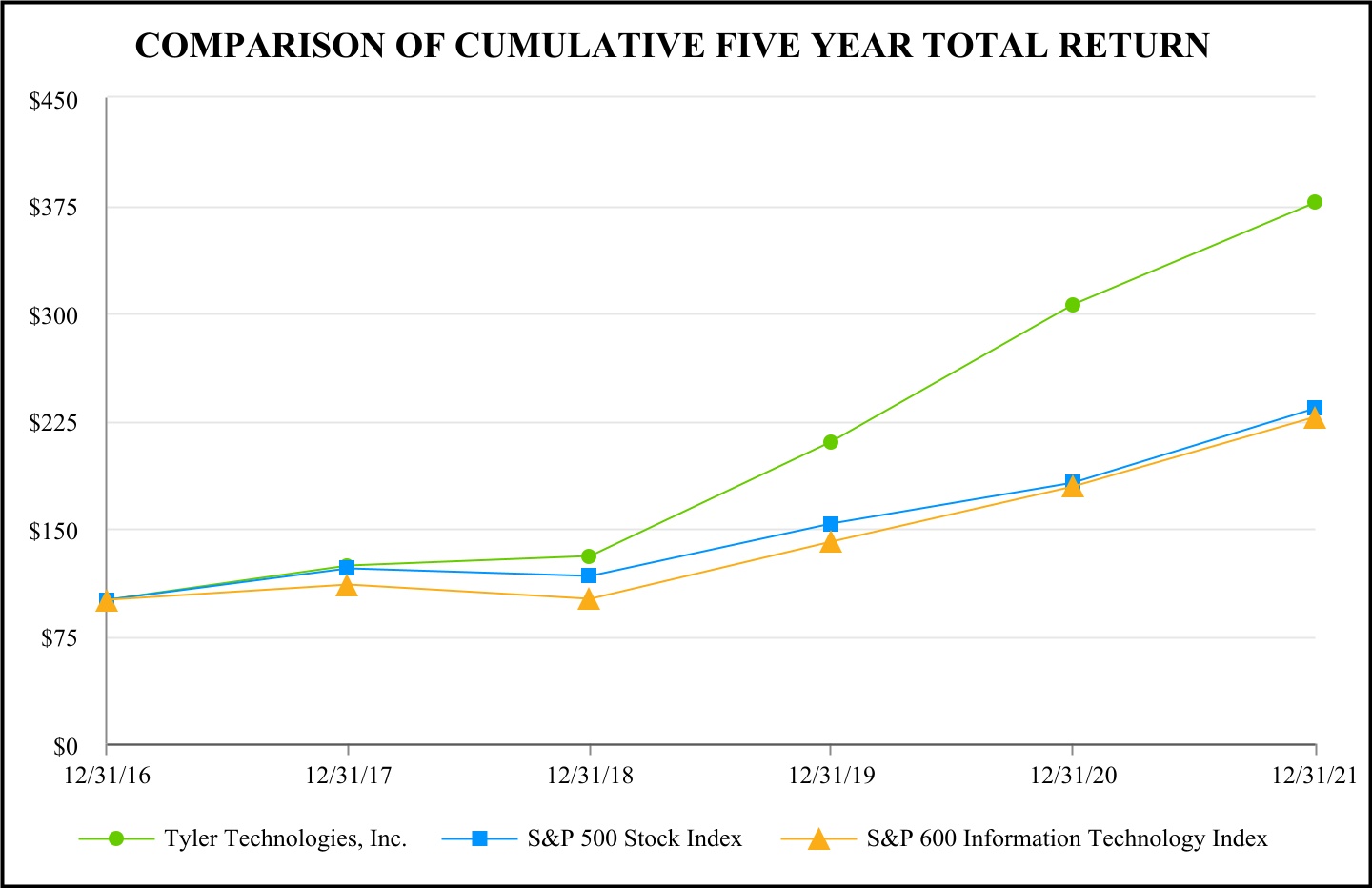
| Company / Index | 12/31/16 | 12/31/17 | 12/31/18 | 12/31/19 | 12/31/20 | 12/31/21 | |||||||||||||||||||||||||||||
| Tyler Technologies, Inc. | 100 | 124.01 | 130.15 | 210.14 | 305.75 | 376.79 | |||||||||||||||||||||||||||||
| S&P 500 Stock Index | 100 | 121.83 | 116.49 | 153.17 | 181.35 | 233.41 | |||||||||||||||||||||||||||||
| S&P 600 Information Technology Index | 100 | 110.28 | 100.43 | 140.19 | 179.18 | 227.28 |
Item 6. This section has been eliminated as a result of adopting the November 19, 2020 amendment to Item 301 of Regulation S-K.
This section has been eliminated as a result of adopting the November 19, 2020 amendment to Item 301 of Regulation S-K.
Item 7. MANAGEMENT’S DISCUSSION AND ANALYSIS OF FINANCIAL CONDITION AND RESULTS OF OPERATIONS.
The following discussion and analysis should be read in conjunction with our consolidated financial statements and related notes included in Item 8 of this Annual Report on Form 10-K. For a comparison of our Results of Operations for the years ended December 31, 2020, and 2019, and our Cash Flow discussion for the year ended December 2020, see “Part II, Item 7. Management's Discussion and Analysis of Financial Conditions and Results of Operations” of our Annual Report on Form 10-K for the year ended December 31, 2020, as filed with the SEC on February 19, 2021.
FORWARD-LOOKING STATEMENTS
This document contains “forward-looking statements” within the meaning of Section 27A of the Securities Act of 1933 and Section 21E of the Securities Exchange Act of 1934 that are not historical in nature and typically address future or anticipated events, trends, expectations or beliefs with respect to our financial condition, results of operations or business. Forward-looking statements often contain words such as “believes,” “expects,” “anticipates,” “foresees,” “forecasts,” “estimates,” “plans,” “intends,” “continues,” “may,” “will,” “should,” “projects,” “might,” “could” or other similar words or phrases. Similarly, statements that describe our business strategy, outlook, objectives, plans, intentions or goals also are forward-looking statements. We believe there is a reasonable basis for our forward-looking statements, but they are inherently subject to risks and uncertainties and actual results could differ materially from the expectations and beliefs reflected in the forward-looking statements. We presently consider the following to be among the important factors that could cause actual results to differ materially from our expectations and beliefs: (1) the ongoing effects of the COVID-19 pandemic, including its potential effects on the economic environment, our customers and our operations, as well as any changes to federal, state or local government laws, regulations or orders in connection with the pandemic; (2) changes in the budgets or regulatory environments of our clients, primarily local and state governments, that could negatively impact information technology spending; (3) disruption to our business and harm to our competitive position resulting from cyber-attacks and security vulnerabilities; (4) our ability to protect client information from security breaches and provide uninterrupted operations of data centers; (5) our ability to achieve growth or operational synergies through the integration of acquired businesses, while avoiding unanticipated costs and disruptions to existing operations; (6) material portions of our business require the Internet infrastructure to be adequately maintained; (7) our ability to achieve our financial forecasts due to various factors, including project delays by our clients, reductions in transaction size, fewer transactions, delays in delivery of new products or releases or a decline in our renewal rates for service agreements; (8) general economic, political and market conditions; (9) technological and market risks associated with the development of new products or services or of new versions of existing or acquired products or services; (10) competition in the industry in which we conduct business and the impact of competition on pricing, client retention and pressure for new products or services; (11) the ability to attract and retain qualified personnel and dealing with the loss or retirement of key members of management or other key personnel; and (12) costs of compliance and any failure to comply with government and stock exchange regulations. A detailed discussion of these factors and other risks that affect our business are described in Item 1A, “Risk Factors”. We expressly disclaim any obligation to publicly update or revise our forward-looking statements.
OVERVIEW
General
We provide integrated information management solutions and services for the public sector. We develop and market a broad line of software products and services to address the IT needs of cities, counties, states, schools, federal agencies, and other government entities. In addition, we provide professional IT services to our clients, including software and hardware installation, data conversion, training and for certain clients, product modifications, along with continuing maintenance and support for clients using our systems. We also provide subscription-based services such as software as a service (“SaaS”), transaction and payment processing solutions, and electronic document filing solutions (“e-filing”), which simplify the filing and management of court related documents. We also provide property appraisal outsourcing services for taxing jurisdictions.
Our products generally automate nine major functional areas: (1) financial management and education, (2) courts and justice, (3) public safety, (4) property appraisal and tax, (5) planning, regulatory and maintenance, (6) land and vital records management, (7) data and insights, (8) platform technologies, and (9) NIC digital government and payments. We report our results in three segments. The Enterprise Software (“ES”) segment provides public sector entities with software systems and services to meet their information technology and automation needs for mission-critical “back-office” functions such as: financial management; courts and justice processes; public safety; planning, regulatory and maintenance; data analytics; and platform technologies. The Appraisal and Tax (“A&T”) segment provides systems and software that automate the appraisal and assessment of real and personal property, land and vital records management as well as provides property appraisal outsourcing services for local governments and taxing authorities. Property appraisal outsourcing services include: the physical inspection of commercial and residential properties; data collection and processing; computer analysis for property valuation; preparation of tax rolls; community education; and arbitration between taxpayers and the assessing jurisdiction. On April 21, 2021, the Company acquired NIC, Inc. (“NIC”) resulting a new reportable segment, as its
operating results meet the criteria as a reportable segment. The operating results of NIC are included with the operating results of the NIC segment from the date of acquisition.
As of January 1, 2021, certain administrative costs related to information technology, which were previously reported in the ES and A&T segments, were moved to the Corporate segment to reflect changes in the way management makes operating decisions, allocates resources, and manages the growth and profitability of the Company. Prior year amounts for all segments have been adjusted to reflect the segment change. See Note 15, "Segment and Related Information," in the notes to the consolidated financial statements for additional information.
Recent Acquisitions
On September 9, 2021, we acquired all the equity interest of Ultimate Information Systems, Inc. (dba Arx). Arx is a cloud-based platform which creates accessible technology to enable a modern-day police force that is fully transparent, accountable, and a trusted resource to the community it serves. The total purchase price, net of cash acquired, was approximately $12.8 million, of which $12.4 million was paid in cash and approximately $0.5 million was accrued for indemnity holdbacks, subject to certain post-closing adjustments.
On September 1, 2021, we acquired VendEngine, Inc (VendEngine) as contemplated by the Agreement and Plan of Merger dated June 3, 2021. As result of the merger, VendEngine became a direct subsidiary of the Company. VendEngine is a cloud-based software provider focused on financial technology for the corrections market. The total purchase price, net of cash acquired of $1.7 million, was approximately $83.8 million, consisting of $80.2 million paid in cash, and approximately $5.4 million related to indemnit
Showing the first 8K of 85K characters. Open the full section
Item 7A. QUANTITATIVE AND QUALITATIVE DISCLOSURES ABOUT MARKET RISK.
Market risk represents the risk of loss that may affect us due to adverse changes in financial market prices and interest rates.
As of December 31, 2021, we had $755.0 million in outstanding principal under our 2021 Credit Agreement and available borrowing capacity under the 2021 Credit Agreement was $500.0 million.
Borrowings under the Revolving Credit Facility and the Term Loan A-1 will bear interest, at the Company’s option, at a per annum rate of either (1) the Administrative Agent’s prime commercial lending rate (subject to certain higher rate determinations) (the “Base Rate”) plus a margin of 0.125% to 0.75% or (2) the one-, three-, six-, or, subject to approval by all lenders, twelve-month LIBOR rate plus a margin of 1.125% to 1.75%. The Term Loan A-2 will bear interest, at the Company’s option, at a per annum rate of either (1) the Base Rate plus a margin of 0% to 0.5% or (2) the one-, three-, or six-, or, subject to approval by all lenders, twelve-month LIBOR rate plus a margin of 0.875% to 1.5%.
During the year ended December 31, 2021 our effective average interest rate for our borrowings was 1.84%. As of December 31, 2021, our interest rate was 1.55% for our outstanding borrowings. Based on the debt under the 2021 Credit Agreement, the aggregate outstanding principal as of December 31, 2021 is $755.0 million, and each quarter point change in interest rates would result in a $1.9 million change in annual interest expense.
Item 8. FINANCIAL STATEMENTS AND SUPPLEMENTARY DATA.
The reports of our independent registered public accounting firm and our financial statements, related notes, and supplementary data are included as part of this Annual Report beginning on page F-1.
Item 9. CHANGES IN AND DISAGREEMENTS WITH ACCOUNTANTS ON ACCOUNTING AND FINANCIAL DISCLOSURE.
None.
Item 9A. CONTROLS AND PROCEDURES.
Evaluation of Disclosure Controls and Procedures — We maintain disclosure controls and procedures (as defined in Rule 13a-15(e) of the Securities Exchange Act) designed to provide reasonable assurance that the information required to be disclosed by us in the reports we file or submit under the Exchange Act is recorded, processed, summarized and reported within the time periods specified in the SEC’s rules and forms. These include controls and procedures designed to ensure that this information is accumulated and communicated to our management, including our chief executive officer and chief financial officer, as appropriate to allow timely decisions regarding required disclosures. Management, with the participation of the chief executive officer and chief financial officer, evaluated the effectiveness of our disclosure controls and procedures as of December 31, 2021. Based on this evaluation, the chief executive officer and chief financial officer have concluded that our disclosure controls and procedures were effective as of December 31, 2021.
Management’s Report on Internal Control Over Financial Reporting — Tyler’s management is responsible for establishing and maintaining effective internal control over financial reporting as defined in Securities Exchange Act Rule 13a-15(f). Tyler’s internal control over financial reporting is designed to provide reasonable assurance to Tyler’s management and board of directors regarding the preparation and fair presentation of published financial statements.
Because of its inherent limitations, internal control over financial reporting may not prevent or detect misstatements. Therefore, even those systems determined to be effective can provide only reasonable assurance with respect to financial statement preparation and presentation.
Management assessed the effectiveness of Tyler’s internal control over financial reporting as of December 31, 2021. In making this assessment, management used the criteria set forth by the Committee of Sponsoring Organizations of the Treadway Commission (2013 framework) (the COSO criteria). Based on our assessment, we concluded that, as of December 31, 2021, Tyler’s internal control over financial reporting was effective based on those criteria.
Tyler’s internal control over financial reporting as of December 31, 2021 has been audited by Ernst & Young LLP, the independent registered public accounting firm who also audited Tyler’s financial statements. Ernst & Young’s attestation report on Tyler’s internal control over financial reporting appears on page F-1 hereof.
Changes in Internal Control Over Financial Reporting — During the quarter ended December 31, 2021, there were no changes in our internal control over financial reporting, as defined in Securities Exchange Act Rule 13a-15(f), that materially affected, or are reasonably likely to materially affect, our internal control over financial reporting.
Item 9B. OTHER INFORMATION.
None.
PART III
See the information under the following captions in Tyler’s definitive Proxy Statement, which is incorporated herein by reference. Only those sections of the Proxy Statement that specifically address the items set forth herein are incorporated by reference. Such incorporation by reference does not include the Compensation Discussion and Analysis, the Compensation Committee Report or the Audit Committee Report, which are included in the Proxy Statement.
| Headings in Proxy Statement | ||||||||
| ITEM 10. DIRECTORS, EXECUTIVE OFFICERS, AND CORPORATE GOVERNANCE. | “Tyler Management” and “Corporate Governance Principles and Board Matters” |
| ITEM 11. EXECUTIVE COMPENSATION. | “Executive Compensation” |
| ITEM 12. SECURITY OWNERSHIP OF CERTAIN BENEFICIAL OWNERS AND MANAGEMENT AND RELATED STOCKHOLDER MATTERS. | “Security Ownership of Certain Beneficial Owners and Management” |
| ITEM 13. CERTAIN RELATIONSHIPS AND RELATED TRANSACTIONS, AND DIRECTOR INDEPENDENCE. | "Executive Compensation" and “Certain Relationships and Related Transactions” |
| ITEM 14. PRINCIPAL ACCOUNTING FEES AND SERVICES. | ||||||||
| The information required under this item may be found under the section captioned “Proposals For Consideration – Proposal Two – Ratification of Our Independent Auditors for Fiscal Year 2021” in our Proxy Statement when filed. |
PART IV
Item 15. EXHIBITS, FINANCIAL STATEMENT SCHEDULES.
The following documents are filed as part of this Annual Report:
| (a) | (1) | The financial statements are filed as part of this Annual Report. | ||||||||||||||||||
| Page | ||||||||||||||||||||
| Reports of Independent Registered Public Accounting Firm (PCAOB ID: 42) | F-1 | |||||||||||||||||||
| Consolidated Statements of Comprehensive Income for the years ended December 31, 2021, 2020, and 2019 | F-4 | |||||||||||||||||||
| Consolidated Balance Sheets as of December 31, 2021 and 2020 | F-5 | |||||||||||||||||||
| Consolidated Statements of Cash Flows for the years ended December 31, 2021, 2020, and 2019 | F-6 | |||||||||||||||||||
| Consolidated Statements of Shareholders’ Equity for the years ended December 31, 2021, 2020, and 2019 | F-7 | |||||||||||||||||||
| Notes to Consolidated Financial Statements | F-8 | |||||||||||||||||||
| (2) | Financial statement schedules: | |||||||||||||||||||
| There are no financial statement schedules filed as part of this Annual Report, since the required information is included in the financial statements, including the notes thereto, or the circumstances requiring inclusion of such schedules are not present. | ||||||||||||||||||||
| (3) | Exhibits | |||||||||||||||||||
| Certain of the exhibits to this Annual Report are hereby incorporated by reference, as specified: |
| | |
Showing the first 8K of 193K characters. Open the full section