 filings.tools
United Airlines Holdings 10-K 2020-12-31
Filed 2021-03-01. 22 sections, 627K characters. Original on sec.gov · Markdown · JSON
Cover and table of contents
UNITED STATES
SECURITIES AND EXCHANGE COMMISSION
Washington, DC 20549
| FORM | 10-K |
| ☒ | ANNUAL REPORT PURSUANT TO SECTION 13 OR 15(d) OF THE SECURITIES EXCHANGE ACT OF 1934 |
For the fiscal year ended December 31, 2020
OR
| ☐ | TRANSITION REPORT PURSUANT TO SECTION 13 OR 15(d) OF THE SECURITIES EXCHANGE ACT OF 1934 |
For the transition period from to

| Commission File Number | Exact Name of Registrant as Specified in its Charter, Principal Executive Office Address and Telephone Number | State of Incorporation | I.R.S. Employer Identification No. | ||||||||||||||||||||||||||||||||||||||
| 001-06033 | United Airlines Holdings, Inc. | Delaware | 36-2675207 | ||||||||||||||||||||||||||||||||||||||
| 233 South Wacker Drive, | Chicago, | Illinois | 60606 | ||||||||||||||||||||||||||||||||||||||
| (872) | 825-4000 | ||||||||||||||||||||||||||||||||||||||||
| 001-10323 | United Airlines, Inc. | Delaware | 74-2099724 | ||||||||||||||||||||||||||||||||||||||
| 233 South Wacker Drive, | Chicago, | Illinois | 60606 | ||||||||||||||||||||||||||||||||||||||
| (872) | 825-4000 |
Securities registered pursuant to Section 12(b) of the Act:
| Title of Each Class | Trading Symbol | Name of Each Exchange on Which Registered | ||||||||||||||||||
| United Airlines Holdings, Inc. | Common Stock, $0.01 par value | UAL | The Nasdaq Stock Market LLC | |||||||||||||||||
| Preferred Stock Purchase Rights | The Nasdaq Stock Market LLC | |||||||||||||||||||
| United Airlines, Inc. | None | None | None |
Securities registered pursuant to Section 12(g) of the Act:
| United Airlines Holdings, Inc. | None | |||||||||||||
| United Airlines, Inc. | None | |||||||||||||
Indicate by check mark if the registrant is a well-known seasoned issuer, as defined in Rule 405 of the Securities Act
| United Airlines Holdings, Inc. | Yes | ☒ | No | ☐ | United Airlines, Inc. | Yes | ☒ | No | ☐ |
Indicate by check mark if the registrant is not required to file reports pursuant to Section 13 or Section 15(d) of the Act.
| United Airlines Holdings, Inc. | Yes | ☐ | No | ☒ | United Airlines, Inc. | Yes | ☐ | No | ☒ |
Indicate by check mark whether the registrant (1) has filed all reports required to be filed by Section 13 or 15(d) of the Securities Exchange Act of 1934 during the preceding 12 months (or for such shorter period that the registrant was required to file such reports), and (2) has been subject to such filing requirements for the past 90 days.
| United Airlines Holdings, Inc. | Yes | ☒ | No | ☐ | United Airlines, Inc. | Yes | ☒ | No | ☐ |
Indicate by check mark whether the registrant has submitted electronically every Interactive Data File required to be submitted pursuant to Rule 405 of Regulation S-T (§232.405 of this Chapter) during the preceding 12 months (or for such shorter period that the registrant was required to submit such files).
| United Airlines Holdings, Inc. | Yes | ☒ | No | ☐ | United Airlines, Inc. | Yes | ☒ | No | ☐ |
Indicate by check mark whether the registrant is a large accelerated filer, an accelerated filer, a non-accelerated filer, a smaller reporting company, or an emerging growth company. See the definitions of "large accelerated filer," "accelerated filer," "smaller reporting company," and "emerging growth company" in Rule 12b-2 of the Exchange Act.
| United Airlines Holdings, Inc. | Large accelerated filer | ☒ | Accelerated filer | ☐ | Non-accelerated filer | ☐ | Smaller reporting company | ☐ | Emerging growth company | ☐ | ||||||||||||||||||||||
| United Airlines, Inc. | Large accelerated filer | ☐ | Accelerated filer | ☐ | Non-accelerated filer | ☒ | Smaller reporting company | ☐ | Emerging growth company | ☐ |
If an emerging growth company, indicate by check mark if the registrant has elected not to use the extended transition period for complying with any new or revised financial accounting standards provided pursuant to Section 13(a) of the Exchange Act.
| United Airlines Holdings, Inc. | ☐ | United Airlines, Inc. | ☐ |
Indicate by check mark whether the registrant has filed a report on and attestation to its management's assessment of the effectiveness of its internal control over financial reporting under Section 404(b) of the Sarbanes-Oxley Act (15 U.S.C. 7262(b)) by the registered public accounting firm that prepared or issued its audit report.
| United Airlines Holdings, Inc. | ☒ | United Airlines, Inc. | ☐ |
Indicate by check mark whether the registrant is a shell company (as defined in Rule 12b-2 of the Exchange Act).
| United Airlines Holdings, Inc. | Yes | ☐ | No | ☒ | ||||||||||||||||
| United Airlines, Inc. | Yes | ☐ | No | ☒ |
The aggregate market value of common stock held by non-affiliates of United Airlines Holdings, Inc. was $10.0 billion as of June 30, 2020 based on the closing sale price of $34.61 on that date. There is no market for United Airlines, Inc. common stock.
Indicate the number of shares outstanding of each of the registrant's classes of common stock, as of February 24, 2021.
| United Airlines Holdings, Inc. | 318,476,280 | shares of common stock ($0.01 par value) | |||||||||
| United Airlines, Inc. | 1,000 | shares of common stock ($0.01 par value) (100% owned by United Airlines Holdings, Inc.) |
This combined Form 10-K is separately filed by United Airlines Holdings, Inc. and United Airlines, Inc.
OMISSION OF CERTAIN INFORMATION
United Airlines, Inc. meets the conditions set forth in General Instruction I(1)(a) and (b) of Form 10-K and is therefore filing this form with the reduced disclosure format allowed under that General Instruction.
DOCUMENTS INCORPORATED BY REFERENCE
Certain information required by Items 10, 11, 12 and 13 of Part III of this Form 10-K is incorporated by reference for United Airlines Holdings, Inc. from its definitive proxy statement for its 2021 Annual Meeting of Stockholders.
United Airlines Holdings, Inc. and Subsidiary Companies
United Airlines, Inc. and Subsidiary Companies
Annual Report on Form 10-K
For the Year Ended December 31, 2020
This Annual Report on Form 10-K ("Form 10-K") contains various "forward-looking statements" within the meaning of Section 27A of the Securities Act of 1933, as amended (the "Securities Act"), and Section 21E of the Securities Exchange Act of 1934, as amended (the "Exchange Act"). Forward-looking statements represent our expectations and beliefs concerning future results or events, based on information available to us on the date of the filing of this Form 10-K, and are subject to various risks and uncertainties. Factors that could cause actual results or events to differ materially from those referenced in the forward-looking statements are listed in Part I, Item 1A. Risk Factors and in Part II, Item 7. Management's Discussion and Analysis of Financial Condition and Results of Operations. We disclaim any intent or obligation to update or revise any of the forward-looking statements, whether in response to new information, unforeseen events, changed circumstances or otherwise, except as required by applicable law.
PART I
Item 1. BUSINESS.
Overview
United Airlines Holdings, Inc. (together with its consolidated subsidiaries, "UAL" or the "Company") is a holding company and its principal, wholly-owned subsidiary is United Airlines, Inc. (together with its consolidated subsidiaries, "United"). As UAL consolidates United for financial statement purposes, disclosures that relate to activities of United also apply to UAL, unless otherwise noted. United's operating revenues and operating expenses comprise nearly 100% of UAL's revenues and operating expenses. In addition, United comprises approximately the entire balance of UAL's assets, liabilities and operating cash flows. When appropriate, UAL and United are named specifically for their individual contractual obligations and related disclosures and any significant differences between the operations and results of UAL and United are separately disclosed and explained. We sometimes use the words "we," "our," "us," and the "Company" in this report for disclosures that relate to all of UAL and United.
The Company's principal executive office is located at 233 South Wacker Drive, Chicago, Illinois 60606 (telephone number (872) 825-4000). The Company's website is located at www.united.com and its investor relations website is located at ir.united.com. The information contained on or connected to the Company's websites is not incorporated by reference into this Annual Report on Form 10-K and should not be considered part of this or any other report filed with the U.S. Securities and Exchange Commission ("SEC"). The Company's filings with the SEC, including annual reports on Form 10-K, quarterly reports on Form 10-Q, current reports on Form 8-K, and all amendments to those reports, as well as UAL's proxy statement for its annual meeting of stockholders, are accessible without charge on the Company's investor relations website, as soon as reasonably practicable, after such material is electronically filed with, or furnished to, the SEC. Such filings are also available on the SEC's website at www.sec.gov.
Operations
The Company transports people and cargo throughout North America and to destinations in Asia, Europe, Africa, the Pacific, the Middle East and Latin America. UAL, through United and its regional carriers, operates across six continents, with hubs at Newark Liberty International Airport ("Newark"), Chicago O'Hare International Airport ("Chicago O'Hare"), Denver International Airport ("Denver"), George Bush Intercontinental Airport ("Houston Bush"), Los Angeles International Airport ("LAX"), A.B. Won Pat International Airport ("Guam"), San Francisco International Airport ("SFO") and Washington Dulles International Airport ("Washington Dulles").
All of the Company's domestic hubs are located in large business and population centers, contributing to a large amount of "origin and destination" traffic. The hub and spoke system allows us to transport passengers between a large number of destinations with substantially more frequent service than if each route were served directly. The hub system also allows us to add service to a new destination from a large number of cities using only one or a limited number of aircraft. As discussed under Alliances below, United is a member of Star Alliance, the world's largest alliance network.
The Company began experiencing a significant decline in passenger demand related to the novel coronavirus (COVID-19) during the first quarter of 2020. The full extent of the ongoing impact of COVID-19 on the Company's longer-term operational and financial performance will depend on future developments, including those outside our control related to the efficacy and speed of vaccination programs in curbing the spread of the virus, the introduction and spread of new variants of the virus which may be resistant to currently approved vaccines, passenger testing requirements, mask mandates or other restrictions on travel, all of which are highly uncertain and cannot be predicted with certainty. In response to decreased demand, the Company cut, relative to 2019 capacity, approximately 57% of its scheduled capacity for 2020. In the first quarter of 2021, the Company expects scheduled capacity to be down at least 51% versus the first quarter of 2019. The Company plans to continue to proactively evaluate and cancel flights on a rolling 60-day basis until it sees signs of a recovery in demand and expects demand to remain suppressed, relative to 2019 levels, until vaccines for COVID-19 are widely distributed and are effective in curbing
the spread of the virus. In addition, the Company does not currently expect the recovery from COVID-19 to follow a linear path. As such, the Company's actual flown capacity may differ materially from its currently scheduled capacity.
Regional. The Company has contractual relationships with various regional carriers to provide regional aircraft service branded as United Express. This regional service complements our operations by carrying traffic that connects to our hubs and allows flights to smaller cities that cannot be provided economically with mainline aircraft. Champlain Enterprises, LLC d/b/a CommutAir ("CommutAir"), Republic Airline Inc. ("Republic"), GoJet Airlines LLC ("GoJet"), Mesa Airlines, Inc. ("Mesa"), SkyWest Airlines, Inc. ("SkyWest"), and Air Wisconsin Airlines LLC ("Air Wisconsin") are all regional carriers that operate with capacity contracted to United under capacity purchase agreements ("CPAs"). Under these CPAs, the Company pays the regional carriers contractually agreed fees (carrier costs) for operating these flights plus a variable rate adjustment based on agreed performance metrics, subject to annual adjustments. The fees are based on specific rates multiplied by specific operating statistics (e.g., block hours, departures), as well as fixed monthly amounts. Under these CPAs, the Company is also responsible for all fuel costs incurred, as well as landing fees and other costs, which are either passed through by the regional carrier to the Company without any markup or directly incurred by the Company. In some cases, the Company owns some or all of the aircraft subject to the CPA and leases such aircraft to the regional carrier. In return, the regional carriers operate the capacity of the aircraft included within the scope of such CPA exclusively for United, on schedules determined by the Company. The Company also determines pricing and revenue management, assumes the inventory and distribution risk for the available seats and permits mileage accrual and redemption for regional flights through its MileagePlus loyalty program. The significant decline in demand for air travel services resulting from the COVID-19 pandemic has also materially impacted demand for regional carrier services and, as a result, the Company's utilization of its regional network is significantly reduced and is expected to remain so for the foreseeable future. As a result, we may face claims that we failed to perform certain obligations under our agreements with our regional carriers and may incur damages. Additionally, in July 2020, the Company announced its plans to consolidate its Embraer 145 ("E145") operations into a single regional partner, CommutAir. As a result, the Company terminated its CPA with ExpressJet Airlines, LLC, a domestic regional airline ("ExpressJet"). ExpressJet flew its last commercial flight, on behalf of United, on September 30, 2020. Additionally, United transferred all of its E145 operations over to CommutAir as United's sole regional partner for this aircraft type. We expect the disruption to services resulting from the COVID-19 pandemic to continue to adversely affect our regional carriers, some of which may declare bankruptcy or otherwise cease to operate.
Alliances. United is a member of Star Alliance, a global integrated airline network and the largest and most comprehensive airline alliance in the world. Despite the global challenges posed by the COVID-19 pandemic, Star Alliance carriers continued to serve nearly 1,000 airports in 154 countries with close to 10,000 daily departures as of January 1, 2021. Star Alliance members, in addition to United, are Aegean Airlines, Air Canada, Air China, Air India, Air New Zealand, All Nippon Airways ("ANA"), Asiana Airlines, Austrian Airlines, Aerovías del Continente Americano S.A. ("Avianca"), Brussels Airlines, Copa Airlines ("Copa"), Croatia Airlines, EGYPTAIR, Ethiopian Airlines, EVA Air, LOT Polish Airlines, Lufthansa, SAS Scandinavian Airlines, Shenzhen Airlines, Singapore Airlines, South African Airways, SWISS, TAP Air Portugal, THAI Airways International and Turkish Airlines. In addition to its members, Star Alliance includes Shanghai-based Juneyao Airlines and Thailand-based Thai Smile Airways, a subsidiary of THAI Airways International, as connecting partners.
United has a variety of bilateral commercial alliance agreements and obligations with Star Alliance members, addressing, among other things, reciprocal earning and redemption of frequent flyer miles, access to airport lounges and, with certain Star Alliance members, codesharing of flight operations (whereby one carrier's selected flights can be marketed under the brand name of another carrier). In addition to the alliance agreements with Star Alliance members, United currently maintains independent marketing alliance agreements with other air carriers, including Aeromar, Aer Lingus, Air Dolomiti, Azul Linhas Aéreas Brasileiras S.A. ("Azul"), Boutique Air, Cape Air, Edelweiss, Eurowings, Hawaiian Airlines, Olympic Air, Silver Airways and Vistara.
United also participates in four passenger joint business arrangements ("JBAs"): one with Air Canada and the Lufthansa Group (which includes Lufthansa and its affiliates Austrian Airlines, Brussels Airlines, Eurowings and SWISS) covering transatlantic routes, one with ANA covering certain transpacific routes, one with Air New Zealand covering certain routes between the United States and New Zealand and one with Avianca and Copa, which, upon regulatory approval, will cover routes between the United States and Central and South America, excluding Brazil. These passenger JBAs enable the participating carriers to integrate the services they provide in the respective regions, capturing revenue synergies and delivering enhanced customer benefits, such as highly competitive flight schedules, fares and services. Separate from the passenger JBAs, United also participates in cargo JBAs with ANA for transpacific cargo services and with Lufthansa for transatlantic cargo services. These cargo JBAs offer expanded and more seamless access to cargo space across the carriers' respective combined networks.
Loyalty Program. United's MileagePlus loyalty program builds customer loyalty by offering awards, benefits and services to program participants. Members in this program earn miles for flights on United, United Express, Star Alliance members and certain other airlines that participate in the program. Members can also earn miles by purchasing goods and services from our
network of non-airline partners, such as domestic and international credit card issuers, retail merchants, hotels and car rental companies. Members can redeem miles for free (other than taxes and government-imposed fees), discounted or upgraded travel and non-travel awards.
United has an agreement with JPMorgan Chase Bank, N.A. ("Chase"), pursuant to which members of United's MileagePlus loyalty program who are residents of the United States can earn miles for making purchases using a MileagePlus credit card issued by Chase (the "Co-Brand Agreement"). The Co-Brand Agreement also provides for joint marketing and other support for the MileagePlus credit card and provides Chase with other benefits such as permission to market to the Company's customer database.
In 2020, approximately 1.9 million MileagePlus flight awards were used on United and United Express. These awards represented 6.2% of United's total revenue passenger miles. Total miles redeemed for flights on United and United Express, including class-of-service upgrades, represented approximately 80% of the total miles redeemed. In addition, excluding miles redeemed for flights on United and United Express, MileagePlus members redeemed miles for approximately 0.8 million other awards. These awards include United Club memberships, car and hotel awards, merchandise and flights on other air carriers. Redemptions in 2020 were adversely impacted by the COVID-19 pandemic.
In response to the impact of COVID-19, the Company made changes to its MileagePlus® Premier® program that will make it easier to earn status in 2021 for the 2022 program year. United will again have reduced Premier Qualifying Points ("PQP") and Premier Qualifying Flights ("PQF") thresholds in 2021 and will have innovative promotions that help members earn status more quickly. Early in 2021, United deposited 25% of the PQP-only requirements in Premier members' accounts based on their 2021 Premier status level. Premier members will earn double the PQP on each of the first three PQP-eligible trips completed January 1 through March 31, 2021 (up to 1,500 PQP per trip), helping their flights go further toward reaching status.
Aircraft Fuel. The table below summarizes the fuel consumption and expense of UAL's aircraft (including the operations of our regional partners operating under CPAs) during the last three years.
| Year | Gallons Consumed (in millions) | Fuel Expense (in millions) | Average Price Per Gallon | Percentage of Total Operating Expense | ||||||||||||||||||||||||||||
| 2020 | 2,004 | $ | 3,153 | $ | 1.57 | 15 | % | |||||||||||||||||||||||||
| 2019 | 4,292 | $ | 8,953 | $ | 2.09 | 23 | % | |||||||||||||||||||||||||
| 2018 | 4,137 | $ | 9,307 | $ | 2.25 | 24 | % |
Our operational and financial results can be significantly impacted by changes in the price and availability of aircraft fuel. To provide adequate supplies of fuel, the Company routinely enters into purchase contracts that are customarily indexed to market prices for aircraft fuel, and the Company generally has some ability to cover short-term fuel supply and infrastructure disruptions at certain major demand locations. The price of aircraft fuel has fluctuated substantially in the past several years. The Company's current strategy is to not enter into transactions to hedge its fuel consumption, although the Company regularly reviews its strategy based on market conditions and other factors.
Third-Party Business. United generates third-party business revenue that includes maintenance services, catering, frequent flyer award non-travel redemptions and ground handling. Third-party business revenue is recorded in Other operating revenue. Expenses associated with third-party business, except non-travel redemptions, are recorded in Other operating expenses. Non-travel redemptions expenses are recorded to Other operating revenue.
Air Cargo. United provides freight and mail services (air cargo). The majority of cargo services are provided to commercial businesses, freight forwarder firms and the United States Postal Service. Through our global network, our cargo operations are able to connect the world's major freight gateways. We generate cargo revenues in domestic and international markets through the use of cargo space on regularly scheduled passenger aircraft, and starting in 2020, cargo-only flights.
Distribution Channels. The Company's airline seat inventory and fares are distributed through the Company's direct channels, traditional travel agencies and on-line travel agencies. The use of the Company's direct sales website, www.united.com, the Company's mobile applications and alternative distribution systems provides the Company with an opportunity to de-commoditize its services, better present its content, make more targeted offerings, better retain its customers, enhance its brand and lower its ticket distribution costs. Agency sales are primarily sold using global distribution systems ("GDS"). United has developed and expects to continue to develop capabilities to sell certain ancillary products through the GDS channel to provide an enhanced buying experience for customers who purchase in that channel.
Industry Conditions
COVID-19. The COVID-19 pandemic, together with the measures implemented or recommended by governmental authorities and private organizations in response to the pandemic, has had an adverse impact that has been material to the airline industry. Measures such as "shelter in place" or quarantine requirements, international and domestic travel restrictions or advisories, limitations on public gatherings, social distancing recommendations, remote work arrangements and closures of tourist destinations and attractions, as well as consumer perceptions of the safety, ease and predictability of air travel, have contributed to a precipitous decline in passenger demand and bookings for both business and leisure travel.
The full extent of the ongoing impact of COVID-19 on the Company's longer-term operational and financial performance will depend on future developments, including those outside our control related to the efficacy and speed of vaccination programs in curbing the spread of the virus, the introduction and spread of new variants of the virus which may be resistant to currently approved vaccines, passenger testing requirements, mask mandates or other restrictions on travel, all of which are highly uncertain and cannot be predicted with certainty. Effective August 30, 2020, United permanently eliminated change fees on all standard Economy and Premium cabin tickets for travel within the 50 U.S. states, Washington, D.C., Puerto Rico and the U.S. Virgin Islands. Also, in December 2020, the Company eliminated change fees on flights from the U.S. to all international destinations and fees on Basic Economy and all other international travel tickets issued by March 31, 2021. In addition, effective January 1, 2021, United began allowing passengers to standby for free on a flight departing the day of their travel regardless of the type of ticket or class of service, while MileagePlus Premier members can confirm a seat on a different flight on the same day with the same departure and arrival cities as their original ticket if a seat in the same ticket fare class is available.
Domestic Competition. The domestic airline industry is highly competitive and dynamic. The Company's competitors consist primarily of other airlines and, to a certain extent, other forms of transportation. Currently, any U.S. carrier deemed fit by the U.S. Department of Transportation (the "DOT") is largely free to operate scheduled passenger service between any two points within the United States. Competition can be direct, in the form of another carrier flying the exact non-stop route, or indirect, where a carrier serves the same two cities non-stop from an alternative airport in that city or via an itinerary requiring a connection at another airport. Air carriers' cost structures are not uniform and are influenced by numerous factors. Carriers with lower costs may offer lower fares to passengers, which could have a potential negative impact on the Company's revenues. Domestic pricing decisions are impacted by intense competitive pressure exerted on the Company by other U.S. airlines. In order to remain competitive and maintain passenger traffic levels, we often find it necessary to match competitors' discounted fares. Since we compete in a dynamic marketplace, attempts to generate additional revenue through increased fares often fail.
International Competition. Internationally, the Company competes not only with U.S. airlines, but also with foreign carriers. International competition has increased and may continue to increase in the future as a result of airline mergers and acquisitions, JBAs, alliances, restructurings, liberalization of aviation bilateral agreements and new or increased service by competitors, including government-subsidized competitors from certain Middle East countries. Competition on international routes is subject to varying degrees of governmental regulation. The Company's ability to compete successfully with non-U.S. carriers on international routes depends in part on its ability to generate traffic to and from the entire United States via its integrated domestic route network and its ability to overcome business and operational challenges across its network worldwide. Foreign carriers currently are prohibited by U.S. law from carrying local passengers between two points in the United States and the Company generally experiences comparable restrictions in foreign countries. Separately, "fifth freedom rights" allow the Company to operate between points in two different foreign countries and foreign carriers may also have fifth freedom rights between the U.S. and another foreign country. In the absence of fifth freedom rights, or some other extra-bilateral right to conduct operations between two foreign countries, U.S. carriers are constrained from carrying passengers to points beyond designated international gateway cities. To compensate partially for these structural limitations, U.S. and foreign carriers have entered into alliances, immunized JBAs and marketing arrangements that enable these carriers to exchange traffic between each other's flights and route networks. Through these arrangements, the Company strives to provide consumers with a growing number of seamless, cost-effective and convenient travel options. See Alliances, above, for additional information.
Seasonality. The air travel business is subject to seasonal fluctuations. Historically, demand for air travel is higher in the second and third quarters, driving higher revenues, than in the first and fourth quarters, which are periods of lower travel demand.
Industry Regulation
Airlines are subject to extensive domestic and international regulatory oversight. The following discussion summarizes the principal elements of the regulatory framework applicable to our business. Regulatory requirements, including but not limited to those discussed below, affect our operations and increase our operating costs, and future regulatory developments may continue to do the same in the future. In addition, should any of our governmental authorizations or certificates be modified, suspended or revoked, our business and competitive position could be materially adversely affected. See Part I, Item 1A. Risk
Factors—"The airline industry is subject to extensive government regulation, which imposes significant costs and may adversely impact our business, operating results and financial condition" for additional information on the material effects of compliance with government regulations.
Domestic Regulation. All carriers engaged in air transportation in the United States are subject to regulation by the DOT. Absent an exemption, no air carrier may provide air transportation of passengers or property without first being issued a DOT certificate of public convenience and necessity. The DOT also grants international route authority, approves international codeshare arrangements and regulates methods of competition. The DOT regulates consumer protection and maintains jurisdiction over advertising, denied boarding compensation, tarmac delays, baggage liability and other areas and may add additional expensive regulatory burdens in the future. The DOT has launched investigations or claimed rulemaking authority to regulate commercial agreements among carriers or between carriers and third parties in a wide variety of contexts.
Airlines are also regulated by the Federal Aviation Administration (the "FAA"), an agency within the DOT, primarily in the areas of flight safety, air carrier operations and aircraft maintenance and airworthiness. The FAA issues air carrier operating certificates and aircraft airworthiness certificates, prescribes maintenance procedures, oversees airport operations, and regulates pilot and other employee training. From time to time, the FAA issues directives that require air carriers to inspect, modify or ground aircraft and other equipment, potentially causing the Company to incur substantial, unplanned expenses. The airline industry is also subject to numerous other federal laws and regulations. The U.S. Department of Homeland Security ("DHS") has jurisdiction over virtually every aspect of civil aviation security. The Antitrust Division of the U.S. Department of Justice ("DOJ") has jurisdiction over certain airline competition matters. The U.S. Postal Service has authority over certain aspects of the transportation of mail by airlines. Labor relations in the airline industry are generally governed by the Railway Labor Act ("RLA"), a federal statute. The Company is also subject to investigation inquiries by the DOT, FAA, DOJ, DHS, the U.S. Food and Drug Administration ("FDA"), the U.S. Department of Agriculture ("USDA"), Centers for Disease Control and Prevention ("CDC"), U.S. Occupational Safety and Health Administration ("OSHA"), and other U.S. and international regulatory bodies.
Airport Access. Access to landing and take-off rights, or "slots," at several major U.S. airports served by the Company are subject to government regulation. Federally-mandated domestic slot restrictions that limit operations and regulate capacity currently apply at three airports: Reagan National Airport in Washington, D.C. ("Reagan National"), and John F. Kennedy International Airport and LaGuardia Airport ("LaGuardia") in the New York City metropolitan region. Additional restrictions on takeoff and landing slots at these and other airports may be implemented in the future and could affect the Company's rights of ownership and transfer as well as its operations.
Legislation. The airline industry is subject to legislative actions (or inactions) that may have an impact on operations and costs. In 2018, the U.S. Congress approved a five-year reauthorization for the FAA, which encompasses significant aviation tax and policy-related issues. The law includes a range of policy changes related to airline customer service and aviation safety. Implementation of some items continues into the new Administration and, depending on how they are implemented, could impact our operations and costs. U.S. Congressional action in response to the COVID-19 pandemic has provided funding for U.S. airlines, in both grants and loans. The U.S. Congress has imposed limited conditions on airlines accepting funding, including workforce retention and minimum service requirements. With the change in control of the U.S. Congress and a new presidential administration, any future funding or other pandemic relief could include additional requirements that could impact our operations and costs. Additionally, the U.S. Congress may consider legislation related to environmental issues or increases to the U.S. federal corporate income tax rate, which could impact the Company and the airline industry.
Catering Operations. The Company owns and operates catering kitchens at airports in Denver, Cleveland, Newark, Houston, and Honolulu, which prepare ready-to-eat food for United flights. Some of the Company's kitchens also prepare ready-to-eat food for other domestic and international airlines. The Company's onboard food service operations are subject to FDA regulation through its interstate conveyance sanitation regulations, and the Company's catering operations are subject to regulation by the FDA and the USDA, as well as other federal, state, and local regulatory agencies. In particular, the FDA enforces the Federal Food Safety Modernization Act which requires all food manufacturers, including ready-to-eat catering operations, to implement stringent risk-based preventive controls. As a result, the Company's catering and food service operations are periodically subject to inspections and enforcement by regulatory agencies.
International Regulation. International air transportation is subject to extensive government regulation. In connection with the Company's international services, the Company is regulated by both the U.S. government and the governments of the foreign countries the Company serves. In addition, the availability of international routes to U.S. carriers is regulated by aviation agreements between the U.S. and foreign governments, and in some cases, fares and schedules require the approval of the DOT and/or the relevant foreign governments.
Legislation. Foreign countries are increasingly enacting passenger protection laws, rules and regulations that meet or exceed U.S. requirements. In cases where this activity exceeds U.S. requirements, additional burden and liability may be placed on the
Company. Certain countries have regulations requiring passenger compensation and/or enforcement penalties from the Company in addition to changes in operating procedures due to canceled and delayed flights.
Airport Access. Historically, access to foreign markets has been tightly controlled through bilateral agreements between the U.S. and each foreign country involved. These agreements regulate the markets served, the number of carriers allowed to serve each market and the frequency of carriers' flights. Since the early 1990s, the U.S. has pursued a policy of "Open Skies" (meaning all U.S.-flag carriers have access to the destination), under which the U.S. government has negotiated a number of bilateral agreements allowing unrestricted access between U.S. and foreign markets. Currently, there are more than 100 Open Skies agreements in effect. However, even with Open Skies, many of the airports that the Company serves in Europe, Asia and Latin America maintain slot controls. A large number of these slot controls exist due to congestion, environmental and noise protection and reduced capacity due to runway and air traffic control ("ATC") construction work, among other reasons. London Heathrow International Airport, Frankfurt Rhein-Main Airport, Shanghai Pudong International Airport, Beijing Capital International Airport, Sao Paulo Guarulhos International Airport and Tokyo Haneda International Airport are among the most restrictive foreign airports due to slot and capacity limitations.
The Company's ability to serve some foreign markets and expand into certain others is limited by the absence of aviation agreements between the U.S. government and the relevant foreign governments. Shifts in U.S. or foreign government aviation policies may lead to the alteration or termination of air service agreements. Depending on the nature of any such change, the value of the Company's international route authorities and slot rights may be materially enhanced or diminished. Similarly, foreign governments control their airspace and can restrict our ability to overfly their territory, enhancing or diminishing the value of the Company's existing international route authorities and slot rights.
The COVID-19 pandemic has caused most governments to restrict entry to foreign nationals (with some exceptions) and to impose multiple health management rules which can include COVID-19 testing, quarantine upon arrival, health declarations, and temperature screens, among others. Such requirements may result in reduced demand for travel and cause the Company to suspend service to some foreign markets. Certain foreign governments have granted waivers for limited periods that allow the Company to maintain existing slot rights and route authorizations while not operating at a particular foreign point. The airline industry is advocating for the continuation of such waivers until the operating and demand environment return to normal, but future waivers are not guaranteed.
Environmental Regulation. The airline industry is subject to increasingly stringent federal, state, local and international environmental requirements, including those regulating emissions to air, water discharges, safe drinking water and the use and management of hazardous substances and wastes.
Climate Change. There is an increasing global regulatory focus on greenhouse gas ("GHG") emissions and their potential impacts relating to climate change. An initiative to regulate GHG emissions from aviation known as the European Union ("EU") Emission Trading System ("ETS") was adopted in 2009, but applicability to flights arriving at or departing from airports outside the EU has been postponed several times. In December 2017, the European Parliament voted to extend exemptions for extra-EU flights until December 2023 in order to align the extension date with the completion of the pilot phase of the International Civil Aviation Organization's ("ICAO") Carbon Offsetting and Reduction Scheme for International Aviation ("CORSIA"). CORSIA, which was adopted in October 2016, is intended to create a single global market-based measure to achieve carbon-neutral growth for international aviation, which can be achieved through airline purchases of eligible carbon offset credits and the use of eligible sustainable fuels. The unprecedented nature of the COVID-19 pandemic prompted ICAO to include only 2019 emissions (as opposed to the originally planned average of 2019-20 emissions) as the baseline upon which offsetting obligations would be calculated for the pilot phase (2021-23) of the scheme; the applicable baseline for the subsequent phases of the scheme, however, is still uncertain. The European Parliament is expected to assess CORSIA implementation and re-assess the applicability of EU ETS to international aviation in 2024, at which point the EU could require all extra- and intra-EU flights to participate in EU ETS. Certain CORSIA program aspects could potentially be affected by the results of the pilot phase of the program, and thus the impact of CORSIA cannot be fully predicted. However, CORSIA is expected to increase operating costs for the Company, depending on a number of factors, including the number of its flights that are subject to CORSIA, the fuel efficiency of the Company's fleet, the Company's purchase and use of CORSIA-eligible sustainable fuels, aviation sector growth, the price of CORSIA-eligible offsets and the applicable baseline year(s) applied to future phases of the program. In 2017, ICAO also adopted a carbon dioxide ("CO2") emission standard for aircraft. In December 2020, the U.S. Environmental Protection Agency ("EPA") adopted its own aircraft and aircraft engine GHG emissions standards, which are aligned with the 2017 ICAO airplane CO2 emission standards. While United endeavors to comply with all applicable environmental regulations, United's Eco-Skies commitment to becoming a more environmentally sustainable company extends beyond seeking to comply with regulatory requirements.
We have made a series of tangible commitments and actions to help reduce our carbon emission footprint, including the following:
-
In 2015, we invested $30 million in Fulcrum BioEnergy, a sustainable aviation fuel ("SAF") producer that converts trash to low-carbon jet fuel.
-
In 2016, we became the first airline globally to use SAF in regular operations on a continuous basis and, as of December 31, 2020, based on publicly announced commitments, have purchased more SAF than any other U.S. commercial airline.
-
In 2018, we became the first U.S. airline to establish a climate goal of reducing our emissions 50% by 2050 versus our 2005 baseline.
-
In 2020:
◦We pledged to become 100% green by reducing our GHG emissions by 100% by 2050—without relying on voluntary carbon offsets.
◦We became the first airline to announce a commitment to invest in Direct Air Capture technology through 1PointFive, a joint venture between Oxy Low Carbon Ventures and Rusheen Capital.
◦The Carbon Disclosure Project ("CDP") named United as the only airline globally to its climate 'A List' for the Company's actions to cut emissions, mitigate climate risks and develop the low-carbon economy, marking the seventh consecutive year that United had the highest CDP score among U.S. airlines.
- In the first quarter of 2021, United entered into an agreement to work with, and to invest in, air mobility company Archer Aviation Inc. on the development of electric vertical takeoff and landing (eVTOL) aircraft that have the potential for future use as an 'air taxi' in urban markets.
Additional information regarding United's Eco-Skies program and our pledge to become 100% green by reducing GHG emissions by 100% by 2050, can be found on our website at united.com/100green. The information contained on or connected to the Company's website is not incorporated by reference into this Annual Report on Form 10-K and should not be considered part of this or any other report filed with the SEC.
Other Regulations. Our operations are subject to a variety of other environmental laws and regulations both in the United States and internationally. These include noise-related restrictions on aircraft types and operating times and state and local air quality initiatives which have resulted, or could in the future result in curtailments in services, increased operating costs, limits on expansion, or further emission reduction requirements. Certain airports and/or governments, both domestically and internationally, either have established or are seeking to establish environmental fees and other requirements applicable to carbon emissions, local air quality pollutants and/or noise. The implementation of these requirements is expected to result in restrictions on mobile sources of air pollutants such as cars, trucks and airport ground support equipment in corresponding locations. Various states have passed legislation restricting the use of Class B fire-fighting foam agents that contain intentionally added per- and polyfluoroalkyl substances ("PFAS"), which are expected to require the Company to incur costs to convert existing fixed foam fire suppression systems to accommodate PFAS-free firefighting foam agents. Finally, environmental cleanup laws could require the Company to undertake or subject the Company to liability for investigation and remediation costs at certain owned or leased locations or third-party disposal locations.
Until the applicability of new regulations to our specific operations is better defined and/or until pending regulations are finalized, future costs to comply with such regulations will remain uncertain but are likely to increase our operating costs over time. While we continue to monitor these developments, the precise nature of future requirements and their applicability to the Company are difficult to predict, but the financial impact to the Company and the aviation industry could be significant.
Human Capital
As of December 31, 2020, UAL, including its subsidiaries, had approximately 74,400 employees, not including furloughed employees who were recalled in connection with the Payroll Support Program extension under Subtitle A of Title IV of Division N of the Consolidated Appropriations Act, 2021 (the "PSP Extension Law"). Approximately 84% of the Company's employees were represented by various U.S. labor organizations. The Company believes engaged and empowered employees are important for the success of its mission. The Company's focus areas for employee engagement and retention include, but are not limited to:
Workplace Safety. At United, safety is first in everything we do and is our first core4 service standard (Safe, Caring, Dependable and Efficient). We have implemented policies and training programs, as well as performed self-audits designed to ensure our employees are safe every day. United has onsite clinic locations in certain of its hubs that provide services to active employees including, but not limited to, occupational injury, Company-directed exams, acute care for personal illness, pre-
employment exams, travel immunizations and OSHA audiometric testing. For all other locations, United has partnered with third-party clinics to provide such services. United has a Drug Abatement organization that has implemented programs aimed at supporting United's goal of maintaining a drug- and alcohol-free workplace. Additionally, since the start of the COVID-19 pandemic, the Company has actively implemented additional safety measures in compliance with CDC guidelines and we actively follow their recommendations.
Talent and Pay. At United, we take great pride in the unique opportunity that we have to create and support the kind of careers that are increasingly hard to find in the 21st century American economy. There are thousands of jobs at United that do not require a four-year college degree and also provide significant schedule flexibility. For example our flight attendants and ramp agents have significant flexibility in their work schedules and, as they gain seniority, have the opportunity to earn up to six-figures in total annual compensation and benefits. There are thousands of additional specialized roles at United, like technicians and pilots, with even higher wage scales. Each of these jobs comes with a full suite of employment benefits including a retirement plan, life insurance, health insurance, free travel and more. These employees also enjoy valuable protections negotiated by U.S. labor organizations.
Culture. Having an engaged and proud work force is important to the success of our business. We undertake a confidential employee survey that provides us with point-in-time insights multiple times a year. We use the employee feedback to better understand the employee experience and assess progress made on achieving our goal of making United the best place to work.
Diversity, Equity and Inclusion. United is committed to creating a workplace where all employees feel included and empowered to make a measurable difference in our success. United offers policies, programs, benefits and recognition designed to reward and support the success of our diverse workforce. To help advance United's goals for diversity, equity and inclusion, the airline supports seven employee-run business resource groups with over 8,000 participants. Each group — LGBTQ+, Multi-cultural, People with Disabilities, Veterans, Women, Black/African American and Next Generation — helps increase awareness and understanding of cultural issues and opportunities for employees, while nurturing United's diverse talent, enriching the airline's organizational culture and contributing to Company performance. In 2020 and for the fifth consecutive year, United was recognized as a top-scoring company and best place to work for disability inclusion with a perfect score of 100 on the 2020 Disability Equality Index (DEI). In February, 2021, United received a perfect score of 100%, for the tenth consecutive year, on the Human Rights Campaign Foundation's 2021 Corporate Equality Index (CEI). The scorecard is a benchmarking report on corporate policies and practices related to LGBTQ workplace equality. The perfect score places United on the prestigious 2021 list of "Best Places to Work for LGBTQ Equality."
Additionally, we announced in January that we have achieved near perfect gender and pay equity for our U.S.-based population and, to promote greater transparency, have shared our gender and racial/ethnic representation for our workforce with our employees. We remain committed to continuing to share this information as we continue our journey towards great diversity, equity and inclusion throughout our organization.
Health Benefits: COVID-19 Impacts. United offers a variety of medical plans and options, including vision, dental, long-term disability and life insurance. At United, physical, emotional and financial wellness are top priorities. In 2020, United implemented new benefits and enhanced preexisting benefits to assist employees during the COVID-19 pandemic. These included enhanced telemedicine offerings to all employees, contact tracing, modified absence management practices and additional mental health programs and resources.
Collective Bargaining Agreements. Collective bargaining agreements between the Company and its represented employee groups are negotiated under the RLA. Such agreements typically do not contain an expiration date and instead specify an amendable date, upon which the agreement is considered "open for amendment."
The following table reflects the Company's represented employee groups, the number of employees per represented group, union representation for each employee group, and the amendable date for each employee group's collective bargaining agreement as of December 31, 2020:
| Employee Group | Number of Employees | Union | Agreement Open for Amendment | |||||||||||||||||
| Flight Attendants | 16,507 | Association of Flight Attendants (the "AFA") | August 2021 | |||||||||||||||||
| Pilots | 11,840 | ALPA | January 2019 | |||||||||||||||||
| Fleet Service | 11,383 | International Association of Machinists and Aerospace Workers (the "IAM") | December 2021 | |||||||||||||||||
| Passenger Service | 9,272 | IAM | December 2021 | |||||||||||||||||
| Technicians | 6,630 | IBT | December 2022 | |||||||||||||||||
| Passenger Service - United Ground Express, Inc. | 3,427 | IAM | March 2025 | |||||||||||||||||
| Catering | 1,941 | UNITE HERE | N/A | |||||||||||||||||
| Storekeepers | 653 | IAM | December 2021 | |||||||||||||||||
| Dispatchers | 249 | Professional Airline Flight Control Association | December 2021 | |||||||||||||||||
| Fleet Tech Instructors | 112 | IAM | December 2021 | |||||||||||||||||
| Load Planners | 41 | IAM | December 2021 | |||||||||||||||||
| Security Officers | 45 | IAM | December 2021 | |||||||||||||||||
| Maintenance Instructors | 36 | IAM | December 2021 |
Information about Our Executive Officers
Kate Gebo. Age 52. Ms. Gebo has served as Executive Vice President Human Resources and Labor Relations of UAL and United since December 2017. From November 2016 to November 2017, Ms. Gebo served as Senior Vice President, Global Customer Service Delivery and Chief Customer Officer of United. From October 2015 to November 2016, Ms. Gebo served as Vice President of the Office of the Chief Executive Officer. From November 2009 to October 2015, Ms. Gebo served as Vice President of Corporate Real Estate of United.
Brett J. Hart. Age 51. Mr. Hart has served as President of UAL and United since May 2020. From March 2019 to May 2020, he served as Executive Vice President and Chief Administrative Officer of UAL and United. From May 2017 to March 2019, he served as Executive Vice President, Chief Administrative Officer and General Counsel of UAL and United. From February 2012 to May 2017, he served as Executive Vice President and General Counsel of UAL and United. Mr. Hart served as acting Chief Executive Officer and principal executive officer of the Company, on an interim basis, from October 2015 to March 2016. From December 2010 to February 2012, he served as Senior Vice President, General Counsel and Secretary of UAL, United and Continental Airlines, Inc. ("Continental"). From June 2009 to December 2010, Mr. Hart served as Executive Vice President, General Counsel and Corporate Secretary at Sara Lee Corporation, a consumer food and beverage company. From March 2005 to May 2009, Mr. Hart served as Deputy General Counsel and Chief Global Compliance Officer of Sara Lee Corporation.
Linda P. Jojo. Age 55. Ms. Jojo has served as Executive Vice President Technology and Chief Digital Officer of UAL and United since May 2017. From November 2014 to May 2017, Ms. Jojo served as Executive Vice President and Chief Information Officer of UAL and United. From July 2011 to October 2014, Ms. Jojo served as Executive Vice President and Chief Information Officer of Rogers Communications, Inc., a Canadian communications and media company. From October 2008 to June 2011, Ms. Jojo served as Chief Information Officer of Energy Future Holdings, a Dallas-based privately held energy company and electrical utility provider.
Chris Kenny. Age 56. Mr. Kenny has served as Vice President and Controller of UAL and United since October 2010. From September 2003 to September 2010, Mr. Kenny served as Vice President and Controller of Continental. Mr. Kenny joined Continental in 1997.
J. Scott Kirby. Age 53. Mr. Kirby has served as Chief Executive Officer of UAL and United since May 2020. Mr. Kirby served as President of UAL and United from August 2016 to May 2020. Prior to joining the Company, from December 2013 to August 2016, Mr. Kirby served as President of American Airlines Group and American Airlines, Inc. Mr. Kirby also previously served as President of US Airways from October 2006 to December 2013. Mr. Kirby held significant other leadership roles at US Airways and at America West prior to the 2005 merger of those carriers, including Executive Vice President—Sales and Marketing (2001 to 2006); Senior Vice President, e-business (2000 to 2001); Vice President, Revenue Management (1998 to
2000); Vice President, Planning (1997 to 1998); and Senior Director, Scheduling and Planning (1995 to 1998). Prior to joining America West, Mr. Kirby worked for American Airlines Decision Technologies and at the Pentagon.
Gerald Laderman. Age 63. Mr. Laderman has served as Executive Vice President and Chief Financial Officer since August 2018. Mr. Laderman served as Senior Vice President Finance, Procurement and Treasurer for UAL and United from 2013 to August 2015, and again from August 2016 to May 2018. Mr. Laderman additionally was acting Chief Financial Officer from August 2015 to August 2016 and from May 2018 to August 2018. Mr. Laderman served as Senior Vice President Finance and Treasurer for the Company from 2010 to 2013. From 2001 to 2010, Mr. Laderman served as Senior Vice President of Finance and Treasurer for Continental. Mr. Laderman joined Continental in 1988 as senior director legal affairs, finance and aircraft programs.
Oscar Munoz. Age 62. Mr. Munoz has served as Executive Chairman of the Board of Directors of UAL since May 2020. Mr. Munoz served as Chief Executive Officer of UAL and United from September 2015 to May 2020, and also as President of UAL and United from September 2015 until August 2016. From February 2015 to September 2015, Mr. Munoz served as President and Chief Operating Officer of CSX Corporation ("CSX"), a railroad and intermodal transportation services company, overseeing operations, sales and marketing, human resources, service design and information technology. Prior to his appointment as President and Chief Operating Officer of CSX, Mr. Munoz served as Executive Vice President and Chief Operating Officer of CSX from January 2012 to February 2015 and as Executive Vice President and Chief Financial Officer of CSX from 2003 to 2012. Mr. Munoz has been a member of the UAL Board of Directors since 2010.
Andrew Nocella. Age 51. Mr. Nocella has served as Executive Vice President and Chief Commercial Officer of UAL and United since September 2017. From February 2017 to September 2017, he served as Executive Vice President and Chief Revenue Officer of UAL and United. Prior to joining the Company, from August 2016 to February 2017, Mr. Nocella served as Senior Vice President, Alliances and Sales of American Airlines, Inc. From December 2013 to August 2016, he served as Senior Vice President and Chief Marketing Officer of American Airlines, Inc. From August 2007 to December 2013, he served as Senior Vice President, Marketing and Planning of US Airways.
Jonathan Roitman. Age 55. Mr. Roitman has served as Executive Vice President and Chief Operations Officer of UAL and United since September 2020. Mr. Roitman served as Senior Vice President and Chief Operations Officer of the Company from June 2020 to September 2020. Mr. Roitman served as Senior Vice President Airport and Network Operations of United from November 2019 to May 2020. From August 2018 to November 2019, Mr. Roitman served as Senior Vice President Airport and Catering Operations, and from January 2015 to August 2018, he served as Senior Vice President Airport Operations of United. From December 1997 through January 2015, Mr. Roitman held positions of increasing responsibility at United and at Continental prior to its merger with the Company, including as Senior Vice President Operations and Cargo, Vice President, Newark Hub, and Vice President, Cleveland Hub. Prior to joining Continental in December 1997, Mr. Roitman was the manager of business development for BWAB Incorporated, a real estate development and oil and gas production firm, and served in the U.S. Army.
Item 1A. RISK FACTORS.
The following risk factors should be read carefully when evaluating the Company's business and the forward-looking statements contained in this report and other statements the Company or its representatives make from time to time. Any of the following risks could materially and adversely affect the Company's business, operating results, financial condition and the actual outcome of matters as to which forward-looking statements are made in this report. Risks not currently known to the Company or that the Company currently deems to be immaterial may also materially and adversely affect the Company's business, operating results, financial condition and the actual outcome of matters as to which forward-looking statements are made in this report.
Risk Factor Summary
The following is a summary of the principal risks that could adversely affect, or have adversely affected, the Company's business, operating results and financial condition:
-
The adverse impacts of the ongoing COVID-19 global pandemic, and possible outbreaks of another disease or similar public health threat in the future, on our business, operating results, financial condition, liquidity and near-term and long-term strategic operating plan, including possible additional adverse impacts resulting from the duration and spread of the pandemic;
-
Unfavorable economic and political conditions in the United States and globally;
-
The highly competitive nature of the global airline industry and susceptibility of the industry to price discounting and changes in capacity;
-
High and/or volatile fuel prices or significant disruptions in the supply of aircraft fuel;
-
Our reliance on technology and automated systems to operate our business and the impact of any significant failure or disruption of, or failure to effectively integrate and implement, the technology or systems;
-
Our reliance on third-party service providers and the impact of any failure of these parties to perform as expected, or interruptions in our relationships with these providers or their provision of services;
-
Adverse publicity, harm to our brand, reduced travel demand and potential tort liability as a result of an accident, catastrophe or incident involving us, our regional carriers, our codeshare partners, or another airline;
-
Terrorist attacks, international hostilities or other security events, or the fear of terrorist attacks or hostilities, even if not made directly on the airline industry;
-
Increasing privacy and data security obligations or a significant data breach;
-
Disruptions to our regional network and United Express flights provided by third-party regional carriers;
-
The failure of our significant investments in other airlines, including AVH and its affiliates, and the commercial relationships that we have with those carriers, to produce the returns or results we expect;
-
Further changes to the airline industry with respect to alliances and JBAs or due to consolidations;
-
Changes in our network strategy or other factors outside our control resulting in less economic aircraft orders, costs related to modification or termination of aircraft orders or entry into less favorable aircraft orders;
-
Our reliance on single suppliers to source a majority of our aircraft and certain parts, and the impact of any failure to obtain timely deliveries, additional equipment or support from any of these suppliers;
-
The impacts of union disputes, employee strikes or slowdowns, and other labor-related disruptions on our operations;
-
Extended interruptions or disruptions in service at major airports where we operate;
-
The impacts of the United Kingdom's withdrawal from the EU on our operations in the United Kingdom and elsewhere;
-
The impacts of seasonality and other factors associated with the airline industry;
-
Our failure to realize the full value of our intangible assets or our long-lived assets, causing us to record impairments;
-
Any damage to our reputation or brand image;
-
The limitation of our ability to use our net operating loss carryforwards and certain other tax attributes to offset future taxable income for U.S. federal income tax purposes;
-
The costs of compliance with extensive government regulation of the airline industry;
-
Costs, liabilities and risks associated with environmental regulation and climate change;
-
Continued restrictions on the use of our Boeing 737 MAX aircraft and our inability to accept or integrate new aircraft into our fleet as planned;
-
The impacts of our significant amount of financial leverage from fixed obligations, the possibility we may seek material amounts of additional financial liquidity in the short-term and insufficient liquidity on our financial condition and business;
-
Failure to comply with the covenants in the MileagePlus Financing agreements, resulting in the possible acceleration of the MileagePlus indebtedness, foreclosure upon the collateral securing the MileagePlus indebtedness or the exercise of other remedies;
-
Failure to comply with financial and other covenants governing our other debt;
-
Changes in, or failure to retain, our senior management team or other key employees;
-
Current or future litigation and regulatory actions, or failure to comply with the terms of any settlement, order or arrangement relating to these actions; and
-
Increases in insurance costs or inadequate insurance coverage.
For a more complete discussion of the material risks facing the Company's business, see below.
Risks Relating to COVID-19
The global pandemic resulting from a novel strain of coronavirus has had an adverse impact that has been material to the Company's business, operating results, financial condition and liquidity, and the duration and spread of the pandemic could result in additional adverse impacts. The outbreak of another disease or similar public health threat in the future could also have an adverse effect on the Company's business, operating results, financial condition and liquidity.
The novel coronavirus (COVID-19) pandemic, together with the measures implemented or recommended by governmental authorities and private organizations in response to the pandemic, has had an adverse impact that has been material to the Company's business, operating results, financial condition and liquidity. Measures such as "shelter in place" or quarantine requirements, international and domestic travel restrictions or advisories, limitations on public gatherings, social distancing recommendations, remote work arrangements and closures of tourist destinations and attractions, as well as consumer perceptions of the safety, ease and predictability of air travel, have contributed to a precipitous decline in passenger demand and bookings for both business and leisure travel.
The Company began experiencing a significant decline in international and domestic demand related to COVID-19 during the first quarter of 2020. The decline in demand caused a material deterioration in our revenues in 2020, resulting in a net loss of $7.1 billion. The full extent of the ongoing impact of COVID-19 on the Company's longer-term operational and financial performance will depend on future developments, including those outside our control related to the efficacy and speed of vaccination programs in curbing the spread of the virus, the introduction and spread of new variants of the virus which may be resistant to currently approved vaccines, passenger testing requirements, mask mandates or other restrictions on travel, all of which are highly uncertain and cannot be predicted with certainty. In response to decreased demand, the Company cut, relative to 2019 capacity, approximately 57% of its scheduled capacity for 2020. In the first quarter of 2021, the Company expects scheduled capacity to be down at least 51% versus the first quarter of 2019. The Company plans to continue to proactively evaluate and cancel flights on a rolling 60-day basis until i
Showing the first 8K of 115K characters. Open the full section
Item 1B. UNRESOLVED STAFF COMMENTS.
None.
Item 2. PROPERTIES.
Fleet. As of December 31, 2020, United's mainline and regional fleets consisted of the following:
| Aircraft Type | Total | Owned | Leased | Seats in Standard Configuration | Average Age (In Years) | ||||||||||||||||||||||||||||||
| Mainline: | |||||||||||||||||||||||||||||||||||
| 777-300ER | 22 | 22 | — | 350 | 3.0 | ||||||||||||||||||||||||||||||
| 777-200ER | 55 | 52 | 3 | 267-276 | 20.8 | ||||||||||||||||||||||||||||||
| 777-200 | 19 | 19 | — | 364 | 23.5 | ||||||||||||||||||||||||||||||
| 787-10 | 13 | 13 | — | 318 | 1.6 | ||||||||||||||||||||||||||||||
| 787-9 | 35 | 28 | 7 | 252 | 3.6 | ||||||||||||||||||||||||||||||
| 787-8 | 12 | 12 | — | 219 | 7.5 | ||||||||||||||||||||||||||||||
| 767-400ER | 16 | 14 | 2 | 240 | 19.3 | ||||||||||||||||||||||||||||||
| 767-300ER | 38 | 30 | 8 | 167-214 | 24.9 | ||||||||||||||||||||||||||||||
| 757-300 | 21 | 9 | 12 | 234 | 18.3 | ||||||||||||||||||||||||||||||
| 757-200 | 40 | 35 | 5 | 142-176 | 23.9 | ||||||||||||||||||||||||||||||
| 737 MAX 9 | 22 | 14 | 8 | 179 | 1.5 | ||||||||||||||||||||||||||||||
| 737-900ER | 136 | 136 | — | 179 | 8.0 | ||||||||||||||||||||||||||||||
| 737-900 | 12 | 8 | 4 | 179 | 19.3 | ||||||||||||||||||||||||||||||
| 737-800 | 141 | 97 | 44 | 166 | 16.8 | ||||||||||||||||||||||||||||||
| 737-700 | 49 | 37 | 12 | 126 | 20.7 | ||||||||||||||||||||||||||||||
| A320-200 | 96 | 78 | 18 | 150 | 22.3 | ||||||||||||||||||||||||||||||
| A319-100 | 85 | 56 | 29 | 126-128 | 18.9 | ||||||||||||||||||||||||||||||
| Total mainline | 812 | 660 | 152 | 16.0 |
In addition to the aircraft presented in the table above, United owned or leased, as of December 31, 2020, eleven Boeing 757-200s, three Airbus A319s, three Airbus A320s and one Boeing 767-200 that are not used in its operations.
| Aircraft Type | Total | Owned | Owned or Leased by Regional Carrier | Regional Carrier Operator and Number of Aircraft | Seats in Standard Configuration | |||||||||||||||||||||||||||||||||||||||
| Regional: | ||||||||||||||||||||||||||||||||||||||||||||
| Embraer E175/E175LL | 190 | 91 | 99 | SkyWest: Mesa: Republic: | 90 72 28 | 70 | (a) | |||||||||||||||||||||||||||||||||||||
| Embraer 170 | 38 | — | 38 | Republic: | 38 | 70 | ||||||||||||||||||||||||||||||||||||||
| CRJ700 | 27 | — | 27 | Mesa: SkyWest: | 8 19 | 70 | ||||||||||||||||||||||||||||||||||||||
| CRJ550 | 38 | — | 38 | GoJet: | 38 | 50 | ||||||||||||||||||||||||||||||||||||||
| CRJ200 | 133 | — | 133 | SkyWest: Air Wisconsin: | 70 63 | 50 | ||||||||||||||||||||||||||||||||||||||
| Embraer ERJ 145 (XR/LR) | 49 | 49 | — | CommutAir: | 49 | 50 | ||||||||||||||||||||||||||||||||||||||
| Total regional | 475 | 140 | 335 | |||||||||||||||||||||||||||||||||||||||||
| (a) In 2020, the Company temporarily modified all 76-seat aircraft to have a 70-seat configuration as agreed upon in the Pandemic Recovery Agreement between the Company and its pilots. | ||||||||||||||||||||||||||||||||||||||||||||
In addition to the aircraft presented in the table above, United owned or leased the following regional aircraft as of December 31, 2020:
-
Four Embraer E175LLs, which were delivered but not yet in service;
-
119 Embraer ERJ 145s currently in storage with several aircraft scheduled to be inducted into CommutAir's fleet throughout 2021 and 2022; and
-
12 CRJ700s that are being transitioned between CPAs and for which United continues to make monthly payments.
Firm Order and Option Aircraft. As of December 31, 2020 (adjusted to include the effects of the February 26, 2021 agreement with Boeing discussed below), United had firm commitments and options to purchase new aircraft from Boeing, Airbus and Embraer as presented in the table below:
| Scheduled Aircraft Deliveries | ||||||||||||||||||||||||||
| Aircraft Type | Number of Firm Commitments (a) | 2021 | 2022 | After 2022 | ||||||||||||||||||||||
| Airbus A321XLR | 50 | — | — | 50 | ||||||||||||||||||||||
| Airbus A350 | 45 | — | — | 45 | ||||||||||||||||||||||
| Boeing 737 MAX | 188 | 21 | 40 | 127 | ||||||||||||||||||||||
| Boeing 787 | 11 | 11 | — | — | ||||||||||||||||||||||
| Embraer E175 | 4 | 4 | — | — | ||||||||||||||||||||||
(a) United also has options and purchase rights for additional aircraft.
On February 26, 2021, the Company entered into an agreement with The Boeing Company ("Boeing") for a firm order of 25 Boeing 737 MAX aircraft for delivery in 2023, and to reschedule the delivery of 40 previously ordered Boeing 737 MAX aircraft to 2022 and 5 Boeing 737 MAX aircraft into 2023.
The aircraft listed in the table above are scheduled for delivery through 2030. To the extent the Company and the aircraft manufacturers with which the Company has existing orders for new aircraft agree to modify the contracts governing those orders, the amount and timing of the Company's future capital commitments could change. United also has an agreement to purchase 11 used Boeing 737-700 aircraft with expected delivery dates in 2021. In addition, United has an agreement to purchase 17 used Airbus A319 aircraft, which it intends to sell, with expected delivery dates in 2021 and 2022.
See Notes 10 and 13 to the financial statements included in Part II, Item 8 of this report for additional information.
Facilities. United leases gates, hangar sites, terminal buildings and other airport facilities in the municipalities it serves. United has major terminal facility leases at SFO, Washington Dulles, Chicago O'Hare, LAX, Denver, Newark, Houston Bush and Guam with expiration dates ranging from 2021 through 2053. Substantially all of these facilities are leased on a net-rental basis, resulting in the Company's responsibility for maintenance, insurance and other facility-related expenses and services.
United also maintains administrative, catering, cargo, training, maintenance and other facilities to support its operations in the cities it serves. In addition, United has multiple leases, which expire from 2030 through 2033, for its principal executive office and operations center in downtown Chicago and administrative offices in downtown Houston.
Item 3. LEGAL PROCEEDINGS.
On June 30, 2015, UAL received a Civil Investigative Demand ("CID") from the Antitrust Division of the DOJ seeking documents and information from the Company in connection with a DOJ investigation related to statements and decisions about airline capacity. The Company has completed its response to the CID. The Company is not able to predict what action, if any, might be taken in the future by the DOJ or other governmental authorities as a result of the investigation. Beginning on July 1, 2015, subsequent to the announcement of the CID, UAL and United were named as defendants in multiple class action lawsuits that asserted claims under the Sherman Antitrust Act, which have been consolidated in the United States District Court for the District of Columbia. The complaints generally allege collusion among U.S. airlines on capacity impacting airfares and seek treble damages. The Company intends to vigorously defend against the class action lawsuits.
On October 13, 2015, United received a CID from the Civil Division of the DOJ. The CID requested documents and oral testimony from United in connection with an industry-wide DOJ investigation related to delivery scan and other data purportedly required for payment for the carriage of mail under United's International Commercial Air Contracts with the U.S. Postal Service. The Company has been responding to the DOJ's request and cooperating in the investigation since that time. On November 8, 2016, the DOJ Criminal Division met with representatives from the Company and advised they are conducting an industry-wide investigation into the same matter. In February 2021, United entered into a settlement with the Civil and Criminal Divisions of the DOJ, pursuant to which the Company agreed to pay $49.5 million. In conjunction with these settlements, United entered into a non-prosecution agreement with the Criminal Division of the DOJ.
Other Legal Proceedings. The Company is involved in various other claims and legal actions involving passengers, customers, suppliers, employees and government agencies arising in the ordinary course of business. Additionally, from time to time, the Company becomes aware of potential non-compliance with applicable environmental regulations, which have either been identified by the Company (through internal compliance programs such as its environmental compliance audits) or through notice from a governmental entity. In some instances, these matters could potentially become the subject of an administrative or judicial proceeding and could potentially involve monetary sanctions. After considering a number of factors, including (but not limited to) the views of legal counsel, the nature of contingencies to which the Company is subject and prior experience, management believes that the ultimate disposition of these other claims and legal actions will not materially affect its consolidated financial position or results of operations. However, the ultimate resolutions of these matters are inherently unpredictable. As such, the Company's financial condition and results of operations could be adversely affected in any particular period by the unfavorable resolution of one or more of these matters.
Item 4. MINE SAFETY DISCLOSURES.
Not applicable.
PART II
Item 5. MARKET FOR REGISTRANT'S COMMON EQUITY, RELATED STOCKHOLDER MATTERS AND ISSUER PURCHASES OF EQUITY SECURITIES.
UAL's common stock is listed on the Nasdaq Global Select Market ("Nasdaq") under the symbol "UAL." As of February 24, 2021, there were 5,989 holders of record of UAL common stock.
The following graph shows the cumulative total stockholder return for UAL's common stock during the period from December 31, 2015 to December 31, 2020. The graph also shows the cumulative returns of the Standard and Poor's 500 Index ("SPX") and the NYSE Arca Airline Index ("XAL") of 15 investor-owned airlines over the same five-year period. The comparison assumes $100 was invested on December 31, 2015 in each of UAL common stock, the SPX and the XAL.
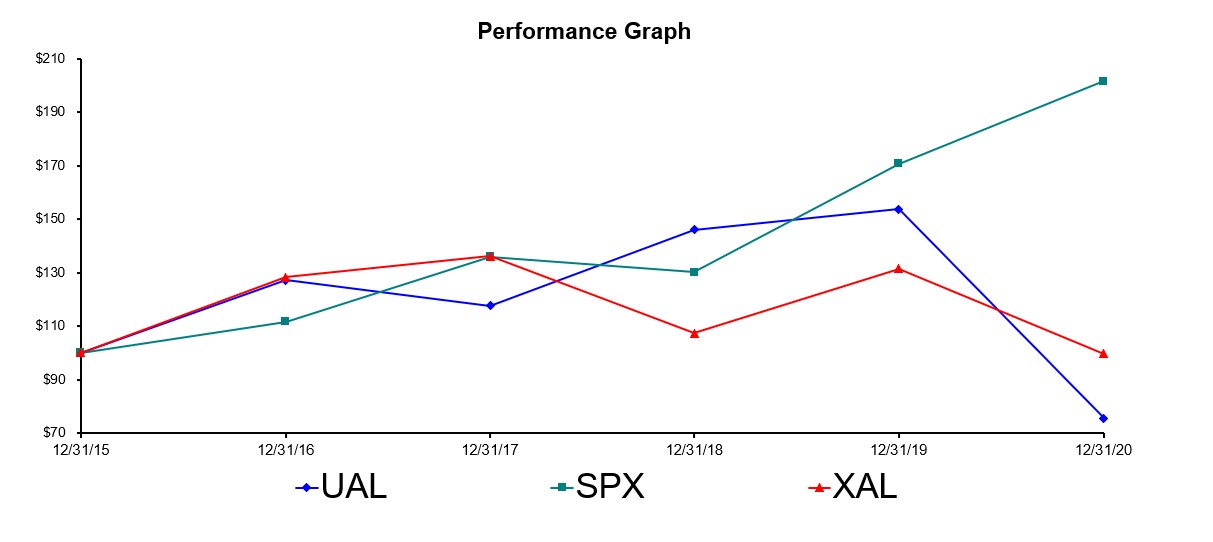
Note: The stock price performance shown in the graph above should not be considered indicative of potential future stock price performance. The foregoing performance graph is being furnished as part of this report solely in accordance with the requirement under Rule 14a-3(b)(9) to furnish our stockholders with such information, and therefore, shall not be deemed to be filed or incorporated by reference into any filings by the Company under the Securities Act or the Exchange Act.
The following table presents repurchases of UAL common stock made in the fourth quarter of fiscal year 2020:
| Period | Total number of shares purchased | Average price paid per share | Total number of shares purchased as part of publicly announced plans or programs (a) | Maximum number of shares (or approximate dollar value) of shares that may yet be purchased under the plans or programs | ||||||||||||||||||||||
| October 2020 | — | $ | — | — | $ | — | ||||||||||||||||||||
| November 2020 | — | — | — | — | ||||||||||||||||||||||
| December 2020 | — | — | — | — | ||||||||||||||||||||||
| Total | — | — |
(a) On April 24, 2020, UAL's Board of Directors terminated its share repurchase program. Under the Payroll Support Program agreements and Loan Program, the Company and its business are subject to certain restrictions, including, but not limited to, restrictions on the ability to repurchase UAL's equity securities through September 26, 2026 (or such earlier date that is one year after repayment in full of the Term Loan Facility).
Item 6. SELECTED FINANCIAL DATA.
UAL's consolidated financial statements and statistical data are provided in the tables below:
| Year Ended December 31, | ||||||||||||||||||||||||||||||||
| 2020 | 2019 | 2018 | 2017 | 2016 | ||||||||||||||||||||||||||||
| Income Statement Data (in millions, except per share amounts): | ||||||||||||||||||||||||||||||||
| Operating revenue | $ | 15,355 | $ | 43,259 | $ | 41,303 | $ | 37,784 | $ | 36,558 | ||||||||||||||||||||||
| Operating expense | 21,714 | 38,958 | 38,074 | 34,166 | 32,214 | |||||||||||||||||||||||||||
| Operating income (loss) | (6,359) | 4,301 | 3,229 | 3,618 | 4,344 | |||||||||||||||||||||||||||
| Net income (loss) | (7,069) | 3,009 | 2,122 | 2,143 | 2,234 | |||||||||||||||||||||||||||
| Basic earnings (loss) per share | (25.30) | 11.63 | 7.70 | 7.08 | 6.77 | |||||||||||||||||||||||||||
| Diluted earnings (loss) per share | (25.30) | 11.58 | 7.67 | 7.06 | 6.76 | |||||||||||||||||||||||||||
| Balance Sheet Data at December 31 (in millions): | ||||||||||||||||||||||||||||||||
| Unrestricted cash, cash equivalents and short-term investments | $ | 11,683 | $ | 4,944 | $ | 3,950 | $ | 3,798 | $ | 4,428 | ||||||||||||||||||||||
| Total assets | 59,548 | 52,611 | 49,024 | 47,469 | 40,208 | |||||||||||||||||||||||||||
| Debt and finance lease obligations | 27,153 | 14,818 | 13,792 | 13,576 | 11,705 |
| Year Ended December 31, | ||||||||||||||||||||||||||||||||
| 2020 | 2019 | 2018 | 2017 | 2016 | ||||||||||||||||||||||||||||
| Select operating statistics (a) | ||||||||||||||||||||||||||||||||
| Passengers (thousands) (b) | 57,761 | 162,443 | 158,330 | 148,067 | 143,177 | |||||||||||||||||||||||||||
| Revenue passenger miles ("RPMs") (millions) (c) | 73,883 | 239,360 | 230,155 | 216,261 | 210,309 | |||||||||||||||||||||||||||
| Available seat miles ("ASMs") (millions) (d) | 122,804 | 284,999 | 275,262 | 262,386 | 253,590 | |||||||||||||||||||||||||||
| Cargo revenue ton miles (millions) (e) | 2,711 | 3,329 | 3,425 | 3,316 | 2,805 | |||||||||||||||||||||||||||
| Passenger load factor (f) | 60.2% | 84.0% | 83.6% | 82.4% | 82.9% | |||||||||||||||||||||||||||
| Passenger revenue per available seat mile ("PRASM") (cents) | 9.61 | 13.90 | 13.70 | 13.13 | 13.18 | |||||||||||||||||||||||||||
| Total revenue per available seat mile ("TRASM") (cents) | 12.50 | 15.18 | 15.00 | 14.40 | 14.42 | |||||||||||||||||||||||||||
| Average yield per revenue passenger mile ("Yield") (cents) (g) | 15.98 | 16.55 | 16.38 | 15.93 | 15.90 | |||||||||||||||||||||||||||
| Cost per available seat mile ("CASM") (cents) | 17.68 | 13.67 | 13.83 | 13.02 | 12.70 | |||||||||||||||||||||||||||
| Average price per gallon of fuel, including fuel taxes | $ | 1.57 | $ | 2.09 | $ | 2.25 | $ | 1.74 | $ | 1.49 | ||||||||||||||||||||||
| Fuel gallons consumed (millions) | 2,004 | 4,292 | 4,137 | 3,978 | 3,904 | |||||||||||||||||||||||||||
| Average stage length (miles) (h) | 1,307 | 1,460 | 1,446 | 1,460 | 1,473 | |||||||||||||||||||||||||||
| Employee headcount, as of December 31 (thousands) | 74.4 | 95.9 | 91.7 | 89.8 | 87.8 |
(a) Includes data from our regional carriers operating under CPAs unless otherwise noted.
(b) The number of revenue passengers measured by each flight segment flown.
(c) The number of scheduled miles flown by revenue passengers.
(d) The number of seats available for passengers multiplied by the number of scheduled miles those seats are flown.
(e) The number of cargo revenue tons transported multiplied by the number of miles flown.
(f) RPM divided by ASM.
(g) The average passenger revenue received for each revenue passenger mile flown.
(h) Average stage length equals the average distance a flight travels weighted for size of aircraft.
Item 7. MANAGEMENT'S DISCUSSION AND ANALYSIS OF FINANCIAL CONDITION AND RESULTS OF OPERATIONS.
Overview
United Airlines Holdings, Inc. (together with its consolidated subsidiaries, "UAL" or the "Company") is a holding company and its principal, wholly-owned subsidiary is United Airlines, Inc. (together with its consolidated subsidiaries, "United"). As UAL consolidates United for financial statement purposes, disclosures that relate to activities of United also apply to UAL, unless otherwise noted. United's operating revenues and operating expenses comprise nearly 100% of UAL's revenues and operating expenses. In addition, United comprises approximately the entire balance of UAL's assets, liabilities and operating cash flows. When appropriate, UAL and United are named specifically for their individual contractual obligations and related disclosures and any significant differences between the operations and results of UAL and United are separately disclosed and explained. We sometimes use the words "we," "our," "us," and the "Company" in this report for disclosures that relate to all of UAL and United.
Impact of COVID-19 and Outlook
The novel coronavirus (COVID-19) pandemic, together with the measures implemented or recommended by governmental authorities and private organizations in response to the pandemic, has had an adverse impact that has been material to the Company's business, operating results, financial condition and liquidity. The Company began experiencing a significant decline in international and domestic demand related to COVID-19 during the first quarter of 2020. The decline in demand caused a material deterioration in our revenues in 2020, resulting in a net loss of $7.1 billion. The full extent of the ongoing impact of COVID-19 on the Company's longer-term operational and financial performance will depend on future developments, including those outside our control related to the efficacy and speed of vaccination programs in curbing the spread of the virus, the introduction and spread of new variants of the virus which may be resistant to currently approved vaccines, passenger testing requirements, mask mandates or other restrictions on travel, all of which are highly uncertain and cannot be predicted with certainty.
In response to decreased demand, the Company cut, relative to 2019 capacity, approximately 57% of its scheduled capacity for 2020. In the first quarter of 2021, the Company expects scheduled capacity to be down at least 51% versus the first quarter of 2019. The Company plans to continue to proactively evaluate and cancel flights on a rolling 60-day basis until it sees signs of a recovery in demand and expects demand to remain suppressed, relative to 2019 levels, until vaccines for COVID-19 are widely distributed and are effective in curbing the spread of the virus. In addition, the Company does not currently expect the recovery from COVID-19 to follow a linear path. As such, the Company's actual flown capacity may differ materially from its currently scheduled capacity.
The Company has taken a number of actions in response to the decreased demand for air travel. In addition to the schedule reductions discussed above, the Company has:
-
reduced its planned capital expenditures and reduced operating expenditures in 2020 (including by postponing projects deemed non-critical to the Company's operations);
-
terminated its share repurchase program;
-
issued or entered into approximately $13.4 billion in new secured notes, secured term loan facilities and new aircraft financings in 2020, including short term borrowings that were paid in 2020;
-
borrowed $1.0 billion under the $2.0 billion revolving credit facility established under the Amended and Restated Credit and Guaranty Agreement (the "Credit Agreement");
-
availed itself of financial assistance and/or financing made available by the U.S. Treasury Department ("Treasury"), as further described below;
-
raised approximately $2.1 billion in cash proceeds from the issuance and sale of UAL common stock in 2020;
-
entered into agreements to finance certain aircraft currently subject to purchase agreements through sale and leaseback transactions;
-
elected to defer the payment of $199 million in payroll taxes incurred through December 31, 2020, as provided by the Coronavirus Aid, Relief, and Economic Security Act (the "CARES Act"), until December 2021, at which time 50% is due, with the remaining amount due December 2022; and
-
taken a number of actions to reduce employee-related costs, including, among other items, the Company's Chief Executive Officer and President waived 100% of their respective base salaries through the end of 2020, other officers temporarily waived a portion of their base salaries, the Company's non-employee directors waived 100% of their cash
compensation for the second and third quarters of 2020, the Company suspended merit salary increases for 2020 and implemented a temporary four-day work week for management and administrative employees and the Company offered voluntary unpaid leaves of absence. The Company also entered into an agreement with its pilots to distribute fewer flight hours to a larger number of pilots, while also reaching agreements to provide a path to early retirement and reduce expense through voluntary leave of absence programs.
In addition, and as announced in July 2020, the Company started the involuntary furlough process by issuing Worker Adjustment and Retraining Notification ("WARN") Act notices to 36,000 of its employees. Since then, the Company worked to reduce the total number of furloughs to approximately 13,000 employees by working closely with its union partners, introducing new voluntary options selected by approximately 9,000 employees and proposing creative solutions that would save jobs. As a result of the Company's entry into the PSP2 Agreement, as described below, the Company issued recall notices to these furloughed employees and others impacted by furlough mitigation programs. See the discussion below for more detail about the PSP2 Agreement and the recall process.
The Company continues to focus on reducing expenses and managing its liquidity. We expect to continue to modify our cost management structure and capacity as the timing of demand recovery becomes more certain.
On March 27, 2020, the President of the United States signed the CARES Act into law. The CARES Act is intended to respond to the COVID-19 pandemic and its impact on the economy, public health, state and local governments, individuals, and businesses. The CARES Act also provides supplemental appropriations for federal agencies to respond to the COVID-19 pandemic.
On April 20, 2020, United entered into a Payroll Support Program Agreement (the "PSP Agreement") with Treasury providing the Company with total funding of approximately $5.1 billion pursuant to the Payroll Support Program established under the CARES Act. These funds were used to pay for the wages, salaries and benefits of United employees. Approximately $3.6 billion of the $5.1 billion was provided as a direct grant, and approximately $1.5 billion consists of indebtedness evidenced by a 10-year senior unsecured promissory note issued by UAL to Treasury (the "PSP Note"). See Note 2 to the financial statements included in Part II, Item 8 of this report for additional information related to warrants issued in connection with the PSP Note and Note 10 to the financial statements included in Part II, Item 8 of this report for a discussion of the PSP Note.
During 2020, UAL and United entered into a loan and guarantee agreement with Treasury. The agreement provides for a term loan facility of up to approximately $7.5 billion (the "CARES Act Term Loan Facility") pursuant to the loan program established under Section 4003(b)(1) of the CARES Act (the "Loan Program"). The loans (the "CARES Act Term Loans") may be disbursed in up to three disbursements on or before May 28, 2021. On September 28, 2020, United borrowed, and recorded as Long-term debt on the Company's consoli
Showing the first 8K of 71K characters. Open the full section
Item 7A. QUANTITATIVE AND QUALITATIVE DISCLOSURES ABOUT MARKET RISK.
Interest Rates. Our net income is affected by fluctuations in interest rates (e.g. interest expense on variable rate debt and interest income earned on short-term investments). The Company's policy is to manage interest rate risk through a combination of fixed and variable rate debt. The following table summarizes information related to the Company's interest rate market risk at December 31 (in millions):
| 2020 | 2019 | ||||||||||
| Variable rate debt | |||||||||||
| Carrying value of variable rate debt at December 31 | $ | 9,533 | $ | 3,408 | |||||||
| Impact of 100 basis point increase on projected interest expense for the following year | 81 | 33 | |||||||||
| Fixed rate debt | |||||||||||
| Carrying value of fixed rate debt at December 31 | 17,214 | 11,144 | |||||||||
| Fair value of fixed rate debt at December 31 | 19,273 | 11,736 | |||||||||
| Impact of 100 basis point increase in market rates on fair value | (709) | (458) |
As most recently announced on November 30, 2020, LIBOR is expected to be phased out starting on January 1, 2022 for the one-week and two-month USD LIBOR settings and starting on July 1, 2023 for the remaining USD LIBOR settings. Uncertainty as to the nature of alternative reference rates and as to potential changes or other reforms to LIBOR may adversely impact our interest rates and related interest expense. As of December 31, 2020, the Company had $9.5 billion in variable rate indebtedness. See Part II, Item 7. Management's Discussion and Analysis of Financial Condition and Results of Operations—Other Liquidity Matters, of this report for more information on interest expense.
A change in market interest rates would also impact interest income earned on our cash, cash equivalents and short-term investments. Assuming our cash, cash equivalents and short-term investments remain at their average 2020 levels, a 100 basis point increase in interest rates would result in a corresponding increase in the Company's interest income of approximately $95 million during 2021.
Commodity Price Risk (Aircraft Fuel). The price of aircraft fuel can significantly affect the Company's operations, results of operations, financial position and liquidity.
Our operational and financial results can be significantly impacted by changes in the price and availability of aircraft fuel. To provide adequate supplies of fuel, the Company routinely enters into purchase contracts that are customarily indexed to market prices for aircraft fuel, and the Company generally has some ability to cover short-term fuel supply and infrastructure disruptions at some major demand locations. The Company's current strategy is to not enter into transactions to hedge fuel price volatility, although the Company regularly reviews its policy based on market conditions and other factors. The Company's 2021 forecasted fuel consumption is presently approximately 2.1 billion gallons, and based on this forecast, a one-dollar change in the price of a barrel of crude oil would change the Company's annual fuel expense by approximately $49 million.
Foreign Currency. The Company generates revenues and incurs expenses in numerous foreign currencies. Changes in foreign currency exchange rates impact the Company's results of operations through changes in the dollar value of foreign currency-denominated operating revenues and expenses. Some of the Company's more significant foreign currency exposures include the Canadian dollar, Chinese renminbi, European euro, British pound and Japanese yen. The Company's current strategy is to not enter into transactions to hedge its foreign currency sales, although the Company regularly reviews its policy based on market conditions and other factors.
The result of a uniform 1% strengthening in the value of the U.S. dollar from December 31, 2020 levels relative to each of the currencies in which the Company has foreign currency exposure would result in a decrease in pre-tax income of approximately $10 million for the year ending December 31, 2021. This sensitivity analysis was prepared based upon projected 2021 foreign currency-denominated revenues and expenses as of December 31, 2020.
Item 8. FINANCIAL STATEMENTS AND SUPPLEMENTARY DATA.
REPORT OF INDEPENDENT REGISTERED PUBLIC ACCOUNTING FIRM
To the Stockholders and the Board of Directors of United Airlines Holdings, Inc.
Opinion on the Financial Statements
We have audited the accompanying consolidated balance sheets of United Airlines Holdings, Inc. (the "Company") as of December 31, 2020 and 2019, the related consolidated statements of operations, comprehensive income (loss), cash flows, and stockholders' equity for each of the three years in the period ended December 31, 2020, and the related notes and financial statement schedule listed in the Index at Item 15(a) (collectively referred to as the "consolidated financial statements"). In our opinion, the consolidated financial statements present fairly, in all material respects, the financial position of the Company at December 31, 2020 and 2019, and the results of its operations and its cash flows for each of the three years in the period ended December 31, 2020, in conformity with U.S. generally accepted accounting principles.
We also have audited, in accordance with the standards of the Public Company Accounting Oversight Board (United States) ("PCAOB"), the Company's internal control over financial reporting as of December 31, 2020, based on criteria established in Internal Control-Integrated Framework issued by the Committee of Sponsoring Organizations of the Treadway Commission (2013 framework) and our report dated March 1, 2021, expressed an unqualified opinion thereon.
Basis for Opinion
These financial statements are the responsibility of the Company's management. Our responsibility is to express an opinion on the Company's financial statements based on our audits. We are a public accounting firm registered with the PCAOB and are required to be independent with respect to the Company in accordance with the U.S. federal securities laws and the applicable rules and regulations of the Securities and Exchange Commission and the PCAOB.
We conducted our audits in accordance with the standards of the PCAOB. Those standards require that we plan and perform the audit to obtain reasonable assurance about whether the financial statements are free of material misstatement, whether due to error or fraud. Our audits included performing procedures to assess the risks of material misstatement of the financial statements, whether due to error or fraud, and performing procedures that respond to those risks. Such procedures included examining, on a test basis, evidence regarding the amounts and disclosures in the financial statements. Our audits also included evaluating the accounting principles used and significant estimates made by management, as well as evaluating the overall presentation of the financial statements. We believe that our audits provide a reasonable basis for our opinion.
Critical Audit Matters
The critical audit matters communicated below are matters arising from the current period audit of the financial statements that were communicated or required to be communicated to the audit committee and that: (1) relate to accounts or disclosures that are material to the financial statements and (2) involved our especially challenging, subjective or complex judgments. The communication of critical audit matters does not alter in any way our opinion on the consolidated financial statements, taken as a whole, and we are not, by communicating the critical audit matters below, providing separate opinions on the critical audit matters or on the accounts or disclosures to which they relate.
| Indefinite-lived Intangible Asset (China Route Authorities) Impairment Analysis | ||||||||
| Description of the matter | At December 31, 2020, the Company's China route authorities indefinite-lived intangible asset had a carrying value of approximately $1.0 billion. As discussed in Note 1 of the consolidated financial statements, indefinite-lived assets are reviewed for impairment on an annual basis as of October 1, or on an interim basis whenever a triggering event occurs. As discussed in Note 14 of the consolidated financial statements, the Company recorded a $130 million interim impairment charge related to this intangible asset. | |||||||
| Auditing management's annual China route authorities indefinite-lived intangibles impairment test was complex and judgmental due to the significant estimation required in determining the fair value. The fair value estimate was sensitive to significant assumptions such as revenue growth rate, operating margin and the discount rate, each of which is affected by expectations about future market or economic conditions. As a result of the subjectivity of the assumptions, adverse changes to management's estimates could reduce the underlying cash flows used to estimate fair value and trigger impairment charges. | ||||||||
| How we addressed the matter in our audit | We tested the Company's design and operating effectiveness of internal controls that address the risk of material misstatement relating to the estimate of fair value of route authorities used in the annual and interim impairment tests. This included testing controls over management's review of the significant assumptions used in the discounted cash flow methodology, including revenue growth rate, operating margin and the discount rate. | |||||||
| To test the estimated fair value of the Company's China route authorities indefinite-lived intangible, we performed audit procedures that included, among others, assessing the fair value methodology used by management and evaluating the significant assumptions used in the valuation models. We compared significant assumptions to current industry, market and economic trends, and to the Company's historical results. We assessed the historical accuracy of management's estimates and performed sensitivity analyses of significant assumptions to evaluate the changes in the fair value of the intangible asset that would result from changes in assumptions. We also involved a valuation specialist to assist in our evaluation of the Company's valuation methodology and discount rates. | ||||||||
| Deferred Tax Assets—Valuation Allowance | ||||||||
| Description of the matter | As more fully described in Note 6 to the consolidated financial statements, at December 31, 2020, the Company had deferred tax assets of $6.6 billion. In addition, the Company had deferred tax liabilities of $6.5 billion. Deferred tax assets are reduced by a valuation allowance if, based on the weight of all available evidence, in management’s judgment it is more likely than not that some portion, or all, of the deferred tax assets will not be realized. | |||||||
| Auditing management's assessment of the realizability of its deferred tax assets involved complex auditor judgment because management's estimate is highly judgmental and based on significant assumptions that may be affected by future market or economic conditions. | ||||||||
| How we addressed the matter in our audit | We obtained an understanding, evaluated the design, and tested the operating effectiveness of controls that address the risks of material misstatement relating to the realizability of deferred tax assets. This included controls over management's scheduling of the future reversal of existing taxable temporary differences (deferred tax liabilities) and projections of future taxable income. | |||||||
| Among other audit procedures |
Showing the first 8K of 261K characters. Open the full section
Item 9. CHANGES IN AND DISAGREEMENTS WITH ACCOUNTANTS ON ACCOUNTING AND FINANCIAL DISCLOSURE.
None.
Item 9A. CONTROLS AND PROCEDURES
Evaluation of Disclosure Control and Procedures
UAL and United each maintain controls and procedures that are designed to ensure that information required to be disclosed in the reports filed or submitted by UAL and United to the SEC is recorded, processed, summarized and reported, within the time periods specified by the SEC's rules and forms, and is accumulated and communicated to management including the Chief Executive Officer and Chief Financial Officer, as appropriate, to allow timely decisions regarding required disclosure. The management of UAL and United, including the Chief Executive Officer and Chief Financial Officer, performed an evaluation to conclude with reasonable assurance that UAL's and United's disclosure controls and procedures were designed and operating effectively to report the information each company is required to disclose in the reports they file with the SEC on a timely basis. Based on that evaluation, the Chief Executive Officer and the Chief Financial Officer of UAL and United have concluded that as of December 31, 2020, disclosure controls and procedures were effective.
Changes in Internal Control over Financial Reporting during the Quarter Ended December 31, 2020
During the three months ended December 31, 2020, there was no change in UAL's or United's internal control over financial reporting that materially affected, or is reasonably likely to materially affect, their internal control over financial reporting.
REPORT OF INDEPENDENT REGISTERED PUBLIC ACCOUNTING FIRM
To the Stockholders and Board of Directors of United Airlines Holdings, Inc.
Opinion on Internal Control over Financial Reporting
We have audited United Airlines Holdings, Inc.'s (the "Company") internal control over financial reporting as of December 31, 2020, based on criteria established in Internal Control-Integrated Framework issued by the Committee of Sponsoring Organizations of the Treadway Commission (2013 framework) (the "COSO criteria"). In our opinion, the Company maintained, in all material respects, effective internal control over financial reporting as of December 31, 2020, based on the COSO criteria.
We also have audited, in accordance with the standards of the Public Company Accounting Oversight Board (United States) ("PCAOB"), the consolidated financial statements as of and for the year ended December 31, 2020 of the Company and our report dated March 1, 2021 expressed an unqualified opinion thereon.
Basis for Opinion
The Company's management is responsible for maintaining effective internal control over financial reporting and for its assessment of the effectiveness of internal control over financial reporting included in the accompanying Management Report on Internal Control over Financial Reporting in Item 9A. Our responsibility is to express an opinion on the Company's internal control over financial reporting based on our audit. We are a public accounting firm registered with the PCAOB and are required to be independent with respect to the Company in accordance with the U.S. federal securities laws and the applicable rules and regulations of the Securities and Exchange Commission and the PCAOB.
We conducted our audit in accordance with the standards of the PCAOB. Those standards require that we plan and perform the audit to obtain reasonable assurance about whether effective internal control over financial reporting was maintained in all material respects.
Our audit included obtaining an understanding of internal control over financial reporting, assessing the risk that a material weakness exists, testing and evaluating the design and operating effectiveness of internal control based on the assessed risk, and performing such other procedures as we considered necessary in the circumstances. We believe that our audit provides a reasonable basis for our opinion.
Definition and Limitations of Internal Control Over Financial Reporting
A company's internal control over financial reporting is a process designed to provide reasonable assurance regarding the reliability of financial reporting and the preparation of financial statements for external purposes in accordance with generally accepted accounting principles. A company's internal control over financial reporting includes those policies and procedures that (1) pertain to the maintenance of records that, in reasonable detail, accurately and fairly reflect the transactions and dispositions of the assets of the company; (2) provide reasonable assurance that transactions are recorded as necessary to permit preparation of financial statements in accordance with generally accepted accounting principles, and that receipts and expenditures of the company are being made only in accordance with authorizations of management and directors of the company; and (3) provide reasonable assurance regarding prevention or timely detection of unauthorized acquisition, use, or disposition of the company's assets that could have a material effect on the financial statements.
Because of its inherent limitations, internal control over financial reporting may not prevent or detect misstatements. Also, projections of any evaluation of effectiveness to future periods are subject to the risk that controls may become inadequate because of changes in conditions, or that the degree of compliance with the policies or procedures may deteriorate.
/s/ Ernst & Young LLP
Chicago, Illinois
March 1, 2021
United Airlines Holdings, Inc. Management Report on Internal Control Over Financial Reporting
March 1, 2021
To the Stockholders of United Airlines Holdings, Inc.
Chicago, Illinois
The management of United Airlines Holdings, Inc. ("UAL") is responsible for establishing and maintaining adequate internal control over financial reporting, as such term is defined in Exchange Act Rules 13a-15(f). Our internal control over financial reporting is designed to provide reasonable assurance regarding the reliability of financial reporting and the preparation of financial statements for external purposes in accordance with generally accepted accounting principles. Because of its inherent limitations, our internal control over financial reporting may not prevent or detect misstatements. Also, projections of any evaluation of effectiveness to future periods are subject to the risk that controls may become inadequate because of changes in conditions, or that the degree of compliance with the policies or procedures may deteriorate.
Under the supervision and with the participation of management, including our Chief Executive Officer and Chief Financial Officer, we conducted an evaluation of the design and operating effectiveness of our internal control over financial reporting as of December 31, 2020. In making this assessment, management used the framework set forth in Internal Control—Integrated Framework (2013 Framework) issued by the Committee of the Sponsoring Organizations of the Treadway Commission. Based on this evaluation, our Chief Executive Officer and Chief Financial Officer concluded that our internal control over financial reporting was effective as of December 31, 2020.
Our independent registered public accounting firm, Ernst & Young LLP, who audited UAL's consolidated financial statements included in this Form 10-K, has issued a report on UAL's internal control over financial reporting, which is included herein.
United Airlines, Inc. Management Report on Internal Control Over Financial Reporting
March 1, 2021
To the Stockholder of United Airlines, Inc.
Chicago, Illinois
The management of United Airlines, Inc. ("United") is responsible for establishing and maintaining adequate internal control over financial reporting, as such term is defined in Exchange Act Rules 13a-15(f). United's internal control over financial reporting is designed to provide reasonable assurance regarding the reliability of financial reporting and the preparation of financial statements for external purposes in accordance with generally accepted accounting principles. Because of its inherent limitations, United's internal control over financial reporting may not prevent or detect misstatements. Also, projections of any evaluation of effectiveness to future periods are subject to the risk that controls may become inadequate because of changes in conditions, or that the degree of compliance with the policies or procedures may deteriorate.
Under the supervision and with the participation of management, including United's Chief Executive Officer and Chief Financial Officer, United conducted an evaluation of the design and operating effectiveness of its internal control over financial reporting as of December 31, 2020. In making this assessment, management used the framework set forth in Internal Control—Integrated Framework (2013 Framework) issued by the Committee of the Sponsoring Organizations of the Treadway Commission. Based on this evaluation, United's Chief Executive Officer and Chief Financial Officer concluded that its internal control over financial reporting was effective as of December 31, 2020.
This annual report does not include an attestation report of United's registered public accounting firm regarding internal control over financial reporting. Management's report was not subject to attestation by United's registered public accounting firm pursuant to the rules of the Securities and Exchange Commission that permit United to provide only management's report in this annual report.
Item 9B. OTHER INFORMATION.
2021 Executive Compensation Program
On February 25, 2021, the Compensation Committee (the "Committee") of the Board of Directors of United Airlines Holdings, Inc. (the "Company") approved the Company's 2021 executive compensation program ("2021 Program"). The 2021 Program is designed to be aligned with the Company's recovery efforts from the COVID-19 pandemic and the related impacts on the global economy and the travel industry in particular. As described further below, the recovery design of the 2021 Program includes short-term and long-term incentive awards. The 2021 Program maintains salary and compensation levels linked to short-term performance goals but significantly reduces the intended levels of long-term equity incentives granted to our executives in order to comply with the compensation limits of the CARES Act (as described below). As a result of this reduction in long-term equity incentives, the compensation component levels under the 2021 Program differ as compared to our traditional and intended compensation levels.
As previously disclosed, in April 2020, the Company entered into a Payroll Support Program Agreement (the "First PSP Agreement") with the United States Department of the Treasury (the "U.S. Treasury Department") under the Coronavirus Aid, Relief, and Economic Security Act (the "CARES Act"); in September 2020, the Company entered into a loan agreement with the U.S. Treasury Department (the "Term Loan Facility") pursuant to the loan program established under the CARES Act; and, in January 2021, the Company and the U.S. Treasury Department entered into the Payroll Support Program Extension Agreement (together with the First PSP Agreement, the "PSP Agreement"). As a condition of the PSP Agreement and the Term Loan Facility, the Company is subject to restrictions on the amount of total compensation that it can provide to certain employees, including each of the Company's named executive officers. These compensation restrictions continue until the later of (i) October 1, 2022 and (ii) one year after full repayment of all loans under the Term Loan Facility, which has a maturity date of September 26, 2025 (such period is referred to herein as the "CARES Act restricted period").
The annual total target compensation levels for our executives are set with reference to market practices of a peer group of companies and the benchmarking results are balanced with additional factors, such as each executive's experience, knowledge, skills, roles, and contributions to the Company. The Committee also considers internal pay parity among our executives. As a result of the CARES Act limitations on executive compensation, the Company is prohibited from providing our executives the full value of the intended compensation levels during the CARES Act restricted period. The 2021 Program is designed to motivate and retain our executives while complying with the compensation limits under the CARES Act.
The compensation packages of our executives also were significantly reduced during 2020. As previously disclosed, Scott Kirby, our CEO, and Brett Hart, our President, each waived 100% of his 2020 base salary for portions of 2020 in recognition of the impact of the COVID-19 pandemic on the Company's business, and to lead by example. In addition, no payments were made under our 2020 Annual Incentive Program ("AIP"). The total salary amounts waived during 2020 were as follows (including reference to the percent of total annual salary that was waived for 2020): Mr. Kirby—$784,470 (82%) Mr. Hart—$545,737 (70%); and Mr. Gerald Laderman (our Executive Vice President and Chief Financial Officer)—$151,057 (21%). The target level of the 2020 AIP awards, for which no payments were made, were as follows: Mr. Kirby—$2,500,000; Mr. Hart—$1,356,250; and Mr. Laderman—$758,500.
Short-term Incentives. On February 25, 2021, the Committee authorized short-term performance-based restricted stock unit ("RSU") awards ("Recovery Performance RSUs") under the Company's 2017 Incentive Compensation Plan (the "2017 Plan") in lieu of the cash-based payment structure of the 2020 AIP. Under the Recovery Performance RSUs, the Committee established short-term performance goals based on financial and customer satisfaction metrics that are deemed critical to the Company's success as it emerges from the worst crisis in the history of the aviation industry. The equity design of the Recovery Performance RSUs places emphasis on Company stock price performance and is designed to further support alignment of interests between our executives and stockholders.
The Recovery Performance RSUs may be granted to officers and employees of United Airlines, Inc. ("United") or any subsidiary of United. Generally, a recipient of a Recovery Performance RSU award must remain continuously employed from the date of grant through the last day of the performance period in order to be eligible for vesting of the award. However, if the recipient's employment is terminated by reason of death or disability, then the award will vest on a pro-rated basis (based on the number of days worked during the performance period and assuming achievement of the target level).
Long-term Equity Incentives. The Committee sets the intended long-term equity compensation levels as an element of the annual total target compensation package based on the peer benchmarking results and other factors referenced above. However, in designing the 2021 Program, the Committee determined that it was appropriate to implement the required CARES Act compensation limits through reductions to the target grant level of the long-term equity awards. The 2021 reductions to the long-term equity awards to comply with the CARES Act limits are detailed in the table below.
| Name | Intended LTI Equity Award Level | Actual LTI Equity Award Level (1) | Reduction For CARES Act Limit | |||||||||||||||||
| J. Scott Kirby | $10,000,000 | $6,230,000 | $3,770,000 | |||||||||||||||||
| Brett J. Hart | $5,812,500 | $1,256,000 | $4,556,500 | |||||||||||||||||
| Gerald Laderman | $2,718,750 | $1,665,000 | $1,053,750 |
The entire 2021 LTI equity award for Mr. Hart and a portion of the 2021 LTI equity award ($1,574,000) for Mr. Kirby will not be granted until a later date in accordance with the requirements of the CARES Act, which counts and restricts total compensation on a rolling 12-month basis.
As noted above, in order to support continued alignment with the Company's stockholders, the short-term incentive component is being delivered entirely in equity. In addition, while the short-term component of the 2021 Program emphasizes performance goals deemed critical to the Company's emergence from the COVID-19 pandemic, the 2021 long-term incentive retains the time-vested equity component included in the Company's long-term incentive design in prior years. The time-vested equity component enhances stability of the long-term incentive by reducing volatility (as compared to performance-based awards), which is expected to enhance retention value, while assuring that a significant portion of compensation is directly linked to the Company's stock price performance.
Vesting of the time-vested RSUs is subject to the employee's continued employment with the Company or its subsidiaries from the date of grant through each vesting date (except as otherwise provided by the Committee or as provided in the 2017 Plan). The time-vested awards under the 2021 Program generally vest in six-month increments over a two-year period (on August 31st and February 28th). The Committee established this vesting schedule in consideration of the significant reduction in the long-term equity incentives under the 2021 Program as compared to the intended levels under the Company's traditional total compensation design. In addition, this vesting schedule is balanced by the extended vesting period of the long-term contingent cash awards (described below), which include a vesting condition that may extend for more than five years.
Consistent with our prior long-term incentive design, if the employee remains continuously employed by the Company or an affiliate from the date of grant until the date upon which a qualifying event (which is generally a termination of employment within two years following a change of control of the Company under circumstances entitling the employee to a cash severance payment) occurs, then on the date of such qualifying event the employee's rights with respect to all RSUs that are not then vested will become vested and all restrictions on such RSUs will lapse. Further, if the employee's employment is terminated by reason of death or disability, then all RSUs that are not then vested will fully vest.
Long-term Contingent Cash Awards. On February 25, 2021, the Committee also approved long-term contingent cash awards (the "Long-Term Cash Awards") in recognition of the Company's need to reward and retain its management team as it continues to navigate the Company's responses to the COVID-19 pandemic. The Committee approved Long-Term Cash Awards to Messrs. Kirby, Hart, and Laderman with a contingent payment opportunity equal to three times the executive's base salary level at the time of grant. Under the terms of the Long-Term Cash Awards, payment of the award is contingent upon the recipient's continued employment with the Company through the later of (i) three years from the date of award or (ii) the expiration of the CARES Act restricted period. If the recipient's employment is terminated by reason of death or disability, then the Long-Term Cash Award is payable in full to the recipient or his or her estate.
In making the determination to grant the Long-Term Cash Awards, the Committee considered concerns related to the need to retain and reward our management team throughout the current crisis, considerations related to compensation benchmarking and internal and external pay parity, and management's voluntary waivers of significant salary amounts in 2020. The Long-Term Cash Awards are intended to enhance our ability to retain our management team during this time of unprecedented challenges for the Company and the airline industry as a whole, particularly as our management team has marketable skills that are highly valued and transferable to other companies, including companies in industries that have not been as adversely impacted by COVID-19.
PART III
Item 10. DIRECTORS, EXECUTIVE OFFICERS AND CORPORATE GOVERNANCE.
Certain information required by this item with respect to UAL is incorporated by reference from UAL's definitive proxy statement for its 2021 Annual Meeting of Stockholders under the captions "Election of Directors" and "Corporate Governance." Information regarding the executive officers of UAL is presented in Part I, Item 1 of this report. There are no family relationships among the executive officers or the directors of UAL. The executive officers are elected by UAL's Board of Directors each year and hold office until the next annual meeting of stockholders, until their successors are elected and qualified, or until their earlier death, resignation or removal.
Information required by this item with respect to United is omitted pursuant to General Instruction I(2)(c) of Form 10-K.
Code of Ethics. The Company has a code of ethics, the "Code of Ethics and Business Conduct," for its directors, officers and employees. The code serves as a "Code of Ethics" as defined by SEC regulations, and as a "Code of Conduct" under Nasdaq Listing Rule 5610. The code is available on the Company's investor relations website at ir.united.com. Waivers granted to certain officers from compliance with or future amendments to the code will be disclosed on the Company's investor relations website in accordance with Item 5.05 of Form 8-K.
Item 11. EXECUTIVE COMPENSATION.
Information required by this item with respect to UAL is incorporated by reference from UAL's definitive proxy statement for its 2021 Annual Meeting of Stockholders under the captions "Executive Compensation," "2020 Director Compensation" and "Corporate Governance—Compensation Committee Interlocks and Insider Participation."
Information required by this item with respect to United is omitted pursuant to General Instruction I(2)(c) of Form 10-K.
Item 12. SECURITY OWNERSHIP OF CERTAIN BENEFICIAL OWNERS AND MANAGEMENT AND RELATED STOCKHOLDER MATTERS.
Information required by this item with respect to UAL is incorporated by reference from UAL's definitive proxy statement for its 2021 Annual Meeting of Stockholders under the caption "Beneficial Ownership of Securities."
Information required by this item with respect to United is omitted pursuant to General Instruction I(2)(c) of Form 10-K.
Item 13. CERTAIN RELATIONSHIPS AND RELATED TRANSACTIONS, AND DIRECTOR INDEPENDENCE.
Information required by this item with respect to UAL is incorporated by reference from UAL's definitive proxy statement for its 2021 Annual Meeting of Stockholders under the captions "Corporate Governance—Certain Relationships and Related Transactions," "Corporate Governance—Committees of the Board" and "Corporate Governance—Director Independence."
Information required by this item with respect to United is omitted pursuant to General Instruction I(2)(c) of Form 10-K.
Item 14. PRINCIPAL ACCOUNTANT FEES AND SERVICES.
The Audit Committee of the UAL Board of Directors has adopted a policy on pre-approval of services of the Company's independent registered public accounting firm. As a wholly-owned subsidiary of UAL, United's audit services are determined by UAL. The policy provides that the Audit Committee shall pre-approve all audit and non-audit services to be provided to UAL and its subsidiaries and affiliates by its independent auditors. The process by which this is carried out is as follows:
For recurring services, the Audit Committee reviews and pre-approves the independent registered public accounting firm's annual audit services in conjunction with the annual appointment of the outside auditors. The reviewed materials include a description of the services along with related fees. The Audit Committee also reviews and pre-approves other classes of recurring services along with fee thresholds for pre-approved services. In the event that the additional services are required prior to the next scheduled Audit Committee meeting, pre-approvals of additional services follow the process described below.
Any requests for audit, audit related, tax and other services not contemplated with the recurring services approval described above must be submitted to the Audit Committee for specific pre-approval and cannot commence until such approval has been granted. Normally, pre-approval is provided at regularly scheduled meetings. However, the authority to grant specific preapproval between meetings, as necessary, has been delegated to the Chair of the Audit Committee. The Chair must update the Audit Committee at the next regularly scheduled meeting of any services that were granted specific pre-approval.
On a periodic basis, the Audit Committee reviews the status of services and fees incurred year-to-date and a list of newly pre-approved services since its last regularly scheduled meeting. The Audit Committee has considered whether the 2020 and 2019 non-audit services provided by Ernst & Young LLP, the Company's independent registered public accounting firm, are compatible with maintaining auditor independence.
All of the services in 2020 and 2019 under the Audit Fees, Audit Related Fees, Tax Fees and All Other Fees categories below have been approved by the Audit Committee pursuant to paragraph (c)(7) of Rule 2-01 of Regulation S-X of the Exchange Act.
The aggregate fees billed for professional services rendered by the Company's independent auditors in 2020 and 2019 are as follows (in thousands):
| Service | 2020 | 2019 | ||||||||||||
| Audit Fees | $ | 6,000 | $ | 4,323 | ||||||||||
| Audit Related Fees | 302 | 403 | ||||||||||||
| Tax fees | 170 | 174 | ||||||||||||
| Total Fees | $ | 6,472 | $ | 4,900 |
Note: UAL and United amounts are the same.
Audit Fees. For 2020 and 2019, audit fees consist primarily of the audit and quarterly reviews of the consolidated financial statements and the audit of the effectiveness of internal control over financial reporting of United Airlines Holdings, Inc. and its wholly-owned subsidiaries. Audit fees also include the audit of the consolidated financial statements of United, attestation services required by statute or regulation, comfort letters, consents, assistance with and review of documents filed with the SEC, and accounting and financial reporting consultations and research work necessary to comply with generally accepted auditing standards.
Audit Related Fees. For 2020, fees for audit-related services primarily consisted of audits and/or agreed upon audit procedures related to prior years' audits of subsidiaries of the Company.
For 2019, fees for audit-related services primarily consisted of accounting consultations for proposed or future transactions and identifying and testing changes in the internal control environment prior to the implementation of the new revenue accounting system, which went into effect during the third quarter of 2019.
Tax Fees. Tax fees for 2020 and 2019 relate to professional services provided for research and consultations regarding tax accounting and tax compliance matters and review of U.S. and international tax impacts of certain transactions, exclusive of tax services rendered in connection with the audit.
PART IV
Item 15. EXHIBITS AND FINANCIAL STATEMENT SCHEDULES.
| (a) | List of documents filed as part of this report: | |||||||
| (1) | Financial Statements. The financial statements required by this item are listed in Part II, Item 8, Financial Statements and Supplementary Data herein. | |||||||
| (2) | Financial Statement Schedules. The financial statement schedule required by this item is listed below and included in this report after the signature page hereto. |
| Schedule II-Valuation and Qualifying Accounts for the years ended December 31, 2020, 2019 and 2018. | ||||||||
| All other schedules are omitted because they are not applicable, not required or the required information is shown in the consolidated financial statements or notes thereto. | ||||||||
| (b) | Exhibits. The exhibits required by this item are provided in the Exhibit Index. |
Item 16. FORM 10-K SUMMARY.
None.
EXHIBIT INDEX
| 31.3 | United | Certification of the Principal Executive Officer of United Airlines, Inc. pursuant to 15 U.S.C. 78m(a) or 78o(d) (Section 302 of the Sarbanes-Oxley Act of 2002) | ||||||
| 31.4 | United | Certification of the Principal Financial Officer of United Airlines, Inc. pursuant to 15 U.S.C. 78m(a) or 78o(d) (Section 302 of the Sarbanes-Oxley Act of 2002) | ||||||
| Section 1350 Certifications | ||||||||
| 32.1 | UAL | Certification of the Chief Executive Officer and Chief Financial Officer of United Airlines Holdings, Inc. pursuant to 18 U.S.C. 1350 (Section 906 of the Sarbanes-Oxley Act of 2002) | ||||||
| 32.2 | United | Certification of the Chief Executive Officer and Chief Financial Officer of United Airlines, Inc. pursuant to 18 U.S.C. 1350 (Section 906 of the Sarbanes-Oxley Act of 2002) | ||||||
| Interactive Data File | ||||||||
| 101 | UAL United | The following financial statements from the combined Annual Report of UAL and United on Form 10-K for the year ended December 31, 2020, formatted in Inline XBRL: (i) Statements of Consolidated Operations, (ii) Statements of Consolidated Comprehensive Income (Loss), (iii) Consolidated Balance Sheets, (iv) Statements of Consolidated Cash Flows, (v) Statements of Consolidated Stockholders' Equity (Deficit) and (vi) Combined Notes to Condensed Consolidated Financial Statements, tagged as blocks of text and including detailed tags. | ||||||
| 104 | UAL United | Cover Page Interactive Data File - the cover page XBRL tags are embedded within the Inline XBRL document |
† Indicates management contract or compensatory plan or arrangement. Pursuant to Item 601(b)(10), United is permitted to omit certain compensation-related exhibits from this report and therefore only UAL is identified as the registrant for purposes of those items.
^ Portions of the referenced exhibit have been omitted pursuant to Item 601(b) of Regulation S-K.
- Exhibits and schedules have been omitted pursuant to Item 601(a)(5) of Regulation S-K and will be furnished on a supplemental basis to the Securities and Exchange Commission upon request.
SIGNATURES
Pursuant to the requirements of Section 13 or 15(d) of the Securities Exchange Act of 1934, each registrant has duly caused this report to be signed on its behalf by the undersigned, thereunto duly authorized.
| UNITED AIRLINES HOLDINGS, INC. UNITED AIRLINES, INC. (Registrants) | ||||||||
| By: | /s/ Gerald Laderman | |||||||
| Gerald Laderman | ||||||||
| Executive Vice President and Chief Financial Officer | ||||||||
| Date: | March 1, 2021 |
Pursuant to the requirements of the Securities Exchange Act of 1934, this report has been signed below by the following persons on behalf of United Airlines Holdings, Inc. and in the capacities and on the date indicated.
| Signature | Capacity | |||||||
| /s/ J. Scott Kirby | Chief Executive Officer, Director | |||||||
| J. Scott Kirby | (Principal Executive Officer) | |||||||
| /s/ Gerald Laderman | Executive Vice President and Chief Financial Officer | |||||||
| Gerald Laderman | (Principal Financial Officer) | |||||||
| /s/ Chris Kenny | Vice President and Controller | |||||||
| Chris Kenny | (Principal Accounting Officer) | |||||||
| /s/ Carolyn Corvi | Director | |||||||
| Carolyn Corvi | ||||||||
| /s/ Barney Harford | Director | |||||||
| Barney Harford | ||||||||
| /s/ Michele J. Hooper | Director | |||||||
| Michele J. Hooper | ||||||||
| /s/ Todd M. Insler | Director | |||||||
| Todd M. Insler | ||||||||
| /s/ Walter Isaacson | Director | |||||||
| Walter Isaacson |
| /s/ James A.C. Kennedy | Director | |||||||
| James A.C. Kennedy | ||||||||
| /s/ Oscar Munoz | Director | |||||||
| Oscar Munoz | ||||||||
| /s/ Sito Pantoja | Director | |||||||
| Sito Pantoja | ||||||||
| /s/ Edward M. Philip | Director | |||||||
| Edward M. Philip | ||||||||
| /s/ Edward L. Shapiro | Director | |||||||
| Edward L. Shapiro | ||||||||
| /s/ David J. Vitale | Director | |||||||
| David J. Vitale | ||||||||
| /s/ James M. Whitehurst | Director | |||||||
| James M. Whitehurst |
| Date: | March 1, 2021 |
Pursuant to the requirements of the Securities Exchange Act of 1934, this report has been signed below by the following persons on behalf of United Airlines, Inc. and in the capacities and on the date indicated.
| Signature | Capacity | |||||||
| /s/ J. Scott Kirby | Chief Executive Officer, Director | |||||||
| J. Scott Kirby | (Principal Executive Officer) | |||||||
| /s/ Gerald Laderman | Executive Vice President and Chief Financial Officer, Director | |||||||
| Gerald Laderman | (Principal Financial Officer) | |||||||
| /s/ Chris Kenny | Vice President and Controller | |||||||
| Chris Kenny | (Principal Accounting Officer) | |||||||
| /s/ Brett J. Hart | Director | |||||||
| Brett J. Hart | ||||||||
| Date: | March 1, 2021 |
Schedule II
Valuation and Qualifying Accounts
For the Years Ended December 31, 2020, 2019 and 2018
| (In millions) Description | Balance at Beginning of Period | Additions Charged to Costs and Expenses | Deductions | Other | Balance at End of Period | ||||||||||||||||||||||||
| Allowance for credit losses - receivables: | |||||||||||||||||||||||||||||
| 2020 | $ | 9 | $ | 70 | $ | 16 | $ | 15 | $ | 78 | |||||||||||||||||||
| 2019 | 8 | 17 | 16 | — | 9 | ||||||||||||||||||||||||
| 2018 | 7 | 17 | 16 | — | 8 | ||||||||||||||||||||||||
| Obsolescence allowance—spare parts: | |||||||||||||||||||||||||||||
| 2020 | $ | 425 | $ | 88 | $ | 35 | $ | — | $ | 478 | |||||||||||||||||||
| 2019 | 412 | 76 | 63 | — | 425 | ||||||||||||||||||||||||
| 2018 | 354 | 73 | 15 | — | 412 | ||||||||||||||||||||||||
| Allowance for credit losses - notes receivable: | |||||||||||||||||||||||||||||
| 2020 | $ | — | $ | 518 | $ | — | $ | 4 | $ | 522 | |||||||||||||||||||
| Valuation allowance for deferred tax assets: | |||||||||||||||||||||||||||||
| 2020 | $ | 58 | $ | 197 | $ | 8 | $ | — | $ | 247 | |||||||||||||||||||
| 2019 | 59 | — | 1 | — | 58 | ||||||||||||||||||||||||
| 2018 | 63 | 2 | 6 | — | 59 |