 filings.tools
United Airlines Holdings 10-K 2021-12-31
Filed 2022-02-18. 23 sections, 581K characters. Original on sec.gov · Markdown · JSON
Cover and table of contents
UNITED STATES
SECURITIES AND EXCHANGE COMMISSION
Washington, DC 20549
| FORM | 10-K |
| ☒ | ANNUAL REPORT PURSUANT TO SECTION 13 OR 15(d) OF THE SECURITIES EXCHANGE ACT OF 1934 |
For the fiscal year ended December 31, 2021
OR
| ☐ | TRANSITION REPORT PURSUANT TO SECTION 13 OR 15(d) OF THE SECURITIES EXCHANGE ACT OF 1934 |
For the transition period from to

| Commission File Number | Exact Name of Registrant as Specified in its Charter, Principal Executive Office Address and Telephone Number | State of Incorporation | I.R.S. Employer Identification No. | ||||||||||||||||||||||||||||||||||||||
| 001-06033 | United Airlines Holdings, Inc. | Delaware | 36-2675207 | ||||||||||||||||||||||||||||||||||||||
| 233 South Wacker Drive, | Chicago, | Illinois | 60606 | ||||||||||||||||||||||||||||||||||||||
| (872) | 825-4000 | ||||||||||||||||||||||||||||||||||||||||
| 001-10323 | United Airlines, Inc. | Delaware | 74-2099724 | ||||||||||||||||||||||||||||||||||||||
| 233 South Wacker Drive, | Chicago, | Illinois | 60606 | ||||||||||||||||||||||||||||||||||||||
| (872) | 825-4000 |
Securities registered pursuant to Section 12(b) of the Act:
| Title of Each Class | Trading Symbol | Name of Each Exchange on Which Registered | ||||||||||||||||||
| United Airlines Holdings, Inc. | Common Stock, $0.01 par value | UAL | The Nasdaq Stock Market LLC | |||||||||||||||||
| Preferred Stock Purchase Rights | None | The Nasdaq Stock Market LLC | ||||||||||||||||||
| United Airlines, Inc. | None | None | None |
Securities registered pursuant to Section 12(g) of the Act:
| United Airlines Holdings, Inc. | None | |||||||||||||
| United Airlines, Inc. | None | |||||||||||||
Indicate by check mark if the registrant is a well-known seasoned issuer, as defined in Rule 405 of the Securities Act
| United Airlines Holdings, Inc. | Yes | ☒ | No | ☐ | United Airlines, Inc. | Yes | ☒ | No | ☐ |
Indicate by check mark if the registrant is not required to file reports pursuant to Section 13 or Section 15(d) of the Act.
| United Airlines Holdings, Inc. | Yes | ☐ | No | ☒ | United Airlines, Inc. | Yes | ☐ | No | ☒ |
Indicate by check mark whether the registrant (1) has filed all reports required to be filed by Section 13 or 15(d) of the Securities Exchange Act of 1934 during the preceding 12 months (or for such shorter period that the registrant was required to file such reports), and (2) has been subject to such filing requirements for the past 90 days.
| United Airlines Holdings, Inc. | Yes | ☒ | No | ☐ | United Airlines, Inc. | Yes | ☒ | No | ☐ |
Indicate by check mark whether the registrant has submitted electronically every Interactive Data File required to be submitted pursuant to Rule 405 of Regulation S-T (§232.405 of this Chapter) during the preceding 12 months (or for such shorter period that the registrant was required to submit such files).
| United Airlines Holdings, Inc. | Yes | ☒ | No | ☐ | United Airlines, Inc. | Yes | ☒ | No | ☐ |
Indicate by check mark whether the registrant is a large accelerated filer, an accelerated filer, a non-accelerated filer, a smaller reporting company, or an emerging growth company. See the definitions of "large accelerated filer," "accelerated filer," "smaller reporting company," and "emerging growth company" in Rule 12b-2 of the Exchange Act.
| United Airlines Holdings, Inc. | Large accelerated filer | ☒ | Accelerated filer | ☐ | Non-accelerated filer | ☐ | Smaller reporting company | ☐ | Emerging growth company | ☐ | ||||||||||||||||||||||
| United Airlines, Inc. | Large accelerated filer | ☐ | Accelerated filer | ☐ | Non-accelerated filer | ☒ | Smaller reporting company | ☐ | Emerging growth company | ☐ |
If an emerging growth company, indicate by check mark if the registrant has elected not to use the extended transition period for complying with any new or revised financial accounting standards provided pursuant to Section 13(a) of the Exchange Act.
| United Airlines Holdings, Inc. | ☐ | United Airlines, Inc. | ☐ |
Indicate by check mark whether the registrant has filed a report on and attestation to its management's assessment of the effectiveness of its internal control over financial reporting under Section 404(b) of the Sarbanes-Oxley Act (15 U.S.C. 7262(b)) by the registered public accounting firm that prepared or issued its audit report.
| United Airlines Holdings, Inc. | ☒ | United Airlines, Inc. | ☐ |
Indicate by check mark whether the registrant is a shell company (as defined in Rule 12b-2 of the Exchange Act).
| United Airlines Holdings, Inc. | Yes | ☐ | No | ☒ | ||||||||||||||||
| United Airlines, Inc. | Yes | ☐ | No | ☒ |
The aggregate market value of common stock held by non-affiliates of United Airlines Holdings, Inc. was $16.9 billion as of June 30, 2021 based on the closing sale price of $52.29 on that date. There is no market for United Airlines, Inc. common stock.
Indicate the number of shares outstanding of each of the registrant's classes of common stock, as of February 10, 2022.
| United Airlines Holdings, Inc. | 324,626,332 | shares of common stock ($0.01 par value) | |||||||||
| United Airlines, Inc. | 1,000 | shares of common stock ($0.01 par value) (100% owned by United Airlines Holdings, Inc.) |
This combined Form 10-K is separately filed by United Airlines Holdings, Inc. and United Airlines, Inc.
OMISSION OF CERTAIN INFORMATION
United Airlines, Inc. meets the conditions set forth in General Instruction I(1)(a) and (b) of Form 10-K and is therefore filing this form with the reduced disclosure format allowed under that General Instruction.
DOCUMENTS INCORPORATED BY REFERENCE
Certain information required by Items 10, 11, 12 and 13 of Part III of this Form 10-K is incorporated by reference for United Airlines Holdings, Inc. from its definitive proxy statement for its 2022 Annual Meeting of Stockholders.
United Airlines Holdings, Inc. and Subsidiary Companies
United Airlines, Inc. and Subsidiary Companies
Annual Report on Form 10-K
For the Year Ended December 31, 2021
This Annual Report on Form 10-K ("Form 10-K") contains various "forward-looking statements" within the meaning of Section 27A of the Securities Act of 1933, as amended (the "Securities Act"), and Section 21E of the Securities Exchange Act of 1934, as amended (the "Exchange Act"). Forward-looking statements represent our expectations and beliefs concerning future results or events, based on information available to us on the date of the filing of this Form 10-K, and are subject to various risks and uncertainties. Factors that could cause actual results or events to differ materially from those referenced in the forward-looking statements are listed in Part I, Item 1A. Risk Factors and in Part II, Item 7. Management's Discussion and Analysis of Financial Condition and Results of Operations. We disclaim any intent or obligation to update or revise any of the forward-looking statements, whether in response to new information, unforeseen events, changed circumstances or otherwise, except as required by applicable law.
PART I
Item 1. BUSINESS.
Overview
United Airlines Holdings, Inc. (together with its consolidated subsidiaries, "UAL" or the "Company") is a holding company and its principal, wholly-owned subsidiary is United Airlines, Inc. (together with its consolidated subsidiaries, "United"). United's shared purpose is "Connecting People. Uniting the World." United has the most comprehensive route network among North American carriers, including U.S. mainland hubs in Chicago, Denver, Houston, Los Angeles, New York/Newark, San Francisco and Washington, D.C.
As UAL consolidates United for financial statement purposes, disclosures that relate to activities of United also apply to UAL, unless otherwise noted. United's operating revenues and operating expenses comprise nearly 100% of UAL's revenues and operating expenses. In addition, United comprises approximately the entire balance of UAL's assets, liabilities and operating cash flows. When appropriate, UAL and United are named specifically for their individual contractual obligations and related disclosures and any significant differences between the operations and results of UAL and United are separately disclosed and explained. We sometimes use the words "we," "our," "us," and the "Company" in this report for disclosures that relate to all of UAL and United.
The Company's principal executive office is located at 233 South Wacker Drive, Chicago, Illinois 60606 (telephone number (872) 825-4000). The Company's website is located at www.united.com and its investor relations website is located at ir.united.com. The information contained on or connected to the Company's websites is not incorporated by reference into this Form 10-K and should not be considered part of this or any other report filed with the U.S. Securities and Exchange Commission ("SEC"). The Company's filings with the SEC, including annual reports on Form 10-K, quarterly reports on Form 10-Q, current reports on Form 8-K, and all amendments to those reports, as well as UAL's proxy statement for its annual meeting of stockholders, are accessible without charge on the Company's investor relations website, as soon as reasonably practicable, after we electronically file such material with, or furnish such material to, the SEC pursuant to Section 13(a) or 15(d) of the Exchange Act. Such filings are also available on the SEC's website at www.sec.gov.
Operations
The Company transports people and cargo throughout North America and to destinations in Asia, Europe, Africa, the Pacific, the Middle East and Latin America. UAL, through United and its regional carriers, operates across six continents, with hubs at Newark Liberty International Airport ("EWR"), Chicago O'Hare International Airport ("ORD"), Denver International Airport ("DEN"), George Bush Intercontinental Airport ("IAH"), Los Angeles International Airport ("LAX"), A.B. Won Pat International Airport ("GUM"), San Francisco International Airport ("SFO") and Washington Dulles International Airport ("IAD").
All of the Company's domestic hubs are located in large business and population centers, contributing to a large amount of "origin and destination" traffic. The hub and spoke system allows us to transport passengers between a large number of destinations with substantially more frequent service than if each route were served directly. The hub system also allows us to add service to a new destination from a large number of cities using only one or a limited number of aircraft. As discussed under Alliances below, United is a member of Star Alliance, the world's largest alliance network.
COVID-19 Impact. The novel coronavirus (COVID-19) pandemic, together with the measures implemented or recommended by governmental authorities and private organizations in response to the pandemic, has had an adverse impact that has been material to the Company's business, operating results, financial condition and liquidity. The Company has seen increasing demand for travel both domestically and in countries where entry is permitted compared to demand at the start of the COVID-19 pandemic; however, as the situation surrounding the COVID-19 pandemic remains fluid, the pandemic has
continued to negatively impact travel demand. It remains difficult to reasonably assess or predict the full extent of the ongoing impact of the COVID-19 pandemic on the Company's longer-term operational and financial performance, which will depend on a number of future developments, many of which are outside the Company's control, such as the ultimate duration of and factors impacting the recovery from the pandemic (including the efficacy and speed of vaccination programs in curbing the spread of the virus in different markets, the efficacy and availability of various treatment options, the introduction and spread of new variants of the virus that may be resistant to currently approved vaccines or treatment options, and the continuation of existing or implementation of new government travel restrictions), customer behavior changes and fluctuations in demand for air travel, among others. The COVID-19 pandemic and the measures taken in response may continue to impact many aspects of our business, operating results, financial condition and liquidity in a number of ways, including labor shortages (including reductions in available staffing and related impacts to the Company's flight schedules and reputation), facility closures and related costs, disruptions to the Company's and its business partners' operations, reduced travel demand and consumer spending, increased operating costs, supply chain disruptions, logistics constraints, volatility in the price of our securities, our ability to access capital markets and volatility in the global economy and financial markets generally. The Company's recovery from the COVID-19 pandemic has not followed a linear path, and due to the significant uncertainty that remains, its future operating performance, particularly in the short-term, may be subject to volatility. The Company is taking steps to be prepared for recovery as demand for travel continues to generally increase, which include investing in innovative technology, focusing on process improvements and implementing the United Next transformative strategy. During 2021, the Company operated approximately 63% of its 2019 capacity.
United Next. In the second quarter of 2021, United announced its United Next plan, which we believe will have a transformational effect on the customer experience and earnings power of the business. It is expected to increase United's average gauge in North America, the total number of available seats per departure, by almost 30% by 2026 versus 2019, as well as significantly lower carbon emissions per seat. New aircraft will come with a new signature interior that includes seat-back entertainment in every seat, larger overhead bins for every passenger's carry-on bag and the industry's fastest available in-flight WiFi, as well as a bright look-and-feel with LED lighting. New aircraft are expected to increase North America premium seat counts by 75% per short-haul departure by 2026 versus 2019. The Company plans to replace older, smaller mainline jets and at least 200 single-class regional jets with larger aircraft, which we expect will lead to significant sustainability benefits compared to older planes: an expected 11% overall improvement in fuel efficiency and an expected 17-20% lower carbon emission per seat compared to older planes. We believe United Next will allow us to differentiate our network and segment our products with a greater premium offering, while also maintaining fare competitiveness with low-cost carriers.
Regional. The Company's business and operations are dependent on its regional flight network, with regional capacity accounting for approximately 13% of the Company's total capacity for the year ended December 31, 2021. The Company has contractual relationships with various regional carriers to provide re
Showing the first 8K of 84K characters. Open the full section
Item 1A. RISK FACTORS.
Any of the risks and uncertainties described below could significantly and negatively affect our business operations, financial condition, operating results (including components of our financial results), cash flows, prospects, reputation or credit ratings, which could cause the trading price of our common stock to decline significantly. Additional risks and uncertainties that are not presently known to us, or risks that we currently consider immaterial, could also impair our business operations, financial condition, operating results, cash flows, prospects, reputation or credit ratings.
COVID-19 Pandemic Risks
The COVID-19 pandemic has materially and adversely impacted our business, operating results, financial condition and liquidity. The full extent of the impact will depend on future developments and how quickly we can return to more normal operations, among other things. If the impacts from the COVID-19 pandemic extend beyond our assumed timelines, our actual results may vary significantly from our expectations.
The COVID-19 pandemic prompted governments and businesses to take unprecedented measures in response that have included international and domestic travel restrictions or advisories, restrictions on business operations, limitations on public gatherings, social distancing recommendations, temporary closures of businesses, remote work arrangements, closures of tourist destinations and attractions as well as quarantine and shelter-in-place orders. As a result, we experienced a precipitous decline in passenger demand and bookings for both business and leisure travel, which has had an adverse impact that has been material to the Company's business, operating results, financial condition and liquidity and has materially disrupted our strategic operating plans. The Company has seen increasing demand for travel both domestically and internationally; however, as the situation surrounding the COVID-19 pandemic remains fluid, the pandemic has continued to negatively impact travel demand. It remains difficult to reasonably predict the full extent of the ongoing impact of the COVID-19 pandemic on the Company's longer-term operational and financial performance, which will depend on a number of future developments, many of which are outside the Company's control, such as the ultimate duration of and factors impacting the recovery from the pandemic (including the efficacy and speed of vaccination programs in curbing the spread of the virus in different markets, the efficacy and availability of various treatment options, the introduction and spread of new variants of the virus that may be resistant to currently approved vaccines or treatment options and the continuation of existing or implementation of new government travel restrictions), the volatility of aircraft fuel prices, customer behavior changes and fluctuations in demand for air travel, among others. The COVID-19 pandemic and the measures taken in response may continue to impact many aspects of our business, operating results, financial condition and liquidity in a number of ways, including labor shortages (including reductions in available staffing and related impacts to the Company's flight schedules and reputation), facility closures and related costs and disruptions to the Company's and its business partners' operations, reduced travel demand and consumer spending, increased fuel and other operating costs (including due to inflation), supply chain disruptions, logistics constraints, volatility in the price of our securities, our ability to access capital markets and volatility in the global economy and financial markets generally. If the negative impacts from the COVID-19 pandemic extend beyond our assumed timelines, our actual results may vary significantly from our expectations.
In addition, the outbreak and spread of the COVID-19 pandemic have adversely impacted customer perceptions of the health, safety, ease and predictability of air travel and these negative perceptions could continue even after the pandemic subsides. Actual or perceived risk of infection on our flights, at airports and during other travel-related activities has had, and may continue to have, a material adverse effect on the public's perception of air travel, which has harmed, and may continue to harm, our reputation and brand and result in reduced demand for the Company's flights or the flights of its codeshare partners or regional carriers. We have incurred, and expect that we will continue to incur, COVID-19-related costs as we sanitize aircraft, implement additional hygiene-related protocols and take other actions to limit the threat of infection among our employees and passengers and combat negative customer perceptions of the health and safety of travel on our aircraft and at our terminals.
Our level of indebtedness has increased as we managed through the effects of the COVID-19 pandemic and may continue to increase. As a result of the Company's various financing activities in response to the pandemic, the Company is subjected to more substantial risk of default, cross-default and cross-acceleration in the event of breach of its covenants under such financings. For example, under certain of the Company's credit card processing agreements with financial institutions, the financial institutions in certain circumstances have the right to require that the Company maintain certain cash or other collateral reserves related to advance ticket sales. The COVID-19 pandemic has resulted in an increase in demand from consumers for refunds on their tickets, and if increased demand for refunds continues, we are at risk of triggering liquidity covenants in these processing agreements. If such covenants were triggered, it could force us to post cash collateral. In addition, under the terms of certain assistance received by the Company under the Coronavirus Aid, Relief, and Economic Security Act (the "CARES Act") and related legislation, the Company's business is subject to certain restrictions, including requirements to maintain certain levels of scheduled service. Moreover, the Company may plan to seek additional liquidity in the near-term and the Company's ability to obtain additional financing is subject to certain limitations, including covenants in several of the
Company's debt agreements that limit its ability to incur additional indebtedness. In addition, the terms of any additional financing may subject the Company to additional covenants limiting its operational and financial flexibility.
We, as well as our partners, are facing and could continue to face potential other negative consequences stemming from the COVID-19 pandemic, including but not limited to increased cyber threats, such as phishing, social engineering and malware attacks partly due to the increase in remote work arrangements, supply chain constraints and an increasingly competitive labor market due to an industry-wide sustained labor shortage, including for skilled labor. If a regional carrier, supplier, third party vendor or service provider were unable to timely provide adequate products or support for its products (including aircraft), or otherwise fulfill its commitments to the Company, the Company's operations could be materially adversely affected.
It is possible that COVID-19 could exacerbate any of the other risks described in this Form 10-K as well. At this time, we cannot predict the full extent of the negative impact that the COVID-19 pandemic will have on our business, operating results, financial condition, and liquidity.
Strategic and Business Development Risks
We may not be successful in executing elements of our strategic operating plan, which may have a material adverse impact on our business, financial results and market capitalization.
In June 2021, the Company announced its United Next plan, including firm orders of 270 aircraft, retrofitting plans and plans to increase mainline daily departures and
Showing the first 8K of 86K characters. Open the full section
Item 1B. UNRESOLVED STAFF COMMENTS.
None.
Item 2. PROPERTIES.
Fleet. As of December 31, 2021, United's mainline and regional fleets consisted of the following:
| Aircraft Type | Total | Owned | Leased | Seats in Standard Configuration | Average Age (In Years) | |||||||||||||||||||||||||||
| Mainline: | ||||||||||||||||||||||||||||||||
| 777-300ER | 22 | 22 | — | 350 | 4.0 | |||||||||||||||||||||||||||
| 777-200ER | 55 | 52 | 3 | 276-362 | 21.8 | |||||||||||||||||||||||||||
| 777-200 | 19 | 19 | — | 364 | 24.5 | |||||||||||||||||||||||||||
| 787-10 | 13 | 13 | — | 318 | 2.6 | |||||||||||||||||||||||||||
| 787-9 | 38 | 28 | 10 | 252-257 | 4.3 | |||||||||||||||||||||||||||
| 787-8 | 12 | 12 | — | 243 | 8.5 | |||||||||||||||||||||||||||
| 767-400ER | 16 | 16 | — | 240 | 20.3 | |||||||||||||||||||||||||||
| 767-300ER | 38 | 31 | 7 | 167-214 | 25.9 | |||||||||||||||||||||||||||
| 757-300 | 21 | 9 | 12 | 234 | 19.3 | |||||||||||||||||||||||||||
| 757-200 | 40 | 35 | 5 | 169-176 | 24.9 | |||||||||||||||||||||||||||
| 737 MAX 9 | 30 | 14 | 16 | 179 | 2.1 | |||||||||||||||||||||||||||
| 737 MAX 8 | 16 | — | 16 | 166 | 0.3 | |||||||||||||||||||||||||||
| 737-900ER | 136 | 136 | — | 179 | 9.0 | |||||||||||||||||||||||||||
| 737-900 | 12 | 8 | 4 | 179 | 20.3 | |||||||||||||||||||||||||||
| 737-800 | 141 | 108 | 33 | 166 | 17.8 | |||||||||||||||||||||||||||
| 737-700 | 40 | 32 | 8 | 126 | 22.8 | |||||||||||||||||||||||||||
| A320-200 | 96 | 78 | 18 | 150 | 23.4 | |||||||||||||||||||||||||||
| A319-100 | 81 | 52 | 29 | 126 | 20.1 | |||||||||||||||||||||||||||
| Total mainline | 826 | 665 | 161 | 16.5 |
In addition to the aircraft presented in the table above, United owned or leased, as of December 31, 2021, seven Boeing 757-200s, 13 Boeing 737-700s, 17 Airbus A319s, three Airbus A320s and one Boeing 767-200 that are not used in its operations.
| Aircraft Type | Total | Owned | Owned or Leased by Regional Carrier | Regional Carrier Operator and Number of Aircraft | Seats in Standard Configuration | |||||||||||||||||||||||||||||||||||||||
| Regional: | ||||||||||||||||||||||||||||||||||||||||||||
| Embraer E175/E175LL | 198 | 99 | 99 | SkyWest: Mesa: Republic: | 90 80 28 | 70/76 | ||||||||||||||||||||||||||||||||||||||
| Embraer 170 | 38 | — | 38 | Republic: | 38 | 70 | ||||||||||||||||||||||||||||||||||||||
| CRJ700 | 19 | — | 19 | SkyWest: | 19 | 70 | ||||||||||||||||||||||||||||||||||||||
| CRJ550 | 55 | 6 | 49 | GoJet: | 55 | 50 | ||||||||||||||||||||||||||||||||||||||
| CRJ200 | 133 | — | 133 | SkyWest: Air Wisconsin: | 70 63 | 50 | ||||||||||||||||||||||||||||||||||||||
| Embraer ERJ 145 (XR/LR) | 75 | 75 | — | CommutAir: | 75 | 50 | ||||||||||||||||||||||||||||||||||||||
| Total regional | 518 | 180 | 338 | |||||||||||||||||||||||||||||||||||||||||
In addition to the aircraft presented in the table above, United owned or leased the following regional aircraft as of December 31, 2021:
-
11 CRJ700s awaiting conversion to CRJ550s; and
-
85 Embraer ERJ 145s, which are temporarily grounded, 56 of which are currently held for sale.
Firm Order and Option Aircraft. As of December 31, 2021, United had firm commitments and options to purchase aircraft from Boeing and Airbus presented in the table below:
| Scheduled Aircraft Deliveries | ||||||||||||||||||||||||||
| Aircraft Type | Number of Firm Commitments (a) | 2022 | 2023 | After 2023 | ||||||||||||||||||||||
| Airbus A321XLR | 50 | — | — | 50 | ||||||||||||||||||||||
| Airbus A321neo | 70 | — | 12 | 58 | ||||||||||||||||||||||
| Airbus A350 | 45 | — | — | 45 | ||||||||||||||||||||||
| Boeing 737 MAX | 367 | 53 | 109 | 205 | ||||||||||||||||||||||
| Boeing 787 | 8 | 8 | — | — | ||||||||||||||||||||||
| (a) United also has options and purchase rights for additional aircraft. | ||||||||||||||||||||||||||
The aircraft listed in the table above are scheduled for delivery through 2030. To the extent the Company and the aircraft manufacturers with whom the Company has existing orders for new aircraft agree to modify the contracts governing those orders, or to the extent rights are exercised pursuant to the relevant agreements to modify the timing of deliveries, the amount and timing of the Company's future capital commitments could change.
See Notes 10 and 13 to the financial statements included in Part II, Item 8 of this report for additional information.
Facilities. United leases gates, hangar sites, terminal buildings and other airport facilities in the municipalities it serves. United has major terminal facility leases at SFO, IAD, ORD, LAX, DEN, EWR, IAH and GUM with expiration dates ranging from 2022 through 2053. Substantially all of these facilities are leased on a net-rental basis, resulting in the Company having financial responsibility for maintenance, insurance and other facility-related expenses and services.
United also maintains administrative, catering, cargo, training, maintenance and other facilities to support its operations in the cities it serves. In addition, United has multiple leases, which expire from 2029 through 2033, for its principal executive office and operations center in downtown Chicago and administrative offices in downtown Houston. In November 2021, United purchased off-lease its backup network operations center in Arlington Heights, Illinois, which, effective April 1, 2022, will become the Company's primary network operations center.
Item 3. LEGAL PROCEEDINGS.
The Company is involved in legal proceedings, including litigation, arbitration and other claims, and investigations, inspections, subpoenas, audits, inquiries and similar action, involving its passengers, customers, suppliers and employees as well as government agencies arising in the ordinary course of business and that have not been fully resolved. Legal proceedings, in general, and securities, class action and multi-district litigation, in particular, can be expensive and disruptive. Some of these suits may purport or may be determined to be class actions and/or involve parties seeking large and/or indeterminate amounts, including punitive or exemplary damages, and may remain unresolved for several years. Additionally, from time to time, the
Company becomes aware of potential non-compliance with applicable environmental regulations, which have either been identified by the Company (through internal compliance programs such as its environmental compliance audits) or through notice from a governmental entity. In some instances, these matters could potentially become the subject of an administrative or judicial proceeding and could potentially involve monetary sanctions.
Management believes, after considering a number of factors, including (but not limited to) the information currently available, the views of legal counsel, the nature of contingencies to which the Company is subject and prior experience, that its defenses and assertions in pending legal proceedings have merit and the ultimate disposition of any pending matter will not materially affect the Company's financial position, results of operations or cash flows. However, the ultimate resolutions of the Company's legal proceedings and other contingencies are inherently unpredictable and subject to significant uncertainties. There can be no assurance that there will not be an increase in the scope of one or more of these pending matters or any other or future lawsuits, claims, government investigations or other legal proceedings will not be material to the Company's financial position, results of operations or cash flows for a particular period. As such, the Company's financial condition and results of operations could be adversely affected in any particular period by the unfavorable resolution of one or more of these matters.
Antitrust Litigation
On June 30, 2015, UAL received a Civil Investigative Demand ("CID") from the Antitrust Division of the DOJ seeking documents and information from the Company in connection with a DOJ investigation related to statements and decisions about airline capacity. The Company has completed its response to the CID. The Company is not able to predict what action, if any, might be taken in the future by the DOJ or other governmental authorities as a result of the investigation. Beginning on July 1, 2015, subsequent to the announcement of the CID, UAL and United were named as defendants in multiple class action lawsuits that asserted claims under the Sherman Antitrust Act, which have been consolidated in the United States District Court for the District of Columbia. The complaints generally allege collusion among U.S. airlines on capacity impacting airfares and seek treble damages. The Company intends to vigorously defend against the class action lawsuits.
Item 4. MINE SAFETY DISCLOSURES.
Not applicable.
PART II
Item 5. MARKET FOR REGISTRANT'S COMMON EQUITY, RELATED STOCKHOLDER MATTERS AND ISSUER PURCHASES OF EQUITY SECURITIES.
UAL's common stock is listed on the Nasdaq Global Select Market ("Nasdaq") under the symbol "UAL."
Holders of Common Stock
As of February 10, 2022, there were 5,920 holders of record of UAL common stock.
The number of record holders is based upon the actual number of holders registered on our books at such date based on information provided by Computershare Investor Services, our transfer agent, and does not include holders of shares in "street name" or other holders identified in security position listings maintained by depository trust companies.
Performance Graph
The following graph compares the cumulative total stockholder return during the period from December 31, 2016 to December 31, 2021 of UAL's common stock to the Standard and Poor's 500 Index ("SPX") and the NYSE Arca Airline Index ("XAL"). The comparison assumes $100 was invested on December 31, 2016 in our common stock and in each of the foregoing indices and assumes that all dividends were reinvested.
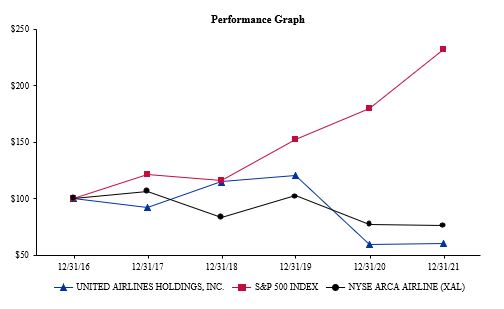
Note: The stock price performance shown in the graph above should not be considered indicative of potential future stock price performance. The foregoing performance graph is being furnished as part of this report solely in accordance with the requirement under Rule 14a-3(b)(9) to furnish our stockholders with such information, and therefore, shall not be deemed to be filed or incorporated by reference into any filings by the Company under the Securities Act or the Exchange Act.
Item 6. [RESERVED]
Item 7. MANAGEMENT'S DISCUSSION AND ANALYSIS OF FINANCIAL CONDITION AND RESULTS OF OPERATIONS.
Management's discussion and analysis of financial condition and results of operations is provided as a supplement to and should be read in conjunction with the consolidated financial statements and related notes included elsewhere in this Form 10-K and the description of our business and reportable segments in Item 1 above to enhance the understanding of our results of operations, financial condition and cash flows.
This section generally discusses 2021 and 2020 items and year-to-year comparisons between 2021 and 2020. Discussions of 2019 items and year-to-year comparisons between 2020 and 2019 are not included in this Form 10-K and can be found in "Management's Discussion and Analysis of Financial Condition and Results of Operations" in Part II, Item 7 of the Company's Annual Report on Form 10-K for the fiscal year ended December 31, 2020 filed with the U.S. Securities and Exchange Commission (the "SEC") on March 1, 2021 (the "2020 Annual Report").
Executive Summary
Overview
United Airlines Holdings, Inc. (together with its consolidated subsidiaries, "UAL" or the "Company") is a holding company and its principal, wholly-owned subsidiary is United Airlines, Inc. (together with its consolidated subsidiaries, "United"). The Company's shared purpose is "Connecting People. Uniting the World." The Company has the most comprehensive route network among North American carriers, including U.S. mainland hubs in Chicago, Denver, Houston, Los Angeles, New York/Newark, San Francisco and Washington, D.C.
As UAL consolidates United for financial statement purposes, disclosures that relate to activities of United also apply to UAL, unless otherwise noted. United's operating revenues and operating expenses comprise nearly 100% of UAL's revenues and operating expenses. In addition, United comprises approximately the entire balance of UAL's assets, liabilities and operating cash flows. When appropriate, UAL and United are named specifically for their individual contractual obligations and related disclosures and any significant differences between the operations and results of UAL and United are separately disclosed and explained. We sometimes use the words "we," "our," "us," and the "Company" in this report for disclosures that relate to all of UAL and United.
Our business and operating results for 2021 continued to be significantly impacted by the COVID-19 pandemic. Given the more significant impact of the pandemic on our business and operating results in 2020, we believe that a comparison of our 2021 results to 2019 for certain key metrics in this financial overview discussion is more reflective of the impact of the COVID-19 pandemic.
Our current expectations described below are forward-looking statements and our actual results and timing may vary materially based on various factors that include, but are not limited to, those discussed below under "Cautionary Statement Regarding Forward-Looking Statements" and in Part I, Item 1A. Risk Factors, of this Form 10-K. The Company is unable to reconcile forward-looking projections to accounting principles generally accepted in the United States of America ("GAAP"); refer to "Supplemental Information" below for further details.
Impact of the COVID-19 Pandemic
The COVID-19 pandemic, together with the measures implemented or recommended by governmental authorities and private organizations in response to the pandemic, has had an adverse impact that has been material to the Company's business, operating results, financial condition and liquidity. The Company has seen increasing demand for travel both domestically and in countries where entry is permitted; however, as the situation surrounding the COVID-19 pandemic remains fluid, the pandemic has continued to negatively impact travel demand. It remains difficult to reasonably assess or predict the full extent of the ongoing impact of the COVID-19 pandemic on the Company's longer-term operational and financial performance, which will depend on a number of future developments, many of which are outside the Company's control, such as the ultimate duration of and factors impacting the recovery from the pandemic (including the efficacy and speed of vaccination programs in curbing the spread of the virus in different markets, the efficacy and availability of various treatment options, the introduction and spread of new variants of the virus that may be resistant to currently approved vaccines or treatment options, and the continuation of existing or implementation of new government travel restrictions), customer behavior changes and fluctuations in demand for air travel, among others. The COVID-19 pandemic and the measures taken in response may continue to impact many aspects of our business, operating results, financial condition and liquidity in a number of ways, including labor shortages (including reductions in available skilled labor and related impacts to the Company's flight schedules and reputation), facility closures and related costs, disruptions to the Company's and its business partners' operations, reduced travel demand and consumer spending, increased fuel and other operating costs, supply chain disruptions, logistics constraints, inflation, volatility in the price of our securities, our ability to access capital markets and volatility in the global economy and financial markets generally.
We have reduced our capacity as we managed through the effects of the COVID-19 pandemic, which in 2021 remained significantly lower than capacity prior to the pandemic and resulted in a significant reduction to our revenue through the date of this report. We operated at approximately 63% of our full year 2019 capacity during the full year of 2021. We have delayed a portion of our previously planned capacity increases for full year 2022 and may need to implement further modifications. The Company is taking steps to be prepared for recovery as demand for travel continues to generally increase, which include investing in innovative technology, focusing on process improvements and implementing the United Next transformative strategy.
We have taken steps to strengthen our financial position during this period of market uncertainty, which has resulted in an increase of our overall debt levels. As of December 31, 2021, unrestricted cash, cash equivalents and short-term investments totaled $18.4 billion, an increase of approximately $13.5 billion from December 31, 2019. We had approximately $41.1 billion of debt, finance lease, operating lease and sale-leaseback obligations as of December 31, 2021 (including $4.5 billion that will become due in the next 12 months), up from approximately $20.5 billion as of December 31, 2019.
The Company's recovery from the COVID-19 pandemic has not followed a linear path, and due to the significant uncertainty that remains, its future operating performance, particularly in the short-term, may be subject to volatility. Risks and uncertainties related to the COVID-19 pandemic are further described in Part I, Item 1A. Risk Factors— "The COVID-19 pandemic has materially and adversely impacted our business, operating results, financial condition and liquidity. The full extent of the impact will depend on future developments and how quickly we can return to more normal operations, among other things. If the impacts from the COVID-19 pandemic extend beyond our assumed timelines, our actual results may vary significantly from our expectations" of this report.
Outlook for Full Year 2022
Capacity. The Company expects its scheduled capacity for full year 2022 to be down versus 2019.
Adjusted cost per available seat mile ("CASM-ex"). The Company expects full year 2022 CASM-ex (a non-GAAP financial measure defined as CASM excluding fuel, profit sharing, third-party business expense and special charges; see "Supplemental Information" below) to be higher than 2019.
Strategic Objectives
In the second quarter of 2021, United announc
Showing the first 8K of 72K characters. Open the full section
Item 7A. QUANTITATIVE AND QUALITATIVE DISCLOSURES ABOUT MARKET RISK.
We are exposed to market risk resulting from changes in currency exchange rates and interest rates. These risks, along with other business risks, impact our cost of capital. It is our policy to manage our debt structure and foreign exchange exposure in order to manage capital costs, control financial risks and maintain financial flexibility over the long term. In managing market risks, we may employ derivatives according to documented policies and procedures, including interest rate swaps, interest rate locks, foreign currency exchange contracts and combined interest rate foreign currency contracts (cross-currency swaps). We do not use derivatives for trading or speculative purposes. We do not foresee significant changes in the strategies we use to manage market risk in the near future. All of our financial instruments, including derivatives, are subject to counterparty credit risk considered as part of the overall fair value measurement.
Interest Rates. Our net income is affected by fluctuations in interest rates (e.g. interest expense on variable rate debt and interest income earned on short-term investments). The Company's policy is to manage interest rate risk through a combination of fixed and variable rate debt. The following table summarizes information related to the Company's interest rate market risk at December 31, 2021 (in millions):
| Variable rate debt | |||||||||||
| Carrying value of variable rate debt at December 31 | $ | 13,003 | |||||||||
| Impact of 100 basis point increase on projected interest expense for the following year | 98 | ||||||||||
| Fixed rate debt | |||||||||||
| Carrying value of fixed rate debt at December 31 | 20,360 | ||||||||||
| Fair value of fixed rate debt at December 31 | 21,514 | ||||||||||
| Impact of 100 basis point increase in market rates on fair value | (657) |
LIBOR is being phased out starting on January 1, 2022 for the one-week and two-month USD LIBOR settings and starting on July 1, 2023 for the remaining USD LIBOR settings. Uncertainty as to the nature of alternative reference rates and as to potential changes or other reforms to LIBOR may adversely impact our interest rates and related interest expense. See Part II, Item 7. Management's Discussion and Analysis of Financial Condition and Results of Operations—Other Liquidity Matters, of this report for more information on interest expense. Risks and uncertainties related to the LIBOR phase out are further described in Part I, Item 1A. Risk Factors— "The proposed phase out of the London interbank offer rate could have a material adverse effect on us."
A change in market interest rates would also impact interest income earned on our cash, cash equivalents and short-term investments. Assuming our cash, cash equivalents and short-term investments remain at their average 2021 levels, a 100 basis point increase in interest rates would result in a corresponding increase in the Company's interest income of approximately $178 million during 2022.
Commodity Price Risk (Aircraft Fuel). The price of aircraft fuel can significantly affect the Company's operations, results of operations, financial position and liquidity.
Our operational and financial results can be significantly impacted by changes in the price and availability of aircraft fuel. To provide adequate supplies of fuel, the Company routinely enters into purchase contracts that are customarily indexed to market prices for aircraft fuel, and the Company generally has some ability to cover short-term fuel supply and infrastructure disruptions at some major demand locations. The Company's current strategy is to not enter into transactions to hedge fuel price volatility, although the Company regularly reviews its policy based on market conditions and other factors. A one-dollar change in the price of a barrel of aircraft fuel would change the Company's annual fuel expense by approximately $102 million, assuming flying levels similar to 2019.
Foreign Currency. The Company generates revenues and incurs expenses in numerous foreign currencies. Changes in foreign currency exchange rates impact the Company's results of operations through changes in the dollar value of foreign currency-denominated operating revenues and expenses. Some of the Company's more significant foreign currency exposures include the Canadian dollar, Chinese renminbi, European euro, British pound and Japanese yen. The Company's current strategy is to not enter into transactions to hedge its foreign currency exposure, although the Company regularly reviews its policy based on market conditions and other factors.
The result of a uniform 1% strengthening in the value of the U.S. dollar from December 31, 2021 levels relative to each of the currencies in which the Company has foreign currency exposure would result in a decrease in pre-tax income of approximately $14 million for the year ending December 31, 2022. This sensitivity analysis was prepared based upon projected 2022 foreign currency-denominated revenues and expenses as of December 31, 2021.
Item 8. FINANCIAL STATEMENTS AND SUPPLEMENTARY DATA.
REPORT OF INDEPENDENT REGISTERED PUBLIC ACCOUNTING FIRM
To the Stockholders and the Board of Directors of United Airlines Holdings, Inc.
Opinion on the Financial Statements
We have audited the accompanying consolidated balance sheets of United Airlines Holdings, Inc. (the "Company") as of December 31, 2021 and 2020, the related consolidated statements of operations, comprehensive income (loss), cash flows, and stockholders' equity for each of the three years in the period ended December 31, 2021, and the related notes and financial statement schedule listed in the Index at Item 15(a) (collectively referred to as the "consolidated financial statements"). In our opinion, the consolidated financial statements present fairly, in all material respects, the financial position of the Company at December 31, 2021 and 2020, and the results of its operations and its cash flows for each of the three years in the period ended December 31, 2021, in conformity with U.S. generally accepted accounting principles.
We also have audited, in accordance with the standards of the Public Company Accounting Oversight Board (United States) ("PCAOB"), the Company's internal control over financial reporting as of December 31, 2021, based on criteria established in Internal Control-Integrated Framework issued by the Committee of Sponsoring Organizations of the Treadway Commission (2013 framework) and our report dated February 18, 2022, expressed an unqualified opinion thereon.
Basis for Opinion
These financial statements are the responsibility of the Company's management. Our responsibility is to express an opinion on the Company's financial statements based on our audits. We are a public accounting firm registered with the PCAOB and are required to be independent with respect to the Company in accordance with the U.S. federal securities laws and the applicable rules and regulations of the Securities and Exchange Commission and the PCAOB.
We conducted our audits in accordance with the standards of the PCAOB. Those standards require that we plan and perform the audit to obtain reasonable assurance about whether the financial statements are free of material misstatement, whether due to error or fraud. Our audits included performing procedures to assess the risks of material misstatement of the financial statements, whether due to error or fraud, and performing procedures that respond to those risks. Such procedures included examining, on a test basis, evidence regarding the amounts and disclosures in the financial statements. Our audits also included evaluating the accounting principles used and significant estimates made by management, as well as evaluating the overall presentation of the financial statements. We believe that our audits provide a reasonable basis for our opinion.
Critical Audit Matters
The critical audit matters communicated below are matters arising from the current period audit of the financial statements that were communicated or required to be communicated to the audit committee and that: (1) relate to accounts or disclosures that are material to the financial statements and (2) involved our especially challenging, subjective or complex judgments. The communication of critical audit matters does not alter in any way our opinion on the consolidated financial statements, taken as a whole, and we are not, by communicating the critical audit matters below, providing separate opinions on the critical audit matters or on the accounts or disclosures to which they relate.
| Indefinite-lived Intangible Asset (China Route Authorities) Impairment Analysis | ||||||||
| Description of the matter | At December 31, 2021, the carrying value of the Company's China route authorities indefinite-lived intangible assets (the China intangible assets) was $1.02 billion. As discussed in Note 1 of the consolidated financial statements, indefinite-lived assets are reviewed for impairment on an annual basis as of October 1, or on an interim basis whenever a triggering event occurs. | |||||||
| Auditing management's annual China intangible assets impairment test was complex and highly judgmental due to the significant estimation required in determining the fair value of the assets. The fair value estimate was sensitive to significant assumptions such as revenue growth rate, operating margin and the discount rate, each of which is affected by expectations about future market or economic conditions. As a result of the subjectivity of the assumptions, adverse changes to management's estimates could reduce the underlying cash flows used to estimate fair value and trigger impairment charges. | ||||||||
| How we addressed the matter in our audit | We tested the Company's design and operating effectiveness of internal controls that address the risk of material misstatement relating to the estimate of fair value of the China intangible assets used in the annual impairment test. This included testing controls over management's review of the significant assumptions used in the discounted cash flow methodology, including revenue growth rate, operating margin and the discount rate. | |||||||
| To test the estimated fair value of the Company's China intangible assets, we performed audit procedures that included, among others, assessing the fair value methodology used by management and evaluating the significant assumptions used in the valuation model. We compared significant assumptions to current industry, market and economic trends, and to the Company's historical results. We assessed the historical accuracy of management's estimates and performed sensitivity analyses of significant assumptions to evaluate the changes in the fair value of the China intangible assets that would result from changes in assumptions. We also involved a valuation specialist to assist in our evaluation of the Company's valuation methodology and discount rate. | ||||||||
| Deferred Tax Assets—Valuation Allowance | ||||||||
| Description of the matter | As more fully described in Note 6 to the consolidated financial statements, at December 31, 2021, the Company had deferred tax assets of $7.5 billion. In addition, the Company had deferred tax liabilities available to offset deferred tax assets of $6.2 billion. Deferred tax assets are reduced by a valuation allowance if, based on the weight of all available evidence, in management's judgment it is more likely than not that some portion, or all, of the deferred tax assets will not be realized. | |||||||
| Auditing management's assessment of the realizability of its deferred tax assets involved complex auditor judgment because management's judgement involves significant assumptions about the ability to generate future taxable income that may be affected by future market or economic conditions. | ||||||||
| How we addressed the matter in our audit | We obtained an understanding, evaluated the design, and tested the operating effectiveness of controls that address the risks of material misstatement relating to the realizability of deferred tax assets. This included controls over management's scheduling of the future reversal of existing taxable temporary differences (deferred tax liabilities) and projections of future taxable income. | |||||||
| Among other audit procedures performed, we tested the Company's scheduling of the reversal of existing temporary taxable differences and tested the underlying data used to schedule the reversals. We evaluated the assump |
Showing the first 8K of 217K characters. Open the full section
Item 9. CHANGES IN AND DISAGREEMENTS WITH ACCOUNTANTS ON ACCOUNTING AND FINANCIAL DISCLOSURE.
None.
Item 9A. CONTROLS AND PROCEDURES
Evaluation of Disclosure Control and Procedures
UAL and United each maintain controls and procedures that are designed to ensure that information required to be disclosed in the reports filed or submitted by UAL and United to the SEC is recorded, processed, summarized and reported, within the time periods specified by the SEC's rules and forms, and is accumulated and communicated to management including the Chief Executive Officer and Chief Financial Officer, as appropriate, to allow timely decisions regarding required disclosure. The management of UAL and United, including the Chief Executive Officer and Chief Financial Officer, performed an evaluation to conclude with reasonable assurance that UAL's and United's disclosure controls and procedures as defined in Rules 13a-15(e) and 15d-15(e) under the Securities Exchange Act of 1934, as amended ("Exchange Act") were designed and operating effectively to report the information each company is required to disclose in the reports they file with the SEC on a timely basis. Based on that evaluation, the Chief Executive Officer and the Chief Financial Officer of UAL and United have concluded that as of December 31, 2021, disclosure controls and procedures were effective.
Management's Reports on Internal Control Over Financial Reporting
UAL and United Management's Reports on Internal Control Over Financial Reporting are included herein.
Ernst & Young LLP, an independent registered public accounting firm, has audited the Company's financial statements included in this Form 10-K and issued its report on the effectiveness of the Company's internal control over financial reporting as of December 31, 2021, which is included herein.
Changes in Internal Control over Financial Reporting during the Quarter Ended December 31, 2021
During the three months ended December 31, 2021, there was no change in UAL's or United's internal control over financial reporting that materially affected, or is reasonably likely to materially affect, their internal control over financial reporting.
REPORT OF INDEPENDENT REGISTERED PUBLIC ACCOUNTING FIRM
To the Stockholders and Board of Directors of United Airlines Holdings, Inc.
Opinion on Internal Control over Financial Reporting
We have audited United Airlines Holdings, Inc.'s (the "Company") internal control over financial reporting as of December 31, 2021, based on criteria established in Internal Control-Integrated Framework issued by the Committee of Sponsoring Organizations of the Treadway Commission (2013 framework) (the "COSO criteria"). In our opinion, the Company maintained, in all material respects, effective internal control over financial reporting as of December 31, 2021, based on the COSO criteria.
We also have audited, in accordance with the standards of the Public Company Accounting Oversight Board (United States) ("PCAOB"), the 2021 consolidated financial statements and our report dated February 18, 2022 expressed an unqualified opinion thereon.
Basis for Opinion
The Company's management is responsible for maintaining effective internal control over financial reporting and for its assessment of the effectiveness of internal control over financial reporting included in the accompanying Management's Reports on Internal Control Over Financial Reporting in Item 9A. Our responsibility is to express an opinion on the Company's internal control over financial reporting based on our audit. We are a public accounting firm registered with the PCAOB and are required to be independent with respect to the Company in accordance with the U.S. federal securities laws and the applicable rules and regulations of the Securities and Exchange Commission and the PCAOB.
We conducted our audit in accordance with the standards of the PCAOB. Those standards require that we plan and perform the audit to obtain reasonable assurance about whether effective internal control over financial reporting was maintained in all material respects.
Our audit included obtaining an understanding of internal control over financial reporting, assessing the risk that a material weakness exists, testing and evaluating the design and operating effectiveness of internal control based on the assessed risk, and performing such other procedures as we considered necessary in the circumstances. We believe that our audit provides a reasonable basis for our opinion.
Definition and Limitations of Internal Control Over Financial Reporting
A company's internal control over financial reporting is a process designed to provide reasonable assurance regarding the reliability of financial reporting and the preparation of financial statements for external purposes in accordance with generally accepted accounting principles. A company's internal control over financial reporting includes those policies and procedures that (1) pertain to the maintenance of records that, in reasonable detail, accurately and fairly reflect the transactions and dispositions of the assets of the company; (2) provide reasonable assurance that transactions are recorded as necessary to permit preparation of financial statements in accordance with generally accepted accounting principles, and that receipts and expenditures of the company are being made only in accordance with authorizations of management and directors of the company; and (3) provide reasonable assurance regarding prevention or timely detection of unauthorized acquisition, use, or disposition of the company's assets that could have a material effect on the financial statements.
Because of its inherent limitations, internal control over financial reporting may not prevent or detect misstatements. Also, projections of any evaluation of effectiveness to future periods are subject to the risk that controls may become inadequate because of changes in conditions, or that the degree of compliance with the policies or procedures may deteriorate.
/s/ Ernst & Young LLP
Chicago, Illinois
February 18, 2022
United Airlines Holdings, Inc. Management Report on Internal Control Over Financial Reporting
February 18, 2022
To the Stockholders of United Airlines Holdings, Inc.
Chicago, Illinois
The management of United Airlines Holdings, Inc. ("UAL") is responsible for establishing and maintaining adequate internal control over financial reporting, as such term is defined in Exchange Act Rule 13a-15(f). Our internal control over financial reporting is designed to provide reasonable assurance regarding the reliability of financial reporting and the preparation of financial statements for external purposes in accordance with generally accepted accounting principles. Because of its inherent limitations, our internal control over financial reporting may not prevent or detect misstatements. Also, projections of any evaluation of effectiveness to future periods are subject to the risk that controls may become inadequate because of changes in conditions, or that the degree of compliance with the policies or procedures may deteriorate.
Under the supervision and with the participation of management, including our Chief Executive Officer and Chief Financial Officer, we conducted an evaluation of the design and operating effectiveness of our internal control over financial reporting as of December 31, 2021. In making this assessment, management used the framework set forth in Internal Control—Integrated Framework (2013 Framework) issued by the Committee of the Sponsoring Organizations of the Treadway Commission. Based on this evaluation, our Chief Executive Officer and Chief Financial Officer concluded that our internal control over financial reporting was effective as of December 31, 2021.
Our independent registered public accounting firm, Ernst & Young LLP, who audited UAL's consolidated financial statements included in this Form 10-K, has issued a report on UAL's internal control over financial reporting, which is included herein.
United Airlines, Inc. Management Report on Internal Control Over Financial Reporting
February 18, 2022
To the Stockholder of United Airlines, Inc.
Chicago, Illinois
The management of United Airlines, Inc. ("United") is responsible for establishing and maintaining adequate internal control over financial reporting, as such term is defined in Exchange Act Rule 13a-15(f). United's internal control over financial reporting is designed to provide reasonable assurance regarding the reliability of financial reporting and the preparation of financial statements for external purposes in accordance with generally accepted accounting principles. Because of its inherent limitations, United's internal control over financial reporting may not prevent or detect misstatements. Also, projections of any evaluation of effectiveness to future periods are subject to the risk that controls may become inadequate because of changes in conditions, or that the degree of compliance with the policies or procedures may deteriorate.
Under the supervision and with the participation of management, including United's Chief Executive Officer and Chief Financial Officer, United conducted an evaluation of the design and operating effectiveness of its internal control over financial reporting as of December 31, 2021. In making this assessment, management used the framework set forth in Internal Control—Integrated Framework (2013 Framework) issued by the Committee of the Sponsoring Organizations of the Treadway Commission. Based on this evaluation, United's Chief Executive Officer and Chief Financial Officer concluded that its internal control over financial reporting was effective as of December 31, 2021.
This annual report does not include an attestation report of United's registered public accounting firm regarding internal control over financial reporting. Management's report was not subject to attestation by United's registered public accounting firm pursuant to the rules of the Securities and Exchange Commission that permit United to provide only management's report in this annual report.
Item 9B. OTHER INFORMATION.
None.
Item 9C. DISCLOSURE REGARDING FOREIGN JURISDICTIONS THAT PREVENT INSPECTIONS.
Not applicable.
PART III
Item 10. DIRECTORS, EXECUTIVE OFFICERS AND CORPORATE GOVERNANCE.
Reference is made to the 2022 Proxy Statement with respect to information about UAL's directors and corporate governance, which is incorporated herein by reference and made a part hereof in response to the information required by Item 10 with respect to UAL.
The information required by Item 10 with respect to UAL's and United's executive officers has been included in Part I of this Form 10-K under the caption "Information about Our Executive Officers" and is incorporated herein by reference and made a part hereof in response to the information required by Item 10 with respect to UAL.
Reference is made to the 2022 Proxy Statement with respect to UAL's non-compliance with Section 16(a) of the Exchange Act, if applicable, which is incorporated herein by reference and made a part hereof in response to the information required by Item 10 with respect to UAL.
Code of Ethics. The Company has a code of ethics, the "Code of Ethics and Business Conduct," for its directors, officers and employees. The code serves as a "Code of Ethics" as defined by SEC regulations, and as a "Code of Conduct" under Nasdaq Listing Rule 5610. The code is available on the Company's investor relations website at ir.united.com. Waivers granted to certain officers from compliance with or future amendments to the code will be disclosed on the Company's investor relations website in accordance with Item 5.05 of Form 8-K.
Information required by this item with respect to United is omitted pursuant to General Instruction I(2)(c) of Form 10-K.
Item 11. EXECUTIVE COMPENSATION.
Reference is made to the 2022 Proxy Statement with respect to information about UAL's executive and director compensation and certain related matters, which is incorporated herein by reference and made a part hereof in response to the information required by Item 11 with respect to UAL.
Information required by this item with respect to United is omitted pursuant to General Instruction I(2)(c) of Form 10-K.
Item 12. SECURITY OWNERSHIP OF CERTAIN BENEFICIAL OWNERS AND MANAGEMENT AND RELATED STOCKHOLDER MATTERS.
Reference is made to the 2022 Proxy Statement with respect to the security ownership of certain beneficial owners and management and certain equity compensation plan information, which is incorporated herein by reference and made a part hereof in response to the information required by Item 12 with respect to UAL.
Information required by this item with respect to United is omitted pursuant to General Instruction I(2)(c) of Form 10-K.
Item 13. CERTAIN RELATIONSHIPS AND RELATED TRANSACTIONS, AND DIRECTOR INDEPENDENCE.
Reference is made to the 2022 Proxy Statement with respect to information about certain relationships and related transactions and director independence, which is incorporated herein by reference and made a part hereof in response to the information required by Item 13 with respect to UAL.
Information required by this item with respect to United is omitted pursuant to General Instruction I(2)(c) of Form 10-K.
Item 14. PRINCIPAL ACCOUNTANT FEES AND SERVICES.
The Audit Committee of the UAL Board of Directors has adopted a policy on pre-approval of services of the Company's independent registered public accounting firm. As a wholly-owned subsidiary of UAL, United's audit services are determined by UAL. The policy provides that the Audit Committee shall pre-approve all audit and non-audit services to be provided to UAL and its subsidiaries and affiliates by its independent auditors. The process by which this is carried out is as follows:
For recurring services, the Audit Committee reviews and pre-approves the independent registered public accounting firm's annual audit services in conjunction with the annual appointment of the outside auditors. The reviewed materials include a description of the services along with related fees. The Audit Committee also reviews and pre-approves other classes of recurring services along with fee thresholds for pre-approved services. In the event that the additional services are required prior to the next scheduled Audit Committee meeting, pre-approvals of additional services follow the process described below.
Any requests for audit, audit related, tax and other services not contemplated with the recurring services approval described above must be submitted to the Audit Committee for specific pre-approval and cannot commence until such approval has been granted. Normally, pre-approval is provided at regularly scheduled meetings. However, the authority to grant specific preapproval between meetings, as necessary, has been delegated to the Chair of the Audit Committee. The Chair must update the Audit Committee at the next regularly scheduled meeting of any services that were granted specific pre-approval.
On a periodic basis, the Audit Committee reviews the status of services and fees incurred year-to-date and a list of newly pre-approved services since its last regularly scheduled meeting. The Audit Committee has considered whether the 2021 and 2020 non-audit services provided by Ernst & Young LLP (PCAOB ID No. 42), the Company's independent registered public accounting firm, are compatible with maintaining auditor independence.
All of the services in 2021 and 2020 under the Audit Fees, Audit Related Fees, Tax Fees and All Other Fees categories below have been approved by the Audit Committee pursuant to paragraph (c)(7) of Rule 2-01 of Regulation S-X of the Exchange Act.
The aggregate fees billed for professional services rendered by the Company's independent auditors in 2021 and 2020 are as follows (in thousands):
| Service | 2021 | 2020 | ||||||||||||
| Audit Fees | $ | 4,477 | $ | 6,000 | ||||||||||
| Audit Related Fees | — | 302 | ||||||||||||
| Tax Fees | 37 | 170 | ||||||||||||
| Total Fees | $ | 4,514 | $ | 6,472 |
Note: UAL and United amounts are the same.
Audit Fees. For 2021 and 2020, audit fees consist primarily of the audit and quarterly reviews of the consolidated financial statements and the audit of the effectiveness of internal control over financial reporting of the Company and its wholly owned subsidiaries. Audit fees also include the audit of the consolidated financial statements of United Airlines, attestation services required by statute or regulation, comfort letters, consents, assistance with and review of documents filed with the SEC, and accounting and financial reporting consultations and research work necessary to comply with generally accepted auditing standards.
Audit Related Fees. For 2020, fees for audit-related services primarily consisted of audits and/or agreed upon audit procedures related to prior years' audits of subsidiaries of the Company.
Tax Fees. Tax fees for 2021 and 2020 relate to professional services provided for research and consultations regarding tax accounting and tax compliance matters and review of U.S. and international tax impacts of certain transactions, exclusive of tax services rendered in connection with the audit.
PART IV
Item 15. EXHIBITS AND FINANCIAL STATEMENT SCHEDULES.
| (a) | List of documents filed as part of this report: | |||||||
| (1) | Financial Statements. The financial statements required by this item are listed in Part II, Item 8, Financial Statements and Supplementary Data herein. | |||||||
| (2) | Financial Statement Schedules. The financial statement schedule required by this item is listed below and included in this report after the signature page hereto. |
| Schedule II-Valuation and Qualifying Accounts for the years ended December 31, 2021, 2020 and 2019. | ||||||||
| All other schedules are omitted because they are not applicable, not required or the required information is shown in the consolidated financial statements or notes thereto. | ||||||||
| (b) | Exhibits. The exhibits required by this item are provided in the Exhibit Index. |
Item 16. FORM 10-K SUMMARY.
None.
EXHIBIT INDEX
Showing the first 8K of 68K characters. Open the full section