 filings.tools
Uber Technologies 10-K 2023-12-31
Filed 2024-02-15. 24 sections, 764K characters. Original on sec.gov · Markdown · JSON
Cover and table of contents
UNITED STATES
SECURITIES AND EXCHANGE COMMISSION
Washington, D.C. 20549
FORM 10-K
(Mark One)
☒ ANNUAL REPORT PURSUANT TO SECTION 13 OR 15(d) OF THE SECURITIES EXCHANGE ACT OF 1934
For the fiscal year ended December 31, 2023
OR
☐ TRANSITION REPORT PURSUANT TO SECTION 13 OR 15(d) OF THE SECURITIES EXCHANGE ACT OF 1934
For the transition period from_____ to _____
Commission File Number: 001-38902
UBER TECHNOLOGIES, INC.
(Exact name of registrant as specified in its charter)
| Delaware | 45-2647441 | ||||
| (State or other jurisdiction of incorporation or organization) | (I.R.S. Employer Identification No.) |
1725 3rd Street
San Francisco, California 94158
(Address of principal executive offices, including zip code)
(415) 612-8582
(Registrant’s telephone number, including area code)
Securities registered pursuant to Section 12(b) of the Act:
| Title of each class | Trading Symbol(s) | Name of each exchange on which registered | ||||||||||||
| Common Stock, par value $0.00001 per share | UBER | New York Stock Exchange |
Securities registered pursuant to Section 12(g) of the Act: None
Indicate by check mark whether the registrant is a well-known seasoned issuer, as defined in Rule 405 of the Securities Act. Yes ☒ No ☐
Indicate by check mark whether the registrant is not required to file reports pursuant to Section 13 or Section 15(d) of the Act. Yes ☐ No ☒
Indicate by check mark whether the registrant (1) has filed all reports required to be filed by Section 13 or 15(d) of the Securities Exchange Act of 1934 during the preceding 12 months (or for such shorter period that the registrant was required to file such reports), and (2) has been subject to such filing requirements for the past 90 days. Yes ☒ No ☐
Indicate by check mark whether the registrant has submitted electronically every Interactive Data File required to be submitted pursuant to Rule 405 of Regulation S-T (§232.405 of this chapter) during the preceding 12 months (or for such shorter period that the registrant was required to submit such files). Yes ☒ No ☐
Indicate by check mark whether the registrant is a large accelerated filer, an accelerated filer, a non-accelerated filer, a smaller reporting company, or an emerging growth company. See the definitions of “large accelerated filer,” “accelerated filer,” “smaller reporting company,” and “emerging growth company” in Rule 12b-2 of the Exchange Act.
| Large accelerated filer | ☒ | Accelerated filer | ☐ | ||||||||||||||
| Non-accelerated filer | ☐ | Smaller reporting company | ☐ | ||||||||||||||
| Emerging growth company | ☐ | ||||||||||||||||
| If an emerging growth company, indicate by check mark if the registrant has elected not to use the extended transition period for complying with any new or revised financial accounting standards provided pursuant to Section 13(a) of the Exchange Act. | ☐ | ||||||||||||||||
| Indicate by check mark whether the registrant has filed a report on and attestation to its management’s assessment of the effectiveness of its internal control over financial reporting under Section 404(b) of the Sarbanes-Oxley Act (15 U.S.C. 7262(b)) by the registered public accounting firm that prepared or issued its audit report. | ☒ | ||||||||||||||||
| If securities are registered pursuant to Section 12(b) of the Act, indicate by check mark whether the financial statements of the registrant included in the filing reflect the correction of an error to previously issued financial statements. | ☒ | ||||||||||||||||
| Indicate by check mark whether any of those error corrections are restatements that required a recovery analysis of incentive-based compensation received by any of the registrant’s executive officers during the relevant recovery period pursuant to §240.10D-1(b). | ☐ |
| Indicate by check mark whether the registrant is a shell company (as defined in Rule 12b-2 of the Exchange Act). | Yes | ☐ | No | ☒ |
The aggregate market value of the voting and non-voting common equity held by non-affiliates of the registrant as of June 30, 2023, the last business day of the registrant's most recently completed second fiscal quarter, was approximately $87.9 billion based upon the closing price reported for such date on the New York Stock Exchange.
The number of shares of the registrant's common stock outstanding as of February 12, 2024 was 2,076,497,400.
DOCUMENTS INCORPORATED BY REFERENCE
Portions of the registrant’s Definitive Proxy Statement relating to the Annual Meeting of Stockholders are incorporated by reference into Part III of this Annual Report on Form 10-K where indicated. Such Definitive Proxy Statement will be filed with the Securities and Exchange Commission within 120 days after the end of the registrant’s fiscal year ended December 31, 2023.
UBER TECHNOLOGIES, INC.
TABLE OF CONTENTS
SPECIAL NOTE REGARDING FORWARD-LOOKING STATEMENTS
This Annual Report on Form 10-K contains forward-looking statements within the meaning of the Private Securities Litigation Reform Act of 1995. All statements other than statements of historical facts contained in this Annual Report on Form 10-K, including statements regarding our future results of operations or financial condition, business strategy and plans, and objectives of management for future operations, are forward-looking statements. In some cases, you can identify forward-looking statements because they contain words such as “anticipate,” “believe,” “contemplate,” “continue,” “could,” “estimate,” “expect,” “hope,” “intend,” “may,” “might,” “objective,” “ongoing,” “plan,” “potential,” “predict,” “project,” “should,” “target,” “will,” or “would” or the negative of these words or other similar terms or expressions. These forward-looking statements include, but are not limited to, statements concerning the following:
-
our ability to successfully defend litigation and government proceedings brought against us, including with respect to our relationship with drivers and couriers, and the potential impact on our business operations and financial performance if we are not successful;
-
our ability to successfully compete in highly competitive markets;
-
our expectations regarding financial performance, including but not limited to revenue, achieving or maintaining profitability, ability to generate or maintain positive Adjusted EBITDA or Free Cash Flow, expenses, and other results of operations;
-
our expectations regarding future operating performance, including but not limited to our expectations regarding future Monthly Active Platform Consumers (“MAPCs”), Trips, Gross Bookings, and Revenue Margin (defined as revenue as a percentage of Gross Bookings);
-
our expectations regarding our competitors’ use of incentives and promotions, our competitors’ ability to raise capital, and the effects of such incentives and promotions on our growth and results of operations;
-
our anticipated investments in new products and offerings, and the effect of these investments on our results of operations;
-
our anticipated capital expenditures and our estimates regarding our capital requirements;
-
our ability to close and integrate acquisitions into our operations;
-
anticipated technology trends and developments and our ability to address those trends and developments with our products and offerings;
-
the size of our addressable markets, market share, category positions, and market trends, including our ability to grow our business in the countries we have identified as expansion markets;
-
the safety, affordability, and convenience of our platform and our offerings;
-
our ability to identify, recruit, and retain skilled personnel, including key members of senior management;
-
our ability to effectively manage our growth and maintain and improve our corporate culture;
-
our expected growth in the number of platform users, and our ability to promote our brand and attract and retain platform users;
-
our ability to maintain, protect, and enhance our intellectual property rights;
-
our ability to introduce new products and offerings and enhance existing products and offerings;
-
our ability to successfully enter into new geographies, expand our presence in countries in which we are limited by regulatory restrictions, and manage our international expansion;
-
our ability to successfully renew licenses to operate our business in certain jurisdictions;
-
our ability to successfully respond to global economic conditions, including rising inflation and interest rates;
-
the availability of capital to grow our business;
-
volatility in the business or stock price of our minority-owned entities;
-
our ability to meet the requirements of our existing debt and draw on our line of credit;
-
our ability to prevent disturbances, including cybersecurity incidents, to our information technology systems;
-
our ability to comply with existing, modified, or new laws and regulations applying to our business;
-
the impact of contagious disease or outbreaks of viruses, disease or pandemics on our business, results of operations, financial position and cash flows; and
-
our ability to implement, maintain, and improve our internal control over financial reporting.
Actual events or results may differ from those expressed in forward-looking statements. As such, you should not rely on forward-looking statements as predictions of future events. We have based the forward-looking statements contained in this Annual Report on Form 10-K primarily on our current expectations and projections about future events and trends that we believe may affect our business, financial condition, operating results, prospects, strategy, and financial needs. The outcome of the events described in these forward-looking statements is subject to risks, uncertainties, assumptions, and other factors described in the section titled “Risk Factors” and elsewhere in this Annual Report on Form 10-K. Moreover, we operate in a highly competitive and rapidly changing environment. New risks and uncertainties emerge from time to time, and it is not possible for us to predict all risks and uncertainties that could have an impact on the forward-looking statements contained in this Annual Report on Form 10-K. The results, events and circumstances reflected in the forward-looking statements may not be achieved or occur, and actual results, events or circumstances could differ materially from those described in the forward-looking statements.
In addition, statements that “we believe” and similar statements reflect our beliefs and opinions on the relevant subject. These statements are based on information available to us as of the date of this Annual Report on Form 10-K. While we believe that such information provides a reasonable basis for these statements, such information may be limited or incomplete. Our statements should not be read to indicate that we have conducted an exhaustive inquiry into, or review of, all relevant information. These statements are inherently uncertain, and investors are cautioned not to unduly rely on these statements.
The forward-looking statements made in this Annual Report on Form 10-K speak only as of the date on which the statements are made. We undertake no obligation to update any forward-looking statements made in this Annual Report on Form 10-K to reflect events or circumstances after the date of this Annual Report on Form 10-K or to reflect new information, actual results, revised expectations, or the occurrence of unanticipated events, except as required by law. We may not actually achieve the plans, intentions or expectations disclosed in our forward-looking statements, and you should not place undue reliance on our forward-looking statements.
PART I
Item 1. BUSINESS
Overview
Uber Technologies, Inc. (“Uber,” “we,” “our,” or “us”) is a technology platform that uses a massive network, leading technology, operational excellence and product expertise to power movement from point A to point B. We develop and operate proprietary technology applications supporting a variety of offerings on our platform (“platform(s)” or “Platform(s)”). We connect consumers (“Rider(s)”) with independent providers of ride services (“Mobility Driver(s)”) for ridesharing services, and connect Riders and other consumers (“Eater(s)”) with restaurants, grocers and other stores (collectively, “Merchants”) with delivery service providers (“Couriers”) for meal preparation, grocery and other delivery services. Riders and Eaters are collectively referred to as “end-user(s)” or “consumer(s).” Mobility Drivers and Couriers are collectively referred to as “Driver(s).” We also connect consumers with public transportation networks. We use this same network, technology, operational excellence and product expertise to connect shippers (“Shipper(s)”) with carriers (“Carrier(s)”) in the freight industry by providing Carriers with the ability to book a shipment, transportation management and other logistics services. Uber is also developing technologies designed to provide new solutions to solve everyday problems.
Our technology is available in approximately 70 countries around the world, principally in the United States (“U.S.”) and Canada, Latin America, Europe (excluding Russia), the Middle East, Africa, and Asia (excluding China and Southeast Asia).
Our Segments
As of December 31, 2023, we had three operating and reportable segments: Mobility, Delivery and Freight. Mobility, Delivery and Freight platform offerings each address large, fragmented markets.
Mobility
Our Mobility offering connects consumers with a wide range of transportation modalities, such as ridesharing, carsharing, micromobility, rentals, public transit, taxis, and more—helping customers go almost anywhere they need. We believe our global leadership position—and the vast amount of marketplace data that comes along with it—means that we have the best technical and data platform to innovate faster than other companies with similar products.
We believe our scale and global availability allows our Mobility segment to offer better consumer experiences to riders in a variety of vehicle types, providing consumers with higher reliability and Drivers with better earnings opportunities. Mobility also includes activity related to our financial partnerships products and advertising. We also participate in certain regions through our minority-owned entities.
Delivery
Our Delivery offering allows consumers to search for and discover the best of local commerce—from restaurants to grocery, alcohol, convenience and other retailers—order a meal or other items, and either pick-up at the restaurant or have it delivered. We refer to the grocery, alcohol, convenience, and retail categories collectively as Grocery & Retail. After launching our Delivery app, Uber Eats, over eight years ago, we believe our Delivery offering increases consumer engagement with the Uber platform overall, which in turn results in broader reach for our Merchants who can attract Uber Eats consumers from Uber without increasing their own costs. For Drivers, we believe the Delivery offering leverages, and has expanded, our earner base by increasing utilization and earnings across the network. We also believe it also attracts new Drivers to the platform who do not have access to Mobility-qualified vehicles. Over the last several years, our Delivery business has expanded to include Uber Direct, our white-label Delivery-as-a-Service offering to retailers and restaurants around the world, as well as advertising opportunities.
Freight
We believe that Freight is revolutionizing the logistics industry. Freight powers a managed transportation and logistics network and connects Shippers and Carriers in a digital marketplace to move shipments while leveraging our proprietary technology, brand awareness, and experience revolutionizing industries. Freight provides an on-demand platform to automate and accelerate logistics transactions end-to-end while providing visibility and control of logistics networks. Freight connects Carriers with Shippers’ shipments available on our platform, and gives Carriers upfront, transparent pricing and the ability to book a shipment with the touch of a button. Freight serves Shippers ranging from small- and medium-sized businesses to global enterprises. By leveraging logistics solutions expertise and value-add solutions, Freight enables Shippers to create and tender shipments, secure capacity on demand with real-time pricing, and track those shipments from pickup to delivery. Freight operations are principally based in North America and Europe. We believe that all of these factors represent significant efficiency improvements over traditional transportation management and freight brokerage providers.
Platform Synergies
Our Platform
The foundation of our platform is our massive network, leading technology, operational excellence, and product expertise.
Together, these elements power movement from point A to point B.
| Massive Network | Our massive, efficient, and intelligent network consists of tens of millions of Drivers, consumers, Merchants, Shippers and Carriers, as well as underlying data, technology, and shared infrastructure. Our network becomes smarter with every trip. In more than 10,000 cities around the world (as of December 31, 2023), our network powers movement at the touch of a button for millions, and we hope eventually billions, of people. | |||||||
| Leading Technology | We have built proprietary marketplace, routing, and payments technologies. Marketplace technologies are the core of our deep technology advantage and include demand prediction, matching and dispatching, and pricing technologies. Our technologies make it extremely efficient to launch new businesses and operationalize existing ones. | |||||||
| Operational Excellence | Our regional on-the-ground operations teams use their extensive market-specific knowledge to rapidly launch and scale products in cities, support Drivers, consumers, Merchants, Shippers, and Carriers, and build and enhance relationships with cities and regulators. | |||||||
| Product Expertise | Our products are built with the expertise that allows us to set the standard for powering movement on-demand, provide platform users with a contextual, intuitive interface, continually evolve features and functionality, and deliver safety and trust. |
We intend to continue to invest in new platform offerings that we believe will further strengthen our platform and existing offerings.
We believe that all of these synergies serve the customer experience, enabling us to attract new platform users and to deepen engagement with existing platform users. Both of these dynamics grow our network scale and liquidity, which further increases the value of our platform-to-platform users. For example, Delivery attracts new consumers to our network—for the three months ended December 31, 2023, over 60% of first-time Delivery consumers were new to our platform. Additionally, for the three months ended December 31, 2023, consumers who used both Mobility and Delivery generated 10.5 Trips per month on average, compared to 5.0 Trips per month on average for consumers who used a single offering in cities where both Mobility and Delivery were offered. We believe that these trends will improve as we further leverage the power of our platform.
With our platform, we are making it even easier for our consumers to unlock convenience. In 2020, we rolled out our “Super App” view on iOS and Android, which combines our multiple offerings into a single app and is designed to remove friction for our consumers. During November 2021, we launched Uber One in the United States as our single cross-platform membership program that brings together the best of Uber. Uber One members have access to discounts, special pricing, priority service, and exclusive perks across our rides, delivery and grocery offerings. Since then, we have expanded Uber One to approximately 25 countries. Our Eats Pass membership program continues to remain available in select cities as a subscription offering. Our membership programs are designed to make utilizing our suite of products a seamless and rewarding experience for our consumers. We exited 2023 with 19 million members for our Uber One, Eats Pass and Rides Pass membership programs.
We are also utilizing our data and scale to offer marketplace-centric advertising to connect merchants and brands with our platform network and unlocking cross-platform advertising formats. During October 2022, we officially launched Uber’s advertising division and introduced Uber Journey Ads, an engaging way for brands to connect with consumers throughout the entire ride process. We now offer a model that enables brands to partner with Uber on a variety of advertising options on the Uber and Uber Eats apps, and beyond, while connecting with consumers in brand-safe and captivating ways. We also provide comprehensive reporting and analysis, which helps brands fine-tune their understanding of consumers and create more impactful campaigns as they connect with consumers at relevant points throughout their journeys and transactions. During the fourth quarter of 2023, active advertising merchants exceeded 550,000. We believe that our advertising further strengthens the power of our platform and will continue to do so as we onboard more advertisers.
Competitive Environment
We compete on a global basis in highly fragmented markets. We face significant competition in each of the mobility and delivery industries globally and in the logistics industry in the United States and Canada from existing, well-established, and low-cost alternatives, and in the future we expect to face competition from new market entrants given the low barriers to entry that characterize these industries. As we and our competitors introduce new products and offerings, and as existing products evolve, we expect to become subject to additional competition. While we work to expand globally and introduce new products and offerings across a range of industries, many of our competitors remain focused on a limited number of products or on a narrow geographic scope, allowing them to develop specialized expertise and employ resources in a more targeted manner than we do. The competition we face in each of our offerings includes:
- Mobility. Our Mobility offering competes with personal vehicle ownership and usage, which accounts for the majority of passenger miles in the markets that we serve, and traditional transportation services, including taxicab companies and taxi-hailing services, livery and other car services. In addition, public transportation can be a superior substitute to our Mobility offering and in many cases, offers a faster and lower-cost travel option in many cities. We also compete with other
ridesharing companies, including certain of our minority-owned entities, for Drivers and Riders, including Lyft, Ola, Didi, and Bolt.
-
Delivery. Our Delivery offering competes with numerous companies in the meal, grocery and other delivery space in various regions for drivers, consumers, and merchants, including Amazon, Deliveroo, Delivery Hero, DoorDash, iFood, Instacart, Just Eat Takeaway, and Rappi. Our Delivery offering also competes with restaurants, including those that offer their own delivery and/or take-away, meal kit delivery services, grocery delivery services, and traditional grocers.
-
Freight. Our Freight offering competes with global and North American freight brokers and managed transportation providers such as C.H. Robinson, Total Quality Logistics, XPO Logistics, Echo Global Logistics, Coyote, Transfix, DHL, and NEXT Trucking.
Government Regulation
We operate in a particularly complex legal and regulatory environment. Our business is subject to a variety of U.S. federal, state, local and foreign laws, rules, and regulations, including those related to Internet activities, privacy, cybersecurity, data protection, intellectual property, competition, consumer protection, payments, labor and employment, transportation services, transportation network companies, licensing regulations and taxation. These laws and regulations are constantly evolving and may be interpreted, applied, created, or amended, in a manner that could harm our business. Examples of certain laws and regulations we are subject to are described below. For further discussion of risks relating to government regulation, see our risk factors, including the risk factors in the section titled “Legal and Regulatory Risks Related to Our Business” in Part I, Item 1A of this Annual Report on Form 10-K.
Our platform, and in particular our Mobility products, are subject to differing, and sometimes conflicting, laws, rules, and regulations in the numerous jurisdictions in which we operate. A large number of proposals are before various national, regional, and local legislative bodies and regulatory entities, both within the United States and in foreign jurisdictions, regarding issues related to our business model.
In the United States, many state and local laws, rules, and regulations impose legal restrictions and other requirements on operating our Mobility products, including licensing, insurance, screening, and background check requirements. Outside of the United States, certain jurisdictions have adopted similar laws, rules, and regulations while other jurisdictions have not adopted any laws, rules, and regulations which govern our Mobility business. Further, certain jurisdictions, including Argentina, Germany, Italy, Japan, South Korea, and Spain, six countries that we have identified as expansion markets, have adopted laws, rules, and regulations banning certain ridesharing products or imposing extensive operational restrictions. This uncertainty and fragmented regulatory environment creates significant complexities for our business and operating model. In addition, our Delivery and Freight products are also subject to laws, regulations and standards that govern the transportation of food, alcohol and other goods.
Substantially all states in the United States and numerous municipalities in the United States and around the world have adopted Transportation Network Company (“TNC”) regulations. These regulations generally focus on companies that operate websites or mobile apps that connect individual drivers with their own vehicles to passengers willing to pay to be driven to their destinations. These regulations often require TNCs to comply with rules regarding, among other things, background checks, vehicle inspections, accessible vehicles, driver and consumer safety, insurance, driver training, driver conduct, and other similar matters.
In addition, many jurisdictions have adopted regulations that apply to how we classify the Drivers who use our platform. For example, California’s Assembly Bill 5 (“AB5”), which went into effect in January 2020, codified a test to determine whether a worker is an employee under California law. The California Attorney General, in conjunction with the city attorneys for San Francisco, Los Angeles and San Diego, filed a complaint under AB5, alleging that drivers are misclassified, and sought an injunction and monetary damages related to the alleged competitive advantage caused by the alleged misclassification of drivers. Although the Court issued a preliminary injunction enjoining Uber and Lyft from classifying drivers as independent contractors during the pendency of the lawsuit, the parties were granted a stipulation to dissolve the injunction in April 2021. In November 2020, California voters approved Proposition 22, a California state ballot initiative that provides a framework for drivers that use platforms like ours for independent work. Proposition 22 went into effect in December 2020 and as a result of the passage of Proposition 22, Drivers are able to maintain their status as independent contractors under California law, and we and our competitors are required to comply with the provisions of Proposition 22. In addition, many jurisdictions have municipal bodies that adopted and will adopt regulations that govern our business. This uncertainty and fragmented regulatory environment creates significant complexities for our business and operating model. As we continue to expand our offerings, we may be subject to additional regulations separate from those that apply to our existing products. See the section titled “Risk Factors” included in Part I, Item 1A and “Note 14 – Commitments and Contingencies” to our consolidated financial statements included in Part II, Item 8, “Financial Statements and Supplementary Data,” of this Annual Report on Form 10-K.
Data Privacy and Protection
Our technology platform, and the user data we collect and process to run our business, are an integral part of our business model and, as a result, our compliance with laws dealing with the collection and processing of personal data is core to our strategy to improve platform user experience and build trust. Regulators around the world have adopted or proposed requirements regarding the collection, use, transfer, security, storage, destruction, and other processing of personal data, and these laws are increasing in number, enforcement, fines, and other penalties. Two examples of such regulations that have significant implications for our business are the
European Union’s General Data Protection Regulation (the “GDPR”), a law which went into effect in May 2018 and implemented more stringent requirements for processing personal data relating to individuals in the EU, and the California Consumer Privacy Act (the “CCPA”), which went into effect in January 2020 and established new consumer rights and data privacy and protection requirements for covered businesses. U.S. state, city, federal, and foreign regulators are expected to continue proposing and adopting significant laws impacting the processing of personal data and other data relating to individuals, such as the California Privacy Rights Act (“CPRA”) passed in California (effective in January 2023), and India’s Digital Personal Data Protection Act 2023.
Payments and Financial Services
Most jurisdictions in which we operate have laws that govern payment and financial services activities. For example, our subsidiary in the Netherlands, Uber Payments B.V., is registered and authorized as an electronic money institution in support of certain payment activities in the European Economic Area (the “EEA”). Regulators in certain additional jurisdictions may determine that certain aspects of our business are subject to these laws and could require us to obtain licenses to continue to operate in such jurisdictions. In addition, laws related to money transmission and online payments are evolving, and changes in such laws could affect our ability to provide payment processing on our platform. We are continuing to evaluate our options for seeking further licenses and approvals in several other jurisdictions to optimize payment solutions and support future growth of our business.
Antitrust
Competition authorities closely scrutinize us under U.S. and foreign antitrust and competition laws. An increasing number of governments are enforcing competition laws and are doing so with increased scrutiny, including governments in large markets such as the EU, the United States, Brazil, and India, particularly surrounding issues of pricing parity, price-fixing, and abuse of market power. In addition, governmental agencies and regulators may, among other things, prohibit future acquisitions, divestitures, or combinations we plan to make, impose significant fines or penalties, require divestiture of certain of our assets, or impose other restrictions that limit or require us to modify our operations, including limitations on our contractual relationships with platform users or restrictions on our pricing models.
Intellectual Property
We believe that our intellectual property is essential to our business and affords us a competitive advantage in the markets in which we operate. Our intellectual property includes the content of our website, mobile applications, registered domain names, software code, firmware, hardware and hardware designs, registered and unregistered trademarks, trademark applications, copyrights, trade secrets, inventions (whether or not patentable), patents, and patent applications.
To protect our intellectual property, we rely on a combination of copyright, trademark, patent, and trade secret laws, contractual provisions, end-user policies, and disclosure restrictions. Upon discovery of potential infringement of our intellectual property, we assess and when necessary, take action to protect our rights as appropriate. We also enter into confidentiality agreements and invention assignment agreements with our employees and consultants and seek to control access to, and distribution of, our proprietary information in a commercially prudent manner.
Research and Development
Because the industries in which we compete are characterized by rapid technological advances, our ability to compete successfully depends heavily upon our ability to ensure a continual and timely flow of competitive new offerings and technologies. We continue to develop new technologies to enhance existing offerings and services, and to expand the range of our offerings through research and development (“R&D”) and acquisition of third-party businesses and technology.
Seasonality
Mobility
We typically expect to experience seasonal impacts to our operating results as we generate higher Gross Bookings in our fourth quarter compared to other quarters due in part to fourth-quarter holiday and business demand, and typically generate lower Gross Bookings in our first quarter compared to other quarters due in part to less usage of our platform as holiday demand slows down. We have typically experienced softer quarter-over-quarter Mobility trends in the first quarter.
Delivery
We typically expect to experience seasonal impacts to our operating results with increases in our Gross Bookings in the fourth quarter compared to other quarters, although the historical growth of Delivery has masked these seasonal fluctuations.
Human Capital at Uber
Employees
We are a global company and as of December 31, 2023, we and our subsidiaries had approximately 30,400 employees globally and operations in approximately 70 countries and more than 10,000 cities around the world. Our human capital strategies are
developed and managed by our Chief People Officer, who reports to the CEO, and are overseen by the Compensation Committee and the Board of Directors.
Our success depends in large part on our ability to attract and retain high-quality management, operations, engineering, and other personnel who are in high demand, are often subject to competing employment offers, and are attractive recruiting targets for our competitors.
Our Board of Directors recognizes the strategic importance of these issues and the Compensation Committee has incorporated employee retention metrics into the compensation packages of our most senior executives.
Adapting to a New Way of Working. The world of work has changed significantly in the last few years, and in response we have evolved our work philosophy to reflect all that we have learned and what we believe will produce the best results for our employees and our business going forward. Our work model has shifted to a hybrid model where employees have flexibility to work from home.
Employee Engagement. To attract and retain the best talent, we strive to establish a culture where people of all backgrounds can find a sense of belonging and are able to achieve their highest capability. We measure how successful we have been in establishing the culture we need through employee engagement surveys and related tools. We conduct continuous listening by collecting feedback from employees throughout the year and through various channels. We use the results of these regular checks to better understand employees’ needs and support their teams on topics such as well-being, inclusivity, fairness, rewards and recognition, and growth opportunities. For example, our hybrid return-to-office approach was shaped based on employee feedback. In addition to the engagement survey results, we also monitor the health of our workforce and the success of our people operations through monitoring metrics such as attrition, retention, and offer acceptance rates, as well as sexual orientation, gender and ethnic diversity.
Employee Development and Retention. We believe that employees who have opportunities for development are more engaged, satisfied, and productive. Employees are empowered to drive their own growth, whether by learning on the job, finding stretch assignments, participating in mentorship, or identifying their next opportunity within Uber through internal mobility programs. Employees have access to an internal jobs marketplace for full-time jobs as well as short-term stretch assignments that enable them to have an impact on other areas of the business. Our goal is to help all employees be their best selves by providing programs and resources that promote wellness and productivity. This helps our diverse employee base manage life’s expected and unexpected events. Globally, Uber offers competitive benefits packages to our employees and their families. We provide competitive benefits as well as offerings tailored to our unique populations.
For additional discussion, see the risk factor titled “—Our business depends on retaining and attracting high-quality personnel, and continued attrition, future attrition, or unsuccessful succession planning could adversely affect our business.” included in Part I, Item 1A of this Annual Report on Form 10-K as well as our 2023 Environmental, Social, and Governance Report, which is available on our website. The information in the 2023 Environmental, Social, and Governance Report is not a part of this Form 10-K.
Diversity and Inclusion
We believe that great minds don’t think alike, and we work hard to ensure that people of diverse backgrounds feel welcome and valued. We encourage different opinions and approaches to be heard, and then we come together and build. We believe that when employees feel empowered to succeed in a work environment that celebrates, supports, and invests in diversity, progress follows. To achieve our objective to increase diversity in who we hire, we implement processes throughout Uber and measure progress. For example, the Mansfield Rule was implemented by June 2021, to ensure that we are considering female, LGBTQIA+ individuals, people with disabilities, and racially underrepresented talent by expanding the applicant pool for open roles.
Our Board of Directors recognizes the strategic importance of these issues and incorporated diversity performance metrics into the compensation packages of our most senior executives.
We encourage employees who believe they, or any other employee, have been subjected to discrimination to notify their manager, Uber’s People Team or the Integrity Helpline.
As a company that powers movement, it is our goal to ensure that everyone can move freely and safely, whether physically, economically, or socially. To do that, we strive to help fight racism that persists across society, be a champion for equity, and create opportunities for all, both inside and outside our company.
For more information regarding our Diversity and Inclusion efforts, please see our 2023 Environmental, Social, and Governance Report, which is available on our website. The information in this report is not a part of this Form 10-K.
Driver and Courier Well-Being
In addition to employees discussed above, our business also depends on our ability to attract and engage Drivers, consumers, Merchants, Shippers, and Couriers, as well as contractors and consultants that support our global operations.
In relation to those individuals who earn income on our platform, Uber is one of the largest open platforms for work in the world, providing accessible, flexible work in approximately 70 countries. Drivers are key parts of the marketplaces that Uber has created through its apps. A diverse set of people choose to use our platform to earn income without having to apply for, or work the fixed
schedules associated with, traditional employment. We believe this flexibility is an improvement over traditional work schedules and is something we believe can and should remain available to anyone who chooses platform-based work. Uber monitors regional and global driver attraction, retention and satisfaction rates.
Accessible, flexible, independent work has offered an option for many workers historically marginalized from the labor market and has enabled wide geographic coverage and reliable service offerings for consumers. However, it is increasingly clear that more can be done to improve the experience of using an app to connect with work opportunities. Although the situation varies across countries and cities, the benefits and protections for independent workers are generally patchy compared with those that employees receive. The current binary system of employment classification under some legal frameworks means that a worker is either an employee who is provided significant social benefits or an independent worker who has access to relatively few. This does not have to be the case. At Uber, we believe that being your own boss should not have to come at the expense of security and dignity in work. Around the world, Uber has found innovative ways to address these issues.
- Advocacy**: We have advocated for wider policy solutions to improve access to protections and benefits for independent workers. We believe all work should be treated equally. We also believe that legislative reform is needed to modernize the social safety net. This includes requiring Uber—and other app based companies—to provide benefits and protections to their users without compromising the flexibility of their use of the app. Some examples of our advocacy to preserve flexibility of work while expanding access to benefits and protections are as follows:
◦In Washington State, we welcomed a new law that preserves rideshare driver independence and confers new benefits such as minimum earnings guarantee, injury protection and paid sick leave.
◦In Chile, the legislature passed a law that incorporates platform workers into the government’s healthcare and pensions scheme and introduces new requirements for platform companies such as minimum earnings guarantee for time spent actively working, maintain on-app insurance coverage, and provide couriers with safety equipment.
-
Protections and benefits**: We partner with leading insurance companies around the world to pioneer protections for independent workers.
-
Earnings**: We are continually developing new technology that Drivers can use to acquire information that may help them save on costs and make informed choices about where and when to drive (based on when and where their earnings potential is highest).
-
Learning and Growth**: We have partnered with learning and academic institutions to provide opportunities to eligible Drivers and their family members through undergraduate degree programs and courses on entrepreneurship, skills development and language learning. For example, since its launch in 2018, our partnership with Arizona State University has enrolled nearly 13,000 Drivers and their family members in undergraduate degree programs online.
-
Engagement**: We are focused on listening to and responding to the ideas and concerns of Drivers and Merchants who use our platform. We believe that the best ideas can come from anywhere, both inside and outside our company. In locations around the world, we are piloting innovative ways for Drivers to participate in meaningful dialogue with us. In markets across the world, we hold regular meetings with Driver associations and conduct regular surveys to gather feedback on our app, our support services, and other matters.
For additional discussion, see the risk factor titled “—If we are unable to attract or maintain a critical mass of Drivers, consumers, merchants, shippers, and carriers, whether as a result of competition or other factors, our platform will become less appealing to platform users, and our financial results would be adversely impacted.” included in Part I, Item 1A of this Annual Report on Form 10-K as well our 2023 Environmental, Social, and Governance Report. The information in this report is not a part of this Form 10-K.
Additional Information
We were founded in 2009 and incorporated as Ubercab, Inc., a Delaware corporation, in July 2010. In February 2011, we changed our name to Uber Technologies, Inc. Our principal executive offices are located at 1725 3rd Street, San Francisco, California 94158, and our telephone number is (415) 612-8582.
Our website address is www.uber.com and our investor relations website is located at https://investor.uber.com. The information posted on our website is not incorporated into this Annual Report on Form 10-K. The U.S. Securities and Exchange Commission (“SEC”) maintains an Internet site that contains reports, proxy and information statements, and other information regarding issuers that file electronically with the SEC at www.sec.gov. Our Annual Report on Form 10-K, Quarterly Reports on Form 10-Q, Current Reports on Form 8-K and amendments to reports filed or furnished pursuant to Sections 13(a) and 15(d) of the Securities Exchange Act of 1934, as amended, (the “Exchange Act”) are also available free of charge on our investor relations website as soon as reasonably practicable after we electronically file such material with, or furnish it to, the SEC.
We webcast our earnings calls and certain events we participate in or host with members of the investment community on our investor relations website. Additionally, we provide notifications of news or announcements regarding our financial performance,
including SEC filings, investor events, press and earnings releases, as part of our investor relations website. The contents of these websites are not intended to be incorporated by reference into this report or in any other report or document we file.
Item 1A. RISK FACTORS
Certain factors may have a material adverse effect on our business, financial condition, and results of operations. You should carefully consider the following risks, together with all of the other information contained in this Annual Report on Form 10-K, including the sections titled “Special Note Regarding Forward-Looking Statements” and “Management’s Discussion and Analysis of Financial Condition and Results of Operations” and our financial statements and the related notes included elsewhere in this Annual Report on Form 10-K. Any of the following risks could have an adverse effect on our business, financial condition, operating results, or prospects and could cause the trading price of our common stock to decline, which would cause you to lose all or part of your investment. Our business, financial condition, operating results, or prospects could also be harmed by risks and uncertainties not currently known to us or that we currently do not believe are material.
Risk Factor Summary
The following are some of these risks, any of which could have an adverse effect on our business financial condition, operating results, or prospects.
-
Our business would be adversely affected if Drivers were classified as employees, workers or quasi-employees instead of independent contractors.
-
The mobility, delivery, and logistics industries are highly competitive, with well-established and low-cost alternatives that have been available for decades, low barriers to entry, low switching costs, and well-capitalized competitors in nearly every major geographic region.
-
To remain competitive in certain markets, we have in the past lowered, and may continue to lower, fares or service fees, and we have in the past offered, and may continue to offer, significant Driver incentives and consumer discounts and promotions.
-
We have incurred significant losses since inception, including in the United States and other major markets. We expect our operating expenses to increase in the foreseeable future, and we may not achieve or maintain profitability.
-
If we are unable to attract or maintain a critical mass of Drivers, consumers, merchants, Shippers, and Carriers, whether as a result of competition or other factors, our platform will become less appealing to platform users.
-
Our business depends on retaining and attracting high-quality personnel, and continued attrition, future attrition, or unsuccessful succession planning could adversely affect our business.
-
Maintaining and enhancing our brand and reputation is critical to our business prospects. We receive significant media coverage, including negative publicity regarding our brand and reputation, and while we have taken significant steps to rehabilitate our brand and reputation, failure to maintain and enhance our brand and reputation will cause our business to suffer.
-
Our historical workplace culture and forward-leaning approach created operational, compliance, and cultural challenges and our efforts to address these challenges may not be successful.
-
If we are unable to optimize our organizational structure or effectively manage our growth, our financial performance and future prospects will be adversely affected.
-
Platform users may engage in, or be subject to, criminal, violent, inappropriate, or dangerous activity that results in major safety incidents, which may harm our ability to attract and retain Drivers, consumers, merchants, Shippers, and Carriers.
-
We are making substantial investments in new offerings and technologies, and may increase such investments in the future. These new ventures are inherently risky, and we may never realize any expected benefits from them.
-
We generate a significant percentage of our Gross Bookings from trips in large metropolitan areas, and these operations may be negatively affected by economic, social, weather, and regulatory conditions, public health concerns or other circumstances.
-
We may fail to offer autonomous vehicle technologies on our platform, fail to offer such technologies on our platform before our competitors, or such technologies may fail to perform as expected, may be inferior to those offered by our competitors, or may be perceived as less safe than those offered by competitors or non-autonomous vehicles.
-
We have experienced and may experience security or data privacy breaches or other unauthorized or improper access to, use of, alteration of or destruction of our proprietary or confidential data, employee data, or platform user data.
-
Cyberattacks, including computer malware, ransomware, viruses, denial of service attacks, spamming, and phishing attacks could harm our reputation, business, and operating results.
-
Our growing use of artificial intelligence and machine learning may present additional risks, including risks associated with algorithm development or use, the data sets used, and/or a complex, developing regulatory environment.
-
We are subject to climate change risks, including physical and transitional risks, and if we are unable to manage such risks, our business may be adversely impacted.
-
Increased attention to, and evolving expectations regarding, environment, social and governance and sustainability matters may impact our business, reputation and liabilities, including in the context of certain commitments we have made.
-
Occurrence of a catastrophic event, including but not limited to disease, a weather event, war, or terrorist attack, could adversely impact our business, financial condition and results of operation.
-
We rely on third parties maintaining open marketplaces to distribute our platform and to provide the software we use in certain of our products and offerings. If such third parties interfere with the distribution of our products or offerings or with our use of such software, our business would be adversely affected.
-
We will require additional capital to support the growth of our business, and this capital might not be available on reasonable terms or at all.
-
If we are unable to successfully identify, acquire and integrate suitable businesses, our operating results and prospects could be harmed, and any businesses we acquire may not perform as expected or be effectively integrated.
-
We may continue to be blocked from or limited in providing or operating our products and offerings in certain jurisdictions, and may be required to modify our business model in those jurisdictions as a result.
-
Our business is subject to numerous legal and regulatory risks that could have an adverse impact on our business and future prospects.
-
Our business is subject to extensive government regulation and oversight relating to the provision of payment and financial services.
-
We face risks related to our collection, use, transfer, disclosure, and other processing of data, which have resulted and may result in investigations, inquiries, litigation, fines, legislative and regulatory action, and negative press about our privacy and data protection practices.
-
If we are unable to protect our intellectual property, or if third parties are successful in claiming that we are misappropriating the intellectual property of others, we may incur significant expense and our business may be adversely affected.
-
The market price of our common stock has been, and may continue to be, volatile or may decline steeply or suddenly regardless of our operating performance, and we may not be able to meet investor or analyst expectations. You may not be able to resell your shares at or above the price you paid and may lose all or part of your investment.
Operational and Economic Risks Related to Our Business
Operational Risks
Our business would be adversely affected if Drivers were classified as employees, workers or quasi-employees.
The classification of Drivers is currently being challenged in courts, by legislators and by government agencies in the United States and abroad. We are involved in
Showing the first 8K of 232K characters. Open the full section
Item 1B. UNRESOLVED STAFF COMMENTS
Not applicable.
Item 1C. CYBERSECURITY
Safeguarding our critical networks and the information that platform users share with us is vital to our business. One key way that Uber addresses this need is through its cybersecurity risk management program (“Cybersecurity Program”).
Uber’s Chief Information Security Officer (“CISO”) is responsible for the Cybersecurity Program, which is coordinated and primarily executed by the global organization of engineers focused on risk management using the NIST Framework (Identify, Protect, Detect, Respond, and Recover) and activities such as automation, secure development, and advanced analytics and monitoring. The CISO has served in such role since February 2021 and has more than 20+ years of engineering and/or cybersecurity experience, including previously as CISO and Deputy Chief Technology Officer at a Fortune 500 company.
The Cybersecurity Program is also supported by Uber’s Chief Privacy Officer and Associate General Counsel, Privacy & Cybersecurity (“CPO”), who has served in that role since August 2018. The CPO has three decades of experience as a legal advisor to
multinational corporations, including serving as Chief Privacy & Security Counsel for a Fortune 100 technology company prior to her role at Uber.
The Cybersecurity Program is supported by other members of Uber’s senior management team as well, including the Chief Legal Officer, Head of Platform Engineering, and EU Data Protection Officer. Uber’s Board of Directors oversees the Cybersecurity Program through regular updates.
This Cybersecurity Program is a critical component of Uber’s enterprise risk management program, through which Uber reviews business, cybersecurity, information technology, privacy, legal, and geopolitical risks, among others. The Cybersecurity Program is designed to assess, identify, and manage risks from cybersecurity threats.
Key elements of this program include:
- Oversight and Governance**. Uber’s Board oversees the Cybersecurity Program, and Uber’s risk profile with respect to cybersecurity matters, through regular reports and reviews. These include presentations by the CISO to the Board and Audit Committee on an alternating quarterly basis, quarterly reports of certain cybersecurity incidents to the Board, and annual reports by the CPO to the Board.
The CISO also provides quarterly updates to Uber’s senior management regarding cybersecurity risks, as well as interim updates during regular meetings with Uber’s engineering, product and internal audit leadership. The CISO and CPO also jointly chair Uber’s Privacy and Cybersecurity Council, which provides a venue for cross-functional insight and input into the Cybersecurity Program and our privacy program as they relate to Uber’s business operations.
-
Internally conducted environment and vulnerability assessments.** These include semi-annual assessments performed by Uber’s security engineering teams. The findings from these assessments are reported to Uber’s senior management, including the CISO, and the Board or Audit Committee. In addition, our internal audit function periodically conducts additional reviews and assessments, which are reported to the Audit Committee.
-
Independent third-party audits and assessments by industry-leading firms**. These include regular assessments of Uber’s information systems, business systems and cybersecurity infrastructure; reviews to identify opportunities to strengthen Uber’s cybersecurity posture; and cybersecurity audits for purposes of maintaining Uber’s Payment Cards Industry (PCI), ISO 27001 and 27002, and SOC1 and SOC2 certifications.
-
Cyber incident management**. This includes efforts by Uber’s security engineering team, at the direction of the CISO, to review potential incidents identified by Uber’s internal teams, Uber’s third-party service providers or external researchers through Uber’s Bug Bounty program; identify those which represent potential or actual threats to Uber’s systems, data or users; investigate and mitigate the cause and impact of such incidents; and implement safeguards to help prevent recurrence. Uber’s CPO and legal team support such efforts, including in connection with legal or disclosure obligations triggered in connection with any such incidents.
-
Third Party Risk Management**. Uber performs due diligence regarding its third-party suppliers, service providers and business partners. This includes requiring submission of evidence demonstrating third parties’ ability to meet Uber’s cybersecurity and data handling requirements. In addition, Uber’s third-party suppliers and service providers who process Uber personal data are contractually obligated to notify Uber if they experience certain incidents impacting Uber personal data.
For a discussion regarding risks from cybersecurity threats, see our risk factors, including the risk factors titled “—We have experienced, and may experience security or privacy breaches or other unauthorized or improper access to, use of, disclosure of, alteration of or destruction of our proprietary or confidential data, employee data, or platform user data, which could cause loss of revenue, harm to our brand, business disruption, and significant liabilities”, “—Cyberattacks, including computer malware, ransomware, viruses, denial of service attacks, spamming, phishing and social engineering attacks could harm our reputation, business, and operating results”, “—We currently are subject to a number of inquiries, investigations, and requests for information from the DOJ, other federal, state and local government agencies and other foreign government agencies, the adverse outcomes of which could harm our business” and “—We face risks related to our collection, use, transfer, disclosure, and other processing of data, which could result in investigations, inquiries, litigation, fines, legislative and regulatory action, and negative press about our privacy and data protection practices” in Part I, Item 1A of this Annual Report on Form 10-K.
Item 2. PROPERTIES
As of December 31, 2023, we leased and owned office facilities around the world totaling 8.8 million square feet, including 2.0 million square feet for our corporate headquarters in the San Francisco Bay Area, California.
We believe our facilities, which are generally used by all of our reportable segments, are adequate and suitable for our current needs and that should it be needed, suitable additional or alternative space will be available to accommodate our operations.
Item 3. LEGAL PROCEEDINGS
We are a party to various legal actions and government investigations, and similar or other actions could be brought against us in the future. The most significant of these matters are described below.
Legal Proceedings Described in Note 14 – Commitments and Contingencies to Our Consolidated Financial Statements
Note 14 – Commitments and Contingencies to our consolidated financial statements for the year ended December 31, 2023 contained in this Annual Report on Form 10-K includes information on legal proceedings that constitute material contingencies for financial reporting purposes that could have a material adverse effect on our consolidated financial position, liquidity or results of operations if they were resolved in a manner that is adverse to us. This item should be read in conjunction with Note 14 for information regarding the following material legal proceedings, which information is incorporated into this item by reference:
-
Driver Classification
-
State Unemployment Taxes
Legal Proceedings That Are Not Described in Note 14 – Commitments and Contingencies to Our Consolidated Financial Statements
In addition to the matters that are identified in Note 14 – Commitments and Contingencies to our consolidated financial statements for the year ended December 31, 2023 contained in this Annual Report on Form 10-K, and incorporated into this item by reference, the following matters also constitute material pending legal proceedings, other than ordinary course litigation incidental to our business, to which we are or any of our subsidiaries is a party.
Australia Class Actions
In May 2019, an Australian law firm filed a class action in the Supreme Court of Victoria, Australia, against us and certain of our subsidiaries, on behalf of certain participants in the taxi, hire-car, and limousine industries. The plaintiff alleges that the Uber entities conspired to injure the group members during the period 2014 to 2017 by either directly breaching transport legislation or commissioning offenses against transport legislation by UberX Drivers in Australia. The claim alleges, in effect, that these operations caused loss and damage to the class representative and class members, including lost income and decreased value of certain taxi licenses. In March, April and October 2020, the same Australian law firm filed four additional class action lawsuits alleging the same claim. We intend to continue to vigorously defend against the lawsuit. A trial has been scheduled to commence in March 2024.
Other Legal Proceedings
While it is not possible to determine the outcome of the legal actions, investigations, and proceedings brought against us, we believe that, except for the matters described above, the resolution of all such matters will not have a material adverse effect on our consolidated financial position or liquidity, but could be material to our consolidated results of operations in any one accounting period. We are currently involved in, and may in the future be involved in, legal proceedings, litigation, claims, and government investigations in the ordinary course of business. In addition, the nature of our business exposes us to claims related to the classification of Drivers and the compliance of our business with applicable law. This risk is enhanced in certain jurisdictions outside the United States where we may be less protected under local laws than we are in the United States. Although the results of the legal proceedings, claims, and government investigations in which we are involved cannot be predicted with certainty, we do not believe that the final outcome of these matters is reasonably likely to have a material adverse effect on our business, financial condition, or operating results. Regardless of final outcomes, however, any such legal proceedings, claims, and government investigations may nonetheless impose a significant burden on management and employees and may come with costly defense costs or unfavorable preliminary and interim rulings.
Item 4. MINE SAFETY DISCLOSURES
Not applicable.
PART II
Item 5. MARKET FOR REGISTRANT’S COMMON EQUITY, RELATED STOCKHOLDER MATTERS AND ISSUER PURCHASES OF EQUITY SECURITIES
Market Information for Common Stock
Our common stock has been listed on the New York Stock Exchange (“NYSE”) under the symbol “UBER” since May 10, 2019. Prior to that date, there was no public trading market for our common stock.
Holders of our Common Stock
As of February 12, 2024, there were 1,366 holders of record of our common stock. The actual number of stockholders is greater than this number of record holders and includes stockholders who are beneficial owners but whose shares are held in street name by brokers and other nominees.
Dividend Policy
We have never declared or paid cash dividends on our capital stock. We intend to retain all available funds and future earnings, if any, to fund the development and expansion of our business, and we do not anticipate declaring or paying any cash dividends in the foreseeable future. The terms of certain of our outstanding debt instruments restrict our ability to pay dividends or make distributions on our common stock, and we may enter into credit agreements or other borrowing arrangements in the future that will restrict our ability to declare or pay cash dividends or make distributions on our capital stock. Any future determination regarding the declaration and payment of dividends, if any, will be at the discretion of our board of directors and will depend on then-existing conditions, including our financial condition, operating results, contractual restrictions, capital requirements, business prospects, and other factors our board of directors may deem relevant.
Unregistered Sales of Equity Securities and Use of Proceeds
Unregistered Sales of Equity Securities
Not applicable.
Performance Graph
This performance graph shall not be deemed “soliciting material” or to be “filed” with the SEC for purposes of Section 18 of the Exchange Act, or otherwise subject to the liabilities under that Section, and shall not be deemed to be incorporated by reference into any filing of Uber Technologies, Inc. under the Securities Act, or the Exchange Act.
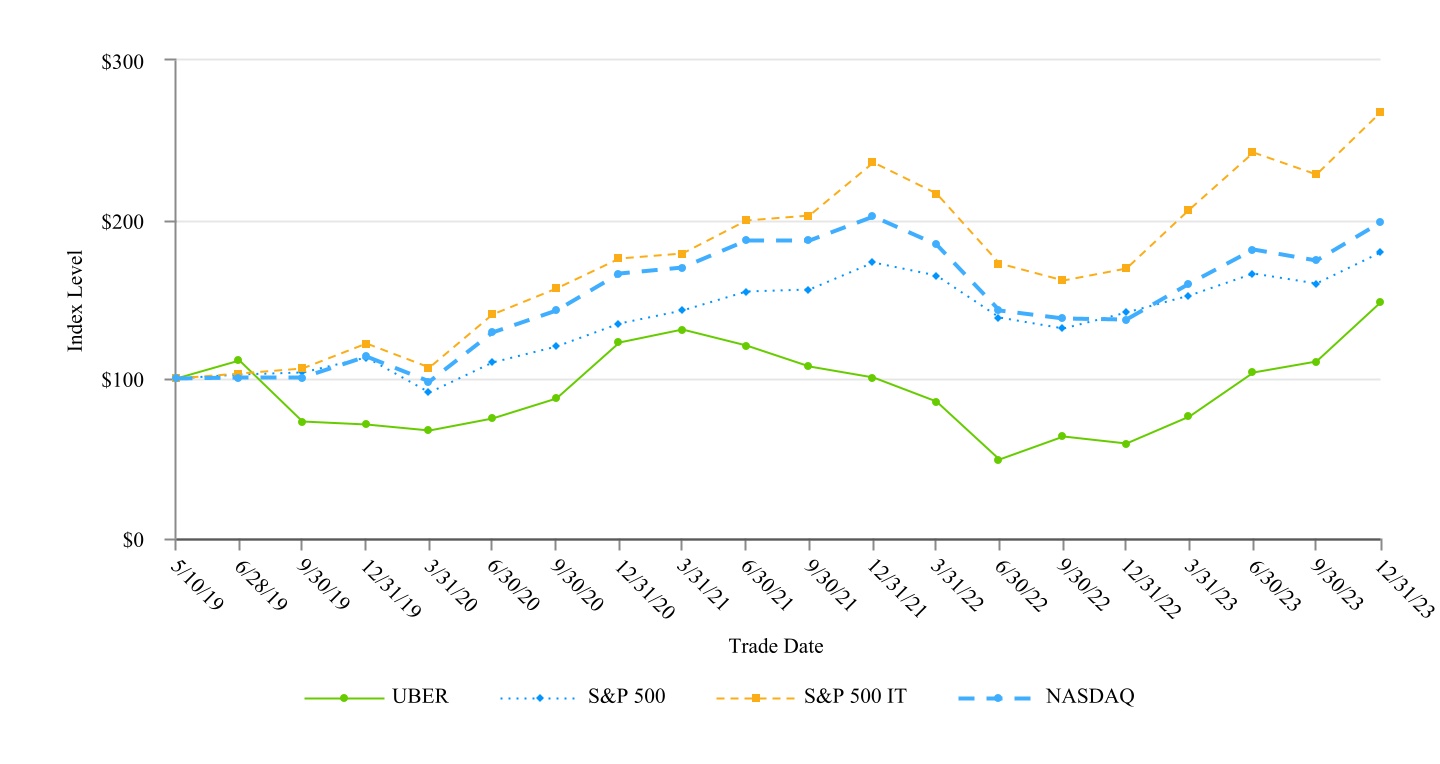
The following graph compares the cumulative total return to stockholders on our common stock relative to the cumulative total returns of the Standard & Poor’s 500 Index (“S&P 500”), S&P 500 Information Technology Sector Index (“S&P 500 IT”) and the Nasdaq Composite Index (“NASDAQ”). An investment of $100 (with reinvestment of all dividends) is assumed to have been made in our common stock and in each index on May 10, 2019, the date our common stock began trading on the NYSE, and its relative performance is tracked through December 31, 2023. The returns shown are based on historical results and are not intended to suggest future performance.
Item 6. [RESERVED]
Item 7. MANAGEMENT’S DISCUSSION AND ANALYSIS OF FINANCIAL CONDITION AND RESULTS OF OPERATIONS
The following discussion and analysis of our financial condition and results of operations should be read in conjunction with our consolidated financial statements and the related notes included in Part II, Item 8, “Financial Statements and Supplementary Data,” of this Annual Report on Form 10-K. We have elected to omit discussion on the earliest of the three years covered by the consolidated financial statements presented. Refer to Item 7. Management's Discussion and Analysis of Financial Condition and Results of Operations located in our Annual Report on Form 10-K for the year ended December 31, 2022, filed on February 21, 2023, for reference to discussion of the fiscal year ended December 31, 2021, the earliest of the three fiscal years presented.
In addition to our historical consolidated financial information, the following discussion contains forward-looking statements that reflect our plans, estimates, and beliefs. Our actual results could differ materially from those discussed in the forward-looking statements. You should review the sections titled “Special Note Regarding Forward-Looking Statements” for a discussion of forward-looking statements and in Part I, Item 1A, “Risk Factors”, for a discussion of factors that could cause actual results to differ materially from the results described in or implied by the forward-looking statements contained in the following discussion and analysis and elsewhere in this Annual Report on Form 10-K.
Overview
We are a technology platform that uses a massive network, leading technology, operational excellence, and product expertise to power movement from point A to point B. We develop and operate proprietary technology applications supporting a variety of offerings on our platform. We connect consumers with providers of ride services, merchants as well as delivery service providers for meal preparation, grocery and other delivery services. Uber also connects consumers with public transportation networks. We use this same network, technology, operational excellence, and product expertise to connect Shippers with Carriers in the freight industry by providing Carriers with the ability to book a shipment, transportation management and other logistics services. We are also developing technologies designed to provide new solutions to solve everyday problems.
Driver Classification Developments
The classification of Drivers is currently being challenged in courts, by legislators and by government agencies in the United States and abroad. We are involved in numerous legal proceedings globally, including putative class and collective class action lawsuits, demands for arbitration, charges and claims before administrative agencies, and investigations or audits by labor, social security, and tax authorities that claim that Drivers should be treated as our employees (or as workers or quasi-employees where those statuses exist), rather than as independent contractors. Of particular note are proceedings in California, where on May 5, 2020, the California Attorney General, in conjunction with the city attorneys for San Francisco, Los Angeles and San Diego, filed a complaint in San Francisco Superior Court (the “Court”) against Uber and Lyft, Inc., alleging that drivers are misclassified, and sought an injunction and monetary damages related to the alleged competitive advantage caused by the alleged misclassification of drivers. To comply with Proposition 22, we have incurred and expect to incur additional expenses, including expenses associated with a guaranteed minimum earnings floor for Drivers, insurance for injury protection and subsidies for health care. We do not expect these changes will have a material impact on our business, results of operations, financial position, or cash flows.
If, as a result of legislation or judicial decisions, we are required to classify Drivers as employees, workers or quasi-employees where those statuses exist, we would incur significant additional expenses for compensating Drivers, including expenses associated with the application of wage and hour laws (including minimum wage, overtime, and meal and rest period requirements), employee benefits, social security contributions, taxes (direct and indirect), and potential penalties. Additionally, we may not have adequate Driver supply as Drivers may opt out of our platform given the loss of flexibility under an employment model, and we may not be able to hire a majority of the Drivers currently using our platform. Any of these events could negatively impact our business, result of operations, financial position, and cash flows.
For a discussion of risk factors related to how misclassification challenges may impact our business, result of operations, financial position and operating condition and cash flows, see the risk factor titled “-Our business would be adversely affected if Drivers were classified as employees, workers or quasi-employees” included in Part I, Item 1A, “Risk Factors”, and Note 14 – Commitments and Contingencies to our consolidated financial statements included in Part II, Item 8, “Financial Statements and Supplementary Data,” of this Annual Report on Form 10-K.
In addition, if we are required to classify Drivers as employees, this may impact our current financial statement presentation including revenue, cost of revenue, incentives and promotions as further described in Note 1 – Description of Business and Summary of Significant Accounting Policies in the notes to the consolidated financial statements included in Part II, Item 8, “Financial Statements and Supplementary Data,” and the section titled “Critical Accounting Estimates” in Part II, Item 7, of this Annual Report on Form 10-K.
Financial and Operational Highlights
| Year Ended December 31, | ||||||||||||||||||||||||||
| (In millions, except percentages) | 2022 | 2023 | % Change | % Change (Constant Currency (1)****) | ||||||||||||||||||||||
| Monthly Active Platform Consumers (“MAPCs”) (2), (3) | 131 | 150 | 15 | % | ||||||||||||||||||||||
| Trips (2) | 7,642 | 9,448 | 24 | % | ||||||||||||||||||||||
| Gross Bookings (2) | $ | 115,395 | $ | 137,865 | 19 | % | 20 | % | ||||||||||||||||||
| Revenue | $ | 31,877 | $ | 37,281 | 17 | % | 18 | % | ||||||||||||||||||
| Income (loss) from operations | $ | (1,832) | $ | 1,110 | ** | |||||||||||||||||||||
| Net income (loss) attributable to Uber Technologies, Inc. | $ | (9,141) | $ | 1,887 | ** | |||||||||||||||||||||
| Adjusted EBITDA (1), (2) | $ | 1,713 | $ | 4,052 | 137 | % | ||||||||||||||||||||
| Net cash provided by operating activities (4) | $ | 642 | $ | 3,585 | ** | |||||||||||||||||||||
| Free cash flow (1), (4) | $ | 390 | $ | 3,362 | ** | |||||||||||||||||||||
(1) See the section titled “Reconciliations of Non-GAAP Financial Measures” for more information and reconciliations to the most directly comparable GAAP financial measure.
(2) See the section titled “Certain Key Metrics and Non-GAAP Financial Measures” below for more information.
(3) MAPCs presented for annual periods are MAPCs for the fourth quarter of the year.
(4) Net cash provided by operating activities and free cash f
Showing the first 8K of 97K characters. Open the full section
Item 7A. QUANTITATIVE AND QUALITATIVE DISCLOSURES ABOUT MARKET RISK
We are exposed to market risks in the ordinary course of our business. These risks primarily include interest rate risk, investment risk, and foreign currency risk as follows:
Interest Rate Risk
Our exposures to market risk for changes in interest rates relate primarily to our 2030 Refinanced Term Loans. The 2030 Refinanced Term Loans represent floating rate notes and are carried at amortized cost. Therefore, fluctuations in interest rates will impact our consolidated financial statements. The interest rate for the 2030 Refinanced Term Loans is SOFR plus 2.75% per annum, subject to a floor of 0.00%. There is no cap on the interest rate associated with the 2030 Refinanced Term Loans. A rising interest rate environment will increase the amount of interest paid on the 2030 Refinanced Term Loans. A hypothetical 100 basis point increase or decrease in interest rates would not have a material effect on our financial results.
The fair value of our fixed rate notes will generally fluctuate with movements of interest rates, increasing in periods of declining rates of interest and declining in periods of increasing rates of interest. A hypothetical 100 basis point increase in interest rates would have decreased the fair value of our notes by $231 million as of December 31, 2023.
Investment Risk
Our investment policy limits the amount of credit exposure with any one financial institution or commercial issuer. Cash deposits typically exceed insured limits and are placed with financial institutions around the world that we believe are of high credit quality. These deposits are in excess of the Federal Deposit Insurance Corporation (“FDIC”) insurance limits. There can be no assurance that our deposits in excess of the FDIC limits will be backstopped by the U.S., or that any bank or financial institution with which we do business will be able to obtain needed liquidity from other banks, government institutions or by acquisition in the event of a failure or liquidity crisis.
Our investment policy objective aims to preserve capital and meet liquidity requirements without significantly increasing risk. We had cash and cash equivalents including restricted cash and cash equivalents totaling $6.7 billion and $7.0 billion as of December 31, 2022 and December 31, 2023, respectively. Marketable debt securities classified as restricted investments and short-term investments totaled $5.5 billion as of December 31, 2023. As of December 31, 2023, our cash, cash equivalents, and marketable debt securities primarily consist of money market funds, cash deposits, U.S. government securities, U.S. government agency securities, and investment-grade corporate debt securities. We do not enter into investments for trading or speculative purposes. Investments in fixed rate securities carry a degree of interest rate risk. Changes in rates would primarily impact interest income due to the relatively short-term nature of our investments. A hypothetical 100 basis point change in interest rates would not have a material effect on our financial results.
We are exposed to certain risks related to the carrying amounts of investments in other companies, including our minority-owned, privately-held entities and public companies, compared to their fair value. We hold privately held investments in illiquid private company stock which are inherently difficult to value given the lack of publicly available information. We also hold equity securities with readily determinable fair values which are subject to equity price risk. These investments in privately-held entities and public companies may increase the volatility in our net income/(loss) in future periods due to changes in the fair value of these investments. In certain cases, our ability to sell these investments may be impacted by contractual obligations to hold the securities for a set period of time after a public offering. As of December 31, 2023, the carrying value of these investments was $6.5 billion, including equity method investments.
Foreign Currency Risk
We transact business globally in multiple currencies. Our international revenue, as well as costs and expenses denominated in foreign currencies, expose us to the risk of fluctuations in foreign currency exchange rates against the U.S. dollar. We are exposed to foreign currency risks related to our revenue and operating expenses denominated in currencies other than the U.S. dollar. Accordingly, changes in exchange rates may negatively affect our future revenue and other operating results as expressed in U.S. dollars. Our foreign currency risk is partially mitigated as our revenue recognized in currencies other than the U.S. dollar is diversified across geographic regions and we incur expenses in the same currencies in such regions.
We have experienced and will continue to experience fluctuations in our net income/(loss) as a result of transaction gains or (losses) related to remeasurement of our asset and liability balances that are denominated in currencies other than the functional currency of the entities in which they are recorded. At this time, we do not, but we may in the future, enter into derivatives or other financial instruments in an attempt to hedge our foreign currency exchange risk.
Item 8. FINANCIAL STATEMENTS AND SUPPLEMENTARY DATA
INDEX TO CONSOLIDATED FINANCIAL STATEMENTS AND SCHEDULE
Report of Independent Registered Public Accounting Firm
To the Board of Directors and Stockholders of Uber Technologies, Inc.
Opinions on the Financial Statements and Internal Control over Financial Reporting
We have audited the accompanying consolidated balance sheets of Uber Technologies, Inc. and its subsidiaries (the “Company”) as of December 31, 2023 and 2022, and the related consolidated statements of operations, of comprehensive income (loss), of redeemable non-controlling interests and equity and of cash flows for each of the three years in the period ended December 31, 2023, including the related notes and financial statement schedule listed in the accompanying index (collectively referred to as the “consolidated financial statements”). We also have audited the Company's internal control over financial reporting as of December 31, 2023, based on criteria established in Internal Control - Integrated Framework (2013) issued by the Committee of Sponsoring Organizations of the Treadway Commission (COSO).
In our opinion, the consolidated financial statements referred to above present fairly, in all material respects, the financial position of the Company as of December 31, 2023 and 2022, and the results of its operations and its cash flows for each of the three years in the period ended December 31, 2023 in conformity with accounting principles generally accepted in the United States of America. Also in our opinion, the Company maintained, in all material respects, effective internal control over financial reporting as of December 31, 2023, based on criteria established in Internal Control - Integrated Framework (2013) issued by the COSO.
Change in Accounting Principle
As discussed in Note 8 to the consolidated financial statements, the Company changed the manner in which it accounts for convertible instruments and contracts in an entity’s own equity in 2021.
Basis for Opinions
The Company's management is responsible for these consolidated financial statements, for maintaining effective internal control over financial reporting, and for its assessment of the effectiveness of internal control over financial reporting, included in Management’s Report on Internal Control over Financial Reporting appearing under Item 9A. Our responsibility is to express opinions on the Company’s consolidated financial statements and on the Company's internal control over financial reporting based on our audits. We are a public accounting firm registered with the Public Company Accounting Oversight Board (United States) (PCAOB) and are required to be independent with respect to the Company in accordance with the U.S. federal securities laws and the applicable rules and regulations of the Securities and Exchange Commission and the PCAOB.
We conducted our audits in accordance with the standards of the PCAOB. Those standards require that we plan and perform the audits to obtain reasonable assurance about whether the consolidated financial statements are free of material misstatement, whether due to error or fraud, and whether effective internal control over financial reporting was maintained in all material respects.
Our audits of the consolidated financial statements included performing procedures to assess the risks of material misstatement of the consolidated financial statements, whether due to error or fraud, and performing procedures that respond to those risks. Such procedures included examining, on a test basis, evidence regarding the amounts and disclosures in the consolidated financial statements. Our audits also included evaluating the accounting principles used and significant estimates made by management, as well as evaluating the overall presentation of the consolidated financial statements. Our audit of internal control over financial reporting included obtaining an understanding of internal control over financial reporting, assessing the risk that a material weakness exists, and testing and evaluating the design and operating effectiveness of internal control based on the assessed risk. Our audits also included performing such other procedures as we considered necessary in the circumstances. We believe that our audits provide a reasonable basis for our opinions.
Definition and Limitations of Internal Control over Financial Reporting
A company’s internal control over financial reporting is a process designed to provide reasonable assurance regarding the reliability of financial reporting and the preparation of financial statements for external purposes in accordance with generally accepted accounting principles. A company’s internal control over financial reporting includes those policies and procedures that (i) pertain to the maintenance of records that, in reasonable detail, accurately and fairly reflect the transactions and dispositions of the assets of the company; (ii) provide reasonable assurance that transactions are recorded as necessary to permit preparation of financial statements in accordance with generally accepted accounting principles, and that receipts and expenditures of the company are being made only in accordance with authorizations of management and directors of the company; and (iii) provide reasonable assurance regarding prevention or timely detection of unauthorized acquisition, use, or disposition of the company’s assets that could have a material effect on the financial statements.
Because of its inherent limitations, internal control over financial reporting may not prevent or detect misstatements. Also, projections of any evaluation of effectiveness to future periods are subject to the risk that controls may become inadequate because of changes in conditions, or that the degree of compliance with the policies or procedures may deteriorate.
Critical Audit Matters
The critical audit matters communicated below are matters arising from the current period audit of the consolidated financial statements that were communicated or required to be communicated to the audit committee and that (i) relate to accounts or disclosures that are material to the consolidated financial statements and (ii) involved our especially challenging, subjective, or complex judgments. The communication of critical audit matters does not alter in any way our opinion on the consolidated financial statements, taken as a whole, and we are not, by communicating the critical audit matters below, providing separat
Showing the first 8K of 321K characters. Open the full section
Item 9. CHANGES IN AND DISAGREEMENTS WITH ACCOUNTANTS ON ACCOUNTING AND FINANCIAL DISCLOSURE
None.
Item 9A. CONTROLS AND PROCEDURES
Evaluation of Disclosure Controls and Procedures
We maintain disclosure controls and procedures that are designed to provide reasonable assurance that information required to be disclosed in reports that we file or submit under the Securities Exchange Act of 1934, as amended (the “Exchange Act”) is recorded, processed, summarized and reported within the time periods specified in the Securities and Exchange Commission’s rules and forms and that such information is accumulated and communicated to our management, including our Chief Executive Officer and Chief Financial Officer, as appropriate, to allow for timely decisions regarding required disclosure. As required by Rule 13a-15(b) under the Exchange Act, our management, including our Chief Executive Officer and Chief Financial Officer, evaluated the effectiveness of our disclosure controls and procedures as of the end of the period covered by this Annual Report on Form 10-K. Based upon that evaluation, our Chief Executive Officer and Chief Financial Officer concluded that, as of the end of the period covered by this Annual Report on Form 10-K, our disclosure controls and procedures are effective at a reasonable assurance level.
Changes in Internal Control over Financial Reporting
There were no changes to our internal control over financial reporting that occurred during the quarter ended December 31, 2023 that have materially affected, or are reasonably likely to materially affect, our internal control over financial reporting.
Inherent Limitations on Effectiveness of Controls
Our management, including our Chief Executive Officer and Chief Financial Officer, believes that our disclosure controls and procedures and internal control over financial reporting are designed to provide reasonable assurance of achieving their objectives and are effective at the reasonable assurance level. However, our management does not expect that our disclosure controls and procedures
or our internal control over financial reporting will prevent or detect all error and fraud. Any control system, no matter how well designed and operated, is based upon certain assumptions and can provide only reasonable, not absolute, assurance that its objectives will be met. Further, no evaluation of controls can provide absolute assurance that misstatements due to error or fraud will not occur or that all control issues and instances of fraud, if any, within our company have been detected.
Management's Report on Internal Control over Financial Reporting
Our management is responsible for establishing and maintaining adequate internal control over financial reporting (as defined in Rule 13a-15(f) under the Exchange Act). Our management conducted an assessment of the effectiveness of our internal control over financial reporting based on the criteria established in “Internal Control - Integrated Framework” (2013) issued by the Committee of Sponsoring Organizations of the Treadway Commission (“COSO”). Based on that assessment, our management has concluded that our internal control over financial reporting was effective as of December 31, 2023. In addition, PricewaterhouseCoopers LLP, our independent registered public accounting firm, provided an attestation report on our internal control over financial reporting as of December 31, 2023. You can find the full text of PricewaterhouseCoopers LLP attestation report in Item 8 of this Annual Report on Form 10-K.
Item 9B. OTHER INFORMATION
Amendments to Bylaws
On February 15, 2024, as part of its periodic review of the governing documents of the Company, our Board of Directors adopted Amended and Restated Bylaws (the “Bylaws”) to permit stockholders who own at least 25% of the aggregate voting power of our voting securities, and who satisfy other requirements as set forth in the Bylaws, to call a special meeting of stockholders. The foregoing description is qualified in its entirety by reference to the full text of the Bylaws, which are attached hereto as Exhibit 3.2.
Item 9C. DISCLOSURE REGARDING FOREIGN JURISDICTIONS THAT PREVENT INSPECTIONS
Not applicable.
PART III
Item 10. DIRECTORS, EXECUTIVE OFFICERS AND CORPORATE GOVERNANCE
The information required by this item is set forth under the headers “Proposal 1- Election of Directors,” “Executive Officers,” “Corporate Governance” and “Other Governance Matters” in our Proxy Statement for the 2024 Annual Meeting of Stockholders to be filed with the SEC within 120 days of the fiscal year ended December 31, 2023 (“2024 Proxy Statement”) and is incorporated herein by reference.
Item 11. EXECUTIVE COMPENSATION
The information required by this item is included under the headers “Director Compensation,” “Executive Compensation” and “Compensation Committee Interlocks and Insider Participation” in the 2024 Proxy Statement and is incorporated herein by reference.
Item 12. SECURITY OWNERSHIP OF CERTAIN BENEFICIAL OWNERS AND MANAGEMENT AND RELATED STOCKHOLDER MATTERS
The information required by this item is included under the headers “Executive Officers-Security Ownership of Certain Beneficial Owners and Management” and “Equity Compensation Plan Information” in the 2024 Proxy Statement and is incorporated herein by reference.
Item 13. CERTAIN RELATIONSHIPS AND RELATED TRANSACTIONS, AND DIRECTOR INDEPENDENCE
The information required by this item is included under the headers “Corporate Governance-Certain Relationships and Related Person Transactions” and “Corporate Governance-Director Independence Determination” in the 2024 Proxy Statement and is incorporated herein by reference.
Item 14. PRINCIPAL ACCOUNTING FEES AND SERVICES
The information required by this item is included under the header “Proposal 3: Ratification of Appointment of Independent Registered Public Accounting Firm” in the 2024 Proxy Statement and is incorporated herein by reference.
PART IV
Item 15. EXHIBITS, FINANCIAL STATEMENT SCHEDULES
(a) We have filed the following documents as part of this Annual Report on Form 10-K:
**1.**Consolidated Financial Statements
Our consolidated financial statements are listed in the “Index to Consolidated Financial Statements and Schedule” under Part II, Item 8 of this Annual Report on Form 10-K.
**2.**Financial Statement Schedules
All financial statement schedules have been omitted because they are not applicable, not material or the required information is shown in Part II, Item 8 of this Annual Report on Form 10-K.
**3.**Exhibits
The documents listed in the Exhibit Index of this Annual Report on Form 10-K are incorporated by reference or are filed with this Annual Report on Form 10-K, in each case as indicated therein (numbered in accordance with Item 601 of Regulation S-K).
Item 16. FORM 10-K SUMMARY
None.
EXHIBIT INDEX
+Portions of this exhibit have been omitted in accordance with Item 601(b)(10)(iv) of Regulation S-K.
‡This form of employment agreement will be used for all named executive officer employment agreements entered into and effective after July 1, 2020 unless otherwise noted.
- The certifications attached as Exhibit 32.1 that accompany this Annual Report on Form 10-K are deemed furnished and not filed with the Securities and Exchange Commission and are not to be incorporated by reference into any filing of Uber Technologies, Inc. under the Securities Act of 1933, as amended, or the Securities Exchange Act of 1934, as amended, whether made before or after the date of this Annual Report on Form 10-K, irrespective of any general incorporation language contained in such filing.
SIGNATURES
Pursuant to the requirements of Section 13 or 15(d) of the Securities Exchange Act of 1934, the registrant has duly caused this report to be signed on its behalf by the undersigned thereunto duly authorized.
| UBER TECHNOLOGIES, INC. | |||||
| Date: February 15, 2024 | By: /s/ Dara Khosrowshahi | ||||
| Dara Khosrowshahi | |||||
| Chief Executive Officer and Director | |||||
| (Principal Executive Officer) |
POWER OF ATTORNEY
KNOW ALL PERSONS BY THESE PRESENTS, that each person whose signature appears below constitutes and appoint Dara Khosrowshahi, Prashanth Mahendra-Rajah, and Tony West, and each one of them, as his or her true and lawful attorneys-in-fact and agents, with full power of substitution and resubstitution, for him or her and in their name, place and stead, in any and all capacities, to sign any amendments to this Annual Report on Form 10-K, and to file the same, with all exhibits thereto and other documents in connection therewith, with the Securities and Exchange Commission, granting unto said attorneys-in-fact and agents, and each of them, full power and authority to do and perform each and every act and thing requisite and necessary to be done in connection therewith, as fully to all intents and purposes as he might or could do in person, hereby ratifying and confirming all that said attorneys-in-fact and agents or any of them, or his substitute or substitutes, may lawfully do or cause to be done by virtue hereof.
Pursuant to the requirements of the Securities Exchange Act of 1934, the registrant has duly caused this report to be signed on its behalf by the following persons in the capacities and on the dates indicated.
| Signature | Title | Date | ||||||||||||
| /s/ Dara Khosrowshahi | Chief Executive Officer and Director | February 15, 2024 | ||||||||||||
| Dara Khosrowshahi | (Principal Executive Officer) | |||||||||||||
| /s/ Prashanth Mahendra-Rajah | Chief Financial Officer | February 15, 2024 | ||||||||||||
| Prashanth Mahendra-Rajah | (Principal Financial Officer) | |||||||||||||
| /s/ Glen Ceremony | Chief Accounting Officer and Global Corporate Controller | February 15, 2024 | ||||||||||||
| Glen Ceremony | (Principal Accounting Officer) | |||||||||||||
| /s/ Ronald Sugar | Chairperson of the Board of Directors | February 15, 2024 | ||||||||||||
| Ronald Sugar | ||||||||||||||
| /s/ Revathi Advaithi | Director | February 15, 2024 | ||||||||||||
| Revathi Advaithi | ||||||||||||||
| /s/ Turqi Alnowaiser | Director | February 15, 2024 | ||||||||||||
| Turqi Alnowaiser | ||||||||||||||
| /s/ Ursula Burns | Director | February 15, 2024 | ||||||||||||
| Ursula Burns | ||||||||||||||
| /s/ Robert Eckert | Director | February 15, 2024 | ||||||||||||
| Robert Eckert | ||||||||||||||
| /s/ Amanda Ginsberg | Director | February 15, 2024 | ||||||||||||
| Amanda Ginsberg | ||||||||||||||
| /s/ Wan Ling Martello | Director | February 15, 2024 | ||||||||||||
| Wan Ling Martello | ||||||||||||||
| /s/ John Thain | Director | February 15, 2024 | ||||||||||||
| John Thain | ||||||||||||||
| /s/ David Trujillo | Director | February 15, 2024 | ||||||||||||
| David Trujillo | ||||||||||||||
| /s/ Alexander Wynaendts | Director | February 15, 2024 | ||||||||||||
| Alexander Wynaendts |