 filings.tools
Item 2. Properties
8K characters. Original on sec.gov ·
Item 2. Properties
We employ a variety of assets in the management and operation of our rail business. Our rail network covers 23 states in the western two-thirds of the U.S.
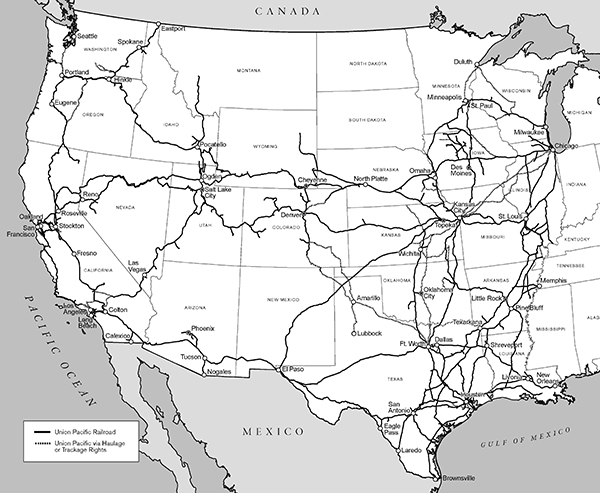
TRACK
Our rail network includes 32,693 route miles. We own 26,110 miles and operate on the remainder pursuant to trackage rights or leases. The following table describes track miles:
| As of December 31, | 2023 | 2022 | ||||||
|---|---|---|---|---|---|---|---|---|
| Route | 32,693 | 32,534 | ||||||
| Other main line | 7,117 | 7,113 | ||||||
| Passing lines and turnouts | 3,466 | 3,454 | ||||||
| Switching and classification yard lines | 8,852 | 8,853 | ||||||
| Total miles | 52,128 | 51,954 |
HEADQUARTERS BUILDING
We own our headquarters building in Omaha, Nebraska. The facility has 1.2 million square feet of space that can accommodate approximately 4,000 employees.
HARRIMAN DISPATCHING CENTER
The Harriman Dispatching Center (HDC), located in Omaha, Nebraska, is our primary dispatching facility. It is linked to regional dispatching and locomotive management facilities at various locations along our network. HDC employees coordinate moves of locomotives and trains, manage traffic and train crews on our network, and coordinate interchanges with other railroads. Generally, around 500 employees work on-site in the facility. In the event of a disruption of operations at HDC due to a cyber-attack, flooding or severe weather, pandemic outbreak, or other event, we maintain the capability to conduct critical operations at back-up facilities in different locations.
RAIL FACILITIES
In addition to our track structure, we operate numerous facilities, including terminals for intermodal and other freight; rail yards for building trains (classification yards), switching, storage-in-transit (the temporary storage of customer goods in rail cars prior to shipment), and other activities; offices to administer and manage our operations; dispatching centers to direct traffic on our rail network; crew on duty locations for train crews along our network; and shops and other facilities for fueling, maintenance, and repair of locomotives and repair and maintenance of rail cars and other equipment. The following table includes the major yards and terminals on our system:
| Major Classification Yards | Major Intermodal Terminals |
|---|---|
| North Platte, Nebraska | Joliet (Global 4), Illinois |
| Englewood (Houston), Texas | Global II (Chicago), Illinois |
| North Little Rock, Arkansas | East Los Angeles, California |
| Livonia, Louisiana | ICTF (Long Beach), California |
| Fort Worth, Texas | Mesquite, Texas |
| Roseville, California | Lathrop, California |
| Houston, Texas | City of Industry, California |
| West Colton, California | Salt Lake City, Utah |
RAIL EQUIPMENT
Our equipment includes owned and leased locomotives and rail cars; heavy maintenance equipment and machinery; other equipment and tools in our shops, offices, and facilities; and vehicles for maintenance, transportation of crews, and other activities. As of December 31, 2023, we owned or leased the following units of equipment:
| Average | ||||||||||||||||
|---|---|---|---|---|---|---|---|---|---|---|---|---|---|---|---|---|
| Locomotives | Owned | Leased | Total | Age (yrs.) | ||||||||||||
| Multiple purpose | 5,971 | 1,037 | 7,008 | 24.3 | ||||||||||||
| Switching | 132 | - | 132 | 43.5 | ||||||||||||
| Other | 14 | - | 14 | 51.2 | ||||||||||||
| Total locomotives | 6,117 | 1,037 | 7,154 | N/A |
| Average | ||||||||||||||||
|---|---|---|---|---|---|---|---|---|---|---|---|---|---|---|---|---|
| Freight cars | Owned | Leased | Total | Age (yrs.) | ||||||||||||
| Covered hoppers | 13,761 | 9,474 | 23,235 | 21.3 | ||||||||||||
| Open hoppers | 4,846 | 775 | 5,621 | 36.4 | ||||||||||||
| Gondolas | 6,396 | 4,492 | 10,888 | 23.1 | ||||||||||||
| Boxcars | 3,389 | 7,572 | 10,961 | 32.7 | ||||||||||||
| Refrigerated cars | 2,444 | 1,199 | 3,643 | 21.8 | ||||||||||||
| Flat cars | 2,216 | 2,254 | 4,470 | 32.6 | ||||||||||||
| Other | - | 371 | 371 | 35.2 | ||||||||||||
| Total freight cars | 33,052 | 26,137 | 59,189 | N/A |
| Average | ||||||||||||||||
|---|---|---|---|---|---|---|---|---|---|---|---|---|---|---|---|---|
| Highway revenue equipment | Owned | Leased | Total | Age (yrs.) | ||||||||||||
| Containers | 47,439 | 545 | 47,984 | 12.2 | ||||||||||||
| Chassis | 30,635 | 17,705 | 48,340 | 13.2 | ||||||||||||
| Total highway revenue equipment | 78,074 | 18,250 | 96,324 | N/A |
We continuously assess our need for equipment to run an efficient and reliable network. Many factors cause us to adjust the size of our active fleets, including changes in carload volume, weather events, seasonality, customer preferences, and operational efficiency initiatives. As some of these factors are difficult to assess or can change rapidly, we maintain a buffer to remain agile. Without the surge fleet, our ability to react quickly is hindered as equipment suppliers are limited and lead times to acquire equipment are long and may be in excess of a year. We believe our locomotive and freight car fleets are appropriately sized to meet our current and future business requirements. These fleets serve as the most reliable and efficient equipment to facilitate growth without additional acquisitions. Locomotive and freight car in service utilization percentages for the year ended December 31, 2023, were 69% and 74%, respectively.
CAPITAL EXPENDITURES
Our rail network requires significant annual capital investments for replacement, improvement, and expansion. These investments enhance safety, support the transportation needs of our customers, improve our operational efficiency, and support emission reduction initiatives. Additionally, we add new equipment to our fleet to replace older equipment and to support growth and customer demand.
2023 Capital Program – During 2023, our capital program totaled approximately $3.7 billion. (See the cash capital investments table in Management’s Discussion and Analysis of Financial Condition and Results of Operations - Liquidity and Capital Resources, Item 7, of this report.)
2024 Capital Plan – In 2024, we expect our capital plan to be approximately $3.4 billion, down 8% from 2023. (See further discussion of our 2024 capital plan in Management’s Discussion and Analysis of Financial Condition and Results of Operations - Liquidity and Capital Resources, Item 7, of this report.)
OTHER
Equipment Encumbrances – See Note 14 and 16 to the Financial Statements and Supplementary Data, Item 8.
Environmental Matters – Certain of our properties are subject to federal, state, and local laws and regulations governing the protection of the environment. (See discussion within this report of environmental issues in Business - Governmental and Environmental Regulation, Item 1; Management’s Discussion and Analysis of Financial Condition and Results of Operations - Critical Accounting Estimates - Environmental, Item 7; and Note 17 to the Financial Statements and Supplementary Data, Item 8.)
Previous: Item 1C. Cybersecurity · Next: Item 3. Legal Proceedings