 filings.tools
United Parcel Service 10-K 2019-12-31
Filed 2020-02-20. 22 sections, 553K characters. Original on sec.gov · Markdown · JSON
Cover and table of contents
UNITED STATES
SECURITIES AND EXCHANGE COMMISSION
Washington, D.C. 20549
Form 10-K
(Mark One)
| ☒ | ANNUAL REPORT PURSUANT TO SECTION 13 OR 15(d) OF THE SECURITIES EXCHANGE ACT OF 1934 |
For the fiscal year ended December 31, 2019
or
| ☐ | TRANSITION REPORT PURSUANT TO SECTION 13 OR 15(d) OF THE SECURITIES EXCHANGE ACT OF 1934 |
For the transition period from to
Commission file number 001-15451

United Parcel Service, Inc.
(Exact name of registrant as specified in its charter)
| Delaware | 58-2480149 | |
| (State or Other Jurisdiction of Incorporation or Organization) | (I.R.S. Employer Identification No.) |
55 Glenlake Parkway, N.E**.** Atlanta**,** Georgia 30328
(Address of Principal Executive Offices) (Zip Code)
(404) 828-6000
(Registrant’s telephone number, including area code)
Securities registered pursuant to Section 12(b) of the Act:
| Title of Each Class | Trading Symbol | Name of Each Exchange on Which Registered |
| Class B common stock, par value $.01 per share | UPS | New York Stock Exchange |
| Floating-Rate Senior Notes due 2020 | UPS20A | New York Stock Exchange |
| 1.625% Senior Notes due 2025 | UPS25 | New York Stock Exchange |
| 1% Senior Notes due 2028 | UPS28 | New York Stock Exchange |
| 0.375% Senior Notes due 2023 | UPS23A | New York Stock Exchange |
| 1.500% Senior Notes due 2032 | UPS32 | New York Stock Exchange |
Securities registered pursuant to Section 12(g) of the Act:
Class A common stock, par value $.01 per share
(Title of Class)
Indicate by check mark if the registrant is a well-known seasoned issuer, as defined in Rule 405 of the Securities Act. Yes x No ¨
Indicate by check mark if the registrant is not required to file reports pursuant to Section 13 or Section 15(d) of the Exchange Act. Yes ¨ No x
Indicate by check mark whether the registrant: (1) has filed all reports required to be filed by Section 13 or 15(d) of the Securities Exchange Act of 1934 during the preceding 12 months (or for such shorter period that the registrant was required to file such reports), and (2) has been subject to such filing requirements for the past 90 days. Yes x No ¨
Indicate by check mark whether the registrant has submitted electronically every Interactive Data File required to be submitted pursuant to Rule 405 of Regulation S-T (Section 232.405 of this chapter) during the preceding 12 months (or for such shorter period that the registrant was required to submit such files). Yes x No ¨
Indicate by check mark whether the registrant is a large accelerated filer, an accelerated filer, a non-accelerated filer, a smaller reporting company, or an emerging growth company. See definitions of “ large accelerated filer”, “accelerated filer”, “smaller reporting company,” and "emerging growth company" in Rule 12b-2 of the Exchange Act.
| Large accelerated filer | x | Accelerated filer ¨ | Non-accelerated filer ¨ | Smaller reporting company | ☐ | Emerging growth company | ☐ |
If an emerging growth company, indicate by check mark if the registrant has elected not to use the extended transition period for complying with any new or revised financial accounting standards provided pursuant to Section 13(a) of the Exchange Act. ¨
Indicate by check mark whether the registrant is a shell company (as defined in Rule 12b-2 of the Exchange Act). Yes ☐ No x
The aggregate market value of the class B common stock held by non-affiliates of the registrant was $72,097,367,231 as of June 30, 2019. The registrant’s class A common stock is not listed on a national securities exchange or traded in an organized over-the-counter market, but each share of the registrant’s class A common stock is convertible into one share of the registrant’s class B common stock.
As of February 6, 2020, there were 156,399,660 outstanding shares of class A common stock and 702,088,016 outstanding shares of class B common stock.
DOCUMENTS INCORPORATED BY REFERENCE
Portions of the registrant’s definitive proxy statement for its annual meeting of shareowners scheduled for May 14, 2020 are incorporated by reference into Part III of this report.
UNITED PARCEL SERVICE, INC.
ANNUAL REPORT ON FORM 10-K
TABLE OF CONTENTS
PART I
Cautionary Statement About Forward-Looking Statements
This report, our Annual Report to Shareowners and our other filings with the Securities and Exchange Commission (“SEC”) contain “forward-looking statements” within the meaning of the Private Securities Litigation Reform Act of 1995. Statements other than those of current or historical fact, and all statements accompanied by terms such as “believe,” “project,” “expect,” “estimate,” “assume,” “intend,” “anticipate,” “target,” “plan” and variations thereof and similar terms, are intended to be forward-looking statements. Forward-looking statements are made subject to the safe harbor protections of the federal securities laws pursuant to Section 27A of the Securities Act of 1933 and Section 21E of the Securities Exchange Act of 1934.
From time to time, we also include written or oral forward-looking statements in other publicly disclosed materials. Such statements relate to our intent, belief and current expectations about our strategic direction, prospects and future results, and give our current expectations or forecasts of future events; they do not relate strictly to historical or current facts. Management believes that these forward-looking statements are reasonable as and when made. However, caution should be taken not to place undue reliance on any such forward-looking statements because such statements speak only as of the date when made.
Forward-looking statements are subject to certain risks and uncertainties that could cause actual results to differ materially from our historical experience and our present expectations or anticipated results. These risks and uncertainties are described in Part I, “Item 1A. Risk Factors” and may also be described from time to time in our future reports filed with the SEC. You should consider the limitations on, and risks associated with, forward-looking statements and not unduly rely on the accuracy of predictions contained in such forward-looking statements. We do not undertake any obligation to update forward-looking statements to reflect events, circumstances, changes in expectations or the occurrence of unanticipated events after the date of those statements.
Item 1. Business
Overview
United Parcel Service, Inc. (“UPS”) was founded in 1907 as a private messenger and delivery service in Seattle, Washington. Today, we are the world’s largest package delivery company, a leader in the U.S. less-than-truckload industry and a premier provider of global supply chain management solutions. The global market for these services includes transportation, distribution, contract logistics, ground freight, ocean freight, air freight, customs brokerage, insurance and financing.
We operate one of the largest airlines in the world, as well as the world’s largest fleet of alternative-powered vehicles. We deliver packages each business day for 1.6 million shipping customers to 9.9 million delivery customers in over 220 countries and territories. In 2019, we delivered an average of 21.9 million pieces per day, or a total of 5.5 billion packages. Total revenue in 2019 was $74.094 billion.
We have three reporting segments: U.S. Domestic Package and International Package, which together we refer to as our global small package operations, and Supply Chain & Freight, all of which are described below.
Strategy
Our strategy is to provide advanced logistics solutions made possible by a broad portfolio of differentiated services and capabilities integrated into our customers’ businesses. This strategy, supported by our efficient global multimodal network, enables us to deliver value to, and build lasting relationships with, our customers.
Customers are able to leverage our broad portfolio of logistics capabilities comprised of: our extensive presence in North America, Europe, Middle East, Africa, Asia Pacific and Latin America; our reliability; and our industry-leading technologies and solutions.
We offer a full range of industry-leading products, services and capabilities across a growing geographical and industry footprint. Achieving our objectives has required new methods and innovative approaches to develop and implement logistics services that address customer needs for speed to market, visibility, reliability and greater control. Recent examples include:
| • | the acquisition or creation of platform-based offerings such as UPS e-fulfillment and Ware2Go; |
| • | specialized healthcare solutions such as UPS Premier, which offers prioritized handling and visibility for critical healthcare shipments; |
| • | a full range of global customs brokerage and shipment insurance services; and |
| • | offerings such as UPS My Choice for business that give small- and medium-sized businesses ("SMBs") greater control, visibility and data access to improve their customer service. |
We monitor global trade, economic, geopolitical, regulatory and environmental factors, as well as other factors impacting the business environment. We quickly implement measures to convert risk to opportunity and help our customers adjust their supply chains to a fast-moving world. We have a long history of joint ventures and partnerships that provide operational flexibility and the ability to acquire new capabilities as we build scale, and we also forge new marketplace alliances to stay at the cutting edge of business. For example, our Digital Access Program makes it easier for SMBs to use our services by embedding our shipping solutions directly into leading e-commerce platforms.
We are a disciplined and focused business that purposefully reinvests capital to achieve both long-term strategic benefits and favorable returns. In September 2018, we communicated our commitment to continuous transformation and to invest to modernize our business and operations through state-of-the art technology. We see transformation as an ongoing commitment to enhance quality and efficiency as we deliver innovative capabilities and services. Our strategic investments are primarily focused in areas we believe will drive growth and lasting profit potential:
| • | services and solutions for SMBs; |
| • | international growth markets; |
| • | global Business to Consumer (“B2C”) and Business to Business (“B2B”) e-commerce; |
| • | healthcare and life-sciences logistics; and |
| • | operational improvements to drive greater productivity and the use of automation to enhance the efficiency of our network. |
In recent periods, we have added approximately ten million square feet of highly automated capacity in more than forty new and remodeled facilities globally. We have also continued to implement numerous new technologies to help control the network and ensure resources are in the right place at the right time.
Products and Services; Reporting Segments
Global Small Package
Our global small package operations provide time-definite delivery services for express letters, documents, small packages and palletized freight via air and ground services. These services are supported by numerous shipping, visibility and billing technologies.
All types of service (air, ground, domestic, international, commercial and residential) are managed through a single, global integrated pickup and delivery network. We combine all packages within our network, unless dictated by specific service commitments. This enables one UPS driver to pick up customers’ shipments for any services at a scheduled time each day. Our integrated network uniquely provides operational and capital efficiencies that have less of an impact on the environment than single service network designs.
We handle packages up to 108 inches in length that weigh up to 150 pounds and are up to 165 inches in combined length and girth, as well as palletized shipments weighing more than 150 pounds. We offer same-day pickup of air and ground packages seven days a week. Our global network offers approximately 150,000 entry points where customers can tender a package to us at a location or time convenient to them. This integrated network includes UPS drivers who can accept packages, UPS drop boxes, UPS Access Point locations, The UPS Store locations, authorized shipping outlets and commercial counters, alliance locations and customer centers attached to UPS facilities. The UPS Access Point network, which includes local small businesses, national retailers and self-serve lockers, allows consumers to ship or redirect packages to an alternate delivery location or drop off pre-labeled packages, including returns. We have expanded the UPS Access Point network to total approximately 21,000 locations within the U.S. and 40,000 globally.
We have developed a robust portfolio of returns services in more than 145 countries resulting from the continued growth of online and mobile shopping that has increased our customers’ need for efficient and reliable returns. This portfolio provides a range of cost-effective label options and a broad network of consumer drop points, as well as a selection of returns technologies that promote efficiency and a friction-free consumer experience. These options include solutions such as UPS Returns, as well as more-specialized services such as UPS Returns Exchange. Our technologies, such as UPS Returns Manager promote systems integration, customer ease of use and visibility of inbound merchandise, which help reduce costs and improve efficiency in our customers' reverse logistics processes.
Our global air operations are centered at our Worldport hub in Louisville, Kentucky. Our U.S. regional air hubs in Dallas, Texas; Ontario, California; Philadelphia, Pennsylvania and Rockford, Illinois support Worldport. Our European air hub is located in Cologne, Germany, and we maintain Asia Pacific air hubs in Shanghai, China; Shenzhen, China and Hong Kong. Our regional air hub in Canada is located in Hamilton, Ontario and our regional air hub for Latin America and the Caribbean is in Miami, Florida. This network design creates cost-effective package processing in our most technology-enabled facilities, which allows us to use fewer, larger and more fuel-efficient aircraft.
U.S. Domestic Package Reporting Segment
We are a leader in time-definite, guaranteed small package delivery services in the United States. We offer a full spectrum of U.S. domestic guaranteed air and ground package transportation services, and our U.S. ground fleet serves all business and residential zip codes in the contiguous United States.
| • | UPS's Air portfolio offers options enabling customers to specify a time-of-day guarantee for their delivery (e.g. by 8:00 A.M., 10:30 A.M., noon, end of day, etc.), while selecting from same day, next day, two day and three day delivery alternatives. |
| • | Customers can also leverage our extensive ground network to ship using our day-definite guaranteed Ground service. We deliver more ground packages in the U.S. than any other carrier, with average daily package volume of 15 million, most within one to three business days. |
| • | We offer UPS SurePost, an economy residential ground service for customers with non-urgent, lightweight residential shipments. UPS SurePost is a residential ground service that combines the consistency and reliability of the UPS ground network with final delivery often provided by the U.S. Postal Service. |
International Package Reporting Segment
Our International Package reporting segment consists of our small package operations in Europe, Asia Pacific, Canada, Latin America and the Indian sub-continent, Middle East and Africa ("ISMEA"). We offer a wide selection of guaranteed day- and time-definite international shipping services. We offer more guaranteed time-definite express options (Express Plus, Express and Express Saver) than any other carrier.
In recent years we have continued the expansion of our Express time-definite portfolio, with certain products now reaching as many as 220 countries and territories. For international package shipments that do not require Express services, UPS Worldwide Expedited offers a reliable, deferred, guaranteed day-definite service option. The service is now available from more than 80 origin countries to more than 220 countries and territories. For cross-border ground package delivery, we offer UPS Standard delivery services within Europe, between the U.S. and Canada and between the U.S. and Mexico.
By expanding our time-definite services, we are better able to offer customers the services they need in the places they do business. For businesses with time-sensitive shipments, these upgrades can help replenish inventories quicker, improve time to market and meet urgent delivery requirements.
Europe, our largest region outside of the U.S., accounts for approximately half of our international small package segment revenue and is one of the primary drivers of our growth. We continue to make major European infrastructure investments, including new hubs in London, Paris and Eindhoven, the Netherlands.
Asia Pacific also remains a strategic market due to growth rates in intra-Asia trade. To capitalize on these opportunities, we have continued to bring faster time-in-transit to customers focused on intra-Asia trade and reduced transit times from Asia to the U.S. and Europe. Through added flight frequencies, we now provide our customers the ability to ship next day to more places in the U.S. and Europe - guaranteed - than any other express carrier. We serve more than 40 Asia Pacific countries and territories through more than two dozen alliances with local delivery companies that supplement our owned operations. For example, our joint venture with SF Express combines SF’s extensive Chinese network with UPS’s delivery capabilities in the U.S. and Europe, increasing our market presence and providing Chinese enterprises with greater global access. In addition, improvements to time-in-transit for UPS Express Saver and UPS Worldwide Expedited services to Shanghai have resulted in faster delivery by a full day to 185 postal codes for packages coming from Europe.
International high-growth markets remain one of our strategic imperatives. Our direct flight from the U.S. to Dubai has improved time-in-transit to key destinations in ISMEA for shippers throughout the U.S., Canada and the Americas. Markets like India also provide opportunities for growth. In support of this, we acquired full ownership of our express services unit in 2018. The unit helps Indian businesses, large and small, connect with global markets via the UPS network. This follows the opening of two integrated logistics facilities in Hyderabad and Ahmedabad from where customers are provided a 48-hour delivery timeline to markets in the U.S. and Europe. In addition to these upgrades, we have added Saturday delivery to seven countries in ISMEA and expanded Express Services to India, the Middle East and other international high-growth markets ahead of Expo 2020 in Dubai, offering greater flexibility and competitiveness.
Supply Chain & Freight
Supply Chain & Freight consists of our forwarding, truckload brokerage, logistics, UPS Freight, UPS Capital and other businesses. Supply chain complexity creates demand for a global service offering that incorporates transportation, distribution and international trade and brokerage services, with complementary financial and information services. Outsourcing non-core logistics activity is a strategy more companies are pursuing. With increased competition and growth opportunities in new markets, businesses require flexible and responsive supply chains to support their strategies. We meet this demand by offering a broad array of supply chain services in more than 200 countries and territories.
Forwarding
We are one of the largest U.S. domestic air freight carriers and among the top international air freight forwarders globally. We offer a portfolio of guaranteed and non-guaranteed global air freight services. Additionally, as one of the world’s leading non-vessel operating common carriers, we provide ocean freight full-container load, less-than-container load and multimodal transportation services between most major ports around the world.
Truckload Brokerage
Our acquisition of Coyote Logistics, LLC, a U.S.-based third party logistics provider, in 2015 has resulted in synergies in the areas of purchased transportation, backhaul utilization, technology systems and industry best practices. Coyote's access to our fleet, combined with its broad carrier network, has created a customized capacity solution for all markets, customers and situations. In addition, Coyote provides access to UPS services (such as air freight, customs brokerage and global freight forwarding) for its customer base.
Our acquisition of Freightex, a U.K.- based freight brokerage firm, in 2017 added a full scale truckload brokerage and transportation management solution to our European portfolio, creating a single-source solution for shippers throughout Europe with freight ranging from parcel to full truckload. In 2018, Freightex was rebranded as Coyote Logistics to further leverage the centralized technology and business models with the market knowledge, talent and established customer and carrier bases already in Europe. Coyote Logistics's European division complements our North American truckload brokerage business, as many international shippers know and trust the Coyote truckload product.
Logistics
We provide value-added fulfillment and transportation management services to customers through our global network of owned and leased distribution centers and field stocking locations. We leverage a global network of more than 1,000 facilities in more than 100 countries to ensure products and parts are in the right place at the right time.
Our distribution centers are strategically located near UPS air and ground transportation hubs for rapid delivery to consumer and business markets. In 2019, we expanded our network to support new business growth by adding 2 million square feet of distribution capacity. We also continued to expand our cloud-based transportation and warehouse management platforms, driving higher operational efficiency and improved customer service. The result has been better visibility, more rapid onboarding of customers and improved flexibility and response times.
With the strategic focus of serving the unique, priority-handling needs of healthcare and life sciences customers, U.S. healthcare warehouse and distribution space will total approximately 5 million square feet in 2020. Key features in the new facilities include climate controls and validated coolers and freezers for customer products requiring strict temperature-controlled environments.
In 2019, we expanded our e-commerce solutions for SMBs worldwide, offering streamlined fulfillment and shipping services to consumers in the U.S. and Canada. We launched the UPS eFulfillment program to help sellers quickly and easily manage multiple marketplaces. The program, which is compatible with over 20 e-commerce marketplaces, includes a technology platform and physical fulfillment services, such as storage, order processing, packaging and shipping.
UPS Post Sales, our service parts logistics solution, relies on a global network of over 950 central and field stocking sites to provide same and next-day spare parts delivery, enabling customers to get critical equipment back up and running. This solution focuses on customers within the high tech, industrial manufacturing, automotive, healthcare and aerospace sectors. More specific to the healthcare industry, UPS has an implantable medical device solution leveraging 36 field stocking sites, which helps ensure surgical kits and devices arrive safely and on time at hospital and surgery centers. Implantable medical device firms benefit from outsourcing and optimizing their supply chain with UPS, which drives down costs and increases control and service levels.
Also in 2019, UPS announced an expansion of foreign trade zone (“FTZ”) management services in the U.S.. Since our acquisition of Zone Solutions in 2017, we have developed a comprehensive FTZ solution that helps clients manage the end-to-end process, from dealing with customers to inventory control. The integration of FTZ services with our logistics network means UPS can designate any of our 42 U.S. distribution centers as a FTZ, allowing customers to take advantage of the program’s benefits. The strategic utilization of the FTZ program provides opportunities for duty elimination and duty deferral.
UPS Freight
UPS Freight offers regional, inter-regional and long-haul less-than-truckload ("LTL") services in all 50 states, Canada, Puerto Rico, Guam, the U.S. Virgin Islands and Mexico. UPS Freight provides reliable LTL service backed by a day-definite, on-time guarantee at no additional cost. UPS Freight also provides dedicated contract carriage truckload services. User friendly shipping, visibility and billing technology offerings, including UPS WorldShip, Quantum View and UPS Billing Center, allow freight customers to create electronic bills of lading, monitor shipment progress and reconcile shipping charges.
Customs Brokerage
We are among the world’s largest customs brokers by both the number of shipments processed annually and by the number of dedicated brokerage employees worldwide. In addition to customs clearance services, we provide product classification, trade management, duty drawback and consulting services through STTAS, a UPS company.
UPS Capital
UPS Capital provides financial, insurance and payment services to support all aspects of the order-to-cash cycle and help protect companies from risk in their supply chains. Services are available in 22 countries and territories. UPS Capital also offers insured transportation of high value goods including loose gemstones, finished jewelry and wristwatches.
People
The strength of UPS is our people, working together with a common purpose. We have more than 495,000 employees (excluding temporary seasonal employees), of which 413,000 are in the U.S. and 82,000 are located internationally. Our global workforce includes approximately 87,000 management employees (40% of whom are part-time) and 408,000 hourly employees (49% of whom are part-time).
For information regarding employees employed under collective bargaining agreements, see note 6 to the audited, consolidated financial statements.
Customers
As described below, we believe that our focus on building and maintaining long-term customer relationships is a competitive strength of UPS. We serve 1.6 million shipping customers and more than 9.9 million delivery customers daily. For the year ended December 31, 2019, one customer, Amazon.com, Inc. and its affiliates, represented approximately 11.6% of our consolidated revenues, substantially all of which was within our U.S. Domestic Package segment. For additional information on our customers, see “Risk Factors - Changes in our relationships with any of our significant customers, including the loss or reduction in business from one or more of them, could have a material adverse effect on us” and note 13 to the audited, consolidated financial statements.
Competition
We offer a broad array of services in the package and freight delivery industry and compete with many local, regional, national and international logistics providers. We believe our strategy, network and competitive strengths position us well to compete in the marketplace. For additional information on our competitive environment, see "Risk Factors - Our industry is rapidly evolving. We expect to continue to face significant competition, which could adversely affect us".
Competitive Strengths
Our competitive strengths include:
Efficient Multimodal Network. We believe that our integrated global air and ground network is the most extensive in the industry. We provide all types of package services (air, ground, domestic, international, commercial and residential) through a single pickup and delivery network. We also have extensive air freight, ocean freight, ground freight and logistics networks that provide additional capabilities in the global transportation and logistics market. Our sophisticated engineering systems allow us to optimize our network efficiency and asset utilization.
Global Presence. We serve more than 220 countries and territories. We have a significant presence in all of the world’s major economies.
Cutting-Edge Technology. Technology powers virtually every service we offer and every operation we perform. We are a global leader in developing technology that helps our customers enhance their shipping and logistics business processes to lower costs, improve service and increase efficiency. We offer a variety of online service options that enable our customers to integrate UPS functionality into their own businesses to send, manage and track their shipments conveniently, and also to provide their customers with better information services. We provide the infrastructure for an internet presence that extends to tens of thousands of customers who have integrated UPS tools directly into their own websites.
Broad Portfolio of Services. Our portfolio of services helps customers choose the delivery option that is most appropriate for their requirements. Increasingly, our customers benefit from business solutions that integrate many UPS services beyond package delivery. For example, our supply chain services – such as freight forwarding, truckload brokerage, customs brokerage, order fulfillment and returns management – help improve the efficiency of the entire supply chain management process.
Customer Relationships. We focus on building and maintaining long-term customer relationships. We serve 1.6 million shipping customers daily and deliver packages to more than 9.9 million delivery customers daily. Cross selling small package and supply chain services across our customer base is an important growth mechanism for UPS.
Brand Equity. We have built a leading and trusted brand that stands for quality, reliability and service innovation. The distinctive appearance of our vehicles and the professional courtesy of our drivers are major contributors to our brand equity.
Distinctive Culture. We believe that the dedication of our employees comes in large part from our distinctive “employee-owner” concept. Our employee stock ownership tradition dates back to 1927, when our founders, who believed that employee stock ownership was a vital foundation for successful business, created our first stock ownership program.
Financial Strength. Our financial strength allows us to achieve global scale; to invest in employee development, technology, transportation equipment and facilities; to pursue strategic opportunities that facilitate our growth; to service our obligations and to return value to our shareowners.
Government Regulation
We are subject to numerous laws and regulations in the countries in which we operate. Key laws and regulations are summarized below.
Air Operations
The U.S. Department of Transportation (“DOT”), the Federal Aviation Administration (“FAA”) and the U.S. Department of Homeland Security, through the Transportation Security Administration (“TSA”), have regulatory authority over our air transportation services. The Federal Aviation Act of 1958, as amended, is the statutory basis for DOT and FAA authority and the Aviation and Transportation Security Act of 2001, as amended, is the basis for TSA aviation security authority.
The DOT’s authority primarily relates to economic aspects of air transportation, such as operations, authority, insurance requirements, pricing, non-competitive practices, interlocking relations and cooperative agreements. The DOT also regulates, subject to the authority of the President of the United States, international routes, fares, rates and practices and is authorized to investigate and take action against discriminatory treatment of U.S. air carriers abroad. International operating rights for U.S. airlines are usually subject to bilateral agreements between the U.S. and foreign governments or, in the absence of such agreements, by principles of reciprocity. We are also subject to current and potential aviation regulations imposed by governments in other countries in which we operate, including registration and license requirements and security regulations. We have international route operating rights granted by the DOT and we may apply for additional authorities when those operating rights are available and are required for the efficient operation of our international network. The efficiency and flexibility of our international air transportation network is dependent on DOT and foreign government regulations and operating restrictions.
The FAA’s authority primarily relates to safety aspects of air transportation, including certification, aircraft operating procedures, transportation of hazardous materials, record keeping standards and maintenance activities and personnel. In 1988, the FAA granted us an operating certificate, which remains in effect so long as we meet the safety and operational requirements of the applicable FAA regulations. In addition, we are subject to non-U.S. government regulation of aviation rights involving non-U.S. jurisdictions and non-U.S. customs regulation.
UPS's aircraft maintenance programs and procedures, including aircraft inspection and repair at periodic intervals, are approved for all aircraft under FAA regulations. The future cost of repairs pursuant to these programs may fluctuate according to aircraft condition, age and the enactment of additional FAA regulatory requirements.
The TSA regulates various security aspects of air cargo transportation in a manner consistent with the TSA mission statement to “protect the Nation’s transportation systems to ensure freedom of movement for people and commerce.” Our airport and off-airport locations, as well as our personnel, facilities and procedures involved in air cargo transportation must comply with TSA regulations.
UPS Airlines, along with a number of other U.S. domestic airlines, participates in the Civil Reserve Air Fleet (“CRAF”) program. Our participation in the CRAF program allows the U.S. Department of Defense (“DOD”) to requisition specified UPS Airlines aircraft for military use during a national defense emergency. The DOD is required to compensate us for the use of aircraft under the CRAF program. In addition, participation in CRAF entitles us to bid for other U.S. Government opportunities including small package and air freight.
Ground Operations
Our ground transportation of packages in the U.S. is subject to regulation by the DOT and its agency, the Federal Motor Carrier Safety Administration (the “FMCSA”). Ground transportation also falls under state jurisdiction with respect to the regulation of operations, safety and insurance. Our ground transportation of hazardous materials in the U.S. is subject to regulation by the DOT's Pipeline and Hazardous Materials Safety Administration. We also must comply with safety and fitness regulations promulgated by the FMCSA, including those relating to drug and alcohol testing and hours of service for drivers. We are subject to similar regulation in many non-U.S. jurisdictions.
The Postal Reorganization Act of 1970 created the U.S. Postal Service as an independent establishment of the executive branch of the federal government, and created the Postal Rate Commission, an independent agency, to recommend postal rates. The Postal Accountability and Enhancement Act of 2006 amended the 1970 Act to give the re-named Postal Regulatory Commission revised oversight authority over many aspects of the Postal Service, including postal rates, product offerings and service standards. We sometimes participate in proceedings before the Postal Regulatory Commission in an attempt to secure fair postal rates for competitive services.
Our ground operations are also subject to compliance with various cargo-security and transportation regulations issued by the U.S. Department of Homeland Security, including regulation by the TSA.
Customs
We are subject to the customs laws regarding the import and export of shipments in the countries in which we operate, including those related to the filing of documents on behalf of client importers and exporters. Our activities in the U.S., including customs brokerage and freight forwarding, are subject to regulation by the Bureau of Customs and Border Protection, the TSA, the U.S. Federal Maritime Commission and the DOT. Our international operations are subject to similar regulatory structures in their respective jurisdictions.
Environmental
We are subject to federal, state and local environmental laws and regulations across all of our business units. These laws and regulations cover a variety of processes, including, but not limited to: properly storing, handling and disposing of waste materials; appropriately managing waste water and stormwater; monitoring and maintaining the integrity of underground storage tanks; complying with laws regarding clean air, including those governing emissions; protecting against and appropriately responding to spills and releases and communicating the presence of reportable quantities of hazardous materials to local responders. We have established site- and activity-specific environmental compliance and pollution prevention programs to address our environmental responsibilities and remain compliant. In addition, we have created numerous programs which seek to minimize waste and prevent pollution within our operations.
Pursuant to the Federal Aviation Act, the FAA, with the assistance of the Environmental Protection Agency is authorized to establish standards governing aircraft noise. Our aircraft fleet is in compliance with current noise standards of the federal aviation regulations. Our international operations are also subject to noise regulations in certain countries in which we operate.
Communications and Data Protection
Because of our extensive use of radio and other communication facilities in our aircraft and ground transportation operations, we are subject to the Federal Communications Act of 1934, as amended. In addition, the Federal Communications Commission regulates and licenses our activities pertaining to satellite communications. There has recently been increased regulatory and enforcement focus on data protection in the U.S. (at both the state and federal level) and in other countries. For example, the European Union (“E.U.”) General Data Protection Regulation (“GDPR”), which became effective in May 2018, greatly increases the jurisdictional reach of E.U. law and increases the requirements related to personal data, including individual notice and opt-out preferences and public disclosure of significant data breaches. Additionally, violations of the GDPR can result in significant fines. Other governments have enacted or are enacting similar data protection laws, and are considering data localization laws that would govern the use of data outside of their respective jurisdictions.
Where You Can Find More Information
We maintain a website at www.ups.com. Our annual report on Form 10-K, quarterly reports on Form 10-Q, current reports on Form 8-K and any amendments to those reports filed with or furnished to the SEC pursuant to Section 13(a) of the Securities Exchange Act of 1934 are made available free of charge through our investor relations website at www.investors.ups.com under the heading "Financials - SEC Filings" as soon as reasonably practical after we electronically file or furnish the reports to the SEC. We have a written Code of Business Conduct that applies to all of our directors, officers and employees, including our principal executive and financial officers. It is available under the heading "ESG"- Governance Documents" on our investor relations website. In the event that we make changes in, or provide waivers from, the provisions of the Code of Business Conduct that the SEC requires us to disclose, we intend to disclose these events within four business days following the date of the amendment or waiver in that section of our investor relations website.
Our Corporate Governance Guidelines and the Charters for our Audit Committee, Compensation Committee, Executive Committee, Risk Committee and Nominating and Corporate Governance Committee are also available under the heading "ESG- Governance Documents" on our investor relations website.
Our sustainability report, which describes our activities that support our commitment to acting responsibly and contributing to society, is available at www.sustainability.ups.com.
We provide the addresses to our internet sites solely for information. We do not intend for any addresses to be active links or to otherwise incorporate the contents of any website into this or any other report we file with the SEC.
Item 1A. Risk Factors
Our business, financial condition and results are subject to numerous risks and uncertainties. In connection with any investment decision, you should carefully consider the following significant factors, which could materially affect us, including impacting our business, financial condition, results of operations, stock price or credit rating, as well as our reputation. You should read these risk factors in conjunction with “Management’s Discussion and Analysis of Financial Condition and Results of Operations” in Item 7 and our Consolidated Financial Statements and related notes in Item 8. These risks are not the only ones we face. We could also be affected by other events, factors or uncertainties that are unknown to us, or that we do not currently consider to be significant risks.
Changes in general economic conditions, in the U.S. and internationally, may adversely affect us.
We conduct operations in over 220 countries and territories. Our operations are subject to cyclicality affecting national and international economies in general, as well as the local economic environments in which we operate. The factors that result in general economic changes are beyond our control, and it may be difficult for us to adjust our business model to mitigate the impact of these factors. In particular, our business is affected by levels of industrial production, consumer spending and retail activity and we could be materially affected by adverse developments in these aspects of the economy. In addition, there remains substantial economic uncertainty arising from the United Kingdom’s decision to leave the European Union. The U.K. and the E.U. continue to negotiate the future relationship between themselves, which could take several years to finalize. The outcome of these negotiations could result in, among other things, transportation delays, fewer goods being transported globally, additional volatility in currency exchange rates and further regulations relating to, among other things, trade, aviation and the transport of goods. Any of the foregoing could materially adversely affect us.
Our industry is rapidly evolving. We expect to continue to face significant competition, which could adversely affect us.
Our industry is rapidly evolving, including demand for faster deliveries and increased visibility into shipments. We expect continued significant competition on a local, regional, national and international basis. Our competitors include the postal services of the U.S. and other nations, various motor carriers, express companies, freight forwarders, air couriers, large transportation and e-commerce companies that are making significant investments in their capabilities, and start ups and other companies that combine technologies with crowdsourcing to focus on local market needs, some of whom may currently be our customers. Competition may also come from other sources in the future, including as new technologies are developed. Competitors have cost and organizational structures that differ from ours and from time to time may offer services or pricing terms that we may not be willing or able to offer. Additionally, to remain competitive, from time to time we may have to raise prices and our customers may not be willing to accept these higher prices. If we are unable to timely and appropriately respond to competitive pressures, we could be adversely affected.
Continued transportation industry consolidation may further increase competition. As a result of consolidation, competitors may increase their market share, improve their financial capacity and strengthen their competitive positions. Business combinations could also result in competitors providing a wider variety of services and products at competitive prices, which could adversely affect us.
Changes in our relationships with any of our significant customers, including the loss or reduction in business from one or more of them, could have a material adverse effect on us.
For the year ended December 31, 2019, one customer, Amazon.com and its affiliates, accounted for 11.6% of our consolidated revenues. Some of our other significant customers can account for a relatively significant portion of our revenues in a particular quarter or year. These customers can impact our revenues based on factors such as: customer product launches; e-commerce or other industry trends, such as the seasonality associated with the fourth quarter holiday season; business combinations and the overall growth of a customer's underlying business; as well as any disruptions to their businesses. These customers could choose to divert all or a portion of their business with us to one of our competitors, demand pricing concessions for our services, require us to provide enhanced services that increase our costs, or develop their own shipping and distribution capabilities. In addition, certain of our significant customer contracts include termination rights of either party upon the occurrence of certain events or without cause upon advance notice to the other party. If all or a portion of our business relationships with one or more significant customers were to terminate or be canceled it could materially adversely affect us.
Our business is subject to complex and stringent laws, regulations and policies which could increase our operating costs.
We are subject to complex and stringent aviation, transportation, environmental, security, labor, employment, safety, privacy and data protection and other governmental laws, regulations and policies, both in the U.S. and in other countries in which we operate. In addition, we are impacted by laws, regulations and policies that affect global trade, including tariff and trade policies, export requirements, taxes, monetary policies and other restrictions and charges. Recently, trade discussions between the U.S. and various of its trading partners have been fluid, and existing and future trade agreements are and are expected to continue to be subject to a number of uncertainties, including the imposition of new tariffs or adjustments and changes to the products covered by existing tariffs. The impact of new laws, regulations and policies or decisions or interpretations by authorities applying those laws and regulations, cannot be predicted. Compliance with any new laws or regulations may increase our operating costs or require significant capital expenditures. Any failure to comply with applicable laws, regulations or policies in the U.S. or in any of the other countries in which we operate could result in substantial fines or possible revocation of our authority to conduct our operations, which could adversely affect us.
Increased security requirements impose substantial costs on us and we could be the target of an attack or have a security breach, which could materially adversely affect us.
As a result of concerns about global terrorism and homeland security, governments around the world have adopted or may adopt stricter security requirements that will result in increased operating costs for businesses in the transportation industry. These requirements may change periodically as a result of regulatory and legislative requirements and in response to evolving threats. We cannot determine the effect that any new requirements will have on our cost structure or our operating results, and new rules or other future security requirements may increase our costs of operations and reduce operating efficiencies. Regardless of our compliance with security requirements or the steps we take to secure our facilities or fleet, we could also be the target of an attack or security breaches could occur, which could materially adversely affect us.
Increasingly stringent regulations related to climate change could materially increase our operating costs.
Regulation of greenhouse gas ("GHG") emissions exposes our transportation and logistics businesses to potentially significant new taxes, fees and other costs. Compliance with such regulation, and any increased or additional regulation, or the associated costs is further complicated by the fact that various countries and regions are following different approaches to the regulation of climate change.
For example, in 2009 the European Commission approved the extension to the airline industry of the European Union Emissions Trading Scheme (“ETS”) for GHG emissions. Under this decision, all of our flights operating within the European Union are covered by the ETS requirements, and we are required annually to purchase emission allowances in an amount exceeding the number of free allowances allocated to us under the ETS. Similarly, in 2016, the International Civil Aviation Organization (“ICAO”) passed a resolution adopting the Carbon Offsetting and Reduction Scheme for International Aviation (“CORSIA”), which is a global, market-based emissions offset program to encourage carbon-neutral growth beyond 2020. A pilot phase is scheduled to begin in 2021 in which countries may voluntarily participate, and full mandatory participation is scheduled to begin in 2027. ICAO continues to develop details regarding implementation, but compliance with CORSIA will increase our operating costs.
In the U.S., Congress in the past several years has considered various bills that would regulate GHG emissions, but these bills so far have not received sufficient Congressional support for enactment. Nevertheless, some form of federal climate change legislation is possible in the future. Even in the absence of such legislation, the Environmental Protection Agency (“EPA”), spurred by judicial interpretation of the Clean Air Act, could determine to regulate GHG emissions, especially aircraft or diesel engine emissions, and this could impose substantial costs on us.
In November 2019, the U.S. began the process to withdraw from the Paris climate accord, an agreement among 196 countries to reduce GHG emissions. The effect of that withdrawal on future U.S. policy regarding GHG emissions, on CORSIA and on other GHG regulation is uncertain. Nevertheless, the extent to which other countries implement that agreement could have an adverse direct or indirect effect on us.
We may face additional regulations regarding GHG emissions internationally and in the United States. Potential costs to us of increased regulation regarding GHG emissions, especially aircraft or diesel engine emissions, include an increase in the cost of the fuel and other energy we purchase and capital costs associated with updating or replacing our aircraft or vehicles prematurely. We cannot predict the impact any future regulation would have on our cost structure or our operating results. It is possible that such regulation could significantly increase our operating costs and that we may not be willing or able to pass such costs along to our customers. Moreover, even without such regulation, increased awareness and any adverse publicity in the global marketplace about the GHGs emitted by companies in the airline and transportation industries could harm our reputation and reduce customer demand for our services, especially our air services.
Strikes, work stoppages and slowdowns by our employees could adversely affect us.
Many of our U.S. employees are employed under a national master agreement and various supplemental agreements with local unions affiliated with the Teamsters. Our airline pilots, airline mechanics, ground mechanics and certain other employees are employed under other collective bargaining agreements. In addition, some of our international employees are employed under collective bargaining or similar agreements. Strikes, work stoppages or slowdowns by our employees could adversely affect our ability to meet our customers' needs. As a result, customers may reduce their business or stop doing business with us if they believe that such actions or threatened actions may adversely affect our ability to provide services. We may face a permanent loss of customers if we are unable to provide uninterrupted service, and this could materially adversely affect us. The terms of future collective bargaining agreements also may affect our competitive position and results of operations.
We are exposed to the effects of changing fuel and energy prices, including gasoline, diesel and jet fuel, and interruptions in supplies of these commodities.
Changing fuel and energy costs have a significant impact on our operations. We require significant quantities of fuel for our aircraft and delivery vehicles and are exposed to the risks associated with variations in the market price for petroleum products, including gasoline, diesel and jet fuel. We mitigate our exposure to changing fuel prices through our indexed fuel surcharges and through hedging transactions from time to time. If we are unable to maintain or increase our fuel surcharges, higher fuel costs could adversely impact our operating results. Even if we are able to offset changes in fuel costs with surcharges, high fuel surcharges may result in a mix shift from our higher-yielding air products to lower-yielding ground products or an overall reduction in volume. There can also be no assurance that hedging transactions will be effective to protect us from changes in fuel prices. Moreover, we could experience a disruption in energy supplies as a result of war, actions by producers or other factors beyond our control, which could have a material adverse effect on us.
Changes in exchange rates or interest rates may have a material adverse effect on us.
We conduct business across the globe with a significant portion of our revenue derived from operations outside the United States. Our operations in international markets are affected by changes in the exchange rates for local currencies, and in particular the Euro, British Pound Sterling, Canadian Dollar, Chinese Renminbi and Hong Kong Dollar.
We are exposed to changes in interest rates, primarily on our short-term debt and that portion of our long-term debt that carries floating interest rates. The impact of a 100-basis-point change in interest rates affecting our debt is discussed in the “Quantitative and Qualitative Disclosures about Market Risk” section of this report. Additionally, changes in interest rates impact the valuation of our pension and postretirement benefit obligations and the related benefit cost recognized in the income statement. The impact of changes in interest rates on our pension and postretirement benefit obligations and costs is discussed further in the "Critical Accounting Policies and Estimates" section of this report.
We monitor and manage our exposures to changes in currency exchange rates and interest rates, and use derivative instruments to mitigate the impact of changes in these rates on our financial position and results of operations; however, changes in exchange rates and interest rates cannot always be predicted or hedged and may have a material adverse effect on us.
The proposed phase out of the London Interbank Offer Rate ("LIBOR") could have an adverse effect on us.
Certain of our debt and other financial instruments have interest rates tied to LIBOR. The head of the United Kingdom Financial Conduct Authority has announced the desire to phase out the use of LIBOR by the end of 2021. There is currently no definitive information regarding the future utilization of LIBOR or any particular replacement rate. As such, the potential effect of any such event on our cost of capital cannot be determined. In addition, any further changes or reforms to the determination or supervision of LIBOR may result in a sudden or prolonged increase or decrease in reported LIBOR, which could have an adverse impact on extensions of credit held by us and could have a material adverse effect on us.
Failure to maintain our brand image and corporate reputation could adversely impact us.
Our success depends in part on our ability to maintain the image of the UPS brand and our reputation for providing excellent service to our customers. Service quality issues, actual or perceived, even when false or unfounded, could tarnish the image of our brand and may cause customers to use other companies. Also, adverse publicity surrounding labor relations, environmental concerns, security matters, political activities and similar matters, or attempts to connect our company to such issues, either in the United States or other countries in which we operate, could negatively affect our overall reputation and use of our services by customers. Social media accelerates and amplifies the scope of negative publicity, and makes responding to negative claims more difficult. Damage to our reputation and loss of brand equity could reduce demand for our services and thus have a material adverse effect on us, and could require additional resources to rebuild our reputation and restore the value of our brand.
A significant data breach or IT system disruption could materially adversely affect us, including requiring us to increase spending on data and system security.
We rely heavily on information technology networks and systems, including the Internet and a number of internally-developed systems and applications, to manage or support a wide variety of important business processes and activities throughout our operations. For example, we rely on information technology to receive package level information in advance of physical receipt of packages, to track items that move through our delivery systems, to efficiently plan deliveries, to execute billing processes, and to track and report financial and operational data. Our franchised center locations and businesses we have acquired also are reliant on the use of information technology systems to manage their business processes and activities.
In addition, the provision of service to our customers and the operation of our networks and systems involve the collection, storage and transmission of significant amounts of proprietary information and sensitive or confidential data, including personal information of customers, employees and others. To conduct our operations, we regularly move data across national borders, and consequently we are subject to a variety of continuously evolving and developing laws and regulations in the United States and abroad regarding privacy, data protection and data security. The scope of the laws that may be applicable to us is often uncertain and may be conflicting, particularly with respect to foreign laws. For example, the European Union’s General Data Protection Regulation (“GDPR”), which greatly increases the jurisdictional reach of European Union law and adds a broad array of requirements for handling personal data, including the public disclosure of significant data breaches, became effective in May 2018. Other countries have enacted or are enacting data localization laws that require data to stay within their borders. All of these evolving compliance and operational requirements impose significant costs that are likely to increase over time.
Our information technology systems (as well as those of our franchisees and acquired businesses) are susceptible to damage, disruptions or shutdowns due to programming errors, defects or other vulnerabilities, power outages, hardware failures, computer viruses, cyber-attacks, ransomware attacks, malware attacks, theft, misconduct by employees or other insiders, telecommunications failures, misuse, human errors or other catastrophic events. Hackers, foreign governments, cyber-terrorists and cyber-criminals, acting individually or in coordinated groups, may launch distributed denial of service attacks or other coordinated attacks that may cause service outages, gain inappropriate or block legitimate access to systems or information, or result in other interruptions in our business. In addition, the foregoing breaches in security could expose us, our customers and franchisees, or the individuals affected, to a risk of loss, disclosure or misuse of proprietary information and sensitive or confidential data, including personal information of customers, employees and others. The techniques used to obtain unauthorized access, disable or degrade service or sabotage systems change frequently, may be difficult to detect and often are not recognized until launched against a target. As a result, we may be unable to anticipate these techniques or to implement adequate measures to prevent any of the events described above.
We also depend on and interact with the information technology networks and systems of third-parties for many aspects of our business operations, including our customers, and franchisees and service providers such as cloud service providers and third-party delivery services. These third parties may have access to information we maintain about our company, operations, customers, employees and vendors, or operating systems that are critical to or can significantly impact our business operations. Like us, these third parties are subject to risks imposed by data breaches and IT systems disruptions like those described above, and other events or actions that could damage, disrupt or close down their networks or systems. Security processes, protocols and standards that we have implemented and contractual provisions requiring security measures that we may have sought to impose on such third-parties may not be sufficient or effective at preventing such events. These events could result in unauthorized access to, or disruptions or denials of access to, misuse or disclosure of, information or systems that are important to our business, including proprietary information, sensitive or confidential data, and other information about our operations, customers, employees and suppliers, including personal information.
Any of these events that impact our information technology networks or systems, or those of acquired businesses, franchisees, customers, service providers or other third-parties, could result in disruptions in our operations, the loss of existing or potential customers, damage to our brand and reputation, regulatory scrutiny, and litigation and potential liability for us. Among other consequences, our customers’ confidence in our ability to protect data and systems and to provide services consistent with their expectations could be impacted, further disrupting our operations. Similarly, an actual or alleged failure to comply with applicable U.S. or foreign data protection regulations or other data protection standards may expose us to litigation, fines, sanctions or other penalties.
We have invested and continue to invest in technology security initiatives, information technology risk management and disaster recovery plans. The cost and operational consequences of implementing, maintaining and enhancing further data or system protection measures could increase significantly to overcome increasingly intense, complex and sophisticated global cyber threats. Despite our best efforts, we are not fully insulated from data breaches and system disruptions. Although to date we are unaware of a data breach or system disruption, including a cyber-attack, that has been material to us, we cannot provide any assurances that such events and impacts will not be material in the future, and our efforts to deter, identify, mitigate and/or eliminate future breaches may require significant additional effort and expense and may not be successful.
Severe weather or other natural or manmade disasters could adversely affect us.
Severe weather conditions and other natural or manmade disasters, including storms, floods, fires, earthquakes, epidemics, pandemics, conflicts, unrest, or terrorist attacks, may disrupt our business and result in decreased revenues. Customers may reduce shipments, or our costs to operate our business may increase, either of which could have a material adverse effect on us. Any such event affecting one of our major facilities could result in a significant interruption in or disruption of our business.
We make significant capital investments in our business of which a significant portion is tied to projected volume levels.
We require significant capital investments in our business consisting of aircraft, vehicles, technology, facilities and sorting and other types of equipment. These investments support both our existing business and anticipated growth. Forecasting projected volume involves many factors which are subject to uncertainty, such as general economic trends, changes in governmental regulation and competition. If we do not accurately forecast our future capital investment needs, we could have excess capacity or insufficient capacity, either of which would negatively affect our revenues and profitability. In addition to forecasting our capital investment requirements, we adjust other elements of our operations and cost structure in response to adverse economic conditions; however, these adjustments may not be sufficient to allow us to maintain our operating margins.
Economic, political, social developments and other risks associated with international operations could adversely affect us.
We have significant international operations. As a result, we are continually exposed to changing economic, political and social developments that are beyond our control. Emerging markets are typically more volatile than those in the developed world, and any broad-based downturn in these markets could reduce our revenues and adversely affect our business, financial position and results of operations. We are subject to many laws governing our international operations, including those that prohibit improper payments to government officials and commercial customers, and restrict where we can do business, our shipments to certain countries and the information that we can provide to non-U.S. governments. Our failure to manage and anticipate these and other risks associated with our international operations could materially adversely affect us.
We are subject to changes in markets and our business plans that have resulted, and may in the future result, in substantial write-downs of the carrying value of our assets, thereby reducing our net income.
Our regular review of the carrying value of our assets has resulted, from time to time, in significant impairments, and we may in the future be required to recognize additional impairment charges. Changes in business strategy, government regulations, or economic or market conditions have resulted and may result in further substantial impairments of our intangible, fixed or other assets at any time in the future. In addition, we have been and may be required in the future to recognize increased depreciation and amortization charges if we determine that the useful lives of our fixed assets or intangible assets are shorter than we originally estimated. Such changes have in the past, and may in the future, reduce our net income.
Employee health and retiree health and pension benefit costs represent a significant expense to us; further cost increases could materially and adversely affect us.
Our expenses relating to employee health and retiree health and pension benefits are significant. In recent years, we have experienced significant increases in some of these costs, largely as a result of economic factors beyond our control, including, in particular, ongoing increases in healthcare costs well in excess of the rate of inflation and historically low discount rates that we use to value our benefit plan obligations. Continually increasing healthcare costs, volatility in investment returns and discount rates, as well as changes in laws, regulations and assumptions used to calculate retiree health and pension benefit expenses, may adversely affect our business, financial position, results of operations or require significant contributions to our benefit plans. Our national master agreement with the Teamsters includes provisions that are designed to mitigate certain of these healthcare expenses, but there can be no assurance that our efforts will be successful or that the failure or success of these efforts will not materially adversely affect us.
We participate in a number of trustee-managed multiemployer pension and health and welfare plans for employees covered under collective bargaining agreements. As part of the overall collective bargaining process for wage and benefit levels, we have agreed to contribute certain amounts to the multiemployer benefit plans during the contract period. The multiemployer benefit plans set benefit levels and are responsible for benefit delivery to participants. Future contribution amounts to multiemployer benefit plans will be determined only through collective bargaining, and we have no additional legal or constructive obligation to increase contributions beyond the agreed-upon amounts. However, in future collective bargaining negotiations, we could agree to make significantly higher future contributions to improve the funded status of one or more of these plans. The funded status of these multiemployer plans is impacted by various factors, including investment performance, healthcare inflation, changes in demographics and changes in participant benefit levels. At this time, we are unable to determine the amount of additional future contributions, if any, or whether any material adverse effect on us could result from our participation in these plans.
In addition to our on-going multiemployer pension plan obligations, we may have significant additional exposure with respect to benefits earned in the Central States Pension Fund (the "CSPF"). For additional information on our potential additional liabilities related to the CSPF, see note 5 to the audited, consolidated financial statements.
We may have additional tax liabilities.
We are subject to income taxes in the U.S. and many foreign jurisdictions. Significant judgment is required in determining our worldwide provision for income taxes. In the course of our business, there are many transactions and calculations where the ultimate tax determination is uncertain. For example, compliance with the 2017 United States Tax Cuts and Jobs Act (the “Tax Act”) may require the collection of information not regularly produced within our company and the exercise of significant judgment in accounting for its provisions. Many aspects of the Tax Act remain unclear and may not be clarified for some time. In addition, many state jurisdictions continue to issue guidance on the state treatment of certain aspects of the Tax Act. As regulations and guidance evolve with respect to the Tax Act, our results may differ from previous estimates and may materially affect our tax rates and our financial position.
We are regularly under audit by tax authorities in different jurisdictions. Economic and political pressures to increase tax revenue in various jurisdictions may make resolving tax disputes more difficult. Although we believe our tax estimates are reasonable, the final determination of tax audits and any related litigation in the jurisdictions where we are subject to taxation could be materially different from our historical income tax provisions and accruals. In addition, changes in U.S. federal and state or international tax laws applicable to corporate multinationals, other fundamental law changes currently being considered by many countries, and changes in taxing jurisdictions’ administrative interpretations, decisions, policies and positions may materially adversely impact our tax expense and cash flows.
We may be subject to various claims and lawsuits that could result in significant expenditures.
The nature of our business exposes us to the potential for various claims and litigation related to labor and employment, personal injury, property damage, business practices, environmental liability and other matters. Any material litigation or a catastrophic accident or series of accidents could result in significant expenditures and have a material adverse effect on us.
Our inability to effectively integrate acquired operations and realize the anticipated benefits of acquisitions, joint ventures or strategic alliances could adversely affect us.
As part of our business strategy, we may acquire businesses and form joint ventures or strategic alliances. Whether we realize the anticipated benefits from these transactions depends, in part, upon the successful integration between the businesses involved, the performance of the underlying operations, capabilities or technologies and the management of the acquired operations. Accordingly, our financial results could be materially adversely affected by our failure to effectively integrate the acquired operations, unanticipated performance issues or transaction-related charges.
Insurance and claims expenses could have a material adverse effect on us.
We have a combination of both self-insurance and high-deductible insurance programs for the risks arising out of the services we provide and the nature of our global operations, including claims exposure resulting from cargo loss, personal injury, property damage, aircraft and related liabilities, business interruption and workers' compensation. Workers' compensation, automobile and general liabilities are determined using actuarial estimates of the aggregate liability for claims incurred and an estimate of incurred but not reported claims, on an undiscounted basis. Our accruals for insurance reserves reflect certain actuarial assumptions and management judgments, which are subject to a high degree of variability. If the number or severity of claims for which we are retaining risk increases, our financial condition and results of operations could be adversely affected. If we lose our ability to self-insure these risks, our insurance costs could materially increase and we may find it difficult to obtain adequate levels of insurance coverage.
Item 1B. Unresolved Staff Comments
None.
Item 2. Properties
Operating Facilities
We own our headquarters, which is located in Atlanta, Georgia and consists of approximately 745,000 square feet of space in an office campus, and our UPS Supply Chain Solutions group’s headquarters, which is located in Alpharetta, Georgia and consists of approximately 310,000 square feet of office space. Our information technology headquarters is located in Parsippany, New Jersey, consisting of about 200,000 square feet of owned office space.
Our primary information technology operations are consolidated in a 444,000 square foot owned facility in New Jersey. We also own a 175,000 square foot facility in Georgia, which serves as a backup to the main information technology operations facility in New Jersey.
We own or lease over 1,000 package operating facilities in the U.S., with approximately 80 million square feet of floor space. These facilities have vehicles and drivers stationed for the pick-up and delivery of packages, and capacity to sort and transfer packages. Our larger facilities also service our vehicles and equipment, and employ specialized mechanical installations for the sorting and handling of packages. We own or lease approximately 800 facilities that support our international package operations, with approximately 24 million square feet of space.
Our aircraft are operated in a hub and spoke pattern in the U.S., with our principal air hub, Worldport, located in Louisville, Kentucky. The Worldport facility consists of over 5 million square feet and includes high-speed conveyor and computer control systems. For additional information on our air hubs, see “Item 1 - Business - Products and Services; Reporting Segments - Global Small Package”.
Our major air hub in Europe is located in Cologne, Germany, and we operate three air hubs in Asia in Shanghai, China; Shenzhen, China; and Hong Kong.
We own or lease more than 500 facilities, with approximately 38 million square feet of floor space that support our freight forwarding and logistics operations. We own and operate a logistics campus consisting of approximately 4 million square feet in Louisville, Kentucky.
We own or lease approximately 200 UPS Freight service centers with approximately 6 million square feet of floor space. The main offices of UPS Freight in Richmond, Virginia, consist of approximately 217,000 square feet of office space.
Fleet
Aircraft
The following table shows information about our aircraft fleet as of December 31, 2019:
| Description | Owned & Finance Leases | Operating Leases & Chartered From Others | On Order | Under Option | |||||||
| Boeing 757-200 | 75 | — | — | — | |||||||
| Boeing 767-200 | — | — | |||||||||
| Boeing 767-300 | 64 | 2 | 8 | — | |||||||
| Boeing 767-300BCF | 3 | — | 1 | — | |||||||
| Boeing 767-300BDSF | 2 | 2 | |||||||||
| Airbus A300-600 | 52 | — | — | — | |||||||
| Boeing MD-11 | 37 | — | 5 | — | |||||||
| Boeing 747-400F | 11 | — | — | — | |||||||
| Boeing 747-400BCF | 2 | — | — | — | |||||||
| Boeing 747-8F | 15 | — | 13 | — | |||||||
| Other | — | 309 | — | ||||||||
| Total | 261 | 311 | 29 | — |
Vehicles
We operate a global ground fleet of approximately 125,000 package cars, vans, tractors and motorcycles. Our ground support fleet consists of 36,000 pieces of equipment designed specifically to support our aircraft fleet, ranging from non-powered container dollies and racks to powered aircraft main deck loaders and cargo tractors. We also have 52,000 containers used to transport cargo in our aircraft.
Item 3. Legal Proceedings
See note 5 to the audited, consolidated financial statements for a discussion of pension related matters and note 9 to the audited, consolidated financial statements for a discussion of judicial proceedings and other matters arising from the conduct of our business activities.
Item 4. Mine Safety Disclosures
Not applicable.
Information about our Executive Officers
The information under the heading "Information about our Executive Officers" in Item 10 hereof is incorporated by reference into this Part 1.
PART II
Item 5. Market for Registrant’s Common Equity, Related Stockholder Matters and Issuer Purchases of Equity Securities
Our class A common stock is not listed on a national securities exchange or traded in an organized over-the-counter market, but each share of our class A common stock is convertible into one share of our class B common stock. Our class B common stock is listed on the New York Stock Exchange under the symbol “UPS”.
As of February 7, 2020, there were 155,914 and 19,196 shareowners of record of class A and class B common stock, respectively.
Our practice has been to pay dividends on a quarterly basis. The declaration of dividends is subject to the discretion of the Board of Directors and will depend on various factors, including our net income, financial condition, cash requirements, future prospects and other relevant factors.
On February 13, 2020, our Board declared a dividend of $1.01 per share, which is payable on March 10, 2020 to shareowners of record on February 25, 2020. This represents a 5.2% increase from the previous $0.96 per share quarterly dividend paid in December 2019.
A summary of repurchases of our class A and class B common stock during the fourth quarter of 2019 is as follows (in millions, except per share amounts):
| Total Number of Shares Purchased**(1)** | Total Number of Shares Purchased as Part of Publicly Announced Program | Average Price Paid Per Share | Approximate Dollar Value of Shares that May Yet be Purchased Under the Program (as of month-end) | ||||||||||
| October 1—October 31 | 0.8 | 0.8 | $ | 115.96 | $ | 2,495 | |||||||
| November 1—November 30 | 0.6 | 0.6 | 121.81 | 2,416 | |||||||||
| December 1—December 31 | 0.7 | 0.7 | 117.99 | 2,334 | |||||||||
| Total October 1—December 31 | 2.1 | 2.1 | $ | 118.59 |
| (1) | Includes shares repurchased through our publicly announced share repurchase program and shares tendered to pay the exercise price and tax withholding on employee stock awards. |
In May 2016, the Board of Directors approved a share repurchase authorization of $8.0 billion for shares of class A and class B common stock. We anticipate repurchasing approximately $1.0 billion of shares in 2020. For additional information on our share repurchase activities, see note 11 to the audited, consolidated financial statements included in this report.
Shareowner Return Performance Graph
The following performance graph and related information shall not be deemed “soliciting material” or to be “filed” with the SEC, nor shall such information be incorporated by reference into any future filing under the Securities Act of 1933 or Securities Exchange Act of 1934, each as amended, except to the extent that the Company specifically incorporates such information by reference into such filing.
The following graph shows a five-year comparison of cumulative total shareowners’ returns for our class B common stock, the Standard & Poor’s 500 Index and the Dow Jones Transportation Average. The comparison of the total cumulative return on investment, which is the change in the stock price plus reinvested dividends for each of the quarterly periods, assumes that $100 was invested on December 31, 2014 in the Standard & Poor’s 500 Index, the Dow Jones Transportation Average and our class B common stock.
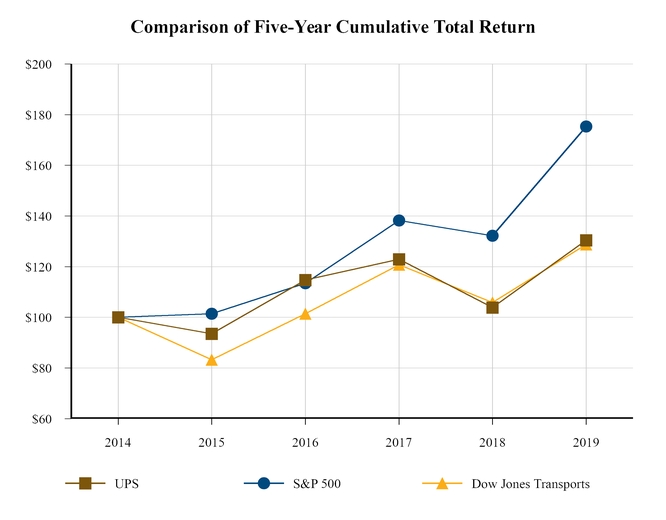
| 12/31/2014 | 12/31/2015 | 12/31/2016 | 12/31/2017 | 12/31/2018 | 12/31/2019 | ||||||||||||||||||
| United Parcel Service, Inc. | $ | 100.00 | $ | 93.50 | $ | 114.74 | $ | 122.93 | $ | 103.90 | $ | 130.39 | |||||||||||
| Standard & Poor’s 500 Index | $ | 100.00 | $ | 101.37 | $ | 113.49 | $ | 138.26 | $ | 132.19 | $ | 175.30 | |||||||||||
| Dow Jones Transportation Average | $ | 100.00 | $ | 83.24 | $ | 101.44 | $ | 120.73 | $ | 105.85 | $ | 128.76 |
For information regarding our equity compensation plans, see Item 12 of this report.
Item 6. Selected Financial Data
The following table sets forth selected financial data for each of the five years in the period ended December 31, 2019 (in millions, except per share amounts). This financial data should be read together with our consolidated financial statements and related notes, Management’s Discussion and Analysis of Financial Condition and Results of Operations, including the Supplemental Information - Items Affecting Comparability section, and other financial data appearing elsewhere in this report.
| Years Ended December 31, | |||||||||||||||||||
| 2019 | 2018 | 2017 | 2016 | 2015 | |||||||||||||||
| Selected Income Statement Data | |||||||||||||||||||
| Revenue: | |||||||||||||||||||
| U.S. Domestic Package | $ | 46,493 | $ | 43,593 | $ | 40,761 | $ | 38,284 | $ | 36,744 | |||||||||
| International Package | 14,220 | 14,442 | 13,342 | 12,346 | 12,142 | ||||||||||||||
| Supply Chain & Freight | 13,381 | 13,826 | 12,482 | 10,980 | 10,300 | ||||||||||||||
| Total Revenue | 74,094 | 71,861 | 66,585 | 61,610 | 59,186 | ||||||||||||||
| Operating Expenses: | |||||||||||||||||||
| Compensation and benefits | 38,908 | 37,235 | 34,577 | 32,534 | 31,448 | ||||||||||||||
| Other | 27,388 | 27,602 | 24,479 | 21,388 | 20,495 | ||||||||||||||
| Total Operating Expenses | 66,296 | 64,837 | 59,056 | 53,922 | 51,943 | ||||||||||||||
| Operating Profit: | |||||||||||||||||||
| U.S. Domestic Package | 4,164 | 3,643 | 4,303 | 4,628 | 4,427 | ||||||||||||||
| International Package | 2,657 | 2,529 | 2,429 | 2,417 | 2,123 | ||||||||||||||
| Supply Chain and Freight | 977 | 852 | 797 | 643 | 693 | ||||||||||||||
| Total Operating Profit | 7,798 | 7,024 | 7,529 | 7,688 | 7,243 | ||||||||||||||
| Other Income and (Expense): | |||||||||||||||||||
| Investment income (expense) and other | (1,493 | ) | (400 | ) | 61 | (2,186 | ) | 435 | |||||||||||
| Interest expense | (653 | ) | (605 | ) | (453 | ) | (381 | ) | (341 | ) | |||||||||
| Income Before Income Taxes | 5,652 | 6,019 | 7,137 | 5,121 | 7,337 | ||||||||||||||
| Income Tax Expense | 1,212 | 1,228 | 2,232 | 1,699 | 2,497 | ||||||||||||||
| Net Income | $ | 4,440 | $ | 4,791 | $ | 4,905 | $ | 3,422 | $ | 4,840 | |||||||||
| Per Share Amounts: | |||||||||||||||||||
| Basic Earnings Per Share | $ | 5.14 | $ | 5.53 | $ | 5.63 | $ | 3.88 | $ | 5.37 | |||||||||
| Diluted Earnings Per Share | $ | 5.11 | $ | 5.51 | $ | 5.61 | $ | 3.86 | $ | 5.34 | |||||||||
| Dividends Declared Per Share | $ | 3.84 | $ | 3.64 | $ | 3.32 | $ | 3.12 | $ | 2.92 | |||||||||
| Weighted Average Shares Outstanding: | |||||||||||||||||||
| Basic | 864 | 866 | 871 | 883 | 901 | ||||||||||||||
| Diluted | 869 | 870 | 875 | 887 | 906 | ||||||||||||||
| As of December 31, | |||||||||||||||||||
| 2019 | 2018 | 2017 | 2016 | 2015 | |||||||||||||||
| Selected Balance Sheet Data: | |||||||||||||||||||
| Cash and marketable securities | $ | 5,741 | $ | 5,035 | $ | 4,069 | $ | 4,567 | $ | 4,726 | |||||||||
| Total assets | 57,857 | 50,016 | 45,574 | 40,545 | 38,497 | ||||||||||||||
| Long-term debt | 21,818 | 19,931 | 20,278 | 12,394 | 11,316 | ||||||||||||||
| Shareowners’ equity | 3,283 | 3,037 | 1,024 | 430 | 2,501 |
This table reflects the impact of the adoption of new accounting standards in 2018 and 2019. Refer to note 1 to the audited, consolidated financial statements.
Item 7. Management’s Discussion and Analysis of Financial Condition and Results of Operations
Overview
Highlights of our annual results follow:
| Year Ended December 31, | $ Change | % Change | ||||||||||||
| 2019 | 2018 | 2019/2018 | 2019/2018 | |||||||||||
| Revenue (in millions) | $ | 74,094 | $ | 71,861 | $ | 2,233 | 3.1 | % | ||||||
| Operating Expenses (in millions) | 66,296 | 64,837 | 1,459 | 2.3 | % | |||||||||
| Operating Profit (in millions) | $ | 7,798 | $ | 7,024 | $ | 774 | 11.0 | % | ||||||
| Operating Margin | 10.5 | % | 9.8 | % | ||||||||||
| Net Income (in millions) | $ | 4,440 | $ | 4,791 | $ | (351 | ) | (7.3 | )% | |||||
| Basic Earnings Per Share | $ | 5.14 | $ | 5.53 | $ | (0.39 | ) | (7.1 | )% | |||||
| Diluted Earnings Per Share | $ | 5.11 | $ | 5.51 | $ | (0.40 | ) | (7.3 | )% | |||||
| Average Daily Package Volume (in thousands) | 21,880 | 20,677 | 5.8 | % | ||||||||||
| Average Revenue Per Piece | $ | 10.87 | $ | 10.98 | $ | (0.11 | ) | (1.0 | )% |
| • | Consolidated revenue increased 3.1%. |
| • | Average daily package volume increased 5.8% primarily driven by our U.S. Domestic Package segment, which experienced growth from SMBs as well as several large customers, led by our largest customer, Amazon. |
| • | Average revenue per piece is dependent upon base rates, customer and product mix, average billable weight per piece, fuel surcharge rates and currency. Average revenue per piece decreased as a result of changes in customer and product mix, and lower average billable weight per piece in our U.S. Domestic Package segment. Currency movements negatively impacted revenue per piece in our International Package segment. |
| • | Operating profit and operating margin increased with growth and margin expansion in all segments. |
| • | We reported net income of $4.440 billion and diluted earnings per share of $5.11. Adjusted diluted earnings per share was $7.53 after adjusting for the after-tax impacts of the following: |
◦transformation strategy costs of $196 million;
◦legal contingencies and expenses of $91 million; and
◦pension mark-to-market losses recognized outside of a 10% corridor of $1.816 billion.
2018 compared to 2017
See Item 7. Management's Discussion and Analysis of Financial Condition and Results of Operations of the Company's Annual Report on Form 10-K for the year ended December 31, 2018 filed with the Securities and Exchange Commission on February 21, 2019.
UNITED PARCEL SERVICE, INC. AND SUBSIDIARIES
MANAGEMENT'S DISCUSSION AND ANALYSIS OF FINANCIAL CONDITION AND
RESULTS OF OPERATIONS
Supplemental Information - Items Affecting Comparability
We supplement the reporting of our financial information determined under generally accepted accounting principles in the United States ("GAAP") with certain non-GAAP financial measures including, as applicable, "adjusted" compensation and benefits, operating expenses, operating profit, operating margin, other income and (expense), income before income taxes, income tax expense, effective tax rate, net income and earnings per share. Adjusted financial measures may exclude the impact of period over period exchange rate changes and hedging activities, amounts related to mark-to-market gains or losses, recognition of contingencies and transformation strategy costs, as described below. We believe that these adjusted financial measures provide meaningful information to assist investors and analysts in understanding our financial results and assessing our prospects for future performance. We believe these adjusted financial measures are important indicators of our recurring results of operations because they exclude items that may not be indicative of, or are unrelated to, our underlying operating results, and provide a useful baseline for analyzing trends in our underlying businesses. Additionally, these adjusted financial measures are used internally by management for the determination of incentive compensation awards, business unit operating performance analysis and business unit resource allocation.
Non-GAAP financial measures should be considered in addition to, and not as an alternative for, our reported results prepared in accordance with GAAP. Our non-GAAP financial information does not represent a comprehensive basis of accounting. Therefore, our non-GAAP financial information may not be comparable to similarly titled measures reported by other companies.
The year over year comparisons of our financial results are affected by the following items (in millions):
| Year Ended December 31, | |||||||
| Non-GAAP Adjustments | 2019 | 2018 | |||||
| Operating Expenses: | |||||||
| Transformation Strategy Costs | $ | 255 | $ | 360 | |||
| Legal Contingencies and Expenses | 97 | — | |||||
| Total Adjustments to Operating Expenses | $ | 352 | $ | 360 | |||
| Other Income and (Expense): | |||||||
| Defined Benefit Plans Mark-to-Market Charges | $ | 2,387 | $ | 1,627 | |||
| Total Adjustments to Other Income and (Expense) | $ | 2,387 | $ | 1,627 | |||
| Total Adjustments to Income Before Income Taxes | $ | 2,739 | $ | 1,987 | |||
| Income Tax Benefit from the Mark-to-Market Charges | $ | (571 | ) | $ | (390 | ) | |
| Income Tax Benefit from Transformation Strategy Costs | (59 | ) | (87 | ) | |||
| Income Tax Benefit from Legal Contingencies and Expenses | (6 | ) | — | ||||
| Total Adjustments to Income Tax Expense | $ | (636 | ) | $ | (477 | ) | |
| Total Adjustments to Net Income | $ | 2,103 | $ | 1,510 |
These items have been excluded from comparisons of "adjusted" Compensation and benefits, Operating Expenses, Operating Profit, Operating Margin, Other Income and (Expense), Income Tax Expense and effective tax rate in the discussion that follows. The income tax benefit from transformation strategy costs, legal contingencies and expenses and the mark-to-market charges are calculated by multiplying the statutory tax rates applicable in each tax jurisdiction, including the U.S. federal jurisdiction and various U.S. state and non-U.S. jurisdictions, by the tax deductible adjustments. The blended average of the effective tax rates in 2019 and 2018 were 23.2% and 24.0%, respectively.
UNITED PARCEL SERVICE, INC. AND SUBSIDIARIES
MANAGEMENT'S DISCUSSION AND ANALYSIS OF FINANCIAL CONDITION AND
RESULTS OF OPERATIONS
Impact of Changes in Foreign Currency Exchange Rates and Hedging Activities
We supplement the reporting of our revenue, revenue per piece and operating profit with non-GAAP measures that exclude the period over period impact of foreign currency exchange rate changes and hedging activities.
Currency-neutral revenue, revenue per piece and operating profit are calculated by dividing current period reported U.S. dollar revenue, revenue per piece and operating profit by the current period average exchange rates to derive current period local currency revenue, revenue per piece and operating profit. The derived amounts are then multiplied by the average foreign exchange rates used to translate the comparable results for each month in the prior year period (including the period over period impact of foreign currency hedging activities). The d
Showing the first 8K of 107K characters. Open the full section
Item 7A. Quantitative and Qualitative Disclosures about Market Risk
We are exposed to market risk from changes in certain commodity prices, foreign currency exchange rates, interest rates and equity prices. All of these market risks arise in the normal course of business, as we do not engage in speculative trading activities. In order to manage the risk arising from these exposures, we utilize a variety of commodity, foreign exchange and interest rate forward contracts, options and swaps. A discussion of our accounting policies for derivative instruments and further disclosures are provided in note 1 to the audited, consolidated financial statements.
Commodity Price Risk
We are exposed to changes in the prices of refined fuels, principally jet-A, diesel and unleaded gasoline, as well as changes in the price of natural gas and other alternative fuels. Currently, the fuel surcharges that we apply to our domestic and international package and LTL services are the primary means of reducing the risk of adverse fuel price changes. In order to mitigate the impact of fuel surcharges imposed on us by outside carriers, we regularly adjust the rates we charge for our freight brokerage, inter-modal and truckload services. The majority of our contracts for fuel purchases utilize index-based pricing formulas plus or minus a fixed locational/supplier differential. While many of the indices are aligned, each index may fluctuate at a different pace, driving variability in the prices paid for fuel. Because of this, our operating results may be affected should the market price of fuel suddenly change by a significant amount or change by amounts that do not result in an adjustment in our fuel surcharges, which can significantly affect our earnings either positively or negatively in the short-term. Additionally, we periodically use a combination of option, forward and futures contracts to provide partial protection from changing fuel and energy prices. As of December 31, 2019 and 2018, however, we had no commodity contracts outstanding.
Foreign Currency Exchange Risk
We have foreign currency risks related to our revenue, operating expenses and financing transactions in currencies other than the local currencies in which we operate. We are exposed to currency risk from the potential changes in functional currency values of our foreign currency-denominated assets, liabilities and cash flows. Our most significant foreign currency exposures relate to the Euro, British Pound Sterling, Canadian Dollar, Chinese Renminbi and Hong Kong Dollar. We use forwards as well as a combination of purchased and written options to hedge forecasted cash flow currency exposures. These derivative instruments generally cover forecasted foreign currency exposures for periods of 12 to 48 months. We also utilize forward contracts to hedge portions of our anticipated cash settlements of intercompany transactions and interest payments on certain debt subject to foreign currency remeasurement.
Interest Rate Risk
We have issued debt instruments, including debt associated with finance leases, that accrue expense at fixed and floating rates of interest. We use a combination of interest rate swaps as part of our program to manage the fixed and floating interest rate mix of our total debt portfolio and related overall cost of borrowing. The notional amount, interest payment and maturity dates of the swaps match the terms of the associated debt. We also utilize forward starting swaps and similar instruments to lock in all or a portion of the borrowing cost of anticipated debt issuances. Our floating-rate debt and interest rate swaps subject us to risk resulting from changes in short-term (primarily LIBOR) interest rates. For a discussion of the risks associated with the anticipated cessation of LIBOR, see Item 1A. Risk Factors - "The proposed phase out of the London Interbank Offer Rate ("LIBOR") could have an adverse effect on us".
We also are subject to interest rate risk with respect to our pension and postretirement benefit obligations, as changes in interest rates will effectively increase or decrease our liabilities associated with these benefit plans, which also results in changes to the amount of pension and postretirement benefit expense recognized in future periods.
We have investments in debt securities, as well as cash-equivalent instruments, some of which accrue income at variable rates of interest. Additionally, we hold a portfolio of finance receivables that accrue income at fixed and floating rates of interest.
UNITED PARCEL SERVICE, INC. AND SUBSIDIARIES
MANAGEMENT'S DISCUSSION AND ANALYSIS OF FINANCIAL CONDITION AND
RESULTS OF OPERATIONS
Sensitivity Analysis
The following analysis provides quantitative information regarding our exposure to foreign currency exchange risk, interest rate risk and equity price risk embedded in our existing financial instruments. We utilize valuation models to evaluate the sensitivity of the fair value of financial instruments with exposure to market risk that assume instantaneous, parallel shifts in exchange rates, interest rate yield curves and commodity and equity prices. For options and instruments with non-linear returns, models appropriate to the instrument are utilized to determine the impact of market shifts.
There are certain limitations inherent in the sensitivity analyses presented, primarily due to the assumption that exchange rates change in a parallel fashion and that interest rates change instantaneously. In addition, the analyses are unable to reflect the complex market reactions that normally would arise from the market shifts modeled. While this is our best estimate of the impact of the specified interest rate scenarios, these estimates should not be viewed as forecasts. We adjust the fixed and floating interest rate mix of our interest rate sensitive assets and liabilities in response to changes in market conditions. Additionally, changes in the fair value of foreign currency derivatives and commodity derivatives are offset by changes in the cash flows of the underlying hedged foreign currency and commodity transactions.
| Shock-Test Result As of December 31, | |||||||
| (in millions) | 2019 | 2018 | |||||
| Change in Fair Value: | |||||||
| Currency Derivatives(1) | $ | (786 | ) | $ | (743 | ) | |
| Change in Annual Interest Expense: | |||||||
| Variable Rate Debt(2) | $ | 64 | $ | 58 | |||
| Interest Rate Derivatives(2) | $ | 37 | $ | 47 | |||
| Change in Annual Interest Income: | |||||||
| Marketable Securities(3) | $ | — | $ | 1 |
| (1) | The potential change in fair value from a hypothetical 10% weakening of the U.S. Dollar against local currency exchange rates across all maturities. |
| (2) | The potential change in annual interest expense resulting from a hypothetical 100 basis point increase in short-term interest rates, applied to our variable rate debt and swap instruments (excluding hedges of anticipated debt issuances). |
| (3) | The potential change in interest income resulting from a hypothetical 100 basis point increase in short-term interest rates, applied to our variable rate investment holdings. |
The sensitivity of our pension and postretirement benefit obligations to changes in interest rates is quantified in “Critical Accounting Policies and Estimates”. The sensitivity in the fair value and interest income of our finance receivables due to changes in interest rates was not material as of December 31, 2019 and 2018.
Item 8. Financial Statements and Supplementary Data
Table of Contents
Report of Independent Registered Public Accounting Firm
To the Shareowners and Board of Directors of
United Parcel Service, Inc.
Atlanta, Georgia
Opinion on the Financial Statements
We have audited the accompanying consolidated balance sheets of United Parcel Service, Inc. and subsidiaries (the "Company") as of December 31, 2019 and 2018, the related consolidated statements of income, comprehensive income, and cash flows, for each of the three years in the period ended December 31, 2019, and the related notes (collectively referred to as the "financial statements"). In our opinion, the financial statements present fairly, in all material respects, the financial position of the Company as of December 31, 2019 and 2018, and the results of its operations and its cash flows for each of the three years in the period ended December 31, 2019, in conformity with accounting principles generally accepted in the United States of America.
We have also audited, in accordance with the standards of the Public Company Accounting Oversight Board (United States) (PCAOB), the Company's internal control over financial reporting as of December 31, 2019, based on criteria established in Internal Control - Integrated Framework (2013) issued by the Committee of Sponsoring Organizations of the Treadway Commission and our report dated February 20, 2020, expressed an unqualified opinion on the Company's internal control over financial reporting.
Change in Accounting Principle
As discussed in Note 1 to the financial statements, the Company has changed its method of accounting for leases due to the adoption of Financial Accounting Standards Board Accounting Standards Update 2016-02, Leases (Topic 842). This change has been applied on a modified retrospective basis effective on January 1, 2019.
Basis for Opinion
These financial statements are the responsibility of the Company's management. Our responsibility is to express an opinion on the Company's financial statements based on our audits. We are a public accounting firm registered with the PCAOB and are required to be independent with respect to the Company in accordance with the U.S. federal securities laws and the applicable rules and regulations of the Securities and Exchange Commission and the PCAOB.
We conducted our audits in accordance with the standards of the PCAOB. Those standards require that we plan and perform the audit to obtain reasonable assurance about whether the financial statements are free of material misstatement, whether due to error or fraud. Our audits included performing procedures to assess the risks of material misstatement of the financial statements, whether due to error or fraud, and performing procedures that respond to those risks. Such procedures included examining, on a test basis, evidence regarding the amounts and disclosures in the financial statements. Our audits also included evaluating the accounting principles used and significant estimates made by management, as well as evaluating the overall presentation of the financial statements. We believe that our audits provide a reasonable basis for our opinion.
Critical Audit Matters
The critical audit matters communicated below are matters arising from the current-period audit of the financial statements that were communicated or required to be communicated to the audit committee and that (1) relate to accounts or disclosures that are material to the financial statements and (2) involved our especially challenging, subjective, or complex judgments. The communication of critical audit matters does not alter in any way our opinion on the financial statements, taken as a whole, and we are not, by communicating the critical audit matters below, providing separate opinions on the critical audit matters or on the accounts or disclosures to which they relate.
Central States Pension Fund coordinating benefit obligation assumptions - Refer to Note 5, Company-Sponsored Employee Benefit Plans (Actuarial Assumptions - Central States Pension Fund), to the financial statements
Critical Audit Matter Description
The Company was a contributing employer to the Central States Pension Fund (“CSPF”) until 2007 when it withdrew and fully funded its allocable share of unvested benefits. The Company agreed to provide coordinating benefits in the UPS/IBT Full Time Employee Pension Plan (“UPS/IBT Plan”) to CSPF participants whose last employer was the Company and who had not retired as of January 1, 2008 (the “UPS Transfer Group”) if the CSPF were to lawfully reduce benefits consistent with the terms of its withdrawal agreement with the Company. The CSPF has asserted that, absent legislative reform, it will become insolvent in 2025. If the CSPF were to become insolvent consistent with that assertion, the Company may be required to provide coordinating benefits through the UPS/IBT Plan to the UPS Transfer Group.
Under accounting standards generally accepted in the
Showing the first 8K of 305K characters. Open the full section
Item 9. Changes in and Disagreements with Accountants on Accounting and Financial Disclosure
None.
Item 9A. Controls and Procedures
Evaluation of Disclosure Controls and Procedures:
As of the end of the period covered by this report, management, including our Chief Executive Officer and Chief Financial Officer, evaluated the effectiveness of the design and operation of our disclosure controls and procedures. Based upon, and as of the date of, the evaluation, our Chief Executive Officer and Chief Financial Officer concluded that the disclosure controls and procedures were effective to ensure that information required to be disclosed in the reports we file and submit under the Exchange Act is recorded, processed, summarized and reported as and when required and is accumulated and communicated to our management, including the Chief Executive Officer and Chief Financial Officer, as appropriate to allow timely decisions regarding required disclosure.
Changes in Internal Control:
There were no changes in the Company’s internal control over financial reporting during the quarter ended December 31, 2019 that have materially affected, or are reasonably likely to materially affect, the Company’s internal control over financial reporting.
Management’s Report on Internal Control Over Financial Reporting:
UPS management is responsible for establishing and maintaining adequate internal control over financial reporting for United Parcel Service, Inc. and its subsidiaries (the “Company”). Based on the criteria for effective internal control over financial reporting established in Internal Control-Integrated Framework (2013) issued by the Committee of Sponsoring Organizations of the Treadway Commission, management has assessed the Company’s internal control over financial reporting as effective as of December 31, 2019. The independent registered public accounting firm of Deloitte & Touche LLP, as auditors of the consolidated balance sheets of United Parcel Service, Inc. and its subsidiaries as of December 31, 2019 and the related statements of consolidated income, consolidated comprehensive income and consolidated cash flows for the year ended December 31, 2019, has issued an attestation report on the Company’s internal control over financial reporting, which is included herein.
Report of Independent Registered Public Accounting Firm
To the Shareowners and Board of Directors of
United Parcel Service, Inc.
Atlanta, Georgia
Opinion on Internal Control over Financial Reporting
We have audited the internal control over financial reporting of United Parcel Service, Inc. and subsidiaries (the "Company") as of December 31, 2019, based on criteria established in Internal Control-Integrated Framework (2013) issued by the Committee of Sponsoring Organizations of the Treadway Commission (“COSO”). In our opinion, the Company maintained, in all material respects, effective internal control over financial reporting as of December 31, 2019, based on criteria established in Internal Control - Integrated Framework (2013) issued by COSO.
We have also audited, in accordance with the standards of the Public Company Accounting Oversight Board (United States) (“PCAOB”), the consolidated financial statements as of and for the year ended December 31, 2019, of the Company and our report dated February 20, 2020, expressed an unqualified opinion on those financial statements and included an explanatory paragraph regarding the Company’s adoption of a new accounting standard.
Basis for Opinion
The Company’s management is responsible for maintaining effective internal control over financial reporting and for its assessment of the effectiveness of internal control over financial reporting, included in the accompanying Management’s Report on Internal Control over Financial Reporting. Our responsibility is to express an opinion on the Company’s internal control over financial reporting based on our audit. We are a public accounting firm registered with the PCAOB and are required to be independent with respect to the Company in accordance with the U.S. federal securities laws and the applicable rules and regulations of the Securities and Exchange Commission and the PCAOB.
We conducted our audit in accordance with the standards of the PCAOB. Those standards require that we plan and perform the audit to obtain reasonable assurance about whether effective internal control over financial reporting was maintained in all material respects. Our audit included obtaining an understanding of internal control over financial reporting, assessing the risk that a material weakness exists, testing and evaluating the design and operating effectiveness of internal control based on the assessed risk, and performing such other procedures as we considered necessary in the circumstances. We believe that our audit provides a reasonable basis for our opinion.
Definition and Limitations of Internal Control over Financial Reporting
A company’s internal control over financial reporting is a process designed to provide reasonable assurance regarding the reliability of financial reporting and the preparation of financial statements for external purposes in accordance with generally accepted accounting principles. A company’s internal control over financial reporting includes those policies and procedures that (1) pertain to the maintenance of records that, in reasonable detail, accurately and fairly reflect the transactions and dispositions of the assets of the company; (2) provide reasonable assurance that transactions are recorded as necessary to permit preparation of financial statements in accordance with generally accepted accounting principles, and that receipts and expenditures of the company are being made only in accordance with authorizations of management and directors of the company; and (3) provide reasonable assurance regarding prevention or timely detection of unauthorized acquisition, use, or disposition of the company’s assets that could have a material effect on the financial statements.
Because of its inherent limitations, internal control over financial reporting may not prevent or detect misstatements. Also, projections of any evaluation of effectiveness to future periods are subject to the risk that controls may become inadequate because of changes in conditions, or that the degree of compliance with the policies or procedures may deteriorate.
/s/ Deloitte & Touche LLP
Atlanta, Georgia
February 20, 2020
Item 9B. Other Information
None.
PART III
Item 10. Directors, Executive Officers and Corporate Governance
Information about our Executive Officers
| Name and Office | Age | Principal Occupation and Employment For the Last Five Years | |||
| David P. Abney Chairman and Chief Executive Officer | 64 | Chief Executive Officer (2014 - present), Chairman (2016 - present) Senior Vice President and Chief Operating Officer (2007 - 2014). | |||
| Norman M. Brothers, Jr. Senior Vice President, General Counsel and Corporate Secretary | 52 | Senior Vice President, General Counsel and Corporate Secretary (2016 - present), Corporate Legal Department Manager (2014 - 2016), Vice President, Corporate Legal (2004 - 2014). | |||
| Nando Cesarone Senior Vice President and President, UPS International | 48 | President, UPS International (2018 - present), Europe Region Manager (2016 - 2018), Asia Pacific Region Manager (2013 - 2016). | |||
| Philippe Gilbert Senior Vice President and President, UPS Supply Chain Solutions | 55 | President, UPS Supply Chain Solutions (2019 - present), Regional CEO, Americas, DB Schenker Logistics (2015 - 2018), Regional CEO, West Europe, DB Schenker Logistics (2013 - 2015). | |||
| Kate M. Gutmann Senior Vice President, Chief Sales and Solutions Officer | 51 | Chief Sales and Solutions Officer; Senior Vice President The UPS Store and UPS Capital (2017 - present), Senior Vice President, Worldwide Sales and Solutions (2014 - 2017), President, Worldwide Sales (2011 - 2014). | |||
| Brian Newman Senior Vice President, Chief Financial Officer and Treasurer | 51 | Chief Financial Officer and Treasurer (2019 - present), Executive Vice President, Finance and Operations, Latin America, PepsiCo, Inc. (2017 - 2019), Executive Vice President, Global Operations, PepsiCo, Inc. (2015 - 2017), Global Head of e-Commerce, PepsiCo, Inc. (2014 - 2015). | |||
| Juan R. Perez Senior Vice President, Chief Information Officer | 53 | Chief Information Officer and Engineering Officer (2017 - present), Chief Information Officer (2016 - 2017), Vice President, Information Services (2011 - 2016). | |||
| Scott A. Price Senior Vice President, Chief Transformation Officer | 57 | Chief Strategy Transformation Officer (2017 - present), Executive Vice President of Global Leverage - Walmart International, Walmart Stores, Inc. (2017), Chief Administrative Officer and Executive Vice President - Walmart International, Walmart Stores Inc. (2016 - 2017), Chief Executive Officer and President of Walmart Asia Pte. Ltd. (2014 - 2016). | |||
| Charlene Thomas Senior Vice President, Chief Human Resources Officer | 52 | Chief Human Resources Officer (2019 - present), President, Human Capital Transformation (2019), West Region Manager (2018 - 2019), North Atlantic District Manager (2018), Mid-South District Manager (2016-2018), West-OPS Package Operations Manager (2016), U.S. Operations Training Staff Manager (2015-2016). | |||
| Kevin Warren Senior Vice President, Chief Marketing Officer | 57 | Chief Marketing Officer (2018 - present), Executive Vice President and Chief Commercial Officer, Xerox Corp. (2017 - 2018), President, Commercial Business Group, Xerox Corp. (2016 - 2017), President, Industrial, Retail and Hospitality Business Group, Xerox Corp. (2015 - 2016), President of Strategic Growth Initiatives, Xerox Corp. (2014 - 2015). | |||
| George Willis Senior Vice President and President, United States Operations | 55 | President, U.S. Operations (2018 - present), President, West Region (2015 - 2018), U.K., Ireland, and Nordics District Manager (2013 - 2015). |
Information about our directors is presented under the caption “Our Board of Directors" in our definitive proxy statement for the Annual Meeting of Shareowners to be held on May 14, 2020 (the “Proxy Statement”) and is incorporated herein by reference.
Information about our Audit Committee is presented under the caption “Our Board of Directors - Committees of the Board of Directors” and "Audit Committee Matters" in our Proxy Statement and is incorporated herein by reference.
Information about our Code of Business Conduct is presented under the caption “Where You Can Find More Information” in Part I, Item 1 of this report.
Item 11. Executive Compensation
Information about our board and executive compensation is presented under the captions “Our Board of Directors - Director Compensation" and "Executive Compensation" in our Proxy Statement and is incorporated herein by reference.
Item 12. Security Ownership of Certain Beneficial Owners and Management and Related Stockholder Matters
Information about security ownership is presented under the caption “Ownership of Our Securities - Securities Ownership of Certain Beneficial Owners and Management” in our Proxy Statement and is incorporated herein by reference.
Information about our equity compensation plans is presented under the caption “Executive Compensation - Equity Compensation Plans” in our Proxy Statement and is incorporated herein by reference.
Item 13. Certain Relationships and Related Transactions, and Director Independence
Information about transactions with related persons is presented under the caption “Corporate Governance - Conflicts of Interest and Related Person Transactions” in our Proxy Statement and is incorporated herein by reference.
Information about director independence is presented under the caption “Corporate Governance - Director Independence” in our Proxy Statement and is incorporated herein by reference.
Item 14. Principal Accountant Fees and Services
Information about aggregate fees billed to us by our principal accountant is presented under the caption “Audit Committee Matters - Principal Accounting Firm Fees” in our Proxy Statement and is incorporated herein by reference.
PART IV
Item 15. Exhibits and Financial Statement Schedules
(a) Documents filed as a part of this report:
- Financial Statements.
See Item 8 for the financial statements filed with this report.
- Financial Statement Schedules.
None.
- Exhibits.
See the Exhibit Index below for a list of the exhibits incorporated by reference into or filed with this report.
(b) Exhibits Required To Be Filed
See Item 15(a)1 above
(c) Financial Statement Schedules Required To Be Filed
See Item 15(a) 2 above
Item 16. Form 10-K Summary
None.
EXHIBIT INDEX
| (1) | Filed in paper format. |
| ***** | Management contract or compensatory plan or arrangement. |
SIGNATURES
Pursuant to the requirements of Section 13 or 15(d) of the Securities Exchange Act of 1934, United Parcel Service, Inc. has duly caused this report to be signed on its behalf by the undersigned, thereunto duly authorized.
| UNITED PARCEL SERVICE, INC. | ||
| (REGISTRANT) | ||
| By: | /S/ DAVID P. ABNEY | |
| David P. Abney | ||
| Chairman and Chief Executive Officer (Principal Executive Officer) |
Date: February 20, 2020
Pursuant to the requirements of the Securities Exchange Act of 1934, this report has been signed below by the following persons on behalf of the Registrant and in the capacities and on the dates indicated.
| Signature | Title | Date | ||
| /S/ DAVID P. ABNEY | Chairman, Chief Executive Officer and Director | February 20, 2020 | ||
| David P. Abney | (Principal Executive Officer) | |||
| /S/ BRIAN NEWMAN | Senior Vice President, Chief Financial Officer and Treasurer | February 20, 2020 | ||
| Brian Newman | (Principal Financial and Accounting Officer) | |||
| /S/ RODNEY C. ADKINS | Director | February 20, 2020 | ||
| Rodney C. Adkins | ||||
| /S/ MICHAEL J. BURNS | Director | February 20, 2020 | ||
| Michael J. Burns | ||||
| /S/ WILLIAM R. JOHNSON | Director | February 20, 2020 | ||
| William R. Johnson | ||||
| /S/ ANN M. LIVERMORE | Director | February 20, 2020 | ||
| Ann M. Livermore | ||||
| /S/ RUDY H.P. MARKHAM | Director | February 20, 2020 | ||
| Rudy H. P. Markham | ||||
| /S/ FRANCK J. MOISON | Director | February 20, 2020 | ||
| Franck J. Moison | ||||
| /S/ CLARK T. RANDT, JR. | Director | February 20, 2020 | ||
| Clark T. Randt, Jr. | ||||
| /S/ CHRISTIANA SMITH SHI | Director | February 20, 2020 | ||
| Christiana Smith Shi | ||||
| /S/ JOHN T. STANKEY | Director | February 20, 2020 | ||
| John T. Stankey | ||||
| /S/ CAROL B. TOMÉ | Director | February 20, 2020 | ||
| Carol B. Tomé | ||||
| /S/ KEVIN M. WARSH | Director | February 20, 2020 | ||
| Kevin M. Warsh |