 filings.tools
Item 1. Business
41K characters. Original on sec.gov · Markdown
Item 1. Business
OVERVIEW
Visa is a global payments technology company that connects consumers, merchants, financial institutions, businesses, strategic partners and government entities in more than 200 countries and territories to fast, secure and reliable electronic payments. We enable global commerce through the transfer of value and information among these participants. Our advanced transaction processing network facilitates authorization, clearing and settlement of payment transactions and enables us to provide our financial institution and merchant clients a wide range of products, platforms and value-added services.
Our vision is to be the best way to pay and be paid for everyone, everywhere. To deliver on this vision, we focus on six strategic goals:
| • | Evolve our client interactions to build deeper partnerships with financial institutions, merchants and new industry partners; |
| • | Transform Visa’s technology assets to drive efficiency and enable innovation; |
| • | Achieve success as a leading partner for digital payments comparable to what we have achieved in the physical world; |
| • | Expand access to Visa products and services globally; |
| • | Champion payment system security for the industry; and |
| • | Be the employer of choice for top talent. |
Visa is one of the world’s largest retail electronic payments network based on payments volume, number of transactions and number of cards in circulation.
Visa Network
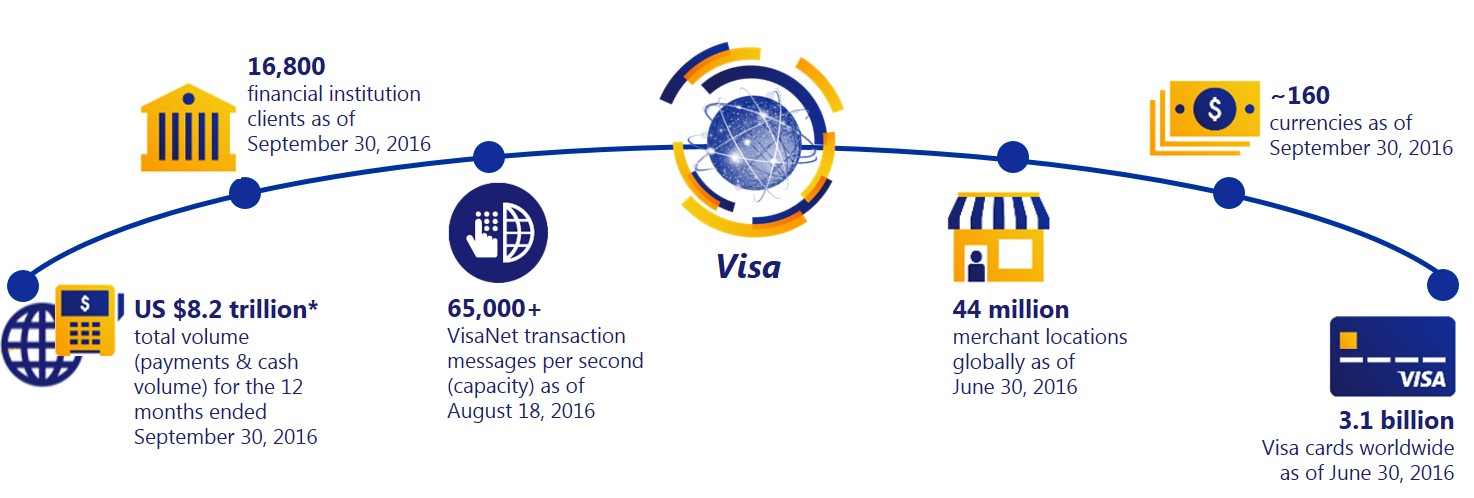
- Total volume includes Europe for the fourth quarter.
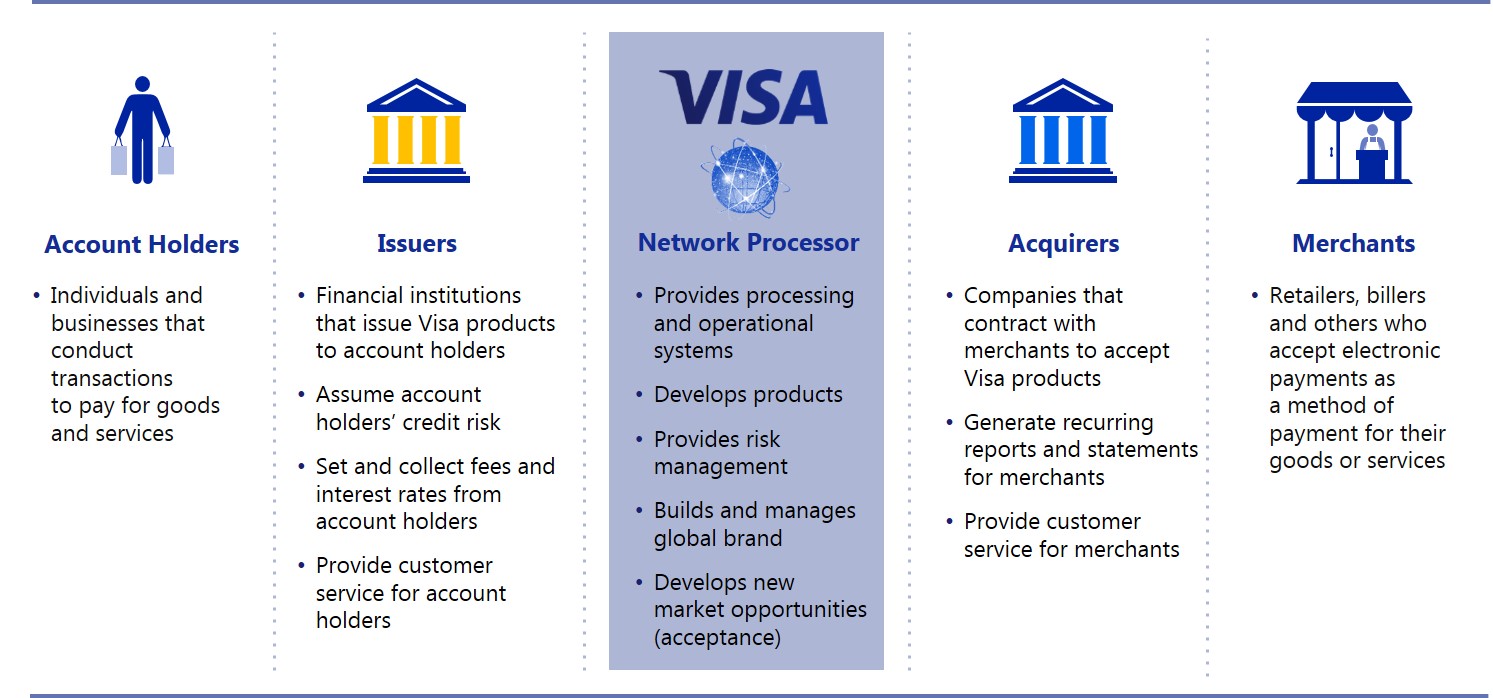
Visa operates in a four party model, which includes card issuing financial institutions, acquirers and merchants. We are not a bank and do not issue cards, extend credit or set rates and fees for account holders on Visa products. In most cases, our financial institution clients are responsible for and manage account holder and merchant relationships.
We do not earn revenues from, or bear credit risk with respect to, interest or fees paid by account holders on Visa products. Interchange reimbursement fees represent a transfer of value between the financial institutions participating in our open-loop payments network. We administer the collection and remittance of interchange reimbursement fees through the settlement process, but we generally do not receive any revenue related to interchange reimbursement fees. In addition, we do not receive as revenue any of the fees that merchants are charged directly for acceptance by the acquirers.
Visa Brand
The Visa brand is one of the most well-known and valuable brands in the world. Anchored on the notion that Visa is 'everywhere you want to be,' the brand stands for acceptance, security, convenience and universality. In recognition of its strength among clients and consumers, the Visa brand is ranked highly in a number of widely recognized brand studies, including the 2016 BrandZ Top 100 Most Valuable Global Brands Study (#6), Interbrand’s 2016 Best Global Brands (#61) and Forbes 2016 World’s Most Valuable Brands (#30). We leverage our brand strength to deliver added value to financial institutions, merchants and other clients through compelling brand expressions, expanded products and services, and innovative marketing efforts.
Payment Security
Security is critical to maintaining trust and confidence in electronic payments. To ensure that Visa remains one of the safest ways to pay and be paid, we deploy a multi-layered security approach focused on eliminating vulnerable data from the payments environment, securing the data that remains, preventing fraud and empowering system participants to protect themselves. This approach has historically kept fraud rates low as payment volumes have grown. With commerce moving to digital channels, we are investing in new technologies and solutions in order to maintain the trust that consumers, clients and merchants place in Visa. This requires innovation, leadership and cross-industry collaboration.
Fiscal 2016 Key Statistics
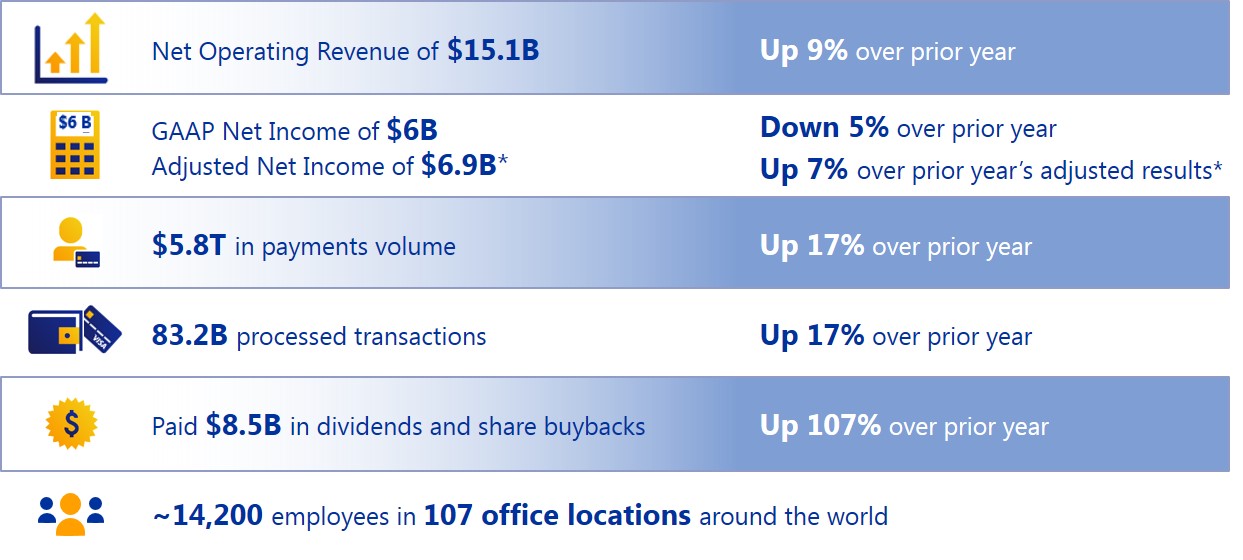
*Please see Item 7—Management's Discussion and Analysis of Financial Condition and Results of Operations for a reconciliation of our adjusted financial results.
KEY INITIATIVES
Visa Europe Acquisition. Prior to our 2007 reorganization, Visa operated as a collection of member-owned associations, with each region serving its member financial institutions and administering Visa programs within a global framework. In 2007, Visa reorganized, with all of the regions except Visa Europe coming together to form Visa Inc., a Delaware corporation. Visa Europe remained owned by its European member financial institutions.
On June 21, 2016, we acquired Visa Europe. We believe the acquisition positions our Company to create additional value through increased scale, efficiencies realized by integration of the businesses, and benefits related to Visa Europe's transition from a member-owned association to a for-profit enterprise. We plan to bring Visa's global capabilities to our European clients, deliver a more seamless experience operating as one single global company and grow our business in that region. As part of the acquisition, we acquired 100% of the share capital of Visa Europe for €12.2 billion ($13.9 billion) and €5.3 billion ($6.1 billion) in preferred stock, with an additional €1.0 billion, plus 4% compound annual interest, to be paid on June 21, 2019.
Capital Structure. In December 2015, we issued $16 billion of senior notes with maturities ranging between two and 30 years, and in June 2016, we issued two new series of preferred stock to Visa Europe's member financial institutions that are convertible into approximately 79 million shares of class A common stock as part of the Visa Europe transaction. We also have plans to raise an additional $2 billion in debt by the end of calendar year 2016, subject to market conditions.
Technology Transformation. At its heart, Visa is a technology company. With the intensifying digital economy and the ubiquity of mobile technology, data and enhanced security driving the future of payments, we embarked on a multi-year journey in 2015 to transform technology at Visa with the main areas of focus on opening our network and creating a digital platform for innovation while at the same time adding layers of security and operational resilience. We have executed on our workforce plan by hiring a total of 1,700 technology employees globally over the past two years, including nearly 750 new college graduates, replacing a significant percentage of our contractor and vendor spend. We are making steady progress on our technology strategic roadmap, resulting in enhanced services for our ecosystem stakeholders and positive impacts to our infrastructure. Since the launch of Visa’s Developer Platform (VDP) in 2015, more than 180 of Visa’s product or service functions are available in API or application program interface format to our clients and partners. We added new services to enable clients to develop support for tokenized transactions and create new and innovative solutions in mobile, ecommerce and digital face-to-face transactions. Cybersecurity remains a top focus and in fiscal 2016 we launched our new Threat Intelligence Fusion Platform, a cyber command and control center that provides integrated cybersecurity operations to further help protect our data and assets. At the same time, new open technologies have been added
systematically to our infrastructure and platform components and we continue to bolster the resiliency of our infrastructure and application services to provide high availability of our services for our clients.
How We Work with Partners - Innovation Centers, VDP & API Suite. To drive new technologies in the payments space and accelerate the proliferation of safe and fast digital payments, we opened new innovation centers in Dubai, Miami and Singapore in fiscal 2016. Along with the San Francisco innovation center and European innovation hubs in London, Tel Aviv and Berlin, these centers foster collaboration with our financial institution clients, partners and developers across the regions to spur creation of the next generation of payments and commerce applications and solutions. In 2016, VDP became generally available, offered application developers around the globe access to Visa technology, services and tools, and provided safe testing environments for the development of new digital payments and commerce solutions. By exposing new and modified APIs through a variety of channels, Visa has made digital payment solutions available to support hundreds of financial institutions and technology partners such as Google, Microsoft and Samsung.
PRODUCTS & SERVICES
Core Products
Debit: Debit cards are issued by banks to allow consumers to access funds held in their demand deposit accounts (DDAs). Debit cards allow consumers to transact without needing cash or checks and without accessing a line of credit. Visa provides the network infrastructure, product support and industry knowledge to help issuers optimize their debit offerings and help consumers and merchants efficiently transact for the purchase of goods and services, whether in person or through online or mobile channels. Across all Visa’s core products, Visa offers security protections that help prevent, detect and resolve fraud. Where applicable, Visa's zero-liability policy protects consumer cardholders from any unauthorized charges.
Credit: Credit cards are issued by banks to allow consumers to access credit to pay for goods and services. Visa does not extend credit; however, we provide combinations of card benefits and brand support, that financial institutions use to support and enable their credit products. We also partner with our clients on product design, customer segmentation and customer experience design to help financial institutions better deliver products and services that match their consumers’ needs. In fiscal 2016, we saw significant volume growth from the conversion of the USAA portfolio to Visa and opening of credit acceptance at Costco membership warehouses in the U.S.
Prepaid: Prepaid products draw funds from a designated pool of funds. Prepaid cards can be funded by individuals, corporations or governments. Prepaid cards address many consumer use cases and needs:
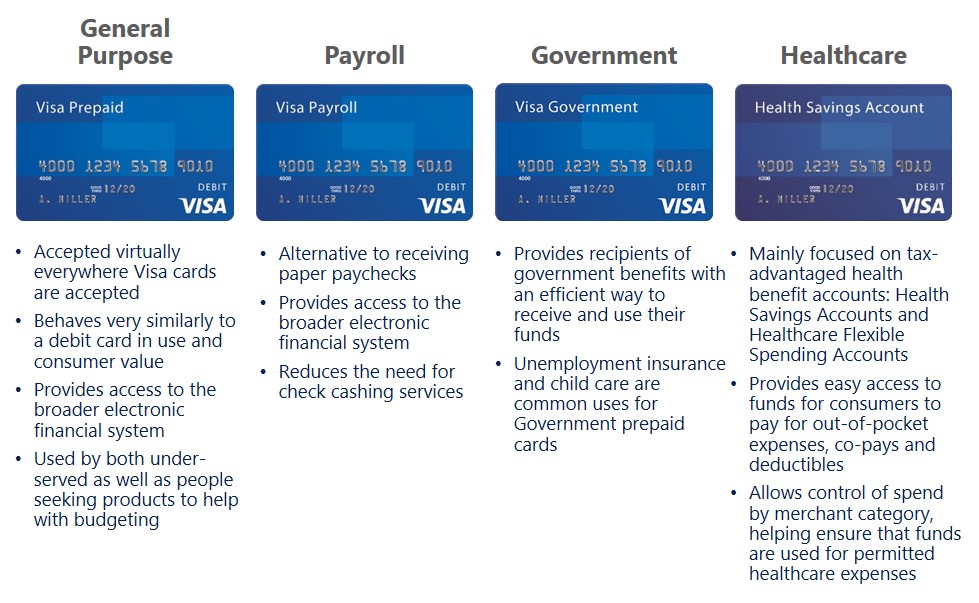
Commercial: We offer a portfolio of corporate (travel) cards and purchasing card (P-card) products covering all major segments. The Commercial category is not one single product but a portfolio of products designed to bring efficiency, controls and automation to corporate and government travel and procurement processes ranging from employee travel to fully integrated, invoice-based payables. We support financial institutions, accounts payable platforms, like Bottomline and MineralTree, and technology companies as they build and expand their business-to-business platforms.
Processing Infrastructure
VisaNet authorizes, clears and settles transactions processed by Visa, excluding European domestic transactions, which are routed through the European processing platform. VisaNet consists of multiple synchronized processing centers that are linked by a global telecommunications network and engineered for minimal downtime and uninterrupted connectivity. While Visa Europe's systems are being integrated with our systems, we will continue to maintain mostly separate authorization, clearing and settlement systems from Visa Europe while ensuring interoperability with their processing centers in the United Kingdom (U.K.).
VisaNet is capable of handling more than 65,000 transactions per second reliably, conveniently and securely. In fiscal 2016, Visa processed over 83 billion payment and cash disbursement authorization transactions, which included Europe during the fourth quarter. VisaNet is built on a centralized architecture, enabling us to analyze each authorization we process in real time and provide value-added processing services, such as risk scoring and tokenization. It provides the infrastructure for delivering innovation and other payment system enhancements for domestic payment systems and cross border international transactions globally.
A typical Visa transaction begins when the account holder presents his or her Visa product to a merchant as payment for goods or services. The transaction is then sent to the acquirer and routed over VisaNet or Visa Europe's processing platform to an issuer for an authorization decision. The transaction is either approved or declined and routed back to the acquirer and merchant usually in a matter of seconds.
Transaction Processing Services
Our core transaction processing services involve the routing of payment information and related data to facilitate the authorization, clearing and settlement of transactions between our issuers and acquirers. Our processing services also address the varied needs of other participants in the evolving payments ecosystem, through such offerings as our merchant gateway and Visa DPS issuer processing. Merchant gateway services, provided through CyberSource, enable merchants to accept, process and reconcile payments, manage fraud and safeguard payment security online and in-store. CyberSource additionally enables acquirers and other partners to offer these services to their merchants. DPS provides comprehensive issuer processing services for participating issuers of Visa debit, prepaid and ATM products. Value-added offerings by DPS to issuer clients include: fraud and risk services, data analytics, marketing campaign management, mobile and digital solutions, back office tools and services, card fulfillment and management, network gateway services, call centers and web hosting solutions. These and other services support our issuers and acquirers and their use of our products, and promote the growth and security of our payments network by expanding the payment value chain and increasing network utilization.
Digital Products
Visa Checkout: Visa Checkout offers consumers an expedited and secure payment experience for online transactions wherever Visa Checkout is enabled. Visa Checkout helps merchants convert higher numbers of consumers to sale, a particularly important issue as digital commerce shifts from desktop devices to mobile devices which have lower conversion rates. At the end of fiscal 2016, Visa Checkout had over 15 million consumer accounts in 21 countries, seven languages and over 1,400 financial institution partners across the globe participating. More than 300,000 merchants, including some of the largest global retailers accept Visa Checkout. In October 2016, we rolled out a redesigned Visa Checkout experience, making it easier for consumers to enroll and complete purchases on mobile devices. We recently announced that we are opening the Visa Checkout platform to clients and partners, allowing them to integrate their digital wallets into Visa Checkout for streamlined authentication and checkout.
Visa Direct: Visa Direct is a push payment product platform that facilitates payer-initiated transactions that are sent directly to the Visa account of the recipient. It supports faster payments use cases like person-to-person (P2P) payments, and disbursements. We are working with key partners, including processors like Fiserv, FIS and Jack Henry & Associates, and originators like Early Warning (EWS), Ingo Money, Hyperwallet, Wells Fargo and QIWI, along with merchants to expand the distribution and usage of push payments.
We are also enabling push payments in developing economies to electronify payments. We recently launched a new service called mVisa in Kenya. First launched in Rwanda in 2014 and India in 2015, mVisa allows consumers to transfer money to merchants in real time using their mobile phones and merchants are able to accept Visa transactions without the need to install card acceptance hardware.
Visa Token Service: The Visa Token Service replaces the card account numbers from the transaction with a token. Tokenization helps to protect consumer financial information and lessen the risk of stolen card credentials. In fiscal 2017, we announced new specifications that allow certified third party service providers such as Gemalto, Giesecke & Devrient and Inside Secure to connect directly to our Token Service and become Token Service Providers (TSP). These TSPs will be able to provide a range of services to support Visa tokens for issuers and token requestors participating in the Visa Token Service, including new account provisioning and life cycle management. By expanding access to the Visa Token Service to new partners, we expect Visa issuers will be able to more quickly and easily offer secure digital payment services across a wide range of solutions.
Merchant Products
Visa has a suite of products and services to help merchants reduce their payment fraud and improve their customer engagement. Visa Advertising Solutions, Visa Commerce Network and CyberSource’s product offerings are examples of Visa’s continued investment to deliver industry-leading products and capabilities to our merchant partners.
Visa launched Visa Advertising Solutions, a service that allows merchants to better target and track the efficacy of their digital campaigns. Visa has partnered with strategic advertising technology leaders to help deliver targeting and measurement capabilities using aggregated and anonymous spend insights. The Visa Commerce Network (VCN) uses Visa’s global payment network to enable merchants to promote relevant offers to acquire new customers, drive loyalty and increase sales. For example, Uber uses the platform to provide its customers with card-linked offers from local restaurants and retailers. Qualifying purchases are recognized at the point of sale and rewards are applied to the riders' Uber accounts - eliminating the need for coupons.
CyberSource offers a suite of products and services for merchants to manage online, mobile and in-store payments. CyberSource gateway services enable global payment acceptance of cards and other digital payment types. CyberSource Decision Manager is a comprehensive solution for fraud management including a merchant risk model, rules engine, managed services and solutions for specific categories such as airline fraud. Decision Manager Replay is an analytical tool that allows merchants to compare fraud strategies in real-time using their historical data to test and quantify the expected impact of various risk management strategies. CyberSource additionally offers payment security services including tokenization and payer authentication, commerce services such as tax calculation and recurring billing, and merchant reporting and analytics. CyberSource also offers products and services tailored to the needs of small and mid-sized merchants under the Authorize.Net brand. CyberSource and Authorize.Net capabilities are offered through Visa and our partners.
Risk Products & Payment Security Initiatives
Visa continues to develop our suite of risk products and services to help clients minimize risk and enable secure commerce. Visa Risk Manager is a decision making solution that helps issuers improve loss prevention and profitability through effective, enhanced risk evaluation capabilities. Products like Visa Advanced Authorization evaluate the risk associated with every participating VisaNet transaction. Our case studies have shown that an issuer employing Visa Advanced Authorization can significantly improve fraud detection. In addition to reducing fraud, approval rates can be increased by accepting transactions that were once deemed too risky. For example, in fiscal 2016 we introduced Mobile Location Confirmation, a service that enhances Visa Advanced Authorization by adding geolocation intelligence in real time. Mobile Location Confirmation informs issuers if their participating account holder’s mobile phone is near a purchase location. This new data improves the issuer’s ability to make more informed approve or decline decisions.
We have also extended our fraud prediction capabilities to merchants via Visa Transaction Advisor. Our first implementation of this product is at fuel pumps, whereby we provide a risk indicator to the merchant for each Visa card transaction so the merchant can decide if they would like to require incremental authentication for risky transactions. Fuel merchants using our Visa Transaction Advisor product have seen a significant decline in counterfeit fraud rates and in lost and stolen fraud chargebacks.
Verified by Visa is a solution designed to make online transactions safer by authenticating an account holder’s identity at the time of purchase. It is designed to improve account holder and merchant confidence in online
purchases and to reduce disputes and fraud related to the use of Visa payment products. Visa Consumer Authentication Service is a hosted solution for issuers on Verified by Visa transactions delivering protection against online fraud through risk-based authentication. Issuers have full control of when and how they decide to authenticate based on their transaction risk threshold, existing fraud-detection tools, operational requirements and user demands.
We also launched Visa Consumer Transaction Controls in fiscal 2016, which allow account holders to place restrictions on their enrolled cards that define when, where and how those cards can be used to better manage account spending and security. Issuers can utilize this solution across their entire card portfolio.
EMV Migration in the United States: To enhance payment security and mitigate counterfeit fraud, we have been working with U.S. merchants and financial institutions to encourage the adoption of EMV chip payment technology. EMV, which stands for Europay, MasterCard and Visa, is a global standard for chip cards and chip terminals. Chip technology generates a one-time use code for every transaction that is used to authenticate that the transaction is originating from a valid (i.e., not fraudulent) card. Under policies announced by Visa in 2011, effective October 2015, the party that has not adopted the more secure chip technology is responsible for any resulting counterfeit fraud. Over the last year, there has been steady growth in chip card issuance and in the activation of chip-enabled terminals. As of September 30, 2016, more than 373 million Visa chip cards have been issued, making the United States the largest chip card market in the world. Nearly 1.6 million merchant locations in the United States are now chip-enabled, or roughly 30% of all U.S. merchants that accept Visa cards at the physical point of sale. Over 30% of U.S. in-store payment volume is now being processed as chip transactions. We continue to work to help improve the merchant and account holder experience, with the roll out of Quick Chip, a solution designed to reduce the time it takes to complete a chip transaction. We are also working with merchants and acquirers to simplify the terminal certification process, and have taken steps to limit merchants’ exposure to counterfeit fraud liability for those that have had challenges getting terminals certified and activated.
SIGNIFICANT BUSINESS DEVELOPMENTS
CEO Succession. On October 17, 2016, we announced that Alfred Kelly, Jr. will become CEO, effective December 1, 2016, replacing Charles Scharf. Mr. Scharf will serve as an advisor to Mr. Kelly for a period of several months to assist with the transition.
Interchange Multidistrict Litigation. Visa, MasterCard and various U.S. financial institutions are defendants in class and individual actions challenging, among other things, Visa’s and MasterCard’s purported setting of interchange reimbursement fees and certain network rules. In 2012, Visa, MasterCard, various U.S. financial institution defendants, and class plaintiffs signed a settlement agreement to resolve the class plaintiffs’ claims. On January 14, 2014, the U.S. District Court for the Eastern District of New York entered a final judgment order approving the settlement, from which a number of objectors appealed. On June 30, 2016, the U.S. Court of Appeals for the Second Circuit vacated the lower court's certification of the merchant class and reversed the approval of the settlement. The Second Circuit determined that the class plaintiffs were inadequately represented and remanded the case to the lower court for further proceedings not inconsistent with its decision. Prior to November 23, 2016, class plaintiffs may file a petition for writ of certiorari with the U.S. Supreme Court seeking review of the Second Circuit’s decision. Until the appeals process is complete, it is uncertain whether the Company will be able to resolve the class plaintiffs' claims as contemplated by the settlement agreement. See Item 1A—Risk Factors—We may be adversely affected by the outcome of litigation or investigations, despite certain protections that are in place and Item 8—Financial Statements and Supplementary Data—Note 20—Legal Matters of this report for more information.
INTELLECTUAL PROPERTY
We own and manage the Visa brand, which stands for acceptance, security, convenience and universality. Our portfolio of trademarks, in particular our family of Visa marks, our PLUS mark and our Dove design mark, are important to our business. We give our clients access to these assets through agreements with our issuers and acquirers, which authorize the use of our trademarks in connection with their participation in our payments network. We also own a number of patents, patent applications and other intellectual property relating to payment solutions, transaction processing, security systems and other matters. We rely on a combination of patent, trademark, copyright and trade secret laws in the U.S. and other jurisdictions, as well as confidentiality procedures and contractual provisions, to protect our proprietary technology.
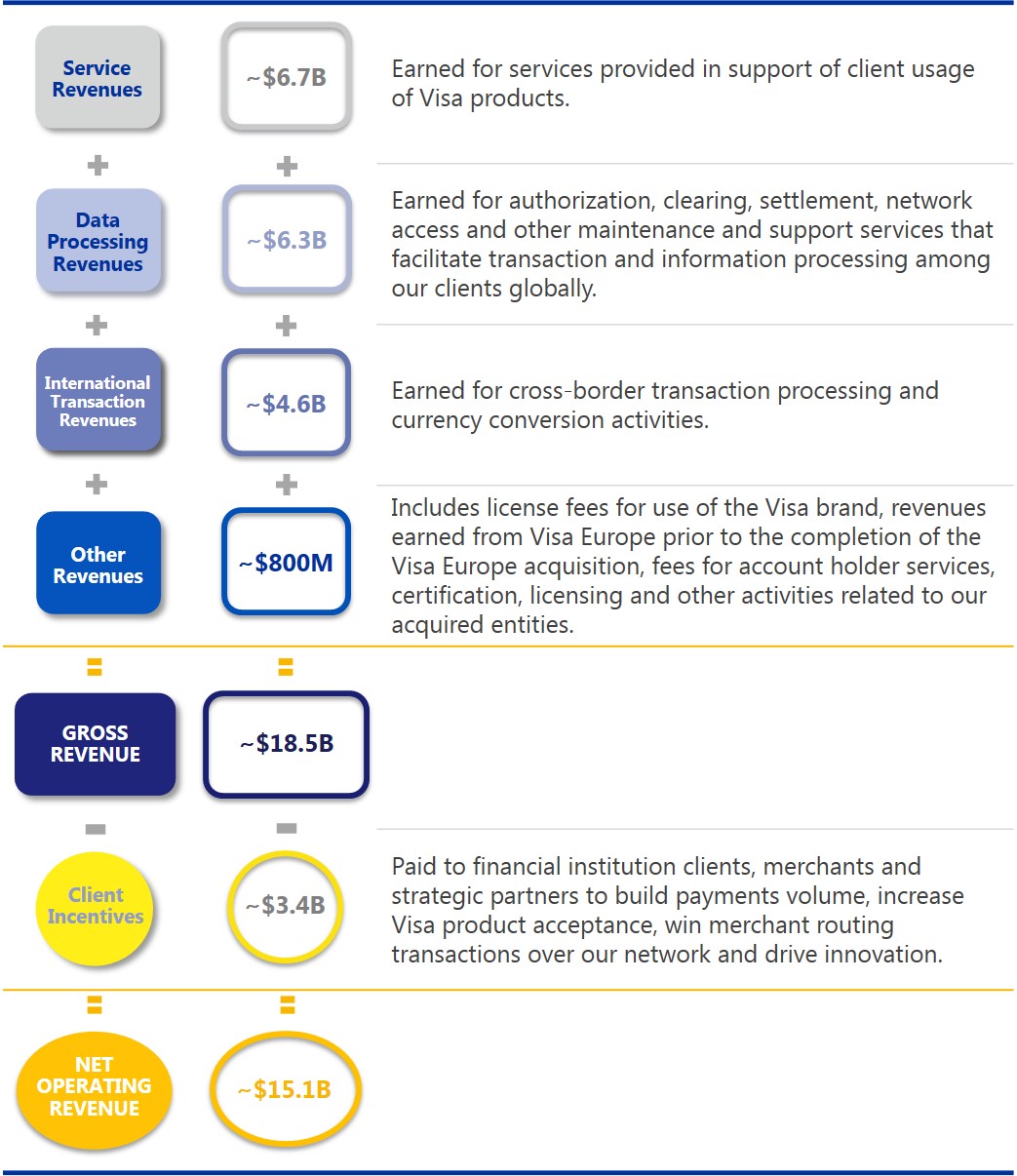
NET OPERATING REVENUES
Our gross revenues are principally comprised of service revenues, data processing revenues, international transaction revenues and other revenues. Net operating revenues are gross revenues reduced by costs incurred under client incentive arrangements. We have one reportable segment, Payment Services.
Revenue Details
COMPETITION
The global payments industry continues to undergo dynamic change. Existing and emerging competitors compete with Visa for consumers, financial institution clients and merchant participation in our network and payment solutions. Technology and innovation is shifting consumer habits and driving growth opportunities in ecommerce, mobile payments, block chain technology and digital currencies. These advances are enabling new entrants, many of which depart from traditional network payment models. In certain countries, the evolving regulatory landscape is changing how we compete, creating local networks or enabling processing competition.
We compete against all forms of payment. This includes paper-based payments, primarily cash and checks, and all forms of electronic payments. Our electronic payment competitors principally include:
Global or Multi-Regional Networks, which typically offer a range of branded, general purpose card payment products that can be used at millions of merchant locations around the world. Examples include MasterCard, American Express, Discover and JCB. These competitors may be more concentrated in specific geographic regions, such as JCB in Japan and Discover in the U.S., or have a leading position in certain countries. For example, UnionPay operates the sole domestic acceptance mark in China. Based on available data, Visa is one of the largest retail electronic funds transfer networks used throughout the world. The following chart compares our network with these network competitors for calendar year 2015(1):
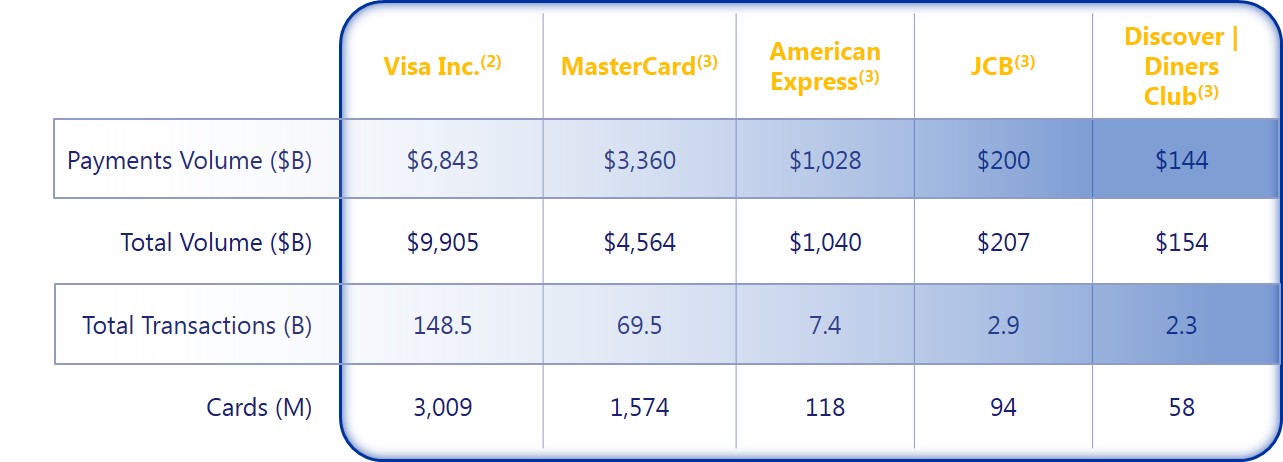
| (1) | UnionPay, which operates primarily within the Chinese domestic market, is not included in this table as Visa currently does not compete in that market under local law. Although we are uncertain how UnionPay reports certain volumes, reportedly its numbers could approach or exceed some of those listed in this chart. |
| (2) | The data presented are provided by our financial institution clients. Previously submitted information may be updated and all data are subject to review by Visa. Visa Europe data are included. |
| (3) | MasterCard, American Express, JCB and Discover/Diners Club data sourced from The Nilson Report issue 1085 (April 2016). Includes all consumer and commercial credit, debit and prepaid cards. Some figures are estimates and currency figures are in U.S. dollars. MasterCard excludes Maestro and Cirrus figures. American Express includes figures for third-party issuers. Discover figures consist of U.S. data only and include third-party issuers. JCB figures include third-party issuers and other payment-related products. |
Local and regional networks, that operate in many countries, often with the support of government influence or mandate. In some cases, they are owned by financial intuitions. These networks typically focus on debit payment products, have functionality or their brand marks present with the Visa brand on the card or payment device, and may have strong local acceptance and recognizable brands. Examples include STAR, NYCE, and Pulse in the United States, Interac in Canada, and EFTPOS in Australia.
Alternate Payment Providers, which often have a primary focus of enabling payments through ecommerce and mobile channels. These companies may process payments using in-house account transfers between parties, electronic funds transfer networks like the Automated Clearing House (ACH), or global or local networks like Visa. In some cases, these entities are both a partner and a competitor to Visa. Examples include PayPal and Alipay.
Other Electronic Payment Networks like the ACH in the U.S. are often created and governed by local governments. Historically focused on interbank transfers, many are adding capabilities that may make them more competitive for retail payments. We also compete with closed-loop payment systems, wire transfers and electronic benefit transfers.
Payment Processors, where we face competition for the processing of Visa transactions or are not permitted to do so under local regulation. For example, as a result of regulation in Europe under the Second Payment Services Directive (PSD2), we may face competition from other networks, processors and other third-parties who could process Visa transactions directly with issuers and acquirers.
We also face increasingly intense competitive pressure on the prices we charge our financial institution clients. We believe our fundamental value proposition of acceptance, security, convenience and universality offers us a key competitive advantage. We succeed in part because we understand the needs of the individual markets in which we operate. We do so by partnering with local financial institutions, merchants, governments, non-governmental
organizations and business organizations to provide tailored solutions to meet their varied needs. We believe Visa is well-positioned competitively, due to our global brand, our broad set of Visa-branded payment products and our proven track record of processing payment transactions securely and reliably through VisaNet.
SEASONALITY
We generally do not experience any pronounced seasonality in our business. No individual quarter of fiscal 2016 or fiscal 2015 accounted for more than 30% of our operating revenues in those years.
WORKING CAPITAL
Payments settlement due to and from our financial institution clients can represent a substantial daily working capital requirement. Most U.S. dollar settlements are settled within the same day and do not result in a receivable or payable balance, while settlement in currencies other than the U.S. dollar generally remain outstanding for one to two business days, which is consistent with industry practice for such transactions.
FINANCIAL INFORMATION ABOUT GEOGRAPHIC AREAS
For more information on the concentration of our operating revenues and other financial information, see Item 8—Financial Statements and Supplementary Data—Note 13—Enterprise-wide Disclosures and Concentration of Business included elsewhere in this report.
GOVERNMENT REGULATION
As a global payments technology company, we are subject to complex and evolving global regulations in the various jurisdictions in which our products and services are used. The most significant government regulations that impact our business are discussed below. For further discussion of how global regulations may impact our business, see Item 1A—Risk Factors—Regulatory Risks.
Supervisory Oversight of the Payments Industry. Visa is subject to financial sector oversight and regulation in substantially all of the jurisdictions in which we operate. In the U.S., the Federal Financial Institutions Examination Council (FFIEC) has supervisory oversight over Visa under applicable federal banking laws and policies. The federal banking agencies comprising the FFIEC are the Federal Reserve Board, the Comptroller of the Currency, the Federal Deposit Insurance Corporation and the National Credit Union Administration. Visa also may be examined by the Consumer Financial Protection Bureau (CFPB) as a service provider to the banks that issue Visa-branded consumer credit and debit card products. Central banks in other countries, including Russia, Ukraine, Hong Kong and Europe (as discussed below), have recognized or designated Visa for purposes of various degrees of financial stability regulation as a retail payment system. Visa is also subject to oversight by banking and financial sector authorities in other jurisdictions, such as Brazil, Mexico and Colombia.
Government-imposed Market Participation and Restrictions. Certain governments, including China, Russia and India, have taken actions to advantage domestic payments systems and/or certain issuers, payments networks or processors, including by imposing regulations that favor domestic providers or that mandate domestic processing be done entirely in that country.
Interchange Rates and Fees. An increasing number of jurisdictions around the world regulate or influence debit and credit interchange reimbursement rates in their regions. For example, the Dodd-Frank Act in the U.S. limits interchange reimbursement rates for certain debit card transactions, the E.U.’s Interchange Fee Regulation (IFR) limits interchange rates in Europe (as discussed below) and the Reserve Bank of Australia has regulated average permissible levels of interchange for over a decade.
Network Exclusivity and Routing. In the U.S., the Dodd-Frank Act limits network exclusivity and preferred routing for the debit and prepaid market segments. Other jurisdictions impose similar limitations, such as the IFR’s prohibition on restrictions that prevent multiple payment brands or functionality on the same card.
No-surcharge Rules. We have historically enforced rules that prohibit merchants from charging higher prices to consumers who pay using Visa products instead of other means. However, merchants’ ability to surcharge varies by geographic market as well as Visa product type, and continues to be impacted by litigation, regulation and legislation.
Privacy and Data Protection. Aspects of our operations or business are subject to privacy, data use and data security regulations, which impact the way we use and handle data, operate our products and services, and even
impact our ability to offer a product or service. In addition, regulators are proposing new laws or regulations which could require Visa to adopt certain cybersecurity practices. In many jurisdictions consumers must be notified in the event of a data breach, and such notification requirements continue to increase in scope and cost. The European Union’s General Data Protection Regulation, which will become effective in May 2018, will create new individual privacy rights and impose worldwide obligations on companies handling personal data.
Anti-corruption, Anti-money Laundering, Anti-terrorism and Sanctions. We are subject to anti-corruption laws and regulations, including the U.S. Foreign Corrupt Practices Act (FCPA), the U.K. Bribery Act and other laws, that generally prohibit the making or offering of improper payments to foreign government officials and political figures for the purpose of obtaining or retaining business or to gain an unfair business advantage. We are also subject to anti-money laundering and anti-terrorist financing laws and regulations, including the U.S. Bank Secrecy Act and the USA PATRIOT Act. In addition, we are subject to economic and trade sanctions programs administered by the Office of Foreign Assets Control (OFAC) in the U.S.
Internet Transactions. Many jurisdictions have adopted regulations that require payments system participants to monitor, identify, filter, restrict or take other actions with regard to certain types of payment transactions on the Internet, such as gambling and the purchase of cigarettes or alcohol.
Additional Regulatory Developments. Various regulatory agencies also continue to examine a wide variety of other issues, including mobile payment transactions, tokenization, money transfer, identity theft, account management guidelines, disclosure rules, security and marketing that could affect our financial institution clients and us.
European Regulations and Supervisory Oversight. In addition, following the Visa Europe acquisition in June 2016, we are subject to complex and evolving regulation of our business in the European Union. Visa Europe has been designated as a Recognized Payment System, bringing it within the scope of the Bank of England’s oversight to ensure the financial stability of the U.K. Visa Europe is also subject to the Eurosystem’s oversight, including the security of payment instruments and ecommerce security policies and scheme rules. Furthermore, Visa Europe is regulated by the U.K.’s Payment Systems Regulator (PSR), which has wide ranging powers and authority to review our business practices, systems, rules and fees with respect to promoting competition and innovation in the U.K., and ensuring payments meet account holder needs. It also is the regulator responsible for monitoring and enforcing the IFR in the U.K. Outside the U.K., in relation to IFR, Visa is also subject to compliance monitoring by national competent authorities in all markets. The IFR regulates interchange rates within Europe, requires Visa Europe to separate its payment card scheme activities from processing activities for accounting, organization and decision making purposes within the E.U. and imposes limitations on network exclusivity and routing.
There are other regulations in the E.U. that impact our business, as discussed above, including, privacy and data protection, anti-bribery, anti-money laundering, anti-terrorism and sanctions. Other recent regulatory changes in Europe such as the PSD2 could reduce perceived barriers to entry for emerging, non-card payments.
AVAILABLE INFORMATION
We are subject to the reporting requirements of the Securities Exchange Act of 1934, as amended (Exchange Act) and its rules and regulations. The Exchange Act requires us to file periodic reports, proxy statements and other information with the U.S. Securities and Exchange Commission (SEC). Copies of these reports, proxy statements and other information can be viewed at http://www.sec.gov. Our corporate website is accessible at http://corporate.visa.com. We make available, free of charge, on our investor relations website at http://investor.visa.com our annual reports on Form 10-K, our quarterly reports on Form 10-Q, our current reports on Form 8-K and any amendments to those reports as soon as reasonably practicable after they are electronically filed with, or furnished to, the SEC. We also may include supplemental financial information on our investor relations website at http://investor.visa.com and may use this website as a means of disclosing material, non-public information and for complying with our disclosure obligations under Regulation FD. Accordingly, investors should monitor such portions of our investor relations website, in addition to following SEC filings and publicly available conference calls. The information contained on, or accessible through, our corporate website, including the information contained on our investor relations website, is not incorporated by reference into this report or any other report filed with, or furnished to, the SEC.
Previous: Cover and table of contents · Next: Item 1A. Risk Factors