 filings.tools
Visa 10-K 2023-09-30
Filed 2023-11-15. 23 sections, 508K characters. Original on sec.gov · Markdown · JSON
Cover and table of contents
UNITED STATES SECURITIES AND EXCHANGE COMMISSION
WASHINGTON, D.C. 20549
FORM 10-K
| ☑ | ANNUAL REPORT PURSUANT TO SECTION 13 OR 15(d) OF THE SECURITIES EXCHANGE ACT OF 1934 |
For the fiscal year ended September 30, 2023
OR
| ☐ | TRANSITION REPORT PURSUANT TO SECTION 13 OR 15(d) OF THE SECURITIES EXCHANGE ACT OF 1934 |
For the transition period from to
Commission file number 001-33977

VISA INC.
(Exact name of Registrant as specified in its charter)
| Delaware | 26-0267673 | ||||||||||
| (State or other jurisdiction of incorporation or organization) | (IRS Employer Identification No.) | ||||||||||
| P.O. Box 8999 | 94128-8999 | ||||||||||
| San Francisco, | California | ||||||||||
| (Address of principal executive offices) | (Zip Code) |
(650) 432-3200
(Registrant’s telephone number, including area code)
Securities registered pursuant to Section 12(b) of the Act:
| Title of each class | Trading Symbol | Name of each exchange on which registered | ||||||||||||
| Class A Common Stock, par value $0.0001 per share | V | New York Stock Exchange | ||||||||||||
| 1.500% Senior Notes due 2026 | V26 | New York Stock Exchange | ||||||||||||
| 2.000% Senior Notes due 2029 | V29 | New York Stock Exchange | ||||||||||||
| 2.375% Senior Notes due 2034 | V34 | New York Stock Exchange | ||||||||||||
Securities registered pursuant to Section 12(g) of the Act:
Class B common stock, par value $0.0001 per share
Class C common stock, par value $0.0001 per share
(Title of each class)
Indicate by check mark if the registrant is a well-known seasoned issuer, as defined in Rule 405 of the Securities Act. Yes ☑ No ☐
Indicate by check mark if the registrant is not required to file reports pursuant to Section 13 or 15(d) of the Act. Yes ☐ No ☑
Indicate by check mark whether the registrant (1) has filed all reports required to be filed by Section 13 or 15(d) of the Securities Exchange Act of 1934 during the preceding 12 months (or for such shorter period that the registrant was required to file such reports), and (2) has been subject to such filing requirements for the past 90 days. Yes ☑ No ☐
Indicate by check mark whether the registrant has submitted electronically, every Interactive Data File required to be submitted pursuant to Rule 405 of Regulation S-T (§232.405 of this chapter) during the preceding 12 months (or for such shorter period that the registrant was required to submit such files). Yes ☑ No ☐
Indicate by check mark whether the registrant is a large accelerated filer, an accelerated filer, a non-accelerated filer, a smaller reporting company, or an emerging growth company. See the definitions of “large accelerated filer,” “accelerated filer,” “smaller reporting company,” and “emerging growth company” in Rule 12b-2 of the Exchange Act.
| Large accelerated filer | ☑ | Accelerated filer | ☐ | |||||||||||
| Non-accelerated filer | ☐ | Smaller reporting company | ☐ | |||||||||||
| Emerging growth company | ☐ |
If an emerging growth company, indicate by check mark if the registrant has elected not to use the extended transition period for complying with any new or revised financial accounting standards provided pursuant to Section 13(a) of the Exchange Act. ☐
Indicate by check mark whether the registrant has filed a report on and attestation to its management’s assessment of the effectiveness of its internal control over financial reporting under Section 404(b) of the Sarbanes-Oxley Act (15 U.S.C. 7262(b)) by the registered public accounting firm that prepared or issued its audit report. ☑
If securities are registered pursuant to Section 12(b) of the Act, indicate by check mark whether the financial statements of the registrant included in the filing reflect the correction of an error to previously issued financial statements. ☐
Indicate by check mark whether any of those error corrections are restatements that required a recovery analysis of incentive-based compensation received by any of the registrant’s executive officers during the relevant recovery period pursuant to §240.10D-1(b). ☐
Indicate by check mark whether the registrant is a shell company (as defined in Rule 12b-2 of the Act). Yes ☐ No ☑
The aggregate market value of the registrant’s class A common stock, held by non-affiliates (using the New York Stock Exchange closing price as of March 31, 2023, the last business day of the registrant’s most recently completed second fiscal quarter) was approximately $364.9 billion. There is currently no established public trading market for the registrant’s class B common stock, or the registrant’s class C common stock.
As of November 8, 2023, there were 1,580,679,900 shares outstanding of the registrant’s class A common stock, 245,513,385 shares outstanding of the registrant’s class B common stock, and 9,453,068 shares outstanding of the registrant’s class C common stock.
DOCUMENTS INCORPORATED BY REFERENCE
Portions of the Registrant’s Proxy Statement for the 2024 Annual Meeting of Stockholders are incorporated herein by reference in Part III of this Annual Report on Form 10-K to the extent stated herein. Such Proxy Statement will be filed with the Securities and Exchange Commission within 120 days of the Registrant’s fiscal year ended September 30, 2023.
TABLE OF CONTENTS
Unless the context indicates otherwise, reference to “Visa,” “we,” “us,” “our” or “the Company” refers to Visa Inc. and its subsidiaries.
“Visa” and our other trademarks referenced in this report are Visa’s property. This report may contain additional trade names and trademarks of other companies. The use or display of other companies’ trade names or trademarks does not imply our endorsement or sponsorship of, or a relationship with these companies.
Forward-Looking Statements
This Annual Report on Form 10-K contains forward-looking statements within the meaning of the U.S. Private Securities Litigation Reform Act of 1995 that relate to, among other things, the impact on our future financial position, results of operations and cash flows; the approval and implementation of the potential certificate of incorporation amendments and the potential exchange offers; prospects, developments, strategies and growth of our business; anticipated expansion of our products in certain countries; industry developments; anticipated timing and benefits of our acquisitions; expectations regarding litigation matters, investigations and proceedings; timing and amount of stock repurchases; sufficiency of sources of liquidity and funding; effectiveness of our risk management programs; and expectations regarding the impact of recent accounting pronouncements on our consolidated financial statements. Forward-looking statements generally are identified by words such as “anticipates,” “believes,” “estimates,” “expects,” “intends,” “may,” “projects,” “could,” “should,” “will,” “continue” and other similar expressions. All statements other than statements of historical fact could be forward-looking statements, which speak only as of the date they are made, are not guarantees of future performance and are subject to certain risks, uncertainties and other factors, many of which are beyond our control and are difficult to predict. We describe risks and uncertainties that could cause actual results to differ materially from those expressed in, or implied by, any of these forward-looking statements in Item 1, Item 1A, Item 7 and elsewhere in this report. Except as required by law, we do not intend to update or revise any forward-looking statements as a result of new information, future events or otherwise.
PART I
Item 1. Business
OVERVIEW
Visa is one of the world’s leaders in digital payments. Our purpose is to uplift everyone, everywhere by being the best way to pay and be paid. We facilitate global commerce and money movement across more than 200 countries and territories among a global set of consumers, merchants, financial institutions and government entities through innovative technologies.
Since Visa’s early days in 1958, we have been in the business of facilitating payments between consumers and businesses. We are focused on extending, enhancing and investing in our proprietary advanced transaction processing network, VisaNet, to offer a single connection point for facilitating payment transactions to multiple endpoints through various form factors. As a network of networks enabling global movement of money through all available networks, we are working to provide payment solutions and services for everyone, everywhere. Through our network, we offer products, solutions and services that facilitate secure, reliable and efficient money movement for participants in the ecosystem.
-
We facilitate secure, reliable and efficient money movement among consumers, issuing and acquiring financial institutions and merchants.** We have traditionally referred to this structure as the “four-party” model. Please see Our Core Business discussion below. As the payments ecosystem continues to evolve, we have broadened this model to include digital banks, digital wallets and a range of financial technology companies (fintechs), governments and non-governmental organizations (NGOs). We provide transaction processing services (primarily authorization, clearing and settlement) to our financial institution and merchant clients through VisaNet. During fiscal year 2023, 276 billion payments and cash transactions with Visa’s brand were processed by Visa or other networks, equating to an average of 757 million transactions per day. Of the 276 billion total transactions, 213 billion were processed by Visa.
-
We offer a wide range of Visa-branded payment products** that our clients, including 14,500 financial institutions, use to develop and offer payment solutions or services, including credit, debit, prepaid and cash access programs for individual, business and government account holders. During fiscal year 2023, Visa’s total payments and cash volume was $15 trillion, and 4.3 billion payment credentials, which are issued Visa card accounts that were available worldwide to be used at more than 130 million merchant locations.(1)
-
We take an open partnership approach** and seek to provide value by enabling access to our global network, including offering our technology capabilities through application programming interfaces (APIs). We partner with both traditional and emerging players to innovate and expand the payments ecosystem, allowing them to use the resources of our platform to scale and grow their businesses more quickly and effectively.
-
We are accelerating the migration to digital payments** through our network of networks strategy. We aim to provide a single connection point so that Visa clients can enable money movement for businesses, governments and consumers, regardless of which network is used to start or complete the transaction. This model ultimately helps to unify a complex payments ecosystem. Visa’s network of networks approach creates opportunities by facilitating person-to-person (P2P), business-to-consumer (B2C), business-to-business (B2B) and government-to-consumer (G2C) payments, in addition to consumer to business (C2B) payments.
-
We provide value added services** to our clients, including issuing solutions, acceptance solutions, risk and identity solutions, open banking and advisory services.
-
We invest in and promote our brand** to the benefit of our clients and partners through advertising, promotional and sponsorship initiatives with the International Olympic Committee, the International Paralympic Committee and the National Football League (NFL), among others. We also use these sponsorship assets to showcase our payment innovations.
(1) The number includes an estimated 30 million locations through payment facilitators, which are technology providers that provide payment acceptance services to merchants on behalf of acquirers. Data provided to Visa by acquiring institutions and other third parties as of June 30, 2023.
FISCAL YEAR 2023 KEY STATISTICS
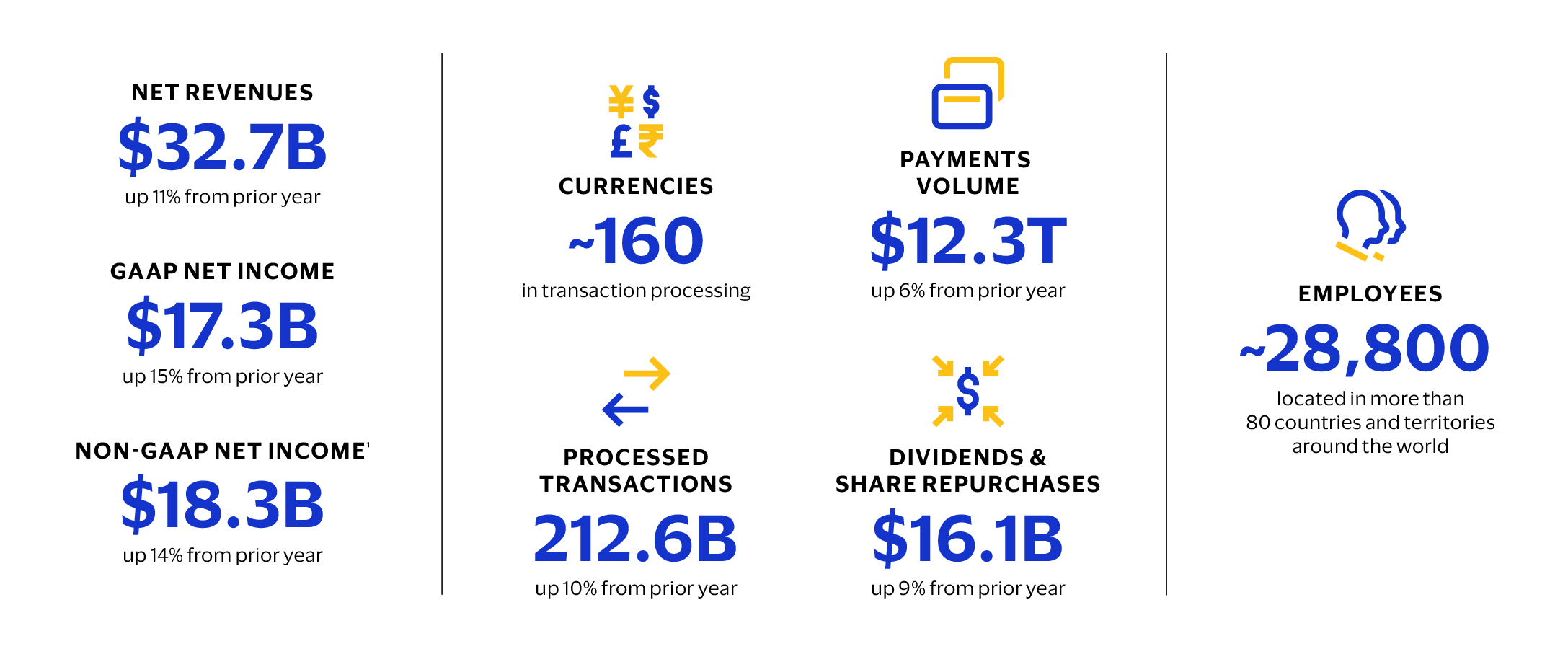
(1)Please see Item 7 of this report for a reconciliation of our GAAP to non-GAAP financial results.
OUR CORE BUSINESS
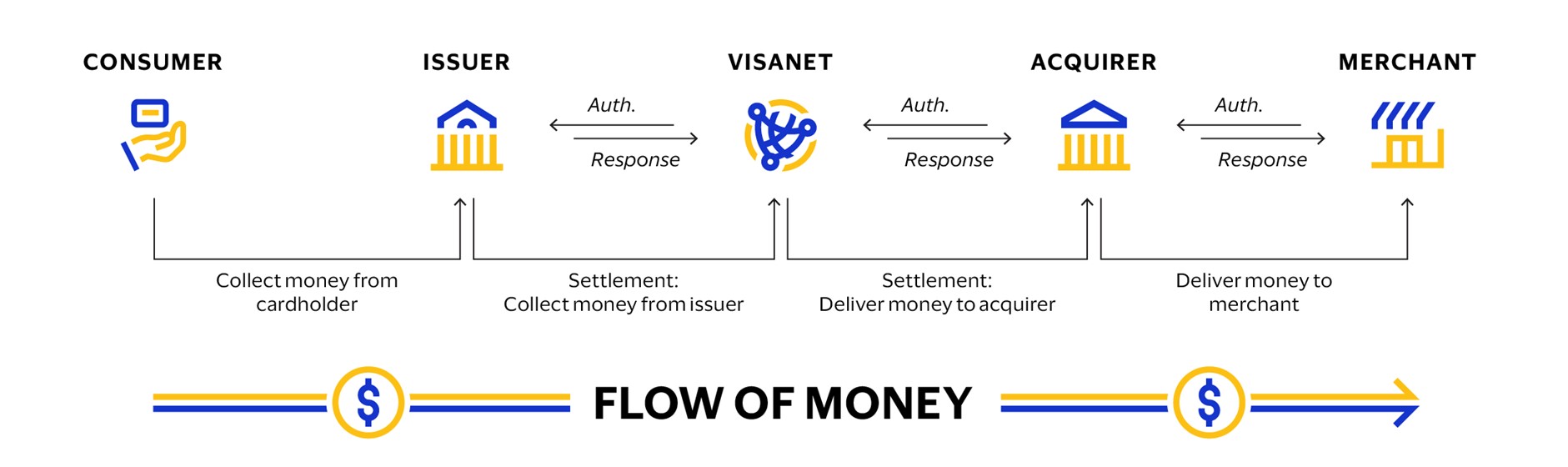
In a typical Visa C2B payment transaction, the consumer purchases goods or services from a merchant using a Visa card or payment product. The merchant presents the transaction data to an acquirer, usually a bank or third-party processing firm that supports acceptance of Visa cards or payment products, for verification and processing. Through VisaNet, the acquirer presents the transaction data to Visa, which in turn sends the transaction data to the issuer to check the account holder’s account balance or credit line for authorization. After the transaction is authorized, the issuer posts the transaction to the consumer’s account and effectively pays the acquirer an amount equal to the value of the transaction, minus the interchange reimbursement fee. The acquirer pays the amount of the purchase, minus the merchant discount rate (MDR), to the merchant.
Visa earns revenue by facilitating money movement across more than 200 countries and territories among a global set of consumers, merchants, financial institutions and government entities through innovative technologies.
Our net revenues in fiscal year 2023 consisted of the following:
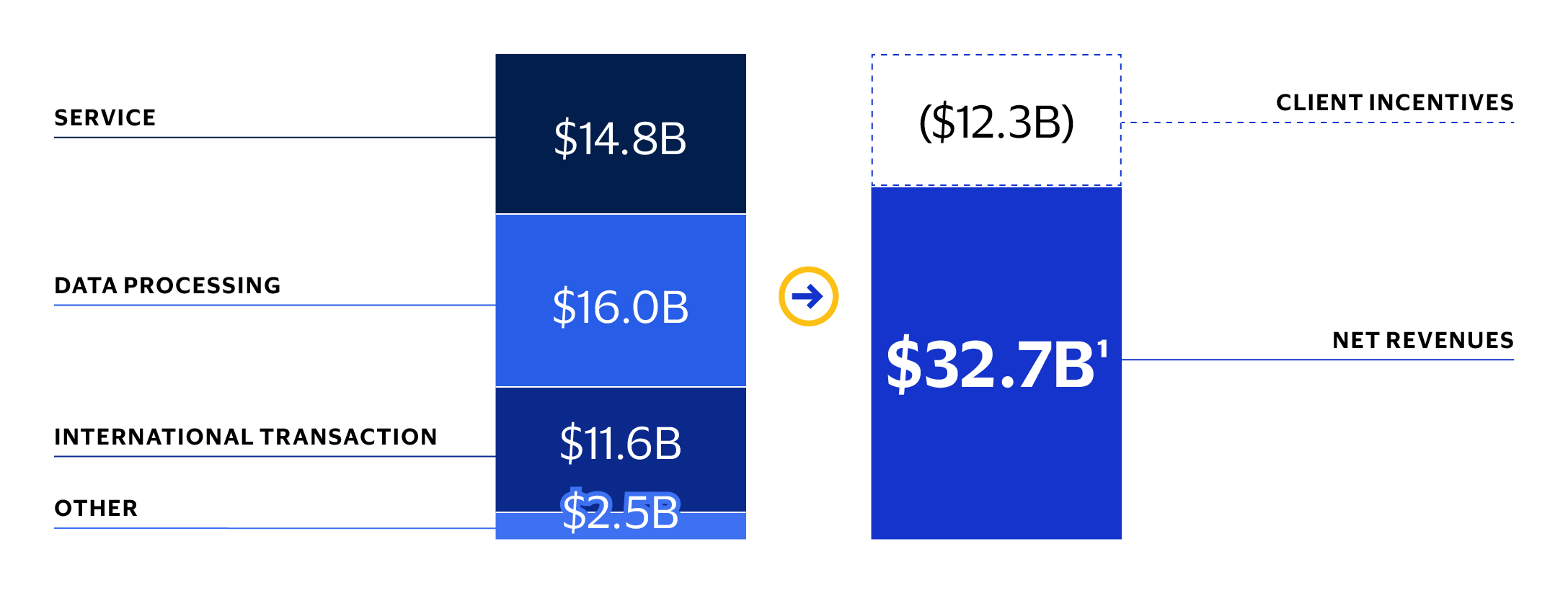
 | SERVICE REVENUES Earned for services provided in support of client usage of Visa payment services |  | OTHER REVENUES Consist mainly of value added services related to advisory, marketing and certain card benefits; license fees for use of the Visa brand or technology; and fees for account holder services, certification and licensing | ||||||||
 | DATA PROCESSING REVENUES Earned for authorization, clearing, settlement; value added services related to issuing, acceptance, and risk and identity solutions; network access; and other maintenance and support services that facilitate transaction and information processing among our clients globally | ||||||||||
 | CLIENT INCENTIVES Paid to financial institution clients, merchants and other business partners to grow payments volume; increase Visa product acceptance; win merchant routing transactions over to our network; and drive innovation | ||||||||||
 | INTERNATIONAL TRANSACTION REVENUES Earned for cross-border transaction processing and currency conversion activities |
(1)Figure may not recalculate exactly due to rounding.
Please see Item 7 and Note 1—Summary of Significant Accounting Policies included in Item 8 of this report, which include disclosures on how we earn and recognize our revenues.
Visa provides payment processing for both non-Visa-branded and Visa-branded card transactions. In the context of non-Visa-branded card transactions, we facilitate payment processing by providing gateway routing services to other payment networks. At the client’s request, we may provide authorization, clearing or settlement services on our network before or after we route the transaction to the other payments network. In those instances, Visa may earn data processing revenues for the specific services provided. In the context of Visa-branded card transactions on our network, we provide authorization, clearing and settlement services and may earn service, data processing, international transaction, or other revenues. Depending on applicable regulations, some payment processors may or may not use our network to process Visa-branded card transactions. If they use our network, we may earn service revenues and data processing revenues. If they do not use our network, we earn only service revenues.
Visa is not a financial institution. We do not issue cards, extend credit or set rates and fees for account holders of Visa products nor do we earn revenues from, or bear credit risk with respect to, any of these activities. Interchange reimbursement fees reflect the value merchants receive from accepting our products and play a key role in balancing the costs and benefits that account holders and merchants derive from participating in our payments networks. Generally, interchange reimbursement fees are paid by acquirers to issuers. We establish default interchange reimbursement fees that apply absent other established settlement terms. These default interchange reimbursement fees are set independently from the revenues we receive from issuers and acquirers. Our acquiring clients are responsible for setting the fees they charge to merchants for the MDR and for soliciting merchants. Visa sets fees to acquirers independently from any fees that acquirers may charge merchants. Therefore, the fees we receive from issuers and acquirers are not derived from interchange reimbursement fees or MDRs.

Visa’s strategy is to accelerate our revenue growth in consumer payments, new flows and value added services, and fortify the key foundations of our business model.
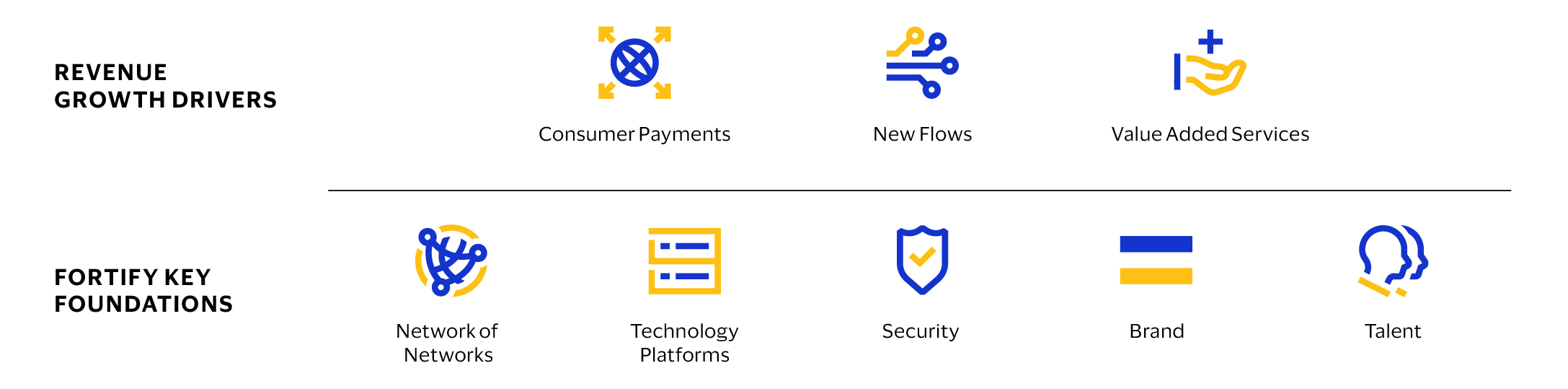

We seek to accelerate revenue growth in three primary areas — consumer payments, new flows and value added services.

Consumer Payments
We remain focused on moving trillions of dollars of consumer spending in cash and checks to cards and digital accounts on Visa’s network of networks.

Core Products
Visa’s growth has been driven by the strength of our core products — credit, debit and prepaid.
Credit: Credit cards and digital credentials allow consumers and businesses to access credit to pay for goods and services. Credit cards are affiliated with programs operated by financial institution clients, co-brand partners, fintechs and affinity partners.
Debit: Debit cards and digital credentials allow consumers and small businesses to purchase goods and services using funds held in their deposit accounts. Debit cards enable account holders to transact in person, online or via mobile without needing cash or checks and without accessing a line of credit. The Visa/PLUS Global ATM network also provides debit, credit and prepaid account holders with cash access, and other banking capabilities, in more than 200 countries and territories worldwide through issuing and acquiring partnerships with both financial institutions and independent ATM operators.
Prepaid: Prepaid cards and digital credentials draw from a designated balance funded by individuals, businesses or governments. Prepaid cards address many use cases and needs, including general purpose reloadable, payroll, government and corporate disbursements, healthcare, gift and travel. Visa-branded prepaid cards also play an important part in financial inclusion, bringing payment solutions to those with limited or no access to traditional banking products.
Enablers
We enable consumer payments and help our clients grow as digital commerce, new technologies and new participants continue to transform the payments ecosystem. Some examples include:
 Tap to Pay
As we seek to improve the user experience in the face-to-face environment, contactless payments or tap to pay, which is the process of tapping a contactless card or mobile device on a terminal to make a payment, has emerged as a preferred way to pay among consumers in many countries around the world. Tap to pay adoption is growing and many consumers have come to expect touchless payment experiences.
Globally, we have 50 countries and territories with more than 90 percent contactless penetration and more than 100 countries and territories where tap to pay is more than 50 percent of face-to-face transactions. Excluding the United States, 76 percent of face-to-face transactions globally were contactless in fiscal year 2023. In the U.S., Visa has surpassed 40 percent contactless penetration and more than 520 million tap-to-pay-enabled Visa cards. We have activated more than 750 contactless public transport projects worldwide. In addition, we processed more than 1.6 billion contactless transactions on global transit systems in fiscal year 2023, an increase of more than 30 percent year over year.
 Tokenization
Visa Token Service (VTS) brings trust to digital commerce innovation. As consumers increasingly rely on digital transactions, VTS is designed to enhance the digital ecosystem through improved authorization, reduced fraud and improved consumer experience. VTS helps protect digital transactions by replacing 16-digit Visa account numbers with a token that includes a surrogate account number, cryptographic information and other data to protect the underlying account information. This security technology can work for a variety of payment transactions, both in person or online.
The provisioning of network tokens continues to accelerate. As of the end of fiscal year 2023, Visa provisioned more than 7.5 billion network tokens, surpassing the number of physical cards in circulation. The milestone reinforces Visa’s commitment to secure, reliable and efficient money movement, in person and online.
 Click to Pay
Click to Pay provides a simplified and more consistent cardholder checkout experience online by removing time-consuming key entry of personal information and enabling consumer and transaction data to be passed securely between payments network participants. Based on the EMV® Secure Remote Commerce industry standard, Click to Pay brings a standardized and streamlined approach to online checkout and meets the needs of consumers shopping across a growing number of connected devices. The goal of Click to Pay is to make digital payments as secure, reliable and interoperable as the checkout experience in person.
New Flows
New flows focus on facilitating commercial and global money movement across Visa’s network of networks. This approach creates opportunities to capture new sources of money movement through card and non-card flows for consumers, businesses and governments around the world by facilitating P2P, B2C, B2B and G2C payments*.*

Visa Direct
Visa Direct is part of Visa’s strategy beyond C2B payments and helps facilitate the delivery of funds to eligible cards, deposit accounts and digital wallets across more than 190 countries and territories. Visa Direct supports multiple use cases, such as P2P payments and account-to-account transfers, business and government payouts to individuals or small businesses, merchant settlements and refunds.
Visa Direct utilizes more than 70 domestic payment schemes, 10 real-time payments schemes, 15 card-based networks and five payment gateways, with the potential to reach more than 8.5 billion cards, deposit accounts and digital wallets. In fiscal year 2023, Visa Direct processed more than 7.5 billion transactions across more than 2,800 global programs. Visa Direct solutions supported more than 500 partners across more than 65 use cases. We also announced in fiscal year 2023 Visa’s partnership with DailyPay, i2C, PayPal, TabaPay, Venmo and Western Union to pilot Visa+, an innovative service that aims to help individuals send money quickly and securely between different participating P2P digital payment apps.
We continue to build on our network of networks strategy by investing in our own capabilities with Visa+ and Visa Alias Directory Service, which offers capabilities to our clients to link aliases, such as mobile numbers or email addresses, to payment credentials, as well as strategically collaborating with digital and mobile payment providers to expand the reach of Visa Direct and deliver even stronger domestic and cross-border payment and connection capabilities to our clients.
Visa Commercial Solutions
We are also expanding our network with B2B payments. Our three strategic areas of focus include investing in and growing card-based payments, accelerating our efforts in non-card, cross-border payments and digitizing domestic accounts payable and accounts receivable processes. We offer a portfolio of commercial payment solutions, including small business, corporate (travel) cards, purchasing cards, virtual cards and digital credentials, non-card cross-border B2B payment options and disbursement accounts, covering most major industry segments around the world. These solutions are designed to bring efficiency, controls and automation to small businesses, commercial and government payment processes, ranging from employee travel to fully integrated, invoice-based payables.
Visa B2B Connect is a multilateral B2B cross-border payments network designed to facilitate transactions from the bank of origin directly to the beneficiary bank, helping streamline settlement and optimize payments for financial institutions’ corporate clients. The network delivers B2B cross-border payments that are reliable, flexible, data-rich, secure and cost-effective. Visa B2B Connect continues to scale and is available in more than 100 countries and territories.
Visa Cross-Border Solutions
Formerly Treasury as a Service, Visa Cross-Border Solutions aligns with our global network of networks strategy, as we are focused on building the infrastructure that enables our clients of all sizes to deliver cross-border products with visibility, speed and security. This includes a series of solutions for our established cross-border consumer payments business, as well as use cases enabled by our digitally native Currencycloud platform, which includes real-time foreign exchange rates, virtual accounts, and enhanced liquidity and settlement capabilities.
Value Added Services
Value added services represent an opportunity for us to diversify our revenue with products and solutions that differentiate our network, deepen our client relationships and deliver innovative solutions across other networks.

Issuing Solutions
Visa DPS is one of the largest issuer processors of Visa debit transactions in the world. In addition to multi-network transaction processing, Visa DPS also provides a wide range of value added services, including fraud mitigation, dispute management, data analytics, campaign management, a suite of digital solutions and contact center services. Our capabilities in API-based issuer processing solutions, like DPS Forward, allow our clients to create new payments use cases and provide them with modular capabilities for digital payments.
We also provide a range of other services and digital solutions to issuers, such as account controls, digital issuance, and branded consumer experiences. Additionally, Visa provides loyalty and benefits solution to issuers aimed at creating compelling and differentiated cardholder experiences, as well as Buy Now, Pay Later (BNPL) capabilities. BNPL or installment payments allow shoppers the flexibility to pay for a purchase in equal payments over a defined period of time. Visa is investing in installments as a payments strategy — by offering a portfolio of BNPL solutions for traditional clients, as well as installments providers, who use our cards and services to support a wide variety of installment options before, during or after checkout, in person and online.
Acceptance Solutions
Visa Acceptance Solutions, which includes Cybersource, provides modular, value added services in addition to the traditional gateway function of connecting merchants to payment processing. Using the platform, acquirers, payment service providers, independent software vendors, and merchants of all sizes can improve the way their consumers engage and transact; help to mitigate fraud and lower operational costs; and adapt to changing business requirements. They can also connect with other fintechs through a global payment management platform to use their services. Visa Acceptance Solutions’ capabilities provide new and enhanced payment integrations with ecommerce platforms, enabling sellers and acquirers to provide tailored commerce experiences with payments seamlessly embedded. Visa Acceptance Solutions enables an omnichannel solution with a cloud-based architecture to deliver more innovation at the point of sale.
In addition, Visa provides secure, reliable services for merchants and acquirers that reduce friction and drive acceptance. Examples include Global Urban Mobility, which supports transit operators to accept Visa contactless payments in addition to closed-loop payment solutions; and Visa Account Updater, which provides updated account information for merchants to help strengthen customer relationships and retention. Visa also offers dispute management services, including a network-agnostic solution from Verifi that enables merchants to prevent and resolve disputes with a single connection.
Risk and Identity Solutions
Visa’s risk and identity solutions transform data into insights for near real-time decisions and facilitate account holder authentication to help clients prevent fraud and protect account holder data. With the increasing popularity of omnichannel commerce and digital payments among consumers, fraud prevention helps increase trust in digital payments. Solutions such as Visa Advanced Authorization, Visa Secure, Visa Risk Manager and Decision Manager, Visa Consumer Authentication Service, and payment-decisioning solutions from CardinalCommerce empower financial institutions and merchants with tools that help automate and simplify fraud prevention and enhance payment security.
Aligned to our network of networks strategy, Visa is increasingly bringing our expertise and capabilities to emerging fraud challenges, working with network operators and financial institutions to help mitigate fraud. These value-added fraud prevention tools layer on top of a suite of our network programs that protect the safety and integrity of the payment ecosystem, and along with our investments in intelligence and technology, help to prevent, detect and mitigate threats. These programs and Visa’s fraud prevention expertise are among the core benefits of
being part of the Visa network. Through the combined efforts of security and identity tools and services, payment and cyber intelligence, insights and learnings from client or partner breach investigations, and law enforcement engagement, Visa helps protect financial institutions and merchants from fraud and solve payment security challenges.
Open Banking
In March 2022, Visa acquired Tink AB, an open banking platform, to catalyze fintech innovation and accelerate the development and adoption of open banking securely and at scale. Visa’s open banking capabilities range from data access use cases, such as account verification, balance check and personal finance management, to payment initiation capabilities, such as account-to-account transactions and merchant payments. These capabilities can help our partner businesses deliver valuable services to their customers.
Advisory Services
Visa Consulting and Analytics (VCA) is the payments consulting advisory arm of Visa. The combination of our deep payments expertise, proprietary analytical models applied to a breadth of data and our economic intelligence allows us to identify actionable insights, make recommendations and help implement solutions that can drive better business decisions and measurable outcomes for clients. VCA offers consulting services for issuers, acquirers, merchants, fintechs and other partners, spanning the entire customer journey from acquisition to retention. Further, VCA Managed Services, our dedicated execution arm within the consulting division, is being increasingly utilized by clients to implement our recommendations and wider value added services product enablement.

We are fortifying the key foundations of our business model, which consist of becoming a network of networks, our technology platforms, security, brand and talent.

Network of Networks
Our network of networks strategy means moving money to all endpoints and to all form factors, using all available networks and being a single connection point for our partners; and providing our value added services on all transactions, no matter the network. The key component of our network of networks strategy is interoperability. We are opening up our network and increasingly using other networks to reach accounts we could not otherwise reach and enabling new types of money movement. Visa B2B Connect, Visa Direct, and Visa+ are examples of our strategy.
Technology Platforms
Visa’s leading technology platforms comprise software, hardware, data centers and a large telecommunications infrastructure. Visa’s four data centers are a critical part of our global processing environment and have a high redundancy of network connectivity, power and cooling designed to provide continuous availability of systems. Together, these systems deliver the secure, convenient and reliable service that our clients and consumers expect from the Visa brand.
Security
Our in-depth, multi-layer security approach includes a formal program to devalue sensitive and/or personal data through various cryptographic means; embedded security in the software development lifecycle; identity and access management controls to protect against unauthorized access; and advanced cyber detection and response capabilities. We deploy security tools that help keep our clients and consumers safe. We also invest significantly in our comprehensive approach to cybersecurity. We deploy security technologies to protect data confidentiality, the integrity of our network and service availability to strengthen our core cybersecurity capabilities to minimize risk. Our
payments fraud disruption team continually monitors threats to the payments ecosystem to help ensure attacks are detected and prevented efficiently and effectively.
Brand
Visa’s strong brand helps deliver added value to our clients and their customers, financial institutions, merchants and partners through compelling brand expressions, a wide range of products and services as well as innovative brand and marketing efforts. In line with our commitment to an expansive and diverse range of partnerships for the benefit of our stakeholders, Visa is a sponsor of top entertainment and sports events including the FIFA Women’s World Cup 2023TM, the Olympic and Paralympic Games, and the Super Bowl.
Talent
Attracting, developing and advancing the best talent globally is critical to our continued success. This year we grew our total workforce from approximately 26,500 in fiscal year 2022 to approximately 28,800 employees in fiscal year 2023, an increase of 9 percent year over year. Voluntary workforce turnover (rolling 12-month attrition) was 6 percent as of September 30, 2023. Visa employees are located in more than 80 countries and territories, with 55 percent located outside the U.S. At the end of fiscal year 2023, Visa’s global workforce was 58 percent men and 42 percent women, and women represented 36 percent of Visa’s leadership (defined as vice president level and above). In the U.S., ethnicity of our workforce was 42 percent Asian, 8 percent Black, 13 percent Hispanic, 3 percent Other and 35 percent White. For our U.S. leadership, the breakdown was 18 percent Asian, 6 percent Black, 13 percent Hispanic, 3 percent Other and 60 percent White.
Given Visa’s ambitious growth agenda and efforts to achieve our purpose, we have focused on enhancing our employees’ expertise across our business. This includes an enhanced development program for our senior leaders and a formal technology apprenticeship program to help us broaden and strengthen our talent channels and pipelines. We have also committed to providing employees with the tools they need to do their work more quickly and easily, including an artificial intelligence or AI-driven portal with a searchable knowledge base to create customized results and bespoke solutions. We enhanced our mental well-being and retirement benefits, which is reflective of our key priority to take care of our employees.
We also are dedicated to ensuring that employees feel valued in their day-to-day work. During our global employee engagement survey last year, we learned that our employees wanted more opportunities to recognize and be recognized, in more informal ways. In response, Visa developed a program that better enabled employees to provide peer-to-peer recognition for each other’s contributions. Using UPLIFT, Visa’s new recognition platform, employees can celebrate their peers’ achievements, send e-cards to celebrate the employee journey (from welcoming new hires to recognizing service anniversaries), use an automated internal networking tool that matches employees based on smart algorithms, and more. Importantly, all our recognition categories are grounded in behaviors that reflect our employee value proposition or Visa’s Leadership Principles – further reinforcing that at Visa, it is not only about what you achieve, but how you do it. Employee engagement in peer recognition has significantly increased since the launch, with monthly active users reaching 78 percent in September 2023, compared to 45 percent in September 2022. With this enhanced platform, employees are encouraged to recognize and uplift each other.
Visa is committed to pay equity, regardless of gender or race/ethnicity, and conducts pay equity analyses on an annual basis. We are also committed to transparency – this year, we launched total rewards statements in the United Kingdom in addition to those already provided in Asia, to drive a deeper understanding and appreciation of total rewards value to the individual. We plan to introduce statements in the U.S. as well. For additional information regarding our human capital management, please see the section titled “Talent and Human Capital Management” in Visa’s 2023 Proxy Statement as well as our website at visa.com/esg, which includes enhanced workforce disclosures that include our 2022 Consolidated EEO-1 Report and our 2022 Environmental, Social and Governance (ESG) Report. See Available Information below.
FINTECH AND DIGITAL PARTNERSHIPS
Fintechs are a vital growth engine for Visa and a key driver in realizing our purpose – to uplift everyone, everywhere by being the best way to pay and be paid. Fintechs are key enablers of new payment experiences and new flows. Our work with fintechs is one of our greatest opportunities and has opened new points of acceptance, extended credit at the point of sale, made cross-border money flows more efficient, moved B2B spend onto Visa’s network, expedited payroll and provided digital wallet customers access to our services. Our portfolio of fintech partners is diverse and continues to grow and scale. We signed more than 500 commercial partnerships with
fintechs globally, from early stage companies to growing and mature players, an increase of 25 percent year over year.
To better serve fintechs, Visa has a suite of streamlined commercial programs and digital onboarding tools. Fintech Fast Track, our flagship program for fintechs is designed to help launch new financial features quickly, such as launching a new card program or enabling the movement of money with Visa Direct. We provide streamlined onboarding and turnkey access to hundreds of ecosystem partners. The program has welcomed hundreds of fintechs who are actively engaged in the program.
Visa Ready, our certification program, helps technology companies build and launch payment solutions that meet Visa's global standards around security and functionality. Fintech Partner Connect helps build pathways between Visa’s issuing clients and fintech providers. With our startup engagement programs, like the Visa Everywhere Initiative that launched in 2022, early-stage companies can build payment solutions based on our capabilities. Visa also manages programs including She’s Next, Empowered by Visa, a global women’s entrepreneurship initiative, and Africa Fintech Accelerator Program to uplift underrepresented communities.
MERGERS AND ACQUISITIONS, JOINT VENTURES AND STRATEGIC INVESTMENTS
Visa continually explores opportunities to augment our capabilities and provide meaningful value to our clients. Mergers and acquisitions, joint ventures and strategic investments complement our internal development and enhance our partnerships to align with Visa’s priorities. Visa applies a rigorous business analysis to our acquisitions, joint ventures and investments to ensure they will differentiate our network, provide value added services and accelerate growth.
In fiscal year 2023, we signed a definitive agreement to acquire Pismo, a cloud-native issuer processing and core banking platform with operations in Latin America, Asia Pacific and Europe. The transaction is subject to customary closing conditions, including applicable regulatory reviews and approvals.
CORPORATE RESPONSIBILITY AND SUSTAINABILITY
Visa is committed to operating as a responsible, ethical, inclusive and sustainable company. As one of the global leaders in digital payments, Visa strives to join with clients, partners and other stakeholders to empower people, businesses and communities to thrive, to be an industry leader in addressing the corporate responsibility and sustainability (CRS) topics most significant to our role as a payments technology company, and to meet and exceed our expectations for performance and transparency. Visa’s purpose is to uplift everyone, everywhere by being the best way to pay and be paid. We believe deeply in our purpose, and we are focused on empowering people and economies; securing commerce and protecting customers; investing in our workforce; protecting the planet; and operating responsibly. Our 2022 ESG Report, as well as other CRS-related resources are available on our website at visa.com/esg. See Available Information below.
INTELLECTUAL PROPERTY
We own and manage the Visa brand, which stands for acceptance, security, convenience, speed and reliability. Our portfolio of Visa-owned trademarks is important to our business. Generally, trademark registrations are valid indefinitely as long as they are in use and/or maintained. We give our clients access to these assets through agreements with our issuers and acquirers, which authorize the use of our trademarks in connection with their participation in our payments network. Additionally, we own a number of patents and patent applications related to our business and continue to pursue patents in emerging technologies that may have applications in our business. We rely on a combination of patent, trademark, copyright and trade secret laws in the U.S. and other jurisdictions, as well as confidentiality procedures and contractual provisions, to protect our proprietary technology.
COMPETITION
The global payments industry continues to undergo dynamic change. Existing and emerging competitors compete with Visa’s network and payment solutions for consumers and for participation by financial institutions and merchants. Technology and innovation are shifting consumer habits and driving growth opportunities in ecommerce, mobile payments, blockchain technology and digital currencies. These advances are enabling new entrants, many
of which depart from traditional network payment models. In certain countries, the evolving regulatory landscape is creating local networks or enabling additional processing competition.
We compete against all forms of payment. This includes paper-based payments, primarily cash and checks, and all forms of electronic payments. Our electronic payment competitors principally include:
Global or Multi-Regional Networks: These networks typically offer a range of branded, general purpose card payment products that consumers can use at millions of merchant locations around the world. Examples include American Express, Discover, JCB, Mastercard and UnionPay. These competitors may be more concentrated in specific geographic regions, such as Discover in the U.S. and JCB in Japan, or have a leading position in certain countries, such as UnionPay in China. See Item 1A—Regulatory Risks—Government-imposed obligations and/or restrictions on international payments systems may prevent us from competing against providers in certain countries, including significant markets such as China and India. Based on available data, Visa is one of the largest retail electronic funds transfer networks used throughout the world.
The following chart compares our network with these network competitors for calendar year 2022(1):
| Visa | American Express | Diners Club / Discover | JCB | Mastercard | |||||||||||||||||||||||||
| Payments Volume ($B) | 11,668 | 1,540 | 243 | 312 | 6,568 | ||||||||||||||||||||||||
| Total Volume ($B)(2) | 14,108 | 1,553 | 258 | 320 | 8,177 | ||||||||||||||||||||||||
| Total Transactions (B) | 260 | 10 | 4 | 6 | 150 | ||||||||||||||||||||||||
| Cards (M) | 4,160 | 133 | 80 | 153 | 2,713 |
(1)American Express, Diners Club / Discover, JCB and Mastercard data sourced from The Nilson Report issue 1241 (May 2023). Includes all consumer, small business and commercial credit, debit and prepaid cards. American Express, Diners Club / Discover, and JCB include business from third-party issuers. JCB figures include other payment-related products and some figures are estimates. Mastercard excludes Maestro and Cirrus figures.
(2)Total volume is the sum of payments volume and cash volume. Cash volume generally consists of cash access transactions, balance access transactions, balance transfers and convenience checks.
Local and Regional Networks: Operated in many countries, these networks often have the support of government influence or mandate. In some cases, they are owned by financial institutions or payment processors. These networks typically focus on debit payment products, and may have strong local acceptance, and recognizable brands. Examples include NYCE, Pulse and STAR in the U.S., Interac in Canada and eftpos in Australia.
Alternative Payments Providers: These providers, such as closed commerce ecosystems, BNPL solutions and cryptocurrency platforms, often have a primary focus of enabling payments through ecommerce and mobile channels; however, they are expanding or may expand their offerings to the physical point of sale. These companies may process payments using in-house account transfers between parties, electronic funds transfer networks like the ACH, global or local networks like Visa, or some combination of the foregoing. In some cases, these entities can be both a partner and a competitor to Visa.
Real-time Payment (RTP) Networks: RTP networks have launched in multiple markets and continue to be driven by strong government sponsorship and regulatory initiatives to enable and drive adoption (e.g., FedNow in the U.S., PIX in Brazil and United Payments Interface (UPI) in India), increasing their position as an alternative to payment card schemes. These networks primarily focus on domestic transactions, with adoption varying by use cases and geographies. However, with linkages such as PayNow in Singapore and UPI in India, cross-border RTP networks are advancing and will compete with our cross-border business. RTP networks can compete with Visa on consumer payments and other payment flows (e.g., B2B and P2P) but can also be customers for value added services, such as risk management.
Digital Wallet Providers: They continue to expand payment capabilities in person and online for consumers and merchants and provide consumers with additional ways to pay. While digital wallets can help drive Visa volumes, they can also be funded by non-card payment options. Digital wallet providers who utilize RTP networks provide additional competition.
Payment Processors: Payment processors may perform processing services on third-party payments networks on behalf of issuers or acquirers. We compete with payment processors for the processing of Visa transactions. These processors may benefit from mandates requiring them to handle processing under local
regulation. For example, as a result of regulation in Europe under the Interchange Fee Regulation (IFR), we may face competition from other networks, processors and other third parties who could process Visa transactions directly with issuers and acquirers.
New Flows Providers: We compete with alternative solutions to our new flows (e.g., Visa Direct and Visa B2B Connect) such as ACH, RTP and wires. We compete with other global and local card networks for commercial card portfolios. Additionally, we may face competition from financial institution clients who are experimenting with B2B blockchain payments.
Value Added Service Providers: We face competition from companies that provide alternatives to our value added services. This includes a wide range of players, such as technology companies, information services and consulting firms, governments and merchant services companies. The integration of technology like generative AI can create new and better offerings that compete with our value added services, such as strengthened risk monitorization and managing digital identification. Regulatory initiatives could also lead to increased competition in these areas.
We believe our fundamental value proposition of security, convenience, speed and reliability as well as the number of credentials and our acceptance footprint help us to succeed. In addition, we understand the needs of the individual markets in which we operate and partner with local financial institutions, merchants, fintechs, governments, NGOs and business organizations to provide tailored and innovative solutions. We will continue to utilize our network of networks strategy to facilitate the movement of money. We believe Visa is well-positioned competitively due to our global brand, our broad set of payment products, new flows offerings and value added services, and our proven track record of processing payment transactions securely and reliably.
GOVERNMENT REGULATION
As a global payments technology company, we are subject to complex and evolving global regulations in the various jurisdictions in which our products and services are used. The most significant government regulations that impact our business are discussed below. For further discussion of how global regulations may impact our business, see Item 1A*—*Regulatory Risks.
Anti-Corruption, Anti-Money Laundering, Anti-Terrorism and Sanctions: We are subject to anti-corruption laws and regulations, including the U.S. Foreign Corrupt Practices Act (FCPA), the UK Bribery Act and other laws that generally prohibit the making or offering of improper payments to foreign government officials and political figures for the purpose of obtaining or retaining business or to gain an unfair business advantage. We are also subject to anti-money laundering and anti-terrorist financing laws and regulations, including the U.S. Bank Secrecy Act. In addition, we are subject to economic and trade sanctions programs administered by the Office of Foreign Assets Control (OFAC) in the U.S. Therefore, we do not permit financial institutions or other entities that are domiciled in countries or territories subject to comprehensive OFAC trade sanctions (currently, Cuba, Iran, North Korea, Syria, Crimea, and the Donetsk People’s Republic and Luhansk People’s Republic regions of Ukraine), or that are included on OFAC’s list of Specially Designated Nationals and Blocked Persons, to issue or acquire Visa cards or engage in transactions using our products and services.
Government-Imposed Market Participation Restrictions: Certain governments, including China, India, Indonesia, Thailand and Vietnam, have taken actions to promote domestic payments systems and/or certain issuers, payments networks or processors, by imposing regulations that favor domestic providers, impose local ownership requirements on processors, require data localization or mandate that domestic processing be done in that country.
Interchange Rates and Fees: An increasing number of jurisdictions around the world regulate or influence debit and credit interchange reimbursement rates in their regions. For example, the U.S. Dodd-Frank Wall Street Reform and Consumer Act (Dodd-Frank Act) limits interchange reimbursement rates for certain debit card transactions in the U.S.; the European Union (EU) IFR limits interchange rates in the European Economic Area (EEA) (as discussed below); and the Reserve Bank of Australia (RBA) and the Central Bank of Brazil regulate average permissible levels of interchange.
Internet Transactions: Many jurisdictions have adopted regulations that require payments system participants to monitor, identify, filter, restrict or take other actions with regard to certain types of payment transactions on the Internet, such as gambling, digital currencies, the purchase of cigarettes or alcohol and other controversial transaction types.
Network Exclusivity and Routing: In the U.S., the Dodd-Frank Act limits network exclusivity and restrictions on merchant routing choice for the debit and prepaid market segments. Other jurisdictions impose similar limitations, such as the IFR’s prohibition in Europe on restrictions that prevent multiple payment brands or functionality on the same card.
No-surcharge Rules: We have historically enforced rules that prohibit merchants from charging higher prices to consumers who pay using Visa products instead of other means. However, merchants’ ability to surcharge varies by geographic market as well as Visa product type, and continues to be impacted by litigation, regulation and legislation.
Privacy and Data Protection: Aspects of our operations or business are subject to privacy, data use and data security regulations, which impact the way we use and handle data, operate our products and services and even impact our ability to offer a product or service. In addition, regulators are proposing new laws or regulations that could require Visa to adopt certain cybersecurity and data-handling practices, create new individual privacy rights and impose increased obligations on companies handling personal data.
Supervisory Oversight of the Payments Industry: Visa is subject to financial sector oversight and regulation in substantially all of the jurisdictions in which we operate. In the U.S., for example, the Federal Banking Agencies (FBA) (formerly known as the Federal Financial Institutions Examination Council) has supervisory oversight over Visa under applicable federal banking laws and policies as a technology service provider to U.S. financial institutions. The federal banking agencies comprising the FBA are the Federal Reserve Board, the Comptroller of the Currency, the Federal Deposit Insurance Corporation and the National Credit Union Administration. Visa also may be separately examined by the Consumer Financial Protection Bureau as a service provider to the banks that issue Visa-branded consumer credit and debit card products. Central banks in other countries/regions, including Canada, Europe, India, Ukraine and the UK (as discussed below), have recognized or designated Visa as a retail payment system under various types of financial stability regulations. Visa is also subject to oversight by banking and financial sector authorities in other jurisdictions, such as Brazil and Hong Kong.
European and United Kingdom Regulations and Supervisory Oversight: Visa in Europe continues to be subject to complex and evolving regulation in the EEA and the UK.
There are a number of EU regulations that impact our business. As discussed above, the IFR regulates interchange rates within the EEA, requires Visa Europe to separate its payment card scheme activities from processing activities for accounting, organization and decision-making purposes within the EEA, and imposes limitations on network exclusivity and routing. National competent authorities in the EEA are responsible for monitoring and enforcing the IFR in their markets. We are also subject to regulations governing areas such as privacy and data protection, anti-bribery, anti-money laundering, anti-terrorism and sanctions. Other regulations in Europe, such as the second Payment Services Directive (PSD2), require, among other things, that our financial institution clients provide certain customer account access rights to emerging non-financial institution players. PSD2 also includes strong customer authentication requirements for certain transactions that could impose both operational complexity on Visa and impact consumer payment experiences. Visa Europe is also subject to supervisory oversight by the European Central Bank and certain competent authorities in Europe.
In the UK, Visa Europe is designated as a Recognized Payment System, bringing it within the scope of the Bank of England’s supervisory powers and subjecting it to various requirements, including on issues such as governance and risk management designed to maintain the stability of the UK’s financial system. Visa Europe is also regulated by the UK’s Payment Systems Regulator (PSR), which has wide-ranging powers and authority to review our business practices, systems, rules and fees with respect to promoting competition and innovation in the UK, and ensuring payment systems take care of, and promote, the interests of service-users. Post-Brexit, the UK has adopted various European regulations, including regulations that impact the payments ecosystem, such as the IFR and PSD2. The PSR is responsible for monitoring Visa Europe’s compliance with the IFR as adopted in the UK.
Corporate Responsibility and Sustainability: Certain governments around the world are adopting laws and regulations pertaining to corporate responsibility and sustainability performance, transparency and reporting. Regulations may include mandated corporate reporting (e.g., Corporate Sustainability Reporting Directive) or in individual areas, such as mandated reporting on climate-related financial disclosures.
Additional Regulatory Developments: Various regulatory agencies across the world also continue to examine a wide variety of other issues, including mobile payment transactions, tokenization, access rights for non-financial institutions, money transfer services, identity theft, account management guidelines, disclosure rules, security and marketing that could affect our financial institution clients and our business. Furthermore, following the
passage of PSD2 in Europe, several countries, including Australia, Brazil, Canada, Hong Kong and Mexico, are contemplating granting or have already granted various types of access rights to third-party processors, including access to consumer account data maintained by our financial institution clients. These changes could have negative implications for our business depending on how the regulations are framed and implemented.
AVAILABLE INFORMATION
Our corporate website is visa.com/ourbusiness. Our annual reports on Form 10-K, our quarterly reports on Form 10-Q, our current reports on Form 8-K, proxy statements and any amendments to those reports filed or furnished pursuant to the U.S. Securities Exchange Act of 1934, as amended, can be viewed at sec.gov and our investor relations website at investor.visa.com as soon as reasonably practicable after these materials are electronically filed with or furnished to the U.S. Securities and Exchange Commission (SEC). In addition, we routinely post financial and other information, which could be deemed to be material to investors, on our investor relations website. Information regarding our corporate responsibility and sustainability initiatives is also available on our website at visa.com/esg. The content of any of our websites referred to in this report is not incorporated by reference into this report or any other filings with the SEC.
Item 1A. Risk Factors
Regulatory Risks
We are subject to complex and evolving global regulations that could harm our business and financial results.
As a global payments technology company, we are subject to complex and evolving regulations that govern our operations. See Item 1—Government Regulation for more information on the most significant areas of regulation that affect our business. The impact of these regulations on us, our clients, and other third parties could limit our ability to enforce our payments system rules; require us to adopt new rules or change existing rules; affect our existing contractual arrangements; increase our compliance costs; and require us to make our technology or intellectual property available to third parties, including competitors, in an undesirable manner. As discussed in more detail below, we may face differing rules and regulations in matters like interchange reimbursement rates, preferred routing, domestic processing and localization requirements, currency conversion, point-of-sale transaction rules and practices, privacy, data use or protection, licensing requirements, and associated product technology. As a result, the Visa operating rules and our other contractual commitments may differ from country to country or by product offering. Complying with these and other regulations increases our costs and reduces our revenue opportunities.
If widely varying regulations come into existence worldwide, we may have difficulty rapidly adjusting our product offerings, services, fees and other important aspects of our business to comply with the regulations. Our compliance programs and policies are designed to support our compliance with a wide array of regulations and laws, such as regulations regarding anti-money laundering, anti-corruption, competition, money transfer services, privacy and sanctions, and we continually adjust our compliance programs as regulations evolve. However, we cannot guarantee that our practices will be deemed compliant by all applicable regulatory authorities. In the event our controls should fail or we are found to be out of compliance for other reasons, we could be subject to monetary damages, civil and criminal penalties, litigation, investigations and proceedings, and damage to our global brands and reputation. Furthermore, the evolving and increased regulatory focus on the payments industry could negatively impact or reduce the number of Visa products our clients issue, the volume of payments we process, our revenues, our brands, our competitive positioning, our ability to use our intellectual property to differentiate our products and services, the quality and types of products and services we offer, the countries in which our products are used, and the types of consumers and merchants who can obtain or accept our products, all of which could harm our business and financial results.
Increased scrutiny and regulation of the global payments industry, including with respect to interchange reimbursement fees, merchant discount rates, operating rules, risk management protocols and other related practices, could harm our business.
Regulators around the world have been establishing or increasing their authority to regulate various aspects of the payments industry. See Item 1—Government Regulation for more information*.* In the U.S. and many other jurisdictions, we have historically set default interchange reimbursement fees. Even though we generally do not receive any revenue related to interchange reimbursement fees in a payment transaction (in the context of credit and debit transactions, those fees are paid by the acquirers to the issuers; the reverse is true for certain transactions like ATM), interchange reimbursement fees are a factor on which we compete with other payments providers and are therefore an important determinant of the volume of transactions we process. Consequently, changes to these fees, whether voluntarily or by mandate, can substantially affect our overall payments volumes and revenues.
Interchange reimbursement fees, certain operating rules and related practices continue to be subject to increased government regulation globally, and regulatory authorities and central banks in a number of jurisdictions have reviewed or are reviewing these fees, rules and practices. For example:
- Regulations adopted by the U.S. Federal Reserve cap the maximum U.S. debit interchange reimbursement rate received by large financial institutions at 21 cents plus 5 basis points per transaction, plus a possible fraud adjustment of 1 cent. Additionally, the Dodd-Frank Act limits issuers’ and our ability to adopt network exclusivity and preferred routing in the debit and prepaid area, which also impacts our business. In response to merchant requests, the Federal Reserve has recently taken actions to revisit its regulations that implement these aspects of the Dodd-Frank Act. For example, in October 2022, the Federal Reserve published a final rule effectively requiring issuers to ensure that at least two unaffiliated networks are available for routing card not present debit transactions by July 1, 2023. In October 2023, the Federal
Reserve issued a proposal for comment which would further lower debit interchange rates, with a mechanism for automatic adjustment every two years. Separately, there continues to be interest in regulation of credit interchange fees and routing practices by members of Congress and state legislators in the U.S. In June 2023, legislation was reintroduced in the U.S. House of Representatives and Senate, which among other things, would require large issuing banks to offer a choice of at least two unaffiliated networks over which electronic credit transactions may be processed. Similar legislation was introduced in the previous Congress in 2022 but failed to advance and become law. The current legislation has additional bipartisan support, and while the ultimate outcome of the legislation remains unclear, its sponsors continue to strongly advocate for its passage.
-
In Europe, the EU’s IFR places an effective cap on consumer credit and consumer debit interchange fees for both domestic and cross-border transactions within the EEA (30 basis points and 20 basis points, respectively). EU member states have the ability to further reduce these interchange levels within their territories. The European Commission has announced its intention to conduct another impact assessment of the IFR, which could result in even lower caps on interchange rates and the expansion of regulation to other types of products, services and fees.
-
Several countries in Latin America continue to explore regulatory measures against payments networks and have either adopted or are exploring interchange caps, including Argentina, Brazil, Chile and Costa Rica. In Asia Pacific, the Reserve Bank of Australia (RBA) completed its review of the country’s payment system regulations and adopted a series of measures, which include lower interchange rates for debit transactions. The RBA also continues to assess the potential merits of mandating co-badging and merchant routing choice on dual network debit cards. In addition, the New Zealand Parliament passed legislation capping domestic interchange rates for debit and credit products. Finally, many governments, including but not limited to governments in India, Costa Rica, and Turkey, are using regulation to further drive down MDR, which could negatively affect the economics of our transactions.
-
While the focus of interchange and MDR regulation has primarily been on domestic rates historically, there is increasing focus on cross-border rates in recent years. For example, in 2019, we settled certain cross-border interchange rates with the European Commission. In 2020, Costa Rica became the first country to formally regulate cross-border interchange rates by direct
Showing the first 8K of 76K characters. Open the full section
Item 1B. Unresolved Staff Comments
Not applicable.
Item 2. Properties
As of September 30, 2023, we owned or leased 144 office locations in 82 countries around the world, including four data centers located in the U.S., the United Kingdom and Singapore. Our corporate headquarters are located in owned and leased premises in the San Francisco Bay Area.
We believe that these facilities are suitable and adequate to support our ongoing business needs.
Item 3. Legal Proceedings
Refer to Note 20—Legal Matters to our consolidated financial statements included in Item 8 of this report.
Item 4. Mine Safety Disclosures
Item 5. Market for Registrant’s Common Equity, Related Stockholder Matters and Issuer Purchases of Equity Securities
Our class A common stock has been listed on the New York Stock Exchange under the symbol “V”. As of November 8, 2023, we had 316 stockholders of record of our class A common stock. The number of beneficial owners is substantially greater than the number of record holders, because a large portion of our class A common stock is held in “street name” by brokers and other financial institutions on behalf of our stockholders. There is currently no established public trading market for our class B or C common stock. As of November 8, 2023, there were 1,106 and 381 holders of record of our class B and C common stock, respectively.
On October 24, 2023, our board of directors declared a quarterly cash dividend of $0.52 per share of class A common stock (determined in the case of class B and C common stock and series A, B and C convertible participating preferred stock on an as-converted basis) payable on December 1, 2023, to holders of record as of November 9, 2023.
Subject to legally available funds, we expect to continue paying quarterly cash dividends on our outstanding common and preferred stock in the future. However, the declaration and payment of future dividends is at the sole discretion of our board of directors after taking into account various factors, including our financial condition, settlement indemnifications, operating results, available cash and current and anticipated cash needs.
Issuer Purchases of Equity Securities
The table below presents our purchases of common stock during the quarter ended September 30, 2023:
| Period | Total Number of Shares Purchased | Average Purchase Price per Share**(1)** | Total Number of Shares Purchased as Part of Publicly Announced Plans or Programs**(2)** | Approximate Dollar Value of Shares that May Yet Be Purchased Under the Plans or Programs**(1),(2)** | ||||||||||||||||||||||
| (in millions, except per share data) | ||||||||||||||||||||||||||
| July 1-31, 2023 | 3 | $ | 240.62 | 3 | $ | 8,215 | ||||||||||||||||||||
| August 1-31, 2023 | 7 | $ | 243.29 | 7 | $ | 6,473 | ||||||||||||||||||||
| September 1-30, 2023 | 7 | $ | 238.94 | 7 | $ | 4,733 | ||||||||||||||||||||
| Total | 17 | $ | 241.03 | 17 |
(1)Includes applicable taxes.
(2)The figures in the table reflect transactions according to the trade dates. For purposes of our consolidated financial statements included in this report, the impact of these repurchases is recorded according to the settlement dates.
See Note 15—Stockholders’ Equity to our consolidated financial statements included in Item 8 of this report for further discussion on our share repurchase programs.
Item 6. [Reserved]
Item 7. Management’s Discussion and Analysis of Financial Condition and Results of Operations
This management’s discussion and analysis provides a review of the results of operations, financial condition and liquidity and capital resources of Visa Inc. and its subsidiaries (Visa, we, us, our or the Company) on a historical basis and outlines the factors that have affected recent earnings, as well as those factors that may affect future earnings. The following discussion and analysis should be read in conjunction with the consolidated financial statements and related notes included in Item 8 of this report.
This section of the report generally discusses fiscal 2023 compared to fiscal 2022. Discussions of fiscal 2022 compared to 2021 that are not included in this report can be found in “Management’s Discussion and Analysis of Financial Condition and Results of Operations” in Part II, Item 7 in our Annual Report on Form 10-K for the year ended September 30, 2022, filed with the United States Securities and Exchange Commission.
Overview
Visa is a global payments technology company that facilitates global commerce and money movement across more than 200 countries and territories among a global set of consumers, merchants, financial institutions and government entities through innovative technologies. We provide transaction processing services (primarily authorization, clearing and settlement) to our financial institution and merchant clients through VisaNet, our proprietary advanced transaction processing network. We offer products, solutions and services that facilitate secure, reliable, and efficient money movement for all participants in the ecosystem.
Financial overview. A summary of our as-reported U.S. GAAP and non-GAAP operating results is as follows:
| For the Years Ended September 30, | % Change**(1)** | ||||||||||||||||||||||||||||
| 2023 | 2022 | 2021 | 2023 vs. 2022 | 2022 vs. 2021 | |||||||||||||||||||||||||
| (in millions, except percentages and per share data) | |||||||||||||||||||||||||||||
| Net revenues | $ | 32,653 | $ | 29,310 | $ | 24,105 | 11 | % | 22 | % | |||||||||||||||||||
| Operating expenses | $ | 11,653 | $ | 10,497 | $ | 8,301 | 11 | % | 26 | % | |||||||||||||||||||
| Net income | $ | 17,273 | $ | 14,957 | $ | 12,311 | 15 | % | 21 | % | |||||||||||||||||||
| Diluted earnings per share | $ | 8.28 | $ | 7.00 | $ | 5.63 | 18 | % | 24 | % | |||||||||||||||||||
| Non-GAAP operating expenses(2) | $ | 10,481 | $ | 9,387 | $ | 8,077 | 12 | % | 16 | % | |||||||||||||||||||
| Non-GAAP net income(2) | $ | 18,280 | $ | 16,034 | $ | 12,933 | 14 | % | 24 | % | |||||||||||||||||||
| Non-GAAP diluted earnings per share(2) | $ | 8.77 | $ | 7.50 | $ | 5.91 | 17 | % | 27 | % |
(1)Figures in the table may not recalculate exactly due to rounding. Percentage changes are calculated based on unrounded numbers.
(2)For a full reconciliation of our GAAP to non-GAAP financial results, see tables in Non-GAAP financial results below.
Disruption in the Banking Sector. During fiscal 2023, certain U.S. banks failed, which caused volatility in the global financial markets. These events did not have an impact on our operating results. We continuously monitor and manage balance sheet and operational risks from clients in our portfolio, including their settlement obligations.
Russia & Ukraine. During fiscal 2022, economic sanctions were imposed on Russia by the U.S., European Union, United Kingdom and other jurisdictions and authorities, impacting Visa and its clients. In March 2022, we suspended our operations in Russia and as a result, are no longer generating revenue from domestic and cross-border activities related to Russia. For fiscal 2022 and 2021, total net revenues from Russia, including revenues driven by domestic as well as cross-border activities, were approximately 2% and 4% of our consolidated net revenues, respectively.
The continuing effects of the liquidity issues at certain financial institutions and the war in Ukraine are difficult to predict due to numerous uncertainties identified in Part I, Item 1A of this report. We will continue to evaluate the nature and extent of the impact to our business.
Highlights for fiscal 2023. Net revenues increased 11% over the prior year, primarily due to the year-over-year growth in nominal cross-border volume, processed transactions and nominal payments volume, partially offset by
higher client incentives. Exchange rate movements lowered our net revenues growth by approximately one-and-a-half percentage points.
GAAP operating expenses increased 11% over the prior year, primarily driven by higher expenses related to personnel. See Results of Operations—Operating Expenses below for further discussion. Non-GAAP operating expenses increased 12% over the prior year, primarily driven by higher expenses related to personnel.
Pending acquisition. In June 2023, we entered into a definitive agreement to acquire Pismo Holdings (Pismo), a cloud-native issuer processing and core banking platform with operations in Latin America, Asia Pacific and Europe, for $1.0 billion in cash. This acquisition is subject to customary closing conditions, including applicable regulatory reviews and approvals.
Interchange multidistrict litigation. During fiscal 2023, we recorded additional accruals of $906 million to address claims associated with the interchange multidistrict litigation. We also made deposits of $1.0 billion into the U.S. litigation escrow account. See Note 5—U.S. and Europe Retrospective Responsibility Plans and Note 20—Legal Matters to our consolidated financial statements included in Item 8 of this report*.*
Potential exchange offer program. In September 2023, we announced that we are engaging with our common stockholders on the subject of potential amendments to our certificate of incorporation that would authorize Visa to conduct an exchange offer program that would have the effect of releasing transfer restrictions on portions of our class B common stock prior to the final resolution of the U.S. covered litigation. See our current report on Form 8-K filed with the SEC on September 13, 2023.
Common stock repurchases. In October 2022, our board of directors authorized a $12.0 billion share repurchase program. During fiscal 2023, we repurchased 55 million shares of our class A common stock in the open market for $12.2 billion. As of September 30, 2023, our share repurchase program had remaining authorized funds of $5.0 billion. In October 2023, our board of directors authorized a new $25.0 billion share repurchase program, providing multi-year flexibility. See Note 15—Stockholders’ Equity to our consolidated financial statements included in Item 8 of this report.
Non-GAAP financial results. We use non-GAAP financial measures of our performance which exclude certain items which we believe are not representative of our continuing operations, as they may be non-recurring or have no cash impact, and may distort our longer-term operating trends. We consider non-GAAP measures usefu
Showing the first 8K of 66K characters. Open the full section
Item 7A. Quantitative and Qualitative Disclosures about Market Risk
Market risk is the potential economic loss arising from adverse changes in market factors. Our exposure to financial market risks results primarily from fluctuations in foreign currency exchange rates, interest rates and equity prices. Aggregate risk exposures are monitored on an ongoing basis.
Foreign Currency Exchange Rate Risk
We are exposed to risks from foreign currency exchange rate fluctuations that are primarily related to changes in the functional currency value of revenues generated from foreign currency-denominated transactions and changes in the functional currency value of payments in foreign currencies. We manage these risks by entering into foreign currency forward contracts that hedge exposures of the variability in the functional currency equivalent of anticipated non-functional currency denominated cash flows. Our foreign currency exchange rate risk management program reduces, but does not entirely eliminate, the impact of foreign currency exchange rate movements.
As of September 30, 2023 and 2022, the effect of a hypothetical 10% weakening in the value of the functional currencies is estimated to create an additional fair value loss of approximately $236 million and $220 million, respectively, on our outstanding foreign currency forward contracts. The loss from this hypothetical weakening would be largely offset by a corresponding gain on our cash flows from foreign currency-denominated revenues and payments. See Note 1—Summary of Significant Accounting Policies and Note 13—Derivative and Hedging Instruments to our consolidated financial statements included in Item 8 of this report.
We are further exposed to foreign currency exchange rate risk related to translation as the functional currency of Visa Europe is the Euro. Translation from the Euro to the U.S. dollar is performed for balance sheet accounts using exchange rates in effect at the balance sheet dates and for revenue and expense accounts using an average exchange rate for the period. Resulting translation adjustments are reported as a component of accumulated other comprehensive income (loss) on the consolidated balance sheets. A hypothetical 10% change in the Euro against the U.S. dollar compared to the exchange rate as of September 30, 2023 and 2022 would result in a foreign currency translation adjustment of $1.9 billion and $1.8 billion, respectively.
As of September 30, 2023 and 2022, we designated €3.0 billion and €1.2 billion, respectively, of our Euro-denominated senior notes as a net investment hedge against a portion of the foreign exchange rate exposure from our net investment in Visa Europe. Foreign currency translation adjustments resulting from the designated portion of the Euro-denominated senior notes partially offset the foreign currency translation adjustments resulting from our net investment in Visa Europe. See Note 1—Summary of Significant Accounting Policies and Note 13—Derivative and Hedging Instruments to our consolidated financial statements included in Item 8 of this report.
We are also subject to foreign currency exchange risk in daily settlement activities. This risk arises from the timing of rate setting for settlement with clients relative to the timing of market trades for balancing currency positions. Risk in settlement activities is limited through daily operating procedures, including the utilization of Visa settlement systems and our interaction with foreign exchange trading counterparties.
Interest Rate Risk
Our investment portfolio assets are held in both fixed-rate and adjustable-rate securities. Investments in fixed-rate instruments carry a degree of interest rate risk. The fair value of fixed-rate securities may be adversely impacted due to a rise in interest rates. Additionally, a falling-rate environment creates reinvestment risk because as securities mature, the proceeds are reinvested at a lower rate, generating less interest income. As of September 30, 2023 and 2022, a hypothetical 100 basis point increase in interest rates would create an estimated decrease in the fair value of our investment securities of approximately $43 million and $47 million, respectively. Any realized losses resulting from such interest rate changes would only occur if we sold the investments prior to maturity. Historically, we have been able to hold investments until maturity.
We have interest rate and cross-currency swap agreements on a portion of our outstanding senior notes that allow us to manage our interest rate exposure through a combination of fixed and floating rates and reduce our overall cost of borrowing. Together these swap agreements effectively convert a portion of our U.S. dollar denominated fixed-rate payments into U.S. dollar and Euro-denominated floating-rate payments. By entering into interest rate swaps, we have assumed risks associated with market interest rate fluctuations. As of September 30, 2023 and 2022, a hypothetical 100 basis point increase in interest rates would have resulted in an increase of approximately $40 million in annual interest expense for each fiscal year. See Note 13—Derivative and Hedging Instruments to our consolidated financial statements included in Item 8 of this report.
Equity Investment Risk
Our equity investments are held in both marketable and non-marketable equity securities. The marketable equity securities are publicly traded stocks and the non-marketable equity securities are investments in privately held companies. As of September 30, 2023 and 2022, the carrying value of our marketable equity securities was $163 million and $291 million, respectively, and the carrying value of our non-marketable equity securities was $1.4 billion and $1.2 billion, respectively. These securities are subject to a wide variety of market-related risks that could substantially reduce or increase the fair value of our holdings. A decline in financial condition or operating results of these investments could result in a loss of all or a substantial part of our carrying value in these companies. We regularly review our non-marketable equity securities for possible impairment, which generally involves an analysis of the facts and changes in circumstances influencing the investment, expectations of the entity’s cash flows and capital needs, and the viability of its business model.
Item 8. Financial Statements and Supplementary Data
VISA INC.
INDEX TO CONSOLIDATED FINANCIAL STATEMENTS
Report of Independent Registered Public Accounting Firm
To the Stockholders and the Board of Directors
Visa Inc.:
Opinions on the Consolidated Financial Statements and Internal Control Over Financial Reporting
We have audited the accompanying consolidated balance sheets of Visa Inc. and subsidiaries (the Company) as of September 30, 2023 and 2022, the related consolidated statements of operations, comprehensive income, changes in equity, and cash flows for each of the years in the three-year period ended September 30, 2023, and the related notes (collectively, the consolidated financial statements). We also have audited the Company’s internal control over financial reporting as of September 30, 2023, based on criteria established in Internal Control – Integrated Framework (2013) issued by the Committee of Sponsoring Organizations of the Treadway Commission.
In our opinion, the consolidated financial statements referred to above present fairly, in all material respects, the financial position of the Company as of September 30, 2023 and 2022, and the results of its operations and its cash flows for each of the years in the three-year period ended September 30, 2023, in conformity with U.S. generally accepted accounting principles. Also in our opinion, the Company maintained, in all material respects, effective internal control over financial reporting as of September 30, 2023 based on criteria established in Internal Control – Integrated Framework (2013) issued by the Committee of Sponsoring Organizations of the Treadway Commission.
Basis for Opinions
The Company’s management is responsible for these consolidated financial statements, for maintaining effective internal control over financial reporting, and for its assessment of the effectiveness of internal control over financial reporting, included in the accompanying Management’s Report on Internal Control over Financial Reporting. Our responsibility is to express an opinion on the Company’s consolidated financial statements and an opinion on the Company’s internal control over financial reporting based on our audits. We are a public accounting firm registered with the Public Company Accounting Oversight Board (United States) (PCAOB) and are required to be independent with respect to the Company in accordance with the U.S. federal securities laws and the applicable rules and regulations of the Securities and Exchange Commission and the PCAOB.
We conducted our audits in accordance with the standards of the PCAOB. Those standards require that we plan and perform the audits to obtain reasonable assurance about whether the consolidated financial statements are free of material misstatement, whether due to error or fraud, and whether effective internal control over financial reporting was maintained in all material respects.
Our audits of the consolidated financial statements included performing procedures to assess the risks of material misstatement of the consolidated financial statements, whether due to error or fraud, and performing procedures that respond to those risks. Such procedures included examining, on a test basis, evidence regarding the amounts and disclosures in the consolidated financial statements. Our audits also included evaluating the accounting principles used and significant estimates made by management, as well as evaluating the overall presentation of the consolidated financial statements. Our audit of internal control over financial reporting included obtaining an understanding of internal control over financial reporting, assessing the risk that a material weakness exists, and testing and evaluating the design and operating effectiveness of internal control based on the assessed risk. Our audits also included performing such other procedures as we considered necessary in the circumstances. We believe that our audits provide a reasonable basis for our opinions.
Report of Independent Registered Public Accounting Firm—(Continued)
Definition and Limitations of Internal Control Over Financial Reporting
A company’s internal control over financial reporting is a process designed to provide reasonable assurance regarding the reliability of financial reporting and the preparation of financial statements for external purposes in accordance with generally accepted accounting principles. A company’s internal control over financial reporting includes those policies and procedures that (1) pertain to the maintenance of records that, in reasonable detail, accurately and fairly reflect the transactions and dispositions of the assets of the company; (2) provide reasonable assurance that transactions are recorded as necessary to permit preparation of financial statements in accordance with generally accepted accounting principles, and that receipts and expenditures of the company are being made only in accordance with authorizations of management and directors of the company; and (3) provide reasonable assurance regarding prevention or timely detection of unauthorized acquisition, use, or disposition of the company’s assets that could have a material effect on the financial statements.
Because of its inherent limitations, internal control over financial reporting may not prevent or detect misstatements. Also, projections of any evaluation of effectiveness to future periods are subject to the risk that controls may become inadequate because of changes in conditions, or that the degree of compliance with the policies or procedures may deteriorate.
Critical Audit Matter
The critical audit matter communicated below is a matter arising from the current period audit of the consolidated financial statements that was communicated or required to be communicated to the audit committee and that: (1) relates to accounts or disclosures that are material to the consolidated financial statements and (2) involved our especially challenging, subjective, or complex judgments. The communication of a critical audit matter does not alter in any way our opinion on the consolidated financial statements, taken as a whole, and we are not, by communicating the critical audit matter below, providing a separate opinion on the critical audit matter or on the accounts or disclosures to which it relates.
Assessment of the litigation accrual for class members opting out of the Damages Class settlement in the Interchange Multidistrict Litigation (MDL)
As discussed in Notes 5 and 20 to the consolidated financial statements, the Company is party to various legal proceedings including the Interchange Multidistrict Litigation (MDL) – Individual Merchant Actions, and has recorded a litigation
Showing the first 8K of 232K characters. Open the full section
Item 9. Changes in and Disagreements with Accountants on Accounting and Financial Disclosures
Not applicable.
Item 9A. Controls and Procedures
Evaluation of Disclosure Controls and Procedures
We maintain a system of disclosure controls and procedures (as defined in the Rules 13a-15(e) and 15d-15(e) under the Securities Exchange Act of 1934, as amended (Exchange Act)) that is designed to ensure that information required to be disclosed in our Exchange Act reports is recorded, processed, summarized and reported within the time periods specified in the SEC’s rules and forms, and that such information is accumulated and communicated to our management, including our Chief Executive Officer and Chief Financial Officer, as appropriate, to allow timely decisions regarding required disclosures.
Under the supervision and with the participation of our management, including our Chief Executive Officer and Chief Financial Officer, we conducted an evaluation of our disclosure controls and procedures. Based on this evaluation, our Chief Executive Officer and our Chief Financial Officer concluded that, as of September 30, 2023, our disclosure controls and procedures were effective at the reasonable assurance level.
Management’s Report on Internal Control over Financial Reporting
Our management is responsible for establishing and maintaining adequate internal control over our financial reporting. Management assessed the effectiveness of our internal control over financial reporting as of September 30, 2023 using the criteria set forth in Internal Control*—*Integrated Framework issued by the Committee of Sponsoring Organizations of the Treadway Commission (2013 framework). Based on management’s assessment, management has concluded that our internal control over financial reporting was effective as of September 30, 2023.
The effectiveness of our internal control over financial reporting as of September 30, 2023, has been audited by KPMG LLP, an independent registered public accounting firm, as stated in their report which is included in Item 8 of this report.
Inherent Limitations on Effectiveness of Controls and Procedures and Internal Control over Financial Reporting
Our internal control over financial reporting is designed to provide reasonable, but not absolute, assurance regarding the reliability of financial reporting and the preparation of financial statements in accordance with U.S. generally accepted accounting principles. There are inherent limitations to the effectiveness of any system of internal control over financial reporting. These limitations include the possibility of human error, the circumvention or overriding of the system and reasonable resource constraints. Because of its inherent limitations, our internal control over financial reporting may not prevent or detect misstatements and instances of fraud. In addition, because we have designed our system of controls based on certain assumptions, which we believe are reasonable, about the likelihood of future events, our system of controls may not achieve its desired purpose under all possible future conditions. Accordingly, our disclosure controls and procedures provide reasonable assurance, but not absolute assurance, of achieving their objectives. Projections of any evaluation of effectiveness to future periods are subject to the risks discussed in Part I, Item 1A—Risk Factors of this report.
Changes in Internal Control over Financial Reporting
In preparation for management’s report on internal control over financial reporting, we documented and tested the design and operating effectiveness of our internal control over financial reporting. There have been no changes in our internal controls over financial reporting that occurred during our fourth quarter of fiscal 2023 that have materially affected, or are reasonably likely to materially affect, our internal control over financial reporting.
Item 9B. Other Information
(b) Trading Plans.
None
Item 9C. Disclosure Regarding Foreign Jurisdictions that Prevent Inspections
Not applicable.
PART III
Item 10. Directors, Executive Officers and Corporate Governance
We will file a definitive proxy statement pursuant to Regulation 14A under the Exchange Act (Proxy Statement) no later than 120 days after the end of the fiscal year ended September 30, 2023. The information required by this item will be included in our Proxy Statement and is incorporated herein by reference.
Our Code of Business Conduct and Ethics that is applicable to our directors, executive officers, senior financial officers, as well as our employees and contractors and our Corporate Governance Guidelines are available on the Investor Relations page of our website at investor.visa.com, under “Corporate Governance.” Printed copies of these documents are also available to stockholders without charge upon written request directed to Corporate Secretary, Visa Inc., P.O. Box 193243, San Francisco, California 94119 or corporatesecretary@visa.com.
Item 11. Executive Compensation
The information required by this item will be included in our Proxy Statement and is incorporated herein by reference.
Item 12. Security Ownership of Certain Beneficial Owners and Management and Related Stockholder Matters
The information required by this item will be included in our Proxy Statement and is incorporated herein by reference.
Item 13. Certain Relationships and Related Transactions, and Director Independence
The information required by this item will be included in our Proxy Statement and is incorporated herein by reference.
Item 14. Principal Accountant Fees and Services
The information required by this Item will be included in our Proxy Statement and is incorporated herein by reference.
PART IV
Item 15. Exhibits and Financial Statement Schedules
The following documents are filed as part of this report:
1.Consolidated Financial Statements
See Index to Consolidated Financial Statements in Item 8 of this report.
2.Consolidated Financial Statement Schedules
None.
3.The following exhibits are filed as part of this report or, where indicated, were previously filed and are hereby incorporated by reference:
Refer to the Exhibit Index herein.
Item 16. Form 10-K Summary
None.
EXHIBIT INDEX
| 101.INS+ | Inline XBRL Instance Document - the instance document does not appear in the Interactive Data File because its XBRL tags are embedded within the Inline XBRL document. | |||||||||||||||||||||||||||||||
| 101.SCH+ | Inline XBRL Taxonomy Extension Schema Document | |||||||||||||||||||||||||||||||
| 101.CAL+ | Inline XBRL Taxonomy Extension Calculation Linkbase Document | |||||||||||||||||||||||||||||||
| 101.DEF+ | Inline XBRL Taxonomy Extension Definition Linkbase Document | |||||||||||||||||||||||||||||||
| 101.LAB+ | Inline XBRL Taxonomy Extension Label Linkbase Document | |||||||||||||||||||||||||||||||
| 101.PRE+ | Inline XBRL Taxonomy Extension Presentation Linkbase Document | |||||||||||||||||||||||||||||||
| 104+ | Cover Page Interactive Data File (formatted as Inline XBRL and contained in Exhibit 101) |
† Confidential treatment has been requested for portions of this agreement. A completed copy of the agreement, including the redacted portions, has been filed separately with the SEC.
- Management contract, compensatory plan or arrangement.
+ Filed or furnished herewith.
Schedules have been omitted pursuant to Item 601(b)(2) of Regulation S-K. A copy of any omitted schedule will be furnished supplementally to the SEC upon request; provided, however, that the parties may request confidential treatment pursuant to Rule 24b-2 of the Exchange Act for any document so furnished.
SIGNATURES
Pursuant to the requirements of Section 13 or 15(d) of the Securities Exchange Act of 1934, as amended, the registrant has duly caused this Annual Report on Form 10-K to be signed on its behalf by the undersigned, thereunto duly authorized.
| VISA INC. | ||||||||
| By: | /s/ Ryan McInerney | |||||||
| Name: | Ryan McInerney | |||||||
| Title: | Chief Executive Officer | |||||||
| Date: | November 15, 2023 |
Pursuant to the requirements of the Securities Exchange Act of 1934, as amended, this report has been signed below by the following persons on behalf of the registrant in the capacities and on the dates indicated:
| Signature | Title | Date | ||||||||||||
| /s/ Ryan McInerney | Chief Executive Officer and Director | November 15, 2023 | ||||||||||||
| Ryan McInerney | (Principal Executive Officer) | |||||||||||||
| /s/ Chris Suh | Chief Financial Officer | November 15, 2023 | ||||||||||||
| Chris Suh | (Principal Financial Officer) | |||||||||||||
| /s/ Peter M. Andreski | Global Corporate Controller, Chief Accounting Officer | November 15, 2023 | ||||||||||||
| Peter M. Andreski | (Principal Accounting Officer) | |||||||||||||
| /s/ Alfred F. Kelly, Jr. | Executive Chairman | November 15, 2023 | ||||||||||||
| Alfred F. Kelly, Jr. | ||||||||||||||
| /s/ John F. Lundgren | Lead Independent Director | November 15, 2023 | ||||||||||||
| John F. Lundgren | ||||||||||||||
| /s/ Lloyd A. Carney | Director | November 15, 2023 | ||||||||||||
| Lloyd A. Carney | ||||||||||||||
| /s/ Kermit R. Crawford | Director | November 15, 2023 | ||||||||||||
| Kermit R. Crawford | ||||||||||||||
| /s/ Francisco Javier Fernández-Carbajal | Director | November 15, 2023 | ||||||||||||
| Francisco Javier Fernández-Carbajal | ||||||||||||||
| /s/ Ramon Laguarta | Director | November 15, 2023 | ||||||||||||
| Ramon Laguarta | ||||||||||||||
| /s/ Teri L. List | Director | November 15, 2023 | ||||||||||||
| Teri L. List | ||||||||||||||
| /s/ Denise M. Morrison | Director | November 15, 2023 | ||||||||||||
| Denise M. Morrison | ||||||||||||||
| /s/ Pamela Murphy | Director | November 15, 2023 | ||||||||||||
| Pamela Murphy | ||||||||||||||
| /s/ Linda J. Rendle | Director | November 15, 2023 | ||||||||||||
| Linda J. Rendle | ||||||||||||||
| /s/ Maynard G. Webb, Jr. | Director | November 15, 2023 | ||||||||||||
| Maynard G. Webb, Jr. |