 filings.tools
VICI Properties 10-K 2017-12-31
Filed 2018-03-28. 22 sections, 480K characters. Original on sec.gov · Markdown · JSON
Cover and table of contents
10-K 1 viciform10-k2017.htm 10-K
UNITED STATES
SECURITIES AND EXCHANGE COMMISSION
Washington, D.C. 20549
FORM 10-K
| (Mark One) | |
| x | ANNUAL REPORT PURSUANT TO SECTION 13 OR 15(d) OF THE SECURITIES EXCHANGE ACT OF 1934 |
For the Fiscal Year Ended December 31, 2017
or
| o | TRANSITION REPORT PURSUANT TO SECTION 13 OR 15(d) OF THE SECURITIES EXCHANGE ACT OF 1934 |
For the Transition Period From ________ to _________
Commission file number: 000-55791
VICI PROPERTIES INC.
(Exact name of registrant as specified in its charter)
| Maryland | 81-4177147 | |
| (State or other jurisdiction of incorporation or organization) | (I.R.S. Employer Identification No.) |
8329 W. Sunset Road, Suite 210 Las Vegas, Nevada 89113
(Address of Principal Executive Offices) (Zip Code)
Registrant’s telephone number, including area code: (702) 820-3800
SECURITIES REGISTERED PURSUANT TO SECTION 12(b) OF THE ACT:
| Title of each class | Name of each exchange on which registered | |
| Common stock, $0.01 par value | New York Stock Exchange |
SECURITIES REGISTERED PURSUANT TO SECTION 12(g) OF THE ACT:
None
Indicate by check mark if the registrant is a well-known seasoned issuer, as defined in Rule 405 of the Securities Act. Yes o No x
Indicate by check mark if the registrant is not required to file reports pursuant to Section 13 or Section 15(d) of the Act. Yes o No x
Indicate by check mark whether the registrant (1) has filed all reports required to be filed by Section 13 or 15(d) of the Securities Exchange Act of 1934 during the preceding 12 months (or for such shorter period that the registrant was required to file such reports), and (2) has been subject to such filing requirements for the past 90 days. Yes x No o
Indicate by check mark whether the registrant has submitted electronically and posted on its corporate Web site, if any, every Interactive Data File required to be submitted and posted pursuant to Rule 405 of Regulation S-T (§232.405 of this chapter) during the preceding 12 months (or for such shorter period that the registrant was required to submit and post such files). Yes x No o
Indicate by check mark if disclosure of delinquent filers pursuant to Item 405 of Regulation S-K (§229.405) is not contained herein, and will not be contained, to the best of registrant’s knowledge, in definitive proxy or information statements incorporated by reference in Part III of this Form 10-K or any amendment to this Form 10-K. x
Indicate by check mark whether the registrant is a large accelerated filer, an accelerated filer, a non-accelerated filer, smaller reporting company, or an emerging growth company. See the definitions of “large accelerated filer,” “accelerated filer,” “smaller reporting company,” and “emerging growth company” in Rule 12b-2 of the Exchange Act.
| Large accelerated filer | o | Accelerated filer | o |
| Non-accelerated filer | x (Do not check if a smaller reporting company) | Smaller reporting company | o |
| Emerging growth company | o |
If an emerging growth company, indicate by check mark if the registrant has elected not to use the extended transition period for complying with any new or revised financial accounting standards provided pursuant to Section 13(a) of the Exchange Act. o
Indicate by check mark whether the registrant is a shell company (as defined in Rule 12b-2 of the Act). Yes o No x
As of June 30, 2017 (the last day of the registrant’s most recently completed second fiscal quarter), the registrant’s common stock was not listed on any exchange or over-the-counter market. The registrant’s common stock was first publicly traded on the OTC Markets Group, Inc.’s “Grey Market” on October 18, 2017 and began trading on the New York Stock Exchange on February 1, 2018. As of February 28, 2018, the aggregate market value of the common stock held by non-affiliates of the registrant was approximately $7.23 billion.
As of February 28, 2018, the registrant had 370,128,832 shares of common stock outstanding.
DOCUMENTS INCORPORATED BY REFERENCE
Portions of the registrant’s definitive proxy statement for its 2018 annual meeting of stockholders are incorporated by reference into Part III of this Annual Report on Form 10-K. Such proxy statement, or an amendment to this Annual Report on Form 10-K, will be filed with the U.S. Securities and Exchange Commission within 120 days after the end of the calendar year to which this report relates.
PART I
In this Annual Report on Form 10-K, the words “VICI,” “VICI REIT,” “Company,” “we,” “our,” and “us” refer to VICI Properties Inc., unless otherwise stated or the context requires otherwise.
We refer to (i) our Consolidated Financial Statements as our “Financial Statements,” (ii) our Consolidated Statement of Operations as our “Statement of Operations,” and (iii) our Consolidated Balance Sheets as our “Balance Sheet.” References to numbered “Notes” refer to Notes to our Consolidated Financial Statements included in Item 8.
“CEOC” refers to Caesars Entertainment Operating Company, Inc., a Delaware corporation, and its subsidiaries, prior to the October 6, 2017 (the “Formation Date”), and following the Formation Date, CEOC, LLC, a Delaware limited liability company and its subsidiaries. CEOC is a subsidiary of Caesars.
“Caesars” or “CEC” refers to Caesars Entertainment Corporation and its subsidiaries. “CRC” refers to Caesars Resort Collection, LLC, a Delaware limited liability company which is a subsidiary of Caesars.
“VICI PropCo” refers to VICI Properties 1 LLC, a Delaware limited liability company, which through its subsidiaries owns the real estate assets transferred by CEOC to VICI on the Formation Date and “CPLV” refers to the Caesars Palace Las Vegas facility located on the Las Vegas Strip, which was owned by CEOC prior to the Formation Date and whose related real estate assets were transferred by CEOC to us on the Formation Date.
“HLV” refers to the real estate of Harrah’s Las Vegas Hotel & Casino facility located on the Las Vegas Strip which we purchased from a subsidiary of CRC on December 22, 2017.
“HLV Lease Agreement” refers to the lease agreement for the Harrah’s Las Vegas facilities. “CPLV Lease Agreement” refers to
the lease agreement for Caesars Palace Las Vegas; “Joliet Lease Agreement” refers to the lease agreement for the facilities in Joliet, Illinois; and the“Non-CPLV Lease Agreement” refers to the lease agreement for regional properties other than the facilities in Joliet, Illinois (together, the “Formation Lease Agreements”). “Lease Agreements” refers collectively to the CPLV Lease Agreement, the Non-CPLV Lease Agreement, the Joliet Lease Agreement and the HLV Lease Agreement, unless the context otherwise requires.
Item 1. Business
Overview of the Company
We are an owner and acquirer of experiential real estate assets across leading gaming, hospitality, entertainment and leisure destinations. Our national, geographically diverse portfolio consists of 20 market-leading properties, including Caesars Palace Las Vegas and Harrah’s Las Vegas, two of the most iconic entertainment facilities on the Las Vegas Strip. Our entertainment facilities are leased to leading brands that seek to drive consumer loyalty and value with guests through superior services, experiences, products and continuous innovation. Across more than 36 million square feet, our well-maintained properties are located in nine states, contain nearly 14,500 hotel rooms and feature over 150 restaurants, bars and nightclubs. Our portfolio also includes approximately 34 acres of undeveloped land adjacent to the Las Vegas Strip that is leased to Caesars, which we may look to monetize as appropriate. We also own and operate four championship golf courses located near certain of our properties, two of which are in close proximity to the Las Vegas Strip. As a growth focused public real estate company, we expect our relationship with our partners will position us for the acquisition of additional properties across leisure and hospitality.
In December 2017, we acquired from an affiliate of Caesars and then leased back the real estate assets of Harrah’s Las Vegas for approximately $1.14 billion, and we simultaneously sold to Caesars approximately 18.4 acres of undeveloped land located behind the LINQ Hotel & Casino and Harrah’s Las Vegas for $73.6 million (the “Eastside Property”). Simultaneous with this transaction, VICI PropCo entered into a new credit facility (the “VICI PropCo Credit Facility”), comprised of a $2.2 billion senior secured term loan B facility (the “Term Loan B Facility”) and a $400.0 million senior secured revolving credit facility (the “Revolving Credit Facility”), and we used the proceeds from the Term Loan B Facility and drawings under the Revolving Credit Facility to refinance a portion of our outstanding long-term debt.
Our portfolio is competitively positioned and well-maintained. Pursuant to the terms of the Lease Agreements, which require Caesars to invest in our properties, and in line with its commitment to build guest loyalty, we anticipate Caesars will continue to make strategic value-enhancing investments in our properties over time, helping to maintain their competitive position. In addition,
given our scale and deep industry knowledge, we believe we are well-positioned to execute highly complementary single-asset and portfolio acquisitions to augment growth.
We intend to elect and qualify to be taxed as a REIT for U.S. Federal income tax purposes commencing with our taxable year ended December 31, 2017. We believe our election of REIT status combined with the income generation from the Lease Agreements will enhance our ability to make distributions to our stockholders, providing investors with current income as well as long-term growth.
Recent Developments
On February 5, 2018, the Company completed an initial public offering of 69,575,000 shares of common stock (which included 9,075,000 shares of common stock related to the overallotment option exercised by the underwriters in full) at an offering price of $20.00 per share for gross proceeds of $1,391.5 million, resulting in net proceeds of approximately $1,307.0 million after commissions and expenses. The Company utilized a portion of the net proceeds from the stock offering to: (a) pay down $300.0 million of indebtedness outstanding under the Revolving Credit Facility; (b) redeem $268.4 million in aggregate principal amount of the Second Lien Notes at a redemption price of 108% plus accrued and unpaid interest to the date of the redemption; and (c) repay $100.0 million of the Term Loan B Facility.
Our Competitive Strengths
We believe the following strengths effectively position us to execute our business and growth strategies:
Leading portfolio of high-quality experiential gaming, hospitality, entertainment and leisure assets.
Our portfolio features Caesars Palace Las Vegas and Harrah’s Las Vegas and market-leading regional properties with significant scale. Our properties are well-maintained and leased to leading brands, such as Caesars, Horseshoe, Harrah’s and Bally’s. These brands seek to drive loyalty and value with guests through superior service and products and continuous innovation. Our portfolio benefits from its strong mix of demand generators, including casinos, guest rooms, restaurants, entertainment facilities, bars and nightclubs and convention space. We believe our properties are well-insulated from incremental competition as a result of high replacement costs, as well as regulatory restrictions and long-lead times for new development. The high quality of our properties appeals to a broad base of customers, stimulating traffic and visitation.
Our portfolio is anchored by our Las Vegas properties, Caesars Palace Las Vegas and Harrah’s Las Vegas, which are located at the center of the Strip. We believe Las Vegas is one of the most attractive travel destinations in the United States, with a record 42.9 million visitors in 2016, according to the Las Vegas Convention and Visitors Authority. We believe Las Vegas is a market characterized by steady economic growth and high consumer and business demand with limited new supply. Our Las Vegas properties, which are two of the most iconic entertainment facilities in Las Vegas, feature gaming entertainment, large-scale hotels, extensive food and beverage options, state-of-the-art convention facilities, retail outlets and entertainment showrooms. Our Las Vegas properties continue to benefit from positive macroeconomic trends, including, according to Caesars’ publicly available information, record visitation levels in 2016 and strong convention attendance, hotel occupancy and average daily rates, among other key indicators.
Our portfolio also includes market-leading regional resorts that we believe are benefiting from significant invested capital over recent years. The regional properties we own include award-winning land-based and dockside casinos, hotels and entertainment facilities that are market leaders within their respective regions. The properties operate primarily under the Caesars, Harrah’s, Horseshoe and Bally’s trademark and brand names, which, in many instances, have market-leading brand recognition.
Under the terms of the Lease Agreements, the tenants are required to continue to invest in the properties, which we believe will enhance the value of our properties.
Our properties feature diversified sources of revenue on both a business and geographic basis.
Our portfolio includes 20 geographically diverse casino resorts that serve numerous Metropolitan Statistical Areas (“MSAs”) nationally. This diversity reduces our exposure to adverse events that may affect any single market. This also allows our tenants to derive revenue from an economically diverse set of customers who work in a variety of industries. Additionally, although the Lease Agreements are with subsidiaries of Caesars, Caesars generates revenue from a diverse set of services that it offers its customers. These include gaming, food and beverage, entertainment, hospitality and other sources of revenue. We believe that this
geographic diversity and the diversity of revenue sources that our tenants derive from our leased properties improves the stability of rental revenue.
Our long-term Lease Agreements provide a highly predictable base level of rent with embedded growth potential.
Our properties are 100% occupied pursuant to our long-term triple-net Lease Agreements with subsidiaries of Caesars, providing us with a predictable level of rental revenue to support future cash distributions to our stockholders. In October 2017, we entered into the Formation Lease Agreements and in December 2017, we enter
Showing the first 8K of 87K characters. Open the full section
Item 1A. Risk Factors
You should be aware that the occurrence of any of the events described in this section and elsewhere in this report or in any other of our filings with the SEC could have a material adverse effect on our business, financial position, results of operations and cash flows. In evaluating us, you should consider carefully, among other things, the risks described below. The risks and uncertainties described below are not the only ones we face, but do represent those risks and uncertainties that we believe are material to us. Additional risks and uncertainties not presently known to us or that, as of the date of this Annual Report on Form 10-K, we deem immaterial may also harm our business. Some statements included in this Annual Report on Form 10-K, including statements in the following risk factors, constitute forward-looking statements. Please refer to the section entitled “Cautionary Note Regarding Forward-Looking Statements.”
Risks Related to Our Business and Operations
We are dependent on Caesars for the foreseeable future, and an event that has a material adverse effect on Caesars’ business, financial condition, liquidity, results of operations or prospects would have a material adverse effect on our business, financial condition, liquidity, results of operations and prospects.
Subsidiaries of Caesars are the lessees of all of our properties pursuant to the Lease Agreements and Caesars or CRC guarantees the obligations of the applicable tenants under the Lease Agreements. The Lease Agreements account for a significant majority of all of our revenues. Additionally, because the Lease Agreements are triple-net leases, we depend on the tenants to pay all insurance, taxes, utilities, and maintenance and repair expenses in connection with these leased properties and to indemnify, defend, and hold us harmless from and against various claims, litigation, and liabilities arising in connection with our businesses. See “Business.” There can be no assurance that the tenants will have sufficient assets, income, and access to financing to enable them to satisfy their payment obligations on account of the Lease Agreements, or that Caesars or its CRC will be able to satisfy its guarantee of the applicable tenant’s obligations under the Lease Agreements. The tenants and the applicable guarantor rely on the properties they or their subsidiaries own and/or operate for income to satisfy their obligations, including their debt service requirements and lease payments due to us under the Lease Agreements and the guarantees. If income from these properties were to decline for any reason, if any tenant’s or the applicable guarantor or their subsidiaries’ debt service requirements were to increase (whether due to an increase in interest rates or otherwise), or if Caesars’ subsidiaries were prevented from making distributions to Caesars or CRC (whether due to restrictions in their financing arrangements or otherwise), a tenant may become unable or unwilling to satisfy its payment obligations under the Lease Agreements and the applicable guarantor may become unable or unwilling to make payments under its guarantee of the Lease Agreements.
The inability or unwillingness of a tenant or the applicable guarantor to meet their rent and other obligations to us under the Lease Agreements and the related guarantee would materially and adversely affect our business, financial condition, liquidity, results of operations and prospects, including our ability to make distributions to our stockholders as required to maintain our status as a REIT. For these reasons, if any tenant and/or the applicable guarantor were to experience a material adverse effect on its business, financial condition, liquidity, results of operations or prospects, we would also be materially and adversely affected.
In addition, due to our dependence on rental payments from Caesars as a primary source of revenues, we may be limited in our ability to enforce our rights under the Lease Agreements or to terminate the applicable lease with respect to a particular property. Failure by the tenants to comply with the terms of the Lease Agreements or to comply with the gaming regulations to which the leased properties are subject could require us to find another lessee for such leased property, to the extent possible, and there could be a decrease or cessation of rental payments by the tenants. In such event, we may be unable to locate a suitable, credit-worthy lessee at similar rental rates or at all, which could have a material and adverse effect on us.
Because a concentrated portion of our revenues are generated from the Strip, we are subject to greater risks than a company that is more geographically diversified.
Our properties on the Las Vegas Strip generated approximately 27.8% of our lease revenue for the period from October 6, 2017 to December 31, 2017. Therefore, our business may be significantly affected by risks common to the Las Vegas tourism industry. For example, the cost and availability of air services and the impact of any events that disrupt air travel to and from Las Vegas can adversely affect the business of our tenants. We cannot control the number or frequency of flights to or from Las Vegas, but the tenants rely on air traffic for a significant portion of their visitors. Reductions in flights by major airlines as a result of higher fuel prices or lower demand can impact the number of visitors to our properties. Additionally, there is one principal interstate highway between Las Vegas and Southern California, where a large number of the customers that frequent our properties reside. Capacity constraints of that highway or any other traffic disruptions may also affect the number of customers who visit our facilities. Moreover, due to the importance of our two properties on the Strip, we may be disproportionately affected by general risks such
as acts of terrorism, natural disasters, including major fires, floods and earthquakes, and severe or inclement weather, should such developments occur in or nearby Las Vegas.
Caesars and its subsidiaries are party to certain leasing and financial commitments with us, which may have a negative impact on Caesars’ business and operating condition.
Caesars and/or its subsidiaries entered into certain leasing and financial commitments, evidenced by agreements, with us. See “Business—Our Relationship with Caesars” for additional information regarding such agreements.
Caesars is obligated to pay us in the aggregate approximately $735.3 million in fixed annual rents and golf course membership fees for each of the first seven years, subject to certain escalators and adjustments. If Caesars’ businesses and properties fail to generate sufficient earnings, the applicable tenants, Caesars and/or CRC may be unable to satisfy their respective obligations under the Lease Agreements or the related guarantees, respectively. Additionally, these obligations may limit their ability to make investments to maintain and grow their portfolio of businesses and properties, which may adversely affect their competitiveness and ability to satisfy their obligations to us. See “—We are dependent on Caesars for the foreseeable future, and an event that has a material adverse effect on Caesars’ business, financial condition, liquidity results of operations or prospects would have a material adverse effect on our business, financial condition, liquidity, results of operations and prospects” above.
Subsidiaries of Caesars are required to pay a significant portion of their cash flow from operations to us pursuant to, and subject to the terms and conditions of, the Lease Agreements, which could adversely affect Caesars’ ability to fund their operations or development projects, raise capital, make acquisitions, and otherwise respond to competitive and economic changes and its ability to satisfy its payment obligations to us under the Lease Agreements and the related guarantees.
Subsidiarie
Showing the first 8K of 121K characters. Open the full section
Item 1B. Unresolved Staff Comments
None.
Item 2. Properties
Our geographically diverse portfolio consists of 20 market-leading properties that are leased to Caesars, including Caesars Palace Las Vegas and Harrah’s Las Vegas, two of the most iconic entertainment facilities on the Las Vegas Strip, approximately 34 acres of undeveloped land adjacent to the Las Vegas Strip that is leased to Caesars and four championship golf courses located near certain of our properties, two of which are in close proximity to the Las Vegas Strip.
Our properties secure our long-term debt. See Note 9 — Debt to our Consolidated Financial Statements included in Item 8 for additional information.
See Item 1 for further information pertaining to our properties.
Item 3. Legal Proceedings
In the ordinary course of business, from time to time, the Company may be subject to legal claims and administrative proceedings, none of which are currently outstanding, which the Company believes could have, individually or in the aggregate, a material adverse effect on its business, financial condition or results of operations, liquidity or cash flows.
Item 4. Mine Safety Disclosures
Not applicable.
PART II
Item 5. Market for the Company’s Common Equity, Related Shareholder Matters and Issuer Purchases of Equity Securities
Market Information
On February 1, 2018, in connection with our initial registered public offering, our common stock began trading on the New York Stock Exchange (“NYSE”) under the symbol “VICI.” Prior to this, our common stock was quoted on the OTC Markets Group, Inc.’s “Grey Market” under the symbol “VICI.” The following table sets forth the high and low bid quotations per share of our common stock as reported on the OTC Market for the period presented. The OTC Market quotations reflect inter-dealer prices, without retail mark-up, mark-down or commission and may not necessarily represent actual transactions.
| Share Price | ||||
| High | Low | |||
| Fourth Quarter ended December 31, 2017(1) | $21.00 | $18.00 |
(1) Represents the period from October 18, 2017, the first date on which our shares of common stock were publicly traded, until December 31, 2017.
Holders
As of February 28, 2018, there were 370,128,832 shares of common stock issued and outstanding that were held by approximately 225 stockholders of record, not including beneficial owners of shares registered in nominee or street name.
Distribution Policy
We intend to make regular quarterly distributions to holders of shares of our common stock. We cannot assure you that our estimated distributions will be made or sustained or that our board of directors will not change our distribution policy in the future. Any distributions will be at the sole discretion of our board of directors, and their form, timing and amount, if any, will depend upon a number of factors, including our actual and projected results of operations, FFO, liquidity, cash flows and financial condition, the revenue we actually receive from our properties, our operating expenses, our debt service requirements, our capital expenditures, prohibitions and other limitations under our financing arrangements, our REIT taxable income, the annual REIT distribution requirements, applicable law and such other factors as our board of directors deems relevant. For more information regarding risk factors that could materially and adversely affect us and our ability to make cash distributions, see “Risk Factors.” If our operations do not generate sufficient cash flow to enable us to pay our intended or required distributions, we may be required either to fund distributions from working capital, borrow or raise equity or to reduce such distributions. In addition, our charter allows us to issue preferred stock that could have a preference on distributions and could limit our ability to make distributions to our stockholders. Additionally, under certain circumstances, agreements relating to our indebtedness could limit our ability to make distributions to our stockholders.
Federal income tax law requires that a REIT distribute annually at least 90% of its REIT taxable income (with certain adjustments), determined without regard to the dividends paid deduction and excluding any net capital gains, and that it pay tax at regular corporate rates to the extent that it annually distributes less than 100% of its REIT taxable income, determined without regard to the dividends paid deduction and including any net capital gains. In addition, a REIT will be required to pay a 4% nondeductible excise tax on the amount, if any, by which the distributions it makes in a calendar year are less than the sum of 85% of its ordinary income, 95% of its capital gain net income and 100% of its undistributed income from prior years.
We intend to make distributions to our stockholders to comply with the REIT requirements of the Code and to avoid or otherwise minimize paying entity level Federal or excise tax (other than at any TRS of ours). We may generate taxable income greater than our income for financial reporting purposes prepared in accordance with GAAP. In particular, during the first several years of the leases, under the terms of the Lease Agreements, rental income will be allocated for tax purposes generally in an amount greater than cash rents. Further, we may generate REIT taxable income greater than our cash flow from operations after operating expenses and debt service as a result of differences in timing between the recognition of REIT taxable income and the actual
receipt of cash or the effect of nondeductible capital expenditures, the creation of reserves or required debt or amortization payments.
To date, we have not made any cash distributions.
Recent Sales of Unregistered Securities
We did not sell any equity securities which were not registered under the Securities Act of 1933, as amended (the “Securities Act”) during the year ended December 31, 2017 that were not otherwise disclosed in our Quarterly Reports on Form 10-Q or our Current Reports on Form 8-K.
Issuer Repurchases of Equity Securities
We did not repurchase any shares of our common stock during the three months ended December 31, 2017.
Registered Offering of Securities - Use of Proceeds
On January 31, 2018, our Registration Statement on Form S-11, as amended (Commission File No. 333-221997) and our Registration Statement on Form S-11MEF (Commission File No. 333-222806) were declared effective by the SEC, pursuant to which we sold a total of 69,575,000 shares of our common stock at a price per share of $20.00, for an aggregate offering price of $1.3915 billion (the “Offering”) before fees, expenses and commissions. Morgan Stanley & Co. LLC, Goldman Sachs & Co. LLC and Merrill Lynch, Pierce, Fenner & Smith Incorporated acted as principal representatives of the underwriters in the Offering. The Offering was completed on February 5, 2018, after sales of all 69,575,000 shares of common stock (inclusive of the full exercise by the underwriters of their overallotment option to purchase 9,075,000 additional shares of common stock). None of the proceeds from the Offering were used during the reporting period covered by this Annual Report on Form 10-K.
Stock Performance Graph
The graph below matches VICI Properties’ cumulative two-month total shareholder return on common stock with the cumulative total returns of the S&P 500 index and the FTSE NAREIT Equity REITs index. The graph tracks the performance of a $100 investment in our common stock and in each index (with the reinvestment of all dividends as required by the SEC) from October 18, 2017 the first date on which our shares of common stock were publicly traded, until December 31, 2017. The return shown on the graph is not necessarily indicative of future performance.
The following performance graph shall not be deemed to be "filed" for purposes of Section 18 of the Exchange Act, nor shall this information be incorporated by reference into any future filing under the Securities Act or the Exchange Act, except to the extent that we specifically incorporate it by reference into a filing.
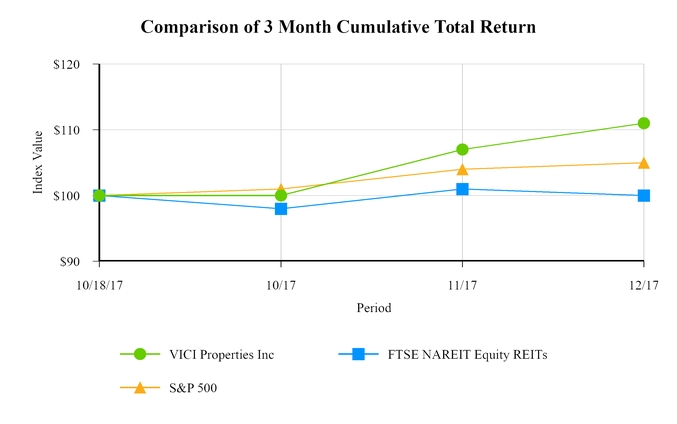
| Company / Index | 10/18/2017 | 10/17 | 11/17 | 12/17 | ||||||||||||
| VICI Properties Inc | $ | 100.0 | $ | 100.0 | $ | 107.0 | $ | 111.0 | ||||||||
| FTSE NAREIT Equity REITs | $ | 100.0 | $ | 98.0 | $ | 101.0 | $ | 100.0 | ||||||||
| S&P 500 | $ | 100.0 | $ | 101.0 | $ | 104.0 | $ | 105.0 |
Item 6. Selected Financial Data
The following selected financial data is derived from our Financial Statements. It should be read in conjunction with the Financial Statements and Item 7, “Management’s Discussion and Analysis of Financial Condition and Results of Operations,” in this Annual Report on Form 10-K.
| (In thousands, except share data) | Period from October 6, 2017 to December 31, 2017* | |||
| Statement of Operations: | ||||
| Net revenues | $ | 187,609 | ||
| Total operating expenses | 43,413 | |||
| Income from operations | 144,196 | |||
| Interest expense | (63,354 | ) | ||
| Loss from extinguishment of debt | (38,488 | ) | ||
| Income before income taxes | 42,636 | |||
| Provision for income taxes | 1,901 | |||
| Net income | 44,537 | |||
| Net income attributable to common stockholders | 42,662 | |||
| Per share data: | ||||
| Basic earnings per common share | $ | 0.19 | ||
| Diluted earnings per common share | $ | 0.19 | ||
| Weighted shares outstanding—Basic | 227,828,844 | |||
| Weighted shares outstanding—Diluted | 227,985,455 | |||
| Other Data: | ||||
| Net cash provided by operating activities | $ | 129,440 | ||
| Net cash used in investing activities | (1,136,251 | ) | ||
| Net cash provided by financing activities | 1,148,446 | |||
| Financial Position Data: | As of December 31, 2017 | |||
| Cash and cash equivalents | $ | 183,646 | ||
| Restricted cash | 13,760 | |||
| Total assets | 9,739,712 | |||
| Debt | 4,785,756 | |||
| Non-controlling interests | 84,875 | |||
| Shareholders’ equity | 4,776,364 |
*Represents the period from October 6, 2017, the date of the Company’s Formation, through December 31, 2017
Item 7. Management’s Discussion and Analysis of Financial Condition and Results of Operations
You should read the following discussion and analysis of our financial condition and results of operations in conjunction with the audited consolidated Financial Statements and notes thereto of VICI Properties Inc., the combined Financial Statements and notes thereto of Caesars Entertainment Outdoor and other financial information included elsewhere in this Annual Report on Form 10-K. Some of the information contained in this discussion and analysis or set forth elsewhere in this Annual Report on Form 10-K, including information with respect to our business and growth strategies, statements regarding the industry outlook and our expectations regarding the future performance of our business contained herein are forward-looking statements. See “Cautionary Note Regarding Forward-Looking Statements.” You should also review the “Risk Factors” section of this Annual Report on Form 10-K for a discussion of important factors that could cause actual results to differ materially from the results described in or implied by such forward-looking statements.
BACKGROUND AND FORMATION
VICI is a Maryland corporation that was created to hold certain real estate assets owned by Caesars Entertainment Operating Company (“CEOC”), upon CEOC’s emergence from bankruptcy. Pursuant to CEOC’s Plan of Reorganization, on October 6, 2017 (the “Formation Date”), the historical business of CEOC was separated by means of a spin-off transaction whereby the real property assets (“Formation Properties”) of CEOC and certain of its subsidiaries, including four golf course businesses, were transferred through a series of transactions to VICI. Following the Formation Date, VICI is a stand-alone entity that was initially owned by certain former creditors of CEOC. VICI is primarily engaged in the business of owning and acquiring gaming, hospitality and entertainment destinations. VICI leases the Formation Properties and Harrah’s Las Vegas, which was acquired on December 22, 2017, to subsidiaries of Caesars. VICI conducts its real property business through an operating partnership and its golf course business through a taxable REIT subsidiary (“TRS”), VICI Golf LLC.
The financial information included in this Annual Report on Form 10-K are the consolidated results of VICI (including the real property business and the golf course business) from October 6, 2017 through December 31, 2017. Other financial information included in Part IV, Item 15 of this Annual Report on Form 10-K are the historical combined Financial Statements of Caesars Entertainment Outdoor, the golf course business owned by CEOC until Formation Date. The financial information included for Caesars Entertainment Outdoor includes the period January 1, 2017 through October 5, 2017.
We intend to elect on our U.S. federal income tax return for our taxable year ended December 31, 2017 to be treated as a REIT and we have elected for VICI Golf LLC to be treated as a “taxable REIT subsidiary.”
SUMMARY OF 2017 EVENTS
Formation
In connection with our formation, on October 6, 2017, we issued 177,160,494 shares of common stock and 12,000,000 shares of Series A preferred stock with an aggregate liquidation preference of $300.0 million ($25 per share) to CEOC and certain of its subsidiaries in exchange for the Formation Properties, Caesars Entertainment Outdoor and approximately $56 million of cash and other assets, which shares were transferred by CEOC to its creditors as part of the Plan of Reorganization. These assets had an aggregate fair value of approximately $8.4 billion.
On October 6, 2017, in connection with our formation, we entered into the Formation Lease Agreements, pursuant to which we lease the Formation Properties to Caesars. Additionally, on October 6, 2017, we entered into the Golf Course Use Agreement.
In addition, on October 6, 2017, the Company entered into $4,917.0 million aggregate principal amount of debt consisting of senior secured credit facilities of $1,638.4 million (“Prior Term Loan”), first lien notes of $311.7 million (“Prior First Lien Notes”), second lien notes of $766.9 million (“Second Lien Notes”), $1,550.0 million in asset-level real estate mortgage financing of CPLV (“CPLV CMBS Debt”) and $650.0 million in CPLV mezzanine debt.
Mandatory Conversions
On November 6, 2017, all of the Series A preferred stock automatically converted into 51,433,692 shares of the Company’s common stock (the “Mandatory Preferred Conversion”). No additional consideration was payable in connection with the Mandatory Preferred Conversion.
On November 6, 2017, the junior tranche of CPLV mezzanine debt of $250.0 million issued to institutional accredited investors at formation, automatically converted into an aggregate of 17,630,700 shares of our common stock.
Acquisition of Harrah’s Las Vegas and Sale of Eastside Property
Purchase of Harrah’s Las Vegas Real Estate
On December 22, 2017, we acquired all of the land and real property improvements associated with Harrah’s Las Vegas Hotel & Casino (“HLV”) from a subsidiary of Caesars, for a purchase price of approximately $1,136.2 million. On the closing date, we entered into the HLV Lease Agreement with a subsidiary of Caesars, as tenant, pursuant to which we lease back HLV to Caesars, and Caesars Resorts Collection (“CRC”) guarantees the tenant’s payment obligations under the lease.
Sale of Eastside Property
On December 22, 2017, we sold approximately 18.4 acres of certain parcels located in Las Vegas, Nevada, east of HLV, to a subsidiary of Caesars, for a sales price of approximately $73.6 million.
At the closing, we entered into a Put-Call Agreement with certain subsidiaries of Caesars, which provides Caesars and us with certain rights and obligations in connection with (i) the sale by subsidiaries of Caesars to us and simultaneous leaseback by us to subsidiaries of Caesars of the Eastside Convention Center Property; and (ii) in the event the transactions described in item (i) are triggered by Caesars and such transactions do not close for reasons other than a default by Caesars or failure to obtain any required regulatory approvals (among other things), and Caesars so elects, the sale by us to Caesars of HLV, all on and subject to the terms and conditions set forth in the Put-Call Agreement. After the closing, subsidiaries of Caesars are the owners of certain parcels of real property located adjacent to HLV (including the Eastside Property) (collectively, the “Designated Property”), all or a portion of which Designated Property may in the future be improved by a convention center (in such case, the “Eastside Convention Center”).
Due to the Put-Call Agreement on the land parcels, it was determined that the transaction does not meet the requirements of a completed sale for accounting purposes. As a result, we reclassified $73.6 million from Real estate investments accounted for using the operating method to Land. Additionally, the Company recorded a $73.6 million Deferred financing liability in its Balance Sheet.
Amended and Restated Right of First Refusal Agreement
On December 22, 2017, VICI and Caesars entered into an Amended and Restated Right of First Refusal Agreement pursuant to which we also have a right of first refusal on any sale-leaseback by Caesars of the gaming facilities of Centaur Holdings, LLC, which are proposed to be acquired by Caesars, and certain income-producing improvements if built by Caesars in lieu of a large-scale convention center on the Eastside Property, subject to certain exclusions.
$2.6 Billion Senior Secured VICI PropCo Credit Facility and Debt Refinancing
On December 22, 2017, we entered into a new $2.6 billion senior secured VICI PropCo Credit Facility, comprised of a $2.2 billion senior secured term loan facility (the “Term B Loan Facility”) and a $400.0 million senior secured revolving credit facility (the “Revolving Credit Facility”). The proceeds of the Term B Loan Facility, together with $300.0 million of borrowings under the Revolving Credit Facility, provided a portion of the proceeds used to purchase the Harrah’s Las Vegas property, to repay in full the Prior Term Loans, to repurchase in full the then outstanding Prior CPLV Mezzanine Debt and to discharge in full our obligations under the Prior First Lien Notes.
Private Equity Placement
On December 22, 2017, we sold, contemporaneously with the consummation of the acquisition of the Harrah’s Las Vegas property, 54,054,052 shares of our common stock at a price of $18.50 per share in a private placement transaction, for net proceeds of approximately $963.8 million. The net proceeds from the transaction were used to partially fund the purchase price for the Harrah’s Las Vegas property and for working capital and general corporate purposes.
KEY TRENDS THAT MAY AFFECT OUR BUSINESS
Subsidiaries of Caesars are the lessees of all of our properties pursuant to the Lease Agreements, and Caesars or CRC guarantees the obligations of the tenants under the Lease Agreements. The Lease Agreements account for substantially all of our revenues. Additionally, we expect to experience organic growth in rental revenue through annual rent escalators in our Lease Agreements. Accordingly, we are dependent on Caesars, the gaming industry and the health of the economies in the areas where our properties are located for the foreseeable future, and an event that has a material adverse effect on Caesars’ business, financial condition, liquidity, results of operations or prospects would have a material adverse effect on our business, financial condition, liquidity, results of operations and prospects. See “Risk Factors—Risks Related to Our Business and Operations.”
Additionally, we expect to grow our portfolio through acquisitions by pursuing opportunities to execute sale leaseback transactions with Caesars, pursuant to: (i) the Call Right Agreements, relating to three properties; (ii) rights of first refusal relating to certain domestic gaming facilities proposed to be acquired or developed by Caesars located outside the Gaming Enterprise District of Clark County, Nevada and the properties that Caesars recently agreed to acquire from Centaur Holdings, LLC; and (iii) the Put-Call Agreement, which includes rights relating to the Eastside Convention Center Property in Las Vegas. Additionally, we will actively seek to grow our portfolio through acquisitions of experiential real estate in dynamic markets spanning hospitality, entertainment, leisure and gaming properties. Finally, we believe the approximately 34 acres (after giving effect to the sale of approximately 18.4 acres to Caesars in December 2017) of undeveloped land adjacent to the Las Vegas Strip that we own will provide attractive opportunities for potential future expansion and development. In pursuing external growth initiatives, we will generally seek to acquire properties that can generate stable rental revenue through long-term, triple-net leases with tenants with
established operating histories, and we will consider various factors when evaluating acquisitions, including the ability to diversify our tenant base, by potentially leasing properties to parties unaffiliated with Caesars, and increasing our geographic diversification.
Our operating and financial performance in the future will be significantly influenced by the success of our acquisition strategy, and the timing and the availability and terms of financing of any acquisitions that we may complete. We can provide no assurance that we will exercise any of our contractual rights to purchase one or more properties from Caesars or otherwise be successful in acquiring any properties. Additionally, our ability to successfully implement our acquisition strategy will depend upon the availability and terms of financing, including debt and equity capital. Further, the pricing of any acquisitions we may consummate and the terms of any leases that we may enter into will significantly impact our future results. Competition to execute sale leaseback transactions with attractive properties and desirable tenants is intense, and we can provide no assurance that any future acquisitions or leases will be on terms as favorable to us as those relating to recent transactions. Should we exercise an option to purchase a property under a Call Right Agreement, the purchase price will be equal to ten times the property’s annual rent, which, in turn, will equal approximately 60% of the trailing property EBITDAR at the time of exercise. Accordingly, the purchase price and rent for any property we may acquire under a Call Right Agreement and lease to Caesars will depend upon the property’s EBITDAR at the time of exercise. We anticipate that we would seek to finance these acquisitions with a majority of equity, although no assurance can be given that we would be able to issue equity in such amounts on favorable terms, or at all, or that we would not determine to incur more debt on a relative basis at the relevant time due market conditions or otherwise. In addition to rent, our tenants are required to pay the following: (1) all facility maintenance; (2) all insurance required in connection with the leased properties and the business conducted on the leased properties; (3) taxes levied on or with respect to the leased properties (other than taxes on our income); and (4) all utilities and other services necessary or appropriate for the leased properties and the business conducted on the leased properties. Accordingly, due to the “triple-net” structure of our leases, we do not expect to incur significant property-level expenses.
DISCUSSION OF OPERATING RESULTS
Revenue
For the period from October 6, 2017, the date of our formation, to December 31, 2017 our revenue was $187.5 million and was comprised of $181.2 million from our real property business and $6.4 million from our golf course business.
Real Property Business Revenue
Real property business revenue of $181.2 million was generated from rent and reimbursements of property taxes, pursuant to the Formation Lease Agreements, which became effective on October 6, 2017, and the HLV Lease, which became effective on December 22, 2017, and was comprised of $150.1 million of earned income from direct financing leases, $11.5 million of rental income from operating leases and $19.6 million of property taxes paid by our tenants on the leased properties.
For the period from October 6, 2017 to December 31, 2017, cash received under our Lease Agreements was $213.7 million, including $60.4 million received for January 2018 rent.
Golf Course Business Revenue
For the period from October 6, 2017 to December 31, 2017, Golf Course related revenue was $6.4 million. Revenue for the golf courses included $2.4 million earned pursuant to the Caesars membership fee; $0.7 million from the Caesars use fee; $0.3 million from Caesars minimum rounds fees; $2.1 million from other golf activities; $0.4 million from food and beverage; and $0.5 million from merchandise sales and other.
For the period from January 1, 2017 to October 5, 2017, Golf Course related revenue was $14.1 million and were comprised of golf revenues of $11.4 million, food and beverage revenues of $1.3 million and retail and other revenues of $1.4 million. Golf Course related revenue was $18.8 million and $18.1 million for the years ended December 31, 2016 and 2015, respectively. Revenues for the year ended December 31, 2016 were comprised of golf revenues of $14.6 million, food and beverage revenues of $2.1 million and other revenues of $2.1 million. Revenues for the year ended December 2015 were comprised of golf revenues of $14.1 million, food and beverage revenues of $2.1 million and other revenues of $1.9 million.
Operating Expenses
General and Administrative Expenses
For the period from October 6, 2017 to December 31, 2017, general and administrative expenses were $9.9 million, comprised primarily of $5.0 million of compensation costs; $3.4 million of legal and professional fees and $1.1 million of franchise and other taxes.
Transaction and Acquisition Costs
For the period from October 6, 2017 to December 31, 2017, transaction and acquisition costs totaled $9.0 million and were comprised of expenses related to the acquisition of Harrah’s Las Vegas and the sale of the Eastside Property.
Loss on Extinguishment of Debt
We recognized a loss on extinguishment of debt of $38.5 million during the period from October 6, 2017 to December 31, 2017, resulting from the buy down of $400.0 million aggregate principal amount of Prior CPLV Mezzanine Debt.
Property Taxes
Property taxes paid or reimbursed by our tenants were $19.6 million for the period from October 6, 2017 to December 31, 2017.
Golf-related Expenses
Golf-related expenses totaled $4.1 million for the period from October 6, 2017 to December 31, 2017 and were primarily comprised of property-related costs consisting of land rent, grounds maintenance, taxes, insurance and utilities directly related to the golf course of $1.7 million; compensation costs of $1.1 million; and food, beverage and retail-related cost of goods sold of $0.4 million.
In addition, $0.8 million of depreciation expense was incurred by the golf business during the period from October 6, 2017 to December 31, 2017.
Golf-related expenses totaled $14.1 million for the period from January 1, 2017 to October 5, 2017. Golf-related expenses totaled $18.8 million and $18.1 million for the years ended December 31, 2016 and 2015, respectively.
Interest Expense
During the period from October 6, 2017 to December 31, 2017, we incurred $63.4 million of interest expense from our borrowing obligations based upon a weighted average interest rate of 5.19%. We paid cash interest costs of $36.8 million during the 2017 period. See “Liquidity and Capital Resources” below for more information.
Net Income, Funds From Operations (“FFO”), Available Funds From Operations (“AFFO”) and Adjusted EBITDA
Net income, FFO, AFFO and Adjusted EBITDA were $42.7 million, $42.7 million, $84.1 million and $145.1 million for the period from October 6, 2017 to December 31, 2017. See “Reconciliation of Non-GAAP Measures” below for a reconciliation of net income to FFO, AFFO and Adjusted EBITDA.
RECONCILIATION OF NON-GAAP MEASURES
We present Funds From Operations (“FFO”), Adjusted Funds From Operations (“AFFO”) and Adjusted EBITDA, which are not required by, or presented in accordance with, generally accepted accounting principles in the United States (“GAAP”). These are non-GAAP financial measures and should not be construed as alternatives to net income or as an indicator of operating performance (as determined in accordance with GAAP). We believe FFO, AFFO and Adjusted EBITDA provide a meaningful perspective of the underlying operating performance of our business.
FFO is a non-GAAP financial measure that is considered a supplemental measure for the real estate industry and a supplement to GAAP measures. Consistent with the definition used by The National Association of Real Estate Investment Trusts (“NAREIT”), we define FFO as net income (or loss) (computed in accordance with GAAP) excluding gains (or losses) from sales of property plus real estate depreciation. AFFO is a non-GAAP measure that is used as a supplemental operating measure specifically for comparing year over year ability to fund dividend distribution from operating activities. AFFO is used by us as a basis to address our ability to fund our dividend payments. We calculate AFFO by adding or subtracting from FFO direct financing lease adjustments, transaction costs incurred in connection with the acquisition of real estate investments, non-cash stock-based compensation expense, amortization of debt issuance costs and original issue discount, non-cash interest expense, non-real estate depreciation (which is comprised of the depreciation related to our golf course operations), impairment charges on non-real estate assets, amortization of capitalized leasing costs and debt extinguishment gains and losses. We define Adjusted EBITDA as net income as adjusted for gains (or losses) from sales of property, real estate depreciation, direct financing lease adjustments, transaction costs incurred in connection with the acquisition of real estate investments, non-cash stock-based compensation expense, amortization of debt issuance costs and original issue discount, other non-cash interest expense, non-real estate depreciation (which is comprised of the depreciation related to our golf course operations), impairment charges on non-real estate assets, amortization of capitalized leasing costs, debt extinguishment gains and losses, provision for income taxes and interest expense, net.
Because not all companies calculate FFO, AFFO and Adjusted EBITDA in the same way we do and other companies may not perform such calculations, those measures as used by other companies may not be consistent with the way we calculate such measures and should not be considered as alternative measures of operating income or net income. Our presentation of these measures does not replace the presentation of our financial results in accordance with GAAP.
Reconciliation of FFO, AFFO and Adjusted EBITDA
| (In thousands) | For the period October 6, 2017 to December 31, 2017 | |||
| Net income attributable to common shareholders | $ | 42,662 | ||
| Real estate depreciation | — | |||
| FFO | 42,662 | |||
| Direct financing lease adjustments attributable to common shareholders | (8,362 | ) | ||
| Loss on extinguishment of debt | 38,488 | |||
| Acquisition and transaction costs | 9,039 | |||
| Non-cash stock compensation | 1,385 | |||
| Amortization of debt issuance costs and original issue discount | 156 | |||
| Other depreciation | 751 | |||
| AFFO | 84,119 | |||
| Interest expense, net | 62,916 | |||
| Income tax benefit | (1,901 | ) | ||
| Adjusted EBITDA | $ | 145,134 |
LIQUIDITY AND CAPITAL RESOURCES
General
VICI’s intends to use funds for payment of operating expenses, cash distributions, principal and interest on our outstanding indebtedness and other investments. We expect to meet our liquidity and capital resource requirements primarily through currently available cash and cash equivalents, restricted cash, cash received under our Lease Agreements, borrowings from banks, including undrawn capacity under our Revolving Credit Facility, and proceeds from the issuance of debt and equity securities. As of December 31, 2017, our cash balance was $183.9 million, our restricted cash balance was $13.8 million and we had $300.0 million outstanding and $100.0 million was available for future borrowings under our Revolving Credit Facility.
Cash Flow Analysis
The table below summarizes our cash flows for the period from October 6, 2017 to December 31, 2017:
| (In thousands) | Period from October 6 to December 31, 2017 | ||||
| Cash, cash equivalents and restricted cash | |||||
| Provided by operating activities | $ | 129,440 | |||
| Used in investing activities | (1,136,251 | ) | |||
| Provided by financing activities | 1,148,446 | ||||
| Net increase in cash, cash equivalents and restricted cash | 141,635 | ||||
| Balance at October 6, 2017 | 55,771 | ||||
| Balance at December 31, 2017 | $ | 197,406 |
Cash Flows from Operating Activities
Net cash provided by operating activities totaled $129.4 million for the period from October 6, 2017 to December 31, 2017 with the primary source being from cash rent collected by our leasing operations of $213.7 million and the primary use being cash paid for interest on our debt obligations of $36.8 million.
Cash Flows from Investing Activities
Net cash used in investing activities totaled $1,136.3 million for the period from October 6, 2017 to December 31, 2017. The acquisition of Harrah’s Las Vegas for $1,136.2 million was the primary use of cash from investing activities. The sale of approximately 18.4 acres of undeveloped land located behind the LINQ Hotel & Casino and Harrah’s Las Vegas to Caesars for $73.6 million was the primary source of cash from investing activities.
Cash Flows from Financing Activities
Net cash provided by financing activities totaled $1,148.4 million million for the period from October 6, 2017 to December 31, 2017.
The primary sources of cash from financing activities include:
| • | Proceeds from the issuance of $2,200.0 million of Term Loan B Facility; |
| • | Proceeds from the $300.0 million draw from our Revolving Credit Facility; |
| • | Proceeds from the private placement issuance of $1,000.0 million of our common stock; and |
The primary uses of cash from financing activities include:
| • | Repayment of our $1,638.4 million senior secured first lien Prior Term Loan; |
| • | Repayment of our $311.7 million first-priority senior secured Prior First Lien Notes; |
| • | The purchase by VICI PropCo of the entirety of the outstanding CPLV mezzanine debt in the aggregate principal amount of $400.0 million; |
| • | Costs of $36.2 million related to our common stock private placement and premium and fees related to the purchase of the mezzanine debt of $38.4 million; and |
| • | Debt issuance costs of $31.5 million related to our Term Loan B Facility and Revolving Credit Facility. |
Debt
On the Formation Date, VICI issued $1,638.4 million of Prior Term Loans; $311.7 million aggregate principal amount of Prior First Lien Notes; $766.9 million aggregate principal amount of Second Lien Notes; $1,550.0 million of CPLV CMBS Debt and $650.0 million of CPLV mezzanine debt for a total aggregate face value of debt of $4,917.0 million. The weighted average interest rate on the outstanding debt at formation was 5.36% and had a first year debt service requirements of $272.0 million.
As a result of a mandatory conversion of the $250.0 million junior tranche of the CPLV mezzanine debt in November 2017 and certain refinancing transactions in December 2017, VICI has $4,816.9 million of aggregate face value of debt outstanding at December 31, 2017. Included in our year-end debt balances are: a new $2,200.0 million Term B Loan Facility; $300.0 million drawn on a new $400.0 million senior secured Revolving Credit Facility; $1,550.0 million of CPLV CMBS Debt; and $766.9 million of our Second Lien Notes. The weighted average interest rate on all outstanding debt at December 31, 2017 was 4.64% and has a 2018 debt service requirements of $249.3 million. In addition, we were in compliance with all debt-related covenants at December 31, 2017.
Impact of Initial Public Offering
On February 5, 2018, the Company completed an initial public offering of 69,575,000 shares of common stock (which included 9,075,000 shares of common stock related to the overallotment option exercised by the underwriters in full) at an offering price of $20.00 per share for gross proceeds of $1,391.5 million, resulting in net proceeds of $1,307.0 million after commissions and expenses. The Company utilized a portion of the net proceeds from the stock offering to: (a) pay down $300.0 million of indebtedness outstanding under the Revolving Credit Facility; (b) redeem $268.4 million in aggregate principal amount of the Second Lien Notes at a redemption price of 108% plus accrued and unpaid interest to the date of the redemption; and (c) repay $100.0 million of the Term Loan B Facility.
The impact of these subsequent payments of debt decreased our weighted average interest rate on outstanding debt from 4.64% at December 31, 2017 to 4.39% at February 28, 2018 and decreased our 2018 debt service requirements to $210.8 million.
VICI PropCo Credit Facility
On December 22, 2017, VICI PropCo entered into the VICI PropCo Credit Facility, comprised of the $2,200.0 million senior secured Term Loan B Facility and a $400.0 million senior secured Revolving Credit Facility. The Revolving Credit Facility and Term Loan B Facility initially bear interest at LIBOR plus 2.25%, with an adjustment to LIBOR plus 2.00% upon an Initial Public Offering with proceeds greater than $500.0 million. The Revolving Credit Facility will mature on December 22, 2022 and the Term Loan B Facility will mature on December 22, 2024 or the date that is three months prior to the maturity date of the Second Lien Notes, whichever is earlier (or if the maturity is extended pursuant to the terms of the agreement, such extended maturity date as determined pursuant thereto). As of December 31, 2017, $300.0 million was drawn on the Revolving Credit Facility. If more than 30% of the Revolving Credit Facility is utilized at any quarter-end, VICI PropCo is required to maintain a maximum total net debt to adjusted total assets ratio.
The VICI PropCo Credit Facility contains customary covenants that, among other things, limit the ability of VICI PropCo and its restricted subsidiaries to: (i) incur additional indebtedness; (ii) merge with a third party or engage in other fundamental changes; (iii) make restricted payments; (iv) enter into, create, incur or assume any liens; (v) make certain sales and other dispositions of assets; (vi) enter into certain transactions with affiliates; (vii) make certain payments on certain other indebtedness; (viii) make certain investments; and (ix) incur restrictions on the ability of restricted subsidiaries to make certain distributions, loans or transfers of assets to the VICI PropCo or any restricted-subsidiary. These covenants are subject to a number of important exceptions and qualifications, including, with respect to the restricted payments covenant, the ability to make unlimited restricted payments to maintain the REIT status of VICI.
CPLV CMBS Debt
On the Formation Date, CPLV Property Owner LLC, the special purpose entity that is the fee owner of CPLV (subject to the CPLV Lease Agreement) and that is indirectly owned by VICI PropCo (the “CPLV Mortgage Borrower”) borrowed the CPLV CMBS Debt, which matures in October 2022 and consists of asset-level real estate mortgage financing from various third-party financial institutions.
The CPLV CMBS Debt has an interest rate of 4.36% per annum and is secured by, among other things, all of the assets of CPLV Mortgage Borrower, including, but not limited to, CPLV Mortgage Borrower’s (1) fee interest (except as provided in (2)) in and to CPLV, (2) leasehold interest with respect to Octavius Tower, and (3) interest in the CPLV Lease Agreement and all related agreements. The CPLV CMBS Debt is a first priority lien, subject only to permitted encumbrances (which are set forth in the loan documentation), and an obligation to repay a specified sum with interest. The CPLV CMBS Debt was evidenced by certain promissory notes and secured by a deed of trust that created a mortgage lien on the fee and/or leasehold interest of the CPLV Mortgage Borrower.
The loan documents governing the CPLV CMBS Debt contain covenants limiting CPLV Mortgage Borrower’s ability to, among other things: (i) incur additional debt; (ii) enter into certain transactions with its affiliates; (iii) consolidate, merge, sell or otherwise dispose of its assets; and (iv) allow transfers of its direct or indirect equity interests.
Second Lien Notes
On the Formation Date, VICI Properties 1 LLC and VICI FC Inc. (together, “the co-issuers”), issued $766.9 million in aggregate principal amount of Second Lien Notes to certain creditors pursuant to the terms of the Plan of Reorganization. The Second Lien Notes are due in 2023. The notes co-issuers pay interest semi-annually on the Second Lien Notes at a rate per annum of 8.0%. The Second Lien Notes are senior secured obligations of the notes co-issuers and rank equally and ratably in right of payment with all existing and future senior obligations and senior to all future subordinated indebtedness.
The Second Lien Notes are guaranteed on a senior secured basis by each of the VICI PropCo existing and subsequently acquired direct and indirect wholly owned material domestic restricted subsidiaries, and secured by a second priority lien and security interest on substantially all of VICI PropCo and each such restricted subsidiaries’ material assets, including pledges of equity interests in their respective restricted subsidiaries and mortgages on their respective real estate (which mortgages are to be entered into within a certain period of time following the issuance of the Second Lien Notes), subject in each case to customary exceptions. Such guarantees are required to be provided by the same subsidiary guarantors that guarantee the indebtedness under the VICI PropCo Credit Facility or Prior First Lien Notes and such liens and security interests are required to be in the same collateral that
secures the indebtedness under the VICI PropCo Credit Facility or Prior First Lien Notes. Neither VICI REIT or our Operating Partnership or certain subsidiaries of VICI PropCo, including CPLV and its subsidiaries, are subject to the covenants of the indenture governing the Second Lien Notes or are guarantors of the Second Lien Notes.
The indenture governing the Second Lien Notes contains covenants that limit the notes co-issuers’ and their restricted subsidiaries’ ability to, among other things: (i) incur additional debt; (ii) pay dividends on or make other distributions in respect of their capital stock or make other restricted payments; (iii) make certain investments; (iv) sell certain assets; (v) create or permit to exist dividend and/or payment restrictions affecting their restricted subsidiaries; (vi) create liens on certain assets to secure debt; (vii) consolidate, merge, sell or otherwise dispose of all or substantially all of their assets; (viii) enter into certain transactions with their affiliates; and (ix) designate their subsidiaries as unrestricted subsidiaries. The Second Lien Notes are redeemable at VICI PropCo’s option, in whole or in part, at any time, from time to time, at a price equal to 100% of the principal amount of the Second Lien Notes so redeemed and, (1) prior to the third anniversary of the issuance of such Notes, a “make-whole” premium and (2) thereafter, a prepayment premium equal to (y) 4% of the amount redeemed on and after the third anniversary of such issuance, and (z) 0% on and after the fourth anniversary of such issuance plus accrued and unpaid interest to the redemption date. In addition, prior to the third anniversary of such issuance, up to 35% of the original aggregate principal amount of the Second Lien Notes may be redeemed at VICI PropCo’s option with the net cash proceeds of certain issuances of common or preferred equity by VICI PropCo, VICI REIT or any parent entity of VICI PropCo, at a price equal to 108% of the principal amount of the Second Lien Notes redeemed plus accrued and unpaid interest to the redemption date; provided, however, that at least 50% of the original aggregate principal amount of the Second Lien Notes must remain outstanding after any such redemption.
Covenants
At December 31, 2017, the Company was in compliance with all required debt-related financial covenants.
Capital Expenditures
As described in our leases, capital expenditures for properties under the Formation Lease Agreements and the HLV Lease are the responsibility of the tenants. Minimum capital expenditure spending requirements of the tenants are described in “Overview of our Lease Agreements” of Item 1 - Business.
Inflation
Our leases provide for certain increases in rent as a result of a fixed annual rent escalator or changes in the Consumer Price Index as further described in “Overview of our Lease Agreements” of Item 1 - Business. Inflation may cause the rent provisions to result in rent increases over time. However, we could be negatively affected if increases in rent are not sufficient to cover increases in our operating expenses due to inflation. In addition, inflation and increased cost may have an adverse impact on our tenants if increases in their operating expenses exceed increases in revenue due to inflation.
Off-Balance Sheet Arrangements
As of December 31, 2017 and as of the date this report was filed, we do not have any off-balance sheet arrangements.
CRITICAL ACCOUNTING POLICIES AND ESTIMATES
Our Financial Statements are prepared in accordance with GAAP. We have identified certain accounting policies that we believe are the most critical to the presentation of our financial information over a period of time. These accounting policies may require our management to take decisions on subjective and/or complex matters relating to reported amounts of assets, liabilities, revenue, costs, expenses and related disclosures. These would further lead us to estimate the effect of matters that may inherently be uncertain.
Estimates are required in order to prepare the Financial Statements in conformity with U.S. GAAP.
Significant estimates, judgments, and assumptions are required in a number of areas, including, but not limited to, the application of fresh start reporting, determining the useful lives of real estate properties, and evaluating the impairment of long-lived assets, and allocation of costs and deferred income taxes. The judgment on such estimates and underlying assumptions is based on our historical experience that we believe is reasonable under the circumstances. These form the basis of our judgment on matters that may not be apparent from other available sources of information. In many instances changes in the accounting estimates are likely to occur from period to period. Actual results may differ from the estimates. We believe the current assumptions and other considerations used to estimate amounts reflected in our Financial Statements are appropriate. However, if actual experience differs
from the assumptions and other considerations used in estimating amounts reflected in our Financial Statements, the resulting changes could have a material adverse effect on our consolidated results of operations and, in certain situations, could have a material adverse effect on our financial condition.
Revenue Recognition
Leases
As a REIT, the majority of our revenues are derived from rent received from our tenants under long-term triple-net leases. The accounting guidance under Financial Accounting Standards Board (“FASB”) Accounting Standards Codification (“ASC”) 840, “Leases” (“ASC 840”) is complex and requires the use of judgments and assumptions by management to determine the proper accounting treatment of a lease. We perform a lease classification upon lease inception, to determine if we will account for the lease as a capital or operating lease. Under ASC 840, for leases of both building and land, if the fair value of the land is 25 percent or more of the total fair value of the leased property at lease inception we consider the land and building separately for lease classification. In these cases, if the building element of the lease meets the criteria to be classified as a capital lease, then we account for the building element as a capital lease and the land separately as an operating lease. If the building element does not meet the criteria to be classified as a capital lease, then we account for the building and land elements as a single operating lease. To determine
if the building portion of a lease triggers capital lease treatment we conduct the four lease tests in ASC 840 outlined below. If a lease meets any of the four criteria below, it is accounted for as a capital lease.
(1) Transfer of ownership. The lease transfers ownership of the property to the lessee by the end of the lease term. This criterion is met in situations in which the lease agreement provides for the transfer of title at or shortly after the end of the lease term in exchange for the payment of a nominal fee, for example, the minimum required by statutory regulation to transfer title.
(2) Bargain purchase option. The lease contains a bargain purchase option, which is a provision allowing the lessee, at its option, to purchase the leased property for a price which is sufficiently lower than the expected fair value of the property at the date the option becomes exercisable. In addition, the exercise of the option must be reasonably assured at lease inception.
(3) Lease term. The lease term is equal to 75% or more of the estimated economic life of the leased property. However, if the beginning of the lease term falls within the last 25 percent of the total estimated economic life of the leased property, including earlier years of use, this criterion shall not be used for purposes of classifying the lease. This test is conducted on a property by property basis.
(4) Minimum lease payments. The present value of the minimum lease payments at the beginning of the lease term, excluding that portion of the payments representing executory costs such as insurance, maintenance, and taxes to be paid by the lessor, including any profit thereon, equals or exceeds 90% of the fair value of the leased property to the lessor at lease inception less any related investment tax credit retained by the lessor and expected to be realized by the lessor. If the beginning of the lease term falls within the last 25% of the total estimated economic life of the leased property, including earlier years of use, this criterion shall not be used for purposes of classifying the lease.
The tests outlined above, as well as the resulting calculations, require subjective judgments, such as determining, at lease inception, the fair value of the assets, the residual value of the assets at the end of the lease term, the likelihood a tenant will exercise all renewal options (in order to determine the lease term), the estimated remaining economic life of the leased assets, the incremental borrowing rate of the lessee and the interest rate implicit in the lease. A change in estimate or judgment can result in a materially different financial statement presentation.
The revenue recognition model is different under capital leases and operating leases.
Under the operating lease model, as the lessor, at lease inception the land is recorded as Real Estate Investments accounted for using the operating method in our Balance Sheet and we record rental income from operating leases on a straight-line basis over the lease term. The amount of annual minimum lease payments attributable to the land element after deducting executory costs, including any profit thereon, is determined by applying our incremental borrowing rate to the value of the land. We record this lease income as Rental Income from Operating Leases in our Statement of Operations.
Under the direct financing lease model, as lessor, at lease inception we record the lease receivable as Investment in direct financing leases, net in our Balance Sheet. Under the direct financing lease method, we recognize fixed amounts due on an effective interest basis at a constant rate of return over the lease term. As a result, the cash payments accounted for under direct financing leases
will not equal the earned income from direct financing leases as a portion of the cash rent we receive is recorded as Earned income from direct financing leases in our Statement of Operations and a portion is recorded as a reduction to Investment in direct financing leases, net.
Investment in direct financing leases, net and Real Estate Investments
For real estate investments accounted for using the operating method, we continually monitor events and circumstances that could indicate that the carrying amount of our real estate investments may not be recoverable or realized. When events or changes in circumstances indicate that a potential impairment has occurred or that the carrying value of a real estate investment may not be recoverable, we use an estimate of the undiscounted value of expected future operating cash flows to determine whether the real estate investment is impaired. If the undiscounted cash flows plus net proceeds expected from the disposition of the asset is less than the carrying value of the assets, we recognize an impairment charge equivalent to the amount required to reduce the carrying
value of the asset to its estimated fair value. We group our real estate investments together by property, the lowest level for which identifiable cash flows are available, in evaluating impairment. In assessing the recoverability of the carrying value, we must make assumptions regarding future cash flows and other factors. Factors considered in performing this assessment include current operating results, market and other applicable trends and residual values, as well as the effect of obsolescence, demand, competition and other factors. If these estimates or the related assumptions change in the future, we may be required to record an impairment loss.
Our investment in direct financing leases, net, is evaluated for impairment as necessary, if indicators of impairment are present, to determine if there has been an-other-than-temporary decline in the residual value of the property or a change in the lessee’s credit worthiness.
Income Taxes—REIT Qualification
We intend to elect to be taxed and qualify as a REIT for U.S. Federal income tax purposes commencing with our taxable year ended December 31, 2017, and we intend to continue to be organized and to operate in a manner that will permit us to qualify as a REIT beyond that taxable year end. To qualify as a REIT, we must meet certain organizational and operational requirements, including a requirement to distribute at least 90% of our annual REIT taxable income to stockholders (with certain adjustments), determined without regard to the dividends paid deduction and excluding any net capital gains. As a REIT, we generally will not be subject to Federal income tax on income that we pay as distributions to our stockholders. If we fail to qualify as a REIT in any taxable year, we will be subject to U.S. Federal income tax on our taxable income at regular corporate income tax rates, and distributions paid to our stockholders would not be deductible by us in computing taxable income. Additionally, any resulting corporate liability created if we fail to qualify as a REIT could be substantial and could materially and adversely affect our net income and net cash available for distribution to stockholders. Unless we were entitled to relief under certain Code provisions, we also would be disqualified from re-electing to be taxed as a REIT for the four taxable years following the year in which we failed to qualify to be taxed as a REIT.
CONTRACTUAL OBLIGATIONS AND COMMITMENTS
Information concerning our obligations and commitments to make future payments under contracts such as our indebtedness and future minimum lease commitments under operating leases is included in the following table as of December 31, 2017.
| Payments Due By Period | |||||||||||||||||||||
| (In thousands) | Total | Within 1 Year | 1-3 Years | 4-5 Years | After 5 Years | ||||||||||||||||
| Long-term debt | |||||||||||||||||||||
| Term Loan B Facility (1) | $ | 2,200,000 | $ | 21,918 | $ | 43,182 | $ | 42,326 | $ | 2,092,574 | |||||||||||
| CPLV CMBS Debt, principal (2) | 1,550,000 | — | — | 1,550,000 | |||||||||||||||||
| Second Lien Notes, principal (3) | 766,892 | — | — | — | 766,892 | ||||||||||||||||
| Revolving Credit Facility, principal (4) | 300,000 | — | — | 300,000 | — | ||||||||||||||||
| Estimated interest payments (5) | 1,313,336 | 227,372 | 443,709 | 428,567 | 213,688 | ||||||||||||||||
| Total debt contractual obligations | 6,130,228 | 249,290 | 486,891 | 2,320,893 | 3,073,154 | ||||||||||||||||
| Leases and contracts | |||||||||||||||||||||
| Operating lease for Cascata Golf Course Land | 22,509 | 873 | 1,799 | 1,871 | 17,966 | ||||||||||||||||
| Golf maintenance contract for Rio Secco and Cascata Golf Course | 3,194 | 2,969 | 225 | — | — | ||||||||||||||||
| Office leases | 258 | 200 | 58 | — | — | ||||||||||||||||
| Total leases and contract obligations | 25,961 | 4,042 | 2,082 | 1,871 | 17,966 | ||||||||||||||||
| Total Contractual Commitments | $ | 6,156,189 | $ | 253,332 | $ | 488,973 | $ | 2,322,764 | $ | 3,091,120 |
(1) The Term Loan B Facility requires scheduled quarterly payments in amounts equal to 0.25% of the original aggregate principal amount, with the balance due at maturity. The Term Loan B Facility will mature on December 22, 2024 or the date that is three months prior to the maturity of the Second Lien Notes, whichever is earlier (or if the maturity is extended pursuant to the terms of the agreement, such extended maturity date as determined pursuant thereto).
(2) The CPLV CMBS Debt will mature on October 10, 2022.
(3) The Second Lien Notes will mature on October 15, 2023.
(4) The Revolving Credit Facility will mature on December 22, 2022.
(5) Estimated interest on variable interest loans are based on a LIBOR rate of 1.50%.
As discussed in Note 17—Subsequent Events, the Company utilized a portion of the proceeds from its initial public offering in February 2018 to: (a) pay down $300.0 million of indebtedness outstanding under the Revolving Credit Facility; (b) redeem $268.4 million in aggregate principal amount of the Second Lien Notes at a redemption price of 108% plus accrued and unpaid interest to the date of the redemption; and (c) repay $100.0 million of the Term Loan B Facility.
Item 7A. Quantitative and Qualitative Disclosures About Market Risk
We face market risk exposure in the form of interest rate risk. This market risk arises from our debt obligations. Our primary market risk exposure is interest rate risk with respect to our indebtedness.
At December 31, 2017, we had $4,816.9 million aggregate principal amount of outstanding indebtedness. Approximately $2,500.0 million of our indebtedness has variable interest rates. A one percent increase or decrease in the annual interest rate on our variable rate borrowings of $2,500.0 million would increase or decrease our annual cash interest expense by approximately $25.0 million.
We may manage, or hedge, interest rate risks related to our borrowings by means of interest rate swap agreements. We also expect to manage our exposure to interest rate risk by maintaining a mix of fixed and variable rates for our indebtedness. However, the REIT provisions of the Code substantially limit our ability to hedge our assets and liabilities.
Item 8. Financial Statements and Supplementary Data
REPORT OF INDEPENDENT REGISTERED PUBLIC ACCOUNTING FIRM
To the shareholders and the Board of Directors of VICI Properties Inc.
Opinion on the Financial Statements
We have audited the accompanying consolidated balance sheet of VICI Properties Inc. and subsidiaries (the "Company") as of December 31, 2017, the related consolidated statements of operations, shareholders’ equity, and cash flows, for the period from October 6, 2017 (Formation Date) to December 31, 2017, and the related notes and the schedules listed in the Index at Item 15 (collectively referred to as the "financial statements"). In our opinion, the financial statements present fairly, in all material respects, the financial position of the Company as of December 31, 2017, and the results of its operations and its cash flows for the period from October 6, 2017 to December 31, 2017, in conformity with accounting principles generally accepted in the United States of America.
Basis for Opinion
These financial statements are the responsibility of the Company's management. Our responsibility is to express an opinion on the Company's financial statements based on our audit. We are a public accounting firm registered with the Public Company Accounting Oversight Board (United States) (PCAOB) and are required to be independent with respect to the Company in accordance with the U.S. federal securities laws and the applicable rules and regulations of the Securities and Exchange Commission and the PCAOB.
We conducted our audit in accordance with the standards of the PCAOB. Those standards require that we plan and perform the audit to obtain reasonable assurance about whether the financial statements are free of material misstatement, whether due to error or fraud. The Company is not required to have, nor were we engaged to perform, an audit of its internal control over financial reporting. As part of our audit, we are required to obtain an understanding of internal control over financial reporting but not for the purpose of expressing an opinion on the effectiveness of the Company’s internal control over financial reporting. Accordingly, we express no such opinion.
Our audit included performing procedures to assess the risks of material misstatement of the financial statements, whether due to error or fraud, and performing procedures that respond to those risks. Such procedures included examining, on a test basis, evidence regarding the amounts and disclosures in the financial statements. Our audit also included evaluating the accounting principles used and significant estimates made by management, as well as evaluating the overall presentation of the financial statements. We believe that our audit provides a reasonable basis for our opinion.
/s/ Deloitte & Touche LLP
Las Vegas, Nevada
March 28, 2018
We have served as the Company's auditor since 2016.
VICI PROPERTIES INC.
CONSOLIDATED BALANCE SHEET
(AMOUNTS IN THOUSANDS, EXCEPT SHARE DATA)
| December 31, 2017 | |||
| Assets | |||
| Investment in direct financing leases, net | $ | 8,268,643 | |
| Real Estate Investments: | |||
| Accounted for using the operating method | 1,110,400 | ||
| Land | 73,600 | ||
| Property and equipment used in operations, net | 74,300 | ||
| Cash and cash equivalents | 183,646 | ||
| Restricted cash | 13,760 | ||
| Other assets | 15,363 | ||
| Total assets | $ | 9,739,712 | |
| Liabilities | |||
| Debt, net | $ | 4,785,756 | |
| Accrued interest | 21,595 | ||
| Deferred financing liability | 73,600 | ||
| Deferred revenue | 68,117 | ||
| Accounts payable and accrued expenses | 10,562 | ||
| Deferred income taxes | 3,718 | ||
| Total liabilities | 4,963,348 | ||
| Commitments and Contingencies (Note 11) | |||
| Shareholders’ equity | |||
| Common stock, $0.01 par value, 700,000,000 shares authorized and 300,278,938 shares issued and outstanding at December 31, 2017 | 3,003 | ||
| Preferred stock, $0.01 par value, 50,000,000 shares authorized, 12,000,000 shares issued and no shares outstanding at December 31, 2017 | — | ||
| Additional paid in capital | 4,645,824 | ||
| Retained earnings | 42,662 | ||
| Total VICI shareholders’ equity | 4,691,489 | ||
| Non-controlling interests | 84,875 | ||
| Total shareholders’ equity | 4,776,364 | ||
| Total liabilities and shareholders’ equity | $ | 9,739,712 |
See accompanying Notes to Consolidated Financial Statements.
VICI PROPERTIES INC.
CONSOLIDATED STATEMENT OF OPERATIONS
(AMOUNTS IN THOUSANDS, EXCEPT SHARE DATA)
| Period from October 6 to December 31, 2017 | |||
| Revenues | |||
| Earned income from direct financing leases | $ | 150,171 | |
| Rental income from operating leases | 11,529 | ||
| Tenant reimbursement of property taxes | 19,558 | ||
| Golf-related | 6,351 | ||
| Net revenues | 187,609 | ||
| Operating expenses | |||
| General and administrative | 9,939 | ||
| Depreciation | 751 | ||
| Property taxes | 19,558 | ||
| Golf-related | 4,126 | ||
| Acquisition and transaction expenses | 9,039 | ||
| Total operating expenses | 43,413 | ||
| Operating income | 144,196 | ||
| Interest expense | (63,354 | ) | |
| Interest income | 282 | ||
| Loss from extinguishment of debt | (38,488 | ) | |
| Income before income taxes | 42,636 | ||
| Income tax benefit | 1,901 | ||
| Net income | 44,537 | ||
| Less: Net income attributable to noncontrolling interests | 1,875 | ||
| Net income attributable to common shareholders | $ | 42,662 | |
| Weighted average number of common shares outstanding | |||
| Basic | 227,828,844 | ||
| Diluted | 227,985,455 | ||
| Common per share data | |||
| Basic earnings per common share | $ | 0.19 | |
| Diluted earnings per common share | $ | 0.19 |
See accompanying Notes to Consolidated Financial Statements.
VICI PROPERTIES INC.
CONSOLIDATED STATEMENT OF SHAREHOLDERS’ EQUITY
(AMOUNTS IN THOUSANDS)
| Common Stock | Preferred Stock | Additional paid-in capital | Retained Earnings | Total VICI Shareholders’ Equity | Non-controlling interests | Total Shareholders’ Equity | |||||||||||||||||||||
| Balance at October 6, 2017 | $ | 1,772 | $ | 120 | $ | 3,431,781 | $ | — | $ | 3,433,673 | $ | 83,000 | $ | 3,516,673 | |||||||||||||
| Net income | — | — | — | 42,662 | 42,662 | 1,875 | 44,537 | ||||||||||||||||||||
| Issuance of common stock: | |||||||||||||||||||||||||||
| Preferred stock conversion | 514 | (120 | ) | (394 | ) | — | — | — | — | ||||||||||||||||||
| Mandatory debt conversion | 176 | — | 249,811 | — | 249,987 | — | 249,987 | ||||||||||||||||||||
| Private equity placement | 541 | — | 963,241 | — | 963,782 | — | 963,782 | ||||||||||||||||||||
| Non-cash stock compensation | — | — | 1,385 | — | 1,385 | — | 1,385 | ||||||||||||||||||||
| Balance at December 31, 2017 | $ | 3,003 | $ | — | $ | 4,645,824 | $ | 42,662 | $ | 4,691,489 | $ | 84,875 | $ | 4,776,364 |
See accompanying Notes to Consolidated Financial Statements.
VICI PROPERTIES INC.
CONSOLIDATED STATEMENT OF C
Showing the first 8K of 157K characters. Open the full section
Item 9. Changes in and Disagreements with Accountants on Accounting and Financial Disclosure
None.
Item 9A. Controls and Procedures
Disclosure Controls and Procedures
We maintain disclosure controls and procedures designed to provide reasonable assurance that information required to be disclosed in reports filed under the Securities Exchange Act of 1934, as amended (the “Exchange Act”), is recorded, processed, summarized and reported within the specified time periods and accumulated and communicated to our management, including our principal executive officer and principal financial officer, as appropriate, to allow timely decisions regarding required disclosure. Our management, with the participation of our principal executive officer and principal financial officer, evaluated the effectiveness of our disclosure controls and procedures (as defined in Rules 13a-15(e) or 15d-15(e) promulgated under the Exchange Act) at December 31, 2017. Based on this evaluation required by paragraph (b) of Rules 13a-15 or 15d-15, our principal executive officer and principal financial officer concluded that our disclosure controls and procedures were effective as of December 31, 2017.
Based on this evaluation, our principal executive officer and principal financial officer concluded that the Company's disclosure controls and procedures were effective as of December 31, 2017 to ensure that information required to be disclosed by the Company in the reports that we file or submit under the Exchange Act is (i) recorded, processed, summarized and reported within the time periods specified in the SEC’s rules and forms and (ii) accumulated and communicated to the Company's management, including the Company's principal executive officer and principal financial officer, as appropriate to allow timely decisions regarding required disclosures.
Management's Report on Internal Control over Financial Reporting
This Annual Report on Form 10-K does not include a report of management's assessment regarding internal control over financial reporting or an attestation report of our company's registered public accounting firm due to a transition period established by the rules of the Securities and Exchange Commission for newly public companies.
Changes in Internal Control Over Financial Reporting
The Company’s internal control over financial reporting was established in conjunction with the Formation of the Company in October 2017. There has been no change in our internal control over financial reporting during the quarter ended December 31, 2017 that has materially affected, or is reasonably likely to materially affect, our internal control over financial reporting.
Item 9B. Other Information
None.
PART III
Item 10. Directors, Executive Officers and Corporate Governance
We have adopted a Code of Business Conduct that applies to our principal executive officer, principal financial officer and principal accounting officer, and have posted the Code on our website at www.viciproperties.com. In the event that we have any amendments to or waivers from any provision of the Code applicable to our principal executive officer, principal financial officer or principal accounting officer, we intend to satisfy the disclosure requirement under Item 5.05 of Form 8-K by posting such information on our website.
The information required by this item is incorporated herein by reference to the Company's definitive proxy statement for its 2018 Annual Meeting of Shareholders (the "2018 Proxy Statement"), which we expect will be filed with the SEC within 120 days after December 31, 2017 pursuant to Regulation 14A under the Securities Act. If such proxy statement is not filed within 120 days after
December 31, 2017, the information called for by this item will be filed as part of an amendment to this Annual Report on Form 10-K on or before such date.
Item 11. Executive Compensation
The information required by this item is incorporated herein by reference to our 2018 Proxy Statement, which we expect will be filed with the SEC within 120 days after December 31, 2017. If such proxy statement is not filed within 120 days after December 31, 2017, the information called for by this item will be filed as part of an amendment to this Annual Report on Form 10-K on or before such date.
Item 12. Security Ownership of Certain Beneficial Owners and Management and Related Stockholder Matters
The information required by this item is incorporated herein by reference to our 2018 Proxy Statement, which we expect will be filed with the SEC within 120 days after December 31, 2017. If such proxy statement is not filed within 120 days after December 31, 2017, the information called for by this item will be filed as part of an amendment to this Annual Report on Form 10-K on or before such date.
Equity Compensation Plan Information
The following table summarizes information as of December 31, 2017, relating to equity compensation plans of the Company pursuant to which shares of our common stock are authorized for issuance:
| Plan Category | Number of securities to be issued upon exercise of outstanding options, warrants and rights | Weighted average exercise price of outstanding options, warrants and rights | Number of securities available for future issuance under equity compensation plans | |||||||||
| Equity compensation plans approved by shareholders | ||||||||||||
| Restricted stock | 174,572 | $ | — | N/A | ||||||||
| Equity compensation plans not approved by shareholders | — | — | — | |||||||||
| Total | 174,572 | $ | — | 12,575,428 | (1) |
(1) A combined total of 12,750,000 shares of common stock may be issued under the Company’s 2017 Stock Incentive Plan.
Item 13. Certain Relationships and Related Transactions and Director Independence
The information required by this item is incorporated herein by reference to our 2018 Proxy Statement, which we expect will be filed with the SEC within 120 days after December 31, 2017. If such proxy statement is not filed within 120 days after December 31, 2017, the information called for by this item will be filed as part of an amendment to this Annual Report on Form 10-K on or before such date.
Item 14. Principal Accounting Fees and Services
The information required by this item is incorporated herein by reference to our 2018 Proxy Statement, which we expect will be filed with the SEC within 120 days after December 31, 2017. If such proxy statement is not filed within 120 days after December 31, 2017, the information called for by this item will be filed as part of an amendment to this Annual Report on Form 10-K on or before such date.
PART IV
Item 15. Exhibits and Financial Statement Schedules
(a)(1). Financial Statements.
Included in Part II of this Report:
(a)(2). Financial Statement Schedules.
(a)(3). Exhibits.
| Incorporated by Reference | ||||||||||
| Exhibit Number | Exhibit Description | Filed Herewith | Form | Exhibit | Filing Date | |||||
| 2.1 | Third Amended Joint Plan of Reorganization of Caesars Entertainment Operating Company, Inc., et al., under Chapter 11 of the Bankruptcy Code, dated January 13, 2016. | T-3/A of VICI Properties 1 LLC | T3E-2 | 8/11/2017 | ||||||
| 2.2 | Separation Agreement, dated as of October 6, 2017, between Caesars Entertainment Operating Company, Inc. and VICI Properties Inc. | 8-K | 2.1 | 10/11/2017 | ||||||
| 3.1 | Articles of Amendment and Restatement of VICI Properties Inc. | 8-K | 3.1 | 10/11/2017 | ||||||
- Furnished herewith.
† Management contracts and compensation plans and arrangements.
Schedule I
CONDENSED FINANCIAL INFORMATION OF REGISTRANT PARENT COMPANY ONLY
VICI PROPERTIES INC.
CONDENSED BALANCE SHEET
(AMOUNTS IN THOUSANDS)
| December 31, 2017 | |||
| Assets | |||
| Cash and cash equivalents | $ | 119,117 | |
| Due from affiliates | 57,573 | ||
| Investment in subsidiaries | 9,545,013 | ||
| Total assets | $ | 9,721,703 | |
| Liabilities | |||
| Due to affiliates | 155,001 | ||
| Total liabilities | 155,001 | ||
| Shareholders’ equity | |||
| Common stock, $0.01 par value, 700,000,000 shares authorized and 300,278,939 shares issued and outstanding at December 31, 2017 | 3,003 | ||
| Preferred stock, $0.01 par value, 50,000,000 shares authorized, 12,000,000 shares issued and no shares outstanding at December 31, 2017 | — | ||
| Additional paid in capital | 9,563,417 | ||
| Retained earnings | 282 | ||
| Total shareholders' equity | 9,566,702 | ||
| Total liabilities and shareholders’ equity | $ | 9,721,703 |
See accompanying Notes to Condensed Financial Information
Schedule I
CONDENSED FINANCIAL INFORMATION OF REGISTRANT PARENT COMPANY ONLY
VICI PROPERTIES INC.
CONDENSED STATEMENT OF OPERATIONS
(AMOUNTS IN THOUSANDS)
| Period from October 6 to December 31, 2017 | |||
| Interest income | $ | 282 | |
| Income before income taxes | 282 | ||
| Income taxes | — | ||
| Net income | $ | 282 |
See accompanying Notes to Condensed Financial Information
Schedule I
CONDENSED FINANCIAL INFORMATION OF REGISTRANT PARENT COMPANY ONLY
VICI PROPERTIES INC.
CONDENSED STATEMENT OF CASH FLOWS
(AMOUNTS IN THOUSANDS)
| Period from October 6 to December 31, 2017 | ||||
| Cash flows from operating activities | ||||
| Net income | $ | 282 | ||
| Change in operating assets and liabilities: | ||||
| Change in intercompany balances, net | 98,813 | |||
| Cash flows from operating activities | 99,095 | |||
| Cash flows from investing activities | ||||
| Investment in subsidiary | (1,000,000 | ) | ||
| Cash flows used in investing activities | (1,000,000 | ) | ||
| Cash flows from financing activities | ||||
| Proceeds from private placement of common stock | 964,376 | |||
| Mandatory debt conversion costs | (13 | ) | ||
| Cash flows provided by financing activities | 964,363 | |||
| Net increase in cash and cash equivalents | 63,458 | |||
| Cash, cash equivalents and restricted cash, beginning of period | 55,659 | |||
| Cash, cash equivalents and restricted cash, end of period | $ | 119,117 |
See accompanying Notes to Condensed Financial Information
Schedule I
CONDENSED FINANCIAL INFORMATION OF REGISTRANT PARENT COMPANY ONLY
VICI PROPERTIES INC.
NOTES TO CONDENSED FINANCIAL INFORMATION
| 1. | Background and Basis of Presentation |
The condensed parent company financial information have been prepared in accordance with Rule 12-04, Schedule 1 of Regulation S-X, as the restricted net assets of VICI Properties Inc. and its subsidiaries exceed 25% of the consolidated net assets of VICI Properties Inc. and its subsidiaries (the “Company”). This information should be read in conjunction with the Company’s consolidated financial statements included elsewhere in this filing.
| 2. | Restricted net assets of subsidiaries |
Certain of the Company’s subsidiaries have restrictions on their ability to pay dividends or make intercompany loans and advances pursuant to financing arrangements and regulatory restrictions. The amount of restricted net assets the Company’s consolidated subsidiaries held as of December 31, 2017 was approximately $1.5 billion.
| 3. | Commitments, contingencies, and long-term obligations |
For a discussion of the Company’s commitments, contingencies, and long-term obligations under its senior secured credit facilities, see Note 11 of the Company’s consolidated financial statements.
SCHEDULE III
REAL ESTATE ASSETS AND ACCUMULATED DEPRECIATION
December 31, 2017
(in thousands)
| Acquisition Costs | Costs Capitalized Subsequent to Acquisition | Gross Amount at Which Carried at Close of Period | ||||||||||||||||||||||||||||||||||||||
| Description | Location | Encumbrances | Land and Improvements | Building and Improvements | Land and Improvements | Building and Improvements | Land and Improvements | Building and Improvements | Total (a) | Accumulated Depreciation | Date Acquired | Useful Life | ||||||||||||||||||||||||||||
| Caesars Palace Land | Las Vegas, Nevada | (b) (c) | $ | 1,000,000 | $ | — | $ | — | $ | — | $ | 1,000,000 | $ | — | $ | 1,000,000 | $ | — | 10/6/2017 | N/A | ||||||||||||||||||||
| Vacant Land Parcels | Various | (d) | 110,400 | — | — | — | 110,400 | — | 110,400 | — | 10/6/2017 | N/A | ||||||||||||||||||||||||||||
| Eastside Property (c) | Las Vegas, Nevada | 73,600 | — | — | — | 73,600 | — | 73,600 | — | 10/6/2017 | N/A | |||||||||||||||||||||||||||||
| $ | 1,184,000 | $ | — | $ | — | $ | — | $ | 1,184,000 | $ | — | $ | 1,184,000 | $ | — | |||||||||||||||||||||||||
| (a) As discussed further in Note 2 — Summary of Significant Accounting Policies, the Lease Agreements are bifurcated between operating leases and direct financing leases, resulting in land that is subject to operating lease treatment being recorded as a Real Estate Investments accounted for using the operating method on the Company's Balance Sheet and included in this Schedule III. Building assets that triggered direct financing lease treatment are recorded Investment in direct financing leases, net on the Company's Balance Sheet and are not included in this Schedule III. | ||||||||||||||||||||||||||||||||||||||||
| (b) Pledged to secure obligations under the CPLV CMBS Debt | ||||||||||||||||||||||||||||||||||||||||
| (c) Pledged to secure obligations under the Senior Secured Credit Facilities | ||||||||||||||||||||||||||||||||||||||||
| (d) The transaction to sell the Eastside Property to a subsidiary of Caesars closed on December 22, 2017. Due to a put/call option on the land parcels, it was determined that the transaction does not meet the requirements of a completed sale for accounting purposes. As a result, we reclassified $73.6 million from Real estate investments accounted for using the operating method to Land. |
A summary of activity for real estate assets and accumulated depreciation for the period October 6, 2017 through December 31, 2017 is as follows:
| Real Estate | Accumulated Depreciation | ||||||||
| Balance as of October 6, 2017 | $ | 1,184,000 | $ | — | |||||
| Additions | — | — | |||||||
| Disposals | — | — | |||||||
| Depreciation expense | — | — | |||||||
| Balance as of December 31, 2017 | $ | 1,184,000 | $ | — |
Item 16. Form 10-K Summary
None.
SIGNATURES
Pursuant to the requirements of Section 13 or 15(d) of the Securities Exchange Act of 1934, the registrant has duly caused this report to be signed on its behalf by the undersigned, thereunto duly authorized.
| VICI PROPERTIES INC. | ||
| March 28, 2018 | By: | /S/ EDWARD BALTAZAR PITONIAK |
| Edward Baltazar Pitoniak | ||
| Chief Executive Officer and Director |
POWER OF ATTORNEY
Each of the officers and directors of VICI Properties Inc., whose signature appears below, in so signing, also makes, constitutes and appoints each of Edward Pitoniak, David Kieske and Kenneth Kuick, and each of them, his or her true and lawful attorneys-in-fact, with full power and substitution, for him or her in any and all capacities, to execute and cause to be filed with the SEC any and all amendments to this Annual Report on Form 10-K, with exhibits thereto and all other documents connected therewith and to perform any acts necessary to be done in order to file such documents, and hereby ratifies and confirms all that said attorneys-in-fact or their substitute or substitutes may do or cause to done by virtue hereof.
Pursuant to the requirements of the Securities Exchange Act of 1934, this report has been signed below by the following persons on behalf of the registrant and in the capacities and on the dates indicated.
| Signature | Title | Date | ||
| /S/ EDWARD BALTAZAR PITONIAK | Chief Executive Officer and Director | March 28, 2018 | ||
| Edward Baltazar Pitoniak | (Principal Executive Officer) | |||
| /S/ DAVID KIESKE | Chief Financial Officer | March 28, 2018 | ||
| David Kieske | (Principal Financial Officer) | |||
| /S/ KENNETH J. KUICK | Chief Accounting Officer | March 28, 2018 | ||
| Kenneth J. Kuick | (Principal Accounting Officer) | |||
| /S/ JAMES ROBERT ABRAHAMSON | Chair of the Board of Directors | March 28, 2018 | ||
| James Robert Abrahamson | ||||
| /S/ EUGENE IRWIN DAVIS | Director | March 28, 2018 | ||
| Eugene Irwin Davis | ||||
| /S/ ERIC LITTMANN HAUSLER | Director | March 28, 2018 | ||
| Eric Littmann Hausler | ||||
| /S/ ELIZABETH I. HOLLAND | Director | March 28, 2018 | ||
| Elizabeth I. Holland | ||||
| /S/ CRAIG MACNAB | Director | March 28, 2018 | ||
| Craig Macnab | ||||
| /S/ MICHAEL DAVID RUMBOLZ | Director | March 28, 2018 | ||
| Michael David Rumbolz |