 filings.tools
Item 1. Business
91K characters. Original on sec.gov · Markdown
Item 1. Business
We are an owner and acquirer of experiential real estate assets across leading gaming, hospitality, entertainment and leisure destinations. Our national, geographically diverse portfolio currently consists of 28 market leading properties, including Caesars Palace Las Vegas and Harrah’s Las Vegas, two of the most iconic entertainment facilities on the Las Vegas Strip. Our entertainment facilities are leased to leading brands that seek to drive consumer loyalty and value with guests through superior services, experiences, products and continuous innovation. Across approximately 40 million square feet, our well-maintained properties are currently located across urban, destination and drive-to markets in twelve states, contain approximately 15,600 hotel rooms and feature over 180 restaurants, bars and nightclubs.
Our portfolio also includes approximately 34 acres of undeveloped or underdeveloped land on and adjacent to the Las Vegas Strip that is leased to Caesars, which we may look to monetize as appropriate. We also own and operate four championship golf courses located near certain of our properties, two of which are in close proximity to the Las Vegas Strip.
We believe we have mutually beneficial relationships with Caesars, Penn National, Hard Rock, Century Casinos and JACK Entertainment, all of which are leading owners and operators of gaming, entertainment and leisure properties. Our long-term triple-net Lease Agreements with subsidiaries of our operators provide us with a highly predictable revenue stream with embedded growth potential. We believe our geographic diversification limits the effect of changes in any one market on our overall performance. We are focused on driving long-term total returns through managing experiential asset growth and allocating capital diligently, maintaining a highly productive tenant base, and optimizing our capital structure to support external growth. As a growth focused public real estate company, we expect our relationship with our partners will position us for the acquisition of additional properties across leisure and hospitality.
Our portfolio is competitively positioned and well-maintained. Pursuant to the terms of the Lease Agreements, which require our tenants to invest in our properties, and in line with our tenants’ commitment to build guest loyalty, we anticipate our tenants will continue to make strategic value-enhancing investments in our properties over time, helping to maintain their competitive position. In addition, given our scale and deep industry knowledge, we believe we are well-positioned to execute highly complementary single-asset and portfolio acquisitions to augment growth.
We conduct our operations as a real estate investment trust (“REIT”) for U.S. federal income tax purposes. We generally will not be subject to U.S. federal income taxes on our taxable income to the extent that we annually distribute all of our net taxable income to stockholders and maintain our qualification as a REIT. We conduct our real property business through our Operating Partnership and our golf course business through a taxable REIT subsidiary (a “TRS”), VICI Golf.
Our Competitive Strengths
We believe the following strengths effectively position us to execute our business and growth strategies:
Leading portfolio of high-quality experiential gaming, hospitality, entertainment and leisure assets.
Our portfolio features Caesars Palace Las Vegas and Harrah’s Las Vegas and market-leading urban, destination and regional properties with significant scale. Our properties are well-maintained and leased to leading brands such as Caesars, Harrah’s, Horseshoe, Bally’s, Margaritaville, Greektown, JACK, Hard Rock, Century and Mountaineer. These brands seek to drive loyalty and value with guests through superior service and products and continuous innovation. Our portfolio benefits from its strong mix of demand generators, including casinos, guest rooms, restaurants, entertainment facilities, bars and nightclubs and convention space. We believe our properties are well-insulated from incremental competition as a result of high replacement costs, as well as regulatory restrictions and long-lead times for new development. The high quality of our properties appeals to a broad base of customers, stimulating traffic and visitation.
Our portfolio is anchored by our Las Vegas properties, Caesars Palace Las Vegas and Harrah’s Las Vegas, which are located at the center of the Strip. We believe Las Vegas is a market characterized by steady economic growth and high consumer and business demand with limited new supply. Our Las Vegas properties, which are two of the most iconic entertainment facilities in Las Vegas, feature gaming entertainment, large-scale hotels, extensive food and beverage options, state-of-the-art convention facilities, retail outlets and entertainment showrooms.
Our portfolio also includes market-leading regional resorts and destinations that we believe are benefiting from significant invested capital over recent years. The regional properties we own include award-winning land-based and dockside casinos, hotels and entertainment facilities that are market leaders within their respective regions. The properties operate primarily under the Caesars,
Harrah’s, Horseshoe, Bally’s, Margaritaville, Greektown, JACK, Hard Rock, Century and Mountaineer trademark and brand names, which, in many instances, have market-leading brand recognition.
Under the terms of the Lease Agreements, the tenants are required to continue to invest in the properties, which we believe enhances the value of our properties and maintains their competitive market position.
Our properties feature diversified sources of revenue on both a business and geographic basis.
Our portfolio includes 28 geographically diverse casino resorts that serve numerous Metropolitan Statistical Areas (“MSAs”) nationally. This diversity reduces our exposure to adverse events that may affect any single market. This also allows our tenants to derive multiple revenue streams from an economically diverse set of customers and services to such customers. These include gaming, food and beverage, entertainment, hospitality and other sources of revenue. We believe that this geographic diversity and the diversity of revenue sources that our tenants derive from our leased properties improves the stability of rental revenue.
Our long-term Lease Agreements provide a highly predictable base level of rent with embedded growth potential.
Our properties are 100% occupied pursuant to our long-term triple-net Lease Agreements with subsidiaries of Caesars, Penn National, Hard Rock, Century Casinos and JACK Entertainment, providing us with a predictable level of rental revenue to support future cash distributions to our stockholders.
All of our casino resort properties are established assets with extensive operating histories. Based on historical performance of the properties, we expect that the properties will generate sufficient revenues for our tenants to pay to us all rent due under the Lease Agreements.
We believe our relationship with Caesars, Penn National, Hard Rock, Century Casinos and JACK Entertainment, including our contractual agreements with them and their applicable subsidiaries, will continue to drive significant benefits and mutual alignment of strategic interests in the future.
The payment obligations of our tenants are guaranteed by Caesars, Penn National, Seminole Hard Rock, Century Casinos and Rock Ohio Ventures LLC, as applicable.
All of our existing properties are leased to subsidiaries of Caesars, Penn National, Hard Rock, Century Casinos and JACK Entertainment. Caesars guarantees the payment obligations of our tenants under the Formation Lease Agreements, CRC, a subsidiary of Caesars, guarantees the payment obligations of our tenant under the HLV Lease Agreement, Penn National guarantees the payment obligations of our tenant under the Penn National Lease Agreements, Seminole Hard Rock guarantees the payment obligations of our tenant under the Hard Rock Cincinnati Lease Agreement, Century Casinos guarantees the payment obligations of our tenant under the Century Portfolio Lease Agreement and Rock Ohio Ventures LLC guarantees the payment obligations of our tenants under the JACK Cleveland/Thistledown Lease Agreement.
In addition to the properties leased from us, Caesars, Penn National, Hard Rock and Century Casinos operate numerous other casino resorts, collectively comprising a nationally recognized portfolio of brands. In addition, Caesars uses the Caesars Rewards® program, which is core to its cross-market strategy and is designed to encourage Caesars’ customers to direct a larger share of their entertainment spending to Caesars. Subsequent to the closing of the Eldorado/Caesars merger, the Caesars Rewards® program will remain as the customer loyalty program and will include the Eldorado owned brands. Our other tenants operate their own customer loyalty rewards programs including Penn National using the mychoice® reward program and Hard Rock using the Hard Rock Rewards® program.
Experienced management team and independent board of directors with robust corporate governance
We have an experienced and independent management team that has been actively engaged in the leadership, acquisition and investment aspects of the hospitality, gaming, entertainment and real estate industries throughout their careers. Our Chief Executive Officer, Edward Pitoniak, and President and Chief Operating Officer, John Payne, are industry veterans with an average of over 30 years of experience in the REIT, gaming and experiential real estate industries, during which time they were able to drive controlled growth and diversification of significant real estate and gaming portfolios. Mr. Pitoniak’s service as an independent board member of public companies provides him with a unique and meaningful management perspective and enables him to work with our independent board of directors as a trusted steward of our extensive portfolio. Our Chief Financial Officer and General Counsel have an average of over 20 years of experience in the REIT, real estate and hospitality industries and bring significant leadership and expertise to our team across capital markets, corporate finance, acquisitions, risk management and corporate governance. Our independent board of directors, which is made of highly skilled and seasoned real estate, gaming, hospitality, consumer products and corporate professionals, was established to ensure that there was no overlap between our tenants and the companies with which our directors are affiliated. In addition, our board of directors is not staggered, with each of our directors subject to re-election annually. Robust corporate governance in the best interests of our stockholders is of central importance to the management of our company, as we have a separate Chairman of the Board and Chief Executive Officer and all members of our audit committee qualify as an “audit committee financial expert” as defined by the SEC. Directors are elected in uncontested elections by the affirmative vote of a majority of the votes cast, and stockholder approval is required prior to, or in certain circumstances within twelve months following, the adoption by our board of a stockholder rights plan.
Our Properties
The following map and tables summarize our current portfolio of properties, our pending acquisitions and our properties subject to the right of first refusal agreement and put/call agreement, subject to the closing of the Eldorado/Caesars Merger. Our properties are diversified across a range of primary uses, including gaming, hotel, convention, dining, entertainment, retail, golf course and other resort amenities and activities.
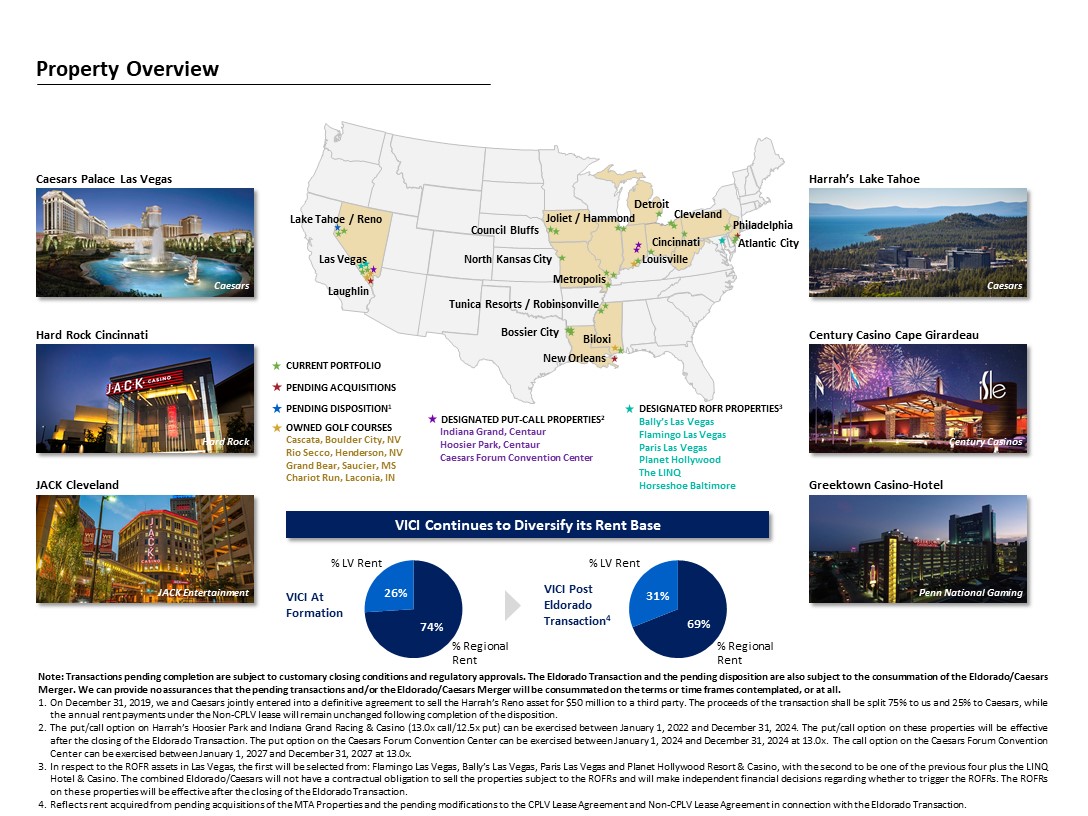
| MSA / Property | Location | Approx. Casino Sq. Ft. (000’s) | Approx. Gaming Units | Hotel Rooms | Lease Agreement | ||||||
| Current Portfolio - Casinos | |||||||||||
| Las Vegas—Destination Gaming | |||||||||||
| Caesars Palace Las Vegas | Las Vegas, NV | 124 | 1,600 | 3,970 | CPLV | ||||||
| Harrah’s Las Vegas | Las Vegas, NV | 89 | 1,310 | 2,540 | HLV | ||||||
| San Francisco / Sacramento | |||||||||||
| Harvey’s Lake Tahoe | Lake Tahoe, NV | 44 | 720 | 740 | Non-CPLV | ||||||
| Harrah’s Reno (1) | Reno, NV | 40 | 640 | 930 | Non-CPLV | ||||||
| Harrah’s Lake Tahoe | Stateline, NV | 45 | 830 | 510 | Non-CPLV | ||||||
| Philadelphia | |||||||||||
| Caesars Atlantic City | Atlantic City, NJ | 116 | 2,020 | 1,140 | Non-CPLV | ||||||
| Bally’s Atlantic City | Atlantic City, NJ | 127 | 1,960 | 1,210 | Non-CPLV | ||||||
| Harrah’s Philadelphia (2) | Chester, PA | 113 | 2,560 | N/A | Non-CPLV | ||||||
| Chicago | |||||||||||
| Horseshoe Hammond | Hammond, IN | 108 | 2,370 | N/A | Non-CPLV | ||||||
| Harrah’s Joliet (3) | Joliet, IL | 39 | 1,130 | 200 | Joliet | ||||||
| Cincinnati | |||||||||||
| Hard Rock Cincinnati | Cincinnati, OH | 100 | 1,900 | N/A | Hard Rock Cincinnati | ||||||
| Cleveland | |||||||||||
| JACK Cleveland (4) | Cleveland, OH | 96 | 1,450 | N/A | JACK Cleveland/Thistledown | ||||||
| JACK Thistledown Racino (4) | North Randall, OH | 57 | 1,480 | N/A | JACK Cleveland/Thistledown | ||||||
| Dallas | |||||||||||
| Horseshoe Bossier City | Bossier City, LA | 28 | 1,240 | 610 | Non-CPLV | ||||||
| Harrah’s Louisiana Downs (2) | Bossier City, LA | 12 | 830 | N/A | Non-CPLV | ||||||
| Margaritaville Resort Casino | Bossier City, LA | 27 | 1,270 | 395 | Margaritaville | ||||||
| Detroit | |||||||||||
| Greektown Casino Hotel | Detroit, MI | 100 | 2,780 | 400 | Greektown | ||||||
| Kansas City | |||||||||||
| Harrah’s North Kansas City | North Kansas City, MO | 60 | 1,360 | 390 | Non-CPLV | ||||||
| St. Louis | |||||||||||
| Century Cape Girardeau | Cape Girardeau, MO | 42 | 880 | N/A | Century Portfolio | ||||||
| Century Caruthersville | Caruthersville, MO | 21 | 510 | N/A | Century Portfolio | ||||||
| Pittsburgh | |||||||||||
| Mountaineer Casino Resort & Racetrack | New Cumberland, WV | 76 | 1,520 | 357 | Century Portfolio | ||||||
| Memphis | |||||||||||
| Horseshoe Tunica | Robinsonville, MS | 63 | 1,110 | 510 | Non-CPLV | ||||||
| Tunica Roadhouse (5) | Robinsonville, MS | N/A | N/A | 140 | Non-CPLV | ||||||
| Omaha | |||||||||||
| Harrah’s Council Bluffs | Council Bluffs, IA | 21 | 570 | 250 | Non-CPLV | ||||||
| Horseshoe Council Bluffs | Council Bluffs, IA | 60 | 1,450 | N/A | Non-CPLV | ||||||
| Nashville | |||||||||||
| Harrah’s Metropolis | Metropolis, IL | 24 | 870 | 260 | Non-CPLV | ||||||
| New Orleans | |||||||||||
| Harrah’s Gulf Coast | Biloxi, MS | 31 | 800 | 500 | Non-CPLV | ||||||
| Louisville | |||||||||||
| Caesars Southern Indiana | Elizabeth, IN | 87 | 1,680 | 500 | Non-CPLV | ||||||
| Total Casinos | 28 | 1,750 | 36,840 | 15,552 | |||||||
| MSA / Property | Location | Approx. Casino Sq. Ft. (000’s) | Approx. Gaming Units | Hotel Rooms | Lease Agreement | ||||||
| Current Portfolio - Golf Courses | |||||||||||
| Las Vegas | |||||||||||
| Cascata Golf Course | Boulder City, NV | N/A | N/A | N/A | N/A | ||||||
| Rio Secco Golf Course | Henderson, NV | N/A | N/A | N/A | N/A | ||||||
| New Orleans | |||||||||||
| Grand Bear Golf Course | Saucier, MS | N/A | N/A | N/A | N/A | ||||||
| Louisville | |||||||||||
| Chariot Run Golf Course | Laconia, IN | N/A | N/A | N/A | N/A | ||||||
| Total Golf Courses | 4 | — | — | — | |||||||
| Total | 32 | 1,750 | 36,840 | 15,552 | |||||||
| Pending Acquisitions | |||||||||||
| Philadelphia | |||||||||||
| Harrah’s Atlantic City (7) | Atlantic City, NJ | 156 | 2,270 | 2,590 | Non-CPLV (6) | ||||||
| New Orleans | |||||||||||
| Harrah’s New Orleans (7) | New Orleans, LA | 125 | 1,630 | 450 | Non-CPLV (6) | ||||||
| Laughlin | |||||||||||
| Harrah’s Laughlin (7) | Laughlin, NV | 56 | 910 | 1,510 | Non-CPLV (6) | ||||||
| Total | 3 | 337 | 4,810 | 4,550 | |||||||
| Put/Call Properties | |||||||||||
| Indianapolis | |||||||||||
| Indiana Grand Racing & Casino (2)(7) | Anderson, IN | 84 | 2,070 | N/A | N/A | ||||||
| Harrah’s Hoosier Park (2)(7) | Shelbyville, IN | 54 | 1,070 | N/A | N/A | ||||||
| Las Vegas | |||||||||||
| Caesars Forum Convention Center | Las Vegas, NV | N/A | N/A | N/A | N/A | ||||||
| Total | 3 | 138 | 3,140 | — | |||||||
| (1) On December 31, 2019 we and Caesars entered into a definitive agreement to sell the Harrah’s Reno asset for $50 million to a third party. We are entitled to receive 75% of the proceeds of the sale and Caesars is entitled to receive 25% of the proceeds. The annual rent payments under the Non-CPLV Lease Agreement will remain unchanged following completion of the disposition. | |||||||||||
| (2) Property has live horse racing. | |||||||||||
| (3) Owned by Harrah’s Joliet Landco LLC, a joint venture of which VICI PropCo is the 80% owner and the managing member. | |||||||||||
| (4) On January 24, 2020, we completed the previously announced transaction to acquire JACK Cleveland/Thistledown. | |||||||||||
| (5) In January of 2019, Caesars combined the gaming operations of Tunica Roadhouse and Horseshoe Tunica. | |||||||||||
| (6) The Harrah’s Atlantic City, Harrah’s New Orleans and Harrah’s Laughlin properties will be added to the Non-CPLV Lease Agreement upon the closing of the Eldorado Transaction. | |||||||||||
| (7) Subject to closing of Eldorado/Caesars Merger. See Item 1 - Business - Our Relationship with Caesars - Call Right Agreements and Item 7 - Management’s Discussion and Analysis of Financial Condition and Results of Operations - Summary of Recent Activities - Eldorado Transaction. |
Our Lease Agreements
We derive substantially all of our revenues from rental revenue from the Lease Agreements for our properties, each of which are “triple-net” leases, pursuant to which the tenant bears responsibility for all property costs and expenses associated with ongoing maintenance and operation, including utilities, property tax and insurance.
Caesars Lease Agreements - Overview
The following is a summary of the material lease provisions of the Caesars Lease Agreements (which does not reflect the modifications to the Caesars Lease Agreements contemplated in connection with the closing of the Eldorado Transaction):
| ($ In thousands) | ||||||
| Lease Provision (1) | Non-CPLV Lease Agreement and Joliet Lease Agreement | CPLV Lease Agreement | HLV Lease Agreement | |||
| Initial Term | 15 years | 15 years | 15 years | |||
| Renewal Terms | Four, five-year terms | Four, five-year terms | Four, five-year terms | |||
| Current Annual Rent (2) | $508,534 | $207,745 | $89,157 | |||
| Escalator commencement | Lease year two | Lease year two | Lease year two | |||
| Escalator (3) | Lease years 2-5 - 1.5% Lease years 6-15 - Consumer price index subject to 2% floor | Consumer price index subject to 2% floor | Lease years 2-5 - 1% Lease years 6-15 - Consumer price index subject to 2% floor | |||
| EBITDAR to Rent Ratio floor (4) | 1.2x commencing lease year 8 | 1.7x commencing lease year 8 | 1.6x commencing lease year 6 | |||
| Variable Rent commencement/reset | Lease years 8 and 11 | Lease years 8 and 11 | Lease years 8 and 11 | |||
| Variable Rent split (5) | Lease years 8-10 - 70% Base Rent and 30% Variable Rent Lease years 11-15- 80% Base Rent and 20% Variable Rent | 80% Base Rent and 20% Variable Rent | 80% Base Rent and 20% Variable Rent | |||
| Variable Rent percentage (5) | 4% | 4% | 4% |
(1) All capitalized terms used without definition herein have the meanings detailed in the applicable Caesars Lease Agreements.
(2) In relation to the Non-CPLV Lease Agreement, Joliet Lease Agreement and CPLV Lease Agreement, the amount represents the current annual base rent payable for the current lease year which is the period from November 1, 2019 through October 31, 2020. In relation to the HLV Lease Agreement the amount represents current annual base rent payable for the current lease year which is the period from January 1, 2020 through December 31, 2020.
(3) Any amounts representing rents in excess of the CPI floors specified above are considered contingent rent in accordance with GAAP. N**o such rent has been recognized for the year ended December 31, 2019.
(4) In the event that the EBITDAR to Rent Ratio coverage is below the stated floor, the Escalator of the respective Caesars Lease Agreements will be reduced to such amount to achieve the stated EBITDAR to Rent Ratio coverage, provided that the amount shall never result in a decrease to the prior year’s rent. The EBITDAR to Rent Ratio floor is conditioned upon obtaining a favorable private letter ruling from the Internal Revenue Service. The coverage floors, which coverage floors serve to reduce the rent escalators under the Caesars Lease Agreements in the event that the “EBITDAR to Rent Ratio” coverage is below the stated floor, will be removed upon execution of the amendments to the Caesars Lease Agreements in connection with the closing of the Eldorado Transaction.
(5) Variable Rent is not subject to the Escalator and is calculated as an increase or decrease of Net Revenues, as defined in the Caesars Lease Agreements, multiplied by the Variable Rent percentage.
Penn National Lease Agreements - Overview
The following is a summary of the material lease provisions of the Penn National Lease Agreements:
| ($ In thousands) | ||||
| Lease Provision | Margaritaville Lease Agreement | Greektown Lease Agreement | ||
| Initial term | 15 years | 15 years | ||
| Renewal terms | Four, five-year terms | Four, five-year terms | ||
| Current annual rent (1) | $23,544 | $55,600 | ||
| Escalation commencement | Lease year two | Lease year two | ||
| Escalation | 2% of Building base rent, subject to the net revenue to rent ratio floor | 2% of Building base rent, subject to the EBITDAR to rent ratio floor | ||
| Performance to rent ratio floor (2) | 6.1x net revenue commencing lease year two | 1.85x EBITDAR commencing lease year two | ||
| Percentage rent (3) | $3,000 (fixed for lease year one and two) | $6,400 (fixed for lease year one and two) | ||
| Percentage rent reset | Lease year three and each and every other lease year thereafter | Lease year three and each and every other lease year thereafter | ||
| Percentage rent multiplier | The product of (i) 4% and (ii) the excess (if any) of (a) the average annual net revenue of a trailing two-year period preceding such reset year over (b) a threshold amount (defined as 50% of LTM net revenues prior to acquisition) | The product of (i) 4% and (ii) the excess (if any) of (a) the average annual net revenue of a trailing two-year period preceding such reset year over (b) a threshold amount (defined as 50% of LTM net revenues prior to acquisition) |
(1) In relation to the Margaritaville Lease Agreement, the amount represents current annual base rent payable for the current lease year, which is the period from February 1, 2020 through January 31, 2021. In relation to the Greektown Lease Agreement, the amount represents current annual base rent payable for the current lease year which is the period from May 23, 2019 through May 31, 2020.
(2) In February 2020 the performance basis of the Margaritaville Lease Agreement was changed from a 1.9x EBITDAR to rent ratio to a 6.1x net revenue to rent ratio. In the event that the net revenue or EBITDAR to rent ratio coverage is below the stated floor, the escalation will be reduced to such amount to achieve the stated net revenue or EBITDAR to rent ratio coverage, provided that the amount shall never result in a decrease to the prior year’s rent. In relation to the Greektown Lease Agreement, the EBITDAR to rent ratio floor is conditioned upon obtaining a favorable private letter ruling from the Internal Revenue Service.
(3) Percentage rent is subject to the percentage rent multiplier. After the percentage rent reset in lease year three, any amounts related to percentage rent are considered contingent rent in accordance with GAAP. N**o such rent has been recognized for the year ended December 31, 2019.
Hard Rock Cincinnati Lease Agreement - Overview
The following is a summary of the material lease provisions of the Hard Rock Cincinnati Lease Agreement:
| ($ In thousands) | ||
| Lease Provision | Term | |
| Initial term | 15 years | |
| Renewal terms | Four, five-year terms | |
| Current annual rent (1) | $42,750 | |
| Escalator commencement | Lease year two | |
| Escalator (2) | Lease years 2-4 - 1.5% Lease years 5-15 - The greater of 2% or the change in consumer price index (“CPI”) unless the change in CPI is less than 0.5%, in which case there is no escalation in rent for such lease year | |
| Variable rent commencement/reset | Lease year 8 | |
| Variable rent split (3) | 80% Base Rent and 20% Variable Rent | |
| Variable rent percentage (3) | 4% |
(1)The amount represents the current annual base rent payable for the current lease year, which is the period from September 20, 2019 through September 30, 2020.
(2) Any amounts representing rents in excess of the CPI floors specified above are considered contingent rent in accordance with GAAP. N**o such rent has been recognized for the year ended December 31, 2019.
(3) Variable rent is not subject to the escalator and is calculated as an increase or decrease of the average of net revenues for lease years 5 through 7 compared to the average net revenue for lease years 1 through 3, multiplied by the Variable rent percentage.
Century Portfolio Lease Agreement - Overview
The following is a summary of the material lease provisions of the Century Portfolio Lease Agreement:
| ($ In thousands) | ||
| Lease Provision | Term | |
| Initial term | 15 years | |
| Renewal terms | Four, five-year terms | |
| Current annual rent (1) | $25,000 | |
| Escalator commencement | Lease year two | |
| Escalator (2) | Lease years 2-3 - 1.0% Lease years 4-15 - The greater of 1.25% or the change in consumer price index (“CPI”) | |
| Net revenue to rent ratio floor | 7.5x commencing lease year six - if the coverage ratio is below the stated amount the escalator will be reduced to 0.75% | |
| Variable rent commencement/reset | Lease year 8 and 11 | |
| Variable rent split (3) | 80% Base Rent and 20% Variable Rent | |
| Variable rent percentage (3) | 4% |
(1) The amount represents the current annual base rent payable for the current lease year, which is the period from December 6, 2019 through December 31, 2020.
(2) Any amounts representing rents in excess of the CPI floors specified above are considered contingent rent in accordance with GAAP. N**o such rent has been recognized for the year ended December 31, 2019.
(3) Variable rent is not subject to the escalator and is calculated for lease year 8 as an increase or decrease of the average of net revenues for lease years 5 through 7 compared to the average net revenue for lease years 1 through 3 and for lease year 11 as an increase or decrease of the average of net revenues for lease years 8 through 10 compared to the average net revenue for lease years 5 through 7, multiplied by the Variable rent percentage.
JACK Cleveland/Thistledown Lease Agreement - Overview
Subsequent to year end, on January 24, 2020, we completed the previously announced JACK Cleveland/Thistledown Acquisition (as defined below). The following is a summary of the material lease provisions of our lease with a subsidiary of JACK Entertainment, which commenced on January 24, 2020, the date of acquisition:
| ($ In thousands) | ||
| Lease Provision | Term | |
| Initial term | 15 years | |
| Renewal terms | Four, five-year terms | |
| Current annual rent (1) | $65,880 | |
| Escalator commencement | Lease year two | |
| Escalator (2) | Lease years 2-3 - 1.0% Lease years 4-6 - 1.5% Lease Years 7-15 - The greater of 1.5% or the change in consumer price index (“CPI”) capped at 2.5% | |
| Net revenue to rent ratio floor | 4.9x in any lease year (commencing in lease year 5) - if the coverage ratio is below the stated amount there is no escalation in rent for such lease year | |
| Variable rent commencement/reset | Lease year 8 and 11 | |
| Variable rent split (3) | 80% Base Rent and 20% Variable Rent | |
| Variable rent percentage (3) | 4% |
(1) The amount represents the current annual base rent payable for the current lease year, which is the period from January 24, 2020 through January 31, 2021.
(2) Any amounts representing rents in excess of the CPI floors specified above are considered contingent rent in accordance with GAAP.
(3) Variable rent is not subject to the escalator and is calculated for lease year 8 as an increase or decrease of the average of net revenues for lease years 5 through 7 compared to the average net revenue for lease years 1 through 3 and for lease year 11 as an increase or decrease of the average of net revenues for lease years 8 through 10 compared to the average net revenue for lease years 5 through 7, multiplied by the Variable rent percentage.
Capital Expenditure Requirements
Under our Lease Agreements our tenants are responsible for all capital expenditures at our properties. The Lease Agreements specify certain minimum amounts that our tenants must spend on capital expenditures that constitute installation or restoration and repair or other improvements of items with respect to the leased properties. The following table summarizes the capital expenditure requirements under the Lease Agreements:
The following table summarizes the capital expenditure requirements of the respective tenants under the Caesars Lease Agreements (which does not reflect the modifications to the Caesars Lease Agreements contemplated in connection with the closing of the Eldorado Transaction, including the inclusion of the Harrah’s New Orleans, Harrah’s Atlantic City and Harrah’s Laughlin properties in the Non-CPLV Lease Agreement):
| Provision | Non-CPLV Lease Agreement and Joliet Lease Agreement | CPLV Lease Agreement | HLV Lease Agreement | |||
| Yearly minimum expenditure | 1% of net revenues (1) | 1% of net revenues (1) | 1% of net revenues commencing in 2022 | |||
| Rolling three-year minimum (2) | $255 million | $84 million | N/A | |||
| Initial minimum capital expenditure | N/A | N/A | $171 million (2017 - 2021) |
(1) The lease agreement requires a $100 million floor on annual capital expenditures for CPLV, Joliet and Non-CPLV in the aggregate. Additionally, annual building & improvement capital improvements must be equal to or greater than 1% of prior year net revenues.
(2) CEOC is required to spend $350 million on capital expenditures (excluding gaming equipment) over a rolling three-year period, with $255 million allocated to Non-CPLV, $84 million allocated to CPLV and the remaining balance of $11 million to facilities covered by any Formation Lease Agreement in such proportion as CEOC may elect. Additionally, CEOC is required to expend a minimum of $495 million on capital expenditures (including gaming equipment) across certain of its affiliates and other assets, together with the $350 million requirement.
The following table summarizes the capital expenditure requirements of Penn National, Hard Rock, Century Casinos and JACK Entertainment under each of the respective Lease Agreements:
| Provision | Penn National Lease Agreements | Hard Rock Cincinnati Lease Agreement | Century Portfolio Lease Agreement | JACK Cleveland/Thistledown Lease Agreement | ||||
| Yearly minimum expenditure | 1% of net revenues based on rolling four-year basis | 1% of net revenues | 1% of net gaming revenues (1) | Initial minimum of $30 million (2) Thereafter - 1% of net revenues on a rolling three-year basis |
(1) Minimum of 1% of net gaming revenue on a rolling three-year basis for each individual facility and 1% of net gaming revenues per fiscal year for the facilities collectively.
(2) Initial minimum required to be spent from the period commencing April 1, 2019 through December 31, 2022.
Our Relationship with Caesars
Caesars is a leading owner and operator of gaming, entertainment and leisure properties. Caesars maintains a diverse brand portfolio with a wide range of options that appeal to a variety of gaming, travel and entertainment consumers. As of December 31, 2019, Caesars operates 53 properties, consisting of 23 owned and operated properties, eight properties that it manages on behalf of third parties and 20 properties that it leases from us.
We are independent from Caesars. However, we believe we have a mutually beneficial relationship with Caesars. Our long-term triple-net Lease Agreements with subsidiaries of Caesars provide us with a highly predictable revenue stream with embedded growth potential. We believe our geographic diversification limits the effect of changes in any one market on our overall performance. We are focused on driving long-term total returns through managing assets and allocating capital diligently, maintaining a highly productive tenant base, capitalizing on strategic development and redevelopment opportunities, and optimizing our capital structure to support opportunistic growth.
To govern the ongoing relationship between us and Caesars and our respective subsidiaries, we entered into various agreements with Caesars and/or its subsidiaries as described herein. The summaries presented herein are not complete and are qualified in their entirety by reference to the full text of the applicable agreements, which are included as exhibits to this Annual Report on Form 10-K.
Caesars Guaranty
Pursuant to the Management and Lease Support Agreements, Caesars guarantees the payment and performance of all monetary obligations of CEOC and/or its subsidiaries under the Formation Lease Agreements and of the “User” under the Golf Course Use Agreement, subject to the following terms: (i) Caesars will be liable for the full amounts of the monetary obligations owed under the Formation Lease Agreements and the Golf Course Use Agreement (not merely for any deficiency amount), unless and until irrevocably paid in full; (ii) Caesars will have no obligation to make a payment with respect to the leases unless an event of default is continuing under the applicable Formation Lease Agreement and Caesars was given notice of the applicable default (or event or circumstance that is or would become a default) of our tenant and/or its subsidiaries under the applicable Lease Agreement, and, with respect to monetary defaults, did not cure such default within the period set forth in the agreements; and (iii) Caesars’ and the Managers’ obligations with respect to each Management and Lease Support Agreement (including Caesars’ guaranty obligations) will terminate if the applicable Formation Lease Agreement is terminated by us, except to the extent of any accrued and unpaid guaranty obligations through the date of such termination and damages to which we are entitled due to such termination. Caesars’ guaranty obligations will also terminate if (x) the Management and Lease Support Agreement is terminated by the parties thereto, (y) a replacement Lease Agreement and Management and Lease Support Agreement are entered into by us, Caesars and/or its affiliates upon certain bankruptcy-related events (or if we elect in writing not to enter into such replacement agreements or such replacement agreements are not entered into as a direct and proximate result of our acts or failure to act) or (z) we terminate a Manager for cause (as defined in the Management and Lease Support Agreements) and an arbitrator determines that cause did not exist. Notwithstanding the foregoing, Caesars’ guaranty obligations will continue (i) to the extent of any accrued and unpaid guaranty obligations through the date of termination of the guaranty and such damages to which we are entitled due to such termination, (ii) during a two-year post-termination transition period during which the applicable Manager continues to act as manager and (iii) in all respects if the Managers are terminated for cause.
Collateral
Caesars’ guaranty of the Formation Leases is not currently collateralized. However, if CEOC’s first lien debt (or any guaranty thereof made by Caesars) is secured by Caesars’ or certain of its subsidiaries’ assets under certain circumstances the collateral securing any such first lien debt of CEOC shall also serve as collateral for Caesars’ guaranty obligations on a pari passu basis with such CEOC first lien debt. Such security interest will automatically be released upon the earlier to occur of (i) the termination of the security interest granted by Caesars or its subsidiaries securing CEOC’s first lien debt (or Caesars’ guaranty thereof) and (ii) (x) the date on which Caesars’ guaranty obligations under the Management and Lease Support Agreements have been irrevocably paid or (y) to the extent Caesars’ guaranty obligation under the Management and Lease Support Agreement is terminated, twelve months after such termination. Such security interest would be a “silent” security interest that provides us with a secured claim against Caesars while any such Caesars debt guaranty or pledge of assets remains in effect, but we will have no voting, enforcement or default related rights with respect to such debt guaranty or collateral, unless and until the occurrence of certain defaults in respect of any of Caesars’ guaranty obligations with respect to the Lease Agreements, or CEOC’s first lien debt. The collateral that secures Caesars’ guaranty obligations will be the same collateral that secures any such Caesars debt guaranty obligations at any time, and Caesars’ guaranty obligations will be secured by such collateral on a pari passu basis with such debt guaranty obligations for so long as such debt guaranty obligations are secured.
Caesars Covenants
The Management and Lease Support Agreements contain customary terms and waivers of all suretyship and other defenses by Caesars and include a covenant by Caesars requiring that (a) a sale of certain material assets by Caesars be for fair market value consideration, on arm’s-length terms in certain cases, with the approval of Caesars’ board of directors, and (b) non-cash dividends by Caesars are permitted only to the extent such dividends would not reasonably be expected to result in Caesars’ inability to perform its guaranty obligations under such agreements.
In addition, until October 6, 2023, or, if earlier, (x) on the date on which Caesars’ guaranty obligations under the Management and Lease Support Agreements have been irrevocably paid or (y) to the extent Caesars’ guaranty obligation under the Management and Lease Support Agreements are terminated by the express terms of the Management and Lease Support Agreements, twelve months after such termination, Caesars may not directly or indirectly (i) declare or pay any dividend, distribution, or similar payment with respect to any of Caesars’ capital stock or other equity interests, (ii) purchase or otherwise acquire or retire for value any of Caesars’ capital stock or other equity interests, or (iii) engage in any other transaction with any direct or indirect holder of Caesars’ capital stock or other equity interests, which is similar in purpose or effect to those described above. However, Caesars will be permitted to execute such transactions if (a) Caesars’ equity market capitalization after giving effect to such transaction is at least $5.5 billion, (b) the amount of such transaction (together with any and all other such dividends and distributions and other transactions made under this clause (b) but excluding, any dividends, distributions or other transactions to be made under clause (c) or (d) below in such fiscal year), does not exceed, in the aggregate, (x) 25% of the net proceeds, up to a cap of $25 million in any fiscal year, from the disposition of assets by Caesars and its subsidiaries and (y) $100 million from other sources in any fiscal year, (c) Caesars’ equity market capitalization after giving effect to such transaction is at least $4.5 billion and such transaction made under this clause (c) (excluding, any dividends, distributions or other transactions made under clause (b) above or clause (d) below in such fiscal year) is less than or equal to $125 million per annum and is funded solely by asset sale proceeds or (d) solely with respect to a transaction described in clause (a) above, the aggregate amount of such transactions (excluding transactions made under clause (b) or (c) above) is not more than $199.5 million. Similarly, until October 6, 2023, or the expiration of the restrictions described above (except in the case of the exceptions under clauses (a) and (c) above), any net proceeds from the disposition of assets by Caesars or its subsidiaries in excess of $25 million that are directly or indirectly distributed to, or otherwise received by, Caesars in any fiscal year will not be used to fund any restricted payment of Caesars described above in clauses (i) through (iii) above.
Second Amended and Restated Right of First Refusal Agreement
We entered into a second amended and restated right of first refusal agreement with Caesars (the “Second Amended and Restated Right of First Refusal Agreement”), which contains a right of first refusal in our favor, pursuant to which we have the right to own (and cause to be leased to, and managed by, Caesars (or its affiliate or affiliates)) any domestic gaming facility located outside of Greater Las Vegas, proposed to be acquired or developed by Caesars that is not (i) then subject to a pre-existing lease, management agreement or other contractual restriction that was not entered into in contemplation of such acquisition or development and which (x) was entered into on arms’-length terms and (y) would not be terminated upon or prior to such transaction, (ii) a transaction for which the opco/propco structure would be prohibited by applicable laws, or which would require governmental consent or approval (unless already received), (iii) any transaction that does not consist of owning or acquiring a fee or leasehold interest in real property, (iv) a transaction in which Caesars will not own at least 50% of, or control, the entity that will own the gaming facility, (v) a transaction in which one or more third parties will own or acquire, in the aggregate, a beneficial economic interest of at least 30% in the applicable gaming facility, and such third parties are unable, or make a bona fide, good faith refusal, to enter into the opco/
propco structure, (vi) a transaction in which Caesars or its subsidiaries proposes to acquire a then-existing gaming facility from Caesars or its subsidiaries, and (vii) a transaction with respect to any asset remaining in CEOC after the formation transactions. The Second Amended and Restated Right of First Refusal further provides us, subject to certain exclusions, the right to acquire (and lease to Caesars) (x) any of the properties that Caesars has acquired from Centaur Holdings, LLC, should Caesars determine to sell any such properties in a sale-leaseback transaction, (y) certain income-producing improvements if built by Caesars in lieu of the Caesars Forum Convention Center on the Eastside Property, subject to certain exclusions and (z) a portion of the undeveloped land adjacent to the Las Vegas Strip, if acquired from us and developed by Caesars in accordance with certain procedures set forth in the Non-CPLV Lease Agreement. If, among other things, we decline to exercise our right of first refusal, the Non-CPLV Lease Agreement and Joliet Lease Agreement establish a variable rent floor to any facility outside of Greater Las Vegas and located within a 30-mile radius of any facility as to which we declined our right of first refusal. If we exercise such right, we and Caesars will structure such transaction in a manner that allows the subject property to be owned by us and leased to Caesars. In such event, Caesars (or its designee) will enter into a lease with respect to the subject property whereby (i) rent thereunder will be established based on formulas consistent with the EBITDAR coverage ratio (determined based on the prior 12-month period) with respect to the Lease Agreement then in effect and (ii) such other terms as are agreed by the parties.
The Second Amended and Restated Right of First Refusal Agreement also contains a right of first refusal in favor of Caesars, pursuant to which Caesars will have the right to lease and manage any domestic gaming facility located outside of Greater Las Vegas, proposed to be acquired by us that is not: (i) any asset that is then subject to a pre-existing lease, management agreement or other contractual restriction that was not entered into in contemplation of such acquisition and which (x) was entered into on arms’ length terms and (y) would not be terminated upon or prior to closing of such transaction, (ii) any transaction for which the opco/propco structure would be prohibited by applicable laws or which would require governmental consent (unless already received), (iii) any transaction structured by the seller as a sale-leaseback, (iv) any transaction in which we will not own at least 50% of, or control, the entity that will own the gaming facility, and (v) any transaction in which we propose to acquire a then-existing gaming facility from ourselves or our affiliates. If Caesars (or its designee) exercises such right, we and Caesars will structure such transaction in a manner that allows the subject property to be owned by us and leased to Caesars. In such event, Caesars (or its designee) will enter into a lease with respect to the additional property whereby (i) rent thereunder will be established based on formulas consistent with the adjusted EBITDA coverage ratio (as set forth in the agreement) with respect to the lease then in effect and (ii) such other terms as are agreed by the parties.
In the event that the foregoing rights are not exercised by us or Caesars and CEOC, as applicable, each party will have the right to consummate the subject transaction without the other’s involvement, provided the same is on terms no more favorable to the counterparty than those presented to us or Caesars and CEOC, as applicable.
The rights of first refusal will not apply if (A) the Management and Lease Support Agreements have been terminated or have expired by their terms or with our consent, (B) Caesars is no longer managing the facilities, or (C) a change of control occurs with respect to either Caesars or us. Accordingly, the Second Amended and Restated Right of First Refusal Agreement will terminate in accordance with its terms upon the consummation of the Eldorado/Caesars Merger.
Upon closing of the Eldorado/Caesars Merger, the Second Amended and Restated Right of First Refusal Agreement will be terminated and we will enter into the Las Vegas ROFR (as defined and described below in Item 7 under “Management’s Discussion and Analysis-Eldorado Transaction-Las Vegas Strip Assets ROFR”) and the Horseshoe Baltimore ROFR (as defined and described below in Item 7 under “Management’s Discussion and Analysis-Eldorado Transaction- Horseshoe Baltimore ROFR”).
Call Right Agreements
We entered into certain call right agreements (the “Call Right Agreements”), which provide our Operating Partnership with the opportunity to acquire Harrah’s Atlantic City, Harrah’s New Orleans and Harrah’s Laughlin (“Option Properties”) from Caesars. Our Operating Partnership can exercise the call rights within five years from the Formation Date. The purchase price for each property will be 10 multiplied by the initial property lease rent for the respective property, with the initial property lease rent for each property being the amount that causes the ratio of (x) EBITDAR of the property for the most recently ended four quarter period for which financial statements are available to (y) the initial property lease rent to equal 1.67.
Under certain circumstances, the owner may propose one or more replacement properties and the material terms of the purchase and if such proposal is at least as economically beneficial to us as the exercise of the call right, the parties must proceed with the sale of that property and any dispute with respect to the same (including whether such proposal was a qualifying proposal) will be submitted to arbitration.
If the exercise of the call right is not permissible because a debt agreement does not permit the sale and such limitation is not resolved within one year from exercise of the right and the owner has not made an alternative proposal that is at least as economically beneficial to us as the exercise of the call right, the owner must pay us an amount equal to the value of our loss as of the Formation
Date which will increase at a rate of 8.5% per annum, with annual compounding for the period from the date of each agreement until the date on which payment of the value loss amount is made.
If the exercise of the call right is not permissible due to a reason other than because of a debt limitation and the owner has not made an alternative proposal that is at least as economically beneficial to us as the exercise of the call right, then the parties must use commercially reasonable efforts to resolve the issue in accordance with the agreement. If the applicable issue making the transaction impermissible is not resolved by the foregoing described deadline, the owner must use commercially reasonable efforts to sell the property to an alternative purchaser for the fair market value of the property, and, upon the closing of any such alternative transaction we would be entitled to any portion of the purchase price that exceeds the amount that would otherwise be determined in accordance with the applicable agreement.
If the exercise of the call right is permissible, the parties will use good faith, commercially reasonable efforts, for a period of ninety days following the delivery of the election notice to negotiate and enter into a sale agreement and conveyance and ancillary documents with respect to the applicable property together with a leaseback agreement.
As described below in Item 7 under “Management’s Discussion and Analysis-Eldorado Transaction-Acquisition of the MTA Properties” we have entered into agreements to acquire all of the land and real estate assets associated with Harrah’s Atlantic City, Harrah’s New Orleans and Harrah’s Laughlin, and the existing call right agreements will terminate, upon the earlier to occur of the closing of the corresponding MTA Property Acquisition or our obtaining specific performance or liquidated damages with respect to the relevant property.
Caesars Forum Put/Call Agreement
Claudine Propco LLC (“HLV Owner”), our wholly owned subsidiary, and certain subsidiaries of Caesars entered into a put/call agreement (the “Caesars Forum Put/Call Agreement”) which provides for (i) a put right in favor of Caesars, which would result in the sale by Caesars to HLV Owner and simultaneous leaseback by HLV Owner to Caesars of a convention center (the “Caesars Forum Convention Center”) that Caesars is currently constructing on the Eastside Property (the “Put Right”), (ii) if Caesars exercises the Put Right and, among other things, the sale of the Caesars Forum Convention Center to HLV Owner does not close for certain reasons more particularly described in the agreement, then a repurchase right in favor of Caesars, which, if exercised, would result in the sale by HLV Owner to Caesars of Harrah’s Las Vegas (the “Repurchase Right”) and (iii) a call right in favor of HLV Owner, which, if exercised, would result in the sale by Caesars to HLV Owner and simultaneous leaseback by HLV Owner to Caesars of the Caesars Forum Convention Center (the “Call Right”). The Put Right may be exercised by Caesars between January 1, 2024 and December 31, 2024. The Repurchase Right may be exercised by Caesars during a one-year period commencing on the date upon which the closing under the Put Right transaction does not occur and ending on the day immediately preceding the first anniversary thereof. The purchase price for Harrah’s Las Vegas would be an amount equal to 13 times the rent due under the HLV Lease Agreement for the most recently ended four consecutive fiscal quarter period for which financial statements are available as of the date of Caesars’ election to execute the Repurchase Right. The Call Right may be exercised by HLV Owner between January 1, 2027 and December 31, 2027. The purchase price for the Caesars Forum Convention Center is equal to 13 times the rent due in connection with the leaseback thereof, which will be determined pursuant to the formulas set forth in the Caesars Forum Put/Call Agreement. The Caesars Forum Put/Call Agreement survives the closing of the Eldorado/Caesars Merger.
Golf Course Use Agreement
Pursuant to a golf course use agreement (as amended, the “Golf Course Use Agreement”), VICI Golf granted to CEOC and CES (collectively, the “users”) certain priority rights and privileges with respect to access and use of the following golf course properties: Rio Secco (Henderson, Nevada), Cascata (Boulder City, Nevada), Chariot Run (Laconia, Indiana) and Grand Bear (Saucier, Mississippi). Pursuant to the Golf Course Use Agreement, the users are granted specific rights and privileges to the golf courses, including (i) preferred access to tee times for guests of users’ casinos and/or hotels located within the same markets as the golf courses, (ii) preferred rates for guests of users’ casinos and/or hotels located within the same markets as the golf courses, and (iii) availability for golf tournaments and events at preferred rates and discounts. Payments under the Golf Course Use Agreement are currently comprised of an approximately $10.3 million annual membership fee, $3.1 million of use fees and $1.2 million of minimum rounds fees subject to certain adjustments. The Golf Course Use Agreement survives the closing of the Eldorado/Caesars Merger.
Tax Matters Agreement
We have entered into a tax matters agreement (the “Tax Matters Agreement”), which addresses matters relating to the payment of taxes and entitlement to tax refunds by Caesars, CEOC, the Operating Partnership and us, and allocates certain liabilities, including providing for certain covenants and indemnities, relating to the payment of such taxes, receipt of such refunds, and preparation of tax returns relating thereto. In general, the Tax Matters Agreement provides for the preparation and filing by Caesars of tax returns
relating to CEOC and for the preparation and filing by us of tax returns relating to us and our operations. Under the Tax Matters Agreement, Caesars has agreed to indemnify us for any taxes allocated to CEOC that we are required to pay pursuant to our tax returns and we have agreed to indemnify Caesars for any taxes allocated to us that Caesars or CEOC is required to pay pursuant to a Caesars or CEOC tax return.
Under the Tax Matters Agreement, Caesars has agreed to indemnify us for taxes attributable to acts or omissions taken by Caesars and we have agreed to indemnify Caesars for taxes attributable to our acts or omissions, in each case that cause a failure of the transactions entered into as part of the Plan of Reorganization to qualify as tax-free under the code. The Tax Matters Agreement survives the closing of the Eldorado/Caesars Merger.
Eldorado Transaction
On June 24, 2019, Eldorado entered into a definitive agreement and plan of merger (the “Eldorado/Caesars Merger Agreement”) by and among Eldorado, Colt Merger Sub, Inc. (“Merger Sub”) and Caesars, pursuant to which Merger Sub will merge with and into Caesars, with Caesars surviving as a wholly owned subsidiary of Eldorado. Upon closing of the Eldorado/Caesars Merger, Eldorado will be renamed Caesars.
On the same day, in connection with the announcement of the Eldorado/Caesars Merger, we entered into a Master Transaction Agreement with Eldorado relating to the MTA Properties Acquisitions (as defined and described below in Item 7 under “Management’s Discussion and Analysis-Eldorado Transaction-Acquisition of the MTA Properties”) and modifications to our Caesars Lease Agreements, and the entry into the Las Vegas ROFR, the Horseshoe Baltimore ROFR and the Centaur Properties Put/Call Agreement. Additionally, as described in Item 7 “Management’s Discussion and Analysis of Financial Condition and Results of Operations” below, upon the consummation of the Eldorado Transaction, Eldorado will execute new guaranties (collectively, the “Eldorado Guaranties”) of the Formation Lease Agreements and the existing guaranties by Caesars of the Formation Lease Agreements, along with all covenants and other obligations of Caesars incurred in connection with such guaranties, will be terminated with respect to Caesars (which will become a subsidiary of Eldorado following the closing of the Eldorado/Caesars Merger). The Eldorado Transaction and the Eldorado/Caesars Merger both continue to be subject to regulatory approvals and customary closing conditions. Eldorado has publicly disclosed that it expects the Eldorado/Caesars Merger to be completed in the first half of 2020, and we expect the Eldorado Transaction to close concurrently. However, we can provide no assurances that the Eldorado/Caesars Merger or the Eldorado Transaction described herein will close in the anticipated timeframe, on the contemplated terms or at all.
Refer to Item 7 “Management’s Discussion and Analysis of Financial Condition and Results of Operations” for a more detailed description of the Eldorado Transaction.
Competition
We compete for real property investments with other REITs, gaming companies, investment companies, private equity and hedge fund investors, sovereign funds, lenders and other investors. In addition, revenues from our properties are dependent on the ability of our tenants and operators, subsidiaries of Caesars, Penn National, Hard Rock, Century Casinos and JACK Entertainment to compete with other gaming operators. The operators of our properties compete on a local and regional basis for customers. The gaming industry is characterized by a high degree of competition among a large number of participants, including riverboat casinos, dockside casinos, land-based casinos, video lottery, sweepstakes and poker machines not located in casinos, Native American gaming, emerging varieties of Internet gaming and other forms of gaming in the United States.
As a landlord, we compete in the real estate market with numerous developers and owners of properties. Some of our competitors are significantly larger, have greater financial resources and lower costs of capital than we have, have greater economies of scale and have greater name recognition than we do. Increased competition will make it more challenging to identify and successfully capitalize on acquisition opportunities that meet our investment objectives. Our ability to compete is also impacted by national and local economic trends, availability of investment alternatives, availability and cost of capital, construction and renovation costs, existing laws and regulations, new legislation and population trends.
Employees
Approximately 140 employees were employed by us at December 31, 2019. Of these employees, 16 are employed at our Operating Partnership and approximately 124 are employed at our TRS, VICI Golf, or their respective subsidiaries.
Governmental Regulation and Licensing
The ownership, operation and management of gaming and racing facilities are subject to pervasive regulation. Each of our gaming and racing facilities is subject to regulation under the laws, rules, and regulations of the jurisdiction in which it is located. Gaming laws and regulations generally require gaming industry participants to:
| • | ensure that unsuitable individuals and organizations have no role in gaming operations; |
| • | establish and maintain responsible accounting practices and procedures; |
| • | maintain effective controls over their financial practices, including establishment of minimum procedures for internal fiscal affairs and the safeguarding of assets and revenues; |
| • | maintain systems for reliable record keeping; |
| • | file periodic reports with gaming regulators; and |
| • | ensure that contracts and financial transactions are commercially reasonable, reflect fair market value and are arms-length transactions. |
Gaming laws and regulations impact our business in two respects: (1) our ownership of land and buildings in which gaming activities are operated by our tenants; and (2) the operations of our tenants as operators in the gaming industry. Further, many gaming and racing regulatory agencies in the jurisdictions in which our tenants operate require us and our affiliates to apply for and maintain a license as a key business entity or supplier because of our status as landlord.
Our businesses and the business of Caesars, Penn National, Hard Rock, Century Casinos and JACK Entertainment are also subject to various Federal, state and local laws and regulations in addition to gaming regulations. These laws and regulations include, but are not limited to, restrictions and conditions concerning alcoholic beverages, environmental matters, employees, health care, currency transactions, taxation, zoning and building codes and marketing and advertising. Such laws and regulations could change or could be interpreted differently in the future, or new laws and regulations could be enacted. Material changes, new laws or regulations, or material differences in interpretations by courts or governmental authorities could adversely affect our operating results.
Violations of Gaming Laws
If we, our subsidiaries or the tenants of our properties violate applicable gaming laws, our gaming licenses could be limited, conditioned, suspended or revoked by gaming authorities, and we and any other persons involved could be subject to substantial fines. Further, a supervisor or conservator can be appointed by gaming authorities to operate our gaming properties, or in some jurisdictions, take title to our gaming assets in the jurisdiction, and under certain circumstances, earnings generated during such appointment could be forfeited to the applicable jurisdictions. Violations of laws in one jurisdiction could result in disciplinary action in other jurisdictions. Finally, the loss of our gaming licenses could result in an event of default under our certain of our indebtedness, and cross-default provisions in our debt agreements could cause an event of default under one debt agreement to trigger an event of default under our other debt agreements. As a result, violations by us of applicable gaming laws could have a material adverse effect on us.
Review and Approval of Transactions
Substantially all material loans, leases, sales of securities and similar financing transactions by us and our subsidiaries must be reported to and in some cases approved by gaming authorities. Neither we nor any of our subsidiaries may make a public offering of securities without the prior approval of certain gaming authorities. Changes in control through merger, consolidation, stock or asset acquisitions, management or consulting agreements, or otherwise are subject to receipt of prior approval of gaming authorities. Entities seeking to acquire control of us or one of our subsidiaries must satisfy gaming authorities with respect to a variety of stringent standards prior to assuming control.
Insurance
The Lease Agreements require the tenants to maintain, with financially sound and reputable insurance companies (and in certain cases subject to the right of the tenants to self-insure), insurance (subject to customary deductibles and retentions) in such amounts and against such risks as are customarily maintained by similarly situated companies engaged in the same or similar businesses operating in the same or similar locations. The Lease Agreements provide that the amount and type of insurance that the tenants have in effect as of the commencement of the leases will satisfy for all purposes the requirements to insure the properties. However, such insurance coverage may not be sufficient to fully cover our losses.
Environmental Matters
Our properties are subject to environmental laws regulating, among other things, air emissions, wastewater discharges and the handling and disposal of wastes, including medical wastes. Certain of the properties we own utilize above or underground storage tanks to store heating oil for use at the properties. Other properties were built during the time that asbestos-containing building materials were routinely installed in residential and commercial structures. The Lease Agreements generally obligate our tenants to comply with applicable environmental laws and to indemnify us if its noncompliance results in losses or claims against us, and we expect that any future leases will include the same provisions for other operators. A tenant’s failure to comply could result in fines and penalties or the requirement to undertake corrective actions which may result in significant costs to the operator and thus adversely affect their ability to meet their obligations to us.
Pursuant to U.S. Federal, state and local environmental laws and regulations, a current or previous owner or operator of real property may be required to investigate, remove and/or remediate a release of hazardous substances or other regulated materials at, or emanating from, such property. Further, under certain circumstances, such owners or operators of real property may be held liable for property damage, personal injury and/or natural resource damage resulting from or arising in connection with such releases. Certain of these laws have been interpreted to be joint and several unless the harm is divisible and there is a reasonable basis for allocation of responsibility. We also may be liable under certain of these laws for damage that occurred prior to our ownership of a property or at a site where we sent wastes for disposal. The failure to properly remediate a property may also adversely affect our ability to lease, sell or rent the property or to borrow funds using the property as collateral.
In connection with the ownership of our current properties and any properties that we may acquire in the future, we could be legally responsible for environmental liabilities or costs relating to a release of hazardous substances or other regulated materials at or emanating from such property. We are not aware of any environmental issues that are expected to have a material impact on the operations of any of our properties.
Sustainability
We continue to focus on developing our efforts relative to implementing and reporting on environmental sustainability efforts at our properties. We have implemented tenant engagement initiatives designed to assist us in understanding the environmental impact of our leased properties and to gather environmental sustainability data in order to monitor sustainability metrics throughout our leased property portfolio. Our existing leased properties are leased pursuant to long-term triple-net leases, which provide our tenants with complete control over operations at our leased properties, including over the implementation of environmental sustainability initiatives consistent with their business strategies and our revenue objectives, and do not permit us to require the collection or reporting of environmental sustainability data. Although not contractually required, in 2019, certain of our tenants reported to us on LEED certification, water and energy use, emissions and waste diversion. In addition, we have implemented recording and reporting protocols at our owned and operated golf courses in order to monitor our environmental impact at those properties and commence our process towards setting long-term sustainability targets. In 2019, we relocated our corporate headquarters to a LEED Gold certified building with an Energy Star label. We are committed to the improvement of environmental conditions through our business activities within the scope of our capabilities, and we periodically engage with key stakeholders with regard to environmental sustainability priorities, among other things.
Intellectual Property
Most of the properties within our portfolio are currently operated and promoted under trademarks and brand names not owned by us, including Caesars Palace, Harrah’s, Horseshoe, Bally’s, Greektown, JACK, Hard Rock, Century and Mountaineer. In addition, properties that we may acquire in the future may be operated and promoted under these same trademarks and brand names, or under different trademarks and brand names we do not, or will not, own. During the term that our properties are managed by Caesars Penn National, Hard Rock, Century Casinos and JACK Entertainment, we are reliant on Caesars, Penn National, Hard Rock, Century Casinos and JACK Entertainment to maintain and protect the trademarks, brand names and other licensed intellectual property used in the operation or promotion of the leased properties. Operation of the leased properties, as well as our business and financial condition, could be adversely impacted by infringement, invalidation, unauthorized use or litigation affecting any such intellectual property. In addition, if any of our properties are rebranded, it could have a material adverse effect on us, as we may not enjoy comparable recognition or status under a new brand.
Investment Policies
Investment in Real Estate or Interests in Real Estate
Our investment objectives are to increase cash flow from operations, achieve sustainable long-term growth and maximize stockholder value to allow for stable dividends and stock appreciation. We have not established a specific policy regarding the relative priority of these investment objectives.
Our business is focused primarily on gaming and leisure sector properties and activities directly related thereto. We own 28 market-leading properties and own and operate four golf courses. We believe there are potential opportunities to acquire additional gaming, hospitality and entertainment assets. Our future investment activities will not be limited to any geographic area or to a specific percentage of our assets. We intend to engage in such future investment activities in a manner that is consistent with our qualification as a REIT for U.S. Federal income tax purposes. We do not have a specific policy to acquire assets primarily for capital gain or primarily for income. In addition, we may purchase or lease income-producing commercial and other types of properties for long-term investment, expand and improve the properties we presently own or other acquired properties, or sell such properties, in whole or in part, when circumstances warrant.
We may participate with third parties in property ownership, through joint ventures or other types of co-ownership, and we may engage in such activities in the future if we determine that doing so would be the most effective means of owning or acquiring properties. We do not expect, however, to enter into a joint venture or other partnership arrangement to make an investment that would not otherwise meet our investment policies. We also may acquire real estate or interests in real estate in exchange for the issuance of common stock, preferred stock or options to purchase stock or interests in our subsidiaries, including our Operating Partnership. We may also pursue opportunities to provide mortgage financing of preferred equity investments for investment in certain situations where this structure is more advantageous than owning the underlying real estate.
Equity investments in acquired properties may be subject to existing mortgage financing and other indebtedness or to new indebtedness which may be incurred in connection with acquiring or refinancing these investments. Principal and interest on our debt will have a priority over any dividends with respect to our common stock. Investments are also subject to our policy not to be required to register as an investment company under the Investment Company Act of 1940, as amended.
Investments in Real Estate Debt
Although we do not presently intend to invest in mortgages or other forms of real estate-related debt, other than in a manner that is ancillary to an equity investment, we may elect, in our discretion, to invest in real estate debt, including, without limitation, traditional mortgages, participating or convertible mortgages, mezzanine loans or preferred equity investments; provided, in each case, that such investment is consistent with our qualification as a REIT. Investments in real estate-related debt run the risk that a borrower may default under certain provisions governing the debt investment and that the collateral securing the investment may not be sufficient to enable us to recover our full investment.
Securities of or Interests in Persons Primarily Engaged in Real Estate Activities and Other Issuers
Subject to the asset tests and gross income tests necessary for REIT qualification, we may invest in securities of other REITs, other entities engaged in real estate activities or securities of other issuers, including for the purpose of exercising control over such entities. We do not currently have any policy limiting the types of entities in which we may invest or the proportion of assets to be so invested, whether through acquisition of an entity’s common stock, limited liability or partnership interests, interests in another REIT or entry into a joint venture. We have no current plans to make additional investments in entities that are not engaged in real estate activities. Our investment objectives are to maximize the cash flow of our investments, acquire investments with growth potential and provide cash distributions and long-term capital appreciation to our stockholders through increases in the value of our company. We have not established a specific policy regarding the relative priority of these investment objectives.
Investments in Short-term Commercial Paper and Discount Notes
We generally invest our excess cash in short-term investment grade commercial paper as well as discount notes issued by government-sponsored enterprises, including the Federal Home Loan Mortgage Corporation and certain of the Federal Home Loan Banks. These investments generally have original maturities between 91 and 180 days.
Financing Policies
We expect to employ leverage in our capital structure in amounts that we determine appropriate from time to time. Our board of directors has not adopted a policy that limits the total amount of indebtedness that we may incur, but will consider a number of factors in evaluating our level of indebtedness from time to time, as well as the amount of such indebtedness that will be either
fixed or variable rate. We are, however, and expect to continue to be, subject to certain indebtedness limitations pursuant to the restrictive covenants of our outstanding indebtedness. We may from time to time modify our debt policy in light of then-current economic conditions, relative availability and costs of debt and equity capital, market values of our properties, general market conditions for debt and equity securities, fluctuations in the market price of our shares of common stock, growth and acquisition opportunities and other factors. If these limits are relaxed, we could become more highly leveraged, resulting in an increased risk of default on our obligations and a related increase in debt service requirements that could adversely affect our financial condition, liquidity and results of operations and our ability to make distributions to our stockholders. To the extent that our board of directors or management determines that it is necessary to raise additional capital, we may, without stockholder approval, borrow money under our Revolving Credit Facility, issue debt or equity securities, including securities senior to our shares, retain earnings (subject to the REIT distribution requirements for U.S. Federal income tax purposes), assume indebtedness, obtain mortgage financing on a portion of our owned properties, engage in a joint venture, or employ a combination of these methods.
Corporate Information
We were initially organized as a limited liability company in the State of Delaware on July 5, 2016 as a wholly owned subsidiary of CEOC. On May 5, 2017, we subsequently converted to a corporation under the laws of the State of Maryland and issued shares of common stock to CEOC as part of our formation transactions, which shares were subsequently transferred by CEOC to its creditors as part of the Third Amended Joint Plan of Reorganization of Caesars Entertainment Operating Company, Inc. et. al. (the “Plan of Reorganization”) confirmed by the United States Bankruptcy Court for the Northern District of Illinois (Chicago) on January 17, 2017.
Our principal executive offices are located at 535 Madison Ave., 20th Floor, New York, New York 10022 and our main telephone number at that location is (646) 949-4631. Our website address is www.viciproperties.com. None of the information on, or accessible through, our website or any other website identified herein is incorporated in, or constitutes a part of, this Annual Report on Form 10-K. Our electronic filings with the SEC (including annual reports on Form 10-K, quarterly reports on Form 10-Q, and current reports on Form 8-K, and any amendments to these reports), including the exhibits, are available free of charge through our website as soon as reasonably practicable after we electronically file them with or furnish them to the SEC.
CAUTIONARY NOTE REGARDING FORWARD-LOOKING STATEMENTS
Certain statements in this Annual Report on Form 10-K, including statements such as “anticipate,” “believe,” “estimate,” “expect,” “intend,” “plan,” “project,” “target,” “can,” “could,” “may,” “should,” “will,” “would” or similar expressions, constitute “forward-looking statements” within the meaning of the Private Securities Litigation Reform Act of 1995. Forward-looking statements are based on our current plans, expectations and projections about future events. We caution you therefore against relying on any of these forward-looking statements. They give our expectations about the future and are not guarantees. These statements involve known and unknown risks, uncertainties and other factors that may cause our actual results, performance and achievements to materially differ from any future results, performance and achievements expressed in or implied by such forward-looking statements.
The forward-looking statements included herein are based upon our current expectations, plans, estimates, assumptions and beliefs that involve numerous risks and uncertainties. Assumptions relating to the foregoing involve judgments with respect to, among other things, future economic, competitive and market conditions and future business decisions, all of which are difficult or impossible to predict accurately and many of which are beyond our control. Although we believe that the expectations reflected in such forward-looking statements are based on reasonable assumptions, our actual results, performance and achievements could differ materially from those set forth in the forward-looking statements and may be affected by a variety of risks and other factors, including, among others:
| • | our dependence on subsidiaries of Caesars, Penn National, Hard Rock, Century Casinos and JACK Entertainment (and, following the completion of the Eldorado Transaction, subsidiaries of the combined Eldorado/Caesars) as tenants of our properties and Caesars, Penn National, Seminole Hard Rock, Century Casinos and Rock Ohio Ventures LLC or certain of their respective subsidiaries (and, following the completion of the Eldorado Transaction, subsidiaries of the combined Eldorado/Caesars) as guarantors of the lease payments and the negative consequences any material adverse effect on their respective businesses could have on us; |
| • | our dependence on the gaming industry; |
| • | our ability to pursue our business and growth strategies may be limited by our substantial debt service requirements and by the requirement that we distribute 90% of our REIT taxable income in order to qualify for taxation as a REIT and that we distribute 100% of our REIT taxable income in order to avoid current entity-level U.S. Federal income taxes; |
| • | the impact of extensive regulation from gaming and other regulatory authorities; |
| • | the ability of our tenants to obtain and maintain regulatory approvals in connection with the operation of our properties; |
| • | the possibility that our tenants may choose not to renew the Lease Agreements following the initial or subsequent terms of the leases; |
| • | restrictions on our ability to sell our properties subject to the Lease Agreements; |
| • | Caesars’, Penn National’s, Hard Rock’s, Century Casinos’ and JACK Entertainment’s (and following the completion of the Eldorado Transaction, the combined Eldorado/Caesars) historical results may not be a reliable indicator of their future results; |
| • | our substantial amount of indebtedness and ability to service, refinance and otherwise fulfill our obligations under such indebtedness; |
| • | limits on our operational and financial flexibility imposed by our debt agreements; |
| • | our historical financial information may not be reliable indicators of our future results of operations, financial condition and cash flows; |
| • | the ability to receive, or delays in obtaining, the governmental and regulatory approvals and consents required to consummate our pending acquisitions in connection with the Eldorado Transaction, or other delays or impediments to completing these acquisitions; |
| • | our ability to obtain the financing necessary to complete our pending acquisitions in connection with the Eldorado Transaction on the terms we currently expect or at all; |
| • | the possibility that our pending acquisitions in connection with the Eldorado Transaction may not be completed or that completion may be unduly delayed; |
| • | the possibility that we identify significant environmental, tax, legal or other issues that materially and adversely impact the value of properties acquired (or other benefits we expect to receive) in the Eldorado Transaction or any of our other pending or recently completed acquisitions; |
| • | the effects of our recently completed acquisition and the pending acquisitions on us, including the post-acquisition impact on our financial condition, financial and operating results, cash flows, strategy and plans; |
| • | the possibility our separation from CEOC fails to qualify as a tax-free spin-off, which could subject us to significant tax liabilities; |
| • | the impact of changes to the U.S. Federal income tax laws; |
| • | the possibility of foreclosure on our properties if we are unable to meet required debt service payments; |
| • | the impact of a rise in interest rates on us; |
| • | our inability to successfully pursue investments in, and acquisitions of, additional properties; |
| • | the impact of natural disasters, war, political and public health conditions or uncertainty or civil unrest, violence or terrorist activities or threats on our properties and changes in economic conditions or heightened travel security and health measures instituted in response to these events; |
| • | the impact of changes in general economic conditions, including low consumer confidence, unemployment levels and depressed real estate prices resulting from the severity and duration of any downturn in the U.S. or global economy; |
| • | the loss of the services of key personnel; |
| • | the inability to attract, retain and motivate employees; |
| • | the costs and liabilities associated with environmental compliance; |
| • | failure to establish and maintain an effective system of integrated internal controls; |
| • | the costs of operating as a public company; |
| • | our inability to operate as a stand-alone company; |
| • | our inability to maintain our qualification for taxation as a REIT; |
| • | our reliance on distributions received from the Operating Partnership to make distributions to our stockholders; |
| • | the amount of our cash distributions could be impacted if we were to sell any of our properties in the future; |
| • | our ability to continue to make distributions to holders of our common stock or maintain anticipated levels of distributions over time; |
| • | competition for acquisition opportunities, including from other REITs, investment companies, gaming companies. private equity and hedge fund investors, sovereign funds, lenders, gaming companies and other investors that may have greater resources and access to capital and a lower cost of capital or different investment parameters than us; and |
| • | additional factors discussed herein under “Risk Factors” and listed from time to time in our filings with the SEC, including without limitation, in our subsequent reports on Form 10-K, Form 10-Q and Form 8-K. |
Any of the assumptions underlying forward-looking statements could be inaccurate. You are cautioned not to place undue reliance on any forward-looking statements. All forward-looking statements are made as of the date of this Annual Report on Form 10-K and the risk that actual results, performance and achievements will differ materially from the expectations expressed herein will increase with the passage of time. Except as otherwise required by the Federal securities laws, we undertake no obligation to publicly update or revise any forward-looking statements, whether as a result of new information, future events, changed circumstances or any other reason. In light of the significant uncertainties inherent in forward-looking statements, the inclusion of such forward-looking statements should not be regarded as a representation by us.
Previous: Cover and table of contents · Next: Item 1A. Risk Factors