 filings.tools
VICI Properties 10-K 2020-12-31
Filed 2021-02-18. 22 sections, 672K characters. Original on sec.gov · Markdown · JSON
Cover and table of contents
UNITED STATES
SECURITIES AND EXCHANGE COMMISSION
Washington, D.C. 20549
FORM 10-K
| (Mark One) | |||||
| ☒ | ANNUAL REPORT PURSUANT TO SECTION 13 OR 15(d) OF THE SECURITIES EXCHANGE ACT OF 1934 |
For the Fiscal Year Ended December 31, 2020
or
| ☐ | TRANSITION REPORT PURSUANT TO SECTION 13 OR 15(d) OF THE SECURITIES EXCHANGE ACT OF 1934 |
For the Transition Period From ________ to _________
Commission file number: 000-55791
________________________________________________
VICI PROPERTIES INC.
(Exact name of registrant as specified in its charter)
________________________________________________
| Maryland | 81-4177147 | |||||||
| (State or other jurisdiction of incorporation or organization) | (I.R.S. Employer Identification No.) |
535 Madison Avenue, 20th Floor New York, New York 10022
(Address of Principal Executive Offices) (Zip Code)
Registrant’s telephone number, including area code: (646) 949-4631
SECURITIES REGISTERED PURSUANT TO SECTION 12(b) OF THE ACT:
| Title of each class | Trading Symbol | Name of each exchange on which registered | ||||||||||||
| Common stock, $0.01 par value | VICI | New York Stock Exchange |
SECURITIES REGISTERED PURSUANT TO SECTION 12(g) OF THE ACT:
None
Indicate by check mark if the registrant is a well-known seasoned issuer, as defined in Rule 405 of the Securities Act. Yes ☒ No ☐
Indicate by check mark if the registrant is not required to file reports pursuant to Section 13 or Section 15(d) of the Act. Yes ☐ No ☒
Indicate by check mark whether the registrant (1) has filed all reports required to be filed by Section 13 or 15(d) of the Securities Exchange Act of 1934 during the preceding 12 months (or for such shorter period that the registrant was required to file such reports), and (2) has been subject to such filing requirements for the past 90 days. Yes ☒ No ☐
Indicate by check mark whether the registrant has submitted electronically every Interactive Data File required to be submitted pursuant to Rule 405 of Regulation S-T (§ 232.405 of this chapter) during the preceding 12 months (or for such shorter period that the registrant was required to submit such files). Yes ☒ No ☐
Indicate by check mark whether the registrant is a large accelerated filer, an accelerated filer, a non-accelerated filer, smaller reporting company, or an emerging growth company. See the definitions of “large accelerated filer,” “accelerated filer,” “smaller reporting company,” and “emerging growth company” in Rule 12b-2 of the Exchange Act.
| Large accelerated filer | ☒ | Accelerated filer | ☐ | ||||||||
| Non-accelerated filer | ☐ | Smaller reporting company | ☐ | ||||||||
| Emerging growth company | ☐ |
If an emerging growth company, indicate by check mark if the registrant has elected not to use the extended transition period for complying with any new or revised financial accounting standards provided pursuant to Section 13(a) of the Exchange Act. ☐
Indicate by check mark whether the registrant has filed a report on and attestation to its management’s assessment of the effectiveness of its internal control over financial reporting under Section 404(b) of the Sarbanes-Oxley Act (15 U.S.C.7262(b)) by the registered public accounting firm that prepared or issued its audit report. ☒
Indicate by check mark whether the registrant is a shell company (as defined in Rule 12b-2 of the Act). Yes ☐ No ☒
As of June 30, 2020 (the last business day of the registrant's most recently completed second fiscal quarter), the aggregate market value of the common stock held by non-affiliates of the registrant was approximately $10.8 billion, based on the closing price of the common stock as reported on the NYSE on that date.
As of February 16, 2021, the registrant had 536,663,115 shares of common stock outstanding.
DOCUMENTS INCORPORATED BY REFERENCE
Portions of the Company’s definitive proxy statement relating to the 2021 Annual Meeting of Stockholders, to be filed with the Securities and Exchange Commission within 120 days after the end of the calendar year to which this report relates, are incorporated by reference into Part III, Items 10-14 of this Annual Report on Form 10-K as indicated herein.
PART I
In this Annual Report on Form 10-K, the words “VICI,” the “Company,” “we,” “our,” and “us” refer to VICI Properties Inc. and its subsidiaries, on a consolidated basis, unless otherwise stated or the context requires otherwise.
We refer to (i) our Consolidated Financial Statements as our “Financial Statements,” (ii) our Consolidated Balance Sheets as our “Balance Sheet,” (iii) our Consolidated Statements of Operations and Comprehensive Income as our “Statement of Operations,” and (iv) our Consolidated Statement of Cash Flows as our “Statement of Cash Flows.” References to numbered “Notes” refer to the Notes to our Consolidated Financial Statements.
“2025 Notes” refers to $750.0 million aggregate principal amount of 3.500% senior unsecured notes due 2025 issued by the Operating Partnership and VICI Note Co. Inc., as Co-Issuer, in February 2020.
“2026 Notes” refers to $1.25 billion aggregate principal amount of 4.250% senior unsecured notes due 2026 issued by the Operating Partnership and VICI Note Co. Inc., as Co-Issuer, in November 2019.
“2027 Notes” refers to $750.0 million aggregate principal amount of 3.750% senior unsecured notes due 2027 issued by the Operating Partnership and VICI Note Co. Inc., as Co-Issuer, in February 2020.
“2029 Notes” refers to $1.0 billion aggregate principal amount of 4.625% senior unsecured notes due 2029 issued by the Operating Partnership and VICI Note Co. Inc., as Co-Issuer, in November 2019.
“2030 Notes” refers to $1.0 billion aggregate principal amount of 4.125% senior unsecured notes due 2030 issued by the Operating Partnership and VICI Note Co. Inc., as Co-Issuer, in February 2020.
“Caesars” refers to Caesars Entertainment, Inc., a Delaware corporation, formerly Eldorado, following the consummation of the Eldorado/Caesars Merger on July 20, 2020 and Eldorado’s conversion to a Delaware corporation.
“Caesars Forum Convention Center” refers to the Caesars Forum Convention Center in Las Vegas, Nevada, and the approximately 28 acres of land upon which the Caesars Forum Convention Center is built and/or otherwise used in connection with or necessary for the operation of the Caesars Forum Convention Center.
“Caesars Lease Agreements” refer collectively to (i) prior to the consummation of the Eldorado Transaction, the CPLV Lease Agreement, the Non-CPLV Lease Agreement, the Joliet Lease Agreement and the HLV Lease Agreement, and (ii) from and after the consummation of the Eldorado Transaction, the Las Vegas Master Lease Agreement, the Regional Master Lease Agreement and the Joliet Lease Agreement, in each case, unless the context otherwise requires.
“Century Casinos” refers to Century Casinos, Inc., a Delaware corporation, and, as the context requires, its subsidiaries.
“Century Portfolio” refers to the real estate assets associated with the (i) Mountaineer Casino, Racetrack & Resort located in New Cumberland, West Virginia, (ii) Century Casino Caruthersville located in Caruthersville, Missouri and (iii) Century Casino Cape Girardeau located in Cape Girardeau, Missouri, which we purchased on December 6, 2019.
“Century Portfolio Lease Agreement” refers to the lease agreement for the Century Portfolio, as amended from time to time.
“CEOC” refers to Caesars Entertainment Operating Company, Inc., a Delaware corporation, and its subsidiaries, prior to the Formation Date, and following the Formation Date, CEOC, LLC, a Delaware limited liability company and, as the context requires, its subsidiaries. CEOC was a subsidiary of Pre-Merger Caesars, and following the consummation of the Eldorado/Caesars Merger, is a subsidiary of Caesars.
“Co-Issuer” refers to VICI Note Co. Inc., a Delaware corporation, and co-issuer of the Senior Unsecured Notes.
“CPLV CMBS Debt” refers to $1.55 billion of asset-level real estate mortgage financing of Caesars Palace Las Vegas, incurred by a subsidiary of the Operating Partnership on October 6, 2017 and repaid in full on November 26, 2019.
“CPLV Lease Agreement” refers to the lease agreement for Caesars Palace Las Vegas, as amended from time to time, which was combined with the HLV Lease Agreement into the Las Vegas Master Lease Agreement upon the consummation of the Eldorado Transaction.
“Eldorado” refers to Eldorado Resorts, Inc., a Nevada corporation, and, as the context requires, its subsidiaries. Following the consummation of the Eldorado/Caesars Merger on July 20, 2020, Eldorado converted to a Delaware corporation and changed its name to Caesars Entertainment, Inc.
“Eldorado Transaction” refers to a series of transactions between us and Eldorado in connection with the Eldorado/Caesars Merger, including the acquisition of the Harrah’s New Orleans, Harrah’s Atlantic City and Harrah’s Laughlin properties, modifications to the Caesars Lease Agreements, and rights of first refusal.
“Eldorado/Caesars Merger” refers to the merger consummated on July 20, 2020 under an Agreement and Plan of Merger pursuant to which a subsidiary of Eldorado merged with and into Pre-Merger Caesars, with Pre-Merger Caesars surviving as a wholly owned subsidiary of Caesars (which changed its name from Eldorado in connection with the closing of the Eldorado/Caesars Merger).
“February 2020 Senior Unsecured Notes” refers collectively to the 2025 Notes, the 2027 Notes and the 2030 Notes.
“Formation Date” refers to October 6, 2017.
“Greektown” refers to the real estate assets associated with the Greektown Casino-Hotel, located in Detroit, Michigan, which we purchased on May 23, 2019.
“Greektown Lease Agreement” refers to the lease agreement for Greektown, as amended from time to time.
“Hard Rock” means Hard Rock International, and, as the context requires, its subsidiary and affiliate entities.
“Hard Rock Cincinnati” refers to the casino-entitled land and real estate and related assets associated with the Hard Rock Cincinnati Casino, located in Cincinnati, Ohio, which we purchased on September 20, 2019.
“Hard Rock Cincinnati Lease Agreement” refers to the lease agreement for Hard Rock Cincinnati, as amended from time to time.
“HLV Lease Agreement” refers to the lease agreement for the Harrah’s Las Vegas facilities, as amended from time to time, which was combined with the CPLV Lease Agreement into the Las Vegas Master Lease Agreement upon the consummation of the Eldorado Transaction.
“JACK Entertainment” refers to JACK Ohio LLC, and, as the context requires, its subsidiary and affiliate entities.
“JACK Cleveland/Thistledown” refers to the casino-entitled land and real estate and related assets associated with the JACK Cleveland Casino located in Cleveland, Ohio, and the video lottery gaming and pari-mutuel wagering authorized land and real estate and related assets of JACK Thistledown Racino located in North Randall, Ohio, which we purchased on January 24, 2020.
“JACK Cleveland/Thistledown Lease Agreement” refers to the lease agreement for JACK Cleveland/Thistledown, as amended from time to time.
“Joliet Lease Agreement” refers to the lease agreement for the facility in Joliet, Illinois, as amended from time to time.
“Las Vegas Master Lease Agreement” refers to the lease agreement for Caesars Palace Las Vegas and the Harrah’s Las Vegas facilities, as amended from time to time, from and after the consummation of the Eldorado Transaction.
“Lease Agreements” refer collectively to the Caesars Lease Agreements, the Penn National Lease Agreements, the Hard Rock Cincinnati Lease Agreement, the Century Portfolio Lease Agreement and the JACK Cleveland/Thistledown Lease Agreement, unless the context otherwise requires.
“Margaritaville” refers to the real estate of Margaritaville Resort Casino, located in Bossier City, Louisiana, which we purchased on January 2, 2019.
“Margaritaville Lease Agreement” refers to the lease agreement for Margaritaville, as amended from time to time.
“Master Transaction Agreement” or “MTA” refers to the master transaction agreement with Eldorado relating to the Eldorado Transaction.
“Non-CPLV Lease Agreement” refers to the lease agreement for regional properties (other than the facility in Joliet, Illinois) leased to Pre-Merger Caesars prior to the consummation of the Eldorado Transaction, as amended from time to time, which was replaced by the Regional Master Lease Agreement upon the consummation of the Eldorado Transaction.
“November 2019 Senior Unsecured Notes” refers collectively to the 2026 Notes and the 2029 Notes.
“Operating Partnership” refers to VICI Properties L.P., a Delaware limited partnership and a wholly owned subsidiary of VICI.
“Penn National” refers to Penn National Gaming, Inc., a Pennsylvania corporation, and, as the context requires, its subsidiaries.
“Penn National Lease Agreements” refer collectively to the Margaritaville Lease Agreement and the Greektown Lease Agreement, unless the context otherwise requires.
“Pre-Merger Caesars” refers to Caesars Entertainment Corporation, a Delaware corporation, and, as the context requires, its subsidiaries. Following the consummation of the Eldorado/Caesars Merger on July 20, 2020, Pre-Merger Caesars became a wholly owned subsidiary of Caesars.
“Regional Master Lease Agreement” refers to the lease agreement for the regional properties (other than the facility in Joliet, Illinois) leased to Caesars, as amended from time to time, from and after the consummation of the Eldorado Transaction.
“Revolving Credit Facility” refers to the five-year first lien revolving credit facility entered into by VICI PropCo, as amended from time to time.
“Senior Unsecured Notes” refers collectively to the November 2019 Senior Unsecured Notes and the February 2020 Senior Unsecured Notes.
“Second Lien Notes” refers to $766.9 million aggregate principal amount of 8.0% second priority senior secured notes due 2023 issued by a subsidiary of the Operating Partnership in October 2017, the remaining $498.5 million aggregate principal amount outstanding as of December 31, 2019 of which was redeemed in full on February 20, 2020.
“Seminole Hard Rock” means Seminole Hard Rock Entertainment, Inc.
“Term Loan B Facility” refers to the seven-year senior secured first lien term loan B facility entered into by VICI PropCo in December 2017, as amended from time to time.
“VICI Golf” refers to VICI Golf LLC, a Delaware limited liability company that is the owner and operator of our golf segment business.
“VICI PropCo” refers to VICI Properties 1 LLC, a Delaware limited liability company and an indirect wholly owned subsidiary of VICI.
Summary of Risk Factors
Our business is subject to a number of risks, including risks that may prevent us from achieving our business objectives or may adversely affect our business, financial condition, liquidity, results of operations and prospects. These risks are discussed more fully in Item 1A. Risk Factors. These risks include, but are not limited to, the following:
Risks Related to Our Business and Operations
-
The COVID-19 pandemic and its immediate and long-term effects, including its effect on our tenants and the gaming industry, could materially and adversely impact us, including by affecting our tenants and the gaming industry, upon which we are dependent;
-
We are and will always be significantly dependent on our tenants for our revenues, and unless or until we substantially diversify our portfolio an event that has a material adverse effect on any of our tenants’ businesses, financial condition, liquidity, results of operations or prospects could have a material adverse effect on our business, financial condition, liquidity, results of operations and prospects;
-
Caesars is required to pay a significant portion of their cash flow from operations to us pursuant to the Caesars Lease Agreements and the Forum Convention Center Mortgage Loan which could adversely affect Caesars’ ability to satisfy its obligations to us;
-
Caesars’ indebtedness and the fact that a significant portion of its cash flow is used to make interest payments could adversely affect its ability to satisfy its obligations to us;
-
We and our tenants face extensive regulation from gaming and other regulatory authorities;
-
Required regulatory approvals can delay or prohibit transfers of our gaming properties or the consummation of other pending transactions, which could result in periods in which we are unable to receive rent for such properties or otherwise realize the benefits of such transactions;
-
Tenants may choose not to renew the Lease Agreements;
-
Net leases may not result in fair market lease rates over time, which could negatively impact our results of operations and cash flows and reduce the amount of funds available to make distributions to stockholders;
-
If Caesars declares bankruptcy and, as a result, a lease is re-characterized as a disguised financing transaction, we could be materially and adversely affected;
-
We have a substantial amount of indebtedness, and may incur additional indebtedness in the future, that exposes us to the risk of default under our debt obligations, limits our operating flexibility, increases the risks associated with a downturn in our business or in the businesses of our tenants and requires us to use a substantial portion of our cash to service our debt obligations;
-
Our ability to refinance our indebtedness as it becomes due depends on many factors, some of which are beyond our control;
-
We may not be able to purchase the properties subject to the A&R Convention Center Put-Call Agreement, the Centaur Properties Put-Call Agreement, the Las Vegas Strip Assets ROFR or the Horseshoe Baltimore ROFR and we may be forced to dispose of Harrah’s Las Vegas on disadvantageous terms;
-
The bankruptcy or insolvency of any tenant or guarantor could result in the termination of the Lease Agreements and the related guarantees and material losses to us;
-
Our pursuit of investments in, and acquisitions of, additional properties may be unsuccessful or fail to meet our expectations;
-
We may sell or divest different properties or assets after an evaluation of our portfolio of businesses. Such sales or divestitures would affect our costs, revenues, results of operations, financial condition and liquidity;
-
Our properties are subject to risks from natural disasters such as earthquakes, hurricanes, severe weather, including as a result of climate change, and terrorism;
-
We face risks associated with security breaches through cyber-attacks, cyber-intrusions or otherwise, as well as other significant disruptions of our information technology (IT) networks and related systems;
-
The possibility that our separation from CEOC fails to qualify as a tax-free spin-off, which could subject CEOC to significant tax liabilities and for which we could be required to indemnify CEOC;
Risks Related to our Status as a REIT
-
We may not qualify or maintain our qualification as a REIT;
-
Qualification to be taxed as a REIT involves highly technical and complex provisions of the Code, and violations of these provisions could jeopardize our REIT qualification;
-
The cash available for distribution to stockholders may not be sufficient to pay dividends at expected levels, nor can we assure you of our ability to make distributions in the future. We may use borrowed funds to make distributions;
Risks Related to Our Organizational Structure
-
Our charter and bylaws contain provisions that may delay, defer or prevent an acquisition of our common stock or a change in control;
-
Certain provisions of Maryland law may limit the ability of a third party to acquire control of us;
General Risks
-
Future incurrences of debt and/or issuance of preferred equity securities could adversely affect the market price of our common stock; and
-
The market price and trading volume of shares of our common stock may be volatile; the number of shares available for future sale and our earnings and cash distributions could adversely affect the market price of shares of our common stock.
Item 1. Business
We are a Maryland corporation that is primarily engaged in the business of owning and acquiring gaming, hospitality and entertainment destinations, subject to long-term triple net leases. Our national, geographically diverse portfolio currently consists of 28 market leading properties, including Caesars Palace Las Vegas and Harrah’s Las Vegas, two of the most iconic entertainment facilities on the Las Vegas Strip. Our entertainment facilities are leased to leading brands that seek to drive consumer loyalty and value with guests through superior services, experiences, products and continuous innovation. Across over 47 million square feet, our well-maintained properties are currently located across urban, destination and drive-to markets in twelve states, contain approximately 17,800 hotel rooms and feature over 200 restaurants, bars and nightclubs.
Our portfolio also includes three secured real estate mortgages that we have originated for strategic reasons, and were in connection with transactions that may provide the potential to convert our investment into the ownership of certain of the underlying real estate in the future. In addition, we own approximately 34 acres of undeveloped or underdeveloped land on and adjacent to the Las Vegas Strip that is leased to Caesars, which we may look to monetize as appropriate. We also own and operate four championship golf courses located near certain of our properties, two of which are in close proximity to the Las Vegas Strip.
We lease our properties to subsidiaries of Caesars, Penn National, Hard Rock, Century Casinos and JACK Entertainment, with Caesars being our largest tenant. We believe we have a mutually beneficial relationship with each of Caesars, Penn National, Hard Rock, Century Casinos and JACK Entertainment, all of which are leading owners and operators of gaming, entertainment and leisure properties. Our long-term triple-net Lease Agreements with subsidiaries of our operators provide us with a highly predictable revenue stream with embedded growth potential. We believe our geographic diversification limits the effect of changes in any one market on our overall performance. We are focused on driving long-term total returns through managing experiential asset growth and allocating capital diligently, maintaining a highly productive tenant base, and optimizing our capital structure to support external growth. As a growth focused public real estate investment trust with long-term investments, we expect our relationship with our partners will position us for the acquisition of additional properties across leisure and hospitality over the long term. Despite the ongoing impact and uncertainty of the COVID-19 pandemic, we continue to evaluate and may opportunistically pursue accretive acquisitions or investments that may arise in the market.
Our portfolio is competitively positioned and well-maintained. Pursuant to the terms of the Lease Agreements, which require our tenants to invest in our properties (subject in certain cases to temporary relief we granted certain tenants on a portion of their capital expenditure obligations in connection with the impact of the COVID-19 pandemic), and in line with our tenants’ commitment to build guest loyalty, we anticipate our tenants will continue to make strategic value-enhancing investments in our properties over time, helping to maintain their competitive position. In addition, given our scale and deep industry knowledge, we believe we are well-positioned to execute highly complementary single-asset and portfolio acquisitions, as well as other investments, to augment growth as market conditions allow, with a focus on disciplined capital allocation.
We conduct our operations as a real estate investment trust (“REIT”) for U.S. federal income tax purposes. We generally will not be subject to U.S. federal income taxes on our taxable income to the extent that we annually distribute all of our net taxable income to stockholders and maintain our qualification as a REIT. We believe our election of REIT status, combined with the income generation from the Lease Agreements, will enhance our ability to make distributions to our stockholders, providing investors with current income as well as long-term growth, subject to the current macroeconomic impact of the COVID-19 pandemic and market conditions more broadly. We conduct our real property business through our Operating Partnership and our golf course business through a taxable REIT subsidiary (a “TRS”), VICI Golf.
Impact of the COVID-19 Pandemic on Our Business
On March 11, 2020, the World Health Organization declared COVID-19 a pandemic, and on March 13, 2020, the United States declared a national emergency. Among the broader public health, societal and global impacts, the COVID-19 pandemic resulted in state governments and/or regulatory authorities issuing various directives, mandates, orders or similar actions, resulting in temporary closures of our tenants’ operations at all of our properties. Our golf course business has also been impacted, with all four courses temporarily ceasing operations in March 2020 as a result of the COVID-19 pandemic, although our golf courses were subsequently reopened in early to mid-May 2020 in compliance with applicable regulations and restrictions. Although the operations of all of our properties are currently open, they remain subject to any current or future operating limitations or closures imposed by state and local governments and/or regulatory authorities. As a result, our tenants’ facilities at our properties are generally operating at reduced capacity and subject to additional operating restrictions, and we cannot predict how long they will be required to operate subject to such operating restrictions, or whether they will be subject to additional restrictions or forced to close again in the future. The full extent to which the COVID-19 pandemic continues to adversely affect our tenants, and ultimately impacts us, depends on future developments, which are highly uncertain and cannot be predicted with confidence, including the scope, severity and duration of the pandemic, the actions taken to contain the pandemic or mitigate its impact, including the availability and efficacy of one or more approved vaccines, and the direct and indirect economic effects of the pandemic and containment measures on our tenants, including our tenants’ financial performance and the duration and extent of operating limitations, reduced capacity requirements and any additional required closures. We continue to closely monitor the impact of the COVID-19 pandemic on us and our tenants.
In addition to the closure and restriction of their operations, our tenants have experienced a substantial number of cancellations and reductions in future events and reservations in connection with the uncertain duration of the COVID-19 pandemic. Our tenants have also faced additional challenges with respect to restoring operations, customer engagement and financial performance, although, in many of our tenants’ regional markets their early operational performance following reopening has generally been at or near prior-year levels for such period. More broadly, the COVID-19 pandemic and the actions taken to contain the pandemic or mitigate its impact have resulted in a prolonged period of significant economic uncertainty, as well as a global economic contraction, which may continue through 2021. Additional economic effects may continue well beyond the lifting or phasing out of governmental restrictions related to COVID-19 or the immediate public health crisis of the pandemic, or may further impact certain regions, such as Las Vegas, Nevada, thereby negatively affecting an economic recovery in the gaming sector. Historically, economic indicators such as GDP growth, consumer confidence and employment are correlated with demand for gaming, entertainment and leisure properties, and economic recessions have led to
Showing the first 8K of 80K characters. Open the full section
Item 1A. Risk Factors
You should be aware that the occurrence of any of the events described in this section and elsewhere in this report or in any other of our filings with the SEC could have a material adverse effect on our business, financial position, results of operations and cash flows. In evaluating us, you should consider carefully, among other things, the risks described below. The risks and uncertainties described below are not the only ones we face, but do represent those risks and uncertainties that we believe are material to us. Additional risks and uncertainties not presently known to us or that, as of the date of this Annual Report on Form 10-K, we deem immaterial may also harm our business. Some statements included in this Annual Report on Form 10-K, including statements in the following risk factors, constitute forward-looking statements. Please refer to the section entitled “Cautionary Note Regarding Forward-Looking Statements.”
Risks Related to Our Business and Operations
The COVID-19 pandemic has adversely impacted our tenants’ operations and financial performance, as well as global and U.S. economic activity and market performance, which could have a material adverse impact on our business, financial condition, liquidity, results of operations and prospects.
Since being initially reported in December 2019, the outbreak of COVID-19 has spread globally and created considerable health risks in the United States and around the world, resulting in severely adversely impacted global, national and regional economic activity, and has contributed to significant volatility and negative pressure in financial markets. On March 11, 2020, the World Health Organization declared COVID-19 a pandemic, and on March 13, 2020, the U.S. federal government declared a national emergency concerning the COVID-19 outbreak. Several countries, including the United States, took steps to restrict air travel, and many state and local governments have instituted and continue to impose additional measures, including quarantines, states of emergency, mandatory business and school closures, “shelter-at-home” and similar orders and other restrictions on travel and large gatherings, as well as initiatives such as “social distancing” guidelines. In connection with these actions, state governments and/or regulatory authorities issued various directives, mandates, orders or similar actions that resulted in the closure of non-essential businesses, which included substantially all of our tenants’ operations, including at our properties, as well as our golf courses. While such governmental and regulatory measures have in many jurisdictions been lifted or modified, resulting in the reopening of most of our tenants’ operations at our properties, there can be no assurance that such restrictions will not be reinstated, new restrictions will not be imposed or closures required as a result of an increase in COVID-19 infections, or that other developments will not take place that would further limit our tenants’ operations, including at our properties.
In addition, our tenants have experienced a substantial number of cancellations and reductions in future events and reservations in connection with the uncertain duration of the COVID-19 pandemic and business closures. Following the reopening of our tenants’ businesses, they faced, and continue to face, additional challenges with respect to restoring business activity, operations and financial performance to pre-pandemic levels, in particular as a result of changes in customer engagement. This reduced business activity has, and possible future closures may continue to, adversely affect our tenants’ financial performance, and such impact could be material to us depending on the ultimate duration of the pandemic and operational restrictions affecting our tenants’ ability to restore business activity and operations to pre-pandemic levels. These closures, operational restrictions and reduced business activity could also materially and adversely affect our tenants’ ability to meet their respective financial obligations going forward, including their obligations under our leases to pay us rent and make capital expenditures, which could have a material adverse effect on our business, results of operations and liquidity. Although all of our tenants have fulfilled their rent obligations in full through February, we cannot predict with confidence future developments with respect to our tenants’ operations at our properties, including the potential for further closures or restrictions, or if and when they will return to pre-pandemic performance levels. As the duration of the pandemic and operational restrictions lengthens, our tenants’ liquidity positions may become more stressed which may cause one or more of our tenants to be unable to meet their obligations to us in full, or at all, or to otherwise seek modifications to such obligations. Any such modifications to our tenants’ obligations to us under our leases may have an adverse effect on our business. Even if our tenants are able to fulfill their obligations to us, their inability to meet their financial obligations to their creditors or other counterparties could also have a material adverse effect on our business. The financial impact of the COVID-19 pandemic, including a failure of any of our tenants to make full rental payments, or any other default by our tenants, under our Lease Agreements, could also negatively impact our or our tenants’ future compliance with financial covenants of existing and any future credit facilities and indebtedness, and result in a default and potentially an acceleration event, which non-compliance could negatively impact our or our tenants’ ability to make additional borrowings, including borrowings under our Revolving Credit Facility, issue additional indebtedness and otherwise operate our respective businesses.
Furthermore, the outbreak has triggered an economic contraction in the United States and a material global economic slowdown, which many experts predict may continue well beyond the lifting of governmental restrictions related to COVID-19 and result in changes to consumer behavior or other detrimental effects, thereby negatively affecting an economic recovery in
the gaming sector. Any sustained economic slowdown, contraction or recession, or the impact thereof, such as through decreased rates of employment or broader changes in consumer behavior, may further materially and adversely affect our tenants’ financial performance and ability to meet such obligations. We cannot predict with confidence when applicable government or regulatory orders, or travel and other restrictions, including orders and restrictions re-imposed in connection with the increase in the COVID-19 infection rate in the fourth quarter of 2020, will end or whether and on what timeline our tenants’ performance will improve or return to pre-pandemic levels. In addition, due to the current volatility in the debt and equity markets, we may be unable to obtain financing for future acquisitions on satisfactory terms, or at all. Continuing disruption and instability in the global financial markets or deteriorations in credit and financing conditions may affect our access to debt and equity capital in order to fund business operations, if necessary, or address maturing liabilities on a timely basis, as well as our tenants’ ability to fund their business operations, meet their obligations to us, and secure financing for any future or pending transactions.
The full extent to which our business and results of operations will ultimately be affected by the COVID-19 pandemic and resulting economic slowdown, contraction or recession, and the extent to which such factors continue to adversely affect our tenants, will largely depend on future developments, including the duration of the pandemic, the actions taken to contain the pandemic or mitigate its impact, including the availability, distr
Showing the first 8K of 148K characters. Open the full section
Item 1B. Unresolved Staff Comments
None.
Item 2. Properties
Our geographically diverse portfolio consists of 28 market-leading properties that are leased to Caesars, Penn National, Hard Rock, Century Casinos and JACK Entertainment, including Caesars Palace Las Vegas and Harrah’s Las Vegas, two of the most iconic entertainment facilities on the Las Vegas Strip, approximately 34 acres of undeveloped or underdeveloped land on and adjacent to the Las Vegas Strip that is leased to Caesars and four championship golf courses located near certain of our properties, two of which are in close proximity to the Las Vegas Strip.
All of our properties, except for Margaritaville, our Harrah’s Joliet property in Joliet, Illinois and our golf courses, secure our Term Loan B and Revolving Credit Facility. See Note 8 — Debt to our Consolidated Financial Statements for additional information.
See Item 1 - “Business - Our Properties” for further information pertaining to our properties.
Item 3. Legal Proceedings
In the ordinary course of business, from time to time, we may be subject to legal claims and administrative proceedings. As of December 31, 2020, we are not subject to any litigation that we believe could have, individually or in the aggregate, a material adverse effect on our business, financial condition or results of operations, liquidity or cash flows.
Item 4. Mine Safety Disclosures
Item 5. Market for the Company’s Common Equity, Related Stockholder Matters and Issuer Purchases of Equity Securities
Market Information
On February 1, 2018, in connection with our initial registered public offering, our common stock began trading on the New York Stock Exchange (“NYSE”) under the symbol “VICI.”
Holders
As of February 16, 2021, there were 536,663,115 shares of common stock issued and outstanding that were held by 70 stockholders of record, not including beneficial owners of shares registered in nominee or street name.
Distribution Policy
We intend to make regular quarterly distributions to holders of shares of our common stock. We cannot assure you that our estimated distributions will be made or sustained or that our board of directors will not change our distribution policy in the future. Any distributions will be at the sole discretion of our board of directors, and their form, timing and amount, if any, will depend upon a number of factors, including our actual and projected results of operations, FFO, AFFO, liquidity, cash flows and financial condition, the revenue we actually receive from our properties, our operating expenses, our debt service requirements, our capital expenditures, prohibitions and other limitations under our financing arrangements, our REIT taxable income, the annual REIT distribution requirements, applicable law and such other factors as our board of directors deems relevant. For more information regarding risk factors that could materially and adversely affect us and our ability to make cash distributions, see Item 1A “Risk Factors.” If our operations do not generate sufficient cash flow to enable us to pay our intended or required distributions, we may be required either to fund distributions from working capital, borrow or raise equity or to reduce such distributions. In addition, our charter allows us to issue preferred stock that could have a preference on distributions and could limit our ability to make distributions to our common stockholders. Additionally, under certain circumstances, agreements relating to our indebtedness could limit our ability to make distributions to our common stockholders.
Federal income tax law requires that a REIT distribute annually at least 90% of its REIT taxable income (with certain adjustments), determined without regard to the dividends paid deduction and excluding any net capital gains, and that it pay tax at regular corporate rates to the extent that it annually distributes less than 100% of its REIT taxable income, determined without regard to the dividends paid deduction and including any net capital gains. In addition, a REIT will be required to pay a 4% nondeductible excise tax on the amount, if any, by which the distributions it makes in a calendar year are less than the sum of 85% of its ordinary income, 95% of its capital gain net income and 100% of its undistributed income from prior years.
We intend to make distributions to our stockholders to comply with the REIT requirements of the Code and to avoid or otherwise minimize paying entity level Federal or excise tax (other than at any TRS of ours). We may generate taxable income greater than our income for financial reporting purposes prepared in accordance with GAAP. Further, we may generate REIT taxable income greater than our cash flow from operations after operating expenses and debt service as a result of differences in timing between the recognition of REIT taxable income and the actual receipt of cash or the effect of nondeductible capital expenditures, the creation of reserves or required debt or amortization payments.
Recent Sales of Unregistered Securities
We did not sell any unregistered equity securities during the year ended December 31, 2020.
Issuer Repurchases of Equity Securities
During the three months ended December 31, 2020, we did not repurchase any equity securities registered pursuant to Section 12 of the Exchange Act.
Registered Offering of Securities - Use of Proceeds
Not applicable.
Stock Performance Graph
The graph below matches our cumulative total stockholder return for the period from October 18, 2017 to December 31, 2020 on common stock with the cumulative total returns of the S&P 500 index and the MSCI US REIT index. The graph tracks the performance of a $100 investment in our common stock and in each index (with the reinvestment of all dividends as required by the SEC) from October 18, 2017, the first date on which our shares of common stock were publicly traded, until December 31, 2020. The return shown on the graph is not necessarily indicative of future performance.
The following performance graph shall not be deemed to be "filed" for purposes of Section 18 of the Exchange Act, nor shall this information be incorporated by reference into any future filing under the Securities Act or the Exchange Act, except to the extent that we specifically incorporate it by reference into a filing.
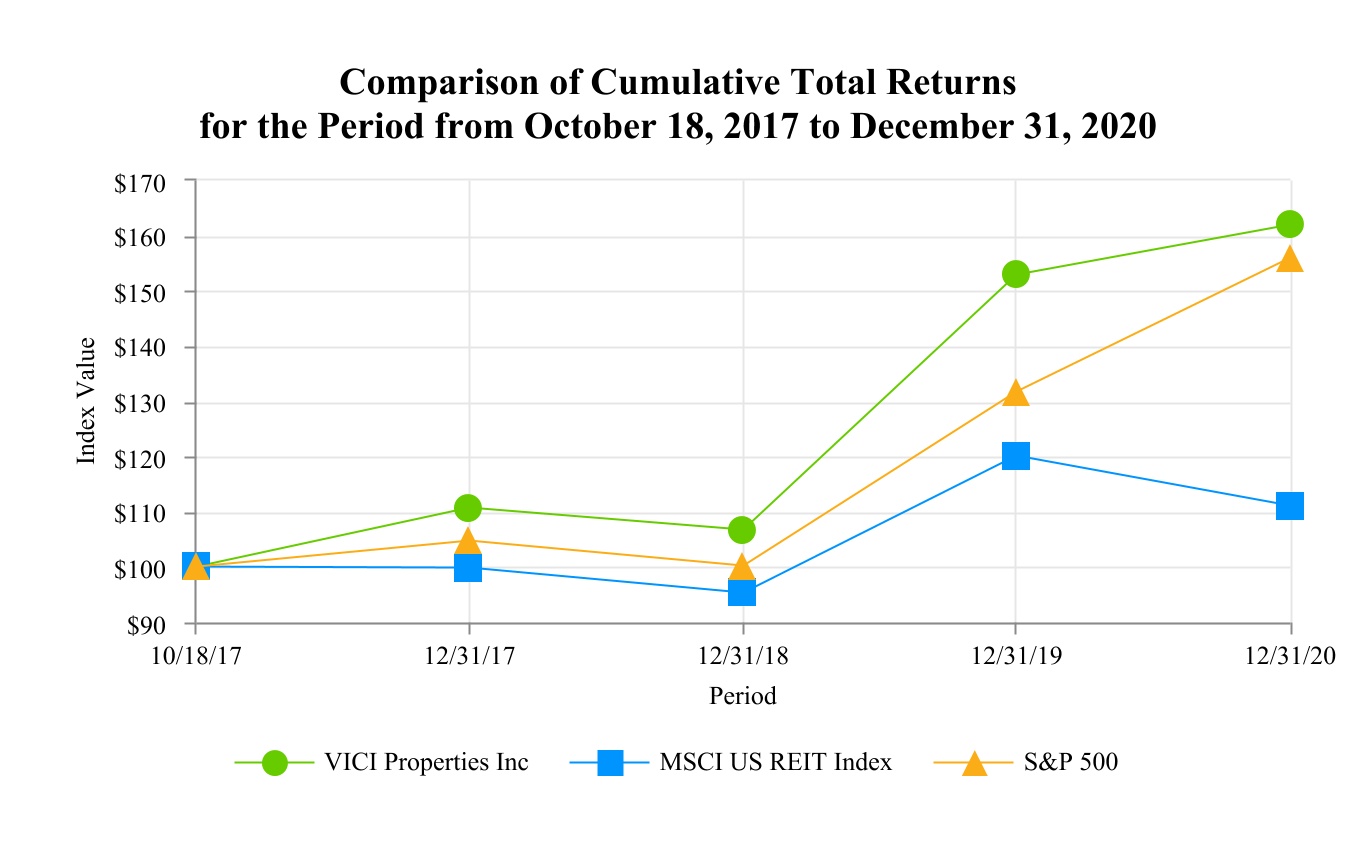
| Company / Index | 10/18/17 | 12/31/17 | 12/31/18 | 12/31/19 | 12/31/20 | |||||||||||||||||||||||||||
| VICI Properties Inc. | $ | 100.0 | $ | 110.8 | $ | 106.8 | $ | 152.9 | $ | 162.0 | ||||||||||||||||||||||
| MSCI US REIT Index | $ | 100.0 | $ | 99.9 | $ | 95.4 | $ | 120.1 | $ | 111.0 | ||||||||||||||||||||||
| S&P 500 | $ | 100.0 | $ | 104.8 | $ | 100.2 | $ | 131.7 | $ | 156.0 |
Item 6. Selected Financial Data
Item 7. Management’s Discussion and Analysis of Financial Condition and Results of Operations
You should read the following discussion and analysis of our financial condition and results of operations in conjunction with the audited consolidated Financial Statements and notes thereto of VICI Properties Inc. and other financial information included elsewhere in this Annual Report on Form 10-K. Some of the information contained in this discussion and analysis or set forth elsewhere in this Annual Report on Form 10-K, including information with respect to our business and growth strategies, statements regarding the industry outlook and our expectations regarding the future performance of our business contained herein are forward-looking statements. See “Cautionary Note Regarding Forward-Looking Statements.” You should also review the “Risk Factors” section in Item 1A of this Annual Report on Form 10-K for a discussion of important factors that could cause actual results to differ materially from the results described in or implied by such forward-looking statements.
OVERVIEW
We are a Maryland corporation that is primarily engaged in the business of owning and acquiring gaming, hospitality and entertainment destinations. We lease our properties to subsidiaries of Caesars, Penn National, Hard Rock, Century Casinos and JACK Entertainment, with Caesars being our largest tenant. We conduct our real property business through an operating partnership and our golf course business through a TRS, VICI Golf LLC. The financial information included in this Annual Report on Form 10-K are our consolidated results (including the real property business and the golf course business) for the years ended December 31, 2020, 2019 and 2018.
Key 2020 Highlights
Operating Results
-
Collected 100% of rent in cash.
-
Total revenues increased 37.0% year-over-year to $1.2 billion.
-
Net income attributable to common stockholders was $891.7 million, or $1.75 per diluted share.
-
AFFO increased 28.7% year-over-year to $835.8 million and AFFO per diluted share increased 10.8% to $1.64.
Acquisition and Investment Activity
- Completed $4.6 billion of acquisitions and investments, including:
◦Acquisition of the real estate assets of Harrah’s New Orleans, Harrah’s Laughlin, and Harrah’s Atlantic City and modification of certain provisions of the Caesars Lease Agreements in connection with the Eldorado/Caesars Merger for total consideration of approximately $3.2 billion; and
**◦**Acquisition of the real estate assets of JACK Cleveland/Thistledown for total consideration of approximately $843.3 million.
◦Originated $575.0 million of mortgage loan investments, including our first investment outside of gaming through an $80.0 million mortgage loan secured by Chelsea Piers New York, a sports and entertainment complex located in New York City.
- Added $318.4 million of contractual rent on an annualized basis to our real estate portfolio.
Capital Markets and Financing Activity
-
Increased our quarterly cash dividend to $0.33 per share (or $1.32 per share on an annualized basis), representing a 10.9% increase compared to our previous quarterly dividend.
-
Completed an equity offering in which 29,900,000 shares were sold through a forward sale agreement at $22.15 per share, raising gross proceeds of $662.3 million, with 3,000,000 shares subsequently settled for net proceeds to us of approximately $63.0 million and 26,900,000 shares remaining for settlement under the forward sale agreement.
-
Settled all 65,000,000 shares of the Company's outstanding June 2019 forward sale agreements for net proceeds of approximately $1.3 billion.
-
Issued 7,500,000 shares under the Company’s ATM Program for net proceeds of approximately $200.0 million
-
Issued $2.5 billion of Senior Unsecured Notes at a blended and weighted average interest rate of 3.83% and used $500.0 million of those proceeds to redeem our 8% Second Lien Notes that were scheduled to mature in 2023.
-
Repriced our Term Loan B Facility and lowered the interest rate from L + 2.00% to L + 1.75%.
SUMMARY OF SIGNIFICANT 2020 ACTIVITIES
Acquisition and Investment Activity
-
Caesars Forum Convention Center Mortgage Loan.** On September 18, 2020, we provided a $400.0 million mortgage loan to Caesars that is secured by the Caesars Forum Convention Center. The loan bears interest at an initial rate of 7.7%, has a term of five years and is prepayable beginning in year three, subject to certain conditions. The Caesars Forum Convention Center is subject to the A&R Convention Center Put-Call Agreement between Caesars and us, with our call option being accelerated to 2025 in connection with the entry into the mortgage loan.
-
Chelsea Piers Mortgage Loan. On August 31, 2020, we entered into an $80.0 million mortgage loan agreement with Chelsea Piers New York (“Chelsea Piers”) secured by the Chelsea Piers complex in New York City, pursuant to which we provided an initial $65.0 million term loan and a $15.0 million delayed draw term loan (which remains undrawn), subject to certain conditions. The loan bears interest at a rate of 7.0% per annum and has a term of seven years.
-
Consummation of the Eldorado Transaction. On July 20, 2020, concurrent with the consummation of the Eldorado/Caesars Merger, we consummated the Eldorado Transaction contemplated by the Master Transaction Agreement and associated agreements. The closing of the Eldorado Transaction includes the consummation of the transactions contemplated by the below described agreements. Refer to Note 4 - Property Transactions for further details.
◦Acquisition of the MTA Properties. We acquired all of the land and real estate assets associated with Harrah’s New Orleans, Harrah’s Laughlin and Harrah’s Atlantic City (collectively, the “MTA Properties”) for an aggregate purchase price of $1,823.5 million (the “MTA Properties Acquisitions”). The Regional Master Lease Agreement was amended to, among other things, include each such property, with initial aggregate total annual rent payable to us increased by $154.0 million to $621.7 million, to extend the initial lease term to July 2035 and to adjust certain minimum capital expenditure requirements and other related terms and conditions as a result of the MTA Properties being included in the Regional Master Lease Agreement.
◦Creation of Las Vegas Master Lease. In consideration of a payment by us to (i) the tenant under the CPLV Lease Agreement of $1,189.9 million (the “CPLV Lease Amendment Payment”) and (ii) the tenant under the HLV Lease Agreement of $213.8 million (the “HLV Lease Amendment Payment”), upon the consummation of the Eldorado Transaction, (a) the CPLV Lease Agreement was amended to (A) combine the CPLV Lease Agreement and the HLV Lease Agreement into a single Las Vegas Master Lease Agreement, (B) increase the annual rent payable to us thereunder associated with Caesars Palace Las Vegas by $83.5 million (the “CPLV Additional Rent Acquisition”), (C) increase the annual rent payable to us thereunder with respect to the Harrah’s Las Vegas property by $15.0 million (the “HLV Additional Rent Acquisition”) and (D) provide for the amended terms described below, and (b) the HLV Lease Agreement and the related lease guaranty were terminated. As a result of such amendments, the Harrah’s Las Vegas property is also now subject to the higher rent escalator under the Las Vegas Master Lease Agreement.
- Lease Amendments and Terminations. Each of the Caesars Lease Agreements was amended to, among other things, (i) remove the rent coverage floors, which coverage floors served to reduce the rent escalators under such leases in the event that the “EBITDAR to Rent Ratio” (as defined in the applicable Caesars Lease Agreements) coverage was below the stated floor and
Showing the first 8K of 94K characters. Open the full section
Item 7A. Quantitative and Qualitative Disclosures About Market Risk
Our future income, cash flows and fair values relevant to financial instruments are dependent upon prevailing market interest rates. In the normal course of business, we are exposed to the effect of interest rate changes. We have entered into derivative agreements to mitigate exposure to unexpected changes in interest. Market risk refers to the risk of loss from adverse changes in market interest rates. We periodically use derivative financial instruments to seek to manage, or hedge, interest rate risks related to our borrowings. We do not use derivatives for trading or speculative purposes and only enter into contracts with major financial institutions based on their credit rating and other factors. We intend to enter into derivative agreements only with counterparties that we believe have a strong credit rating to mitigate the risk of counterparty default or insolvency.
As of December 31, 2020, we had $6,850.0 million of debt outstanding of which $4,750.0 million was fixed rate debt and $2,000.0 million was hedged variable rate debt, the remaining $100.0 million of our indebtedness was unhedged. As of December 31, 2020, a one percent increase or decrease in the annual interest rate on our unhedged variable rate borrowings of $100.0 million would increase or decrease our annual cash interest expense by approximately $1.0 million.
Subsequent to year end, on January 22, 2021, two of our interest rate swaps with a notional balance of $500.0 million matured and, as a result, subsequent to January 22, 2021, $600.0 million of our indebtedness was unhedged. After January 22, 2021, a one percent increase or decrease in the annual interest rate on our unhedged variable rate borrowings of $600.0 million would increase or decrease our annual cash interest expense by approximately $6.0 million.
We may manage, or hedge, interest rate risks related to our borrowings by means of interest rate swap agreements. We also expect to manage our exposure to interest rate risk by maintaining a mix of fixed and variable rates for our indebtedness. However, the REIT provisions of the Code substantially limit our ability to hedge our assets and liabilities.
Item 8. Financial Statements and Supplementary Financial Data
The financial statements required by this item and the reports of the independent accountants thereon required by Item 15 - Exhibits and Financial Statement Schedule of this Form 10-K appear on pages F-2 to F-55. See accompanying Index to the Consolidated Financial Statements on page F-1. The supplementary financial data required by Item 302 of Regulation S-K appears in pages S-1 to S-4 to the consolidated financial statements.
Item 9. Changes in and Disagreements with Accountants on Accounting and Financial Disclosure
None.
Item 9A. Controls and Procedures
Disclosure Controls and Procedures
We maintain disclosure controls and procedures (as defined in Rules 13a-15(e) and 15d-15(e) of the Securities Exchange Act of 1934, as amended (the “Exchange Act”)) designed to provide reasonable assurance that information required to be disclosed in reports filed under the Exchange Act, is recorded, processed, summarized and reported within the specified time periods and accumulated and communicated to our management, including our principal executive officer and principal financial officer, as appropriate, to allow timely decisions regarding required disclosure.
Our management has evaluated, under the supervision and with the participation of our principal executive officer and principal financial officer, the effectiveness of the design and operation of our disclosure controls and procedures pursuant to Exchange Act Rule 13a-15(e) as of the end of the period covered by this report. Based upon this evaluation, our principal executive officer and principal financial officer concluded that our disclosure controls and procedures were effective as of the end of the period covered by this report.
Management's Report on Internal Control over Financial Reporting
Our management is responsible for establishing and maintaining adequate internal control over financial reporting (as defined in Rules 13a-15(f) and 15d-15(f) under the Exchange Act). Our internal control over financial reporting is a process designed under the supervision of our principal executive officer and principal financial officer to provide reasonable assurance regarding the reliability of financial reporting and the preparation of our consolidated financial statements for external reporting purposes in accordance with GAAP.
Our internal control over financial reporting includes policies and procedures that pertain to the maintenance of records that, in reasonable detail, accurately and fairly reflect transactions and dispositions of assets; provide reasonable assurances that transactions are recorded as necessary to permit preparation of financial statements in accordance with GAAP, and that receipts and expenditures are being made only in accordance with authorizations of our management; and provide reasonable assurance regarding prevention or timely detection of unauthorized acquisition, use or disposition of our assets that could have a material effect on our consolidated financial statements.
Management conducted an assessment of the effectiveness of our internal control over financial reporting as of December 31, 2020 based on the framework established in the updated Internal Control – Integrated Framework (2013) issued by the Committee of Sponsoring Organizations of the Treadway Commission (COSO). Based on this assessment, management has determined that our internal control over financial reporting was effective as of December 31, 2020.
Deloitte & Touche LLP, an independent registered public accounting firm, has audited our financial statements included in this report on Form 10-K and issued its attestation report, which is included herein and expresses an unqualified opinion on the effectiveness of our internal control over financial reporting as of December 31, 2020.
Changes in Internal Control Over Financial Reporting
There were no changes in our internal control over financial reporting (as is defined in Rules 13a–15(f) and 15d–15(f) under the Exchange Act) that occurred during our most recent quarter, that has materially affected, or is reasonably likely to materially affect, our internal control over financial reporting.
Item 9B. Other Information
None.
PART III
Item 10. Directors, Executive Officers and Corporate Governance
The information required by this item is incorporated by reference to the Company’s definitive proxy statement to be filed not later than April 30, 2021 with the SEC pursuant to Regulation 14A under the Exchange Act.
Item 11. Executive Compensation
The information required by this item is incorporated by reference to the Company’s definitive proxy statement to be filed not later than April 30, 2021 with the SEC pursuant to Regulation 14A under the Exchange Act.
Item 12. Security Ownership of Certain Beneficial Owners and Management and Related Stockholder Matters
The information required by this item is incorporated by reference to the Company’s definitive proxy statement to be filed not later than April 30, 2021 with the SEC pursuant to Regulation 14A under the Exchange Act.
Item 13. Certain Relationships and Related Transactions and Director Independence
The information required by this item is incorporated by reference to the Company’s definitive proxy statement to be filed not later than April 30, 2021 with the SEC pursuant to Regulation 14A under the Exchange Act.
Item 14. Principal Accounting Fees and Services
The information required by this item is incorporated by reference to the Company’s definitive proxy statement to be filed not later than April 30, 2021 with the SEC pursuant to Regulation 14A under the Exchange Act.
PART IV
Item 15. Exhibits and Financial Statement Schedule
(a)(1). Financial Statements.
See the accompanying Index to Consolidated Financial Statements and Schedule on page F-1.
(a)(2). Financial Statement Schedule.
See the accompanying Index to Consolidated Financial Statements and Schedule on page F-1.
(a)(3). Exhibits.
- Furnished herewith
† Management contracts and compensation plans and arrangements.
+ Portions of the exhibits have been redacted because such information is (i) not material and (ii) could be competitively harmful if publicly disclosed.
Item 16. Form 10-K Summary
None.
SIGNATURES
Pursuant to the requirements of Section 13 or 15(d) of the Securities Exchange Act of 1934, the registrant has duly caused this report to be signed on its behalf by the undersigned, thereunto duly authorized.
| VICI PROPERTIES INC. | ||||||||
| February 18, 2021 | By: | /S/ EDWARD B. PITONIAK | ||||||
| Edward B. Pitoniak | ||||||||
| Chief Executive Officer and Director |
POWER OF ATTORNEY
Each of the officers and directors of VICI Properties Inc., whose signature appears below, in so signing, also makes, constitutes and appoints each of Edward B. Pitoniak, David A. Kieske and Gabriel F. Wasserman, and each of them, his or her true and lawful attorneys-in-fact, with full power and substitution, for him or her in any and all capacities, to execute and cause to be filed with the SEC any and all amendments to this Annual Report on Form 10-K, with exhibits thereto and all other documents connected therewith and to perform any acts necessary to be done in order to file such documents, and hereby ratifies and confirms all that said attorneys-in-fact or their substitute or substitutes may do or cause to done by virtue hereof.
Pursuant to the requirements of the Securities Exchange Act of 1934, this report has been signed below by the following persons on behalf of the registrant and in the capacities and on the dates indicated.
| Signature | Title | Date | ||||||||||||
| /S/ EDWARD B. PITONIAK | Chief Executive Officer and Director | February 18, 2021 | ||||||||||||
| Edward B. Pitoniak | (Principal Executive Officer) | |||||||||||||
| /S/ DAVID A. KIESKE | Chief Financial Officer | February 18, 2021 | ||||||||||||
| David A. Kieske | (Principal Financial Officer) | |||||||||||||
| /S/ GABRIEL F. WASSERMAN | Chief Accounting Officer | February 18, 2021 | ||||||||||||
| Gabriel F. Wasserman | (Principal Accounting Officer) | |||||||||||||
| /S/ JAMES R. ABRAHAMSON | Chair of the Board of Directors | February 18, 2021 | ||||||||||||
| James R. Abrahamson | ||||||||||||||
| /S/ DIANA F. CANTOR | Director | February 18, 2021 | ||||||||||||
| Diana F. Cantor | ||||||||||||||
| /S/ MONICA H. DOUGLAS | Director | February 18, 2021 | ||||||||||||
| Monica H. Douglas | ||||||||||||||
| /S/ ELIZABETH I. HOLLAND | Director | February 18, 2021 | ||||||||||||
| Elizabeth I. Holland | ||||||||||||||
| /S/ CRAIG MACNAB | Director | February 18, 2021 | ||||||||||||
| Craig Macnab | ||||||||||||||
| /S/ MICHAEL D. RUMBOLZ | Director | February 18, 2021 | ||||||||||||
| Michael D. Rumbolz |
F - 1
REPORT OF INDEPENDENT REGISTERED PUBLIC ACCOUNTING FIRM
To the stockholders and the Board of Directors of VICI Properties Inc.
Opinion on the Financial Statements
We have audited the accompanying consolidated balance sheets of VICI Properties Inc. and subsidiaries (the "Company") as of December 31, 2020 and 2019, the related consolidated statements of operations and comprehensive income, stockholders' equity, and cash flows, for each of the three years in the period ended December 31, 2020, and the related notes and the schedule listed in the Index at Item 15 (collectively referred to as the "financial statements"). In our opinion, the financial statements present fairly, in all material respects, the financial position of the Company as of December 31, 2020 and 2019, and the results of its operations and its cash flows for each of the three years in the period ended December 31, 2020, in conformity with accounting principles generally accepted in the United States of America.
We have also audited, in accordance with the standards of the Public Company Accounting Oversight Board (United States) (PCAOB), the Company's internal control over financial reporting as of December 31, 2020, based on criteria established in Internal Control - Integrated Framework (2013) issued by the Committee of Sponsoring Organizations of the Treadway Commission and our report dated February 18, 2021, expressed an unqualified opinion on the Company's internal control over financial reporting.
Change in Accounting Principle
As discussed in Note 3 to the financial statements, effective January 1, 2020, the Company adopted Accounting Standard Update No. 2016-13 - Financial Instruments-Credit Losses (Topic 326) using the modified retrospective approach.
Basis for Opinion
These financial statements are the responsibility of the Company's management. Our responsibility is to express an opinion on the Company's financial statements based on our audits. We are a public accounting firm registered with the PCAOB and are required to be independent with respect to the Company in accordance with the U.S. federal
Showing the first 8K of 273K characters. Open the full section