 filings.tools
Valero Energy 10-K 2021-12-31
Filed 2022-02-22. 16 sections, 556K characters. Original on sec.gov · Markdown · JSON
Cover and table of contents
UNITED STATES
SECURITIES AND EXCHANGE COMMISSION
Washington, D.C. 20549
FORM 10-K
(Mark One)
| ☑ | ANNUAL REPORT PURSUANT TO SECTION 13 OR 15(d) OF THE SECURITIES EXCHANGE ACT OF 1934 |
For the fiscal year ended December 31, 2021
OR
| ☐ | TRANSITION REPORT PURSUANT TO SECTION 13 OR 15(d) OF THE SECURITIES EXCHANGE ACT OF 1934 | ||||
| For the transition period from _______________ to _______________ |
Commission file number 001-13175

VALERO ENERGY CORPORATION
(Exact name of registrant as specified in its charter)
| Delaware | 74-1828067 | ||||
| (State or other jurisdiction of | (I.R.S. Employer | ||||
| incorporation or organization) | Identification No.) |
One Valero Way
San Antonio, Texas 78249
(Address of principal executive offices) (Zip Code)
Registrant’s telephone number, including area code: (210) 345-2000
Securities registered pursuant to Section 12(b) of the Act:
| Title of each class | Trading Symbol(s) | Name of each exchange on which registered | ||||||||||||
| Common stock | VLO | New York Stock Exchange |
Securities registered pursuant to Section 12(g) of the Act: None.
Indicate by check mark if the registrant is a well-known seasoned issuer, as defined in Rule 405 of the Securities Act.
Yes ☑ No ☐
Indicate by check mark if the registrant is not required to file reports pursuant to Section 13 or Section 15(d) of the Act.
Yes ☐ No ☑
Indicate by check mark whether the registrant (1) has filed all reports required to be filed by Section 13 or 15(d) of the Securities Exchange Act of 1934 during the preceding 12 months (or for such shorter period that the registrant was required to file such reports), and (2) has been subject to such filing requirements for the past 90 days. Yes ☑ No ☐
Indicate by check mark whether the registrant has submitted electronically every Interactive Data File required to be submitted pursuant to Rule 405 of Regulation S-T (§232.405 of this chapter) during the preceding 12 months (or for such shorter period that the registrant was required to submit such files). Yes ☑ No ☐
Indicate by check mark whether the registrant is a large accelerated filer, an accelerated filer, a non-accelerated filer, a smaller reporting company, or an emerging growth company. See the definitions of “large accelerated filer,” “accelerated filer,” “smaller reporting company,” and “emerging growth company” in Rule 12b-2 of the Exchange Act.
| Large accelerated filer | ☑ | Accelerated filer | ☐ | Non-accelerated filer | ☐ | ||||||||||||||||||||||||||||||||||||||||||||||||
| Smaller reporting company | ☐ | Emerging growth company | ☐ |
If an emerging growth company, indicate by check mark if the registrant has elected not to use the extended transition period for complying with any new or revised financial accounting standards provided pursuant to Section 13(a) of the Exchange Act. ☐
Indicate by check mark whether the registrant has filed a report on and attestation to its management’s assessment of the effectiveness of its internal control over financial reporting under Section 404(b) of the Sarbanes-Oxley Act (15 U.S.C. 7262(b)) by the registered public accounting firm that prepared or issued its audit report. ☑
Indicate by check mark whether the registrant is a shell company (as defined in Rule 12b-2 of the Exchange Act). Yes ☐ No ☑
The aggregate market value of the voting and non-voting common stock held by non-affiliates was approximately $31.9 billion based on the last sales price quoted as of June 30, 2021 on the New York Stock Exchange, the last business day of the registrant’s most recently completed second fiscal quarter.
As of February 18, 2022, 409,303,630 shares of the registrant’s common stock were outstanding.
DOCUMENTS INCORPORATED BY REFERENCE
We intend to file with the Securities and Exchange Commission a definitive Proxy Statement for our Annual Meeting of Stockholders scheduled for April 28, 2022, at which directors will be elected. Portions of the 2022 Proxy Statement are incorporated by reference in PART III of this Form 10-K and are deemed to be a part of this report.
CROSS-REFERENCE SHEET
The following table indicates the headings in the 2022 Proxy Statement where certain information required in PART III of this Form 10-K may be found.
| Form 10-K Item No. and Caption | Heading in 2022 Proxy Statement | ||||||||||
| 10. | Directors, Executive Officers and Corporate Governance | “Information Regarding the Board of Directors — Committees of the Board — Audit Committee — Meetings and Current Members,” “Proposal No. 1 Election of Directors — Information Concerning Nominees and Other Directors,” “Proposal No. 1 Election of Directors — Nominees,” “Identification of Executive Officers,” and “Miscellaneous — Governance Documents and Codes of Ethics” | |||||||||
| 11. | Executive Compensation | “Information Regarding the Board of Directors — Committees of the Board — Compensation Committee —Compensation Committee Interlocks and Insider Participation,” “Compensation Discussion and Analysis,” “Executive Compensation,” “Director Compensation,” “Pay Ratio Disclosure,” and “Certain Relationships and Related Transactions” | |||||||||
| 12. | Security Ownership of Certain Beneficial Owners and Management and Related Stockholder Matters | “Beneficial Ownership of Valero Securities” and “Equity Compensation Plan Information” | |||||||||
| 13. | Certain Relationships and Related Transactions, and Director Independence | “Certain Relationships and Related Transactions” and “Information Regarding the Board of Directors — Independent Directors” | |||||||||
| 14. | Principal Accountant Fees and Services | “KPMG LLP Fees” |
Copies of all documents incorporated by reference, other than exhibits to such documents, will be provided without charge to each person who receives a copy of this Form 10-K upon written request to Valero Energy Corporation, Attn: Secretary, P.O. Box 696000, San Antonio, Texas 78269-6000.
i
CONTENTS
| PAGE | ||||||||
| PART I | [1](# |
Showing the first 8K of 72K characters. Open the full section
Item 1A. RISK FACTORS
You should carefully consider the following risk factors in addition to the other information included in this report. Each of these risk factors could adversely affect our business, financial condition, results of operations, and/or liquidity, as well as adversely affect the value of an investment in our common stock or debt securities.
Risks Related to Our Business, Industry, and Operations
Our financial results are affected by volatile margins, which are dependent upon factors beyond our control, including the price of crude oil, corn, and other feedstocks and the market price at which we can sell our products.
Our financial results are affected by the relationship, or margin, between our product prices and the prices for crude oil, corn, and other feedstocks, which can vary based on global, regional, and local market conditions, as well as by type and class of product. Historically, refining and ethanol margins have been volatile, and we believe they will continue to be volatile in the future. We expect that the volume of renewable diesel produced by competitors will increase going forward, and as the market becomes more competitive, or if there are changes in the regulations, policies, and standards affecting the demand for low-carbon fuels, our Renewable Diesel segment may experience increased volatility in product margins. Our cost to acquire feedstocks and the price at which we can ultimately sell products depend upon several factors beyond our control, including regional and global supply of and demand for crude oil, corn, and other feedstocks, gasoline, diesel, other liquid transportation fuels (such as jet fuel, renewable diesel, and ethanol), and other products. These in turn depend on, among other things, the availability and quantity of imports, the production levels of U.S. and international suppliers, levels of product inventories, productivity and growth (or the lack thereof) of U.S. and global economies, U.S. relationships with foreign governments, political affairs, and the extent of governmental regulation. The ability of the members of the Organization of Petroleum Exporting Countries (OPEC) to agree on and to maintain crude oil price and production controls has also had, and may continue to have, a significant impact on the market prices of crude oil and certain of our products. Additionally, the regulations, policies, and standards discussed under “ITEMS 1. and 2. BUSINESS AND PROPERTIES—OUR COMPREHENSIVE LIQUID FUELS STRATEGY—Regulations, Policies, and Standards Driving Low-Carbon Fuel Demand” have had, and may continue to have, a significant impact on the market prices of the feedstocks for, and products produced by, our low-carbon fuels businesses. Any adverse change in these regulations, policies, and standards, including the calculation of CI scores, or in our ability to obtain any approved fuel pathways, could have a material adverse effect on the margins we receive for our low-carbon products in certain markets.
Some of these factors can vary by region and may change quickly, adding to market volatility, while others may have longer-term effects. The longer-term effects of these and other factors on product margins are uncertain. We do not produce crude oil, corn, waste and renewable feedstocks, or other primary feedstocks and must purchase nearly all of the feedstocks we process. We generally purchase our feedstocks long before we process them and sell the resulting products. Price level changes during the period between purchasing feedstocks and selling the resulting products has had, and in the future could continue to have, a significant effect on our financial results. A decline in market prices could negatively impact the carrying value of our inventories.
Economic turmoil, inflation, cybersecurity incidents, and political unrest or hostilities, including the threat of future terrorist attacks, could affect the economies of the U.S. and other countries. Lower levels of
economic activity could result in declines in energy consumption, including declines in the demand for and consumption of our products, which could cause our revenues and margins to decline and limit our future growth prospects. Refining, renewable diesel, and ethanol margins also can be significantly impacted by the addition of capacity through the expansion of existing facilities or the construction of new refineries or plants. Worldwide refining capacity expansions may result in refining production capacity exceeding refined petroleum product demand, which would have an adverse effect on refining margins.
A significant portion of our profitability is derived from the ability to purchase and process crude oil feedstocks that historically have been cheaper than benchmark crude oils, such as Louisiana Light Sweet (LLS) and Brent crude oils. These crude oil feedstock differentials vary significantly depending on overall economic conditions and trends and conditions within the markets for crude oil and refined petroleum products. Previous declines in such differentials have had, and any future declines would again have, a negative impact on our results of operations.
Technological and industry developments, and evolving investor and market sentiment regarding fossil fuels and GHG emissions, may decrease the demand for our products and could adversely affect our performance.
A reduction in the demand for our products could result from a transition to alternative fuel vehicles by consumers, such as electric vehicles (EVs) and hybrid vehicles, whether as a result of technological or scientific advances, government mandates, or consumer or investor sentiment towards fossil fuels and GHG emissions. New or changing technologies may be developed that make alternative fuel vehicles more affordable or desirable, including improvements in battery and storage technology, increases to EV driving ranges, increased availability of charging stations and other necessary infrastructure, and increased inventory, which may cause some consumers to shift to alternative fuel vehicles, including vehicles that use alternative fuels other than the liquid fuels we produce.
Additionally, there may be new entrants into the renewable fuels industry that could meet demand for lower-carbon transportation fuels and modes of transportation in a more efficient or less costly manner than our technologies and products, which could also have a material adverse effect on our low-carbon fuels businesses. For instance, several other companies have made, or announced interest in making, investments in renewable diesel projects. Should these projects develop, we would face competition from them for feedstocks and customers, which could strain margins on the products we sell and limit the growth and profitability of our low-carbon fuels businesses. It is not possible at this time to predict the ultimate form, timing, or extent of any such developments. However, a reduction in the demand for our products as a result of any of the foregoing events could materially and adversely affect our business, financial condition, results of operations, and liquidity.
Investor and market sentiment towards climate change, fossil fuels, GHG emissions, environmental justice, and other ESG matters could adversely affect our business, cost of capital, and the price of our common stock and debt securities.
There have been efforts in recent years aimed at the investment community, including investment advisors, sovereign wealth funds, pension funds, universities, and other groups, to promote the divestment of securities of energy companies, as well as to pressure lenders and other financial services companies to limit or curtail activities with energy companies. As a result, some financial intermediaries, investors, and other capital markets participants have reduced or ceased lending to, or investing in, companies that operate in industries with higher perceived environmental exposu
Showing the first 8K of 63K characters. Open the full section
Item 1B. UNRESOLVED STAFF COMMENTS
None.
Item 3. LEGAL PROCEEDINGS
LITIGATION
We incorporate by reference into this Item our disclosures made in Note 1 of Notes to Consolidated Financial Statements under “Legal Contingencies.”
ENVIRONMENTAL ENFORCEMENT MATTERS
While it is not possible to predict the outcome of the following environmental proceedings, if any one or more of them were decided against us, we believe that there would be no material effect on our financial condition, results of operations, and liquidity. We are reporting these proceedings to comply with SEC regulations, which require us to disclose certain information about proceedings arising under U.S. federal, state, or local provisions regulating the discharge of materials into the environment or protecting the environment if we reasonably believe that such proceedings have the potential to result in monetary sanctions of $300,000 or more.
EPA (Benicia Refinery). In our annual report on Form 10-K for the year ended December 31, 2020, we reported that the EPA had issued a Notice of Potential Violations and Opportunity to Confer related to a series of inspections conducted by the EPA in 2019 arising out of a 2019 emissions event. We are working with the EPA to resolve this matter.
Attorney General of the State of Texas (Texas AG) (Corpus Christi Asphalt Plant). In our quarterly report on Form 10-Q for the quarter ended March 31, 2019, we reported that we had received a letter and draft Agreed Final Judgment from the Texas AG related to a contaminated water backflow incident that related to the Valero Corpus Christi Asphalt Plant. We have reached a final agreement with the Texas AG resolving the matter upon entry of the Agreed Final Judgment with the court.
Texas AG (Port Arthur Refinery). In our quarterly report on Form 10-Q for the quarter ended June 30, 2019, we reported that the Texas AG had filed suit against our Port Arthur Refinery in the 419th Judicial District Court of Travis County, Texas, Cause No. D-1-GN-19-004121, for alleged violations of the Clean Air Act seeking injunctive relief and penalties. We are working with the Texas AG to resolve this matter.
Bay Area Air Quality Management District (BAAQMD) (Benicia Refinery). In our quarterly report on Form 10-Q for the quarter ended September 30, 2021, we reported that we had received a Violation Notice from the BAAQMD related to atmospheric emissions at our Benicia Refinery. We are working with the BAAQMD to resolve this matter.
Texas Commission on Environmental Quality (TCEQ) (Corpus Christi East Refinery). In our quarterly report on Form 10-Q for the quarter ended September 30, 2021, we reported that we had received a Notice of Enforcement from the TCEQ relating to Title V permit deviations at our Corpus Christi East Refinery. We are working with the TCEQ to resolve this matter.
Item 4. MINE SAFETY DISCLOSURES
None.
PART II
Item 5. MARKET FOR REGISTRANT’S COMMON EQUITY, RELATED STOCKHOLDER MATTERS AND ISSUER PURCHASES OF EQUITY SECURITIES
Our common stock trades on the NYSE under the trading symbol “VLO.”
As of January 31, 2022, there were 4,813 holders of record of our common stock.
Dividends are considered quarterly by the Board, may be paid only when approved by the Board, and will depend on our financial condition, results of operations, cash flows, prospects, industry conditions, capital requirements, and other factors and restrictions our board deems relevant. There can be no assurance that we will pay a dividend in the future at the rates we have paid historically, or at all.
The following table discloses purchases of shares of our common stock made by us or on our behalf during the fourth quarter of 2021.
| Period | Total Number of Shares Purchased | Average Price Paid per Share | Total Number of Shares Not Purchased as Part of Publicly Announced Plans or Programs (a) | Total Number of Shares Purchased as Part of Publicly Announced Plans or Programs | Approximate Dollar Value of Shares that May Yet Be Purchased Under the Plans or Programs (b) | |||||||||||||||||||||||||||
| October 2021 | 3,083 | $ | 80.40 | 3,083 | — | $1.4 billion | ||||||||||||||||||||||||||
| November 2021 | 147,445 | $ | 76.04 | 147,445 | — | $1.4 billion | ||||||||||||||||||||||||||
| December 2021 | 7,928 | $ | 69.68 | 7,928 | — | $1.4 billion | ||||||||||||||||||||||||||
| Total | 158,456 | $ | 75.81 | 158,456 | — | $1.4 billion |
(a)The shares reported in this column represent purchases settled in the fourth quarter of 2021 relating to (i) our purchases of shares in open-market transactions to meet our obligations under stock-based compensation plans and (ii) our purchases of shares from our employees and non-employee directors in connection with the exercise of stock options, the vesting of restricted stock, and other stock compensation transactions in accordance with the terms of our stock-based compensation plans.
(b)On January 23, 2018, we announced that our Board authorized our purchase of up to $2.5 billion of our outstanding common stock (the 2018 Program), with no expiration date. As of December 31, 2021, we had $1.4 billion remaining available for purchase under the 2018 Program. We have not purchased any shares of our common stock under the 2018 Program since mid-March 2020, and we will evaluate the timing of repurchases when appropriate. We have no obligation to make purchases under the 2018 Program.
The following performance graph is not “soliciting material,” is not deemed filed with the SEC, and is not to be incorporated by reference into any of our filings under the Securities Act of 1933 or the Securities Exchange Act of 1934, as amended, respectively.
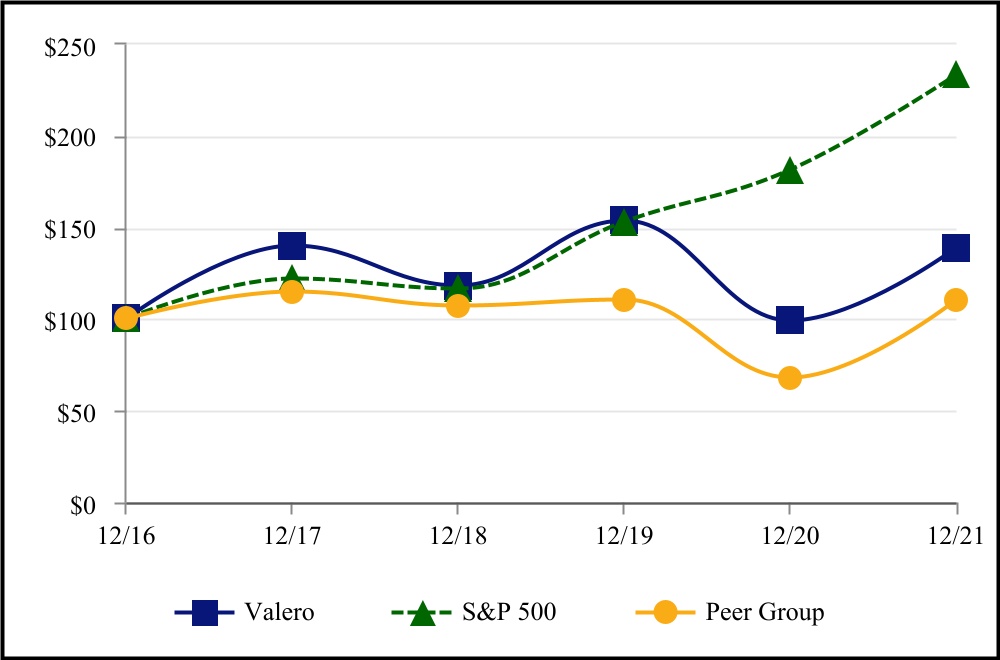
This performance graph and the related textual information are based on historical data and are not indicative of future performance. The following line graph compares the cumulative total return3 on an investment in our common stock against the cumulative total return of the S&P 500 Composite Index and an index of peers (that we selected) for the five-year period commencing December 31, 2016 and ending December 31, 2021. Our selected peer group comprises the following ten members: ConocoPhillips; CVR Energy, Inc.; Delek US Holdings, Inc.; the Energy Select Sector SPDR Fund; EOG Resources, Inc.; HollyFrontier Corporation; Marathon Petroleum Corporation; Occidental Petroleum Corporation; PBF Energy Inc.; and Phillips 66. The Energy Select Sector SPDR Fund (XLE) serves as a proxy for stock price performance of the energy sector and includes energy companies with which we compete for capital. We believe that our peer group represents a group of companies for making head-to-head performance comparisons in a competitive operating environment that is primarily characterized by U.S.-based companies that have business models predominantly consisting of downstream refining operations, together with similarly sized energy companies that share operating similarities to us, and that are in adjacent segments of the oil and gas industry.
COMPARISON OF 5 YEAR CUMULATIVE TOTAL RETURN3
Among Valero, the S&P 500 Index, and Peer Group
| As of December 31, | |||||||||||||||||||||||||||||||||||
| 2016 | 2017 | 2018 | 2019 | 2020 | 2021 | ||||||||||||||||||||||||||||||
| Valero common stock | $ | 100.00 | $ | 139.98 | $ | 117.98 | $ | 153.80 | $ | 99.04 | $ | 138.98 | |||||||||||||||||||||||
| S&P 500 index | 100.00 | 121.83 | 116.49 | 153.17 | 181.35 | 233.41 | |||||||||||||||||||||||||||||
| Peer Group | 100.00 | 114.94 | 107.11 | 110.73 | 68.00 | 110.49 |
3 Assumes that an investment in Valero common stock, the S&P 500 index, and our peer group was $100 on December 31, 2016. Cumulative total return is based on share price appreciation plus reinvestment of dividends from December 31, 2016 through December 31, 2021.
Item 6. [RESERVED]
Item 7. MANAGEMENT’S DISCUSSION AND ANALYSIS OF FINANCIAL CONDITION AND RESULTS OF OPERATIONS
The following discussion and analysis is management’s perspective of our current financial condition and results of operations, and should be read in conjunction with “ITEM 1A. RISK FACTORS” and “ITEM 8. FINANCIAL STATEMENTS AND SUPPLEMENTARY DATA” included in this report. This discussion and analysis includes the years ended December 31, 2021 and 2020 and comparisons between such years. The discussions for the year ended December 31, 2019 and comparisons between the years ended December 31, 2020 and 2019 have been omitted from this annual report on Form 10-K for the year ended December 31, 2021, as such information can be found in “ITEM 7. MANAGEMENT’S DISCUSSION AND ANALYSIS OF FINANCIAL CONDITION AND RESULTS OF OPERATIONS” in our annual report on Form 10-K for the year ended December 31, 2020, which was filed on February 23, 2021.
CAUTIONARY STATEMENT FOR THE PURPOSE OF SAFE HARBOR PROVISIONS OF THE PRIVATE SECURITIES LITIGATION REFORM ACT OF 1995
This report, including without limitation our disclosures below under “OVERVIEW AND OUTLOOK,” includes forward-looking statements within the meaning of Section 27A of the Securities Act of 1933 and Section 21E of the Securities Exchange Act of 1934. You can identify our forward-looking statements by the words “anticipate,” “believe,” “expect,” “plan,” “intend,” “scheduled,” “estimate,” “project,” “projection,” “predict,” “budget,” “forecast,” “goal,” “guidance,” “target,” “could,” “would,” “should,” “may,” “strive,” “seek,” “potential,” “opportunity,” “aimed,” “considering,” “continue,” and similar expressions.
These forward-looking statements include, among other things, statements regarding:
-
the effect, impact, potential duration or timing, or other implications of the COVID-19 pandemic, government restrictions, requirements, or mandates in response thereto, variants of the COVID-19 virus, vaccine distribution and administration levels, economic activity, and global crude oil production levels, and any expectations we may have with respect thereto, including with respect to our responses thereto, our operations and the production levels of our assets;
-
future Refining segment margins, including gasoline and distillate margins, and discounts;
-
future Renewable Diesel segment margins;
-
future Ethanol segment margins;
-
expectations regarding feedstock costs, including crude oil differentials, product prices for each of our segments, and operating expenses;
-
anticipated levels of crude oil and liquid transportation fuel inventories and storage capacity;
-
expectations regarding the levels of, and timing with respect to, the production and operations at our existing refineries and plants and projects under construction;
-
our anticipated level of capital investments, including deferred turnaround and catalyst cost expenditures, our expected allocation between, and/or within, growth capital expenditures and sustaining capital expenditures, capital expenditures for environmental and other purposes, and joint venture investments, the expected timing applicable to such capital investments and any related projects, and the effect of those capital investments on our business, financial condition, results of operations, and liquidity;
-
our anticipated level of cash distributions or contributions, such as our dividend payment rate and contributions to our qualified pension plans and other postretirement benefit plans;
-
our ability to meet future cash requirements, whether from funds generated from our operations or our ability to access financial markets effectively, and our ability to maintain sufficient liquidity;
-
our evaluation of, and expectations regarding, any future activity under our share repurchase program or transactions involving our debt securities;
-
anticipated trends in the supply of, and demand for, crude oil and other feedstocks and refined petroleum products, renewable diesel, and ethanol and corn related co-products in the regions where we operate, as well as globally;
-
expectations regarding environmental, tax, and other regulatory matters, including the anticipated amounts and timing of payment with respect to our deferred tax liabilities, matters impacting our ability to repatriate cash held by our foreign subsidiaries, and the anticipated effect thereof on our business, financial condition, results of operations, and liquidity;
-
the effect of general economic and other conditions on refining, renewable diesel, and ethanol industry fundamentals;
-
expectations regarding our risk management activities, including the anticipated effects of our hedge transactions;
-
expectations regarding our counterparties, including our ability to pass on increased compliance costs and timely collect receivables, and the credit risk within our accounts receivable or accounts payable;
-
expectations regarding adoptions of new, or changes to existing, low-carbon fuel standards or policies, blending and tax credits, or efficiency standards that impact demand for renewable fuels; and
-
expectations regarding our publicly announced GHG emissions reduction/offset targets and our current and any future carbon transition projects.
We based our forward-looking statements on our current expectations, estimates, and projections about ourselves, our industry, and the global economy and financial markets generally. We caution that these statements are not guarantees of future performance or results and involve known and unknown risks and uncertainties, the ultimate outcomes of which we cannot predict with certainty. In addition, we based many of these forward-looking statements on assumptions about future events, the ultimate outcomes of which we cannot predict with certainty and which may prove to be inaccurate. Accordingly, actual performance or results may differ materially from the future performance or results that we have expressed, suggested, or forecast in the forward-looking statements. Differences between actual performance or results and any future performance or results expressed, suggested, or forecast in these forward-looking statements could result from a variety of factors, including the following:
-
demand for, and supplies of, refined petroleum products (such as gasoline, diesel, jet fuel, and petrochemicals), renewable diesel, and ethanol and corn related co-products;
-
demand for, and supplies of, crude oil and other feedstocks;
-
the effects of public health threats, pandemics, and epidemics, such as the COVID-19 pandemic and variants of the virus, governmental and societal responses thereto, including requirements and mandates with respect to vaccines, vaccine distribution and administration levels, and the adverse impacts of the foregoing on our business, financial condition, results of operations, and liquidity, including, but not limited to, our growth, operating costs, administrative costs, supply chain, labor availability, logistical capabilities, customer demand for our products, and industry demand generally, margins, production and throughput capacity, utilization, inventory value, cash
position, taxes, the price of our securities and trading markets with respect thereto, our ability to access capital markets, and the global economy and financial markets generally;
-
acts of terrorism aimed at either our refineries and plants or third-party facilities that could impair our ability to produce or transport refined petroleum products, renewable diesel, ethanol, or corn related co-products, to receive feedstocks, or otherwise operate efficiently;
-
political and economic conditions in nations that produce crude oil or other feedstocks or consume refined petroleum products, renewable diesel, ethanol or corn related co-products;
-
the ability of the members of OPEC to agree on and to maintain crude oil price and production controls;
-
the level of consumer demand, consumption and overall economic activity, including seasonal fluctuations;
-
refinery,
Showing the first 8K of 107K characters. Open the full section
Item 7A. QUANTITATIVE AND QUALITATIVE DISCLOSURES ABOUT MARKET RISK
COMMODITY PRICE RISK
We are exposed to market risks related to the volatility in the price of feedstocks (primarily crude oil, waste and renewable feedstocks, and corn), the products we produce, and natural gas used in our operations. To reduce the impact of price volatility on our results of operations and cash flows, we use commodity derivative instruments, including futures and options to manage the volatility of:
-
inventories and firm commitments to purchase inventories generally for amounts by which our current year inventory levels (determined on a LIFO basis) differ from our previous year-end LIFO inventory levels; and
-
forecasted purchases and/or product sales at existing market prices that we deem favorable.
Our positions in commodity derivative instruments are monitored and managed on a daily basis by our risk control group to ensure compliance with our stated risk management policy that has been approved by our Board.
As of December 31, 2021 and 2020, the amount of gain or loss that would have resulted from a 10 percent increase or decrease in the underlying price for all of our commodity derivative instruments entered into for purposes other than trading with which we have market risk was not material. See Note 21 of Notes to Consolidated Financial Statements for notional volumes associated with these derivative contracts as of December 31, 2021.
COMPLIANCE PROGRAM PRICE RISK
We are exposed to market risk related to the volatility in the price of credits needed to comply with the Renewable and Low-Carbon Fuel Blending Programs. To manage this risk, we enter into contracts to purchase these credits. As of December 31, 2021 and 2020, the amount of gain or loss in the fair value of derivative instruments that would have resulted from a 10 percent increase or decrease in the underlying price of the contracts was not material. See Note 21 of Notes to Consolidated Financial Statements for a discussion about these blending programs.
INTEREST RATE RISK
The following table provides information about our debt instruments (dollars in millions), the fair values of which are sensitive to changes in interest rates. Principal cash flows and related weighted-average interest rates by expected maturity dates are presented. See Note 10 of Notes to Consolidated Financial Statements for additional information related to our debt.
| December 31, 2021 (a) | |||||||||||||||||||||||||||||||||||||||||||||||
| Expected Maturity Dates | |||||||||||||||||||||||||||||||||||||||||||||||
| 2022 (b)(c) | 2023 | 2024 | 2025 | 2026 | There- after | Total | Fair Value | ||||||||||||||||||||||||||||||||||||||||
| Fixed rate | $ | 300 | $ | — | $ | 169 | $ | 1,374 | $ | 1,726 | $ | 7,637 | $ | 11,206 | $ | 12,838 | |||||||||||||||||||||||||||||||
| Average interest rate | 4.0 | % | — | % | 1.2 | % | 3.0 | % | 3.9 | % | 5.0 | % | 4.5 | % | |||||||||||||||||||||||||||||||||
| Floating rate | $ | 810 | $ | 20 | $ | — | $ | — | $ | — | $ | — | $ | 830 | $ | 830 | |||||||||||||||||||||||||||||||
| Average interest rate | 3.5 | % | 3.9 | % | — | % | — | % | — | % | — | % | 3.5 | % |
| December 31, 2020 (a) | |||||||||||||||||||||||||||||||||||||||||||||||
| Expected Maturity Dates | |||||||||||||||||||||||||||||||||||||||||||||||
| 2021 (c) | 2022 (b) | 2023 | 2024 | 2025 | There- after | Total | Fair Value | ||||||||||||||||||||||||||||||||||||||||
| Fixed rate | $ | — | $ | 300 | $ | 850 | $ | 925 | $ | 1,650 | $ | 8,174 | $ | 11,899 | $ | 13,899 | |||||||||||||||||||||||||||||||
| Average interest rate | — | % | 4.0 | % | 2.7 | % | 1.2 | % | 3.1 | % | 5.1 | % | 4.4 | % | |||||||||||||||||||||||||||||||||
| Floating rate | $ | 603 | $ | 6 | $ | 595 | $ | — | $ | — | $ | — | $ | 1,204 | $ | 1,204 | |||||||||||||||||||||||||||||||
| Average interest rate | 3.9 | % | 3.0 | % | 1.4 | % | — | % | — | % | — | % | 2.7 | % |
(a)Excludes unamortized discounts and debt issuance costs.
(b)See “ITEM 7. MANAGEMENT’S DISCUSSION AND ANALYSIS OF FINANCIAL CONDITION AND RESULTS OF OPERATIONS—LIQUIDITY AND CAPITAL RESOURCES—Our Capital Resources—Contractual Obligations” for a discussion of the Mandatory Tender Date and maturity date of our GO Zone Bonds.
(c)Our floating rate debt included outstanding borrowings under the DGD Revolver, the DGD Loan Agreement, and the IEnova Revolver (each as defined and described in Note 10 of Notes to Consolidated Financial Statements). The respective lenders of these debt instruments do not have recourse against us.
FOREIGN CURRENCY RISK
We are exposed to exchange rate fluctuations on transactions related to our foreign operations that are denominated in currencies other than the local (functional) currencies of those operations. To manage our exposure to these exchange rate fluctuations, we often use foreign currency contracts. As of December 31, 2021 and 2020, the fair value of our foreign currency contracts was not material.
See Note 21 of Notes to Consolidated Financial Statements for a discussion about our foreign currency risk management activities.
Item 8. FINANCIAL STATEMENTS AND SUPPLEMENTARY DATA
MANAGEMENT’S REPORT ON INTERNAL CONTROL OVER FINANCIAL REPORTING
Our management is responsible for establishing and maintaining adequate “internal control over financial reporting” (as defined in Rule 13a-15(f) under the Securities Exchange Act of 1934) for Valero Energy Corporation. Our management evaluated the effectiveness of Valero’s internal control over financial reporting as of December 31, 2021. In its evaluation, management used the criteria established in Internal Control – Integrated Framework (2013) issued by the Committee of Sponsoring Organizations of the Treadway Commission (COSO). Management believes that as of December 31, 2021, our internal control over financial reporting was effective based on those criteria.
Our independent registered public accounting firm has issued an attestation report on the effectiveness of our internal control over financial reporting, which begins on page 69 of this report.
REPORT OF INDEPENDENT REGISTERED PUBLIC ACCOUNTING FIRM
To the Board of Directors and Stockholders
Valero Energy Corporation:
Opinion on the Consolidated Financial Statements
We have audited the accompanying consolidated balance sheets of Valero Energy Corporation and subsidiaries (the Company) as of December 31, 2021 and 2020, the related consolidated statements of income, comprehensive income, equity, and cash flows for each of the years in the three-year period ended December 31, 2021, and the related notes (collectively, the consolidated financial statements). In our opinion, the consolidated financial statements present fairly, in all material respects, the financial position of the Company as of December 31, 2021 and 2020, and the results of its operations and its cash flows for each of the years in the three-year period ended December 31, 2021, in conformity with U.S. generally accepted accounting principles.
We also have audited, in accordance with the standards of the Public Company Accounting Oversight Board (United States) (PCAOB), the Company’s internal control over financial reporting as of December 31, 2021, based on criteria established in Internal Control – Integrated Framework (2013) issued by the Committee of Sponsoring Organizations of the Treadway Commission, and our report dated February 22, 2022 expressed an unqualified opinion on the effectiveness of the Company’s internal control over financial reporting.
Basis for Opinion
These consolidated financial statements are the responsibility of the Company’s management. Our responsibility is to express an opinion on these consolidated financial statements based on our audits. We are a public accounting firm registered with the PCAOB and are required to be independent with respect to the Company in accordance with the U.S. federal securities laws and the applicable rules and regulations of the Securities and Exchange Commission and the PCAOB.
We conducted our audits in accordance with the standards of the PCAOB. Those standards require that we plan and perform the audit to obtain reasonable assurance about whether the consolidated financial statements are free of material misstatement, whether due to error or fraud. Our audits included performing procedures to assess the risks of material misstatement of the consolidated financial statements, whether due to error or fraud, and performing procedures that respond to those risks. Such procedures included examining, on a test basis, evidence regarding the amounts and disclosures in the consolidated financial statements. Our audits also included evaluating the accounting principles used and significant estimates made by management, as well as evaluating the overall presentation of the consolidated financial statements. We believe that our audits provide a reasonable basis for our opinion.
Critical Audit Matter
The critical audit matter communicated below is a matter arising from the current period audit of the consolidated financial statements that was communicated or required to be communicated to the audit committee and that: (1) relates to accounts or disclosures that are material to the consolidated financial statements and (2) involved our especially challenging, subjective, or complex judgments. The communication of a critical audit matter does not alter in any way our opinion on the consolidated
financial statements, taken as a whole, and we are not, by communicating the critical audit matter below, providing a separate opinion on the critical audit matter or on the accounts or disclosures to which it relates.
Assessment of gross unrecognized tax benefits
As discussed in Note 16 to the consolidated financial statements, as of December 31, 2021, the Company has gross unrecognized tax benefits, excluding related interest and penalties, of $816 million. The Company’s tax positions are subject to examination by local taxing authorities and the resolution of such examinations may span multiple years. Due to the complexities inherent in the interpretation of income tax laws in domestic and foreign jurisdictions, it is uncertain whether some of the Company’s income tax positions will be sustained upon examination.
We identified the assessment of the Company’s gross unrecognized tax benefits as a critical audit matter. Complex auditor judgment was required in evaluating the Company’s interpretation of income tax laws and assessing the Company’s estimate of the ultimate resolution of its income tax positions.
The following are the primary procedures we performed to address this critical audit matter. We evaluated the design and tested the operating effectiveness of certain internal controls over the Company’s income tax process. This included controls to evaluate which of the Company’s income tax positions may not be sustained upon examination and estimate the gross unrecognized tax benefits. We involved domestic and international income tax professionals with specialized skills and knowledge, who assisted in:
-
obtaining an understanding and evaluating the Company’s income tax positions as filed or intended to be filed
-
evaluating the Company’s interpretation of income tax laws by developing an independent assessment of the Company’s income tax positions and comparing the results to the Company’s assessment
-
inspecting settlements and communications with applicable taxing authorities
-
assessing the expiration of applicable statutes of limitations.
In addition, we evaluated the Company’s ability to estimate its gross unrecognized tax benefits by comparing historical uncertain income tax positions, including the gross unrecognized tax benefits, to actual results upon conclusion of tax examinations.
/s/ KPMG LLP
We have served as the Company’s auditor since 2004.
San Antonio, Texas
February 22, 2022
REPORT OF INDEPENDENT REGISTERED PUBLIC ACCOUNTING FIRM
To the Board of Directors and Stockholders
Valero Energy Corporation:
Opinion on Internal Control Over Financial Reporting
We have audited Valero Energy Corporation and subsidiaries’ (the Company) internal control over financial reporting as of December 31, 2021, based on criteria established in Internal Control – Integrated Framework (2013) issued by the Committee of Sponsoring Organizations of the Treadway Commission. In our opinion, the Company maintained, in all material respects, effective internal control over financial reporting as of December 31, 2021, based on criteria established in Internal Control – Integrated Framework (2013) issued by the Committee of Sponsoring Organizations of the Treadway Commission.
We also have audited, in accordance with the standards of the Public Company Accounting Oversight Board (United States) (PCAOB), the consolidated balance sheets of the Company as of December 31, 2021 and 2020, the related consolidated statements of income, comprehensive income, equity, and cash flows for each of the years in the three-year period ended Decem
Showing the first 8K of 259K characters. Open the full section
Item 9. CHANGES IN AND DISAGREEMENTS WITH ACCOUNTANTS ON ACCOUNTING AND FINANCIAL DISCLOSURE
None.
Item 9A. CONTROLS AND PROCEDURES
Disclosure Controls and Procedures
Our management has evaluated, with the participation of our principal executive officer and principal financial officer, the effectiveness of our disclosure controls and procedures (as defined in Rule 13a-15(e) under the Securities Exchange Act of 1934) as of the end of the period covered by this report, and has concluded that our disclosure controls and procedures were effective as of December 31, 2021.
Internal Control over Financial Reporting
(a) Management’s Report on Internal Control over Financial Reporting.
The management report on our internal control over financial reporting required by this item appears in “ITEM 8. FINANCIAL STATEMENTS AND SUPPLEMENTARY DATA” on page 66 of this report, and is incorporated by reference into this item.
(b) Attestation Report of the Independent Registered Public Accounting Firm.
KPMG LLP’s report on our internal control over financial reporting appears in “ITEM 8. FINANCIAL STATEMENTS AND SUPPLEMENTARY DATA” beginning on page 69 of this report, and is incorporated by reference into this item.
(c) Changes in Internal Control over Financial Reporting.
There has been no change in our internal control over financial reporting that occurred during our last fiscal quarter that has materially affected, or is reasonably likely to materially affect, our internal control over financial reporting.
Item 9B. OTHER INFORMATION
None.
Item 9C. DISCLOSURE REGARDING FOREIGN JURISDICTIONS THAT PREVENT INSPECTIONS
Not applicable.
PART III
ITEMS 10-14.
The information required by ITEMS 10 through 14 of Form 10-K is incorporated by reference into these items to the definitive proxy statement for our 2022 annual meeting of stockholders. We expect to file the proxy statement with the SEC on or before March 31, 2022. No other information other than what is required to satisfy ITEMS 10 through 14 of Form 10-K is incorporated by reference into these items from such proxy statement. See the cross-reference sheet on page “i.”
PART IV
Item 15. EXHIBITS AND FINANCIAL STATEMENT SCHEDULES
(a) 1. Financial Statements. The following are included in “ITEM 8. FINANCIAL STATEMENTS AND SUPPLEMENTARY DATA” of this Form 10-K:
2. Financial Statement Schedules and Other Financial Information. No financial statement schedules are submitted because either they are inapplicable or because the required information is included in the consolidated financial statements or notes thereto.
3. Exhibits. Filed as part of this Form 10-K are the following exhibits:
| ***101.PRE | — | Inline XBRL Taxonomy Extension Presentation Linkbase Document. | ||||||
| ***104 | — | Cover Page Interactive Data File (formatted as Inline XBRL and contained in Exhibit 101). |
| * | Filed herewith. | ||||
| ** | Furnished herewith. | ||||
| *** | Submitted electronically herewith. | ||||
| + | Identifies management contracts or compensatory plans or arrangements required to be filed as an exhibit hereto. | ||||
| ++ | Certain schedules have been omitted pursuant to Item 601(b)(2) of Regulation S-K. The registrant agrees to furnish supplementally a copy of any such omitted schedule to the SEC upon request. |
Pursuant to paragraph 601(b)(4)(iii)(A) of Regulation S-K, the registrant has omitted from the foregoing listing of exhibits, and hereby agrees to furnish to the SEC upon its request, copies of certain instruments, each relating to debt not exceeding 10 percent of the total assets of the registrant and its subsidiaries on a consolidated basis.
Item 16. FORM 10-K SUMMARY
None.
SIGNATURE
Pursuant to the requirements of Section 13 or 15(d) of the Securities Exchange Act of 1934, the registrant has duly caused this report to be signed on its behalf by the undersigned, thereunto duly authorized.
| VALERO ENERGY CORPORATION (Registrant) | ||||||||
| By: | /s/ Joseph W. Gorder | |||||||
| (Joseph W. Gorder) | ||||||||
| Chairman of the Board and Chief Executive Officer |
Date: February 22, 2022
POWER OF ATTORNEY
KNOW ALL PERSONS BY THESE PRESENTS, that each person whose signature appears below hereby constitutes and appoints Joseph W. Gorder, Jason W. Fraser, and Richard J. Walsh, or any of them, each with power to act without the other, his true and lawful attorney-in-fact and agent, with full power of substitution and resubstitution, for him and in his name, place and stead, in any and all capacities, to sign any or all subsequent amendments and supplements to this annual report on Form 10-K, and to file the same, or cause to be filed the same, with all exhibits thereto, and other documents in connection therewith, with the Securities and Exchange Commission, granting unto each said attorney-in-fact and agent full power to do and perform each and every act and thing requisite and necessary to be done in and about the premises, as fully to all intents and purposes as he might or could do in person, hereby qualifying and confirming all that said attorney-in-fact and agent or his substitute or substitutes may lawfully do or cause to be done by virtue hereof.
Pursuant to the requirements of the Securities Exchange Act of 1934, this report has been signed below by the following persons on behalf of the registrant and in the capacities and on the dates indicated.
| Signature | Title | Date | ||||||||||||
| /s/ Joseph W. Gorder | Chairman of the Board and Chief Executive Officer (Principal Executive Officer) | February 22, 2022 | ||||||||||||
| (Joseph W. Gorder) | ||||||||||||||
| /s/ Jason W. Fraser | Executive Vice President and Chief Financial Officer (Principal Financial and Accounting Officer) | February 22, 2022 | ||||||||||||
| (Jason W. Fraser) | ||||||||||||||
| /s/ Fred M. Diaz | Director | February 22, 2022 | ||||||||||||
| (Fred M. Diaz) | ||||||||||||||
| /s/ H. Paulett Eberhart | Director | February 22, 2022 | ||||||||||||
| (H. Paulett Eberhart) | ||||||||||||||
| /s/ Kimberly S. Greene | Director | February 22, 2022 | ||||||||||||
| (Kimberly S. Greene) | ||||||||||||||
| /s/ Deborah P. Majoras | Director | February 22, 2022 | ||||||||||||
| (Deborah P. Majoras) | ||||||||||||||
| /s/ Eric D. Mullins | Director | February 22, 2022 | ||||||||||||
| (Eric D. Mullins) | ||||||||||||||
| /s/ Donald L. Nickles | Director | February 22, 2022 | ||||||||||||
| (Donald L. Nickles) | ||||||||||||||
| /s/ Philip J. Pfeiffer | Director | February 22, 2022 | ||||||||||||
| (Philip J. Pfeiffer) | ||||||||||||||
| /s/ Robert A. Profusek | Director | February 22, 2022 | ||||||||||||
| (Robert A. Profusek) | ||||||||||||||
| /s/ Stephen M. Waters | Director | February 22, 2022 | ||||||||||||
| (Stephen M. Waters) | ||||||||||||||
| /s/ Randall J. Weisenburger | Director | February 22, 2022 | ||||||||||||
| (Randall J. Weisenburger) | ||||||||||||||
| /s/ Rayford Wilkins, Jr. | Director | February 22, 2022 | ||||||||||||
| (Rayford Wilkins, Jr.) |