 filings.tools
Vivmark Residential 10-K 2021-12-31
Filed 2022-02-17. 18 sections, 567K characters. Original on sec.gov · Markdown · JSON
Cover and table of contents
UNITED STATES
SECURITIES AND EXCHANGE COMMISSION
Washington, D.C. 20549
FORM 10-K
| ☒ | ANNUAL REPORT PURSUANT TO SECTION 13 OR 15(d) OF THE SECURITIES EXCHANGE ACT OF 1934 |
|---|
For the Fiscal Year Ended December 31, 2021
OR
| ☐ | TRANSITION REPORT PURSUANT TO SECTION 13 OR 15(d) OF THE SECURITIES EXCHANGE ACT OF 1934 |
|---|
For the transition period from to
Commission File Number: 1-12252 (Equity Residential)
Commission File Number: 0-24920 (ERP Operating Limited Partnership)
EQUITY RESIDENTIAL
ERP OPERATING LIMITED PARTNERSHIP
(Exact name of registrant as specified in its charter)
| Maryland (Equity Residential) | 13-3675988 (Equity Residential) |
|---|---|
| Illinois (ERP Operating Limited Partnership) | 36-3894853 (ERP Operating Limited Partnership) |
| (State or other jurisdiction of incorporation or organization) | (I.R.S. Employer Identification No.) |
| Two North Riverside Plaza, Chicago, Illinois 60606 | (312) 474-1300 |
| (Address of principal executive offices) (Zip Code) | (Registrant’s telephone number, including area code) |
Securities registered pursuant to Section 12(b) of the Act:
| Title of each class | Trading Symbol(s) | Name of each exchange on which registered | ||
|---|---|---|---|---|
| Common Shares of Beneficial Interest, $0.01 Par Value (Equity Residential) | EQR | New York Stock Exchange | ||
| 7.57% Notes due August 15, 2026 (ERP Operating Limited Partnership) | N/A | New York Stock Exchange |
Securities registered pursuant to Section 12(g) of the Act:
None (Equity Residential)
Units of Limited Partnership Interest (ERP Operating Limited Partnership)
(Title of each class)
Indicate by check mark if the registrant is a well-known seasoned issuer, as defined in Rule 405 of the Securities Act.
| Equity Residential Yes ☒ No ☐ | ERP Operating Limited Partnership Yes ☒ No ☐ |
|---|
Indicate by check mark if the registrant is not required to file reports pursuant to Section 13 or Section 15(d) of the Act.
| Equity Residential Yes ☐ No ☒ | ERP Operating Limited Partnership Yes ☐ No ☒ |
|---|
Indicate by check mark whether the registrant (1) has filed all reports required to be filed by Section 13 or 15(d) of the Securities Exchange Act of 1934 during the preceding 12 months (or for such shorter period that the registrant was required to file such reports), and (2) has been subject to such filing requirements for the past 90 days.
| Equity Residential Yes ☒ No ☐ | ERP Operating Limited Partnership Yes ☒ No ☐ |
|---|
Indicate by check mark whether the registrant has submitted electronically every Interactive Data File required to be submitted pursuant to Rule 405 of Regulation S-T (§ 232.405 of this chapter) during the preceding 12 months (or for such shorter period that the registrant was required to submit such files).
| Equity Residential Yes ☒ No ☐ | ERP Operating Limited Partnership Yes ☒ No ☐ |
|---|
Indicate by check mark whether the registrant is a large accelerated filer, an accelerated filer, a non-accelerated filer, a smaller reporting company, or an emerging growth company. See the definitions of “large accelerated filer,” “accelerated filer,” “smaller reporting company,” and “emerging growth company” in Rule 12b-2 of the Exchange Act.
| Equity Residential: | ||||||
|---|---|---|---|---|---|---|
| Large accelerated filer | ☒ | Accelerated filer | ☐ | |||
| Non-accelerated filer | ☐ | Smaller reporting company | ☐ | |||
| Emerging growth company | ☐ |
| ERP Operating Limited Partnership: | ||||||
|---|---|---|---|---|---|---|
| Large accelerated filer | ☐ | Accelerated filer | ☐ | |||
| Non-accelerated filer | ☒ | Smaller reporting company | ☐ | |||
| Emerging growth company | ☐ |
If an emerging growth company, indicate by check mark if the registrant has elected not to use the extended transition period for complying with any new or revised financial accounting standards provided pursuant to Section 13(a) of the Exchange Act.
| Equity Residential | ☐ | ERP Operating Limited Partnership | ☐ |
|---|
Indicate by check mark whether the registrant has filed a report on and attestation to its management’s assessment of the effectiveness of its internal control over financial reporting under Section 404(b) of the Sarbanes-Oxley Act (15 U.S.C. 7262(b)) by the registered public accounting firm that prepared or issued its audit report.
| Equity Residential | ☒ | ERP Operating Limited Partnership | ☒ |
|---|
Indicate by check mark whether the registrant is a shell company (as defined in Rule 12b-2 of the Act).
| Equity Residential Yes ☐ No ☒ | ERP Operating Limited Partnership Yes ☐ No ☒ |
|---|
The aggregate market value of Common Shares held by non-affiliates of the Registrant was approximately $28.5 billion based upon the closing price on June 30, 2021 of $77.00 using beneficial ownership of shares rules adopted pursuant to Section 13 of the Securities Exchange Act of 1934 to exclude voting shares owned by Trustees and Executive Officers, some of whom may not be held to be affiliates upon judicial determination.
The number of Common Shares of Beneficial Interest, $0.01 par value, outstanding on February 11, 2022 was 375,917,242.
| Auditor Firm Id: | 42 | Auditor Name: | Ernst and Young LLP | Auditor Location: | Chicago, Illinois, USA |
|---|
DOCUMENTS INCORPORATED BY REFERENCE
Part III incorporates by reference certain information that will be contained in Equity Residential’s Proxy Statement relating to its 2022 Annual Meeting of Shareholders, which Equity Residential intends to file no later than 120 days after the end of its fiscal year ended December 31, 2021, and thus these items have been omitted in accordance with General Instruction G(3) to Form 10-K. Equity Residential is the general partner and 96.7% owner of ERP Operating Limited Partnership.
EXPLANATORY NOTE
This report combines the annual reports on Form 10-K for the year ended December 31, 2021 of Equity Residential and ERP Operating Limited Partnership. Unless stated otherwise or the context otherwise requires, references to “EQR” mean Equity Residential, a Maryland real estate investment trust (“REIT”), and references to “ERPOP” mean ERP Operating Limited Partnership, an Illinois limited partnership. References to the “Company,” “we,” “us” or “our” mean collectively EQR, ERPOP and those entities/subsidiaries owned or controlled by EQR and/or ERPOP. References to the “Operating Partnership” mean collectively ERPOP and those entities/subsidiaries owned or controlled by ERPOP. The following chart illustrates the Company’s and the Operating Partnership’s corporate structure:
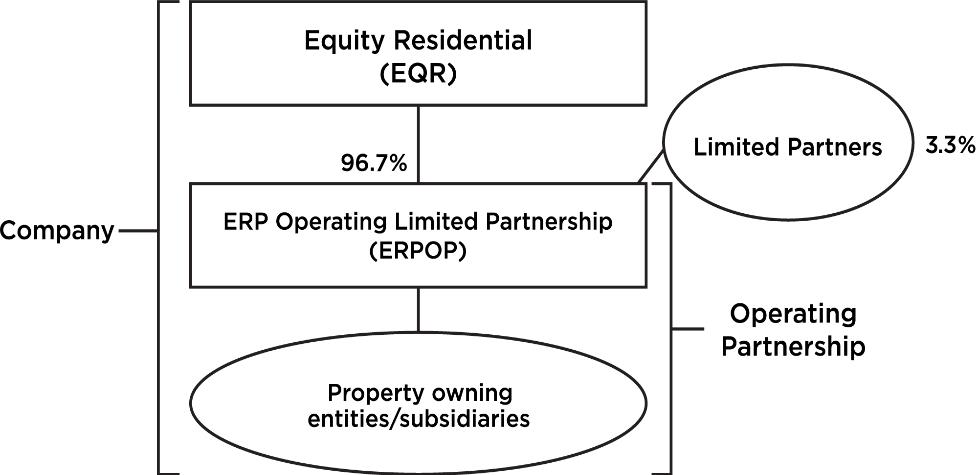
EQR is the general partner of, and as of December 31, 2021 owned an approximate 96.7% ownership interest in, ERPOP. The remaining 3.3% interest is owned by limited partners. As the sole general partner of ERPOP, EQR has exclusive control of ERPOP’s day-to-day management. Management operates the Company and the Operating Partnership as one business. The management of EQR consists of the same members as the management of ERPOP.
The Company is structured as an umbrella partnership REIT (“UPREIT”) and EQR contributes all net proceeds from its various equity offerings to ERPOP. In return for those contributions, EQR receives a number of OP Units (see definition below) in ERPOP equal to the number of Common Shares it has issued in the equity offering. The Company may acquire properties in transactions that include the issuance of OP Units as consideration for the acquired properties. Such transactions may, in certain circumstances, enable the sellers to defer in whole or in part, the recognition of taxable income or gain that might otherwise result from the sales. This is one of the reasons why the Company is structured in the manner shown above. Based on the terms of ERPOP’s partnership agreement, OP Units can be exchanged with Common Shares on a one-for-one basis because the Company maintains a one-for-one relationship between the OP Units of ERPOP issued to EQR and the outstanding Common Shares.
The Company believes that combining the reports on Form 10-K of EQR and ERPOP into this single report provides the following benefits:
| • | enhances investors’ understanding of the Company and the Operating Partnership by enabling investors to view the business as a whole in the same manner as management views and operates the business; |
|---|
| • | eliminates duplicative disclosure and provides a more streamlined and readable presentation since a substantial portion of the disclosure applies to both the Company and the Operating Partnership; and |
|---|
| • | creates time and cost efficiencies through the preparation of one combined report instead of two separate reports. |
|---|
The Company believes it is important to understand the few differences between EQR and ERPOP in the context of how EQR and ERPOP operate as a consolidated company. All of the Company’s property ownership, development and related business operations are conducted through the Operating Partnership and EQR has no material assets or liabilities other than its investment in ERPOP. EQR’s primary function is acting as the general partner of ERPOP. EQR also issues equity from time to time, the net proceeds of which it is obligated to contribute to ERPOP. EQR does not have any indebtedness as all debt is incurred by the Operating Partnership. The Operating Partnership holds substantially all of the assets of the Company, including the Company’s ownership interests in its joint ventures. The Operating Partnership conducts the operations of the business and is structured as a partnership with no publicly traded equity. Except for the net proceeds from equity offerings by EQR (which are contributed to the capital of ERPOP in exchange for additional partnership interests in ERPOP (“OP Units”) (on a one-for-one Common Share per OP Unit basis) or additional preference units in ERPOP (on a one-for-one preferred share per preference unit basis)), the Operating Partnership generates all remaining capital required by the Company’s business. These sources include the Operating Partnership’s working capital, net cash provided by operating activities, borrowings under its revolving credit facility and/or commercial paper program, the issuance of secured and unsecured debt and partnership interests, and proceeds received from disposition of certain properties and joint venture interests.
Shareholders’ equity, partners’ capital and noncontrolling interests are the main areas of difference between the consolidated financial statements of the Company and those of the Operating Partnership. The limited partners of the Operating Partnership are accounted for as partners’ capital in the Operating Partnership’s financial statements and as noncontrolling interests in the Company’s financial statements. The noncontrolling interests in the Operating Partnership’s financial statements include the interests of unaffiliated partners in various consolidated partnerships. The noncontrolling interests in the Company’s financial statements include the same noncontrolling interests at the Operating Partnership level and limited partner OP Unit holders of the Operating Partnership. The differences between shareholders’ equity and partners’ capital result from differences in the equity issued at the Company and Operating Partnership levels.
To help investors understand the differences between the Company and the Operating Partnership, this report provides separate consolidated financial statements for the Company and the Operating Partnership; a single set of consolidated notes to such financial statements that includes separate discussions of each entity’s debt, noncontrolling interests and shareholders’ equity or partners’ capital, as applicable; and a combined Management’s Discussion and Analysis of Financial Condition and Results of Operations section that includes discrete information related to each entity.
This report also includes separate Part II, Item 9A, Controls and Procedures, sections and separate Exhibits 31 and 32 certifications for each of the Company and the Operating Partnership in order to establish that the requisite certifications have been made and that the Company and the Operating Partnership are compliant with Rule 13a-15 or Rule 15d-15 of the Securities Exchange Act of 1934, as amended (the “Exchange Act”), and 18 U.S.C. §1350.
In order to highlight the differences between the Company and the Operating Partnership, the separate sections in this report for the Company and the Operating Partnership specifically refer to the Company and the Operating Partnership. In the sections that combine disclosure of the Company and the Operating Partnership, this report refers to actions or holdings as being actions or holdings of the Company. Although the Operating Partnership is generally the entity that directly or indirectly enters into contracts and joint ventures and holds assets and debt, reference to the Company is appropriate because the Company is one business and the Company operates that business through the Operating Partnership.
As general partner with control of ERPOP, EQR consolidates ERPOP for financial reporting purposes, and EQR essentially has no assets or liabilities other than its investment in ERPOP. Therefore, the assets and liabilities of the Company and the Operating Partnership are the same on their respective financial statements. The separate discussions of the Company and the Operating Partnership in this report should be read in conjunction with each other to understand the results of the Company on a consolidated basis and how management operates the Company.
EQUITY RESIDENTIAL
ERP OPERATING LIMITED PARTNERSHIP
TABLE OF CONTENTS
PART I
Item 1. Business
General
Equity Residential (“EQR”) is committed to creating communities where people thrive. The Company, a member of the S&P 500, is focused on the acquisition, development and management of residential properties located in and around dynamic cities that attract affluent long-term renters. ERP Operating Limited Partnership (“ERPOP”) is focused on conducting the multifamily property business of EQR. EQR is a Maryland real estate investment trust (“REIT”) formed in March 1993 and ERPOP is an Illinois limited partnership formed in May 1993. References to the “Company,” “we,” “us” or “our” mean collectively EQR, ERPOP and those entities/subsidiaries owned or controlled by EQR and/or ERPOP. References to the “Operating Partnership” mean collectively ERPOP and those entities/subsidiaries owned or controlled by ERPOP.
EQR is the general partner of, and as of December 31, 2021 owned an approximate 96.7% ownership interest in, ERPOP. All of the Company’s property ownership, development and related business operations are conducted through the Operating Partnership and EQR has no material assets or liabilities other than its investment in ERPOP. EQR issues equity from time to time, the net proceeds of which it is obligated to contribute to ERPOP, but does not have any indebtedness as all debt is incurred by the Operating Partnership. The Operating Partnership holds substantially all of the assets of the Company, including the Company’s ownership interests in its joint ventures. The Operating Partnership conducts the operations of the business and is structured as a partnership with no publicly traded equity.
The Company’s corporate headquarters is located in Chicago, Illinois and the Company also operates regional property management offices in most of its markets.
Certain capitalized terms used herein are defined in the Notes to Consolidated Financial Statements. See also Note 17 in the Notes to Consolidated Financial Statements for additional discussion regarding the Company’s segment disclosures.
Available Information
You may access our Annual Report on Form 10-K, our Quarterly Reports on Form 10-Q, our Current Reports on Form 8-K, our proxy statements and any amendments to any of those reports/statements we file with or furnish to the Securities and Exchange Commission (“SEC”) free of charge on our website, www.equityapartments.com. These reports/statements are made available on our website as soon as reasonably practicable after we file them with or furnish them to the SEC. The information contained on our website, including any information referred to in this report as being available on our website, is not a part of or incorporated into this report.
Business Objectives and Operating and Investing Strategies
Overview
The Company is one of the largest U.S. publicly-traded owners and operators of high quality rental apartment properties, with an established presence in Boston, New York, Washington, D.C., Southern California (including Los Angeles, Orange County and San Diego), San Francisco and Seattle, and an expanding presence in Denver, Atlanta, Dallas/Ft. Worth and Austin. We believe our markets are knowledge centers of the U.S. economy that draw talented workers and employers that drive economic growth in the United States. We believe the locations of our properties in these markets are attractive to these knowledge workers whom we hope to convert into satisfied long-term residents.
Equity Residential is committed to creating communities where people thrive. We carry this, our corporate purpose, through our relationships with our customers, our employees, our shareholders and the communities in which we operate. It drives our commitments to sustainability, diversity and inclusion, the total wellbeing of our employees and being a responsible corporate citizen in the communities in which we operate, which has been especially relevant as we faced unprecedented challenges like the novel coronavirus (“COVID-19”) pandemic.
We believe we have created an industry‐leading operating platform and balance sheet to run our properties. Our employees are focused on delivering remarkable customer service to our residents so they will stay with us longer, be willing to pay higher rent for a great experience and will tell others about how much they love living in an Equity Residential property. We utilize technology and other innovative methods of engagement with our residents to foster relationships and community, improve the resident experience and operate our business more efficiently. We pair that with disciplined balance sheet management that enhances returns and value creation while maintaining flexibility to take advantage of future opportunities. We believe that our stakeholders value stability, liquidity, predictability and accountability and that is the mission to which we remain unwaveringly committed.
Despite the challenges we have faced with the COVID-19 pandemic, we believe that the long-term prospects for our business remain strong. Our well-located communities are in and around dynamic cities that we believe will continue to attract affluent long-term renters. With the pandemic subsiding and cities reopening, we are seeing strong demand from our affluent resident base, demonstrating the long-term attractiveness of our communities.
Investment Strategy
The Company’s long-term strategy is to invest in apartment communities located in strategically targeted markets with the goal of maximizing our risk-adjusted total returns and balancing current cash flow generation with long-term capital appreciation. We seek to meet this goal by investing in markets that are characterized by conditions favorable to multifamily property operations over the long-term. The markets we focus on generally feature one or more of the following characteristics that allow us to drive performance:
| • | Large and diverse economic drivers. Our markets are some of the largest cities in the United States. They are markets that generally attract a variety of large and diverse industries and businesses. They include a number of submarkets that are attractive for long-term multifamily ownership. |
|---|
| • | Strong high quality job growth. Our markets attract and create high quality jobs that are often focused in growing areas of the knowledge-based economy. These jobs result in the significant presence and growth in renters that work in the highest earning sectors of the economy, are not rent burdened and are attracted to our type of properties. This creates the ability to raise rents more readily in good economic times and reduces risk during downturns. Many of these workers are employed in the fields of Science, Technology, Engineering and Mathematics, or STEM jobs, which experienced significantly lower job loss during the COVID-19 pandemic. |
|---|
| • | Significant apartment demand that meets new apartment supply. We remain focused on owning and operating properties in markets or submarkets where the supply of apartments is balanced with strong demand that supports superior long-term returns. |
|---|
| • | Other favorable performance drivers including high and rapidly rising single-family housing prices that support longer term rentership, a balanced regulatory/political environment relating to housing policy and manageable resiliency/environmental risk. |
|---|
We believe our strategy capitalizes on the preference of renters of all ages to live in the locations where we operate which typically are near transportation (both public transit and convenient highway access), entertainment, employment centers/universities and cultural and outdoor amenities. Furthermore, we believe that demand for rental housing will continue to be driven primarily through household formations from the younger segments of our population, including both Millennials and Generation Z, and to a lesser extent the aging Baby Boomer generation.
| • | Millennials are comprised of those individuals born between 1981 and 1996, total approximately 72 million people and continue to be a significant portion of the renter population. They also tend to remain renters longer due to societal trends favoring delays in marriage and having children as well as lower savings for home down payments. |
|---|
| • | Generation Z is comprised of the approximately 67 million people born between 1997 and 2012. This cohort is just now entering the renter population and is expected to continue to be an important source of demand. |
|---|
| • | Baby Boomers, a demographic of more than 71 million people born between 1946 and 1964, also trend toward apartment rentals. |
|---|
The Company continues to allocate capital in order to optimize performance by balancing current cash flow growth with long-term capital appreciation. Most recently, we have done so by adding expansion markets to our portfolio allocation that meet the same characteristics listed above. Expansion into these markets of Denver, Atlanta, Dallas/Ft. Worth and Austin includes investments in both urban and suburban properties and is generally being funded by reducing exposure in selective established markets. Development also plays an important role in our capital allocation. Development activity is focused on our in-house pipeline, our strategic partnership with Toll Brothers, Inc. and joint ventures with other third-party developers in both established and expansion markets.
Operations and Innovation
We attempt to balance occupancy and rental rates to maximize our revenue while exercising tight cost control to generate the highest possible return to our shareholders. Revenue is maximized through our customized pricing system that uses market data on current and projected demand and availability to create both current and forward pricing daily for each apartment unit we manage. We focus on the resident experience and leveraging operating efficiency which we believe drives our success in renewing our residents. This focus has driven strong occupancy and a high percentage of residents renewing that is in line with pre-pandemic levels while achieving strong renewal rate growth.
Rapidly evolving technology continues to drive innovation in the rental industry. We have been and continue to be a leader in deploying and investing in property technology to serve our customers better and operate more efficiently. Having been a first mover in such important areas as revenue management and online leasing, we are focused on technology that improves our operating margins and customer experience. We use a standardized purchasing system to control our operating expenses and a business intelligence platform that allows all our team members to quickly identify and address issues and opportunities. Our operations benefitted from having many of these initiatives in place during the pandemic, allowing us to interact with our customers in a safe and responsible manner, including self-guided tours, automated responses to customer inquiries and enhanced service and maintenance management. While we believe areas such as “smart home” technology and others will provide the foundation for current and future improvements to how we do business, we will continue to consider the cost and longevity of technology capital investments and their benefits.
Our Commitment to Environmental, Social and Governance (“ESG”)
At Equity Residential, we believe a focus on ESG is a key way to programmatically address stakeholder concerns as part of our corporate purpose. This needs to be a sustainable endeavor, in which we provide resilient properties that will stand the test of time and remain attractive to our customers and the community without negatively impacting the environment. We have a dedicated in-house team that initiates and applies sustainable practices in all aspects of our business, including investment activities, development, property operations and property management activities. Multifamily housing is one of the most environmentally-friendly uses of real estate, as each property provides homes for hundreds of families in a denser shared environment. We consider building locations based on walkability, accessibility, neighborhoods and parks. We also design our communities to support amenities such as fitness centers and we select locations near shops, restaurants, outdoor amenities such as bike/running paths and health clubs, enabling a low carbon footprint lifestyle for our residents to live, work and play.
Equity Residential’s sustainability program actively manages environmental impacts and climate-related risks and opportunities through optimized, financially responsible capital investments and technologies. We methodically focus on energy, water and emissions to advance the program’s policies, targets and resilience outcomes. Together, we believe our program drives long-term asset value, responsibly manages risks and engages our communities, residents, employees and shareholders as part of our broader ESG strategy and commitment to good corporate citizenship and maximizing investment performance.
To further strengthen our commitments to ESG initiatives, we issued two sustainable fixed-income instruments (each a “green bond”) designed to support projects that contribute to environmental sustainability. In 2018, the Company became the first multifamily REIT ever to issue a green bond, with the net proceeds of approximately $396.7 million from the offering allocated to the development of a property in San Francisco certified as LEED Platinum and the acquisition of two properties certified as LEED Silver. In 2021, the Company issued a second green bond, and the net proceeds of approximately $497.5 million from this offering are intended to be allocated to the development or acquisition of green buildings and/or investments in renewable energy, energy efficiency and sustainable water management. Additionally, during 2021, the Company began funding its $10.0 million investment in a new fund focused on early stage sustainability and climate change mitigation technology relevant to the built environment.
We are also intensely focused on the “Social” and “Governance” aspects of ESG. As detailed below, we have a commitment to our employees’ engagement, diversity and inclusion and wellness that is the foundation of our corporate purpose. We also recognize that a successful company must incorporate the best corporate governance practices in order to better serve its stakeholders.
For additional information regarding our ESG efforts, see our 2021 Environmental, Social and Governance Report at our website, www.equityapartments.com. This report, which includes Sustainability Accounting Standards Board disclosures and incorporates recommendations from the Task Force on Climate-related Financial Disclosures, was reviewed and approved by the Corporate Governance Committee of our Board of Trustees, which monitors the Company’s ongoing ESG efforts. We continue to enhance our ESG disclosure efforts, including auditing the results outlined in the above report. Furthermore, our annual proxy statements contain additional information on our ESG efforts, including detailed information regarding our corporate governance practices. Such annual proxy statements and the information contained therein are not part of or incorporated into this report, except as otherwise provided herein.
Human Capital
At Equity Residential, our team of approximately 2,400 employees is the driving force behind our success. We believe that our richly diverse work environment captures top talent, cultivates the best ideas and creates the widest possible platform for this success in line with our corporate purpose of “Creating communities where people thrive”. Our core principles, affectionately named “Ten Ways to Be a Winner”, guide our behavior as individuals and collectively as a team, helping us in our goal to deliver market-leading performance. As part of our Ten Ways to Be a Winner, we encourage our team members to raise questions, take educated risks, offer new ideas and help us make the right decisions. One way we live the “Ten Ways” is by enriching our culture through our core “Equity Values: Diversity & Inclusion, Social Responsibility, Sustainability and Total Wellbeing”. We have assembled a cross-functional employee-led Equity Values Council to lead our efforts on these values by acting as change agents to drive initiatives,
create goals and awareness, and encourage colleagues to participate in community service activities and wellness initiatives. In addition, executive compensation is based, in part, on meeting important Equity Values goals, and our Board of Trustees, primarily through its Compensation Committee, takes an active role in overseeing our efforts in this regard.
Diversity and Inclusion
| • | Our commitment to diversity and inclusion starts with a highly skilled and diverse Board of Trustees. |
|---|
| • | We are committed to hiring a diverse workforce and also fostering a safe, inclusive and productive workplace for all employees. We believe providing a work environment based on respect, trust and collaboration creates an exceptional employee experience where employees can bring their whole selves to work and thrive in their careers. In recent years, we have created dedicated Diversity and Inclusion staffing to oversee this crucial work. |
|---|
| • | To further prioritize the importance of our diversity and inclusion efforts, our executives’ annual compensation goals include an evaluation of objective metrics measuring our Company’s progress in this regard. |
|---|
| • | We have the benefit of a diverse workforce, of which 62.0% currently identify as ethnically diverse. We also continue to focus on improving our female representation, which is now 36.0% of our workforce. |
|---|
| • | A diversity and inclusion lens is embedded in our talent review process. This includes the development of our Overcoming Bias in Performance Review Toolkit designed to provide practical bias interrupters and tweaks to the performance evaluation process that interrupt and correct unconscious bias. |
|---|
| • | We strategically identify opportunities to increase the diversity of our talent pipeline at all levels, including by actively seeking to source a pool of diverse candidates for mid-management and above positions in the communities where we serve, such as from Project Destined, Fannie Mae’s Future Housing Leaders, Howard University, Roosevelt University, International Rescue Committee and Evanston Scholars. |
|---|
| • | We employ interns from the Development School for Youth and local colleges to provide pathways for students of various backgrounds interested in real estate. |
|---|
| • | The Company was named the Gold Nareit 2021 Diversity, Equity and Inclusion award recipient in recognition of the Company’s demonstration of a strong commitment to the advancement of diversity and inclusion both within the Company and in the REIT and publicly traded real estate industry. |
|---|
Pay Equity
| • | In order to attract and retain the best employees, we are committed to providing a total compensation package which is market-based, performance driven, fair and internally equitable. |
|---|
| • | Our goal is to be competitive both within the general employment market as well as with our competitors in the real estate industry, with our strongest performers being paid more. |
|---|
| • | Base pay is reviewed annually, as is Equity Residential’s compensation framework, by partnering with managers to create and update job descriptions that reflect the duties, skills, experience and education required to perform the role, and then benchmarking our jobs against third-party compensation surveys to determine the market value of the job. |
|---|
| • | During the year-end evaluation process, managers review and calibrate compensation for all employees on their team, in an effort to ensure equity around our pay practices and allow us to retain and reward our top talent. |
|---|
Employee Engagement
| • | Employee engagement and experience are extremely important at Equity Residential. In 2021, we transitioned to a new Employee Experience (EX) Survey, measuring employee engagement and diversity & inclusion, among other components of the employee experience. |
|---|
| • | Our 2021 engagement score of 79% favorability is very strong, especially given the pandemic and uncertainty surrounding it. Our Diversity & Inclusion Index score of 83% demonstrated an increase in employee favorability for the initiatives taking place and a greater sense of belonging. |
|---|
| • | Senior leaders are assessed annually on their leadership results, which for 2021 were measured by a pulse survey score, employee retention and diversity and inclusion efforts. |
|---|
Training and Development
| • | We believe a successful workplace is one where employees constantly learn and grow. Our internal Organization and Talent Development (“OTD”) team is interspersed throughout our markets and works regularly with employees to expand their knowledge and skills. OTD develops and delivers a wide range of training and development opportunities, from tactical to strategic, face-to-face to virtual, social learning to self-directed learning, and more. In 2021, each employee |
|---|
| completed an average of approximately 15 hours of dedicated learning at a Company expenditure of approximately $1,200 per employee. |
|---|
Health, Safety and Wellness
| • | Equity Residential is committed to providing the tools and resources to help our employees achieve total wellbeing. Whether physical, financial, career, social or community wellbeing, Equity Residential offers benefits to help meet our employee needs. |
|---|
| • | Physical Wellbeing: Equity Residential is focused on providing benefits that help our employees achieve balance and address good health proactively, with coverage for emergencies and ongoing needs that can arise as well. Long before healthcare reform, Equity Residential made a commitment to cover 100% of employee preventive care. This commitment—and our robust and highly popular wellness program—has made proactive personal healthcare more accessible and manageable for employees, while encouraging ongoing healthy behaviors and rewarding employees for taking a proactive approach to their health. During the COVID-19 pandemic, we held 2020 healthcare premiums flat for employees in 2021 in support of a holistic total rewards strategy. |
|---|
| • | Financial Wellbeing: These benefits and resources help our employees manage their money better today, while preparing for financial milestones and retirement in the future. Financial peace of mind is at the core of these offerings, whether it’s our generous 401(k) match, basic and supplemental insurance to ensure our loved ones and possessions are cared for, rent discounts at our properties or additional savings and investment options like our employee share purchase plan. |
|---|
| • | Career Wellbeing: When employees move up in skill and experience, so does Equity Residential. We encourage our employees to Test their Limits, push the boundaries of their comfort zones and seek new challenges through several learning resources and courses, in addition to tuition reimbursement. We actively promote from within, and many senior corporate and property leaders have risen from entry level or junior positions. |
|---|
| • | Social and Community Wellbeing: We offer a number of benefits that foster social and community wellbeing, including paid time off to volunteer in our communities. |
|---|
| • | Throughout the COVID-19 pandemic, we have communicated regularly with employees and also released a comprehensive guide designed as a single place for employees to access information on critical benefits and resources. A key focus included mental wellbeing to help employees better cope with the challenges to our work routines, our home routines and how we interact with our family, friends and community. We also continued to ensure that our employees had access to personal protective equipment and cleaning supplies as needed throughout the pandemic. |
|---|
| • | In October 2021, as an effort to do our part in the prevention and severity of the COVID-19 pandemic, we introduced our COVID-19 Health & Safety Requirement Policy requiring all employees to be fully vaccinated (or receive an approved accommodation) by January 13, 2022. When implementing this new policy, we took great care by supporting each employee in their decision-making process and providing additional resources, including access to medical professionals. Our efforts resulted in a compliance and employee retention rate of 99%. |
|---|
| • | For nearly three years, we have partnered with Employees1st to provide financial relief via a crisis fund for employees struck by personal hardships or unforeseen disasters. The Company contributed additional funds to the Employees1st crisis fund to further support employees who experienced hardship as a result of the ongoing COVID-19 pandemic. We are proud that this program allows yet another avenue for us to tangibly demonstrate our One Team culture by ensuring that employees are safe and secure, especially during extreme or catastrophic circumstances. |
|---|
Competition
All of the Company’s properties are located in developed areas with multiple housing choices, including other multifamily properties. The number of competitive housing choices or multifamily properties in a particular area could have a material effect on the Company’s ability to lease apartment units at its properties and on the rents charged. The Company may be competing with other housing providers that have greater resources than the Company and whose managers have more experience than the Company’s managers. In addition, other forms of rental properties and single-family housing provide housing alternatives to potential residents of multifamily properties. See Item 1A, Risk Factors, for additional information with respect to competition.
Regulatory Considerations
See Item 1A, Risk Factors, for information concerning the potential effects of governmental regulations, including environmental regulations, on our operations.
Item 1A. Risk Factors
General
This Item 1A includes forward-looking statements. You should refer to our discussion of the qualifications and limitations on forward-looking statements included in Item 7, Management’s Discussion and Analysis of Financial Condition and Results of Operations.
The occurrence of the events discussed in the following risk factors could adversely affect, possibly in a material manner, our business, financial condition or results of operations, which could affect the value of our common shares of beneficial interest or preferred shares of beneficial interest (which we refer to collectively as “Shares”), Preference Units, OP Units, restricted units and our public unsecured debt. In this section, we refer to the Shares, Preference Units, OP Units, restricted units and public unsecured debt together as our “securities” and the investors who own such securities as our “security holders.”
Risks Related to the ongoing COVID-19 Pandemic
The ongoing COVID-19 pandemic and the pace and degree of recovery, as well as the emergence of new variants, could have a material adverse effect on our business, results of operations, cash flows and financial condition.
During the early stages of the COVID-19 pandemic, governments and other authorities around the world, including federal, state and local authorities in the United States, imposed measures intended to control its spread, including restrictions on movement and business operations such as travel bans, border closings, business closures, quarantines, social distancing and shelter-in-place orders. While many of the most stringent restrictions have been removed throughout our markets, the ongoing COVID-19 pandemic has caused, and could continue to cause, severe economic, market and other disruptions worldwide. There can be no assurance that conditions will not deteriorate as a result of the pandemic.
The impact of the COVID-19 pandemic could materially negatively impact our business, results of operations, financial condition and liquidity in a number of ways, including:
| • | A decrease in our rental revenues or increase in related reserves and write-offs as a potential result of: |
|---|
| • | The deterioration of global economic conditions as a result of the pandemic, which could ultimately decrease occupancy levels and pricing across our portfolio, reduce or defer our residents’ spending, or negatively impact our residents’ and tenants’ ability to pay their rent on time or at all; |
|---|
| • | Reductions in the demand for multifamily properties within our markets due to changes in resident preferences (including changes resulting from increased employer flexibility to work from home), economic disruptions due to delays in business re-openings or required re-closures, and other factors impacting demand; |
|---|
| • | Elevated costs or concessions required to attract or retain new and existing residents/tenants, release units due to resident or tenant nonpayment, default, or bankruptcy, or other incentives that may be less favorable to us than those that are currently in place; |
|---|
| • | Local and national authorities expanding or extending certain measures that impose restrictions on our ability to enforce residents’ or tenants’ contractual rental obligations (such as eviction moratoriums or rental forgiveness) and limit our ability to raise rents or charge certain fees; |
|---|
| • | Failure by local and national authorities to extend, adequately fund or administer government stimulus and relief programs which may be providing or would provide benefits to our residents (or employers of our residents) and tenants; and |
|---|
| • | Restrictions inhibiting our employees’ ability to meet with existing and potential residents, which has disrupted and could in the future further disrupt our ability to lease apartments and could adversely impact our rental rate and occupancy levels. |
|---|
| • | Our properties may also incur additional operating expenses related to the ongoing pandemic, such as higher cleaning or other related costs; |
|---|
| • | The risk that our access to capital at attractive terms may be diminished due to, among other factors: (i) potential disruptions in the long-term debt and commercial paper markets; (ii) the risk that a prolonged economic slowdown or recession could negatively impact our lending counterparties; and (iii) reductions in the Company’s credit ratings as a result of a protracted and more severe deterioration in our operations due to the pandemic; |
|---|
| • | The risk of a prolonged outbreak and/or multiple waves of an outbreak of the pandemic: |
|---|
| a) | could cause long-term damage to economic conditions, which in turn could cause material declines in the fair value of our assets, leading to asset impairment charges; and, |
|---|
| b) | could cause an adverse impact on our future financial results, cash flows and financial condition and therefore our ability to pay dividends; |
|---|
| • | A general decline in the real estate market or demand for real estate transactions could hinder our ability to acquire or dispose of properties, or obtain financing to develop properties, including through our joint ventures; |
|---|
| • | The risk of delays in our development and renovation projects due to construction moratoriums, governmental movement restrictions, social distancing requirements, the closure of many permitting and inspection agencies and disruptions in the supply of labor or the supply of construction materials or other products due to problems in the broader supply chain or otherwise; |
|---|
| • | A possible decline in the price of our common shares due to a prolonged economic recession or other impacts described herein; |
|---|
| • | Increased risks of potential cyber attacks due to an increased reliance on remote working and other electronic interactions with our current and prospective residents; and |
|---|
| • | Potential inability to maintain adequate staffing at our properties and corporate/regional offices due to an outbreak at one or more of our properties or corporate/regional offices and/or the continued duration or expansion of the pandemic. |
|---|
The extent of the ongoing COVID-19 pandemic’s effect on our operational and financial performance will depend on future developments, including the duration, spread and intensity of COVID-19 and its variants; the distribution, effectiveness and acceptance of vaccines and testing; and the pace and degree of recovery from the pandemic, all of which are uncertain and difficult to predict. To the extent the COVID-19 pandemic adversely affects our business, results of operations, cash flows and financial condition, it may also continue to heighten many of the other risks described below.
Risks Related to our Business Strategy
Investing in real estate is inherently subject to risks that could negatively impact our business.
Investing in real estate is subject to varying degrees and types of risk. While we seek to mitigate these risks through various strategies, including geographic diversification, market research and proactive asset management, among other techniques, these risks cannot be eliminated. Factors that may impact cash flows and real estate values include, but are not limited to:
| • | Local economic conditions, particularly oversupply or reductions in demand; |
|---|
| • | National, regional and local political and regulatory climates, governmental fiscal health and governmental policies; |
|---|
| • | The inability or unwillingness of residents to pay rent increases; |
|---|
| • | Increases in our operating expenses due to inflationary or other pressures; |
|---|
| • | Cost and availability of labor and materials required to maintain our properties at acceptable standards; |
|---|
| • | Availability of attractive financing opportunities; |
|---|
| • | Changes in social preferences; and |
|---|
| • | Additional risks that are discussed below. |
|---|
The geographic concentration of our properties could have an adverse effect on our operations.
While the Company continues to diversify its portfolio with the addition of the expansion markets, the Company’s properties are still predominantly concentrated in our established coastal markets. If one or more of these markets is unfavorably impacted by specific economic conditions, local real estate conditions, increases in social unrest, increases in real estate and other taxes, reduced quality of life, deterioration of local or state government health, rent control or stabilization laws, localized environmental issues or natural/man-made disasters, the impact of such conditions may have a more negative impact on our results of operations than if our properties were more geographically diverse.
Within its markets, the Company is also predominantly concentrated in certain dense urban and suburban submarkets. To the extent that these markets or submarkets within these markets become less desirable to operate in, including changes in multifamily housing supply and demand, our results of operations could be more negatively impacted than if we were more diversified within our markets or invested in a greater number of markets.
Competition in multifamily housing may negatively affect operations and demand for the Company’s properties or residents*.*
Our properties face competition for residents from other existing or new multifamily properties, condominiums, single family homes and other living arrangements, whether owned or rental, that may attract residents from our properties or prospective residents that would otherwise choose to live with us. As a result, we may not be able to renew existing resident leases or enter into new resident leases, or if we are able to renew or enter into new leases, they may be at rates or terms that are less favorable than our current rates or terms, resulting in a material impact on our results of operations.
Additionally, our properties face competition for residents as a result of technology innovation. Therefore, we may not be able to retain residents or attract new residents if we are unable to identify and cost effectively implement new, relevant technologies and keep up with constantly changing resident demand for the latest innovations.
The short-term nature of apartment leases exposes us more quickly to the effects of declining market rents, potentially making our results of operations and cash flows more volatile.
Generally, our residential apartment leases are for twelve months or less. If the terms of the renewal or releasing are less favorable than current terms, then the Company’s results of operations and financial condition could be negatively affected. Given our generally shorter-term lease structure, our rental revenues are impacted by declines in market rents more quickly than if our leases were for longer terms. In addition, operating expenses associated with each property, such as real estate taxes, insurance, utilities, maintenance costs and employee wages and benefits, may not decline as quickly or at the same rate as revenues when circumstances might cause a reduction of those revenues at our properties.
Competition for acquisitions may prevent us from acquiring properties on favorable terms.
We may not be successful in pursuing acquisition and development opportunities. We expect that other real estate investors will compete with us for attractive investment opportunities or may also develop properties in markets where we focus our development and acquisition efforts. We may not be in a position or have the opportunity in the future to make suitable property acquisitions on favorable terms.
Operations from new acquisitions, development projects and renovations may fail to perform as expected.
We intend to actively acquire, develop and renovate multifamily operating properties as part of our business strategy. Newly acquired, developed or renovated properties may not perform as we expect. We may overestimate the revenue (or underestimate the expenses) that these new or repositioned properties may generate. The occupancy rates and rents at these properties may also fail to meet our expectations for these investments. We may also underestimate the costs necessary to operate an acquired or developed property to the standards established for its intended market position. Land parcels acquired for development may lose significant value prior to the start of construction. Development and renovations are subject to even greater uncertainties and risks due to the complexities and lead time to build or complete these projects. We may also underestimate the costs to complete a development property or to complete a renovation.
Construction risks on our development projects could affect our profitability.
We intend to continue to develop multifamily properties through both wholly owned and joint venture arrangements as part of our business strategy. Development often includes long planning and entitlement timelines, subjecting the project to changes in market conditions. It can involve complex and costly activities, including significant environmental remediation or construction work in our markets. We may also experience an increase in costs due to general disruptions that affect the cost of labor and/or materials, such as supply chain disruptions, trade disputes, tariffs, labor unrest, geopolitical conflicts or other factors that create inflationary pressures. We may abandon opportunities that we have already begun to explore for a number of reasons, and as a result, we may fail to recover expenses or option payments already incurred in exploring those opportunities. We may also be unable to obtain, or experience delays in obtaining, necessary zoning, occupancy, or other required governmental or third-party permits and authorizations. These and other risks inherent in development projects, including the joint venture risks noted below. could result in increased costs or the delay or abandonment of opportunities.
Because real estate investments are illiquid, we may not be able to sell properties when appropriate.
Real estate investments often cannot be sold quickly due to regulatory constraints, market conditions or otherwise. As a result, we may not be able to reconfigure our portfolio, including the diversification of our portfolio into the expansion markets, as promptly as planned or in response to changing economic or other conditions. We may also be unable to consummate dispositions in a timely manner, on attractive terms, or at all. The capitalization rates/disposition yields at which properties may be sold could also be higher than historic rates, thereby reducing our potential proceeds from sale. In some cases, we may also determine that we will not recover the carrying amount of the property upon disposition. This inability to reallocate our capital promptly could negatively affect our financial condition, including our ability to make distributions to our security holders.
We are subject to risks involved in real estate activity through joint ventures.
We currently, and may continue to in the future, develop and acquire properties in joint ventures with unrelated third parties. Joint ventures create risks including the following:
| • | The possibility that our partners might refuse or be financially unable to make capital contributions when due or may fail to meet contractual obligations to cover development cost overruns and therefore we may be forced to make contributions to protect our investments; |
|---|
| • | These projects generally use mortgage debt to finance their activities at a higher leverage level than how we finance the Company as a whole; |
|---|
| • | We may be responsible to our partners for indemnifiable losses; |
|---|
| • | Our partners might at any time have business or economic goals that are inconsistent with ours; and |
|---|
| • | Our partners may be in a position to take action or withhold consent contrary to our recommendations, instructions or requests. |
|---|
At times we have entered into agreements providing for joint and several liability with our partners. We also have in the past and could choose in the future to guarantee part of or all of certain joint venture debt. We and our respective joint venture partners may each have the right to trigger a buy-sell arrangement that could cause us to sell our interest, or acquire our partner's interest, at a time or price that is unfavorable to us. To the extent we have commitments to, on behalf of or are dependent on any such off-balance sheet commitments, or if those commitments or their properties or leases are subject to material contingencies, our liquidity and financial condition could be adversely affected.
In some instances, our joint venture partners may also have competing interests or objectives that could create conflicts of interest similar to those noted above. These objectives may be contrary to our compliance with the REIT requirements, and our REIT status could be jeopardized if any of our joint ventures do not operate in compliance with those requirements. To the extent our partners do not meet their obligations to us or our joint ventures, or they take actions inconsistent with the interests of the joint venture, it could have a negative effect on our results of operations and financial condition, including distributions to our security holders.
The Company’s real estate assets may be subject to impairment charges.
A decline in the fair value of our assets may require us to recognize an impairment against our assets under accounting principles generally accepted in the United States (“GAAP”) if we were to determine that, with respect to any assets in unrealized loss positions, we do not have the ability and intent to hold such assets for a period of time sufficient to allow for recovery of the depreciated cost of such assets. If such a determination were to be made, we would recognize unrealized losses through earnings and write-down the depreciated cost of such assets to a new cost basis, based on the fair value of such assets on the date they are considered to be impaired. Such impairment charges reflect non-cash losses at the time of recognition; subsequent disposition or sale of such assets could further affect our future losses or gains, as they are based on the difference between the sale price received and adjusted amortized cost of such assets at the time of sale. If we are required to recognize material asset impairment charges in the future, these charges could adversely affect our financial condition and results of operations.
Corporate social responsibility, specifically related to ESG, may impose additional costs and expose us to new risks.
Environmental sustainability, social and governance evaluations remain highly important to some investors and other stakeholders. Certain organizations that provide corporate governance and other corporate risk advisory services to investors have developed scores and ratings to evaluate companies and investment funds based upon ESG metrics. Many investors focus on positive ESG-related business practices and scores when choosing to allocate their capital and may consider a company's score as a reputational or other factor in making an investment decision. Investors' increased focus and activism related to ESG and similar matters may constrain our business operations or increase expenses or capital expenditures. In addition, investors may decide to
refrain from investing in us as a result of their assessment of our approach to and consideration of ESG factors. We may face reputational damage in the event our corporate responsibility procedures or standards do not meet the standards set by various constituencies. Although we have generally scored highly in these metrics to date, there can be no assurance that we will continue to score highly in the future. In addition, the criteria by which companies are rated for ESG efforts may change, which could cause us to receive lower scores than in previous years. A low ESG score could result in a negative perception of the Company, exclusion of our securities from consideration by certain investors who may elect to invest with our competition instead and/or cause investors to reallocate their capital away from the Company, all of which could have an adverse impact on the price of our securities.
Risks Related to our Financing Strategy and Capital Structure
Disruptions in the financial markets could hinder our ability to obtain debt and equity financing and impact our acquisitions and dispositions.
Dislocations and disruptions in capital markets could result in increased costs or lack of availability of debt financing (including under our commercial paper program) and equity financing. Such events may affect our ability to refinance existing debt, require us to utilize higher cost alternatives and/or impair our ability to adjust to changing economic and business conditions. Capital market disruptions could negatively impact our ability to make acquisitions or make it more difficult or not possible for us to sell properties or may unfavorably affect the price we receive for properties that we do sell. Such disruptions could cause the price of our securities to decline.
Changes in market conditions and volatility of share prices could decrease the market price of our Common Shares.
The stock markets, including the New York Stock Exchange on which we list our Common Shares, have experienced significant price and volume fluctuations over time. As a result, the market price of our Common Shares could be similarly volatile. Investors in our Common Shares consequently may experience a decrease in the value of their shares, including decreases due to this volatility and not necessarily related to our operating performance or prospects. Additionally, the market price of our Common Shares may decline or fluctuate significantly in response to the sale of substantial amounts of our Common Shares, or the anticipation of the sale of such shares, by large holders of our securities, as well as our inclusion or exclusion from stock indices. The issuance of additional Common Shares by the Company, or the perception that such issuances might occur, could also cause significant volatility and decreases in the value of our shares.
Our financial counterparties may not perform their obligations.
Although we have not experienced any material counterparty non-performance, disruptions in financial and credit markets or other events could impair the ability of our counterparties to perform under their contractual obligations to us. There are multiple financial institutions that are individually committed to provide borrowings under our revolving credit facility. Should any of these institutions fail to perform their obligations when contractually required, our financial condition could be adversely affected.
Rising interest rates can increase costs and impact the value of the Company’s assets.
The Company is exposed to market risk from financial instruments primarily from changes in market interest rates. Such risks derive from the refinancing of debt, exposure to interest rate fluctuations in floating rate debt and from derivative instruments utilized to swap fixed rate debt to floating rates or to hedge rates in anticipation of future debt issuances. Increases in interest rates would increase our interest expense and the costs of refinancing existing debt. Higher interest rates could also result in increased capitalization rates, which may lead to reduced valuations of the Company’s assets.
Insufficient cash flow could affect our ability to service existing debt and create refinancing risk.
We are subject to risks normally associated with debt financing, including the risk that our cash flow will be insufficient to meet required payments. We may not be able to refinance existing debt and if we can, the terms of such refinancing may be less favorable than the terms of existing indebtedness. Our inability to refinance, extend or repay debt with proceeds from other capital market transactions would negatively impact our financial condition. If the debt is secured, the mortgage holder may also foreclose on the property.
A significant downgrade in our credit ratings could adversely affect our performance.
A significant downgrade in our credit ratings, while not affecting our ability to draw proceeds under the Company’s revolving credit facility, would cause the corresponding borrowing costs to increase, impact our ability to borrow secured and unsecured debt, and potentially impair our ability to access the commercial paper market or otherwise limit our access to capital. In addition, a
downgrade below investment grade would likely cause us to lose access to the commercial paper markets and would require us to post cash collateral and/or letters of credit in favor of some of our secured lenders to cover our self-insured property and liability insurance deductibles or to obtain lower deductible insurance compliant with the lenders’ requirements at the lower ratings level.
Financial covenants could limit operational flexibility and affect our overall financial position.
The terms of our credit agreements, including our revolving credit facility and the indentures under which a substantial portion of our unsecured debt was issued, require us to comply with a number of financial covenants. These covenants may limit our flexibility to run our business and breaches of these covenants could result in defaults under the instruments governing the applicable indebtedness and trigger a cross default of other debt.
Some of our properties are financed with tax-exempt bonds or otherwise contain restrictive covenants or deed restrictions, including affordability requirements, which limit income from certain properties. The Company monitors compliance with the restrictive covenants and deed restrictions that affect these properties. While we generally believe that the interest rate benefit from financing properties with tax-exempt bonds more than outweighs any loss of income due to restrictive covenants or deed restrictions, this may not always be the case. Some of these requirements are complex, and our failure to comply with them may subject us to material fines or liabilities.
We may change the dividend policy for our securities in the future.
The decision to declare and pay dividends on our securities, as well as the timing, amount and composition of any such future dividends, is at the discretion of the Board of Trustees and will depend on actual and projected financial conditions, the Company’s actual and projected liquidity and operating results, the Company’s projected cash needs for capital expenditures and other investment activities and such other factors as the Company’s Board of Trustees deems relevant. The Board of Trustees may modify our dividend policy from time to time and any change in our dividend policy could negatively impact the market price of our securities.
Issuances or sales of our Common Shares or Units may be dilutive.
Any additional issuance of Common Shares or Units would reduce the percentage of our Common Shares and Units owned by existing investors. In most circumstances, shareholders and unitholders will not be entitled to vote on whether or not we issue additional Common Shares or Units. In addition, depending on the terms and pricing of additional offerings of our Common Shares or Units along with the value of our properties, our shareholders and unitholders could experience dilution in both the book value and fair value of their Common Shares or Units, as well as dilution in our actual and expected earnings per share, funds from operations (“FFO”) per share and Normalized FFO per share.
Regulatory and Tax Risks
The adoption of, or changes in, rent control or rent stabilization regulations and eviction regulations in our markets could have an adverse effect on our operations and property values.
A growing number of state and local governments have enacted and may continue to consider enacting and/or expanding rent control, rent stabilization or other regulations, which limit or could continue to limit our ability to raise rents or charge certain fees, either of which could have a retroactive effect. We continue to see increases in governmental entities considering or being urged by advocacy groups to consider rent forgiveness, rent control or rent stabilization regulations or expand coverage of existing regulations in our markets. These regulations may also make changes to and/or expand eviction and other tenants’ rights regulations that may limit our ability to enforce residents’ or tenants’ contractual rental obligations (such as eviction moratoriums), pursue collections or charge certain fees, which could have an adverse impact on our operations and property values.
Compliance or failure to comply with regulatory requirements could result in substantial costs.
Our properties are subject to various federal, state and local regulatory requirements, such as state and local fire and life safety requirements, building and zoning codes, environmental and other ESG regulations, and federal, state and local accessibility requirements, including and in addition to those imposed by the Americans with Disabilities Act and the Fair Housing Act. Noncompliance could result in fines, subject us to lawsuits and require us to remediate or repair the noncompliance. Existing requirements could change and compliance with future requirements may require significant unanticipated expenditures that could adversely affect our financial condition or results of operations.
Environmental problems are possible and can be costly.
Federal, state and local laws and regulations relating to the protection of the environment may require current or previous owners or operators of real estate to investigate and clean up hazardous or toxic substances at such properties. The owner or operator
may have to pay a governmental entity or third parties for property damage and for investigation and clean-up costs incurred by such parties in connection with the contamination. These laws typically impose clean-up responsibility and liability without regard to whether the owner or operator knew of or caused the presence of the contaminants. Even if more than one person may have been responsible for the contamination, each person covered by the environmental laws may be held responsible for all of the clean-up costs incurred. Third parties may also sue the owner or operator of a site for damages and costs resulting from environmental contamination emanating from that site. We cannot be assured that existing environmental assessments of our properties reveal all environmental liabilities, that any prior owner of any of our properties did not create a material environmental condition not known to us, or that a material environmental condition does not otherwise exist as to any of our properties.
Changes in U.S. accounting standards may materially and adversely affect the reporting of our operations.
The Company follows GAAP, which is established by the Financial Accounting Standards Board (“FASB”), an independent body whose standards are recognized by the Securities and Exchange Commission (“SEC”) as authoritative for publicly held companies. The FASB and the SEC create and interpret accounting standards and may issue new accounting pronouncements or change the interpretation and application of these standards that govern the preparation of our financial statements. These changes could have a material impact on our reported consolidated results of operations and financial position.
Any weaknesses identified in our internal control over financial reporting could result in a decrease of our share price.
Section 404 of the Sarbanes-Oxley Act of 2002 requires us to evaluate and report on our internal control over financial reporting. If we identify one or more material weaknesses in our internal control over financial reporting, we could lose investor confidence in the accuracy and completeness of our financial reports, which in turn could have a negative impact on our share price.
Our failure to qualify as a REIT would have serious adverse consequences to our security holders.
We plan to continue to meet the requirements for taxation as a REIT. Many of these requirements, for which there is limited judicial and administrative interpretation, however, are highly technical and complex. Therefore, we cannot guarantee that we have qualified or will qualify as a REIT in the future. The determination that we are a REIT requires an analysis of various factual matters that may not be totally within our control. To qualify as a REIT, our assets must be substantially comprised of real estate assets as defined in the Internal Revenue Code of 1986, as amended (the “Code”), and related guidance and our gross income must generally come from rental and other real estate or passive related sources that are itemized in the REIT tax laws. We are also required to distribute to security holders at least 90% of our REIT taxable income excluding net capital gains.
If we fail to qualify as a REIT, we would be subject to U.S. federal income tax at regular corporate rates and would have to pay significant income taxes unless the Internal Revenue Service (“IRS”) granted us relief under certain statutory provisions. In addition, we would remain disqualified from taxation as a REIT for four years following the year in which we failed to qualify as a REIT. We would therefore have less money available for investments or for distributions to security holders and would no longer be required to make distributions to security holders. This would likely have a significant negative impact on the value of our securities.
In addition, certain of our subsidiary entities have elected to be taxed as REITs. As such, each must separately satisfy all of the requirements to qualify for REIT status. If a subsidiary REIT did not satisfy such requirements, and certain relief provisions did not apply, it would be taxed as a regular corporation and its income would be subject to U.S. federal income taxation. Failure to comply with these complex REIT rules at the subsidiary REIT level can have a material and detrimental impact to EQR’s REIT status.
Gain on disposition of assets held for sale in the ordinary course of business is subject to 100% tax.
Any gain resulting from transfers of properties we hold as inventory or primarily for sale to customers in the ordinary course of business is treated as income from a prohibited transaction subject to a 100% penalty tax unless certain safe harbor exceptions set forth in the Code apply. We do not believe that our transfers or disposals of property are prohibited transactions. However, whether property is held for investment purposes is a question that depends on all the facts and circumstances surrounding the particular transaction. The IRS may contend that certain transfers or dispositions of properties by us or contributions of properties are prohibited transactions. While we believe the IRS would not prevail in any such dispute, if the IRS were to argue successfully that a transfer or disposition of property constituted a prohibited transaction, we would be required to pay a 100% penalty tax on any gain allocable to us from the prohibited transaction. In addition, income from a prohibited transaction might adversely affect our ability to satisfy the income tests for qualification as a REIT.
We may be subject to legislative or regulatory tax changes that could negatively impact our financial condition*.*
At any time, U.S. federal income tax laws governing REITs or impacting real estate or the administrative interpretations of those laws may be enacted or amended. We cannot predict if or when any new U.S. federal income tax law, regulation or administrative interpretation, or any amendment to any existing U.S. federal income tax law, IRS and U.S. Department of Treasury regulations or other administrative guidance, will be adopted or become effective and any such law, regulation or interpretation may take effect retroactively. The Company and our shareholders could be negatively impacted by any such change in, or any new, U.S. federal income tax law, regulations or administrative guidance.
Distribution requirements may limit our flexibility to manage our portfolio.
In order to maintain qualification as a REIT under the Code, a REIT must annually distribute to its shareholders at least 90% of its REIT taxable income, excluding the dividends paid deduction and net capital gains. To the extent the REIT does not distribute all its net capital gain, or distributes at least 90%, but less than 100% of its REIT taxable income, it will be required to pay regular U.S. federal income tax on the undistributed amount at corporate rates. In addition, we will be subject to a 4% nondeductible excise tax on amounts, if any, by which distributions we pay in any calendar year are less than the sum of 85% of our ordinary income, 95% of our net capital gains and 100% of our undistributed income from prior years. We may not have sufficient cash or other liquid assets to meet the 90% distribution requirement. We may be required from time to time, under certain circumstances, to accrue as income for tax purposes interest and rent earned but not yet received. We may incur a reduction in tax depreciation without a reduction in capital expenditures. Difficulties in meeting the 90% distribution requirement might arise due to competing demands for our funds or due to timing differences between tax reporting and cash distributions, because deductions may be disallowed, income may be reported before cash is received, expenses may have to be paid before a deduction is allowed or because the IRS may make a determination that adjusts reported income. In addition, gain from the sale of property may exceed the amount of cash received on a leverage-neutral basis. A substantial increase to our taxable income may reduce the flexibility of the Company to manage its portfolio through dispositions of properties other than through tax deferred transactions, such as Section 1031 exchanges, or cause the Company to borrow funds or liquidate investments on unfavorable terms in order to meet these distribution requirements. If we do not dispose of our properties through tax deferred transactions, we may be required to distribute the gain proceeds to shareholders or pay income tax. If we fail to satisfy the 90% distribution requirement and are unable to cure the deficiency, we would cease to be taxed as a REIT, resulting in substantial tax-related liabilities.
We have a share ownership limit for REIT tax purposes.
To remain qualified as a REIT for U.S. federal income tax purposes, not more than 50% in value of our outstanding Shares may be owned, directly or indirectly, by five or fewer individuals at any time during the last half of any year. To facilitate maintenance of our REIT qualification, our Declaration of Trust, subject to certain exceptions, prohibits ownership by any single shareholder of more than five percent of the lesser of the number or value of any outstanding class of common or preferred shares (the “Ownership Limit”). Absent an exemption or waiver granted by our Board of Trustees, securities acquired or held in violation of the Ownership Limit will be transferred to a trust for the exclusive benefit of a designated charitable beneficiary, and the security holder’s rights to distributions and to vote would terminate. A transfer of Shares may automatically be deemed void if it causes a person to violate the Ownership Limit. The Ownership Limit could delay or prevent a change in control and, therefore, could affect our security holders’ ability to realize a premium over the then-prevailing market price for their Shares. To reduce the ability of the Board to use the Ownership Limit as an anti-takeover device, the Company’s Ownership Limit requires, rather than permits, the Board to grant a waiver of the Ownership Limit if the individual seeking a waiver demonstrates that such ownership would not jeopardize the Company’s status as a REIT.
Tax elections regarding distributions may impact future liquidity of the Company or our shareholders.
Under certain circumstances we have made and/or may consider making in the future, a tax election to treat certain distributions to shareholders made after the close of a taxable year as having been distributed during such closed taxable year. This election, which is provided for in the Code, may allow us to avoid increasing our dividends or paying additional income taxes in the current year. However, this could result in a constraint on our ability to decrease our dividends in future years without creating risk of either violating the REIT distribution requirements or generating additional income tax liability. In addition, the Company may be required to pay interest to the IRS based on such a distribution.
In order to retain liquidity and continue to satisfy the REIT distribution requirements, the Company could issue shares rather than pay a dividend entirely in cash to shareholders. The IRS has published several rulings which have allowed REITs to offer shareholders the choice between shares or cash as a form of payment of a dividend (an “elective stock dividend”). However, REITs are generally required to structure the cash component to be no less than 20% of the total dividend paid. Therefore, it is possible that the total tax burden to shareholders resulting from an elective stock dividend may exceed the amount of cash received by the shareholder.
Inapplicability of Maryland law limiting certain changes in control.
Certain provisions of Maryland law applicable to REITs prohibit “business combinations” (including certain issuances of equity securities) with any person who beneficially owns ten percent or more of the voting power of outstanding securities, or with an
affiliate who, at any time within the two-year period prior to the date in question, was the beneficial owner of ten percent or more of the voting power of the Company’s outstanding voting securities (an “Interested Shareholder”), or with an affiliate of an Interested Shareholder. These prohibitions last for five years after the most recent date on which the Interested Shareholder became an Interested Shareholder. After the five-year period, a business combination with an Interested Shareholder must be approved by two super-majority shareholder votes unless, among other conditions, holders of common shares receive a minimum price for their shares and the consideration is received in cash or in the same form as previously paid by the Interested Shareholder for its common shares. As permitted by Maryland law, however, the Board of Trustees of the Company has opted out of these restrictions with respect to any business combination involving Sam Zell and certain of his affiliates and persons acting in concert with them. Consequently, the five-year prohibition and the super-majority vote requirements will not apply to a business combination involving us and/or any of them. Such business combinations may not be in the best interest of our security holders.
General Risk Factors
Risk of Pandemics or Other Health Crisis.
A pandemic, epidemic or other health crisis, similar to the ongoing outbreak of COVID-19, affecting areas where our properties, corporate/regional offices or major service providers are located could have an adverse effect on our business, results of operations, cash flows and financial condition.
The occurrence of cyber incidents, or a deficiency in our cybersecurity, could negatively impact our business by causing a disruption to our operations, a compromise or corruption of our confidential information, and/or damage to our reputation and business relationships, all of which could negatively impact our financial results.
A cyber incident is an intentional attack or an unintentional event that can include gaining unauthorized access to systems to disrupt payment collections and operations, corrupt data or steal confidential information, including information regarding our residents, prospective residents, employees and employees’ dependents.
Despite system redundancy, the implementation of security measures, required employee awareness training and the existence of a disaster recovery plan for our internal information technology systems, our systems and systems maintained by third-party vendors with which we do business are vulnerable to damage from any number of sources. We face risks associated with security breaches, whether through cyber attacks or cyber intrusions over the Internet, malware, computer viruses, attachments to emails, phishing attempts, ransomware or other scams, persons inside our organization or persons/vendors with access to our systems and other significant disruptions of our information technology networks and related systems, including property infrastructure. Our information technology networks and related systems are essential to the operation of our business and our ability to perform day-to-day operations. Even the most well-protected information, networks, systems and facilities remain potentially vulnerable because the techniques used in such attempted security breaches evolve and generally are not recognized until launched against a target, and in some cases are designed not to be detected and, in fact, may not be detected. Accordingly, we may be unable to anticipate these techniques or to implement adequate security barriers or other preventative measures, and thus it is impossible for us to entirely mitigate this risk.
We may periodically collect and store personally identifiable information of our residents and prospective residents in connection with our leasing activities, and we may collect and store personally identifiable information of our employees and their dependents. In addition, we often engage third-party service providers that may have access to such personally identifiable information in connection with providing necessary information technology, security and other business services to us. The systems of these third-party service providers may contain defects in design or other problems that could unexpectedly compromise personally identifiable information. Although we make efforts to maintain the security and integrity of our information technology networks and those of our third-party providers and we have implemented various measures to manage the risk of a security breach or disruption, there can be no assurance that our security efforts and measures will be effective or that attempted security breaches or disruptions would not be successful or damaging.
We address potential breaches or disclosure of this confidential personally identifiable information by implementing a variety of security measures intended to protect the confidentiality and security of this information including (among others): (a) engaging reputable, recognized firms to help us design and maintain our information technology and data security systems; (b) conducting periodic testing and verification of information and data security systems, including performing ethical hacks of our systems to discover where any vulnerabilities may exist; (c) providing periodic employee awareness training around phishing and other scams, malware and other cyber risks; and (d) systematically deleting personally identifiable information that no longer is required. The Company also has a cyber liability insurance policy to provide some coverage for certain risks arising out of data and network breaches and data privacy regulations which provides a policy aggregate limit and a per occurrence deductible. Cyber liability insurance generally covers, among other things, costs associated with the wrongful release, through inadvertent breach or network
attack, of personally identifiable information. However, there can be no assurance that these measures will prevent a cyber incident or that our cyber liability insurance coverage will be sufficient to cover our losses in the event of a cyber incident.
A breach or significant and extended disruption in the function of our systems, including our primary website, could damage our reputation and cause us to lose residents and revenues, result in a violation of applicable privacy and other laws, generate third-party claims, result in the unintended and/or unauthorized public disclosure or the misappropriation of proprietary, personally identifiable and confidential information and require us to incur significant expenses to address and remediate or otherwise resolve these kinds of issues. We may not be able to recover these expenses in whole or in any part from our service providers, our insurers or any other responsible parties. As a result, there can be no assurance that our financial results would not be negatively impacted.
We are also subject to laws, rules, and regulations in the United States, such as the California Consumer Privacy Act (“CCPA”), relating to the collection, use, and security of resident, customer, employee and other data. Evolving compliance and operational requirements under the CCPA and the privacy laws of other jurisdictions in which we operate may impose significant costs that are likely to increase over time. Our failure to comply with laws, rules, and regulations related to privacy and data protection could harm our business or reputation or subject us to fines and penalties.
The Audit Committee is primarily responsible for oversight of the risk management process related to cybersecurity and typically meets no less often than annually with Company information technology personnel to discuss recent trends in cyber risks and the Company’s strategy to defend its business systems and information against cyber attacks as well as the Company’s efforts to comply with data privacy laws such as the CCPA.
Our business and operations rely on specialized information technology systems, the failure of or inadequacy of which could impact our business.
Our ability to identify, implement and maintain appropriate information technology systems differentiates and creates competitive advantages for us in the operations of our business. These systems often are developed and hosted by third-party vendors whom we rely upon for ongoing maintenance, upgrades and enhancements. While we maintain a rigorous process around selecting appropriate information technology systems and partnering with vendors, our failure to adequately do so could negatively impact our operations and competitive position.
We depend on our key personnel.
We depend on the efforts of our trustees and executive officers. If one or more of them resign or otherwise cease to be employed by us, our business and results of operations and financial condition could be adversely affected.
Litigation risk could affect our business.
We may become involved in legal proceedings, claims, actions, inquiries and investigations in the ordinary course of business. These legal proceedings may include, but are not limited to, proceedings related to consumer, shareholder, securities, employment, environmental, development, condominium conversion, tort, eviction and commercial legal issues. Litigation can be lengthy and expensive, and it can divert management's attention and resources. Results cannot be predicted with certainty, and an unfavorable outcome in litigation could result in liability material to our financial condition or results of operations.
Insurance policies can be costly and may not cover all losses, which may adversely affect our financial condition or results of operations.
The Company’s property, general liability and workers compensation insurance policies provide coverage with substantial per occurrence deductibles and/or self-insured retentions. These self-insurance retentions can be a material portion of insurance losses in excess of the base deductibles. While the Company has previously purchased incremental insurance coverage in the event of multiple non-catastrophic occurrences within the same policy year, these substantial deductible and self-insured retention amounts do expose the Company to greater potential for uninsured losses and this additional multiple occurrences coverage may not be available at all or on commercially reasonable terms in the future. We believe the policy specifications and insured limits of these policies are adequate and appropriate; however, there are certain types of extraordinary losses which may not be adequately covered under our insurance program. As a result, our financial results could be adversely affected and may vary significantly from period to period.
The Company relies on third-party insurance providers for its property, general liability, workers compensation and other insurance, and should any of them experience liquidity issues or other financial distress, it could negatively impact their ability to pay claims under the Company’s policies.
Earthquake risk: Our policies insuring against earthquake losses have substantial deductibles which are applied to the values of the buildings involved in the loss. With the geographic concentration of our properties, a single earthquake affecting a market may have a significant negative effect on our financial condition and results of operations. We cannot assure that an earthquake would not cause damage or losses greater than insured levels. In the event of a loss in excess of insured limits, we could lose our capital invested in the affected property or market, as well as anticipated future revenue.
Terrorism risk: The Company has terrorism insurance coverage which excludes losses from nuclear, biological and chemical attacks. In the event of a terrorist attack impacting one or more of our properties, we could lose the revenues from the property, our capital investment in the property and possibly face liability claims from residents or others suffering injuries or losses.
Catastrophic weather and natural disaster risk: Our properties may be located in areas that could experience catastrophic weather and other natural disasters from time to time, including wildfires, snow or ice storms, hail, windstorms or hurricanes, drought, flooding or other severe disasters. These severe weather and natural disasters could cause substantial damages or losses to our properties which may not be covered or could exceed our insurance coverage. Exposure to this risk could also result in a decrease in demand for properties located in these areas or affected by these conditions.
Climate change risk: To the extent that significant changes in the climate occur in areas where our properties are located, we may experience severe weather, which may result in physical damage to or decrease the demand for properties located in these areas or affected by these conditions. Should the impact of climate change be material in nature, significant property damage or destruction of our properties could result. In addition, climate change could cause a significant increase in insurance premiums and deductibles or a decrease in the availability of coverage, either of which could expose the Company to even greater uninsured losses. Our financial condition or results of operations may be adversely affected. In addition, changes in federal, state and local legislation and regulation based on concerns about climate change could adversely impact the value of our properties or result in increased capital expenditures on our existing properties and our new development properties.
Provisions of our Declaration of Trust and Bylaws could inhibit changes in control.
Certain provisions of our Declaration of Trust and Bylaws may delay or prevent a change in control of the Company or other transactions that could provide the security holders with a premium over the then-prevailing market price of their securities or which might otherwise be in the best interest of our security holders. This includes the Ownership Limit described above. While our existing preferred shares/preference units do not have all of these provisions, any future series of preferred shares/preference units may have certain voting provisions that could delay or prevent a change in control or other transactions that might otherwise be in the interest of our security holders. Our Bylaws require certain information to be provided by any security holder, or persons acting in concert with such security holder, who proposes business or a nominee at an annual meeting of shareholders, including disclosure of information related to hedging activities and investment strategies with respect to our securities. These requirements could delay or prevent a change in control or other transactions that might otherwise be in the interest of our security holders. The Board of Trustees may use its powers to issue preferred shares and to set the terms of such securities to delay or prevent a change in control of the Company even if a change in control were in the interest of the security holders.
Item 1B. Unresolved Staff Comments
None.
Item 2. Properties
As of December 31, 2021, the Company, directly or indirectly through investments in title holding entities, owned all or a portion of 310 properties located in 10 states and the District of Columbia consisting of 80,407 apartment units. See Item 1, Business, for additional information regarding the Company’s properties and the markets/metro areas upon which we are focused. The Company’s properties are summarized by building type in the following table:
| Type | Properties | Apartment Units | Average Apartment Units | |||||||||
|---|---|---|---|---|---|---|---|---|---|---|---|---|
| Garden | 96 | 24,489 | 255 | |||||||||
| Mid/High-Rise | 214 | 55,918 | 261 | |||||||||
| 310 | 80,407 | 259 |
Garden-style are generally defined as properties with two and/or three story buildings while mid-rise/high-rise are generally defined as properties with greater than three story buildings. These two property types typically provide residents with amenities, such as rooftop decks and swimming pools, fitness centers and community rooms. In addition, many of our urban properties have non-residential components, such as parking garages and/or retail spaces.
The Company’s properties are summarized by ownership type in the following table:
| Properties | Apartment Units | |||||||
|---|---|---|---|---|---|---|---|---|
| Wholly Owned Properties | 294 | 76,861 | ||||||
| Partially Owned Properties – Consolidated | 16 | 3,546 | ||||||
| 310 | 80,407 |
The following table sets forth certain information by market relating to the Company’s properties at December 31, 2021:
| Portfolio Summary | ||||||||||||||||
|---|---|---|---|---|---|---|---|---|---|---|---|---|---|---|---|---|
| Markets/Metro Areas | Properties | Apartment Units | % of Stabilized Budgeted NOI (1) | Average Rental Rate (2) | ||||||||||||
| Established Markets: | ||||||||||||||||
| Los Angeles | 66 | 15,259 | 18.6 | % | $ | 2,673 | ||||||||||
| Orange County | 13 | 4,028 | 5.3 | % | 2,427 | |||||||||||
| San Diego | 11 | 2,706 | 3.7 | % | 2,598 | |||||||||||
| Subtotal – Southern California | 90 | 21,993 | 27.6 | % | 2,619 | |||||||||||
| San Francisco | 44 | 11,830 | 16.0 | % | 2,957 | |||||||||||
| Washington D.C. | 48 | 14,851 | 15.5 | % | 2,358 | |||||||||||
| New York | 36 | 9,343 | 13.7 | % | 3,597 | |||||||||||
| Boston | 27 | 7,170 | 11.4 | % | 3,049 | |||||||||||
| Seattle | 46 | 9,525 | 11.0 | % | 2,332 | |||||||||||
| Expansion Markets: | ||||||||||||||||
| Denver | 8 | 2,498 | 2.6 | % | 2,197 | |||||||||||
| Atlanta | 4 | 1,215 | 1.0 | % | 1,935 | |||||||||||
| Dallas/Ft. Worth | 4 | 1,241 | 0.8 | % | 1,868 | |||||||||||
| Austin | 3 | 741 | 0.4 | % | 1,694 | |||||||||||
| Total | 310 | 80,407 | 100.0 | % | $ | 2,696 |
Note: Projects under development are not included in the Portfolio Summary until construction has been completed.
| (1) | % of Stabilized Budgeted NOI - Represents original budgeted 2022 NOI for stabilized properties and projected annual NOI at stabilization (defined as having achieved 90% occupancy for three consecutive months) for properties that are in lease-up. |
|---|
| (2) | Average Rental Rate - Total residential rental revenues reflected on a straight-line basis in accordance with GAAP divided by the weighted average occupied apartment units for the reporting period presented. |
|---|
The following tables provide a rollforward of the apartment units included in Same Store Properties (please refer to the Definitions section in Item 7, Management’s Discussion and Analysis of Financial Condition and Results of Operations) and a reconciliation of apartment units included in Same Store Properties to those included in Total Properties for the year ended December 31, 2021:
| Year Ended December 31, 2021 | ||||||||
|---|---|---|---|---|---|---|---|---|
| Properties | Apartment Units | |||||||
| Same Store Properties at December 31, 2020 | 285 | 73,585 | ||||||
| 2019 acquisitions stabilized | 12 | 3,323 | ||||||
| 2021 dispositions | (14 | ) | (3,053 | ) | ||||
| Lease-up properties stabilized | 1 | 222 | ||||||
| Same Store Properties at December 31, 2021 | 284 | 74,077 |
| Year Ended December 31, 2021 | ||||||||
|---|---|---|---|---|---|---|---|---|
| Properties | Apartment Units | |||||||
| Same Store | 284 | 74,077 | ||||||
| Non-Same Store: | ||||||||
| 2021 acquisitions | 17 | 4,747 | ||||||
| 2020 acquisitions | 1 | 158 | ||||||
| 2019 acquisitions not yet stabilized | 1 | 217 | ||||||
| Lease-up properties not yet stabilized (1) | 6 | 1,207 | ||||||
| Other | 1 | 1 | ||||||
| Total Non-Same Store | 26 | 6,330 | ||||||
| Total Properties and Apartment Units | 310 | 80,407 |
Note: Properties are considered “stabilized” when they have achieved 90% occupancy for three consecutive months. Properties are included in same store when they are stabilized for all of the current and comparable periods presented.
| (1) | Consists of properties in various stages of lease-up and properties where lease-up has been completed but the properties were not stabilized for the comparable periods presented. Also includes one former third-party master-leased property that was not stabilized. |
|---|
As of December 31, 2021, the Company’s same store occupancy was 96.4% and its total portfolio-wide occupancy, which includes completed development properties in various stages of lease-up, was 95.7%. Certain of the Company’s properties are encumbered by mortgages and additional detail can be found on Schedule III – Real Estate and Accumulated Depreciation.
The properties in various stages of development and lease-up at December 31, 2021 are included in the following table:
| Development and Lease-Up Projects as of December 31, 2021 | ||||||||||||||||||||||||||||||||||||
|---|---|---|---|---|---|---|---|---|---|---|---|---|---|---|---|---|---|---|---|---|---|---|---|---|---|---|---|---|---|---|---|---|---|---|---|---|
| (Amounts in thousands except for project and apartment unit amounts) | ||||||||||||||||||||||||||||||||||||
| Total | Total | |||||||||||||||||||||||||||||||||||
| No. of | Budgeted | Book | Estimated/Actual | Percentage | ||||||||||||||||||||||||||||||||
| Ownership | Apartment | Capital | Value | Total | Percentage | Start | Initial | Completion | Stabilization | Leased / | ||||||||||||||||||||||||||
| Projects | Location | Percentage | Units | Cost (1) | to Date | Debt (2) | Completed | Date | Occupancy | Date | Date | Occupied | ||||||||||||||||||||||||
| CONSOLIDATED: | ||||||||||||||||||||||||||||||||||||
| Projects Under Development: | ||||||||||||||||||||||||||||||||||||
| 9th and W (3) | Washington, DC | 92% | 312 | $ | 108,027 | $ | 24,307 | $ | — | 16% | Q3 2021 | Q2 2023 | Q3 2023 | Q3 2024 | – / – | |||||||||||||||||||||
| Projects Under Development - Consolidated | 312 | 108,027 | 24,307 | — | ||||||||||||||||||||||||||||||||
| Projects Completed Not Stabilized: | ||||||||||||||||||||||||||||||||||||
| The Edge (fka 4885 Edgemoor Lane) (3) | Bethesda, MD | 100% | 154 | 75,271 | 73,091 | — | 100% | Q3 2019 | Q3 2021 | Q3 2021 | Q3 2022 | 62% / 54% | ||||||||||||||||||||||||
| Aero Apartments | Alameda, CA | 90% | 200 | 117,794 | 113,361 | 61,662 | 100% | Q3 2019 | Q2 2021 | Q2 2021 | Q2 2022 | 71% / 70% | ||||||||||||||||||||||||
| Alcott Apartments (fka West End Tower) | Boston, MA | 100% | 470 | 409,749 | 398,138 | — | 98% | Q2 2018 | Q3 2021 | Q4 2021 | Q1 2023 | 52% / 43% | ||||||||||||||||||||||||
| Projects Completed Not Stabilized - Consolidated | 824 | 602,814 | 584,590 | 61,662 | ||||||||||||||||||||||||||||||||
| UNCONSOLIDATED: (4) | ||||||||||||||||||||||||||||||||||||
| Projects Under Development: | ||||||||||||||||||||||||||||||||||||
| Alloy Sunnyside | Denver, CO | 80% | 209 | 66,004 | 15,554 | — | 12% | Q3 2021 | Q2 2023 | Q4 2023 | Q3 2024 | – / – | ||||||||||||||||||||||||
| Alexan Harrison | Harrison, NY | 62% | 450 | 198,664 | 52,041 | — | 4% | Q3 2021 | Q3 2023 | Q2 2024 | Q4 2025 | – / – | ||||||||||||||||||||||||
| Solana Beeler Park | Denver, CO | 90% | 270 | 79,956 | 12,739 | — | 1% | Q4 2021 | Q4 2023 | Q2 2024 | Q1 2025 | – / – | ||||||||||||||||||||||||
| Projects Under Development - Unconsolidated | 929 | 344,624 | 80,334 | — | ||||||||||||||||||||||||||||||||
| Total Development Projects - Consolidated | 1,136 | 710,841 | 608,897 | 61,662 | ||||||||||||||||||||||||||||||||
| Total Development Projects - Unconsolidated | 929 | 344,624 | 80,334 | — | ||||||||||||||||||||||||||||||||
| Total Development Projects | 2,065 | $ | 1,055,465 | $ | 689,231 | $ | 61,662 |
| (1) | Total Budgeted Capital Cost – Estimated remaining cost for projects under development and/or developed plus all capitalized costs incurred to date, including land acquisition costs, construction costs, capitalized real estate taxes and insurance, capitalized interest and loan fees, permits, professional fees, allocated development overhead and other regulatory fees, plus any estimates of costs remaining to be funded for all projects, all in accordance with GAAP. Amounts for partially owned consolidated and unconsolidated properties are presented at 100% of the project. |
|---|
| (2) | All non-wholly owned projects are being partially funded with project-specific construction loans. None of these loans are recourse to the Company. As of December 31, 2021, no draws have been made on the construction loans for 9th and W, Alloy Sunnyside, Alexan Harrison or Solana Beeler Park. |
|---|
| (3) | The land under these projects are subject to long-term ground leases. |
|---|
| (4) | The Company has six unconsolidated development joint ventures as of December 31, 2021. In addition to the three projects disclosed in “Projects Under Development – Unconsolidated” above, the Company has three additional unconsolidated joint venture projects that have not yet started but are expected to do so in 2022 and eventually deliver approximately 1,005 apartment units. |
|---|
Item 3. Legal Proceedings
As of December 31, 2021, the Company does not believe there is any litigation pending or threatened against it that, individually or in the aggregate, may reasonably be expected to have a material adverse effect on the Company.
Item 4. Mine Safety Disclosures
Not applicable.
PART II
Item 5. Market for Registrant’s Common Equity, Related Stockholder Matters and Issuer Purchases of Equity Securities
Common Share/Unit Information (Equity Residential and ERP Operating Limited Partnership)
The Company’s Common Shares trade on the New York Stock Exchange under the trading symbol EQR. There is no established public market for the Operating Partnership’s Units (OP Units and restricted units). At February 11, 2022, the number of record holders of Common Shares was approximately 1,850 and 375,917,242 Common Shares were outstanding. At February 11, 2022, the number of record holders of Units in the Operating Partnership was approximately 475 and 388,789,846 Units were outstanding.
Unregistered Common Shares Issued in the Quarter Ended December 31, 2021 (Equity Residential)
During the quarter ended December 31, 2021, EQR issued 200,245 Common Shares in exchange for 200,245 OP Units held by various limited partners of ERPOP. OP Units are generally exchangeable into Common Shares on a one-for-one basis or, at the option of ERPOP, the cash equivalent thereof, at any time one year after the date of issuance. These shares were either registered under the Securities Act of 1933, as amended (the “Securities Act”), or issued in reliance on an exemption from registration under Section 4(a)(2) of the Securities Act and the rules and regulations promulgated thereunder, as these were transactions by an issuer not involving a public offering. In light of the manner of the sale and information obtained by EQR from the limited partners in connection with these transactions, EQR believes it may rely on these exemptions.
Equity Compensation Plan Information
The following table provides information as of December 31, 2021 with respect to the Company’s Common Shares that may be issued under its existing equity compensation plans.
| Plan Category | Number of securities to be issued upon exercise of outstanding options, warrants and rights | Weighted-average exercise price of outstanding options, warrants and rights | Number of securities remaining available for future issuance under equity compensation plans (excluding securities in column (a)) | |||||||||
|---|---|---|---|---|---|---|---|---|---|---|---|---|
| (a) (1) | (b) (1) | (c) (2) | ||||||||||
| Equity compensation plans approved by shareholders | 4,387,833 | $ | 60.65 | 12,092,912 | ||||||||
| Equity compensation plans not approved by shareholders | N/A | N/A | N/A |
| (1) | The amounts shown in columns (a) and (b) of the above table do not include 309,876 outstanding Common Shares (all of which are restricted and subject to vesting requirements) that were granted under the Company’s 2011 Share Incentive Plan, as amended (the “2011 Plan”), and 2019 Share Incentive Plan, as amended (the “2019 Plan”), and outstanding Common Shares that have been purchased by employees and trustees under the Company’s ESPP. |
|---|
| (2) | Includes 9,539,478 Common Shares that may be issued under the 2019 Plan and 2,553,434 Common Shares that may be sold to employees and trustees under the ESPP. |
|---|
On June 27, 2019, the shareholders of EQR approved the Company's 2019 Plan and the Company filed a Form S-8 registration statement to register 11,331,958 Common Shares under this plan. As of December 31, 2021, 9,539,478 shares were available for future issuance. In conjunction with the approval of the 2019 Plan, no further awards may be granted under the 2011 Plan. The 2019 Plan expires on June 27, 2029.
Any Common Shares issued pursuant to EQR’s incentive equity compensation and employee share purchase plans will result in ERPOP issuing OP Units to EQR on a one-for-one basis, with ERPOP receiving the net cash proceeds of such issuances.
Item 6. Reserved
Item 7. Management’s Discussion and Analysis of Financial Condition and Results of Operations
The following discussion and analysis of the results of operations and financial condition of the Company and the Operating Partnership should be read in connection with the Consolidated Financial Statements and Notes thereto. Due to the Company’s ability to control the Operating Partnership and its subsidiaries, the Operating Partnership and each such subsidiary entity has been consolidated with the Company for financial reporting purposes, except for any unconsolidated properties/entities. Capitalized terms used herein and not defined are as defined elsewhere in this Annual Report on Form 10-K. In addition, please refer to the Definitions section below for various capitalized terms not immediately defined in this Item 7, Management’s Discussion and Analysis of Financial Condition and Results of Operations.
Forward-Looking Statements
Forward-looking statements are intended to be made pursuant to the safe harbor provisions of the Private Securities Litigation Reform Act of 1995. These statements are based on current expectations, estimates, projections and assumptions made by management. While the Company’s management believes the assumptions underlying its forward-looking statements are reasonable, such information is inherently subject to uncertainties and may involve certain risks, which could cause actual results, performance or achievements of the Company to differ materially from anticipated future results, performance or achievements expressed or implied by such forward-looking statements. Many of these uncertainties and risks are difficult to predict and beyond management’s control, such as the current COVID-19 pandemic (see below for further discussion). Forward-looking statements are not guarantees of future performance, results or events. The forward-looking statements contained herein are made as of the date hereof and the Company undertakes no obligation to update or supplement these forward-looking statements.
In addition, these forward-looking statements are subject to risks related to the COVID-19 pandemic and its accompanying variants, many of which are unknown, including the duration, severity and the extent of the adverse health impact on the general population, our residents and employees, the distribution, effectiveness and acceptance of vaccines and testing, the overall reopening progress in the cities in which we operate, the potential long-term changes in customer preferences for living in our communities and the impact of operational changes we have implemented and may implement in response to the pandemic.
Additional factors that might cause such differences are discussed in Part I of this Annual Report on Form 10-K, particularly those under Item 1A, Risk Factors.
Forward-looking statements and related uncertainties are also included in the Notes to Consolidated Financial Statements in this report.
Overview
See Item 1, Business, for discussion regarding the Company’s overview.
Business Objectives and Operating and Investing Strategies
See Item 1, Business, for discussion regarding the Company’s business objectives and operating and investing strategies.
COVID-19 Impact
The Company continues to monitor and respond to the ongoing effects of the COVID-19 pandemic. Its duration, severity and the extent of its adverse health impact on the general population, our residents and employees, along with the distribution, effectiveness and acceptance of vaccines and testing and pace and degree of recovery from the pandemic are among the many unknowns that have had or could continue to have a significant impact on the Company. These, among other items, have impacted the economy, the unemployment rate and our operations and could materially affect our future consolidated results of operations, financial condition, liquidity, investments and overall performance. Despite the impact of COVID-19, we continue to believe that the long-term prospects for our business remain strong. For additional details, see Item 1A, Risk Factors.
Results of Operations
2020 and 2021 Transactions
In conjunction with our business objectives and operating and investing strategies, the following table provides a rollforward of the transactions that occurred during the years ended December 31, 2020 and 2021:
Portfolio Rollforward
($ in thousands)
| Properties | Apartment Units | Purchase Price | Acquisition Cap Rate | |||||||||||||
|---|---|---|---|---|---|---|---|---|---|---|---|---|---|---|---|---|
| 12/31/2019 | 309 | 79,962 | ||||||||||||||
| Acquisitions: | ||||||||||||||||
| Consolidated Rental Properties – Not Stabilized (1) | 1 | 158 | $ | 48,860 | 4.7 | % | ||||||||||
| Sales Price | Disposition Yield | |||||||||||||||
| Dispositions: | ||||||||||||||||
| Consolidated Rental Properties | (6 | ) | (2,231 | ) | $ | (1,066,861 | ) | (4.5 | )% | |||||||
| 12/31/2020 | 304 | 77,889 | ||||||||||||||
| Purchase Price | Acquisition Cap Rate | |||||||||||||||
| Acquisitions: | ||||||||||||||||
| Consolidated Rental Properties | 13 | 3,533 | $ | 1,249,679 | 3.7 | % | ||||||||||
| Consolidated Rental Properties – Not Stabilized (2) | 4 | 1,214 | $ | 459,700 | 4.0 | % | ||||||||||
| Sales Price | Disposition Yield | |||||||||||||||
| Dispositions: | ||||||||||||||||
| Consolidated Rental Properties | (14 | ) | (3,053 | ) | $ | (1,716,775 | ) | (3.7 | )% | |||||||
| Completed Developments – Consolidated | 3 | 824 | ||||||||||||||
| 12/31/2021 | 310 | 80,407 |
| (1) | The Company acquired one property during the year ended December 31, 2020 in the Seattle market that was in lease-up and is expected to stabilize in its second year of ownership. |
|---|
| (2) | The Company acquired four properties during the year ended December 31, 2021, one each in the Denver, Atlanta, Seattle and Dallas/Ft. Worth markets, that are in lease-up and are expected to stabilize in their second year of ownership at the combined Acquisition Cap Rate listed above. |
|---|
Acquisitions
| • | The consolidated property acquired in 2020 was located in the Seattle market; |
|---|
| • | The consolidated properties acquired in 2021 are located in the Atlanta (4), Austin (3), Boston, Dallas/Ft. Worth (4), Denver (3), Seattle and Washington D.C. markets. The Atlanta, Austin and Dallas/Ft. Worth acquisitions marked the Company’s re-entry into these markets; |
|---|
| • | Approximately $1.4 billion, or 82.0% of all acquisition activity in 2021, was in expansion markets; and |
|---|
| • | The Company funded the 2021 acquisitions by selling older assets located within established markets that no longer met our long-term investment criteria. |
|---|
Dispositions
| • | The consolidated properties disposed of in 2020 were located in the Phoenix, San Diego, San Francisco (3) and Washington D.C. markets and the sales generated an Unlevered IRR of 10.2%; and |
|---|
| • | The consolidated properties disposed of in 2021 were located in the Los Angeles (6), New York, San Francisco (5), Seattle and Washington D.C. markets and the sales generated an Unlevered IRR of 10.4%. |
|---|
Developments
| • | The Company completed construction on three consolidated apartment properties during 2021, located in the San Francisco, Washington D.C. and Boston markets, consisting of 824 apartment units totaling approximately $602.8 million of development costs; and |
|---|
| | • | The Comp
Showing the first 8K of 67K characters. Open the full section
Item 7A. Quantitative and Qualitative Disclosures about Market Risk
The Company is exposed to market risk from financial instruments primarily from changes in interest rates. Such risks derive from the refinancing of debt maturities, from exposure to interest rate fluctuations on floating rate debt and from derivative instruments utilized to swap fixed rate debt to floating or to hedge rates in anticipation of future debt issuances. Our operating results are, therefore, affected by changes in short-term interest rates, primarily LIBOR and Securities Industry and Financial Markets Association (“SIFMA”) indices, which directly impact borrowings under our revolving credit facility and interest on secured and unsecured borrowings contractually tied to such rates. Short-term interest rates also indirectly affect the discount on notes issued under our commercial paper program. Additionally, we have exposure to long-term interest rates, particularly U.S. Treasuries as they are utilized to price our long-term borrowings and therefore affect the cost of refinancing existing debt or incurring additional debt.
In the U.S., the Alternative Rates Reference Committee (the “ARRC”), a group of market participants convened in 2014 to help ensure a successful transition away from USD LIBOR, has identified the Secured Overnight Financing Rate (“SOFR”) as its preferred alternative rate. As part of the transition process that is now under way, LIBOR is no longer published for certain tenors and key USD settings are expected to be discontinued by June 2023. LIBOR is the primary basis for determining interest payments on borrowings on the Company’s $2.5 billion revolving credit facility. This facility contains provisions that establish a process for entering into an amendment to replace LIBOR under certain circumstances. We are closely monitoring the evolution of practices in the credit market and we do not expect such transition to have a material impact on the Company’s financial position or cash flows.
The Company monitors and manages interest rates as part of its risk management process, by targeting adequate levels of floating rate exposure and an appropriate debt maturity profile. From time to time, we may utilize derivative instruments to manage interest rate exposure and to comply with the requirements of certain lenders, but not for trading or speculative purposes.
The Company had total variable rate debt of $0.6 billion, representing 7.3% of total debt, and $0.8 billion, representing 10.0% of total debt, as of December 31, 2021 and 2020, respectively. If interest rates had been 100 basis points higher in 2021 and 2020 and average balances coincided with year end balances, our annual interest expense would have been $6.1 million and $8.1 million higher, respectively. Unsecured notes issued under the Company’s commercial paper program are treated as variable rate debt for the purposes of this calculation even though they do not have a stated interest rate, given their short-term nature. The effect of derivatives, if applicable, is also considered when computing the total amount of variable rate debt.
Changes in interest rates also affect the estimated fair market value of our fixed rate debt, computed using a discounted cash flow model. As of December 31, 2021, the Company had total outstanding fixed rate debt of $7.7 billion, or 92.7% of total debt, with an estimated fair market value of $8.4 billion. If interest rates had been 100 basis points lower as of December 31, 2021, the estimated fair market value would have increased by approximately $637.2 million. As of December 31, 2020, the Company had total outstanding fixed rate debt of $7.2 billion, or 90.0% of total debt, with an estimated fair market value of $8.2 billion. If interest rates had been 100 basis points lower as of December 31, 2020, the estimated fair market value would have increased by approximately $686.6 million.
These amounts were determined by considering the impact of hypothetical interest rates on the Company’s financial instruments. These analyses do not consider the effects of the changes in overall economic activity that could exist in such an environment. Further, in the event of changes of such magnitude, management would likely take actions to further mitigate its exposure to these changes. However, due to the uncertainty of the specific actions that would be taken and their possible effects, this analysis assumes no changes in the Company’s financial structure or results.
The Company cannot predict the effect of adverse changes in interest rates on its debt and derivative instruments and, therefore, its exposure to market risk, nor can there be any assurance that long-term debt will be available at advantageous pricing. Consequently, future results may differ materially from the estimated adverse changes discussed above.
Item 8. Financial Statements and Supplementary Data
See Index to Consolidated Financial Statements and Schedule on page F-1 of this Form 10-K.
Item 9. Changes in and Disagreements with Accountants on Accounting and Financial Disclosure
None.
Item 9A. Controls and Procedures
Equity Residential
(a) Evaluation of Disclosure Controls and Procedures:
Effective as of December 31, 2021, the Company carried out an evaluation, under the supervision and with the participation of the Company’s management, including the Chief Executive Officer and Chief Financial Officer, of the effectiveness of the
Company’s disclosure controls and procedures pursuant to Exchange Act Rules 13a-15 and 15d-15. Based on that evaluation, the Chief Executive Officer and Chief Financial Officer concluded that the disclosure controls and procedures are effective to ensure that information required to be disclosed by the Company in its Exchange Act filings is recorded, processed, summarized and reported within the time periods specified in the SEC’s rules and forms.
(b) Management’s Report on Internal Control over Financial Reporting:
Equity Residential’s management is responsible for establishing and maintaining adequate internal control over financial reporting, as such term is defined in Rule 13a-15(f) under the Exchange Act. Under the supervision and with the participation of management, including the Company’s Chief Executive Officer and Chief Financial Officer, management conducted an evaluation of the effectiveness of internal control over financial reporting based on the framework in Internal Control – Integrated Framework issued by the Committee of Sponsoring Organizations of the Treadway Commission (2013 framework).
Because of its inherent limitations, internal control over financial reporting may not prevent or detect misstatements. Therefore, even those systems determined to be effective can only provide reasonable assurance with respect to financial statement preparation and presentation.
Based on the Company’s evaluation under the framework in Internal Control – Integrated Framework, management concluded that its internal control over financial reporting was effective as of December 31, 2021. Our internal control over financial reporting has been audited as of December 31, 2021 by Ernst & Young LLP, an independent registered public accounting firm, as stated in their report which is included herein.
(c) Changes in Internal Control over Financial Reporting:
There were no changes to the internal control over financial reporting of the Company identified in connection with the Company’s evaluation referred to above that occurred during the fourth quarter of 2021 that have materially affected, or are reasonably likely to materially affect, the Company’s internal control over financial reporting.
ERP Operating Limited Partnership
(a) Evaluation of Disclosure Controls and Procedures:
Effective as of December 31, 2021, the Operating Partnership carried out an evaluation, under the supervision and with the participation of the Operating Partnership’s management, including the Chief Executive Officer and Chief Financial Officer of EQR, of the effectiveness of the Operating Partnership’s disclosure controls and procedures pursuant to Exchange Act Rules 13a-15 and 15d-15. Based on that evaluation, the Chief Executive Officer and Chief Financial Officer concluded that the disclosure controls and procedures are effective to ensure that information required to be disclosed by the Operating Partnership in its Exchange Act filings is recorded, processed, summarized and reported within the time periods specified in the SEC’s rules and forms.
(b) Management’s Report on Internal Control over Financial Reporting:
ERP Operating Limited Partnership’s management is responsible for establishing and maintaining adequate internal control over financial reporting, as such term is defined in Rule 13a-15(f) under the Exchange Act. Under the supervision and with the participation of management, including the Chief Executive Officer and Chief Financial Officer of EQR, management conducted an evaluation of the effectiveness of internal control over financial reporting based on the framework in Internal Control – Integrated Framework issued by the Committee of Sponsoring Organizations of the Treadway Commission (2013 framework).
Because of its inherent limitations, internal control over financial reporting may not prevent or detect misstatements. Therefore, even those systems determined to be effective can only provide reasonable assurance with respect to financial statement preparation and presentation.
Based on the Operating Partnership’s evaluation under the framework in Internal Control – Integrated Framework, management concluded that its internal control over financial reporting was effective as of December 31, 2021. Our internal control over financial reporting has been audited as of December 31, 2021 by Ernst & Young LLP, an independent registered public accounting firm, as stated in their report which is included herein.
(c) Changes in Internal Control over Financial Reporting:
There were no changes to the internal control over financial reporting of the Operating Partnership identified in connection with the Operating Partnership’s evaluation referred to above that occurred during the fourth quarter of 2021 that have materially affected, or are reasonably likely to materially affect, the Operating Partnership’s internal control over financial reporting.
Item 9B. Other Information
None.
Item 9C. Disclosure Regarding Foreign Jurisdictions that Prevent Inspections
Not applicable.
PART III
Items 10, 11, 12, 13 and 14.
Trustees, Executive Officers and Corporate Governance; Executive Compensation; Security Ownership of Certain Beneficial Owners and Management and Related Stockholder Matters; Certain Relationships and Related Transactions, and Trustee Independence; and Principal Accountant Fees and Services
The information required by Item 10, Item 11, Item 12, Item 13 and Item 14 is incorporated by reference to, and will be contained in, Equity Residential’s Proxy Statement, which the Company intends to file no later than 120 days after the end of its fiscal year ended December 31, 2021, and thus these items have been omitted in accordance with General Instruction G(3) to Form 10-K. Equity Residential is the general partner and 96.7% owner of ERP Operating Limited Partnership.
PART IV
Item 15. Exhibit and Financial Statement Schedules
(a) The following documents are filed as part of this Report:
| (1) | Financial Statements: See Index to Consolidated Financial Statements and Schedule on page F-1 of this Form 10-K. |
|---|
| (2) | Exhibits: See the Exhibit Index. |
|---|
| (3) | Financial Statement Schedules: See Index to Consolidated Financial Statements and Schedule on page F-1 of this Form 10-K. |
|---|
Item 16. Form 10-K Summary
None.
EXHIBIT INDEX
The exhibits listed below are filed as part of this report. References to exhibits or other filings under the caption “Location” indicate that the exhibit or other filing has been filed, that the indexed exhibit and the exhibit referred to are the same and that the exhibit referred to is incorporated by reference. The Commission file numbers for our Exchange Act filings referenced below are 1-12252 (Equity Residential) and 0-24920 (ERP Operating Limited Partnership).
| Exhibit | Description | Location | ||
|---|---|---|---|---|
| 3.1 | Articles of Restatement of Declaration of Trust of Equity Residential dated December 9, 2004. | Included as Exhibit 3.1 to Equity Residential’s Form 10-K for the year ended December 31, 2004. | ||
| 3.2 | Eighth Amended and Restated Bylaws of Equity Residential, effective as of October 1, 2015. | Included as Exhibit 3.1 to Equity Residential's Form 8-K dated and filed on October 1, 2015. | ||
| 3.3 | First Amendment to Eighth Amended and Restated Bylaws of Equity Residential, dated November 20, 2017. | Included as Exhibit 3.1 to Equity Residential's Form 8-K dated and filed on November 20, 2017. | ||
| 3.4 | Second Amendment to Eighth Amended and Restated Bylaws of Equity Residential, effective as of May 4, 2020. | Included as Exhibit 3.1 to Equity Residential's Form 8-K dated May 4, 2020, filed on May 8, 2020. | ||
| 3.5 | Seventh Amended and Restated Agreement of Limited Partnership for ERP Operating Limited Partnership, dated as of March 18, 2021 and effective as of January 1, 2020. | Included as Exhibit 10.1 to Equity Residential's and ERP Operating Limited Partnership's Form 8-K dated March 18, 2021, filed on March 24, 2021. | ||
| 4.1 | Description of Equity Residential Common Shares Registered Under Section 12 of the Securities Exchange Act of 1934. | Included as Exhibit 4.1 to Equity Residential's and ERP Operating Limited Partnership's Form 10-K for the year ended December 31, 2019. | ||
| 4.2 | Description of ERP Operating Limited Partnership Notes Registered Under Section 12 of the Securities Exchange Act of 1934. | Included as Exhibit 4.2 to Equity Residential's and ERP Operating Limited Partnership's Form 10-K for the year ended December 31, 2019. | ||
| 4.3 | Description of ERP Operating Limited Partnership OP Units Registered Under Section 12 of the Securities Exchange Act of 1934. | Attached herein. | ||
| 4.4 | Indenture, dated October 1, 1994, between the Operating Partnership and The Bank of New York Mellon Trust Company, N.A., as successor trustee (“Indenture”). | Included as Exhibit 4(a) to ERP Operating Limited Partnership’s Form S-3 filed on October 7, 1994. ** | ||
| 4.5 | First Supplemental Indenture to Indenture, dated as of September 9, 2004. | Included as Exhibit 4.2 to ERP Operating Limited Partnership’s Form 8-K, filed on September 10, 2004. | ||
| 4.6 | Second Supplemental Indenture to Indenture, dated as of August 23, 2006. | Included as Exhibit 4.1 to ERP Operating Limited Partnership’s Form 8-K dated August 16, 2006, filed on August 23, 2006. | ||
| 4.7 | Third Supplemental Indenture to Indenture, dated as of June 4, 2007. | Included as Exhibit 4.1 to ERP Operating Limited Partnership’s Form 8-K dated May 30, 2007, filed on June 1, 2007. | ||
| 4.8 | Fourth Supplemental Indenture to Indenture, dated as of December 12, 2011. | Included as Exhibit 4.2 to ERP Operating Limited Partnership's Form 8-K dated December 7, 2011, filed on December 9, 2011. | ||
| 4.9 | Fifth Supplemental Indenture to Indenture, dated as of February 1, 2016. | Included as Exhibit 4.6 to Equity Residential's and ERP Operating Limited Partnership's Form 10-K for the year ended December 31, 2015. | ||
| 4.10 | Form of 3.00% Note due April 15, 2023. | Included as Exhibit 4.1 to ERP Operating Limited Partnership's Form 8-K dated April 3, 2013, filed on April 8, 2013. | ||
| 4.11 | Form of 3.375% Note due June 1, 2025. | Included as Exhibit 4.1 to ERP Operating Limited Partnership's Form 8-K dated May 11, 2015, filed on May 13, 2015. | ||
| 4.12 | Terms Agreement regarding 7.57% Notes due August 15, 2026. | Included as Exhibit 1 to ERP Operating Limited Partnership’s Form 8-K, filed on August 13, 1996. | ||
| 4.13 | Form of 2.850% Note due November 1, 2026. | Included as Exhibit 4.1 to ERP Operating Limited Partnership's Form 8-K dated October 4, 2016, filed on October 7, 2016. | ||
| 4.14 | Form of 3.250% Note due August 1, 2027. | Included as Exhibit 4.1 to Equity Residential's and ERP Operating Limited Partnership's Form 8-K dated July 31, 2017, filed on August 2, 2017. | ||
| 4.15 | Form of 3.500% Note due March 1, 2028. | Included as Exhibit 4.1 to Equity Residential's and ERP Operating Limited Partnership's Form 8-K dated February 1, 2018, filed on February 6, 2018. | ||
| 4.16 | Form of 4.150% Note due December 1, 2028. | Included as Exhibit 4.1 to Equity Residential's and ERP Operating Limited Partnership's Form 8-K dated November 28, 2018, filed on November 29, 2018. | ||
|---|---|---|---|---|
| 4.17 | Form of 3.000% Note due July 1, 2029. | Included as Exhibit 4.1 to Equity Residential's and ERP Operating Limited Partnership's Form 8-K dated June 17, 2019, filed on June 20, 2019. | ||
| 4.18 | Form of 2.500% Note due February 15, 2030. | Included as Exhibit 4.1 to Equity Residential's and ERP Operating Limited Partnership's Form 8-K dated August 20, 2019, filed on August 22, 2019. | ||
| 4.19 | Form of 1.850% Note due August 1, 2031. | Included as Exhibit 4.1 to Equity Re |
Showing the first 8K of 369K characters. Open the full section