 filings.tools
Verisign 10-K 2019-12-31
Filed 2020-02-14. 22 sections, 282K characters. Original on sec.gov · Markdown · JSON
Cover and table of contents
UNITED STATES
SECURITIES AND EXCHANGE COMMISSION
Washington, D.C. 20549
————————
FORM 10-K
(Mark One)
| ☒ | ANNUAL REPORT PURSUANT TO SECTION 13 OR 15(d) OF THE SECURITIES EXCHANGE ACT OF 1934 |
For the fiscal year ended December 31, 2019
OR
| ☐ | TRANSITION REPORT PURSUANT TO SECTION 13 OR 15(d) OF THE SECURITIES EXCHANGE ACT OF 1934 |
For the transition period from to
Commission File Number: 000-23593
————————
VERISIGN, INC.
(Exact name of registrant as specified in its charter)
| Delaware | 94-3221585 | ||
| (State or other jurisdiction of incorporation or organization) | (I.R.S. Employer Identification No.) | ||
| 12061 Bluemont Way, | |||
| Reston, | Virginia | 20190 | |
| (Address of principal executive offices) | (Zip Code) |
Registrant’s telephone number, including area code: (703) 948-3200
Securities registered pursuant to Section 12(b) of the Act:
| Title of each class | Trading Symbol(s) | Name of each exchange on which registered |
| Common Stock, $0.001 par value per share | VRSN | Nasdaq Global Select Market |
Securities registered pursuant to Section 12(g) of the Act: None
Indicate by check mark if the registrant is a well-known seasoned issuer, as defined in Rule 405 of the Securities Act. Yes ☒ No ☒
Indicate by check mark if the registrant is not required to file reports pursuant to Section 13 or Section 15(d) of the Act. Yes ☒ No ☒
Indicate by check mark whether the registrant (1) has filed all reports required to be filed by Section 13 or 15(d) of the Securities Exchange Act of 1934 during the preceding 12 months (or for such shorter period that the registrant was required to file such reports), and (2) has been subject to such filing requirements for the past 90 days. Yes ☒ No ☒
Indicate by check mark whether the registrant has submitted electronically every Interactive Data File required to be submitted pursuant to Rule 405 of Regulation S-T (§232.405 of this chapter) during the preceding 12 months (or for such shorter period that the registrant was required to submit such files). Yes ☒ No ☒
Indicate by check mark whether the registrant is a large accelerated filer, an accelerated filer, a non-accelerated filer, or a smaller reporting company. See the definitions of “large accelerated filer,” “accelerated filer,” “smaller reporting company” and “emerging growth company” in Rule 12b-2 of the Exchange Act.
| Large accelerated filer | ☒ | Accelerated filer | ☐ | |
| Non-accelerated filer | ☐ | Smaller reporting company | ☐ | |
| Emerging growth company | ☐ |
If an emerging growth company, indicate by check mark if the registrant has elected not to use the extended transition period for complying with any new or revised financial accounting standards provided pursuant to Section 13(a) of the Exchange Act. o
Indicate by check mark whether the registrant is a shell company (as defined in Rule 12b-2 of the Exchange Act.): Yes ☐ No ☒
The aggregate market value of the voting and non-voting common equity stock held by non-affiliates of the Registrant as of June 30, 2019, was $16.1 billion based upon the last sale price reported for such date on the Nasdaq Global Select Market. For purposes of this disclosure, shares of Common Stock held by persons known to the Registrant (based on information provided by such persons and/or the most recent schedule 13Gs filed by such persons) to beneficially own more than 5% of the Registrant’s Common Stock and shares held by officers and directors of the Registrant have been excluded because such persons may be deemed to be affiliates. This determination is not necessarily a conclusive determination for other purposes.
Number of shares of Common Stock, $0.001 par value, outstanding as of the close of business on February 7, 2020: 116,417,738 shares.
DOCUMENTS INCORPORATED BY REFERENCE
Portions of the definitive Proxy Statement to be delivered to stockholders in connection with the 2020 Annual Meeting of Stockholders are incorporated by reference into Part III
TABLE OF CONTENTS
For purposes of this Annual Report, the terms “Verisign”, “the Company”, “we”, “us”, and “our” refer to VeriSign, Inc. and its consolidated subsidiaries.
PART I
Item 1. BUSINESS
Overview
We are a global provider of domain name registry services and internet infrastructure, enabling internet navigation for many of the world’s most recognized domain names. We enable the security, stability, and resiliency of key internet infrastructure and services, including providing root zone maintainer services, operating two of the 13 global internet root servers, and providing registration services and authoritative resolution for the .com and .net top-level domains (“TLDs”), which support the majority of global e-commerce.
We were incorporated in Delaware on April 12, 1995. Our principal executive offices are located at 12061 Bluemont Way, Reston, Virginia 20190. Our telephone number at that address is (703) 948-3200. Our common stock is traded on the Nasdaq Global Select Market under the ticker symbol VRSN. VERISIGN, the VERISIGN logo, and certain other product or service names are registered or unregistered trademarks in the U.S. and other countries. Other names used in this Form 10-K may be trademarks of their respective owners. Our primary website is https://www.Verisign.com. The information available on, or accessible through, this website is not incorporated in this Form 10-K by reference.
Our Annual Report on Form 10-K, Quarterly Reports on Form 10-Q, Current Reports on Form 8-K, and amendments to those reports filed or furnished pursuant to Section 13(a) or 15(d) of the Securities Exchange Act of 1934, as amended (the “Exchange Act”), are available, free of charge, on the Investor Relations section of our website as soon as is reasonably practicable after filing such reports with the Securities and Exchange Commission (the “SEC”). The SEC maintains an internet site that contains reports, proxy and information statements, and other information regarding issuers that file electronically with the SEC at https://www.sec.gov.
Pursuant to our agreements with the Internet Corporation for Assigned Names and Numbers (“ICANN”), we make available on our website (at https://www.Verisign.com/zone) files containing all active domain names registered in the .com and .net registries. At the same website address, we make available a summary of the active zone count registered in the .com and .net registries and the number of .com and .net domain name registrations in the domain name base. The domain name base is the active zone plus the number of domain names that are registered but not configured for use in the respective top-level domain zone file plus the number of domain names that are in a client or server hold status. The domain name base may also reflect compensated or uncompensated judicial or administrative actions to add or remove from the active zone an immaterial number of domain names. These files and the related summary data are updated at least once per day. The update times may vary each day. The number of domain names provided in this Form 10-K are as of midnight of the date reported.
We announce material financial information to our investors using our investor relations website https://investor.Verisign.com, SEC filings, investor events, news and earnings releases, public conference calls and webcasts. We use these channels as well as social media to communicate with our investors and the public about our company, our products and services, and other issues. It is possible that the information we post on social media could be deemed to be material information. Therefore, we encourage investors, the media, and others interested in our company to review the information we post on the social media channels listed below. This list may be updated from time to time on our investor relations website.
https://www.Facebook.com/Verisign
https://www.Twitter.com/Verisign
https://www.LinkedIn.com/company/Verisign
https://www.YouTube.com/user/Verisign
The contents of these websites are not intended to be incorporated by reference into this Annual Report on Form 10-K or in any other report or document we file.
Services
We operate the authoritative directory of and/or the back-end systems for all .com, .net, .cc, .tv, .gov, .jobs, .edu and .name domain names, among others. Our services allow individuals and organizations to establish their online identities, while providing the secure, always-on access they need to communicate and transact reliably with large-scale online audiences.
We are the exclusive registry of domain names within the .com, .net, and .name generic top-level domains (“gTLDs”), among others, under agreements with ICANN and also, with respect to the .com agreement, the U.S. Department of Commerce (“DOC”). We are also the exclusive registry of domain names within certain transliterations of .com and .net in a number of different native languages and scripts (“IDN gTLDs”). As a registry, we maintain the master directory of all second-level domain names (e.g., johndoe.com and janedoe.net) in these gTLDs and IDN gTLDs. Our global constellation of DNS servers provides internet protocol (“IP”) address information in response to queries, enabling the use of browsers, email systems, and other systems on the internet. In addition, we own and maintain the shared registration system that allows ICANN-accredited registrars to enter new second-level domain names into central directories and to submit modifications, transfers, re-registrations, and deletions for existing second-level domain names (“Shared Registration System”).
In addition to our registry agreements with ICANN, we have agreements to operate the registry for the .tv and .cc country code top-level domains (“ccTLDs”) for Tuvalu and Cocos (Keeling) Islands, respectively, and to operate the back-end registry systems for the .gov, .jobs, and .edu sponsored TLDs, among others. These TLDs are also supported by our global constellation of DNS servers and Shared Registration System.
We also provide internationalized domain name (“IDN”) services that enable internet users to access websites in characters representing their local language. Our gTLDs and ccTLDs can support standards-compliant registrations in over 100 different native languages and scripts.
We also perform the root zone maintainer function under an agreement with ICANN for the core of the internet’s DNS and operate two of the 13 root zone servers that contain authoritative data for the very top of the DNS hierarchy.
Domain names can be registered for between one and 10 years. The fees charged for .com, .net and .name may only be increased according to adjustments prescribed in our agreements with ICANN over the applicable term. Revenues for .cc and .tv domain names and our IDN gTLDs are based on a similar fee system and registration system, although the fees charged are not subject to the same pricing restrictions as those imposed by the DOC on .com, or ICANN with respect to .net and .name. The fees received from operating the .gov registry are based on the terms of Verisign’s agreement with the U.S. General Services Administration. The fees received from operating the .jobs registry infrastructure, and that of others for which Verisign provides such services, are based on the terms of Verisign’s agreements with those respective registry operators*.*
Operations Infrastructure
Our operations infrastructure consists of three secure data centers in Dulles, Virginia; New Castle, Delaware; and Fribourg, Switzerland as well as more than 100 resolution sites around the world. Our domain name servers provide the associated authoritative name servers and IP addresses for every .com and .net domain name on the internet and a large number of other TLD queries, processing more than 192 billion queries daily. These secure data centers operate 24 hours a day, supporting our business units and services. The performance and scale of our infrastructure are critical for our business, and give us the platform to maintain our leadership position. Key features of our operations infrastructure include:
| • | Distributed Servers: We operate a large number of high-speed servers globally to support localized capacity and availability demands. In conjunction with our proprietary software, processes and procedures, this platform offers rapid failover, global and local load balancing, and threshold monitoring on critical servers. |
| • | Networking: We deploy and maintain a redundant and diverse global network, maintain high-speed, redundant connections to numerous internet service providers, and maintain peering relationships globally to ensure that our critical services are readily accessible to customers at all times. |
| • | Security: We incorporate architectural concepts such as protected domains, restricted nodes and distributed access control in our system architecture. In addition, we employ firewalls and intrusion detection software, as well as proprietary security mechanisms at many points across our infrastructure. We perform recurring internal vulnerability testing and controls audits, and also contract with third-party security consultants who perform periodic penetration tests and security risk assessments on our systems. We have engineered resiliency and diversity into how we host classes of products throughout our set of interconnected sites to mitigate unknown vendor defects and zero-hour security vulnerabilities. This includes different physical security silos, which themselves are separated into bulkheads, and in which servers are located. Corporate networks are in their own physical silo. Thus, the corporate networks to which |
personnel directly connect are separated from the silos that house production services; administration of production gear from corporate systems must go through an internal, fortified intermediary; and account credentials used within the corporate networks are not used within the production silos, nor on the fortified systems.
| • | Data Integrity: We employ both phased and systemic integrity validation operations via a number of proprietary mechanisms on all internal DNS publication operations. |
We have continuously expanded our infrastructure to meet demands to support normal and peak system load and attack volumes based on what we have experienced historically, as well as to address projected internet attack trends.
Call Centers and Help Desk: We provide customer support services through phone-based call centers, email help desks and web-based self-help systems. Our Virginia call center is staffed with trained customer support agents 24 hours a day, every day of the year.
Operations Support and Monitoring: Through our network operations center, we have an extensive monitoring capability that enables us to track the status and performance of our critical database systems and our global resolution systems. Our network operations center is staffed 24 hours a day, every day of the year.
Disaster Recovery Plans: We have disaster recovery and business continuity capabilities that are designed to deal with the loss of entire data centers and other facilities. We maintain dual mirrored data centers that allow rapid failover with no data loss and no loss of function or capacity, as well as off-continent tertiary facilities. Our critical data services (including domain name registration and global resolution) use advanced storage systems that provide data protection through techniques such as synchronous mirroring and remote replication.
Marketing, Sales and Distribution
We seek to expand our business through focused marketing campaigns and programs that target growth in the .com and .net domain name base, both domestically and in foreign markets. We offer promotional marketing programs for our registrars based upon market conditions and the business environment in which the registrars operate. We provide tools to be used by both registrars and end users to enable them to find relevant domain names. We have marketing and sales offices in several countries around the world.
Research and Development
We believe that timely development of new and enhanced services, including monitoring and visualization, registry provisioning platforms, navigation and resolution services, data services, value added services, and new and enhanced ways to ensure the security, stability, and resiliency of our services, is necessary to remain competitive in the marketplace.
Our future success will depend, in large part, on our ability to continue to maintain and enhance our current technologies and services and to develop new ones. We actively investigate and incubate new concepts and evaluate new business ideas through our innovation pipeline. We expect that most of the future enhancements to our existing services and our new services will be the result of internal development efforts in collaboration with suppliers, other vendors, customers, and the technology community. Under certain circumstances, we may also acquire or license technology from third parties.
The markets for our services are dynamic, characterized by rapid technological developments, frequent new product introductions, and evolving industry standards. The constantly changing nature of these markets and their rapid evolution will require us to continually improve the performance, features, and reliability of our services, particularly in response to competitive offerings, and to introduce both new and enhanced services as quickly as possible and prior to our competitors.
Competition
We face competition in the domain name registry space from other gTLD and ccTLD registries that are competing for the business of entities and individuals that are seeking to obtain a domain name registration, establish an online presence, as well as other uses of domain names, such as branded email. In addition to the gTLDs and ccTLDs we operate or for which we provide back-end registry services, there are over 1,200 other operational gTLD registries, over 250 Latin script ccTLD registries, more than 50 IDN ccTLD registries, and over 90 IDN gTLD registries. Under our agreements with ICANN, we are subject to certain restrictions in the operation of .com, .net and .name on pricing, bundling, marketing, methods of distribution, the introduction of new registry services, and use of registrars, that do not apply to ccTLDs and other gTLDs and therefore may create a competitive disadvantage.
To the extent end-users navigate using search engines or social media, or transact on e-commerce platforms, as opposed to direct navigation, we face competition from search engines such as Google, Bing, Yahoo!, and Baidu, social media networks such
as Facebook and WeChat, e-commerce platforms such as Amazon, eBay and Taobao, and microblogging tools such as Twitter. In addition, we face competition from these social media businesses and e-commerce platforms if they are used by businesses and individuals to establish an online presence rather than through the use of a domain name. Furthermore, to the extent end-users increase the use of web and mobile applications to locate and access content, we face competition from providers of such web and mobile applications.
New technologies and the expansion of existing technologies may increase competitive pressure. In addition, our markets are characterized by announcements of collaborative relationships involving our competitors. The existence or announcement of any such relationships could adversely affect our ability to attract and retain customers.
We compete with numerous companies that offer outsourced domain name registration, resolution and other DNS services to registries that require a reliable and scalable infrastructure. Among our competitors are Afilias plc, CentralNic Ltd., and Neustar, Inc.
Industry Regulation
The internet is governed under a multi-stakeholder model comprising civil society, the private sector including for-profit and not-for-profit organizations such as ICANN, governments including the U.S. government, academia, non-governmental organizations, and international organizations. ICANN plays a central coordination role in the multi-stakeholder system. ICANN is mandated through its bylaws to uphold a private sector-led multi-stakeholder approach to internet governance for the public benefit. The multi-stakeholder process has and will continue to create policies, programs, and standards that directly or indirectly impact or affect our business. In addition, country-level regulations, such as those implemented by China, impose additional costs on our business, can affect the growth or renewal rates of domain name registrations, and may also affect our ability to do business. For example, under its internet domain name regulations, China’s Ministry of Industry and Information Technology awarded licenses for the continued operation of the .com and .net TLDs in China. These licenses must be renewed in 2022. Domestically and abroad, legislative and regulatory bodies continue to enhance and modify data privacy protections, which impact our collection and delivery of personal data as we provide our domain name registry services and could affect our costs of operation.
As the exclusive registry of domain names within the .com and .net gTLDs, we have entered into certain agreements with ICANN and, in the case of .com, the DOC under a Cooperative Agreement.
.com Registry Agreement
The extension of the .com Registry Agreement effective on October 20, 2016 provides that we will continue to be the sole registry operator for domain names in the .com gTLD through November 30, 2024. As part of the extension of the .com Registry Agreement, the Company and ICANN agreed to cooperate and negotiate in good faith to amend the terms of the .com Registry Agreement: (i) by October 20, 2018, to preserve and enhance the security and stability of the internet or the .com TLD, and (ii) as may be necessary for consistency with changes to, or the termination or expiration of, the Cooperative Agreement. On January 3, 2020, the Company and ICANN announced that they reached a proposed agreement to amend the .com Registry Agreement (“Proposed .com Amendment”) and to enter into a new proposed framework for working together on initiatives related to the security, stability and resiliency of the DNS in the form of a binding Letter of Intent (“Proposed LOI”). Together, these agreements satisfy the requirements described above as part of the .com Registry Agreement extension. In conjunction with the public announcement, ICANN published the Proposed .com Amendment and Proposed LOI for public comment until February 14, 2020. Following the close of the comment period and review of the public comments, ICANN will prepare and publish a summary and analysis report. Thereafter, ICANN and Verisign will determine whether to enter into the Proposed .com Amendment and Proposed LOI.
The Proposed .com Amendment, among other items, incorporates the applicable terms of Amendment 35 to the Cooperative Agreement. Specifically, the Proposed .com Amendment would allow Verisign to increase the Maximum Price (as defined in the .com Registry Agreement) of a .com domain name registration by up to 7% in each of the final four years of each six-year period. The first such six-year period began on October 26, 2018. The Proposed .com Amendment also clarifies that the restrictions on the. com Registry Agreement relating to vertical integration apply solely to the .com TLD.
The Proposed .com Amendment also clarifies that Verisign’s ability to increase prices by 7% over the previous year due to new ICANN specifications or polices adopted by ICANN pursuant to the procedures set forth in its bylaws and due process (“Consensus Policies”) or documented extraordinary expense may occur only in years where Verisign does not otherwise take the price increases described above. In addition, it sets forth additional obligations, including updated technical and reporting requirements that are similar to requirements in ICANN’s new gTLD base agreement.
The Proposed LOI formalizes a framework by which ICANN and the Company will work together to support additional enhancements to the security and stability of the DNS. The Proposed LOI provides that the Company will, make payments annually to ICANN totaling $20 million over five years, beginning on January 1, 2021, to support ICANN’s initiatives to preserve and enhance the security, stability and resiliency of the DNS, including root server system governance, mitigation of DNS security threats, promotion and/or facilitation of DNSSEC deployment, the mitigation of name collisions and research into the operation of the DNS. A material term of the Proposed LOI is a signed confirmation by an ICANN offer confirming that ICANN incurred costs in the amount of Verisign’s support payment during each period.
The .com Registry Agreement includes a number of obligations, including, on a quarterly basis, that we pay $0.25 to ICANN for each annual term of a domain name registered or renewed during such quarter. In addition, we are required to comply with and implement temporary specifications or policies (“Temporary Policies”) and Consensus Policies, as well as other provisions relating to registry operations.
The .com and .net Registry Agreements with ICANN contain a “presumptive” right of renewal upon the expiration of their current terms. ICANN could terminate or refuse to renew our .com and/or .net Registry Agreements if, upon proper notice, (i) we fail to cure a fundamental and material breach of certain specified obligations, and (ii) we fail to timely comply with a final decision of an arbitrator or court. See “Risk Factors - Risks arising from our agreements governing our business could limit our ability to maintain or grow our business” in Part I, Item 1A of this Annual Report on Form 10-K for further information. Our .com and .net Registry Agreements contain obligations to provide access to our systems, restrictions on our ability to market and bundle our products and services, and restrictions on our ability to control our registrar channel or own a registrar. The .com and .net Registry Agreements also provide a procedure for Verisign to propose, and ICANN to review and approve, certain changes to registry services and requests by Verisign to offer additional registry services. The .com and .net Registry Agreements contain service level agreements for the availability of our DNS resolution services, our shared registration system, and our Whois services.
Cooperative Agreement
Verisign and the DOC entered into Amendment 35 of the Cooperative Agreement on October 26, 2018, which, among other items, extends the term of the Cooperative Agreement until November 30, 2024. The Cooperative Agreement will automatically renew on the same terms for successive six-year terms unless the DOC provides written notice of non-renewal 120 days prior to the end of the then-current term. Under Amendment 35, standard renewals of the .com Registry Agreement with ICANN will not require further DOC approval, although removal of, or any changes to the pricing section (other than as approved in Amendment 35), changes to the vertical integration provisions (other than the clarification approved in Amendment 35), changes to the security, stability and resiliency posture as reflected in the functional or performance specifications (including the SLAs), the conditions for renewal or termination, or to the Whois service (except as mandated by ICANN through Temporary or Consensus Policies), as set forth in the Amendment 35, would require further DOC approval. As was the case with prior amendments, the DOC’s approval of Amendment 35 was not intended to confer federal antitrust immunity on Verisign with respect to the .com Registry Agreement.
Under Amendment 35 to the Cooperative Agreement, the Maximum Price (as defined in the .com Registry Agreement) of a .com domain name may be increased without further DOC approval by up to 7% in each of the final four years of each six-year period. The first such six-year period began on October 26, 2018. The changes to the Maximum Price under Amendment 35 are not effective until such price increases are incorporated in the .com Registry Agreement with ICANN through the Proposed .com Amendment. Further, we are entitled to increase the Maximum Price of a .com domain name due to the imposition of any new Consensus Policy or documented extraordinary expense resulting from an attack or threat of attack on the Security or Stability of the DNS as described in the .com Registry Agreement (and as may be further clarified in the Proposed .com Amendment), provided that we may not exercise such right unless the DOC provides prior written approval that the exercise of such right will serve the public interest, such approval not to be unreasonably withheld. The Cooperative Agreement further provides that we shall be entitled at any time during the term of the .com Registry Agreement to seek to remove the pricing restrictions contained in the .com Registry Agreement if we demonstrate to the DOC that market conditions no longer warrant pricing restrictions in the .com Registry Agreement, as determined by the DOC. Also, under Amendment 35, we clarified that the restrictions in the .com Registry Agreement relating to vertical integration apply solely to the .com TLD. As to the .com TLD, we are not permitted to acquire, directly or indirectly, control of, or a greater than 15% ownership interest in, any ICANN-accredited registrar that sells .com domain names. In addition, under Amendment 35, we have agreed to continue to operate the .com TLD in a content-neutral manner and to work within ICANN processes to promote the development of content-neutral policies for the operation of the DNS.
.net Registry Agreement
We entered into a renewal of our .net Registry Agreement with ICANN that was effective on July 1, 2017. The .net Registry Agreement provides that we will continue to be the sole registry operator for domain names in the .net TLD through June 30, 2023.
Root Zone Maintainer Service Agreement
In the fourth quarter of 2016, we entered into a new agreement with ICANN, the Root Zone Maintainer Service Agreement (“RZMA”) under which we perform the Root Zone Maintainer functions on behalf of ICANN. The RZMA will expire on October 19, 2024, with an automatic renewal, unless earlier terminated.
The descriptions of the .com Registry Agreement, the Cooperative Agreement, and the .net Registry Agreement are qualified in their entirety by the text of the complete agreements that are incorporated by reference as exhibits in this Form 10-K.
Intellectual Property
We rely on a combination of copyrighted software, trademarks, service marks, patents, trade secrets, know-how, restrictions on disclosure, and other methods to protect our proprietary assets. We also enter into confidentiality and/or intellectual property assignment agreements with our employees, consultants and current and potential affiliates, customers and business partners. We also control access to and distribution of proprietary documentation and other confidential information.
We have been issued numerous patents in the U.S. and abroad, covering a wide range of our technologies. Additionally, we continue to file numerous patent applications with respect to certain of our technologies in the U.S. Patent and Trademark Office and internationally. Patents may not be awarded with respect to these applications and even if such patents are awarded, such patents may not provide sufficient protection of our technologies. We continue to focus on growing our patent portfolio and consider opportunities for its strategic use.
We have obtained trademark registrations for the VERISIGN mark and VERISIGN logo in the U.S. and certain countries, and have pending trademark applications for the VERISIGN logo in a number of other countries. We have common law rights in other proprietary names. We take steps to enforce and police Verisign’s trademarks. We rely on the strength of our Verisign brand to help differentiate ourselves in the marketing of our products and services.
Our principal intellectual property consists of, and our success is dependent upon, proprietary software used in our business and certain methodologies (many of which are patented or for which patent applications are pending) and technical expertise and proprietary know-how we use in both the design and implementation of our current and future registry services. We own our proprietary Shared Registration System through which registrars submit second-level domain name registrations for each of the registries we operate, as well as the ATLAS distributed lookup system which processes billions of queries per day. Some of the software and protocols used in our business are in the public domain or are otherwise available to our competitors, and some are based on open standards set by organizations such as the Internet Engineering Task Force. To the extent any of our patents are considered “standard essential patents,” we may be required to license such patents to our competitors on reasonable and non-discriminatory terms or otherwise be limited in our ability to assert such patents.
Employees
The following table shows a comparison of our consolidated employee headcount, by function:
| As of December 31, | ||||||||
| 2019 | 2018 | 2017 | ||||||
| Employee headcount by function: | ||||||||
| Cost of revenues | 259 | 281 | 288 | |||||
| Sales and marketing | 71 | 84 | 133 | |||||
| Research and development | 214 | 219 | 226 | |||||
| General and administrative | 328 | 316 | 305 | |||||
| Total | 872 | 900 | 952 |
We have never had a work stoppage, and no U.S.-based employees are represented under collective bargaining agreements. Our ability to achieve our financial and operational objectives depends in large part upon our continued ability to attract, integrate, train, retain, and motivate highly qualified sales, technical and managerial personnel, and upon the continued service of our senior management and key sales and technical personnel. Competition for qualified personnel in our industry and in some of our geographical locations is intense, particularly for software development personnel.
Information About Our Executive Officers
The following table sets forth information regarding our executive officers as of February 14, 2020:
| Name | Age | Position | |||
| D. James Bidzos | 64 | Executive Chairman and Chief Executive Officer | |||
| Todd B. Strubbe | 56 | President and Chief Operating Officer | |||
| George E. Kilguss, III | 59 | Executive Vice President, Chief Financial Officer | |||
| Thomas C. Indelicarto | 56 | Executive Vice President, General Counsel and Secretary |
D. James Bidzos has served as Executive Chairman since August 2009 and Chief Executive Officer since August 2011. He served as President from August 2011 to February 2020. He served as Executive Chairman and Chief Executive Officer on an interim basis from June 2008 to August 2009 and served as President from June 2008 to January 2009. He served as Chairman of the Board since August 2007 and from April 1995 to December 2001. He served as Vice Chairman of the Board from December 2001 to August 2007. Mr. Bidzos served as a director of VeriSign Japan from March 2008 to August 2010 and served as Representative Director of VeriSign Japan from March 2008 to September 2008. Mr. Bidzos served as Vice Chairman of RSA Security Inc., an internet identity and access management solution provider, from March 1999 to May 2002, and Executive Vice President from July 1996 to February 1999. Prior thereto, he served as President and Chief Executive Officer of RSA Data Security, Inc. from 1986 to February 1999.
Todd B. Strubbe has served as Chief Operating Officer since April 2015 and President since February 2020. From September 2009 to April 2015, he served as the President of the Unified Communications Business Segment for West Corporation, a provider of technology-driven communications services. Prior to this, he was a co-founder and Managing Partner of Arbor Capital, LLC. He has also served in executive leadership positions at First Data Corporation and CompuBank, N.A. and as an associate and then as an engagement manager with McKinsey & Company, Inc. He also served for five years as an infantry officer with the United States Army. Mr. Strubbe holds an M.B.A. degree from Harvard Business School and a B.S. degree from the United States Military Academy at West Point.
George E. Kilguss, III has served as Chief Financial Officer since May 2012. From April 2008 to May 2012, he was the Chief Financial Officer of Internap Network Services Corporation, an IT infrastructure solutions company. From December 2003 to December 2007, he served as the Chief Financial Officer of Towerstream Corporation, a company that delivers high speed wireless internet access to businesses. Mr. Kilguss holds an M.B.A. degree from the University of Chicago’s Graduate School of Business and a B.S. degree in Economics and Finance from the University of Hartford.
Thomas C. Indelicarto has served as General Counsel and Secretary since November 2014. From September 2008 to November 2014, he served as Vice President and Associate General Counsel. From January 2006 to September 2008, he served as Litigation Counsel. Prior to joining the Company, Mr. Indelicarto was in private practice as an associate at Arnold & Porter LLP and Buchanan Ingersoll (now, Buchanan Ingersoll & Rooney, PC). Mr. Indelicarto also served as a U.S. Army officer for nine years. Mr. Indelicarto holds a J.D. degree from the University of Pittsburgh School of Law and a B.S. degree from Indiana University of Pennsylvania.
Item 1A. RISK FACTORS
Please carefully consider the following discussion of significant factors, events and uncertainties that make an investment in our securities risky. In addition to other information in this Form 10-K, the following risk factors should be carefully considered in evaluating us and our business. When the factors, events and contingencies described below or elsewhere in this Form 10-K materialize, our business, operating results, financial condition, reputation, cash flows or prospects can be materially adversely affected. In such case, the trading price of our common stock could decline and you could lose part or all of your investment. Additional risks and uncertainties not currently known to us or that we currently deem immaterial may also materially adversely affect our business, operating results, financial condition, reputation, cash flows and prospects. Actual results could differ materially from those projected in the forward-looking statements contained in this Form 10-K as a result of the risk factors discussed below and elsewhere in this Form 10-K and in other filings we make with the SEC.
Risks arising from our agreements governing our business could limit our ability to maintain or grow our business.
We are parties to (i) a Cooperative Agreement, as amended, with the DOC with respect to the .com gTLD and (ii) Registry Agreements with ICANN with respect to the .com, .net, .name, and other gTLDs including our IDN gTLDs. As substantially all of our revenues are derived from operation of these gTLDs, limitations and obligations in, or changes or challenges to, these agreements, particularly the agreements that involve .com and .net, could have a material adverse impact on our business. Certain competing registries, such as the ccTLDs, are not subject to the same limitations or obligations that we are subject to in our agreements. Verisign and the DOC entered into Amendment 35 to the Cooperative Agreement on October 26, 2018, which, among other things, extends the term of the Cooperative Agreement through November 30, 2024. As amended by Amendment 35, the Cooperative Agreement will automatically renew on the same terms for successive six-year terms unless the DOC provides written notice of non-renewal within 120 days prior to the end of the then-current term. Further changes to the Cooperative Agreement require the mutual agreement of the DOC and the Company.
Modifications or Amendments. In October 2016, the Company and ICANN entered into an amendment to extend the term of the .com Registry Agreement to November 30, 2024 (“First .com Amendment”). As part of the First .com Amendment, the Company and ICANN agreed to negotiate in good faith to amend the terms of the .com Registry Agreement: (i) by October 20, 2018, to preserve and enhance the security and stability of the internet or the .com TLD, and (ii) as may be necessary for consistency with changes to, or the termination or expiration of, the Cooperative Agreement. On January 3, 2020, the Company and ICANN announced that they reached a proposed agreement to amend the .com Registry Agreement (“Proposed .com Amendment”) and to enter into a new proposed framework for working together on initiatives related to the security, stability and resiliency of the DNS in the form of a binding Letter of Intent (“Proposed LOI”). Together these agreements satisfy the requirements described as part of the First .com Amendment. In conjunction with the public announcement, ICANN published the Proposed .com Amendment and the Proposed LOI for public comment until February 14, 2020. Although we do not anticipate changes to these documents, we can provide no assurance that modifications will not be made in connection with the public comment process or otherwise. See the “Industry Regulation” section in Part I, Item 1 for further information.
Under the Cooperative Agreement, as amended by Amendment 35, standard renewals of the .com Registry Agreement will not require further DOC approval, although removal of, or any changes to the pricing section (other than as approved in Amendment 35), changes to the vertical integration provisions (other than the clarification approved in Amendment 35), changes to the security, stability and resiliency posture as reflected in the functional or performance specifications (including the SLAs), changes to the conditions for renewal or termination, or changes to the Whois service (other than such changes mandated by ICANN through temporary specifications or policies (“Temporary Policies”) and specifications or polices adopted by ICANN pursuant to the procedures set forth in its bylaws and due process (“Consensus Policies”)), as set forth in Amendment 35, the prior written approval of the DOC is required. We can provide no assurances that such approval would be provided.
In addition, our Registry Agreements for new gTLDs, including the Registry Agreements for our IDN gTLDs, include ICANN’s right to amend the agreements without our consent, which could impose unfavorable contract obligations on us that could impact our plans and competitive positions with respect to new gTLDs. At the time of renewal of our .com or .net Registry Agreements, ICANN might also attempt to impose this same unilateral right to amend these Registry Agreements under certain conditions. ICANN has also included new mandatory obligations on new gTLD registry operators, including us, that may increase the risks and potential liabilities associated with operating new gTLDs. ICANN might seek to impose these new mandatory obligations in our other Registry Agreements under certain conditions. We can provide no assurance that any changes to our Registry Agreements as a result of the above obligations will not have a material adverse impact on our business, operating results, financial condition, and cash flows.
Pricing. Under the terms of the Cooperative Agreement, as amended by Amendment 35, the Company and ICANN may agree to amend the terms of the .com Registry Agreement to permit the price of registrations or renewals of .com domain names to be increased by up to 7% per year in each of the final four years of each six-year period beginning on October 26, 2018. The Proposed .com Amendment would allow such price increases.
In addition, we are entitled to increase the price up to 7% due to the imposition of any new Consensus Policies or documented extraordinary expense resulting from an attack or threat of attack on the security and stability of the DNS (“Extraordinary Expense”). The Proposed .com Amendment would clarify that Verisign’s ability to increase prices due to a Consensus Policy or Extraordinary Expense may occur only in years where Verisign does not take a price increase as described in the above paragraph. It is uncertain whether circumstances would arise that would permit a price increase due to a Consensus Policy or Extraordinary Expense, or if they do, whether we would seek to increase the price for .com domain name registrations for this reason.
We also have the right under the Cooperative Agreement to seek the removal of these pricing restrictions if we demonstrate to the DOC that market conditions no longer warrant such restrictions. However, it is uncertain whether we will seek the removal of such restrictions, or whether the DOC would approve the removal of such restrictions. In comparison, under the terms of the .net and .name Registry Agreements with ICANN, we are permitted to increase the price of domain name registrations and renewals in these TLDs up to 10% per year. Additionally, ICANN’s registry agreements for new gTLDs do not contain such pricing restrictions.
Vertical integration. Under Amendment 35, the parties clarified that the restrictions in the .com Registry Agreement relating to vertical integration apply solely to the .com TLD. This clarification is now set forth in the Proposed .com Amendment. As to the .*co
Showing the first 8K of 72K characters. Open the full section
Item 1B. UNRESOLVED STAFF COMMENTS
None.
Item 2. PROPERTIES
As of December 31, 2019, we owned each of our significant properties, which include our corporate headquarters facility in Reston, Virginia, and data center facilities in New Castle, Delaware and Dulles, Virginia. We also lease a number of smaller office and data center locations around the world. We believe that our existing facilities, both owned and leased, are in good condition and suitable for the conduct of our business.
Item 3. LEGAL PROCEEDINGS
As we previously disclosed, Afilias, a competitor and losing bidder in the .web auction, filed a form of arbitration proceeding against ICANN, an Independent Review Process (IRP) under ICANN’s bylaws, on November 14, 2018. Afilias alleges that the agreement between Verisign and Nu Dotco, LLC (NDC) pertaining to .web violated ICANN’s new gTLD Applicant Guidebook. As a result, Afilias claims that ICANN had a duty to disqualify NDC’s bid and award .web to Afilias. Afilias also claims that ICANN would violate its bylaws pertaining to competition by awarding .web to Verisign. Afilias amended its IRP on March 21, 2019 in part to oppose Verisign’s and NDC’s participation in the IRP. A hearing was held on Verisign’s and NDC’s applications for participation and, on February 12, 2020, the IRP Panel permitted Verisign and NDC to participate in aspects of the IRP. We believe that Afilias’ claims regarding Verisign’s and NDC’s conduct are without merit and we intend to vigorously oppose Afilias in this matter.
We are also involved in various investigations, claims and lawsuits arising in the normal conduct of our business, none of which, in our opinion, will have a material adverse effect on our financial condition, results of operations, or cash flows. We cannot assure you that we will prevail in any litigation. Regardless of the outcome, any litigation may require us to incur significant litigation expense and may result in significant diversion of management attention.
Item 4. MINE SAFETY DISCLOSURES
Not applicable.
PART II
Item 5. MARKET FOR REGISTRANT’S COMMON EQUITY, RELATED STOCKHOLDER MATTERS AND ISSUER PURCHASES OF EQUITY SECURITIES
Market Information
Our common stock is traded on the Nasdaq Global Select Market under the symbol VRSN. On February 7, 2020, there were 367 holders of record of our common stock. We cannot estimate the number of beneficial owners since many brokers and other institutions hold our stock on behalf of stockholders.
Share Repurchases
The following table presents the share repurchase activity during the three months ended December 31, 2019:
| Total Number of Shares Purchased | Average Price Paid per Share | Total Number of Shares Purchased as Part of Publicly Announced Plans or Programs (1) | Approximate Dollar Value of Shares That May Yet Be Purchased Under the Plans or Programs (1)(2) | ||||||||||
| (Shares in thousands) | |||||||||||||
| October 1 – 31, 2019 | 429 | $184.83 | 429 | $ | 442.8 | million | |||||||
| November 1 – 30, 2019 | 302 | $188.04 | 302 | $ | 386.1 | million | |||||||
| December 1 – 31, 2019 | 308 | $190.04 | 308 | $ | 327.5 | million | |||||||
| 1,039 | 1,039 |
| (1) | Effective February 7, 2019, our Board authorized the repurchase of our common stock in the amount of approximately $602.9 million, in addition to the $397.1 million remaining available for repurchase under the previous share repurchase program, for a total repurchase authorization of up to $1.0 billion under the share repurchase program. |
| (2) | Effective February 6, 2020, our Board authorized the repurchase of our common stock in the amount of $743.0 million, in addition to the $257.0 million that remained available for repurchases under the share repurchase program, for a total repurchase authorization of up to $1.0 billion under the program. The share repurchase program has no expiration date. Purchases made under the program could be effected through open market transactions, block purchases, accelerated share repurchase agreements or other negotiated transactions. |
Performance Graph
The information contained in the Performance Graph shall not be deemed to be “soliciting material” or “filed” with the SEC or subject to the liabilities of Section 18 of the Exchange Act, except to the extent that we specifically incorporate it by reference into a document filed under the Securities Act of 1933, as amended (the “Securities Act”), or the Exchange Act.
The following graph compares the cumulative total stockholder return on our common stock, the Standard and Poor’s (“S&P”) 500 Index, and the S&P 500 Information Technology Index. The graph assumes that $100 (and the reinvestment of any dividends thereafter) was invested in our common stock, the S&P 500 Index and the S&P 500 Information Technology Index on December 31, 2014, and calculates the return annually through December 31, 2019. The stock price performance on the following graph is not necessarily indicative of future stock price performance.
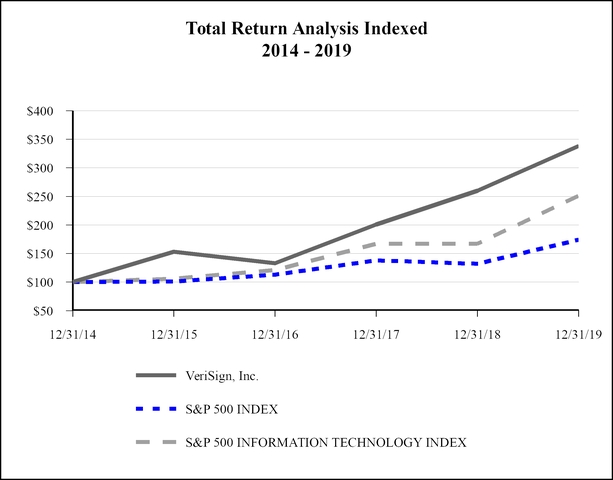
| 12/31/14 | 12/31/15 | 12/31/16 | 12/31/17 | 12/31/18 | 12/31/19 | |||||||||||||
| VeriSign, Inc. | $ | 100 | $ | 153 | $ | 133 | $ | 201 | $ | 260 | $ | 338 | ||||||
| S&P 500 Index | $ | 100 | $ | 101 | $ | 113 | $ | 138 | $ | 132 | $ | 174 | ||||||
| S&P 500 Information Technology Index | $ | 100 | $ | 106 | $ | 121 | $ | 167 | $ | 167 | $ | 251 |
Item 6. SELECTED FINANCIAL DATA
The following table sets forth selected financial data as of and for the last five fiscal years. The information set forth below is not necessarily indicative of results of future operations, and should be read in conjunction with Item 7, “Management’s Discussion and Analysis of Financial Condition and Results of Operations,” and our Notes to Consolidated Financial Statements in Item 8 of this Form 10-K, to fully understand factors that may affect the comparability of the information presented below.
Selected Consolidated Statements of Comprehensive Income Data: (in millions, except per share data)
| Year Ended December 31, | |||||||||||||||||||
| 2019 | 2018 | 2017 | 2016 | 2015 | |||||||||||||||
| Revenues | $ | 1,232 | $ | 1,215 | $ | 1,165 | $ | 1,142 | $ | 1,059 | |||||||||
| Operating income | $ | 806 | $ | 767 | $ | 708 | $ | 687 | $ | 606 | |||||||||
| Net income (1) | $ | 612 | $ | 582 | $ | 457 | $ | 441 | $ | 375 | |||||||||
| Earnings per share: | |||||||||||||||||||
| Basic | $ | 5.17 | $ | 5.13 | $ | 4.56 | $ | 4.12 | $ | 3.29 | |||||||||
| Diluted | $ | 5.15 | $ | 4.75 | $ | 3.68 | $ | 3.42 | $ | 2.82 |
———————
| (1) | Net income for 2018 includes a $52.0 million after-tax gain recognized in 2018 related to the sale of customer contracts of our security services business. |
Consolidated Balance Sheet Data: (in millions)
| As of December 31, | |||||||||||||||||||
| 2019 | 2018 | 2017 | 2016 | 2015 | |||||||||||||||
| Cash, cash equivalents and marketable securities (1) (2) | $ | 1,218 | $ | 1,270 | $ | 2,415 | $ | 1,798 | $ | 1,915 | |||||||||
| Total assets (1) (2) | $ | 1,854 | $ | 1,915 | $ | 2,941 | $ | 2,335 | $ | 2,358 | |||||||||
| Deferred revenues | $ | 1,034 | $ | 1,018 | $ | 999 | $ | 976 | $ | 961 | |||||||||
| Subordinated convertible debentures, including contingent interest derivative (2) | $ | — | $ | — | $ | 628 | $ | 630 | $ | 634 | |||||||||
| Long-term debt (1) | $ | 1,788 | $ | 1,785 | $ | 1,783 | $ | 1,237 | $ | 1,235 |
——————
| (1) | The increases in Cash, cash equivalents and marketable securities, Total assets and Long-term debt from 2016 to 2017 was due to the issuance of $550.0 million aggregate principal amount of 4.75% senior unsecured notes due 2027. |
| (2) | The decreases in Cash, cash equivalents and marketable securities, Total assets and Subordinated convertible debentures, including contingent interest derivative from 2017 to 2018 was due to the settlement of our subordinated convertible debentures in 2018. |
Item 7. MANAGEMENT’S DISCUSSION AND ANALYSIS OF FINANCIAL CONDITION AND RESULTS OF OPERATIONS
FORWARD-LOOKING STATEMENTS
This Report on Form 10-K contains forward-looking statements within the meaning of Section 27A of the Securities Act and Section 21E of the Exchange Act. These forward-looking statements involve risks and uncertainties, including, among other things, statements regarding our anticipated costs and expenses and revenue mix. Forward-looking statements include, among others, those statements including the words “expects,” “anticipates,” “intends,” “believes” and similar language. Our actual results may differ significantly from those projected in the forward-looking statements. Factors that might cause or contribute to such differences include, but are not limited to, those discussed in the section titled “Risk Factors” in Part I, Item 1A of this Form 10-K. You are cautioned not to place undue reliance on the forward-looking statements, which speak only as of the date of this Form 10-K. We undertake no obligation to publicly release any revisions to the forward-looking statements or reflect events or circumstances after the date of this document.
This section of this Form 10-K generally discusses 2019 and 2018 items and year-to-year comparisons between 2019 and 2018. Discussions of 2017 items and year-to-year comparisons between 2018 and 2017 that are not included in this Form 10-K can be found in “Management’s Discussion and Analysis of Financial Condition and Results of Operations” in Part II, Item 7 of the Company’s Annual Report on Form 10-K for the fiscal year ended December 31, 2018.
Overview
We are a global provider of domain name registry services and internet infrastructure, enabling internet navigation for many of the world’s most recognized domain names. We enable the security, stability, and resiliency of key internet infrastructure and services, including providing root zone maintainer services, operating two of the 13 global internet root servers, and providing registration services and authoritative resolution for the .com and .net top-level domains, which support the majority of global e-commerce.
As of December 31, 2019, we had approximately 158.8 million .com and .net registrations in the domain name base. The number of domain names registered is largely driven by continued growth in online advertising, e-commerce, and the number of internet users, which is partially driven by greater availability of internet access, as well as marketing activities carried out by us and our registrars. Growth in the number of domain name registrations under our management may be hindered by certain factors, including overall economic conditions, competition from ccTLDs, the introduction of new gTLDs, and ongoing changes in the internet practices and behaviors of consumers and businesses. Factors such as the evolving practices and preferences of internet users, and how they navigate the internet, as well as the motivation of domain name registrants and how they will manage their investment in domain names, can negatively impact our business and the demand for new domain name registrations and renewals.
2019 Business Highlights and Trends
| • | We recorded revenues of $1,231.7 million in 2019, which represents an increase of 1% compared to 2018. |
| • | We recorded operating income of $806.1 million during 2019, which represents an increase of 5% as compared to 2018. |
| • | We finished 2019 with 158.8 million .com and .net registrations in the domain name base, which represents a 4% increase from December 31, 2018. |
| • | During 2019, we processed 40.3 million new domain name registrations for .com and .net compared to 38.2 million in 2018. |
| • | The final .com and .net renewal rate for the third quarter of 2019 was 73.7% compared with 74.8% for the same quarter in 2018. Renewal rates are not fully measurable until 45 days after the end of the quarter. |
| • | We repurchased 3.9 million shares of our common stock for an aggregate cost of $738.5 million in 2019. As of December 31, 2019, there was $327.5 million remaining for future share repurchases under the share repurchase program. |
| • | Effective February 6, 2020, our Board authorized the repurchase of our common stock in the amount of $743.0 million, in addition to the $257.0 million that remained available for repurchases under the share repurchase program, for a total repurchase authorization of up to $1.0 billion under the program. |
| • | We generated cash flows from operating activities of $753.9 million in 2019, which represents an increase of 8% as compared to 2018. |
Critical Accounting Policies and Significant Management Estimates
The discussion and analysis of our financial condition and results of operations are based upon our Consolidated Financial Statements, which have been prepared in accordance with U.S. generally accepted accounting principles. The preparation of these financial statements requires management to make estimates and judgments that affect the reported amounts of assets, liabilities, revenues and expenses, and related disclosures of contingent assets and liabilities. On an ongoing basis, management evaluates those estimates. Management bases its estimates on historical experience and on various assumptions that are believed to be reasonable under the circumstances, the results of which form the basis for making judgments about the carrying values of assets and liabilities that are not readily available from other sources. Actual results may differ from these estimates under different assumptions or conditions.
An accounting estimate is considered critical if the nature of the estimates or assumptions is material due to the levels of subjectivity and judgment involved, and the impact of changes in the estimates and assumptions would have a material effect on the consolidated financial statements. We believe the following critical accounting estimates and policies have the most significant impact on our consolidated financial statements:
Income taxes
Our operations involve dealing with uncertainties and judgments in the application of complex tax regulations in multiple jurisdictions. The final taxes payable are dependent upon many factors, including negotiations with taxing authorities in various jurisdictions and resolution of disputes arising from U.S. federal, state, and international tax audits. We only recognize or continue to only recognize tax positions that are more likely than not to be sustained upon examination. We adjust these amounts in light of changing facts and circumstances; however, due to the complexity of some of these uncertainties, the ultimate resolution may result in a payment that is materially different from our current estimate of the tax liabilities.
Results of Operations
The following table presents information regarding our results of operations as a percentage of revenues:
| Year Ended December 31, | ||||||||
| 2019 | 2018 | 2017 | ||||||
| Revenues | 100.0 | % | 100.0 | % | 100.0 | % | ||
| Costs and expenses: | ||||||||
| Cost of revenues | 14.6 | 15.8 | 16.6 | |||||
| Sales and marketing | 3.8 | 5.3 | 7.0 | |||||
| Research and development | 4.9 | 4.8 | 4.5 | |||||
| General and administrative | 11.2 | 10.9 | 11.2 | |||||
| Total costs and expenses | 34.5 | 36.8 | 39.3 | |||||
| Operating income | 65.5 | 63.2 | 60.7 | |||||
| Interest expense | (7.4 | ) | (9.5 | ) | (11.7 | ) | ||
| Non-operating income, net | 3.5 | 6.3 | 2.4 | |||||
| Income before income taxes | 61.6 | 60.0 | 51.4 | |||||
| Income tax expense | (11.9 | ) | (12.1 | ) | (12.2 | ) | ||
| Net income | 49.7 | % | 47.9 | % | 39.2 | % |
Revenues
Our revenues are primarily derived from registrations for domain names in the .com and .net domain name registries. We also derive revenues from operating domain name registries for several other TLDs and from providing back-end registry services to a number of TLD registry operators, all of which are not significant in relation to our consolidated revenues. For domain names registered with the .com and .net registries we receive a fee from registrars per annual registration that is fixed pursuant to our agreements with ICANN. Individual customers, called registrants, contract directly with registrars or their resellers, and the registrars in turn register the domain names with Verisign. Changes in revenues are driven largely by changes in the number of new domain name registrations and the renewal rate for existing registrations as well as the impact of new and prior price increases, to the extent permitted by ICANN and the DOC. New registrations and the renewal rate for existing registrations are impacted by continued growth in online advertising, e-commerce, and the number of internet users, as well as marketing activities carried out by us and our registrars. The annual fee for a .com domain name registration has been fixed at
$7.85 since 2012. On October 26, 2018, we entered into an agreement with the DOC to amend the Cooperative Agreement. The amendment extends the term of the Cooperative Agreement until November 30, 2024 and permits the price of a .com domain name to be increased without further DOC approval by up to 7% in each of the final four years of each six-year period beginning on October 26, 2018. We increased the annual fee for a .net domain name registration from $8.20 to $9.02 on February 1, 2018. We have the contractual right to increase the fees for .net domain name registrations by up to 10% each year during the term of our agreement with ICANN, through June 30, 2023. We offer promotional marketing programs for our registrars based upon market conditions and the business environment in which the registrars operate. All fees paid to us for .com and .net registrations are in U.S. dollars.
A comparison of revenues is presented below:
| Year Ended December 31, | ||||||||||||||||||
| 2019 | % Change | 2018 | % Change | 2017 | ||||||||||||||
| (Dollars in thousands) | ||||||||||||||||||
| Revenues | $ | 1,231,661 | 1 | % | $ | 1,214,969 | 4 | % | $ | 1,165,095 |
The following table compares the .com and .net domain name registrations in the domain name base:
| As of December 31, | ||||||||||||
| 2019 | % Change | 2018 | % Change | 2017 | ||||||||
| .com and .net domain name registrations in the domain name base | 158.8 million | 4 | % | 153.0 million | 4 | % | 146.4 million |
Growth in the domain name base has been primarily driven by continued internet growth and marketing activities carried out by us and our registrars. However, competitive pressure from ccTLDs, the introduction of new gTLDs, ongoing changes in internet practices and behaviors of consumers and business, as well as the motivation of existing domain name registrants managing their investment in domain names, and historical global economic uncertainty, has limited the rate of growth of the domain name base in recent years and may continue to do so in 2020 and beyond.
Revenues increased by $16.7 million in 2019 compared to 2018, primarily due to an increase in revenues from the operation of the registries for the .com and .net TLDs, partially offset by the decrease in revenues from the security services business as customers terminated or consented to the assignment of their contracts to Neustar. The increase in revenues from the .com and .net TLDs was driven by a 5% increase in registrations in the domain name base for .com and the increase in the .net domain name registration fees in February 2018, partially offset by a 4% decline in registrations in the domain name base for .net.
Geographic revenues
We generate revenues in the U.S.; Europe, the Middle East and Africa (“EMEA”); China; and certain other countries, including Canada, Australia and Japan. The following table presents a comparison of the Company’s geographic revenues:
| Year Ended December 31, | |||||||||||||||||
| 2019 | % Change | 2018 | % Change | 2017 | |||||||||||||
| (Dollars in thousands) | |||||||||||||||||
| U.S | $ | 772,586 | 2 | % | $ | 756,907 | 7 | % | $ | 707,906 | |||||||
| EMEA | 206,975 | (3 | )% | 212,699 | 1 | % | 211,349 | ||||||||||
| China | 119,291 | 12 | % | 106,841 | — | % | 106,526 | ||||||||||
| Other | 132,809 | (4 | )% | 138,522 | (1 | )% | 139,314 | ||||||||||
| Total revenues | $ | 1,231,661 | 1 | % | $ | 1,214,969 | 4 | % | $ | 1,165,095 |
Revenues in the table above are attributed to the country of domicile and the respective regions in which our registrars are located, however, this may differ from the regions where the registrars operate or where registrants are located. Revenue growth for each region may be impacted by registrars reincorporating, relocating, or from acquisitions or changes in affiliations of resellers. Revenue growth for each region may also be impacted by registrars domiciled in one region, registering domain names in another region. The majority of our revenue growth in 2019 has come from increased sales to registrars based in the U.S. and China. Revenues in the U.S. and EMEA regions in particular, were impacted by the decrease in revenues from our security services business as customers terminated or consented to the assignment of their contracts to Neustar.
We expect revenues will continue to grow in 2020, as a result of the increased volume of domain registrations in 2019, and continued growth in registrations in the domain name base in 2020, partially offset by the elimination of revenue from the customers of our security services business that had not yet consented to the assignment of their contracts to Neustar.
Cost of revenues
Cost of revenues consist primarily of salaries and employee benefits expenses for our personnel who manage the operational systems, depreciation expenses, operational costs associated with the delivery of our services, fees paid to ICANN, customer support and training, consulting and development services, costs of facilities and computer equipment used in these activities, telecommunications expense and allocations of indirect costs such as corporate overhead.
A comparison of cost of revenues is presented below:
| Year Ended December 31, | |||||||||||||||||
| 2019 | % Change | 2018 | % Change | 2017 | |||||||||||||
| (Dollars in thousands) | |||||||||||||||||
| Cost of revenues | $ | 180,467 | (6 | )% | $ | 192,134 | (1 | )% | $ | 193,326 |
Cost of revenues decreased by $11.7 million in 2019 compared to 2018 primarily due to decreases in salary and employee benefits expenses, telecommunications expenses, and depreciation expenses. Salary and benefits expenses decreased by $5.5 million due to a reduction in average headcount primarily related to employees supporting the divested security services business. Telecommunications expenses decreased by $5.1 million as a result of lower costs to support our operations. Depreciation expenses decreased by $2.0 million as a result of a decrease in capital expenditures in recent years.
We expect cost of revenues as a percentage of revenues to remain consistent in 2020 as compared to 2019.
Sales and marketing
Sales and marketing expenses consist primarily of salaries, sales commissions, sales operations and other personnel-related expenses, travel and related expenses, trade shows, costs of lead generation, costs of computer and communications equipment and support services, facilities costs, consulting fees, costs of marketing programs, such as online, television, radio, print and direct mail advertising costs, and allocations of indirect costs such as corporate overhead.
A comparison of sales and marketing expenses is presented below:
| Year Ended December 31, | |||||||||||||||||
| 2019 | % Change | 2018 | % Change | 2017 | |||||||||||||
| (Dollars in thousands) | |||||||||||||||||
| Sales and marketing | $ | 46,637 | (28 | )% | $ | 64,891 | (21 | )% | $ | 81,951 |
Sales and marketing expenses decreased by $18.3 million in 2019 compared to 2018 primarily due to decreases in salary and employee benefits expenses, advertising and marketing expenses, and allocated overhead expenses. Salary and employee benefits expenses decreased by $9.1 million due to a reduction in average headcount primarily affecting employees supporting the divested security services business. Advertising and marketing expenses decreased by $4.4 million as we executed fewer marketing activities and campaigns. Allocated overhead expenses decreased by $2.7 million primarily due to a decrease in average headcount relative to other cost types.
We expect sales and marketing expenses as a percentage of revenues to remain consistent in 2020 as compared to 2019.
Research and development
Research and development expenses consist primarily of costs related to research and development personnel, including salaries and other personnel-related expenses, consulting fees, facilities costs, computer and communications equipment, support services used in our service and technology development, and allocations of indirect costs such as corporate overhead.
A comparison of research and development expenses is presented below:
| Year Ended December 31, | |||||||||||||||||
| 2019 | % Change | 2018 | % Change | 2017 | |||||||||||||
| (Dollars in thousands) | |||||||||||||||||
| Research and development | $ | 60,805 | 5 | % | $ | 57,884 | 11 | % | $ | 52,342 |
Research and development expenses increased by $2.9 million in 2019 compared to 2018 primarily due to a decrease in capitalized labor and an increase in allocated overhead expenses. Capitalized labor decreased by $2.5 million due to a shift in work from capital projects to certain non-capital projects and maintenance of existing software products. Allocated overhead expenses increased by $2.0 million primarily due to an increase in average headcount relative to other cost types.
We expect research and development expenses as a percentage of revenues to remain consistent in 2020 as compared to 2019.
General and administrative
General and administrative expenses consist primarily of salaries and other personnel-related expenses for our executive, administrative, legal, finance, information technology and human resources personnel, costs of facilities, computer and communications equipment, management information systems, support services, professional services fees, and certain tax and license fees, offset by allocations of indirect costs such as facilities and shared services expenses to other cost types.
A comparison of general and administrative expenses is presented below:
| Year Ended December 31, | |||||||||||||||||
| 2019 | % Change | 2018 | % Change | 2017 | |||||||||||||
| (Dollars in thousands) | |||||||||||||||||
| General and administrative | $ | 137,625 | 4 | % | $ | 132,668 | 2 | % | $ | 129,754 |
General and administrative expenses increased by $5.0 million in 2019 compared to 2018 primarily due to increases in salary and employee benefits expenses and software license expenses. Salary and employee benefits expenses increased by $2.8 million due to an increase in average headcount and annual salary increases. Software license expenses increased by $2.4 million resulting from costs related to certain security initiatives.
We expect general and administrative expenses as a percentage of revenues to remain consistent in 2020 as compared to 2019.
Interest expense
See Note 4, “Debt and interest expense” of our Notes to Consolidated Financial Statements in Item 8 of this Form 10-K. We expect interest expense to remain consistent in 2020 as compared to 2019.
Non-operating income, net
See Note 9, “Non-operating income, net” of our Notes to Consolidated Financial Statements in Item 8 of this Form 10-K. We expect Non-operating income, net to decrease in 2020 as compared to 2019 due to income from the transition services provided to Neustar in 2019 in connection with the sale of customer contracts of our security services business and a decrease in interest income resulting from a decline in interest rates.
Income tax expense
| Year Ended December 31, | ||||||||||
| 2019 | 2018 | 2017 | ||||||||
| (Dollars in thousands) | ||||||||||
| Income tax expense | 146,477 | $ | 147,027 | $ | 141,764 | |||||
| Effective tax rate | 19 | % | 20 | % | 24 | % |
The effective tax rates for 2019 and 2018 were lower than the statutory federal rate of 21% due to a lower foreign effective tax rate and excess tax benefits related to stock-based compensation, partially offset by state income taxes, U.S. taxes on our foreign earnings, and accrual for uncertain tax positions.
As of December 31, 2019, we had deferred tax assets arising from deductible temporary differences, tax losses, and tax credits of $94.8 million, net of valuation allowances, but before the offset of certain deferred tax liabilities. With the exception of deferred tax assets related to certain state and foreign NOL carryforwards, we believe it is more likely than not that the tax effects of the deferred tax liabilities, together with future taxable income, will be sufficient to fully recover the remaining deferred tax assets.
We qualified for a tax holiday in Switzerland until the end of 2019 which lowered tax rates on certain types of income and required certain thresholds of foreign source income. The tax holiday reduced our foreign income tax expense by $17.3 million ($0.15 per share) and $16.9 million ($0.14 per share) in 2019 and 2018, respectively. The benefit from the tax holiday is calculated before consideration of any offsetting tax impact in the United States. Effective January 1, 2020, due to Swiss tax law changes, the tax holiday was eliminated, which was partially offset by a lowered statutory tax rate.
We expect the effective tax rate for 2020 to be between 18% and 21%.
Liquidity and Capital Resources
| As of December 31, | |||||||
| 2019 | 2018 | ||||||
| (In thousands) | |||||||
| Cash and cash equivalents | $ | 508,196 | $ | 357,415 | |||
| Marketable securities | 709,863 | 912,254 | |||||
| Total | $ | 1,218,059 | $ | 1,269,669 |
As of December 31, 2019, our principal source of liquidity was $508.2 million of cash and cash equivalents and $709.9 million of marketable securities. The marketable securities consist primarily of debt securities issued by the U.S. Treasury meeting the criteria of our investment policy, which is focused on the preservation of our capital through investment in investment grade securities. The cash equivalents consist mainly of amounts invested in money market funds and U.S. Treasury bills purchased with original maturities of less than 90 days. As of December 31, 2019, all of our debt securities have contractual maturities of less than one year. Our cash and cash equivalents are readily accessible. Following the Tax Cuts and Jobs Act, we have greater flexibility in accessing the cash, cash equivalents and marketable securities balances held by our foreign subsidiaries. For additional information on our investment portfolio, see Note 2, “Financial Instruments,” of our Notes to Consolidated Financial Statements in Item 8 of this Form 10-K.
In 2019, we repurchased 3.9 million shares of our common stock at an average stock price of $188.84 for an aggregate cost of $738.5 million under our share repurchase program. In 2018, we repurchased 4.4 million shares of our common stock at an average stock price of $137.86 for an aggregate cost of $600.0 million. Effective February 6, 2020, our Board authorized the repurchase of our common stock in the amount of $743.0 million, in addition to the $257.0 million that remained available for repurchases under the share repurchase program, for a total repurchase authorization of up to $1.0 billion under the program.
As of December 31, 2019, we had $550.0 million principal amount outstanding of 4.75% senior unsecured notes due 2027, $500.0 million principal amount outstanding of the 5.25% senior unsecured notes due 2025 and $750.0 million principal amount outstanding of the 4.625% senior unsecured notes due 2023. In December 2019, we entered into a new $200.0 million unsecured revolving credit facility. This facility will expire in 2024 and takes the place of our prior unsecured revolving credit facility. As of December 31, 2019, there were no borrowings outstanding under this credit facility.
In 2018 we settled our subordinated convertible debentures with the $1.25 billion principal value paid in cash and 26.1 million shares of common stock issued for the conversion spread.
We believe existing cash, cash equivalents and marketable securities, and funds generated from operations, together with our ability to arrange for additional financing should be sufficient to meet our working capital, capital expenditure requirements, and to service our debt for the next 12 months. We regularly assess our cash management approach and activities in view of our current and potential future needs.
In summary, our cash flows for 2019, 2018, and 2017 were as follows:
| Year Ended December 31, | |||||||||||
| 2019 | 2018 | 2017 | |||||||||
| (In thousands) | |||||||||||
| Net cash provided by operating activities | $ | 753,892 | $ | 697,767 | $ | 702,761 | |||||
| Net cash provided by (used in) investing activities | 167,195 | 1,070,130 | (405,424 | ) | |||||||
| Net cash used in financing activities | (770,303 | ) | (1,875,325 | ) | (65,073 | ) | |||||
| Effect of exchange rate changes on cash, cash equivalents and restricted cash | 64 | (958 | ) | 1,294 | |||||||
| Net increase (decrease) in cash, cash equivalents and restricted cash | $ | 150,848 | $ | (108,386 | ) | $ | 233,558 |
Cash flows from operating activities
Our largest source of operating cash flows is cash collections from our customers. Our primary uses of cash from operating activities are for personnel related expenditures, and other general operating expenses, as well as payments related to taxes, interest and facilities.
Net cash provided by operating activities increased in 2019 compared to 2018 primarily due to an increase in cash received from customers and a decrease in cash paid for interest, partially offset by an increase in cash paid for income taxes. Cash received from customers increased primarily due to higher domain name registrations and renewals. The decrease in cash paid for interest on our debt obligations was primarily due to the settlement of our subordinated convertible debentures in May 2018. The increase in cash paid for income taxes was primarily due to by higher U.S. federal income tax payments in 2019, partially offset by the $60.7 million of foreign withholding taxes paid on the repatriation of $1.15 billion cash held by foreign subsidiaries to the U.S. in the first quarter of 2018.
Cash flows from investing activities
The changes in cash flows from investing activities primarily relate to purchases, maturities and sales of marketable securities, purchases of property and equipment and the sale of businesses.
Net cash provided by investing activities decreased in 2019 compared to 2018 primarily due to decreases in proceeds from sales and maturities of marketable securities, net of purchases, proceeds from the sale of businesses, and an increase in purchases of property and equipment.
Cash flows from financing activities
The changes in cash flows from financing activities primarily relate to share repurchases, proceeds from and repayment of borrowings, and our employee stock purchase plan (“ESPP”).
Net cash used in financing activities decreased in 2019 compared to 2018 primarily due to the repayment of the principal amount of the subordinated convertible debentures during 2018, partially offset by an increase in share repurchases.
Impact of Inflation
We do not believe that inflation has had a significant impact on our operations in any of the periods presented.
Income taxes
We expect cash paid for income taxes in 2020 to approximate our Income tax expenses for the year.
Property and Equipment Expenditures
Our planned property and equipment expenditures for 2020 are anticipated to be between $45.0 million and $55.0 million and will primarily be focused on infrastructure upgrades and enhancements to our product portfolio.
Contractual Obligations
See Note 11, “Commitments and Contingencies,” Purchase Obligations and Contractual Agreements, of our Notes to Consolidated Financial Statements in Item 8 of this Form 10-K.
Off-Balance Sheet Arrangements
It is not our business practice to enter into off-balance sheet arrangements. As of December 31, 2019, we did not have any significant off-balance sheet arrangements. See Note 11, “Commitments and Contingencies,” Off-Balance Sheet Arrangements, of our Notes to Consolidated Financial Statements in Item 8 of this Form 10-K for further information regarding off-balance sheet arrangements.
Dilution from RSUs
Grants of stock-based awards are key components of the compensation packages we provide to attract and retain certain of our talented employees and align their interests with the interests of existing stockholders. We recognize that these stock-based awards dilute existing stockholders and have sought to control the number granted while providing competitive compensation packages. As of December 31, 2019, there are a total of 0.9 million unvested RSUs which represent potential dilution of less than 1.0%. This maximum potential dilution will only result if all outstanding RSUs vest and are settled. In recent years, our stock repurchase program has more than offset the dilutive effect of RSU grants to employees; however, we may reduce the level of our stock repurchases in the future as we may use our available cash for other purposes.
Item 7A. QUANTITATIVE AND QUALITATIVE DISCLOSURES ABOUT MARKET RISK
We are exposed to financial market risks, including changes in interest rates, foreign exchange rates and market risks. We have not entered into any market risk sensitive instruments for trading purposes.
Interest rate sensitivity
The fixed income securities in our investment portfolio are subject to interest rate risk. As of December 31, 2019, we had $1.04 billion of fixed income securities, which consisted of U.S. Treasury bills with maturities of less than one year. A hypothetical change in interest rates by 100 basis points would not have a significant impact on the fair value of our investments.
Foreign exchange risk management
We conduct business in several countries and transact in multiple foreign currencies. The functional currency for all of our international subsidiaries is the U.S. Dollar. Our foreign currency risk management program is designed to mitigate foreign exchange risks associated with monetary assets and liabilities of our operations that are denominated in currencies other than the U.S. dollar. The primary objective of this program is to minimize the gains and losses to income resulting from fluctuations in exchange rates. We may choose not to hedge certain foreign exchange exposures due to immateriality, prohibitive economic cost of hedging particular exposures, and limited availability of appropriate hedging instruments. We do not enter into foreign currency transactions for trading or speculative purposes, nor do we hedge foreign currency exposures in a manner that entirely offsets the effects of changes in exchange rates. The program may entail the use of forward or option contracts, which are usually placed and adjusted monthly. These foreign currency forward contracts are derivatives and are recorded at fair market value. We attempt to limit our exposure to credit risk by executing foreign exchange contracts with financial institutions that have investment grade ratings.
As of December 31, 2019, we held foreign currency forward contracts in notional amounts totaling $26.3 million to mitigate the impact of exchange rate fluctuations associated with certain foreign currencies. Gains or losses on the foreign currency forward contracts would be largely offset by the remeasurement of our foreign currency denominated assets and liabilities, resulting in an insignificant net impact to income.
A hypothetical uniform 10% strengthening or weakening in the value of the U.S. dollar relative to the foreign currencies in which our revenues and expenses are denominated would not result in a significant impact to our financial statements.
Market risk management
The fair market values of our senior notes are subject to interest rate risk. Generally, the fair market value of fixed interest rate debt will increase as interest rates fall and decrease as interest rates rise. As of December 31, 2019, the fair values of the senior notes issued in 2013, 2015 and 2017 were $762.8 million, $552.3 million, and $581.9 million, respectively, based on available market information from public data sources.
Item 8. FINANCIAL STATEMENTS AND SUPPLEMENTARY DATA
Report of Independent Registered Public Accounting Firm
To the Stockholders and Board of Directors
VeriSign, Inc.:
Opinion on the Consolidated Financial Statements
We have audited the accompanying consolidated balance sheets of Verisign, Inc. and subsidiaries (the Company) as of December 31, 2019 and 2018, the related consolidated statements of comprehensive income, stockholders’ deficit, and cash flows for each of the years in the three‑year period ended December 31, 2019, and the related notes (collectively, the consolidated financial statements). In our opinion, the consolidated financial statements present fairly, in all material respects, the financial position of the Company as of December 31, 2019 and 2018, and the results of its operations and its cash flows for each of the years in the three‑year period ended December 31, 2019, in conformity with U.S. generally accepted accounting principles.
We also have audited, in accordance with the standards of the Public Company Accounting Oversight Board (United States) (PCAOB), the Company’s internal control over financial reporting as of December 31, 2019, based on criteria established in Internal Control - Integrated Framework (2013) issued by the Committee of Sponsoring Organizations of the Treadway Commission, and our report dated February 14, 2020 expressed an unqualified opinion on the effectiveness of the Company’s internal control over financial reporting.
Change in Accounting Principle
Effective January 1, 2018, the Company adopted Accounting Standards Update (ASU) 2014-09, Revenue from Contracts with Customers, and several related amendments, issued by the Financial Accounting Standards Board (FASB). This change was adopted using the modified retrospective method.
Basis for Opinion
These consolidated financial statements are the responsibility of the Company’s management. Our responsibility is to express an opinion on these consolidated financial statements based on our audits. We are a public accounting firm registered with the PCAOB and are required to be independent with respect to the Company in accordance with the U.S. federal securities laws and the applicable rules and regulations of the Securities and Exchange Commission and the PCAOB.
We conducted our audits in accordance with the standards of the PCAOB. Those standards require that we plan and perform the audit to obtain reasonable assurance about whether the consolidated financial statements are free of material misstatement, whether due to error or fraud. Our audits included performing procedures to assess the risks of material misstatement of the consolidated financial statements, whether due to error or fraud, and performing procedures that respond to those risks. Such procedures included examining, on a test basis, evidence regarding the amounts and disclosures in the consolidated financial statements. Our audits also included evaluating the accounting principles used and significant estimates made by management, as well as evaluating the overall presentation of the consolidated financial statements. We believe that our audits provide a reasonable basis for our opinion.
Critical Audit Matter
The critical audit matter communicated below is a matter arising from the current period audit of the consolidated financial statements that was communicated or required to be communicated to the audit committee and that: (1) relates to accounts or disclosures that are material to the consolidated financial statements and (2) involved our especially challenging, subjective, or complex judgment. The communication of a critical audit matter does not alter in any way our opinion on the consolidated financial statements, taken as a whole, and we are not, by communicating the critical audit matter below, providing a separate opinion on the critical audit matter or on the accounts or disclosures to which it relates.
Evaluation of the Company’s uncertain tax positions.
As discussed in Notes 1 and 10 of the consolidated financial statements, as of December 31, 2019, the Company had $231.3 million of gross unrecognized tax benefits.
We identified the evaluation of the Company’s uncertain tax positions as a critical audit matter because complex auditor judgment was required in evaluating the Company’s interpretation of tax law and its estimate of the ultimate resolution of the tax positions.
The primary procedures we performed to address this critical audit matter included the following. We tested certain internal controls over the Company’s uncertain tax positions process to assess that new and existing tax positions and
adjustments giving rise to additional uncertain tax positions were considered in accordance with applicable guidance over accounting for uncertain tax positions. Since tax law is complex and often subject to interpretations, we involved tax professionals with specialized skills and knowledge, who assisted in:
| • | Evaluating the Company’s tax positions and its interpretation of tax laws, |
| • | Identifying any changes or developments in tax law, court cases, tax regulations or any pertinent tax rulings that would impact the positions taken by the Company, |
| • | Performing a web based search of key terms relating to the Company’s uncertain tax positions to identify public company filings that disclose similar positions with alternative treatments, |
| • | Examining the Company’s filed tax returns and the detailed tax provision to assess the sustainability of the Company’s uncertain tax positions, and |
| • | Reading the Company’s board minutes and inquiring of various members of the tax, legal and finance teams regarding their knowledge of conditions that would give rise to a change in the uncertain tax positions. |
Additionally, we involved tax and valuation professionals with specialized skills and knowledge, who assisted in:
| • | Reading correspondence from the Internal Revenue Service (IRS) in relation to the Company’s income tax returns to assess any changes or developments relevant to the sustainability of the Company’s positions. |
/s/ KPMG LLP
We have served as the Company’s auditor since 1995.
McLean, Virginia
February 14, 2020
Report of Independent Registered Public Accounting Firm
To the Stockholders and Board of Directors
VeriSign, Inc.:
Opinion on Internal Control Over Financial Reporting
We have audited Verisign, Inc. and subsidiaries’ (the Company) internal control over financial reporting as of December 31, 2019, based on criteria established in Internal Control - Integrated Framework (2013) issued by the Committee of Sponsoring Organizations of the Treadway Commission. In our opinion, the Company maintained, in all material respects, effective internal control over financial reporting as of December 31, 2019, based on criteria established in Internal Control - Integrated Framework (2013) issued by the Committee of Sponsoring Organizations of the Treadway Commission.
We also have
Showing the first 8K of 91K characters. Open the full section
Item 9. CHANGES IN AND DISAGREEMENTS WITH ACCOUNTANTS ON ACCOUNTING AND FINANCIAL DISCLOSURE
Not applicable.
Item 9A. CONTROLS AND PROCEDURES
a. Evaluation of Disclosure Controls and Procedures
Based on our management’s evaluation, with the participation of our Chief Executive Officer (our principal executive officer) and our Chief Financial Officer (our principal financial officer), as of December 31, 2019, our principal executive officer and principal financial officer have concluded that our disclosure controls and procedures (as defined in Rules 13a-15(e) and 15d-15(e) under the Securities Exchange Act of 1934, as amended, (the “Exchange Act”)) are effective to ensure that information required to be disclosed by us in reports that we file or submit under the Exchange Act is recorded, processed, summarized and reported within the time periods specified in SEC rules and forms and is accumulated and communicated to our management, including our principal executive officer and principal financial officer, as appropriate to allow timely decisions regarding required disclosure.
b. Management’s Report on Internal Control over Financial Reporting
Our management is responsible for establishing and maintaining adequate internal control over financial reporting as defined in Rules 13a-15(f) and 15d-15(f) under the Exchange Act. Under the supervision and with the participation of our management, including our Chief Executive Officer and Chief Financial Officer, we conducted an evaluation of the effectiveness of our internal control over financial reporting as of December 31, 2019 using the criteria established in Internal Control-Integrated Framework (2013 Framework) issued by the Committee of Sponsoring Organizations of the Treadway Commission (“COSO”).
Based on our evaluation under the COSO framework, management has concluded that our internal control over financial reporting is effective to provide reasonable assurance regarding the reliability of financial reporting and the preparation of financial statements for external purposes in accordance with generally accepted accounting principles.
KPMG LLP, an independent registered public accounting firm, has issued a report concerning the effectiveness of our internal control over financial reporting as of December 31, 2019. See “Report of Independent Registered Public Accounting Firm” in Item 8 of this Form 10-K.
c. Changes in Internal Control over Financial Reporting
There was no change in our internal control over financial reporting (as such term is defined in Rules 13a-15(f) and 15d-15(f) under the Exchange Act) during the three months ended December 31, 2019 that has materially affected, or is reasonably likely to materially affect, the Company’s internal control over financial reporting.
d. Inherent Limitations of Disclosure Controls and Internal Control over Financial Reporting
Because of their inherent limitations, our disclosure controls and procedures and our internal control over financial reporting may not prevent material errors or fraud. A control system, no matter how well conceived and operated, can provide only reasonable, not absolute, assurance that the objectives of the control system are met. The effectiveness of our disclosure controls and procedures and our internal control over financial reporting is subject to risks, including that the controls may become inadequate because of changes in conditions or that the degree of compliance with our policies or procedures may deteriorate.
Item 9B. OTHER INFORMATION
On February 11, 2020, the Board appointed Todd B. Strubbe, 56, as President and Chief Operating Officer of the Company, effective as of that date.
Mr. Strubbe previously served as Executive Vice President and Chief Operating Officer since April 2015. See “Information About Our Executive Officers” in Part I, Item 1 for further information.
Mr. Strubbe will continue to earn a base salary at the annual rate of $565,000, payable in accordance with the Company’s standard payroll practices. Mr. Strubbe’s annual incentive bonus target as a percentage of his Base Salary will be increased from 90% to 95% (the “Annual Incentive Bonus”). The Annual Incentive Bonus is not guaranteed; the Annual Incentive Bonus is based upon the Company’s achievement of pre-established financial goals, as well as individual performance. The
compensation package also includes a $240,000 promotional equity grant, which is in addition to a $2,760,000 annual long-term incentive equity grant, both consisting of 50% performance-based RSUs and 50% time-vesting RSUs. The metrics associated with the performance-based RSUs consist of two financial measures - compound annual growth rate of operating income per share and the total shareholder return (“TSR”) of Verisign stock compared to the TSR of the S&P 500 Index, each measured over a three-year performance period from January 1, 2020 through December 31, 2022.
Mr. Strubbe has no family relationships with any of the Company’s directors or executive officers, and there have been no related party transactions between the Company and Mr. Strubbe reportable under Item 404(a) of Regulation S-K.
PART III
Item 10. DIRECTORS, EXECUTIVE OFFICERS AND CORPORATE GOVERNANCE
The information required by this item relating to our directors and nominees, regarding compliance with Section 16(a) of the Exchange Act, and regarding our Audit Committee, Corporate Governance and Nominating Committee and Compensation Committee will be included under the captions “Proposal No. 1: Election of Directors,” “Security Ownership of Certain Beneficial Owners” and “Corporate Governance” in our Proxy Statement related to the 2020 Annual Meeting of Stockholders and is incorporated herein by reference (“2020 Proxy Statement”).
Pursuant to General Instruction G(3) of Form 10-K, the information required by this item relating to our executive officers is included under the caption “Information about our Executive Officers” in Part I of this Annual Report on Form 10-K.
We have adopted a “Verisign Code of Conduct”, which is posted on our website under “Ethics and Business Conduct” at https://investor.verisign.com/corporate-governance.cfm. The code of conduct applies to all directors, officers and employees, including the principal executive officer, principal financial officer and other senior accounting officers. We have also adopted the “Corporate Governance Principles for the Board of Directors,” which provide guidance to our directors on corporate practices that serve the best interests of the Company and its shareholders.
We intend to satisfy any disclosure requirement under Item 5.05 of Form 8-K regarding an amendment to, or waiver from, a provision of the “Verisign Code of Conduct,” to the extent applicable to the principal executive officer, principal financial officer, or other senior accounting officers, by posting such information on our website, on the web page found by clicking through to “Ethics and Business Conduct” as specified above.
Item 11. EXECUTIVE COMPENSATION
Information required by this item is incorporated herein by reference to our 2020 Proxy Statement from the discussions under the captions “Compensation of Directors,” “Non-Employee Director Retainer Fees and Equity Compensation Information” and “Non-Employee Director Compensation Table for Fiscal 2019,” and “Executive Compensation.”
Item 12. SECURITY OWNERSHIP OF CERTAIN BENEFICIAL OWNERS AND MANAGEMENT AND RELATED STOCKHOLDER MATTERS
Information required by this item is incorporated herein by reference from the discussions under the captions “Security Ownership of Certain Beneficial Owners and Management” and “Equity Compensation Plan Information” in our 2020 Proxy Statement.
Item 13. CERTAIN RELATIONSHIPS AND RELATED TRANSACTIONS, AND DIRECTOR INDEPENDENCE
Information required by this item is incorporated herein by reference to our 2020 Proxy Statement from the discussions under the captions “Policies and Procedures with Respect to Transactions with Related Persons,” “Certain Relationships and Related Transactions” and “Independence of Directors.”
Item 14. PRINCIPAL ACCOUNTANT FEES AND SERVICES
Information required by this item is incorporated herein by reference to our 2020 Proxy Statement from the discussions under the captions “Principal Accountant Fees and Services” and “Policy on Audit Committee Pre-Approval of Audit and Permissible Non-Audit Services of Independent Auditors.”
PART IV
Item 15. EXHIBITS, FINANCIAL STATEMENT SCHEDULES
(a) Documents filed as part of this report
- Financial statements
The financial statements are set forth under Item 8 of this Form 10-K, as indexed below.
- Financial statement schedules
| Financial statement schedules are omitted because the information called for is not material or is shown either in the consolidated financial statements or the notes thereto. |
- Exhibits
(a) Index to Exhibits
Pursuant to the rules and regulations of the Securities and Exchange Commission (the “SEC”), the Company has filed certain agreements as exhibits to this Form 10-K. These agreements may contain representations and warranties by the parties thereto. These representations and warranties have been made solely for the benefit of the other party or parties to such agreements and (1) may be intended not as statements of fact, but rather as a way of allocating the risk to one of the parties to such agreements if those statements prove to be inaccurate, (2) may have been qualified by disclosures that were made to such other party or parties and that either have been reflected in the Company’s filings or are not required to be disclosed in those filings, (3) may apply materiality standards different from what may be viewed as material to investors and (4) were made only as of the date of such agreements or such other date(s) as may be specified in such agreements and are subject to more recent developments. Accordingly, these representations and warranties may not describe the Company’s actual state of affairs at the date hereof or at any other time.
| Incorporated by Reference | |||||||||||
| Exhibit Number | Exhibit Description | Form | Date | Number | Filed Herewith | ||||||
| 2.01 | Agreement and Plan of Merger dated as of March 6, 2000, by and among the Registrant, Nickel Acquisition Corporation and Network Solutions, Inc. | 8-K | 3/8/00 | 2.1 | |||||||
| 3.01 | Sixth Amended and Restated Certificate of Incorporation of the Registrant. | 10-K | 2/17/17 | 3.01 | |||||||
| 3.02 | Bylaws of VeriSign, Inc. | 10-K | 2/16/18 | 3.02 | |||||||
| 4.01 | Indenture, dated as of April 16, 2013, between VeriSign, Inc., each of the subsidiary guarantors party thereto and U.S. Bank National Association, as trustee. | 8-K | 4/17/13 | 4.1 | |||||||
| 4.02 | Indenture dated as of March 27, 2015 between VeriSign, Inc. and U.S. Bank National Association, as trustee. | 8-K | 3/30/15 | 4.1 | |||||||
| 4.03 | Indenture, dated as of July 5, 2017, between VeriSign, Inc. and U.S. Bank National Association, as trustee. | 8-K | 7/5/17 | 4.1 | |||||||
| * | As contemplated by SEC Release No. 33-8212, these exhibits are furnished with this Annual Report on Form 10-K and are not deemed filed with the Securities and Exchange Commission and are not incorporated by reference in any filing of VeriSign, Inc. under the Securities Act of 1933 or the Securities Exchange Act of 1934, whether made before or after the date hereof and irrespective of any general incorporation language in such filings. |
| + | Indicates a management contract or compensatory plan or arrangement. |
| † | Certain portions of this exhibit have been omitted pursuant to Item 601(b)(10)(iv) of Regulation S-K. |
Item 16. 10-K SUMMARY
None.
SIGNATURES
Pursuant to the requirements of Section 13 or 15(d) of the Securities Exchange Act of 1934, the registrant has duly caused this report to be signed on its behalf by the undersigned, thereunto duly authorized, in the City of Reston, Commonwealth of Virginia, on the 14th day of February 2020.
VERISIGN, INC.
| By: | /S/ D. JAMES BIDZOS | |
| D. James Bidzos | ||
| Chief Executive Officer | ||
| (Principal Executive Officer) |
KNOW ALL PERSONS BY THESE PRESENTS that each individual whose signature appears below constitutes and appoints D. James Bidzos, George E. Kilguss, III, and Thomas C. Indelicarto, and each of them, his or her true lawful attorneys-in-fact and agents, with full power of substitution, for him or her and in his or her name, place and stead, in any and all capacities, to sign any and all amendments to this Annual Report on Form 10-K and to file the same, with all exhibits thereto and all documents in connection therewith, with the Securities and Exchange Commission, granted unto said attorneys-in-fact and agents, and each of them, full power and authority to do and perform each and every act and thing requisite and necessary to be done in and about the premises, as fully to all intents and purposes as he or she might or could do in person, hereby ratifying and confirming all that said attorneys-in-fact and agents or any of them, or his, her or their substitute or substitutes, may lawfully do or cause to be done by virtue hereof.
Pursuant to the requirements of the Securities Exchange Act of 1934, this report has been signed by the following persons on behalf of the registrant and in the capacities indicated on the 14th day of February 2020.
| Signature | Title | |
| /S/ D. JAMES BIDZOS | Chief Executive Officer, Executive Chairman and Director (Principal Executive Officer) | |
| D. JAMES BIDZOS | ||
| /S/ GEORGE E. KILGUSS, III | Chief Financial Officer (Principal Financial and Accounting Officer) | |
| GEORGE E. KILGUSS, III | ||
| /S/ YEHUDA ARI BUCHALTER | Director | |
| YEHUDA ARI BUCHALTER | ||
| /S/ KATHLEEN A. COTE | Director | |
| KATHLEEN A. COTE | ||
| /S/ THOMAS F. FRIST III | Director | |
| THOMAS F. FRIST III | ||
| /S/ JAMIE S. GORELICK | Director | |
| JAMIE S. GORELICK | ||
| /S/ ROGER H. MOORE | Director | |
| ROGER H. MOORE | ||
| /S/ LOUIS A. SIMPSON | Director | |
| LOUIS A. SIMPSON | ||
| /S/ TIMOTHY TOMLINSON | Director | |
| TIMOTHY TOMLINSON |