 filings.tools
Vertiv Holdings 10-K 2021-12-31
Filed 2022-03-01. 23 sections, 473K characters. Original on sec.gov · Markdown · JSON
Cover and table of contents
| UNITED STATES | ||||||||||||||
| SECURITIES AND EXCHANGE COMMISSION | ||||||||||||||
| Washington, D. C. 20549 | ||||||||||||||
| FORM 10-K | ||||||||||||||
| ☒ ANNUAL REPORT PURSUANT TO SECTION 13 OR 15(d) OF THE SECURITIES EXCHANGE ACT OF 1934 | ||||||||||||||
| For the fiscal year ended December 31, 2021 | ||||||||||||||
| or | ||||||||||||||
| ☐ TRANSITION REPORT PURSUANT TO SECTION 13 OR 15(d) OF THE SECURITIES EXCHANGE ACT OF 1934 | ||||||||||||||
| For the transition period from to | ||||||||||||||
| Commission File No. 001-38518 | ||||||||||||||
| Vertiv Holdings Co | ||||||||||||||
| (Exact name of registrant as specified in it charter) | ||||||||||||||
| Delaware (State or other jurisdiction of incorporation or organization) | 81-2376902 (I.R.S Employer Identification No.) | |||||||||||||
| 1050 Dearborn Dr, Columbus, Ohio 43085 | ||||||||||||||
| (Address of principal executive offices including zip code) | ||||||||||||||
| 614-888-0246 | ||||||||||||||
| (Registrant's telephone number, including area code) |
| Securities registered pursuant to Section 12(b) of the Act: | ||||||||||||||
| Title of each class | Trading Symbol(s) | Name of each exchange on which registered | ||||||||||||
| Class A common stock, $0.0001 par value per share | VRT | New York Stock Exchange | ||||||||||||
| Securities registered pursuant to Section 12(g) of the Act: | ||||||||||||||
| None |
Indicate by check mark if the registrant is a well-known seasoned issuer, as defined in Rule 405 of the Securities Act. Yes ☐ No ☒
Indicate by check mark if the registrant is not required to file reports pursuant to Section 13 or Section 15(D) of the Exchange Act from their obligations under those Sections. Yes ☐ No ☒
Indicate by check mark whether the registrant (1) has filed all reports required to be filed by Section 13 or 15(d) of the Securities Exchange Act of 1934 during the preceding 12 months (or for such shorter period that the registrant was required to file such reports), and (2) has been subject to such filing requirements for the past 90 days. Yes ☒ No ☐
Indicate by check mark whether the registrant has submitted electronically every Interactive Data File required to be submitted pursuant to Rule 405 of Regulation S-T (§ 232.405 of this chapter) during the preceding 12 months (or for such shorter period that the registrant was required to submit such files). Yes ☒ No ☐
Indicate by check mark whether the registrant is a large accelerated filer, an accelerated filer, a non-accelerated filer, a smaller reporting company, or an emerging growth company. See the definitions of “large accelerated filer,” “accelerated filer,” “smaller reporting company,” and “emerging growth company” in Rule 12b-2 of the Exchange Act:
| Large accelerated filer | ☒ | Accelerated filer | ☐ | |||||||||||
| Non-accelerated filer | ☐ | Smaller reporting company | ☐ | |||||||||||
| Emerging growth company | ☐ |
If an emerging growth company, indicate by check mark if the registrant has elected not to use the extended transition period for complying with any new or revised financial accounting standards provided pursuant to Section 13(a) of the Exchange Act. ☐
Indicate by check mark whether the registrant has filed a report on and attestation to its management’s assessment of the effectiveness of its internal control over financial reporting under Section 404(b) of the Sarbanes-Oxley Act (15 U.S.C. 7262(b)) by the registered public accounting firm that prepared or issued its audit report. ☒
Indicate by check mark whether the registrant is a shell company (as defined in 12b-2 of the Act). Yes ☐ No ☒
The aggregate market value of Common Shares (the only common equity of the registrant) held by non-affiliates (for this purpose, executive officers and directors of the registrant are considered affiliates) as of June 30, 2021 (the last business day of the most recently completed second quarter) was approximately $7,784,432,865
As of February 22, 2022, there were 375,991,964 shares of our Class A common stock, par value $0.0001, issued and outstanding.
DOCUMENTS INCORPORATED BY REFERENCE
Portions of the registrant’s definitive proxy statement for use in connection with its 2022 Annual Meeting of Shareholders, which is to be filed no later than 120 days after December 31, 2021, are incorporated by reference into Part III of this Annual Report on Form 10-K.
Unless the context otherwise indicates or requires, references to “the Company,” “Vertiv,” “we,” “us” and “our” refer to Vertiv Holdings Co, a Delaware corporation, and its consolidated subsidiaries.
CAUTIONARY NOTE REGARDING FORWARD-LOOKING STATEMENTS
This Annual Report on Form 10-K ("Annual Report"), may contain forward-looking statements within the meaning of the Private Securities Litigation Reform Act of 1995, and as such are not historical facts. Such statements may include, without limitation, those regarding our future financial performance or position, capital structure, indebtedness, business performance, strategy and plans, and expectations and objectives of Vertiv management for future operations. These statements constitute projections, forecasts and forward-looking statements, and are not guarantees of results or performance. Vertiv cautions that such forward-looking statements are subject to numerous assumptions, risks and uncertainties, which may change over time. Such statements can be identified by the fact that they do not relate strictly to historical or current facts. When used in this Annual Report, words such as “anticipate,” “believe,” “continue,” “could,” “estimate,” “expect,” “intend,” “may,” “might,” “plan,” “possible,” “potential,” “predict,” “project,” “should,” “strive,” “would” and similar expressions may identify forward-looking statements, but the absence of these words does not mean that a statement is not forward-looking. When the Company discusses its strategies or plans, it is making projections, forecasts or forward-looking statements. Such statements are based on the beliefs of, as well as assumptions made by and information currently available to, the Company’s management.
The forward-looking statements contained in this Annual Report are based on current expectations and beliefs concerning future developments and their potential effects on Vertiv. There can be no assurance that future developments affecting Vertiv will be those that Vertiv has anticipated.
Forward-looking statements included in this Annual Report speak only as of the date of this Annual Report or any earlier date specified for such statements. Vertiv undertakes no obligation to update or revise any forward-looking statements, whether as a result of new information, future events or otherwise, except as may be required under applicable securities laws. All subsequent written or oral forward-looking statements attributable to the Company or persons acting on the Company’s behalf are qualified in their entirety by this Cautionary Note Regarding Forward-Looking Statements.
These forward-looking statements involve a number of risks, uncertainties (some of which are beyond Vertiv’s control) or other assumptions that may cause actual results or performance to be materially different from those expressed or implied by these forward-looking statements. Should one or more of these risks or uncertainties materialize, or should any of the assumptions prove incorrect, actual results may vary in material respects from those projected in these forward-looking statements. Factors that may cause actual results to differ materially from historical performance and include, but are not limited to: risks relating to the continued growth of Vertiv’s customers’ markets; disruption of Vertiv’s customers’ orders or Vertiv’s customers’ markets; less favorable contractual terms with large customers; risks associated with governmental contracts; failure to mitigate risks associated with long-term fixed price contracts; competition in the infrastructure technologies industry; failure to obtain performance and other guarantees from financial institutions; failure to realize sales expected from Vertiv’s backlog of orders and contracts; failure to properly manage the Vertiv’s supply chain or difficulties with third-party manufacturers; our ability to forecast changes in prices, including due to inflation in material, freight and/or labor costs, and timely implement measures necessary to mitigate the impacts of any such changes; risks associated with our significant backlog, including that the impacts of any measures taken to mitigate inflation will not be reflected in our financial statements immediately; failure to meet or anticipate technology changes risks associated with information technology disruption or security; risks associated with the implementation and enhancement of information systems; failure to realize the expected benefit from any rationalization, restructuring and improvement efforts; Vertiv’s ability to realize cost savings in connection with Vertiv's restructuring program; disruption of, or changes in, Vertiv’s independent sales representatives, distributors and original equipment manufacturers; changes to tax law; ongoing tax audits; costs or liabilities associated with product liability; the global scope of Vertiv’s operations; risks associated with Vertiv’s sales and operations in emerging markets; risks associated with future legislation and regulation of Vertiv’s customers’ markets both in the United States and abroad; Vertiv’s ability to comply with various laws and regulations and the costs associated with legal compliance; adverse outcomes to any legal claims and proceedings filed by or against Vertiv; risks associated with litigation or claims against Vertiv; Vertiv’s ability to protect or enforce its proprietary rights on which its business depends; third party intellectual property infringement claims; liabilities associated with environmental, health and safety matters, including risks associated with the COVID-19 pandemic; failure to realize the value of goodwill and intangible assets; exposure to fluctuations in foreign currency exchange rates; failure to maintain internal controls over financial reporting; the unpredictability of Vertiv’s future operational results, including the ability to grow and manage growth profitably; potential net losses in future periods; Vertiv’s level of indebtedness and the ability to incur additional indebtedness; Vertiv’s ability to comply with the covenants and restrictions contained in our credit agreements, including restrictive covenants that restrict operational flexibility; Vertiv’s ability to comply with the covenants and restrictions contained in our credit agreements is not fully within our control; Vertiv’s ability to access funding through capital markets; the Vertiv Stockholder’s significant ownership and influence over the Company; risks associated with Vertiv’s obligations to pay the
Vertiv Stockholder portions of the tax benefits relating to pre-Business Combination tax assets and attributes; resales of Vertiv's securities may cause volatility in the market price of our securities; Vertiv's Organizational Documents contain provisions that may discourage unsolicited takeover proposals; Vertiv's Certificate of Incorporation includes a forum selection clause, which could discourage or limit stockholders’ ability to make a claim against it; the ability of Vertiv’s subsidiaries to pay dividends; volatility in Vertiv's stock price due to various market and operational factors; risks associated with the failure of industry analysts to provide coverage of Vertiv's business or securities; competition, the ability of Vertiv to grow and manage growth profitably, maintain relationships with customers and suppliers and retain its management and key employees; and factors relating to the business, operations and financial performance of Vertiv and its subsidiaries, including: global economic weakness and uncertainty; Vertiv’s ability to attract, train and retain key members of its leadership team and other qualified personnel; the adequacy of Vertiv’s insurance coverage; a failure to benefit from future acquisitions; risks associated with Vertiv's limited history of operating as an independent company; and other risks and uncertainties indicated in this Annual Report including those under the heading “Item 1A. Risk Factors.”
Risk Factor Summary
Investing in Vertiv's common stock involves a high degree of risk. You should carefully consider all information in this Annual Report prior to investing in Vertiv common stock. These risks are discussed more fully in the section titled “Item 1A. Risk Factors.” These risks and uncertainties include, but are not limited to, the following:
-
Risks relating to the continued growth of our customers’ markets;
-
The long sales cycles for certain of our products and solutions offerings, as well as unpredictable placing or canceling of customer orders;
-
Disruption of our customers’ orders or the markets;
-
Less favorable contractual terms with large customers;
-
The risks associated with governmental contracts;
-
Any failure to mitigate risks associated with long-term fixed price contracts;
-
We operate in a highly competitive environment;
-
Any failure to obtain performance and other guarantees from financial institutions;
-
Failure to realize sales expected from the Company’s backlog of orders and contracts;
-
Failure to properly manage the Company’s supply chain or difficulties with third-party manufacturers and increases in costs of materials, labor and freight;
-
Competition in the infrastructure technologies;
-
Risks associated with information technology disruption or security;
-
Risks associated with the implementation and enhancement of information systems;
-
Failure to realize the expected benefit from any rationalization, restructuring, and improvement efforts;
-
Disruption of, or changes in, the Company’s independent sales representatives, distributors and original equipment manufacturers;
-
Changes to tax law and the costs and liabilities associated with such changes and any tax audits that may arise;
-
Costs or liabilities associated with product liability;
-
Failure of product offerings yielding legal liability and damage to the Company's reputation and brands;
-
The global scope of the Company’s operations;
-
Risks associated with the Company’s sales and operations in emerging markets including economic, political, and production level risk;
-
Risks associated with future legislation and regulation of the Company’s customers’ markets both in the United States and abroad;
-
The Company’s ability to comply with various laws and regulations, including, but not limited to, laws and regulations relating to data protection and data privacy;
-
Failure to properly address legal compliance issues, particularly those related to imports/exports and foreign operations;
-
The Company’s ability to comply with laws and regulations relating to environmental, anti-corruption and international trade and the costs associated with legal compliance Risks associated with litigation or claims against the Company, including the risk of adverse outcomes in any such legal claims or proceedings;
-
The Company’s ability to protect or enforce its intellectual property and proprietary rights on which its business depends;
-
Third party intellectual property infringement claims;
-
Liabilities associated with environmental, health and safety matters;
-
Risks related to sustainability and environmental, social, and governance (ESG) issues;
-
Failure to realize the value of goodwill and intangible assets;
-
Exposure to fluctuations in foreign currency exchange rates;
-
Any failure to remediate material weaknesses in our internal controls over financial reporting*;*
*•*Volatility of the end markets we serve may impact ability to grow and manage growth profitably;
-
Potential net losses in future periods;
-
Our level of indebtedness;
-
Our ability to incur additional indebtedness;
-
The Company’s ability to comply with the covenants and restrictions contained in our credit agreements, including restrictive covenants that restrict operational flexibility;
-
The Company’s ability to comply with the covenants and restrictions contained in our credit agreements are not fully within our control;
-
Our ability to access funds through capital markets;
-
The Vertiv Stockholder’s significant ownership and influence over the Company;
-
Risks associated with the Company’s obligations to pay the Vertiv Stockholder portions of the tax benefits relating to pre-Business Combination tax assets and attributes;
-
Resales of our securities may cause volatility in the market price of our securities;
-
Provisions contained in our organizational documents that may discourage unsolicited takeover proposals;
-
A forum selection clause included in our Certificate of Incorporation, which could discourage or limit stockholders’ ability to make a claim against us;
-
The ability of the Company’s subsidiaries to pay dividends;
-
Volatility in our stock price due to various market and operational factors;
-
Risks associated with the failure of industry analysts to provide coverage of our business or our securities;
-
Risk related to the increase in Class A common stock upon the exercise of outstanding warrants;
-
Increased volatility in our net income (loss) due to the valuation of our Warrants;
-
Factors relating to the business, operations and financial performance of the Company and its subsidiaries, including risks associated with the COVID-19 pandemic;
-
Risks associated with global economic weakness, uncertainty and volatility
-
The Company’s ability to attract, train and retain key members of its leadership team and other qualified personnel;
-
The adequacy of the Company’s insurance coverage;
-
A failure to benefit from future acquisitions;
-
The phase-out of LIBOR affecting interest rates for our variable rate debt and interest rate swap agreements;
-
Fluctuations in interest rates materially affecting our financial results and increasing the risk our counterparties default on our interest rate hedges; and
-
The Company's incurrence of significant costs and devotion of substantial management time as a result of operating as a public company; and ceasing to be an “emerging growth company.”
The discussion of risk factors contained in "Item 1A. Risk Factors" herein includes forward-looking statements. These risks, which may be affected by a number of factors, whether currently known or unknown, including but not limited to those described herein, may impact our actual financial condition, operating results and prospects, and are important to understanding other statements included in this Annual Report. Additional risks and uncertainties not presently known to us or that we presently deem less significant may also impact our business operations. If any of the events or circumstances described in the following risk factors occur, in whole or in part, our business, operating results, financial condition, cash flows, and prospects could be materially and adversely affected and vary materially from past, or anticipated future, results. In that event, the market price of our common stock could decline, and you could lose part or all of your investment.
Because of the risk factors included herein, as well as other factors affecting our financial condition, operating results, past financial performance should not be considered to be a reliable indicator of future performance, and investors should not use historical trends to anticipate results or trends in future periods.
PART I.
(Dollars in millions except for per share data and as otherwise noted)
Item 1. Business
Overview
We are a global leader in the design, manufacturing and servicing of critical digital infrastructure technology that powers, cools, deploys, secures and maintains electronics that process, store and transmit data. We provide this technology to data centers, communication networks and commercial & industrial environments worldwide.
We believe there is a better way to meet the world's accelerating demand for data - one driven by passion and innovation.
Our Company
Vertiv Holdings Co, formerly known as GS Acquisition Holdings Corp, was originally incorporated in Delaware on April 25, 2016 as a special purpose acquisition company. On June 12, 2018, GS Acquisition Holdings Corp (“GSAH”) consummated its initial public offering (the “IPO”), following which its securities began trading on the New York Stock Exchange (the “NYSE”). Thereafter, on February 7, 2020, (1) Crew Merger Sub I LLC, a direct, wholly-owned subsidiary of GSAH merged with and into Vertiv Holdings, LLC (“Vertiv Holdings”) with Vertiv Holdings continuing as the surviving entity, and (2) immediately thereafter, Vertiv Holdings merged with and into Crew Merger Sub II LLC, a direct, wholly-owned subsidiary of GSAH, with Crew Merger Sub II LLC continuing as the surviving entity and being renamed “Vertiv Holdings, LLC”. This transaction is referred to as the “Business Combination”.
As a result of the consummation of the Business Combination, (a) the Company directly owns all of the equity interests of Vertiv Holdings and indirectly owns the equity interests of its subsidiaries and (b) VPE Holdings LLC, a Delaware limited liability company (the "Vertiv Stockholder"), the sole equity owner of Vertiv Holdings prior to the Business Combination, holds 37,955,215 shares of our Class A common stock as of February 22, 2022.
Our Business
We have a suite of comprehensive offerings, innovative solutions and a leading service organization that supports a diversified group of customers, which we deliver from engineering, manufacturing, sales and service locations in more than 45 countries across the Americas, Asia Pacific and Europe, the Middle East and Africa (“EMEA”). We provide the hardware, software and services to facilitate an increasingly interconnected marketplace of digital systems where large amounts of indispensable data need to be transmitted, analyzed, processed and stored. Whether this growing quantity of data is managed centrally in hyperscale/cloud locations, distributed at the so-called “edge” of the network, processed in an enterprise location or managed via a hybrid platform, the underpinnings and operations of all those locations rely on our critical digital infrastructure and services.
We have a broad range of offerings, which include AC and DC power management products, thermal management products, integrated rack systems, modular solutions, and management systems for monitoring and controlling digital infrastructure. These comprehensive offerings are integral to the technologies used for a number of services, including e-commerce, online banking, file sharing, video on-demand, energy storage, wireless communications, Internet of Things (“IoT”) and online gaming. In addition, through our global services network, we provide lifecycle management services, predictive analytics and professional services for deploying, maintaining and optimizing these products and their related systems.
Our primary customers are businesses across three main end markets: (1) data centers (including hyperscale/cloud, colocation, enterprise and edge), (2) communication networks and (3) commercial and industrial environments. Within these areas we serve a diverse array of industries, including social media, financial services, healthcare, transportation, retail, education and government. We approach these industries and end users through our global network of direct sales professionals, independent sales representatives, channel partners and original equipment manufacturers. Many of our installations are completed in collaboration with our customers and we work with them from the initial planning phase through delivery and servicing of the completed solution. This depth of interaction supports key customer relationships, sometimes spanning multiple decades. Our most prominent brands include Liebert, NetSure, Geist, E&I, Powerbar and Avocent.
Our business is organized into three segments according to our main geographic regions—the Americas, Asia Pacific and EMEA—and we manage and report our results of operations across these three business segments. For the year ended December 31, 2021, Vertiv’s revenue was $4,998.1, of which 44% was transacted in the Americas; 32% was transacted in Asia Pacific; and 24% was transacted in EMEA as compared with our revenue for the year ended December 31, 2020 of $4,370.6, of which 47% was transacted in the Americas, 31% was transacted in Asia Pacific, and 22% in EMEA.
Our Customers
Our primary customers are businesses across three main end markets: (1) data centers (including hyperscale/cloud, colocation, enterprise and edge), (2) communication networks and (3) commercial and industrial environments.
Data Centers: The primary purpose of a data center is to process, store and distribute data. There are a host of different sizes and types of data centers, but primarily they can be broken down into the following classifications:
-
Cloud/Hyperscale: These facilities are massive in scale and are primarily used to support off-premise cloud applications. This portion of the industry is growing rapidly. Examples of companies in this space include Microsoft Azure, Amazon Web Services, and Google Cloud.
-
Colocation: These facilities range in size and offer users a location where they can place their information technology (“I.T.”) equipment, while the building and critical digital infrastructure is owned by the colocation company. We find that this portion of the industry is growing rapidly. Examples of companies in this space include Digital Realty and Equinix.
-
Enterprise: This classification refers to the “Fortune 1000” type businesses that have their own on-premises data centers. Examples of companies in this space include Goldman Sachs, J.P. Morgan, Walmart and Cleveland Clinic. We have found that the growth of the enterprise market, based on data centers and square footage, has generally been flat for the past three years.
-
Edge: These types of data centers are at the infancy stage of their development and will likely be utilized by all of the aforementioned categories in the future. These locations are decentralized by nature and located closer to where the data is being demanded (i.e., towards the edge of the network). This market is currently small, but the opportunities for growth in this space are expected to increase as the proliferation of connected devices and data storage needs continue to grow in the future.
Communication Networks: This space is comprised of wireline, wireless and broadband companies. These companies create content and are ultimately responsible for distributing voice, video and data to businesses and consumers. They deliver this data through an intricate network of wireline and wireless mediums. Additionally, some of these companies’ locations act as data centers where the data is delivered, processed and stored. This sector has a generally low single-digit growth profile.
Commercial/Industrial: This space is comprised of those applications that are tied to a company’s critical systems. Examples include transportation, manufacturing, oil and gas, etc. These applications are growing in their need for intelligent infrastructure and may be regulated or need to satisfy some level of compliance. The growth in this area generally aligns with gross domestic product.
Our Offerings
We design, manufacture and service critical digital infrastructure technology for data centers, communication networks and commercial/industrial environments. Our principal offerings include:
Critical infrastructure & solutions
We identify delivery of products as performance obligations within the critical infrastructure & solutions offering. Such products include AC and DC power management, thermal management, low/medium voltage switchgear, busway, and integrated modular solutions.
Integrated Rack Solutions
Performance obligations within integrated rack solutions include the delivery of racks, rack power, rack power distribution, rack thermal systems, configurable integrated solutions, and hardware for managing I.T. equipment.
Services & spares
Services include preventative maintenance, acceptance testing, engineering and consulting, performance assessments, remote monitoring, training, spare parts, and critical digital infrastructure software.
Sales and Marketing
Due to the global nature of our customers, we go to market through multiple channels to ensure that we map our coverage to align with our customers’ buying organization. Our primary selling method is direct sales. To accomplish this, we have approximately 3,000 sales people located around the world. Additionally, we utilize a robust network of channel partners in the form of distributors, I.T. resellers, value-added retailers and original equipment manufacturers. This network helps extend our global reach to all corners of the world where we operate.
Backlog
Vertiv’s estimated combined order backlog was approximately $3,191.0 and $1,844.8 as of December 31, 2021 and 2020, respectively. The backlog consists of product and service orders for which a customer purchase order or purchase commitment has been received and which have not yet been delivered. Orders may be subject to cancellation or rescheduling by the customer. The following table shows estimated backlog by business segment at December 31, 2021 and 2020, respectively.
| (Dollars in millions) | December 31, 2021(1) | December 31, 2020 | ||||||||||||
| Americas | $ | 1,886.1 | $ | 836.0 | ||||||||||
| Asia Pacific | 484.2 | 445.9 | ||||||||||||
| EMEA | 820.7 | 562.9 | ||||||||||||
| Total Backlog | $ | 3,191.0 | $ | 1,844.8 |
(1) For the year ended December 31, 2021 E&I backlog of $66.0 and $221.8 are included in Americas; and Europe, Middle East & Africa reportable segments, respectively.
The vast majority of the combined backlog as of December 31, 2021 is considered firm and is expected to be shipped within one year. Due to continued supply chain challenges globally and continued strong demand there has been an increase in customer orders placed in advance which has increased backlog by approximately $1.4 billion since 2020. We do not believe that Vertiv’s backlog estimates as of any date are necessarily indicative of our revenues for any future period. Backlog estimates are subject to a number of risks. See “Item 1A. Risk factors—Risks relating to our customers and our industry—We may not realize all of the sales expected from our backlog of orders and contracts.”
Research and Development
We are committed to outpacing our competitors and being first to market with new product developments and improvements. In 2021, Vertiv spent $266.4 on Research and Development (“R&D”). We use our R&D budget to focus on fostering new product innovation and engineering. We have global product leaders that manage global product lines and engineering organizations to ensure that we continue to be ahead of market trends by leveraging our regional input. These global groups are also supported by in-region product and engineering teams who are responsible for understanding and adapting our offerings to local market and customer requirements. These teams work closely with our sales and service network which allows us to receive and act upon customer feedback to continuously improve our offerings.
Competition
We encounter competition from a variety of areas; however the majority of our competitors are targeted within a specific offering or a specific geographic location. Competition in our markets is primarily on the basis of reliability, quality, price, service and customer relationships. Across our three markets, we encounter two principal types of competitors: niche players and global competitors. We believe we differentiate ourselves through our ability to service customers in each phase of the product lifecycle, our large customer network which allows us to address the local and regional needs of our customer base, our ability to apply our understanding of trends, technologies and the implementation of our offerings to our customers’ utilization of technology and our integration with third party software which allows us to customize solutions according to a particular customer’s needs.
Facilities, Operations and Supply Chain
Being able to serve our customers both on a global and regional level is important, and we have built our manufacturing footprint with that principle in mind. We have significant manufacturing facilities in the Americas, Asia Pacific and EMEA. This well-diversified global network of facilities allows for cost, delivery and inventory optimization. Our manufacturing facilities are supported by regional engineering and configuration centers where, if our customers desire, we can tailor our products to the local market and to a given customer’s specific requirements.
We have established a robust supply chain that is normally complementary to our manufacturing footprint. The COVID-19 pandemic has led to supply chain constraints, despite strong market demand, and we have experienced significant material, freight and labor cost increases, which are expected to continue throughout 2022. In addition to providing high quality service to our customers, we follow a diversification strategy to avoid overconcentration or a significant dependence on a particular supplier or region. The Company continues to take actions to address these challenges.
Human Capital Resources
As of December 31, 2021, we employed approximately 24,000 full-time and part-time employees. Approximately 29% of our employees are manufacturing operators and we use talent acquisition and retention practices, including but not limited to, college and university recruiting programs, job fairs, and compensation benchmarking, employee engagement and communication through email, social media, and other communication platforms. We also provide employee development and training programs for our employees, including new product training for our sales and services organizations, “Managing@Vertiv” for our management level employees, and “MyFirst90Days” for newly hired employees as key human capital measures and objectives.
We are committed to attracting, hiring and developing the best and brightest talent and focus significant resources on supporting and managing our globally diverse employee population. We offer our employees competitive pay packages and a broad range of company-paid benefits and recognize that our success is based in large part on the talents and dedication of those we employ.
Intellectual Property
Our ability to create, obtain and protect intellectual property is important to the success of our business and our ability to compete. We create intellectual property ("IP") in our operations globally, and we actively work to protect and enforce our IP rights. We consider our trademarks to be valuable assets, including well-known marks within the industry such as Vertiv, Geist, Liebert, Energy Labs, NetSure, E&I, Powerbar, and Avocent.
In addition, we integrate licensed third party technology and IP into certain aspects of our products. Although certain third party proprietary IP rights are important to our success, we do not believe we are materially dependent on any particular third party patent of license or group.
As of December 31, 2021 Vertiv had approximately 2,700 patents and approximately 470 pending, published or allowed patent applications, and approximately 1,800 registered trademarks and approximately 200 pending trademark applications.
Raw Materials
We obtain raw materials and supplies from a variety of sources and generally from more than one supplier. We have experienced critical part shortages supply chain constraints in addition to logistical issues which have significantly delayed receipt of materials, as well as increases in the costs of certain raw materials. We continue to address these challenges associated with our sources, supplies and costs of raw materials.
Environmental, Health and Safety
We are subject to a broad range of foreign and domestic environmental, health and safety laws, regulations and requirements, including those relating to the discharge of regulated materials into the environment, the generation and handling of hazardous substances and wastes, human health and safety and the content, composition and takeback of our products. We maintain an environmental, health and safety compliance program, including policies and standards, dedicated staff, and periodic auditing and training. We also have a program for complying with the European Union Restriction on the Use of Certain Hazardous Substances and Waste Electrical and Electronic Equipment Directives, the China Restriction of Hazardous Substances law, the European Union Registration, Evaluation, Authorization and Restriction of Chemicals regulation, and similar requirements.
At sites which we own, lease or operate, or have previously owned, leased or operated, or where we have disposed or arranged for the disposal of hazardous materials, we could incur liability for any potential contamination, and could in the future be liable for additional contamination. We have projects under way at certain current and former manufacturing facilities to investigate and remediate environmental contamination. Compliance with laws regulating contamination and the discharge of materials into the environment or otherwise relating to the protection of the environment has not had a material effect on our capital expenditures, earnings or competitive position.
Business Combination
GSAH was incorporated on April 25, 2016 as a Delaware corporation under the name “GS Acquisition Holdings Corp” and formed for the purpose of effecting a merger, capital stock exchange, asset acquisition, stock purchase, reorganization or similar business combination with one or more businesses. On June 12, 2018, GSAH closed its IPO of 69,000,000 units, consisting of one share of Class A common stock and one-third of one redeemable warrant, at a price of $10.00 per unit. Each whole warrant entitled the holder to purchase one share of Class A common stock at an exercise price of $11.50 per share (the “Public Warrants”). Simultaneously with the closing of the IPO, GSAH closed the private placement of an aggregate of 10,533,333 warrants, each exercisable to purchase one share of Class A common stock at an exercise price of $11.50 per share (the “Private Placement Warrants” and, together with the Public Warrants, the “Warrants”), initially issued to GS DC Sponsor I LLC, a Delaware limited liability company (our “Sponsor”), at a price of $1.50 per Private Placement Warrant, generating proceeds of $15.8.
The Public Warrants were redeemed by the Company and delisted on January 19, 2021. The Private Placement Warrants are exercisable on a cashless basis, at the holder’s option, and are non-redeemable so long as they are held by the initial purchasers or their permitted transferees. If the Private Placement Warrants are held by someone other than the initial purchasers or their permitted transferees, the Private Placement Warrants will be redeemable by us and exercisable by such holders on the same basis as the Public Warrant. As of December 31, 2021, there are 10,533,333 private placement warrants outstanding.
On the Closing Date, in connection with the Business Combination, we entered into certain related agreements including the Tax Receivable Agreement, the Amended and Restated Registration Rights Agreement and the Stockholders Agreement (each of which is described below under “—Related Agreements.”
Related Agreements
Amended and Restated Registration Rights Agreement
On the Closing Date, we entered into the Amended and Restated Registration Rights Agreement (the “Amended and Restated Registration Rights Agreement”), with the Initial Stockholders, the Vertiv Stockholder, the GS ESC PIPE Investor, the Cote PIPE Investor and certain other PIPE Investors (collectively, with each other person who has executed and delivered a joinder thereto, the “RRA Parties”), pursuant to which the RRA Parties are entitled to registration rights in respect of certain shares of the Company’s Class A common stock and certain other equity securities of the Company that are held by the RRA Parties from time to time.
Each of the GS Sponsor Member, the Cote Sponsor Member and the Vertiv Stockholder is entitled to make up to two demand registrations in any 12 month period in connection with an underwritten shelf takedown offering, in each case subject to certain offering thresholds, applicable lock-up restrictions and certain other conditions. In addition, the RRA Parties have certain “piggy-back” registration rights. The Amended and Restated Registration Rights Agreement includes customary indemnification and confidentiality provisions. The Company will bear the expenses incurred in connection with the filing of any registration statements filed pursuant to the terms of the Amended and Restated Registration Rights Agreement.
On February 7, 2020, the Company filed a registration statement on Form S-1, as amended (the “Registration Statement on Form S-1”), to meet its obligations under the Amended and Restated Registration Rights Agreement. In August 2020, the Vertiv Stockholder sold 26,000,000 shares of our Class A common stock in a secondary offering and in November 2020, the Vertiv Stockholder sold 18,000,000 shares of our Class A common stock in a secondary offering.
Stockholders Agreement
On the Closing Date, the Company, the GS Sponsor Member, the Cote Sponsor Member and the Vertiv Stockholder entered into the Stockholders Agreement (the “Stockholders Agreement”).
Pursuant to the Stockholders Agreement, the Vertiv Stockholder has the right to nominate up to four directors to our Board of Directors, subject to its ownership percentage of the total outstanding shares of Class A common stock. If the Vertiv Stockholder holds: (i) 30% or greater of the outstanding Class A common stock, it will have the right to nominate four directors (two of which must be independent); (ii) less than 30% but greater than or equal to 20% of the outstanding Class A common stock, it will have the right to nominate three directors (one of which must be independent); (iii) less than 20% but greater than or equal to 10% of the outstanding Class A common stock, it will have the right to nominate two directors; (iv) less than 10% but greater than or equal to 5% of the outstanding Class A common stock, it will have the right to nominate one director; and (v) less than 5% of the outstanding Class A common stock, it will not have the right to nominate any directors. As long as the Vertiv Stockholder has the right to nominate at least one director, the Vertiv Stockholder shall have certain rights to appoint its nominees to committees of the Board of Directors and the Company shall take certain actions to ensure the number of directors serving on the Board of Directors does not exceed nine. In addition, the Stockholders Agreement provides that so long as the Company has any Executive Chairman or Chief Executive Officer as a named executive officer, the Company shall take certain actions to include such Executive Chairman or Chief Executive Officer on the slate of nominees recommended by the Board of Directors for election. The Stockholders Agreement also provides that, for so long as the Vertiv Stockholder holds at least 5% of our outstanding Class A common stock, the Vertiv Stockholder will have the right to designate an observer to attend meetings of the Board, subject to certain limitations. As of February 22, 2022, the Vertiv Stockholder holds 10% of the outstanding Class A common stock.
Tax Receivable Agreement
In connection with the Business Combination, the Company entered into the Tax Receivable Agreement, which generally provided for payments to the Vertiv Stockholder of 65% of the cash tax savings in U.S. federal, state, local and certain foreign taxes, that we actually realize (or are deemed to realize) in periods after the closing of the Business Combination as a result of (i) increases in the tax basis of certain intangible assets of Vertiv resulting from certain pre-Business Combination acquisitions, (ii) certain U.S. federal income tax credits for increasing research activities (so-called “R&D credits”) and (iii) tax deductions in respect of certain Business Combination expenses. We expect to retain the benefit of the remaining 35% of these cash tax savings.
For purposes of the Tax Receivable Agreement, the applicable tax savings are generally computed by comparing our actual tax liability for a given taxable year to the amount of such taxes that we would have been required to pay in such taxable year without the tax basis in the certain intangible assets, the U.S. federal income tax R&D credits and the tax deductions for certain Business Combination expenses described above. The original term of the Tax Receivable Agreement was twelve taxable years following the closing of the Business Combination, with the payments described in (i) and (ii) above being deferred until the close of our third taxable year following the closing of the Business Combination, and payments described in (iii) above generally being deferred until the close of our fourth taxable year following the closing of the Business Combination and then payable ratably over the following three taxable year period regardless of whether we actually realize such tax benefits.
On December 31, 2021, the Company and the Vertiv Stockholder entered into a TRA Repurchase Agreement, in which the parties agreed to amend and supplement the Tax Receivable Agreement, to replace the Company’s remaining payment obligations under the Tax Receivable agreement with an obligation to pay $100 million in cash in two equal installments, payable on or before June 15, 2022, and on or before September 15, 2022. Upon receipt of the second installment payment, the Tax Receivable Agreement will terminate and the Company will not be required to make any further payments to the Vertiv Stockholder thereunder. In the event of a change of control of the Company prior to delivery of the second installment payment, all unpaid installment payments (together with any accrued interest thereon) will accelerate and become payable upon the consummation of such change of control, consistent with the existing terms of the Tax Receivable Agreement. In addition, in the event of a material breach by the Company of any of its material obligations under the TRA Repurchase Agreement, all unpaid obligations under the TRA Repurchase Agreement will accelerate and become payable immediately and will accrue interest at a rate equal to the lesser of the default rate and the maximum rate (each, as defined in the Tax Receivable Agreement) until satisfied in full.
Corporate Information
Our principal executive offices are located at 1050 Dearborn Drive, Columbus, Ohio, 43085, and our telephone number is (614) 888-0246. Our website is www.vertiv.com.
Our Annual Reports on Form 10-K, Quarterly Reports on Form 10-Q, Current Reports on Form 8-K, and amendments to reports filed pursuant to Sections 13(a) and 15(d) of the Securities Exchange Act of 1934, as amended (the “Exchange Act”), are filed with the Securities and Exchange Commission (the “SEC”). We are subject to the informational requirements of the Exchange Act, and we file or furnish reports, proxy statements and other information with the SEC. Such reports and other information we file with the SEC are available free of charge at www.vertiv.com when such reports are available on the SEC’s website. The SEC maintains a website that contains reports, proxy and information statements, and other information regarding issuers that file electronically with the SEC at www.sec.gov. We periodically provide other information for investors on our corporate website, including press releases and other information about financial performance, information on corporate governance and details related to our annual meeting of stockholders. Our references to website URLs are intended to be inactive textual references only. The information found on, or that can be accessed from or that is hyperlinked to, our website does not constitute part of, and is not incorporated into, this Annual Report.
This Annual Report contains some of our trademarks, service marks and trade names, including, among others, Vertiv, Liebert, NetSure, Geist, Energy Labs, E&I, Powerbar, and Avocent. Each one of these trademarks, service marks or trade names is either (1) our registered trademark, (2) a trademark for which we have a pending application, or (3) a trade name or service mark for which we claim common law rights. All other trademarks, trade names or service marks of any other company appearing in this Annual Report belong to their respective owners. Solely for convenience, the trademarks, service marks and trade names referred to in this Annual Report are presented without the TM, SM and ® symbols, but such references are not intended to indicate, in any way, that we will not assert, to the fullest extent under applicable law, our respective rights or the rights of the applicable licensors to these trademarks, service marks and trade names.
Upon the written request of any record holder or beneficial owner of Common Stock entitled to vote at the Annual Meeting, we will, without charge, provide a copy of our Annual Report, including the financial statements and the financial statement schedules, for the fiscal year ended December 31, 2021, as filed with the SEC. Requests should be directed to ir@vertiv.com.
Item 1A. Risk Factors
An investment in our securities involves risks and uncertainties. You should carefully consider the following risks as well as the other information included in this annual report, including “Cautionary Statement About Regarding Forward-Looking Statements,” “Risk Factor Summary,” “Item 7. Management’s Discussion and Analysis of Financial Condition and Results of Operations” and the consolidated financial statements and the related notes thereto included elsewhere in this annual report, before investing in our securities. We operate in a changing environment that involves numerous known and unknown risks and uncertainties that could materially adversely affect our operations. Any of the following risks could materially and adversely affect our business, financial condition, results of operations or prospects. However, the selected risks described below are not the only risks facing us. Additional risks and uncertainties not currently known to us or those we currently view to be immaterial may also materially and adversely affect our business, financial condition, results of operations or prospects. In such a case, the trading price of our securities could decline and you may lose all or part of your investment in us. Unless the context otherwise requires, all references in this subsection to the “Company,” “we,” “us” or “our” refer to Vertiv Holdings Co and its consolidated subsidiaries following the Business Combination, other than certain historical information which refers to the business of Vertiv prior to the consummation of the Business Combination.
Risks Related to Our Customers and Our Industry
We rely on the continued growth of our customers’ networks, in particular data center and communication networks, to grow our business, operations and revenue, and any decreases in demand in these networks could lead to a decrease in our product offerings.
A substantial portion of our business depends on the continued growth of our customers’ data centers and communication networks. If these networks do not continue to grow, whether as a result of changes in the economy, capital spending, building capacity in excess of demand, delays in receiving required permits and approvals, or for any other reason, overall demand could decrease for our product offerings, which would have an adverse effect on our business, results of operations and financial condition.
The long sales cycles for certain of our products and solutions offerings, as well as unpredictable placing or canceling of customer orders, particularly large orders, may cause our revenues and operating results to vary significantly from quarter-to-quarter, which could make our future operational results less predictable.
A customer’s decision to purchase certain of our products or solutions, particularly products new to the market or long-term end-to-end solutions, may involve a lengthy contracting, design and qualification process. In particular, customers deciding on the design and implementation of large deployments may have lengthy and unpredictable procurement processes that may delay or impact expected future orders. As a result, the order booking and sales recognition process [is sometimes / often] uncertain and unpredictable, with some customers placing large orders with short lead times on little advance notice and others requiring lengthy, open-ended processes that may change depending on global or regional economic weakness. This unpredictability may cause our revenues and operating results to vary unexpectedly from quarter-to-quarter, making our future operational results less predictable.
Any disruption or consolidation of our customers’ markets or reduction in customer spending on technology could result in declines in the sales volume and prices of our products.
The disruption of our customers’ markets could occur due to a number of factors, including government policy changes, industry consolidations or the shifting of market size and power among customers. Such consolidations or other disruptions may result in certain parties gaining additional purchasing leverage and, consequently, increasing the product pricing pressures facing our business. Such changes could impact spending as customers evolve their strategies or integrate acquired operations. For example, if industry consolidation results in there being fewer customers, the loss of any one customer could have a material impact on results not anticipated in a customer marketplace composed of more numerous participants. Any reduction in customer spending on technological development as a result of these and other factors could have an adverse effect on our business, results of operations and financial condition. (See also “— Future legislation and regulation, both in the United States and abroad, governing the Internet services, other related communications services and information technologies could disrupt our customers’ markets resulting in declines in sales volume and prices of our products and otherwise have an adverse effect on our business operations.”)
Large companies, such as communication network and cloud/hyperscale and colocation data center providers, often require more favorable terms and conditions in our contracts, which could result in downward pricing pressures on our business.
Large companies, such as communication network and cloud/hyperscale and colocation data center providers, comprise a material portion of our customer base and generally have greater purchasing power than smaller entities. Accordingly, these customers often require more favorable terms and conditions in contracts from suppliers including us. Consolidation among such large customers, as noted in the risk factor above, could further increase their buying power and ability to require onerous terms. In addition, these customers may impose substantial penalties for any product or service failures caused by us or the failure by us to timely deliver products ordered by those customers. As we seek to sell more products to such customers, we may be required to agree to such terms and conditions more frequently, which may include terms that affect the timing of our cash flows and ability to recognize revenue, and could have an adverse effect on our business, results of operations and financial condition.
Our contracts with governmental customers are subject to increased pressures to reduce expenses, may contain additional or more onerous terms and conditions that are not common among commercial customers, and may subject us to increased risk of audits, investigations, sanctions and penalties by such governmental parties, which could result in various civil and criminal penalties, administrative sanctions, and fines and suspensions.
We derive a portion of our revenue from contracts with governmental customers, including the U.S. federal, state and local governments. There is increased pressure on such governmental customers and their respective agencies to reduce spending and some of our contracts at the state and local levels are subject to government funding authorizations. These factors combine to potentially limit the revenue we derive from such contracts.
Additionally, government contracts are generally subject to audits and investigations which could result in various civil and criminal penalties and administrative sanctions, including termination of contracts, refund of a portion of fees received, forfeiture of profits, suspension of payments, fines and suspensions or debarment from future government business. Such contracts are also subject to various laws and regulations that apply to doing business with governmental entities. The laws relating to government contracts differ from other commercial contracting laws and our government contracts may contain pricing and other terms and conditions that are less favorable to the Company than those in commercial contracts*.*
**We have, and we intend to cont
Showing the first 8K of 116K characters. Open the full section
Item 1B. Unresolved Staff Comments
None
Item 2. Properties
The Company's principal executive offices are located at 1050 Dearborn Drive, Columbus, Ohio. The Company maintains offices and manufacturing facilities at approximately 300 locations in 45 countries. The Company is a lessee under a number of operating leases for certain real properties and equipment, none of which are material to its operations. Management believes that the existing manufacturing facilities are adequate for its operations and that the facilities are maintained in good condition. The company does not anticipate difficulty in renewing leases as they expire or in finding alternative facilities.
Item 3. Legal Proceedings
In the normal course of business, we are involved in a variety of lawsuits, claims and legal proceedings, including commercial and contract disputes, employment matters, product liability claims, environmental liabilities and intellectual property disputes.
The Company is a party to a number of pending legal proceedings and claims, including those involving general and product liability and other matters. See "Note 17 – Commitments and Contingencies” to the consolidated financial statements for additional information.
Item 4. Mine Safety Disclosures
Not applicable.
PART II.
Item 5. Market for Registrant's Common Equity, Related Stockholder Matters and Issuer Purchases of Equity Securities
Market Information
Our Class A common stock currently trades on the NYSE under the symbol “VRT”. Our units and Warrants previously traded on the NYSE under the symbols “VERT.U” and "VRT WS,” respectively, from the consummation of the Business Combination until January 19, 2021 when they were delisted in connection with the redemption of all of our Public Warrants.
Holders of Common Stock
As of February 22, 2022, there were 46 holders of record of the Company's common shares. Such number does not include DTC participants or beneficial owners holding shares through nominee names.
Cash Dividends
On November 4, 2021, Vertiv declared an annual dividend of $0.01 per share, paid on December 16, 2021 to the Company’s shareholders of record, as of December 1, 2021, including holders of record of the Company’s units. We are a holding company without any direct operations and have no significant assets other than our ownership interest in Vertiv Holdings, LLC. Accordingly, our ability to pay dividends depends upon the financial condition, liquidity and results of operations of, and our receipt of dividends, loans or other funds from, our subsidiaries. Our subsidiaries are separate and distinct legal entities and have no obligation to make funds available to us. In addition, there are various statutory, regulatory and contractual limitations and business considerations on the extent, if any, to which our subsidiaries may pay dividends, make loans or otherwise provide funds to us. For example, the ability of our subsidiaries to make distributions, loans and other payments to us for the purposes described above and for any other purpose may be limited by the terms of the Senior Secured Credit Facilities and any of our other outstanding indebtedness.
The declaration and payment of dividends is also at the discretion of our Board and depends on various factors including our results of operations, financial condition, cash requirements, prospects and other factors deemed relevant by our Board. In addition, under Delaware law, our Board may declare dividends only to the extent of our surplus (which is defined as total assets at fair market value minus total liabilities, minus statutory capital) or, if there is no surplus, out of our net profits for the then-current and/or immediately preceding fiscal year.
Recent Sales of Unregistered Securities; Use of Proceeds from Registered Securities; Repurchases of Securities
None.
Stock performance graph
The following graph provides a comparison of the cumulative total stockholder return on our common stock from our first day of trading on July 30, 2018 through December 31, 2021 to the returns of the S&P MidCap 400 and Russell 1000. The graph assumes that $100 was invested on July 30, 2018 in our Class A common stock and that any dividends were reinvested. The graph is not, and is not intended to be, indicative of future performance of our common stock.
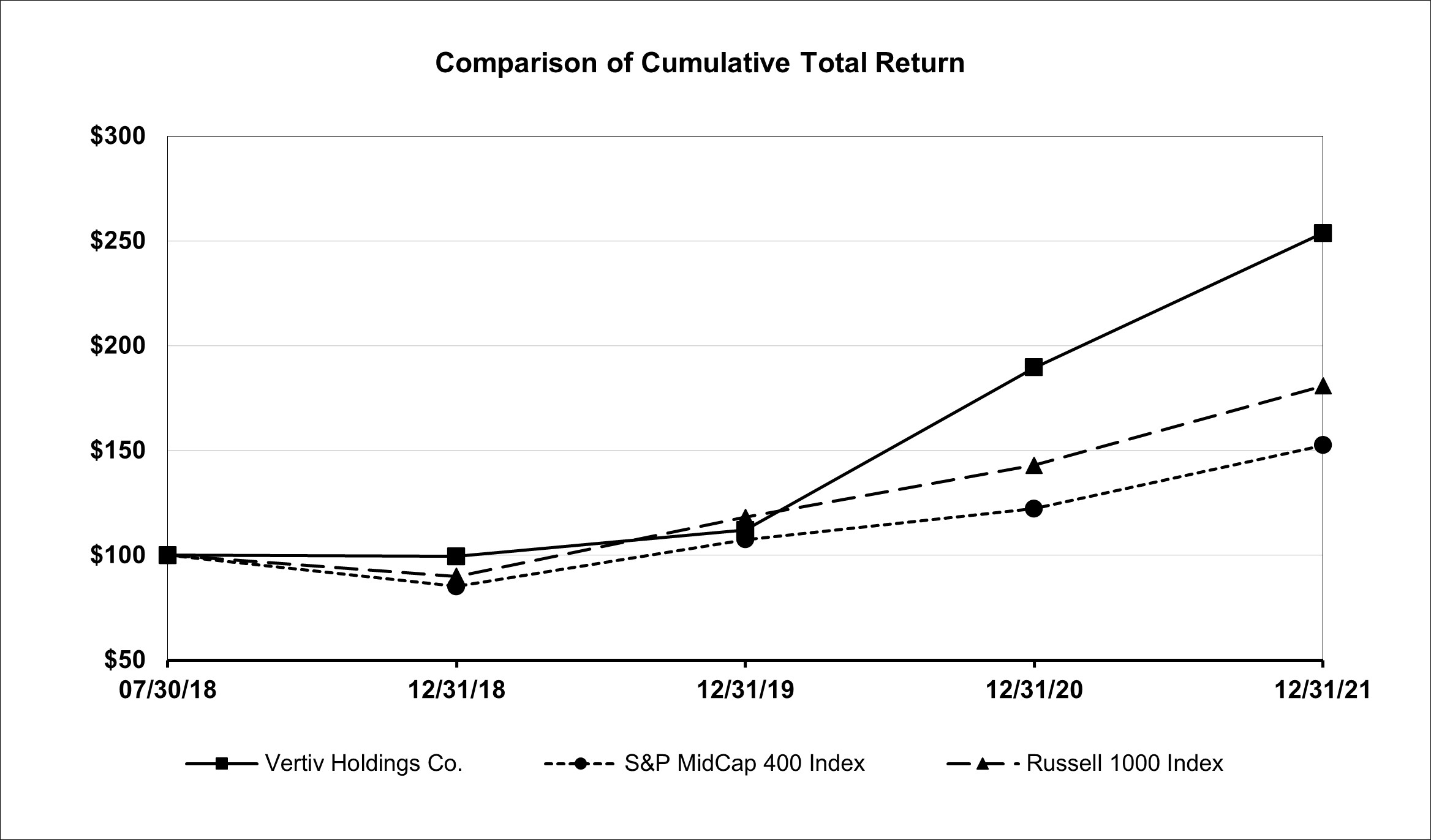
| Company / Index | 7/30/2018 | 12/31/2018 | 12/31/2019 | 12/31/2020 | 12/31/2021 | ||||||||||||||||||||||||
| Vertiv Holdings Co. | 100.0 | 99.5 | 112.0 | 189.6 | 253.7 | ||||||||||||||||||||||||
| S&P MidCap 400 Index | 100.0 | 85.2 | 107.5 | 122.2 | 152.5 | ||||||||||||||||||||||||
| Russell 1000 Index | 100.0 | 90.0 | 118.2 | 143.0 | 180.9 |
Item 6. [Reserved]
Item 7. Management's Discussion and Analysis of Financial Condition and Results of Operation
Unless the context otherwise indicates or requires, references to (1) “the Company,” “Vertiv,” “we,” “us” and “our” refer to Vertiv Holdings Co, a Delaware corporation, and its consolidated subsidiaries ; and (2) “GSAH” refers to GS Acquisition Holdings Corp prior to the Business Combination. In addition, dollar amounts are stated in millions, except for per share amounts. You should read the following discussion and analysis of our financial condition and results of operations in conjunction with the consolidated financial statements and the notes thereto included elsewhere in this Annual Report.
Overview
We are a global leader in the design, manufacturing and servicing of critical digital infrastructure technology that powers, cools, deploys, secures and maintains electronics that process, store and transmit data. We provide this technology to data centers, communication networks and commercial & industrial environments worldwide. We aim to help create a world where critical technologies always work, and where we empower the vital applications of the digital world.
Key Developments
Below is a summary of selected key operational developments affecting our business in 2021:
-
All public warrants previously outstanding were exercised or redeemed as of January 19, 2021, generating $156.5 of cash in December 2020 and $107.5 in January 2021.
-
In March 2021, we, through our subsidiary Vertiv Group Corporation, a Delaware corporation (the “Borrower”) amended our existing Term Loan Credit Agreement with Citibank, N.A., to, among other things, reduce the interest rate margin for the Borrower’s outstanding term loans under the Term Loan Credit Agreement by 0.25%, to 2.75% in respect of term loans bearing interest based on the LIBOR rate and to 1.75% in respect of term loans bearing interest based on a base rate defined in the Term Loan Credit Agreement.
-
On November 1, 2021, we, along with certain of our domestic and international subsidiaries, acquired E&I Engineering Ireland Limited, a private company limited by shares incorporated in Ireland, and Powerbar Gulf LLC – Foreign Direct Investment, a non-freezone limited liability company incorporated and registered in Ras Al Khaimah Economic Zone-Government of Ras Al Khaimah, (the “E&I Acquisition"), for an aggregate purchase price of $1,775.7 in upfront consideration plus an additional $200.0 in cash, with the additional consideration subject to achieving certain future profit milestones. The gross consideration of $1,775.7, consisted of $1,163.7 in cash, approximately $601.1 of Vertiv common stock, equating to 23.1 million shares of Vertiv common stock, $7.4 of contingent consideration and $3.5 of other adjustments.
-
In conjunction with the E&I Acquisition, on October 22, 2021, we completed an offering of $850.0 aggregate principal amount Senior Secured Notes due 2028 in a private placement at par, which bear interest at 4.125% per annum and mature on November 15, 2028.
Outlook and Trends
Below is a summary of trends and events that are currently affecting, or may in the future affect, our business, operations and short-term outlook:
-
COVID-19 Pandemic: Unprecedented measures have been taken by governments and businesses to address the COVID-19 pandemic. These measures have included periodic shelter-in-place orders, restrictions on travel and business operations, temporary closures of businesses, quarantines, and attempts to institute various regulatory requirements. As a result of this pandemic, global economic activity has been significantly impacted, causing volatility and disruption in global financial markets. These responsive measures taken by many countries have affected, and could in the future materially impact, the Company’s business, results of operations, financial condition and stock price.
-
The extent of the continuing impact of the COVID-19 pandemic on the Company’s operational and financial performance is uncertain and will depend on many factors outside the Company’s control, including, without limitation, the extent, timing and duration of the pandemic; the availability, distribution and effectiveness of vaccines; the imposition of protective public safety measures; and the impact of the pandemic on the global economy and demand for products. Refer to Part I, Item 1A of this Form 10-K under the heading “Risk Factors,” for more information. The Company continues to monitor the situation and will take further actions as may be required by federal, state, or local governmental authorities, or that we determine are in the best interests of our associates, customers, and shareholders.
-
Supply Chain Constraints and Cost Increases: During 2021, aspects of the Company’s business continued to be affected by the COVID-19 pandemic as well as increased costs for materials, freight and labor. Despite strong market demand, supply chain challenges continued, with critical part shortages driving the need for additional spot buys at increased costs, and costs associated with premium freight to meet customer commitments. These issues were exacerbated by failure to accurately forecast increases in costs due to inflation and translate such increases into changes in the prices we charge our customers. Additionally, logistical issues have significantly delayed the receipt of materials and, in some cases, the Company cannot procure critical parts at any price, creating production and delivery challenges pressuring the top and bottom line. The Company has taken actions to improve our ability to forecast inflationary headwinds and reflect anticipated cost increases in our prices and will continue to take actions to address shortages and inflationary pressures, which are expected to continue throughout 2022.
RESULTS OF OPERATIONS
Year ended December 31, 2021 compared to year ended December 31, 2020
| (Dollars in millions) | 2021 | 2020 | $ Change | % Change | |||||||||||||||||||
| Net sales | $ | 4,998.1 | $ | 4,370.6 | $ | 627.5 | 14.4 | % | |||||||||||||||
| Cost of sales | 3,475.4 | 2,896.9 | 578.5 | 20.0 | % | ||||||||||||||||||
| Gross profit | 1,522.7 | 1,473.7 | 49.0 | 3.3 | % | ||||||||||||||||||
| Selling, general and administrative expenses | 1,109.0 | 1,008.4 | 100.6 | 10.0 | % | ||||||||||||||||||
| Amortization of intangibles | 144.3 | 128.7 | 15.6 | 12.1 | % | ||||||||||||||||||
| Restructuring costs | 1.4 | 73.9 | (72.5) | (98.1) | % | ||||||||||||||||||
| Foreign currency (gain) loss, net | 3.2 | 26.0 | (22.8) | (87.7) | % | ||||||||||||||||||
| Asset impairments | 8.7 | 21.7 | (13.0) | (59.9) | % | ||||||||||||||||||
| Other operating expense (income) | (3.8) | 1.5 | (5.3) | (353.3) | % | ||||||||||||||||||
| Operating profit (loss) | 259.9 | 213.5 | 46.4 | 21.7 | % | ||||||||||||||||||
| Interest expense, net | 90.6 | 150.4 | (59.8) | (39.8) | % | ||||||||||||||||||
| Loss on extinguishment of debt | 0.4 | 174.0 | (173.6) | (99.8) | % | ||||||||||||||||||
| Gain on tax receivable agreement | (59.2) | — | (59.2) | 100.0 | % | ||||||||||||||||||
| Change in fair value of warrant liabilities | 61.9 | 143.7 | (81.8) | (56.9) | % | ||||||||||||||||||
| Income tax expense | 46.6 | 72.7 | (26.1) | (35.9) | % | ||||||||||||||||||
| Net income (loss) | $ | 119.6 | $ | (327.3) | $ | 446.9 | (136.5) | % |
Net Sales
Net sales were $4,998.1 in 2021, an increase of $627.5, or 14.4%, compared with $4,370.6 in 2020. The increase in sales was primarily driven by demand gains across each of the Company's product and service offerings, positive impacts from foreign currency of $82.5, E&I sales of $67.4 and the impact of global economic recovery from the COVID-19 pandemic. By offering, critical infrastructure & solutions sales increased $465.8 including the positive impacts from E&I sales of $67.4 and foreign currency of $50.7. Services & spares sales increased $121.6, including the positive impacts from foreign currency of $20.1. Integrated rack solutions sales increased $40.1 including the positive impacts from foreign currency of $11.7.
Excluding intercompany sales, net sales were $2,187.4 in the Americas, $1,609.0 in Asia Pacific and $1,201.7 in EMEA. Movements in net sales by segment and offering are each detailed in the Business Segments section below.
Cost of Sales
Cost of sales were $3,475.4 in 2021, an increase of $578.5, or 20.0% compared to 2020. The increase in cost of sales was primarily due to the flow-through impact of higher net sales volume and increased commodity and logistic costs. Gross profit was $1,522.7 in 2021, or 30.5% of sales, compared to $1,473.7, or 33.7% of sales in 2020.
Selling, General and Administrative Expenses
Selling, general and administrative expenses (SG&A) were $1,109.0 in 2021, an increase of $100.6 compared to 2020. SG&A as a percentage of sales were 22.2% in 2021 compared with 23.1% in 2020. The increase in SG&A was primarily driven by $39.4 merger and acquisition costs associated with the acquisition and integration of E&I, $18.7 related to litigation settlement costs, one time fixed cost reduction actions undertaken in 2020 in response to the COVID-19 pandemic, including discretionary spending cuts, that resulted in approximately $30.0 of cost savings, which were offset by one-time transaction related bonuses in 2020.
Other Operating Expenses
Other operating expenses include amortization of intangibles, restructuring costs, foreign currency (gain) loss, and other operating expense (income). Other expenses were $153.8 for 2021, which was a $98.0 decrease from 2020. The decrease was primarily due to a decrease in restructuring costs of $72.5, change in foreign currency (gain) loss of $22.8, and a decrease in asset impairment of $13.0.
Loss on Extinguishment of debt
Loss on extinguishment of debt was $0.4 in 2021, which was a $173.6 decrease from the 2020 loss that resulted from the repayment of indebtedness from the Business Combination and the subsequent refinancing transactions.
Gain on Tax Receivable Agreement
The gain on tax receivable agreement is related to the $59.2 gain associated with the amended Tax Receivable Agreement signed December 31, 2021. Refer to "Note 12 – Financial Instruments and Risk Management” to the consolidated financial statements for additional information.
Change in Fair Value of Warrant Liabilities
Change in Fair Value of Warrant Liabilities represents the mark-to-market fair value adjustments to the outstanding warrants issued in connection with the IPO of GSAH. The change in fair value of the outstanding warrants liability during 2021 and 2020 resulted in a loss of $61.9 and $143.7, respectively. The change in fair value of stock warrants was the result of changes in market prices and other observable inputs deriving the value of the financial instruments.
Interest expense
Interest expense, net, was $90.6 in 2021 compared to $150.4 in 2020. The $59.8 decrease was primarily due to a $25.4 reduction in interest expense resulting from the repayment of indebtedness in 2020, a $26.2 decrease related to lower interest rates secured through the debt refinancing, as described in "Note 6 - Debt" to the consolidated financial statements, a $16.8 decrease in accretion expense associated with the Tax Receivable Agreement, and partially offset by a $4.2 increase due to net settlement payments on the Company's interest rate swaps.
Income Taxes
Income tax expense was $46.6 in 2021 compared to $72.7 in 2020. The effective rate in 2021 was primarily influenced by the mix of income between our U.S. and non-U.S. operations, net of changes in valuation allowances and uncertain tax positions, and reflects the impact of non-deductible changes in fair value of the warrant liabilities, as well as a discrete tax adjustment related to legislative changes enacted in the period. The effective tax rate includes the benefit of certain internal reorganizations and tax elections outside the U.S. In 2020, income tax expense was primarily influenced by the mix of income between our U.S. and non-U.S. operations, net of changes in valuation allowances and uncertain tax positions, and discrete tax benefits related to a change in our indefinite reinvestment liability caused by legislative changes and movement in foreign currencies.
The tax expense in 2021 was $26.1 lower than 2020 primarily due to the change in mix of income, non-U.S. tax elections and changes in valuation allowances in the U.S.
Business Segments
The following are business segment results for the years ended December 31, 2021 and 2020. Segment profitability is defined as operating profit (loss). Segment margin represents segment operating profit (loss) expressed as a percentage of segment net sales. For reconciliations of segment net sales and earnings to the Company’s consolidated results, see "Note 14 — Segment Information", of the Company's condensed consolidated financial statements. Segment net sales are presented excluding intercompany sales.
Americas
| (Dollars in millions) | December 31, 2021 | December 31, 2020 | $ Change | % Change | |||||||||||||||||||||||||
| Net sales | $ | 2,187.4 | $ | 2,040.6 | $ | 146.8 | 7.2 | % | |||||||||||||||||||||
| Operating profit (loss) | 441.2 | 497.0 | (55.8) | (11.2) | % | ||||||||||||||||||||||||
| Margin | 20.2 | % | 24.4 | % |
Americas net sales of $2,187.4 in 2021 increased $146.8, or 7.2% from 2020. By product offering, net sales increased in critical infrastructure & solutions by $115.4 driven by strong growth in Thermal, DC Power Custom Solutions offerings and E&I sales of $21.7. Service & spares increased by $42.5 due to improved customer site availability, and integrated rack solutions decreased by a $11.1 primarily driven by supply chain constraints. Additionally, Americas net sales were positively impacted by foreign currency of approximately $3.9.
Operating profit (loss) in 2021 was $441.2, a decrease of $55.8 compared with 2020. Margin declined primarily due to increased commodity and logistic costs, supply chain constraints, and partially offset by decreased year over year restructuring charges of $11.5.
Asia Pacific
| (Dollars in millions) | December 31, 2021 | December 31, 2020 | $ Change | % Change | |||||||||||||||||||||||||
| Net sales | $ | 1,609.0 | $ | 1,368.4 | $ | 240.6 | 17.6 | % | |||||||||||||||||||||
| Operating profit (loss) | 253.4 | 197.1 | 56.3 | 28.6 | % | ||||||||||||||||||||||||
| Margin | 15.7 | % | 14.4 | % |
Asia Pacific net sales of $1,609.0 in 2021 increased $240.6, or 17.6% from 2020. Sales increases were primarily due to strong growth in large projects such as data centers, 5G projects, and wind power. Additionally, sales improved in part due to the global recovery from COVID-19 in telecom, channel and services. By product offering, net sales improved in all offering categories, including increases in critical infrastructure & solutions, service & spares, and integrated rack solutions of $141.0, $55.2 and $44.4, respectively. Additionally, Asia Pacific net sales were positively impacted by foreign currency of approximately $61.5.
Operating profit (loss) in 2021 was $253.4, an increase of $56.3 compared with 2020. Margin improvements were driven by fixed cost volume leveraging on higher sales, decreased year over year restructuring charges of $7.3, partially offset by the absence of COVID-19 related government subsidies received in 2020 and increased commodity and logistic costs, and supply chain constraints.
Europe, Middle East & Africa
| (Dollars in millions) | December 31, 2021 | December 31, 2020 | $ Change | % Change | ||||||||||||||||||||||||||||
| Net sales | $ | 1,201.7 | $ | 961.6 | $ | 240.1 | 25.0 | % | ||||||||||||||||||||||||
| Operating profit (loss) | 217.6 | 105.5 | 112.1 | 106.3 | % | |||||||||||||||||||||||||||
| Margin | 18.1 | % | 11.0 | % |
EMEA net sales of $1,201.7 in 2021 increased $240.1, or 25.0% from 2020. Sales increases were primarily due to deployment of large colocation data centers, the global recovery from COVID-19, and E&I sales of $45.7. By offering, net sales improved in all offering categories, including increases in critical infrastructure & solutions, service & spares, and integrated rack solutions of $209.4, $23.9, and $6.8 respectively. Additionally, EMEA net sales were positively impacted by foreign currency of approximately $17.1.
Operating profit (loss) in 2021 was $217.6, an increase of $112.1 compared with 2020. Margin improved primarily due to decreased year over year restructuring charges of $49.8, fixed cost volume leveraging on higher sales, improved operational productivity and new product introductions, partially offset by increased commodity and logistic costs, and supply chain constraints.
Corporate and Other
Corporate and other costs include costs associated with our headquarters located in Columbus, Ohio, as well as centralized global functions including Finance, Treasury, Risk Management, Strategy & Marketing, IT, Legal, and global product platform development and offering management. Corporate and other costs were $504.8 and $431.4 in 2021 and 2020, respectively. Corporate and other costs increased $73.4 compared with 2020 primarily due to $39.4 related to merger and acquisition costs associated with the acquisition of E&I and integration, approximately a $37.8 increase in costs related to research and development, $18.7 in legal settlement costs, and $8.7 of impairment costs related to the sale of a heavy industrial business, partially offset by decreased year over year restructuring charges of $3.9.
Capital Resources and Liquidity
Our primary future cash needs relate to working capital, operating activities, capital spending, strategic investments and debt service. On March 10, 2021, we, through our subsidiary Vertiv Group Corporation, a Delaware corporation (the “Borrower”) and an indirect wholly owned subsidiary of Vertiv Holdings Co, Vertiv Intermediate Holding II Corporation, a Delaware corporation (“Holdings”) and the direct parent of Vertiv Group, and certain direct and indirect subsidiaries of the Borrower entered into an Amendment No. 1 to Term Loan Credit Agreement (the "Term Loan Amendment") with Citibank, N.A., as administrative agent (in such capacity, the “Term Agent”), and the lenders party thereto, which amended the Term Loan Credit Agreement, dated as of March 2, 2020 (as so amended the “Term Loan Credit Agreement”), by and among Holdings, the Borrower, the Term Agent and the lenders from time to time party thereto, to, among other things, reduce the interest rate margin for the Borrower’s outstanding term loans under the Term Loan Credit Agreement by 0.25%, to 2.75% in respect of term loans bearing interest based on the LIBOR rate and to 1.75% in respect of term loans bearing interest based on a base rate defined in the Term Loan Credit Agreement. The maturity date for such term loans remains March 2, 2027, and all other material provisions of the original Term Loan Credit Agreement remain materially unchanged.
On October 22, 2021, Vertiv Group Corporation (the “Issuer”), completed its offering (the “Offering”) of $850.0 aggregate principal amount of its Senior Secured Notes due 2028 (the “Notes”) in a private placement at par. The Notes will bear interest at 4.125% per annum and mature on November 15, 2028. The Company incurred $13.8 of debt issuance costs that were capitalized as part of the Notes.
We believe that net cash provided by operating activities, augmented by our long-term debt arrangements discussed below and ABL Revolving Credit Facility, will provide adequate near-term liquidity for the next 12 months of independent operations, as well as the resources necessary to invest for growth in existing businesses and manage our capital structure on a short- and long-term basis. We may also from time to time opportunistically access the capital markets and financing markets to optimize our capital structure subject to prevailing markets conditions. Access to capital and the availability of financing on acceptable terms in the future will be affected by many factors, including our credit rating, economic conditions, and the overall liquidity of capital markets. There can be no assurance that we will continue to have access to the capital markets and financing markets on acceptable terms.
At December 31, 2021, we had $439.1 in cash and cash equivalents, which includes amounts held outside of the U.S., primarily in Europe and Asia. Non-U.S. cash is generally available for repatriation without legal restrictions, subject to certain taxes, mainly withholding taxes. We are not asserting indefinite reinvestment of cash or outside basis for our non-U.S. subsidiaries due to the outstanding debt obligations in instances where alternative repatriation options other than dividends are not available. Our ABL Revolving Credit Facility provides for up to $455.0 of revolving borrowings, with separate sublimits for letters of credit, swingline borrowings and borrowings made to certain non-U.S. subsidiaries, and an uncommitted accordion of up to $145.0. At December 31, 2021, Vertiv Group and certain other subsidiaries of the Company had $435.6 of availability (subject to customary borrowing base and other conditions) under the ABL Revolving Credit Facility, net of letters of credit outstanding in the aggregate principal amount of $19.4, and taking into account the borrowing base limitations set forth in the ABL Revolving Credit Facility.
Long-Term Debt Obligations
See "Note 6 — Debt" of the consolidated financial statements of the long-term debt arrangements issued by the Company with certain of our subsidiaries named as guarantors or co-borrowers.
Summary Statement of Cash Flows
Year ended December 31, 2021 compared to year ended December 31, 2020
| (Dollars in millions) | 2021 | 2020 | $ Change | % Change | ||||||||||||||||||||||
| Net cash provided by (used for) operating activities | $ | 210.9 | $ | 208.9 | $ | 2.0 | 1.0 | % | ||||||||||||||||||
| Net cash used for investing activities | (1,216.8) | (45.7) | (1,171.1) | 2,562.6 | ||||||||||||||||||||||
| Net cash provided by financing activities | 914.9 | 140.7 | 774.2 | 550.2 | ||||||||||||||||||||||
| Capital expenditures | (73.4) | (44.4) | (29.0) | 65.3 | ||||||||||||||||||||||
| Investments in capitalized software | (11.2) | (8.3) | (2.9) | 34.9 |
Net Cash provided by Operating Activities
Net cash provided by operating activities was $210.9 in 2021, a $2.0 increase in cash generation compared to 2020. The increase in cash generation was primarily driven by lower cash interest as a result of our overall reduction in long-term debt and our first quarter 2021 debt refinancing as well as lower transformation-related spending.
Net Cash used for Investing Activities
Net cash used for investing activities was $1,216.8 in 2021 compared to net cash used for investing activities of $45.7 in 2020. The higher use of cash over the comparable period was primarily the result of the E&I Acquisition for $1,163.7, increased capital expenditures, and slightly offset by $21.7 in proceeds from the sale of a heavy industrial UPS business.
Net Cash provided by Financing Activities
Net cash provided by financing activities was $914.9 in 2021 compared to $140.7 in 2020. The increase in cash generation was primarily the result of the issuance of the Notes due 2028 of $850.0, slightly offset by a decrease in exercise of Public Warrants of $49.0, and employee taxes paid from shares withheld of $7.3. In 2021, borrowings on the Term Loan Facility of $2,189.0, net of original discount, and proceeds from the reverse recapitalization of $1,832.5 were offset by the repayment of the Prior Term Loan Facility and Prior Notes as well as a payment made to Platinum Equity Advisors, LLC ("Advisors") in connection with the closing of the merger with GSAH.
Critical Accounting Estimates
The Company's discussion and analysis of financial condition and results of operations is based upon our Consolidated Financial Statements, which have been prepared in accordance with accounting principles generally accepted in the United States. The preparation of these financial statements requires management to make estimates and assumptions that affect the reported amounts of assets and liabilities and the disclosure of contingent assets and liabilities at the date of the financial statements and the reported amounts of revenues and expenses during the reporting period. On an ongoing basis, management evaluates its estimates and judgments related to these assets, liabilities, revenues and expenses. We believe these estimates to be reasonable under the circumstances. Management bases its estimates and judgments on historical experience, expected future outcomes, and on various other factors that are believed to be reasonable under the circumstances, the results of which form the basis for making judgments about the carrying values of assets and liabilities that are not readily apparent from other sources. Actual results may differ from these estimates.
The Company believes that the following accounting estimates are critical to our financial results:
Business Combinations
The Company allocates the purchase price of acquired companies to tangible and intangible assets acquired and liabilities assumed based upon their estimated fair values at the acquisition date. The amount of purchase price which is in excess of the fair values of assets acquired and liabilities assumed is recognized as goodwill. The purchase price allocation process requires management to make significant estimates and assumptions with respect to intangible assets. Although we believe the assumptions and estimates we have made are reasonable, they are based in part on historical experience, market conditions and information obtained from management of the acquired companies and are inherently uncertain. The following are critical estimates in valuing intangible assets we have acquired or may acquire in the future and include but are not limited to:
-
forecasted earnings before interest, taxes, and amortization;
-
forecasted revenue;
-
customer attrition rates;
-
royalty rates; and
-
discount rates.
Unanticipated events and circumstances may occur which may affect the accuracy or validity of such assumptions, estimates or actual results. Different assumptions may result in materially different values for assets acquired and liabilities assumed, which may impact the Company's financial position and future results of operations.
Long-lived assets
Goodwill
The Company accounts for goodwill and other intangible assets acquired in a business combination in conformity with current accounting guidance which does not allow for goodwill and indefinite-lived intangible assets to be amortized.
The Company reviews goodwill for impairment annually in the fourth quarter or when events and circumstances indicate an impairment may have occurred. The Company tests goodwill for impairment by comparing the estimated fair value of the reporting units to the related carrying value. If the fair value of the reporting unit is lower than its carrying amount, goodwill is written down for the amount by which the carrying amount exceeds fair value. However, the loss recognized cannot exceed the carrying amount of goodwill. Reporting units are defined as either operating segments or one level below the operating segments for which discrete financial information is available and reviewed by the business management. The Company’s four reporting units are comprised of the Americas; Greater China; Australia & New Zealand, South East Asia and India (ASI); and EMEA reporting units.
The Company makes various estimates and assumptions in determining the estimated fair value of each reporting unit using a combination of discounted cash flow models and valuations based on earnings multiples for guideline public companies and transactions in each reporting unit’s industry peer group, when externally quoted market prices are not readily available. Discounted cash flow models are highly reliant on various assumptions, including projected business results, long-term growth factors and discount rate. Management judgement is involved in estimating these variables, and they include inherent uncertainties since they are forecasting future events. The Company performs sensitivity analyses by using a range of inputs to confirm the reasonableness of the long-term growth rate and discount rate estimates. Additionally, the Company compares the indicated equity value to the Company’s market capitalization and evaluates the resulting implied control premium/discount to determine if the estimated enterprise value is reasonable compared to external market indicators.
The Company performed its annual goodwill impairment using the quantitative approach in the fourth quarter and concluded there was no impairment as of that date. The impairment test concluded that the Americas; Greater China; Australia & New Zealand, South East Asia and India (ASI); and EMEA reporting units had fair values significantly in excess of their respective carrying amounts. The Company compared the total fair values of the reporting units to the Company’s market capitalization, to determine if the fair values are reasonable compared to external market indicators. The Company believes its use of significant assumptions within its valuation models are reasonable estimates of likely future events. Subsequent to this annual impairment test, no additional indications of an impairment were identified.
Significant assumptions inherent in the valuation methodologies include estimates of future projected business results (principally revenue and EBITDA), long-term growth rates, and the discount rate. The Company performed sensitivity analyses by using a range of inputs to confirm the reasonableness of long-term growth rate and discount rate estimates. Significant assumptions utilized in the impairment analysis performed during the fourth quarter of 2021 included the weighted-average cost of capital, ranging between 10.5% and 12.0%, and terminal growth rates of 3.0%.
Tangible assets
The Company reviews property, plant and equipment asset groups for impairment whenever events or changes in circumstances indicate the carrying amount of an asset may not be recoverable. The Company monitors these changes and events on at least a quarterly basis. Examples of events or changes in circumstances could include, but are not limited to, a prolonged economic downturn, current period operating or cash flow losses combined with a history of losses or a forecast of continuing losses associated with the use of an asset group, or a current expectation that an asset group will be sold or disposed of before the end of its previously estimated useful life. Recoverability is based upon projections of anticipated future undiscounted cash flows associated with the use and eventual disposal of the property, plant and equipment asset groups, as well as specific appraisals in certain instances. Reviews occur at the lowest level for which identifiable cash flows are largely independent of cash flows associated with other property, plant and equipment asset groups. If the future undiscounted cash flows result in a value that is less than the carrying value, then the long-lived asset is considered impaired and a loss is recognized based on the amount by which the carrying amount exceeds the estimated fair value. Various factors that the Company uses in determining the impact of these assessments include the expected useful lives of long-lived assets and the ability to realize any undiscounted cash flows in excess of the carrying amounts of such asset groups, and are affected primarily by changes in the expected use of the assets, changes in technology or development of alternative assets, changes in economic conditions, changes in operating performance and changes in expected future cash flows. Because judgment is involved in determining the fair value of property, plant and equipment asset groups, there is risk that the carrying value of these assets may require adjustment in future periods.
Finite-lived intangible assets
Finite-lived intangible assets principally consist of certain customer relationships, developed technology, capitalized software and trademarks. These intangible assets are amortized on a straight-line basis over their estimated useful lives. The cost of customer relationships is amortized principally over 10 to 13 years, developed technology over 5 to 10 years, capitalized software over 5 years, and trademarks over 5 to 10 years. The Company reviews finite-lived intangible assets for impairment whenever events or changes in circumstances indicate the carrying amount of an asset may not be recoverable. The Company monitors these changes and events on at least a quarterly basis.
Amortization expense recognized on finite-lived intangible assets was $157.9 for 2021, $142.8 for 2020, and $145.8 for 2019.
Other indefinite-lived intangible assets
Other indefinite-lived intangible assets include certain trademarks. The Company reviews these intangible assets for possible impairment annually in the fourth quarter or whenever events or changes in circumstances indicate that carrying amounts may not be recoverable. If the carrying value of an individual indefinite-lived intangible asset exceeds its fair value, the asset is written down to its fair value and the amount of the write down is the impairment charge. Similar to its annual assessment for goodwill, the Company performs a quantitative test for impairment.
When a quantitative analysis is performed, the Company tests these assets using a “relief-from-royalty” valuation method to determine the fair value. Significant assumptions inherent in the valuation methodologies include, but are not limited to, future projected business results, growth rates, the discount rate for a market participant, and royalty rates.
In conjunction with the annual assessment of indefinite-lived intangible assets, the Company’s quantitative approach model did not indicate any impairment, as each indefinite-lived intangible asset’s fair value exceeded their carrying values.
The Company’s assessment of an impairment on any of these assets classified currently as having indefinite lives, including goodwill, could change in future periods if significant events happen and/or circumstances change that effect the previously mentioned assumptions. Significant assumptions inherent in the valuation methodologies include, but are not limited to, such estimates as future projected business results, growth rates, the weighted average cost of capital for a market participant, and royalty and discount rates. For further information, see "Note 5 – Goodwill and Other Intangibles” of Notes to Consolidated Financial Statements.
Revenue recognition
The Company recognizes revenue from the sale of manufactured products and services when control of promised goods or services are transferred to customers in an amount that reflects the consideration the Company expects to be entitled to in exchange for those goods or services. Control is transferred when the customer has the ability to direct the use of and obtain benefits from the goods or services. The majority of the Company’s sales agreements contain performance obligations satisfied at a point in time when control is transferred to the customer. Sales for service contracts, including installation, inventory with no alternative use and an enforceable right of payment upon customer termination and other discrete services, generally are recognized over time as the services are provided. Payments received in advance for service arrangements are recorded as deferred revenue and recognized in net sales when the revenue recognition criteria are met. Unbilled revenue is recorded when performance obligations have been satisfied, but the Company does not have present right to payment.
For agreements with multiple performance obligations, judgment is required to determine whether performance obligations specified in these agreements are distinct and should be accounted for as separate revenue transactions for recognition purposes. In these types of agreements we allocate sales price to each distinct obligation on a relative stand-alone selling price basis. The majority of revenue from arrangements with multiple performance obligations is recognized when tangible products are delivered, with smaller portions for associated installation and commissioning recognized shortly thereafter. Generally, contract duration is short term, and cancellation, termination or refund provisions apply only in the event of contract breach. These provisions have historically not been invoked.
Payment terms vary by the type and location of the customer and the products or services offered. Revenue from our sales have not been adjusted for the effects of a financing component as we expect that the period between when we transfer control of the product and when we receive payment to be one year or less. Sales, value add, and other taxes collected concurrent with revenue are excluded from sales. The Company records amounts billed to customers for shipping and handling in a sales transaction as revenue. Shipping and handling costs are treated as fulfillment costs and are included in costs of sales.
Public and Private Placement Warrants
As part of GSAH's IPO on June 12, 2018, warrants were issued that entitled the holder to purchase one share of Class A common stock at an exercise price of $11.50 per share (the “Public Warrants”). In addition, as part of a simultaneous private placement, additional warrants, exercisable for one share of Class A common stock at an exercise price of $11.50 per share (the “Private Placement Warrants” and, together with the Public Warrants, the “Warrants”).
9,387,093 Public Warrants and 10,533,333 Private Placement Warrants remained outstanding as of December 31, 2020. On January 19, 2021, the Company redeemed the outstanding Public Warrants in full and the Public Warrants and attached units were subsequently delisted from NYSE.
The Private Placement Warrants are exercisable on a cashless basis, at the holder’s option, and are non-redeemable so long as they are held by the initial purchasers or their permitted transferees. If the Private Placement Warrants are held by someone other than the initial purchasers or their permitted transferees, the Private Placement Warrants will be redeemable by us and exercisable by such holders on the same basis as the Public Warrant. As of December 31, 2021, 10,533,333 Private Placement Warrants remain outstanding.
We evaluated the Public and Private Placement Warrants under ASC 815-40, Derivatives and Hedging—Contracts in Entity’s Own Equity, and concluded that they do not meet the criteria to be classified in stockholders’ equity. Specifically, the SEC Statement focused in part on provisions in warrant agreements that provide for potential changes to the settlement amounts dependent upon the characteristics of the warrant holder and because the holder of a warrant is not an input into the pricing of a fixed-for-fixed option on equity shares, such provision would preclude the warrant from being classified in equity and thus the warrant should be classified as a liability. Since the Public and Private Placement Warrants meet the definition of a derivative under ASC 815, we recorded these Warrants as liabilities on the balance sheet at fair value, with subsequent changes in their respective fair values recognized in the consolidated statement of earnings (loss) and consolidated statements of comprehensive income (loss) at each reporting date. Because the Public Warrants were publicly traded and thus had an observable market price, fair value adjustments were determined by utilizing the market prices whereas the Private Placement Warrants were valued using a Black-Sholes-Merton pricing model as described in "Note 12 - Financial Instruments and Risk Management", to the consolidated financial statements. The changes in the fair value of the Warrants may be material to our future operating results.
Income Taxes
The Company is subject to income taxes in the United States and numerous foreign jurisdictions. Judgment in the forecasting of taxable income using historical and projected future operating results is required in determining the Company’s provision for income taxes and the related assets and liabilities. The provision for income taxes includes income taxes paid, currently payable or receivable, and deferred taxes. Under U.S. GAAP, deferred tax assets and liabilities are determined based on differences between financial reporting and tax basis of assets and liabilities and are measured using enacted tax rates and laws that are expected to be in effect when the differences reverse. Deferred tax assets are also recognized for the estimated future effects of tax loss and credit carryforwards. The effect on deferred taxes of changes in tax rates is recognized in the period in which the enactment date occurs. Valuation allowances are established when necessary on a jurisdictional basis to reduce deferred tax assets to the amounts expected to be realized. Deferred taxes are not provided on the unremitted earnings of subsidiaries outside of the United States when it is expected that these earnings are indefinitely reinvested. In the event that the actual outcome of future tax consequences differs from the Company’s estimates and assumptions due to changes or future events such as tax legislation, geographic mix of earnings, completion of tax audits or earnings repatriation plans, the resulting change to the provision for income taxes could have a material effect on the Consolidated Statements of Earnings (Loss) and Consolidated Balance Sheets.
The recoverability of deferred tax assets and the recognition and measurement of uncertain tax positions are subject to various assumptions and judgment by Vertiv. If actual results differ from the estimates made by Vertiv in establishing or maintaining valuation allowances against deferred tax assets, the resulting change in the valuation allowance would generally impact earnings. Additionally, the positions taken with regard to tax contingencies may be subject to audit and review by tax authorities, which may result in future taxes, interest and penalties. Positive and negative evidence is considered in determining the need for a valuation allowance against deferred tax assets, which includes such evidence as historical earnings, projected future earnings, tax planning strategies and expected timing of reversal of existing temporary differences.
In determining the recoverability of deferred tax assets Vertiv gives consideration to all available positive and negative evidence including reversals of deferred tax liabilities, projected future income, tax planning strategies and recent trends in financial results. Vertiv attaches the most weight to historical earnings as they are more objectively verifiable compared to forecasts. In evaluating the objective evidence that historical results provide, Vertiv generally considers three years of cumulative income or loss at the jurisdictional taxpayer level as an important factor.
Item 7A. Quantitative and Qualitative Disclosures About Market Risk
The Company is exposed to certain market risks, including the impact of changes in foreign currency exchange rates, interest rates and the prices of various commodities used in the normal course of business.
To mitigate the volatility in our earnings and cash flows, the Company manages certain of our exposures through the use of various financial instruments, including some derivatives, to help us hedge our foreign currency exchange risk and interest rate risk. The Company does not enter into such transactions for trading or speculative purposes.
A discussion of the Company’s accounting policies for derivative instruments and hedging activities, is included in “Note 1 – Summary of Significant Accounting Policies”. Information relating to market risks is presented in “Note 12 - Financial Instruments and Risk Management” in the Notes to Consolidated Financial Statements and is incorporated by reference into Part II of this Annual Report.
Foreign Exchange Rate Risk
The Company has transactional foreign currency exposures related to buying and selling in currencies other than the local currencies in which it operates. The Company enters into one-month foreign exchange forwards in order to mitigate European Euro and Chinese Yuan exposures on the carrying amount of foreign currency-denominated assets, liabilities, commitments, and when applicable anticipated foreign currency transactions. As of December 31, 2021 the Company had an insignificant amount of outstanding currency hedges. We have translation exposure resulting from translating the financial statements of foreign subsidiaries into United States Dollars. During 2021, the Company has hedged portions of the net investment in foreign subsidiaries against fluctuations in the European Euro and Chinese Yuan through derivative financial instruments.
Interest Rate Risk
The Company is subject to market risk from exposure to changes in interest rates and cash and cash equivalents which are exposed to floating interest rates and may impact cash flow. The Company has an ABL Revolving Credit Facility, floating rate Term Loan due 2027 and cash and cash equivalents which are exposed to floating interest rates and may impact cash flow. As of December 31, 2021 and 2020, the Company had no borrowings on its ABL Revolving Credit Facility. Cash and cash equivalents were $439.1 and $534.6 at December 31, 2021 and 2020, respectively. In order to mitigate interest rate risk, the Company entered into interest rate swap agreements with an initial notional amount of $1,200.0, which reduced to $1,000.0 in 2021 and will remain at $1,000.0 until the maturity of the Term Loan Credit Agreement in 2027. The swap transactions exchange floating rate interest payments for fixed rate interest payments on the notional amount to reduce interest rate volatility. Based on the outstanding balances of floating rate debt, net of interest rate swap agreements, a 100 basis point increase (decrease) in variable interest rates at December 31, 2021 and 2020 would increase our annual net interest expense by approximately $12.0 and $10.0, respectively.
Commodity Risk
We are subject to commodity risk from fluctuating prices of certain raw materials, steel, copper and aluminum and electronic components.
Additional information relating to market risks is presented in "Note 12 - Financial Instruments and Risk Management" in the Notes to Consolidated Financial Statements and is incorporated by reference into Part II of this Annual Report. Our Consolidated Financial Statements and the accompanying Notes to Consolidated Financial Statements are filed as part of this Annual Report under “Item 15. Exhibits, Financial Statement Schedules” and are set forth immediately following the signature pages of this Annual Report.
Item 8. Financial statements and supplementary data
The Report of Independent Registered Public Accounting Firm, our consolidated financial statements, and the accompanying Notes to Consolidated Financial Statements that are filed as part of this Annual Report are listed under “Item 15. Exhibits, Financial Statement Schedules” and are set forth immediately following the signature pages of this Annual Report.
Item 9. Changes in and Disagreements with Accountants on Accounting and Financial Disclosure
Not Applicable.
Item 9A. Controls and Procedures
Disclosure Controls and Procedures
The Company maintains (a) disclosure controls and procedures (as such term is defined in Rules 13a-15(e) and 15d-15(e) under the Exchange Act), and (b) internal control over financial reporting (as such term is defined in Rules 13a-15(f) and 15d-15(f) under the Exchange Act).
Our management, with the participation of our President and Chief Executive Officer and our Chief Financial Officer, conducted an evaluation of the effectiveness of our disclosure controls and procedures as of December 31, 2021 (the end of the period covered by this Annual Report). Based upon that evaluation, our Chief Executive Officer and Chief Financial Officer have concluded that, as of December 31, 2021, our disclosure controls and procedures were effective in ensuring that material information for the Company, including its consolidated subsidiaries, required to be disclosed by the Company in reports that it files or submits under the Exchange Act is recorded, processed, summarized and reported within the time periods specified in the SEC’s rules and forms, and that it is accumulated and communicated to management, including our principal executive and financial officers, or persons performing similar functions, as appropriate to allow timely decisions regarding required disclosure.
Management Report on Internal Control over Financial Reporting
Management of the Company is responsible for establishing and maintaining adequate internal control over financial reporting as such term is defined in Rules 13a-15(f) and 15d-15(f) under the Securities Exchange Act of 1934.
Management has assessed the effectiveness of the Company’s internal control over financial reporting as of December 31, 2021 based on criteria established in the Internal Control-Integrated Framework in 2013 issued by the Committee of Sponsoring Organizations of the Treadway Commission (COSO).
Management's assessment of the effectiveness of the Company’s internal control over financial reporting as of December 31, 2021 excluded E&I which was acquired by the Company in the fourth quarter of 2021. Total assets and totals sales recorded by the Company related to this acquisition represented 28.7% (inclusive of acquired intangible assets), and 1.3%, respectively, of Vertiv’s consolidated balances, as of and for the year ended December 31, 2021. Companies are permitted to exclude acquisitions from their assessment of internal control over financial reporting during the first year of an acquisition while integrating the acquired company under guidelines established by the Securities and Exchange Commission.
Remediation of Material Weakness in Internal Control Over Financial Reporting
The Company designed and implemented internal controls to remediate the material weaknesses that existed as of December 31, 2020, with respect to our controls over automated and manual business process controls, including reports generated from our IT systems, that are dependent upon the completeness and accuracy of information from the affected general information technology controls. We implemented new, relevant IT systems; improved IT change management policies and procedures; implemented proper segregation of duties; and implemented dedicated controls over our IT systems and general information technology controls. With respect to our controls over financial reporting we have re-designed internal controls processes; expanded our Finance, Accounting and Reporting and Information Technology teams with experienced and qualified resources; and, implemented a risk-based internal controls plan with enhanced process documentation.
These changes and the remediation of the material weaknesses identified as of December 31, 2020, were completed during the year ended December 31, 2021. Based on these remediation efforts, the Company has concluded that its internal control over financial reporting was effective as of December 31, 2021.
The effectiveness of our internal control over financial reporting as of December 31, 2021, has been audited by Ernst & Young LLP, an independent registered public accounting firm, as stated in their report which appears in this Annual Report.
Except as described in Item 9A, there have been no change in the Company's internal control over financial reporting during the year ended December 31, 2021 that materially affected, or is reasonably likely to materially affect, the Company's internal control over financial reporting.
Report of Independent Registered Public Accounting Firm
To the Shareholders and the Board of Directors of Vertiv Holdings Co
Opinion on Internal Control Over Financial Reporting
We have audited Vertiv Holdings Co’s internal control over financial reporting as of December 31, 2021, based on criteria established in Internal Control-Integrated Framework issued by the Committee of Sponsoring Organizations of the Treadway Commission (2013 framework) (the COSO criteria). In our opinion, Vertiv Holdings Co (the Company) maintained, in all material respects, effective internal control over financial reporting as of December 31, 2021, based on the COSO criteria.
As indicated in the accompanying Management’s Report on Internal Control Over Financial Reporting, management’s assessment of and conclusion on the effectiveness of internal control over financial reporting did not include the internal controls of E&I (as defined in Note 2), which is included in the 2021 consolidated financial statements of the Company and constituted 28.7% of total assets (inclusive of acquired intangible assets) as of December 31, 2021 and 1.3% of total sales for the year then ended. Our audit of internal control over financial reporting of the Company also did not include an evaluation of the internal control over financial reporting of E&I.
We also have audited, in accordance with the standards of the Public Company Accounting Oversight Board (United States) (PCAOB), the consolidated balance sheets of the Company as of December 31, 2021 and 2020, the related consolidated statements of comprehensive income (loss), equity (deficit), and cash flows for each of the three years in the period ended December 31, 2021, and the related notes and our report dated March 1, 2022, expressed an unqualified opinion thereon.
Basis for Opinion
The Company’s management is responsible for maintaining effective internal control over financial reporting and for its assessment of the effectiveness of internal control over financial reporting included in the accompanying Management’s Report on Internal Control Over Financial Reporting. Our responsibility is to express an opinion on the Company’s internal control over financial reporting based on our audit. We are a public accounting firm registered with the PCAOB and are required to be independent with respect to the Company in accordance with the U.S. federal securities laws and the applicable rules and regulations of the Securities and Exchange Commission and the PCAOB.
We conducted our audit in accordance with the standards of the PCAOB. Those standards require that we plan and perform the audit to obtain reasonable assurance about whether effective internal control over financial reporting was maintained in all material respects.
Our audit included obtaining an understanding of internal control over financial reporting, assessing the risk that a material weakness exists, testing and evaluating the design and operating effectiveness of internal control based on the assessed risk, and performing such other procedures as we considered necessary in the circumstances. We believe that our audit provides a reasonable basis for our opinion.
Definition and Limitations of Internal Control Over Financial Reporting
A company’s internal control over financial reporting is a process designed to provide reasonable assurance regarding the reliability of financial reporting and the preparation of financial statements for external purposes in accordance with generally accepted accounting principles. A company’s internal control over financial reporting includes those policies and procedures that (1) pertain to the maintenance of records that, in reasonable detail, accurately and fairly reflect the transactions and dispositions of the assets of the company; (2) provide reasonable assurance that transactions are recorded as necessary to permit preparation of financial statements in accordance with generally accepted accounting principles, and that receipts and expenditures of the company are being made only in accordance with authorizations of management and directors of the company; and (3) provide reasonable assurance regarding prevention or timely detection of unauthorized acquisition, use, or disposition of the company’s assets that could have a material effect on the financial statements.
Because of its inherent limitations, internal control over financial reporting may not prevent or detect misstatements. Also, projections of any evaluation of effectiveness to future periods are subject to the risk that controls may become inadequate because of changes in conditions, or that the degree of compliance with the policies or procedures may deteriorate.
/s/ Ernst & Young LLP
Grandview Heights, Ohio
March 1, 2022
Item 9B. Other Information
Not applicable.
Item 9C. Disclosure Regarding Foreign Jurisdictions that Prevent Inspections
Not applicable.
PART III.
Item 10. Directors, Executive Officer and Corporate Governance
The information required by this Item 10. “Directors, Executive Officers and Corporate Governance” is incorporated herein by reference from our Proxy Statement for the 2022 Annual Meeting of Stockholders to be filed with the SEC within 120 days after our fiscal year end of December 31, 2021 (the “Proxy Statement”).
Item 11. Director and Executive Compensation
The information required by this Item 11. “Director and Executive Compensation” is incorporated herein by reference from our Proxy Statement.
Item 12. Security Ownership of Certain Beneficial Owners and Management and Related Stockholder Matters
Securities authorized for issuance under equity compensation plans
The following table provides information as of December 31, 2021 with respect to our shares of Class A common stock issuable under our equity compensation plans.
| Plan Category | Number of securities to be issued upon exercise of outstanding options, Warrants and rights | Weighted-average exercise price of outstanding options, Warrants and rights (1) | Number of securities remaining available for future issuance under equity compensation plans (excluding securities reflected in column (a)) (2) | ||||||||||||||
| Equity compensation plans approved by security holders | |||||||||||||||||
| Vertiv Holdings Co 2020 Stock Incentive Plan | 12,020,105 | 14.56 | 30,416,663 | ||||||||||||||
| Equity compensation plans not approved by security holders | |||||||||||||||||
| Total | 12,020,105 | 14.56 | 30,416,663 |
(1)The calculation of the weighted average exercise price does not include 3,657,389 shares subject to restricted stock units that do not have an exercise price.
(2)Commencing with the first business day of each calendar year beginning in 2021 through 2030, the number of shares in the reserve under the 2020 Stock Incentive Plan may be increased by a number equal to the least of (x) 10.5 million shares, (y) 3% of the number of shares outstanding as of the last day of the immediately preceding calendar year, or (z) a lesser number of Shares determined by our board of directors or compensation committee. This number is inclusive of 10.3 million shares authorized in 2021 pursuant to the plan.
The information required by this Item 12. “Security Ownership of Certain Beneficial Owners and Management and Related Stockholder Matters” is incorporated herein by reference from our Proxy Statement.
Item 13. Certain Relationships and Related Transactions, and Director Independence
The information required by this Item 13. “Certain Relationships and Related Transactions, and Director Independence” is incorporated herein by reference from our Proxy Statement.
Item 14. Principal Accounting Fees and Services
The information required by this Item 14. “Principal Accounting Fees and Services” is incorporated herein by reference from our Proxy Statement.
PART IV.
Item 15. Exhibits and Financial Statement Schedules
1. Financial Statements
See Index to Consolidated Financial Statements appearing on page 57.
2. Financial Statement Schedules
All financial statement schedules called for under Regulation S-X are omitted because either they are not required under the related instructions, are included in the Consolidated Financial Statements or Notes thereto included elsewhere in this Annual Report on Form 10-K, or are not material.
3. Exhibits
The exhibits listed on the accompanying Exhibit Index are filed or incorporated by reference as part of this report.
| 31.2* | Certification of Principal Financial Officer Pursuant to Section 302 of the Sarbanes-Oxley Act of 2002 (filed herewith) | |||||||||||||
| 32.1* | Certification of Principal Executive Officer Pursuant to 18 U.S.C. Section 1350, as Adopted Pursuant to Section 906 of the Sarbanes-Oxley Act of 2002 (filed herewith) | |||||||||||||
| 32.2* | Certification of Principal Financial Officer Pursuant to 18 U.S.C. Section 1350, as Adopted Pursuant to Section 906 of the Sarbanes-Oxley Act of 2002 (filed herewith) | |||||||||||||
| 101.INS* | The following financial statements from the Company's Annual Report on Form 10-K for the year ended December 31, 2020, formatted in Inline XBRL: (i) Consolidated Statements of Cash Flows, (ii) Consolidated Statements of Operations, (iii) Consolidated Statements of Comprehensive Income, (iv) Consolidated Balance Sheets, and (v) Notes to Consolidated Financial Statements, tagged as blocks of text and including detailed tags. | |||||||||||||
| 101.SCH* | Inline XBRL Taxonomy Extension Schema (filed herewith) | |||||||||||||
| 101.CAL* | Inline XBRL Taxonomy Extension Calculation Linkbase (filed herewith) | |||||||||||||
| 101.DEF* | Inline XBRL Taxonomy Extension Definition Linkbase (filed herewith) | |||||||||||||
| 101.LAB* | Inline XBRL Taxonomy Extension Label Linkbase (filed herewith) | |||||||||||||
| 101.PRE* | Inline XBRL Taxonomy Extension Presentation Linkbase (filed herewith) |
- Filed herewith.
** Denotes the management contracts and compensatory arrangements in which any director or named executive officer participates.
Item 16. Form 10-K Summary
None.
SIGNATURES
Pursuant to the requirements of Section 13 or 15(d) of the Securities Exchange Act of 1934, the registrant has duly caused this report to be signed on its behalf by the undersigned, thereunto duly authorized.
| Date: | March 1, 2022 | Vertiv Holdings Co | ||||||||||||
| /s/ Rob Johnson | ||||||||||||||
| Name: Rob Johnson | ||||||||||||||
| Title: Chief Executive Officer | ||||||||||||||
| /s/ David J. Fallon | ||||||||||||||
| Name: David J. Fallon | ||||||||||||||
| Title: Chief Financial Officer | ||||||||||||||
| /s/ Scott Cripps | ||||||||||||||
| Name: Scott Cripps | ||||||||||||||
| Title: Chief Accounting Officer and Corporate Controller |
Pursuant to the requirements of the Securities Exchange Act of 1934, this report has been signed below by the following persons on behalf of the Registrant and in the capacities and on the dates indicated.
| /s/ Rob Johnson | Chief Executive Officer and Director | March 1, 2022 | ||||||
| Rob Johnson | (Principal Executive Officer) | |||||||
| /s/ David J. Fallon | Chief Financial Officer | March 1, 2022 | ||||||
| David J. Fallon | (Principal Financial Officer) | |||||||
| /s/ Scott A. Cripps | Chief Accounting Officer | March 1, 2022 | ||||||
| Scott A. Cripps | (Principal Accounting Officer) | |||||||
| /s/ David M. Cote | Executive Chairman of the Board | March 1, 2022 | ||||||
| David M. Cote | ||||||||
| /s/ Joseph van Dokkum | Director | March 1, 2022 | ||||||
| Joseph van Dokkum | ||||||||
| /s/ Roger Fradin | Director | March 1, 2022 | ||||||
| Roger Fradin | ||||||||
| /s/ Jacob Kotzubei | Director | March 1, 2022 | ||||||
| Jacob Kotzubei | ||||||||
| /s/ Matthew Louie | Director | March 1, 2022 | ||||||
| Matthew Louie | ||||||||
| /s/ Edward L. Monser | Director | March 1, 2022 | ||||||
| Edward L. Monser | ||||||||
| /s/ Steven S. Reinemund | Director | March 1, 2022 | ||||||
| Steven S. Reinemund | ||||||||
| /s/ Robin L. Washington | Director | March 1, 2022 | ||||||
| Robin L. Washington |
Item 8. Financial Statements and Supplementary Data
Report of Independent Registered Public Accounting Firm
To the Shareholders and the Board of Directors of Vertiv Holdings Co
Opinion on the Financial Statements
We have audited the accompanying consolidated balance sheets of Vertiv Holdings Co (the Company) as of December 31, 2021 and 2020, the related consolidated statements of earnings (loss), comprehensive income (loss), equity (deficit), and cash flows for each of the three years in the period ended December 31, 2021, and the related notes (collectively referred to as the “consolidated financial statements”). In our opinion, the consolidated financial statements present fairly, in all material aspects, the financial position of the Company at December 31, 2021 and 2020, and the results of its operations and its cash flows for each of the three years in the period ended December 31, 2021 in conformity with U.S. generally accepted accounting principles.
We also have audited, in accordance with the standards of the Public Company Accounting Oversight Board (United States) (PCAOB), the Company’s internal control over financial reporting as of December 31, 2021, based on criteria established in Internal Control-Integrated Framework issued by the Committee of Sponsoring Organizations of the Treadway Commission (2013 framework) and our report dated March 1, 2022 expressed an unqualified opinion thereon.
Basis for Opinion
These financial statements are the responsibility of the Company's management. Our responsibility is to express an opinion on the Company’s financial statements based on our audits. We are a public accounting firm registered with the PCAOB and are required to be independent with respect to the Company in accordance with the U.S. federal securities laws and the applicable rules and regulations of the Securities and Exchange Commission and the PCAOB.
We conducted our audits in accordance with the standards of the PCAOB. Those standards require that we plan and perform the audit to obtain reasonable assurance about whether the financial statements are free of material misstatement, whether due to error or fraud. Our audits included performing procedures to assess the risks of material misstatement of the financial statements, whether due to error or fraud, and performing procedures that respond to those risks. Such procedures included examining, on a test basis, evidence regarding the amounts and disclosures in the financial statements. Our audits also included evaluating the accounting principles used and significant estimates made by management, as well as evaluating the overall presentation of the financial statements. We believe that our audits provide a reasonable basis for our opinion.
Critical Audit Matter
The critical audit matter communicated below is a matter arising from the current period audit of the financial statements that was communicated or required to be communicated to the audit committee and that: (1) relates to accounts or disclosures that are material to the financial statements and (2) involved our especially challenging, subjective or complex judgments. The communication of the critical audit matter does not alter in any way our opinion on the consolidated financial statements, taken as a whole, and we are not, by communicating the critical audit matter below, providing a separate opinion on the critical audit matter or on the account or disclosure to which it relates.
**Valua
Showing the first 8K of 207K characters. Open the full section