 filings.tools
Vertex Pharmaceuticals 10-K 2022-12-31
Filed 2023-02-10. 23 sections, 600K characters. Original on sec.gov · Markdown · JSON
Cover and table of contents
UNITED STATES
SECURITIES AND EXCHANGE COMMISSION
WASHINGTON, D.C. 20549
FORM 10-K
☒ ANNUAL REPORT PURSUANT TO SECTION 13 OR 15(d) OF THE SECURITIES EXCHANGE ACT OF 1934
For the Fiscal Year Ended December 31, 2022
or
☐ TRANSITION REPORT PURSUANT TO SECTION 13 OR 15(d) OF THE SECURITIES EXCHANGE ACT OF 1934
FOR THE TRANSITION PERIOD FROM TO
Commission file number 000-19319
Vertex Pharmaceuticals Incorporated
(Exact name of registrant as specified in its charter)
Massachusetts
(State or other jurisdiction of incorporation or organization)
50 Northern Avenue, Boston, Massachusetts
(Address of principal executive offices)
04-3039129
(I.R.S. Employer Identification No.)
02210
(Zip Code)
Registrant’s telephone number, including area code (617) 341-6100
Securities registered pursuant to Section 12(b) of the Exchange Act:
| Title of Each Class | Trading Symbol | Name of Each Exchange on Which Registered | ||||||||||||
| Common Stock, $0.01 Par Value Per Share | VRTX | The Nasdaq Global Select Market |
Securities registered pursuant to Section 12(g) of the Exchange Act: None
Indicate by check mark if the registrant is a well-known seasoned issuer, as defined in Rule 405 of the Securities Act. Yes ☒ No ☐
Indicate by check mark if the registrant is not required to file reports pursuant to Section 13 or Section 15(d) of the Exchange Act. Yes ☐ No ☒
Indicate by check mark whether the registrant: (1) has filed all reports required to be filed by Section 13 or 15(d) of the Securities Exchange Act of 1934 during the preceding 12 months (or for such shorter period that the registrant was required to file such reports), and (2) has been subject to such filing requirements for the past 90 days. Yes ☒ No ☐
Indicate by check mark whether the registrant has submitted electronically every Interactive Data File required to be submitted pursuant to Rule 405 of Regulation S-T (§232.405 of this chapter) during the preceding 12 months (or for such shorter period that the registrant was required to submit such files). Yes ☒ No ☐
Indicate by check mark whether the registrant is a large accelerated filer, an accelerated filer, a non-accelerated filer, a smaller reporting company, or an emerging growth company. See the definitions of “large accelerated filer,” “accelerated filer,” “smaller reporting company,” and “emerging growth company” in Rule 12b-2 of the Exchange Act (Check one):
Large accelerated filer ☒ Accelerated filer ☐ Non-accelerated filer ☐ Smaller reporting company ☐ Emerging growth company ☐
If an emerging growth company, indicate by check mark if the registrant has elected not to use the extended transition period for complying with any new or revised financial accounting standards provided pursuant to Section 13(a) of the Exchange Act. ☐
Indicate by check mark whether the registrant has filed a report on and attestation to its management’s assessment of the effectiveness of its internal control over financial reporting under Section 404(b) of the Sarbanes-Oxley Act (15 U.S.C. 7262(b)) by the registered public accounting firm that prepared or issued its audit report. ☒
If securities are registered pursuant to Section 12(b) of the Act, indicate by check mark whether the financial statements of the registrant included in the filing reflect the correction of an error to previously issued financial statements. ☐
Indicate by check mark whether any of those error corrections are restatements that required a recovery analysis of incentive-based compensation received by any of the registrant’s executive officers during the relevant recovery period pursuant to § 240.10D-1(b). ☐
Indicate by check mark whether the registrant is a shell company (as defined in Rule 12b-2 of the Exchange Act). Yes ☐ No ☒
The aggregate market value of the registrant’s common stock held by non-affiliates of the registrant based on the closing price on June 30, 2022 (the last business day of the registrant’s most recently completed second fiscal quarter of 2022) was $71.8 billion.
As of January 31, 2023, the registrant had 257,091,441 shares of common stock outstanding.
DOCUMENTS INCORPORATED BY REFERENCE
Portions of the definitive proxy statement for the 2023 Annual Meeting of Shareholders, which we expect to hold on May 17, 2023, are incorporated by reference into Part III of this Annual Report on Form 10-K.
VERTEX PHARMACEUTICALS INCORPORATED
ANNUAL REPORT ON FORM 10-K
TABLE OF CONTENTS
“Vertex,” “we,” “us” and “our” as used in this Annual Report on Form 10-K refer to Vertex Pharmaceuticals Incorporated, a Massachusetts corporation, and its subsidiaries.
“VERTEX®,” “KALYDECO®,” “ORKAMBI®,” “SYMDEKO®,” “SYMKEVI®,” “TRIKAFTA®” and “KAFTRIO®” are registered trademarks of Vertex. Other brands, names and trademarks contained in this Annual Report on Form 10-K are the property of their respective owners.
We use the brand name for our products when we refer to the product that has been approved and with respect to the indications on the approved label. Otherwise, including in discussions of our cystic fibrosis development programs, we refer to our compounds by their scientific (or generic) name or VX developmental designation.
This Annual Report on Form 10-K contains forward-looking statements. Words such as “anticipates,” “may,” “forecasts,” “expects,” “intends,” “plans,” “potentially,” “believes,” “seeks,” “estimates,” variations of such words and similar expressions are intended to identify such forward-looking statements, although not all forward-looking statements contain these identifying words. Please refer to “Special Note Regarding Forward-Looking Statements” set forth in Part I, Item 1A, for a discussion of our forward-looking statements and the related risks and uncertainties of such statements.
PART I
Item 1. BUSINESS
OVERVIEW
We are a global biotechnology company that invests in scientific innovation to create transformative medicines for people with serious diseases, with a focus on specialty markets. We have four approved medicines that treat the underlying cause of cystic fibrosis (“CF”), a life-threatening genetic disease, and we continue to focus on developing additional treatments for CF. Beyond CF, we have a pipeline that includes mid- and late-stage clinical programs in sickle cell disease, beta thalassemia, acute and neuropathic pain, APOL1-mediated kidney disease, type 1 diabetes, and alpha-1 antitrypsin deficiency, and earlier-stage programs in diseases such as muscular dystrophies.
Our goal in CF is to develop treatment regimens that will provide benefits to all people with CF and will enhance the benefits currently provided to people taking our medicines. Our marketed medicines are TRIKAFTA/KAFTRIO (elexacaftor/tezacaftor/ivacaftor and ivacaftor), SYMDEKO/SYMKEVI (tezacaftor/ivacaftor and ivacaftor), ORKAMBI (lumacaftor/ivacaftor) and KALYDECO (ivacaftor). Collectively, our CF medicines are being used to treat the majority of the approximately 88,000 people with CF in North America, Europe and Australia.
Through label expansions, approval of new medicines, and expanded reimbursement, we are focused on increasing the number of people with CF who are eligible and able to receive our medicines. We are evaluating our current medicines in additional patient populations, including younger children, with the goal of having small molecule treatments for all people who have at least one mutation in their cystic fibrosis transmembrane conductance regulator (“CFTR”) gene that is responsive to our CFTR modulators. We are evaluating a once-daily triple combination of vanzacaftor/tezacaftor/deutivacaftor, formerly known as VX-121/tezacaftor/VX-561, in Phase 3 clinical trials. We believe this new triple-combination has the potential to provide enhanced benefits to CF patients who have at least one mutation in their CFTR gene. This regimen also carries a lower royalty burden. In addition, in December 2022, the U.S. Food and Drug Administration (“FDA”), cleared our Investigational New Drug Application (“IND”) for VX-522, a messenger ribonucleic acid (“mRNA”) therapeutic we are developing in collaboration with Moderna, Inc. (“Moderna”), that has the potential to benefit the approximately 5,000 people with CF in North America, Europe and Australia who cannot benefit from CFTR modulators.
Beyond CF, we are advancing programs across multiple disease areas and modalities, including:
-
Sickle Cell Disease and Beta Thalassemia. We have completed enrollment in two ongoing Phase 3 clinical trials of exagamglogene autotemcel (“exa-cel”), formerly known as CTX001, an investigational CRISPR/Cas9-based gene-editing therapy for severe sickle cell disease (“SCD”), and transfusion-dependent beta thalassemia (“TDT”). In the fourth quarter of 2022, we completed European regulatory submissions for exa-cel and initiated a rolling submission in the United States (the “U.S.”). The European Medicines Agency (“EMA”) and the Medicines and Healthcare products Regulatory Agency (“MHRA”) have validated the marketing authorization application (“MAA”) for exa-cel.
-
Pain. We are evaluating VX-548, a non-opioid, investigational NaV 1.8 inhibitor, for the treatment of pain. Our most advanced clinical trials in pain are three Phase 3 clinical trials of VX-548 as a potential treatment for moderate to severe acute pain. In addition, we have initiated a Phase 2 clinical trial evaluating VX-548 in chronic neuropathic pain.
-
APOL1-Mediated Kidney Disease. We are evaluating inaxaplin, formerly known as VX-147, our investigational small molecule for the treatment of APOL1-mediated kidney disease (“AMKD”) in a Phase 2/3 clinical trial.
-
Type 1 Diabetes. We are evaluating VX-880, an investigational stem-cell derived fully-differentiated islet cell therapy, for the treatment of type 1 diabetes (“T1D”) in a Phase 1/2 clinical trial in which patients receive immunosuppressive therapy to protect the islet cells from immune rejection. Our Clinical Trial Application (“CTA”) in Canada for our second program in T1D, VX-264, in which the implanted islet cells are encapsulated in an immunoprotective device, was authorized and we plan to begin screening, enrollment and dosing in Canada in the coming months. In the U.S., the IND is on hold.
-
Alpha-1 Antitrypsin Deficiency. We initiated a clinical trial for VX-634, which is the first in a series of next-wave investigational molecules with significantly improved potency and drug-like properties as compared to our previous Alpha-1 Antitrypsin (“AAT”) correctors. We initiated a Phase 2 clinical trial of VX-864, a first-generation AAT corrector, to assess the impact of longer-term treatment on the liver, as well as the levels of functional AAT in the plasma.
-
Duchenne Muscular Dystrophy and Myotonic Dystrophy Type 1. We are conducting IND-enabling studies for our first in vivo gene-editing therapy for Duchenne Muscular Dystrophy (“DMD”), and we expect to submit an IND for this program in 2023. We are exploring multiple approaches to address the underlying causal biology for Myotonic Dystrophy Type 1 (“DM1”), including small molecules.
-
In addition to the programs listed above, we have a number of earlier-stage research programs aimed at diseases that fit our research and development strategy.
Our core strategy is to discover and develop innovative medicines by combining transformative advances in the understanding of human disease and the science of therapeutics to dramatically advance human health. That strategy focuses on validated targets that address causal human biology, predictive lab assays and clinical biomarkers, rapid paths to registration and approval, and product candidates that hold the potential for transformative patient benefit. We plan to continue investing to advance our strategy, fostering scientific innovation by identifying additional product candidates through internal research efforts, and investing in business development transactions to access emerging technologies, products and product candidates. Our research and early development strategy includes advancing multiple compounds or therapies from each program into early clinical trials to obtain patient data that can inform selection of the most promising compounds for later stage development as well as inform our ongoing discovery and development efforts. We aim to rapidly follow our first-in-class therapies that achieve proof-of-concept with potential best-in-class candidates. This serial innovation approach is intended to increase the likelihood of successfully bringing transformative medicines to patients and provide durable clinical and commercial success. We continue to invest in active research to identify additional candidate therapies in support of the clinical stage programs described above and in other targets that are consistent with our core research strategy.
MARKETED PRODUCTS
Our medicines are collectively being used by approximately two-thirds of people with CF in North America, Europe and Australia. Our approved medicines, including information regarding the indication and age groups for which the medicine is approved in the U.S. and Europe, are set forth in the table below.
| Product | Scientific Name | Region/Initial Approval (1) | Indication | Eligible Age Group | ||||||||||
 | elexacaftor/tezacaftor/ivacaftor and ivacaftor | U.S. (2019) | People with CF with (i) at least one F508del mutation, or (ii) another mutation that is respon |
Showing the first 8K of 130K characters. Open the full section
Item 1A. RISK FACTORS
Investing in our common stock involves a high degree of risk, and you should carefully consider the risks and uncertainties described below in addition to the other information included or incorporated by reference in this Annual Report on Form 10-K. If any of the following risks or uncertainties actually occurs, our business, financial condition or results of operations would likely suffer, possibly materially. In that case, the trading price of our common stock could decline.
SUMMARY OF RISK FACTORS
Our business is subject to numerous risks and uncertainties, discussed in more detail in the following section. These risks include, among others, the following key risks:
Risks Related to Our Business
-
We invest significant resources in the research, development, manufacturing and supply of therapies for serious diseases other than CF, and if we are unable to successfully commercialize one or more of these therapies, our business could be materially harmed.
-
All of our product revenues and the vast majority of our total revenues are derived from sales of medicines for the treatment of CF. If we are unable to continue to increase revenues from sales of our CF medicines or to eventually derive revenues from the sales of our pipeline products, our business would be materially harmed and the market price of our common stock would likely decline.
-
We have limited experience developing and commercializing cell and genetic therapies and could experience challenges with these programs, which could result in delays or prevent the development, manufacturing and commercialization of our cell and genetic therapies.
-
If our competitors bring products with superior product profiles to market, our products may not be competitive and our revenues could decline.
-
If we discover safety issues with any of our products or if we fail to comply with continuing U.S. and applicable foreign regulations, commercialization efforts for the product could be negatively affected, the approved product could lose its approval or sales could be suspended, and our business could be materially harmed.
-
If physicians and patients do not accept our products, or if patients do not remain on treatment or comply with their prescribed dosing regimen, our product revenues would be materially harmed in future periods.
Risks Related to Pricing of Our Products
-
Government and other third-party payors seek to contain costs of health care through legislative and other means. If they fail to provide coverage and adequate reimbursement rates for our products, our revenues will be harmed.
-
We may experience incremental pricing pressure on our products, which could reduce our revenues and future profitability.
-
Current health care laws and regulations in the U.S. and future legislative or regulatory reforms to the U.S. health care system may affect our ability to commercialize our marketed products profitably.
-
We have experienced challenges commercializing products outside of the U.S., and our future revenues will be dependent on our ability to obtain adequate reimbursement for our products.
Risks Related to Development and Clinical Testing of Our Products and Product Candidates
-
Our product candidates remain subject to clinical testing and regulatory approval, and our future success is dependent on our ability to successfully develop additional product candidates for both CF and non-CF indications.
-
If we are unable to obtain or are delayed in obtaining regulatory approval, we may incur additional costs, experience delays in commercialization, or be unable to commercialize our product candidates.
-
If clinical trials are prolonged or delayed, our development timelines for the affected development program could be extended, our costs to develop the product candidate could increase and the competitive position of the product candidate could be adversely affected.
-
Difficulty in enrolling patients could delay or prevent clinical trials of our product candidates, and ultimately delay or prevent regulatory approval.
Risks Related to Government Regulation
-
If regulatory authorities interpret any of our conduct, including our marketing practices, as being in violation of applicable health care laws, including fraud and abuse laws, laws prohibiting off-label promotion, disclosure laws or other similar laws, we may be subject to civil or criminal penalties.
-
If we fail to comply with our reporting and payment obligations under the Medicaid Drug Rebate Program or other governmental pricing programs in the U.S., we could be subject to additional reimbursement requirements, penalties, sanctions and fines that could have a material adverse effect on our business, financial condition, results of operations and growth prospects.
-
If our processes and systems are not compliant with regulatory requirements, we could be subject to restrictions on marketing our products or could be delayed in submitting regulatory filings seeking approvals for our product candidates.
-
We are subject to various and evolving laws and regulations governing the privacy and security of personal data, and our failure to comply could adversely affect our business, result in fines and/or criminal penalties, and damage our reputation.
Risks Related to Business Development Activities
-
Our ability to execute on our long-term strategy depends in part on our ability to engage in transactions and collaborations with other entities that add to our pipeline or provide us with new commercial opportunities.
-
We may not realize the anticipated benefits of acquisitions of businesses or technologies, and the integration following any such acquisition may disrupt our business and management.
-
We face risks in connection with existing and future collaborations with respect to the development, manufacture and commercialization of our products and product candidates.
-
We may not be able to attract collaborators or external funding for the development and commercialization of certain of our product candidates.
Risks Related to Supply, Manufacturing and Reliance on Third Parties
-
We depend on third-party manufacturers and our internal capabilities to manufacture our products and the materials we require for our clinical trials. We may not be able to maintain our third-party relationships and could experience supply disruptions outside of our control.
-
We rely on third parties to conduct pre-clinical work, clinical trials and other activities, and those third parties may not perform satisfactorily, including failing to meet established deadlines for the completion of such studies and/or trials or failing to satisfy regulatory requirements.
Risks Related to Intellectual Property
-
If our patents do not protect our products or our products infringe third-party patents, we could be subject to litigation which could result in injunctions preventing us from selling our products or substantial liabilities.
-
Uncertainty over intellectual property in the pharmaceutical and biotechnology industry has been the source of litigation and other disputes, that are inherently costly and unpredictable.
-
We may be subject to claims by third parties asserting that our employees or we have misappropriated their intellectual property, or claiming ownership of what we regard as our own intellectual property.
Risks Related to Our Operations
-
A variety of risks associated with operating in foreign countries could materially adversely affect our business.
-
If we fail to attract and retain skilled employees, our business could be materially harmed.
-
A breakdown or breach of our information technology systems could subject us to liability or interrupt the operation of our business.
Risks Related to Financial Results and Holding Our Common Stock
- Our effective tax rate fluctuates, and changes in tax laws, regulations and treaties, unfavorable resolution to the tax positions we h
Showing the first 8K of 160K characters. Open the full section
Item 1B. UNRESOLVED STAFF COMMENTS
We did not receive any written comments from the Securities and Exchange Commission prior to the date 180 days before the end of the fiscal year ended December 31, 2022 regarding our filings under the Securities Exchange Act of 1934, as amended, that have not been resolved.
Item 2. PROPERTIES
Corporate Headquarters
We lease approximately 1.1 million square feet of office and laboratory space at our corporate headquarters in Boston, Massachusetts in two buildings pursuant to two leases that we entered into in May 2011. These leases commenced in December 2013 and extend until December 2028. We have an option to extend the term of the leases for an additional ten years.
Additional United States and Worldwide Locations
In addition to our corporate headquarters, we lease an aggregate of approximately 838,000 square feet of space globally. This space includes logistical, laboratory, commercial and manufacturing operations, as well as laboratory and office space to support our research and development organizations. We also own approximately 213,000 square feet at our continuous manufacturing facility in Massachusetts.
Item 3. LEGAL PROCEEDINGS
We are not currently subject to any material legal proceedings.
Item 4. MINE SAFETY DISCLOSURES
Not applicable.
PART II
Item 5. MARKET FOR REGISTRANT’S COMMON EQUITY, RELATED STOCKHOLDER MATTERS AND ISSUER PURCHASES OF EQUITY SECURITIES
Market Information
Our common stock is traded on The Nasdaq Global Select Market under the symbol “VRTX.”
Shareholders
As of January 31, 2023, there were 107 holders of record of our common stock.
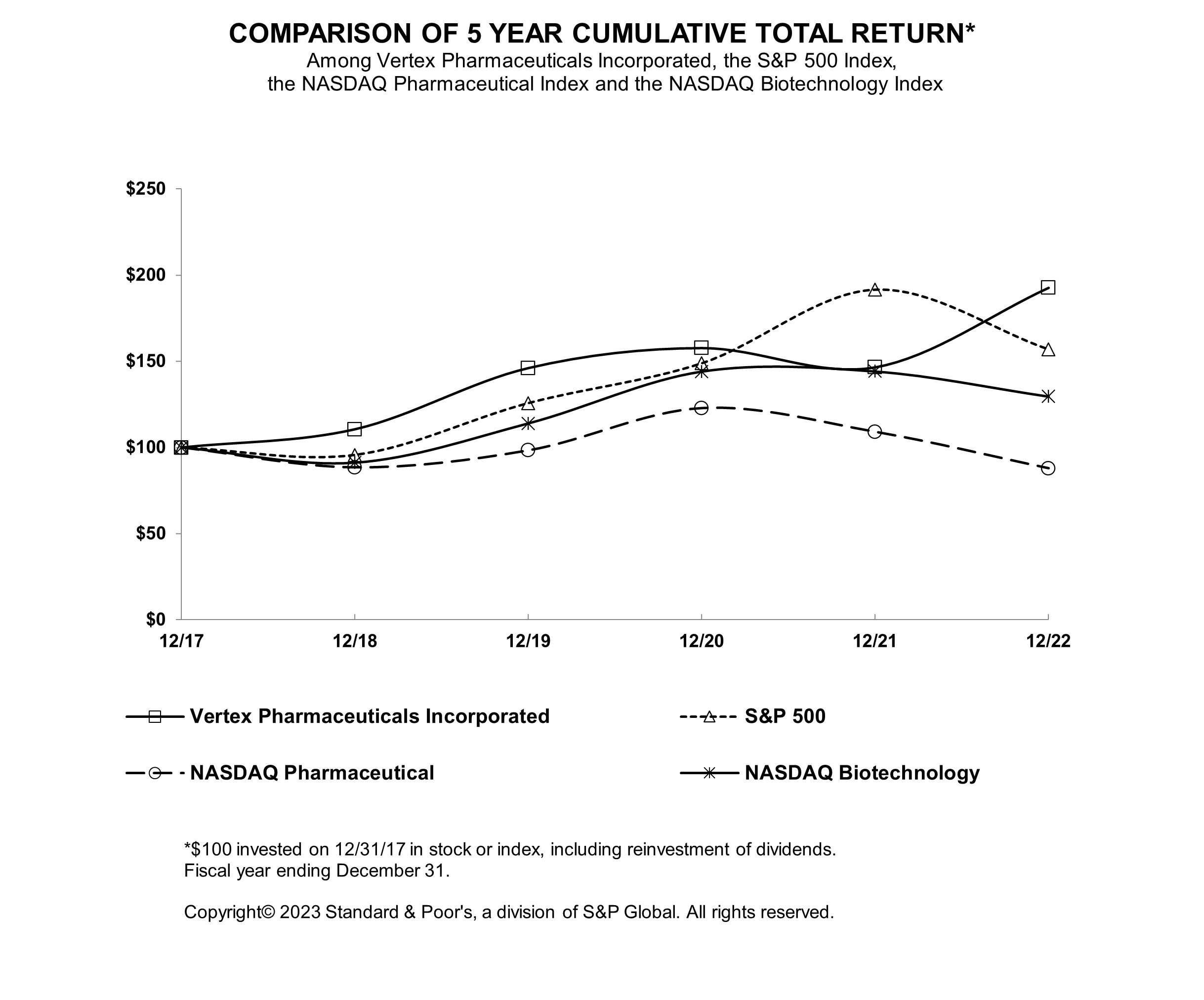
Performance Graph
Our performance graph includes the NASDAQ Biotechnology Index, which we believe is a comparable index consisting of companies with similar industry classifications, and which we plan to use in our future performance graphs.
Dividends
We have never paid any cash dividends on our common stock, and we do not anticipate paying any in the foreseeable future.
Issuer Repurchases of Equity Securities
In June 2021, our Board of Directors approved a share repurchase program (the “2021 Share Repurchase Program”), pursuant to which we were authorized to repurchase up to $1.5 billion of our common stock by December 31, 2022. We did not repurchase any shares of our common stock under the 2021 Share Repurchase Program in the three months ended December 31, 2022. On December 31, 2022, the 2021 Share Repurchase Program expired with $499.7 million remaining authorization.
In February 2023, our Board of Directors approved a share repurchase program (the “2023 Share Repurchase Program”) pursuant to which we are authorized to repurchase up to $3.0 billion of our common stock.
Item 6. [RESERVED]
Item 7. MANAGEMENT’S DISCUSSION AND ANALYSIS OF FINANCIAL CONDITION AND RESULTS OF OPERATIONS
Our discussion and analysis of our financial condition and results of operations for 2022 as compared to 2021 are discussed below. For a discussion of our financial condition and results of operations for 2021 as compared to 2020, please refer to Item 7, “Management’s Discussion and Analysis of Financial Condition and Results of Operations” in our 2021 Annual Report on Form 10-K, except as set forth below.
OVERVIEW
We are a global biotechnology company that invests in scientific innovation to create transformative medicines for people with serious diseases, with a focus on specialty markets. We have four approved medicines that treat the underlying cause of cystic fibrosis (“CF”), a life-threatening genetic disease, and we continue to focus on developing additional treatments for CF. Beyond CF, we have a pipeline that includes mid- and late-stage clinical programs in sickle cell disease, beta thalassemia, acute and neuropathic pain, APOL1-mediated kidney disease, type 1 diabetes, and alpha-1 antitrypsin deficiency, and earlier-stage programs in diseases such as muscular dystrophies.
Our triple combination regimen, TRIKAFTA/KAFTRIO (elexacaftor/tezacaftor/ivacaftor and ivacaftor), was approved in 2019 in the United States (the “U.S.”) and in 2020 in the European Union (the “E.U.”). Collectively, our four medicines are being used by the majority of the approximately 88,000 people with CF in North America, Europe, and Australia. We are evaluating our medicines in additional patient populations, including younger children, with the goal of having small molecule treatments for all people who have at least one mutation in their cystic fibrosis transmembrane conductance regulator (“CFTR”) gene that is response to our CFTR modulators. We also are pursuing genetic therapies for people with CF who do not make CFTR protein and, as a result, cannot benefit from our current CF medicines.
Financial Highlights
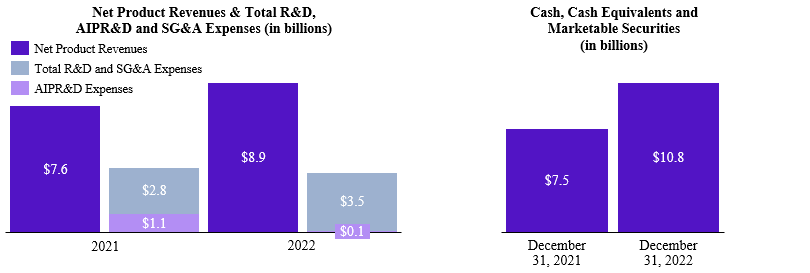
| Revenues | In 2022, our net product revenues increased to $8.9 billion as compared to $7.6 billion in 2021, primarily due to the strong uptake of TRIKAFTA/KAFTRIO in multiple countries internationally and continued steady performance of TRIKAFTA in the U.S., following the June 2021 launch of TRIKAFTA for children with CF 6 through 11 years of age. | ||||
| Expenses | Our total research and development (“R&D”), acquired in-process research and development (“AIPR&D”), and selling, general and administrative (“SG&A”) expenses decreased to $3.6 billion as compared to $3.9 billion in 2021. The decrease was primarily due to decreased AIPR&D following a $900.0 million upfront payment we made in 2021 to CRISPR in connection with an amendment to our exa-cel collaboration, partially offset by increased spend to advance the progression of several product candidates into mid- to late-stage clinical development. Cost of sales was 12% of our net product revenues in 2022 and 2021. | ||||
| Cash | Our cash, cash equivalents and marketable securities increased to $10.8 billion as of December 31, 2022 as compared to $7.5 billion as of December 31, 2021 primarily due to our net product revenues and operating cash flows, partially offset by income tax payments and our $315.0 million acquisition of ViaCyte. |
Business Updates
Marketed Products
We expect to continue to grow our CF business by increasing the number of people with CF who are eligible and able to receive our medicines, including younger people, and providing improved treatment options for people who are already eligible for one of our medicines. Recent and anticipated progress in activities supporting these efforts is included below:
-
The European Commission and the United Kingdom’s Medicines and Healthcare products Regulatory Agency (“MHRA”) granted marketing authorization for KAFTRIO for the treatment of children with CF 6 through 11 years of age who have at least one F508del mutation in the CFTR gene.
-
The U.S. Food and Drug Administration (the “FDA”) approved the use of ORKAMBI in children with CF 12 months to less than 24 months of age who are homozygous for the F508del mutation in the CFTR gene.
-
In the fourth quarter of 2022, we submitted global regulatory filings for TRIKAFTA/KAFTRIO in children with CF 2 to 5 years of age and for KALYDECO in children with CF from 1 month to less than 4 months of age.
-
TRIKAFTA/KAFTRIO is now approved and reimbursed or accessible in more than 30 countries outside the U.S.
Pipeline
We continue to advance a pipeline of potentially transformative small molecule and cell and genetic therapies aimed at treating serious diseases. Recent and anticipated progress in activities supporting these efforts is included below.
Cystic Fibrosis
-
We are conducting two Phase 3 global, randomized, double-blind, active-controlled clinical trials, SKYLINE 102 and SKYLINE 103, evaluating our new once-daily investigational triple combination of vanzacaftor/tezacaftor/deutivacaftor, formerly known as VX-121/tezacaftor/VX-561, in people with CF 12 years of age and older, and have completed enrollment in these trials. We expect to complete these clinical trials by the end of 2023. We also have initiated a clinical trial of vanzacaftor/tezacaftor/deutivacaftor in children with CF 6 to 11 years of age, known as the RIDGELINE study.
-
In collaboration with Moderna, we are developing VX-522, an mRNA therapeutic for the treatment of people with CF who do not produce any CFTR protein. In December 2022, the FDA cleared our Investigational New Drug Application (“IND”) for VX-522. We have initiated a single-ascending dose clinical trial for VX-522 in people with CF, which is active and enrolling patients. We expect to complete this single ascending dose clinical trial and initiate the multiple ascending dose clinical trial in 2023. The FDA has granted Fast Track designation for VX-522.
Sickle Cell Disease and Beta Thalassemia
-
We are evaluating the use of a non-viral ex vivo CRISPR gene-editing therapy, exagamglogene autotemcel (“exa-cel”), formerly known as CTX001, for the treatment of sickle cell disease (“SCD”) and transfusion-dependent beta thalassemia (“TDT”).
-
In the fourth quarter of 2022, we completed regulatory submissions to the European Medicines Agency (“EMA”) and the MHRA for exa-cel for SCD and TDT, and both the EMA and the MHRA have validated the marketing authorization application. Exa-cel has been granted EMA Priority Medicines (“PRIME”) designation in the E.U. and Orphan Drug designation in the E.U. and the United Kingdom (the “U.K.”).
-
In November 2022, we initiated the submission of a biologics licensing application (“BLA”) for exa-cel for SCD and TDT for rolling review by the FDA, and expect to complete the submission by the end of the first quarter of 2023. In the U.S., exa-cel has been granted Fast Track, Regenerative Medicine Advanced Therapy, Rare Pediatric Disease, and Orphan Drug designations.
-
Two additional Phase 3 clinical trials evaluating exa-cel in pediatric patients with SCD and TDT are ongoing.
Pain
- We have discovered multiple selective small molecule inhibitors of NaV1.8, with the objective of creating a new class of pain medicines that provide effective non-opioid pain relief, without abuse potential. In March 2022, we announced positive Phase 2 data for VX-548, a NaV1.8 inhibitor, for treatment of acute pain. We have initiated two randomized, double-blind, placebo-controlled Phase 3 trials with a total of 2,000 patients with moderate to severe acute pain following bunionectomy or abdominoplasty surgery. The Phase 3 program for VX-548 also includes a single-arm study evaluating the safety and effectiveness of VX-548 in multiple other types of moderate to severe pain. We expect to complete these Phase 3 trials in late
Showing the first 8K of 74K characters. Open the full section
Item 7A. QUANTITATIVE AND QUALITATIVE DISCLOSURES ABOUT MARKET RISK
Interest Rate Risk
Financial Instruments
As part of our investment portfolio, we own financial instruments that are sensitive to market risks. The investment portfolio is used to preserve our capital, provide adequate liquidity and earn returns commensurate with our risk appetite. We invest in instruments that meet the credit quality standards outlined in our investment policy, which also limits the amount of credit exposure to any one issue or type of instrument. These instruments principally include securities issued by the U.S. government and its agencies, investment-grade corporate bonds and commercial paper, and money market funds. These investments are denominated in U.S. Dollars and none are held for trading purposes.
All of our interest-bearing securities are subject to interest rate risk and could change in value if interest rates fluctuate. Substantially all of our investment portfolio consists of marketable securities with active secondary or resale markets to help ensure portfolio liquidity, and we have implemented guidelines limiting the term-to-maturity of our investment instruments. Since we account for these securities as available-for-sale, no gains or losses are realized due to changes in the fair value of our investments unless we sell our investments prior to maturity or incur a credit loss. Due to the conservative nature of these instruments, we do not believe that the fair value of our investments has a material exposure to interest rate risk.
While we are exposed to global interest rate fluctuations, our investment portfolio is most affected by fluctuations in U.S. interest rates, which affect the interest earned on our cash, cash equivalents and marketable securities.
Credit Agreement
In 2022, we entered into a $500.0 million unsecured revolving credit facility (“credit agreement”). Loans under this credit agreement bear interest, at our option, at a base rate or a Secured Overnight Financing Rate (“SOFR”), plus an applicable margin based on our consolidated leverage ratio (the ratio of our total consolidated funded indebtedness to our consolidated EBITDA for the most recently completed four fiscal quarter period). Pursuant to our credit agreement, the applicable margin on base rate loans ranges from 0.000% to 0.500% and the applicable margin on SOFR loans ranges from 1.000% to 1.500%. We do not believe that changes in interest rates related to our credit agreement would have a material effect on our consolidated financial statements. As of December 31, 2022, we had no principal or interest outstanding under our credit facility. A portion of our “Interest expense” in 2023 will be dependent on whether, and to what extent, we borrow amounts under this facility.
Foreign Exchange Market Risk
As a result of our foreign operations, we face significant exposure to movements in foreign currency exchange rates, primarily the Euro and British Pound against the U.S. dollar. Fluctuations in the amounts of our foreign revenues and fluctuations in foreign currency exchange rates, may have a positive or negative effect on our foreign exchange rate exposure. The current exposures arise primarily from cash, accounts receivable, intercompany receivables and payables, payables and accruals and inventories.
We have a foreign currency management program, which is separate from our investment policy and portfolio, with the objective of reducing the effect of exchange rate fluctuations on our operating results and forecasted revenues denominated in foreign currencies. We currently have cash flow hedges for the Euro, British Pound, Canadian Dollar, Swiss Franc and Australian Dollar related to a portion of our forecasted product revenues that qualify for hedge accounting treatment under U.S. GAAP. We do not seek hedge accounting treatment for our foreign currency forward contracts related to monetary assets and liabilities that impact our operating results. As of December 31, 2022, we held foreign exchange forward contracts that were designated as cash flow hedges with notional amounts totaling $2.2 billion representing a net fair value of $33.1 million on our consolidated balance sheet.
Although not predictive in nature, we believe a hypothetical 10% threshold reflects a reasonably possible near-term change in exchange rates. If the December 31, 2022 exchange rates were to change by a hypothetical 10%, the fair value recorded on our consolidated balance sheet related to our foreign exchange forward contracts that were designated as cash flow hedges as of December 31, 2022 would change by approximately $220.2 million. However, since these contracts hedge a specific portion of our forecasted product revenues denominated in certain foreign currencies, any change in the fair value of these contracts is recorded in “Accumulated other comprehensive income” on our consolidated balance sheets and is
reclassified to earnings in the same periods during which the underlying product revenues affect earnings. Therefore, any change in the fair value of these contracts that would result from a hypothetical 10% change in exchange rates would be entirely offset by the change in value associated with the underlying hedged product revenues resulting in no impact on our future anticipated earnings and cash flows with respect to the hedged portion of our forecasted product revenues.
Equity Price Risk
Information required by this section is incorporated by reference from the discussion in the “Strategic Investments” section of this Part II, Item 7, “Management’s Discussion and Analysis of Financial Condition and Results of Operations.”
Item 8. FINANCIAL STATEMENTS AND SUPPLEMENTARY DATA
The information required by this Item 8 is contained on pages F-1 through F-45 of this Annual Report on Form 10-K.
Item 9. CHANGES IN AND DISAGREEMENTS WITH ACCOUNTANTS ON ACCOUNTING AND FINANCIAL DISCLOSURE
Not applicable.
Item 9A. CONTROLS AND PROCEDURES
(1) Evaluation of Disclosure Controls and Procedures. Our chief executive officer and chief financial officer, after evaluating the effectiveness of our disclosure controls and procedures (as defined in Rule 13a-15(e) and Rule 15d-15(e) promulgated under the Securities Exchange Act of 1934, as amended) as of the end of the period covered by this Annual Report on Form 10-K, have concluded that, based on such evaluation, our disclosure controls and procedures were effective. In designing and evaluating the disclosure controls and procedures, management recognized that any controls and procedures, no matter how well designed and operated, can provide only reasonable assurance of achieving the desired control objectives, and management necessarily was required to apply our judgment in evaluating the cost-benefit relationship of possible controls and procedures.
(2) Management’s Annual Report on Internal Control Over Financial Reporting. Management is responsible for establishing and maintaining adequate internal control over financial reporting. Internal control over financial reporting is defined in Rule 13a-15(f) and Rule 15d-15(f) promulgated under the Securities Exchange Act of 1934, as amended, as a process designed by, or under the supervision of, our principal executive and principal financial officers and effected by our board of directors, management and other personnel, to provide reasonable assurance regarding the reliability of financial reporting and the preparation of financial statements for external purposes in accordance with generally accepted accounting principles. Our internal control over financial reporting include those policies and procedures that:
-
pertain to the maintenance of records that, in reasonable detail, accurately and fairly reflect the transactions and dispositions of our assets;
-
provide reasonable assurance that transactions are recorded as necessary to permit preparation of financial statements in accordance with generally accepted accounting principles, and that our receipts and expenditures are being made only in accordance with authorizations of management and our directors; and
-
provide reasonable assurance regarding prevention or timely detection of unauthorized acquisition, use or disposition of our assets that could have a material effect on the financial statements.
Because of its inherent limitations, internal control over financial reporting may not prevent or detect misstatements. Also, projections of any evaluation of effectiveness to future periods are subject to the risk that controls may become inadequate because of changes in conditions, or that the degree of compliance with the policies or procedures may deteriorate.
Management assessed the effectiveness of our internal control over financial reporting as of December 31, 2022. In making this assessment, we used the criteria set forth in the Internal Control—Integrated Framework (2013) issued by the Committee of Sponsoring Organizations of the Treadway Commission (“COSO”). Based on our assessment, management has concluded that, as of December 31, 2022, our internal control over financial reporting is effective based on those criteria.
Our independent registered public accounting firm, Ernst & Young LLP, issued an attestation report on our internal control over financial reporting. See Section 4 below.
(3) Changes in Internal Controls. During the quarter ended December 31, 2022, there were no changes in our internal control over financial reporting that materially affected, or are reasonably likely to materially affect, our internal control over financial reporting.
(4) Report of Independent Registered Public Accounting Firm
To the Shareholders and the Board of Directors of Vertex Pharmaceuticals Incorporated
Opinion on Internal Control Over Financial Reporting
We have audited Vertex Pharmaceuticals Incorporated’s internal control over financial reporting as of December 31, 2022, based on criteria established in Internal Control-Integrated Framework issued by the Committee of Sponsoring Organizations of the Treadway Commission (2013 framework) (the COSO criteria). In our opinion, Vertex Pharmaceuticals Incorporated (the Company) maintained, in all material respects, effective internal control over financial reporting as of December 31, 2022, based on the COSO criteria.
We also have audited, in accordance with the standards of the Public Company Accounting Oversight Board (United States) (PCAOB), the 2022 consolidated financial statements of the Company and our report dated February 10, 2023, expressed an unqualified opinion thereon.
Basis for Opinion
The Company’s management is responsible for maintaining effective internal control over financial reporting and for its assessment of the effectiveness of internal control over financial reporting included in the accompanying Management’s Report on Internal Control Over Financial Reporting. Our responsibility is to express an opinion on the Company’s internal control over financial reporting based on our audit. We are a public accounting firm registered with the PCAOB and are required to be independent with respect to the Company in accordance with the U.S. federal securities laws and the applicable rules and regulations of the Securities and Exchange Commission and the PCAOB.
We conducted our audit in accordance with the standards of the PCAOB. Those standards require that we plan and perform the audit to obtain reasonable assurance about whether effective internal control over financial reporting was maintained in all material respects.
Our audit included obtaining an understanding of internal control over financial reporting, assessing the risk that a material weakness exists, testing and evaluating the design and operating effectiveness of internal control based on the assessed risk, and performing such other procedures as we considered necessary in the circumstances. We believe that our audit provides a reasonable basis for our opinion.
Definition and Limitations of Internal Control Over Financial Reporting
A company’s internal control over financial reporting is a process designed to provide reasonable assurance regarding the reliability of financial reporting and the preparation of financial statements for external purposes in accordance with generally accepted accounting principles. A company’s internal control over financial reporting includes those policies and procedures that (1) pertain to the maintenance of records that, in reasonable detail, accurately and fairly reflect the transactions and dispositions of the assets of the company; (2) provide reasonable assurance that transactions are recorded as necessary to permit preparation of financial statements in accordance with generally accepted accounting principles, and that receipts and expenditures of the company are being made only in accordance with authorizations of management and directors of the company; and (3) provide reasonable assurance regarding prevention or timely detection of unauthorized acquisition, use, or disposition of the company’s assets that could have a material effect on the financial statements.
Because of its inherent limitations, internal control over financial reporting may not prevent or detect misstatements. Also, projections of any evaluation of effectiveness to future periods are subject to the risk that controls may become inadequate because of changes in conditions, or that the degree of compliance with the policies or procedures may deteriorate.
/s/ Ernst & Young LLP
Boston, Massachusetts
February 10, 2023
Item 9B. OTHER INFORMATION
Amended and Restated By-Laws
On February 8, 2023, our Board of Directors approved an amendment and restatement of our By-Laws (the “Amended and Restated By-Laws”), effective immediately upon approval by the Board. The Amended and Restated By-Laws had the effect of amending the previous By-Laws of the Company by:
-
expanding the advanced notice by-law to cover both board nominations by a shareholder and any other business brought by a shareholder before an annual or special meeting (unless the proposal is made pursuant to Rule 14a-8 of the Exchange Act, in which case Rule 14a-8 of the Exchange Act will govern);
-
providing that, for an annual meeting of shareholder, a shareholders’ advanced notice of shareholder business or a nomination must be provided no earlier than 120 days and no later than 90 days prior to the anniversary date of the immediately preceding annual meeting;
-
expanding the disclosures required to be made by a shareholder seeking to bring business or a nomination before a shareholders’ meeting under the by-laws, including, among other things, certain ownership information of the nominating shareholder and a completed director questionnaire with respect to the nominee;
-
requiring a nominating shareholder to comply with Rule 14a-9 under the U.S. Securities Exchange Act of 1934, as amended, which is also known as the “universal proxy card rules”;
-
mandating that a nominating shareholder use a color for its proxy card that is other than white;
-
expressly permitting the Chief Executive Officer to call special meetings of the Board, and increasing the number of directors necessary to call a special meeting from two to three; and
-
expressly stating that the Chief Executive Officer of the Company (which may or may not be the same person as the President of the Company) is an officer of the Company.
The amendments also include various conforming, technical and non-substantive changes, including gender-neutral language.
The foregoing summary of the amendments to the Amended and Restated By-Laws does not purport to be complete and is qualified in its entirety by reference to the Amended and Restated By-Laws, which is filed as Exhibit 3.2 to this Annual Report on Form 10-K and is incorporated herein by reference.
Jeffrey Leiden Amendment
On February 8, 2023, the Company entered into an amendment to Dr. Jeffrey Leiden’s employment agreement, which was scheduled to expire on March 31, 2024. Among other things, the amendment extends the term for one year through March 31, 2025 and provides that Dr. Leiden’s equity compensation during the final year of the amended employment agreement will be equivalent to his equity compensation in the preceding year.
The foregoing description of the amendment to Dr. Leiden’s employment agreement does not purport to be complete and is qualified in its entirety by reference to the full text of such agreement, which is filed as Exhibit 10.23 to this Annual Report on Form 10-K and incorporated herein by reference.
Item 9C. DISCLOSURE REGARDING FOREIGN JURISDICTIONS THAT PREVENT INSPECTIONS.
None.
PART III
Portions of our definitive Proxy Statement for the 2023 Annual Meeting of Shareholders (“2023 Proxy Statement”) are incorporated by reference into this Part III of our Annual Report on Form 10-K.
Item 10. DIRECTORS, EXECUTIVE OFFICERS AND CORPORATE GOVERNANCE
The information regarding directors required by this Item 10 will be included in our 2023 Proxy Statement and is incorporated herein by reference. We expect this information to be provided under “Election of Directors,” “Corporate Governance and Risk Management,” “Shareholder Proposals for the 2024 Annual Meeting and Nominations for Director,” “Delinquent Section 16(a) Reports” and “Code of Conduct.” The information regarding executive officers required by this Item 10 is included in Part I of this Annual Report on Form 10-K.
Item 11. EXECUTIVE COMPENSATION
The information required by this Item 11 will be included in the 2023 Proxy Statement and is incorporated herein by reference. We expect this information to be provided under “Compensation Committee Interlocks and Insider Participation,” “Compensation Discussion and Analysis,” “Compensation and Equity Tables,” “Director Compensation,” “Management Development and Compensation Committee Report” and/or “Corporate Governance and Risk Management.”
Item 12. SECURITY OWNERSHIP OF CERTAIN BENEFICIAL OWNERS AND MANAGEMENT AND RELATED STOCKHOLDER MATTERS
The information required by this Item 12 will be included in the 2023 Proxy Statement and is incorporated herein by reference. We expect this information to be provided under “Security Ownership of Certain Beneficial Owners and Management” and “Equity Compensation Plan Information.”
Item 13. CERTAIN RELATIONSHIPS AND RELATED TRANSACTIONS, AND DIRECTOR INDEPENDENCE
The information required by this Item 13 will be included in the 2023 Proxy Statement and is incorporated herein by reference. We expect this information to be provided under “Election of Directors,” “Corporate Governance and Risk Management,” and “Audit and Finance Committee.”
Item 14. PRINCIPAL ACCOUNTANT FEES AND SERVICES
The information required by this Item 14 will be included in the 2023 Proxy Statement and is incorporated herein by reference. We expect this information to be provided under “Ratification of the Appointment of Independent Registered Public Accounting Firm.”
PART IV
Item 15. EXHIBITS AND FINANCIAL STATEMENT SCHEDULES
(a)(1) The Financial Statements required to be filed by Items 8 and 15(c) of Form 10-K, and filed herewith, are as follows:
| Page Number in this Form 10-K | |||||
| Report of Independent Registered Public Accounting Firm (PCAOB ID: 42) | F-1 | ||||
| Consolidated Statements of Operations for the years ended December 31, 2022, 2021 and 2020 | F-3 | ||||
| Consolidated Statements of Comprehensive Income for the years ended December 31, 2022, 2021 and 2020 | F-4 | ||||
| Consolidated Balance Sheets as of December 31, 2022 and 2021 | F-5 | ||||
| Consolidated Statements of Shareholders’ Equity for the years ended December 31, 2022, 2021 and 2020 | F-6 | ||||
| Consolidated Statements of Cash Flows for the years ended December 31, 2022, 2021 and 2020 | F-7 | ||||
| Notes to Consolidated Financial Statements | F-8 |
(a)(2) Financial Statement Schedules have been omitted because they are either not applicable or the required information is included in the consolidated financial statements or notes thereto listed in (a)(1) above.
(a)(3) Exhibits.
The following is a list of exhibits filed as part of this Annual Report on Form 10-K.
Item 16. FORM 10-K SUMMARY
Not applicable.
SIGNATURES
Pursuant to the requirements of Section 13 or 15(d) of the Securities Exchange Act of 1934, the registrant has duly caused this report to be signed on its behalf by the undersigned, thereunto duly authorized.
| Vertex Pharmaceuticals Incorporated | ||||||||
| February 10, 2023 | By: | /s/ Reshma Kewalramani | ||||||
| Reshma Kewalramani Chief Executive Officer |
Pursuant to the requirements of the Securities Exchange Act of 1934, this report has been signed below by the following persons on behalf of the registrant and in the capacities and on the dates indicated.
| Name | Title | Date | |||||||||||||||||||||||||||||||||||||||
| /s/ Reshma Kewalramani | |||||||||||||||||||||||||||||||||||||||||
| Reshma Kewalramani | President, Chief Executive Officer and Director (Principal Executive Officer) | February 10, 2023 | |||||||||||||||||||||||||||||||||||||||
| /s/ Charles F. Wagner, Jr. | |||||||||||||||||||||||||||||||||||||||||
| Charles F. Wagner, Jr. | Executive Vice President and Chief Financial Officer (Principal Financial Officer) | February 10, 2023 | |||||||||||||||||||||||||||||||||||||||
| /s/ Kristen C. Ambrose | |||||||||||||||||||||||||||||||||||||||||
| Kristen C. Ambrose | Senior Vice President and Chief Accounting Officer (Principal Accounting Officer) | February 10, 2023 | |||||||||||||||||||||||||||||||||||||||
| /s/Jeffrey M. Leiden | |||||||||||||||||||||||||||||||||||||||||
| Jeffrey M. Leiden | Executive Chairman | February 10, 2023 | |||||||||||||||||||||||||||||||||||||||
| /s/ Sangeeta N. Bhatia | |||||||||||||||||||||||||||||||||||||||||
| Sangeeta N. Bhatia | Director | February 10, 2023 | |||||||||||||||||||||||||||||||||||||||
| /s/ Lloyd Carney | |||||||||||||||||||||||||||||||||||||||||
| Lloyd Carney | Director | February 10, 2023 | |||||||||||||||||||||||||||||||||||||||
| /s/ Alan Garber | |||||||||||||||||||||||||||||||||||||||||
| Alan Garber | Director | February 10, 2023 | |||||||||||||||||||||||||||||||||||||||
| /s/ Terrence C. Kearney | |||||||||||||||||||||||||||||||||||||||||
| Terrence C. Kearney | Director | February 10, 2023 | |||||||||||||||||||||||||||||||||||||||
| /s/ Yuchun Lee | |||||||||||||||||||||||||||||||||||||||||
| Yuchun Lee | Director | February 10, 2023 | |||||||||||||||||||||||||||||||||||||||
| /s/ Margaret G. McGlynn | |||||||||||||||||||||||||||||||||||||||||
| Margaret G. McGlynn | Director | February 10, 2023 | |||||||||||||||||||||||||||||||||||||||
| /s/ Diana McKenzie | |||||||||||||||||||||||||||||||||||||||||
| Diana McKenzie | Director | February 10, 2023 | |||||||||||||||||||||||||||||||||||||||
| /s/ Bruce I. Sachs | |||||||||||||||||||||||||||||||||||||||||
| Bruce I. Sachs | Director | February 10, 2023 | |||||||||||||||||||||||||||||||||||||||
| /s/ Suketu Upadhyay | |||||||||||||||||||||||||||||||||||||||||
| Suketu Upadhyay | Director | February 10, 2023 |
Report of Independent Registered Public Accounting Firm
To the Shareholders and the Board of Directors of Vertex Pharmaceuticals Incorporated
Opinion on the Financial Statements
We have audited the accompanying consolidated balance sheets of Vertex Pharmaceuticals Incorporated (the Company) as of December 31, 2022 and 2021, the related consolidated statements of operations, comprehensive income, shareholders’ equity, and cash flows for each of the three years in the period ended December 31, 2022, and the related notes (collectively referred to as the “consolidated financial statements”). In our opinion, the consolidated financial statements present fairly, in
Showing the first 8K of 184K characters. Open the full section