 filings.tools
Vistra 10-K 2017-12-31
Filed 2018-02-26. 22 sections, 666K characters. Original on sec.gov · Markdown · JSON
Cover and table of contents
10-K 1 vistra-12312017x10k.htm FORM 10-K
UNITED STATES
SECURITIES AND EXCHANGE COMMISSION
Washington, D.C. 20549
FORM 10-K
x ANNUAL REPORT PURSUANT TO SECTION 13 OR 15(d) OF THE SECURITIES EXCHANGE ACT OF 1934
FOR THE FISCAL YEAR ENDED DECEMBER 31, 2017
— OR —
o TRANSITION REPORT PURSUANT TO SECTION 13 OR 15(d) OF THE SECURITIES EXCHANGE ACT OF 1934
Commission File Number 001-38086
Vistra Energy Corp.
(Exact name of registrant as specified in its charter)
| Delaware | 36-4833255 | |
| (State or other jurisdiction of incorporation or organization) | (I.R.S. Employer Identification No.) | |
| 6555 Sierra Drive, Irving, Texas 75039 | (214) 812-4600 | |
| (Address of principal executive offices) (Zip Code) | (Registrant's telephone number, including area code) |
Securities registered pursuant to Section 12(b) of the Act:
| Title of Each Class | Name of Each Exchange on Which Registered | |
| Common stock, par value $0.01 per share | New York Stock Exchange |
Securities registered pursuant to Section 12(g) of the Act: None
Indicate by check mark if the registrant is a well-known seasoned issuer, as defined in rule 405 of the Securities Act. Yes o No x
Indicated by check mark if the registrant is not required to file reports pursuant to Section 13 or Section 15(d) of the act. Yes o No x
Indicate by check mark whether the registrant (1) has filed all reports required to be filed by Section 13 or 15(d) of the Securities Exchange Act of 1934 during the preceding 12 months (or for such shorter period that the registrant was required to file such reports) and (2) has been subject to such filing requirements for the past 90 days. Yes x No o
Indicate by check mark whether the registrant has submitted electronically and posted on its corporate Web site, if any, every Interactive Data File required to be submitted and posted pursuant to Rule 405 of Regulation S-T (§232.405 of this chapter) during the preceding 12 months (or for such shorter period that the registrant was required to submit and post such files). Yes x No o
Indicate by check mark if disclosure of delinquent filers pursuant to Item 405 of Regulation S-K (§229.405 of this chapter) is not contained herein, and will not be contained, to the best of registrant's knowledge, in definitive proxy or information statements incorporated by reference in Part III of this Form 10-K or any amendment to this Form 10-K. o
Indicate by check mark whether the registrant is a large accelerated filer, an accelerated filer, a non-accelerated filer, a smaller reporting company or an emerging growth company. See the definitions of "large accelerated filer," "accelerated filer," "smaller reporting company" and "emerging growth company" in Rule 12b-2 of the Exchange Act.
Large accelerated filer o Accelerated filer o Non-Accelerated filer x (Do not check if a smaller reporting company)
Smaller reporting company o Emerging growth company o
If an emerging growth company, indicate by check mark if the registrant has elected not to use the extended transition period for complying with any new or revised financial accounting standards provided pursuant to Section 13(a) of the Exchange Act. o
As of June 30, 2017, the aggregate market value of the Vistra Energy Corp. common stock held by non-affiliates of the registrant was $5,404,454,926 based on the closing sale price as reported on the New York Stock Exchange.
Indicate by check mark if the registrant is a shell company (as defined in Rule 12b-2 of the Exchange Act). Yes o No x
As of February 21, 2018, there were 428,447,631 shares of common stock, par value $0.01, outstanding of Vistra Energy Corp.
DOCUMENTS INCORPORATED BY REFERENCE
Portions of the proxy statement for the registrant's 2018 annual meeting of stockholders are incorporated in Part III of this Annual Report on Form 10‑K.
TABLE OF CONTENTS
Vistra Energy Corp.'s (Vistra Energy) annual reports, quarterly reports, current reports and any amendments to those reports are made available to the public, free of charge, on the Vistra Energy website at http://www.vistraenergy.com, as soon as reasonably practicable after they have been filed with or furnished to the Securities and Exchange Commission pursuant to Section 13(a) or 15(d) of the Exchange Act. The information on Vistra Energy's website shall not be deemed a part of, or incorporated by reference into, this Annual Report on Form 10-K. The representations and warranties contained in any agreement that we have filed as an exhibit to this Annual Report on Form 10-K, or that we have or may publicly file in the future, may contain representations and warranties that may (i) be made by and to the parties thereto at specific dates, (ii) be subject to exceptions and qualifications contained in separate disclosure schedules, (iii) represent the parties' risk allocation in the particular transaction, or (iv) be qualified by materiality standards that differ from what may be viewed as material for securities law purposes.
This Annual Report on Form 10-K and other Securities and Exchange Commission filings of Vistra Energy and its subsidiaries occasionally make references to Vistra Energy (or "we," "our," "us" or "the Company"), TXU Energy or Luminant when describing actions, rights or obligations of their respective subsidiaries. These references reflect the fact that the subsidiaries are consolidated with, or otherwise reflected in, their respective parent company's financial statements for financial reporting purposes. However, these references should not be interpreted to imply that the parent company is actually undertaking the action or has the rights or obligations of the relevant subsidiary company or vice versa.
i
GLOSSARY
When the following terms and abbreviations appear in the text of this report, they have the meanings indicated below.
| CCGT | combined cycle gas turbine | |
| CFTC | U.S. Commodity Futures Trading Commission | |
| Chapter 11 Cases | Cases in the U.S. Bankruptcy Court for the District of Delaware (Bankruptcy Court) concerning voluntary petitions for relief under Chapter 11 of the U.S. Bankruptcy Code (Bankruptcy Code) filed on April 29, 2014 by the Debtors. On the Effective Date, the TCEH Debtors (together with the Contributed EFH Debtors) emerged from the Chapter 11 Cases. | |
| CME | Chicago Mercantile Exchange | |
| CO2 | carbon dioxide | |
| Contributed EFH Debtors | certain EFH Debtors that became subsidiaries of Vistra Energy on the Effective Date | |
| CSAPR | Cross-State Air Pollution Rule issued by the EPA in July 2011 | |
| DIP Facility | TCEH's $3.375 billion debtor-in-possession financing facility, which was repaid in August 2016 (see Note 12 to the Financial Statements) | |
| DIP Roll Facilities | TCEH's $4.250 billion debtor-in-possession and exit financing facilities, which was converted to the Vistra Operations Credit Facilities on the Effective Date (see Note 12 to the Financial Statements) | |
| Debtors | EFH Corp. and the majority of its direct and indirect subsidiaries, including EFIH, EFCH and TCEH but excluding the Oncor Ring-Fenced Entities. Prior to the Effective Date, also included the TCEH Debtors and the Contributed EFH Debtors. | |
| Dynegy | Dynegy Inc., and/or its subsidiaries, depending on context | |
| EBITDA | earnings (net income) before interest expense, income taxes, depreciation and amortization | |
| EFCH | Energy Future Competitive Holdings Company LLC, a direct, wholly owned subsidiary of EFH Corp. and, prior to the Effective Date, the indirect parent of the TCEH Debtors, depending on context | |
| Effective Date | October 3, 2016, the date the TCEH Debtors and the Contributed EFH Debtors completed their reorganization under the Bankruptcy Code and emerged from the Chapter 11 Cases | |
| EFH Corp. | Energy Future Holdings Corp. and/or its subsidiaries, depending on context, whose major subsidiaries include Oncor and, prior to the Effective Date, included the TCEH Debtors and the Contributed EFH Debtors | |
| EFH Debtors | EFH Corp. and its subsidiaries that are Debtors in the Chapter 11 Cases, including EFIH and EFIH Finance Inc., but excluding the TCEH Debtors and the Contributed EFH Debtors | |
| EFIH | Energy Future Intermediate Holding Company LLC, a direct, wholly owned subsidiary of EFH Corp. and the direct parent of Oncor Holdings | |
| Emergence | emergence of the TCEH Debtors and the Contributed EFH Debtors from the Chapter 11 Cases as subsidiaries of a newly formed company, Vistra Energy, on the Effective Date | |
| EPA | U.S. Environmental Protection Agency | |
| Exchange Act | Exchange Act of 1934, as amended | |
| ERCOT | Electric Reliability Council of Texas, Inc., the independent system operator and the regional coordinator of various electricity systems within Texas | |
| Federal and State Income Tax Allocation Agreements | An agreement, executed in May 2012 but effective as of January 2010 to which prior to the Effective Date, EFH Corp. and certain of its subsidiaries (including EFCH, EFIH and TCEH, but not including Oncor Holdings and Oncor) were parties. The Agreement was rejected by the TCEH Debtors and the Contributed EFH Debtors on the Effective Date (see Note 8 to the Financial Statements). | |
| FERC | U.S. Federal Energy Regulatory Commission | |
ii
| GAAP | generally accepted accounting principles | |
| GHG | greenhouse gas | |
| GWh | gigawatt-hours | |
| ICE | IntercontinentalExchange | |
| IRS | U.S. Internal Revenue Service | |
| ISO | Independent system operator | |
| LIBOR | London Interbank Offered Rate, an interest rate at which banks can borrow funds, in marketable size, from other banks in the London interbank market | |
| load | demand for electricity | |
| LSTC | liabilities subject to compromise | |
| Luminant | subsidiaries of Vistra Energy engaged in competitive market activities consisting of electricity generation and wholesale energy sales and purchases as well as commodity risk management, all largely in Texas | |
| market heat rate | Heat rate is a measure of the efficiency of converting a fuel source to electricity. Market heat rate is the implied relationship between wholesale electricity prices and natural gas prices and is calculated by dividing the wholesale market price of electricity, which is based on the price offer of the marginal supplier in ERCOT (generally natural gas plants), by the market price of natural gas. | |
| Merger | the proposed merger of Dynegy with and into Vistra Energy, with Vistra Energy as the surviving corporation | |
| Merger Agreement | the Agreement and Plan of Merger, dated as of October 29, 2017, by and between Vistra Energy and Dynegy, as it may be amended or modified from time to time | |
| Merger Proposal | the proposal by each of Vistra Energy and Dynegy to their stockholders to adopt the Merger Agreement | |
| Merger Support Agreements | the Merger Support Agreements, dated as of October 29, 2017, by and between Dynegy, the Apollo Entities, the Brookfield Entities and the Oaktree Entities, respectively, on the one hand, and by and between Vistra Energy and certain affiliates of Oaktree and Terawatt Holdings, LP, a Delaware limited partnership affiliated with Energy Capital Partners III, LLC, respectively, on the other hand, as they may be amended or modified from time to time | |
| MMBtu | million British thermal units | |
| MSHA | U.S. Mine Safety and Health Administration | |
| MW | megawatts | |
| MWh | megawatt-hours | |
| NERC | North American Electric Reliability Corporation | |
| NOX | nitrogen oxide | |
| NRC | U.S. Nuclear Regulatory Commission | |
| NYMEX | the New York Mercantile Exchange, a commodity derivatives exchange | |
| NYSE | New York Stock Exchange | |
| Oncor | Oncor Electric Delivery Company LLC, a direct, majority-owned subsidiary of Oncor Holdings and an indirect subsidiary of EFH Corp., that is engaged in regulated electricity transmission and distribution activities | |
| Oncor Holdings | Oncor Electric Delivery Holdings Company LLC, a direct, wholly owned subsidiary of EFIH and the direct majority owner of Oncor, and/or its subsidiaries, depending on context | |
| Oncor Ring-Fenced Entities | Oncor Holdings and its direct and indirect subsidiaries, including Oncor | |
| OPEB | postretirement employee benefits other than pensions | |
iii
| Petition Date | April 29, 2014, the date the Debtors filed voluntary petitions for relief under Chapter 11 of the United States Bankruptcy Code | |
| Plan of Reorganization | Third Amended Joint Plan of Reorganization filed by the Debtors in August 2016 and confirmed by the Bankruptcy Court in August 2016 solely with respect to the TCEH Debtors and the Contributed EFH Debtors | |
| PrefCo | Vistra Preferred Inc. | |
| PrefCo Preferred Stock Sale | as part of the Spin-Off, the contribution of certain of the assets of the Predecessor and its subsidiaries by a subsidiary of TEX Energy LLC to PrefCo in exchange for all of PrefCo's authorized preferred stock, consisting of 70,000 shares, par value $0.01 per share | |
| PUCT | Public Utility Commission of Texas | |
| PURA | Texas Public Utility Regulatory Act | |
| REP | retail electric provider | |
| RCT | Railroad Commission of Texas, which among other things, has oversight of lignite mining activity in Texas | |
| S&P | Standard & Poor's Ratings (a credit rating agency) | |
| SEC | U.S. Securities and Exchange Commission | |
| Securities Act | Securities Act of 1933, as amended | |
| SG&A | selling, general and administrative | |
| Settlement Agreement | Amended and Restated Settlement Agreement among the Debtors, the Sponsor Group, settling TCEH first lien creditors, settling TCEH second lien creditors, settling TCEH unsecured creditors and the official committee of unsecured creditors of TCEH (collectively, the Settling Parties), approved by the Bankruptcy Court in December 2015. | |
| SO2 | sulfur dioxide | |
| Spin-Off | the tax-free spin-off from EFH Corp. executed pursuant to the Plan of Reorganization on the Effective Date by the TCEH Debtors and the Contributed EFH Debtors | |
| Sponsor Group | Refers, collectively, to certain investment funds affiliated with Kohlberg Kravis Roberts & Co. L.P., TPG Global, LLC (together with its affiliates, TPG) and GS Capital Partners, an affiliate of Goldman, Sachs & Co., that have an ownership interest in Texas Energy Future Holdings Limited Partnership, a limited partnership controlled by the Sponsor Group, that owns substantially all of the common stock of EFH Corp. | |
| Stock Issuance Proposal | the proposal by Vistra Energy to its stockholders to approve the issuance of Vistra Energy common stock to holders of Dynegy common stock, in connection with the Merger, as contemplated by the Merger Agreement | |
| Tax Matters Agreement | Tax Matters Agreement, dated as of the Effective Date, by and among EFH Corp., EFIH, EFIH Finance Inc. and EFH Merger Co. LLC. | |
| TCJA | the Tax Cuts and Jobs Act, a comprehensive tax reform bill signed into law in December 2017 | |
| TRA | Tax Receivables Agreement, containing certain rights (TRA Rights) to receive payments from Vistra Energy related to certain tax benefits, including those it realized as a result of certain transactions entered into at Emergence (see Note 9) | |
| TRE | Texas Reliability Entity, Inc., an independent organization that develops reliability standards for the ERCOT region and monitors and enforces compliance with NERC standards and monitors compliance with ERCOT protocols | |
| TCEH or Predecessor | Texas Competitive Electric Holdings Company LLC, a direct, wholly owned subsidiary of Energy Future Competitive Holdings Company LLC, and, prior to the Effective Date, the parent company of the TCEH Debtors, depending on context, that were engaged in electricity generation and wholesale and retail energy market activities, and whose major subsidiaries included Luminant and TXU Energy | |
| TCEH Debtors | the subsidiaries of TCEH that were Debtors in the Chapter 11 Cases | |
iv
| TCEH Senior Secured Facilities | Refers, collectively, to the TCEH First Lien Term Loan Facilities, TCEH First Lien Revolving Credit Facility and TCEH First Lien Letter of Credit Facility with a total principal amount of $22.616 billion. The claims arising under these facilities were discharged in the Chapter 11 Cases on the Effective Date pursuant to the Plan of Reorganization. | |
| TCEQ | Texas Commission on Environmental Quality | |
| TXU Energy | TXU Energy Retail Company LLC, a direct, wholly owned subsidiary of Vistra Energy that is a REP in competitive areas of ERCOT and is engaged in the retail sale of electricity to residential and business customers | |
| U.S. | United States of America | |
| Vistra Energy or Successor | Vistra Energy Corp., formerly known as TCEH Corp., and/or its subsidiaries, depending on context. On the Effective Date, the TCEH Debtors and the Contributed EFH Debtors emerged from Chapter 11 and became subsidiaries of Vistra Energy Corp. | |
| Vistra Operations Credit Facilities | Vistra Operations Company LLC's $5.210 billion senior secured financing facilities (see Note 12 to the Financial Statements) |
v
PART I
Item 1. BUSINESS
References in this report to "we," "our," "us" and "the Company" are to Vistra Energy and/or its subsidiaries, as apparent in the context. See Glossary for defined terms.
Business
Vistra Energy is a holding company operating an integrated power business in Texas. Through our Luminant and TXU Energy subsidiaries, we are engaged in competitive electricity market activities including electricity generation, wholesale energy sales and purchases, commodity risk management activities, and retail sales of electricity to end users, all largely in the ERCOT market.
TXU Energy is the largest retailer of electricity in Texas, with approximately 1.7 million residential, commercial and industrial customers. Luminant is the largest generator of electricity in ERCOT, operating approximately 13,600 MW of installed capacity in ERCOT.
We have two reportable segments: our Wholesale Generation segment, consisting largely of Luminant, and our Retail Electricity segment, consisting largely of TXU Energy.
As of December 31, 2017, we had approximately 4,150 full-time employees, including approximately 1,630 employees under collective bargaining agreements.
Merger
On October 29, 2017, Vistra Energy and Dynegy Inc., a Delaware corporation (Dynegy), entered into an Agreement and Plan of Merger (the Merger Agreement) pursuant to which, upon closing (which is expected to occur in the second quarter of 2018), Dynegy will merge with and into Vistra Energy (the Merger), with Vistra Energy surviving the Merger and the shareholders of Vistra Energy and Dynegy receiving 79% and 21%, respectively, of the equity of the combined company. See Item 1. Business - Recent Developments below for a more detailed description of the Merger and the Merger Agreement.
Business Strategy
Our business strategy is to deliver long-term stakeholder value through a focus on the following areas:
| • | Integrated business model. We believe the key factor that distinguishes us from others in our industry is the integrated nature of our business (i.e., pairing Luminant's reliable and efficient mining, generating and wholesale commodity risk management capabilities with TXU Energy's retail platform). Our business strategy will be guided by our integrated business model because we believe it is our core competitive advantage and differentiates us from our non-integrated competitors. We believe our integrated business model creates a unique opportunity because, relative to our non-integrated competitors, it reduces the effects of commodity price movements and contributes to earnings stability. Consequently, our integrated business model is at the core of our business strategy. |
| • | Strong balance sheet and disciplined capital allocation. Like any energy-focused business, we are potentially subject to significant commodity price volatility and capital costs. Accordingly, our strategy has been, and will continue to be, to maintain a strong balance sheet. As a result, we are focused on maintaining prudent financial leverage supported by readily accessible, flexible and diverse sources of liquidity. Our ongoing capital allocation priorities primarily include making necessary capital investments to maintain the safety and reliability of our facilities. Because we believe cost discipline and strong management of our assets and commodity positions are necessary to deliver long-term value to our stakeholders, we generally make capital allocation decisions that we believe will lead to attractive cash returns on investment. |
| • | Superior customer service. Through TXU Energy, we serve the retail electricity needs of end-use residential, small business, commercial and industrial electricity customers through multiple sales and marketing channels. In addition to benefitting from our integrated business model, we leverage our brand, our commitment to a consistent and reliable product offering, the backstop of the electricity generated by our generation fleet, our wholesale commodity risk management operations and our strong customer service to differentiate our products and services from our competitors. We strive to be at the forefront of innovation with new offerings and customer experiences to reinforce our value proposition. We maintain a focus on solutions that give our customers choice, convenience and control over how and when they use electricity and related services, including Free Nights and Solar Days residential plans, MyEnergy DashboardSM, TXU iThermostat product and mobile solution, the TXU Energy Rewards program, the TXU Energy Green UpSM renewable energy credit program and a diverse set of solar options. Our focus on superior customer service will guide our efforts to acquire new residential and commercial customers, serve and retain existing customers and maintain valuable sales channels for our electricity generation resources. We believe our customer service, products and trusted brand have resulted in TXU Energy maintaining the highest residential customer retention rate of any Texas retail electric provider in its respective core market. |
| • | Excellence in operations while maintaining an efficient cost structure. We believe that operating our facilities in a safe, reliable, environmentally compliant, and cost-effective and efficient manner is a foundation for delivering long-term stakeholder value. We also believe value increases as a function of making disciplined investments that enable our generation facilities to operate not only effectively and efficiently, but also safely, reliably and in an environmentally compliant manner. We believe that an ongoing focus on operational excellence and safety is a key component to success in a highly competitive environment and is part of the unique value proposition of our integrated model. Additionally, we are committed to optimizing our cost structure and implementing enterprise-wide process and operating improvements without compromising the safety of our communities, customers and employees. In connection with Emergence, in addition to significantly reducing our debt levels, we implemented certain cost-reduction actions in order to better align and right-size our cost structure. We believe we have a highly effective and efficient cost structure and that our cost structure supports excellence in our operations. |
| • | Integrated hedging and commercial management. Our commercial team is focused on managing risk, through opportunistic hedging, and optimizing our assets and business positions. We actively manage our exposure to wholesale electricity prices in ERCOT, on an integrated basis, through contracts for physical delivery of electricity, exchange-traded and over-the-counter financial contracts, ERCOT term, day-ahead and real-time market transactions, and bilateral contracts with other wholesale market participants, including other power generators and end-user electricity customers. These hedging activities include short-term agreements, long-term electricity sales contracts and forward sales of natural gas through financial instruments. The historically positive correlation between natural gas prices and wholesale electricity prices in ERCOT has provided us an opportunity to manage our exposure to the variability of wholesale electricity prices through natural gas hedging activities. We seek to hedge near-term cash flow and optimize long term value through hedging and forward sales contracts. We believe our integrated hedging and commercial management strategy, in combination with a strong balance sheet and strong liquidity profile, will provide a long-term advantage through cycles of higher and lower commodity prices. |
| • | Growth and enhancement. Our growth strategy leverages our core capabilities of multi-channel retail marketing in a large and competitive market, operating large-scale, environmentally sensitive, and diverse assets across a variety of fuel technologies, fuel logistics and management, commodity risk management, cost control, and energy infrastructure investing. We intend to opportunistically evaluate acquisitions of high-quality energy infrastructure assets and businesses that complement these core capabilities and enable us to achieve operational or financial synergies. While we are intent on growing our business and creating value for our stockholders, we are committed to making disciplined investments that are consistent with our focus on maintaining a strong balance sheet and strong liquidity profile. As a result, consistent with our disciplined capital allocation approval process, growth opportunities we pursue will need to have compelling economic value in addition to fitting with our business strategy. |
| • | Corporate responsibility and citizenship. We are committed to providing safe, reliable, cost-effective and environmentally compliant electricity for the communities and customers we serve. We strive to improve the quality of life in the communities in which we operate. We are also committed to being a good corporate citizen in the communities in which we conduct operations. We and our employees are actively engaged in programs intended to support and strengthen the communities in which we conduct operations. Our foremost giving initiatives are through the United Way and TXU Energy Aid campaigns. TXU Energy Aid has served as an integral resource for social service agencies that assist families in need across Texas pay their electricity bills. |
The ERCOT Market
ERCOT is an ISO that manages the flow of electricity from approximately 78,000 MW of installed capacity to approximately 24 million Texas customers, representing approximately 90% of the state's electric load and spanning approximately 75% of its geography, as of December 31, 2017. Population growth in Texas is currently expanding at well above the national average rate, with a growth rate of 12.1% between July 2010 and July 2017, more than double the U.S. population growth rate of 5.3% during the same period, according to the U.S. Census Bureau. ERCOT accounts for approximately 32% of the competitively served retail load in the U.S., and residential consumers in the ERCOT market consume approximately 30% more electricity than the average U.S. residential consumer according to the U.S. Energy Information Administration (EIA). Total ERCOT power demand has grown at a compounded annual growth rate of approximately 1.4% from 2006 through 2016, compared to a range of -0.3% to 0.2% in other U.S. markets, according to ERCOT and the EIA, respectively.
As an energy-only market, ERCOT's market design is distinct from other competitive electricity markets in the United States. Other markets maintain a minimum reserve margin through regulated planning, resource adequacy requirements and/or capacity markets. In contrast, ERCOT's resource adequacy is predominately dependent on free-market processes and energy-market price signals. On June 1, 2014, ERCOT implemented the Operating Reserve Demand Curve (ORDC), pursuant to which wholesale electricity prices in the real-time electricity market increase automatically as available operating reserves decrease below defined threshold levels, creating a price adder. When operating reserves drop to 2,000 MW or less, the ORDC automatically adjusts power prices to the established value of lost load (VOLL), which is set at $9,000/MWh. Because ERCOT has limited excess generation capacity to meet high demand days due to its minimal import capacity, and peaking facilities have high operating costs, the marginal price of supply rapidly increases during periods of high demand. Historically, elevated temperatures in the summer months have driven high electricity demand in ERCOT. Many generators benefit from these sporadic periods of "scarcity pricing" in which power prices may increase significantly, up to the current $9,000/MWh price cap.
Transactions in ERCOT take place in two key markets: the day-ahead market and the real-time market. The day-ahead market is a voluntary, forward electricity market conducted the day before each operating day in which generators and purchasers of electricity may bid for one or more hours of electricity supply or consumption. The real-time market is a spot market in which electricity may be sold in five-minute intervals. The day-ahead market provides market participants with visibility into where prices are expected to clear, and the prices are not impacted by subsequent events. Conversely, the real-time market exposes purchasers to the risk of transient operational events and price spikes. These two markets allow market participants to manage their risk profile by adjusting their participation in each market. In addition, ERCOT uses ancillary services to maintain system reliability, including regulation service-up, regulation service-down, responsive reserve service and non-spinning reserve service. Regulation service up and down are used to balance the grid in a near-instantaneous fashion when supply and demand fluctuate due to a variety of factors, such as weather, generation outages, renewable production intermittency and transmission outages. Responsive reserves and non-spinning reserves are used by ERCOT when the grid is at, near or recovering from a state of emergency due to inadequate generation. Because ERCOT has one of the highest concentrations of wind capacity generation among United States markets, the ERCOT market is more susceptible to fluctuations in wholesale electricity supply due to intermittent wind production, making ERCOT more vulnerable to periods of generation scarcity.
Operating Segments
Our operating segments consist of the Wholesale Generation segment, consisting largely of Luminant, and the Retail Electricity segment, consisting largely of TXU Energy. See Note 20 to the Financial Statements for additional information related to our operating segments.
Wholesale Generation Segment
As described in Item 2. Properties, our power generation fleet is diverse and flexible in terms of dispatch characteristics as our fleet includes baseload, intermediate/load following and peaking generation. Our wholesale commodity risk management business is responsible for dispatching our generation fleet in response to market needs after implementing portfolio optimization strategies, thus linking and integrating the generation fleet production with our retail customer and wholesale sales opportunities. Market demand, also known as load, faced by an electric power system such as ERCOT varies from moment to moment as a result of changes in business and residential demand, which is often driven by weather. Unlike most other commodities, the production and consumption of electricity must remain balanced on an instantaneous basis. There is a certain baseline demand for electricity across an electric power system that occurs throughout the day, which is typically satisfied by baseload generating units with low variable operating costs. Baseload generating units can also increase output to satisfy certain incremental demand and reduce output when demand is unusually low. Intermediate/load-following generating units, which can more efficiently change their output to satisfy increases in demand, typically satisfy a large proportion of changes in intraday load as they respond to daily increases in demand or unexpected changes in supply created by reduced generation from renewable resources or other generator outages. Peak daily loads may be satisfied by peaking units. Peaking units are typically the most expensive to operate, but they can quickly start up and shut down to meet brief peaks in demand. In general, baseload units, intermediate/load following units and peaking units are dispatched into the ERCOT grid in order from lowest to highest variable cost. Price formation in ERCOT, as with other competitive power markets in the U.S., is typically based on the highest variable cost unit that clears the market to satisfy system demand at a given point in time.
Retail Electricity Segment
Texas has one of the fastest growing populations of any state in the U.S. and has a diverse economy, which has resulted in a significant and growing competitive retail electricity market. We are an active participant in the competitive ERCOT market and continue to be a market leader, which we believe is driven by, among other things, having one of the lowest customer complaint rates according to the PUCT and having an integrated power generation and wholesale operation that allows us to efficiently obtain the electricity needed to serve our customers at the lowest cost. We provided electricity to approximately 24% and 18% of the residential and commercial customers in ERCOT, respectively, as of December 31, 2017. We believe that we have differentiated ourselves by providing a distinctive customer experience predicated on delivering reliable and innovative power products and solutions to our customers, such as Free Nights and Solar Days residential plans, MyEnergy DashboardSM, TXU iThermostat product and mobile solution, the TXU Energy Rewards program, the TXU Energy Green UPSM renewable energy credit program and a diverse set of solar options, which give our customers choice, convenience and control over how and when they use electricity and related services. We competitively market electricity and related services to acquire, serve and retain retail customers. We believe we are situated to better serve our retail customers through our unique affiliation with our wholesale commodity risk management personnel who can structure products and contracts in a way that offers significant value compared to stand-alone retail electric providers. Additionally, our wholesale commodity risk management business protects our retail business from power price volatility by allowing us to bypass bid-ask spread in the market (particularly for illiquid products and time periods), which results in significantly lower collateral costs for our retail business as compared to other, non-integrated retail electric providers. Moreover, our retail business reduces, to some extent, the exposure of our wholesale generation business to wholesale power price volatility. This is because the retail load requirements of our retail operations (primarily TXU Energy) provide a natural offset to the length of Luminant's generation portfolio thereby reducing the exposure to wholesale power price volatility as compared to a non-integrated independent power producer.
Seasonality
The demand for and market prices of electricity and natural gas are affected by weather. As a result, our operating results may fluctuate on a seasonal basis, and more severe weather conditions such as heat waves or extreme winter weather may make such fluctuations more pronounced. The pattern of this fluctuation may change depending on, among other things, the retail load served and the terms of contracts to purchase or sell electricity.
Competition
Competition in ERCOT, as in other electricity markets, is impacted by electricity and fuel prices, congestion along the power grid, subsidies provided by state and federal governments for new generation facilities, new market entrants, construction of new generating assets, technological advances in power generation, the actions of environmental and other regulatory authorities, and other factors. We primarily compete with other electricity generators and retailers based on our ability to generate electric supply, market and sell electricity at competitive prices and to efficiently utilize transportation from third-party pipelines and transmission from electric utilities to deliver electricity to end-users. Competitors in the generation and retail power markets in which we participate include regulated utilities, industrial companies, non-utility generators, competitive subsidiaries of regulated utilities, independent power producers, REPs and other energy marketers. See Item 1A. Risk Factors for additional information concerning the risks faced with respect to the competitive energy markets in which we operate.
Brand Value
Our TXU EnergyTM brand, which has been used to sell electricity to customers in the competitive retail electricity market in Texas for approximately 16 years, is registered and protected by trademark law and is the only material intellectual property asset that we own. As of December 31, 2017, we have reflected an intangible asset on our balance sheet for the TXU EnergyTM brand of approximately $1.2 billion (see Note 7 to the Financial Statements).
Recent Developments
On October 29, 2017, Vistra Energy and Dynegy, entered into the Merger Agreement. The following description of the Merger Agreement does not purport to be a complete description and is qualified in its entirety by reference to the full text of the Merger Agreement filed as Exhibit 2.1 to our Current Report on Form 8-K filed on October 31, 2017.
Upon the terms and subject to the conditions set forth in the Merger Agreement, which has been approved by the boards of directors of Vistra Energy and Dynegy, Dynegy will merge with and into Vistra Energy, with Vistra Energy continuing as the surviving corporation. The Merger is intended to qualify as a tax-free reorganization under the Internal Revenue Code of 1986, as amended, so that none of Vistra Energy, Dynegy or any of the Dynegy stockholders will recognize any gain or loss in the transaction, except that Dynegy stockholders could recognize a gain or loss with respect to cash received in lieu of fractional shares of Vistra Energy's common stock. We expect that Vistra Energy will be the acquirer for both federal tax and accounting purposes.
Upon the closing of the Merger, each issued and outstanding share of Dynegy common stock, par value $0.01 per share, other than shares owned by Vistra Energy or its subsidiaries, held in treasury by Dynegy or held by a subsidiary of Dynegy, will automatically be converted into the right to receive 0.652 shares of common stock, par value $0.01 per share, of Vistra Energy (the Exchange Ratio), except that cash will be paid in lieu of fractional shares, which we expect will result in Vistra Energy's stockholders and Dynegy's stockholders owning approximately 79% and 21%, respectively, of the combined company. Dynegy stock options and equity-based awards outstanding immediately prior to the Effective Time will generally automatically convert upon completion of the Merger into stock options and equity-based awards, respectively, with respect to Vistra Energy's common stock, after giving effect to the Exchange Ratio.
The Merger Agreement also provides that, upon the closing of the Merger, the board of directors of the combined company will be comprised of 11 members, consisting of (a) the eight current directors of Vistra Energy and (b) three of Dynegy's current directors, of whom one will be a Class I director, one will be a Class II director and one will be a Class III director, unless the closing of the Merger occurs after the date of Vistra Energy's 2018 Annual Meeting of Stockholders, in which case one will be a Class I director and two will be Class II directors.
Completion of the Merger is subject to various customary conditions, including, among others, (a) approval by Vistra Energy's stockholders of the issuance of Vistra Energy's common stock in the Merger, (b) adoption of the Merger Agreement by Vistra Energy's stockholders and Dynegy's stockholders, (c) receipt of all requisite regulatory approvals, which includes approvals of the FERC, the PUCT, the Federal Communications Commission and the New York Public Service Commission, and the expiration or termination of the applicable waiting period under the Hart-Scott-Rodino Antitrust Improvements Act of 1976, (HSR Waiting Period) and (d) the approval of the listing of shares to be issued on the NYSE. Each party's obligation to consummate the Merger is also subject to certain additional customary conditions, including (i) subject to certain exceptions, the accuracy of the representations and warranties of the other party, (ii) performance in all material respects by the other party of its obligations under the Merger Agreement and (iii) the receipt by such party of an opinion from its counsel to the effect that the Merger will qualify as a tax-free reorganization within the meaning of the Code. The HSR Waiting Period expired on February 5, 2018.
The Merger Agreement contains customary representations, warranties and covenants of Vistra Energy and Dynegy, including, among others, covenants (a) to conduct their respective businesses in the ordinary course during the interim period between the execution of the Merger Agreement and completion of the Merger, (b) not to take certain actions during the interim period except with the consent of the other party, (c) that Vistra Energy and Dynegy will convene and hold meetings of their respective stockholders to obtain the required stockholder approvals, and (d) that the parties use their respective reasonable best efforts to take all actions necessary to obtain all governmental and regulatory approvals and consents (except that Vistra Energy shall not be required, and Dynegy shall not be permitted, to take any action that constitutes or would reasonably be expected to have certain specified burdensome effects). Each of Vistra Energy and Dynegy is also subject to restrictions on its ability to solicit alternative acquisition proposals and to provide information to, and engage in discussion with, third parties regarding such proposals, except under limited circumstances to permit Vistra Energy's and Dynegy's boards of directors to comply with their respective fiduciary duties.
The Merger Agreement contains certain termination rights for both Vistra Energy and Dynegy, including in specified circumstances in connection with an alternative acquisition proposal that has been determined to be a superior offer. Upon termination of the Merger Agreement, under specified circumstances (a) for a failure by Vistra Energy to obtain certain requisite regulatory approvals, Vistra Energy may be required to pay Dynegy a termination fee of $100 million, (b) in connection with a superior offer, acquisition proposal or unforeseeable material intervening event, Vistra Energy may be required to pay a termination fee to Dynegy of $100 million, and (c) in connection with a superior offer, acquisition proposal or an unforeseeable material intervening event, Dynegy may be required to pay to Vistra Energy a termination fee of $87 million. In addition, if the Merger Agreement is terminated (i) because Vistra Energy's stockholders do not approve the issuance of Vistra Energy's common stock in the Merger or do not adopt the Merger Agreement, then Vistra Energy will be obligated to reimburse Dynegy for its reasonable out-of-pocket fees and expenses incurred in connection with the Merger Agreement, or (ii) because Dynegy's stockholders do not adopt the Merger Agreement, then Dynegy will reimburse Vistra Energy for its reasonable out-of-pocket fees and expenses incurred in connection with the Merger Agreement, each of which is subject to a cap of $22 million. Such expense reimbursement may be deducted from the foregoing termination fees, if ultimately payable.
The Merger is subject to certain risks and uncertainties, and there can be no assurance that we will be able to complete the Merger on the expected timeline or at all.
Merger Support Agreements — Concurrently with the execution of the Merger Agreement, certain stockholders of Vistra Energy, including affiliates of Apollo Management Holdings L.P. (collectively, the Apollo Entities), affiliates of Brookfield Asset Management Private Institutional Capital Adviser (Canada), L.P. (collectively, the Brookfield Entities) and certain affiliates of Oaktree Capital Management, L.P. (Oaktree), such agreements representing in the aggregate approximately 34% of the shares of Vistra Energy's common stock that will be entitled to vote on the Merger, and certain stockholders of Dynegy, including Terawatt Holdings, LP, an affiliate of certain affiliated investment funds of Energy Capital Partners III, LLC (Terawatt) and certain affiliates of Oaktree, such agreements representing in the aggregate approximately 21% of the shares of Dynegy's common stock that will be entitled to vote on the Merger, have entered into the Merger Support Agreements, pursuant to which each such stockholder agreed to vote their shares of common stock of Vistra Energy or Dynegy, as applicable, to adopt the Merger Agreement, and in the case of stockholders of Vistra Energy, approve the stock issuance. The Merger Support Agreements will automatically terminate upon a change of recommendation by the applicable board of directors or the termination of the Merger Agreement in accordance with its terms.
The foregoing description of the Merger Support Agreements does not purport to be complete and is qualified in its entirety by reference to that certain Merger Support Agreement, dated as of October 29, 2017, by and among Dynegy and the Apollo Entities, the Brookfield Entities and certain affiliates of Oaktree (filed as Exhibit 10.1 to Dynegy Inc.'s Current Report on Form 8-K filed on October 30, 2017), the Merger Support Agreement entered into between Vistra Energy and Terawatt (filed as Exhibit 10.1 to our Current Report on Form 8-K filed on October 31, 2017) and the Merger Support Agreement entered into between Vistra Energy and certain affiliates of Oaktree (filed as Exhibit 10.2 to our Current Report on Form 8-K filed on October 31, 2017).
Litigation Related to the Merger — In January 2018, a purported Dynegy stockholder filed a putative class action lawsuit in the U.S. District Court for the Southern Division of Texas, Houston Division, alleging that Dynegy, each member of the Dynegy board of directors and Vistra Energy violated federal securities laws by filing a Form S-4 Registration Statement in connection with the Merger that omits purportedly material information. The lawsuit seeks to enjoin the Merger and to have Dynegy and Vistra Energy issue an amended Form S-4 or, alternatively, damages if the Merger closes without an amended Form S-4 having been filed. Two other related lawsuits were also filed but neither of those named Vistra Energy. In February 2018, Vistra Energy and Dynegy filed supplemental disclosures to the Registration Statement and the plaintiffs agreed to forego any further effort to enjoin the Merger, dismiss the individual claims with prejudice, and dismiss without prejudice claims of the putative class following the stockholder vote scheduled for March 2, 2018.
Environmental Regulations and Related Considerations
We are subject to extensive environmental regulation by governmental authorities, including the EPA and the TCEQ. The EPA has recently finalized or proposed several regulatory actions establishing new requirements for control of certain emissions from sources, including electricity generation facilities. See Item 1A. Risk Factors for additional discussion of risks posed to us regarding regulatory requirements. See Note 13 to the Financial Statements for a discussion of litigation related to EPA reviews.
Greenhouse Gas Emissions
In August 2015, the EPA finalized rules to address greenhouse gas (GHG) emissions from new, modified and reconstructed and existing electricity generation units, referred to as the Clean Power Plan. The rule for existing facilities would establish state-specific emissions rate goals to reduce nationwide CO2 emissions related to affected units by over 30% from 2012 emission levels by 2030. A number of parties, including Luminant, filed petitions for review in the U.S. Court of Appeals for the District of Columbia Circuit (D.C. Circuit Court) for the rule for new, modified and reconstructed plants. In addition, a number of petitions for review of the rule for existing plants were filed in the D.C. Circuit Court by various parties and groups, including challenges from twenty-seven different states opposed to the rule as well as those from, among others, certain power generating companies, various business groups and some labor unions. Luminant also filed its own petition for review. In January 2016, a coalition of states, industry (including Luminant) and other parties filed applications with the U.S. Supreme Court (Supreme Court) asking that the Supreme Court stay the rule while the D.C. Circuit Court reviews the legality of the rule for existing plants. In February 2016, the Supreme Court stayed the rule pending the conclusion of legal challenges on the rule before the D.C. Circuit Court and until the Supreme Court disposes of any subsequent petition for review. Oral argument on the merits of the legal challenges to the rule was heard in September 2016 before the entire D.C. Circuit Court.
In March 2017, President Trump issued an Executive Order entitled Promoting Energy Independence and Economic Growth (Order). The Order covers a number of matters, including the Clean Power Plan. Among other provisions, the Order directs the EPA to review the Clean Power Plan and, if appropriate, suspend, revise or rescind the rules on existing and new, modified and reconstructed generating units. In April 2017, in accordance with the Order, the EPA published its intent to review the Clean Power Plan. In addition, the Department of Justice has filed motions seeking to abate those cases until the EPA concludes its review of the rules, including any new rulemaking that results from that review. In April 2017, the D.C. Circuit Court issued orders holding the cases in abeyance for 60 days and directing the EPA to provide status reports at 30-day intervals. The D.C. Circuit Court further ordered that all parties file supplemental briefs in May 2017 on whether the cases should be remanded to the EPA rather than held in abeyance. The D.C. Circuit Court entered additional 60-day abeyances in August 2017 and November 2017. The latest 60-day abeyance expired in January 2018, and the D.C. Circuit Court has yet to take further action on the EPA's request to continue the abeyance. In October 2017, the EPA issued a proposed rule that would repeal the Clean Power Plan. The proposed repeal focuses on what the EPA believes to be the unlawful nature of the Clean Power Plan and asks for public comment on the EPA's interpretations of its authority under the Clean Air Act. We currently plan to submit comments in response to the proposed repeal by April 2018. In December 2017, the EPA published an advance notice of proposed rulemaking (ANPR) soliciting information from the public as the EPA considers proposing a future rule. We currently plan on submitting comments by the February 2018 deadline. While we cannot predict the outcome of these rulemakings and related legal proceedings, or estimate a range of reasonably probable costs, if the rules are ultimately implemented or upheld as they were issued, they could have a material impact on our results of operations, liquidity or financial condition.
Cross-State Air Pollution Rule (CSAPR)
In July 2011, the EPA issued the CSAPR, compliance with which would have required significant additional reductions of sulfur dioxide (SO2) and nitrogen oxide (NOx) emissions from our fossil fueled generation units. In February 2012, the EPA released a final rule (Final Revisions) and a proposed rule revising certain aspects of the CSAPR, including increases in the emissions budgets for Texas and our generation assets as compared to the July 2011 version of the rule. In June 2012, the EPA finalized the proposed rule (Second Revised Rule).
The CSAPR became effective January 1, 2015. In July 2015, following a remand of the case from the Supreme Court to consider further legal challenges, the D.C. Circuit Court ruled in favor of Luminant and other petitioners, holding that the CSAPR emissions budgets over-controlled Texas and other states. The D.C. Circuit Court remanded those states' budgets to the EPA for prompt reconsideration. While Luminant planned to participate in the EPA's reconsideration process to develop increased budgets for the 1997 ozone standard that do not over-control Texas, the EPA instead responded to the remand by proposing a new rulemaking that created new NOX ozone season budgets for the 2008 ozone standard without addressing the over-controlling budgets for the 1997 standard. Comments on the EPA's proposal were submitted by Luminant in February 2016. In August 2016, the EPA disapproved certain aspects of Texas's infrastructure State Implementation Plan (SIP) for the 2008 ozone National Ambient Air Quality Standard and imposed a Federal Implementation Plan (FIP) in its place in October 2016. Texas filed a petition in the Fifth Circuit Court challenging the SIP disapproval and Luminant intervened in support of Texas's challenge. The parties moved to stay the case and the court responded by dismissing the petition with the right to reinstate as provided in the Fifth Circuit Court's rules. The State of Texas and Luminant have also both filed challenges in the D.C. Circuit Court challenging the EPA's FIP and those cases are currently pending before that court. With respect to Texas's SO2 emission budgets, in June 2016, the EPA issued a memorandum describing the EPA's proposed approach for responding to the D.C. Circuit Court's remand for reconsideration of the CSAPR SO2 emission budgets for Texas and three other states that had been remanded to the EPA by the D.C. Circuit Court. In the memorandum, the EPA stated that those four states could either voluntarily participate in the CSAPR by submitting a SIP revision adopting the SO2 budgets that had been previously held invalid by the D.C. Circuit Court and the current annual NOX budgets or, if the state chooses not to participate in the CSAPR, the EPA could withdraw the CSAPR FIP by the fall of 2016 for those states and address any interstate transport and regional haze obligations on a state-by-state basis. Texas has not indicated that it intends to adopt the over-controlling budgets and, in November 2016, the EPA proposed to withdraw the CSAPR FIP addressing SO2 and NOx for Texas. In September 2017, the EPA finalized its proposal to remove Texas from the annual CSAPR programs. The Sierra Club and the National Parks Conservation Association filed a petition for review in the D.C. Circuit Court challenging that final rule. Luminant intervened on behalf of the EPA. As a result of the EPA's action, Texas electric generating units are no longer subject to the CSAPR annual SO2 and NOX limits, but remain subject to the CSAPR's ozone season NOX requirements. While we cannot predict the outcome of future proceedings related to the CSAPR, including the EPA's recent actions concerning the CSAPR annual emissions budgets for affected states participating in the CSAPR program, based upon our current operating plans, including the recent retirements of our Monticello, Big Brown and Sandow 4 plants (see Note 4 to the Financial Statements), we do not believe that the CSAPR itself will cause any material operational, financial or compliance issues to our business or require us to incur any material compliance costs.
Regional Haze — Reasonable Progress and Long-Term Strategies
The Regional Haze Program of the CAA establishes "as a national goal the prevention of any future, and the remedying of any existing, impairment of visibility in mandatory Class I federal areas, like national parks, which impairment results from man-made pollution." There are two components to the Regional Haze Program. First, states must establish goals for reasonable progress for Class I federal areas within the state and establish long-term strategies to reach those goals and to assist Class I federal areas in neighboring states to achieve reasonable progress set by those states towards a goal of natural visibility by 2064. In February 2009, the TCEQ submitted a SIP concerning regional haze (Regional Haze SIP) to the EPA. In December 2011, the EPA proposed a limited disapproval of the Regional Haze SIP due to its reliance on the Clean Air Interstate Rule (CAIR) instead of the EPA's replacement CSAPR program that the EPA finalized in July 2011. The EPA finalized the limited disapproval of Texas's Regional Haze SIP in June 2012. In August 2012, Luminant filed a petition for review in the Fifth Circuit Court challenging the EPA's limited disapproval of the Regional Haze SIP on the grounds that the CAIR continued in effect pending the D.C. Circuit Court's decision in the CSAPR litigation. In August 2012, Luminant filed a motion to intervene in a case filed by industry groups and other states and private parties in the D.C. Circuit Court challenging the EPA's limited disapproval and issuance of a FIP regarding the regional haze best available retrofit technology (BART) program. The Fifth Circuit Court case has since been transferred to the D.C. Circuit Court and consolidated with other pending BART program regional haze appeals. Briefing in the D.C. Circuit Court was completed in March 2017, and oral argument was held in November 2017.
In May 2014, the EPA issued requests for information under Section 114 of the CAA to Luminant and other generators in Texas related to the reasonable progress program. After releasing a proposed rule in November 2014 and receiving comments from a number of parties, including Luminant and the State of Texas in April 2015, the EPA issued a final rule in January 2016 approving in part and disapproving in part Texas' SIP for Regional Haze and issuing a FIP for Regional Haze. In the rule, the EPA asserts that the Texas SIP does not show reasonable progress in improving visibility for two areas in Texas and that its long-term strategy fails to make emission reductions needed to achieve reasonable progress in improving visibility in the Wichita Mountains of Oklahoma. The EPA's emission limits in the FIP assume additional control equipment for specific lignite/coal-fueled generation units across Texas, including new flue gas desulfurization systems (scrubbers) at seven electricity generating units and upgrades to existing scrubbers at seven generation units. Specifically, for Luminant, the EPA's FIP is based on new scrubbers at Big Brown Units 1 and 2 and Monticello Units 1 and 2 and scrubber upgrades at Martin Lake Units 1, 2 and 3, Monticello Unit 3 and Sandow Unit 4. Under the terms of the rule, subject to the legal proceedings described in the following paragraph, the scrubber upgrades would be required by February 2019, and the new scrubbers would be required by February 2021.
In March 2016, Luminant and a number of other parties, including the State of Texas, filed petitions for review in the Fifth Circuit Court challenging the FIP's Texas requirements. Luminant and other parties also filed motions to stay the FIP while the court reviews the legality of the EPA's action. In July 2016, the Fifth Circuit Court denied the EPA's motion to dismiss Luminant's challenge to the FIP and denied the EPA's motion to transfer the challenges Luminant, the other industry petitioners and the State of Texas filed to the D.C. Circuit Court. In addition, the Fifth Circuit Court granted the motions to stay filed by Luminant, the other industry petitioners and the State of Texas pending final review of the petitions for review. The case was abated until the end of November 2016 in order to allow the parties to pursue settlement discussions. Settlement discussions were unsuccessful, and in December 2016 the EPA filed a motion seeking a voluntary remand of the rule back to the EPA for further consideration of Luminant's pending request for administrative reconsideration. Luminant and some of the other petitioners filed a response opposing the EPA's motion to remand and filed a cross motion for vacatur of the rule in December 2016. In March 2017, the Fifth Circuit Court remanded the rule back to the EPA for reconsideration in light of the Court's prior determination that we and the other petitioners demonstrated a substantial likelihood that the EPA exceeded its statutory authority and acted arbitrarily and capriciously, but the Court denied all of the other pending motions. The stay of the rule (and the emission control requirements) remains in effect. In addition, the Fifth Circuit Court denied the EPA's motion to lift the stay as to parts of the rule implicated in the EPA's subsequent BART proposal and the Court is retaining jurisdiction of the case and requiring the EPA to file status reports on its reconsideration every 60 days. The recent retirements of our Monticello, Big Brown and Sandow 4 plants should have a favorable impact on this rulemaking and litigation. While we cannot predict the outcome of the rulemaking and legal proceedings, or estimate a range of reasonably possible costs, the result may have a material impact on our results of operations, liquidity or financial condition.
Regional Haze — Best Available Retrofit Technology
The second part of the Regional Haze Program subjects certain electricity generation units built between 1962 and 1977, to BART standards designed to improve visibility if such units cause or contribute to impairment of visibility in a federal class I area. BART reductions of SO2 and NOX are required either on a unit-by-unit basis or are deemed satisfied by state participation in an EPA-approved regional trading program such as the CSAPR or other approved alternative program. In response to a lawsuit by environmental groups, the D.C. Circuit Court issued a consent decree in March 2012 that required the EPA to propose a decision on the Regional Haze SIP by May 2012 and finalize that decision by November 2012. The consent decree requires a FIP for any provisions that the EPA disapproves. The D.C. Circuit Court has amended the consent decree several times to extend the dates for the EPA to propose and finalize a decision on the Regional Haze SIP. The consent decree was modified in December 2015 to extend the deadline for the EPA to finalize action on the determination and adoption of requirements for BART for electricity generation. Under the amended consent decree, the EPA had until December 2016 to propose, and had until September 2017 to finalize, either approval of the state plan or a FIP for BART for Texas electricity generation sources if the EPA determines that BART requirements have not been met. The EPA issued a proposed BART FIP for Texas in January 2017. The EPA's proposed emission limits assume additional control equipment for specific lignite/coal-fueled generation units across Texas, including new flue gas desulfurization systems (scrubbers) at 12 electric generation units and upgrades to existing scrubbers at four electric generation units. Specifically, for Luminant, the EPA's proposed emission limitations were based on new scrubbers at Big Brown Units 1 and 2 and Monticello Units 1 and 2 and scrubber upgrades at Martin Lake Units 1, 2 and 3 and Monticello Unit 3. Luminant evaluated the requirements and potential financial and operational impacts of the proposed rule, but new scrubbers at the Big Brown and Monticello units necessary to achieve the emission limits required by the FIP (if those limits are possible to attain), along with the existence of low wholesale power prices in ERCOT, would challenge the long-term economic viability of those units. Under the terms of the proposed rule, the scrubber upgrades would have been required within three years of the effective date of the final rule and the new scrubbers will be required within five years of the effective date of the final rule. We submitted comments on the proposed FIP in May 2017.
The EPA signed the final BART FIP for Texas in September 2017. The rule is a partial approval of Texas's 2009 SIP and a partial FIP. In response to comments on the proposed rule submitted to the EPA, for SO2, the rule creates an intrastate Texas emission allowance trading program as a "BART alternative" that operates in a similar fashion to a CSAPR trading program. The program includes 39 generating units, including our Martin Lake, Big Brown, Monticello, Sandow 4, Stryker 2 and Graham 2 plants. Of the 39 units, 30 are BART-eligible, three are co-located with a BART-eligible unit and six units are included in the program based on a visibility impacts analysis by the EPA. The 39 units represent 89% of SO2 emissions from Texas electric generating units in 2016 and 85% of all CSAPR SO2 allowance allocations for Texas existing electric generating units. The compliance obligations in the program will start on January 1, 2019. The identified units will receive an annual allowance allocation that is equal to their most recent annual CSAPR SO2 allocation. Luminant's units covered by the program are allocated 91,222 allowances annually. Under the rule, a unit that is listed that does not operate for two consecutive years starting after 2018 would no longer receive allowances after the fifth year of non-operation. We believe the recent retirements of our Monticello, Big Brown and Sandow 4 plants will enhance our ability to comply with this BART rule for SO2. For NOX, the rule adopts the CSAPR's ozone program as BART and for particulate matter, the rule approves Texas's SIP that determines that no electric generating units are subject to BART for particulate matter. The National Parks Conservation Association, the Sierra Club and the Environmental Defense Fund filed a petition challenging the rule in the Fifth Circuit Court as well as a petition for reconsideration filed with the EPA. Additionally, the National Parks Conservation Association, the Sierra Club, the Environmental Defense Fund and other environmental groups filed a motion in the D.C. Circuit Court in October 2017 to enforce the terms of the consent decree that was originally entered in 2012. The EPA filed a cross-motion to terminate the consent decree in October 2017. These motions remain pending before the D.C. Circuit Court. Luminant has intervened on behalf of the EPA in that action. While we cannot predict the outcome of the rulemaking and potential legal proceedings, we believe the rule, if ultimately implemented or upheld as issued, will not have a material impact on our results of operation, liquidity or financial condition.
Intersection of the CSAPR and Regional Haze Programs
Historically the EPA has considered compliance with a regional trading program, such as the CSAPR, as satisfying a state's obligations under the BART portion of the Regional Haze Program. However, in the reasonable progress FIP, the EPA diverged from this approach and did not treat Texas' compliance with the CSAPR as satisfying its obligations under the BART portion of the Regional Haze Program. The EPA concluded that it would not be appropriate to finalize that determination given the remand of the CSAPR budgets. As described above, the EPA has now removed Texas from the annual CSAPR trading programs for SO2 and NOX and has issued a final BART FIP for Texas.
Affirmative Defenses During Malfunctions
In February 2013, in response to a petition for rulemaking filed by the Sierra Club, the EPA proposed a rule requiring certain states to replace SIP exemptions for excess emissions during malfunctions with an affirmative defense. Texas was not included in that original proposal since it already had an EPA-approved affirmative defense provision in its SIP that was found to be lawful by the Fifth Circuit Court in 2013. In 2014, as a result of a D.C. Circuit Court decision striking down an affirmative defense in another EPA rule, the EPA revised its 2013 proposal to extend the EPA's proposed findings of inadequacy to states that have affirmative defense provisions, including Texas. The EPA's revised proposal would require Texas to remove or replace its EPA-approved affirmative defense provisions for excess emissions during startup, shutdown and maintenance events. In May 2015, the EPA finalized the proposal. In June 2015, Luminant filed a petition for review in the Fifth Circuit Court challenging certain aspects of the EPA's final rule as they apply to the Texas SIP. The State of Texas and other parties have also filed similar petitions in the Fifth Circuit Court. In August 2015, the Fifth Circuit Court transferred the petitions that Luminant and other parties filed to the D.C. Circuit Court, and in October 2015 the petitions were consolidated with the pending petitions challenging the EPA's action in the D.C. Circuit Court. Briefing in the D.C. Circuit Court on the challenges was completed in October 2016 and oral argument was originally set for May 2017. However, in April 2017, the court granted the EPA's motion to continue oral argument and ordered that the case be held in abeyance with the EPA to provide status reports to the court on the EPA's review of the action at 90-day intervals. We cannot predict the timing or outcome of this proceeding, or estimate a range of reasonably possible costs, but implementation of the rule as finalized may have a material impact on our results of operations, liquidity or financial condition.
SO2 Designations for Texas
In February 2016, the EPA notified Texas of the EPA's preliminary intention to designate nonattainment areas for counties surrounding our Big Brown, Monticello and Martin Lake generation plants based on modeling data submitted to the EPA by the Sierra Club. Such designation would potentially require the implementation of various controls or other requirements to demonstrate attainment. Luminant submitted comments challenging the use of modeling data rather than data from actual air quality monitoring equipment. In November 2016, the EPA finalized its proposed designations for Texas including finalizing the nonattainment designations for the areas referenced above. In doing so, the EPA ignored contradictory modeling that we submitted with our comments. The final designation mandates would be for Texas to begin the multi-year process to evaluate what potential emission controls or operational changes, if any, may be necessary to demonstrate attainment. In February 2017, the State of Texas and Luminant filed challenges to the nonattainment designations in the Fifth Circuit Court and protective petitions in the D.C. Circuit Court. In March 2017, the EPA filed a motion to transfer or dismiss our Fifth Circuit Court petition, and the State of Texas and Luminant filed an opposition to that motion. Briefing on that motion in the Fifth Circuit Court was completed in May 2017, and the Fifth Circuit Court held oral argument on that motion in July 2017. In August 2017, the Fifth Circuit Court denied the EPA's motion to transfer our challenge to the D.C. Circuit Court. In October 2017, the Fifth Circuit Court granted the EPA's motion to hold the case in abeyance in light of the EPA's representation that it intended to revisit the rule. In December 2017, the TCEQ submitted a petition for reconsideration to the EPA. In addition, with respect to Monticello and Big Brown, the retirement of those plants should favorably impact our legal challenge to the nonattainment designations in that the nonattainment designation for Freestone County and Titus County are based solely on the Sierra Club modeling of alleged SO2 emissions from Big Brown and Monticello. We dispute the Sierra Club's modeling. Regardless, considering these retirements, the nonattainment designation for those counties are no longer supported. While we cannot predict the outcome of this matter, or estimate a range of reasonably possible costs, the result may have a material impact on our results of operations, liquidity or financial condition.
Water
The TCEQ and the EPA have jurisdiction over water discharges (including storm water) from facilities in Texas. We believe our facilities are presently in material compliance with applicable state and federal requirements relating to discharge of pollutants into water. We believe we hold all required waste water discharge permits from the TCEQ for facilities in operation and have applied for or obtained necessary permits for facilities under construction. We also believe we can satisfy the requirements necessary to obtain any required permits or renewals.
Diversion, impoundment and withdrawal of water for cooling and other purposes are subject to the jurisdiction of the TCEQ and the EPA. We believe we possess all necessary permits from the TCEQ for these activities at our current facilities. Clean Water Act Section 316(b) regulations pertaining to existing water intake structures at large generation facilities became effective in 2014. Although the rule does not mandate a certain control technology, it does require site-specific assessments of technology feasibility on a case-by-case basis at the state level. Luminant has received determinations that most of our cooling water lakes are closed-cycle recirculating systems.
Radioactive Waste
See Item 2. Properties for discussion of storage of used nuclear fuel.
Solid Waste
Treatment, storage and disposal of solid waste and hazardous waste are regulated at the state level under the Texas Solid Waste Disposal Act and at the federal level under the Resource Conservation and Recovery Act of 1976, as amended, and the Toxic Substances Control Act. The EPA has issued regulations under the Resource Conservation and Recovery Act of 1976 and the Toxic Substances Control Act, and the TCEQ has issued regulations under the Texas Solid Waste Disposal Act applicable to our facilities. We believe we are in material compliance with all applicable solid waste rules and regulations. In addition, we have registered solid waste disposal sites and have obtained or applied for permits where required by such regulations.
Environmental Capital Expenditures
Capital expenditures for our environmental projects totaled $14 million in 2017 and are expected to total approximately $17 million in 2018 for environmental control equipment to comply with regulatory requirements.
Item 1A. RISK FACTORS
Important factors, in addition to others specifically addressed in Item 7. Management's Discussion and Analysis of Financial Condition and Results of Operations, that could have a material adverse effect on the Merger and/or our business, results of operations, liquidity and financial condition, or could cause results or outcomes to differ materially from those contained in or implied by any forward-looking statement in this Annual Report, are described below. There may be further risks and uncertainties that are not currently known or that are not currently believed to be material that may adversely affect the Merger and/or our business, results of operations, liquidity, financial condition and prospects and the market price of our common stock in the future. The realization of any of these factors could cause investors in our common stock to lose all or a substantial portion of their investment.
Risks Related to the Merger
The Merger is subject to a number of conditions which, if not satisfied or waived in a timely manner, would delay the Merger or adversely impact our ability to complete the Merger on the terms set forth in the Merger Agreement or at all.
The completion of the Merger is subject to the satisfaction or waiver of a number of conditions. For example, before the Merger may be completed, both our stockholders and Dynegy stockholders must approve the Merger Proposal. In addition, various filings must be made with the FERC and certain other regulatory, antitrust and other authorities in the U.S., including the PUCT, the New York Public Service Commission (NYPSC), the U.S. Department of Justice (DOJ) and the Federal Trade Commission (FTC). These governmental authorities may impose conditions on the completion, or require changes to the terms of the Merger, including restrictions or conditions on the business, operations or financial performance of the combined company following completion of the Merger. These conditions or changes, including potential litigation brought in connection with the Merger, could have the effect of delaying completion of the Merger or imposing additional costs on or limiting the revenues of the combined company following the Merger, or could cause the combined company not to realize the anticipated benefits of the Merger, any of which could have a material adverse effect on the financial condition, results of operations and cash flows of the combined company and/or cause either Vistra Energy or Dynegy to abandon the Merger. These conditions or changes could also have the effect of causing the Merger to be consummated on terms different than those contemplated by the Merger Agreement or causing the Merger to fail to be consummated.
If we are unable to complete the Merger, we still will incur and will remain liable for significant transaction costs, including legal, accounting, filing, printing and other costs relating to the Merger. Also, depending upon the reasons for not completing the Merger, we may be required to pay Dynegy a termination fee of $100 million or reimburse its expenses up to $22 million. For more information on the termination fees and/or expenses potentially payable by the Company and Dynegy, see Note 2 to the Financial Statements. If such a termination fee is payable, the payment of this fee could have a material adverse effect on the financial condition, results of operations and cash flows of the Company.
Failure to consummate the Merger as currently contemplated or at all could adversely affect the price of our common stock and our future business and financial results.
The completion of the Merger is subject to the satisfaction or waiver of a number of conditions. We cannot guarantee when or if these conditions will be satisfied or that the Merger will be successfully completed. If the Merger is not consummated, or is consummated on different terms than as contemplated by the Merger Agreement, we could be adversely affected and subject to a variety of risks associated with the failure to consummate the Merger, or to consummate the Merger as contemplated by the Merger Agreement, including:
| • | our stockholders may be prevented from realizing the anticipated potential benefits of the Merger; |
| • | the market price of our common stock could decline significantly; |
| • | reputational harm due to the adverse public perception of any failure to successfully complete the Merger; |
| • | under certain circumstances, we may be required to pay Dynegy a termination fee of up to $100 million or reimburse its expenses up to $22 million, and |
| • | the attention of our management and employees may be diverted from their day-to-day business and operational matters and our relationships with our customers and suppliers may be disrupted as a result of efforts relating to attempting to consummate the Merger. |
Any delay in the consummation of the Merger, any uncertainty about the consummation of the Merger on terms other than those contemplated by the Merger Agreement and any failure to consummate the Merger could adversely affect our business, financial results and common stock price.
We will be subject to business uncertainties and contractual restrictions while the Merger is pending that could adversely affect our financial results.
Uncertainty about the effect of the Merger on employees, customers and suppliers may have an adverse effect on our business. These uncertainties may impair our ability to attract, retain and motivate key personnel until the Merger is completed and for a period of time thereafter, and could cause customers, suppliers and others that deal with us to seek to change existing business relationships.
If, despite our retention and recruiting efforts, key employees depart or prospective employees fail to accept employment with us for any reason, including because of issues relating to the uncertainty and difficulty of integration or a desire not to remain with the combined company, our operations and financial results could be affected.
The pursuit of the Merger and the preparation for the integration of Dynegy may place a significant burden on management and internal resources. The diversion of management attention away from ongoing business concerns and any difficulties encountered in the transition and integration process could affect our business, and our financial condition, results of operations and cash flows.
In addition, we are restricted under the Merger Agreement, without obtaining Dynegy's consent, from taking other specified actions until the Merger occurs or the Merger Agreement terminates. These restrictions may prevent us from pursuing otherwise attractive business opportunities and making other changes to our business prior to completion of the Merger or termination of the Merger Agreement.
Because the market prices of shares of common stock of the Company and Dynegy will fluctuate and the Exchange Ratio is fixed, the market value of the merger consideration at the date of the closing may vary significantly from the date the Merger Agreement was executed, the date of the joint proxy statement and prospectus and the dates of our special meeting and Dynegy's special meeting.
Upon completion of the Merger, subject to certain exceptions, each outstanding share of Dynegy common stock will be converted into the right to receive 0.652 of a share of common stock of the Company. The number of shares of common stock of the Company to be issued pursuant to the Merger Agreement for each share of Dynegy common stock is fixed and will not change to reflect changes in the market price of common stock of the Company or Dynegy. Because the Exchange Ratio is fixed, the market value of the common stock of the Company issued in connection with the Merger and/or the Dynegy common stock surrendered in connection with the Merger may be significantly higher
Showing the first 8K of 113K characters. Open the full section
Item 1B. UNRESOLVED STAFF COMMENTS
None.
Item 2. PROPERTIES
The following description excludes three power plants (Monticello, Big Brown and Sandow) with a total installed nameplate generation capacity of approximately 4,167 MW that were retired in the first quarter of 2018.
Luminant's generation fleet consists of 49 power generation units, all of which are wholly owned and operate within the ERCOT electricity market, with the location, fuel types, dispatch characteristics and total installed nameplate generation capacity for each generation facility shown in the table below:
| Name | Location (all in the state of Texas) | Fuel Type | Dispatch Type | Installed Nameplate Generation Capacity (MW) | Number of Units | ||||||
| Comanche Peak | Somervell County | Nuclear | Baseload | 2,300 | 2 | ||||||
| Oak Grove | Robertson County | Lignite | Baseload | 1,600 | 2 | ||||||
| Martin Lake | Rusk County | Lignite/Coal | Intermediate/Load Following | 2,250 | 3 | ||||||
| Forney | Kaufman County | Natural Gas (CCGT) | Intermediate/Load Following | 1,912 | 8 | ||||||
| Lamar | Lamar County | Natural Gas (CCGT) | Intermediate/Load Following | 1,076 | 6 | ||||||
| Odessa | Ector County | Natural Gas (CCGT) | Intermediate/Load Following | 1,054 | 6 | ||||||
| Morgan Creek | Mitchell County | Natural Gas (CT) | Peaking | 390 | 6 | ||||||
| Permian Basin | Ward County | Natural Gas (CT) | Peaking | 325 | 5 | ||||||
| DeCordova | Hood County | Natural Gas (CT) | Peaking | 260 | 4 | ||||||
| Lake Hubbard | Dallas County | Natural Gas (Steam) | Peaking | 921 | 2 | ||||||
| Stryker Creek (a) | Cherokee County | Natural Gas (Steam) | Peaking | 685 | 2 | ||||||
| Graham (a) | Young County | Natural Gas (Steam) | Peaking | 630 | 2 | ||||||
| Trinidad (a) | Henderson County | Natural Gas (Steam) | Peaking | 244 | 1 | ||||||
| Total | 13,647 | 49 |
| (a) | We are currently conducting a competitive sales process for our Stryker Creek, Graham and Trinidad units (see Note 4 to the Financial Statements). |
Our wholesale commodity risk management business also procures renewable energy credits from wind generation to support our electricity sales to wholesale and retail customers to satisfy the increasing demand for renewable resources from such customers. As of December 31, 2017, Vistra Energy had long-term power purchase agreements to annually procure approximately 400 MW of renewable energy. These renewable generation sources deliver electricity when conditions make them available, and, when on-line, they generally compete with baseload units. Because they cannot be relied upon to meet demand continuously due to their dependence on weather and time of day, these generation sources are categorized as non-dispatchable and create the need for intermediate/load-following resources to respond to changes in their output.
Fuel Supply
Nuclear — We operate two nuclear generation units at the Comanche Peak plant site, each of which is designed for a capacity of 1,150 MW. Comanche Peak Unit 1 and Unit 2 went into commercial operation in 1990 and 1993, respectively, and are generally operated at full capacity. Refueling (nuclear fuel assembly replacement) outages for each unit are scheduled to occur every eighteen months during the spring or fall off-peak demand periods. Every three years, the refueling cycle results in the refueling of both units during the same year, the latest of which occurred during 2017. While one unit is undergoing a refueling outage, the remaining unit is intended to operate at full capacity. During a refueling outage, other maintenance, modification and testing activities are completed that cannot be accomplished when the unit is in operation. Over the last three years the refueling outage period per unit has ranged from 30 to 40 days. The Comanche Peak facility operated at a capacity factor of 84%, 101% and 99% in 2017, 2016 and 2015, respectively. The capacity factor for the year ended December 31, 2017 reflected an unplanned outage at one of the units between June and August 2017.
We have contracts in place for all our nuclear fuel requirements for 2018. We have contracts in place for the majority of our nuclear fuel requirements through 2019. We do not anticipate any significant difficulties in acquiring uranium and contracting for associated conversion, enrichment and fabrication services in the foreseeable future.
The nuclear industry has developed ways to store used nuclear fuel on site at nuclear generation facilities, primarily through the use of dry cask storage, since there are no facilities for reprocessing or disposal of used nuclear fuel currently in operation in the U.S. Luminant stores its used nuclear fuel on-site in storage pools or dry cask storage facilities and believes its on-site used nuclear fuel storage capability is sufficient for the foreseeable future.
Coal/Lignite — Our lignite/coal fueled generation fleet capacity totals 3,850 MW. Maintenance outages at these units are scheduled during the spring or fall off-peak demand periods.
We satisfy all of our fuel requirements at the Oak Grove generation facility with lignite that we mine. We meet our fuel requirements for the Martin Lake generation facility by blending lignite we mine with coal purchased from multiple suppliers under contracts of various lengths and transported from the Powder River Basin to our generation plants by railcar. In 2017, approximately 53% of the fuel used at the Martin Lake generation facility was supplied from surface minable lignite reserves located adjacent to the facility and dedicated to it.
Natural Gas — Our natural gas-fueled generation fleet capacity totals 7,497 MW. In April 2016, we acquired La Frontera Holdings, LLC the indirect owner of two CCGT natural gas fueled generation facilities located in ERCOT. The facility in Forney, Texas (8 units) has a capacity of 1,912 MW and the facility in Paris, Texas (6 units) has a capacity of 1,076 MW. In August 2017, we acquired a facility in Odessa, Texas (6 units) with a capacity of 1,054 MW. The acquisitions diversified our fuel mix and increased the dispatch flexibility in our fleet.
We also operate combustion turbine (CT) facilities at Morgan Creek (6 units), Permian Basin (5 units), DeCordova (4 units) plant sites and steam facilities at Lake Hubbard (2 units), Stryker Creek (2 units), Graham (2 units) and Trinidad (1 unit) plant sites. The CT and steam plants are peaking units which provide us the ability to meet increased demand from our retail customers during high market price intervals with available generation capacity and provide other wholesale opportunities.
We satisfy our fuel requirements at these facilities through a combination of spot market and near-term purchase contracts. Additionally, we have near-term natural gas transportation agreements in place for all of our sites to ensure reliable fuel supply.
Item 3. LEGAL PROCEEDINGS
See Note 13 to the Financial Statements for discussion of litigation, including matters related to our generation facilities and EPA reviews.
Item 4. MINE SAFETY DISCLOSURES
Vistra Energy currently owns and operates 12 surface lignite coal mines in Texas to provide fuel for its electricity generation facilities. These mining operations are regulated by the MSHA under the Federal Mine Safety and Health Act of 1977, as amended (the Mine Act), as well as other federal and state regulatory agencies such as the RCT and Office of Surface Mining. The MSHA inspects U.S. mines, including Vistra Energy's mines, on a regular basis, and if it believes a violation of the Mine Act or any health or safety standard or other regulation has occurred, it may issue a citation or order, generally accompanied by a proposed fine or assessment. Such citations and orders can be contested and appealed, which often results in a reduction of the severity and amount of fines and assessments and sometimes results in dismissal. Disclosure of MSHA citations, orders and proposed assessments are provided in Exhibit 95(a) to this Annual Report on Form 10-K.
PART II
Item 5. MARKET FOR REGISTRANT'S COMMON EQUITY, RELATED STOCKHOLDER MATTERS AND ISSUER PURCHASES OF EQUITY SECURITIES
Vistra Energy's authorized capital stock consists of 1,800,000,000 shares of common stock with a par value of $0.01 per share.
Since May 10, 2017, Vistra Energy's common stock has been listed on the NYSE under the symbol "VST". Upon Emergence and through May 9, 2017, Vistra Energy's common stock was listed on the OTCQX U.S. under the symbol "VSTE".
As of February 21, 2018, there were 428,447,631 shares of common stock issued and outstanding and 123 shareholders of record.
The following table sets forth the per share high and low closing prices and per share cash dividends declared per common share for the periods presented.
| 2017 | 2016 | ||||||||||||||||||
| Fourth Quarter | Third Quarter | Second Quarter | First Quarter | Fourth Quarter | |||||||||||||||
| High price | $ | 20.49 | $ | 18.70 | $ | 16.86 | $ | 17.95 | $ | 16.40 | |||||||||
| Low price | $ | 17.24 | $ | 15.88 | $ | 14.59 | $ | 15.36 | $ | 13.60 | |||||||||
| Dividends per common share | $ | — | $ | — | $ | — | $ | — | $ | 2.32 |
Other than a one-time dividend in the aggregate amount of approximately $1 billion ($2.32 per share of common stock) to holders of record of our common stock on December 19, 2016, Vistra Energy has never paid a dividend on our common stock, and the Board has no present intention to declare or pay dividends in the future. For additional details, see Item 1A. Risk Factors and Note 14 to the Financial Statements
Subject to limitations under applicable Delaware law, preferences that may apply to any outstanding shares of our preferred stock and contractual restrictions, holders of our common stock are entitled to receive dividends or other distributions ratably, when, as and if declared by the Board. The ability of the Board to declare dividends with respect to our common stock, however, will be subject to such limitations, preferences and restrictions and the availability of sufficient funds under the Delaware General Corporation Law (DGCL) to pay such dividends.
Stock Performance Graph
The performance graph below compares Vistra Energy's cumulative total return on common stock for the period from May 10, 2017 through December 31, 2017 with the cumulative total returns of the S&P 500 Stock Index (S&P 500) and the S&P Utility Index (S&P Utilities). The graph below compares the return in each period assuming that $100 was invested at May 10, 2017 in Vistra Energy's common stock, the S&P 500 and the S&P Utilities, and that all dividends were reinvested.
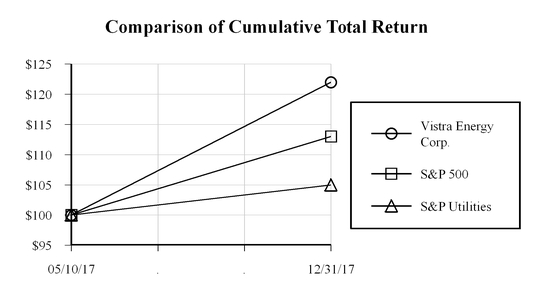
Item 6. SELECTED FINANCIAL DATA
| VISTRA ENERGY CORP. SELECTED CONSOLIDATED FINANCIAL INFORMATION (Millions of Dollars, Except Per Share Amounts and Ratios | ||||||||||||||||||||||||
|---|---|---|---|---|---|---|---|---|---|---|---|---|---|---|---|---|---|---|---|---|---|---|---|---|
| Successor | Predecessor | |||||||||||||||||||||||
| Year Ended December 31, 2017 | Period from October 3, 2016 through December 31, 2016 | Period from January 1, 2016 through October 2, 2016 | Year Ended December 31, | |||||||||||||||||||||
| 2015 | 2014 | 2013 | ||||||||||||||||||||||
| Operating revenues | $ | 5,430 | $ | 1,191 | $ | 3,973 | $ | 5,370 | $ | 5,978 | $ | 5,899 | ||||||||||||
| Impairment of goodwill | $ | — | $ | — | $ | — | $ | (2,200 | ) | $ | (1,600 | ) | $ | (1,000 | ) | |||||||||
| Impairment of long-lived assets | $ | (25 | ) | $ | — | $ | — | $ | (2,541 | ) | $ | (4,670 | ) | $ | (140 | ) | ||||||||
| Operating income (loss) | $ | 198 | $ | (161 | ) | $ | 568 | $ | (4,091 | ) | $ | (6,015 | ) | $ | (1,113 | ) | ||||||||
| Net income (loss) (a) | $ | (254 | ) | $ | (163 | ) | $ | 22,851 | $ | (4,677 | ) | $ | (6,229 | ) | $ | (2,197 | ) | |||||||
| Cash provided by (used in) operating activities | $ | 1,386 | $ | 81 | $ | (238 | ) | $ | 237 | $ | 444 | $ | (270 | ) | ||||||||||
| Net loss per weighted average share of common stock outstanding — basic | $ | (0.59 | ) | $ | (0.38 | ) | ||||||||||||||||||
| Net loss per weighted average share of common stock outstanding — diluted | $ | (0.59 | ) | $ | (0.38 | ) | ||||||||||||||||||
| Dividend declared per share of common stock | $ | — | $ | 2.32 |
| Successor | Predecessor | |||||||||||||||||||
| At December 31, | At December 31, | |||||||||||||||||||
| 2017 | 2016 | 2015 | 2014 | 2013 | ||||||||||||||||
| Balance Sheet Information: | ||||||||||||||||||||
| Total assets (b)(c) | $ | 14,600 | $ | 15,167 | $ | 15,658 | $ | 21,343 | $ | 28,822 | ||||||||||
| Property, plant and equipment — net (b)(c) | $ | 4,820 | $ | 4,443 | $ | 9,349 | $ | 12,288 | $ | 17,649 | ||||||||||
| Goodwill and intangible assets | $ | 4,437 | $ | 5,112 | $ | 1,331 | $ | 3,688 | $ | 5,669 | ||||||||||
| Long-term debt including current maturities (d) | $ | 4,423 | $ | 4,623 | $ | 19 | $ | 73 | $ | 31,758 | ||||||||||
| Borrowings under debtor-in-possession credit facility | $ | — | $ | — | $ | 1,425 | $ | 1,425 | $ | — | ||||||||||
| Pre-Petition notes, loans and other debt reported as liabilities subject to compromise (e) | $ | — | $ | — | $ | 31,668 | $ | 31,856 | $ | — | ||||||||||
| Total equity/membership interests | $ | 6,342 | $ | 6,597 | $ | (22,884 | ) | $ | (18,209 | ) | $ | (11,982 | ) |
| (a) | For the Predecessor period from January 1, 2016 through October 2, 2016, net income includes net gains totaling $22.121 billion related to bankruptcy-related reorganization items including gains on extinguishing claims pursuant to the Plan of Reorganization (see Notes 5 and 6 to the Financial Statements). |
| (b) | At December 31, 2017 and 2016, includes the Lamar and Forney natural gas generation facilities purchased in April 2016, and at December 31, 2017 includes the Odessa-Ector natural gas generation facility purchased in August 2017 (see Note 3 to the Financial Statements). |
| (c) | Reflects the impacts of impairment charges related to long-lived assets of $2.541 billion and $4.670 billion in the years ended December 31, 2015 and 2014, respectively (see Note 4 to the Financial Statements). |
| (d) | As of December 31, 2013, includes borrowings under Predecessor's credit facilities of $2.054 billion. |
| (e) | As of December 31, 2015 and 2014, includes both unsecured and under secured obligations incurred prior to the Petition Date, but excludes pre-petition obligations that were fully secured and other obligations that were allowed to be paid as ordered by the Bankruptcy Court. As of December 31, 2014, also excludes $702 million of deferred debt issuance and extension costs. |
Quarterly Information (Unaudited)
Results of operations by quarter are summarized below. In our opinion, all adjustments (consisting of normal recurring accruals) necessary for a fair statement of such amounts have been made. Quarterly results are not necessarily indicative of a full year's operations because of seasonal and other factors. All amounts are in millions of dollars, except per share amounts, and may not add to full year amounts due to rounding.
| Successor | |||||||||||||||
| Quarter Ended | |||||||||||||||
| March 31 | June 30 | September 30 | December 31 (a) | ||||||||||||
| 2017: | |||||||||||||||
| Operating revenues | $ | 1,357 | $ | 1,296 | $ | 1,833 | $ | 944 | |||||||
| Operating income (loss) | $ | 155 | $ | 53 | $ | 452 | $ | (462 | ) | ||||||
| Net income (loss) | $ | 78 | $ | (26 | ) | $ | 273 | $ | (579 | ) | |||||
| Net income (loss) per weighted average share of common stock outstanding — basic | $ | 0.18 | $ | (0.06 | ) | $ | 0.64 | $ | (1.35 | ) | |||||
| Net income (loss) per weighted average share of common stock outstanding — diluted | $ | 0.18 | $ | (0.06 | ) | $ | 0.64 | $ | (1.35 | ) |
| Predecessor | Successor | |||||||||||||||
| Quarter Ended | Period from July 1 through October 2 (b) | Period from October 3 through December 31 | ||||||||||||||
| March 31 | June 30 | |||||||||||||||
| 2016: | ||||||||||||||||
| Operating revenues | $ | 1,049 | $ | 1,233 | $ | 1,690 | $ | 1,191 | ||||||||
| Operating income (loss) | $ | 39 | $ | (112 | ) | $ | 640 | $ | (161 | ) | ||||||
| Net income (loss) | $ | (343 | ) | $ | (499 | ) | $ | 23,693 | $ | (163 | ) | |||||
| Net loss per weighted average share of common stock outstanding — basic | $ | (0.38 | ) | |||||||||||||
| Net loss per weighted average share of common stock outstanding — diluted | $ | (0.38 | ) |
| (a) | For the Successor quarter ended December 31, 2017, operating loss includes noncash charges of $183 million related to the generation facilities retirement announcements. Net loss reflects the retirements mentioned above as well as a $451 million reduction of deferred tax assets related to the decrease in the corporate tax rate due to the TCJA (see Note 8 to the Financial Statements), partially offset by $117 million of impacts of the TRA. |
| (b) | For the Predecessor period from July 1, 2016 through October 2, 2016, net income includes net gains totaling $22.239 billion related to bankruptcy-related reorganization items including gains on extinguishing claims pursuant to the Plan of Reorganization (see Notes 5 and 6 to the Financial Statements). |
Item 7. MANAGEMENT'S DISCUSSION AND ANALYSIS OF FINANCIAL CONDITION AND RESULTS OF OPERATIONS
As described in Note 1 to the Financial Statements, Vistra Energy is considered a new reporting entity for accounting purposes as of the Effective Date, and its financial statements reflect the application of fresh start reporting. The financial statements of Vistra Energy (the Successor) for periods subsequent to the Effective Date are not comparable to the financial statements of TCEH (the Predecessor) for periods prior to the Effective Date, as those previous periods do not give effect to any adjustments to the carrying values of assets or amounts of liabilities that resulted from the Plan of Reorganization, and the related application of fresh start reporting, which includes accounting policies implemented by Vistra Energy that may differ from the Predecessor. See Note 6 to the Financial Statements for further discussion of fresh start reporting.
The following discussion and analysis of our financial condition and results of operations for the Successor period for the year ended December 31, 2017 and the period from October 3, 2016 through December 31, 2016 and the Predecessor period from January 1, 2016 through October 2, 2016 and the year ended December 31, 2015 should be read in conjunction with our consolidated financial statements and the notes to those statements. Results are impacted by the effects of fresh start reporting, the Bankruptcy Filing and the application of Financial Accounting Standards Board Accounting Standards Codification (ASC) 852, Reorganizations.
All dollar amounts in the tables in the following discussion and analysis are stated in millions of U.S. dollars unless otherwise indicated.
Business
Vistra Energy is a holding company operating an integrated power business in Texas. Through our Luminant and TXU Energy subsidiaries, we are principally engaged in competitive electricity market activities including electricity generation, wholesale energy sales and purchases, commodity risk management and retail sales of electricity and related services to end users. Prior to the Effective Date, TCEH was a holding company for our subsidiaries, which were principally engaged in the same activities as they are today.
Operating Segments
Subsequent to the Effective Date, Vistra Energy has two reportable segments: the Wholesale Generation segment, consisting largely of Luminant, and the Retail Electricity segment, consisting largely of TXU Energy. Prior to the Effective Date, there were no reportable business segments for TCEH. See Note 20 to the Financial Statements for further information concerning reportable business segments.
Significant Activities and Events and Items Influencing Future Performance
Merger Agreement — On October 29, 2017, Vistra Energy and Dynegy Inc., a Delaware corporation (Dynegy), entered into an Agreement and Plan of Merger (the Merger Agreement). Upon the terms and subject to the conditions set forth in the Merger Agreement, which has been approved by the boards of directors of Vistra Energy and Dynegy, Dynegy will merge with and into Vistra Energy (the Merger), with Vistra Energy continuing as the surviving corporation.
Upon the closing of the Merger, each issued and outstanding share of Dynegy common stock, par value $0.01 per share, other than shares owned by Vistra Energy or its subsidiaries, held in treasury by Dynegy or held by a subsidiary of Dynegy, will automatically be converted into the right to receive the Exchange Ratio, except that cash will be paid in lieu of fractional shares, which we expect will result in Vistra Energy's stockholders and Dynegy's stockholders owning approximately 79% and 21%, respectively, of the combined company.
See Note 2 to the Financial Statements for a summary of the Merger Agreement and the related Merger Support Agreements. The Merger is subject to numerous uncertainties and risks more fully described in Item 1. Risk Factors of this Annual Report on Form 10-K.
Retirement of Generation Plants — In October 2017, Luminant announced plans to retire three power plants with a total installed nameplate generation capacity of approximately 4,167 MW and two lignite mines. These power plants include the Monticello, Sandow 4, Sandow 5 and Big Brown generation units. Luminant decided to retire these units given they are projected to be uneconomic based on current market conditions and given the significant environmental costs associated with operating such units. In the case of the Sandow units, the decision also reflected the execution of a Settlement Agreement discussed below.
As part of the retirement process, Luminant filed notices with ERCOT, which triggered a reliability review regarding such proposed retirements. In October and November 2017, ERCOT determined the units were not needed for reliability. The Sandow and Monticello units were retired in January 2018, and the Big Brown units were retired in February 2018.
During the year ended December 31, 2017, we recorded charges of approximately $206 million related to the retirements, including employee related severance costs, noncash charges for writing off materials inventory and a contract intangible asset associated with the Big Brown plant and the acceleration of Luminant's mining reclamation obligations (see Note 21 to the Financial Statements). In addition, we will continue the ongoing reclamation work at the plants' mines.
Termination and Settlement of Alcoa Contract — In October 2017, subsidiaries of Vistra Energy (Vistra Parties) entered into a separation and settlement agreement (Settlement Agreement) with Alcoa Corporation and Alcoa USA Corp. (collectively, the Alcoa Parties). Pursuant to the Settlement Agreement, the Vistra Parties and the Alcoa Parties agreed to early termination of a series of agreements related to industrial operations near Rockdale, Texas, thereby ending their contractual relationship with respect to the power generation unit known as Sandow Unit 4 and the mine known as Three Oaks Mine. The terminated agreements were scheduled to terminate in 2038 absent the Settlement Agreement. Among other things, the Alcoa Parties made a cash payment to the Vistra Parties in the amount of approximately $238 million and transferred certain real property and related assets to the Vistra Parties, the Vistra Parties agreed to assume and be responsible for certain liabilities and asset retirement obligations related to Sandow Unit 4 (including certain related common facilities), the related mine and other property transferred from the Alcoa Parties to the Vistra Parties, and both parties released one another from any obligations and claims under the terminated agreements. The transactions under the Settlement Agreement are effective as of October 1, 2017.
In the three months ended December 31, 2017, we recorded a gain related to the impacts of the Settlement Agreement in our consolidated financial statements totaling $11 million, which included the receipt of the cash payment, the acquisition of real property and the incurrence of certain liabilities and asset retirement obligations, along with the elimination of a related electric supply contract intangible asset on our consolidated balance sheet (see Note 7 to the Financial Statements).
CCGT Plant Acquisition — In July 2017, La Frontera Holdings, LLC (La Frontera), an indirect wholly owned subsidiary of Vistra Energy, entered into an asset purchase agreement with Odessa-Ector Power Partners, L.P., an indirect wholly owned subsidiary of Koch Ag & Energy Solutions, LLC (the Odessa Acquisition), to acquire a 1,054 MW CCGT natural gas fueled generation plant (and other related assets and liabilities) located in Odessa, Texas (the Odessa Facility). On August 1, 2017, the Odessa Acquisition closed and La Frontera acquired the Odessa Facility. La Frontera paid an aggregate purchase price of approximately $355 million, plus a five-year earn-out provision, to acquire the Odessa Facility. The purchase price was funded by cash on hand.
Upton Solar
Showing the first 8K of 105K characters. Open the full section
Item 7A. QUANTITATIVE AND QUALITATIVE DISCLOSURES ABOUT MARKET RISK
Market risk is the risk that in the normal course of business we may experience a loss in value as a result of changes in market conditions that affect economic factors such as commodity prices, interest rates and counterparty credit. Our exposure to market risk is affected by a number of factors, including the size, duration and composition of our energy and financial portfolio, as well as the volatility and liquidity of markets. Instruments used to manage this exposure include interest rate swaps to hedge debt costs, as well as exchange-traded, over-the-counter contracts and other contractual arrangements to hedge commodity prices.
Risk Oversight
We manage the commodity price, counterparty credit and commodity-related operational risk related to the competitive energy business within limitations established by senior management and in accordance with overall risk management policies. Interest rate risk is managed centrally by our treasury function. Market risks are monitored by risk management groups that operate independently of the wholesale commercial operations, utilizing defined practices and analytical methodologies. These techniques measure the risk of change in value of the portfolio of contracts and the hypothetical effect on this value from changes in market conditions and include, but are not limited to, position reporting and review, Value at Risk (VaR) methodologies and stress test scenarios. Key risk control activities include, but are not limited to, transaction review and approval (including credit review), operational and market risk measurement, transaction authority oversight, validation of transaction capture, market price validation and reporting, and portfolio valuation and reporting, including mark-to-market valuation, VaR and other risk measurement metrics.
Vistra Energy has a risk management organization that enforces applicable risk limits, including the respective policies and procedures to ensure compliance with such limits, and evaluates the risks inherent in our businesses.
Commodity Price Risk
Our business is subject to the inherent risks of market fluctuations in the price of electricity, natural gas and other energy-related products it markets or purchases. We actively manage the portfolio of generation assets, fuel supply and retail sales load to mitigate the near-term impacts of these risks on results of operations. Similar to other participants in the market, we cannot fully manage the long-term value impact of structural declines or increases in natural gas and power prices.
In managing energy price risk, we enter into a variety of market transactions including, but not limited to, short- and long-term contracts for physical delivery, exchange-traded and over-the-counter financial contracts and bilateral contracts with customers. Activities include hedging, the structuring of long-term contractual arrangements and proprietary trading. We continuously monitor the valuation of identified risks and adjust positions based on current market conditions. We strive to use consistent assumptions regarding forward market price curves in evaluating and recording the effects of commodity price risk.
VaR Methodology — A VaR methodology is used to measure the amount of market risk that exists within the portfolio under a variety of market conditions. The resultant VaR produces an estimate of a portfolio's potential for loss given a specified confidence level and considers, among other things, market movements utilizing standard statistical techniques given historical and projected market prices and volatilities.
A Monte Carlo simulation methodology is used to calculate VaR and is considered by management to be the most effective way to estimate changes in a portfolio's value based on assumed market conditions for liquid markets. The use of this method requires a number of key assumptions, such as use of (i) an assumed confidence level; (ii) an assumed holding period (i.e., the time necessary for management action, such as to liquidate positions); and (iii) historical estimates of volatility and correlation data. The tables below detail certain VaR measures related to various portfolios of contracts.
VaR for Underlying Generation Assets and Energy-Related Contracts Subject to Mark-to-Market (MtM) Accounting — This measurement estimates the potential loss in fair value, due to changes in market conditions, of all underlying generation assets and contracts marked-to-market in net income (through the end of 2018), based on a 95% confidence level and an assumed holding period of 60 days.
| Year Ended December 31, | |||||||
| 2017 | 2016 | ||||||
| Month-end average VaR: | $ | 92 | $ | 65 | |||
| Month-end high VaR: | $ | 140 | $ | 119 | |||
| Month-end low VaR: | $ | 62 | $ | 30 |
The increase in the month-end high VaR risk measure in 2017 reflected lower seasonal natural gas to power correlations in early 2017 and increased natural gas volatility.
Interest Rate Risk
The following table provides information concerning our financial instruments at December 31, 2017 and 2016 that are sensitive to changes in interest rates. Debt amounts consist of the Vistra Operations Credit Facilities. See Note 12 to the Financial Statements for further discussion of these financial instruments.
| Expected Maturity Date | |||||||||||||||||||||||||||||||||||||||
| (millions of dollars, except percentages) | |||||||||||||||||||||||||||||||||||||||
| 2018 | 2019 | 2020 | 2021 | 2022 | There-after | 2017 Total Carrying Amount | 2017 Total Fair Value | 2016 Total Carrying Amount | 2016 Total Fair Value | ||||||||||||||||||||||||||||||
| Long-term debt, including current maturities (a): | |||||||||||||||||||||||||||||||||||||||
| Variable rate debt amount | $ | 39 | $ | 39 | $ | 39 | $ | 39 | $ | 39 | $ | 4,116 | $ | 4,311 | $ | 4,334 | $ | 4,500 | $ | 4,552 | |||||||||||||||||||
| Average interest rate (b) | 3.98 | % | 3.98 | % | 3.98 | % | 3.98 | % | 3.98 | % | 3.98 | % | 3.98 | % | 4.78 | % | |||||||||||||||||||||||
| Debt swapped to fixed (c): | |||||||||||||||||||||||||||||||||||||||
| Notional amount | $ | — | $ | — | $ | — | $ | — | $ | — | $ | 3,000 | $ | 3,000 | $ | 3,000 | |||||||||||||||||||||||
| Average pay rate | 4.59 | % | 4.59 | % | 4.59 | % | 4.59 | % | 4.59 | % | 4.59 | % | 4.59 | % | 5.82 | % | |||||||||||||||||||||||
| Average receive rate | 4.11 | % | 4.11 | % | 4.11 | % | 4.11 | % | 4.11 | % | 4.11 | % | 4.11 | % | 4.52 | % |
| (a) | Capital leases, mandatorily redeemable preferred stock and the effects of unamortized premiums and discounts are excluded from the table. |
| (b) | The weighted average interest rate presented is based on the rates in effect at December 31, 2017. |
| (c) | Interest rate swaps became effective in January 2017 and have maturity dates through July 2023. |
At December 31, 2017, the potential reduction of annual pretax earnings over the next 12 months due to a one percentage-point (100 basis points) increase in floating interest rates on long-term debt totaled approximately $13 million, taking into account the interest rate swaps discussed in Note 12 to Financial Statements.
Credit Risk
Credit risk relates to the risk of loss associated with nonperformance by counterparties. We minimize credit risk by evaluating potential counterparties, monitoring ongoing counterparty risk and assessing overall portfolio risk. This includes review of counterparty financial condition, current and potential credit exposures, credit rating and other quantitative and qualitative credit criteria. We also employ certain risk mitigation practices, including utilization of standardized master agreements that provide for netting and setoff rights, as well as credit enhancements such as margin deposits and customer deposits, letters of credit, parental guarantees and surety bonds. See Note 16 to the Financial Statements for further discussion of this exposure.
Credit Exposure — Our gross credit exposure (excluding collateral impacts) associated with retail and wholesale trade accounts receivable and net derivative assets arising from commodity contracts and hedging and trading activities totaled $611 million at December 31, 2017.
At December 31, 2017, Retail Electricity segment credit exposure totaled $469 million, including $451 million of trade accounts receivable and $18 million related to derivative assets. Cash deposits and letters of credit held as collateral for these receivables totaled $44 million, resulting in a net exposure of $425 million. We believe the risk of material loss (after consideration of bad debt allowances) from nonperformance by these customers is unlikely based upon historical experience. Allowances for uncollectible accounts receivable are established for the potential loss from nonpayment by these customers based on historical experience, market or operational conditions and changes in the financial condition of large business customers.
At December 31, 2017, Wholesale Generation segment credit exposure totaled $142 million including $81 million related to derivative assets and $61 million of trade accounts receivable, after taking into account master netting agreement provisions but excluding collateral impacts.
Including collateral posted to us by counterparties, our net Wholesale Generation segment exposure was $136 million, substantially all of which is with investment grade customers as seen in the following table that presents the distribution of credit exposure at December 31, 2017. Credit collateral includes cash and letters of credit, but excludes other credit enhancements such as guarantees or liens on assets.
| Exposure Before Credit Collateral | Credit Collateral | Net Exposure | |||||||||
| Investment grade | $ | 132 | $ | — | $ | 132 | |||||
| Below investment grade or no rating | 10 | 6 | 4 | ||||||||
| Totals | $ | 142 | $ | 6 | $ | 136 |
Significant (10% or greater) concentration of credit exposure exists with three counterparties, which represented an aggregate $102 million, or 75%, of the total net exposure. We view exposure to these counterparties to be within an acceptable level of risk tolerance due to the counterparties' credit ratings, each of which is rated as investment grade, the counterparties' market role and deemed creditworthiness and the importance of our business relationship with the counterparties. An event of default by one or more counterparties could subsequently result in termination-related settlement payments that reduce available liquidity if amounts such as margin deposits are owed to the counterparties or delays in receipts of expected settlements owed to us.
Contracts classified as "normal" purchase or sale and non-derivative contractual commitments are not marked-to-market in the financial statements and are excluded from the detail above. Such contractual commitments may contain pricing that is favorable considering current market conditions and therefore represent economic risk if the counterparties do not perform.
At December 31, 2017, interest rate swap exposure in the Corporate and Other non-segment totaled $18 million. There are no collateral offsets. The counterparty credit rating is investment grade.
FORWARD-LOOKING STATEMENTS
This report and other presentations made by us contain "forward-looking statements." All statements, other than statements of historical facts, that are included in this report, or made in presentations, in response to questions or otherwise, that address activities, events or developments that may occur in the future, including such matters as activities related to our financial or operational projections, capital allocation, capital expenditures, liquidity, dividend policy, business strategy, competitive strengths, goals, future acquisitions or dispositions, development or operation of power generation assets, market and industry developments and the growth of our businesses and operations (often, but not always, through the use of words or phrases such as "intends," "plans," "will likely," "unlikely," "expected," "anticipated," "estimated," "should," "may," "projection," "target," "goal," "objective" and "outlook"), are forward-looking statements. Although we believe that in making any such forward-looking statement our expectations are based on reasonable assumptions, any such forward-looking statement involves uncertainties and risks and is qualified in its entirety by reference to the discussion under Item 1A. Risk Factors and Item 7., Management's Discussion and Analysis of Financial Condition and Results of Operations in this report and the following important factors, among others, that could cause our actual results to differ materially from those projected in or implied by such forward-looking statements:
| • | the actions and decisions of regulatory authorities; |
| • | prohibitions and other restrictions on our operations due to the terms of our agreements; |
| • | prevailing governmental policies and regulatory actions, including those of the Texas Legislature, the Governor of Texas, the U.S. Congress, the FERC, the NERC, the TRE, the PUCT, the RCT, the NRC, the EPA, the TCEQ the MSHA and the CFTC, with respect to, among other things: |
| ◦ | allowed prices; |
| ◦ | industry, market and rate structure; |
| ◦ | purchased power and recovery of investments; |
| ◦ | operations of nuclear generation facilities; |
| ◦ | operations of fossil fueled generation facilities; |
| ◦ | operations of mines; |
| ◦ | acquisition and disposal of assets and facilities; |
| ◦ | development, construction and operation of facilities; |
| ◦ | decommissioning costs; |
| ◦ | present or prospective wholesale and retail competition; |
| ◦ | changes in tax laws and policies; |
| ◦ | changes in and compliance with environmental and safety laws and policies, including National Ambient Air Quality Standards, the Cross-State Air Pollution Rule, the Mercury and Air Toxics Standard, regional haze program implementation and GHG and other climate change initiatives, and |
| ◦ | clearing over-the-counter derivatives through exchanges and posting of cash collateral therewith; |
| • | legal and administrative proceedings and settlements; |
| • | general industry trends; |
| • | economic conditions, including the impact of an economic downturn; |
| • | weather conditions, including drought and limitations on access to water, and other natural phenomena, and acts of sabotage, wars or terrorist or cyber security threats or activities; |
| • | our ability to collect trade receivables from counterparties; |
| • | our ability to attract and retain profitable customers; |
| • | our ability to profitably serve our customers; |
| • | restrictions on competitive retail pricing; |
| • | changes in wholesale electricity prices or energy commodity prices, including the price of natural gas; |
| • | changes in prices of transportation of natural gas, coal, fuel oil and other refined products; |
| • | changes in the ability of vendors to provide or deliver commodities as needed; |
| • | changes in market heat rates in the ERCOT electricity market; |
| • | our ability to effectively hedge against unfavorable commodity prices, including the price of natural gas, market heat rates and interest rates; |
| • | population growth or decline, or changes in market supply or demand and demographic patterns, particularly in ERCOT; |
| • | access to adequate transmission facilities to meet changing demands; |
| • | changes in interest rates, commodity prices, rates of inflation or foreign exchange rates; |
| • | changes in operating expenses, liquidity needs and capital expenditures; |
| • | commercial bank market and capital market conditions and the potential impact of disruptions in U.S. and international credit markets; |
| • | access to capital, the attractiveness of the cost and other terms of such capital and the success of financing and refinancing efforts, including availability of funds in capital markets; |
| • | our ability to maintain prudent financial leverage; |
| • | our ability to generate sufficient cash flow to make principal and interest payments in respect of, or refinance, our debt obligations: |
| • | competition for new energy development and other business opportunities; |
| • | our ability to successfully complete our solar generation project in a timely and cost-efficient manner or at all; |
| • | inability of various counterparties to meet their obligations with respect to our financial instruments; |
| • | changes in technology (including large scale electricity storage) used by and services offered by us; |
| • | changes in electricity transmission that allow additional power generation to compete with our generation assets; |
| • | our ability to attract and retain qualified employees; |
| • | significant changes in our relationship with our employees, including the availability of qualified personnel, and the potential adverse effects if labor disputes or grievances were to occur; |
| • | changes in assumptions used to estimate costs of providing employee benefits, including medical and dental benefits, pension and OPEB, and future funding requirements related thereto, including joint and several liability exposure under ERISA; |
| • | hazards customary to the industry and the possibility that we may not have adequate insurance to cover losses resulting from such hazards; |
| • | the impact of our obligations under the TRA; |
| • | expectations regarding the Merger, including beliefs concerning stockholder and regulatory approvals; |
| • | the occurrence of any event that could give rise to the termination of the Merger Agreement, including a termination of the Merger Agreement under circumstances that could require us to pay a termination fee; |
| • | our ability to successfully integrate the businesses of Vistra Energy and Dynegy upon consummation of the Merger and our ability to successfully capture any projected synergies relating to the Merger, and |
| • | actions by credit rating agencies. |
Any forward-looking statement speaks only at the date on which it is made, and, except as may be required by law, we undertake no obligation to update any forward-looking statement to reflect events or circumstances after the date on which it is made or to reflect the occurrence of unanticipated events or circumstances. New factors emerge from time to time, and it is not possible for us to predict them. In addition, we may be unable to assess the impact of any such event or condition or the extent to which any such event or condition, or combination of events or conditions, may cause results to differ materially from those contained in or implied by any forward-looking statement. As such, you should not unduly rely on such forward-looking statements.
INDUSTRY AND MARKET INFORMATION
Certain industry and market data and other statistical information used throughout this report are based on independent industry publications, government publications, reports by market research firms or other published independent sources, including certain data published by ERCOT, the PUCT and NYMEX. We did not commission any of these publications, reports or other sources. Some data is also based on good faith estimates, which are derived from our review of internal surveys, as well as the independent sources listed above. Industry publications, reports and other sources generally state that they have obtained information from sources believed to be reliable, but do not guarantee the accuracy and completeness of such information. While we believe that each of these studies, publications, reports and other sources is reliable, we have not independently investigated or verified the information contained or referred to therein and make no representation as to the accuracy or completeness of such information. Forecasts are particularly likely to be inaccurate, especially over long periods of time, and we do not know what assumptions were used in preparing such forecasts. Statements regarding industry and market data and other statistical information used throughout this report involve risks and uncertainties and are subject to change based on various factors.
Item 8. FINANCIAL STATEMENTS AND SUPPLEMENTARY DATA
REPORT OF INDEPENDENT REGISTERED PUBLIC ACCOUNTING FIRM
To the shareholders and the Board of Directors of Vistra Energy Corp.
Opinion on the Financial Statements
We have audited the accompanying consolidated balance sheets of Vistra Energy Corp. and its subsidiaries (the "Company") as of December 31, 2017 and 2016 (Successor Company balance sheets), and the related statements of consolidated income (loss), consolidated comprehensive income (loss), consolidated cash flows, and consolidated equity, for the year ended December 31, 2017 and for the period October 3, 2016 through December 31, 2016 (Successor Company operations), the period January 1, 2016 through October 2, 2016 and the year ended December 31, 2015 (Predecessor Company operations), the related notes, and the schedule listed in the Index at Item 15(b) (collectively referred to as the "financial statements"). In our opinion, the Successor Company financial statements present fairly, in all material respects, the financial position of the Company as of December 31, 2017 and 2016, and the results of its operations and its cash flows, for the year ended December 31, 2017 and for the period October 3, 2016 through December 31, 2016, in conformity with accounting principles generally accepted in the United States of America. Further, in our opinion, the Predecessor Company financial statements present fairly, in all material respects, the results of operations and cash flows of the Predecessor Company for the period January 1, 2016 through October 2, 2016 and the year ended December 31, 2015, in conformity with accounting principles generally accepted in the United States of America.
Fresh-Start Reporting
As discussed in Note 6 to the financial statements, on August 29, 2016 the Bankruptcy Court entered an order confirming the plan of reorganization which became effective on October 3, 2016. Accordingly, the accompanying financial statements have been prepared in conformity with Accounting Standards Codification Topic 852, Reorganizations, for the Successor Company as a new entity with assets, liabilities, and a capital structure having carrying values not comparable with prior periods as described in Note 1 to the financial statements.
Basis for Opinion
These financial statements are the responsibility of the Company's management. Our responsibility is to express an opinion on the Company’s financial statements based on our audits. We are a public accounting firm registered with the Public Company Accounting Oversight Board (United States) (PCAOB) and are required to be independent with respect to the Company in accordance with the U.S. federal securities laws and the applicable rules and regulations of the Securities and Exchange Commission and the PCAOB.
We conducted our audits in accordance with the standards of the PCAOB. Those standards require that we plan and perform the audit to obtain reasonable assurance about whether the financial statements are free of material misstatement, whether due to error or fraud. The Company is not required to have, nor were we engaged to perform, an audit of its internal control over financial reporting. As part of our audits, we are required to obtain an understanding of internal control over financial reporting but not for the purpose of expressing an opinion on the effectiveness of the Company's internal control over financial reporting. Accordingly, we express no such opinion.
Our audits included performing procedures to assess the risks of material misstatement of the financial statements, whether due to error or fraud, and performing procedures that respond to those risks. Such procedures included examining, on a test basis, evidence regarding the amounts and disclosures in the financial statements. Our audits also included evaluating the accounting principles used and significant estimates made by management, as well as evaluating the overall presentation of the financial statements. We believe that our audits provide a reasonable basis for our opinion.
/s/ Deloitte & Touche LLP
Dallas, TX
February 26, 2018
We have served as the Company's auditor since 2002.
VISTRA ENERGY CORP.
STATEMENTS OF CONSOLIDATED INCOME (LOSS)
(Millions of Dollars, Except Per Share Amounts)
| Successor | Predecessor | |||||||||||||||
| Year Ended December 31, 2017 | Period from October 3, 2016 through December 31, 2016 | Period from January 1, 2016 through October 2, 2016 | Year Ended December 31, 2015 | |||||||||||||
| Operating revenues | $ | 5,430 | $ | 1,191 | $ | 3,973 | $ | 5,370 | ||||||||
| Fuel, purchased power costs and delivery fees | (2,935 | ) | (720 | ) | (2,082 | ) | (2,692 | ) | ||||||||
| Net gain from commodity hedging and trading activities | — | — | 282 | 334 | ||||||||||||
| Operating costs | (973 | ) | (208 | ) | (664 | ) | (834 | ) | ||||||||
| Depreciation and amortization | (699 | ) | (216 | ) | (459 | ) | (852 | ) | ||||||||
| Selling, general and administrative expenses | (600 | ) | (208 | ) | (482 | ) | (676 | ) | ||||||||
| Impairment of goodwill (Note 7) | — | — | — | (2,200 | ) | |||||||||||
| Impairment of long-lived assets (Note 4) | (25 | ) | — | — | (2,541 | ) | ||||||||||
| Operating income (loss) | 198 | (161 | ) | 568 | (4,091 | ) | ||||||||||
| Other income (Note 21) | 37 | 10 | 19 | 18 | ||||||||||||
| Other deductions (Note 21) | (5 | ) | — | (75 | ) | (93 | ) | |||||||||
| Interest expense and related charges (Note 10) | (193 | ) | (60 | ) | (1,049 | ) | (1,289 | ) | ||||||||
| Impacts of Tax Receivable Agreement (Note 9) | 213 | (22 | ) | — | — | |||||||||||
| Reorganization items (Note 5) | — | — | 22,121 | (101 | ) | |||||||||||
| Income (loss) before income taxes | 250 | (233 | ) | 21,584 | (5,556 | ) | ||||||||||
| Income tax (expense) benefit (Note 8) | (504 | ) | 70 | 1,267 | 879 | |||||||||||
| Net income (loss) | $ | (254 | ) | $ | (163 | ) | $ | 22,851 | $ | (4,677 | ) | |||||
| Weighted average shares of common stock outstanding: | ||||||||||||||||
| Basic | 427,761,460 | 427,560,620 | ||||||||||||||
| Diluted | 427,761,460 | 427,560,620 | ||||||||||||||
| Net income (loss) per weighted average share of common stock outstanding: | ||||||||||||||||
| Basic | $ | (0.59 | ) | $ | (0.38 | ) | ||||||||||
| Diluted | $ | (0.59 | ) | $ | (0.38 | ) | ||||||||||
| Dividend declared per share of common stock | $ | — | $ | 2.32 |
See Notes to the Consolidated Financial Statements.
VISTRA ENERGY CORP.
STATEMENTS OF CONSOLIDATED COMPREHENSIVE INCOME (LOSS)
(Millions of Dollars)
| Successor | Predecessor | |||||||||||||||
| Year Ended December 31, 2017 | Period from October 3, 2016 through December 31, 2016 | Period from January 1, 2016 through October 2, 2016 | Year Ended December 31, 2015 | |||||||||||||
| Net income (loss) | $ | (254 | ) | $ | (163 | ) | $ | 22,851 | $ | (4,677 | ) | |||||
| Other comprehensive income (loss), net of tax effects: | ||||||||||||||||
| Eff |
Showing the first 8K of 291K characters. Open the full section
Item 9. CHANGES IN AND DISAGREEMENTS WITH ACCOUNTANTS ON ACCOUNTING AND FINANCIAL DISCLOSURE
None.
Item 9A. CONTROLS AND PROCEDURES
An evaluation was performed under the supervision and with the participation of our management, including the principal executive officer and principal financial officer, of the effectiveness of the design and operation of the disclosure controls and procedures in effect at the end of the current period included in this Annual Report on Form 10-K. Based on the evaluation performed, our principal executive officer and principal financial officer concluded that the disclosure controls and procedures were effective. During the fiscal quarter covered by this quarterly report, there has been no change in our internal control over financial reporting that has materially affected, or is reasonably likely to materially affect, our internal control over financial reporting. This Annual Report on Form 10-K does not include a report of management's assessment regarding internal control over financial reporting or an attestation report of Vistra Energy's registered public accounting firm due to a transition period established by the rules of the SEC for newly public companies.
Item 9B. OTHER INFORMATION
None.
PART III
Item 10. DIRECTORS, EXECUTIVE OFFICERS AND CORPORATE GOVERNANCE
Information required by this Item is incorporated herein by reference to the sections entitled "Management" and "Corporate Governance" in the Proxy Statement.
Item 11. EXECUTIVE COMPENSATION
Information required by this Item is incorporated herein by reference to the sections entitled "Executive Compensation" in the Proxy Statement.
Item 12. SECURITY OWNERSHIP OF CERTAIN BENEFICIAL OWNERS AND MANAGEMENT AND RELATED STOCKHOLDER MATTERS
Information required by this Item is incorporated herein by reference to the sections entitled "Beneficial Ownership of Common Stock of the Company" in the Proxy Statement.
Item 13. CERTAIN RELATIONSHIPS AND RELATED TRANSACTIONS, AND DIRECTOR INDEPENDENCE
Information required by this Item is incorporated herein by reference to the sections entitled "Business Relationships and Related Person Transactions Policy" and "Director Independence" in the Proxy Statement.
Item 14. PRINCIPAL ACCOUNTING FEES
Information required by this Item is incorporated herein by reference to the sections entitled "Principal Accounting Fees" in the Proxy Statement.
PART IV
Item 15. EXHIBITS, FINANCIAL STATEMENT SCHEDULES
| (a) | Our financial statements and financial statement schedules are incorporated under Part II, Item 8 of this Annual Report on Form 10-K. |
| (b) | SCHEDULE I – CONDENSED FINANCIAL INFORMATION OF REGISTRANT |
VISTRA ENERGY CORP. (PARENT)
SCHEDULE I – CONDENSED FINANCIAL INFORMATION OF REGISTRANT
CONDENSED STATEMENTS OF LOSS
(Millions of Dollars)
| Successor | |||||||
| Year Ended December 31, 2017 | Period from October 3, 2016 through December 31, 2016 | ||||||
| Selling, general and administrative expense | $ | (47 | ) | $ | (7 | ) | |
| Loss from operations | (47 | ) | (7 | ) | |||
| Interest income | 4 | — | |||||
| Impacts of Tax Receivable Agreement | 213 | (22 | ) | ||||
| Income (loss) before income taxes and equity earnings | 170 | (29 | ) | ||||
| Pretax equity in gains (losses) of consolidated subsidiaries | 80 | (204 | ) | ||||
| Income tax (expense) benefit | (504 | ) | 70 | ||||
| Net loss | $ | (254 | ) | $ | (163 | ) |
See Notes to the Condensed Financial Statements.
VISTRA ENERGY CORP. (PARENT)
SCHEDULE I – CONDENSED FINANCIAL INFORMATION OF REGISTRANT
CONDENSED STATEMENTS OF CASH FLOWS
(Millions of Dollars)
| Successor | |||||||
| Year Ended December 31, 2017 | Period from October 3, 2016 through December 31, 2016 | ||||||
| Cash flows — operating activities: | |||||||
| Net loss | $ | (254 | ) | $ | (163 | ) | |
| Adjustments to reconcile net loss to cash provided by (used in) operating activities: | |||||||
| Pretax equity in (gains) losses of consolidated subsidiaries | (80 | ) | 204 | ||||
| Deferred income tax benefit (expense), net | 418 | (76 | ) | ||||
| Impacts of Tax Receivables Agreement | (213 | ) | 22 | ||||
| Other, net | 23 | 3 | |||||
| Changes in operating assets and liabilities | (2 | ) | (26 | ) | |||
| Cash used in operating activities | (108 | ) | (36 | ) | |||
| Cash flows — financing activities: | |||||||
| Special dividend (Note 4) | — | (992 | ) | ||||
| Other, net | (1 | ) | 1 | ||||
| Cash used in financing activities | (1 | ) | (991 | ) | |||
| Cash flows — investing activities: | |||||||
| Dividend received from subsidiaries | 1,505 | 997 | |||||
| Odessa Acquisition | (330 | ) | — | ||||
| Changes in restricted cash | 32 | 36 | |||||
| Cash provided by financing activities | 1,207 | 1,033 | |||||
| Net change in cash and cash equivalents | 1,098 | 6 | |||||
| Cash and cash equivalents — beginning balance | 26 | 20 | |||||
| Cash and cash equivalents — ending balance | $ | 1,124 | $ | 26 |
See Notes to the Condensed Financial Statements.
VISTRA ENERGY CORP. (PARENT)
SCHEDULE I – CONDENSED FINANCIAL INFORMATION OF REGISTRANT
CONDENSED BALANCE SHEETS
(Millions of Dollars)
| December 31 | |||||||
| 2017 | 2016 | ||||||
| ASSETS | |||||||
| Current assets: | |||||||
| Cash and cash equivalents | $ | 1,124 | $ | 26 | |||
| Restricted cash | 59 | 90 | |||||
| Other current assets | 5 | 3 | |||||
| Total current assets | 1,188 | 119 | |||||
| Equity investments in consolidated subsidiaries | 4,927 | 6,067 | |||||
| Accumulated deferred income taxes | 710 | 1,122 | |||||
| Other noncurrent assets | 6 | 7 | |||||
| Total assets | $ | 6,831 | $ | 7,315 | |||
| LIABILITIES AND EQUITY | |||||||
| Current liabilities: | |||||||
| Trade accounts payable | $ | 11 | $ | — | |||
| Accrued taxes | 59 | 31 | |||||
| Other current liabilities | 86 | 91 | |||||
| Total current liabilities | 156 | 122 | |||||
| Tax Receivable Agreement obligation | 333 | 596 | |||||
| Total liabilities | 489 | 718 | |||||
| Total shareholders' equity | 6,342 | 6,597 | |||||
| Total liabilities and equity | $ | 6,831 | $ | 7,315 |
See Notes to the Condensed Financial Statements.
NOTES TO CONDENSED FINANCIAL STATEMENTS
| 1. | BASIS OF PRESENTATION |
The accompanying unconsolidated condensed balance sheets, statements of net loss and cash flows present results of operations and cash flows of Vistra Energy Corp. (Parent). Certain information and footnote disclosures normally included in financial statements prepared in accordance with U.S. GAAP have been omitted pursuant to the rules of the SEC. Because the unconsolidated condensed financial statements do not include all of the information and footnotes required by U.S. GAAP, they should be read in conjunction with the financial statements and related notes of Vistra Energy Corp. and Subsidiaries included in the 2017 Annual Report on Form 10-K. Vistra Energy Corp.'s subsidiaries have been accounted for under the equity method. All dollar amounts in the financial statements and tables in the notes are stated in millions of U.S. dollars unless otherwise indicated.
Vistra Energy Corp. (Parent) will file a consolidated U.S. federal income tax return. All consolidated tax expenses/benefits and deferred tax assets/liabilities are recorded at Vistra Energy Corp. (Parent).
| 2. | RESTRICTIONS ON SUBSIDIARIES |
The agreement governing the Vistra Operations Credit Facilities (the Credit Facilities Agreement) generally restricts the ability of Vistra Operations Company LLC (Vistra Operations) to make distributions to any direct or indirect parent unless such distributions are expressly permitted thereunder. As of December 31, 2017, Vistra Operations can distribute approximately $1.0 billion to Vistra Energy Corp. (Parent) under the Credit Facilities Agreement without the consent of any party. The amount that can be distributed by Vistra Operations to Parent was partially reduced by distributions made by Vistra Operations to Parent during the year ended December 31, 2017 of approximately $1.1 billion. Additionally, Vistra Operations may make distributions to Vistra Energy Corp. (Parent) in amounts sufficient for Vistra Energy Corp. (Parent) to make any payments required under the Tax Receivables Agreement or the Tax Matters Agreement or, to the extent arising out of Vistra Energy Corp.'s (Parent) ownership or operation of Vistra Operations, to pay any taxes or general operating or corporate overhead expenses. As of December 31, 2017, the maximum amount of restricted net assets of Vistra Operations that may not be distributed to Parent totaled $3.9 billion.
| 3. | GUARANTEES |
As of December 31, 2017, there are no material outstanding guarantees at Vistra Energy Corp. (Parent).
| 4. | DIVIDEND RESTRICTIONS |
Under applicable law, Vistra Energy Corp. (Parent) is prohibited from paying any dividend to the extent that immediately following payment of such dividend there would be no statutory surplus or Vistra Energy Corp. (Parent) would be insolvent. On December 30, 2016, Vistra Energy Corp. (Parent) paid a special cash dividend in the aggregate amount of approximately $992 million to holders of record of its common stock on December 19, 2016.
Vistra Energy Corp. (Parent) received $1.505 billion and $997 million in dividends from its consolidated subsidiaries in the Successor period for the year ended December 31, 2017 and the period from October 3, 2016 through December 31, 2016, respectively.
| (c) | EXHIBITS: |
Vistra Energy Corp. Exhibits to Form 10-K for the Fiscal Year Ended December 31, 2017
| Exhibits | Previously Filed With File Number* | As Exhibit | ||||||
| XBRL Data Files | ||||||||
| 101.INS | ** | — | XBRL Instance Document | |||||
| 101.SCH | ** | — | XBRL Taxonomy Extension Schema Document | |||||
| 101.CAL | ** | — | XBRL Taxonomy Extension Calculation Document | |||||
| 101.DEF | ** | — | XBRL Taxonomy Extension Definition Document | |||||
| 101.LAB | ** | — | XBRL Taxonomy Extension Labels Document | |||||
| 101.PRE | ** | — | XBRL Taxonomy Extension Presentation Document |
| * | Incorporated herein by reference |
| ** | Filed herewith |
Item 16. FORM 10-K SUMMARY
Not applicable.
SIGNATURES
Pursuant to the requirements of Section 13 or 15(d) of the Securities Exchange Act of 1934, Vistra Energy Corp. has duly caused this report to be signed on its behalf by the undersigned, thereunto duly authorized.
| VISTRA ENERGY CORP. | |||
| Date: | February 26, 2018 | By | /s/ CURTIS A. MORGAN |
| Curtis A. Morgan (President and Chief Executive Officer) |
Pursuant to the requirements of the Securities Exchange Act of 1934, this report has been signed below by the following persons on behalf of Vistra Energy Corp. and in the capacities and on the date indicated.
| Signature | Title | Date |
| /s/ CURTIS A. MORGAN | Principal Executive Officer and Director | February 26, 2018 |
| (Curtis A. Morgan, President and Chief Executive Officer) | ||
| /s/ J. WILLIAM HOLDEN | Principal Financial Officer | February 26, 2018 |
| (J. William Holden, Executive Vice President and Chief Financial Officer) | ||
| /s/ CHRISTY DOBRY | Principal Accounting Officer | February 26, 2018 |
| (Christy Dobry, Vice President and Controller) | ||
| /s/ SCOTT B. HELM | Chairman of the Board and Director | February 26, 2018 |
| (Scott B. Helm, Chairman of the Board) | ||
| /s/ GAVIN R. BAIERA | Director | February 26, 2018 |
| (Gavin R. Baiera) | ||
| /s/ JENNIFER BOX | Director | February 26, 2018 |
| (Jennifer Box) | ||
| /s/ BRIAN K. FERRAIOLI | Director | February 26, 2018 |
| (Brian K. Ferraioli) | ||
| /s/ JEFF D. HUNTER | Director | February 26, 2018 |
| (Jeff D. Hunter) | ||
| /s/ CYRUS MADON | Director | February 26, 2018 |
| (Cyrus Madon) | ||
| /s/ GEOFFREY D. STRONG | Director | February 26, 2018 |
| (Geoffrey D. Strong) | ||