 filings.tools
Vistra 10-K 2021-12-31
Filed 2022-02-25. 23 sections, 932K characters. Original on sec.gov · Markdown · JSON
Cover and table of contents
UNITED STATES
SECURITIES AND EXCHANGE COMMISSION
Washington, D.C. 20549
FORM 10-K
| ☒ | ANNUAL REPORT PURSUANT TO SECTION 13 OR 15(d) OF THE SECURITIES EXCHANGE ACT OF 1934 |
FOR THE FISCAL YEAR ENDED DECEMBER 31, 2021
— OR —
| ☐ | TRANSITION REPORT PURSUANT TO SECTION 13 OR 15(d) OF THE SECURITIES EXCHANGE ACT OF 1934 |
For the transition period from __ to __
Commission File Number 001-38086
Vistra Corp.
(Exact name of registrant as specified in its charter)
| Delaware | 36-4833255 | |||||||||||||||||||
| (State or other jurisdiction of incorporation or organization) | (I.R.S. Employer Identification No.) | |||||||||||||||||||
| 6555 Sierra Drive | Irving, | Texas | 75039 | (214) | 812-4600 | |||||||||||||||
| (Address of principal executive offices) (Zip Code) | (Registrant's telephone number, including area code) |
Securities registered pursuant to Section 12(b) of the Act:
| Title of Each Class | Trading Symbol(s) | Name of Each Exchange on Which Registered | ||||||||||||
| Common stock, par value $0.01 per share | VST | New York Stock Exchange | ||||||||||||
| Warrants | VST.WS.A | New York Stock Exchange |
Securities registered pursuant to Section 12(g) of the Act: None
Indicate by check mark if the registrant is a well-known seasoned issuer, as defined in Rule 405 of the Securities Act. Yes ☒ No ☐
Indicated by check mark if the registrant is not required to file reports pursuant to Section 13 or Section 15(d) of the Act. Yes ☐ No ☒
Indicate by check mark whether the registrant (1) has filed all reports required to be filed by Section 13 or 15(d) of the Securities Exchange Act of 1934 during the preceding 12 months (or for such shorter period that the registrant was required to file such reports) and (2) has been subject to such filing requirements for the past 90 days. Yes ☒ No ☐
Indicate by check mark whether the registrant has submitted electronically every Interactive Data File required to be submitted pursuant to Rule 405 of Regulation S-T (§232.405 of this chapter) during the preceding 12 months (or for such shorter period that the registrant was required to submit such files). Yes ☒ No ☐
Indicate by check mark whether the registrant is a large accelerated filer, an accelerated filer, a non-accelerated filer, a smaller reporting company or an emerging growth company. See the definitions of "large accelerated filer," "accelerated filer," "smaller reporting company," and "emerging growth company" in Rule 12b-2 of the Exchange Act.
| Large accelerated filer | ☒ | Accelerated filer | ☐ | Non-accelerated filer | ☐ | Smaller reporting company | ☐ | Emerging growth company | ☐ |
If an emerging growth company, indicate by check mark if the registrant has elected not to use the extended transition period for complying with any new or revised financial accounting standards provided pursuant to Section 13(a) of the Exchange Act. ☐
Indicate by check mark whether the registrant has filed a report on and attestation to its management's assessment of the effectiveness of its internal control over financial reporting under Section 404(b) of the Sarbanes-Oxley Act (15 U.S.C. 7262(b)) by the registered public accounting firm that prepared or issued its audit report. ☒
Indicate by check mark whether the registrant is a shell company (as defined in Rule 12b-2 of the Exchange Act). Yes ☐ No ☒
As of June 30, 2021, the aggregate market value of the Vistra Corp. common stock held by non-affiliates of the registrant was $8,921,038,713 based on the closing sale price as reported on the New York Stock Exchange.
As of February 22, 2022, there were 448,803,986 shares of common stock, par value $0.01, outstanding of Vistra Corp.
DOCUMENTS INCORPORATED BY REFERENCE
Portions of the proxy statement for the registrant's 2022 annual meeting of stockholders are incorporated in Part III of this annual report on Form 10-K.
TABLE OF CONTENTS
Vistra Corp.'s (Vistra) annual reports, quarterly reports, current reports and any amendments to those reports are made available to the public, free of charge, on the Vistra website at http://www.vistracorp.com, as soon as reasonably practicable after they have been filed with or furnished to the Securities and Exchange Commission pursuant to Section 13(a) or 15(d) of the Securities Exchange Act of 1934, as amended. Additionally, Vistra posts important information, including press releases, investor presentations, sustainability reports, and notices of upcoming events on its website and utilizes its website as a channel of distribution to reach public investors and as a means of disclosing material non-public information for complying with disclosure obligations under Regulation FD. Investors may be notified of posting to the website by signing up for email alerts and RSS feeds on the "Investor Relations" page of Vistra's website. The information on Vistra's website shall not be deemed a part of, or incorporated by reference into, this annual report on Form 10-K. The representations and warranties contained in any agreement that we have filed as an exhibit to this annual report on Form 10-K, or that we have or may publicly file in the future, may contain representations and warranties that may (i) be made by and to the parties thereto at specific dates, (ii) be subject to exceptions and qualifications contained in separate disclosure schedules, (iii) represent the parties' risk allocation in the particular transaction, or (iv) be qualified by materiality standards that differ from what may be viewed as material for securities law purposes.
This annual report on Form 10-K and other Securities and Exchange Commission filings of Vistra and its subsidiaries occasionally make references to Vistra (or "we," "our," "us" or "the Company"), Luminant, TXU Energy, Ambit, Value Based Brands, Dynegy Energy Services, Homefield Energy, TriEagle Energy, Public Power or U.S. Gas & Electric, when describing actions, rights or obligations of their respective subsidiaries. These references reflect the fact that the subsidiaries are consolidated with, or otherwise reflected in, the Vistra financial statements for financial reporting purposes. However, these references should not be interpreted to imply that the parent company is actually undertaking the action or has the rights or obligations of the relevant subsidiary company or vice versa.
i
GLOSSARY
When the following terms and abbreviations appear in the text of this report, they have the meanings indicated below.
| 2020 Form 10-K | Vistra's annual report on Form 10-K for the year ended December 31, 2020, filed with the SEC on February 26, 2021 | |||||||
| Ambit or Ambit Energy | Ambit Holdings, LLC, and/or its subsidiaries (d/b/a Ambit), depending on context | |||||||
| ARO | asset retirement and mining reclamation obligation | |||||||
| CAA | Clean Air Act | |||||||
| CAISO | The California Independent System Operator | |||||||
| CARES Act | Coronavirus Aid, Relief, and Economic Security Act | |||||||
| CCGT | combined cycle gas turbine | |||||||
| CCR | coal combustion residuals | |||||||
| CFTC | U.S. Commodity Futures Trading Commission | |||||||
| Chapter 11 Cases | Cases in the U.S. Bankruptcy Court for the District of Delaware (Bankruptcy Court) concerning voluntary petitions for relief under Chapter 11 of the U.S. Bankruptcy Code (Bankruptcy Code) filed on April 29, 2014 (Petition Date) by Energy Future Holdings Corp. (EFH Corp.) and the majority of its direct and indirect subsidiaries, including Energy Future Intermediate Holding Company LLC, Energy Future Competitive Holdings Company LLC and TCEH but excluding Oncor Electric Delivery Holdings Company LLC and its direct and indirect subsidiaries (Debtors). On the Effective Date, subsidiaries of TCEH that were Debtors in the Chapter 11 Cases (TCEH Debtors), along with certain other Debtors that became subsidiaries of Vistra on that date (Contributed EFH Debtors) emerged from the Chapter 11 Cases. | |||||||
| CME | Chicago Mercantile Exchange | |||||||
| CO****2 | carbon dioxide | |||||||
| CPUC | California Public Utilities Commission | |||||||
| Crius | Crius Energy Trust and/or its subsidiaries, depending on context | |||||||
| CT | combustion turbine | |||||||
| Dynegy | Dynegy Inc., and/or its subsidiaries, depending on context | |||||||
| Dynegy Energy Services | Dynegy Energy Services, LLC and Dynegy Energy Services (East), LLC (each d/b/a Dynegy, Better Buy Energy, Brighten Energy, Honor Energy and True Fit Energy), indirect, wholly owned subsidiaries of Vistra, that are REPs in certain areas of MISO and PJM, respectively, and are engaged in the retail sale of electricity to residential and business customers. | |||||||
| EBITDA | earnings (net income) before interest expense, income taxes, depreciation and amortization | |||||||
| Effective Date | October 3, 2016, the date the TCEH Debtors and the Contributed EFH Debtors completed their reorganization under the Bankruptcy Code and emerged from the Chapter 11 Cases | |||||||
| Emergence | emergence of the TCEH Debtors and the Contributed EFH Debtors from the Chapter 11 Cases as subsidiaries of a newly formed company, Vistra, on the Effective Date | |||||||
| ESG | environmental, social and governance | |||||||
| EPA | U.S. Environmental Protection Agency | |||||||
| ERCOT | Electric Reliability Council of Texas, Inc. | |||||||
| ESS | energy storage system | |||||||
| Exchange Act | Securities Exchange Act of 1934, as amended | |||||||
| FERC | U.S. Federal Energy Regulatory Commission | |||||||
| Fitch | Fitch Ratings Inc. (a credit rating agency) | |||||||
| FTC | Federal Trade Commission | |||||||
| GAAP | generally accepted accounting principles | |||||||
| GHG | greenhouse gas | |||||||
| GWh | gigawatt-hours | |||||||
| Homefield Energy | Illinois Power Marketing Company (d/b/a Homefield Energy), an indirect, wholly owned subsidiary of Vistra, a REP in certain areas of MISO that is engaged in the retail sale of electricity to municipal customers |
ii
| ICE | Intercontinental Exchange | |||||||
| IEPA | Illinois Environmental Protection Agency | |||||||
| IPCB | Illinois Pollution Control Board | |||||||
| IRC | Internal Revenue Code of 1986, as amended | |||||||
| IRS | U.S. Internal Revenue Service | |||||||
| ISO | independent system operator | |||||||
| ISO-NE | ISO New England Inc. | |||||||
| kW | kilowatt | |||||||
| LIBOR | London Interbank Offered Rate, an interest rate at which banks can borrow funds, in marketable size, from other banks in the London interbank market | |||||||
| load | demand for electricity | |||||||
| LTSA | long-term service agreements for plant maintenance | |||||||
| Luminant | subsidiaries of Vistra engaged in competitive market activities consisting of electricity generation and wholesale energy sales and purchases as well as commodity risk management | |||||||
| market heat rate | Heat rate is a measure of the efficiency of converting a fuel source to electricity. Market heat rate is the implied relationship between wholesale electricity prices and natural gas prices and is calculated by dividing the wholesale market price of electricity, which is based on the price offer of the marginal supplier (generally natural gas plants), by the market price of natural gas. | |||||||
| Merger | the merger of Dynegy with and into Vistra, with Vistra as the surviving corporation | |||||||
| Merger Agreement | the Agreement and Plan of Merger, dated as of October 29, 2017, by and between Vistra and Dynegy | |||||||
| Merger Date | April 9, 2018, the date Vistra and Dynegy completed the transactions contemplated by the Merger Agreement | |||||||
| MISO | Midcontinent Independent System Operator, Inc. | |||||||
| MMBtu | million British thermal units | |||||||
| Moody's | Moody's Investors Service, Inc. (a credit rating agency) | |||||||
| MSHA | U.S. Mine Safety and Health Administration | |||||||
| MW | megawatts | |||||||
| MWh | megawatt-hours | |||||||
| NELP | Northeast Energy, LP, a joint venture between Dynegy Northeast Generation GP, Inc. and Dynegy Northeast Associates LP, Inc., both indirect subsidiaries of Vistra, and certain subsidiaries of NextEra Energy, Inc. Prior to the NELP Transaction, NELP indirectly owned Bellingham NEA facility and the Sayreville facility. | |||||||
| NELP Transaction | a transaction among Dynegy Northeast Generation GP, Inc., Dynegy Northeast Associates LP, Inc. and certain subsidiaries of NextEra Energy, Inc. wherein the indirect subsidiaries of Vistra redeemed their ownership interest in NELP partnership in exchange for 100% ownership interest in NJEA, the entity which owns the Sayreville facility | |||||||
| NERC | North American Electric Reliability Corporation | |||||||
| NJEA | North Jersey Energy Associates, A Limited Partnership | |||||||
| NO****X | nitrogen oxide | |||||||
| NRC | U.S. Nuclear Regulatory Commission | |||||||
| NYISO | New York Independent System Operator, Inc. | |||||||
| NYMEX | the New York Mercantile Exchange, a commodity derivatives exchange | |||||||
| NYSE | New York Stock Exchange | |||||||
| Oncor | Oncor Electric Delivery Company LLC, a direct, majority-owned subsidiary of Oncor Holdings and formerly an indirect subsidiary of EFH Corp., that is engaged in regulated electricity transmission and distribution activities | |||||||
| OPEB | postretirement employee benefits other than pensions | |||||||
| Parent | Vistra Corp. | |||||||
| PJM | PJM Interconnection, LLC |
iii
| Plan of Reorganization | Third Amended Joint Plan of Reorganization filed by the Debtors in August 2016 and confirmed by the Bankruptcy Court in August 2016 solely with respect to the TCEH Debtors and the Contributed EFH Debtors | |||||||
| PrefCo | Vistra Preferred Inc. | |||||||
| PrefCo Preferred Stock Sale | as part of the Spin-Off, the contribution of certain of the assets of the Predecessor and its subsidiaries by a subsidiary of TEX Energy LLC to PrefCo in exchange for all of PrefCo's authorized preferred stock, consisting of 70,000 shares, par value $0.01 per share | |||||||
| Preferred Stock | Vistra's Series A Preferred Stock and Series B Preferred Stock | |||||||
| Public Power | Public Power, LLC (d/b/a Public Power), an indirect, wholly owned subsidiary of Vistra, a REP in certain areas of PJM, ISO-NE, NYISO and MISO that is engaged in the retail sale of electricity to residential and business customers | |||||||
| PUCT | Public Utility Commission of Texas | |||||||
| PURA | Texas Public Utility Regulatory Act | |||||||
| REP | retail electric provider | |||||||
| RCT | Railroad Commission of Texas, which among other things, has oversight of lignite mining activity in Texas, and has jurisdiction over oil and natural gas exploration and production, permitting and inspecting intrastate pipelines, and overseeing natural gas utility rates and compliance | |||||||
| RTO | regional transmission organization | |||||||
| S&P | Standard & Poor's Ratings (a credit rating agency) | |||||||
| SEC | U.S. Securities and Exchange Commission | |||||||
| Securities Act | Securities Act of 1933, as amended | |||||||
| Series A Preferred Stock | Vistra's 8.0% Series A Fixed Rate Reset Cumulative Redeemable Perpetual Preferred Stock, $0.01 par value, with a liquidation preference of $1,000 per share | |||||||
| Series B Preferred Stock | Vistra's 7.0% Series B Fixed Rate Reset Cumulative Redeemable Perpetual Preferred Stock, $0.01 par value, with a liquidation preference of $1,000 per share | |||||||
| SG&A | selling, general and administrative | |||||||
| SO****2 | sulfur dioxide | |||||||
| Spin-Off | the tax-free spin-off from EFH Corp. executed pursuant to the Plan of Reorganization on the Effective Date by the TCEH Debtors and the Contributed EFH Debtors | |||||||
| ST | steam turbine | |||||||
| Tax Matters Agreement | Tax Matters Agreement, dated as of the Effective Date, by and among EFH Corp., Energy Future Intermediate Holding Company LLC, EFIH Finance Inc. and EFH Merger Co. LLC | |||||||
| TCJA | The Tax Cuts and Jobs Act of 2017, federal income tax legislation enacted in December 2017, which significantly changed the tax laws applicable to business entities | |||||||
| TCEH or Predecessor | Texas Competitive Electric Holdings Company LLC, a direct, wholly owned subsidiary of Energy Future Competitive Holdings Company LLC, and, prior to the Effective Date, the parent company of the TCEH Debtors whose major subsidiaries included Luminant and TXU Energy | |||||||
| TCEH Debtors | the subsidiaries of TCEH that were Debtors in the Chapter 11 Cases | |||||||
| TCEQ | Texas Commission on Environmental Quality | |||||||
| TRA | Tax Receivables Agreement, containing certain rights (TRA Rights) to receive payments from Vistra related to certain tax benefits, including benefits realized as a result of certain transactions entered into at Emergence (see Note 8 to the Financial Statements) | |||||||
| TRE | Texas Reliability Entity, Inc., an independent organization that develops reliability standards for the ERCOT region and monitors and enforces compliance with NERC standards and monitors compliance with ERCOT protocols | |||||||
| TriEagle Energy | TriEagle Energy, LP (d/b/a TriEagle Energy, TriEagle Energy Services, Eagle Energy, Energy Rewards, Power House Energy and Viridian Energy), an indirect, wholly owned subsidiary of Vistra, a REP in certain areas of ERCOT and PJM that is engaged in the retail sale of electricity to residential and business customers | |||||||
| TWh | terawatt-hours | |||||||
| TXU Energy | TXU Energy Retail Company LLC (d/b/a TXU), an indirect, wholly owned subsidiary of Vistra that is a REP in competitive areas of ERCOT and is engaged in the retail sale of electricity to residential and business customers |
iv
| U.S. | United States of America | |||||||
| U.S. Gas & Electric | U.S. Gas and Electric, Inc. (d/b/a USG&E, Illinois Gas & Electric and ILG&E), an indirect, wholly owned subsidiary of Vistra, a REP in certain areas of PJM, ISO-NE, NYISO and MISO that is engaged in the retail sale of electricity to residential and business customers | |||||||
| Value Based Brands | Value Based Brands LLC (d/b/a 4Change Energy, Express Energy and Veteran Energy), an indirect, wholly owned subsidiary of Vistra that is a REP in competitive areas of ERCOT and is engaged in the retail sale of electricity to residential and business customers | |||||||
| Vistra | Vistra Corp., formerly known as TCEH Corp., and/or its subsidiaries, depending on context. On the Effective Date, the TCEH Debtors and the Contributed EFH Debtors emerged from Chapter 11 and became subsidiaries of Vistra Energy Corp. Effective July 2, 2020, Vistra Energy Corp. changed its name to Vistra Corp. | |||||||
| Vistra Intermediate | Vistra Intermediate Company LLC, a direct, wholly owned subsidiary of Vistra | |||||||
| Vistra Operations | Vistra Operations Company LLC, an indirect, wholly owned subsidiary of Vistra that is the issuer of certain series of notes (see Note 11 to the Financial Statements) and borrower under the Vistra Operations Credit Facilities | |||||||
| Vistra Operations Credit Facilities | Vistra Operations senior secured financing facilities (see Note 11 to the Financial Statements) | |||||||
| Vistra Zero | Vistra Zero LLC |
v
PART I
Item 1. BUSINESS
References in this report to "we," "our," "us" and "the Company" are to Vistra and/or its subsidiaries, as apparent in the context. See Glossary for defined terms.
Business
Vistra is a holding company operating an integrated retail and electric power generation business primarily in markets throughout the U.S. Through our subsidiaries, we are engaged in competitive energy activities including electricity generation, wholesale energy sales and purchases, commodity risk management and retail sales of electricity and natural gas to end users. We incorporated under Delaware law in 2016. Effective July 2, 2020, we changed our name from Vistra Energy Corp. to Vistra Corp. to distinguish from companies that are involved in exploring for, producing, refining, or transporting fossil fuels (many of which use "energy" in their names) and to better reflect our integrated business model, which combines a retail electricity and natural gas business focused on serving its customers with new and innovative products and services and an electric power generation business leading the clean power transition through our Vistra Zero portfolio while powering the communities we serve with safe, reliable and affordable power.
We serve approximately 4.3 million customers and operate in 20 states and the District of Columbia. Our generation fleet totals approximately 38,700 MW of generation capacity with a portfolio of natural gas, nuclear, coal, solar and battery energy storage facilities.
Vistra has six reportable segments: (i) Retail, (ii) Texas, (iii) East, (iv) West, (v) Sunset and (vi) Asset Closure. See Market Discussion below and Note 20 to the Financial Statements for further information concerning our reportable segments, including an update of our reportable segments in the third quarter of 2020.
Business Strategy
Vistra is a leader in the clean power transition. With a strong zero-carbon generation portfolio and a deliberate and responsible strategy to decarbonize, the company is focused on delivering healthy returns and value for all stakeholders. Our business strategy is focused on the following areas:
-
Growth and transformation. Vistra's strategy is to responsibly and reliably grow our business through economically attractive investments in retail, renewable, and energy storage assets that assist in reducing our carbon footprint and create a more sustainable and resilient company well positioned to generate stable long-term value for all of our stakeholders. Since 2010, Vistra has retired more than 12,000 MW of coal and gas power plants resulting in a 45% reduction of greenhouse gas (GHG emissions), a 45% reduction in carbon dioxide (CO2) emissions, a 55% reduction in nitrogen oxide (NOX) emissions, and a 75% reduction in sulfur dioxide (SO2) emissions through year-end 2020, compared to a 2010 baseline. Now, we are transforming our generation portfolio through investments in zero-carbon resources and new carbon-reducing technologies, targeting net-zero carbon emissions by 2050. By year-end 2026, our Vistra Zero portfolio is expected to grow to 7,300 MW of zero-carbon generation, including solar, energy storage and our Comanche Peak nuclear power plant. Additionally, we have announced the retirement of approximately 7,500 MW of coal-fueled power plants by 2027, with plans to repurpose feasible sites to solar and energy storage developments. Repurposed sites provide a strategic advantage in the development of greener power due to the interconnection infrastructure already available, but additionally, and importantly, they allow us to continue supporting the local communities and our employees in those areas. We believe our diversified asset mix will support the reliability of the electric system while providing customers with cost-effective energy that meets their sustainable preferences throughout the clean power transition. Our growth strategy leverages our core capabilities of multi-channel retail marketing in large and competitive markets, operating large-scale, environmentally sensitive, and diverse assets across a variety of fuel technologies, fuel logistics and management, commodity risk management, cost control, and energy infrastructure investing. To advance our sustainability and energy transition initiatives, in December 2021, we adopted our Green Finance Framework, pursuant to which we issued $1.0 billion of Series B Preferred Stock to finance or refinance, in whole or in part, new or existing eligible green projects. We intend to opportunistically evaluate the acquisition and development of high-quality generation and storage assets and power-related businesses, including renewable energy and battery storage assets as well as retail businesses, that complement our core capabilities and align with our operational, financial and sustainability goals. We pride ourselves on our deliberate and responsible approach to grow and transform, considering impacts on all stakeholders. We make disciplined investments that are consistent with our focus on maintaining both a strong balance sheet and strong liquidity profile and our commitment to ensuring grid reliability, affordable power, and pursuit of a just transition away from carbon-emitting generation assets for the communities in which we operate and serve. As a result, consistent with our disciplined capital allocation approval process, the growth opportunities we pursue must have compelling economic value and align with or enhance our purpose and core principles.
-
Disciplined capital allocation. Vistra takes a disciplined approach to capital allocation in support of our commitment to maintain a strong balance sheet. We thoughtfully make capital allocation decisions that we believe will lead to attractive cash returns on investment, including returning capital to our stockholders through quarterly dividends and our share repurchase program as reflected in our current plans to return up to $7.5 billion in capital to common shareholders and reduce up to $3 billion in debt (exclusive of potential limited recourse project financing) through 2026. In addition to our dedicated approach to returning value to all stakeholders, we invest prudently in the maintenance of our existing assets and potential growth acquisitions. A strong balance sheet ensures Vistra's interest expense is manageable in a variety of wholesale power price environments while giving Vistra access to flexible and diverse sources of liquidity needed to make prudent capital investment decisions. We believe in cost discipline and strong commercial management of our assets and commodity positions to deliver long-term value to our stakeholders, to maintain the safety and reliability of our facilities, all while accelerating growth in our Vistra Zero portfolio pipeline with cost-efficient capital and investment in new technologies when economic, including solar assets and energy storage systems, resulting in a continued modernization of Vistra's generation fleet.
-
Integrated business model. Our integrated business model is an important component of our business strategy. This element of our business provides long-term sustainable solutions enabled by our diversified portfolio. This key factor distinguishes us from our electricity competitors by pairing our reliable and efficient mining, diversified generation fleet and wholesale commodity risk management capabilities with our retail platform. Coupling retail with generation is a core competitive advantage that reduces the effects of commodity price movements and contributes to stable earnings and predictable cash flow, a crucial feature of the strategy as Vistra responsibly grows its renewables portfolio and winds down its carbon-emitting assets.
-
Superior customer service. Through our retail brands, including TXU Energy, Ambit Energy, Value Based Brands, Dynegy Energy Services, Homefield Energy, TriEagle Energy, Public Power and U.S. Gas & Electric, we serve the re
Showing the first 8K of 87K characters. Open the full section
Item 1A. RISK FACTORS
Summary of Risk Factors
The following summarizes the principal factors that make an investment in our company speculative or risky, all of which are more fully described in the Risk Factors section below. This summary should be read in conjunction with the Risk Factors section and should not be relied upon as an exhaustive summary of the material risks facing our business. The following factors could result in harm to our business, financial condition, results of operations, cash flows, and prospects, among other impacts:
Market, Financial and Economic Risks
-
Our revenues, results of operations and operating cash flows are affected by price fluctuations in the wholesale power market and other market factors beyond our control.
-
We purchase natural gas, coal, fuel oil, and nuclear fuel for our generation facilities, and higher than expected fuel costs or disruptions in these fuel markets may have an adverse impact on, our costs, revenues, results of operations, financial condition and cash flows.
-
We have retired, announced planned retirements of, and may be forced to retire or idle additional underperforming generation units which could result in significant costs and have an adverse effect on our operating results.
-
Our assets or positions cannot be fully hedged against changes in commodity prices and market heat rates, and hedging transactions may not work as planned or hedge counterparties may default on their obligations.
-
Competition, changes in market structure, and/or state or federal interference in the wholesale and retail power markets, together with subsidized generation, may have a material adverse effect on our financial condition, results of operations and cash flows.
-
Our results of operations and financial condition could be materially and adversely affected if energy market participants continue to construct new generation facilities or expand or enhance existing generation facilities despite relatively low power prices and such additional generation capacity results in a reduction in wholesale power prices.
-
The agreements and instruments governing our debt, including the Vistra Operations Credit Facilities and indentures, contain restrictions and limitations that could affect our ability to operate our business, our liquidity, and our results of operations, and any failure to comply with these restrictions could have a material adverse effect on us.
-
We may not be able to complete future acquisitions on favorable terms or at all, successfully integrate future acquisitions into our business, or effectively identify and invest in value-creating businesses, assets or projects, which could result in unanticipated expenses and losses or otherwise hinder or delay our growth strategy.
-
Our ability to achieve the expected growth of our Vistra Zero portfolio, consisting of our solar generation, ESS, and other renewables development projects, is subject to substantial capital requirements and other significant uncertainties.
-
Tax legislation initiatives or challenges to our tax positions, or potential future legislation or the imposition of new or increased taxes or fees, could have a material adverse effect on our financial condition, results of operations and cash flows.
-
We are required to pay the holders of TRA Rights for certain tax benefits, which amounts are expected to be substantial.
Regulatory and Legislative Risks
-
Our businesses are subject to ongoing complex governmental regulations and legislation that have adversely impacted, and may in the future adversely impact, our businesses, results of operations, liquidity and financial condition.
-
Our cost of compliance with existing and new environmental laws could have a material adverse effect on us.
-
Pending or proposed laws or regulations, including those proposed or implemented under the Biden administration, could have a material adverse effect on our businesses, results of operations, liquidity and financial condition.
-
Changes to laws, rules or regulations related to market structures in the markets in which we participate may have a material adverse effect on our businesses, results of operation, liquidity and financial condition.
-
We could be materially and adversely affected if current regulations are implemented or if new federal or state legislation or regulations are adopted to address global climate change, or if we are subject to lawsuits for alleged damage to persons or property resulting from greenhouse gas emissions.
-
Litigation, legal proceedings, regulatory investigations or other administrative proceedings could expose us to significant liabilities and reputational damage that could have a material adverse effect on us.
Operational Risks
-
Volatile power supply costs and demand for power have and could in the future adversely affect the financial performance of our retail businesses.
-
Our retail operations are subject to significant competition from other REPs, which could result in a loss of existing customers and the inability to attract new customers.
-
The operation of our businesses is subject to information security and operational technology risks, including cybersecurity breaches and failure of critical information and operations technology systems. Attacks on our infrastructure that breach cyber/data security measures could expose us to significant liabilities, reputational damage, regulatory action, and disrupt business operations, which could have a material adverse effect on us.
-
We may suffer material losses, costs and liabilities due to operational risks, regulatory risks, and the risk of nuclear accidents arising from the ownership and operation of the Comanche Peak nuclear generation facility.
-
The operation and maintenance of power generation facilities and related mining operations are capital intensive and involve significant risks that could adversely affect our results of operations, liquidity and financial condition.
-
We may be materially and adversely affected by obligations to comply with federal and state regulations, laws, and other legal requirements that govern the operations, assessments, storage, closure, corrective action, disposal and monitoring relating to CCR.
-
We are subject to, and may be materially and adversely affected by, the effects of extreme weather conditions and seasonality.
-
The outbreak of COVID-19, or the future outbreak of any other highly infectious or contagious diseases, could have a material and adverse effect on our business, financial condition, results of operations and cash flows.
-
Changes in technology, increased electricity conservation efforts, or energy sustainability efforts may reduce the value of our generation facilities and may otherwise have a material adverse effect on us.
Risks Related to Our Structure and Ownership of our Common Stock
- Evolving expectations from stakeholders, including investors, on ESG issues, including climate change and sustainability matters, and erosion of stakeholder trust or confidence could influence actions or decisions about our company and our industry and could adversely affect our business, operations, financial results, or stock price.
Please carefully consider the following discussion of significant factors, events, and uncertainties that make an investment in our securities risky. These factors, in addition to others specifically addressed in Item 7. Management's Discussion and Analysis of Financial Condition and Results of Operations (MD&A), provide important information for the understanding of our forward-looking statements in this annual report on Form 10-K. If one or more of the factors, events and uncertainties discussed below or in the MD&A were to materialize, our business, results of operations, liquidity, financial condition, cash flows, reputation or prospects could be materially adversely affected. In addition, if one or more of such factors, events and uncertainties we
Showing the first 8K of 138K characters. Open the full section
Item 1B. UNRESOLVED STAFF COMMENTS
None.
Item 2. PROPERTIES
Luminant's asset fleet consists of power generation and battery ESS units in six ISOs/RTOs, with the location, ISO/RTO, technology, primary fuel type, net capacity and ownership interest for each generation facility shown in the table below:
| Facility | Location | ISO/RTO | Technology | Primary Fuel (a) | Net Capacity (MW) (b) | Ownership Interest (c) | ||||||||||||||||||||||||||||||||
| Ennis | Ennis, TX | ERCOT | CCGT | Natural Gas | 366 | 100% | ||||||||||||||||||||||||||||||||
| Forney | Forney, TX | ERCOT | CCGT | Natural Gas | 1,912 | 100% | ||||||||||||||||||||||||||||||||
| Hays | San Marcos, TX | ERCOT | CCGT | Natural Gas | 1,047 | 100% | ||||||||||||||||||||||||||||||||
| Lamar | Paris, TX | ERCOT | CCGT | Natural Gas | 1,076 | 100% | ||||||||||||||||||||||||||||||||
| Midlothian | Midlothian, TX | ERCOT | CCGT | Natural Gas | 1,596 | 100% | ||||||||||||||||||||||||||||||||
| Odessa | Odessa, TX | ERCOT | CCGT | Natural Gas | 1,054 | 100% | ||||||||||||||||||||||||||||||||
| Wise | Poolville, TX | ERCOT | CCGT | Natural Gas | 787 | 100% | ||||||||||||||||||||||||||||||||
| Martin Lake | Tatum, TX | ERCOT | ST | Coal | 2,250 | 100% | ||||||||||||||||||||||||||||||||
| Oak Grove | Franklin, TX | ERCOT | ST | Coal | 1,600 | 100% | ||||||||||||||||||||||||||||||||
| DeCordova | Granbury, TX | ERCOT | CT | Natural Gas | 260 | 100% | ||||||||||||||||||||||||||||||||
| Graham | Graham, TX | ERCOT | ST | Natural Gas | 630 | 100% | ||||||||||||||||||||||||||||||||
| Lake Hubbard | Dallas, TX | ERCOT | ST | Natural Gas | 921 | 100% | ||||||||||||||||||||||||||||||||
| Morgan Creek | Colorado City, TX | ERCOT | CT | Natural Gas | 390 | 100% | ||||||||||||||||||||||||||||||||
| Permian Basin | Monahans, TX | ERCOT | CT | Natural Gas | 325 | 100% | ||||||||||||||||||||||||||||||||
| Stryker Creek | Rusk, TX | ERCOT | ST | Natural Gas | 685 | 100% | ||||||||||||||||||||||||||||||||
| Trinidad | Trinidad, TX | ERCOT | ST | Natural Gas | 244 | 100% | ||||||||||||||||||||||||||||||||
| Comanche Peak | Glen Rose, TX | ERCOT | Nuclear | Nuclear | 2,300 | 100% | ||||||||||||||||||||||||||||||||
| Upton 2 | Upton County, TX | ERCOT | Solar/Battery | Renewable | 180 | 100% | ||||||||||||||||||||||||||||||||
| Total Texas Segment | 17,623 | |||||||||||||||||||||||||||||||||||||
| Fayette | Masontown, PA | PJM | CCGT | Natural Gas | 726 | 100% | ||||||||||||||||||||||||||||||||
| Hanging Rock | Ironton, OH | PJM | CCGT | Natural Gas | 1,430 | 100% |
| Facility | Location | ISO/RTO | Technology | Primary Fuel (a) | Net Capacity (MW) (b) | Ownership Interest (c) | ||||||||||||||||||||||||||||||||
| Hopewell | Hopewell, VA | PJM | CCGT | Natural Gas | 370 | 100% | ||||||||||||||||||||||||||||||||
| Kendall | Minooka, IL | PJM | CCGT | Natural Gas | 1,288 | 100% | ||||||||||||||||||||||||||||||||
| Liberty | Eddystone, PA | PJM | CCGT | Natural Gas | 607 | 100% | ||||||||||||||||||||||||||||||||
| Ontelaunee | Reading, PA | PJM | CCGT | Natural Gas | 600 | 100% | ||||||||||||||||||||||||||||||||
| Sayreville | Sayreville, NJ | PJM | CCGT | Natural Gas | 349 | 100% | ||||||||||||||||||||||||||||||||
| Washington | Beverly, OH | PJM | CCGT | Natural Gas | 711 | 100% | ||||||||||||||||||||||||||||||||
| Calumet | Chicago, IL | PJM | CT | Natural Gas | 380 | 100% | ||||||||||||||||||||||||||||||||
| Dicks Creek | Monroe, OH | PJM | CT | Natural Gas | 155 | 100% | ||||||||||||||||||||||||||||||||
| Miami Fort (CT) | North Bend, OH | PJM | CT | Fuel Oil | 77 | 100% | ||||||||||||||||||||||||||||||||
| Pleasants | Saint Marys, WV | PJM | CT | Natural Gas | 388 | 100% | ||||||||||||||||||||||||||||||||
| Richland | Defiance, OH | PJM | CT | Natural Gas | 423 | 100% | ||||||||||||||||||||||||||||||||
| Stryker | Stryker, OH | PJM | CT | Fuel Oil | 16 | 100% | ||||||||||||||||||||||||||||||||
| Bellingham | Bellingham, MA | ISO-NE | CCGT | Natural Gas | 566 | 100% | ||||||||||||||||||||||||||||||||
| Blackstone | Blackstone, MA | ISO-NE | CCGT | Natural Gas | 544 | 100% | ||||||||||||||||||||||||||||||||
| Casco Bay | Veazie, ME | ISO-NE | CCGT | Natural Gas | 543 | 100% | ||||||||||||||||||||||||||||||||
| Lake Road | Dayville, CT | ISO-NE | CCGT | Natural Gas | 827 | 100% | ||||||||||||||||||||||||||||||||
| Masspower | Indian Orchard, MA | ISO-NE | CCGT | Natural Gas | 281 | 100% | ||||||||||||||||||||||||||||||||
| Milford | Milford, CT | ISO-NE | CCGT | Natural Gas | 600 | 100% | ||||||||||||||||||||||||||||||||
| Independence | Oswego, NY | NYISO | CCGT | Natural Gas | 1,212 | 100% | ||||||||||||||||||||||||||||||||
| Total East Segment | 12,093 | |||||||||||||||||||||||||||||||||||||
| Moss Landing 1 & 2 | Moss Landing, CA | CAISO | CCGT | Natural Gas | 1,020 | 100% | ||||||||||||||||||||||||||||||||
| Moss Landing | Moss Landing, CA | CAISO | Battery | Renewable | 400 | 100% | ||||||||||||||||||||||||||||||||
| Oakland | Oakland, CA | CAISO | CT | Fuel Oil | 110 | 100% | ||||||||||||||||||||||||||||||||
| Total West Segment | 1,530 | |||||||||||||||||||||||||||||||||||||
| Coleto Creek | Goliad, TX | ERCOT | ST | Coal | 650 | 100% | ||||||||||||||||||||||||||||||||
| Baldwin | Baldwin, IL | MISO | ST | Coal | 1,185 | 100% | ||||||||||||||||||||||||||||||||
| Edwards | Bartonville, IL | MISO | ST | Coal | 585 | 100% | ||||||||||||||||||||||||||||||||
| Newton | Newton, IL | MISO | ST | Coal | 615 | 100% | ||||||||||||||||||||||||||||||||
| Joppa/EEI | Joppa, IL | MISO | ST | Coal | 802 | 80% | ||||||||||||||||||||||||||||||||
| Joppa CT 1-3 | Joppa, IL | MISO | CT | Natural Gas | 165 | 100% | ||||||||||||||||||||||||||||||||
| Joppa CT 4-5 | Joppa, IL | MISO | CT | Natural Gas | 56 | 80% | ||||||||||||||||||||||||||||||||
| Kincaid | Kincaid, IL | PJM | ST | Coal | 1,108 | 100% | ||||||||||||||||||||||||||||||||
| Miami Fort 7 & 8 | North Bend, OH | PJM | ST | Coal | 1,020 | 100% | ||||||||||||||||||||||||||||||||
| Zimmer | Moscow, OH | PJM | ST | Coal | 1,300 | 100% | ||||||||||||||||||||||||||||||||
| Total Sunset Segment | 7,486 | |||||||||||||||||||||||||||||||||||||
| Total capacity | 38,732 |
(a)Renewable represents generation assets fueled by renewable sources including energy storage and solar, which do not have significant fuel costs.
(b)Unit capabilities are based on winter capacity and are reflected at our net ownership interest. We have not included units that have been retired or are out of operation.
(c)Ownership interest of 100% indicates fee simple ownership of the facility. Ownership of less than 100% indicates the share of ownership in the facility held by the Company.
See Note 3 to the Financial Statements for discussion of our solar and battery energy storage projects currently under development and Note 4 to the Financial Statements for discussion of our retirement of certain generation facilities.
Our wholesale commodity risk management group also procures renewable energy credits from renewable generation in ERCOT to support our electricity sales to wholesale and retail customers to satisfy the increasing demand for renewable resources from such customers. As of December 31, 2021, Vistra had long-term agreements to procure renewable energy credits from approximately 915 MW of renewable generation. These renewable generation sources deliver electricity when conditions make them available, and, when on-line, they generally compete with baseload units. Because they cannot be relied upon to meet demand continuously due to their dependence on weather and time of day, these generation sources are categorized as non-dispatchable and create the need for intermediate/load-following resources to respond to changes in their output.
Fuel Supply
Nuclear — We own and operate two nuclear generation units at the Comanche Peak plant site in ERCOT, each of which is designed for a capacity of 1,150 MW. Comanche Peak Unit 1 and Unit 2 went into commercial operation in 1990 and 1993, respectively, and are generally operated at full capacity. Refueling (nuclear fuel assembly replacement) outages for each unit are scheduled to occur every eighteen months during the spring or fall off-peak demand periods. Every three years, the refueling cycle results in the refueling of both units during the same year, which occurred in 2020. While one unit is undergoing a refueling outage, the remaining unit is intended to operate at full capacity. During a refueling outage, other maintenance, modification and testing activities are completed that cannot be accomplished when the unit is in operation. The Comanche Peak facility operated at a capacity factor of 96%, 97% and 96% in 2021, 2020 and 2019, respectively.
We have contracts in place for all of our 2022 and 2023 nuclear fuel requirements. We do not anticipate any significant difficulties in acquiring uranium and contracting for associated conversion, enrichment and fabrication services in the foreseeable future.
Natural Gas — Our natural gas-fueled generation fleet is comprised of 23 CCGT generating facilities totaling 19,512 MW and 13 peaking generation facilities totaling 5,022 MW. We satisfy our fuel requirements at these facilities through a combination of spot market and near-term purchase contracts. Additionally, we have near-term natural gas transportation agreements in place to ensure reliable fuel supply.
Coal/Lignite — Our coal/lignite-fueled generation fleet is comprised of 10 generation facilities totaling 11,115 MW of generation capacity. Maintenance outages at these units are scheduled during the spring or fall off-peak demand periods. We meet our fuel requirements at our coal-fueled generation facilities in PJM and MISO with coal purchased from multiple suppliers under contracts of various lengths and transported to the facilities by either railcar or barges. We meet our fuel requirements in ERCOT using lignite that we mine at the Oak Grove generation facility and coal purchased and transported by railcar at the Coleto Creek and Martin Lake generation facilities.
Item 3. LEGAL PROCEEDINGS
See Note 13 to the Financial Statements for discussion of litigation, including matters related to our generation facilities and EPA reviews.
Item 4. MINE SAFETY DISCLOSURES
Vistra currently owns and operates, or is in the process of reclaiming, 12 surface lignite coal mines in Texas to provide fuel for its electricity generation facilities. Vistra also owns or leases, and is in the process of reclaiming, two waste-to-energy surface facilities in Pennsylvania. These mining operations are regulated by the MSHA under the Federal Mine Safety and Health Act of 1977, as amended (the Mine Act), as well as other federal and state regulatory agencies such as the RCT and Office of Surface Mining. The MSHA inspects U.S. mines, including Vistra's mines, on a regular basis, and if it believes a violation of the Mine Act or any health or safety standard or other regulation has occurred, it may issue a citation or order, generally accompanied by a proposed fine or assessment. Such citations and orders can be contested and appealed, which often results in a reduction of the severity and amount of fines and assessments and sometimes results in dismissal. Disclosure of MSHA citations, orders and proposed assessments are provided in Exhibit 95.1 to this annual report on Form 10-K.
PART II
Item 5. MARKET FOR REGISTRANT'S COMMON EQUITY, RELATED STOCKHOLDER MATTERS AND ISSUER PURCHASES OF EQUITY SECURITIES
Vistra's authorized capital stock consists of 1,800,000,000 shares of common stock with a par value of $0.01 per share.
Since May 10, 2017, Vistra's common stock has been listed on the NYSE under the symbol "VST".
As of February 22, 2022, there were 448,803,986 shares of common stock issued and outstanding and 620 stockholders of record.
In November 2018, we announced that the Board had adopted a common stock dividend program which we initiated in the first quarter of 2019. Our common stockholders are entitled to receive any such dividends or other distributions ratably. In February 2022, our Board declared a quarterly dividend of $0.17 per share that will be paid in March 2022. Each dividend under the program is subject to declaration by the Board and, thus, may be subject to numerous factors in existence at the time of any such declaration including, but not limited to, prevailing market conditions, our results of operations, financial condition and liquidity, Delaware law and contractual limitations. For additional details, see Item 1A. Risk Factors and Note 14 to the Financial Statements.
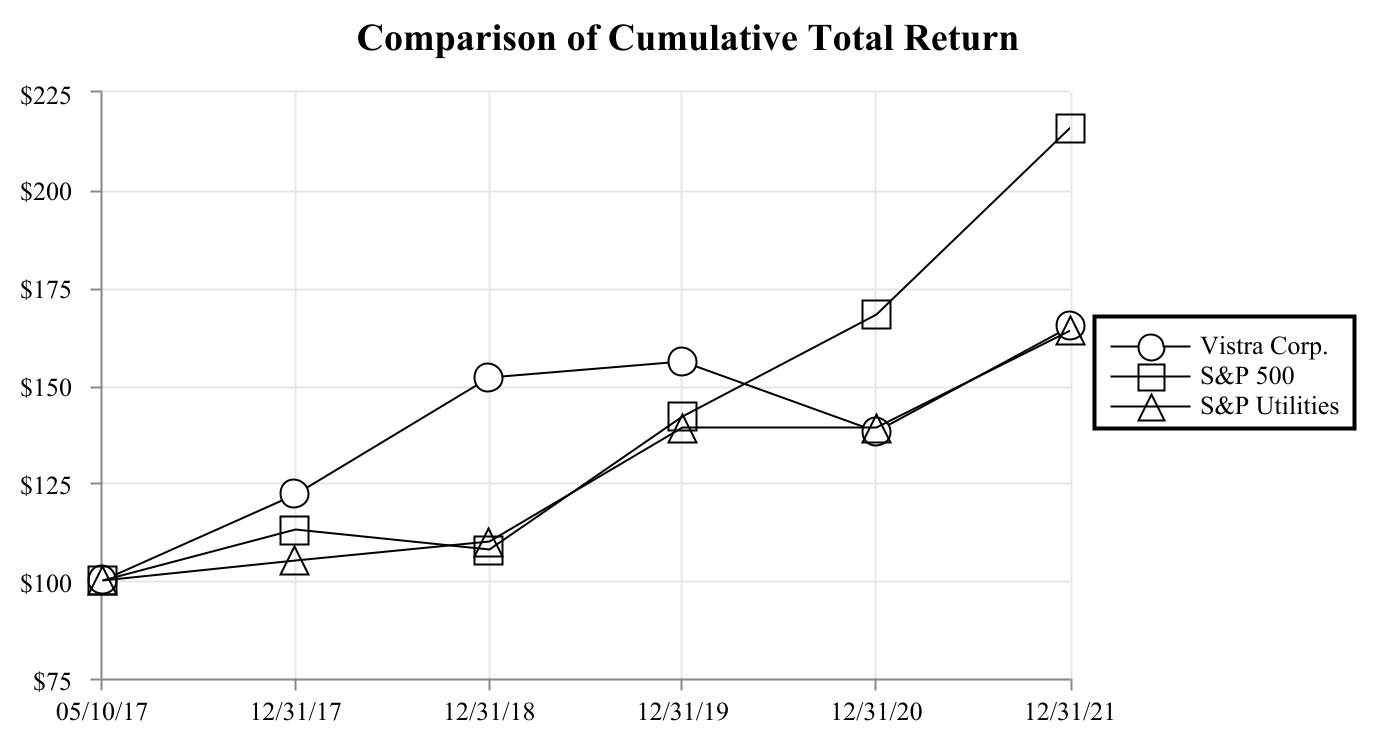
Stock Performance Graph
The performance graph below compares Vistra's cumulative total return on common stock for the period from May 10, 2017 (the date we were listed on the NYSE) through December 31, 2021 with the cumulative total returns of the S&P 500 Stock Index (S&P 500) and the S&P Utility Index (S&P Utilities). The graph below compares the return in each period assuming that $100 was invested at May 10, 2017 in Vistra's common stock, the S&P 500 and the S&P Utilities, and that all dividends were reinvested.
Share Repurchase Program
The following table provides information about our repurchase of equity securities that are registered by us pursuant to Section 12 of the Exchange Act, as amended, during the quarter ended December 31, 2021.
| Total Number of Shares Purchased | Average Price Paid per Share | Total Number of Shares Purchased as Part of a Publicly Announced Program | Maximum Dollar Amount of Shares that may yet be Purchased under the Program (in millions) | |||||||||||||||||||||||
| October 1 - October 31, 2021 | — | $ | — | — | $ | 2,000 | ||||||||||||||||||||
| November 1 - November 30, 2021 | 5,094,030 | $ | 20.22 | 5,094,030 | $ | 1,897 | ||||||||||||||||||||
| December 1 - December 31, 2021 | 14,236,335 | $ | 21.50 | 14,236,335 | $ | 1,591 | ||||||||||||||||||||
| For the quarter ended December 31, 2021 | 19,330,365 | $ | 21.16 | 19,330,365 | $ | 1,591 |
In October 2021, we announced that the Board had authorized a new share repurchase program (Share Repurchase Program) under which up to $2.0 billion of our outstanding common stock may be repurchased. The Share Repurchase Program became effective on October 11, 2021. The Share Repurchase Program supersedes the $1.5 billion share repurchase program previously announced in September 2020, which had $1.325 billion of remaining authorization as of September 30, 2021. As an initial step in our broader capital allocation plan, we intend to use all of the net proceeds from our October 2021 Series A Preferred Stock offering to repurchase shares of our outstanding common stock. We expect to complete repurchases under the Share Repurchase Program by the end of 2022.
Under the Share Repurchase Program, any purchases of shares of the Company's stock may be repurchased from time to time in open market transactions at prevailing market prices, in privately negotiated transactions, pursuant to plans complying with the Exchange Act or by other means in accordance with federal securities laws. The actual timing, number and value of shares repurchased under the Share Repurchase Program or otherwise will be determined at our discretion and will depend on a number of factors, including our capital allocation priorities, the market price of our stock, general market and economic conditions, applicable legal requirements and compliance with the terms of our debt agreements.
See Note 14 to the Financial Statements for more information concerning the Share Repurchase Program.
Item 6. [RESERVED]
Not applicable.
Item 7. MANAGEMENT'S DISCUSSION AND ANALYSIS OF FINANCIAL CONDITION AND RESULTS OF OPERATIONS
The discussion below, as well as other portions of this annual report on Form 10-K, contain forward-looking statements within the meaning of Section 27A of the Securities Act, Section 21E of the Exchange Act and the Private Securities Litigation Reform Act of 1995. In addition, management may make forward-looking statements orally or in other writing, including, but not limited to, in press releases, quarterly earnings calls, executive presentations, in the annual report to stockholders and in other filings with the SEC. Readers can usually identify these forward-looking statements by the use of such words as “may,” “will,” “should,” “likely,” “plans,” “projects,” “expects,” “anticipates,” “believes” or similar words. These statements involve a number of risks and uncertainties. Actual results could materially differ from those anticipated by such forward-looking statements. For more discussion about risk factors that could cause or contribute to such differences, see Part I, Item 1A "Risk Factors" and other risks discussed herein. Forward-looking statements reflect the information only as of the date on which they are made. The Company does not undertake any obligation to update any forward-looking statements to reflect future events, developments, or other information. If Vistra does update one or more forward-looking statements, no inference should be drawn that additional updates will be made regarding that statement or any other forward-looking statements. This discussion is intended to clarify and focus on our results of operations, certain changes in our financial position, liquidity, capital structure and business developments for the periods covered by the consolidated financial statements included under Part II, Item 8 of this annual report on Form 10-K for the year ended December 31, 2021. This discussion should be read in conjunction with those consolidated financial statements and the related notes and is qualified by reference to them.
The following discussion and analysis of our financial condition and results of operations for the years ended December 31, 2021, 2020 and 2019 should be read in conjunction with our consolidated financial statements and the notes to those statements. The discussion and analysis of our financial condition and results of operations for the year ended December 31, 2019 and for the year ended December 31, 2020 compared to the year ended December 31, 2019 are included in Item 7. Management's Discussion and Analysis of Financial Condition and Results in our 2020 Form 10-K and are incorporated herein by reference.
All dollar amounts in the tables in the following discussion and analysis are stated in millions of U.S. dollars unless otherwise indicated.
Business
Vistra is a holding company operating an integrated retail and electric power generation business primarily in markets throughout the U.S. Through our subsidiaries, we are engaged in competitive energy market activities including electricity generation, wholesale energy sales and purchases, commodity risk management and retail sales of electricity and natural gas to end users.
Operating Segments
Vistra has six reportable segments: (i) Retail, (ii) Texas, (iii) East (iv) West, (v) Sunset and (vi) Asset Closure. See Note 20 to the Financial Statements for further information concerning our reportable business segments.
Significant Activities and Events and Items Influencing Future Performance
Winter Storm Uri
In February 2021, the U.S. experienced an unprecedented Winter Storm Uri, bringing extreme cold temperatures to the central U.S., including Texas. On February 12, 2021, the Governor of Texas declared a state of disaster for all 254 counties in the State in response to the then-forecasted weather conditions. The declaration certified that severe winter weather posed an imminent threat due to prolonged freezing temperatures, heavy snow, and freezing rain statewide. On February 14, 2021, President Biden issued a federal emergency declaration for all 254 Texas counties.
As part of its annual winter season preparations, our power plant teams executed a significant winter preparedness strategy, which included installing windbreaks and large radiant heaters to supplement existing freeze protection and insulation and performing preventative maintenance on freeze protection equipment such as the insulation and automatic circuitry designed to keep pipes at the power plants from freezing. In addition, in anticipation of Winter Storm Uri we took additional steps to prepare, including procuring additional demineralized water supply trailers to ensure sufficient water availability to run for extended periods and verifying that freeze protection circuits were operational.
This severe weather resulted in surging demand for power, gas supply shortages, operational challenges for generators, and a significant load shed event (i.e., involuntary outages to customers across the system for varying periods of time) that was ordered by ERCOT beginning on February 15, 2021 and continuing through February 18, 2021. Despite these challenges, we estimate that our fleet generated approximately 25 to 30% of the power on the grid during the height of the outages, as compared to our approximately 18% market share.
The weather event resulted in a $2.2 billion negative impact on the Company's pre-tax earnings in the year ended December 31, 2021 (see Note 1 to the Financial Statements), after taking into account approximately $544 million in securitization proceeds Vistra expects to receive from ERCOT as further described below. The primary drivers of the loss were the need to procure power in ERCOT at market prices at or near the price cap due to lower output from our natural gas-fueled power plants driven by natural gas deliverability issues and our coal-fueled power plants driven by coal fuel handling challenges, high fuel costs, and high retail load costs.
As part of the 2021 regular Texas legislative sessions and in response to extraordinary costs incurred by electricity market participants during Winter Storm Uri, the Texas legislature passed House Bill (HB) 4492 for ERCOT to obtain financing to distribute to load-serving entities (LSEs) that were charged and paid to ERCOT exceptionally high price adders and ancillary service costs during Winter Storm Uri. In October 2021, the PUCT issued a debt obligation order approving ERCOT's $2.1 billion financing and the methodology for allocation of proceeds to the LSEs. In December 2021, ERCOT finalized the amount of allocations to the LSEs, and we expect to receive $544 million in proceeds from ERCOT in the second quarter of 2022. We concluded that the threshold for recognizing a receivable was met in December 2021 as the amounts to be received are determinable and ERCOT was directed by its governing body, the PUCT, to take all actions required to effectuate the $2.1 billion funding approved in the debt obligation order. Accordingly, we recognized the $544 million in expected proceeds as an expense reduction in the fourth quarter of 2021 within fuel, purchased power costs and delivery fees in our consolidated statements of operation.
We continue to be subject to the outcome of potential litigation arising from this event (including any litigation that we may pursue or be a party to); or any corrective action taken by the State of Texas, ERCOT, the RCT, or the PUCT to resettle pricing across any portion of the supply chain that is currently being considered or may be considered by any such parties. The Texas legislature also continues to consider potential legislation, such as Senate Bill (SB) 1580, which was passed in May 2021. SB 1580 may impact the total amount of balances owed by electric cooperatives to the
Showing the first 8K of 153K characters. Open the full section
Item 7A. QUANTITATIVE AND QUALITATIVE DISCLOSURES ABOUT MARKET RISK
Market risk is the risk that in the normal course of business we may experience a loss in value because of changes in market conditions that affect economic factors such as commodity prices, interest rates and counterparty credit. Our exposure to market risk is affected by several factors, including the size, duration and composition of our energy and financial portfolio, as well as the volatility and liquidity of markets. Instruments used to manage this exposure include interest rate swaps to hedge debt costs, as well as exchange-traded, over-the-counter contracts and other contractual arrangements to hedge commodity prices.
Risk Oversight
We manage the commodity price, counterparty credit and commodity-related operational risk related to the competitive energy business within limitations established by senior management and in accordance with overall risk management policies. Interest rate risk is managed centrally by our treasury function. Market risks are monitored by risk management groups that operate independently of the wholesale commercial operations, utilizing defined practices and analytical methodologies. These techniques measure the risk of change in value of the portfolio of contracts and the hypothetical effect on this value from changes in market conditions and include, but are not limited to, position reporting and review, Value at Risk (VaR) methodologies and stress test scenarios. Key risk control activities include, but are not limited to, transaction review and approval (including credit review), operational and market risk measurement, transaction authority oversight, validation of transaction capture, market price validation and reporting, and portfolio valuation and reporting, including mark-to-market, VaR and other risk measurement metrics.
Vistra has a risk management organization that enforces applicable risk limits, including the respective policies and procedures to ensure compliance with such limits, and evaluates the risks inherent in our businesses.
Commodity Price Risk
Our business is subject to the inherent risks of market fluctuations in the price of electricity, natural gas and other energy-related products it markets or purchases. We actively manage the portfolio of generation assets, fuel supply and retail sales load to mitigate the near-term impacts of these risks on results of operations. Similar to other participants in the market, we cannot fully manage the long-term value impact of structural declines or increases in natural gas and power prices.
In managing energy price risk, we enter into a variety of market transactions including, but not limited to, short- and long-term contracts for physical delivery, exchange-traded and over-the-counter financial contracts and bilateral contracts with customers. Activities include hedging, the structuring of long-term contractual arrangements and proprietary trading. We continuously monitor the valuation of identified risks and adjust positions based on current market conditions. We strive to use consistent assumptions regarding forward market price curves in evaluating and recording the effects of commodity price risk.
VaR Methodology — A VaR methodology is used to measure the amount of market risk that exists within the portfolio under a variety of market conditions. The resultant VaR produces an estimate of a portfolio's potential for loss given a specified confidence level and considers, among other things, market movements utilizing standard statistical techniques given historical and projected market prices and volatilities.
Parametric processes are used to calculate VaR and are considered by management to be the most effective way to estimate changes in a portfolio's value based on assumed market conditions for liquid markets. The use of this method requires a number of key assumptions, such as use of (i) an assumed confidence level, (ii) an assumed holding period (i.e., the time necessary for management action, such as to liquidate positions) and (iii) historical estimates of volatility and correlation data. The table below details a VaR measure related to various portfolios of contracts.
VaR for Underlying Generation Assets and Energy-Related Contracts — This measurement estimates the potential loss in value, due to changes in market conditions, of all underlying generation assets and contracts, based on a 95% confidence level and an assumed holding period of 60 days. The forward period covered by this calculation includes the current and subsequent calendar year at the time of calculation.
| Year Ended December 31, | |||||||||||
| 2021 | 2020 | ||||||||||
| Month-end average VaR | $ | 424 | $ | 234 | |||||||
| Month-end high VaR | $ | 684 | $ | 361 | |||||||
| Month-end low VaR | $ | 222 | $ | 164 |
The VaR risk measures in 2021 were primarily comparable to the prior year. The increase in month-end high VaR risk measure in 2021 is driven by a larger net open position, higher forward prices and an increase in market implied volatility as compared to the prior year.
Interest Rate Risk
The following table provides information concerning our financial instruments at December 31, 2021 and 2020 that are sensitive to changes in interest rates. Debt amounts consist of the Vistra Operations Credit Facilities. See Note 11 to the Financial Statements for further discussion of these financial instruments.
| Expected Maturity Date | 2021 Total Carrying Amount | 2021 Total Fair Value | 2020 Total Carrying Amount | 2020 Total Fair Value | |||||||||||||||||||||||||||||||||||||||||||||||||||||||
| 2022 | 2023 | 2024 | 2025 | 2026 | There-after | ||||||||||||||||||||||||||||||||||||||||||||||||||||||
| Long-term debt, including current maturities (a): | |||||||||||||||||||||||||||||||||||||||||||||||||||||||||||
| Variable rate debt amount | $ | 29 | $ | 28 | $ | 29 | $ | 2,457 | $ | — | $ | — | $ | 2,543 | $ | 2,518 | $ | 2,572 | $ | 2,565 | |||||||||||||||||||||||||||||||||||||||
| Average interest rate (b) | 1.85 | % | 1.85 | % | 1.85 | % | 1.85 | % | — | % | — | % | 1.85 | % | 1.90 | % | |||||||||||||||||||||||||||||||||||||||||||
| Debt swapped to fixed (c): | |||||||||||||||||||||||||||||||||||||||||||||||||||||||||||
| Notional amount | $ | — | $ | 2,300 | $ | — | $ | — | $ | 2,300 | $ | — | $ | 4,600 | $ | 4,600 | |||||||||||||||||||||||||||||||||||||||||||
| Average pay rate | 3.77 | % | 4.10 | % | 4.75 | % | 4.77 | % | 4.77 | % | — | % | |||||||||||||||||||||||||||||||||||||||||||||||
| Average receive rate | 1.86 | % | 2.24 | % | 2.98 | % | 3.01 | % | 3.01 | % | — | % | |||||||||||||||||||||||||||||||||||||||||||||||
(a)Unamortized premiums, discounts and debt issuance costs are excluded from the table.
(b)The weighted average interest rate presented is based on the rates in effect at December 31, 2021.
(c)Interest rate swaps have maturity dates through July 2026. Excludes $2.12 billion of debt swapped to variable that is matched against the terms of $2.12 billion of debt swapped to fixed that effectively fix the out-of-the-money position of such swaps (see Note 11 to the Financial Statements).
As of December 31, 2021, the potential reduction of annual pretax earnings over the next twelve months due to a one percentage-point (100 basis points) increase in floating interest rates on long-term debt totaled approximately $2 million taking into account the interest rate swaps discussed in Note 11 to Financial Statements.
Credit Risk
Credit risk relates to the risk of loss associated with nonperformance by counterparties. We minimize credit risk by evaluating potential counterparties, monitoring ongoing counterparty risk and assessing overall portfolio risk. This includes review of counterparty financial condition, current and potential credit exposures, credit rating and other quantitative and qualitative credit criteria. We also employ certain risk mitigation practices, including utilization of standardized master agreements that provide for netting and setoff rights, as well as credit enhancements such as margin deposits and customer deposits, letters of credit, parental guarantees and surety bonds. See Note 16 to the Financial Statements for further discussion of this exposure.
Credit Exposure — Our gross credit exposure (excluding collateral impacts) associated with retail and wholesale trade accounts receivable and net derivative assets arising from commodity contracts and hedging and trading activities totaled $2.357 billion at December 31, 2021.
As of December 31, 2021, Retail segment credit exposure totaled approximately $900 million of primarily trade accounts receivable. Cash deposits and letters of credit held as collateral for these receivables totaled $60 million, resulting in a net exposure of $840 million. Allowances for uncollectible accounts receivable are established for the potential loss from nonpayment by these customers based on historical experience, market or operational conditions and changes in the financial condition of large business customers.
As of December 31, 2021, aggregate Texas, East and Sunset segments credit exposure totaled $1.457 billion including $687 million related to derivative assets and $770 million of accounts receivable, after taking into account master netting agreement provisions but excluding collateral impacts.
Including collateral posted to us by counterparties, our net Texas, East and Sunset segments exposure was $1.390 billion, as seen in the following table that presents the distribution of credit exposure by counterparty credit quality at December 31, 2021. Credit collateral includes cash and letters of credit but excludes other credit enhancements such as guarantees or liens on assets.
| Exposure Before Credit Collateral | Credit Collateral | Net Exposure | |||||||||||||||||||||||||||||||||||||||
| Investment grade | $ | 947 | $ | 24 | $ | 923 | |||||||||||||||||||||||||||||||||||
| Below investment grade or no rating | 510 | 43 | 467 | ||||||||||||||||||||||||||||||||||||||
| Totals | $ | 1,457 | $ | 67 | $ | 1,390 | |||||||||||||||||||||||||||||||||||
Significant (i.e., 10% or greater) concentration of credit exposure exists with one counterparty, which represented an aggregate $619 million, or 45%, of the total net exposure. We view exposure to this counterparty to be within an acceptable level of risk tolerance due to the counterparty's credit ratings, the counterparty's market role and deemed creditworthiness and the importance of our business relationship with the counterparty. An event of default by one or more counterparties could subsequently result in termination-related settlement payments that reduce available liquidity if amounts such as margin deposits are owed to the counterparties or delays in receipts of expected settlements owed to us.
Contracts classified as "normal" purchase or sale and non-derivative contractual commitments are not marked-to-market in the financial statements and are excluded from the detail above. Such contractual commitments may contain pricing that is favorable considering current market conditions and therefore represent economic risk if the counterparties do not perform.
FORWARD-LOOKING STATEMENTS
This report and other presentations made by us contain "forward-looking statements." All statements, other than statements of historical facts, that are included in this report, or made in presentations, in response to questions or otherwise, that address activities, events or developments that may occur in the future, including (without limitation) such matters as activities related to our financial or operational projections, capital allocation, capital expenditures, liquidity, dividend policy, business strategy, competitive strengths, goals, future acquisitions or dispositions, development or operation of power generation assets, market and industry developments and the growth of our businesses and operations (often, but not always, through the use of words or phrases such as "intends," "plans," "will likely," "unlikely," "expected," "anticipated," "estimated," "should," "may," "projection," "target," "goal," "objective" and "outlook"), are forward-looking statements. Although we believe that in making any such forward-looking statement our expectations are based on reasonable assumptions, any such forward-looking statement involves uncertainties and risks and is qualified in its entirety by reference to the discussion under Item 1A. Risk Factors and Item 7. Management's Discussion and Analysis of Financial Condition and Results of Operations in this annual report on Form 10-K and the following important factors, among others, that could cause our actual results to differ materially from those projected in or implied by such forward-looking statements:
-
the actions and decisions of judicial and regulatory authorities;
-
prohibitions and other restrictions on our operations due to the terms of our agreements;
-
prevailing federal, state and local governmental policies and regulatory actions, including those of the legislatures and other government actions of states in which we operate, the U.S. Congress, the FERC, the NERC, the TRE, the public utility commissions of states and locales in which we operate, CAISO, ERCOT, ISO-NE, MISO, NYISO, PJM, the RCT, the NRC, the EPA, the environmental regulatory bodies of states in which we operate, the MSHA and the CFTC, with respect to, among other things:
▪allowed prices;
▪industry, market and rate structure;
▪purchased power and recovery of investments;
▪operations of nuclear generation facilities;
▪operations of fossil-fueled generation facilities;
▪operations of mines;
▪acquisition and disposal of assets and facilities;
▪development, construction and operation of facilities;
▪decommissioning costs;
▪present or prospective wholesale and retail competition;
▪changes in federal, state and local tax laws, rates and policies, including additional regulation, interpretations, amendments, or technical corrections to the TCJA;
▪changes in and compliance with environmental and safety laws and policies, including the Coal Combustion Residuals Rule, National Ambient Air Quality Standards, the Cross-State Air Pollution Rule, the Mercury and Air Toxics Standard, regional haze program implementation and GHG and other climate change initiatives; and
▪clearing over-the-counter derivatives through exchanges and posting of cash collateral therewith;
-
expectations regarding, or impacts of, environmental matters, including costs of compliance, availability and adequacy of emission credits, and the impact of ongoing proceedings and potential regulations or changes to current regulations, including those relating to climate change, air emissions, cooling water intake structures, coal combustion byproducts, and other laws and regulations that we are, or could become, subject to, which could increase our costs, result in an impairment of our assets, cause us to limit or terminate the operation of certain of our facilities, or otherwise negatively impact our financial results or stock price;
-
legal and administrative proceedings and settlements;
-
general industry trends;
-
economic conditions, including the impact of any recession or economic downturn;
-
investor sentiment relating to climate change and utilization of fossil fuels in connection with power generation could reduce demand for, or increase potential volatility in the market price of, our common stock;
-
the severity, magnitude and duration of pandemics, including the COVID-19 pandemic, and the resulting effects on our results of operations, financial condition and cash flows;
-
the severity, magnitude and duration of extreme weather events (including Winter Storm Uri), drought and limitations on access to water, and other weather conditions and natural phenomena, contingencies and uncertainties relating thereto, most of which are difficult to predict and many of which are beyond our control, and the resulting effects on our results of operations, financial condition and cash flows;
-
acts of sabotage, wars or terrorist or cybersecurity threats or activities;
-
risk of contract performance claims by us or our counterparties, and risks of, or costs associated with, pursuing or defending such claims;
-
our ability to collect trade receivables from counterparties in the amount or at the time expected, if at all;
-
our ability to attract, retain and profitably serve customers;
-
restrictions on competitive retail pricing or direct-selling businesses;
-
adverse publicity associated with our retail products or direct selling businesses, including our ability to address the marketplace and regulators regarding our compliance with applicable laws;
-
changes in wholesale electricity prices or energy commodity prices, including the price of natural gas;
-
changes in prices of transportation of natural gas, coal, fuel oil and other refined products;
-
sufficiency of, access to, and costs associated with coal, fuel oil, and natural gas inventories and transportation and storage thereof;
-
changes in the ability of counterparties and suppliers to provide or deliver commodities, materials, or services as needed;
-
beliefs and assumptions about the benefits of state- or federal-based subsidies to our market competition, and the corresponding impacts on us, including if such subsidies are disproportionately available to our competitors;
-
the effects of, or changes to, market design and the power, ancillary services, and capacity procurement processes in the markets in which we operate;
-
changes in market heat rates in the CAISO, ERCOT, ISO-NE, MISO, NYISO and PJM electricity markets;
-
our ability to effectively hedge against unfavorable commodity prices, including the price of natural gas, market heat rates and interest rates;
-
population growth or decline, or changes in market supply or demand and demographic patterns;
-
our ability to mitigate forced outage risk, including managing risk associated with Capacity Performance in PJM and performance incentives in ISO-NE;
-
efforts to identify opportunities to reduce congestion and improve busbar power prices;
-
access to adequate transmission facilities to meet changing demands;
-
changes in interest rates, commodity prices, rates of inflation or foreign exchange rates;
-
changes in operating expenses, liquidity needs and capital expenditures;
-
commercial bank market and capital market conditions and the potential impact of disruptions in U.S. and international credit markets;
-
access to capital, the attractiveness of the cost and other terms of such capital and the success of financing and refinancing efforts, including availability of funds in capital markets;
-
our ability to maintain prudent financial leverage and achieve our capital allocation, performance, and cost-saving initiatives and objectives;
-
our ability to generate sufficient cash flow to make principal and interest payments in respect of, or refinance, our debt obligations;
-
our expectation that we will continue to pay a comparable cash dividend on a quarterly basis;
-
our ability to implement and successfully execute upon our strategic and growth initiatives, including the completion and integration of mergers, acquisitions and/or joint venture activity, the identification and completion of sales and divestitures activity, and the completion and commercialization of our other business development and construction projects;
-
competition for new energy development and other business opportunities;
-
inability of various counterparties to meet their obligations with respect to our financial instruments;
-
counterparties' collateral demands and other factors affecting our liquidity position and financial condition;
-
changes in technology (including large-scale electricity storage) used by and services offered by us;
-
changes in electricity transmission that allow additional power generation to compete with our generation assets;
-
our ability to attract and retain qualified employees;
-
significant changes in our relationship with our employees, including the availability of qualified personnel, and the potential adverse effects if labor disputes or grievances were to occur or changes in laws or regulations relating to independent contractor status;
-
changes in assumptions used to estimate costs of providing employee benefits, including medical and dental benefits, pension and OPEB, and future funding requirements related thereto, including joint and several liability exposure under ERISA;
-
hazards customary to the industry and the possibility that we may not have adequate insurance to cover losses resulting from such hazards;
-
the impact of our obligations under the TRA;
-
our ability to optimize our assets through targeted investment in cost-effective technology enhancements and operations performance initiatives;
-
our ability to effectively and efficiently plan, prepare for and execute expected asset retirements and reclamation obligations and the impacts thereof;
-
our ability to successfully complete the integration of businesses acquired by Vistra and our ability to successfully capture the full amount of projected operational and financial synergies relating to such transactions; and
-
actions by credit rating agencies.
Any forward-looking statement speaks only at the date on which it is made, and except as may be required by law, we undertake no obligation to update any forward-looking statement to reflect events or circumstances after the date on which it is made or to reflect the occurrence of unanticipated events or circumstances. New factors emerge from time to time, and it is not possible for us to predict them. In addition, we may be unable to assess the impact of any such event or condition or the extent to which any such event or condition, or combination of events or conditions, may cause results to differ materially from those contained in or implied by any forward-looking statement. As such, you should not unduly rely on such forward-looking statements.
INDUSTRY AND MARKET INFORMATION
Certain industry and market data and other statistical information used throughout this report are based on independent industry publications, government publications, reports by market research firms or other published independent sources, including certain data published by CAISO, ERCOT, ISO-NE, MISO, NYISO, PJM, the environmental regulatory bodies of states in which we operate and NYMEX. We did not commission any of these publications, reports or other sources. Some data is also based on good faith estimates, which are derived from our review of internal surveys, as well as the independent sources listed above. Industry publications, reports and other sources generally state that they have obtained information from sources believed to be reliable, but do not guarantee the accuracy and completeness of such information. While we believe that each of these studies, publications, reports and other sources is reliable, we have not independently investigated or verified the information contained or referred to therein and make no representation as to the accuracy or completeness of such information. Forecasts are particularly likely to be inaccurate, especially over long periods of time, and we do not know what assumptions were used in preparing such forecasts. Statements regarding industry and market data and other statistical information used throughout this report involve risks and uncertainties and are subject to change based on various factors.
Item 8. FINANCIAL STATEMENTS AND SUPPLEMENTARY DATA
REPORT OF INDEPENDENT REGISTERED PUBLIC ACCOUNTING FIRM
To the stockholders and the Board of Directors of Vistra Corp.
Opinion on the Financial Statements
We have audited the accompanying consolidated balance sheets of Vistra Corp. and its subsidiaries (the “Company”) as of December 31, 2021 and 2020, the related consolidated statements of operations, consolidated statements of comprehensive income (loss), consolidated statements of cash flows, and consolidated statement of changes in equity, for each of the three years in the period ended December 31, 2021, and the related notes and the schedule listed in the Index at Item 15(b) (collectively referred to as the “financial statements”). In our opinion, the financial statements present fairly, in all material respects, the financial position of the Company as of December 31, 2021 and 2020, and the results of its operations and its cash flows for each of the three years in the period ended December 31, 2021, in conformity with accounting principles generally accepted in the United States of America.
We have also audited, in accordance with the standards of the Public Company Accounting Oversight Board (United States) (PCAOB), the Company’s internal control over financial reporting as of December 31, 2021, based on criteria established in Internal Control—Integrated Framework (2013) issued by the Committee of Sponsoring Organizations of the Treadway Commission and our report dated February 25, 2022, expressed an unqualified opinion on the Company’s internal control over financial reporting.
Basis for Opinion
These financial statements are the responsibility of the Company’s management. Our responsibility is to express an opinion on the Company’s financial statements based on our audits. We are a public accounting firm registered with the PCAOB and are required to be independent with respect to the Company in accordance with the U.S. federal securities laws and the applicable rules and regulations of the Securities and Exchange Commission and the PCAOB.
We conducted our audits in accordance with the standards of the PCAOB. Those standards require that we plan and perform the audit to obtain reasonable assurance about whether the financial statements are free of material misstatement, whether due to error or fraud. Our audits included performing procedures to assess the risks of material misstatement of the financial statements, whether due to error or fraud, and performing procedures that respond to those risks. Such procedures included examining, on a test basis, evidence regarding the amounts and disclosures in the financial statements. Our audits also included evaluating the accounting principles used and significant estimates made by management, as well as evaluating the overall presentation of the financial statements. We believe that our audits provide a reasonable basis for our opinion.
Critical Audit Matters
The critical audit matters communicated below are matters arising from the current period audit of the financial statements that were communicated or required to be communicated to the audit committee and that (1) relate to accounts or disclosures that are material to the financial statements and (2) involved our especially challenging, subjective, or complex judgments. The communication of critical audit matters does not alter in any way our opinion on the financial statements, taken as a whole, and we are not, by communicating the critical audit matters below, providing separate opinions on the critical audit matters or on the accounts or disclosures to which they relate.
Tax Receivable Agreement Obligation — Refer to Notes 1 and 8 to the financial statements
Critical Audit Matter Description
The Company has a tax receivable agreement (TRA) obligation that requires the Company to make annual payments to the TRA rights holders based on cash savings in income tax resulting from a step up in the tax basis of certain assets upon emergence from bankruptcy in 2016. The carrying value of the TRA obligation is based on the discounted amount of forecasted payments to the TRA rights holders. Determining the carrying value of the TRA obligation requires management to make significant estimates and assumptions in preparing its forecast of taxable income for a period of approximately 35 years. Changes to either the estimated timing or amount of expected TRA payments impact the carrying value of the obligation. As of December 31, 2021, the carrying value of the TRA obligation totaled $395 million.
Given the significant judgements made by management to estimate the TRA obligation, performing audit procedures to evaluate the reasonableness of management’s estimate and assumptions related to the estimated future taxable income required a high degree of auditor judgement and an increased extent of effort, including the need to involve our income tax specialists.
How the Critical Audit Matter Was Addressed in the Audit
Our audit procedures related to the evaluation of estimated future taxable income included the following, among others:
-
We tested the effectiveness of controls over management’s determination of the TRA obligation carrying amount, including controls over developing estimated future taxable income.
-
With the assistance of our income tax specialists, we evaluated the following elements in testing management’s estimated future taxable income:
◦The application of tax laws and regulations
◦Future reversals of existing temporary differences, including the timing and amount of loss carryforwards
- We evaluated the reasonableness of management’s estimates of future taxable income by comparing the estimates to:
◦Historical taxable income
◦Internal communications to management and the Board of Directors
◦Forecasted information included in the Company's press releases as well as in analyst and industry reports for the Company
- We assessed the consistency of future taxable income with evidence obtained in other areas of the audit.
Fair Value Measurements — Level 3 Derivative Assets and Liabilities — Refer to Notes 1 and 15 to the financial statements
Critical Audit Matter Description
The Company has assets and liabilities whose fair values are based on complex proprietary models and/or unobservable inputs. These financial instruments can span a broad array of product types and generally include (1) electricity purchases and sales that include power and heat rate positions; (2) physical electricity options, spread options, swaptions, and natural gas options; (3) forward purchase contracts of congestion revenue rights and financial transmission rights; and (4) contracts for natural gas, coal, and environmental allowances. Under accounting principles generally accepted in the United States of America, these financial instruments are generally classified as Level 3 derivative assets or liabilities. As of December 31, 2021, the fair value of the Level 3 derivative assets and liabilities totaled $442 million and $802 million, respectively.
Given management uses complex proprietary models and/or unobservable inputs to estimate the fair value of Level 3 derivative assets and liabilities, performing audit procedures to evaluate the reasonableness of the fair value of Level 3 derivative assets and liabilities required a high degree of auditor judgment and an increased extent of effort, including the need to involve our energy commodity fair value specialists who possess significant quantitative and modeling expertise.
How the Critical Audit Matter Was Addressed in the Audit
Our audit procedures related to the evaluation of the fair value of Level 3 derivative assets and liabilities included the following, among others:
-
We tested the effectiveness of controls over derivative asset and liability valuations, including controls related to price verification of illiquid price curves.
-
We obtained the Company's complete listing of derivative asse
Showing the first 8K of 366K characters. Open the full section
Item 9. CHANGES IN AND DISAGREEMENTS WITH ACCOUNTANTS ON ACCOUNTING AND FINANCIAL DISCLOSURE
None.
Item 9A. CONTROLS AND PROCEDURES
An evaluation was performed under the supervision and with the participation of our management, including the principal executive officer and principal financial officer, of the effectiveness of the design and operation of the disclosure controls and procedures (as such term is defined in Rules 13a-15(e) and 15a-15(e) of the Exchange Act) in effect at December 31, 2021. Based on the evaluation performed, our principal executive officer and principal financial officer concluded that the disclosure controls and procedures were effective as of that date.
There have been no changes in our internal control over financial reporting (as such term is defined in Rules 13a-15(e) and 15a-15(e) of the Exchange Act) during the most recently completed fiscal quarter that have materially affected, or are reasonably likely to materially affect, our internal control over financial reporting.
VISTRA CORP.
MANAGEMENT’S ANNUAL REPORT ON
INTERNAL CONTROL OVER FINANCIAL REPORTING
The management of Vistra Corp. is responsible for establishing and maintaining adequate internal control over financial reporting (as defined in Rules 13a-15(f) and 15d-15(f) under the Securities Exchange Act of 1934) for the company. Vistra Corp.'s internal control over financial reporting is designed to provide reasonable assurance regarding the reliability of financial reporting and the preparation of financial statements for external purposes in accordance with generally accepted accounting principles. Because of its inherent limitations, internal control over financial reporting may not prevent or detect misstatements. Also, projections of any evaluation of effectiveness to future periods are subject to the risk that controls may become inadequate because of changes in condition or the deterioration of compliance with procedures or policies.
The management of Vistra Corp. performed an evaluation of the effectiveness of the company's internal control over financial reporting as of December 31, 2021 based on the Committee of Sponsoring Organizations of the Treadway Commission's (COSO's) Internal Control - Integrated Framework (2013). Based on the review performed, management believes that as of December 31, 2021 Vistra Corp.'s internal control over financial reporting was effective.
The independent registered public accounting firm of Deloitte & Touche LLP as auditors of the consolidated financial statements of Vistra Corp. has issued an attestation report on Vistra Corp.'s internal control over financial reporting.
| /s/ CURTIS A. MORGAN | /s/ JAMES A. BURKE | |||||||
| Curtis A. Morgan | James A. Burke | |||||||
| Chief Executive Officer | President and Chief Financial Officer | |||||||
| (Principal Executive Officer) | (Principal Financial Officer) |
February 25, 2022
REPORT OF INDEPENDENT REGISTERED PUBLIC ACCOUNTING FIRM
To the stockholders and the Board of Directors of Vistra Corp.
Opinion on Internal Control over Financial Reporting
We have audited the internal control over financial reporting of Vistra Corp. and its subsidiaries (the “Company”) as of December 31, 2021, based on criteria established in Internal Control — Integrated Framework (2013) issued by the Committee of Sponsoring Organizations of the Treadway Commission (COSO). In our opinion, the Company maintained, in all material respects, effective internal control over financial reporting as of December 31, 2021, based on criteria established in Internal Control — Integrated Framework (2013) issued by COSO.
We have also audited, in accordance with the standards of the Public Company Accounting Oversight Board (United States) (PCAOB), the consolidated financial statements as of and for the year ended December 31, 2021, of the Company and our report dated February 25, 2022, expressed an unqualified opinion on those financial statements.
Basis for Opinion
The Company’s management is responsible for maintaining effective internal control over financial reporting and for its assessment of the effectiveness of internal control over financial reporting, included in the accompanying Management’s Annual Report on Internal Control over Financial Reporting. Our responsibility is to express an opinion on the Company’s internal control over financial reporting based on our audit. We are a public accounting firm registered with the PCAOB and are required to be independent with respect to the Company in accordance with the U.S. federal securities laws and the applicable rules and regulations of the Securities and Exchange Commission and the PCAOB.
We conducted our audit in accordance with the standards of the PCAOB. Those standards require that we plan and perform the audit to obtain reasonable assurance about whether effective internal control over financial reporting was maintained in all material respects. Our audit included obtaining an understanding of internal control over financial reporting, assessing the risk that a material weakness exists, testing and evaluating the design and operating effectiveness of internal control based on the assessed risk, and performing such other procedures as we considered necessary in the circumstances. We believe that our audit provides a reasonable basis for our opinion.
Definition and Limitations of Internal Control over Financial Reporting
A company’s internal control over financial reporting is a process designed to provide reasonable assurance regarding the reliability of financial reporting and the preparation of financial statements for external purposes in accordance with generally accepted accounting principles. A company’s internal control over financial reporting includes those policies and procedures that (1) pertain to the maintenance of records that, in reasonable detail, accurately and fairly reflect the transactions and dispositions of the assets of the company; (2) provide reasonable assurance that transactions are recorded as necessary to permit preparation of financial statements in accordance with generally accepted accounting principles, and that receipts and expenditures of the company are being made only in accordance with authorizations of management and directors of the company; and (3) provide reasonable assurance regarding prevention or timely detection of unauthorized acquisition, use, or disposition of the company’s assets that could have a material effect on the financial statements.
Because of its inherent limitations, internal control over financial reporting may not prevent or detect misstatements. Also, projections of any evaluation of effectiveness to future periods are subject to the risk that controls may become inadequate because of changes in conditions, or that the degree of compliance with the policies or procedures may deteriorate.
/s/ Deloitte & Touche LLP
Dallas, Texas
February 25, 2022
Item 9B. OTHER INFORMATION
On February 23, 2022, our board of directors (Board) approved our amended and restated bylaws (A&R Bylaws) effective immediately. The A&R Bylaws were amended and restated, among other things, to amend advance notice requirements for stockholders to bring proposed director nominees or other items of business before a special or annual stockholders meeting, and to allow annual meetings of stockholders to be held by means of remote communication in addition to being held at any place, as determined by our Board in its sole discretion. The A&R Bylaws also reflect other technical and administrative changes.
The foregoing description of our A&R Bylaws is qualified in its entirety by the full text of the A&R Bylaws, a copy of which is included as Exhibit 3.5 to this Annual Report on Form 10-K.
Item 9C. DISCLOSURE REGARDING FOREIGN JURISDICTIONS THAT PREVENT INSPECTIONS
None.
PART III
Item 10. DIRECTORS, EXECUTIVE OFFICERS AND CORPORATE GOVERNANCE
Code of Ethics
Vistra has adopted a code of ethics entitled "Vistra Code of Conduct" that applies to directors, officers and employees, including the chief executive officer and senior financial officers of Vistra. It may be accessed through the "Corporate Governance" section of the Company's website at www.vistracorp.com. Vistra also elects to disclose the information required by Form 8-K, Item 5.05, "Amendments to the Registrant's Code of Ethics, or Waiver of a Provision of the Code of Ethics," through the Company's website and will disclose such events within four business days following the date of the amendment or waiver, and such information will remain available on this website for at least a 12-month period. A copy of the "Vistra Code of Conduct" is available in print to any stockholder who requests it.
Other information required by this Item is incorporated by reference to the similarly named section of Vistra Definitive Proxy Statement for its 2022 Annual Meeting of Stockholders.
Item 11. EXECUTIVE COMPENSATION
Information required by this Item is incorporated by reference to the similarly named section of Vistra's Definitive Proxy Statement for its 2022 Annual Meeting of Stockholders.
Item 12. SECURITY OWNERSHIP OF CERTAIN BENEFICIAL OWNERS AND MANAGEMENT AND RELATED STOCKHOLDER MATTERS
Information required by this Item is incorporated by reference to the sections entitled "Beneficial Ownership of Common Stock of the Company" in Vistra's Definitive Proxy Statement for its 2022 Annual Meeting of Stockholders.
Item 13. CERTAIN RELATIONSHIPS AND RELATED TRANSACTIONS, AND DIRECTOR INDEPENDENCE
Information required by this Item is incorporated by reference to the sections entitled "Business Relationships and Related Person Transactions Policy" and "Director Independence" in Vistra's Definitive Proxy Statement for its 2022 Annual Meeting of Stockholders.
Item 14. PRINCIPAL ACCOUNTANT FEES AND SERVICES
Information required by this Item is incorporated by reference to the sections entitled "Principal Accounting Fees" in Vistra's Definitive Proxy Statement for its 2022 Annual Meeting of Stockholders.
Deloitte & Touche LLP's PCAOB ID Number is 34.
PART IV
Item 15. EXHIBITS AND FINANCIAL STATEMENT SCHEDULES
(a) Our financial statements and financial statement schedules are incorporated under Part II, Item 8 of this annual report on Form 10-K.
(b) SCHEDULE I - CONDENSED FINANCIAL INFORMATION OF REGISTRANT
VISTRA CORP. (PARENT)
SCHEDULE I - CONDENSED FINANCIAL INFORMATION OF REGISTRANT
CONDENSED STATEMENTS OF OPERATIONS
(Millions of Dollars)
| Year Ended December 31, | |||||||||||||||||
| 2021 | 2020 | 2019 | |||||||||||||||
| Depreciation and amortization | $ | (17) | $ | (15) | $ | (7) | |||||||||||
| Selling, general and administrative expenses | (53) | (72) | (62) | ||||||||||||||
| Operating loss | (70) | (87) | (69) | ||||||||||||||
| Other income | 3 | 5 | 12 | ||||||||||||||
| Interest expense and related charges | — | (7) | (88) | ||||||||||||||
| Impacts of Tax Receivable Agreement | 53 | 5 | (37) | ||||||||||||||
| Loss before income tax benefit | (14) | (84) | (182) | ||||||||||||||
| Income tax benefit | 4 | 25 | 42 | ||||||||||||||
| Equity in earnings of subsidiaries, net of tax | (1,264) | 695 | 1,068 | ||||||||||||||
| Net income (loss) | $ | (1,274) | $ | 636 | $ | 928 |
See Notes to the Condensed Financial Statements.
VISTRA CORP. (PARENT)
SCHEDULE I - CONDENSED FINANCIAL INFORMATION OF REGISTRANT
CONDENSED STATEMENTS OF CASH FLOWS
(Millions of Dollars)
| Year Ended December 31, | |||||||||||||||||
| 2021 | 2020 | 2019 | |||||||||||||||
| Cash flows — operating activities: | |||||||||||||||||
| Cash used in operating activities | $ | (38) | $ | (86) | $ | (58) | |||||||||||
| Cash flows — investing activities: | |||||||||||||||||
| Capital expenditures | — | (15) | (36) | ||||||||||||||
| Dividend received from subsidiaries | 405 | 1,105 | 3,890 | ||||||||||||||
| Equity contribution to subsidiaries | (988) | — | — | ||||||||||||||
| Cash provided by investing activities | (583) | 1,090 | 3,854 | ||||||||||||||
| Cash flows — financing activities: | |||||||||||||||||
| Issuances of preferred stock | 2,000 | — | — | ||||||||||||||
| Repayments/repurchases of debt | — | (747) | (2,903) | ||||||||||||||
| Debt tender offer and other debt financing fees | — | (17) | (123) | ||||||||||||||
| Stock repurchases | (471) | — | (656) | ||||||||||||||
| Dividends paid to stockholders | (290) | (266) | (243) | ||||||||||||||
| Other, net | (23) | — | — | ||||||||||||||
| Cash used in financing activities | 1,216 | (1,030) | (3,925) | ||||||||||||||
| Net change in cash, cash equivalents and restricted cash | 595 | (26) | (129) | ||||||||||||||
| Cash, cash equivalents and restricted cash — beginning balance | 73 | 99 | 228 | ||||||||||||||
| Cash, cash equivalents and restricted cash — ending balance | $ | 668 | $ | 73 | $ | 99 |
See Notes to the Condensed Financial Statements.
VISTRA CORP. (PARENT)
SCHEDULE I - CONDENSED FINANCIAL INFORMATION OF REGISTRANT
CONDENSED BALANCE SHEETS
(Millions of Dollars)
| December 31, | |||||||||||
| 2021 | 2020 | ||||||||||
| ASSETS | |||||||||||
| Cash and cash equivalents | $ | 668 | $ | 73 | |||||||
| Trade accounts receivable — net | 8 | 7 | |||||||||
| Income taxes receivable | 15 | — | |||||||||
| Prepaid expense and other current assets | 1 | 5 | |||||||||
| Total current assets | 692 | 85 | |||||||||
| Investment in affiliated companies | 7,157 | 8,005 | |||||||||
| Property, plant and equipment — net | 3 | 3 | |||||||||
| Identifiable intangible assets — net | 31 | 47 | |||||||||
| Accumulated deferred income taxes | 1,016 | 783 | |||||||||
| Other noncurrent assets | 1 | 2 | |||||||||
| Total assets | $ | 8,900 | $ | 8,925 | |||||||
| LIABILITIES AND EQUITY | |||||||||||
| Trade accounts payable | $ | 114 | $ | 2 | |||||||
| Accounts payable —affiliates | 72 | 74 | |||||||||
| Accrued taxes | — | 14 | |||||||||
| Other current liabilities | 3 | 4 | |||||||||
| Total current liabilities | 189 | 94 | |||||||||
| Tax Receivable Agreement obligations | 394 | 447 | |||||||||
| Other noncurrent liabilities and deferred debits | 25 | 23 | |||||||||
| Total liabilities | 608 | 564 | |||||||||
| Total stockholders' equity | 8,292 | 8,361 | |||||||||
| Total liabilities and equity | $ | 8,900 | $ | 8,925 |
See Notes to the Condensed Financial Statements.
NOTES TO CONDENSED FINANCIAL STATEMENTS
**1.**BASIS OF PRESENTATION
The accompanying unconsolidated condensed balance sheets, statements of net loss and cash flows present results of operations and cash flows of Vistra Corp. (Parent). Certain information and footnote disclosures normally included in financial statements prepared in accordance with U.S. GAAP have been omitted pursuant to the rules of the SEC. Because the unconsolidated condensed financial statements do not include all of the information and footnotes required by U.S. GAAP, they should be read in conjunction with the financial statements and related notes of Vistra Corp. and Subsidiaries included in the annual report on Form 10-K for the year ended December 31, 2020. Vistra Corp.'s subsidiaries have been accounted for under the equity method. All dollar amounts in the financial statements and tables in the notes are stated in millions of U.S. dollars unless otherwise indicated.
Vistra Corp. (Parent) files a consolidated U.S. federal income tax return. Consolidated tax expenses or benefits and deferred tax assets or liabilities have been allocated to the respective subsidiaries in accordance with the accounting rules that apply to separate financial statements of subsidiaries.
**2.**RESTRICTIONS ON SUBSIDIARIES
The Credit Facilities Agreement generally restricts the ability of Vistra Operations to make distributions to any direct or indirect parent unless such distributions are expressly permitted thereunder. As of December 31, 2021, Vistra Operations can distribute approximately $7.3 billion to Vistra Corp. (Parent) under the Credit Facilities Agreement without the consent of any party. The amount that can be distrib
Showing the first 8K of 99K characters. Open the full section
Item 16. FORM 10-K SUMMARY
None.
SIGNATURES
Pursuant to the requirements of Section 13 or 15(d) of the Securities Exchange Act of 1934, Vistra Corp. has duly caused this report to be signed on its behalf by the undersigned, thereunto duly authorized.
| VISTRA CORP. | |||||||||||
| Date: | February 25, 2022 | By | /s/ CURTIS A. MORGAN | ||||||||
| Curtis A. Morgan (Chief Executive Officer) |
Pursuant to the requirements of the Securities Exchange Act of 1934, this report has been signed below by the following persons on behalf of Vistra Corp. and in the capacities and on the date indicated.
| Signature | Title | Date | ||||||
| /s/ CURTIS A. MORGAN | Principal Executive Officer and Director | February 25, 2022 | ||||||
| (Curtis A. Morgan, Chief Executive Officer) | ||||||||
| /s/ JAMES A. BURKE | Principal Financial Officer | February 25, 2022 | ||||||
| (James A. Burke, President and Chief Financial Officer) | ||||||||
| /s/ CHRISTY DOBRY | Principal Accounting Officer | February 25, 2022 | ||||||
| (Christy Dobry, Senior Vice President and Controller) | ||||||||
| /s/ SCOTT B. HELM | Chairman of the Board and Director | February 25, 2022 | ||||||
| (Scott B. Helm, Chairman of the Board) | ||||||||
| /s/ HILARY E. ACKERMANN | Director | February 25, 2022 | ||||||
| (Hilary E. Ackermann) | ||||||||
| /s/ ARCILIA C. ACOSTA | Director | February 25, 2022 | ||||||
| (Arcilia C. Acosta) | ||||||||
| /s/ GAVIN R. BAIERA | Director | February 25, 2022 | ||||||
| (Gavin R. Baiera) | ||||||||
| /s/ PAUL M. BARBAS | Director | February 25, 2022 | ||||||
| (Paul M. Barbas) | ||||||||
| /s/ LISA CRUTCHFIELD | Director | February 25, 2022 | ||||||
| (Lisa Crutchfield) | ||||||||
| /s/ BRIAN K. FERRAIOLI | Director | February 25, 2022 | ||||||
| (Brian K. Ferraioli) | ||||||||
| /s/ JEFF D. HUNTER | Director | February 25, 2022 | ||||||
| (Jeff D. Hunter) | ||||||||
| /s/ JOHN R. SULT | Director | February 25, 2022 | ||||||
| (John R. Sult) |