 filings.tools
Waters 2018 10-K Annual Report
WAT · CIK 1000697 · Form 10-K · Fiscal year ended December 31, 2018 · Filed February 26, 2019
Revenue rose 4.8% to $2.42 billion. Operating margin was 30.6%, against 28.7% the year before.
21 sections, 433K characters. Original on sec.gov · ·
| Measure | Year ended Dec 31, 2018 | Year ended Dec 31, 2017 | Change |
|---|---|---|---|
| Revenue | $2.42B | $2.31B | +4.8% |
| Operating income | $740M | $662M | +11.7% |
| Diluted EPS | $7.65 | $0.25 | +2960% |
| Operating cash flow | $604M | $698M | -13.4% |
| Cash and equivalents | $796M | $642M | +24.0% |
| Operating margin* | 30.6% | 28.7% | +1.9 pts |
From the XBRL facts tagged to this filing; both columns are as reported in this filing. * Computed by filings.tools: free cash flow is operating cash flow less capital spending; operating margin is operating income over revenue.
Cover and table of contents
10-K 1 d612944d10k.htm 10-K
Table of Contents
UNITED STATES SECURITIES AND EXCHANGE COMMISSION
Washington, D.C. 20549
Form 10-K
| ☑ | ANNUAL REPORT PURSUANT TO SECTION 13 OR 15(d) |
|---|
| OF THE SECURITIES EXCHANGE ACT OF 1934 |
|---|
For the fiscal year ended December 31, 2018
or
| ☐ | TRANSITION REPORT PURSUANT TO SECTION 13 OR 15(d) |
|---|
| OF THE SECURITIES EXCHANGE ACT OF 1934 |
|---|
Commission File Number: 01-14010
Waters Corporation
(Exact name of registrant as specified in its charter)
| Delaware | 13-3668640 | |
| (State or other jurisdiction of incorporation or organization) | (I.R.S. Employer Identification No.) |
34 Maple Street
Milford, Massachusetts 01757
(Address, including zip code, of principal executive offices)
(508) 478-2000
(Registrant’s telephone number, including area code)
| Securities registered pursuant to Section 12(b) of the Act: | Common Stock, par value $0.01 per share | |
| Name of each exchange on which registered: | New York Stock Exchange, Inc. | |
| Securities registered pursuant to Section 12(g) of the Act: | None |
Indicate by check mark if the registrant is a well-known seasoned issuer, as defined in Rule 405 of the Securities Act. Yes ☑ No ☐
Indicate by check mark if the registrant is not required to file reports pursuant to Section 13 or Section 15(d) of the Act. Yes ☐ No ☑
Indicate by check mark whether the registrant (1) has filed all reports required to be filed by Section 13 or 15(d) of the Securities Exchange Act of 1934 during the preceding 12 months (or for such shorter period that the registrant was required to file such reports), and (2) has been subject to such filing requirements for the past 90 days. Yes ☑ No ☐
Indicate by check mark whether the registrant has submitted electronically every Interactive Data File required to be submitted pursuant to Rule 405 of Regulation S-T (§232.405 of this chapter) during the preceding 12 months (or for such shorter period that the registrant was required to submit such files). Yes ☑ No ☐
Indicate by check mark if disclosure of delinquent filers pursuant to Item 405 of Regulation S-K (§229.405 of this chapter) is not contained herein, and will not be contained, to the best of registrant’s knowledge, in definitive proxy or information statements incorporated by reference in Part III of this Form 10-K or any amendment to this Form 10-K. ☑
Indicate by check mark whether the registrant is a large accelerated filer, an accelerated filer, a non-accelerated filer, a smaller reporting company, or emerging growth company. See the definitions of “large accelerated filer”, “accelerated filer”, “smaller reporting company”, and “emerging growth company” in Rule 12b-2 of the Exchange Act. (Check one):
| Large accelerated filer ☑ | Accelerated filer ☐ | Non-accelerated filer ☐ | Smaller reporting company ☐ | |||
| Emerging growth company ☐ |
If an emerging growth company, indicate by check mark if the registrant has elected not to use the extended transition period for complying with any new or revised financial accounting standards provided pursuant to Section 13(a) of the Exchange Act. ☐
Indicate by check mark whether the registrant is a shell company (as defined in Rule 12b-2 of the Act). Yes ☐ No ☑
State the aggregate market value of the registrant’s common stock held by non-affiliates of the registrant as of June 30, 2018: $14,912,684,699.
Indicate the number of shares outstanding of the registrant’s common stock as of February 22, 2019: 71,512,391
DOCUMENTS INCORPORATED BY REFERENCE
Portions of the registrant’s definitive proxy statement that will be filed for the 2019 Annual Meeting of Stockholders are incorporated by reference in Part III.
Table of Contents
WATERS CORPORATION AND SUBSIDIARIES
ANNUAL REPORT ON FORM 10-K
INDEX
Table of Contents
PART I
Item 1. Business
| --- | --- |
General
Waters Corporation (the “Company,” “we,” “our,” or “us”) is a specialty measurement company that operates with a fundamental underlying purpose to advance the science that enables our customers to enhance human health and well-being. The Company has pioneered analytical workflow solutions involving liquid chromatography, mass spectrometry and thermal analysis innovations serving the life, materials and food sciences for more than 60 years. The Company primarily designs, manufactures, sells and services high performance liquid chromatography (“HPLC”), ultra performance liquid chromatography (“UPLCTM” and together with HPLC, referred to as “LC”) and mass spectrometry (“MS”) technology systems and support products, including chromatography columns, other consumable products and comprehensive post-warranty service plans. These systems are complementary products that are frequently employed together (“LC-MS”) and sold as integrated instrument systems using common software platforms. In addition, the Company designs, manufactures, sells and services thermal analysis, rheometry and calorimetry instruments through its TATM product line. The Company is also a developer and supplier of advanced software-based products that interface with the Company’s instruments, as well as other manufacturers’ instruments.
The Company’s products are used by pharmaceutical, biochemical, industrial, nutritional safety, environmental, academic and governmental customers working in research and development, quality assurance and other laboratory applications. LC is a standard technique and is utilized in a broad range of industries to detect, identify, monitor and measure the chemical, physical and biological composition of materials, and to purify a full range of compounds. MS technology, principally in conjunction with chromatography, is employed in drug discovery and development, including clinical trial testing, the analysis of proteins in disease processes (known as “proteomics”), nutritional safety analysis and environmental testing. LC-MS instruments combine a liquid phase sample introduction and separation system with mass spectrometric compound identification and quantification. The Company’s thermal analysis, rheometry and calorimetry instruments are used in predicting the suitability and stability of fine chemicals, pharmaceuticals, water, polymers, metals and viscous liquids for various industrial, consumer goods and healthcare products, as well as for life science research.
Waters Corporation, organized as a Delaware corporation in 1991, is a holding company that owns all of the outstanding common stock of Waters Technologies Corporation, its operating subsidiary. Waters Corporation became a publicly-traded company with its initial public offering (“IPO”) in November 1995. Since the IPO, the Company has added two significant and complementary technologies to its range of products with the acquisitions of TA Instruments in May 1996 and Micromass Limited in September 1997.
Business Segments
The Company’s business activities, for which discrete financial information is available, are regularly reviewed and evaluated by the chief operating decision maker. As a result of this evaluation, the Company determined that it has two operating segments: WatersTM and TATM. The Waters operating segment is primarily in the business of designing, manufacturing, selling and servicing LC and MS instrument systems, columns and other precision chemistry consumables that can be integrated and used along with other analytical instruments. The TA operating segment is primarily in the business of designing, manufacturing, selling and servicing thermal analysis, rheometry and calorimetry instruments. The Company’s two operating segments have similar economic characteristics; product processes; products and services; types and classes of customers; methods of distribution; and regulatory environments. Because of these similarities, the two segments have been aggregated into one reporting segment for financial statement purposes.
Information concerning revenues and long-lived assets attributable to each of the Company’s products, services and geographic areas is set forth in Note 17 in the Notes to the Consolidated Financial Statements, which is incorporated herein by reference.
Table of Contents
Waters Products and Markets
High Performance and Ultra Performance Liquid Chromatography
HPLC is a standard technique used to identify and analyze the constituent components of a variety of chemicals and other materials. The Company believes that HPLC’s performance capabilities enable it to separate, identify and quantify a high proportion of all known chemicals. As a result, HPLC is used to analyze substances in a wide variety of industries for research and development purposes, quality control and process engineering applications.
The most significant end-use markets for HPLC are those served by the pharmaceutical and life science industries. In these markets, HPLC is used extensively to understand diseases, identify new drugs, develop manufacturing methods and assure the potency and purity of new pharmaceuticals. HPLC is also used in a variety of other applications, such as analyses of foods and beverages for nutritional labeling and compliance with safety regulations and the testing of water and air purity within the environmental testing industry, as well as applications in other industries, such as chemical and consumer products. HPLC is also used by universities, research institutions and governmental agencies, such as the United States Food and Drug Administration (“FDA”) and the United States Environmental Protection Agency (“EPA”) and their foreign counterparts that mandate safety and efficacy testing.
In 2004, Waters introduced a novel technology that the Company describes as ultra performance liquid chromatography that utilizes a packing material with small, uniform diameter particles and a specialized instrument, the ACQUITY UPLCTM, to accommodate the increased pressure and narrower chromatographic bands that are generated by these small and tightly packed particles. By using the ACQUITY UPLC, researchers and analysts are able to achieve more comprehensive chemical separations and faster analysis times in comparison with many analyses previously performed by HPLC. In addition, in using the ACQUITY UPLC, researchers have the potential to extend the range of applications beyond that of HPLC, enabling them to uncover more levels of scientific information. While offering significant performance advantages, the ACQUITY UPLC is also compatible with the Company’s software products and the general operating protocols of HPLC. For these reasons, the Company’s customers and field sales and support organizations are well positioned to utilize this new technology and instrument. In 2018, the Company introduced the ACQUITYTM ARCTM Bio System, a versatile, iron-free, bio-inert, quaternary liquid chromatograph specifically engineered to improve bioseparation analytical methods. The Company also introduced the ACQUITYTM UPLCTM PLUS series in 2018, consisting of the H-Class PLUS, H-Class PLUS Bio and I-Class PLUS systems, which incorporate foundational enhancements into the legacy systems.
Waters manufactures LC instruments that are offered in configurations that allow for varying degrees of automation, from component configured systems for academic teaching and research applications to fully automated systems for regulated and high sample throughput testing, and that have a variety of detection technologies, from optical-based ultra-violet (“UV”) absorbance, refractive index and fluorescence detectors to a suite of MS-based detectors, optimized for certain analyses.
The primary consumable products for LC are chromatography columns. These columns are packed with separation media used in the LC testing process and are typically replaced
Showing the first 8K of 85K characters. Open the full section
Item 1B. Unresolved Staff Comments
Item 2. Properties
| --- | --- |
Waters Corporation operates 22 United States facilities and 72 international facilities, including field offices. The Company believes its facilities are suitable and adequate for its current production level and for reasonable growth over the next several years. The Company’s primary facilities are summarized in the table below.
Primary Facility Locations
| Location | Function (1) | Owned/Leased | ||
| Golden, CO | M, R, S, D, A | Leased | ||
| New Castle, DE | M, R, S, D, A | Owned | ||
| Franklin, MA | D | Leased | ||
| Milford, MA | M, R, S, A | Owned | ||
| Taunton, MA | M, R | Owned | ||
| Wakefield, MA | M, R, S, D, A | Leased | ||
| Eden Prairie, MN | M, R, S, D, A | Leased | ||
| Nixa, MO | M, S, D, A | Leased | ||
| Sharpsburg, PA | M, R, S, D, A | Leased | ||
| Lindon, UT | M, R, S, D, A | Leased | ||
| Newcastle, England | R, S, D, A | Leased | ||
| Solihull, England | M,A | Owned | ||
| Wilmslow, England | M, R, S, D, A | Owned | ||
| St. Quentin, France | S, A | Leased | ||
| Bochum, Germany | R, S, A | Leased | ||
| Huellhorst, Germany | M, R, S, D, A | Owned | ||
| Budapest, Hungary | R | Leased | ||
| Wexford, Ireland | M, R, D, A | Owned | ||
| Etten-Leur, Netherlands | S, D, A | Owned | ||
| Brasov, Romania | R, A | Leased | ||
| Singapore | R, S, D, A | Leased |
| (1) | M = Manufacturing; R = Research; S = Sales and Service; D = Distribution; A = Administration |
|---|
The Company operates and maintains 11 field offices in the United States and 61 field offices abroad in addition to sales offices in the primary facilities listed above. The Company’s field office locations are listed below.
Field Office Locations (2)
| United States | International | |||||
| Costa Mesa, CA | Australia | India | Portugal | |||
| Pleasanton, CA | Austria | Ireland | Poland | |||
| Wood Dale, IL | Belgium | Israel | Puerto Rico | |||
| Carmel, IN | Brazil | Italy | Spain | |||
| Columbia, MD | Canada | Japan | Sweden | |||
| Beverly, MA | Czech Republic | Korea | Switzerland | |||
| Durham, NC | Denmark | Malaysia | Taiwan | |||
| Morrisville, NC | Finland | Mexico | United Kingdom | |||
| Parsippany, NJ | France | Netherlands | ||||
| Plymouth Meeting, PA | Germany | Norway | ||||
| Bellaire, TX | Hungary | People’s Republic of China |
| (2) | The Company operates more than one field office within certain states and foreign countries. |
|---|
Table of Contents
Item 3. Legal Proceedings
| --- | --- |
From time to time, the Company and its subsidiaries are involved in various litigation matters arising in the ordinary course of business. The Company believes it has meritorious arguments in its current litigation matters and believes any outcome, either individually or in the aggregate, will not be material to the Company’s financial position or results of operations.
Item 4. Mine Safety Disclosures
| --- | --- |
Not applicable.
EXECUTIVE OFFICERS OF THE REGISTRANT
Officers of the Company are elected annually by the Board of Directors and hold office at the discretion of the Board of Directors. The following persons serve as executive officers of the Company:
Christopher J. O’Connell, 52, has served as a Director of the Company since September 2015, when he assumed the position of President and Chief Executive Officer of the Company. In December 2017, Mr. O’Connell was appointed as the Chairman of the Board of Directors of the Company. Mr. O’Connell served as Executive Vice President and President of Restorative Therapies Group of Medtronic plc from August 2009 to August 2015. From 1994 to August 2009, Mr. O’Connell served in the following positions at Medtronic plc: Senior Vice President and President of Medtronic Diabetes, President of Medtronic Physio-Control, Vice President of Sales and Marketing for the Cardiac Rhythm Management business, Vice President/General Manager of the Patient Management Business, Vice President of Corporate Strategy, Director of Investor Relations and Corporate Development Associate.
Mark T. Beaudouin, 64, was appointed Senior Vice President, General Counsel and Secretary in February 2016 and was Vice President, General Counsel and Secretary of the Company since April 2003. Prior to joining Waters Corporation, he served as Senior Vice President, General Counsel and Secretary of PAREXEL International Corporation, a bio/pharmaceutical services company, from January 2000 to April 2003. Previously, from May 1985 to January 2000, Mr. Beaudouin served in several senior legal management positions, including Vice President, General Counsel and Secretary of BC International, Inc., a development stage biotechnology company, First Senior Vice President, General Counsel and Secretary of J. Baker, Inc., a diversified retail company, and General Counsel and Secretary of GenRad, Inc., a high technology test equipment manufacturer.
Sherry L. Buck, 55, was appointed Senior Vice President and Chief Financial Officer in January 2017. Previously, Ms. Buck served as the Vice President, Chief Financial Officer of Libbey Inc. since August 2012. From 1993 to 2012, Ms. Buck held several positions at Whirlpool Corporation, including Vice President, Finance/Chief Financial Officer, Global Product and Enterprise Cost Leadership; Vice President, Finance—US; Vice President, Cost Leadership; Vice President, Finance—International; and Vice President, Business Performance Management.
Robert G. Carson, 45, was appointed Senior Vice President, Corporate Development in February 2018. Prior to joining Waters Corporation, he held several positions during his 16 years at Medtronic plc, including Vice President and General Manager, Pacemaker Business from January 2017 to January 2018. In addition, Mr. Carson spent nearly 12 years in Medtronic’s spinal implants and biologics business, serving as Vice President and General Manager from July 2016 to January 2017, Vice President of Global Marketing & Strategy from April 2015 to July 2016 and Vice President & Therapy Segment Leader from October 2012 to April 2015. Mr. Carson began his career with Banc of America Securities.
Dr. Michael C. Harrington, 58, was appointed Senior Vice President, Global Markets in February 2016. Dr. Harrington joined Waters Corporation in 1987 and has held several senior positions with Waters Corporation,
Table of Contents
including Vice President, Europe and Asia Pacific Operations, Senior Director of US Sales Operations, Director of US Chemistry Sales and General Manager of Phase Separations. Prior to joining Waters Corporation, Dr. Harrington held senior sales positions at Celsis, Inc.
Terrance P. Kelly, 56, was appointed Senior Vice President and President, TA Instruments in February 2016. Mr. Kelly has served as President, TA instruments since February 2005. Mr. Kelly started his career in finance and accounting at ICI in 1985. He joined DuPont in 1988. He held various sales and marketing positions with DuPont, and later TA Instruments. Mr. Kelly joined Waters Corporation in 1996, when TA Instruments was acquired.
Francis Kim, 52, was appointed Senior Vice President, Global Operations in February 2018. Mr. Kim previously served as Vice President of Global Quality Assurance since November 2016. Prior to joining Waters Corporation, he held several positions during his 20 years at Medtronic plc, including Vice President of Quality, Restorative Therapies Group from May 2015 to November 2016 and Vice President of Quality, Regulatory and Clinical Affairs, Surgical Technologies Division from January 2011 to May 2015.
Ian S. King, 62, was appointed Senior Vice President, Global Products in July 2017. Mr. King joined Waters in 1982 and previously served as Senior Vice President, Instrument Technology; Vice President, Separations Technologies; and Vice President and General Manager of Consumable Division, as well as a variety of scientific and management positions in Waters Corporation’s international subsidiaries. Prior to joining Waters Corporation, Mr. King worked at Edinburgh University as a research scientist.
Elizabeth B. Rae, 61, was appointed Senior Vice President, Global Human Resources in February 2016 and was Vice President of Human Resources since October 2005 and Vice President of Worldwide Compensation and Benefits since January 2002. Ms. Rae joined Waters Corporation in January 1996 as Director of Worldwide Compensation. Prior to joining Waters Corporation, she held senior human resources positions in retail, healthcare and financial services companies.
Table of Contents
PART II
Item 5. Market for Registrant’s Common Equity, Related Stockholder Matters and Issuer Purchases of Equity Securities
| --- | --- |
The Company’s common stock is registered under the Securities Exchange Act of 1934, as amended (the “Exchange Act”), and is listed on the New York Stock Exchange under the symbol “WAT”. As of February 21, 2019, the Company had 86 common stockholders of record. The Company has not declared or paid any dividends on its common stock in its past three fiscal years and does not intend to pay cash dividends in the foreseeable future. Any future determination to pay cash dividends will be made at the discretion of the Board of Directors and will depend on restrictions and other factors the Board of Directors may deem relevant. The Company has not made any sales of unregistered equity securities in the years ended December 31, 2018, 2017 or 2016.
Securities Authorized for Issuance under Equity Compensation Plans
Equity compensation plan information is incorporated by reference from Part III, Item 12, Security Ownership of Certain Beneficial Owners and Management and Related Stockholder Matters, of this document and should be considered an integral part of this Item 5.
Table of Contents
Stock Price Performance Graph
The following performance graph and related information shall not be deemed to be “soliciting material” or to be “filed” with the SEC, nor shall such information be incorporated by reference into any future filing under the Securities Act of 1933, as amended, or the Exchange Act, except to the extent that the Company specifically incorporates it by reference into such filing.
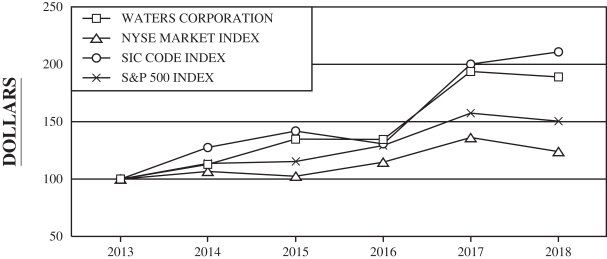
The following graph compares the cumulative total return on $100 invested as of December 31, 2013 (the last day of public trading of the Company’s common stock in fiscal year 2013) through December 31, 2018 (the last day of public trading of the common stock in fiscal year 2018) in the Company’s common stock, the NYSE Market Index, the SIC Code 3826 Index and the S&P 500 Index. The return of the indices is calculated assuming reinvestment of dividends during the period presented. The Company has not paid any dividends since its IPO. The stock price performance shown on the graph below is not necessarily indicative of future price performance.
COMPARISON OF CUMULATIVE TOTAL RETURN SINCE DECEMBER 31, 2013
AMONG WATERS CORPORATION, NYSE MARKET INDEX, SIC CODE 3826 INDEX – LABORATORY ANALYTICAL INSTRUMENTS AND S&P 500 INDEX
| 2013 | 2014 | 2015 | 2016 | 2017 | 2018 | |||||||||||||||||||
| WATERS CORPORATION | $ | 100.00 | $ | 112.72 | $ | 134.58 | $ | 134.39 | $ | 193.19 | $ | 188.65 | ||||||||||||
| NYSE MARKET INDEX | $ | 100.00 | $ | 106.75 | $ | 102.38 | $ | 114.61 | $ | 136.07 | $ | 123.89 | ||||||||||||
| SIC CODE INDEX | $ | 100.00 | $ | 127.50 | $ | 141.59 | $ | 130.44 | $ | 199.51 | $ | 210.24 | ||||||||||||
| S&P 500 INDEX | $ | 100.00 | $ | 113.69 | $ | 115.26 | $ | 129.05 | $ | 157.22 | $ | 150.33 |
Table of Contents
Purchases of Equity Securities by the Issuer
The following table provides information about purchases by the Company during the three months ended December 31, 2018 of equity securities registered by the Company under the Exchange Act (in thousands, except per share data):
| Period | Total Number of Shares Purchased (1) | Average Price Paid per Share | Total Number of Shares Purchased as Part of Publicly Announced Programs (2) | Maximum Dollar Value of Shares that May Yet Be Purchased Under the Programs (2) | ||||||||||||
| September 30 to October 27, 2018 | 128 | $ | 182.79 | 128 | $ | 2,968,685 | ||||||||||
| October 28 to November 24, 2018 | 1,126 | $ | 195.56 | 1,126 | $ | 2,748,484 | ||||||||||
| November 25 to December 31, 2018 | 1,466 | $ | 189.54 | 1,460 | $ | 2,471,785 | ||||||||||
| Total | 2,720 | $ | 191.71 | 2,714 | $ | 2,471,785 | ||||||||||
| (1) | The Company repurchased 6 thousand shares of common stock at a cost of less than $1 million related to the vesting of restricted stock units during the three months ended December 31, 2018. |
|---|
| (2) | In April 2018, the Company’s Board of Directors authorized the repurchase of up to $3.5 billion of its outstanding common stock in open market or private transactions over a three-year period. In January 2019, the Company’s Board of Directors authorized the Company to repurchase up to $4 billion of its outstanding common stock in open market or private transactions over a two-year period. This new program replaced the remaining amounts available under the April 2018 authorization. |
|---|
Table of Contents
Item 6. Selected Financial Data
| --- | --- |
The following table sets forth selected historical consolidated financial and operating data for the periods indicated. The statement of operations and balance sheet data is derived from financial statements for the years 2018, 2017, 2016, 2015 and 2014. The Company’s financial statements as of December 31, 2018 and 2017, and for each of the three years in the period ended December 31, 2018 are included in Part II, Item 8, Financial Statements and Supplementary Data, of this Form 10-K.
| In thousands, except per share and employees data | 2018 | 2017 | 2016 | 2015 | 2014 | |||||||||||||||
| STATEMENT OF OPERATIONS DATA: | ||||||||||||||||||||
| Net sales | $ | 2,419,929 | $ | 2,309,078 | $ | 2,167,423 | $ | 2,042,332 | $ | 1,989,344 | ||||||||||
| Income from operations before income taxes | $ | 682,146 | $ | 641,097 | $ | 600,114 | $ | 541,918 | $ | 490,740 | ||||||||||
| Net income* | $ | 593,794 | $ | 20,311 | $ | 521,503 | $ | 469,275 | $ | 431,620 | ||||||||||
| Net income per basic common share* | $ | 7.71 | $ | 0.25 | $ | 6.46 | $ | 5.70 | $ | 5.12 | ||||||||||
| Weighted-average number of basic common shares | 76,992 | 79,793 | 80,786 | 82,336 | 84,358 | |||||||||||||||
| Net income per diluted common share* | $ | 7.65 | $ | 0.25 | $ | 6.41 | $ | 5.65 | $ | 5.07 | ||||||||||
| Weighted-average number of diluted common shares and equivalents | 77,618 | 80,604 | 81,417 | 83,087 | 85,151 | |||||||||||||||
| BALANCE SHEET AND OTHER DATA: | ||||||||||||||||||||
| Cash, cash equivalents and investments | $ | 1,735,224 | $ | 3,393,701 | $ | 2,813,032 | $ | 2,399,263 | $ | 2,055,388 | ||||||||||
| Working capital, including current maturities of debt** | $ | 2,214,232 | $ | 3,663,977 | $ | 3,115,124 | $ | 2,649,457 | $ | 2,236,558 | ||||||||||
| Total assets** | $ | 3,727,426 | $ | 5,324,354 | $ | 4,662,059 | $ | 4,268,677 | $ | 3,874,690 | ||||||||||
| Long-term debt** | $ | 1,148,172 | $ | 1,897,501 | $ | 1,701,966 | $ | 1,493,027 | $ | 1,237,463 | ||||||||||
| Stockholders’ equity*** | $ | 1,567,258 | $ | 2,233,788 | $ | 2,301,949 | $ | 2,058,851 | $ | 1,894,666 | ||||||||||
| Employees | 7,246 | 7,020 | 6,899 | 6,594 | 6,161 |
| * | The provision for income taxes for 2017 includes a $550 million estimate for the impact of the enactment of the 2017 Tax Act, which was signed into law on December 22, 2017. The $550 million income tax provision reduced net income per share by $6.82. The $550 million income tax provision primarily consists of an estimated transition tax, as well as estimated income tax provisions for state and withholding taxes and a provision associated with the remeasurement of the Company’s deferred tax assets and liabilities from 35% to the new U.S. corporate income tax rate of 21%. |
|---|
The Company adopted new accounting guidance related to stock-based compensation in 2017. The new accounting guidance requires the excess tax benefits or deficiencies related to stock-based compensation to be reflected in the consolidated statements of operations as a component of the provision for income taxes, whereas they were previously recognized in equity. This aspect of the new accounting guidance was required to be adopted on a prospective basis for the statement of operations and retroactive restatement is not permitted. In 2018 and 2017, the Company recognized an excess tax benefit, which decreased income tax expense by $9 million and $20 million, respectively, and added $0.11 and $0.24, respectively, to net income per diluted share.
In addition, in December 2018, the Company settled a pension plan obligation by making lump-sum cash payments and purchasing annuity contracts for participants to permanently extinguish the pension plan’s obligations. As a result, the Company recorded a $46 million charge, which consisted of a $6 million cash contribution to the plan and a $40 million non-cash charge related to the reversal of unrecognized actuarial losses recorded in accumulated other comprehensive income in the stockholders’ equity. The $46 million pre-tax charge reduced net income per diluted share by $0.39.
Table of Contents
| ** | In 2015, the Company adopted new accounting guidance related to the presentation of debt issuance costs and deferred income taxes, both standards have been applied above retrospectively. Certain debt issuance costs have been reclassified from intangible assets and are presented as a direct deduction from the carrying value of the associated debt. Current deferred tax assets and liabilities have been reclassified as non-current deferred tax assets and liabilities. |
|---|
| *** | In 2018, the Company adopted new accounting guidance which eliminates the deferral of tax effects on intra-entity transfers other than inventory and requires an entity to recognize the income tax consequences when the transfer occurs. The Company adopted this standard as of January 1, 2018 with a $4 million charge to beginning retained earnings in the consolidated balance sheet. |
|---|
Item 7. Management’s Discussion and Analysis of Financial Condition and Results of Operations
| --- | --- |
Business and Financial Overview
The Company has two operating segments: WatersTM and TATM. Waters products and services primarily consist of high performance liquid chromatography (“HPLC”), ultra performance liquid chromatography (“UPLCTM” and together with HPLC, referred to as “LC”), mass spectrometry (“MS”) and precision chemistry consumable products and related services. TA products and services primarily consist of thermal analysis, rheometry and calorimetry instrument systems and service sales. The Company’s products are used by pharmaceutical, biochemical, industrial, nutritional safety, environmental, academic and governmental customers. These customers use the Company’s products to detect, identify, monitor and measure the chemical, physical and biological composition of materials and to predict the suitability and stability of fine chemicals, pharmaceuticals, water, polymers, metals and viscous liquids in various industrial, consumer goods and healthcare products.
The Company’s operating results are as follows for the years ended December 31, 2018, 2017 and 2016 (dollars in thousands, except per share data):
| Year Ended December 31, | % change | |||||||||||||||||||
| 2018 | 2017 | 2016 | 2018 vs. 2017 | 2017 vs. 2016 | ||||||||||||||||
| Revenues: | ||||||||||||||||||||
| Product sales | $ | 1,604,993 | $ | 1,552,349 | $ | 1,460,296 | 3 | % | 6 | % | ||||||||||
| Service sales | 814,936 | 756,729 | 707,127 | 8 | % | 7 | % | |||||||||||||
| Total net sales | 2,419,929 | 2,309,078 | 2,167,423 | 5 | % | 7 | % | |||||||||||||
| Costs and operating expenses: | ||||||||||||||||||||
| Cost of sales | 992,564 | 947,067 | 891,453 | 5 | % | 6 | % | |||||||||||||
| Selling and administrative expenses | 536,902 | 544,363 | 512,331 | (1 | %) | 6 | % | |||||||||||||
| Research and development expenses | 143,403 | 132,593 | 125,187 | 8 | % | 6 | % | |||||||||||||
| Purchased intangibles amortization | 7,712 | 6,743 | 9,889 | 14 | % | (32 | %) | |||||||||||||
| Litigation (settlement) provision | (426 | ) | 11,114 | 3,524 | (104 | %) | 215 | % | ||||||||||||
| Acquired in-process research and development | — | 5,000 | — | (100 | %) | — | ||||||||||||||
| Operating income | 739,774 | 662,198 | 625,039 | 12 | % | 6 | % | |||||||||||||
| Operating income as a % of sales | 30.6 | % | 28.7 | % | 28.8 | % | ||||||||||||||
| Other expense | (47,794 | ) | (340 | ) | (700 | ) | * | * | 51 | % | ||||||||||
| Interest expense, net | (9,834 | ) | (20,761 | ) | (24,225 | ) | (53 | %) | (14 | %) | ||||||||||
| Income before income taxes | 682,146 | 641,097 | 600,114 | 6 | % | 7 | % | |||||||||||||
| Provision for income taxes | 88,352 | 620,786 | 78,611 | (86 | %) | 690 | % | |||||||||||||
| Net income | $ | 593,794 | $ | 20,311 | $ | 521,503 | * | * | (96 | %) | ||||||||||
| Net income per diluted common share | $ | 7.65 | $ | 0.25 | $ | 6.41 | * | * | (96 | %) |
| ** | Percentage not meaningful |
|---|
Table of Contents
The Company’s net sales increased 5% in 2018 as compared to 2017, and 7% in 2017 as compared to 2016. Foreign currency translation increased sales growth by 1% in both 2018 and 2017. Recent acquisitions did not have an impact on sales growth. Unless otherwise noted, sales growth or decline percentages are presented as compared with the same period in the prior year.
Instrument system sales increased 2% and 6% in 2018 and 2017, respectively. In 2018, the increase in instrument system sales was primarily driven by an increase in demand for LC and TA’s instrument systems. During 2018, the demand for our LC-MS instrument systems was somewhat unfavorably impacted by the timing of new product introductions, as many of the Company’s new products were not launched until the second half of 2018 or early in 2019. In 2017, the demand for instrument system sales was balanced across our LC-MS and TA instrument systems. Recurring revenues (combined sales of precision chemistry consumables and services) increased 8% and 7% in 2018 and 2017, respectively, as a result of a larger installed base of customers and higher billing demand for service sales.
Geographically, the Company’s sales growth in both 2018 and 2017 was primarily driven by the 7% and 10% sales growth in Asia, respectively, with double-digit sales growth in China for both years. Europe’s sales grew 4% and 10% in 2018 and 2017, respectively, and benefited from the effect of foreign currency translation, which added 3% and 2% to sales growth, respectively. The Company’s 2018 sales were impacted by lower sales growth in India and Europe, resulting from lower customer demand for our instrument systems. Sales in the Americas grew 3% in 2018 and were flat in 2017. The Americas’ sales growth in 2017 was negatively impacted by natural disasters in the U.S., Mexico and Puerto Rico, as well as weaker customer sentiment in the first half of 2017.
Sales to pharmaceutical customers grew 5% and 7% in 2018 and 2017, respectively. These increases were driven by the increasing need for global access to prescription drugs and the testing of newer and more complex biologic drugs. Combined sales to industrial customers, which include materials characterization, food, environmental and fine chemical markets, grew 2% and 4% in 2018 and 2017, respectively. The growth in both 2018 and 2017 was driven by recent product introductions and rising global regulatory standards in both food and materials markets. Combined sales to governmental and academic customers increased 8% in both 2018 and 2017. Sales to governmental and academic customers are highly dependent on when institutions receive funding to purchase our instrument systems and, as such, sales growth rates can vary significantly from period to period.
Operating income was $740 million in 2018, an increase of 12% as compared to 2017. This increase was primarily a result of the effect of higher sales volume achieved in 2018, as well as the effect of approximately $33 million of facility closure, litigation and intellectual property payment charges from 2017 that did not recur in 2018.
Operating income increased 6% in 2017 as compared to 2016. This increase was primarily a result of the effect of higher sales volume achieved in 2017, which was somewhat offset by the impact of $13 million of severance costs primarily associated with the closure of a facility in Germany and costs associated with providing U.S. employees with an early retirement transition incentive; an $11 million litigation settlement provision and related costs and a $5 million charge relating to a milestone payment for the licensing of certain intellectual property relating to mass spectrometry technologies yet to be commercialized.
Showing the first 8K of 90K characters. Open the full section
Item 7A. Quantitative and Qualitative Disclosures About Market Risk
Derivative Transactions
The Company is a global company that operates in over 35 countries and, as a result, the Company’s net sales, cost of sales, operating expenses and balance sheet amounts are significantly impacted by fluctuations in foreign currency exchange rates. The Company is exposed to currency price risk on foreign currency exchange rate fluctuations when it translates its non-U.S. dollar foreign subsidiaries’ financial statements into U.S. dollars, and when any of the Company’s subsidiaries purchase or sell products or services in a currency other than its own currency.
The Company’s principal strategies in managing exposures to changes in foreign currency exchange rates are to (1) naturally hedge the foreign-currency-denominated liabilities on the Company’s balance sheet against corresponding assets of the same currency, such that any changes in liabilities due to fluctuations in foreign currency exchange rates are typically offset by corresponding changes in assets and (2) mitigate foreign exchange risk exposure of international operations by hedging the variability in the movement of foreign currency exchange rates on a portion of its Euro-denominated net asset investments. The Company presents the derivative transactions in financing activities in the statement of cash flows.
Table of Contents
Foreign Currency Exchange Contracts
The Company does not specifically enter into any derivatives that hedge foreign-currency-denominated operating assets, liabilities or commitments on its balance sheet, other than a portion of certain third-party accounts receivable and accounts payable, and the Company’s net worldwide intercompany receivables and payables, which are eliminated in consolidation. The Company periodically aggregates these net worldwide balances by currency and then enters into foreign currency exchange contracts that mature within 90 days to hedge a portion of the remaining balance to minimize some of the Company’s currency price risk exposure. The foreign currency exchange contracts are not designated for hedge accounting treatment. Principal hedged currencies include the Euro, Japanese yen, British pound, Mexican peso and Brazilian real.
Interest Rate Cross-Currency Swap Agreements
In 2018, the Company entered into three-year interest rate cross-currency swap derivative agreements with a notional value of $300 million to hedge the variability in the movement of foreign currency exchange rates on a portion of its Euro-denominated net asset investments. Under hedge accounting, the change in fair value of the derivative that relates to changes in the foreign currency spot rate are recorded in the currency translation adjustment in other comprehensive income and remain in accumulated comprehensive income in stockholders’ equity until the sale or substantial liquidation of the foreign operation. The difference between the interest rate received and paid under the interest rate cross-currency swap derivative agreement is recorded in interest income in the statement of operations.
The Company’s foreign currency exchange contracts and interest rate cross-currency swap agreements included in the consolidated balance sheets are classified as follows (in thousands):
| December 31, 2018 | December 31, 2017 | |||||||||||||||
| Notional Value | Fair Value | Notional Value | Fair Value | |||||||||||||
| Foreign currency exchange contracts: | ||||||||||||||||
| Other current assets | $ | 112,212 | $ | 503 | $ | 110,759 | $ | 566 | ||||||||
| Other current liabilities | $ | 40,175 | $ | 224 | $ | 37,104 | $ | 182 | ||||||||
| Interest rate cross-currency swap agreements: | ||||||||||||||||
| Other assets | $ | 300,000 | $ | 1,093 | $ | — | $ | — | ||||||||
| Accumulated other comprehensive income | $ | (1,093 | ) | $ | — |
The following is a summary of the activity included in the statements of comprehensive income related to the foreign currency exchange contracts (in thousands):
| Financial Statement Classification | ||||||||||||||
| Year Ended December 31, | ||||||||||||||
| 2018 | 2017 | 2016 | ||||||||||||
| Foreign currency exchange contracts: | ||||||||||||||
| Realized (losses) gains on closed contracts | Cost of sales | $ | (6,684 | ) | $ | 3,894 | $ | (10,401 | ) | |||||
| Unrealized (losses) gains on open contracts | Cost of sales | (105 | ) | 1,054 | (883 | ) | ||||||||
| Cumulative net pre-tax (losses) gains | Cost of sales | $ | (6,789 | ) | $ | 4,948 | $ | (11,284 | ) | |||||
| Interest rate cross-currency swap agreements: | ||||||||||||||
| Interest earned | Interest income | $ | 2,713 | $ | — | $ | — | |||||||
| Unrealized gains on open contracts | Stockholders’ equity | $ | 1,093 | $ | — | $ | — |
Table of Contents
Assuming a hypothetical adverse change of 10% in year-end exchange rates (a strengthening of the U.S. dollar), the fair market value of the foreign currency exchange contracts outstanding as of December 31, 2018 would decrease pre-tax earnings by approximately $15 million. Assuming a hypothetical adverse change of 10% in year-end exchange rates (a strengthening of the U.S. dollar), the fair market value of the interest rate cross-currency swap agreements outstanding as of December 31, 2018 would increase by approximately $30 million and would be recorded to foreign currency translation in other comprehensive income within stockholders’ equity. The related impact on interest income would not have a material effect on pre-tax earnings.
The Company’s cash and cash equivalents are not subject to significant interest rate risk due to the short maturities of these instruments. The Company’s cash equivalents represent highly liquid investments, with original maturities of 90 days or less, primarily in bank deposits, U.S. treasury bill money market funds and commercial paper. As of December 31, 2018, the carrying value of the Company’s cash and cash equivalents approximated fair value.
The Company is exposed to the risk of interest rate fluctuations from the investments of cash generated from operations. Investments with maturities greater than 90 days are classified as investments, and are held primarily in U.S. dollar-denominated treasury bills and commercial paper, bank deposits and corporate debt securities. As of December 31, 2018, the Company estimates that a hypothetical adverse change of 100 basis points across all maturities would not have a material effect on the fair market value of its portfolio.
The Company is also exposed to the risk of exchange rate fluctuations. The Company maintains cash balances in various operating accounts in excess of federally insured limits, and in foreign subsidiary accounts in currencies other than the U.S. dollar. As of December 31, 2018 and 2017, $471 million out of $1,735 million and $3,326 million out of $3,394 million, respectively, of the Company’s total cash, cash equivalents and investments were held by foreign subsidiaries. In addition, $251 million out of $1,735 million and $304 million out of $3,394 million of cash, cash equivalents and investments were held in currencies other than the U.S. dollar at December 31, 2018 and 2017, respectively. As of December 31, 2018, the Company has no holdings in auction rate securities or commercial paper issued by structured investment vehicles.
Assuming a hypothetical adverse change of 10% in year-end exchange rates (a strengthening of the U.S. dollar), the fair market value of the Company’s cash, cash equivalents and investments held in currencies other than the U.S. dollar as of December 31, 2018 would decrease by approximately $25 million, of which the majority would be recorded to foreign currency translation in other comprehensive income within stockholders’ equity.
Table of Contents
Item 8. Financial Statements and Supplementary Data
Management’s Report on Internal Control Over Financial Reporting
Our management is responsible for establishing and maintaining adequate internal control over financial reporting, as such term is defined in Rules 13a-15(f) and 15d-15(f) under the Exchange Act. Because of its inherent limitations, internal control over financial reporting may not prevent or detect misstatements. Also, projections of any evaluation of effectiveness to future periods are subject to the risk that controls may become inadequate because of changes in conditions, or that the degree of compliance with the policies or procedures may deteriorate.
Under the supervision and with the participation of our management, including our chief executive officer and chief financial officer, we conducted an evaluation of the effectiveness of our internal control over financial reporting based on the framework in Internal Control — Integrated Framework (2013) issued by the Committee of Sponsoring Organizations of the Treadway Commission (COSO). Based on our evaluation under the framework in Internal Control — Integrated Framework (2013), our management, including our chief executive officer and chief financial officer, concluded that our internal control over financial reporting was effective as of December 31, 2018.
The effectiveness of our internal control over financial reporting as of December 31, 2018 has been audited by PricewaterhouseCoopers LLP, an independent registered public accounting firm, as stated in their report which is included herein.
Table of Contents
Report of Independent Registered Public Accounting Firm
To the Board of Directors and Stockholders of Waters Corporation
Opinions on the Financial Statements and Internal Control over Financial Reporting
We have audited the accompanying consolidated balance sheets of Waters Corporation and its subsidiaries (the “Company”) as of December 31, 2018 and 2017, and the related consolidated statements of operations, comprehensive income, stockholders’ equity and cash flows for each of the three years in the period ended December 31, 2018, including the related notes and schedule of valuation and qualifying accounts for each of the three years in the period ended December 31, 2018 appearing under Item 15(c) (collectively referred to as the “consolidated financial statements”). We also have audited the Company’s internal control over financial reporting as of December 31, 2018, based on criteria established in Internal Control — Integrated Framework (2013) issued by the Committee of Sponsoring Organizations of the Treadway Commission (COSO).
In our opinion, the consolidated financial statements referred to above present fairly, in all material respects, the financial position of the Company as of December 31, 2018 and 2017, and the results of its operations and its cash flows for each of the three years in the period ended December 31, 2018 in conformity with accounting principles generally accepted in the United States of America. Also in our opinion, the Company maintained, in all material respects, effective internal control over financial reporting as of December 31, 2018, based on criteria established in Internal Control — Integrated Framework (2013) issued by the COSO.
Change in Accounting Principle
As discussed in Note 10 to the consolidated financial statements, the Company changed the manner in which it accounts for share-based payment transactions in 2017.
Basis for Opinions
The Company’s management is responsible for these consolidated financial statements, for maintaining effective internal control over financial reporting, and for its assessment of the effectiveness of internal control over financial reporting, included in the accompanying Management’s Report on Internal Control Over Financial Reporting. Our responsibility is to express opinions on the Company’s consolidated financial statements and on the Company’s internal control over financial reporting based on our audits. We are a public accounting firm registered with the Public Company Accounting Oversight Board (United States) (PCAOB) and are required to be independent with respect to the Company in accordance with the U.S. federal securities laws and the applicable rules and regulations of the Securities and Exchange Commission and the PCAOB.
We conducted our audits in accordance with the standards of the PCAOB. Those standards require that we plan and perform the audits to obtain reasonable assurance about whether the consolidated financial statements are free of material misstatement, whether due to error or fraud, and whether effective internal control over financial reporting was maintained in all material respects.
Our audits of the consolidated financial statements included performing procedures to assess the risks of material misstatement of the consolidated financial statements, whether due to error or fraud, and performing procedures that respond to those risks. Such procedures included examining, on a test basis, evidence regarding the amounts and disclosures in the consolidated financial statements. Our audits also included evaluating the accounting principles used and significant estimates made by management, as well as evaluating the overall presentation of the consolidated financial statements. Our audit of internal control over financial reporting included obtaining an understanding of internal control over financial reporting, assessing the risk that a material weakness exists, and testing and evaluating the design and operating effectiveness of internal control based on the assessed risk. Our audits also included performing such other procedures as we considered necessary in the circumstances. We believe that our audits provide a reasonable basis for our opinions.
Table of Contents
Definition and Limitations of Internal Control over Financial Reporting
A company’s internal control over financial reporting is a process designed to provide reasonable assurance regarding the reliability of financial reporting and the preparation of financial statements for external purposes in accordance with generally accepted accounting principles. A company’s internal control over financial reporting includes those policies and procedures that (i) pertain to the maintenance of records that, in reasonable detail, accurately and fairly reflect the transactions and dispositions of the assets of the company; (ii) provide reasonable assurance that transactions are recorded as necessary to permit preparation of financial statements in accordance with generally accepted accounting principles, and that receipts and expenditures of the company are being made only in accordance with authorizations of management and directors of the company; and (iii) provide reasonable assurance regarding prevention or timely detection of unauthorized acquisition, use, or disposition of the company’s assets that could have a material effect on the financial statements.
Because of its inherent limitations, internal control over financial reporting may not prevent or detect misstatements. Also, projections of any evaluation of effectiveness to future periods are subject to the risk that controls may become inadequate because of changes in conditions, or that the degree of compliance with the policies or procedures may deteriorate.
| /s/ PricewaterhouseCoopers LLP |
| Boston, Massachusetts |
| February 26, 2019 |
We have served as the Company’s auditor since 1994.
Table of Contents
WATERS CORPORATION AND SUBSIDIARIES
CONSOLIDATED BALANCE SHEETS
| December 31, | ||||||||
| 2018 | 2017 | |||||||
| (In thousands, except per share data) | ||||||||
| ASSETS | ||||||||
| Current assets: |
Showing the first 8K of 194K characters. Open the full section
Item 9. Changes in and Disagreements with Accountants on Accounting and Financial Disclosure
None.
Item 9A. Controls and Procedures
Evaluation of Disclosure Controls and Procedures
The Company’s chief executive officer and chief financial officer (principal executive officer and principal financial officer), with the participation of management, evaluated the effectiveness of the Company’s disclosure controls and procedures (as defined in Rules 13a-15(e) and 15d-15(e) under the Exchange Act) as of the end of the period covered by this annual report on Form 10-K. Based on this evaluation, the Company’s chief executive officer and chief financial officer concluded that the Company’s disclosure controls and procedures were effective as of December 31, 2018 (1) to ensure that information required to be disclosed by the Company, including its consolidated subsidiaries, in the reports that it files or submits under the Exchange Act is accumulated and communicated to the Company’s management, including its chief executive officer and chief financial officer, to allow timely decisions regarding the required disclosure and (2) to provide reasonable assurance that information required to be disclosed by the Company in the reports that it files or submits under the Exchange Act is recorded, processed, summarized and reported within the time periods specified in the SEC’s rules and forms.
Management’s Annual Report on Internal Control Over Financial Reporting
See Management’s Report on Internal Control Over Financial Reporting in Item 8 on page 49 of this Form 10-K.
Report of the Independent Registered Public Accounting Firm
See the report of PricewaterhouseCoopers LLP in Item 8 on page 50 of this Form 10-K.
Changes in Internal Controls Over Financial Reporting
No change was identified in the Company’s internal control over financial reporting (as defined in Rules 13a-15(f) and 15d-15(f) under the Exchange Act) during the quarter ended December 31, 2018 that has materially affected, or is reasonably likely to materially affect, the Company’s internal control over financial reporting.
Item 9B. Other Information
Item 10. Directors, Executive Officers and Corporate Governance
Information regarding the Company’s directors and any material changes to the process by which security holders may recommend nominees to the Board of Directors is contained in the definitive proxy statement for the 2019 Annual Meeting of Stockholders under the headings “Election of Directors”, “Directors Meetings and Board Committees”, “Corporate Governance”, “Report of the Audit Committee of the Board of Directors” and “Compensation of Directors and Executive Officers”. Information regarding compliance with Section 16(a) of the Exchange Act is contained in the Company’s definitive proxy statement for the 2019 Annual Meeting of Stockholders under the heading “Section 16(a) Beneficial Ownership Reporting Compliance”. Information regarding the Company’s Audit Committee and Audit Committee Financial Expert is contained in the definitive proxy statement for the 2019 Annual Meeting of Stockholders under the headings “Report of the Audit Committee of the Board of Directors” and “Directors Meetings and Board Committees”. Such information is incorporated herein by reference. Information regarding the Company’s executive officers is contained in Part I of this Form 10-K.
The Company has adopted a Global Code of Business Conduct & Ethics (the “Code”) that applies to all of the Company’s employees (including its executive officers) and directors and that is in compliance with Item 406 of Regulation S-K. The Code has been distributed to all employees of the Company. In addition, the Code is available on the Company’s website, www.waters.com, under the caption “Corporate Governance”. The Company intends to satisfy the disclosure requirement regarding any amendment to, or waiver of a provision of, the Code applicable to any executive officer or director by posting such information on its website. The Company shall also provide to any person without charge, upon request, a copy of the Code. Any such request must be made in writing to the Secretary of the Company, c/o Waters Corporation, 34 Maple Street, Milford, MA 01757.
The Company’s corporate governance guidelines and the charters of the audit committee, compensation committee, finance committee and nominating and corporate governance committee of the Board of Directors are available on the Company’s website, www.waters.com, under the caption “Corporate Governance”. The Company shall provide to any person without charge, upon request, a copy of any of the foregoing materials. Any such request must be made in writing to the Secretary of the Company, c/o Waters Corporation, 34 Maple Street, Milford, MA 01757.
In 2017, the Company adopted a proxy access bylaw provision that allows eligible stockholders or groups of up to 20 stockholders who have held at least 3% of the Company’s common stock continuously for three years to nominate up to two individuals or 20% of the Board of Directors, whichever is greater, for election at the Company’s Annual Meeting of Stockholders, and to have those individuals included in the Company’s proxy materials for that meeting. The Company believes that the proxy access bylaw adopted by the Company strikes an appropriate balance between providing meaningful proxy access for stockholders and limiting the potential for abuse.
Item 11. Executive Compensation
This information is contained in the Company’s definitive proxy statement for the 2019 Annual Meeting of Stockholders under the headings “Compensation of Directors and Executive Officers”, “Compensation Committee Interlocks and Insider Participation” and “Compensation Committee Report”. Such information is incorporated herein by reference.
Item 12. Security Ownership of Certain Beneficial Owners and Management and Related Stockholder Matters
| --- | --- |
Except for the Equity Compensation Plan information set forth below, this information is contained in the Company’s definitive proxy statement for the 2019 Annual Meeting of Stockholders under the heading “Security Ownership of Certain Beneficial Owners and Management”. Such information is incorporated herein by reference.
Table of Contents
Equity Compensation Plan Information
The following table provides information as of December 31, 2018 about the Company’s common stock that may be issued upon the exercise of options, warrants, and rights under its existing equity compensation plans (in thousands):
| A | B | C | ||||||||||
| Number of Securities to be Issued Upon Exercise of Outstanding Options, Warrants and Rights (1) | Weighted-Average Exercise Price of Outstanding Options, Warrants and Rights (1) | Number of Securities Remaining Available for Future Issuance Under Equity Compensation Plans (excluding securities reflected in column (A)) | ||||||||||
| Equity compensation plans approved by security holders | 2,234 | $ | 142.47 | 3,005 | ||||||||
| Equity compensation plans not approved by security holders | — | — | — | |||||||||
| Total | 2,234 | $ | 142.47 | 3,005 | ||||||||
| (1) | Column (a) includes an aggregate of 444 shares of common stock to be issued upon settlement of restricted stock, restricted stock units and performance stock units. The weighted-average share price in column (b) does not take into account restricted stock, restricted stock units or performance stock units, which do not have an exercise price. |
|---|
See Note 13, Stock-Based Compensation, in the Notes to Consolidated Financial Statements for a description of the material features of the Company’s equity compensation plans.
Item 13. Certain Relationships and Related Transactions and Director Independence
This information is contained in the Company’s definitive proxy statement for the 2019 Annual Meeting of Stockholders under the headings “Directors Meetings and Board Committees”, “Corporate Governance” and “Compensation of Directors and Executive Officers”. Such information is incorporated herein by reference.
Item 14. Principal Accountant Fees and Services
This information is contained in the Company’s definitive proxy statement for the 2019 Annual Meeting of Stockholders under the headings “Ratification of Selection of Independent Registered Public Accounting Firm” and “Report of the Audit Committee of the Board of Directors”. Such information is incorporated herein by reference.
Table of Contents
PART IV
Item 15. Exhibits, Financial Statement Schedules
(a) Documents filed as part of this report:
| (1) | Financial Statements: |
|---|
The consolidated financial statements of the Company and its subsidiaries are filed as part of this Form 10-K and are set forth on pages 52 to 97. The report of PricewaterhouseCoopers LLP, an independent registered public accounting firm, dated February 26, 2019, is set forth on page 50 of this Form 10-K.
| (2) | Financial Statement Schedule: |
|---|
See (c) below.
| (3) | Exhibits: |
|---|
Table of Contents
Table of Contents
| (1) | Incorporated by reference to the Registrant’s Report on Form 10-K dated March 29, 1996 (File No. 001-14010). |
|---|
| (2) | Incorporated by reference to the Registrant’s Registration Statement on Form S-1 (File No. 333-96934). |
|---|
| (3) | Incorporated by reference to the Registrant’s Report on Form 10-Q dated August 11, 1999 (File No. 001-14010). |
|---|
| (4) | Incorporated by reference to the Registrant’s Report on Form 10-Q dated August 8, 2000 (File No. 001-14010). |
|---|
| (5) | Incorporated by reference to the Registrant’s Report on Form 10-K dated March 28, 2002 (File No. 001-14010). |
|---|
| (6) | Incorporated by reference to the Registrant’s Report on Form S-8 dated November 20, 2003 (File No. 333-110613). |
|---|
| (7) | Incorporated by reference to the Registrant’s Report on Form 10-K dated March 12, 2004 (File No. 001-14010). |
|---|
| (8) | Incorporated by reference to the Registrant’s Report on Form 10-Q dated November 10, 2004 (File No. 001-14010). |
|---|
| (9) | Incorporated by reference to the Registrant’s Report on Form 10-Q dated August 5, 2005 (File No. 001-14010). |
|---|
| (10) | Incorporated by reference to the Registrant’s Report on Form 10-K dated March 1, 2007 (File No. 001-14010). |
|---|
| (11) | Incorporated by reference to the Registrant’s Report on Form 10-Q dated November 2, 2007 (File No. 001-14010). |
|---|
| (12) | Incorporated by reference to the Registrant’s Report on Form 10-K dated February 29, 2008 (File No. 001-14010). |
|---|
Table of Contents
| (13) | Incorporated by reference to the Registrant’s Report on Form 10-K dated February 27, 2009 (File No. 001-14010). |
|---|
| (14) | Incorporated by reference to the Registrant’s Report on Form S-8 dated July 10, 2009 (File No. 333-160507). |
|---|
| (15) | Incorporated by reference to the Registrant’s Report on Form 10-K dated February 26, 2010 (File No. 001-14010). |
|---|
| (16) | Incorporated by reference to the Registrant’s Report on Form 10-Q dated May 6, 2011 (File No. 001-14010). |
|---|
| (17) | Incorporated by reference to the Registrant’s Report on Form S-8 dated September 5, 2012 (File No. 333-183721). |
|---|
| (18) | Incorporated by reference to the Registrant’s Report on Form 8-K dated December 11, 2012 (File No. 001-14010). |
|---|
| (19) | Incorporated by reference to the Registrant’s Report on Form 8-K dated December 11, 2013 (File No. 001-14010). |
|---|
| (20) | Incorporated by reference to the Registrant’s Report on Form 10-Q dated August 1, 2014 (File No. 001-14010). |
|---|
| (21) | Incorporated by reference to the Registrant’s Report on Form 10-K dated February 27, 2015 (File No. 001-14010). |
|---|
| (22) | Incorporated by reference to the Registrant’s Report on Form 10-Q dated May 8, 2015 (File No. 001-14010). |
|---|
| (23) | Incorporated by reference to the Registrant’s Report on Form 10-Q dated August 7, 2015 (File No. 001-14010). |
|---|
| (24) | Incorporated by reference to the Registrant’s Report on Form 10-Q dated August 5, 2016 (File No. 001-14010). |
|---|
| (25) | Incorporated by reference to the Registrant’s Report on Form 8-K dated December 15, 2016 (File No. 001-14010). |
|---|
| (26) | Incorporated by reference to the Registrant’s Report on Form 10-K dated February 24, 2017 (File No. 001-14010). |
|---|
| (27) | Incorporated by reference to the Registrant’s Report on Form 8-K dated March 27, 2017 (File No. 001-14010). |
|---|
| (28) | Incorporated by reference to the Registrant’s Report on Form 10-Q dated November 3, 2017 (File No. 001-14010). |
|---|
| (29) | Incorporated by reference to the Registrant’s Report on Form 8-K dated December 8, 2017 (File No. 001-14010). |
|---|
| (30) | Incorporated by reference to the Registrant’s Report on Form 10-K dated February 27, 2018 (File No. 001-14010). |
|---|
| (P) | Paper Filing |
|---|
| (*) | Management contract or compensatory plan required to be filed as an Exhibit to this Form 10-K. |
|---|
| (**) | This exhibit shall not be deemed “filed” for purposes of Section 18 of the Exchange Act, or otherwise subject to the liability of that section, nor shall it be deemed incorporated by reference into any filing under the Securities Act of 1933, as amended, or the Exchange Act, whether made before or after the date hereof and irrespective of any general incorporation language in any filing, except to the extent the Company specifically incorporates it by reference. |
|---|
Table of Contents
| (b) | See Item 15 (a) (3) above. |
|---|
| (c) | Financial Statement Schedule: |
|---|
The following additional financial statement schedule should be considered in conjunction with the consolidated financial statements. All other schedules have been omitted because the required information is either not applicable or not sufficiently material to require submission of the schedule.
WATERS CORPORATION AND SUBSIDIARIES
SCHEDULE II - VALUATION AND QUALIFYING ACCOUNTS
For each of the three years in the period ended December 31, 2018
| Balance at Beginning of Period | Charged to Provision for Income Taxes* | Other** | Balance at End of Period | |||||||||||||
| Valuation allowance for deferred tax assets: | ||||||||||||||||
| 2018 | $ | 62,098 | $ | (2,128 | ) | $ | (6,077 | ) | $ | 53,893 | ||||||
| 2017 | $ | 61,225 | $ | (6,363 | ) | $ | 7,236 | $ | 62,098 | |||||||
| 2016 | $ | 68,595 | $ | (5,473 | ) | $ | (1,897 | ) | $ | 61,225 |
| * | These amounts have been recorded as part of the income statement provision for income taxes. The income statement effects of these amounts have largely been offset by amounts related to changes in other deferred tax balance sheet accounts. |
|---|
| ** | The change in the valuation allowance during the year ended December 31, 2018 is primarily due to the write-off of a valuation allowance to Retained Earnings for the tax effect related to intra-entity asset transfers. The change in the valuation allowance during the years ended December 31, 2017 and 2016 is primarily due to the effect of foreign currency translation on a valuation allowance related to a net operating loss carryforward. In addition, 2016 includes the release of a valuation allowance related to a foreign tax credit carryforward due to expiration. |
|---|
Item 16. Form 10-K Summary
The optional summary in Item 16 has not been included in this Form 10-K.
Table of Contents
SIGNATURES
Pursuant to the requirements of Section 13 or 15(d) of the Securities Exchange Act of 1934, the registrant has duly caused this report to be signed on its behalf by the undersigned, thereunto duly authorized.
| WATERS CORPORATION |
| /s/ SHERRY L. BUCK |
| Sherry L. Buck |
| Senior Vice President and |
| Chief Financial Officer |
Date: February 26, 2019
Pursuant to the requirements of the Securities Exchange Act of 1934, this report has been signed by the following persons on behalf of the registrant and in the capacities indicated on February 26, 2019.
| /S/ CHRISTOPHER J. O’CONNELL | Chairman of the Board of Directors and Chief | |
| Christopher J. O’Connell | Executive Officer (principal executive officer) | |
| /S/ SHERRY L. BUCK | Senior Vice President and Chief Financial Officer | |
| Sherry L. Buck | (principal financial officer) (principal accounting officer) | |
| /S/ LINDA BADDOUR | Director | |
| Linda Baddour | ||
| /S/ DR. MICHAEL J. BERENDT | Director | |
| Dr. Michael J. Berendt | ||
| /S/ EDWARD CONARD | Director | |
| Edward Conard | ||
| /S/ DR. LAURIE H. GLIMCHER | Director | |
| Dr. Laurie H. Glimcher | ||
| /S/ GARY HENDRICKSON | Director | |
| Gary Hendrickson | ||
| /S/ CHRISTOPHER A. KUEBLER | Director | |
| Christopher A. Kuebler | ||
| /S/ FLEMMING ORNSKOV | Director | |
| Flemming Ornskov | ||
| /S/ JOANN A. REED | Director | |
| JoAnn A. Reed | ||
| /S/ THOMAS P. SALICE | Director | |
| Thomas P. Salice |