 filings.tools
Waters 10-K 2022-12-31
Filed 2023-02-27. 16 sections, 418K characters. Original on sec.gov · Markdown · JSON
Cover and table of contents
Table of Contents
UNITED STATES
SECURITIES AND EXCHANGE COMMISSION
Washington, D.C. 20549
Form 10-K
| ☑ | ANNUAL REPORT PURSUANT TO SECTION 13 OR 15(d) |
|---|
| OF THE SECURITIES EXCHANGE ACT OF 1934 |
|---|
For the fiscal year ended December 31, 2022
or
| ☐ | TRANSITION REPORT PURSUANT TO SECTION 13 OR 15(d) |
|---|
| OF THE SECURITIES EXCHANGE ACT OF 1934 |
|---|
Commission File Number:
01-14010
Waters Corporation
(Exact name of registrant as specified in its charter)
| Delaware | 13-3668640 | |
| (State or other jurisdiction of incorporation or organization) | (I.R.S. Employer Identification No.) |
34 Maple Stree
t
Milford, Massachusetts 01757
(Address, including zip code, of principal executive offices)
(508) 478-2000
(Registrant’s telephone number, including area code)
Securities registered pursuant to Section 12(b) of the Act:
| Title of each class | Trading Symbol(s) | Name of each exchange on which registered | ||
| Common Stock, par value $0.01 per share | WAT | New York Stock Exchange, Inc. |
| Securities registered pursuant to Section 12(g) of the Act: | None |
Indicate by check mark if the registrant is a well-known seasoned issuer, as defined in Rule 405 of the Securities Act. Yes ☑ No ☐
Indicate by check mark if the registrant is not required to file reports pursuant to Section 13 or Section 15(d) of the Act. Yes ☐ No ☑
Indicate by check mark whether the registrant (1) has filed all reports required to be filed by Section 13 or 15(d) of the Securities Exchange Act of 1934 during the preceding 12 months (or for such shorter period that the registrant was required to file such reports), and (2) has been subject to such filing requirements for the past 90 days. Yes ☑ No ☐
Indicate by check mark whether the registrant has submitted electronically every Interactive Data File required to be submitted pursuant to Rule 405 of Regulation
S-T
(§232.405 of this chapter) during the preceding 12 months (or for such shorter period that the registrant was required to submit such files). Yes ☑ No ☐
Indicate by check mark whether the registrant is a large accelerated filer, an accelerated filer, a
non-accelerated
filer, a smaller reporting company, or emerging growth company. See the definitions of “large accelerated filer”, “accelerated filer”, “smaller reporting company”, and “emerging growth company” in
Rule 12b-2
of the Exchange Act. (Check one):
| Large accelerated filer ☑ | Accelerated filer ☐ | Non-accelerated filer ☐ | Smaller reporting company ☐ | |||
| Emerging growth company ☐ |
If an emerging growth company, indicate by check mark if the registrant has elected not to use the extended transition period for complying with any new or revised financial accounting standards provided pursuant to Section 13(a) of the Exchange Act. ☐
Indicate by check mark whether the registrant has filed a report on and attestation to its management’s assessment of the effectiveness of its internal control over financial reporting under Section 404(b) of the Sarbanes-Oxley Act (15 U.S.C. 7262(b)) by the registered public accounting firm that prepared or issued its audit report. ☑
If securities are registered pursuant to Section 12(b) of the Act, indicate by check mark whether the financial statements of the registrant included in the filing reflect the correction of an error to previously issued financial statements. ☐
Indicate by check mark whether any of those error corrections are restatements that required a recovery analysis of incentive based compensation received by any of the registrant’s executive officers during the relevant recovery period pursuant to
§240.10D-1(b).
☐
Indicate by check mark whether the registrant is a shell company (as defined in
Rule 12b-2
of the Act). Yes ☐ No ☑
State the aggregate market value of the registrant’s common stock held by
non-affiliates
of the registrant as of July 1, 2022: $20,209,471,189.
Indicate the number of shares outstanding of the registrant’s common stock as of February 24, 202
3: 58,943,567
DOCUMENTS INCORPORATED BY REFERENCE
Portions of the registrant’s definitive proxy statement that will be filed for the 2023 Annual Meeting of Stockholders are incorporated by reference in Part III.
Table of Contents
WATERS CORPORATION AND SUBSIDIARIES
ANNUAL REPORT ON FORM 10-K
INDEX
Table of Contents
PART I
Item 1. Business
General
Waters Corporation (the “Company,” “WatersTM,” “we,” “our,” or “us”) is a specialty measurement company that operates with a fundamental underlying purpose to advance the science that enables our customers to enhance human health and well-being. Waters has pioneered analytical workflow solutions involving liquid chromatography, mass spectrometry and thermal analysis innovations serving the life, materials and food sciences for more than 60 years. The Company primarily designs, manufactures, sells and services high-performance liquid chromatography (“HPLC”), ultra-performance liquid chromatography (“UPLCTM” and together with HPLC, referred to as “LC”) and mass spectrometry (“MS”) technology systems and support products, including chromatography columns, other consumable products and comprehensive post-warranty service plans. These systems are complementary products that are frequently employed together (“LC-MS”) and sold as integrated instrument systems using common software platforms. In addition, the Company designs, manufactures, sells and services thermal analysis, rheometry and calorimetry instruments through its TA InstrumentsTM (“TA”) product line. The Company is also a developer and supplier of advanced software-based products that interface with the Company’s instruments, as well as other manufacturers’ instruments.
The Company’s products are used by pharmaceutical, clinical, biochemical, industrial, nutritional safety, environmental, academic and governmental customers working in research and development, quality assurance and other laboratory applications. LC is a standard technique and is utilized in a broad range of industries to detect, identify, monitor and measure the chemical, physical and biological composition of materials, and to purify a full range of compounds. MS technology, principally in conjunction with chromatography, is employed in drug discovery and development, including clinical trial testing, the analysis of proteins in disease processes (known as “proteomics”), nutritional safety analysis and environmental testing. LC-MS instruments combine a liquid phase sample introduction and separation system with mass spectrometric compound identification and quantification. The Company’s thermal analysis, rheometry and calorimetry instruments are used in predicting the suitability and stability of fine chemicals, pharmaceuticals, water, polymers, metals and viscous liquids for various industrial, consumer goods and healthcare products, as well as for life science research.
Waters Corporation, organized as a Delaware corporation in 1991, is a holding company that owns all of the outstanding common stock of Waters Technologies Corporation, its operating subsidiary. Waters Corporation became a publicly traded company with its initial public offering (“IPO”) in November 1995. Since the IPO, the Company has added two significant and complementary technologies to its range of products with the acquisitions of TA Instruments in May 1996 and Micromass Limited in September 1997.
Business Segments
The Company’s business activities, for which discrete financial information is available, are regularly reviewed and evaluated by the chief operating decision maker. As a result of this evaluation, the Company determined that it has two operating segments: Waters and TA. The Waters operating segment is primarily in the business of designing, manufacturing, selling and servicing LC and MS instrument systems, columns and other precision chemistry consumables that can be integrated and used along with other analytical instruments. The TA operating segment is primarily in the business of designing, manufacturing, selling and servicing thermal analysis, rheometry and calorimetry instruments. The Company’s two operating segments have similar economic characteristics; product processes; products and services; types and classes of customers; methods of distribution; and regulatory environments. Because of these similarities, the two segments have been aggregated into one reporting segment for financial statement purposes.
Information concerning revenues and long-lived assets attributable to each of the Company’s products, services and geographic areas is set forth in Note 18 in the Notes to the Consolidated Financial Statements, which is incorporated herein by reference.
Table of Contents
Waters Products and Markets
High-Performance and Ultra-Performance Liquid Chromatography
HPLC is a standard technique used to identify and analyze the constituent components of a variety of chemicals and other materials. The Company believes that HPLC’s performance capabilities enable it to separate, identify and quantify a high proportion of all known chemicals. As a result, HPLC is used to analyze substances in a wide variety of industries for research and development purposes, quality control and process engineering applications.
The most significant end-use markets for HPLC are those served by the pharmaceutical and life science industries. In these markets, HPLC is used extensively to understand diseases, identify new drugs, develop manufacturing methods and assure the potency and purity of new pharmaceuticals. HPLC is also used in a variety of other applications, such as analyses of foods and beverages for nutritional labeling and compliance with safety regulations and the testing of water and air purity within the environmental testing industry, as well as applications in other industries, such as chemical and consumer products. Waters also has in vitro diagnostic labelled products that are used as general-purpose instruments for clinical diagnostic applications, such as newborn screening and therapeutic drug management, in countries where these products are registered. HPLC is also used by universities, research institutions and governmental agencies, such as the United States Food and Drug Administration (“FDA”) and the United States Environmental Protection Agency (“EPA”) and their foreign counterparts that mandate safety and efficacy testing.
In 2004, Waters introduced a novel technology that the Company describes as ultra-performance liquid chromatography that utilizes a packing material with small, uniform diameter particles and a specialized instrument, the ACQUITY UPLCTM, to accommodate the increased pressure and narrower chromatographic bands that are generated by these small and tightly packed particles. By using the ACQUITY UPLC, researchers and analysts are able to achieve more comprehensive chemical separations and faster analysis times in comparison with many analyses previously performed by HPLC. In addition, in using the ACQUITY UPLC, researchers have the potential to extend the range of applications beyond that of HPLC, enabling them to uncover more levels of scientific information. While offering significant performance advantages, the ACQUITY UPLC is also compatible with the Company’s software products and the general operating protocols of HPLC. For these reasons, the Company’s customers and field sales and support organizations are well positioned to utilize this innovative technology and instrument. In 2018, the Company introduced the ACQUITY ARCTM Bio System, a versatile, iron-free, bio-inert, quaternary liquid chromatograph specifically engineered to improve bioseparation analytical methods. The Company also introduced the ACQUITY UPLC PLUS series in 2018, consisting of the H-Class PLUS, H-Class PLUS Bio and I-Class PLUS systems, which incorporate foundational enhancements into the legacy systems.
Waters manufactures LC instruments that are offered in configurations that allow for varying degrees of automation, from component configured systems for academic teaching and research applications to fully automated systems for regulated and high sample throughput testing, and that have a variety of detection technologies, from optical-based ultra-violet absorbance, refractive index and fluorescence detectors to a suite of MS-based detectors, optimized for certain analyses.
In 2019, the Company introduced the ACQUITYTM Advanced Polymer ChromatographyTM System, which is the first fully solvent-compatible UPLC system to perform size exclusion, gradient polymer elution and solvent compatible reversed-phase liquid chromatographic separations on a single platform. The all-in-one system gives research scientists greater analytical versatility and speed when conducting research on next-generation polymers. In 2020, the Company introduced the Waters ArcTM HPLC System, a new HPLC system for routine testing in the pharmaceutical, food, academic and materials markets. A key target application is quality control in laboratories performing batch release tests on small molecule pharmaceuticals. In 2021, the Company introduced the new ACQUITY PREMIER LC solution and the Arc Premier System both featuring Waters’ MaxPeakTM High Performance Surface (“HPS”) technology. MaxPeakTM HPS technology, which was first introduced with
Table of Contents
the Company’s introduction of ACQUITYTM PREMIER Columns in 2020, is a surface technology that forms a barrier between the sample and the metal surfaces of both the system and column, eliminating the need for system passivation, mitigating the loss of metal-sensitive analytes and yielding higher quality data in less time and effort.
The primary consumable products for LC instruments are chromatography columns. These columns are packed with separation media used in the LC testing process and are typically replaced at regular intervals. The chromatography column contains one of several types of packing material, typically stationary phase particles made from silica or polymeric resins. As a pressurized sample is introduced to the column inlet and permeates through the packed column, it is separated into its constituent components.
Waters HPLC columns can be used on Waters-branded and competitors’ LC systems. The Company believes that it is one of a few suppliers in the world that manufactures silica and polymeric resins, packs columns and distributes its own products. In doing so, the Company believes it can better ensure product consistency, a key attribute for its customers in quality control laboratories, and can react quickly to new customer requirements. The Company believes that its ACQUITY UPLC lines of columns are used primarily on its ACQUITY UPLC instrument systems and, furthermore, that its ACQUITY UPLC instruments primarily use ACQUITY UPLC columns. In 2019, the Company introduced the BioResolv SCX mAb Columns and VanGuardTM FIT Cartridge technologies. These new cation exchange column lines with specialized consumables are designed to simplify and improve the characterization and monitoring of monoclonal antibody (“mAb”) therapeutics, as well as enable mAb charge-variant analyses as required by the World Health Organization, the FDA and the International Conference on Harmonization for confirming the efficacy and safety of biologics and biosimilars with discovery, development and manufacturing applications. In 2020, Waters introduced ACQUITYTM PREMIER Columns, a new family of premium sub-2-micron columns featuring MaxPeakTM HPS technology. The columns are for use with any brand of UPLC system and can measurably improve data quality by mitigating the loss of sample analytes due to analyte-to-surface interactions.
The Company’s precision chemistry consumable products also include environmental and nutritional safety testing products, including Certified Reference Materials and Proficiency Testing products. Laboratories around the world and across multiple industries use these products for quality control and proficiency testing and also purchase product support services required to help with their federal and state mandated accreditation requirements or with quality control over critical pharmaceutical analysis.
In 2020, the Company acquired all of the outstanding stock of Andrew Alliance, S.A. and its two operating subsidiaries, Andrew Alliance USA, Inc. and Andrew Alliance France, SASU (collectively, “Andrew Alliance”), for $80 million, net of cash acquired. Andrew Alliance offers lab workflow automation solutions with the combination of its software platform and smart, connected laboratory equipment and accessories. The Company anticipates that full integration of Andrew Alliance will allow us to positively impact our customers’ workflows by improving the repeatability, performance and speed of laboratory operations and chemistry workflows.
Mass Spectrometry and Liquid Chromatography-Mass Spectrometry
MS is a powerful analytical technology that is used to identify unknown compounds, to quantify known materials and to elucidate the structural and chemical properties of molecules by measuring the masses of molecules that have been converted into ions.
The Company is a technology and market leader in the development, manufacture, sale and service of MS instruments and components. These instruments are typically integrated and used along with other complementary analytical instruments and systems, such as LC, chemical electrophoresis and gas chromatography. A wide variety of instrumental designs fall within the overall category of MS instrumentation, including devices that incorporate quadrupole, ion trap, time-of-flight (“Tof”), magnetic sector and ion mobility technologies. Furthermore, these technologies are often used in tandem to maximize the speed and/or efficacy of certain experiments.
Table of Contents
Currently, the Company offers a wide range of MS instrument systems utilizing various combinations of quadrupole, Tof and ion mobility designs. These instrument systems are used in drug discovery and development, as well as for environmental, clinical and nutritional safety testing. The overwhelming majority of mass spectrometers sold by the Company are designed to utilize an LC system and a liquid compatible interface (such as an electrospray ionization source) as the sample introduction device. These products supply a diverse market with a strong emphasis on the pharmaceutical, biomedical, clinical, food and beverage and environmental market segments worldwide.
MS is an increasingly important detection technology for LC. The Company’s smaller-sized mass spectrometers, such as the single quadrupole detector and the tandem quadrupole detector (“TQD”), are often referred to as LC “detectors” and are typically sold as part of an LC system or as an LC system upgrade. Larger quadrupole systems, such as the XevoTM TQ and Xevo TQ-S instruments, are used primarily for experiments performed for late-stage drug development, including clinical trial testing. Quadrupole time-of-flight (“Q-Tof”) instruments, such as the Company’s SYNAPTTM G2-S, are often used to analyze the role of proteins in disease processes, an application sometimes referred to as “proteomics”.
LC and MS are typically embodied within an analytical system tailored for either a dedicated class of analyses or as a general-purpose analytical device. An increasing percentage of the Company’s customers are purchasing LC and MS components simultaneously and it has become common for LC and MS instrumentation to be used within the same laboratory and operated by the same user. The descriptions of LC and MS above reflect the historical segmentation of these analytical technologies and the historical categorization of their respective practitioners. Increasingly in today’s instrument market, this segmentation and categorization is becoming obsolete as a high percentage of instruments used in the laboratory embody both LC and MS technologies as part of a single device. In response to this development and to further promote the high utilization of these hybrid instruments, the Company has organized its Waters operating segment to develop, manufacture, sell and service integrated LC-MS systems.
In 2019, the Company introduced the BioAccordTM system, a liquid chromatography-mass spectrometry solution that expands access to high-resolution time-of-flight mass spectrometry capabilities. The system provides new levels of user experience with automated setup and self-diagnosis delivered through an intuitive user interface. Also in 2019, the Company introduced the Cyclic IMS system, which seamlessly integrates cyclic ion mobility technology into a high-performance research-grade time-of-flight mass spectrometer. In addition, the Company introduced the SYNAPT XS, a new highly flexible, high-resolution mass spectrometer for research and development labs focused on discovery applications. The Company also reinforced its tandem quadrupole mass spectrometry portfolio during the current year with upgrades to the Xevo TQ-S micro and the introduction of the new Xevo TQ-S cronos. The Xevo TQ-S micro features new performance enhancements that bring the quantitation of highly polar, ionic compounds in food to a higher level. The Xevo TQ-S cronos is a new, tandem quadrupole mass spectrometer purposely built for routine quantitation of large numbers of small-molecule organic compounds over a wide concentration range. The Xevo TQ-S micro and the Xevo TQ-S cronos are also well suited to meet regulatory requirements for pesticide residue analysis, the monitoring for contaminants in processed foods, identifying drugs of abuse, and performing impurity profiling of pharmaceuticals. In 2020, the Company introduced the new RADIANTM ASAPTM System, a novel direct mass detector engineered for non-mass spectrometry experts to conduct fast and accurate analyses of solids and liquids with minimal sample prep. Also in 2020, the Company introduced enhancements for the Waters Xevo G2-XS QTof SYNAPT XS and SELECT SERIES Cyclic IMS, including a new fragmentation technique and imaging option.
In 2021, the Company introduced the Waters SELECT SERIESTM MRT, a high-resolution mass spectrometer that combines Multi-Reflecting Time-of-Flight (“MRT”) technology with enhanced desorption electrospray ionization and new matrix-assisted laser desorption ionization imaging sources. The platform will serve as the basis for Waters’ next generation Tof instruments with applications in pharmaceutical, biomedical, natural products, and materials research. Also in 2021, the Company released the ACQUITY RDa™ Detector featuring SmartMS™, the company’s newest Tof MS designed to improve the ease and reliability of small
Table of Contents
molecule analysis for pharmaceutical, academic, food, and forensic applications. The Company also introduced a new peptide multi-attribute method workflow for the BioAccord LC-MS system in 2021, which is an end-to-end workflow for analyzing monoclonal antibodies and other protein and peptide-based drugs.
In 2022, the Company introduced the new Xevo™ TQ Absolute system, the most sensitive and compact benchtop tandem mass spec in its class. The Company introduced the new Xevo™ G3 quadrupole time-of-flight (“QTof”) mass spectrometer with CONFIRM Sequence—a new oligonucleotide sequencing confirmation app for the waters_connect™ software platform and an electrospray ionization source for the high-resolution Waters™ SELECT SERIES™ Multi-Reflecting Time-of-Flight mass spectrometer.
Based upon 2022 reports from independent marketing research firms and publicly disclosed sales figures from competitors, the Company believes that it is one of the world’s largest manufacturers and distributors of LC and LC-MS instrument systems, chromatography columns and other consumables and related services.
The Company has been a developer and supplier of software-based products that interface with both the Company’s and other suppliers’ instruments. The Company’s newest software technology is the waters_connectTM platform. In 2019, the Company introduced the first of a series of applications on this platform supporting the BioAccord system and the Xevo G2 XS mass spectrometers. These applications support biopharmaceutical workflows, simplifying the collection of often complex LCMS data for use in biopharmaceutical development and into QC where it is used to assure the quality of existing medicines and new drug formulations. The platform design of waters_connect has enabled rapid delivery of several major updates including new biopharma application workflows designed in close collaboration with biopharmaceutical innovators to solve specific challenges they face with existing solutions. The platform also provides the foundation for the connected lab of the future where data is no longer siloed but can be securely shared among a community of connected scientists. Waters_connect joins the existing suite of informatics products – Empower™ Chromatography Data Software, MassLynx™ Mass Spectrometry Software and NuGenesis™ Scientific Data Management System, each of which is used to support innovations within world-leading institutions. In 2020, Waters announced the availability of Waters Empower BC LAC/ETM with SecureSync, an enhanced solution to preserve the ability for laboratories to work locally when organizations with distributed laboratory environments experience an enterprise interruption.
On December 15, 2020, the Company acquired all of the outstanding stock of Integrated Software Solutions Pty Limited and its two operating subsidiaries Integrated Software Solutions Limited and Integrated Software Solutions USA, LLC (collectively, “ISS”), for $4 million, net of cash acquired. In addition to the cash paid at closing there was an earn out provision in which the Company would have to pay an additional $2 million to the shareholders of ISS if certain revenue and customer account conditions are achieved in the two years subsequent to the acquisition date. This contingent consideration is recorded as a liability. As of the balance sheet date the earn out period has been completed. ISS offers clinical laboratory software systems that support and further expand product offerings within our clinical business. The net assets acquired primarily relate to ISS’ laboratory information system, OMNI-Lab.
In 2022, the Company introduced a new Per-and Polyfluoroalkyl Substances (“PFAS”) quantitation workflow enabled by enhancements to its waters_connect™ for quantitation software and the Company introduced Extraction+ Connected Device, a new software-controlled product for the Waters™ Andrew+™ Pipetting Robot that automates the preparation of biological, food, forensics and environmental samples by solid phase extraction.
Waters Service
Services provided by Waters enable customers to maximize technology productivity, support customer compliance activities and provide transparency into enterprise resource management efficiencies. The customer benefits from improved budget control, data-driven technology adoption and accelerated workflow at a site or on
Table of Contents
a global perspective. The Company considers its service offerings to be highly differentiated from its competition, as evidenced by a consistent increase in annual service revenues. The Company’s principal competitors in the service market include PerkinElmer, Inc., Agilent Technologies, Inc. and Thermo Fisher Scientific Inc. These competitors can provide certain services on Waters instruments to varying degrees and always present competitive risk.
The servicing and support of instruments, software and accessories is an important source of revenue and represented over 35% of sales for Waters in 2022. These revenues are derived primarily through the sale of support plans, demand services, spare parts, customer performance validation services and customer training. Support plans typically involve scheduled instrument maintenance and an agreement to promptly repair a non-functioning instrument in return for a fee described in a contract that is priced according to the configuration of the instrument.
TA Products and Markets
Thermal Analysis, Rheometry and Calorimetry
Thermal analysis measures the physical or thermodynamic characteristics of materials as a function of temperature. Changes in temperature affect several characteristics of materials, such as their heat flow characteristics, physical state, weight, dimension and mechanical and electrical properties, which may be measured by one or more thermal analysis techniques, including calorimetry. Consequently, thermal analysis techniques are widely used in the development, production and characterization of materials in various industries, such as plastics, chemicals, automobiles, pharmaceuticals and electronics.
Rheometry instruments often complement thermal analyzers in characterizing materials. Rheometry characterizes the flow properties of materials and measures their viscosity, elasticity and deformation under different types of “loading” or other conditions. The information obtained under such conditions provides insight into a material’s behavior during processing, packaging, transport, usage and storage.
Thermal analysis, rheometry and calorimetry instruments are heavily used in material testing laboratories and, in many cases, provide information useful in predicting the suitability and stability of industrial polymers, fine chemicals, pharmaceuticals, water, metals and viscous liquids in various industrial, consumer goods and healthcare products, as well as for life science research. As with systems offered by Waters, a range of instrument configurations is available with increasing levels of sample handling and information processing automation. In addition, systems and accompanying software packages can be tailored for specific applications.
In 2020, TA introduced the new Discovery X3 Differential Scanning Calorimeter (“X3 DSC”), Discovery Hybrid Rheometers and TAM IV Micro XL isothermal microcalorimeter. The X3 DSC accelerates productivity in customers’ laboratories by enabling three samples to be measured in a single experiment, compared to the single-sample series operation of the other available DSC offerings in the market. This particularly addresses a need in high-throughput laboratories in industries such as composites, electronics and polymer manufacturing. The new line of Discovery Hybrid Rheometers provides increased sensitivity and versatility of rheometry measurements, supporting the development of next-generation, high-performance materials by improving the productivity and efficiency of materials science research. The TAM IV Micro XL isothermal calorimeter supports the development of new battery chemistries by measuring self-discharge and unwanted reactions that reduce battery life and efficiency.
In 2021, TA introduced the TMA 450RH and the Discovery SA. The TMA 450RH provides measurements of dimensional compatibility of materials under controlled temperature and humidity that are important for the development of new electronic devices. The Discovery SA is used in pharmaceutical development to assess the impact of moisture in drug product processing and storage on crystalline structure, which is related to drug product efficacy.
Table of Contents
In 2021, TA introduced the TRIOS AutoPilot software for its thermal analyzer product line. This software helps laboratory staff using TA’s thermal analyzers create routine and streamlined standard operating procedures improving the speed and productivity of thermal analysis measurements.
In 2022, TA introduced the Powder Rheology Accessory, which enables our Discovery Hybrid Rheometers to characterize the behavior of powders during storage, dispensing, processing and end-use. The Powder Rheology Accessory provides relevant property and processing measurements for battery electrode coatings to prevent defects that cause cell failure and pharmaceutical tablets to prevent instabilities of API blends.
In 2022, TA introduced Polymer Workflow Guided Methods, which provides walk up and use functionality by codifying polymer workflows. Guided Methods leverages the power of AutoPilot and enables novice users to quickly learn and use the instrument to set up test methods, run tests, and execute analyses across our Thermal Analysis and Rheology product lines.
TA Service
Similar to Waters, the servicing and support of TA’s instruments is an important source of revenue and represented more than 25% of sales for TA in 2022. TA operates independently from the Waters operating segment, though many of its overseas offices are jointly occupied with Waters to achieve operational efficiencies. TA has dedicated field sales and service operations. Service sales are primarily derived from the sale of support plans, replacement parts and billed labor fees associated with the repair, maintenance and upgrade of installed systems.
Global Customers
The Company typically has a broad and diversified customer base that includes pharmaceutical accounts, other industrial accounts, universities and governmental agencies. Purchase of the Company’s instrument systems is often dependent on its customers’ capital spending, or funding as in the cases of academic, governmental and research institutions, which often fluctuate from year to year. The pharmaceutical segment represents the Company’s largest sector and includes multinational pharmaceutical companies, generic drug manufacturers, contract research organizations (“CRO”s) and biotechnology companies. The Company’s other industrial customers include chemical manufacturers, polymer manufacturers, food and beverage companies and environmental testing laboratories. The Company also sells to universities and governmental agencies worldwide. The Company’s technical sales and support staff members work closely with its customers in developing and implementing applications that meet their full range of analytical requirements. During 2022, 59% of the Company’s net sales were to pharmaceutical accounts, 31% to other industrial accounts and 10% to academic institutions and governmental agencies. Although the Company transacts business with various government agencies, no government contract is of such magnitude that a renegotiation of profits or termination of the contract at the election of the government agency would have a material adverse effect on the Company’s financial results.
The Company typically experiences an increase in sales in the fourth quarter, as a result of purchasing habits for capital goods of many customers who tend to exhaust their spending budgets by calendar year-end. The Company does not rely on any single customer for a material portion of its sales. During fiscal years 2022, 2021 and 2020, no single customer accounted for more than 2% of the Company’s net sales.
Sales and Service
The Company has one of the largest direct sales and service organizations focused exclusively on the analytical workflows offered by the Company. Across these product technologies, using respective specialized sales and service workforces, the Company serves its customer base with 83 sales offices throughout the world as of December 31, 2022 and approximately 4,500, 4,300 and 4,000 field representatives in 2022, 2021 and 2020,
Table of Contents
respectively. This investment in sales and service personnel serves to maintain and expand the Company’s installed base of instruments. The Company’s sales representatives have direct responsibility for account relationships, while service representatives work in the field to install instruments, train customers and minimize instrument downtime. In-house and field-based technical support representatives work directly with customers, providing them assistance with applications and procedures on Company products. The Company provides customers with comprehensive information through various corporate and geographic-specific internet websites and product literature, and also makes consumable products available through electronic ordering facilities and a dedicated catalog.
Manufacturing and Distribution
The Company provides high product quality by overseeing each stage of the production of its instruments, columns and chemical reagents.
The Company currently assembles a portion of its LC instruments at its facility in Milford, Massachusetts, where it performs machining, assembly and testing. The Milford facility maintains quality management and environmental management systems in accordance with the requirements of ISO 9001:2015, ISO 13485:2016, ISO 45001:2018 and ISO 14001:2015, and adheres to applicable regulatory requirements (including the FDA Quality System Regulation and the European In-Vitro Diagnostic Directive). The Company outsources manufacturing of certain electronic components, such as computers, monitors and circuit boards, to outside vendors that meet the Company’s quality requirements. In addition, the Company outsources the manufacturing of certain LC instrument systems and components to well-established contract manufacturing firms in Singapore. The Company’s Singapore entity is ISO 9001:2015 certified and manages all Asian outsourced manufacturing as well as the distribution of all products from Asia. The Company may pursue outsourcing opportunities as they arise but believes it maintains adequate supply chain and manufacturing capabilities in the event of disruption or natural disasters.
The Company primarily manufactures and distributes its LC columns at its facilities in Taunton, Massachusetts and Wexford, Ireland. In February 2018, the Company’s Board of Directors approved expanding its Taunton location. The Company has incurred costs of approximately $232 million on a new state-of-the-art facility, which is expected to be completed in 2023. The Taunton facility processes, sizes and treats silica and polymeric media that are packed into columns, solid phase extraction cartridges and bulk shipping containers in both Taunton and Wexford. The Wexford facility also manufactures and distributes certain data, instruments and software components for the Company’s LC, MS and TA product lines. The Company’s Taunton facility is certified to ISO 9001:2015 and ISO 14001:2015. The Wexford facility is certified to ISO 9001:2015, ISO 13485:2016/EN ISO 13485:2016 and ISO 14001:2015. VICAMTM manufactures antibody-linked resins and magnetic beads that are packed into columns and kits in Milford, Massachusetts and Nixa, Missouri. The Company manufactures and distributes its Analytical Standards and Reagents and Environmental Resource Associates (“ERA”) product lines at its facility in Golden, Colorado, which is certified to ISO 9001:2015 and accredited to ISO/IEC 17025:2017, ISO/IEC 17034:16, ISO/IEC 17043:2010 and TNI Standard Vol. 3:2016. Some ERA products are also manufactured in the Wexford, Ireland facility, which is also accredited to ISO/IEC 17025:2017 and ISO/IEC 17034:2016.
The Company manufactures and distributes its MS products at its facilities in Wilmslow, England and Wexford, Ireland. Certain components or modules of the Company’s MS instruments are manufactured at its facility in Solihull, England and by long-standing outside contractors. Each stage of this supply chain is closely monitored by the Company to maintain high quality and performance standards. The instruments, components or modules are then returned to the Company’s facilities, where its engineers perform final assembly, calibrations to customer specifications and quality control procedures. The Company’s MS facilities are certified to ISO 9001:2015, ISO 13485:2016/EN ISO 13485:2016 and ISO 14001:2015 (Wexford only) and adhere to applicable regulatory requirements (including the FDA Quality System Regulation and the European In-Vitro Diagnostic Directive).
Table of Contents
TA’s thermal analysis, rheometry and calorimetry products are manufactured and distributed at the Company’s New Castle, Delaware, Eden Prairie, Minnesota, Lindon, Utah and Hüllhorst, Germany facilities. Similar to MS, elements of TA’s products are manufactured by outside contractors and are then returned to the Company’s facilities for final assembly, calibration and quality control. The Company’s New Castle facility is certified to the ISO 9001:2015 standard and the Eden Prairie facility is certified to both ISO 9001:2015 and ISO/IEC 17025:2017 standards, and the Lindon facility is certified to ISO 9001:2015.
Raw Materials
The Company purchases a variety of raw materials, primarily consisting of high temperature alloy sheet metal and castings, forgings, pre-plated metals and electrical components from various vendors. The materials used by the Company’s operations are generally available from a number of sources and in sufficient quantities to meet current requirements subject to normal lead times; however, during 2022, the Company experienced shortages in certain electronic components resulting from the disruption in its supply chain caused by COVID-19 pandemic and related response measures. See Item 1A, Risk Factors – Public health crises, epidemics or pandemics, such as the continuing COVID-19 pandemic have had, and could in the future have, a negative impact on the Company’s business and operations.
The Company is subject to rules of the Securities and Exchange Commission (“SEC”) under the Dodd-Frank Wall Street Reform and Consumer Protection Act, which requires disclosure as to whether certain materials (tantalum, tin, gold and tungsten), known as conflict minerals, which may be contained in the Company’s products, are mined from the Democratic Republic of the Congo and adjoining countries. In 2021, the Company was not able to determine with certainty the country of origin of some of the conflict minerals in its manufactured products. However, the Company does not have knowledge that any of its conflict minerals originated from the Democratic Republic of the Congo or adjoining countries. The Company is in the process of evaluating its 2022 supply chain, and the Company plans to file its 2022 Form SD with the SEC in May 2023. The results of this and future evaluations may impose additional costs and may introduce new risks related to the Company’s ability to verify the origin of any conflict minerals contained in its products.
In addition, the Company continues to monitor environmental, health and safety regulations in countries in which it operates throughout the world, in particular, European Union and China Restrictions on the use of certain Hazardous Substances in electrical and electronic equipment and European Union Waste Electrical and Electronic Equipment directives. Further information regarding these regulations is available on the Company’s website, www.waters.com, under the caption “About Waters / Corporate Governance”.
Research and Development
The Company maintains an active research and development program focused on the development and commercialization of products that extend, complement and update its existing product offering. The Company’s research and development expenditures for 2022, 2021 and 2020 were $176 million, $168 million and $141 million, respectively.
Nearly all of the Company’s LC products have been developed at the Company’s main research and development center located in Milford, Massachusetts, with input and feedback from the Company’s extensive field organizations and customers. The majority of the Company’s MS products are developed at facilities in England and most of the Company’s current materials characterization products are developed at the Company’s research and development center in New Castle, Delaware. At December 31, 2022, 2021 and 2020, there were approximately 1,233, 1,150 and 1,112 employees, respectively, involved in the Company’s research and development efforts. The Company has increased research and development expenses from its continued commitment to invest significantly in new product development and existing product enhancements, and as a result of acquisitions. Despite the Company’s active research and development programs, there can be no assurance that the Company’s product development and commercialization efforts will be successful or that the products developed by the Company will be accepted by the marketplace.
Table of Contents
In 2020, the Company opened a new research laboratory in Cambridge, MA, which serves as a strategic, collaborative space in the community, where Waters can partner with academia, research and industry to accelerate the next generation of scientific advancements.
Human Capital
We believe that our people differentiate our business and are vital to our continued success. As a result, we have made important investments in our workforce through initiatives and programs that support talent development and inclusion and enhance our Total Rewards programs.
Employees
The Company employed approximately 8,200, 7,800 and 7,400 employees at December 31, 2022, 2021 and 2020, respectively, with approximately 39% of the Company’s employees located in the United States. The Company believes its employee relations are generally good. The Company’s employees are not unionized or affiliated with any internal or external labor organizations.
Talent Development
We believe that our future success depends in a significant part on our continued ability to attract and retain highly skilled employees and then contribute to the growth and development of these employees.
We further the growth and development of our employees by investing in various programs, digital platforms and workshops that build professional and technical skills. In addition, management periodically assesses succession planning for certain key positions and reviews our workforce to identify high potential employees for future growth and development.
Inclusion & Diversity
We believe inclusion is a core tenet of organizational success and that fostering a sense of inclusivity allows our employees to maximize their performance contribution to our business. In 2021, we hired our first Director of Diversity, Equity and Inclusion to help strategize and focus Waters’ inclusivity efforts. We celebrate difference and diversity in our Employee Circles, which are composed of employees from throughout the Company, which provide a forum in which to promote topics related to diversity and inclusion focusing on gender, people of color, veterans, disability and LGBTQ+ employees and allies. All employees are encouraged to participate in these Employee Circles at the local and global levels. We have also rolled out training to all employees to support an inclusive culture that values diverse perspectives.
We believe that part of fostering an inclusive and increasingly racially and ethnically diverse workforce requires understanding the makeup of our current employees. As of December 31, 2022, our workforce is:
| • | 32% female, with women occupying 34% of company leadership roles (defined as Senior Director or above) compared with 22% in 2017, a 12% increase; and |
|---|
| • | 23% racially and/or ethnically diverse, with 11% of our workforce identifying as Asian, 4% as Black or African American, 7% identifying as Hispanic/Latinx and 1% identifying as two or more races. |
|---|
Recruitment
Waters has focused on expanding diversity in our recruitment processes. We have developed hiring partnerships with agencies such as the National Organization of Black Chemists and Chemical Engineers, the National Society of Black Engineers, Recruit Military, Out in Tech and Fairygodboss to expand the pipeline of strong candidates.
Table of Contents
Health and Safety
The health and safety of our employees is our highest priority. Through online and in-person training programs, we believe that we foster a safe workplace and ensure that all employees are empowered to prevent accidents and injuries.
We manufacture products deemed essential to critical infrastructure, including health and safety, food and agriculture, and energy, and as a result, the majority of our production sites continued operating during the COVID-19 pandemic.
During the pandemic, we invested in maintaining safe work environments for our employees. We responded to the COVID-19 pandemic by, among other things:
| • | Adding work from home flexibility; |
|---|
| • | Adjusting attendance policies to encourage those who are sick to stay home; |
|---|
| • | Increasing cleaning protocols across all work locations; |
|---|
| • | Initiating regular communication regarding impacts of the COVID-19 pandemic, including health and safety protocols and procedures; |
|---|
| • | Establishing new physical distancing and safety procedures for employees who need to be onsite; |
|---|
| • | Modifying workspaces as appropriate; |
|---|
| • | Implementing protocols to address actual and suspected COVID-19 cases and potential exposure; and |
|---|
| • | Continuing to modify and evolve our COVID-19 response plan as governments issue new recommendations and guidelines. |
|---|
Competition
The analytical instrument systems, supplies and services market is highly competitive. The Company encounters competition from several worldwide suppliers and other companies in both domestic and foreign markets for each of its three primary technologies. The Company competes in its markets primarily on the basis of product performance, reliability, service and, to a lesser extent, price. Competitors continuously introduce new products and have instrument businesses that are generally more diversified than the Company’s business. Some competitors have greater financial resources and broader distribution than the Company’s.
In the markets served by Waters, the Company’s principal competitors include: Agilent Technologies, Inc., Shimadzu Corporation, Bruker Corporation, Danaher Corporation and Thermo Fisher Scientific Inc. In the markets served by TA, the Company’s principal competitors include: PerkinElmer, Inc., NETZSCH-Geraetebau GmbH, Thermo Fisher Scientific Inc., Malvern PANalytical Ltd., a subsidiary of Spectris plc, Anton-Paar GmbH and others not identified here.
The market for consumable LC products, including separation columns, is highly competitive and generally more fragmented than the analytical instruments market. The Company encounters competition in the consumable columns market from chemical companies that produce column sorbents and small specialized companies that primarily pack purchased sorbents into columns and subsequently package and distribute columns. The Company believes that it is one of the few suppliers that processes silica and polymeric resins, packs columns and distributes its own products. The Company competes in this market on the basis of performance, reproducibility, reputation and, to a lesser extent, price. In recent years, the Company’s principal competitors for consumable products have included: Danaher Corporation; Merck KGaA; Agilent Technologies, Inc.; General Electric Company and Thermo Fisher Scientific Inc. The ACQUITY UPLC instrument is designed to offer a predictable level of performance when used with ACQUITY UPLC columns and the Company believes that the expansion of the ACQUITY UPLC instrument base will enhance its chromatographic column business because of the high level of synergy between ACQUITY UPLC columns and the ACQUITY UPLC instruments.
Table of Contents
Patents, Trademarks and Licenses
The Company owns a number of United States and foreign patents and has patent applications pending in the United States and abroad. Certain technology and software has been acquired or is licensed from third parties. The Company also owns a number of trademarks. The Company’s patents, trademarks and licenses are viewed as valuable assets to its operations. However, the Company believes that no one patent or group of patents, trademark or license is, in and of itself, essential to the Company such that its loss would materially affect the Company’s business as a whole.
Environmental Matters and Climate Change
The Company is subject to foreign and U.S. federal, state and local laws, regulations and ordinances that (i) govern activities or operations that may have adverse environmental effects, such as discharges to air and water as well as handling and disposal practices for solid and hazardous wastes, and (ii) impose liability for the costs of cleaning up and certain damages resulting from sites of past spills, disposals or other releases of hazardous substances. The Company believes that it currently conducts its operations and has operated its business in the past in substantial compliance with applicable environmental laws. From time to time, Company operations have resulted or may result in noncompliance with environmental laws or liability for cleanup pursuant to environmental laws. The Company does not currently anticipate any material adverse effect on its operations, financial condition or competitive position as a result of its efforts to comply with environmental laws.
The Company is sensitive to the growing global debate with respect to climate change. An internal sustainability working group develops increasingly robust data with respect to the Company’s utilization of carbon producing substances in an effort to continuously reduce the Company’s carbon footprint. In 2019, the Company published a sustainability report identifying the various actions and behaviors the Company adopted in 2018 concerning its commitment to both the environment and the broader topic of social responsibility. The Company has continued to annually publish a sustainability report, including the now-renamed ESG Report that the Company published on November 10, 2022, detailing the Company’s efforts to address its environmental impact and uphold its social responsibilities. See Item 1A, Risk Factors – The effects of climate change could harm the Company’s business, for more information on the potential significance of climate change legislation. See also Note 18 in the Notes to the Consolidated Financial Statements for financial information about geographic areas.
Available Information
The Company files or furnishes all required reports with the SEC. The Company is an electronic filer and the SEC maintains a website that contains reports, proxy and information statements and other information regarding issuers that file electronically with the SEC. The address of the SEC electronic filing website is http://www.sec.gov. The Company also makes available, free of charge on its website, its annual report on Form 10-K, quarterly reports on Form 10-Q, current reports on Form 8-K and any amendments to those reports as soon as reasonably practicable after such material is electronically filed with or furnished to the SEC. The website address for Waters Corporation is http://www.waters.com and SEC filings can be found under the caption “Investors”. The Company is providing its website address solely for the information of investors. The Company does not intend the address to be an active link or to otherwise incorporate the contents of the website, including any reports that are noted in this annual report on Form 10-K as being posted on the website, into this annual report on Form 10-K (this “Annual Report”). Investors and others should note that we may announce material information to our investors using our investor relations website (ir.waters.com), SEC filings, press releases, public conference calls and webcasts. We use these channels, as well as social media, to communicate with our investors and the public about our Company, our business and other issues. It is possible that the information that we post on these channels could be deemed to be material information. We therefore encourage investors to visit these websites from time to time.
Table of Contents
Forward-Looking Statements
This Annual Report, including the information incorporated by reference herein, contains forward-looking statements within the meaning of Section 27A of the Securities Act of 1933, as amended (the “Securities Act”), and Section 21E of the Securities Exchange Act of 1934, as amended (the “Exchange Act”). Statements that are not statements of historical fact may be deemed forward-looking statements. You can identify these forward-looking statements by the use of the words “feels”, “believes”, “anticipates”, “plans”, “expects”, “may”, “will”, “would”, “intends”, “suggests”, “appears”, “estimates”, “projects”, “should” and similar expressions, whether in the negative or affirmative. These forward-looking statements are subject to various risks and uncertainties, many of which are outside the control of the Company, including, and without limitation:
| • | foreign currency exchange rate fluctuations potentially affecting translation of the Company’s future non-U.S. operating results, particularly when a foreign currency weakens against the U.S. dollar; |
|---|
| • | current global economic, sovereign and political conditions and uncertainties, including the effect of new or proposed tariff or trade regulations, changes in inflation and interest rates, the impacts and costs of war, in particular as a result of the ongoing conflict between Russia and Ukraine, and the possibility of further escalation resulting in new geopolitical and regulatory instability, the United Kingdom’s exit from the European Union and the Chinese government’s ongoing tightening of restrictions on procurement by government-funded customers; |
|---|
| • | the Company’s ability to access capital, maintain liquidity and service the Company’s debt in volatile market conditions; |
|---|
| • | risks related to the effects of the ongoing COVID-19 pandemic on our business, financial condition, results of operations and prospects; |
|---|
| • | changes in timing and demand for the Company’s products among the Company’s customers and various market sectors, particularly as a result of fluctuations in their expenditures or ability to obtain funding, as in the cases of academic, governmental and research institutions; |
|---|
| • | the introduction of competing products by other companies and loss of market share, as well as pressures on prices from customers and/or competitors; |
|---|
| • | changes in the competitive landscape as a result of changes in ownership, mergers and continued consolidation among the Company’s competitors; |
|---|
| • | regulatory, economic and competitive obstacles to new product introductions, lack of acceptance of new products and inability to grow organically through innovation; |
|---|
| • | rapidly changing technology and product obsolescence; |
|---|
| • | risks associated with previous or future acquisitions, strategic investments, joint ventures and divestitures, including risks associated with contingent purchase price payments and expansion of our business into new or developing markets; |
|---|
| • | risks associated with unexpected disruptions in operations; |
|---|
| • | failure to adequately protect the Company’s intellectual property, infringement of intellectual property rights of third parties and inability to obtain licenses on commercially reasonable terms; |
|---|
| • | the Company’s ability to acquire adequate sources of supply and its reliance on outside contractors for certain components and modules, as well as disruptions to its supply chain; |
|---|
| • | risks associated with third-party sales intermediaries and resellers; |
|---|
| • | the impact and costs in connection with shifts in taxable income in jurisdictions with different effective tax rates, the outcome of ongoing and future tax examinations and changes in legislation affecting the Company’s effective tax rate; |
|---|
| • | the Company’s ability to attract and retain qualified employees and management personnel; |
|---|
Table of Contents
| • | risks associated with cybersecurity and technology, including attempts by third parties to defeat the security measures of the Company and its third-party partners; |
|---|
| • | increased regulatory burdens as the Company’s business evolves, especially with respect to the U.S. Food and Drug Administration and U.S. Environmental Protection Agency, among others, and in connection with government contracts; |
|---|
| • | regulatory, environmental and logistical obstacles affecting the distribution of the Company’s products, completion of purchase order documentation and the ability of customers to obtain letters of credit or other financing alternatives; |
|---|
| • | risks associated with litigation and other legal and regulatory proceedings; and |
|---|
| • | the impact and costs incurred from changes in accounting principles and practices; the impact and costs of changes in statutory or contractual tax rates in jurisdictions in which the Company operates, specifically as it relates to the Tax Cuts and Jobs Act (the “2017 Tax Act”) in the U.S.; and shifts in taxable income among jurisdictions with different effective tax rates. |
|---|
Certain of these and other factors are further described below in Item 1A, Risk Factors, of this Annual Report. Actual results or events could differ materially from the plans, intentions and expectations disclosed in the forward-looking statements, whether because of these factors or for other reasons. All forward-looking statements speak only as of the date of this Annual Report, and forward-looking statements in documents that are incorporated by reference hereto speak only as of the date of those documents. Such forward-looking statements are expressly qualified in their entirety by the cautionary statements included in this report. Except as required by law, the Company does not assume any obligation to update any forward-looking statements.
Item 1A. Risk Factors
The Company is subject to risks and uncertainties, including, but not limited to, the following:
RISKS RELATED TO MACROECONOMIC CONDITIONS
The Company’s international operations may be negatively affected by political events, wars or terrorism, economic conditions and regulatory changes, related to either a specific country or a larger region. These potential political, currency and economic disruptions, as well as foreign currency exchange rate fluctuations, could have a material adverse effect on the Company’s results of operations or financial condition.
Approximately 70% and 72% of the Company’s net sales in 2022 and 2021, respectively, were outside of the United States and were primarily denominated in foreign currencies. During 2022, the U.S. dollar strengthened significantly against all other major currencies in the world, which resulted in foreign currency exchange rate fluctuations negatively impacting the Company’s sales growth by 5% and earnings per diluted share growth by 9% or $1.00. In addition, the Company has considerable manufacturing operations in Ireland and the U.K., as well as significant subcontractors located in Singapore. As a result, a significant portion of the Company’s sales and operations are subject to certain risks, including adverse developments in the political, regulatory and economic environment, in particular, uncertainty regarding possible changes to foreign and domestic trade policy; the effect of the U.K.’s exit from the European Union as well as the financial difficulties and debt burden experienced by a number of European countries; impact and costs of terrorism or war, in particular as a result of the ongoing conflict between Russia and Ukraine, and the possibility of further escalation resulting in new geopolitical and regulatory instability; the instability and possible dissolution of the euro as a single currency; sudden movements in a country’s foreign exchange rates due to a change in a country’s sovereign risk profile or foreign exchange regulatory practices; trade protection measures including embargoes, sanctions and tariffs; differing tax laws and changes in those laws; restrictions on investments and/or limitations regarding foreign ownership; nationalization of private enterprises which may result in the confiscation of assets; credit risk and uncertainties regarding the collectability of accounts receivable; the impact of global health pandemics and epidemics, such as COVID-19; difficulties in protecting intellectual property; difficulties in staffing and managing foreign operations; and associated adverse operational, contractual and tax consequences.
Table of Contents
In 2022, the Company generated approximately 19% of its total net sales from China. China’s government continues to play a significant role in regulating industry development by imposing sector-specific policies, and it maintains control over China’s economic growth through setting monetary policy and determining treatment of particular industries or companies. Accordingly, our financial position or results of operations can be adversely influenced by political, economic, legal, compliance, social and business conditions in China generally.
Additionally, the U.S. dollar value of the Company’s net sales, cost of sales, operating expenses, interest, taxes and net income varies with foreign currency exchange rate fluctuations. Significant increases or decreases in the value of the U.S. dollar relative to certain foreign currencies, particularly the euro, Japanese yen, British pound and Chinese renminbi, could have a material adverse effect or benefit on the Company’s results of operations or financial condition.
From time to time, the Company enters into certain foreign currency exchange contracts that are intended to offset some of the market risk associated with sales denominated in foreign currencies. We cannot predict the effectiveness of these transactions or their impact upon our future operating results, and from time to time they may negatively affect our quarterly earnings.
Global economic conditions may have an adverse effect on the demand for, and supply of, the Company’s products and harm the Company’s financial results.
The Company is a global business that may be adversely affected by changes in global economic conditions such as changes in the rate of inflation (including the cost of raw materials, commodities and supplies) and interest rates. These changes in global economic conditions may affect the demand for, and supply of, the Company’s products and services. This may result in a decline in sales in the future, increased rate of order cancellations or delays, increased risk of excess or obsolete inventories, longer sales cycles and potential difficulty in collecting sales proceeds. There can be no assurance regarding demand for the Company’s products and services in the future.
Disruption in worldwide financial markets could adversely impact the Company’s access to capital and financial condition.
Financial markets in the U.S., Europe and Asia have experienced times of extreme disruption, including, among other things, sharp increases in the cost of new capital, credit rating downgrades and bailouts, severely diminished capital availability and severely reduced liquidity in money markets. Financial and banking institutions have also experienced disruptions, resulting in large asset write-downs, higher costs of capital, rating downgrades and reduced desire to lend money. There can be no assurance that there will not be future deterioration or prolonged disruption in financial markets or financial institutions. Any future deterioration or prolonged disruption in financial markets or financial institutions in which the Company participates may impair the Company’s ability to access its existing cash, utilize its existing syndicated bank credit facility funded by such financial institutions or access sources of new capital, which it may need to meet its capital needs. The cost to the Company of any new capital raised and interest expense would increase if this were to occur.
Public health crises, epidemics or pandemics, such as the continuing COVID-19 pandemic have had, and could in the future have, a negative impact on the Company’s business and operations.
Public health crises, epidemics or pandemics have had, and could in the future have, a negative impact on our business and operations. In particular, the COVID-19 pandemic has disrupted and may continue to disrupt the Company’s business. The Company operates in over 35 countries, including those in the regions most impacted by the COVID-19 pandemic. In response to the COVID-19 pandemic, governments of most countries, including the United States, as well as private businesses, implemented numerous measures attempting to contain and mitigate the effects of COVID-19. While these restrictions have been lifted or eased in many jurisdictions, a resurgence of COVID-19 in certain countries, particularly in China, has resulted in an increased number of cases, and may slow, halt or reverse the reopening process. Such measures have had and are expected to continue to have adverse impacts on the United States and foreign economies of uncertain severity and duration, and have had and may continue to have a negative impact on the Company’s operations, including Company sales and cash flow.
Table of Contents
For example, the COVID-19 pandemic has and may continue to have a significant impact on our supply chain if our manufacturing facilities or those of third parties to whom we outsource certain manufacturing processes, the distribution centers where our inventory is managed or the operations of our logistics and other service providers are disrupted, temporarily closed or experience worker shortages. The current logistic and supply chain issues being experienced throughout the world have made it more difficult for us to manage our operations and as such we cannot provide any assurances that any further disruptions in the logistics and supply chains will not have a material impact on our future financial results and cashflows. We have and may continue to have disruptions or delays in shipments of certain materials or components of our products.
The COVID-19 pandemic has caused the Company to take measures to modify its business practices. We have invested in maintaining safe work environments for our employees by, among other things, adding work from home flexibility, adjusting attendance policies to encourage those who are sick to stay at home and establishing new physical distancing and safety procedures for employees. Further, the Company has modified policies regarding employee travel and physical participation in meetings, events and conferences. The Company may take further actions as may be required by government authorities or that the Company determines are in the best interests of, among others, its employees, customers, third-party sales intermediaries and suppliers. The Company’s change in business practices may result in the Company experiencing lower workforce efficiency and productivity. In addition, as Company employees work from home and access the Company’s systems remotely, the Company may be subject to heightened security risks, including the risks of cyber-attacks. Although we are in re-opening phases for our corporate and other facilities, such re-openings may face future closure requirements. There is no certainty that the Company’s measures will be sufficient to mitigate the risks posed by COVID-19, and the Company’s ability to perform critical functions could be adversely impacted. Furthermore, the Company’s business could be adversely affected if any of the Company’s key management employees are unable to perform their duties for a period of time, including as a result of illness.
The degree to which COVID-19 or any other public health crisis ultimately affects the Company’s business, financial results and operations will depend on future developments, which are highly uncertain and cannot be predicted.
RISKS RELATED TO OUR BUSINESS
The Company’s financial results are subject to changes in customer demand, which may decrease for a number of reasons, many beyond the Company’s control.
The demand for the Company’s products is dependent upon the size of the markets for its LC, LC-MS, thermal analysis, rheometry and calorimetry products; the timing and level of capital spending and expenditures of the Company’s customers; changes in governmental regulations, particularly those affecting drug, food and drinking water testing; funding available to academic, governmental and research institutions; general economic conditions and the rate of economic growth in the Company’s major markets; and competitive considerations. The Company typically experiences an increase in sales in its fourth quarter as a result of purchasing habits for capital goods by customers that tend to exhaust their spending budgets by calendar year-end. However, there can be no assurance that the Company will effectively forecast customer demand and appropriately allocate research and development expenditures to products with high growth and high margin prospects. Additionally, there can be no assurance that the Company’s results of operations or financial condition will not be adversely impacted by a change in any of the factors listed above or the continuation of uncertain global economic conditions.
The analytical instrument market may also, from time to time, experience low sales growth. Approximately 59% and 60% of the Company’s net sales in 2022 and 2021, respectively, were to worldwide pharmaceutical accounts, which may be periodically subject to unfavorable market conditions and consolidations. Unfavorable industry conditions could have a material adverse effect on the Company’s results of operations or financial condition.
Table of Contents
Competitors may introduce more effective or less expensive products than the Company’s, which could result in decreased sales. The competitive landscape may transform as a result of potential changes in ownership, mergers and continued consolidations among the Company’s competitors, which could harm the Company’s business.
The analytical instrument market, and, in particular, the portion related to the Company’s HPLC, UPLC, LC-MS, thermal analysis, rheometry and calorimetry product lines, is highly competitive. The Company encounters competition from several international instrument suppliers and other companies in both domestic and foreign markets. Some competitors have instrument businesses that are generally more diversified than the Company’s business, but are typically less focused on the Company’s chosen markets. Over the years, some competitors have merged with other competitors for various reasons, including increasing product line offerings, improving market share and reducing costs. There can be no assurance that the Company’s competitors will not introduce more effective and less costly products than those of the Company or that the Company will be able to increase its sales and profitability from new product introductions. There can be no assurance that the Company’s sales and marketing forces will compete successfully against the Company’s competitors in the future.
Strategies for organic growth require developing new technologies and bringing these new technologies to market, which could negatively impact the Company’s financial results.
The Company’s corporate strategy is fundamentally based on winning through organic innovation and deep application expertise. The Company is in the process of developing new products with recently acquired technologies. The future development of these new products will require a significant amount of spending over the next few years before any significant, robust sales will be realized. Furthermore, these new products will be sold into both the non-clinical and clinical markets, and any new products requiring FDA clearance may take longer to bring to market. There can be no assurance given as to the timing of these new product launches and the ultimate realization of sales and profitability in the future.
In addition, the Company’s products are subject to rapid changes in technology. Rapidly changing technology could make some or all of our product lines obsolete unless the Company is able to continually improve our existing products and develop new products. If the Company fails to develop and introduce products in a timely manner in response to changing technology, market demands or the requirements of our customers, the Company’s product sales may decline, and we could experience an adverse effect on our results of operations or financial condition.
The Company may face risks associated with previous or future acquisitions, strategic investments, joint ventures and divestitures.
In the normal course of business, the Company may engage in discussions with third parties relating to possible acquisitions, strategic investments, joint ventures and divestitures. The Company may pursue transactions that complement or augment its existing products and services. Such transactions involve numerous risks, including difficulties in integrating the acquired operations, technologies and products; diversion of management’s attention from other business concerns; inability to predict financial results; potential departures of key employees of the acquired company; and difficulties in effectively transferring divested businesses and liabilities. If the Company successfully identifies acquisitions in the future, completing such acquisitions may result in new issuances of the Company’s stock that may be dilutive to current owners; increases in the Company’s debt and contingent liabilities; and additional amortization expense related to intangible assets. Acquired businesses may also expose the Company to new risks and new markets, and the Company may have difficulty addressing these risks in a cost-effective and timely manner. Any of these transaction-related risks could have a material adverse effect on the Company’s profitability. In addition, the Company may not be able to identify, successfully complete, or integrate potential acquisitions in the future. Even if the Company can do so, it cannot be sure that these acquisitions will have a positive impact on the Company’s business or operating results.
Table of Contents
The Company’s software or hardware may contain coding or manufacturing errors that could impact their function, performance and security, and result in other negative consequences.
Despite testing prior to the release and throughout the lifecycle of a product or service, the detection and correction of any errors in released software or hardware can be time consuming and costly. This could delay the development or release of new products or services, or new versions of products or services, create security vulnerabilities in the Company’s products or services, and adversely affect market acceptance of products or services. If the Company experiences errors or delays in releasing its software or hardware, or new versions thereof, its sales could be affected and revenues could decline. Errors in software or hardware could expose the Company to product liability, performance and warranty claims as well as harm to brand and reputation, which could impact future sales.
A successful product liability claim brought against the Company in excess of, or outside the coverage of, the Company’s insurance coverage could have a material adverse effect on our business, financial condition and results of operations. The Company may not be able to maintain product liability insurance on acceptable terms, if at all, and insurance may not provide adequate coverage against potential liabilities.
Disruption of operations at the Company’s manufacturing facilities could harm the Company’s financial condition.
The Company manufactures LC instruments at facilities in Milford, Massachusetts and through a subcontractor in Singapore; precision chemistry separation columns at its facilities in Taunton, Massachusetts and Wexford, Ireland; MS products at its facilities in Wilmslow, England, Solihull, England and Wexford, Ireland; thermal analysis and rheometry products at its facilities in New Castle, Delaware; and other instruments and consumables at various other locations as a result of the Company’s acquisitions. Any prolonged disruption to the operations at any of these facilities, whether due to labor difficulties, destruction of or damage to any facility or other reasons, could harm our customer relationships, impede our ability to generate sales and have a material adverse effect on the Company’s results of operations or financial condition.
Failure to adequately protect intellectual property could have materially adverse effects on the Company’s results of operations or financial condition.
Our success depends on our ability to obtain, maintain, and enforce patents on our technology, maintain our trademarks, and protect our trade secrets. There can be no assurance that any patents held by the Company will not be challenged, invalidated or circumvented or that the rights granted thereunder will provide competitive advantages to the Company. Additionally, there could be successful claims against the Company by third-party patent holders with respect to certain Company products that may infringe the intellectual property rights of such third parties. In the event that a claim relating to intellectual property is asserted against the Company, or third parties hold pending or issued patents that relate to the Company’s products or technology, the Company may seek licenses to such intellectual property or challenge those patents. However, the Company may be unable to obtain these licenses on commercially reasonable terms, if at all, and the challenge of the patents may be unsuccessful. The Company’s failure to obtain the necessary licenses or other rights could impact the sale, manufacture, or distribution of its products and, therefore, could have a material adverse effect on its results of operations and financial condition. The Company’s patents, including those licensed from others, expire on various dates.
The Company also relies on trade secrets and proprietary know-how with which it seeks to protect its products, in part, by confidentiality agreements with its collaborators, employees and consultants. These agreements may not adequately protect the Company’s trade secrets and other proprietary rights. These agreements may be breached, and the Company may not have adequate remedies for any breach. In addition, the Company’s trade secrets may otherwise become known or be independently developed by its competitors. If the Company is unable to protect its intellectual property rights, it could have an adverse and material effect on the Company’s results of operations or financial condition.
Table of Contents
The Company’s business would suffer if the Company were unable to acquire adequate sources of supply.
Most of the raw materials, components and supplies purchased by the Company are available from a number of different suppliers; however, a number of items are purchased from limited or single sources of supply. Consolidation among such suppliers could also result in other limited or sole-source suppliers for the Company in the future. Disruption of these sources could have, at a minimum, a temporary adverse effect on shipments and the financial results of the Company. In addition, price increases from these suppliers could have an adverse effect on the Company’s margins. A prolonged inability to obtain certain materials or components could have an adverse effect on the Company’s financial condition or results of operations and could result in damage to its relationships with its customers and, accordingly, adversely affect the Company’s business.
The Company’s sales would deteriorate if the Company’s outside contractors fail to provide necessary components or modules.
Certain components or modules of the Company’s LC and MS instruments are manufactured by outside contractors, including the manufacturing of LC instrument systems and related components by contract manufacturing firms in Singapore. The ability of these contractors to perform their obligations is largely outside of the Company’s control. Failure by these outside contractors to perform their obligations in a timely manner or at satisfactory quality levels could have an adverse effect on the supply chain and the financial results of the Company. In addition, if one or more of such contractors experience significant disruption in services or institute a significant price increase, the Company may have to seek alternative providers, its costs could increase and the delivery of its products could be prevented or delayed. A prolonged inability to obtain these components or modules could have an adverse effect on the Company’s financial condition or results of operations.
The Company’s business could be harmed by actions of third-party sales intermediaries and other third parties that sell our products.
The Company sells some products through third parties, including third-party sales intermediaries and value-added resellers. This exposes us to various risks, including competitive pressure, concentration of sales volumes, credit risks and compliance risks. We may rely on one or a few key third-party sales intermediaries for a product or market and the loss of these third-party sales intermediaries could reduce our revenue or net earnings. Third-party sales intermediaries may also face financial difficulties, including bankruptcy, which could harm our collection of accounts receivable. Moreover, violations of the U.S. Foreign Corrupt Practices Act (“FCPA”), the U.K. Bribery Act or similar anti-bribery laws by distributors or other third-party intermediaries could materially and adversely impact our business, reputation and results of operations. Risks related to our use of third-party sales intermediaries and other third parties may reduce sales, increase expenses and weaken our competitive position.
The Company is subject to laws and regulations governing government contracts, and failure to address these laws and regulations or comply with government contracts could harm its business by leading to a reduction in revenues associated with these customers.
The Company derives a portion of its revenue from direct and indirect sales to U.S. federal, state and local as well as foreign governments and their respective agencies, and, as a result, it is subject to various statutes and regulations that apply to companies doing business with the government. The laws governing government contracts differ from the laws governing private contracts and government contracts may contain pricing terms and conditions that are not applicable to private contracts. The Company is also subject to investigation for compliance with the regulations governing government contracts. A failure to comply with these regulations could result in suspension of these contracts, criminal, civil and administrative penalties or debarment, which could negatively impact the Company’s business and operations. If the Company’s government contracts are terminated, if it is suspended from government work or if its ability to compete for new contracts is adversely affected, the Company’s business could be negatively impacted.
Table of Contents
The Company’s financial results are subject to unexpected shifts in pre-tax income between tax jurisdictions, changing application of tax law and tax audit examinations.
The Company is subject to rates of income tax that range from 0% up to 34% in various jurisdictions in which it conducts business. In addition, the Company typically generates a substantial portion of its income in the fourth quarter of each fiscal year. Geographical shifts in income from previous quarters’ projections caused by factors including, but not limited to, changes in volume and product mix and fluctuations in foreign currency translation rates, could therefore have potentially significant favorable or unfavorable effects on the Company’s income tax expense, effective tax rate and results of operations.
Governments in the jurisdictions in which the Company operates implement changes to tax laws and regulations from time to time. Any changes in corporate income tax rates or regulations regarding transfer pricing or repatriation of dividends or capital, as well as changes in the interpretation of existing tax laws and regulations, in the jurisdictions in which the Company operates could adversely affect the Company’s cash flow and lead to increases in its overall tax burden, which would negatively affect the Company’s profitability.
The Company entered into a new Development and Expansion Incentive in Singapore that provides a concessionary income tax rate of 5% on certain types of income for the period April 1, 2021 through March 31, 2026. Prior to April 1, 2021, the Company had a tax exemption in Singapore on certain types of income, based upon the achievement and continued satisfaction of certain operational and financial milestones, which the Company met as of December 31, 2020 and maintained through March 2021. The Company had determined that it was more likely than not to realize the tax exemption in Singapore and, accordingly, did not recognize any reserves for unrecognized tax benefits on its balance sheet related to this tax exemption. If any of the milestone targets were not met, the Company would not have been entitled to the tax exemption on income earned in Singapore dating back to the start date of the agreement (April 1, 2016), and all the tax benefits previously recognized would be reversed, resulting in the recognition of income tax expense equal to the statutory tax of 17% on income earned during that period.
As a global business, the Company is subject to tax audit examinations in various jurisdictions throughout the world. The Company must manage the cost and disruption of responding to governmental audits, investigations and proceedings. In addition, the impact of the settlement of pending or future tax audit examination could have an unfavorable effect on the Company’s income tax expense, effective tax rate and results of operations.
The Company may be required to recognize impairment charges for our goodwill and other intangible assets.
As of December 31, 2022, the net carrying value of the Company’s goodwill and other intangible assets totaled approximately $658 million. In accordance with generally accepted accounting principles, the Company periodically assesses these assets to determine if they are impaired. Significant negative industry or economic trends, disruptions to the Company’s business, inability to effectively integrate acquired businesses, unexpected significant changes or planned changes in use of our assets, changes in the structure of our business, divestitures, market capitalization declines or increases in associated discount rates can impair the Company’s goodwill and other intangible assets. Any charges relating to such impairments adversely affect the Company’s financial statements in the periods recognized.
RISKS RELATED TO HUMAN CAPITAL MANAGEMENT
We may not be able to attract and retain qualified employees.
Our future success depends upon the continued service of our executive officers and other key management and technical personnel, and on our ability to continue to identify, attract, retain and motivate them. Implementing our business strategy requires specialized engineering and other talent, as our revenues are highly dependent on technological and product innovations. The market for employees in our industry is extremely competitive, and competitors for talent, particularly engineering talent, increasingly attempt to hire, and to varying degrees have been successful in hiring, our employees. A number of such competitors for talent are significantly larger than us
Table of Contents
and are able to offer compensation in excess of what we are able to offer. Further, existing immigration laws make it more difficult for us to recruit and retain highly skilled foreign national graduates of universities in the United States, making the pool of available talent even smaller. If we are unable to attract and retain qualified employees, our business may be harmed.
The loss of key members of management and the risks inherent in succession planning could adversely affect the Company’s results of operations or financial condition.
The operation of the Company requires managerial and operational expertise. None of the Company’s key management employees, with the exception of the Chief Executive Officer and Chief Financial Officer, have an employment contract with the Company and there can be no assurance that such individuals will remain with the Company. If, for any reason, other key personnel do not continue to be active in management, the Company’s results of operations or financial condition could be adversely affected. The Company’s success also depends on its ability to execute leadership succession plans. The inability to successfully transition key management roles could have a material adverse effect on the Company’s operating results.
RISKS RELATED TO CYBERSECURITY
Disruption, cyber-attack or unforeseen problems with the security, maintenance or upgrade of the Company’s information and web-based systems could have an adverse effect on the Company’s operations and financial condition.
The Company relies on its technology infrastructure and that of its third-party partners, including its software and banking partners, among other functions, to interact with suppliers, sell products and services, fulfill contract obligations, ship products, collect and make electronic wire and check based payments and otherwise conduct business. The Company’s technology infrastructure and that of its third-party partners has been, and may in the future be, vulnerable to damage or interruption from, but not limited to, natural disasters, power loss, telecommunication failures, terrorist attacks, computer viruses, ransomware, unauthorized access to customer or employee data, unauthorized access to and funds transfers from Company bank accounts and other attempts to harm the Company’s systems. In the event of such an incident, the Company has in the past, and may in the future, suffer interruptions in service, loss of assets or data or reduced functionality. The Company attempts to mitigate cybersecurity risks by employing a number of proactive measures, including mandatory ongoing employee training and awareness, technical security controls, enhanced data protection and maintenance of backup and protective systems. Despite these mitigation measures, the Company’s systems and those of its partners remain potentially vulnerable to cybersecurity threats, any of which could have a material adverse effect on the Company’s business. To date, cybersecurity incidents have not resulted in a material adverse impact to the Company’s business or operations, but there can be no guarantee it will not experience such an impact. Additionally, the Company must maintain and periodically upgrade its information and web-based systems, which has caused and will in the future cause temporary interruptions to its technology infrastructure. Any prolonged disruption to the Company’s technology infrastructure, at any of its facilities, could have a material adverse effect on the Company’s results of operations or financial condition. While the Company maintains cyber insurance, this insurance may not, however, be sufficient to cover the financial, legal, business or reputational losses that may result from an interruption or breach of its systems.
If the Company’s security measures are compromised or fail to adequately protect its technology infrastructure, research and development efforts or manufacturing operations, the Company’s products and services may be perceived as vulnerable or unreliable, the information protected by the Company’s controls and processes may be subject to unauthorized access, acquisition or modification, the Company’s brand and reputation could be damaged, the services that the Company provides to its customers could be disrupted, and customers may stop using the Company’s products and services, all of which could reduce the Company’s revenue and earnings, increase its expenses and expose it to legal claims and regulatory actions.
The Company is in the business of designing, manufacturing, selling and servicing analytical instruments to life science, pharmaceutical, biochemical, industrial, nutritional safety and environmental, academic and governmental customers working in research and development, quality assurance and other laboratory
Table of Contents
applications, and the Company is also a developer and supplier of software-based products that support instrument systems. Many of the Company’s customers are in highly regulated industries. While the Company has invested time and resources implementing measures designed to protect the integrity and security of its technology infrastructure, research and development processes, manufacturing operations, products and services, and the internal and external data managed by the Company, there is a risk these measures will be defeated or compromised or that they are otherwise insufficient to protect against existing or emerging threats. The Company also has acquired companies, products, services and technologies over time and may face inherent risk when integrating these acquisitions into the Company. In addition, at times, the Company faces attempts by third parties to defeat its security measures or exploit vulnerabilities in its systems. These risks will increase as the Company continues to grow and expand geographically, and its systems, products and services become increasingly digital and sensor- and web-based.
The Company could suffer significant damage to its brand and reputation if a security incident resulted in unauthorized access to, acquisition of, or modification to the Company’s technology infrastructure, research and development processes, manufacturing operations, its products and services as well as the internal and external data managed by the Company. Such an incident could disrupt the Company’s operations and customers could lose confidence in the Company’s ability to deliver quality and reliable products or services. This could negatively impact sales and could increase costs related to fixing and addressing these incidents and any vulnerabilities exposed by them, as well as to lawsuits, regulatory investigations, claims or legal liability including contractual liability, costs and expenses owed to customers and business partners.
RISKS RELATED TO COMPLIANCE, REGULATORY OR LEGAL MATTERS
Changes in governmental regulations and compliance failures could harm the Company’s business.
The Company is subject to regulation by various federal, state and foreign governments and agencies in areas including, among others, health and safety, import/export, privacy and data protection, FCPA and environmental laws and regulations. A portion of the Company’s operations are subject to regulation by the FDA and similar foreign regulatory agencies. These regulations are complex, can change frequently and govern an array of product activities, including design, development, labeling, manufacturing, promotion, sales and distribution. Any failure by the Company to comply with applicable governmental regulations could result in product recalls, the imposition of fines, restrictions on the Company’s ability to conduct or expand its operations or the cessation of all or a portion of its operations. Additionally, the Company develops, configures and markets its products and services to meet customer needs created by these regulations, and any significant change in regulations could reduce demand for its products, increase its expenses or otherwise materially impact its financial position and results of operations.
Regulators globally are increasingly imposing greater fines and penalties for privacy and data protection violations, and the European Union, as an example, has enacted a broad data protection regulation with fines based on a percentage of global revenues. Changes in laws or regulations associated with enhanced protection of certain sensitive types of personal information, such as information related to health, could greatly increase the cost of compliance and the cost of providing the Company’s products or services. Any failure, or perceived failure, by the Company to comply with laws and regulations on privacy, data security or consumer protection, or other policies, public perception, standards, self-regulatory requirements or legal obligations, could result in lost or restricted business, proceedings, actions or fines brought against the Company or levied by governmental entities or others, or could otherwise adversely affect the business and harm the Company’s reputation.
Some of the Company’s operations are subject to domestic and international laws and regulations with respect to the manufacturing, handling, use or sale of toxic or hazardous substances. This requires the Company to devote substantial resources to maintain compliance with those applicable laws and regulations. If the Company fails to comply with such requirements in the manufacturing or distribution of its products, it could face civil and/or criminal penalties and potentially be prohibited from distributing or selling such products until they are compliant.
Table of Contents
Some of the Company’s products are also subject to the rules of certain industrial standards bodies, such as the International Standards Organization. The Company must comply with these rules, as well as those of other agencies, such as the United States Occupational Safety and Health Administration. Failure to comply with such rules could result in the loss of certification and/or the imposition of fines and penalties, which could have a material adverse effect on the Company’s operations.
As a publicly-traded company, the Company is subject to the rules of the SEC and the New York Stock Exchange. In addition, the Company must comply with the Sarbanes-Oxley regulations, which require the Company to establish and maintain adequate internal control over financial reporting. The Company’s efforts to comply with such laws and regulations are time consuming and costly. While we continue to enhance our controls, we cannot be certain that we will be able to prevent future significant deficiencies or material weaknesses. Failure to comply with such regulations or having inadequate internal controls could have a material adverse effect on the Company’s financial condition and operations, which could cause investors to lose confidence in our reported financial information and could have a negative effect on the trading price of our stock and our access to capital.
The Company is subject to the rules of the SEC under the Dodd-Frank Wall Street Reform and Consumer Protection Act, which require disclosure as to whether certain materials (tantalum, tin, gold and tungsten), known as conflict minerals, which may be contained in the Company’s products, are mined from the Democratic Republic of the Congo and adjoining countries. In 2021, the Company was not able to determine with certainty the country of origin of some of the conflict minerals in its manufactured products. However, the Company does not have knowledge that any of its conflict minerals originated from the Democratic Republic of the Congo or adjoining countries. The Company is in the process of evaluating its 2022 supply chain, and the Company plans to file its 2022 Form SD with the SEC in May 2023. The results of this and future evaluations may impose additional costs and may introduce new risks related to the Company’s ability to verify the origin of any conflict minerals contained in its products.
The Company may be harmed by improper conduct of any of our employees, agents or business partners.
We cannot provide assurance that our internal controls and compliance systems will always protect the Company from acts committed by employees, agents or business partners that would violate domestic and international laws, including laws governing payments to government officials, bribery, fraud, kickbacks and false claims, pricing, sales and marketing practices, conflicts of interest, competition, export and import compliance, money laundering and data privacy. In particular, the FCPA, the U.K. Bribery Act and similar anti-bribery laws generally prohibit companies and their intermediaries from making improper payments to government officials for the purpose of obtaining or retaining business, and we operate in many parts of the world that have experienced governmental corruption to some degree. Any such improper actions or allegations of such acts could damage our reputation and subject us to civil or criminal investigations in the U.S. and in other jurisdictions and related shareholder lawsuits, could lead to substantial civil and criminal, monetary and non-monetary penalties and could cause us to incur significant legal and investigatory fees. In addition, the government may seek to hold us liable as a successor for violations committed by companies in which we invest or that we acquire. We also rely on our suppliers to adhere to our supplier standards of conduct and material violations of such standards of conduct could occur that could have a material effect on our business, reputation and financial statements.
Environmental, social and corporate governance (“ESG”) issues, including those related to climate change and sustainability, may have an adverse effect on our business, financial condition and results of operations and damage our reputation.
There is an increasing focus from certain investors, customers, consumers, employees and other stakeholders concerning ESG matters. Additionally, public interest and legislative pressure related to public companies’ ESG practices continue to grow. If our ESG practices fail to meet regulatory requirements or investor, customer, consumer, employee or other stakeholders’ evolving expectations and standards for responsible corporate
Table of Contents
citizenship in areas including environmental stewardship and sustainability, support for local communities, director and employee diversity, human capital management, employee health and safety practices, product quality, supply chain management, corporate governance and transparency, our reputation, brand and employee retention may be negatively impacted, and our customers and suppliers may be unwilling to continue to conduct business with us.
Customers, consumers, investors and other stakeholders are increasingly focusing on environmental issues, including climate change, energy and water use, plastic waste and other sustainability concerns. Concern over climate change or plastics and packaging materials, in particular, may result in new or increased legal and regulatory requirements to reduce or mitigate impacts to the environment. Changing customer and consumer preferences or increased regulatory requirements may result in increased demands or requirements regarding plastics and packaging materials, including single-use and non-recyclable plastic products and packaging, other components of our products and their environmental impact on sustainability, or increased customer and consumer concerns or perceptions (whether accurate or inaccurate) regarding the effects of substances present in certain of our products. Complying with these demands or requirements could cause us to incur additional manufacturing, operating or product development costs.
If we do not adapt to or comply with new regulations, or fail to meet evolving investor, industry or stakeholder expectations and concerns regarding ESG issues, investors may reconsider their capital investment in our Company, and customers and consumers may choose to stop purchasing our products, which could have a material adverse effect on our reputation, business or financial condition.
The Company is subject to or otherwise responsible for a variety of litigation and other legal and regulatory proceedings in the ordinary course of business that can adversely affect our business, results of operations and financial condition.
From time to time, the Company and its subsidiaries are subject to or otherwise responsible for a variety of litigation and other legal and regulatory proceedings in the ordinary course of business, as well as regulatory subpoenas, requests for information, investigations and enforcement. Defending or otherwise responding to these matters can divert the Company’s management’s attention and may cause it to incur significant expenses. The Company believes it has meritorious arguments in its current litigation matters and believes any outcome, either individually or in the aggregate, will not be material to the Company’s financial position or results of operations. However, each of these matters is subject to uncertainties, and it is possible that some of these matters may be resolved unfavorably to the Company.
GENERAL RISK FACTORS
The effects of climate change could harm the Company’s business.
The Company’s manufacturing processes for certain of its products involve the use of chemicals and other substances that are regulated under various international, federal, state and local laws governing the environment. In the event that any future climate change legislation would require that stricter standards be imposed by domestic or international environmental regulatory authorities with respect to the use and/or levels of possible emissions from such chemicals and/or other substances, the Company may be required to make certain changes and adaptations to its manufacturing processes. Any such changes could have a material adverse effect on the financial statements of the Company.
Another potential effect of climate change is an increase in the severity of global weather conditions. The Company’s manufacturing facilities are located in the U.S., U.K., Ireland and Germany. In addition, the Company manufactures a growing percentage of its HPLC, UPLC and MS products in both Singapore and Ireland. Severe weather and geological conditions or events, including earthquakes, hurricanes and/or tsunamis, could potentially cause significant damage to the Company’s manufacturing facilities in each of these countries. The effects of such damage and the resulting disruption of manufacturing operations and the impact of lost sales could have a material adverse impact on the financial results of the Company.
Table of Contents
Estimates and assumptions made in accounting for the Company’s results from operations are dependent on future results, which involve significant judgments and may be imprecise and may differ materially from actual results.
The preparation of consolidated financial statements in conformity with generally accepted accounting principles requires the Company to make estimates and judgments that affect the reported amounts of assets, liabilities, revenues and expenses, and related disclosure of contingent liabilities at the dates of the financial statements. These estimates and assumptions must be made due to certain information used in preparation of our financial statements which is dependent on future events, cannot be calculated with a high degree of precision from data available or is not capable of being readily calculated based on generally accepted methodologies. The Company believes that the accounting related to revenue recognition, goodwill and intangible assets, income taxes, uncertain tax positions, litigation, business combinations and asset acquisitions and inventory valuation involves significant judgments and estimates. Actual results for all estimates could differ materially from the estimates and assumptions used, which could have a material adverse effect on our financial condition and results of operations.
The Company’s financial condition and results of operations could be adversely affected by changes to the Company’s retirement plans or retirement plan assets.
The Company sponsors various retirement plans, both inside and outside the United States. Any changes in regulations made by governments in countries in which the Company sponsors retirement plans could adversely impact the Company’s cash flows or results of operations. In connection with these retirement plans, the Company is exposed to market risks associated with changes in the various capital markets. For example, changes in long-term interest rates affect the discount rate that is used to measure the Company’s retirement plan obligations and related expense. In addition, changes in the market value of investments held by the retirement plans could materially impact the funded status of the retirement plans, and affect the related pension expense and level and timing of contributions required under applicable laws.
The Company’s financial condition and results of operations could be adversely affected if the Company is unable to maintain a sufficient level of cash flow.
The Company had $1.6 billion in debt and $481 million in cash, cash equivalents and investments as of December 31, 2022. As of December 31, 2022, the Company also had the ability to borrow an additional $1.5 billion from its existing, committed credit facility. All but a small portion of the Company’s debt was in the U.S. There is a substantial cash requirement in the United States to fund operations and capital expenditures, service debt interest obligations, finance potential United States acquisitions and continue authorized stock repurchase programs. As such, the Company’s financial condition and results of operations could be adversely impacted if the Company is unable to generate and maintain a sufficient level of cash flow to address these requirements through (1) cash from operations, (2) the Company’s ability to access its existing cash and revolving credit facility, (3) the ability to expand the Company’s borrowing capacity and (4) other sources of capital obtained at an acceptable cost.
Debt covenants, and the Company’s failure to comply with them, could negatively impact the Company’s capital and financial results.
The Company’s existing debt is, and future debt may be, subject to restrictive debt covenants that limit the Company’s ability to engage in certain activities that could otherwise benefit the Company. These debt covenants include restrictions on the Company’s ability to enter into certain contracts or agreements, which may limit the Company’s ability to make dividend or other payments, secure other indebtedness, enter into transactions with affiliates and consolidate, merge or transfer all or substantially all of the Company’s assets. The Company is also required to meet specified financial ratios under the terms of the Company’s debt agreements. The Company’s ability to comply with these financial restrictions and all other covenants is dependent on the Company’s future performance, which is subject to, but not limited to, prevailing economic conditions and other factors, including factors that are beyond the Company’s control, such as foreign exchange rates, interest rates, changes in
Table of Contents
technology and changes in the level of competition. Failure to comply with restrictive debt covenants that are not waived or cured could result in an event of default under the applicable debt instrument, which could permit acceleration of the applicable debt and require the Company to prepay the debt before its scheduled due date.
Item 1B. Unresolved Staff Comments
None.
Item 2. Properties
Waters Corporation operates 19 United States facilities and 70 international facilities, including field offices. The Company believes its facilities are suitable and adequate for its current production level and for reasonable growth over the next several years. The Company’s primary facilities are summarized in the table below.
Primary Facility Locations (1)
| Location | Function (2) | Owned/Leased | ||
| Golden, CO | M, R, S, D, A | Leased | ||
| New Castle, DE | M, R, S, D, A | Owned | ||
| Franklin, MA | D | Leased | ||
| Milford, MA | M, R, S, A | Owned | ||
| Taunton, MA | M, R | Owned | ||
| Cambridge, MA | R, S | Leased | ||
| Eden Prairie, MN | M, R, S, D, A | Leased | ||
| Nixa, MO | M, S, D, A | Leased | ||
| Lindon, UT | M, R, S, D, A | Leased | ||
| Beijing, China | S, A | Leased | ||
| Shanghai, China | R, S, A | Leased | ||
| Solihull, England | M, A | Owned | ||
| Wilmslow, England | M, R, S, D, A | Owned | ||
| St. Quentin, France | S, A | Leased | ||
| Hüllhorst, Germany | M, R, S, D, A | Owned | ||
| Hong Kong | S, A | Leased | ||
| Wexford, Ireland | M, R, D, A | Owned | ||
| Bangalore, India | M, S, D, A | Owned | ||
| Etten-Leur, Netherlands | S, D, A | Owned | ||
| Brasov, Romania | R, A | Leased | ||
| Singapore | R, S, D, A | Leased |
| (1) | The Company operates more than one primary facility within certain states and foreign countries. |
|---|
| (2) | M = Manufacturing; R = Research; S = Sales and Service; D = Distribution; A = Administration |
|---|
The Company operates and maintains 9 field offices in the United States and 57 field offices abroad in addition to sales offices in the primary facilities listed above. The Company’s field office locations are listed below.
Field Office Locations (3)
| United States | International | |||||
| Costa Mesa, CA | Australia | Hungary | Norway | |||
| Pleasanton, CA | Austria | India | People’s Republic of China |
Table of Contents
| United States | International | |||||
| Wood Dale, IL | Belgium | Ireland | Portugal | |||
| Carmel, IN | Brazil | Israel | Poland | |||
| Columbia, MD | Canada | Italy | Puerto Rico | |||
| Morrisville, NC | Czech Republic | Japan | Spain | |||
| Parsippany, NJ | Denmark | Korea | Sweden | |||
| Plymouth Meeting, PA | Finland | Malaysia | Switzerland | |||
| Bellaire, TX | France | Mexico | Taiwan | |||
| Germany | Netherlands | United Arab Emirates | ||||
| United Kingdom |
| (3) | The Company operates more than one field office within certain states and foreign countries. |
|---|
Item 3. Legal Proceedings
From time to time, the Company and its subsidiaries are involved in various lawsuits, claims, investigations and proceedings covering a wide range of matters that arise in the ordinary course of business. The Company believes it has meritorious arguments in its current litigation matters and believes any outcome, either individually or in the aggregate, will not be material to the Company’s financial position or results of operations. However, each of these matters is subject to uncertainties, and it is possible that some of these matters may be resolved unfavorably to the Company.
Item 4. Mine Safety Disclosures
Not applicable.
Table of Contents
PART II
| Item 5: | Market for Registrant’s Common Equity, Related Stockholder Matters and Issuer Purchases of Equity Securities |
|---|
The Company’s common stock is registered under the Exchange Act and is listed on the New York Stock Exchange under the symbol “WAT”. As of February 24, 2023, the Company had 75 common stockholders of record. The Company has not declared or paid any dividends on its common stock in its past three fiscal years and does not intend to pay cash dividends in the foreseeable future. Any future determination to pay cash dividends will be made at the discretion of the Board of Directors and will depend on restrictions and other factors the Board of Directors may deem relevant. The Company has not made any sales of unregistered equity securities in the years ended December 31, 2022, 2021 and 2020.
Securities Authorized for Issuance under Equity Compensation Plans
Equity compensation plan information is incorporated by reference from Part III, Item 12, Security Ownership of Certain Beneficial Owners and Management and Related Stockholder Matters, of this document and should be considered an integral part of this Item 5.
Table of Contents
Stock Price Performance Graph
The following performance graph and related information shall not be deemed to be “soliciting material” or to be “filed” with the SEC, nor shall such information be incorporated by reference into any future filing under the Securities Act or the Exchange Act, except to the extent that the Company specifically incorporates it by reference into such filing.
The following graph compares the cumulative total return on $100 invested as of December 31, 2017 (the last day of public trading of the Company’s common stock in fiscal year 2017) through December 31, 2022 (the last day of public trading of the common stock in fiscal year 2022) in the Company’s common stock, the NYSE Market Index, the SIC Code 3826 Index and the S&P 500 Index. The return of the indices is calculated assuming reinvestment of dividends during the period presented. The Company has not paid any dividends since its IPO. The stock price performance shown on the graph below is not necessarily indicative of future price performance.
COMPARISON OF CUMULATIVE TOTAL RETURN SINCE DECEMBER 31, 2017
AMONG WATERS CORPORATION, NYSE MARKET INDEX, SIC CODE 3826 INDEX – LABORATORY ANALYTICAL INSTRUMENTS AND S&P 500 INDEX
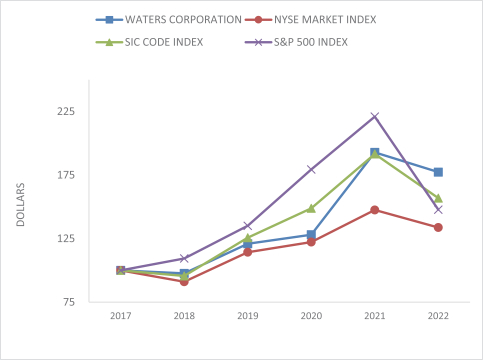
| 2017 | 2018 | 2019 | 2020 | 2021 | 2022 | |||||||||||||||||||
| WATERS CORPORATION | 100.00 | 97.65 | 120.94 | 128.07 | 192.87 | 177.33 | ||||||||||||||||||
| NYSE MARKET INDEX | 100.00 | 91.05 | 114.28 | 122.26 | 147.54 | 133.75 | ||||||||||||||||||
| SIC CODE INDEX | 100.00 | 95.62 | 125.72 | 148.85 | 191.58 | 156.89 | ||||||||||||||||||
| S&P 500 INDEX | 100.00 | 109.38 | 135.10 | 179.41 | 220.97 | 147.77 |
Table of Contents
Purchases of Equity Securities by the Issuer
The following table provides information about purchases by the Company during the last three months of 2022 of equity securities registered by the Company under the Exchange Act (in thousands, except per share data):
| Period | Total Number of Shares Purchased (1) | Average Price Paid per Share | Total Number of Shares Purchased as Part of Publicly Announced Programs | Maximum Dollar Value of Shares that May Yet Be Purchased Under the Programs (2) | ||||||||||||
| October 2, 2022 to October 29, 2022 | 174 | $ | 282.93 | 174 | $ | 368,795 | ||||||||||
| October 30, 2022 to November 26, 2022 | 147 | $ | 318.78 | 147 | $ | 321,997 | ||||||||||
| November 27, 2022 to December 31, 2022 | 154 | $ | 342.87 | 154 | $ | 269,297 | ||||||||||
| Total | 475 | $ | 313.46 | 475 | $ | 269,297 | ||||||||||
| (1) | The Company repurchased approximately two thousand shares of common stock at a cost of less than $1 million related to the vesting of restricted stock during the last three months of 2022. |
|---|
| (2) | In January 2019, the Company’s Board of Directors authorized the Company to repurchase up to $4 billion of its outstanding common stock in open market or private transactions over a two-year period. This program replaced the remaining amounts available under the pre-existing authorization. In December 2020, the Company’s Board of Directors authorized the extension of the share repurchase program through January 21, 2023. In December 2022, the Company’s Board of Directors amended and extended this repurchase program’s term by one year such that it shall now expire on January 21, 2024 and increases the total authorization level to $4.8 billion, an increase of $750 million. The size and timing of these purchases, if any, will depend on our stock price and market and business conditions, as well as other factors. |
|---|
Table of Contents
Item 6. Reserved
Item 7. Management’s Discussion and Analysis of Financial Condition and Results of Operations
Business Overview
The Company has two operating segments: WatersTM and TATM. Waters products and services primarily consist of high-performance liquid chromatography (“HPLC”), ultra-performance liquid chromatography (“UPLCTM” and, together with HPLC, referred to as “LC”), mass spectrometry (“MS”) and precision chemistry consumable products and related services. TA products and services primarily consist of thermal analysis, rheometry and calorimetry instrument systems and service sales. The Company’s products are used by pharmaceutical, biochemical, industrial, nutritional safety, environmental, academic and government customers. These customers use the Company’s products to detect, identify, monitor and measure the chemical, physical and biological composition of materials and to predict the suitability and stability of fine chemicals, pharmaceuticals, water, polymers, metals and viscous liquids in various industrial, consumer goods and healthcare products.
COVID-19 Pandemic
Both the Company’s domestic and international operations have been and continue to be affected by the ongoing global COVID-19 pandemic that has led to volatility and uncertainty in the U.S. and international markets. The Company is actively managing its business to respond to the COVID-19 impact; however, the Company cannot reasonably estimate the length or severity of the COVID-19 pandemic, including the effect of the emergence of variants of the virus, or the related response, or the extent to which the disruption may materially impact the Company’s business, consolidated financial position, consolidated results of operations or consolidated cash flows in the future.
The COVID-19 pandemic has not had a material impact on the Company’s manufacturing facilities or those of the third parties to whom it outsources certain manufacturing processes, the distribution centers where the inventory is managed or the operations of its logistics and other service providers.
The Company has taken decisive and appropriate actions throughout the COVID-19 pandemic and continues to take proactive measures to guard the health of its global employee base and the safety of all customer interactions. The Company has implemented rigorous protocols to promote a safe work environment in all of its locations that are operational around the world and continues to closely monitor and update its multi-phase process for the safe return of employees to their physical workplaces as social distancing, governmental requirements, including capacity limitations, and other protocols allow.
The vast majority of the markets the Company serves, most notably the pharmaceutical, biomedical research, materials sciences, food/environmental and clinical markets, have continued to operate at various levels, and the Company is working closely with these customers to facilitate their seamless operation.
Table of Contents
Financial Overview
The Company’s operating results are as follows for the years ended December 31, 2022, 2021 and 2020 (dollars in thousands, except per share data):
| Year Ended December 31, | % change | |||||||||||||||||||
| 2022 | 2021 | 2020 | 2022 vs 2021 | 2021 vs 2020 | ||||||||||||||||
| Revenues: | ||||||||||||||||||||
| Product sales | $ | 1,988,169 | $ | 1,822,070 | $ | 1,497,333 | 9 | % | 22 | % | ||||||||||
| Service sales | 983,787 | 963,804 | 868,032 | 2 | % | 11 | % | |||||||||||||
| Total net sales | 2,971,956 | 2,785,874 | 2,365,365 | 7 | % | 18 | % | |||||||||||||
| Costs and operating expenses: | ||||||||||||||||||||
| Cost of sales | 1,248,182 | 1,156,533 | 1,006,689 | 8 | % | 15 | % | |||||||||||||
| Selling and administrative expenses | 658,026 | 626,968 | 553,698 | 5 | % | 13 | % | |||||||||||||
| Research and development expenses | 176,190 | 168,358 | 140,777 | 5 | % | 20 | % | |||||||||||||
| Purchased intangibles amortization | 6,366 | 7,143 | 10,587 | (11 | %) | (33 | %) | |||||||||||||
| Asset impairments | — | — | 6,945 | *** | *** | *** | *** | |||||||||||||
| Acquired in-process research and development | 9,797 | — | — | *** | *** | *** | *** | |||||||||||||
| Litigation provision | — | 5,165 | 1,180 | *** | *** | *** | *** | |||||||||||||
| Operating income | 873,395 | 821,707 | 645,489 | 6 | % | 27 | % | |||||||||||||
| Operating income as a % of sales | 29.4 | % | 29.5 | % | 27.3 | % | ||||||||||||||
| Other income (expense), net | 2,228 | 17,203 | (1,775 | ) | (87 | %) | *** | *** | ||||||||||||
| Interest expense, net | (37,777 | ) | (32,717 | ) | (32,800 | ) | 15 | % | — | |||||||||||
| Income before income taxes | 837,846 | 806,193 | 610,914 | 4 | % | 32 | % | |||||||||||||
| Provision for income taxes | 130,091 | 113,350 | 89,343 | 15 | % | 27 | % | |||||||||||||
| Net income | $ | 707,755 | $ | 692,843 | $ | 521,571 | 2 | % | 33 | % | ||||||||||
| Net income per diluted common share | $ | 11.73 | $ | 11.17 | $ | 8.36 | 5 | % | 34 | % |
| ** | Percentage not meaningful |
|---|
The Company’s net sales increased 7% in 2022 as compared to 2021, and 18% in 2021 as compared to 2020. The sales growth in 2022 and 2021 was driven by strong customer demand across most major geographies, end markets, and product categories. The increase in sales in 2021 was also impacted by the increase in demand for our products and services as our customers returned to pre-pandemic levels of operations. Foreign currency translation decreased total sales growth by 5% in 2022 as the U.S. dollar strengthened significantly against all other major currencies in the world, which negatively impacted our sales and operating profits. Foreign currency translation increased total sales growth by 2% in 2021.
Instrument system sales increased 11% and 23% in 2022 and 2021, respectively. Such increases were attributable to the broad-based increase in customer demand across all existing and newly introduced LC, LC-MS and Thermal Analysis instrument system sales. Foreign currency translation decreased instrument system sales growth by 5% in 2022 and had minimal impact on sales growth in 2021. Recurring revenues (combined sales of precision chemistry consumables and services) increased 3% and 13% in 2022 and 2021, respectively, with foreign currency translation decreasing sales growth by 6% in 2022 and increasing sales growth by 2% in 2021.
Operating income was $873 million in 2022, an increase of 6% as compared to 2021. This increase was primarily a result of the increase in sales volume and pricing increases, partially offset by higher electronic component and freight inflationary costs and the negative effect of foreign currency translation. The effect of foreign currency translation lowered operating income by approximately $71 million d
Showing the first 8K of 61K characters. Open the full section
Item 7A. Quantitative and Qualitative Disclosures About Market Risk
Derivative Transactions
The Company is a global company that operates in over 35 countries and, as a result, the Company’s net sales, cost of sales, operating expenses and balance sheet amounts are significantly impacted by fluctuations in foreign currency exchange rates. The Company is exposed to currency price risk on foreign currency exchange rate fluctuations when it translates its non-U.S. dollar foreign subsidiaries’ financial statements into U.S. dollars, and when any of the Company’s subsidiaries purchase or sell products or services in a currency other than its own currency.
The Company’s principal strategies in managing exposures to changes in foreign currency exchange rates are to (1) naturally hedge the foreign-currency-denominated liabilities on the Company’s balance sheet against corresponding assets of the same currency, such that any changes in liabilities due to fluctuations in foreign currency exchange rates are typically offset by corresponding changes in assets and (2) mitigate foreign exchange risk exposure of international operations by hedging the variability in the movement of foreign currency exchange rates on a portion of its euro-denominated and yen-denominated net asset investments. The Company presents the derivative transactions in financing activities in the statement of cash flows.
Foreign Currency Exchange Contracts
The Company does not specifically enter into any derivatives that hedge foreign-currency-denominated operating assets, liabilities or commitments on its balance sheet, other than a portion of certain third-party accounts receivable and accounts payable, and the Company’s net worldwide intercompany receivables and payables, which are eliminated in consolidation. The Company periodically aggregates these net worldwide balances by currency and then enters into foreign currency exchange contracts that mature within 90 days to hedge a portion of the remaining balance to minimize some of the Company’s currency price risk exposure. The foreign currency exchange contracts are not designated for hedge accounting treatment. Principal hedged currencies include the euro, Japanese yen, British pound, Mexican peso and Brazilian real.
Interest Rate Cross-Currency Swap Agreements
As of December 31, 2022, the Company had three-year interest rate cross-currency swap derivative agreements with a notional value of $585 million to hedge the variability in the movement of foreign currency exchange rates on a portion of its euro-denominated and yen-denominated net asset investments. Under hedge accounting, the change in fair value of the derivative that relates to changes in the foreign currency spot rate are recorded in the currency translation adjustment in other comprehensive income and remain in accumulated other comprehensive income in stockholders’ equity until the sale or substantial liquidation of the foreign operation. The difference between the interest rate received and paid under the interest rate cross-currency swap derivative agreement is recorded in interest income in the statement of operations.
The Company’s foreign currency exchange contracts and interest rate cross-currency swap agreements included in the consolidated balance sheets are classified as follows (in thousands):
| December 31, 2022 | December 31, 2021 | |||||||||||||||
| Notional Value | Fair Value | Notional Value | Fair Value | |||||||||||||
| Foreign currency exchange contracts: | ||||||||||||||||
| Other current assets | $ | 42,047 | $ | 231 | $ | 55,309 | $ | 504 | ||||||||
| Other current liabilities | $ | 13,450 | $ | 98 | $ | 9,000 | $ | 195 | ||||||||
| Interest rate cross-currency swap agreements: | ||||||||||||||||
| Other assets | $ | 400,000 | $ | 19,163 | $ | — | $ | — | ||||||||
| Other liabilities | $ | 185,000 | $ | 4,783 | $ | 230,000 | $ | 5,363 | ||||||||
| Accumulated other comprehensive income (loss) | $ | 10,026 | $ | (15,944 | ) |
Table of Contents
The following is a summary of the activity included in the consolidated statements of operations and statements of comprehensive income related to the foreign currency exchange contracts and interest rate cross-currency swap agreements (in thousands):
| Financial Statement Classification | ||||||||||||||
| Year Ended December 31, | ||||||||||||||
| 2022 | 2021 | 2020 | ||||||||||||
| Foreign currency exchange contracts: | ||||||||||||||
| Realized (losses) gains on closed contracts | Cost of sales | $ | (3,855 | ) | $ | (1,973 | ) | $ | 1,444 | |||||
| Unrealized (losses) gains on open contracts | Cost of sales | (176 | ) | (343 | ) | 1,663 | ||||||||
| Cumulative net pre-tax (losses) gains | Cost of sales | $ | (4,031 | ) | $ | (2,316 | ) | $ | 3,107 | |||||
| Interest rate cross-currency swap agreements: | ||||||||||||||
| Interest earned | Interest income | $ | 8,872 | $ | 11,084 | $ | 15,296 | |||||||
| Unrealized gains (losses) on open contracts | Accumulated other comprehensive loss | $ | 25,969 | $ | 29,052 | $ | (44,996 | ) |
Assuming a hypothetical adverse change of 10% in year-end exchange rates (a strengthening of the U.S. dollar), the fair market value of the foreign currency exchange contracts outstanding as of December 31, 2022 would increase pre-tax earnings by approximately $6 million. Assuming a hypothetical adverse change of 10% in year-end exchange rates (a strengthening of the U.S. dollar), the fair market value of the interest rate cross-currency swap agreements outstanding as of December 31, 2022 would increase by approximately $57 million and would be recorded to foreign currency translation in other comprehensive income within stockholders’ equity (deficit). The related impact on interest income would not have a material effect on pre-tax earnings.
The Company’s cash and cash equivalents are not subject to significant interest rate risk due to the short maturities of these instruments. The Company’s cash equivalents represent highly liquid investments, with original maturities of 90 days or less, primarily in bank deposits, U.S. treasury bill money market funds and commercial paper. As of December 31, 2022, the carrying value of the Company’s cash and cash equivalents approximated fair value.
The Company is exposed to the risk of interest rate fluctuations from the investments of cash generated from operations. Investments with maturities greater than 90 days are classified as investments, and are held primarily in U.S. dollar-denominated treasury bills and commercial paper, bank deposits and corporate debt securities. As of December 31, 2022, the Company estimates that a hypothetical adverse change of 100 basis points across all maturities would not have a material effect on the fair market value of its portfolio.
The Company is also exposed to the risk of exchange rate fluctuations. The Company maintains cash balances in various operating accounts in excess of federally insured limits, and in foreign subsidiary accounts in currencies other than the U.S. dollar. As of December 31, 2022 and 2021, $472 million out of $481 million and $440 million out of $569 million, respectively, of the Company’s total cash, cash equivalents and investments were held by foreign subsidiaries. In addition, $336 million out of $481 million and $298 million out of $569 million of cash, cash equivalents and investments were held in currencies other than the U.S. dollar at December 31, 2022 and 2021, respectively. As of December 31, 2022, the Company had no holdings in auction rate securities or commercial paper issued by structured investment vehicles.
Assuming a hypothetical adverse change of 10% in year-end exchange rates (a strengthening of the U.S. dollar), the fair market value of the Company’s cash, cash equivalents and investments held in currencies other than the U.S. dollar as of December 31, 2022 would decrease by approximately $34 million, of which the majority would be recorded to foreign currency translation in other comprehensive income within stockholders’ equity.
Table of Contents
Item 8. Financial Statements and Supplementary Data
Financial Statements and Supplementary Data
Management’s Report on Internal Control Over Financial Reporting
Our management is responsible for establishing and maintaining adequate internal control over financial reporting, as such term is defined in
Rules 13a-15(f)
and
15d-15(f)
under the Exchange Act. Because of its inherent limitations, internal control over financial reporting may not prevent or detect misstatements. Also, projections of any evaluation of effectiveness to future periods are subject to the risk that controls may become inadequate because of changes in conditions, or that the degree of compliance with the policies or procedures may deteriorate.
Under the supervision and with the participation of our management, including our chief executive officer and chief financial officer, we conducted an evaluation of the effectiveness of our internal control over financial reporting based on the framework in Internal Control — Integrated Framework (2013) issued by the Committee of Sponsoring Organizations of the Treadway Commission (COSO). Based on our evaluation under the framework in Internal Control — Integrated Framework (2013), our management, including our chief executive officer and chief financial officer, concluded that our internal control over financial reporting was effective as of December 31, 2022.
The effectiveness of our internal control over financial reporting as of December 31, 2022 has been audited by PricewaterhouseCoopers LLP, an independent registered public accounting firm, as stated in their report which is included
herein
.
Report of Independent Registered Public Accounting Firm
To the Board of Directors and Stockholders of Waters Corporation
Opinions on the Financial Statements and Internal Control over Financial Reporting
We have audited the accompanying consolidated balance sheets of Waters Corporation and its subsidiaries (the “Company”) as of December 31, 2022 and 2021, and the related consolidated statements of operations, of comprehensive income, of stockholders’ equity (deficit) and of cash flows for each of the three years in the period ended December 31, 2022, including the related notes (collectively referred to as the “consolidated financial statements”). We also have audited the Company’s internal control over financial reporting as of December 31, 2022, based on criteria established in
Internal Control—Integrated Framework
(2013) issued by the Committee of Sponsoring Organizations of the Treadway Commission (COSO).
In our opinion, the consolidated financial statements referred to above present fairly, in all material respects, the financial position of the Company as of December 31, 2022 and 2021, and the results of its operations and its cash flows for each of the three years in the period ended December 31, 2022 in conformity with accounting principles generally accepted in the United States of America. Also in our opinion, the Company maintained, in all material respects, effective internal control over financial reporting as of December 31, 2022, based on criteria established in
Internal Control—Integrated Framework
(2013) issued by the COSO.
Basis for Opinions
The Company’s management is responsible for these consolidated financial statements, for maintaining effective internal control over financial reporting, and for its assessment of the effectiveness of internal control over financial reporting, included i
n the accompanying Ma
nagement’s Report on Internal Control Over Financial Reporting. Our responsibility is to express opinions on the Company’s consolidated financial statements and on the Company’s internal control over financial reporting based on our audits. We are a public accounting firm registered with the Public Company Accounting Oversight Board (United States) (PCAOB) and are required to be independent with respect to the Company in accordance with the U.S. federal securities laws and the applicable rules and regulations of the Securities and Exchange Commission and the PCAOB.
We conducted our audits in accordance with the standards of the PCAOB. Those standards require that we plan and perform the audits to obtain reasonable assurance about whether the consolidated financial statements are free of material misstatement, whether due to error or fraud, and whether effective internal control over financial reporting was maintained in all material respects.
Our audits of the consolidated financial statements included performing procedures to assess the risks of material misstatement of the consolidated financial statements, whether due to error or fraud, and performing procedures that respond to those risks. Such procedures included examining, on a test basis, evidence regarding the amounts and disclosures in the consolidated financial statements. Our audits also included evaluating the accounting principles used and significant estimates made by management, as well as evaluating the overall presentation of the consolidated financial statements. Our audit of internal control over financial reporting included obtaining an understanding of internal control over financial reporting, assessing the risk that a material weakness exists, and testing and evaluating the design and operating effectiveness of internal control based on the assessed risk. Our audits also included performing such other procedures as we considered necessary in the circumstances. We believe that our audits provide a reasonable basis for our opinions.
Definition and Limitations of Internal Control over Financial Reporting
A company’s internal control over financial reporting is a process designed to provide reasonable assurance regarding the reliability of financial reporting and the preparation of financial statements for external purposes in
accordance with generally accepted accounting principles. A company’s internal control over financial reporting includes those policies and procedures that (i) pertain to the maintenance of records that, in reasonable detail, accurately and fairly reflect the transactions and dispositions of the assets of the company; (ii) provide reasonable assurance that transactions are recorded as necessary to permit preparation of financial statements in accordance with generally accepted accounting principles, and that receipts and expenditures of the company are being made only in accordance with authorizations of management and directors of the company; and (iii) provide reasonable assurance regarding prevention or timely detection of unauthorized acquisition, use, or disposition of the company’s assets that could have a material effect on the financial statements.
Because of its inherent limitations, internal control over financial reporting may not prevent or detect misstatements. Also, projections of any evaluation of effectiveness to future periods are subject to the risk that controls may become inadequate because of changes in conditions, or that the degree of compliance with the policies or procedures may deteriorate.
Critical Audit Matters
The critical audit matter communicated below is a matter arising from the current period audit of the consolidated financial statements that was communicated or required to be communicated to the audit committee and that (i) relates to accounts or disclosures that are material to the consolidated financial statements and (ii) involved our especially challenging, subjective, or complex judgments. The communication of critical audit matters does not alter in any way our opinion on the consolidated financial statements, taken as a whole, and we are not, by communicating the critical audit matter below, providing a separate opinion on the critical audit matter or on the accounts or disclosures to which it relates.
Product Revenue Recognition
As described in Note 2 to the consolidated financial statements, the Company recognizes revenue upon transfer of control of promised products to customers in an amount that ref
Showing the first 8K of 187K characters. Open the full section
Item 9. Changes in and Disagreements with Accountants on Accounting and Financial Disclosure
None.
Item 9A. Controls and Procedures
Evaluation of Disclosure Controls and Procedures
The Company’s chief executive officer and chief financial officer (principal executive officer and principal financial officer), with the participation of management, evaluated the effectiveness of the Company’s disclosure controls and procedures (as defined in Rules 13a-15(e) and 15d-15(e) under the Securities Exchange Act of 1934, as amended (the “Exchange Act”)) as of the end of the period covered by this annual report on Form 10-K. Based on this evaluation, the Company’s chief executive officer and chief financial officer concluded that the Company’s disclosure controls and procedures were effective as of December 31, 2022 (1) to ensure that information required to be disclosed by the Company, including its consolidated subsidiaries, in the reports that it files or submits under the Exchange Act is accumulated and communicated to the Company’s management, including its chief executive officer and chief financial officer, to allow timely decisions regarding the required disclosure and (2) to provide reasonable assurance that information required to be disclosed by the Company in the reports that it files or submits under the Exchange Act is recorded, processed, summarized and reported within the time periods specified in the SEC’s rules and forms.
Management’s Annual Report on Internal Control Over Financial Reporting
See Management’s Report on Internal Control Over Financial Reporting in Item 8 on page 47 of this Annual Report.
Report of the Independent Registered Public Accounting Firm
See the report of PricewaterhouseCoopers LLP in Item 8 beginning on page 48 of this Annual Report.
Changes in Internal Control Over Financial Reporting
No change was identified in the Company’s internal control over financial reporting (as defined in Rules 13a-15(f) and 15d-15(f) under the Exchange Act) during the quarter ended December 31, 2022 that has materially affected, or is reasonably likely to materially affect, the Company’s internal control over financial reporting.
Item 9B. Other Information
None.
Item 9C. Disclosure Regarding Foreign Jurisdictions that Prevent Inspections
None.
PART III
| Item 10: | Directors, Executive Officers and Corporate Governance |
|---|
INFORMATION ABOUT OUR EXECUTIVE OFFICERS
Officers of the Company are elected annually by the Board of Directors and hold office at the discretion of the Board of Directors. The following persons serve as executive officers of the Company:
Dr. Udit Batra, 52, was appointed a Director of the Company as well as President and CEO on September 1, 2020. He most recently served as Chief Executive Officer of the Life Science business of Merck KGaA,
Table of Contents
Darmstadt, Germany, which operates as MilliporeSigma in the United States and Canada, and as a member of its Executive Board, roles he held from 2014 and 2016, respectively, through July 2020. Prior to that, Dr. Batra served as President and Chief Executive Officer of Merck KGaA, Darmstadt, Germany’s Consumer Health business. Dr. Batra oversaw the company’s Bioethics Advisory Panel and had Board responsibility for the global Information Technology function. Before joining Merck KGaA, Darmstadt, Germany, Dr. Batra held several positions of increasing responsibility at Novartis, including Global Head of Corporate Strategy in Switzerland, Country President for the Pharma Business of Novartis in Australia and New Zealand and the Global Head of Public Health and Market Access in Cambridge, Massachusetts. Dr. Batra also served at the global consultancy McKinsey & Company across the healthcare, consumer and non-profit sectors. Dr. Batra started his career at Merck Research Labs in West Point, Pennsylvania as a research engineer.
Jianqing Bennett, 53, was appointed Senior Vice President of TA Instruments Division on May 1, 2021. Previously, Ms. Bennett served as Senior Vice President, High Growth Markets at Beckman Coulter Diagnostics from November 2017 to March 2021. Prior to that, from 2007-2017, she held various senior management positions at Carestream Health Inc, including serving as President, Medical Digital Solutions from August 2015 to November 2017.
Amol Chaubal, 47, was appointed Chief Financial Officer of Waters Corporation on May 12, 2021. Previously, Mr. Chaubal was Chief Financial Officer of Quanterix Corporation, a life sciences company, where he served as Chief Financial Officer since April 2019. Before Quanterix, Mr. Chaubal served as Chief Financial Officer, Global Operations at Smith & Nephew, a global medical devices company, from October 2017 to April 2019. Prior to his time at Smith & Nephew, he served as Corporate Vice President and Head of Finance for the Clinical Research Services and Access business at Parexel from July 2015 to October 2017.
Jonathan M. Pratt, 53, was appointed Senior Vice President, Waters Division, on May 1, 2021. Previously, he served as Senior Vice President and President, TA Instruments from August 2019 to April 30, 2021. Prior to joining Waters Corporation, Mr. Pratt was President of Beckman Coulter Life Sciences from January 2017 to April 2019. Additionally, he held senior positions at Pall Corporation from 2001 to 2017, where he was Vice President and General Manager from October 2015 to December 2016 following Pall Corporation’s acquisition by Danaher Corporation and, prior to that, President of its Food & Beverage, Laboratory and ForteBio businesses from April 2011 to October 2015. Since August 2020, Mr. Pratt has served on the Board of SPX FLOW, Inc. (NYSE:FLOW) as an independent director and a member of the Audit, Compensation and Nominating & Governance Committees.
Information regarding the Company’s directors, any material changes to the process by which security holders may recommend nominees to the Board of Directors and the information required by the Item will be contained in our definitive proxy statement for the 2023 Annual Meeting of Stockholders, to be filed with the SEC not later than 120 days after the close of business of the fiscal year and is incorporated in this report by reference (the “2023 Proxy Statement”), under the headings “Election of Directors”, “Directors Meetings and Board Committees”, “Corporate Governance”, “Report of the Audit Committee of the Board of Directors” and “Compensation of Directors and Executive Officers”. Information regarding compliance with Section 16(a) of the Exchange Act is contained in the 2023 Proxy Statement, under the heading “Delinquent Section 16(a) Reports”. Information regarding the Company’s Audit Committee and Audit Committee Financial Expert is contained in the 2023 Proxy Statement, under the headings “Report of the Audit Committee of the Board of Directors” and “Directors Meetings and Board Committees”. Such information is incorporated herein by reference.
The Company has adopted a Global Code of Business Conduct & Ethics (the “Code”) that applies to all of the Company’s employees (including its executive officers) and directors and that is in compliance with Item 406 of Regulation S-K. The Code has been distributed to all employees of the Company. In addition, the Code is available on the Company’s website, https://www.waters.com, under the caption “Corporate Governance”. The Company intends to satisfy the disclosure requirement regarding any amendment to, or waiver of a provision of,
Table of Contents
the Code applicable to any executive officer or director by posting such information on its website. The Company shall also provide to any person without charge, upon request, a copy of the Code. Any such request must be made in writing to the Secretary of the Company, c/o Waters Corporation, 34 Maple Street, Milford, MA 01757.
The Company’s corporate governance guidelines and the charters of the audit committee, compensation committee and nominating and corporate governance committee of the Board of Directors are available on the Company’s website, https://www.waters.com, under the caption “Corporate Governance”. The Company shall provide to any person without charge, upon request, a copy of any of the foregoing materials. Any such request must be made in writing to the Secretary of the Company, c/o Waters Corporation, 34 Maple Street, Milford, MA 01757.
| Item 11: | Executive Compensation |
|---|
This information is contained in the 2023 Proxy Statement, under the headings “Compensation of Directors and Executive Officers”, “Compensation Committee Interlocks and Insider Participation” and “Compensation Committee Report”. Such information is incorporated herein by reference.
Item 12. Security Ownership of Certain Beneficial Owners and Management and Related Stockholder Matters
Except for the Equity Compensation Plan information set forth below, this information is contained in the 2023 Proxy Statement, under the heading “Security Ownership of Certain Beneficial Owners and Management”. Such information is incorporated herein by reference.
Equity Compensation Plan Information
The following table provides information as of December 31, 2022 about the Company’s common stock that may be issued upon the exercise of options, warrants and rights under its existing equity compensation plans (in thousands):
| A | B | C | ||||||||||
| Number of Securities to be Issued Upon Exercise of Outstanding Options, Warrants and Rights (1) | Weighted-Average Exercise Price of Outstanding Options, Warrants and Rights (1) | Number of Securities Remaining Available for Future Issuance Under Equity Compensation Plans (excluding securities reflected in column (A)) | ||||||||||
| Equity compensation plans approved by security holders | 976 | $ | 238.43 | 6,929 | ||||||||
| Equity compensation plans not approved by security holders | — | — | — | |||||||||
| Total | 976 | $ | 238.43 | 6,929 | ||||||||
| (1) | Column (a) includes an aggregate of 379 shares of common stock to be issued upon settlement of restricted stock, restricted stock units and performance stock units. The weighted-average share price in column (b) does not take into account restricted stock, restricted stock units or performance stock units, which do not have an exercise price. |
|---|
See Note 14, Stock-Based Compensation, in the Notes to Consolidated Financial Statements for a description of the material features of the Company’s equity compensation plans.
| Item 13: | Certain Relationships and Related Transactions and Director Independence |
|---|
This information is contained in the 2023 Proxy Statement, under the headings “Directors Meetings and Board Committees”, “Corporate Governance” and “Compensation of Directors and Executive Officers”. Such information is incorporated herein by reference.
Table of Contents
| Item 14: | Principal Accountant Fees and Services |
|---|
This information is contained in the 2023 Proxy Statement, under the headings “Ratification of Selection of Independent Registered Public Accounting Firm” and “Report of the Audit Committee of the Board of Directors”. Such information is incorporated herein by reference.
Table of Contents
PART IV
| Item 15: | Exhibits, Financial Statement Schedules |
|---|
(a) Documents filed as part of this report:
| (1) | Financial Statements: |
|---|
The consolidated financial statements of the Company and its subsidiaries are filed as part of this Annual Report and are set forth on pages 50 to 95. The report of PricewaterhouseCoopers LLP (PCAOB ID: 238), an independent registered public accounting firm, dated February 27, 2023, is set forth beginning on page 48 of this Annual Report.
| (2) | Exhibits: |
|---|
Table of Contents
Table of Contents
Table of Contents
| Exhibit Number | Description of Document | |
| 31.1 | Chief Executive Officer Certification Pursuant to Section 302 of the Sarbanes-Oxley Act of 2002. | |
| 31.2 | Chief Financial Officer Certification Pursuant to Section 302 of the Sarbanes-Oxley Act of 2002. | |
| 32.1 | Chief Executive Officer Certification Pursuant to 18 U.S.C. Section 1350, as Adopted Pursuant to Section 906 of the Sarbanes-Oxley Act of 2002.** | |
| 32.2 | Chief Financial Officer Certification Pursuant to 18 U.S.C. Section 1350, as Adopted Pursuant to Section 906 of the Sarbanes-Oxley Act of 2002.** | |
| 101 | The following materials from Waters Corporation’s Annual Report on Form 10-K for the year ended December 31, 2022, formatted in iXBRL (Inline eXtensible Business Reporting Language): (i) the Consolidated Balance Sheets, (ii) the Consolidated Statements of Operations, (iii) the Consolidated Statements of Comprehensive Income, (iv) the Consolidated Statements of Cash Flows, (v) the Consolidated Statements of Stockholders’ Equity (Deficit) and (vi) Notes to Consolidated Financial Statements. | |
| 104 | Cover Page Interactive Date File (formatted in iXBRL and contained in Exhibit 101). |
| + | Paper Filing |
|---|
| * | Management contract or compensatory plan required to be filed as an Exhibit to this Annual Report. |
|---|
| ** | This exhibit shall not be deemed “filed” for purposes of Section 18 of the Exchange Act, or otherwise subject to the liability of that section, nor shall it be deemed incorporated by reference into any filing under the Securities Act, or the Exchange Act, whether made before or after the date hereof and irrespective of any general incorporation language in any filing, except to the extent the Company specifically incorporates it by reference. |
|---|
| (b) | See Item 15 (a) (2) above. |
|---|
| Item 16: | Form 10-K Summary |
|---|
The optional summary in Item 16 has not been included in this Annual Report.
Table of Contents
SIGNATURES
Pursuant to the requirements of Section 13 or 15(d) of the Securities Exchange Act of 1934, the registrant has duly caused this report to be signed on its behalf by the undersigned, thereunto duly authorized.
| WATERS CORPORATION |
| /s/ Amol Chaubal |
| Amol Chaubal |
| Senior Vice President and Chief Financial Officer |
| (Principal Financial Officer) |
| (Principal Accounting Officer) |
Date: February 27, 2023
Pursuant to the requirements of the Securities Exchange Act of 1934, this report has been signed by the following persons on behalf of the registrant and in the capacities indicated on February 27, 2023.
| /s/ Dr. Flemming Ornskov, M.D., M.P.H. | Chairman of the Board of Directors | |||
| Dr. Flemming Ornskov, M.D., M.P.H. | ||||
| /s/ Dr. Udit Batra, Ph.D. | President and Chief Executive Officer | |||
| Dr. Udit Batra, Ph.D. | Director (Principal Executive Officer) | |||
| /s/ Amol Chaubal | Senior Vice President and Chief Financial Officer | |||
| Amol Chaubal | (Principal Financial Officer) | |||
| (Principal Accounting Officer) | ||||
| /s/ Linda Baddour | Director | |||
| Linda Baddour | ||||
| /s/ Dan Brennan | Director | |||
| Dan Brennan | ||||
| /s/ Edward Conard | Director | |||
| Edward Conard | ||||
| /s/ Dr. Pearl S. Huang, Ph.D. | Director | |||
| Dr. Pearl S. Huang, Ph.D. | ||||
| /s/ Wei Jiang | Director | |||
| Wei Jiang | ||||
| /s/ Christopher A. Kuebler | Director | |||
| Christopher A. Kuebler | ||||
| /s/ Mark Vergnano | Director | |||
| Mark Vergnano |