 filings.tools
Warner Bros. Discovery 10-K 2024-12-31
Filed 2025-02-27. 24 sections, 666K characters. Original on sec.gov · Markdown · JSON
Cover and table of contents
UNITED STATES
SECURITIES AND EXCHANGE COMMISSION
Washington, D.C. 20549
| FORM | 10-K | ||||
| ☒ | ANNUAL REPORT PURSUANT TO SECTION 13 OR 15(d) OF THE SECURITIES EXCHANGE ACT OF 1934 |
For the fiscal year ended December 31, 2024
OR
| ☐ | TRANSITION REPORT PURSUANT TO SECTION 13 OR 15(d) OF THE SECURITIES EXCHANGE ACT OF 1934 |
For the transition period from to
Commission File Number: 001-34177

Warner Bros. Discovery, Inc.
(Exact name of Registrant as specified in its charter)
| Delaware | 35-2333914 | ||||||||||
| (State or other jurisdiction of incorporation or organization) | (I.R.S. Employer Identification No.) | ||||||||||
| 230 Park Avenue South | 10003 | ||||||||||
| New York, New York | (Zip Code) | ||||||||||
| (Address of principal executive offices) |
(212) 548-5555
(Registrant’s telephone number, including area code)
Securities registered pursuant to Section 12(b) of the Act:
| Title of Each Class | Trading Symbols | Name of Each Exchange on Which Registered | ||||||
| Series A Common Stock | WBD | The Nasdaq Global Select Market | ||||||
| 4.302% Senior Notes due 2030 | WBDI30 | The Nasdaq Global Market | ||||||
| 4.693% Senior Notes due 2033 | WBDI33 | The Nasdaq Global Market |
Securities registered pursuant to Section 12(g) of the Act:
None
Indicate by check mark if the Registrant is a well-known seasoned issuer, as defined in Rule 405 of the Securities Act. Yes ý No ¨
Indicate by check mark if the Registrant is not required to file reports pursuant to Section 13 or Section 15(d) of the Act. Yes ¨ No ý
Indicate by check mark whether the Registrant (1) has filed all reports required to be filed by Section 13 or 15(d) of the Securities Exchange Act of 1934 during the preceding 12 months (or for such shorter period that the Registrant was required to file such reports), and (2) has been subject to such filing requirements for the past 90 days. Yes ý No ¨
Indicate by check mark whether the Registrant has submitted electronically every Interactive Data File required to be submitted pursuant to Rule 405 of Regulation S-T (§232.405 of this chapter) during the preceding 12 months (or for such shorter period that the Registrant was required to submit such files). Yes ý No ¨
Indicate by check mark whether the Registrant is a large accelerated filer, an accelerated filer, a non-accelerated filer, smaller reporting company or an emerging growth company. See the definitions of “large accelerated filer,” “accelerated filer,” “smaller reporting company,” and “emerging growth company” in Rule 12b-2 of the Exchange Act.
| Large accelerated filer | ý | Accelerated filer | ☐ | |||||||||||||||||
| Non-accelerated filer | ☐ | Smaller reporting company | ☐ | |||||||||||||||||
| Emerging growth company | ☐ |
If an emerging growth company, indicate by check mark if the registrant has elected not to use the extended transition period for complying with any new or revised financial accounting standards provided pursuant to Section 13(a) of the Exchange Act. ¨
Indicate by check mark whether the registrant has filed a report on and attestation to its management’s assessment of the effectiveness of its internal control over financial reporting under Section 404(b) of the Sarbanes-Oxley Act (15 U.S.C. 7262(b)) by the registered public accounting firm that prepared or issued its audit report. ☒
If securities are registered pursuant to Section 12(b) of the Act, indicate by check mark whether the financial statements of the registrant included in the filing reflect the correction of an error to previously issued financial statements. ¨
Indicate by check mark whether any of those error corrections are restatements that required a recovery analysis of incentive-based compensation received by any of the registrant’s executive officers during the relevant recovery period pursuant to §240.10D-1(b). ¨
Indicate by check mark whether the Registrant is a shell company (as defined in Rule 12b-2 of the Exchange Act). Yes ☐ No ý
The aggregate market value of voting and non-voting common stock held by non-affiliates of the Registrant computed by reference to the last sales price of such stock, as of the last business day of the Registrant’s most recently completed second fiscal quarter, which was June 30, 2024, was approximately $18 billion.
Total number of shares outstanding of each class of the Registrant’s common stock as of February 13, 2025 was:
| Series A Common Stock, par value $0.01 per share | 2,454,764,337 |
DOCUMENTS INCORPORATED BY REFERENCE
Certain information required in Item 10 through Item 14 of Part III of this Annual Report on Form 10-K is incorporated herein by reference to the Registrant’s definitive Proxy Statement for its 2025 Annual Meeting of Stockholders, which shall be filed with the Securities and Exchange Commission pursuant to Regulation 14A of the Securities Exchange Act of 1934, as amended.
WARNER BROS. DISCOVERY, INC.
FORM 10-K
TABLE OF CONTENTS
PART I
CAUTIONARY NOTE CONCERNING FORWARD-LOOKING STATEMENTS
Certain statements in this Annual Report on Form 10-K constitute forward-looking statements within the meaning of the Private Securities Litigation Reform Act of 1995, including statements regarding our business, marketing and operating strategies, integration of acquired businesses, new product and service offerings, financial prospects and anticipated sources and uses of capital. Words such as “anticipate,” “assume,” “believe,” “continue,” “estimate,” “expect,” “forecast,” “future,” “intend,” “plan,” “potential,” “predict,” “project,” “strategy,” “target” and similar terms, and future or conditional tense verbs like “could,” “may,” “might,” “should,” “will” and “would,” among other terms of similar substance used in connection with any discussion of future operating or financial performance identify forward-looking statements. Where, in any forward-looking statement, we express an expectation or belief as to future results or events, such expectation or belief is expressed in good faith and believed to have a reasonable basis, but there can be no assurance that the expectation or belief will result or be accomplished. The following is a list of some, but not all, of the factors that could cause actual results or events to differ materially from those anticipated:
-
more intense competitive pressure from existing or new competitors in the industries in which we operate;
-
reduced spending on domestic and foreign television advertising, due to macroeconomic, industry or consumer behavior trends or unexpected reductions in our number of subscribers;
-
uncertainties associated with product and service development and market acceptance, including the development and provision of programming for new television and telecommunications technologies, and the success of our streaming services;
-
market demand for foreign first-run and existing content libraries;
-
negative publicity or damage to our brands, reputation or talent;
-
realizing direct-to-consumer subscriber goals;
-
disagreements with our distributors or other business partners;
-
continued consolidation of distribution customers and production studios;
-
industry trends, including the timing of, and spending on, sports programming, feature film, television and television commercial production;
-
the possibility or duration of an industry-wide strike, such as the strikes of the Writers Guild of America (“WGA”) and Screen Actors Guild-American Federation of Television and Radio Artists (“SAG-AFTRA”) in 2023, player lock-outs or other job action affecting a major entertainment industry union, athletes or others involved in the development and production of our sports programming, television programming, feature films and interactive entertainment (e.g., games) who are covered by collective bargaining agreements;
-
inherent uncertainties involved in the estimates and assumptions used in the preparation of financial forecasts;
-
our level of debt, including the significant indebtedness incurred in connection with the acquisition of the WarnerMedia Business, and our future compliance with debt covenants;
-
changes to our corporate or debt-specific credit ratings or outlook;
-
unforeseen costs, execution risks, and operational challenges related to our efforts to integrate the WarnerMedia Business;
-
changes in, or failure or inability to comply with, laws and government regulations, including, without limitation, regulations of the U.S. government and other international governments, the Federal Communications Commission and similar authorities internationally and data privacy regulations;
-
adverse outcomes of legal proceedings or disputes, including those related to our acquisition of the WarnerMedia Business, or adverse outcomes from regulatory proceedings;
-
threatened or actual cyber-attacks and cybersecurity breaches;
-
theft of our content and unauthorized duplication, distribution and exhibition of such content; and
-
general economic and business conditions, fluctuations in foreign currency exchange rates, global events such as pandemics, natural disasters impacting the geographic areas where our businesses and operations are located, and political uncertainty or unrest in the markets in which we operate.
Forward-looking statements are subject to various risks and uncertainties which change over time, are based on management’s expectations and assumptions at the time the statements are made and are not guarantees of future results.
These risks have the potential to impact the recoverability of the assets recorded on our balance sheets, including goodwill and other intangibles. Management’s expectations and assumptions, and the continued validity of any forward-looking statements we make, cannot be foreseen with certainty and are subject to change due to a broad range of factors affecting the U.S. and global economies and regulatory environments, factors specific to Warner Bros. Discovery and other factors described under Item 1A, “Risk Factors” and elsewhere in this Annual Report on Form 10-K, including under Item 7, “Management’s Discussion and Analysis of Financial Condition and Results of Operations.”
Actual outcomes and results may differ materially from what is expressed in our forward-looking statements and from our historical financial results due to the factors discussed in this section and elsewhere in this Annual Report on Form 10-K or disclosed in our other SEC filings. These forward-looking statements and such risks, uncertainties, and other factors speak only as of the date of this Annual Report on Form 10-K, and we expressly disclaim any obligation or undertaking to disseminate any updates or revisions to any forward-looking statement contained herein, to reflect any change in our expectations with regard thereto, or any other change in events, conditions or circumstances on which any such statement is based.
Item 1. Business.
For convenience, the terms “Warner Bros. Discovery”, “WBD”, the “Company,” “we,” “us” or “our” are used in this Annual Report on Form 10-K to refer to both Warner Bros. Discovery, Inc. and collectively to Warner Bros. Discovery, Inc. and one or more of its consolidated subsidiaries, unless the context otherwise requires.
Industry Trends
The WGA and SAG-AFTRA went on strike in May and July 2023, respectively, following the expiration of their respective collective bargaining agreements with the Alliance of Motion Picture and Television Producers (“AMPTP”). The WGA strike ended on September 27, 2023, and a new collective bargaining agreement was ratified on October 9, 2023. The SAG-AFTRA strike ended on November 9, 2023, and a new collective bargaining agreement was ratified on December 5, 2023.
The strikes had a material impact on the operations and results of the Company in 2023, including a pause on certain theatrical and television productions. Effects included a positive impact on cash flow from operations attributed to delayed production spend, and a negative impact on the results of operations attributed to timing and performance of the 2023 film slate, as well as the Company’s ability to produce, license, and deliver content. The Company experienced content completion and delivery delays in the first quarter of 2024 due to the pause in television and theatrical productions in 2023, but did not experience any material impacts for the remainder of 2024.
Other headwinds in the industry, such as continued pressures on linear distribution and continued softness in the U.S. linear advertising market, have had, and are expected to continue to have, a material impact on the operations and results of the Company, including a negative impact on the results of operations attributed to declines in linear advertising revenue. In addition, declines in linear subscribers are expected to continue. The increase of digital advertising available in the marketplace has also resulted in, and is expected to continue to result in, increased competition for advertising expenditures for both traditional linear networks and ad-supported tiers in streaming services.
We continue to closely monitor the ongoing impact of industry trends to our business; however, the full effects on our operations and results will depend on future developments, which are highly uncertain and cannot be predicted.
Description of Business
Warner Bros. Discovery is a leading global media and entertainment company that creates and distributes a differentiated and comprehensive portfolio of content and products across television, film, streaming, interactive gaming, publishing, themed experiences, and consumer products through brands including: Discovery Channel, Max, CNN, DC Studios, TNT Sports, HBO, Food Network, TLC, TBS, Warner Bros. Motion Picture Group, Warner Bros. Television Group, Warner Bros. Games, Adult Swim, Turner Classic Movies, and others.
We are home to one of the largest collections of owned content in the world with assets and intellectual property across sports, news, lifestyle, and entertainment in most languages and regions of the globe. We create some of the best-in-class content using our renowned library, beloved franchises, and acclaimed creative expertise to serve our audiences and consumers. Our asset mix strongly positions us to execute our key strategies: grow our direct-to-consumer (“DTC”) business globally, enhance our Studios segment, and manage our linear networks for the best possible success in order to create long-term value for our shareholders.
We generate revenue from fees charged to distributors that carry our network brands and programming, including cable, direct-to-home (“DTH”) satellite, telecommunication and digital service providers, as well as through DTC subscription services (distribution revenue); the sale of advertising on our networks and digital platforms (advertising revenue); the release of feature films for initial exhibition in theaters, the licensing of feature films and television programs to various television, subscription video on demand (“SVOD”) and other digital markets, distribution of feature films and television programs in the physical and digital home entertainment markets, sales of console games and mobile in-game content, sublicensing of sports rights, and licensing of intellectual property such as characters and brands (content revenue); and other sources such as studio tours and production services (other revenue).
Corporate Reorganization
On December 12, 2024, the Company announced that its board of directors had authorized the Company to implement a new corporate structure designed to enhance the Company’s strategic flexibility and create potential opportunities to unlock shareholder value. Under the new corporate structure, the Company will serve as the parent company for two distinct operating divisions: Global Linear Networks and Streaming & Studios. To facilitate the implementation of this new structure and the movement of entities and assets to align with the new operating divisions, on January 1, 2025, the Company completed certain transactions, including (1) a merger of Discovery Holding Company with and into a newly formed subsidiary of WarnerMedia Holdings, Inc. (the “DHC Merger”) and (2) a merger of a second newly formed subsidiary of WarnerMedia Holdings, Inc. with and into Scripps Networks Interactive, Inc. (the “Scripps Merger”). As a result of the DHC Merger, Discovery Communications, LLC became an indirect subsidiary of WarnerMedia Holdings, Inc. As a result of the Scripps Merger, Scripps Networks Interactive, Inc. became a direct subsidiary of WarnerMedia Holdings, Inc.
Segments
As of December 31, 2024, we classified our operations in three reportable segments:
-
Studios** - Our Studios segment primarily consists of the production and release of feature films for initial exhibition in theaters, production and initial licensing of television programs to our networks/DTC services as well as third parties, distribution of our films and television programs to various third party and internal television and streaming services, distribution through the home entertainment market (physical and digital), related consumer products and themed experience licensing, and interactive gaming.
-
Networks** - Our Networks segment primarily consists of our domestic and international television networks.
-
DTC** - Our DTC segment primarily consists of our premium pay-TV and streaming services.
Our segment presentation aligns with our management structure and the financial information management uses to make decisions about operating matters, such as the allocation of resources and business performance assessments. Financial information for our segments and the geographical areas in which we do business is set forth in Item 7, “Management’s Discussion and Analysis of Financial Condition and Results of Operations” and Note 23 to the consolidated financial statements included in Item 8, “Financial Statements and Supplementary Data” in this Annual Report on Form 10-K.
Studios
WBD’s Studios business includes the Warner Bros. Motion Picture Group (“WBMPG”), DC Studios, Warner Bros. Television Group (“WBTVG”), Consumer Products, Themed Entertainment and Brand Licensing, DC Comics Publishing, Content Licensing, Home Entertainment, Studio Operations, and Interactive Gaming.
WBMPG is comprised of Warner Bros. Pictures, New Line Cinema, and Warner Bros. Pictures Animation. WBMPG partners with captivating storytellers to create filmed entertainment for a global audience.
DC Studios, tasked with developing properties licensed from DC Comics for film, television, animation, and games, continues the tradition of high-quality storytelling within the DC Universe, while building a sustainable growth business out of the iconic characters.
WBTVG consists of Warner Bros. Television, the Company’s flagship television production unit for live-action scripted programming, as well as Warner Bros. Unscripted Television, which produces unscripted and alternative programming through its four production units – Warner Horizon Unscripted Television, Telepictures, Warner Bros. International Television Production, and Shed Media. WBTVG also includes Warner Bros. Animation, Cartoon Network Studios, and Hanna-Barbera Studios Europe.
Among the Studios segment’s content highlights for 2024 were Dune: Part Two, Beetlejuice, Beetlejuice and Godzilla x Kong: The New Empire on the film side, with Warner Bros. Discovery becoming the first studio to cross the $1 billion mark at the worldwide box office that year. Award-winning TV titles for 2024 include Abbott Elementary, Shrinking, and The Voice. As of December 31, 2024, the new series The Penguin remains one of the most-watched debut seasons globally of any current HBO or Max show, behind only House of the Dragon and The Last of Us.
Beyond its production operations, the Studios segment includes various businesses that facilitate consumer interaction with the intellectual property it creates.
Global Consumer Products, Themed Entertainment and Brand Licensing, and world-renowned comic and publishing powerhouse DC Comics, all drive opportunities for consumers to engage with WBD’s leading entertainment brands and franchises.
Global distribution of most of WBD’s content is handled by Content Sales, which provides content for viewers across streaming, cable, satellite and broadcast networks, local television stations, and airlines. Warner Bros. Home Entertainment oversees the global distribution of content through physical goods (Blu-ray Disc™ and DVD) and digital media in the form of electronic sell-through and video-on-demand via cable, satellite, online, and mobile channels.
The Studios segment also includes Warner Bros. Games, a worldwide publisher, developer, licensor, and distributor of content for the interactive space across all platforms, including console, handheld, mobile, and PC-based gaming for both internal and third-party game titles.
In September 2024, WBD announced a new global structure for the Company’s worldwide studio tours, retail destinations, touring exhibitions, and all location-based experiences. WBD Global Experiences brings together the previous Global Themed Entertainment licensing group and the Studio Tours & Retail owned and operated group into a single worldwide division to develop and execute on global strategies that offer partners a mix of both group models, putting WBD in a position to drive growth and become a worldwide leader in the creation, development, licensing, and operation of location-based entertainment inspired by Harry Potter, DC, Looney Tunes, Scooby-Doo, Game of Thrones, Friends, Discovery and more.
For the year ended December 31, 2024, content and other revenues were 92% and 8%, respectively, of total revenues for this segment.
Networks
WBD’s linear network operations include general entertainment, lifestyle, and news networks in the U.S., as well as a host of international media networks and global sports networks.
General and lifestyle entertainment networks in the U.S. include TNT, TBS, Turner Classic Movies, OWN, HGTV, Food Network, TLC, Discovery Channel and Adult Swim, among many others.
In 2024, CNN, our global news brand, launched CNN International in Europe on Max, giving audiences the ability to access a combination of on-air CNN content and exclusive programming on WBD’s streaming service in Spain, Nordics, Belgium, Netherlands, and Central and Eastern Europe.
TNT Sports is a global leader in the delivery of premium sports content. The TNT Sports U.S. portfolio includes expansive, multi-platform partnerships with the National Basketball Association (“NBA”), Major League Baseball, the National Collegiate Athletic Association (“NCAA”) Division I Men’s Basketball Championship, National Hockey League, United States Soccer Federation, Unrivaled, National Association for Stock Car Auto Racing, Roland-Garros, NCAA Big 12 Football and Men’s Basketball, and NCAA Big East Men’s and Women’s Basketball. Additionally, TNT Sports co-manages NCAA.com and NCAA March Madness Live, along with NBA Digital including NBA TV, the NBA App and NBA.com. Bleacher Report and House of Highlights, digital destinations for young adult sports fans, are owned and operated by TNT Sports. In March 2024, TNT Sports also premiered a primetime sports programming block on truTV consisting of live sports, original sports shows, and ancillary sports content.
TNT Sports in the United Kingdom and Ireland includes live coverage of Australian Open and Roland-Garros tennis; Grand Tour cycling; the Union Cycliste Internationale Mountain Bike World Series; World Championship and World Cup winter sports events; British and World Superbikes; snooker; Olympic Games 2026-2032; Premier League; Union of European Football Associations club football; Premiership men’s and women’s rugby; MotoGP; international cricket; Ultimate Fighting Championship and boxing, which are all available on TNT Sports and its streaming home, discovery+.
TNT Sports’ owned-and-operated platforms include Bleacher Report, Eurosport.com, House of Highlights, Golf Digest, and a full suite of digital and social brands.
For the year ended December 31, 2024, distribution, advertising, content, and other revenues were 53%, 36%, 9%, and 2%, respectively, of total revenues for this segment.
DTC
WBD’s DTC business includes our streaming services, such as Max and discovery+, and premium pay-TV services, such as HBO. Our streaming services are available on most mobile and connected TV devices. As of December 31, 2024, we had 116.9 million DTC subscribers1. Our strong subscriber growth this year has driven increased revenue and profitability for the DTC segment. In 2025 and 2026, we anticipate additional launches of our streaming services in major markets.
HBO is one of the most respected and innovative entertainment brands in the world, serving iconic, award-winning programming through the HBO linear channels and our DTC streaming service, Max. In 2024, HBO’s crime drama The Penguin earned positive reviews and grew its premiere-night audience by 54% from debut to finale. The Penguin also earned Colin Farrell a Golden Globe Award in the category for Best Performance by a Male Actor in a Limited Series, Anthology Series, or a Motion Picture Made for Television. Another standout was True Detective: Night Country, which became the series’ most watched season, receiving 19 Emmy nominations and one win for Jodie Foster’s performance. New HBO series highlights include Dune: Prophecy and Like Water for Chocolate, both of which have already been renewed for a second season. Other hit HBO series that returned to critical acclaim in 2024 included House of the Dragon and Hacks, a Golden Globe winner for Best Television Series - Musical or Comedy.
Max is a streaming destination for a variety of programming including HBO Originals, Warner Bros. films, Max Originals, the DC universe, the Wizarding World of Harry Potter, CNN, and programming across food, home, reality, lifestyle, and documentaries from leading brands like HGTV, Food Network, Discovery Channel, and more. Our strategy to grow our DTC business globally delivered success in 2024 with the launch of Max in 73 new markets across Latin America, the Caribbean, Europe, and Asia and the addition of 19.3 million global subscribers to our DTC products.
In 2025, our content pipeline for HBO and Max includes the highly anticipated returns of The White Lotus, The Last of Us, Hacks, ...And Just Like That, Peacemaker, and The Gilded Age, as well as the series premieres of It: Welcome to Derry and The Eastern Gate.
discovery+ is WBD’s non-fiction, real-life subscription-based streaming service. discovery+ features a wide range of series across popular passion verticals, including lifestyle and relationships; home and food; true crime; paranormal; adventure and natural history; science, tech, and the environment; and a slate of high-quality documentaries. discovery+ highlights for 2024 included the premiere of Quiet on Set and the return of the Curious Case of Natalia Grace.
Max and discovery+ currently feature both ad-free and ad-lite versions in most markets.
For the year ended December 31, 2024, distribution, advertising, and content revenues were 87%, 8%, and 4%, respectively, of total revenues for this segment.
1 Direct-to-Consumer subscriber - We define a “Core DTC Subscription” as:
(i) a retail subscription to discovery+, HBO, HBO Max, Max, or a Premium Sports Product (defined below) for which we have recognized subscription revenue, whether directly or through a third party, from a direct-to-consumer platform; (ii) a wholesale subscription to discovery+, HBO, HBO Max, Max, or a Premium Sports Product for which we have recognized subscription revenue from a fixed-fee arrangement with a third party and where the individual user has activated their subscription; (iii) a wholesale subscription to discovery+, HBO, HBO Max, Max, or a Premium Sports Product for which we have recognized subscription revenue on a per subscriber basis; (iv) a retail or wholesale subscription to an independently-branded, regional product sold on a stand-alone basis that includes discovery+, HBO, HBO Max, Max, and/or a Premium Sports Product, for which we have recognized subscription revenue (as per (i)-(iii) above); and (v) users on free trials who convert to a subscription for which we have recognized subscription revenue within the first seven days of the calendar month immediately following the month in which their free trial expires.
The Company defines a “Premium Sports Product” as a strategically prioritized, sports-focused product sold on a stand-alone basis and made available directly to consumers. The current “independently-branded, regional products” referred to in (iv) above consist of TVN/Player and BluTV. Subscribers to multiple WBD DTC products (listed above) are counted as a paid subscriber for each individual WBD DTC product subscription. We may refer to the aggregate number of DTC Subscriptions as “subscribers”.
The reported number of “subscribers” included herein and the definition of “DTC Subscription” as used herein excludes: (i) individuals who subscribe to DTC products, other than discovery+, HBO, HBO Max, Max, a Premium Sports Product, and independently-branded, regional products (currently consisting of TVN/Player and BluTV) that may be offered by us or by certain joint venture partners or affiliated parties from time to time; (ii) a limited number of international discovery+ subscribers that are part of non-strategic partnerships or short-term arrangements as may be identified by the Company from time to time; (iii) domestic and international Cinemax subscribers, and international basic HBO subscribers; and (iv) users on free trials except for those users on free trial that convert to a DTC Subscription within the first seven days of the next month as noted above.
Domestic subscriber - We define a Domestic subscriber as a subscription based either in the United States of America or Canada.
International subscriber - We define an International subscriber as a subscription based outside of the United States of America or Canada.
COMPETITION
Providing content across various distribution platforms is a highly competitive business worldwide. We experience competition for the development and acquisition of content, distribution and sale of our content, sale of commercial time on our networks and viewership. There is competition from other production studios, other television networks, and online-based content providers for the acquisition of content and creative talent such as writers, producers and directors. In addition, the composition of our competitors has evolved with the entrance of new market participants, including companies in adjacent sectors with significant financial, marketing, and other resources, greater efficiencies of scale, fewer regulatory burdens and more competitive pricing. Our ability to produce and acquire popular content is an important competitive factor for the distribution of our content, attracting viewers and the sale of advertising. Our success in securing popular content and creative talent depends on various factors such as the number of competitors providing content that targets the same genre and audience, the distribution of our content, viewership, and the production, marketing and advertising support we provide.
Our networks compete with other television networks, including broadcast, cable and local, and with other studios and production companies for the distribution of our content and fees charged to cable television operators, DTH satellite service providers, and other distributors that carry our content. Our ability to secure distribution agreements is necessary to ensure the retention of our audiences. Our contractual agreements with distributors are renewed or renegotiated from time to time in the ordinary course of business. Growth in the number of networks distributed, consolidation and other market conditions in the cable and satellite distribution industry, and increased popularity of other platforms may adversely affect our ability to obtain and maintain contractual terms for the distribution of our content that are as favorable as those currently in place. The ability to secure distribution agreements is dependent upon the production, acquisition and packaging of content, viewership, the marketing and advertising support and incentives provided to distributors, the product offering across a series of networks within a region, and the prices charged for carriage.
Our networks and streaming services, which include Max, HBO Max, and discovery+, compete for the sale of advertising with other television networks, including broadcast, cable, local networks, other content distribution outlets and new market participants for their target audiences and the sale of advertising. Our success in selling advertising is a function of the size and demographics of our audiences, quantitative and qualitative characteristics of the audience of each network, the perceived quality of the network and of the particular content, the brand appeal of the network and ratings as determined by third-party research companies, prices charged for advertising and overall advertiser demand in the marketplace.
Our networks, studios and streaming services also compete for their target audiences with all forms of content and other media provided to viewers, including broadcast, cable and local networks, streaming services, pay-per-view and video-on-demand (“VOD”) services, online activities and other forms of news, information and media entertainment.
INTELLECTUAL PROPERTY
We are one of the world’s leading creators, owners and distributors of intellectual property. Our intellectual property assets include copyrights in films, television programs, software, comic books and mobile apps; trademarks in names, logos and characters; patents or patent applications for inventions related to products and services; websites; and licenses of intellectual property rights of various kinds from third parties. We have made and will continue to make investments in developing technology platforms to support our digital products and streaming services, including Max and discovery+, and consider these platforms to be intellectual property assets as well.
We are a global media and entertainment company and the protection of our content and brands is of primary importance. To protect our intellectual property assets, we rely upon a combination of copyright, trademark, patent, unfair competition, and internet/domain name statutes and laws, and contract provisions. However, there can be no assurance of the degree to which these measures will be successful. Moreover, effective intellectual property protection may be either unavailable or limited in certain foreign territories, and new legislative or regulatory initiatives could impact our operations.
We seek to limit unauthorized use of our intellectual property through a combination of approaches. However, the steps taken to prevent the infringement of our intellectual property by unauthorized third parties may not be effective. Piracy, which encompasses the theft of our signals, and the unauthorized use of our intellectual property in the digital environment, continues to present a threat to revenues from products and services based on our intellectual property. Piracy also includes the unauthorized use of our intellectual property on physical goods. We have a team dedicated to disrupting and curbing piracy and other forms of intellectual property infringement and use external vendors to detect and remove infringements, whether digital in nature or on physical goods. We also engage with intermediaries that facilitate piracy, leverage our membership in a range of industry groups, and initiate enforcement actions, including litigation, to address piracy issues. In general, policing unauthorized use of our products and services and related intellectual property is difficult and costly. Further, new technologies such as generative AI and their impact on our intellectual property rights remain uncertain, and development of the law in this area could impact our ability to protect against infringing uses or result in infringement claims against us.
Third parties may challenge the validity or scope of our intellectual property from time to time, and the success of any such challenges could result in the limitation or loss of intellectual property rights. Irrespective of their validity, such claims may also result in substantial costs and diversion of resources which could have an adverse effect on our operations.
REGULATORY MATTERS
Our businesses are subject to and affected by regulations of U.S. federal, state and local government authorities, and our international operations are subject to laws and regulations of the countries and international bodies, such as the E.U., in which we operate. Content networks, such as those owned by us, are regulated in certain limited respects by the Federal Communications Commission (“FCC”), including some regulations that only apply to content networks affiliated with a cable television operator. Other FCC regulations, although imposed on cable television operators and direct broadcast satellite (“DBS”) operators and other distributors, affect content networks indirectly. The rules, regulations, policies and procedures affecting our businesses are constantly subject to change. These descriptions are summary in nature and describe only the most significant regulations we face; they do not purport to describe all present and proposed laws and regulations affecting our businesses.
Program Access
The Communications Act (the “Act”) and the FCC’s program access rules prevent a content vendor in which a cable operator has an “attributable” ownership interest from discriminating against unaffiliated multichannel video programming distributors (“MVPDs”), such as cable and DBS operators, in the rates, terms and conditions for the sale or delivery of the vendor’s content networks, on the basis of the non-affiliation. These rules permit the unaffiliated MVPD to initiate a complaint to the FCC against the content vendor and content networks if it believes this rule has been violated.
Program Carriage
The Act and the FCC’s program carriage rules prohibit MVPDs from favoring their affiliated content networks over unaffiliated, similarly situated content networks in the rates, terms and conditions of their carriage agreements in a manner that unreasonably restrains the ability of the unaffiliated content network to compete fairly. These rules permit the unaffiliated content network to initiate a complaint to the FCC against the MVPD if it believes these rules have been violated, but court decisions interpreting the regulations have made it difficult for us to challenge a distributor’s decision to decline to carry one of our content networks or discriminate against one of our content networks.
“Must-Carry”/Retransmission Consent
The Act imposes “must-carry” regulations on cable systems, requiring them to carry, as part of their cable service, the signals of most local broadcast television stations in their market if they elect mandatory carriage. DBS systems are also subject to their own must-carry rules. The FCC’s implementation of “must-carry” obligations requires cable operators and DBS providers to give broadcasters preferential access to channel space and favorable channel positions. This reduces the amount of channel space that is available for carriage of our content networks by cable and DBS operators on television. The Act also gives certain broadcasters the choice of opting out of must-carry and invoking the right to retransmission consent, which refers to a broadcaster’s right to require MVPDs, such as cable and satellite operators, to obtain the broadcaster’s consent before distributing the broadcaster’s signal to the MVPDs’ subscribers, often at a substantial cost that reduces the content funds available for programmers not affiliated with broadcasters, such as us.
Accessibility, Children’s Advertising Restrictions, Emergency Alerts and CALM Act
Certain of our content networks and some of our IP-delivered video content must provide closed-captioning and audio description of some of their programming and comply with other regulations designed to make our content more accessible to persons with disabilities. The U.S. Congress, the FCC, and the U.S. Department of Justice periodically consider proposals to implement additional accessibility requirements, and are considering a number of such proposals now, some of which would increase our obligations substantially. Our television programming intended primarily for children 12 years of age and under must comply with certain limits on the amount and type of permissible advertising, and certain regulations extend to our digital products when they are referenced by web address in our television programming. We may not include actual or simulated emergency alert tones or signals in our content. Commercials embedded in our networks’ television content stream also must adhere to certain standards for ensuring that those commercials are not transmitted at louder volumes than our program material.
Obscenity Restrictions
MVPDs are prohibited from transmitting obscene content, and our distribution agreements generally require us to refrain from including such content on our networks.
Regulation of Digital Products and Services
We operate a variety of free, advertising-based and subscription-based digital products and streaming services providing news, information and entertainment to consumers in the U.S. and international markets via web, mobile and connected TV platforms. In some cases, those products and services are provided directly to consumers, and in other cases, they can be used and/or purchased through a third-party distributor, such as Xfinity or Hulu. Our digital products and services are subject to federal and state laws in the U.S. relating to the privacy and security of personal information collected from our users, including laws pertaining to the acquisition of personal information from children. Some examples of these laws include the federal Children’s Online Privacy Protection Act (COPPA), the federal Controlling the Assault of Non-Solicited Pornography and Marketing Act (CAN SPAM), the Video Privacy Protection Act (VPPA), and the California Consumer Privacy Act (CCPA). Additional U.S. state and federal laws addressing data security and data breach notification obligations also may apply to the Company in some instances. These laws and their public and private enforcement are continually evolving. More than a dozen comprehensive U.S. state privacy laws have taken effect in the last few years, and a number of others have been introduced and may pass in the future. Additional U.S. federal and state laws and regulations apply or may be adopted with respect to our digital products and services, covering such issues as data privacy and security, the online safety of children and teens, dissemination or moderation of user-generated content, advertising, competition, pricing, content, copyrights and trademarks, access by persons with disabilities, distribution, taxation and characteristics and quality of products and services. The scope of regulation may differ depending on how these products and services are used and/or purchased. In addition, the FCC from time to time considers whether some or all digital services should be considered MVPDs and regulated as such, or otherwise subjected to rules that apply to traditional communications providers. Such determination would increase our regulatory burdens substantially.
Intellectual Property Laws and Regulations
Our intellectual property assets are discussed under “Business – Intellectual Property” above. Our content, whether distributed over broadcast, cable, DBS, wireless, or internet-based services, or through other means, is protected under intellectual property law, including copyright, trademark, patent, unfair competition, and internet/domain name statutes and laws and license agreements. Changes to these laws and regulations could either strengthen or weaken our ability to license and protect our content and combat its theft or misuse.
Foreign Laws and Regulations
The foreign jurisdictions in which our products and services are offered have, in varying degrees, laws and regulations governing our businesses, including relating to the production, monetization and distribution of content. By way of example, our digital offerings available to consumers in international jurisdictions are subject to laws and regulations relating to, without limitation, consumer protection, data privacy and security, advertising, competition, intellectual property, and content limitations.
Similar to the U.S., new laws and regulations in international jurisdictions may be adopted with respect to our intellectual property, products and services. In particular, we face increased efforts in international jurisdictions to regulate streaming services, which may constrain our offerings. Further, international laws and regulations around intellectual property could limit our ability to license and protect our content, as well as impose additional burdens on our business.
HUMAN CAPITAL
As of December 31, 2024, we had approximately 35,000 employees, including full-time and part-time employees of our wholly-owned subsidiaries and consolidated ventures, with 50% located in the U.S. and 50% located outside of the U.S.
We are a talent-driven business, aiming to attract, develop, and motivate top talent throughout our company. To support these objectives, our people and culture programs are designed to provide competitive, locally-relevant benefits, performance-based pay, and nonfinancial support and incentives. We also strive to enhance our culture through efforts aimed at making our workplace engaging and inclusive, and to develop our talent to prepare them for critical roles and leadership positions for the future. We also provide opportunities for our employees to make an impact in their communities through social good initiatives around the world.
Some examples of our people and culture programs and initiatives are described below.
Compensation
Our compensation philosophy is to pay for performance, encourage excellence and reward employees who innovate and deliver high-quality results. Our compensation programs are designed to implement our compensation philosophy by:
-
paying competitively, across salary grades and geographies;
-
applying compensation policies in an internally consistent manner; and
-
incentivizing our employees to deliver on our short- and long-term objectives.
Benefits
We provide an array of benefits and programs that support our employees in their personal and professional lives. Highlights include:
-
local medical, dental, and vision plans in many countries around the world to support our employees with access to health care, supplementing any state-provided health care;
-
on-site wellness centers in our New York, Los Angeles, Atlanta, and Chiswick (London) offices, fully-equipped fitness centers in our New York, Los Angeles and Atlanta offices, and access to virtual fitness classes and wellbeing programs;
-
family support programs, including on-site childcare in certain offices, childcare locator services, back-up childcare, maternity/paternity leave, adoption assistance and elder care;
-
tools and resources to support the mental wellbeing of our employees and their families, including mental health counselors in our on-site wellness centers and a confidential, dedicated line for employees to contact and speak with a counselor in the event they need mental health support;
-
products and services to support employees’ financial wellbeing, including life, accident, and disability insurance plans, discount benefits, financial planning tools, a 401(k) savings plan in the U.S. and retirement/pension plans in over 20 countries, with competitive contributions from the Company for employees at all levels; and
-
offering an employee stock purchase plan, which allows certain employees globally (where legislation permits) an opportunity to buy WBD Series A common stock (“WBD common stock”) at a discounted price through convenient after-tax payroll deductions with no commission charges.
Learning and Development
Our Global Learning & Development (“L&D”) team provides learning opportunities for employees around the world. The L&D team uses a variety of delivery methods suitable to the content and audience, including live in-person sessions, virtual workshops, webinars, and asynchronous online learning through our global learning management platform. The L&D team also provides tuition reimbursement for eligible courses.
AVAILABLE INFORMATION
All of our filings with the U.S. Securities and Exchange Commission (the “SEC”), including reports on Form 10-K, Form 10-Q, and Form 8-K, and all amendments to such filings are available free of charge at the investor relations section of our website, ir.wbd.com, as soon as reasonably practicable after such material is filed with, or furnished to, the SEC. Our annual report, corporate governance guidelines, code of business ethics, audit committee charter, compensation committee charter, and nominating and corporate governance committee charter are also available on our website. In addition, we will provide a printed copy of any of these documents, free of charge, upon written request to: Investor Relations, Warner Bros. Discovery, Inc., 230 Park Avenue South, New York, NY 10003. Additionally, the SEC maintains a website at www.sec.gov that contains quarterly, annual and current reports, proxy and information statements, and other information regarding issuers that file electronically with the SEC, including the Company.
We also routinely post on our website news releases, announcements and other statements about our business and results of operations, some of which may contain information that may be deemed to be material to investors. Therefore, we encourage investors to monitor our website and review the information we post there. The information contained on our website is not part of this Annual Report on Form 10-K and is not incorporated by reference herein.
Item 1A. Risk Factors.
Investing in our securities involves risk. In addition to the other information contained in this Annual Report on Form 10-K, you should consider the following risk factors before investing in our securities. Additional risks and uncertainties not presently known to us or that we currently believe not to be material may also adversely impact our business, results of operations, financial position and cash flows.
Risks Related to Our Business and Industry
Our businesses operate in highly competitive industries and if we are unable to compete effectively, our business, financial condition and results of operations could suffer.
The media and entertainment industries in which we compete for viewers, distribution and advertising are highly competitive. See the discussion under “Business – Competition” that appears above. We face increased competitive pressure for talent, content, audiences, subscribers, service providers, advertising spending and production infrastructure. We compete with a broad range of companies engaged in media, entertainment and communications services, some of whom have interests in multiple media and entertainment businesses that are often vertically integrated, all vying for consumer time, attention and discretionary spending. In addition, the composition of our competitors has evolved with the entrance of new market participants, including companies in adjacent sectors with significant financial, marketing and other resources, greater efficiencies of scale, fewer regulatory burdens and more competitive pricing. Such competitors could also have preferential access to important technologies, customer data or other competitive information. Our competitors may also consolidate or enter into business combinations or alliances that strengthen their competitive positions.
Our ability to compete successfully depends on a number of factors, including our ability to consistently acquire and produce high quality content and our ability to identify and successfully execute strategies and partnerships to distribute our content amidst a rapidly evolving competitive landscape. In addition, new technology, including generative artificial intelligence (“AI”), is evolving rapidly and our ability to compete could be adversely affected if our competitors gain an advantage by using such technologies. There can be no assurance that we will be able to compete successfully in the future against existing or new competitors, or that competition in the marketplace will not have an adverse effect on our business, financial condition or results of operations.
Our advertising revenues have been, and may continue to be, adversely impacted by several factors, including the changing landscape of television advertising spending and advertising market conditions.
We derive substantial revenues from the sale of advertising, and a continuing decline in advertising revenues could have a material adverse effect on our business, financial condition or results of operations.
Shifting consumer preferences toward streaming services and other digital products and the increasing number of entertainment choices has intensified audience fragmentation and reduced content viewership through traditional linear distribution models. This has changed the landscape of traditional television advertising spending, prompting advertisers to shift their strategies, and ultimately advertising spend, toward streaming services and other digital products to reach target audiences. In addition, a number of other streaming services with larger subscriber bases and greater household penetration have recently introduced ad-supported tiers. The increase of digital advertising available in the marketplace, due to both the introduction of ad-supported tiers in competing streaming services and the expansion of free ad-supported television (“FAST”) products, has increased, and is expected to continue to increase, the competition we face for advertising expenditures for both our traditional linear networks and the ad-supported tiers in our streaming services, and has also limited our ability to demand higher rates for our linear and digital advertising inventory or even the same rates that we previously charged for our advertising inventory prior to the surge in digital advertising. There can be no assurance that we can successfully navigate the evolving streaming and digital advertising market or that the advertising revenues we generate in that market will replace the declines in advertising revenues generated from our traditional linear business.
The advertising market is also sensitive to general economic conditions and consumer buying patterns. Financial instability or a general decline in economic conditions in the U.S. and other countries where our content is distributed could adversely affect the spending priorities of our advertising partners who might reduce their spending, which could result in a decrease in advertising rates and volume and in our overall advertising revenues. Natural and other disasters, pandemics, acts of terrorism, political uncertainty or hostilities could also lead to a reduction in domestic and international advertising expenditures, which could also have an adverse effect on our advertising revenues.
Our advertising revenues are also dependent on our ability to measure viewership and audience engagement across all platforms and in all geographic regions. Although audience measurement systems have evolved and improved to capture the viewership of programming across multiple platforms, they still do not fully capture all viewership across streaming and other digital platforms and advertisers may not be willing to pay advertising rates based on the viewership that is not being measured. In certain geographic regions, our ability to fully capture viewership information may be limited by local laws and regulations.
As further discussed in other parts of this Item 1a. Risk Factors, our ability to generate advertising revenue is also dependent on our ability to compete in highly competitive, rapidly evolving industries, our ability to respond to changes in consumer behavior and our ability to consistently achieve audience acceptance of our content and brands.
Changes in consumer behavior, as well as evolving technologies and distribution models, may negatively affect our business, financial condition or results of operations.
Our success depends on our ability to anticipate and adapt to changes in consumer behavior and shifting content consumption patterns. The ways in which viewers consume content, and technology and distribution models in the media and entertainment industries, continue to evolve, and new distribution platforms, as well as increased competition from new entrants and emerging technologies, have added to the complexity of maintaining predictable revenues. Technological advancements have empowered consumers to seek more control over how they consume content and have affected the options available to advertisers for reaching target audiences. This trend has impacted certain traditional distribution models, as demonstrated by industry-wide declines in cable ratings, declines in subscribers to the traditional cable bundle, the development of alternative distribution platforms for content, and reduced theatergoing.
Declines in linear television viewership are expected to continue and possibly accelerate, which could adversely affect our advertising and distribution revenues. In order to respond to this decline, changing consumer behavior, increasing preferences to consume content on demand, and changes in content distribution models in the media and entertainment industries, we have invested in, developed and launched streaming services including Max and discovery+. We have incurred and will likely continue to incur significant costs to develop and market our streaming services, including costs related to international expansion,
Showing the first 8K of 82K characters. Open the full section
Item 1B. Unresolved Staff Comments.
None.
Item 1C. Cybersecurity.
We have a cybersecurity program to assess and manage risks to the confidentiality, integrity, and availability of our data, networks and technology assets across WBD. Our board of directors oversees risk management at WBD and has delegated functional oversight of cybersecurity and information technology risks to the Audit Committee. Our Chief Information Security Officer (“CISO”) is responsible for the management of such risks and oversees a global organization whose responsibilities include proactively managing and monitoring information and content security, cybersecurity risk, and processes to enable secure and resilient access to, and use of, WBD products and services. Our cybersecurity risk management processes are aligned and integrated into our overall enterprise risk management approach.
Risk Management and Strategy
We have a cybersecurity risk management strategy for safeguarding our digital assets that includes both technical and non-technical cybersecurity controls. Our multi-layered technical defense involves a series of protective measures across various levels of our technology environment. This includes fortifying our network perimeter through intrusion detection and prevention systems, securing individual devices with antivirus solutions and endpoint detection, implementing network security measures, and ensuring the resilience of applications. In addition to these technical security solutions, we also leverage non-technical methods, such as promoting a cybersecurity-conscious culture throughout WBD which includes mandatory annual cybersecurity training for all employees, a regular cadence of cybersecurity messaging to our employees, and frequent phishing simulations. Further, we engage independent third parties to conduct annual internal and external penetration testing and independent assessments of our cybersecurity risk management practices using the National Institute of Standards and Technology’s cybersecurity framework and other leading industry practices as guidelines. We also engage an independent third party to conduct a biennial cybersecurity maturity assessment to evaluate the maturity of our entire cybersecurity program.
We also invest in cybersecurity incident detection and response. Our Cybersecurity Operations Center provides continuous threat monitoring and anomaly detection that is intended to prevent or minimize damage from a cybersecurity attack. We have a Cybersecurity Incident Response Plan that establishes procedures, roles, responsibilities, and communication protocols for WBD executive management and technical staff in the event of a cybersecurity incident. We test the efficacy of the Cybersecurity Incident Response Plan and assess our response capabilities by conducting annual tabletop exercises that simulate cybersecurity threat scenarios.
We have ongoing processes to identify and assess cybersecurity risks associated with current and prospective third-party service providers. These processes include a vendor cybersecurity compliance assessment at the time of onboarding, contract renewal and/or as needed in the event of a cybersecurity incident affecting such third-party vendor. In addition, we require our providers to meet appropriate security requirements, controls and responsibilities and notify us in the event of a cybersecurity incident that impacts us.
We have established cybersecurity information sharing and collaboration practices with both government agencies and industry partners, which we believe enhances our overall cybersecurity resilience.
Governance
We have established a cybersecurity governance structure to engage appropriate stakeholders. Our CISO is informed about and monitors our prevention, detection, mitigation and remediation efforts related to cyber threats through regular communication and reporting from our information security team. Our Chief Financial Officer, our Chief Legal Officer, our Chief Audit and Risk Officer and our Chief Information Officer also have input and involvement in our cybersecurity program. Our board of directors has an active role, as a whole and at the committee level, in overseeing the Company’s overall risk management, including cybersecurity risks. Our board of directors has delegated responsibility for cybersecurity and information technology risks to our Audit Committee and is regularly informed about such risks through committee reports and other presentations. Our Audit Committee regularly reviews and discusses our cybersecurity risks and is updated quarterly by our CISO on how we identify, assess and mitigate those risks. Our Audit Committee receives quarterly updates from our CISO on our cybersecurity risk posture, the status of projects to strengthen and enhance our cybersecurity program, the evolving threat landscape, and cybersecurity incident reports and learnings. The Audit Committee also periodically devotes additional meeting time, as needed, to in-depth discussions on a particularly relevant cybersecurity topic or to education on developments in the realm of cybersecurity. In addition to the quarterly incident reports, cybersecurity incidents meeting pre-determined criteria are reported to the Audit Committee outside of regularly scheduled quarterly updates and to WBD executive management as needed.
Our CISO has over 30 years of expertise in global digital and information security, cybersecurity risk management, data privacy and compliance across diverse industries including media and entertainment, biotechnology, pharmaceuticals, financial services, and government defense sectors and holds multiple industry-recognized certifications including, among others, a Certificate of Cybersecurity Oversight from the National Association of Corporate Directors and a Certified Information Systems Security Professional certification.
We periodically experience cybersecurity incidents, but, as of December 31, 2024, we are not aware of any such incidents that have materially impacted or are reasonably likely to materially impact our business, financial condition or results of operations. However, despite our efforts, we cannot eliminate all risks from cybersecurity threats or provide assurances that we have not experienced undetected cybersecurity incidents or will not discover additional information about previously detected events. See Item 1A, “Risk Factors” for details on the risks from cybersecurity threats that we face.
Item 2. Properties.
The Company’s headquarters are located in New York City at 230 Park Ave. South. The Company owns and leases approximately 17 million square feet of offices; studios; technical, production and warehouse spaces; and other properties in numerous locations in the U.S. and around the world for its businesses. Each property is considered to be in good condition, adequate for its purpose, and suitably utilized according to the individual nature and requirements of the relevant operations housed within. The following table sets forth information as of December 31, 2024 with respect to the Company’s principal properties:
| Location | Principal Use | Approximate Square Footage | Type of Ownership; Expiration Date of Lease | |||||||||||||||||
| Burbank, CA 4000 Warner Blvd. | Studios | 2,600,000 | Owned. | |||||||||||||||||
| New York, NY 30 Hudson Yards | Studios, Networks, DTC, and Corporate | 1,500,000 | Leased; expires in 2034. | |||||||||||||||||
| Leavesden, UK Warner Drive (Studios); Studio Tour Drive (Studio Tour); 5 and 6 Hercules Way (Leavesden Park) | Studios | 1,300,000 | Owned. | |||||||||||||||||
| Atlanta, GA 1050 Techwood Drive | Studios, Networks, DTC, and Corporate | 1,170,000 | Owned. | |||||||||||||||||
| Burbank, CA 100 and 200 South California Street | Studios and Corporate | 811,000 | Leased; Tower 1 expires in 2037 and Tower 2 expires in 2039. |
| Location | Principal Use | Approximate Square Footage | Type of Ownership; Expiration Date of Lease | |||||||||||||||||
| Santiago, Chile Pedro Montt 2354 | Studios and Networks | 610,000 | Owned | |||||||||||||||||
| Tokyo, Japan 1-1625-1, Kasuga-cho, Nerima-ku | Studios | 531,000 | Leased; expires in 2053. | |||||||||||||||||
| Burbank, CA 3000 West Alameda Avenue | Studios | 460,000 | Leased; expires in 2027. | |||||||||||||||||
| New York, NY 230 Park Ave. South | Headquarters, Studios, Networks, DTC, and Corporate | 360,000 | Leased; expires in 2037. | |||||||||||||||||
| Warsaw, Poland Wiertnicza 166 | Studios, Networks, DTC, and Corporate | 335,000 | Owned. | |||||||||||||||||
| Culver City, CA 8900 Venice Boulevard | Networks and DTC | 244,000 | Leased; expires in 2036. | |||||||||||||||||
| Cardington, Bedfordshire, UK Cardington Airfield, Shed 1 | Studios | 220,000 | Leased; expires in 2027. | |||||||||||||||||
| Radlett, UK Ventura Park, Old Parkbury Lane | Studios | 198,000 | Leased; expires in 2028 and 2034. | |||||||||||||||||
| Atlanta, GA 3700 Atlanta Industrial Pkwy. | Studios | 177,000 | Leased; expires in 2025. | |||||||||||||||||
| Krakow, Poland Plk. Dadka 2 | Studios and Networks | 151,000 | Leased; expires in 2026. | |||||||||||||||||
| London, England 98 Theobalds Road | Networks, DTC, and Corporate | 135,000 | Leased; expires in 2034. | |||||||||||||||||
| Buenos Aires, Argentina 599 and 533 Defensa Street | Studios, Networks, DTC, and Corporate | 129,000 | Owned. | |||||||||||||||||
| London, UK 160 Old Street | Studios, Networks, DTC, and Corporate | 116,000 | Leased; expires in 2034. | |||||||||||||||||
| London, UK Chiswick Park, Bldg. 2 | Studios, Networks, DTC, and Corporate | 115,000 | Leased; expires in 2034. | |||||||||||||||||
| Richmond, Canada 13480 Crestwood Place | Studios | 114,000 | Leased; expires in 2030. | |||||||||||||||||
| Seattle, WA 1099 Stewart Street | DTC | 112,000 | Leased; expires in 2025. | |||||||||||||||||
| Hyderabad, India Block A, International Tech Park | Corp. | 110,000 | Leased; expires in 2028. | |||||||||||||||||
| Washington, DC 820 First Street | Studios and Networks | 109,000 | Leased; expires in 2031. | |||||||||||||||||
| Mexico City, Mexico Paseo de las Palmas, 425 Col. Lomas de Chapultepec | Corp. | 85,000 | Leased; expires in 2029 | |||||||||||||||||
| Paris, France L’Amiral, ZAC Forum Seine | Networks, DTC, and Corporate | 81,000 | Leased; expires in 2031. | |||||||||||||||||
| Auckland, New Zealand 2 and 3 Flower Street | Studios, Networks, DTC, and Corporate | 57,000 | Leased; expires in 2025. | |||||||||||||||||
| Sterling, VA 45580 Terminal Drive | Studios, Networks, DTC, and Corporate | 54,000 | Owned. | |||||||||||||||||
| Knoxville, TN 265 Brookview Center Way | Networks and Corp. | 53,000 | Leased; expires in 2033. | |||||||||||||||||
| Bellevue, WA 225 108th Avenue NE | DTC | 48,000 | Leased; expires in 2030. |
| Location | Principal Use | Approximate Square Footage | Type of Ownership; Expiration Date of Lease | |||||||||||||||||
| Silver Spring, MD 8403 Colesville Road | Networks and Corporate | 47,000 | Leased; expires in 2030. | |||||||||||||||||
| Many of the listed locations are occupied by multiple segments; the most critical or the principal occupiers are listed here. |
Item 3. Legal Proceedings.
From time to time, in the normal course of its operations, the Company is subject to various litigation matters and claims, including claims related to employees, stockholders, vendors, other business partners, government regulations, or intellectual property, as well as disputes and matters involving counterparties to contractual agreements, such as disputes arising out of definitive agreements entered into in connection with the Merger. A determination as to the amount of the accrual required for such contingencies is highly subjective and requires judgment about future events. The Company may not currently be able to estimate the reasonably possible loss or range of loss for certain matters until developments in such matters have provided sufficient information to support an assessment of such loss. In the absence of sufficient information to support an assessment of the reasonably possible loss or range of loss, no accrual for such contingencies is made and no loss or range of loss is disclosed. (See Note 22 to the accompanying consolidated financial statements.) Although the outcome of these matters cannot be predicted with certainty and the impact of the final resolution of these matters on the Company’s results of operations in a particular subsequent reporting period is not known, management does not currently believe that the resolution of these matters will have a material adverse effect on the Company’s future consolidated financial position, future results of operations, or cash flows.
Between September 23, 2022 and October 24, 2022, two purported class action lawsuits (Collinsville Police Pension Board v. Discovery, Inc., et al., Case No. 1:22-cv-08171; Todorovski v. Discovery, Inc., et al., Case No. 1:22-cv-09125) were filed in the United States District Court for the Southern District of New York. The complaints named Warner Bros. Discovery, Inc., Discovery, Inc., David Zaslav, and Gunnar Wiedenfels as defendants. The complaints generally alleged that the defendants made false and misleading statements in SEC filings and in certain public statements relating to the Merger, in violation of Sections 11, 12(a)(2), and 15 of the Securities Act of 1933, as amended, and sought damages and other relief. On November 4, 2022, the court consolidated the Collinsville and Todorovski complaints under case number 1:22-CV-8171, and on December 12, 2022, the court appointed lead plaintiffs and lead counsel. On February 15, 2023, the lead plaintiffs filed an amended complaint adding Advance/Newhouse Partnership, Advance/Newhouse Programming Partnership, Steven A. Miron, Robert J. Miron, and Steven O. Newhouse as defendants. The amended complaint asserted violations of Sections 11, 12(a)(2), and 15 of the Securities Act of 1933, as amended, and sought damages and other relief. On February 5, 2024, the court dismissed the amended complaint with prejudice. On March 4, 2024, plaintiffs filed an appeal. On November 1, 2024, the United States Court of Appeals for the Second Circuit affirmed the February 5, 2024 judgment.
Item 4. Mine Safety Disclosures.
Not applicable.
Executive Officers of Warner Bros. Discovery, Inc.
As of February 27, 2025, the following individuals are the executive officers of the Company.
David M. Zaslav, President, Chief Executive Officer, and a director
Age: 65
Executive Officer since 2007
Mr. Zaslav has served as our President and Chief Executive Officer and a member of our board of directors since the closing of the Merger on April 8, 2022. Prior to the closing, Mr. Zaslav served as Discovery’s President and Chief Executive Officer from January 2007 until April 2022 and a common stock director of Discovery from September 2008 until April 2022.
Gunnar Wiedenfels, Chief Financial Officer
Age: 47
Executive Officer since 2017
Mr. Wiedenfels has served as our Chief Financial Officer since the closing of the Merger on April 8, 2022. Prior to the closing, Mr. Wiedenfels served as Discovery’s Chief Financial Officer from April 2017 until April 2022.
Priya Aiyar, Chief Legal Officer
Age: 50
Executive Officer since 2025
Ms. Aiyar joined the Company as our Chief Legal Officer on February 24, 2025. Prior to joining the Company, Ms. Aiyar served at American Airlines Group Inc., a global airline, as its Executive Vice President, Corporate Affairs and Chief Legal Officer from September 2022 to February 2025, its Senior Vice President, Corporate Affairs and Chief Legal Officer from January 2022 to September 2022, and its Senior Vice President and General Counsel from September 2019 to January 2022.
Bruce L. Campbell, Chief Revenue and Strategy Officer
Age: 57
Executive Officer since 2008
Mr. Campbell has served as our Chief Revenue and Strategy Officer since the closing of the Merger on April 8, 2022. Prior to the closing, he served as Discovery’s Chief Development, Distribution and Legal Officer. Mr. Campbell has served in several senior executive roles at Discovery, including as Chief Distribution Officer from October 2015 to April 2022, Chief Development Officer from August 2010 to April 2022, General Counsel from December 2010 to April 2017, Digital Media Officer from August 2014 to October 2015 and President, Digital Media & Corporate Development from March 2007 to August 2010.
Lori Locke, Chief Accounting Officer
Age: 61
Executive Officer since 2019
Ms. Locke has served as our Chief Accounting Officer since the closing of the Merger on April 8, 2022. Prior to the closing, Ms. Locke served as Discovery’s Chief Accounting Officer from June 2019 to April 2022.
Jean-Briac Perrette, CEO and President, Global Streaming and Games
Age: 53
Executive Officer since 2014
Mr. Perrette has served as our CEO and President of Global Streaming and Games since the closing of the Merger on April 8, 2022. Prior to the closing, he served as President and CEO of Discovery International (formerly referred to as Discovery Networks International) from June 2016 until April 2022, and served as President of Discovery Networks International from March 2014 to June 2016. Prior to that, Mr. Perrette served as Discovery’s Chief Digital Officer from October 2011 to February 2014.
Jennifer Remling, Chief People and Culture Officer
Age: 59
Executive Officer since 2024
Ms. Remling joined the Company in January 2024 and has served as our Chief People and Culture Officer since April 1, 2024. Prior to joining the Company, Ms. Remling served as Chief People Officer of WPP, a global advertising and marketing services company, from January 2016 to December 2023.
Gerhard Zeiler, President, International
Age: 69
Executive Officer since 2022
Mr. Zeiler has served as our President, International since the closing of the Merger on April 8, 2022. Prior to the closing, Mr. Zeiler served as President of WarnerMedia International from August 2020 to April 2022 and prior to that, Chief Revenue Officer of WarnerMedia from March 2019 to August 2020. Mr. Zeiler was President of Turner Broadcasting System International from May 2012 to February 2019.
PART II
Item 5. Market for Registrant’s Common Equity, Related Stockholder Matters and Issuer Purchases of Equity Securities.
WBD common stock is listed and traded on the Nasdaq Global Select Market (“Nasdaq”) under the symbol “WBD”.
As of February 13, 2025, there were approximately 669,356 holders of record of WBD common stock. This amount does not include the number of shareholders whose shares are held of record by banks, brokerage houses or other institutions, but includes each such institution as one shareholder.
We have not paid any cash dividends on WBD common stock and we have no present intention to do so. Payment of cash dividends, if any, will be determined by our board of directors after consideration of our earnings, financial condition and other relevant factors such as our credit facility’s restrictions on our ability to declare dividends in certain situations.
Stock Performance Graph
The following graph shows a comparison of cumulative total shareholder return, calculated on a dividend-reinvested basis, for (a) WBD common stock (which began trading on April 11, 2022) and Discovery Series A common stock, Series B convertible common stock, and Series C common stock (which ceased trading on April 8, 2022), (b) the Standard and Poor’s 500 Stock Index (“S&P 500 Index”), and (c) the Standard & Poor’s 500 Media and Entertainment Industry Group Index (“S&P 500 Media & Entertainment Index”) for the five years ended December 31, 2024. The graph assumes $100 was invested in each of Discovery Series A common stock, Series B convertible common stock, and Series C common stock, the S&P 500 Index, and the S&P 500 Media & Entertainment Index on December 31, 2019, and that $100 was invested in WBD common stock on April 11, 2022, the date on which it began trading. Note that historic stock price performance is not necessarily indicative of future stock price performance.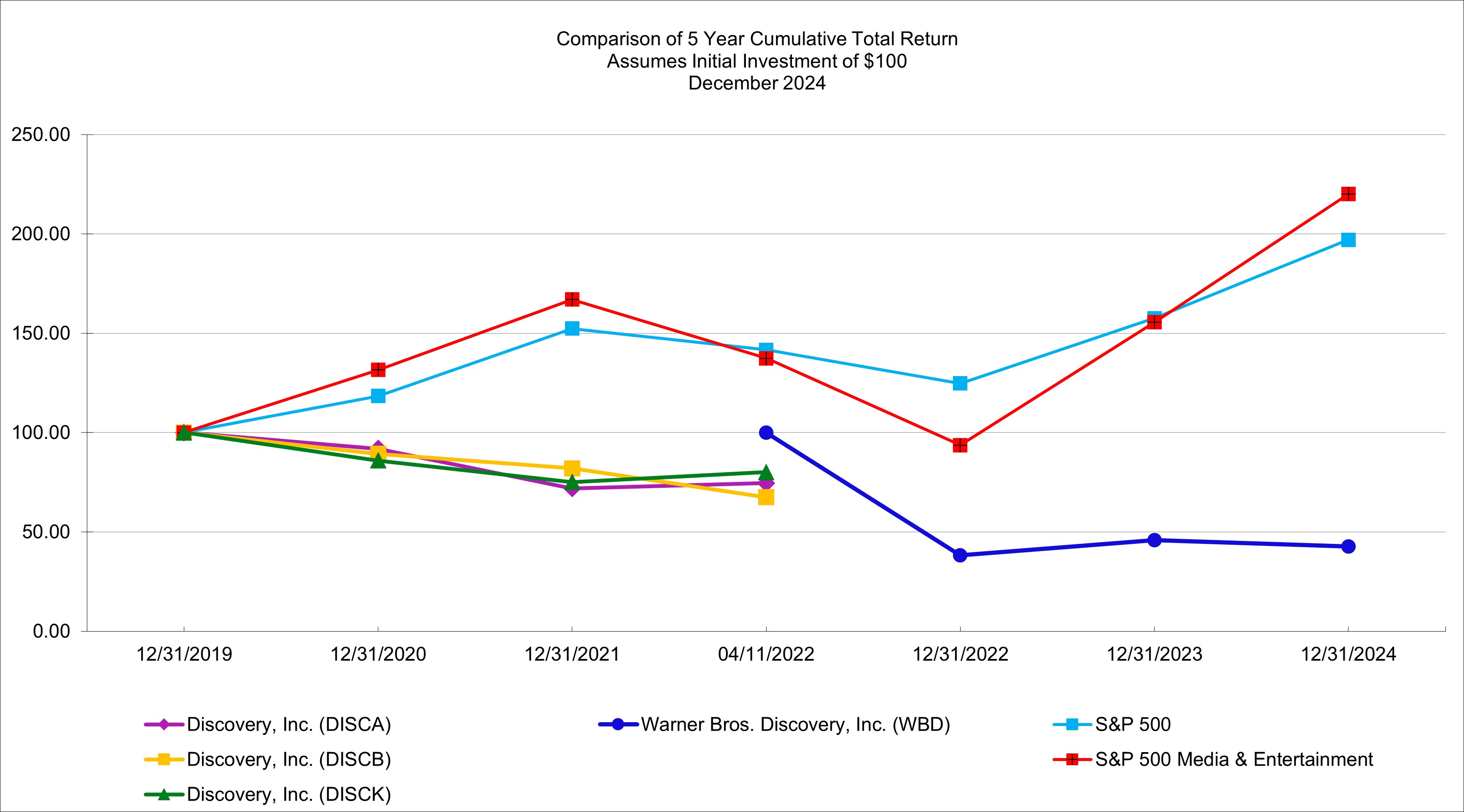
Note: Peer group indices use beginning of period market capitalization weighting.
Note: Index Data: Copyright Standard and Poor’s, Inc. Used with permission. All rights reserved.
Note: Prepared by Zacks Investment Research, Inc. Used with permission. All rights reserved. Copyright 1980-2025.
| December 31, | April 11, | December 31, | ||||||||||||||||||||||||||||||||||||||||||
| 2019 | 2020 | 2021 | 2022 | 2022 | 2023 | 2024 | ||||||||||||||||||||||||||||||||||||||
| WBD | $ | 100.00 | $ | 38.26 | $ | 45.92 | $ | 42.66 | ||||||||||||||||||||||||||||||||||||
| DISCA | $ | 100.00 | $ | 91.91 | $ | 71.90 | $ | 74.62 | $ | — | $ | — | $ | — | ||||||||||||||||||||||||||||||
| DISCB | $ | 100.00 | $ | 89.35 | $ | 82.05 | $ | 67.43 | $ | — | $ | — | $ | — | ||||||||||||||||||||||||||||||
| DISCK | $ | 100.00 | $ | 85.90 | $ | 75.11 | $ | 80.09 | $ | — | $ | — | $ | — | ||||||||||||||||||||||||||||||
| S&P 500 Index | $ | 100.00 | $ | 118.40 | $ | 152.39 | $ | 141.64 | $ | 124.79 | $ | 157.59 | $ | 197.02 | ||||||||||||||||||||||||||||||
| S&P 500 Media & Entertainment Index | $ | 100.00 | $ | 131.54 | $ | 166.98 | $ | 137.39 | $ | 93.66 | $ | 155.53 | $ | 220.01 | ||||||||||||||||||||||||||||||
Item 6. [Reserved].
Item 7. Management’s Discussion and Analysis of Financial Condition and Results of Operations.
Management’s discussion and analysis of financial condition and results of operations is a supplement to and should be read in conjunction with the accompanying consolidated financial statements and related notes. This section provides additional information regarding our businesses, current developments, results of operations, cash flows, financial condition, contractual commitments, critical accounting policies, and estimates that require significant judgment and thus have the most significant potential impact on our consolidated financial statements. This discussion and analysis is intended to better allow investors to view the company from management’s perspective.
This section provides an analysis of our financial results for the fiscal year ended December 31, 2024 compared to the fiscal year ended December 31, 2023. A discussion of our results of operations and liquidity for the fiscal year ended December 31, 2023 compared to the fiscal year ended December 31, 2022 can be found under Item 7 in our Annual Report on Form 10-K for the fiscal year ended December 31, 2023, filed on February 23, 2024, which is available free of charge on the SEC’s website at www.sec.gov and our Investor Relations website at ir.wbd.com. The information contained on our website is not part of this Annual Report on Form 10-K and is not incorporated by reference herein.
BUSINESS OVERVIEW
On April 8, 2022, Discovery, a global media company that provides content across multiple distribution platforms, including linear, free-to-air, and broadcast television, authenticated GO applications, digital distribution arrangements, content licensing arrangements, and DTC subscription products, completed its Merger with the WarnerMedia Business of AT&T and changed its name from “Discovery, Inc.” to “Warner Bros. Discovery, Inc.” On April 11, 2022, our shares started trading on Nasdaq under the trading symbol WBD. (See Note 3 and Note 4 to the accompanying consolidated financial statements.)
Warner Bros. Discovery is a leading global media and entertainment company that creates and distributes a differentiated and comprehensive portfolio of content and products across television, film, streaming, interactive gaming, publishing, themed experiences, and consumer products through brands including: Discovery Channel, Max, CNN, DC Studios, TNT Sports, HBO, Food Network, TLC, TBS, Warner Bros. Motion Picture Group, Warner Bros. Television Group, Warner Bros. Games, Adult Swim, Turner Classic Movies, and others. For a discussion of our global portfolio see our business overview set forth in Item 1, “Business” in this Annual Report on Form 10-K.
In connection with the Merger, we have announced and taken actions to implement projects to achieve cost synergies for the Company. We finalized the framework supporting our ongoing restructuring and transformation initiatives during the year ended December 31, 2022, which included, among other things, strategic content programming assessments, organization restructuring, facility consolidation activities, and other contract termination costs. At that time, we expected to incur approximately $4.1 - $5.3 billion in pre-tax restructuring charges, of which we have incurred $4.7 billion as of December 31, 2024. Of the total expected pre-tax restructuring charges, we expected total cash expenditures to be $1.0 - $1.5 billion. While our restructuring efforts are ongoing, the Merger-related restructuring program was substantially completed at the end of 2024. During 2023, we initiated a strategic realignment plan associated with our Warner Bros. Pictures Animation group and during 2024, we initiated two additional restructuring initiatives; an organizational and personnel restructuring plan and a restructuring initiative associated with our Warner Bros. Games group.
As of December 31, 2024, we classified our operations in three reportable segments:
-
Studios** - Our Studios segment primarily consists of the production and release of feature films for initial exhibition in theaters, production and initial licensing of television programs to our networks/DTC services as well as third parties, distribution of our films and television programs to various third party and internal television and streaming services, distribution through the home entertainment market (physical and digital), related consumer products and themed experience licensing, and interactive gaming.
-
Networks** - Our Networks segment primarily consists of our domestic and international television networks.
-
DTC** - Our DTC segment primarily consists of our premium pay-TV and streaming services.
Our segment presentation was aligned with our management structure and the financial information management uses to make decisions about operating matters, such as the allocation of resources and business performance assessments.
For further discussion of financial information for our segments and the geographical areas in which we do business, our content development activities, and revenues, see our business overview set forth in Item 1, “Business” and Note 23 to the consolidated financial statements included in Item 8, “Financial Statements and Supplementary Data” in this Annual Report on Form 10-K.
RESULTS OF OPERATIONS
Foreign Exchange Impacting Comparability
The impact of exchange rates on our business is an important factor in understanding period-to-period comparisons of our results. For example, our international revenues are favorably impacted as the U.S. dollar weakens relative to other foreign currencies, and unfavorably impacted as the U.S. dollar strengthens relative to other foreign currencies. We believe the presentation of results on a constant currency basis (“ex-FX”), in addition to results reported in accordance with U.S. GAAP provides useful information about our operating performance because the presentation ex-FX excludes the effects of foreign currency volatility and highlights our core operating results. The presentation of results on a constant currency basis should be considered in addition to, but not a substitute for, measures of financial performance reported in accordance with U.S. GAAP.
The ex-FX change represents the percentage change on a period-over-period basis adjusted for foreign currency impacts. The ex-FX change is calculated as the difference between the current year amounts translated at a baseline rate, which is a spot rate for each of our currencies determined early in the fiscal year as part of our forecasting process (the “2024 Baseline Rate”), and the prior year amounts translated at the same 2024 Baseline Rate. In addition, consistent with the assumption of a constant currency environment, our ex-FX results exclude the impact of our foreign currency hedging activities, as well as realized and unrealized foreign currency transaction gains and losses. Results on a constant currency basis, as we present them, may not be comparable to similarly titled measures used by other companies.
Consolidated Results of Operations – 2024 vs. 2023
Our consolidated results of operations for 2024 and 2023 were as follows (in millions).
| Year Ended December 31, | |||||||||||||||||||||||||||||||||||||||||||||||
| 2024 | 2023 | % Change | % Change (ex-FX) | ||||||||||||||||||||||||||||||||||||||||||||
Showing the first 8K of 107K characters. Open the full section
Item 7A. Quantitative and Qualitative Disclosures about Market Risk.
Our financial position, earnings, and cash flows are exposed to market risks and can be affected by, among other things, economic conditions, interest rate changes, foreign currency fluctuations, and changes in the market values of investments. We have established policies, procedures, and internal processes governing our management of market risks and the use of financial instruments to manage our exposure to such risks.
Interest Rates
We are exposed to the impact of interest rate changes primarily through our actual and potential borrowing activities. During the year ended December 31, 2024, we entered into a new $6.0 billion multicurrency revolving credit agreement, replacing the existing $6.0 billion multicurrency revolving credit agreement. We had no outstanding borrowings as of December 31, 2024. We also have access to a commercial paper program, which had no outstanding borrowings as of December 31, 2024. The interest rate on borrowings under the revolving credit facility is based on a floating rate based on the applicable currency of the borrowing plus a margin. The revolving credit facility matures in October 2029, with the option for up to two additional 364-day renewal periods. As of December 31, 2024, we had $39.5 billion of fixed-rate senior notes, at par value.
Our current objectives in managing exposure to interest rate changes are to limit the impact of interest rates on earnings and cash flows. To achieve these objectives, we may enter into derivative instruments, effectively converting fixed rate borrowings to variable rate borrowings indexed to benchmark interest rates in order to reduce the amount of interest paid, or to limit the impact of volatility in interest rates on future issuances of fixed rate debt. (See Note 13 to the accompanying consolidated financial statements.)
As of December 31, 2024, the fair value of our outstanding senior notes, including accrued interest, was $34.9 billion. The fair value of our long-term debt may vary as a result of market conditions and other factors. A change in market interest rates will impact the fair market value of our fixed rate debt. The potential change in fair value of these senior notes from a 100 basis-point increase in quoted interest rates across all maturities, often referred to as a parallel shift in the yield curve, would be a decrease in fair value of approximately $2.1 billion as of December 31, 2024.
Foreign Currency Exchange Rates
We transact business globally and are subject to risks associated with changing foreign currency exchange rates. Market risk refers to the risk of loss arising from adverse changes in foreign currency exchange rates. The risk of loss can be assessed from the perspective of adverse changes in fair values, cash flows, and future earnings. We operate from hubs in EMEA, Latin America, and Asia, with net earnings reinvested locally and working capital requirements met from existing liquid funds. To the extent such funds are not sufficient to meet working capital requirements, drawdowns in the appropriate local currency are available from intercompany borrowings or from our revolving credit facility. The earnings of certain international operations are expected to be reinvested in those businesses indefinitely.
The functional currency of most of our international subsidiaries is the local currency. We are exposed to foreign currency risk to the extent that we enter into transactions denominated in currencies other than our subsidiaries’ respective functional currencies (“non-functional currency risk”). Such transactions include affiliate and ad sales arrangements, content arrangements, equipment and other vendor purchases, and intercompany transactions. Changes in exchange rates with respect to amounts recorded in our consolidated balance sheets related to these items will result in unrealized foreign currency transaction gains and losses based upon period-end exchange rates. We also record realized foreign currency transaction gains and losses upon settlement of the transactions. Moreover, we will experience fluctuations in our revenues and expenses solely as a result of changes in foreign currency exchange rates.
We also are exposed to unfavorable and potentially volatile fluctuations of the U.S. dollar, which is our reporting currency, against the currencies of our operating subsidiaries when their respective financial statements are translated into U.S. dollars for inclusion in our consolidated financial statements. Cumulative translation adjustments are recorded in accumulated other comprehensive loss as a separate component of equity. Any increase or decrease in the value of the U.S. dollar against any foreign functional currency of one of our operating subsidiaries will cause us to experience unrealized foreign currency translation gains or losses with respect to amounts already invested in such foreign currencies. Accordingly, we may experience a negative impact on our net loss, other comprehensive loss, and equity with respect to our holdings solely as a result of changes in foreign currency.
The majority of our foreign currency exposure is tied to Europe and Latin America. We may enter into derivative instruments that change in value as foreign currency exchange rates change to hedge certain exposures associated with affiliate revenue, the cost of producing or acquiring content, certain intercompany transactions, or in connection with forecasted business combinations. These contracts hedge forecasted foreign currency transactions in order to mitigate fluctuations in our earnings and cash flows associated with changes in foreign currency exchange rates. Our objective in managing exposure to foreign currency fluctuations is to reduce volatility of earnings and cash flows. Most of our non-functional currency risks related to our revenue, operating expenses, and capital expenditures were not hedged as of December 31, 2024. We generally do not hedge against the risk that we may incur non-cash losses upon the translation of the financial statements of our subsidiaries and affiliates into U.S. dollars. (See Note 13 to the accompanying consolidated financial statements.)
Derivatives
We may use derivative financial instruments to modify our exposure to exogenous events and market risks from changes in foreign currency exchange rates and interest rates. We do not use derivatives unless there is an underlying exposure. While derivatives are used to mitigate cash flow risk and the risk of declines in fair value, they also limit potential economic benefits to our business in the event of positive shifts in foreign currency exchange rates and interest rates. We do not hold or enter into financial instruments for speculative trading purposes. (See Note 13 to the accompanying consolidated financial statements.)
Market Values of Investments and Liabilities
In addition to derivatives, we had investments in entities accounted for as equity method investments, equity investments, and other highly liquid instruments, such as money market funds and mutual funds, that are accounted for at fair value. We also have liabilities, such as deferred compensation, that are accounted for at fair value (See Note 10 and Note 14 to the accompanying consolidated financial statements). Investments in mutual funds include both fixed- and floating-rate interest earning securities that carry a degree of interest rate risk. Fixed-rate securities may have their fair market value adversely impacted by a rise in interest rates, while floating-rate securities may produce less income than predicted if interest rates fall. Due in part to these factors, our income from such investments may decrease in the future. Liabilities carried at fair value, such as deferred compensation, may experience capital gains that result in increased liabilities and expenses as the capital gains occur. We may enter into derivative financial instruments to hedge the risk of these market value changes. (See Note 13 to the accompanying consolidated financial statements.)
Item 8. Financial Statements and Supplementary Data.
MANAGEMENT’S REPORT ON INTERNAL CONTROL OVER FINANCIAL REPORTING
Management of Warner Bros. Discovery, Inc. (the “Company”) is responsible for establishing and maintaining adequate internal control over financial reporting, as such term is defined in Rule 13a-15(f) and Rule 15d-15(f) of the Securities Exchange Act of 1934, as amended. The Company’s internal control over financial reporting includes those policies and procedures that (i) pertain to the maintenance of records that, in reasonable detail, accurately and fairly reflect the transactions and disposition of the assets of the Company; (ii) provide reasonable assurance that transactions are recorded as necessary to permit preparation of financial statements in accordance with generally accepted accounting principles, and provide reasonable assurance that receipts and expenditures of the Company are being made only in accordance with authorizations of management and the directors of the Company; and (iii) provide reasonable assurance regarding prevention or timely detection of unauthorized acquisition, use, or disposition of the Company’s assets that could have a material effect on the consolidated financial statements.
Internal control over financial reporting is designed to provide reasonable assurance regarding the reliability of financial reporting and the preparation of financial statements prepared for external purposes in accordance with generally accepted accounting principles. Because of its inherent limitations, internal control over financial reporting may not prevent or detect misstatements. Also, projections of any evaluation of effectiveness to future periods are subject to the risk that controls may become inadequate because of changes in conditions, or that the degree of compliance with the policies or procedures may deteriorate.
The Company’s management, with the participation of its Chief Executive Officer and Chief Financial Officer, conducted an evaluation of the effectiveness of the Company’s internal control over financial reporting as of December 31, 2024 based on the framework set forth in Internal Control – Integrated Framework (2013) issued by the Committee of Sponsoring Organizations of the Treadway Commission. Based on its evaluation, management concluded that, as of December 31, 2024, the Company’s internal control over financial reporting was effective to provide reasonable assurance regarding the reliability of financial reporting and the preparation of financial statements for external purposes in accordance with generally accepted accounting principles.
The effectiveness of the Company’s internal control over financial reporting as of December 31, 2024 has been audited by PricewaterhouseCoopers LLP, an independent registered public accounting firm, as stated in their report in Item 8 of Part II of this Annual Report on Form 10-K under the caption “Report of Independent Registered Public Accounting Firm.”
Report of Independent Registered Public Accounting Firm
To the Board of Directors and Stockholders of Warner Bros. Discovery, Inc.
Opinions on the Financial Statements and Internal Control over Financial Reporting
We have audited the accompanying consolidated balance sheets of Warner Bros. Discovery, Inc. and its subsidiaries (the “Company”) as of December 31, 2024 and 2023, and the related consolidated statements of operations, of comprehensive (loss) income, of equity and of cash flows for each of the three years in the period ended December 31, 2024, including the related notes and schedule of valuation and qualifying accounts for each of the three years in the period ended December 31, 2024 appearing under Item 15(a)(2) (collectively referred to as the “consolidated financial statements”). We also have audited the Company's internal control over financial reporting as of December 31, 2024, based on criteria established in Internal Control - Integrated Framework (2013) issued by the Committee of Sponsoring Organizations of the Treadway Commission (COSO).
In our opinion, the consolidated financial statements referred to above present fairly, in all material respects, the financial position of the Company as of December 31, 2024 and 2023**,** and the results of its operations and its cash flows for each of the three years in the period ended December 31, 2024 in conformity with accounting principles generally accepted in the United States of America. Also in our opinion, the Company maintained, in all material respects, effective internal control over financial reporting as of December 31, 2024, based on criteria established in Internal Control - Integrated Framework (2013) issued by the COSO.
Basis for Opinions
The Company's management is responsible for these consolidated financial statements, for maintaining effective internal control over financial reporting, and for its assessment of the effectiveness of internal control over financial reporting, included in the accompanying Management’s Report on Internal Control Over Financial Reporting. Our responsibility is to express opinions on the Company’s consolidated financial statements and on the Company's internal control over financial reporting based on our audits. We are a public accounting firm registered with the Public Company Accounting Oversight Board (United States) (PCAOB) and are required to be independent with respect to the Company in accordance with the U.S. federal securities laws and the applicable rules and regulations of the Securities and Exchange Commission and the PCAOB.
We conducted our audits in accordance with the standards of the PCAOB. Those standards require that we plan and perform the audits to obtain reasonable assurance about whether the consolidated financial statements are free of material misstatement, whether due to error or fraud, and whether effective internal control over financial reporting was maintained in all material respects.
Our audits of the consolidated financial statements included performing procedures to assess the risks of material misstatement of the consolidated financial statements, whether due to error or fraud, and performing procedures that respond to those risks. Such procedures included examining, on a test basis, evidence regarding the amounts and disclosures in the con
Showing the first 8K of 320K characters. Open the full section
Item 9. Changes in and Disagreements With Accountants on Accounting and Financial Disclosure.
None.
Item 9A. Controls and Procedures.
Evaluation of Disclosure Controls and Procedures
Our management, with the participation of our Chief Executive Officer and Chief Financial Officer, has evaluated the effectiveness of our disclosure controls and procedures as of December 31, 2024. The term “disclosure controls and procedures,” as defined in Rules 13a-15(e) and 15d-15(e) of the Securities Exchange Act of 1934, as amended (the “Exchange Act”), means controls and other procedures of a company that are designed to provide reasonable assurance that information required to be disclosed by a company in the reports that it files or submits under the Exchange Act is recorded, processed, summarized and reported, within the time periods specified in the SEC’s rules and forms. Disclosure controls and procedures include, without limitation, controls and procedures designed to provide reasonable assurance that information required to be disclosed by a company in the reports that it files or submits under the Exchange Act is accumulated and communicated to the company’s management, including its principal executive and principal financial officers, or persons performing similar functions, as appropriate to allow timely decisions regarding required disclosure. Management recognizes that any controls and procedures, no matter how well designed and operated, can provide only reasonable assurance of achieving their objectives and management necessarily applies its judgment in evaluating the cost-benefit relationship of possible controls and procedures. Based on the evaluation of our disclosure controls and procedures as of December 31, 2024, our Chief Executive Officer and Chief Financial Officer concluded that, as of such date, our disclosure controls and procedures were effective at the reasonable assurance level.
Management’s Annual Report on Internal Control Over Financial Reporting
Management’s report on internal control over financial reporting is set forth in Item 8 of this Annual Report on Form 10-K under the caption “Management’s Report on Internal Control Over Financial Reporting,” which is incorporated herein by reference.
Report of the Independent Registered Public Accounting Firm
The report of our independent registered public accounting firm regarding internal control over financial reporting is set forth in Item 8 of this Annual Report on Form 10-K under the caption “Report of Independent Registered Public Accounting Firm,” which is incorporated herein by reference.
Changes in Internal Control Over Financial Reporting
During the three months ended December 31, 2024, there were no changes in our internal control over financial reporting, as defined in Exchange Act Rule 13a-15(f), that have materially affected, or are reasonably likely to materially affect, our internal control over financial reporting.
Item 9B. Other Information.
None.
Item 9C. Disclosure Regarding Foreign Jurisdictions that Prevent Inspections.
Not applicable.
PART III
Certain information required in Item 10 through Item 14 of Part III of this Annual Report on Form 10-K is incorporated herein by reference to our definitive Proxy Statement for our 2025 Annual Meeting of Stockholders (“2025 Proxy Statement”), which shall be filed with the SEC pursuant to Regulation 14A of the Exchange Act within 120 days of our fiscal year end.
Item 10. Directors, Executive Officers and Corporate Governance.
Information regarding our directors, compliance with Section 16(a) of the Exchange Act, and our Audit Committee, including committee members and its financial expert, will be set forth in our 2025 Proxy Statement under the captions “Proposal 1: Election of Directors,” “Stock Ownership - Security Ownership of Management - Delinquent Section 16(a) Reports,” if applicable, and “Corporate Governance – Board Meetings and Committees – Board Committee Structure – Audit Committee,” respectively, which are incorporated herein by reference.
Information regarding our executive officers is set forth in Part I of this Annual Report on Form 10-K under the caption “Executive Officers of Warner Bros. Discovery, Inc.” as permitted by General Instruction G(3) to Form 10-K.
We have adopted a Code of Ethics (the “Code”) that is applicable to all of our directors, officers and employees. Our board of directors approved an updated Code in January 2023 and reviews it regularly. A copy of the Code and any amendments or waivers that would be required to be disclosed under applicable SEC rules are available free of charge at our Investor Relations website at ir.wbd.com. The information contained on our website is not part of this Annual Report on Form 10-K and is not incorporated by reference herein. In addition, we will provide a printed copy of the Code, free of charge, upon written request to: Investor Relations, Warner Bros. Discovery, Inc., 230 Park Avenue South, New York, NY 10003.
We have adopted an insider trading policy which governs transactions in our securities, as well as the securities of publicly traded companies with whom we have a business relationship, by any of our directors, officers and employees, and other covered persons. While the Company’s insider trading policy is designed to apply to individuals, as described above, rather than transactions by the Company in its own securities, it is the Company’s practice with respect to transactions in its securities to comply with all applicable insider trading laws and Nasdaq standards. We believe the policy is reasonably designed to promote compliance with insider trading laws, rules and regulations applicable to the Company. A copy of our insider trading policy is filed with this Annual Report on Form 10-K as Exhibit 19.
Item 11. Executive Compensation.
Information regarding executive compensation will be set forth in our 2025 Proxy Statement under the captions “Executive Compensation – Compensation Discussion and Analysis” and “Executive Compensation – Executive Compensation Tables,” which are incorporated herein by reference.
Information regarding compensation policies and practices as they relate to our risk management, director compensation, and compensation committee interlocks and insider participation will be set forth in our 2025 Proxy Statement under the captions “Executive Compensation – Other Compensation-Related Matters – Risk Considerations in our Compensation Programs,” “Corporate Governance – Director Compensation,” and “Corporate Governance – Board Meetings and Committees – Board Committee Structure – Compensation Committee,” respectively, which are incorporated herein by reference.
Information regarding the compensation committee report will be set forth in our 2025 Proxy Statement under the caption “Executive Compensation – Compensation Committee Report” which is incorporated herein by reference.
Item 12. Security Ownership of Certain Beneficial Owners and Management and Related Stockholder Matters.
Information regarding securities authorized for issuance under equity compensation plans will be set forth in our 2025 Proxy Statement under the caption “Securities Authorized for Issuance under Equity Compensation Plans,” which is incorporated herein by reference.
Information regarding security ownership of certain beneficial owners and management will be set forth in our 2025 Proxy Statement under the captions “Stock Ownership – Security Ownership of Certain Beneficial Owners” and “Stock Ownership – Security Ownership of Management,” which are incorporated herein by reference.
Item 13. Certain Relationships and Related Transactions, and Director Independence.
Information regarding certain relationships and related transactions, and director independence will be set forth in our 2025 Proxy Statement under the captions “Corporate Governance – Transactions with Related Persons” and “Corporate Governance – Director Independence,” respectively, which are incorporated herein by reference.
Item 14. Principal Accountant Fees and Services.
Information regarding principal accountant fees and services will be set forth in our 2025 Proxy Statement under the captions “Audit Matters – Audit Firm Fees and Services” and “Audit Matters – Audit Committee Pre-Approval Procedures,” which are incorporated herein by reference.
PART IV
Item 15. Exhibits and Financial Statement Schedules.
(a) The following documents are filed as part of this Annual Report on Form 10-K:
(1) The following consolidated financial statements of Warner Bros. Discovery, Inc. are filed as part of Item 8 of this Annual Report on Form 10-K:
(2) Financial Statement Schedule
Schedule II: Valuation and Qualifying Accounts
Changes in valuation and qualifying accounts consisted of the following (in millions):
| Beginning of Year | Additions | Deductions | End of Year | ||||||||||||||||||||||||||||||||||||||
| 2024 | |||||||||||||||||||||||||||||||||||||||||
| Allowance for credit losses | $ | 161 | 127 | (127) | $ | 161 | |||||||||||||||||||||||||||||||||||
| Deferred tax valuation allowance | $ | 2,191 | 179 | (327) | $ | 2,043 | |||||||||||||||||||||||||||||||||||
| 2023 | |||||||||||||||||||||||||||||||||||||||||
| Allowance for credit losses | $ | 123 | 152 | (114) | $ | 161 | |||||||||||||||||||||||||||||||||||
| Deferred tax valuation allowance | $ | 1,849 | 429 | (87) | $ | 2,191 | |||||||||||||||||||||||||||||||||||
| 2022 | |||||||||||||||||||||||||||||||||||||||||
| Allowance for credit losses (a) | $ | 54 | 165 | (96) | $ | 123 | |||||||||||||||||||||||||||||||||||
| Deferred tax valuation allowance (b) | $ | 305 | 1,617 | (73) | $ | 1,849 | |||||||||||||||||||||||||||||||||||
| (a) Increase in the allowance for credit losses is related to the acquisition of WM in 2022. | |||||||||||||||||||||||||||||||||||||||||
| (b) Additions to the deferred tax valuation allowance include $343 million related to the acquisition of WM in 2022. |
All other financial statement schedules required to be filed pursuant to Item 8 and Item 15(c) of Form 10-K have been omitted as the required information is not applicable, not material, or is set forth in the consolidated financial statements or notes thereto.
(3) The following exhibits are filed or furnished as part of this Annual Report on Form 10-K pursuant to Item 601 of SEC Regulation S-K and Item 15(b) of Form 10-K:
- Indicates management contract or compensatory plan, contract or arrangement.
(1) Other instruments defining the rights of holders of long-term debt of the registrant and its consolidated subsidiaries may be omitted from Exhibit 4 in accordance with Item 601(b)(4)(iii)(A) of Regulation S-K. Copies of any such agreements will be supplementally provided to the SEC upon request.
(2) Exhibits, schedules and annexes have been omitted pursuant to Item 601(a)(5) of Regulation S-K and will be supplementally provided to the SEC upon request.
(3) Certain provisions of this exhibit have been omitted pursuant to Item 601(b)(10)(iv) of Regulation S-K and will be supplementally provided to the SEC upon request.
†Attached as Exhibit 101 to this Annual Report on Form 10-K are the following formatted in Inline XBRL (Extensible Business Reporting Language): (i) Consolidated Balance Sheets as of December 31, 2024 and December 31, 2023, (ii) Consolidated Statements of Operations for the Years Ended December 31, 2024, 2023, and 2022, (iii) Consolidated Statements of Comprehensive Income for the Years Ended December 31, 2024, 2023, and 2022, (iv) Consolidated Statements of Cash Flows for the Years Ended December 31, 2024, 2023, and 2022, (v) Consolidated Statements of Equity for the Years Ended December 31, 2024, 2023, and 2022, and (vi) Notes to Consolidated Financial Statements.
Item 16. Form 10-K Summary
Not Applicable.
SIGNATURES
Pursuant to the requirements of Section 13 or 15(d) of the Securities Exchange Act of 1934, the registrant has duly caused this report to be signed on its behalf by the undersigned, thereunto duly authorized.
| WARNER BROS. DISCOVERY, INC. (Registrant) | ||||||||||||||
| Date: February 27, 2025 | By: | /s/ David M. Zaslav | ||||||||||||
| David M. Zaslav | ||||||||||||||
| President and Chief Executive Officer |
Pursuant to the requirements of the Securities Exchange Act of 1934, this report has been signed below by the following persons on behalf of the registrant and in the capacities and on the date indicated.
| Signature | Title | Date | ||||||||||||
| /s/ David M. Zaslav | President and Chief Executive Officer, and Director (Principal Executive Officer) | February 27, 2025 | ||||||||||||
| David M. Zaslav | ||||||||||||||
| /s/ Gunnar Wiedenfels | Chief Financial Officer (Principal Financial Officer) | February 27, 2025 | ||||||||||||
| Gunnar Wiedenfels | ||||||||||||||
| /s/ Lori C. Locke | Executive Vice President and Chief Accounting Officer (Principal Accounting Officer) | February 27, 2025 | ||||||||||||
| Lori C. Locke | ||||||||||||||
| /s/ Samuel A. Di Piazza, Jr. | Director | February 27, 2025 | ||||||||||||
| Samuel A. Di Piazza, Jr. | ||||||||||||||
| /s/ Richard W. Fisher | Director | February 27, 2025 | ||||||||||||
| Richard W. Fisher | ||||||||||||||
| /s/ Paul A. Gould | Director | February 27, 2025 | ||||||||||||
| Paul A. Gould | ||||||||||||||
| /s/ Debra L. Lee | Director | February 27, 2025 | ||||||||||||
| Debra L. Lee | ||||||||||||||
| /s/ Joseph M. Levin | Director | February 27, 2025 | ||||||||||||
| Joseph M. Levin | ||||||||||||||
| /s/ Kenneth W. Lowe | Director | February 27, 2025 | ||||||||||||
| Kenneth W. Lowe | ||||||||||||||
| /s/ Dr. John C. Malone | Director | February 27, 2025 | ||||||||||||
| Dr. John C. Malone | ||||||||||||||
| /s/ Fazal F. Merchant | Director | February 27, 2025 | ||||||||||||
| Fazal F. Merchant | ||||||||||||||
| /s/ Anthony J. Noto | Director | February 27, 2025 | ||||||||||||
| Anthony J. Noto | ||||||||||||||
| /s/ Paula A. Price | Director | February 27, 2025 | ||||||||||||
| Paula A. Price | ||||||||||||||
| /s/ Daniel E. Sanchez | Director | February 27, 2025 | ||||||||||||
| Daniel E. Sanchez | ||||||||||||||
| /s/ Geoffrey Y. Yang | Director | February 27, 2025 | ||||||||||||
| Geoffrey Y. Yang |