 filings.tools
Welltower 10-K 2018-12-31
Filed 2019-02-25. 22 sections, 839K characters. Original on sec.gov · Markdown · JSON
Cover and table of contents
UNITED STATES SECURITIES AND EXCHANGE COMMISSION
Washington, D.C. 20549
FORM 10-K
ANNUAL REPORT PURSUANT TO SECTION 13 OR 15(d)
OF THE SECURITIES EXCHANGE ACT OF 1934
For the fiscal year ended December 31, 2018
Commission File No. 1-8923

WELLTOWER INC.
(Exact name of registrant as specified in its charter)
| Delaware | 34-1096634 | |
| (State or other jurisdiction of incorporation or organization) | (I.R.S. Employer Identification No.) | |
| 4500 Dorr Street, Toledo, Ohio | 43615 | |
| (Address of principal executive offices) | (Zip Code) |
(419) 247-2800
(Registrant’s telephone number, including area code)
Securities registered pursuant to Section 12(b) of the Act:
| Title of Each Class | Name of Each Exchange on Which Registered |
| Common Stock, $1.00 par value | New York Stock Exchange |
| 6.50% Series I Cumulative Convertible Perpetual Preferred Stock, $1.00 par value | New York Stock Exchange |
| 4.800% Notes due 2028 | New York Stock Exchange |
| 4.500% Notes due 2034 | New York Stock Exchange |
Securities registered pursuant to Section 12(g) of the Act: None
Indicate by check mark if the registrant is a well-known seasoned issuer, as defined in Rule 405 of the Securities Act. Yes þ No ¨
Indicate by check mark if the registrant is not required to file reports pursuant to Section 13 or 15(d) of the Act. Yes ¨ No þ
Indicate by check mark whether the registrant (1) has filed all reports required to be filed by Section 13 or 15(d) of the Securities Exchange Act of 1934 during the preceding 12 months (or for such shorter period that the registrant was required to file such reports), and (2) has been subject to such filing requirements for the past 90 days. Yes þ No ¨
Indicate by check mark whether the registrant has submitted electronically, every Interactive Data File required to be submitted pursuant to Rule 405 of Regulation S-T (§232.405 of this chapter) during the preceding 12 months (or for such shorter period that the registrant was required to submit and post such files). Yes þ No ¨
Indicate by check mark if disclosure of delinquent filers pursuant to Item 405 of Regulation S-K (§229.405 of this chapter) is not contained herein, and will not be contained, to the best of registrant’s knowledge, in definitive proxy or information statements incorporated by reference in Part III of this Form 10-K or any amendment to this Form 10-K. þ
Indicate by check mark whether the registrant is a large accelerated filer, an accelerated filer, a non-accelerated filer, a smaller reporting company or an emerging growth company. See the definitions of “large accelerated filer,” “accelerated filer,” “smaller reporting company” and "emerging growth company" in Rule 12b-2 of the Exchange Act.
| Large accelerated filer | þ | Accelerated filer | ¨ | Non-accelerated filer | ¨ | Smaller reporting company | ¨ | Emerging growth company | ¨ |
| (Do not check if a smaller reporting company) |
If an emerging growth company, indicate by check mark if the registrant has elected not to use the extended transition period for complying with any new or revised financial accounting standards provided pursuant to Section 13(a) of the Exchange Act.
Indicate by check mark whether the registrant is a shell company (as defined in Rule 12b-2 of the Exchange Act). Yes ¨ No þ
The aggregate market value of the shares of voting common stock held by non-affiliates of the registrant, computed by reference to the closing sales price of such shares on the New York Stock Exchange as of the last business day of the registrant’s most recently completed second fiscal quarter was $23,282,837,560.
As of February 13, 2019, the registrant had 386,361,193 shares of common stock outstanding.
DOCUMENTS INCORPORATED BY REFERENCE
Portions of the registrant’s definitive proxy statement for the annual stockholders’ meeting to be held May 2, 2019, are incorporated by reference into Part III.
WELLTOWER INC. AND SUBSIDIARIES
2018 FORM 10-K ANNUAL REPORT
TABLE OF CONTENTS
| Page | ||
| PART I | ||
| Item 1. | Business | 2 |
| Item 1A. | Risk Factors | 25 |
| Item 1B. | Unresolved Staff Comments | 34 |
| Item 2. | Properties | 35 |
| Item 3. | Legal Proceedings | 36 |
| Item 4. | Mine Safety Disclosures | 36 |
| PART II | ||
| Item 5. | Market for Registrant’s Common Equity, Related Stockholder Matters and Issuer Purchases of Equity Securities | 37 |
| Item 6. | Selected Financial Data | 38 |
| Item 7. | Management’s Discussion and Analysis of Financial Condition and Results of Operations | 39 |
| Item 7A. | Quantitative and Qualitative Disclosures About Market Risk | 60 |
| Item 8. | Financial Statements and Supplementary Data | 61 |
| Item 9. | Changes in and Disagreements with Accountants on Accounting and Financial Disclosure | 94 |
| Item 9A. | Controls and Procedures | 94 |
| Item 9B. | Other Information | 95 |
| PART III | ||
| Item 10. | Directors, Executive Officers and Corporate Governance | 96 |
| Item 11. | Executive Compensation | 96 |
| Item 12. | Security Ownership of Certain Beneficial Owners and Management and Related Stockholder Matters | 96 |
| Item 13. | Certain Relationships and Related Transactions and Director Independence | 96 |
| Item 14. | Principal Accounting Fees and Services | 96 |
| PART IV | ||
| Item 15. | Exhibits and Financial Statement Schedules | 97 |
| Item 16. | Form 10-K Summary | 102 |
| Signature | 103 |
PART I
Item 1. Business
General
Welltower Inc. (NYSE:WELL), an S&P 500 company headquartered in Toledo, Ohio, is driving the transformation of health care infrastructure. The company invests with leading seniors housing operators, post-acute providers and health systems to fund the real estate and infrastructure needed to scale innovative care delivery models and improve people’s wellness and overall health care experience. Welltower™, a real estate investment trust (“REIT”), owns interests in properties concentrated in major, high-growth markets in the United States (“U.S.”), Canada and the United Kingdom (“U.K.”), consisting of seniors housing and post-acute communities and outpatient medical properties. More information is available on the Internet at www.welltower.com. The information on our website is not incorporated by reference in this Annual Report on Form 10-K, and our web address is included as an inactive textual reference only.
Our primary objectives are to protect stockholder capital and enhance stockholder value. We seek to pay consistent cash dividends to stockholders and create opportunities to increase dividend payments to stockholders as a result of annual increases in net operating income and portfolio growth. To meet these objectives, we invest across the full spectrum of seniors housing and health care real estate and diversify our investment portfolio by property type, relationship and geographic location.
References herein to “we,” “us,” “our” or the “company” refer to Welltower Inc., a Delaware corporation, and its subsidiaries unless specifically noted otherwise.
Portfolio of Properties
Please see “Item 7 – Management’s Discussion and Analysis of Financial Condition and Results of Operation – Executive Summary – Company Overview” for a table that summarizes our portfolio as of December 31, 2018.
Property Types
We invest in seniors housing and health care real estate and evaluate our business through three reportable segments: Seniors Housing Operating, Triple-net and Outpatient Medical. For additional information regarding our segments, please see Note 17 to our consolidated financial statements. The accounting policies of the segments are the same as those described in the summary of significant accounting policies in Note 2 to our consolidated financial statements. The following is a summary of our various property types.
Seniors Housing Operating
Our seniors housing operating properties offer services including independent living and independent supportive living, continuing care retirement communities, assisted living, Alzheimer's/dementia care and include care homes with or without nursing (U.K.), which assist with activities of daily living that preserve a person's mobility and social systems to promote cognitive engagement. Our properties include stand-alone properties that provide one level of service, combination properties that provide multiple levels of service and communities or campuses that provide a wide range of services. Properties are primarily held in joint venture entities with operating partners. We utilize the structure authorized by the REIT Investment Diversification and Empowerment Act of 2007, which is commonly referred to as a “RIDEA” structure (the provisions of the Internal Revenue Code authorizing the RIDEA structure were enacted as part of the Housing and Economic Recovery Act of 2008).
Independent Living and Independent Supportive Living (Canada) Independent living and independent supportive living refers to age-restricted, multifamily properties with central dining that provide residents access to meals and other services such as housekeeping, linen service, transportation and social and recreational activities.
Continuing Care Retirement Communities Continuing care retirement communities typically include a combination of detached homes and properties offering independent living, assisted living and/or long-term/post-acute care services on one campus. These communities appeal to residents because there is no need to relocate when health and medical needs change. Resident payment plans vary, but can include entrance fees, condominium fees and rental fees. Many of these communities also charge monthly maintenance fees in exchange for a living unit, meals and some health services.
Assisted Living Assisted living refers to state-regulated rental properties that provide independent living services, but also provide supportive care from trained employees to residents who require assistance with activities of daily living, including, but not limited to, management of medications, bathing, dressing, toileting, ambulating and eating.
Alzheimer’s/Dementia Care Certain properties offering assisted living may include state-licensed settings that specialize in caring for those afflicted with Alzheimer’s disease and/or other types of dementia.
Care Homes with or without Nursing (U.K.) Care homes without nursing, regulated by the Care Quality Commission ("CQC”), are rental properties that provide essentially the same services as U.S. assisted living. Care homes with nursing, also regulated by
the CQC, are licensed daily rate or rental properties where most individuals require 24-hour nursing and/or medical care. Generally, these properties are licensed for various national and local reimbursement programs. Unlike the U.S., care homes with nursing in the U.K. generally do not provide post-acute care.
Our Seniors Housing Operating segment accounted for 69%, 65% and 59% of total revenues for the years ended December 31, 2018, 2017 and 2016, respectively. As of December 31, 2018, we had relationships with 21 operators to manage our seniors housing operating properties. In each instance, our partner provides management services to the properties pursuant to an incentive-based management contract. We rely on our partners to effectively and efficiently manage these properties. For the year ended December 31, 2018, our relationship with Sunrise Senior Living accounted for approximately 36% of our Seniors Housing Operating segment revenues and 25% of our total revenues.
Triple-net
Our triple-net properties offer services including independent living and independent supportive living (Canada), assisted living, continuing care retirement communities, Alzheimer's/dementia care and care homes with or without nursing (U.K.) described above, as well as long-term/post-acute care. We invest primarily through acquisitions, development and joint venture partnerships. Our properties are primarily leased to operators under long-term, triple-net master leases that obligate the tenant to pay all operating costs, utilities, real estate taxes, insurance, building repairs, maintenance costs and all obligations under certain ground leases. We are not involved in property management. Our properties include stand-alone properties that provide one level of service, combination facilities that provide multiple levels of service, and communities or campuses that provide a wide range of services.
Long-Term/Post-Acute Care Facilities Post-acute care is at the leading edge of reducing health care costs while improving quality. These high-impact centers help patients recover from illness or surgery with the goals of getting the patient home and healed faster and reducing hospital readmission rates. Our long-term/post-acute care properties generally offer skilled nursing/post-acute care, inpatient rehabilitation and long-term acute care services. Skilled nursing/post-acute care refers to licensed daily rate or rental properties where most individuals require 24-hour nursing and/or medical care. Generally, these properties are licensed for Medicaid and/or Medicare reimbursement in the U.S. or provincial reimbursement in Canada. All properties offer some level of rehabilitation services. Some properties focus on higher acuity patients and offer rehabilitation units specializing in cardiac, orthopedic, dialysis, neur
Showing the first 8K of 136K characters. Open the full section
Item 1A. Risk Factors
This section discusses the most significant factors that affect our business, operations and financial condition. It does not describe all risks and uncertainties applicable to us, our industry or ownership of our securities. If any of the following risks, as well as other risks and uncertainties that are not addressed in this section or that we have not yet identified, actually occur, we could be materially adversely affected and the value of our securities could decline. We group these risk factors into three categories:
| • | Risks arising from our business; |
| • | Risks arising from our capital structure; and |
| • | Risks arising from our status as a REIT. |
Risks Arising from Our Business
Our investments in and acquisitions of health care and seniors housing properties may be unsuccessful or fail to meet our expectations
We are exposed to the risk that some of our acquisitions may not prove to be successful. We could encounter unanticipated difficulties and expenditures relating to any acquired properties, including contingent liabilities, and acquired properties might require significant management attention that would otherwise be devoted to our ongoing business. If we agree to provide construction funding to an operator/tenant and the project is not completed, we may need to take steps to ensure completion of the project. Such expenditures may negatively affect our results of operations. Investments in and acquisitions of seniors housing and health care properties entail risks associated with real estate investments generally, including risks that the investment will not achieve expected returns, that the cost estimates for necessary property improvements will prove inaccurate or that the tenant, operator or manager will fail to meet performance expectations. Furthermore, there can be no assurance that our anticipated acquisitions and investments, the completion of which is subject to various conditions, will be consummated in accordance with
anticipated timing, on anticipated terms, or at all. Health care properties are often highly customizable and the development or redevelopment of such properties may require costly tenant-specific improvements. We also may be unable to quickly and efficiently integrate new acquisitions, particularly acquisitions of portfolios of properties, into our existing operations, and this could have an adverse effect on our results of operations and financial condition. As a result, we cannot assure you that we will achieve the economic benefit we expect from acquisitions, investment, development and redevelopment opportunities. All of the foregoing could affect our ability to continue paying dividends at the current rate.
Our investments in joint ventures could be adversely affected by our lack of exclusive control over these investments, our partners’ insolvency or failure to meet their obligations, and disputes between us and our partners
We have entered into, and may continue in the future to enter into, partnerships or joint ventures with other persons or entities. Joint venture investments involve risks that may not be present with other methods of ownership, including the possibility that our partner might become insolvent, refuse to make capital contributions when due or otherwise fail to meet its obligations, which may result in certain liabilities to us for guarantees and other commitments; that our partner might at any time have economic or other business interests or goals that are or become inconsistent with our interests or goals; that we could become engaged in a dispute with our partner, which could require us to expend additional resources to resolve such dispute and could have an adverse impact on the operations and profitability of the joint venture; and that our partner may be in a position to take action or withhold consent contrary to our instructions or requests. In addition, our ability to transfer our interest in a joint venture to a third party may be restricted. In some instances, we and/or our partner may have the right to trigger a buy-sell arrangement, which could cause us to sell our interest, or acquire our partner’s interest, at a time when we otherwise would not have initiated such a transaction. Our ability to acquire our partner’s interest may be limited if we do not have sufficient cash, available borrowing capacity or other capital resources. In such event, we may be forced to sell our interest in the joint venture when we would otherwise prefer to retain it. Joint ventures may require us to share decision-making authority with our partners, which could limit our ability to control the properties in the joint ventures. Even when we have a controlling interest, certain major decisions may require partner approval, such as the sale, acquisition or financing of a property.
We are exposed to operational risks with respect to our seniors housing operating properties that could adversely affect our revenue and operations
We are exposed to various operational risks with respect to our seniors housing operating properties that may increase our costs or adversely affect our ability to generate revenues. These risks include fluctuations in occupancy, Medicare and Medicaid reimbursement, if applicable, and private pay rates; economic conditions; competition; federal, state, local, and industry-regulated licensure, certification and inspection laws, regulations, and standards; the availability and increases in cost of general and professional liability insurance coverage; state regulation and rights of residents related to entrance fees; and the availability and increases in the cost of labor (as a result of unionization or otherwise). Any one or a combination of these factors may adversely affect our revenue and operations.
Decreases in our operators’ revenues or increases in our operators’ expenses could affect our operators’ ability to make payments to us
Our operators’ revenues are primarily driven by occupancy, private pay rates, and Medicare and Medicaid reimbursement, if applicable. Expenses for these facilities are primarily driven by the costs of labor, food, utilities, taxes, insurance and rent or debt service. Revenues from government reimbursement have, and may continue to, come under pressure due to reimbursement cuts and state budget shortfalls. Operating costs continue to increase for our operators. To the extent that any decrease in revenues and/or any increase in operating expenses result in a property not generating enough cash to make payments to us, the credit of our operator and the value of other collateral would have to be relied upon. To the extent the value of such property is reduced, we may need to record an impairment for such asset. Furthermore, if we determine to dispose of an underperforming property, such sale may result in a loss. Any such impairment or loss on sale would negatively affect our financial results. All of the foregoing could affect our ability to continue paying dividends at the current rate.
Increased competition and oversupply may affect our operators’ ability to meet their obligations to us
The operators of our properties compete on a local and regional basis with operators of properties and other health care providers that provide comparable services for residents and patients, including on the basis of the scope and quality of care and services provided, reputation and financial condition, physical appearance of the properties, price, and location. Our operators are expected to encounter increased competition in the future that could limit their ability to attract residents or expand their businesses. In addition, we expect that there will continue to be a more than adequate inventory of seniors housing facilities. We cannot be certain that the operators of all of our facilities will be able to achieve and maintain occupancy and rate levels that will enable them to meet all of their obligations to us. If our operators cannot compete effectively or if there is an oversupply of facilities, their financial performance and ability to meet their obligations to us could have a material adverse effect on our financial results.
A severe cold and flu season, epidemics or any other widespread illnesses could adversely affect the occupancy of our seniors housing operating and triple-net properties
Our revenues and our operators’ revenues are dependent on occupancy. It is impossible to predict the severity of the cold and flu season or the occurrence of epidemics or any other widespread illnesses. The occupancy of our seniors housing operating and triple-net properties could significantly decrease in the event of a severe cold and flu season, an epidemic or any other widespread illness. Such a decrease could affect the operating income of our seniors housing operating properties and the ability of our triple-net operators to make payments to us. In addition, a flu pandemic could significantly increase the cost burdens faced by our operators, including if they are required to implement quarantines for residents, and adversely affect their ability to meet their obligations to us, which would have a material adverse effect on our financial results.
The insolvency or bankruptcy of our tenants, operators, borrowers, managers and other obligors may adversely affect our business, results of operations and financial condition
We are exposed to the risk that our tenants, operators, borrowers, managers or other obligors may not be able to meet the rent, principal and interest or other payments due us, which may result in a tenant, operator, borrower, manager or other obligor bankruptcy or insolvency, or that a tenant, operator, borrower, manager or other obligor might become subject to bankruptcy or insolvency proceedings for other reasons. Although our operating lease agreements provide us with the right to evict a tenant, demand immediate payment of rent and exercise other remedies, and our loans provide us with the right to terminate any funding obligation, demand immediate repayment of principal and unpaid interest, foreclose on the collateral and exercise other remedies, the bankruptcy and insolvency laws afford certain rights to a party that has filed for bankruptcy or reorganization. A tenant, operator, borrower, manager or other obligor in bankruptcy or subject to insolvency proceedings may be able to limit or delay our ability to collect unpaid rent in the case of a lease or to receive unpaid principal and interest in the case of a loan, and to exercise other rights and remedies. In addition, if a lease is rejected in a tenant bankruptcy, our claim against the tenant may be limited by applicable provisions of the bankruptcy law. We may be required to fund certain expenses (e.g., real estate taxes and maintenance) to preserve the value of an investment property, avoid the imposition of liens on a property and/or transition a property to a new tenant. In some instances, we have terminated our lease with a tenant and relet the property to another tenant. In some of those situations, we have provided working capital loans to and limited indemnification of the new obligor. If we cannot transition a leased property to a new tenant, we may take possession of that property, which may expose us to certain successor liabilities. Should such events occur, our revenue and operating cash flow may be adversely affected. All of the foregoing could affect our ability to continue paying dividends at the current rate.
We may not be able to timely reinvest our sale proceeds on terms acceptable to us
From time to time, we will have cash available from the proceeds of sales of our securities, principal payments on our loans receivable or the sale of properties, including non-elective dispositions, under the terms of master leases or similar financial support arrangements. In order to maintain current revenues and continue generating attractive returns, we expect to re-invest these proceeds in a timely manner. We compete for real estate investments with a broad variety of potential investors, including other health care REITs, real estate partnerships, health care providers, health care lenders and other investors, including developers, banks, insurance companies, pension funds, government-sponsored entities and private equity firms, some of whom may have greater financial resources and lower costs of capital than we do. This competition for attractive investments may negatively affect our ability to make timely investments on terms acceptable to us.
The properties managed by Sunrise Senior Living, LLC (“Sunrise”) account for a significant portion of our revenues and net operating income and any adverse developments in its business or financial condition could adversely affect us
As of December 31, 2018, Sunrise managed 161 of our seniors housing operating properties. These properties account for a significant portion of our revenues, and we rely on Sunrise to manage these properties efficiently and effectively. We also rely on Sunrise to set appropriate resident fees, to provide accurate property-level financial results for our properties in a timely manner and to otherwise operate them in compliance with the terms of our management agreements and all applicable laws and regulations. Any adverse developments in Sunrise’s business or financial condition could impair its ability to manage our properties efficiently and effectively, which could adversely affect our business, results of operations, and financial condition. Also, if Sunrise experiences any significant financial, legal, accounting or regulatory difficulties, such difficulties could result in, among other things, acceleration of its indebtedness, impairment of its continued access to capital or the commencement of insolvency proceedings by or against it under the U.S. Bankruptcy Code, which, in turn, could adversely affect our business, results of operations and financial condition. See Note 8 to our consolidated financial statements for additional information.
We depend on Genesis HealthCare (“Genesis”), Brookdale Senior Living (“Brookdale”) and ProMedica Health System ("ProMedica") for a significant portion of our revenues and any failure, inability or unwillingness by them to satisfy obligations under their agreements with us could adversely affect us
The properties we lease to Genesis, Brookdale and ProMedica account for a significant portion of our revenues, and because these leases are triple-net leases, we also depend on Genesis, Brookdale and ProMedica to pay all insurance, taxes, utilities and maintenance and repair expenses in connection with the leased properties. We cannot assure you that Genesis, Brookdale and ProMedica will have sufficient assets, income and access to financing to enable them to make rental payments to us or to otherwise satisfy their respective obligations under our leases, and any failure, inability or unwillingness by Genesis, Brookdale or ProMedica
to do so could have an adverse effect on our business, results of operations and financial condition. Genesis, Brookdale and ProMedica have also agreed to indemnify, defend and hold us harmless from and against various claims, litigation and liabilities arising in connection with their respective businesses, and we cannot assure you that Genesis, Brookdale and ProMedica will have sufficient assets, income, access to financing and insurance coverage to enable them to satisfy their respective indemnification obligations. Genesis, Brookdale and ProMedica's failure to effectively conduct their operations or to maintain and improve our properties could adversely affect their business reputations and their ability to attract and retain patients and residents in our properties, which, in turn, could adversely affect our business, results of operations and financial condition. Additionally, we have made real estate and other loans to Genesis and their operational or other failures could adversely impact their ability to repay these loans when due.
Ownership of property outside the U.S. may subject us to different or greater risks than those associated with our domestic operations
We have operations in Canada and the U.K. which represent 10.0% and 9.6% of total Welltower revenues, respectively. As of December 31, 2018, Revera managed 98 of our seniors housing operating properties in Canada, representing a significant portion of our revenues, and also owned a controlling interest in Sunrise. International development, ownership, and operating activities involve risks that are different from those we face with respect to our domestic properties and operations. These risks include, but are not limited to, any international currency gain recognized with respect to changes in exchange rates may not qualify under the 75% gross income test or the 95% gross income test that we must satisfy annually in order to qualify and maintain our status as a REIT; challenges with respect to the repatriation of foreign earnings and cash; changes in foreign political, regulatory, and economic conditions (regionally, nationally and locally) including, but not limited to, continuing uncertainty surrounding the process of Brexit and the macroeconomic and regulatory effects of Brexit, including impacts on the U.K. real estate market; challenges in managing international operations; challenges of complying with a wide variety of foreign laws and regulations, including those relating to real estate, corporate governance, operations, taxes, employment and other civil and criminal legal proceedings; foreign ownership restrictions with respect to operations in countries; differences in lending practices and the willingness of domestic or foreign lenders to provide financing; regional or country-specific business cycles and political and economic instability; and failure to comply with applicable laws and regulations in the U.S. that affect foreign operations, including, but not limited to, the U.S. Foreign Corrupt Practices Act. If we are unable to successfully manage the risks associated with international expansion and operations, our results of operations and financial condition may be adversely affected.
If our tenants do not renew their existing leases, or if we are required to sell properties for liquidity reasons, we may be unable to lease or sell the properties on favorable terms, or at all
We cannot predict whether our tenants will renew existing leases at the end of their lease terms, which expire at various times. If these leases are not renewed, we would be required to find other tenants to occupy those properties or sell them. There can be no assurance that we would be able to identify suitable replacement tenants or enter into leases with new tenants on terms as favorable to us as the current leases or that we would be able to lease those properties at all.
Real estate investments are relatively illiquid and most of the property we own is highly customized for specific uses. Our ability to quickly sell or exchange any of our properties in response to changes in operator, economic and other conditions will be limited. No assurances can be given that we will recognize full value for any property that we are required to sell. Our inability to respond rapidly to changes in the performance of our investments could adversely affect our financial condition and results of operations. In addition, we are exposed to the risks inherent in concentrating investments in real estate, and in particular, the seniors housing and health care industries. A downturn in the real estate industry could adversely affect the value of our properties and our ability to sell properties for a price or on terms acceptable to us. All of the foregoing could affect our ability to continue paying dividends at the current rate.
Our tenants, operators and managers may not have the necessary insurance coverage to insure adequately against losses
We maintain or require our tenants, operators and managers to maintain comprehensive insurance coverage on our properties and their operations with terms, conditions, limits and deductibles that we believe are customary for similarly-situated companies in our industry, and we frequently review our insurance programs and requirements. That said, we cannot assure you that we or our tenants, operators or managers will continue to be able to maintain adequate levels of insurance and required coverages or that we will continue to require the same levels of insurance coverage under our lease, management and other agreements, which could adversely affect us in the event of a significant uninsured loss. Also, in recent years, long-term/post-acute care and seniors housing operators and managers have experienced substantial increases in both the number and size of patient care liability claims. As a result, general and professional liability costs have increased in some markets. General and professional liability insurance coverage may be restricted or very costly, which may adversely affect the tenants’, operators’ and managers’ future operations, cash flows and financial condition, and may have a material adverse effect on the tenants’, operators’ and managers’ ability to meet their obligations to us.
Our ownership of properties through ground leases exposes us to the loss of such properties upon breach or termination of the ground leases
We have acquired an interest in certain of our properties by acquiring a leasehold interest in the property on which the building is located, and we may acquire additional properties in the future through the purchase of interests in ground leases. As the lessee under a ground lease, we are exposed to the possibility of losing the property upon termination of the ground lease or an earlier breach of the ground lease by us.
The requirements of, or changes to, governmental reimbursement programs, such as Medicare, Medicaid or government funding, could have a material adverse effect on our obligors’ liquidity, financial condition and results of operations, which could adversely affect our obligors’ ability to meet their obligations to us
Some of our obligors’ businesses are affected by government reimbursement. To the extent that an operator/tenant receives a significant portion of its revenues from government payors, primarily Medicare and Medicaid, such revenues may be subject to statutory and regulatory changes, retroactive rate adjustments, recovery of program overpayments or set-offs, court decisions, administrative rulings, policy interpretations, payment or other delays by fiscal intermediaries or carriers, government funding restrictions (at a program level or with respect to specific facilities), any lapse in Congressional funding of the Centers for Medicare and Medicaid Services and interruption or delays in payments due to any ongoing government investigations and audits at such property. In recent years, government payors have frozen or reduced payments to health care providers due to budgetary pressures. Health care reimbursement will likely continue to be of paramount importance to federal and state authorities. We cannot make any assessment as to the ultimate timing or effect any future legislative reforms may have on the financial condition of our obligors and properties. There can be no assurance that adequate reimbursement levels will be available for services provided by any property operator, whether the property receives reimbursement from Medicare, Medicaid or private payors. Significant limits on the scope of services reimbursed and on reimbursement rates and fees could have a material adverse effect on an obligor’s liquidity, financial condition and results of operations, which could adversely affect the ability of an obligor to meet its obligations to us.
The Health Reform Laws, provide those states that expand their Medicaid coverage to otherwise eligible state residents with incomes at or below 138% of the federal poverty level with an increased federal medical assistance percentage, effective January 1, 2014, when certain conditions are met. Given that the federal government substantially funds the Medicaid expansion, it is unclear how many states will ultimately pursue this option, although, as of early February 2018, more than 60% of the states have expanded Medicaid coverage. The participation by states in the Medicaid expansion could have the dual effect of increasing our tenants’ revenues, through new patients, but further straining state budgets and their ability to pay our tenants. We expect that the current Presidential Administration and U.S. Congress will seek to modify, repeal, or otherwise invalidate all, or certain provisions of, the Health Reform Laws, including Medicaid expansion. Since taking office, President Trump has continued to support the repeal of all or portions of the Health Reform Laws. See “Item 1 — Business — Certain Government Regulations — United States — Reimbursement” above for additional information. If the operations, cash flows or financial condition of our operators and tenants are materially adversely impacted by the Health Reform Laws or future legislation, our revenue and operations may be adversely affected as well. More generally, and because of the dynamic nature of the legislative and regulatory environment for health care products and services, and in light of existing federal deficit and budgetary concerns, we cannot predict the impact that broad-based, far-reaching legislative or regulatory changes could have on the U.S. economy, our business, or that of our operators and tenants.
Our operators’ or tenants’ failure to comply with federal, state, province, local, and industry-regulated licensure, certification and inspection laws, regulations, and standards could adversely affect such operators’ or tenants’ operations, which could adversely affect our operators’ and tenants’ ability to meet their obligations to us
Our operators and tenants generally are subject to varying levels of federal, state, local, and industry-regulated licensure, certification and inspection laws, regulations, and standards. Our operators’ or tenants’ failure to comply with any of these laws, regulations, or standards could result in loss of accreditation, denial of reimbursement, imposition of fines, suspension, decertification or exclusion from federal and state health care programs, loss of license or closure of the facility. Such actions may have an effect on our operators’ or tenants’ ability to make lease payments to us and, therefore, adversely impact us. See “Item 1 — Business — Certain Government Regulations — United States — Fraud & Abuse Enforcement” above.
Many of our properties may require a license, registration, and/or CON to operate. Failure to obtain a license, registration, or CON, or loss of a required license, registration, or CON would prevent a facility from operating in the manner intended by the operators or tenants. These events could materially adversely affect our operators’ or tenants’ ability to make rent or other obligatory payments to us. State and local laws also may regulate the expansion, including the addition of new beds or services or acquisition of medical equipment, and the construction or renovation of health care facilities, by requiring a CON or other similar approval from a state agency. See “Item 1 — Business — Certain Government Regulations — United States — Licensing and Certification” above.
The real estate market and our business may be negatively impacted by changes to U.S. tax laws
The Tax Cuts and Jobs Act ("Tax Act") enacted in December 2017 significantly changes the U.S. income tax rules for individuals and corporations. Although the Tax Act involves comprehensive changes to the system of corporate income tax, it does not substantively change the manner in which REITs are taxed. Although numerous provisions of the Tax Act do affect REITs, we are
generally not subject to federal taxes applicable to regular corporations if we comply with the tax law governing REIT status and distribute annually an amount at least equal to our taxable income. Nonetheless, the Tax Act makes numerous changes to the individual income tax rules that may affect the real estate market in the U.S., including limitations on the deductibility of state and local property taxes and interest. Although the impact of these changes is likely to be most significant in the residential real estate market, rather than in the sectors where we operate, the effects of these changes on the broader real estate market in the geographic areas in which we operate and on our tenants remain uncertain.
Changes in applicable tax regulations could negatively affect our financial results
We are subject to taxation in the U.S. and numerous foreign jurisdictions. Because, even with the passage of the Tax Act, the U.S. maintains a worldwide corporate tax system, the foreign and U.S. tax systems are somewhat interdependent. Longstanding international norms that determine each country’s jurisdiction to tax cross-border international trade are evolving and could reduce the ability of our foreign subsidiaries to deduct for foreign tax purposes the interest they pay on loans from us, thereby, increasing the foreign tax liability of the subsidiaries; it is also possible that foreign countries could increase their withholding taxes on dividends and interest. Given the unpredictability of these possible changes and their potential interdependency, it is very difficult to assess the overall effect of such potential tax changes on our earnings and cash flow, but such changes could adversely impact our financial results.
Unfavorable resolution of pending and future litigation matters and disputes could have a material adverse effect on our financial condition
From time to time, we may be directly involved in a number of legal proceedings, lawsuits and other claims. We may also be named as defendants in lawsuits allegedly arising out of our actions or the actions of our operators/tenants or managers in which such operators/tenants or managers have agreed to indemnify, defend and hold us harmless from and against various claims, litigation and liabilities arising in connection with their respective businesses. An unfavorable resolution of pending or future litigation or legal proceedings may have a material adverse effect on our business, results of operations and financial condition. Regardless of its outcome, litigation may result in substantial costs and expenses and significantly divert the attention of management. There can be no assurance that we will be able to prevail in, or achieve a favorable settlement of, pending or future litigation. In addition, pending litigation or future litigation, government proceedings or environmental matters could lead to increased costs or interruption of our normal business operations.
Development, redevelopment and construction risks could affect our profitability
At any given time, we may be in the process of constructing one or more new facilities that ultimately will require a CON and license before they can be utilized by the operator for their intended use. The operator also may need to obtain Medicare and Medicaid certification and enter into Medicare and Medicaid provider agreements and/or third party payor contracts. In the event that the operator is unable to obtain the necessary CON, licensure, certification, provider agreements or contracts after the completion of construction, there is a risk that we will not be able to earn any revenues on the facility until either the initial operator obtains a license or certification to operate the new facility and the necessary provider agreements or contracts or we find and contract with a new operator that is able to obtain a license to operate the facility for its intended use and the necessary provider agreements or contracts.
In connection with our renovation, redevelopment, development and related construction activities, we may be unable to obtain, or suffer delays in obtaining, necessary zoning, land-use, building, occupancy and other required governmental permits and authorizations. These factors could result in increased costs or our abandonment of these projects. In addition, we may not be able to obtain financing on favorable terms, which may render us unable to proceed with our development activities, and we may not be able to complete construction and lease-up of a property on schedule, which could result in increased debt service expense or construction costs. Additionally, the time frame required for development, construction and lease-up of these properties means that we may have to wait years for significant cash returns. Because we are required to make cash distributions to our stockholders, if the cash flow from operations or refinancing is not sufficient, we may be forced to borrow additional money to fund such distributions. Newly developed and acquired properties may not produce the cash flow that we expect, which could adversely affect our overall financial performance.
In deciding whether to acquire or develop a particular property, we make assumptions regarding the expected future performance of that property. In particular, we estimate the return on our investment based on expected occupancy, rental rates and capital costs. If our financial projections with respect to a new property are inaccurate as a result of increases in capital costs or other factors, the property may fail to perform as we expected in analyzing our investment. Our estimate of the costs of repositioning or redeveloping an acquired property may prove to be inaccurate, which may result in our failure to meet our profitability goals. Additionally, we may acquire new properties that are not fully leased, and the cash flow from existing operations may be insufficient to pay the operating expenses and debt service associated with that property.
We may experience losses caused by severe weather conditions or natural disasters, which could result in an increase of our or our tenants’ cost of insurance, a decrease in our anticipated revenues or a significant loss of the capital we have invested in a property
We maintain or require our tenants to maintain comprehensive insurance coverage on our properties with terms, conditions, limits and deductibles that we believe are appropriate given the relative risk and costs of such coverage, and we frequently review our insurance programs and requirements. However, a large number of our properties are located in areas particularly susceptible to revenue loss, cost increase or damage caused by severe weather conditions or natural disasters such as hurricanes, earthquakes, tornadoes and floods. We believe, given current industry practice and analysis prepared by outside consultants, that our and our tenants’ insurance coverage is appropriate to cover reasonably anticipated losses that may be caused by hurricanes, earthquakes, tornadoes, floods and other severe weather conditions and natural disasters, including the effects of climate change. Nevertheless, we are always subject to the risk that such insurance will not fully cover all losses and, depending on the severity of the event and the impact on our properties, such insurance may not cover a significant portion of the losses. These losses may lead to an increase of our and our tenants’ cost of insurance, a decrease in our anticipated revenues from an affected property and a loss of all or a portion of the capital we have invested in an affected property. In addition, we or our tenants may not purchase insurance under certain circumstances if the cost of insurance exceeds, in our or our tenants’ judgment, the value of the coverage relative to the risk of loss.
We may incur costs to remediate environmental contamination at our properties, which could have an adverse effect on our or our obligors’ business or financial condition
Under various laws, owners or operators of real estate may be required to respond to the presence or release of hazardous substances on the property and may be held liable for property damage, personal injuries or penalties that result from environmental contamination or exposure to hazardous substances. We may become liable to reimburse the government for damages and costs it incurs in connection with the contamination. Generally, such liability attaches to a person based on the person’s relationship to the property. Our tenants or borrowers are primarily responsible for the condition of the property. Moreover, we review environmental site assessments of the properties that we own or encumber prior to taking an interest in them. Those assessments are designed to meet the “all appropriate inquiry” standard, which we believe qualifies us for the innocent purchaser defense if environmental liabilities arise. Based upon such assessments, we do not believe that any of our properties are subject to material environmental contamination. However, environmental liabilities may be present in our properties and we may incur costs to remediate contamination, which could have a material adverse effect on our business or financial condition or the business or financial condition of our obligors.
Cybersecurity incidents could disrupt our business and result in the loss of confidential information
Our business is at risk from and may be impacted by cybersecurity attacks, including attempts to gain unauthorized access to our confidential data, and other electronic security breaches, including those resulting from human error, product defects and technology failures. Such cyber-attacks can range from individual attempts to gain unauthorized access to our information technology systems to more sophisticated security threats. While we employ a number of measures to prevent, detect and mitigate these threats, there is no guarantee such efforts will be successful in preventing a cyber-attack. In the past, we have experienced cybersecurity breaches, which to date have not had a material impact on our operations; however, there is no assurance that such impacts will not be material in the future. Cybersecurity incidents could disrupt our business, damage our reputation, cause us to incur significant remediation expense and have a materially adverse effect on our business, financial condition and results of operations. Cybersecurity breaches that compromise proprietary, personal identifying or confidential information of our employees, operators, tenants and partners could result in legal claims or proceedings, including under data privacy regulations.
Our success depends on key personnel whose continued service is not guaranteed
Our success depends on the continued availability and service of key personnel, including our executive officers and other highly qualified employees, and competition for their talents is intense. We cannot assure you that we will retain our key personnel or that we will be able to recruit and retain other highly qualified employees in the future. Losing any key personnel could, at least temporarily, have a material adverse effect on our business, financial position and results of operations.
Risks Arising from Our Capital Structure
Our certificate of incorporation and by-laws contain anti-takeover provisions
Our certificate of incorporation and by-laws contain anti-takeover provisions (restrictions on share ownership and transfer and super majority stockholder approval requirements for business combinations) that could make it more difficult for or even prevent a third party from acquiring us without the approval of our incumbent Board of Directors. Provisions and agreements that inhibit or discourage takeover attempts could reduce the market value of our common stock.
We may become more leveraged
Permanent financing for our investments is typically provided through a combination of public offerings of debt and equity securities and the incurrence or assumption of secured debt. The incurrence or assumption of indebtedness may cause us to become more leveraged, which could (1) require us to dedicate a greater portion of our cash flow to the payment of debt service, (2) make
us more vulnerable to a downturn in the economy, (3) limit our ability to obtain additional financing, or (4) negatively affect our credit ratings or outlook by one or more of the rating agencies.
Cash available for distributions to stockholders may be insufficient to make dividend contributions at expected levels and are made at the discretion of the Board of Directors
If cash available for distribution generated by our assets decreases due to dispositions or otherwise, we may be unable to make dividend distributions at expected levels. Our inability to make expected distributions would likely result in a decrease in the market price of our common stock. All distributions are made at the discretion of our Board of Directors in accordance with Delaware law and depend on our earnings, our financial condition, debt and equity capital available to us, our expectation of our future capital requirements and operating performance, restrictive covenants in our financial and other contractual arrangements, maintenance of our REIT qualification, restrictions under Delaware law and other factors as our Board of Directors may deem relevant from time to time. Additionally, our ability to make distributions will be adversely affected if any of the risks described herein, or other significant adverse events, occur.
We are subject to covenants in our debt agreements that could have a material adverse impact on our business, results of operations and financial condition
Our debt agreements contain various covenants, restrictions and events of default. Among other things, these provisions require us to maintain certain financial ratios and minimum net worth and impose certain limits on our ability to incur indebtedness, create liens and make investments or acquisitions. Breaches of these covenants could result in defaults under the instruments governing the applicable indebtedness, in addition to any other indebtedness cross-defaulted against such instruments. These defaults could have a material adverse impact on our business, results of operations and financial condition.
Limitations on our ability to access capital could have an adverse effect on our ability to make future investments or to meet our obligations and commitments
We cannot assure you that we will be able to raise the capital necessary to make future investments or to meet our obligations and commitments as they mature. Our access to capital depends upon a number of factors over which we have little or no control, including rising interest rates, inflation and other general market conditions; the market’s perception of our growth potential and our current and potential future earnings and cash distributions; the market price of the shares of our capital stock and the credit ratings of our debt securities; the financial stability of our lenders, which might impair their ability to meet their commitments to us or their willingness to make additional loans to us; changes in the credit ratings on U.S. government debt securities; or default or delay in payment by the U.S. of its obligations. If our access to capital is limited by these factors or other factors, it could negatively impact our ability to acquire properties, repay or refinance our indebtedness, fund operations or make distributions to our stockholders.
Downgrades in our credit ratings could have a material adverse impact on our cost and availability of capital
We plan to manage the company to maintain a capital structure consistent with our current profile, but there can be no assurance that we will be able to maintain our current credit ratings. Any downgrades in terms of ratings or outlook by any or all of the rating agencies could have a material adverse impact on our cost and availability of capital, which could in turn have a material adverse impact on our results of operations, liquidity and/or financial condition.
Increases in interest rates could have a material adverse impact on our cost of capital
An increase in interest rates may increase interest cost on new and existing variable rate debt. Such increases in the cost of capital could adversely impact our ability to finance operations, the acquisition and development of properties, and refinance existing debt. Additionally, increased interest rates may also result in less liquid property markets, limiting our ability to sell existing assets.
Fluctuations in the value of foreign currencies could adversely affect our results of operations and financial position
Currency exchange rate fluctuations could affect our results of operations and financial position, including exchange rate fluctuations resulting from Brexit. We generate a portion of our revenue and expenses in such foreign currencies as the Canadian dollar and the British pound sterling. Although we may enter into foreign exchange agreements with financial institutions and/or obtain local currency mortgage debt in order to reduce our exposure to fluctuations in the value of foreign currencies, we cannot assure you that foreign currency fluctuations will not have a material adverse effect on us.
Our entry into hedge agreements may not effectively reduce our exposure to changes in interest rates or foreign currency exchange rates
We enter into hedge agreements from time to time to manage some of our exposure to interest rate and foreign currency exchange rate volatility. These agreements involve risks, such as the risk that counterparties may fail to honor their obligations under these arrangements. In addition, these arrangements may not be effective in reducing our exposure to changes in interest rates or foreign
currency exchange rates. When we use forward-starting interest rate swaps, there is a risk that we will not complete the long-term borrowing against which the swap is intended to hedge. If such events occur, our results of operations may be adversely affected.
Risks Arising from Our Status as a REIT
We might fail to qualify or remain qualified as a REIT
We intend to operate as a REIT under the Internal Revenue Code of 1986, as amended (the “Code”), and believe we have and will continue to operate in such a manner. If we lose our status as a REIT, we will face serious income tax consequences that will substantially reduce the funds available for satisfying our obligations and for distribution to our stockholders because:
| • | we would not be allowed a deduction for distributions to stockholders in computing our taxable income and would be subject to U.S. federal income tax at regular corporate rates; |
| • | we could be subject to possibly increased state and local taxes; and |
| • | unless we are entitled to relief under statutory provisions, we could not elect to be subject to tax as a REIT for four taxable years following the year during which we were disqualified. |
Since REIT qualification requires us to meet a number of complex requirements, it is possible that we may fail to fulfill them, and if we do, our earnings will be reduced by the amount of U.S. federal and other income taxes owed. A reduction in our earnings would affect the amount we could distribute to our stockholders. If we do not qualify as a REIT, we would not be required to make distributions to stockholders since a non-REIT is not required to pay dividends to stockholders in order to maintain REIT status or avoid an excise tax. In addition, if we fail to qualify as a REIT, all distributions to stockholders would continue to be treated as dividends to the extent of our current and accumulated earnings and profits, although corporate stockholders may be eligible for the dividends received deduction, and individual stockholders may be eligible for taxation at the rates generally applicable to long-term capital gains (currently at a maximum rate of 20%) with respect to distributions.
As a result of all these factors, our failure to qualify as a REIT also could impair our ability to implement our business strategy and would adversely affect the value of our common stock. Qualification as a REIT involves the application of highly technical and complex Code provisions for which there are only limited judicial and administrative interpretations. The determination of various factual matters and circumstances not entirely within our control may affect our ability to remain qualified as a REIT. Although we believe that we qualify as a REIT, we cannot assure you that we will remain qualified as a REIT for U.S. federal income tax purposes.
Certain subsidiaries might fail to qualify or remain qualified as a REIT
We own interests in a number of entities which have elected to be taxed as REITs for U.S. federal income tax purposes, some of which we consolidate for financial reporting purposes but each of which is treated as a separate REIT for federal income tax purposes (each a “Subsidiary REIT”). To qualify as a REIT, each Subsidiary REIT must independently satisfy all of the REIT qualification requirements under the Code, together with all other rules applicable to REITs. Provided that each Subsidiary REIT qualifies as a REIT, our interests in the Subsidiary REITs will be treated as qualifying real estate assets for purposes of the REIT asset tests. If a Subsidiary REIT fails to qualify as a REIT in any taxable year, such Subsidiary REIT will be subject to federal and state income taxes and may not be able to qualify as a REIT for the four subsequent taxable years. Any such failure could have an adverse effect on our ability to comply with the REIT income and asset tests, and thus our ability to qualify as a REIT, unless we are able to avail ourselves of certain relief provisions.
The 90% annual distribution requirement will decrease our liquidity and may limit our ability to engage in otherwise beneficial transactions
To comply with the 90% distribution requirement applicable to REITs and to avoid the nondeductible excise tax, we must make distributions to our stockholders. Although we anticipate that we generally will have sufficient cash or liquid assets to enable us to satisfy the REIT distribution requirement, it is possible that, from time to time, we may not have sufficient cash or other liquid assets to meet the 90% distribution requirement, or we may decide to retain cash or distribute such greater amount as may be necessary to avoid income and excise taxation. This may be due to timing differences between the actual receipt of income and actual payment of deductible expenses, on the one hand, and the inclusion of that income and deduction of those expenses in arriving at our taxable income, on the other hand. In addition, non-deductible expenses such as principal amortization or repayments or capital expenditures in excess of non-cash deductions may cause us to fail to have sufficient cash or liquid assets to enable us to satisfy the 90% distribution requirement. In the event that timing differences occur, or we deem it appropriate to retain cash, we may borrow funds, issue additional equity securities (although we cannot assure you that we will be able to do so), pay taxable stock dividends, if possible, distribute other property or securities or engage in other transactions intended to enable us to meet the REIT distribution requirements. This may require us to raise additional capital to meet our obligations.
The lease of qualified health care properties to a taxable REIT subsidiary is subject to special requirements
We lease certain qualified health care properties to taxable REIT subsidiaries (or limited liability companies of which the taxable REIT subsidiaries are members), which lessees contract with managers (or related parties) to manage the health care operations at these properties. The rents from this taxable REIT subsidiary lessee structure are treated as qualifying rents from real property if (1) they are paid pursuant to an arms-length lease of a qualified health care property with a taxable REIT subsidiary and (2) the manager qualifies as an eligible independent contractor (as defined in the Code). If any of these conditions are not satisfied, then the rents will not be qualifying rents.
If certain sale-leaseback transactions are not characterized by the Internal Revenue Service (“IRS”) as “true leases,” we may be subject to adverse tax consequences
We have purchased certain properties and leased them back to the sellers of such properties, and we may enter into similar transactions in the future. We intend for any such sale-leaseback transaction to be structured in such a manner that the lease will be characterized as a “true lease,” thereby allowing us to be treated as the owner of the property for U.S. federal income tax purposes. However, depending on the terms of any specific transaction, the IRS might take the position that the transaction is not a “true lease” but is more properly treated in some other manner. In the event any sale-leaseback transaction is challenged and successfully re-characterized by the IRS, we would not be entitled to claim the deductions for depreciation and cost recovery generally available to an owner of property. Furthermore, if a sale-leaseback transaction were so re-characterized, we might fail to satisfy the REIT asset tests or income tests and, consequently, could lose our REIT status effective with the year of re-characterization. Alternatively, the amount of our REIT taxable income could be recalculated, which may cause us to fail to meet the REIT annual distribution requirements for a taxable year.
We could be subject to changes in our tax rates, the adoption of new U.S. or international tax legislation, or exposure to additional tax liabilities
We are subject to taxes in the U.S. and foreign jurisdictions. Our analysis of the Tax Act may be impacted by any corrective legislation and any guidance provided by the U.S. Treasury and the IRS. Our effective tax rates could be affected by changes in the mix of earnings in countries with differing statutory tax rates, changes in the valuation of deferred tax assets and liabilities, or changes in tax laws or their interpretation. We are also subject to the examination of our tax returns and other tax matters by the IRS and other tax authorities and governmental bodies. We regularly assess the likelihood of an adverse outcome resulting from these examinations to determine the adequacy of our provision for taxes. There can be no assurance as to the outcome of these examinations. If we were subject to review or examination by the IRS or applicable foreign jurisdiction as the result of any new tax law changes (including the recently enacted Tax Act) the ultimate determination of which may change our taxes owed for an amount in excess of amounts previously accrued or recorded, our financial condition, operating results, and cash flows could be adversely affected.
Item 1B. Unresolved Staff Comments
None.
Item 2. Properties
We lease our corporate headquarters located at 4500 Dorr Street, Toledo, Ohio 43615. We also lease corporate offices throughout the U.S., Canada, the United Kingdom and Luxembourg and have ground leases relating to certain of our properties. The following table sets forth certain information regarding the properties that comprise our consolidated real property and real estate loan investments as of December 31, 2018 (dollars in thousands):
| Seniors Housing Operating | Triple-net | Outpatient Medical | |||||||||||||||||||||||||
| Property Location | Number of Properties | Total Investment | Annualized Revenues(1) | Number of Properties | Total Investment | Annualized Revenues(1) | Number of Properties | Total Investment | Annualized Revenues(1) | ||||||||||||||||||
| Alaska | — | $ | — | $ | — | — | $ | — | $ | — | 2 | $ | 28,820 | $ | 3,628 | ||||||||||||
| Alabama | — | — | — | 4 | 33,434 | 3,356 | 7 | 80,968 | 7,782 | ||||||||||||||||||
| Arkansas | — | — | — | — | — | — | 1 | 22,949 | 2,228 | ||||||||||||||||||
| Arizona | 3 | 52,715 | 20,712 | 3 | 34,957 | 2,192 | 4 | 61,618 | 8,539 | ||||||||||||||||||
| California | 84 | 2,762,952 | 715,203 | 16 | 390,915 | 40,140 | 34 | 877,181 | 89,356 | ||||||||||||||||||
| Colorado | 4 | 114,217 | 32,053 | 13 | 331,738 | 29,536 | 2 | 31,643 | 5,947 | ||||||||||||||||||
| Connecticut | 18 | 443,781 | 148,458 | 13 | 145,985 | 16,087 | 1 | 41,820 | 4,746 | ||||||||||||||||||
| District Of Columbia | 1 | 61,763 | 14,680 | — | — | — | — | — | — | ||||||||||||||||||
| Delaware | 4 | 85,736 | 28,372 | 6 | 101,096 | 16,269 | — | 19,687 | 340 | ||||||||||||||||||
| Florida | 11 | 820,940 | 138,385 | 51 | 580,495 | 54,033 | 38 | 465,835 | 54,695 | ||||||||||||||||||
| Georgia | 6 | 110,534 | 29,961 | 6 | 59,190 | 6,874 | 10 | 164,211 | 27,547 | ||||||||||||||||||
| Iowa | 1 | 31,059 | 11,937 | 10 | 105,633 | 10,551 | 1 | 6,435 | 1,438 | ||||||||||||||||||
| Idaho | — | — | — | 1 | 4,096 | 1,098 | — | — | — | ||||||||||||||||||
| Illinois | 14 | 428,803 | 113,909 | 27 | 399,815 | 35,118 | 7 | 106,276 | 10,514 | ||||||||||||||||||
| Indiana | — | — | — | 30 | 385,372 | 41,623 | 9 | 156,095 | 19,261 | ||||||||||||||||||
| Kansas | 2 | 29,458 | 10,668 | 28 | 300,665 | 28,286 | 5 | 61,037 | 13,562 | ||||||||||||||||||
| Kentucky | 2 | 37,556 | 14,754 | 7 | 59,124 | 13,121 | 1 | 6,872 | 797 | ||||||||||||||||||
| Louisiana | 2 | 48,893 | 11,173 | 3 | 18,177 | 2,717 | — | — | — | ||||||||||||||||||
| Massachusetts | 40 | 1,103,287 | 261,207 | 18 | 152,967 | 13,766 | — | — | — | ||||||||||||||||||
| Maryland | 6 | 250,315 | 74,605 | 24 | 306,394 | 17,290 | 6 | 175,587 | 18,271 | ||||||||||||||||||
| Maine | 2 | 48,130 | 19,155 | — | — | — | 1 | 18,293 | 2,404 | ||||||||||||||||||
| Michigan | 5 | 105,899 | 23,987 | 24 | 281,423 | 30,649 | 2 | 29,874 | 6,221 | ||||||||||||||||||
| Minnesota | 4 | 108,830 | 21,491 | 10 | 218,152 | 18,909 | 8 | 159,033 | 30,553 | ||||||||||||||||||
| Missouri | 5 | 142,202 | 23,278 | 1 | 12,376 | 968 | 8 | 137,216 | 19,352 | ||||||||||||||||||
| Mississippi | — | — | — | 3 | 25,835 | 1,057 | — | — | — | ||||||||||||||||||
| Montana | 1 | 5,710 | 4,302 | 1 | 6,281 | 752 | — | — | — | ||||||||||||||||||
| North Carolina | 2 | 119,188 | 20,243 | 50 | 362,777 | 60,081 | 11 | 103,708 | 8,906 | ||||||||||||||||||
| Nebraska | — | — | — | 4 | 30,897 | 4,067 | 2 | 32,719 | 5,310 | ||||||||||||||||||
| New Hampshire | 4 | 114,495 | 32,511 | 4 | 49,700 | 4,136 | 1 | 12,705 | 1,770 | ||||||||||||||||||
| New Jersey | 26 | 693,703 | 201,450 | 46 | 815,490 | 60,776 | 9 | 268,927 | 43,281 | ||||||||||||||||||
| New Mexico | 1 | 17,772 | 1,793 | — | — | — | 3 | 30,344 | 3,796 | ||||||||||||||||||
| Nevada | 2 | 35,225 | 11,279 | 3 | 32,315 | 4,309 | 5 | 42,113 | 3,263 | ||||||||||||||||||
| New York | 12 | 428,241 | 111,700 | 4 | 42,201 | 5,795 | 9 | 162,066 | 10,114 | ||||||||||||||||||
| Ohio | 6 | 299,653 | 41,009 | 42 | 363,009 | 34,429 | 5 | 49,245 | 8,985 | ||||||||||||||||||
| Oklahoma | 2 | 38,951 | 2,576 | 21 | 208,973 | 20,907 | 2 | 22,695 | 3,591 | ||||||||||||||||||
| Oregon | — | — | — | 1 | 2,914 | 804 | 1 | 9,330 | 1,562 | ||||||||||||||||||
| Pennsylvania | 9 | 155,558 | 61,400 | 77 | 1,012,532 | 99,319 | 1 | 35,687 | 1,386 | ||||||||||||||||||
| Rhode Island | 3 | 59,381 | 20,945 | — | — | — | — | — | — | ||||||||||||||||||
| South Carolina | 2 | 7,101 | 10,190 | 8 | 49,243 | 4,889 | 1 | 23,837 | 2,364 | ||||||||||||||||||
| Tennessee | 2 | 48,089 | 15,482 | 4 | 38,684 | 4,536 | 6 | 62,239 | 10,622 | ||||||||||||||||||
| Texas | 28 | 820,461 | 192,066 | 41 | 483,016 | 55,358 | 62 | 973,590 | 101,286 | ||||||||||||||||||
| Utah | 2 | 20,765 | 12,356 | 2 | 26,538 | 2,775 | — | — | — | ||||||||||||||||||
| Virginia | 5 | 243,676 | 60,168 | 28 | 299,224 | 34,530 | 4 | 58,476 | 6,337 | ||||||||||||||||||
| Vermont | 1 | 25,536 | 7,160 | — | — | — | — | — | — | ||||||||||||||||||
| Washington | 14 | 474,394 | 90,927 | 14 | 195,075 | 21,038 | 9 | 225,029 | 23,975 | ||||||||||||||||||
| Wisconsin | — | — | — | 7 | 105,832 | 11,694 | 2 | 29,513 | 2,197 | ||||||||||||||||||
| West Virginia | — | — | — | 4 | 65,116 | 8,866 | — | — | — | ||||||||||||||||||
| Total domestic | 336 | 10,394,969 | 2,611,545 | 659 | 8,137,656 | 822,701 | 280 | 4,793,673 | 565,926 | ||||||||||||||||||
| Canada | 110 | 2,101,067 | 451,347 | 6 | 143,362 | 9,944 | — | — | — | ||||||||||||||||||
| United Kingdom | 54 | 1,475,141 | 321,623 | 61 | 1,111,086 | 113,498 | 4 | 263,815 | 24,742 | ||||||||||||||||||
| Total international | 164 | 3,576,208 | 772,970 | 67 | 1,254,448 | 123,442 | 4 | 263,815 | 24,742 | ||||||||||||||||||
| Grand total | 500 | $ | 13,971,177 | $ | 3,384,515 | 726 | $ | 9,392,104 | $ | 946,143 | 284 | $ | 5,057,488 | $ | 590,668 |
(1) Represents revenue for the month ended December 31, 2018 annualized.
The following table sets forth occupancy, coverages and average annualized revenues for certain property types (excluding investments in unconsolidated entities):
| Occupancy(1) | Coverages(1,2) | Average Annualized Revenues(3) | ||||||||||||||||
| 2018 | 2017 | 2018 | 2017 | 2018 | 2017 | |||||||||||||
| Seniors Housing Operating(4) | 87.5% | 86.5% | n/a | n/a | $ | 60,635 | $ | 60,828 | per unit | |||||||||
| Triple-net(5) | 84.9% | 85.8% | 1.39x | 1.34x | 12,831 | 15,663 | per bed/unit | |||||||||||
| Outpatient Medical(6) | 93.1% | 93.7% | n/a | n/a | 34 | 33 | per sq. ft. | |||||||||||
(1) We use unaudited, periodic financial information provided solely by tenants/borrowers to calculate occupancy and coverages for properties other than outpatient medical buildings and have not independently verified the information.
(2) Represents the ratio of our triple-net customers' earnings before interest, taxes, depreciation, amortization, rent and management fees to contractual rent or interest due us. Data reflects the twelve months ended September 30 for the periods presented.
(3) Represents annualized revenues divided by total beds, units or square feet as presented in the tables above.
(4) Occupancy represents average occupancy for the three months ended December 31.
(5) Occupancy represents average quarterly operating occupancy based on the quarters ended September 30 and excludes properties that are unstabilized, closed or for which data is not available or meaningful.
(6) Occupancy represents the percentage of total rentable square feet leased and occupied (including month-to-month and holdover leases and excluding terminations) as of December 31.
The following table sets forth information regarding lease expirations for certain portions of our portfolio as of December 31, 2018 (dollars in thousands):
| Expiration Year(1) | ||||||||||||||||||||||||||||||||||||||||||||
| 2019 | 2020 | 2021 | 2022 | 2023 | 2024 | 2025 | 2026 | 2027 | 2028 | Thereafter | ||||||||||||||||||||||||||||||||||
| Triple-net: | ||||||||||||||||||||||||||||||||||||||||||||
| Properties | 67 | — | 8 | 12 | — | 4 | 55 | 95 | 19 | 33 | 410 | |||||||||||||||||||||||||||||||||
| Base rent(2) | $ | 58,718 | $ | — | $ | 13,691 | $ | 8,272 | $ | — | $ | 11,096 | $ | 62,108 | $ | 123,694 | $ | 35,006 | $ | 49,075 | $ | 452,444 | ||||||||||||||||||||||
| % of base rent | 7.2 | % | — | % | 1.7 | % | 1.0 | % | — | % | 1.4 | % | 7.6 | % | 15.2 | % | 4.3 | % | 6.0 | % | 55.6 | % | ||||||||||||||||||||||
| Units | 8,401 | — | 1,416 | 1,245 | — | 692 | 4,140 | 7,717 | 2,401 | 2,840 | 43,019 | |||||||||||||||||||||||||||||||||
| % of units | 11.7 | % | — | % | 2.0 | % | 1.7 | % | — | % | 1.0 | % | 5.8 | % | 10.7 | % | 3.3 | % | 4.0 | % | 59.9 | % | ||||||||||||||||||||||
| Outpatient Medical: | ||||||||||||||||||||||||||||||||||||||||||||
| Square feet | 1,232,245 | 1,346,567 | 1,630,750 | 1,769,937 | 1,398,798 | 1,404,470 | 834,530 | 1,327,844 | 579,397 | 763,969 | 4,660,901 | |||||||||||||||||||||||||||||||||
| Base rent(2) | $ | 34,810 | $ | 38,060 | $ | 45,882 | $ | 47,951 | $ | 38,075 | $ | 41,464 | $ | 22,411 | $ | 33,712 | $ | 14,550 | $ | 20,441 | $ | 95,301 | ||||||||||||||||||||||
| % of base rent | 8.0 | % | 8.8 | % | 10.6 | % | 11.1 | % | 8.8 | % | 9.6 | % | 5.2 | % | 7.8 | % | 3.4 | % | 4.7 | % | 22.0 | % | ||||||||||||||||||||||
| Leases | 350 | 332 | 323 | 313 | 312 | 181 | 134 | 154 | 86 | 88 | 171 | |||||||||||||||||||||||||||||||||
| % of leases | 14.3 | % | 13.6 | % | 13.2 | % | 12.8 | % | 12.8 | % | 7.4 | % | 5.5 | % | 6.3 | % | 3.5 | % | 3.6 | % | 7.0 | % |
(1) Excludes investments in unconsolidated entities. Investments classified as held for sale are included in 2019.
(2) The most recent monthly cash base rent annualized. Base rent does not include tenant recoveries or amortization of above and below market lease intangibles or other non cash income.
Item 3. Legal Proceedings
From time to time, there are various legal proceedings pending against us that arise in the ordinary course of our business. Management does not believe that the resolution of any of these legal proceedings either individually or in the aggregate will have a material adverse effect on our business, results of operations or financial condition. Further, from time to time, we are party to certain legal proceedings for which third parties, such as tenants, operators and/or managers are contractually obligated to indemnify, defend and hold us harmless. In some of these matters, the indemnitors have insurance for the potential damages. In other matters, we are being defended by tenants and other obligated third parties and these indemnitors may not have sufficient insurance, assets, income or resources to satisfy their defense and indemnification obligations to us. The unfavorable resolution of such legal proceedings could, individually or in the aggregate, materially adversely affect the indemnitors’ ability to satisfy their respective obligations to us, which, in turn, could have a material adverse effect on our business, results of operations or financial condition. It is management’s opinion that there are currently no such legal proceedings pending that will, individually or in the aggregate, have such a material adverse effect. Despite management’s view of the ultimate resolution of these legal proceedings, we may have significant legal expenses and costs associated with the defense of such matters. Further, management cannot predict the outcome of these legal proceedings and if management’s expectation regarding such matters is not correct, such proceedings could have a material adverse effect on our business, results of operations or financial condition.
Item 4. Mine Safety Disclosures
None.
PART II
Item 5. Market for Registrant’s Common Equity, Related Stockholder Matters and Issuer Purchases of Equity Securities
Our common stock trades on the New York Stock Exchange (NYSE:WELL). There were 3,668 stockholders of record as of January 31, 2019.
Stockholder Return Performance Presentation
Set forth below is a line graph comparing the yearly percentage change and the cumulative total stockholder return on our shares of common stock against the cumulative total return of the S & P Composite-500 Stock Index and the FTSE NAREIT Equity Index. As of December 31, 2018, 161 companies comprised the FTSE NAREIT Equity Index, which consists of REITs identified by NAREIT as equity (those REITs which have at least 75% of their investments in real property). The data are based on the closing prices as of December 31 for each of the five years. 2013 equals $100 and dividends are assumed to be reinvested.
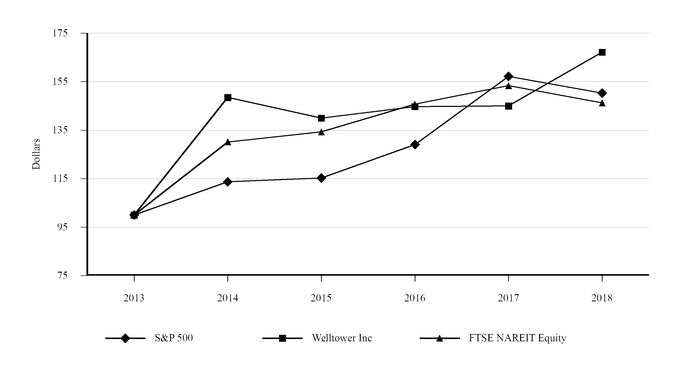
| 12/31/2013 | 12/31/2014 | 12/31/2015 | 12/31/2016 | 12/31/2017 | 12/31/2018 | |||||||||||||||||||
| S & P 500 | $ | 100.00 | $ | 113.69 | $ | 115.26 | $ | 129.05 | $ | 157.22 | $ | 150.33 | ||||||||||||
| Welltower Inc. | 100.00 | 148.51 | 140.01 | 144.73 | 145.02 | 167.21 | ||||||||||||||||||
| FTSE NAREIT Equity | 100.00 | 130.14 | 134.30 | 145.74 | 153.36 | 146.27 |
Except to the extent that we specifically incorporate this information by reference, the foregoing Stockholder Return Performance Presentation shall not be deemed incorporated by reference by any general statement incorporating by reference this Annual Report on Form 10-K into any filing under the Securities Act of 1933, as amended, or under the Securities Exchange Act of 1934, as amended. This information shall not otherwise be deemed filed under such Acts.
| Issuer Purchases of Equity Securities | |||||||||||
| Period | Total Number of Shares Purchased(1) | Average Price Paid Per Share | Total Number of Shares Purchased as Part of Publicly Announced Plans or Programs(2) | Maximum Number of Shares that May Yet Be Purchased Under the Plans or Programs | |||||||
| October 1, 2018 through October 31, 2018 | 1,739 | $ | 62.01 | ||||||||
| November 1, 2018 through November 30, 2018 | 416 | 69.17 | |||||||||
| December 1, 2018 through December 31, 2018 | — | — | |||||||||
| Totals | 2,155 | $ | 63.39 |
(1) During the three months ended December 31, 2018, the company acquired shares of common stock held by employees who tendered owned shares to satisfy tax withholding obligations.
(2) No shares were purchased as part of publicly announced plans or programs.
Item 6. Selected Financial Data
The following selected financial data for the five years ended December 31, 2018 are derived from our audited consolidated financial statements (in thousands, except per share data):
| Year Ended December 31, | ||||||||||||||||||||
| 2014 | 2015 | 2016 | 2017 | 2018 | ||||||||||||||||
| Operating Data | ||||||||||||||||||||
| Total revenues | $ | 3,343,546 | $ | 3,859,826 | $ | 4,281,160 | $ | 4,316,641 | $ | 4,700,499 | ||||||||||
| Total expenses | 2,959,333 | 3,223,709 | 3,571,907 | 4,017,025 | 4,277,009 | |||||||||||||||
| Income from continuing operations before income taxes and other items | 384,213 | 636,117 | 709,253 | 299,616 | 423,490 | |||||||||||||||
| Income tax (expense) benefit | 1,267 | (6,451 | ) | 19,128 | (20,128 | ) | (8,674 | ) | ||||||||||||
| Income (loss) from unconsolidated entities | (27,426 | ) | (21,504 | ) | (10,357 | ) | (83,125 | ) | (641 | ) | ||||||||||
| Gain (loss) on real estate dispositions, net | 147,111 | 280,387 | 364,046 | 344,250 | 415,575 | |||||||||||||||
| Income from continuing operations | 505,165 | 888,549 | 1,082,070 | 540,613 | 829,750 | |||||||||||||||
| Income from discontinued operations, net | 7,135 | — | — | — | — | |||||||||||||||
| Net income | 512,300 | 888,549 | 1,082,070 | 540,613 | 829,750 | |||||||||||||||
| Preferred stock dividends | 65,408 | 65,406 | 65,406 | 49,410 | 46,704 | |||||||||||||||
| Preferred stock redemption charge | — | — | — | 9,769 | — | |||||||||||||||
| Net income (loss) attributable to noncontrolling interests | 147 | 4,799 | 4,267 | 17,839 | 24,796 | |||||||||||||||
| Net income attributable to common stockholders | $ | 446,745 | $ | 818,344 | $ | 1,012,397 | $ | 463,595 | $ | 758,250 | ||||||||||
| Other Data | ||||||||||||||||||||
| Average number of common shares outstanding: | ||||||||||||||||||||
| Basic | 306,272 | 348,240 | 358,275 | 367,237 | 373,620 | |||||||||||||||
| Diluted | 307,747 | 349,424 | 360,227 | 369,001 | 375,250 | |||||||||||||||
| Per Share Data | ||||||||||||||||||||
| Basic: | ||||||||||||||||||||
| Income from continuing operations | $ | 1.65 | $ | 2.55 | $ | 3.02 | $ | 1.47 | $ | 2.22 | ||||||||||
| Discontinued operations, net | $ | 0.02 | $ | — | $ | — | $ | — | $ | — | ||||||||||
| Net income attributable to common stockholders | $ | 1.46 | $ | 2.35 | $ | 2.83 | $ | 1.26 | $ | 2.03 | ||||||||||
| Diluted: | ||||||||||||||||||||
| Income from continuing operations | $ | 1.64 | $ | 2.54 | $ | 3.00 | $ | 1.47 | $ | 2.21 | ||||||||||
| Discontinued operations, net | $ | 0.02 | $ | — | $ | — | $ | — | $ | — | ||||||||||
| Net income attributable to common stockholders | $ | 1.45 | $ | 2.34 | $ | 2.81 | $ | 1.26 | $ | 2.02 | ||||||||||
| Cash distributions per common share | $ | 3.18 | $ | 3.30 | $ | 3.44 | $ | 3.48 | $ | 3.48 | ||||||||||
| December 31, | ||||||||||||||||||||
| Balance Sheet Data | 2014 | 2015 | 2016 | 2017 | 2018 | |||||||||||||||
| Net real estate investments | $ | 22,851,196 | $ | 26,888,685 | $ | 26,563,629 | $ | 26,171,077 | $ | 28,420,769 | ||||||||||
| Total assets | 24,962,923 | 29,023,845 | 28,865,184 | 27,944,445 | 30,342,072 | |||||||||||||||
| Total long-term obligations | 10,776,640 | 12,967,686 | 12,358,245 | 11,731,936 | 13,297,144 | |||||||||||||||
| Total liabilities | 11,403,465 | 13,664,877 | 13,185,279 | 12,643,799 | 14,331,427 | |||||||||||||||
| Total preferred stock | 1,006,250 | 1,006,250 | 1,006,250 | 718,503 | 718,498 | |||||||||||||||
| Total equity | 13,473,049 | 15,175,885 | 15,281,472 | 14,925,452 | 15,586,599 | |||||||||||||||
Item 7. Management’s Discussion and Analysis of Financial Condition and Results of Operations
| EXECUTIVE SUMMARY | |
| Company Overview | 40 |
| Business Strategy | 40 |
| Key Transactions | 41 |
| Key Performance Indicators, Trends and Uncertainties | 42 |
| Corporate Governance | 43 |
| LIQUIDITY AND CAPITAL RESOURCES | |
| Sources and Uses of Cash | 43 |
| Off-Balance Sheet Arrangements | 44 |
| Contractual Obligations | 44 |
| Capital Structure | 45 |
| RESULTS OF OPERATIONS | |
| Summary | 46 |
| Seniors Housing Operating | 47 |
| Triple-net | 48 |
| Outpatient Medical | 50 |
| Non-Segment/Corporate | 52 |
| OTHER | |
| Non-GAAP Financial Measures | 53 |
| Critical Accounting Policies | 57 |
Item 7. Management’s Discussion and Analysis of Financial Condition and Results of Operations
The following discussion and analysis is based primarily on the consolidated financial statements of Welltower Inc. presented in conformity with U.S. generally accepted accounting principles (“U.S. GAAP”) for the periods presented and should be read together with the notes thereto contained in this Annual Report on Form 10-K. Other important factors are identified in “Item 1 — Business” and “Item 1A — Risk Factors” above.
Executive Summary
Company Overview
Welltower Inc. (NYSE:WELL), an S&P 500 company headquartered in Toledo, Ohio, is driving the transformation of health care infrastructure. The company invests with leading seniors housing operators, post-acute providers and health systems to fund the real estate and infrastructure needed to scale innovative care delivery models and improve people’s wellness and overall health care experience. Welltower™, a real estate investment trust (“REIT”), owns interests in properties concentrated in major, high-growth markets in the United States (“U.S.”), Canada and the United Kingdom (“U.K.”), consisting of seniors housing and post-acute communities and outpatient medical properties. Our capital programs, when combined with comprehensive planning, development and property management services, make us a single-source solution for acquiring, planning, developing, managing, repositioning and monetizing real estate assets.
The following table summarizes our consolidated portfolio for the year ended December 31, 2018 (dollars in thousands):
| Percentage of | Number of | |||||||||
| Type of Property | NOI(1) | NOI | Properties | |||||||
| Seniors Housing Operating | $ | 985,022 | 43.5 | % | 500 | |||||
| Triple-net | 900,049 | 39.7 | % | 726 | ||||||
| Outpatient Medical | 380,136 | 16.8 | % | 284 | ||||||
| Totals | $ | 2,265,207 | 100.0 | % | 1,510 |
(1) Represents consolidated NOI and excludes our share of investments in unconsolidated entities. Entities in which we have a joint venture with a minority partner are shown at 100% of the joint venture amount. See Non-GAAP Financial Measures for additional information and reconciliation.
Business Strategy
Our primary objectives are to protect stockholder capital and enhance stockholder value. We seek to pay consistent cash dividends to stockholders and create opportunities to increase dividend payments to stockholders as a result of annual increases in net operating income and portfolio growth. To meet these objectives, we invest across the full spectrum of seniors housing and health care real estate and diversify our investment portfolio by property type, relationship and geographic location.
Substantially all of our revenues are derived from operating lease rentals, resident fees/services, and interest earned on outstanding loans receivable. These items represent our primary sources of liquidity to fund distributions and depend upon the continued ability of our obligors to make contractual rent and interest payments to us and the profitability of our operating properties. To the extent that our obligors/partners experience operating difficulties and become unable to generate sufficient cash to make payments or operating distributions to us, there could be a material adverse impact on our consolidated results of operations, liquidity and/or financial condition. To mitigate this risk, we monitor our investments through a variety of methods determined by the type of property. Our asset management process for seniors housing properties generally includes review of monthly financial statements and other operating data for each property, review of obligor/partner creditworthiness, property inspections, and review of covenant compliance relating to licensure, real estate taxes, letters of credit and other collateral. Our internal property management division manages and monitors the outpatient medical portfolio with a comprehensive process including review of tenant relations, lease expirations, the mix of health service providers, hospital/health system relationships, property performance, capital improvement needs, and market conditions among other things. We evaluate the operating environment in each property’s market to determine the likely trend in operating performance of the facility. When we identify unacceptable trends, we seek to mitigate, eliminate or transfer the risk. Through these efforts, we generally aim to intervene at an early stage to address any negative trends, and in so doing, support both the collectability of revenue and the value of our investment.
In addition to our asset management and research efforts, we also aim to structure our relevant investments to mitigate payment risk. Operating leases and loans are normally credit enhanced by guaranties and/or letters of credit. In addition, operating leases are typically structured as master leases and loans are generally cross-defaulted and cross-collateralized with other real estate loans, operating leases or agreements between us and the obligor and its affiliates.
For the year ended December 31, 2018, resident fees/services and rental income represented 69% and 29%, respectively, of total revenues. Substantially all of our operating leases are designed with escalating rent structures. Leases with fixed annual rental escalators are generally recognized on a straight-line basis over the initial lease period, subject to a collectability assessment. Rental income related to leases with contingent rental escalators is generally recorded based on the contractual cash rental payments due for the period. Our yield on loans receivable depends upon a number of factors, including the stated interest rate, the average principal amount outstanding during the term of the loan, and any interest rate adjustments.
Item 7. Management’s Discussion and Analysis of Financial Condition and Results of Operations
Our primary sources of cash include resident fees/services, rent and interest receipts, borrowings under our primary unsecured credit facility, public issuances of debt and equity securities, our commercial paper program, proceeds from investment dispositions and principal payments on loans receivable. Our primary uses of cash include dividend distributions, debt service payments (including principal and interest), real property investments (including acquisitions, capital expenditures, construction advances and transaction costs), loan advances, property operating expenses and general and administrative expenses. Depending upon the availability and cost of external capital, we believe our liquidity is sufficient to fund these uses of cash.
We also continuously evaluate opportunities to finance future investments. New investments are generally funded from temporary borrowings under our primary unsecured credit facility, internally generated cash and the proceeds from investment dispositions. Our investments generate cash from net operating income. Permanent financing for future investments, which replaces funds drawn under our primary unsecured credit facility, has historically been provided through a combination of the issuance of public debt and equity securities and the incurrence or assumption of secured debt.
Depending upon market conditions, we believe that new investments will be available in the future with spreads over our cost of capital that will generate appropriate returns to our stockholders. It is also likely that investment dispositions may occur in the future. To the extent that investment dispositions exceed new investments, our revenues and cash flows from operations could be adversely affected. We expect to reinvest the proceeds from any investment dispositions in new investments. To the extent that new investment requirements exceed our available cash on-hand, we expect to borrow under our primary unsecured credit facility. At December 31, 2018, we had $215,376,000 of cash and cash equivalents, $100,753,000 of restricted cash and $1,853,000,000 of available borrowing capacity under our primary unsecured credit facility.
Key Transactions
Capital The following summarizes key capital transactions that occurred and supported new investments made during the year ended December 31, 2018:
| • | In April 2018, we issued $550,000,000 of 4.25% senior unsecured notes due 2028 for net proceeds of approximately $545,074,000. |
| • | In connection with the QCP acquisition, in July 2018, we drew on a $1,000,000,000 term loan facility to fund a portion of the cash consideration and other expenses. |
| • | In August 2018, we issued $200,000,000 of 4.25% senior unsecured notes due 2028, $600,000,000 of 3.95% senior unsecured notes due 2023 and $500,000,000 of 4.95% senior unsecured notes due 2048 for aggregate net proceeds of approximately $1,283,226,000. Proceeds from these issuances were used to repay advances under the $1,000,000,000 term loan facility drawn on in July 2018 and the primary unsecured credit facility. |
| • | In July 2018, we closed on a new $3,700,000,000 unsecured credit facility with improved pricing across both our line of credit and term loan facility and terminated the existing unsecured credit facility. The credit facility includes a $3,000,000,000 revolving credit facility at a borrowing rate of 0.825% over LIBOR, a $500,000,000 USD unsecured term credit facility at a borrowing rate of 0.90% over LIBOR and a $250,000,000 CAD unsecured term credit facility at 0.90% over CDOR. |
| • | We extinguished $306,553,000 of secured debt at a blended average interest rate of 5.36%. |
| • | We repaid our $450,000,000 of 2.25% senior unsecured notes at par upon maturity on March 15, 2018. |
| • | We raised $794,649,000 through our dividend reinvestment program and our Equity Shelf Program (as defined below). |
Investments The following summarizes our property acquisitions and joint venture investments made during the year ended December 31, 2018 (dollars in thousands):
| Properties | Investment Amount(1) | Capitalization Rates(2) | Book Amount(3) | ||||||||||
| Seniors Housing Operating | 12 | $ | 673,374 | 6.7% | $ | 742,675 | |||||||
| Triple-net | 246 | 2,438,899 | 6.9% | 3,062,427 | |||||||||
| Outpatient Medical | 30 | 605,866 | 5.8% | 628,824 | |||||||||
| Totals | 288 | $ | 3,718,139 | 6.7% | $ | 4,433,926 |
(1) Represents stated pro rata purchase price including cash and any assumed debt but excludes fair value adjustments pursuant to U.S. GAAP.
(2) Represents annualized contractual or projected net operating income to be received in cash divided by investment amounts.
(3) Represents amounts recorded in real property including fair value adjustments pursuant to U.S. GAAP. See Note 3 to our consolidated financial statements for additional information.
Item 7. Management’s Discussion and Analysis of Financial Condition and Results of Operations
Dispositions The following summarizes property dispositions made during the year ended December 31, 2018 (dollars in thousands):
| Properties | Proceeds(1) | Capitalization Rates(2) | Book Amount(3) | ||||||||||
| Seniors Housing Operating | 4 | $ | 40,073 | 7.5% | $ | 36,627 | |||||||
| Triple-net | 107 | 1,050,290 | 5.3% | 835,093 | |||||||||
| Outpatient Medical | 21 | 464,843 | 6.2% | 253,397 | |||||||||
| Totals | 132 | $ | 1,555,206 | 5.6% | $ | 1,125,117 |
(1) Represents pro rata proceeds received upon disposition.
(2) Represents annualized contractual net operating income that was being received in cash at date of disposition divided by disposition proceeds.
(3) Represents carrying value of assets at time of disposition. See Note 5 to our consolidated financial statements for additional information.
Dividends Our Board of Directors announced the 2019 annual cash dividend of $3.48 per common share ($0.87 per share quarterly), consistent with 2018, beginning in February 2019. The dividend declared for the quarter ended December 31, 2018 represents the 191st consecutive quarterly dividend payment.
Key Performance Indicators, Trends and Uncertainties
We utilize several key performance indicators to evaluate the various aspects of our business. These indicators are discussed below and relate to operating performance, credit strength and concentration risk. Management uses these key performance indicators to facilitate internal and external comparisons to our historical operating results, in making operating decisions, and for budget planning purposes.
Operating Performance We believe that net income and net income attributable to common stockholders (“NICS”) per the Statement of Comprehensive Income are the most appropriate earnings measures. Other useful supplemental measures of our operating performance include funds from operations attributable to common stockholders (“FFO”), consolidated net operating income (“NOI”) and same store NOI (“SSNOI”); however, these supplemental measures are not defined by U.S. GAAP. Please refer to the section entitled “Non-GAAP Financial Measures” for further discussion and reconciliations. These earnings measures are widely used by investors and analysts in the valuation, comparison, and investment recommendations of companies. The following table reflects the recent historical trends of our operating performance measures for the periods presented (in thousands):
| Year Ended December 31, | ||||||||||||
| 2016 | 2017 | 2018 | ||||||||||
| Net income | $ | 1,082,070 | $ | 540,613 | $ | 829,750 | ||||||
| Net income attributable to common stockholders | 1,012,397 | 463,595 | 758,250 | |||||||||
| Funds from operations attributable to common stockholders | 1,582,940 | 1,165,576 | 1,392,183 | |||||||||
| Consolidated net operating income | 2,404,177 | 2,232,716 | 2,267,482 | |||||||||
| Same store net operating income | 1,528,340 | 1,544,462 | 1,551,424 |
Credit Strength We measure our credit strength both in terms of leverage ratios and coverage ratios. The leverage ratios indicate how much of our balance sheet capitalization is related to long-term debt, net of cash and Internal Revenue Code (“IRC”) section 1031 deposits. The coverage ratios indicate our ability to service interest and fixed charges (interest, secured debt principal amortization and preferred dividends). We expect to maintain capitalization ratios and coverage ratios sufficient to maintain a capital structure consistent with our current profile. The coverage ratios are based on adjusted earnings before interest, taxes, depreciation and amortization (“Adjusted EBITDA”). Please refer to the section entitled “Non-GAAP Financial Measures” for further discussion and reconciliation of these measures. Leverage ratios and coverage ratios are widely used by investors, analysts and rating agencies in the valuation, comparison, investment recommendations, and rating of companies. The following table reflects the recent historical trends for our credit strength measures for the periods presented:
| Year Ended December 31, | ||||||
| 2016 | 2017 | 2018 | ||||
| Net debt to book capitalization ratio | 42.9% | 42.9% | 45.0% | |||
| Net debt to undepreciated book capitalization ratio | 37.4% | 36.3% | 37.8% | |||
| Net debt to market capitalization ratio | 31.1% | 31.2% | 31.3% | |||
| Adjusted interest coverage ratio | 4.21x | 4.36x | 4.11x | |||
| Adjusted fixed charge coverage ratio | 3.34x | 3.54x | 3.44x |
Concentration Risk We evaluate our concentration risk in terms of NOI by property mix, relationship mix and geographic mix. Concentration risk is a valuable measure in understanding what portion of our NOI could be at risk if certain sectors were to experience downturns. Property mix measures the portion of our NOI that relates to our various property types. Relationship mix measures the portion of our NOI that relates to our top five relationships. Geographic mix measures the portion of our NOI that
Item 7. Management’s Discussion and Analysis of Financial Condition and Results of Operations
relates to our top five states (or international equivalents). The following table reflects our recent historical trends of concentration risk by NOI for the years indicated below:
| December 31,(1) | |||||||
| 2016 | 2017 | 2018 | |||||
| Property mix: | |||||||
| Seniors Housing Operating | 34% | 40% | 43% | ||||
| Triple-net | 50% | 43% | 40% | ||||
| Outpatient Medical | 16% | 17% | 17% | ||||
| Relationship mix: | |||||||
| Sunrise Senior Living(2) | 13% | 14% | 15% | ||||
| Revera(2) | 6% | 7% | 7% | ||||
| Brookdale Senior Living | 6% | 7% | 6% | ||||
| Genesis HealthCare | 16% | 9% | 6% | ||||
| Benchmark Senior Living | 4% | 4% | 4% | ||||
| Remaining | 55% | 59% | 62% | ||||
| Geographic mix: | |||||||
| California | 10% | 13% | 14% | ||||
| United Kingdom | 8% | 9% | 9% | ||||
| Canada | 7% | 8% | 8% | ||||
| Texas | 7% | 7% | 8% | ||||
| New Jersey | 8% | 8% | 7% | ||||
| Remaining | 60% | 55% | 54% |
(1) Excludes our share of investments in unconsolidated entities and non-segment/corporate NOI. Entities in which we have a joint venture with a minority partner are shown at 100% of the joint venture amount.
(2) Revera owns a controlling interest in Sunrise Senior Living.
We evaluate our key performance indicators in conjunction with current expectations to determine if historical trends are indicative of future results. Our expected results may not be achieved and actual results may differ materially from our expectations. Factors that may cause actual results to differ from expected results are described in more detail in “Item 1 — Business — Cautionary Statement Regarding Forward-Looking Statements” and “Item 1A — Risk Factors” and other sections of this Annual Report on Form 10-K. Management regularly monitors economic and other factors to develop strategic and tactical plans designed to improve performance and maximize our competitive position. Our ability to achieve our financial objectives is dependent upon our ability to effectively execute these plans and to appropriately respond to emerging economic and company-specific trends. Please refer to “Item 1 — Business,” “Item 1A — Risk Factors” in this Annual Report on Form 10-K for further discussion of these risk factors.
Corporate Governance
Maintaining investor confidence and trust is important in today’s business environment. Our Board of Directors and management are strongly committed to policies and procedures that reflect the highest level of ethical business practices. Our corporate governance guidelines provide the framework for our business operations and emphasize our commitment to increase stockholder value while meeting all applicable legal requirements. These guidelines meet the listing standards adopted by the New York Stock Exchange and are available on the Internet at www.welltower.com/investors/governance. The information on our website is not incorporated by reference in this Annual Report on Form 10-K, and our web address is included as an inactive textual reference only.
Liquidity and Capital Resources
Sources and Uses of Cash
Our primary sources of cash include resident fees/services, rent and interest receipts, borrowings under our primary unsecured credit facility, public issuances of debt and equity securities, proceeds from investment dispositions and principal payments on loans receivable. Our primary uses of cash include dividend distributions, debt service payments (including principal and interest), real property investments (including acquisitions, capital expenditures, construction advances and transaction costs), loan advances, property operating expenses and general and administrative expenses. These sources and uses of cash are reflected in our Consolidated Statements of Cash Flows and are discussed in further detail below. The following is a summary of our sources and uses of cash flows for the periods presented (dollars in thousands):
Item 7. Management’s Discussion and Analysis of Financial Condition and Results of Operations
| Year Ended | One Year Change | Year Ended | One Year Change | Two Year Change | |||||||||||||||||||||||||||||
| December 31, | December 31, | December 31, | |||||||||||||||||||||||||||||||
| 2016 | 2017 | $ | % | 2018 | $ | % | $ | % | |||||||||||||||||||||||||
| Beginning cash, cash equivalents and restricted cash | $ | 422,690 | $ | 607,220 | $ | 184,530 | 44 | % | $ | 309,303 | $ | (297,917 | ) | -49 | % | $ | (113,387 | ) | -27 | % | |||||||||||||
| Net cash provided from (used in): | |||||||||||||||||||||||||||||||||
| Operating activities | 1,639,064 | 1,434,177 | (204,887 | ) | -13 | % | 1,583,944 | 149,767 | 10 | % | (55,120 | ) | -3 | % | |||||||||||||||||||
| Investing activities | (183,443 | ) | 154,581 | 338,024 | n/a | (2,386,471 | ) | (2,541,052 | ) | n/a | (2,203,028 | ) | 1,201 | % | |||||||||||||||||||
| Financing activities | (1,250,817 | ) | (1,913,527 | ) | (662,710 | ) | 53 | % | 818,368 | 2,731,895 | n/a | 2,069,185 | n/a | ||||||||||||||||||||
| Effect of foreign currency translation | (20,274 | ) | 26,852 | 47,126 | n/a | (9,015 | ) | (35,867 | ) | n/a | 11,259 | -56 | % | ||||||||||||||||||||
| Ending cash, cash equivalents and restricted cash | $ | 607,220 | $ | 309,303 | $ | (297,917 | ) | -49 | % | $ | 316,129 | $ | 6,826 | 2 | % | $ | (291,091 | ) | -48 | % |
Operating Activities The change in net cash provided from operating activities is attributable to changes in NOI, which is primarily due to acquisitions and annual rent increasers, partially offset to dispostions. Please see “Results of Operations” below for further discussion. For the years ended December 31, 2016, 2017 and 2018, cash flows from operations exceeded cash distributions to stockholders.
Investing Activities The changes in net cash used in investing activities are primarily attributable to net changes in real property investments, real estate loans receivable, and investments in unconsolidated entities which are summarized above in “Key Transactions.” Please refer to Notes 3, 6, and 7 of our consolidated financial statements for additional information. The following is a summary of cash used in non-acquisition capital improvement activities for the periods presented (dollars in thousands):
| Year Ended | One Year Change | Year Ended | One Year Change | Two Year Change | |||||||||||||||||||||||||||||
| December 31, | December 31, | December 31, | |||||||||||||||||||||||||||||||
| 2016 | 2017 | $ | % | 2018 | $ | % | $ | % | |||||||||||||||||||||||||
| New development | $ | 403,131 | $ | 232,715 | $ | (170,416 | ) | -42 | % | $ | 160,706 | $ | (72,009 | ) | -31 | % | $ | (242,425 | ) | -60 | % | ||||||||||||
| Recurring capital expenditures, tenant improvements and lease commissions | 66,332 | 67,797 | 1,465 | 2 | % | 90,190 | 22,393 | 33 | % | 23,858 | 36 | % | |||||||||||||||||||||
| Renovations, redevelopments and other capital improvements | 152,814 | 182,479 | 29,665 | 19 | % | 175,993 | (6,486 | ) | -4 | % | 23,179 | 15 | % | ||||||||||||||||||||
| Total | $ | 622,277 | $ | 482,991 | $ | (139,286 | ) | -22 | % | $ | 426,889 | $ | (56,102 | ) | -12 | % | $ | (195,388 | ) | -31 | % |
The change in new development is primarily due to the number and size of construction projects on-going during the relevant periods. Renovations, redevelopments and other capital improvements include expenditures to maximize property value, increase net operating income, maintain a market-competitive position, and/or achieve property stabilization. Generally, these expenditures have increased as a result of acquisitions, primarily in our Seniors Housing Operating segment.
Financing Activities The changes in net cash provided from financing activities are primarily attributable to changes related to our long-term debt arrangements, the issuance/redemptions of common and preferred stock and dividend payments which are summarized above in “Key Transactions.” Please refer to Notes 9, 10 and 13 of our consolidated financial statements for additional information.
Off-Balance Sheet Arrangements
At December 31, 2018, we had investments in unconsolidated entities with our ownership generally ranging from 10% to 50%. We use financial derivative instruments to hedge interest rate and foreign currency exchange rate exposure. At December 31, 2018, we had fourteen outstanding letter of credit obligations. Please see Notes 7, 11 and 12 to our consolidated financial statements for additional information.
Contractual Obligations
The following table summarizes our payment requirements under contractual obligations as of December 31, 2018 (in thousands):
Item 7. Management’s Discussion and Analysis of Financial Condition and Results of Operations
| Payments Due by Period | ||||||||||||||||||||
| Contractual Obligations | Total | 2019 | 2020-2021 | 2022-2023 | Thereafter | |||||||||||||||
| Unsecured revolving credit facility(1) | $ | 1,147,000 | $ | — | $ | — | $ | 1,147,000 | $ | — | ||||||||||
| Senior unsecured notes and term credit facilities:(2) | ||||||||||||||||||||
| U.S. Dollar senior unsecured notes | 7,450,000 | 600,000 | 900,000 | 1,700,000 | 4,250,000 | |||||||||||||||
| Canadian Dollar senior unsecured notes(3) | 219,989 | — | 219,989 | — | — | |||||||||||||||
| Pounds Sterling senior unsecured notes(3) | 1,339,170 | — | — | — | 1,339,170 | |||||||||||||||
| U.S. Dollar term credit facility | 507,500 | — | 7,500 | 500,000 | — | |||||||||||||||
| Canadian Dollar term credit facility(3) | 183,325 | — | — | 183,325 | — | |||||||||||||||
| Secured debt:(2,3) | ||||||||||||||||||||
| Consolidated | 2,485,711 | 508,899 | 507,412 | 605,789 | 863,611 | |||||||||||||||
| Unconsolidated | 790,643 | 51,614 | 88,024 | 39,495 | 611,510 | |||||||||||||||
| Contractual interest obligations:(4) | ||||||||||||||||||||
| Unsecured revolving credit facility | 171,910 | 38,202 | 76,405 | 57,303 | — | |||||||||||||||
| Senior unsecured notes and term loans(3) | 3,930,812 | 424,529 | 758,541 | 638,183 | 2,109,559 | |||||||||||||||
| Consolidated secured debt(3) | 478,922 | 90,861 | 144,026 | 96,873 | 147,162 | |||||||||||||||
| Unconsolidated secured debt(3) | 211,077 | 30,919 | 51,892 | 47,904 | 80,362 | |||||||||||||||
| Capital lease obligations(5) | 84,265 | 4,173 | 8,346 | 71,746 | — | |||||||||||||||
| Operating lease obligations(5) | 1,138,046 | 18,242 | 35,392 | 33,965 | 1,050,447 | |||||||||||||||
| Purchase obligations(5) | 1,704,293 | 1,599,477 | 104,816 | — | — | |||||||||||||||
| Other long-term liabilities(6) | 1,229 | 1,229 | — | — | — | |||||||||||||||
| Total contractual obligations | $ | 21,843,892 | $ | 3,368,145 | $ | 2,902,343 | $ | 5,121,583 | $ | 10,451,821 |
(1) Relates to our unsecured revolving credit facility with an aggregate commitment of $3,000,000,000. See Note 9 to our consolidated financial statements.
(2) Amounts represent principal amounts due and do not reflect unamortized premiums/discounts or other fair value adjustments as reflected on the balance sheet.
(3) Based on foreign currency exchange rates in effect as of balance sheet date.
(4) Based on variable interest rates in effect as of December 31, 2018.
(5) See Note 12 to our consolidated financial statements for additional information.
(6) Primarily relates to payments to be made under a supplemental executive retirement plan for one former executive officer.
Capital Structure
Please refer to “Credit Strength” above for a discussion of our leverage and coverage ratio trends. Our debt agreements contain various covenants, restrictions and events of default. Certain agreements require us to maintain financial ratios and minimum net worth and impose certain limits on our ability to incur indebtedness, create liens and make investments or acquisitions. As of December 31, 2018, we were in compliance with all of the covenants under our debt agreements. None of our debt agreements contain provisions for acceleration which could be triggered by our debt ratings. However, under our primary unsecured credit facility, the ratings on our senior unsecured notes are used to determine the fees and interest charged. We plan to manage the company to maintain compliance with our debt covenants and with a capital structure consistent with our current profile. Any downgrades in terms of ratings or outlook by any or all of the rating agencies could have a material adverse impact on our cost and availability of capital, which could in turn have a material adverse impact on our consolidated results of operations, liquidity and/or financial condition.
On May 17, 2018, we filed with the Securities and Exchange Commission (1) an open-ended automatic or “universal” shelf registration statement covering an indeterminate amount of future offerings of debt securities, common stock, preferred stock, depositary shares, warrants and units and (2) a registration statement in connection with our enhanced dividend reinvestment plan (“DRIP”) under which we may issue up to 15,000,000 shares of common stock. As of February 13, 2019, 8,526,222 shares of common stock remained available for issuance under the DRIP registration statement. On August 3, 2018, we entered into separate amended and restated equity distribution agreements with each of Morgan Stanley & Co. LLC; Merrill Lynch, Pierce, Fenner & Smith Incorporated; Goldman Sachs & Co. LLC; UBS Securities LLC and Wells Fargo Securities, LLC relating to the offer and sale from time to time of up to $784,083,001 aggregate amount of our common stock (“Equity Shelf Program”). The Equity Shelf Program also allows us to enter into forward sale agreements. We expect that, if entered into, we will physically settle each forward sale agreement on one or more dates on or prior to the maturity date of that particular forward sale agreement, in which case we will expect to receive per share cash proceeds at settlement equal to the forward sale price under the relevant forward sale agreement. However, we may elect to cash settle or net share settle a forward sale agreement. As of February 13, 2019, we had $227,958,000 of remaining capacity under the Equity Shelf Program and there were no outstanding forward sales agreements. Depending upon market conditions, we anticipate issuing securities under our registration statements to invest in additional properties and to repay borrowings under our primary unsecured credit facility.
Item 7. Management’s Discussion and Analysis of Financial Condition and Results of Operations
Results of Operations
Summary
Our primary sources of revenue include resident fees/services,rent and interest income. Our primary expenses include interest expense, depreciation and amortization, property operating expenses, other expenses and general and administrative expenses. We evaluate our business and make resource allocations on our three business segments: Seniors Housing Operating, Triple-net and Outpatient Medical. The primary performance measures for our properties are NOI and SSNOI and other supplemental measures include FFO and Adjusted EBITDA, which are further discussed below. Please see Non-GAAP Financial Measures for additional information and reconciliations. The following is a summary of our results of operations for the periods presented (dollars in thousands, except per share amounts):
| Year Ended | One Year Change | Year Ended | One Year Change | Two Year Change | |||||||||||||||||||||||||||||
| December 31, | December 31, | December 31, | |||||||||||||||||||||||||||||||
| 2016 | 2017 | Amount | % | 2018 | Amount | % | Amount | % | |||||||||||||||||||||||||
| Net income | $ | 1,082,070 | $ | 540,613 | $ | (541,457 | ) | -50 | % | $ | 829,750 | $ | 289,137 | 53 | % | $ | (252,320 | ) | -23 | % | |||||||||||||
| NICS | 1,012,397 | 463,595 | (548,802 | ) | -54 | % | 758,250 | 294,655 | 64 | % | (254,147 | ) | -25 | % | |||||||||||||||||||
| FFO | 1,582,940 | 1,165,576 | (417,364 | ) | -26 | % | 1,392,183 | 226,607 | 19 | % | (190,757 | ) | -12 | % | |||||||||||||||||||
| Adjusted EBITDA | 2,256,864 | 2,128,429 | (128,435 | ) | -6 | % | 2,153,005 | 24,576 | 1 | % | (103,859 | ) | -5 | % | |||||||||||||||||||
| Consolidated NOI | 2,404,177 | 2,232,716 | (171,461 | ) | -7 | % | 2,267,482 | 34,766 | 2 | % | (136,695 | ) | -6 | % | |||||||||||||||||||
| Same store NOI | 1,528,340 | 1,544,462 | 16,122 | 1 | % | 1,551,424 | 6,962 | — | % | 23,084 | 2 | % | |||||||||||||||||||||
| Per share data (fully diluted): | |||||||||||||||||||||||||||||||||
| Net income attributable to common stockholders | $ | 2.81 | $ | 1.26 | $ | (1.55 | ) | -55 | % | $ | 2.02 | $ | 0.76 | 60 | % | $ | (0.79 | ) | -28 | % | |||||||||||||
| Funds from operations attributable to common stockholders | 4.39 | 3.16 | (1.23 | ) | -28 | % | 3.71 | 0.55 | 17 | % | (0.68 | ) | -15 | % | |||||||||||||||||||
| Adjusted interest coverage ratio | 4.21x | 4.36x | 0.15x | 4 | % | 4.11x | -0.25x | -6 | % | 0.15x | 4 | % | |||||||||||||||||||||
| Adjusted fixed charge coverage ratio | 3.34x | 3.54x | 0.20x | 6 | % | 3.44x | -0.10x | -3 | % | 0.20x | 6 | % |
The following table represents the changes in outstanding common stock for the period from January 1, 2016 to December 31, 2018 (in thousands):
| Year Ended | ||||||||||||
| December 31, 2016 | December 31, 2017 | December 31, 2018 | Totals | |||||||||
| Beginning balance | 354,778 | 362,602 | 371,732 | 354,778 | ||||||||
| Dividend reinvestment plan issuances | 4,145 | 5,640 | 6,529 | 16,314 | ||||||||
| Preferred stock conversions | — | 4 | — | 4 | ||||||||
| Redemption of equity membership units | — | 91 | — | 91 | ||||||||
| Option exercises | 141 | 253 | 57 | 451 | ||||||||
| Equity Shelf Program issuances | 3,135 | 2,987 | 5,241 | 11,363 | ||||||||
| Other, net | 403 | 155 | 116 | 674 | ||||||||
| Ending balance | 362,602 | 371,732 | 383,675 | 383,675 | ||||||||
| Average number of shares outstanding: | ||||||||||||
| Basic | 358,275 | 367,237 | 373,620 | |||||||||
| Diluted | 360,227 | 369,001 | 375,250 |
During the past three years, inflation has not significantly affected our earnings because of the moderate inflation rate. Additionally, a portion of our earnings are derived primarily from long-term investments with predictable rates of return. These investments are mainly financed with a combination of equity, senior unsecured notes, secured debt and borrowings under our primary unsecured credit facility. During inflationary periods, which generally are accompanied by rising interest rates, our ability to grow may be adversely affected because the yield on new investments may increase at a slower rate than new borrowing costs. Presuming the current inflation rate remains moderate and long-term interest rates do not increase significantly, we believe that inflation will not impact the availability of equity and debt financing for us.
Item 7. Management’s Discussion and Analysis of Financial Condition and Results of Operations
Seniors Housing Operating
The following is a summary of our NOI and SSNOI for the Seniors Housing Operating segment for the years presented (dollars in thousands):
| Year Ended | One Year Change | Year Ended | One Year Change | Two Year Change | |||||||||||||||||||||||||||||
| December 31, | December 31, | December 31, | |||||||||||||||||||||||||||||||
| 2016 | 2017 | $ | % | 2018 | $ | % | $ | % | |||||||||||||||||||||||||
| NOI | $ | 814,114 | $ | 880,026 | $ | 65,912 | 8 | % | $ | 985,022 | $ | 104,996 | 12 | % | $ | 170,908 | 21 | % | |||||||||||||||
| Non-cash NOI attributable to same store properties(1) | 1,990 | 1,242 | (748 | ) | -38 | % | 836 | (406 | ) | -33 | % | (1,154 | ) | -58 | % | ||||||||||||||||||
| NOI attributable to non same store properties(2) | (77,334 | ) | (132,604 | ) | (55,270 | ) | 71 | % | (251,803 | ) | (119,199 | ) | 90 | % | (174,469 | ) | 226 | % | |||||||||||||||
| SSNOI(1) | $ | 738,770 | $ | 748,664 | $ | 9,894 | 1 | % | $ | 734,055 | $ | (14,609 | ) | -2 | % | $ | (4,715 | ) | -1 | % |
(1) Relates to 348 same store properties.
(2) Primarily relates to the acquisition of 66 properties subsequent to January 1, 2016 and the transition of 69 properties from Triple-net to Seniors Housing Operating.
The following is a summary of our results of operations for the Seniors Housing Operating segment for the years presented (dollars in thousands):
| Year Ended | One Year Change | Year Ended | One Year Change | Two Year Change | |||||||||||||||||||||||||||||||
| December 31, | December 31, | December 31, | |||||||||||||||||||||||||||||||||
| 2016 | 2017 | $ | % | 2018 | $ | % | $ | % | |||||||||||||||||||||||||||
| Revenues: | |||||||||||||||||||||||||||||||||||
| Resident fees and services | $ | 2,504,731 | $ | 2,779,423 | $ | 274,692 | 11 | % | $ | 3,234,852 | $ | 455,429 | 16 | % | $ | 730,121 | 29 | % | |||||||||||||||||
| Interest income | 4,180 | 69 | (4,111 | ) | -98 | % | 578 | 509 | 738 | % | (3,602 | ) | -86 | % | |||||||||||||||||||||
| Other income | 17,085 | 5,127 | (11,958 | ) | -70 | % | 5,024 | (103 | ) | -2 | % | (12,061 | ) | -71 | % | ||||||||||||||||||||
| Total revenues | 2,525,996 | 2,784,619 | 258,623 | 10 | % | 3,240,454 | 455,835 | 16 | % | 714,458 | 28 | % | |||||||||||||||||||||||
| Property operating expenses | 1,711,882 | 1,904,593 | 192,711 | 11 | % | 2,255,432 | 350,839 | 18 | % | 543,550 | 32 | % | |||||||||||||||||||||||
| NOI(1) | 814,114 | 880,026 | 65,912 | 8 | % | 985,022 | 104,996 | 12 | % | 170,908 | 21 | % | |||||||||||||||||||||||
| Other expenses: | |||||||||||||||||||||||||||||||||||
| Depreciation and amortization | 415,429 | 484,796 | 69,367 | 17 | % | 529,449 | 44,653 | 9 | % | 114,020 | 27 | % | |||||||||||||||||||||||
| Interest expense | 81,853 | 63,265 | (18,588 | ) | -23 | % | 69,060 | 5,795 | 9 | % | (12,793 | ) | -16 | % | |||||||||||||||||||||
| Transaction costs(2) | 29,207 | — | (29,207 | ) | -100 | % | — | — | n/a | (29,207 | ) | -100 | % | ||||||||||||||||||||||
| Loss (gain) on extinguishment of debt, net | (88 | ) | 3,785 | 3,873 | -4,401 | % | 110 | (3,675 | ) | -97 | % | 198 | -225 | % | |||||||||||||||||||||
| Impairment of assets | 12,403 | 21,949 | 9,546 | 77 | % | 7,599 | (14,350 | ) | -65 | % | (4,804 | ) | -39 | % | |||||||||||||||||||||
| Other expenses(2) | — | 8,347 | 8,347 | n/a | 6,624 | (1,723 | ) | -21 | % | 6,624 | n/a | ||||||||||||||||||||||||
| 538,804 | 582,142 | 43,338 | 8 | % | 612,842 | 30,700 | 5 | % | 74,038 | 14 | % | ||||||||||||||||||||||||
| Income (loss) from continuing operations before income taxes and other items | 275,310 | 297,884 | 22,574 | 8 | % | 372,180 | 74,296 | 25 | % | 96,870 | 35 | % | |||||||||||||||||||||||
| Income tax benefit (expense) | (3,762 | ) | (16,430 | ) | (12,668 | ) | 337 | % | 1,202 | 17,632 | -107 | % | 4,964 | -132 | % | ||||||||||||||||||||
| Income (loss) from unconsolidated entities | (20,442 | ) | (105,236 | ) | (84,794 | ) | 415 | % | (28,142 | ) | 77,094 | -73 | % | (7,700 | ) | 38 | % | ||||||||||||||||||
| Gain (loss) on real estate dispositions, net | 9,880 | 56,295 | 46,415 | 470 | % | (2,245 | ) | (58,540 | ) | -104 | % | (12,125 | ) | -123 | % | ||||||||||||||||||||
| Income from continuing operations | 260,986 | 232,513 | (28,473 | ) | -11 | % | 342,995 | 110,482 | 48 | % | 82,009 | 31 | % | ||||||||||||||||||||||
| Net income (loss) | 260,986 | 232,513 | (28,473 | ) | -11 | % | 342,995 | 110,482 | 48 | % | 82,009 | 31 | % | ||||||||||||||||||||||
| Less: Net income (loss) attributable to noncontrolling interests | 2,292 | 8,472 | 6,180 | 270 | % | (660 | ) | (9,132 | ) | -108 | % | (2,952 | ) | -129 | % | ||||||||||||||||||||
| Net income (loss) attributable to common stockholders | $ | 258,694 | $ | 224,041 | $ | (34,653 | ) | -13 | % | $ | 343,655 | $ | 119,614 | 53 | % | $ | 84,961 | 33 | % |
(1) See Non-GAAP Financial Measures below.
(2) See Note 3 to our consolidated financial statements.
Fluctuations in resident fees/services and property operating expenses are primarily a result of acquisitions, segment transitions and the movement of U.S. and foreign currency exchange rates. The fluctuations in depreciation and amortization are due to acquisitions and variations in amortization of short-lived intangible assets. To the extent that we acquire or dispose of additional properties in the future, these amounts will change accordingly. The decrease in other income for the year ended December 31, 2018 is primarily a result of insurance proceeds received during 2017 relating to a property as well as a bargain purchase gain recognized in conjuncti
Showing the first 8K of 81K characters. Open the full section
Item 7A. Quantitative and Qualitative Disclosures About Market Risk
We are exposed to various market risks, including the potential loss arising from adverse changes in interest rates and foreign currency exchange rates. We seek to mitigate the underlying foreign currency exposures with gains and losses on derivative contracts hedging these exposures. We seek to mitigate the effects of fluctuations in interest rates by matching the terms of new investments with new long-term fixed rate borrowings to the extent possible. We may or may not elect to use financial derivative instruments to hedge interest rate exposure. These decisions are principally based on our policy to match our variable rate investments with comparable borrowings, but are also based on the general trend in interest rates at the applicable dates and our perception of the future volatility of interest rates. This section is presented to provide a discussion of the risks associated with potential fluctuations in interest rates and foreign currency exchange rates. For more information, see Notes 11 and 16 to our consolidated financial statements.
We historically borrow on our primary unsecured credit facility to acquire, construct or make loans relating to health care and seniors housing properties. Then, as market conditions dictate, we will issue equity or long-term fixed rate debt to repay the borrowings under our primary unsecured credit facility and new commercial paper program. We are subject to risks associated with debt financing, including the risk that existing indebtedness may not be refinanced or that the terms of refinancing may not be as favorable as the terms of current indebtedness. The majority of our borrowings were completed under indentures or contractual agreements that limit the amount of indebtedness we may incur. Accordingly, in the event that we are unable to raise additional equity or borrow money because of these limitations, our ability to acquire additional properties may be limited.
A change in interest rates will not affect the interest expense associated with our fixed rate debt. Interest rate changes, however, will affect the fair value of our fixed rate debt. Changes in the interest rate environment upon maturity of this fixed rate debt could have an effect on our future cash flows and earnings, depending on whether the debt is replaced with other fixed rate debt, variable rate debt or equity or repaid by the sale of assets. To illustrate the impact of changes in the interest rate markets, we performed a sensitivity analysis on our fixed rate debt instruments whereby we modeled the change in net present values arising from a hypothetical 1% increase in interest rates to determine the instruments’ change in fair value. The following table summarizes the analysis performed as of the dates indicated (in thousands):
| December 31, 2018 | December 31, 2017 | |||||||||||||||
| Principal balance | Fair value change | Principal balance | Fair value change | |||||||||||||
| Senior unsecured notes | $ | 9,009,159 | $ | (548,558 | ) | $ | 7,710,219 | $ | (500,951 | ) | ||||||
| Secured debt | 1,639,983 | (59,522 | ) | 1,749,958 | (63,492 | ) | ||||||||||
| Totals | $ | 10,649,142 | $ | (608,080 | ) | $ | 9,460,177 | $ | (564,443 | ) |
Our variable rate debt, including our primary unsecured credit facility, is reflected at fair value. At December 31, 2018, we had $2,683,553,000 outstanding related to our variable rate debt. Assuming no changes in outstanding balances, a 1% increase in interest rates would result in increased annual interest expense of $26,836,000. At December 31, 2017, we had $2,294,678,000 outstanding under our variable rate debt. Assuming no changes in outstanding balances, a 1% increase in interest rates would have resulted in increased annual interest expense of $22,947,000.
We are subject to currency fluctuations that may, from time to time, affect our financial condition and results of operations. Increases or decreases in the value of the Canadian Dollar or British Pounds Sterling relative to the U.S. Dollar impact the amount of net income we earn from our investments in Canada and the United Kingdom. Based solely on our results for the year ended December 31, 2018, including the impact of existing hedging arrangements, if these exchange rates were to increase or decrease by 10%, our net income from these investments would increase or decrease, as applicable, by less than $10,000,000. We will continue to mitigate these underlying foreign currency exposures with non-U.S. denominated borrowings and gains and losses on derivative contracts. If we increase our international presence through investments in, or acquisitions or development of, seniors housing and health care properties outside the U.S., we may also decide to transact additional business or borrow funds in currencies other than U.S. Dollars, Canadian Dollars or British Pounds Sterling. To illustrate the impact of changes in foreign currency markets, we performed a sensitivity analysis on our derivative portfolio whereby we modeled the change in net present values arising from a hypothetical 1% increase in foreign currency exchange rates to determine the instruments’ change in fair value. The following table summarizes the results of the analysis performed, excluding cross currency hedge activity (dollars in thousands):
| December 31, 2018 | December 31, 2017 | |||||||||||||||
| Carrying value | Fair value change | Carrying value | Fair value change | |||||||||||||
| Foreign currency exchange contracts | $ | 23,620 | $ | 16,163 | $ | 23,238 | $ | 12,929 | ||||||||
| Debt designated as hedges | 1,559,159 | 15,592 | 1,620,273 | 16,203 | ||||||||||||
| Totals | $ | 1,582,779 | $ | 31,755 | $ | 1,643,511 | $ | 29,132 |
Item 8. Financial Statements and Supplementary Data
REPORT OF INDEPENDENT REGISTERED PUBLIC ACCOUNTING FIRM
The Shareholders and the Board of Directors of Welltower Inc.
Opinion on the Financial Statements
We have audited the accompanying consolidated balance sheets of Welltower Inc. and subsidiaries (the Company) as of December 31, 2018 and 2017, the related consolidated statements of comprehensive income, equity and cash flows for each of the three years in the period ended December 31, 2018, and the related notes and financial statement schedules listed in the Index at Item 15(a) (collectively referred to as the “consolidated financial statements”). In our opinion, the consolidated financial statements present fairly, in all material respects, the financial position of the Company at December 31, 2018 and 2017 and the results of its operations and its cash flows for each of the three years in the period ended December 31, 2018, in conformity with U.S. generally accepted accounting principles.
We also have audited, in accordance with the standards of the Public Company Accounting Oversight Board (United States) (PCAOB), the Company’s internal control over financial reporting as of December 31, 2018, based on criteria established in Internal Control – Integrated Framework issued by the Committee of Sponsoring Organizations of the Treadway Commission (2013 framework) and our report dated February 25, 2019 expressed an unqualified opinion thereon.
Basis for Opinion
These financial statements are the responsibility of the Company’s management. Our responsibility is to express an opinion on the Company’s financial statements based on our audits. We are a public accounting firm registered with the PCAOB and are required to be independent with respect to the Company in accordance with the U.S. federal securities laws and the applicable rules and regulations of the Securities and Exchange Commission and the PCAOB.
We conducted our audits in accordance with the standards of the PCAOB. Those standards require that we plan and perform the audit to obtain reasonable assurance about whether the financial statements are free of material misstatement, whether due to error or fraud. Our audits included performing procedures to assess the risks of material misstatement of the financial statements, whether due to error or fraud, and performing procedures that respond to those risks. Such procedures included examining, on a test basis, evidence regarding the amounts and disclosures in the financial statements. Our audits also included evaluating the accounting principles used and significant estimates made by management, as well as evaluating the overall presentation of the financial statements. We believe that our audits provide a reasonable basis for our opinion.
/s/ Ernst & Young LLP
We have served as the Company’s auditor since 1970.
Toledo, Ohio
February 25, 2019
CONSOLIDATED BALANCE SHEETS
WELLTOWER INC. AND SUBSIDIARIES
(in thousands)
| December 31, 2018 | December 31, 2017 | |||||||
| Assets | ||||||||
| Real estate investments: | ||||||||
| Real property owned: | ||||||||
| Land and land improvements | $ | 3,205,091 | $ | 2,734,467 | ||||
| Buildings and improvements | 28,019,502 | 25,373,117 | ||||||
| Acquired lease intangibles | 1,581,159 | 1,502,471 | ||||||
| Real property held for sale, net of accumulated depreciation | 590,271 | 734,147 | ||||||
| Construction in progress | 194,365 | 237,746 | ||||||
| Gross real property owned | 33,590,388 | 30,581,948 | ||||||
| Less accumulated depreciation and amortization | (5,499,958 | ) | (4,838,370 | ) | ||||
| Net real property owned | 28,090,430 | 25,743,578 | ||||||
| Real estate loans receivable | 398,711 | 495,871 | ||||||
| Less allowance for losses on loans receivable | (68,372 | ) | (68,372 | ) | ||||
| Net real estate loans receivable | 330,339 | 427,499 | ||||||
| Net real estate investments | 28,420,769 | 26,171,077 | ||||||
| Other assets: | ||||||||
| Investments in unconsolidated entities | 482,914 | 445,585 | ||||||
| Goodwill | 68,321 | 68,321 | ||||||
| Cash and cash equivalents | 215,376 | 243,777 | ||||||
| Restricted cash | 100,753 | 65,526 | ||||||
| Straight-line receivable | 367,093 | 389,168 | ||||||
| Receivables and other assets | 686,846 | 560,991 | ||||||
| Total other assets | 1,921,303 | 1,773,368 | ||||||
| Total assets | $ | 30,342,072 | $ | 27,944,445 | ||||
| Liabilities and equity | ||||||||
| Liabilities: | ||||||||
| Borrowings under primary unsecured credit facility | $ | 1,147,000 | $ | 719,000 | ||||
| Senior unsecured notes | 9,603,299 | 8,331,722 | ||||||
| Secured debt | 2,476,177 | 2,608,976 | ||||||
| Capital lease obligations | 70,668 | 72,238 | ||||||
| Accrued expenses and other liabilities | 1,034,283 | 911,863 | ||||||
| Total liabilities | 14,331,427 | 12,643,799 | ||||||
| Redeemable noncontrolling interests | 424,046 | 375,194 | ||||||
| Equity: | ||||||||
| Preferred stock | 718,498 | 718,503 | ||||||
| Common stock | 384,465 | 372,449 | ||||||
| Capital in excess of par value | 18,424,368 | 17,662,681 | ||||||
| Treasury stock | (68,499 | ) | (64,559 | ) | ||||
| Cumulative net income | 6,121,534 | 5,316,580 | ||||||
| Cumulative dividends | (10,818,557 | ) | (9,471,712 | ) | ||||
| Accumulated other comprehensive income (loss) | (129,769 | ) | (111,465 | ) | ||||
| Other equity | 294 | 670 | ||||||
| Total Welltower Inc. stockholders’ equity | 14,632,334 | 14,423,147 | ||||||
| Noncontrolling interests | 954,265 | 502,305 | ||||||
| Total equity | 15,586,599 | 14,925,452 | ||||||
| Total liabilities and equity | $ | 30,342,072 | $ | 27,944,445 |
See accompanying notes
CONSOLIDATED STATEMENTS OF COMPREHENSIVE INCOME
WELLTOWER INC. AND SUBSIDIARIES
(In thousands, except per share data)
| Year Ended December 31, | ||||||||||||
| 2018 | 2017 | 2016 | ||||||||||
| Revenues: | ||||||||||||
| Resident fees and services | $ | 3,234,852 | $ | 2,779,423 | $ | 2,504,731 | ||||||
| Rental income | 1,380,422 | 1,445,871 | 1,648,815 | |||||||||
| Interest income | 55,814 | 73,811 | 97,963 | |||||||||
| Other income | 29,411 | 17,536 | 29,651 | |||||||||
| Total revenues | 4,700,499 | 4,316,641 | 4,281,160 | |||||||||
| Expenses: | ||||||||||||
| Property operating expenses | 2,433,017 | 2,083,925 | 1,876,983 | |||||||||
| Depreciation and amortization | 950,459 | 921,720 | 901,242 | |||||||||
| Interest expense | 526,592 | 484,622 | 521,345 | |||||||||
| General and administrative expenses | 126,383 | 122,008 | 155,241 | |||||||||
| Transaction costs | — | — | 42,910 | |||||||||
| Loss (gain) on derivatives and financial instruments, net | (4,016 | ) | 2,284 | (2,448 | ) | |||||||
| Loss (gain) on extinguishment of debt, net | 16,097 | 37,241 | 17,214 | |||||||||
| Provision for loan losses | — | 62,966 | 10,215 |
Showing the first 8K of 166K characters. Open the full section
Item 9. Changes in and Disagreements with Accountants on Accounting and Financial Disclosure
Not applicable.
Item 9A. Controls and Procedures
Disclosure Controls and Procedures
An evaluation was carried out under the supervision and with the participation of our management, including our Chief Executive Officer and Chief Financial Officer, of the effectiveness of the disclosure controls and procedures (as defined in Rule 13a-15(e) of the Securities Exchange Act of 1934, as amended) as of the end of the period covered by this report. Based on that evaluation, the Chief Executive Officer and Chief Financial Officer concluded that the disclosure controls and procedures were effective as of the end of the period covered by this report.
Management’s Report on Internal Control over Financial Reporting
Management is responsible for establishing and maintaining adequate internal control over financial reporting (as defined in Rule 13a-15(f) of the Securities Exchange Act of 1934, as amended). The Company’s internal control over financial reporting is a process designed to provide reasonable assurance regarding the reliability of financial reporting and the preparation of financial statements for external purposes in accordance with U.S. generally accepted accounting principles. The Company’s internal control over financial reporting includes those policies and procedures that (1) pertain to the maintenance of records that, in reasonable detail, accurately and fairly reflect the transactions and dispositions of the assets of the Company; (2) provide reasonable assurance that transactions are recorded as necessary to permit preparation of financial statements in accordance with U.S. generally accepted accounting principles, and that receipts and expenditures of the Company are being made only in accordance with authorizations of management and directors of the Company; and (3) provide reasonable assurance regarding prevention or timely detection of unauthorized acquisition, use, or disposition of the Company’s assets that could have a material effect on the financial statements. Because of its inherent limitations, internal control over financial reporting may not prevent or detect misstatements. Also, projections of any evaluation of effectiveness to future periods are subject to the risk that controls may become inadequate because of changes in conditions, or that the degree of compliance with the policies or procedures may deteriorate.
Management has assessed the effectiveness of the Company’s internal control over financial reporting as of December 31, 2018 based on the criteria established by the Committee of Sponsoring Organizations of the Treadway Commission (2013 framework) in a report entitled Internal Control — Integrated Framework.
Based on this assessment, using the criteria above, management concluded that the Company’s system of internal control over financial reporting was effective as of December 31, 2018.
The independent registered public accounting firm of Ernst & Young LLP, as auditors of the Company’s consolidated financial statements, has issued an attestation report on the Company’s internal control over financial reporting.
Changes in Internal Control over Financial Reporting
No change in our internal control over financial reporting (as defined in Rule 13a-15(f) of the Securities Exchange Act of 1934, as amended) occurred during the fourth quarter of the one-year period covered by this report that materially affected, or is reasonably likely to materially affect, our internal control over financial reporting.
REPORT OF INDEPENDENT REGISTERED PUBLIC ACCOUNTING FIRM
The Shareholders and Board of Directors of Welltower Inc.
Opinion on Internal Control over Financial reporting
We have audited Welltower Inc. and subsidiaries’ internal control over financial reporting as of December 31, 2018, based on criteria established in Internal Control – Integrated Framework issued by the Committee of Sponsoring Organizations of the Treadway Commission (2013 framework) (the “COSO Criteria”). In our opinion, Welltower Inc. and subsidiaries (the Company) maintained, in all material respects, effective internal control over financial reporting as of December 31, 2018, based on the COSO Criteria.
We also have audited, in accordance with the standards of the Public Company Accounting Oversight Board (United States) (PCAOB), the consolidated balance sheets of Welltower Inc. and subsidiaries as of December 31, 2018 and 2017, the related consolidated statements of comprehensive income, equity and cash flows for each of the three years in the period ended December 31, 2018, and the related notes and financial statement schedules listed in the index at Item 15(a) and our report dated February 25, 2019 expressed an unqualified opinion thereon.
Basis for Opinion
The Company’s management is responsible for maintaining effective internal control over financial reporting, and for its assessment of the effectiveness of internal control over financial reporting included in the accompanying Management’s Report on Internal Control over Financial Reporting. Our responsibility is to express an opinion on the Company’s internal control over financial reporting based on our audit. We are a public accounting firm registered with the PCAOB and are required to be independent with respect to the Company in accordance with the U.S. federal securities laws and the applicable rules and regulations of the Securities and Exchange Commission and the PCAOB.
We conducted our audit in accordance with the standards of the PCAOB. Those standards require that we plan and perform the audit to obtain reasonable assurance about whether effective internal control over financial reporting was maintained in all material respects.
Our audit included obtaining an understanding of internal control over financial reporting, assessing the risk that a material weakness exists, testing and evaluating the design and operating effectiveness of internal control based on the assessed risk, and performing such other procedures as we considered necessary in the circumstances. We believe that our audit provides a reasonable basis for our opinion.
Definition and Limitations of Internal Control over Financial Reporting
A company’s internal control over financial reporting is a process designed to provide reasonable assurance regarding the reliability of financial reporting and the preparation of financial statements for external purposes in accordance with generally accepted accounting principles. A company’s internal control over financial reporting includes those policies and procedures that (1) pertain to the maintenance of records that, in reasonable detail, accurately and fairly reflect the transactions and dispositions of the assets of the company; (2) provide reasonable assurance that transactions are recorded as necessary to permit preparation of financial statements in accordance with generally accepted accounting principles, and that receipts and expenditures of the company are being made only in accordance with authorizations of management and directors of the company; and (3) provide reasonable assurance regarding prevention or timely detection of unauthorized acquisition, use or disposition of the company’s assets that could have a material effect on the financial statements.
Because of its inherent limitations, internal control over financial reporting may not prevent or detect misstatements. Also, projections of any evaluation of effectiveness to future periods are subject to the risk that controls may become inadequate because of changes in conditions, or that the degree of compliance with the policies or procedures may deteriorate.
/s/ Ernst & Young LLP
Toledo, Ohio
February 25, 2019
Item 9B. Other Information
None.
PART III
Item 10. Directors, Executive Officers and Corporate Governance
The information required by this Item is incorporated herein by reference to the information under the headings “Election of Directors,” “Corporate Governance,” “Executive Officers,” and “Security Ownership of Directors and Management and Certain Beneficial Owners — Section 16(a) Beneficial Ownership Reporting Compliance” in our definitive proxy statement, which will be filed with the Securities and Exchange Commission (the “Commission”) prior to May 1, 2019.
We have adopted a Code of Business Conduct and Ethics that applies to our directors, officers and employees. The code is posted on the Internet at www.welltower.com/investors/governance. Any amendment to, or waivers from, the code that relate to any officer or director of the company will be promptly disclosed on the Internet at www.welltower.com.
In addition, the Board has adopted charters for the Audit, Compensation and Nominating/Corporate Governance Committees. These charters are posted on the Internet at www.welltower.com/investors/governance. Please refer to “Item 7 – Management’s Discussion and Analysis of Financial Condition and Results of Operations – Executive Summary – Corporate Governance” in the Annual Report on Form 10-K for further discussion of corporate governance.
The information on our website is not incorporated by reference in this Annual Report on Form 10-K, and our web address is included as an inactive textual reference only.
Item 11. Executive Compensation
The information required by this Item is incorporated herein by reference to the information under the headings “Executive Compensation” and “Director Compensation” in our definitive proxy statement, which will be filed with the Commission prior to May 1, 2019.
Item 12. Security Ownership of Certain Beneficial Owners and Management and Related Stockholder Matters
The information required by this Item is incorporated herein by reference to the information under the headings “Security Ownership of Directors and Management and Certain Beneficial Owners” and “Equity Compensation Plan Information” in our definitive proxy statement, which will be filed with the Commission prior to May 1, 2019.
Item 13. Certain Relationships and Related Transactions and Director Independence
The information required by this Item is incorporated herein by reference to the information under the headings “Corporate Governance — Independence and Meetings” and “Security Ownership of Directors and Management and Certain Beneficial Owners — Certain Relationships and Related Transactions” in our definitive proxy statement, which will be filed with the Commission prior to May 1, 2019.
Item 14. Principal Accounting Fees and Services
The information required by this Item is incorporated herein by reference to the information under the heading “Ratification of the Appointment of the Independent Registered Public Accounting Firm” in our definitive proxy statement, which will be filed with the Commission prior to May 1, 2019.
PART IV
Item 15. Exhibits and Financial Statement Schedules
| (a)1. | Our Consolidated Financial Statements are included in Part II, Item 8: |
| Report of Independent Registered Public Accounting Firm | 61 |
| Consolidated Balance Sheets – December 31, 2018 and 2017 | 62 |
| Consolidated Statements of Comprehensive Income — Years ended December 31, 2018, 2017 and 2016 | 63 |
| Consolidated Statements of Equity — Years ended December 31, 2018, 2017 and 2016 | 65 |
| Consolidated Statements of Cash Flows — Years ended December 31, 2018, 2017 and 2016 | 66 |
| Notes to Consolidated Financial Statements | 67 |
| 2. | The following Financial Statement Schedules are included beginning on page 105: |
III – Real Estate and Accumulated Depreciation
IV – Mortgage Loans on Real Estate
The financial statement schedule required by Item15(a) (Schedule II, Valuation and Qualifying Accounts) is included in Item 8 of this Annual Report on Form 10-K.
| (b) | Exhibits: |
The exhibits listed below are either filed with this Form 10-K or incorporated by reference in accordance with Rule 12b-32 of the Securities Exchange Act of 1934.
| 10.5(b) | Letter Agreement, dated January 30, 2019, by and between John A. Goodey and the Company.* |
10.8 Summary of Director Compensation.*
| 10.14(a) | Welltower Inc. 2019-2021 Long-Term Incentive Program.* |
10.14(b) Form of Restricted Stock Unit Award Agreement under the 2019-2021 Long-Term Incentive Program.*
21 Subsidiaries of the Company.
23 Consent of Ernst & Young LLP, independent registered public accounting firm.
31.1 Rule 13a-14(a)/15d-14(a) Certification of Chief Executive Officer.
31.2 Rule 13a-14(a)/15d-14(a) Certification of Chief Financial Officer.
32.1 Certification pursuant to 18 U.S.C. Section 1350 by Chief Executive Officer.
32.2 Certification pursuant to 18 U.S.C. Section 1350 by Chief Financial Officer.
101.INS XBRL Instance Document
101.SCH XBRL Taxonomy Extension Schema Document
101.CAL XBRL Taxonomy Extension Calculation Linkbase Document
101.LAB XBRL Taxonomy Extension Label Linkbase Document
101.PRE XBRL Taxonomy Extension Presentation Linkbase Document
101.DEF XBRL Taxonomy Extension Definition Linkbase Document
| * | Management Contract or Compensatory Plan or Arrangement. |
Item 16. Form 10-K Summary
None.
SIGNATURES
Pursuant to the requirements of Section 13 or 15(d) of the Securities Exchange Act of 1934, the Registrant has duly caused this report to be signed on its behalf by the undersigned, thereunto duly authorized.
Date: February 25, 2019
WELLTOWER INC.
By: /s/ Thomas J. DeRosa
Thomas J. DeRosa,
Chief Executive Officer and Director
Pursuant to the requirements of the Securities Exchange Act of 1934, this report has been signed below on February 25, 2019 by the following persons on behalf of the Registrant and in the capacities indicated.
| /s/ Jeffrey H. Donahue ** | /s/ Johnese Spisso ** | |
| Jeffrey H. Donahue, Chairman of the Board | Johnese Spisso, Director | |
| /s/ Kenneth J. Bacon ** | /s/ R. Scott Trumbull ** | |
| Kenneth J. Bacon, Director | R. Scott Trumbull, Director | |
| /s/ Karen DeSalvo ** | /s/ Gary Whitelaw ** | |
| Karen DeSalvo, Director | Gary Whitelaw, Director | |
| /s/ Geoffrey G. Meyers ** | /s/ Thomas J. DeRosa ** | |
| Geoffrey G. Meyers, Director | Thomas J. DeRosa, Chief Executive Officer and Director | |
| (Principal Executive Officer) | ||
| /s/ Timothy J. Naughton ** | /s/ John A. Goodey ** | |
| Timothy J. Naughton, Director | John A. Goodey, Executive Vice President and Chief | |
| Financial Officer (Principal Financial Officer) | ||
| /s/ Sharon M. Oster ** | /s/ Joshua T. Fieweger** | |
| Sharon M. Oster, Director | Joshua T. Fieweger, Vice President and | |
| Controller (Principal Accounting Officer) | ||
| /s/ Judith C. Pelham ** | **By: /s/ Thomas J. DeRosa | |
| Judith C. Pelham, Director | Thomas J. DeRosa, Attorney-in-Fact | |
| /s/ Sergio D. Rivera ** | ||
| Sergio D. Rivera, Director |
| Welltower Inc. | ||||||||||||||||||||||||||||||||||
| Schedule III | ||||||||||||||||||||||||||||||||||
| Real Estate and Accumulated Depreciation | ||||||||||||||||||||||||||||||||||
| December 31, 2018 | ||||||||||||||||||||||||||||||||||
| (Dollars in thousands) | ||||||||||||||||||||||||||||||||||
| Initial Cost to Company | Gross Amount at Which Carried at Close of Period | |||||||||||||||||||||||||||||||||
| Description | Encumbrances | Land | Building & Improvements | Cost Capitalized Subsequent to Acquisition | Land | Building & Improvements | Accumulated Depreciation(1) | Year Acquired | Year Built | Address | ||||||||||||||||||||||||
| Seniors Housing Operating: | ||||||||||||||||||||||||||||||||||
| Acton, MA | $ | — | $ | — | $ | 31,346 | $ | 1,691 | $ | 24 | $ | 33,013 | $ | 6,127 | 2013 | 2000 | 10 Devon Drive | |||||||||||||||||
| Adderbury, UK | — | 2,144 | 12,549 | — | 2,144 | 12,549 | 621 | 2015 | 2017 | Banbury Road | ||||||||||||||||||||||||
| Albuquerque, NM | — | 1,270 | 20,837 | 2,139 | 1,354 | 22,892 | 6,475 | 2010 | 1984 | 500 Paisano St NE | ||||||||||||||||||||||||
| Alexandria, VA | — | 8,280 | 50,914 | — | 8,280 | 50,914 | 1,055 | 2016 | 2018 | 5550 Cardinal Place | ||||||||||||||||||||||||
| Alhambra, CA | — | 600 | 6,305 | 9,067 | 600 | 15,372 | 2,124 | 2011 | 1923 | 1118 N. Stoneman Ave. | ||||||||||||||||||||||||
| Altrincham, UK | — | 4,244 | 25,187 | 1,700 | 4,388 | 26,743 | 5,790 | 2012 | 2009 | 295 Hale Road | ||||||||||||||||||||||||
| Amherstview, ON | 486 | 473 | 4,446 | 508 | 493 | 4,934 | 799 | 2015 | 1974 | 4567 Bath Road | ||||||||||||||||||||||||
| Anderson, SC | — | 710 | 6,290 | 456 | 710 | 6,746 | 3,524 | 2003 | 1986 | 311 Simpson Rd. | ||||||||||||||||||||||||
| Apple Valley, CA | — | 480 | 16,639 | 262 | 486 | 16,895 | 4,633 | 2010 | 1999 | 11825 Apple Valley Rd. | ||||||||||||||||||||||||
| Arlington, VA | — | 8,385 | 31,198 | 14,030 | 8,385 | 45,228 | 6,530 | 2017 | 1992 | 900 N Taylor Street | ||||||||||||||||||||||||
| Arlington, VA | — | — | 2,338 | — | — | 2,338 | 89 | 2018 | 1992 | 900 N Taylor Street | ||||||||||||||||||||||||
| Arnprior, ON | 147 | 788 | 6,283 | 422 | 810 | 6,683 | 1,505 | 2013 | 1991 | 15 Arthur Street | ||||||||||||||||||||||||
| Atlanta, GA | — | 2,100 | 20,603 | 1,532 | 2,197 | 22,038 | 4,140 | 2014 | 2000 | 1000 Lenox Park Blvd NE | ||||||||||||||||||||||||
| Austin, TX | — | 1,560 | 21,413 | 511 | 1,560 | 21,924 | 2,984 | 2014 | 2013 | 11330 Farrah Lane | ||||||||||||||||||||||||
| Austin, TX | — | 4,200 | 74,850 | 746 | 4,200 | 75,596 | 8,063 | 2015 | 2014 | 4310 Bee Caves Road | ||||||||||||||||||||||||
| Avon, CT | — | 1,550 | 30,571 | 4,211 | 1,590 | 34,742 | 10,488 | 2011 | 1998 | 101 Bickford Extension | ||||||||||||||||||||||||
| Azusa, CA | — | 570 | 3,141 | 7,872 | 570 | 11,013 | 3,286 | 1998 | 1953 | 125 W. Sierra Madre Ave. | ||||||||||||||||||||||||
| Bagshot, UK | — | 4,960 | 29,881 | 2,920 | 5,133 | 32,628 | 7,189 | 2012 | 2009 | 14 - 16 London Road | ||||||||||||||||||||||||
| Banstead, UK | — | 6,695 | 55,113 | 4,444 | 6,956 | 59,296 | 12,237 | 2012 | 2005 | Croydon Lane | ||||||||||||||||||||||||
| Basingstoke, UK | — | 3,420 | 18,853 | 1,014 | 3,535 | 19,752 | 2,578 | 2014 | 2012 | Grove Road | ||||||||||||||||||||||||
| Basking Ridge, NJ | — | 2,356 | 37,710 | 1,623 | 2,395 | 39,294 | 8,040 | 2013 | 2002 | 404 King George Road | ||||||||||||||||||||||||
| Bassett, UK | — | 4,874 | 32,304 | 4,413 | 5,051 | 36,540 | 8,138 | 2013 | 2006 | 111 Burgess Road | ||||||||||||||||||||||||
| Bath, UK | — | 2,696 | 11,876 | — | 2,696 | 11,876 | 571 | 2015 | 2017 | Clarks Way, Rush Hill | ||||||||||||||||||||||||
| Baton Rouge, LA | 8,838 | 790 | 29,436 | 1,139 | 842 | 30,523 | 6,086 | 2013 | 2009 | 9351 Siegen Lane | ||||||||||||||||||||||||
| Beaconsfield, UK | — | 5,566 | 50,952 | 2,287 | 5,765 | 53,040 | 10,591 | 2013 | 2009 | 30-34 Station Road | ||||||||||||||||||||||||
| Beaconsfield, QC | — | 1,149 | 17,484 | 641 | 1,225 |
Showing the first 8K of 283K characters. Open the full section