 filings.tools
Walmart 10-K 2024-01-31
Filed 2024-03-15. 24 sections, 464K characters. Original on sec.gov · Markdown · JSON
Cover and table of contents
UNITED STATES
SECURITIES AND EXCHANGE COMMISSION
Washington, D.C. 20549
___________________________________________
FORM 10-K
___________________________________________
| ☒ | Annual report pursuant to section 13 or 15(d) of the Securities Exchange Act of 1934 |
For the fiscal year ended January 31, 2024, or
| ☐ | Transition report pursuant to section 13 or 15(d) of the Securities Exchange Act of 1934 |
Commission file number 001-06991.
___________________________________________
WALMART INC.
(Exact name of registrant as specified in its charter)
___________________________________________
| Delaware | 71-0415188 | ||||||||||
| (State or other jurisdiction of incorporation or organization) | (IRS Employer Identification No.) | ||||||||||
| 702 S.W. 8th Street | 72716 | ||||||||||
| Bentonville, | AR | ||||||||||
| (Address of principal executive offices) | (Zip Code) |
Registrant's telephone number, including area code: (479) 273-4000
Securities registered pursuant to Section 12(b) of the Act:
| Title of each class | Trading Symbol(s) | Name of each exchange on which registered | ||||||||||||
| Common Stock, par value $0.10 per share | WMT | New York Stock Exchange | ||||||||||||
| 2.550% Notes due 2026 | WMT26 | New York Stock Exchange | ||||||||||||
| 1.050% Notes due 2026 | WMT26A | New York Stock Exchange | ||||||||||||
| 1.500% Notes due 2028 | WMT28C | New York Stock Exchange | ||||||||||||
| 4.875% Notes due 2029 | WMT29B | New York Stock Exchange | ||||||||||||
| 5.750% Notes due 2030 | WMT30B | New York Stock Exchange | ||||||||||||
| 1.800% Notes due 2031 | WMT31A | New York Stock Exchange | ||||||||||||
| 5.625% Notes due 2034 | WMT34 | New York Stock Exchange | ||||||||||||
| 5.250% Notes due 2035 | WMT35A | New York Stock Exchange | ||||||||||||
| 4.875% Notes due 2039 | WMT39 | New York Stock Exchange |
Securities registered pursuant to Section 12(g) of the Act: None
___________________________________________
Indicate by check mark if the registrant is a well-known seasoned issuer, as defined in Rule 405 of the Securities Act.
Yes ý No ¨
Indicate by check mark if the registrant is not required to file reports pursuant to Section 13 or Section 15(d) of the Exchange Act.
Yes ¨ No ý
Indicate by check mark whether the registrant (1) has filed all reports required to be filed by Section 13 or 15(d) of the Securities Exchange Act of 1934 during the preceding 12 months (or for such shorter period that the registrant was required to file such reports), and (2) has been subject to such filing requirements for at least the past 90 days.
Yes ý No ¨
Indicate by check mark whether the registrant has submitted electronically every Interactive Data File required to be submitted pursuant to Rule 405 of Regulation S-T (§232.405 of this chapter) during the preceding 12 months (or for such shorter period that the registrant was required to submit such files).
Yes ý No ¨
Indicate by check mark whether the registrant is a large accelerated filer, an accelerated filer, a non-accelerated filer, a smaller reporting company or an emerging growth company. See the definitions of "large accelerated filer," "accelerated filer," "smaller reporting company" and "emerging growth company" in Rule 12b-2 of the Exchange Act.
| Large Accelerated Filer | ☒ | Accelerated Filer | ☐ | |||||||||||||||||
| Non-Accelerated Filer | ☐ | Smaller Reporting Company | ☐ | |||||||||||||||||
| Emerging Growth Company | ☐ |
If an emerging growth company, indicate by check mark if the registrant has elected not to use the extended transition period for complying with any new or revised financial accounting standards provided pursuant to Section 13(a) of the Exchange Act. ☐
Indicate by check mark whether the registrant has filed a report on and attestation to its management's assessment of the effectiveness of its internal control over financial reporting under Section 404(b) of the Sarbanes-Oxley Act (15 U.S.C. 7262(b)) by the registered public accounting firm that prepared or issued its audit report. ☒
If securities are registered pursuant to Section 12(b) of the Act, indicate by check mark whether the financial statements of the registrant included in the filing reflect the correction of an error to previously issued financial statements. ¨
Indicate by check mark whether any of those error corrections are restatements that required a recovery analysis of incentive-based compensation received by any of the registrant's executive officers during the relevant recovery period pursuant to §240.10D-1(b). ¨
Indicate by check mark whether the registrant is a shell company (as defined in Rule 12b-2 of the Exchange Act).
Yes ☐ No ☒
As of July 31, 2023, the aggregate market value of the voting common stock of the registrant held by non-affiliates of the registrant, based on the closing sale price of those shares on the New York Stock Exchange reported on July 31, 2023, was $228,694,206,501. For the purposes of this disclosure only, the registrant has assumed that its directors, executive officers (as defined in Rule 3b-7 under the Exchange Act) and the beneficial owners of 5% or more of the registrant's outstanding common stock are the affiliates of the registrant.
The registrant had 8,058,048,674 shares of common stock outstanding as of March 13, 2024.
DOCUMENTS INCORPORATED BY REFERENCE
| Document | Parts Into Which Incorporated | |||||||
| Portions of the registrant's Proxy Statement for the Annual Meeting of Shareholders to be held June 5, 2024 (the "Proxy Statement") | Part III |
Walmart Inc.
Form 10-K
For the Fiscal Year Ended January 31, 2024
Table of Contents
WALMART INC.
ANNUAL REPORT ON FORM 10-K
FOR THE FISCAL YEAR ENDED JANUARY 31, 2024
All references in this Annual Report on Form 10-K, the information incorporated into this Annual Report on Form 10-K by reference to information in the Proxy Statement of Walmart Inc. for its Annual Shareholders' Meeting to be held on June 5, 2024 and in the exhibits to this Annual Report on Form 10-K to "Walmart Inc.," "Walmart," "the Company," "our Company," "we," "us" and "our" are to the Delaware corporation named "Walmart Inc." and, except where expressly noted otherwise or the context otherwise requires, that corporation's consolidated subsidiaries.
On February 23, 2024, the Company effected a 3-for-1 forward split of its common stock and a proportionate increase in the number of authorized shares. All share and per share information, including share based compensation, throughout this Annual Report on Form 10-K has been retroactively adjusted to reflect the stock split.
PART I
Cautionary Statement Regarding Forward-Looking Statements
This Annual Report on Form 10-K and other reports, statements and information that Walmart Inc. (which individually or together with its subsidiaries, as the context otherwise requires, is referred to as "we," "Walmart" or the "Company") has filed with or furnished to the Securities and Exchange Commission ("SEC") or may file with or furnish to the SEC in the future, and prior or future public announcements and presentations that we or our management have made or may make, include or may include, or incorporate or may incorporate by reference, statements that may be deemed to be "forward-looking statements" within the meaning of Section 21E of the Securities Exchange Act of 1934, as amended (the "Exchange Act"), that are intended to enjoy the protection of the safe harbor for forward-looking statements provided by the Exchange Act as well as protections afforded by other federal securities laws.
Nature of Forward-Looking Statements
Such forward-looking statements are not statements of historical facts, but instead express our estimates or expectations for our consolidated, or one of our segment's, economic performance or results of operations for future periods or as of future dates or events or developments that may occur in the future or discuss our plans, objectives or goals. These forward-looking statements may relate to:
-
macroeconomic, geopolitical, and business conditions, trends and events around the world and in the markets in which we operate, including inflation or deflation, generally, and in certain product categories, the impact of supply chain challenges, and recessionary pressures;
-
the growth of our business or change in our competitive position in the future, or in or over particular periods, both generally, and with respect to particular markets, segments or lines of business, including, but not limited to, advertising, fulfillment, healthcare and financial services;
-
the amount, number, growth, increase, reduction or decrease in or over certain periods, of or in certain financial items or measures or operating measures, including our earnings per share, net sales, growth rates, comparable store and club sales, our eCommerce sales, liabilities, expenses of certain categories, expense leverage, operating income, returns, capital and operating investments or expenditures of particular types and new store and club openings, inventory levels and associated costs, product mix and demand for certain merchandise, consumer confidence, disposable income, credit availability, spending levels, shopping patterns and debt levels;
-
our increasing investments in eCommerce, technology, automation, supply chain, new stores and clubs as well as remodels and other omni-channel customer initiatives, such as same day pickup and delivery;
-
investments and capital expenditures we will make and how certain of those investments and capital expenditures are expected to be financed;
-
our workforce strategy, including the availability of necessary personnel to staff our stores, clubs and other facilities and the potential impact of changes to the costs of labor;
-
volatility in currency exchange rates affecting our consolidated, or one or more of our segments' results of operations;
-
the Company continuing to provide returns to shareholders through share repurchases and dividends, the use of share repurchase authorization over a certain period or the source of funding of a certain portion of our share repurchases;
-
our sources of liquidity, including our cash, continuing to be adequate or sufficient to fund our operations, finance our global investment and expansion activities, pay dividends and fund share repurchases;
-
cash flows from operations, our current cash position and access to capital markets or credit will continue to be sufficient to meet our anticipated operating cash needs;
-
the reclassification of amounts related to our derivatives;
-
our effective tax rate for certain periods and the realization of certain net deferred tax assets and the effects of resolutions of tax-related matters;
-
the adoption or creation of new, and modification of existing, governmental policies, programs, initiatives and actions in the markets in which we operate and elsewhere and actions with respect to such policies, programs and initiatives (including, but not limited to, changes in the enforcement priorities of regulatory authorities);
-
the effect of adverse decisions in, or settlement of, litigation or other proceedings or investigations to which we are subject;
-
the effect on our results of operations or financial position of our adoption of certain new, or amendments to existing, accounting standards; or
-
our commitments, intentions, plans or goals related to environmental, social, and governance ("ESG") priorities, including, but not limited to, the sustainability of our environment and supply chains, the promotion of economic opportunity or other societal initiatives.
Our forward-looking statements may also include statements of our strategies, plans and objectives for our operations, including areas of future focus in our operations, and the assumptions underlying any of the forward-looking statements we make. The forward-looking statements we make can typically be identified by the use therein of words and phrases such as "aim," "anticipate," "believe," "continue," "could be," "could increase," "could occur," "could result," "estimate," "expansion," "expect," "expectation," "expected to be," "focus," "forecast," "goal," "grow," "guidance," "intend," "invest," "is expected," "may continue," "may fluctuate," "may grow," "may impact," "may result," "objective," "plan," "priority," "project," "should," "strategy," "to be," "we'll," "we will," "will add," "will allow," "will be," "will benefit," "will change," "will come in at," "will continue," "will decrease," "will grow," "will have," "will impact," "will include," "will increase," "will open," "will remain," "will result," "will stay," "will strengthen," "would be," "would decrease" and "would increase," variations of such words or phrases, other phrases commencing with the word "will" or similar words and phrases denoting anticipated or expected occurrences or results.
The forward-looking statements that we make or that are made by others on our behalf are based on our knowledge of our business and our operating environment and assumptions that we believe to be or will believe to be reasonable when such forward-looking statements were or are made. As a consequence of the factors described above, the other risks, uncertainties and factors we disclose below and in the other reports as mentioned above, other risks not known to us at this time, changes in facts, assumptions not being realized or other circumstances, our actual results may differ materially from those discussed in or implied or contemplated by our forward-looking statements. Consequently, this cautionary statement qualifies all forward-looking statements we make or that are made on our behalf, including those made herein and incorporated by reference herein. We cannot assure you that the results or developments expected or anticipated by us will be realized or, even if substantially realized, that those results or developments will result in the expected consequences for us or affect us, our business, our operations or our operating results in the manner or to the extent we expect. We caution readers not to place undue reliance on such forward-looking statements, which speak only as of their dates. We undertake no obligation to revise or update any of the forward-looking statements to reflect subsequent events or circumstances except to the extent required by applicable law.
Item 1. BUSINESS
General
Walmart Inc. ("Walmart," the "Company" or "we") is a people-led, technology-powered omni-channel retailer dedicated to helping people around the world save money and live better – anytime and anywhere – by providing the opportunity to shop in both retail stores and through eCommerce, and to access our other service offerings. Through innovation, we strive to continuously improve a customer-centric experience that seamlessly integrates our eCommerce and retail stores in an omni-channel offering that saves time for our customers. Each week, we serve approximately 255 million customers who visit more than 10,500 stores and numerous eCommerce websites in 19 countries.
Our strategy is to make every day easier for busy families, operate with discipline, sharpen our culture and become more digital, and make trust a competitive advantage. Making life easier for busy families includes our commitment to price leadership, which has been and will remain a cornerstone of our business, as well as increasing convenience to save our customers time. By leading on price, we earn the trust of our customers every day by providing a broad assortment of quality merchandise and services at everyday low prices ("EDLP"). EDLP is our pricing philosophy under which we price items at a low price every day so our customers trust that our prices will not change under frequent promotional activity. Everyday low cost ("EDLC") is our commitment to control expenses so our cost savings can be passed along to our customers.
Our operations comprise three reportable segments: Walmart U.S., Walmart International and Sam's Club. Our fiscal year ends on January 31 for our United States ("U.S.") and Canadian operations. We consolidate all other operations generally using a one-month lag and on a calendar year basis. Our discussion is as of, and for the fiscal years ended, January 31, 2024 ("fiscal 2024"), January 31, 2023 ("fiscal 2023") and January 31, 2022 ("fiscal 2022"). During fiscal 2024, we generated total revenues of $648.1 billion, which was comprised primarily of net sales of $642.6 billion.
We maintain our principal offices in Bentonville, Arkansas. Our common stock trades on the New York Stock Exchange under the symbol "WMT."
The Development of Our Company
The businesses conducted by our founders began in 1945 when Sam M. Walton opened a franchise Ben Franklin variety store in Newport, Arkansas. In 1946, his brother, James L. Walton, opened a similar store in Versailles, Missouri. Until 1962, our founders' business was devoted entirely to the operation of variety stores, at which time we began to open discount stores. We completed our initial public offering in 1970. In 1983, we opened our first Sam's Club, and in 1988, we opened our first supercenter. In 1998, we opened our first Walmart Neighborhood Market. In 1991, we began our first international initiative when we entered into a joint venture in Mexico and, as of January 31, 2024, our Walmart International segment conducted business in 18 countries.
In 2000, we began our first eCommerce initiative by creating both walmart.com and samsclub.com. Since then, our eCommerce presence has continued to grow. In 2007, leveraging our physical stores, walmart.com launched its Site-to-Store service, enabling customers to make a purchase online and pick up merchandise in stores. To date, we now have over 8,000 pickup and over 7,800 delivery locations globally. In recent years, we expanded our eCommerce and digital presence through acquisitions with our majority stakes in Flipkart and PhonePe in India. We continue to heavily invest in omni-channel and eCommerce innovation, which enables us to leverage technology, talent and expertise, and expand our assortment and service offerings.
We are enhancing our omni-channel capabilities through a combination of stores, eCommerce websites and service offerings, as well as our supply chain, combined with approximately 2.1 million associates as of January 31, 2024, to better serve our customers. Together, these elements produce a global retail ecosystem that we believe allows customers to view Walmart as their primary retail destination. In the U.S., our Walmart+ membership incorporates several service offerings which provide enhanced omni-channel shopping experiences and benefits for members. As we execute on our strategy globally, our business is expanding through offerings such as advertising, marketplace and fulfillment services, healthcare and financial services. These offerings represent mutually reinforcing pieces of our omni-channel model centered on our customers around the world who are increasingly seeking convenience.
Information About Our Segments
We are engaged in global operations of retail, wholesale and other units, as well as eCommerce, located throughout the U.S., Africa, Canada, Central America, Chile, China, India and Mexico. We also previously operated in the United Kingdom and Japan prior to the sale of those operations in the first quarter of fiscal 2022. Refer to Note 12 to our Consolidated Financial Statements for information on these divestitures. Our operations are conducted in three reportable segments: Walmart U.S., Walmart International and Sam's Club, which are further described below. Each segment contributes to the Company's operating results differently. However, each has generally maintained a consistent contribution rate to the Company's net sales in recent years other than minor changes to the contribution rate for the Walmart International segment due to the exit of certain markets and fluctuations in currency exchange rates. Additional information on our operating segments and geographic information is contained in Note 13 to our Consolidated Financial Statements.
Walmart U.S. Segment
Walmart U.S. is our largest segment and operates in the U.S., including in all 50 states, Washington D.C. and Puerto Rico. Walmart U.S. is a mass merchandiser of consumer products, operating under the "Walmart" and "Walmart Neighborhood Market" brands, including walmart.com. Walmart U.S. had net sales of $441.8 billion for fiscal 2024, representing 69% of our fiscal 2024 consolidated net sales, and had net sales of $420.6 billion and $393.2 billion for fiscal 2023 and 2022, respectively. Of our three segments, Walmart U.S. has historically had the highest gross profit as a percentage of net sales ("gross profit rate"). In addition, Walmart U.S. has historically contributed the greatest amount to the Company's net sales and operating income.
Omni-channel. Walmart U.S. provides an omni-channel experience to customers, integrating retail stores and eCommerce, through services such as pickup and delivery, in-home delivery, ship-from-store and digital pharmacy fulfillment options. As of January 31, 2024, the vast majority of our stores have pickup locations and more than 4,300 locations offer same-day delivery. Our Walmart+ membership offering provides enhanced omni-channel shopping benefits including unlimited free shipping on eligible items with no order minimum, unlimited delivery from store, fuel discounts, mobile Scan & Go and access to additional member benefits. We define eCommerce sales as sales initiated by customers digitally and fulfilled by a number of methods including our dedicated eCommerce fulfillment centers and leveraging our stores, as well as certain other business offerings that are part of our ecosystem, such as our Walmart Connect advertising business. The following table provides the approximate size of our retail stores as of January 31, 2024:
| Minimum Square Feet | Maximum Square Feet | Average Square Feet | ||||||||||||||||||
| Supercenters (general merchandise and grocery) | 69,000 | 260,000 | 178,000 | |||||||||||||||||
| Discount stores (general merchandise and limited grocery) | 30,000 | 206,000 | 105,000 | |||||||||||||||||
| Neighborhood markets(1) (grocery) | 28,000 | 65,000 | 42,000 |
(1) Excludes other small formats.
Merchandise. Walmart U.S. does business primarily in three strategic merchandise units, listed below:
-
Grocery consists of a full line of grocery items, including dry grocery, snacks, dairy, meat, produce, deli & bakery, frozen foods, alcoholic and nonalcoholic beverages, as well as consumables such as health and beauty aids, pet supplies, household chemicals, paper goods and baby products;
-
General merchandise includes:
◦Entertainment (e.g., electronics, toys, seasonal merchandise, wireless, video games, movies, music and books);
◦Hardlines (e.g., automotive, hardware and paint, sporting goods, outdoor living and stationery);
◦Fashion (e.g., apparel for adults and children, as well as shoes, jewelry and accessories); and
◦Home (e.g., housewares and small appliances, bed & bath, furniture and home organization, home furnishings, home decor, fabrics and crafts).
- Health and wellness includes pharmacy, over-the-counter drugs and other medical products, optical services and other clinical services.
Other categories in the Walmart U.S. business include fuel and various service offerings such as in-house advertising via Walmart Connect, supply chain and fulfillment capabilities to online marketplace sellers via Walmart Fulfillment Services, initiatives such as business-to-business last mile delivery services via Walmart GoLocal, and a suite of data products for merchants and suppliers via Walmart Luminate. Additional service offerings include financial services and related products (including through our digital channels, stores and our fintech venture, ONE), such as money orders, prepaid access, money transfers, check cashing, bill payment and certain types of installment lending.
Brand name merchandise represents a significant portion of the merchandise sold in Walmart U.S. We also market lines of merchandise under our private brands, including brands such as: "Allswell," "Athletic Works," "Equate," "Free Assembly,"
"Freshness Guaranteed," "George," "Great Value," "Holiday Time," "Hyper Tough," "Mainstays," "Marketside," "No Boundaries," "onn.," "Ozark Trail," "Parent's Choice," "Sam's Choice," "Scoop," "Spring Valley," "Time and Tru," "Way to Celebrate" and "Wonder Nation." The Company also markets lines of merchandise under licensed brands, some of which include: "Avia," "Better Homes & Gardens," "Love & Sports," "Sofia Jeans by Sofia Vergara," and "The Pioneer Woman."
Periodically, revisions are made to the categorization of the components comprising our strategic merchandise units. When revisions are made, the previous periods' presentation is adjusted to maintain comparability.
Operations. Walmart U.S. is available to customers through supercenters, discount stores and neighborhood markets, as well as online or through the mobile application 24 hours a day. Consistent with its strategy, Walmart U.S. continues to develop technology tools and services to better serve customers and help stores operate more efficiently, such as pickup and delivery, Walmart+, ship-from-store and other initiatives which provide convenient and seamless omni-channel shopping experiences.
Seasonal Aspects of Operations. Walmart U.S.'s business is seasonal to a certain extent due to calendar events and national and religious holidays, as well as different weather patterns. Historically, its highest sales volume has occurred in the fiscal quarter ending January 31.
Competition. Walmart U.S. competes with brick and mortar, eCommerce and omni-channel retailers operating discount, department, retail and wholesale grocers, drug, dollar, variety and specialty stores, supermarkets, hypermarkets and supercenter-type stores, social commerce platforms, as well as companies that offer services in digital advertising, fulfillment and delivery services, health and wellness and financial services. Each of these landscapes is highly competitive and rapidly evolving, and new business models and the entry of new, well-funded competitors continue to intensify this competition. Some of our competitors have longer histories in these lines of business, more customers and greater brand recognition. They may be able to obtain more favorable terms from suppliers and business partners and to devote greater resources to the development of these businesses. In addition, for eCommerce and other internet-based businesses, newer or smaller businesses may be better able to innovate and compete with us.
Our ability to develop and operate units at the right locations and to deliver a customer-centric omni-channel experience largely determines our competitive position within the retail industry. We compete in a variety of ways, including the prices at which we sell our merchandise, merchandise and selection availability, services offered to customers, the quality of the products and services we offer, location, store hours, in-store amenities, the shopping convenience and overall shopping experience we offer, the attractiveness and ease of use of our digital platforms, cost and speed of and options for delivery to customers of merchandise purchased through our digital platforms or through our omni-channel integration of our physical and digital operations. We employ many strategies and programs designed to meet competitive pressures within our industry. These strategies include the following:
-
EDLP: our pricing philosophy under which we price items at everyday low prices so our customers trust that our prices will not change under frequent promotional activity;
-
EDLC: everyday low cost is our commitment to control expenses so our cost savings can be passed along to our customers;
-
Omni-channel offerings such as pickup and delivery and our Walmart+ membership offering, all of which enhance convenience and seek to serve customers in the ways they want to be served; and
-
Expanding our ecosystem and the products and services we offer in areas such as digital advertising, fulfillment services, health and wellness, and financial services to provide our customers a broader set of offerings to meet expanding needs.
Distribution. We continue to invest in supply chain automation and utilize a total of 162 distribution facilities which are located strategically throughout the U.S. For fiscal 2024, the majority of Walmart U.S.'s purchases of store merchandise were shipped through these facilities, while most of the remaining store merchandise we purchased was shipped directly from suppliers. General merchandise and dry grocery merchandise is transported primarily through the segment's private truck fleet; however, we contract with common carriers to transport the majority of our perishable grocery merchandise. We ship merchandise purchased by customers on our eCommerce platforms by a number of methods from multiple locations including from our 30 dedicated eCommerce fulfillment centers, as well as leveraging our ability to ship or deliver directly from more than 4,300 stores, some of which include market fulfillment centers, which are positioned inside or attached to our stores to fill online orders more efficiently.
Walmart International Segment
Walmart International is our second largest segment and operates in 18 countries outside of the U.S. Walmart International operates through our wholly-owned subsidiaries in Canada, Chile, China, and Africa (which includes Botswana, Lesotho, Malawi, Mozambique, Namibia, South Africa, Eswatini, and Zambia), and our majority-owned subsidiaries in India, as well as Mexico and Central America (which includes Costa Rica, El Salvador, Guatemala, Honduras and Nicaragua). Walmart International previously operated in the United Kingdom and Japan prior to the sale of those operations in the first quarter of fiscal 2022. Refer to Note 12 to our Consolidated Financial Statements for discussion of recent divestitures.
Walmart International includes numerous formats divided into two major categories: retail and wholesale. These categories consist of many formats, including: supercenters, supermarkets, hypermarkets, warehouse clubs (including Sam's Clubs) and cash & carry, as well as eCommerce through websites and mobile applications, including walmart.com.mx, walmart.ca, flipkart.com, PhonePe and other sites. Walmart International had net sales of $114.6 billion for fiscal 2024, representing 18% of our fiscal 2024 consolidated net sales, and had net sales of $101.0 billion for both fiscal 2023 and 2022. The gross profit rate is slightly lower than that of Walmart U.S. primarily because of its format and channel mix.
Walmart International's strategy is to create strong local businesses powered by Walmart, which means being locally relevant and customer-focused in each of the markets it operates. We are being deliberate about where and how we choose to operate and continue to re-shape the portfolio to best enable long-term, sustainable and profitable growth. As such, we have taken certain strategic actions to strengthen our Walmart International portfolio for the long-term, which include the following highlights over the last three years:
-
Divested of Asda Group Limited ("Asda"), our retail operations in the U.K., in February 2021.
-
Divested of a majority stake in Seiyu, our retail operations in Japan, in March 2021.
-
Bought out the noncontrolling interest shareholders of our Massmart subsidiary in November 2022 and exited operations in certain countries in Africa.
-
Increased our ownership in PhonePe, our digital payments platform in India, as part of the separation from Flipkart in December 2022.
Omni-channel. Walmart International provides an omni-channel experience to customers, integrating retail stores and eCommerce, such as through pickup and delivery services in most of our markets and our marketplaces such as Flipkart in India. Our financial services offerings continue to grow with our digital payment platform at PhonePe in India. We continue to expand our marketplace offerings, which also unlock fulfillment and advertising services.
Generally, retail units' selling areas range in size from 1,400 square feet to 186,000 square feet. Our wholesale stores' selling areas generally range in size from 25,000 square feet to 158,000 square feet. As of January 31, 2024, Walmart International had over 2,800 pickup and over 2,900 delivery locations.
Merchandise. The merchandising strategy for Walmart International is similar to that of our operations in the U.S. in terms of the breadth and scope of merchandise offered for sale. While brand name merchandise accounts for a majority of our sales, we have both leveraged U.S. private brands and developed market specific private brands to serve our customers with high quality, low priced items. Along with the private brands we market globally, such as "Equate," "George," "Great Value," "Holiday Time," "Mainstays," "Marketside" and "Parent's Choice," our international markets have developed market specific brands including "Aurrera" and "Lider." In addition, we have developed and continue to grow our relationships with regional and local suppliers in each market to ensure reliable sources of quality merchandise that is equal to national brands at low prices.
Consistent with its strategy, Walmart International continues to build mutually reinforcing businesses in areas such as advertising, marketplace and fulfillment services, healthcare and financial services. Our businesses in Mexico and Canada, for example, offer prepaid cards and money transfers, and our PhonePe business in India continues to grow, providing a platform that offers mobile and bill payment, person-to-person (P2P) payment, investment and insurance solutions, financial services and advertising. In Mexico, we also offer a value-based internet and telephone service allowing customers to enjoy digital connectivity. Combined, these offerings did not represent a significant portion of annual segment revenues.
Operations. The hours of operation for operating units in Walmart International vary by country and by individual markets within countries, depending upon local and national ordinances governing hours of operation. Customers can also access online and mobile applications 24 hours a day. Consistent with its strategy, Walmart International continues to develop technology tools and services to better serve customers and help its various formats operate more efficiently, as well as to provide convenient and seamless omni-channel shopping experiences.
Seasonal Aspects of Operations. Walmart International's business is seasonal to a certain extent. Historically, its highest sales volume has occurred in the fourth quarter of our fiscal year. The seasonality of the business varies by country due to different national and religious holidays, festivals and customs, as well as different weather patterns.
Competition. Walmart International competes with brick and mortar, eCommerce and omni-channel retailers who operate department, drug, discount, variety and specialty stores, supermarkets, hypermarkets and supercenter-type stores, wholesale clubs, home-improvement stores, specialty electronics stores, cash & carry operations and convenience stores, and direct to consumer offerings, as well as companies that offer services in digital advertising, fulfillment services, health and wellness and financial services. Our ability to develop and operate units at the right locations and to deliver a customer-centric omni-channel experience largely determines our competitive position within the retail industry. We believe price leadership is a critical part of our business model and we continue to progress our markets towards an EDLP approach. Additionally, our ability to operate food departments effectively has a significant impact on our competitive position in many of the markets where we operate. Each of these landscapes is highly competitive and rapidly evolving, and new business models and the entry of new or well-funded competitors continue to intensify this competition. Some of our competitors have longer histories in these lines of business, more customers and greater brand recognition and therefore they may be able to obtain more favorable terms from suppliers and business partners and to devote greater resources to the development of these businesses. In addition, for eCommerce and other internet-based businesses, newer or smaller businesses may be better able to innovate and compete with us.
Distribution. We utilize a total of 176 distribution facilities located in Canada, Central America, Chile, China, India, Mexico and Africa. Through these facilities, we process and distribute both imported and domestic products to the operating units of the Walmart International segment. During fiscal 2024, the majority of Walmart International's purchases passed through these distribution facilities. Suppliers ship the remainder of Walmart International's purchases directly to our stores in the various markets in which we operate. Across the segment, we have efficient networks connecting physical stores and distribution and fulfillment centers, which facilitate the movement of goods to where our customers live. We ship merchandise purchased by customers on our eCommerce platforms by a number of methods from multiple locations, such as in India where we utilize a combination of more than 3,500 eCommerce fulfillment centers, sort centers and last-mile delivery facilities, as well as our physical retail stores.
Sam's Club Segment
Sam's Club operates in 44 states in the U.S. and in Puerto Rico. Sam's Club is a membership-only warehouse club that also operates samsclub.com. Sam's Club had net sales of $86.2 billion for fiscal 2024, representing 13% of our consolidated fiscal 2024 net sales, and had net sales of $84.3 billion and $73.6 billion for fiscal 2023 and 2022, respectively. As a membership-only warehouse club, membership income is a significant component of the segment's operating income. Sam's Club operates with a lower gross profit rate and lower operating expenses as a percentage of net sales than our other segments.
Membership. The following two options are available to members:
| Plus Membership | Club Membership | ||||||||||||||||||||||
| Annual Membership Fee | $110 | $50 | |||||||||||||||||||||
| Number of Add-on Memberships ($45 each) | Up to 16 | Up to 8 |
All memberships include a spouse/household card at no additional cost. Plus Members are also eligible for free curbside pickup and free shipping on the majority of merchandise, with no minimum order size, and receive discounts on prescriptions and glasses. Beginning in fiscal 2023, Sam's Club launched a single loyalty rewards currency called Sam's Cash which merges and replaces existing Cash Rewards for Plus members and Cash Back for Sam's Club Mastercard holders. Members may redeem Sam's Cash on purchases in the club and online, to pay for membership fees or for cash in clubs. Sam's Cash does not expire and is available for monthly redemption.
Omni-channel. Sam's Club provides an omni-channel experience to members, integrating warehouse clubs and eCommerce through such services as Curbside Pickup, mobile Scan & Go, ship-from-club, and delivery-from-club. Members have access to a broad assortment of merchandise and services, including those not found in our clubs, online at samsclub.com and through our mobile commerce applications. The warehouse facility sizes generally range between 32,000 and 168,000 square feet, with an average size of approximately 134,000 square feet.
Merchandise. Sam's Club offers merchandise in the following five merchandise categories:
-
Grocery and consumables includes dairy, meat, bakery, deli, produce, dry, chilled or frozen packaged foods, alcoholic and nonalcoholic beverages, floral, snack foods, candy, other grocery items, health and beauty aids, paper goods, laundry and home care, baby care, pet supplies and other consumable items;
-
Fuel, tobacco and other categories;
-
Home and apparel includes home improvement, outdoor living, gardening, furniture, apparel, jewelry, tools and power equipment, housewares, toys, seasonal items, mattresses and tire and battery centers;
-
Health and wellness includes pharmacy, optical and hearing services and over-the-counter drugs; and
-
Technology, office and entertainment includes consumer electronics and accessories, software, video games, office supplies, appliances and third-party gift cards.
Within the categories above, the Member's Mark private label brand continues to expand its assortment and deliver member value.
Operations. Sam's Club is available to members through warehouse club locations, as well as online or through the mobile application 24 hours a day. Club locations offer Plus Members the ability to shop before regular operating hours. Consistent with its strategy, Sam's Club continues to develop technology tools to drive a great member experience. Curbside Pickup is available at clubs to help provide fast, easy and contact-free shopping for members. Sam's Club also offers Scan & Go, a mobile checkout and payment solution, which allows members to bypass the checkout line.
Seasonal Aspects of Operations. Sam's Club's business is seasonal to a certain extent due to calendar events and national and religious holidays, as well as different weather patterns. Historically, its highest sales volume has occurred in the fiscal quarter ending January 31.
Competition. Sam's Club competes with other membership-only warehouse clubs, the largest of which is Costco, as well as with discount retailers, retail and wholesale grocers, general merchandise wholesalers and distributors, gasoline stations as well as omni-channel and eCommerce retailers and catalog businesses. At Sam's Club, we provide value at members-only prices, a quality merchandise assortment, and bulk sizing to serve both our Plus and Club members. Our eCommerce website and mobile commerce applications have increasingly become important factors in our ability to compete.
Distribution. We utilize 30 dedicated distribution facilities located strategically throughout the U.S., as well as some of the Walmart U.S. segment's distribution facilities which service the Sam's Club segment for certain items. During fiscal 2024, the majority of Sam's Club's non-fuel club purchases were shipped from these facilities, while the remainder of our purchases were shipped directly to Sam's Club locations by suppliers. Sam's Club ships merchandise purchased on samsclub.com and through its mobile commerce applications by a number of methods including shipments made directly from clubs, 15 dedicated eCommerce fulfillment centers and other distribution centers.
Sam's Club uses a combination of our private truck fleet, as well as common carriers, to transport perishable and non-perishable merchandise from distribution facilities to clubs.
Intellectual Property
We regard our trademarks, service marks, copyrights, patents, domain names, trade dress, trade secrets, proprietary technologies and similar intellectual property as important to our success, and with respect to our associates, customers and others, we rely on trademark, copyright, and patent laws, trade-secret protection, and confidentiality and/or license agreements to protect our proprietary rights. We have registered, or applied for the registration of, a number of U.S. and international domain names, trademarks, service marks and copyrights. Additionally, we have filed U.S. and international patent applications covering certain of our proprietary technology. We have licensed in the past, and expect that we may license in the future, certain of our proprietary rights to third parties.
Suppliers and Supply Chain
As a retailer and warehouse club operator, we utilize a global supply chain that includes both U.S. and international suppliers from whom we purchase the merchandise that we sell in our stores, clubs and online. In many instances, we purchase merchandise from producers located near the stores and clubs in which such merchandise will be sold, particularly products in the "fresh" category. Consistent with applicable laws, we offer our suppliers the opportunity to efficiently sell significant quantities of their products to us. These relationships enable us to obtain pricing that reflects the volume, certainty and cost-effectiveness these arrangements provide to such suppliers, which in turn enables us to provide low prices to our customers. Our suppliers are subject to standards of conduct, including requirements that they comply with local labor laws, local worker safety laws and other applicable laws. Our ability to acquire from our suppliers the assortment and volume of products we wish to offer to our customers, to receive those products within the required time through our supply chain and to distribute those products to our stores and clubs, determines, along with other supply chain logistics matters (such as containers or port access for example), in part, our in-stock levels in our stores and clubs and the attractiveness of our merchandise assortment we offer to our customers and members.
Government Regulation
As a company with global operations, we are subject to the laws of the United States and multiple foreign jurisdictions in which we operate and the rules and regulations of various governing bodies, which may differ among jurisdictions. For additional information, see the risk factors herein in "Item 1A. Risk Factors" under the sub-caption "Legal, Tax, Regulatory, Compliance, Reputational and Other Risks."
Environmental, Social and Governance ("ESG") Priorities
Our ESG strategy is centered on the concept of creating shared value: we believe we maximize long-term value and create competitive advantage for the Company by serving our stakeholders, including our customers, associates, shareholders, suppliers, business partners and communities. We believe that addressing such societal needs builds the value of our business, including by enhancing customer and associate trust, creating new business opportunities, managing cost and risk, building capabilities for future advantage and strengthening the underlying systems on which Walmart and our stakeholders rely.
We prioritize the ESG issues that offer the greatest potential for Walmart to create shared value: issues that rank high in relevance to our business and stakeholders and which Walmart is positioned to make a positive impact. Our current ESG priorities are categorized into four broad themes: opportunity, sustainability, community and ethics and integrity.
-
Opportunity**. Retail can be a powerful engine for inclusive economic opportunity. We aim to advance belonging, diversity, equity and inclusion, and create opportunity for Walmart associates (as further described in the Human Capital Management section below), our suppliers and workers in supply chains, and the communities in which we operate. Doing so helps us fulfill our customer mission, strengthens our business and helps people build a better life for themselves and their families.
-
Sustainability**. Walmart's sustainability efforts focus on our ability to create and preserve long-term value for both people and planet. With respect to people, our sustainability efforts include sourcing responsibly, helping prevent forced labor, empowering women, creating inclusive economic opportunity and selling safer, healthier products. With respect to the planet, our efforts aim to enhance the sustainability of product supply chains by reducing emissions, protecting and restoring nature and reducing waste. To help address the effects of climate change, Walmart has set science-based targets for emissions reduction, including our goal to achieve zero emissions in our operations by 2040—without offsets—and to reduce, avoid or sequester one billion metric tons of emissions in our value chain by 2030 under our Project Gigaton initiative.
-
Community**. Walmart aims to serve and strengthen communities by operating our business in a way that meets the needs of our customer and community stakeholder groups, including by providing safer, healthier and more affordable food and other products, disaster support, associate volunteerism, local grant programs and community cohesion initiatives.
-
Ethics and Integrity**. At every level of our Company, we work to create a culture that inspires trust among our associates, with our customers and in the communities we serve.
We periodically publish information on our ESG priorities, strategies and progress on our corporate website and may update those disclosures from time to time. Nothing on our website, including our ESG reporting, documents or sections thereof, shall be deemed incorporated by reference into this Annual Report on Form 10-K or incorporated by reference into any of our other filings with the SEC.
Human Capital Management
Our associates – powered by technology – play a critical role in delivering on our purpose to help people save money and live better. Our business is focused on serving people and this is delivered by our approximately 2.1 million associates around the world with approximately 1.6 million associates in the U.S. and approximately 0.5 million associates internationally. In the U.S., approximately 92% of our associates are hourly and approximately 69% of our associates are full-time.
We believe our people make the difference, and we are focused on investing in the growth and well-being of our associates, investing in digital experiences to improve their quality of work and creating a culture of belonging. An important part of our focus is to provide opportunities for associates to grow and learn. For some, we are a foundational entry point to develop critical skills that are relevant for a variety of careers. We are focused on developing, rewarding and retaining associates in an ever-changing environment. Our people ultimately make Walmart a better place to work and a better place to shop. Our workforce strategy includes the following strategic priorities: belonging, well-being, growth and digital.
Belonging - Focus on creating a workplace where all associates feel seen, supported and connected through a culture of belonging. We publish our diversity representation twice yearly and hold ourselves accountable to providing recurring belonging, diversity, equity and inclusion updates to senior leadership – including our President and CEO – and members of the Board of Directors. Of the approximately 2.1 million associates employed worldwide, 52% identify as women. In the U.S., 51% of the approximately 1.6 million associates identify as people of color.
Our Belonging programs aim to create equitable opportunities for everyone, regardless of background, so that every eligible and qualified individual can thrive and perform. We regularly review our processes around fair-pay practices and are committed to creating a performance culture where associates are rewarded based on meaningful factors such as qualifications, experience, performance and the work they do.
To build a company where associates feel seen, supported and connected, we gather and respond to associate feedback in a variety of ways, including in-person dialogue; real-time digital insights such as pulse surveys; formal surveys like our associate engagement survey; and always-on confidential channels, including our Open Door process and ethics channels.
Well-being - Prioritize the emotional, physical and financial well-being of associates. We invest in our associates by offering competitive wages, as well as a broad range of benefits to meet the diverse needs of our global associate population and their eligible dependents. In the U.S., this includes company-paid benefits such as 401(k) match, family building support, maternity leave, fertility benefits, a paid parental leave program to all full-time associates, paid time off, Associate Stock Purchase Plan match, life insurance, behavioral and mental health services, a Walmart discount card or Sam's Club membership and predictable scheduling that helps associates plan for life outside of work and know what to expect in their paychecks.
Additional information about how we invest in our associates' well-being, including wage structure and pay, can be found in our Human Capital brief in our most recent ESG reporting, which is available on our corporate website. Nothing on our website, including our ESG reporting documents, or sections thereof, shall be deemed incorporated by reference into this Annual Report on Form 10-K or incorporated by reference into any of our other filings with the SEC. Certain information relating to retirement-related benefits we provide to our associates is included in Note 11 to our Consolidated Financial Statements.
Growth - Provide ongoing growth, development and learning opportunities for associates and continue to attract talent with new skills. We are invested in the growth of our associates – in support of our business and their success – by offering good jobs that lead to great careers and better lives.
Approximately 75% of our U.S. salaried store, club and supply chain management started their careers in hourly positions. Our focus on providing a path of opportunity for our associates through robust training, competitive wages and benefits and career advancement creates a strong associate value proposition and strengthens our workforce. In the U.S., we seek to enable these pathways through programs like Walmart Academy and Live Better U (LBU). Walmart Academy offers training for on-the-job retail skills, leadership and well-being, serving our associates through a combination of digital and in-person offerings. Additionally, our LBU program provides access to educational opportunities for our part-time and full-time frontline eligible associates in the U.S. through high school diplomas, short-form certificates and credentials or college degrees.
Digital - Drive a digital transformation that improves the associate experience and powers the business. To deliver a seamless customer and associate experience, we continue to invest in consumer-grade digital tools designed to improve associate productivity and efficiency, engagement and performance, allowing associates to spend more time generating new ideas, developing strategy and building relationships. This capability has been expanded to certain international markets.
Technology is also used to improve associate experience, including an app developed to capture real-time associate feedback. Walmart also supports associates on the U.S. Medical Plan with free virtual visits for medical doctor urgent care and mental health care with psychiatrists and psychologists.
Information About Our Executive Officers
The following chart names the executive officers of the Company as of the date of the filing of this Annual Report on Form 10-K with the SEC, each of whom is elected by, and serves at the pleasure of, the Board of Directors. The business experience shown for each officer has been his or her principal occupation for at least the past five years, unless otherwise noted.
| Name | Business Experience | Current Position Held Since | Age | |||||||||||||||||
| Daniel J. Bartlett | Executive Vice President, Corporate Affairs, effective June 2013. From November 2007 to June 2013, he served as the Chief Executive Officer and President of U.S. Operations at Hill & Knowlton, Inc., a public relations company. | 2013 | 52 | |||||||||||||||||
| Rachel Brand | Executive Vice President, Global Governance, Chief Legal Officer and Corporate Secretary, effective April 2018. From May 2017 to February 2018, she served as Associate Attorney General in the United States Department of Justice. | 2018 | 50 | |||||||||||||||||
| David M. Chojnowski | Senior Vice President and Controller effective January 2017. From October 2014 to January 2017, he served as Vice President and Controller, Walmart U.S. | 2017 | 54 | |||||||||||||||||
| John Furner | Executive Vice President, President and Chief Executive Officer, Walmart U.S. effective November 2019. From February 2017 until November 2019, he served as President and Chief Executive Officer, Sam's Club. | 2019 | 49 | |||||||||||||||||
| Suresh Kumar | Executive Vice President, Global Chief Technology Officer and Chief Development Officer effective July 2019. From February 2018 until June 2019, Mr. Kumar was Vice President and General Manager at Google LLC. | 2019 | 59 | |||||||||||||||||
| Kathryn McLay | Executive Vice President, President and Chief Executive Officer, Walmart International, effective August 2023. From 2019 to 2023, she served as Executive Vice President, President and Chief Executive Officer, Sam's Club. From February 2019 to November 2019, she served as Executive Vice President, Walmart U.S. Neighborhood Markets. From December 2015 until February 2019, she served as Senior Vice President, U.S. Supply Chain. | 2023 | 50 | |||||||||||||||||
| C. Douglas McMillon | President and Chief Executive Officer, effective February 2014. From February 2009 to January 2014, he served as Executive Vice President, President and Chief Executive Officer, Walmart International. | 2014 | 57 | |||||||||||||||||
| Donna Morris | Executive Vice President, Global People, and Chief People Officer, effective February 2020. From April 2002 to January 2020, she worked at Adobe Inc. in various roles, including most recently, Chief Human Resources Officer and Executive Vice President, Employee Experience. | 2020 | 56 | |||||||||||||||||
| Christopher Nicholas | Executive Vice President, President and Chief Executive Officer, Sam's Club effective September 2023. From October 2021 to September 2023, he served as Executive Vice President, Chief Operating Officer, Walmart U.S. From February 2021 until October 2021, he served as Executive Vice President, Chief Financial Officer Walmart U.S. From January 2020 until February 2021, he served as Executive Vice President, Chief Financial Officer Walmart International. He joined the Company in August 2018 as Senior Vice President and Deputy Chief Financial Officer, Walmart International. | 2023 | 47 | |||||||||||||||||
| John David Rainey | Executive Vice President and Chief Financial Officer, effective June 2022. From September 2015 to June 2022, he served as Chief Financial Officer and Executive Vice President, Global Customer Operations for PayPal Holdings, Inc. | 2022 | 53 |
Our Website and Availability of SEC Reports and Other Information
Our corporate website is located at www.stock.walmart.com. We file with, or furnish to, the SEC Annual Reports on Form 10-K, Quarterly Reports on Form 10-Q, Current Reports on Form 8-K, amendments to those reports, proxy statements and annual reports to shareholders, and, from time to time, other documents. The reports and other documents filed with, or furnished to, the SEC are available to investors on or through our corporate website free of charge as soon as reasonably practicable after we electronically file them with or furnish them to the SEC. The SEC maintains a website that contains reports, proxy and information statements and other information regarding issuers, such as the Company, that file electronically with the SEC. The address of that website is www.sec.gov. Our SEC filings, our Reporting Protocols for Senior Financial Officers and our Code of Conduct can be found on our website at www.stock.walmart.com. These documents are available in print to any shareholder who requests a copy by writing or calling our Investor Relations Department, which is located at our principal offices.
A description of any substantive amendment or waiver of Walmart's Reporting Protocols for Senior Financial Officers or our Code of Conduct for our chief executive officer, our chief financial officer and our controller, who is our principal accounting officer, will be disclosed on our website at www.stock.walmart.com under the Corporate Governance section. Any such description will be located on our website for a period of 12 months following the amendment or waiver.
Item 1A. RISK FACTORS
The risks described below could, in ways we may or may not be able to accurately predict, materially and adversely affect our business, results of operations, financial position and liquidity. Our business operations could also be affected by additional factors that apply to all companies operating in the U.S. and globally. The following risk factors do not identify all risks that we may face.
Strategic Risks
Failure to successfully execute our omni-channel strategy and the cost of our investments in eCommerce and technology may materially adversely affect our market position, net sales and financial performance.
The retail business continues to rapidly evolve and consumers increasingly embrace digital shopping. As a result, the portion of total consumer expenditures with retailers and wholesale clubs occurring through digital platforms is increasing and the pace of this increase could continue to accelerate.
Our strategy, which includes investments in eCommerce, technology, including the use of artificial intelligence technology, talent, supply chain automation, acquisitions, joint ventures, store remodels and other customer initiatives may not adequately or effectively allow us to continue to grow our eCommerce business, increase comparable sales, maintain or grow our overall market position or otherwise offset the impact on the growth of our business of a moderated pace of new store and club openings and sustain the current pace of remodels. The success of this strategy will depend in large measure on our ability to continue building and delivering a seamless omni-channel shopping experience and interconnected ecosystem for our customers that deepens and maintains our relationships with our customers across our various businesses and partnerships and reinforces our overall enterprise strategy. The success of this strategy is further subject to the related risks discussed in this Item 1A. With the interconnected components of this enterprise strategy and an increasing allocation of capital expenditures focused on these initiatives, changes in customer or member perceptions about our reputation or our failure to successfully execute on individual components of this strategy may adversely affect our market position, net sales and financial performance, which could also result in impairment charges to intangible assets or other long-lived assets. In addition, a greater concentration of eCommerce sales, including increasing online grocery sales, could result in a reduction in the amount of traffic in our stores and clubs, which would, in turn, reduce the opportunities for cross-store or cross-club sales of merchandise that such traffic creates and could reduce our sales within our stores and clubs and materially adversely affect our financial performance.
Furthermore, the cost of certain investments in eCommerce, technology, talent and automation, including any operating losses incurred for those initiatives, will adversely impact our financial performance in the short-term and failure to realize the benefits of these investments may adversely impact our financial performance over the longer term.
If we do not timely identify or effectively respond to consumer trends or preferences, it could negatively affect our relationship with our customers, demand for the products and services we sell, our market share and the growth of our business.
It is difficult to predict consistently and successfully the products and services our customers will demand and changes in their shopping patterns, tastes and preferences. The success of our business depends in part on how accurately we predict consumer demand, availability of merchandise, the related impact on the demand for existing products and services and the competitive environment. Our business is dependent on our ability to make critical decisions and predictions with respect to merchandise categories that quickly respond to changing consumer spending patterns, tastes and preferences, any incorrect calculations by us may result in lower sales, spoilage and inventory markdowns, which could adversely impact our results of operations. Our ability to predict and adapt to changing tastes and preferences depends on many factors, including obtaining accurate and
relevant data on customer preferences, emphasizing relevant merchandise categories, effectively managing our inventory levels, and implementing competitive and effective pricing and promotion strategies. Price transparency, assortment of products, customer experience, convenience, ease and the speed and cost of shipping are of primary importance to customers and continue to increase in importance, particularly as a result of digital tools and social media available to consumers and the choices available to consumers for purchasing products. We must continue to preserve our reputation, which is impacted based on public perceptions. It may be difficult to address negative publicity across media channels, regardless of whether it is accurate. Negative incidents involving us, our workforce (including the loss of merchandise as a result of shrink or theft) or others with whom we do business could quickly erode trust and confidence in our business and could result in consumer boycotts, workforce unrest and government investigations. Negative reputational incidents or negative perceptions of us could adversely impact our business and results of operations, including through lower sales, the termination of business relationships and associate retention and recruiting efforts. Moreover, failure to adequately predict customer demand and consumer spending patterns or otherwise optimize and operate our distribution and fulfillment centers could result in excess or insufficient inventory, service interruptions and increased costs, any of which could significantly harm our business. As we continue to add new fulfillment centers, our fulfillment and technology networks become increasingly complex and operating them becomes more challenging. There can be no assurance that we will be able to operate our networks effectively.
We face strong competition from other retailers, wholesale club operators, omni-channel retailers and other businesses which could materially adversely affect our financial performance.
Each of our segments competes for customers, employees, digital prominence, products and services and in other important aspects of its business with many other local, regional, national and global physical, eCommerce and omni-channel retailers, social commerce platforms, wholesale club operators and retail intermediaries, as well as companies that offer services in digital advertising, fulfillment and delivery services, health and wellness and financial services. The omni-channel retail landscape is highly competitive and rapidly evolving, and the entry of new, well-funded competitors may increase competitive pressures. In addition, for eCommerce and other internet-based businesses, newer or smaller businesses may be better able to innovate and compete with us.
We compete in a variety of ways, including the prices at which we sell our merchandise, merchandise selection and availability, services offered to customers, location, store hours, in-store amenities, the shopping convenience and overall shopping experience we offer, the attractiveness and ease of use of our digital platforms, cost and speed of and options for delivery to customers of merchandise purchased through our digital platforms or through our omni-channel integration of our physical and digital operations.
A failure to respond effectively to competitive pressures and changes in the retail and other markets in which we operate, omni-channel innovations and omni-channel ecosystems developed by our competitors or delays or failure in execution of our strategy could materially adversely affect our financial performance. See "[Item 1. Busin
Showing the first 8K of 89K characters. Open the full section
Item 1B. UNRESOLVED STAFF COMMENTS
None.
Item 1C. CYBERSECURITY
Walmart seeks to build and maintain the trust of customers, associates, shareholders and other stakeholders with respect to our use of technology and data. Our digital trust commitments, in line with our Company's values of service, excellence, integrity and respect for the individual, provide a foundation for our approach to cybersecurity.
The Board of Directors, committees of the Board of Directors and management coordinate risk oversight and management responsibilities, and cybersecurity represents an important component of our overall approach to enterprise risk management. In general, we seek to address cybersecurity risks through a cross-functional approach focused on protecting business operations and preserving the confidentiality, integrity and availability of information by identifying, preventing and mitigating cybersecurity threats and effectively responding to cybersecurity incidents when they occur.
Board of Directors' oversight of risks from cybersecurity threats
Our Board of Directors, which has primary responsibility for overseeing risk management, has delegated risk management oversight responsibility for information systems, information security, data privacy and cybersecurity to the Audit Committee. Several of our Board members, including certain members of our Audit Committee, have backgrounds or professional experience in risk management, digital platforms, information technology or cybersecurity.
The Audit Committee receives periodic updates from our Chief Information Security Officer ("CISO"), Chief Technology Officer ("CTO") and other members of management on risks related to information systems, information security, data privacy and cybersecurity. Specific topics may include updates to our company's approach to cybersecurity risk management; recent developments; key initiatives; the threat landscape; trends; and the results of certain assessments and testing. The Board of Directors receives regular reports from the Audit Committee chair on these and other risk-related matters as deemed necessary. Our CISO or other members of management provide information to the Audit Committee pursuant to risk-based escalation protocols for cybersecurity incidents that exceed established reporting thresholds.
Management's role in assessing and managing material risks from cybersecurity threats
Our CISO leads Walmart's Information Security organization and has responsibility for overseeing our Company's cybersecurity program. To operationalize our program, we deploy multidisciplinary teams, including cybersecurity personnel and professionals, to address cybersecurity threats and respond to cybersecurity incidents, including for those non-wholly owned subsidiaries whose systems have not been fully integrated into Walmart's networks. Through ongoing engagement with these teams and certain third-party service providers, our CISO monitors the prevention, detection, mitigation and remediation of cybersecurity threats and incidents and reports cybersecurity incidents that reach established thresholds to senior management and the Audit Committee, which are also analyzed for external reporting requirements.
Our CISO has been a Walmart associate for over 30 years, has served in various roles in information technology and information security at Walmart for almost 20 years, and has received industry-recognized information security certifications. Our CTO, to whom the CISO reports, has served as Walmart's CTO since 2019 and prior to that had experience managing technology and other risks at several other large public companies.
Risk Management and Strategy
Our cybersecurity program is informed by various industry frameworks including the National Institute of Standards and Technology Cybersecurity Framework for Improving Critical Infrastructure Cybersecurity (NIST-CSF Version 1.1), which are reflected in our related policies, standards, processes and practices. We may implement changes to our cybersecurity program when deemed necessary based on updates to industry standards among other things. We have multiple layers of security designed to detect and block cybersecurity events, as well as dedicated teams of cybersecurity personnel and professionals, which assist our CISO in helping to assess, identify, monitor, detect and manage cybersecurity risks, threats, vulnerabilities and incidents. We collaborate with public and private entities and industry groups and engage third-party service providers to expand the capabilities and capacity of our cybersecurity program when deemed necessary. Certain key components of our cybersecurity program include the following:
Protecting our technology and information systems: When we implement significant changes to our technologies or information systems, we conduct risk-based security and privacy impact assessments and deploy technical safeguards that are designed to reasonably protect our technology and information systems from cybersecurity threats. We actively monitor and proactively research potential cybersecurity threats to our technologies and information systems. We use what we learn to evolve our security controls over time to mitigate risks posed by such threats.
Incident response and recovery planning: We maintain incident response and recovery plans that address our response to cybersecurity incidents, including incidents that we become aware of at third parties that support our operations. These plans guide how we evaluate and assign incident severity levels and reporting thresholds; escalate and engage incident response teams; and manage and mitigate the related risks.
Third-party risk management: We maintain a risk-based approach to identifying and managing cybersecurity threats presented to Walmart by third-party systems that support our operations, as well as third-party users of our data and systems, including vendors, service providers and subcontractors.
Training and awareness: We provide recurring information security training (which includes cybersecurity training) to our associates and certain third parties based on access, risk, roles, policies, standards and behaviors.
Assessments and testing: We engage in periodic assessment and testing of our policies, standards, processes and practices that are designed to address cybersecurity threats. These efforts include tabletop exercises, threat modeling, vulnerability testing and other exercises focused on evaluating the effectiveness of our cybersecurity measures and planning. We regularly engage third parties to assist with our assessments and testing. Where appropriate we adjust our cybersecurity policies, standards, processes and practices accordingly based on internal and external assessment and testing results.
Certain of Walmart's systems and those of our third-party service providers have experienced cybersecurity incidents and threats. Based on the information available as of the date of this Annual Report on Form 10-K, we are not aware of any risks from cybersecurity threats, including as a result of any cybersecurity incidents, which have materially affected us or are reasonably likely to materially affect us, including our business strategy, results of operations, or financial condition. Despite our security measures, however, there can be no assurance that we, or the third parties with which we interact, will not experience a cybersecurity incident in the future that will materially affect us. Additional information about cybersecurity risks we face is discussed in "Item 1A. Risk Factors," which should be read in conjunction with the information above.
Item 2. PROPERTIES
As of January 31, 2024(1), retail unit counts for Walmart U.S., Sam's Club and International are summarized as follows:
| Total | Square feet**(2)** | ||||||||||
| Walmart U.S. | |||||||||||
| Supercenters | 3,560 | 632,771 | |||||||||
| Discount Stores | 360 | 37,816 | |||||||||
| Neighborhood Markets and other small formats | 695 | 28,414 | |||||||||
| Walmart U.S. Total | 4,615 | 699,001 | |||||||||
| Sam's Club | 599 | 80,199 | |||||||||
| Domestic Total | 5,214 | 779,200 | |||||||||
| International | |||||||||||
| Retail | 5,075 | 236,180 | |||||||||
| Wholesale | 327 | 37,685 | |||||||||
| International Total | 5,402 | 273,865 | |||||||||
| Total Company | 10,616 | 1,053,065 |
**(1)**Walmart International unit counts, with the exception of Canada, are as of December 31, 2023, to correspond with the balance sheet date of the related geographic market. Canada unit counts are as of January 31, 2024.
(2)Square feet reported in thousands.
Owned and Leased Properties
The following table provides further details of our retail units and distribution facilities, including return facilities and dedicated eCommerce fulfillment centers, as of January 31, 2024(1):
| Owned | Leased**(2)** | Total | ||||||||||||||||||||||||||||||
| Retail Units | ||||||||||||||||||||||||||||||||
| Walmart U.S. retail units | 4,041 | 574 | 4,615 | |||||||||||||||||||||||||||||
| Sam's Club retail units | 512 | 87 | 599 | |||||||||||||||||||||||||||||
| International retail units | 1,469 | 3,933 | 5,402 | |||||||||||||||||||||||||||||
| Total retail units | 6,022 | 4,594 | 10,616 | |||||||||||||||||||||||||||||
| Distribution Facilities | ||||||||||||||||||||||||||||||||
| Walmart U.S. distribution facilities | 112 | 50 | 162 | |||||||||||||||||||||||||||||
| Sam's Club distribution facilities | 10 | 20 | 30 | |||||||||||||||||||||||||||||
| International distribution facilities | 22 | 154 | 176 | |||||||||||||||||||||||||||||
| Total distribution facilities | 144 | 224 | 368 |
**(1)**Walmart International properties, with the exception of Canada, are as of December 31, 2023, to correspond with the balance sheet date of the related geographic market. Canada unit counts are as of January 31, 2024.
(2)Also includes U.S. and international distribution facilities which are third-party owned and operated.
We own office facilities in Bentonville, Arkansas, that serve as our principal office and own and lease office facilities throughout the U.S. and internationally for operations as well as for field and market management. The land on which our stores are located is either owned or leased by the Company. We use independent contractors to construct our buildings. All store leases provide for annual rentals, some of which escalate during the original lease or provide for additional rent based on sales volume. Substantially all of the Company's store and club leases have renewal options, some of which include rent escalation clauses. For further information on our distribution centers, see the caption "Distribution" provided for each of our segments under "Item 1. Business."
Item 3. LEGAL PROCEEDINGS
I. SUPPLEMENTAL INFORMATION: The Company is involved in legal proceedings arising in the normal course of its business, including litigation, arbitration and other claims, and investigations, inspections, subpoenas, audits, claims, inquiries and similar actions by governmental authorities. We discuss certain legal proceedings in Note 10 to our Consolidated Financial Statements included in "Item 8. Financial Statements and Supplementary Data," which is captioned "Contingencies," under the sub-caption "Legal Proceedings." We refer you to that discussion for important information concerning those legal proceedings, including the basis for such actions and, where known, the relief sought. We provide the following additional information concerning those legal proceedings, including the name of the lawsuit, the court in which the lawsuit is pending, and the date on which the petition commencing the lawsuit was filed.
Prescription Opiate Litigation: In re National Prescription Opiate Litigation (MDL No. 2804) (the "MDL"). The MDL is pending in the U.S. District Court for the Northern District of Ohio and includes over 340 cases as of March 4, 2024. The liability phase of a single, two-county trial in one of the MDL cases against a number of parties, including the Company, regarding opioid dispensing claims resulted in a jury verdict on November 23, 2021, finding in favor of the plaintiffs as to the liability of all defendants, including the Company. The abatement phase of the single, two-county trial resulted in a judgment on August 17, 2022, that ordered all three defendants, including the Company, to pay an aggregate amount of approximately $0.7 billion over fifteen years, on a joint and several liability basis, and granted the plaintiffs injunctive relief. The Company has filed an appeal with the Sixth Circuit Court of Appeals. The monetary aspect of the judgment is stayed pending appeal, and the injunctive portion of the judgment went into effect on February 20, 2023. On September 11, 2023, the Sixth Circuit Court of Appeals issued an order certifying certain questions in the appeal for review by the Supreme Court of Ohio. On November 29, 2023, the Supreme Court of Ohio accepted the request for certification, and the matter remains pending with that court. On October 25, 2023, the MDL designated four cases brought by third-party payers as bellwether cases to proceed through discovery. Additional bellwethers of cases brought by hospitals and other healthcare providers may be designated in the future. In addition, there are over 50 other cases pending in state and federal courts throughout the country against the Company as of March 4, 2024, as well as other cases in Canada against Wal-Mart Canada Corp. and certain other subsidiaries of the Company. The case citations and currently scheduled trial dates, where applicable, are listed on Exhibit 99.1 to this Annual Report on Form 10-K.
Opioid Settlement Framework: On November 15, 2022, the Company announced that it had agreed to a Settlement Framework to resolve substantially all opioids-related lawsuits filed against the Company by states, political subdivisions, and Native American tribes (other than the single, two-county trial on appeal to the Sixth Circuit Court of Appeals as described above), as described in more detail in Note 10 to the Consolidated Financial Statements. The Company now has settlement agreements with all 50 states, including four states that previously settled with the Company, as well as the District of Columbia, Puerto Rico and three other U.S. territories, that are intended to resolve substantially all opioids-related lawsuits brought by state and local governments against the Company. As described in more detail in Note 10 to the Consolidated Financial Statements, the Settlement Framework became effective on September 6, 2023, and as of January 31, 2024 substantially all of the original approximately $3.3 billion accrued liability for the Settlement Framework and other settlements have been paid.
DOJ Opioid Civil Litigation: A civil complaint pending in the U.S. District Court for the District of Delaware has been filed by the U.S. Department of Justice (the "DOJ") against the Company, in which the DOJ alleges violations of the Controlled Substances Act related to nationwide distribution and dispensing of opioids. U.S. v. Walmart Inc., et al., USDC, Dist. of DE, 12/22/20. The Company filed a motion to dismiss the DOJ complaint on February 22, 2021. After the parties had fully briefed the Company's motion to dismiss, the DOJ filed an amended complaint on October 7, 2022. On November 7, 2022, the Company filed a partial motion to dismiss the amended complaint. The Court held a hearing on the partial motion to dismiss on January 18, 2024, and ordered the DOJ to file an amended complaint. The DOJ filed that amended complaint on February 1, 2024, and Walmart filed a partial motion to dismiss that complaint on February 6, 2024. On March 11, 2024, the Court granted in-part Walmart's motion by dismissing the entirety of the DOJ's claims related to distribution and dismissing the DOJ's claims arising under one of the DOJ's two dispensing liability theories. The DOJ's claims arising under its other dispensing liability theory remain pending.
Opioids Related Securities Class Actions and Derivative Litigation: Three derivative complaints and two securities class actions drawing heavily on the allegations of the DOJ complaint have been filed in Delaware naming the Company and various current and former directors and certain current and former officers as defendants. The plaintiffs in the derivative suits (in which the Company is a nominal defendant) allege, among other things, that the defendants breached their fiduciary duties in connection with oversight of opioids dispensing and distribution and that the defendants violated Section 14(a) of the Exchange Act, and are liable for contribution under Section 10(b) of the Exchange Act in connection with the Company's disclosures about opioids. Two of the derivative suits have been filed in the U.S. District Court in Delaware and those suits have been stayed pending further developments in other opioids litigation matters. The other derivative suit has been filed in the Delaware Court of Chancery. The defendants in the derivative suit pending in the Delaware Court of Chancery moved to dismiss and/or to stay that case on December 21, 2021; the plaintiffs responded by filing an amended complaint on February 22, 2022. On April 20, 2022, the defendants moved to dismiss and/or stay proceedings on the amended complaint. In two orders issued on April 12 and 26, 2023, the Court of Chancery granted the defendants' motion to dismiss with respect to claims involving the Company's distribution practices and denied the remainder of the motion, including the Company's request to stay the litigation. On May 5, 2023, the Company's Board of Directors appointed an independent Special Litigation Committee (the "SLC") to investigate the allegations regarding certain current and former officers and directors named in the various proceedings regarding oversight with respect to opioids. The Board has authorized the SLC to retain independent legal counsel and such other advisors as the SLC deems appropriate in carrying out its duties. The derivative matter pending in the Delaware Court of Chancery is stayed until the SLC completes its investigation.
The securities class actions, alleging violations of Sections 10(b) and 20(a) of the Exchange Act regarding the Company's disclosures with respect to opioids, purport to be filed on behalf of a class of investors who acquired Walmart stock from March 30, 2016, through December 22, 2020. On May 11, 2021, the U.S. District Court in Delaware consolidated the class actions and appointed a lead plaintiff and lead counsel. The defendants moved to dismiss the consolidated securities class action on October 8, 2021. On October 14, 2022, plaintiffs filed an amended complaint, which revised the applicable putative class of investors to those who acquired Walmart stock from March 31, 2017, through December 22, 2020. On November 16, 2022, the Company moved to dismiss the amended complaint. That motion remains pending.
Derivative Lawsuits: Abt v. Alvarez et al., USDC, Dist. of DE, 2/9/21; Nguyen v. McMillon et al., USDC, Dist. of DE, 4/16/21: Ontario Provincial Council of Carpenters' Pension Trust Fund et al. v. Walton et al., DE Court of Chancery, 9/27/21.
Securities Class Actions: Stanton v. Walmart Inc. et al., USDC, Dist. of DE, 1/20/21 and Martin v. Walmart Inc. et al., USDC*,* Dist. of DE, 3/5/21, consolidated into In re Walmart Inc. Securities Litigation, USDC, Dist. of DE, 5/11/21.
ASDA Equal Value Claims: Ms S Brierley & Others v. ASDA Stores Ltd (2406372/2008 & Others – Manchester Employment Tribunal); Abbas & Others v Asda Stores limited (KB-2022-003243); and Abusubih & Others v Asda Stores limited (KB-2022-003240).
Money Transfer Agent Services Litigation: Federal Trade Commission v. Walmart Inc. (CV-3372), USDC, N. Dist. Of Ill, 6/28/22.
Mexico Antitrust Matter: Comisión Federal de Competencia Económica of México, Investigative Authority v. Nueva Wal-Mart de México, S.de R.L. de C.V. (Docket IO-002-2020, consolidated with Docket DE-026-2020), Mexico, 10/6/23.
II. CERTAIN OTHER MATTERS:
Foreign Direct Investment Matters: In July 2021, the Directorate of Enforcement in India issued a show cause notice to Flipkart Private Limited and one of its subsidiaries ("Flipkart"), and to unrelated companies and individuals, including certain current and former shareholders and directors of Flipkart. The notice requests the recipients to show cause as to why further proceedings under India's Foreign Direct Investment rules and regulations (the "Rules") should not be initiated against them based on alleged violations during the period from 2009 to 2015, prior to the Company's acquisition of a majority stake in Flipkart in 2018. The notice is an initial stage of proceedings under the Rules which could, depending upon the conclusions at the end of the initial stage, lead to a hearing to consider the merits of the allegations described in the notice. If a hearing is initiated and if it is determined that violations of the Rules occurred, the regulatory authority has the authority to impose monetary and/or non-monetary relief. Flipkart has begun the process of responding to the notice and, if the matter progresses to a consideration of the merits of the allegations described in the notice is initiated, Flipkart intends to defend against the allegations vigorously. Due to the fact that this process is in an early stage, the Company is unable to predict whether the notice will lead to a hearing on the merits or, if it does, the final outcome of the resulting proceedings. While the Company does not currently believe that this matter will have a material adverse effect on its business, financial condition, results of operations or cash flows, the Company can provide no assurance as to the scope or outcome of any proceeding that might result from the notice, the amount of the proceeds the Company may receive in indemnification from individuals and entities that sold shares to the Company under the 2018 agreement pursuant to which the Company acquired its majority stake in Flipkart, and can provide no assurance as to whether there will be a material adverse effect to its business or its Consolidated Financial Statements.
III. ENVIRONMENTAL MATTERS: Item 103 of SEC Regulation S-K requires disclosure of certain environmental matters when a governmental authority is a party to the proceedings and such proceedings involve potential monetary sanctions that the Company reasonably believes will exceed an applied threshold not to exceed $1 million.
In December 2021, the Office of the Attorney General of the State of California filed suit against the Company, bringing enforcement claims regarding Walmart's management of waste consumer products at its California facilities that are alleged to be hazardous. The suit was filed in Superior Court of Alameda County, California, Case No. 21CV004367, People v. Walmart Inc. Trial is currently set for September 30, 2024. The Company believes it has strong defenses and is vigorously defending this litigation matter. While the Company cannot predict the ultimate outcome of this matter, the potential for penalties or settlement costs could exceed $1 million. Although the Company does not believe that this matter will have a material adverse effect on its business, financial position, results of operations or cash flows, the Company can provide no assurance as to the scope and outcome of this matter and no assurance as to whether there will be a material adverse effect to its business or its Consolidated Financial Statements.
In October 2023, the Company received a Finding of Violation from the U.S. Environmental Protection Agency (the "EPA") alleging violations of the Clean Air Act in connection with the Company's refrigeration leak detection and repair program at certain of its facilities. The Company is evaluating the findings and cooperating with the EPA in its investigation. The EPA may seek to impose monetary and non-monetary penalties for the alleged violations of the Clean Air Act. Due to the fact that this process is in an early stage, the Company is unable to predict the final outcome of this matter. Although the Company does not believe this matter will have a material adverse effect on its business, financial position, results of operations or cash flows, the Company can provide no assurance as to the scope or outcome of this matter and no assurance as to whether there will be a material adverse effect to its business or its Consolidated Financial Statements.
Item 4. MINE SAFETY DISCLOSURES
Not applicable.
PART II
Item 5. MARKET FOR REGISTRANT'S COMMON EQUITY, RELATED STOCKHOLDER MATTERS AND ISSUER PURCHASES OF EQUITY SECURITIES
Market for Common Stock
The principal market on which Walmart's common stock is listed for trading is the New York Stock Exchange. The common stock trades under the symbol "WMT."
Holders of Record of Common Stock
As of March 13, 2024, there were 200,344 holders of record of Walmart's common stock, although there is a much larger number of beneficial owners.
Stock Performance Chart
This graph compares the cumulative total shareholder return on Walmart's common stock during the five fiscal years ended through fiscal 2024 to the cumulative total returns on the S&P 500 Consumer Discretionary Distribution & Retailing Index (formerly named the S&P 500 Retailing Index) and the S&P 500 Index. The comparison assumes $100 was invested on February 1, 2019 in shares of our common stock and in each of the indices shown and assumes that all of the dividends were reinvested.
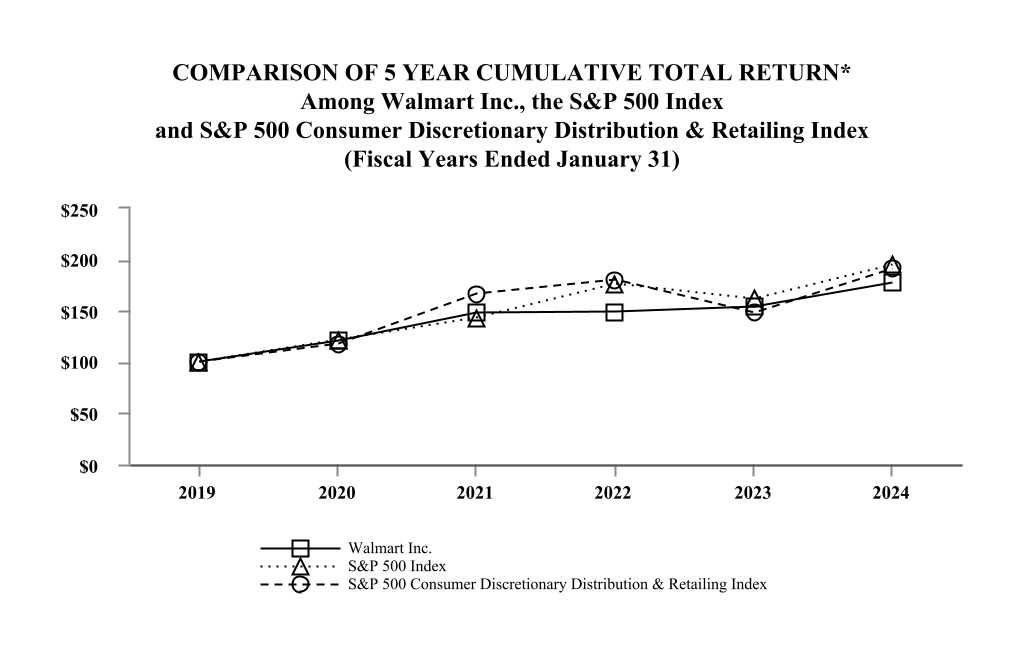
| *Assumes $100 Invested on February 1, 2019 Assumes Dividends Reinvested Fiscal Year ended January 31, 2024 |
| Fiscal Years Ended January 31, | |||||||||||||||||||||||||||||||||||
| 2019 | 2020 | 2021 | 2022 | 2023 | 2024 | ||||||||||||||||||||||||||||||
| Walmart Inc. | $ | 100.00 | $ | 120.27 | $ | 148.41 | $ | 148.47 | $ | 153.58 | $ | 177.30 | |||||||||||||||||||||||
| S&P 500 Index | 100.00 | 121.68 | 142.67 | 175.90 | 161.45 | 195.06 | |||||||||||||||||||||||||||||
| S&P 500 Consumer Discretionary Distribution & Retailing Index | 100.00 | 117.54 | 166.19 | 180.56 | 147.66 | 190.67 |
Issuer Repurchases of Equity Securities
From time to time, the Company repurchases shares of our common stock under share repurchase programs authorized by the Company's Board of Directors. All repurchases made during fiscal 2024 were made under the current $20.0 billion share repurchase program approved in November 2022, which has no expiration date or other restrictions limiting the period over which the Company can make repurchases. As of January 31, 2024, authorization for $16.5 billion of share repurchases remained under the share repurchase program. Any repurchased shares are constructively retired and returned to an unissued status.
Share repurchase activity under our share repurchase programs, on a trade date basis, for each month in the quarter ended January 31, 2024, was as follows:
| Fiscal Period | Total Number of Shares Repurchased**(1)** | Average Price Paid per Share (in dollars)****(1) | Total Number of Shares Repurchased as Part of Publicly Announced Plans or Programs**(1)** | Approximate Dollar Value of Shares that May Yet Be Repurchased Under the Plans or Programs**(2)** (in billions) | ||||||||||||||||||||||
| November 1-30, 2023 | 5,340,951 | $ | 51.99 | 5,340,951 | $ | 17.8 | ||||||||||||||||||||
| December 1-31, 2023 | 13,913,403 | 51.41 | 13,913,403 | 17.1 | ||||||||||||||||||||||
| January 1-31, 2024 | 10,211,025 | 53.62 | 10,211,025 | 16.5 | ||||||||||||||||||||||
| Total | 29,465,379 | 29,465,379 |
(1) Share and per share information in this table has been adjusted to reflect the 3-for-1 common stock split effected on February 23, 2024. Refer to Note 1.
(2) Represents the approximate dollar value of shares that could have been repurchased under the current plan at the end of the month.
Item 6. RESERVED
Item 7. MANAGEMENT'S DISCUSSION AND ANALYSIS OF FINANCIAL CONDITION AND RESULTS OF OPERATIONS
Overview
This discussion, which presents our results for the fiscal years ended January 31, 2024 ("fiscal 2024"), January 31, 2023 ("fiscal 2023") and January 31, 2022 ("fiscal 2022"), should be read in conjunction with our Consolidated Financial Statements and the accompanying notes. We intend for this discussion to provide the reader with information that will assist in understanding our financial statements, the changes in certain key items in those financial statements from period to period and the primary factors that accounted for those changes. We also discuss certain performance metrics that management uses to assess the Company's performance. Additionally, the discussion provides information about the financial results of each of the three segments to provide a better understanding of how each of those segments and its results of operations affect the financial position and results of operations of the Company as a whole.
Throughout this Item 7, we discuss segment operating income, comparable store and club sales and other measures. Management measures the results of the Company's segments using each segment's operating income, including certain corporate overhead allocations, as well as other measures. From time to time, we revise the measurement of each segment's operating income and other measures as determined by the information regularly reviewed by our chief operating decision maker.
Management also measures the results of comparable store and club sales, or comparable sales, a metric that indicates the performance of our existing stores and clubs by measuring the change in sales for such stores and clubs, for a particular period from the corresponding period in the previous year. Walmart's definition of comparable sales includes sales from stores and clubs open for the previous 12 months, including remodels, relocations, expansions and conversions, as well as eCommerce sales. We measure the eCommerce sales impact by including all sales initiated digitally, including omni-channel transactions which are fulfilled through our stores and clubs as well as certain other business offerings that are part of our ecosystem, such as our Walmart Connect advertising business. Sales at a store that has changed in format are excluded from comparable sales when the conversion of that store is accompanied by a relocation or expansion that results in a change in the store's retail square feet of more than five percent. Sales related to divested businesses are excluded from comparable sales, and sales related to acquisitions are excluded until such acquisitions have been owned for 12 months. Comparable sales are also referred to as "same-store" sales by others within the retail industry. The method of calculating comparable sales varies across the retail industry. As a result, our calculation of comparable sales is not necessarily comparable to similarly titled measures reported by other companies.
In discussing our operating results, the term currency exchange rates refers to the currency exchange rates we use to convert the operating results for countries where the functional currency is not the U.S. dollar into U.S. dollars. We calculate the effect of changes in currency exchange rates as the difference between current period activity translated using the current period's currency exchange rates and the comparable prior year period's currency exchange rates. Additionally, no currency exchange rate fluctuations are calculated for non-USD acquisitions until owned for 12 months. Throughout our discussion, we refer to the results of this calculation as the impact of currency exchange rate fluctuations. Volatility in currency exchange rates may impact the results, including net sales and operating income, of the Company and the Walmart International segment in the future.
On February 23, 2024, the Company effected a 3-for-1 forward split of its common stock and a proportionate increase in the number of authorized shares. All share and per share information, including share based compensation, throughout this Annual Report on Form 10-K has been retroactively adjusted to reflect the stock split.
We have taken certain strategic actions across our segments, including an increased emphasis on investments in automation and supply chain as well as diversifying our earnings streams through category and business mix. Additionally, in the Walmart International segment, we have taken strategic actions to reshape our portfolio including the following highlights over the last three years:
- In February 2021, we completed the sale of Asda for net consideration of $9.6 billion. Refer to Note 12.
*•*In March 2021, we completed the sale of Seiyu for net consideration of $1.2 billion. Refer to Note 12.
-
In November 2022, we completed the buyout of the noncontrolling interest shareholders of our Massmart subsidiary (Refer to Note 3) and in December 2022, we exited operations in certain countries in Africa.
-
In December 2022, we increased our ownership in PhonePe as part of the separation from our majority-owned Flipkart subsidiary. Refer to Note 3.
We operate in a highly competitive omni-channel retail industry in all of the markets we serve. We face strong sales competition from other discount, department, drug, dollar, variety and specialty stores, warehouse clubs and supermarkets, as well as eCommerce, health and wellness, financial services, advertising and data service businesses. Many of these competitors are national, regional or international chains or have a national or international omni-channel or eCommerce presence. We compete with a number of companies for attracting and retaining quality associates. We, along with other retail companies, are
influenced by a number of factors including, but not limited to: catastrophic events, weather and other risks related to climate change, global health epidemics and pandemics, competitive pressures, consumer disposable income, consumer debt levels and buying patterns, consumer credit availability, disruptions in supply chain, inventory management, cost and availability of goods, currency exchange rate fluctuations, customer preferences, inflation, deflation, fuel and energy prices, general economic conditions, insurance costs, interest rates, labor availability and costs, tax rates, the imposition of tariffs, cybersecurity attacks and unemployment. Further information on the factors that can affect our operating results and on certain risks to our Company and an investment in its securities can be found herein under "Item 1A. Risk Factors."
We are committed to helping customers save money and live better through everyday low prices, supported by everyday low
costs. Merchandise costs for fiscal 2024 continued to be impacted by inflation, however at a lower rate than we experienced in fiscal 2023. The impact to our net sales and gross profit margin is influenced in part by our pricing and merchandising strategies in response to cost increases. Those pricing strategies include but are not limited to: absorbing cost increases instead of passing those cost increases on to our customers and members; reducing prices in certain merchandise categories; focusing on opening price points for certain food categories; and when necessary, passing cost increases on to our customers and members. Merchandising strategies include, but are not limited to: working with our suppliers to reduce product costs and share in absorbing cost increases; focusing on private label brands and smaller pack sizes; earlier-than-usual purchasing and in greater volumes or moderating purchasing in certain categories; and securing ocean carrier and container capacity. These strategies have and may continue to impact gross profit as a p
Showing the first 8K of 74K characters. Open the full section
Item 7A. QUANTITATIVE AND QUALITATIVE DISCLOSURES ABOUT MARKET RISK
Market Risk
In addition to the risks inherent in our operations, we are exposed to certain market risks, including changes in interest rates, currency exchange rates and the fair values of certain equity and equity method investments measured on a recurring basis.
The analysis presented below for each of our market risk sensitive instruments is based on a hypothetical scenario used to calibrate potential risk and does not represent our view of future market changes. The effect of a change in a particular assumption is calculated without adjusting any other assumption. In reality, however, a change in one factor could cause a change in another, which may magnify or negate other sensitivities.
Interest Rate Risk
We are exposed to changes in interest rates as a result of our short-term borrowings and long-term debt. We hedge a portion of our interest rate risk by managing the mix of fixed and variable rate debt and by entering into interest rate swaps. For fiscal 2024, the net fair value of our interest rate swaps increased $35 million primarily due to fluctuations in market interest rates.
The table below provides information about our financial instruments that are sensitive to changes in interest rates. For long-term debt, the table represents the principal cash flows and related weighted-average interest rates by expected maturity dates. For interest rate swaps, the table represents the contractual cash flows and weighted-average interest rates by the contractual maturity date, unless otherwise noted. The notional amounts are used to calculate contractual cash flows to be exchanged under the contracts. The weighted-average variable rates are based upon prevailing market rates as of January 31, 2024.
| Expected Maturity Date | ||||||||||||||||||||||||||||||||||||||||||||
| (Amounts in millions) | Fiscal 2025 | Fiscal 2026 | Fiscal 2027 | Fiscal 2028 | Fiscal 2029 | Thereafter | Total | |||||||||||||||||||||||||||||||||||||
| Liabilities | ||||||||||||||||||||||||||||||||||||||||||||
| Short-term borrowings: | ||||||||||||||||||||||||||||||||||||||||||||
| Variable rate | $ | 878 | $ | — | $ | — | $ | — | $ | — | $ | — | $ | 878 | ||||||||||||||||||||||||||||||
| Weighted-average interest rate | 7.7 | % | — | % | — | % | — | % | — | % | — | % | 7.7 | % | ||||||||||||||||||||||||||||||
| Long-term debt**(1)****:** | ||||||||||||||||||||||||||||||||||||||||||||
| Fixed rate | $ | 3,447 | $ | 2,600 | $ | 3,483 | $ | 1,760 | $ | 3,458 | $ | 24,831 | $ | 39,579 | ||||||||||||||||||||||||||||||
| Weighted-average interest rate | 3.0 | % | 3.8 | % | 2.5 | % | 3.6 | % | 3.0 | % | 4.5 | % | 3.9 | % | ||||||||||||||||||||||||||||||
| Interest rate derivatives | ||||||||||||||||||||||||||||||||||||||||||||
| Interest rate swaps: | ||||||||||||||||||||||||||||||||||||||||||||
| Fixed to variable | $ | 1,500 | $ | — | $ | — | $ | — | $ | 1,250 | $ | 3,521 | $ | 6,271 | ||||||||||||||||||||||||||||||
| Weighted-average pay rate | 6.7 | % | — | % | — | % | — | % | 5.7 | % | 6.9 | % | 6.6 | % | ||||||||||||||||||||||||||||||
| Weighted-average receive rate | 3.3 | % | — | % | — | % | — | % | 1.5 | % | 2.9 | % | 2.7 | % |
(1) Includes deferred loan costs, discounts, fair value hedges, foreign-held debt and secured debt.
As of January 31, 2024, our variable rate borrowings, including the effect of our commercial paper and interest rate swaps, represented 18% of our total short-term and long-term debt. Based on January 31, 2024 debt levels, a 100 basis point change in prevailing market rates would cause our annual interest costs to change by approximately $0.1 billion.
Foreign Currency Risk
We are exposed to fluctuations in currency exchange rates as a result of our investments and operations in countries other than the U.S., as well as our foreign-currency-denominated long-term debt. For fiscal 2024, movements in currency exchange rates and the related impact on the translation of the balance sheets resulted in the $0.3 billion net gain in the currency translation and other category of accumulated other comprehensive loss.
We hedge a portion of our foreign currency risk by entering into currency swaps. The aggregate fair value of these swaps was in a liability position of $1.3 billion and $1.4 billion as of January 31, 2024 and January 31, 2023, respectively. The change in the fair value of these swaps was due to fluctuations in currency exchange rates, primarily due to the strengthening of certain currencies relative to the U.S. dollar in fiscal 2024. The hypothetical result of a uniform 10% weakening in the value of the U.S. dollar relative to other currencies underlying these swaps would have resulted in a change in the value of the swaps of $0.7 billion. A hypothetical 10% change in interest rates underlying these swaps from the market rates in effect as of January 31, 2024 would have resulted in a change in the value of the swaps of $0.1 billion.
In certain countries, we also enter into immaterial foreign currency forward contracts to hedge the purchase and payment of purchase commitments denominated in non-functional currencies.
Investment Risk
We are exposed to investment risk primarily related to changes in the fair value of certain equity investments, including certain immaterial equity method investments where we have elected the fair value option, measured on a recurring basis. The amounts of gains and losses included in earnings from fair value changes for these investments are recorded within other gains and losses and resulted in a net loss of $3.8 billion in fiscal 2024 primarily due to net decreases in the underlying stock prices of these investments. As of January 31, 2024, the fair value of our equity investments, including certain equity method investments, measured on a recurring basis was $7.2 billion. As of January 31, 2024, a hypothetical 10% change in the stock price of such investments would have changed the fair value of such investments by approximately $0.7 billion.
Item 8. FINANCIAL STATEMENTS AND SUPPLEMENTARY DATA
Consolidated Financial Statements of Walmart Inc.
For the Fiscal Year Ended January 31, 2024
Table of Contents
Report of Independent Registered Public Accounting Firm
To the Shareholders and the Board of Directors of Walmart Inc.
Opinion on the Financial Statements
We have audited the accompanying consolidated balance sheets of Walmart Inc. (the Company) as of January 31, 2024 and 2023, the related consolidated statements of income, comprehensive income, shareholders' equity and cash flows for each of the three years in the period ended January 31, 2024, and the related notes (collectively referred to as the "Consolidated Financial Statements"). In our opinion, the Consolidated Financial Statements present fairly, in all material respects, the financial position of the Company at January 31, 2024 and 2023, and the results of its operations and its cash flows for each of the three years in the period ended January 31, 2024, in conformity with U.S. generally accepted accounting principles.
We also have audited, in accordance with the standards of the Public Company Accounting Oversight Board (United States) (PCAOB), the Company's internal control over financial reporting as of January 31, 2024, based on criteria established in Internal Control-Integrated Framework issued by the Committee of Sponsoring Organizations of the Treadway Commission (2013 framework) and our report dated March 15, 2024 expressed an unqualified opinion thereon.
Basis for Opinion
These financial statements are the responsibility of the Company's management. Our responsibility is to express an opinion on the Company's financial statements based on our audits. We are a public accounting firm registered with the PCAOB and are required to be independent with respect to the Company in accordance with the U.S. federal securities laws and the applicable rules and regulations of the Securities and Exchange Commission and the PCAOB.
We conducted our audits in accordance with the standards of the PCAOB. Those standards require that we plan and perform the audit to obtain reasonable assurance about whether the financial statements are free of material misstatement, whether due to error or fraud. Our audits included performing procedures to assess the risks of material misstatement of the financial statements, whether due to error or fraud, and performing procedures that respond to those risks. Such procedures included examining, on a test basis, evidence regarding the amounts and disclosures in the financial statements. Our audits also included evaluating the accounting principles used and significant estimates made by management, as well as evaluating the overall presentation of the financial statements. We believe that our audits provide a reasonable basis for our opinion.
Critical Audit Matter
The critical audit matter communicated below is a matter arising from the current period audit of the financial statements that was communicated or required to be communicated to the audit committee and that: (1) relates to accounts or disclosures that are material to the financial statements and (2) involved our especially challenging, subjective or complex judgments. The communication of the critical audit matter does not alter in any way our opinion on the Consolidated Financial Statements, taken as a whole, and we are not, by communicating the critical audit matter below, providing a separate opinion on the critical audit matter or on the account or disclosures to which it relates.
| Contingencies | ||||||||
| Description of the Matter | As described in Note 10 to the Consolidated Financial Statements, at January 31, 2024, the Company is involved in a number of legal proceedings and certain regulatory matters. The Company records a liability for those legal proceedings and regulatory matters when management determines it is probable that a loss has been incurred and the amount of the loss can be reasonably estimated. The Company also discloses when it is reasonably possible that a material loss may be incurred. In assessing the probability of occurrence and whether an estimate of loss can be reasonably estimated for a particular legal proceeding, management exercises judgment on matters relevant to each proceeding. Auditing management's accounting for, and disclosure of, loss contingencies was complex and highly judgmental as it involved our assessment of the significant judgments made by management when assessing the probability of loss for contingencies or when determining whether an estimate of the loss or range of loss could be made. |
| How We Addressed the Matter in Our Audit | We obtained an understanding, evaluated the design and tested the operating effectiveness of controls over the identification and evaluation of contingencies. For example, we tested controls over the Company's assessment of the likelihood of loss and the Company's determinations regarding the measurement of loss. To test the Company's assessment of the probability of loss or determination of an estimate of loss, or range of loss, among other procedures, we read the minutes of the meetings of the board of directors and committees of the board of directors, reviewed documents provided to the Company by certain outside legal counsel, read letters received directly by us from internal and outside legal counsel, evaluated the current status of contingencies based on discussions with internal and outside legal counsel, and obtained representations from management. We also assessed the adequacy of the related disclosures. |
/s/ Ernst & Young LLP
We have served as the Company's auditor since 1969.
Rogers, Arkansas
March 15, 2024
Report of Independent Registered Public Accounting Firm
To the Shareholders and the Board of Directors of Walmart Inc.
Opinion on Internal Control Over Financial Reporting
We have audited Walmart Inc.'s internal control over financial reporting as of January 31, 2024, based on criteria established in Internal Control—Integrated Framework issued by the Committee of Sponsoring Organizations of the Treadway Commission (2013 framework) (the COSO criteria). In our opinion, Walmart Inc. (the Company) maintained, in all material respects, effective internal control over financial reporting as of January 31, 2024, based on the COSO criteria.
We also have audited, in accordance with the standards of the Publi
Showing the first 8K of 159K characters. Open the full section
Item 9. CHANGES IN AND DISAGREEMENTS WITH ACCOUNTANTS ON ACCOUNTING AND FINANCIAL DISCLOSURE
None.
Item 9A. CONTROLS AND PROCEDURES
Evaluation of Disclosure Controls and Procedures
We maintain disclosure controls and procedures that are designed to provide reasonable assurance that information, which is required to be timely disclosed, is accumulated and communicated to management in a timely fashion. In designing and evaluating such controls and procedures, we recognize that any controls and procedures, no matter how well designed and operated, can provide only reasonable assurance of achieving the desired control objectives. Our management is necessarily required to use judgment in evaluating controls and procedures. Also, we have investments in unconsolidated entities. Since we do not control or manage those entities, our controls and procedures with respect to those entities are substantially more limited than those we maintain with respect to our consolidated subsidiaries.
In the ordinary course of business, we review our internal control over financial reporting and make changes to our systems and processes to improve such controls and increase efficiency, while ensuring that we maintain an effective internal control environment. Changes may include such activities as implementing new, more efficient systems, updating existing systems, automating manual processes, standardizing controls globally, migrating certain processes to our shared services organizations and increasing monitoring controls. We are currently upgrading our financial system in stages, beginning in our U.S. and Canadian markets, including our general ledger which was upgraded for these markets during fiscal 2024. Our financial system is a significant component of our internal control over financial reporting. We will continue to implement other components of our new financial system in stages, and each implementation will impact our internal control over financial reporting.
An evaluation of the effectiveness of the design and operation of our disclosure controls and procedures as of January 31, 2024 was performed under the supervision and with the participation of management, including our Chief Executive Officer and Chief Financial Officer. Based upon that evaluation, our Chief Executive Officer and Chief Financial Officer concluded that our disclosure controls and procedures are effective to provide reasonable assurance that information required to be disclosed by the Company in the reports that it files or submits under the Securities Exchange Act of 1934, as amended, is accumulated and communicated to management, including our Chief Executive Officer and Chief Financial Officer, as appropriate, to allow timely decisions regarding required disclosure and are effective to provide reasonable assurance that such information is recorded, processed, summarized and reported within the time periods specified by the SEC's rules and forms.
Report on Internal Control Over Financial Reporting
Management has responsibility for establishing and maintaining adequate internal control over financial reporting. Internal control over financial reporting is a process designed to provide reasonable assurance regarding the reliability of financial reporting and the preparation of financial statements for external reporting purposes in accordance with accounting principles generally accepted in the United States. Because of its inherent limitations, internal control over financial reporting may not prevent or detect misstatements. Management has assessed the effectiveness of the Company's internal control over financial reporting as of January 31, 2024. In making its assessment, management has utilized the criteria set forth by the Committee of Sponsoring Organizations ("COSO") of the Treadway Commission in Internal Control-Integrated Framework (2013). Management concluded that based on its assessment, Walmart's internal control over financial reporting was effective as of January 31, 2024. The Company's internal control over financial reporting as of January 31, 2024, has been audited by Ernst & Young LLP as stated in their report which appears herein.
Changes in Internal Control Over Financial Reporting
There have been no changes in the Company's internal control over financial reporting as of January 31, 2024, that have materially affected, or are reasonably likely to materially affect, the Company's internal control over financial reporting.
Item 9B. OTHER INFORMATION
Security Trading Plans of Directors and Executive Officers
None of the Company's directors or executive officers adopted or terminated a Rule 10b5-1 trading arrangement or a non-Rule 10b5-1 trading arrangement during the Company's fiscal quarter ended January 31, 2024, as such terms are defined under Item 408(a) or Regulation S-K.
Item 9C. DISCLOSURE REGARDING FOREIGN JURISDICTIONS THAT PREVENT INSPECTIONS
Not applicable.
PART III
Item 10. DIRECTORS, EXECUTIVE OFFICERS AND CORPORATE GOVERNANCE
Please see the information concerning our executive officers contained in "Item 1. Business" herein under the caption "Information About Our Executive Officers," which is included in accordance with the Instruction to Item 401 of the SEC's Regulation S-K.
Information required by this Item 10 with respect to the Company's directors and certain family relationships is incorporated by reference to such information under the caption "Proposal No. 1 – Election of Directors" included in our Proxy Statement relating to our 2024 Annual Meeting of Shareholders (our "Proxy Statement").
No material changes have been made to the procedures by which shareholders of the Company may recommend nominees to our Board of Directors since those procedures were disclosed in our proxy statement relating to our 2023 Annual Shareholders' Meeting as previously filed with the SEC.
The information regarding our Audit Committee, including our audit committee financial experts, our Reporting Protocols for Senior Financial Officers and our Code of Conduct applicable to all of our associates, including our Chief Executive Officer, Chief Financial Officer and our Controller, who is our principal accounting officer, required by this Item 10 is incorporated herein by reference to the information under the captions "Corporate Governance" and "Proposal No. 4: Ratification of Independent Accountants" included in our Proxy Statement. "Item 1. Business" above contains information relating to the availability of a copy of our Reporting Protocols for Senior Financial Officers and our Code of Conduct and the posting of amendments to and any waivers of the Reporting Protocols for Senior Financial Officers and our Code of Conduct on our website.
Item 11. EXECUTIVE COMPENSATION
The information required by this Item 11 is incorporated herein by reference to the information under the captions "Corporate Governance – Director Compensation" and "Executive Compensation" included in our Proxy Statement.
Item 12. SECURITY OWNERSHIP OF CERTAIN BENEFICIAL OWNERS AND MANAGEMENT AND RELATED STOCKHOLDER MATTERS
The information required by this Item 12 is incorporated herein by reference to the information that appears under the caption "Stock Ownership" included in our Proxy Statement.
Item 13. CERTAIN RELATIONSHIPS AND RELATED TRANSACTIONS, AND DIRECTOR INDEPENDENCE
The information required by this Item 13 is incorporated herein by reference to the information under the caption "Corporate Governance – Board Processes and Practices" included in our Proxy Statement.
Item 14. PRINCIPAL ACCOUNTING FEES AND SERVICES
The information required by this Item 14 is incorporated herein by reference to the information under the caption "Proposal No. 4 – Ratification of Independent Accountants" included in our Proxy Statement.
PART IV
Item 15. EXHIBITS, FINANCIAL STATEMENT SCHEDULES
(a) Documents filed as part of this report are as follows:
| 1. | Financial Statements: See the Financial Statements in "Item 8. Financial Statements and Supplementary Data." | |||||||
| 2. | Financial Statement Schedules: Certain schedules have been omitted because the required information is not present or is not present in amounts sufficient to require submission of the schedule, or because the information required is included in the Consolidated Financial Statements, including the notes thereto. | |||||||
| 3. | Exhibits: See exhibits listed under part (b) below. | |||||||
(b) The required exhibits are filed as part of this Form 10-K or are incorporated by reference herein.(1)
| 21* | List of the Company's Significant Subsidiaries | |||||||
| 23* | Consent of Independent Registered Public Accounting Firm | |||||||
| 31.1* | Chief Executive Officer Section 302 Certification | |||||||
| 31.2* | Chief Financial Officer Section 302 Certification | |||||||
| 32.1** | Chief Executive Officer Section 906 Certification | |||||||
| 32.2** | Chief Financial Officer Section 906 Certification | |||||||
| 97.1* | Walmart Executive Compensation Recoupment Policy | |||||||
| 99.1* | Certain Federal and State Court Opioids Litigation Case Citations and Currently Scheduled Trial Dates | |||||||
| 101.INS* | Inline XBRL Instance Document | |||||||
| 101.SCH* | Inline XBRL Taxonomy Extension Schema Document | |||||||
| 101.CAL* | Inline XBRL Taxonomy Extension Calculation Linkbase Document | |||||||
| 101.DEF* | Inline XBRL Taxonomy Extension Definition Linkbase Document | |||||||
| 101.LAB* | Inline XBRL Taxonomy Extension Label Linkbase Document | |||||||
| 101.PRE* | Inline XBRL Taxonomy Extension Presentation Linkbase Document | |||||||
| 104 | Cover Page Interactive Data File (formatted as Inline XBRL and contained in Exhibit 101) |
| * | Filed herewith as an Exhibit. | |||||||
| ** | Furnished herewith as an Exhibit. | |||||||
| (C) | This Exhibit is a management contract or compensatory plan or arrangement | |||||||
| (P) | This Exhibit was originally filed in paper format. Accordingly, a hyperlink has not been provided. | |||||||
| (1) | Certain instruments defining the rights of holders of long-term debt securities of the Registrant are omitted pursuant to Item 601(b)(4)(iii) of Regulation S-K. The Company hereby undertakes to furnish to the SEC, upon request, copies of any such instruments. |
(c) Financial Statement Schedules: None.
Item 16. FORM 10-K SUMMARY
None.
SIGNATURES
Pursuant to the requirements of Section 13 or 15(d) of the Securities Exchange Act of 1934, the registrant has duly caused this report to be signed on its behalf by the undersigned, thereunto duly authorized.
| Walmart Inc. | ||||||||||||||
| Date: March 15, 2024 | By | /s/ C. Douglas McMillon | ||||||||||||
| C. Douglas McMillon | ||||||||||||||
| President and Chief Executive Officer |
Pursuant to the requirements of the Securities Exchange Act of 1934, this report has been signed below by the following persons on behalf of the registrant and in the capacities and on the dates indicated:
| Date: March 15, 2024 | By | /s/ C. Douglas McMillon | ||||||||||||
| C. Douglas McMillon | ||||||||||||||
| President and Chief Executive Officer and Director | ||||||||||||||
| (Principal Executive Officer) | ||||||||||||||
| Date: March 15, 2024 | By | /s/ Gregory B. Penner | ||||||||||||
| Gregory B. Penner | ||||||||||||||
| Chairman of the Board and Director | ||||||||||||||
| Date: March 15, 2024 | By | /s/ John David Rainey | ||||||||||||
| John David Rainey | ||||||||||||||
| Executive Vice President and Chief Financial Officer | ||||||||||||||
| (Principal Financial Officer) | ||||||||||||||
| Date: March 15, 2024 | By | /s/ David M. Chojnowski | ||||||||||||
| David M. Chojnowski | ||||||||||||||
| Senior Vice President and Controller | ||||||||||||||
| (Principal Accounting Officer) |
Signature Page to Walmart Inc.
Form 10-K for the Fiscal Year Ended January 31, 2024
| Date: March 15, 2024 | By | /s/ Cesar Conde | ||||||||||||
| Cesar Conde | ||||||||||||||
| Director | ||||||||||||||
| Date: March 15, 2024 | By | /s/ Timothy P. Flynn | ||||||||||||
| Timothy P. Flynn | ||||||||||||||
| Director | ||||||||||||||
| Date: March 15, 2024 | By | /s/ Sarah Friar | ||||||||||||
| Sarah Friar | ||||||||||||||
| Director | ||||||||||||||
| Date: March 15, 2024 | By | /s/ Carla A. Harris | ||||||||||||
| Carla A. Harris | ||||||||||||||
| Director | ||||||||||||||
| Date: March 15, 2024 | By | /s/ Thomas W. Horton | ||||||||||||
| Thomas W. Horton | ||||||||||||||
| Director | ||||||||||||||
| Date: March 15, 2024 | By | /s/ Marissa A. Mayer | ||||||||||||
| Marissa A. Mayer | ||||||||||||||
| Director | ||||||||||||||
| Date: March 15, 2024 | By | /s/ Randall L. Stephenson | ||||||||||||
| Randall L. Stephenson | ||||||||||||||
| Director | ||||||||||||||
| Date: March 15, 2024 | By | /s/ S. Robson Walton | ||||||||||||
| S. Robson Walton | ||||||||||||||
| Director | ||||||||||||||
| Date: March 15, 2024 | By | /s/ Steuart L. Walton | ||||||||||||
| Steuart L. Walton | ||||||||||||||
| Director |
Signature Page to Walmart Inc.
Form 10-K for the Fiscal Year Ended January 31, 2024