 filings.tools
West Pharmaceutical Services 10-K 2019-12-31
Filed 2020-02-24. 21 sections, 387K characters. Original on sec.gov · Markdown · JSON
Cover and table of contents
| UNITED STATES | ||
| SECURITIES AND EXCHANGE COMMISSION | ||
| Washington, D.C. 20549 |
| FORM 10-K |
(Mark One)
| ☑ | ANNUAL REPORT PURSUANT TO SECTION 13 OR 15(d) OF THE SECURITIES EXCHANGE ACT OF 1934 |
For the fiscal year ended December 31, 2019
or
| ☐ | TRANSITION REPORT PURSUANT TO SECTION 13 OR 15(d) OF THE SECURITIES EXCHANGE ACT OF 1934 |
For the transition period from to
Commission File Number 1-8036
| WEST PHARMACEUTICAL SERVICES, INC. (Exact name of registrant as specified in its charter) |
| Pennsylvania | 23-1210010 | ||||
| (State or other jurisdiction of incorporation or organization) | (I.R.S. Employer Identification Number) | ||||
| 530 Herman O. West Drive, Exton, PA | 19341-0645 | ||||
| (Address of principal executive offices) | (Zip Code) |
Registrant’s telephone number, including area code: 610-594-2900
Securities registered pursuant to Section 12(b) of the Act:
| Title of each class | Trading Symbol | Name of each exchange on which registered | ||||||
| Common Stock, par value $.25 per share | WST | New York Stock Exchange |
Securities registered pursuant to Section 12(g) of the Act: None
Indicate by check mark if the registrant is a well-known seasoned issuer, as defined in Rule 405 of the Securities Act. Yes ☑ No ☐
Indicate by check mark if the registrant is not required to file reports pursuant to Section 13 or Section 15(d) of the Act. Yes ☐ No ☑
Indicate by check mark whether the registrant (1) has filed all reports required to be filed by Section 13 or 15(d) of the Securities Exchange Act of 1934 during the preceding 12 months (or for such shorter period that the registrant was required to file such reports), and (2) has been subject to such filing requirements for the past 90 days. Yes þ No o
Indicate by check mark whether the registrant has submitted electronically every Interactive Data File required to be submitted pursuant to Rule 405 of Regulation S-T (§ 232.405 of this chapter) during the preceding 12 months (or for such shorter period that the registrant was required to submit and post such files). Yes þ No o
Indicate by check mark whether the registrant is a large accelerated filer, an accelerated filer, a non-accelerated filer, a smaller reporting company, or an emerging growth company. See the definitions of “large accelerated filer,” “accelerated filer,” “smaller reporting company,” and “emerging growth company” in Rule 12b-2 of the Exchange Act.
| Large accelerated filer | ☑ | Accelerated filer | ☐ | |||||||||||
| Non-accelerated filer | ☐ | Smaller reporting company | ☐ | |||||||||||
| Emerging growth company | ☐ |
If an emerging growth company, indicate by check mark if the registrant has elected not to use the extended transition period for complying with any new or revised financial accounting standards provided pursuant to Section 13(a) of the Exchange Act. ☐
Indicate by check mark whether the registrant is a shell company (as defined in Rule 12b-2 of the Exchange Act). Yes ☐ No ☑
The aggregate market value of the voting stock held by non-affiliates of the registrant as of June 30, 2019 was approximately $9,218,126,218 based on the closing price as reported on the New York Stock Exchange.
As of January 31, 2020, there were 73,837,449 shares of the registrant’s common stock outstanding.
DOCUMENTS INCORPORATED BY REFERENCE
| Document | Parts Into Which Incorporated | ||||
| Proxy Statement for the Annual Meeting of Shareholders to be held May 5, 2020 | Part III |
TABLE OF CONTENTS
| PART I | Page | ||||||||||
| ITEM 1. | BUSINESS | 3 | |||||||||
| ITEM 1A. | RISK FACTORS | 7 | |||||||||
| ITEM 1B. | UNRESOLVED STAFF COMMENTS | 15 | |||||||||
| ITEM 2. | PROPERTIES | 15 | |||||||||
| ITEM 3. | LEGAL PROCEEDINGS | 16 | |||||||||
| ITEM 4. | MINE SAFETY DISCLOSURES | 16 | |||||||||
| INFORMATION ABOUT OUR EXECUTIVE OFFICERS | 16 | ||||||||||
| PART II | |||||||||||
| ITEM 5. | MARKET FOR REGISTRANT’S COMMON EQUITY, RELATED STOCKHOLDER MATTERS AND ISSUER PURCHASES OF EQUITY SECURITIES | 18 | |||||||||
| ITEM 6. | SELECTED FINANCIAL DATA | 20 | |||||||||
| ITEM 7. | MANAGEMENT’S DISCUSSION AND ANALYSIS OF FINANCIAL CONDITION AND RESULTS OF OPERATIONS | 21 | |||||||||
| ITEM 7A. | QUANTITATIVE AND QUALITATIVE DISCLOSURES ABOUT MARKET RISK | 35 | |||||||||
| ITEM 8. | FINANCIAL STATEMENTS AND SUPPLEMENTARY DATA | 38 | |||||||||
| ITEM 9. | CHANGES IN AND DISAGREEMENTS WITH ACCOUNTANTS ON ACCOUNTING AND FINANCIAL DISCLOSURE | 85 | |||||||||
| ITEM 9A. | CONTROLS AND PROCEDURES | 85 | |||||||||
| ITEM 9B. | OTHER INFORMATION | 86 | |||||||||
| PART III | |||||||||||
| ITEM 10. | DIRECTORS, EXECUTIVE OFFICERS AND CORPORATE GOVERNANCE | 86 | |||||||||
| ITEM 11. | EXECUTIVE COMPENSATION | 86 | |||||||||
| ITEM 12. | SECURITY OWNERSHIP OF CERTAIN BENEFICIAL OWNERS AND MANAGEMENT AND RELATED STOCKHOLDER MATTERS | 86 | |||||||||
| ITEM 13. | CERTAIN RELATIONSHIPS AND RELATED TRANSACTIONS, AND DIRECTOR INDEPENDENCE | 87 | |||||||||
| ITEM 14. | PRINCIPAL ACCOUNTING FEES AND SERVICES | 88 | |||||||||
| PART IV | |||||||||||
| ITEM 15. | EXHIBITS, FINANCIAL STATEMENT SCHEDULES | 88 | |||||||||
| ITEM 16. | FORM 10-K SUMMARY | 89 | |||||||||
| SIGNATURES | 90 | ||||||||||
| EXHIBIT INDEX | F-1 |
PART I
Unless otherwise indicated, or the context otherwise requires, references in this report to “the Company”, “we”, “us”, “our” and “West” refer to West Pharmaceutical Services, Inc. and its majority-owned subsidiaries.
All trademarks and registered trademarks used in this report are our property, either directly or indirectly through our subsidiaries, unless noted otherwise. Daikyo Crystal Zenith® (“Crystal Zenith”) is a registered trademark of Daikyo Seiko, Ltd. (“Daikyo”).
Throughout this report, references to “Notes” refer to the Notes to Consolidated Financial Statements included in Part II, Item 8 of this Annual Report on Form 10-K (“Form 10-K”), unless otherwise indicated.
Information in this Form 10-K is current as of February 21, 2020, unless otherwise specified.
Item 1. BUSINESS
General
We are a leading global manufacturer in the design and production of technologically advanced, high-quality, integrated containment and delivery systems for injectable drugs and healthcare products. Our products include a variety of primary packaging, containment solutions, reconstitution and transfer systems, and drug delivery systems, as well as contract manufacturing, analytical lab services and integrated solutions. Our customers include the leading biologic, generic, pharmaceutical, diagnostic, and additional medical device companies in the world. Our top priority is delivering quality products that meet the exact product specifications and quality standards customers require and expect. This focus on quality includes a commitment to excellence in manufacturing, scientific and technical expertise and management, and enables us to partner with our customers in order to deliver safe, effective drug products to patients quickly and efficiently.
The Company was incorporated under the laws of the Commonwealth of Pennsylvania on July 27, 1923.
Business Segments
Our business operations are organized into two reportable segments, Proprietary Products and Contract-Manufactured Products.
Proprietary Products Segment
Our Proprietary Products reportable segment offers proprietary packaging, containment and drug delivery products, along with analytical lab services and integrated solutions, primarily to biologic, generic and pharmaceutical drug customers. Our packaging products include stoppers and seals for injectable packaging systems, which are designed to help ensure drug compatibility and stability with active drug products, while also supporting operational efficiency for customers. This product portfolio also includes syringe and cartridge components, including custom solutions for the specific needs of injectable drug applications, as well as administration systems that can enhance the safe delivery of drugs through advanced reconstitution, mixing and transfer technologies. We also provide films, coatings, washing and sterilization processes and services to enhance the quality of packaging components and mitigate the risk of contamination and compatibility issues.
This segment’s product portfolio also includes drug containment solutions, including Crystal Zenith, a cyclic olefin polymer, in the form of vials, syringes and cartridges. These products can provide a high-quality solution to glass incompatibility issues and can stand up to cold storage environments, while reducing the risk of breakage that exists with glass. In addition, we offer a variety of self-injection devices, designed to address the need to provide at-home delivery of injectable therapies. These devices are patient-centric technologies that are easy-to-use and can be combined with connected health technologies that have the potential to increase adherence.
In addition to our Proprietary Products product portfolio, we provide our customers with a range of integrated solutions, including analytical lab services, pre-approval primary packaging support and engineering development, regulatory expertise, and after-sales technical support. Offering the combination of primary packaging components, containment solutions, and drug delivery devices, as well as a broad range of integrated services, helps to position us as a leader in the integrated containment and delivery of injectable medicines.
This reportable segment has manufacturing facilities in North and South America, Europe, and Asia Pacific, with affiliated companies in Mexico and Japan. Please refer to Item 2, Properties, for additional information on our manufacturing and other sites.
Contract-Manufactured Products Segment
Our Contract-Manufactured Products reportable segment serves as a fully integrated business, focused on the design, manufacture, and automated assembly of complex devices, primarily for pharmaceutical, diagnostic, and medical device customers. These products include a variety of custom contract-manufacturing and assembly solutions, which use such technologies as multi-component molding, in-mold labeling, ultrasonic welding, clean room molding and device assembly. We manufacture customer-owned components and devices used in surgical, diagnostic, ophthalmic, injectable, and other drug delivery systems, as well as consumer products.
We have vast expertise in product design and development, including in-house mold design, process design and validation and high-speed automated assemblies.
This reportable segment has manufacturing operations in North America and Europe. Please refer to Item 2, Properties, for additional information on our manufacturing and other sites.
International
We have significant operations outside of the United States (“U.S.”), which are managed through the same business segments as our U.S. operations – Proprietary Products and Contract-Manufactured Products. Sales outside of the U.S. accounted for 55.7% of our consolidated net sales in 2019. Please refer to Item 2, Properties, for additional information on our manufacturing and other sites.
Although the general business processes are similar to the domestic business, international operations are exposed to additional risks. These risks include currency fluctuations relative to the U.S. Dollar (“USD”), multiple tax jurisdictions and, particularly in South America, Israel and the Middle East, uncertain or changing regulatory regimes, or political and social issues, that could destabilize local markets and affect the demand for our products.
See further discussion of our international operations, the risks associated with our international operations, and our attempt to minimize some of these risks in Part I, Item 1A, Risk Factors; Part II, Item 7, Management’s Discussion and Analysis of Financial Condition and Results of Operations under the caption Financial Condition, Liquidity and Capital Resources; Part II, Item 7A, Quantitative and Qualitative Disclosures About Market Risk; Note 1 under the captions Financial Instruments and Foreign Currency Translation; and Note 11, Derivative Financial Instruments.
Raw Materials
We use three basic raw materials in the manufacture of our products: elastomers, aluminum and plastic. Elastomers include both natural and synthetic materials. We currently have access to adequate supplies of these raw materials to meet our production needs through agreements with suppliers.
We employ a supply chain management strategy in our business segments, which involves purchasing from integrated suppliers that control their own sources of supply. Due to regulatory control over our production processes, sole source availability, and the cost and time involved in qualifying suppliers, we rely on single-source suppliers for many critical raw materials. We generally purchase certain raw materials in the open market. This strategy increases the risk that our supply chain may be interrupted in the event of a supplier production or
distribution problem. These risks are managed, when and where possible, by selecting suppliers with multiple manufacturing sites, rigorous quality control systems, surplus inventory levels and other methods of maintaining supply in case of an interruption in production or distribution.
Intellectual Property
Intellectual property, including patents, trademarks, copyrights, trade secrets, and know-how, is important to our business. We own or license intellectual property rights, including issued patents and pending patent applications in the U.S. and in other countries, that relate to various aspects of our products. In 2019, more than 150 patents were issued to West across the globe. Some key value-added and proprietary products and processes are licensed from Daikyo. Our intellectual property rights have been useful in establishing our market position and in the growth of our business, and are expected to continue to be of value in the future.
Seasonality
Our business is not inherently seasonal.
Working Capital
We are required to carry significant amounts of inventory to meet customer requirements. In addition, some of our supply agreements require us to purchase inventory in bulk orders, which increases inventory levels but decreases the risk of supply interruption. For a more detailed discussion of working capital, please refer to the discussion in Part II, Item 7, Management’s Discussion and Analysis of Financial Condition and Results of Operations under the caption Financial Condition, Liquidity and Capital Resources.
Marketing
Our Proprietary Products customers primarily include many of the major biologic, generic, and pharmaceutical drug companies in the world, which incorporate our components and other offerings into their injectable products for distribution to the point of care and ultimate end-user - the patient.
Our Contract-Manufactured Products customers include many of the world’s largest pharmaceutical, diagnostic, and medical device companies. Contract-Manufactured Products components generally are incorporated into our customers’ manufacturing lines for further processing or assembly.
Our products and services are sold and distributed primarily through our own sales force and distribution network, with limited use of contract sales agents and regional distributors.
Our ten largest customers accounted for 44.3% of our consolidated net sales in 2019, but none of these customers individually accounted for more than 10% of consolidated net sales. Please refer to Note 3, Revenue, and Note 19, Segment Information, for additional information on our consolidated net sales.
Order Backlog
Order backlog includes firm orders placed by customers for manufacture over a period of time according to their schedule or upon confirmation by the customer. We also have contractual arrangements with a number of our customers. Products covered by these contracts are included in our backlog only as orders are received. Order backlog may be positively or negatively impacted by several factors, including customer ordering patterns and the necessary lead-time to deliver customer orders. Order backlog is one of many measures we use to understand future demand, and should not be considered in isolation to predict future sales growth.
At December 31, 2019 and 2018, the order backlog for Proprietary Products was $587.9 million and $407.3 million, respectively. The increase in backlog primarily reflects increases in demand for our products due to several successful customer launches in 2019 and expansion of current customer programs due to the success of their drug
products. The majority of the order backlog for Proprietary Products at December 31, 2019 is expected to be filled during 2020.
The majority of Contract-Manufactured Products manufacturing activity is governed by contractual volume expectations, subject to periodic revisions based on customer requirements.
Competition
With our range of proprietary technologies, we compete with several companies across our Proprietary Products product lines. Due to the special nature of our pharmaceutical packaging components and our long-standing participation in the market, competition for these components is based primarily on product design and performance, although total cost is becoming increasingly important as pharmaceutical companies continue with aggressive cost-control programs across their operations.
In addition, there are a number of competitors supplying medical devices and medical device components, including a number of pharmaceutical manufacturers who are also potential customers of our medical devices. We compete in this market on the basis of our reputation for quality and reliability in engineering and project management, as well as our knowledge of, and experience in, compliance with regulatory requirements.
We have specialized knowledge of container closure components, which is integral to developing delivery systems. With our range of proprietary technologies, we compete with new and established companies in the area of drug delivery devices, including suppliers of prefillable syringes, auto-injectors, safety needles, and other proprietary systems.
We seek to differentiate ourselves from our competition by serving as an integrated drug containment and delivery systems global supplier that can provide pre-approval primary packaging support and engineering development, analytical lab services and integrated solutions, regulatory expertise, and after-sale technical support. Customers also appreciate the global scope of our manufacturing capability and our ability to produce many products at multiple sites.
Our Contract-Manufactured Products business operates in very competitive markets for its products. The competition varies from smaller regional companies to large global assembly manufacturers. Given the cost pressures they face, many of our customers look to reduce costs by sourcing from low-cost locations. We seek to differentiate ourselves by leveraging our global capabilities and by employing new technologies such as high-speed automated assembly, insert-molding, multi-shot precision molding, and expertise with multiple-piece closure systems.
Research and Development Activities
We maintain our own research-scale production facilities and laboratories for developing new products, and offer contract engineering design and development services to assist customers with new product development. Our quality control, regulatory and laboratory testing capabilities are used to ensure compliance with applicable manufacturing and regulatory standards for primary and secondary pharmaceutical packaging components and delivery systems.
Commercial development of our new products and services for medical and pharmaceutical applications commonly requires several years. New products that we develop may require separate approval as medical devices, and products that are intended to be used in the packaging and delivery of pharmaceutical products are subject to both customer acceptance of our products and regulatory approval of the customer’s products following our development period.
We continue to pursue innovative strategic platforms in prefillable syringes, injectable containers, advanced injection, and safety and administration systems.
We also continue to seek new innovative opportunities for acquisition, licensing, partnering or development of products, services and technologies that serve the injectable drug containment and delivery market.
Environmental Regulations
We are subject to various national, state and local provisions regulating the discharge of materials into the environment or otherwise relating to the protection of the environment. Our compliance with these laws and regulations has not had a material impact on our financial position, results of operations or cash flows. There were no required material capital expenditures for environmental controls in our facilities in 2019 and there are currently no needed or planned material expenditures for 2020.
Employees
As of December 31, 2019, we employed approximately 8,200 people in our operations throughout the world.
Available Information
We maintain a website at www.westpharma.com. Our Form 10-K, Quarterly Reports on Form 10-Q, Current Reports on Form 8-K and amendments to those reports filed or furnished pursuant to Section 13(a) or 15(d) of the Securities Exchange Act of 1934 (the “Exchange Act”) are available on our website under the Investors - SEC Filings caption as soon as reasonably practical after we electronically file the material with, or furnish it to, the U.S. Securities and Exchange Commission (“SEC”). These filings are also available to the public over the Internet at the SEC’s website at www.sec.gov.
Throughout this Form 10-K, we incorporate by reference certain information from parts of other documents filed with the SEC and from our Proxy Statement for the 2020 Annual Meeting of Shareholders (“2020 Proxy Statement”), which will be filed with the SEC within 120 days following the end of our 2019 fiscal year. Our 2020 Proxy Statement will be available on our website on or about March 31, 2020, under the caption Investors - Annual Reports & Proxy.
Information about our corporate governance, including our Corporate Governance Principles and Code of Business Conduct, as well as information about our Directors, Board Committees, Committee Charters, and instructions on how to contact the Board, is available on our website under the Investors - Corporate Governance heading. We intend to make any required disclosures regarding any amendments of our Code of Business Conduct or waivers granted to any of our directors or executive officers under the caption Code of Business Conduct on our website. Information relating to the West Pharmaceutical Services Dividend Reinvestment Plan is also available on our website under the Investors - Transfer Agent/Dividend Reinvestment caption. Information on our website does not constitute part of this document.
We will provide any of the foregoing information without charge upon written request to our Corporate Secretary, West Pharmaceutical Services, Inc., 530 Herman O. West Drive, Exton, PA 19341.
Item 1A. RISK FACTORS
The statements in this section describe major risks to our business and should be considered carefully. In addition, these statements constitute our cautionary statements under the Private Securities Litigation Reform Act of 1995.
Our disclosure and analysis in this Form 10-K contains some forward-looking statements that are based on management’s beliefs and assumptions, current expectations, estimates and forecasts. We also provide forward-looking statements in other materials we release to the public as well as oral forward-looking statements. Such statements give our current expectations or forecasts of future events. They do not relate strictly to historical or current facts. We have attempted, wherever possible, to identify forward-looking statements by using words such as “estimate,” “expect,” “intend,” “believe,” “plan,” “anticipate” and other words and phrases of similar meaning. In particular, these include statements relating to future actions, business plans and prospects, new products, future
performance or results of current or anticipated products, sales efforts, expenses, interest rates, foreign-exchange rates, economic effects, the outcome of contingencies, such as legal proceedings, and financial results.
Many of the factors that will determine our future results are beyond our ability to control or predict. Achievement of future results is subject to known or unknown risks or uncertainties, including, without limitation, the risks set forth below. Therefore, actual results could differ materially from past results and those expressed or implied in any forward-looking statement. You should bear this in mind as you consider forward-looking statements.
Unless required by applicable securities law, we undertake no obligation to publicly update forward-looking statements, whether as a result of new information, future events or otherwise. We also refer you to further disclosures we make on related subjects in our Quarterly Reports on Form 10-Q and Current Reports on Form 8-K to the SEC.
Our operating results may be adversely affected by unfavorable economic and market conditions.
The current uncertainty in the global economy, including the effects of recession or slow economic growth in the U.S., Europe, and emerging markets in Asia and South America, may negatively affect our operating results. Examples of the effects of these global economic challenges include: our suppliers’ and our customers’ inability to access the credit markets at commercially reasonable rates; reduction in sales due to customers decreasing their inventories in the near-term or long-term or due to liquidity difficulties; reduction in sales due to shortages of materials we purchase from our suppliers; reduction in research and development efforts and expenditures by our customers; our inability to hedge our currency and raw material risks sufficiently or at commercially reasonable prices; insolvency of suppliers or customers; inflationary pressures on our supplies or our products; and increased expenses due to growing global taxation of corporate profits or revenues or changes in, or expirations of, a country’s tax laws or regulations. Our operating results in one or more geographic regions may also be affected by uncertain or changing economic conditions within that region. If economic and market conditions in the U.S. or Europe, or in emerging markets, weaken further, we may experience material adverse impacts on our business, financial condition and results of operations.
Our sales and profitability are largely dependent on the sale of drug products delivered by injection and the packaging of drug products. If the drug products developed by our customers in the future use another delivery system or are reconfigured to require less frequent dosing, our sales and profitability could suffer.
Our business depends to a substantial extent on customers’ continued sales and development of products that are delivered by injection. If (i) our customers fail to continue to sell, develop and deploy injectable products; (ii) our customers reconfigure their drug product or develop new drug products requiring less frequent dosing; or (iii) we are unable to develop new products that assist in the delivery of drugs by alternative methods, our sales and profitability may suffer.
Changes in foreign currency exchange rates could have a material adverse effect on our business and/or results of operations.
Our business is subject to foreign currency exchange rate fluctuations. Sales outside of the U.S. accounted for 55.7% of our consolidated net sales in 2019 and we anticipate that sales from international operations will continue to represent a significant portion of our total sales in the future. In addition, many of our manufacturing facilities and suppliers are located outside of the U.S. Further, we intend to continue our expansion into emerging and/or faster-growing markets outside of the U.S. in the future. Virtually all of our international sales, assets and related operating costs and expenses are earned, valued or incurred in the currency of the local country, primarily the Euro, the Singapore Dollar (“SGD”), and the Danish Krone. In addition, we are exposed to Japanese Yen (“Yen”), as we maintain a 49% ownership interest in, and we purchase finished goods and other materials from, Daikyo. We are also exposed to currencies in emerging market countries, such as the Chinese Yuan, the Indian Rupee, the South Korean Won, and various South American currencies. Our consolidated financial statements are presented in USD, and, therefore, we must translate the reported values of our foreign assets, liabilities, revenues, and expenses into USD, which can result in significant fluctuations in the amount of those assets, liabilities, revenues, or expenses. The
exchange rates between these foreign currencies and USD in recent years have fluctuated significantly and may continue to do so in the future. Increases or decreases in the value of USD compared to these foreign currencies may negatively affect the value of these items in our consolidated financial statements, which could have a material adverse effect on our operating results.
In addition to translation risks, we incur currency transaction risk when we or one of our subsidiaries enters into a purchase or sales transaction in a currency other than that entity’s local currency. In order to reduce our exposure to fluctuations in certain exchange rates, we have entered, and expect to continue to enter, into hedging arrangements, including the use of financial derivatives. There can be no certainty that we will be able to enter into or maintain hedges of these currency risks, or that our hedges will be effective, which could have a significant effect on our financial condition and operating results.
If we are unable to provide comparative value advantages, timely fulfill customer orders, or resist pricing pressure, we will have to reduce our prices, which may reduce our profit margins.
We compete with several companies across our major product lines. Because of the special nature of these products, competition is based primarily on product design and performance, although total cost is becoming increasingly important as pharmaceutical companies continue with aggressive cost-control programs across their operations. Companies often compete on the basis of price. We aim to differentiate ourselves from our competition by being a “full-service, value-added” global supplier that is able to provide pre-sale compatibility studies, engineering support, and other services and sophisticated post-sale technical support on a global basis. However, we face continued pricing pressure from our customers and competitors. If we are unable to resist or offset the effects of continued pricing pressure through our value-added services, improved operating efficiencies and reduced expenditures, or if we have to reduce our prices, our sales and profitability may suffer.
Consolidation in the pharmaceutical and healthcare industries could adversely affect our future revenues and operating income.
The pharmaceutical and healthcare industries have experienced a significant amount of consolidation. As a result of this consolidation, competition to provide goods and services to customers has increased. In addition, group purchasing organizations and integrated health delivery networks have served to concentrate purchasing decisions for some customers, which has placed pricing pressure on suppliers. Further consolidation within the industries we serve could exert additional pressure on the prices of our products.
We are subject to regulation by governments around the world, and if these regulations are not complied with, existing and future operations may be curtailed, and we could be subject to liability.
The design, development, manufacturing, marketing and labeling of certain of our products and our customers’ products that incorporate our products are subject to regulation by governmental authorities in the U.S., Europe and other countries, including the U.S. Food and Drug Administration (“FDA”), the European Medicines Agency and the National Medical Products Administration (China). Complying with governmental regulation can be costly and can result in required modification or withdrawal of existing products and a substantial delay in the introduction of new products. Failure to comply with applicable regulatory requirements or failure to obtain regulatory approval for a new product could result in expenses and actions that could adversely affect our business and financial performance.
Products that incorporate our technologies and medical devices that we produce are subject to regulations and extensive approval or clearance processes, which make the timing and success of new-product commercialization difficult to predict.
The process of obtaining and maintaining FDA and other required regulatory approvals is expensive and time-consuming. Historically, most medical devices that incorporate our technologies and medical devices that we produce have been subject to the FDA’s 510(k) marketing approval process, which typically lasts from six to nine months. Supplemental or full pre-market approval reviews require a significantly longer period, delaying
commercialization. Changes in regulation on a global scale must be monitored and actions taken to ensure ongoing compliance. Pharmaceutical products that incorporate our technologies and medical devices that we produce are subject to the FDA’s New Drug Application process, which typically takes a number of years to complete. Additionally, biotechnology products that incorporate our technologies and medical devices that we produce are subject to the FDA’s Biologics License Application process, which also typically takes a number of years to complete. Outside of the U.S., sales of medical devices and pharmaceutical or biotechnology products are subject to international regulatory requirements that vary from country to country. The time required to obtain approval for sale internationally may be longer or shorter than that required for FDA approval. There is no certainty that any regulatory approval may be obtained or maintained indefinitely, and our ability to launch products on to the market and maintain market presence is not guaranteed.
Changes in the regulation of drug products and devices may increase competitive pressure and adversely affect our business.
An effect of the governmental regulation of our medical devices and our customers’ drug products, devices, and manufacturing processes is that compliance with regulations makes it difficult to change components and devices produced by one supplier with those from another supplier, due to the large amount of data and information that customers must generate to demonstrate that the components and devices are equivalent and pose no additional risk to the patient. The regulation of our medical devices and our customers’ products that incorporate our components and devices has increased over time. If the applicable regulations were to be modified in a way that reduced the level of data and information needed to prove equivalency for a change from one supplier’s components or devices to those made by another, it is likely that the competitive pressure would increase and adversely affect our sales and profitability.
If we are not successful in protecting our intellectual property rights, our ability to compete may be affected.
Our patents, trademarks and other intellectual property are important to our business. We rely on patent, trademark, copyright, trade secret, and other intellectual property laws, as well as nondisclosure and confidentiality agreements and other methods, to protect our proprietary products, information, technologies and processes. We also have obligations with respect to the non-use and non-disclosure of third-party intellectual property. We may need to engage in litigation or similar activities to enforce our intellectual property rights, to protect our trade secrets or to determine the validity and scope of proprietary rights of others. Any such litigation could require us to expend significant resources and divert the efforts and attention of our management and other personnel from our business operations. There can be no assurance that the steps we will take to prevent misappropriation, infringement or other violation of our intellectual property or the intellectual property of others will be successful. In addition, effective patent, copyright, trademark, and trade secret protection may be unavailable or limited for some of our proprietary products in some countries. Failure to protect our intellectual property or successfully invalidate or defend against intellectual property protections of third parties could harm our business and results of operations. In addition, if relevant and effective patent protection is not available or has expired, we may not be able to prevent competitors from independently developing products and services similar or duplicative to ours.
Disruption in our manufacturing facilities could have a material adverse effect on our ability to make and sell products and have a negative impact on our reputation, performance or financial condition.
We have manufacturing sites throughout the world. In some instances, however, the manufacturing of certain product lines is concentrated in one or only a few of our plants. The functioning of our manufacturing and distribution assets and systems could be disrupted for reasons either within or beyond our control, including, without limitation: extreme weather or longer-term climatic changes; natural disasters; pandemic; war; accidental damage; disruption to the supply of material or services; product quality and safety issues; systems failure; workforce actions; or environmental contamination. There is a risk that incident management systems in place may prove inadequate and that any disruption may materially adversely affect our ability to make and sell products and, therefore, materially adversely affect our reputation, performance or financial condition.
The medical technology industry is very competitive and customer demands and/or new products in the marketplace could cause a reduction in demand.
The medical technology industry is subject to rapid technological changes, and we face significant competition across our product lines and in each market in which our products are sold. We face this competition from a wide range of companies, including large medical device companies, some of which have greater financial and marketing resources than we do. We also face competition from firms that are more specialized than we are with respect to particular markets. In some instances, competitors, including pharmaceutical companies, also offer, or are attempting to develop, alternative therapies for diseases that may be delivered via their own, or without, a medical device. The development of new or improved products, processes or technologies by other companies (such as needle-free injection technology) may reduce customer demand for our products or render some of our products or proposed products obsolete or less competitive. In addition, any failure or inability to meet increased customer quality expectations could cause a reduction in demand.
Significant developments in U.S. policies could have a material adverse effect on our business and/or results of operations.
Changes in U.S. social, political, regulatory, and economic conditions, or in laws and policies governing foreign trade, manufacturing, development, immigration, and investment, could have an adverse effect on our financial condition, results of operations and cash flows.
Our international sales and operations are subject to risks and uncertainties that vary by country and which could have a material adverse effect on our business and/or results of operations.
We conduct business in most of the major pharmaceutical markets in the world. Our international operations and our ability to implement our overall business strategy (including our plan to continue expanding into emerging and/or faster-growing markets outside of the U.S.) are subject to risks and uncertainties that can vary by country, and include: transportation delays and interruptions; political and economic instability and disruptions, including the United Kingdom’s referendum on withdrawal from the European Union; imposition of duties and tariffs; import and export controls; the risks of divergent business expectations or cultural incompatibility inherent in establishing and maintaining operations in foreign countries; difficulties in staffing and managing multi-national operations; labor strikes and/or disputes; and potentially adverse tax consequences. Limitations on our ability to enforce legal rights and remedies with third parties or our joint venture partners outside of the U.S. could also create exposure. In addition, we may not be able to operate in compliance with foreign laws and regulations, or comply with applicable customs, currency exchange control regulations, transfer pricing regulations or any other laws or regulations to which we may be subject, in the event that these laws or regulations change. Any of these events could have an adverse effect on our international operations in the future by reducing the demand for our products or decreasing the prices at which we can sell our products, or otherwise have an adverse effect on our financial condition, results of operations and cash flows.
Disruptions in the supply of key raw materials could adversely impact our operations.
We generally purchase our raw materials and supplies required for the production of our products in the open market. For reasons of quality assurance, sole source availability or cost effectiveness, many components and raw materials are available and/or purchased only from a single supplier. Due to the stringent regulations and requirements of the FDA and other regulatory authorities regarding the manufacture of our products and the availability of such raw materials, we may not be able to quickly establish additional or replacement sources for these components or raw materials or do so without excessive cost. As a result, a reduction or interruption in supply, or an inability to secure alternative sources of raw materials or components, could have a material adverse effect on our business and/or results of operations.
Unauthorized access to our or our customers’ information and systems could negatively impact our business.
Our systems and networks, as well as those of our customers, suppliers, service providers, and banks, have and may in the future become the target of cyberattacks or information security breaches which, in turn, could result in the unauthorized release and misuse of confidential or proprietary information about our company, our employees or our customers, as well as disrupt our operations or damage our facilities or those of third parties. Additionally, our systems are subject to regulation to preserve the privacy of certain data held on those systems. We maintain an extensive network of technical security controls, policy enforcement mechanisms and monitoring systems, in order to address these threats. While these measures are designed to prevent, detect and respond to unauthorized activity in our systems, certain types of attacks could result in financial or information losses and/or reputational harm. If we cannot comply with regulations or prevent the unauthorized access, release and/or corruption of our or our customers’ confidential, classified or personally identifiable information, our reputation could be damaged, and/or we could face financial losses. We may also be required to incur additional costs to modify or enhance our systems, or to try to prevent or remediate any such attacks. Modifying or enhancing our systems may result in unanticipated or prolonged disruption events, which could have a material adverse effect on our business and/or results of operations.
Raw material and energy prices have a significant impact on our profitability. If raw material and/or energy prices increase, and we cannot pass those price increases on to our customers, our profitability and financial condition may suffer.
We use three basic raw materials in the manufacture of our products: elastomers (which include synthetic and natural material), aluminum and plastic. In addition, our manufacturing facilities consume a wide variety of energy products to fuel, heat and cool our operations. Supply and demand factors, which are beyond our control, generally affect the price of our raw materials and utility costs. If we are unable to pass along increased raw material prices and energy costs to our customers, our profitability, and thus our financial condition, may be adversely affected. The prices of many of these raw materials and utilities are cyclical and volatile. For example, the prices of certain commodities, particularly petroleum-based raw materials, have in the recent past exhibited rapid changes, affecting the cost of synthetic elastomers and plastic. While we generally attempt to pass along increased costs to our customers in the form of sales price increases, historically there has been a time delay between raw material and/or energy price increases and our ability to increase the prices of our products. In some circumstances, we may not be able to increase the prices of our products due to competitive pressure and other factors.
If we are not timely or successful in new-product innovation or the development and commercialization of proprietary multi-component systems, our future revenues and operating income could be adversely affected.
Our growth partly depends on new-product innovation and the development and commercialization of proprietary multi-component systems for injectable drug administration and other healthcare applications. Product development and commercialization is inherently uncertain and is subject to a number of factors outside of our control, including any necessary regulatory approvals and commercial acceptance for the products. The ultimate timing and successful commercialization of new products and systems requires substantial evaluations of the functional, operational, clinical, and economic viability of our products. In addition, the timely and adequate availability of filling capacity is essential to both conducting definitive stability trials and the timing of commercialization of customers’ products in Crystal Zenith vials, syringes and cartridges. Delays, interruptions or failures in developing and commercializing new-product innovations or proprietary multi-component systems could adversely affect future revenues and operating income. In addition, adverse conditions may also result in future charges to recognize impairment in the carrying value of our goodwill and other intangible assets, which could have a material adverse effect on our financial results.
We may not succeed in finding and completing acquisitions or other strategic transactions, which could have an adverse effect on our business and results of operations.
We have historically engaged in acquisition activity and we may in the future engage in acquisitions or other strategic transactions, such as joint ventures or investments in other entities. We may be unable to identify suitable
targets, opportunistic or otherwise, for acquisitions or other strategic transactions in the future. If we identify a suitable candidate, our ability to successfully implement the strategic transaction would depend on a variety of factors, including our ability to obtain financing on acceptable terms and to comply with the restrictions contained in our debt agreements. Strategic transactions involve risks, including those associated with integrating the operations or maintaining the operations as separate (as applicable), financial reporting, disparate technologies, and personnel of acquired companies, joint ventures or related companies; managing geographically dispersed operations or other strategic investments; the diversion of management’s attention from other business concerns; the inherent risks in entering markets or lines of business in which we have either limited or no direct experience; the potential loss of key employees, customers and strategic partners of acquired companies, joint ventures or companies in which we may make strategic investments; and potentially other unknown risks. We may not successfully integrate any businesses or technologies we may acquire or strategically develop in the future and may not achieve anticipated revenue and cost benefits relating to any such strategic transactions. Strategic transactions may be expensive, time consuming and may strain our resources. Strategic transactions may not be accretive to our earnings and may negatively impact our results of operations as a result of, among other things, the incurrence of debt, one-time write-offs of goodwill, additional carrying costs of patent or trademark portfolios, and amortization expenses of other intangible assets. In addition, strategic transactions that we may pursue could result in dilutive issuances of equity securities.
Product defects could adversely affect the results of our operations.
The design, manufacture and marketing of pharmaceutical packaging and medical devices involve certain inherent risks. Manufacturing or design defects, unanticipated use of our products, or inadequate disclosure of risks relating to the use of our products can lead to injury or other adverse events. These events could lead to recalls or safety alerts relating to our products (either voluntary or required by the FDA or similar governmental authorities in other countries), and could result, in certain cases, in the removal of a product from the market. A recall could result in significant costs, as well as negative publicity and damage to our reputation that could reduce demand for our products. Personal injuries relating to the use of our products can also result in product liability claims being brought against us. In some circumstances, such adverse events could also cause delays in new product approvals. Please refer to Note 3, Revenue, for the discussion of the voluntary recall of our Vial2Bag® product line.
Our operations must comply with environmental statutes and regulations, and any failure to comply could result in extensive costs which would harm our business.
The manufacture of some of our products has involved, and may continue to involve, the use, transportation, storage, and disposal of hazardous or toxic materials and is subject to various environmental protection and occupational health and safety laws and regulations in the countries in which we operate. This has exposed us in the past, and could expose us in the future, to risks of accidental contamination and events of non-compliance with environmental laws. Any such occurrences could result in regulatory enforcement or personal injury and property damage claims or could lead to a shutdown of some of our operations, which could have an adverse effect on our business and results of operations. We currently incur costs to comply with environmental laws and regulations and these costs may become more significant.
A loss of key personnel or highly skilled employees could disrupt our operations.
Our future success depends, in large part, on our ability to retain key employees, including our executive officers and individuals in technical, marketing, sales, and research positions. Competition for experienced employees, particularly for persons with specialized skills, can be intense. Our ability to recruit such talent will depend on a number of factors, including compensation and benefits, work location and work environment. If we cannot effectively recruit and retain qualified executives and employees, our business could be adversely affected. Although we believe that we will be able to attract and retain talented personnel and replace key personnel should the need arise, our inability to do so on a timely basis could disrupt the operations of the unit affected or our overall operations. In addition, because of the complex nature of many of our products and programs, we are generally
dependent on an educated and highly skilled engineering staff and workforce. Our operations could be disrupted by a shortage of available skilled employees.
The uncertain effects of climate change and potential climate change legislation could lead to business interruption, significantly increased costs and/or other adverse consequences to our business.
Climate change and potential climate change legislation may present risks to our operations, including business interruption, significantly increased costs and/or other adverse consequences to our business. Some of the potential impacts of climate change to our business include physical risks to our facilities, water and energy supply limitations or interruptions, disruptions to our supply chain and impairment of other resources. In addition, if legislation or regulations are enacted or promulgated in the U.S., Europe or Asia or any other jurisdictions in which we do business that limit or reduce allowable greenhouse gas emissions and other emissions, such restrictions could have a significant effect on our operating and financial decisions, including those involving capital expenditures to reduce emissions, and our results of operations. Our manufacturing operations may not be able to operate as planned if we are not able to comply with new legal and regulatory legislation around climate change, or it may become too costly to operate in a profitable manner. Additionally, suppliers’ added expenses could be passed on to us in the form of higher prices and we may not be able to pass on such expenses to our customers through price increases.
Healthcare reform may adversely affect our results of operations.
Changes in the U.S. or international healthcare systems, including the Patient Protection and Affordable Care Act (the “PPACA”), could result in reduced demand for our products, as our sales depend, in part, on the extent to which pharmaceutical companies and healthcare providers and facilities are reimbursed by government authorities, private insurers and other third-party payers for the costs of our products. The coverage policies and reimbursement levels of third-party payers, which can vary among public and private sources, may affect which products customers purchase and the prices they are willing to pay for these products in a particular jurisdiction. Legislative or administrative reforms to reimbursement systems in the U.S. (including the possible termination of the PPACA and potential replacement thereafter with a different system) or abroad (for example, those under consideration in France, Germany, Italy and the United Kingdom) could significantly reduce reimbursement for our customers’ products, which could in turn reduce the demand for our products.
Moreover, in the coming years, additional changes could be made to global governmental healthcare programs that could significantly impact the success of our products. We will continue to evaluate the PPACA, as amended, the implementation of regulations or guidance related to various provisions of the PPACA by federal agencies, the potential repeal and replacement of the PPACA, as well as trends and changes that may be encouraged by the legislation and other healthcare legislation globally and that may potentially impact our business over time.
LIBOR reform may adversely affect our financial condition, results of operations and cash flows.
Our variable-rate debt, which includes our new senior unsecured, multi-currency revolving credit facility agreement (the “Credit Agreement”) and our new term loan (the “Term Loan”), currently use the London Interbank Offered Rate ("LIBOR") as a benchmark for establishing the interest rate. LIBOR is the subject of recent national, international and other regulatory guidance and proposals for reform. These proposals for reform and other pressures may cause LIBOR to disappear entirely or to perform differently than in the past. If the method for calculation of LIBOR changes, if LIBOR is no longer available or if lenders have increased costs due to changes in LIBOR, we may suffer from potential increases in interest rates on our variable-rate debt, which could have a material adverse effect on our financial condition, results of operations and cash flows. Further, we may need to amend our Credit Agreement and Term Loan as a factor in determining the interest rate to replace LIBOR with the new standard that is established. We will continue to monitor the proposals for reform relating to LIBOR.
No assurance can be given that we will continue to pay or declare dividends.
We have historically paid dividends. However, there can be no assurance that we will pay or declare dividends in the future. The actual declaration and payment of future dividends, the amount of any such dividends, and the
establishment of record and payment dates, if any, are subject to determination by our Board of Directors each quarter after its review of our then-current strategy, applicable debt covenants and financial performance and position, among other things. Our declaration and payment of future dividends is subject to risks and uncertainties, including: deterioration of our financial performance or position; inability to declare a dividend in compliance with applicable laws or debt covenants; an increase in our cash needs or decrease in available cash; and the business judgment of the Board of Directors that a declaration of a dividend is not in our best interest.
Our results of operations and earnings may not meet guidance or expectations**.**
We provide public guidance on our expected results of operations for future periods. This guidance is comprised of forward-looking statements subject to risks and uncertainties, including the risks and uncertainties described in this Form 10-K and in our other public filings and public statements, and is based necessarily on assumptions we make at the time we provide such guidance. Our guidance may not always be accurate. If, in the future, our results of operations for a particular period do not meet our guidance or the expectations of investment analysts, or if we reduce our guidance for future periods, the market price of our common stock could decline significantly.
We are exposed to credit risk on accounts receivable and certain prepayments made in the normal course of business. This risk is heightened during periods when economic conditions worsen.
A substantial majority of our outstanding trade receivables are not covered by collateral or credit insurance. In addition, we have made prepayments associated with insurance premiums and other advances in the normal course of business. While we have procedures to monitor and limit exposure to credit risk on trade receivables and other current assets, there can be no assurance such procedures will effectively limit our credit risk and avoid losses, which could have a material adverse effect on our financial condition and operating results.
If we fail to comply with our obligations under our distributorship or license agreements with Daikyo, the agreements are terminated early or we are unable to renew these agreements on the same or substantially similar terms, we could lose license rights that are important to our business.
Key value-added and proprietary products and processes are licensed from our affiliate, Daikyo, including but not limited to, Crystal Zenith, FluroTec® and B2-coating technologies. Our rights to these products and processes are licensed pursuant to agreements that expire in 2027. However, if the agreements are terminated early, our business could be adversely impacted. Please refer to Note 7, Affiliated Companies, for information relating to the increase in our ownership interest in Daikyo in 2019.
ITEM IB. UNRESOLVED STAFF COMMENTS
As of the filing of this Form 10-K, there were no unresolved comments from the Staff of the SEC.
Item 2. PROPERTIES
Our corporate headquarters are located at 530 Herman O. West Drive, Exton, Pennsylvania.
The following table summarizes production facilities by segment and geographic region. All facilities shown are owned except where otherwise noted.
| Proprietary Products | ||||||||||||||||||||||||||
| Manufacturing: | ||||||||||||||||||||||||||
| North American Operations | European Operations | Asia Pacific Operations | ||||||||||||||||||||||||
| United States | Denmark | China | ||||||||||||||||||||||||
| Jersey Shore, PA | Horsens | Qingpu | ||||||||||||||||||||||||
| Kearney, NE | England | India |
| Kinston, NC | St. Austell | Sri City | ||||||||||||||||||||||||
| Scottsdale, AZ (2) | France | Singapore | ||||||||||||||||||||||||
| St. Petersburg, FL (1) | Le Nouvion | Jurong | ||||||||||||||||||||||||
| Le Vaudreuil | ||||||||||||||||||||||||||
| South American Operations | Germany | |||||||||||||||||||||||||
| Brazil | Eschweiler (1) (2) | |||||||||||||||||||||||||
| Sao Paulo | Stolberg | |||||||||||||||||||||||||
| Ireland | ||||||||||||||||||||||||||
| Waterford | ||||||||||||||||||||||||||
| Serbia | ||||||||||||||||||||||||||
| Kovin | ||||||||||||||||||||||||||
| Mold-and-Die Tool Shop: | Contract Analytical Laboratory: | |||||||||||||||||||||||||
| North American Operations | European Operations | North American Operations | ||||||||||||||||||||||||
| United States | England | United States | ||||||||||||||||||||||||
| Upper Darby, PA | Bodmin (2) | Exton, PA | ||||||||||||||||||||||||
| Contract-Manufactured Products | ||||||||||||||||||||||||||
| Manufacturing: | ||||||||||||||||||||||||||
| North American Operations | European Operations | |||||||||||||||||||||||||
| United States | Ireland | |||||||||||||||||||||||||
| Grand Rapids, MI | Dublin (2) | |||||||||||||||||||||||||
| Phoenix, AZ (2) | ||||||||||||||||||||||||||
| Tempe, AZ (2) | ||||||||||||||||||||||||||
| Williamsport, PA | ||||||||||||||||||||||||||
| Puerto Rico | ||||||||||||||||||||||||||
| Cayey | ||||||||||||||||||||||||||
(1)This manufacturing facility is also used for research and development activities.
(2)This facility is leased in whole or in part.
Our Proprietary Products reportable segment leases facilities located in Germany and Israel for research and development, as well as other activities. Sales offices in various locations are leased under short-term arrangements.
Item 3. LEGAL PROCEEDINGS
None.
Item 4. MINE SAFETY DISCLOSURES
Not applicable.
INFORMATION ABOUT OUR EXECUTIVE OFFICERS
The executive officers of the Company are set forth in this table. Generally, executive officers are elected by the Board of Directors annually at the regular meeting of the Board of Directors following the Annual Meeting of Shareholders. Additionally, executive officers may be elected upon hire or due to a promotion.
| Name | Age | Position | ||||||
| Silji Abraham | 48 | Senior Vice President, Chief Digital and Transformation Officer since February 2018. Prior to joining West, he most recently served as Executive Vice President and Chief Information Officer of MilliporeSigma, a subsidiary of Merck KGaA, Darmstadt, Germany. Prior to this role, he served as Chief Information Officer at Sigma-Aldrich Corporation, a leading life science and technology company, and worked in various leadership roles at Invensys Operations Management, ArvinMeritor and Chrysler Group. | ||||||
| Bernard J. Birkett | 51 | Senior Vice President and Chief Financial Officer since June 2018. In addition, Treasurer from June 2018 to December 2019. Principal Accounting Officer since October 2019. Prior to joining West, he spent more than 20 years at Merit Medical Systems, Inc., a leading manufacturer of disposable medical devices, where he served in a number of senior global leadership roles, including Chief Financial Officer and Treasurer, Controller for Europe, Middle East and Africa (EMEA) and Vice President of International Finance. | ||||||
| Annette F. Favorite | 55 | Senior Vice President and Chief Human Resources Officer since October 2015. Prior to joining West, she spent more than 25 years at IBM Corporation, an information technology services company, in a number of strategic and global human resources roles, including Vice President, Global Talent Management, Vice President of Human Resources for Worldwide Software Sales, and Human Resources Leader for the company’s Southwest European Region, based out of Spain. | ||||||
| Eric M. Green | 50 | Chief Executive Officer since April 2015 and President since December 2015. Prior to joining West, he was Executive Vice President and President of the Research Markets business unit at Sigma-Aldrich Corporation from 2013 to 2015. From 2009 to 2013, he served as Vice President and Managing Director, International, where he was responsible for Asia Pacific and Latin America, and prior thereto, held various commercial and operational roles. | ||||||
| Quintin J. Lai | 53 | Vice President, Corporate Development, Strategy and Investor Relations since January 2016. Prior to joining West, he was Vice President of Investor Relations and Corporate Strategy at Sigma-Aldrich Corporation from 2012 to 2015. From 2002 to 2012, he was at Robert W. Baird & Company, where he held various roles, including Managing Director and Senior Equity Research Analyst of the Life Science Tools and Diagnostic sector and Associate Director of Equity Research. | ||||||
| George L. Miller | 65 | Senior Vice President, General Counsel and Corporate Secretary since joining West in November 2015. Previously, he served as Senior Vice President, General Counsel and Corporate Secretary for Sigma-Aldrich Corporation from 2009 to 2015. Prior to working at Sigma-Aldrich, he held senior legal positions with Novartis AG, a global healthcare company. | ||||||
| David A. Montecalvo | 54 | Senior Vice President and Chief Operations and Supply Chain Officer since February 2019. Senior Vice President, Global Operations and Supply Chain from September 2016 until February 2019. Prior to joining West, he served in a number of senior leadership roles at Medtronic plc, including Vice President, Contract Manufacturing Operations, for the company’s Restorative Therapies Group, Vice President, Business Operations Integration, where he was responsible for directing and leading the global operations integration of Covidien plc into Medtronic, and Vice President, Product Development and Operations for Medtronic Cardiovascular. Prior thereto, he held senior operations and product development roles at Urologix, Inc. and LecTec Corporation. | ||||||
| Eric Resnick | 56 | Vice President and Chief Technology Officer since March 2016. Previously, he served as Vice President and General Manager of Integrated Packaging and Delivery within West’s Innovation and Technology Team and President Proprietary Products - Pharmaceutical Delivery Systems from March 2015 until March 2016. He served as Vice President Research and Development and Self-Injection Systems from March 2014 until March 2015, and Vice President and General Manager of West’s Contract Manufacturing Delivery Devices division from 2008 until March 2014. Prior thereto, he held various positions since joining The Tech Group in 2001, and held engineering and operating roles with Eastman Kodak Company and Ortho Clinical Diagnostics. |
PART II
Item 5. MARKET FOR REGISTRANT’S COMMON EQUITY, RELATED STOCKHOLDER MATTERS AND ISSUER PURCHASES OF EQUITY SECURITIES
Our common stock is listed on the New York Stock Exchange (“NYSE”) under the symbol “WST.”
As of January 31, 2020, we had 756 shareholders of record, which excludes shareholders whose shares were held by brokerage firms, depositaries and other institutional firms in “street names” for their customers.
On November 1, 2019, in connection with the amendment of certain commercial agreements with Daikyo, we increased our ownership interest from 25% to 49% in Daikyo in exchange for $85.1 million in cash and $4.9 million in shares of our treasury stock to certain stockholders of Daikyo (the “Stock Consideration”). Please refer to Note 7, Affiliated Companies, for additional information on our ownership interest in Daikyo. The issuance of the Stock Consideration is exempt from registration under the Securities Act of 1933 (the “Securities Act”) pursuant to Section 4(a)(2) under the Securities Act. Our reliance upon Section 4(a)(2) of the Securities Act in issuing the securities was based upon the following factors: (a) the issuance of the securities was an isolated private transaction by us which did not involve a public offering; (b) there were only a limited number of recipients; (c) the negotiations for the issuance of the securities took place directly between the recipients and the Company; and (d) the recipients of the securities were sophisticated, accredited investors.
Dividends
Our common stock paid a quarterly dividend of $0.14 per share in each of the first three quarters of 2018; $0.15 per share in the fourth quarter of 2018 and each of the first three quarters of 2019; and $0.16 per share in the fourth quarter of 2019.
Issuer Purchases of Equity Securities
During the three months ended December 31, 2019, there were no purchases of our common stock made by us or any of our “affiliated purchasers” as defined in Rule 10b-18(a)(3) under the Exchange Act.
In February 2019, we announced a share repurchase program for calendar-year 2019 authorizing the repurchase of up to 800,000 shares of our common stock from time to time on the open market or in privately-negotiated transactions as permitted under Exchange Act Rule 10b-18. The number of shares repurchased and the timing of such transactions depended on a variety of factors, including market conditions. There were no shares purchased during the three months ended December 31, 2019. During the year ended December 31, 2019, we purchased 800,000 shares of our common stock under the now-completed program at a cost of $83.1 million, or an average price of $103.89 per share.
In December 2019, we announced a share repurchase program for calendar-year 2020 authorizing the repurchase of up to 848,000 shares of our common stock from time to time on the open market or in privately-negotiated transactions as permitted under Exchange Act Rule 10b-18. The number of shares to be repurchased and the timing
of such transactions will depend on a variety of factors, including market conditions. This share repurchase program is expected to be completed by December 31, 2020.
Performance Graph
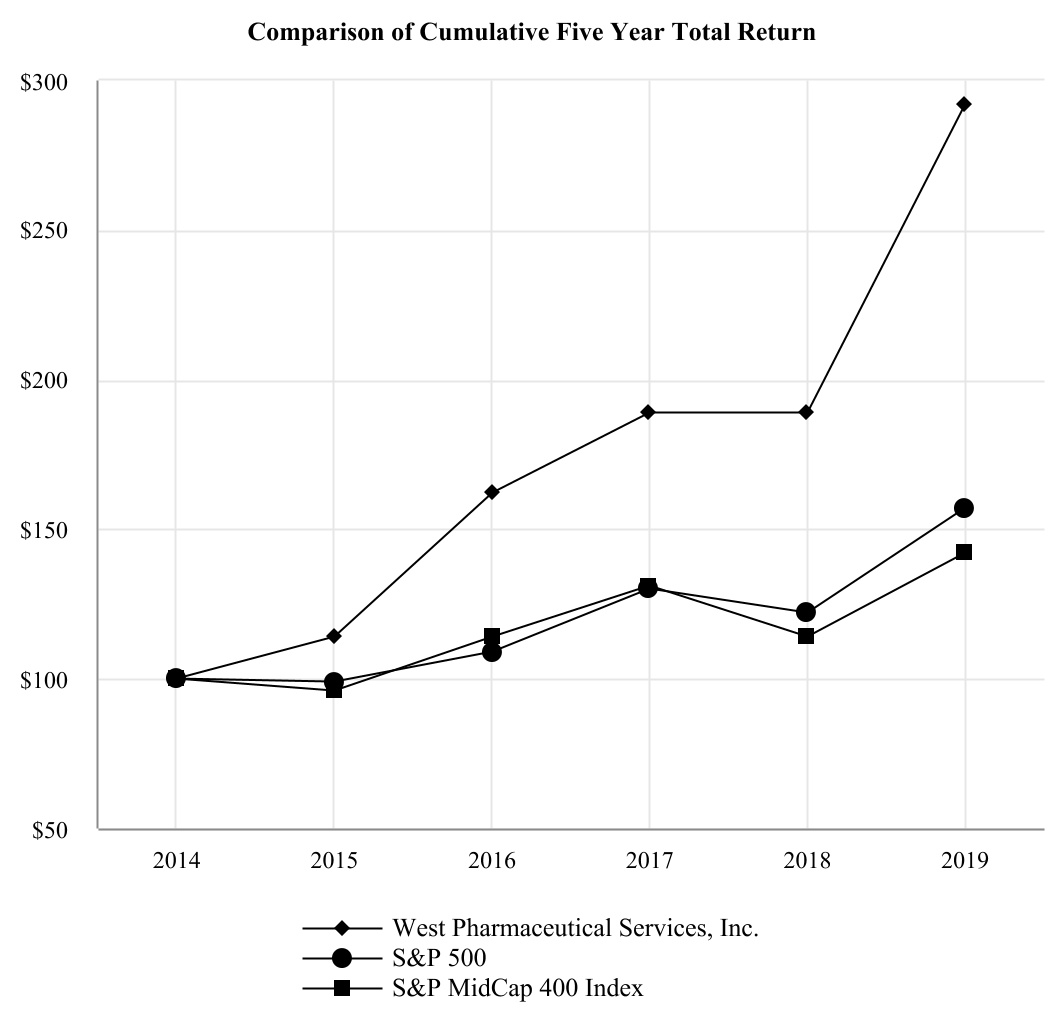
The following performance graph compares the cumulative total return to holders of our common stock with the cumulative total return of the following Standard & Poor’s (“S&P”) indices, for the five years ended December 31, 2019: 500 and MidCap 400 Index. The performance graph does not necessarily reflect management's opinion that such indices are an appropriate measure of the relative performance of the stock involved, and is not intended to forecast or be indicative of possible future performance of the Company’s common stock.
Cumulative total return to shareholders is measured by dividing total dividends (assuming dividend reinvestment) plus the per-share price change for the period by the share price at the beginning of the period. The Company’s cumulative shareholder return is based on an investment of $100 on December 31, 2014 and is compared to the cumulative total return of the S&P indices mentioned above over the period with a like amount invested.
Item 6. SELECTED FINANCIAL DATA
FIVE-YEAR SUMMARY
West Pharmaceutical Services, Inc. and Subsidiaries
| (in millions, except per share data) | 2019 | 2018 | 2017 | 2016 | 2015 | ||||||||||||
| SUMMARY OF OPERATIONS | |||||||||||||||||
| Net sales | $ | 1,839.9 | $ | 1,717.4 | $ | 1,599.1 | $ | 1,509.1 | $ | 1,399.8 | |||||||
| Operating profit † | 296.6 | 240.3 | 225.8 | 195.2 | 177.0 | ||||||||||||
| Net income | 241.7 | 206.9 | 150.7 | 143.6 | 95.6 | ||||||||||||
| Net income per share: | |||||||||||||||||
| Basic (1) | $ | 3.27 | $ | 2.80 | $ | 2.04 | $ | 1.96 | $ | 1.33 | |||||||
| Diluted (2) | 3.21 | 2.74 | 1.99 | 1.91 | 1.30 | ||||||||||||
| Weighted average common shares outstanding | 74.0 | 73.9 | 73.9 | 73.3 | 72.0 | ||||||||||||
| Weighted average shares assuming dilution | 75.4 | 75.4 | 75.8 | 75.0 | 73.8 | ||||||||||||
| Dividends declared per common share | $ | 0.62 | $ | 0.58 | $ | 0.54 | $ | 0.50 | $ | 0.46 | |||||||
| YEAR-END FINANCIAL POSITION | |||||||||||||||||
| Cash and cash equivalents | $ | 439.1 | $ | 337.4 | $ | 235.9 | $ | 203.0 | $ | 274.6 | |||||||
| Working capital | 717.1 | 610.7 | 464.0 | 400.9 | 359.4 | ||||||||||||
| Total assets | 2,341.4 | 1,978.9 | 1,862.8 | 1,716.7 | 1,695.1 | ||||||||||||
| Total invested capital: | |||||||||||||||||
| Total debt | 257.3 | 196.1 | 197.0 | 228.6 | 298.2 | ||||||||||||
| Total equity | 1,573.2 | 1,396.3 | 1,279.9 | 1,117.5 | 1,023.9 | ||||||||||||
| Total invested capital | $ | 1,830.5 | $ | 1,592.4 | $ | 1,476.9 | $ | 1,346.1 | $ | 1,322.1 | |||||||
| PERFORMANCE MEASUREMENTS (3) | |||||||||||||||||
| Gross margin (a) | 32.9 | % | 31.8 | % | 32.1 | % | 33.2 | % | 32.6 | % | |||||||
| Operating profitability (b) † | 16.1 | % | 14.0 | % | 14.1 | % | 12.9 | % | 12.6 | % | |||||||
| Effective tax rate (4) | 20.2 | % | 17.2 | % | 36.4 | % | 28.7 | % | 22.6 | % | |||||||
| Return on invested capital (c) † | 13.8 | % | 13.0 | % | 10.2 | % | 10.4 | % | 10.5 | % | |||||||
| Net debt-to-total invested capital (d) | N/A | N/A | N/A | 2.2 | % | 2.3 | % | ||||||||||
| Research and development expenses | $ | 38.9 | $ | 40.3 | $ | 39.1 | $ | 36.8 | $ | 34.1 | |||||||
| Operating cash flow | 367.2 | 288.6 | 263.3 | 219.4 | 212.4 | ||||||||||||
| Stock price range | $152.12-93.08 | $125.09-82.74 | $103.36-77.97 | $86.50-53.88 | $64.59-48.66 |
(1) Based on weighted average common shares outstanding.
(2) Based on weighted average shares, assuming dilution.
(3) Performance measurements represent indicators commonly used in the financial community. The following performance measures are not in conformity with U.S. generally accepted accounting principles (“U.S. GAAP”) and should not be used as a substitute for the comparable U.S. GAAP financial measures. The non-U.S. GAAP financial measures are included as management uses them in evaluating our results of operations and believes that this information provides users with a valuable insight into our overall performance and financial position.
(a) Net sales minus cost of goods and services sold, including applicable depreciation and amortization, divided by net sales.
(b) Operating profit divided by net sales.
(c) Operating profit multiplied by one minus the effective tax rate divided by average total invested capital.
(d) Net debt (total debt less cash and cash equivalents) divided by total invested capital less cash and cash equivalents.
(4) As a result of the Tax Cuts and Jobs Act (the “2017 Tax Act”), the federal statutory rate was reduced from 35.0% to 21.0% effective for tax years beginning after December 31, 2017. Please refer to Note 17, Income Taxes, for further discussion of the 2017 Tax Act.
† Reflects our adoption of the guidance issued by the Financial Accounting Standards Board (“FASB”) regarding the presentation of net periodic pension and postretirement benefit cost (net benefit cost).
Factors affecting the comparability of the information reflected in the selected financial data:
▪Net income in 2019 included the impact of restructuring and related charges of $3.7 million (net of $1.2 million in tax), a gain on the sale of fixed assets as a result of our restructuring plan of $1.3 million (net of $0.4 million in tax), a pension settlement charge of $2.7 million (net of $0.8 million in tax), a charge of $1.0 million related to the continued devaluation of Argentina’s currency, a tax recovery of $2.9 million (net of $1.5 million in tax) related to previously-paid international excise taxes, a net tax benefit of $0.3 million related to the impact of federal law changes enacted during the year, and a tax benefit of $10.3 million associated with stock-based compensation.
▪Net income in 2018 included the impact of restructuring and related charges of $7.2 million (net of $1.9 million in tax), a gain on the sale of fixed assets as a result of our restructuring plans of $0.9 million (net of $0.2 million in tax), a charge of $1.1 million related to the classification of Argentina’s economy as highly inflationary under U.S. GAAP as of July 1, 2018, a net tax benefit of $2.5 million for the estimated impact of the 2017 Tax Act, and a tax benefit of $14.3 million associated with stock-based compensation.
▪Net income in 2017 included the impact of a discrete tax charge of $48.8 million related to the 2017 Tax Act and the impact of changes in enacted international tax rates on previously-recorded deferred tax asset and liability balances, as well as a tax benefit of $33.1 million associated with stock-based compensation and a charge of $11.1 million related to the deconsolidation of our Venezuelan subsidiary.
▪Net income in 2016 included the impact of restructuring and related charges of $17.4 million (net of $9.0 million in tax), a charge related to the devaluation of the Venezuelan Bolivar of $2.7 million, a pension curtailment gain of $1.3 million (net of $0.8 million in tax), and a discrete tax charge of $1.0 million.
▪Net income in 2015 included the impact of a pension settlement charge of $32.0 million (net of $18.4 million in tax), a charge for executive retirement and related costs of $6.9 million (net of $4.0 million in tax) and a discrete tax charge of $0.8 million.
Item 7. MANAGEMENT’S DISCUSSION AND ANALYSIS OF FINANCIAL CONDITION AND RESULTS OF OPERATIONS
OVERVIEW
The following discussion is intended to further the reader’s understanding of the consolidated financial condition and results of operations of our Company. It should be read in conjunction with our consolidated financial statements and the accompanying footnotes included in Part II, Item 8 of this Form 10-K. These historical financial statements may not be indicative of our future performance. This Management’s Discussion and Analysis of Financial Condition and Results of Operations contains a number of forward-looking statements, all of which are based on our current expectations and could be affected by the uncertainties and risks discussed in Part I, Item 1A of this Form 10-K.
Non-U.S. GAAP Financial Measures
For the purpose of aiding the comparison of our year-over-year results, we may refer to net sales and other financial results excluding the effects of changes in foreign currency exchange rates. The constant-currency amounts are
calculated by translating the current year’s functional currency results at the prior-year period’s exchange rate. We may also refer to consolidated operating profit and consolidated operating profit margin excluding the effects of unallocated items. The re-measured results excluding effects from currency translation and excluding the effects of unallocated items are not in conformity with U.S. GAAP and should not be used as a substitute for the comparable U.S. GAAP financial measures. The non-U.S. GAAP financial measures are included in our discussion and analysis as management uses them in evaluating our results of operations and believes that this information provides users with a valuable insight into our overall performance and financial position.
Our Operations
We are a leading global manufacturer in the design and production of technologically advanced, high-quality, integrated containment and delivery systems for injectable drugs and healthcare products. Our products include a variety of primary packaging, containment solutions, reconstitution and transfer systems, and drug delivery systems, as well as contract manufacturing, analytical lab services and integrated solutions. Our customers include the leading biologic, generic, pharmaceutical, diagnostic, and additional medical device companies in the world. Our top priority is delivering quality products that meet the exact product specifications and quality standards customers require and expect. This focus on quality includes a commitment to excellence in manufacturing, scientific and technical expertise and management, and enables us to partner with our customers in order to deliver safe, effective drug products to patients quickly and efficiently. The Company was incorporated under the laws of the Commonwealth of Pennsylvania on July 27, 1923.
Our business operations are organized into two reportable segments, Proprietary Products and Contract-Manufactured Products. Our Proprietary Products reportable segment offers proprietary packaging, containment and drug delivery products, along with analytical lab services and integrated solutions, primarily to biologic, generic and pharmaceutical drug customers. Our Contract-Manufactured Products reportable segment serves as a fully integrated business, focused on the design, manufacture, and automated assembly of complex devices, primarily for pharmaceutical, diagnostic, and medical device customers. We also maintain collaborations to share technologies and market products with affiliates in Japan and Mexico.
2019 Financial Performance Summary
Consolidated net sales increased by $122.5 million, or 7.1%, in 2019. Excluding foreign currency translation effects of $52.2 million, as well as incremental sales of $3.3 million from our recent acquisition, consolidated net sales increased by $171.4, or 10.0%.
Net income in 2019 was $241.7 million, or $3.21 per diluted share, compared to $206.9 million, or $2.74 per diluted share, in 2018. Net income in 2019 included the impact of restructuring and related charges of $3.7 million (net of $1.2 million in tax), or $0.04 per diluted share, a gain on the sale of fixed assets as a result of our restructuring plan of $1.3 million (net of $0.4 million in tax), or $0.02 per diluted share, a pension settlement charge of $2.7 million (net of $0.8 million in tax), or $0.04 per diluted share, a charge of $1.0 million related to the continued devaluation of Argentina’s currency, or $0.01 per diluted share, a tax recovery related to previously-paid international excise taxes of $2.9 million (net of $1.5 million in tax), or $0.04 per diluted share, a net tax benefit of $0.3 million related to the impact of federal law changes enacted during the year, and a tax benefit of $10.3 million, or $0.14 per diluted share, associated with stock-based compensation. Net income in 2018 included the impact of restructuring and related charges of $7.2 million (net of $1.9 million in tax), or $0.09 per diluted share, a gain on the sale of fixed assets as a result of our restructuring plans of $0.9 million (net of $0.2 million in tax), or $0.01 per diluted share, a charge of $1.1 million, or $0.02 per diluted share, related to the classification of Argentina’s economy as highly inflationary under U.S. GAAP as of July 1, 2018, a net tax benefit of $2.5 million, or $0.03 per diluted share, for the estimated impact of the 2017 Tax Act, and a tax benefit of $14.3 million, or $0.19 per diluted share, associated with stock-based compensation.
At December 31, 2019, our cash and cash equivalents balance totaled $439.1 and our available borrowing capacity under our $300.0 million multi-currency revolving credit facility (the “Credit Facility”) was $297.5 million.
RESULTS OF OPERATIONS
We evaluate the performance of our segments based upon, among other things, segment net sales and operating profit. Segment operating profit excludes general corporate costs, which include executive and director compensation, stock-based compensation, adjustments to annual incentive plan expense for over- or under-attainment of targets, certain pension and other retirement benefit costs, and other corporate facilities and administrative expenses not allocated to the segments. Also excluded are items that we consider not representative of ongoing operations. Such items are referred to as other unallocated items and generally include restructuring and related charges, certain asset impairments and other specifically-identified income or expense items.
Percentages in the following tables and throughout this Results of Operations section may reflect rounding adjustments.
Net Sales
The following table presents net sales, consolidated and by reportable segment:
| Year Ended December 31, | % Change | ||||||||||||||||||||||||||||||||||||||||||||||
| ($ in millions) | 2019 | 2018 | 2017 | 2019/2018 | 2018/2017 | ||||||||||||||||||||||||||||||||||||||||||
| Proprietary Products | $ | 1,398.6 | $ | 1,308.6 | $ | 1,236.9 | 6.9 | % | 5.8 | % | |||||||||||||||||||||||||||||||||||||
| Contract-Manufactured Products | 441.5 | 409.1 | 362.5 | 7.9 | % | 12.9 | % | ||||||||||||||||||||||||||||||||||||||||
| Intersegment sales elimination | (0.2) |
Showing the first 8K of 63K characters. Open the full section
Item 7A. QUANTITATIVE AND QUALITATIVE DISCLOSURES ABOUT MARKET RISK
Our ongoing business operations expose us to various risks, such as fluctuating interest rates, foreign currency exchange rates and increasing commodity prices. These risk factors can impact our results of operations, cash flows and financial position. To manage these market risks, we periodically enter into derivative financial instruments, such as interest rate swaps, options and foreign exchange contracts for periods consistent with, and for notional amounts equal to or less than, the related underlying exposures. We do not purchase or hold any derivative financial
instruments for investment or trading purposes. All derivatives are recorded in our consolidated balance sheet at fair value.
Foreign Currency Exchange Risk
Sales outside of the U.S. accounted for 55.7% of our consolidated net sales in 2019. Virtually all of these sales and related operating costs are denominated in the currency of the local country and translated into USD for consolidated reporting purposes. Although the majority of the assets and liabilities of these subsidiaries are denominated in the functional currency of the subsidiary, they may also hold assets or liabilities denominated in other currencies. These items may give rise to foreign currency transaction gains and losses. As a result, our results of operations and financial position are exposed to changing currency exchange rates. We periodically use forward exchange contracts to hedge certain transactions or to manage month-end balance sheet exposures on cross-currency intercompany loans.
We have entered into forward exchange contracts, designated as fair value hedges, to manage our exposure to fluctuating foreign exchange rates on cross-currency intercompany loans. As of December 31, 2019, the total amount of these forward exchange contracts was SGD 601.5 million and $13.4 million. As of December 31, 2018, the total amount of these forward exchange contracts was €10.0 million, SGD 601.5 million and $13.4 million.
In addition, we have entered into several foreign currency contracts, designated as cash flow hedges, for periods of up to eighteen months, intended to hedge the currency risk associated with a portion of our forecasted transactions denominated in foreign currencies. As of December 31, 2019, we had outstanding foreign currency contracts to purchase and sell certain pairs of currencies, as follows:
| (in millions) | Sell | ||||||||||||||||
| Currency | Purchase | USD | Euro | ||||||||||||||
| USD | 38.4 | — | 33.6 | ||||||||||||||
| Yen | 6,550.4 | 37.8 | 20.6 | ||||||||||||||
| SGD | 29.4 | 16.5 | 4.6 |
In November and December 2019, in conjunction with the repayment of the outstanding long-term borrowings under our Credit Facility denominated in Euro and Yen, we de-designated these borrowings as hedges of our net investments in certain European subsidiaries and Daikyo. The amounts recorded as a cumulative translation adjustment in accumulated other comprehensive loss related to these borrowings (prior to de-designation) will remain in accumulated other comprehensive loss indefinitely, unless certain future events occur, such as the disposition of the operations for which the net investment hedges relate.
In December 2019, in conjunction with the repayment of the outstanding long-term borrowings under our Credit Facility denominated in Yen, we entered into a forward exchange contract, designated as a cash flow hedge, to manage our exposure to fluctuating foreign exchange rates. This forward exchange contract matured on December 30, 2019.
In December 2019, we entered into a five-year floating-to-floating forward-starting cross-currency swap (the “cross-currency swap”) for $90 million, which we designated as a hedge of our net investment in Daikyo. The notional amount of the cross-currency swap is ¥9.8 billion ($90 million) and the swap termination date is December 31, 2024. Under the cross-currency swap, we receive floating interest rate payments based on three-month USD LIBOR plus a margin, in return for paying floating interest rate payments based on three-month Yen LIBOR plus a margin.
Interest Rate Risk
As a result of our normal borrowing activities, we have long-term debt with both fixed and variable interest rates. Long-term debt consists of our Term Loan and Series A, B and C notes.
The following table summarizes our interest rate risk-sensitive instruments (excluding unamortized debt issuance costs):
| ($ in millions) | 2020 | 2021 | 2022 | 2023 | 2024 | Thereafter | Carrying Value | Fair Value | ||||||||||||||||||
| Current Debt: | ||||||||||||||||||||||||||
| U.S. dollar denominated | $ | 2.3 | $ | 2.3 | $ | 2.3 | ||||||||||||||||||||
| Average interest rate - variable | 2.8 | % | ||||||||||||||||||||||||
| Long-Term Debt: | ||||||||||||||||||||||||||
| U.S. dollar denominated | 42.0 | 53.0 | 73.0 | 168.0 | 176.3 | |||||||||||||||||||||
| Average interest rate - fixed | 3.7 | % | 3.8 | % | 4.0 | % | ||||||||||||||||||||
| U.S. dollar denominated | 2.3 | 2.3 | 2.3 | 80.8 | 87.7 | 87.7 | ||||||||||||||||||||
| Average interest rate - variable | 2.8 | % | 2.8 | % | 2.8 | % | 2.8 | % | ||||||||||||||||||
Commodity Price Risk
Many of our proprietary products are made from synthetic elastomers, which are derived from the petroleum refining process. We purchase the majority of our elastomers via long-term supply contracts, some of which contain clauses that provide for surcharges related to fluctuations in crude oil prices. In recent years, raw material costs have fluctuated due to crude oil price fluctuations. We expect this volatility to continue. We will continue to pursue pricing and hedging strategies, and ongoing cost control initiatives, to offset the effects on gross profit.
From November 2017 through October 2019, we purchased several series of call options for a total of 352,682 barrels of crude oil to mitigate our exposure to such oil-based surcharges and protect operating cash flows with regards to a portion of our forecasted elastomer purchases.
During 2019, the loss recorded in cost of goods and services sold related to these options was $0.4 million. During 2018, the gain recorded in cost of goods and services sold related to these options was $0.1 million.
As of December 31, 2019, we had outstanding contracts to purchase 135,967 barrels of crude oil from January 2020 to June 2021, at a weighted-average strike price of $70.71 per barrel.
Item 8. FINANCIAL STATEMENTS AND SUPPLEMENTARY DATA
CONSOLIDATED STATEMENTS OF INCOME
West Pharmaceutical Services, Inc. and Subsidiaries for the years ended December 31, 2019, 2018 and 2017
(in millions, except per share data)
| 2019 | 2018 | 2017 | ||||||||||||||||||
| Net sales | $ | 1,839.9 | $ | 1,717.4 | $ | 1,599.1 | ||||||||||||||
| Cost of goods and services sold | 1,234.2 | 1,172.0 | 1,086.2 | |||||||||||||||||
| Gross profit | 605.7 | 545.4 | 512.9 | |||||||||||||||||
| Research and development | 38.9 | 40.3 | 39.1 | |||||||||||||||||
| Selling, general and administrative expenses | 272.7 | 262.9 | 246.0 | |||||||||||||||||
| Other (income) expense (Note 16) | (2.5) | 1.9 | 2.0 | |||||||||||||||||
| Operating profit | 296.6 | 240.3 | 225.8 | |||||||||||||||||
| Interest expense | 8.5 | 8.4 | 7.8 | |||||||||||||||||
| Interest income | (3.8) | (2.1) | (1.3) | |||||||||||||||||
| Other nonoperating expense (income) | 0.1 | (6.7) | (3.1) | |||||||||||||||||
| Income before income taxes | 291.8 | 240.7 | 222.4 | |||||||||||||||||
| Income tax expense | 59.0 | 41.4 | 80.9 | |||||||||||||||||
| Equity in net income of affiliated companies | (8.9) | (7.6) | (9.2) | |||||||||||||||||
| Net income | $ | 241.7 | $ | 206.9 | $ | 150.7 | ||||||||||||||
| Net income per share: | ||||||||||||||||||||
| Basic | $ | 3.27 | $ | 2.80 | $ | 2.04 | ||||||||||||||
| Diluted | $ | 3.21 | $ | 2.74 | $ | 1.99 | ||||||||||||||
| Weighted average shares outstanding: | ||||||||||||||||||||
| Basic | 74.0 | 73.9 | 73.9 | |||||||||||||||||
| Diluted | 75.4 | 75.4 | 75.8 | |||||||||||||||||
The accompanying notes are an integral part of the consolidated financial statements.
CONSOLIDATED STATEMENTS OF COMPREHENSIVE INCOME
West Pharmaceutical Services, Inc. and Subsidiaries for the years ended December 31, 2019, 2018 and 2017
(in millions)
| 2019 | 2018 | 2017 | |||||||||||||||
| Net income | $ | 241.7 | $ | 206.9 | $ | 150.7 | |||||||||||
| Other comprehensive income (loss), net of tax: | |||||||||||||||||
| Foreign currency translation adjustments | 4.9 | (39.2) | 68.8 | ||||||||||||||
| Defined benefit pension and other postretirement plans: | |||||||||||||||||
| Prior service cost arising during period, net of tax of $0 | — | (0.3) | — | ||||||||||||||
| Net actuarial (loss) gain arising during period, net of tax of $(0.3), $(0.2) and $1.3 | (1.9) | (0.7) | 6.3 | ||||||||||||||
| Settlement effects arising during period, net of tax of $0.8 | 2.7 | — | — | ||||||||||||||
| Less: amortization of actuarial (gain) loss, net of tax of $0, $0.3 and $0.5 | (0.2) | 1.1 | 3.6 | ||||||||||||||
| Less: amortization of prior service credit, net of tax of $(0.1), $(0.5) and $(0.5) | (0.5) | (1.5) | (3.5) | ||||||||||||||
| Net loss on investment securities, net of tax of $0, $(0.1) and $(2.5) | — | (0.1) | (4.7) | ||||||||||||||
| Net (loss) gain on derivatives, net of tax of $(0.2), $1.5 and $(0.1) | (0.4) | 3.8 | (1.0) | ||||||||||||||
| Other comprehensive income (loss), net of tax | 4.6 | (36.9) | 69.5 | ||||||||||||||
| Comprehensive income | $ | 246.3 | $ | 170.0 | $ | 220.2 |
The accompanying notes are an integral part of the consolidated financial statements.
CONSOLIDATED BALANCE SHEETS
West Pharmaceutical Services, Inc. and Subsidiaries at December 31, 2019 and 2018
(in millions, except per share data)
| 2019 | 2018 | ||||||||||
| ASSETS | |||||||||||
| Current assets: | |||||||||||
| Cash and cash equivalents | $ | 439.1 | $ | 337.4 | |||||||
| Accounts receivable, net | 319.3 | 288.2 | |||||||||
| Inventories | 235.7 | 214.5 | |||||||||
| Other current assets | 64.6 | 54.3 | |||||||||
| Total current assets | 1,058.7 | 894.4 | |||||||||
| Property, plant and equipment | 1,820.1 | 1,752.7 | |||||||||
| Less: accumulated depreciation and amortization | 980.8 | 930.7 | |||||||||
| Property, plant and equipment, net | 839.3 | 822.0 | |||||||||
| Operating lease right-of-use assets | 70.1 | — | |||||||||
| Investments in affiliated companies | 192.7 | 91.2 | |||||||||
| Goodwill | 107.8 | 105.8 | |||||||||
| Deferred income taxes | 14.0 | 24.7 | |||||||||
| Intangible assets, net | 29.8 | 20.3 | |||||||||
| Pension and other postretirement benefits | 4.3 | — | |||||||||
| Other noncurrent assets | 24.7 | 20.5 | |||||||||
| Total Assets | $ | 2,341.4 | $ | 1,978.9 | |||||||
| LIABILITIES AND EQUITY | |||||||||||
| Current liabilities: | |||||||||||
| Notes payable and other current debt | $ | 2.3 | $ | 0.1 | |||||||
| Accounts payable | 156.8 | 130.4 | |||||||||
| Pension and other postretirement benefits | 2.2 | 2.3 | |||||||||
| Accrued salaries, wages and benefits | 73.0 | 64.5 | |||||||||
| Income taxes payable | 6.4 | 9.8 | |||||||||
| Operating lease liabilities | 9.6 | — | |||||||||
| Other current liabilities | 91.3 | 76.6 | |||||||||
| Total current liabilities | 341.6 | 283.7 | |||||||||
| Long-term debt | 255.0 | 196.0 | |||||||||
| Deferred income taxes | 15.5 | 13.1 | |||||||||
| Pension and other postretirement benefits | 52.5 | 56.2 | |||||||||
| Operating lease liabilities | 62.4 | — | |||||||||
| Other long-term liabilities | 41.2 | 33.6 | |||||||||
| Total Liabilities | 768.2 | 582.6 | |||||||||
| Commitments and contingencies (Note 18) | |||||||||||
| Equity: | |||||||||||
| Preferred stock, 3.0 million shares authorized; 0 shares issued and outstanding in 2019 and 2018 | — | — | |||||||||
| Com |
Showing the first 8K of 199K characters. Open the full section
Item 9. CHANGES IN AND DISAGREEMENTS WITH ACCOUNTANTS ON ACCOUNTING AND FINANCIAL DISCLOSURE
None.
Item 9A. . CONTROLS AND PROCEDURES
Disclosure controls are controls and procedures designed to reasonably ensure that information required to be disclosed in our reports filed under the Exchange Act, such as this annual report, is recorded, processed, summarized, and reported within the time periods specified in the SEC’s rules and forms. Disclosure controls include, without limitation, controls and procedures designed to ensure that information required to be disclosed in our reports filed under the Securities Exchange Act of 1934, as amended, is accumulated and communicated to our management, including our CEO and Chief Financial Officer (“CFO”), or persons performing similar functions, as appropriate, to allow timely decisions regarding required disclosure. Our disclosure controls include some, but not all, components of our internal control over financial reporting.
Evaluation of Disclosure Controls and Procedures
An evaluation was performed under the supervision and with the participation of our management, including our CEO and CFO, of the effectiveness of our disclosure controls and procedures (as defined in Rule 13a-15(e) under the Securities Exchange Act of 1934), as of the end of the period covered by this Form 10-K. Based on this evaluation, our CEO and CFO have concluded that, as of December 31, 2019, our disclosure controls and procedures are effective.
Management’s Report on Internal Control over Financial Reporting
Our management is responsible for establishing and maintaining adequate internal control over financial reporting, as defined in Rule 13a-15(f) under the Securities Exchange Act of 1934. Our internal control over financial reporting is a process designed under the supervision of our CEO and CFO to provide reasonable assurance regarding the reliability of financial reporting and the preparation of our financial statements for external reporting purposes in accordance with U.S. generally accepted accounting principles.
Management assessed the effectiveness of our internal control over financial reporting as of December 31, 2019 based on the framework established in “Internal Control-Integrated Framework (2013)” issued by the Committee of Sponsoring Organizations of the Treadway Commission (COSO). Based on this assessment, management has determined that our internal control over financial reporting was effective as of December 31, 2019.
Because of its inherent limitations, internal control over financial reporting may not prevent or detect misstatements. No evaluation of controls can provide absolute assurance that all control issues and instances of fraud, if any, within West have been detected. These inherent limitations include the realities that judgments in decision-making can be faulty, and that breakdowns can occur because of simple error or mistake. Controls can also be circumvented by the individual acts of some persons, by collusion of two or more people, or by management override of the controls. The design of any system of controls is based in part upon certain assumptions about the likelihood of future events, and there can be no assurance that any design will succeed in achieving its stated goals under all potential future conditions. Also projections of any evaluation of effectiveness to future periods are subject to the risks that controls
may become inadequate because of changes in conditions, or that the degree of compliance with the policies or procedures may deteriorate.
The effectiveness of our internal control over financial reporting as of December 31, 2019 has been audited by PricewaterhouseCoopers LLP, an independent registered public accounting firm, as stated in their report, which is included herein.
Changes in Internal Controls
During the fourth quarter ended December 31, 2019, there have been no changes to our internal control over financial reporting that have materially affected, or are reasonably likely to materially affect, our internal control over financial reporting.
On January 1, 2019, we adopted ASC 842. Although our adoption of ASC 842 resulted in no change to our internal control over financial reporting that materially affected, or is reasonably likely to materially affect, our internal control over financial reporting, we did implement changes to our internal controls relating to leases. These changes included the development of new policies, enhanced contract review requirements, and other ongoing monitoring activities. These controls were designed to provide assurance at a reasonable level of the fair presentation of our consolidated financial statements and related disclosures.
Item 9B. OTHER INFORMATION
None.
PART III
Item 10. DIRECTORS, EXECUTIVE OFFICERS AND CORPORATE GOVERNANCE
Information is incorporated by reference from the discussion under the heading Proposal 1 - Election of Directors; Corporate Governance Documents and Policies - Ethics and Our Code of Business Conduct; Voting and Other Information - 2021 Shareholder Proposals or Nominations; and Board and Director Information and Policies - Committees - Audit Committee in our 2020 Proxy Statement. The balance of the information required by this item is contained in the discussion entitled Information About Our Executive Officers in Part I of this Form 10-K.
Item 11. EXECUTIVE COMPENSATION
Information about director and executive compensation is incorporated by reference from the discussion under the headings Director Compensation, Compensation Committee Report, Compensation Discussion and Analysis, and Compensation Tables in our 2020 Proxy Statement.
Item 12. SECURITY OWNERSHIP OF CERTAIN BENEFICIAL OWNERS AND MANAGEMENT AND RELATED STOCKHOLDER MATTERS
Information required by this Item is incorporated by reference from the discussion under the heading Stock Ownership in our 2020 Proxy Statement.
Equity Compensation Plan Information Table
The following table sets forth information about the grants of stock options, restricted stock or other rights under all of the Company’s equity compensation plans as of the close of business on December 31, 2019. The table does not include information about tax-qualified plans such as the West 401(k) Plan or the West Contract Manufacturing Savings and Retirement Plan.
| Plan Category | Number of Securities to be Issued Upon Exercise of Outstanding Options, Warrants and Rights (a) | Weighted-Average Exercise Price of Outstanding Options, Warrants and Rights (b) | Number of Securities Remaining Available for Future Issuance Under Equity Compensation Plans (Excluding Securities Reflected in Columns (a)) (c) | |||||||||||||||||
| Equity compensation plans approved by security holders | 3,281,507 | (1) | $ | 67.05 | (2) | 7,226,236 | (3) | |||||||||||||
| Equity compensation plans not approved by security holders | — | — | — | |||||||||||||||||
| Total | 3,281,507 | $ | 67.05 | 7,226,236 |
(1) Includes 1,207,157 outstanding stock options, 264,691 restricted performance share units, 25,892 restricted retention share units, 64,544 deferred stock-equivalents units, and 494 restricted stock-equivalents units granted to directors under the 2016 Plan. Includes 1,462,578 outstanding stock options, 12,160 outstanding stock-settled stock appreciation rights, 13,459 restricted retention share units, and 108,074 deferred stock-equivalents units under the 2011 Plan (which was terminated in 2016). Includes 68,400 outstanding stock options and 54,058 deferred stock-equivalents units granted to directors under the Non-Qualified Deferred Compensation Plan for Non-Employee Directors under the 2007 Omnibus Incentive Compensation Plan (which was terminated in 2011). The average term of remaining options and stock-settled stock appreciation rights granted is 5.9 years. No future grants or awards may be made under the terminated plans. The total includes restricted performance share units at 100% of grant. The restricted performance share unit payouts were at 49.39%, 96.6%, and 89.8% in 2019, 2018 and 2017, respectively. The total does not include stock-equivalent units granted or credited to directors under the Non-Qualified Deferred Compensation Plan for Non-Employee Directors to be settled only in cash.
(2) Restricted performance share and deferred stock-equivalent units are excluded when determining the weighted-average exercise price of outstanding options.
(3) Represents 3,829,712 shares reserved under the Company’s Employee Stock Purchase Plan and 3,119,314 shares remaining available for issuance under the 2016 Plan. The estimated number of shares that could be issued for 2019 from the Employee Stock Purchase Plan is 277,210. This number of shares is calculated by multiplying the 190 shares per offering period per participant limit by 1,459, the number of current participants in the plan.
Item 13. CERTAIN RELATIONSHIPS AND RELATED TRANSACTIONS, AND DIRECTOR INDEPENDENCE
Information called for by this Item is incorporated by reference from the discussion under the heading Corporate Governance Documents and Policies - Related Person Transactions and Procedures in our 2020 Proxy Statement. Information about director independence is incorporated by reference from the discussion under the heading Corporate Governance Documents and Policies - Director Independence in our 2020 Proxy Statement.
Item 14. PRINCIPAL ACCOUNTING FEES AND SERVICES
Information is incorporated by reference from the discussion under the heading Independent Auditors and Fees - Fees Paid to PricewaterhouseCoopers LLP and Independent Auditors and Fees - Audit Committee Policy on Pre-Approval of Audit and Permissible Non-Audit Services in our 2020 Proxy Statement.
PART IV
Item 15. EXHIBITS, FINANCIAL STATEMENT SCHEDULES
(a) 1. Financial Statements
The following documents are included in Part II, Item 8:
Consolidated Statements of Income for the years ended December 31, 2019, 2018 and 2017
Consolidated Statements of Comprehensive Income for the years ended December 31, 2019, 2018 and 2017
Consolidated Balance Sheets at December 31, 2019 and 2018
Consolidated Statement of Equity for the years ended December 31, 2019, 2018 and 2017
Consolidated Statements of Cash Flows for the years ended December 31, 2019, 2018 and 2017
Notes to Consolidated Financial Statements
Report of Independent Registered Public Accounting Firm
(a) 2. Financial Statement Schedules
Schedule II - Valuation and Qualifying Accounts
| ($ in millions) | Balance at beginning of period | Charged to costs and expenses | Deductions (1) | Balance at end of period | ||||||||||
| For the year ended December 31, 2019 | ||||||||||||||
| Allowances deducted from assets: | ||||||||||||||
| Deferred tax asset valuation allowance | $ | 16.0 | $ | — | $ | (0.1) | $ | 15.9 | ||||||
| Allowance for doubtful accounts | 2.0 | 0.1 | (1.6) | 0.5 | ||||||||||
| Total allowances deducted from assets | $ | 18.0 | $ | 0.1 | $ | (1.7) | $ | 16.4 | ||||||
| For the year ended December 31, 2018 | ||||||||||||||
| Allowances deducted from assets: | ||||||||||||||
| Deferred tax asset valuation allowance | $ | 20.9 | $ | (3.0) | $ | (1.9) | $ | 16.0 | ||||||
| Allowance for doubtful accounts | 0.5 | 0.7 | 0.8 | 2.0 | ||||||||||
| Total allowances deducted from assets | $ | 21.4 | $ | (2.3) | $ | (1.1) | $ | 18.0 | ||||||
| For the year ended December 31, 2017 | ||||||||||||||
| Allowances deducted from assets: | ||||||||||||||
| Deferred tax asset valuation allowance | $ | 18.7 | $ | 2.5 | $ | (0.3) | $ | 20.9 | ||||||
| Allowance for doubtful accounts | 0.4 | (0.2) | 0.3 | 0.5 | ||||||||||
| Total allowances deducted from assets | $ | 19.1 | $ | 2.3 | $ | — | $ | 21.4 | ||||||
(1)Includes accounts receivable written off, the write-off or write-down of valuation allowances, and translation adjustments.
All other schedules are omitted because they are either not applicable, not required or because the information required is contained in the consolidated financial statements or notes thereto.
(a) 3. Exhibits - An index of the exhibits included in this Form 10-K is contained on pages F-1 through F-3 and is incorporated herein by reference.
(b) See subsection (a) 3. above.
(c) Financial Statements of affiliates are omitted because they do not meet the tests of a significant subsidiary at the 20% level.
Item 16. FORM 10-K SUMMARY
None.
SIGNATURES
Pursuant to the requirements of Section 13 or 15(d) of the Securities Exchange Act of 1934, West Pharmaceutical Services, Inc. has duly caused this report to be signed on its behalf by the undersigned, thereunto duly authorized.
WEST PHARMACEUTICAL SERVICES, INC.
(Registrant)
By: /s/ Bernard J. Birkett
Bernard J. Birkett
Senior Vice President and Chief Financial Officer
February 21, 2020
Pursuant to the requirements of the Securities Exchange Act of 1934, this report has been signed below by the following persons on behalf of West Pharmaceutical Services, Inc. in the capacities and on the dates indicated.
| Signature | Title | Date | ||||||
| /s/ Eric M. Green | Director, President and Chief Executive Officer | February 21, 2020 | ||||||
| Eric M. Green | (Principal Executive Officer) | |||||||
| /s/ Bernard J. Birkett | Senior Vice President and Chief Financial Officer | February 21, 2020 | ||||||
| Bernard J. Birkett | (Principal Financial Officer and Principal Accounting Officer) | |||||||
| /s/ Mark A. Buthman | Director | February 18, 2020 | ||||||
| Mark A. Buthman | ||||||||
| /s/ William F. Feehery, Ph.D. | Director | February 18, 2020 | ||||||
| William F. Feehery, Ph.D. | ||||||||
| /s/ Robert F. Friel | Director | February 18, 2020 | ||||||
| Robert F. Friel | ||||||||
| /s/ Thomas W. Hofmann | Director | February 18, 2020 | ||||||
| Thomas W. Hofmann | ||||||||
| /s/ Paula A. Johnson, M.D., MPH | Director | February 18, 2020 | ||||||
| Paula A. Johnson, M.D., MPH | ||||||||
| /s/ Deborah L.V. Keller | Director | February 18, 2020 | ||||||
| Deborah L.V. Keller | ||||||||
| /s/ Myla P. Lai-Goldman, M.D. | Director | February 18, 2020 | ||||||
| Myla P. Lai-Goldman, M.D. | ||||||||
| /s/ Douglas A. Michels | Director | February 18, 2020 | ||||||
| Douglas A. Michels | ||||||||
| /s/ Paolo Pucci | Director | February 18, 2020 | ||||||
| Paolo Pucci | ||||||||
| /s/ Patrick J. Zenner | Director and Chairman of the Board | February 18, 2020 | ||||||
| Patrick J. Zenner |
EXHIBIT INDEX
F-1
F-2
| Exhibit Number | Description | ||||
| 32.1* | Certification by the Chief Executive Officer Pursuant to 18 U.S.C. Section 1350, as Adopted Pursuant to Section 906 of the Sarbanes-Oxley Act of 2002. | ||||
| 32.2* | Certification by the Chief Financial Officer Pursuant to 18 U.S.C. Section 1350, as Adopted Pursuant to Section 906 of the Sarbanes-Oxley Act of 2002. | ||||
| 101.INS | The instance document does not appear in the interactive data file because its XBRL tags are embedded within the inline XBRL document. | ||||
| 101.SCH | Inline XBRL Taxonomy Extension Schema Document | ||||
| 101.CAL | Inline XBRL Taxonomy Extension Calculation Linkbase Document | ||||
| 101.LAB | Inline XBRL Taxonomy Extension Label Linkbase Document | ||||
| 101.PRE | Inline XBRL Taxonomy Extension Presentation Linkbase Document | ||||
| 101.DEF | Inline XBRL Taxonomy Extension Definition Linkbase Document | ||||
| 104** | Inline XBRL for the cover page of this Annual Report on Form 10-K, included in the Exhibit 101 Inline XBRL Document Set. |
(1) We agree to furnish to the SEC, upon request, a copy of each instrument with respect to issuances of long-term debt of the Company and its subsidiaries.
(2) Management compensatory plan.
(3) Certain portions of this exhibit have been omitted and filed separately with the SEC pursuant to a confidential treatment order of the SEC.
(4) Portions of this exhibit (indicated therein by asterisks) have been omitted for confidential treatment.
- Furnished, not filed.
F-3