 filings.tools
Willis Towers Watson 10-K 2022-12-31
Filed 2023-02-24. 23 sections, 634K characters. Original on sec.gov · Markdown · JSON
Cover and table of contents
UNITED STATES
SECURITIES AND EXCHANGE COMMISSION
Washington, D.C. 20549
FORM 10-K
(Mark one)
☒ ANNUAL REPORT PURSUANT TO SECTION 13 OR 15(d) OF THE SECURITIES EXCHANGE ACT OF 1934
For the fiscal year ended December 31, 2022
or
☐ TRANSITION REPORT PURSUANT TO SECTION 13 OR 15(d) OF THE SECURITIES EXCHANGE ACT OF 1934
Commission File Number: 001-16503

WILLIS TOWERS WATSON PUBLIC LIMITED COMPANY
(Exact name of registrant as specified in its charter)
| Ireland (Jurisdiction of incorporation or organization) | 98-0352587 (I.R.S. Employer Identification No.) | |
| c/o Willis Group Limited 51 Lime Street**,** London EC3M 7DQ**,** England (Address of principal executive offices) | (011) 44-20-3124-6000 (Registrant’s telephone number, including area code) |
Securities registered pursuant to Section 12(b) of the Act:
| Title of each class | Trading Symbol(s) | Name of each exchange on which registered | ||
| Ordinary Shares, nominal value $0.000304635 per share | WTW | NASDAQ Global Select Market |
Securities registered pursuant to Section 12(g) of the Act: None
Indicate by check mark if the registrant is a well-known seasoned issuer, as defined in Rule 405 of the Securities Act. Yes ☑ No ☐
Indicate by check mark if the registrant is not required to file reports pursuant to Section 13 or Section 15(d) of the Act. Yes ☐ No ☑
Indicate by check mark whether the Registrant (1) has filed all reports required to be filed by Section 13 or 15(d) of the Securities Exchange Act of 1934 during the preceding 12 months (or for such shorter period that the Registrant was required to file such reports), and (2) has been subject to such filing requirements for the past 90 days. Yes ☑ No ☐
Indicate by check mark whether the Registrant has submitted electronically every Interactive Data File required to be submitted pursuant to Rule 405 of Regulation S-T (§ 232.405 of this chapter) during the preceding 12 months (or for such shorter period that the Registrant was required to submit and post such files). Yes ☑ No ☐
Indicate by check mark whether the registrant is a large accelerated filer, an accelerated filer, a non-accelerated filer or a smaller reporting company. See the definitions of ‘large accelerated filer’, ‘accelerated filer’ and ‘smaller reporting company’ in Rule 12b-2 of the Exchange Act.
| Large accelerated filer ☑ | Accelerated filer ☐ | Non-accelerated filer ☐ | Smaller reporting company ☐ |
| Emerging growth company ☐ |
If an emerging growth company, indicate by check mark if the registrant has elected not to use the extended transition period for complying with any new or revised financial accounting standards provided pursuant to Section 13(a) of the Exchange Act. ☐
Indicate by check mark whether the registrant has filed a report on and attestation to its management’s assessment of the effectiveness of its internal control over financial reporting under Section 404(b) of the Sarbanes-Oxley Act (15 U.S.C. 7262(b)) by the registered public accounting firm that prepared or issued its audit report. ☑
If securities are registered pursuant to Section 12(b) of the Act, indicate by check mark whether the financial statements of the registrant included in the filing reflect the correction of an error to previously issued financial statements. ☐
Indicate by check mark whether any of those error corrections are restatements that required a recovery analysis of incentive-based compensation received by any of the registrant’s executive officers during the relevant recovery period pursuant to §240.10D-1(b). ☐
Indicate by check mark whether the registrant is a shell company (as defined in Rule 12b-2 of the Act). Yes ☐ No ☑
The aggregate market value of the voting common equity held by non-affiliates of the Registrant, computed by reference to the last reported price at which the Registrant’s common equity was sold on June 30, 2022 (the last day of the Registrant’s most recently completed second quarter) was $21,628,207,514.
As of February 16, 2023, there were outstanding 106,577,635 ordinary shares, nominal value $0.000304635 per share, of the Registrant.
DOCUMENTS INCORPORATED BY REFERENCE
Portions of Part III will be incorporated by reference in accordance with Instruction G(3) to Form 10-K no later than 120 days after the end of the Company’s fiscal year.
WILLIS TOWERS WATSON PUBLIC LIMITED COMPANY
INDEX TO FORM 10-K
For the year ended December 31, 2022
Certain De****finitions
The following definitions apply throughout this Annual Report on Form 10-K unless the context requires otherwise:
| ‘We’, ‘Us’, ‘Company’, ‘WTW’, ‘Willis Towers Watson’, ‘Our’, or ‘Willis Towers Watson plc’ | Willis Towers Watson Public Limited Company, a company organized under the laws of Ireland, and its subsidiaries | |
| ‘shares’ | The ordinary shares of Willis Towers Watson Public Limited Company, nominal value $0.000304635 per share | |
| ‘Legacy Willis’ or ‘Willis’ | Willis Group Holdings Public Limited Company and its subsidiaries, predecessor to WTW, prior to the Merger | |
| ‘Legacy Towers Watson’ or ‘Towers Watson’ | Towers Watson & Co. and its subsidiaries | |
| ‘Merger’ | Merger of Willis Group Holdings Public Limited Company and Towers Watson & Co. pursuant to the Agreement and Plan of Merger, dated June 29, 2015, as amended on November 19, 2015, and completed on January 4, 2016 | |
| ‘Miller’ | Miller Insurance Services LLP and its subsidiaries | |
| ‘TRANZACT’ | CD&R TZ Holdings, Inc. and its subsidiaries, doing business as TRANZACT | |
| ‘U.S.’ | United States | |
| ‘U.K.’ | United Kingdom | |
| ‘Brexit’ | The United Kingdom’s exit from the European Union, which occurred on January 31, 2020. | |
| ‘E.U.’ | European Union or European Union 27 (the number of member countries following the United Kingdom’s exit) | |
| ‘U.S. GAAP’ | United States Generally Accepted Accounting Principles | |
| ‘FASB’ | Financial Accounting Standards Board | |
| ‘ASC’ | Accounting Standards Codification | |
| ‘ASU’ | Accounting Standards Update | |
| ‘SEC’ | United States Securities and Exchange Commission | |
| ‘EBITDA’ | Earnings before Interest, Taxes, Depreciation and Amortization |
Disclaimer Regarding For****ward-looking Statements
We have included in this document ‘forward-looking statements’ within the meaning of Section 27A of the Securities Act of 1933, and Section 21E of the Securities Exchange Act of 1934, which are intended to be covered by the safe harbors created by those laws. These forward-looking statements include information about possible or assumed future results of our operations. All statements, other than statements of historical facts, that address activities, events or developments that we expect or anticipate may occur in the future, including such things as: our outlook; the impact of the COVID-19 pandemic on our business; future capital expenditures; ongoing working capital efforts; future share repurchases; financial results (including our revenue, costs or margins) and the impact of changes to tax laws on our financial results, existing and evolving business strategies, and acquisitions and dispositions, including transitional arrangements in effect subsequent to the completed sale of Willis Re to Arthur J. Gallagher & Co. (‘Gallagher’); demand for our services and competitive strengths; strategic goals; the benefits of new initiatives; growth of our business and operations; our ability to successfully manage ongoing leadership, organizational, and technology changes, including investments in improving systems and processes; our ability to implement and realize anticipated benefits of any cost-savings initiatives including the multi-year operational Transformation program; and plans and references to future successes, including our future financial and operating results, short-term and long-term financial goals, plans, objectives, expectations and intentions are all forward-looking statements. Also, when we use words such as ‘may’, ‘will’, ‘would’, ‘anticipate’, ‘believe’, ‘estimate’, ‘expect’, ‘intend’, ‘plan’, ‘probably’, or similar expressions, we are making forward-looking statements. Such statements are based upon the current beliefs and expectations of the Company’s management and are subject to significant risks and uncertainties. Actual results may differ from those set forth in the forward-looking statements. All forward-looking disclosure is speculative by its nature.
A number of risks and uncertainties that could cause actual results to differ materially from the results reflected in these forward-looking statements are identified under ‘Risk Factors’ in Item 1A of this Annual Report on Form 10-K. These statements are based on assumptions that may not come true and are subject to significant risks and uncertainties.
Although we believe that the assumptions underlying our forward-looking statements are reasonable, any of these assumptions, and therefore also the forward-looking statements based on these assumptions, could themselves prove to be inaccurate. Given the significant uncertainties inherent in the forward-looking statements included in this Annual Report on Form 10-K, our inclusion of this information is not a representation or guarantee by us that our objectives and plans will be achieved.
Our forward-looking statements speak only as of the date made and we will not update these forward-looking statements unless the securities laws require us to do so. With regard to these risks, uncertainties and assumptions, the forward-looking events discussed in this document may not occur, and we caution you against unduly relying on these forward-looking statements.
PART I.
Item 1. BUSINESS
The Company
WTW is a leading global advisory, broking and solutions company that provides data-driven, insight-led solutions in the areas of people, risk and capital. Utilizing the global view and local expertise of our more than 46,000 colleagues serving more than 140 countries and markets, we help organizations sharpen strategies, enhance resilience, motivate workforces and maximize performance. We design and deliver solutions that manage risk, optimize benefits, cultivate talent and expand the power of capital to protect and strengthen institutions and individuals. Working closely with our clients, we uncover opportunities for sustainable success.
Our clients operate on a global and local scale in a multitude of businesses and industries throughout the world and generally range in size from large, major multinational corporations to middle-market domestic and international companies. Our clients include many of the world’s leading corporations, including approximately 93% of the FTSE 100, 89% of the Fortune 1000, and 90% of the Fortune Global 500 companies. We also advise the majority of the world’s leading insurance companies. We work with major corporations, emerging growth companies, governmental agencies and not-for-profit institutions in a wide variety of industries, with many of our client relationships spanning decades. None of the Company’s customers individually represented more than 10% of its consolidated revenue for each of the years ended December 31, 2022, 2021 and 2020. We place insurance with more than 2,500 insurance carriers, none of which individually accounted for a significant concentration of the total premiums we placed on behalf of our clients in 2022, 2021 or 2020.
Segment Reorganization
On January 1, 2022, WTW realigned to provide its comprehensive offering of services and solutions to clients across two business segments: Health, Wealth & Career and Risk & Broking. These changes were made in conjunction with changes in the WTW leadership team, including the appointment of a new chief executive officer who succeeded the prior CEO as the chief operating decision maker on that date. Prior to January 1, 2022, we operated across four segments: Human Capital and Benefits; Corporate Risk and Broking; Investment, Risk and Reinsurance; and Benefits Delivery and Administration. Following the realignment, the two new segments consist of the following businesses:
The Health, Wealth & Career segment includes businesses previously aligned under the Human Capital and Benefits segment, the Benefits Delivery and Administration segment, and the Investments business, which was previously under the Investment, Risk and Reinsurance segment.
The Risk & Broking segment includes businesses previously aligned under the Corporate Risk and Broking segment, as well as the Insurance Consulting and Technology business, which was previously under the Investment, Risk and Reinsurance segment.
Below are the percentages of revenue generated by each segment for each of the years ended December 31, 2022, 2021 and 2020. These percentages exclude revenue that has been classified as discontinued operations in our consolidated statements of comprehensive income.
| Year ended December 31, | ||||||||||||
| 2022 | 2021 | 2020 | ||||||||||
| Health, Wealth & Career | 60 | % | 60 | % | 60 | % | ||||||
| Risk & Broking | 40 | % | 40 | % | 40 | % |
The following presents descriptions of our reorganized segments:
Health, Wealth & Career
The Health, Wealth & Career (‘HWC’) segment provides an array of advice, broking, solutions and technology for employee benefit plans, institutional investors, compensation and career programs, and the employee experience overall. Our portfolio of services support the interrelated challenges that the management teams of our clients face across human resources (‘HR’) and finance.
HWC is the larger of the two segments of the Company. Addressing four key areas, Health, Wealth, Career and Benefits Delivery & Outsourcing, the segment is focused on addressing our clients’ people and risk needs to help them succeed in a global marketplace.
Health
The Health & Benefits (‘H&B’) business provides strategy and design consulting, plan management service and support, broking and administration across the full spectrum of health, wellbeing and other group benefit programs, including medical, dental, disability, life, voluntary benefits and other coverage. Our reach extends from small/mid-market clients to large-market and multinational clients, across the full geographic footprint of the Company, and to most industries. We can address our clients’ needs in more than 140 countries.
Our consultants help clients make strategic decisions on topics such as optimizing program spend; evaluating emerging vendors, point solutions and coverage options (including publicly-subsidized health insurance exchanges and private exchanges in the U.S.); and dealing with above-inflation-rate increases in healthcare costs. We also assist clients in selecting the appropriate insurance carriers to cover benefit risks and administer the programs. In addition to our consulting and broking services, we manage a number of collective purchasing initiatives, such as pharmacy and stop-loss, that allow employers to realize greater value from third-party service providers than they can achieve on their own.
With Global Benefits Management, our suite of global services supporting medical, dental and risk (e.g., life, disability) programs, we have a tailored offering for multinationals. This offering includes a flexible set of ready-made solutions, proven technology and an integrated approach to service delivery that translates to a globally consistent, high-quality experience for our clients.
A meaningful portion of revenue in this business is from recurring work, though contracts may be annual or multi-year. Given the balance of revenue across consulting, broking and solutions, our revenue is somewhat weighted to the first quarter.
Wealth
Our wealth-related businesses include Retirement and Investments.
The Retirement business provides actuarial support, plan design, and administrative services for all forms of pension and retirement savings plans. Our colleagues help our clients assess the costs and risks of retirement plans on cash flow, earnings and the balance sheet, the effects of changing workforce demographics on their retirement plans, and retiree benefit adequacy and security. We offer clients a full range of integrated retirement consulting services and solutions to meet the needs of all types of employers, including those that continue to offer defined benefit plans and those that are reexamining their retirement benefit strategies. We help multinationals coordinate plan design and actuarial services across their complex global plans. We bring in-depth data analysis and perspective to their decision process, because we have tracked the retirement designs and financing strategies of companies around the world over many decades.
For clients that want to outsource some or all of their pension plan management, we offer broking services, as well as integrated solutions that can combine investment discretionary management, pension administration, core actuarial services, and communication and change management assistance.
Retirement relationships are generally long-term in nature, and client retention rates for this business are high. A significant portion of the revenue in this business is from recurring work, with multi-year contracts that are driven by the heavily regulated nature of pension plans and our clients’ annual needs for these services. Revenue for the Retirement business in some geographies is somewhat seasonal,
Showing the first 8K of 65K characters. Open the full section
Item 1A. RISK FACTORS
Executive Summary of Risk Factors
The following contains a summary of each of our risk factors. For the complete disclosure of each risk factor contained herein, please click on the respective summary.
Strategic and Operational Transformation Risks
We may not be able to fully realize the anticipated benefits of our growth strategy.
Business Environment Risks
Human Capital Risks
Intellectual Property, Technology, Cybersecurity and Data Protection Risks
Legal, Non-Financial/Regulatory and Compliance Risks
Financial and Related Regulatory Risks
[A downgrade to our corporate credit rating and the credit ratings of our outstanding debt may adversely affect our borrowing costs and financial flexibility and, under certain c
Showing the first 8K of 143K characters. Open the full section
Item 1B. UNRESOLVED STAFF COMMENTS
None.
Item 2. PROPERTIES
We operate offices in many countries throughout the world and believe that our properties are generally suitable and adequate for the purposes for which they are used. The principal properties are located in the United States and the United Kingdom. In addition, we have other offices in various locations, including among others, Europe, Asia, Australia and Latin America. Operations of each of our segments are carried out in owned or leased offices under operating leases that typically do not exceed 10 years in length, except for certain properties in key locations. We do not anticipate difficulty in meeting our space needs at lease expiration.
Item 3. LEGAL PROCEEDINGS
From time to time, we are party to various lawsuits, arbitrations or mediations that arise in the ordinary course of business. The disclosure called for by Item 3 regarding our legal proceedings is incorporated by reference herein from Note 15 — Commitments and Contingencies, within Item 8 in this Annual Report on Form 10-K.
Item 4. MINE SAFETY DISCLOSURES
Not applicable.
PART II.
Item 5. MARKET FOR REGISTRANT’S COMMON EQUITY, RELATED STOCKHOLDER MATTERS AND ISSUER PURCHASES OF EQUITY SECURITIES
Share Data
Our ordinary shares trade on the NASDAQ Global Select Market under the symbol ‘WTW’ as of January 10, 2022. Our ordinary shares previously traded under the symbol ‘WLTW’ starting on January 5, 2016. As of February 16, 2023, there were 1,079 shareholders of record of our shares.
Dividends
We normally pay dividends on a quarterly basis to shareholders of record on March 31, June 30, September 30 and December 31. In February 2023, the board of directors approved a quarterly cash dividend of $0.84 per share ($3.36 per share annualized rate), which will be paid on or around April 17, 2023 to shareholders of record as of March 31, 2023.
There are no governmental laws, decrees or regulations in Ireland that restrict the remittance of dividends or other payments to non-resident holders of the Company’s shares.
In circumstances where one of Ireland’s many exemptions from dividend withholding tax (‘DWT’) does not apply, dividends paid by the Company will be subject to Irish DWT (currently 20 percent). Residents of the United States should be exempt from Irish DWT provided relevant documentation supporting the exemption has been put in place. While the U.S.-Ireland Double Tax Treaty contains provisions reducing the rate of Irish DWT in prescribed circumstances, it should generally be unnecessary for U.S. residents to rely on the provisions of this treaty due to the wide scope of exemptions from Irish DWT available under Irish domestic law. Irish income tax may also arise in respect of dividends paid by the Company. However, U.S. residents entitled to an exemption from Irish DWT generally have no Irish income tax liability on dividends.
With respect to non-corporate U.S. shareholders, certain dividends from a qualified foreign corporation may be subject to reduced rates of taxation. A foreign corporation is treated as a qualified foreign corporation with respect to dividends received from that corporation on shares that are readily tradeable on an established securities market in the United States, such as our shares. Non-corporate U.S. shareholders that do not meet a minimum holding period requirement for our shares during which they are not protected from the risk of loss or that elect to treat the dividend income as investment income pursuant to section 163(d)(4) of the Code will not be eligible for the reduced rates of taxation regardless of our status as a qualified foreign corporation. In addition, the rate reduction will not apply to dividends if the recipient of a dividend is obligated to make related payments with respect to positions in substantially similar or related property. This disallowance applies even if the minimum holding period has been met. U.S. shareholders should consult their own tax advisors regarding the application of these rules given their particular circumstances.
Performance Graph
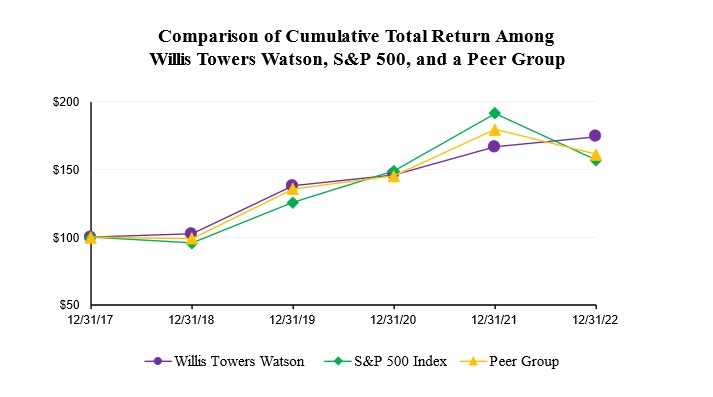
Comparison of Five-Year Cumulative Total Shareholder Return
The graph below depicts cumulative total shareholder returns for WTW for the period from December 31, 2017 through December 31, 2022.
The graph also depicts the total return for the S&P 500 and for a peer group for WTW comprised of Aon plc, Arthur J. Gallagher & Co., Automatic Data Processing, Inc., Booz Allen Hamilton Holding Corporation, Cognizant Technology Solutions Corporation, Conduent Incorporated, Fidelity National Financial, Inc., Fidelity National Information Services, Inc., First American Financial Corporation, Fiserv, Inc., Marsh & McLennan Companies, Inc., Principal Financial Group, Inc., Robert Half International Inc., S&P Global Inc., The Hartford Financial Services Group, Inc., and Unum Group. The graph charts the performance of $100 invested on the initial date indicated, December 31, 2017, assuming full dividend reinvestment.
Unregistered Sales of Equity Securities and Use of Proceeds
During the year ended December 31, 2022, no shares were issued by the Company without registration under the Securities Act of 1933, as amended.
Purchases of Equity Securities by the Issuer and Affiliated Purchasers
The Company is authorized to repurchase shares, by way of redemption, and will consider whether to do so from time to time, based on many factors, including market conditions. Since April 20, 2016, when the WTW board reconfirmed, reapproved and reauthorized the remaining $529 million portion of the Legacy Willis program to repurchase the Company’s ordinary shares on the open market or by way of redemption or otherwise, the following additional authorizations have occurred:
November 10, 2016 — the Company announced that the board of directors approved an additional authorization of $1.0 billion.
February 23, 2018 — the Company announced that the board of directors approved an additional authorization of $400 million.
February 26, 2020 — the Company announced that the board of directors approved an additional authorization of $251 million.
July 26, 2021 — the Company announced that the board of directors approved an additional authorization of $1.0 billion.
September 16, 2021 — the Company announced that the board of directors approved an additional authorization of $4.0 billion.
May 25, 2022 — the Company announced that the board of directors approved an additional authorization of $1.0 billion.
There are no expiration dates for these repurchase plans or programs. The following table presents specified information about the Company’s repurchases of ordinary shares in the fourth quarter and the Company’s repurchase authority.
| Period | Total number of shares purchased | Average price paid per share | Total number of shares purchased as part of publicly announced plans or programs | Maximum number of shares that may yet be purchased under the plans or programs | |||||||||||
| October 1, 2022 through October 31, 2022 | 617,691 | $ | 207.67 | 617,691 | 6,808,160 | ||||||||||
| November 1, 2022 through November 30, 2022 | 671,294 | $ | 229.41 | 671,294 | 6,136,866 | ||||||||||
| December 1, 2022 through December 31, 2022 | 647,247 | $ | 244.08 | 647,247 | 5,489,619 | ||||||||||
| 1,936,232 | $ | 227.38 | 1,936,232 |
At December 31, 2022, the maximum number of shares that may be purchased under the existing stock repurchase program is 5,489,619, with approximately $1.3 billion remaining on the current open-ended repurchase authority granted by the board. An estimate of the maximum number of shares under the existing authorities was determined using the closing price of our ordinary shares on December 31, 2022 of $244.58.
Securities Authorized for Issuance Under Equity Compensation Plans
The following table provides information, as of December 31, 2022, about the securities authorized for issuance under the Company’s equity compensation plans and is categorized according to whether or not the equity plan was previously approved by shareholders.
| Plan Category | Number of Shares to be Issued Upon Exercise of Outstanding Options, Warrants and Rights | Weighted Average Exercise Price of Outstanding Options, Warrants and Rights (i) | Number of Shares Remaining Available for Future Issuance (iii) | |||
| Equity Compensation Plans Approved by Security Holders (ii) | 994,516 | $116.27 | 4,769,269 | |||
| Equity Compensation Plans Not Approved by Security Holders (iv) | 207 | — | — | |||
| Total | 994,723 | $116.27 | 4,769,269 |
(i)
The weighted-average exercise price set forth in this column is calculated excluding restricted stock units (‘RSUs’) or other awards for which recipients are not required to pay an exercise price to receive the shares subject to the awards. The $116.27 is related to time-based options.
(ii)
Includes options and RSUs outstanding under the Towers Watson & Co. 2009 Long-Term Incentive Plan and the 2012 Equity Incentive Plan (‘2012 Plan’). The Company intends to only grant future awards under the 2012 Plan.
(iii)
Represents shares available for issuance pursuant to awards that may be granted under the 2012 Plan (3,711,668 shares) and the 2010 North American Employee Stock Purchase Plan (1,057,601 shares).
(iv)
Includes incentive stock options outstanding under the Extend Health, Inc. 2007 Equity Incentive Plan and the Liazon Corporation 2011 Equity Incentive Plan. The Company does not plan to grant future awards under these plans.
Item 6. [Reserved]
Item 7. MANAGEMENT’S DISCUSSION AND ANALYSIS OF FINANCIAL CONDITION AND RESULTS OF OPERATIONS
This discussion includes forward-looking statements. See ‘Disclaimer Regarding Forward-looking Statements’ for certain cautionary information regarding forward-looking statements and Part I, Item 1A Risk Factors for a list of factors that could cause actual results to differ materially from those predicted in those statements.
This discussion includes references to non-GAAP financial measures as defined in the rules of the SEC. We present such non-GAAP financial measures, specifically, adjusted, constant currency and organic non-GAAP financial measures, as we believe such information is of interest to the investment community because it provides additional meaningful methods of evaluating certain aspects of the Company’s operating performance from period to period on a basis that may not be otherwise apparent under U.S. GAAP, and these provide a measure against which our businesses may be assessed in the future.
Our methods of calculating these measures may differ from those used by other companies and therefore comparability may be limited. These financial measures should be viewed in addition to, not in lieu of, the consolidated financial statements for the year ended December 31, 2022.
See ‘Non-GAAP Financial Measures’ below for further discussion of our adjusted, constant currency and organic non-GAAP financial measures.
Executive Overview
Market Conditions
Typically, our business benefits from regulatory change, political risk or economic uncertainty. Insurance broking generally tracks the economy, but demand for both insurance broking and consulting services usually remains steady during times of uncertainty. We have some businesses, such as our health and benefits and administration businesses, which can be counter cyclical during the early period of a significant economic change.
Within our insurance and brokerage business, due to the cyclical nature of the insurance market and the impact of other market conditions on insurance premiums, commission revenue may vary widely between accounting periods. A period of low or declining premium rates, generally known as a ‘soft’ or ‘softening’ market, generally leads to downward pressure on commission revenue and can have a material adverse impact on our revenue and operating margin. A ‘hard’ or ‘firming’ market, during which premium rates rise, generally has a favorable impact on our revenue and operating margin. Rates, however, vary by geography, industry and client segment. As a result, and due to the global and diverse nature of our business, we view rates in the aggregate. Overall, we are currently seeing a modest but definite increase in pricing in the market.
Market conditions in the broking industry in which we operate are generally defined by factors such as the strength of the economies in the various geographic regions in which we serve around the world, insurance rate movements, and insurance and reinsurance buying patterns of our clients.
The markets for our consulting, technology and solutions, and marketplace services are affected by economic, regulatory and legislative changes, technological developments, and increased competition from established and new competitors. We believe that the primary factors in selecting a human resources or risk management consulting firm include reputation, the ability to provide measurable increases to shareholder value and return on investment, global scale, quality of service and the ability to tailor services to clients’ unique needs. In that regard, we are focused on developing and implementing technology, data and analytic solutions for both internal operations and for maintaining industry standards and meeting client preferences. We have made such investments from time to time and may decide, based on perceived business needs, to make investments in the future that may be different from past practice or what we currently anticipate.
With regard to the market for exchanges, we believe that clients base their decisions on a variety of factors that include the ability of the provider to deliver measurable cost savings for clients, a strong reputation for efficient execution and an innovative service delivery model and platform. Part of the employer-sponsored insurance market has matured and become more fragmented while other segments remain in the entry phase. As these market segments continue to evolve, we may experience growth in intervals, with periods of accelerated expansion balanced by periods of modest growth. In recent years, growth in the market for exchanges has slowed, and this trend may continue.
From time to time, including but not limited to the period after the announcement of the proposed Aon plc (‘Aon’) combination through the period that has followed the termination of the proposed combination, we have lost (and may in the future continue to lose) colleagues who manage substantial client relationships or possess substantial experience or expertise; when we lose colleagues such as those, it often results in such colleagues competing against us. Further, the full impact of this competition may be delayed due to the timing of restrictive covenants or client renewals. We believe that this dynamic, which was most pronounced in our Risk &
Broking segment during 2021, has caused the segment’s growth rate for 2022 to be meaningfully slower than other competitors. This dynamic may be difficult to predict, given that the adverse impact in future periods is more significant than in the periods in which employees departed. It is possible that growth could be different than expected and our results of operations could be significantly and adversely impacted by this factor going into 2023.
See Part I, Item 1A Risk Factors in this Annual Report on Form 10-K for discussions of risks that may affect our ability to compete.
Outlook Following Russia Divestiture
In the third quarter of 2022, we completed the transfer of ownership of our Russian subsidiaries to local management and, given current conditions, do not anticipate resuming operations in Russia within the foreseeable future. The Russian entities were primarily within our Risk & Broking segment. We have estimated that the annualized run-rate impact from the divestiture of our Russian operations is approximately $120 million of revenue. Additionally, the Russian business was highly profitable, with operating margins in excess of double the enterprise-level margins. Because we did not receive significant proceeds in connection with the divestiture with which to reinvest in the business, the lost profits will adversely impact earnings, margins and cash flow. For additional information about the risks relating to lost profits following the divestiture of our Russian subsidiaries see Part I, Item 1A Risk Factors – ‘Our business, financial condition, results of operations, and long-term goals may continue to be adversely affected, possibly materially, by negative impacts on the global economy and capital markets resulting from the war between Russia and Ukraine or any other geopolitical tensions’.
Transformation Program
In the fourth quarter of 2021, we initiated a three-year ‘Transformation program’ designed to enhance operations, optimize technology and align our real estate footprint to our new ways of working. During the third quarter of 2022, we revised the expected costs and savings under the program and we now expect the program to generate annual cost savings in excess of $360 million by the end of 2024. The program is expected to incur cumulative costs of $630 million and capital expenditures of approximately $270 million, for a total investment of $900 million. The main categories of charges will be in the following four areas:
Real estate rationalization — includes costs to align the real estate footprint to our new ways of working (hybrid work) and includes breakage fees and the impairment of right-of-use assets and other related leaseho
Showing the first 8K of 98K characters. Open the full section
Item 7A. QUANTITATIVE AND QUALITATIVE DISCLOSURES ABOUT MARKET RISK
Financial Risk Management
We are exposed to market risk from changes in foreign currency exchange rates. In order to manage the risk arising from these exposures, we enter into a variety of foreign currency derivatives. We do not hold financial or derivative instruments for trading purposes.
A discussion of our accounting policies for financial and derivative instruments is included in Note 2 — Basis of Presentation, Significant Accounting Policies and Recent Accounting Pronouncements and Note 10 — Derivative Financial Instruments within Item 8 of this Annual Report on Form 10-K.
Foreign Exchange Risk
Because of the large number of countries and currencies we operate in, movements in currency exchange rates may affect our results.
We report our operating results and financial condition in U.S. dollars. Our U.S. operations earn revenue and incur expenses primarily in U.S. dollars. Outside the U.S., we predominantly generate revenue and expenses in the local currency with the exception of our London market operations which earn revenue in several currencies but incur expenses predominantly in Pounds sterling.
The table below gives an approximate analysis of revenue and expenses from continuing operations by currency in 2022.
| U.S. dollars | Pounds sterling | Euro | Other currencies | |||||
| Revenue | 60% | 11% | 14% | 15% | ||||
| Expenses (i) | 55% | 17% | 12% | 16% |
(i)
These percentages exclude certain expenses for significant items which will not be settled in cash, or which we believe to be items that are not core to our current or future operations. These items include amortization of intangible assets and transaction and transformation, net.
Our principal exposures to foreign exchange risk arise from:
our London market operations;
intercompany lending between subsidiaries; and
translation.
London market operations
The Company’s primary foreign exchange risks in its London market operations arise from changes in the exchange rate between the U.S. dollar and Pound sterling as its London market operations earn the majority of its revenue in U.S. dollars but incur expenses predominantly in Pounds sterling and may also hold significant foreign currency asset or liability positions on its consolidated balance sheet. In addition, the London market operations earn significant revenue in Euro and Japanese yen.
The foreign exchange risks in our London market operations are hedged to the extent that:
forecasted Pounds sterling expenses exceed Pounds sterling revenue, in which case the Company limits its exposure to this exchange rate risk by the use of forward contracts matched to a portion of the forecasted Pounds sterling outflows arising in the ordinary course of business. In addition, we are also exposed to foreign exchange risk on any net Pounds sterling asset or liability position in our London market operations; and
the U.K. operations also earn significant revenue in Euro and Japanese yen. The Company limits its exposure to changes in the exchange rates between the U.S. dollar and these currencies by the use of foreign exchange contracts matched to a proportion of forecast cash inflows in these specific currencies and periods.
Intercompany lending between subsidiaries
The Company engages in intercompany borrowing and lending between subsidiaries, primarily through its in-house banking operations which give rise to foreign exchange exposures. The Company mitigates these risks through the use of short-term foreign currency forward and swap transactions that offset the underlying exposure created when the borrower and lender have different functional currencies. These derivatives are not generally designated as hedging instruments and at December 31, 2022, we had
notional amounts of $1.7 billion (denominated primarily in U.S. dollars, Pound sterling, Euro and Australian dollars), with a net asset fair value of $24 million. Such derivatives typically mature within three months.
Translation risk
Outside our U.S. and London market operations, we predominantly earn revenue and incur expenses in the local currency. When we translate the results and net assets of these operations into U.S. dollars for reporting purposes, movements in exchange rates will affect reported results and net assets. For example, if the U.S. dollar strengthens against the Euro, the reported results of our Eurozone operations in U.S. dollar terms will be lower.
The table below provides information about our foreign currency forward exchange contracts which are designated as hedging instruments and are sensitive to exchange rate risk. The table summarizes the U.S. dollar equivalent amounts of each currency bought and sold forward and the weighted-average contractual exchange rates. All forward exchange contracts mature within two years.
| Settlement date before December 31, | ||||||||||||
| 2023 | 2024 | |||||||||||
| December 31, 2022 | Contract amount | Average contractual exchange rate | Contract amount | Average contractual exchange rate | ||||||||
| (millions) | (millions) | |||||||||||
| Foreign currency sold | ||||||||||||
| U.S. dollars sold for Pounds sterling | $ | 74 | $1.26 = £1 | $ | 30 | $1.21 = £1 | ||||||
| Euros sold for U.S. dollars | 23 | €1 = $1.11 | 5 | €1 = $1.03 | ||||||||
| Japanese yen sold for U.S. dollars | 2 | ¥122.34= $1 | — | ¥127.18= $1 | ||||||||
| Total | $ | 99 | $ | 35 | ||||||||
| Fair value (i) | $ | (2 | ) | $ | (1 | ) |
(i)
Represents the difference between the contract amount and the cash flow in U.S. dollars which would have been receivable had the foreign currency forward exchange contracts been entered into on December 31, 2022 at the forward exchange rates prevailing at that date.
Income earned within foreign subsidiaries outside of the U.K. is generally offset by expenses in the same local currency, however the Company does have exposure to foreign exchange movements on the net income of these entities.
Interest Rate Risk
The Company has access to $1.5 billion under a revolving credit facility (see Note 11 — Debt within Item 8 of this Annual Report on Form 10-K for further information). As of December 31, 2022, no amount was drawn on this facility. We are also subject to market risk from exposure to changes in interest rates based on our investing activities where our primary interest rate risk arises from changes in short-term interest rates in U.S. dollars, Pounds sterling and Euros.
The table below provides information about our financial instruments that are sensitive to changes in interest rates. The Company had no outstanding floating rate-based debt at December 31, 2022.
| Expected to mature before December 31, | ||||||||||||||||||||||||||||||||
| 2023 | 2024 | 2025 | 2026 | 2027 | Thereafter | Total | Fair Value (i) | |||||||||||||||||||||||||
| ($ in millions) | ||||||||||||||||||||||||||||||||
| Fixed rate debt | ||||||||||||||||||||||||||||||||
| Principal | $ | 250 | $ | 650 | $ | — | $ | 550 | $ | 750 | $ | 2,550 | $ | 4,750 | $ | 4,317 | ||||||||||||||||
| Fixed rate payable | 4.625 | % | 3.600 | % | — | 4.400 | % | 4.650 | % | 4.186 | % | 4.227 | % |
(i)
Represents the net present value of the expected cash flows discounted at current market rates of interest or quoted market rates as appropriate.
Interest Income on Fiduciary Funds
We are exposed to interest rate risk. Specifically, as a result of our operating activities, we receive cash for premiums and claims which we deposit in high-quality bank term deposit and money market funds where permitted. We earn interest on these funds, which is included in our consolidated financial statements as interest income. These funds are regulated in terms of access and the instruments in which they may be invested, most of which are short-term in maturity. As a result of measures taken by central banks around the world, rates offered on these investments have increased, in some cases significantly over the course of the year. As a result, interest income has improved substantially this year, with the greatest impact having been recognized in the second half of
- Interest income in the future will be a function of the short-term rates we are able to obtain by currency and the cash balances available to invest in these instruments. Interest income was $55 million, $12 million and $18 million for the years ended December 31, 2022, 2021 and 2020, respectively. At December 31, 2022, we held $2.2 billion of fiduciary funds invested in interest-bearing accounts. If short-term interest rates increased or decreased by 25 basis points, interest earned on these invested fiduciary funds, and therefore our interest income recognized, would increase or decrease by approximately $5 million on an annualized basis.
Credit Risk and Concentrations of Credit Risk
Credit risk represents the loss that would be recognized at the reporting date if counterparties failed to perform as contracted. The Company currently does not anticipate non-performance by its counterparties. The Company generally does not require collateral or other security to support financial instruments with credit risk.
Concentrations of credit risk that arise from financial instruments exist for groups of customers or counterparties when they have similar economic characteristics that would cause their ability to meet contractual obligations to be similarly affected by changes in economic or other conditions. Financial instruments on the balance sheet that potentially subject the Company to concentrations of credit risk consist primarily of cash and cash equivalents, fiduciary funds, accounts receivable and derivatives which are recorded at fair value.
The Company maintains a policy of providing for the diversification of cash and cash equivalent investments and places such investments in an extensive number of financial institutions to limit the amount of credit risk exposure. These financial institutions are monitored on an ongoing basis for credit quality predominantly using information provided by credit agencies.
Concentrations of credit risk with respect to receivables are limited due to the large number of clients and markets in which the Company does business, as well as the dispersion across many geographic areas. Management does not believe that significant risk exists in connection with the Company’s concentrations of credit as of December 31, 2022.
Item 8. FINANCIAL STATEMENTS AND SUPPLEMENTARY DATA
WILLIS TOWERS WATSON PUBLIC LIMITED COMPANY
INDEX TO FORM 10-K
For the year ended December 31, 2022
REPORT OF INDEPENDENT REGIST****ERED PUBLIC ACCOUNTING FIRM
To the Shareholders and the Board of Directors of Willis Towers Watson Public Limited Company
Opinion on the Financial Statements
We have audited the accompanying consolidated balance sheets of Willis Towers Watson Public Limited Company and subsidiaries (the ‘Company’) as of December 31, 2022 and 2021, the related consolidated statements of comprehensive income, changes in equity and cash flows, for the three years then ended, and the related notes (collectively referred to as the ‘financial statements’). In our opinion, the financial statements present fairly, in all material respects, the financial position of the Company as of December 31, 2022 and 2021, and the results of its operations and its cash flows for the three years then ended, in conformity with accounting principles generally accepted in the United States of America (‘US GAAP’).
We have also audited, in accordance with the standards of the Public Company Accounting Oversight Board (United States) (‘PCAOB’), the Company’s internal control over financial reporting as of December 31, 2022, based on criteria established in Internal Control — Integrated Framework (2013) issued by the Committee of Sponsoring Organizations of the Treadway Commission and our report dated February 24, 2023, expressed an unqualified opinion on the Company’s internal control over financial reporting.
Basis for Opinion
These financial statements are the responsibility of the Company's management. Our responsibility is to express an opinion on the Company’s financial statements based on our audits. We are a public accounting firm registered with the PCAOB and are required to be independent with respect to the Company in accordance with the U.S. federal securities laws and the applicable rules and regulations of the Securities and Exchange Commission and the PCAOB.
We conducted our audits in accordance with the standards of the PCAOB. Those standards require that we plan and perform the audit to obtain reasonable assurance about whether the financial statements are free of material misstatement, whether due to error or fraud. Our audits included performing procedures to assess the risks of material misstatement of the financial statements, whether due to error or fraud, and performing procedures that respond to those risks. Such procedures included examining, on a test basis, evidence regarding the amounts and disclosures in the financial statements. Our audits also included evaluating the accounting principles used and significant estimates made by management, as well as evaluating the overall presentation of the financial statements. We believe that our audits provide a reasonable basis for our opinion.
Critical Audit Matter
The critical audit matter communicated below is a matter arising from the current-period audit of the financial statements that was communicated or required to be communicated to the audit committee and that (1) relates to accounts or disclosures that are material to the financial statements and (2) involved our especially challenging, subjective, or complex judgments. The communication of critical audit matters does not alter in any way our opinion on the financial statements, taken as a whole, and we are not, by communicating the critical audit matter below, providing a separate opinion on the critical audit matter or on the accounts or disclosures to which it relates.
Errors and Omissions Reserve — Refer to Notes 2, 15 and 16 to the financial statements
Critical Audit Matter Description
The Company has established provisions against various actual and potential claims, lawsuits and other proceedings relating principally to alleged errors and omissions (‘E&O’) which arise in connection with the placement of insurance and reinsurance and provision of broking, consulting and outsourcing services in the ordinary course of business. Such provisions cover claims that have been reported but not paid and also claims that have been incurred but not reported (‘IBNR’). These provisions are established based on actuarial estimates together with individual case reviews. Significant management judgment is required to estimate the amounts of such claims.
Auditing management’s judgments related to its E&O provision, and in particular the broking, consulting and outsourcing business provisions related to the IBNR, and the provisions related to significant claims reported but not paid, involved especially complex and subjective judgment and an increased extent of effort, including the need to involve our actuarial specialists.
How the Critical Audit Matter Was Addressed in the Audit
We tested the effectiveness of controls over the Company’s estimation of the E&O provisions, including controls over the underlying historical claims data, the actuarial methodology used, the assumptions selected by management that are used to calculate the broking,
consulting and outsourcing business IBNR provisions, and the establishment and quarterly evaluation of provisions for reported claims, including significant claims.
For the IBNR provisions, we evaluated the appropriateness of the IBNR models, and evaluated the consistency of the model with prior years in order to challenge the methodology used to estimate the provisions. With the assistance of our actuarial specialists, we assessed the methodology and models used, including key inputs and assumptions used in, and arithmetical accuracy of, the models used. We also performed retrospective reviews of management’s estimated claims emergence in comparison to actual results and evaluated the provisions set by management in comparison to a range of independent estimates that we developed.
We evaluated the E&O matters and the appropriateness of their projected settlement values through inquiries of, and confirmations from, in-house counsel and external lawyers handling those matters for the Company.
/s/ Deloitte & Touche LLP
Philadelphia, PA
February 24, 2023
We have served as the Company’s auditor since 2017.
WILLIS TOWERS WATSON PUBLIC LIMITED COMPANY
Consolidated Statements of Comprehensive Income
(In millions of U.S. dollars, except per share data)
| Years ended December 31, | ||||||||||||
| 2022 | 2021 | 2020 | ||||||||||
| Revenue | $ | 8,866 | $ | 8,998 | $ | 8,615 | ||||||
| Costs of providing services | ||||||||||||
| Salaries and benefits | 5,065 | 5,253 | 5,157 | |||||||||
| Other operating expenses | 1,776 | 1,673 | 1,697 | |||||||||
| Depreciation | 255 | 281 | 307 | |||||||||
| Amortization | 312 | 369 | 461 | |||||||||
| Restructuring costs | 99 | 26 |
Showing the first 8K of 255K characters. Open the full section
Item 9. CHANGES IN AND DISAGREEMENTS WITH ACCOUNTANTS ON ACCOUNTING AND FINANCIAL DISCLOSURE
None.
Item 9A. CONTROLS AND PROCEDURES
Evaluation of Disclosure Controls and Procedures
An evaluation was performed under the supervision and with the participation of our chief executive officer (‘CEO’) and chief financial officer (‘CFO’), of the effectiveness of the design and operation of our disclosure controls and procedures, as defined in Rules 13a-15(e) and 15d-15(e) under the Securities Exchange Act of 1934, as amended (the ‘Exchange Act’), as of the end of the period covered by this annual report. Based upon that evaluation, our management, including the CEO and CFO, concluded that our disclosure controls and procedures were effective as of December 31, 2022 in providing reasonable assurance that the information required to be disclosed in the periodic reports we file or submit under the Exchange Act is (1) recorded, processed, summarized and reported within the time periods specified in SEC rules and forms, and (2) accumulated and communicated to our management, including the CEO and the CFO, as appropriate, to allow for timely decisions regarding required disclosure.
Changes in Internal Control Over Financial Reporting
There were no changes in our internal control over financial reporting, as defined in Rules 13a-15(f) and 15d-15(f) under the Exchange Act, identified in connection with the evaluation required by Rules 13a-15(d) or 15d-15(d) under the Exchange Act in the quarter and year ended December 31, 2022 that materially affected, or are reasonably likely to materially affect, our internal control over financial reporting.
Management’s Report on Internal Control over Financial Reporting
Internal control over financial reporting refers to the process designed by, or under the supervision of, our CEO and CFO, and overseen by our board of directors, management and other personnel, to provide reasonable assurance regarding the reliability of financial reporting and the preparation of financial statements for external purposes in accordance with U.S. generally accepted accounting principles (‘U.S. GAAP’), and includes those policies and procedures that:
(1)
Pertain to the maintenance of records that in reasonable detail accurately and fairly reflect the transactions and dispositions of our assets;
(2)
Provide reasonable assurance that transactions are recorded as necessary to permit preparation of financial statements in accordance with U.S. GAAP and that our receipts and expenditures are being made only in accordance with authorizations of our management and directors; and
(3)
Provide reasonable assurance regarding prevention or timely detection of unauthorized acquisition, use or disposition of our assets that could have a material effect on the financial statements.
Internal control over financial reporting cannot provide absolute assurance of achieving financial reporting objectives because of its inherent limitations. Internal control over financial reporting is a process that involves human diligence and compliance and is subject to lapses in judgment and breakdowns resulting from human failures. Internal control over financial reporting can also be circumvented by collusion or improper management override. Also, projections of any evaluation of effectiveness to future periods are subject to the risk that controls may become inadequate because of changes in conditions, or that the degree of compliance with the policies or procedures may deteriorate. Because of such limitations, there is a risk that material misstatements may not be prevented or detected on a timely basis by internal control over financial reporting. However, these inherent limitations are known features of the financial reporting process. Therefore, it is possible to design into the process safeguards to reduce, though not eliminate, this risk.
Management is responsible for establishing and maintaining the adequacy and effectiveness of our internal control over financial reporting. Under the supervision and with the participation of our management, including our CEO and CFO, we evaluated the effectiveness of our internal control over financial reporting as of December 31, 2022. In making this evaluation, management used the criteria set forth by the Committee of Sponsoring Organizations of the Treadway Commission in the report entitled Internal Control — Integrated Framework (2013). Based on this evaluation, management has concluded that we maintained effective internal control over financial reporting as of December 31, 2022.
The effectiveness of our internal control over financial reporting has been audited by Deloitte & Touche LLP, an independent registered public accounting firm, as stated in their report titled “Report of Independent Registered Public Accounting Firm on Internal Control over Financial Reporting,” which is included herein.
REPORT OF INDEPENDENT REGISTERED PUBLIC ACCOUNTING FIRM
To the Shareholders and the Board of Directors of Willis Towers Watson Public Limited Company
Opinion on Internal Control over Financial Reporting
We have audited the internal control over financial reporting of Willis Towers Watson Public Limited Company and subsidiaries (the ‘Company’) as of December 31, 2022, based on criteria established in Internal Control — Integrated Framework (2013) issued by the Committee of Sponsoring Organizations of the Treadway Commission (‘COSO’). In our opinion, the Company maintained, in all material respects, effective internal control over financial reporting as of December 31, 2022, based on criteria established in Internal Control — Integrated Framework (2013) issued by COSO.
We have also audited, in accordance with the standards of the Public Company Accounting Oversight Board (United States) (‘PCAOB’), the consolidated financial statements as of and for the year ended December 31, 2022, of the Company and our report dated February 24, 2023, expressed an unqualified opinion on those financial statements.
Basis for Opinion
The Company’s management is responsible for maintaining effective internal control over financial reporting and for its assessment of the effectiveness of internal control over financial reporting, included in the accompanying Management’s Report on Internal Control over Financial Reporting. Our responsibility is to express an opinion on the Company’s internal control over financial reporting based on our audit. We are a public accounting firm registered with the PCAOB and are required to be independent with respect to the Company in accordance with the U.S. federal securities laws and the applicable rules and regulations of the Securities and Exchange Commission and the PCAOB.
We conducted our audit in accordance with the standards of the PCAOB. Those standards require that we plan and perform the audit to obtain reasonable assurance about whether effective internal control over financial reporting was maintained in all material respects. Our audit included obtaining an understanding of internal control over financial reporting, assessing the risk that a material weakness exists, testing and evaluating the design and operating effectiveness of internal control based on the assessed risk, and performing such other procedures as we considered necessary in the circumstances. We believe that our audit provides a reasonable basis for our opinion.
Definition and Limitations of Internal Control over Financial Reporting
A company’s internal control over financial reporting is a process designed to provide reasonable assurance regarding the reliability of financial reporting and the preparation of financial statements for external purposes in accordance with generally accepted accounting principles. A company’s internal control over financial reporting includes those policies and procedures that (1) pertain to the maintenance of records that, in reasonable detail, accurately and fairly reflect the transactions and dispositions of the assets of the company; (2) provide reasonable assurance that transactions are recorded as necessary to permit preparation of financial statements in accordance with generally accepted accounting principles, and that receipts and expenditures of the company are being made only in accordance with authorizations of management and directors of the company; and (3) provide reasonable assurance regarding prevention or timely detection of unauthorized acquisition, use, or disposition of the company’s assets that could have a material effect on the financial statements.
Because of its inherent limitations, internal control over financial reporting may not prevent or detect misstatements. Also, projections of any evaluation of effectiveness to future periods are subject to the risk that controls may become inadequate because of changes in conditions, or that the degree of compliance with the policies or procedures may deteriorate.
/s/ Deloitte & Touche LLP
Philadelphia, PA
February 24, 2023
Item 9B. OTHER INFORMATION
Disclosures Required Pursuant to Section 13(r) of the Securities Exchange Act of 1934
Set forth below is a description of a matter reported pursuant to Section 219 of the Iran Threat Reduction and Syria Human Rights Act of 2012 and Section 13(r) of the Exchange Act. Concurrently with this Annual Report on Form 10-K, we are filing a notice pursuant to Section 13(r) of the Exchange Act that the matter has been disclosed herein.
Willis Limited, WTW’s main broking entity in the U.K., at the request and on behalf of certain reinsured clients, has obtained reinsurance coverage from the F.A.I.R. Aviation Pool (‘the Pool’), which is managed by Société Centrale de Réassurance, a Moroccan entity (‘SCR Maroc’). The membership of the Pool changes each policy year, but has in some, but not all, years included Iranian (re)insurance carriers, namely Bimeh Markazi Iran, Bimeh Asia (Asia Insurance Co), and Bimeh Iran (Iran Insurance Co) (collectively, the ‘Iranian Carriers’). As a broker, Willis Limited has, on behalf of its reinsured clients, made premium payments to SCR Maroc (acting on behalf of the Pool) and received claims payments from SCR Maroc (acting on behalf of the Pool), at times offset against premium payments owed to the Pool. Willis Limited has not made any payments to or received any payments from the Iranian Carriers directly. However, based on currently known information, our belief is that SCR Maroc may have paid to (or received from) Iranian Carriers a portion of those amounts corresponding to their share of the Pool for the relevant underwriting year. We do not believe, based on current information, that the Company teams working on the placement understood or intended the connections with Iranian Carriers described above.
Since 2013, Willis Limited has made seven premium or netted premium/claim payments to SCR Maroc where Iranian Carriers were members of the Pool for the relevant policy year, in amounts equal to $134,728.12 plus EUR 7,242.40 in the aggregate. From these payments, Willis Limited retained commission of $21,860.71 plus EUR 2,566.86 in the aggregate.
An affiliate of Willis Limited has submitted a voluntary self-disclosure to the U.S. Office of Foreign Assets Control (‘OFAC’) in relation to the above-described U.S. dollar transactions. It intends to cooperate fully with any investigation by OFAC.
The Company does not intend to engage in future transactions or dealings with the Iranian Carriers.
Item 9C. DISCLOSURE REGARDING FOREIGN JURISDICTIONS THAT PREVENT INSPECTIONS
Not Applicable.
PART III.
Item 10. DIRECTORS, EXECUTIVE OFFICERS AND CORPORATE GOVERNANCE
Information with respect to the executive officers of the Company is provided in Part I, Item 1 Business above under the heading ‘Information about Executive Officers of the Registrant’. All other information required by this Item will be provided in accordance with Instruction G(3) to Form 10-K no later than 120 days after the end of the Company’s fiscal year.
Item 11. EXECUTIVE COMPENSATION
The information required by this Item will be provided in accordance with Instruction G(3) to Form 10-K no later than 120 days after the end of the Company’s fiscal year.
Item 12. SECURITY OWNERSHIP OF CERTAIN BENEFICIAL OWNERS AND MANAGEMENT AND RELATED STOCKHOLDER MATTERS
Information with respect to the Company’s Securities Authorized for Issuance Under Equity Compensation Plans as required by Item 201(d) of Regulation S-K is incorporated herein by reference to Item 5 of this Annual Report on Form 10-K. All other information required by this Item will be provided in accordance with Instruction G(3) to Form 10-K no later than 120 days after the end of the Company’s fiscal year.
Item 13. CERTAIN RELATIONSHIPS AND RELATED TRANSACTIONS, AND DIRECTOR INDEPENDENCE
The information required by this Item will be provided in accordance with Instruction G(3) to Form 10-K no later than 120 days after the end of the Company’s fiscal year.
Item 14. PRINCIPAL ACCOUNTANT FEES AND SERVICES
The information required by this Item will be provided in accordance with Instruction G(3) to Form 10-K no later than 120 days after the end of the Company’s fiscal year.
PART IV.
Item 15. EXHIBITS AND FINANCIAL STATEMENT SCHEDULES
a)
The following documents have been included in Part II, Item 8:
Report of Independent Registered Public Accounting Firm
Consolidated Financial Statements of Willis Towers Watson Public Limited Company
Financial Statements:
Consolidated Statements of Comprehensive Income for each of the three years in the period ended December 31, 2022
Consolidated Balance Sheets at December 31, 2022 and 2021
Consolidated Statements of Cash Flows for each of the three years in the period ended December 31, 2022
Consolidated Statements of Changes in Equity for each of the three years in the period ended December 31, 2022
Notes to the Consolidated Financial Statements
b)
Exhibits:
In reviewing the agreements included or incorporated by reference as exhibits to this Annual Report on Form 10-K, it is important to note that they are included to provide investors with information regarding their terms, and are not intended to provide any other factual or disclosure information about WTW or the other parties to the agreements. The agreements contain representations and warranties made by each of the parties to the applicable agreement. These representations and warranties have been made solely for the benefit of the other parties to the applicable agreement, and: should not be treated as categorical statements of fact, but rather as a way of allocating risk between the parties; have in some cases been qualified by disclosures that were made to the other party in connection with the negotiation of the applicable agreement, which disclosures are not necessarily reflected in the agreement; may apply standards of materiality in a way that is different from what may be material to investors; and were made only as of the date of the applicable agreement or such other date or dates as may be specified in the agreement and are subject to more recent developments.
Accordingly, these representations and warranties may not describe the actual state of affairs as of the date they were made or at any other time. Additional information about WTW may be found elsewhere in this Annual Report on Form 10-K and our other public filings, which are available without charge through the SEC’s website at http://www.sec.gov.
| Incorporated by Reference | ||||||||||
| Exhibit Number | Description of Exhibit | Schedule/ Form | Exhibit | Filing Date | Filed Herewith | |||||
| 2.1 | Agreement and Plan of Merger, dated as of June 29, 2015, by and among Willis Group Holdings plc, Citadel Merger Sub, Inc. and Towers Watson & Co | 8-K | 2.1 | June 30, 2015 | ||||||
| 2.2 | Amendment No. 1 to Agreement and Plan of Merger, dated November 19, 2015, by and among Willis, Merger Sub and Towers Watson | 8-K | 2.1 | November 20, 2015 | ||||||
| 3.1 | Amended and Restated Memorandum and Articles of Association of Willis Towers Watson Public Limited Company | 8-K | 3.1 | June 15, 2017 | ||||||
| 4.1 | Description of Willis Towers Watson Public Limited Company’s ordinary shares | 10-K | 4.1 | February 26, 2020 |
** Furnished herewith. Any exhibits furnished herewith (including the certifications furnished in Exhibits 32.1 and 32.2) are deemed to accompany this Annual Report on Form 10-K and will not be deemed “filed” for purposes of Section 18 of the Securities Exchange Act of 1934, as amended, or otherwise subject to the liability of that section, except to the extent that the registrant specifically incorporates it by reference.
† Management contract or compensatory plan or arrangement.
^ Certain of the exhibits and schedules to this Exhibit have been omitted in accordance with Regulation S-K Item 601(a)(5). We agree to furnish a copy of all omitted exhibits and schedules to the SEC upon its request.
All exhibits that are incorporated by reference herein to a filing with the SEC are filed under SEC File No. 001-16503, except for filings made more than six years ago which are filed under: SEC File No. 001-16503, for any filings that were made by Willis Group Holdings or the Company; SEC File No. 001-34594, for any filings that were made by Towers Watson; and SEC File No. 001-16159, for any filings that were made by Watson Wyatt Worldwide.
Item 16. FORM 10-K SUMMARY
Not applicable.
SIGNAT****URES
Pursuant to the requirements of Section 13 or 15(d) of the Securities Exchange Act of 1934, the registrant has duly caused this report to be signed on its behalf by the undersigned, thereunto duly authorized.
| WILLIS TOWERS WATSON PUBLIC LIMITED COMPANY (REGISTRANT) | ||
| By: | /s/ Carl Hess | |
| Carl Hess | ||
| Chief Executive Officer |
Date: February 24, 2023
Pursuant to the requirements of the Securities Exchange Act of 1934, this report has been signed below by the following persons on behalf of the registrant and in the capacities indicated.
| /s/ Carl Hess | /s/ Andrew Krasner | |
| Carl Hess Chief Executive Officer and Director (Principal Executive Officer) | Andrew Krasner Chief Financial Officer | |
| /s/ Joseph Kurpis | ||
| Joseph Kurpis Principal Accounting Officer and Controller | ||
| /s/ Dame Inga Beale | /s/ Fumbi Chima | |
| Dame Inga Beale Director | Fumbi Chima Director | |
| /s/ Michael Hammond | /s/ Brendan O’Neill | |
| Michael Hammond Director | Brendan O’Neill Director | |
| /s/ Linda Rabbitt | /s/ Paul Reilly | |
| Linda Rabbitt Director | Paul Reilly Director | |
| /s/ Michelle Swanback | /s/ Paul Thomas | |
| Michelle Swanback Director | Paul Thomas Director |