 filings.tools
Item 1. OUR BUSINESS
96K characters. Original on sec.gov ·
Item 1. OUR BUSINESS
OUR BUSINESS
We are one of the world's largest private owners of timberlands. We own or control 13.1 million acres of timberlands, primarily in the U.S., and manage additional timberlands under long-term licenses in Canada. We manage these timberlands on a sustainable basis in compliance with internationally recognized forestry standards. Our objective is to maximize the long-term value of timberlands we own. We analyze each timberland acre comprehensively to understand its highest-value use. We realize this value in many different ways, including harvesting the trees and selling the timberland. In addition, we focus on opportunities to realize value for oil and natural gas production, construction aggregates and mineral extraction, wind power and communication and transportation rights of way that exist in our ownership. We are also one of the largest manufacturers of wood products in North America. Our company is a real estate investment trust (REIT).
We are committed to operate as a sustainable company and are listed on the Dow Jones World Sustainability Index. In our operations, we focus on increasing energy and resource efficiency, reducing greenhouse gas emissions, reducing water consumption, conserving natural resources, and offering products that meet our customers' needs with superior sustainability attributes. We operate with world class safety results, understand and address the needs of the communities in which we operate, and present ourselves transparently.
In 2016, we generated $6.4 billion in net sales from continuing operations and employed approximately 10,400 people who serve customers worldwide.
This portion of our Annual Report on Form 10-K provides detailed information about who we are, what we do and where we are headed. Unless otherwise specified, current information reported in this Form 10-K is as of or for the fiscal year ended December 31, 2016.
We break out financial information such as revenues, earnings and assets by the business segments that form our company. We also discuss the development of our company and the geographic areas where we do business.
Throughout this Form 10-K, unless specified otherwise, references to “we,” “our,” “us” and “the company” refer to the consolidated company.
| WE CAN TELL YOU MORE |
AVAILABLE INFORMATION
We meet the information-reporting requirements of the Securities Exchange Act of 1934 by filing periodic reports, proxy statements and other information with the Securities and Exchange Commission (SEC). These reports and statements — information about our company’s business, financial results and other matters — are available at:
| • | the SEC website — www.sec.gov; |
| • | the SEC’s Public Conference Room, 100 F St. N.E., Washington, D.C., 20549, (800) SEC-0330; and |
| • | our website — www.weyerhaeuser.com. |
When we file the information electronically with the SEC, it also is posted to our website.
| WHO WE ARE |
We started out as Weyerhaeuser Timber Company, incorporated in the state of Washington in January 1900, when Frederick Weyerhaeuser and 15 partners bought 900,000 acres of timberland. Today, we are working to be the world's premier timber, land, and forest products company for our shareholders, customers and employees.
REAL ESTATE INVESTMENT TRUST (REIT) ELECTION
Starting with our 2010 fiscal year, we elected to be taxed as a REIT. REIT income can be distributed to shareholders without first paying corporate level tax, substantially eliminating the double taxation on income. We expect to derive most of our REIT income from investments in timberlands, including the sale of standing timber through pay-as-cut sales contracts and lump sum timber deeds. We continue to be required to pay federal corporate income taxes on earnings of our Taxable REIT Subsidiary (TRS), which includes our Wood Products segment and a portion of our Timberlands and Real Estate, Energy and Natural Resources (Real Estate & ENR) segments.
MERGER WITH PLUM CREEK
On February 19, 2016, pursuant to the Agreement and Plan of Merger dated November 6, 2015, Plum Creek Timber Company, Inc. (Plum Creek) merged with and into Weyerhaeuser. Plum Creek was a REIT that primarily owned and managed timberlands in the United States. Plum Creek also produced wood products, developed opportunities for mineral and other natural resource extraction, and sold real estate properties. The merger combined two industry leaders. The breadth and diversity of our combined timberlands, real estate, energy and natural resources assets, and wood products operations position Weyerhaeuser to capitalize on the improving housing market and to continue to capture value across the combined portfolio. Under the terms of the Agreement and Plan of Merger, each issued and outstanding share of Plum Creek common stock was exchanged for 1.60 Weyerhaeuser common shares. See Note 4: Merger with Plum Creek in the Notes to Consolidated Financial Statements for further information about the merger.
OUR BUSINESS SEGMENTS
During fiscal year 2016, the company's chief operating decision maker changed the information regularly reviewed for making decisions to allocate resources and assess performance. As a result, the company will report its financial performance based on three business segments:
| • | Timberlands; |
| • | Real Estate, Energy and Natural Resources (Real Estate & ENR); and |
| • | Wood Products. |
Prior to revising our segment structure, activities related to the Real Estate & ENR business segment were reported as part of the Timberlands business segment. Amounts for all periods presented have been reclassified throughout the consolidated financial statements and disclosures to conform to the new segment structure.
WEYERHAEUSER COMPANY > 2016 ANNUAL REPORT AND FORM 10-K 1
In the Consolidated Results section of Management’s Discussion and Analysis of Financial Condition and Results of Operations, you will find our overall performance results for our business segments.
Detailed financial information about our business segments and our geographic locations is provided in Note 2: Business Segments and Note 20: Geographic Areas in the Notes to Consolidated Financial Statements, as well as in this section and in Management’s Discussion and Analysis of Financial Condition and Results of Operations.
We have made certain reclassifications in our consolidated financial statements to reflect discontinued operations related to our former Cellulose Fibers businesses disposed of during 2016, and Weyerhaeuser Real Estate Company (WRECO) disposed of during 2014. Cellulose Fibers was previously disclosed as a separate reportable business segment and WRECO and its subsidiaries were previously reported as the Real Estate segment. Refer to Note 3: Discontinued Operations in the Notes to Consolidated Financial Statements for further information.
EFFECT OF MARKET CONDITIONS
The health of the U.S. housing market strongly affects our Wood Products and Timberlands segments. Wood Products primarily sells into the new residential building and repair and remodel markets. Demand for logs from our Timberlands segment is affected by the production of wood-based building products as well as export demand. Real Estate is affected by local real estate market conditions, such as the level of supply of, or demand for, properties sharing the same or similar characteristics as our timberlands. Energy and Natural Resources are affected by the changes in commodity prices, including oil and gas.
COMPETITION IN OUR MARKETS
We operate in highly competitive domestic and foreign markets, with numerous companies selling similar products. Many of our products also face competition from substitutes for wood products. We compete in our markets primarily through product quality, service levels and price. We are relentlessly focused on improving operational excellence to ensure a competitive cost structure and producing quality products customers want and are willing to pay for.
Our business segments’ competitive strategies are as follows:
| • | Timberlands — Extract maximum timber value from each acre we own or manage. |
| • | Real Estate & ENR — Deliver premiums to timber value by identifying and monetizing higher and better use lands and capturing the full value of surface and subsurface assets. |
| • | Wood Products — Deliver high-quality lumber, structural panels, engineered wood products and complementary building products for residential, multi-family, industrial and light commercial applications at competitive costs. |
SALES OUTSIDE THE U.S.
In 2016, $915 million — 14 percent — of our total consolidated sales from continuing operations were to customers outside the U.S. Our sales outside the U.S. are generally denominated in U.S. dollars. The table below shows sales outside the U.S. for the last three years.
| DOLLAR AMOUNTS IN MILLIONS | |||||||||
| 2016 | 2015 | 2014 | |||||||
| Exports from the U.S. | $ | 515 | $ | 497 | $ | 640 | |||
| Canadian export and domestic sales | 342 | 317 | 392 | ||||||
| Other foreign sales | 58 | 69 | 80 | ||||||
| Total | $ | 915 | $ | 883 | $ | 1,112 | |||
| Percent of total sales | 14 | % | 17 | % | 20 | % | |||
| Excludes sales from Discontinued Operations. Refer to Note 3: Discontinued Operations in the Notes to Consolidated Financial Statements for further information. |
OUR EMPLOYEES
We have approximately 10,400 employees. This number includes:
| • | 9,700 employed in North America and |
| • | 700 employed by our operations outside of North America. |
Of these employees, approximately 2,900 are members of unions covered by multi-year collective-bargaining agreements. More information about these agreements is provided in Note 9: Pension and Other Postretirement Benefit Plans in the Notes to Consolidated Financial Statements.
WEYERHAEUSER COMPANY > 2016 ANNUAL REPORT AND FORM 10-K 2
| WHAT WE DO |
This section provides information about how we:
| • | grow and harvest trees; |
| • | maximize the value of every acre we own; and |
| • | manufacture and sell products made from them. |
For each of our business segments, we provide details about what we do, where we do it, how much we sell and where we are headed.
TIMBERLANDS
Our Timberlands segment manages 13.1 million acres of private commercial timberlands worldwide. We own 12.0 million of those acres and have long-term leases on the other 1.1 million acres. In addition, we have renewable, long-term licenses on 13.9 million acres of Canadian timberlands. The tables presented in this section include data from this segment's business units as of the end of 2016.
WHAT WE DO
Forestry Management
Our Timberlands segment:
| • | plants seedlings to reforest harvested areas using the most effective regeneration method for the site and species (natural regeneration is employed and managed in parts of Canada and the northern U.S.); |
| • | monitors and cares for the planted trees as they grow to maturity; |
| • | harvests trees to be converted into lumber, wood products, pulp and paper; |
| • | strives to sustain and maximize the timber supply from our timberlands while keeping the health of our environment a key priority; and |
| • | offers recreational access to the public. |
Our goal is to maximize returns by selling logs and stumpage to internal and external customers. We focus on solid wood and use intensive silviculture to improve forest productivity and returns while managing our forests on a sustainable basis to meet customer needs and public expectations.
Sustainable Forestry Practices
We are committed to responsible environmental stewardship wherever we operate, managing forests to produce financially mature timber while protecting the ecosystem services they provide. Our working forests include places with unique environmental, cultural, historical or recreational value. To protect their unique qualities, we follow regulatory requirements, voluntary standards and implement the Sustainable Forestry Initiative® (SFI) standard. Independent auditing of all of the forests we own or manage in the United States and Canada certifies that we meet the SFI standard. Our timberlands in Uruguay are certified under the Forest Stewardship Council (FSC) standard or the Uruguayan national forestry management standard which is endorsed by the Program for the Endorsement of Forest Certification (PEFC).
Canadian Forestry Operations
In Canada, we manage timberlands under long-term licenses that provide raw material for our manufacturing facilities in various provinces. When we harvest trees, we pay the provinces at stumpage rates set by the government, which generally are based on prevailing market prices. We transfer logs to our manufacturing facilities at cost, and do not generate any profit in the Timberlands segment from the harvest of timber from the licensed acres in Canada.
Timberlands Products
| PRODUCTS | HOW THEY’RE USED |
| Grade logs | Grade logs are made into a diverse range of products including lumber, plywood, and veneer. |
| Fiber logs | Fiber logs are sold to pulp, paper, and oriented strand board mills. |
| Timber | Standing timber is sold to third parties. |
| Recreational leases | Timberlands are leased to the public for recreational purposes. |
| Other products | Seed and seedlings grown in the U.S. and plywood produced at our mill in Uruguay. |
HOW WE MEASURE OUR PRODUCT
We previously reported Timberlands volumes information in cubic meters. Prior period volumes have been converted from cubic meters to tons using conversion factors as follows:
| • | West: 1.056 m3 = 1 ton |
| • | South: 0.818 m3 = 1 ton |
| • | Uruguay: 0.907 m3 = 1 ton |
| • | Canada: 1.244 m3 = 1 ton |
We also use multiple units of measure when transacting business including:
| • | Thousand board feet (MBF) — used in the West to measure the expected lumber recovery from a tree or log. This measure does not include taper or recovery of non-lumber residual products. |
| • | Hundred cubic feet (CCF) — used in the West to measure the volume of a log. The measure does not include any calculation for expected lumber recovery. |
| • | Green tons (GT) — used in the South to measure weight; factors used for conversion to product volume can vary by species, size, location and season. |
WEYERHAEUSER COMPANY > 2016 ANNUAL REPORT AND FORM 10-K 3
WHERE WE DO IT
Our timberlands assets are located primarily in North America. In the U.S. we own and manage sustainable timberlands in twenty states for use in wood products manufacturing. We own or lease:
| • | 2.9 million acres in the western U.S. (Oregon and Washington); |
| • | 7.4 million acres in the southern U.S. (Alabama, Arkansas, Florida, Georgia, Louisiana, Mississippi, North Carolina, Oklahoma, South Carolina, Texas and Virginia); and |
| • | 2.5 million acres in the northern U.S. (Maine, Michigan, Montana, New Hampshire, Vermont, West Virginia and Wisconsin). |
Included in the acreage above is the approximately 6.3 million acres of timberlands added through our merger with Plum Creek, which produced over 18 million tons of harvest volume in 2015. The merger resulted in the addition of the following acres:
| • | 0.4 million acres in the western U.S., |
| • | 3.4 million acres in the southern U.S. and |
| • | 2.5 million acres in the northern U.S. |
In Uruguay, we own 299,000 acres and have long-term leases on 10,000 acres. In Canada, we manage timberlands under long-term licenses that provide raw material for our manufacturing facilities. These licenses are in Alberta, British Columbia, Ontario (license is managed by partnership) and Saskatchewan.
Our total timber inventory — including timber on owned and leased land— is approximately 645 million tons. The amount of timber inventory does not translate into an amount of lumber or panel products because the quantity of end products varies according to the species, size and quality of the timber; and will change through time as the mix of these variables adjust.
The species, size and grade of the trees affects the relative value of our timberlands.
We maintain our timber inventory in an integrated resource inventory and geographic information system (“GIS”). The resource inventory component of the system is proprietary and is largely based on internally developed technologies, including growth and yield models developed by our research and development organization. The GIS component is based on GIS software that is viewed as the standard in our industry.
Timber inventory data collection and verification techniques include the use of industry standard field sampling procedures as well as proprietary remote sensing technologies in some geographies where they generate improved estimates. The data is collected and maintained at the timber stand level.
We also own and operate nurseries and seed orchards in Arkansas, Georgia, Louisiana, Mississippi, Oregon, South Carolina, and Washington.
Summary of 2016 Standing Timber Inventory
| GEOGRAPHIC AREA | MILLIONS OF TONS AT DECEMBER 31, 2016 | |
| TOTAL INVENTORY(1) | ||
| U.S.: | ||
| West | ||
| Douglas fir | 159 | |
| Cedar | 3 | |
| Whitewood | 33 | |
| Hardwood | 15 | |
| Total West | 210 | |
| South(2) | ||
| Southern yellow pine | 278 | |
| Hardwood | 71 | |
| Total South | 349 | |
| North | ||
| Conifer | 33 | |
| Hardwood | 39 | |
| Total North | 72 | |
| Total U.S. | 631 | |
| Uruguay: | ||
| Loblolly pine | 9 | |
| Eucalyptus | 5 | |
| Total Uruguay | 14 | |
| Total Company | 645 | |
| (1) Inventory encompasses all conservation and non-harvest areas. (2) Southern inventory includes our managed Twin Creeks operations. |
WEYERHAEUSER COMPANY > 2016 ANNUAL REPORT AND FORM 10-K 4
Summary of 2016 Timberland Locations
| GEOGRAPHIC AREA | THOUSANDS OF ACRES AT DECEMBER 31, 2016 | |||||
| FEE OWNERSHIP | LONG-TERM LEASES | TOTAL ACRES(1) | ||||
| U.S.: | ||||||
| West | ||||||
| Oregon | 1,604 | — | 1,604 | |||
| Washington | 1,345 | — | 1,345 | |||
| Total West | 2,949 | — | 2,949 | |||
| South | ||||||
| Alabama | 394 | 279 | 673 | |||
| Arkansas | 1,216 | 64 | 1,280 | |||
| Florida | 228 | 85 | 313 | |||
| Georgia | 652 | 115 | 767 | |||
| Louisiana | 1,041 | 352 | 1,393 | |||
| Mississippi | 1,241 | 146 | 1,387 | |||
| North Carolina | 568 | 2 | 570 | |||
| Oklahoma | 497 | — | 497 | |||
| South Carolina | 285 | 46 | 331 | |||
| Texas | 30 | 2 | 32 | |||
| Virginia | 125 | — | 125 | |||
| Total South | 6,277 | 1,091 | 7,368 | |||
| North | ||||||
| Maine | 840 | — | 840 | |||
| Michigan | 563 | — | 563 | |||
| Montana | 738 | — | 738 | |||
| New Hampshire | 24 | — | 24 | |||
| Vermont | 86 | — | 86 | |||
| West Virginia | 258 | — | 258 | |||
| Wisconsin | 4 | — | 4 | |||
| Total North | 2,513 | — | 2,513 | |||
| Total U.S. | 11,739 | 1,091 | 12,830 | |||
| Total Uruguay | 299 | 10 | 309 | |||
| Total Company | 12,038 | 1,101 | 13,139 | |||
| (1) Acres include all conservation and non-harvest areas. |
We provide a constant year round flow of logs to internal and third-party customers. We sell grade logs to mills that manufacture a diverse range of products including lumber, plywood and veneer. We also sell standing timber to third parties. Our timberlands are well located to take advantage of road, logging and transportation systems for efficient delivery of logs to these customers.
Western United States
Our Western acres are well situated to serve the wood product markets in Oregon and Washington. Additionally, our location on the West Coast provides access to higher-value export markets for Douglas fir and whitewood logs to Japan, China and Korea. The size and quality of our Western Timberlands, coupled with their proximity to several deep-water port facilities, positions us to meet the needs of Pacific Rim log markets.
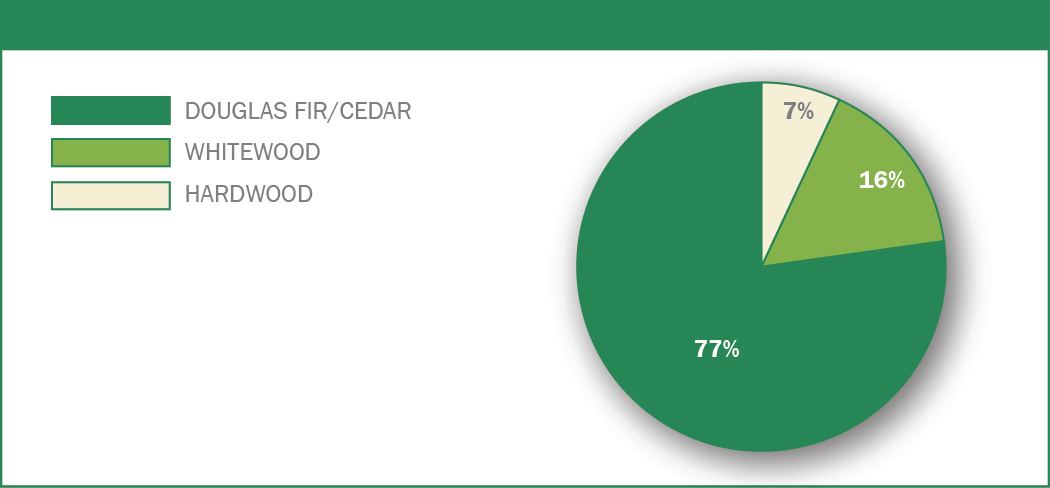
Our holdings are composed primarily of Douglas fir, a species highly valued for its structural strength. Our coastal holdings also contain whitewood and have a higher proportion of hemlock and other whitewoods than our western interior holdings. Our management systems provide us a competitive operating advantage in the areas of research and forestry, to technical planning models, mechanized harvesting, and marketing and logistics.
WEYERHAEUSER COMPANY > 2016 ANNUAL REPORT AND FORM 10-K 5
2016 Western U.S. Inventory by Species
2016 Western U.S. Inventory by Age / Species
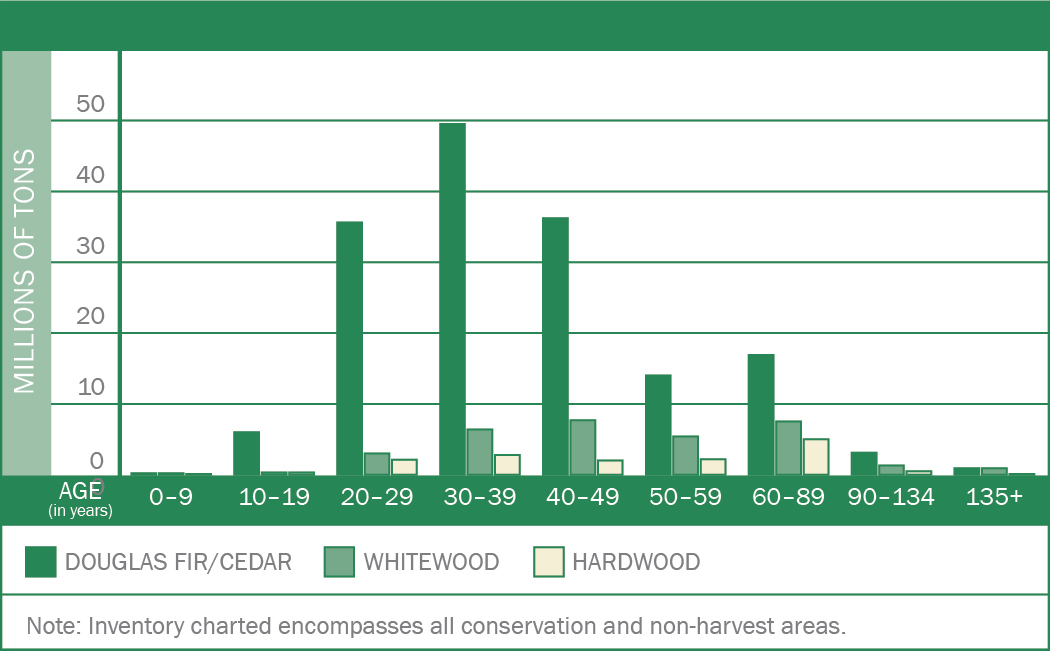
The average age of timber harvested from our Western timberlands in 2016 was 52 years. Most of our Western timberlands are intensively managed for timber production, but some areas are conserved for environmental and/or recreational reasons. Some of our older trees are protected in acreage set aside for conservation, and some are not yet logged due to harvest rate regulations. While over the long term our average harvest age will decrease in accordance with our sustainable forestry practices, we harvest approximately 2 percent of our Western acreage each year.
Southern United States
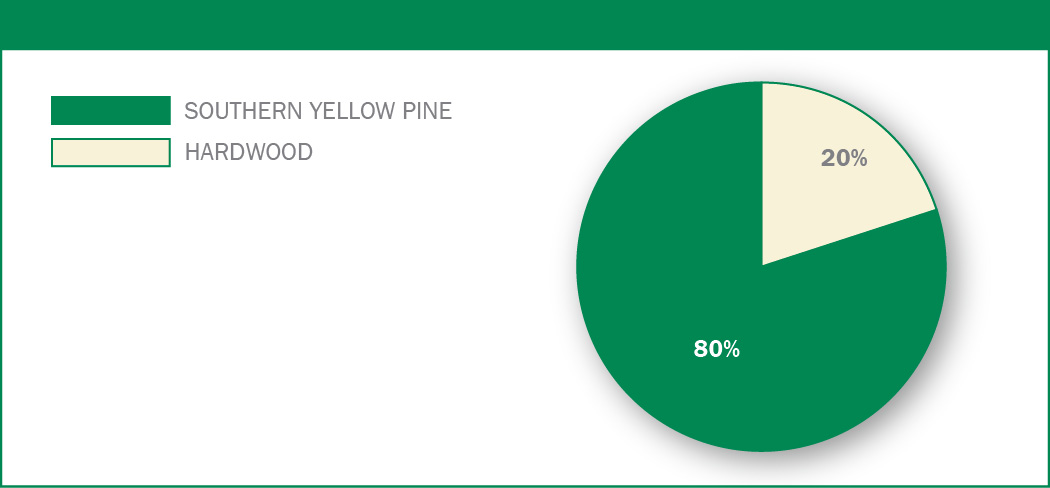
Our Southern forests predominantly contain southern yellow pine and include timberlands in 11 states.
We intensively manage our timber plantations using forestry research and planning systems to optimize grade log production. We do this while providing quality habitat for a range of animals and birds. We lease more than 92 percent of our Southern acreage for recreational purposes.
2016 Southern U.S. Inventory by Species
WEYERHAEUSER COMPANY > 2016 ANNUAL REPORT AND FORM 10-K 6
2016 Southern U.S. Inventory by Age / Species
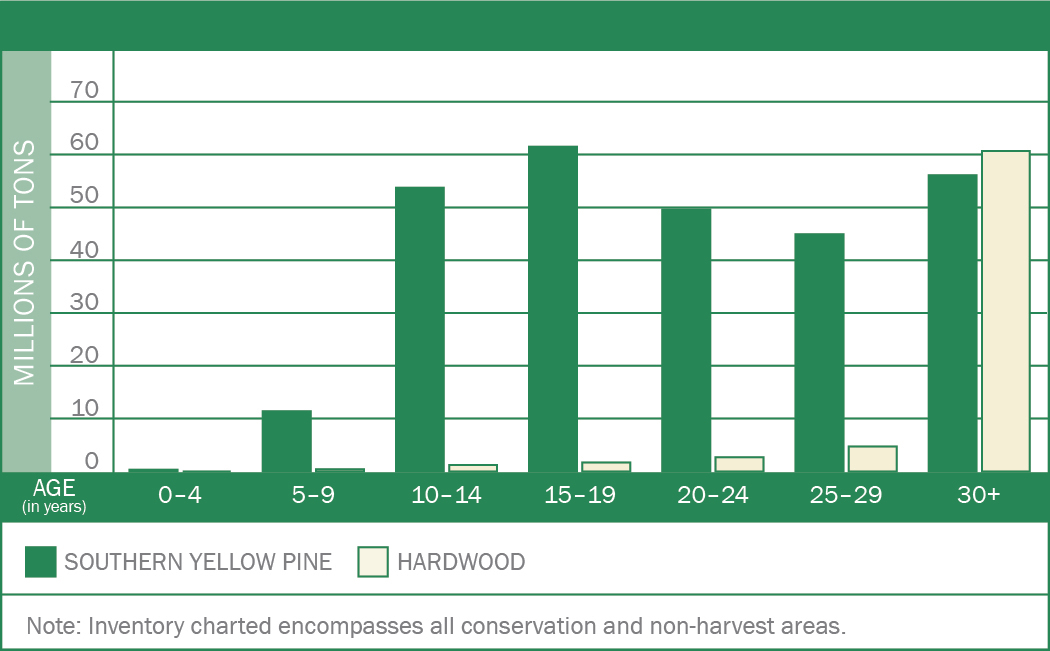
The average age of timber harvested from our Southern timberlands in 2016 was 29 years. In accordance with our sustainable forestry practices, we harvest approximately 3 percent of our acreage each year in the South.
Northern United States
Our Northern acres contain a diverse mix of temperate broadleaf hardwoods and mixed conifer species across timberlands located in seven states (Maine, Michigan, Montana, New Hampshire, Vermont, West Virginia and Wisconsin). Species include American beech, balsam fir, birch, cedar, cherry, Douglas fir, hemlock, maple, oak, red pine, spruce, Western larch and white pine.
Regeneration is predominantly natural, augmented by planting where appropriate. Environmental stewardship in the region is shaped by responsible forest management, the geography of our ownership and past management practices.
2016 Northern U.S. Inventory by Species
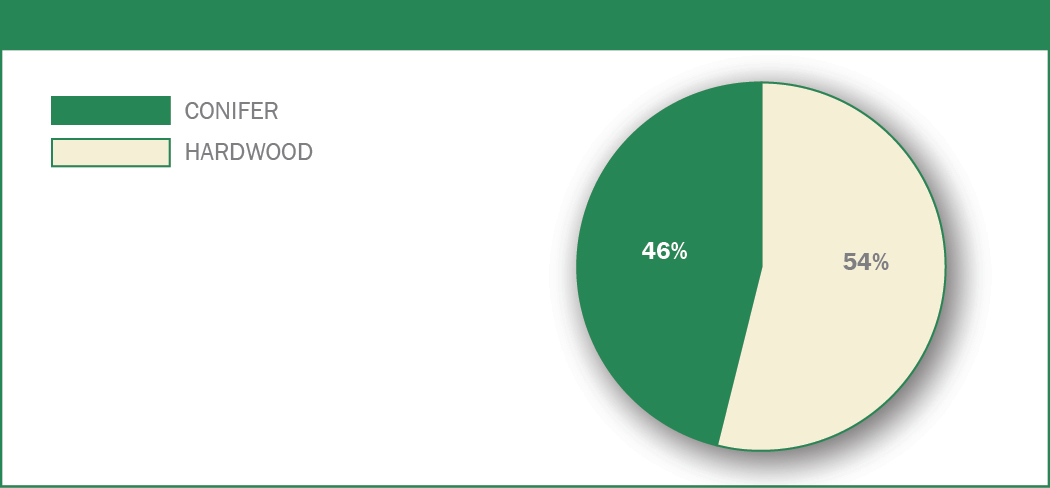
2016 Northern U.S. Inventory by Age / Species
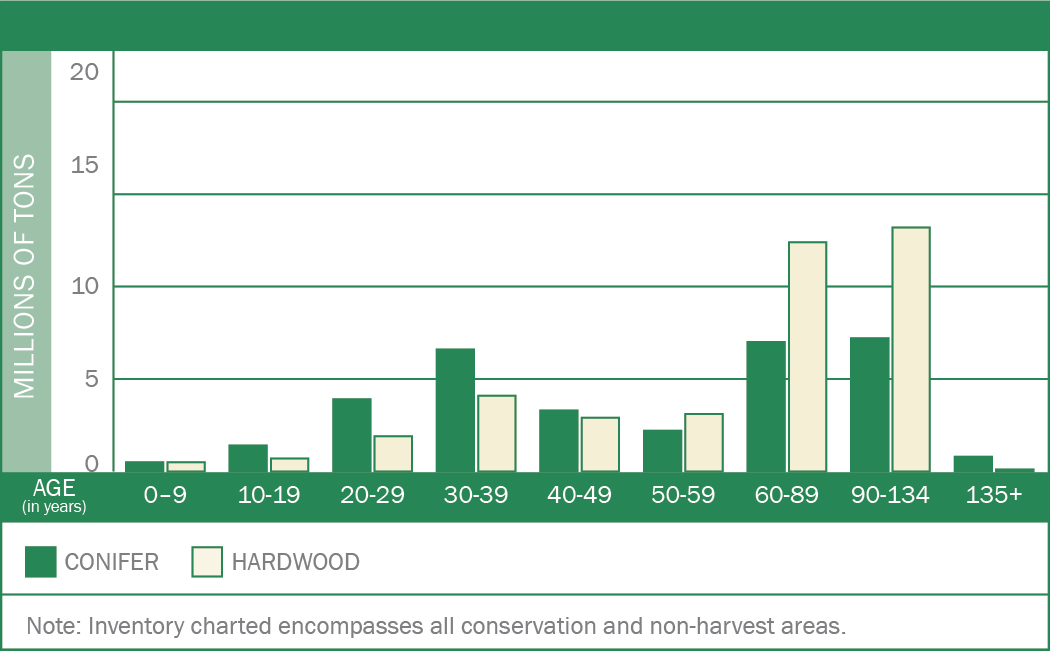
The average age of timber harvested from our Northern timberlands in 2016 was 66 years. Timber harvested in the North is sold predominately as delivered logs to domestic mills, including our manufacturing facilities located in Montana and West Virginia. In accordance with our sustainable forestry practices, we harvest less than 1 percent of our acreage each year in the North.
Uruguay
Our timberland acres in Uruguay are split approximately 49 percent loblolly pine and 51 percent eucalyptus. Loblolly pine comprises more of our timber inventory due to its older age. On average, our timber in Uruguay is in the second third of its rotation age. It is entering into that part of the growth rotation when we will see increased volume. About 98 percent of the area to be planted has been afforested to date.
WEYERHAEUSER COMPANY > 2016 ANNUAL REPORT AND FORM 10-K 7
2016 Uruguay Inventory by Species
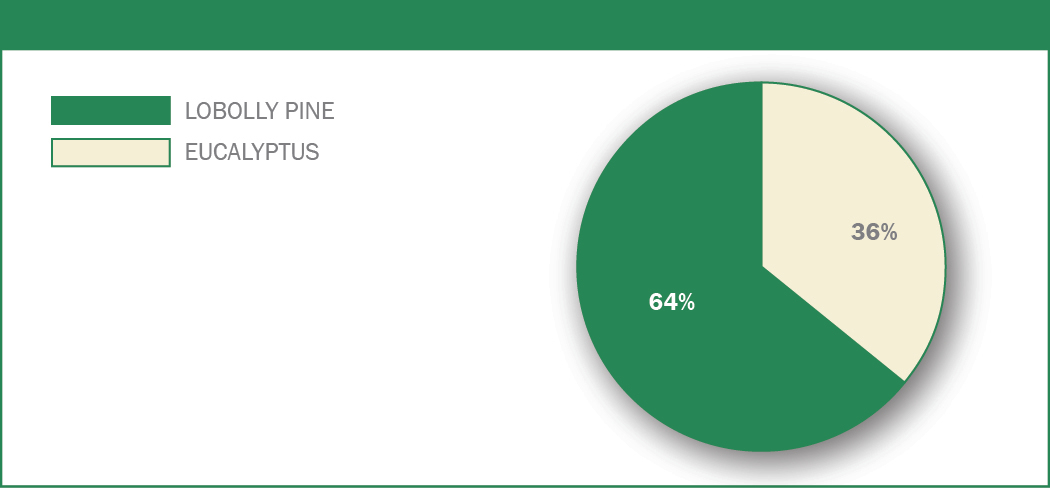
In Uruguay, the target rotation ages are 21 to 22 years for pine and 14 to 17 years for eucalyptus. We manage both species to a grade (appearance) regime.
We also operate a plywood mill in Uruguay with a production capacity of approximately 260 thousand cubic meters. Mill operations are included in our Timberlands business segment. Production volume reached 228 thousand cubic meters in 2016.
On October 12, 2016, we announced the exploration of strategic alternatives for our timberlands and manufacturing operations in Uruguay. We intend to consider a broad range of alternatives, including continuing to hold and operate the business, or a sale.
Canada — Licensed Timberlands
We manage timberlands in Canada under long-term licenses from the provincial governments to secure volume for our manufacturing facilities in various provinces. The provincial governments regulate the volume of timber that may be harvested each year through Annual Allowable Cuts (AAC), which are updated every 10 years. As of December 31, 2016, our AAC by province was:
| • | Alberta — 3,107 thousand tons, |
| • | British Columbia — 627 thousand tons, |
| • | Ontario — 254 thousand tons and |
| • | Saskatchewan — 633 thousand tons. |
When the volume is harvested, we pay the province at stumpage rates set by the government. The harvested logs are transferred to our manufacturing facilities at cost (stumpage plus harvest, haul and overhead costs less any margin on selling logs to third parties). Any profit from harvesting the log through to converting to finished products is recognized at the respective mill in our Wood Products segment.
A small amount of harvested volumes are sold to unaffiliated customers.
| GEOGRAPHIC AREA | THOUSANDS OF ACRES AT DECEMBER 31, 2016 | |
| TOTAL LICENSE ARRANGEMENTS | ||
| Canada: | ||
| Alberta | 5,321 | |
| British Columbia | 1,011 | |
| Ontario(1) | 2,574 | |
| Saskatchewan | 4,987 | |
| Total Canada | 13,893 | |
| (1) License is managed by partnership. |
WEYERHAEUSER COMPANY > 2016 ANNUAL REPORT AND FORM 10-K 8
HOW MUCH WE HARVEST
Our fee harvest volumes are managed sustainably across all regions to ensure the preservation of long-term economic value of the timber and to capture maximum value from the markets. This is accomplished by ensuring annual harvest schedules target financially mature timber and reforestation activities align with the growing of timber through its life cycle to financial maturity.
Five-Year Summary of Timberlands Fee Harvest Volumes
| FEE HARVEST VOLUMES IN THOUSANDS | ||||||||||
| 2016 | 2015 | 2014 | 2013 | 2012 | ||||||
| Fee harvest volume – tons: | ||||||||||
| West | 11,083 | 10,563 | 10,580 | 8,435 | 6,790 | |||||
| South | 26,343 | 14,113 | 14,276 | 14,177 | 14,046 | |||||
| North | 2,044 | — | — | — | — | |||||
| Uruguay | 1,119 | 980 | 1,091 | 902 | 841 | |||||
| Other(1) | 701 | — | — | — | — | |||||
| Total | 41,290 | 25,656 | 25,947 | 23,514 | 21,677 | |||||
| (1) Other includes volumes managed for the Twin Creeks Venture. For additional information see Note 8: Related Parties in Notes to Consolidated Financial Statements. |
Five-Year Summary of Timberlands Fee Harvest Volumes - Percentage of Grade and Fiber
| PERCENTAGE OF GRADE AND FIBER | |||||||||||
| 2016 | 2015 | 2014 | 2013 | 2012 | |||||||
| West | Grade | 87 | % | 87 | % | 89 | % | 90 | % | 90 | % |
| Fiber | 13 | % | 13 | % | 11 | % | 10 | % | 10 | % | |
| South | Grade | 52 | % | 59 | % | 59 | % | 57 | % | 59 | % |
| Fiber | 48 | % | 41 | % | 41 | % | 43 | % | 41 | % | |
| North | Grade | 47 | % | — | — | — | — | ||||
| Fiber | 53 | % | — | — | — | — | |||||
| Uruguay | Grade | 66 | % | 65 | % | 63 | % | 60 | % | 67 | % |
| Fiber | 34 | % | 35 | % | 37 | % | 40 | % | 33 | % | |
| Other(1) | Grade | 45 | % | — | — | — | — | ||||
| Fiber | 55 | % | — | — | — | — | |||||
| Total | Grade | 64 | % | 73 | % | 73 | % | 69 | % | 71 | % |
| Fiber | 36 | % | 27 | % | 27 | % | 31 | % | 29 | % | |
| (1) Other includes volumes managed for the Twin Creeks Venture. For additional information see Note 8: Related Parties in Notes to Consolidated Financial Statements. |
HOW MUCH WE SELL
Our net sales to unaffiliated customers over the last two years were:
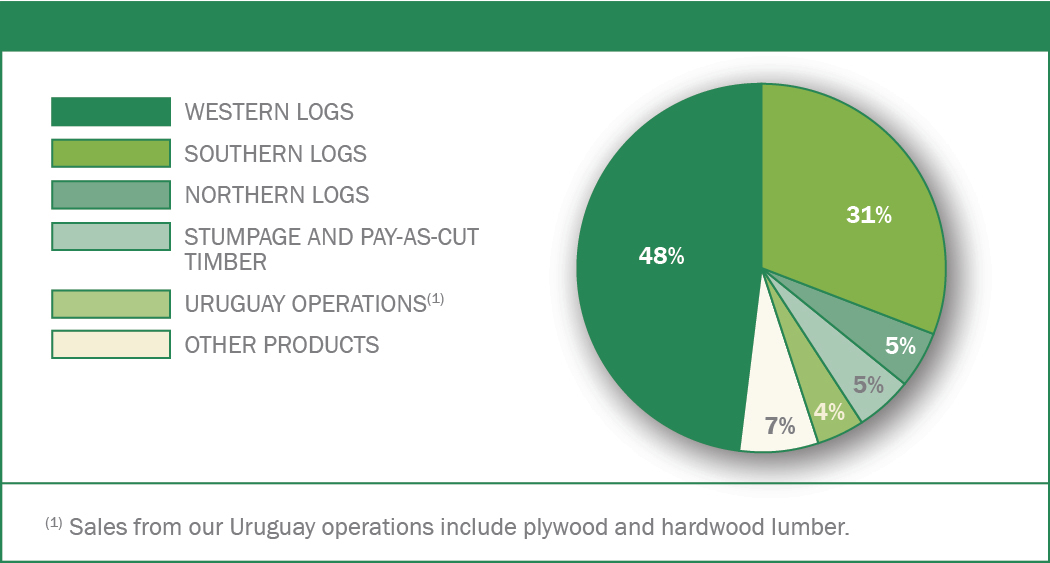
| • | $1.8 billion in 2016 — up 42 percent from 2015; and |
| • | $1.3 billion in 2015. |
Our intersegment sales over the last two years were:
| • | $840 million in 2016 — up 1 percent from 2015; and |
| • | $830 million in 2015. |
WEYERHAEUSER COMPANY > 2016 ANNUAL REPORT AND FORM 10-K 9
Five-Year Summary of Net Sales for Timberlands
| NET SALES IN MILLIONS OF DOLLARS | |||||||||||||||
| 2016 | 2015 | 2014 | 2013 | 2012 | |||||||||||
| To unaffiliated customers: | |||||||||||||||
| Delivered Logs: | |||||||||||||||
| West | $ | 865 | $ | 830 | $ | 972 | $ | 828 | $ | 559 | |||||
| South | 566 | 241 | 257 | 256 | 233 | ||||||||||
| North | 91 | — | — | — | — | ||||||||||
| Other(1) | 38 | 24 | 22 | 19 | 19 | ||||||||||
| Total | 1,560 | 1,095 | 1,251 | 1,103 | 811 | ||||||||||
| Stumpage and pay-as-cut timber | 85 | 37 | 18 | 9 | 11 | ||||||||||
| Uruguay operations(2) | 79 | 87 | 88 | 76 | 92 | ||||||||||
| Recreational lease revenue | 44 | 25 | 22 | 21 | 19 | ||||||||||
| Other products(3) | 37 | 29 | 36 | 40 | 49 | ||||||||||
| Subtotal sales to unaffiliated customers | 1,805 | 1,273 | 1,415 | 1,249 | 982 | ||||||||||
| Intersegment sales: | |||||||||||||||
| United States | 590 | 559 | 576 | 518 | 447 | ||||||||||
| Canada | 250 | 271 | 291 | 281 | 236 | ||||||||||
| Subtotal intersegment sales | 840 | 830 | 867 | 799 | 683 | ||||||||||
| Total | $ | 2,645 | $ | 2,103 | $ | 2,282 | $ | 2,048 | $ | 1,665 | |||||
| (1) Other delivered logs includes sales to unaffiliated customers in Canada and sales from timberlands managed for the Twin Creeks Venture. For additional information about the Twin Creeks Venture see Note 8: Related Parties in Notes to Consolidated Financial Statements. | |||||||||||||||
| (2) Sales from our Uruguay operations include plywood and hardwood lumber. | |||||||||||||||
| (3) Other products sales include sales of seeds and seedlings from our nursery operations, chips, and sales from our operations in Brazil (operations sold in 2014) and China (operations sold in 2012). |
Five-Year Trend for Total Net Sales in Timberlands
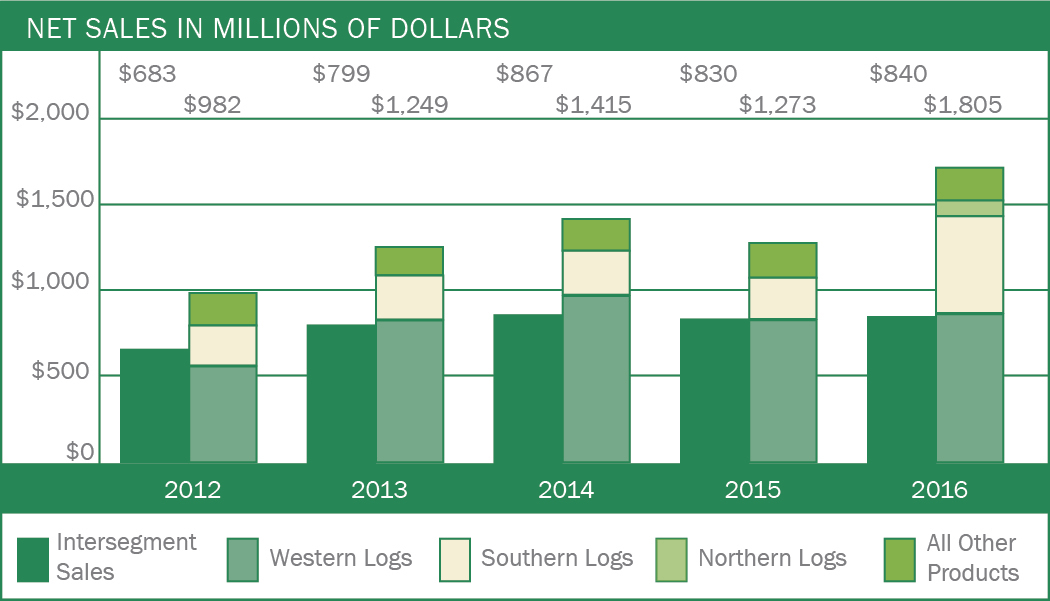
Percentage of 2016 Sales Dollars to Unaffiliated Customers
WEYERHAEUSER COMPANY > 2016 ANNUAL REPORT AND FORM 10-K 10
Log Sales Volume
Logs sold to unaffiliated customers in 2016 increased 11.6 million tons — 73 percent — from 2015.
| • | Sales volume in the West increased 0.5 million tons — 6 percent — primarily due to the addition of volumes harvested from acquired Plum Creek timberlands. |
| • | Sales to unaffiliated customers in the South increased 9.5 million tons — 146 percent — primarily due to the addition of volumes harvested from acquired Plum Creek timberlands. |
| • | Sales to unaffiliated customers in the North were 1.5 million tons, all generated from acquired Plum Creek timberlands. |
We sell three grades of logs — domestic grade, domestic fiber and export. Factors that may affect log sales in each of these categories include:
| • | domestic grade log sales — lumber usage, primarily for housing starts and repair and remodel activity, the needs of our own mills and the availability of logs from both outside markets and our own timberlands; |
| • | domestic fiber log sales — demand for chips by pulp, containerboard mills, and OSB mills; and |
| • | export log sales — the level of housing starts in Japan and construction in China. |
Our sales volume includes logs purchased in the open market and all our domestic and export logs that are sold to unaffiliated customers or transferred at market prices to our internal mills.
Five-Year Summary of Log Sales Volume to Unaffiliated Customers
| SALES VOLUME IN THOUSANDS | ||||||||||
| 2016 | 2015 | 2014 | 2013 | 2012 | ||||||
| Logs – tons: | ||||||||||
| West | 8,713 | 8,212 | 8,504 | 7,300 | 5,585 | |||||
| South | 15,967 | 6,480 | 6,941 | 7,198 | 6,816 | |||||
| North | 1,500 | — | — | — | — | |||||
| Uruguay | 470 | 714 | 667 | 394 | 379 | |||||
| Other(1) | 943 | 551 | 474 | 410 | 426 | |||||
| Total | 27,593 | 15,957 | 16,586 | 15,302 | 13,206 | |||||
| (1) Other includes our Canadian operations and managed Twin Creeks operations. |
Log Prices
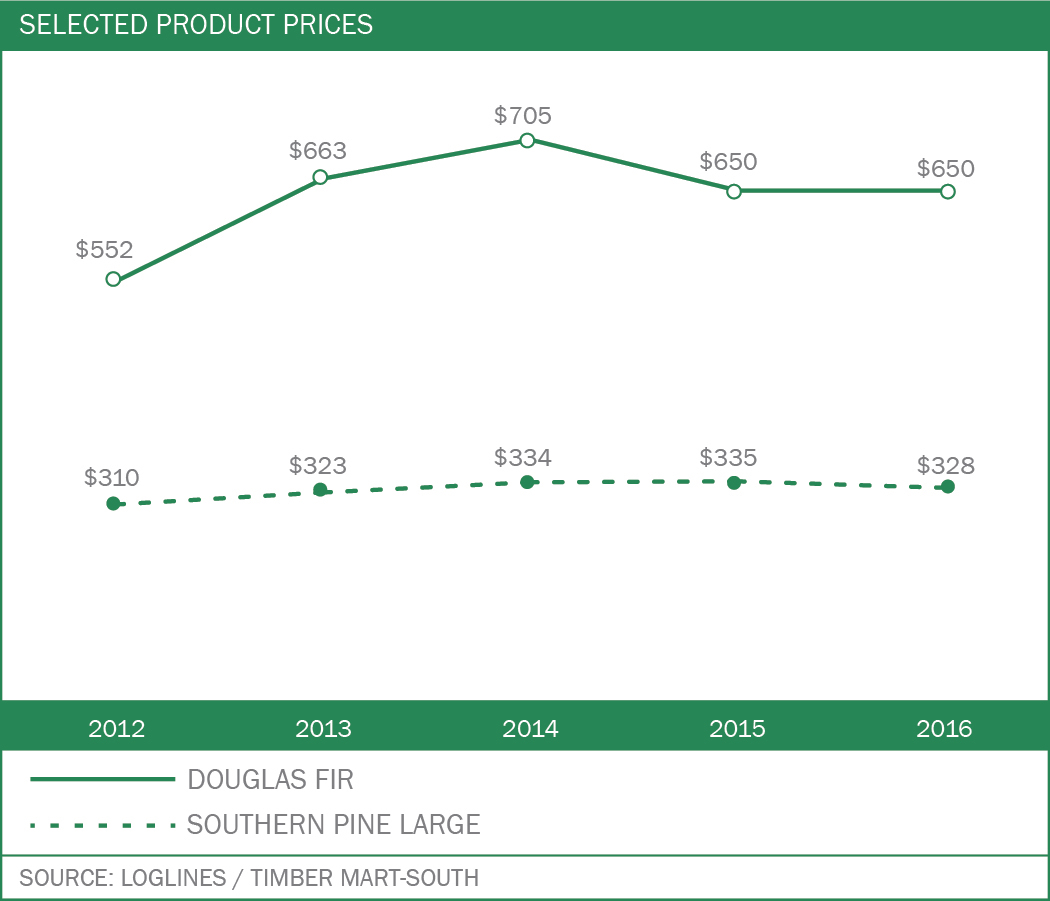
The majority of our log sales to unaffiliated customers involve sales to domestic sawmills and the export market. Log prices in the following tables are on a delivered (mill) basis:
Five-Year Summary of Published Domestic Log Prices (#2 Sawlog Bark On — $/MBF)
WEYERHAEUSER COMPANY > 2016 ANNUAL REPORT AND FORM 10-K 11
Five-Year Summary of Export Log Prices (#2 Sawlog Bark On — $/MBF)
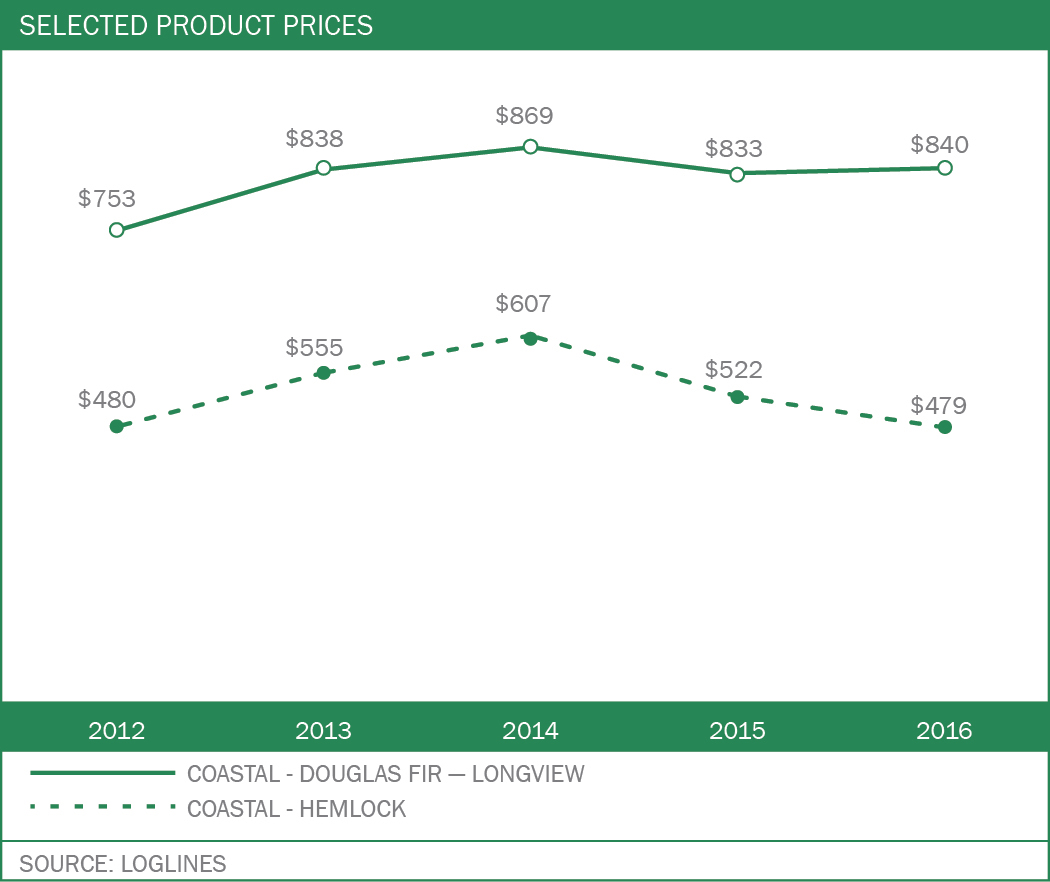
Our log prices are affected by the supply of and demand for grade and fiber logs and are influenced by the same factors that affect log sales. Export log prices are particularly affected by the Japanese housing market and Chinese demand.
Our average 2016 log realizations in the West decreased by 2 percent compared to 2015 — primarily due to grade mix and export vs. domestic sales mix.
Our average 2016 log realizations in the South decreased by 5 percent compared to 2015 — primarily as a result of lower realization pulpwood sales having increased and higher realization grade logs having decreased as a percentage of total sales volume. The change in mix is attributable to the addition of acquired Plum Creek timberlands that have historically produced a higher proportion of pulpwood vs. grade logs compared to legacy Weyerhaeuser timberlands.
WHERE WE’RE HEADED
Our competitive strategies include:
| • | continuing to capitalize on our scale of operations, silviculture expertise and sustainability practices; |
| • | optimizing cash flow through operational excellence initiatives such as merchandising for value, harvest and transportation efficiencies, and flexing harvest to seasonal and short term opportunities; |
| • | sustaining our export and domestic market access, infrastructure and strong customer relationships; |
| • | increasing our recreational lease revenue stream; and |
| • | continuing to successfully integrate operations acquired in our merger with Plum Creek, capture operational synergies, and maximize the value of our combined timberlands portfolio. |
REAL ESTATE, ENERGY AND NATURAL RESOURCES
Our Real Estate & ENR segment maximizes the value of our timberland ownership through application of our asset value optimization (AVO) process and captures the full value of surface and subsurface assets through development of oil, natural gas, minerals and wind resources.
WHAT WE DO
Real Estate
Properties that exhibit higher value than commercial timberlands are monetized within our Real Estate business. We analyze existing U.S. timberland holdings using a process we call asset value optimization. We start with understanding the value of a parcel operating as commercial timberlands and then assess the specific real estate attributes of the parcel and its corresponding market. The assessment includes demographics, infrastructure and proximity to amenities and recreation to determine the potential to yield a premium value to commercial timberland. Attributes can evolve over time, and accordingly, the assignment of value and opportunity can change.
The assessment includes third party experts and results in a categorization of properties with potential premium values. These properties are acres we expect to sell, exchange, and/or develop for recreational, conservation, commercial or residential purposes. Development is conducted using internal resources or through third-party arrangements.
Occasionally we enter into small, opportunistic timberlands transactions in areas where we choose to reduce our market presence or we can capture a price that exceeds the value derivable from holding and operating as commercial timberlands. These transactions will vary based on factors including the locations and physical characteristics of the timberlands.
The timing of real estate sales is a function of many factors, including the general state of the economy, demand in local real estate markets, the ability to obtain entitlements, the ability of buyers to obtain financing, the number of competing properties listed for sale, the seasonal nature of sales (particularly in the northern states), the plans of adjacent landowners, our expectation of future price appreciation, the timing of the harvesting activities, and the availability of government and not-for-profit funding (especially for conservation sales). In any period the average sales price per acre will vary based on the location and physical characteristics of parcels sold.
WEYERHAEUSER COMPANY > 2016 ANNUAL REPORT AND FORM 10-K 12
Energy and Natural Resources
In the United States, we analyze and manage mineral, oil and gas, and renewable energy opportunities on our timberlands. We recognize leasing, bonus, and option revenue over the terms of agreements with buyers. Revenue primarily comes from:
| • | royalty payments on hard minerals (rock, sand and gravel); |
| • | royalty payments on oil and gas production; |
| • | bonus payments from oil and gas leasing and exploration activity; |
| • | wind power and communication and transmission rights of way; |
| • | coal royalties; and |
| • | the sale of mineral assets. |
We generate revenue related to our ownership of mineral rights and, separately, related to our ownership of the surface. The ownership of mineral rights and surface rights may be held by two separate parties. Materials that can be mined from the surface, and whose value comes from factors other than their chemical composition typically belong to the surface owner. Examples of surface materials include rock, sand and gravel. The mineral rights owner holds the title to commodities that derive value from their unique chemical composition. Examples of mineral rights include oil, gas, coal (even if mined at the surface) and precious metals. If the two types of rights conflict, then mineral rights generally are superior to surface rights. A third type of land right is geothermal, which can belong to either the surface or mineral owner. We generally reserve mineral and geothermal rights when selling surface timberlands acreage.
We expect to continue to negotiate royalty arrangements and leases to capture the maximum value for our non-timber natural resources assets. Some of these activities are conducted through our wholly-owned taxable REIT subsidiaries.
Real Estate Development Joint Venture
Our share of equity earnings from WestRock-Charleston Land Partners, LLC (WR-CLP) are included in the net contribution to earnings of our Real Estate & ENR segment. WR-CLP develops and sells its acreage of high value rural lands and development-quality lands near Charleston, South Carolina. Refer to Note 8: Related Parties in Notes to Consolidated Financial Statements for further information.
Real Estate, Energy and Natural Resources Sources of Revenue
| SOURCE | ACTIVITIES |
| Timberlands | Select timberland tracts are sold for recreational, conservation or residential purposes to maximize value or improve our timberland portfolio. |
| Minerals and mineral rights | Rights are sold to explore and extract minerals, oil and gas for sale into energy markets. |
| Surface materials | Rights are sold to access and extract surface materials (rock, sand and gravel) for sale into construction markets |
| Rights of way and easements | Rights are sold to access and utilize surface acreage for wind power, communications equipment, and transportation implementations (e.g. pipeline and power line easements) |
Certain activities within this segment are performed by our REIT, whereas others are activities of our Taxable REIT Subsidiaries.
WHERE WE DO IT
Our Real Estate & ENR segment identifies opportunities to realize premium value for our U.S. timberland acreage.
The AVO review of our legacy Weyerhaeuser Southern timberlands was completed in fourth quarter 2016. The AVO review of our legacy Weyerhaeuser Western timberlands is currently underway and is expected to be completed in 2017. Beyond initially applying the AVO process to legacy Weyerhaeuser timberlands, we will continually revisit our AVO assessment of all of our U.S. timberland acres, including acreage acquired in our merger with Plum Creek that was subjected to the AVO process prior to the merger.
Our significant energy and natural resources revenue sources are generated from construction materials royalties in South Carolina and Georgia; oil and natural gas royalties in West Virginia and Louisiana; and coal reserves in West Virginia.
HOW MUCH WE SELL
Our net sales to unaffiliated buyers over the last two years were:
| • | $226 million in 2016 — up 124 percent from 2015; and |
| • | $101 million in 2015. |
Five-Year Summary of Net Sales for Real Estate, Energy and Natural Resources
| NET SALES IN MILLIONS OF DOLLARS | |||||||||||||||
| 2016 | 2015 | 2014 | 2013 | 2012 | |||||||||||
| Net Sales: | |||||||||||||||
| Real Estate | $ | 172 | $ | 75 | $ | 72 | $ | 84 | $ | 83 | |||||
| Energy and Natural Resources | 54 | 26 | 32 | 31 | 31 | ||||||||||
| Total | $ | 226 | $ | 101 | $ | 104 | $ | 115 | $ | 114 |
WEYERHAEUSER COMPANY > 2016 ANNUAL REPORT AND FORM 10-K 13
Five-Year Summary of Real Estate Sales Statistics
| REAL ESTATE SALES STATISTICS | |||||||||||||||
| 2016 | 2015 | 2014 | 2013 | 2012 | |||||||||||
| Acres sold | 82,687 | 27,390 | 24,583 | 25,781 | 25,234 | ||||||||||
| Average price per acre | $ | 2,072 | $ | 2,490 | $ | 2,428 | $ | 2,462 | $ | 2,123 |
WHERE WE’RE HEADED
Our competitive strategies include:
| • | continuing to apply the AVO process to identify opportunities to capture a substantial premium to timber value; |
| • | maintaining a flexible, low-cost execution model by continuing to leverage strategic relationships with outside brokers; |
| • | capturing the full value of our surface and subsurface assets, including: aggregates and industrial minerals, oil and natural gas and wind resources; and |
| • | delivering the most value from every acre. |
WOOD PRODUCTS
We are a large manufacturer of wood products in North America and distributor of wood products, primarily in North America.
WHAT WE DO
Our wood products segment:
| • | provides high-quality softwood lumber, engineered wood products, structural panels, medium density fiberboard (MDF) and other specialty products to the residential, multi-family, industrial, light commercial and repair and remodel markets; |
| • | distributes our products as well as complementary building products that we purchase from other manufacturers; and |
| • | exports our softwood lumber, oriented strand board (OSB) and engineered wood products, primarily to Asia. |
Wood Products
| PRODUCTS | HOW THEY’RE USED |
| Structural lumber | Structural framing for new residential, repair and remodel, treated applications, industrial and commercial structures |
| Engineered wood products • Solid section • I-joists | Floor and roof joists, and headers and beams for residential, multi-family and commercial structures |
| Structural panels • OSB • Softwood plywood | Structural sheathing, subflooring and stair tread for residential, multi-family and commercial structures |
| Medium density fiberboard (MDF) | Furniture and cabinet components, architectural moldings, doors, store fixtures, core material for hardwood plywood, face material for softwood plywood, commercial wall paneling and substrate for laminate flooring |
| Other products | Wood chips and other byproducts |
| Complementary building products | Complementary building products such as cedar, decking, siding, insulation and rebar sold in our distribution facilities |
WHERE WE DO IT
We operate manufacturing facilities in the United States and Canada. We distribute through a combination of Weyerhaeuser distribution centers and third-party distributors. Information about the locations, capacities and actual production of our manufacturing facilities is included below.
Principal Manufacturing Locations
Locations of our principal manufacturing facilities as of December 31, 2016, by major product group were:
| • | Structural lumber |
– U.S. — Alabama, Arkansas, Louisiana, Mississippi, Montana, North Carolina, Oklahoma, Oregon and Washington
– Canada — Alberta and British Columbia
| • | Engineered wood products |
– U.S. — Alabama, Louisiana, Oregon and West Virginia
– Canada — British Columbia and Ontario
| • | Oriented strand board |
– U.S. — Louisiana, Michigan, North Carolina and West Virginia
– Canada — Alberta and Saskatchewan
| • | Softwood plywood |
– U.S. — Arkansas, Montana and Louisiana
| • | Medium density fiberboard |
– U.S. — Montana
We also operate a facility in Foster, Oregon, that produces veneer, primarily for use in our engineered wood products facilities.
Upon our merger with Plum Creek, we acquired five manufacturing facilities in Montana, two plywood facilities, two lumber facilities, and one MDF facility. We permanently closed the lumber facility and softwood plywood facility in Columbia Falls, Montana during the third quarter of
WEYERHAEUSER COMPANY > 2016 ANNUAL REPORT AND FORM 10-K 14
- The closure of these facilities allows us to align the available log supply with our manufacturing capacity, including adding shifts at our Kalispell, Montana facilities to position our Montana operations for long-term success.
We also own or lease 17 distribution centers in the U.S. where our major products and complementary building products are sold. During 2015, we decided to close our distribution centers in Baltimore, Pittsburgh, Chicago, and St. Paul. These were permanently closed in 2016.
Summary of Wood Products Capacities as of December 31, 2016
| CAPACITIES IN MILLIONS | ||||
| PRODUCTION CAPACITY | NUMBER OF FACILITIES | |||
| Structural lumber – board feet | 4,940 | 19 | ||
| Engineered solid section – cubic feet(1) | 43 | 6 | ||
| Oriented strand board – square feet (3/8”) | 3,035 | 6 | ||
| Softwood plywood – square feet (3/8”) | 610 | 3 | ||
| Medium density fiberboard – square feet (3/4') | 265 | 1 | ||
| (1) This represents total press capacity. Three facilities also produce I-Joist to meet market demand. In 2016, approximately 25% of the total press production was converted into 184 million linear feet of I-Joist. |
Production capacities listed represent annual production volume under normal operating conditions and producing a normal product mix for each individual facility. Production capacities do not include any capacity for facilities that were sold or permanently closed as of the end of 2016.
Five-Year Summary of Wood Products Production
| PRODUCTION IN MILLIONS | ||||||||||
| 2016 | 2015 | 2014 | 2013 | 2012 | ||||||
| Structural lumber – board feet | 4,516 | 4,252 | 4,152 | 4,084 | 3,846 | |||||
| Engineered solid section – cubic feet(1) | 22.8 | 20.9 | 20.4 | 18.0 | 15.4 | |||||
| Engineered I-joists – lineal feet(1) | 184 | 185 | 182 | 168 | 147 | |||||
| Oriented strand board – square feet (3/8”) | 2,910 | 2,847 | 2,749 | 2,723 | 2,511 | |||||
| Softwood plywood – square feet (3/8”)(2) | 396 | 248 | 252 | 241 | 214 | |||||
| MDF – square feet (3/4') | 209 | — | — | — | — | |||||
| (1) Weyerhaeuser engineered I-joist facilities also may produce engineered solid section. (2) All Weyerhaeuser plywood facilities also produce veneer. |
HOW MUCH WE SELL
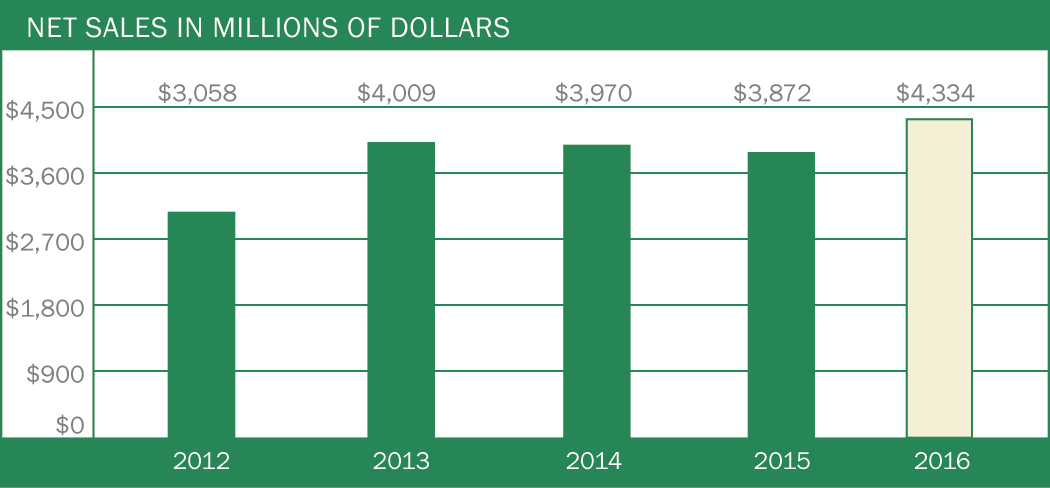
Revenues of our Wood Products segment come from sales to wood products dealers, do-it-yourself retailers, builders and industrial users. Wood Products net sales were $4.3 billion in 2016 and $3.9 billion 2015.
Five-Year Summary of Net Sales for Wood Products
| NET SALES IN MILLIONS OF DOLLARS | |||||||||||||||
| 2016 | 2015 | 2014 | 2013 | 2012 | |||||||||||
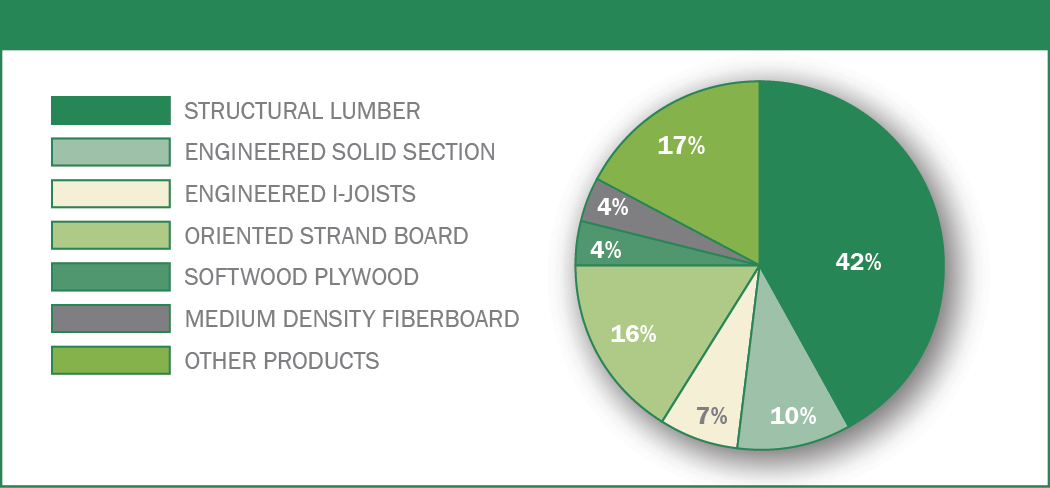
| Structural lumber | $ | 1,839 | $ | 1,741 | $ | 1,901 | $ | 1,873 | $ | 1,400 | |||||
| Engineered solid section | 450 | 428 | 402 | 353 | 279 | ||||||||||
| Engineered I-joists | 290 | 284 | 277 | 247 | 190 | ||||||||||
| Oriented strand board | 707 | 595 | 610 | 809 | 612 | ||||||||||
| Softwood plywood | 174 | 129 | 143 | 144 | 115 | ||||||||||
| Medium density fiberboard | 158 | — | — | — | — | ||||||||||
| Other products produced | 201 | 189 | 176 | 171 | 167 | ||||||||||
| Complementary building products | 515 | 506 | 461 | 412 | 295 | ||||||||||
| Total | $ | 4,334 | $ | 3,872 | $ | 3,970 | $ | 4,009 | $ | 3,058 |
Five-Year Trend for Total Net Sales in Wood Products
WEYERHAEUSER COMPANY > 2016 ANNUAL REPORT AND FORM 10-K 15
Percentage of 2016 Net Sales Dollars in Wood Products
Wood Products Volume
The volume of structural lumber, engineered wood products, OSB and plywood sold in 2016 increased from 2015 due to our our acquired Plum Creek operations and increased demand.
Five-Year Summary of Sales Volume for Wood Products
| SALES VOLUME IN MILLIONS | ||||||||||
| 2016 | 2015 | 2014 | 2013 | 2012 | ||||||
| Structural lumber – board feet | 4,723 | 4,588 | 4,463 | 4,436 | 4,031 | |||||
| Engineered solid section – cubic feet | 23.3 | 21.3 | 20.0 | 18.2 | 15.4 | |||||
| Engineered I-joists – lineal feet | 195 | 188 | 184 | 177 | 152 | |||||
| Oriented strand board – square feet (3/8”) | 2,934 | 2,972 | 2,788 | 2,772 | 2,508 | |||||
| Softwood Plywood – square feet (3/8”) | 481 | 381 | 395 | 402 | 340 | |||||
| MDF – square feet (3/4') | 206 | — | — | — | — | |||||
| Sales volume includes sales of internally produced products and complementary building products sold primarily through our distribution centers. |
Wood Products Prices
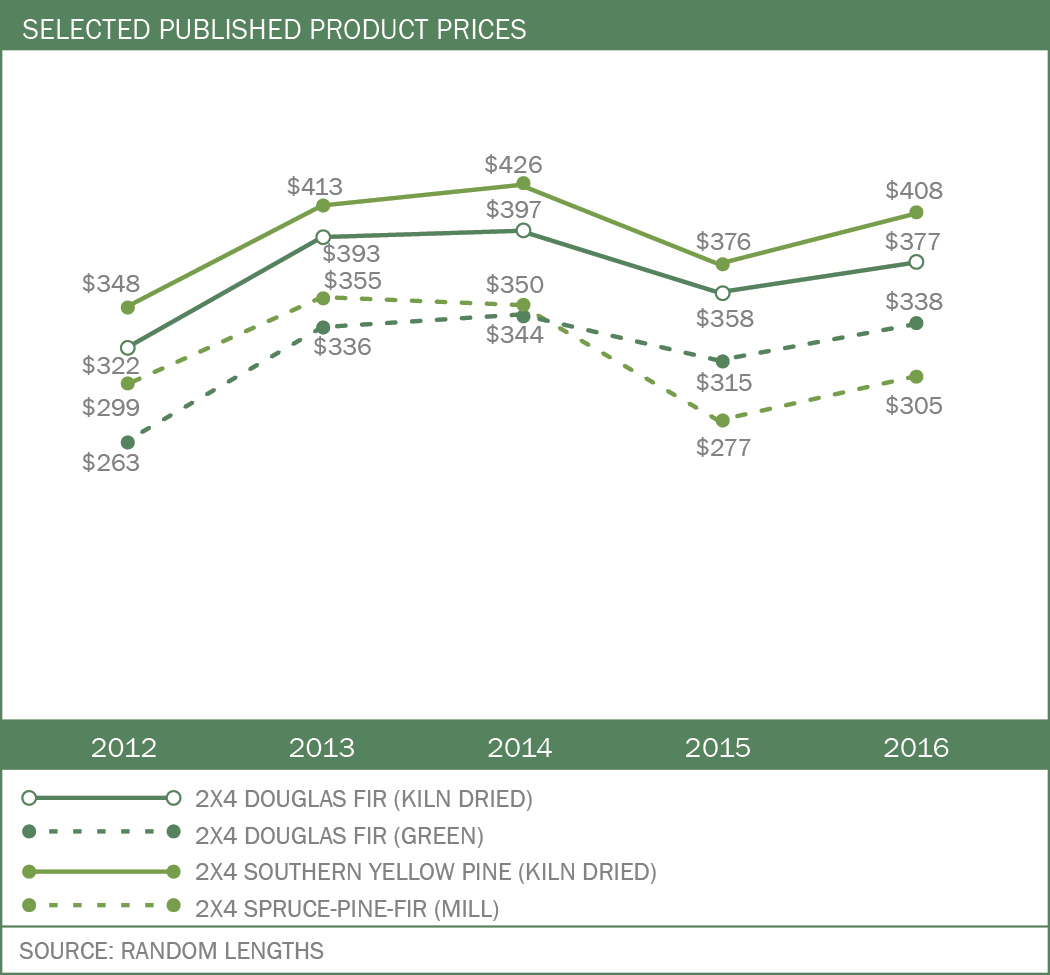
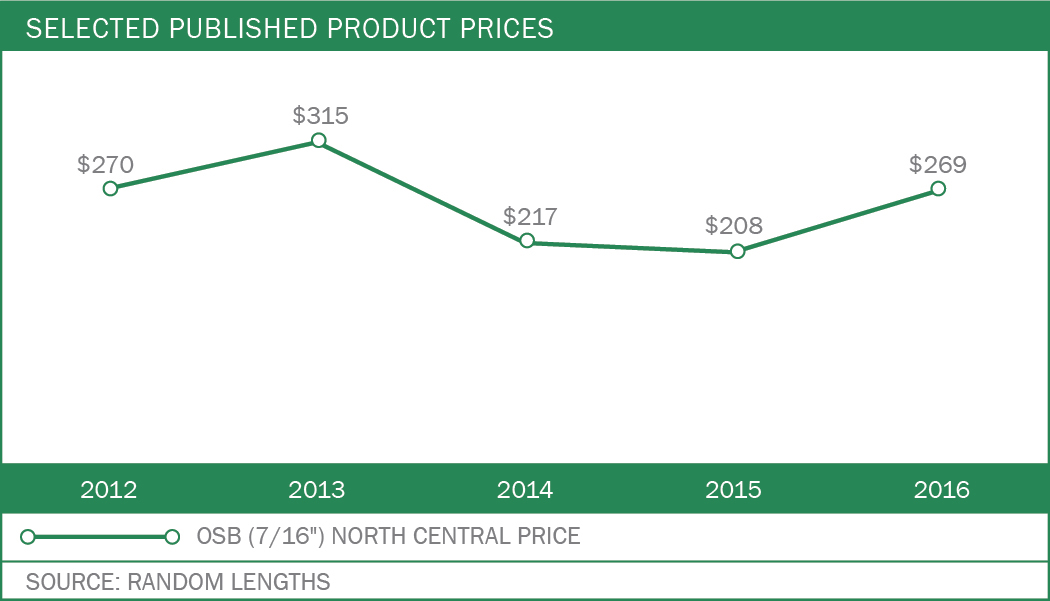
Prices for commodity wood products — Structural lumber, OSB and Plywood — increased in 2016 from 2015.
In general, the following factors influence prices for wood products:
| • | Demand for wood products used in residential and multi-family construction and the repair and remodel of existing homes affects prices. Residential construction is influenced by factors such as population growth and other demographics, the level of employment, consumer confidence, consumer income, availability of financing and interest rate levels, and the supply and pricing of existing homes on the market. Repair and remodel activity is affected by the size and age of existing housing inventory and access to home equity financing and other credit. |
| • | The availability of supply of commodity building products such as structural lumber, OSB and plywood affects prices. A number of factors can influence supply, including changes in production capacity and utilization rates, weather, raw material supply and availability of transportation. |
Demand for wood products continued to improve in 2016. The following graphs reflect product price trends for the past five years.
Five-Year Summary of Published Lumber Prices — $/MBF
WEYERHAEUSER COMPANY > 2016 ANNUAL REPORT AND FORM 10-K 16
Five-Year Summary of Published Oriented Strand Board Prices — $/MSF
WHERE WE’RE HEADED
Our competitive strategies include:
| • | reduce controllable manufacturing costs through operational excellence and disciplined capital execution; |
| • | strong alignment with fiber supply; |
| • | leverage our brand and reputation as the preferred provider of quality building products; and |
| • | pursue disciplined, profitable sales growth in target markets. |
WEYERHAEUSER COMPANY > 2016 ANNUAL REPORT AND FORM 10-K 17
| EXECUTIVE OFFICERS OF THE REGISTRANT |
Adrian M. Blocker, 60, has been senior vice president, Wood Products since January 2015. Previously, he served as senior vice president, Lumber, from August 2013 to December 2014. He joined the company in May 2013 as vice president, Lumber. Prior to joining the company, he served as CEO of the Wood Products Council. He has held numerous leadership positions in the industry focused on forest management, fiber procurement, consumer packaging, strategic planning, business development and manufacturing, including at West Fraser, International Paper and Champion International.
Russell S. Hagen, 51, has been senior vice president and chief financial officer since February 2016. Previously, he served as senior vice president, Business Development, at Plum Creek. from December 2011 to February 2016. Prior to this he was vice president, Real Estate Development, overseeing the development activities of the company's real estate, oil and gas, construction materials and bioenergy businesses. Mr. Hagen began his career in 1988 with PricewaterhouseCoopers LLC where he was a certified public accountant and led the audits of public clients in technology, banking and natural resource industries. He joined Plum Creek in 1993 as Manager of Internal Audit and held director-level positions in accounting, financial operations, risk management and information technology.
Kristy T. Harlan, 43, has been senior vice president, General Counsel and Corporate Secretary since January 2017. She leads the company's Law department, with responsibility for global legal, compliance, real estate services and land title functions. Before joining the company, she was a partner at K&L Gates LLP since 2007. Previously, she worked as an attorney at Preston Gates & Ellis LLP and Akin Gump Strauss Hauer & Feld.
Rhonda D. Hunter, 54, has been senior vice president, Timberlands, since January 2014. Previously, she was vice president, Southern Timberlands from 2010 to 2014. She held a number of leadership positions in the Southern Timberlands organization and has experience in inventory and planning, regional timberlands management, environmental and work systems, finance and land acquisition. She joined Weyerhaeuser in 1987 as an accountant.
James A. Kilberg, 60, has been senior vice president, Real Estate, Energy and Natural Resources, since April 2016. In this position, he oversees the company's real estate development, land asset management, conservation, mitigation banking, recreational lease management, oil and gas, construction materials, heavy minerals, wind and water. Prior to joining the company, he served as Plum Creek's senior vice president, Real Estate, Energy and Natural Resources, from 2006 until February 2016, and as Plum Creek’s vice president, Land Management, from 2001 until 2006. Prior to joining Plum Creek, Mr. Kilberg held several executive positions in real estate, asset management and development. He currently serves on the board of the Georgia Chamber of Commerce and the Alliance Theater, as well as the Corporate Council of the Land Trust Alliance.
Denise M. Merle, 53, has been senior vice president, Human Resources and Information Technology, since February 2016. Prior to her current role, she was senior vice president, Human Resources and Investor Relations, since August 2014; and senior vice president, Human Resources, since February 2014. She was director, Finance and Human Resources, for the Lumber business since 2013. Prior to that, she was director, Compliance & Enterprise Planning, from 2009 to 2013, and director, Internal Audit, from 2004 to 2009. She has also held various roles in the company's paper and packaging businesses, including finance, capital planning and analysis, and business development. She is a licensed CPA in the state of Washington. She serves on the Board of Advisors of the Seattle University business school.
Doyle R. Simons, 53, has been president and chief executive officer since August 2013 and a director of the company since June 2012. He was appointed chief executive officer-elect and an executive officer of the company in June 2013. Prior to joining the company, he served as chairman and chief executive officer of Temple-Inland, Inc., from 2008 until February 2012 when it was acquired by International Paper Company. He held various management positions with Temple-Inland, including executive vice president from 2005 through 2007 and chief administrative officer from 2003 to 2005. Prior to joining Temple-Inland in 1992, he practiced real estate and banking law with Hutcheson and Grundy, L.L.P. He also serves on the Board of Fiserv, Inc.
WEYERHAEUSER COMPANY > 2016 ANNUAL REPORT AND FORM 10-K 18
| NATURAL RESOURCE AND ENVIRONMENTAL MATTERS |
We are subject to a multitude of laws and regulations in the operation of our businesses. We also participate in voluntary certification of our timberlands to ensure that we sustain their overall quality, including the protection of wildlife and water quality. Changes in law and regulation, or certification standards, can significantly affect our business.
REGULATIONS AFFECTING FORESTRY PRACTICES
In the United States, regulations established by federal, state and local government agencies to protect water quality and wetlands could affect future harvests and forest management practices on our timberlands. Forest practice laws and regulations that affect present or future harvest and forest management activities in certain states include:
| • | limits on the size of clearcuts, |
| • | requirements that some timber be left unharvested to protect water quality and fish and wildlife habitat, |
| • | regulations regarding construction and maintenance of forest roads, |
| • | rules requiring reforestation following timber harvest and |
| • | various related permit programs. |
Each state in which we own timberlands has developed best management practices to reduce the effects of forest practices on water quality and aquatic habitats. Additional and more stringent regulations may be adopted by various state and local governments to achieve water-quality standards under the federal Clean Water Act, protect fish and wildlife habitats, human health, or achieve other public policy objectives.
In Canada, our forest operations are carried out on public timberlands under forest licenses with the provinces. All forest operations are subject to:
| • | forest practices and environmental regulations and |
| • | license requirements established by contract between us and the relevant province designed to: |
- protect environmental values and
- encourage other stewardship values.
In Canada, 21 member companies of the Forest Products Association of Canada (FPAC), including Weyerhaeuser’s Canadian subsidiary, announced in May 2010 the signing of a Canadian Boreal Forest Agreement (CBFA) with nine environmental organizations. The CBFA applies to approximately 72 million hectares of public forests licensed to FPAC members and, when fully implemented, is expected to lead to the conservation of significant areas of Canada’s boreal forest and protection of boreal species at risk, in particular woodland caribou. CBFA signatories continue to work on management plans with provincial governments, and seek the participation of aboriginal and local communities in advancing the goals of the CBFA. Progress under the CBFA is measured and reported on by an independent auditor.
ENDANGERED SPECIES PROTECTIONS
In the United States, a number of fish and wildlife species that inhabit geographic areas near or within our timberlands have been listed as threatened or endangered under the federal Endangered Species Act (ESA) or similar state laws, such as:
| • | the northern spotted owl, the marbled murrelet, a number of salmon species, bull trout and steelhead trout in the Pacific Northwest; |
| • | several freshwater mussel and sturgeon species; and |
| • | the red-cockaded woodpecker, gopher tortoise, gopher frog, American burying beetle and Northern long-eared bat in the South or Southeast. |
Additional species or populations may be listed as threatened or endangered as a result of pending or future citizen petitions or petitions initiated by federal or state agencies. In addition, significant citizen litigation seeks to compel the federal agencies to designate "critical habitat" for ESA-listed species, and many cases have resulted in settlements under which designations will be implemented over time. Such designations may adversely affect some management activities and options. Restrictions on timber harvests can result from:
| • | federal and state requirements to protect habitat for threatened and endangered species; |
| • | regulatory actions by federal or state agencies to protect these species and their habitat; and |
| • | citizen suits under the ESA. |
Such actions could increase our operating costs and affect timber supply and prices in general. To date, we do not believe that these measures have had, and we do not believe that in 2017 they will have, a significant effect on our harvesting operations. We anticipate that likely future actions will not disproportionately affect Weyerhaeuser as compared with comparable operations of U.S. competitors.
In Canada:
| • | The federal Species at Risk Act (SARA) requires protective measures for species identified as being at risk and for critical habitat, pursuant to SARA, Environment Canada continues to identify and assess species deemed to be at risk and their critical habitat. |
| • | In October 2012, the Canadian Minister of the Environment released a strategy for the recovery of the boreal population of woodland caribou under the SARA. The population and distribution objectives for boreal caribou across Canada are to (1) maintain the current status of existing, self-sustaining local caribou populations and (2) stabilize and achieve self-sustaining status for non-self-sustaining local caribou populations. Critical habitat for boreal caribou is identified for all boreal caribou ranges, except for northern Saskatchewan’s Boreal Shield range (SK1) where additional information is required for that population. Species assessment and recovery plans are developed in consultation with aboriginal communities and stakeholders. |
The identification and protection of habitat and the implementation of range plans and land use action plans may, over time, result in additional restrictions on timber harvests and other forest management practices that could increase operating costs for operators of timberlands in Canada. To date, we do not believe that these Canadian measures have had, and we do not believe that in 2017 they will have, a significant effect on our harvesting operations. We anticipate that likely future measures will not disproportionately affect Weyerhaeuser as compared with similar operations of Canadian competitors.
WEYERHAEUSER COMPANY > 2016 ANNUAL REPORT AND FORM 10-K 19
FOREST CERTIFICATION STANDARDS
We operate in North America under the Sustainable Forestry Initiative (SFI®). This is a certification standard designed to supplement government regulatory programs with voluntary landowner initiatives to further protect certain public resources and values. SFI® is an independent standard, overseen by a governing board consisting of:
| • | conservation organizations, |
| • | academia, |
| • | the forest industry and |
| • | large and small forest landowners. |
Ongoing compliance with SFI® may result in some increases in our operating costs and curtailment of our timber harvests in some areas. There also is competition from other private certification systems, primarily the Forest Stewardship Council (FSC), coupled with efforts by supporters to further those systems by persuading customers of forest products to require products certified to their preferred system. Certain features of the FSC system could impose additional operating costs on timberland management. Because of the considerable variation in FSC standards, and variability in how those standards are interpreted and applied, if sufficient marketplace demand develops for products made from raw materials sourced from other than SFI-certified forests, we could incur substantial additional costs for operations and be required to reduce harvest levels.
WHAT THESE REGULATIONS AND CERTIFICATION PROGRAMS MEAN TO US
The regulatory and non-regulatory forest management programs described above have:
| • | increased our operating costs; |
| • | resulted in changes in the value of timber and logs from our timberlands; |
| • | contributed to increases in the prices paid for wood products and wood chips during periods of high demand; |
| • | sometimes made it more difficult for us to respond to rapid changes in markets, extreme weather or other unexpected circumstances; and |
| • | potentially encouraged further reductions in the use of, or substitution of other products for, lumber, oriented strand board, and plywood. |
We believe that these kinds of programs have not had, and in 2017 will not have, a significant effect on our total harvest of timber in the United States or Canada. However, these kinds of programs may have such an effect in the future. We expect we will not be disproportionately affected by these programs as compared with typical owners of comparable timberlands. We also expect that these programs will not significantly disrupt our planned operations over large areas or for extended periods.
CANADIAN ABORIGINAL RIGHTS
Many of the Canadian timberlands are subject to the constitutionally protected treaty or common-law rights of aboriginal peoples of Canada. Most of British Columbia (B.C.) is not covered by treaties, and as a result the claims of B.C.’s aboriginal peoples relating to forest resources have been largely unresolved. On June 26, 2014 the Supreme Court of Canada ruled that the Tsilhqot’in Nation holds aboriginal title to approximately 1,900 square kilometers in B.C. This was the first time that the court has declared title to exist based on historical occupation by aboriginal peoples. Many aboriginal groups continue to be engaged in treaty discussions with the governments of B.C., other provinces and Canada.
Final or interim resolution of claims brought by aboriginal groups can be expected to result in:
| • | additional restrictions on the sale or harvest of timber, |
| • | potential increase in operating costs and |
| • | impact to timber supply and prices in Canada. |
We believe that such claims will not have a significant effect on our total harvest of timber or production of forest products in 2017, although they may have such an effect in the future. In 2008, FPAC, of which we are a member, signed a Memorandum of Understanding with the Assembly of First Nations, under which the parties agree to work together to strengthen Canada’s forest sector through economic-development initiatives and business investments, strong environmental stewardship and the creation of skill-development opportunities particularly targeted to aboriginal youth.
POLLUTION-CONTROL REGULATIONS
Our operations are subject to various laws and regulations, including:
| • | federal, |
| • | state, |
| • | provincial and |
| • | local pollution controls. |
These laws and regulations, as well as market demands, impose controls with regard to:
| • | air, water and land; |
| • | solid and hazardous waste management; |
| • | waste disposal; |
| • | remediation of contaminated sites; and |
| • | the chemical content of some of our products. |
Compliance with these laws, regulations and demands usually involves capital expenditures as well as additional operating costs. We cannot easily quantify the future amounts of capital expenditures we might have to make to comply with these laws, regulations and demands or the effects on our operating costs because in some instances compliance standards have not been developed or have not become final or definitive. In addition, it is difficult to isolate the environmental component of most manufacturing capital projects.
WEYERHAEUSER COMPANY > 2016 ANNUAL REPORT AND FORM 10-K 20
Our capital projects typically are designed to:
| • | enhance safety, |
| • | extend the life of a facility, |
| • | increase capacity, |
| • | increase efficiency, |
| • | facilitate raw material changes and handling requirements, |
| • | increase the economic value of assets or products, and |
| • | comply with regulatory standards. |
ENVIRONMENTAL CLEANUP
We are involved in the environmental investigation or remediation of numerous sites. Of these sites:
| • | we may have the sole obligation to remediate, |
| • | we may share that obligation with one or more parties, |
| • | several parties may have joint and several obligations to remediate or |
| • | we may have been named as a potentially responsible party for sites designated as U.S. Superfund sites. |
Our liability with respect to these various sites ranges from insignificant to substantial. The amount of liability depends on:
| • | the quantity, toxicity and nature of materials at the site; and |
| • | the number and economic viability of the other responsible parties. |
We spent approximately $10 million in 2016 and expect to spend approximately $10 million in 2017 on environmental remediation of these sites.
It is our policy to accrue for environmental-remediation costs when we:
| • | determine it is probable that such an obligation exists and |
| • | can reasonably estimate the amount of the obligation. |
We currently believe it is reasonably possible that our costs to remediate all the identified sites may exceed our current accruals of $34 million. The excess amounts required may be insignificant or could range, in the aggregate, up to $110 million over several years. This estimate of the upper end of the range of reasonably possible additional costs is much less certain than the estimates we currently are using to determine how much to accrue. The estimate of the upper range also uses assumptions less favorable to us among the range of reasonably possible outcomes.
REGULATION OF AIR EMISSIONS IN THE U.S.
The United States Environmental Protection Agency (EPA) has promulgated regulations for air emissions from:
| • | wood products facilities and |
| • | industrial boilers. |
These regulations cover:
| • | hazardous air pollutants that require use of maximum achievable control technology (MACT); and |
| • | controls for pollutants that contribute to smog, haze and more recently, greenhouse gases. |
Between 2011 and 2015 EPA issued three related portions of new MACT standards for industrial boilers and process heaters. In July 2016, a court decision was issued that remains unsettled at this time, but which will cause certain of the emissions standards to be re-issued. Some of these re-issued emissions standards will be applicable to a small number of our wood products mills. Because the court decision remains unsettled and because we do not know how or when the EPA will implement the final court decision, we cannot predict whether or when the emission standard revisions may have a material impact on regulatory compliance costs at our mills. We do not expect any material expenditures in 2017 to comply with MACT standards.
The EPA must still promulgate supplemental MACT standards for plywood, lumber and composite wood products facilities. The EPA is expected to collect information for these future rulemakings in 2017.
We cannot currently quantify the amount of capital we will need in the future to comply with new regulations being developed by the EPA because final rules have not been promulgated.
In 2010 EPA issued a final greenhouse gas rule limiting the growth of emissions from new projects meeting certain thresholds. On June 23, 2014, the US Supreme Court issued a decision that removed potential applicability of the underlying 2010 regulations based solely on greenhouse gas emissions and limited application of the rule’s technology requirements to larger emission sources as a result of new emissions from non-greenhouse gas pollutants. As a result of this Supreme Court ruling, EPA is expected to issue new regulations to set thresholds for when the greenhouse gas technology requirements apply if the non-greenhouse gas emissions trigger the rule in the first instance. The impact of the Supreme Court ruling is to end the potential applicability of the technology requirements for our smaller manufacturing operations and limit the applicability for our other operations.
In 2015 EPA issued an extensive regulatory program for new and existing electric utility generating units to scale back emissions of greenhouse gas carbon dioxide (CO2) arising from fossil fuel use to generate electricity. EPA also proposed additional regulations related to how states and federal agencies may implement the requirements finalized in 2015. This regulatory program potentially will have indirect impacts on our operations, such as from rising purchased electricity prices or from mandated energy demand reductions that could apply to our mills and other facilities that we operate. We are evaluating the regulations and additional proposals but are not able to predict whether the regulations, when complete and implemented, will have a material impact on our operations.
We use significant biomass for energy production at our mills. EPA is currently working on rules regarding regulation of biomass emissions.
The impact of these greenhouse gas and biomass rules, as well as recent court decisions, on our operations remains uncertain.
To address concerns about greenhouse gases as a pollutant, we:
| • | closely monitor legislative, regulatory and scientific developments pertaining to climate change; |
| • | adopted in 2006, as part of the company's sustainability program, a goal of reducing greenhouse gas emissions by 40 percent by 2020 compared with our emissions in 2000, assuming a comparable portfolio and regulations; |
WEYERHAEUSER COMPANY > 2016 ANNUAL REPORT AND FORM 10-K 21
| • | determined to achieve this goal by increasing energy efficiency and using more greenhouse gas-neutral, biomass fuels instead of fossil fuels; and |
| • | reduced greenhouse gas emissions by approximately 25 percent considering changes in the asset portfolio according to 2014 data, compared to our 2000 baseline. |
Additional factors that could affect greenhouse gas emissions in the future include:
| • | policy proposals by federal or state governments regarding regulation of greenhouse gas emissions, |
| • | Congressional legislation regulating greenhouse gas emissions within the next several years and |
| • | establishment of a multistate or federal greenhouse gas emissions reduction trading systems with potentially significant implications for all U.S. businesses. |
We believe these developments have not had, and in 2017 will not have, a significant effect on our operations. Although these measures could have a material adverse effect on our operations in the future, we expect that we will not be disproportionately affected by these measures as compared with owners of comparable operations. We maintain an active forestry research program to track and understand any potential effect from actual climate change related parameters that could affect the forests we own and manage and do not anticipate any disruptions to our planned operations.
REGULATION OF AIR EMISSIONS IN CANADA
In addition to existing provincial air quality regulations, the Canadian federal government has proposed an air quality management system (AQMS) as a comprehensive national approach for improving air quality in Canada. The federal proposed AQMS includes:
| • | ambient air quality standards for outdoor air quality management across the country, |
| • | a framework for air zone air management within provinces and territories that targets specific sources of air emissions, |
| • | regional airsheds that facilitate coordinated action across borders, |
| • | industrial sector based emission requirements that set a national base level of performance for major industries in Canada and |
| • | improved intergovernmental collaboration to reduce emissions from the transportation sector. |
In 2016, Environment Canada released the Pan-Canadian Framework on Clean Growth and Climate Change, a "Greenhouse Gas Emission Framework." The framework put in place a national, sector-based greenhouse gas reduction program applicable to a number of industries.
All Canadian provincial governments:
| • | have greenhouse gas reporting requirements, |
| • | are working on reduction strategies and |
| • | together with the Canadian federal government, are considering new or revised emission standards. |
In addition, British Columbia has adopted a carbon tax and Alberta has a mandatory greenhouse gas emission reduction regulation.
We believe these measures have not had, and in 2017 will not have, a significant effect on our operations. Although these measures could have a material adverse effect on our operations in the future, we expect that we will not be disproportionately affected by these measures as compared with owners of comparable operations. We also expect that these measures will not significantly disrupt our planned operations.
REGULATION OF AIR EMISSIONS IN URUGUAY
Some provinces in Uruguay have established air quality monitoring networks and ambient air objectives have been proposed for the region where our Los Piques mill is located.
We believe these measures have not had, and in 2017 will not have, a significant effect on our operations. Although these measures could have a material adverse effect on our operations in the future, we expect that we will not be disproportionately affected by these measures as compared with owners of comparable operations. We also expect that these measures will not significantly disrupt our planned operations.
REGULATION OF WATER
In the U.S., as a result of litigation under the federal Clean Water Act, additional federal or state permits are now required in some states for the application of pesticides, including herbicides, on timberlands. Those permits have entailed payment of additional costs. In addition, there is continuing litigation in the federal courts that may result in permit requirements for pollution discharges from forest roads and other drainage features on timberland, which would entail additional costs for forest landowners including Weyerhaeuser. Finally, federal regulatory agencies adopted rules in 2015 that potentially expand the definition of waters subject to federal Clean Water Act jurisdiction, which could increase the scope and number of permits required for forestry-related activities and entail additional costs for Weyerhaeuser and other forest landowners in the U.S. Those rules have been challenged in federal court by multiple parties and states and an injunction has been entered that prevents them from going into effect. We are not able to predict the ultimate resolution of these pending legal actions.
In 2016, Washington State Department of Ecology (WA DOE) adopted human health-based water quality criteria. The EPA subsequently promulgated its own water quality standards for Washington state for the protection of human health for certain pollutants. It is unclear what effect, if any, these rules will have on our manufacturing operations in Washington state.
In 2016, the EPA finalized new and revised federal Clean Water Act water quality standards and human health criteria that would apply to waters under the state of Maine's jurisdiction.
In addition:
| • | In 2013, amendments to the Canadian Federal Fisheries Act came into force. These amendments change the focus from habitat protection to fisheries protection and increase penalties. We expect further changes to these regulations subsequent to review and regulatory consultations that took place in 2016, but we cannot predict the scope or potential impact, if any, on our operations. |
| • | Uruguay's national policy for water includes regulation of river basin planning, management and water use permits. Wastewater discharge authorization is required for industry, including our Los Piques mill. |
WEYERHAEUSER COMPANY > 2016 ANNUAL REPORT AND FORM 10-K 22
We believe the above developments have not had, and in 2017 will not have, a significant effect on our operations. Although these measures could have a material adverse effect on our operations in the future, we expect that we will not be disproportionately affected by these measures as compared with owners of comparable operations. We also expect that these measures will not significantly disrupt our planned operations.
POTENTIAL CHANGES IN POLLUTION REGULATION
State governments continue to promulgate total maximum daily load (TMDL) requirements for pollutants in water bodies that do not meet state or EPA water quality standards. State TMDL requirements may:
| • | set limits on pollutants that may be discharged to a body of water; or |
| • | set additional requirements, such as best management practices for nonpoint sources, including timberland operations, to reduce the amounts of pollutants. |
It is not possible to estimate the capital expenditures that may be required for us to meet pollution allocations across the various proposed state TMDL programs until a specific TMDL is promulgated.
In Canada, various levels of government have been working to address water issues including use, quality and management. Recent areas of focus include water allocation, regional watershed protection, protection of drinking water, water pricing and a national water quality index.
WEYERHAEUSER COMPANY > 2016 ANNUAL REPORT AND FORM 10-K 23
| FORWARD-LOOKING STATEMENTS |
This report contains statements concerning our future results and performance that are forward-looking statements within the meaning of the Private Securities Litigation Reform Act of 1995. These statements:
| • | are based on various assumptions we make and |
| • | may not be accurate because of risks and uncertainties surrounding the assumptions we make. |
These statements reflect our current views with respect to future events. Factors listed in this section, factors discussed under "Risk Factors" and "Management's Discussion and Analysis of Financial Condition and Results of Operations" in this report, and other factors not included, may cause our actual results to differ significantly from our forward-looking statements. There is no guarantee that any of the events anticipated by our forward-looking statements will occur. Or if any of the events occur, there is no guarantee what effect it will have on our operations, cash flows, or financial condition.
We undertake no obligation to update our forward-looking statements after the date of this report.
FORWARD-LOOKING TERMINOLOGY
Forward-looking statements can be identified by the fact that they do not relate strictly to historical or current facts. They often use words such as expects, may, should, will, believes, anticipates, estimates, projects, intends, plans, targets or approximately, or similar words. They may use the positive, negative or another variation of those and similar words.
STATEMENTS
In this report we make forward-looking statements concerning our plans, strategies, intentions and expectations, including with respect to our strategic corporate initiatives; operational excellence initiatives, including costs and product development and production; estimated taxes and tax rates; future debt payments; future dividends; future restructuring charges; expected results of litigation and the sufficiency of litigation reserves; expected uses of cash, including share repurchases; expected capital expenditures; expected economic conditions, including markets, pricing and demand for our products; laws and regulations relevant to our businesses; and our expectations relating to pension contributions and benefit payments.
RISKS, UNCERTAINTIES AND ASSUMPTIONS
Major risks and uncertainties, and assumptions that we make, that affect our business and may cause actual results to differ materially from the content of these forward-looking statements include, but are not limited to:
| • | the effect of general economic conditions, including employment rates, interest rates, housing starts, general availability of financing for home mortgages and the relative strength of the U.S. dollar; |
| • | market demand for the company's products, including market demand for our timberland properties with higher and better uses, which is related to, among other factors, the strength of the various U.S. business segments and U.S. and international economic conditions; |
| • | performance of our manufacturing operations, including maintenance requirements; |
| • | potential disruptions in our manufacturing operations; |
| • | level of competition from domestic and foreign producers; |
| • | our ability to successfully realize the expected benefits from the merger with Plum Creek; |
| • | the results of our strategic alternatives review of our operations in Uruguay; |
| • | the successful execution of our internal plans and strategic initiatives, including restructurings and cost reduction initiatives; |
| • | raw material availability and prices; |
| • | the effect of weather; |
| • | the risk of loss from fires, floods, windstorms, hurricanes, pest infestations and other natural disasters; |
| • | energy prices; |
| • | transportation and labor availability and costs; |
| • | federal tax policies; |
| • | the effect of forestry, land use, environmental and other governmental regulations; |
| • | legal proceedings; |
| • | performance of pension fund investments and related derivatives; |
| • | the effect of timing of retirements and changes in the market price of our common stock on charges for share-based compensation; |
| • | changes in accounting principles; |
| • | changes in implementation of acquisition accounting; and |
| • | other factors described under Risk Factors. |
We are also a large exporter, and our business is thus affected by:
| • | economic activity in Asia, especially Japan and China; |
| • | currency exchange rates, particularly the relative value of the U.S. dollar to the euro and the Canadian dollar, and the relative value of the euro to the yen; and |
| • | restrictions on international trade, tariffs imposed on imports and the availability and cost of shipping and transportation. |
WEYERHAEUSER COMPANY > 2016 ANNUAL REPORT AND FORM 10-K 24
Previous: Cover and table of contents · Next: Item 1A. RISK FACTORS