 filings.tools
Item 1. BUSINESS
61K characters. Original on sec.gov · Markdown
Item 1. BUSINESS
Business Overview
Xylem, with 2014 revenue of $3.9 billion and approximately 12,500 employees, is a world leader in the design, manufacturing, and application of highly engineered technologies for the water industry. We are a leading equipment and service provider for water and wastewater applications with a broad portfolio of products and services addressing the full cycle of water, from collection, distribution and use to the return of water to the environment. We have leading market positions among equipment and service providers in the core application areas of the water equipment industry: transport, treatment, test, building services, industrial processing and irrigation. Our Company’s brands, such as Bell & Gossett and Flygt, are well known throughout the industry and have served the water market for many years.
We serve a global customer base across diverse end markets while offering localized expertise. We sell our products in more than 150 countries through a balanced distribution network consisting of our direct sales force and independent channel partners. In 2014, 62% of our revenue was generated outside the United States, with 21% of revenue generated in emerging markets.
In 2014, we began implementing an organizational redesign to integrate our commercial teams within geographical regions. The integration of our commercial teams creates a cross-Xylem sales and marketing organization, shifting from a dedicated product line organizational structure. This sales structure is largely in place in the Company’s Europe, Middle East, Africa and Asia regions and to a lesser extent in our other regions. While this organizational redesign did not change the Company’s reportable segments, it had implications on how the Company manages the business, the most significant of which was the shift of certain responsibilities, namely customer and market-related activities, into the regional selling organizations.
Our Industry
Our planet faces a serious water challenge. Less than 1% of the total water available on earth is fresh water, and this percentage is declining due to factors such as the draining of aquifers, increased pollution and climate change. In addition, demand for fresh water is rising rapidly due to population growth, industrial expansion, and increased agricultural development, with consumption estimated to double every 20 years. By 2025, more than 30% of the world’s population is expected to live in areas without adequate water supply. Even in developed countries with sufficient clean water supply, existing infrastructure for water supply is aging and inadequately funded. In the United States, degrading pipe systems leak one out of every six gallons of water, on average, on its way from a treatment plant to the customer. These challenges are driving opportunities for growth in the global water industry, which we estimate to have a total market size of approximately $550 billion.
We view these challenges through the lens of water productivity, water quality and resilience. Water productivity refers to the more efficient delivery and use of clean water. Water quality refers to the efficient and effective management of wastewater. Resilience refers to the management of water-related risks and the resilience of water infrastructure. The Company’s customers often face all three of these challenges, ranging from inefficient aging water distribution networks (which require increases in “water productivity”); energy-intensive or unreliable wastewater management systems (which require increases in “water quality”); or exposure to natural disasters such as floods or droughts (which require increases in “resilience”). Delivering value in these areas creates significant opportunity for the Company.
The water industry supply chain is comprised of Equipment and Services companies, Design and Build service providers, and Utilities. Equipment and Service providers serve distinct customer types. The Utilities supply water through an infrastructure network. Supply chain companies provide single, or sometimes combined, functions from equipment manufacturing and services to facility design (engineering, procurement and construction, or “EPC” firms) to plant operations (Utilities), as depicted below in Figure 1. The Utilities and EPC customers are looking for technology and application expertise from their Equipment and Services providers to address trends such as rising pollution, stricter regulations, and the increased outsourcing of process knowledge. The end users of water consist of a wide array of entities, including farms, mines, power plants, industrial facilities and residential homes. These customers are predominately served through specialized distributors and original equipment manufacturers (“OEMs”).
Figure 1: Water Industry Supply Chain

Our business focuses on the beginning of the supply chain by providing technology-intensive equipment and services. We sell our equipment and services via direct and indirect channels that serve the needs of each customer type. On the utility side, we provide the majority of our sales direct to customers with strong application expertise, with the remaining amount going through distribution partners. To end users of water, we provide the majority of our sales through long-standing relationships with the world’s leading distributors, with the remainder going direct to customers.
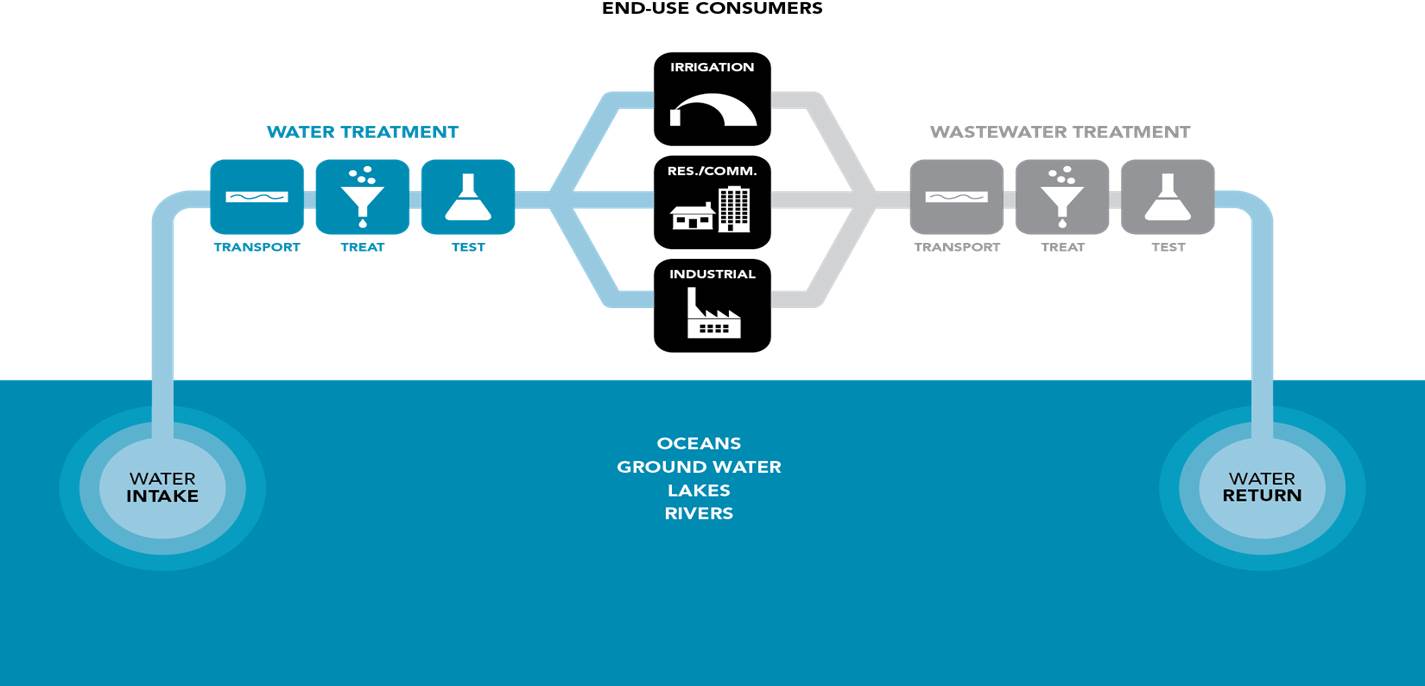
The Equipment and Services market addresses the key processes of the water industry, which are best illustrated through the cycle of water, as depicted in Figure 2, below. We believe this industry has two distinct sectors within the cycle of water: Water Infrastructure and Usage Applications. The key processes of this cycle begin when raw water is extracted by pumps, which provide the necessary pressure and flow, to move or transport, this water from natural sources, such as oceans, groundwater, lakes and rivers, through pipes to treatment facilities. Treatment facilities can provide many forms of treatment, such as filtration, disinfection and desalination, to remove solids, bacteria, and salt, respectively. Throughout each of these stages, analytical instruments test the water to ensure regulatory requirements are met so that it can be utilized by end-use customers. A network of pipes and pumps again transports this clean water to where it is needed, such as to crops for irrigation, to power plants to provide cooling in industrial water, or to an apartment building as drinking water in residential and commercial buildings. After usage, the wastewater is collected by a separate network of pipes and pumps and transported to a wastewater treatment facility, where processes such as digestion deactivate and reduce the volume of solids, and disinfection purifies effluent water. Once treated, analytical instruments test the water to ensure regulatory requirements are met so that it can be discharged back to the environment, thereby completing the cycle.
Figure 2: Cycle of Water
In the Water Infrastructure sector, two primary end markets exist: public utility and industrial. The public utility market comprises public, private and public-private institutions that handle water and wastewater for mostly residential and commercial purposes. The industrial market involves the supply of water and removal of wastewater for industrial facilities. We view the main macro drivers of this sector to be water quality, the desire for energy-efficient products, water scarcity, regulatory requirements and infrastructure needs, for both the repair of aging systems in developed countries as well as new installations in emerging markets.
In the Usage Applications sector, end-use customers fall into four main markets: residential, commercial, industrial and agricultural. Homeowners represent the end users in the residential market. Owners and managers of properties such as apartment buildings, retail stores, institutional buildings, restaurants, schools, hospitals and hotels are examples of end users in the commercial market. The industrial market is wide ranging, involving OEMs, exploration and production firms, and developers and managers of facilities operated by electrical power generators, chemical manufacturers, machine shops, clothing manufacturers, beverage dispensing and food processing firms, and car washes. The agricultural market end users are owners and operators of businesses such as crop and livestock farms, aquaculture, golf courses, and other turf applications. We believe population growth, urbanization and regulatory requirements are the primary macro drivers of these markets, as these trends drive the need for housing, food, community services and retail goods within growing city centers. Water reuse and conservation are driving the need for new technologies.
Business Strategy
Our strategy is to enhance shareholder value by providing distinctive solutions for our customers' most important water productivity, quality and resilience challenges, enabling us to grow revenue, organically and through strategic acquisitions, as we streamline our cost structure. Key elements of our strategy are summarized below:
| • | Accelerate Profitable Growth. To achieve our goal of accelerating growth, we have identified the following five priorities: |
| • | Emerging Market Growth - We seek to accelerate our growth in priority emerging markets through increased focus on product localization and channel development. |
| ▪ | Innovation - We seek to enhance the Company’s innovation efforts with increased focus on disruptive technologies that can significantly improve customers’ water productivity, quality and resilience. |
| • | Industry vertical marketing - We are strengthening vertical marketing capabilities for key end markets to bring the full breadth of the Company’s portfolio to bear on critical customer challenges. |
| • | Commercial team effectiveness - We continue to strengthen our regional commercial teams, including through the global adoption of improved commercial information technology tools, such as customer relationship management software. |
| • | Mergers and acquisitions - We continue to evaluate and, where appropriate, will act upon attractive acquisition candidates to accelerate our growth, including into new markets. |
| • | Build a Continuous Improvement Culture. We seek to embed continuous improvement into our culture and simplify our organizational structure to make the Company more agile, more profitable, and create room to re-invest in growth. To accomplish this, we will continue to strengthen our lean six sigma and global strategic sourcing capabilities, and continue to optimize our cost structure by eliminating unnecessary costs and inefficient overhead. |
| • | Build Superior Leadership and Talent Development. We seek to continue to invest in attracting, developing and retaining world-class talent with an increased focus on leadership and talent development programs. We will continue to align individual performance to the objectives of the Company and its shareholders. |
| • | Build a Culture of Execution and Accountability. We seek to ensure the impact of these strategic focus areas by holding our people accountable and streamlining our performance management and goal deployment systems. |
Business Segments
We have two reportable business segments that are aligned with the cycle of water and the key strategic market applications they provide: Water Infrastructure (collection, distribution, return) and Applied Water (usage). See Note 21, “Segment and Geographic Data,” in our consolidated financial statements for financial information about segments and geographic areas.
The table and descriptions below provide an overview of our business segments.
| Market Applications | 2014 Revenue (in millions) | % Revenue | Major Products | Primary Brands | |||||||||
| Water Infrastructure | Transport | $ | 1,779 | 73 | % | • Water and wastewater pumps • Filtration, disinfection and biological treatment equipment • Test equipment • Controls | • Flygt • WEDECO • Godwin • WTW • Sanitaire • YSI • Leopold | ||||||
| Treatment | 348 | 14 | % | ||||||||||
| Test | 315 | 13 | % | ||||||||||
| $ | 2,442 | 100 | % | ||||||||||
| Applied Water | Building Services | $ | 781 | 53 | % | • Pumps • Valves • Heat exchangers • Controls • Dispensing equipment systems | • Goulds Water Technology • Bell & Gossett • A-C Fire Pump • Standard Xchange • Lowara • Jabsco • Flojet • Flowtronex | ||||||
| Industrial Water | 592 | 40 | % | ||||||||||
| Irrigation | 101 | 7 | % | ||||||||||
| $ | 1,474 | 100 | % | ||||||||||
Water Infrastructure
Water Infrastructure involves the process that collects water from a source and distributes it to users, and then returns the wastewater responsibly to the environment. Within the Water Infrastructure segment, our pump systems transport water from oceans, groundwater, aquifers, lakes, rivers and seas. From there, our filtration, ultraviolet ("UV") and ozone systems provide treatment, making the water fit for use. After consumption, our pump lift stations move the wastewater to treatment facilities where our mixers, biological treatment, monitoring, and control systems provide the primary functions in the treatment process. Throughout each of these stages, our analytical systems test to ensure quality of water for consumption as well as for its return to nature. Water Infrastructure serves its customers, public utilities and industrial applications, through three closely linked applications: Transport, Treatment and Test of water and wastewater. We estimate our served market size in this sector to be approximately $20 billion.
Transport
The Transport application includes all of the equipment and services involved in the safe and efficient movement of water from sources such as oceans, groundwater, aquifers, lakes, rivers and seas to treatment facilities, and then to users. It also includes the movement of wastewater from the point of use to a treatment facility and then back into the environment. Finally, the Transport application also includes dewatering pumps, equipment and services which provide the safe removal or draining of groundwater and surface water from a riverbed, construction site or mine shaft. We offer a wide range of highly engineered products such as water and wastewater submersible pumps, monitoring controls, and application solutions; we do not serve the market for lower-value equipment such as pipes and fittings. We primarily employ configure-to-order capabilities to maximize manufacturing and logistics efficiencies by producing high volumes of basic product configurations. When we provide a configure-to-order solution, we configure a standard product to our customers’ specifications. To a lesser extent, we provide engineer-to-order products to meet the customization requirements of our customers. This process requires that we apply our technical expertise and production capabilities to provide a non-standard solution to the customer. We believe our business is one of the largest players in this served market based on management estimates. With operations on six continents, we also have one of the world’s largest dewatering rental fleets, serviced with our Flygt and Godwin brands. In our Water Infrastructure Segment, Transport accounted for approximately 73% of our segment revenue in 2014, 74% in 2013 and 73% in 2012.
Flygt — Flygt is a world-leader in the design and manufacture of dry and submersible pumps and related intelligent controls systems. Under the Flygt banner, customers have access to a complete range of products and solutions for moving water, wastewater, and advanced monitoring and control equipment to optimize their use. Founded in Sweden in 1901, Flygt is the originator of the reliable, energy-efficient electrical submersible pump. Flygt products have applications in various markets, including wastewater lift stations, water and wastewater treatment facilities, pressurized sewage systems, oil and gas, steel, mining and leisure markets. Customers include public utility and industrial water and wastewater systems operators. In 2012, Xylem successfully launched Flygt Experior which brings together advanced controls, hydraulics and energy-efficient motor technology to deliver substantial energy savings. During 2014, we won a large contract to provide large custom-made Flygt pumps for the Xayaburi run-of-river hydropower dam in Laos. The construction of the dam allows water to be kept within the river’s course and minimally raises the water level to allow fish migration between the Upper and Lower Mekong Rivers, while providing electricity to about 1 million people in Laos and 3 million people in Thailand.
Godwin — With more than 35 years as a leader in pump manufacturing and applications, Godwin has established itself as a well-recognized, market leading brand in the global portable pump market. Godwin manufactures, sells, rents and services its products. Its quick response and 24/7 capabilities allow it to provide customized pumping solutions to meet the specific needs of its customers. Founded in Quenington, England, Godwin is currently headquartered in Bridgeport, New Jersey. Godwin's products include fully automatic self-priming Dri-Prime® pumps, a full range of Flygt electric submersible pumps, Heidra hydraulic submersible pumps, Wet-Prime gasoline-powered contractor pumps and a broad line of generators and portable light towers, as well as a multitude of pumping accessories and pipe. Godwin products are primarily used in construction, water & wastewater transport, oil & gas markets, hydraulic fracturing, industrial, mining, and municipal, as well as government, temporary fire protection, environmental, agriculture, and marine. Godwin products are also instrumental in disaster relief efforts. After Superstorm Sandy hit the United States in October 2012, Godwin's pumps were instrumental in minimizing or preventing flood damage in various flooded regions throughout the Northeast. Godwin's fleet of equipment is rented through 45 U.S. branches and a global network of distributors and Xylem rental and sales facilities.
Treatment
The Treatment application includes equipment and services that treat both water for consumption and wastewater to be returned responsibly to the environment. Primary served markets include public utilities and industrial operations. While there are several treatment solutions in the market today, we focus on three basic treatment types: (i) filtration, (ii) disinfection systems and (iii) biological treatment systems. Filtration uses gravity-based media filters and clarifiers to clean both water and wastewater. Leopold, with more than 90 years of experience, is our leading filtration brand. Disinfection systems, both UV and ozone oxidation, treat both public utility drinking water and wastewater, as well as industrial process water, and are provided through our WEDECO brand. Biological treatment systems are key to the treatment and mixing of solids in wastewater plants, which are provided through our Sanitaire and Flygt brands. We believe our business is one of the largest players in this served market based on management estimates. In our Water Infrastructure Segment, Treatment accounted for approximately 14% of our segment revenue in both 2014 and 2013, and 15% in 2012.
Leopold — Founded in 1924 in Pittsburgh, Pennsylvania, Leopold is a leader in rapid gravity media filtration and clarification solutions for the water and wastewater industry. In potable drinking water treatment plants, the Clari-DAF system is used to clarify raw water to remove contaminants such as turbidity, algae, color, iron/manganese, organics, and taste and odor compounds. Several years ago, we augmented our filtration products with membrane technology. Our filtration products include the rapid gravity media, membranes and reverse osmosis/ultrafine filtration. Leopold gravity media filtration is used in potable water treatment plants to remove particulate in the final filtration step. In public utility wastewater treatment plants, the ClariVAC system is used in final clarifiers to remove the sludge solids. For those areas where nitrogen and phosphorus nutrient removal is required, we provide elimi-NITE systems which convert the filters to become biologically active so that the effluent meets the mandated nitrate and phosphorus levels. In desalination systems, Leopold Clari-DAF® systems and Filterworx systems are provided to remove contaminants that will harm reverse osmosis membranes, so that salt can be removed from the seawater to make it potable. Primary customers are public utility water and wastewater systems, as well as desalination plant facilities. During 2014, Leopold launched Oxelia, which is a cutting-edge, ozone-enhanced biologically active filtration system and multi-barrier solution for municipal wastewater treatment. Oxelia combines ozone, filtration and analytical instrumentation to deliver optimal wastewater treatment for water reuse, as well as discharge into sensitive water.
WEDECO — WEDECO was founded in 1975 in Herford, Germany to develop chemical-free and environmentally-friendly water treatment technologies, including UV light and ozone systems. There are more than 250,000 installed WEDECO systems for UV disinfection and ozone oxidation globally in private, public utility and industrial locations. WEDECO introduced ozone technology in 1988 and has been expanding internationally ever since. UV disinfection systems have a number of applications including water treatment and aquaculture. Ozone disinfection systems have applications in drinking water, wastewater, process water, product polishing, bleaching, ozonolysis/synthesis and deodorization. Customers include public utility wastewater and clean water treatment facilities, power plants, pulp and paper mills, food product manufacturers and aquaculture facilities. During 2014, we won a large contract with Bahrain’s Ministry of Works to upgrade a wastewater treatment facility in Manama, the capital city of Bahrain. The Company will design, install and commission an expansion and upgrade of the existing Wedeco ozone systems at the Tubli Water Pollution Control Centre which will increase the capacity of the wastewater treatment facility from 200,000 to 240,000 cubic meters per day. The enhanced wastewater reuse capacity is necessary for irrigation purposes in the area and will benefit the local agriculture and horticulture sectors in particular.
Sanitaire — Launched in 1967, the Sanitaire brand provides complete biological wastewater treatment solutions for public utility and industrial applications. Sanitaire’s comprehensive offering includes diffused aeration, sequencing batch reactors, drum filters and state-of-the-art controls that drive efficient operations. Sanitaire is regarded as a leading brand in diffused aeration, which is a process that introduces air into a liquid, providing an aerobic environment for degradation of organic matter. Fine-pore diffusion of air is highly competitive due to its high oxygen transfer efficiency and lower energy costs. Sanitaire wide-band aeration systems are used in applications such as grit chambers and sludge that require non-clogging, maintenance-free systems. Principal Sanitaire customers are public utility and industrial wastewater treatment facilities. In 2013, Xylem launched the Sanitaire OSCAR process performance optimization system. When combined with Sanitaire’s advanced aeration system, Xylem was able to deliver 65 percent energy savings to the operators of the Sterno, Sweden wastewater treatment plant.
Flygt — Flygt is also a world-leader in the design and manufacturing of submersible, jet and top-entry mixers. Flygt has over 30 years of expertise in the area of wastewater treatment mixing, as well as over 100,000 applications globally. Submersible mixers are often used in sewage treatment plants to keep solids in suspension in the various process tanks and/or sludge holding tanks. In 2013, Xylem won an order to provide Flygt submersible mixers for the
Panama Canal. The project includes four anti-sedimentation mixers at each lock gate of a new Panama Canal channel, as well as local electrical panels and accessories.
Test
Analytical instrumentation is used across most industries to ensure regulatory requirements are met. Growth in this market is primarily driven by increasing regulation of water and wastewater in North America, Europe and Asia. Our served market is predominately focused on water and the environment for quality levels throughout the water infrastructure loop. Analytical systems are applied in three primary ways: in the field, in a facility laboratory, or real time, online monitoring in a treatment facility process. We believe we have a leading position in this served market based on management estimates. In our Water Infrastructure Segment, Test accounted for approximately 13% of our segment revenue in 2014 and 12% in both 2013 and 2012.
WTW — In wastewater treatment facilities, WTW-branded systems monitor parameters such as dissolved oxygen, pH, and turbidity throughout the water process to ensure regulatory standards are met before water is discharged back into the environment. Founded in 1945, as a major brand in Europe, WTW has strong market penetration in the environmental, water and wastewater segments. WTW holds leading market positions in on-line instrumentation and manufactures premium positioned robust and reliable analysis products for the measurement of pH, dissolved oxygen, conductivity, total dissolved solids, turbidity, specific ions and biological oxygen demand. WTW’s product offering includes meters, sensors, data-loggers, photometers and software providing customer solutions for even the most challenging applications. WTW instruments have been placed in major monitoring stations around the globe to monitor water quality. One of our largest installations is in the Yangtze river station in China.
YSI — Yellow Springs Instrument Company ("YSI"), founded in 1948, develops and manufactures sensors, instruments, software and data collection platforms for environmental and coastal water quality monitoring and testing. YSI holds a leading market position in surface water monitoring and sampling which includes equipment that allows users to measure multiple parameters simultaneously, including conductivity, dissolved oxygen, temperature, turbidity, depth or level, chlorophyll, blue green algae and pH, among others, in a variety of applications. YSI's SonTek Division designs and manufactures acoustic Doppler instruments which provide water velocity measurements for oceans, rivers, lakes, harbors, canals, estuaries and laboratories. YSI also offers Life Sciences products including biochemical analyzers for bioprocess monitoring, food and beverage processing, and sports physiology. YSI instruments have become integral across Xylem as the technologies have enabled customers such as water treatment plants to meet their critical water and wastewater testing requirements while lowering energy costs and improving process efficiencies. The main market areas are water quality, environmental monitoring, aquaculture, life sciences and ocean research. YSI sensors played a critical role in monitoring water levels and providing other real-time data that helped track Superstorm Sandy which hit the Mid-Atlantic and Northeast United States in October of 2012.
Applied Water
Applied Water encompasses the uses of water. Since water is used to some degree in almost every aspect of human, economic and environmental activity, this segment has a significant number of potential applications and we participate in all major areas of water demand. Irrigation applications constitute the majority of all water usage globally. Examples of what we provide include: boosting systems for farming irrigation, pumps for dairy operations, and rainwater reuse systems for small scale crop and turf irrigation. Industrial Water applications account for the next largest amount of global water consumption. Our pumps, heat exchangers, valves and controls provide cooling to power plants and manufacturing facilities, as well as circulation for food and beverage processing. The remaining portion of global water use resides in human and building consumption, where we deliver water boosting systems for drinking, heating, ventilation and air conditioning ("HVAC") and fire protection systems to Residential and Commercial Building Services. We estimate our served market size in this sector to be approximately $15 billion.
Residential & Commercial Building Services
This business is defined by four main uses of water in building services applications, such as in residential homes and commercial buildings, including offices, hotels, hospitals, schools, restaurants and malls. The first application is in HVAC, where Bell & Gossett and Lowara specialize in pumps and valves that are used in water-driven heating and cooling systems, along with heat exchangers, valves, and monitoring and control products that augment the system. The second is the supply of potable water for consumption, such as for drinking and hygiene. The Goulds Water Technology and Lowara brands provides pumps and boosting systems utilized within buildings, sourcing water from distribution networks or from wells. The third application is wastewater removal with sump and sewage pumps, provided by Bell & Gossett, Goulds Water Technology and Lowara. The fourth water-related building service
area is fire protection, where our AC Fire brand supplies full pump systems for emergency fire suppression. Bell & Gossett, Goulds Water Technology and Lowara have continued to innovate, focusing on providing industry-leading energy-efficient and intelligent pumps for the building services market; many of these products are more efficient than competitive devices. We believe our business is one of the largest players in this served market based on management estimates. In our Applied Water Segment, Building Services accounted for approximately 53% of our segment revenue in 2014, 50% in 2013 and 53% in 2012.
Industrial Water
Water is used in most industrial facilities to provide processing steps such as cooling, heating, cleaning and mixing. Our Goulds Water Technology and Lowara brands supply vertical multistage pumps to bring in source water or to boost pressure for purposes such as circulating water through a manufacturing facility to cool machine tools. Our Standard Xchange brand delivers heat exchangers for combined heat and power applications within power generation plants. We also service niche applications such as flexible impeller pumps for wine processing facilities served by our Jabsco brand, and water-based detergent dispensing and water circulation within car washes served by Flojet and Goulds Water Technology air-operated diaphragm and end suction pumps. Our boosting pumps are also increasingly being used in hydraulic fracturing applications. Across all these various end applications, we believe our business is the second largest player in this served market based on management estimates. In our Applied Water Segment, Industrial Water accounted for approximately 40% of our segment revenue in 2014, 43% in 2013 and 40% in 2012.
Irrigation
The irrigation business consists of irrigation-related equipment and services associated with bringing water from a source to the plant or livestock need, including hoses, sprinklers, center pivot and drip irrigation. We focus on the pumps and boosting systems that supply this ancillary equipment with water. Our Goulds Water Technology brand brings mixed flow pumps, and our Flowtronex group specializes in equipment "packaged solutions" incorporating monitoring and controls to optimize energy efficiency in irrigation delivery. Our Lowara brand also produces pumps for agriculture applications and irrigation of gardens and parks. We believe we have a leading position in this served market based on management estimates. In our Applied Water Segment, Irrigation accounted for approximately 7% of our segment revenue in each of 2014, 2013 and 2012.
As described above, the following brands and products are used across the applications in our Applied Water segment:
Goulds Water Technology — With origins dating back more than 150 years, Goulds Water Technology is a leading brand of centrifugal and turbine pumps, controllers, variable frequency drives and accessories for residential and commercial water supply and wastewater applications. Goulds Water Technology is a leader in the water technologies market with its line of residential water well pumps. The Goulds Water Technology product portfolio includes submersible and line shaft turbine, 4” submersible, jet, sump, effluent, sewage and centrifugal pumps for residential, agriculture and irrigation, sewage and drainage, commercial and light industrial use. Goulds Water Technology has various vertical configuration high pressure centrifugal pumps which are utilized for water boost, filtration and boiler feed applications in industrial environments. Goulds Water Technology submersible, deepwell or other pumps can be found in more than a quarter of the existing 15 million household wells and more than 380,000 public and community wells in the United States. Products for commercial wastewater include sewage, effluent and grinder pumps and packages. Agriculture products include pump and control products for irrigation, stockwater, wash systems, cooling systems and waste management, with turf irrigation products, including submersible and surface pumps for landscape and turf irrigation systems. We serve the building trades market with filtration, chilling, pressure boost, wash system, water supply, wastewater and boiler feed applications. We also have a range of standard cast iron and bronze end-suction and multistage pumps for various commercial applications. In 2014, the Company won a large project with a mining customer at the Kinross Fort Knox gold mine in Fairbanks, Alaska, which will address the customer’s water productivity needs. The project includes Goulds Water Technology turbine pump assemblies with motors for the mine’s barren booster pump supply, a process in which previously mined and processed ore is reprocessed through a leach field to pull more gold from the tailings.
Lowara — Founded in 1968 in Vicenza, Italy, Lowara is a leader in stainless steel pump manufacturing technology for water technology applications. The Lowara range of products includes submersible, sump, effluent, sewage, centrifugal pumps and booster packages for water supply and water pumping needs in the residential, agriculture, industrial, public utility, building service and commercial markets worldwide, with particular strength in Europe. Residential applications include pumps for pressurization, conditioning, fire-fighting systems, lifting stations and
dewatering. Agriculture applications include pumps for irrigation of gardens and parks. Industrial applications include drinking water, industrial washing equipment and machine tool cooling. The German water services company Erftverband implemented a comprehensive system of Lowara pumps and a Hydrovar speed control smart system to address complex water management needs in Korschenbroich and Kaarst, Germany during 2013.
Bell & Gossett — Founded in 1916 in Chicago, Illinois, Bell & Gossett ("B&G") is a leader in plumbing and water-based heating and air conditioning markets. Products are used in residential applications where single- or multi-family homes are heated with hot water or steam. Key products include circulating pumps, valves, and specialty products used in these systems. B&G also sells wastewater pumps for commercial and residential applications. In commercial applications, B&G provides a broad range of products, including a wide variety of pumps, heat exchangers, valves and controls for heating and air-conditioning systems, sump pumps for wastewater systems, condensate pumping systems for steam heating systems and a comprehensive line of energy-saving variable speed controls. Training is provided for building system design engineers at B&G’s industry renowned Little Red Schoolhouse in Morton Grove, Illinois which has educated more than 60,000 engineers. Key commercial building types include hospitals, schools, institutional buildings and data centers. B&G products are sold globally by independent manufacturer representatives and distributed locally by HVAC wholesalers. During 2014, the B&G brand Series e-1510 single stage end suction centrifugal pump won the Consulting-Specifying Engineer’s Product of the Year award, the premier award for new products in the HVAC, fire/life safety, electrical and plumbing systems engineering markets.
A-C Fire Pump — Allis-Chalmers Company ("A-C Fire Pump") was founded in the 1840s in Milwaukee, Wisconsin. It offers turnkey fire pump systems for commercial, residential and industrial applications. A-C Fire Pump designs and custom-builds a wide range of fire pump systems, including prefabricated packages and house units that meet every fire protection need. A-C Fire Pump products include In-Line Pumps, Vertical Turbine, Package Systems, Split Case (various series) and 13D Home Defender for residential fire pump service. The 13D Home Defender is designed to boost water pressure for automatic residential sprinkler systems. In addition to residential applications, turnkey fire pumping systems from A-C Fire Pump protect an increasing number of petrochemical facilities, commercial buildings and factories around the world. During 2014, we secured a large project in Bolivia to meet an energy customer’s water resilience needs by providing customized diesel-driven split case A-C Fire Pumps that will protect gas treatment plants, connecting pipelines and the base camp where workers reside.
Flowtronex — Flowtronex, founded in 1974 as Pumping Systems, Inc., began by producing some of the golf industry’s first prefabricated water pumping systems. The Silent Storm package and Pace Integrated Pump Controller are our two primary products sold into the golf market. In landscape, Flowtronex products, primarily the Floboy system, are sold to customers such as cities and nurseries. In golf, Flowtronex products are sold to golf course superintendents through our Toro Distribution partnership. Retrofit sales of golf pumping systems are sold through our FlowNet Service Network, a group of factory authorized service technicians that provide set up and start up, and service and repair of Flowtronex pump stations. During 2014, we launched the Oasis EX, a new pump controller which delivers modern features, such as remote monitoring, Web-enabled controls and advanced water measurements, to maximize water and energy efficiency in pump stations, while also reducing operating costs and increasing productivity.
Standard Xchange — Since 1917, Standard Xchange has been the leader in the design and manufacture of shell and tube heat exchangers. Standard Xchange is the brand of our complete line of heat transfer products used in industrial and process applications such as heating or cooling liquids or gases, heat recovery in chemical processing, power and co-generation, paper and pulp, OEMs and commercial marine markets. Products include basic shell-and-tube heat exchangers, air coolers, heat transfer coils, compact brazed, welded, gasketed plate units and packaged steam condensers. Standard Xchange heat exchangers provide cooling for many of the major turbine manufacturers in electrical power generation plants around the world.
Jabsco — The Jabsco brand is known for its marine, industrial, and hygienic/sanitary pumps and systems that are used in many industries, including marine, industrial, healthcare and food processing. It was founded in 1938 by the inventors of the flexible impeller pump. Jabsco is a leader in the leisure marine market, with a broad range of products including water system, engine cooling pumps, searchlights and marine waste systems. Jabsco also offers industrial pumps for hygienic applications, fluid transfer in chemical processing, laboratory, paint processing, plating, and construction. Jabsco rotary lobe pumps offer outstanding performance with unique capabilities. Jabsco Hy-line and Ultima rotary lobe pumps support food and dairy product production, healthcare, chemical, pharmaceutical and biotech applications, whether the product is thin, viscous or fragile. Jabsco also offers multi-purpose and specialized flexible impeller, diaphragm and sliding vane pumps for chemical and general transfer applications. Jabsco marine products can be found under the decks of millions of pleasure boats around the world.
Flojet — Established in 1975, the Flojet brand encompasses a broad range of small pumps, motors and dispensing pumps for the beverage, industrial, recreational vehicle, marine and food processing markets. Flojet is a leader in the small pump market, offering a versatile range of products serving the beverage market, including both air- and motor-operated diaphragm pumps and centrifugal chilling pumps, as well as booster systems and accumulator tanks. Flojet’s beverage pumps can be found in applications such as beer dispensing, syrup mixing for carbonated drinks, re-circulation in vending machines and refrigerators, bottled water dispensers, icemakers and coffee machines. In addition to significant beverage applications, Flojet’s electric and air-operated diaphragm pumps are utilized in street sweepers, car washes, carpet cleaners, parts washers, agricultural spraying and road rollers. Flojet’s positive displacement diaphragm pumps can be driven by air, electric motor or solenoid. The positive displacement diaphragm design of Flojet pumps makes them ideal for use in conditions that require self-priming and dry running capability for short periods of time. Additionally, the compact size of these pumps makes them very useful in tight spaces where one cannot ensure a flooded suction. Flojet pumps are designed to be more efficient and are often the choice of customers for applications where low power consumption is critical. Xylem services many of the world's leading beverage producers. During 2014, the Company launched Filtration by Flojet, which is a system that uses integrated membrane pre-activated carbon technology to improve water taste and appearance, better protect dispense equipment and mitigate health concerns in food-service applications.
Geographic Profile
The table below illustrates the annual revenue and percentage of revenue by geographic area for each of the three years ended December 31, 2014.
| Revenue | ||||||||||||||||||||
| (in millions) | 2014 | 2013 | 2012 | |||||||||||||||||
| $ Amount | % of Total | $ Amount | % of Total | $ Amount | % of Total | |||||||||||||||
| United States | $ | 1,477 | 38 | % | $ | 1,434 | 38 | % | $ | 1,400 | 37 | % | ||||||||
| Europe | 1,379 | 35 | % | 1,387 | 36 | % | 1,338 | 35 | % | |||||||||||
| Asia Pacific | 478 | 12 | % | 467 | 12 | % | 469 | 12 | % | |||||||||||
| Other | 582 | 15 | % | 549 | 14 | % | 584 | 16 | % | |||||||||||
| Total | $ | 3,916 | $ | 3,837 | $ | 3,791 |
In addition to the traditional markets of the United States and Europe, opportunities in emerging markets within Asia Pacific, Eastern Europe, Latin America and other countries are growing. Revenue derived from emerging markets comprised 21%, 19% and 20% of our revenue in 2014, 2013 and 2012, respectively.
The table below illustrates the property, plant & equipment and percentage of property, plant & equipment by geographic area for each of the three years ended December 31, 2014.
| Property, Plant & Equipment | ||||||||||||||||||||
| (in millions) | 2014 | 2013 | 2012 | |||||||||||||||||
| $ Amount | % of Total | $ Amount | % of Total | $ Amount | % of Total | |||||||||||||||
| United States | $ | 180 | 39 | % | $ | 186 | 38 | % | $ | 183 | 38 | % | ||||||||
| Europe | 206 | 45 | % | 225 | 46 | % | 219 | 45 | % | |||||||||||
| Asia Pacific | 53 | 11 | % | 45 | 9 | % | 65 | 13 | % | |||||||||||
| Other | 22 | 5 | % | 32 | 7 | % | 20 | 4 | % | |||||||||||
| Total | $ | 461 | $ | 488 | $ | 487 |
Distribution, Training and End Use
Water Infrastructure provides the majority of its sales through direct channels with remaining sales through indirect channels and service capabilities. Both public utility and industrial facility customers increasingly require our teams’ global but locally proficient expertise to use our equipment in their specific applications. Several trends are increasing the need for this application expertise: (i) the increase in type and amount of contaminants in water supply, (ii) increasing environmental regulations, (iii) the need to increase system efficiencies to optimize energy costs, and (iv) the retirement of a largely aging water industry workforce not systematically replaced at utilities.
In the Applied Water segment, many end-use areas are widely different, so specialized distribution partners are often preferred. Our commercial teams have built long-standing relationships around our brands in many of these industries through which we can continue to leverage new product and service applications. Revenue opportunities are balanced between OEMs and after-market customers. Our products in the Applied Water segment are sold through our global direct sales and strong indirect channels with the majority of revenue going through indirect channels. We have long-standing relationships with many of the leading independent distributors in the markets we serve, and we provide incentives to distributors, such as specialized loyalty and training programs.
Aftermarket Parts and Service
During their lifecycle, installed products require maintenance, repair services and parts due to the harsh environments in which they operate. We have many service centers around the world, which employ service employees to provide aftermarket parts and services to our large installed base of customers. Service centers offer an array of integrated service solutions for the industry including: preventive monitoring, contract maintenance, emergency field service, engineered upgrades, inventory management, and overhauls for pumps and other rotating equipment.
Depending on the type of product, median lifecycles range from five years to over 50 years, at which time they must be replaced. Many of our products are precisely selected and applied within a larger network of equipment driving a strong preference by customers and installers to replace them with the same exact brand and model when they reach the end of their lifecycle. This dynamic establishes a large recurring revenue stream for our business.
Supply and Seasonality
We have a global manufacturing footprint, with production facilities in Europe, North America, Latin America, and Asia. Our inventory management and distribution practices seek to minimize inventory holding periods by striving to take delivery of the inventory and manufacturing as close as possible to the sale or distribution of products to our customers. All of our businesses require various parts and raw materials, of which the availability and prices may fluctuate. Parts and raw materials commonly used in our products include motors, fabricated parts, castings, bearings, seals, nickel, copper, aluminum, and plastics. While we may recover some cost increases through operational improvements, we are still exposed to some pricing risk. We attempt to control costs through fixed-priced contracts with suppliers and various other programs, such as our global strategic sourcing initiative.
Our business relies on third-party suppliers, contract manufacturing and commodity markets to secure raw materials, parts and components used in our products. We typically acquire materials and components through a combination of blanket and scheduled purchase orders to support our materials requirements. For most of our products, we have existing alternate sources of supply, or such sources are readily available.
We may experience price volatility or supply constraints for materials that are not available from multiple sources. From time to time, we acquire certain inventory in anticipation of supply constraints or enter into longer-term pricing commitments with vendors to improve the priority, price and availability of supply. There have been no raw material shortages that have had a significant adverse impact on our business as a whole.
Our Water Infrastructure and Applied Water segments experience some modest level of seasonality in its business. This seasonality is dependent on factors such as capital spending of customers as well as weather conditions, including heavy flooding, droughts, and fluctuations in temperatures, which can positively or negatively impact portions of our business.
Customers
Our business is not dependent on any single customer or a few customers, the loss of which would have a material adverse effect on our Water Infrastructure or Applied Water segments or on the Company as a whole. No individual customer accounted for more than 10% of our consolidated 2014, 2013 or 2012 revenue.
Backlog
Delivery schedules vary from customer to customer based upon their requirements. Typically, large projects require longer lead production cycles and delays can occur from time to time. Total backlog was $740 million at December 31, 2014 and $707 million at December 31, 2013. We anticipate that more than 85% of the backlog at December 31, 2014 will be recognized as revenue during 2015.
Competition
Given the highly fragmented nature of the water industry, the Water Infrastructure segment competes with a large number of businesses. Competition in the water transport and treatment technologies markets focuses on product performance, reliability and innovation, application expertise, brand reputation, energy efficiency, product life cycle cost, timeliness of delivery, proximity of service centers, effectiveness of our distribution channels and price. In the sale of products and services, we benefit from our large installed base of pumps and complementary products, which require maintenance, repair and replacement parts due to the nature of the products and the conditions under which they operate. Timeliness of delivery, quality and the proximity of service centers are important customer considerations when selecting a provider for after-market products and services as well as equipment rentals. In geographic regions where we are locally positioned to provide a quick response, customers have historically relied on us, rather than our competitors, for after-market products relating to our highly engineered and customized solutions. Our key competitors within the Water Infrastructure segment include KSB Inc., Sulzer Ltd., Evoqua Water Technologies (formerly Siemens AG) and Danaher Corporation.
Competition in the Applied Water segment focuses on brand equity, application expertise, product delivery and performance, quality, and price. We compete by offering a wide variety of innovative and high-quality products, coupled with world-class application expertise. We believe our distribution through well-established channels and our reputation for quality significantly enhance our market position. Our ability to deliver innovative product offerings has allowed us to compete effectively, to cultivate and maintain customer relationships and to serve and expand into many niche and new markets. Our key competitors within the Applied Water segment include Grundfos, Wilo SE, Pentair Ltd. and Franklin Electric Co., Inc.
Research and Development
Research and development (“R&D”) is a key element of our engineering culture and is generally focused on the design and development of products and application know-how that anticipate customer needs and emerging trends. Our engineers are involved in new product development and improvement of existing products. Our businesses invest substantial resources for R&D. We anticipate we will continue to develop and invest in our R&D capabilities to promote a steady flow of innovative, high-quality and reliable products and applications to further strengthen our position in the markets we serve. We invested $104 million, $104 million, and $106 million for the years ended December 31, 2014, 2013 and 2012, respectively, in R&D.
We have engineering and research employees in technology centers around the world. R&D activities are initially conducted in our technology centers, located in conjunction with some of our major manufacturing facilities to ensure an efficient development process. We have a Center of Excellence in Stockholm, Sweden, with research, development and engineering employees. We have Centers of Excellence in India and China, where we are accelerating the customization of our application expertise to local needs. In the scale-up process, our R&D activities are conducted at our piloting and testing facilities or at strategic customer sites. These piloting and testing facilities enable us to serve our strategic markets in each region of the world.
Intellectual Property
We generally seek patent protection for those inventions and improvements that we believe will improve our competitive position. We believe that our patents and applications are important for maintaining the competitive differentiation of our products and improving our return on research and development investments. While we own, control or license a significant number of patents, trade secrets, proprietary information, trademarks, trade names, copyrights, and other intellectual property rights which, in the aggregate, are of material importance to our business, management believes that our business, as a whole, as well as each of our core business segments, is not materially dependent on any one intellectual property right or related group of such rights.
Patents, patent applications, and license agreements expire or terminate over time by operation of law, in accordance with their terms or otherwise. As the portfolio of our patents, patent applications, and license agreements has evolved over time, we do not expect the expiration of any specific patent to have a material adverse effect on our financial position or results of operations.
Environmental Matters and Regulation
Our manufacturing operations worldwide are subject to many requirements under environmental laws. In the United States, the Environmental Protection Agency and similar state agencies administer laws and regulations concerning air emissions, water discharges, waste disposal, environmental remediation, and other aspects of environmental protection. Such environmental laws and regulations in the United States include, for example, the Federal Clean Air Act, the Clean Water Act, the Resource, Conservation and Recovery Act, and the Comprehensive Environmental Response, Compensation and Liability Act. Environmental requirements significantly affect our operations. We have established an internal program to address compliance with applicable environmental requirements and, as a result, management believes that we are in substantial compliance with current environmental regulations.
While environmental laws and regulations are subject to change, such changes can be difficult to predict reliably and the timing of potential changes is uncertain. Management does not believe, based on current circumstances, that compliance costs pursuant to such regulations will have a material adverse effect on our financial position or results of operations. However, the effect of future legislative or regulatory changes could be material to our financial condition or results of operations.
Accruals for environmental matters are recorded on a site-by-site basis when it is probable that a liability has been incurred and the amount of the liability can be reasonably estimated, based on current law and existing technologies. It can be difficult to estimate reliably the final costs of investigation and remediation due to various factors. Our accrued liabilities for these environmental matters represent the best estimates related to the investigation and remediation of environmental media such as water, soil, soil vapor, air and structures, as well as related legal fees based upon the facts and circumstances as currently known to us. These estimates, and related accruals, are reviewed quarterly and updated for progress of investigation and remediation efforts and changes in facts and legal circumstances. Liabilities for these environmental expenditures are recorded on an undiscounted basis. We do not anticipate these liabilities will have a material adverse effect on our consolidated financial position or results of operations. We cannot make assurances that other sites, or new details about sites known to us, that could give rise to environmental liabilities with such material adverse effects on us will not be identified in the future. At December 31, 2014, we had estimated and accrued $5 million related to environmental matters.
Employees
As of December 31, 2014, Xylem had approximately 12,500 employees worldwide. We have more than 3,700 employees in the United States, of whom approximately 17% are represented by labor unions, and in certain foreign countries, some of our employees are represented by work councils. We believe that our facilities are in favorable labor markets with ready access to adequate numbers of workers and believe our relations with our employees are good.
Company History and Certain Relationships
On October 31, 2011 (the "Distribution Date"), ITT completed the Spin-off (the “Spin-off”) of Xylem, formerly ITT’s water equipment and services businesses ("WaterCo"). The Spin-off was completed pursuant to the Distribution Agreement, dated as of October 25, 2011 (the “Distribution Agreement”), among ITT, Exelis Inc. (“Exelis”) and Xylem.
Available Information
We are required to file annual, quarterly and current reports, proxy statements and other information with the SEC. Our annual reports on Form 10-K, quarterly reports on Form 10-Q, current reports on Form 8-K, proxy statements and amendments to those reports are available free of charge on our website www.xyleminc.com as soon as reasonably practicable after such reports are electronically filed with or furnished to the SEC. The information on our website is not, and shall not be deemed to be, a part hereof or incorporated into this or any of our other filings with the SEC.
In addition, the public may read or copy any materials filed with the SEC at the SEC’s Public Reference Room located at 100 F Street NE, Washington, D.C. 20549. The public may also obtain information on the operation of the Public Reference Room by calling the SEC at 1-800-SEC-0330. These reports and other information are also available, free of charge, at www.sec.gov.
Previous: Cover and table of contents · Next: Item 1A. RISK FACTORS