 filings.tools
Item 1. BUSINESS
40K characters. Original on sec.gov · Markdown
Item 1. BUSINESS
Business Overview
Xylem, with 2015 revenue of $3.7 billion and approximately 12,700 employees, is a world leader in the design, manufacturing, and application of highly engineered technologies for the water industry. We are a leading equipment and service provider for water and wastewater applications with a broad portfolio of products and services addressing the full cycle of water, from collection, distribution and use to the return of water to the environment. We have leading market positions among equipment and service providers in the core application areas of the water equipment industry: transport, treatment, test, building services, industrial processing and irrigation. Our Company’s brands, such as Bell & Gossett and Flygt, are well known throughout the industry and have served the water market for many years.
We serve a global customer base across diverse end markets while offering localized expertise. We sell our products in approximately 150 countries through a balanced distribution network consisting of our direct sales force and independent channel partners. In 2015, 59% of our revenue was generated outside the United States, with 21% of revenue generated in emerging markets.
Our Industry
Our planet faces a serious water challenge. Less than 1% of the total water available on earth is fresh water, and this percentage is declining due to factors such as the draining of aquifers, increased pollution and climate change. In addition, demand for fresh water is rising rapidly due to population growth, industrial expansion, and increased agricultural development, with consumption estimated to double every 20 years. By 2025, more than 30% of the world’s population is expected to live in areas without adequate water supply. Even in developed countries with sufficient clean water supply, existing infrastructure for water supply is aging and inadequately funded. In the United States, degrading pipe systems leak one out of every six gallons of water, on average, on its way from a treatment plant to the customer. These challenges are driving opportunities for growth in the global water industry, which we estimate to have a total market size of approximately $550 billion. We estimate our total served market size to be approximately $37 billion.
We view these challenges through the lens of water productivity, water quality and resilience. Water productivity refers to the more efficient delivery and use of clean water. Water quality refers to the efficient and effective management of wastewater. Resilience refers to the management of water-related risks and the resilience of water infrastructure. The Company’s customers often face all three of these challenges, ranging from inefficient aging water distribution networks (which require increases in “water productivity”); energy-intensive or unreliable wastewater management systems (which require increases in “water quality”); or exposure to natural disasters such as floods or droughts (which require increases in “resilience”). Delivering value in these areas creates significant opportunity for the Company.
The water industry supply chain is comprised of Equipment and Services companies, Design and Build service providers, and Utilities. Equipment and Service providers serve distinct customer types. The Utilities supply water through an infrastructure network. Supply chain companies provide single, or sometimes combined, functions from equipment manufacturing and services to facility design (engineering, procurement and construction, or “EPC” firms) to plant operations (Utilities), as depicted below in Figure 1. The Utilities and EPC customers are looking for technology and application expertise from their Equipment and Services providers to address trends such as rising pollution, stricter regulations, and the increased outsourcing of process knowledge. The end users of water consist of a wide array of entities, including farms, mines, power plants, industrial facilities and residential homes. These customers are predominately served through specialized distributors and original equipment manufacturers (“OEMs”).
Figure 1: Water Industry Supply Chain

Our business focuses on the beginning of the supply chain by providing technology-intensive equipment and services. We sell our equipment and services via direct and indirect channels that serve the needs of each customer type. On the utility side, we provide the majority of our sales direct to customers with strong application expertise, with the remaining amount going through distribution partners. To end users of water, we provide the majority of our sales through long-standing relationships with the world’s leading distributors, with the remainder going direct to customers.
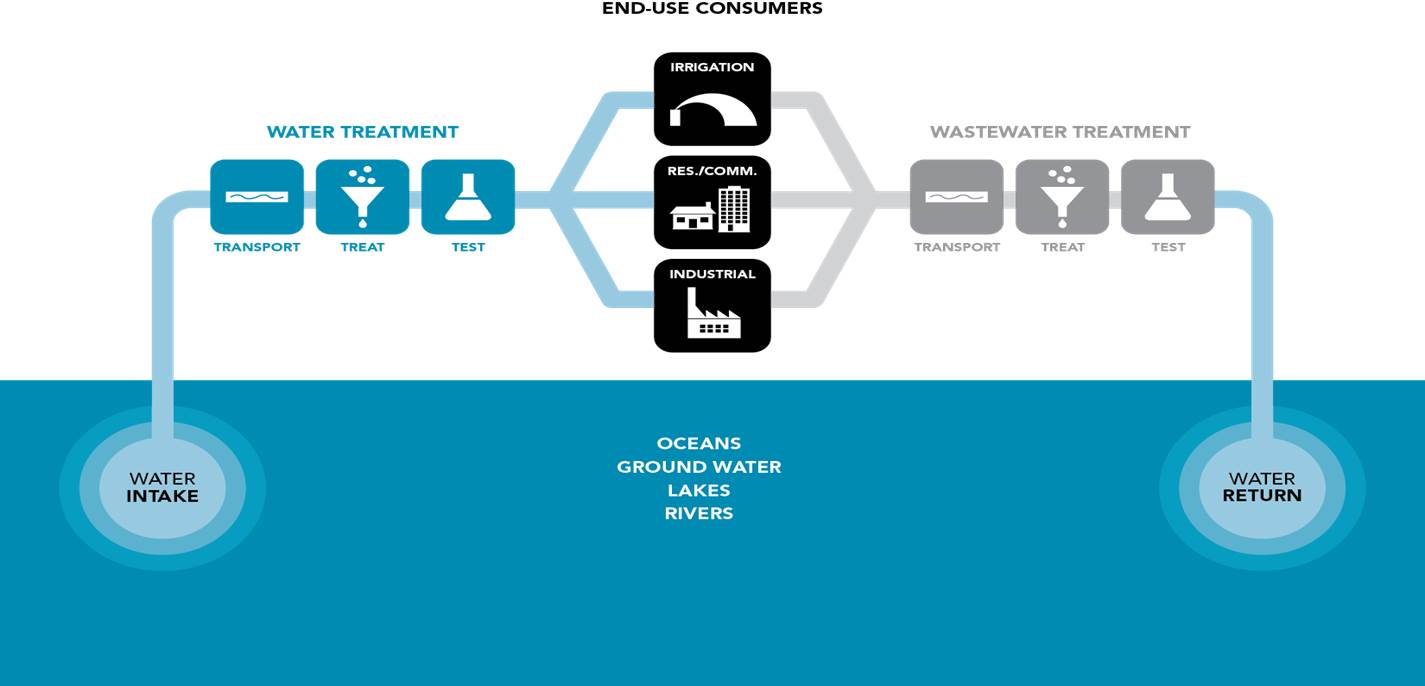
The Equipment and Services market addresses the key processes of the water industry, which are best illustrated through the cycle of water, as depicted in Figure 2, below. We believe this industry has two distinct sectors within the cycle of water: Water Infrastructure and Usage Applications. The key processes of this cycle begin when raw water is extracted by pumps, which provide the necessary pressure and flow, to move or transport, this water from natural sources, such as oceans, groundwater, lakes and rivers, through pipes to treatment facilities. Treatment facilities can provide many forms of treatment, such as filtration, disinfection and desalination, to remove solids, bacteria, and salt, respectively. Throughout each of these stages, analytical instruments test the water to ensure regulatory requirements are met so that it can be utilized by end-use customers. A network of pipes and pumps again transports this clean water to where it is needed, such as to crops for irrigation, to power plants to provide cooling in industrial water, or to an apartment building as drinking water in residential and commercial buildings. After usage, the wastewater is collected by a separate network of pipes and pumps and transported to a wastewater treatment facility, where processes such as digestion deactivate and reduce the volume of solids, and disinfection purifies effluent water. Once treated, analytical instruments test the water to ensure regulatory requirements are met so that it can be discharged back to the environment, thereby completing the cycle.
Figure 2: Cycle of Water
In the Water Infrastructure sector, two primary end markets exist: public utility and industrial. The public utility market comprises public, private and public-private institutions that handle water and wastewater for mostly residential and commercial purposes. The industrial market involves the supply of water and removal of wastewater for industrial facilities. We view the main macro drivers of this sector to be water quality, the desire for energy-efficient products, water scarcity, regulatory requirements and infrastructure needs, for both the repair of aging systems in developed countries as well as new installations in emerging markets.
In the Usage Applications sector, end-use customers fall into four main markets: residential, commercial, industrial and agricultural. Homeowners represent the end users in the residential market. Owners and managers of properties such as apartment buildings, retail stores, institutional buildings, restaurants, schools, hospitals and hotels are examples of end users in the commercial market. The industrial market is wide ranging, involving OEMs, exploration and production firms, and developers and managers of facilities operated by electrical power generators, chemical manufacturers, machine shops, clothing manufacturers, beverage dispensing and food processing firms, and car washes. The agricultural market end users are owners and operators of businesses such as crop and livestock farms, aquaculture, golf courses, and other turf applications. We believe population growth, urbanization and regulatory requirements are the primary macro drivers of these markets, as these trends drive the need for housing, food, community services and retail goods within growing city centers. Water reuse and conservation are driving the need for new technologies.
Business Strategy
Our strategy is to enhance shareholder value by providing distinctive solutions for our customers' most important water productivity, quality and resilience challenges, enabling us to grow revenue, organically and through strategic acquisitions, as we streamline our cost structure. Key elements of our strategy are summarized below:
| • | Accelerate Profitable Growth. To achieve our goal of accelerating growth, we have identified the following five priorities: |
| • | Emerging Markets - We seek to accelerate our growth in priority emerging markets through increased focus on product localization and channel development. |
| ▪ | Innovation & Technology - We seek to enhance the Company’s innovation efforts with increased focus on technologies and innovation that can significantly improve customers’ water productivity, quality and resilience. |
| • | Commercial Leadership - We are strengthening our capabilities by focusing on simplifying our commercial processes along with the supporting backend information technology systems. |
| • | Mergers and acquisitions - We continue to evaluate and, where appropriate, will act upon attractive acquisition candidates to accelerate our growth, including into new markets. |
| • | Drive Continuous Improvement. We seek to embed continuous improvement into our culture and simplify our organizational structure to make the Company more agile, more profitable, and create room to re-invest in growth. To accomplish this, we will continue to strengthen our lean six sigma and global procurement capabilities, and continue to optimize our cost structure through business simplification by eliminating structural, process and product complexity. |
| • | Leadership and Talent Development. We seek to continue to invest in attracting, developing and retaining world-class talent with an increased focus on leadership and talent development programs. We will continue to align individual performance to the objectives of the Company and its shareholders. |
| • | Focus on Execution and Accountability. We seek to ensure the impact of these strategic focus areas by holding our people accountable and streamlining our performance management and goal deployment systems. |
Business Segments
We have two reportable business segments that are aligned with the cycle of water and the key strategic market applications they provide: Water Infrastructure (collection, distribution, return) and Applied Water (usage). See Note 20, “Segment and Geographic Data,” in our consolidated financial statements for financial information about segments and geographic areas.
The table and descriptions below provide an overview of our business segments.
| Market Applications | 2015 Revenue (in millions) | % Revenue | Major Products | Primary Brands | |||||||||
| Water Infrastructure | Transport | $ | 1,624 | 73 | % | • Water and wastewater pumps • Filtration, disinfection and biological treatment equipment • Test equipment • Controls | • Flygt • Wedeco • Godwin • WTW • Sanitaire • YSI • Leopold | ||||||
| Treatment | 316 | 14 | % | ||||||||||
| Test | 291 | 13 | % | ||||||||||
| $ | 2,231 | 100 | % | ||||||||||
| Applied Water | Building Services | $ | 774 | 54 | % | • Pumps • Valves • Heat exchangers • Controls • Dispensing equipment systems | • Goulds Water Technology • Bell & Gossett • A-C Fire Pump • Standard Xchange • Lowara • Jabsco • Flojet • Flowtronex | ||||||
| Industrial Water | 562 | 40 | % | ||||||||||
| Irrigation | 86 | 6 | % | ||||||||||
| $ | 1,422 | 100 | % | ||||||||||
Water Infrastructure
Water Infrastructure involves the process that collects water from a source and distributes it to users, and then returns the wastewater responsibly to the environment. Within the Water Infrastructure segment, our pump systems transport water from oceans, groundwater, aquifers, lakes, rivers and seas. From there, our filtration, ultraviolet ("UV") and ozone systems provide treatment, making the water fit for use. After consumption, our pump lift stations move the wastewater to treatment facilities where our mixers, biological treatment, monitoring, and control systems provide the primary functions in the treatment process. Throughout each of these stages, our analytical systems test the quality of water for consumption as well as for its return to nature. Water Infrastructure serves its customers, public utilities and industrial applications, through three closely linked applications: Transport, Treatment and Test of water and wastewater. We estimate our served market size in this sector to be approximately $21 billion.
Transport
The Transport application includes all of the equipment and services involved in the safe and efficient movement of water from sources such as oceans, groundwater, aquifers, lakes, rivers and seas to treatment facilities, and then to users. It also includes the movement of wastewater from the point of use to a treatment facility and then back into the environment. Finally, the Transport application also includes dewatering pumps, equipment and services which provide the safe removal or draining of groundwater and surface water from a riverbed, construction site or mine shaft and bypass pumping for the repair of aging public utility infrastructure, as well as emergency water removal during severe weather events. We offer a wide range of highly engineered products such as water and wastewater submersible pumps, monitoring controls, and application solutions; we do not serve the market for lower-value equipment such as pipes and fittings. We primarily employ configure-to-order capabilities to maximize manufacturing and logistics efficiencies by producing high volumes of basic product configurations. When we provide a configure-to-order solution, we configure a standard product to our customers’ specifications. To a lesser extent, we provide engineer-to-order products to meet the customization requirements of our customers. This process requires that we apply our technical expertise and production capabilities to provide a non-standard solution to the customer. We believe our business is one of the largest players in this served market based on management estimates. With operations on six continents, we also have one of the world’s largest dewatering rental fleets. Our key brands for this application are Flygt and Godwin. Transport accounted for approximately 73% of our Water Infrastructure segment revenue in both 2015 and 2014, and 74% in 2013.
Treatment
The Treatment application includes equipment and services that treat both water for consumption and wastewater to be returned responsibly to the environment or reused. Primary served markets include public utilities and industrial operations. While there are several treatment solutions in the market today, we focus on three basic treatment types: (i) filtration systems, (ii) disinfection systems, (iii) biological treatment systems, including mixers. Our key brands for this application are Leopold, Wedeco, Sanitaire and Flygt. Filtration uses gravity-based media filters and clarifiers to clean both water and wastewater. Leopold, has been a worldwide leader in filtration for over 90 years. Wedeco offers chemical-free and environmentally friendly disinfection systems, both UV and ozone oxidation, to treat public utility drinking water, wastewater and industrial process water. Biological treatment systems are key to the treatment and mixing of solids in wastewater plants, which are provided through our Sanitaire and Flygt brands. We believe our business is one of the largest players in this served market based on management estimates. Treatment accounted for approximately 14% of our Water Infrastructure segment revenue in 2015, 2014 and 2013.
Test
Analytical instrumentation is used across most industries to ensure regulatory requirements are met. Growth in this market is primarily driven by increasing regulation of water and wastewater in North America, Europe and Asia. Our served market is predominately focused on water and the environment for quality levels throughout the water infrastructure loop. Analytical systems are applied in three primary ways: in the field, in a facility laboratory, or real time, online monitoring in a treatment facility process. We believe we have a leading position in this served market based on management estimates. Our key brands for this application are WTW and YSI. Test accounted for approximately 13% of our Water Infrastructure segment revenue in both 2015 and 2014, and 12% in 2013.
Applied Water
Applied Water encompasses the uses of water. Since water is used to some degree in almost every aspect of human, economic and environmental activity, this segment has a significant number of applications and we participate in all major areas of water demand. Residential and Commercial Building Services account for human and building consumption, where we deliver water boosting systems for drinking, heating, ventilation and air conditioning ("HVAC") and fire protection systems. Industrial Water applications account for water consumption activities that use pumps, heat exchangers, valves and controls to provide cooling to power plants and manufacturing facilities, as well as circulation for food and beverage processing. The remaining portion of global water use resides in irrigation applications. Examples of what we provide include: boosting systems for farming irrigation, pumps for dairy operations, and rainwater reuse systems for small scale crop and turf irrigation.We estimate our served market size in this sector to be approximately $16 billion.
Residential & Commercial Building Services
This business is defined by four primary uses of water in building services applications, such as in residential homes and commercial buildings, including offices, hotels, hospitals, schools, restaurants and malls. The first application is in HVAC, where Bell & Gossett and Lowara specialize in pumps and valves that are used in water-driven heating and cooling systems, along with heat exchangers, valves, and monitoring and control products that augment the system. The second is the supply of potable water for consumption, including drinking water and for hygienic purposes . The Goulds Water Technology, Lowara and Bell & Gossett brands provide pumps and boosting systems utilized within buildings, sourcing water from distribution networks or from wells. The third application is wastewater removal with sump and sewage pumps, provided by Bell & Gossett, Goulds Water Technology and Lowara. The fourth water-related building service area is fire protection, where our A-C Fire Pump brand supplies full pump systems for emergency fire suppression. Bell & Gossett, Goulds Water Technology and Lowara have continued to innovate, focusing on providing industry-leading energy-efficient and intelligent pumps for the building services market; many of these products are more efficient than competitive devices. We believe our business is one of the largest players in this served market based on management estimates. Building Services accounted for approximately 54% of our Applied Water segment revenue in 2015, 53% in 2014 and 50% in 2013.
Industrial Water
Water is used in most industrial facilities to provide processing steps such as cooling, heating, cleaning and mixing. Our Goulds Water Technology and Lowara brands supply vertical multistage pumps to bring in source water or to boost pressure for purposes, including water circulation through a manufacturing facility to cool machine tools. Our Standard Xchange brand delivers heat exchangers for combined heat and power applications within power generation plants. We also service niche applications such as wine processing with Jabsco brand flexible impeller pumps, and water-based detergent dispensing and water circulation for car washes served by Flojet air-operated
diaphragm and Goulds Water Technology end suction pumps. Our boosting pumps are also increasingly being used in hydraulic fracturing applications. We can support mines throughout exploration, development and operation. Our wide range of durable pumps ensures reliability that minimizes risks, maximizes uptime and delivers superior total cost of ownership. Across all these various end applications, we believe our business is the second largest player in this served market based on management estimates. Industrial Water accounted for approximately 40% of our Applied Water segment revenue in 2015 and 2014, and 43% in 2013.
Irrigation
The irrigation business consists of irrigation-related equipment and services associated with bringing water from a source to a production plant or livestock facility, including hoses, sprinklers, center pivot and drip irrigation systems. We focus on the pumps and boosting systems that supply this ancillary equipment with water. Our Goulds Water Technology brand brings mixed flow pumps, and our Flowtronex group specializes in equipment "packaged solutions" incorporating monitoring and controls to optimize energy efficiency in irrigation delivery. Our Lowara brand also produces pumps for agricultural applications and irrigation for gardens and parks. We believe we have a leading position in this served market based on management estimates. Irrigation accounted for approximately 6% of our Applied Water segment revenue in 2015, and 7% in 2014 and 2013.
Geographic Profile
The table below illustrates the annual revenue and percentage of revenue by geographic area for each of the three years ended December 31.
| Revenue | ||||||||||||||||||||
| (in millions) | 2015 | 2014 | 2013 | |||||||||||||||||
| $ Amount | % of Total | $ Amount | % of Total | $ Amount | % of Total | |||||||||||||||
| United States | $ | 1,490 | 41 | % | $ | 1,477 | 38 | % | $ | 1,434 | 38 | % | ||||||||
| Europe | 1,179 | 32 | % | 1,379 | 35 | % | 1,387 | 36 | % | |||||||||||
| Asia Pacific | 482 | 13 | % | 478 | 12 | % | 467 | 12 | % | |||||||||||
| Other | 502 | 14 | % | 582 | 15 | % | 549 | 14 | % | |||||||||||
| Total | $ | 3,653 | $ | 3,916 | $ | 3,837 |
In addition to the traditional markets of the United States and Europe, opportunities in emerging markets within Asia Pacific, Eastern Europe, Latin America and other countries are growing. Revenue derived from emerging markets comprised 21%, 21% and 19% of our revenue in 2015, 2014 and 2013, respectively.
The table below illustrates the property, plant & equipment and percentage of property, plant & equipment by geographic area for each of the three years ended December 31.
| Property, Plant & Equipment | ||||||||||||||||||||
| (in millions) | 2015 | 2014 | 2013 | |||||||||||||||||
| $ Amount | % of Total | $ Amount | % of Total | $ Amount | % of Total | |||||||||||||||
| United States | $ | 168 | 38 | % | $ | 180 | 39 | % | $ | 186 | 38 | % | ||||||||
| Europe | 189 | 43 | % | 206 | 45 | % | 225 | 46 | % | |||||||||||
| Asia Pacific | 56 | 13 | % | 53 | 11 | % | 45 | 9 | % | |||||||||||
| Other | 26 | 6 | % | 22 | 5 | % | 32 | 7 | % | |||||||||||
| Total | $ | 439 | $ | 461 | $ | 488 |
Distribution, Training and End Use
Water Infrastructure provides the majority of its sales through direct channels with remaining sales through indirect channels and service capabilities. Both public utility and industrial facility customers increasingly require our teams’ global but locally proficient expertise to use our equipment in their specific applications. Several trends are increasing the need for this application expertise: (i) the increase in type and amount of contaminants in water supply, (ii) increasing environmental regulations, (iii) the need to increase system efficiencies to optimize energy costs, (iv) the retirement of a largely aging water industry workforce not systematically replaced at utilities and other end user customers, and (v) the build-out of water infrastructure in the emerging markets.
In the Applied Water segment, many end-use areas are widely different, so specialized distribution partners are often preferred. Our commercial teams have built long-standing relationships around our brands in many of these industries through which we can continue to leverage new product and service applications. Revenue opportunities are balanced between OEMs and after-market customers. Our products in the Applied Water segment are sold
through our global direct sales and strong indirect channels with the majority of revenue going through indirect channels. We have long-standing relationships with many of the leading independent distributors in the markets we serve, and we provide incentives to distributors, such as specialized loyalty and training programs.
Aftermarket Parts and Service
During their lifecycle, installed products require maintenance, repair services and parts due to the harsh environments in which they operate. We have many service centers around the world, which employ service employees to provide aftermarket parts and services to our large installed base of customers. Service centers offer an array of integrated service solutions for the industry including: preventive monitoring, contract maintenance, emergency field service, engineered upgrades, inventory management, and overhauls for pumps and other rotating equipment.
Depending on the type of product, median lifecycles range from five years to over 50 years, at which time they must be replaced. Many of our products are precisely selected and applied within a larger network of equipment driving a strong preference by customers and installers to replace them with the same exact brand and model when they reach the end of their lifecycle. This dynamic establishes a large recurring revenue stream for our business.
Supply and Seasonality
We have a global manufacturing footprint, with production facilities in Europe, North America, Latin America, and Asia. Our inventory management and distribution practices seek to minimize inventory holding periods by striving to take delivery of the inventory and manufacturing as close as possible to the sale or distribution of products to our customers. All of our businesses require various parts and raw materials, of which the availability and prices may fluctuate. Parts and raw materials commonly used in our products include motors, fabricated parts, castings, bearings, seals, nickel, copper, aluminum, and plastics. While we may recover some cost increases through operational improvements, we are still exposed to some pricing risk. We attempt to control costs through fixed-priced contracts with suppliers and various other programs, such as our global procurement initiative.
Our business relies on third-party suppliers, contract manufacturing and commodity markets to secure raw materials, parts and components used in our products. We typically acquire materials and components through a combination of blanket and scheduled purchase orders to support our materials requirements. For most of our products, we have existing alternate sources of supply, or such sources are readily available.
We may experience price volatility or supply constraints for materials that are not available from multiple sources. From time to time, we acquire certain inventory in anticipation of supply constraints or enter into longer-term pricing commitments with vendors to improve the priority, price and availability of supply. There have been no raw material shortages that have had a significant adverse impact on our business as a whole.
Our Water Infrastructure and Applied Water segments experience some modest level of seasonality in its business. This seasonality is dependent on factors such as capital spending of customers as well as weather conditions, including heavy flooding, droughts, and fluctuations in temperatures, which can positively or negatively impact portions of our business.
Customers
Our business is not dependent on any single customer or a few customers, the loss of which would have a material adverse effect on our Water Infrastructure or Applied Water segments or on the Company as a whole. No individual customer accounted for more than 10% of our consolidated 2015, 2014 or 2013 revenue.
Backlog
Delivery schedules vary from customer to customer based upon their requirements. Typically, large projects require longer lead production cycles and delays can occur from time to time. Total backlog was $716 million at December 31, 2015 and $740 million at December 31, 2014. We anticipate that more than 81% of the backlog at December 31, 2015 will be recognized as revenue during 2016.
Competition
Given the highly fragmented nature of the water industry, the Water Infrastructure segment competes with a large number of businesses. Competition in the water transport and treatment technologies markets focuses on product performance, reliability and innovation, application expertise, brand reputation, energy efficiency, product life cycle cost, timeliness of delivery, proximity of service centers, effectiveness of our distribution channels and price. In the sale of products and services, we benefit from our large installed base of pumps and complementary products, which require maintenance, repair and replacement parts due to the nature of the products and the conditions under which they operate. Timeliness of delivery, quality and the proximity of service centers are important
customer considerations when selecting a provider for after-market products and services as well as equipment rentals. In geographic regions where we are locally positioned to provide a quick response, customers have historically relied on us, rather than our competitors, for after-market products relating to our highly engineered and customized solutions. Our key competitors within the Water Infrastructure segment include KSB Inc., Sulzer Ltd., Evoqua Water Technologies and Danaher Corporation.
Competition in the Applied Water segment focuses on brand equity, application expertise, product delivery and performance, quality, and price. We compete by offering a wide variety of innovative and high-quality products, coupled with world-class application expertise. We believe our distribution through well-established channels and our reputation for quality significantly enhance our market position. Our ability to deliver innovative product offerings has allowed us to compete effectively, to cultivate and maintain customer relationships and to serve and expand into many niche and new markets. Our key competitors within the Applied Water segment include Grundfos, Wilo SE, Pentair Ltd. and Franklin Electric Co., Inc.
Research and Development
Research and development (“R&D”) is a key foundation of our growth strategy and we focus on the design and development of products and application know-how that anticipate customer needs and emerging trends. Our engineers are involved in new product development as well as improvement of existing products to increase customer value. Our businesses invest substantial resources for R&D. We anticipate we will continue to develop and invest in our R&D capabilities to promote a steady flow of innovative, high-quality and reliable products and applications to further strengthen our position in the markets we serve. We invested $95 million, $104 million, and $104 million in R&D in 2015, 2014 and 2013, respectively.
We have R&D and product development capabilities around the world. R&D activities are initially conducted in our technology centers, located in conjunction with some of our major manufacturing facilities to ensure an efficient and robust development process. We have several global technical centers and local development teams around the world where we are supporting global needs and accelerating the customization of our application expertise to local needs. In some cases, our R&D activities are conducted at our piloting and testing facilities and at strategic customer sites. These piloting and testing facilities enable us to serve our strategic markets in each region of the world.
Intellectual Property
We generally seek patent protection for those inventions and improvements that we believe will improve our competitive position. We believe that our patents and applications are important for maintaining the competitive differentiation of our products and improving our return on research and development investments. While we own, control or license a significant number of patents, trade secrets, proprietary information, trademarks, trade names, copyrights, and other intellectual property rights which, in the aggregate, are of material importance to our business, management believes that our business, as a whole, as well as each of our core business segments, is not materially dependent on any one intellectual property right or related group of such rights.
Patents, patent applications, and license agreements expire or terminate over time by operation of law, in accordance with their terms or otherwise. As the portfolio of our patents, patent applications, and license agreements has evolved over time, we do not expect the expiration of any specific patent to have a material adverse effect on our financial position or results of operations.
Environmental Matters and Regulation
Our manufacturing operations worldwide are subject to many requirements under environmental laws. In the United States, the Environmental Protection Agency and similar state agencies administer laws and regulations concerning air emissions, water discharges, waste disposal, environmental remediation, and other aspects of environmental protection. Such environmental laws and regulations in the United States include, for example, the Federal Clean Air Act, the Clean Water Act, the Resource, Conservation and Recovery Act, and the Comprehensive Environmental Response, Compensation and Liability Act. Environmental requirements significantly affect our operations. We have established an internal program to address compliance with applicable environmental requirements and, as a result, management believes that we are in substantial compliance with current environmental regulations.
While environmental laws and regulations are subject to change, such changes can be difficult to predict reliably and the timing of potential changes is uncertain. Management does not believe, based on current circumstances, that compliance costs pursuant to such regulations will have a material adverse effect on our financial position or results of operations. However, the effect of future legislative or regulatory changes could be material to our financial condition or results of operations.
Accruals for environmental matters are recorded on a site-by-site basis when it is probable that a liability has been incurred and the amount of the liability can be reasonably estimated, based on current law and existing technologies. It can be difficult to estimate reliably the final costs of investigation and remediation due to various factors. Our accrued liabilities for these environmental matters represent the best estimates related to the investigation and remediation of environmental media such as water, soil, soil vapor, air and structures, as well as related legal fees based upon the facts and circumstances as currently known to us. These estimates, and related accruals, are reviewed quarterly and updated for progress of investigation and remediation efforts and changes in facts and legal circumstances. Liabilities for these environmental expenditures are recorded on an undiscounted basis. We do not anticipate these liabilities will have a material adverse effect on our consolidated financial position or results of operations. We cannot make assurances that other sites, or new details about sites known to us, that could give rise to environmental liabilities with such material adverse effects on us will not be identified in the future. At December 31, 2015, we had estimated and accrued $4 million related to environmental matters.
Employees
As of December 31, 2015, Xylem had approximately 12,700 employees worldwide. We have more than 3,700 employees in the United States, of whom approximately 17% are represented by labor unions, and in certain foreign countries, some of our employees are represented by work councils. We believe that our facilities are in favorable labor markets with ready access to adequate numbers of workers and believe our relations with our employees are good.
Company History and Certain Relationships
On October 31, 2011 (the "Distribution Date"), ITT completed the Spin-off (the “Spin-off”) of Xylem, formerly ITT’s water equipment and services businesses ("WaterCo"). The Spin-off was completed pursuant to the Distribution Agreement, dated as of October 25, 2011 (the “Distribution Agreement”), among ITT, Exelis Inc., acquired by Harris Inc. on May 29, 2015, (“Exelis”) and Xylem.
Available Information
We are required to file annual, quarterly and current reports, proxy statements and other information with the SEC. Our annual reports on Form 10-K, quarterly reports on Form 10-Q, current reports on Form 8-K, proxy statements and amendments to those reports are available free of charge on our website www.xyleminc.com as soon as reasonably practicable after such reports are electronically filed with or furnished to the SEC. The information on our website is not, and shall not be deemed to be, a part hereof or incorporated into this or any of our other filings with the SEC.
In addition, the public may read or copy any materials filed with the SEC at the SEC’s Public Reference Room located at 100 F Street NE, Washington, D.C. 20549. The public may also obtain information on the operation of the Public Reference Room by calling the SEC at 1-800-SEC-0330. These reports and other information are also available, free of charge, at www.sec.gov.
Previous: Cover and table of contents · Next: Item 1A. RISK FACTORS