 filings.tools
Item 1. BUSINESS
34K characters. Original on sec.gov · Markdown
Item 1. BUSINESS
Business Overview
Xylem, with 2019 revenues of $5.2 billion and approximately 16,300 employees, is a leading global water technology company. We design, manufacture and service highly engineered products and solutions ranging across a wide variety of critical applications primarily in the water sector, but also in electric and gas. Our broad portfolio of products, services and solutions addresses customer needs across the water cycle, from the delivery, measurement and use of drinking water to the collection, testing, analysis and treatment of wastewater to the return of water to the environment.
We have differentiated market positions in core application areas including transport, treatment, test, smart metering, infrastructure assessment services, digital solutions, condition assessment and leak detection, commercial and residential building services and industrial processing. Setting us apart is a unique set of global assets that include:
| • | Market leading brands, some of which have been in use for more than 100 years |
| • | Far-reaching global distribution networks consisting of direct sales forces and independent channel partners serving a diverse customer base in approximately 150 countries |
| • | A substantial global installed base that provides for steady recurring revenue |
| • | A strong financial position and cash generation profile that enables us to fund strategic organic and inorganic growth initiatives, and consistently return capital to shareholders |
Key pillars of our long-term strategy include: (1) accelerate profitable growth; (2) increase profitability by driving continuous improvement initiatives; (3) develop leadership and talent; (4) focus on execution and accountability; and (5) create social value in everything we do.
Company History and Certain Relationships
On October 31, 2011, ITT Corporation ("ITT") completed the Spin-off (the “Spin-off”) of Xylem, formerly ITT’s water equipment and services businesses. The Spin-off was completed pursuant to a Distribution Agreement, dated as of October 25, 2011 (the “Distribution Agreement”), among ITT (now ITT LLC), Exelis Inc., acquired by Harris Inc. on May 29, 2015 (“Exelis”), and Xylem.
Our Industry
Our planet faces serious water challenges. Less than 1% of the total water available on earth is fresh water, and these supplies are under threat due to factors such as the draining of aquifers, increased pollution and the effects of climate change. Demand for fresh water is rising rapidly due to population growth, industrial expansion, and increased agricultural development, with consumption estimated to double every 20 years. By 2025, more than 30% of the world’s population is expected to live in areas without adequate water supply. Even in developed countries with sufficient clean water supply, existing water supply infrastructure is aging and often inefficient. In the United States, deteriorating pipe systems, theft or inaccurate meters result in approximately one out of every six gallons of treated water being lost prior to reaching the end customer. This problem of "non-revenue" water is a major financial challenge of many utilities globally, especially in developing markets where non-revenue water can represent 10% to 60% or more of net water produced. These and other challenges create opportunities for growth in the global water industry. We estimate the total addressable market size to be approximately $560 billion.
Global water needs cannot be met without streamlining the water industry’s cost structure with technologies that fundamentally change the provision and management of water. We compete in areas that are pivotal to improving water affordability and resilience while reducing the impact of water scarcity. Water affordability refers to the more efficient delivery, use and treatment of clean water and wastewater. Resilience refers to the management of water-related risks and the resilience of water infrastructure. Water scarcity refers to the management of limited supplies of water due to climate change, overpopulation and pollution. Our customers often face all three of these challenges, ranging from inefficient and aging water distribution networks and energy-intensive or unreliable wastewater management systems (which require improvements in “water affordability”); droughts and pollution which limit the amount of water readily available (causing "water scarcity”); or exposure to natural disasters such as floods or droughts (which require improvements in “resilience”). Additionally, we also provide solutions to enhance communications and efficiency, improve safety and conserve resources to customers in the water, electric, gas, and lighting sectors. Delivering value in these areas creates significant opportunity for the Company. We estimate our total served market size to be approximately $61 billion.
The Global Water Industry Value Chain
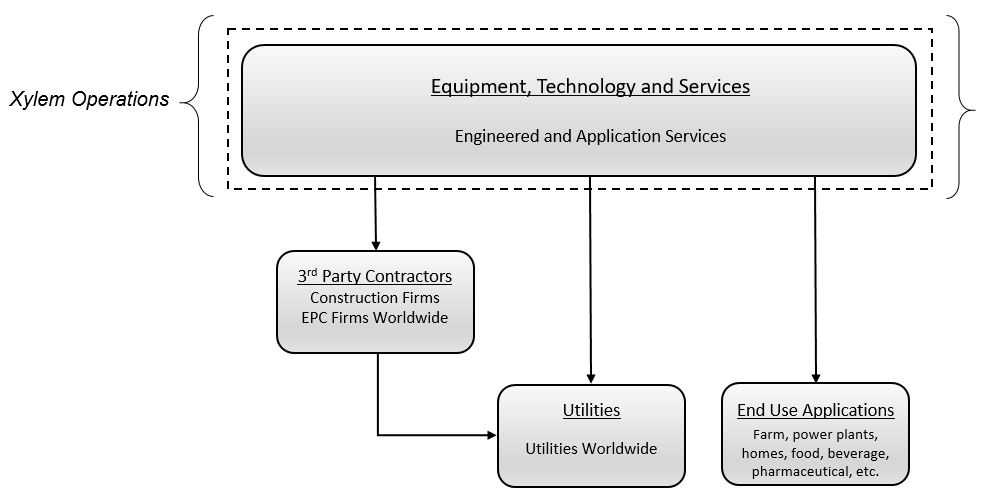
The water industry value chain includes Equipment, Technology and Services companies, like Xylem, which address the unique challenges and demands of a diverse customer base. This customer base includes water and wastewater utilities that supply, treat and monitor clean water or transport, treat and analyze wastewater or storm water through an infrastructure network, and engineering, procurement and construction or (EPC) firms and third party contractors, which work with utilities to design and build water and wastewater infrastructure networks, as depicted below. Utilities and other customers require products, solutions, services, technology and application expertise from their Equipment, Technology and Services providers to address trends such as rising pollution, stricter regulations, increasing operational costs and the increased outsourcing of process knowledge. In addition to utilities, Equipment, Technology and Service companies also provide distinct technologies and application expertise to a wide array of entities, including farms, mines, power plants, industrial facilities (such as food and beverage and pharmaceutical manufacturers) and residential and commercial customers seeking to address similar trends.
Water Industry Supply Chain
Business Strategy
Our strategy is to enhance shareholder value by providing distinctive solutions for our customers' most important water scarcity, affordability and resilience challenges, enabling us to grow revenue, organically and through strategic acquisitions, as we streamline our cost structure. Key elements of our strategy are summarized below:
| • | Accelerate Profitable Growth. To accelerate growth, we continue to focus on several priorities: |
| • | Emerging Markets - We seek to accelerate our growth, particularly in priority emerging markets through increased focus on product localization and channel development. |
| • | Innovation & Technology - We seek to enhance our innovation efforts with increased focus on smart, digitally enabled technologies and innovation that can significantly improve customers’ productivity, quality and resilience. |
| • | Commercial Leadership - We are strengthening our capabilities by simplifying and modernizing our commercial processes and supporting information technology systems. |
| • | Mergers and Acquisitions - We continue to evaluate and, where appropriate, act upon attractive acquisition candidates to accelerate our growth, including into adjacent markets. |
| • | Drive Continuous Improvement. We seek to embed continuous improvement into our culture and simplify our organization to make the Company more agile, more profitable and create room to reinvest in growth. To accomplish this, we will continue to strengthen our lean six sigma and global procurement capabilities, |
while also continuing to optimize our cost structure through business simplification, which aims to eliminate structural, process and product complexity.
| • | Develop Leadership and Talent**.** We continue to invest in attracting, developing and retaining world-class talent with a focus on leadership and talent development programs. We will continue to align individual performance with the objectives of the Company, its shareholders and its stakeholders. |
| • | Focus on Execution and Accountability. We seek to ensure the impact of these strategic focus areas by holding our people accountable and streamlining our performance management and goal deployment systems. |
| • | Create social value in everything we do. We seek to have a positive impact on communities through the combination of sustainable practices, corporate social responsibility and employee, customer, and stakeholder engagement. |
Business Segments, Distribution and Competitive Landscape
We have three reportable business segments that are aligned around the critical market applications they provide: Water Infrastructure, Applied Water, and Measurement & Control Solutions. See Note 22, “Segment and Geographic Data,” in our consolidated financial statements for financial information about segments and geographic areas.
The table and descriptions below provide an overview of our business segments.
| Market Applications | 2019 Revenue (in millions) | % Revenue | Major Products | Primary Brands | |||||||||
| Water Infrastructure | Transport | $ | 1,780 | 82 | % | • Water and wastewater pumps • Filtration, disinfection and biological treatment equipment • Mobile dewatering equipment | • Flygt • Godwin • Leopold • Sanitaire • Wedeco | ||||||
| Treatment | 397 | 18 | % | ||||||||||
| $ | 2,177 | 100 | % | ||||||||||
| Applied Water | Building Services | $ | 848 | 55 | % | • Pumps • Valves • Heat exchangers • Controls • Dispensing equipment systems | • A-C Fire Pump • Bell & Gossett • Flojet • Goulds Water Technology • Jabsco • Lowara • Standard Xchange | ||||||
| Industrial Water | 693 | 45 | % | ||||||||||
| $ | 1,541 | 100 | % | ||||||||||
| Measurement & Control Solutions | Water | $ | 768 | 50 | % | • Smart meters • Networked communication devices • Data analytics • Test equipment • Controls • Sensor devices • Software & managed services • Critical infrastructure services | • EmNet • Pure • Sensus • Smith Blair • Visenti • WTW • YSI | ||||||
| Energy | 337 | 22 | % | ||||||||||
| Test | 327 | 21 | % | ||||||||||
| Software as a Service/Other | 99 | 7 | % | ||||||||||
| $ | 1,531 | 100 | % | ||||||||||
Water Infrastructure
Our Water Infrastructure segment primarily supports the process that collects water from a source, treats it and distributes it to users, and then treats and returns the wastewater responsibly to the environment through two closely linked applications: Transport and Treatment. The Transport application also includes sales and rental of
specialty dewatering pumps and related equipment and services, which provide the safe removal or draining of groundwater and surface water from construction sites or other industrial sites and bypass pumping for the repair of aging utility infrastructure, as well as emergency water transport and removal during severe weather events.
The customer base consists of two primary end markets: utility and industrial. The utility market includes public, private and public-private entities that support water, wastewater and storm water networks. The industrial market includes customers who require similar water and wastewater infrastructure networks to support various industrial operations.
Water Infrastructure sells primarily through direct channels with remaining sales through indirect channels and service capabilities. Both utility and industrial facility customers increasingly require our teams’ global but locally proficient expertise to use our equipment in their specific applications. Several trends are increasing demand for this application expertise: (i) the increase in both the type and amount of contaminants found in the water supply, (ii) increasing environmental regulations, (iii) the need to increase system efficiencies to optimize energy and other operational costs, (iv) the retirement of an aging water industry workforce that has not been systematically renewed at utilities and other end-user customers, and (v) the build-out of water infrastructure in the emerging markets. We estimate our served market size in this sector to be approximately $18 billion.
Given the highly fragmented nature of the water industry, the Water Infrastructure segment competes with a large number of businesses. We differentiate ourselves in the market by focusing on product and service performance, quality and reliability, innovation, speed to market with new or disruptive technologies, application expertise, brand reputation, energy efficiency, product life-cycle cost, timeliness of delivery, proximity of service centers, effectiveness of our distribution channels and price. In the sale or rental of products and provision of services, we benefit from our large installed base, which requires maintenance, repair and replacement parts due to the critical application and nature of the products and the conditions under which they operate. Timeliness of delivery, quality and the proximity of service centers are important customer considerations when selecting a provider for after-market products and services as well as equipment rentals. In geographic regions where we are locally positioned to provide a quick response, customers have historically relied on us, rather than our competitors, for after-market products relating to our highly engineered and customized solutions. Our key competitors in the Water Infrastructure segment include KSB Inc., Sulzer Ltd., Evoqua Water Technologies, United Rentals, Trojan (Danaher Corporation) and Grundfos, among others.
Applied Water
Applied Water encompasses the uses of water in two primarily applications: Building Services and Industrial Water. These applications serve a diverse set of end markets including: residential, commercial and industrial. Residential consumers represent the end users in the residential market, while owners and managers of properties such as apartment buildings, retail stores, institutional buildings, restaurants, schools, hospitals and hotels are examples of end users in the commercial market. The industrial market includes OEMs, exploration and production firms, and developers and managers of industrial facilities, such as electrical power generators, chemical manufacturers, machine shops, clothing manufacturers, food and beverage companies and car washes.
In the Applied Water segment, end markets vary widely and, as a result, specialized distribution partners are often preferred. As such, the Applied Water segment provides the majority of its sales through strong indirect channels with the remaining sales going through our global direct sales channels. We have long-standing relationships with many of the leading independent distributors in the markets we serve and we provide incentives to distributors, such as specialized loyalty and training programs.
We estimate our served market size in this sector to be approximately $19 billion. Population growth, urbanization and regulatory requirements are macro growth drivers of these markets, driving the need for housing, food, community services and retail goods within growing city centers.
Competition in the Applied Water segment focuses on brand equity, application expertise, product delivery, performance and energy efficiency, quality and price. We compete by offering a wide variety of innovative and high-quality products, coupled with world-class application expertise. We believe our distribution through well-established channels and our reputation for quality significantly enhance our market position. Our ability to deliver innovative product offerings has enabled us to compete effectively, to cultivate and maintain customer relationships and to serve and expand into many niche and new markets. Our key competitors in the Applied Water segment include Grundfos, Wilo SE, Pentair plc and Franklin Electric Co., Inc.
Measurement & Control Solutions
Measurement & Control Solutions develops advanced technology solutions that enable intelligent use and conservation of critical water and energy resources. The segment delivers communications, smart metering, measurement and control technologies and critical infrastructure technologies that allow customers to more effectively use their distribution networks for the delivery, monitoring and control of critical resources such as water, electricity and natural gas. We also provide analytical instrumentation used to measure and analyze water quality, flow and level in clean water, wastewater, surface water and coastal environments. Additionally, we offer software and services including cloud-based analytics, remote monitoring and data management, leak detection, condition assessment, asset management and pressure monitoring solutions. We also offer smart lighting solutions that improve efficiency and public safety efforts across communities.
At the heart of our leading technologies is automation, data management and decision support. Communications networks automate and optimize meter reading, monitor flow rates and detect and enable rapid response to changing and unsafe conditions. In short, they provide insight into operations and enable our customers to manage the entire scope of their operations remotely through their networks. At the center of our offering is the FlexNet communication network, which provides a common communications platform and infrastructure for essential metering services. This two-way communication technology remotely connects a wide variety of smart points in a given network with protocols, frequently on Federal Communications Commission ("FCC") licensed spectrum in the United States, that enable reliable, resilient and secure transmissions. These technologies allow our customers to remotely and continuously monitor their water, gas or electric distribution infrastructure, prioritize and manage maintenance and use data to optimize all aspects of their networks. Our Advanced Infrastructure Analytics complement these offerings with intelligent solutions that help utility decision-makers manage and maintain their networks more effectively in real time.
The majority of our sales in the United States is conducted through strong, long-standing relationships with leading distributors and dedicated channel partners for water, gas and electric markets. Internationally, direct sales are often made in markets without established distribution channels; however, some distribution channels are used in more developed markets. A more direct sales approach, with key account management, is employed for large utilities and government programs.
We estimate our served market size in this sector to be approximately $24 billion. Macro growth drivers include increasing regulation, aging infrastructure and worldwide movement towards smart grid implementation. Water scarcity and conservation, as well as the need to prevent revenue loss (via inaccurate meter readings, leaks or theft) are among the drivers of smart meter and leak detection technologies.
Our Sensus-branded meters are well positioned in the smart metering sector, the fastest growing sector of the global meter industry. We set ourselves apart in the industry by focusing on our communication network, innovation, new product development and service offerings that deliver tangible savings of non-revenue water through improved meter accuracy, reduced theft and identification of leaks. Our Pure Technologies’ equipment and services are also well positioned in the leak detection sector which is attracting considerable attention as aging infrastructure and increased regulatory scrutiny exert pressure on operating budgets. Our key competitors in the Measurement & Control Solutions segment include Itron, Badger Meter, Landis+Gyr, Neptune (Roper), Elster (Honeywell), Echologics (Mueller Water Products), Hach (Danaher Corporation) and Teledyne.
Geographic Profile
The table below illustrates the annual revenue and percentage of revenue by geographic area for each of the three years ended December 31.
| Revenue | ||||||||||||||||||||
| (in millions) | 2019 | 2018 | 2017 | |||||||||||||||||
| $ Amount | % of Total | $ Amount | % of Total | $ Amount | % of Total | |||||||||||||||
| United States | $ | 2,554 | 49 | % | $ | 2,424 | 47 | % | $ | 2,161 | 46 | % | ||||||||
| Europe | 1,380 | 26 | % | 1,449 | 28 | % | 1,335 | 28 | % | |||||||||||
| Asia Pacific | 659 | 13 | % | 660 | 13 | % | 611 | 13 | % | |||||||||||
| Other | 656 | 12 | % | 674 | 12 | % | 600 | 13 | % | |||||||||||
| Total | $ | 5,249 | $ | 5,207 | $ | 4,707 |
In addition to the traditional markets of the United States and western Europe, opportunities in emerging markets within Asia Pacific, eastern Europe, Latin America and other countries are growing. Revenue derived from emerging markets comprised approximately 20% of our revenue in each of the last three years.
Supply and Seasonality
We have a global manufacturing and assembly footprint, with production facilities in Europe, North America, Latin America, Asia and the Middle East. Our inventory management and distribution practices seek to minimize inventory holding periods by striving to take delivery of the inventory and manufacturing as close as possible to the sale or distribution of products to our customers. All of our businesses require various parts and raw materials, the availability and prices of which may fluctuate. Parts and raw materials commonly used in our products include motors, fabricated parts, castings, bearings, seals, batteries, PCBs and electronic components, as well as steel, brass, nickel, copper, aluminum and plastics. While we may recover some cost increases through operational improvements, we are still exposed to some pricing risk, including increased pricing risk due to duty and tariff assessments by the United States on foreign imports. We attempt to control costs through fixed-priced contracts with suppliers and various other programs, such as our global procurement initiative.
Our business relies on third-party suppliers, contract manufacturing and commodity markets to secure raw materials, parts and components used in our products. We typically acquire materials and components through a combination of blanket and scheduled purchase orders to support our materials requirements. For many of our products we have existing alternate sources of supply, or such sources may be readily available.
We may experience price volatility or supply constraints for materials that are not available from multiple sources. From time to time, we acquire certain inventory in anticipation of supply constraints or enter into longer-term pricing commitments with suppliers to improve the priority, price and availability of supply. There have been no raw material shortages in the past several years that have had a significant adverse impact on our business as a whole.
Our business segments experience a modest level of seasonality in their operations. This seasonality is dependent on factors such as customers' capital spending as well as climate change and weather conditions, including heavy flooding, droughts and fluctuations in temperatures, all of which can positively or negatively impact portions of our business.
Customers
Our business is not dependent on any single customer or a few customers, the loss of which would have a material adverse effect on our Company. No individual customer accounted for more than 10% of our consolidated revenues in 2019, 2018 or 2017.
Backlog
Backlog includes orders on hand as well as contractual customer agreements at the end of the period. Delivery schedules vary from customer to customer based on their requirements. Annual or multi-year contracts are subject to rescheduling and cancellation by customers due to the long-term nature of the contracts. As such, beginning total backlog, plus orders, minus revenues, will not equal ending total backlog due to contract adjustments, foreign currency fluctuations and other factors. Typically, large projects require longer lead production cycles and deployment schedules and delays can occur from time to time. Total backlog was $1,801 million at December 31, 2019 and $1,689 million at December 31, 2018. We anticipate that approximately 60% of the backlog at December 31, 2019 will be recognized as revenue during 2020.
Research and Development
Research and development (“R&D”) is a key foundation of our growth strategy and we focus on the design and development of products and application know-how that anticipate customer needs and emerging trends. Our engineers are involved in new product development as well as improvement of existing products to increase customer value. Our businesses invest substantial resources into R&D. We anticipate we will continue to develop and invest in our R&D capabilities to promote a steady flow of innovative, high-quality and reliable products and integrated solutions to further strengthen our position in the markets we serve. In addition to investments made in software development, which were capitalized, we incurred $191 million, $189 million, and $181 million as a result of R&D investment spending in 2019, 2018 and 2017, respectively.
We have R&D and product development capabilities around the world. R&D activities are initially conducted in our technology centers, located in conjunction with some of our major manufacturing facilities to ensure an efficient and robust development process. We have several global technical centers and local development teams around the world where we are supporting global needs and accelerating the customization of our products and solutions to address local needs. In some cases, our R&D activities are conducted at our piloting and testing facilities and at strategic customer sites. These piloting and testing facilities enable us to serve our strategic markets globally. As
part of expanding our bandwidth and to increase our access to technology, we have built innovation eco-system partnerships with academic institutions, start-up accelerators and venture capital organizations.
Capitalized Software
We capitalize software developed for sale to external customers, which is included within "Other intangible assets, net" on our Consolidated Balance Sheets. As of December 31, 2019 and 2018 we had net capitalized software for sale to external customers of $165 million and $128 million, respectively.
Intellectual Property
We generally seek patent protection for those inventions and improvements that we believe will improve our competitive position. We believe that our patents and applications are important for maintaining the competitive differentiation of our products and improving our return on R&D investments. While we own, control or license a significant number of patents, trade secrets, proprietary information, trademarks, trade names, copyrights and other intellectual property rights which, in the aggregate, are of material importance to our business, management believes that our business, as a whole, as well as each of our core business segments, is not materially dependent on any one intellectual property right or related group of such rights.
Patents, patent applications and license agreements expire or terminate over time by operation of law, in accordance with their terms or otherwise. As the portfolio of our patents, patent applications and license agreements has evolved over time, we do not expect the expiration of any specific patent to have a material adverse effect on our financial position or results of operations.
Environmental Matters and Regulation
Our global operations are subject to various laws and regulations governing the environment, such as those promulgated by the United States Environmental Protection Agency and similar state and foreign environmental agencies, including the discharge of pollutants and the management and disposal of hazardous substances. While environmental laws and regulations are subject to change, such changes can be difficult to predict reliably and the timing of potential changes is uncertain. Management does not believe, based on current circumstances, that compliance costs pursuant to such regulations will have a material adverse effect on our financial position or results of operations. However, the effect of future legislative or regulatory changes could be material to our financial condition or results of operations.
We continue to be dedicated to environmental and sustainability programs to minimize the use of natural resources, and reduce the utilization and generation of hazardous materials from our processes and to remediate identified environmental concerns. As to the latter, we are currently engaged in site investigations and remediation activities to address environmental cleanup from past operations at current and former manufacturing facilities. We do not anticipate these liabilities will have a material adverse effect on our consolidated financial position or results of operations. At December 31, 2019, we had estimated and accrued $3 million related to environmental matters.
Sustainability
At Xylem, sustainability is at the center of who we are and what we do. As a leading global water technology company, we address one of the world’s most urgent sustainability challenges - responsible stewardship of our shared water resources. Technology is playing an increasingly important role in helping the world solve water issues. We have a long history of innovation and we are focusing on the powerful capabilities of smart technology, integrated management and data analytics.
We believe our financial performance and commitment to sustainability go hand in hand. Xylem approaches business sustainability as a way to generate economic value while also creating value for society, thus meeting the needs of both. Accordingly, in 2019, we evolved our approach to leverage sustainability in our decision-making toward long-term value for our shareholders, customers, employees and communities in which we operate and announced an ambitious new slate of 2025 sustainability goals. These new goals can be found in our 2018 Sustainability Report, which is published using the Global Reporting Initiative (GRI) framework.
In setting our 2025 Sustainability goals, we also aligned them with the United Nations Sustainable Development Goals (UNSDGs), not only to substantiate our contribution to achieving global objectives, but also to be transparent in our communication to stakeholders by providing details on our responsibility to build a sustainable future. While Xylem embraces all 17 of the UNSDGs, we have a special focus on SDG6: Clean Water and Sanitation.
Employees
As of December 31, 2019, Xylem had approximately 16,300 employees worldwide. We have approximately 5,600 employees in the United States, of whom approximately 17% are represented by labor unions. In certain foreign countries, our employees are represented by work councils. We believe that our facilities are in favorable labor markets with ready access to adequate numbers of workers and believe our relations with our employees are good.
Available Information
We are required to file annual, quarterly and current reports, proxy statements and other information with the SEC. Our annual reports on Form 10-K, quarterly reports on Form 10-Q, current reports on Form 8-K, proxy statements and amendments to those reports are available free of charge on our website www.xylem.com as soon as reasonably practicable after such reports are electronically filed with or furnished to the SEC. The information on our website is not, and shall not be deemed to be, a part hereof or incorporated into this or any of our other filings with the SEC.
In addition, the public may read or copy any materials filed with the SEC, free of charge, at www.sec.gov.
Previous: Cover and table of contents · Next: Item 1A. RISK FACTORS