 filings.tools
Xylem 10-K 2020-12-31
Filed 2021-02-26. 22 sections, 509K characters. Original on sec.gov · Markdown · JSON
Cover and table of contents
UNITED STATES SECURITIES AND EXCHANGE COMMISSION
WASHINGTON, D.C. 20549
FORM 10-K
(Mark One)
| ☑ | ANNUAL REPORT PURSUANT TO SECTION 13 OR 15(d) OF THE SECURITIES EXCHANGE ACT OF 1934 | ||||||||||||||||
| For the fiscal year ended | December 31, 2020 | ||||||||||||||||
| or | |||||||||||||||||
| ☐ | TRANSITION REPORT PURSUANT TO SECTION 13 OR 15(d) OF THE SECURITIES EXCHANGE ACT OF 1934 |
For the transition period from to
Commission file number: 1-35229
Xylem Inc.
(Exact name of registrant as specified in its charter)
| Indiana | 45-2080495 | |||||||
| (State or other jurisdiction of incorporation or organization) | (I.R.S. Employer Identification No.) |
1 International Drive, Rye Brook, NY 10573
(Address of principal executive offices and zip code)
(914) 323-5700
(Registrant's telephone number, including area code)
| Securities registered pursuant to Section 12(b) of the Act: | ||||||||
| Title of each class | Trading Symbol(s) | Name of each exchange on which registered | ||||||
| Common Stock, par value $0.01 per share | XYL | New York Stock Exchange | ||||||
| 2.250% Senior Notes due 2023 | XYL23 | New York Stock Exchange | ||||||
| Securities registered pursuant to Section 12(g) of the Act: None |
Indicate by check mark if the registrant is a well-known seasoned issuer, as defined in Rule 405 of the Securities Act. Yes þ No ¨
Indicate by check mark if the registrant is not required to file reports pursuant to Section 13 or Section 15(d) of the Act. Yes ¨ No þ
Indicate by check mark whether the registrant (1) has filed all reports required to be filed by Section 13 or 15(d) of the Securities Exchange Act of 1934 during the preceding 12 months (or for such shorter period that the registrant was required to file such reports), and (2) has been subject to such filing requirements for the past 90 days. Yes þ No ¨
Indicate by check mark whether the registrant has submitted electronically, if any, every Interactive Data File required to be submitted pursuant to Rule 405 of Regulation S-T (§232.405 of this chapter) during the preceding 12 months (or for such shorter period that the registrant was required to submit such files). Yes þ No ¨
Indicate by check mark whether the registrant is a large accelerated filer, an accelerated filer, a non-accelerated filer, a smaller reporting company, or an emerging growth company. See definitions of “large accelerated filer,” “accelerated filer,” “smaller reporting company,” and "emerging growth company" in Rule 12b-2 of the Exchange Act. (Check one):
Large Accelerated Filer ☑ Accelerated Filer ☐ Non-Accelerated Filer ☐ Smaller reporting company ☐ Emerging growth company ☐
If an emerging growth company, indicate by check mark if the registrant has elected not to use the extended transition period for complying with any new or revised financial accounting standards provided pursuant to Section 13(a) of the Exchange Act. ☐
Indicate by check mark whether the registrant has filed a report on and attestation to its management’s assessment of the effectiveness of its internal control over financial reporting under Section 404(b) of the Sarbanes-Oxley Act (15 U.S.C. 7262(b)) by the registered public accounting firm that prepared or issued its audit report. Yes ☑ No ¨
Indicate by check mark whether the registrant is a shell company (as defined in Rule 12b-2 of the Act). Yes ☐ No ☑
The aggregate market value of the common stock of the registrant held by non-affiliates of the registrant as of June 30, 2020 was approximately $11.6 billion. As of February 19, 2021, there were 180,358,493 outstanding shares of the registrant’s common stock, par value $0.01 per share.
DOCUMENTS INCORPORATED BY REFERENCE
Portions of the registrant’s definitive proxy statement for its 2021 Annual Meeting of Shareowners, to be held in May 2021, are incorporated by reference into Part II and Part III of this Report.
Xylem Inc.
ANNUAL REPORT ON FORM 10-K
For the fiscal year ended December 31, 2020
Table of Contents
| * | Included pursuant to the Instruction to Item 401(b) of Regulation S-K. |
PART I
The following discussion should be read in conjunction with the consolidated financial statements, including the notes, included elsewhere in this Annual Report on Form 10-K (this "Report").
Forward-Looking Statements
This Report contains “forward-looking statements" within the meaning of Section 27A of the Securities Act of 1933, as amended, and Section 21E of the Securities Exchange Act of 1934, as amended. Generally, the words “anticipate,” “estimate,” “expect,” “project,” “intend,” “plan,” "contemplate," "predict," “project,” “forecast,” “likely,” “believe,” “target,” “will,” “could,” “would,” “should,” "potential," "may" and similar expressions or their negative, may, but are not necessary to, identify forward-looking statements. By their nature, forward-looking statements address uncertain matters and include any statements that: are not historical, such as statements about our strategy, financial plans, outlook, objectives, plans, intentions or goals; or address possible or future results of operations or financial performance, including statements relating to orders, revenues, operating margins and earnings per share growth.
Although we believe that the expectations reflected in any of our forward-looking statements are reasonable, actual results could differ materially from those projected or assumed in any of our forward-looking statements. Our future financial condition and results of operations, as well as any forward-looking statements, are subject to change and to inherent risks and uncertainties, many of which are beyond our control. Additionally, many of these risks and uncertainties are, and may continue to be, amplified by the coronavirus (“COVID-19”) pandemic. Important factors that could cause our actual results, performance and achievements, or industry results to differ materially from estimates or projections contained in or implied by our forward-looking statements include, among others, the following: overall industry and economic conditions, including industrial, governmental and private sector spending and the strength of the residential and commercial real estate markets; geopolitical, regulatory, economic and other risks associated with international operations; continued uncertainty around the COVID-19 pandemic’s magnitude, duration and impacts on our business, operations, growth, and financial condition, as well as uncertainty around approved vaccines and the pace of recovery when the pandemic subsides; actual or potential other epidemics, pandemics or global health crises; manufacturing and operating cost increases due to inflation, prevailing price changes, tariffs and other factors; fluctuations in foreign currency exchange rates; disruption, competition and pricing pressures in the markets we serve; cybersecurity incidents or other disruptions of information technology systems on which we rely, or involving our products; disruptions in operations at our facilities or that of third parties upon which we rely; availability of products, parts and raw materials from our supply chain; availability, regulation and interference with radio spectrum used by some of our products; our ability to retain and attract senior management and other key talent; uncertainty related to restructuring and realignment actions and related charges and savings; our ability to continue strategic investments for growth; our ability to successfully identify, execute and integrate acquisitions; difficulty predicting our financial results, including uncertainties due to the nature of our short- and long-cycle businesses; volatility in our results due to weather conditions; risks relating to products, including defects, security, warranty and liability claims, and recalls; our ability to borrow or refinance our existing indebtedness and the availability of liquidity sufficient to meet our needs; risk of future impairments to goodwill and other intangible assets; failure to comply with laws or regulations, including those pertaining to anti-corruption, data privacy and security, export and import, competition, and the environment; changes in our effective tax rates or tax expenses; legal, governmental or regulatory claims, investigations or proceedings and associated contingent liabilities; and other factors set forth in “Part I Item 1A. Risk Factors” in this Report and in subsequent filings we make with the Securities and Exchange Commission (“SEC”).
All forward-looking statements made herein are based on information currently available to us as of the date of this Report. We undertake no obligation to publicly update or revise any forward-looking statements, whether as a result of new information, future events or otherwise, except as required by law.
Item 1. BUSINESS
Business Overview
Xylem is a leading global water technology company with 2020 revenues of $4.9 billion and approximately 16,700 employees worldwide, of which approximately 1,100 were temporary or fixed-term employees or interns. We design, manufacture and service highly engineered products and solutions across a wide variety of critical applications primarily in the water sector, but also in energy. Our broad portfolio of products, services and solutions addresses customer needs across the water cycle, from the delivery, measurement and use of drinking water, to the collection, testing, analysis and treatment of wastewater, to the return of water to the environment.
We have differentiated market positions in core application areas including transport, treatment, dewatering, test, smart metering, infrastructure assessment services, digital solutions, commercial and residential building services and industrial processes. Setting us apart is a unique set of global assets that include:
-
Market-leading brands, some of which have been in use for more than 100 years
-
Global distribution networks consisting of direct sales forces and independent channel partners serving a diverse customer base in approximately 150 countries
-
A substantial global installed base that provides for steady recurring revenue
-
A strong history of bringing innovative products, solutions, and business models to customers
-
A strong financial position and cash generation profile that enables us to fund strategic organic and inorganic growth initiatives, and consistently return capital to shareholders
-
A demonstrated commitment to corporate governance, social and environmental sustainability and delivering a positive impact to our customers, communities and employees
-
A dedicated, qualified and technologically advanced group of experienced employees focused on safely satisfying our customers' requirements in the water and energy spaces
Our vision is to create a world in which water issues are no longer a constraint to health, prosperity and sustainable development.
Our Industry
Our planet faces serious water challenges. Less than 1% of the total water available on earth is fresh water, and these supplies are under threat due to factors such as the draining of aquifers, increased pollution and the effects of climate change. Demand for fresh water is rising rapidly due to population growth, industrial expansion, and increased agricultural development, with consumption estimated to double every 20 years. By 2025, more than 30% of the world’s population is expected to live in areas without adequate water supply. Even in developed countries with sufficient clean water supply, existing water supply infrastructure is aging and often inefficient. In the U.S., deteriorating pipe systems, theft or inaccurate meters result in approximately one out of every six gallons of treated water being lost prior to reaching the end customer. This problem of "non-revenue" water is a major financial challenge of many utilities globally, especially in developing markets where non-revenue water can represent 10% to 60% or more of net water produced. These and other challenges create opportunities for growth in the global water industry. We estimate the total addressable market size, excluding operational expenditures related to labor, energy, and chemicals, to be approximately $600 billion.
Global water needs cannot be met without streamlining the water industry’s cost structure with technologies that fundamentally change the provision and management of water. We compete in areas that are pivotal to improving "water affordability" and "resilience", while reducing the impact of "water scarcity". "Water affordability" refers to the more efficient delivery, use and treatment of clean water and wastewater. "Resilience" refers to the management of water-related risks, including climate change mitigation, and the resilience of water infrastructure. "Water scarcity" refers to the management of limited supplies of water due to climate change, overpopulation and pollution. Our customers often face all three of these challenges, ranging from inefficient and aging water distribution networks and energy-intensive or unreliable water and wastewater management systems (which require improvements in water affordability); droughts and pollution which limit the amount of water readily available (causing water scarcity); or exposure to natural disasters such as floods or droughts (which require improvements in resilience). Additionally, we also provide solutions to enhance communications and efficiency, improve safety and conserve resources to customers in the water and energy sectors. Delivering value in these areas creates significant opportunity for the Company. We estimate our total served market size to be approximately $60 billion.
The Global Water Industry Value Chain
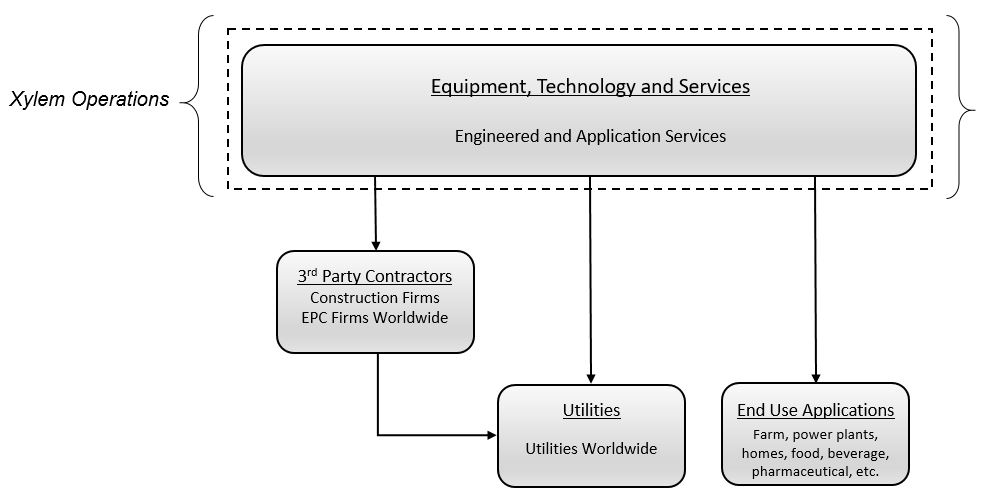
The water industry value chain includes Equipment, Technology and Services companies, like Xylem, that address the unique challenges and demands of a diverse customer base. This customer base includes water and wastewater utilities that supply, treat and monitor clean water or transport, treat and analyze wastewater or storm water through an infrastructure network, and engineering, procurement and construction ("EPC") firms and third party contractors, that work with utilities to design and build water and wastewater infrastructure networks, as depicted below. Utilities and other customers require products, solutions, services, technology and application expertise from their Equipment, Technology and Services providers to address trends such as rising pollution, stricter regulations, increasing operational costs and the increased outsourcing of process knowledge. In addition to utilities, Equipment, Technology and Service companies also provide distinct technologies and application expertise to a wide array of entities, including farms, mines, power plants, industrial facilities (such as food and beverage and pharmaceutical manufacturers) and residential and commercial customers seeking to address similar trends.
Water Industry Supply Chain
Business Strategy
Our strategy is to help customers solve the world's greatest water challenges with innovative products, services and solutions to deliver sustainable economic, social and environmental benefits. The following strategic pillars guide where and how we focus our efforts and resources to implement this strategy:
-
Drive Customer Success.** We seek to partner with customers to meet their stakeholders’ needs through our broad portfolio of unmatched products, services and solutions. We are focused on several key areas, beginning with making it easier for customers to do business with Xylem and access the full range of our capabilities. As part of this, we implement a digital platform to discover, select, get price quotes, and purchase our offerings. Second, we seek to lead the way as digital technologies transform our sector by further integrating our digital solution portfolio and broadening our solution sales, digital literacy and marketing capabilities company-wide. Third, we seek to help customers get the most out of their systems by providing world-class services that ensure uptime, efficiency and resilience. We partner with them by providing powerful, integrated lifecycle services and solutions.
-
Grow in the Emerging Markets. We continue to invest in localizing our capabilities in the emerging markets. We will continue building innovation, product management and engineering teams in these regions, expanding our market coverage in key growth markets such as China, India and Africa. We seek to address the base of the pyramid population by serving water and sanitation needs with new solutions and business models.
-
Strengthen Innovation and Technology.** We seek to create new customer offerings that help them solve water challenges more powerfully than ever before, while also providing our company with rapid growth
opportunities. We will focus on building and enabling infrastructure for digital growth by making our hardware, networks and software applications interoperable and creating a common software experience. This will further strengthen our core product offerings, and deliver strategic, sustainable innovations that help us tap into new markets through advanced technology and new business models.
-
Build a Culture of Continuous Improvement. We seek to continue embedding a continuous improvement mindset throughout the company, and will continue to improve our efficiency, simplify our business and manage costs to support continued growth. We are committed to eliminating business complexity by streamlining internal bureaucracy and expanding standard business platforms and processes to help people do their jobs. This will result in freeing up time to ensure that we focus on work that creates customer value. Other focus areas include removing unnecessary costs from our end-to-end value chain to free up resources for growth; and building resilience and sustainability into our supply chain to protect our ability to serve customers.
-
Cultivate Leadership and Talent Development****.** We continue to foster an empowering, mission-driven, diverse and inclusive culture. We will continue to build leadership succession depth and breadth in keeping with our commitment to developing the next generation of leaders. We will also align our incentives, including share-based compensation, and organizational structure to our strategy, favoring approaches to drive 'one company' skills, behaviors and stakeholder value creation.
Our strategic plan firmly embeds sustainability at the heart of our competitive advantage and unique business model, and aligns each of our five core strategic pillars to the overarching goal of integrating sustainability into everything we do.
While our strategy will evolve in response to the changing world, our four values are the enduring principles that go to the heart of who we are and guide how we conduct ourselves each day: Respect, Responsibility, Integrity and Creativity.
Business Segments, Distribution and Competitive Landscape
We have three reportable business segments that are aligned around the critical market applications they provide: Water Infrastructure, Applied Water, and Measurement & Control Solutions. See Note 22, “Segment and Geographic Data,” in our consolidated financial statements for financial information about segments and geographic areas.
The table and descriptions below provide an overview of our business segments:
| Market Applications | 2020 Revenue (in millions) | % Revenue | Major Products | Primary Brands | ||||||||||||||||||||||||||||
| Water Infrastructure | Transport | $ | 1,679 | 81 | % | • Water and wastewater pumps • Filtration, disinfection and biological treatment equipment • Mobile dewatering equipment | • Flygt • Godwin • Leopold • Sanitaire • Wedeco | |||||||||||||||||||||||||
| Treatment | 400 | 19 | % | |||||||||||||||||||||||||||||
| $ | 2,079 | 100 | % | |||||||||||||||||||||||||||||
| Applied Water | Building Services (a) | $ | 804 | 56 | % | • Pumps • Valves • Heat exchangers • Controls • Dispensing equipment systems | • A-C Fire Pump • Bell & Gossett • Flojet • Goulds Water Technology • Jabsco • Lowara • Standard Xchange | |||||||||||||||||||||||||
| Industrial Water | 630 | 44 | % | |||||||||||||||||||||||||||||
| $ | 1,434 | 100 | % | |||||||||||||||||||||||||||||
| Measurement & Control Solutions | Water | $ | 689 | 51 | % | • Smart meters • Networked communication devices • Data analytics • Test equipment • Controls • Sensor devices • Software & managed services • Critical infrastructure services | • BLU-X • Pure • Sensus • Smith Blair • WTW • YSI | |||||||||||||||||||||||||
| Energy | 276 | 20 | % | |||||||||||||||||||||||||||||
| Test | 306 | 22 | % | |||||||||||||||||||||||||||||
| Software as a Service | 92 | 7 | % | |||||||||||||||||||||||||||||
| $ | 1,363 | 100 | % | |||||||||||||||||||||||||||||
(a)Building Services application revenue is composed of approximately 70% of Commercial end market sales and approximately 30% of Residential end market sales.
Water Infrastructure
Our Water Infrastructure segment primarily supports the process that collects water from a source, treats it and distributes it to users, and then treats and returns the wastewater responsibly to the environment through two closely linked applications: Transport and Treatment. The Transport application also includes sales and rental of specialty dewatering pumps and related equipment and services, which provide the safe removal or draining of groundwater and surface water from construction sites or other industrial sites and bypass pumping for the repair of aging utility infrastructure, as well as emergency water transport and removal during severe weather events.
The customer base consists of two primary end markets: utility and industrial. The utility market includes public, private and public-private entities that support water, wastewater and storm water networks. The industrial market includes customers who require similar water and wastewater infrastructure networks to support various industrial operations.
Water Infrastructure sells primarily through direct channels with remaining sales through indirect channels and service capabilities. Both utility and industrial facility customers increasingly require our teams’ global but locally
proficient expertise to use our equipment in their specific applications. Several trends are increasing demand for this application expertise: (i) the increase in both the type and amount of contaminants found in the water supply, (ii) increasing environmental regulations, (iii) the need to increase system efficiencies and resilience to optimize energy and other operational costs, (iv) the retirement of an aging water industry workforce that has not been systematically renewed at utilities and other end-user customers, and (v) the build-out of water infrastructure in the emerging markets. We estimate our served market size in this sector to be approximately $20 billion.
Given the highly fragmented nature of the water industry, the Water Infrastructure segment competes with a large number of businesses and no one business competes across all the markets Water Infrastructure serves. We differentiate ourselves in the market by focusing on product and service performance, quality and reliability, innovation, speed to market with new or disruptive technologies and business models, application expertise, brand reputation, energy efficiency, product security, product life-cycle cost, timeliness of delivery, proximity of service centers, effectiveness of our distribution channels, price and customers' experience in doing business with us. Increasingly digital solutions and analytics are important competitive differentiators. We are actively expanding our capabilities in these areas and integrating them together with our legacy technologies and service offerings as well as capabilities from other Xylem business units to present ever more compelling solutions to our customers. In the sale or rental of products and provision of services, we benefit from our large installed base, which requires maintenance, repair and replacement parts due to the critical application and nature of the products and the conditions under which they operate. Timeliness of delivery, quality and the proximity of service centers are important customer considerations when selecting a provider for after-market products and services as well as equipment rentals. In geographic regions where we are locally positioned to provide a quick response, customers have historically relied on us, rather than our competitors, for after-market products relating to our highly engineered and customized solutions. Our key competitors in the Water Infrastructure segment include KSB Inc., Sulzer Ltd., Evoqua Water Technologies, United Rentals, Trojan (Danaher Corporation) and Grundfos, among others.
Applied Water
Applied Water encompasses the uses of water in two primary applications: Building Services and Industrial Water. These applications serve a diverse set of customers in the commercial, residential and industrial end markets. Residential consumers represent the end users in the residential market, while owners and managers of properties such as apartment buildings, retail stores, institutional buildings, restaurants, schools, hospitals and hotels are examples of end users in the commercial market. The industrial market includes OEMs, exploration and production firms, and developers and managers of industrial facilities, such as electrical power generators, chemical manufacturers, machine shops, clothing manufacturers, marine, food and beverage companies and car washes.
In the Applied Water segment, end markets vary widely and, as a result, specialized distribution partners are often preferred. As such, the Applied Water segment provides the majority of its sales through strong indirect channels with the remaining sales going through our global direct sales channels. We have long-standing relationships with many of the leading independent distributors in the markets we serve and we provide incentives to distributors, such as specialized loyalty and training programs.
We estimate our served market size in this sector to be approximately $20 billion. Population growth, urbanization and regulatory requirements are macro growth drivers of these markets, driving the need for housing, food, community services and retail goods within growing city centers.
Competition in the Applied Water segment focuses on brand reputation, application expertise, product delivery, performance and energy efficiency, quality and reliability, and price. We compete by offering a wide variety of innovative and high-quality products, coupled with world-class application expertise. We believe our distribution through well-established channels and our reputation for quality significantly enhance our market position. Our ability to deliver innovative product offerings has enabled us to compete effectively, to cultivate and maintain customer relationships and to serve and expand into many niche and new markets. Our key competitors in the Applied Water segment include Grundfos, Wilo SE, Pentair plc and Franklin Electric Co., Inc.
Measurement & Control Solutions
Measurement & Control Solutions develops advanced technology solutions that enable intelligent use and conservation of critical water and energy resources. The segment delivers communications, smart metering, measurement and control technologies and critical infrastructure technologies that allow customers to more effectively use their distribution networks for the delivery, monitoring and control of critical resources such as water, electricity and natural gas. We also provide analytical instrumentation used to measure and analyze water quality, flow and level in clean water, wastewater, surface water and coastal environments. Additionally, we offer
software and services including cloud-based analytics, remote monitoring and data management, leak detection, condition assessment, asset management and pressure monitoring solutions.
At the heart of our leading technologies are automation, data management and decision support. Communications networks enable customers to automate and optimize meter reading, bill customers, monitor flow rates and detect and enable rapid response to changing and unsafe conditions. In short, they provide insight into operations and enable our customers to manage the entire scope of their operations remotely through their networks. At the center of our offering is the FlexNet communication network, which provides a common communications platform and infrastructure for essential metering services. This two-way communication technology remotely connects a wide variety of smart points in a given network with protocols, frequently on Federal Communications Commission ("FCC") licensed spectrum in the U.S., to enable reliable, resilient and secure transmissions. These technologies allow our customers to remotely and continuously monitor their water, energy distribution infrastructure, prioritize and manage maintenance, and use data to optimize many aspects of their networks. Our Advanced Infrastructure Analytics platform complements these offerings with intelligent solutions that help utility decision-makers manage and maintain their networks more effectively in real time.
The majority of our sales in the U.S. are conducted through strong, long-standing relationships with leading distributors and dedicated channel partners for the water and energy markets. Internationally, direct sales are often made in markets without established distribution channels; however, some distribution channels are used in more developed markets. A more direct sales approach, with key account management, is employed for large utilities and government programs.
We estimate our served market size in this sector to be approximately $20 billion. Macro growth drivers include increasing regulation, aging infrastructure and worldwide movement towards smart grid implementation. Water scarcity and conservation, as well as the need to prevent revenue loss (via inaccurate meter readings, leaks or theft) are among the drivers of smart meter and leak detection technologies.
Our Sensus-branded meters are well positioned in the smart metering sector, the fastest growing sector of the global meter industry. We set ourselves apart in the industry by focusing on our communication network, innovation, new product development and service offerings that deliver tangible savings of non-revenue water through improved meter accuracy, reduced theft and identification of leaks. Our Pure Technologies equipment and services are also well positioned in the leak detection sector, which is attracting considerable attention as aging infrastructure and increased regulatory scrutiny exert pressure on operating budgets. Our key competitors in the Measurement & Control Solutions segment include Itron, Badger Meter, Landis+Gyr, Neptune (Roper), Elster (Honeywell), Echologics (Mueller Water Products), Hach (Danaher Corporation) and Teledyne.
Geographic Profile
The table below illustrates the annual revenue and percentage of revenue by geographic area for each of the three years ended December 31.
| Revenue | |||||||||||||||||||||||||||||||||||
| (in millions) | 2020 | 2019 | 2018 | ||||||||||||||||||||||||||||||||
| $ Amount | % of Total | $ Amount | % of Total | $ Amount | % of Total | ||||||||||||||||||||||||||||||
| United States | $ | 2,297 | 47 | % | $ | 2,554 | 49 | % | $ | 2,424 | 47 | % | |||||||||||||||||||||||
| Europe | 1,407 | 29 | % | 1,380 | 26 | % | 1,449 | 28 | % | ||||||||||||||||||||||||||
| Asia Pacific | 618 | 13 | % | 659 | 13 | % | 660 | 13 | % | ||||||||||||||||||||||||||
| Other | 554 | 11 | % | 656 | 12 | % | 674 | 12 | % | ||||||||||||||||||||||||||
| Total | $ | 4,876 | $ | 5,249 | $ | 5,207 |
In addition to the traditional markets of the U.S. and western Europe, opportunities in emerging markets within Asia Pacific, eastern Europe, Latin America and other countries are growing. Revenue derived from emerging markets comprised approximately 19% of total revenue in 2020 and 20% of total revenue in both 2019 and 2018.
Supply and Seasonality
We have a global manufacturing and assembly footprint, with production facilities in Europe, North America, Latin America, Asia and the Middle East. Our inventory management and distribution practices seek to minimize inventory holding periods by striving to take delivery of the inventory and manufacturing as close as possible to the sale or distribution of products to our customers. All of our businesses require various parts and raw materials, the availability and prices of which may fluctuate. Parts and raw materials commonly used in our products include motors, fabricated parts, castings, bearings, seals, batteries, printed circuit boards ("PCBs") and electronic
components, as well as commodities, including steel, brass, nickel, copper, aluminum and plastics. While we may recover some cost increases through operational improvements, we are still exposed to pricing risk, including due to duty and tariff assessments by the U.S. or other governments on foreign imports. We attempt to control costs through fixed-priced contracts with suppliers and various other programs, such as our global procurement initiative.
Our business relies on third-party suppliers, contract manufacturing and commodity markets to secure raw materials, parts and components used in our products. We typically acquire materials and components through a combination of blanket and scheduled purchase orders to support our materials requirements. For many of our products we have existing alternate sources of supply, or such sources may be readily available.
We may experience price volatility or supply constraints for materials that are not available from multiple sources. From time to time, we acquire certain inventory in anticipation of supply constraints or enter into longer-term pricing commitments with suppliers to improve the priority, price and availability of supply. There have been no raw material shortages in the past several years that have had a significant adverse impact on our business as a whole.
Our business segments experience a modest level of seasonality in their operations. This seasonality is dependent on factors such as customers' capital spending as well as the effects of climate change and weather conditions, including heavy flooding, prolonged droughts and fluctuations in temperatures or weather patterns, all of which can positively or negatively impact portions of our business.
Customers
Our business is not dependent on any single customer or a few customers, the loss of which would have a material adverse effect on our Company. No individual customer accounted for more than 10% of our consolidated revenues in 2020, 2019 or 2018.
Backlog
Backlog includes orders on hand as well as contractual customer agreements at the end of the period. Delivery schedules vary from customer to customer based on their requirements. Annual or multi-year contracts are subject to rescheduling and cancellation by customers due to the long-term nature of the contracts. As such, beginning total backlog, plus orders, minus revenues, will not equal ending total backlog due to contract adjustments, foreign currency fluctuations and other factors. Typically, large projects require longer lead production cycles and deployment schedules and delays can occur from time to time. Total backlog was $2,124 million at December 31, 2020 and $1,801 million at December 31, 2019. We anticipate that approximately 55% of the backlog at December 31, 2020 will be recognized as revenue during 2021.
Research and Development
Research and development (“R&D”) is a key foundation of our growth strategy and we focus on the design and development of products and application know-how that anticipate customer needs and emerging trends. Our engineers are involved in new product development as well as improvement of existing products to increase customer value. Our businesses invest substantial resources into R&D. We anticipate we will continue to develop and invest in our R&D capabilities to promote a steady flow of innovative, high-quality and reliable products and integrated solutions to further strengthen our position in the markets we serve. In addition to investments made in software development, which were capitalized, we incurred $187 million, $191 million, and $189 million as a result of R&D investment spending in 2020, 2019 and 2018, respectively.
We have R&D and product development capabilities around the world. R&D activities are initially conducted in our technology centers, located in conjunction with some of our major manufacturing facilities to enable an efficient and robust development process. We have several global technical centers and local development teams around the world where we are supporting global needs and accelerating the customization of our products and solutions to address local needs. In some cases, our R&D activities are conducted at our piloting and testing facilities and at strategic customer sites. These piloting and testing facilities enable us to serve our strategic markets globally. As part of expanding our bandwidth and to increase our access to technology, we have built innovation eco-system partnerships with academic institutions, start-up accelerators and venture capital organizations.
Capitalized Software
We offer software as a product or service directly to external customers, which is included within "Other intangible assets, net" on our Consolidated Balance Sheets. As of December 31, 2020 and 2019 we had net capitalized software used in sales and services to external customers of $182 million and $165 million, respectively.
Intellectual Property
We generally seek patent protection for those inventions and improvements that we believe will improve our competitive position and are not suitable to be kept as a trade secret. We believe that our patents and applications are important for maintaining the competitive differentiation of our products and improving our return on R&D investments. While we own, control or license a significant number of patents, trade secrets, proprietary information, trademarks, trade names, copyrights and other intellectual property rights which, in the aggregate, are of material importance to our business, management believes that our business, as a whole, as well as each of our core business segments, is not materially dependent on any one intellectual property right or related group of such rights.
Patents, patent applications and license agreements expire or terminate over time by operation of law, in accordance with their terms or otherwise. As the portfolio of our patents, patent applications and license agreements has evolved over time, we do not expect the expiration of any specific patent to have a material adverse effect on our financial position or results of operations.
Governmental Regulations
Environmental Regulations
Our global operations are subject to various laws and regulations governing the environment and climate change, such as those promulgated by the U.S. Environmental Protection Agency and similar state and foreign environmental agencies, including the discharge of pollutants and the management and disposal of hazardous substances. While environmental and climate change laws and regulations are subject to change, such changes can be difficult to predict reliably and the timing of potential changes is uncertain. Management does not believe, based on current circumstances, that compliance costs pursuant to such regulations will have a material adverse effect on our financial position or results of operations. However, the effect of future legislative or regulatory changes could be material to our financial condition or results of operations.
We continue to be dedicated to environmental and sustainability programs to minimize the use of natural resources, reduce the utilization and generation of hazardous materials from our processes and remediate identified environmental concerns. We are currently engaged in site investigations and remediation activities to address environmental cleanup from past operations at a number of current and former manufacturing facilities. We do not anticipate these liabilities will have a material adverse effect on our consolidated financial position or results of operations. At December 31, 2020, we had estimated and accrued $3 million related to environmental matters.
Other Regulations
As a company with global operations, we are subject to complex U.S. federal, state and local and foreign laws and regulations in the countries where we conduct business, including with respect to trade, such as tariffs, imports and exports; anti-bribery and corruption; antitrust and competition; data security and privacy, such as the EU General Data Protection Regulation (“GDPR”); use of regulated radio spectrum, including that of the U.S. FCC; lobbying activity; health and safety; and the environment, among other matters. We have policies and procedures in place to promote compliance with these laws and regulations. Additional information about the impact of government regulations on Xylem’s business is included in Item 1A. “Risk Factors” under the headings Risks Related to Our Business and Operations and Risks Related to Legal, Regulatory and Tax.
Sustainability
At Xylem, sustainability is at the center of who we are and what we do. As a leading global water technology company, we address some of the world’s most urgent sustainability challenges - responsible stewardship of our shared water resources and resiliency of communities to climate change. Technology is playing an increasingly important role in helping the world solve water issues. We have a long history of innovation and we are focusing on the powerful capabilities of smart technology, integrated management and data analytics.
We believe our financial performance and commitment to sustainability go hand in hand. Xylem approaches business sustainability as a way to generate economic value while also creating value for society, thus meeting the needs of both. Accordingly, in 2019, we evolved our approach to leverage sustainability in our decision-making toward long-term value for our shareholders, customers, employees and communities in which we operate and announced an ambitious new slate of 2025 sustainability goals. These new goals can be found in our 2019 Sustainability Report, which is aligned to the Global Reporting Initiative and the Sustainability Accounting Standards Board frameworks.
In setting our 2025 Sustainability goals, we also aligned them with the United Nations Sustainable Development Goals ("UNSDGs"), not only to substantiate our contribution to achieving global objectives, but also to be
transparent in our communication to stakeholders by providing details on our responsibility to build a sustainable future. While Xylem embraces all 17 of the UNSDGs, we have a special focus on SDG6: Clean Water and Sanitation.
In 2020, Xylem completed a $1 billion Green Bond offering in senior unsecured notes, consisting of $500 million of 1.950% senior notes due in January 2028 and $500 million of 2.250% senior notes due in January 2031. The proceeds of this offering are funding green projects that help improve water accessibility, water affordability, and water systems resilience.
Human Capital
Our employees around the globe are united in a shared purpose – to solve water – and, as such, are key to the Company’s success and strategy.
As of December 31, 2020, Xylem employed approximately 16,700 employees worldwide, of which approximately 1,100 were temporary or fixed-term employees or interns. We have approximately 5,500 employees in the U.S., of which approximately 17% are represented by labor unions. In certain foreign countries, our employees are represented by work councils. We believe that our facilities are in favorable labor markets with ready access to adequate numbers of workers and believe our relations with our employees are good.
The safety and health of our employees is our highest priority. We have a strong Environmental, Health and Safety program that focuses on governance, risk reduction and education to provide our employees with safe and healthy workplaces. Importantly, during 2020 and in response to the COVID-19 pandemic, we took additional measures to protect the health, safety and well-being of our employees, including a support pay program for employees impacted by the pandemic, an essential services support pay program for employees whose roles were classified as an “essential service” requiring work on-site at a Xylem facility or in the field supporting customers, and the transition of office-based employees to remote work-from-home status where possible, which enabled us to minimize disruptions to our operations and continue to support our customers. In addition, our leadership team held listening sessions with employees who were also caregivers to understand their unique challenges and evolve our support accordingly.
We foster a culture that permits all employees to thrive. This means cultivating a diverse and inclusive workplace that brings together people from different perspectives, talents and experiences. We conduct periodic employee engagement surveys to understand our employees’ perspectives, identify areas for additional focus and establish action plans. We provide periodic training on diversity and inclusion globally, including for our senior leaders. We offer Employee Network Groups, which are voluntary, employee-led groups formed by people with a common affinity, such as gender, race, sexual orientation, military status or other attributes. Each Employee Network Group is sponsored and supported by one or more senior leaders and all groups are open to all employees regardless of any diversity attributes with which they may identify. In addition, our CEO and leadership team hold regular global town hall meetings, as well as smaller regional or local town halls, to share and hear from our employees across all areas of the Company and geographies.
We believe that our success and long-term growth depend, in part, on our continued ability to attract and retain diverse and highly-skilled employees, including senior management and employees with skills in our strategic areas and core competencies, such as engineering, innovation, digital technologies, sales excellence and product and project management. We endeavor to provide our employees with competitive compensation and benefits, including paid parental leave in the U.S. We have a broad range of talent development programs to facilitate the continued professional growth and leadership development of our succession plans. These programs span across all levels, businesses and functions of the organization, including entry-level talent recruitment programs, development programs for emerging leaders, manager training and executive development. We also prioritize employee engagement, including through regular, year round discussions focused on performance and development, through volunteerism, and through activities involving Watermark, our corporate social responsibility program.
Available Information
We are required to file annual, quarterly and current reports, proxy statements and other information with the SEC. Our annual reports on Form 10-K, quarterly reports on Form 10-Q, current reports on Form 8-K, proxy statements and amendments to those reports are available free of charge on our website www.xylem.com as soon as reasonably practicable after such reports are electronically filed with or furnished to the SEC. The information on our website is not, and shall not be deemed to be, a part hereof or incorporated into this or any of our other filings with the SEC.
In addition, the public may read or copy any materials filed with the SEC, free of charge, at www.sec.gov.
Item 1A. RISK FACTORS
In evaluating our business and investment in our securities, investors should carefully consider the following discussion of material factors and events, along with all of the other information in this Report and in our other filings with the SEC. The events and consequences discussed below could, in circumstances that we may not be able to accurately predict, recognize or control, have a material adverse effect on our business, financial condition, cash flows, results of operations or market price of our common stock.
These risk factors do not identify all of the risks we face. Our business is also subject to general risks that affect many other companies. In addition, we operate in a continually changing business, economic and geopolitical environment and as a result new risk factors may emerge from time to time. Risks not currently known to us, or that we currently believe are immaterial, may impact our business operations, financial condition or share price. The global economic and geopolitical climate, including the impacts of the COVID-19 pandemic, amplifies many of the risks below.
Risks Related to Macroeconomic and Industry Factors
Industry and economic conditions may adversely affect our markets and our customers’ operating conditions, which can in turn affect our business, results of operations and financial condition.
With sales in over 150 countries, we compete in a wide range of geographic and product markets. Material economic and industry factors impacting our businesses include the overall strength of, and our customers’ confidence in, local and global macroeconomic conditions; industrial and private sector spending; federal, state, local and municipal governmental fiscal, trade and procurement policies; strength of the residential and commercial real estate markets; the availability of commercial financing for our customers and end-users; and the degree of funding for our public sector customers, including with respect to water infrastructure investments. The downturn in the global economy due to the impacts of COVID-19 has, and continues to have, a material adverse effect on our business and results of operations. Future slowdowns or prolonged downturns in the global economy or our markets could have material adverse effects on our business, financial condition, cash flows and results of operations.
We are exposed to geopolitical, regulatory, economic, foreign exchange and other risks associated with our global sales and operations.
In 2020, 47% of our total revenue was from customers within the U.S. and 53% was from customers outside the U.S. We expect our sales from international operations and export sales to continue to be a significant portion of our revenue. Many of our manufacturing operations, employees and suppliers are located outside of the U.S. Our operations and sales both within the U.S. and internationally are subject, in varying degrees, to risks inherent in doing business globally, including:
-
changes in trade protection measures, including embargoes, tariffs and other trade barriers, and import and export regulations and licensing requirements;
-
instability and uncertainties arising from the global geopolitical environment, including economic nationalism, populism, protectionism and anti-global sentiment;
-
changes in tax laws and potential negative consequences from the interpretation, application and enforcement by governmental tax authorities of tax laws and policies;
-
unanticipated changes in other laws and regulations or how such provisions are interpreted or administered;
-
disruptions in our global supply chain;
-
unfavorable circumstances arising from host country laws or regulations, including those related to infrastructure and data transmission, security and privacy;
-
shocks to the global financial system, including due to global health crises, the effects of climate change, or due to idiosyncratic events, such as a terrorist attack;
-
theft, compromise or misappropriation of technology or intellectual property;
-
foreign currency exchange rate fluctuations, restrictions on repatriation of earnings or payment of distributions, dividends, loans or advances to us by foreign subsidiaries;
-
disruption of operations from labor or political disturbances;
-
regional safety and security considerations;
-
the transition away from benchmark reference rates based on market participant judgments, such as LIBOR and EURIBOR, to rates based on observable transactions, such as the Secured Overnight Financing Rate;
-
increased costs and risks in developing, staffing and simultaneously managing a number of global operations as a result of distance, remote work arrangements, language and cultural differences; and
-
threat, outbreak, uncertainty or escalation of political instability, insurrection, armed conflict, terrorism, global health crises or pandemics, or war.
Additionally, we continue to monitor the impacts of the U.K.’s exit from the EU (“Brexit”) on our supply chain, operations and financial results. The U.K. and the EU concluded a Trade and Cooperation Agreement (“TCA”) that has been provisionally applied since January 1, 2021, pending ratification by the EU Parliament. The TCA creates a number of risks and uncertainties for our businesses. It provides for duties on goods traded between the U.K. and EU, including a preferential treatment provision for no duties on goods that meet certain origin criteria. Our businesses may not be able to benefit from the preferential treatment provision given the origin of certain components used in the manufacture of our products and related certification requirements. The TCA does not specify rules for trade in services, and as such our services are subject to the World Trade Organization’s rules until the parties to the TCA resolve this trade issue. There is also uncertainty as to whether the EU Parliament will ratify the TCA, amend or reject it in its entirety. In addition, the new trading relationship between the U.K. and EU has increased, and will continue to increase, our costs, including for transportation and duties on products not otherwise eligible for preferential treatment under the TCA. We have experienced, and may continue to experience, shipping delays given the need for customs inspections and other procedures at the border, including with respect to requirements to mitigate the risks of COVID-19. Volatility in foreign currencies and other markets may also arise as the U.K. and EU work through the TCA or other new trade arrangements. Additionally, once the TCA is formalized, there could be other near-or long-term negative impacts. The U.K. will also need to negotiate its own trade treaties with countries around the world, which could take years to complete, and any disagreements on trade terms could result in supply chain delays or other disruptions. As a result, we face continued uncertainty and risks of disruptions in our supply chain and increased costs.
In the year ended December 31, 2020, 19% of our total revenues were generated in emerging markets and we have placed a particular emphasis on increasing our growth and presence in emerging markets. Beyond the general risks that we face outside the U.S., our operations in emerging markets could involve additional uncertainties, including risks that governments may impose withholding or other taxes on remittances and other payments to us, or the amount of any such taxes may increase; governments may seek to nationalize our assets; or governments may impose or increase investment barriers or other restrictions affecting our business. In addition, emerging markets pose other uncertainties, including the difficulty of enforcing agreements, challenges collecting receivables, protecting our intellectual property and other assets, pressure on the pricing of our products and services, higher business conduct risks, and the ability to hire and retain qualified talent. We ca
Showing the first 8K of 62K characters. Open the full section
Item 1B. UNRESOLVED STAFF COMMENTS.
None.
Item 2. PROPERTIES
We have approximately 375 locations in more than 50 countries. These properties total approximately 12 million square feet, of which more than 330 locations, or approximately 6.5 million square feet, are leased. We consider the offices, plants, warehouses and other properties that we own or lease to be in good condition and generally suitable for the purposes for which they are used. The following table shows our significant locations by segment:
| Location | State or Country | Principal Business Activity | Approx. Square Feet | Owned or Leased | ||||||||||||||||||||||
| Water Infrastructure | ||||||||||||||||||||||||||
| Emmaboda | Sweden | Administration and Manufacturing | 1,197,000 | Owned | ||||||||||||||||||||||
| Stockholm | Sweden | Administration and Research & Development | 182,000 | Leased | ||||||||||||||||||||||
| Bridgeport | NJ | Administration and Manufacturing | 136,000 | Leased | ||||||||||||||||||||||
| Shenyang | China | Manufacturing | 125,000 | Owned | ||||||||||||||||||||||
| Yellow Springs | OH | Administration and Manufacturing | 112,000 | Owned | ||||||||||||||||||||||
| Quenington | United Kingdom | Manufacturing | 86,000 | Leased | ||||||||||||||||||||||
| Applied Water | ||||||||||||||||||||||||||
| Morton Grove | IL | Administration and Manufacturing | 530,000 | Owned | ||||||||||||||||||||||
| Montecchio | Italy | Administration and Manufacturing | 379,000 | Owned | ||||||||||||||||||||||
| Nanjing | China | Manufacturing | 363,000 | Owned | ||||||||||||||||||||||
| Auburn | NY | Manufacturing | 273,000 | Owned | ||||||||||||||||||||||
| Stockerau | Austria | Administration | 234,000 | Owned | ||||||||||||||||||||||
| Strzelin | Poland | Manufacturing | 185,000 | Owned | ||||||||||||||||||||||
| Cheektowaga | NY | Manufacturing | 147,000 | Owned | ||||||||||||||||||||||
| Vadodara | India | Manufacturing and Research & Development | 133,000 | Leased | ||||||||||||||||||||||
| Measurement & Control Solutions | ||||||||||||||||||||||||||
| Ludwigshafen | Germany | Manufacturing | 318,000 | Owned | ||||||||||||||||||||||
| Texarkana | AR | Manufacturing | 254,000 | Owned | ||||||||||||||||||||||
| Uniontown | PA | Manufacturing | 240,000 | Leased | ||||||||||||||||||||||
| DuBois | PA | Manufacturing | 197,000 | Owned | ||||||||||||||||||||||
| Durham | NC | Administration and Research & Development | 170,000 | Leased | ||||||||||||||||||||||
| DuBois | PA | Manufacturing | 137,000 | Leased | ||||||||||||||||||||||
| Regional Locations | ||||||||||||||||||||||||||
| Dubai | United Arab Emirates | Manufacturing | 144,000 | Owned | ||||||||||||||||||||||
| Nottinghamshire | United Kingdom | Sales Office | 139,000 | Leased | ||||||||||||||||||||||
| Nanterre | France | Sales Office | 139,000 | Leased | ||||||||||||||||||||||
| Langenhagen | Germany | Sales Office | 134,000 | Owned | ||||||||||||||||||||||
| Corporate Headquarters | ||||||||||||||||||||||||||
| Rye Brook | NY | Administration | 67,000 | Leased |
Item 3. LEGAL PROCEEDINGS
From time to time, we are involved in legal and regulatory proceedings that are incidental to the operation of our businesses (or the business operations of previously-owned entities). These proceedings may seek remedies relating to matters including environmental, tax, intellectual property, acquisitions or divestitures, product liability, property damage, personal injury, privacy, employment, labor and pension, government contract issues and commercial or contractual disputes. See Note 20, "Commitments and Contingencies", of the consolidated financial statements included in Item 8 of Part II of this 10-K for information regarding certain legal and regulatory proceedings we are involved in.
Item 4. MINE SAFETY DISCLOSURES
Not applicable.
INFORMATION ABOUT OUR EXECUTIVE OFFICERS
The following information is provided regarding the executive officers of Xylem as of February 4, 2021:
| NAME | AGE | CURRENT TITLE | OTHER BUSINESS EXPERIENCE DURING PAST 5 YEARS | ||||||||||||||||||||
| Patrick K. Decker | 56 | President and Chief Executive Officer (2014) | |||||||||||||||||||||
| Sandra E. Rowland | 49 | Senior VP and Chief Financial Officer (2020) | • Executive Vice President and Chief Financial Officer, Harman International Industries Inc. (2015) | ||||||||||||||||||||
| Franz Cerwinka | 51 | Senior VP and President, Emerging Markets (2020) | • Chief Executive Officer, Johnson Controls-Hitachi Air Conditioning (2015) | ||||||||||||||||||||
| David Flinton | 50 | Senior VP and Chief Innovation, Technology & Product Management Officer (2019) | |||||||||||||||||||||
| Geri McShane | 47 | VP, Controller and Chief Accounting Officer (2019) | • Controller, Accounting and Reporting (2016) | ||||||||||||||||||||
| Matthew Pine | 49 | Senior VP and President, Applied Water Systems and Americas Commercial Team (2020) | • President, Carrier Residential, United Technologies Corporation (2018) •VP and General Manager, Carrier Residential, United Technologies Corporation (2017) | ||||||||||||||||||||
| Colin R. Sabol | 53 | Senior VP and President, Measurement & Control Solutions (2017) | |||||||||||||||||||||
| Kairus Tarapore | 59 | Senior VP and Chief Human Resources Officer (2015) | |||||||||||||||||||||
| Claudia S. Toussaint | 57 | Senior VP, General Counsel and Chief Sustainability Officer (2014) | |||||||||||||||||||||
| Hayati Yarkadas | 52 | Senior VP and President, Water Infrastructure and Europe Commercial Team (2020) | • Senior Vice President and President, Performance Materials, Trinseo S.A. (2015) |
Note: Date in parentheses indicates the year in which the position was assumed.
BOARD OF DIRECTORS
The following information is provided regarding the Board of Directors of Xylem as of February 4, 2021:
| NAME | TITLE | |||||||
| Robert F. Friel | Board Chair, Xylem Inc., Former Chairman, President and Chief Executive Officer, PerkinElmer, Inc. | |||||||
| Jeanne Beliveau-Dunn | CEO and President of Claridad, LLC | |||||||
| Patrick K. Decker | President and Chief Executive Officer, Xylem Inc. | |||||||
| Jorge M. Gomez | Executive Vice President, Chief Financial Officer, Dentsply Sirona, Inc. | |||||||
| Victoria D. Harker | Executive Vice President and Chief Financial Officer, TEGNA, Inc. | |||||||
| Sten E. Jakobsson | Former President and Chief Executive Officer, ABB AB | |||||||
| Steven R. Loranger | Former Chairman, President and Chief Executive Officer, ITT Corporation | |||||||
| Surya N. Mohapatra, Ph.D. | Former Chairman, President and Chief Executive Officer, Quest Diagnostics Incorporated | |||||||
| Jerome A. Peribere | Former President and Chief Executive Officer, Sealed Air Corporation | |||||||
| Markos I. Tambakeras | Former Chairman, President and Chief Executive Officer, Kennametal, Inc. | |||||||
| Lila Tretikov | Corporate Vice President & Deputy Chief Technology Officer, Microsoft | |||||||
| Uday Yadav | President and Chief Operating Officer, Electrical Sector, Eaton |
PART II
Item 5. MARKET FOR THE REGISTRANT’S COMMON EQUITY, RELATED STOCKHOLDER MATTERS AND ISSUER PURCHASES OF EQUITY SECURITIES
Market Price and Dividends
Our common stock trades publicly on the New York Stock Exchange under the trading symbol “XYL”. As of January 31, 2021, there were 9,526 holders of record of our common stock.
Dividends are declared and paid on the common stock at the discretion of our Board of Directors and depend on our profitability, financial condition, capital needs, future prospects and other factors deemed relevant by our Board. Therefore, there can be no assurance as to what level of dividends, if any, will be paid in the future. In the first quarter of 2021, we declared a dividend of $0.28 per share to be paid on March 18, 2021 for shareholders of record on February 18, 2021.
There were no unregistered offerings of our common stock during 2020.
Fourth Quarter 2020 Share Repurchase Activity
The following table summarizes our purchases of our common stock for the quarter ended December 31, 2020:
| (in millions, except per share amounts) | ||||||||||||||||||||||||||
| Period | Total Number of Shares Purchased | Average Price Paid per Share (a) | Total Number of Shares Purchased as Part of Publicly Announced Plans or Programs (b) | Approximate Dollar Value of Shares That May Yet Be Purchased Under the Plans or Programs (b) | ||||||||||||||||||||||
| 10/1/20 - 10/31/20 | — | — | — | $288 | ||||||||||||||||||||||
| 11/1/20 - 11/30/20 | — | — | — | $288 | ||||||||||||||||||||||
| 12/1/20 - 12/31/20 | — | — | — | $288 |
(a)Average price paid per share is calculated on a settlement basis.
(b)On August 24, 2015, our Board of Directors authorized the repurchase of up to $500 million in shares with no expiration date. The program's objective is to deploy our capital in a manner that benefits our shareholders and maintains our focus on growth. There were no shares repurchased under this program during the three months ended December 31, 2020. There are up to $288 million in shares that may still be purchased under this plan as of December 31, 2020.
PERFORMANCE GRAPH
CUMULATIVE TOTAL RETURN
The following graph compares the relative performance of our common stock, the S&P 500 Index and the S&P 500 Industrials Index. This graph covers the period from December 31, 2015 through December 31, 2020 and assumes that $100 was invested on December 31, 2015 in our common stock, the S&P 500 and the S&P 500 Industrials with the reinvestment of any dividends.
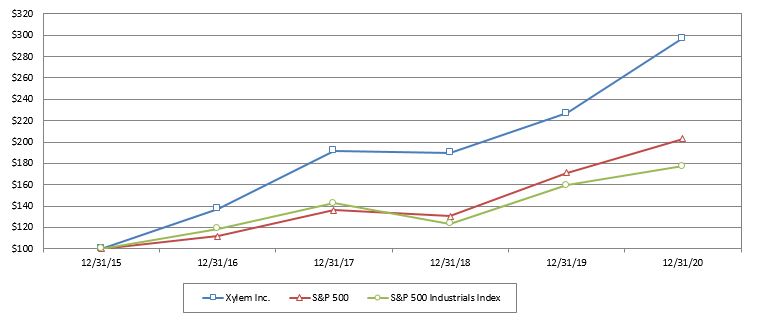
| XYL | S&P 500 | S&P 500 Industrials Index | |||||||||||||||
| December 31, 2015 | 100 | 100 | 100 | ||||||||||||||
| December 31, 2016 | 138 | 112 | 119 | ||||||||||||||
| December 31, 2017 | 192 | 136 | 143 | ||||||||||||||
| December 31, 2018 | 190 | 130 | 124 | ||||||||||||||
| December 31, 2019 | 227 | 171 | 160 | ||||||||||||||
| December 31, 2020 | 297 | 203 | 177 |
The graph is not, and is not intended to be, indicative of future performance of our common stock.
This performance graph shall not be deemed “filed” with the SEC or subject to the liabilities of Section 18 of the Securities Exchange Act of 1934, and should not be deemed incorporated by reference into any of our prior or subsequent filings under the Securities Act of 1933 or the Securities Exchange Act of 1934, except as shall be expressly set forth by specific reference in such filing.
Item 6. SELECTED FINANCIAL DATA
The following table sets forth selected consolidated financial data for the five years ended December 31, 2020. This selected consolidated financial data should be read in conjunction with “Management’s Discussion and Analysis of Financial Condition and Results of Operations” and the consolidated financial statements and the notes thereto included in this Report.
| Year Ended December 31, | |||||||||||||||||||||||||||||
| (in millions, except per share data) | 2020 (a) (b) | 2019 (a) (b) | 2018 (b) | 2017 | 2016 (c) | ||||||||||||||||||||||||
| Results of Operations Data: | |||||||||||||||||||||||||||||
| Revenue | $ | 4,876 | $ | 5,249 | $ | 5,207 | $ | 4,707 | $ | 3,771 | |||||||||||||||||||
| Gross profit | 1,830 | 2,046 | 2,026 | 1,847 | 1,462 | ||||||||||||||||||||||||
| Gross margin | 37.5 | % | 39.0 | % | 38.9 | % | 39.2 | % | 38.8 | % | |||||||||||||||||||
| Operating income | 367 | 486 | 654 | 552 | 408 | ||||||||||||||||||||||||
| Operating margin | 7.5 | % | 9.3 | % | 12.6 | % | 11.7 | % | 10.8 | % | |||||||||||||||||||
| Net income attributable to Xylem | 254 | 401 | 549 | 331 | 260 | ||||||||||||||||||||||||
| Per Share Data: | |||||||||||||||||||||||||||||
| Earnings per share: | |||||||||||||||||||||||||||||
| Basic | $ | 1.41 | $ | 2.23 | $ | 3.05 | $ | 1.84 | $ | 1.45 | |||||||||||||||||||
| Diluted | 1.40 | 2.21 | 3.03 | 1.83 | 1.45 | ||||||||||||||||||||||||
| Basic shares outstanding | 180.1 | 180.0 | 179.8 | 179.6 | 179.1 | ||||||||||||||||||||||||
| Diluted shares outstanding | 181.1 | 181.2 | 181.1 | 180.9 | 180.0 | ||||||||||||||||||||||||
| Cash dividends per share | $ | 1.04 | $ | 0.96 | $ | 0.84 | $ | 0.72 | $ | 0.62 | |||||||||||||||||||
| Balance Sheet Data (at period end): | |||||||||||||||||||||||||||||
| Cash and cash equivalents | $ | 1,875 | $ | 724 | $ | 296 | $ | 414 | $ | 308 | |||||||||||||||||||
| Working capital* | 857 | 919 | 988 | 873 | 878 | ||||||||||||||||||||||||
| Total assets | 8,750 | 7,710 | 7,222 | 6,860 | 6,474 | ||||||||||||||||||||||||
| Total debt | 3,084 | 2,316 | 2,308 | 2,200 | 2,368 |
- The Company calculates Working capital as follows: net accounts receivable + inventories - accounts payable - customer advances.
(a)The amounts shown for the years ended December 31, 2020 and December 31, 2019 include goodwill impairment charges of $58 million and $148 million, respectively, related to the Advanced Infrastructure Analytics ("AIA") goodwill reporting unit. Refer to Note 12 to the consolidated financial statements for further information regarding goodwill.
(b)The amounts shown for the years ended December 31, 2020, December 31, 2019 and December 31, 2018 reflect the acquisition of Pure Technologies Ltd. Refer to Note 3 to the consolidated financial statements for further information regarding acquisitions.
(c)The amounts shown for the year ended December 31, 2016 don't reflect a full year of results for the acquisition of Sensus, which was acquired in October 2016.
Item 7. MANAGEMENT’S DISCUSSION AND ANALYSIS OF FINANCIAL CONDITION AND RESULTS OF OPERATIONS
The following discussion should be read in conjunction with our consolidated financial statements and the notes thereto. This discussion summarizes the significant factors affecting our results of operations and the financial condition of our business. Except as otherwise indicated or unless the context otherwise requires, “Xylem,” “we,” “us,” “our” and “the Company” refer to Xylem Inc. and its subsidiaries.
This section of this Form 10-K generally discusses 2020 and 2019 items and year-to-year comparisons between 2020 and 2019. Discussions of 2018 items and year-to-year comparisons between 2019 and 2018 that are not included in this Form 10-K can be found in “Management’s Discussion and Analysis of Financial Condition and Results of Operations” in Part II, Item 7 of the Company’s Annual Report on Form 10-K for the fiscal year ended December 31, 2019.
Overview
Xylem is a leading global water technology company. We design, manufacture and service highly engineered products and solutions ranging across a wide variety of critical applications in utility, industrial, residential and commercial building services settings. Our broad portfolio of solutions addresses customer needs across the water cycle, from the delivery, measurement and use of drinking water to the collection, test, treatment and analysis of wastewater to the return of water to the environment. Our product and service offerings are organized into three reportable segments that are aligned around the critical market applications they provide: Water Infrastructure, Applied Water and Measurement & Control Solutions.
-
Water Infrastructure serves the water infrastructure sector with pump systems that transport water from aquifers, lakes, rivers and seas; with filtration, ultraviolet and ozone systems that provide treatment, making the water fit to use; and pumping solutions that move the wastewater and storm water to treatment facilities where our mixers, biological treatment, monitoring and control systems provide the primary functions in the treatment process. We also provide sales and rental of specialty dewatering pumps and related equipment and services. Additionally, our offerings use monitoring and control, smart and connected technologies to allow for remote monitoring of performance and enable products to self-optimize pump operations maximizing energy efficiency and minimizing unplanned downtime and maintenance for our customers. In the Water Infrastructure segment, we provide the majority of our sales directly to customers along with strong applications expertise, while the remaining amount is through distribution partners.
-
Applied Water serves the water usage applications sector with water pressure boosting systems for heating, ventilation and air conditioning, and for fire protection systems to the residential and commercial building services markets. In addition, our pumps, heat exchangers and controls provide cooling to power plants and manufacturing facilities, circulation for food and beverage processing, as well as boosting systems for agricultural irrigation. In the Applied Water segment, we provide the majority of our sales through long-standing relationships with many of the leading independent distributors in the markets we serve, with the remainder going directly to customers.
-
Measurement & Control Solutions primarily serves the utility infrastructure solutions and services sector by delivering communications, smart metering, measurement and control technologies and critical infrastructure technologies that allow customers to more effectively use their distribution networks for the delivery, monitoring and control of critical resources such as water, electricity and natural gas. We also provide analytical instrumentation used to measure and analyze water quality, flow and level in clean water, wastewater, surface water and coastal environments. Additionally, we offer software and services including cloud-based analytics, remote monitoring and data management, leak detection, condition assessment, asset management and pressure monitoring solutions. In the Measurement & Control Solutions segment, we generate our sales through a combination of long-standing relationships with leading distributors and dedicated channel partners as well as direct sales depending on the regional availability of distribution channels and the type of product.
COVID-19 Pandemic
The global spread of COVID-19 has curtailed the movement of people, goods and services worldwide, including in many of the regions where we sell our products and services and conduct operations.
This section summarizes the most significant impacts related to the COVID-19 pandemic that we have experienced to date, and we have included additional details as applicable throughout other sections of this Annual Report. Many of these impacts did not begin to be felt broadly across our businesses until the latter part of the first quarter of 2020 and have continued through the remainder of the year. As the COVID-19 pandemic began to unfold in the first quarter of 2020, Xylem deployed a COVID-19 Response Team, responsible for Xylem's Pandemic Plan, which is designed to aid in prevention, preparedness, response and recovery at our sites and across the Company.
Depending on the severity, magnitude and duration of the COVID-19 pandemic and its economic consequences, we anticipate that it will become more difficult to distinguish specific aspects of our operational and financial performance that are most directly related to COVID-19 from those that are more broadly influenced by ongoing macroeconomic, market and industry dynamics that are, to varying degrees, related to the COVID-19 pandemic and its consequences.
Public health officials have recommended, or governments have mandated, precautions to mitigate the spread of COVID-19, including stay at home or similar measures, such as travel restrictions, for periods of time in many of the areas in which we operate. Operationally, a number of our production facilities across the globe experienced reduced production levels due to such measures to varying degrees during the year, however our current overall operating capacity approximates normal levels globally. In order to maintain a safe work environment, our production facilities continue to spread operations over multiple shifts and implement other protective measures such as testing, temperature screening and social distancing, while maintaining operational capabilities.
The COVID-19 pandemic is also adversely affecting, and is expected to continue to adversely affect, our operations, supply chains and businesses. We expect to continue experiencing unpredictable interruptions with our external suppliers into 2021 that could lead to increased logistic costs. We have enhanced our supplier pulsing and redundancy to help mitigate these challenges and do not expect these interruptions to result in a material impact to our business. Additionally, we have in the past and may continue to take measures with respect to buffer stock to minimize freight and logistics delays. If these interruptions are sustained, or additional interruptions occur, they could have a negative impact on our results of operations.
To date, the most significant operational impacts we have experienced are volume reductions ranging across all segments and major geographic regions. Although regions such as Europe and China have started to recover and experienced organic revenue growth during the fourth quarter of 2020, recovery in regions such as the U.S., the Middle East and India continues to lag.
Future demand for our products and services is uncertain as the COVID-19 pandemic has also had an adverse impact on many of the customers we serve. As such, we have, and may continue to, experience decreased or delayed demand for our products and services. At the end of 2020, total backlog increased 17.9% as compared to December 31, 2019.
Showing the first 8K of 102K characters. Open the full section
Item 7A. QUANTITATIVE AND QUALITATIVE DISCLOSURES ABOUT MARKET RISK
We are exposed to market risk, primarily related to foreign currency exchange rates and interest rates. These exposures are actively monitored by management. Our exposure to foreign exchange rate risk is due to certain costs, revenue and borrowings being denominated in currencies other than one of our subsidiaries' functional currency. Similarly, we are exposed to market risk as a result of changes in interest rates which may affect the cost of our financing. It is our policy and practice to use derivative financial instruments only to the extent necessary to manage exposures.
Foreign Currency Exchange Rate Risk
We conduct approximately 53% of our business in various locations outside the U.S.
Our economic foreign currency risk primarily relates to receipts from customers, payments to suppliers and intercompany transactions denominated in foreign currencies. We may use derivative financial instruments to offset risk related to receipts from customers and payments to suppliers, when it is believed that the exposure will not be limited by our normal operating and financing activities. We enter into currency forward contracts periodically in order to manage the exchange rate fluctuation risk on certain intercompany transactions associated with third-party sales and purchases. These risks are also mitigated by natural hedges including the presence of manufacturing facilities outside the U.S., global sourcing and other spending which occurs in foreign countries. Our principal foreign currency transaction exposures primarily relate to the Euro, Swedish Krona, Polish Zloty, Canadian Dollar, British Pound and Australian Dollar. We estimate that a hypothetical 10% movement in foreign currency exchange rates would not have a material economic impact to Xylem’s financial position and results of operations.
Additionally, we are subject to foreign exchange translation risk due to changes in the value of foreign currencies in relation to our reporting currency, the U.S. Dollar. The translation risk is primarily concentrated in the exchange rate between the U.S. Dollar and the Euro, Chinese Yuan, British Pound, Canadian Dollar, Australian Dollar and Swedish Krona. As the U.S. Dollar strengthens against other currencies in which we transact business, revenue and income will generally be negatively impacted, and if the U.S. Dollar weakens, revenue and income will generally be positively impacted. We expect to continue to generate significant revenue from non-U.S. operations and we expect our cash will be predominately held by our foreign subsidiaries. We expect to manage our worldwide cash requirements considering available funds among the many subsidiaries through which we conduct business and the cost effectiveness with which those funds can be accessed. We may transfer cash from certain international subsidiaries to the U.S. and other international subsidiaries when it is cost-effective to do so, though we continually review our domestic and foreign cash profile, expected future cash generation and investment opportunities and reassess whether there is a need to repatriate funds held internationally to support our U.S. operations. We also hedge our investment in certain foreign subsidiaries via the use of cross-currency swaps and the designation of our 2.25% Senior Notes of €500 million aggregate principal amount due March 2023 as a net investment hedge. Accordingly, we estimate that a 10% movement of the U.S. Dollar to various foreign currency exchange rates we translate from, in aggregate would not have a material economic impact on our financial position and results of operations.
Interest Rate Risk
As of December 31, 2020, our long-term debt portfolio is primarily comprised of five series of fixed-rate senior notes that total approximately $2.5 billion. The senior notes are not exposed to interest rate risk as the bonds are at a fixed rate until maturity. Based on the current interest rate market we do not anticipate material risk associated with our debt refinancing within the target time frame of maturity.
Commodity Price Exposures
For a discussion of risks relating to commodity prices, refer to “Item 1A. Risk Factors.”
Item 8. FINANCIAL STATEMENTS AND SUPPLEMENTARY DATA
INDEX TO CONSOLIDATED FINANCIAL STATEMENTS
REPORT OF INDEPENDENT REGISTERED PUBLIC ACCOUNTING FIRM
To the Stockholders and the Board of Directors of Xylem Inc.
Opinion on the Financial Statements
We have audited the accompanying consolidated balance sheets of Xylem Inc. and subsidiaries (the "Company") as of December 31, 2020 and 2019, the related consolidated statements of income, comprehensive income, stockholders' equity, and cash flows, for each of the three years in the period ended December 31, 2020, and the related notes (collectively referred to as the "financial statements"). In our opinion, the financial statements present fairly, in all material respects, the financial position of the Company as of December 31, 2020 and 2019, and the results of its operations and its cash flows for each of the three years in the period ended December 31, 2020, in conformity with accounting principles generally accepted in the United States of America.
We have also audited, in accordance with the standards of the Public Company Accounting Oversight Board (United States) (PCAOB), the Company's internal control over financial reporting as of December 31, 2020, based on criteria established in Internal Control — Integrated Framework (2013) issued by the Committee of Sponsoring Organizations of the Treadway Commission and our report dated February 26, 2021, expressed an unqualified opinion on the Company's internal control over financial reporting.
Basis for Opinion
These financial statements are the responsibility of the Company's management. Our responsibility is to express an opinion on the Company's financial statements based on our audits. We are a public accounting firm registered with the PCAOB and are required to be independent with respect to the Company in accordance with the U.S. federal securities laws and the applicable rules and regulations of the Securities and Exchange Commission and the PCAOB.
We conducted our audits in accordance with the standards of the PCAOB. Those standards require that we plan and perform the audit
Showing the first 8K of 230K characters. Open the full section
Item 9. CHANGES IN AND DISAGREEMENTS WITH ACCOUNTANTS ON ACCOUNTING AND FINANCIAL DISCLOSURE
None.
Item 9A. CONTROLS AND PROCEDURES
Evaluation of Disclosure Controls and Procedures
Our management, with the Chief Executive Officer ("CEO") and Chief Financial Officer ("CFO") of the Company, has evaluated the effectiveness of the design and operation of our disclosure controls and procedures as of the end of the year ended December 31, 2020 pursuant to Rule 13a-15(b) and 15d-15(e) of the Securities Exchange Act of 1934 (“the Exchange Act”). Based upon that evaluation, our CEO and our CFO concluded that our disclosure controls and procedures as of the year ended December 31, 2020 were effective, in all material respects, and designed to provide reasonable assurance that the information required to be disclosed by us in the reports we file or submit under the Exchange Act is (1) recorded, processed, summarized and reported, within the time periods specified in the SEC's rules and forms and (2) accumulated and communicated to our management, including our CEO and CFO, as appropriate to allow timely decisions regarding required disclosures.
Management's Annual Report on Internal Control Over Financial Reporting
As required by the SEC's rules and regulations for the implementation of Section 404 of the Sarbanes-Oxley Act, the Company's management is responsible for establishing and maintaining adequate internal control over financial reporting as defined in Rules 13a-15(f) and 15d-15(f) under the Exchange Act. The Company's internal control over financial reporting is a process designed to provide reasonable assurance regarding the reliability of financial reporting and the preparation of financial statements for external purposes in accordance with GAAP.
The Company's management, including the CEO and CFO, conducted an assessment of the effectiveness of our internal control over financial reporting as of December 31, 2020 based on the framework established in Internal Control - Integrated Framework issued by the Committee of Sponsoring Organization of the Treadway Commission (2013). This assessment included an evaluation of the design of our internal control over financial reporting and testing of the operational effectiveness of those controls. Based on our assessment, the Company's management has concluded that our internal control over financial reporting was effective as of December 31, 2020.
The effectiveness of the Company's internal control over financial reporting as of December 31, 2020 has been audited by Deloitte & Touche LLP, an independent registered public accounting firm, as stated in their report which appears following Item 9B of this Annual Report on Form 10-K.
Changes in Internal Control Over Financial Reporting
There have been no changes in our internal control over financial reporting (as defined in Rule 13a-15(f) under the 1934 Act) during the fiscal quarter ended December 31, 2020 that have materially affected, or are reasonably likely to materially affect, our internal control over financial reporting.
Item 9B. OTHER INFORMATION
None
REPORT OF INDEPENDENT REGISTERED PUBLIC ACCOUNTING FIRM
To the Stockholders and the Board of Directors of Xylem Inc.
Opinion on Internal Control over Financial Reporting
We have audited the internal control over financial reporting of Xylem Inc. and subsidiaries (the "Company") as of
December 31, 2020, based on criteria established in Internal Control — Integrated Framework (2013) issued by the Committee of Sponsoring Organizations of the Treadway Commission (COSO). In our opinion, the Company maintained, in all material respects, effective internal control over financial reporting as of December 31, 2020, based on criteria established in Internal Control — Integrated Framework (2013) issued by COSO.
We have also audited, in accordance with the standards of the Public Company Accounting Oversight Board (United States) (PCAOB), the consolidated financial statements as of and for the year ended December 31, 2020, of the Company and our report dated February 26, 2021, expressed an unqualified opinion on those financial statements.
Basis for Opinion
The Company’s management is responsible for maintaining effective internal control over financial reporting and for its assessment of the effectiveness of internal control over financial reporting, included in the accompanying
Management’s Annual Report on Internal Control over Financial Reporting. Our responsibility is to express an opinion on the Company’s internal control over financial reporting based on our audit. We are a public accounting firm registered with the PCAOB and are required to be independent with respect to the Company in accordance with the U.S. federal securities laws and the applicable rules and regulations of the Securities and Exchange Commission and the PCAOB.
We conducted our audit in accordance with the standards of the PCAOB. Those standards require that we plan and perform the audit to obtain reasonable assurance about whether effective internal control over financial reporting was maintained in all material respects. Our audit included obtaining an understanding of internal control over financial reporting, assessing the risk that a material weakness exists, testing and evaluating the design and operating effectiveness of internal control based on the assessed risk, and performing such other procedures as we considered necessary in the circumstances. We believe that our audit provides a reasonable basis for our opinion.
Definition and Limitations of Internal Control over Financial Reporting
A company’s internal control over financial reporting is a process designed to provide reasonable assurance regarding the reliability of financial reporting and the preparation of financial statements for external purposes in accordance with generally accepted accounting principles. A company’s internal control over financial reporting includes those policies and procedures that (1) pertain to the maintenance of records that, in reasonable detail, accurately and fairly reflect the transactions and dispositions of the assets of the company; (2) provide reasonable assurance that transactions are recorded as necessary to permit preparation of financial statements in accordance with generally accepted accounting principles, and that receipts and expenditures of the company are being made only in accordance with authorizations of management and directors of the company; and (3) provide reasonable assurance regarding prevention or timely detection of unauthorized acquisition, use, or disposition of the company’s assets that could have a material effect on the financial statements.
Because of its inherent limitations, internal control over financial reporting may not prevent or detect misstatements. Also, projections of any evaluation of effectiveness to future periods are subject to the risk that controls may become inadequate because of changes in conditions, or that the degree of compliance with the policies or procedures may deteriorate.
/s/ Deloitte & Touche LLP
Stamford, Connecticut
February 26, 2021
PART III
Item 10. DIRECTORS, EXECUTIVE OFFICERS AND CORPORATE GOVERNANCE
The information required by this Item is incorporated herein by reference to the information in our Definitive Proxy Statement to be filed with the SEC in connection with our 2021 Annual Meeting of Shareholders (the “2021 Proxy Statement”) under the captions “Proposal 1 - Election of Directors,” "Board Composition and Refreshment," "Board Committees - Audit & Finance Committee," and "Audit & Finance Committee Report."
The information called for by Item 10 with respect to executive officers is set forth in Part I of this Report under the caption “Information about our Executive Officers” and is incorporated by reference in this section.
We have adopted Corporate Governance Principles and charters for each of our Board committees. The Corporate Governance Principles address director qualification standards, responsibilities, access to management and independent advisors, compensation, orientation and continuing education, succession planning and board and committee assessment. The Corporate Governance Principles and Board committee charters are available on the Company’s website at www.xylem.com/en-us/investors/governance/. A copy of the Corporate Governance Principles and Board committee charters are also available to any shareholder who requests a copy from the Company’s Corporate Secretary at our Principal Executive Offices.
We have also adopted a written Code of Conduct which is applicable to all of our directors, officers and employees, including the Company’s Chief Executive Officer and Chief Financial Officer and other executive officers identified pursuant to this Item 10. In accordance with the SEC’s rules and regulations, a copy of the Code of Conduct has been posted to our website and it is also available to any shareholder who requests a copy from the Company's Corporate Secretary at our Principal Executive Offices. We intend to disclose any amendments to our Code of Conduct and any waivers of the Code of Conduct on our website at www.xylem.com within four business days following the date of the amendment or waiver.
Item 11. EXECUTIVE COMPENSATION
The information required by this Item is incorporated herein by reference to the information in our 2021 Proxy Statement set forth under captions “Compensation Discussion and Analysis," "Director Compensation," "Board Committees - Leadership Development and Compensation Committee" and “Leadership Development and Compensation Committee Report.”
Item 12. SECURITY OWNERSHIP OF CERTAIN BENEFICIAL OWNERS AND MANAGEMENT AND RELATED STOCKHOLDER MATTERS
The information required by this Item is incorporated herein by reference to the information in our 2021 Proxy Statement set forth under the captions “Stock Ownership - Certain Beneficial Owners," "Stock Ownership - Directors and Named Executive Officers" and "Equity Compensation Plan Information."
Item 13. CERTAIN RELATIONSHIPS AND RELATED TRANSACTIONS, AND DIRECTOR INDEPENDENCE
The information required by this Item is incorporated herein by reference to the information in our 2021 Proxy Statement set forth under the captions "Corporate Governance - Director Independence" and “Corporate Governance Policies and Practices - Related Party Transactions.”
Item 14. PRINCIPAL ACCOUNTING FEES AND SERVICES
The information required by this Item is incorporated herein by reference to the information in our 2021 Proxy Statement set forth under the captions “Proposal 2 - Fees of Audit and Other Services” and "Proposal 2 - Pre-Approval of Audit and Non-Audit Services."
PART IV
Item 15. EXHIBITS, FINANCIAL STATEMENT SCHEDULES
| (a) | (1) | The Index to Consolidated Financial Statements of the Registrant under Item 8 of this Report is incorporated herein by reference as the list of Financial Statements required as part of this Report. | ||||||
| (2) | Financial Statement Schedules — All financial statement schedules have been omitted because they are not applicable or the required information is shown in the financial statements or notes thereto. | |||||||
| (3) | Exhibits — See exhibits listed under Part (b) below. |
EXHIBIT INDEX
| Exhibit Number | Description | Location | ||||||||||||
| 2.1 | Distribution Agreement, dated as of October 25, 2011, among ITT Corporation, Exelis Inc. and Xylem Inc. | Incorporated by reference to Exhibit 10.1 of ITT Corporation’s Form 10-Q Quarterly Report filed on October 28, 2011 (CIK No. 216228, File No. 1-5672). | ||||||||||||
| 3.1 | Fourth Amended and Restated Articles of Incorporation of Xylem Inc. | Incorporated by reference to Exhibit 3.1 of Xylem Inc.’s Form 8-K filed on May 15, 2017 (CIK No. 1524472, File No. 1-35229). | ||||||||||||
| 3.2 | Fourth Amended and Restated By-laws of Xylem Inc. | Incorporated by reference to Exhibit 3.1 of Xylem Inc.’s Form 8-K filed on May 15, 2017 (CIK No. 1524472, File No. 1-35229). | ||||||||||||
| 4.1 | Indenture, dated as of September 20, 2011, between Xylem Inc., ITT Corporation, as initial guarantor, and Union Bank, N.A., as trustee. | Incorporated by reference to Exhibit 4.2 of ITT Corporation’s Form 8-K Current Report filed on September 21, 2011 (CIK No. 216228, File No. 1-5672). | ||||||||||||
| 4.2 | Senior Indenture, dated March 11, 2016, by and between the Company and Deutsche Bank Trust Company Americas, as trustee. | Incorporated by reference to Exhibit 4.1 of Xylem Inc.’s Form 8-K filed on March 11, 2016 (CIK No. 1524472, File No. 1-35229). | ||||||||||||
| 4.3 | First Supplemental Indenture, dated March 11, 2016, by and between the Company and Deutsche Bank Trust Company Americas, as trustee. | Incorporated by reference to Exhibit 4.2 of Xylem Inc.’s Form 8-K filed on March 11, 2016 (CIK No. 1524472, File No. 1-35229) | ||||||||||||
| 4.4 | Second Supplemental Indenture, dated March 11, 2016, by and between the Company and Deutsche Bank Trust Company Americas, as trustee. | Incorporated by reference to Exhibit 4.3 of Xylem Inc.’s Form 8-K filed on March 11, 2016 (CIK No. 1524472, File No. 1-35229). | ||||||||||||
| 4.5 | Third Supplemental Indenture, dated October 11, 2016, by and between the Company and Deutsche Bank Trust Company Americas, as trustee. | Incorporated by reference to Exhibit 4.1 of Xylem Inc.’s Form 8-K filed on October 11, 2016 (CIK No. 1524472, File No. 1-35229). | ||||||||||||
| 4.6 | Form of Xylem Inc. 4.875% Senior Notes due 2021. | Incorporated by reference to Exhibit 4.6 of Xylem Inc.'s Form S-4 Registration Statement filed on May 24, 2012 (CIK No. 1524472, File No. 333-181643). | ||||||||||||
| 4.7 | Form of Xylem Inc. 2.250% Senior Notes due 2023. | Incorporated by reference to Exhibit 4.3 of Xylem Inc.’s Current Report on Form 8-K dated March 11, 2016 (CIK No. 1524472, File No. 1-35229). | ||||||||||||
| 4.8 | Form of Xylem Inc. 3.250% Senior Notes due 2026. | Incorporated by reference to Exhibit 4.1 of Xylem Inc.’s Form 8-K filed on October 11, 2016 (CIK No. 1524472, File No. 1-35229). | ||||||||||||
| 4.9 | Form of Xylem Inc. 4.375% Senior Notes due 2046. | Incorporated by reference to Exhibit 4.1 of Xylem Inc.’s Form 8-K filed on October 11, 2016 (CIK No. 1524472, File No. 1-35229). | ||||||||||||
| 4.10 | Description of securities registered under Section 12 of the Exchange Act | Incorporated by reference to Exhibit 4.10 of Xylem Inc.’s Form 10-K Annual Report filed on February 28, 2020 (CIK No. 1524472, File No. 1-35229). |
| Exhibit Number | Description | Location | ||||||||||||
| 4.11 | Fourth Supplemental Indenture, dated June 26, 2020, by and between the Company and Deutsche Bank Trust Company Americas, as trustee. | Incorporated by reference to Exhibit 4.1 of Xylem Inc.’s Current Report on Form 8-K filed on June 26, 2020 (CIK No. 1524472, File No. 1-35229 | ||||||||||||
| 4.12 | Form of 1.950% Senior Notes due 2028. | Incorporated by reference to Exhibit 4.1 of Xylem Inc.’s Current Report on Form 8-K filed on June 26, 2020 (CIK 1524472, File No. 1-35229) | ||||||||||||
| 4.13 | Form of 2.250% Senior Notes due 2031. | Incorporated by reference to Exhibit 4.1 of Xylem Inc.’s Current Report on Form 8-K filed on June 26, 2020 (CIK 1524472, File No. 1-35229) | ||||||||||||
| 10.1 | # | Form of Xylem 2011 Omnibus Incentive Plan Non-Qualified Stock Option Award Agreement (2015). | Incorporated by reference to Exhibit 10.1 of Xylem Inc.’s Form 10-K Annual Report filed on February 26, 2015 (CIK No. 1524472, File No. 1-35229). | |||||||||||
| 10.3 | Tax Matters Agreement, dated as of October 25, 2011, among ITT Corporation, Exelis Inc. and Xylem Inc. | Incorporated by reference to Exhibit 10.3 of ITT Corporation’s Form 10-Q Quarterly Report filed on October 28, 2011 (CIK No. 216228, File No. 1-5672). | ||||||||||||
| 10.6 | # | Xylem 2011 Omnibus Incentive Plan (Amended as of February 24, 2016). | Incorporated by reference to Exhibit 10.6 of Xylem Inc.'s Form 10-K filed on February 26, 2016 (CIK No. 1524472, File No. 1-35229). | |||||||||||
| 10.7 | # | Form of Xylem Non-Qualified Stock Option Award Agreement (Amended as of February 24, 2016). | Incorporated by reference to Exhibit 10.7 of Xylem Inc.'s Form 10-K filed on February 26, 2016 (CIK No. 1524472, File No. 1-35229). | |||||||||||
| 10.10 | # | Xylem Retirement Savings Plan. | Incorporated by reference to Exhibit 10.1 of Xylem Inc.’s Form 10-Q filed on July 30, 2013 (CIK No. 1524472, File No. 1-35229). | |||||||||||
| 10.11 | # | Xylem Supplemental Retirement Savings Plan. | Incorporated by reference to Exhibit 10.11 of Xylem Inc.’s Form 10-Q Quarterly Report filed on November 21, 2011 (CIK No. 1524472, File No. 1-35229). | |||||||||||
| 10.12 | # | Xylem Deferred Compensation Plan. | Incorporated by reference to Exhibit 10.12 of Xylem Inc.'s Form 10-K Annual Report filed on February 23, 2017 (CIK No. 1524472, File No. 1-35229). | |||||||||||
| 10.13 | # | Xylem Deferred Compensation Plan for Non-Employee Directors. | Incorporated by reference to Exhibit 10.13 of Xylem Inc.’s Form 10-Q Quarterly Report filed on November 21, 2011 (CIK No. 1524472, File No. 1-35229). | |||||||||||
| 10.14 | # | Form of Non-Employee Director Restricted Stock Unit Award Agreement. | Incorporated by reference to Exhibit 10.1 of Xylem Inc.’s Form 10-Q Quarterly Report filed on July 30, 2015 (CIK No. 1524472, File No. 1-35229). | |||||||||||
| 10.15 | # | Xylem Special Senior Executive Severance Pay Plan (Amended as of February 24, 2016). | Incorporated by reference to Exhibit 10.15 of Xylem Inc.'s Form 10-K filed on February 26, 2016 (CIK No. 1524472, File No. 1-35229). | |||||||||||
| 10.16 | # | Xylem Senior Executive Severance Pay Plan (Amended as of May 10, 2017). | Incorporated by reference to Exhibit 10.1 of Xylem Inc.'s Form 10-Q filed on August 1, 2017 (CIK No. 1524472, File No. 1-35229). | |||||||||||
| 10.18 | # | Form of Xylem 2011 Omnibus Incentive Plan Non-Qualified Stock Option Award Agreement — Futures Grant. | Incorporated by reference to Exhibit 10.18 of Xylem Inc.’s Form 10-Q Quarterly Report filed on November 21, 2011 (CIK No. 1524472, File No. 1-35229). | |||||||||||
| 10.19 | # | Xylem Annual Incentive Plan for the Senior Leadership Team (formally "Annual Incentive Plan for Executive Officers") restated, with administrative changes only, on August 11, 2020 | Incorporated by reference to Exhibit 10.1 of Xylem Inc.'s Form 10-Q filed on October 29, 2020 (CIK No. 1524472, File No. 1-35229). | |||||||||||
| Exhibit Number | Description | Location | ||||||||||||
| 10.20 | # | Form of Director’s Indemnification Agreement restated, with administrative changes only, on November 12, 2020. | Filed herewith. | |||||||||||
| 10.21 | # | Form of Xylem 2011 Omnibus Incentive Plan Non-Qualified Stock Option Award Agreement (2013). | Incorporated by reference to Exhibit 10.1 of Xylem Inc.'s Form 10-Q Quarterly Report filed on April 30, 2013 (CIK No. 1524472, File No. 1-35229). | |||||||||||
| 10.22 | # | Letter Agreement between Xylem Inc. and Patrick K. Decker. | Incorporated by reference to Exhibit 10.1 of Xylem Inc.'s Form 10-Q Quarterly Report filed on April 29, 2014 (CIK No. 1524472, File No. 1-35229). | |||||||||||
| 10.23 | # | Letter Agreement between Xylem Inc. and Claudia S. Toussaint. | Filed herewith. | |||||||||||
| 10.24 | # | Letter Agreement between Xylem Inc. and Sandra E. Rowland. | Filed herewith. | |||||||||||
| 10.31 | # | Form of Xylem Restricted Stock Unit Agreement (Amended as of February 21, 2018). | Incorporated by reference to Exhibit 10.31 of Xylem Inc.'s Form 10-K filed on February 23, 2018 (CIK No. 1524472, File No. 1-35229). | |||||||||||
| 10.32 | # | Form of Xylem Performance Share Unit Agreement (Amended as of February 21, 2018). | Incorporated by reference to Exhibit 10.32 of Xylem Inc.'s Form 10-K filed on February 23, 2018 (CIK No. 1524472, File No. 1-35229). | |||||||||||
| 10.34 | Five-Year Revolving Credit Facility Agreement, dated as of March 5, 2019 among Xylem Inc. and the Lenders party thereto. | Incorporated by reference to Exhibit 10.34 of Xylem Inc.’s Form 8-K filed on March 5, 2019 (CIK No. 1524472, File No. 1-35229). | ||||||||||||
| 10.34.1 | Amendment No. 1, dated June 22, 2020, to the Five-Year Revolving Credit Facility Agreement, dated as of March 5, 2019, each among Xylem Inc. and Citibank, N.A., as administrative agent | Incorporated by reference to Exhibit 10.34.1 of Xylem Inc.’s Current Report on Form 8-K filed on June 23, 2020 (CIK No. 1524472, File No. 1-35229). | ||||||||||||
| 21.0 | Subsidiaries of the Registrant. | Filed herewith. | ||||||||||||
| 23.1 | Consent of Independent Registered Public Accounting Firm. | Filed herewith. | ||||||||||||
| 31.1 | Certification pursuant to Rule 13a-14(a)/15d-14(a) of the Securities Exchange Act of 1934, as adopted pursuant to Section 302 of the Sarbanes-Oxley Act of 2002. | Filed herewith. | ||||||||||||
| 31.2 | Certification pursuant to Rule 13a-14(a)/15d-14(a) of the Securities Exchange Act of 1934, as adopted pursuant to Section 302 of the Sarbanes-Oxley Act of 2002. | Filed herewith. | ||||||||||||
| 32.1 | Certification Pursuant to 18 U.S.C. Section 1350, as adopted pursuant to Section 906 of the Sarbanes-Oxley Act of 2002. | This Exhibit is intended to be furnished in accordance with Regulation S-K Item 601(b) (32) (ii) and shall not be deemed to be filed for purposes of Section 18 of the Securities Exchange Act of 1934 or incorporated by reference into any filing under the Securities Act of 1933 or the Securities Exchange Act of 1934, except as shall be expressly set forth by specific reference. | ||||||||||||
| 32.2 | Certification Pursuant to 18 U.S.C. Section 1350, as adopted pursuant to Section 906 of the Sarbanes-Oxley Act of 2002. | This Exhibit is intended to be furnished in accordance with Regulation S-K Item 601(b) (32) (ii) and shall not be deemed to be filed for purposes of Section 18 of the Securities Exchange Act of 1934 or incorporated by reference into any filing under the Securities Act of 1933 or the Securities Exchange Act of 1934, except as shall be expressly set forth by specific reference. | ||||||||||||
| Exhibit Number | Description | Location | ||||||||||||
| 101.0 | The following materials from Xylem Inc.’s Annual Report on Form 10-K for the year ended December 31, 2020, formatted in Inline Extensible Business Reporting Language (Inline XBRL): (i) Consolidated Income Statements, (ii) Consolidated Statements of Comprehensive Income, (iii) Consolidated Balance Sheets, (iv) Consolidated Statements of Cash Flows, (v) Consolidated Statement of Stockholder's Equity and (vi) Notes to Consolidated Financial Statements. | The instance document does not appear in the interactive data file because its XBRL tags are embedded within the Inline XBRL document. | ||||||||||||
| 104.0 | The cover page from Xylem Inc.'s Annual Report on Form 10-K for the year ended December 31, 2020, formatted in Inline XBRL and contained in Exhibit 101.0. |
#Management contract or compensatory plan or arrangement
Item 16. FORM 10-K SUMMARY
None
SIGNATURES
Pursuant to the requirements of Section 13 or 15(d) of the Securities Exchange Act of 1934, the Registrant has duly caused this Report to be signed on its behalf by the undersigned, thereunto duly authorized.
| XYLEM INC. | |||||
| (Registrant) | |||||
| /s/ Geri McShane | |||||
| Geri McShane | |||||
| Vice President, Controller and Chief Accounting Officer |
February 26, 2021
Pursuant to the requirements of the Securities Exchange Act of 1934, this Report has been signed below by the following persons on behalf of the Registrant and in the capacities and on the dates indicated:
| February 26, 2021 | /s/ Patrick K. Decker | |||||||
| Patrick K. Decker | ||||||||
| President and Chief Executive Officer | ||||||||
| (Principal Executive Officer) | ||||||||
| February 26, 2021 | /s/ Sandra E. Rowland | |||||||
| Sandra E. Rowland | ||||||||
| Senior Vice President and Chief Financial Officer | ||||||||
| February 26, 2021 | /s/ Geri McShane | |||||||
| Geri McShane | ||||||||
| Vice President, Controller and Chief Accounting Officer | ||||||||
| February 26, 2021 | /s/ Robert F. Friel | |||||||
| Robert F. Friel, Board Chair | ||||||||
| February 26, 2021 | /s/ Jeanne Beliveau-Dunn | |||||||
| Jeanne Beliveau-Dunn, Director | ||||||||
| February 26, 2021 | /s/ Jorge M. Gomez | |||||||
| Jorge M. Gomez, Director | ||||||||
| February 26, 2021 | /s/ Victoria D. Harker | |||||||
| Victoria D. Harker, Director | ||||||||
| February 26, 2021 | /s/ Sten E. Jakobsson | |||||||
| Sten E. Jakobsson, Director | ||||||||
| February 26, 2021 | /s/ Steven R. Loranger | |||||||
| Steven R. Loranger, Director | ||||||||
| February 26, 2021 | /s/ Surya N. Mohapatra | |||||||
| Surya N. Mohapatra, Director | ||||||||
| February 26, 2021 | /s/ Jerome A. Peribere | |||||||
| Jerome A. Peribere, Director | ||||||||
| February 26, 2021 | /s/ Markos I. Tambakeras | |||||||
| Markos I. Tambakeras, Director | ||||||||
| February 26, 2021 | /s/ Lila Tretikov | |||||||
| Lila Tretikov, Director | ||||||||
| February 26, 2021 | /s/ Uday Yadav | |||||||
| Uday Yadav, Director | ||||||||