 filings.tools
Block 10-K 2023-12-31
Filed 2024-02-22. 24 sections, 643K characters. Original on sec.gov · Markdown · JSON
Cover and table of contents
UNITED STATES
SECURITIES AND EXCHANGE COMMISSION
Washington, D.C. 20549
______________________
FORM 10-K
______________________
(Mark One)
| ☒ | ANNUAL REPORT PURSUANT TO SECTION 13 OR 15(d) OF THE SECURITIES EXCHANGE ACT OF 1934 |
For the fiscal year ended December 31, 2023
OR
| ☐ | TRANSITION REPORT PURSUANT TO SECTION 13 OR 15(d) OF THE SECURITIES EXCHANGE ACT OF 1934 |
For the transition period from ________ to ________
Commission File Number 001-37622
______________________
BLOCK, INC.
(Exact name of registrant as specified in its charter)
______________________
| Delaware | 80-0429876 | |||||||
| (State or other jurisdiction of incorporation or organization) | (I.R.S. Employer Identification Number) |
1955 Broadway, Suite 600
Oakland, CA 94612****1
(Address of principal executive offices, including zip code)
(415) 375-3176
(Registrant's telephone number, including area code)
Securities registered pursuant to Section 12(b) of the Act:
| Title of Each Class | Trading Symbol(s) | Name of each exchange on which registered | ||||||||||||
| Class A Common Stock, $0.0000001 par value per share | SQ | New York Stock Exchange |
Securities registered pursuant to Section 12(g) of the Act: None
Indicate by check mark if the registrant is a well-known seasoned issuer, as defined in Rule 405 of the Securities Act. Yes ☒ No ☐
Indicate by check mark if the registrant is not required to file reports pursuant to Section 13 or 15(d) of the Act. Yes ☐ No ☒
Indicate by check mark whether the registrant (1) has filed all reports required to be filed by Section 13 or 15(d) of the Securities Exchange Act of 1934 during the preceding 12 months (or for such shorter period that the registrant was required to file such reports), and (2) has been subject to such filing requirements for the past 90 days. Yes ☒ No ☐
Indicate by check mark whether the registrant has submitted electronically every Interactive Data File required to be submitted pursuant to Rule 405 of Regulation S-T (§ 232.405 of this chapter) during the preceding 12 months (or for such shorter period that the registrant was required to submit such files).
Yes ☒ No ☐
Indicate by check mark whether the registrant is a large accelerated filer, an accelerated filer, a non‑accelerated filer, a smaller reporting company, or an emerging growth company. See the definitions of “large accelerated filer,” “accelerated filer,” “smaller reporting company,” and "emerging growth company" in Rule 12b‑2 of the Exchange Act.
Large accelerated filer ☒ Accelerated filer ☐ Non-accelerated filer ☐ Smaller reporting company ☐ Emerging growth company ☐
If an emerging growth company, indicate by check mark if the registrant has elected not to use the extended transition period for complying with any new or revised financial accounting standards provided pursuant to Section 13(a) of the Exchange Act. ☐
Indicate by check mark whether the registrant has filed a report on and attestation to its management’s assessment of the effectiveness of its internal control over financial reporting under Section 404(b) of the Sarbanes-Oxley Act (15 U.S.C. 7262(b)) by the registered public accounting firm that prepared or issued its audit report. ☒
If securities are registered pursuant to Section 12(b) of the Act, indicate by check mark whether the financial statements of the registrant included in the filing reflect the correction of an error to previously issued financial statements. ☐
Indicate by check mark whether any of those error corrections are restatements that required a recovery analysis of incentive-based compensation received by any of the registrant’s executive officers during the relevant recovery period pursuant to §240.10D-1(b). ☐
Indicate by check mark whether the registrant is a shell company (as defined in Rule 12b-2 of the Act). Yes ☐ No ☒
The aggregate market value of the voting and non-voting common equity held by non-affiliates of the registrant, based on the closing price of a share of the registrant’s Class A common stock on June 30, 2023 as reported by the New York Stock Exchange on such date was approximately $38.5 billion. Shares of the registrant’s Class A common stock and Class B common stock held by each executive officer, director and holder of 5% or more of the outstanding Class A common stock and Class B common stock have been excluded in that such persons may be deemed to be affiliates. This calculation does not reflect a determination that certain persons are affiliates of the registrant for any other purpose.
As of February 16, 2024, the number of shares (in thousands) of the registrant’s Class A and Class B common stock outstanding were 555,180 and 60,513, respectively.
Portions of the registrant’s Definitive Proxy Statement relating to the Annual Meeting of Stockholders are incorporated by reference into Part III of this Annual Report on Form 10-K where indicated. Such Definitive Proxy Statement will be filed with the Securities and Exchange Commission within 120 days after the end of the registrant’s fiscal year ended December 31, 2023.
1 We have adopted a distributed work model and, therefore, have no formal headquarters. This address represents our "principal executive office," which we are required to identify under Securities and Exchange Commission rules.
TABLE OF CONTENTS
CAUTIONARY NOTE REGARDING FORWARD-LOOKING STATEMENTS
This Annual Report on Form 10-K contains forward-looking statements within the meaning of Section 27A of the Securities Act of 1933, as amended, and Section 21E of the Securities Exchange Act of 1934, as amended, that involve substantial risks and uncertainties. Forward-looking statements generally relate to future events or our future financial or operating performance. In some cases, you can identify forward-looking statements because they contain words such as “may,” “will,” “appears,” “should,” “expects,” “plans,” “anticipates,” “could,” “intends,” “target,” “projects,” “contemplates,” “believes,” “estimates,” “predicts,” “potential,” or “continue,” or the negative of these words or other similar terms or expressions that concern our expectations, strategy, plans, or intentions. Forward-looking statements contained in this Annual Report on Form 10-K include, but are not limited to, statements about our future financial and operating performance, our expectations regarding transaction and loan losses, the adequacy of our allowance for loan losses on loans held for investment, or increased delinquencies, and the impact of inaccurate estimates or inadequate reserves, our anticipated growth and growth strategies and our ability to effectively manage that growth, our ability to invest in and develop our products and services to operate with changing technology, the expected benefits of our products to our customers and the impact of our products on our business, our expectations regarding product launches, the expected impact of the integration of Afterpay Limited ("Afterpay"), trends in our markets and the continuation of such trends, our expectations related to our plans to cap our employee base, our plans with respect to patents and other intellectual property, our expectations regarding litigation and regulatory matters and the adequacy of reserves for such matters, our expectations regarding share-based compensation, our expectations regarding the impacts of accounting guidance and the timing of our compliance therewith, our expectations regarding restricted cash, and the sufficiency of our cash and cash equivalents and cash generated from operations to meet our working capital and capital expenditure requirements.
We have based these forward-looking statements on our current expectations and projections about future events and trends that we believe may affect our business, financial condition, results of operations, prospects, business strategy, and financial needs. The outcome of the events described in these forward-looking statements is subject to known and unknown risks, uncertainties, and other factors described in the section titled “Risk Factors” and elsewhere in this Annual Report on Form 10-K. We operate in a very competitive and rapidly changing environment. New risks and uncertainties emerge from time to time and it is not possible for us to predict all risks and uncertainties that could have an impact on the forward-looking statements contained in this Annual Report on Form 10-K. We cannot assure you that the results, events, and circumstances reflected in the forward-looking statements will be achieved or occur, and actual results, events, or circumstances could differ materially from those described in the forward-looking statements.
All forward-looking statements are based on information and estimates available to us at the time of filing this Annual Report on Form 10-K and are not guarantees of future performance. We undertake no obligation to update any forward-looking statements made in this Annual Report on Form 10-K to reflect events or circumstances after the date of this Annual Report on Form 10-K or to reflect new information or the occurrence of unanticipated events, except as required by law.
PART I
Item 1. BUSINESS
Our Business
At Block, Inc. (together with its subsidiaries, "Block" or "we"), we are building an ecosystem of ecosystems, each focused on distinct customer audiences. We define an ecosystem as a set of tools and services that work together cohesively, often positively reinforcing one another. This helps create resilient relationships with customers as they use our tools and services to satisfy multiple needs. Our ecosystems are united by our shared purpose of economic empowerment, with each ecosystem serving different people — sellers, consumers, artists, fans, and developers. As we scale, we are focused on investing in developing connections between our ecosystems and by creating more connections to increase the resilience of our overall company.
On December 1, 2021, we changed our corporate name from Square, Inc. to Block, Inc. Block is the name for the company as a corporate entity. Since our start in 2009 with the Square business, we have added Cash App, TIDAL, and TBD as businesses.
Our two reportable segments are Square, formerly referred to as Seller, and Cash App, which reflects our two primary ecosystems and the manner in which the Company's chief operating decision maker ("CODM") reviews and assesses performance. We have historically allocated the financial results from our buy now, pay later ("BNPL") platform equally to the Cash App and Square segments. In the fourth quarter of 2023, we changed our management reporting structure and moved the business activities and management of our BNPL platform fully under Cash App. We believe that this transition will allow us to better focus on consumer based commerce as well as the development of its financial tools within Cash App.
Square Ecosystem
We started Block with the Square ecosystem in February 2009 to enable businesses ("sellers") to accept card payments, an important capability that was previously inaccessible to many businesses. As our company grew, we recognized that sellers need a variety of solutions to thrive and saw how we could apply our strength in technology and innovation to help sellers. We have since expanded Square into a cohesive commerce ecosystem that provides more than 30 distinct products and services to help our sellers start, run, and grow their businesses. We combine software, hardware, and financial services to create products and services that are cohesive, fast, self-serve, and elegant. These attributes differentiate Square in a fragmented industry that traditionally forces sellers to stitch together products and services from multiple vendors, and often rely on inefficient non-digital processes and tools. Our ability to add new sellers efficiently, help them grow their business, and cross-sell our products and services has historically led to continued and sustained long-term growth.
Cash App Ecosystem
Cash App provides an ecosystem of financial products and services to help consumers manage their money. Cash App’s goal is to redefine the world’s relationship with money by making it more relatable, instantly available, and universally accessible. While Cash App started with the single ability to send and receive money, it now provides an ecosystem of financial services focused on helping consumers make their money go further by enabling customers to store, send, receive, spend, invest, borrow or save their money with Cash App.
Emerging Ecosystems
We are also making modest investments in two relatively nascent and emerging ecosystems related to TIDAL and bitcoin, in order to serve new audiences.
TIDAL Ecosystem
In 2021, we completed the acquisition of a majority ownership interest in TIDAL, expanding our purpose of economic empowerment to artists. TIDAL is a global platform for musicians and their fans that uses unique content, experiences, and features to bring fans closer to artists and to provide artists with tools to succeed as entrepreneurs. TIDAL offers an extensive catalog of more than 132 million songs and 774,000 high-quality videos. TIDAL has a global presence with listeners in more than 60 countries and relationships with more than 200 labels and distributors.
Bitcoin Ecosystem
Our bitcoin ecosystem includes TBD, which is an open developer platform focused on making the decentralized financial world accessible for everyone, our bitcoin hardware projects, which include Bitkey, a self-custody bitcoin wallet, a bitcoin mining system, Spiral, an independent team focused on contributing to bitcoin open source work. We believe our bitcoin ecosystem can help address inefficiencies in the current financial system, especially with respect to identity and trust.
Our Customers
Our Square Sellers
Square sellers represent a diverse range of industries (including services, food-related, and retail businesses) and sizes, ranging from sole proprietors to multinational businesses. Square sellers span geographies, including the United States, Canada, Japan, Australia, New Zealand, the United Kingdom, Ireland, France, and Spain. We believe the diversity of our sellers underscores the accessibility and flexibility of our offerings. We are also increasingly serving mid-market sellers, which we define as sellers that generate more than $500,000 in annualized Square Gross Payment Volume (“Square GPV”), due to our ability to offer more flexible and complex solutions than traditional alternatives, as well as a growing product suite. For the years ended December 31, 2023, 2022, and 2021, none of our customers accounted for greater than 5% of Square GPV. We define Square GPV as the total dollar amount of all card payments processed by sellers using Square, net of refunds, and ACH transfers.
In the year ended December 31, 2023, more than 4 million sellers used the Square ecosystem to make 4.0 billion individual sales transactions totaling $209.6 billion of Square GPV. These sales transactions originated from 733 million payment cards, across 271 million buyer profiles.
The charts below show the percentage mix of our Square GPV by seller industry and seller size for the year ended December 31, 2023:


Our Cash App Customers
As of December 2023, Cash App had 56 million monthly transacting actives across the United States and the U.K. In 2023, across the iOS App Store and Google Play, Cash App was the number one finance app and the number ten app overall in the United States, based on downloads. Cash App has a diverse mix of customers, and in the United States, Cash App had monthly transacting actives in each of the 50 states and nearly every county as of December 2023.
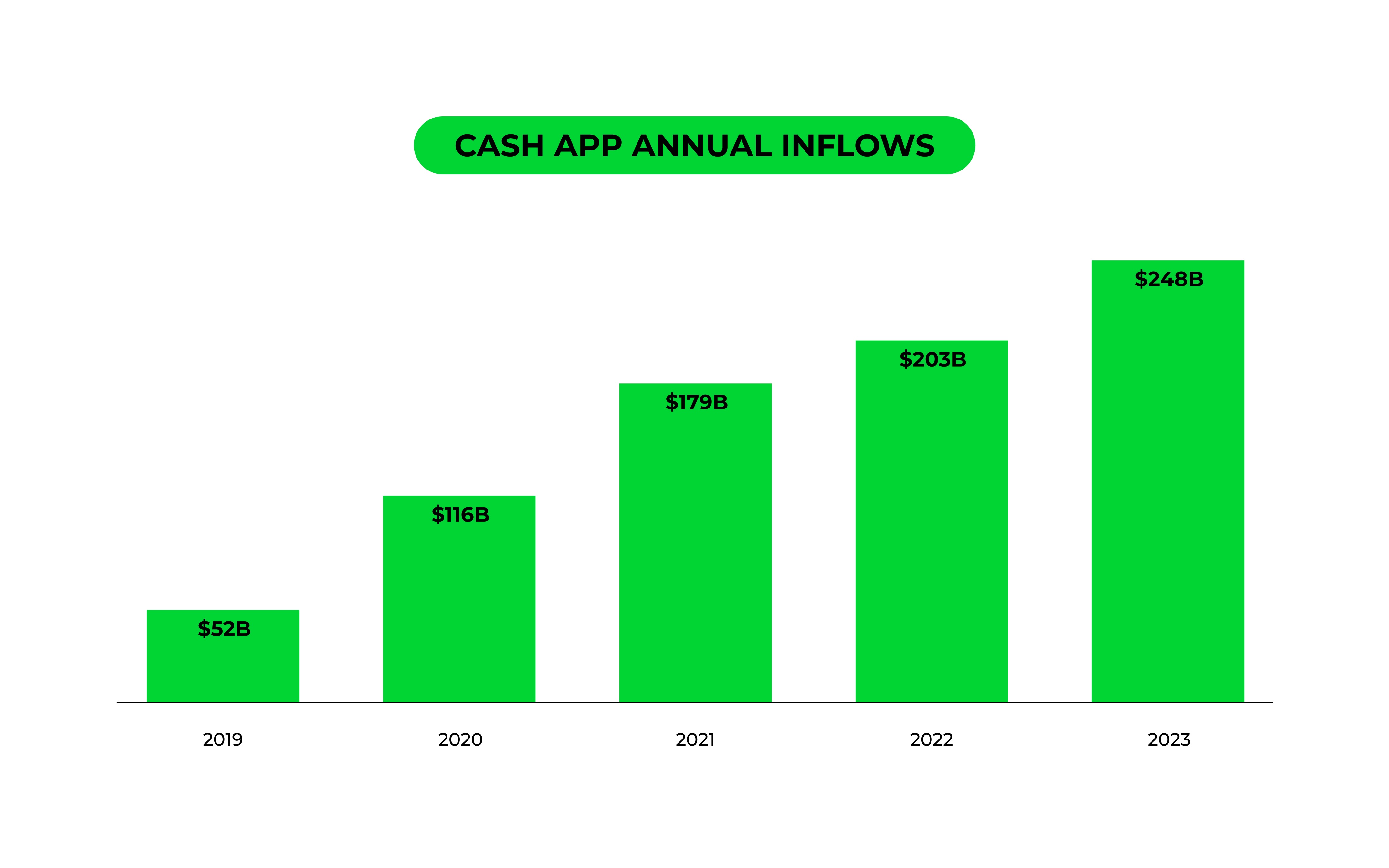
In 2023, Cash App transacting actives brought more than $248 billion in inflows into Cash App. Customers can fund their Cash App accounts with inflows in a variety of ways, including by receiving money from another Cash App customer through the app’s core peer-to-peer transfer service, transferring money from a bank account, depositing mobile checks, adding physical cash at participating retailers, and receiving a recurring paycheck by direct deposit. In 2023, each Cash App monthly transacting active brought in an average of $384 of inflows in a given month during the year. A transacting active is a Cash App account that has at least one financial transaction using any product or service within Cash App during the specified period. Examples of transactions include sending or receiving a peer-to-peer payment, transferring money into or out of Cash App, making a purchase using Cash App Card, earning a dividend on a stock investment, and paying back a loan, among others. Certain of these accounts may share an alias identifier with one or more other transacting active accounts. This could represent, among other things, one customer with multiple accounts or multiple customers sharing one alias identifier (for example, families).

Our Products and Services
Square Ecosystem
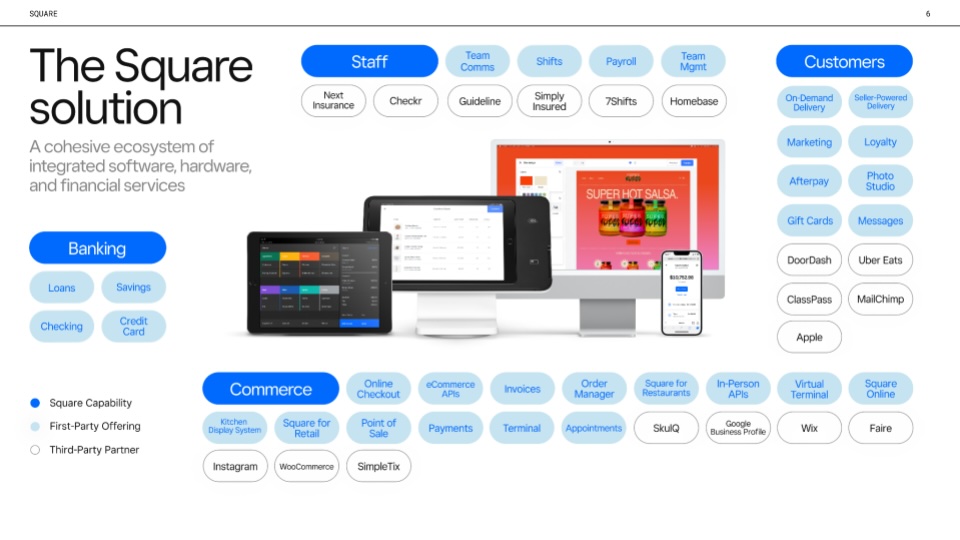
Our Square ecosystem consists of more than 30 distinct software, hardware, and financial services products that provide cohesive Commerce, Customer Relationship Management, Staff Management, and Banking capabilities. Our products are designed to be self-serve and intuitive to make initial setup and new employee training fast and easy, although we also offer full-service setup and support. They are also flexible enough to serve the needs of both small, single location and large, complex multi-location sellers. Our products are integrated to create a seamless experience and enable a holistic view of sales, customers, employees, and finances. We believe the breadth and depth of our products and services provide us unique advantages in best serving the needs of our sellers through a holistic view of their businesses. We supplement these first party capabilities with our open developer platform that enables integrations with third-party applications. We monetize these products through a combination of transaction, subscription, and service fees.
Strategic Priorities: Our focus for Square is on four priorities: maintaining our secure, and flexible multi-product platform, providing a “local” experience to sellers of all sizes, growing with artificial intelligence (“AI”), and further developing our banking offering.
-
Platform: It is critical that we have a strong foundation to build upon to serve external customers through our developer platform and partner ecosystem, and our internal team's first party products. This includes increasing reliability of our platform and also introducing products and features that are most important to our customers.
-
Local:** Our go-to-market strategy is focused on verticals with a local approach, specifically restaurants and services-based businesses. Growing upmarket has shown us that even larger sellers want to feel authentic to their buyers. We can enable this type of robust offering through our technology and by improving the onboarding process through sales and account management.
-
Artificial Intelligence (AI):** We are focused on enabling growth by leveraging AI to increase productivity and outcomes for our sales and marketing, customer service, and engineering efforts, in addition to building features that help sellers grow their businesses.
-
Banking:** Our robust banking offering primarily helps our sellers manage cash flow and grow their business through our lending capabilities. We will continue to drive trust with our sellers, and build products and features that help with sellers accessing funds securely and timely.
Commerce
Square's commerce products help sellers make sales and track orders, inventory, and fulfillment across in-person and online channels, as well as first-party and third-party channels. Most of our Square software products have a free tier (without a subscription fee), which we monetize only through transaction fees on card payments. Most software products also have premium tiers with additional functionality, which we monetize through subscription fees in addition to transaction fees on payments.
-
Square for Restaurants** is a vertical solution tailored for both quick-service and full-service restaurants. It includes table, order, and course management; a kitchen display system; and revenue and cost reporting.
-
Square Appointments** is a vertical solution tailored for appointment-based businesses that need a point-of-sale application with integrated booking capabilities. Square Appointments includes a free online booking site so buyers can easily schedule appointments and select their preferred time, service, and staff member. It is also integrated with Square Assistant, an AI-enabled automated messaging tool that responds to buyers efficiently and professionally, saving sellers' time and helping prevent missed appointments.
-
Square for Retail** is a vertical solution tailored for sellers in the retail industry. It includes advanced inventory management, cost of goods sold reporting, purchase orders, vendor management, and barcode scanning.
-
Square Point of Sale** is a general purpose point-of-sale application for businesses that need an easy-to-use, customizable point-of-sale solution that adapts across business types and stages.
-
Square Online** makes it easy to build a website and online store as well as sell on Instagram and Facebook. The online store is mobile responsive, delivering an app-like ordering experience on a buyer’s phone. With integrated support for QR code ordering, sellers can also streamline their in-store operations by posting the QR code and having their buyers order from their own phones. Fulfillment options include pickup, delivery managed by our sellers, and integrations with partner delivery platforms. Orders, items, inventory, and customer data stay in sync when selling both online and in-person.
-
Square Online Checkout** makes it easy to sell online without a website by allowing sellers to create a checkout link with only a name and price for their good or service.
-
Square Invoices** is a customizable digital invoicing solution with integrated and secure online payment acceptance. This eliminates the need to print and mail statements to customers and wait for checks to arrive. Sellers use Square Invoices for upcoming, recurring, or previously delivered goods and services, such as catering orders, contractor services, lessons, and retail orders. Square Invoices also lets sellers send estimates and collect partial payments for goods and services.
-
Square Virtual Terminal** allows sellers to use a computer as a card terminal. Sellers can take a payment, set up recurring billing, record sales, and send digital receipts for payments, including those made by check and bank transfer.
-
Risk Manager** gives sellers insight into online payment fraud patterns and enables them to set custom rules and alerts to manage risk. Machine-learning algorithms automatically identify fraud patterns and adapt to fit a seller's operations.
-
Order Manager** allows sellers to manage online orders that originate from Square Online, their own website on another platform, and third-party websites including online marketplaces such as DoorDash. Order Manager enables tracking open orders, managing prep times and busy times, and marking orders as completed.
-
Payment APIs** (application programming interfaces) and SDKs (software development kits) support in-person, online, and mobile payments. Square Reader SDK enables developers to seamlessly integrate Square hardware with a seller’s custom point of sale, allowing them to build unique checkout experiences such as self-ordering kiosks powered by Square’s managed payments service. With Square's online payments APIs, developers can integrate Square payments into a seller’s e-commerce website or online store. Square's In-App Payments SDK enables developers to build consumer mobile apps that use Square to process payments. These products are monetized primarily through transaction fees on payment volumes.
-
Commerce APIs:** Square offers more than 30 commerce APIs, through which developers can create and manage orders, subscriptions, product catalogs, inventory, customer profiles, employees, loyalty programs, gift cards, and more to build applications that enrich and integrate with Square's ecosystem of products. In addition, these APIs enable developers to build integrations with their existing business systems such as accounting, customer relationship management (“CRM”), employee management, and enterprise resource planning (“ERP”) software.
For card payments, Square acts as the merchant of record for the transaction as well as the payment service provider (“PSP”). As the merchant of record, Square is the party responsible for settling funds with the seller and helps manage transaction risk loss on behalf of the seller. Square’s managed payments offering for sellers includes payment dispute management, data security, and PCI compliance for a transparent transaction fee paid by sellers. Square has negotiated terms and entered into contractual arrangements directly with other service providers of transaction processing services, including the acquiring processors and card networks, and indirectly with issuing banks. These contracts include negotiated terms, such as more favorable pricing, that are generally not available to sellers if they were to contract directly with these sub-service providers. Square's position as the merchant of record helps us better serve our sellers. For example, as the merchant of record, we can more efficiently onboard new sellers through our website, leveraging our risk assessment models, and we have insights into transaction-level data that we use to inform our sellers and launch new products.
Hardware
Square custom-designs hardware that can process all major card payment forms, including magnetic stripe, EMV chip, and NFC (contactless). Sellers are able to accept cards issued by Visa, Mastercard, American Express, Discover, JCB, Interac Flash (in Canada), e-Money (in Japan), and eftpos (in Australia). Square hardware can be integrated with additional accessories such as cash drawers, receipt printers, scales, and barcode scanners to provide sellers with a comprehensive point-of-sale solution. Square's hardware portfolio includes the following:
-
Square Register** is an all-in-one offering that combines our hardware, point-of-sale software, and payments technology. The dedicated hardware consists of two screens: a seller display and a customer display with a built-in card reader that accepts tap, dip, and swipe payments.
-
Square Terminal** is a portable, all-in-one payments device and receipt printer to replace traditional keypad terminals. It accepts tap, dip, and swipe payments and has a battery that lasts all day, enabling payments anywhere in the store.
-
Square Stand** enables an iPad to be used as a payment terminal or full point-of-sale solution. It features an integrated contactless and chip reader.
-
Square Reader for contactless and chip** accepts EMV chip cards and NFC payments, enabling acceptance via Apple Pay, Google Pay, and other mobile wallets.
-
Square Reader** for magstripe enables swiped transactions of magnetic-stripe cards by connecting with an iOS or Android smartphone or tablet via the headphone jack or Lightning connector.
Customers
Square’s Customer capabilities help sellers grow their business. By linking customer data together with online and in-person commerce data, Square can offer sellers integrated omnichannel capabilities to acquire, engage, and retain customers. Square transaction data and reporting allows sellers to easily assess performance and return on investment. We typically monetize these products via service and software fees.
-
BNPL** helps drive net new demand to sellers via discovery in the Afterpay app and has historically increased average conversion rates and average transaction sizes for new and existing customers across online and in-store channels.
-
Square Loyalty** helps sellers keep their buyers coming back. Buyers that enroll in a Square Loyalty program are twice as likely to be repeat customers and spend 50% more, on average.
-
Square Marketing** helps sellers drive traffic by sending emails or texts to promote in-store events, new products, last-minute deals, or seasonal offers. Sellers can set up recurring automated campaigns to welcome new customers, wish them a happy birthday, send abandoned-cart reminders, or reach out to lapsed customers.
-
Square Gift Cards** help sellers bring in new buyers when their customers purchase gift cards for their friends and family.
Staff
Square's staff management products give sellers digital tools to streamline their operations. These tools seamlessly integrate with other Square products eliminating the latent, time-consuming, and error-prone processes typically used to copy and sync data between disparate systems. We typically monetize these products via software fees.
-
Square Team Management** makes it easy to schedule staff and view team performance and sales analytics in real time. It also enables limiting access to Square software features per employee or role. The Square Team App enables team members to clock in and out, view and adjust their schedules, and see timecards, hours worked, and estimated pay from their mobile phone.
-
Square Payroll** allows sellers to pay wages and associated employee taxes, and offer employee benefits (e.g. 401(k) accounts). The Square ecosystem drives competitive differentiation for our Payroll product with the ability to use Payroll in conjunction with our point-of-sale products, Team Management, and Cash App.
Banking
We offer a growing number of banking services that make it easier for sellers to manage cash flow and get faster access to funds.
-
Square Lending provides a platform of lending products to qualified Square sellers**.** Square Loans (formerly Square Capital) facilitates loans to qualified Square sellers through our subsidiary Square Financial Services, Inc. (“SFS Financial Services”), which is an industrial loan company (“ILC"). Square Loans eliminates the lengthy (and often unsuccessful) loan application process. We are able to approve sellers for these loans by using our unique data set of the seller’s Square transactions to help facilitate loan underwriting and collections, which mitigates risks. Generally, loan repayment occurs automatically through a fixed percentage of every card transaction a seller takes. Loans are sized to be less than 20% of a seller's expected annual Square GPV and, by simply running their business, sellers historically have repaid their loans within nine months on average. We currently fund a majority of these loans from arrangements with institutional third-party investors who purchase these loans on a forward-flow basis, which mitigates our balance sheet and liquidity risk. Since its public launch in May 2014, Square Loans has facilitated more than 2.2 million loans and advances, representing more than $16.2 billion in principal amount loaned or advanced. This includes approximately 150,000 loans to small businesses representing more than $1.5 billion of Paycheck Protection Program (“PPP”) loans facilitated in 2020 and 2021, excluding canceled loans. We launched Square Credit Card in 2023 to provide another lending option.
-
Instant Transfer** enables sellers to receive funds from their payments instantly or later that same day. Instant Transfer is an important tool for sellers that need faster access to their funds in order to better manage their cash flow or working capital.
-
Square Checking** provides sellers with an FDIC-insured account that gives them instant access to their sales and the ability to immediately use those funds via a debit card (Square Debit Card), withdraw funds from an ATM, or transfer funds via ACH.
-
Square Savings** is a high-yield business savings account, with no monthly fees or minimums, designed to make cash flow management easier for sellers. With Square Savings, sellers can easily and automatically put aside a portion of their sales in their savings account while also organizing their money within folders, streamlining the process of saving funds for specific goals and priorities, such as quarterly tax obligations.
Cash App Ecosystem
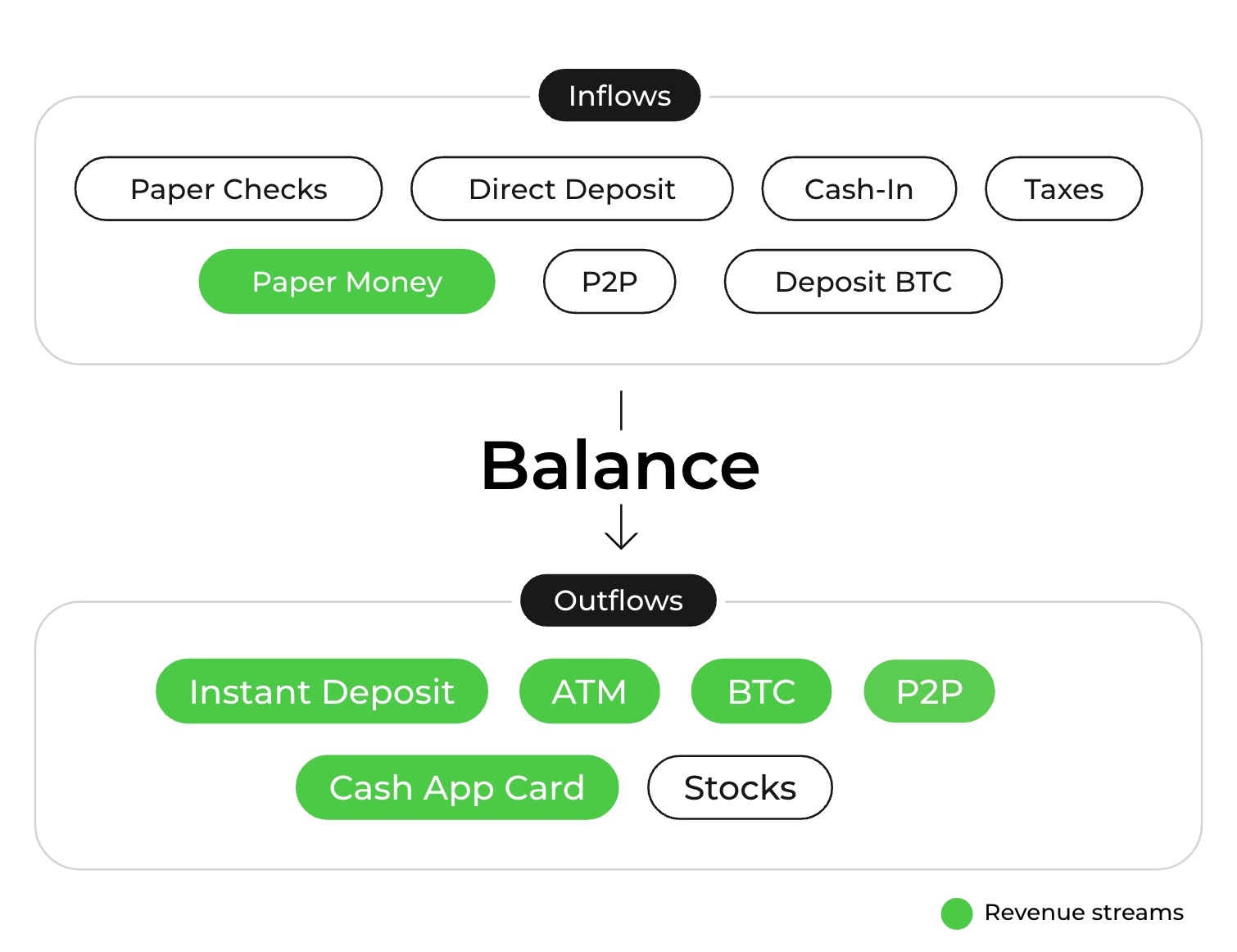
With Cash App, we are building an ecosystem of financial products and services that helps consumers manage their money by making it more relatable, instantly available, and universally accessible. Cash App is primarily in the United States and has a diverse set of customers across demographics and regions. We use our inflows framework to assess the performance of Cash App across actives, inflows per active, and the monetization rate on inflows.
Strategic Priorities
Cash App sits at the intersection of three traditionally-distinct use cases: financial services, community based transactions (peer-to-peer payments) and commerce. Our approach for Cash App is to combine these three areas together in a unique manner to define a new product category and reinvent banking for our customers. Our primary focus with Cash App, in alliance with our bank partners, is on earning the primary banking relationship of our existing customer base in the U.S.
Customers can use Cash App to inflow funds in a variety of ways, including by receiving money from another Cash App customer through the app’s core peer-to-peer transfer service, transferring money from a bank account, depositing mobile checks, adding physical cash at participating retailers, receiving a recurring paycheck by direct deposit, and through other inflow channels. These funds can then be sent to another customer through the app, spent anywhere that accepts Visa cards or Cash App Pay, withdrawn from an ATM using the Cash App Card, invested in stocks or exchange-traded funds (“ETFs”), used to buy bitcoin, or transferred to a bank account (either instantly for a fee or for free in one to three days).
Financial Services
We serve our customers through a broad suite of financial services, and earning their trust is a key factor in how we can deepen our financial relationship with them. The breadth of our financial service offerings allows us to increase our share of wallet as well as expand our customer base to serve a wider variety of demographics. We develop trust with customers by offering reliable, easy, and secure access to their accounts and convenient support. We also adapt the amount of funds a customer can bring in through specific channels based on risk profile, and as we improve our understanding of a customer’s identity. We believe building and maintaining deep trust with our customers will drive greater product adoption and increased inflows into our ecosystem.
Banking Services
-
Cash App Card** is a debit card, issued by our bank partner, and linked directly to a customer’s Cash App balance. Customers can order a Cash App Card for free and use it anywhere that accepts Visa cards to make purchases, drawing down from the funds stored in their Cash App balance. Cash App earns interchange fees when individuals make purchases with their Cash App Card. Customers can select new or promotional Cash App Card designs for a fee, and can also withdraw funds from an ATM using the Cash App Card. Customers can also purchase and send gift cards at specific merchants to other customers, and recipients can spend them with their Cash App Card.
-
Direct deposit** capabilities, in alliance with our partner bank and system processor, allow customers to receive their recurring paycheck, tax refund, or government disbursement into their Cash App account, which they can then use to send, spend, store, or invest.
-
Savings** allows customers to hold a separate savings balance at our bank partner, and easily set and track towards financial goals. Customers can add money to Savings using their Cash App balance, a linked debit card, or through Round Ups on purchases with Cash App Card.
-
Cash Boost** is a free and instant rewards program that offers customers discounts at specific businesses (e.g., 10% off a purchase on DoorDash) or at certain business types (e.g., grocery stores). Customers can select the Cash Boost they want to apply to their Cash App Card, and the discount is instantly applied to their Cash App balance for eligible transactions. Some Cash Boosts are selected and funded by Cash App, while others are funded by our partners. Costs related to the Cash Boost rewards program that are funded by Cash App are recognized as reductions to revenue.
Lending
We believe credit is an area within our financial services offerings where we can provide simple, fair, and accessible products that promote financial health. Cash App Borrow, our first credit product for consumers, allows customers to access short-term loans for a small fee. The product offers eligible Cash App customers up to $500 during a given month that they can pay back in scheduled installments or as a percentage of what they receive into Cash App. We determine a Cash App customer’s eligibility based on prudent risk management by using our unique data set that includes a customer’s inflows and engagement on Cash App. The average Cash App Borrow loan was repaid in less than four weeks in 2023.
Tax Preparation
Cash App Taxes provides a seamless, mobile-first solution for consumers to file their taxes for free.
Stock Brokerage
Customers can also use Cash App to invest their funds for free in U.S. listed stocks and ETFs. We believe this makes investing more accessible by giving customers access to hundreds of listed stocks and ETFs that they can purchase using their Cash App balance or a linked debit card for as little as $1. Once the order is filled, all investments are viewable through the stocks applet.
Bitcoin
We have a simple bitcoin exchange and custody solution that provides customers with an onramp and offramp to buy and sell bitcoin with Cash App for as little as $1 and a custodial account to store it securely without needing to keep track of any private keys. Our solution offers features that allow customers to complete auto buys and custom limit orders, as well as direct deposit to auto-convert their paycheck into bitcoin and earn instant bitcoin rewards on Cash App Card purchases.
We have also focused on payments through bitcoin. Given our network scale, we believe Cash App can help bitcoin evolve beyond an asset class to an investment that possesses real transactional utility, which is why we launched our offering in 2018 with the ability to deposit and withdraw bitcoin across the blockchain. We have since added the ability for customers to send bitcoin across the Cash App network to any phone number or $Cashtag, creating an easy-to-use off-chain network for bitcoin payments that settles instantly between transacting actives. We also allow U.S. actives to send and receive bitcoin to/from anyone with a compatible wallet via the Lightning Network. The Lightning Network is a second layer technology applied to the bitcoin blockchain that enables faster transactions with little to no fees.
Community
Peer-to-peer payments form the basis of our Community development pillar because customers engage in financial transactions with other members of the Cash App community. When customers use peer-to-peer, they are inviting their friends, family, and coworkers to download Cash App so that they can send each other money. Peer-to-peer becomes more useful for our customers as their communities expand, so our customers are naturally incentivized to bring more people into their networks. We offer the peer-to-peer service to our Cash App customers for free when a linked debit account is used to fund a transaction, as we consider peer-to-peer to be a marketing tool to encourage Cash App usage. We charge a fee to the sender when transactions are funded using a credit card, and a fee to the recipient if it is a business account.
Instant Deposit was the first feature we started monetizing on Cash App. Customers are able to instantly transfer funds from Cash App to a bank account for a small fee. We believe our customer base values fast access to funds, and this speed is one example of how we differentiate our ecosystem.
Commerce
Cash App is focused on driving greater commerce between consumers and merchants. Our BNPL platform facilitates commerce between retail merchants and consumers by allowing its retail merchant clients to offer their customers the ability to buy goods and services on a BNPL basis. Our BNPL platform serves as a connection point between our Square and Cash App ecosystems as we build out a marketplace that acts as a shopping destination for consumers to search for merchants and find offers. Our BNPL platform provides consumers the ability to get desired items now but pay for them later, while simultaneously helping merchants increase sales and order values. We have a range of products across our BNPL platform.
-
Pay in 4:** Through the use of our BNPL platform, consumers can split their purchases into generally three or four installments, typically due in two-week increments, without paying fees (if payments are made on time). We pay retail merchants the full order value up front (less a percentage fee) and assume the risk of non-payment from the consumer.
-
Monthly Payment Solution:** We also offer the ability for consumers to pay for larger transaction sizes over a six- or twelve-month period using a monthly payment option. The structure of the product includes no late fees and no compounding interest with a cap on total interest owed.
-
Advertising and affiliate:** Our BNPL platform generates hundreds of millions of leads each year for merchants and has channeled this demand towards scaling an ads and affiliate program for its merchants: for affiliate relationships, we receive a commission when a consumer begins their shopping journey in the Afterpay App and makes a purchase. We may also receive digital advertising revenue based on clicks to a merchant site from the Afterpay App as well as flat fees for premium ad placements.
-
Shop directory:** We operate an online shop directory, which allows consumers to search by product category for stores that offer Afterpay as a payment option.
-
Afterpay Card, Afterpay Plus Card:** We offer two in-store cards that allow consumers to pay in 4 for in-person transactions at a merchant’s point of sale. The Afterpay Card allows consumers to shop in-store at Afterpay merchants and is free for the consumer. The Afterpay Plus Card is currently available to select Afterpay consumers for a monthly fee and allows them to shop in-store anywhere that Apple Pay or Google Pay is accepted.
Cash App Pay
Cash App Pay is a simple, mobile-friendly way for Cash App customers to pay at merchants across online and in-person channels. As of December 2023, Cash App Pay is enabled for a subset of Square sellers that are using certain Square hardware and software products, as well as a subset of Afterpay merchants, and most recently launched with large payment service providers who can offer it to their merchants. With Cash App Pay, Cash App customers can pay by simply scanning a QR code or tapping a button on their mobile device at checkout.
Business Accounts
Cash App allows business accounts to collect payments for their business by accepting peer-to-peer transactions for a fee, while allowing higher weekly limits and providing relevant tax reporting forms.
Sales and Marketing
Square Ecosystem
The Square ecosystem has a strong brand affinity among its sellers. Our Net Promoter Score (“NPS”) has averaged 54 over the past four quarters, which is nearly double the average score for banking providers. Our high NPS means Square sellers recommend our services to others, which we believe strengthens the Square brand and helps drive efficient customer acquisition.
Direct marketing, online and offline, has also been an effective customer acquisition channel. These tactics include online search engine optimization and marketing, online display advertising, direct mail campaigns, direct response television advertising, mobile advertising, and affiliate and seller referral programs. Our direct sales and account management teams also contribute to the acquisition and support of larger sellers.
Our direct, ongoing interactions with our sellers help us tailor offerings to them, at scale, and in the context of their usage. We use various scalable communication channels such as email marketing, in-product notifications and messaging, and Square Communities, our online forum for sellers, to increase the awareness and usage of our products and services with little incremental sales and marketing expense. Our customer support team also helps increase awareness and usage of our products as part of helping sellers address inquiries and issues.
In addition to direct channels, we work with third-party developers and other partners who offer our solutions to their customers. Partners expand our addressable market to sellers with individualized or industry-specific needs. Through the Square App Marketplace, Square partners are able to expand their own addressable market by reaching the millions of sellers using Square. As of December 31, 2023, Square had nearly 1,000 managed partners connected to its platform.
Cash App Ecosystem
Cash App has also developed a strong brand, which can be traced back to our compelling features, self-serve experience, unique design, and engaging marketing.
Peer-to-peer transactions serve as the primary acquisition channel for Cash App. Peer-to-peer transactions have powerful network effects as every time a customer sends or requests money, Cash App can potentially acquire a new customer or re-engage an existing customer. We have enhanced the efficiency of peer-to-peer transfers by streamlining the onboarding process for Cash App, enabling customers to sign up in minutes. We offer the peer-to-peer service to our Cash App customers for free, and we consider it to be a marketing tool to encourage the usage of Cash App. We do not generate revenue on the majority of peer-to-peer transactions and for these transactions we characterize card issuance costs, peer-to-peer costs, and risk loss as a sales and marketing expense.
Cash App also uses paid marketing, including referrals, advertising spend, partnerships, and social media campaigns, to expand its network, as these programs help reach new customers, enhance its brand, and improve retention among existing customers.
Additionally, we see the launch and advertising of new Cash App features as an important way to attract new customers and engage existing customers. Features such as Cash App Card and Boost rewards, bitcoin buying and selling, investing in stocks and ETFs, cross-border payments, Cash App Pay, and a tax preparation service enhance Cash App’s utility for customers and provide reasons for consumers to try Cash App.
Product Development and Technology
We design both our Square and Cash App products and services to be cohesive, fast, self-serve, and elegant, and we organize our product teams accordingly, combining individuals from product management, engineering, data science, analytics, design, and product marketing. Our products and services are platform-agnostic with most supporting iOS, Android, and web. We frequently update our software products and have a rapid software release schedule with improvements deployed regularly. Our services are built on a scalable technology platform, and we place a strong emphasis on data analytics and machine learning to maximize the efficacy, efficiency, and scalability of our services.
In our Square ecosystem, this technology platform enables us to capture and analyze billions of transactions per year and automate risk assessment for more than 99.95% of all transactions. Our hardware is designed and developed in-house, and we contract with third-party manufacturers for production.
Our Competition
Square Ecosystem
The markets in which our Square ecosystem operates are competitive and evolving. Our competitors range from large, well-established vendors to smaller, earlier-stage companies. We seek to differentiate ourselves from competitors primarily on the basis of our extensive commerce ecosystem and our focus on building remarkable products and services that are cohesive, fast, self-serve, and elegant. In addition, we differentiate ourselves by offering transparent pricing, no long-term contracts, and our ability to innovate and reshape the industries we operate in to expand access to traditionally unserved or underserved sellers. With respect to each of these factors, we believe that we compare favorably to our competitors. Competitors that overlap with certain functions and features that we provide include:
-
Business software providers such as those that provide point of sale, website building, inventory management, employee management, customer relationship management invoicing, and appointment booking solutions;
-
Payment terminal vendors;
-
Merchant acquirers;
-
Banks that provide payment processing, checking, savings, loans, and payroll;
-
Pen and paper, manual processes, and paper currency;
-
Payroll processors; and
-
Established or new alternative lenders.
Cash App Ecosystem
Cash App competes with other companies in peer-to-peer payments, debit and prepaid cards, credit card rewards, stock trading, tax filing, digital wallet, bitcoin exchanges, BNPL providers, and shopping and consumer demand generation. Our competitors include money transfer apps, prepaid debit card offerings, brokerage firms, tax firms, financial technology apps, banks, and crypto trading services.
We compete primarily on our differentiated lifestyle brand, the breadth of our network, the range of products in our ecosystem, and the simplicity and quality of our customer experience. We invest in brand, design, and technology to keep our products fast and simple, while also improving and expanding our features.
Intellectual Property
We seek to protect our intellectual property rights by relying on a combination of federal, state, and common law rights in the United States and other countries, as well as on contractual measures. It is our practice to enter into confidentiality, non-disclosure, and invention assignment agreements with our employees and contractors, and into confidentiality and non-disclosure agreements with other third parties, in order to limit access to, and disclosure and use of, our confidential information and proprietary technology. In addition to these contractual measures, we also rely on a combination of trademarks, trade dress, copyrights, registered domain names, trade secrets, and patent rights to help protect our brand and our other intellectual property.
We have developed a patent program and strategy to identify, apply for, and secure patents for innovative aspects of our products, services, and technologies where appropriate. We also actively pursue registration of our trademarks, logos, service marks, trade dress, and domain names in the United States and in other jurisdictions. We intend to file additional patent applications as we continue to innovate through our research and development efforts and to pursue additional patent protection to the extent we deem it beneficial and cost-effective, including acquiring patent assets or licensing patent rights from third parties. In addition, we participate in a number of industry organizations that facilitate patent pools or non-assertion commitments, such as the Cryptocurrency Open Patent Alliance that we co-founded, LOT Network, and Open Invention Network.
Government Regulation
Foreign and domestic legal requirements apply to many key aspects of our business. Any actual or perceived failure to comply with these requirements may result in, among other things, revocation of required licenses or registrations, loss of approved status, private litigation, regulatory or governmental investigations, administrative enforcement actions, sanctions, civil and criminal liability, monetary penalties, and constraints on our ability to continue to operate. It is also possible that current or future laws or regulations could be interpreted or applied in a manner that would prohibit, alter, or impair our existing or planned products and services, or that could require costly, time-consuming, or otherwise burdensome compliance measures from us.
Payments Regulation
Various laws and regulations govern the payments industry in the United States and globally. For example, certain jurisdictions in the United States require a license to offer money transmission services, such as Cash App’s peer-to-peer payments, and we maintain a license in each of those jurisdictions and comply with new license requirements as they arise. We are also registered as a “Money Services Business” with the U.S. Department of Treasury’s Financial Crimes Enforcement Network ("FinCEN"). These licenses and registrations subject us, among other things, to record-keeping requirements, reporting requirements, bonding requirements, limitations on the investment of customer funds, and examination by state and federal regulatory agencies.
Outside the United States, we provide localized versions of some of our services to customers, including through various foreign subsidiaries. The activities of those non-U.S. entities are, or may be, supervised by regulatory authorities in the jurisdictions in which they operate. For instance, we hold an Australian Financial Services License issued by the Australian Securities and Investments Commission to provide non-cash payments in Australia, and we are licensed as an Electronic Money Institution to provide payments services and electronic money in the United Kingdom by the Financial Conduct Authority and in the European Union by the Central Bank of Ireland and the Bank of Lithuania.
Our payments services may be or become subject to regulation by other authorities, and the laws and regulations applicable to the payments industry in any given jurisdiction are always subject to interpretation and change.
Consumer Protection
The Consumer Financial Protection Bureau and other federal, local, state, and foreign regulatory and law enforcement agencies regulate financial products and enforce consumer protection laws, including those applicable to credit, deposit, and payments services, and other similar services. These agencies have broad consumer protection mandates, and they promulgate, interpret, and enforce rules and regulations that affect our business.
Anti-Money Laundering, Anti-Corruption, and Sanctions
We are subject to anti-money laundering ("AML"), anti-corruption, and economic, trade and sanctions laws and regulations in the United States and other jurisdictions in which we operate. The anti-corruption laws, such as the U.S. Foreign Corrupt Practices Act and the U.K. Bribery Act, generally prohibit companies from making or offering improper payments to foreign government officials and political figures for the purpose of obtaining or retaining business or to gain an unfair business advantage. Economic and trade sanctions programs that are administered by the U.S. Department of the Treasury’s Office of Foreign Assets Controls and equivalent applicable foreign authorities prohibit or restrict transactions to or from, or dealings with, specified countries, governments, individuals and entities that are specially designated nationals of those countries, including narcotics traffickers and terrorists or terrorist organizations. We have implemented an AML program designed to comply with the laws and regulations to which we are subject.
Bank Regulation
We obtained approval from the Federal Deposit Insurance Corporation ("FDIC") and the Utah Department of Financial Institutions to open an ILC. The opening of Square Financial Services, Inc., our ILC, in March 2021 subjects us to direct state and federal regulatory supervision and requires compliance with applicable banking regulations and requirements.
Lending Regulation
Various laws and regulations govern lending in the United States and internationally. In the United States, Square Capital, LLC holds and maintains lending and collections licenses with state regulators to support lending products offered across the United States. Afterpay US Services, LLC holds and maintains lending licenses to support its product offerings. These lending licenses subject us to the supervision and examination authority of state regulators, and our partnerships with FDIC-insured financial institutions to offer certain lending products to customers subjects us to federal regulatory supervision.
Outside the United States, we provide localized versions of some of our lending services to customers, including through our various foreign subsidiaries. The activities of our foreign subsidiaries are, or may be, supervised by regulatory authorities in the jurisdictions in which they operate. For example, we hold an Australian Credit Licence issued by the Australian Securities and Investments Commission.
Our lending services may be, or may become, subject to regulation by other applicable authorities or jurisdictions, and the laws and regulations applicable to the lending industry in any given jurisdiction are always subject to interpretation and change.
Broker-Dealer Regulation
Our subsidiary, Cash App Investing LLC ("Cash App Investing"), operates as a broker-dealer and is therefore registered with the Securities and Exchange Commission ("SEC") and a member of the Financial Industry Regulatory Authority ("FINRA"). As a broker-dealer, Cash App Investing is subject to SEC and FINRA laws and regulations including, without limitation, how it markets its services, handles customer assets, keeps records, and reports to the SEC and FINRA. Cash App Investing is also registered in each state where we conduct business, and subject to those states’ securities laws and regulations.
Virtual Currency Regulation
We are subject to certain licensing and supervisory frameworks as a result of our Cash App offering, through which customers can use their stored funds to buy, hold and sell bitcoin, and transfer bitcoin to and from Cash App. We currently hold a New York State BitLicense and a Virtual Currency Business License in Louisiana. The laws and regulations applicable to virtual currency are evolving and subject to interpretation and change. Therefore, our current and future virtual currency services may be or become subject to additional licensing, regulatory requirements and oversight by other state and federal authorities.
Protection and Use of Information
We collect and use a wide variety of information for various purposes in our business, including to help ensure the integrity of our services and to provide features and functionality to our customers. This aspect of our business, including the collection, use, disclosure, and protection of the information we acquire from our own services as well as from third-party sources, is subject to laws and regulations in the United States, the European Union, and elsewhere. Accordingly, we publish our privacy policies and terms of service, which describe our practices concerning the use, transmission, and disclosure of information. As our business continues to expand in the United States and worldwide, and as laws and regulations continue to be passed and their interpretations continue to evolve in numerous jurisdictions, additional laws and regulations may become relevant to us.
Communications Regulation
We send texts, emails, and other communications in a variety of contexts, such as when providing digital receipts and marketing. Communications laws and regulations, including those promulgated by the Federal Communications Commission, apply to certain aspects of this activity in the United States and elsewhere.
Additional Developments
Various legislative bodies and regulatory agencies in the United States and elsewhere in our international markets continue to examine a wide variety of issues that could impact our business, including privacy, data protection, information security, virtual currencies, identity theft, tax, marketing, and labor and employment matters. As our business continues to develop and expand, additional laws, rules and regulations may become relevant.
Seasonality
Historically, transaction-based revenue for our Square ecosystem has been strongest in our fourth quarter and weakest in our first quarter, as our sellers typically generate additional GPV during the holiday season. Subscription and services-based revenue generally demonstrates less seasonality than transaction-based revenue. Hardware revenue generally demonstrates less seasonality than transaction-based revenue, with most fluctuations tied to periodic product launches, promotions, or other arrangements with our retail partners.
Historically, our Cash App ecosystem has experienced improvements in revenue and gross profit related to the distribution of government funds as customers have deposited more funds into Cash App during these times, including during the first quarter when U.S. tax refunds are typically distributed. Certain products within Cash App may also experience stronger fourth quarters and weaker first quarters, such as our BNPL platform, which typically generates additional revenue and gross profit during the holiday season. Typical seasonality trends for the Cash App ecosystem are also impacted by bitcoin revenue, which is driven by customer demand and the current market price of bitcoin, and as such, may not be indicative of future performance and skew typical seasonality trends in the Cash App ecosystem.
Human Capital
Our employees are a driving force behind our purpose of economic empowerment. Attracting, developing, and retaining top talent remain a focus in the development of our human capital programs. As of December 31, 2023, we had 12,985 full-time employees worldwide with 3,154 full-time employees outside the US. We also engage temporary employees and consultants as needed to support our operations. In November 2023, we announced we would implement an absolute cap of 12,000 on the number of employees we have at our company. We plan to operate below this cap through a combination of performance management, centralizing teams and functions to reduce duplication, and prioritization of our scope. We expect to keep this cap in place until we believe the growth of the business has meaningfully outpaced the growth of our company.
We have a purpose-driven culture, with a focus on employee input and well-being, which we believe enables us to attract and retain exceptional talent. We offer learning and development programs for all employees, as well as a robust manager training program. Employees have the opportunity to actively voice their questions and thoughts through many internal channels, including our company townhall meetings and bi-annual employee engagement surveys. Our distributed work model means that we no longer have a designated headquarters location and, for the vast majority of roles, employees have the flexibility to work within or outside a Block office space. Our distributed work model has unlocked opportunities to hire and retain talent in more locations, as we can hire employees in locations where we do not have office space, and employees can continue to work for us if they need or want to relocate.
A key focus of our human capital management approach is our commitment to promoting inclusion and diversity in our workplace. In 2023, we equipped managers with tools to build and lead inclusive teams, expanded professional development opportunities for employees from traditionally underrepresented backgrounds, and continued to elevate diversity as a central component of our recruiting strategy. Each year, we publish our workforce demographics to show how far we have come, where there is room to grow, and how our workforce is evolving. The 2023 report is available at: https://block.xyz/inside/report-workforce-data-2023. The contents of the report and our websites are not incorporated by reference into this Annual Report on Form 10-K.
From a total rewards perspective, Block offers a competitive compensation and benefits package, which is reviewed and updated each year. Our annual compensation planning coincides with our feedback cycle during which employees and managers have performance conversations to facilitate learning and career development. As part of our compensation review program, pay equity analyses are conducted annually.
Corporate Information
Block was incorporated in Delaware in June 2009. In 2020, we adopted a distributed work model and we no longer have a designated headquarters location. Our principal executive office, which we are required to identify under Securities and Exchange Commission rules, is 1955 Broadway, Suite 600 Oakland, CA 94612. Our telephone number is (415) 375-3176. Our website is located at www.block.xyz, and our investor relations website is located at investors.block.xyz. The information contained in, or accessible through, our website is not part of or incorporated into, this Annual Report on Form 10-K.
We use various trademarks and trade names in our business, including “Block,” “Square,” “Cash App” and “Afterpay,” which we have registered in the United States and in various other countries. This Annual Report on Form 10-K also contains trademarks and trade names of other businesses that are the property of their respective holders. We have omitted the ® and ™ designations, as applicable, for the trademarks we name in this Annual Report on Form 10-K.
Available Information
Copies of our Annual Reports on Form 10-K, Quarterly Reports on Form 10-Q, Current Reports on Form 8-K, and amendments to these reports filed or furnished pursuant to Section 13(a) or 15(d) of the Securities Exchange Act of 1934, as amended (Exchange Act), are available, free of charge, on our investor relations website as soon as reasonably practicable after we electronically file or furnish such material with the Securities and Exchange Commission ("SEC"). The SEC also maintains a website that contains our SEC filings. The address of the site is www.sec.gov.
We webcast our earnings calls and certain events we participate in or host with members of the investment community on our investor relations website. Additionally, we provide notifications of news or announcements regarding our financial performance, including SEC filings, investor events, press and earnings releases, and blogs as part of our investor relations website. We have used, and intend to continue to use, our investor relations website, as well as the X (formerly known as Twitter) accounts @Blocks and @BlockIR, as means of disclosing material non-public information and for complying with our disclosure obligations under Regulation FD. Further corporate governance information, including our board committee charters, code of business conduct and ethics, and corporate governance guidelines, is also available on our investor relations website under the heading “Governance Documents.” The contents of our websites are not intended to be incorporated by reference into this Annual Report on Form 10-K or in any other report or document we file with the SEC, and any references to our websites are intended to be inactive textual references only.
Item 1A. RISK FACTORS
Investing in our securities involves a high degree of risk. You should carefully consider the risks and uncertainties described below, together with all of the other information in this Annual Report on Form 10-K, including the section titled Management’s Discussion and Analysis of Financial Condition and Results of Operations and our consolidated financial statements and related notes, before making any investment decision with respect to our securities. The risks and uncertainties described below may not be the only ones we face. If any of the risks actually occur, our business could be materially and adversely affected. In that event, the market price of our Class A common stock could decline, and you could lose part or all of your investment.
Risk Factors Summary
Our business operations are subject to numerous risks and uncertainties, including those outside of our control, that could cause our actual results to be harmed, including risks regarding the following:
Risks related to our business and our industry:
-
our ability to retain existing sellers and customers, attract new sellers and customers, and increase sales to both new and existing sellers and customers;
-
our investments in our business and ability to maintain profitability;
-
our ability to maintain, protect, and enhance our brands;
-
our efforts to expand our product portfolio and market reach;
-
our ability to develop products and services to address the rapidly evolving market for payments and financial services;
-
competition in our markets and industry;
-
risks related to disruptions in or negative perceptions of the cryptocurrency market;
-
any acquisitions, strategic investments, new businesses, joint ventures, divestitures, and other transactions that we may undertake;
-
the ongoing integration of Afterpay with our business;
-
risks related to our majority interest in TIDAL;
-
operating or expanding our business globally;
-
risks related to our BNPL platform;
-
risks related to the banking ecosystem, including through Square Financial Services, our bank partnerships, and FDIC and other regulatory obligations; and
-
additional risks of Square Loans related to the availability of capital, seller payments, interest rate, deposit insurance premiums, and general macroeconomic conditions.
Operational risks:
-
real or perceived improper or unauthorized use of, disclosure of, or access to sensitive data;
-
real or perceived security breaches or incidents or human error in administering our software, hardware, and systems;
-
systems failures, interruptions, delays in service, catastrophic events, and resulting interruptions in the availability of our products or services or those of our sellers;
-
any failure to safeguard the bitcoin we hold on behalf of ourselves and other parties;
-
our risk management efforts;
-
our dependence on payment card networks and acquiring processors;
-
our reliance on third parties and their systems for a variety of services, including the processing of transaction data and settlement of funds;
-
our dependence on key management and any failure to attract, motivate, and retain our employees;
-
our operational, financial, and other internal controls and systems;
-
any shortage, price increases, tariffs, changes, delay or discontinuation of our key components;
-
the integration of our services and our products with a variety of operating systems; and
-
difficulties estimating the amount payable under TIDAL's license agreements.
Economic, financial, and tax risks:
-
a deterioration of general macroeconomic conditions;
-
any inability to secure financing on favorable terms, or at all, or comply with covenants in our existing credit agreement, the indentures, or future agreements;
-
our ability to service our debt, including our convertible notes and our Senior Notes (as defined below);
-
counterparty risk with respect to our convertible note hedge transactions;
-
our bitcoin investments being subject to volatile market prices, impairment, and other risks of loss;
-
foreign exchange rates risks; and
-
any greater-than-anticipated tax liabilities or significant valuation allowances on our deferred tax assets.
Legal, regulatory, and compliance risks:
-
extensive regulation and oversight in a variety of areas of our business;
-
complex and evolving regulations and oversight related to privacy, data protection, and information security;
-
litigation, including intellectual property claims, government investigations or inquiries, and regulatory matters or disputes;
-
obligations and restrictions as a licensed money transmitter;
-
regulatory scrutiny or changes in the BNPL space;
-
regulation and scrutiny of our subsidiary Cash App Investing, which is a broker-dealer registered with the SEC and a member of FINRA, including net capital and other regulatory capital requirements;
-
changes to our business practices imposed by FINRA based on our ownership of Cash App Investing;
-
regulation and scrutiny of our subsidiary Square Financial Services, which is a Utah state-chartered industrial loan company, including the requirement that we serve as a source of financial strength to it;
-
supervision and regulation of Square Financial Services, including the Dodd-Frank Act and its related regulations;
-
any inability to protect our intellectual property rights;
-
assertions by third parties of infringement of intellectual property rights by us; and
-
increased scrutiny from investors, regulators, and other stakeholders relating to environmental, social, and governance issues.
Risks related to ownership of our common stock:
-
the dual class structure of our common stock;
-
volatility of the market price of our Class A common stock;
-
the dual-listing of our Class A common stock on the NYSE and our CHESS Depositary Interests ("CDIs") on the Australian Securities Exchange ("ASX");
-
our convertible note hedge and warrant transactions;
-
anti-takeover provisions contained in our amended and restated certificate of incorporation, our amended and restated bylaws, and provisions of Delaware law; and
-
exclusive forum provisions in our bylaws.
Risks Related to Our Business and Our Industry
Our growth rate has slowed at times and may slow or decline in the future, and our growth rates in each of our reporting segments may vary. Future revenue and gross profit growth depends on our ability to retain existing sellers and customers, attract new sellers and customers, and increase sales to both new and existing sellers and customers.
Our rate of revenue and gross profit growth has slowed at times and may decline in the future, and it may slow or decline more quickly than we expect for a variety of reasons, including the risks described in this Annual Report on Form 10-K. Additionally, our rate of revenue and gross profit growth may vary between our reporting segments. For example, in recent periods our Cash App segment revenue has grown at a high rate, which has varied and may continue to vary from the growth rate of our Square segment. Our sellers and customers have no obligation to continue to use our services, and we cannot assure you that they will. We generally do not have long-term contracts with our sellers and customers, and the difficulty and costs associated with switching to a competitor may not be significant for many of the services we offer. Our sellers’ activity with us may decrease for a variety of reasons, including sellers’ level of satisfaction with our products and services, our pricing and the pricing and quality of competing products or services, the effects of economic conditions, or reductions in the aggregate spending of our sellers’ customers. Growth in transacting actives on Cash App and customers’ level of engagement with our products and services on Cash App are essential to our success and long-term financial performance. However, the growth rate of transacting actives ha
Showing the first 8K of 177K characters. Open the full section
Item 1B. UNRESOLVED STAFF COMMENTS
None.
Item 1C. CYBERSECURITY
Risk Management and Strategy
We have a cybersecurity risk management program consisting of policies and procedures for assessing, identifying, and managing material risk from cybersecurity threats, and we have integrated these policies and procedures into our overall risk management systems and processes. Our cybersecurity policies and procedures are based on recognized frameworks established by the National Institute of Standards and Technology, the International Organization for Standardization and other applicable industry standards. We routinely assess material risks from cybersecurity threats and regularly assess and update our cybersecurity risk management program in response to emerging trends and changes in our operations.
Our risk management program includes, among other elements:
Identification: We aim to proactively identify sources of risk, areas of impact, and relevant events that could give rise to cybersecurity risks, such as changes to our infrastructure, service providers, or personnel.
Assessment: We conduct periodic risk assessments to identify cybersecurity threats. We also conduct likelihood and impact assessments with the goal of identifying reasonably foreseeable internal and external risks, the likelihood and potential damage that could result from such risks, and the sufficiency of existing policies, procedures, systems, and safeguards in place to manage such risks.
Management: Following our risk assessments, we design and implement reasonable safeguards to address any identified gaps in our existing processes and procedures. Our employees participate in cybersecurity training and awareness upon hire and at least annually thereafter.
We engage third parties, including consultants and auditors, to evaluate the effectiveness of our risk management program, control environment, and cybersecurity practices through security audits, penetration testing, and other engagements.
We have processes in place to identify, review and evaluate cybersecurity risks associated with our use of third-party service providers. These reviews are conducted at onboarding and periodically throughout the tenure of the service provider based on risk tier rating of each service provider. We believe these processes enable us to evaluate a third-party service provider’s security posture, identify risks that may arise out of our use of the third party’s service, and make decisions regarding acceptable levels of risk and risk mitigation.
For additional information regarding whether any risks from cybersecurity threats, including as a result of any previous cybersecurity incidents, have materially affected or are reasonably likely to materially affect our company, including our business strategy, results of operations, or financial condition, please refer to Item 1A, “Risk Factors,” in this annual report on Form 10-K.
Board and Management’s Role in Data Privacy and Cybersecurity Oversight
Our board of directors recognizes the oversight of risk management as one of its primary responsibilities and central to maintaining an effective, risk-aware and accountable organization. While the board of directors maintains ultimate responsibility for the oversight of our data privacy and cybersecurity program and risks, it has delegated certain oversight responsibilities to our audit and risk committee. Our board of directors and audit and risk committee’s principal role is one of oversight, recognizing that management is responsible for the design, implementation, and maintenance of an effective program for protecting against and mitigating data privacy and cybersecurity risks. The audit and risk committee assists the board of directors in enhancing its understanding of data privacy and cybersecurity issues by overseeing our data privacy and information security programs, strategy, policies, standards, architecture, processes, and significant risks, as well as overseeing responses to security and data incidents, as appropriate.
The full board of directors undergoes annual information security and privacy training by our Chief Information Security Officer (“CISO”) and our Chief Privacy Officer (“CPO”), which covers, among other matters, our privacy and cybersecurity programs and risks. Our audit and risk committee receives updates, at least quarterly, from our CISO and CPO on significant data privacy and security risks, including any significant incidents, relevant industry developments, threat vectors and significant risks identified in periodic penetration tests or vulnerability scans. The updates also include significant legal and legislative developments concerning data privacy and security, our approach to complying with applicable law, and significant engagement with regulators concerning data privacy and cybersecurity. Our audit committee provides regular updates to the board of directors on such reports.
Our CISO oversees our cybersecurity policies and processes, including those described in “Risk Management and Strategy” above. Our foundational engineering, data security governance, infrastructure security, product security and security operations teams report directly to our CISO and provide regular updates on significant or potentially significant threats and incidents. Additionally, we have an incident response team and an incident response plan that outlines the roles and responsibilities of key personnel, including representatives from information security, compliance, and counsel, that are involved in responding to, remediating and escalating such incidents to the CISO, as appropriate. Our CISO reports directly to our Chief Financial Officer and Chief Operating Officer and indirectly to our audit and risk committee. Our CISO provides updates on significant or potentially significant threats and incidents to our Block Head and leadership team, in addition to the audit and risk committee and our board of directors as appropriate and in accordance with the processes detailed in the prior paragraph.
Our CISO and Deputy CISO are primarily responsible for assessing and managing our material risks from cybersecurity threats. Our CISO has served in various roles building and securing enterprise platforms across retail, corporate and investment banking financial services as well as consumer experiences and data at multiple Fortune 500 companies for over 25 years. Our Deputy CISO has over 20 years of experience in information security, including serving as head of cybersecurity and privacy response at a global public company and information security leadership positions with the United States government. Our Deputy CISO holds undergraduate and graduate degrees in computer information systems and computer science with an information security focus and possesses various certifications, including the Information Systems Security Professional (NSTISSI No. 4011) and Information Systems Security Officer (CNSSI No. 4014) certifications.
Item 2. PROPERTIES
We do not designate a headquarters location as we have adopted a distributed work model. We lease space in San Francisco, California, for product development, sales, marketing, and business operations and vacated most of the space at the end of 2023. We also lease space in New York, New York for a product development, sales, and business operations office under a lease that expires in 2025 and office space in Oakland, California for general corporate purposes under a lease that expires in 2031. In July 2019, the Company entered into a lease arrangement for office space in St Louis, Missouri, for a term of 15.5 years with options to extend the lease term for two 5-year terms. In January 2023, we informed the landlord of this property of our intention to exercise an early termination option of the lease with respect to approximately 50% of the leased space effective December 31, 2023. In addition, we also have offices in several other locations and believe our facilities are sufficient for our current needs.
Item 3. LEGAL PROCEEDINGS
We are currently a party to, and may in the future be involved in, various litigation matters (including intellectual property litigation), legal claims, and government investigations. Refer to Note 20, Commitments and Contingencies within Notes to the Consolidated Financial Statements for further information.
In addition, from time to time, we are involved in various other legal matters, investigations, claims, and disputes arising in the ordinary course of business. We cannot at this time fairly estimate a reasonable range of exposure, if any, of the potential liability with respect to these other matters. While we do not believe, at this time, that any ultimate liability resulting from any of these other matters will have a material adverse effect on our results of operations, financial position, or liquidity, we cannot give any assurance regarding the ultimate outcome of these other matters, and their resolution could be material to our operating results for any particular period.
Item 4. MINE SAFETY DISCLOSURES
Not applicable.
PART II
Item 5. MARKET FOR REGISTRANT’S COMMON EQUITY, RELATED STOCKHOLDER MATTERS AND ISSUER PURCHASES OF EQUITY SECURITIES
Market Information for Common Stock
Our Class A common stock trades on the New York Stock Exchange under the symbol “SQ”. Our CDIs are traded on the ASX under the symbol “SQ2”. There is no public trading market for our Class B common stock.
Holders of Record
As of February 16, 2024, there were 637 holders of record of our Class A common stock and 26 holders of record of our Class B common stock. Because many of our shares of Class A common stock are held by brokers and other institutions on behalf of stockholders, we are unable to estimate the total number of beneficial owners of our Class A common stock represented by these record holders. As of February 16, 2024, we estimate that we have approximately 41,547 holders of record of our CDIs.
Dividend Policy
We have never declared nor paid any cash dividends on our capital stock. We do not expect to pay any dividends on our capital stock in the foreseeable future. Any future determination relating to our dividend policy will be at the discretion of our board of directors, subject to applicable laws, and will depend on our financial condition, results of operations, capital requirements, general business conditions, and other factors that our board of directors considers relevant.
Issuer Purchases of Equity Securities
In October 2023, the Company's Board of Directors authorized the repurchase of up to $1 billion of the Company’s Class A common stock. Repurchases may be made from time to time through open market purchases or through privately negotiated transactions subject to market conditions, applicable legal requirements and other relevant factors. The repurchase program does not obligate the Company to acquire any particular amount of its Class A common stock and may be suspended at any time at the Company’s discretion. The timing and number of shares repurchased will depend on a variety of factors, including the stock price, business and market conditions, corporate and regulatory requirements, alternative investment opportunities, acquisition opportunities, and other factors.
The following table summarizes the share repurchase activity for the three months ended December 31, 2023 (in thousands, except per share amounts):
| Period | Total Number of Shares Purchased | Average price paid per share**(i)** | Total number of shares purchased as part of publicly announced plans or program | Approximate dollar value of shares that may yet be purchased under the plans or programs | ||||||||||||||||||||||
| October 1, 2023 - October 31, 2023 | — | — | — | 1,000,000 | ||||||||||||||||||||||
| November 1, 2023 - November 30, 2023 | 1,345 | 56.21 | 1,345 | 924,423 | ||||||||||||||||||||||
| December 1, 2023 - December 31, 2023 | 1,121 | 72.44 | 1,121 | 843,238 | ||||||||||||||||||||||
| Total | 2,466 | 2,466 |
(i) Average price paid per share for open market purchases includes broker commissions.
Unregistered Sales of Equity Securities
During the three months ended December 31, 2023, we issued a total of 171,691 shares of our Class A common stock in connection with the acquisition of an artist-centric financial technology company, pursuant to exemptions from registration provided by Section 4(a)(2).
Performance Graph
This performance graph shall not be deemed “soliciting material” or to be “filed” with the SEC for purposes of Section 18 of the Securities Exchange Act of 1934, as amended (the "Exchange Act"), or otherwise subject to the liabilities under that Section, and shall not be deemed to be incorporated by reference into any filing of Block, Inc. under the Exchange Act or the Securities Act of 1933, as amended.
The following graph compares the cumulative total return to stockholders of our common stock relative to the cumulative total returns of the Standard & Poor’s 500 Index ("S&P 500"), and the S&P North American Technology Index. An investment of $100 (with reinvestment of all dividends) is assumed to have been made in our Class A common stock and in each index on the last trading day for the fiscal year ended December 31, 2018 and its relative performance is tracked through December 31, 2023. The returns shown are based on historical results and are not intended to suggest future performance.
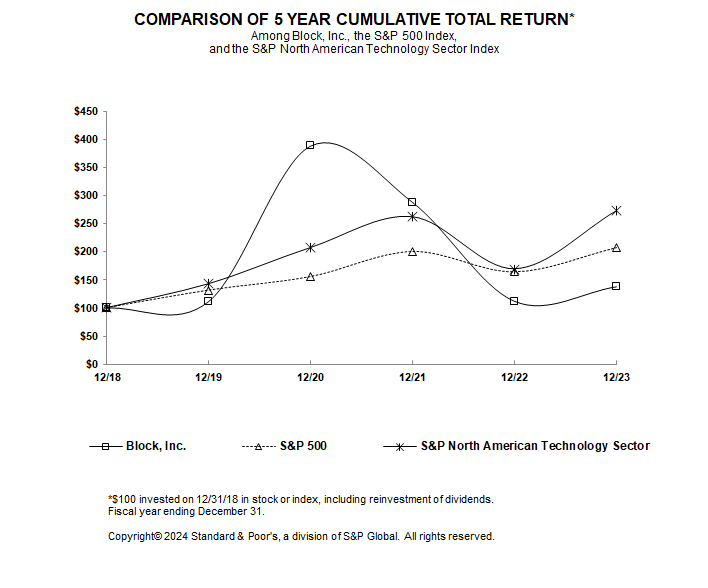
| Company/Index | 12/31/2018 | 12/31/2019 | 12/31/2020 | 12/31/2021 | 12/31/2022 | 12/31/2023 | ||||||||||||||||||||||||||||||||
| Block, Inc. | $ | 100.00 | $ | 111.54 | $ | 388.02 | $ | 287.95 | $ | 112.03 | $ | 137.90 | ||||||||||||||||||||||||||
| S&P 500 | $ | 100.00 | $ | 131.49 | $ | 155.68 | $ | 200.37 | $ | 164.08 | $ | 207.21 | ||||||||||||||||||||||||||
| S&P North American Technology | $ | 100.00 | $ | 142.68 | $ | 207.11 | $ | 261.79 | $ | 169.22 | $ | 272.66 |
Item 6. [RESERVED]
Item 7. MANAGEMENT'S DISCUSSION AND ANALYSIS OF FINANCIAL CONDITION AND RESULTS OF OPERATIONS
This management's discussion and analysis provides a review of the results of operations, key operating metrics and non-GAAP financial measures, and liquidity and capital resources of Block, Inc. on a historical basis and outlines the factors that have affected recent earnings, as well as those factors that may affect future earnings. The following discussion and analysis should be read in conjunction with the consolidated financial statements and the notes thereto included elsewhere in this Annual Report on Form 10-K ("Form 10-K").
This section of this Form 10-K generally discusses fiscal 2023 compared to fiscal 2022. The comparison of the fiscal 2022 results with the fiscal 2021 results that are not included in this Form 10-K can be found in the "Management's Discussion and Analysis Results of Operations" section in the Company's fiscal 2022 Annual Report within Part II, Item 7 of Form 10-K, filed on February 23, 2023.
The statements in this discussion regarding our expectations of our future performance, liquidity, and capital resources; our plans, estimates, beliefs, and expectations that involve risks and uncertainties; and other non-historical statements in this discussion are forward-looking statements. These forward-looking statements are subject to numerous risks and uncertainties, including, but not limited to, the risks and uncertainties described under Item 1A. Risk Factors and elsewhere in this Form 10-K. Our actual results may differ materially from those contained in or implied by any forward-looking statements.
Overview
We launched the Square ecosystem in February 2009 to enable businesses ("sellers") to accept card payments, an important capability that was previously inaccessible to many businesses. We have expanded to provide sellers additional products and services and to give them access to a cohesive ecosystem of tools to help them manage and grow their businesses. Similarly, with Cash App, we have built an ecosystem of financial products and services to help individuals manage their money. In January 2022, we completed the acquisition of Afterpay, a buy now, pay later ("BNPL") platform that facilitates commerce between retail merchants and consumers by allowing retail merchant clients to offer their customers the ability to buy goods and services on a BNPL basis. In addition, we also operate TIDAL, a global platform for musicians and fans, and TBD, an open developer platform, to contribute to our purpose of economic empowerment.
We delivered strong growth across our primary ecosystems in 2023. Gross profit was $7.5 billion, up 25% year over year, driven primarily by our Cash App and Square ecosystems.
Cash App generated gross profit of $4.3 billion in 2023, up 33% year over year. Performance was driven by growth in transacting actives and adoption by transacting actives of our broader ecosystem, including financial services products.
Square generated gross profit of $3.1 billion in 2023, up 16% year over year as we continued to make progress growing upmarket with larger sellers and optimizing our go-to-market strategies.
In 2023, operating loss was $278.8 million and Adjusted Operating Income was $351.4 million, a decrease of 55% and an increase of 342% year over year, respectively. For the same period, net income was $9.8 million, an increase of 102%, year over year, and Adjusted EBITDA was $1.8 billion, an increase of 81% year over year.
Refer to the Key Operating Metrics and Non-GAAP Financial Measures section below for reconciliations of non-GAAP financial measures to their nearest generally accepted accounting principles ("GAAP") equivalents.
In 2023, we sharpened our focus on our organizational structure and expenditures with a view to identifying areas where we can be more cost efficient as we focus on disciplined growth and pursuing cost efficiencies and we expect to continue these efforts in 2024. This involves implementing greater expense discipline and reassessing certain contractual vendor arrangements. In November 2023, we announced we would implement an absolute cap of 12,000 on the number of employees we have at our company. We plan to operate below this cap through a combination of performance management, centralizing teams and functions to reduce duplication, and prioritization of our scope. The Company recorded $104.0 million of severance and other related expenses for the year ended December 31, 2023, of which $70.2 million related to severance recognized in the fourth quarter of 2023. We may continue to incur expenses, including restructuring costs, in the short term to implement these initiatives, but we expect to benefit from these actions in future periods.
We ended 2023 with $7.7 billion in available liquidity, with $6.9 billion in cash, cash equivalents, restricted cash, and investments in marketable debt securities, as well as an undrawn amount of $775.0 million available under our revolving credit facility. This represents an increase of $205.8 million from the end of 2022, including a $461.8 million cash payment for the settlement of the outstanding 2023 Convertible Notes that matured in May 2023.
On October 26, 2023, the board of directors of the Company authorized the repurchase of up to $1 billion of the Company’s Class A common stock, which commenced in the fourth quarter of 2023. The goal of the program is to offset a portion of the dilution associated with stock-based compensation issued to employees as part of the Company’s overall compensation program. The timing and amount of shares repurchased will depend on a variety of factors, including the stock price, business and market conditions, corporate and regulatory requirements, alternative investment opportunities, acquisition opportunities, and other factors. In the fourth quarter of 2023, we repurchased $156.8 million under this program.
We have historically allocated the financial results from our BNPL platform equally to the Cash App and Square segments. In the fourth quarter of 2023, we changed our management reporting structure and moved the business activities and management of our BNPL platform fully under the Cash App segment. We believe that this transition will allow us to better focus on consumer based commerce as well as the development of its financial tools within the Cash App segment. Accordingly, beginning with this Annual Report on Form 10-K, we have updated our segment reporting to incorporate the financial results of the BNPL platform within the Cash App segment, rather than allocating 50% of revenue and gross profit from our BNPL platform to each of the Square and Cash App segments. We have also reflected this change for the applicable historical periods presented.
Components of Results of Operations
Revenue
Transaction-based Revenue
We charge our sellers a transaction fee that is generally calculated based on a percentage of the total transaction amount processed. We also selectively offer custom pricing for certain larger sellers. Transaction-based revenue also includes amounts we charge our Cash App customers for peer-to-peer transactions to business accounts and payments sent from a credit card.
Subscription and Services-based Revenue
Subscription and services-based revenue is primarily comprised of revenue we generate from Cash App, Square Loans (formerly known as Square Capital), our BNPL platform, TIDAL, and various other software as a service (“SaaS”) products that we offer through Square. Cash App subscription and services-based revenue is primarily comprised of transaction fees from Cash App Instant Deposit, Cash App Card, bitcoin withdrawal fees, and other Cash App financial services offerings. Our other SaaS products include subscription fees on our vertical software solutions (including Square for Restaurants, Square Appointments, and Square for Retail), Customer Engagement products (including Square Loyalty, Square Marketing, Square Gift Cards), staff management p
Showing the first 8K of 83K characters. Open the full section
Item 7A. QUANTITATIVE AND QUALITATIVE DISCLOSURES ABOUT MARKET RISK
We have operations both within the United States and globally, and we are exposed to market risks in the ordinary course of our business, including the effects of interest rate changes and foreign currency fluctuations. Information relating to quantitative and qualitative disclosures about these market risks is described below.
Equity Price Risk
Marketable Equity Investments
Our marketable equity investments are investments held in publicly-traded companies and are measured using quoted prices in active markets which could result in volatility in our financial results in future periods. As of December 31, 2023, our marketable equity investments were immaterial. Adjustments are recorded in other (expense) income, net on the consolidated statements of operations and establish a new carrying value for the investment. A hypothetical 10% increase or decrease in the fair value of our marketable equity investments would not have a material effect on our financial results.
Non-Marketable Equity Investments
Our non-marketable equity investments are investments in privately-held companies that we hold for purposes other than trading. These investments are inherently risky because there is no established market for these securities and the markets for the technologies or products these companies are developing are typically in the early stages. As such, we could lose our entire investment in these companies. Adjustments are recorded in other expense (income), net on the consolidated statements of operations and establish a new carrying value for the investment. As of December 31, 2023, the aggregate carrying value of our non-marketable equity investments included in other non-current assets was $205.3 million. A hypothetical 10% increase or decrease in the carrying value of our non-marketable equity investments would not have a material effect on our financial results.
Bitcoin Market Price Risk
Our bitcoin investment is measured using observed prices from active exchanges which could result in volatility in our financial results in future periods. Adjustments are recorded in net income through “other expense (income), net” on the consolidated statements of operations. As of December 31, 2023, the fair value of our bitcoin investment included in other non-current assets was $339.9 million. A hypothetical 10% increase or decrease in the fair value of our bitcoin investment would not have a material effect on our financial results.
Interest Rate Sensitivity
Our cash and cash equivalents, and marketable debt securities as of December 31, 2023 were held primarily in cash deposits, money market funds, U.S. government and agency securities, commercial paper, and corporate bonds. The fair value of our cash, cash equivalents, and marketable debt securities would not be significantly affected by either an increase or decrease in interest rates due mainly to the short-term nature of a majority of these instruments. Additionally, we have the ability to hold these instruments until maturity if necessary to reduce our risk. Our Warehouse Facilities borrowings and any future borrowings incurred under the 2020 Credit Facility both accrue interest at variable rates based on formulas tied to certain market rates at the time of incurrence. A hypothetical 10% increase or decrease in interest rates would not have a material effect on our financial results.
Foreign Currency Risk
Our consolidated financial statements are presented in U.S. dollars. Most of our revenue is earned in U.S. dollars and, subsequent to the acquisition of Afterpay, a portion is earned in Australian Dollars. Our exposure to other foreign currencies would not have a material effect on our financial results. Our foreign operations are denominated in the currencies of the countries in which our operations are located, and may be subject to fluctuations due to changes in foreign currency exchange rates. Our results of operations and cash flows are, therefore, subject to fluctuations in foreign currency exchange rates and may cause us to recognize transaction gains and losses on our financial statements.
From time to time, we use foreign exchange derivative contracts to hedge a portion of our exposure to changes in currency exchange rates, which result from our global operating and financing activities. We do not use derivative financial instruments for trading or speculative purposes. Gains and losses from foreign currency transactions, as well as foreign exchange forward contracts, were not significant for any period presented in the consolidated financial statements included in this Annual Report on Form 10-K. We did not have any material gains and losses from foreign currency derivatives outstanding as of December 31, 2023. A hypothetical 10% increase or decrease in current exchange rates on our financial instruments would not have a material effect on our financial results.
Item 8. FINANCIAL STATEMENTS AND SUPPLEMENTARY DATA
BLOCK, INC.
INDEX TO THE CONSOLIDATED FINANCIAL STATEMENTS
REPORT OF INDEPENDENT REGISTERED PUBLIC ACCOUNTING FIRM
To the Stockholders and the Board of Directors of Block, Inc.
Opinion on the Financial Statements
We have audited the accompanying consolidated balance sheets of Block, Inc. (the Company) as of December 31, 2023 and 2022, and the related consolidated statements of operations, comprehensive income (loss), stockholders’ equity and cash flows for each of the three years in the period ended December 31, 2023, and the related notes (collectively referred to as the “consolidated financial statements”). In our opinion, the consolidated financial statements present fairly, in all material respects, the financial position of the Company at December 31, 2023 and 2022, and the results of its operations and its cash flows for each of the three years in the period ended December 31, 2023, in conformity with U.S. generally accepted accounting principles.
We also have audited, in accordance with the standards of the Public Company Accounting Oversight Board (United States) (PCAOB), the Company's internal control over financial reporting as of December 31, 2023, based on criteria established in Internal Control—Integrated Framework issued by the Committee of Sponsoring Organizations of the Treadway Commission (2013 framework), and our report dated February 22, 2024 expressed an unqualified opinion thereon.
Basis for Opinion
These financial statements are the responsibility of the Company's management. Our responsibility is to express an opinion on the Company's financial statements based on our audits. We are a public accounting firm registered with the PCAOB and are required to be independent with respect to the Company in accordance with the U.S. federal securities laws and the applicable rules and regulations of the Securities and Exchange Commission and the PCAOB.
We conducted our audits in accordance with the standards of the PCAOB. Those standards require that we plan and perform the audit to obtain reasonable assurance about whether the financial statements are free of material misstatement, whether due to error or fraud. Our audits included performing procedures to assess the risks of material misstatement of the financial statements, whether due to error or fraud, and performing procedures that respond to those risks. Such procedures included examining, on a test basis, evidence regarding the amounts and disclosures in the financial statements. Our audits also included evaluating the accounting principles used and significant estimates made by management as well as evaluating the overall presentation of the financial statements. We believe that our audits provide a reasonable basis for our opinion.
Critical Audit Matter
The critical audit matter communicated below is a matter arising from the current period audit of the financial statements that was communicated or required to be communicated to the audit committee and that: (1) relates to accounts or disclosures that are material to the financial statements and (2) involved our especially challenging, subjective or complex judgments. The communication of the critical audit matter does not alter in any way our opinion on the consolidated financial statements, taken as a whole, and we are not, by communicating the critical audit matter below, providing a separate opinion on the critical audit matter or on the accounts or disclosures to which it relates.
| Allowance for Credit Losses related to Consumer Receivables | ||||||||
| Description of the Matter | The Company’s consumer receivables and the associated allowance for credit losses were $2.6 billion and $185.3 million as of December 31, 2023, respectively. The provision for credit losses was $261.3 million for the year ended December 31, 2023. As discussed in Notes 1 and 6 to the consolidated financial statements, the Company has exposure to expected credit losses from consumer receivables, for which an allowance for credit losses is recorded under ASU 2016-13, Financial Instruments - Credit Losses (Topic 326): Measurement of Credit Losses on Financial Instruments. The Company estimates the allowance for credit losses related to consumer receivables using both quantitative methods, based on historical payment patterns including losses and recoveries, recent and historical trends in delinquencies, past-due receivables and charge-offs, and qualitative methods, which consider consumer behavior, current and historical macroeconomic trends, along with other factors. | |||||||
| Auditing management’s estimate of the allowance for credit losses related to consumer receivables was challenging because management’s estimate required a high degree of judgment in evaluating historical trends related to loss rates and an assessment of a need for a qualitative adjustment in the Company’s expected credit loss methodology. | ||||||||
| How We Addressed the Matter in Our Audit | We obtained an understanding, evaluated the design, and tested the operating effectiveness of the Company’s controls over the process for determining the allowance for credit losses related to consumer receivables. This includes testing controls over management’s review of the methodology to determine estimated losses, the completeness and accuracy of historical losses and recoveries, past-due receivables and charge-offs, and management’s qualitative assumptions on future losses. To test the Company’s allowance for credit losses related to consumer receivables, we involved EY specialists in testing management’s methodology and key assumptions. Our audit procedures included, among others, evaluating the Company’s methodology as well as performing procedures over historical losses incurred by the Company by aging category and testing recoveries. In addition, we evaluated and tested management’s conclusion for the need for a qualitative adjustment in the Company’s expected credit loss methodology including the examination of current macroeconomic conditions such as changes in unemployment and GDP. We also reviewed subsequent events, which included actual collections on current and aged receivables as of December 31, 2023, to consider whether they corroborated the Company’s conclusion related to the overall allowance for credit losses related to consumer receivables. |
/s/ Ernst & Young LLP
We have served as the Company’s auditor since 2019.
San Francisco, California
February 22, 2024
REPORT OF INDEPENDENT REGISTERED PUBLIC ACCOUNTING FIRM
To the Stockholders and the Board of Directors of Block, Inc.
**Opinion on I
Showing the first 8K of 254K characters. Open the full section
Item 9. CHANGES IN AND DISAGREEMENTS WITH ACCOUNTANTS ON ACCOUNTING AND FINANCIAL DISCLOSURE
None.
Item 9A. CONTROLS AND PROCEDURES
Evaluation of Disclosure Controls and Procedures
Our management, with the participation of our Principal Executive Officer and our Principal Financial Officer, has evaluated the effectiveness of our disclosure controls and procedures as of the end of the period covered by this Annual Report on Form 10-K. The term “disclosure controls and procedures,” as defined in Rules 13a-15(e) and 15d-15(e) under the Securities Exchange Act of 1934, as amended (the “Exchange Act”), means controls and other procedures of a company that are designed to ensure that information required to be disclosed by a company in the reports that it files or submits under the Exchange Act is recorded, processed, summarized and reported, within the time periods specified in the SEC’s rules and forms. Disclosure controls and procedures include, without limitation, controls and procedures designed to ensure that information required to be disclosed by a company in the reports that it files or submits under the Exchange Act is accumulated and communicated to the company’s management, including its principal executive and principal financial officers, or persons performing similar functions, as appropriate to allow timely decisions regarding required disclosure. Management recognizes that any controls and procedures, no matter how well designed and operated, can provide only reasonable assurance of achieving their objectives and management necessarily applies its judgment in evaluating the cost-benefit relationship of possible controls and procedures. Based on such evaluation, our Principal Executive Officer and Principal Financial Officer have concluded that, as of December 31, 2023, our disclosure controls and procedures were effective at the reasonable assurance level.
Changes in Internal Control over Financial Reporting
There was no change in our internal control over financial reporting identified in connection with the evaluation required by Rule 13a-15(d) and 15d-15(d) of the Exchange Act that occurred during the quarter ended December 31, 2023 that has materially affected, or is reasonably likely to materially affect, our internal control over financial reporting.
Management's Report on Internal Control over Financial Reporting
Our management is responsible for establishing and maintaining adequate internal control over financial reporting (as defined in Rule 13a-15(f) under the Exchange Act). Our management conducted an assessment of the effectiveness of our internal control over financial reporting based on the criteria established in “Internal Control - Integrated Framework” (2013) issued by the Committee of Sponsoring Organizations of the Treadway Commission ("COSO"). Based on that assessment, our management has concluded that our internal control over financial reporting was effective as of December 31, 2023. The effectiveness of our internal control over financial reporting as of December 31, 2023 has been audited by Ernst & Young, LLP, an independent registered public accounting firm, as stated in their report which appears herein.
Item 9B. OTHER INFORMATION
During the quarterly period ended December 31, 2023, the following officer, as defined in Rule 16a-1(f), adopted or terminated a “Rule 10b5-1 trading arrangement” as defined in Regulation S-K Item 408, as follows:
On November 29, 2023, Brian Grassadonia, our Chief Executive Officer, Cash App, adopted a Rule 10b5-1 trading arrangement providing for the sale from time to time of an aggregate of up to 652,282 shares of our Class A common stock, which includes the exercise of up to 412,122 options and the corresponding sale of enough of the resulting 412,122 shares of Class A common stock required to cover the exercise price, withholding taxes, commissions and fees related to exercising the aforementioned options. The trading arrangement is intended to satisfy the affirmative defense in Rule 10b5-1(c). The duration of the trading arrangement is until March 30, 2025, or earlier if all transactions under the trading arrangement are completed.
No other officers or directors, as defined in Rule 16a-1(f), adopted and/or terminated a “Rule 10b5-1 trading arrangement” or a “non-Rule 10b5-1 trading arrangement,” as defined in Regulation S-K Item 408, during the last fiscal quarter.
Item 9C. DISCLOSURE REGARDING FOREIGN JURISDICTIONS THAT PREVENT INSPECTIONS
None.
PART III
Item 10. DIRECTORS, EXECUTIVE OFFICERS AND CORPORATE GOVERNANCE
The information required by this item will be included in our Proxy Statement for the 2024 Annual Meeting of Stockholders to be filed with the SEC within 120 days of the fiscal year ended December 31, 2023 ("Proxy Statement") and is incorporated herein by reference.
Item 11. EXECUTIVE COMPENSATION
The information required by this item will be included in the Proxy Statement and is incorporated herein by reference.
Item 12. SECURITY OWNERSHIP OF CERTAIN BENEFICIAL OWNERS AND MANAGEMENT AND RELATED STOCKHOLDER MATTERS
The information required by this item will be included in the Proxy Statement and is incorporated herein by reference.
Item 13. CERTAIN RELATIONSHIPS AND RELATED TRANSACTIONS, AND DIRECTOR INDEPENDENCE
The information required by this item will be included in the Proxy Statement and is incorporated herein by reference.
Item 14. PRINCIPAL ACCOUNTING FEES AND SERVICES
The information required by this item will be included in the Proxy Statement and is incorporated herein by reference.
PART IV
Item 15. EXHIBITS, FINANCIAL STATEMENT SCHEDULES
(a) The following documents are filed as a part of this Annual Report on Form 10-K:
**(1)**Consolidated Financial Statements:
Our Consolidated Financial Statements are listed in the “Index to Consolidated Financial Statements” under Part II, Item 8 of this Annual Report on Form 10-K.
**(2)**Financial Statement Schedules:
Schedules not listed above have been omitted because the information required to be set forth therein is not applicable or is shown in the financial statements or notes herein.
**(3)**Exhibits
The documents listed in the following Exhibit Index of this Annual Report on Form 10-K are incorporated by reference or are filed with this Annual Report on Form 10-K, in each case as indicated therein (numbered in accordance with Item 601 of Regulation S-K):
EXHIBIT INDEX
- Filed herewith.
- Indicates management contract or compensatory plan.
Certain portions of this exhibit have been redacted pursuant to Item 601(b)(10)(iv) of Regulation S-K. The Company agrees to furnish supplementally an unredacted copy of the exhibit to the Securities and Exchange Commission upon its request.
† The certifications attached as Exhibit 32.1 that accompany this Annual Report on Form 10-K are deemed furnished and not filed with the Securities and Exchange Commission and are not to be incorporated by reference into any filing of the Registrant under the Securities Act of 1933, as amended, or the Securities Exchange Act of 1934, as amended, whether made before or after the date of this Annual Report on Form 10-K, irrespective of any general incorporation language contained in such filing.
Item 16. FORM 10-K SUMMARY
None.
SIGNATURES
Pursuant to the requirements of Section 13 or 15(d) of the Securities Exchange Act of 1934, the registrant has duly caused this Annual Report on Form 10-K to be signed on its behalf by the undersigned, thereunto duly authorized.
Date: February 22, 2024
BLOCK, INC.
By: /s/ Jack Dorsey
Jack Dorsey
Block Head and Chairperson
(Principal Executive Officer)
POWER OF ATTORNEY
Each person whose signature appears below hereby constitutes and appoints Jack Dorsey, Amrita Ahuja, and Chrysty Esperanza, and each of them, as his or her true and lawful attorney-in-fact and agent, with full power of substitution and resubstitution, for him or her and in his or her name, place and stead, in any and all capacities, to sign any and all amendments to this Annual Report on Form 10-K, and to file the same, with all exhibits thereto, and other documents in connection therewith, with the Securities and Exchange Commission, granting unto said attorneys-in-fact and agents, and each of them, full power and authority to do and perform each and every act and thing requisite and necessary to be done in connection therewith, as fully for all intents and purposes as he or she might or could do in person, hereby ratifying and confirming all that said attorneys-in-fact and agents, or any of them, or their, his or her substitutes, may lawfully do or cause to be done by virtue hereof.
Pursuant to the requirements of the Securities Exchange Act of 1934, this Annual Report on Form 10-K has been signed by the following persons on behalf of the registrant and in the capacities and on the dates indicated:
| Signature | Title | Date | ||||||
| /s/ Jack Dorsey | Block Head and Chairperson (Principal Executive Officer) | February 22, 2024 | ||||||
| Jack Dorsey | ||||||||
| /s/ Amrita Ahuja | Chief Financial Officer & Chief Operating Officer (Principal Financial Officer) | February 22, 2024 | ||||||
| Amrita Ahuja | ||||||||
| /s/ Ajmere Dale | Chief Accounting Officer (Principal Accounting Officer) | February 22, 2024 | ||||||
| Ajmere Dale | ||||||||
| /s/ Roelof Botha | Director | February 22, 2024 | ||||||
| Roelof Botha | ||||||||
| /s/ Amy Brooks | Director | February 22, 2024 | ||||||
| Amy Brooks | ||||||||
| /s/ Shawn Carter | Director | February 22, 2024 | ||||||
| Shawn Carter | ||||||||
| /s/ Paul Deighton | Director | February 22, 2024 | ||||||
| Paul Deighton | ||||||||
| /s/ Randy Garutti | Director | February 22, 2024 | ||||||
| Randy Garutti | ||||||||
| /s/ Jim McKelvey | Director | February 22, 2024 | ||||||
| Jim McKelvey | ||||||||
| /s/ Mary Meeker | Director | February 22, 2024 | ||||||
| Mary Meeker | ||||||||
| /s/ Neha Narula | Director | February 22, 2024 | ||||||
| Neha Narula | ||||||||
| /s/ Sharon Rothstein | Director | February 22, 2024 | ||||||
| Sharon Rothstein |