 filings.tools
Block 10-K 2024-12-31
Filed 2025-02-24. 24 sections, 638K characters. Original on sec.gov · Markdown · JSON
Cover and table of contents
UNITED STATES
SECURITIES AND EXCHANGE COMMISSION
Washington, D.C. 20549
______________________
FORM 10-K
______________________
(Mark One)
| ☒ | ANNUAL REPORT PURSUANT TO SECTION 13 OR 15(d) OF THE SECURITIES EXCHANGE ACT OF 1934 |
For the fiscal year ended December 31, 2024
OR
| ☐ | TRANSITION REPORT PURSUANT TO SECTION 13 OR 15(d) OF THE SECURITIES EXCHANGE ACT OF 1934 |
For the transition period from ________ to ________
Commission File Number 001-37622
______________________
BLOCK, INC.
(Exact name of registrant as specified in its charter)
______________________
| Delaware | 80-0429876 | |||||||
| (State or other jurisdiction of incorporation or organization) | (I.R.S. Employer Identification Number) |
1955 Broadway, Suite 600
Oakland, CA 94612****1
(Address of principal executive offices, including zip code)
(415) 375-3176
(Registrant's telephone number, including area code)
Securities registered pursuant to Section 12(b) of the Act:
| Title of Each Class | Trading Symbol(s) | Name of each exchange on which registered | ||||||||||||
| Class A Common Stock, $0.0000001 par value per share | XYZ | New York Stock Exchange |
Securities registered pursuant to Section 12(g) of the Act: None
Indicate by check mark if the registrant is a well-known seasoned issuer, as defined in Rule 405 of the Securities Act. Yes ☒ No ☐
Indicate by check mark if the registrant is not required to file reports pursuant to Section 13 or 15(d) of the Act. Yes ☐ No ☒
Indicate by check mark whether the registrant (1) has filed all reports required to be filed by Section 13 or 15(d) of the Securities Exchange Act of 1934 during the preceding 12 months (or for such shorter period that the registrant was required to file such reports), and (2) has been subject to such filing requirements for the past 90 days. Yes ☒ No ☐
Indicate by check mark whether the registrant has submitted electronically every Interactive Data File required to be submitted pursuant to Rule 405 of Regulation S-T (§ 232.405 of this chapter) during the preceding 12 months (or for such shorter period that the registrant was required to submit such files).
Yes ☒ No ☐
Indicate by check mark whether the registrant is a large accelerated filer, an accelerated filer, a non‑accelerated filer, a smaller reporting company, or an emerging growth company. See the definitions of “large accelerated filer,” “accelerated filer,” “smaller reporting company,” and "emerging growth company" in Rule 12b‑2 of the Exchange Act.
Large accelerated filer ☒ Accelerated filer ☐ Non-accelerated filer ☐ Smaller reporting company ☐ Emerging growth company ☐
If an emerging growth company, indicate by check mark if the registrant has elected not to use the extended transition period for complying with any new or revised financial accounting standards provided pursuant to Section 13(a) of the Exchange Act. ☐
Indicate by check mark whether the registrant has filed a report on and attestation to its management’s assessment of the effectiveness of its internal control over financial reporting under Section 404(b) of the Sarbanes-Oxley Act (15 U.S.C. 7262(b)) by the registered public accounting firm that prepared or issued its audit report. ☒
If securities are registered pursuant to Section 12(b) of the Act, indicate by check mark whether the financial statements of the registrant included in the filing reflect the correction of an error to previously issued financial statements. ☐
Indicate by check mark whether any of those error corrections are restatements that required a recovery analysis of incentive-based compensation received by any of the registrant’s executive officers during the relevant recovery period pursuant to §240.10D-1(b). ☐
Indicate by check mark whether the registrant is a shell company (as defined in Rule 12b-2 of the Act). Yes ☐ No ☒
The aggregate market value of the voting and non-voting common equity held by non-affiliates of the registrant, based on the closing price of a share of the registrant’s Class A common stock on June 30, 2024 as reported by the New York Stock Exchange on such date was approximately $37.8 billion. Shares of the registrant’s Class A common stock and Class B common stock held by each executive officer, director and holder of 5% or more of the outstanding Class A common stock and Class B common stock have been excluded in that such persons may be deemed to be affiliates. This calculation does not reflect a determination that certain persons are affiliates of the registrant for any other purpose.
As of February 18, 2025, the number of shares (in thousands) of the registrant’s Class A and Class B common stock outstanding were 559,431 and 60,049, respectively.
Portions of the registrant’s Definitive Proxy Statement relating to the Annual Meeting of Stockholders are incorporated by reference into Part III of this Annual Report on Form 10-K where indicated. Such Definitive Proxy Statement will be filed with the Securities and Exchange Commission within 120 days after the end of the registrant’s fiscal year ended December 31, 2024.
1 We have adopted a distributed work model and, therefore, have no formal headquarters. This address represents our "principal executive office," which we are required to identify under Securities and Exchange Commission rules.
TABLE OF CONTENTS
CAUTIONARY NOTE REGARDING FORWARD-LOOKING STATEMENTS
This Annual Report on Form 10-K contains forward-looking statements within the meaning of Section 27A of the Securities Act of 1933, as amended, and Section 21E of the Securities Exchange Act of 1934, as amended, that involve substantial risks and uncertainties. Forward-looking statements generally relate to future events or our future financial or operating performance. In some cases, you can identify forward-looking statements because they contain words such as “may,” “will,” “appears,” “should,” “expects,” “plans,” “anticipates,” “could,” “intends,” “target,” “projects,” “contemplates,” “believes,” “estimates,” “predicts,” “potential,” or “continue,” or the negative of these words or other similar terms or expressions that concern our expectations, strategy, plans, or intentions. Forward-looking statements contained in this Annual Report on Form 10-K include, but are not limited to, statements about our future financial and operating performance, our expectations regarding transaction and loan losses, the adequacy of our allowance for loan losses on loans held for investment, or increased delinquencies, and the impact of inaccurate estimates or inadequate reserves, our anticipated growth and growth strategies and our ability to effectively manage that growth, our ability to invest in and develop our products and services to operate with changing technology, the expected benefits of our products to our customers and the impact of our products on our business, our expectations regarding product launches, trends in our markets and the continuation of such trends, our expectations related to our plans to cap our employee base, our plans with respect to patents and other intellectual property, our expectations regarding litigation and regulatory matters, the adequacy of reserves for such matters and the impact of any such matters or settlements thereof on our business, our expectations regarding share-based compensation, our expectations regarding the impacts of accounting guidance and the timing of our compliance therewith, our expectations regarding restricted cash, and the sufficiency of our cash and cash equivalents and cash generated from operations to meet our working capital and capital expenditure requirements.
We have based these forward-looking statements on our current expectations and projections about future events and trends that we believe may affect our business, financial condition, results of operations, prospects, business strategy, and financial needs. The outcome of the events described in these forward-looking statements is subject to known and unknown risks, uncertainties, and other factors described in the section titled “Risk Factors” and elsewhere in this Annual Report on Form 10-K. We operate in a very competitive and rapidly changing environment. New risks and uncertainties emerge from time to time and it is not possible for us to predict all risks and uncertainties that could have an impact on the forward-looking statements contained in this Annual Report on Form 10-K. We cannot assure you that the results, events, and circumstances reflected in the forward-looking statements will be achieved or occur, and actual results, events, or circumstances could differ materially from those described in the forward-looking statements.
All forward-looking statements are based on information and estimates available to us at the time of filing this Annual Report on Form 10-K and are not guarantees of future performance. We undertake no obligation to update any forward-looking statements made in this Annual Report on Form 10-K to reflect events or circumstances after the date of this Annual Report on Form 10-K or to reflect new information or the occurrence of unanticipated events, except as required by law.
PART I
Item 1. BUSINESS
Our Business
At Block, Inc. (together with its subsidiaries, "Block" or "we"), we are building an ecosystem dedicated to economic empowerment and unlocking access to the financial system for people around the world. We do this by building the most relevant products and tools for the communities we serve including sellers, consumers, artists, fans and developers. Our brands work together cohesively, often positively reinforcing one another and creating resonant relationships with people who use our products to meet multiple needs across the different aspects of their lives. As we scale, we are focused on investing in building deeper connections between our ecosystems and increasing the resilience of our company.
On December 1, 2021, we changed our corporate name from Square, Inc. to Block, Inc. Block is the name for the company as a corporate entity. Since our start in 2009 with the Square business, we have added Cash App, and relatively nascent businesses with TIDAL and two bitcoin businesses, Bitkey and Proto.
Our two reportable segments are Square, formerly referred to as Seller, and Cash App, which reflects our two primary ecosystems and the manner in which the Company's chief operating decision maker ("CODM") reviews and assesses performance.
Square Ecosystem
We started Block with the Square ecosystem in February 2009 to enable businesses ("sellers") to accept card payments, an important capability that was previously inaccessible to many businesses. As our company grew, we recognized that sellers need a variety of solutions to thrive and saw how we could apply our strength in technology and innovation to help sellers. We have since expanded Square into a cohesive commerce ecosystem that provides more than 30 distinct products and services to help our sellers start, run, and grow their businesses. We combine software, hardware, and financial services to create products and services that are cohesive, fast, self-serve, and elegant. These attributes differentiate Square in a fragmented industry that traditionally forced sellers to stitch together products and services from multiple vendors, and often rely on inefficient non-digital processes and tools. Our ability to add new sellers efficiently, help them grow their business, and cross-sell our products and services has historically contributed to our long-term growth.
Cash App Ecosystem
Cash App provides an ecosystem of financial products and services to help consumers manage their money. Cash App’s goal is to redefine the world’s relationship with money by making it more relatable, instantly available, and universally accessible. While Cash App started with the single ability to send and receive money, it now provides an ecosystem of financial services focused on helping consumers make their money go further by enabling customers to store, send, receive, spend, invest, buy now, pay later ("BNPL"), borrow or save their money with Cash App. Similar to our Square ecosystem, we believe the aggregation of these products into one app differentiates Cash App from competitors and provides greater utility for customers, allowing Cash App to build retentive relationships with its customers. Over time, with its bank partners, Cash App is aiming to become one of the top providers of banking services to households in the United States that earn up to $150,000 per year.
TIDAL Ecosystem
TIDAL expands our purpose of economic empowerment to artists. TIDAL is a global platform for musicians and their fans that uses unique content, experiences, and features to bring fans closer to artists and to provide artists with tools to succeed as entrepreneurs. TIDAL offers an extensive catalog of more than 162 million songs and 927,000 high-quality videos. TIDAL has a global presence with listeners in more than 60 countries and relationships with more than 300 labels and distributors.
Bitcoin Ecosystem
Our bitcoin ecosystem includes our bitcoin hardware projects, which include Bitkey, a self-custody bitcoin wallet, Proto, a bitcoin mining system, as well as Spiral, an independent team focused on contributing to bitcoin open source work. We believe our bitcoin ecosystem can help address inefficiencies in the current financial system, especially with respect to identity and trust. In the fourth quarter of 2024, we announced our decision to wind down TBD, which was an open developer platform for decentralized finance.
Our Customers
Our Square Sellers
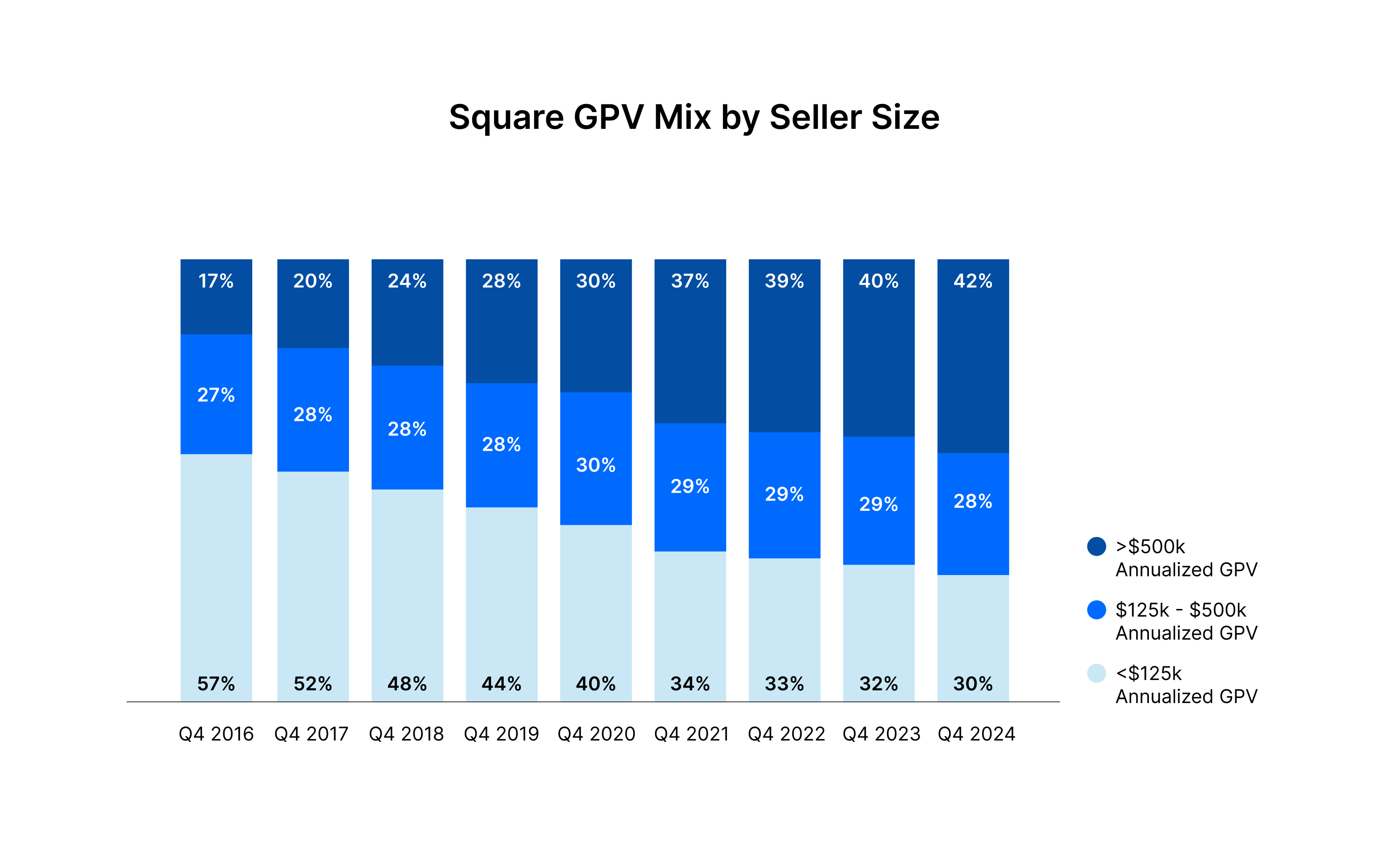
Square sellers represent a diverse range of industries (including services, food-related, and retail businesses) and sizes, ranging from sole proprietors to multinational businesses. Square sellers span geographies, including the United States, Canada, Japan, Australia, the United Kingdom, Ireland, France, and Spain. We believe the diversity of our sellers underscores the accessibility and flexibility of our offerings. We have also increasingly served mid-market sellers, which we define as sellers that generate more than $500,000 in annualized Square Gross Payment Volume (“Square GPV”), due to our ability to offer more flexible and complex solutions than traditional alternatives, as well as a growing product suite. For the years ended December 31, 2024, 2023, and 2022, none of our customers accounted for greater than 5% of Square GPV. We define Square GPV as the total dollar amount of all card and bank payments processed by sellers using Square, net of refunds.
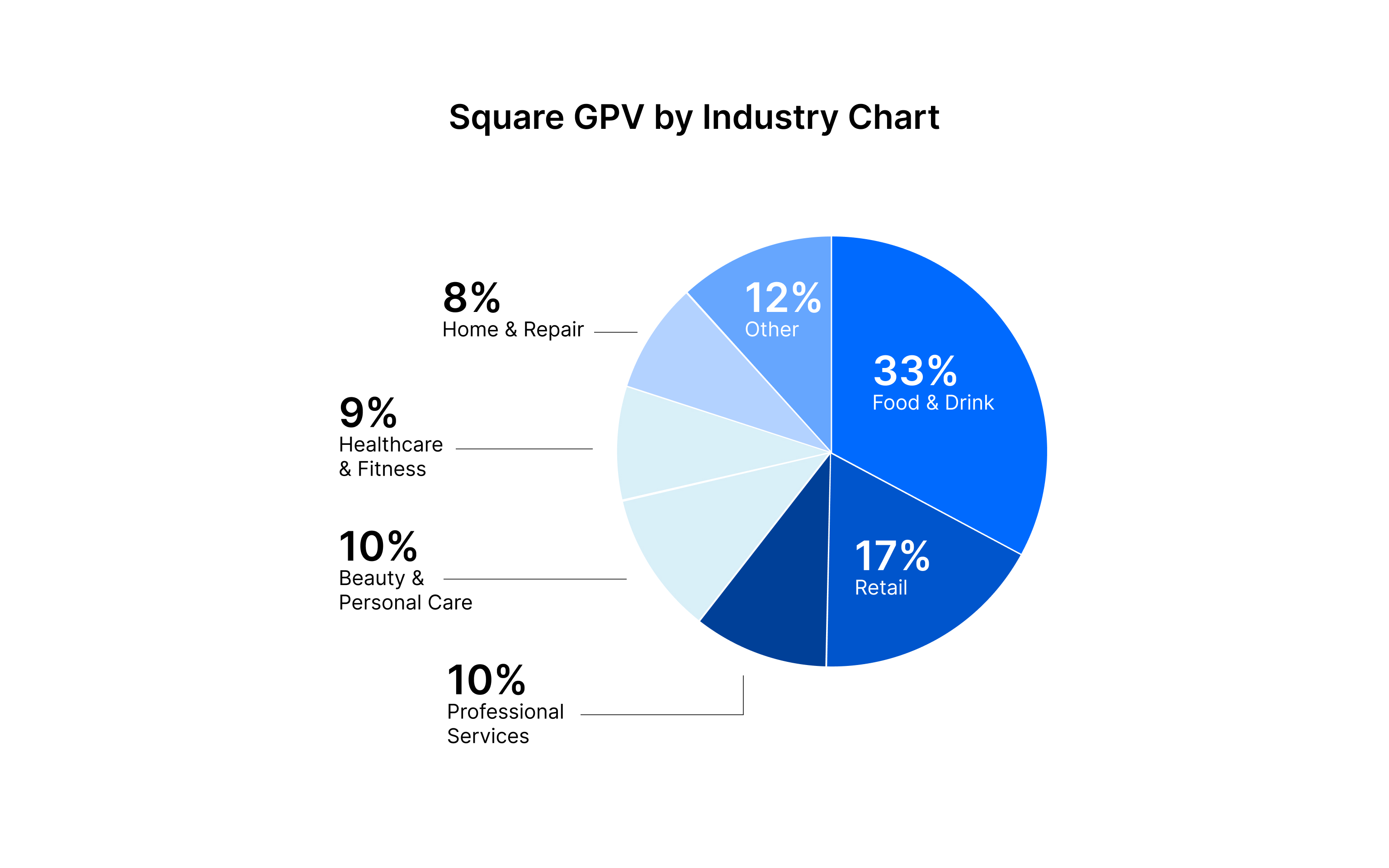
In the year ended December 31, 2024, more than 4 million sellers used the Square ecosystem to make 5.2 billion individual sales transactions totaling $228 billion of Square GPV. These sales transactions originated from more than 800 million payment cards, across more than 300 million buyer profiles.
The charts below show the percentage mix of our Square GPV by seller industry and seller size for the year ended December 31, 2024:
Our Cash App Customers
As of December 2024, Cash App had 57 million monthly transacting actives across the United States. In 2024, Cash App was the number one finance app on Google Play and number two finance app on iOS based on downloads in the United States. Cash App has a diverse mix of customers and, in the United States, had monthly transacting actives in each of the 50 states and nearly every county as of December 2024.
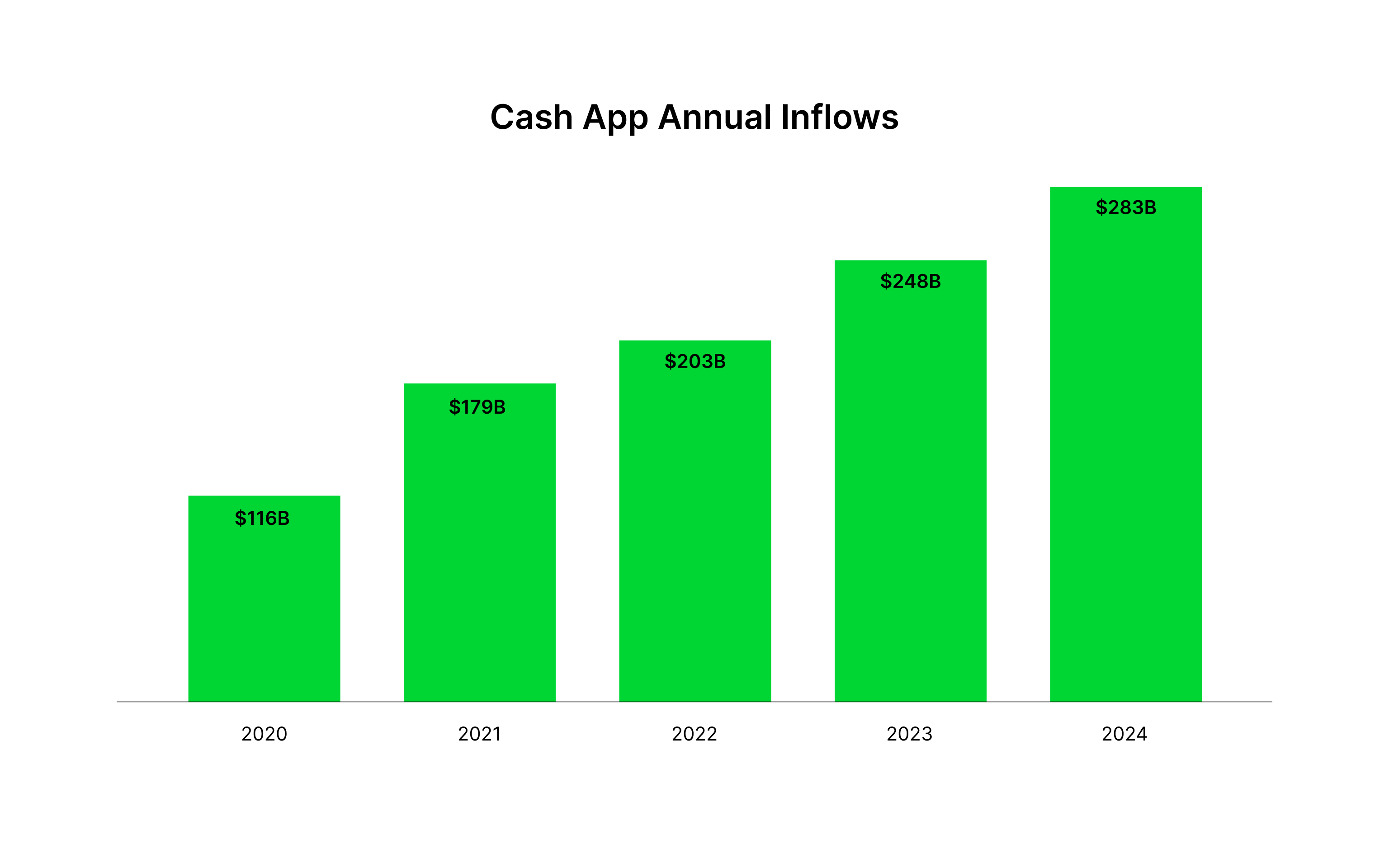
In 2024, Cash App transacting actives brought $283 billion in inflows into Cash App. Customers can fund their Cash App accounts with inflows in a variety of ways, including by receiving money from another Cash App customer through the app’s core peer-to-peer transfer service, transferring money from a bank account, depositing mobile checks, adding physical cash at participating retailers, and receiving a recurring paycheck by direct deposit. In the fourth quarter of 2024, our Cash App monthly transacting actives brought in an average of $1,255 of inflows during the quarter. A transacting active is a Cash App account that has at least one financial transaction using any product or service within Cash App during the specified period. Examples of transactions include sending or receiving a peer-to-peer payment, transferring money into or out of Cash App, making a purchase using Cash App Card, earning a dividend on a stock investment, and paying back a loan, among others. Certain of these accounts may share an alias identifier with one or more other transacting active accounts. This could represent, among other things, one customer with multiple accounts or multiple customers sharing one alias identifier (for example, families).
, our bank partnerships, and FDIC and other regulatory obligations;
-
risks related to our loan products such as the availability of capital, repayments, and general macroeconomic conditions; and
-
risks related to our majority interest in TIDAL.
Operational risks:
-
real or perceived improper or unauthorized use of, disclosure of, or access to sensitive data;
-
real or perceived security breaches or incidents or human error in administering our software, hardware, and systems;
-
systems failures, interruptions, delays in service, catastrophic events, and resulting interruptions in the availability of our products or services or those of our sellers;
-
any failure to safeguard the bitcoin we hold on behalf of ourselves and other parties;
-
our risk management efforts;
-
our dependence on payment card networks and acquiring processors;
-
our reliance on third parties and their systems for a variety of services, including the processing of transaction data and settlement of funds;
-
our dependence on key management and any failure to attract, motivate, and retain our employees;
-
our operational, financial, and other internal controls and systems;
-
any shortage, price increases, tariffs, changes, delay or discontinuation of our key components; and
-
the integration of our services and our products with a variety of operating systems.
Economic, financial, and tax risks:
-
a deterioration of general macroeconomic conditions;
-
any inability to secure financing on favorable terms, or at all, or comply with covenants in our existing credit agreement, the indentures, or future agreements;
-
our ability to service our debt, including our Convertible Notes and our Senior Notes (each as defined below);
-
counterparty risk with respect to our convertible note hedge transactions;
-
our bitcoin investments being subject to volatile market prices and other risks of loss;
-
foreign exchange rates risks; and
-
any greater-than-anticipated tax liabilities or significant valuation allowances on our deferred tax assets.
Legal, regulatory, and compliance risks:
-
extensive regulation and oversight in a variety of areas of our business;
-
complex and evolving regulations and oversight related to privacy, data protection, and cybersecurity;
-
litigation, including intellectual property claims, government investigations or inquiries, and regulatory matters or disputes;
-
obligations and restrictions as a licensed money transmitter;
-
regulatory scrutiny or changes in the buy now pay later ("BNPL") space;
-
regulation and scrutiny of our subsidiary Cash App Investing, which is a broker-dealer registered with the SEC and a member of FINRA, including net capital and other regulatory capital requirements;
-
regulation and scrutiny of our subsidiary Square Financial Services, which is a Utah state-chartered industrial loan company, including the requirement that we serve as a source of financial strength to it;
-
any inability to protect our intellectual property rights;
-
assertions by third parties of infringement of intellectual property rights by us; and
-
increased scrutiny from investors, regulators, and other stakeholders relating to environmental, social, and governance issues.
Risks related to ownership of our common stock:
-
the dual class structure of our common stock;
-
volatility of the market price of our Class A common stock;
-
the dual-listing of our Class A common stock on the NYSE and our CHESS Depositary Interests ("CDIs") on the Australian Securities Exchange ("ASX");
-
our convertible note hedge and warrant transactions;
-
anti-takeover provisions contained in our amended and restated certificate of incorporation, our amended and restated bylaws, and provisions of Delaware law; and
-
exclusive forum provisions in our bylaws.
Risks Related to Our Business and Our Industry
Our growth rate has slowed at times and may slow or decline in the future, and our growth rates in each of our reporting segments may vary. Future revenue and gross profit growth depends on our ability to retain existing sellers and customers, attract new sellers and customers, and increase sales to both new and existing sellers and customers.
Our rate of revenue and gross profit growth has slowed at times and may decline in the future, and it may slow or decline more quickly than we expect for a variety of reasons, including the risks described in this Annual Report on Form 10-K. Additionally, our rate of revenue and gross profit growth may vary between our reporting segments. For example, in recent periods our Cash App segment revenue and gross profit growth has varied and may continue to vary from the growth rate of our Square segment. Our sellers and customers have no obligation to continue to use our services, and we cannot assure you that they will. We generally do not have long-term contracts with our sellers and customers, and the difficulty and costs associated with switching to a competitor may not be significant for many of the services we offer. Our sellers’ activity with us may decrease for a variety of reasons, including sellers’ level of satisfaction with our products and services, our pricing and the pricing and quality of competing products or services, the effects of economic conditions, or reductions in the aggregate spending of our sellers’ customers. Growth in transacting actives on Cash App and customers’ level of engagement with our products and services on Cash App are important to our success and long-term financial performance. However, the growth rate of transacting actives has fluctuated over time, has slowed in recent quarters, and may slow or decline in the future. A number of factors have affected and could negatively affect Cash App customer growth, inflows, and engagement levels, including our ability to introduce new products and services that are compelling to our customers and that they adopt, changes to our systems, processes or other technical or operational requirements t
Showing the first 8K of 176K characters. Open the full section
Item 1B. UNRESOLVED STAFF COMMENTS
None.
Item 1C. CYBERSECURITY
Risk Management and Strategy
We have a cybersecurity risk management program consisting of policies and procedures for assessing, identifying, and managing material risk from cybersecurity threats, and we have integrated these policies and procedures into our overall risk management systems and processes. Our cybersecurity policies and procedures are based on recognized frameworks established by the National Institute of Standards and Technology, the International Organization for Standardization and other applicable industry standards. We routinely assess material risks from cybersecurity threats and regularly assess and update our cybersecurity risk management program in response to emerging trends and changes in our operations.
Our risk management program includes, among other elements:
Identification: We aim to proactively identify sources of risk, areas of impact, and relevant events that could give rise to cybersecurity risks, such as changes to our infrastructure, service providers, or personnel.
Assessment: We conduct periodic risk assessments to identify cybersecurity threats. We also conduct likelihood and impact assessments with the goal of identifying reasonably foreseeable internal and external risks, the likelihood and potential damage that could result from such risks, and the sufficiency of existing policies, procedures, systems, and safeguards in place to manage such risks.
Management: Following our risk assessments, we design and implement reasonable safeguards to address any identified gaps in our existing processes and procedures. Our employees participate in cybersecurity training and awareness upon hire and at least annually thereafter.
We engage third parties, including consultants and auditors, to evaluate the effectiveness of our risk management program, control environment, and cybersecurity practices through security audits, penetration testing, and other engagements.
We have processes in place to identify, review and evaluate cybersecurity risks associated with our use of third-party service providers. These reviews are conducted at onboarding and periodically throughout the tenure of the service provider based on risk tier rating of each service provider. We believe these processes enable us to evaluate a third-party service provider’s security posture, identify risks that may arise out of our use of the third party’s service, and make decisions regarding acceptable levels of risk and risk mitigation.
For additional information regarding whether any risks from cybersecurity threats, including as a result of any previous cybersecurity incidents, have materially affected or are reasonably likely to materially affect our company, including our business strategy, results of operations, or financial condition, please refer to Item 1A, “Risk Factors,” in this annual report on Form 10-K.
Board and Management’s Role in Data Privacy and Cybersecurity Oversight
Our board of directors recognizes the oversight of risk management as one of its primary responsibilities and central to maintaining an effective, risk-aware and accountable organization. While the board of directors maintains ultimate responsibility for the oversight of our data privacy and cybersecurity program and risks, it has delegated certain oversight responsibilities to our audit and risk committee. Our board of directors and audit and risk committee’s principal role is one of oversight, recognizing that management is responsible for the design, implementation, and maintenance of an effective program for protecting against and mitigating data privacy and cybersecurity risks. The audit and risk committee assists the board of directors in enhancing its understanding of data privacy and cybersecurity issues by overseeing our data privacy and information security programs, strategy, policies, processes, and material risks, as well as overseeing responses to security and data incidents, as appropriate.
The full board of directors receives an annual information security update by our Chief Information Security Officer (“CISO”) and an annual privacy update, which covers, among other matters, our privacy and cybersecurity programs and risks. Our audit and risk committee receives updates, at least quarterly, on significant data privacy and security risks, including any significant incidents, relevant industry developments, threat vectors and significant risks identified in periodic penetration tests or vulnerability scans. The updates also include significant legal and legislative developments concerning data privacy and security, our approach to complying with applicable law, and significant engagement with regulators concerning data privacy and cybersecurity. Our audit and risk committee provides regular updates to the board of directors on such reports.
Our CISO oversees our cybersecurity policies and processes, including those described in “Risk Management and Strategy” above. Our data security governance, infrastructure security, product security, applied security engineering and security operations teams report directly to our CISO and provide regular updates on significant or potentially significant threats and incidents. Additionally, we have an incident response team and an incident response plan that outlines the roles and responsibilities of key personnel, including representatives from information security, compliance, and counsel, that are involved in responding to, remediating and escalating such incidents to the CISO, as appropriate. Our CISO reports directly to our Technology + Engineering Lead and indirectly to our audit and risk committee. Our CISO provides updates on significant or potentially significant threats and incidents to our Block Head and leadership team, in addition to the audit and risk committee and our board of directors as appropriate and in accordance with the processes detailed in the prior paragraph.
Our CISO is primarily responsible for assessing and managing our material risks from cybersecurity threats. Our CISO has over 20 years of experience in information security, including serving as head of cybersecurity and privacy response at a global public company and information security leadership positions with the United States government. Our CISO holds undergraduate and graduate degrees in computer information systems and computer science with an information security focus and possesses various certifications, including the Information Systems Security Professional (NSTISSI No. 4011) and Information Systems Security Officer (CNSSI No. 4014) certifications.
Item 2. PROPERTIES
We do not designate a headquarters location as we have adopted a distributed work model. We lease space in New York, New York for a product development, sales, and business operations office under a lease that expires in 2028 and office space in Oakland, California for general corporate purposes under a lease that expires in 2031. We also lease space in St Louis, Missouri, for a business operations office under a lease that expires in 2036 with two renewal options to extend the lease for an additional term of 5 years each. We also have offices in several other locations and believe our facilities are sufficient for our current needs.
Item 3. LEGAL PROCEEDINGS
We are currently a party to, and may in the future be involved in, various legal matters, investigations, subpoenas, inquiries, audits, claims, lawsuits and disputes, including with regulatory bodies and governmental agencies. For information regarding legal proceedings in which we are involved, see "Litigation and Regulatory Matters" in Note 19, Commitments and Contingencies within Notes to the Consolidated Financial Statements, which is incorporated herein by reference.
In addition, from time to time, we are involved in various other legal matters, investigations, subpoenas, inquiries, audits, claims, lawsuits and disputes arising in the ordinary course of business. We cannot at this time fairly estimate a reasonable range of exposure, if any, of the potential liability with respect to these other matters. While we do not believe, at this time, that any ultimate liability resulting from any of these other matters will have a material adverse effect on our results of operations, financial position, or liquidity, we cannot give any assurance regarding the ultimate outcome of these other matters, and their resolution could be material to our operating results for any particular period.
Item 4. MINE SAFETY DISCLOSURES
Not applicable.
PART II
Item 5. MARKET FOR REGISTRANT’S COMMON EQUITY, RELATED STOCKHOLDER MATTERS AND ISSUER PURCHASES OF EQUITY SECURITIES
Market Information for Common Stock
Our Class A common stock trades on the New York Stock Exchange and our CDIs are traded on the ASX, both under the symbol “XYZ”. There is no public trading market for our Class B common stock.
Holders of Record
As of February 18, 2025, there were 504 holders of record of our Class A common stock and 24 holders of record of our Class B common stock. Because many of our shares of Class A common stock are held by brokers and other institutions on behalf of stockholders, we are unable to estimate the total number of beneficial owners of our Class A common stock represented by these record holders. As of February 18, 2025, we have approximately 39,934 holders of record of our CDIs.
Dividend Policy
We have never declared nor paid any cash dividends on our capital stock. We do not expect to pay any dividends on our capital stock in the foreseeable future. Any future determination relating to our dividend policy will be at the discretion of our board of directors, subject to applicable laws, and will depend on our financial condition, results of operations, capital requirements, general business conditions, and other factors that our board of directors considers relevant.
Issuer Purchases of Equity Securities
In October 2023, the Company's board of directors authorized the repurchase of up to $1 billion of the Company’s Class A common stock. On July 25, 2024, the Company's board of directors authorized an increase to the Company's share repurchase program to repurchase up to an additional $3 billion of the Company’s Class A common stock, for a total overall authorization of $4 billion. Repurchases may be made from time to time through open market purchases or through privately negotiated transactions subject to market conditions, applicable legal requirements and other relevant factors. The repurchase program does not obligate the Company to acquire any particular amount of its Class A common stock and may be suspended at any time at the Company’s discretion. The timing and number of shares repurchased will depend on a variety of factors, including the stock price, business and market conditions, corporate and regulatory requirements, alternative investment opportunities, acquisition opportunities, and other factors.
The following table summarizes the share repurchase activity for the three months ended December 31, 2024 (in thousands, except per share amounts):
| Period | Total Number of Shares Purchased | Average price paid per share**(i)** | Total number of shares purchased as part of publicly announced plans or program | Approximate dollar value of shares that may yet be purchased under the plans or programs | ||||||||||||||||||||||
| October 1, 2024 - October 31, 2024 | 1,090 | $ | 70.44 | 1,090 | $ | 2,779,232 | ||||||||||||||||||||
| November 1, 2024 - November 30, 2024 | 653 | $ | 82.50 | 653 | $ | 2,725,360 | ||||||||||||||||||||
| December 1, 2024 - December 31, 2024 | 567 | $ | 92.61 | 567 | $ | 2,672,850 | ||||||||||||||||||||
| Total | 2,310 | 2,310 |
(i) Average price paid per share for open market purchases includes broker commissions.
Unregistered Sales of Equity Securities
None.
Performance Graph
This performance graph shall not be deemed “soliciting material” or to be “filed” with the SEC for purposes of Section 18 of the Securities Exchange Act of 1934, as amended (the "Exchange Act"), or otherwise subject to the liabilities under that Section, and shall not be deemed to be incorporated by reference into any filing of Block, Inc. under the Exchange Act or the Securities Act of 1933, as amended.
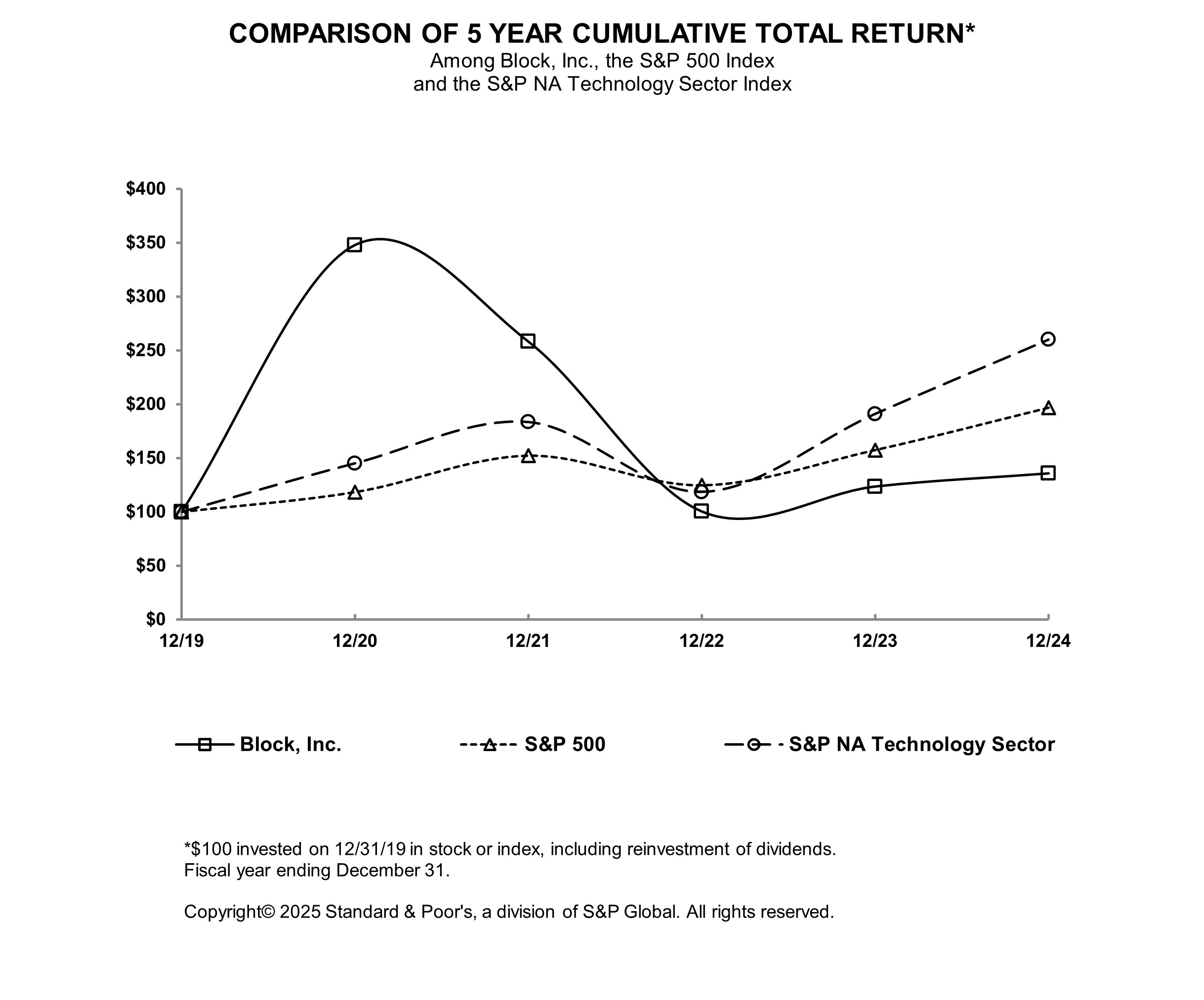
The following graph compares the cumulative total return to stockholders of our common stock relative to the cumulative total returns of the Standard & Poor’s 500 Index ("S&P 500"), and the S&P North American Technology Index. An investment of $100 (with reinvestment of all dividends) is assumed to have been made in our Class A common stock and in each index on the last trading day for the fiscal year ended December 31, 2019 and its relative performance is tracked through December 31, 2024. The returns shown are based on historical results and are not intended to suggest future performance.
| Company/Index | 12/31/2019 | 12/31/2020 | 12/31/2021 | 12/31/2022 | 12/31/2023 | 12/31/2024 | ||||||||||||||||||||||||||||||||
| Block, Inc. | $ | 100.00 | $ | 347.89 | $ | 258.17 | $ | 100.45 | $ | 123.64 | $ | 135.85 | ||||||||||||||||||||||||||
| S&P 500 | $ | 100.00 | $ | 118.40 | $ | 152.39 | $ | 124.79 | $ | 157.59 | $ | 197.02 | ||||||||||||||||||||||||||
| S&P North American Technology | $ | 100.00 | $ | 145.15 | $ | 183.47 | $ | 118.60 | $ | 191.10 | $ | 260.04 |
Item 6. [RESERVED]
Item 7. MANAGEMENT'S DISCUSSION AND ANALYSIS OF FINANCIAL CONDITION AND RESULTS OF OPERATIONS
This management's discussion and analysis provides a review of the results of operations, key operating metrics and non-GAAP financial measures, and liquidity and capital resources of Block, Inc. on a historical basis and outlines the factors that have affected recent earnings, as well as those factors that may affect future earnings. The following discussion and analysis should be read in conjunction with the consolidated financial statements and the notes thereto included elsewhere in this Annual Report on Form 10-K ("Form 10-K").
This section of this Form 10-K generally discusses fiscal 2024 compared to fiscal 2023. The comparison of the fiscal 2023 results with the fiscal 2022 results that are not included in this Form 10-K can be found in the "Management's Discussion and Analysis Results of Operations" section in the Company's fiscal 2023 Annual Report within Part II, Item 7 of Form 10-K, filed on February 22, 2024.
The statements in this discussion regarding our expectations of our future performance, liquidity, and capital resources; our plans, estimates, beliefs, and expectations that involve risks and uncertainties; and other non-historical statements in this discussion are forward-looking statements. These forward-looking statements are subject to numerous risks and uncertainties, including, but not limited to, the risks and uncertainties described under Item 1A. Risk Factors and elsewhere in this Form 10-K. Our actual results may differ materially from those contained in or implied by any forward-looking statements.
Overview
We launched the Square ecosystem in February 2009 to enable businesses ("sellers") to accept card payments, an important capability that was previously inaccessible to many businesses. We have expanded to provide sellers additional products and services and to give them access to a cohesive ecosystem of tools to help them manage and grow their businesses. Similarly, with Cash App, we have built an ecosystem of financial products and services to help individuals manage their money. In January 2022, we completed the acquisition of Afterpay, a buy now, pay later ("BNPL") platform that facilitates commerce between retail merchants and consumers by allowing retail merchant clients to offer their customers the ability to buy goods and services on a BNPL basis. In addition, our nascent businesses include TIDAL and two bitcoin businesses, Bitkey and Proto.
We delivered strong growth across our primary ecosystems in 2024, with gross profit of $8.9 billion, up 18% year over year. Cash App generated gross profit of $5.2 billion in 2024, up 21% year over year. Performance was driven by growth in inflows per active as we execute on our Bank Our Base strategy, which prioritizes engaging customers with more products across our ecosystem and increasing paycheck deposit actives. Square generated gross profit of $3.6 billion in 2024, up 15% year over year, as we continued to increase product velocity and optimize our go-to-market strategies.
In 2024, operating income was $892.3 million and Adjusted Operating Income was $1.6 billion, compared to an operating loss of $278.8 million and Adjusted Operating Income of $351.4 million in 2023. For the same period, net income attributable to common stockholders was $2.9 billion compared to $9.8 million, and Adjusted EBITDA was $3.0 billion, an increase of 69% year over year. Net income for 2024 and 2023 included a gain of $420.9 million and $207.1 million, respectively, from the remeasurement of our bitcoin investment. Additionally, as a result of our improved profitability in the United States, we released our valuation allowance associated with certain federal and state deferred tax assets, as well as recognized deferred tax assets as part of internal legal entity restructuring efforts, which resulted in one-time benefits to net income for 2024 of $1.9 billion. These one-time tax benefits had a corresponding impact of $3.10 and $3.00 per share on our basic and diluted net income per share, respectively, for the year ended December 31, 2024.
Refer to the Key Operating Metrics and Non-GAAP Financial Measures section below for reconciliations of non-GAAP financial measures to their nearest generally accepted accounting principles ("GAAP") equivalents.
Starting in 2023, we sharpened our focus on our organizational structure and expenditures with a view to identifying areas where we can be more cost efficient as we focus on disciplined growth and pursuing cost efficiencies. In 2023, we also announced we would implement an absolute cap of 12,000 on the number of employees we have at our company, which we have achieved in 2024, and we plan to continue to operate below this cap through a combination of performance management, centralization of teams and functions to reduce duplication, and prioritization of our scope. In 2024, we continued to make progress on cost efficiency goals and we expect to continue these efforts, including implementing greater expense discipline and reassessing certain contractual vendor arrangements. We may continue to incur expenses, including restructuring costs, in the short term to implement these initiatives. We continue to realize benefits related to our focus on disciplined growth and cost efficiencies and we expect to continue to benefit from these actions in future periods.
During the second quarter of 2024, we issued $2.0 billion in aggregate principal amount of senior unsecured notes due 2032 ("2032 Senior Notes"). We ended 2024 with $10.7 billion in available liquidity, with $9.9 billion in cash, cash equivalents, restricted cash, and investments in marketable debt securities, as well as an undrawn amount of $775.0 million available under our revolving credit facility. This represents an increase of $3.0 billion from the end of 2023.
On October 26, 2023, our board of directors authorized the repurchase of up to $1 billion of the Company’s Class A common stock. On July 25, 2024, our board of directors authorized an increase to this share repurchase program to repurchase up to an additional $3 billion of our Class A common stock, for a total overall authorization of $4 billion. The goal of the program is to return capital to shareholders. The timing and amount of shares repurchased will depend on a variety of factors, including the stock price, business and market conditions, corporate and regulatory requirements, alternative investment opportunities, acquisition opportunities, and other factors. As of December 31, 2024, we have repurchased $1.3 billion of our Class A common stock under the program, of which $1.2 billion was purchased in 2024.
Components of Results of Operations
Revenue
Transaction-based Revenue
We charge our sellers a transaction fee that is generally calculated based on a percentage of the total transaction amount processed. We also selectively offer custom pricing for certain larger sellers. Transaction-based revenue also includes amounts we charge our Cash App customers for peer-to-peer transactions to business accounts and payments sent from a credit card.
Subscription and Services-based Revenue
Subscription and services-based revenue is primarily comprised of revenue we generate from Cash App, Square Loans (formerly known as Square Capital), our BNPL platform, TIDAL, and various other software as a service (“SaaS”) products that we offer through Square. Cash App subscription and services-based revenue is primarily comprised of transaction fees from Cash App Instant Deposit, Cash App Card, bitcoin withdrawal fees, and other Cash App financial services offerings. Our other SaaS products include subscription fees on our vertical software solutions (including Square for Restaurants, Square Appointments, and Square for Retail), Customer Engagement products (including Square Loyalty, Square Marketing, Square Gift Cards), staff management products (including Square Team Management and Square Payroll), website
Showing the first 8K of 83K characters. Open the full section
Item 7A. QUANTITATIVE AND QUALITATIVE DISCLOSURES ABOUT MARKET RISK
We have operations both within the United States and globally, and we are exposed to market risks in the ordinary course of our business, including the effects of interest rate changes and foreign currency fluctuations. Information relating to quantitative and qualitative disclosures about these market risks is described below.
Equity Price Risk
Marketable Equity Investments
Our marketable equity investments are investments held in publicly-traded companies and are measured using quoted prices in active markets which could result in volatility in our financial results in future periods. As of December 31, 2024, our marketable equity investments were immaterial. Adjustments are recorded in other (expense) income, net on the consolidated statements of operations and establish a new carrying value for the investment. A hypothetical 10% increase or decrease in the fair value of our marketable equity investments would not have a material effect on our financial results.
Non-Marketable Equity Investments
Our non-marketable equity investments are investments in privately-held companies that we hold for purposes other than trading. These investments are inherently risky because there is no established market for these securities and the markets for the technologies or products these companies are developing are typically in the early stages. As such, we could lose our entire investment in these companies. Adjustments are recorded in other expense (income), net on the consolidated statements of operations and establish a new carrying value for the investment. As of December 31, 2024, the aggregate carrying value of our non-marketable equity investments included in other non-current assets was $245.6 million. A hypothetical 10% increase or decrease in the carrying value of our non-marketable equity investments would not have a material effect on our financial results.
Bitcoin Market Price Risk
Our bitcoin investment is measured using observed prices from active exchanges and adjustments are recorded in net income through “other expense (income), net” on the consolidated statements of operations. The bitcoin market price may fluctuate significantly and a decline in the market price of bitcoin could result in a material and adverse effect on our financial results in future periods. As of December 31, 2024, the fair value of our bitcoin investment included in other non-current assets was $792.3 million, and for the year ended December 31, 2024 and 2023, we recognized a $420.9 million and $207.1 million gain, respectively, from the remeasurement of our bitcoin investment.
Interest Rate Sensitivity
Our cash and cash equivalents, and marketable debt securities as of December 31, 2024 were held primarily in certificates of deposits, money market funds, U.S. government and agency securities, commercial paper, and corporate bonds. The fair value of our cash, cash equivalents, and marketable debt securities would not be significantly affected by either an increase or decrease in interest rates due mainly to the short-term nature of a majority of these instruments. Additionally, we have the ability to hold these instruments until maturity if necessary to reduce our risk. Our Warehouse Facilities borrowings and any future borrowings incurred under the 2020 Credit Facility both accrue interest at variable rates based on formulas tied to certain market rates at the time of incurrence. A hypothetical 10% increase or decrease in interest rates would not have a material effect on our financial results.
Foreign Currency Risk
Our consolidated financial statements are presented in U.S. dollars. Most of our revenue is earned in U.S. dollars and, subsequent to the acquisition of Afterpay, a portion is earned in Australian Dollars. Our exposure to other foreign currencies would not have a material effect on our financial results. Our foreign operations are denominated in the currencies of the countries in which our operations are located, and may be subject to fluctuations due to changes in foreign currency exchange rates. Our results of operations and cash flows are, therefore, subject to fluctuations in foreign currency exchange rates and may cause us to recognize transaction gains and losses on our financial statements.
From time to time, we use foreign exchange derivative contracts to hedge a portion of our exposure to changes in currency exchange rates, which result from our global operating and financing activities. We do not use derivative financial instruments for trading or speculative purposes. Gains and losses from foreign currency transactions, as well as foreign exchange forward contracts, were not significant for any period presented in the consolidated financial statements included in this Annual Report on Form 10-K. We did not have any material gains and losses from foreign currency derivatives outstanding as of December 31, 2024. A hypothetical 10% increase or decrease in current exchange rates on our financial instruments would not have a material effect on our financial results.
Item 8. FINANCIAL STATEMENTS AND SUPPLEMENTARY DATA
BLOCK, INC.
INDEX TO THE CONSOLIDATED FINANCIAL STATEMENTS
REPORT OF INDEPENDENT REGISTERED PUBLIC ACCOUNTING FIRM
To the Stockholders and the Board of Directors of Block, Inc.
Opinion on the Financial Statements
We have audited the accompanying consolidated balance sheets of Block, Inc. (the Company) as of December 31, 2024 and 2023, and the related consolidated statements of operations, comprehensive income (loss), stockholders’ equity and cash flows for each of the three years in the period ended December 31, 2024, and the related notes (collectively referred to as the “consolidated financial statements”). In our opinion, the consolidated financial statements present fairly, in all material respects, the financial position of the Company at December 31, 2024 and 2023, and the results of its operations and its cash flows for each of the three years in the period ended December 31, 2024, in conformity with U.S. generally accepted accounting principles.
We also have audited, in accordance with the standards of the Public Company Accounting Oversight Board (United States) (PCAOB), the Company's internal control over financial reporting as of December 31, 2024, based on criteria established in Internal Control—Integrated Framework issued by the Committee of Sponsoring Organizations of the Treadway Commission (2013 framework), and our report dated February 24, 2025 expressed an unqualified opinion thereon.
Adoption of SAB 122
As discussed in Note 1 to the consolidated financial statements, the Company changed its method of accounting for obligations to safeguard crypto-assets held in custody on behalf of its users in 2024 due to the adoption of SAB 122.
Basis for Opinion
These financial statements are the responsibility of the Company's management. Our responsibility is to express an opinion on the Company's financial statements based on our audits. We are a public accounting firm registered with the PCAOB and are required to be independent with respect to the Company in accordance with the U.S. federal securities laws and the applicable rules and regulations of the Securities and Exchange Commission and the PCAOB.
We conducted our audits in accordance with the standards of the PCAOB. Those standards require that we plan and perform the audit to obtain reasonable assurance about whether the financial statements are free of material misstatement, whether due to error or fraud. Our audits included performing procedures to assess the risks of material misstatement of the financial statements, whether due to error or fraud, and performing procedures that respond to those risks. Such procedures included examining, on a test basis, evidence regarding the amounts and disclosures in the financial statements. Our audits also included evaluating the accounting principles used and significant estimates made by management, as well as evaluating the overall presentation of the financial statements. We believe that our audits provide a reasonable basis for our opinion.
Critical Audit Matter
The critical audit matter communicated below is a matter arising from the current period audit of the financial statements that was communicated or required to be communicated to the audit committee and that: (1) relates to accounts or disclosures that are material to the financial statements and (2) involved our especially challenging, subjective or complex judgments. The communication of the critical audit matter does not alter in any way our opinion on the consolidated financial statements, taken as a whole, and we are not, by communicating the critical audit matter below, providing a separate opinion on the critical audit matter or on the accounts or disclosures to which it relates.
| Bitcoin Investment and Bitcoin Held for Other Parties | ||||||||
| Description of the Matter | As described in Notes 1, 12 and 13 to the consolidated financial statements, the Company holds bitcoin for long term investment purposes ("bitcoin investment"). The Company remeasures its bitcoin investment at fair value at the end of each reporting period and as of December 31, 2024, the fair value of the Company’s bitcoin investment was $792.3 million. The Company also allows its Cash App customers to store bitcoin in the Company’s digital wallets. No amounts are recognized on the consolidated balance sheets for bitcoin held for other parties. In the event such bitcoin was lost, the Company would be required to evaluate if a liability should be recorded under ASC 450, Contingencies. The Company has concluded that it has no probable liability for its custodial obligations to recognize as of December 31, 2024. Bitcoin is generally accessible only by the possessor of the unique cryptographic (private) key relating to the public address on which the bitcoin is held. To the extent any of the private keys are lost or destroyed, the Company will be unable to access the bitcoin it controls on behalf of the Company and other parties, which can result in a loss in the consolidated financial statements. We identified the evaluation of audit evidence pertaining to the existence of bitcoin and whether the Company controls the bitcoin as a critical audit matter. Subjective auditor judgment was involved in determining the nature and extent of audit effort required to obtain sufficient appropriate audit evidence to address the risks of material misstatement related to the Company’s ability to access and control the bitcoin investment and bitcoin held for other parties. The nature and extent of audit effort required to address the matter includes significant involvement of more experienced engagement team members and assistance from subject matter experts. | |||||||
| How We Addressed the Matter in Our Audit | We obtained an understanding, evaluated the design, and tested the operating effectiveness of controls related to the ability to access and control the private keys to its wallets as well as management’s controls related to reconciling its internal books and records to the public bitcoin blockchain. Our audit procedures included utilizing our proprietary audit tool to independently obtain evidence from the public bitcoin blockchain to test the existence of bitcoin in the Company’s custody on a sample basis, testing management’s reconciliation of its internal books and records to the public bitcoin blockchain, and testing that management has control of the private keys required to access bitcoin in its wallets through observing the movement of a sample of bitcoin from the Company’s wallets. |
/s/ Ernst & Young LLP
We have served as the Company’s auditor since 2019.
San Francisco, Cali
Showing the first 8K of 254K characters. Open the full section
Item 9. CHANGES IN AND DISAGREEMENTS WITH ACCOUNTANTS ON ACCOUNTING AND FINANCIAL DISCLOSURE
None.
Item 9A. CONTROLS AND PROCEDURES
Evaluation of Disclosure Controls and Procedures
Our management, with the participation of our Principal Executive Officer and our Principal Financial Officer, has evaluated the effectiveness of our disclosure controls and procedures as of the end of the period covered by this Annual Report on Form 10-K. The term “disclosure controls and procedures,” as defined in Rules 13a-15(e) and 15d-15(e) under the Securities Exchange Act of 1934, as amended (the “Exchange Act”), means controls and other procedures of a company that are designed to ensure that information required to be disclosed by a company in the reports that it files or submits under the Exchange Act is recorded, processed, summarized and reported, within the time periods specified in the SEC’s rules and forms. Disclosure controls and procedures include, without limitation, controls and procedures designed to ensure that information required to be disclosed by a company in the reports that it files or submits under the Exchange Act is accumulated and communicated to the company’s management, including its principal executive and principal financial officers, or persons performing similar functions, as appropriate to allow timely decisions regarding required disclosure. Management recognizes that any controls and procedures, no matter how well designed and operated, can provide only reasonable assurance of achieving their objectives and management necessarily applies its judgment in evaluating the cost-benefit relationship of possible controls and procedures. Based on such evaluation, our Principal Executive Officer and Principal Financial Officer have concluded that, as of December 31, 2024, our disclosure controls and procedures were effective at the reasonable assurance level.
Changes in Internal Control over Financial Reporting
There was no change in our internal control over financial reporting identified in connection with the evaluation required by Rule 13a-15(d) and 15d-15(d) of the Exchange Act that occurred during the quarter ended December 31, 2024 that has materially affected, or is reasonably likely to materially affect, our internal control over financial reporting.
Management's Report on Internal Control over Financial Reporting
Our management is responsible for establishing and maintaining adequate internal control over financial reporting (as defined in Rule 13a-15(f) under the Exchange Act). Our management conducted an assessment of the effectiveness of our internal control over financial reporting based on the criteria established in “Internal Control - Integrated Framework” (2013) issued by the Committee of Sponsoring Organizations of the Treadway Commission ("COSO"). Based on that assessment, our management has concluded that our internal control over financial reporting was effective as of December 31, 2024. The effectiveness of our internal control over financial reporting as of December 31, 2024 has been audited by Ernst & Young, LLP, an independent registered public accounting firm, as stated in their report which appears herein.
Item 9B. OTHER INFORMATION
During the quarterly period ended December 31, 2024, no officers, as defined in Rule 16a-1(f), or directors adopted and/or terminated a “Rule 10b5-1 trading arrangement” or a “non-Rule 10b5-1 trading arrangement,” each as defined in Regulation S-K Item 408.
Item 9C. DISCLOSURE REGARDING FOREIGN JURISDICTIONS THAT PREVENT INSPECTIONS
None.
PART III
Item 10. DIRECTORS, EXECUTIVE OFFICERS AND CORPORATE GOVERNANCE
The information required by this item will be included in our Proxy Statement for the 2025 Annual Meeting of Stockholders to be filed with the SEC within 120 days of the fiscal year ended December 31, 2024 ("Proxy Statement") and is incorporated herein by reference.
Item 11. EXECUTIVE COMPENSATION
The information required by this item will be included in the Proxy Statement and is incorporated herein by reference.
Item 12. SECURITY OWNERSHIP OF CERTAIN BENEFICIAL OWNERS AND MANAGEMENT AND RELATED STOCKHOLDER MATTERS
The information required by this item will be included in the Proxy Statement and is incorporated herein by reference.
Item 13. CERTAIN RELATIONSHIPS AND RELATED TRANSACTIONS, AND DIRECTOR INDEPENDENCE
The information required by this item will be included in the Proxy Statement and is incorporated herein by reference.
Item 14. PRINCIPAL ACCOUNTING FEES AND SERVICES
The information required by this item will be included in the Proxy Statement and is incorporated herein by reference.
PART IV
Item 15. EXHIBITS, FINANCIAL STATEMENT SCHEDULES
(a) The following documents are filed as a part of this Annual Report on Form 10-K:
**(1)**Consolidated Financial Statements:
Our Consolidated Financial Statements are listed in the “Index to Consolidated Financial Statements” under Part II, Item 8 of this Annual Report on Form 10-K.
**(2)**Financial Statement Schedules:
Schedules not listed above have been omitted because the information required to be set forth therein is not applicable or is shown in the financial statements or notes herein.
**(3)**Exhibits
The documents listed in the following Exhibit Index of this Annual Report on Form 10-K are incorporated by reference or are filed with this Annual Report on Form 10-K, in each case as indicated therein (numbered in accordance with Item 601 of Regulation S-K):
EXHIBIT INDEX
- Filed herewith.
- Indicates management contract or compensatory plan.
† The certifications attached as Exhibit 32.1 that accompany this Annual Report on Form 10-K are deemed furnished and not filed with the Securities and Exchange Commission and are not to be incorporated by reference into any filing of the Registrant under the Securities Act of 1933, as amended, or the Securities Exchange Act of 1934, as amended, whether made before or after the date of this Annual Report on Form 10-K, irrespective of any general incorporation language contained in such filing.
Item 16. FORM 10-K SUMMARY
None.
SIGNATURES
Pursuant to the requirements of Section 13 or 15(d) of the Securities Exchange Act of 1934, the registrant has duly caused this Annual Report on Form 10-K to be signed on its behalf by the undersigned, thereunto duly authorized.
Date: February 24, 2025
BLOCK, INC.
By: /s/ Jack Dorsey
Jack Dorsey
Block Head and Chairperson
(Principal Executive Officer)
POWER OF ATTORNEY
Each person whose signature appears below hereby constitutes and appoints Jack Dorsey, Amrita Ahuja, and Chrysty Esperanza, and each of them, as his or her true and lawful attorney-in-fact and agent, with full power of substitution and resubstitution, for him or her and in his or her name, place and stead, in any and all capacities, to sign any and all amendments to this Annual Report on Form 10-K, and to file the same, with all exhibits thereto, and other documents in connection therewith, with the Securities and Exchange Commission, granting unto said attorneys-in-fact and agents, and each of them, full power and authority to do and perform each and every act and thing requisite and necessary to be done in connection therewith, as fully for all intents and purposes as he or she might or could do in person, hereby ratifying and confirming all that said attorneys-in-fact and agents, or any of them, or their, his or her substitutes, may lawfully do or cause to be done by virtue hereof.
Pursuant to the requirements of the Securities Exchange Act of 1934, this Annual Report on Form 10-K has been signed by the following persons on behalf of the registrant and in the capacities and on the dates indicated:
| Signature | Title | Date | ||||||
| /s/ Jack Dorsey | Block Head and Chairperson (Principal Executive Officer) | February 24, 2025 | ||||||
| Jack Dorsey | ||||||||
| /s/ Amrita Ahuja | Chief Financial Officer & Chief Operating Officer (Principal Financial Officer) | February 24, 2025 | ||||||
| Amrita Ahuja | ||||||||
| /s/ Ajmere Dale | Chief Accounting Officer (Principal Accounting Officer) | February 24, 2025 | ||||||
| Ajmere Dale | ||||||||
| /s/ Roelof Botha | Director | February 24, 2025 | ||||||
| Roelof Botha | ||||||||
| /s/ Amy Brooks | Director | February 24, 2025 | ||||||
| Amy Brooks | ||||||||
| /s/ Shawn Carter | Director | February 24, 2025 | ||||||
| Shawn Carter | ||||||||
| /s/ Paul Deighton | Director | February 24, 2025 | ||||||
| Paul Deighton | ||||||||
| /s/ Anthony Eisen | Director | February 24, 2025 | ||||||
| Anthony Eisen | ||||||||
| /s/ Randy Garutti | Director | February 24, 2025 | ||||||
| Randy Garutti | ||||||||
| /s/ Jim McKelvey | Director | February 24, 2025 | ||||||
| Jim McKelvey | ||||||||
| /s/ Mary Meeker | Director | February 24, 2025 | ||||||
| Mary Meeker | ||||||||
| /s/ Neha Narula | Director | February 24, 2025 | ||||||
| Neha Narula |