 filings.tools
Yum! Brands 10-K 2016-12-31
Filed 2017-02-22. 21 sections, 443K characters. Original on sec.gov · Markdown · JSON
Cover and table of contents
UNITED STATES
SECURITIES AND EXCHANGE COMMISSION
Washington, D. C. 20549
FORM 10-K
| [Ÿ] | ANNUAL REPORT PURSUANT TO SECTION 13 OR 15(d) OF THE SECURITIES | |
| EXCHANGE ACT OF 1934 for the fiscal year ended December 31, 2016 | ||
| OR | ||
| [ ] | TRANSITION REPORT PURSUANT TO SECTION 13 OR 15(d) OF THE SECURITIES | |
| EXCHANGE ACT OF 1934 |
For the transition period from ____________ to _________________
Commission file number 1-13163
YUM! BRANDS, INC.
(Exact name of registrant as specified in its charter)
| North Carolina | 13-3951308 | ||
| (State or other jurisdiction of | (I.R.S. Employer | ||
| incorporation or organization) | Identification No.) | ||
| 1441 Gardiner Lane, Louisville, Kentucky | 40213 | ||
| (Address of principal executive offices) | (Zip Code) | ||
| Registrant’s telephone number, including area code: (502) 874-8300 |
| Securities registered pursuant to Section 12(b) of the Act | |||
| Title of Each Class | Name of Each Exchange on Which Registered | ||
| Common Stock, no par value | New York Stock Exchange | ||
| Securities registered pursuant to Section 12(g) of the Act: | |||
| None |
Indicate by check mark if the registrant is a well-known seasoned issuer, as defined in Rule 405 of the Securities Act. Yes ü No
Indicate by check mark if the registrant is not required to file reports pursuant to Section 13 or Section 15(d) of the Act. Yes No ü
Indicate by check mark whether the registrant (1) has filed all reports required to be filed by Section 13 or 15(d) of the Securities Exchange Act of 1934 during the preceding 12 months (or for such shorter period that the registrant was required to file such reports), and (2) has been subject to such filing requirements for the past 90 days. Yes ü No
Indicate by check mark whether the registrant has submitted electronically and posted on its corporate Website, if any, every Interactive Data File required to be submitted and posted pursuant to Rule 405 of Regulation S-T during the preceding 12 months (or for such shorter period that the registrant was required to submit and post such files). Yes ü No
Indicate by check mark if disclosure of delinquent filers pursuant to Item 405 of Regulation S-K is not contained herein, and will not be contained, to the best of registrant’s knowledge, in definitive proxy or information statements incorporated by reference in Part III of this Form 10-K or any amendment to this Form 10-K. [ü]
Indicate by check mark whether the registrant is a large accelerated filer, an accelerated filer, a non-accelerated filer or a smaller reporting company. See definitions of “large accelerated filer”, “accelerated filer” and “smaller reporting company” in Rule 12b-2 of the Exchange Act (Check one): Large accelerated filer: [ü] Accelerated filer: [ ] Non-accelerated filer: [ ] Smaller reporting company: [ ]
Indicate by check mark whether the registrant is a shell company (as defined in Rule 12b-2 of the Exchange Act). Yes No ü
The aggregate market value of the voting stock (which consists solely of shares of Common Stock) held by non-affiliates of the registrant as of June 11, 2016 computed by reference to the closing price of the registrant’s Common Stock on the New York Stock Exchange Composite Tape on such date was approximately $31.1 billion. All executive officers and directors of the registrant have been deemed, solely for the purpose of the foregoing calculation, to be “affiliates” of the registrant. The number of shares outstanding of the registrant’s Common Stock as of February 14, 2017 was 353,844,095 shares.
Documents Incorporated by Reference
Portions of the definitive proxy statement furnished to shareholders of the registrant in connection with the annual meeting of shareholders to be held on May 19, 2017 are incorporated by reference into Part III.
Forward-Looking Statements
In this Form 10-K, as well as in other written reports and oral statements, we present “forward-looking statements” within the meaning of Section 27A of the Securities Act of 1933, as amended, and Section 21E of the Securities Exchange Act of 1934, as amended. We intend all forward-looking statements to be covered by the safe harbor provisions of the Private Securities Litigation Reform Act of 1995, and we are including this statement for purposes of complying with those safe harbor provisions.
Forward-looking statements can be identified by the fact that they do not relate strictly to historical or current facts and by the use of forward-looking words such as “expect,” “expectation,” “believe,” “anticipate,” “may,” “could,” “intend,” “belief,” “plan,” “estimate,” “target,” “predict,” “likely,” “seek,” “project,” “model,” “ongoing,” “will,” “should,” “forecast,” “outlook” or similar terminology. Forward-looking statements are based on our current expectations, estimates, assumptions and/or projections as well as our perception of historical trends and current conditions, as well as other factors that we believe are appropriate and reasonable under the circumstances. Forward-looking statements are neither predictions nor guarantees of future events, circumstances or performance and are inherently subject to known and unknown risks, uncertainties and assumptions that could cause our actual results to differ materially from those indicated by those statements. There can be no assurance that our expectations, estimates, assumptions and/or projections will be achieved. Factors that could cause actual results and events to differ materially from our expectations and forward-looking statements include (i) the risks and uncertainties described in the Risk Factors included in Part I, Item 1A of this Form 10-K and (ii) the factors described in Management’s Discussion and Analysis of Financial Condition and Results of Operations included in Part II, Item 7 of this Form 10-K. You should not place undue reliance on forward-looking statements, which speak only as of the date hereof. The forward-looking statements included in this Form 10-K are only made as of the date of this Form 10-K and we disclaim any obligation to publicly update any forward-looking statement to reflect subsequent events or circumstances.
PART I
Item 1. Business.
YUM! Brands, Inc. (referred to herein as “YUM”, the “Registrant” or the “Company”), was incorporated under the laws of the state of North Carolina in 1997. The principal executive offices of YUM are located at 1441 Gardiner Lane, Louisville, Kentucky 40213, and the telephone number at that location is (502) 874-8300. Our website address is http://yum.com.
YUM, together with its subsidiaries, is referred to in this Form 10-K annual report (“Form 10-K”) as the Company. The terms “we,” “us” and “our” are also used in the Form 10-K to refer to the Company. Throughout this Form 10-K, the terms “restaurants,” “stores” and “units” are used interchangeably. While YUM! Brands, Inc., referred to as the Company, does not directly own or operate any restaurants, throughout this document we may refer to restaurants that are owned or operated by our subsidiaries as being Company-owned.
Financial Information about Operating Segments and General Development of the Business
As of December 31, 2016, YUM consists of three operating segments:
| • | The KFC Division which includes the worldwide operations of the KFC concept |
| • | The Pizza Hut Division which includes the worldwide operations of the Pizza Hut concept |
| • | The Taco Bell Division which includes the worldwide operations of the Taco Bell concept |
Effective January 2016, the India Division was segmented by brand, integrated into the global KFC, Pizza Hut and Taco Bell Divisions, and is no longer a separate operating segment. While our consolidated results were not impacted, we have restated our historical segment information for consistent presentation.
On October 31, 2016 (the “Distribution Date”), we completed the spin-off of our China business (the "Separation") into an independent, publicly-traded company under the name of Yum China Holdings, Inc. (“Yum China”). On the Distribution Date, we distributed to each of our shareholders of record as of the close of business on October 19, 2016 (the “Record Date”) one share of Yum China common stock for each share of our Common Stock held as of the Record Date. The distribution was structured to be a tax free distribution to our U.S. shareholders for federal income tax purposes in the United States. Yum China’s common stock now trades on the New York Stock Exchange ("NYSE") under the symbol “YUMC.” After the distribution, we do not beneficially own any shares of Yum China common stock.
Concurrent with the Separation, a subsidiary of the Company entered into a Master License Agreement with a subsidiary of Yum China for the exclusive right to use and sublicense the use of intellectual property owned by YUM and its affiliates for the development and operation of KFC, Pizza Hut and Taco Bell restaurants in China. Prior to the Separation, our operations in mainland China were reported in our former China Division segment results. As a result of the Separation, the results of operations, assets and liabilities, and cash flows of the separated business are presented as discontinued operations in our Consolidated Statements of Income, Consolidated Balance Sheets and Consolidated Statements of Cash Flows for all periods presented. See additional information related to the impact of the Separation in Item 8, Note 4 to the Consolidated Financial Statements.
Operating segment information for the years ended December 31, 2016, December 26, 2015 and December 27, 2014 for the Company is included in Part II, Item 7, Management's Discussion and Analysis of Financial Condition and Results of Operations ("MD&A") and in the related Consolidated Financial Statements in Part II, Item 8.
Narrative Description of Business
General
YUM has over 43,500 restaurants in more than 135 countries and territories. Through the three concepts of KFC, Pizza Hut and Taco Bell (the “Concepts”), the Company develops, operates or franchises a worldwide system of restaurants which prepare, package and sell a menu of competitively priced food items. Units are operated by a Concept or by independent franchisees or licensees under the terms of franchise or license agreements, which require payment of sales-based fees for use of our Concepts' brands. The terms "franchise" or "franchisee" within this Form 10-K are meant to describe third parties that operate units under either franchise or license agreements. Franchisees can range in size from individuals owning just one restaurant to large publicly-traded companies.
Restaurant Concepts
Most restaurants in each Concept offer consumers the ability to dine in and/or carry out food. In addition, Taco Bell and KFC offer a drive-thru option in many stores. Pizza Hut offers a drive-thru option on a much more limited basis. Pizza Hut typically offers delivery service, as does KFC on a more limited basis primarily in China.
Each Concept has proprietary menu items and emphasizes the preparation of food with high quality ingredients, as well as unique recipes and special seasonings to provide appealing, tasty and convenient food at competitive prices.
The franchise programs of the Company are designed to promote consistency and quality, and the Company is selective in granting franchises. The Company utilizes both store-level franchise and master franchise programs to grow its businesses. Under store-level franchise agreements, franchisees supply capital – initially by paying a franchise fee to YUM, by purchasing or leasing the land, building, equipment, signs, seating, inventories and supplies and, over the longer term, by reinvesting in the business. Franchisees contribute to the Company’s revenues on an ongoing basis through the payment of royalties based on a percentage of sales (usually 4% - 6%). Under master franchise arrangements, the Company enters into agreements that allow master franchisees to operate restaurants as well as sub-franchise within certain geographic territories. Master franchisees are responsible for overseeing development within their territories and collect initial fees and royalties from sub-franchisees. Master franchisees often pay royalties at a reduced rate to the Company. Our largest master franchisee, Yum China, pays a 3% license fee on system sales of our Concepts in mainland China to the Company.
The Company believes that it is important to maintain strong and open relationships with its franchisees and their representatives. To this end, the Company invests a significant amount of time working with the franchisee community and their representative organizations on key aspects of the business, including products, equipment, operational improvements and standards and management techniques.
Following is a brief description of each Concept:
KFC
| • | KFC was founded in Corbin, Kentucky by Colonel Harland D. Sanders, an early developer of the quick service food business and a pioneer of the restaurant franchise concept. The Colonel perfected his secret blend of 11 herbs and spices for Kentucky Fried Chicken in 1939 and signed up his first franchisee in 1952. |
| • | KFC operates in 128 countries and territories throughout the world. As of year end 2016, KFC had 20,604 units. 93 percent of the KFC units are franchised. |
| • | KFC restaurants across the world offer fried and non-fried chicken products such as sandwiches, chicken strips, chicken-on-the-bone and other chicken products marketed under a variety of names. KFC restaurants also offer a variety of entrees and side items suited to local preferences and tastes. Restaurant decor throughout the world is characterized by the image of the Colonel. |
Pizza Hut
| • | The first Pizza Hut restaurant was opened in 1958 in Wichita, Kansas, and within a year, the first franchise unit was opened. Today, Pizza Hut is the largest restaurant chain in the world specializing in the sale of ready-to-eat pizza products. |
| • | Pizza Hut operates in 103 countries and territories throughout the world. As of year end 2016, Pizza Hut had 16,409 units. 97 percent of the Pizza Hut units are franchised. |
| • | Pizza Hut operates in the delivery, carryout and casual dining segments around the world. Outside of the U.S., Pizza Hut often uses unique branding to differentiate these segments. Additionally, a growing percentage of Pizza Hut's customer orders are being generated digitally. |
| • | Pizza Hut features a variety of pizzas which are marketed under varying names. Each of these pizzas is offered with a variety of different toppings suited to local preferences and tastes. Many Pizza Huts also offer pasta and chicken wings, including approximately 5,900 stores offering wings under the brand WingStreet in the U.S. Outside the U.S., Pizza Hut casual dining restaurants offer a variety of core menu products other than pizza, which are typically suited to local preferences and tastes. Pizza Hut units feature a distinctive red roof logo on their signage. |
Taco Bell
| • | The first Taco Bell restaurant was opened in 1962 by Glen Bell in Downey, California, and in 1964, the first Taco Bell franchise was sold. |
| • | Taco Bell operates in 22 countries and territories throughout the world. As of year end 2016, there were 6,604 Taco Bell units, primarily in the U.S. 87 percent of the Taco Bell units are franchised. |
| • | Taco Bell specializes in Mexican-style food products, including various types of tacos, burritos, quesadillas, salads, nachos and other related items. Taco Bell offers breakfast items in its U.S. stores. Taco Bell units feature a distinctive bell logo on their signage. |
Restaurant Operations
Through its Concepts, YUM develops, operates and franchises a worldwide system of both traditional and non-traditional Quick Service Restaurants ("QSR"). Traditional units feature dine-in, carryout and, in some instances, drive-thru or delivery services. Non-traditional units include express units and kiosks which have a more limited menu, usually generate lower sales volumes and operate in non-traditional locations like malls, airports, gasoline service stations, train stations, subways, convenience stores, stadiums, amusement parks and colleges, where a full-scale traditional outlet would not be practical or efficient.
Restaurant management structure varies by Concept and unit size. Generally, each Concept-owned restaurant is led by a restaurant general manager (“RGM”), together with one or more assistant managers, depending on the operating complexity and sales volume of the restaurant. Each Concept issues detailed manuals, which may then be customized to meet local regulations and customs. These manuals set forth standards and requirements for all aspects of restaurant operations, including food safety and quality, food handling and product preparation procedures, equipment maintenance, facility standards and accounting control procedures. The restaurant management teams are responsible for the day-to-day operation of each unit and for ensuring compliance with operating standards. CHAMPS – which stands for Cleanliness, Hospitality, Accuracy, Maintenance, Product Quality and Speed of Service – is our proprietary systemwide program for training, measuring and rewarding employee performance against key customer measures. CHAMPS is intended to align the operating processes of our entire system around one core set of standards. RGMs’ efforts, including CHAMPS performance measures, are monitored by Area Coaches, where sufficient scale allows. Area Coaches typically work with approximately six to twelve restaurants. Various senior operators visit restaurants from time to time to promote adherence to system standards and mentor restaurant team members.
Supply and Distribution
The Company and franchisees of the Concepts are substantial purchasers of a number of food and paper products, equipment and other restaurant supplies. The principal items purchased include chicken, cheese, beef and pork products, paper and packaging materials. The Company has not experienced any significant continuous shortages of supplies, and alternative sources for most of these products are generally available. Prices paid for these supplies fluctuate. When prices increase, the Concepts may attempt to pass on such increases to their customers, although there is no assurance that this can be done practically.
In the U.S., the Company, along with the representatives of the Company’s KFC, Pizza Hut and Taco Bell franchisee groups, are members of Restaurant Supply Chain Solutions, LLC (“RSCS"), which is responsible for purchasing certain restaurant products and equipment. The core mission of RSCS is to provide the lowest possible sustainable store-delivered prices for restaurant products and equipment. This arrangement combines the purchasing power of the Company-owned and franchisee restaurants which the Company believes leverages the system’s scale to drive cost savings and effectiveness in the purchasing function. The Company also believes that RSCS fosters closer alignment of interests and a stronger relationship with its franchisee community.
Most food products, paper and packaging supplies, and equipment used in restaurant operations are distributed to individual restaurant units by third-party distribution companies. In the U.S., McLane Foodservice, Inc. is the exclusive distributor for the majority of items used in Company-owned restaurants and for a substantial number of franchisee stores.
Outside the U.S., we and our franchisees primarily use decentralized sourcing and distribution systems involving many different global, regional and local suppliers and distributors. We and our franchisees have approximately 5,800 food and paper suppliers, including U.S.-based suppliers that export to many countries.
Trademarks and Patents
The Company and its Concepts own numerous registered trademarks and service marks. The Company believes that many of these marks, including its Kentucky Fried Chicken®, KFC®, Pizza Hut® and Taco Bell® marks, have significant value and are materially important to its business. The Company’s policy is to pursue registration of its important marks whenever feasible and to oppose vigorously any infringement of its marks.
The use of these marks by franchisees has been authorized in our franchise agreements. Under current law and with proper use, the Company’s rights in its marks can generally last indefinitely. The Company also has certain patents on restaurant equipment which, while valuable, are not material to its business.
Working Capital
Information about the Company’s working capital is included in MD&A in Part II, Item 7 and the Consolidated Statements of Cash Flows in Part II, Item 8.
Seasonal Operations
The Company does not consider its operations to be seasonal to any material degree.
Competition
The retail food industry, in which our Concepts compete, is made up of supermarkets, supercenters, warehouse stores, convenience stores, coffee shops, snack bars, delicatessens and restaurants (including the QSR segment), and is intensely competitive with respect to price and quality of food products, new product development, advertising levels and promotional initiatives, customer service reputation, restaurant location and attractiveness and maintenance of properties. Competition from delivery aggregators and other food delivery services has also increased in recent years, particularly in urbanized areas. The industry is often affected by changes in consumer tastes; national, regional or local economic conditions; currency fluctuations; demographic trends; traffic patterns; the type, number and location of competing food retailers and products; and disposable purchasing power. Each of the Concepts competes with international, national and regional restaurant chains as well as locally-owned restaurants, not only for customers, but also for management and hourly personnel, suitable real estate sites and qualified franchisees. Given the various types and vast number of competitors, our Concepts do not constitute a significant portion of the retail food industry in terms of number of system units or system sales, either on a worldwide or individual country basis.
Research and Development (“R&D”)
The Company operates R&D facilities in Plano, Texas (KFC and Pizza Hut Divisions); Irvine, California (Taco Bell Division); Louisville, Kentucky (KFC U.S.) and several other locations outside the U.S. In addition to Company R&D, we regularly also engage independent suppliers to conduct research and development activities for the benefit of the YUM system. The Company expensed $24 million, $24 million and $25 million in 2016, 2015 and 2014, respectively, for R&D activities.
Environmental Matters
The Company is not aware of any federal, state or local environmental laws or regulations that will materially affect its earnings or competitive position, or result in material capital expenditures. However, the Company cannot predict the effect on its operations of possible future environmental legislation or regulations. During 2016, there were no material capital expenditures for environmental control facilities and no such material expenditures are anticipated.
Government Regulation
U.S. Operations. The Company and its U.S. operations are subject to various federal, state and local laws affecting its business, including laws and regulations concerning information security, labor and employment, health, marketing, food labeling, sanitation and safety. Each of the Concepts’ restaurants in the U.S. must comply with licensing and regulation by a number of governmental authorities, which include health, sanitation, safety, fire and zoning agencies in the state and/or municipality in which the restaurant is located. In addition, each Concept must comply with various state and federal laws that regulate the franchisor/franchisee relationship. To date, the Company has not been materially adversely affected by such licensing and regulation or by any difficulty, delay or failure to obtain required licenses or approvals.
International Operations. The Company’s restaurants outside the U.S. are subject to national and local laws and regulations which are similar to those affecting U.S. restaurants. The restaurants outside the U.S. are also subject to tariffs and regulations on imported commodities and equipment and laws regulating foreign investment, as well as anti-bribery and anti-corruption laws.
See Item 1A "Risk Factors" for a discussion of risks relating to federal, state, local and international regulation of our business.
Employees
As of year end 2016, the Company and its subsidiaries employed approximately 90,000 persons. The Company believes that it provides working conditions and compensation that compare favorably with those of its principal competitors. The majority of employees are paid on an hourly basis. Some employees are subject to labor council relationships that vary due to the diverse cultures in which the Company operates. The Company and its Concepts consider their employee relations to be good.
Financial Information about Geographic Areas
Financial information about our significant geographic areas is incorporated herein by reference from the related Consolidated Financial Statements in Part II, Item 8.
Available Information
The Company makes available through the Investor Relations section of its internet website at http://yum.com its annual report on Form 10-K, quarterly reports on Form 10-Q, current reports on Form 8-K and amendments to those reports filed or furnished pursuant to Section 13(a) or 15(d) of the Exchange Act, as soon as reasonably practicable after electronically filing such material with the Securities and Exchange Commission ("SEC") at http://www.sec.gov. These reports may also be obtained by visiting the SEC's Public Reference Room at 100 F Street, NE, Washington, DC 20549 or by calling the SEC at 1 (800) SEC-0330.
Our Corporate Governance Principles and our Code of Conduct are also located within the Investor Relations section of the Company's website. The reference to the Company’s website address does not constitute incorporation by reference of the information contained on the website and should not be considered part of this document. These documents, as well as our SEC filings, are available in print free of charge to any shareholder who requests a copy from our Investor Relations Department.
Item 1A. Risk Factors.
You should carefully review the risks described below as they identify important factors that could cause our actual results to differ materially from our forward-looking statements and historical trends.
Food safety and food-borne illness concerns may have an adverse effect on our business.
Food-borne illnesses, such as E. coli, hepatitis A, trichinosis and salmonella, occur or may occur within our system from time to time. In addition, food safety issues such as food tampering, contamination and adulteration occur or may occur within our system from time to time. Any report or publicity linking us or one of our Concepts’ restaurants, including restaurants operated by us or our Concepts’ franchisees, or linking our competitors or our industry generally, to instances of food-borne illness or food safety issues could adversely affect our Concepts’ brands and reputations as well as our revenues and profits, and possibly lead to product liability claims, litigation and damages. If a customer of our Concepts becomes ill as a result of food safety issues, restaurants in our system may be temporarily closed, which would decrease our revenues. In addition, instances or allegations of food-borne illness or food safety issues, real or perceived, involving our restaurants, restaurants of competitors, or suppliers or distributors (regardless of whether we use or have used those suppliers or distributors), or otherwise involving the types of food served at our restaurants, could result in negative publicity that could adversely affect our sales or the sales of our Concepts’ franchisees. The occurrence of food-borne illnesses or food safety issues could also adversely affect the price and availability of affected ingredients, which could result in disruptions in our supply chain and/or lower margins for us and our Concepts’ franchisees.
Health concerns arising from outbreaks of viruses or other diseases may have an adverse effect on our business.
Our business could be materially and adversely affected by the outbreak of a widespread health epidemic, including various strains of avian flu or swine flu, such as H1N1. The occurrence of such an outbreak of an epidemic illness or other adverse public health developments could materially disrupt our business and operations. Such events could also significantly impact our industry and cause a temporary closure of restaurants, which would severely disrupt our operations and have a material adverse effect on our business, financial condition and results of operations.
Our operations could be disrupted if any of our employees or employees of our business partners were suspected of having the avian flu or swine flu, since this could require us or our business partners to quarantine some or all of such employees or disinfect our restaurant facilities. Outbreaks of avian flu occur from time to time around the world, and such outbreaks have resulted in confirmed human cases. It is possible that outbreaks could reach pandemic levels. Public concern over avian flu generally may cause fear about the consumption of chicken, eggs and other products derived from poultry, which could cause customers to consume less poultry and related products. This would likely result in lower revenues and profits. Avian flu outbreaks could also adversely affect the price and availability of poultry, which could negatively impact our profit margins and revenues.
Furthermore, other viruses may be transmitted through human contact, and the risk of contracting viruses could cause employees or guests to avoid gathering in public places, which could adversely affect restaurant guest traffic or the ability to adequately staff restaurants. We could also be adversely affected if jurisdictions in which our Concepts’ restaurants operate impose mandatory closures, seek voluntary closures or impose restrictions on operations of restaurants. Even if such measures are not implemented and a virus or other disease does not spread significantly, the perceived risk of infection or health risk may affect our business.
Our operating results and growth strategies are closely and increasingly tied to the success of our Concepts’ franchisees.
A significant and growing portion of our restaurants are operated by our Concepts’ franchisees. In October 2016, in connection with the spin-off of our China business, we announced our plan to become at least 98% franchised by the end of 2018. Our refranchising efforts will increase our dependence on the financial success and cooperation of our Concepts’ franchisees. In addition, our long-term system sales growth targets depend on an acceleration of our historical net system unit growth rate. Nearly all of this unit growth is expected to result from new unit openings by our franchisees. If our franchisees do not meet our expectations for new unit development, we may fall short of our system sales growth targets.
We have limited control over how our Concepts’ franchisees’ businesses are run, and the inability of franchisees to operate successfully could adversely affect our operating results through decreased royalty payments. If our Concepts’ franchisees incur too much debt, if their operating expenses or commodity prices increase or if economic or sales trends deteriorate such that they are unable to operate profitably or repay existing debt, it could result in their financial distress, including insolvency or bankruptcy. If a significant franchisee or a significant number of our Concepts’ franchisees become financially distressed, our operating results could be impacted through reduced or delayed royalty payments. In addition, we are contingently liable on certain of our Concepts’ franchisees’ lease agreements, including lease agreements that we have guaranteed or assigned to franchisees in connection with refranchising of certain Company restaurants, and our operating results could be impacted by any increased rent obligations for such leased properties.
Our success also depends on the willingness and ability of our Concepts’ franchisees to implement major initiatives, which may include financial investment. Our Concepts may be unable to successfully implement strategies that we believe are necessary for further growth if their franchisees do not participate, which in turn may harm the growth prospects and financial condition of the Company. Additionally, the failure of our Concepts’ franchisees to focus on the fundamentals of restaurant operations, such as quality service and cleanliness (even if such failures do not rise to the level of breaching the related franchise documents), could have a negative impact on our business.
We may not successfully implement our transformation initiatives or fully realize the anticipated benefits from the transformation.
On October 11, 2016, we announced our strategic transformation plans to drive global expansion of our KFC, Pizza Hut and Taco Bell brands following the spin-off of our China business. Among other things, this transformation includes a plan to become at least 98% franchised by the end of 2018 and to significantly reduce annual capital expenditures and our general and administrative costs, each by the end of 2019. We cannot assure you that we will be able to successfully implement our transformation initiatives. Further, our ability to achieve the anticipated benefits of this transformation, including the anticipated levels of cost savings and efficiency, within expected timeframes is subject to many estimates and assumptions, which are, in turn, subject to significant economic, competitive and other uncertainties, some of which are beyond our control. There is no assurance that we will successfully implement, or fully realize the anticipated positive impact of, our transformation initiatives or execute successfully on our transformation strategy, in the expected timeframes or at all. In addition, there can be no assurance that our efforts, if properly executed, will result in our desired outcome of improved financial performance.
We have significant exposure to the Chinese market through our largest franchisee, Yum China, which subjects us to risks that could negatively affect our business.
In connection with the spin-off of our China business in October 2016, we entered into a Master License Agreement with Yum China pursuant to which Yum China is the exclusive licensee of the KFC, Pizza Hut and Taco Bell Concepts and their related
marks and other intellectual property rights for restaurant services in China. Following the spin-off, Yum China is now our largest franchisee, and our overall financial results are significantly affected by Yum China’s results, and our business is exposed to risks in China. These risks include, among others, changes in economic conditions (including consumer spending, unemployment levels and wage and commodity inflation), consumer preferences, the regulatory environment, as well as increased media scrutiny of our business and industry, fluctuations in foreign exchange rates and increased competition. In addition, any significant or prolonged deterioration in U.S.-China relations could adversely affect our China operations if Chinese consumers reduce the frequency of their visits to Yum China’s restaurants. Chinese law regulates the scope of our business conducted within China. Our business is therefore subject to numerous uncertainties based on the policies of the Chinese government, as they may change from time to time.
Our relationship with Yum China is governed by a Master License Agreement, which may be terminated upon the occurrence of certain events, such as the insolvency or bankruptcy of Yum China. In addition, if we are unable to enforce our intellectual property or contract rights in China, if Yum China is unable or unwilling to satisfy its obligations under the Master License Agreement, or if the Master License Agreement is otherwise terminated, it could result in an interruption in the operation of our brands that have been exclusively licensed to Yum China for use in China. Such interruption could result in a delay in or loss of royalty income to us, which would negatively impact our financial results.
Our international operations subject us to risks that could negatively affect our business.
A significant portion of our Concepts’ restaurants are operated in countries and territories outside of the U.S., including in emerging markets, and we intend to continue expansion of our international operations. As a result, our business is increasingly exposed to risks inherent in international operations. These risks, which can vary substantially by country, include political instability, corruption and social and ethnic unrest, as well as changes in economic conditions (including consumer spending, unemployment levels and wage and commodity inflation), the regulatory environment, income and non-income based tax rates and laws, foreign exchange control regimes, consumer preferences and the laws and policies that govern foreign investment in countries where our restaurants are operated. In addition, our franchisees do business in jurisdictions that may be subject to trade or economic sanction regimes. Any failure to comply with such sanction regimes or other similar laws or regulations could result in the assessment of damages, the imposition of penalties, suspension of business licenses, or a cessation of operations at our franchisees’ businesses, as well as damage to our and our Concepts’ brands’ images and reputations, all of which could harm our profitability.
Foreign currency risks and foreign exchange controls could adversely affect our financial results.
Our results of operations and the value of our foreign assets are affected by fluctuations in currency exchange rates, which may adversely affect reported earnings. More specifically, an increase in the value of the U.S. dollar relative to other currencies, such as the Chinese Renminbi (“RMB”), Australian Dollar, the British Pound and the Euro, as well as currencies in certain other markets, such as the Malaysian Ringgit and Russian Ruble, could have an adverse effect on our reported earnings. There can be no assurance as to the future effect of any such changes on our results of operations, financial condition or cash flows. In addition, the Chinese government restricts the convertibility of RMB into foreign currencies and, in certain cases, the remittance of currency out of China. Yum China’s income is almost exclusively derived from the earnings of its Chinese subsidiaries, with substantially all revenues of its Chinese subsidiaries denominated in RMB. Any significant fluctuation in the value of the RMB could materially impact the U.S. dollar value of royalty payments made to us by Yum China, which could result in lower revenues. In addition restrictions on the conversion of RMB to U.S. dollars or further restrictions on the remittance of currency out of China could result in delays in the remittance of Yum China’s license fee, which could impact our liquidity.
Failure to protect the integrity and security of personal information of our customers and employees could result in substantial costs, expose us to litigation and damage our reputation.
We receive and maintain certain personal, financial and other information about our customers, employees and franchisees. The use and handling of this information is regulated by evolving and increasingly demanding laws and regulations in various jurisdictions, as well as by certain third-party contracts. If our security and information systems are compromised as a result of data corruption or loss, cyber-attack or a network security incident or if our employees, franchisees or vendors fail to comply with these laws and regulations and this information is obtained by unauthorized persons or used inappropriately, it could result in liabilities and penalties and could damage our reputation, cause us to incur substantial costs and result in a loss of customer confidence, which could adversely affect our results of operations and financial condition. Additionally, we could be subject to litigation and government enforcement actions as a result of any such failure.
Further, data privacy is subject to frequently changing rules and regulations, which sometimes conflict among the various jurisdictions and countries where we, our Concepts and our Concepts’ franchisees do business. Our failure to adhere to or
successfully implement appropriate processes in this area could result in legal liability or impairment to our and our brands’ reputations.
Our inability or failure to recognize, respond to and effectively manage the accelerated impact of social media could adversely impact our business.
In recent years, there has been a marked increase in the use of social media platforms, including blogs, chat platforms, social media websites, and other forms of Internet-based communications which allow individuals access to a broad audience of consumers and other interested persons. The rising popularity of social media and other consumer-oriented technologies has increased the speed and accessibility of information dissemination. Many social media platforms immediately publish the content their subscribers and participants post, often without filters or checks on accuracy of the content posted. Information posted on such platforms at any time may be adverse to our interests and/or may be inaccurate. The dissemination of information via social media could harm our business, reputation, financial condition, and results of operations, regardless of the information’s accuracy. The damage may be immediate without affording us an opportunity for redress or correction.
In addition, social media is frequently used by our Concepts to communicate with their respective customers and the public in general. Failure by our Concepts to use social media effectively or appropriately, particularly as compared to our Concept’s respective competitors, could lead to a decline in brand value, customer visits and revenue. Other risks associated with the use of social media include improper disclosure of proprietary information, negative comments about our Concepts’ brands, exposure of personally identifiable information, fraud, hoaxes or malicious dissemination of false information. The inappropriate use of social media by our customers or employees could increase our costs, lead to litigation or result in negative publicity that could damage our reputation and adversely affect our results of operations.
Shortages or interruptions in the availability and delivery of food and other supplies may increase costs or reduce revenues.
The products sold by our Concepts and their franchisees are sourced from a wide variety of domestic and international suppliers. We, along with our Concepts’ franchisees, are also dependent upon third parties to make frequent deliveries of food products and supplies that meet our specifications at competitive prices. Shortages or interruptions in the supply of food items and other supplies to our restaurants could adversely affect the availability, quality and cost of items we use and the operations of our restaurants. Such shortages or disruptions could be caused by inclement weather, natural disasters, increased demand, problems in production or distribution, restrictions on imports or exports, the inability of vendors to obtain credit, political instability in the countries in which suppliers and distributors are located, the financial instability of suppliers and distributors, suppliers’ or distributors’ failure to meet our standards, product quality issues, inflation, other factors relating to the suppliers and distributors and the countries in which they are located, food safety warnings or advisories or the prospect of such pronouncements, the cancellation of supply or distribution agreements or an inability to renew such arrangements or to find replacements on commercially reasonable terms, or other conditions beyond our control or the control of our Concepts’ franchisees. In the U.S., the Company, along with representatives of the Company’s KFC, Pizza Hut and Taco Bell franchisee groups, are members of Restaurant Supply Chain Solutions, LLC (“RSCS"), which is responsible for purchasing certain restaurant products and equipment. Any failure or inability of RSCS to perform its purchasing obligations could result in shortages or interruptions in the availability of food and other supplies.
A shortage or interruption in the availability of certain food products or supplies could increase costs and limit the availability of products critical to restaurant operations, which in turn could lead to restaurant closures and/or a decrease in sales. In addition, failure by a key supplier or distributor for our Concepts and/or our Concepts’ franchisees to meet its service requirements could lead to a disruption of service or supply until a new supplier or distributor is engaged, and any disruption could have an adverse effect on our business.
We may not achieve our target development goals, aggressive development could cannibalize existing sales and new restaurants may not be profitable.
Our growth strategy depends on our and our franchisees’ ability to increase our net restaurant count in markets around the world, especially in emerging markets. The successful development of new units depends in large part on the ability of our Concepts’ franchisees to open new restaurants and to operate these restaurants profitably. We cannot guarantee that we, or our Concepts’ franchisees, including Yum China, will be able to achieve our expansion goals or that new restaurants will be operated profitably. Further, there is no assurance that any new restaurant will produce operating results similar to those of our existing restaurants. Other risks that could impact our ability to increase the number of our restaurants include prevailing economic conditions and our, or our Concepts’ franchisees’, ability to obtain suitable restaurant locations, negotiate acceptable lease or purchase terms for the locations, obtain required permits and approvals in a timely manner, hire and train qualified restaurant crews and meet construction schedules.
Expansion into target markets could also be affected by our Concepts’ franchisees’ ability to obtain financing to construct and open new restaurants. If it becomes more difficult or more expensive for our Concepts’ franchisees to obtain financing to develop new restaurants, the expected growth of our system could slow and our future revenues and operating cash flows could be adversely impacted.
In addition, the new restaurants could impact the sales of our Concepts’ existing restaurants nearby. There can be no assurance that sales cannibalization will not occur or become more significant in the future as we increase our presence in existing markets.
Labor shortages or difficulty finding qualified employees could slow our growth, harm our business and reduce our profitability.
Restaurant operations are highly service-oriented and our success depends in part upon our and our Concepts’ franchisees’ ability to attract, retain and motivate a sufficient number of qualified employees, including restaurant managers and other crew members. The market for qualified employees in our industry is very competitive. Any future inability to recruit and retain qualified individuals may delay the planned openings of new restaurants by us and our Concepts’ franchisees and could adversely impact our Concepts’ existing restaurants. Any such delays, material increases in employee turnover rate in existing restaurants or widespread employee dissatisfaction could have a material adverse effect on our and our Concepts’ franchisees’ business and results of operations.
In addition, strikes, work slowdowns or other job actions may become more common in the U.S. In the event of a strike, work slowdown or other labor unrest, the ability to adequately staff our Concept’s restaurants could be impaired, which could result in reduced revenue and customer claims, and may distract our management from focusing on our business and strategic priorities.
Changes in labor and other operating costs could adversely affect our results of operations.
An increase in the costs of employee wages, benefits and insurance (including workers’ compensation, general liability, property and health) as well as other operating costs such as rent and energy costs could adversely affect our operating results. Such increases could result from government imposition of higher minimum wages or from general economic or competitive conditions. Any increase in such operating expenses could adversely affect our and our Concepts’ franchisees’ profit margins. In addition, competition for qualified employees could also compel us or our Concepts’ franchisees to pay higher wages to attract or retain key crew members, which could result in higher labor costs and decreased profitability.
A broader standard for determining joint employer status may adversely affect our business operations and increase our liabilities resulting from actions by our Concepts’ franchisees.
In 2015, the National Labor Relations Board (the “NLRB”) adopted a new and broader standard for determining when two or more otherwise unrelated employers may be found to be a joint employer of the same employees under the National Labor Relations Act. In addition, the general counsel’s office of the NLRB has issued complaints naming McDonald’s Corporation as a joint employer of workers at its franchisees for alleged violations of the U.S. Fair Labor Standards Act. The NLRB’s proposed and evolving joint employer liability standard could cause us or our Concepts to be liable or held responsible for unfair labor practices, violations of wage and hour laws, and other violations and could also require our Concepts to conduct collective bargaining negotiations, regarding employees of our Concepts’ franchisees. Further, there is no assurance that we or our Concepts will not receive similar complaints as McDonald’s Corporation in the future, which could result in legal proceedings based on the actions of our Concepts’ franchisees. In such events, our operating expenses may increase as a result of required modifications to our business practices, increased litigation, governmental investigations or proceedings, administrative enforcement actions, fines and civil liability.
An increase in food prices may have an adverse impact on our and our franchisees’ profit margins.
Our and our Concepts’ franchisees’ businesses depend on reliable sources of large quantities of raw materials such as protein (including poultry, pork, beef and seafood), cheese, oil, flour and vegetables (including potatoes and lettuce). Raw materials purchased for use in our Concepts’ restaurants are subject to price volatility caused by any fluctuation in aggregate supply and demand, or other external conditions, such as weather conditions or natural events or disasters that affect expected harvests of such raw materials. As a result, the historical prices of raw materials used in the operation of our Concepts’ restaurants have fluctuated. We cannot assure you that we or our Concepts’ franchisees will continue to be able to purchase raw materials at reasonable prices, or that raw materials prices will remain stable in the future. In addition, a significant increase in gasoline prices could result in the imposition of fuel surcharges by our distributors.
Because we and our Concepts’ franchisees provide competitively priced food, we may not have the ability to pass through to our customers the full amount of any commodity price increases. If we and our Concepts’ franchisees are unable to manage the cost
of raw materials or to increase the prices of products proportionately, it may have an adverse impact on our and our franchisees’ profit margins.
Our Concepts’ brands may be limited or diluted through franchisee and third-party activity.
Although we monitor and regulate franchisee activities through our franchise agreements, franchisees or other third parties may refer to or make statements about our Concepts’ brands that do not make proper use of our trademarks or required designations, that improperly alter trademarks or branding, or that are critical of our Concepts’ brands or place our Concepts’ brands in a context that may tarnish their reputation. This may result in dilution of or harm to our intellectual property or the value of our Concept’s brands.
Franchisee noncompliance with the terms and conditions of our franchise agreements may reduce the overall goodwill of our Concepts’ brands, whether through the failure to meet health and safety standards, engage in quality control or maintain product consistency, or through the participation in improper or objectionable business practices. Moreover, unauthorized third parties may use our intellectual property to trade on the goodwill of our Concepts’ brands, resulting in consumer confusion or dilution. Any reduction of our Concepts’ brands’ goodwill, consumer confusion, or dilution is likely to impact sales, and could materially and adversely impact our business and results of operations.
Our success depends substantially on our corporate reputation and on the value and perception of our brands.
Our success depends in large part upon our ability and our Concepts’ franchisees’ ability to maintain and enhance the value of our brands and our customers’ loyalty to our brands. Brand value is based in part on consumer perceptions on a variety of subjective qualities. Business incidents, whether isolated or recurring, and whether originating from us, franchisees, competitors, suppliers or distributors, can significantly reduce brand value and consumer trust, particularly if the incidents receive considerable publicity or result in litigation. For example, our Concepts’ brands could be damaged by claims or perceptions about the quality or safety of our products or the quality or reputation of our suppliers, distributors or franchisees, regardless of whether such claims or perceptions are true. Similarly, entities in our supply chain may engage in conduct, including alleged human rights abuses or environmental wrongdoing, and any such conduct could damage our or our Concepts’ brands’ reputations. Any such incidents (even if resulting from actions of a competitor or franchisee) could cause a decline directly or indirectly in consumer confidence in, or the perception of, our Concepts’ brands and/or our products and reduce consumer demand for our products, which would likely result in lower revenues and profits. Additionally, our corporate reputation could suffer from a real or perceived failure of corporate governance or misconduct by a company officer, or an employee or representative of us or a franchisee.
We could be party to litigation that could adversely affect us by increasing our expenses, diverting management attention or subjecting us to significant monetary damages and other remedies.
We are regularly involved in legal proceedings, which include consumer, employment, real estate related, tort, intellectual property, breach of contract, securities, derivative and other litigation (see the discussion of Legal Proceedings in Note 20 to the consolidated financial statements included in Item 8 of this Form 10-K). Plaintiffs in these types of lawsuits often seek recovery of very large or indeterminate amounts, and the magnitude of the potential loss relating to such lawsuits may not be accurately estimated. Regardless of whether any such claims have merit, or whether we are ultimately held liable or settle, such litigation may be expensive to defend and may divert resources and management attention away from our operations and negatively impact reported earnings. With respect to insured claims, a judgment for monetary damages in excess of any insurance coverage could adversely affect our financial condition or results of operations. Any adverse publicity resulting from these allegations may also adversely affect our reputation, which in turn could adversely affect our results of operations.
In addition, the restaurant industry around the world has been subject to claims that relate to the nutritional content of food products, as well as claims that the menus and practices of restaurant chains have led to customer health issues, including weight gain and other adverse effects. These concerns could lead to an increase in the regulation of the content or marketing of our products. We may also be subject to such claims in the future and, even if we are not, publicity about these matters (particularly directed at the quick service and fast-casual segments of the retail food industry) may harm our reputation and adversely affect our business, financial condition and results of operations.
Changes in, or noncompliance with, governmental regulations may adversely affect our business operations, growth prospects or financial condition.
Our Concepts and their franchisees are subject to numerous laws and regulations around the world. These laws change regularly and are increasingly complex. For example, we are subject to:
| • | The Americans with Disabilities Act in the U.S. and similar state laws that give civil rights protections to individuals with disabilities in the context of employment, public accommodations and other areas. |
| • | The U.S. Fair Labor Standards Act, which governs matters such as minimum wages, overtime and other working conditions, as well as family leave mandates and a variety of similar state laws that govern these and other employment law matters. |
| • | Laws and regulations in government-mandated health care benefits such as the Patient Protection and Affordable Care Act. |
| • | Laws and regulations relating to nutritional content, nutritional labeling, product safety, product marketing and menu labeling. |
| • | Laws relating to state and local licensing. |
| • | Laws relating to the relationship between franchisors and franchisees. |
| • | Laws and regulations relating to health, sanitation, food, workplace safety, child labor, including laws prohibiting the use of certain “hazardous equipment” by employees younger than the age of 18 years of age, and fire safety and prevention. |
| • | Laws and regulations relating to union organizing rights and activities. |
| • | Laws relating to information security, privacy, cashless payments, and consumer protection. |
| • | Laws relating to currency conversion or exchange. |
| • | Laws relating to international trade and sanctions. |
| • | Tax laws and regulations. |
| • | Anti-bribery and anti-corruption laws. |
| • | Environmental laws and regulations. |
| • | Federal and state immigration laws and regulations in the U.S. |
Compliance with new or existing laws and regulations could impact our operations. The compliance costs associated with these laws and regulations could be substantial. Any failure or alleged failure to comply with these laws or regulations could adversely affect our reputation, international expansion efforts, growth prospects and financial results or result in, among other things, litigation, revocation of required licenses, internal investigations, governmental investigations or proceedings, administrative enforcement actions, fines and civil and criminal liability. Publicity relating to any such noncompliance could also harm our reputation and adversely affect our revenues.
Failure to comply with anti-bribery or anti-corruption laws could adversely affect our business operations.
The U.S. Foreign Corrupt Practices Act, the UK Bribery Act and other similar applicable laws prohibiting bribery of government officials and other corrupt practices are the subject of increasing emphasis and enforcement around the world. Although we have implemented policies and procedures designed to promote compliance with these laws, there can be no assurance that our employees, contractors, agents or other third parties will not take actions in violation of our policies or applicable law, particularly as we expand our operations in emerging markets and elsewhere. Any such violations or suspected violations could subject us to civil or criminal penalties, including substantial fines and significant investigation costs, and could also materially damage our reputation, brands, international expansion efforts and growth prospects, business and operating results. Publicity relating to any noncompliance or alleged noncompliance could also harm our reputation and adversely affect our revenues and results of operations.
Tax matters, including changes in tax rates, disagreements with taxing authorities and imposition of new taxes could impact our results of operations and financial condition.
A significant percentage of our income is earned outside the U.S. and currently taxed at lower rates than the U.S. statutory rates. However, if the cash generated by our U.S. business is not sufficient to meet our need for cash in the U.S., we may need to repatriate a greater portion of our international earnings to the U.S. in the future. We are required to record U.S. income tax expense in our financial statements at the point in time when our management determines that we no longer have the ability and intent to indefinitely postpone tax consequences related to those international earnings. This could cause our worldwide effective tax rate to increase materially.
We are subject to income taxes as well as non-income based taxes, such as payroll, sales, use, value-added, net worth, property, withholding and franchise taxes in both the U.S. and various foreign jurisdictions. We are also subject to regular reviews, examinations and audits by the U.S. Internal Revenue Service (“IRS”) and other taxing authorities with respect to such income and non-income based taxes inside and outside of the U.S. If the IRS or another taxing authority disagrees with our tax positions, we could face additional tax liabilities, including interest and penalties. Payment of such additional amounts upon final settlement or adjudication of any disputes could have a material impact on our results of operations and financial position.
In addition, we are directly and indirectly affected by new tax legislation and regulation and the interpretation of tax laws and regulations worldwide. Changes in legislation, regulation or interpretation of existing laws and regulations in the U.S. and other
jurisdictions where we are subject to taxation could increase our taxes and have an adverse effect on our operating results and financial condition.
The Yum China spin-off and certain related transactions could result in substantial U.S. tax liability.
We received opinions of outside counsel substantially to the effect that, for U.S. federal income tax purposes, the Yum China spin-off and certain related transactions qualify as generally tax-free under Sections 355 and 361 of the U.S. Internal Revenue Code. The opinions relied on various facts and assumptions, as well as certain representations as to factual matters and undertakings (including with respect to future conduct) made by Yum China and us. If any of these facts, assumptions, representations or undertakings are incorrect or not satisfied, we may not be able to rely on these opinions of outside counsel. Accordingly, notwithstanding receipt of the opinions of outside counsel, the conclusions reached in the tax opinions may be challenged by the IRS. Because the opinions are not binding on the IRS or the courts, there can be no assurance that the IRS or the courts will not prevail in any such challenge.
If, notwithstanding receipt of any opinion, the IRS were to conclude that the Yum China spin-off was taxable, in general, we would recognize taxable gain as if we had sold the Yum China common stock in a taxable sale for its fair market value. In addition, each U.S. holder of our Common Stock who received shares of Yum China common stock in the spin-off transaction would generally be treated as having received a taxable distribution of property in an amount equal to the fair market value of the shares of Yum China common stock received. That distribution would be taxable to each such U.S. stockholder as a dividend to the extent of our current and accumulated earnings and profits. For each such U.S. stockholder, any amount that exceeded our earnings and profits would be treated first as a non-taxable return of capital to the extent of such stockholder’s tax basis in our shares of Common Stock with any remaining amount being taxed as a capital gain.
The Yum China spin-off may be subject to China indirect transfer tax.
In February 2015, the Chinese State Administration of Taxation (“SAT”) issued the Bulletin on Several Issues of Enterprise Income Tax on Income Arising from Indirect Transfers of Property by Non-resident Enterprises (“Bulletin 7”). Pursuant to Bulletin 7, an “indirect transfer” of Chinese taxable assets, including equity interests in a China resident enterprise (“Chinese interests”), by a non-resident enterprise, may be recharacterized and treated as a direct transfer of Chinese taxable assets, if such arrangement does not have reasonable commercial purpose and the transferor has avoided payment of Chinese enterprise income tax. Using general anti-tax avoidance provisions, the SAT may treat an indirect transfer as a direct transfer of Chinese interests if the transfer has avoided Chinese tax by way of an arrangement without reasonable commercial purpose. As a result, gains derived from such indirect transfer may be subject to Chinese enterprise income tax, and the transferee or other person who is obligated to pay for the transfer would be obligated to withhold the applicable taxes, currently at a rate of up to 10% of the capital gain in the case of an indirect transfer of equity interests in a China resident enterprise.
We evaluated the potential applicability of Bulletin 7 in connection with the Separation in the form of a tax free restructuring and believe it is more likely than not that Bulletin 7 does not apply. We believe that the restructuring has reasonable commercial purpose.
However, given how recently Bulletin 7 was promulgated, there are significant uncertainties regarding what constitutes a reasonable commercial purpose, how the safe harbor provisions for group restructurings are to be interpreted and how the Chinese tax authorities will ultimately view the spin-off. As a result, our position could be challenged by the Chinese tax authorities resulting in a tax at a rate of 10% assessed on the difference between the fair market value and the tax basis of Yum China. As our tax basis in Yum China was minimal, the amount of such a tax could be significant and have a material adverse effect on our results of operations and our financial condition.
Failure to protect our service marks or other intellectual property could harm our business.
We regard our Yum®, KFC®, Pizza Hut® and Taco Bell® service marks, and other service marks and trademarks related to our restaurant businesses, as having significant value and being important to our marketing efforts. We rely on a combination of protections provided by contracts, copyrights, patents, trademarks, service marks and other common law rights, such as trade secret and unfair competition laws, to protect our restaurants and services from infringement. We have registered certain trademarks and service marks in the U.S. and foreign jurisdictions. However, from time to time we become aware of names and marks identical or confusingly similar to our service marks being used by other persons. Although our policy is to oppose any such infringement, further or unknown unauthorized uses or other misappropriation of our trademarks or service marks could diminish the value of our brands and adversely affect our business. In addition, effective intellectual property protection may not be available in every country in which our Concepts have, or intend to open or franchise, a restaurant. There can be no assurance that these protections will be adequate, and defending or enforcing our service marks and other intellectual property could result in the expenditure of
significant resources. We may also face claims of infringement that could interfere with the use of the proprietary know-how, concepts, recipes, or trade secrets used in our business. Defending against such claims may be costly, and we may be prohibited from using such proprietary information in the future or forced to pay damages, royalties, or other fees for using such proprietary information, any of which could negatively affect our business, reputation, financial condition, and results of operations.
Our business may be adversely impacted by changes in consumer discretionary spending and general economic conditions.
Purchases at our restaurants are discretionary for consumers and, therefore, our results of operations are susceptible to economic slowdowns and recessions. Our results of operations are dependent upon discretionary spending by consumers, which may be affected by general economic conditions globally or in one or more of the markets we serve. Some of the factors that impact discretionary consumer spending include unemployment rates, fluctuations in the level of disposable income, the price of gasoline, stock market performance and changes in the level of consumer confidence. These and other macroeconomic factors could have an adverse effect on our sales, profitability or development plans, which could harm our financial condition and operating results.
The retail food industry in which we operate is highly competitive.
The retail food industry in which we operate is highly competitive with respect to price and quality of food products, new product development, advertising levels and promotional initiatives, customer service, reputation, restaurant location, and attractiveness and maintenance of properties. If consumer or dietary preferences change, if our marketing efforts are unsuccessful, or if our Concepts’ restaurants are unable to compete successfully with other retail food outlets in new and existing markets, our business could be adversely affected. We also face growing competition as a result of convergence in grocery, convenience, deli and restaurant services, including the offering by the grocery industry of convenient meals, including pizzas and entrees with side dishes. Competition from delivery aggregators and other food delivery services has also increased in recent years, particularly in urbanized areas. Increased competition could have an adverse effect on our sales, profitability or development plans, which could harm our financial condition and operating results.
Our substantial indebtedness makes us more sensitive to adverse economic conditions, may limit our ability to plan for or respond to significant changes in our business, and requires a significant amount of cash to service our debt payment obligations that we may be unable to generate or obtain.
In 2016, we increased our indebtedness from approximately $4 billion to approximately $9 billion. The proceeds from the debt were primarily used to return capital to shareholders through share repurchases and dividends. Subject to the limits contained in the agreements governing our indebtedness, we may be able to incur additional debt from time to time, which would intensify the risks related to our high level of indebtedness.
Specifically, our high level of indebtedness could have important potential consequences, including, but not limited to:
| • | increasing our vulnerability to, and reducing our flexibility to plan for and respond to, adverse economic and industry conditions and changes in our business and the competitive environment; |
| • | requiring the dedication of a substantial portion of our cash flow from operations to the payment of principal of, and interest on, indebtedness, thereby reducing the availability of such cash flow to fund working capital, capital expenditures, acquisitions, dividends, share repurchases or other corporate purposes; |
| • | increasing our vulnerability to a further downgrade of our credit rating, which could adversely affect our cost of funds, liquidity and access to capital markets; |
| • | restricting us from making strategic acquisitions or causing us to make non-strategic divestitures; |
| • | placing us at a disadvantage compared to other less leveraged competitors or competitors with comparable debt at more favorable interest rates; |
| • | increasing our exposure to the risk of increased interest rates insofar as current and future borrowings are subject to variable rates of interest; |
| • | making it more difficult for us to repay, refinance or satisfy our obligations with respect to our debt; |
| • | limiting our ability to borrow additional funds in the future and increasing the cost of any such borrowing; |
| • | imposing restrictive covenants on our operations, which, if not complied with, could result in an event of default, which in turn, if not cured or waived, could result in the acceleration of the applicable debt, and may result in the acceleration of any other debt to which a cross-acceleration or cross-default provision applies; and |
| • | increasing our exposure to risks related to fluctuations in foreign currency as we earn profits in a variety of currencies around the world and our debt is denominated in U.S. dollars. |
There is no assurance that we will generate cash flow from operations or that future debt or equity financings will be available to us to enable us to pay our indebtedness or to fund other liquidity needs. If our business does not generate sufficient cash flow from operation in the amounts projected or at all, or if future borrowings are not available to us in amounts sufficient to pay our
indebtedness or to fund other liquidity needs, our financial condition and results of operations may be adversely affected. As a result, we may need to refinance all or a portion of our indebtedness on or before maturity. There is no assurance that we will be able to refinance any of our indebtedness on favorable terms, or at all. Any inability to generate sufficient cash flow or refinance our indebtedness on favorable terms could have a material adverse effect on our business and financial condition.
Item 1B. Unresolved Staff Comments.
The Company has received no written comments regarding its periodic or current reports from the staff of the Securities and Exchange Commission that were issued 180 days or more preceding the end of its 2016 fiscal year and that remain unresolved.
Item 2. Properties.
As of year end 2016, the Company’s Concepts owned approximately 860 units and leased land, building or both for approximately 2,000 units worldwide. These units are further detailed as follows:
| • | The KFC Division owned approximately 260 units and leased land, building or both in approximately 1,165 units. |
| • | The Pizza Hut Division owned approximately 70 units and leased land, building or both in approximately 480 units. |
| • | The Taco Bell Division owned approximately 530 units and leased land, building or both in approximately 355 units. |
Company-owned restaurants in the U.S. with leases are generally leased for initial terms of 15 or 20 years and generally have renewal options; however, Pizza Hut delivery/carryout units in the U.S. generally are leased for significantly shorter initial terms with shorter renewal options. Company-owned restaurants outside the U.S. with leases have initial lease terms and renewal options that vary by country. The Company currently has land, buildings or both related to approximately 700 units, not included in the property counts above, that it leases or subleases to franchisees, principally in the U.S., United Kingdom, Germany and France.
The KFC Division and Pizza Hut Division corporate headquarters and a KFC and Pizza Hut research facility in Plano, Texas are owned by Pizza Hut. Taco Bell leases its corporate headquarters and research facility in Irvine, California. The YUM corporate headquarters and a KFC research facility in Louisville, Kentucky are owned by KFC. Additional information about the Company’s properties is included in the Consolidated Financial Statements in Part II, Item 8.
The Company believes that its properties are generally in good operating condition and are suitable for the purposes for which they are being used.
Item 3. Legal Proceedings.
The Company is subject to various lawsuits covering a variety of allegations. The Company believes that the ultimate liability, if any, in excess of amounts already provided for these matters in the Consolidated Financial Statements, is not likely to have a material adverse effect on the Company’s annual results of operations, financial condition or cash flows. Matters faced by the Company include, but are not limited to, claims from franchisees, suppliers, employees, customers and others related to operational, contractual or employment issues as well as claims that the Company has infringed on third party intellectual property rights. In addition, the Company brings claims from time-to-time relating to infringement of, or challenges to, our intellectual property, including registered marks. Finally, as a publicly-traded company, disputes arise from time-to-time with our shareholders, including allegations that the Company breached federal securities laws or that officers and/or directors breached fiduciary duties. Descriptions of current specific claims and contingencies appear in Note 20, Contingencies, to the Consolidated Financial Statements included in Part II, Item 8, which is incorporated by reference into this item.
Item 4. Mine Safety Disclosures.
Not applicable.
Executive Officers of the Registrant.
The executive officers of the Company as of February 21, 2017, and their ages and current positions as of that date are as follows:
Greg Creed, 59, is Chief Executive Officer of YUM. He has served in this position since January 2015. He served as Chief Executive Officer of Taco Bell Division from January 2014 to December 2014 and as Chief Executive Officer of Taco Bell U.S. from 2011 to December 2013. Prior to this position, Mr. Creed served as President and Chief Concept Officer of Taco Bell U.S., a position he held beginning in December 2006.
Roger Eaton, 56, is Chief Executive Officer of KFC Division, a position he has held since August 2015. Prior to that, he served as President of KFC Division from January 2014 to August 2015 and as Chief Operations Officer of YUM from November 2011 to August 2015. Prior to these positions, Mr. Eaton served as Chief Executive Officer of KFC U.S. and YUM Operational Excellence Officer from February 2011 to November 2011.
David Gibbs, 53, is President and Chief Financial Officer of YUM. He has served in this position since May 2016. Prior to this position, he served as Chief Executive Officer of Pizza Hut Division from January 2015 to April 2016. From January 2014 to December 2014, Mr. Gibbs served as President of Pizza Hut U.S. Prior to this position, Mr. Gibbs served as President and Chief Financial Officer of Yum! Restaurants International, Inc. (“YRI”) from May 2012 through December 2013. Mr. Gibbs served as Chief Financial Officer of YRI from January 2011 to April 2012. He was Chief Financial Officer of Pizza Hut U.S. from September 2005 to December 2010.
Marc Kesselman, 45, is General Counsel, Corporate Secretary and Chief Government Affairs Officer of YUM. He has served as General Counsel and Corporate Secretary of YUM since February 2016 and as Chief Government Affairs Officer since November 2016. Mr. Kesselman joined YUM from Dean Foods where he held the position of Executive Vice President, General Counsel, Corporate Secretary & Government Affairs from January 2015 to January 2016. Prior to this position, he worked at PepsiCo from January 2009 to January 2015, most recently serving as Senior Vice President and General Counsel of PepsiCo Americas Foods & Frito Lay North America. From May 2006 to December 2008 he served as General Counsel of the United States Department of Agriculture.
Brian Niccol, 42, is Chief Executive Officer of Taco Bell Division, a position he has held since January 2015. From January 2014 to December 2014, Mr. Niccol served as President of Taco Bell Division. From May 2013 to December 2013 Mr. Niccol served as President of Taco Bell U.S. Mr. Niccol served as Chief Marketing and Innovation Officer of Taco Bell U.S. from October 2011 to April 2013. Prior to this position, he served as General Manager of Pizza Hut U.S. from February 2011 to September 2011. From September 2007 to January 2011 he was Chief Marketing Officer of Pizza Hut U.S.
David Russell, 47, is Senior Vice President, Finance and Corporate Controller of YUM. He has served in this position since December 2012. He has been Vice President and Corporate Controller since February 2011. Effective December 2012, his duties and title were expanded to include Vice President, Finance. From November 2010 to February 2011, Mr. Russell served as Vice President, Controller-Designate. From January 2008 to November 2010, he served as Vice President and Assistant Controller.
Tracy Skeans, 44, is Chief Transformation and People Officer of YUM. She has served as Chief People Officer since January 2016 and Chief Transformation Officer since November 2016. From January 2015 to December 2015, she was President of Pizza Hut International. Prior to this position, Ms. Skeans served as Chief People Officer of Pizza Hut Division from December 2013 to December 2014 and Chief People Officer of Pizza Hut U.S. from October 2011 to November 2013. From June 2006 to September 2011, she served as Director of Human Resources for Pizza Hut U.S.
Executive officers are elected by and serve at the discretion of the Board of Directors.
PART II
Item 5. Market for the Registrant’s Common Stock, Related Stockholder Matters and Issuer Purchases of Equity Securities.
The Company’s Common Stock trades under the symbol YUM and is listed on the NYSE. The following sets forth the high and low NYSE composite closing sale prices by quarter for the Company’s Common Stock and dividends per common share. On October 31, 2016 (the "Distribution Date"), we completed the spin-off of our China business (the "Separation") into an independent, publicly-traded company under the name Yum China Holdings, Inc. ("Yum China"). On the Distribution Date we distributed to each of our shareholders of record as of the close of business on October 19, 2016 (the "Record Date"), one share of Yum China common stock for each share of our Common Stock held as of the Record Date. Stock prices prior to November 1, 2016, do not reflect any adjustment for the impact of the Separation.
| 2016 | ||||||||||||
| Quarter | High | Low | Dividends Declared | |||||||||
| First | $ | 78.79 | $ | 65.24 | $ | 0.46 | ||||||
| Second | 84.19 | 78.98 | 0.46 | |||||||||
| Third | 91.26 | 79.33 | — | |||||||||
| Fourth (to October 31) | 91.25 | 85.36 | 0.51 | |||||||||
| Fourth (from November 1) | 64.74 | 59.70 | 0.30 |
| 2015 | ||||||||||||
| Quarter | High | Low | Dividends Declared | |||||||||
| First | $ | 81.80 | $ | 70.01 | $ | — | ||||||
| Second | 94.88 | 78.29 | 0.82 | |||||||||
| Third | 92.75 | 76.10 | — | |||||||||
| Fourth | 83.42 | 67.12 | 0.92 |
On December 21, 2016, the Company declared its first dividend since the separation of its China business of $0.30 per share of Common Stock. The quarterly dividend was distributed February 3, 2017, to shareholders of record at the close of business on January 13, 2017. The Company currently targets an annual dividend payout ratio of approximately 45% to 50% of net income.
As of February 14, 2017, there were 52,541 registered holders of record of the Company’s Common Stock.
Issuer Purchases of Equity Securities
The following table provides information as of December 31, 2016, with respect to shares of Common Stock repurchased by the Company during the quarter then ended. Share prices for shares repurchased prior to November 1, 2016, do not reflect any adjustment for the impact of the Separation.
| Fiscal Periods | Total number of shares purchased (thousands) | Average price paid per share | Total number of shares purchased as part of publicly announced plans or programs (thousands) | Approximate dollar value of shares that may yet be purchased under the plans or programs (millions) | ||||||||
| Period 10 | 7,458 | $ | 89.15 | 7,458 | $ | 940 | ||||||
| 9/4/16 - 10/1/16 | ||||||||||||
| Period 11 | 5,047 | $ | 89.15 | 5,047 | $ | 490 | ||||||
| 10/2/16 - 10/29/16 | ||||||||||||
| Period 12 | 3,511 | $ | 61.38 | 3,511 | $ | 2,275 | ||||||
| 10/30/16 - 11/26/16 | ||||||||||||
| Period 13 | 5,638 | $ | 63.84 | 5,638 | $ | 1,915 | ||||||
| 11/27/16 - 12/31/16 | ||||||||||||
| Total | 21,654 | $ | 78.06 | 21,654 | $ | 1,915 |
On March 4, 2016, our Board of Directors authorized share repurchases through December 2016 of up to $500 million (excluding applicable transaction fees) of our outstanding Common Stock. On May 20, 2016, our Board of Directors authorized share repurchases through December 2016 of up to $4.2 billion (excluding applicable transaction fees) of our outstanding Common Stock. This authorization superseded all previous unutilized authorizations. On November 17, 2016, our Board of Directors authorized additional share repurchases through December 2017 of up to $2.0 billion (excluding applicable transaction fees) of our outstanding Common Stock. As of December 31, 2016, we have remaining capacity to repurchase up to $1.9 billion of Common Stock under the November 2016 authorization.
Stock Performance Graph
This graph compares the cumulative total return of our Common Stock to the cumulative total return of the S&P 500 Stock Index and the S&P 500 Consumer Discretionary Sector, a peer group that includes YUM, for the period from December 30, 2011 to December 30, 2016, the last trading day of our 2016 fiscal year. The graph assumes that the value of the investment in our Common Stock and each index was $100 at December 30, 2011, and that all dividends were reinvested. For the purpose of this graph, the distribution of 100% of the outstanding common stock of Yum China Holdings, Inc. (“Yum China”) to our stockholders, pursuant to which Yum China became an independent company, is treated as a non-taxable cash dividend of $24.51 per share, an amount equal to the opening price of Yum China common stock when it began trading on November 1, 2016, that was deemed reinvested in YUM Common Stock at the closing price on November 1, 2016.
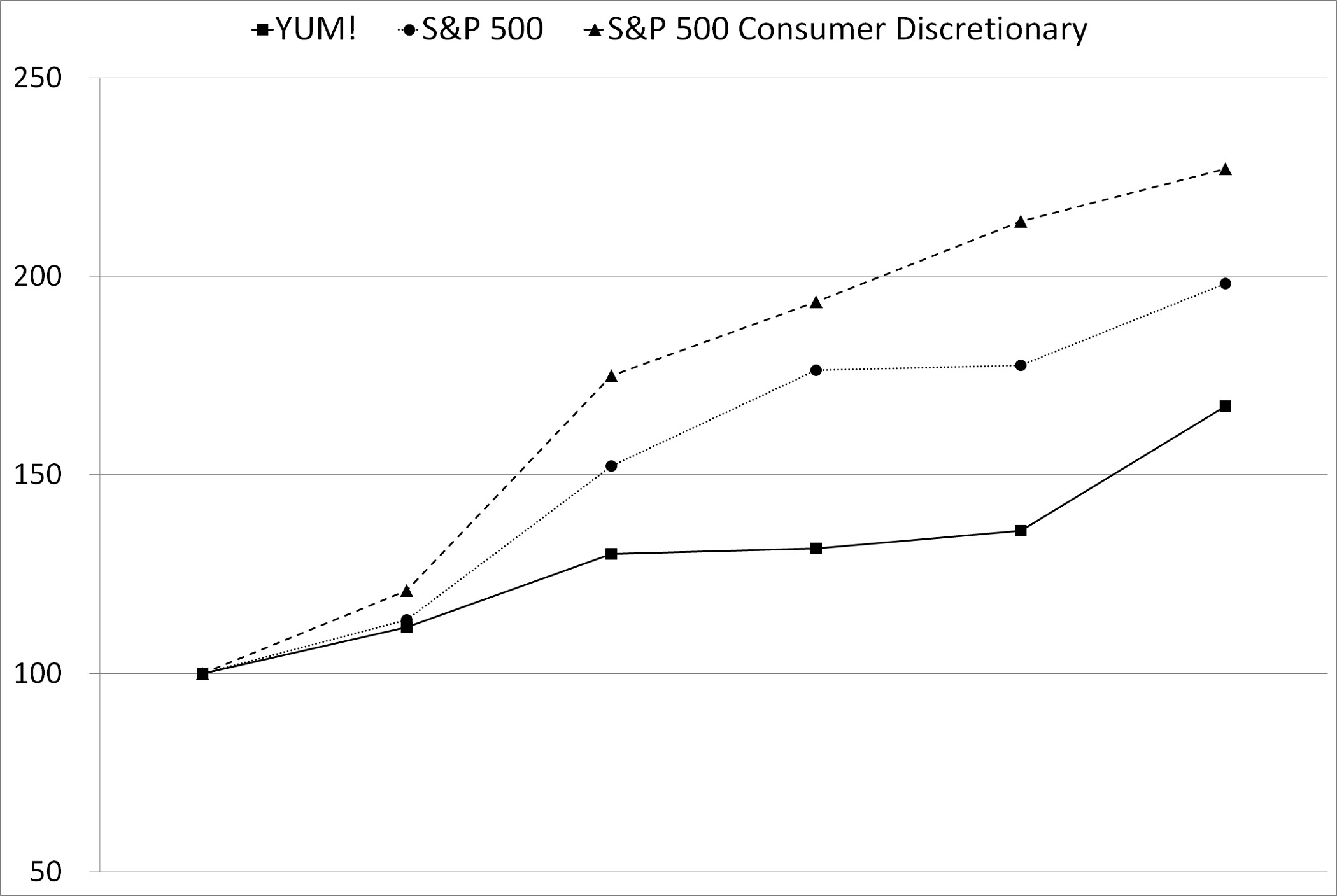
| 12/30/2011 | 12/28/2012 | 12/27/2013 | 12/26/2014 | 12/24/2015 | 12/30/2016 | |||||||||||||||||||
| YUM | $ | 100 | $ | 112 | $ | 130 | $ | 131 | $ | 136 | $ | 167 | ||||||||||||
| S&P 500 | $ | 100 | $ | 114 | $ | 152 | $ | 176 | $ | 178 | $ | 198 | ||||||||||||
| S&P Consumer Discretionary | $ | 100 | $ | 121 | $ | 175 | $ | 194 | $ | 214 | $ | 227 |
Item 6. Selected Financial Data.
Selected Financial Data
YUM! Brands, Inc. and Subsidiaries
(in millions, except per share and unit amounts)
| Fiscal Year | |||||||||||||||||||
| 2016(a)(f) | 2015(a) | 2014(a) | 2013(a) | 2012(a)(f) | |||||||||||||||
| Income Statement Data | |||||||||||||||||||
| Revenues | |||||||||||||||||||
| Company sales | $ | 4,200 | $ | 4,356 | $ | 4,503 | $ | 4,384 | $ | 5,036 | |||||||||
| Franchise and license fees and income | 2,166 | 2,084 | 2,084 | 2,033 | 1,940 | ||||||||||||||
| Total | 6,366 | 6,440 | 6,587 | 6,417 | 6,976 | ||||||||||||||
| Closures and impairment income (expenses) | (14 | ) | (15 | ) | (18 | ) | (6 | ) | (28 | ) | |||||||||
| Refranchising gain (loss)(b) | 141 | (23 | ) | 16 | 95 | 61 | |||||||||||||
| Operating Profit(c) | 1,625 | 1,402 | 1,517 | 1,530 | 1,408 | ||||||||||||||
| Interest expense, net(c) | 307 | 141 | 143 | 251 | 157 | ||||||||||||||
| Income before income taxes | 1,318 | 1,261 | 1,374 | 1,279 | 1,251 | ||||||||||||||
| Income from continuing operations | 994 | 936 | 1,006 | 922 | 884 | ||||||||||||||
| Income from discontinued operations, net of tax | 625 | 357 | 45 | 169 | 713 | ||||||||||||||
| Net Income | 1,619 | 1,293 | 1,051 | 1,091 | 1,597 | ||||||||||||||
| Basic earnings per common share from continuing operations | 2.52 | 2.15 | 2.27 | 2.04 | 1.91 | ||||||||||||||
| Basic earnings per common share from discontinued operations | 1.59 | 0.82 | 0.10 | 0.37 | 1.55 | ||||||||||||||
| Basic earnings per common share | 4.11 | 2.97 | 2.37 | 2.41 | 3.46 | ||||||||||||||
| Diluted earnings per common share from continuing operations | 2.48 | 2.11 | 2.22 | 2.00 | 1.87 | ||||||||||||||
| Diluted earnings per common share from discontinued operations | 1.56 | 0.81 | 0.10 | 0.36 | 1.51 | ||||||||||||||
| Diluted earnings per common share | 4.04 | 2.92 | 2.32 | 2.36 | 3.38 | ||||||||||||||
| Diluted earnings per common share from continuing operations excluding Special Items(c) | 2.45 | 2.33 | 2.20 | 2.04 | 1.90 | ||||||||||||||
| Cash Flow Data | |||||||||||||||||||
| Provided by operating activities | $ | 1,204 | $ | 1,213 | $ | 1,217 | $ | 1,289 | $ | 1,373 | |||||||||
| Capital spending | 422 | 461 | 508 | 481 | 444 | ||||||||||||||
| Proceeds from refranchising of restaurants | 346 | 219 | 83 | 250 | 337 | ||||||||||||||
| Repurchase shares of Common Stock | 5,402 | 1,200 | 820 | 770 | 965 | ||||||||||||||
| Dividends paid on Common Stock | 744 | 730 | 669 | 615 | 544 | ||||||||||||||
| Balance Sheet Data | |||||||||||||||||||
| Total assets | $ | 5,478 | $ | 4,916 | $ | 5,132 | $ | 4,975 | $ | 5,262 | |||||||||
| Long-term debt | 9,061 | 3,007 | 3,042 | 2,888 | 2,905 | ||||||||||||||
| Total debt | 9,127 | 3,928 | 3,308 | 2,958 | 2,914 | ||||||||||||||
| Other Data | |||||||||||||||||||
| Number of stores at year end | |||||||||||||||||||
| Company | 2,859 | 3,159 | 3,247 | 3,071 | 2,997 | ||||||||||||||
| Franchise | 40,758 | 39,263 | 37,984 | 36,746 | 35,461 | ||||||||||||||
| System | 43,617 | 42,422 | 41,231 | 39,817 | 38,458 | ||||||||||||||
| KFC Division system sales growth(d) | |||||||||||||||||||
| Reported | 2 | % | (3 | )% | 1 | % | (2 | )% | 6 | % | |||||||||
| Local currency(e) | 7 | % | 5 | % | 4 | % | — | % | 8 | % | |||||||||
| Pizza Hut Division system sales growth(d) | |||||||||||||||||||
| Reported | — | % | (1 | )% | 1 | % | 3 | % | 5 | % | |||||||||
| Local currency(e) | 2 | % | 3 | % | 2 | % | 4 | % | 7 | % | |||||||||
| Taco Bell Division system sales growth(d) | |||||||||||||||||||
| Reported | 6 | % | 8 | % | 4 | % | 4 | % | 7 | % | |||||||||
| Local currency(e) | 6 | % | 8 | % | 4 | % | 4 | % | 9 | % | |||||||||
| Shares outstanding at year end | 355 | 420 | 434 | 443 | 451 | ||||||||||||||
| Cash dividends declared per Common Share | $ | 1.73 | $ | 1.74 | $ | 1.56 | $ | 1.41 | $ | 1.24 | |||||||||
| Market price per share at year end(g) | $ | 63.33 | $ | 74.00 | $ | 73.14 | $ | 73.87 | $ | 64.72 |
| (a) | Financial data for prior years has been recast to present the results of the Separation as discontinued operations and reflects amounts related to continuing operations unless otherwise noted. Store count data for prior years has been recast to exclude the Little Sheep and East Dawning stores operated by our former China Division and reflect all other former China Division Company operated stores as franchise units within the KFC and Pizza Hut Divisions. KFC Division, Pizza Hut Division and Taco Bell Division system sales growth has been recast to reflect the integration of the former India and China Divisions. See Note 4 regarding details of the Separation. |
| (b) | See Note 5 for discussion of Refranchising gain (loss) for fiscal years 2016, 2015 and 2014. Fiscal year 2013 primarily reflects net gains from refranchising Taco Bell restaurants in the U.S. Fiscal year 2012 included $122 million in net gains from refranchising restaurants in the U.S., primarily Taco Bells, and $70 million in losses related to the refranchising of our then remaining Company-owned Pizza Hut UK dine-in restaurants. |
| (c) | In addition to the results provided in accordance with U.S. Generally Accepted Accounting Principles (“GAAP”),the Company provides non-GAAP measurements which present operating results from continuing operations on a basis excluding Special Items. The Company uses earnings from continuing operations excluding Special Items as a key performance measure of results of operations for the purpose of evaluating performance internally and Special Items are not included in any of our segment results. This non-GAAP measurement is not intended to replace the presentation of our financial results in accordance with GAAP. Rather, the Company believes that the presentation of earnings from continuing operations excluding Special Items provides additional information to investors to facilitate the comparison of past and present results, excluding items that the Company does not believe are indicative of our ongoing operations due to their size and/or nature. |
2016, 2015 and 2014 Special Items are described in further detail within our Management's Discussion and Analysis of Financial Condition and Results of Operations. Special Items in 2013 positively impacted Operating Profit by $73 million, primarily due to refranchising gains on the sale of restaurants in the U.S. (primarily Taco Bells), partially offset by $10 million in pension settlement charges and $5 million of expense related to U.S. productivity initiatives and realignment of resources. Additionally, in 2013, we incurred $118 million of premiums paid and other costs related to the extinguishment of debt that were considered Special Items and were recorded in Interest expense, net. Special Items in 2012 negatively impacted Operating Profit by $16 million, primarily due to $84 million in pension settlement charges and $70 million of losses associated with the refranchising of the Pizza Hut UK dine-in business, partially offset by $122 million in U.S. refranchising net gains. Special Items resulted in cumulative net tax benefits of $23 million and $1 million in 2013 and 2012, respectively.
| (d) | System sales growth includes the results of all restaurants regardless of ownership, including company-owned and franchise restaurants that operate our Concepts. Sales of franchise restaurants typically generate ongoing franchise fees for the Company at a rate of 3% to 6% of sales. Franchise restaurant sales are not included in Company sales on the Consolidated Statements of Income; however, the franchise fees are included in the Company’s revenues. We believe system sales growth is useful to investors as a significant indicator of the overall strength of our business as it incorporates all of our revenue drivers, Company and franchise same-store sales as well as net unit growth. |
| (e) | Local currency represents the percentage change excluding the impact of foreign currency translation. These amounts are derived by translating current year results at prior year average exchange rates. We believe the elimination of the foreign currency translation impact provides better year-to-year comparability without the distortion of foreign currency fluctuations. |
| (f) | Fiscal years 2015, 2014, 2013 and 2012 include 52 weeks and fiscal year 2016 includes 53 weeks. The estimated impacts of the 53rd week on Company sales, Franchise and license fees and income and Operating Profit in 2016 were increases of $55 million, $21 million and $27 million, respectively. The 53rd week positively impacted Division system sales growth by 1%, 1% and 2% for KFC, Pizza Hut and Taco Bell, respectively. Refer to Note 2 for additional details related to our fiscal calendar. |
| (g) | Historical stock prices prior to November 1, 2016, do not reflect any adjustment for the impact of the Separation. |
The selected financial data should be read in conjunction with the Consolidated Financial Statements.
Item 7. Management’s Discussion and Analysis of Financial Condition and Results of Operations.
Introduction and Overview
The following Management’s Discussion and Analysis (“MD&A”), should be read in conjunction with the Consolidated Financial Statements (“Financial Statements”) in Item 8 and the Forward-Looking Statements and the Risk Factors set forth in Item 1A.
YUM! Brands, Inc. (“YUM” or the “Company”) operates or franchises a worldwide system of over 43,500 restaurants in more than 135 countries and territories operating under the KFC, Pizza Hut or Taco Bell (collectively the "Concepts") brands. These three Concepts are the global leaders in the chicken, pizza and Mexican-style food categories, respectively. Of the over 43,500 restaurants, 7% are operated by the Company and its subsidiaries and 93% are operated by franchisees.
As of December 31, 2016, YUM consists of three operating segments:
| • | The KFC Division which includes the worldwide operations of the KFC concept |
| • | The Pizza Hut Division which includes the worldwide operations of the Pizza Hut concept |
| • | The Taco Bell Division which includes the worldwide operations of the Taco Bell concept |
Effective January 2016, the India Division was segmented by brand, integrated into the global KFC, Pizza Hut and Taco Bell Divisions, and is no longer a separate operating segment. While our consolidated results were not impacted, we have restated our historical segment information for consistent presentation.
On October 31, 2016 (the “Distribution Date”), we completed the spin-off of our China business (the "Separation") into an independent, publicly-traded company under the name of Yum China Holdings, Inc. (“Yum China”). On the Distribution Date, we distributed to each of our shareholders of record as of the close of business on October 19, 2016 (the “Record Date”), one share of Yum China common stock for each share of our Common Stock held as of the Record Date. The distribution was structured to be a tax free distribution to our U.S. shareholders for federal income tax purposes in the United States. Yum China’s common stock now trades on the New York Stock Exchange under the symbol “YUMC.” After the distribution, we do not beneficially own any shares of Yum China common stock.
Concurrent with the Separation, a subsidiary of the Company entered into a Master License Agreement with a subsidiary of Yum China for the exclusive right to use and sublicense the use of intellectual property owned by YUM and its affiliates for the development and operation of KFC, Pizza Hut and Taco Bell restaurants in China. Prior to the Separation, our operations in mainland China were reported in our former China Division segment results. As a result of the Separation, the results of operations, assets and liabilities, and cash flows of the separated business are presented as discontinued operations in our Consolidated Statements of Income, Consolidated Balance Sheets and Consolidated Statements of Cash Flows for all periods presented. See additional information related to the impact of the Separation in Item 8, Note 4 to the Consolidated Financial Statements.
On October 11, 2016, we announced our strategic transformation plans to drive global expansion of our KFC, Pizza Hut and Taco Bell brands (“YUM’s Strategic Transformation Initiatives”) following the Separation. Major features of the Company’s transformation and growth strategy involve being more focused, franchised and efficient. YUM’s Strategic Transformation Initiatives below represent the continuation of YUM’s transformation of its operating model and capital structure.
| • | More Focused. Four growth drivers will form the basis of YUM’s strategic plans and repeatable business model to accelerate same-store sales growth and net-new restaurant development at KFC, Pizza Hut and Taco Bell around the world over the long term. The Company will focus on becoming best-in-class in: |
| • | Building Distinctive, Relevant Brands |
| • | Developing Unmatched Franchise Operating Capability |
| • | Driving Bold Restaurant Development |
| • | Growing Unrivaled Culture and Talent |
| • | More Franchised. YUM intends to increase franchise restaurant ownership to at least 98% by the end of 2018. |
| • | More Efficient. The Company intends to revamp its financial profile, improving the efficiency of its organization and cost structure globally, by: |
| • | Reducing annual capital expenditures to approximately $100 million in 2019; |
| • | Reducing General and administrative ("G&A") expenses by a cumulative ~$300 million over the next three years; and |
| • | Maintaining an optimized capital structure of ~5.0x Earnings Before Interest, Taxes, Depreciation and Amortization (“EBITDA”) leverage. |
Since the fourth quarter of 2015, we have returned approximately $7.2 billion of capital to shareholders through share repurchases and cash dividends, funding the repurchases through a recapitalization and issuance of $5.2 billion of incremental borrowings in 2016. Over the next 3 years, we intend to return an additional $6.5 - $7.0 billion to shareholders through share repurchases and cash dividends. We intend to fund these shareholder returns through a combination of refranchising proceeds, free cash flow generation and maintenance of our five times EBITDA leverage. We anticipate generating proceeds in excess of $2 billion, net of tax, through our refranchising initiatives. Refer to the Liquidity and Capital Resources section of this MD&A for additional details.
We intend for this MD&A to provide the reader with information that will assist in understanding our results of operations, including performance metrics that management uses to assess the Company's performance. Throughout this MD&A, we commonly discuss the following performance metrics:
| • | The Company provides certain percentage changes excluding the impact of foreign currency translation (“FX” or “Forex”). These amounts are derived by translating current year results at prior year average exchange rates. We believe the elimination of the foreign currency translation impact provides better year-to-year comparability without the distortion of foreign currency fluctuations. |
| • | System sales growth includes the results of all restaurants regardless of ownership, including company-owned and franchise restaurants that operate our Concepts. Sales of franchise restaurants typically generate ongoing franchise and license fees for the Company at a rate of 3% to 6% of sales. Franchise restaurant sales are not included in Company sales on the Consolidated Statements of Income; however, the franchise and license fees are included in the Company’s revenues. We believe system sales growth is useful to investors as a significant indicator of the overall strength of our business as it incorporates all of our revenue drivers, Company and franchise same-store sales as well as net unit growth. |
| • | Same-store sales growth is the estimated percentage change in sales of all restaurants that have been open and in the YUM system one year or more. |
| • | Company restaurant profit ("Restaurant profit") is defined as Company sales less expenses incurred directly by our Company-owned restaurants in generating Company sales. Company restaurant margin as a percentage of sales is defined as Restaurant profit divided by Company sales. Within the Company Sales and Restaurant Profit sections of this MD&A, Store Portfolio Actions represent the net impact of new unit openings, acquisitions, refranchising and store closures, and Other primarily represents the impact of same-store sales as well as the impact of changes in costs such |
Showing the first 8K of 101K characters. Open the full section
Item 7A. Quantitative and Qualitative Disclosures About Market Risk.
The Company is exposed to financial market risks associated with interest rates, foreign currency exchange rates and commodity prices. In the normal course of business and in accordance with our policies, we manage these risks through a variety of strategies, which may include the use of financial and commodity derivative instruments to hedge our underlying exposures. Our policies prohibit the use of derivative instruments for trading purposes, and we have processes in place to monitor and control their use.
Interest Rate Risk
We have a market risk exposure to changes in interest rates, principally in the U.S. Our outstanding Long-term debt of $9.1 billion includes 73% fixed-rate debt and 27% variable-rate debt. We have attempted to minimize the interest rate risk related to $1.55 billion of this variable-rate debt through the use of interest rate swaps. As a result, approximately 90% of our $9.1 billion of outstanding debt at December 31, 2016 is effectively fixed-rate debt. See Note 11 for details on these issuances and repayments and Note 13 for details related to interest rate swaps.
As of December 31, 2016 and December 26, 2015 a hypothetical 100 basis-point increase in short-term interest rates would result, over the following twelve-month period after consideration of the aforementioned interest rate swaps, in an increase of approximately $10 million and $14 million, respectively, in Interest expense, net within our Consolidated Statements of Income. These estimated amounts are based upon the current level of variable-rate debt that has not been swapped to fixed and assume no changes in the volume or composition of that debt and include no impact from interest income related to cash and cash equivalents.
The fair value of our cumulative fixed-rate debt of $6.6 billion as of December 31, 2016, would decrease approximately $375 million as a result of the same hypothetical 100 basis-point increase. At December 31, 2016, a hypothetical 100 basis-point decrease in short-term interest rates would decrease the fair value of our interest rate swaps approximately $55 million. Fair value was determined based on the present value of expected future cash flows considering the risks involved and using discount rates appropriate for the durations.
Foreign Currency Exchange Rate Risk
Changes in foreign currency exchange rates impact the translation of our reported foreign currency denominated earnings, cash flows and net investments in foreign operations and the fair value of our foreign currency denominated financial instruments. Historically, we have chosen not to hedge foreign currency risks related to our foreign currency denominated earnings and cash flows through the use of financial instruments. We attempt to minimize the exposure related to our net investments in foreign operations by financing those investments with local currency denominated debt when practical. In addition, we attempt to minimize the exposure related to foreign currency denominated financial instruments by purchasing goods and services from third parties in local currencies when practical. Consequently, foreign currency denominated financial instruments consist primarily of intercompany receivables and payables. At times, we utilize forward contracts and cross-currency swaps to reduce our exposure related to these intercompany receivables and payables. The notional amount and maturity dates of these contracts match those of the underlying receivables or payables such that our foreign currency exchange risk related to these instruments is minimized.
The Company’s foreign currency net asset exposure (defined as foreign currency assets less foreign currency liabilities) totaled approximately $2.1 billion as of December 31, 2016. Operating in international markets exposes the Company to movements in foreign currency exchange rates. The Company’s primary exposures result from our operations in Asia-Pacific, Europe and the Americas. For the fiscal year ended December 31, 2016 Operating Profit would have decreased approximately $105 million if all foreign currencies had uniformly weakened 10% relative to the U.S. dollar. This estimated reduction assumes no changes in sales volumes or local currency sales or input prices.
Commodity Price Risk
We are subject to volatility in food costs as a result of market risk associated with commodity prices. Our ability to recover increased costs through higher pricing is, at times, limited by the competitive environment in which we operate. We manage our exposure to this risk primarily through pricing agreements with our vendors.
Item 8. Financial Statements and Supplementary Data.
INDEX TO FINANCIAL INFORMATION
| Page Reference | ||
| Consolidated Financial Statements | ||
| Report of Independent Registered Public Accounting Firm | 48 | |
| Consolidated Statements of Income for the fiscal years ended December 31, 2016, December 26, 2015 and December 27, 2014 | 49 | |
| Consolidated Statements of Comprehensive Income for the fiscal years ended December 31, 2016, December 26, 2015 and December 27, 2014 | 50 | |
| Consolidated Statements of Cash Flows for the fiscal years ended December 31, 2016, December 26, 2015 and December 27, 2014 | 51 | |
| Consolidated Balance Sheets as of December 31, 2016 and December 26, 2015 | 52 | |
| Consolidated Statements of Shareholders’ Equity (Deficit) for the fiscal years ended December 31, 2016, December 26, 2015 and December 27, 2014 | 53 | |
| Notes to Consolidated Financial Statements | 54 |
Financial Statement Schedules
No schedules are required because either the required information is not present or not present in amounts sufficient to require submission of the schedule, or because the information required is included in the above-listed financial statements or notes thereto.
Report of Independent Registered Public Accounting Firm
The Board of Directors and Shareholders
YUM! Brands, Inc.:
We have audited the accompanying consolidated balance sheets of YUM! Brands, Inc. and Subsidiaries (YUM) as of December 31, 2016 and December 26, 2015, and the related consolidated statements of income, comprehensive income, cash flows and shareholders’ equity (deficit) for each of the fiscal years in the three-year period ended December 31, 2016. We also have audited YUM’s internal control over financial reporting as of December 31, 2016, based on criteria established in Internal Control - Integrated Framework (2013) issued by the Committee of Sponsoring Organizations of the Treadway Commission. YUM’s management is responsible for these consolidated financial statements, for maintaining effective internal control over financial reporting, and for its assessment of the effectiveness of internal control over financial reporting, included in the accompanying Item 9A, “Management’s Report on Internal Control over Financial Reporting.” Our responsibility is to express an opinion on these consolidated financial statements and an opinion on YUM’s internal control over financial reporting based on our audits.
We conducted our audits in accordance with the standards of the Public Company Accounting Oversight Board (United States). Those standards require that we plan and perform the audits to obtain reasonable assurance about whether the financial statements are free of material misstatement and whether effective internal control over financial reporting was maintained in all material respects. Our audits of the consolidated financial statements included examining, on a test basis, evidence supporting the amounts and disclosures in the financial statements, assessing the accounting principles used and significant estimates made by management, and evaluating the overall financial statement presentation. Our audit of internal control over financial reporting included obtaining an understanding of internal control over financial reporting, assessing the risk that a material weakness exists, and testing and evaluating the design and operating effectiveness of internal control based on the assessed risk. Our audits also included performing such other procedures as we considered necessary in the circumstances. We believe that our audits provide a reasonable basis for our opinions.
A company’s internal control over financial reporting is a process designed to provide reasonable assurance regarding the reliability of financial reporting and the preparation of financial statements for external purposes in accordance with generally accepted accounting principles. A company’s internal control over financial reporting includes those policies and procedures that (1) pertain to the maintenance of records that, in reasonable detail, accurately and fairly reflect the transactions and dispositions of the assets of the company; (2) provide reasonable assurance that transactions are recorded as necessary to permit preparation of financial statements in accordance with generally accepted accounting principles, and that receipts and expenditures of the company are being made only in accordance with authorizations of management and directors of the company; and (3) provide reasonable assurance regarding prevention or timely detection of unauthorized acquisition, use, or disposition of the company’s assets that could have a material effect on the financial statements.
Because of its inherent limitations, internal control over financial reporting may not prevent or detect misstatements. Also, projections of any evaluation of effectiveness to future periods are subject to the risk that controls may become inadequate because of changes in conditions, or that the degree of compliance with the policies or procedures may deteriorate.
In our opinion, the consolidated financial statements referred to above present fairly, in all material respects, the financial position of YUM as of December 31, 2016 and December 26, 2015, and the results of its operations and its cash flows for each of the fiscal years in the three-year period ended December 31, 2016, in conformity with U.S. generally accepted accounting principles. Also in our opinion, YUM maintained, in all material respects, effective internal control over financial reporting as of December 31, 2016, based on criteria established in Internal Control - Integrated Framework (2013) issued by the Committee of Sponsoring Organizations of the Treadway Commission.
/s/ KPMG LLP
Louisville, Kentucky
February 21, 2017
| Consolidated Statements of Income | ||||||||||||
| YUM! Brands, Inc. and Subsidiaries | ||||||||||||
| Fiscal years ended December 31, 2016, December 26, 2015 and December 27, 2014 | ||||||||||||
| (in millions, except per share data) | ||||||||||||
| 2016 | 2015 | 2014 | ||||||||||
| Revenues | ||||||||||||
| Company sales | $ | 4,200 | $ | 4,356 | $ | 4,503 | ||||||
| Franchise and license fees and income | 2,166 | 2,084 | 2,084 | |||||||||
| Total revenues | 6,366 | 6,440 | 6,587 | |||||||||
| Costs and Expenses, Net | ||||||||||||
| Company restaurants | ||||||||||||
| Food and paper | 1,269 | 1,348 | 1,471 | |||||||||
| Payroll and employee benefits | 1,109 | 1,131 | 1,172 | |||||||||
| Occupancy and other operating expenses | 1,120 | 1,168 | 1,227 | |||||||||
| Company restaurant expenses | 3,498 | 3,647 | 3,870 | |||||||||
| General and administrative expenses | 1,161 | 1,099 | 1,028 | |||||||||
| Franchise and license expenses | 202 | 237 | 159 | |||||||||
| Closures and impairment (income) expenses | 14 | 15 | 18 | |||||||||
| Refranchising (gain) loss | (141 | ) | 23 | (16 | ) | |||||||
| Other (income) expense | 7 | 17 | 11 | |||||||||
| Total costs and expenses, net | 4,741 | 5,038 |
Showing the first 8K of 210K characters. Open the full section
Item 9. Changes In and Disagreements with Accountants on Accounting and Financial Disclosure.
None.
Item 9A. Controls and Procedures.
Evaluation of Disclosure Controls and Procedures
The Company has evaluated the effectiveness of the design and operation of its disclosure controls and procedures pursuant to Rules 13a-15(e) and 15d-15(e) under the Securities Exchange Act of 1934 as of the end of the period covered by this report. Based on the evaluation, performed under the supervision and with the participation of the Company’s management, including the Chief Executive Officer (the “CEO”) and the Chief Financial Officer (the “CFO”), the Company’s management, including the CEO and CFO, concluded that the Company’s disclosure controls and procedures were effective as of the end of the period covered by this report.
Management’s Report on Internal Control Over Financial Reporting
Our management is responsible for establishing and maintaining adequate internal control over financial reporting, as such term is defined in Rules 13a-15(f) under the Securities Exchange Act of 1934. Under the supervision and with the participation of our management, including our principal executive officer and principal financial officer, we conducted an evaluation of the effectiveness of our internal control over financial reporting based on the framework in Internal Control – Integrated Framework (2013) issued by the Committee of Sponsoring Organizations of the Treadway Commission. Based on our evaluation under the framework in Internal Control – Integrated Framework (2013), our management concluded that our internal control over financial reporting was effective as of December 31, 2016.
KPMG LLP, an independent registered public accounting firm, has audited the Consolidated Financial Statements included in this Annual Report on Form 10-K and the effectiveness of our internal control over financial reporting and has issued their report, included herein.
Changes in Internal Control
There were no changes with respect to the Company’s internal control over financial reporting or in other factors that materially affected, or are reasonably likely to materially affect, internal control over financial reporting during the quarter ended December 31, 2016.
Item 9B. Other Information.
None.
PART III
Item 10. Directors, Executive Officers and Corporate Governance.
Information regarding Section 16(a) compliance, the Audit Committee and the Audit Committee financial expert, the Company’s code of ethics and background of the directors appearing under the captions “Stock Ownership Information,” “Governance of the Company,” “Executive Compensation” and “Item 1: Election of Directors and Director biographies” is incorporated by reference from the Company’s definitive proxy statement which will be filed with the Securities and Exchange Commission no later than 120 days after December 31, 2016.
Information regarding executive officers of the Company is included in Part I.
Item 11. Executive Compensation.
Information regarding executive and director compensation and the Compensation Committee appearing under the captions “Governance of the Company” and “Executive Compensation” is incorporated by reference from the Company’s definitive proxy statement which will be filed with the Securities and Exchange Commission no later than 120 days after December 31, 2016.
Item 12. Security Ownership of Certain Beneficial Owners and Management and Related Stockholder Matters.
Information regarding equity compensation plans and security ownership of certain beneficial owners and management appearing under the captions “Executive Compensation” and “Stock Ownership Information” is incorporated by reference from the Company’s definitive proxy statement which will be filed with the Securities and Exchange Commission no later than 120 days after December 31, 2016.
Item 13. Certain Relationships and Related Transactions, and Director Independence.
Information regarding certain relationships and related transactions and information regarding director independence appearing under the caption “Governance of the Company” is incorporated by reference from the Company’s definitive proxy statement which will be filed with the Securities and Exchange Commission no later than 120 days after December 31, 2016.
Item 14. Principal Accountant Fees and Services.
Information regarding principal accountant fees and services and audit committee pre-approval policies and procedures appearing under the caption “Item 2: Ratification of Independent Auditors” is incorporated by reference from the Company’s definitive proxy statement which will be filed with the Securities and Exchange Commission no later than 120 days after December 31, 2016.
PART IV
Item 15. Exhibits and Financial Statement Schedules.
| (a) | (1 | ) | Financial Statements: Consolidated Financial Statements filed as part of this report are listed under Part II, Item 8 of this Form 10-K. | |
| (2 | ) | Financial Statement Schedules: No schedules are required because either the required information is not present or not present in amounts sufficient to require submission of the schedule, or because the information required is included in the Consolidated Financial Statements thereto filed as a part of this Form 10-K. | ||
| (3 | ) | Exhibits: The exhibits listed in the accompanying Exhibit Index are filed as part of this Form 10-K. The Index to Exhibits specifically identifies each management contract or compensatory plan required to be filed as an exhibit to this Form 10-K. |
| SIGNATURES |
Pursuant to the requirements of Section 13 or 15(d) of the Securities Exchange Act of 1934, the registrant has duly caused this Form 10-K annual report to be signed on its behalf by the undersigned, thereunto duly authorized.
| Date: | February 21, 2017 |
| YUM! BRANDS, INC. |
| By: | /s/ Greg Creed |
Pursuant to the requirements of the Securities Exchange Act of 1934, this annual report has been signed below by the following persons on behalf of the registrant and in the capacities and on the dates indicated.
| Signature | Title | Date | ||
| /s/ Greg Creed | Chief Executive Officer | February 21, 2017 | ||
| Greg Creed | (principal executive officer) | |||
| /s/ David Gibbs | President and Chief Financial Officer | February 21, 2017 | ||
| David Gibbs | (principal financial officer) | |||
| /s/ David E. Russell | Senior Vice President, Finance and Corporate Controller | February 21, 2017 | ||
| David E. Russell | (principal accounting officer) | |||
| /s/ Paget L. Alves | Director | February 21, 2017 | ||
| Paget L. Alves | ||||
| /s/ Michael J. Cavanagh | Director | February 21, 2017 | ||
| Michael J. Cavanagh | ||||
| /s/ Brian Cornell | Director | February 21, 2017 | ||
| Brian Cornell | ||||
| /s/ David W. Dorman | Director | February 21, 2017 | ||
| David W. Dorman | ||||
| /s/ Mirian Graddick-Weir | Director | February 21, 2017 | ||
| Mirian Graddick-Weir | ||||
| /s/ Thomas C. Nelson | Director | February 21, 2017 | ||
| Thomas C. Nelson | ||||
| /s/ Thomas M. Ryan | Director | February 21, 2017 | ||
| Thomas M. Ryan | ||||
| /s/ P. Justin Skala | Director | February 21, 2017 | ||
| P. Justin Skala | ||||
| /s/ Elane Stock | Director | February 21, 2017 | ||
| Elane Stock | ||||
| /s/ Robert D. Walter | Director | February 21, 2017 | ||
| Robert D. Walter |
YUM! Brands, Inc.
Exhibit Index
(Item 15)
| Exhibit Number | Description of Exhibits | |||
| 2.1 * | Separation and Distribution Agreement, dated as of October 31, 2016, by and among YUM, Yum Restaurants Consulting (Shanghai) Company Limited and Yum China Holdings, Inc., which is incorporated herein by reference from Exhibit 2.1 to YUM's Report on Form 8-K filed on November 3, 2016. | |||
| 3.1 | Restated Articles of Incorporation of YUM, effective May 26, 2011, which is incorporated herein by reference from Exhibit 3.1 to YUM's Report on Form 8-K filed on May 31, 2011. | |||
| 3.2 | Amended and restated Bylaws of YUM, effective July 15, 2016, which are incorporated herein by reference from Exhibit 3.1 to YUM's Report on Form 8-K filed on July 19, 2016. | |||
| 4.1 | Indenture, dated as of May 1, 1998, between YUM and The Bank of New York Mellon Trust Company, N.A., successor in interest to The First National Bank of Chicago, which is incorporated herein by reference from Exhibit 4.1 to YUM's Report on Form 8-K filed on May 13, 1998. | |||
| (i) | 6.25% Senior Notes due March 15, 2018 issued under the foregoing May 1, 1998 indenture, which notes are incorporated by reference from Exhibit 4.2 to YUM's Report on Form 8-K filed on October 22, 2007. | |||
| (ii) | 6.875% Senior Notes due November 15, 2037 issued under the foregoing May 1, 1998 indenture, which notes are incorporated by reference from Exhibit 4.3 to YUM's Report on Form 8-K filed on October 22, 2007. | |||
| (iii) | 5.30% Senior Notes due September 15, 2019 issued under the foregoing May 1, 1998 indenture, which notes are incorporated by reference from Exhibit 4.1 to YUM's Report on Form 8-K filed on August 25, 2009. | |||
| (iv) | 3.875% Senior Notes due November 1, 2020 issued under the foregoing May 1, 1998 indenture, which notes are incorporated by reference from Exhibit 4.2 to YUM's Report on Form 8-K filed on August 31, 2010. | |||
| (v) | 3.750% Senior Notes due November 1, 2021 issued under the foregoing May 1, 1998 indenture, which notes are incorporated by reference from Exhibit 4.2 to YUM's Report on Form 8-K filed August 29, 2011. | |||
| (vi) | 3.875% Senior Notes due November 1, 2023 issued under the foregoing May 1, 1998 indenture, which notes are incorporated by reference from Exhibit 4.2 to YUM's Report on Form 8-K filed October 31, 2013. | |||
| (vii) | 5.350% Senior Notes due November 1, 2043 issued under the foregoing May 1, 1998 indenture, which notes are incorporated by reference from Exhibit 4.3 to YUM's Report on Form 8-K filed October 31, 2013. |
| 10.1 | Credit Agreement, dated as of June 16, 2016, by and among Pizza Hut Holdings, LLC, KFC Holding Co., and Taco Bell of America, LLC, as the borrowers, the lenders party thereto, JPMorgan Chase Bank, N.A., as Administrative Agent and Collateral Agent, JPMorgan Chase Bank, N.A., Goldman Sachs Bank USA, Wells Fargo Securities, LLC, Citigroup Global Markets Inc., Merrill Lynch, Pierce, Fenner & Smith Incorporated, Morgan Stanley Senior Funding, Inc., Fifth Third Bank and The Bank of Tokyo-Mitsubishi UFJ, Ltd., as Joint Lead Arrangers and Joint Bookrunners, Barclays Bank PLC, The Bank of Nova Scotia, Cooperatieve Rabobank U.A., New York Branch, and Industrial and Commercial Bank of China Limited, New York Branch, as Co-Documentation Agents and Co-Managers, which is incorporated herein by reference from Exhibit 4.1 to YUM's Quarterly Report on Form 10-Q for the quarter ended June 11, 2016. | ||||
| 10.2† | YUM Director Deferred Compensation Plan, as effective October 7, 1997, which is incorporated herein by reference from Exhibit 10.7 to YUM's Annual Report on Form 10-K for the fiscal year ended December 27, 1997. | ||||
| 10.2.1† | YUM Director Deferred Compensation Plan, Plan Document for the 409A Program, as effective January 1, 2005, and as Amended through November 14, 2008, which is incorporated by reference from Exhibit 10.7.1 to YUM's Quarterly Report on Form 10-Q for the quarter ended June 13, 2009. | ||||
| 10.3† | YUM Executive Incentive Compensation Plan, as effective May 20, 2004, and as Amended through the Second Amendment, as effective May 21, 2009, which is incorporated herein by reference from Exhibit A of YUM's Definitive Proxy Statement on Form DEF 14A for the Annual Meeting of Shareholders held on May 21, 2009. | ||||
| 10.4† | YUM Executive Income Deferral Program, as effective October 7, 1997, and as amended through May 16, 2002, which is incorporated herein by reference from Exhibit 10.10 to YUM's Annual Report on Form 10-K for the fiscal year ended December 31, 2005. | ||||
| 10.4.1† | YUM! Brands Executive Income Deferral Program, Plan Document for the 409A Program, as effective January 1, 2005, and as Amended through June 30, 2009, which is incorporated by reference from Exhibit 10.10.1 to YUM's Quarterly Report on Form 10-Q for the quarter ended June 13, 2009. | ||||
| 10.5† | YUM! Brands Pension Equalization Plan, Plan Document for the Pre-409A Program, as effective January 1, 2005, and as Amended through December 31, 2010, which is incorporated by reference from Exhibit 10.7 to Yum's Quarterly Report on Form 10-Q for the quarter ended March 19, 2011. | ||||
| 10.5.1† | YUM! Brands, Inc. Pension Equalization Plan, Plan Document for the 409A Program, as effective January 1, 2005, and as Amended through December 30, 2008, which is incorporated by reference from Exhibit 10.13.1 to YUM's Quarterly Report on Form 10-Q for the quarter ended June 13, 2009. | ||||
| 10.5.2† | YUM! Brands Pension Equalization Plan Amendment, as effective January 1, 2012, which is incorporated by reference from Exhibit 10.7.2 to Yum’s Quarterly Report on Form 10-Q for the quarter ended March 23, 2013. | ||||
| 10.5.3† | YUM! Brands Pension Equalization Plan Amendment, as effective January 1, 2013, which is incorporated by reference from Exhibit 10.7.3 to Yum’s Quarterly Report on Form 10-Q for the quarter ended March 23, 2013. | ||||
| 10.6† | Form of Directors' Indemnification Agreement, which is incorporated herein by reference from Exhibit 10.17 to YUM's Annual Report on Form 10-K for the fiscal year ended December 27, 1997. | ||||
| 10.7† | Form of YUM! Brands, Inc. Change in Control Severance Agreement, which is incorporated herein by reference from Exhibit 10.1 to Yum’s Report on Form 8-K filed on March 21, 2013. | ||||
| 10.8† | YUM! Long Term Incentive Plan, as Amended and Restated effective as of May 20, 2016 as incorporated by reference from Form DEF 14A filed on April 18, 2016. | ||||
| 10.9† | YUM SharePower Plan, as effective October 7, 1997, and as amended through June 23, 2003, which is incorporated herein by reference from Exhibit 10.23 to YUM's Annual Report on Form 10-K for the fiscal year ended December 31, 2005. | ||||
| 10.10† | Form of YUM Director Stock Option Award Agreement, which is incorporated herein by reference from Exhibit 10.25 to YUM's Quarterly Report on Form 10-Q for the quarter ended September 4, 2004. | ||||
| 10.11† | Form of YUM 1999 Long Term Incentive Plan Award Agreement, which is incorporated herein by reference from Exhibit 10.26 to YUM's Quarterly Report on Form 10-Q for the quarter ended September 4, 2004. | ||||
| 10.11.1† | Form of YUM 1999 Long Term Incentive Plan Award Agreement (2013) (Stock Options), which is incorporated herein by reference from Exhibit 10.15.1 to YUM’s Quarterly Report on Form 10-Q for the quarter ended March 23, 2013. | ||||
| 10.11.2† | Form of YUM 1999 Long Term Incentive Plan Award Agreement (2015) (Stock Options), which is incorporated herein by reference from Exhibit 10.15.2 to YUM's Annual Report on Form 10-K for the fiscal year ended December 27, 2014. | ||||
| 10.12† | YUM! Brands, Inc. International Retirement Plan, as in effect January 1, 2005, which is incorporated herein by reference from Exhibit 10.27 to YUM's Annual Report on Form 10-K for the fiscal year ended December 25, 2004. | ||||
| 10.13† | Form of 1999 Long Term Incentive Plan Award Agreement (Stock Appreciation Rights) which is incorporated by reference from Exhibit 99.1 to YUM's Report on Form 8-K as filed on January 30, 2006. | ||||
| 10.13.1† | Form of YUM 1999 Long Term Incentive Plan Award Agreement (2013) (Stock Appreciation Rights), which is incorporated by reference from Exhibit 10.18.1 to YUM’s Quarterly Report on Form 10-Q for the quarter ended March 23, 2013. | ||||
| 10.13.2† | Form of YUM 1999 Long Term Incentive Plan Award Agreement (2015) (Stock Appreciation Rights), which is incorporated herein by reference from Exhibit 10.18.2 to YUM's Annual Report on Form 10-K for the fiscal year ended December 27, 2014. | ||||
| 10.14† | YUM! Brands Leadership Retirement Plan, as in effect January 1, 2005, which is incorporated herein by reference from Exhibit 10.32 to YUM's Quarterly Report on Form 10-Q for the quarter ended March 24, 2007. |
| 10.14.1† | YUM! Brands Leadership Retirement Plan, Plan Document for the 409A Program, as effective January 1, 2005, and as Amended through December, 2009, which is incorporated by reference from Exhibit 10.21.1 to YUM's Annual Report on Form 10-K for the fiscal year ended December 26, 2009. | |||||
| 10.15† | 1999 Long Term Incentive Plan Award (Restricted Stock Unit Agreement) by and between the Company and David C. Novak, dated as of January 24, 2008, which is incorporated herein by reference from Exhibit 10.33 to YUM's Annual Report on Form 10-K for the fiscal year ended December 29, 2007. | |||||
| 10.16† | YUM! Performance Share Plan, as amended and restated January 1, 2013, which is incorporated by reference from Exhibit 10.1 to YUM's Quarterly Report on Form 10-Q for the quarter ended June 13, 2015. | |||||
| 10.17† | YUM! Brands Third Country National Retirement Plan, as effective January 1, 2009, which is incorporated by reference from Exhibit 10.25 to YUM's Annual Report on Form 10-K for the fiscal year ended December 26, 2009. | |||||
| 10.18† | 2010 YUM! Brands Supplemental Long Term Disability Coverage Summary, as effective January 1, 2010, which is incorporated by reference from Exhibit 10.26 to YUM's Annual Report on Form 10-K for the fiscal year ended December 26, 2009. |
| 10.19† | 1999 Long Term Incentive Plan Award (Restricted Stock Unit Agreement) by and between the Company and Jing-Shyh S. Su, dated as of May 20, 2010, which is incorporated by reference from Exhibit 10.27 to YUM's Annual Report on Form 10-K for the fiscal year ended December 25, 2010. | |||||
| 10.20† | 1999 Long Term Incentive Plan Award (Stock Appreciation Rights) by and between the Company and David C. Novak, dated as of February 6, 2015, which is incorporated herein by reference from Exhibit 10.27 to YUM's Annual Report on Form 10-K for the fiscal year ended December 27, 2014. | |||||
| 10.21† | YUM! Brands, Inc. Compensation Recovery Policy, Amended and Restated January 1, 2015, which is incorporated herein by reference from Exhibit 10.28 to YUM's Annual Report on Form 10-K for the fiscal year ended December 27, 2014. | |||||
| 10.22† | Retirement Agreement and General Release, dated August 13, 2015, by and between the Company and Jing-Shyh S. Su, which is incorporated by reference from Exhibit 10.29 to YUM's Quarterly Report on Form 10-Q for the quarter ended September 5, 2015. | |||||
| 10.23† | Letter of Understanding dated December 7, 2015 by and between the Company and Patrick J. Grismer, which is incorporated by reference from Exhibit 10.30 to YUM's Annual Report on Form 10-K for the fiscal year ended December 31, 2015. | |||||
| 10.24† | Letter of Understanding dated June 6, 2016 by and between the Company and David C. Novak, which is incorporated herein by reference from Exhibit 10.31 to YUM's Quarterly Report on Form 10-Q for the quarter ended June 11, 2016. | |||||
| 10.25 | Indenture, dated as of June 16, 2016, by and among KFC Holding Co., Pizza Hut Holdings, LLC and Taco Bell of America, LLC, as issuers, the Guarantors named therein and The Bank of New York Mellon Trust Company, N.A., as trustee, which is incorporated herein by reference from Exhibit 4.1 to YUM's Report on Form 8-K filed on June 21, 2016. | |||||
| 10.26 | Base Indenture, dated as of May 11, 2016, between Taco Bell Funding, LLC, as issuer and Citibank, N.A., as trustee and securities intermediary, which is incorporated herein by reference from Exhibit 4.1 to YUM’s Report on Form 8-K filed on May 16, 2016. | |||||
| 10.27 | Series 2016-1 Supplement to Base Indenture dated as of May 11, 2016, by and between Taco Bell Funding, LLC, as issuer and Citibank, N.A. as trustee and Series 2016-1 securities intermediary, which is incorporated herein by reference from Exhibit 4.2 to YUM’s Report on Form 8-K filed on May 16, 2016. | |||||
| 10.28 | Guarantee and Collateral Agreement, dated as of May 11, 2016, by Taco Bell Franchise Holder 1, LLC, Taco Bell Franchisor, LLC, Taco Bell IP Holder, LLC and Taco Bell Franchisor Holdings, LLC in favor of Citibank, N.A., which is incorporated herein by reference from Exhibit 10.2 to YUM’s Report on Form 8-K filed on May 16, 2016. | |||||
| 10.29 | Management Agreement, dated as of May 11, 2016, among Taco Bell Funding, LLC, as issuer, Taco Bell Franchise Holder 1, LLC, Taco Bell Franchisor, LLC, Taco Bell IP Holder, LLC, Taco Bell Franchisor Holdings, LLC, Citibank, N.A. and Taco Bell Corp., as manager, which is incorporated herein by reference from Exhibit 10.3 to YUM’s Report on Form 8-K filed on May 16, 2016. | |||||
| 10.30 | Master License Agreement, dated as of October 31, 2016, by and between Yum! Restaurants Asia Pte. Ltd. and Yum Restaurants Consulting (Shanghai) Company Limited, which is incorporated herein by reference from Exhibit 10.1 to YUM's Report on Form 8-K filed on November 3, 2016. | |||||
| 10.31 | Tax Matters Agreement, dated as of October 31, 2016, by and among YUM, Yum China Holdings, Inc. and Yum Restaurants Consulting (Shanghai) Company Limited, which is incorporated herein by reference from Exhibit 10.2 to YUM's Report on Form 8-K filed on November 3, 2016. | |||||
| 12.1 | Computation of ratio of earnings to fixed charges. |
| 21.1 | Active Subsidiaries of YUM. | |||||
| 23.1 | Consent of KPMG LLP. | |||||
| 31.1 | Certification of the Chief Executive Officer pursuant to Rule 13a-14(a) of Securities Exchange Act of 1934, as adopted pursuant to Section 302 of the Sarbanes-Oxley Act of 2002. | |||||
| 31.2 | Certification of the Chief Financial Officer pursuant to Rule 13a-14(a) of Securities Exchange Act of 1934, as adopted pursuant to Section 302 of the Sarbanes-Oxley Act of 2002. | |||||
| 32.1 | Certification of the Chief Executive Officer pursuant to 18 U.S.C. Section 1350, as adopted pursuant to Section 906 of the Sarbanes-Oxley Act of 2002. | |||||
| 32.2 | Certification of the Chief Financial Officer pursuant to 18 U.S.C. Section 1350, as adopted pursuant to Section 906 of the Sarbanes-Oxley Act of 2002. | |||||
| 101.INS | Instance Document - the instance document does not appear in the Interactive Data File because its XBRL tags are embedded within the Inline XBRL document | |||||
| 101.SCH | XBRL Taxonomy Extension Schema Document | |||||
| 101.CAL | XBRL Taxonomy Extension Calculation Linkbase Document | |||||
| 101.LAB | XBRL Taxonomy Extension Label Linkbase Document | |||||
| 101.PRE | XBRL Taxonomy Extension Presentation Linkbase Document | |||||
| 101.DEF | XBRL Taxonomy Extension Definition Linkbase Document | |||||
| * | Certain schedules and exhibits to this agreement have been omitted in accordance with Item 601(b)(2) of Regulation S-K. A copy of any omitted schedules and/or exhibits will be furnished to the Securities and Exchange Commission upon request. | |||||
| † | Indicates a management contract or compensatory plan. |