 filings.tools
Yum! Brands 2020 10-K Annual Report
YUM · CIK 1041061 · Form 10-K · Fiscal year ended December 31, 2020 · Filed February 22, 2021
21 sections, 574K characters. Original on sec.gov · Markdown · JSON
Risk FactorsBusinessMD&AFinancial StatementsWhat changed vs 2019
Cover and table of contents
UNITED STATES
SECURITIES AND EXCHANGE COMMISSION
Washington, D. C. 20549
FORM 10-K
| ☒ | ANNUAL REPORT PURSUANT TO SECTION 13 OR 15(d) OF THE SECURITIES | ||||||||||
| EXCHANGE ACT OF 1934 for the fiscal year ended | December 31, 2020 | ||||||||||
| OR | |||||||||||
| ☐ | TRANSITION REPORT PURSUANT TO SECTION 13 OR 15(d) OF THE SECURITIES EXCHANGE ACT OF 1934 |
For the transition period from ____________ to _________________
Commission file number 1-13163
YUM! BRANDS, INC.
(Exact name of registrant as specified in its charter)
| North Carolina | 13-3951308 | |||||||||||||||||||
| (State or other jurisdiction of | (I.R.S. Employer | |||||||||||||||||||
| incorporation or organization) | Identification No.) | |||||||||||||||||||
| 1441 Gardiner Lane, | Louisville, | Kentucky | 40213 | |||||||||||||||||
| (Address of principal executive offices) | (Zip Code) | |||||||||||||||||||
| Registrant’s telephone number, including area code: | (502) | 874-8300 |
| Securities registered pursuant to Section 12(b) of the Act: | |||||||||||
| Title of Each Class | Trading Symbol(s) | Name of Each Exchange on Which Registered | |||||||||
| Common Stock, no par value | YUM | New York Stock Exchange | |||||||||
| Securities registered pursuant to Section 12(g) of the Act: | |||||||||||
| None |
Indicate by check mark if the registrant is a well-known seasoned issuer, as defined in Rule 405 of the Securities Act. Yes ☒ No ☐
Indicate by check mark if the registrant is not required to file reports pursuant to Section 13 or Section 15(d) of the Act. Yes ☐ No ☒
Indicate by check mark whether the registrant (1) has filed all reports required to be filed by Section 13 or 15(d) of the Securities Exchange Act of 1934 during the preceding 12 months (or for such shorter period that the registrant was required to file such reports), and (2) has been subject to such filing requirements for the past 90 days. Yes ☒ No ☐
Indicate by check mark whether the registrant has submitted electronically every Interactive Data File required to be submitted pursuant to Rule 405 of Regulation S-T during the preceding 12 months (or for such shorter period that the registrant was required to submit such files). Yes ☒ No ☐
Indicate by check mark whether the registrant is a large accelerated filer, an accelerated filer, a non-accelerated filer, a smaller reporting company, or an emerging growth company. See the definitions of “large accelerated filer”, “accelerated filer”, “smaller reporting company”, and "emerging growth company" in Rule 12b-2 of the Exchange Act.
| Large Accelerated Filer | ☒ | Accelerated Filer | ☐ | |||||||||||
| Non-accelerated Filer | ☐ | Smaller Reporting Company | ☐ | |||||||||||
| Emerging Growth Company | ☐ |
If an emerging growth company, indicate by check mark if the registrant has elected not to use the extended transition period for complying with any new or revised financial accounting standards provided pursuant to Section 13(a) of the Exchange Act. ☐
Indicate by check mark whether the registrant has filed a report on and attestation to its management’s assessment of the effectiveness of its internal control over financial reporting under Section 404(b) of the Sarbanes-Oxley Act (15 U.S.C. 7262(b)) by the registered public accounting firm that prepared or issued its audit report. ☒
Indicate by check mark whether the registrant is a shell company (as defined in Rule 12b-2 of the Exchange Act). Yes ☐ No ☒
The aggregate market value of the voting stock (which consists solely of shares of Common Stock) held by non-affiliates of the registrant as of June 30, 2020, computed by reference to the closing price of the registrant’s Common Stock on the New York Stock Exchange Composite Tape on such date was approximately $26.2 billion. All executive officers and directors of the registrant have been deemed, solely for the purpose of the foregoing calculation, to be “affiliates” of the registrant. The number of shares outstanding of the registrant’s Common Stock as of February 12, 2021, was 300,055,312 shares.
Documents Incorporated by Reference
Portions of the definitive proxy statement furnished to shareholders of the registrant in connection with the annual meeting of shareholders to be held on May 11, 2021, are incorporated by reference into Part III.
Forward-Looking Statements
In this Form 10-K, as well as in other written reports and oral statements, we present “forward-looking statements” within the meaning of Section 27A of the Securities Act of 1933, as amended, and Section 21E of the Securities Exchange Act of 1934, as amended. We intend all forward-looking statements to be covered by the safe harbor provisions of the Private Securities Litigation Reform Act of 1995, and we are including this statement for purposes of complying with those safe harbor provisions.
Forward-looking statements can be identified by the fact that they do not relate strictly to historical or current facts and by the use of forward-looking words such as “expect,” “expectation,” “believe,” “anticipate,” “may,” “could,” “intend,” “belief,” “plan,” “estimate,” “target,” “predict,” “likely,” “seek,” “project,” “model,” “ongoing,” “will,” “should,” “forecast,” “outlook” or similar terminology. Forward-looking statements are based on our current expectations, estimates, assumptions and/or projections, our perception of historical trends and current conditions, as well as other factors that we believe are appropriate and reasonable under the circumstances. Forward-looking statements are neither predictions nor guarantees of future events, circumstances or performance and are inherently subject to known and unknown risks, uncertainties and assumptions that could cause our actual results to differ materially from those indicated by those forward-looking statements. There can be no assurance that our expectations, estimates, assumptions and/or projections will be achieved. Factors that could cause actual results and events to differ materially from our expectations, estimates, assumptions, projections and/or forward-looking statements include (i) the risks and uncertainties described in the Risk Factors included in Part I, Item 1A of this Form 10-K and (ii) the factors described in Management’s Discussion and Analysis of Financial Condition and Results of Operations included in Part II, Item 7 of this Form 10-K. You should not place undue reliance on forward-looking statements, which speak only as of the date they are made. The forward-looking statements included in this Form 10-K are only made as of the date of this Form 10-K and we disclaim any obligation to publicly update any forward-looking statement to reflect subsequent events or circumstances.
PART I
Item 1. Business.
Yum! Brands, Inc. (referred to herein as “YUM”, the “Registrant” or the “Company”), was incorporated under the laws of the state of North Carolina in 1997. The principal executive offices of YUM are located at 1441 Gardiner Lane, Louisville, Kentucky 40213, and the telephone number at that location is (502) 874-8300. Our website address is https://www.yum.com.
YUM, together with its subsidiaries, is referred to in this Form 10-K annual report (“Form 10-K”) as the Company. The terms “we,” “us” and “our” are also used in the Form 10-K to refer to the Company. Throughout this Form 10-K, the terms “restaurants,” “stores” and “units” are used interchangeably. While YUM does not directly own or operate any restaurants, throughout this document we may refer to restaurants that are owned or operated by our subsidiaries as being Company-owned.
Overview of Business
YUM has over 50,000 restaurants in more than 150 countries and territories primarily operating under the four concepts of KFC, Pizza Hut, Taco Bell and The Habit Burger Grill (the “Concepts”). The Company’s KFC, Pizza Hut and Taco Bell brands are global leaders of the chicken, pizza and Mexican-style food categories, respectively. The Habit Burger Grill, a concept we acquired on March 18, 2020, is a fast-casual restaurant concept specializing in made-to-order chargrilled burgers, sandwiches and more. At December 31, 2020, 98% of our units are operated by independent franchisees or licensees under the terms of franchise or license agreements. The terms franchise or franchisee within this Form 10-K are meant to describe third parties that operate units under either franchise or license agreements.
The following is a summary of our Concepts’ operations and a brief description of each Concept as of and for the year ended December 31, 2020:
| Number of Units | % of Units International | Number of Countries and Territories | % Franchised | System Sales(a)(b) (in Millions) | |||||||||||||||||||||||||||||||
| KFC Division | 25,000 | 84 | % | 146 | 99 | % | $ | 26,289 | |||||||||||||||||||||||||||
| Pizza Hut Division | 17,639 | 63 | % | 110 | 99 % | 11,955 | |||||||||||||||||||||||||||||
| Taco Bell Division | 7,427 | 8 | % | 31 | 94 | % | 11,745 | ||||||||||||||||||||||||||||
| Habit Burger Grill Division | 287 | 3 | % | 3 | 12 | % | 370 | ||||||||||||||||||||||||||||
| YUM | 50,353 | 65 | % | 155 | 98 | % | $ | 50,359 | |||||||||||||||||||||||||||
(a) Constitutes sales of all restaurants, both Company-owned and franchised. See further discussion of this performance metric within Part II, Item 7 of this Form 10-K.
(b) System sales of Habit Burger Grill are for the period from March 18, 2020 through December 31, 2020.
KFC
KFC was founded in Corbin, Kentucky, by Colonel Harland D. Sanders, an early developer of the quick service food business and a pioneer of the restaurant franchise concept. The Colonel perfected his secret blend of 11 herbs and spices for Kentucky Fried Chicken in 1939 and signed up his first franchisee in 1952. KFC restaurants across the world offer fried and non-fried chicken products such as sandwiches, chicken strips, chicken-on-the-bone and other chicken products marketed under a variety of names.
Pizza Hut
The first Pizza Hut restaurant was opened in 1958 in Wichita, Kansas, and within a year, the first franchise unit was opened. Today, Pizza Hut is the largest restaurant chain in the world specializing in the sale of ready-to-eat pizza products. Pizza Hut operates in the delivery, carryout and casual dining segments around the world.
Taco Bell
The first Taco Bell restaurant was opened in 1962 by Glen Bell in Downey, California, and in 1964, the first Taco Bell franchise was sold. Taco Bell specializes in Mexican-style food products, including various types of tacos, burritos, quesadillas, salads, nachos and other related items.
Habit Burger Grill
The first Habit Burger Grill restaurant opened in 1969 in Santa Barbara, California. The Habit Burger Grill restaurant concept is built around a distinctive and diverse menu that includes chargrilled burgers and sandwiches made-to-order over an open flame and topped with fresh ingredients.
Business Strategy
Through our Recipe for Growth and Good we intend to unlock the growth potential of our Concepts and YUM, drive increased collaboration across our Concepts and geographies and consistently deliver better customer experiences, improved unit economics and higher rates of growth. Key enablers include accelerated use of technology and better leverage of our systemwide scale.
Our Recipe for Growth is based on four key drivers:
-
Unrivaled Culture and Talent: Leverage our culture and people capability to fuel brand performance and franchise success
-
Unmatched Operating Capability: Recruit and equip the best restaurant operators in the world to deliver great customer experiences
-
Relevant, Easy and Distinctive Brands: Innovate and elevate iconic restaurant brands people trust and champion
-
Bold Restaurant Development: Drive market and franchise expansion with strong economics and value
Our global citizenship and sustainability strategy, called the Recipe for Good, reflects our priorities for socially responsible growth, risk management and sustainable stewardship of our people, food and planet.
Information about Operating Segments
As of December 31, 2020, YUM consists of four operating segments:
-
The KFC Division which includes our worldwide operations of the KFC concept
-
The Pizza Hut Division which includes our worldwide operations of the Pizza Hut concept
-
The Taco Bell Division which includes our worldwide operations of the Taco Bell concept
-
The Habit Burger Grill Division which includes our worldwide operations of the Habit Burger Grill concept
Franchise Agreements
The franchise programs of the Company are designed to promote consistency and quality, and the Company is selective in granting franchises. The Company is focused on partnering with franchisees who have the commitment, capability and capitalization to grow our Concepts. Franchisees can range in size from individuals owning just one restaurant to large publicly-traded companies. The Company has franchise relationships that are particularly important to our business, such as our relationship with Yum China, our strategic alliance with Telepizza Group S.A., who is the master franchisee of Pizza Hut in Latin America (excluding Brazil) and portions of Europe and our relationship with certain large franchisees, such as Flynn Restaurant Group, an existing YUM franchisee, which recently announced its intention to acquire approximately 950 Pizza Hut U.S. restaurants which would make it the largest operator of Pizza Hut restaurants in the U.S.
The Company has successfully increased franchise restaurant ownership in recent years, and utilizes both store-level franchise and master franchise programs to grow our businesses. Of our over 49,000 franchised units at December 31, 2020, approximately 30% operate under our master franchise programs, including over 9,500 units in mainland China. The remainder of our franchise units operate under store-level franchise agreements. Under both types of franchise programs, franchisees supply capital by purchasing or leasing the land, building, equipment, signs, seating, inventories and supplies and, over the longer term, by reinvesting in the business. In certain historical refranchising transactions the Company may have retained ownership of land and building and continues to lease them to the franchisee. Store-level franchise agreements typically require payment to the Company of certain upfront fees such as initial fees paid upon opening of a store, fees paid to renew the term of the franchise agreement and fees paid in the event the franchise agreement is transferred to another franchisee.
Franchisees also pay monthly continuing fees based on a percentage of their restaurants’ sales (typically between 4% to 6%) and are required to spend a certain amount to advertise and promote the brand. Under master franchise arrangements, the Company enters into agreements that allow master franchisees to operate restaurants as well as sub-franchise restaurants within certain geographic territories. Master franchisees are typically responsible for overseeing development within their territories and performing certain other administrative duties with regard to the oversight of sub-franchisees. In exchange, master franchisees retain a certain percentage of fees payable by the sub-franchisees under their franchise agreements and typically pay lower fees for the restaurants they operate. Our largest master franchisee, Yum China, pays the Company a continuing fee of 3% on system sales of our Concepts in mainland China. The use by Yum China of certain of our material trademarks and service marks is governed by a master license agreement between Yum Restaurants Consulting (Shanghai) Company Limited (“YCCL”), a wholly-owned indirect subsidiary of Yum China, and YUM, through YRI China Franchising LLC, a subsidiary of YUM, effective from January 1, 2020, and previously through Yum! Restaurants Asia Pte. Ltd., another subsidiary of YUM, from October 31, 2016 to December 31, 2019.
The Company seeks to maintain strong and open relationships with our franchisees and their representatives. To this end, the Company invests a significant amount of time working with the franchisee community and their representative organizations on key aspects of the business, including products, equipment, operational improvements and standards.
Restaurant Operations
Through its Concepts, YUM develops, operates and franchises a worldwide system of both traditional and non-traditional Quick Service Restaurants (“QSR”). Traditional units can feature dine-in, carryout, drive-thru and delivery services. Non-traditional units include express units and kiosks that have a more limited menu, usually generate lower sales volumes and operate in non-traditional locations like malls, airports, gasoline service stations, train stations, subways, convenience stores, stadiums, amusement parks and colleges, where a full-scale traditional outlet would not be practical or efficient.
Most restaurants in each Concept offer consumers the ability to dine in, carryout food and/or have the Concepts' food delivered either through store-level or third-party delivery services. In addition, Taco Bell and KFC offer a drive-thru option in many stores. Pizza Hut and Habit Burger Grill offer a drive-thru option on a much more limited basis.
Our restaurant operations and results were significantly impacted by a novel strain of coronavirus, COVID-19, in the year ended December 31, 2020. This included having a significant number of our open restaurants subject to dining room closures and other limitations on access. In response, we accelerated our deployment of digital and technology initiatives to enhance the customer experience and our off-premise capabilities. This included increasing our focus on driving digital sales where customers utilize ordering interaction that is primarily facilitated by automated technology. In 2020, our system restaurants generated digital sales of $17 billion, which represented an approximate 45% increase over 2019. Additionally, the number of restaurants that now offer delivery increased to over 35,000 restaurants, which represents over 70% of our global system.
Restaurant management structure varies by Concept and unit size. Generally, each restaurant is led by a restaurant general manager (“RGM”), together with one or more assistant managers, depending on the operating complexity and sales volume of the restaurant. Each Concept issues detailed manuals, which may then be customized to meet local regulations and customs. These manuals set forth standards and requirements for all aspects of restaurant operations, including food safety and quality, food handling and product preparation procedures, equipment maintenance, facility standards and accounting control procedures. The restaurant management teams are responsible for the day-to-day operation of each unit and for ensuring compliance with operating standards. CHAMPS – which stands for Cleanliness, Hospitality, Accuracy, Maintenance, Product Quality and Speed of Service – is our proprietary systemwide program for training, measuring and rewarding employee performance against key customer measures. CHAMPS is intended to align the operating processes of our entire system around one core set of standards. RGMs’ efforts, including CHAMPS performance measures, are monitored by Area Coaches, where sufficient scale allows. Area Coaches typically work with approximately six to twelve restaurants.
Supply and Distribution
The Company and franchisees of the Concepts are substantial purchasers of a number of food and paper products, equipment and other restaurant supplies. The principal items purchased include chicken, cheese, beef and pork products, paper and packaging materials. Prices paid for these supplies fluctuate. When prices increase, the Concepts may attempt to pass on such increases to their customers, although there is no assurance that this can be done in practice. The Company does not typically experience significant continuous shortages of supplies, and alternative sources for most of these supplies are generally available.
In the U.S., the Company, along with the representatives of the Company’s KFC, Pizza Hut and Taco Bell franchisee groups, are members of Restaurant Supply Chain Solutions, LLC (“RSCS"), a third party which is responsible for purchasing certain restaurant products and equipment. Additionally, The Habit Burger Grill entered into a purchasing agreement with RSCS effective July 31, 2020. The core mission of RSCS is to provide the lowest possible sustainable store-delivered prices for restaurant products and equipment. This arrangement combines the purchasing power of the Company-owned and franchisee restaurants, which the Company believes leverages the system’s scale to drive cost savings and effectiveness in the purchasing function. The Company also believes that RSCS fosters closer alignment of interests and a stronger relationship with our franchisee community.
Most food products, paper and packaging supplies, and equipment used in restaurant operations are distributed to individual restaurant units by third-party distribution companies. In the U.S., McLane Foodservice, Inc. is the exclusive distributor for the majority of items used in Company-owned restaurants and for a substantial number of franchisee restaurants. Outside the U.S., we and our Concepts’ franchisees primarily use decentralized sourcing and distribution systems involving many different global, regional and local suppliers and distributors. Our international franchisees generally select and manage their own third-party suppliers and distributors, subject to our internal standards. All suppliers and distributors are expected to provide products and/or services that comply with all applicable laws, rules and regulations in the state and/or country in which they operate as well as comply with our internal standards.
Advertising and Promotional Programs
Company-owned and franchise restaurants are required to spend a percentage of their respective restaurants’ sales on advertising programs with the goal of increasing sales and enhancing the reputation of the Concepts. Advertising may be conducted nationally, regionally and locally. When multiple franchisees operate in the same country or region, the national and regional advertising spending is typically conducted by a cooperative to which the franchisees and Company-owned restaurants, if any, contribute funds as a percentage of restaurants’ sales. The contributions are primarily used to pay for expenses relating to purchasing media for advertising, market research, commercial production, talent payments and other support functions for the respective Concepts. We have the right to control the advertising activities of certain advertising cooperatives, typically in markets where we have Company-owned restaurants, through our majority voting rights.
Trademarks and Patents
The Company and its Concepts own numerous registered trademarks and service marks. The Company believes that many of these marks, including our Kentucky Fried Chicken®, KFC®, Pizza Hut®, Taco Bell® and The Habit® marks, have significant value and material importance to our business. The Company’s policy is to pursue registration of important marks whenever feasible and to oppose vigorously any infringement of our marks.
The use of certain of these marks by franchisees has been authorized in our franchise agreements. Under current law and with proper use, the Company’s rights in our marks can generally last indefinitely. The Company also has certain patents on restaurant equipment which, while valuable, are not currently considered material to our business.
Working Capital
Information about the Company’s working capital is included in MD&A in Part II, Item 7 and the Consolidated Statements of Cash Flows in Part II, Item 8.
Seasonal Operations
The Company does not consider its operations to be seasonal to any material degree.
Competition
The retail food industry, in which our Concepts compete, is made up of supermarkets, supercenters, warehouse stores, convenience stores, coffee shops, snack bars, delicatessens and restaurants (including those in the QSR segment), and is intensely competitive with respect to price and quality of food products, new product development, digital engagement, advertising levels and promotional initiatives, customer service reputation, restaurant location and attractiveness and maintenance of properties. Competition has also increased from and been enabled by delivery aggregators and other food delivery services in recent years, particularly in urbanized areas, which trend has accelerated following the onset of the COVID-19 pandemic. Our Concepts also face competition as a result of convergence in grocery, convenience, deli and restaurant services, including the offering by the grocery industry of convenient meals, including pizzas and entrees with side
dishes. The retail food industry is often affected by: changes in consumer tastes; national, regional or local economic conditions; currency fluctuations; demographic trends; traffic patterns; the type, number and location of competing food retailers and products; and disposable purchasing power. Within the retail food industry, each of our Concepts competes with international, national and regional chains as well as locally-owned establishments, not only for customers, but also for management and hourly personnel, suitable real estate sites and qualified franchisees. Given the various types and vast number of competitors, our Concepts do not constitute a significant portion of the retail food industry in terms of number of system units or system sales, either on a worldwide or individual country basis.
Environmental Matters
The Company is not aware of any federal, state or local environmental laws or regulations that will materially affect our earnings or competitive position, or result in material capital expenditures. However, the Company cannot predict the effect on our operations due to possible future environmental legislation or regulations. During 2020, there were no material capital expenditures for environmental control facilities and no such material expenditures are anticipated.
Government Regulation
U.S. Operations. The Company and its U.S. operations, as well as our franchisees, are subject to various federal, state and local laws affecting our business, including laws and regulations concerning information security, privacy, labor and employment, health, marketing, food labeling, competition, public accommodation, sanitation and safety. Each of our and our Concepts’ franchisees’ restaurants in the U.S. must comply with licensing requirements and regulations promulgated by a number of governmental authorities, which include health, sanitation, safety, fire and zoning agencies in the state and/or municipality in which the restaurant is located. In addition, each Concept must comply with various state and federal laws that regulate the franchisor/franchisee relationship. To date, the Company has not been materially adversely affected by such licensing requirements and regulations or by any difficulty, delay or failure to obtain required licenses or approvals.
International Operations. Our and our Concepts’ franchisees’ restaurants outside the U.S. are subject to national and local laws and regulations which have similarities to those affecting U.S. restaurants but may differ among jurisdictions. The restaurants outside the U.S. are also subject to tariffs and regulations on imported commodities and equipment, laws regulating foreign investment and anti-bribery and anti-corruption laws.
See Item 1A “Risk Factors” of this Form 10-K for a discussion of risks relating to federal, state, local and international regulation of our business.
Human Capital Management
Overview
As of December 31, 2020, the Company and its subsidiaries employed approximately 38,000 persons, including approximately 23,000 employees in the U.S. and approximately 15,000 employees outside the U.S. Approximately 90% and 85% of our U.S. and international employees, respectively, work in restaurants while the remainder work in our restaurant-support centers. In the U.S., approximately 85% of our Company-owned restaurant employees are part-time and at least 45% have been employed by the Company for less than a year. Some of our International employees are subject to labor council relationships whose terms vary due to the diverse countries in which the Company operates.
In addition to the persons employed by the Company and its subsidiaries, our approximately 2,000 franchisees around the world are estimated to employ over 1 million people working in and supporting the approximately 49,000 restaurants they operate. Each year YUM and our franchisees around the world create thousands of restaurant jobs, which are part-time, entry-level opportunities to grow careers at our KFC, Pizza Hut, Taco Bell and The Habit Burger Grill brands. As evidence of the opportunities these positions create, approximately 80% of our Company-owned Restaurant General Managers (“RGMs”) located in the U.S. have been promoted from other positions in our restaurants and such RGMs often earn competitive pay greater than the average American household income.
Human capital management considerations are integral to our Recipe for Growth and Good strategy, the drivers of which include leveraging our culture and people capability to fuel brand performance and franchise success, as well as recruiting and equipping the best restaurant operators in the world to deliver great customer experiences. Our investment in people includes creating a culture of engagement that attracts, retains and grows the best people and creates high performance in our restaurants. We are also highly focused on building an inclusive culture among our employees, franchisees, suppliers and partners to reflect
the diversity of our customers and communities. Our commitments and progress towards executing this strategy are reflected below.
Culture & Talent
We believe that our culture and talent provide us with a competitive advantage with respect to the performance of our business. Our areas of focus in this regard include the following:
-
Measuring YUM employee engagement regularly. For example, every other year we conduct a global employee engagement survey of all employees working in our restaurant support centers. The most recent survey conducted was in 2019 and reflected an engagement level among our employees significantly exceeding the average engagement levels of benchmarked companies.
-
Providing YUM employees with training and development that builds world-class leaders and drives business results. We promote these efforts through initiatives such as our leadership development program (Heartstyles), our unconscious bias program (Inclusive Leadership) and training programs with respect to our compliance polices, including our Code of Conduct. We also intend to make available the Heartstyles program to our franchisees so that their employees may benefit as well.
-
Enabling a culture that fuels results and cross-brand collaboration on operational execution, people capability and customer experience initiatives across our system.
-
Assessing progress towards lowering turnover and increasing retention rates, particularly at the restaurant-employee level.
Equity, Inclusion & Belonging
In connection with our focus on equity, inclusion and belonging, our areas of focus include the following:
-
Continually building upon ongoing inclusion efforts to help ensure our workplaces are environments where all people can be successful.
-
Significantly increasing the number of women in our senior leadership globally, with a goal of achieving gender parity by 2030. In 2019, approximately 40% of our global leadership roles were held by women and approximately half of our global above-restaurant workforce were women.
-
Increasing representation of Black and Latinx U.S. associates among our executive and management ranks, franchisees and suppliers over the next 10 years to match the combined demographics of those groups within the U.S. We intend to further this goal through an increased focus on coaching capability, sponsorship programs and customized individual development plans. Moreover, we have joined We Are All Human's Hispanic Promise, a national pledge to hire, promote, retain and celebrate Hispanics in the workplace. We also plan to enhance our relationship with the Consortium for Graduate Studies in Management, which brings outstanding underrepresented talent of color and companies like YUM together to fill critical organizational roles.
-
Continuing to roll out Inclusive Leadership training and anti-racism training across our system. We intend to expand our Inclusive Leadership training to employees and franchisees around the world and have started development of an online module of this training program to help provide even greater access.
COVID-19 Response
In connection with navigating the COVID-19 pandemic, we have been heavily focused on the health and safety of the employees, customers and franchisees of our Concepts. Our response efforts during the pandemic have included the following:
-
Supporting impacted employees through establishment of a global medical relief fund through Yum! Brands Foundation, Inc. for Company-owned and franchise restaurant team members diagnosed with COVID-19 or acting as the primary caregiver for someone diagnosed with COVID-19.
-
Assisting franchisees through a global franchise health and COVID-19 support team for business continuity and providing assistance to franchisees who were in good standing and needed more access to capital, primarily through deferrals of capital obligations for remodels and new development. Additionally, where necessary, we provided grace periods for near-term payments due to YUM.
-
Keeping restaurants open safely through increased use of low contact options such as delivery, drive-thru and curbside pickup, providing for contactless delivery, increased cleaning and sanitization and providing for personal protective equipment, temperature checks and counter shields.
Available Information
The Company makes available, through the Investor Relations section of its internet website at https://www.yum.com, its annual report on Form 10-K, quarterly reports on Form 10-Q, current reports on Form 8-K and amendments to those reports filed or furnished pursuant to Section 13(a) or 15(d) of the Exchange Act, as soon as reasonably practicable after electronically filing such material with the Securities and Exchange Commission (“SEC”) at https://www.sec.gov.
Our Corporate Governance Principles and our Code of Conduct are also located within the Investor Relations section of the Company's website. The references to the Company’s website address in this Form 10-K do not constitute incorporation by reference of the information contained on the website and should not be considered part of this Form 10-K. These documents, as well as our SEC filings, are available in print free of charge to any shareholder who requests a copy from our Investor Relations Department.
Item 1A. Risk Factors.
You should carefully review the risks described below as they identify important factors that could cause our actual results to differ materially from our forward-looking statements, expectations and historical trends. Any of the following risk factors, either by itself or together with other risk factors, could materially adversely affect our business, results of operations, cash flows and/or financial condition.
Risks Related to COVID-19, Health Epidemics and Food Safety
The novel coronavirus (COVID-19) global pandemic has had, and is expected to continue to have, an adverse effect on our business and results of operations.
In late 2019, COVID-19 was first detected and in March 2020, the World Health Organization declared COVID-19 a global pandemic. During 2020, COVID-19 spread throughout the U.S. and the rest of the world, and governmental authorities implemented measures to reduce the spread of COVID-19. These measures include restrictions on travel outside the home or other limitations on business and other activities, as well as encouraging social distancing. Moreover, COVID-19 cases increased in late 2020 and early 2021 in the U.S. and various other regions of the world in which we have operations, which resulted in some governmental authorities re-imposing restrictions on business and other activities that were previously lifted or reduced.
Developments related to COVID-19 have had and are expected to continue to have an adverse effect on our business and results of operations. The impacts of COVID-19 have included the ongoing loss of revenues due to reduced and limited store-level operations, continued or increased full or partial dining room closures, other restrictions on our business and operations, continued delays in reopening, and an increase in the number of permanent restaurant closures during the year ended December 31, 2020. The impact on our sales in each of our markets has been dependent on, among other factors, the timing, severity and duration of the outbreak, measures implemented by government authorities to reduce the spread of COVID-19, and our reliance on dine-in sales in the market. Additionally, we and our franchisees have made operational changes intended to safeguard employees and customers in response to COVID-19, including increased cleaning and sanitization, installation of counter
screens and purchasing personal protective equipment, which have increased and may continue to increase restaurant operating costs and impact restaurant-level margins and return on invested capital. Our and our franchisees restaurants may experience interruptions of food and other supplies as well as labor shortages as a result of COVID-19, thereby disrupting our and our franchisees operations and impacting same-store sales negatively.
Our success is heavily reliant on our Concepts’ franchisees, and the COVID-19 pandemic has caused and may continue to cause financial distress for certain franchisees, particularly those located in areas most significantly impacted by the COVID-19 pandemic. As a result of this distress, our franchisees may not be able to meet their financial obligations to us as they come due, including the payment of royalties, rent, or other amounts due to the Company. This has led to, and may continue to lead to, write-offs of amounts we have currently due from our franchisees beyond amounts we have reserved, as well as decreased future collections from franchisees. In certain instances we offered grace periods to our franchisees, who were in good standing with the Company and needed greater access to capital, for certain near-term payments due to us. Offering grace periods negatively impacts the Company’s cash flows in the short-term, and if grace periods are necessitated in the future there is no guarantee that our franchisees will ultimately pay amounts due. Additionally, our franchisees may not be able to make payments to landlords, distributors and key suppliers, as well as payments to service any debt they may have outstanding. Franchisee financial distress has also led to, and may continue to lead to, permanent store closures and delayed or reduced new franchisee development, which may further harm our results and liquidity. Further, in some cases, we are contingently liable for franchisee lease obligations, and a failure by a franchisee to perform its obligations under such lease could result in direct payment obligations for YUM.
We are unable to fully predict the impact that COVID-19 will have on our and our franchisees’ operations going forward due to various uncertainties, including the severity and duration of the outbreak, the timing and availability of effective medical treatments and vaccines, the timing and effectiveness of the ongoing rollout of vaccines, the extent to which COVID-19 may cause customers to continue to be reluctant to return to in-restaurant dining or otherwise change their consumption patterns (including after the COVID-19 pandemic has ended), additional actions that may be taken by governmental authorities, and the length and severity of ongoing negative economic conditions in the U.S. and globally arising from the COVID-19 pandemic. Moreover, if conditions related to the COVID-19 pandemic result in significant disruptions to capital and financial markets, or negatively impact our credit ratings, our cost of borrowing, our ability to access capital on favorable terms and our overall liquidity and capital structure could be adversely impacted. Finally, the negative economic conditions arising from the COVID-19 pandemic have resulted in the impairment of the value of certain of our restaurant assets as well as the goodwill impairment charge we incurred with respect to our Habit Burger Grill reporting unit in the first quarter of 2020. If such conditions persist and continue to adversely affect our business, this could give rise to impairment in the value of other tangible or intangible assets. Conversely, for our restaurants that prominently feature drive-thru, carryout and delivery options, COVID-19 has in many cases contributed to an increase in sales during 2020. If the impact of COVID-19 recedes, in-person dining restrictions are lifted or lessened and the restaurant industry in general returns to more normal operations, the benefits to sales experienced by certain of our restaurants, including our Pizza Hut delivery restaurants, could wane and our results could be negatively impacted.
Food safety and food-borne illness concerns may have an adverse effect on our business.
Food-borne illnesses, such as E. coli, Listeria, Salmonella and Trichinosis, occur or may occur within our system from time to time. In addition, food safety issues such as food tampering, contamination and adulteration occur or may occur within our system from time to time. Furthermore, due to the COVID-19 pandemic, there are now stricter health regulations and guidelines and increased public concern over food safety standards and controls. Any report or publicity linking us or one of our Concepts’ restaurants, including restaurants operated by us or our Concepts’ franchisees, or linking our competitors or the retail food industry generally, to instances of food-borne illness or food safety issues could adversely affect our Concepts’ brands and reputations as well as our revenues and profits, and possibly lead to product liability claims, litigation, governmental investigations or actions, and damages. If a customer of one of our Concepts’ restaurants becomes ill from food borne illnesses or as a result of food safety issues, restaurants in our system may be temporarily closed, which could disrupt our operations and have a material adverse effect on our business, financial condition and results of operations. In addition, instances or allegations of food-borne illness or food safety issues, real or perceived, involving our restaurants, restaurants of competitors, or our suppliers or distributors (rega
Showing the first 8K of 82K characters. Open the full section
Item 1B. Unresolved Staff Comments.
The Company has received no written comments regarding its periodic or current reports from the staff of the Securities and Exchange Commission that were issued 180 days or more preceding the end of its 2020 fiscal year and that remain unresolved.
Item 2. Properties.
As of year end 2020, the Company’s Concepts owned land, building or both for 333 restaurants worldwide in connection with the operation of our 1,098 Company-owned restaurants. These restaurants are further detailed as follows:
-
The KFC Division owned land, building or both for 70 restaurants.
-
The Pizza Hut Division owned land, building or both for 3 restaurants.
-
The Taco Bell Division owned land, building or both for 260 restaurants.
The Company currently also owns land, building or both related to approximately 500 franchise restaurants and leases land, building or both related to approximately 350 franchise restaurants, not included in the property counts above, that it leases or subleases to franchisees, principally in the U.S., United Kingdom, Australia and Germany.
Company-owned restaurants in the U.S. with leases are generally leased for initial terms of 10 to 20 years and generally have renewal options. Company-owned restaurants outside the U.S. with leases have initial lease terms and renewal options that vary by country.
The KFC Division and Pizza Hut Division corporate headquarters and a KFC and Pizza Hut research facility in Plano, Texas are owned by Pizza Hut. Taco Bell leases its corporate headquarters and research facility in Irvine, California. The YUM corporate headquarters and a KFC research facility in Louisville, Kentucky are owned by KFC. The Habit Burger Grill Division leases its corporate headquarters in Irvine, California. Additional information about the Company’s properties is included in the Consolidated Financial Statements in Part II, Item 8.
The Company believes that its properties are generally in good operating condition and are suitable for the purposes for which they are being used.
Item 3. Legal Proceedings.
The Company is subject to various lawsuits covering a variety of allegations. The Company believes that the ultimate liability, if any, in excess of amounts already provided for these matters in the Consolidated Financial Statements, is not likely to have a material adverse effect on the Company’s annual results of operations, financial condition or cash flows. Matters faced by the Company include, but are not limited to, claims from franchisees, suppliers, employees, customers, governments and others related to operational, foreign exchange, tax, franchise, contractual or employment issues as well as claims that the Company has infringed on third-party intellectual property rights. In addition, the Company brings claims from time-to-time relating to infringement of, or challenges to, our intellectual property, including registered marks. Finally, as a publicly-traded company, disputes arise from time-to-time with our shareholders, including allegations that the Company breached federal securities laws or that officers and/or directors breached fiduciary duties. Descriptions of significant current specific claims and contingencies appear in Note 20, Contingencies, to the Consolidated Financial Statements included in Part II, Item 8, which is incorporated by reference into this item.
Item 4. Mine Safety Disclosures.
Not applicable.
Executive Officers of the Registrant.
The executive officers of the Company as of February 19, 2021, and their ages and current positions as of that date are as follows:
David Gibbs, 57, is Chief Executive Officer of YUM a position he has held since January 2020. Prior to that, he served as President and Chief Operating Officer from August 2019 to December 2019, as President, Chief Financial Officer and Chief Operating Officer from January 2019 to August 2019 and as President and Chief Financial Officer from May 2016 to December 2018. Prior to these positions, he served as Chief Executive Officer of Pizza Hut Division from January 2015 to April 2016. From January 2014 to December 2014, Mr. Gibbs served as President of Pizza Hut U.S. Prior to this position, Mr. Gibbs served as President and Chief Financial Officer of Yum! Restaurants International, Inc. (“YRI”) from May 2012 through December 2013. Mr. Gibbs served as Chief Financial Officer of YRI from January 2011 to April 2012. He was Chief Financial Officer of Pizza Hut U.S. from September 2005 to December 2010.
Scott Catlett, 44, is Chief Legal and Franchise Officer and Corporate Secretary of YUM. He has served in this position since July 2020. Prior to that, he served as General Counsel and Corporate Secretary of YUM from July 2018 to June 2020 and he served as Vice President and Deputy General Counsel of YUM from November 2015 to June 2018. From September 2007 to October 2015 Mr. Catlett held various YUM positions including Vice President & Associate General Counsel.
Mark King, 61, is Chief Executive Officer of Taco Bell Division, a position he has held since August 2019. Before joining YUM, Mr. King served as President, adidas Group North America from June 2014 to June 2018 and as Chief Executive Officer of TaylorMade-adidas Golf from 2003 to 2014.
Tony Lowings, 62, is Chief Executive Officer of KFC Division, a position he has held since January 2019. Prior to that, he served as President and Chief Operations Officer of KFC Division from August 2018 to December 2018. From November 2016 to July 2018 he served as Managing Director of Asia-Pacific and from February 2013 to October 2016 as Managing Director of KFC SOPAC (Australia and New Zealand). Mr. Lowings served in various positions including Chief Operations Officer of YRI and Managing Director of Latin America and the Caribbean for KFC, Pizza Hut and Taco Bell and General Manager of KFC and Pizza Hut in Australia and New Zealand from January 2010 to January 2013.
David Russell, 51, is Senior Vice President, Finance and Corporate Controller of YUM. He has served as YUM's Corporate Controller since February 2011 and as Senior Vice President, Finance since February 2017. Prior to serving as Corporate Controller, Mr. Russell served in various positions at the Vice President level in the YUM Finance Department, including Controller-Designate from November 2010 to February 2011 and Vice President, Assistant Controller from January 2008 to December 2010.
Tracy Skeans, 48, is Chief Operating Officer and Chief People Officer of YUM. She has served as Chief Operating Officer since January 2021 and Chief People Officer since January 2016. She also served as Chief Transformation Officer from November 2016 to December 2020. From January 2015 to December 2015, she was President of Pizza Hut International. Prior to this position, Ms. Skeans served as Chief People Officer of Pizza Hut Division from December 2013 to December 2014 and
Chief People Officer of Pizza Hut U.S. from October 2011 to November 2013. From July 2009 to September 2011, she served as Director of Human Resources for Pizza Hut U.S and was on the Pizza Hut U.S. Finance team from September 2000 to June 2009.
Arthur Starrs, 44, is Chief Executive Officer of Pizza Hut Division, a position he has held since August 2019. He served as President of Pizza Hut U.S. from May 2016 to July 2019 and he served as General Manager and Chief Financial Officer of Pizza Hut U.S. from November 2013 to April 2016.
Christopher Turner, 46, is Chief Financial Officer of YUM, a position he has held since August 2019. Before joining YUM, he served as Senior Vice President and General Manager in PepsiCo’s retail and e-commerce businesses with Walmart in the U.S. and more than 25 countries and across PepsiCo’s brands from December 2017 to July 2019. Prior to leading PepsiCo’s Walmart business, he served in various positions including Senior Vice President of Transformation for PepsiCo’s Frito-Lay North America business from July 2017 to December 2017 and Senior Vice President of Strategy for Frito-Lay from February 2016 to June 2017. Prior to joining PepsiCo, he was a partner in the Dallas office of McKinsey & Company, a strategic management consulting firm.
Executive officers are elected by and serve at the discretion of the Board of Directors.
PART II
Item 5. Market for the Registrant’s Common Stock, Related Stockholder Matters and Issuer Purchases of Equity Securities.
Market Information and Dividend Policy
The Company’s Common Stock trades under the symbol YUM and is listed on the New York Stock Exchange ("NYSE").
As of February 12, 2021, there were 39,395 registered holders of record of the Company’s Common Stock.
In 2020, the Company declared and paid four cash dividends of $0.47 per share. Future decisions to pay cash dividends continue to be at the discretion of the Board of Directors and will be dependent on our operating performance, financial condition, capital expenditure requirements and other factors that the Board of Directors considers relevant.
Issuer Purchases of Equity Securities
The following table provides information as of December 31, 2020, with respect to shares of Common Stock repurchased by the Company during the quarter then ended.
| Fiscal Periods | Total number of shares purchased (thousands) | Average price paid per share | Total number of shares purchased as part of publicly announced plans or programs (thousands) | Approximate dollar value of shares that may yet be purchased under the plans or programs (millions) | ||||||||||||||||||||||
| 10/1/20 - 10/31/20 | 160 | $ | 93.48 | 160 | $ | 1,985 | ||||||||||||||||||||
| 11/1/20- 11/30/20 | 1,224 | $ | 101.49 | 1,224 | $ | 1,861 | ||||||||||||||||||||
| 12/1/20 - 12/31/20 | 1,034 | $ | 107.10 | 1,034 | $ | 1,750 | ||||||||||||||||||||
| Total | 2,418 | 2,418 |
On November 21, 2019, our Board of Directors authorized share repurchases through June 2021 of up to $2 billion (excluding applicable transaction fees) of our outstanding Common Stock. As of December 31, 2020, we have remaining capacity to repurchase up to $1.75 billion of Common Stock under this authorization.
Stock Performance Graph
This graph compares the cumulative total return of our Common Stock to the cumulative total return of the S&P 500 Index and the S&P 500 Consumer Discretionary Sector Index, a peer group that includes YUM, for the period from December 31, 2015 to December 31, 2020. The graph assumes that the value of the investment in our Common Stock and each index was $100 at December 31, 2015, and that all cash dividends were reinvested.
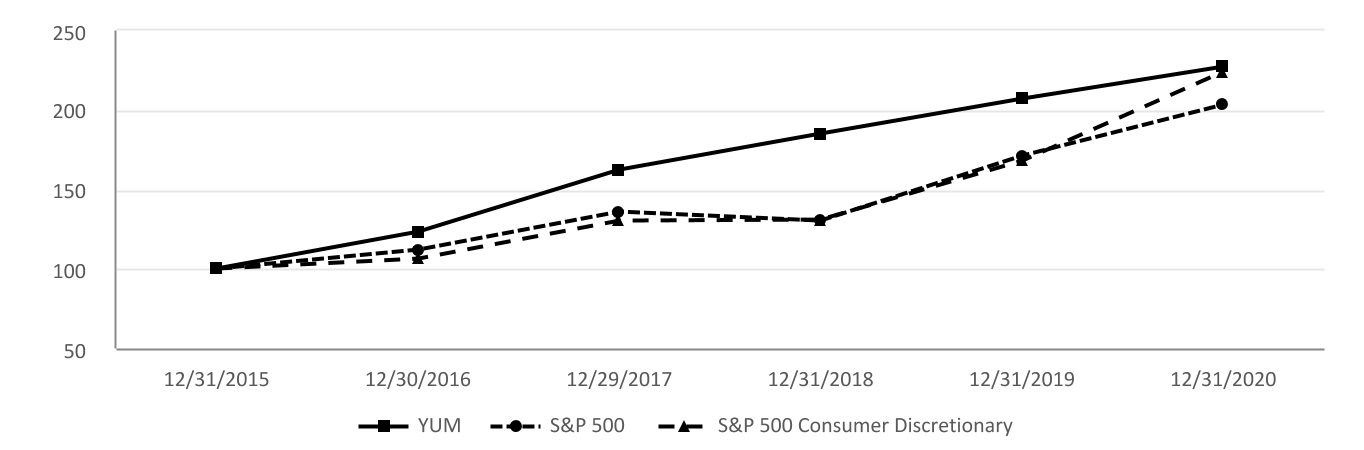
| 12/31/2015 | 12/30/2016 | 12/29/2017 | 12/31/2018 | 12/31/2019 | 12/31/2020 | |||||||||||||||||||||||||||||||||
| YUM | $ | 100 | $ | 123 | $ | 162 | $ | 185 | $ | 207 | $ | 227 | ||||||||||||||||||||||||||
| S&P 500 | $ | 100 | $ | 112 | $ | 136 | $ | 130 | $ | 171 | $ | 203 | ||||||||||||||||||||||||||
| S&P Consumer Discretionary | $ | 100 | $ | 106 | $ | 130 | $ | 131 | $ | 168 | $ | 224 |
Source of total return data: Bloomberg
Item 6. Selected Financial Data.
Selected Financial Data
Yum! Brands, Inc. and Subsidiaries
(in millions, except per share and unit amounts)
| 2020 | 2019 | 2018 | 2017 | 2016 | |||||||||||||||||||||||||
| Income Statement Data | |||||||||||||||||||||||||||||
| Revenues | |||||||||||||||||||||||||||||
| Company sales | $ | 1,810 | $ | 1,546 | $ | 2,000 | $ | 3,572 | $ | 4,189 | |||||||||||||||||||
| Franchise and property revenues | 2,510 | 2,660 | 2,482 | 2,306 | 2,167 | ||||||||||||||||||||||||
| Franchise contributions for advertising and other services | 1,332 | 1,391 | 1,206 | — | — | ||||||||||||||||||||||||
| Total | 5,652 | 5,597 | 5,688 | 5,878 | 6,356 | ||||||||||||||||||||||||
| Refranchising (gain) loss | (34) | (37) | (540) | (1,083) | (163) | ||||||||||||||||||||||||
| Operating Profit | 1,503 | 1,930 | 2,296 | 2,761 | 1,682 | ||||||||||||||||||||||||
| Investment (income) expense, net | (74) | 67 | (9) | (5) | (2) | ||||||||||||||||||||||||
| Other pension (income) expense | 14 | 4 | 14 | 47 | 32 | ||||||||||||||||||||||||
| Interest expense, net | 543 | 486 | 452 | 445 | 307 | ||||||||||||||||||||||||
| Income from continuing operations before income taxes | 1,020 | 1,373 | 1,839 | 2,274 | 1,345 | ||||||||||||||||||||||||
| Income from continuing operations | 904 | 1,294 | 1,542 | 1,340 | 1,018 | ||||||||||||||||||||||||
| Income from discontinued operations, net of tax | N/A | N/A | N/A | N/A | 625 | ||||||||||||||||||||||||
| Net Income | 904 | 1,294 | 1,542 | 1,340 | 1,643 | ||||||||||||||||||||||||
| Basic earnings per share from continuing operations | 2.99 | 4.23 | 4.80 | 3.86 | 2.58 | ||||||||||||||||||||||||
| Basic earnings per share from discontinued operations | N/A | N/A | N/A | N/A | 1.59 | ||||||||||||||||||||||||
| Basic earnings per share | 2.99 | 4.23 | 4.80 | 3.86 | 4.17 | ||||||||||||||||||||||||
| Diluted earnings per share from continuing operations | 2.94 | 4.14 | 4.69 | 3.77 | 2.54 | ||||||||||||||||||||||||
| Diluted earnings per share from discontinued operations | N/A | N/A | N/A | N/A | 1.56 | ||||||||||||||||||||||||
| Diluted earnings per share | 2.94 | 4.14 | 4.69 | 3.77 | 4.10 | ||||||||||||||||||||||||
| Diluted earnings per share from continuing operations excluding Special Items | 3.62 | 3.55 | 3.17 | 2.96 | 2.46 | ||||||||||||||||||||||||
| Cash Flow Data | |||||||||||||||||||||||||||||
| Provided by operating activities | $ | 1,305 | $ | 1,315 | $ | 1,176 | $ | 1,030 | $ | 1,248 | |||||||||||||||||||
| Capital spending | 160 | 196 | 234 | 318 | 427 | ||||||||||||||||||||||||
| Proceeds from refranchising of restaurants | 19 | 110 | 825 | 1,773 | 370 | ||||||||||||||||||||||||
| Repurchase shares of Common Stock | 239 | 815 | 2,390 | 1,960 | 5,403 | ||||||||||||||||||||||||
| Dividends paid on Common Stock | 566 | 511 | 462 | 416 | 744 | ||||||||||||||||||||||||
| Balance Sheet Data | |||||||||||||||||||||||||||||
| Total assets | $ | 5,852 | $ | 5,231 | $ | 4,130 | $ | 5,311 | $ | 5,453 | |||||||||||||||||||
| Long-term debt | 10,272 | 10,131 | 9,751 | 9,429 | 9,059 | ||||||||||||||||||||||||
| Total debt | 10,725 | 10,562 | 10,072 | 9,804 | 9,125 | ||||||||||||||||||||||||
| Other Data | |||||||||||||||||||||||||||||
| Number of units at year end | |||||||||||||||||||||||||||||
| Franchise | 49,255 | 49,257 | 47,268 | 43,603 | 40,834 | ||||||||||||||||||||||||
| Company | 1,098 | 913 | 856 | 1,481 | 2,841 | ||||||||||||||||||||||||
| System | 50,353 | 50,170 | 48,124 | 45,084 | 43,675 | ||||||||||||||||||||||||
| System net new unit growth | — | % | 4 | % | 7 | % | 3 | % | 3 | % | |||||||||||||||||||
| System and same-store sales | |||||||||||||||||||||||||||||
| KFC Division System sales | $ | 26,289 | $ | 27,900 | $ | 26,239 | $ | 24,515 | $ | 23,242 | |||||||||||||||||||
| System sales growth (decline) | (6) | % | 6 | % | 7 | % | 5 | % | 3 | % | |||||||||||||||||||
| System sales growth, ex FX and 53rd week | (5) | % | 9 | % | 6 | % | 6 | % | 6 | % | |||||||||||||||||||
| Same-store sales growth | (9) | % | 4 | % | 2 | % | 3 | % | 2 | % | |||||||||||||||||||
| Pizza Hut Division System sales | $ | 11,955 | $ | 12,900 | $ | 12,212 | $ | 12,034 | $ | 12,019 | |||||||||||||||||||
| System sales growth (decline) | (7) | % | 6 | % | 1 | % | — | % | — | % | |||||||||||||||||||
| System sales growth, ex FX and 53rd week | (6) | % | 7 | % | 1 | % | 2 | % | 1 | % | |||||||||||||||||||
| Same-store sales growth (decline) | (6) | % | — | % | — | % | — | % | (2 | %) | |||||||||||||||||||
| Taco Bell Division System sales | $ | 11,745 | $ | 11,784 | $ | 10,786 | $ | 10,145 | $ | 9,660 | |||||||||||||||||||
| System sales growth | — | % | 9 | % | 6 | % | 5 | % | 6 | % | |||||||||||||||||||
| System sales growth, ex FX and 53rd week | 1 | % | 8 | % | 6 | % | 7 | % | 5 | % | |||||||||||||||||||
| Same-store sales growth | (1) | % | 5 | % | 4 | % | 4 | % | 2 | % | |||||||||||||||||||
| Shares outstanding at year end | 300 | 300 | 306 | 332 | 355 | ||||||||||||||||||||||||
| Cash dividends declared per common share | $ | 1.88 | $ | 1.68 | $ | 1.44 | $ | 0.90 | $ | 1.73 | |||||||||||||||||||
| Market price per share at year end | $ | 108.56 | $ | 100.73 | $ | 91.92 | $ | 81.61 | $ | 63.33 |
The table above reflects the impact of the adoption of new lease accounting standards in fiscal year 2019 and the impact of the adoption of new revenue recognition accounting standards in fiscal year 2018.
System sales growth and unit growth measures in 2020 reflect the addition of 276 units through our acquisition of The Habit Restaurants, Inc. in March 2020. System sales growth measures in 2019 and System unit growth in 2018 reflect the addition of approximately 1,300 Telepizza units in December 2018. See additional discussion of the acquisition of The Habit Restaurants, Inc. and the Telepizza strategic alliance within our MD&A.
Fiscal years for our U.S. and certain international subsidiaries that operate on a weekly periodic calendar include 52 weeks in 2020, 2018 and 2017 and 53 weeks in 2019 and 2016. Refer to Note 2 in our Consolidated Financial Statements for additional details related to our fiscal calendar, including the impact of the 53rd week on our results in 2019. In 2019, the 53rd week added $24 million to Operating Profit. In 2016, the 53rd week added $28 million to Operating Profit.
Discontinued operations in 2016 reflects the spin-off of our China business into an independent, publicly-traded company (the "Separation").
The non-GAAP measure of Diluted earnings per share from continuing operations excluding Special Items is discussed in further detail in our MD&A within Part II, Item 7.
System sales growth, System sales growth excluding the impacts of foreign currency translation ("FX") and 53rd week, Same-store sales growth and System net new unit growth are performance metrics and discussed in further detail in our MD&A within Part II, Item 7.
See discussion of our 2020, 2019 and 2018 Special Items in our MD&A. Special Items in 2017 positively impacted Operating Profit by $1,001 million and positively impacted Net Income by $288 million, primarily due to $1,083 million in Refranchising gains, partially offset by $31 million in costs associated with the Pizza Hut U.S. Transformation Agreement, $23 million in costs associated with YUM's Strategic Transformation Initiatives, $18 million in share-based compensation charges related to the Separation, $17 million in costs associated with the KFC U.S. Acceleration Agreement, $434 million recognized in our Income tax provision as a result of the Tax Cuts and Jobs Act of 2017 and a $23 million charge within Other Pension (income) expense primarily due to an adjustment of certain historical deferred vested pension liability balances as a result of the completion of a pension data review and reconciliation. Special Items in 2016 positively impacted Operating Profit by $35 million and positively impacted Net Income by $33 million, primarily due to $163 million in Refranchising gains, partially offset by $67 million in costs associated with YUM's Strategic Transformation Initiatives, $30 million in share-based compensation charges related to the Separation, $26 million in costs associated with the KFC Acceleration Agreement and $26 million incurred within Other Pension (income) expense primarily due to a settlement charge associated with an option for certain employees to voluntarily elect an early payout of their pension benefits.
Selected financial data for year 2016 have been recast from that originally presented to present a change in our reporting calendar and the retroactive adoption of an accounting standard related to the presentation of net periodic pension cost and net periodic postretirement benefit cost.
The selected financial data should be read in conjunction with the Consolidated Financial Statements.
Item 7. Management’s Discussion and Analysis of Financial Condition and Results of Operations.
Introduction and Overview
The following Management’s Discussion and Analysis (“MD&A”), should be read in conjunction with the Consolidated Financial Statements (“Financial Statements”) in Item 8 and the Forward-Looking Statements and the Risk Factors set forth in Item 1A. All Note references herein refer to the Notes to the Financial Statements. Tabular amounts are displayed in millions of U.S. dollars except per share and unit count amounts, or as otherwise specifically identified. Percentages may not recompute due to rounding.
Yum! Brands, Inc. and its subsidiaries (collectively referred to herein as the "Company", “YUM”, "we", "us" or "our") franchise or operate a system of over 50,000 restaurants in more than 150 countries and territories, primarily under the concepts of KFC, Pizza Hut, Taco Bell and The Habit Burger Grill (collectively, the "Concepts"). The Company's KFC, Pizza Hut and Taco Bell brands are global leaders of the chicken, pizza and Mexican-style food categories, respectively. The Habit Burger Grill, a concept we acquired on March 18, 2020, is a fast-casual restaurant concept specializing in made-to-order chargrilled burgers, sandwiches and more. Of the over 50,000 restaurants, 98% are operated by franchisees.
As of December 31, 2020, YUM consists of four operating segments:
-
The KFC Division which includes our worldwide operations of the KFC concept
-
The Pizza Hut Division which includes our worldwide operations of the Pizza Hut concept
-
The Taco Bell Division which includes our worldwide operations of the Taco Bell concept
-
The Habit Burger Grill Division which includes our worldwide operations of the Habit Burger Grill concept
Through our Recipe for Growth and Good we intend to unlock the growth potential of our Concepts and YUM, drive increased collaboration across our Concepts and geographies and consistently deliver better customer experiences, improved unit economics and higher rates of growth. Key enablers include accelerated use of technology and better leverage of our systemwide scale.
Our Recipe for Growth is based on four key drivers:
-
Unrivaled Culture and Talent: Leverage our culture and people capability to fuel brand performance and franchise success
-
Unmatched Operating Capability: Recruit and equip the best restaurant operators in the world to deliver great customer experiences
-
Relevant, Easy and Distinctive Brands: Innovate and elevate iconic restaurant brands people trust and champion
-
Bold Restaurant Development: Drive market and franchise expansion with strong economics and value
Our global citizenship and sustainability strategy, called the Recipe for Good, reflects our priorities for socially responsible growth, risk management and sustainable stewardship of our people, food and planet.
On October 11, 2016, YUM announced our transformation plans to drive global expansion of our KFC, Pizza Hut and Taco Bell brands (“YUM's Strategic Transformation Initiatives”) following the spin-off of our China business into an independent publicly-traded company under the name of Yum China Holdings, Inc. (“Yum China”). At this time, we established transformation goals to be met by the end of 2019 including becoming:
-
More Focused. By focusing on four growth drivers similar to those that make up our Recipe for Growth above we accelerated system sales growth to 8% in 2019 (excluding the impacts of the 53rd week and foreign currency translation).
-
More Franchised. The Company successfully increased franchise restaurant ownership to 98% as of the end of 2018.
-
More Efficient. The Company revamped its financial profile, improving the efficiency of its organization and cost structure globally, by:
-
Reducing annual capital expenditures associated with Company-operated restaurant maintenance and other projects and funded additional capital for new Company units through the refranchising of existing Company units. Capital spending in 2019 net of refranchising proceeds was $86 million.
-
Lowering General and administrative expenses ("G&A") to 1.7% of system sales in 2019; and
-
Maintaining an optimized capital structure of ~5.0x Earnings Before Interest, Taxes, Depreciation and Amortization (“EBITDA”) net leverage.
From 2017 through 2019, we returned $6.5 billion to shareholders through share repurchases and cash dividends. We funded these shareholder returns through a combination of refranchising proceeds, free cash flow generation and maintenance of our ~5.0x EBITDA consolidated net leverage. We generated pre-tax proceeds of $2.8 billion through our refranchising initiatives to achieve targeted franchise ownership of 98%. Refer to the Liquidity and Capital Resources section of this MD&A for additional details.
As a result of the impacts on our business due to the COVID-19 pandemic, certain measures we established as part of our transformation goals were negatively impacted in 2020. For the full year 2020, G&A, excluding the impact of Special Items, represented 1.9% of consolidated system sales, primarily due to sales pressures resulting from the COVID-19 pandemic. While we took certain austerity measures to reduce G&A spending such as lower travel related costs and a reduction of our Chief Executive Officer's salary, these reductions were offset by accelerated digital and technology spending to enhance our customer experience and off-premise capabilities. We expect our G&A as a percentage of consolidated system sales to move back toward our historical target of 1.7% as sustained growth resumes. Additionally, during 2020 our EBITDA was negatively impacted by the impacts of the COVID-19 pandemic, which increased our consolidated leverage, net of available cash. We currently estimate we will grow back into our ~5.0x EBITDA consolidated net leverage by second quarter 2021.
Going forward, we expect to:
-
Maintain a capital structure of ~5.0x EBITDA consolidated net leverage;
-
Invest capital in a manner consistent with an asset light, franchisor model; and
-
Allocate G&A in an efficient manner that provides leverage to operating profit growth while at the same time opportunistically investing in strategic growth initiatives.
We intend for this MD&A to provide the reader with information that will assist in understanding our results of operations, including performance metrics that management uses to assess the Company's performance. Throughout this MD&A, we commonly discuss the following performance metrics:
- Same-store sales growth is the estimated percentage change in system sales of all restaurants that have been open and in the YUM system for one year or more, including those temporarily closed. From time-to-time restaurants may be temporarily closed due to remodeling or image enhancement, rebuilding, natural disasters, health epidemic or pandemic, landlord disputes or other issues. Throughout 2020 we had a significant number of restaurants that were temporarily closed, including restaurants closed due to government and landlord restrictions, as a result of COVID-19. The system sales of restaurants we deem temporarily closed remain in our base for purposes of determining same-store sales growth and the restaurants remain in our unit count (see below). We believe same-store sales growth is useful to investors because our results are heavily dependent on the results of our Concepts' existing store base. Additionally, same-store sales growth is reflective of the strength of our Brands, the effectiveness of our operational and advertising initiatives and local economic and consumer trends. In 2020, when calculating same-store sales growth we also included in our prior year base the sales of stores that were added as a result of our acquisition of The Habit Restaurants, Inc. on March 18, 2020, and that were open for one year or more. In 2019, when calculating same-store sales growth we also included in our prior year base the sales of stores that were added as a result of the Telepizza str
Showing the first 8K of 122K characters. Open the full section
Item 7A. Quantitative and Qualitative Disclosures About Market Risk.
The Company is exposed to financial market risks associated with interest rates, foreign currency exchange rates and commodity prices. In the normal course of business and in accordance with our policies, we manage these risks through a variety of strategies, which may include the use of financial and commodity derivative instruments to hedge our underlying exposures. Our policies prohibit the use of derivative instruments for trading purposes, and we have processes in place to monitor and control their use.
Interest Rate Risk
We have a market risk exposure to changes in interest rates, principally in the U.S. Our outstanding total debt, excluding finance leases and debt issuance costs and discounts, of $10.7 billion includes 78% fixed-rate debt and 22% variable-rate debt. We have attempted to minimize the interest rate risk from variable-rate debt through the use of interest rate swaps that, as of December 31, 2020, result in a fixed interest rate on $1.55 billion of our variable-rate debt. As a result, approximately 93% of our $10.7 billion of outstanding debt at December 31, 2020, is effectively fixed-rate debt. See Note 11 for details on our outstanding debt and Note 13 for details related to interest rate swaps.
As of both December 31, 2020 and December 31, 2019, a hypothetical 100 basis-point increase in short-term interest rates would result, over the following twelve-month period after consideration of the aforementioned interest rate swaps, in an increase of approximately $8 million in Interest expense, net within our Consolidated Statement of Income. These estimated amounts are based upon the current level of variable-rate debt that has not been swapped to fixed and assume no changes in the volume or composition of that debt and exclude any impact from interest income related to cash and cash equivalents.
The fair value of our cumulative fixed-rate debt of $8.4 billion as of December 31, 2020, would decrease approximately $475 million as a result of the same hypothetical 100 basis-point increase. At December 31, 2020, a hypothetical 100 basis-point decrease in short-term interest rates would increase the liability associated with the fair value of our interest rate swaps by approximately $24 million. Fair value was determined based on the present value of expected future cash flows considering the risks involved and using discount rates appropriate for the durations.
Foreign Currency Exchange Rate Risk
Changes in foreign currency exchange rates impact the translation of our reported foreign currency denominated earnings, cash flows and net investments in foreign operations and the fair value of our foreign currency denominated financial instruments. Historically, we have chosen not to hedge foreign currency risks related to our foreign currency denominated earnings and cash flows through the use of financial instruments. In addition, we attempt to minimize the exposure related to foreign currency denominated financial instruments by purchasing goods and services from third parties in local currencies when practical. Consequently, foreign currency denominated financial instruments consist primarily of intercompany receivables and payables. At times, we utilize forward contracts and cross-currency swaps to reduce our exposure related to these intercompany receivables and payables. The notional amount and maturity dates of these contracts match those of the underlying receivables or payables such that our foreign currency exchange risk related to these instruments is minimized.
The Company’s foreign currency net asset exposure (defined as foreign currency assets less foreign currency liabilities) totaled approximately $1.3 billion as of December 31, 2020. Operating in international markets exposes the Company to movements in foreign currency exchange rates. The Company’s primary exposures result from our operations in Asia-Pacific, Europe and the Americas. For the fiscal year ended December 31, 2020, Operating Profit would have decreased approximately $115 million if all foreign currencies had uniformly weakened 10% relative to the U.S. dollar. This estimated reduction assumes no changes in sales volumes, local currency sales or input prices.
Commodity Price Risk
We are subject to volatility in food costs as a result of market risk associated with commodity prices. Our ability to recover increased costs through higher pricing is, at times, limited by the competitive environment in which we operate. We manage our exposure to this risk primarily through pricing agreements with our vendors.
Item 8. Financial Statements and Supplementary Data.
INDEX TO FINANCIAL INFORMATION
| Page Reference | ||||||||
| Consolidated Financial Statements | ||||||||
| Report of Independent Registered Public Accounting Firm | 57 | |||||||
| Consolidated Statements of Income | 60 | |||||||
| Consolidated Statements of Comprehensive Income | 61 | |||||||
| Consolidated Statements of Cash Flows | 62 | |||||||
| Consolidated Balance Sheets | 63 | |||||||
| Consolidated Statements of Shareholders’ Deficit | 64 | |||||||
| Notes to Consolidated Financial Statements | 65 |
Financial Statement Schedules
No schedules are required because either the required information is not present or not present in amounts sufficient to require submission of the schedule, or because the information required is included in the above-listed financial statements or notes thereto.
Report of Independent Registered Public Accounting Firm
To the Shareholders and Board of Directors
Yum! Brands, Inc.:
Opinions on the Consolidated Financial Statements and Internal Control Over Financial Reporting
We have audited the accompanying consolidated balance sheets of Yum! Brands, Inc. and Subsidiaries (the Company) as of December 31, 2020 and 2019, the related consolidated statements of income, comprehensive income, cash flows and shareholders’ deficit for each of the years in the three-year period ended December 31, 2020, and the related notes (collectively, the consolidated financial statements). We also have audited the Company’s internal control over financial reporting as of December 31, 2020, based on criteria established in Internal Control – Integrated Framework (2013) issued by the Committee of Sponsoring Organizations of the Treadway Commission.
In our opinion, the consolidated financial statements referred to above present fairly, in all material respects, the financial position of the Company as of December 31, 2020 and 2019, and the results of its operations and its cash flows for each of the years in the three-year period ended December 31, 2020, in conformity with U.S. generally accepted accounting principles. Also in our opinion, the Company maintained, in all material respects, effective internal control over financial reporting as of December 31, 2020 based on criteria established in Internal Control – Integrated Framework (2013) issued by the Committee of Sponsoring Organizations of the Treadway Commission.
The Company acquired The Habit Restaurants, Inc. and its subsidiaries (Habit Burger Grill) during 2020, and management excluded from its assessment of the effectiveness of the Company’s internal control over financial reporting as of December 31, 2020, Habit Burger Grill’s internal control over financial reporting associated with approximately 9% of total assets and 6% of total revenues included in the consolidated financial statements of the Company as of and for the year ended December 31, 2020. Our audit of internal control over financial reporting of the Company also excluded an evaluation of the internal control over financial reporting of Habit Burger Grill.
Change in Accounting Principle
As discussed in Note 2 to the consolidated financial statements, the Company changed its method of accounting for leases in fiscal year 2019 due to the adoption of Topic 842, Leases.
Basis for Opinions
The Company’s management is responsible for these consolidated financial statements, for maintaining effective internal control over financial reporting, and for its assessment of the effectiveness of internal control over financial reporting, included in the accompanying Management's Report on Internal Control Over Financial Reporting in the accompanying Item 9A. Our responsibility is to express an opinion on the Company’s consolidated financial statements and an opinion on the Company’s internal control over financial reporting based on our audits. We are a public accounting firm registered with the Public Company Accounting Oversight Board (United States) (PCAOB) and are required to be independent with respect to the Company in accordance with the U.S. federal securities laws and the applicable rules and regulations of the Securities and Exchange Commission and the PCAOB.
We conducted our audits in accordance with the standards of the PCAOB. Those standards require that we plan and perform the audits to obtain reasonable assurance about whether the consolidated financial statements are free of material misstatement, whether due to error or fraud, and whether effective internal control over financial reporting was maintained in all material respects.
Our audits of the consolidated financial statements included performing procedures to assess the risks of material misstatement of the consolidated financial statements, whether due to error or fraud, and performing procedures that respond to those risks. Such procedures included examining, on a test basis, evidence regarding the amounts and disclosures in the consolidated financial statements. Our audits also included evaluating the accounting principles used and significant estimates made by management, as well as evaluating the overall presentation of the consolidated financial statements. Our audit of internal control over financial reporting included obtaining an understanding of internal control over financial reporting, assessing the risk that a material weakness exists, and testing and evaluating the design and operating effectiveness of internal control based on the assessed risk. Our audits also included performing such other procedures as we considered necessary in the circumstances. We believe that our audits provide a reasonable basis for our opinions.
Definition and Limitations of Internal Control Over Financial Reporting
A company’s internal control over financial reporting is a process designed to provide reasonable assurance regarding the reliability of financial reporting and the preparation of financial statements for external purposes in accordance with generally accepted accounting principles. A company’s internal control over financial reporting includes those policies and procedures that (1) pertain to the maintenance of records that, in reasonable detail, accurately and fairly reflect the transactions and dispositions of the assets of the company; (2) provide reasonable assurance that transactions are recorded as necessary to permit preparation of financial statements in accordance with generally accepted accounting principles, and that receipts and expenditures of the company are being made only in accordance with authorizations of management and directors of the company; and (3) provide reasonable assurance regarding prevention or timely detection of unauthorized acquisition, use, or disposition of the company’s assets that could have a material effect on the financial statements.
Because of its inherent limitations, internal control over financial reporting may not prevent or detect misstatements. Also, projections of any evaluation of effectiveness to future periods are subject to the risk that controls may become inadequate because of changes in conditions, or that the degree of compliance with the policies or procedures may deteriorate.
Critical Audit Matters
The critical audit matters communicated below are matters
Showing the first 8K of 261K characters. Open the full section
Item 9. Changes In and Disagreements with Accountants on Accounting and Financial Disclosure.
None.
Item 9A. Controls and Procedures.
Evaluation of Disclosure Controls and Procedures
The Company has evaluated the effectiveness of the design and operation of its disclosure controls and procedures pursuant to Rules 13a-15(e) and 15d-15(e) under the Securities Exchange Act of 1934 as of the end of the period covered by this report. Based on the evaluation, performed under the supervision and with the participation of the Company’s management, including the Chief Executive Officer (the “CEO”) and the Chief Financial Officer (the “CFO”), the Company’s management, including the CEO and CFO, concluded that the Company’s disclosure controls and procedures were effective as of the end of the period covered by this report.
Management’s Report on Internal Control Over Financial Reporting
Our management is responsible for establishing and maintaining adequate internal control over financial reporting, as such term is defined in Rules 13a-15(f) under the Securities Exchange Act of 1934. Under the supervision and with the participation of our management, including our principal executive officer and principal financial officer, we conducted an evaluation of the effectiveness of our internal control over financial reporting based on the framework in Internal Control – Integrated Framework (2013) issued by the Committee of Sponsoring Organizations of the Treadway Commission. Based on our evaluation under the framework in Internal Control – Integrated Framework (2013), our management concluded that our internal control over financial reporting was effective as of December 31, 2020.
We have excluded from the scope of management’s assessment of the effectiveness of our internal control over financial reporting as of December 31, 2020, the operations and related assets of The Habit Restaurants, Inc. and its subsidiaries (“The Habit Burger Grill”), which we acquired on March 18, 2020. The Habit Burger Grill’s total assets and total revenues represented approximately 9% and 6% of the Company's respective consolidated total assets and total revenues as of and for the year ended December 31, 2020.
KPMG LLP, an independent registered public accounting firm, has audited the Consolidated Financial Statements included in this Annual Report on Form 10-K and the effectiveness of our internal control over financial reporting and has issued their report, included herein.
Changes in Internal Control
There were no changes with respect to the Company’s internal control over financial reporting or in other factors that materially affected, or are reasonably likely to materially affect, internal control over financial reporting during the quarter ended December 31, 2020.
Item 9B. Other Information.
None.
PART III
Item 10. Directors, Executive Officers and Corporate Governance.
Information regarding Section 16(a) compliance, the Audit Committee and the Audit Committee financial expert, the Company’s code of ethics and background of the directors appearing under the captions “Stock Ownership Information,” “Governance of the Company,” “Executive Compensation” and “Item 1: Election of Directors and Director biographies” is incorporated by reference from the Company’s definitive proxy statement which will be filed with the Securities and Exchange Commission no later than 120 days after December 31, 2020.
Information regarding executive officers of the Company is included in Part I.
Item 11. Executive Compensation.
Information regarding executive and director compensation and the Management Planning and Development Committee appearing under the captions “Governance of the Company” and “Executive Compensation” is incorporated by reference from the Company’s definitive proxy statement which will be filed with the Securities and Exchange Commission no later than 120 days after December 31, 2020.
Item 12. Security Ownership of Certain Beneficial Owners and Management and Related Stockholder Matters.
Information regarding equity compensation plans and security ownership of certain beneficial owners and management appearing under the captions “Executive Compensation” and “Stock Ownership Information” is incorporated by reference from the Company’s definitive proxy statement which will be filed with the Securities and Exchange Commission no later than 120 days after December 31, 2020.
Item 13. Certain Relationships and Related Transactions, and Director Independence.
Information regarding certain relationships and related transactions and information regarding director independence appearing under the caption “Governance of the Company” is incorporated by reference from the Company’s definitive proxy statement which will be filed with the Securities and Exchange Commission no later than 120 days after December 31, 2020.
Item 14. Principal Accountant Fees and Services.
Information regarding principal accountant fees and services and audit committee pre-approval policies and procedures appearing under the caption “Item 2: Ratification of Independent Auditors” is incorporated by reference from the Company’s definitive proxy statement which will be filed with the Securities and Exchange Commission no later than 120 days after December 31, 2020.
PART IV
Item 15. Exhibits and Financial Statement Schedules.
| (a) | (1) | Financial Statements: Consolidated Financial Statements filed as part of this report are listed under Part II, Item 8 of this Form 10-K. | |||||||||
| (2) | Financial Statement Schedules: No schedules are required because either the required information is not present or not present in amounts sufficient to require submission of the schedule, or because the information required is included in the Consolidated Financial Statements thereto filed as a part of this Form 10-K. | ||||||||||
| (3) | Exhibits: The exhibits listed in the accompanying Exhibit Index are filed as part of this Form 10-K. The Index to Exhibits specifically identifies each management contract or compensatory plan required to be filed as an exhibit to this Form 10-K. |
| SIGNATURES |
Pursuant to the requirements of Section 13 or 15(d) of the Securities Exchange Act of 1934, the registrant has duly caused this Form 10-K annual report to be signed on its behalf by the undersigned, thereunto duly authorized.
| Date: | February 19, 2021 |
| YUM! BRANDS, INC. |
| By: | /s/ David W. Gibbs |
Pursuant to the requirements of the Securities Exchange Act of 1934, this annual report has been signed on February 19, 2021, by the following persons on behalf of the registrant and in the capacities indicated.
| Signature | Title | ||||||||||
| /s/ David W. Gibbs | Chief Executive Officer | ||||||||||
| David W. Gibbs | (principal executive officer) | ||||||||||
| /s/ Chris Turner | Chief Financial Officer | ||||||||||
| Chris Turner | (principal financial officer) | ||||||||||
| /s/ David E. Russell | Senior Vice President, Finance and Corporate Controller | ||||||||||
| David E. Russell | (principal accounting officer) | ||||||||||
| /s/ Paget L. Alves | Director | ||||||||||
| Paget L. Alves | |||||||||||
| /s/ Keith Barr | Director | ||||||||||
| Keith Barr | |||||||||||
| /s/ Christopher M. Connor | Director | ||||||||||
| Christopher M. Connor | |||||||||||
| /s/ Brian C. Cornell | Director | ||||||||||
| Brian C. Cornell | |||||||||||
| /s/ Tanya L. Domier | Director | ||||||||||
| Tanya L. Domier | |||||||||||
| /s/ Mirian M. Graddick-Weir | Director | ||||||||||
| Mirian M. Graddick-Weir | |||||||||||
| /s/ Lauren R. Hobart | Director | ||||||||||
| Lauren R. Hobart | |||||||||||
| /s/ Thomas C. Nelson | Director | ||||||||||
| Thomas C. Nelson | |||||||||||
| /s/ P. Justin Skala | Director | ||||||||||
| P. Justin Skala | |||||||||||
| /s/ Elane B. Stock | Director | ||||||||||
| Elane B. Stock | |||||||||||
| /s/ Annie Young-Scrivner | Director | ||||||||||
| Annie Young-Scrivner |
Yum! Brands, Inc.
Exhibit Index
(Item 15)