 filings.tools
Apple 10-K 2015-09-26
Filed 2015-10-28. 21 sections, 352K characters. Original on sec.gov · Markdown · JSON
Cover and table of contents
10-K 1 d17062d10k.htm FORM 10-K
Table of Contents
UNITED STATES
SECURITIES AND EXCHANGE COMMISSION
Washington, D.C. 20549
Form 10-K
(Mark One)
x ANNUAL REPORT PURSUANT TO SECTION 13 OR 15(d) OF THE SECURITIES EXCHANGE ACT OF 1934
For the fiscal year ended September 26, 2015
or
¨ TRANSITION REPORT PURSUANT TO SECTION 13 OR 15(d) OF THE SECURITIES EXCHANGE ACT OF 1934
For the transition period from to
Commission File Number: 001-36743

Apple Inc.
(Exact name of Registrant as specified in its charter)
| California | 94-2404110 | |
| (State or other jurisdiction of incorporation or organization) | (I.R.S. Employer Identification No.) |
| 1 Infinite Loop Cupertino, California | 95014 | |
| (Address of principal executive offices) | (Zip Code) |
(408) 996-1010
(Registrant’s telephone number, including area code)
Securities registered pursuant to Section 12(b) of the Act:
| Common Stock, $0.00001 par value per share 1.000% Notes due 2022 1.625% Notes due 2026 3.05% Notes due 2029 3.60% Notes due 2042 1.375% Notes due 2024 2.000% Notes due 2027 | The NASDAQ Stock Market LLC New York Stock Exchange LLC New York Stock Exchange LLC New York Stock Exchange LLC New York Stock Exchange LLC New York Stock Exchange LLC New York Stock Exchange LLC | |
| (Title of class) | (Name of exchange on which registered) |
Securities registered pursuant to Section 12(g) of the Act: None
Indicate by check mark if the Registrant is a well-known seasoned issuer, as defined in Rule 405 of the Securities Act.
Yes x No ¨
Indicate by check mark if the Registrant is not required to file reports pursuant to Section 13 or Section 15(d) of the Act.
Yes ¨ No x
Indicate by check mark whether the Registrant (1) has filed all reports required to be filed by Section 13 or 15(d) of the Securities Exchange Act of 1934 during the preceding 12 months (or for such shorter period that the Registrant was required to file such reports), and (2) has been subject to such filing requirements for the past 90 days.
Yes x No ¨
Indicate by check mark whether the Registrant has submitted electronically and posted on its corporate Web site, if any, every Interactive Data File required to be submitted and posted pursuant to Rule 405 of Regulation S-T (§232.405 of this chapter) during the preceding 12 months (or for such shorter period that the Registrant was required to submit and post such files).
Yes x No ¨
Indicate by check mark if disclosure of delinquent filers pursuant to Item 405 of Regulation S-K (§229.405 of this chapter) is not contained herein, and will not be contained, to the best of the Registrant’s knowledge, in definitive proxy or information statements incorporated by reference in Part III of this Form 10-K or any amendment to this Form 10-K. x
Indicate by check mark whether the Registrant is a large accelerated filer, an accelerated filer, a non-accelerated filer, or a smaller reporting company. See the definitions of “large accelerated filer,” “accelerated filer” and “smaller reporting company” in Rule 12b-2 of the Exchange Act.
| Large accelerated filer x | Accelerated filer | ¨ | ||||
| Non-accelerated filer ¨ | (Do not check if a smaller reporting company) | Smaller reporting company | ¨ |
Indicate by check mark whether the Registrant is a shell company (as defined in Rule 12b-2 of the Act).
Yes ¨ No x
The aggregate market value of the voting and non-voting stock held by non-affiliates of the Registrant, as of March 27, 2015, the last business day of the Registrant’s most recently completed second fiscal quarter, was approximately $709,923,000,000. Solely for purposes of this disclosure, shares of common stock held by executive officers and directors of the Registrant as of such date have been excluded because such persons may be deemed to be affiliates. This determination of executive officers and directors as affiliates is not necessarily a conclusive determination for any other purposes.
5,575,331,000 shares of common stock were issued and outstanding as of October 9, 2015.
DOCUMENTS INCORPORATED BY REFERENCE
Portions of the Registrant’s definitive proxy statement relating to its 2016 annual meeting of shareholders (the “2016 Proxy Statement”) are incorporated by reference into Part III of this Annual Report on Form 10-K where indicated. The 2016 Proxy Statement will be filed with the U.S. Securities and Exchange Commission within 120 days after the end of the fiscal year to which this report relates.
Table of Contents
Apple Inc.
Form 10-K
For the Fiscal Year Ended September 26, 2015
TABLE OF CONTENTS
Table of Contents
This Annual Report on Form 10-K (“Form 10-K”) contains forward-looking statements, within the meaning of the Private Securities Litigation Reform Act of 1995, that involve risks and uncertainties. Many of the forward-looking statements are located in Part II, Item 7 of this Form 10-K under the heading “Management’s Discussion and Analysis of Financial Condition and Results of Operations.” Forward-looking statements provide current expectations of future events based on certain assumptions and include any statement that does not directly relate to any historical or current fact. Forward-looking statements can also be identified by words such as “future,” “anticipates,” “believes,” “estimates,” “expects,” “intends,” “will,” “would,” “could,” “can,” “may,” and similar terms. Forward-looking statements are not guarantees of future performance and the Company’s actual results may differ significantly from the results discussed in the forward-looking statements. Factors that might cause such differences include, but are not limited to, those discussed in Part I, Item 1A of this Form 10-K under the heading “Risk Factors,” which are incorporated herein by reference. All information presented herein is based on the Company’s fiscal calendar. Unless otherwise stated, references to particular years, quarters, months or periods refer to the Company’s fiscal years ended in September and the associated quarters, months and periods of those fiscal years. Each of the terms the “Company” and “Apple” as used herein refers collectively to Apple Inc. and its wholly-owned subsidiaries, unless otherwise stated. The Company assumes no obligation to revise or update any forward-looking statements for any reason, except as required by law.
PART I
Item 1. Business
| --- | --- |
Company Background
The Company designs, manufactures and markets mobile communication and media devices, personal computers and portable digital music players, and sells a variety of related software, services, accessories, networking solutions and third-party digital content and applications. The Company’s products and services include iPhone®, iPad®, Mac®, iPod®, Apple Watch®, Apple TV®, a portfolio of consumer and professional software applications, iOS, OS X® and watchOS™ operating systems, iCloud®, Apple Pay® and a variety of accessory, service and support offerings. In September 2015, the Company announced a new Apple TV, tvOS™ operating system and Apple TV App Store®, which are expected to be available by the end of October 2015. The Company sells and delivers digital content and applications through the iTunes Store®, App Store, Mac App Store, iBooks Store™ and Apple Music™ (collectively “Internet Services”). The Company sells its products worldwide through its retail stores, online stores and direct sales force, as well as through third-party cellular network carriers, wholesalers, retailers and value-added resellers. In addition, the Company sells a variety of third-party Apple compatible products, including application software and various accessories through its online and retail stores. The Company sells to consumers, small and mid-sized businesses and education, enterprise and government customers. The Company’s fiscal year is the 52 or 53-week period that ends on the last Saturday of September. The Company is a California corporation established in 1977.
Business Strategy
The Company is committed to bringing the best user experience to its customers through its innovative hardware, software and services. The Company’s business strategy leverages its unique ability to design and develop its own operating systems, hardware, application software and services to provide its customers products and solutions with innovative design, superior ease-of-use and seamless integration. As part of its strategy, the Company continues to expand its platform for the discovery and delivery of digital content and applications through its Internet Services, which allows customers to discover and download digital content, iOS, Mac and Apple Watch applications, and books through either a Mac or Windows-based computer or through iPhone, iPad and iPod touch® devices (“iOS devices”) and Apple Watch. The Company also supports a community for the development of third-party software and hardware products and digital content that complement the Company’s offerings. The Company believes a high-quality buying experience with knowledgeable salespersons who can convey the value of the Company’s products and services greatly enhances its ability to attract and retain customers. Therefore, the Company’s strategy also includes building and expanding its own retail and online stores and its third-party distribution network to effectively reach more customers and provide them with a high-quality sales and post-sales support experience. The Company believes ongoing investment in research and development (“R&D”), marketing and advertising is critical to the development and sale of innovative products and technologies.
Apple Inc. | 2015 Form 10-K | 1
Table of Contents
Business Organization
The Company manages its business primarily on a geographic basis. In 2015, the Company changed its reportable operating segments as management began reporting business performance and making decisions primarily on a geographic basis, including the results of its retail stores in each respective geographic segment. Accordingly, the Company’s reportable operating segments consist of the Americas, Europe, Greater China, Japan and Rest of Asia Pacific. The Americas segment includes both North and South America. The Europe segment includes European countries, as well as India, the Middle East and Africa. The Greater China segment includes China, Hong Kong and Taiwan. The Rest of Asia Pacific segment includes Australia and those Asian countries not included in the Company’s other reportable operating segments. Although each reportable operating segment provides similar hardware and software products and similar services, they are managed separately to better align with the location of the Company’s customers and distribution partners and the unique market dynamics of each geographic region. Further information regarding the Company’s reportable operating segments may be found in Part II, Item 7 of this Form 10-K under the subheading “Segment Operating Performance,” and in Part II, Item 8 of this Form 10-K in the Notes to Consolidated Financial Statements in Note 11, “Segment Information and Geographic Data.”
Products
iPhone
iPhone is the Company’s line of smartphones based on its iOS operating system. iPhone includes Siri®, a voice activated intelligent assistant, and Apple Pay and Touch ID™ on qualifying devices. In September 2015, the Company introduced iPhone 6s and 6s Plus, featuring 3D Touch, which senses force to access features and interact with content and apps. iPhone works with the iTunes Store, App Store and iBooks Store for purchasing, organizing and playing digital content and apps. iPhone is compatible with both Mac and Windows personal computers and Apple’s iCloud services, which provide synchronization across users’ devices.
iPad
iPad is the Company’s line of multi-purpose tablets based on its iOS operating system, which includes iPad Air® and iPad mini™. iPad includes Siri and also includes Touch ID on qualifying devices. In September 2015, the Company announced the new iPad Pro™, featuring a 12.9-inch Retina® display, which is expected to be available in November 2015. iPad works with the iTunes Store, App Store and iBooks Store for purchasing, organizing and playing digital content and apps. iPad is compatible with both Mac and Windows personal computers and Apple’s iCloud services.
Mac
Mac is the Company’s line of desktop and portable personal computers based on its OS X operating system. The Company’s desktop computers include iMac®, 21.5” iMac with Retina 4K Display, 27” iMac with Retina 5K Display, Mac Pro® and Mac mini. The Company’s portable computers include MacBook®, MacBook Air®, MacBook Pro® and MacBook Pro with Retina display.
Operating System Software
iOS
iOS is the Company’s Multi-Touch™ operating system that serves as the foundation for iOS devices. Devices running iOS are compatible with both Mac and Windows personal computers and Apple’s iCloud services. In September 2015, the Company released iOS 9, which provides more search abilities and improved Siri features. iOS 9 also introduced new multitasking features designed specifically for iPad, including Slide Over and Split View, which allow users to work with two apps simultaneously, and Picture-in-Picture that allows users to watch a video while using another application.
OS X
OS X is the Company’s Mac operating system and is built on an open-source UNIX-based foundation and provides an intuitive and integrated computer experience. Support for iCloud is built into OS X so users can access content and information from Mac, iOS devices and other supported devices and access downloaded content and apps from the iTunes Store. OS X El Capitan, released in September 2015, is the 12th major release of OS X and incorporates additional window management features, including Split View and the new Spaces Bar in Mission Control®, which provides users an intuitive way to group applications.
Apple Inc. | 2015 Form 10-K | 2
Table of Contents
watchOS
watchOS is the Company’s operating system for Apple Watch. Released in September 2015, watchOS 2 is the first major software update for Apple Watch, providing users with new features, including new watch faces, the ability to add third-party app information on watch faces, Time Travel, and additional communication capabilities in Mail, Friends and Digital Touch. watchOS 2 also gives developers the ability to build native apps for Apple Watch.
tvOS
In September 2015, the Company announced tvOS, its operating system for the new Apple TV, which is expected to be available at the end of October 2015. The tvOS operating system is based on the Company’s iOS platform and will enable developers to create new apps and games specifically for Apple TV and deliver them to customers through the new Apple TV App Store.
Application Software
The Company’s application software includes iLife®, iWork® and various other software, including Final Cut Pro_®_, Logic® Pro X and FileMaker® Pro. iLife is the Company’s consumer-oriented digital lifestyle software application suite included with all Mac computers and features iMovie®, a digital video editing application, and GarageBand®, a music creation application that allows users to play, record and create music. iWork is the Company’s integrated productivity suite included with all Mac computers and is designed to help users create, present and publish documents through Pages®, presentations through Keynote® and spreadsheets through Numbers®. The Company also has Multi-Touch versions of iLife and iWork applications designed specifically for use on iOS devices, which are available as free downloads for all new iPhones and iPads.
Services
Internet Services
The iTunes Store, available for iOS devices, Mac and Windows personal computers and Apple TV, allows customers to purchase and download music and TV shows, rent or purchase movies and download free podcasts. The App Store, available for iOS devices, allows customers to discover and download apps and purchase in-app content. The Mac App Store, available for Mac computers, allows customers to discover, download and install Mac applications. The iBooks Store, available for iOS devices and Mac computers, features e-books from major and independent publishers. Apple Music offers users a curated listening experience with on-demand radio stations that evolve based on a user’s play or download activity and a subscription-based internet streaming service that also provides unlimited access to the Apple Music library. In September 2015, the Company announced the Apple TV App Store, which provides customers access to apps and games specifically for the new Apple TV.
iCloud
iCloud is the Company’s cloud service which stores music, photos, contacts, calendars, mail, documents and more, keeping them up-to-date and available across multiple iOS devices, Mac and Windows personal computers and Apple TV. iCloud services include iCloud DriveSM, iCloud Photo Library, Family Sharing, Find My iPhone, Find My Friends, Notes, iCloud Keychain® and iCloud Backup for iOS devices.
AppleCare
AppleCare_®_ offers a range of support options for the Company’s customers. These include assistance that is built into software products, printed and electronic product manuals, online support including comprehensive product information as well as technical assistance, the AppleCare Protection Plan (“APP”) and the AppleCare+ Protection Plan (“AC+”). APP is a fee-based service that typically extends the service coverage of phone support, hardware repairs and dedicated web-based support resources for Mac, Apple TV and display products. AC+ is a fee-based service offering additional coverage under some circumstances for instances of accidental damage in addition to the services offered by APP and is available in certain countries for iPhone, iPad, Apple Watch and iPod.
Apple Pay
Apple Pay is the Company’s mobile payment service available in the U.S. and U.K. that offers an easy, secure and private way to pay. Apple Pay allows users to pay for purchases in stores accepting contactless payments and to pay for purchases within participating apps on qualifying devices. Apple Pay accepts credit and debit cards across major card networks and also supports reward programs and store-issued credit and debit cards.
Apple Inc. | 2015 Form 10-K | 3
Table of Contents
Other Products
Accessories
The Company sells a variety of Apple-branded and third-party Mac-compatible and iOS-compatible accessories, including Apple TV, Apple Watch, headphones, displays, storage devices, Beats products, and various other connectivity and computing products and supplies.
Apple TV
Apple TV connects to consumers’ TVs and enables them to access digital content directly for streaming high definition video, playing music and games, and viewing photos. Content from Apple Music and other media services are also available on Apple TV. Apple TV allows streaming digital content from Mac and Windows personal computers through Home Share and through AirPlay® from compatible Mac and iOS devices. In September 2015, the Company announced the new Apple TV running on the Company’s tvOS operating system and based on apps built for the television. Additionally, the new Apple TV remote features Siri, allowing users to search and access content with their voice. The new Apple TV is expected to be available at the end of October 2015.
Apple Watch
Apple Watch is a personal electronic device that combines the watchOS user interface and technologies created specifically for a smaller device, including the Digital Crown, a unique navigation tool that allows users to seamlessly scroll, zoom and navigate, and Force Touch, a technology that senses the difference between a tap and a press and allows users to access controls within apps. Apple Watch enables users to communicate in new ways from their wrist, track their health and fitness through activity and workout apps, and includes Siri and Apple Pay.
iPod
iPod is the Company’s line of portable digital music and media players, which includes iPod touch, iPod nano® and iPod shuffle®. All iPods work with iTunes to purchase and synchronize content. iPod touch, based on the Company’s iOS operating system, is a flash-memory-based iPod that works with the iTunes Store, App Store and iBooks Store for purchasing and playing digital content and apps.
Developer Programs
The Company’s developer programs support app developers with building, testing and distributing apps for iOS, Mac, Apple Watch and the new Apple TV. Developer program membership provides access to beta software, the ability to integrate advanced app capabilities (e.g., iCloud, Game Center and Apple Pay), distribution on the App Store, access to App Analytics, and code-level technical support. Developer programs also exist for businesses creating apps for internal use (the Apple Developer Enterprise Program) and developers creating accessories for Apple devices (the MFi Program). All developers, even those who are not developer program members, can sign in with their Apple ID to post on the Apple Developer Forums and use Xcode®, the Company’s integrated development environment for creating apps for Apple platforms. Xcode includes project management tools; analysis tools to collect, display and compare app performance data; simulation tools to locally run, test and debug apps; and tools to simplify the design and development of user interfaces. All developers also have access to extensive technical documentation and sample code.
Markets and Distribution
The Company’s customers are primarily in the consumer, small and mid-sized business, education, enterprise and government markets. The Company sells its products and resells third-party products in most of its major markets directly to consumers and small and mid-sized businesses through its retail and online stores and its direct sales force. The Company also employs a variety of indirect distribution channels, such as third-party cellular network carriers, wholesalers, retailers and value-added resellers. During 2015, the Company’s net sales through its direct and indirect distribution channels accounted for 26% and 74%, respectively, of total net sales.
The Company believes that sales of its innovative and differentiated products are enhanced by knowledgeable salespersons who can convey the value of the hardware and software integration and demonstrate the unique solutions that are available on its products. The Company further believes providing direct contact with its targeted customers is an effective way to demonstrate the advantages of its products over those of its competitors and providing a high-quality sales and after-sales support experience is critical to attracting new and retaining existing customers.
To ensure a high-quality buying experience for its products in which service and education are emphasized, the Company continues to build and improve its distribution capabilities by expanding the number of its own retail stores worldwide. The Company’s retail stores are typically located at high-traffic locations in quality shopping malls and urban shopping districts. By operating its own stores and locating them in desirable high-traffic locations the Company is better positioned to ensure a high quality customer buying experience and attract new customers. The stores are designed to simplify and enhance the presentation and marketing of the Company’s products and related solutions. The retail stores employ experienced and knowledgeable personnel who provide product advice, service and training and offer a wide selection of third-party hardware, software and other accessories that complement the Company’s products.
Apple Inc. | 2015 Form 10-K | 4
Table of Contents
The Company has also invested in programs to enhance reseller sales by placing high-quality Apple fixtures, merchandising materials and other resources within selected third-party reseller locations. Through the Apple Premium Reseller Program, certain third-party resellers focus on the Apple platform by providing a high level of product expertise, integration and support services.
The Company is committed to delivering solutions to help educators teach and students learn. The Company believes effective integration of technology into classroom instruction can result in higher levels of student achievement and has designed a range of products, services and programs to address the needs of education customers. The Company also supports mobile learning and real-time distribution of, and access to, education related materials through iTunes U, a platform that allows students and teachers to share and distribute educational media online. The Company sells its products to the education market through its direct sales force, select third-party resellers and its online and retail stores.
The Company also sells its hardware and software products to enterprise and government customers in each of its reportable operating segments. The Company’s products are deployed in these markets because of their performance, productivity, ease of use and seamless integration into information technology environments. The Company’s products are compatible with thousands of third-party business applications and services, and its tools enable the development and secure deployment of custom applications as well as remote device administration.
No single customer accounted for more than 10% of net sales in 2015, 2014 or 2013.
Competition
The markets for the Company’s products and services are highly competitive and the Company is confronted by aggressive competition in all areas of its business. These markets are characterized by frequent product introductions and rapid technological advances that have substantially increased the capabilities and use of mobile communication and media devices, personal computers and other digital electronic devices. The Company’s competitors that sell mobile devices and personal computers based on other operating systems have aggressively cut prices and lowered their product margins to gain or maintain market share. The Company’s financial condition and operating results can be adversely affected by these and other industry-wide downward pressures on gross margins. Principal competitive factors important to the Company include price, product features (including security features), relative price and performance, product quality and reliability, design innovation, a strong third-party software and accessories ecosystem, marketing and distribution capability, service and support and corporate reputation.
The Company is focused on expanding its market opportunities related to personal computers and mobile communication and media devices. These markets are highly competitive and include many large, well-funded and experienced participants. The Company expects competition in these markets to intensify significantly as competitors attempt to imitate some of the features of the Company’s products and applications within their own products or, alternatively, collaborate with each other to offer solutions that are more competitive than those they currently offer. These markets are characterized by aggressive pricing practices, frequent product introductions, evolving design approaches and technologies, rapid adoption of technological and product advancements by competitors and price sensitivity on the part of consumers and businesses.
The Company’s digital content services have faced significant competition from other companies promoting their own digital music and content products and services, including those offering free peer-to-peer music and video services.
The Company’s future financial condition and operating results depend on the Company’s ability to continue to develop and offer new innovative products and services in each of the markets in which it competes. The Company believes it offers superior innovation and integration of the entire solution including the hardware (iOS devices, Mac, Apple Watch and Apple TV), software (iOS, OS X, watchOS and tvOS), online services and distribution of digital content and applications (Internet Services). Some of the Company’s current and potential competitors have substantial resources and may be able to provide such products and services at little or no profit or even at a loss to compete with the Company’s offerings.
Supply of Components
Although most components essential to the Company’s business are generally available from multiple sources, a number of components are currently obtained from single or limited sources. In addition, the Company competes for various components with other participants in the markets for mobile communication and media devices and personal computers. Therefore, many components used by the Company, including those that are available from multiple sources, are at times subject to industry-wide shortage and significant pricing fluctuations that could materially adversely affect the Company’s financial condition and operating results.
Apple Inc. | 2015 Form 10-K | 5
Table of Contents
The Company uses some custom components that are not commonly used by its competitors, and the Company often utilizes custom components available from only one source. When a component or product uses new technologies, initial capacity constraints may exist until the suppliers’ yields have matured or manufacturing capacity has increased. If the Company’s supply of components were delayed or constrained, or if an outsourcing partner delayed shipments of completed products to the Company, the Company’s financial condition and operating results could be materially adversely affected. The Company’s business and financial performance could also be materially adversely affected depending on the time required to obtain sufficient quantities from the original source, or to identify and obtain sufficient quantities from an alternative source. Continued availability of these components at acceptable prices, or at all, may be affected if those suppliers concentrated on the production of common components instead of components customized to meet the Company’s requirements.
The Company has entered into agreements for the supply of many components; however, there can be no guarantee that the Company will be able to extend or renew these agreements on similar terms, or at all. Therefore, the Company remains subject to significant risks of supply shortages and price increases that could materially adversely affect its financial condition and operating results.
While some Mac computers are manufactured in the U.S. and Ireland, substantially all of the Company’s hardware products are currently manufactured by outsourcing partners that are located primarily in Asia. A significant concentration of this manufacturing is currently performed by a small number of outsourcing partners, often in single locations. Certain of these outsourcing partners are the sole-sourced suppliers of components and manufacturers for many of the Company’s products. Although the Company works closely with its outsourcing partners on manufacturing schedules, the Company’s operating results could be adversely affected if its outsourcing partners were unable to meet their production commitments. The Company’s purchase commitments typically cover its requirements for periods up to 150 days.
Research and Development
Because the industries in which the Company competes are characterized by rapid technological advances, the Company’s ability to compete successfully depends heavily upon its ability to ensure a continual and timely flow of competitive products, services and technologies to the marketplace. The Company continues to develop new technologies to enhance existing products and to expand the range of its product offerings through R&D, licensing of intellectual property and acquisition of third-party businesses and technology. Total R&D expense was $8.1 billion, $6.0 billion and $4.5 billion in 2015, 2014 and 2013, respectively.
Patents, Trademarks, Copyrights and Licenses
The Company currently holds rights to patents and copyrights relating to certain aspects of its hardware devices, accessories, software and services. The Company has registered or has applied for trademarks and service marks in the U.S. and a number of foreign countries. Although the Company believes the ownership of such patents, copyrights, trademarks and service marks is an important factor in its business and that its success does depend in part on such ownership, the Company relies primarily on the innovative skills, technical competence and marketing abilities of its personnel.
The Company regularly files patent applications to protect innovations arising from its research, development and design, and is currently pursuing thousands of patent applications around the world. Over time, the Company has accumulated a large portfolio of issued patents around the world. The Company holds copyrights relating to certain aspects of its products and services. No single patent or copyright is solely responsible for protecting the Company’s products. The Company believes the duration of its patents is adequate relative to the expected lives of its products.
Many of the Company’s products are designed to include intellectual property obtained from third parties. It may be necessary in the future to seek or renew licenses relating to various aspects of its products, processes and services. While the Company has generally been able to obtain such licenses on commercially reasonable terms in the past, there is no guarantee that such licenses could be obtained in the future on reasonable terms or at all. Because of technological changes in the industries in which the Company competes, current extensive patent coverage and the rapid rate of issuance of new patents, it is possible that certain components of the Company’s products, processes and services may unknowingly infringe existing patents or intellectual property rights of others. From time to time, the Company has been notified that it may be infringing certain patents or other intellectual property rights of third parties.
Foreign and Domestic Operations and Geographic Data
During 2015, the Company’s domestic and international net sales accounted for 35% and 65%, respectively, of total net sales. Information regarding financial data by geographic segment is set forth in Part II, Item 7 of this Form 10-K under the subheading “Segment Operating Performance,” and in Part II, Item 8 of this Form 10-K in the Notes to Consolidated Financial Statements in Note 11, “Segment Information and Geographic Data.”
Apple Inc. | 2015 Form 10-K | 6
Table of Contents
While some Mac computers are manufactured in the U.S. and Ireland, substantially all of the Company’s hardware products are currently manufactured by outsourcing partners that are located primarily in Asia. The supply and manufacture of a number of components is performed by sole-sourced outsourcing partners in the U.S., Asia and Europe. Margins on sales of the Company’s products in foreign countries and on sales of products that include components obtained from foreign suppliers, can be adversely affected by foreign currency exchange rate fluctuations and by international trade regulations, including tariffs and antidumping penalties. Information regarding concentration in the available sources of supply of materials and products is set forth in Part II, Item 8 of this Form 10-K in the Notes to Consolidated Financial Statements in Note 10, “Commitments and Contingencies.”
Business Seasonality and Product Introductions
The Company has historically experienced higher net sales in its first quarter compared to other quarters in its fiscal year due in part to seasonal holiday demand. Additionally, new product introductions can significantly impact net sales, product costs and operating expenses. Product introductions can also impact the Company’s net sales to its indirect distribution channels as these channels are filled with new product inventory following a product introduction, and often, channel inventory of a particular product declines as the next related major product launch approaches. Net sales can also be affected when consumers and distributors anticipate a product introduction. However, neither historical seasonal patterns nor historical patterns of product introductions should be considered reliable indicators of the Company’s future pattern of product introductions, future net sales or financial performance.
Warranty
The Company offers a limited parts and labor warranty on most of its hardware products. The basic warranty period is typically one year from the date of purchase by the original end-user. The Company also offers a 90-day basic warranty for its service parts used to repair the Company’s hardware products. In certain jurisdictions, local law requires that manufacturers guarantee their products for a period prescribed by statute, typically at least two years. In addition, where available, consumers may purchase APP or AC+, which extends service coverage on many of the Company’s hardware products.
Backlog
In the Company’s experience, the actual amount of product backlog at any particular time is not a meaningful indication of its future business prospects. In particular, backlog often increases immediately following new product introductions as customers anticipate shortages. Backlog is often reduced once customers believe they can obtain sufficient supply. Because of the foregoing, backlog should not be considered a reliable indicator of the Company’s ability to achieve any particular level of revenue or financial performance.
Employees
As of September 26, 2015, the Company had approximately 110,000 full-time equivalent employees.
Available Information
The Company’s Annual Report on Form 10-K, Quarterly Reports on Form 10-Q, Current Reports on Form 8-K, and amendments to reports filed pursuant to Sections 13(a) and 15(d) of the Securities Exchange Act of 1934, as amended (the “Exchange Act”), are filed with the Securities and Exchange Commission (the “SEC”). The Company is subject to the informational requirements of the Exchange Act and files or furnishes reports, proxy statements and other information with the SEC. Such reports and other information filed by the Company with the SEC are available free of charge on the Company’s website at investor.apple.com/sec.cfm when such reports are available on the SEC’s website. The public may read and copy any materials filed by the Company with the SEC at the SEC’s Public Reference Room at 100 F Street, NE, Room 1580, Washington, DC 20549. The public may obtain information on the operation of the Public Reference Room by calling the SEC at 1-800-SEC-0330. The SEC maintains an internet site that contains reports, proxy and information statements and other information regarding issuers that file electronically with the SEC at www.sec.gov. The contents of these websites are not incorporated into this filing. Further, the Company’s references to website URLs are intended to be inactive textual references only.
Apple Inc. | 2015 Form 10-K | 7
Table of Contents
Item 1A. Risk Factors
| --- | --- |
The following discussion of risk factors contains forward-looking statements. These risk factors may be important to understanding other statements in this Form 10-K. The following information should be read in conjunction with Part II, Item 7, “Management’s Discussion and Analysis of Financial Condition and Results of Operations” and the consolidated financial statements and related notes in Part II, Item 8, “Financial Statements and Supplementary Data” of this Form 10-K.
The business, financial condition and operating results of the Company can be affected by a number of factors, whether currently known or unknown, including but not limited to those described below, any one or more of which could, directly or indirectly, cause the Company’s actual financial condition and operating results to vary materially from past, or from anticipated future, financial condition and operating results. Any of these factors, in whole or in part, could materially and adversely affect the Company’s business, financial condition, operating results and stock price.
Because of the following factors, as well as other factors affecting the Company’s financial condition and operating results, past financial performance should not be considered to be a reliable indicator of future performance, and investors should not use historical trends to anticipate results or trends in future periods.
Global and regional economic conditions could materially adversely affect the Company.
The Company’s operations and performance depend significantly on global and regional economic conditions. Uncertainty about global and regional economic conditions poses a risk as consumers and businesses may postpone spending in response to tighter credit, higher unemployment, financial market volatility, government austerity programs, negative financial news, declines in income or asset values and/or other factors. These worldwide and regional economic conditions could have a material adverse effect on demand for the Company’s products and services. Demand also could differ materially from the Company’s expectations as a result of currency fluctuations because the Company generally raises prices on goods and services sold outside the U.S. to correspond with the effect of a strengthening of the U.S. dollar. Other factors that could influence worldwide or regional demand include changes in fuel and other energy costs, conditions in the real estate and mortgage markets, unemployment, labor and healthcare costs, access to credit, consumer confidence and other macroeconomic factors affecting consumer spending behavior. These and other economic factors could materially adversely affect demand for the Company’s products and services.
In the event of financial turmoil affecting the banking system and financial markets, additional consolidation of the financial services industry, or significant financial service institution failures, there could be tightening in the credit markets, low liquidity and extreme volatility in fixed income, credit, currency and equity markets. This could have a number of effects on the Company’s business, including the insolvency or financial instability of outsourcing partners or suppliers or their inability to obtain credit to finance development and/or manufacture products resulting in product delays; inability of customers, including channel partners, to obtain credit to finance purchases of the Company’s products; failure of derivative counterparties and other financial institutions; and restrictions on the Company’s ability to issue new debt. Other income and expense also could vary materially from expectations depending on gains or losses realized on the sale or exchange of financial instruments; impairment charges resulting from revaluations of debt and equity securities and other investments; changes in interest rates; increases or decreases in cash balances; volatility in foreign exchange rates; and changes in fair value of derivative instruments. Increased volatility in the financial markets and overall economic uncertainty would increase the risk of the actual amounts realized in the future on the Company’s financial instruments differing significantly from the fair values currently assigned to them.
Global markets for the Company’s products and services are highly competitive and subject to rapid technological change, and the Company may be unable to compete effectively in these markets.
The Company’s products and services compete in highly competitive global markets characterized by aggressive price cutting and resulting downward pressure on gross margins, frequent introduction of new products, short product life cycles, evolving industry standards, continual improvement in product price/performance characteristics, rapid adoption of technological and product advancements by competitors and price sensitivity on the part of consumers.
The Company’s ability to compete successfully depends heavily on its ability to ensure a continuing and timely introduction of innovative new products, services and technologies to the marketplace. The Company believes it is unique in that it designs and develops nearly the entire solution for its products, including the hardware, operating system, numerous software applications and related services. As a result, the Company must make significant investments in R&D. The Company currently holds a significant number of patents and copyrights and has registered and/or has applied to register numerous patents, trademarks and service marks. In contrast, many of the Company’s competitors seek to compete primarily through aggressive pricing and very low cost structures, and emulating the Company’s products and infringing on its intellectual property. If the Company is unable to continue to develop and sell innovative new products with attractive margins or if competitors infringe on the Company’s intellectual property, the Company’s ability to maintain a competitive advantage could be adversely affected.
Apple Inc. | 2015 Form 10-K | 8
Table of Contents
The Company markets certain mobile communication and media devices based on the iOS mobile operating system and also markets related third-party digital content and applications. The Company faces substantial competition in these markets from companies that have significant technical, marketing, distribution and other resources, as well as established hardware, software and digital content supplier relationships; and the Company has a minority market share in the global smartphone market. Additionally, the Company faces significant price competition as competitors reduce their selling prices and attempt to imitate the Company’s product features and applications within their own products or, alternatively, collaborate with each other to offer solutions that are more competitive than those they currently offer. The Company competes with business models that include content provided to users for free. The Company also competes with illegitimate ways to obtain third-party digital content and applications. Some of the Company’s competitors have greater experience, product breadth and distribution channels than the Company. Because some current and potential competitors have substantial resources and/or experience and a lower cost structure, they may be able to provide products and services at little or no profit or even at a loss. The Company also expects competition to intensify as competitors attempt to imitate the Company’s approach to providing components seamlessly within their individual offerings or work collaboratively to offer integrated solutions. The Company’s financial condition and operating results depend substantially on the Company’s ability to continually improve iOS and iOS devices in order to maintain their functional and design advantages.
The Company is the only authorized maker of hardware using OS X, which has a minority market share in the personal computer market. This market has been contracting and is dominated by computer makers using competing operating systems, most notably Windows. In the market for personal computers and accessories, the Company faces a significant number of competitors, many of which have broader product lines, lower priced products and a larger installed customer base. Historically, consolidation in this market has resulted in larger competitors. Price competition has been particularly intense as competitors selling Windows-based personal computers have aggressively cut prices and lowered product margins. An increasing number of internet-enabled devices that include software applications and are smaller and simpler than traditional personal computers compete for market share with the Company’s existing products. The Company’s financial condition and operating results also depend on its ability to continually improve the Mac platform to maintain its functional and design advantages.
There can be no assurance the Company will be able to continue to provide products and services that compete effectively.
To remain competitive and stimulate customer demand, the Company must successfully manage frequent product introductions and transitions.
Due to the highly volatile and competitive nature of the industries in which the Company competes, the Company must continually introduce new products, services and technologies, enhance existing products and services, effectively stimulate customer demand for new and upgraded products and successfully manage the transition to these new and upgraded products. The success of new product introductions depends on a number of factors including, but not limited to, timely and successful product development, market acceptance, the Company’s ability to manage the risks associated with new product production ramp-up issues, the availability of application software for new products, the effective management of purchase commitments and inventory levels in line with anticipated product demand, the availability of products in appropriate quantities and at expected costs to meet anticipated demand and the risk that new products may have quality or other defects or deficiencies in the early stages of introduction. Accordingly, the Company cannot determine in advance the ultimate effect of new product introductions and transitions.
The Company depends on the performance of distributors, carriers and other resellers.
The Company distributes its products through cellular network carriers, wholesalers, national and regional retailers and value-added resellers, many of whom distribute products from competing manufacturers. The Company also sells its products and third-party products in most of its major markets directly to education, enterprise and government customers and consumers and small and mid-sized businesses through its online and retail stores.
Carriers providing cellular network service for iPhone typically subsidize users’ purchases of the device. There is no assurance that such subsidies will be continued at all or in the same amounts upon renewal of the Company’s agreements with these carriers or in agreements the Company enters into with new carriers.
Apple Inc. | 2015 Form 10-K | 9
Table of Contents
Many resellers have narrow operating margins and have been adversely affected in the past by weak economic conditions. Some resellers have perceived the expansion of the Company’s direct sales as conflicting with their business interests as distributors and resellers of the Company’s products. Such a perception could discourage resellers from investing resources in the distribution and sale of the Company’s products or lead them to limit or cease distribution of those products. The Company has invested and will continue to invest in programs to enhance reseller sales, including staffing selected resellers’ stores with Company employees and contractors, and improving product placement displays. These programs could require a substantial investment while providing no assurance of return or incremental revenue. The financial condition of these resellers could weaken, these resellers could stop distributing the Company’s products, or uncertainty regarding demand for some or all of the Company’s products could cause resellers to reduce their ordering and marketing of the Company’s products.
The Company faces substantial inventory and other asset risk in addition to purchase commitment cancellation risk.
The Company records a write-down for product and component inventories that have become obsolete or exceed anticipated demand or net realizable value and accrues necessary cancellation fee reserves for orders of excess products and components. The Company also reviews its long-lived assets, including capital assets held at its suppliers’ facilities and inventory prepayments, for impairment whenever events or circumstances indicate the carrying amount of an asset may not be recoverable. If the Company determines that impairment has occurred, it records a write-down equal to the amount by which the carrying value of the assets exceeds its fair value. Although the Company believes its provisions related to inventory, capital assets, inventory prepayments and other assets and purchase commitments are currently adequate, no assurance can be given that the Company will not incur additional related charges given the rapid and unpredictable pace of product obsolescence in the industries in which the Company competes.
The Company must order components for its products and build inventory in advance of product announcements and shipments. Consistent with industry practice, components are normally acquired through a combination of purchase orders, supplier contracts and open orders, in each case based on projected demand. Where appropriate, the purchases are applied to inventory component prepayments that are outstanding with the respective supplier. Purchase commitments typically cover forecasted component and manufacturing requirements for periods up to 150 days. Because the Company’s markets are volatile, competitive and subject to rapid technology and price changes, there is a risk the Company will forecast incorrectly and order or produce excess or insufficient amounts of components or products, or not fully utilize firm purchase commitments.
Future operating results depend upon the Company’s ability to obtain components in sufficient quantities.
Because the Company currently obtains components from single or limited sources, the Company is subject to significant supply and pricing risks. Many components, including those that are available from multiple sources, are at times subject to industry-wide shortages and significant commodity pricing fluctuations. While the Company has entered into agreements for the supply of many components, there can be no assurance that the Company will be able to extend or renew these agreements on similar terms, or at all. A number of suppliers of components may suffer from poor financial conditions, which can lead to business failure for the supplier or consolidation within a particular industry, further limiting the Company’s ability to obtain sufficient quantities of components. The effects of global or regional economic conditions on the Company’s suppliers, described in “Global and regional economic conditions could materially adversely affect the Company” above, also could affect the Company’s ability to obtain components_._ Therefore, the Company remains subject to significant risks of supply shortages and price increases.
The Company and other participants in the markets for mobile communication and media devices and personal computers also compete for various components with other industries that have experienced increased demand for their products. The Company uses some custom components that are not common to the rest of these industries. The Company’s new products often utilize custom components available from only one source. When a component or product uses new technologies, initial capacity constraints may exist until the suppliers’ yields have matured or manufacturing capacity has increased. Continued availability of these components at acceptable prices, or at all, may be affected for any number of reasons, including if those suppliers decide to concentrate on the production of common components instead of components customized to meet the Company’s requirements. The supply of components for a new or existing product could be delayed or constrained, or a key manufacturing vendor could delay shipments of completed products to the Company.
Apple Inc. | 2015 Form 10-K | 10
Table of Contents
The Company depends on component and product manufacturing and logistical services provided by outsourcing partners, many of which are located outside of the U.S.
Substantially all of the Company’s manufacturing is performed in whole or in part by a few outsourcing partners located primarily in Asia. The Company has also outsourced much of its transportation and logistics management. While these arrangements may lower operating costs, they also reduce the Company’s direct control over production and distribution. It is uncertain what effect such diminished control will have on the quality or quantity of products or services, or the Company’s flexibility to respond to changing conditions. Although arrangements with these partners may contain provisions for warranty expense reimbursement, the Company may remain responsible to the consumer for warranty service in the event of product defects and could experience an unanticipated product defect or warranty liability. While the Company relies on its partners to adhere to its supplier code of conduct, material violations of the supplier code of conduct could occur.
The Company relies on sole-sourced outsourcing partners in the U.S., Asia and Europe to supply and manufacture many critical components, and on outsourcing partners primarily located in Asia, for final assembly of substantially all of the Company’s hardware products. Any failure of these partners to perform may have a negative impact on the Company’s cost or supply of components or finished goods. In addition, manufacturing or logistics in these locations or transit to final destinations may be disrupted for a variety of reasons including, but not limited to, natural and man-made disasters, information technology system failures, commercial disputes, military actions or economic, business, labor, environmental, public health, or political issues.
The Company has invested in manufacturing process equipment, much of which is held at certain of its outsourcing partners, and has made prepayments to certain of its suppliers associated with long-term supply agreements. While these arrangements help ensure the supply of components and finished goods, if these outsourcing partners or suppliers experience severe financial problems or other disruptions in their business, such continued supply could be reduced or terminated and the net realizable value of these assets could be negatively impacted.
The Company’s products and services may experience quality problems from time to time that can result in decreased sales and operating margin and harm to the Company’s reputation.
The Company sells complex hardware and software products and services that can contain design and manufacturing defects. Sophisticated operating system software and applications, such as those sold by the Company, often contain “bugs” that can unexpectedly interfere with the software’s intended operation. The Company’s online services may from time to time experience outages, service slowdowns, or errors. Defects may also occur in components and products the Company purchases from third parties. There can be no assurance the Company will be able to detect and fix all defects in the hardware, software and services it sells. Failure to do so could result in lost revenue, significant warranty and other expenses and harm to the Company’s reputation.
The Company relies on access to third-party digital content, which may not be available to the Company on commercially reasonable terms or at all.
The Company contracts with numerous third parties to offer their digital content. This includes the right to sell currently available music, movies, TV shows and books. The licensing or other distribution arrangements with these third parties are for relatively short terms and do not guarantee the continuation or renewal of these arrangements on reasonable terms, if at all. Some third-party content providers and distributors currently or in the future may offer competing products and services, and could take action to make it more difficult or impossible for the Company to license or otherwise distribute their content in the future. Other content owners, providers or distributors may seek to limit the Company’s access to, or increase the cost of, such content. The Company may be unable to continue to offer a wide variety of content at reasonable prices with acceptable usage rules, or continue to expand its geographic reach. Failure to obtain the right to make available third-party digital content, or to make available such content on commercially reasonable terms, could have a material adverse impact on the Company’s financial condition and operating results.
Some third-party digital content providers require the Company to provide digital rights management and other security solutions. If requirements change, the Company may have to develop or license new technology to provide these solutions. There is no assurance the Company will be able to develop or license such solutions at a reasonable cost and in a timely manner. In addition, certain countries have passed or may propose and adopt legislation that would force the Company to license its digital rights management, which could lessen the protection of content and subject it to piracy and also could negatively affect arrangements with the Company’s content providers.
Apple Inc. | 2015 Form 10-K | 11
Table of Contents
The Company’s future performance depends in part on support from third-party software developers.
The Company believes decisions by customers to purchase its hardware products depend in part on the availability of third-party software applications and services. There is no assurance that third-party developers will continue to develop and maintain software applications and services for the Company’s products. If third-party software applications and services cease to be developed and maintained for the Company’s products, customers may choose not to buy the Company’s products.
With respect to its Mac products, the Company believes the availability of third-party software applications and services depends in part on the developers’ perception and analysis of the relative benefits of developing, maintaining and upgrading such software for the Company’s products compared to Windows-based products. This analysis may be based on factors such as the market position of the Company and its products, the anticipated revenue that may be generated, expected future growth of Mac sales and the costs of developing such applications and services. If the Company’s minority share of the global personal computer market causes developers to question the Mac’s prospects, developers could be less inclined to develop or upgrade software for the Company’s Mac products and more inclined to devote their resources to developing and upgrading software for the larger Windows market.
With respect to iOS devices, the Company relies on the continued availability and development of compelling and innovative software applications, which are distributed through a single distribution channel, the App Store. iOS devices are subject to rapid technological change, and, if third-party developers are unable to or choose not to keep up with this pace of change, third-party applications might not successfully operate and may result in dissatisfied customers. As with applications for the Company’s Mac products, the availability and development of these applications also depend on developers’ perceptions and analysis of the relative benefits of developing, maintaining or upgrading software for the Company’s iOS devices rather than its competitors’ platforms, such as Android. If developers focus their efforts on these competing platforms, the availability and quality of applications for the Company’s iOS devices may suffer.
The Company relies on access to third-party intellectual property, which may not be available to the Company on commercially reasonable terms or at all.
Many of the Company’s products include third-party intellectual property, which requires licenses from those third parties. Based on past experience and industry practice, the Company believes such licenses generally can be obtained on reasonable terms. There is, however, no assurance that the necessary licenses can be obtained on acceptable terms or at all. Failure to obtain the right to use third-party intellectual property, or to use such intellectual property on commercially reasonable terms, could preclude the Company from selling certain products or otherwise have a material adverse impact on the Company’s financial condition and operating results.
The Company could be impacted by unfavorable results of legal proceedings, such as being found to have infringed on intellectual property rights.
The Company is subject to various legal proceedings and claims that have not yet been fully resolved and that have arisen in the ordinary course of business, and additional claims may arise in the future.
For example, technology companies, including many of the Company’s competitors, frequently enter into litigation based on allegations of patent infringement or other violations of intellectual property rights. In addition, patent holding companies seek to monetize patents they have purchased or otherwise obtained. As the Company has grown, the intellectual property rights claims against it have increased and may continue to increase. In particular, the Company’s cellular enabled products compete with products from mobile communication and media device companies that hold significant patent portfolios, and the number of patent claims against the Company has significantly increased. The Company is vigorously defending infringement actions in courts in a number of U.S. jurisdictions and before the U.S. International Trade Commission, as well as internationally in various countries. The plaintiffs in these actions frequently seek injunctions and substantial damages.
Regardless of the scope or validity of such patents or other intellectual property rights, or the merits of any claims by potential or actual litigants, the Company may have to engage in protracted litigation. If the Company is found to infringe one or more patents or other intellectual property rights, regardless of whether it can develop non-infringing technology, it may be required to pay substantial damages or royalties to a third-party, or it may be subject to a temporary or permanent injunction prohibiting the Company from marketing or selling certain products.
In certain cases, the Company may consider the desirability of entering into licensing agreements, although no assurance can be given that such licenses can be obtained on acceptable terms or that litigation will not occur. These licenses may also significantly increase the Company’s operating expenses.
Apple Inc. | 2015 Form 10-K | 12
Table of Contents
Regardless of the merit of particular claims, litigation may be expensive, time-consuming, disruptive to the Company’s operations and distracting to management. In recognition of these considerations, the Company may enter into arrangements to settle litigation.
In management’s opinion, there is not at least a reasonable possibility the Company may have incurred a material loss, or a material loss in excess of a recorded accrual, with respect to loss contingencies, including matters related to infringement of intellectual property rights. However, the outcome of litigation is inherently uncertain.
Although management considers the likelihood of such an outcome to be remote, if one or more legal matters were resolved against the Company in a reporting period for amounts in excess of management’s expectations, the Company’s consolidated financial statements for that reporting period could be materially adversely affected. Further, such an outcome could result in significant compensatory, punitive or trebled monetary damages, disgorgement of revenue or profits, remedial corporate measures or injunctive relief against the Company that could materially adversely affect its financial condition and operating results.
The Company is subject to laws and regulations worldwide, changes to which could increase the Company’s costs and individually or in the aggregate adversely affect the Company’s business.
The Company is subject to laws and regulations affecting its domestic and international operations in a number of areas. These U.S. and foreign laws and regulations affect the Company’s activities including, but not limited to, in areas of labor, advertising, digital content, consumer protection, real estate, billing, e-commerce, promotions, quality of services, telecommunications, mobile communications and media, television, intellectual property ownership and infringement, tax, import and export requirements, anti-corruption, foreign exchange controls and cash repatriation restrictions, data privacy requirements, anti-competition, environmental, health and safety.
By way of example, laws and regulations related to mobile communications and media devices in the many jurisdictions in which the Company operates are extensive and subject to change. Such changes could include, among others, restrictions on the production, manufacture, distribution and use of devices, locking devices to a carrier’s network, or mandating the use of devices on more than one carrier’s network. These devices are also subject to certification and regulation by governmental and standardization bodies, as well as by cellular network carriers for use on their networks. These certification processes are extensive and time consuming, and could result in additional testing requirements, product modifications, or delays in product shipment dates, or could preclude the Company from selling certain products.
Compliance with these laws, regulations and similar requirements may be onerous and expensive, and they may be inconsistent from jurisdiction to jurisdiction, further increasing the cost of compliance and doing business. Any such costs, which may rise in the future as a result of changes in these laws and regulations or in their interpretation, could individually or in the aggregate make the Company’s products and services less attractive to the Company’s customers, delay the introduction of new products in one or more regions, or cause the Company to change or limit its business practices. The Company has implemented policies and procedures designed to ensure compliance with applicable laws and regulations, but there can be no assurance that the Company’s employees, contractors, or agents will not violate such laws and regulations or the Company’s policies and procedures.
The Company’s business is subject to the risks of international operations.
The Company derives a significant portion of its revenue and earnings from its international operations. Compliance with applicable U.S. and foreign laws and regulations, such as import and export requirements, anti-corruption laws, tax laws, foreign exchange controls and cash repatriation restrictions, data privacy requirements, environmental laws, labor laws and anti-competition regulations, increases the costs of doing business in foreign jurisdictions. Although the Company has implemented policies and procedures to comply with these laws and regulations, a violation by the Company’s employees, contractors, or agents could nevertheless occur. Violations of these laws and regulations could materially adversely affect the Company’s brand, international growth efforts and business.
The Company also could be significantly affected by other risks associated with international activities including, but not limited to, economic and labor conditions, increased duties, taxes and other costs and political instability. Margins on sales of the Company’s products in foreign countries, and on sales of products that include components obtained from foreign suppliers, could be materially adversely affected by international trade regulations, including duties, tariffs and antidumping penalties. The Company is also exposed to credit and collectability risk on its trade receivables with customers in certain international markets. There can be no assurance the Company can effectively limit its credit risk and avoid losses.
Apple Inc. | 2015 Form 10-K | 13
Table of Contents
The Company’s retail stores have required and will continue to require a substantial investment and commitment of resources and are subject to numerous risks and uncertainties.
The Company’s retail stores have required substantial investment in equipment and leasehold improvements, information systems, inventory and personnel. The Company also has entered into substantial operating lease commitments for retail space. Certain stores have been designed and built to serve as high-profile venues to promote brand awareness and serve as vehicles for corporate sales and marketing activities. Because of their unique design elements, locations and size, these stores require substantially more investment than the Company’s more typical retail stores. Due to the high cost structure associated with the Company’s retail stores, a decline in sales or the closure or poor performance of individual or multiple stores could result in significant lease termination costs, write-offs of equipment and leasehold improvements and severance costs.
Many factors unique to retail operations, some of which are beyond the Company’s control, pose risks and uncertainties. These risks and uncertainties include, but are not limited to, macro-economic factors that could have an adverse effect on general retail activity, as well as the Company’s inability to manage costs associated with store construction and operation, the Company’s failure to manage relationships with its existing retail partners, more challenging environments in managing retail operations outside the U.S., costs associated with unanticipated fluctuations in the value of retail inventory, and the Company’s inability to obtain and renew leases in quality retail locations at a reasonable cost.
Investment in new business strategies and acquisitions could disrupt the Company’s ongoing business and present risks not originally contemplated.
The Company has invested, and in the future may invest, in new business strategies or acquisitions. Such endeavors may involve significant risks and uncertainties, including distraction of management from current operations, greater than expected liabilities and expenses, inadequate return of capital and unidentified issues not discovered in the Company’s due diligence. These new ventures are inherently risky and may not be successful.
The Company’s business and reputation may be impacted by information technology system failures or network disruptions.
The Company may be subject to information technology system failures and network disruptions. These may be caused by natural disasters, accidents, power disruptions, telecommunications failures, acts of terrorism or war, computer viruses, physical or electronic break-ins, or other events or disruptions. System redundancy may be ineffective or inadequate, and the Company’s disaster recovery planning may not be sufficient for all eventualities. Such failures or disruptions could, among other things, prevent access to the Company’s online stores and services, preclude retail store transactions, compromise Company or customer data, and result in delayed or cancelled orders. System failures and disruptions could also impede the manufacturing and shipping of products, delivery of online services, transactions processing and financial reporting.
There may be breaches of the Company’s information technology systems that materially damage business partner and customer relationships, curtail or otherwise adversely impact access to online stores and services, or subject the Company to significant reputational, financial, legal and operational consequences.
The Company’s business requires it to use and store customer, employee and business partner personally identifiable information (“PII”). This may include, among other information, names, addresses, phone numbers, email addresses, contact preferences, tax identification numbers and payment account information. Although malicious attacks to gain access to PII affect many companies across various industries, the Company is at a relatively greater risk of being targeted because of its high profile and the amount of PII it manages.
The Company requires user names and passwords in order to access its information technology systems. The Company also uses encryption and authentication technologies designed to secure the transmission and storage of data and prevent access to Company data or accounts. As with all companies, these security measures are subject to third-party security breaches, employee error, malfeasance, faulty password management, or other irregularities. For example, third parties may attempt to fraudulently induce employees or customers into disclosing user names, passwords or other sensitive information, which may in turn be used to access the Company’s information technology systems. To help protect customers and the Company, the Company monitors accounts and systems for unusual activity and may freeze accounts under suspicious circumstances, which may result in the delay or loss of customer orders.
Apple Inc. | 2015 Form 10-K | 14
Table of Contents
The Company devotes significant resources to network security, data encryption and other security measures to protect its systems and data, but these security measures cannot provide absolute security. To the extent the Company was to experience a breach of its systems and was unable to protect sensitive data, such a breach could materially damage business partner and customer relationships, and curtail or otherwise adversely impact access to online stores and services. Moreover, if a computer security breach affects the Company’s systems or results in the unauthorized release of PII, the Company’s reputation and brand could be materially damaged, use of the Company’s products and services could decrease, and the Company could be exposed to a risk of loss or litigation and possible liability. While the Company maintains insurance coverage that, subject to policy terms and conditions and subject to a significant self-insured retention, is designed to address certain aspects of cyber risks, such insurance coverage may be insufficient to cover all losses or all types of claims that may arise in the continually evolving area of cyber risk.
The Company’s business is subject to a variety of U.S. and international laws, rules, policies and other obligations regarding data protection.
The Company is subject to federal, state and international laws relating to the collection, use, retention, security and transfer of PII. In many cases, these laws apply not only to third-party transactions, but also to transfers of information between the Company and its subsidiaries, and among the Company, its subsidiaries and other parties with which the Company has commercial relations. Several jurisdictions have passed laws in this area, and other jurisdictions are considering imposing additional restrictions. These laws continue to develop and may be inconsistent from jurisdiction to jurisdiction. Complying with emerging and changing international requirements may cause the Company to incur substantial costs or require the Company to change its business practices. Noncompliance could result in penalties or significant legal liability.
The Company’s privacy policy, which includes related practices concerning the use and disclosure of data, is posted on its website. Any failure by the Company, its suppliers or other parties with whom the Company does business to comply with its posted privacy policy or with other federal, state or international privacy-related or data protection laws and regulations could result in proceedings against the Company by governmental entities or others.
The Company is also subject to payment card association rules and obligations under its contracts with payment card processors. Under these rules and obligations, if information is compromised, the Company could be liable to payment card issuers for associated expenses and penalties. In addition, if the Company fails to follow payment card industry security standards, even if no customer information is compromised, the Company could incur significant fines or experience a significant increase in payment card transaction costs.
The Company’s success depends largely on the continued service and availability of key personnel.
Much of the Company’s future success depends on the continued availability and service of key personnel, including its Chief Executive Officer, executive team and other highly skilled employees. Experienced personnel in the technology industry are in high demand and competition for their talents is intense, especially in Silicon Valley, where most of the Company’s key personnel are located.
The Company’s business may be impacted by political events, war, terrorism, public health issues, natural disasters and other business interruptions.
War, terrorism, geopolitical uncertainties, public health issues and other business interruptions have caused and could cause damage or disruption to international commerce and the global economy, and thus could have a material adverse effect on the Company, its suppliers, logistics providers, manufacturing vendors and customers, including channel partners. The Company’s business operations are subject to interruption by, among others, natural disasters, whether as a result of climate change or otherwise, fire, power shortages, nuclear power plant accidents, terrorist attacks and other hostile acts, labor disputes, public health issues and other events beyond its control. Such events could decrease demand for the Company’s products, make it difficult or impossible for the Company to make and deliver products to its customers, including channel partners, or to receive components from its suppliers, and create delays and inefficiencies in the Company’s supply chain. Should major public health issues, including pandemics, arise, the Company could be adversely affected by more stringent employee travel restrictions, additional limitations in freight services, governmental actions limiting the movement of products between regions, delays in production ramps of new products and disruptions in the operations of the Company’s manufacturing vendors and component suppliers. The majority of the Company’s R&D activities, its corporate headquarters, information technology systems and other critical business operations, including certain component suppliers and manufacturing vendors, are in locations that could be affected by natural disasters. In the event of a natural disaster, the Company could incur significant losses, require substantial recovery time and experience significant expenditures in order to resume operations.
Apple Inc. | 2015 Form 10-K | 15
Table of Contents
The Company expects its quarterly revenue and operating results to fluctuate.
The Company’s profit margins vary across its products and distribution channels. The Company’s software, accessories, and service and support contracts generally have higher gross margins than certain of the Company’s other products. Gross margins on the Company’s hardware products vary across product lines and can change over time as a result of product transitions, pricing and configuration changes, and component, warranty, and other cost fluctuations. The Company’s direct sales generally have higher associated gross margins than its indirect sales through its channel partners. In addition, the Company’s gross margin and operating margin percentages, as well as overall profitability, may be materially adversely impacted as a result of a shift in product, geographic or channel mix, component cost increases, the strengthening U.S. dollar, price competition, or the introduction of new products, including those that have higher cost structures with flat or reduced pricing.
The Company has typically experienced higher net sales in its first quarter compared to other quarters due in part to seasonal holiday demand. Additionally, new product introductions can significantly impact net sales, product costs and operating expenses. Further, the Company generates a majority of its net sales from a single product and a decline in demand for that product could significantly impact quarterly net sales. The Company could also be subject to unexpected developments late in a quarter, such as lower-than-anticipated demand for the Company’s products, issues with new product introductions, an internal systems failure, or failure of one of the Company’s logistics, components supply, or manufacturing partners.
The Company’s stock price is subject to volatility.
The Company’s stock price has experienced substantial price volatility in the past and may continue to do so in the future. Additionally, the Company, the technology industry and the stock market as a whole have experienced extreme stock price and volume fluctuations that have affected stock prices in ways that may have been unrelated to these companies’ operating performance. Price volatility over a given period may cause the average price at which the Company repurchases its own stock to exceed the stock’s price at a given point in time. The Company believes its stock price should reflect expectations of future growth and profitability. The Company also believes its stock price should reflect expectations that its cash dividend will continue at current levels or grow and that its current share repurchase program will be fully consummated. Future dividends are subject to declaration by the Company’s Board of Directors, and the Company’s share repurchase program does not obligate it to acquire any specific number of shares. If the Company fails to meet expectations related to future growth, profitability, dividends, share repurchases or other market expectations, its stock price may decline significantly, which could have a material adverse impact on investor confidence and employee retention.
The Company’s financial performance is subject to risks associated with changes in the value of the U.S. dollar versus local currencies.
The Company’s primary exposure to movements in foreign currency exchange rates relates to non-U.S. dollar-denominated sales and operating expenses worldwide. Weakening of foreign currencies relative to the U.S. dollar adversely affects the U.S. dollar value of the Company’s foreign currency-denominated sales and earnings, and generally leads the Company to raise international pricing, potentially reducing demand for the Company’s products. Margins on sales of the Company’s products in foreign countries and on sales of products that include components obtained from foreign suppliers, could be materially adversely affected by foreign currency exchange rate fluctuations. In some circumstances, for competitive or other reasons, the Company may decide not to raise local prices to fully offset the dollar’s strengthening, or at all, which would adversely affect the U.S. dollar value of the Company’s foreign currency-denominated sales and earnings. Conversely, a strengthening of foreign currencies relative to the U.S. dollar, while generally beneficial to the Company’s foreign currency-denominated sales and earnings, could cause the Company to reduce international pricing and incur losses on its foreign currency derivative instruments, thereby limiting the benefit. Additionally, strengthening of foreign currencies may also increase the Company’s cost of product components denominated in those currencies, thus adversely affecting gross margins.
The Company uses derivative instruments, such as foreign currency forward and option contracts, to hedge certain exposures to fluctuations in foreign currency exchange rates. The use of such hedging activities may not offset any, or more than a portion, of the adverse financial effects of unfavorable movements in foreign exchange rates over the limited time the hedges are in place.
The Company is exposed to credit risk and fluctuations in the market values of its investment portfolio.
Given the global nature of its business, the Company has both domestic and international investments. Credit ratings and pricing of the Company’s investments can be negatively affected by liquidity, credit deterioration, financial results, economic risk, political risk, sovereign risk or other factors. As a result, the value and liquidity of the Company’s cash, cash equivalents and marketable securities may fluctuate substantially. Therefore, although the Company has not realized any significant losses on its cash, cash equivalents and marketable securities, future fluctuations in their value could result in a significant realized loss.
Apple Inc. | 2015 Form 10-K | 16
Table of Contents
The Company is exposed to credit risk on its trade accounts receivable, vendor non-trade receivables and prepayments related to long-term supply agreements, and this risk is heightened during periods when economic conditions worsen.
The Company distributes its products through third-party cellular network carriers, wholesalers, retailers and value-added resellers. The Company also sells its products directly to small and mid-sized businesses and education, enterprise and government customers. A substantial majority of the Company’s outstanding trade receivables are not covered by collateral, third-party financing arrangements or credit insurance. The Company’s exposure to credit and collectability risk on its trade receivables is higher in certain international markets and its ability to mitigate such risks may be limited. The Company also has unsecured vendor non-trade receivables resulting from purchases of components by outsourcing partners and other vendors that manufacture sub-assemblies or assemble final products for the Company. In addition, the Company has made prepayments associated with long-term supply agreements to secure supply of inventory components. As of September 26, 2015, a significant portion of the Company’s trade receivables was concentrated within cellular network carriers, and its vendor non-trade receivables and prepayments related to long-term supply agreements were concentrated among a few individual vendors located primarily in Asia. While the Company has procedures to monitor and limit exposure to credit risk on its trade and vendor non-trade receivables, as well as long-term prepayments, there can be no assurance such procedures will effectively limit its credit risk and avoid losses.
The Company could be subject to changes in its tax rates, the adoption of new U.S. or international tax legislation or exposure to additional tax liabilities.
The Company is subject to taxes in the U.S. and numerous foreign jurisdictions, including Ireland, where a number of the Company’s subsidiaries are organized. Due to economic and political conditions, tax rates in various jurisdictions may be subject to significant change. The Company’s effective tax rates could be affected by changes in the mix of earnings in countries with differing statutory tax rates, changes in the valuation of deferred tax assets and liabilities, or changes in tax laws or their interpretation, including in the U.S. and Ireland. For example, in June 2014, the European Commission opened a formal investigation of Ireland to examine whether decisions by the tax authorities with regard to the corporate income tax to be paid by two of the Company’s Irish subsidiaries comply with European Union rules on state aid. If the European Commission were to conclude against Ireland, it could require Ireland to recover from the Company past taxes covering a period of up to 10 years reflective of the disallowed state aid, and such amount could be material.
The Company is also subject to the examination of its tax returns and other tax matters by the Internal Revenue Service and other tax authorities and governmental bodies. The Company regularly assesses the likelihood of an adverse outcome resulting from these examinations to determine the adequacy of its provision for taxes. There can be no assurance as to the outcome of these examinations. If the Company’s effective tax rates were to increase, particularly in the U.S. or Ireland, or if the ultimate determination of the Company’s taxes owed is for an amount in excess of amounts previously accrued, the Company’s financial condition, operating results and cash flows could be adversely affected.
Apple Inc. | 2015 Form 10-K | 17
Table of Contents
Item 1B. Unresolved Staff Comments
| --- | --- |
None.
Item 2. Properties
| --- | --- |
The Company’s headquarters are located in Cupertino, California. As of September 26, 2015, the Company owned or leased 25.6 million square feet of building space, primarily in the U.S. The Company also owned or leased building space in various locations, including throughout Europe, China, Singapore and Japan. Of the total owned or leased building space 18.5 million square feet was leased building space, which includes approximately 5.3 million square feet related to retail store space. Additionally, the Company owns a total of 1,757 acres of land in various locations.
As of September 26, 2015, the Company owned a manufacturing facility in Cork, Ireland that also housed a customer support call center; facilities in Elk Grove, California that included warehousing and distribution operations and a customer support call center; and a facility in Mesa, Arizona. The Company also owned land in Austin, Texas where it is expanding its existing office space and customer support call center. In addition, the Company owned facilities and land for R&D and corporate functions in San Jose, California and Cupertino, California, including land that is being developed for the Company’s second corporate campus. The Company also owned data centers in Newark, California; Maiden, North Carolina; Prineville, Oregon; and Reno, Nevada. Outside the U.S., the Company owned additional facilities for various purposes.
The Company believes its existing facilities and equipment, which are used by all operating segments, are in good operating condition and are suitable for the conduct of its business. The Company has invested in internal capacity and strategic relationships with outside manufacturing vendors and continues to make investments in capital equipment as needed to meet anticipated demand for its products.
Item 3. Legal Proceedings
| --- | --- |
The Company is subject to the legal proceedings and claims discussed below as well as certain other legal proceedings and claims that have not been fully resolved and that have arisen in the ordinary course of business. In the opinion of management, there was not at least a reasonable possibility the Company may have incurred a material loss, or a material loss in excess of a recorded accrual, with respect to loss contingencies for asserted legal and other claims. However, the outcome of legal proceedings and claims brought against the Company is subject to significant uncertainty. Therefore, although management considers the likelihood of such an outcome to be remote, if one or more of these legal matters were resolved against the Company in a reporting period for amounts in excess of management’s expectations, the Company’s consolidated financial statements for that reporting period could be materially adversely affected. See the risk factor “The Company could be impacted by unfavorable results of legal proceedings, such as being found to have infringed on intellectual property rights” in Part I, Item 1A of this Form 10-K under the heading “Risk Factors.” The Company settled certain matters during the fourth quarter of 2015 that did not individually or in the aggregate have a material impact on the Company’s financial condition or operating results.
Apple eBooks Antitrust Litigation (United States of America v. Apple Inc., et al.)
On April 11, 2012, the U.S. Department of Justice filed a civil antitrust action against the Company and five major book publishers in the U.S. District Court for the Southern District of New York, alleging an unreasonable restraint of interstate trade and commerce in violation of §1 of the Sherman Act and seeking, among other things, injunctive relief, the District Court’s declaration that the Company’s agency agreements with the publishers are null and void and/or the District Court’s reformation of such agreements. On July 10, 2013, the District Court found, following a bench trial, that the Company conspired to restrain trade in violation of §1 of the Sherman Act and relevant state statutes to the extent those laws are congruent with §1 of the Sherman Act. The District Court entered a permanent injunction, which took effect on October 6, 2013 and will be in effect for five years unless the judgment is overturned on appeal. The Company has taken the necessary steps to comply with the terms of the District Court’s order, including renegotiating agreements with the five major eBook publishers, updating its antitrust training program and completing a two-year monitorship with a court-appointed antitrust compliance monitor, whose appointment the District Court ended in October 2015. The Company appealed the District Court’s decision. Pursuant to a settlement agreement reached in June 2014, any damages the Company may be obligated to pay will be determined by the outcome of the final adjudication following exhaustion of all appeals.
Item 4. Mine Safety Disclosures
Item 5. Market for Registrant’s Common Equity, Related Stockholder Matters and Issuer Purchases of Equity Securities
| --- | --- |
The Company’s common stock is traded on the NASDAQ Stock Market LLC (“NASDAQ”) under the symbol AAPL.
Price Range of Common Stock
The price range per share of common stock presented below represents the highest and lowest intraday sales prices for the Company’s common stock on the NASDAQ during each quarter of the two most recent years.
| Fourth Quarter | Third Quarter | Second Quarter | First Quarter | |||||||||||||
| 2015 price range per share | $ | 132.97 - $ 92.00 | $ | 134.54 - $ 123.10 | $ | 133.60 - $ 104.63 | $ | 119.75 - $ 95.18 | ||||||||
| 2014 price range per share | $ | 103.74 - $ 92.09 | $ | 95.05 - $ 73.05 | $ | 80.18 - $ 70.51 | $ | 82.16 - $ 67.77 |
Holders
As of October 9, 2015, there were 25,924 shareholders of record.
Dividends
The Company paid a total of $11.4 billion and $11.0 billion in dividends during 2015 and 2014, respectively, and expects to pay quarterly dividends of $0.52 per common share each quarter, subject to declaration by the Board of Directors. The Company also plans to increase its dividend on an annual basis, subject to declaration by the Board of Directors.
Apple Inc. | 2015 Form 10-K | 19
Table of Contents
Purchases of Equity Securities by the Issuer and Affiliated Purchasers
Share repurchase activity during the three months ended September 26, 2015 was as follows (in millions, except number of shares, which are reflected in thousands, and per share amounts):
| Periods | Total Number of Shares Purchased | Average Price Paid Per Share | Total Number of Shares Purchased as Part of Publicly Announced Plans or Programs | Approximate Dollar Value of Shares That May Yet Be Purchased Under the Plans or Programs (1) | ||||||||||||
| June 28, 2015 to August 1, 2015: | ||||||||||||||||
| May 2015 ASR | 9,973 | (2) | (2) | 9,973 | (2) | |||||||||||
| Open market and privately negotiated purchases | 15,882 | $ | 124.66 | 15,882 | ||||||||||||
| August 2, 2015 to August 29, 2015: | ||||||||||||||||
| Open market and privately negotiated purchases | 68,526 | $ | 114.15 | 68,526 | ||||||||||||
| August 30, 2015 to September 26, 2015: | ||||||||||||||||
| Open market and privately negotiated purchases | 37,394 | $ | 112.94 | 37,394 | ||||||||||||
| Total | 131,775 | $ | 36,024 | |||||||||||||
| (1) | In 2012, the Company’s Board of Directors authorized a program to repurchase up to $10 billion of the Company’s common stock beginning in 2013. The Company’s Board of Directors increased the authorization to repurchase the Company’s common stock to $60 billion in April 2013, to $90 billion in April 2014 and to $140 billion in April 2015. As of September 26, 2015, $104 billion of the $140 billion had been utilized. The remaining $36 billion in the table represents the amount available to repurchase shares under the authorized repurchase program as of September 26, 2015. The Company’s share repurchase program does not obligate it to acquire any specific number of shares. Under the program, shares may be repurchased in privately negotiated and/or open market transactions, including under plans complying with Rule 10b5-1 under the Exchange Act. |
|---|
| (2) | In May 2015, the Company entered into an accelerated share repurchase arrangement (“ASR”) to purchase up to $6.0 billion of the Company’s common stock. In July 2015, the purchase period for this ASR ended and an additional 10.0 million shares were delivered and retired. In total, 48.3 million net shares were delivered under this ASR at an average repurchase price of $124.24. |
|---|
Apple Inc. | 2015 Form 10-K | 20
Table of Contents
Company Stock Performance
The following graph shows a comparison of cumulative total shareholder return, calculated on a dividend reinvested basis, for the Company, the S&P 500 Index, the S&P Information Technology Index and the Dow Jones U.S. Technology Supersector Index for the five years ended September 26, 2015. The graph assumes $100 was invested in each of the Company’s common stock, the S&P 500 Index, the S&P Information Technology Index and the Dow Jones U.S. Technology Supersector Index as of the market close on September 24, 2010. Note that historic stock price performance is not necessarily indicative of future stock price performance.
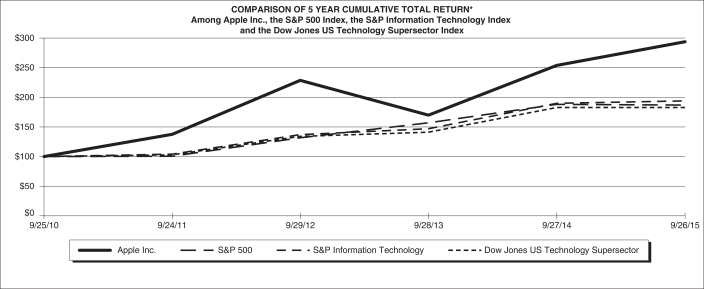
| * | $100 invested on 9/25/10 in stock or index, including reinvestment of dividends. Data points are the last day of each fiscal year for the Company’s common stock and September 30th for indexes. |
|---|
Copyright© 2015 S&P, a division of McGraw Hill Financial. All rights reserved.
Copyright© 2015 Dow Jones & Co. All rights reserved.
| September 2010 | September 2011 | September 2012 | September 2013 | September 2014 | September 2015 | |||||||||||||||||||
| Apple Inc. | $ | 100 | $ | 138 | $ | 229 | $ | 170 | $ | 254 | $ | 294 | ||||||||||||
| S&P 500 Index | $ | 100 | $ | 101 | $ | 132 | $ | 157 | $ | 188 | $ | 187 | ||||||||||||
| S&P Information Technology Index | $ | 100 | $ | 104 | $ | 137 | $ | 147 | $ | 190 | $ | 194 | ||||||||||||
| Dow Jones U.S. Technology Supersector Index | $ | 100 | $ | 103 | $ | 134 | $ | 141 | $ | 183 | $ | 183 |
Apple Inc. | 2015 Form 10-K | 21
Table of Contents
Item 6. Selected Financial Data
| --- | --- |
The information set forth below for the five years ended September 26, 2015, is not necessarily indicative of results of future operations, and should be read in conjunction with Part II, Item 7, “Management’s Discussion and Analysis of Financial Condition and Results of Operations” and the consolidated financial statements and related notes thereto included in Part II, Item 8 of this Form 10-K to fully understand factors that may affect the comparability of the information presented below (in millions, except number of shares, which are reflected in thousands, and per share amounts).
| 2015 | 2014 | 2013 | 2012 | 2011 | ||||||||||||||||
| Net sales | $ | 233,715 | $ | 182,795 | $ | 170,910 | $ | 156,508 | $ | 108,249 | ||||||||||
| Net income | $ | 53,394 | $ | 39,510 | $ | 37,037 | $ | 41,733 | $ | 25,922 | ||||||||||
| Earnings per share: | ||||||||||||||||||||
| Basic | $ | 9.28 | $ | 6.49 | $ | 5.72 | $ | 6.38 | $ | 4.01 | ||||||||||
| Diluted | $ | 9.22 | $ | 6.45 | $ | 5.68 | $ | 6.31 | $ | 3.95 | ||||||||||
| Cash dividends declared per share | $ | 1.98 | $ | 1.82 | $ | 1.64 | $ | 0.38 | $ | 0 | ||||||||||
| Shares used in computing earnings per share: | ||||||||||||||||||||
| Basic | 5,753,421 | 6,085,572 | 6,477,320 | 6,543,726 | 6,469,806 | |||||||||||||||
| Diluted | 5,793,069 | 6,122,663 | 6,521,634 | 6,617,483 | 6,556,514 | |||||||||||||||
| Total cash, cash equivalents and marketable securities | $ | 205,666 | $ | 155,239 | $ | 146,761 | $ | 121,251 | $ | 81,570 | ||||||||||
| Total assets | $ | 290,479 | $ | 231,839 | $ | 207,000 | $ | 176,064 | $ | 116,371 | ||||||||||
| Commercial paper | $ | 8,499 | $ | 6,308 | $ | 0 | $ | 0 | $ | 0 | ||||||||||
| Total term debt (2) | $ | 55,963 | $ | 28,987 | $ | 16,960 | $ | 0 | $ | 0 | ||||||||||
| Other long-term obligations (1) | $ | 33,427 | $ | 24,826 | $ | 20,208 | $ | 16,664 | $ | 10,100 | ||||||||||
| Total liabilities | $ | 171,124 | $ | 120,292 | $ | 83,451 | $ | 57,854 | $ | 39,756 | ||||||||||
| Total shareholders’ equity | $ | 119,355 | $ | 111,547 | $ | 123,549 | $ | 118,210 | $ | 76,615 |
| (1) | Other long-term obligations exclude non-current deferred revenue. |
|---|
| (2) | Includes current and long-term portion of term debt. |
|---|
Apple Inc. | 2015 Form 10-K | 22
Table of Contents
Item 7. Management’s Discussion and Analysis of Financial Condition and Results of Operations
| --- | --- |
This section and other parts of this Annual Report on Form 10-K (“Form 10-K”) contain forward-looking statements, within the meaning of the Private Securities Litigation Reform Act of 1995, that involve risks and uncertainties. Forward-looking statements provide current expectations of future events based on certain assumptions and include any statement that does not directly relate to any historical or current fact. Forward-looking statements can also be identified by words such as “future,” “anticipates,” “believes,” “estimates,” “expects,” “intends,” “plans,” “predicts,” “will,” “would,” “could,” “can,” “may,” and similar terms. Forward-looking statements are not guarantees of future performance and the Company’s actual results may differ significantly from the results discussed in the forward-looking statements. Factors that might cause such differences include, but are not limited to, those discussed in Part I, Item 1A of this Form 10-K under the heading “Risk Factors,” which are incorporated herein by reference. The following discussion should be read in conjunction with the consolidated financial statements and notes thereto included in Part II, Item 8 of this Form 10-K. All information presented herein is based on the Company’s fiscal calendar. Unless otherwise stated, references to particular years, quarters, months or periods refer to the Company’s fiscal years ended in September and the associated quarters, months and periods of those fiscal years. Each of the terms the “Company” and “Apple” as used herein refers collectively to Apple Inc. and its wholly-owned subsidiaries, unless otherwise stated. The Company assumes no obligation to revise or update any forward-looking statements for any reason, except as required by law.
Overview and Highlights
The Company designs, manufactures and markets mobile communication and media devices, personal computers and portable digital music players, and sells a variety of related software, services, accessories, networking solutions and third-party digital content and applications. The Company sells its products worldwide through its retail stores, online stores and direct sales force, as well as through third-party cellular network carriers, wholesalers, retailers and value-added resellers. In addition, the Company sells a variety of third-party Apple compatible products, including application software and various accessories through its online and retail stores. The Company sells to consumers, small and mid-sized businesses and education, enterprise and government customers.
Fiscal 2015 Highlights
Net sales rose 28% or $50.9 billion during 2015 compared to 2014, driven by a 52% year-over-year increase in iPhone® net sales. iPhone net sales and unit sales in 2015 increased in all of the Company’s reportable operating segments. The Company also experienced year-over-year net sales increases in Mac®, Services and Other Products. Apple Watch®, which launched during the third quarter of 2015, accounted for more than 100% of the year-over-year growth in net sales of Other Products. Net sales growth during 2015 was partially offset by the effect of weakness in most foreign currencies relative to the U.S. dollar and lower iPad® net sales. Total net sales increased in each of the Company’s reportable operating segments, with particularly strong growth in Greater China where year-over-year net sales increased 84%.
In April 2015, the Company announced a significant increase to its capital return program by raising the expected total size of the program to $200 billion through March 2017. This included increasing its share repurchase authorization to $140 billion and raising its quarterly dividend to $0.52 per share beginning in May 2015. During 2015, the Company spent $36.0 billion to repurchase shares of its common stock and paid dividends and dividend equivalents of $11.6 billion. Additionally, the Company issued $14.5 billion of U.S. dollar-denominated, €4.8 billion of euro-denominated, SFr1.3 billion of Swiss franc-denominated, £1.3 billion of British pound-denominated, A$2.3 billion of Australian dollar-denominated and ¥250.0 billion of Japanese yen-denominated term debt during 2015.
Fiscal 2014 Highlights
Net sales rose 7% or $11.9 billion during 2014 compared to 2013. This was driven by increases in net sales of iPhone, Mac and Services. Net sales and unit sales increased for iPhone primarily due to the successful introduction of iPhone 5s and 5c in the latter half of calendar year 2013, the successful launch of iPhone 6 and 6 Plus beginning in the fourth quarter of 2014, and expanded distribution. Mac net sales and unit sales increased primarily due to strong demand for MacBook Air® and MacBook Pro® which were updated in 2014 with faster processors and offered at lower prices. Net sales of Services grew primarily due to increased revenue from sales through the App Store®, AppleCare® and licensing. Growth in these areas was partially offset by the year-over-year decline in net sales for iPad due to lower unit sales in many markets, and a decline in net sales of Other Products. All of the Company’s operating segments other than the Rest of Asia Pacific segment experienced increased net sales in 2014, with growth being strongest in the Greater China and Japan operating segments.
During 2014, the Company completed various business acquisitions, including the acquisitions of Beats Music, LLC, which offers a subscription streaming music service, and Beats Electronics, LLC, which makes Beats® headphones, speakers and audio software.
Apple Inc. | 2015 Form 10-K | 23
Table of Contents
In April 2014, the Company increased its share repurchase authorization to $90 billion and the quarterly dividend was raised to $0.47 per common share, resulting in an overall increase in its capital return program from $100 billion to over $130 billion. During 2014, the Company utilized $45 billion to repurchase its common stock and paid dividends and dividend equivalents of $11.1 billion. The Company also issued $12.0 billion of long-term debt during 2014, with varying maturities through 2044, and launched a commercial paper program, with $6.3 billion outstanding as of September 27, 2014.
Sales Data
The following table shows net sales by operating segment and net sales and unit sales by product during 2015, 2014 and 2013 (dollars in millions and units in thousands):
| 2015 | Change | 2014 | Change | 2013 | ||||||||||||||||
| Net Sales by Operating Segment: | ||||||||||||||||||||
| Americas | $ | 93,864 | 17% | $ | 80,095 | 4% | $ | 77,093 | ||||||||||||
| Europe | 50,337 | 14% | 44,285 | 8% | 40,980 | |||||||||||||||
| Greater China | 58,715 | 84% | 31,853 | 18% | 27,016 | |||||||||||||||
| Japan | 15,706 | 3% | 15,314 | 11% | 13,782 | |||||||||||||||
| Rest of Asia Pacific | 15,093 | 34% | 11,248 | (7)% | 12,039 | |||||||||||||||
| Total net sales | $ | 233,715 | 28% | $ | 182,795 | 7% | $ | 170,910 | ||||||||||||
| Net Sales by Product: | ||||||||||||||||||||
| iPhone (1) | $ | 155,041 | 52% | $ | 101,991 | 12% | $ | 91,279 | ||||||||||||
| iPad (1) | 23,227 | (23)% | 30,283 | (5)% | 31,980 | |||||||||||||||
| Mac (1) | 25,471 | 6% |
Showing the first 8K of 68K characters. Open the full section
Item 7A. Quantitative and Qualitative Disclosures About Market Risk
| --- | --- |
Interest Rate and Foreign Currency Risk Management
The Company regularly reviews its foreign exchange forward and option positions and interest rate swaps, both on a stand-alone basis and in conjunction with its underlying foreign currency and interest rate related exposures. Given the effective horizons of the Company’s risk management activities and the anticipatory nature of the exposures, there can be no assurance these positions will offset more than a portion of the financial impact resulting from movements in either foreign exchange or interest rates. Further, the recognition of the gains and losses related to these instruments may not coincide with the timing of gains and losses related to the underlying economic exposures and, therefore, may adversely affect the Company’s financial condition and operating results.
Interest Rate Risk
The Company’s exposure to changes in interest rates relates primarily to the Company’s investment portfolio and outstanding debt. While the Company is exposed to global interest rate fluctuations, the Company’s interest income and expense are most sensitive to fluctuations in U.S. interest rates. Changes in U.S. interest rates affect the interest earned on the Company’s cash, cash equivalents and marketable securities and the fair value of those securities, as well as costs associated with hedging and interest paid on the Company’s debt.
The Company’s investment policy and strategy are focused on preservation of capital and supporting the Company’s liquidity requirements. The Company uses a combination of internal and external management to execute its investment strategy and achieve its investment objectives. The Company typically invests in highly-rated securities, and its investment policy generally limits the amount of credit exposure to any one issuer. The policy requires investments generally to be investment grade, with the primary objective of minimizing the potential risk of principal loss. To provide a meaningful assessment of the interest rate risk associated with the Company’s investment portfolio, the Company performed a sensitivity analysis to determine the impact a change in interest rates would have on the value of the investment portfolio assuming a 100 basis point parallel shift in the yield curve. Based on investment positions as of September 26, 2015 and September 27, 2014, a hypothetical 100 basis point increase in interest rates across all maturities would result in a $4.3 billion and $3.4 billion incremental decline in the fair market value of the portfolio, respectively. Such losses would only be realized if the Company sold the investments prior to maturity.
As of September 26, 2015 and September 27, 2014, the Company had outstanding floating- and fixed-rate notes with varying maturities for an aggregate carrying amount of $56.0 billion and $29.0 billion, respectively. The Company has entered, and may enter in the future, into interest rate swaps to manage interest rate risk on its outstanding term debt. Interest rate swaps allow the Company to effectively convert fixed-rate payments into floating-rate payments or floating-rate payments into fixed-rate payments. Gains and losses on these instruments are generally offset by the corresponding losses and gains on the related hedging instrument. A 100 basis point increase in market interest rates would cause interest expense on the Company’s debt as of September 26, 2015 and September 27, 2014 to increase by $200 million and $110 million on an annualized basis, respectively.
Further details regarding the Company’s debt is provided in Part II, Item 8 of this Form 10-K in the Notes to Consolidated Financial Statements in Note 6, “Debt.”
Foreign Currency Risk
In general, the Company is a net receiver of currencies other than the U.S. dollar. Accordingly, changes in exchange rates, and in particular a strengthening of the U.S. dollar, will negatively affect the Company’s net sales and gross margins as expressed in U.S. dollars. There is a risk that the Company will have to adjust local currency product pricing due to competitive pressures when there have been significant volatility in foreign currency exchange rates.
The Company may enter into foreign currency forward and option contracts with financial institutions to protect against foreign exchange risks associated with certain existing assets and liabilities, certain firmly committed transactions, forecasted future cash flows and net investments in foreign subsidiaries. In addition, the Company has entered, and may enter in the future, into non-designated foreign currency contracts to partially offset the foreign currency exchange gains and losses on its foreign-denominated debt issuances. The Company’s practice is to hedge a portion of its material foreign exchange exposures, typically for up to 12 months. However, the Company may choose not to hedge certain foreign exchange exposures for a variety of reasons, including but not limited to accounting considerations and the prohibitive economic cost of hedging particular exposures.
Apple Inc. | 2015 Form 10-K | 36
Table of Contents
To provide a meaningful assessment of the foreign currency risk associated with certain of the Company’s foreign currency derivative positions, the Company performed a sensitivity analysis using a value-at-risk (“VAR”) model to assess the potential impact of fluctuations in exchange rates. The VAR model consisted of using a Monte Carlo simulation to generate thousands of random market price paths assuming normal market conditions. The VAR is the maximum expected loss in fair value, for a given confidence interval, to the Company’s foreign currency derivative positions due to adverse movements in rates. The VAR model is not intended to represent actual losses but is used as a risk estimation and management tool. The model assumes normal market conditions. Forecasted transactions, firm commitments and assets and liabilities denominated in foreign currencies were excluded from the model. Based on the results of the model, the Company estimates with 95% confidence a maximum one-day loss in fair value of $342 million as of September 26, 2015 compared to a maximum one-day loss in fair value of $240 million as of September 27, 2014. Because the Company uses foreign currency instruments for hedging purposes, the loss in fair value incurred on those instruments are generally offset by increases in the fair value of the underlying exposures.
Actual future gains and losses associated with the Company’s investment portfolio and derivative positions may differ materially from the sensitivity analyses performed as of September 26, 2015 due to the inherent limitations associated with predicting the timing and amount of changes in interest rates, foreign currency exchanges rates and the Company’s actual exposures and positions.
Apple Inc. | 2015 Form 10-K | 37
Table of Contents
Item 8. Financial Statements and Supplementary Data
| --- | --- |
All financial statement schedules have been omitted, since the required information is not applicable or is not present in amounts sufficient to require submission of the schedule, or because the information required is included in the consolidated financial statements and notes thereto.
Apple Inc. | 2015 Form 10-K | 38
Table of Contents
CONSOLIDATED STATEMENTS OF OPERATIONS
(In millions, except number of shares which are reflected in thousands and per share amounts)
| Years ended | ||||||||||||
| September 26, 2015 | September 27, 2014 | September 28, 2013 | ||||||||||
| Net sales | $ | 233,715 | $ | 182,795 | $ | 170,910 | ||||||
| Cost of sales | 140,089 | 112,258 | 106,606 | |||||||||
| Gross margin | 93,626 | 70,537 | 64,304 | |||||||||
| Operating expenses: | ||||||||||||
| Research and development | 8,067 | 6,041 | 4,475 | |||||||||
| Selling, general and administrative | 14,329 | 11,993 | 10,830 | |||||||||
| Total operating expenses | 22,396 | 18,034 | 15,305 | |||||||||
| Operating income | 71,230 | 52,503 | 48,999 | |||||||||
| Other income/(expense), net | 1,285 | 980 | 1,156 | |||||||||
| Income before provision for income taxes | 72,515 | 53,483 | 50,155 | |||||||||
| Provision for income taxes | 19,121 | 13,973 | 13,118 | |||||||||
| Net income | $ | 53,394 | $ | 39,510 | $ | 37,037 | ||||||
| Earnings per share: | ||||||||||||
| Basic | $ | 9.28 | $ | 6.49 | $ | 5.72 | ||||||
| Diluted | $ | 9.22 | $ | 6.45 | $ | 5.68 | ||||||
| Shares used in computing earnings per share: | ||||||||||||
| Basic | 5,753,421 | 6,085,572 | 6,477,320 | |||||||||
| Diluted | 5,793,069 | 6,122,663 | 6,521,634 | |||||||||
| Cash dividends declared per share | $ | 1.98 | $ | 1.82 | $ | 1.64 |
See accompanying Notes to Consolidated Financial Statements.
Apple Inc. | 2015 Form 10-K | 39
Table of Contents
CONSOLIDATED STATEMENTS OF COMPREHENSIVE INCOME
(In millions)
| Years ended | ||||||||||||
| September 26, 2015 | September 27, 2014 | September 28, 2013 | ||||||||||
| Net income | $ | 53,394 | $ | 39,510 | $ | 37,037 | ||||||
| Other comprehensive income/(loss): | ||||||||||||
| Change in foreign currency translation, net of tax effects of $201, $50 and $35, respectively | (411 | ) | (137 | ) | (112 | ) | ||||||
| Change in unrealized gains/losses on derivative instruments: | ||||||||||||
| Change in fair value of derivatives, net of tax benefit/(expense) of $(441), $(297) and $(351), respectively | 2,905 | 1,390 | 522 | |||||||||
| Adjustment for net (gains)/losses realized and included in net income, net of tax expense/(benefit) of $630, $(36) and $255, respectively | (3,497 | ) | 149 | (458 | ) | |||||||
| Total change in unrealized gains/losses on derivative instruments, net of tax | (592 | ) | 1,539 | 64 | ||||||||
| Change in unrealized gains/losses on marketable securities: | ||||||||||||
| Change in fair value of marketable securities, net of tax benefit/(expense) of $264, $(153) and $458, respectively | (483 | ) | 285 | (791 | ) | |||||||
| Adjustment for net (gains)/losses realized and included in net income, net of tax expense/(benefit) of $(32), $71 and $82, respectively | 59 | (134 | ) | (131 | ) | |||||||
| Total change in unrealized gains/losses on marketable securities, net of tax | (424 | ) | 151 | (922 | ) | |||||||
| Total other comprehensive income/(loss) | (1,427 | ) | 1,553 | (970 | ) | |||||||
| Total comprehensive income | $ | 51,967 | $ | 41,063 | $ | 36,067 | ||||||
See accompanying Notes to Consolidated Financial Statements.
Apple Inc. | 2015 Form 10-K | 40
Table of Contents
CONSOLIDATED BALANCE SHEETS
(In millions, except number of shares which are reflected in thousands and par value)
| September 26, 2015 | September 27, 2014 | |||||||
| ASSETS: | ||||||||
| Current assets: | ||||||||
| Cash and cash equivalents | $ | 21,120 | $ | 13,844 | ||||
| Short-term marketable securities | 20,481 | 11,233 | ||||||
| Accounts receivable, less allowances of $82 and $86, respectively | 16,849 | 17,460 | ||||||
| Inventories | 2,349 | 2,111 | ||||||
| Deferred tax assets | 5,546 | 4,318 | ||||||
| Vendor non-trade receivables | 13,494 | 9,759 | ||||||
| Other current assets | 9,539 | 9,806 | ||||||
| Total current assets | 89,378 | 68,531 | ||||||
| Long-term marketable securities | 164,065 | 130,162 | ||||||
| Property, plant and equipment, net | 22,471 | 20,624 | ||||||
| Goodwill | 5,116 | 4,616 | ||||||
| Acquired intangible assets, net | 3,893 | 4,142 | ||||||
| Other assets | 5,556 | 3,764 | ||||||
| Total assets | $ | 290,479 | $ | 231,839 | ||||
| LIABILITIES AND SHAREHOLDERS’ EQUITY: | ||||||||
| Current liabilities: | ||||||||
| Accounts payable | $ | 35,490 | $ | 30,196 | ||||
| Accrued expenses | 25,181 | 18,453 | ||||||
| Defe |
Showing the first 8K of 145K characters. Open the full section
Item 9. Changes in and Disagreements with Accountants on Accounting and Financial Disclosure
| --- | --- |
None.
Item 9A. Controls and Procedures
| --- | --- |
Evaluation of Disclosure Controls and Procedures
Based on an evaluation under the supervision and with the participation of the Company’s management, the Company’s principal executive officer and principal financial officer have concluded that the Company’s disclosure controls and procedures as defined in Rules 13a-15(e) and 15d-15(e) under the Securities Exchange Act of 1934, as amended (the “Exchange Act”) were effective as of September 26, 2015 to provide reasonable assurance that information required to be disclosed by the Company in reports that it files or submits under the Exchange Act is (i) recorded, processed, summarized and reported within the time periods specified in the Securities and Exchange Commission rules and forms and (ii) accumulated and communicated to the Company’s management, including its principal executive officer and principal financial officer, as appropriate to allow timely decisions regarding required disclosure.
Inherent Limitations Over Internal Controls
The Company’s internal control over financial reporting is designed to provide reasonable assurance regarding the reliability of financial reporting and the preparation of financial statements for external purposes in accordance with U.S. generally accepted accounting principles (“GAAP”). The Company’s internal control over financial reporting includes those policies and procedures that:
| (i) | pertain to the maintenance of records that, in reasonable detail, accurately and fairly reflect the transactions and dispositions of the Company’s assets; |
|---|
| (ii) | provide reasonable assurance that transactions are recorded as necessary to permit preparation of financial statements in accordance with GAAP, and that the Company’s receipts and expenditures are being made only in accordance with authorizations of the Company’s management and directors; and |
|---|
| (iii) | provide reasonable assurance regarding prevention or timely detection of unauthorized acquisition, use, or disposition of the Company’s assets that could have a material effect on the financial statements. |
|---|
Management, including the Company’s Chief Executive Officer and Chief Financial Officer, does not expect that the Company’s internal controls will prevent or detect all errors and all fraud. A control system, no matter how well designed and operated, can provide only reasonable, not absolute, assurance that the objectives of the control system are met. Further, the design of a control system must reflect the fact that there are resource constraints, and the benefits of controls must be considered relative to their costs. Because of the inherent limitations in all control systems, no evaluation of internal controls can provide absolute assurance that all control issues and instances of fraud, if any, have been detected. Also, any evaluation of the effectiveness of controls in future periods are subject to the risk that those internal controls may become inadequate because of changes in business conditions, or that the degree of compliance with the policies or procedures may deteriorate.
Management’s Annual Report on Internal Control Over Financial Reporting
The Company’s management is responsible for establishing and maintaining adequate internal control over financial reporting (as defined in Rule 13a-15(f) under the Exchange Act). Management conducted an assessment of the effectiveness of the Company’s internal control over financial reporting based on the criteria set forth in Internal Control – Integrated Framework issued by the Committee of Sponsoring Organizations of the Treadway Commission (2013 framework). Based on the Company’s assessment, management has concluded that its internal control over financial reporting was effective as of September 26, 2015 to provide reasonable assurance regarding the reliability of financial reporting and the preparation of financial statements in accordance with GAAP. The Company’s independent registered public accounting firm, Ernst & Young LLP, has issued an audit report on the Company’s internal control over financial reporting, which appears in Part II, Item 8 of this Form 10-K.
Changes in Internal Control Over Financial Reporting
There were no changes in the Company’s internal control over financial reporting during the fourth quarter of 2015, which were identified in connection with management’s evaluation required by paragraph (d) of rules 13a-15 and 15d-15 under the Exchange Act, that have materially affected, or are reasonably likely to materially affect, the Company’s internal control over financial reporting.
Item 9B. Other Information
Item 10. Directors, Executive Officers and Corporate Governance
| --- | --- |
The information required by this Item is set forth under the headings “Directors, Corporate Governance and Executive Officers” in the Company’s 2016 Proxy Statement to be filed with the U.S. Securities and Exchange Commission (the “SEC”) within 120 days after September 26, 2015 in connection with the solicitation of proxies for the Company’s 2016 annual meeting of shareholders and is incorporated herein by reference.
The Company has a code of ethics, “Business Conduct: The way we do business worldwide,” that applies to all employees, including the Company’s principal executive officer, principal financial officer, and principal accounting officer, as well as to the members of the Board of Directors of the Company. The code is available at investor.apple.com/corporate-governance.cfm. The Company intends to disclose any changes in, or waivers from, this code by posting such information on the same website or by filing a Form 8-K, in each case to the extent such disclosure is required by rules of the SEC or the NASDAQ Stock Market LLC.
Item 11. Executive Compensation
| --- | --- |
The information required by this Item is set forth under the heading “Executive Compensation” and under the subheadings “Board Oversight of Risk Management,” “Compensation Committee Interlocks and Insider Participation,” “Compensation of Directors” and “Director Compensation-2015” under the heading “Directors, Corporate Governance and Executive Officers” in the Company’s 2016 Proxy Statement to be filed with the SEC within 120 days after September 26, 2015 and is incorporated herein by reference.
Item 12. Security Ownership of Certain Beneficial Owners and Management and Related Stockholder Matters
| --- | --- |
The information required by this Item is set forth under the headings “Security Ownership of Certain Beneficial Owners and Management” and “Equity Compensation Plan Information” in the Company’s 2016 Proxy Statement to be filed with the SEC within 120 days after September 26, 2015 and is incorporated herein by reference.
Item 13. Certain Relationships and Related Transactions, and Director Independence
| --- | --- |
The information required by this Item is set forth under the subheadings “Board Committees”, “Review, Approval or Ratification of Transactions with Related Persons” and “Transactions with Related Persons” under the heading “Directors, Corporate Governance and Executive Officers” in the Company’s 2016 Proxy Statement to be filed with the SEC within 120 days after September 26, 2015 and is incorporated herein by reference.
Item 14. Principal Accounting Fees and Services
| --- | --- |
The information required by this Item is set forth under the subheadings “Fees Paid to Auditors” and “Policy on Audit Committee Pre-Approval of Audit and Non-Audit Services Performed by the Independent Registered Public Accounting Firm” under the proposal “Ratification of Appointment of Independent Registered Public Accounting Firm” in the Company’s 2016 Proxy Statement to be filed with the SEC within 120 days after September 26, 2015 and is incorporated herein by reference.
Apple Inc. | 2015 Form 10-K | 72
Table of Contents
PART IV
Item 15. Exhibits, Financial Statement Schedules
| --- | --- |
| (a) | Documents filed as part of this report |
|---|
| (1) | All financial statements |
|---|
| (2) | Financial Statement Schedules |
|---|
All financial statement schedules have been omitted, since the required information is not applicable or is not present in amounts sufficient to require submission of the schedule, or because the information required is included in the consolidated financial statements and notes thereto included in this Form 10-K.
| (3) | Exhibits required by Item 601 of Regulation S-K |
|---|
The information required by this Section (a)(3) of Item 15 is set forth on the exhibit index that follows the Signatures page of this Form 10-K.
Apple Inc. | 2015 Form 10-K | 73
Table of Contents
SIGNATURES
Pursuant to the requirements of Section 13 or 15(d) of the Securities Exchange Act of 1934, the Registrant has duly caused this report to be signed on its behalf by the undersigned, thereunto duly authorized.
Date: October 28, 2015
| Apple Inc. | ||
| By: | /s/ Luca Maestri | |
| Luca Maestri | ||
| Senior Vice President, Chief Financial Officer |
Power of Attorney
KNOW ALL PERSONS BY THESE PRESENTS, that each person whose signature appears below constitutes and appoints Timothy D. Cook and Luca Maestri, jointly and severally, his or her attorneys-in-fact, each with the power of substitution, for him or her in any and all capacities, to sign any amendments to this Annual Report on Form 10-K, and to file the same, with exhibits thereto and other documents in connection therewith, with the Securities and Exchange Commission, hereby ratifying and confirming all that each of said attorneys-in-fact, or his substitute or substitutes, may do or cause to be done by virtue hereof.
Pursuant to the requirements of the Securities Exchange Act of 1934, this report has been signed below by the following persons on behalf of the Registrant and in the capacities and on the dates indicated:
| Name | Title | Date | ||
| /s/ Timothy D. Cook TIMOTHY D. COOK | Chief Executive Officer and Director (Principal Executive Officer) | October 28, 2015 | ||
| /s/ Luca Maestri LUCA MAESTRI | Senior Vice President, Chief Financial Officer (Principal Financial Officer) | October 28, 2015 | ||
| /s/ Chris Kondo CHRIS KONDO | Senior Director of Corporate Accounting (Principal Accounting Officer) | October 28, 2015 | ||
| /s/ Al Gore AL GORE | Director | October 28, 2015 | ||
| /s/ Robert A. Iger ROBERT A. IGER | Director | October 28, 2015 | ||
| /s/ Andrea Jung ANDREA JUNG | Director | October 28, 2015 | ||
| /s/ Arthur D. Levinson ARTHUR D. LEVINSON | Director | October 28, 2015 | ||
| /s/ Ronald D. Sugar RONALD D. SUGAR | Director | October 28, 2015 | ||
| /s/ Susan L. Wagner SUSAN L. WAGNER | Director | October 28, 2015 |
Apple Inc. | 2015 Form 10-K | 74
Table of Contents
EXHIBIT INDEX (1)
| Incorporated by Reference | ||||||||
| Exhibit Number | Exhibit Description | Form | Exhibit | Filing Date/ Period End Date | ||||
| 3.1 | Restated Articles of Incorporation of the Registrant effective as of June 6, 2014. | 8-K | 3.1 | 6/6/14 | ||||
| 3.2 | Amended and Restated Bylaws of the Registrant effective as of February 28, 2014. | 8-K | 3.2 | 3/5/14 | ||||
| 4.1 | Form of Common Stock Certificate of the Registrant. | 10-Q | 4.1 | 12/30/06 | ||||
| 4.2 | Indenture, dated as of April 29, 2013, between the Registrant and The Bank of New York Mellon Trust Company, N.A., as Trustee. | S-3 | 4.1 | 4/29/13 | ||||
| 4.3 | Officer’s Certificate of the Registrant, dated as of May 3, 2013, including forms of global notes representing the Floating Rate Notes due 2016, Floating Rate Notes due 2018, 0.45% Notes due 2016, 1.00% Notes due 2018, 2.40% Notes due 2023 and 3.85% Notes due 2043. | 8-K | 4.1 | 5/3/13 | ||||
| 4.4 | Officer’s Certificate of the Registrant, dated as of May 6, 2014, including forms of global notes representing the Floating Rate Notes due 2017, Floating Rate Notes due 2019, 1.05% Notes due 2017, 2.10% Notes due 2019, 2.85% Notes due 2021, 3.45% Notes due 2024 and 4.45% Notes due 2044. | 8-K | 4.1 | 5/6/14 | ||||
| 4.5 | Officer’s Certificate of the Registrant, dated as of November 10, 2014, including forms of global notes representing the 1.000% Notes due 2022 and 1.625% Notes due 2026. | 8-K | 4.1 | 11/10/14 | ||||
| 4.6 | Officer’s Certificate of the Registrant, dated as of February 9, 2015, including forms of global notes representing the Floating Rate Notes due 2020, 1.55% Notes due 2020, 2.15% Notes due 2022, 2.50% Notes due 2025 and 3.45% Notes due 2045. | 8-K | 4.1 | 2/9/15 | ||||
| 4.7 | Officer’s Certificate of the Registrant, dated as of May 13, 2015, including forms of global notes representing the Floating Rate Notes due 2017, Floating Rate Notes due 2020, 0.900% Notes due 2017, 2.000% Notes due 2020, 2.700% Notes due 2022, 3.200% Notes due 2025, and 4.375% Notes due 2045. | 8-K | 4.1 | 5/13/15 | ||||
| 4.8 | Officer’s Certificate of the Registrant, dated as of June 10, 2015, including forms of global notes representing the 0.35% Notes due 2020. | 8-K | 4.1 | 6/10/15 | ||||
| 4.9 | Officer’s Certificate of the Registrant, dated as of July 31, 2015, including forms of global notes representing the 3.05% Notes due 2029 and 3.60% Notes due 2042. | 8-K | 4.1 | 7/31/15 | ||||
| 4.10 | Officer’s Certificate of the Registrant, dated as of September 17, 2015, including forms of global notes representing the 1.375% Notes due 2024 and 2.000% Notes due 2027. | 8-K | 4.1 | 9/17/15 | ||||
| 10.1* | Employee Stock Purchase Plan, as amended and restated as of March 10, 2015. | 8-K | 10.1 | 3/13/15 | ||||
| 10.2* | Form of Indemnification Agreement between the Registrant and each director and executive officer of the Registrant. | 10-Q | 10.2 | 6/27/09 | ||||
| 10.3* | 1997 Director Stock Plan, as amended through August 23, 2012. | 10-Q | 10.3 | 12/28/13 | ||||
| 10.4* | 2003 Employee Stock Plan, as amended through February 25, 2010. | 8-K | 10.1 | 3/1/10 | ||||
| 10.5* | Form of Restricted Stock Unit Award Agreement under 2003 Employee Stock Plan effective as of November 16, 2010. | 10-Q | 10.10 | 12/25/10 | ||||
| 10.6* | Form of Restricted Stock Unit Award Agreement under 2003 Employee Stock Plan effective as of April 6, 2012. | 10-Q | 10.8 | 3/31/12 |
Apple Inc. | 2015 Form 10-K | 75
Table of Contents
| Incorporated by Reference | ||||||||
| Exhibit Number | Exhibit Description | Form | Exhibit | Filing Date/ Period End Date | ||||
| 10.7* | Summary Description of Amendment, effective as of May 24, 2012, to certain Restricted Stock Unit Award Agreements outstanding as of April 5, 2012. | 10-Q | 10.8 | 6/30/12 | ||||
| 10.8* | 2014 Employee Stock Plan. | 8-K | 10.1 | 3/5/14 | ||||
| 10.9* | Form of Restricted Stock Unit Award Agreement under 2014 Employee Stock Plan as of February 28, 2014. | 8-K | 10.2 | 3/5/14 | ||||
| 10.10* | Form of Performance Award Agreement under 2014 Employee Stock Plan effective as of February 28, 2014. | 8-K | 10.3 | 3/5/14 | ||||
| 10.11* | Form of Restricted Stock Unit Award Agreement under 2014 Employee Stock Plan effective as of August 26, 2014. | 10-K | 10.11 | 9/27/14 | ||||
| 10.12* | Form of Performance Award Agreement under 2014 Employee Stock Plan effective as of August 26, 2014. | 10-K | 10.12 | 9/27/14 | ||||
| 10.13* | Form of Amendment, effective as of August 26, 2014, to Restricted Stock Unit Award Agreements and Performance Award Agreements outstanding as of August 26, 2014. | 10-K | 10.13 | 9/27/14 | ||||
| 10.14* | Offer Letter, dated August 1, 2013, from the Registrant to Angela Ahrendts. | 10-Q | 10.14 | 12/27/14 | ||||
| 12.1** | Computation of Ratio of Earnings to Fixed Charges. | |||||||
| 21.1** | Subsidiaries of the Registrant. | |||||||
| 23.1** | Consent of Ernst & Young LLP, Independent Registered Public Accounting Firm. | |||||||
| 24.1** | Power of Attorney (included on the Signatures page of this Annual Report on Form 10-K). | |||||||
| 31.1** | Rule 13a-14(a) / 15d-14(a) Certification of Chief Executive Officer. | |||||||
| 31.2** | Rule 13a-14(a) / 15d-14(a) Certification of Chief Financial Officer. | |||||||
| 32.1*** | Section 1350 Certifications of Chief Executive Officer and Chief Financial Officer. | |||||||
| 101.INS** | XBRL Instance Document. | |||||||
| 101.SCH** | XBRL Taxonomy Extension Schema Document. | |||||||
| 101.CAL** | XBRL Taxonomy Extension Calculation Linkbase Document. | |||||||
| 101.DEF** | XBRL Taxonomy Extension Definition Linkbase Document. | |||||||
| 101.LAB** | XBRL Taxonomy Extension Label Linkbase Document. | |||||||
| 101.PRE** | XBRL Taxonomy Extension Presentation Linkbase Document. |
| * | Indicates management contract or compensatory plan or arrangement. |
|---|
| ** | Filed herewith. |
|---|
| *** | Furnished herewith. |
|---|
| (1) | Certain instruments defining the rights of holders of long-term debt securities of the Registrant are omitted pursuant to Item 601(b)(4)(iii) of Regulation S-K. The Registrant hereby undertakes to furnish to the SEC, upon request, copies of any such instruments. |
|---|
Apple Inc. | 2015 Form 10-K | 76