 filings.tools
Apple 10-K 2022-09-24
Filed 2022-10-28. 23 sections, 271K characters. Original on sec.gov · Markdown · JSON
Cover and table of contents
UNITED STATES
SECURITIES AND EXCHANGE COMMISSION
Washington, D.C. 20549
FORM 10-K
(Mark One)
☒ ANNUAL REPORT PURSUANT TO SECTION 13 OR 15(d) OF THE SECURITIES EXCHANGE ACT OF 1934
For the fiscal year ended September 24, 2022
or
☐ TRANSITION REPORT PURSUANT TO SECTION 13 OR 15(d) OF THE SECURITIES EXCHANGE ACT OF 1934
For the transition period from to .
Commission File Number: 001-36743

Apple Inc.
(Exact name of Registrant as specified in its charter)
| California | 94-2404110 | |||||||
| (State or other jurisdiction of incorporation or organization) | (I.R.S. Employer Identification No.) | |||||||
| One Apple Park Way | ||||||||
| Cupertino, California | 95014 | |||||||
| (Address of principal executive offices) | (Zip Code) |
(408) 996-1010
(Registrant’s telephone number, including area code)
Securities registered pursuant to Section 12(b) of the Act:
| Title of each class | Trading symbol(s) | Name of each exchange on which registered | ||||||
| Common Stock, $0.00001 par value per share | AAPL | The Nasdaq Stock Market LLC | ||||||
| 1.000% Notes due 2022 | — | The Nasdaq Stock Market LLC | ||||||
| 1.375% Notes due 2024 | — | The Nasdaq Stock Market LLC | ||||||
| 0.000% Notes due 2025 | — | The Nasdaq Stock Market LLC | ||||||
| 0.875% Notes due 2025 | — | The Nasdaq Stock Market LLC | ||||||
| 1.625% Notes due 2026 | — | The Nasdaq Stock Market LLC | ||||||
| 2.000% Notes due 2027 | — | The Nasdaq Stock Market LLC | ||||||
| 1.375% Notes due 2029 | — | The Nasdaq Stock Market LLC | ||||||
| 3.050% Notes due 2029 | — | The Nasdaq Stock Market LLC | ||||||
| 0.500% Notes due 2031 | — | The Nasdaq Stock Market LLC | ||||||
| 3.600% Notes due 2042 | — | The Nasdaq Stock Market LLC |
Securities registered pursuant to Section 12(g) of the Act: None
Indicate by check mark if the Registrant is a well-known seasoned issuer, as defined in Rule 405 of the Securities Act.
Yes ☒ No ☐
Indicate by check mark if the Registrant is not required to file reports pursuant to Section 13 or Section 15(d) of the Act.
Yes ☐ No ☒
Indicate by check mark whether the Registrant (1) has filed all reports required to be filed by Section 13 or 15(d) of the Securities Exchange Act of 1934 during the preceding 12 months (or for such shorter period that the Registrant was required to file such reports), and (2) has been subject to such filing requirements for the past 90 days.
Yes ☒ No ☐
Indicate by check mark whether the Registrant has submitted electronically every Interactive Data File required to be submitted pursuant to Rule 405 of Regulation S-T (§232.405 of this chapter) during the preceding 12 months (or for such shorter period that the Registrant was required to submit such files).
Yes ☒ No ☐
Indicate by check mark whether the Registrant is a large accelerated filer, an accelerated filer, a non-accelerated filer, a smaller reporting company, or an emerging growth company. See the definitions of “large accelerated filer,” “accelerated filer,” “smaller reporting company,” and “emerging growth company” in Rule 12b-2 of the Exchange Act.
| Large accelerated filer | ☒ | Accelerated filer | ☐ | |||||||||||||||||
| Non-accelerated filer | ☐ | Smaller reporting company | ☐ | |||||||||||||||||
| Emerging growth company | ☐ |
If an emerging growth company, indicate by check mark if the Registrant has elected not to use the extended transition period for complying with any new or revised financial accounting standards provided pursuant to Section 13(a) of the Exchange Act. ☐
Indicate by check mark whether the Registrant has filed a report on and attestation to its management’s assessment of the effectiveness of its internal control over financial reporting under Section 404(b) of the Sarbanes-Oxley Act (15 U.S.C. 7262(b)) by the registered public accounting firm that prepared or issued its audit report. ☒
Indicate by check mark whether the Registrant is a shell company (as defined in Rule 12b-2 of the Act).
Yes ☐ No ☒
The aggregate market value of the voting and non-voting stock held by non-affiliates of the Registrant, as of March 25, 2022, the last business day of the Registrant’s most recently completed second fiscal quarter, was approximately $2,830,067,000,000. Solely for purposes of this disclosure, shares of common stock held by executive officers and directors of the Registrant as of such date have been excluded because such persons may be deemed to be affiliates. This determination of executive officers and directors as affiliates is not necessarily a conclusive determination for any other purposes.
15,908,118,000 shares of common stock were issued and outstanding as of October 14, 2022.
DOCUMENTS INCORPORATED BY REFERENCE
Portions of the Registrant’s definitive proxy statement relating to its 2023 annual meeting of shareholders are incorporated by reference into Part III of this Annual Report on Form 10-K where indicated. The Registrant’s definitive proxy statement will be filed with the U.S. Securities and Exchange Commission within 120 days after the end of the fiscal year to which this report relates.
Apple Inc.
Form 10-K
For the Fiscal Year Ended September 24, 2022
TABLE OF CONTENTS
This Annual Report on Form 10-K (“Form 10-K”) contains forward-looking statements, within the meaning of the Private Securities Litigation Reform Act of 1995, that involve risks and uncertainties. Many of the forward-looking statements are located in Part I, Item 1 of this Form 10-K under the heading “Business” and Part II, Item 7 of this Form 10-K under the heading “Management’s Discussion and Analysis of Financial Condition and Results of Operations.” Forward-looking statements provide current expectations of future events based on certain assumptions and include any statement that does not directly relate to any historical or current fact. For example, statements in this Form 10-K regarding the potential future impact of the COVID-19 pandemic on the Company’s business and results of operations are forward-looking statements. Forward-looking statements can also be identified by words such as “future,” “anticipates,” “believes,” “estimates,” “expects,” “intends,” “plans,” “predicts,” “will,” “would,” “could,” “can,” “may,” and similar terms. Forward-looking statements are not guarantees of future performance and the Company’s actual results may differ significantly from the results discussed in the forward-looking statements. Factors that might cause such differences include, but are not limited to, those discussed in Part I, Item 1A of this Form 10-K under the heading “Risk Factors.” The Company assumes no obligation to revise or update any forward-looking statements for any reason, except as required by law.
Unless otherwise stated, all information presented herein is based on the Company’s fiscal calendar, and references to particular years, quarters, months or periods refer to the Company’s fiscal years ended in September and the associated quarters, months and periods of those fiscal years. Each of the terms the “Company” and “Apple” as used herein refers collectively to Apple Inc. and its wholly owned subsidiaries, unless otherwise stated.
PART I
Item 1. Business
Company Background
The Company designs, manufactures and markets smartphones, personal computers, tablets, wearables and accessories, and sells a variety of related services. The Company’s fiscal year is the 52- or 53-week period that ends on the last Saturday of September.
Products
iPhone
iPhone® is the Company’s line of smartphones based on its iOS operating system. The iPhone line includes iPhone 14 Pro, iPhone 14, iPhone 13, iPhone SE®, iPhone 12 and iPhone 11.
Mac
Mac® is the Company’s line of personal computers based on its macOS® operating system. The Mac line includes laptops MacBook Air® and MacBook Pro®, as well as desktops iMac®, Mac mini®, Mac Studio™ and Mac Pro®.
iPad
iPad® is the Company’s line of multipurpose tablets based on its iPadOS® operating system. The iPad line includes iPad Pro®, iPad Air®, iPad and iPad mini®.
Wearables, Home and Accessories
Wearables, Home and Accessories includes:
-
AirPods®, the Company’s wireless headphones, including AirPods, AirPods Pro® and AirPods Max™;
-
Apple TV®, the Company’s media streaming and gaming device based on its tvOS® operating system, including Apple TV 4K and Apple TV HD;
-
Apple Watch®, the Company’s line of smartwatches based on its watchOS® operating system, including Apple Watch Ultra™, Apple Watch Series 8 and Apple Watch SE®; and
-
Beats® products, HomePod mini® and accessories.
Apple Inc. | 2022 Form 10-K | 1
Services
Advertising
The Company’s advertising services include various third-party licensing arrangements and the Company’s own advertising platforms.
AppleCare
The Company offers a portfolio of fee-based service and support products under the AppleCare® brand. The offerings provide priority access to Apple technical support, access to the global Apple authorized service network for repair and replacement services, and in many cases additional coverage for instances of accidental damage and/or theft and loss, depending on the country and type of product.
Cloud Services
The Company’s cloud services store and keep customers’ content up-to-date and available across multiple Apple devices and Windows personal computers.
Digital Content
The Company operates various platforms, including the App Store®, that allow customers to discover and download applications and digital content, such as books, music, video, games and podcasts.
The Company also offers digital content through subscription-based services, including Apple Arcade®, a game subscription service; Apple Fitness+SM, a personalized fitness service; Apple Music®, which offers users a curated listening experience with on-demand radio stations; Apple News+®, a subscription news and magazine service; and Apple TV+®, which offers exclusive original content and live sports.
Payment Services
The Company offers payment services, including Apple Card®, a co-branded credit card, and Apple Pay®, a cashless payment service.
Markets and Distribution
The Company’s customers are primarily in the consumer, small and mid-sized business, education, enterprise and government markets. The Company sells its products and resells third-party products in most of its major markets directly to consumers, small and mid-sized businesses, and education, enterprise and government customers through its retail and online stores and its direct sales force. The Company also employs a variety of indirect distribution channels, such as third-party cellular network carriers, wholesalers, retailers and resellers. During 2022, the Company’s net sales through its direct and indirect distribution channels accounted for 38% and 62%, respectively, of total net sales.
Competition
The markets for the Company’s products and services are highly competitive, and are characterized by aggressive price competition and resulting downward pressure on gross margins, frequent introduction of new products and services, short product life cycles, evolving industry standards, continual improvement in product price and performance characteristics, rapid adoption of technological advancements by competitors, and price sensitivity on the part of consumers and businesses. Many of the Company’s competitors seek to compete primarily through aggressive pricing and very low cost structures, and by imitating the Company’s products and infringing on its intellectual property.
The Company’s ability to compete successfully depends heavily on ensuring the continuing and timely introduction of innovative new products, services and technologies to the marketplace. The Company designs and develops nearly the entire solution for its products, including the hardware, operating system, numerous software applications and related services. Principal competitive factors important to the Company include price, product and service features (including security features), relative price and performance, product and service quality and reliability, design innovation, a strong third-party software and accessories ecosystem, marketing and distribution capability, service and support, and corporate reputation.
Apple Inc. | 2022 Form 10-K | 2
The Company is focused on expanding its market opportunities related to smartphones, personal computers, tablets, wearables and accessories, and services. The Company faces substantial competition in these markets from companies that have significant technical, marketing, distribution and other resources, as well as established hardware, software, and service offerings with large customer bases. In addition, some of the Company’s competitors have broader product lines, lower-priced products and a larger installed base of active devices. Competition has been particularly intense as competitors have aggressively cut prices and lowered product margins. Certain competitors have the resources, experience or cost structures to provide products at little or no profit or even at a loss. The Company’s services compete with business models that provide content to users for free and use illegitimate means to obtain third-party digital content and applications. The Company faces significant competition as competitors imitate the Company’s product features and applications within their products, or collaborate to offer integrated solutions that are more competitive than those they currently offer.
Supply of Components
Although most components essential to the Company’s business are generally available from multiple sources, certain components are currently obtained from single or limited sources. The Company also competes for various components with other participants in the markets for smartphones, personal computers, tablets, wearables and accessories. Therefore, many components used by the Company, including those that are available from multiple sources, are at times subject to industry-wide shortage and significant commodity pricing fluctuations.
The Company uses some custom components that are not commonly used by its competitors, and new products introduced by the Company often utilize custom components available from only one source. When a component or product uses new technologies, initial capacity constraints may exist until the suppliers’ yields have matured or their manufacturing capacities have increased. The continued availability of these components at acceptable prices, or at all, may be affected if suppliers decide to concentrate on the production of common components instead of components customized to meet the Company’s requirements.
The Company has entered into agreements for the supply of many components; however, there can be no guarantee that the Company will be able to extend or renew these agreements on similar terms, or at all.
Substantially all of the Company’s hardware products are manufactured by outsourcing partners that are located primarily in Asia, with some Mac computers manufactured in the U.S. and Ireland.
Research and Development
Because the industries in which the Company competes are characterized by rapid technological advances, the Company’s ability to compete successfully depends heavily upon its ability to ensure a continual and timely flow of competitive products, services and technologies to the marketplace. The Company continues to develop new technologies to enhance existing products and services, and to expand the range of its offerings through research and development (“R&D”), licensing of intellectual property and acquisition of third-party businesses and technology.
Intellectual Property
The Company currently holds a broad collection of intellectual property rights relating to certain aspects of its hardware devices, accessories, software and services. This includes patents, designs, copyrights, trademarks and other forms of intellectual property rights in the U.S. and various foreign countries. Although the Company believes the ownership of such intellectual property rights is an important factor in differentiating its business and that its success does depend in part on such ownership, the Company relies primarily on the innovative skills, technical competence and marketing abilities of its personnel.
The Company regularly files patent, design, copyright and trademark applications to protect innovations arising from its research, development, design and marketing, and is currently pursuing thousands of applications around the world. Over time, the Company has accumulated a large portfolio of issued and registered intellectual property rights around the world. No single intellectual property right is solely responsible for protecting the Company’s products and services. The Company believes the duration of its intellectual property rights is adequate relative to the expected lives of its products and services.
In addition to Company-owned intellectual property, many of the Company’s products and services are designed to include intellectual property owned by third parties. It may be necessary in the future to seek or renew licenses relating to various aspects of the Company’s products, processes and services. While the Company has generally been able to obtain such licenses on commercially reasonable terms in the past, there is no guarantee that such licenses could be obtained in the future on reasonable terms or at all.
Apple Inc. | 2022 Form 10-K | 3
Business Seasonality and Product Introductions
The Company has historically experienced higher net sales in its first quarter compared to other quarters in its fiscal year due in part to seasonal holiday demand. Additionally, new product and service introductions can significantly impact net sales, cost of sales and operating expenses. The timing of product introductions can also impact the Company’s net sales to its indirect distribution channels as these channels are filled with new inventory following a product launch, and channel inventory of an older product often declines as the launch of a newer product approaches. Net sales can also be affected when consumers and distributors anticipate a product introduction.
Human Capital
The Company believes it has a talented, motivated and dedicated team, and works to create an inclusive, safe and supportive environment for all of its team members. As of September 24, 2022, the Company had approximately 164,000 full-time equivalent employees.
Workplace Practices and Policies
The Company is an equal opportunity employer committed to inclusion and diversity and to providing a workplace free of harassment or discrimination.
Compensation and Benefits
The Company believes that compensation should be competitive and equitable, and should enable employees to share in the Company’s success. The Company recognizes its people are most likely to thrive when they have the resources to meet their needs and the time and support to succeed in their professional and personal lives. In support of this, the Company offers a wide variety of benefits for employees around the world and invests in tools and resources that are designed to support employees’ individual growth and development.
Inclusion and Diversity
The Company remains committed to its vision to build and sustain a more inclusive workforce that is representative of the communities it serves. The Company continues to work to increase diverse representation at every level, foster an inclusive culture, and support equitable pay and access to opportunity for all employees.
Engagement
The Company believes that open and honest communication among team members, managers and leaders helps create an open, collaborative work environment where everyone can contribute, grow and succeed. Team members are encouraged to come to their managers with questions, feedback or concerns, and the Company conducts surveys that gauge employee sentiment in areas like career development, manager performance and inclusivity.
Health and Safety
The Company is committed to protecting its team members everywhere it operates. The Company identifies potential workplace risks in order to develop measures to mitigate possible hazards. The Company supports employees with general safety, security and crisis management training, and by putting specific programs in place for those working in potentially high-hazard environments. Additionally, the Company works to protect the safety and security of its team members, visitors and customers through its global security team. The Company has also taken additional health and safety measures during the COVID-19 pandemic.
Available Information
The Company’s Annual Reports on Form 10-K, Quarterly Reports on Form 10-Q, Current Reports on Form 8-K, and amendments to reports filed pursuant to Sections 13(a) and 15(d) of the Securities Exchange Act of 1934, as amended (the “Exchange Act”), are filed with the U.S. Securities and Exchange Commission (the “SEC”). Such reports and other information filed by the Company with the SEC are available free of charge at investor.apple.com/investor-relations/sec-filings/default.aspx when such reports are available on the SEC’s website. The Company periodically provides certain information for investors on its corporate website, www.apple.com, and its investor relations website, investor.apple.com. This includes press releases and other information about financial performance, information on environmental, social and governance matters, and details related to the Company’s annual meeting of shareholders. The information contained on the websites referenced in this Form 10-K is not incorporated by reference into this filing. Further, the Company’s references to website URLs are intended to be inactive textual references only.
Apple Inc. | 2022 Form 10-K | 4
Item 1A. Risk Factors
The Company’s business, reputation, results of operations, financial condition and stock price can be affected by a number of factors, whether currently known or unknown, including those described below. When any one or more of these risks materialize from time to time, the Company’s business, reputation, results of operations, financial condition and stock price can be materially and adversely affected.
Because of the following factors, as well as other factors affecting the Company’s results of operations and financial condition, past financial performance should not be considered to be a reliable indicator of future performance, and investors should not use historical trends to anticipate results or trends in future periods. This discussion of risk factors contains forward-looking statements.
This section should be read in conjunction with Part II, Item 7, “Management’s Discussion and Analysis of Financial Condition and Results of Operations” and the consolidated financial statements and accompanying notes in Part II, Item 8, “Financial Statements and Supplementary Data” of this Form 10-K.
Macroeconomic and Industry Risks
The Company’s operations and performance depend significantly on global and regional economic conditions and adverse economic conditions can materially adversely affect the Company’s business, results of operations and financial condition.
The Company has international operations with sales outside the U.S. representing a majority of the Company’s total net sales. In addition, the Company’s global supply chain is large and complex and a majority of the Company’s supplier facilities, including manufacturing and assembly sites, are located outside the U.S. As a result, the Company’s operations and performance depend significantly on global and regional economic conditions.
Adverse macroeconomic conditions, including inflation, slower growth or recession, new or increased tariffs and other barriers to trade, changes to fiscal and monetary policy, tighter credit, higher interest rates, high unemployment and currency fluctuations can adversely impact consumer confidence and spending and materially adversely affect demand for the Company’s products and services. In addition, consumer confidence and spending can be materially adversely affected in response to financial market volatility, negative financial news, conditions in the real estate and mortgage markets, declines in income or asset values, energy shortages and cost increases, labor and healthcare costs and other economic factors.
In addition to an adverse impact on demand for the Company’s products, uncertainty about, or a decline in, global or regional economic conditions can have a significant impact on the Company’s suppliers, contract manufacturers, logistics providers, distributors, cellular network carriers and other channel partners. Potential effects include financial instability; inability to obtain credit to finance operations and purchases of the Company’s products; and insolvency.
A downturn in the economic environment can also lead to increased credit and collectibility risk on the Company’s trade receivables; the failure of derivative counterparties and other financial institutions; limitations on the Company’s ability to issue new debt; reduced liquidity; and declines in the fair value of the Company’s financial instruments. These and other economic factors can materially adversely affect the Company’s business, results of operations, financial condition and stock price.
The Company’s business, results of operations, financial condition and stock price have been adversely affected and could in the future be materially adversely affected by the COVID-19 pandemic.
COVID-19 has had, and continues to have, a significant impact around the world, prompting governments and businesses to take unprecedented measures in response. Such measures have included restrictions on travel and business operations, temporary closures of businesses, and quarantine and shelter-in-place orders. The COVID-19 pandemic has at times significantly curtailed global economic activity and caused significant volatility and disruption in global financial markets.
The COVID-19 pandemic and the measures taken by many countries in response have adversely affected and could in the future materially adversely impact the Company’s business, results of operations, financial condition and stock price. During the course of the pandemic, certain of the Company’s component suppliers and manufacturing and logistical service providers have experienced disruptions, resulting in supply shortages that affected sales worldwide, and similar disruptions could occur in the future. Public safety measures can also adversely impact consumer demand for the Company’s products and services in affected areas.
Apple Inc. | 2022 Form 10-K | 5
The Company continues to monitor the situation and take appropriate actions in accordance with the recommendations and requirements of relevant authorities. The extent to which the COVID-19 pandemic may impact the Company’s operational and financial performance remains uncertain and will depend on many factors outside the Company’s control, including the timing, extent, trajectory and duration of the pandemic, the emergence of new variants, the development, availability, distribution and effectiveness of vaccines and treatments, the imposition of protective public safety measures, and the impact of the pandemic on the global economy and demand for consumer products and services. Additional future impacts on the Company may include material adverse effects on demand for the Company’s products and services, the Company’s supply chain and sales and distribution channels, the Company’s ability to execute its strategic plans, and the Company’s profitability and cost structure.
To the extent the COVID-19 pandemic adversely affects the Company’s business, results of operations, financial condition and stock price, it may also have the effect of heightening many of the other risks described in this Part I, Item 1A of this Form 10-K.
The Company’s business can be impacted by political events, trade and other international disputes, war, terrorism, natural disasters, public health issues, industrial accidents and other business interruptions.
Political events, trade and other international disputes, war, terrorism, natural disasters, public health issues, industrial accidents and other business interruptions can harm or disrupt international commerce and the global economy, and could have a material adverse effect on the Company and its customers, suppliers, contract manufacturers, logistics providers, distributors, cellular network carriers and other channel partners.
The Company has a large, global business with sales outside the U.S. representing a majority of the Company’s total net sales, and the Company believes that it generally benefits from growth in international trade. Substantially all of the Company’s manufacturing is performed in whole or in part by outsourcing partners located primarily in Asia, including China mainland, India, Japan, South Korea, Taiwan and Vietnam. Trade policies and disputes and other international conflicts can result in tariffs, sanctions and other measures that restrict international trade, and can materially adversely affect the Company’s business, particularly if these measures occur in regions where the Company derives a significant portion of its revenues and/or has significant supply chain operations. For example, tensions between the U.S. and China have led to a series of tariffs being imposed by the U.S. on imports from China mainland, as well as other business restrictions. Tariffs increase the cost of the Company’s products and the components and raw materials that go into making them. These increased costs can adversely impact the gross margin that the Company earns on its products. Tariffs can also make the Compan
Showing the first 8K of 71K characters. Open the full section
Item 1B. Unresolved Staff Comments
None.
Item 2. Properties
The Company’s headquarters are located in Cupertino, California. As of September 24, 2022, the Company owned or leased facilities and land for corporate functions, R&D, data centers, retail and other purposes at locations throughout the U.S. and in various places outside the U.S. The Company believes its existing facilities and equipment, which are used by all reportable segments, are in good operating condition and are suitable for the conduct of its business.
Item 3. Legal Proceedings
Epic Games
Epic Games, Inc. (“Epic”) filed a lawsuit in the U.S. District Court for the Northern District of California (the “Northern California District Court”) against the Company alleging violations of federal and state antitrust laws and California’s unfair competition law based upon the Company’s operation of its App Store. The Company filed a counterclaim for breach of contract. On September 10, 2021, the Northern California District Court ruled in favor of the Company with respect to nine out of the ten counts included in Epic’s claim, and in favor of the Company with respect to the Company’s claims for breach of contract. The Northern California District Court found that certain provisions of the Company’s App Store Review Guidelines violate California’s unfair competition law and issued an injunction. Epic appealed the decision. The Company filed a cross-appeal and has been granted a stay pending the appeal.
Other Legal Proceedings
The Company is subject to other legal proceedings and claims that have not been fully resolved and that have arisen in the ordinary course of business. The Company settled certain matters during the fourth quarter of 2022 that did not individually or in the aggregate have a material impact on the Company’s financial condition or operating results. The outcome of litigation is inherently uncertain. If one or more legal matters were resolved against the Company in a reporting period for amounts above management’s expectations, the Company’s financial condition and operating results for that reporting period could be materially adversely affected.
Item 4. Mine Safety Disclosures
Not applicable.
Apple Inc. | 2022 Form 10-K | 17
PART II
Item 5. Market for Registrant’s Common Equity, Related Stockholder Matters and Issuer Purchases of Equity Securities
The Company’s common stock is traded on The Nasdaq Stock Market LLC under the symbol AAPL.
Holders
As of October 14, 2022, there were 23,838 shareholders of record.
Purchases of Equity Securities by the Issuer and Affiliated Purchasers
Share repurchase activity during the three months ended September 24, 2022 was as follows (in millions, except number of shares, which are reflected in thousands, and per share amounts):
| Periods | Total Number of Shares Purchased | Average Price Paid Per Share | Total Number of Shares Purchased as Part of Publicly Announced Plans or Programs | Approximate Dollar Value of Shares That May Yet Be Purchased Under the Plans or Programs (1) | ||||||||||||||||||||||
| June 26, 2022 to July 30, 2022: | ||||||||||||||||||||||||||
| Open market and privately negotiated purchases | 41,690 | $ | 145.91 | 41,690 | ||||||||||||||||||||||
| July 31, 2022 to August 27, 2022: | ||||||||||||||||||||||||||
| Open market and privately negotiated purchases | 54,669 | $ | 168.29 | 54,669 | ||||||||||||||||||||||
| August 28, 2022 to September 24, 2022: | ||||||||||||||||||||||||||
| Open market and privately negotiated purchases | 63,813 | $ | 155.59 | 63,813 | ||||||||||||||||||||||
| Total | 160,172 | $ | 60,665 |
(1)As of September 24, 2022, the Company was authorized by the Board of Directors to purchase up to $405 billion of the Company’s common stock under a share repurchase program most recently announced on April 28, 2022 (the “Program”), of which $344.3 billion had been utilized. The Program does not obligate the Company to acquire a minimum amount of shares. Under the Program, shares may be repurchased in privately negotiated and/or open market transactions, including under plans complying with Rule 10b5-1 under the Exchange Act.
Apple Inc. | 2022 Form 10-K | 18
Company Stock Performance
The following graph shows a comparison of cumulative total shareholder return, calculated on a dividend-reinvested basis, for the Company, the S&P 500 Index, the S&P Information Technology Index and the Dow Jones U.S. Technology Supersector Index for the five years ended September 24, 2022. The graph assumes $100 was invested in each of the Company’s common stock, the S&P 500 Index, the S&P Information Technology Index and the Dow Jones U.S. Technology Supersector Index as of the market close on September 29, 2017. Past stock price performance is not necessarily indicative of future stock price performance.
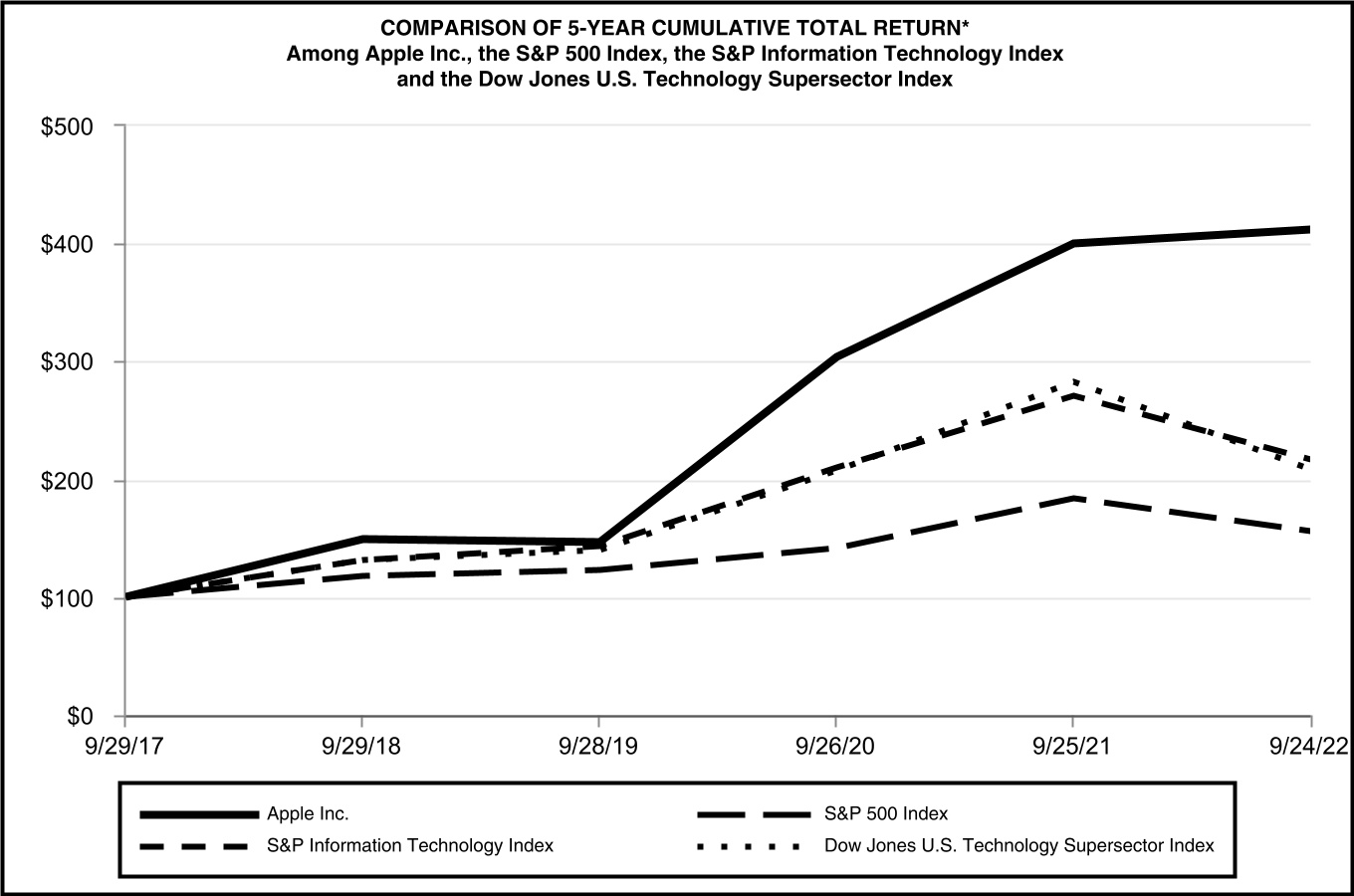
*$100 invested on September 29, 2017 in stock or index, including reinvestment of dividends. Data points are the last day of each fiscal year for the Company’s common stock and September 30th for indexes.
Copyright© 2022 Standard & Poor’s, a division of S&P Global. All rights reserved.
Copyright© 2022 S&P Dow Jones Indices LLC, a division of S&P Global. All rights reserved.
| September 2017 | September 2018 | September 2019 | September 2020 | September 2021 | September 2022 | |||||||||||||||||||||||||||||||||
| Apple Inc. | $ | 100 | $ | 149 | $ | 146 | $ | 303 | $ | 400 | $ | 411 | ||||||||||||||||||||||||||
| S&P 500 Index | $ | 100 | $ | 118 | $ | 123 | $ | 142 | $ | 184 | $ | 156 | ||||||||||||||||||||||||||
| S&P Information Technology Index | $ | 100 | $ | 131 | $ | 143 | $ | 210 | $ | 271 | $ | 217 | ||||||||||||||||||||||||||
| Dow Jones U.S. Technology Supersector Index | $ | 100 | $ | 131 | $ | 139 | $ | 208 | $ | 283 | $ | 209 |
Item 6. [Reserved]
Apple Inc. | 2022 Form 10-K | 19
Item 7. Management’s Discussion and Analysis of Financial Condition and Results of Operations
The following discussion should be read in conjunction with the consolidated financial statements and accompanying notes included in Part II, Item 8 of this Form 10-K. This section of this Form 10-K generally discusses 2022 and 2021 items and year-to-year comparisons between 2022 and 2021. Discussions of 2020 items and year-to-year comparisons between 2021 and 2020 are not included in this Form 10-K, and can be found in “Management’s Discussion and Analysis of Financial Condition and Results of Operations” in Part II, Item 7 of the Company’s Annual Report on Form 10-K for the fiscal year ended September 25, 2021.
Fiscal Year Highlights
Fiscal 2022 Highlights
Total net sales increased 8% or $28.5 billion during 2022 compared to 2021, driven primarily by higher net sales of iPhone, Services and Mac. The weakness in foreign currencies relative to the U.S. dollar had an unfavorable year-over-year impact on all Products and Services net sales during 2022.
The Company announces new product, service and software offerings at various times during the year. Significant announcements during fiscal 2022 included the following:
First Quarter 2022:
-
Updated MacBook Pro 14” and MacBook Pro 16”, powered by the Apple M1 Pro or M1 Max chip; and
-
Third generation of AirPods.
Second Quarter 2022:
-
Updated iPhone SE with 5G technology;
-
All-new Mac Studio, powered by the Apple M1 Max or M1 Ultra chip;
-
All-new Studio Display™; and
-
Updated iPad Air with 5G technology, powered by the Apple M1 chip.
Third Quarter 2022:
-
Updated MacBook Air and MacBook Pro 13”, both powered by the Apple M2 chip;
-
iOS 16, macOS Ventura, iPadOS 16 and watchOS 9, updates to the Company’s operating systems; and
-
Apple Pay Later, a buy now, pay later service.
Fourth Quarter 2022:
-
iPhone 14, iPhone 14 Plus, iPhone 14 Pro and iPhone 14 Pro Max;
-
Second generation of AirPods Pro; and
-
Apple Watch Series 8, updated Apple Watch SE and all-new Apple Watch Ultra.
In April 2022, the Company announced an increase to its Program authorization from $315 billion to $405 billion and raised its quarterly dividend from $0.22 to $0.23 per share beginning in May 2022. During 2022, the Company repurchased $90.2 billion of its common stock and paid dividends and dividend equivalents of $14.8 billion.
COVID-19
The COVID-19 pandemic has had, and continues to have, a significant impact around the world, prompting governments and businesses to take unprecedented measures, such as restrictions on travel and business operations, temporary closures of businesses, and quarantine and shelter-in-place orders. The COVID-19 pandemic has at times significantly curtailed global economic activity and caused significant volatility and disruption in global financial markets. The COVID-19 pandemic and the measures taken by many countries in response have affected and could in the future materially impact the Company’s business, results of operations and financial condition.
Certain of the Company’s outsourcing partners, component suppliers and logistical service providers have experienced disruptions during the COVID-19 pandemic, resulting in supply shortages. Similar disruptions could occur in the future.
Apple Inc. | 2022 Form 10-K | 20
Products and Services Performance
The following table shows net sales by category for 2022, 2021 and 2020 (dollars in millions):
| 2022 | Change | 2021 | Change | 2020 | |||||||||||||||||||||||||
| Net sales by category: | |||||||||||||||||||||||||||||
| iPhone (1) | $ | 205,489 | 7 | % | $ | 191,973 | 39 | % | $ | 137,781 | |||||||||||||||||||
| Mac (1) | 40,177 | 14 | % | 35,190 | 23 | % | 28,622 | ||||||||||||||||||||||
| iPad (1) | 29,292 | (8) | % | 31,862 | 34 | % | 23,724 | ||||||||||||||||||||||
| Wearables, Home and Accessories (1)(2) | 41,241 | 7 | % | 38,367 | 25 | % | 30,620 | ||||||||||||||||||||||
| Services (3) | 78,129 | 14 | % | 68,425 | 27 | % | 53,768 | ||||||||||||||||||||||
| Total net sales | $ | 394,328 | 8 | % | $ | 365,817 | 33 | % | $ | 274,515 |
(1)Products net sales include amortization of the deferred value of unspecified software upgrade rights, which are bundled in the sales price of the respective product.
(2)Wearables, Home and Accessories net sales include sales of AirPods, Apple TV, Apple Watch, Beats products, HomePod mini and accessories.
(3)Services net sales include sales from the Company’s advertising, AppleCare, cloud, digital content, payment and other services. Services net sales also include amortization of the deferred value of services bundled in the sales price of certain products.
iPhone
iPhone net sales increased during 2022 compared to 2021 due primarily to higher net sales from the Company’s new iPhone models released since the beginning of the fourth quarter of 2021.
Mac
Mac net sales increased during 2022 compared to 2021 due primarily to higher net sales of laptops.
iPad
iPad net sales decreased during 2022 compared to 2021 due primarily to lower net sales of iPad Pro.
Wearables, Home and Accessories
Wearables, Home and Accessories net sales increased during 2022 compared to 2021 due primarily to higher net sales of Apple Watch and AirPods.
Services
Services net sales increased during 2022 compared to 2021 due primarily to higher net sales from advertising, cloud services and the App Store.
Apple Inc. | 2022 Form 10-K | 21
Segment Operating Performance
The Company manages its business primarily on a geographic basis. The Company’s reportable segments consist of the Americas, Europe, Greater China, Japan and Rest of Asia Pacific. Americas includes both North and South America. Europe includes European countries, as well as India, the Middle East and Africa. Greater China includes China mainland, Hong Kong and Taiwan. Rest of Asia Pacific includes Australia and those Asian countries not included in the Company’s other reportable segments. Although the reportable segments provide similar hardware and software products and similar services, each one is managed separately to better align with the location of the Company’s customers and distribution partners and the unique market dynamics of each geographic region. Further information regarding the Company’s reportable segments can be found in Part II, Item 8 of this Form 10-K in the Notes to Consolidated Financial Statements in Note 11, “Segment Information and Geographic Data.”
The following table shows net sales by reportable segment for 2022, 2021 and 2020 (dollars in millions):
| 2022 | Change | 2021 | Change | 2020 | |||||||||||||||||||||||||
| Net sales by reportable segment: | |||||||||||||||||||||||||||||
| Americas | $ | 169,658 | 11 | % | $ | 153,306 | 23 | % | $ | 124,556 | |||||||||||||||||||
| Europe | 95,118 | 7 | % | 89,307 | 30 | % | 68,640 | ||||||||||||||||||||||
| Greater China | 74,200 | 9 | % | 68,366 | 70 | % | 40,308 | ||||||||||||||||||||||
| Japan | 25,977 | (9) | % | 28,482 | 33 | % | 21,418 | ||||||||||||||||||||||
| Rest of Asia Pacific | 29,375 | 11 | % | 26,356 | 35 | % | 19,593 | ||||||||||||||||||||||
| Total net sales | $ | 394,328 | 8 | % | $ | 365,817 | 33 | % | $ | 274,515 |
Americas
Americas net sales increased during 2022 compared to 2021 due primarily to higher net sales of iPhone, Services and Mac.
Europe
Europe net sales increased during 2022 compared to 2021 due primarily to higher net sales of iPhone and Services. The weakness in foreign currencies relative to the U.S. dollar had a net unfavorable year-over-year impact on Europe net sales during 2022.
Greater China
Greater China net sales increased during 2022 compared to 2021 due primarily to higher net sales of iPhone and Services. The strength of the renminbi relative to the U.S. dollar had a favorable year-over-year impact on Greater China net sales during 2022.
Japan
Japan net sales decreased during 2022 compared to 2021 due to the weakness of the yen relative to the U.S. dollar.
Rest of Asia Pacific
Rest of Asia Pacific net sales increased during 2022 compared to 2021 due primarily to higher net sales of iPhone, Mac and Services. The weakness in foreign currencies relative to the U.S. dollar had an unfavorable year-over-year impact on Rest of Asia Pacific net sales during 2022.
Apple Inc. | 2022 Form 10-K | 22
Gross Margin
Products and Services gross margin and gross margin percentage for 2022, 2021 and 2020 were as follows (dollars in millions):
| 2022 | 2021 | 2020 | |||||||||||||||
| Gross margin: | |||||||||||||||||
| Products | $ | 114,728 | $ | 105,126 | $ | 69,461 | |||||||||||
| Services | 56,054 | 47,710 | 35,495 | ||||||||||||||
| Total gross margin | $ | 170,782 | $ | 152,836 | $ | 104,956 |
| Gross margin percentage: | |||||||||||||||||
| Products | 36.3 | % | 35.3 | % | 31.5 | % | |||||||||||
| Services | 71.7 | % | 69.7 | % | 66.0 | % | |||||||||||
| Total gross margin percentage | 43.3 | % | 41.8 | % | 38.2 | % |
Products Gross Margin
Products gross margin increased during 2022 compared to 2021 due primarily to a different Products mix and higher Products volume, partially offset by the weakness in foreign currencies relative to the U.S. dollar.
Products gross margin percentage increased during 2022 compared to 2021 due primarily to a different Products mix, partially offset by the weakness in foreign currencies relative to the U.S. dollar.
Services Gross Margin
Services gross margin increased during 2022 compared to 2021 due primarily to higher Services net sales, partially offset by the weakness in foreign currencies relative to the U.S. dollar.
Services gross margin percentage increased during 2022 compared to 2021 due primarily to improved leverage and a different Services mix, partially offset by the weakness in foreign currencies relative to the U.S. dollar.
The Company’s future gross margins can be impacted by a variety of factors, as discussed in Part I, Item 1A of this Form 10-K under the heading “Risk Factors.” As a result, the Company believes, in general, gross margins will be subject to volatility and downward pressure.
Operating Expenses
Operating expenses for 2022, 2021 and 2020 were as follows (dollars in millions):
| 2022 | Change | 2021 | Change | 2020 | |||||||||||||||||||||||||
| Research and development | $ | 26,251 | 20 | % | $ | 21,914 | 17 | % | $ | 18,752 | |||||||||||||||||||
| Percentage of total net sales | 7 | % | 6 | % | 7 | % | |||||||||||||||||||||||
| Selling, general and administrative | $ | 25,094 | 14 | % | $ | 21,973 | 10 | % | $ | 19,916 | |||||||||||||||||||
| Percentage of total net sales | 6 | % | 6 | % | 7 | % | |||||||||||||||||||||||
| Total operating expenses | $ | 51,345 | 17 | % | $ | 43,887 | 13 | % | $ | 38,668 | |||||||||||||||||||
| Percentage of total net sales | 13 | % | 12 | % | 14 | % |
Research and Development
The year-over-year growth in R&D expense in 2022 was driven primarily by increases in headcount-related expenses and engineering program costs.
Selling, General and Administrative
The year-over-year growth in selling, general and administrative expense in 2022 was driven primarily by increases in headcount-related expenses, advertising and professional services.
Apple Inc. | 2022 Form 10-K | 23
Other Income/(Expense), Net
Other income/(expense), net (“OI&E”) for 2022, 2021 and 2020 was as follows (dollars in millions):
| 2022 | Change | 2021 | Change | 2020 | |||||||||||||||||||||||||
| Interest and dividend income | $ | 2,825 | $ | 2,843 | $ | 3,763 | |||||||||||||||||||||||
| Interest expense | (2,931) | (2,645) | (2,873) | ||||||||||||||||||||||||||
| Other income/(expense), net | (228) | 60 | (87) | ||||||||||||||||||||||||||
| Total other income/(expense), net | $ | (334) | (229) | % | $ | 258 | (68) | % | $ | 803 |
The decrease in OI&E during 2022 compared to 2021 was due primarily to higher realized losses on debt securities, unfavorable fair value adjustments on equity securities and higher interest expense, partially offset by higher foreign exchange gains.
Provision for Income Taxes
Provision for income taxes, effective tax rate and statutory federal income tax rate for 2022, 2021 and 2020 were as follows (dollars in millions):
| 2022 | 2021 | 2020 | |||||||||||||||
| Provision for income taxes | $ | 19,300 | $ | 14,527 | $ | 9,680 | |||||||||||
| Effective tax rate | 16.2 | % | 13.3 | % | 14.4 | % | |||||||||||
| Statutory federal income tax rate | 21 | % | 21 | % | 21 | % |
The Company’s effective tax rate for 2022 was lower than the statutory federal income tax rate due primarily to a lower effective tax rate on foreign earnings, tax benefits from share-based compensation and the impact of the U.S. federal R&D credit, partially offset by state income taxes. The Company’s effective tax rate for 2021 was lower than the statutory federal income tax rate due primarily to a lower effective tax rate on foreign earnings, tax benefits from share-based compensation and foreign-derived intangible income deductions.
The Company’s effective tax rate for 2022 was higher compared to 2021 due primarily to a higher effective tax rate on foreign earnings, including the impact to U.S. foreign tax credits as a result of regulatory guidance issued by the U.S. Department of the Treasury in 2022, and lower tax benefits from foreign-derived intangible income deductions and share-based compensation.
Liquidity and Capital Resources
The Company believes its balances of cash, cash equivalents and unrestricted marketable securities, which totaled $156.4 billion as of September 24, 2022, along with cash generated by ongoing operations and continued access to debt markets, will be sufficient to satisfy its cash requirements and capital return program over the next 12 months and beyond.
The Company’s material cash requirements include the following contractual obligations.
Debt
As of September 24, 2022, the Company had outstanding fixed-rate notes with varying maturities for an aggregate principal amount of $111.8 billion (collectively the “Notes”), with $11.1 billion payable within 12 months. Future interest payments associated with the Notes total $41.3 billion, with $2.9 billion payable within 12 months.
The Company also issues unsecured short-term promissory notes (“Commercial Paper”) pursuant to a commercial paper program. As of September 24, 2022, the Company had $10.0 billion of Commercial Paper outstanding, all of which was payable within 12 months.
Leases
The Company has lease arrangements for certain equipment and facilities, including corporate, data center, manufacturing and retail space. As of September 24, 2022, the Company had fixed lease payment obligations of $15.3 billion, with $2.0 billion payable within 12 months.
Apple Inc. | 2022 Form 10-K | 24
Manufacturing Purchase Obligations
The Company utilizes several outsourcing partners to manufacture subassemblies for the Company’s products and to perform final assembly and testing of finished products. The Company also obtains individual components for its products from a wide variety of individual suppliers. Outsourcing partners acquire components and build product based on demand information supplied by the Company, which typically covers periods up to 150 days. As of September 24, 2022, the Company had manufacturing purchase obligations of $71.1 billion, with $68.4 billion payable within 12 months. The Company’s manufacturing purchase obligations are primarily noncancelable.
Other Purchase Obligations
The Company’s other purchase obligations primarily consist of noncancelable obligations to acquire capital assets, including assets related to product manufacturing, and noncancelable obligations related to internet services and content creation. As of September 24, 2022, the Company had other purchase obligations of $17.8 billion, with $6.8 billion payable within 12 months.
Deemed Repatriation Tax Payable
As of September 24, 2022, the balance of the deemed repatriation tax payable imposed by the U.S. Tax Cuts and Jobs Act of 2017 (the “Act”) was $22.0 billion, with $5.3 billion expected to be paid within 12 months.
In addition to its contractual cash requirements, the Company has a capital return program authorized by the Board of Directors. The Program does not obligate the Company to acquire a minimum amount of shares. As of September 24, 2022, the Company’s quarterly cash dividend was $0.23 per share. The Company intends to increase its dividend on an annual basis, subject to declaration by the Board of Directors.
Critical Accounting Estimates
The preparation of financial statements and related disclosures in conformity with U.S. generally accepted accounting principles (“GAAP”) and the Company’s discussion and analysis of its financial condition and operating results require the Company’s management to make judgments, assumptions and estimates that affect the amounts reported. Note 1, “Summary of Significant Accounting Policies” of the Notes to Consolidated Financial Statements in Part II, Item 8 of this Form 10-K describes the significant accounting policies and methods used in the preparation of the Company’s consolidated financial statements. Management bases its estimates on historical experience and on various other assumptions it believes to be reasonable under the circumstances, the results of which form the basis for making judgments about the carrying values of assets and liabilities.
Uncertain Tax Positions
The Company is subject to income taxes in the U.S. and numerous foreign jurisdictions. The evaluation of the Company’s uncertain tax positions involves significant judgment in the interpretation and application of GAAP and complex domestic and international tax laws, including the Act and matters related to the allocation of international taxation rights between countries. Although management believes the Company’s reserves are reasonable, no assurance can be given that the final outcome of these uncertainties will not be different from that which is reflected in the Company’s reserves. Reserves are adjusted considering changing facts and circumstances, such as the closing of a tax examination. Resolution of these uncertainties in a manner inconsistent with management’s expectations could have a material impact on the Company’s financial condition and operating results.
Legal and Other Contingencies
The Company is subject to various legal proceedings and claims that arise in the ordinary course of business, the outcomes of which are inherently uncertain. The Company records a liability when it is probable that a loss has been incurred and the amount is reasonably estimable, the determination of which requires significant judgment. Resolution of legal matters in a manner inconsistent with management’s expectations could have a material impact on the Company’s financial condition and operating results.
Apple Inc. | 2022 Form 10-K | 25
Item 7A. Quantitative and Qualitative Disclosures About Market Risk
Interest Rate and Foreign Currency Risk Management
The Company regularly reviews its foreign exchange forward and option positions and interest rate swaps, both on a stand-alone basis and in conjunction with its underlying foreign currency and interest rate exposures. Given the effective horizons of the Company’s risk management activities and the anticipatory nature of the exposures, there can be no assurance these positions will offset more than a portion of the financial impact resulting from movements in either foreign exchange or interest rates. Further, the recognition of the gains and losses related to these instruments may not coincide with the timing of gains and losses related to the underlying economic exposures and, therefore, may adversely affect the Company’s financial condition and operating results.
Interest Rate Risk
The Company’s exposure to changes in interest rates relates primarily to the Company’s investment portfolio and outstanding debt. While the Company is exposed to global interest rate fluctuations, it is most affected by fluctuations in U.S. interest rates. Changes in U.S. interest rates affect the interest earned on the Company’s cash, cash equivalents and marketable securities and the fair value of those securities, as well as costs associated with hedging and interest paid on the Company’s debt.
The Company’s investment policy and strategy are focused on the preservation of capital and supporting the Company’s liquidity requirements. The Company uses a combination of internal and external management to execute its investment strategy and achieve its investment objectives. The Company typically invests in highly rated securities, with the primary objective of minimizing the potential risk of principal loss. The Company’s investment policy generally requires securities to be investment grade and limits the amount of credit exposure to any one issuer. To provide a meaningful assessment of the interest rate risk associated with the Company’s investment portfolio, the Company performed a sensitivity analysis to determine the impact a change in interest rates would have on the value of the investment portfolio assuming a 100 basis point parallel shift in the yield curve. Based on investment positions as of September 24, 2022 and September 25, 2021, a hypothetical 100 basis point increase in interest rates across all maturities would result in a $4.0 billion and $4.1 billion incremental decline in the fair market value of the portfolio, respectively. Such losses would only be realized if the Company sold the investments prior to maturity.
As of September 24, 2022, the Company had outstanding fixed-rate notes and as of September 25, 2021, the Company had outstanding floating- and fixed-rate notes with varying maturities for an aggregate carrying amount of $110.1 billion and $118.7 billion, respectively. The Company has entered, and in the future may enter, into interest rate swaps to manage interest rate risk on its outstanding term debt. Interest rate swaps allow the Company to effectively convert fixed-rate payments into floating-rate payments or floating-rate payments into fixed-rate payments. Gains and losses on term debt are generally offset by the corresponding losses and gains on the related hedging instrument. A 100 basis point increase in market interest rates would cause interest expense on the Company’s debt as of September 24, 2022 and September 25, 2021 to increase by $201 million and $186 million on an annualized basis, respectively.
Foreign Currency Risk
In general, the Company is a net receiver of currencies other than the U.S. dollar. Accordingly, changes in exchange rates, and in particular a strengthening of the U.S. dollar, will negatively affect the Company’s net sales and gross margins as expressed in U.S. dollars. There is a risk that the Company will have to adjust local currency pricing due to competitive pressures when there has been significant volatility in foreign currency exchange rates.
The Company may enter into foreign currency forward and option contracts with financial institutions to protect against foreign exchange risks associated with certain existing assets and liabilities, certain firmly committed transactions, forecasted future cash flows and net investments in foreign subsidiaries. In addition, the Company has entered, and in the future may enter, into foreign currency contracts to partially offset the foreign currency exchange gains and losses on its foreign currency–denominated debt issuances. The Company generally hedges portions of its forecasted foreign currency exposure associated with revenue and inventory purchases, typically for up to 12 months. However, the Company may choose not to hedge certain foreign exchange exposures for a variety of reasons, including accounting considerations or the prohibitive economic cost of hedging particular exposures.
Apple Inc. | 2022 Form 10-K | 26
To provide an assessment of the foreign currency risk associated with certain of the Company’s foreign currency derivative positions, the Company performed a sensitivity analysis using a value-at-risk (“VAR”) model to assess the potential impact of fluctuations in exchange rates. The VAR model consisted of using a Monte Carlo simulation to generate thousands of random market price paths assuming normal market conditions. The VAR is the maximum expected loss in fair value, for a given confidence interval, to the Company’s foreign currency derivative positions due to adverse movements in rates. The VAR model is not intended to represent actual losses but is used as a risk estimation and management tool. Forecasted transactions, firm commitments and assets and liabilities denominated in foreign currencies were excluded from the model. Based on the results of the model, the Company estimates with 95% confidence, a maximum one-day loss in fair value of $1.0 billion as of September 24, 2022, compared to a maximum one-day loss in fair value of $550 million as of September 25, 2021. Because the Company uses foreign currency instruments for hedging purposes, the losses in fair value incurred on those instruments are generally offset by increases in the fair value of the underlying exposures.
Actual future gains and losses associated with the Company’s investment portfolio, debt and derivative positions may differ materially from the sensitivity analyses performed as of September 24, 2022 due to the inherent limitations associated with predicting the timing and amount of changes in interest rates, foreign currency exchange rates and the Company’s actual exposures and positions.
Apple Inc. | 2022 Form 10-K | 27
Item 8. Financial Statements and Supplementary Data
All financial statement schedules have been omitted, since the required information is not applicable or is not present in amounts sufficient to require submission of the schedule, or because the information required is included in the consolidated financial statements and accompanying notes.
Apple Inc. | 2022 Form 10-K | 28
Apple Inc.
CONSOLIDATED STATEMENTS OF OPERATIONS
(In millions, except number of shares which are reflected in thousands and per share amounts)
| Years ended | |||||||||||||||||
| September 24, 2022 | September 25, 2021 | September 26, 2020 | |||||||||||||||
| Net sales: | |||||||||||||||||
| Products | $ | 316,199 | $ | 297,392 | $ | 220,747 | |||||||||||
| Services | 78,129 | 68,425 | 53,768 | ||||||||||||||
| Total net sales | 394,328 | 365,817 | 274,515 | ||||||||||||||
| Cost of sales: | |||||||||||||||||
| Products | 201,471 | 192,266 | 151,286 | ||||||||||||||
| Services | 22,075 | 20,715 | 18,273 | ||||||||||||||
| Total cost of sales | 223,546 | 212,981 | 169,559 | ||||||||||||||
| Gross margin | 170,782 | 152,836 | 104,956 | ||||||||||||||
| Operating expenses: | |||||||||||||||||
| Research and development | 26,251 | 21,914 | 18,752 | ||||||||||||||
| Selling, general and administrative | 25,094 | 21,973 | 19,916 | ||||||||||||||
| Total operating expenses | 51,345 | 43,887 | 38,668 | ||||||||||||||
| Operating income | 119,437 | 108,949 | 66,288 | ||||||||||||||
| Other income/(expense), net | (334) | 258 | 803 | ||||||||||||||
| Income before provision for income taxes | 119,103 | 109,207 | 67,091 | ||||||||||||||
| Provision for income taxes | 19,300 | 14,527 | 9,680 | ||||||||||||||
| Net income | $ | 99,803 | $ | 94,680 | $ | 57,411 | |||||||||||
| Earnings per share: | |||||||||||||||||
| Basic | $ | 6.15 | $ | 5.67 | $ | 3.31 | |||||||||||
| Diluted | $ | 6.11 | $ | 5.61 | $ | 3.28 | |||||||||||
| Shares used in computing earnings per share: | |||||||||||||||||
| Basic | 16,215,963 | 16,701,272 | 17,352,119 | ||||||||||||||
| Diluted | 16,325,819 | 16,864,919 | 17,528,214 |
See accompanying Notes to Consolidated Financial Statements.
Apple Inc. | 2022 Form 10-K | 29
Apple Inc.
CONSOLIDATED STATEMENTS OF COMPREHENSIVE INCOME
(In millions)
| Years ended | |||||||||||||||||
| September 24, 2022 | September 25, 2021 | September 26, 2020 | |||||||||||||||
| Net income | $ | 99,803 | $ | 94,680 | $ | 57,411 | |||||||||||
| Other comprehensive income/(loss): | |||||||||||||||||
| Change in foreign currency translation, net of tax | (1,511) | 501 | 88 | ||||||||||||||
| Change in unrealized gains/losses on derivative instruments, net of tax: | |||||||||||||||||
| Change in fair value of derivative instruments | 3,212 | 32 | 79 | ||||||||||||||
| Adjustment for net (gains)/losses realized and included in net income | (1,074) | 1,003 | (1,264) | ||||||||||||||
| Total change in unrealized gains/losses on derivative instruments | 2,138 | 1,035 | (1,185) | ||||||||||||||
| Change in unrealized gains/losses on marketable debt securities, net of tax: | |||||||||||||||||
| Change in fair value of marketable debt securities | (12,104) | (694) | 1,202 | ||||||||||||||
| Adjustment for net (gains)/losses realized and included in net income | 205 | (273) | (63) | ||||||||||||||
| Total change in unrealized gains/losses on marketable debt securities | (11,899) | (967) | 1,139 | ||||||||||||||
| Total other comprehensive income/(loss) | (11,272) | 569 | 42 | ||||||||||||||
| Total comprehensive income | $ | 88,531 | $ | 95,249 | $ | 57,453 |
See accompanying Notes to Consolidated Financial Statements.
Apple Inc. | 2022 Form 10-K | 30
Apple Inc.
CONSOLIDATED BALANCE SHEETS
(In millions, except number of shares which are reflected in thousands and par value)
| September 24, 2022 | September 25, 2021 | ||||||||||
| ASSETS: | |||||||||||
| Current assets: | |||||||||||
| Cash and cash equivalents | $ | 23,646 | $ | 34,940 | |||||||
| Marketable securities | 24,658 | 27,699 | |||||||||
| Accounts receivable, net | 28,184 | 26,278 | |||||||||
| Inventories | 4,946 | 6,580 | |||||||||
| Vendor non-trade receivables |
Showing the first 8K of 102K characters. Open the full section
Item 9. Changes in and Disagreements with Accountants on Accounting and Financial Disclosure
None.
Item 9A. Controls and Procedures
Evaluation of Disclosure Controls and Procedures
Based on an evaluation under the supervision and with the participation of the Company’s management, the Company’s principal executive officer and principal financial officer have concluded that the Company’s disclosure controls and procedures as defined in Rules 13a-15(e) and 15d-15(e) under the Exchange Act were effective as of September 24, 2022 to provide reasonable assurance that information required to be disclosed by the Company in reports that it files or submits under the Exchange Act is (i) recorded, processed, summarized and reported within the time periods specified in the SEC rules and forms and (ii) accumulated and communicated to the Company’s management, including its principal executive officer and principal financial officer, as appropriate to allow timely decisions regarding required disclosure.
Inherent Limitations over Internal Controls
The Company’s internal control over financial reporting is designed to provide reasonable assurance regarding the reliability of financial reporting and the preparation of financial statements for external purposes in accordance with U.S. generally accepted accounting principles (“GAAP”). The Company’s internal control over financial reporting includes those policies and procedures that:
(i)pertain to the maintenance of records that, in reasonable detail, accurately and fairly reflect the transactions and dispositions of the Company’s assets;
(ii)provide reasonable assurance that transactions are recorded as necessary to permit preparation of financial statements in accordance with GAAP, and that the Company’s receipts and expenditures are being made only in accordance with authorizations of the Company’s management and directors; and
(iii)provide reasonable assurance regarding prevention or timely detection of unauthorized acquisition, use, or disposition of the Company’s assets that could have a material effect on the financial statements.
Management, including the Company’s Chief Executive Officer and Chief Financial Officer, does not expect that the Company’s internal controls will prevent or detect all errors and all fraud. A control system, no matter how well designed and operated, can provide only reasonable, not absolute, assurance that the objectives of the control system are met. Further, the design of a control system must reflect the fact that there are resource constraints, and the benefits of controls must be considered relative to their costs. Because of the inherent limitations in all control systems, no evaluation of internal controls can provide absolute assurance that all control issues and instances of fraud, if any, have been detected. Also, any evaluation of the effectiveness of controls in future periods are subject to the risk that those internal controls may become inadequate because of changes in business conditions, or that the degree of compliance with the policies or procedures may deteriorate.
Management’s Annual Report on Internal Control over Financial Reporting
The Company’s management is responsible for establishing and maintaining adequate internal control over financial reporting (as defined in Rule 13a-15(f) under the Exchange Act). Management conducted an assessment of the effectiveness of the Company’s internal control over financial reporting based on the criteria set forth in Internal Control – Integrated Framework issued by the Committee of Sponsoring Organizations of the Treadway Commission (2013 framework). Based on the Company’s assessment, management has concluded that its internal control over financial reporting was effective as of September 24, 2022 to provide reasonable assurance regarding the reliability of financial reporting and the preparation of financial statements in accordance with GAAP. The Company’s independent registered public accounting firm, Ernst & Young LLP, has issued an audit report on the Company’s internal control over financial reporting, which appears in Part II, Item 8 of this Form 10-K.
Changes in Internal Control over Financial Reporting
There were no changes in the Company’s internal control over financial reporting during the fourth quarter of 2022, which were identified in connection with management’s evaluation required by paragraph (d) of Rules 13a-15 and 15d-15 under the Exchange Act, that have materially affected, or are reasonably likely to materially affect, the Company’s internal control over financial reporting.
Apple Inc. | 2022 Form 10-K | 53
Item 9B. Other Information
Rule 10b5-1 Trading Plans
During the three months ended September 24, 2022, Katherine L. Adams, Timothy D. Cook, Luca Maestri, Deirdre O’Brien and Jeffrey Williams, each an officer for purposes of Section 16 of the Exchange Act, had equity trading plans in place in accordance with Rule 10b5-1(c)(1) under the Exchange Act. An equity trading plan is a written document that preestablishes the amounts, prices and dates (or formula for determining the amounts, prices and dates) of future purchases or sales of the Company’s stock, including sales of shares acquired under the Company’s employee and director equity plans.
Item 9C. Disclosure Regarding Foreign Jurisdictions that Prevent Inspections
Not applicable.
PART III
Item 10. Directors, Executive Officers and Corporate Governance
The information required by this Item will be included in the Company’s definitive proxy statement to be filed with the SEC within 120 days after September 24, 2022, in connection with the solicitation of proxies for the Company’s 2023 annual meeting of shareholders (the “2023 Proxy Statement”), and is incorporated herein by reference.
Item 11. Executive Compensation
The information required by this Item will be included in the 2023 Proxy Statement, and is incorporated herein by reference.
Item 12. Security Ownership of Certain Beneficial Owners and Management and Related Stockholder Matters
The information required by this Item will be included in the 2023 Proxy Statement, and is incorporated herein by reference.
Item 13. Certain Relationships and Related Transactions, and Director Independence
The information required by this Item will be included in the 2023 Proxy Statement, and is incorporated herein by reference.
Item 14. Principal Accountant Fees and Services
The information required by this Item will be included in the 2023 Proxy Statement, and is incorporated herein by reference.
Apple Inc. | 2022 Form 10-K | 54
PART IV
Item 15. Exhibit and Financial Statement Schedules
**(a)**Documents filed as part of this report
**(1)**All financial statements
*Ernst & Young LLP, PCAOB Firm ID No. 00042.
**(2)**Financial Statement Schedules
All financial statement schedules have been omitted, since the required information is not applicable or is not present in amounts sufficient to require submission of the schedule, or because the information required is included in the consolidated financial statements and accompanying notes included in this Form 10-K.
**(3)**Exhibits required by Item 601 of Regulation S-K (1)
Apple Inc. | 2022 Form 10-K | 55
Apple Inc. | 2022 Form 10-K | 56
*Indicates management contract or compensatory plan or arrangement.
**Filed herewith.
***Furnished herewith.
(1)Certain instruments defining the rights of holders of long-term debt securities of the Registrant are omitted pursuant to Item 601(b)(4)(iii) of Regulation S-K. The Registrant hereby undertakes to furnish to the SEC, upon request, copies of any such instruments.
Item 16. Form 10-K Summary
None.
Apple Inc. | 2022 Form 10-K | 57
SIGNATURES
Pursuant to the requirements of Section 13 or 15(d) of the Securities Exchange Act of 1934, the Registrant has duly caused this report to be signed on its behalf by the undersigned, thereunto duly authorized.
| Date: October 27, 2022 | Apple Inc. | ||||||||||
| By: | /s/ Luca Maestri | ||||||||||
| Luca Maestri | |||||||||||
| Senior Vice President, Chief Financial Officer |
Power of Attorney
KNOW ALL PERSONS BY THESE PRESENTS, that each person whose signature appears below constitutes and appoints Timothy D. Cook and Luca Maestri, jointly and severally, his or her attorneys-in-fact, each with the power of substitution, for him or her in any and all capacities, to sign any amendments to this Annual Report on Form 10-K, and to file the same, with exhibits thereto and other documents in connection therewith, with the Securities and Exchange Commission, hereby ratifying and confirming all that each of said attorneys-in-fact, or his substitute or substitutes, may do or cause to be done by virtue hereof.
Pursuant to the requirements of the Securities Exchange Act of 1934, this report has been signed below by the following persons on behalf of the Registrant and in the capacities and on the dates indicated:
| Name | Title | Date | ||||||||||||
| /s/ Timothy D. Cook | Chief Executive Officer and Director (Principal Executive Officer) | October 27, 2022 | ||||||||||||
| TIMOTHY D. COOK | ||||||||||||||
| /s/ Luca Maestri | Senior Vice President, Chief Financial Officer (Principal Financial Officer) | October 27, 2022 | ||||||||||||
| LUCA MAESTRI | ||||||||||||||
| /s/ Chris Kondo | Senior Director of Corporate Accounting (Principal Accounting Officer) | October 27, 2022 | ||||||||||||
| CHRIS KONDO | ||||||||||||||
| /s/ James A. Bell | Director | October 27, 2022 | ||||||||||||
| JAMES A. BELL | ||||||||||||||
| /s/ Al Gore | Director | October 27, 2022 | ||||||||||||
| AL GORE | ||||||||||||||
| /s/ Alex Gorsky | Director | October 27, 2022 | ||||||||||||
| ALEX GORSKY | ||||||||||||||
| /s/ Andrea Jung | Director | October 27, 2022 | ||||||||||||
| ANDREA JUNG | ||||||||||||||
| /s/ Arthur D. Levinson | Director and Chair of the Board | October 27, 2022 | ||||||||||||
| ARTHUR D. LEVINSON | ||||||||||||||
| /s/ Monica Lozano | Director | October 27, 2022 | ||||||||||||
| MONICA LOZANO | ||||||||||||||
| /s/ Ronald D. Sugar | Director | October 27, 2022 | ||||||||||||
| RONALD D. SUGAR | ||||||||||||||
| /s/ Susan L. Wagner | Director | October 27, 2022 | ||||||||||||
| SUSAN L. WAGNER |
Apple Inc. | 2022 Form 10-K | 58