 filings.tools
Autodesk (ADSK) 10-K risk factor changes: FY2019 vs FY2018
The 2019-01-31 10-K against the 2018-01-31 one, compared heading by heading and sentence by sentence.
Item 1A102 rewritten52 added106 removed423 unchanged
All filing items1,098 rewritten951 added687 removed2,160 unchanged
Summary
counted, not written
- Item 1A lists 33 risk factor headings: 1 new, 8 reworded and 24 unchanged since FY2018. 5 headings from FY2018 no longer appear.
- Sentence by sentence, 951 added, 687 removed, 1,098 rewritten and 2,160 unchanged across 20 items that differ.
New Item 1A headings (1)
- Our debt service obligations may adversely affect our financial condition and cash flows from operations.
Removed Item 1A headings (5)
- If we fail to successfully manage our business model transition to cloud-based products and more flexible product licenses, our results of operations could be negatively impacted.
- A significant portion of our revenue is generated through maintenance revenue; if decreases in maintenance revenue are not offset by increases in subscription revenue, our future revenue and financial results will be negatively impacted.
- Revenue from our offerings may be difficult to predict during our business model transition.
- Actions that we are taking to restructure our business in alignment with our strategic priorities may not be as effective as anticipated.
- We issued $1.6 billion *aggregate principal amount of unsecured notes in debt offerings and have an existing $400.0 million *revolving credit facility, and expect to incur other debt in the future, which may adversely affect our financial condition and future financial results.
Reworded Item 1A headings (8)
- Our business could suffer as a result of risks, costs, charges and integration risks associated with strategic acquisitions and
[removed: investments.][added: investments such as the recent acquisitions of Assemble Systems, Inc., PlanGrid, Inc. and BuildingConnected, Inc.] - Security incidents may compromise the integrity of our or our customers’
[removed: products,][added: offerings,] services, data or intellectual property, harm our reputation, damage our competitiveness, create additional liability and adversely impact our financial results. [removed: We rely on third-party services; any interruption or delay][added: Delays] in service from[removed: these third parties][added: third-party service providers] could expose us to liability, harm our reputation, damage our competitiveness and adversely impact our financial performance.- We are investing in resources to update and improve our information technology systems to digitize
[removed: the Company][added: Autodesk] and support our[removed: business model transition.][added: customers.] Should our investments not succeed, or if delays or other issues with new or existing[removed: internal][added: information] technology systems disrupt our operations, our business[removed: model transition]could be[removed: compromised and our business could be]harmed. - If we do not maintain good relationships with the members of our distribution channel, our ability to generate revenue will be adversely affected. If our distribution channel suffers financial losses, becomes financially unstable or insolvent, or is not provided the right mix of incentives to sell our
[removed: products,][added: subscriptions,] our ability to generate revenue will be adversely affected. - Because we derive a substantial portion of our net revenue from a small number of
[removed: products,][added: solutions,] including our AutoCAD-based software products and collections, if these[removed: products][added: offerings] are not successful, our revenue will be adversely affected. - Net revenue, [added: ARR,] billings,
[removed: earnings][added: earnings, cash flow] or subscriptions shortfalls or the volatility of the market generally may cause the market price of our stock to decline. - We rely on third party technologies and if we are unable to use or integrate these technologies, our
[removed: product][added: solutions] and service development may be delayed and our financial results negatively impacted.
A heading is new when no FY2018 heading matches it after ignoring case and punctuation, and reworded when it shares at least 60 percent of its words with one that went away. All current risk factor headings.
Sentences by item
22 items, with every count and a link to each item that changed
Underlined words on a shaded ground are new in FY2019; struck-through words were in FY2018. Sentences that are wholly new or wholly gone are labelled rather than marked.
Item 1A. RISK FACTORS
102 rewritten, 52 added, 106 removed, 423 unchanged
[removed: ][added: ]
[added: Any of] these events could harm our business, results of operations and financial condition.
Just as the transition from mainframes to personal computers transformed the industry 30 years ago, [removed: we believe our] [added: the software] industry [removed: is undergoing] [added: has undergone] a [removed: similar] transition from [removed: the personal computer] [added: developing and selling perpetual licenses and on-premises products] to cloud, [removed: mobile,] [added: mobile] and social [removed: computing.][added: applications.]
Customers are also reconsidering the manner in which they [removed: license] [added: purchase] software products, which requires us to constantly evaluate our business model and strategy.
In addition, we frequently introduce new business models or methods that require a considerable investment of technical and financial resources such as our introduction of flexible [removed: license] [added: subscription] and service offerings.
We are making such investments through further development and enhancement of our existing products and services, as well as through [removed: acquisitions of new product lines.][added: acquisitions.]
Such investments may not result in sufficient revenue generation to justify their costs and could result in decreased net [removed: revenue.][added: revenue or profitability.]
If we are not able to meet customer requirements, either with respect to our software or [removed: hardware products or] the manner in which we provide such products, or if we are not able to adapt our business model to meet our customers' requirements, our business, financial condition or results of operations may be adversely impacted.
In particular, a critical component of our growth strategy is to have customers of our AutoCAD and AutoCAD LT products expand their portfolios to include our other offerings and cloud-based [removed: services.][added: functionality.]
We want customers using individual Autodesk products to expand their portfolio with our other offerings and cloud-based [removed: services,] [added: functionality,] and we are taking steps to accelerate this migration.
At times, sales of [removed: licenses of] our AutoCAD and AutoCAD LT or individual Autodesk flagship products have decreased without a corresponding increase in [removed: industry collections] [added: Industry Collections] or cloud-based [added: functionality revenue or without purchases of customer seats to our Industry Collections.]
International net revenue represented [removed: 64%] [added: 66%] and [removed: 63%] [added: 64%] of our net revenue in fiscal [removed: 2018] [added: 2019] and [removed: 2017,] [added: 2018,] respectively.
| • | fluctuating currency exchange rates, including [added: devaluations, currency controls and inflation, and] risks related to any hedging activities we undertake; |
The [removed: Brexit] [added: "Brexit"] vote has exacerbated and may further exacerbate many of the risks and uncertainties described above.
The [removed: proposed] withdrawal of the United Kingdom from the European Union could, among other potential outcomes, adversely affect the tax, tax treaty, currency, operational, legal and regulatory regimes to which our businesses in the region are subject.
Further, uncertainty around these and related issues could lead to adverse effects on the economy of the United [removed: Kingdom] [added: Kingdom, European Union] and the other economies in which we operate.
Our offerings are subject to U.S. export controls and economic sanctions laws and regulations that prohibit the [removed: shipment] [added: delivery] of certain [removed: products] [added: solutions] and services without the required export authorizations or export to locations, governments, and persons targeted by U.S. sanctions.
The software [removed: products] [added: solutions] that we offer are [removed: complex, and] [added: complex and,] despite extensive testing and quality control, may contain errors, defects or vulnerabilities.
Some errors, defects and vulnerabilities in our software [removed: products] [added: solutions] may only be discovered after [removed: the product or service has] [added: they have] been released.
Any errors, defects or vulnerabilities could result in the need for corrective releases to our software [removed: products,] [added: solutions,] damage to our reputation, loss of revenue, an increase in [removed: product returns] [added: subscription cancellations] or lack of market acceptance of our [removed: products,] [added: offerings,] any of which would likely harm our business and financial performance.
[added: This shift further lowers barriers] to entry and poses a disruptive challenge to established software companies.
The markets in which we compete are characterized by vigorous competition, both by entry of competitors with innovative technologies and by consolidation of companies with complementary [removed: products] [added: offerings] and technologies.
Furthermore, a reduction in the number and availability of compatible third-party applications, or our inability to rapidly adapt to technological and customer preference changes, including those related to cloud computing, mobile devices, and new computing platforms, may adversely affect the sale of our [removed: products.][added: solutions.]
*Security incidents may compromise the integrity of our or our customers’ [removed: products,] [added: offerings,] services, data or intellectual property, harm our reputation, damage our competitiveness, create additional liability and adversely impact our financial results.*
As we digitize [removed: the Company] [added: Autodesk] and use cloud and [removed: web base] [added: web-based] technologies to leverage customer data to deliver the total customer experience, we are exposed to increased security risks and the potential for unauthorized access to, or improper use [removed: of] [added: of,] our and our customers' information.
Like [removed: all] [added: other] software [removed: products] [added: offerings] and systems, ours are vulnerable to security incidents.
We devote resources to maintain the security and integrity of our systems, [removed: products,] [added: offerings,] services and applications (online, mobile and desktop).
Hackers regularly have targeted our systems, [removed: products,] [added: offerings,] services and applications, and we expect them to do so in the future.
[removed: The impact of security] [added: Security] incidents could disrupt the proper functioning of our systems, [removed: products] [added: solutions] or services; cause errors in the output of our customers' work; allow unauthorized access to [removed: sensitive,] [added: sensitive] data or intellectual property, including proprietary or confidential information of ours or our customers; or [added: cause] other destructive outcomes.
Despite efforts to create security barriers to such [removed: programs,] [added: threats,] it is virtually impossible for us to entirely eliminate this risk.
If any of the foregoing were to occur, our reputation may suffer, our competitive position may be diminished, customers may [removed: stop buying] [added: buy fewer of] our [removed: products] [added: offerings] and services, we could face lawsuits and potential liability, and our financial performance could be negatively impacted.
Our strategy to digitize [removed: the Company] [added: Autodesk] involves increasing our use of cloud and [removed: web based] [added: web-based] technologies and applications to leverage customer [removed: data.][added: data to improve our offerings for the benefit of our customers.]
Governments, [added: regulators,] the plaintiffs’ bar, privacy advocates and customers have increased their focus on how companies collect, process, use, store, share and transmit personal data.
The [added: General Data Protection Regulation ("GDPR") is applicable in all EU member states The] GDPR [removed: introduces] [added: introduced] new data protection requirements in the EU and substantial fines for non-compliance.
The [removed: GDPR increases] [added: GDPR, CCPA and other state and global laws and regulations increased] our responsibility and potential liability in relation to personal data, and we have and will continue to put in place additional processes and programs to demonstrate compliance.
Any failure to comply with [added: the] GDPR or other data privacy laws could lead to government enforcement actions and significant penalties.
[removed: Further, any] [added: Any] perceived privacy right violation could [removed: cause] result in reputational harm, third-party claims, lawsuits or investigations.
[added: The] GDPR, [added: CCPA] other [removed: new] laws and self-regulatory codes may affect our ability to reach current and prospective customers, to understand how our [removed: products] [added: offerings] and services are being used, to respond to customer requests allowed under the laws, and to implement our new business models effectively.
These requirements could impact demand for our [removed: products] [added: offerings] and services and result in more onerous contract obligations.
We rely on [removed: third-parties,] [added: third parties,] such as Amazon Web Services, to provide us with operational and technical services.
*2019 Form 10-K 14*
For example, we recently acquired Assemble Systems, PlanGrid and BuildingConnected.

*2019 Form 10-K 15*

*2019 Form 10-K 16*
There remains significant risk that the United Kingdom will exit from the European Union without agreement between the European Union and United Kingdom on terms addressing customs and trade matters.
In addition, the current U.S. administration has instituted or proposed changes to foreign trade policy including the negotiation or termination of trade agreements, the imposition of tariffs on products imported from certain countries, economic sanctions on individuals, corporations or countries and other government regulations affecting trade between the United States and other countries in which we do business.
New or increased tariffs and other changes in U.S. trade policy could trigger retaliatory actions by affected countries, and certain foreign governments, including the Chinese government, have instituted or are considering imposing trade sanctions on certain U.S. manufactured goods.
The escalation of protectionist or retaliatory trade measures in either the United States or any other countries in which we do business, such as a change in tariff structures, export compliance or other trade policies, may increase the cost of, or otherwise interfere with, conducting our business.

*2019 Form 10-K 17*
If any of the foregoing security incidents were to occur, our reputation may suffer, our competitive position may be diminished, customers may stop paying for our solutions and services, we could face regulator inquiry, lawsuits and potential liability, and our financial performance could be negatively impacted.
In addition, in June 2018, California enacted the California Consumer Privacy Act (the "CCPA"), which takes effect in January 2020.
The CCPA will, among other things, give California residents expanded rights to access and delete their personal information, opt out of certain personal information sharing, and receive detailed information about how their personal information is used.
The CCPA was amended in September 2018, and it is unclear whether further modifications will be made to this legislation or how it will be interpreted.
We cannot yet predict the impact of the CCPA on our business or operations, but it may require us to modify our data processing practices and policies and to incur substantial costs and expenses in an effort to comply.

*2019 Form 10-K 18*

*2019 Form 10-K 19*
The software industry has undergone a transition from developing and selling perpetual licenses and on-premises products to cloud, mobile and social applications.
In addition, countries in which we operate may be classified as highly inflationary economies, requiring special
accounting and financial reporting treatment for such operations, or such countries’ currencies may be devalued, or both, which may adversely impact our business operations and financial results.

*2019 Form 10-K 20*
accounts and may be required to delay the recognition of revenue on future sales to these customers.
| • | failure to manage spend; |

*2019 Form 10-K 21*

*2019 Form 10-K 22*
*Our debt service obligations may adversely affect our financial condition and cash flows from operations.*
We have $2.1 billion of debt, consisting of notes due at various times from June 2020 to June 2027 and a delayed draw term loan facility in the aggregate principal amount of $500.0 million due in December 2020, each as described in Part 2, Item 8.
We also entered into a credit agreement that provides for an unsecured revolving loan facility in the aggregate principal amount of $650.0 million, with an option to be increased up to $1.0 billion, as described in Part 2, Item 8.
Maintenance of our indebtedness, contractual restrictions, and additional issuances of indebtedness could:
| • | cause us to dedicate a substantial portion of our cash flows from operations towards debt service obligations and principal repayments; |
| • | impair our ability to obtain future financing for working capital, capital expenditures, acquisitions, general corporate or other purposes; and |
| • | due to limitations within the debt instruments, restrict our ability to grant liens on property, enter into certain mergers, dispose of all or substantially all of the assets of Autodesk and its subsidiaries, taken as a whole, materially change our business and incur subsidiary indebtedness, subject to customary exceptions. |
We are required to comply with the covenants set forth in our debt instruments, such as an interest coverage ratio in effect January 31, 2019 and a leverage ratio in effect July 31, 2019.
Any of
*2018 Form 10-K 14*
*If we fail to successfully manage our business model transition to cloud-based products and more flexible product licenses, our results of operations could be negatively impacted.*
To address the industry transition from personal computer to cloud, mobile, and social computing, we accelerated our move to the cloud and are offering more flexible product licenses.
To support our transition, we discontinued selling new perpetual licenses of most individual software products effective February 1, 2016, and discontinued selling new perpetual licenses of suites effective August 1, 2016.
On June 15, 2017, we commenced a program to incentivize maintenance plan customers to move to subscription plan offerings.
Through this program we offer discounts to those maintenance plan customers that move to subscription plan offerings, while at the same time increasing maintenance plan pricing over time for customers that remain on maintenance.
As a result, we expect to derive an increasing portion of our revenues in the future from subscriptions.
This subscription model prices and delivers our products in a way that differs from the historical perpetual pricing and delivery methods.
These changes reflect a significant shift from perpetual license sales and distribution of our software in favor of providing our customers the right to access certain of our software in a hosted environment or use downloaded software for a specified subscription period.
During the first three years of the transition, revenue, billings, gross margin, operating margin, net income (loss), earnings (loss) per share, deferred revenue, and cash flow from operations have been impacted as more revenue is recognized ratably rather than upfront and as new offerings bring a wider variety of price points.
Our ability to achieve our financial objectives is subject to risks and uncertainties.
The new offerings require a considerable investment of technical, financial, legal, and sales resources, and a scalable organization.
Market acceptance of such offerings is affected by a variety of factors, including but not limited to: security, reliability, performance, current license terms, customer preference, social/community engagement, customer concerns with entrusting a third party to store and manage their data, public concerns regarding privacy and the enactment of restrictive laws or regulations.
Whether our business model transition will prove successful and will accomplish our business and financial objectives is subject to numerous risks and uncertainties, including but not limited to: customer demand, attach and renewal rates, channel acceptance, our ability to further develop and scale infrastructure, our ability to include functionality and usability in such offerings that address customer requirements, tax and accounting implications, pricing, and our costs.
In addition, the metrics we use to gauge the status of our business model transition may evolve over the course of the transition as significant trends emerge.
If we are unable to successfully establish these new offerings and navigate our business model transition in light of the foregoing risks and uncertainties, our results of operations could be negatively impacted.
*2018 Form 10-K 15*
services revenue or without purchases of customer seats to our industry collections.
Also, adoption of our cloud and mobile computing offerings and changes in the delivery of our software and services to our customers, such as product subscription offerings, will change the way in which we recognize revenue relating to our software and services, with a potential negative impact on our financial performance.
The accounting impact of these offerings and other business decisions are expected to result in an increase in the percentage of our ratable revenue, as well as recurring revenue, making for a more predictable business over time, while potentially reducing our upfront perpetual revenue stream.
*A significant portion of our revenue is generated through maintenance revenue; if decreases in maintenance revenue are not offset by increases in subscription revenue, our future revenue and financial results will be negatively impacted.*
Our maintenance customers have no obligation to renew their maintenance contracts after the expiration of their maintenance period, which is typically one year.
The discontinuance of our perpetual licenses for most individual software products on February 1, 2016 and for perpetual suites on August 1, 2016 resulted in the loss of future opportunities to sell maintenance.
As a result, we expect customer renewal rates will decline or fluctuate over time as a result of a number of factors, including the overall global economy, the health of their businesses, the perceived value of the maintenance program and planned maintenance pricing increases.
If our non-renewing maintenance customers do not transition to subscriptions, our future revenue and financial results will be negatively impacted.
*Revenue from our offerings may be difficult to predict during our business model transition.*
The discontinuance of our perpetual licenses for most individual software products on February 1, 2016 and for perpetual suites on August 1, 2016 has and will continue to result in the loss of future upfront licensing revenue.
This also has frozen the growth of our maintenance revenue because there will be no further opportunities to attach maintenance licensing.
As a result, we expect our maintenance revenue to decline over time, but it may decline more quickly than anticipated due to low maintenance renewals.
At the same time, our subscription revenue may not grow as rapidly as anticipated.
Our subscription pricing allows customers to use our offerings at a lower initial cost when compared to the sale of a perpetual license.
Although our subscriptions are designed to increase the number of customers who purchase offerings and create a recurring revenue stream that is more predictable over time, it creates risks related to the timing of revenue recognition and expected reductions in cash flows in the near term.
*Actions that we are taking to restructure our business in alignment with our strategic priorities may not be as effective as anticipated.*
During the fourth quarter of fiscal 2018, we commenced a world-wide restructuring plan to support the Company's strategic priorities of completing the subscription transition; digitizing the Company; and re-imagining manufacturing, construction, and production.
Through the restructuring, we seek to reduce our investment in areas not aligned with our strategic priorities, including in areas related to research and development and go-to-market activities.
At the same time, we plan to further invest in strategic priority areas related to as digital infrastructure, customer success, and construction.
*2018 Form 10-K 16*
As a result of these actions, we will incur additional costs in the short term that will have the effect of reducing our GAAP operating margins.
We may encounter challenges in the execution of these efforts, and these challenges could impact our financial results.
An excerpt. Shown here: 40 of 102 rewritten, 40 of 52 added and 40 of 106 removed. The counts are complete. For every sentence, read Item 1A. RISK FACTORS in the FY2019 filing and the FY2018 filing.
Item 7. MANAGEMENT’S DISCUSSION AND ANALYSIS OF FINANCIAL CONDITION AND RESULTS OF OPERATIONS
242 rewritten, 287 added, 184 removed, 388 unchanged
Forward-looking statements are any statements that look to future events and consist of, among other things, our business strategies, including those discussed in “Strategy” and “Overview of Fiscal [removed: 2018”] [added: 2019”] below, future net revenue, operating expenses, recurring revenue, annualized recurring revenue, [removed: annualized revenue per subscription,] [added: cash flow,] other future financial results (by product type and [removed: geography)] [added: geography), subscriptions] and [removed: subscriptions, the effectiveness of our restructuring efforts,] [added: annualized revenue per subscription,] the effectiveness of our efforts to successfully manage transitions to new [removed: business models and] markets, our [removed: expectations regarding the continued transition of our business model, expectations for our maintenance plan and subscription plan subscriptions, our] ability to increase our subscription base, expected market trends, [removed: including] the [removed: growth] [added: impact] of [removed: cloud] [added: planned] and [removed: mobile computing, the effect of unemployment, the availability of credit, our expectations for our restructuring,] [added: past acquisitions and investment activities,] the effects of global economic conditions, the effects of revenue recognition, the effects of recently issued accounting standards, [removed: expected trends in certain financial metrics, including expenses, the impact of acquisitions and investment activities,] expectations regarding our cash needs, the effects of fluctuations in exchange rates and our hedging activities on our financial results, our ability to successfully expand adoption of our products, our ability to gain market acceptance of new [removed: businesses] [added: business] and sales initiatives, the impact of economic volatility and geopolitical activities in certain countries, particularly emerging economy countries, the timing and amount of purchases under our stock buy-back plan, and the effects of potential non-cash charges on our financial results and the resulting effect on our financial results.
In addition, forward-looking statements also consist of statements involving expectations regarding product capability and acceptance, [removed: remediation to our controls environment,] statements regarding our liquidity and short-term and long-term cash requirements, as well as statements involving trend analyses and statements including such words as “may,” “believe,” “could,” “anticipate,” “would,” “might,” “plan,” “expect,” and similar expressions or the negative of these terms or other comparable terminology.
As such, our actual results could differ materially from those set forth in the forward-looking statements as a result of a number of factors, including those set forth [removed: below] [added: above] in Part [removed: II,] [added: I,] Item 1A, “Risk Factors,” and in our other reports filed with the U.S. Securities and Exchange Commission.
Just as the transition from mainframes to personal computers transformed the industry over 30 years ago, [removed: we believe our] [added: the software] industry [removed: is undergoing] [added: has undergone] a [removed: similar] transition from [removed: the personal computer] [added: developing and selling perpetual licenses and on-premises products] to cloud, [removed: mobile,] [added: mobile] and social [removed: computing.][added: applications.]
Our [removed: SaaS] [added: cloud] offerings, for example, BIM 360, Shotgun, Fusion, and AutoCAD 360 Pro, provide tools, including mobile and social capabilities, to streamline design, collaboration, building and manufacturing and data management processes.
Industry [removed: collections] [added: Collections] provide our customers with increased access to a broader selection of Autodesk [removed: products] [added: solutions] and services that exceeds those previously available in suites [removed: -] [added: —] simplifying the [removed: customer] [added: customers'] ability to get access to a complete set of tools for their industry.
[removed: We now] [added: Today, we] offer subscriptions for individual products and [removed: industry collections, cloud service offerings, and] [added: Industry Collections,] flexible enterprise business agreements [added: ("EBAs"), and cloud service offerings] (collectively referred to as "subscription plan").
[removed: These subscription plan offerings] [added: Subscription plans] are designed to give our customers more flexibility with how they use our [removed: products and service] offerings and to attract a broader range of customers, such as project-based users and small businesses.
[removed: ][added: ]
[removed: On] [added: Additionally, in] June [removed: 15,] 2017, we commenced a program to incentivize maintenance plan customers to move to subscription plan [removed: offerings.][added: offerings,]
[removed: Through this program we offer discounts to those maintenance customers that move to a subscription plan,] [added: maintenance-to-subscription ("M2S"),] while at the same time increasing maintenance plan pricing over time for customers that remain on [removed: maintenance.][added: maintenance plans.]
[removed: As we progress through the] [added: In our] current [removed: stage of the] business [removed: model transition,] [added: model,] annualized recurring revenue ("ARR"), growth of billings, and total [removed: subscriptions] [added: deferred revenue] better reflect business momentum.
To [removed: further] analyze progress, we [removed: disaggregate] [added: have disaggregated] our growth between the original maintenance model ("maintenance plan") and the subscription plan model.
Maintenance plan subscriptions peaked in the fourth quarter of our fiscal 2016 as we discontinued selling new maintenance plan subscriptions in fiscal 2017, and we expect them to [removed: decline slowly] [added: keep declining] over time as maintenance plan customers continue to convert to our subscription plans.
Our direct channels include internal sales resources dedicated to selling in our largest accounts, our highly specialized [removed: products,] [added: solutions,] and business transacted through our online Autodesk branded store.
[removed: channels] [added: The following table outlines our recurring revenue metric] for the fiscal years ended January 31, [added: 2019,] 2018, [removed: 2017] and [removed: 2016:][added: 2017:]
[removed: 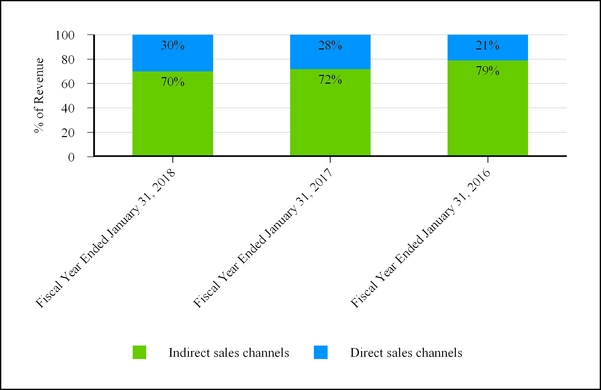][added: ]
However, we expect our indirect channel will continue to transact and support the majority of our customers and [removed: revenue as we move beyond the business model transition.][added: revenue.]
Our distributor and reseller network is extensive and provides our customers with the resources to purchase, deploy, learn, and support our [removed: products] [added: solutions] quickly and easily.
We have a significant number of registered third-party developers who create products that work well with our [removed: products] [added: solutions] and extend them for a variety of specialized applications.
Autodesk is committed to helping fuel a lifelong passion for [removed: design in] [added: making with] students of all ages.
[added: Through Autodesk Design Academy, we provide] secondary and postsecondary school markets hundreds of standards-aligned class projects to support design-based disciplines in Science, Technology, Engineering, Digital Arts, and Math (STEAM) while using Autodesk's professional-grade 3D design, engineering and entertainment software used in industry.
We also have made Autodesk Design Academy curricula available on [removed: iTunes U] [added: Udemy] and [removed: Udemy.][added: Coursera.]
[removed: We continually] review these trade-offs in making decisions regarding acquisitions.
Our strategy depends upon a number of [removed: assumptions to successfully make the transition toward new cloud and mobile platforms,] [added: assumptions,] including: [removed: the related technology and business model shifts;] making our technology available to mainstream markets; leveraging our large global network of distributors, resellers, third-party developers, customers, educational institutions, and students; improving the performance and functionality of our products; and adequately protecting our intellectual property.
Our significant accounting policies are described in [added: Part II, Item 8,] Note 1, “Business and Summary of Significant Accounting Policies,” in the Notes to Consolidated Financial Statements.
Our indirect channel model includes both a two-tiered distribution structure, where [added: Autodesk sells to] distributors [added: that subsequently] sell to resellers, and a one-tiered structure where Autodesk sells directly to resellers.
[removed: We are also] [added: Judgment is] required to [removed: evaluate] [added: determine] whether our distributors and resellers have the ability to honor their commitment to [removed: make fixed or determinable payments,] [added: pay,] regardless of whether they collect payment from their customers.
If we were to change [removed: any of these assumptions or judgments,] [added: this assessment,] it could cause a material increase or decrease in the amount of revenue that we report in a particular period.
A [added: small] portion of [removed: these] [added: partner] incentives reduce [removed: license and] other revenue in the current period.
[removed: The remainder, which relates] [added: Incentives related] to [removed: incentives on] our [removed: Subscription Program, is] [added: subscription program are] recorded as a reduction to deferred revenue in the period the subscription transaction is [removed: billed] [added: billed,] and [added: are] subsequently recognized as a reduction to subscription revenue over the contract period.
Depending on how the payments are made, the reserves associated with the partner incentive program are [removed: treated] [added: recorded] on the balance sheet as either contra [removed: account] [added: accounts] receivable or accounts payable.
*Marketable Securities and Privately Held Company Investments.* As described in [added: Part II, Item 8,] Note [removed: 2,] [added: 3,] “Financial Instruments,” in the Notes to [removed: the] Consolidated Financial Statements, our investments in marketable securities are measured at the end of each reporting period and reported at fair value.
[removed: Autodesk considers various factors in determining] [added: To determine] whether [removed: to recognize an impairment charge, including] [added: a decline in value is other-than-temporary, we evaluate, among other factors:] the [removed: length of time] [added: duration] and extent to which the fair value has been less than [removed: Autodesk’s cost basis,] the [removed: financial condition and near-term prospects of the investee,] [added: carrying value] and [removed: Autodesk’s] [added: its] intent and ability to [removed: hold] [added: retain] the investment for a period of time sufficient to allow for any anticipated recovery in [removed: the market] [added: fair] value.
*Business Combinations.* [removed: We allocate the fair value of the consideration transferred to the] [added: The] assets [added: acquired] and liabilities [removed: acquired, as well as to in-process research and development] [added: assumed in a business combination are recorded] based on their estimated fair values at the acquisition date.
[removed: The purchase price allocation] [added: Accounting for business combinations] requires us to make significant estimates and assumptions, especially at the acquisition date with respect to intangible assets and deferred revenue obligations.
| • | the acquired company's trade name, trademark and existing customer relationship, as well as assumptions about the period of time the acquired trade name and trademark will continue to be used in [removed: the] our product portfolio; |
[removed: In addition, unanticipated] [added: Unanticipated] events and circumstances may occur which may affect the accuracy or validity of such [removed: estimates, and if such events occur we may be required to record a charge against the value ascribed to an acquired asset] [added: assumptions, estimates] or [removed: an increase in the amounts recorded for assumed liabilities.][added: actual results.]
We recognize the tax benefit for an uncertain tax position when it meets a more [added: likely than not threshold.]
Beginning in the second quarter of fiscal 2016, we considered [added: recent] cumulative losses in the U.S. arising from [removed: the Company’s] [added: our] business model transition as a significant source of negative evidence.
To address this shift, Autodesk made a strategic decision to shift its business model from selling perpetual licenses and maintenance plans to selling subscriptions.
*2019 Form 10-K 33*
Since launching the program, over 794,000 maintenance plan customers have converted to subscription plan offerings.
Autodesk seeks to convert the remaining 796,100 maintenance plan customers to subscription through this program.
To support our strategic priority of re-imagining construction, in fiscal 2019, we strengthened the foundation of our construction solutions with both organic and inorganic investments.
In addition to investing in our BIM 360 portfolio, we purchased Assemble Systems for quantity take off functionality, PlanGrid for document-centric workflows and field execution, and BuildingConnected for bidding and estimation processes.
The broadened product portfolio will help us expand our presence with sub-contractors, trades people, and building owners.
As part of our manufacturing strategy we continue to attract global manufacturing leaders with our generative design and our Fusion technology enhancements.
See Note 2, "Revenue Recognition" in the Notes to the Consolidated Financial Statements for further detail on the results of our indirect and direct channel sales for the fiscal years ended January 31, 2019, 2018, and 2017.
For example, we recently acquired Assemble Systems, a leading provider of key workflow software solutions, PlanGrid, Inc., a leading provider of construction productivity software, and BuildingConnected, a leading pre-construction platform.
We believe that the acquisitions of Assemble Systems, PlanGrid and BuildingConnected will enable us to offer a more comprehensive, cloud-based construction platform.
We continually
*2019 Form 10-K 34*
*Revenue Recognition.* Autodesk’s revenue is divided into three categories: subscription revenue, maintenance revenue, and other revenue.
Revenue is recognized when control for these offerings is transferred to our customers, in an amount that reflects the consideration we expect to be entitled to in exchange for products and services.
Our contracts with customers may include promises to provide multiple subscriptions and services to a customer.
Determining whether the offerings and services are considered distinct performance obligations that should be accounted for separately or as one combined performance obligation may require significant judgment.
Judgment is required to determine the level of integration and interdependency between individual components of software and cloud functionality.
This determination influences whether the software is considered distinct and accounted for separately as a license performance obligation, or not distinct and accounted for together with the cloud functionality as a single subscription performance obligation recognized over time.
For product subscriptions, Industry Collections, and enterprise business agreement ("EBA") subscriptions in which the desktop software and related cloud functionality are highly interrelated, the combined performance obligation is recognized ratably over the contract term as the obligation is satisfied.
For contracts involving distinct software licenses, the license performance obligation is satisfied at a point in time when control is transferred to the customer.
For standalone maintenance subscriptions, cloud subscriptions, and technical support services, the performance obligation is satisfied ratably over the contract term as those services are delivered.
For consulting services, the performance obligation is satisfied over a period of time as those services are delivered.
When an arrangement includes multiple performance obligations which are concurrently delivered and have the same pattern of transfer to the customer (the services transfer to the customer over the contract period), we account for those performance obligations as a single performance obligation.
For contracts with more than one performance obligation, the transaction price is allocated among the performance obligations in an amount that depicts the relative standalone selling price ("SSP") of each obligation.
Judgment is required to determine the SSP for each distinct performance obligation.
We use a range of amounts to estimate SSP when we sell each of the products and services separately and need to determine whether there is a discount that should be allocated based on the relative SSP of the various products and services.

*2019 Form 10-K 35*
In instances where SSP is not directly observable, such as when we do not sell the product or service separately, we determine the SSP using information that includes market conditions and other observable inputs.
We typically have more than one SSP for individual products and services due to the stratification of those products and services by customer and circumstance.
In these instances, we use relevant information such as the sales channel and geographic region to determine the SSP.
For these arrangements, transfer of control begins at the time access to our subscriptions is made available electronically to our end customer, provided all other criteria for revenue recognition are met.
The new revenue recognition standard had a material impact in our consolidated financial statements.
Refer to Part II, Item 8, Note 1, Business and Summary of Significant Accounting Policies, Accounting Standards Adopted, of our consolidated financial statements and to discussions below under the heading “Overview” for additional information.
Privately held debt and equity securities (Level 3) are valued using significant unobservable inputs or data in an inactive market and the valuation requires our judgment due to the absence of market prices and inherent lack of liquidity.
The carrying value is not adjusted for our privately held equity securities if there are no observable price changes in a same or similar security from the same issuer or if there are no identified events or changes in circumstances that may indicate impairment, as discussed below.
In determining the estimated fair value of its strategic investments in privately held companies, we utilize the most recent data available to us.
In addition, the determination of whether an orderly transaction is for a same or similar investment requires significant management judgment including: the rights and obligations of the investments, the

To address this transition, we have accelerated our move to the cloud and mobile devices and are offering more flexible licensing.
Our strategy is to lead the industries we serve to cloud-based technologies and business models.
This entails both a technological shift and a business model shift.
As part of the transition, we discontinued selling new perpetual licenses of most individual software products effective February 1, 2016, and discontinued selling new perpetual licenses of suites while introducing industry collections effective August 1, 2016.
*2018 Form 10-K 35*
With the discontinuation of the sale of most perpetual licenses, we have transitioned away from selling a mix of perpetual licenses and term-based product subscriptions toward a single subscription model.
To provide more meaningful information as to the performance of different categories of product and services, we have changed our presentation of revenue and cost of revenue on our Condensed Consolidated Statements of Operations effective the first quarter of fiscal 2018.
See Note 1, "Business and Summary of Significant Accounting Policies," for additional information.
During the first three years of the transition, revenue, margins, EPS, deferred revenue and cash flow from operations have been impacted as more revenue is recognized ratably rather than upfront and as subscription plan offerings generally have a lower initial purchase price.
In order to support our strategic priorities of completing the subscription transition, digitizing the Company, and re-imagining manufacturing, construction, and production, we commenced a world-wide restructuring plan in the fourth quarter of fiscal 2018.
Through the restructuring, we seek to reduce our investments in areas not aligned with our strategic priorities, including in areas related to research and development and go-to-market activities.
At the same time, we plan to further invest in strategic priority areas related to digital infrastructure, customer success, and construction.
By re-balancing resources to better align with our strategic priorities, we are positioning ourselves to meet our long-term goals, while keeping non-GAAP spend flat in fiscal 2019.
We anticipate incurring pre-tax restructuring charges of $135 million to $149 million, substantially all of which would result in cash expenditures, $124 million to $137 million of which would be for one-time employee termination benefits, and $11 million to $12 million of which would be for facilities-related and other costs.
If we are unable to successfully complete our reorganizational efforts we may need to undertake additional restructuring efforts, and our business and operating results may be harmed.
*2018 Form 10-K 36*
The following chart shows our split between indirect and direct
Through Autodesk Design Academy, we provide
*2018 Form 10-K 37*
Our strategy includes improving our product functionality and expanding our product offerings through internal development as well as through the acquisition of products, technology, and businesses.
We currently anticipate that we will continue to acquire products, technology, and businesses as compelling opportunities become available.
*Revenue Recognition.* We recognize revenue when persuasive evidence of an arrangement exists, delivery has occurred or services have been rendered, the price is fixed or determinable, and collection is probable.
However, determining whether and when some of these criteria have been satisfied often involves assumptions and judgments that can have a significant impact on the timing and amount of revenue we report.
For multiple element arrangements containing only software and software-related elements, we allocate the sales price among each of the deliverables using the residual method, under which revenue is allocated to undelivered elements based on our vendor-specific objective evidence (“VSOE”) of fair value.
VSOE is the price charged when an element is sold separately or a price set by management with the relevant authority.
If we do not have VSOE of an undelivered software license, we defer revenue recognition on the entire sales arrangement until all elements for which we do not have VSOE are delivered.
If we do not have VSOE for undelivered product subscriptions, maintenance or services, the revenue for the arrangement is recognized over the longest contractual service period in the arrangement.
We are required to exercise judgment in determining whether VSOE exists for each undelivered element based on whether our pricing for these elements is sufficiently consistent.
For multiple elements arrangements involving non-software elements, including cloud subscription services, our revenue recognition policy is based upon the accounting guidance contained in Accounting Standards Codification ("ASC") 605, *Revenue Recognition*.
For these arrangements, we first allocate the total arrangement consideration based on the relative selling prices of the software group of elements as a whole and to the non-software elements.
We then further allocate consideration within the software group to the respective elements within that group using the residual method as described above.
We exercise judgment and use estimates in connection with the determination of the amount of revenue to be recognized in each accounting period.
We allocate the total arrangement consideration among the various elements based on a selling price hierarchy.
The selling price for a deliverable is based on its VSOE if available, third-party evidence ("TPE") if VSOE is not available, or the best estimated selling price ("BESP") if neither VSOE nor TPE is available.
BESP represents the price at which Autodesk would transact for the deliverable if it were sold regularly on a standalone basis.
To establish BESP for those elements for which
*2018 Form 10-K 38*
neither VSOE nor TPE are available, we perform a quantitative analysis of pricing data points for historical standalone transactions involving such elements for a twelve-month period.
As part of this analysis, we monitor and evaluate the BESP against actual pricing to ensure that it continues to represent a reasonable estimate of the standalone selling price, considering several other external and internal factors including, but not limited to, pricing and discounting practices, contractually stated prices, the geographies in which we offer our products and services, and the type of customer (i.e. distributor, value-added reseller, and direct end user, among others).
We analyze BESP at least annually or on a more frequent basis if a significant change in our business necessitates a more timely analysis or if we experience significant variances in our selling prices.
An excerpt. Shown here: 40 of 242 rewritten, 40 of 287 added and 40 of 184 removed. The counts are complete. For every sentence, read Item 7. MANAGEMENT’S DISCUSSION AND ANALYSIS OF FINANCIAL CONDITION AND RESULTS OF OPERATIONS in the FY2019 filing and the FY2018 filing.
Item 7A. QUANTITATIVE AND QUALITATIVE DISCLOSURES ABOUT MARKET RISK
9 rewritten, 7 added, 1 removed, 16 unchanged
As of January 31, [removed: 2018,] [added: 2019,] and [removed: 2017,] [added: 2018,] we had open cash flow and balance sheet hedge contracts with future settlements within one to twelve months.
Contracts were primarily denominated in euros, Japanese yen, [removed: Swiss francs,] British pounds, Canadian dollars, [removed: and] Australian [removed: dollars.][added: dollars, Singapore dollars, Swiss francs, Swedish krona, and Czech krona.]
The notional amount of our option and forward contracts was [removed: $949.5] [added: $1,383.3] million and [removed: $640.0] [added: $949.5] million at January 31, [removed: 2018,] [added: 2019,] and [removed: 2017,] [added: 2018,] respectively.
A sensitivity analysis performed on our hedging portfolio as of January 31, [removed: 2018,] [added: 2019,] indicated that a hypothetical 10% appreciation of the U.S. dollar from its value at January 31, [removed: 2018] [added: 2019] and [removed: 2017] [added: 2018] would increase the fair value of our foreign currency contracts by [removed: $57.9] [added: $123.4] million and [removed: $60.9] [added: $57.9] million, respectively.
A hypothetical 10% depreciation of the dollar from its value at January 31, [removed: 2018,] [added: 2019,] and [removed: 2017] [added: 2018] would decrease the fair value of our foreign currency contracts by [removed: $83.2] [added: $98.3] million and [removed: $32.5] [added: $83.2] million, respectively.
At January 31, [removed: 2018,] [added: 2019,] we had [removed: $1,078.6] [added: $443.7] million of cash equivalents and marketable securities, including [removed: $245.2] [added: $67.6] million classified as short-term marketable [removed: securities and $190.8 million classified as long-term marketable] securities.
If interest rates were to move up by 50 or 100 basis points over a twelve month period, the market value change of our marketable securities would [added: not] have [removed: an] [added: a meaningful] unrealized gain or [removed: loss of $1.4 million and $2.8 million, respectively.][added: loss.]
See [added: Part II, Item 8,] Note [removed: 2,] [added: 3,] "Financial Instruments" [added: in the Notes to Consolidated Financial Statements] for further discussion regarding our privately held investments.
[removed: ][added: ]
In December 2018, we entered into a $500.0 million term loan facility, all of which was outstanding as of January 31, 2019.
The term loan bears interest, at Autodesk's option, at either (i) a floating rate per annum equal to the base rate plus a margin between 0.000% and 0.625%, depending on Autodesk's Public Debt Rating or (ii) a per annum rate equal to the rate at which dollar deposits are offered in the London interbank market, plus a margin of between 0.875% and 1.625%, depending on Autodesk's Public Debt Rating.
Based on Autodesk's current credit ratings the term loan bears interest at a per annum rate equal to the rate at which dollar deposits are offered in the London interbank market, plus a margin of 1.125% per annum.
A hypothetical increase or decrease of 50 or 100 basis points would not have a material impact on our results of operations.
The term loan facility matures in December 2020.
For information about exposure to counter-party credit-related losses, see Part II, Item 8, Note 1, “Business and Summary of Significant Accounting Policies - Concentration of Credit Risk."
*2019 Form 10-K 60*
*2018 Form 10-K 61*
Item 1. BUSINESS
59 rewritten, 38 added, 39 removed, 244 unchanged
We are a global leader in [removed: design] [added: 3D design, engineering and entertainment] software and services, offering customers productive business solutions through powerful technology products and services.
We serve customers in [added: the] architecture, engineering and construction; product design and manufacturing; and digital media and entertainment industries.
A summary of our revenue by geographic area and product family is found in Note [removed: 13, “Segment, Geographic and Product Family Information,”] [added: 2, “Revenue Recognition,”] in the Notes to [removed: our] Consolidated Financial Statements.
Our Annual Report on Form 10-K, Quarterly Reports on Form 10-Q, Current Reports on Form 8-K and amendments to reports filed or furnished pursuant to Sections 13(a) and 15(d) of the Securities Exchange Act of 1934, as amended, are available free of charge on the Investor Relations portion of our [removed: web site] [added: website] at www.autodesk.com as soon as reasonably practicable after we electronically file such material with, or furnish it to, the SEC.
Autodesk’s product [removed: offerings] [added: offerings, sold through a subscription,] include:
AutoCAD [removed: software, which is our largest single revenue-generating product,] [added: software] is a customizable and extensible CAD application for professional design, drafting, detailing, and visualization.
[removed: ][added: ]
[added: AutoCAD software provides digital tools that can be] used independently and in conjunction with other specific applications in fields ranging from construction and civil engineering to manufacturing and plant design.
Autodesk's Industry Collections provide our customers with increased access to a broader selection of Autodesk [removed: products,] [added: solutions,] greater value, more flexibility, and a simpler way to subscribe and manage Autodesk subscriptions.
The collections are tailored to provide the essential software needed by professionals within each industry: [removed: AEC,] [added: Architecture, Engineering and Construction ("AEC"),] Product [removed: Design,] [added: Design & Manufacturing,] and [removed: M&E.][added: Media & Entertainment ("M&E").]
The AEC [removed: Collection] [added: Collection, including AutoCAD, AutoCAD Civil3D, and Revit,] aims to help our customers design, engineer, and construct higher quality, more predictable building and civil infrastructure projects, commonly used by AEC industry [removed: experts, such as AutoCAD, AutoCAD Civil3D, and Revit.][added: experts.]
The Product Design [added: & Manufacturing] Collection offers connected, professional-grade tools that help our customers make great products today and compete in the changing manufacturing landscape of the future.
This collection enables animators, modelers and visual effect artists to access the [removed: tool] [added: tools] they need, including Maya and 3ds Max, to create compelling effects, 3D characters and digital worlds.
AutoCAD Civil 3D [removed: products provide] [added: solution provides] a surveying, design, analysis, and documentation solution for civil engineering, including land development, transportation, and environmental projects.
Using a model-centric approach that automatically updates documentation as design changes are made, AutoCAD Civil 3D [removed: products enable] [added: enables] civil engineers, designers, drafters, and surveyors to significantly boost productivity and deliver higher-quality designs and construction documentation faster.
With AutoCAD Civil [removed: 3D products,] [added: 3D,] the entire project team works from the same consistent, up-to-date model so they stay coordinated throughout all project phases.
[added: Using the information-rich models created with Revit, architects, engineers,] and construction firms can collaborate to make better-informed decisions earlier in the design process to deliver projects with greater efficiency.
It connects the entire product development process on a single cloud-based [removed: platform that works on both Apple and PC operating systems.][added: platform.]
The software industry [removed: is undergoing] [added: has undergone] a transition from [removed: the personal computer] [added: developing and selling perpetual licenses and on-premises products] to cloud, [removed: social, and] mobile [removed: computing.][added: and social applications.]
Additionally, [removed: on] [added: in] June [removed: 15,] 2017, we commenced a program to incentivize maintenance plan customers to move to subscription plan [removed: offerings.][added: offerings, maintenance-to-subscription ("M2S"), while at the same time increasing maintenance plan pricing over time for customers that remain on maintenance plans.]
We dedicate considerable technical and financial resources to research and development to further enhance our existing products and to create new [removed: products] [added: solutions] and technologies to expand our market opportunity.
For example, in fiscal [removed: 2018,] [added: 2019,] we continued and expanded our investments in construction.
Recognizing the value of data continuity across the construction lifecycle of design, building and operations, we made investments in the [removed: handover] [added: pre-construction] and [removed: operations phase] [added: site execution phases] of the project through our cloud-based tools.
Research and development expenditures were [removed: $755.5] [added: $725.0] million or [removed: 37%] [added: 28%] of fiscal [removed: 2018] [added: 2019] net revenue, [removed: $766.1] [added: $755.5] million or [removed: 38%] [added: 37%] of fiscal [removed: 2017] [added: 2018] net revenue and [removed: $790.0] [added: $766.1] million or [removed: 32%] [added: 38%] of fiscal [removed: 2016] [added: 2017] net revenue.
Translation and localization of our products are performed in a number of local markets, principally Singapore and [removed: Switzerland.][added: Ireland.]
We [removed: license or] sell our products and services globally, primarily through indirect channels consisting of distributors and resellers.
We have a network of approximately [removed: 1,600] [added: 1,300] resellers and distributors worldwide.
For fiscal [removed: 2018,] [added: 2019,] approximately [removed: 70%] [added: 71%] of our revenue was derived from indirect channel sales through distributors and resellers.
Importantly, we expect [added: that the majority of] our [removed: indirect channel] [added: revenue] will continue to [removed: transact and support] [added: be derived from indirect channel sales in] the [removed: majority of our future revenue.][added: near future.]
Sales through our largest distributor, Tech Data Corporation and its global affiliates, accounted for [added: 35%,] 31%, [removed: 30%,] and [removed: 25%] [added: 30%] of our net revenue for fiscal years ended January 31, [added: 2019,] 2018, [removed: 2017,] and [removed: 2016,] [added: 2017,] respectively.
Our customers through Tech Data are the resellers and end users who purchase our [removed: software licenses and services.]
Our customer-related operations are divided into three geographic [removed: regions,] [added: regions:] the Americas; Europe, Middle [removed: East,] [added: East] and Africa [removed: (“EMEA”),] [added: (“EMEA”);] and Asia Pacific (“APAC”).
Fiscal [removed: 2018] [added: 2019] net revenue in the Americas, EMEA, and APAC was [removed: $871.1] [added: $1,049.9] million [removed: (42%), $815.4] [added: (41%), $1,034.3] million (40%), and [removed: $370.1] [added: $485.6] million [removed: (18%),] [added: (19%),] respectively.
A summary of our financial information by geographic location is found in Note [removed: 13, “Segment, Geographic and Product Family Information,”] [added: 2, “Revenue Recognition,”] in the Notes to Consolidated Financial Statements.
[removed: Under our maintenance plan program,] [added: However,] our customers who [removed: own] [added: have previously purchased] a perpetual use license for the most recent version of the underlying product are able to renew a previously purchased maintenance plan that provides them with unspecified upgrades when and if available, and receive online support during the term of their maintenance contract.
To help our customers imagine, design, and make a better world, our [removed: Sustainability] [added: sustainability] initiatives focus our efforts on the [removed: area] [added: areas] where we can have the greatest [removed: impact] [added: positive impact:] enabling sustainable practices through our [removed: products] [added: products,] delivering free sustainable-design learning and training resources, providing software grants to qualifying nonprofits and entrepreneurs, and leading by example with our sustainable business practices.
Furthermore, our leadership is committed to taking climate action and that commitment goes hand-in-hand with our [added: values and] reputation in the marketplace.
With oversight from our CEO, the Sustainability & Foundation Team has direct responsibility for setting and implementing [removed: the] [added: our] corporate sustainability strategy, including [removed: the] [added: our] climate change strategy.
By end of fiscal [removed: 2017,] [added: 2018,] Autodesk had reduced its net greenhouse gas emissions for its operational boundary by [removed: 44%] [added: 38%] from our fiscal year 2009 baseline to [removed: 156,000] [added: 187,000] metric tons of carbon dioxide equivalent.
Our fiscal [removed: 2018] [added: 2019] sustainability report will be published in the second quarter of fiscal [removed: 2019.][added: 2020.]
*2019 Form 10-K 5*

*2019 Form 10-K 6*
| *•* | *PlanGrid* |
PlanGrid cloud-based field collaboration software provides general contractors, subcontractors, owners and architects access to construction information in real-time.
With PlanGrid technology, any construction team member can manage and update blueprints, specs, photos, requests for information (RFIs), field reports, punchlists and other critical jobsite data.
The data collected within PlanGrid software acts as a digital trail during the building process, allowing for easy turnover to the owner for operations and maintenance after construction is complete.
PlanGrid mobile-first technology is accessible on modern desktop, laptop or mobile devices, including native iOS, Android and Windows.
To address this shift, Autodesk made a strategic decision to shift its business model from selling perpetual licenses to selling subscriptions.
We discontinued the sale of new commercial licenses of most individual software products in 2016.
Since launching the program, over 794,000 maintenance

*2019 Form 10-K 7*
plan customers have converted to subscription plan offerings.
Autodesk seeks to convert the remaining 796,100 maintenance plan customers to subscription through this program.

*2019 Form 10-K 8*
products.

*2019 Form 10-K 9*
This approach enables customers and third-

*2019 Form 10-K 10*

*2019 Form 10-K 11*

*2019 Form 10-K 12*
| January 2019 | | BuildingConnected, Inc. ("BuildingConnected") | | The acquisition of BuildingConnected will enable Autodesk to add bid-management capabilities to its construction portfolio. |
| December 2018 | | PlanGrid, Inc. ("PlanGrid") | | The acquisition of PlanGrid will enable Autodesk to offer a more comprehensive, cloud-based construction platform. |
| July 2018 | | Assemble Systems, Inc. ("Assemble Systems") | | The acquisition of Assemble Systems will enable Autodesk's customers to influence, query and connect BIM data to key workflows across bid management, estimating, scheduling, site management and finance. |
*Billings*—Represents total revenue plus net change in deferred revenue from the beginning to the end of the period.
*Core Business*—Represents the combination of maintenance, product, and EBA.
*Free Cash Flow*—Represents cash flow from operating activities minus capital expenditures.
Other revenue also includes software license revenue from the sale of products which do not incorporate substantial cloud services and is recognized up front.

*2019 Form 10-K 13*
*Total Deferred Revenue*—Is calculated by adding together total short term, long term, and unbilled deferred revenue.
Under FASB Accounting Standards Codification ("ASC") Topic 606, unbilled deferred revenue is not included as a receivable or deferred revenue on our Consolidated Balance Sheet.
| | |
| --- | --- |
AutoCAD software provides digital tools that can be
*2018 Form 10-K 5*
Using the information-rich models created with Revit, architects, engineers,
*2018 Form 10-K 6*
In fiscal 2018, we continued to successfully implement a strategic transition of our business model announced in fiscal 2014.
To support our transition, effective February 1, 2016, we discontinued the sale of new commercial seats of most individual software products, which are now exclusively available by desktop subscription, and discontinued selling perpetual licenses of suites while introducing industry collections effective August 1, 2016.
Industry collections allow access to a broad set of products and cloud services that exceeds those previously available in suites - simplifying the customers' ability to access a complete set of industry tools.
Through this program we offer discounts to those maintenance plan customers that move to subscription plan offerings, while at the same time increasing maintenance plan pricing over time for customers that remain on maintenance plans.
*2018 Form 10-K 7*
*2018 Form 10-K 8*
*2018 Form 10-K 9*
*2018 Form 10-K 10*
*2018 Form 10-K 11*
| November 2015 | | netfabb GmbH ("netfabb") | | The acquisition of netfabb GmbH (“netfabb”) provided Autodesk with software solutions that reduced production costs and increased efficiency in 3D printing and additive manufacturing. |
DEFERRED REVENUE AND UNBILLED DEFERRED REVENUE
Our deferred revenue balance at January 31, 2018 was $1,955.1 million and primarily relates to subscription and maintenance agreements invoiced for which the revenue has not yet been recognized but will be recognized as revenue ratably over the life of the contracts.
The term of our subscription contracts is typically between one and three years.
Unbilled deferred revenue is not included on our Condensed Consolidated Balance Sheet until invoiced to the customer.
| | | | |
| --- | --- | --- | --- |
| | Fiscal Year Ended | | |
| *(in millions)* | January 31, 2018 | | |
| Deferred revenue | $ | 1,955.1 | |
| Unbilled deferred revenue (1) | 326.4 | | |
| Total | $ | 2,281.5 | |
*2018 Form 10-K 12*
________________
| (1) | This is our first year presenting this metric and we are not able to provide historical information at this time. Comparative information will not be available until fiscal 2019. |
We expect that the amount of unbilled deferred revenue and deferred revenue will change from quarter to quarter for several reasons, including the specific timing, duration and size of large customer subscription and support agreements, varying billing cycles of such agreements, the specific timing of customer renewals, foreign currency fluctuations and the timing of when billed and unbilled deferred revenue are recognized as revenue.
*Building Information Modeling (BIM)*—Describes a model-based technology linked with a database of project information, and is the process of generating and managing information throughout the life cycle of a building.
BIM is used as a digital representation of the building process to facilitate exchange and interoperability of information in digital formats.
*License and Other Revenue*—Represents (1) perpetual license revenue and (2) other revenue.
Perpetual license revenue includes software license revenue from the sale of perpetual licenses, and Creative Finishing.
*2018 Form 10-K 13*
(*i.e.* cloud services, maintenance, and consulting).
*Unbilled deferred revenue*—Unbilled deferred revenue represents contractually stated or committed orders under multi-year billing plans for subscription, services, license and maintenance for which the associated deferred revenue has not been recognized and the customer has not been invoiced.
Unbilled deferred revenue is not included on our Consolidated Balance Sheet until invoiced to the customer.
An excerpt. Shown here: 40 of 59 rewritten, all 38 added and all 39 removed. The counts are complete. For every sentence, read Item 1. BUSINESS in the FY2019 filing and the FY2018 filing.
Cover and table of contents
31 rewritten, 11 added, 9 removed, 96 unchanged
For the fiscal year ended January 31, [removed: 2018][added: 2019]
[removed: AUTODESK] [added: AUTODESK,] INC.
Indicate by check mark whether the registrant has submitted electronically [removed: and posted on its corporate Web site, if any,] every Interactive Data File required to be submitted [removed: and posted] pursuant to Rule 405 of Regulation S-T (§232.405 of this chapter) during the preceding 12 months (or for such shorter period that the registrant was required to submit and post such files).
Indicate by check mark if disclosure of delinquent filers pursuant to Item 405 of Regulation S-K (§229.405 of this chapter) is not contained herein, and will not be contained, to the best of registrant’s knowledge, in definitive proxy or information statements incorporated by reference in Part III of this Form 10-K or any amendment to this Form 10-K. [removed: x]
As of July 31, [removed: 2017,] [added: 2018,] the last business day of the registrant’s most recently completed second fiscal quarter, there were approximately [removed: 218.5] [added: 218.9] million shares of the registrant’s common stock outstanding that were held by non-affiliates, and the aggregate market value of such shares held by non-affiliates of the registrant (based on the closing sale price of such shares on the [removed: NASDAQ] [added: Nasdaq] Global Select Market on July 31, [removed: 2017)] [added: 2018)] was approximately [removed: $24.2] [added: $28.1] billion.
As of March [removed: 12, 2018,] [added: 15, 2019,] the registrant had outstanding [removed: 218,327,862] [added: 219,535,216] shares of common stock.
[removed: ][added: ]
The Proxy Statement will be filed within 120 days of the registrant’s fiscal year ended January 31, [removed: 2018.][added: 2019.]
| Item 1. | [removed: [Business](#s725A84F1AEBE5835874D3157BE405D58)] [added: [Business](#s86FF75D3BA0A5338A7330AEE3A2F63E7)] | [removed: [5](#s725A84F1AEBE5835874D3157BE405D58)] [added: [5](#s86FF75D3BA0A5338A7330AEE3A2F63E7)] |
| Item 1A. | [Risk [removed: Factors](#s64E91BB8DEFE50A5B6C818A6DB824B11)] [added: Factors](#s98F83B64EC7F5D988B065AB10389CAF4)] | [removed: [14](#s64E91BB8DEFE50A5B6C818A6DB824B11)] [added: [14](#s98F83B64EC7F5D988B065AB10389CAF4)] |
| Item 1B. | [Unresolved Staff [removed: Comments](#s2BA153F924BD51E0B6DB1AF812B39EDE)] [added: Comments](#sB7FAC34C8EB752039A7C3A3FD5A28B11)] | [removed: [30](#s2BA153F924BD51E0B6DB1AF812B39EDE)] [added: [28](#sB7FAC34C8EB752039A7C3A3FD5A28B11)] |
| Item 2. | [removed: [Properties](#s48FD45BFA4A452448482EA1A3B3B020F)] [added: [Properties](#s89D9C08AB8D75C5CB2E01EC3BAAD00B5)] | [removed: [30](#s48FD45BFA4A452448482EA1A3B3B020F)] [added: [28](#s89D9C08AB8D75C5CB2E01EC3BAAD00B5)] |
| Item 3. | [Legal [removed: Proceedings](#s3BBD8147673C51649F57D89CF1812CC7)] [added: Proceedings](#s2621696583E65638A7E0753ACE48DE7A)] | [removed: [30](#s3BBD8147673C51649F57D89CF1812CC7)] [added: [29](#s2621696583E65638A7E0753ACE48DE7A)] |
| Item 4. | [Mine Safety [removed: Disclosures](#s8AF3859E75A652A88D72DE2B3BD7855B)] [added: Disclosures](#s2E82D0994D145A738F2973DAEBA1EB0F)] | [removed: [30](#s8AF3859E75A652A88D72DE2B3BD7855B)] [added: [29](#s2E82D0994D145A738F2973DAEBA1EB0F)] |
| Item 5. | [Market for Registrant’s Common Equity, Related Stockholder Matters and Issuer Purchases of Equity [removed: Securities](#sD255935AF51E56BABE8CE9157B077662)] [added: Securities](#s11899B3BC5EA5760A77E5B0C90FA9EBD)] | [removed: [31](#sD255935AF51E56BABE8CE9157B077662)] [added: [30](#s11899B3BC5EA5760A77E5B0C90FA9EBD)] |
| Item 6. | [Selected Financial [removed: Data](#sF1905A5D7B425BEEAD31F886D34F2060)] [added: Data](#s3A61E705FB58570381EDEE46D508FE00)] | [removed: [34](#sF1905A5D7B425BEEAD31F886D34F2060)] [added: [32](#s3A61E705FB58570381EDEE46D508FE00)] |
| Item 7. | [Management’s Discussion and Analysis of Financial Condition and Results of [removed: Operations](#s68D69C01B541567682A20B35AD9A6570)] [added: Operations](#s74CAF1CB035E50B9945C7B4371E3A8DA)] | [removed: [35](#s68D69C01B541567682A20B35AD9A6570)] [added: [33](#s74CAF1CB035E50B9945C7B4371E3A8DA)] |
| Item 7A. | [Quantitative and Qualitative Disclosures About Market [removed: Risk](#sCF8FB18D667C5DAFA72059C936C4FF7C)] [added: Risk](#sA89D02E2867E5222B597BC70C7478992)] | [removed: [61](#sCF8FB18D667C5DAFA72059C936C4FF7C)] [added: [60](#sA89D02E2867E5222B597BC70C7478992)] |
| Item 8. | [Financial Statements and Supplementary [removed: Data](#s6AFA133EC4BB559F998786069C32114E)] [added: Data](#sDD6EDB646E0B5979B75C9F91669A1631)] | [removed: [62](#s6AFA133EC4BB559F998786069C32114E)] [added: [61](#sDD6EDB646E0B5979B75C9F91669A1631)] |
| Item 9. | [Changes in and Disagreements With Accountants on Accounting and Financial [removed: Disclosure](#sD271CBC723685EF4B46A10259F6B67F3)] [added: Disclosure](#sF037D7703C8C5231A543CC5917B2F767)] | [removed: [106](#sD271CBC723685EF4B46A10259F6B67F3)] [added: [109](#sF037D7703C8C5231A543CC5917B2F767)] |
| Item 9A. | [Controls and [removed: Procedures](#s73E81B0A6DF352D78039DA76FCB2B66E)] [added: Procedures](#s23AC36177F915437B71B00E3BCB31345)] | [removed: [106](#s73E81B0A6DF352D78039DA76FCB2B66E)] [added: [109](#s23AC36177F915437B71B00E3BCB31345)] |
| Item 9B. | [Other [removed: Information](#s4B35CEBBC95F5C14BA88E474508DA66E)] [added: Information](#sF63AE1C310BD50BA92C006DC827060AD)] | [removed: [106](#s4B35CEBBC95F5C14BA88E474508DA66E)] [added: [109](#sF63AE1C310BD50BA92C006DC827060AD)] |
| [PART [removed: III](#sE357721216725318B3056199EDF6E198)] [added: III](#sB3556150D3655B17B17D4A87ED748200)] | | |
| Item 10. | [Directors, Executive Officers and Corporate [removed: Governance](#sEFF5324990F25166AFB603F64384B310)] [added: Governance](#sF06E060E2825523A8B9ED30F4A1F05F4)] | [removed: [107](#sEFF5324990F25166AFB603F64384B310)] [added: [110](#sF06E060E2825523A8B9ED30F4A1F05F4)] |
| Item 11. | [Executive [removed: Compensation](#s2D0D8B90881558B3AD07122FEC8C314F)] [added: Compensation](#sA2F68C93C0405F8683DB64A6C6CDE78B)] | [removed: [108](#s2D0D8B90881558B3AD07122FEC8C314F)] [added: [111](#sA2F68C93C0405F8683DB64A6C6CDE78B)] |
| Item 12. | [Security Ownership of Certain Beneficial Owners and Management and Related Stockholder [removed: Matters](#s7232189B5C53571DB4D440DA89816702)] [added: Matters](#s4C3F46C764FB54A8931EB4F0132BEE2B)] | [removed: [108](#s7232189B5C53571DB4D440DA89816702)] [added: [111](#s4C3F46C764FB54A8931EB4F0132BEE2B)] |
| Item 13. | [Certain Relationships and Related Transactions, and Director [removed: Independence](#sAC0228C122CE5BB1AA60A7EF2BDDB1F7)] [added: Independence](#s7949C1E80EF4517FB216598E2259F460)] | [removed: [108](#sAC0228C122CE5BB1AA60A7EF2BDDB1F7)] [added: [111](#s7949C1E80EF4517FB216598E2259F460)] |
| Item 14. | [Principal Accounting Fees and [removed: Services](#s7C5B63A1F8AF551AAF5E07922C823346)] [added: Services](#s152DF2C4707A57F7AD578FD2969B7F41)] | [removed: [108](#s7C5B63A1F8AF551AAF5E07922C823346)] [added: [111](#s152DF2C4707A57F7AD578FD2969B7F41)] |
| Item 15. | [Exhibits and Financial Statement [removed: Schedules](#s395E3BA9BD29541C99A9C24E0CC8D5F6)] [added: Schedules](#sD8FC726D6A1A53B1992D1306A65BE2F4)] | [removed: [109](#s395E3BA9BD29541C99A9C24E0CC8D5F6)] [added: [112](#sD8FC726D6A1A53B1992D1306A65BE2F4)] |
| Item 16. | [Form 10-K [removed: Summary](#s95D9B10A36225D388D9BADA6A1FDC77B)] [added: Summary](#sED1533B747F25691BC9BF76AB3D6ED91)] | [removed: [109](#s95D9B10A36225D388D9BADA6A1FDC77B)] [added: [112](#sED1533B747F25691BC9BF76AB3D6ED91)] |
Forward-looking statements are any statements that look to future events and consist of, among other things, our business strategies, future financial results ( by product type and geography) and subscriptions, the effectiveness of our [removed: restructuring efforts, the effectiveness of our] efforts to successfully manage transitions to new [removed: business models and] markets, [removed: our] expectations [removed: regarding the continued transition of our business model, expectations] for and our ability to increase [added: annualized recurring revenue, cash flow,] our subscription base, [added: and other financial and operational metrics, the impact of past and planned acquisitions and investment activities,] expected market trends, including the growth of cloud and mobile computing, the effect of unemployment, the availability of credit, the effects of global economic conditions, the effects of revenue recognition, the effects of newly recently issued accounting standards, expected trends in certain financial metrics, including expenses, [removed: the impact of acquisitions and investment activities,] expectations regarding our cash needs, the effects of fluctuations in exchange rates and our hedging activities on our financial results, our ability to successfully expand adoption of our products, our ability to gain market acceptance of new businesses and sales initiatives, and the impact of economic volatility and geopolitical activities in certain countries, particularly emerging economy countries, the timing and amount of purchases under our stock buy-back plan, and the effects of potential non-cash charges on our financial results and the resulting effect on our financial results.
*2019 Form 10-K 1*

*2019 Form 10-K 2*
| [PART I](#sFE93172F59615672A0A2D2C2B506CF45) | | |
| [PART II](#sD3DAC708930B562A92D8DE5CA0FB68AF) | | |
| [PART IV](#sAF35EC2AB60A591D834CD0FDC9460462) | | |
| | [Signatures](#s06E44D7DD4115ABF90D3F8C9CCD857D9) | [113](#s06E44D7DD4115ABF90D3F8C9CCD857D9) |

*2019 Form 10-K 3*

*2019 Form 10-K 4*
*2018 Form 10-K 1*
\[THIS PAGE INTENTIONALLY LEFT BLANK\]
*2018 Form 10-K 2*
| [PART I](#s31AD683F262054D6B906DDC4D08FA491) | | |
| [PART II](#s51E9D19A97C258C8BC4C55053FB77EE9) | | |
| [PART IV](#sF383373CF22B50E78507CF59FC0F2D7B) | | |
| | [Signatures](#s9716C2561F74560D8E30D7BBDFCDAFE7) | [111](#s9716C2561F74560D8E30D7BBDFCDAFE7) |
*2018 Form 10-K 3*
*2018 Form 10-K 4*
Item 1B. UNRESOLVED STAFF COMMENTS
0 rewritten, 1 added, 1 removed, 2 unchanged
None.
None
Item 2. PROPERTIES
6 rewritten, 3 added, 0 removed, 5 unchanged
We lease [removed: 2,128,261] [added: approximately 2,200,000] square feet of office space in [removed: 124] [added: 107] locations in the United States and internationally through our foreign subsidiaries.
Our San Rafael facilities consist of approximately [removed: 189,000] [added: 162,000] square feet under leases that have [added: an] expiration [removed: dates ranging from February 2018 to] [added: date of] December 2019.
Our San Francisco facilities consist of approximately [removed: 264,000] [added: 287,000] square feet under leases that have expiration dates ranging from [removed: December 2018] [added: April 2019] to December 2023.
Our facilities are operating at capacities averaging [removed: 80%] [added: 86%] occupancy worldwide as of January 31, [removed: 2018.][added: 2019.]
We believe that our existing facilities and offices are adequate to meet our requirements for the foreseeable [removed: future.]
See Note [removed: 8,] [added: 9,] “Commitments and Contingencies,” in the Notes to Consolidated Financial Statements for more information about our lease commitments.

*2019 Form 10-K 28*
future.
Item 4. MINE SAFETY DISCLOSURES
1 rewritten, 1 added, 1 removed, 4 unchanged
[removed: ][added: ]
*2019 Form 10-K 29*
*2018 Form 10-K 30*
Item 5. MARKET FOR REGISTRANT’S COMMON EQUITY, RELATED STOCKHOLDER MATTERS AND ISSUER PURCHASES OF EQUITY SECURITIES
9 rewritten, 10 added, 28 removed, 25 unchanged
As of January 31, [removed: 2018,] [added: 2019,] the number of common stockholders of record was [removed: 388.][added: 376.]
Autodesk's stock repurchase program [removed: is largely] [added: provides Autodesk with the ability] to [removed: help] offset the dilution from the issuance of stock under our employee stock plans and [removed: for such other purposes as may be in the interests of Autodesk and its stockholders,] [added: reduce shares outstanding over time,] and has the effect of returning excess cash generated from our business to stockholders.
The share repurchase program does not have an expiration date and the pace and timing of repurchases will depend on factors such as cash generation from operations, available surplus, the volume of employee stock plan activity, [added: remaining shares available in the authorized pool,] cash requirements for acquisitions, economic and market conditions, stock price and legal and regulatory requirements.
[removed: ][added: ]
The following table provides information about the repurchase of common stock in open-market transactions during the quarter ended January 31, [removed: 2018:][added: 2019:]
| (2) | These amounts correspond to the plan [added: publicly announced and] approved by the Board of Directors in September 2016 that authorizes the repurchase of 30.0 million shares. The plan does not have a fixed expiration date. |
There were no sales of unregistered securities during the three months ended January 31, [removed: 2018.][added: 2019.]
[removed: 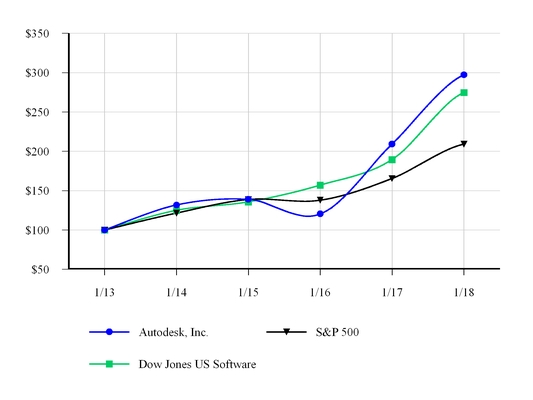][added: 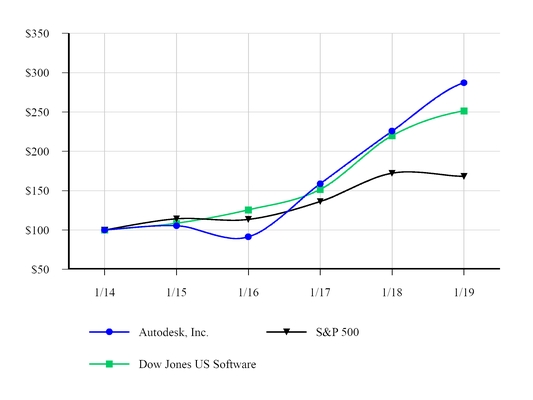]
| (1) | Assumes $100 invested on January 31, [removed: 2013,] [added: 2014,] in Autodesk’s stock, the Standard & Poor’s 500 Stock Index, and the Dow Jones U.S. Software Index, with reinvestment of all dividends. Total stockholder returns for prior periods are not an indication of future investment returns. |
MARKET INFORMATION FOR COMMON STOCK
DIVIDEND POLICY
Under the share repurchase program, Autodesk may repurchase shares from time to time in open market transactions, privately-negotiated transactions, accelerated share repurchase programs, tender offers, or by other means.
| November 1- November 30 | 0.2 | | | $ | 133.83 | | | 0.2 | | | 17.4 | |
| December 1 - December 31 | — | | | — | | | | — | | | 17.4 | |
| January 1 - January 31 | — | | | — | | | | — | | | 17.4 | |
| Total | 0.2 | | | $ | 133.83 | | | 0.2 | | | | |
*2019 Form 10-K 30*

*2019 Form 10-K 31*
The following table lists the intraday high and low sales prices for each quarter in the last two fiscal years.
| | | | | | | | |
| --- | --- | --- | --- | --- | --- | --- | --- |
| | High | | | | Low | | |
| Fiscal 2018 | | | | | | | |
| First Quarter | $ | 90.94 | | | $ | 80.04 | |
| Second Quarter | 115.25 | | | | 91.17 | | |
| Third Quarter | 125.01 | | | | 104.77 | | |
| Fourth Quarter | 131.10 | | | | 103.19 | | |
| Fiscal 2017 | | | | | | | |
| First Quarter | $ | 62.42 | | | $ | 41.60 | |
| Second Quarter | 61.42 | | | | 49.82 | | |
| Third Quarter | 73.40 | | | | 56.80 | | |
| Fourth Quarter | 83.96 | | | | 67.15 | | |
Dividends
We did not declare any cash or stock dividends in either fiscal 2018 or fiscal 2017.
In September 2016, the Board of Directors approved a plan which authorized the repurchase of up to an additional 30.0 million shares of the Company's common stock.
As of January 31, 2018, 10.4 million shares have been repurchased under this plan.
During the three and twelve months ended January 31, 2018, we repurchased 2.5 million and 6.9 million shares, respectively, of our common stock under the Board of Director authorized share repurchase program.
At January 31, 2018, 19.6 million shares remained available for repurchase under the repurchase program approved by the Board of Directors.
See Note 9, “Stockholders' (Deficit) Equity (Deficit),” in the Notes to Consolidated Financial Statements for further discussion.
*2018 Form 10-K 31*
| November 1- November 30 | 0.4 | | | $ | 109.18 | | | 0.4 | | | 21.7 | |
| December 1 - December 31 | 2.0 | | | 107.35 | | | | 2.0 | | | 19.7 | |
| January 1 - January 31 | 0.1 | | | 113.26 | | | | 0.1 | | | 19.6 | |
| Total | 2.5 | | | $ | 107.86 | | | 2.5 | | | | |
*2018 Form 10-K 32*
*2018 Form 10-K 33*
Item 6. SELECTED FINANCIAL DATA
14 rewritten, 5 added, 1 removed, 11 unchanged
The financial data for the fiscal years ended January 31, [removed: 2018] [added: 2019] and [removed: 2017] [added: 2018] are derived from, and are qualified by reference to, the audited consolidated financial statements that are included in this Form 10-K.
The Consolidated Statements of Operations and the Consolidated Statements of Cash Flows data for the [added: fiscal] year ended January 31, [removed: 2016] [added: 2017] are derived from, and are qualified by reference to, the audited consolidated financial statements that are included in this Form 10-K.
The Consolidated Balance Sheet data for the fiscal year ended January 31, [removed: 2016] [added: 2017] and the remaining financial data for the fiscal years ended January 31, [removed: 2015] [added: 2016] and [removed: 2014] [added: 2015] are derived from audited, consolidated financial statements which are not included in this Form 10-K.
| | [removed: 2018] [added: 2019 (1)] | | | | [removed: 2017] [added: 2018] | | | | [removed: 2016] [added: 2017] | | | | [removed: 2015] [added: 2016] | | | | [removed: 2014] [added: 2015] | | |
| Net revenue | $ | [removed: 2,056.6] [added: 2,569.8] | | | $ | [removed: 2,031.0] [added: 2,056.6] | | | $ | [removed: 2,504.1] [added: 2,031.0] | | | $ | [removed: 2,512.2] [added: 2,504.1] | | | $ | [removed: 2,273.9] [added: 2,512.2] | |
| (Loss) income from operations | [removed: (509.1] [added: (25.0] | | ) | | [removed: (499.6] [added: (509.1] | | ) | | [removed: 1.3] [added: (499.6] | | [added: )] | | [removed: 120.7] [added: 1.3] | | | | [removed: 284.8] [added: 120.7] | | |
| Net (loss) income | [removed: (566.9] [added: (80.8] | | ) | | [removed: (582.1] [added: (566.9] | | ) | | [removed: (330.5] [added: (582.1] | | ) | | [removed: 81.8] [added: (330.5] | | [added: )] | | [removed: 228.8] [added: 81.8] | | |
| Cash flow from operations | [removed: 0.9] [added: $] | [added: 377.1] | | | [removed: 169.7] [added: $] | [added: 0.9] | | | [removed: 414.0] [added: $] | [added: 169.7] | | | [removed: 708.6] [added: $] | [added: 414.0] | | | [removed: 572.6] [added: $] | [added: 708.6] | |
| Basic net (loss) income per share | $ | [removed: (2.58] [added: (0.37] | ) | | $ | [removed: (2.61] [added: (2.58] | ) | | $ | [removed: (1.46] [added: (2.61] | ) | | $ | [removed: 0.36] [added: (1.46] | [added: )] | | $ | [removed: 1.02] [added: 0.36] | |
| Diluted net (loss) income per share | [removed: (2.58] [added: $] | [added: (0.37] | ) | | [removed: (2.61] [added: $] | [added: (2.58] | ) | | [removed: (1.46] [added: $] | [added: (2.61] | ) | | [removed: 0.35] [added: $] | [added: (1.46] | [added: )] | | [removed: 1.00] [added: $] | [added: 0.35] | |
| Total assets | $ | [removed: 4,113.6] [added: 4,729.2] | | | $ | [removed: 4,798.1] [added: 4,113.6] | | | $ | [removed: 5,515.3] [added: 4,798.1] | | | $ | [removed: 4,909.7] [added: 5,515.3] | | | $ | [removed: 4,589.9] [added: 4,909.7] | |
| Long-term liabilities | [removed: 2,246.4] [added: 2,638.9] | | | | [removed: 1,879.1] [added: 2,246.4] | | | | [removed: 2,304.7] [added: 1,879.1] | | | | [removed: 1,290.4] [added: 2,304.7] | | | | [removed: 1,256.9] [added: 1,290.4] | | |
| Stockholders’ (deficit) equity | [removed: (256.0] [added: $] | [added: (210.9] | ) | | [removed: 733.6] [added: $] | [added: (256.0] | [added: )] | | [removed: 1,619.6] [added: $] | [added: 733.6] | | | [removed: 2,219.2] [added: $] | [added: 1,619.6] | | | [removed: 2,261.5] [added: $] | [added: 2,219.2] | |
[removed: ][added: ]
____________________
| (1) | Reflects the impact of the adoption of new accounting standards in fiscal year 2019 related to revenue recognition. See Part II, Item 8, Note 1, Business and Summary of Significant Accounting Policies, Accounting Standards Adopted, of our consolidated financial statements for additional information. |
*2019 Form 10-K 32*
| | |
| --- | --- |
*2018 Form 10-K 34*
Item 8. FINANCIAL STATEMENTS AND SUPPLEMENTARY DATA
552 rewritten, 516 added, 288 removed, 729 unchanged
| [removed: 2018] [added: 2019] | | | | [removed: 2017] [added: 2018] | | | | [removed: 2016] [added: 2017] | | | |
| Maintenance | [removed: $] [added: 635.1] | [removed: 989.6] | | | [removed: $] [added: 989.6] | [removed: 1,103.1] | | | [removed: $] [added: 1,103.1] | [removed: 1,152.5] | |
| Subscription | [removed: 894.3] [added: $] | [added: 1,802.3] | | | [removed: 443.1] [added: $] | [added: 894.3] | | | [removed: 228.1] [added: $] | [added: 443.1] | |
| Total [removed: maintenance and] subscription [added: and maintenance] revenue | [removed: 1,883.9] [added: 2,437.4] | | | | [removed: 1,546.2] [added: 1,883.9] | | | | [removed: 1,380.6] [added: 1,546.2] | | |
| [removed: License and other] [added: Other (1)] | [removed: 172.7] [added: 132.4] | | | | [removed: 484.8] [added: 172.7] | | | | [removed: 1,123.5] [added: 484.8] | | |
| Total net revenue | [removed: 2,056.6] [added: 2,569.8] | | | | [removed: 2,031.0] [added: 2,056.6] | | | | [removed: 2,504.1] [added: 2,031.0] | | |
| Cost of [removed: maintenance and] subscription [added: and maintenance] revenue | [removed: 214.4] [added: 216.0] | | | | [removed: 191.7] [added: 214.4] | | | | [removed: 162.3] [added: 191.7] | | |
| Cost of [removed: license and] other revenue [added: (2)] | [removed: 72.6] [added: 54.4] | | | | [removed: 110.2] [added: 72.6] | | | | [removed: 159.4] [added: 110.2] | | |
| Amortization of developed technology | [removed: 16.4] [added: 15.5] | | | | [removed: 40.0] [added: 16.4] | | | | [removed: 49.0] [added: 40.0] | | |
| Total cost of revenue | [removed: 303.4] [added: 285.9] | | | | [removed: 341.9] [added: 303.4] | | | | [removed: 370.7] [added: 341.9] | | |
| Gross profit | [removed: 1,753.2] [added: 2,283.9] | | | | [removed: 1,689.1] [added: 1,753.2] | | | | [removed: 2,133.4] [added: 1,689.1] | | |
| Marketing and sales | [removed: 1,087.3] [added: 1,183.9] | | | | [removed: 1,022.5] [added: 1,087.3] | | | | [removed: 1,015.5] [added: 1,022.5] | | |
| Research and development | [removed: 755.5] [added: 725.0] | | | | [removed: 766.1] [added: 755.5] | | | | [removed: 790.0] [added: 766.1] | | |
| General and administrative | [removed: 305.2] [added: 340.1] | | | | [removed: 287.8] [added: 305.2] | | | | [removed: 293.4] [added: 287.8] | | |
| Amortization of purchased intangibles | [removed: 20.2] [added: 18.0] | | | | [removed: 31.8] [added: 20.2] | | | | [removed: 33.2] [added: 31.8] | | |
| Restructuring [removed: charges] and other [removed: facility] exit costs, net | [removed: 94.1] [added: 41.9] | | | | [removed: 80.5] [added: 94.1] | | | | [removed: —] [added: 80.5] | | |
| Total operating expenses | [removed: 2,262.3] [added: 2,308.9] | | | | [removed: 2,188.7] [added: 2,262.3] | | | | [removed: 2,132.1] [added: 2,188.7] | | |
| [removed: (Loss) income] [added: Loss] from operations | [removed: (509.1] [added: (25.0] | | ) | | [removed: (499.6] [added: (509.1] | | ) | | [removed: 1.3] [added: (499.6] | | [added: )] |
| Interest and other expense, net | [removed: (48.2] [added: (17.7] | | ) | | [removed: (24.2] [added: (48.2] | | ) | | [removed: (21.6] [added: (24.2] | | ) |
| Loss before income taxes | [removed: (557.3] [added: (42.7] | | ) | | [removed: (523.8] [added: (557.3] | | ) | | [removed: (20.3] [added: (523.8] | | ) |
| Provision for income taxes | [removed: (9.6] [added: (38.1] | | ) | | [removed: (58.3] [added: (9.6] | | ) | | [removed: (310.2] [added: (58.3] | | ) |
| Net loss | $ | [removed: (566.9] [added: (80.8] | ) | | $ | [removed: (582.1] [added: (566.9] | ) | | $ | [removed: (330.5] [added: (582.1] | ) |
| Basic net loss per share | $ | [removed: (2.58] [added: (0.37] | ) | | $ | [removed: (2.61] [added: (2.58] | ) | | $ | [removed: (1.46] [added: (2.61] | ) |
| Diluted net loss per share | $ | [removed: (2.58] [added: (0.37] | ) | | $ | [removed: (2.61] [added: (2.58] | ) | | $ | [removed: (1.46] [added: (2.61] | ) |
| Weighted average shares used in computing basic net loss per share | [removed: 219.5] [added: 218.9] | | | | [removed: 222.7] [added: 219.5] | | | | [removed: 226.0] [added: 222.7] | | |
| Weighted average shares used in computing diluted net loss per share | [removed: 219.5] [added: 218.9] | | | | [removed: 222.7] [added: 219.5] | | | | [removed: 226.0] [added: 222.7] | | |
[removed: ][added: ]
| | [removed: 2018] [added: 2019] | | | | [removed: 2017] [added: 2018] | | | | [removed: 2016] [added: 2017] | | |
| Other comprehensive [removed: loss,] [added: (loss) income,] net of reclassifications: | | | | | | | | | | | |
| Net [removed: loss] [added: gain (loss)] on derivative instruments (net of tax effect of [removed: $3.2,] ($1.1), [added: $3.2,] and [removed: $0.6)] [added: ($1.1))] | [removed: (31.2] [added: 31.6] | | [removed: )] | | [removed: (1.1] [added: (31.2] | | ) | | [removed: (27.1] [added: (1.1] | | ) |
| Change in net unrealized [removed: (loss)] gain [added: (loss)] on available-for-sale securities (net of tax effect of [added: $0.0,] $0.1, [removed: ($0.5),] and [removed: $0.0)] [added: ($0.5))] | [removed: (0.2] [added: 2.0] | | [removed: )] | | [removed: 1.3] [added: (0.2] | | [added: )] | | [removed: (1.4] [added: 1.3] | | [removed: )] |
| Change in defined benefit pension items (net of tax effect of [added: ($2.0),] ($0.7), [removed: ($0.9),] and [removed: $0.9)] [added: ($0.9))] | [removed: 4.5] [added: 13.0] | | | | [removed: (5.5] [added: 4.5] | | [removed: )] | | [removed: (4.6] [added: (5.5] | | ) |
| Net change in cumulative foreign currency translation [removed: gain] (loss) [added: gain] (net of tax effect of [added: $0.5,] ($4.8), [removed: $0.2,] and [removed: $0.5)] [added: $0.2))] | [removed: 81.6] [added: (57.8] | | [added: )] | | [removed: (52.1] [added: 81.6] | | [removed: )] | | [removed: (34.7] [added: (52.1] | | ) |
| Total other comprehensive [removed: income] (loss) [added: income] | [removed: 54.7] [added: (11.2] | | [added: )] | | [removed: (57.4] [added: 54.7] | | [removed: )] | | [removed: (67.8] [added: (57.4] | | ) |
| Total comprehensive loss | $ | [removed: (512.2] [added: (92.0] | ) | | $ | [removed: (639.5] [added: (512.2] | ) | | $ | [removed: (398.3] [added: (639.5] | ) |
| | [added: |] January 31, [added: 2019 | | | | | | January 31,] 2018 | | | | January 31, 2017 | | |
| Cash and cash equivalents | $ | [removed: 1,078.0] [added: 886.0] | | | $ | [removed: 1,213.1] [added: 1,078.0] | |
| Marketable securities | [removed: 245.2] [added: 67.6] | | | | [removed: 686.8] [added: 245.2] | | |
| Accounts receivable, net | [removed: 438.2] [added: 474.3] | | | | [removed: 452.3] [added: 438.2] | | |
| Prepaid expenses and other current assets | [removed: 116.5] [added: 192.1] | | | | [removed: 108.4] [added: 116.5] | | |
| (1) | Previously labeled as "License and other" in prior periods. |
| (2) | Previously labeled as "Cost of license and other revenue" in prior periods. |
*2019 Form 10-K 61*
| Net loss | $ | (80.8 | ) | | $ | (566.9 | ) | | $ | (582.1 | ) |

*2019 Form 10-K 62*

*2019 Form 10-K 63*
| Net loss | $ | (80.8 | ) | | $ | (566.9 | ) | | $ | (582.1 | ) |
| Restructuring and other exit costs, net | 31.7 | | | | 94.1 | | | | 80.5 | | |
| Non-cash investing and financing activities: | | | | | | | | | | | |
| Fair value of equity awards assumed (See Note 6) | $ | 10.3 | | | $ | — | | | $ | — | |
| Fair value of common stock issued as consideration for business combination (See Note 6) | $ | 44.8 | | | $ | — | | | $ | — | |

*2019 Form 10-K 64*
| Pre-combination expense related to equity awards assumed | — | | | 10.3 | | | | — | | | | — | | | | 10.3 | | |
| Shares issued as consideration for business combination | 0.3 | | | 44.8 | | | | — | | | | — | | | | 44.8 | | |
| Repurchase and retirement of common shares | (2.2 | ) | | (133.3 | | ) | | — | | | | (159.2 | | ) | | (292.5 | | ) |
| Balances, January 31, 2019 | 219.4 | | | $ | 2,071.5 | | | $ | (135.0 | ) | | $ | (2,147.4 | ) | | $ | (210.9 | ) |

*2019 Form 10-K 65*

*2019 Form 10-K 66*
Privately held debt and equity securities (Level 3) are valued using significant unobservable inputs or data in an inactive market and the valuation requires the Company's judgment due to the absence of market prices and inherent lack of liquidity.
These assumptions are inherently subjective and involve significant management judgment.
Whenever possible, we use observable market data and rely on unobservable inputs only when observable market data is not available, when determining fair value.
The carrying value is not adjusted for the Company's privately held equity securities if there are no observable price changes in a same or similar security from the same issuer or if there are no identified events or changes in circumstances that may indicate impairment, as discussed below.
In determining the estimated fair value of its strategic investments in privately held companies, the Company utilizes the most recent data available to the Company.
In addition, the determination of whether an orderly transaction is for a same or similar investment requires significant management judgment including: the rights and obligations of the investments, the extent to which those differences would affect the fair values of those investments, and the impact of any differences based on the stage of operational development of the investee.
For any marketable debt securities, declines in fair value judged to be other-than-temporary on securities available for sale are included as a reduction to investment income.
For the purposes of computing realized and unrealized gains and losses, the cost of securities sold is based on the specific-identification method.
Interest on securities classified as available for sale is also included as a component of investment income.
For Autodesk's quarterly impairment assessment of privately held debt and equity securities strategic investment portfolio, the analysis encompasses an assessment of the severity and duration of the impairment and qualitative and quantitative analysis of other key factors including: the investee’s financial metrics, the investee’s products and technologies meeting or exceeding predefined milestones, market acceptance of the product or technology, other competitive products or technology in the market, general market conditions, management and governance structure of the investee, the investee’s liquidity, debt ratios and the rate at which the investee is using its cash.
If the investment is considered to be impaired, the Company will record the investment at fair value by recognizing an impairment through the consolidated statement of operations and establishing a new carrying value for the investment.

*2019 Form 10-K 67*
| | 2019 | | | | 2018 | | |
| (1) | Autodesk adopted ASU No. 2014-09, “Revenue from Contracts with Customers" regarding Accounting Standards Codification (ASC Topic 606) during the first quarter of fiscal 2019. As such, current year balances are shown under ASC Topic 606 and prior year balances are shown under ASC Topic 605. See Note 1, "Business and Summary of Significant Accounting Policies\-Accounting Standards Adopted", of our consolidated financial statements for additional information. |
No other customer accounted for more than 10% of Autodesk's total net revenue or trade accounts receivable for each of the respective periods.

*2018 Form 10-K 62*
*2018 Form 10-K 63*
| Long-term notes payable, net | 1,586.0 | | | | 1,092.0 | | |
*2018 Form 10-K 64*
*2018 Form 10-K 65*
| Balances, January 31, 2015 | 227.0 | | | $ | 1,773.1 | | | $ | (53.3 | ) | | $ | 499.4 | | | $ | 2,219.2 | |
| Repurchase and retirement of common shares | (8.5 | ) | | (208.3 | | ) | | — | | | | (249.7 | | ) | | (458.0 | | ) |
*2018 Form 10-K 66*
*Change in Presentation*
During the first quarter of fiscal 2018, the Company changed its historical presentation of its revenue and cost of revenue categories.
Previously, the Company presented revenue and cost of revenue on two lines: subscription, and license and other.
Included within subscription was maintenance revenue for all of the Company's software products and revenue for the Company's cloud service offerings.
License and other revenue included product license revenue, standalone consulting services, and other immaterial items.
Also, included within license and other revenue was an allocation of the estimated value of the software license from the Company's term-based product subscriptions and enterprise offerings, which contain a software license, maintenance and cloud services.
For these arrangements, as there is no vendor-specific-objective evidence ("VSOE") for the related maintenance, the arrangement consideration was allocated between the license and maintenance deliverables based on best estimated selling prices in our consolidated statements of operations.
The Company performed the allocation because it provided a meaningful presentation to investors based on the Company's then current product mix.
As part of the Company's technological and business model transition, the Company discontinued the sale of most of its perpetual licenses, transitioning away from selling a mix of perpetual licenses and term-based product subscriptions to a single subscription model involving a combined hybrid offering of desktop software and cloud functionality, which provides a device-independent, collaborative design workflow for designers and their stakeholders.
Fiscal 2018 marks the first full year in the Company's history that it sold substantially all term-based product subscriptions.
To better reflect this shift in its business, the Company adopted a revised presentation in the first quarter of fiscal 2018, including the separation of subscription revenue and maintenance revenue on distinct line items on the Company's consolidated statement of operations.
Subscription revenue now consists of our term-based product subscriptions, cloud service offerings, and flexible enterprise business arrangements.
Note that with the change in presentation of revenue in the Company’s consolidated statement of operations in fiscal 2018, term-based product subscriptions and flexible enterprise business arrangements are classified and presented in a single line item.
Maintenance revenue is presented as a separate line item in the new presentation and consists of revenue from the Company's existing maintenance plan agreements and related renewals.
License and other revenue will continue to be presented as a separate line item and include any residual perpetual licenses sold, standalone consulting services, and other immaterial items.
*2018 Form 10-K 67*
In connection with these revisions, the Company also revised its cost of revenue classification to present cost of subscription and maintenance revenue and amortization of developed technology separately.
Cost of license and other revenue will continue to be presented as a separate line item.
This change in presentation does not affect the Company's total net revenues, total cost of net revenues or overall gross margin.
The following table shows reclassified amounts to conform to the periods' presentation:
| | | | | | | | | | | | | | | | | | | | | | | | |
| --- | --- | --- | --- | --- | --- | --- | --- | --- | --- | --- | --- | --- | --- | --- | --- | --- | --- | --- | --- | --- | --- | --- | --- |
| | Previously Reported | | | | Change in Presentation Reclassification | | | | Current Presentation | | | | Previously Reported | | | | Change in Presentation Reclassification | | | | Current Presentation | | |
| Maintenance (1) | N/A | | | | $ | 1,103.1 | | | $ | 1,103.1 | | | N/A | | | | $ | 1,152.5 | | | $ | 1,152.5 | |
| Subscription | $ | 1,290.0 | | | (846.9 | | ) | | 443.1 | | | | $ | 1,277.2 | | | (1,049.1 | | ) | | 228.1 | | |
| License and other | 741.0 | | | | (256.2 | | ) | | 484.8 | | | | 1,226.9 | | | | (103.4 | | ) | | 1,123.5 | | |
| Total | $ | 2,031.0 | | | $ | — | | | $ | 2,031.0 | | | $ | 2,504.1 | | | $ | — | | | $ | 2,504.1 | |
| Maintenance and subscription (2) | $ | 151.3 | | | $ | 40.4 | | | $ | 191.7 | | | $ | 156.1 | | | $ | 6.2 | | | $ | 162.3 | |
| License and other | 190.6 | | | | (80.4 | | ) | | 110.2 | | | | 214.6 | | | | (55.2 | | ) | | 159.4 | | |
| Amortization of developed technology (1) | N/A | | | | 40.0 | | | | 40.0 | | | | N/A | | | | 49.0 | | | | 49.0 | | |
| Total | $ | 341.9 | | | $ | — | | | $ | 341.9 | | | $ | 370.7 | | | $ | — | | | $ | 370.7 | |
(1) These lines were not previously reported in the Consolidated Statement of Operations.
An excerpt. Shown here: 40 of 552 rewritten, 40 of 516 added and 40 of 288 removed. The counts are complete. For every sentence, read Item 8. FINANCIAL STATEMENTS AND SUPPLEMENTARY DATA in the FY2019 filing and the FY2018 filing.
Item 9A. CONTROLS AND PROCEDURES
6 rewritten, 0 added, 0 removed, 13 unchanged
Our disclosure controls and procedures are designed to ensure that information required to be disclosed in our Exchange Act reports is (i) recorded, processed, summarized and reported within the time periods specified in the rules of the Securities and Exchange [removed: Commission,] [added: Commission ("SEC"),] and (ii) accumulated and communicated to Autodesk management, including our Chief Executive Officer and Chief Financial Officer, to allow timely decisions regarding required disclosure.
Based upon this evaluation, our Chief Executive Officer and Chief Financial Officer have concluded that our disclosure controls and procedures are effective as of January 31, [removed: 2018.][added: 2019.]
Our management assessed the effectiveness of our internal control over financial reporting as of January 31, [removed: 2018.][added: 2019.]
Our management has concluded that, as of January 31, [removed: 2018,] [added: 2019,] our internal control over financial reporting [removed: is] [added: was] effective to provide reasonable assurance regarding the reliability of financial reporting and the preparation of financial statements for external purposes in accordance with generally accepted accounting principles.
Our independent registered public accounting firm, Ernst & [removed: Young,] [added: Young] LLP, has issued an audit report on our internal control over financial reporting, which is included in Item 8 herein.
There were no changes in our internal [removed: controls] [added: control] over financial reporting (as such term is defined in Rules 13a-15(f) and 15d-15(f) under the Securities Exchange Act of 1934) during the three months ended January 31, [removed: 2018,] [added: 2019,] that have materially affected, or are reasonably likely to materially affect, our internal [removed: controls] [added: control] over financial reporting.
Item 9B. OTHER INFORMATION
1 rewritten, 1 added, 1 removed, 6 unchanged
[removed: ][added: ]
*2019 Form 10-K 109*
*2018 Form 10-K 106*
Item 10. DIRECTORS, EXECUTIVE OFFICERS AND CORPORATE GOVERNANCE
10 rewritten, 1 added, 2 removed, 36 unchanged
The following sets forth certain information as of March [removed: 22, 2018,] [added: 25, 2019,] regarding our executive officers.
| Andrew Anagnost | [removed: 53] [added: 54] | | President and Chief Executive Officer |
| R. Scott Herren | [removed: 56] [added: 57] | | SVP and Chief Financial Officer |
| Steve M. Blum | [removed: 53] [added: 54] | | SVP, Worldwide Field Operations |
| Pascal W. Di Fronzo | [removed: 53] [added: 54] | | SVP, Corporate Affairs, Chief Legal Officer & Secretary |
| Carmel Galvin | [removed: 49] [added: 50] | | SVP, [added: People and Places and] Chief Human Resources Officer |
Di Fronzo joined Autodesk in June 1998 and has served as [removed: SVP,] [added: Senior Vice President,] Corporate Affairs, Chief Legal Officer & Secretary since December 2016.
[removed: ][added: ]
[added: Prior to joining] Autodesk, he advised high technology and emerging growth companies on business and intellectual property transactions and litigation while in private practice.
Carmel Galvin joined Autodesk in March 2018 and serves as Senior Vice President, [added: People and Places and] Chief Human Resources Officer (“CHRO”).
*2019 Form 10-K 110*
Prior to joining
*2018 Form 10-K 107*
Item 11. EXECUTIVE COMPENSATION
1 rewritten, 0 added, 0 removed, 2 unchanged
The information required by this Item is incorporated herein by reference to the [removed: section] [added: sections] entitled "Corporate Governance" and “Executive [removed: Compensation,”] [added: Compensation”] in our Proxy Statement.
Item 12. SECURITY OWNERSHIP OF CERTAIN BENEFICIAL OWNERS AND MANAGEMENT AND RELATED STOCKHOLDER MATTERS
1 rewritten, 0 added, 0 removed, 2 unchanged
The information required by this Item is incorporated herein by reference to the [removed: section] [added: sections] entitled “Security Ownership of Certain Beneficial Owners and [removed: Management,”] [added: Management”] and “Executive Compensation—Equity Compensation Plan Information” in our Proxy Statement.
Item 13. CERTAIN RELATIONSHIPS AND RELATED TRANSACTIONS, AND DIRECTOR INDEPENDENCE
1 rewritten, 0 added, 0 removed, 2 unchanged
The information required by this Item is incorporated herein by reference to the [removed: section] [added: sections] entitled “Certain Relationships and Related Party Transactions” and “Corporate Governance—Independence of the Board of Directors” in our Proxy Statement.
Item 14. PRINCIPAL ACCOUNTING FEES AND SERVICES
1 rewritten, 1 added, 1 removed, 4 unchanged
[removed: ][added: ]
*2019 Form 10-K 111*
*2018 Form 10-K 108*
Item 15. EXHIBITS AND FINANCIAL STATEMENT SCHEDULES
12 rewritten, 4 added, 6 removed, 22 unchanged
| *1.* | *Financial Statements*: The information concerning Autodesk’s financial statements, and [added: the] Report of Ernst & Young LLP, Independent Registered Public Accounting Firm required by this Item is incorporated by reference herein to the section of this Report in Item 8, entitled “Financial Statements and Supplementary Data.” |
| *2.* | *Financial Statement Schedule*: The following financial statement schedule of Autodesk, Inc., for the fiscal years ended January 31, [added: 2019,] 2018, [removed: 2017,] and [removed: 2016,] [added: 2017,] is filed as part of this Report and should be read in conjunction with the Consolidated Financial Statements of Autodesk, Inc.: |
| Description | Balance at Beginning of Fiscal Year | | | [removed: |] Additions Charged to Costs and Expenses or Revenues | | | [removed: |] Deductions and Write-Offs | | | [removed: |] Balance at End of Fiscal Year | | [removed: |]
| | (in millions) | | | | | | | | | | | [removed: | | | |]
| Fiscal Year Ended January 31, 2018 | | | | | | | | | | | | [removed: | | | |]
| Partner Program reserves (1) | 28.1 | | | [removed: |] 224.3 | | | [removed: |] 215.9 | | | [removed: |] 36.5 | | [removed: |]
| Restructuring [added: and other facility exit costs] | 8.4 | | | [removed: |] 94.1 | | | [removed: |] 45.3 | | | [removed: |] 57.2 | | [removed: |]
| Fiscal Year Ended January 31, 2017 | | | | | | | | | | | | [removed: | | | |]
| Partner Program reserves (1) | 45.2 | | | [removed: |] 240.3 | | | [removed: |] 257.4 | | | [removed: |] 28.1 | | [removed: |]
| Restructuring [added: and other facility exit costs] | 1.3 | | | [removed: |] 77.8 | | | [removed: |] 70.7 | | | [removed: |] 8.4 | | [removed: |]
| Fiscal Year Ended January 31, [removed: 2016 | | | |] [added: 2019] | | | | | | | | | | | |
| Partner Program reserves (1) | 36.5 | | | [removed: | 267.4 | | |] [added: 294.7] | [removed: 258.7] | | [added: 279.5] | | [removed: 45.2] | [added: 51.7] | |
| | | | | | | | | | | | |
| --- | --- | --- | --- | --- | --- | --- | --- | --- | --- | --- | --- |
| | | | | | | | | | | | |
| Restructuring and other facility exit costs | 57.2 | | | 41.9 | | | 97.0 | | | 2.1 | |
| | | | | | | | | | | | | | | | |
| --- | --- | --- | --- | --- | --- | --- | --- | --- | --- | --- | --- | --- | --- | --- | --- |
| Allowance for doubtful accounts | $ | 1.5 | | | $ | 2.1 | | | $ | 1.3 | | | $ | 2.3 | |
| Allowance for doubtful accounts | $ | 7.6 | | | $ | (3.3 | ) | | $ | 2.8 | | | $ | 1.5 | |
| Allowance for doubtful accounts | $ | 6.3 | | | $ | 2.3 | | | $ | 1.0 | | | $ | 7.6 | |
| Restructuring | 1.6 | | | | — | | | | 0.3 | | | | 1.3 | | |
Item 16. FORM 10-K SUMMARY
40 rewritten, 13 added, 19 removed, 122 unchanged
[removed: ][added: ]
| Dated: | March [removed: 22, 2018] [added: 25, 2019] | | |
Pursuant to the requirements of the Securities Exchange Act of 1934, this Report has been signed below by the following persons on behalf of the Registrant and in the capacities as of March [removed: 22, 2018.][added: 25, 2019.]
| /s/ R. SCOTT HERREN | | Senior Vice President and Chief Financial Officer (Principal Financial [added: Officer and Principal Accounting] Officer) |
| /s/ [removed: CRAWFORD W. BEVERIDGE] [added: STACY J. SMITH] | | Director (Non-executive Chairman of the Board) |
[removed: *2018] [added: *2019] Form 10-K 112*
| 3.2 | | [Amended and Restated Bylaws of Registrant (incorporated by reference to Exhibit 3.1 filed with the Registrant’s Current Report on Form 8-K filed on [removed: March 21, 2018)](http://www.sec.gov/Archives/edgar/data/769397/000076939718000006/bylawsasamended-2018xmarch.htm)] [added: June 15, 2018)](http://www.sec.gov/Archives/edgar/data/769397/000076939718000027/bylawsasamended-2018xjunex.htm)] |
| 4.1 | | [Indenture dated December 13, 2012, by and between [removed: Autodesk, Inc.] [added: the Registrant] and U.S. Bank National Association (incorporated by reference to Exhibit 4.1 filed with the Registrant's Current Report on Form 8-K filed on December 13, 2012)](http://www.sec.gov/Archives/edgar/data/769397/000119312512501656/d452709dex41.htm) |
| 4.2 | | [First Supplemental Indenture (including Form of Notes) dated December 13, 2012, by and between [removed: Autodesk, Inc.] [added: the Registrant] and U.S. Bank National Association (incorporated by reference to Exhibit 4.2 filed with the Registrant's Current Report on Form 8-K filed on December 13, 2012)](http://www.sec.gov/Archives/edgar/data/769397/000119312512501656/d452709dex42.htm) |
| 4.3 | | [Second Supplemental Indenture (including Form of Notes) dated June 5, 2015, by and between [removed: Autodesk, Inc.] [added: the Registrant] and U.S. Bank National Association (incorporated by reference to Exhibit 4.1 of the Registrant's Current Report on Form 8-K filed on June 8, 2015)](http://www.sec.gov/Archives/edgar/data/769397/000119312515216324/d938494dex41.htm) |
| 4.4 | | [Third Supplemental Indenture (including Form of Notes) dated June 8, 2017, by and between [removed: Autodesk, Inc.] [added: the Registrant] and U.S. Bank National Association. (incorporated by reference to Exhibit 4.1 of the Registrant's Current Report on Form 8-K filed on June 8, 2017)](http://www.sec.gov/Archives/edgar/data/769397/000119312517198513/d399645dex41.htm) |
| 10.1* | | [Description of Registrant's Performance Stock Unit Program (incorporated by reference to Item 5.02 of the Registrant's Current Report on Form 8-K filed on March [removed: 17, 2017)](http://www.sec.gov/Archives/edgar/data/769397/000076939717000011/adsk-form8xkitem502march17.htm)] [added: 26, 2018)](http://www.sec.gov/Archives/edgar/data/769397/000076939718000015/form8-kx2018xmarchx21item5.htm)] |
| 10.2* | | [Registrant’s 1998 Employee Qualified Stock Purchase Plan, as amended and restated effective as of June [removed: 14, 2017] [added: 12, 2018] (incorporated by reference to Exhibit 10.3 of the Registrant’s Quarterly Report on Form 10-Q filed on August [removed: 31, 2017)](http://www.sec.gov/Archives/edgar/data/769397/000076939717000051/adsk07312017ex103.htm)] [added: 30, 2018)](http://www.sec.gov/Archives/edgar/data/769397/000076939718000042/ex103-autodeskxespp199.htm)] |
| 10.4* | | [Registrant's 2012 Employee Stock Plan, as amended and restated [added: effective as of June 12, 2018] (incorporated by reference to Exhibit [removed: 10.4] [added: 10.2] filed with the Registrant's Quarterly Report on Form 10-Q filed on August [removed: 31, 2017)](http://www.sec.gov/Archives/edgar/data/769397/000076939717000051/adsk07312017ex104.htm)] [added: 30, 2018)](http://www.sec.gov/Archives/edgar/data/769397/000076939718000042/ex102-2012employeestoc.htm)] |
[removed: *2018] [added: *2019] Form 10-K 113*
| [removed: 10.9*] [added: 10.11*] | | [Registrant's 2012 Outside Directors' Stock Plan, as amended and restated (incorporated by reference to Exhibit 10.18 filed with the Registrant’s Annual Report on Form 10-K filed on March 21, 2017)](http://www.sec.gov/Archives/edgar/data/769397/000076939717000014/adsk01312017ex1018.htm) |
| [removed: 10.10*] [added: 10.12*] | | [Registrant's 2012 Outside Directors' Stock Plan Form of Restricted Stock Unit Agreement (incorporated by reference to Exhibit 10.5 filed with the Registrant's Current Report on Form 8-K filed on March 13, 2012)](http://www.sec.gov/Archives/edgar/data/769397/000119312512112024/d314351dex105.htm) |
| [removed: 10.11*] [added: 10.13*] | | [Registrant’s Executive Incentive Plan, as amended and restated (incorporated by reference to Exhibit 10.23 filed with the Registrant’s Annual Report on Form 10-K filed on March 23, 2016)](http://www.sec.gov/Archives/edgar/data/769397/000076939716000067/adsk01312016ex1023.htm) |
| [removed: 10.12*] [added: 10.14*] | | [Registrant’s 2005 Non-Qualified Deferred Compensation Plan, as amended and restated, effective as of January 1, 2010 (incorporated by reference to Exhibit 10.1 filed with the Registrant’s Quarterly Report on Form 10-Q filed on December 8, 2009)](http://www.sec.gov/Archives/edgar/data/769397/000119312509249297/dex101.htm) |
| [removed: 10.13*] [added: 10.15*] | | [Participants, target awards and payout formulas for fiscal year [removed: 2018] [added: 2019] under the Registrant's Executive Incentive Plan (incorporated by reference to Item 5.02 of the Registrant's Current Report on Form 8-K filed on March [removed: 17, 2017)](http://www.sec.gov/Archives/edgar/data/769397/000076939717000011/adsk-form8xkitem502march17.htm)] [added: 26, 2018)](http://www.sec.gov/Archives/edgar/data/769397/000076939718000015/form8-kx2018xmarchx21item5.htm)] |
| [removed: 10.14*] [added: 10.16*] | | [Executive Change in Control Program, as amended and restated (incorporated by reference to Exhibit 10.1 filed with the Registrant’s Current Report on Form 8-K filed on December 21, 2016)](http://www.sec.gov/Archives/edgar/data/769397/000076939716000100/ex101executivechangeincont.htm) |
| [removed: 10.15*] [added: 10.17*] | | [Sub-Plan of the Autodesk, Inc. 1998 Employee Qualified Stock Purchase Plan, as amended and restated (filed [removed: herewith)](https://www.sec.gov/Archives/edgar/data/769397/000076939718000011/adsk01312018ex1015.htm)] [added: herewith)](https://www.sec.gov/Archives/edgar/data/769397/000076939719000016/adsk01312019ex1017.htm)] |
| [removed: 10.16*] [added: 10.18*] | | [Form of Indemnification Agreement executed by the Registrant and each of its officers and directors (incorporated by reference to Exhibit 10.8 filed with the Registrant’s Annual Report on Form 10-K filed on March 31, 2005)](http://www.sec.gov/Archives/edgar/data/769397/000119312505067261/dex108.htm) |
| [removed: 10.17*] [added: 10.19*] | | [removed: [Third Amended] [added: [Employment Agreement, dated as of June 19, 2017, by] and [removed: Restated Employment Agreement] between [added: the] Registrant and [removed: Carl Bass dated March 21, 2013] [added: Andrew Anagnost] (incorporated by reference to Exhibit 10.1 filed with the Registrant’s Current Report on Form 8-K filed on [removed: March 25, 2013)](http://www.sec.gov/Archives/edgar/data/769397/000076939713000011/final_carlxbassxemployment.htm)] [added: June 19, 2017)](http://www.sec.gov/Archives/edgar/data/769397/000119312517207116/d372890dex101.htm)] |
| [removed: 10.18*] [added: 10.20*] | | [removed: [R. Scott Herren Offer Letter] [added: [Registrant’s Severance Plan] dated [removed: September 23, 2014] [added: August 27, 2018] (incorporated by reference to Exhibit [removed: 10.1] [added: 99.1] filed with the [removed: Registrant's Quarterly] [added: Registrant’s Current] Report on Form [removed: 10-Q] [added: 8-K] filed on [removed: December 5, 2014)](http://www.sec.gov/Archives/edgar/data/769397/000076939714000060/adsk10312014ex101.htm)] [added: August 30, 2018)](http://www.sec.gov/Archives/edgar/data/769397/000076939718000043/ex991-autodeskseverancepla.htm)] |
| [removed: 10.19*] [added: 10.10*] | | [removed: [Registrant’s Equity Incentive Deferral Plan as amended] [added: [Amended] and [removed: restated effective as of June 12, 2008] [added: Restated BuildingConnected, Inc. 2013 Stock Plan] (incorporated by reference to Exhibit [removed: 10.4] [added: 99.1] filed with the [removed: Registrant’s Quarterly Report] [added: Registrant's Registration Statement] on Form [removed: 10-Q] [added: S-8] filed on [removed: September 5, 2008)](http://www.sec.gov/Archives/edgar/data/769397/000119312508191064/dex104.htm)] [added: January 24, 2019)](http://www.sec.gov/Archives/edgar/data/769397/000076939719000002/ex991buildingconnected2013.htm)] |
| [removed: 10.20*] [added: 10.9*] | | [removed: [Amendment to Registrant's] [added: [PlanGrid, Inc. 2012] Equity Incentive [removed: Deferral] Plan [removed: effective as of February 17, 2012] (incorporated by reference to Exhibit [removed: 10.37] [added: 99.1] filed with the Registrant's [removed: Annual Report] [added: Registration Statement] on Form [removed: 10-K] [added: S-8] filed on [removed: March 15, 2012)](http://www.sec.gov/Archives/edgar/data/769397/000076939712000005/adsk-01312012ex1037.htm)] [added: December 21, 2018)](http://www.sec.gov/Archives/edgar/data/769397/000076939718000057/plangrid2012equityincentiv.htm)] |
| [removed: 10.21] [added: 10.22] | | [Office Lease between Registrant and the J.H.S. Trust for 111 McInnis Parkway, San Rafael, CA, as amended (incorporated by reference to Exhibit 10.1 filed with the Registrant’s Quarterly Report on Form 10-Q for the fiscal quarter ended October 31, 2004)](http://www.sec.gov/Archives/edgar/data/769397/000119312504210314/dex101.htm) |
| [removed: 10.22] [added: 10.23] | | [Fourth Amendment to Lease between Registrant and the J.H.S. Holdings L.P. for 111 McInnis Parkway, San Rafael, CA (incorporated by reference to Exhibit 10.30 filed with the Registrant’s Annual Report on Form 10-K filed on March 19, 2010)](http://www.sec.gov/Archives/edgar/data/769397/000119312510061070/dex1030.htm) |
| [removed: 10.23] [added: 10.24] | | [Amended and Restated Credit Agreement, dated [removed: as of May 29, 2015,] [added: December 17, 2018,] by and among the Registrant, the lenders from time to time party thereto and Citibank, N.A. as agent (incorporated by reference to Exhibit 10.1 filed with the Registrant's Current Report on Form 8-K filed on [removed: May 29, 2015)](http://www.sec.gov/Archives/edgar/data/769397/000076939715000027/autodesk_crxagmtx2015.htm)] [added: December 20, 2018)](http://www.sec.gov/Archives/edgar/data/769397/000076939718000055/ex101-amendedandrestatedcr.htm)] |
| [removed: 10.24] [added: 10.25] | | [removed: [Letter Amendment No. 1, dated April 26, 2017, to the Amended and Restated Credit] [added: [Term Loan] Agreement, dated [removed: as of May 29, 2015,] [added: December 17, 2018,] by and among the Registrant, the lenders from time to time party thereto and Citibank, N.A. as agent (incorporated by reference to Exhibit [removed: 10.5] [added: 10.2] filed with the Registrant's [removed: Quarterly] [added: Current] Report on Form [removed: 10-Q] [added: 8-K] filed on [removed: May 31, 2017)](http://www.sec.gov/Archives/edgar/data/769397/000076939717000031/adsk04302017ex105.htm)] [added: December 20, 2018)](http://www.sec.gov/Archives/edgar/data/769397/000076939718000055/ex102-termloanagreement.htm)] |
| [removed: 10.25] [added: 10.26] | | [removed: [Agreement,] [added: [Agreement and Plan of Merger,] dated [removed: March 10, 2016,] [added: as of November 20, 2018,] by and among the Registrant, [removed: Sachem Head Capital Management LP, Uncas GP LLC,] [added: Araujo Acquisition Corp., PlanGrid, Inc.] and [removed: Sachem Head GP LLC.] [added: Shareholder Representative Services LLC] (incorporated by reference to Exhibit [removed: 99.1] [added: 2.1] filed with the Registrant’s Current Report on Form 8-K filed on [removed: March 11, 2016)](http://www.sec.gov/Archives/edgar/data/769397/000076939716000061/ex991settlement_agreementx.htm)] [added: November 20, 2018)](http://www.sec.gov/Archives/edgar/data/769397/000119312518331326/d659628dex21.htm)] |
[removed: *2018] [added: *2019] Form 10-K 114*
| 21.1 | | [List of Subsidiaries (filed [removed: herewith)](https://www.sec.gov/Archives/edgar/data/769397/000076939718000011/adsk01312018ex211.htm)] [added: herewith)](https://www.sec.gov/Archives/edgar/data/769397/000076939719000016/adsk01312019ex211.htm)] |
| 23.1 | | [Consent of Independent Registered Public Accounting Firm (Ernst & Young LLP) (filed [removed: herewith)](https://www.sec.gov/Archives/edgar/data/769397/000076939718000011/adsk01312018ex231.htm)] [added: herewith)](https://www.sec.gov/Archives/edgar/data/769397/000076939719000016/adsk01312019ex231.htm)] |
| 24.1 | | [removed: Power] [added: [Power] of Attorney (contained in the signature page to this Annual [removed: Report)] [added: Report)](#sFF31289FFF8F5931AA60DE9AC366A314)] |
| 31.1 | | [Certification of Chief Executive Officer pursuant to Rule 13a-14(a) of the Securities Exchange Act of 1934 (filed [removed: herewith)](https://www.sec.gov/Archives/edgar/data/769397/000076939718000011/adsk01312018ex311.htm)] [added: herewith)](https://www.sec.gov/Archives/edgar/data/769397/000076939719000016/adsk01312019ex311.htm)] |
| 31.2 | | [Certification of Chief Financial Officer pursuant to Rule 13a-14(a) of the Securities Exchange Act of 1934 (filed [removed: herewith)](https://www.sec.gov/Archives/edgar/data/769397/000076939718000011/adsk01312018ex312.htm)] [added: herewith)](https://www.sec.gov/Archives/edgar/data/769397/000076939719000016/adsk01312019ex312.htm)] |
| 32.1† | | [Certification of Chief Executive Officer and Chief Financial Officer pursuant to 18 U.S.C. Section 1350, as adopted pursuant to Section 906 of the Sarbanes-Oxley Act of 2002 (filed [removed: herewith)](https://www.sec.gov/Archives/edgar/data/769397/000076939718000011/adsk01312018ex321.htm)] [added: herewith)](https://www.sec.gov/Archives/edgar/data/769397/000076939719000016/adsk01312019ex321.htm)] |
[removed: *2018] [added: *2019] Form 10-K 115*

| /s/ CRAWFORD W. BEVERIDGE | | Director |
| /s/ KAREN BLASING | | Director |
| Blake J. Irving | | |
| /s/ STEPHEN D. MILLIGAN | | Director |
| Stephen D. Milligan | | |


| 10.21* | | [Registrant's 2012 Employee Stock Plan Form of Retirement Restricted Stock Unit Agreement, as amended and restated (filed herewith)](https://www.sec.gov/Archives/edgar/data/769397/000076939719000016/adsk01312019ex1021.htm) |

*2019 Form 10-K 116*

*2019 Form 10-K 117*
*2018 Form 10-K 109*
*2018 Form 10-K 110*
*2018 Form 10-K 111*
| | | |
| /s/ PAUL UNDERWOOD | | Vice President and Controller (Principal Accounting Officer) |
| Paul Underwood | | |
| /s/ CARL BASS | | Director |
| Carl Bass | | |
| /s/ THOMAS GEORGENS | | Director |
| Thomas Georgens | | |
| /s/ RICK HILL | | Director |
| Rick Hill | | |
| /s/ STACY J. SMITH | | Director |
| 10.26 | | [Agreement, dated March 10, 2016, by and among the Registrant, Eminence Capital, LP, and Eminence GP, LLC. (incorporated by reference to Exhibit 99.2 filed with the Registrant’s Current Report on Form 8-K filed on March 11, 2016)](http://www.sec.gov/Archives/edgar/data/769397/000076939716000061/ex992settlement_agreementx.htm) |
| 10.27 | | [Agreement, dated February 6, 2017, by and among the Registrant, Sachem Head Capital Management LP, Uncas GP LLC, and Sachem Head GP LLC. (incorporated by reference to Exhibit 99.1 filed with the Registrant’s Current Report on Form 8-K filed on February 7, 2017)](http://www.sec.gov/Archives/edgar/data/769397/000119312517032583/d344569dex991.htm) |
| 10.28* | | [Transition and Separation Agreement, dated February 6, 2017, by and between the Company and Carl Bass (incorporated by reference to Exhibit 10.1 filed with the Registrant’s Current Report on Form 8-K filed on February 7, 2017)](http://www.sec.gov/Archives/edgar/data/769397/000119312517032583/d344569dex101.htm) |
| 10.29* | | [Employment Agreement, dated as of June 19, 2017, by and between Autodesk, Inc. and Andrew Anagnost (incorporated by reference to Exhibit 10.1 filed with the Registrant’s Current Report on Form 8-K filed on June 19, 2017)](http://www.sec.gov/Archives/edgar/data/769397/000119312517207116/d372890dex101.htm) |
| 10.30 | | [Separation Agreement, dated as of June 19, 2017, by and between Autodesk, Inc. and Amar Hanspal (incorporated by reference to Exhibit 10.2 filed with the Registrant’s Current Report on Form 8-K filed on June 19, 2017)](http://www.sec.gov/Archives/edgar/data/769397/000119312517207116/d372890dex102.htm) |
| 10.31 | | [Separation Agreement, dated as of September 30, 2017, by and between Autodesk, Inc. and Jan Becker (incorporated by reference to Exhibit 10.1 filed with the Registrant’s Quarterly Report on Form 10-Q filed on December 5, 2017)](http://www.sec.gov/Archives/edgar/data/769397/000076939717000057/separationagreement.htm) |