 filings.tools
Item 1. Business
59K characters. Original on sec.gov · Markdown
Item 1. Business
Arista Networks is an industry leader in data-driven, client-to-cloud networking for large AI, data center, campus and routing environments. Arista’s platforms deliver availability, agility, automation, analytics, and security through an advanced network operating stack. Since Arista’s inception, our founders have reimagined cloud networks for performance, scale and programmability with a focus on differentiating in three ways: uncompromising reliability built on the foundation of robust quality assurance capabilities with a suite of automated diagnostics, advanced open and standards-based technology and intelligent automation to decrease the manual workload on the operator.
At the core of Arista’s platform is Arista’s Extensible Operating System ("EOS®"), a modernized publish-subscribe state-sharing networking operating system. Arista EOS, combined with a set of network applications and our Ethernet switching and routing platforms using best of breed merchant silicon, provides customers with a highly competitive and diversified portfolio of products with improved price/performance and time to market.
Our current portfolio of products, services and technologies are grouped into the following categories: Core (Data Center, Cloud and AI Networking), Cognitive Adjacencies (Campus and Routing), and Cognitive Network (Software and Services). Our customers include companies of all sizes and span a range of industries and geographies and are grouped into the following categories: Cloud and AI Titans, Enterprise and Providers. Since we began shipping our products in 2008, we have experienced rapid growth, and, according to market research in 2024, we have achieved the leadership position in overall data center Ethernet switch ports and revenue and continue to lead the market in higher speed Ethernet port shipments of 100G and above. We have been profitable and cash flow positive since 2010.
Our Market Opportunity
We sell our products through both a direct sales force and channel partners, competing primarily in the high-speed data center Ethernet switching markets for 10 Gigabit Ethernet ("GbE") and above, including the Cloud and AI Ethernet switching markets, Enterprise Data Center switching/routing market, the cloud-grade and enterprise routing markets, and the campus wired and wireless markets. We also participate in the Network Monitoring, Network Detection and Response ("NDR") and Network Access Control security markets through both acquisition and organic development.
Our Customers
Our customers include large cloud customers or Cloud and AI Titans, other internet and service providers, including specialty and AI Neoclouds, and a wide breadth of enterprise customers, including financial services organizations and government agencies. We continue to diversify the types of enterprise customers we sell to and have continued to expand our presence across a wide spectrum of industries including media and entertainment, healthcare, oil and gas, education, manufacturing, industrial, and more. Meta Platforms and Microsoft, two of our Cloud and AI Titan end customers, each accounted for more than 10% of our total revenue for the years ended December 31, 2024, and December 31, 2023.
Market Drivers
Digital Transformation
Digital transformation is fundamentally changing the way technology is integrated into business operations and as a result how IT infrastructure is built, and applications are delivered across cloud and end-customer environments. The expanded dependency of business operations on the network has increased the complexity of the network and heightened the importance of network availability, predictable performance, open programmability, security, and operational simplicity.
Public cloud leaders pioneered the development of large-scale cloud data centers to meet these growing demands from their users, including business customers. Enterprises now have the option to move applications to the cloud as cloud services are generally easier and more cost effective to deploy, scale and operate than traditional applications. These cloud metrics have become the baseline for performance, cost and efficiency of IT infrastructure investments. Enterprises and service providers around the world are also now adopting cloud computing technologies and principles to their own non-cloud or hybrid operations in order to achieve similar performance, operational efficiencies and cost reductions.
Arista addresses our customers' requirements through our approach to network architecture, our platforms and our software. Our comprehensive R-series, X-series and Etherlink switching and routing portfolios running the highly programmable EOS, transform networks with simplified and scalable architectures across multiple use-cases.
Artificial Intelligence (AI)
The expansion of generative AI computing and distributed applications is further pushing the boundary of predictable scale and performance in the network. A common characteristic of these AI workloads is that they are both data and compute intensive. A typical AI workload involves large sparse matrix computations, distributed across hundreds or thousands of processors (CPU, GPU, TPU, etc.) with intense computations for a period of time and requires a high-bandwidth, scalable, lossless network in order to service these workloads. With the exponential growth of AI applications, the need for standardized transport like Ethernet becomes paramount, enabling a power-efficient interconnect while overcoming the complexities of traditional approaches.
Arista's AI strategy is based on achieving two key objectives. Arista provides network switching products intended to provide a robust interconnect that seamlessly links GPUs, compute and storage to deliver fast job completion time for training and generative AI workloads. Arista also offers customers the Arista Autonomous Virtual Assist ("AVATM") which uses natural processing language to provide AI-assisted outcomes for network operations, security and observability.
An overview of our AI enabled solutions is shown below:

As a proud founding member, Arista is committed to leading the Ultra Ethernet Consortium ("UEC") to achieve scalable and efficient remote memory access, implemented with enhanced packet spraying, flexible ordering, and modern congestion control algorithms.
Hybrid Work
In the post-pandemic world, the traditional “campus” has been redefined and the boundaries between the office, home, teleworker and user have converged. At the same time, the proliferation and sophistication of devices that connect the campus, such as smart devices, security cameras and Internet of Things ("IoT"), has grown dramatically. The challenge lies in successfully transitioning the existing siloed campus into a data-driven, distributed campus model with a common experience, while addressing the growing security and availability needs.
Arista’s campus portfolio was driven by customers desiring the same quality and operational efficiency available from EOS and CloudVision® throughout their entire enterprise network. We entered the campus market with a diverse portfolio of modular and fixed form factor Campus spine switches, Power-over-Ethernet ("PoE") leaf switches based on EOS and Wi-Fi
access points managed through CloudVision. We continue to expand our campus portfolio to offer the advantages of EOS across the entire enterprise network. Most recently, we have added incremental Enterprise WAN products as well as embedded NDR security sensors into our campus switches to address more of the security challenges that face campus administrators.
Zero Trust Networking Security
Zero trust architectures attempt to mitigate risk associated with cyber threats by eliminating implicit trust in a device simply because it is on the “internal” network. However, this is easier said than done, given today’s changing definition of the network that spans campus, data center, cloud, and more. Adding multiple network security layers such as firewalls, network access control, and threat detection, among others, comes with tremendous cost, complexity, and brittleness, whereas the benefits are often hard to quantify.
Arista offers a full suite of security solutions built on the foundations of our unified operating system in EOS® and the common management plane in CloudVision™. These solutions map to the Cybersecurity and Infrastructure Security Agency’s Zero Trust Maturity Model and help organizations accelerate their journey toward optimal zero trust maturity. Moreover, these network security controls can help compensate for gaps in the organization’s zero trust posture in domains such as identity, devices, workload, and data.
Limitations of Traditional Enterprise Data Center and Campus Networks
The introduction of large scale, highly complex, public cloud environments and the digital transformation of customer business models meant that the traditional ways of building networks were no longer adequate to meet the needs of customers for the deployment and provision of cloud applications and more recently generative AI applications. New innovations were needed to push network performance forward.
Historically, most common network designs were rigidly hierarchical, based on a 3-tiered model developed in the early days of the internet for sparse north/south traffic patterns. This model was limited in the number of devices that could be connected to a network and introduced many points of congestion as customers tried to scale the solution. As more applications move to the cloud, network connections must scale, and the increased east/west traffic must be managed without congestion.
In addition, the switches and routers used to build these tiered networks were based on proprietary, application-specific integrated circuits ("ASICs") that historically underperformed when measured against Moore’s Law, and operating systems that lacked the openness and programmability necessary to automate and effectively manage these networks. As demand for scale and performance increased, the end-user experience was degraded, operational costs increased, and the host cost-per-connection increased.
Similarly, traditional enterprise networks have been mired in complexity, proprietary features and architectures, custom ASICs, siloed designs, and fragile software offerings built up over the previous three decades. Because of this, operating a legacy network is riddled with challenges; critical outages that cause risk-averse behaviors, labor-intensive rollouts that impede business initiatives, limited visibility that prevent problem detection and isolation, and overall lack of automation and uniformity that results in inefficiency. In addition, there had historically been little or no attempt to address the needs of building and operating a network infrastructure at massive, cloud scale. As a result, as enterprises moved applications to the cloud and implemented hybrid and multi-cloud strategies, there have been insufficient solutions that could configure, deploy, automate, and manage these scaled and dispersed resources.
In the post-pandemic world, enterprise campus wired and wireless networks must cope with an ever increasing number of endpoint IoT devices and remote work locations that require users to be connected from virtually anywhere. Campus administrators have sought to address the resulting increased network complexities and bottlenecks through the adoption of a myriad of platforms, operating systems, proprietary features and network management tools. Coupled with the explosive growth of IoT and the requirement for remote workloads, the operational costs of managing these complexities have become prohibitive.
Visibility is a critical component to a more efficient cloud-like network. Being able to capture what a network is ‘thinking’ or ‘doing’ is the basis for true network automation and analytics. Legacy networking has long suffered from limitations in network visibility largely due to inefficient polling mechanisms that only provide a limited subset of data. As a result, the operators of legacy networks have been essentially blinded when it comes to true network insight.
Our Data-Driven Cloud Networking Solutions
The core of our cloud networking platform is our data-driven operating system, EOS, which runs on top of standard Linux and offers programmability at all layers of the stack. System state and data are stored in EOS and maintained in a highly efficient, centralized system database where data is accessed via an automated publish/subscribe model. This distinct design principle provides module independence, self-healing resiliency, and multi-process software stability. EOS is packaged as a perpetual license on Arista hardware platforms, virtualized EOS (vEOS) and CloudEOS for production or simulations use cases with flexible platform support including third-party hardware.
Our cloud networking innovations started with pioneering Arista EOS, which provides switching, routing, state-streaming and telemetry functions across all Arista platforms. EOS established a new standard in networking for large-scale cloud operators, opened the door to the widespread adoption of merchant silicon hardware in networks, and provided dramatic decreases in deployment and operating costs while delivering high reliability for cloud customers, service providers, enterprises, and more.
The Arista EOS network stack architecture provides a foundation for consolidation of streamed device state, telemetry, packet, flow, alert, sensor and third-party data into an aggregated Network Data Lake (Arista NetDL™). Arista NetDL consolidates diverse datasets required for effectively applying AI/Machine Learning (ML) methods by Arista AVA for Network Operations (NetOps) and Security Operations (SecOps) use cases. NetDL also presents a single application programming interface ("API") surface for access to network and network-related data for enhancing Arista and third-party applications.
An overview of our cloud networking solutions is shown below:
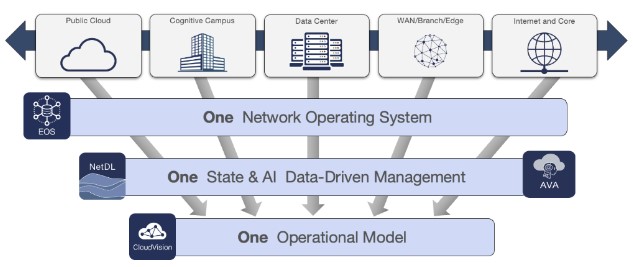
The key benefits of our cloud networking solutions are as follows:
Capacity, Performance and Scale
Our data-driven cloud networking platforms enable data center networks to scale to hundreds of thousands of physical servers and millions of virtual machines with the least number of switching tiers. We achieve this by leveraging standard protocols, non-blocking switch architectures and EOS to meet the scale requirements of cloud computing. We architect active-active Layer 2 and Layer 3 network topologies to enable customers to build extremely large and resilient networks.
Emerging capabilities including recent developments related to AI will continue to place increased demands on networking infrastructure. Arista’s strategic commitment to using merchant silicon is also a key competitive differentiator for Arista in addressing these capacity demands. Merchant silicon not only provides the best price/performance available but allows Arista to bring next generation platforms to market early, allowing customers to benefit from Moore’s Law.
Availability
Networks are only useful when they are available. Arista’s modular EOS architecture and software testing innovations provide features and network designs that keep the network available even during maintenance and upgrades. EOS publish-subscribe architecture provides self-healing resiliency through live patching, upgrades, fault isolation and containment and graceful process restart to reduce maintenance windows and allow for intelligent insertion and removal of network elements.
Openness and Programmability
Customers demand open, standards-based networking that avoids vendor lock-in and enables third-party integration to support best in-class technology ecosystems. Arista EOS, built on Linux, features open standard protocols, such as Border Gateway Protocol ("BGP") and Ethernet VPN ("EVPN"), offering interoperable solutions. Our well-structured set of APIs and EOS Software Development Kit ("SDK") as well as multiple DevOps integrations, enable enterprises to automate networking provisioning without manual intervention. EOS also natively supports Ansible, CFEngine, Chef, Puppet, virtual network orchestration applications and third-party management tools.
Visibility
Monitoring network performance in real time is a core need for current and next-generation architectures to run dependably. Arista EOS and CloudVision bring a modern approach to network telemetry and a replacement for legacy polling mechanisms. CloudVision analytics engines and CloudVision telemetry apps leverage the state streaming infrastructure of EOS and NetDL to give Arista customers an unprecedented level of visibility into their network operations.
Arista EOS also supports multiple telemetry tracers that bring deeper workload-level visibility by integrating with distributed applications like big data, cloud, container and virtualized environments.
Security
Arista focuses on building security into the networking layers through features native to EOS, such as segmentation and encryption, and network access control and NDR powered by AI. Most importantly, Arista’s integrated security toolset uses the underlying network infrastructure from switches to WAN routers to deliver key security capabilities and integrates seamlessly with the organization’s existing security program and tools.
Operational Efficiency
Automation is critical to delivering operational efficiency and Arista has taken the lessons learned from building large public clouds and engineered network automation into our CloudVision management platform. CloudVision eliminates burdensome manual tasks so organizations can become more agile in making changes to network infrastructure. Fewer manual configurations enable faster time to service and improved availability for our customers. Our open APIs enable standards-based integration with third-party tools as well, supporting additional automation capabilities.
Total Cost of Ownership
We believe our programmable, scalable leaf-spine architectures, combined with our applications, significantly reduce networking costs when compared to legacy network designs, enabling faster time to service and improved availability. Our automation tools reduce the operational costs of provisioning, managing and monitoring a data center network and speed up service delivery. Our tools provide visibility into complex network environments without the need for additional data collection equipment.
Cognitive Campus Solutions
Arista’s Cognitive Campus is based on a data driven architecture and offers consistent, unified management across the campus edge for wired and wireless networks as well as integrated security & proactive network assurance. Our Cognitive Campus networking solutions are based on three pillars:
Universal Networking - Customers want a network that minimizes planned and unplanned downtime. Arista delivers that through capabilities such as smart software upgrades that can update a switch to a new version of code without taking an outage. Moreover, Arista’s standards-based offerings minimize the learning curve for operators both in the wired and the wireless space.
Zero Touch Operations - Arista’s solutions are designed from the ground up for real-time telemetry, automation, and AI for networking based on our unified network data lake architecture. As a result, customers can achieve faster deployment to new locations and lower their cost of network operations.
Zero Trust Network - Arista delivers a combination of capabilities that help customers secure their campus networks, from controlling who can get on the network via network access control ("CloudVision AGNI") to detecting threats using network detection and response ("Arista NDR") or wireless intrusion prevention. Arista also provides identity-based micro segmentation ("Arista MSS") to ensure the zero trust posture extends to every critical asset within the organization.
Our Competitive Strengths
We believe the following strengths will allow us to maintain and extend our technology leadership position in data-driven cloud networking and next-generation data center and campus workspace Ethernet products:
Purpose-Built Cloud Networking Platform
We have developed a highly scalable cloud networking platform that uses software to address the needs of large-scale cloud companies, cloud service providers, and large enterprises, including AI, virtualization, big data and low-latency applications. As a result, our cloud networking platform does not have the inherent limitations of legacy network architectures.
Broad and Differentiated Portfolio
Using multiple merchant silicon architectures, we deliver switches, capable of routing, with industry-leading capacity, low latency, port density and power efficiency, and have innovated in areas such as deep packet buffers, highly available modular hardware, and reversible cooling options. Our broad portfolio has allowed us to offer customers products that best match their specific requirements.
Single Binary Image Software
The single binary image of EOS software allows us to maintain feature consistency across our entire product portfolio and enables us to introduce new software innovations into the market that become available to our entire installed base without a “forklift upgrade” (i.e., a broad upgrade of the data center infrastructure).
Rapid Development of New Features and Applications
Our highly modular EOS software has allowed us to rapidly deliver new features and applications while preserving the structural integrity and quality of our network operating system. We believe our ability to deliver new features and capabilities more quickly than legacy switch/router operators provides us with a strategic advantage given that the requirements in cloud and next-generation data center and campus networking continue to evolve rapidly.
Deep Understanding of Customer Requirements
We have developed close working partnerships with many of our largest customers that provide us with insights into their needs and future requirements. This has allowed us to develop and deliver products to the market that meet customer demands and expectations as well as to rapidly grow sales to existing customers.
Strong Management and Engineering Team with Significant Data Center Networking Expertise
Our management and engineering team consists of networking veterans with extensive data center and campus networking expertise. Our Chief Executive Officer and Chairperson, Jayshree Ullal, has over 40 years of networking expertise from silicon to systems companies, and Kenneth Duda, our Founder, Chief Technology Officer and Director, leads our software development team including EOS. Our technical team also includes highly experienced leaders such as Hugh Holbrook, our Chief Development Officer, who leads our platform driven software engineering, and Andy Bechtolsheim, our Founder and Chief Architect, who was previously a founder and chief system architect at Sun Microsystems.
Significant Technology Lead
We believe that our networking technology represents a fundamental advance in networking software. Our EOS software is a key cloud networking software stack that is state-driven and a result of tremendous research and development efforts.
Our Products and Services
Our portfolio of products and services are grouped into the following three categories:
Core Data center/Cloud/AI
Arista offers one of the broadest product portfolios of data-driven, high-speed, cloud and data center Ethernet switches. Built on top of the superior quality and openness of Arista EOS, we deliver high performance, industry-leading capacity, ultra-low latency, rich features, and powerful efficient solutions to meet our customers’ demand for capacity and network speeds for both front-end and back-end storage, compute and AI zones. Our core switching portfolio contains both fixed and modular form factors, varying port configurations and densities, and options in power delivery all driven by customer requirements.
The Arista Etherlink AI portfolio of 800G switches, coupled with Arista's EOS innovations such as AI Analyzer along with optimal load balancing solutions, offer compelling solutions for contemporary AI applications and deployment. Arista also continues to be innovative in such areas as deep packet buffer architectures, virtual output queuing, non-disruptive upgrades, embedded optics and next-generation optics, reversible cooling and overall system power efficiency. The Arista 7800R AI Spine, 7060 AI Leaf and the Distributed Etherlink Switch ("DES") are designed to address the demanding scale and performance requirements driven by large-scale AI networks. Arista also provides solutions for compute, GPU and storage interconnects in driving AI/ML workloads, leveraging its IP/Ethernet switches to deliver unparalleled performance and scalability.
The Arista 7700R4 DES is an ultra-scalable, intelligent distributed system engineered to meet the rigorous demands of large-scale AI and machine learning ("ML") environments. Building upon the foundations of the 7800R4 series, the 7700R4 DES delivers strong performance and scalability for accelerated computing. The Arista 7700R4 represents a significant advancement in networking technology, offering a robust and scalable solution tailored for the most demanding AI and ML workloads. Its combination of high throughput, deterministic performance, and advanced congestion management makes it an ideal choice for organizations aiming to build or expand their AI infrastructure.
AI workloads require optimized performance and availability at all times, to minimize job completion time and thus maximize utilization of expensive XPU accelerators. The EOS-based AI Agent can reside either directly on a SmartNIC or on a server CPU, to provide local configuration management of NICs along with streaming telemetry of NIC performance fed to directly-attached Arista EOS-based switches. This ensures the QoS parameters for AI optimization are consistently applied from the NIC to the network alike, to avoid misconfigurations which might cause performance bottlenecks without an easy-to-diagnose root cause. And with telemetry data spanning the AI NICs and the AI networking platforms, the network operations team can have comprehensive visibility into the entire traffic path with immediate insight into performance and problems.
Cognitive Adjacencies
Cognitive Campus Switching - Arista’s Cognitive Campus switching products, powered by EOS, offer consistent, unified management across the campus edge for wired and wireless networks as well as integrated security & proactive network assurance. Our campus products include the Arista 7300 Series spine/Spline™, 720/750 Series POE switches, and a broad range of indoor and outdoor Cognitive Wi-Fi Access Points.
Cloud-Grade Routing - Arista’s Cloud-Grade Routing platforms, powered by EOS, combine high performance routing, high port density, deep buffers, integrated DWDM and wire speed encryption. Our 7280R3 Universal Leaf and 7500R3 and 7800R3 Universal Spine platforms serve a variety of use cases including high speed multi-cloud connect, Data Center Interconnect (DCI), controller-based traffic engineering, peering, business VPNs, core routing and Secure Enterprise edge routing.
WAN Routing- The Arista AWE-7200R Series of WAN Routing System, purpose built by Arista and powered by Arista EOS, offers high performance and scale to meet enterprise modern WAN edge and aggregation requirements. We believe the Arista AWE-7200R Series sets the standard for aggregation and critical site interconnect by supporting 1/10/100GbE interfaces and flexible network modules. It delivers from 1Gb to over 50Gb of bidirectional AES256 encrypted traffic with high VRF and tunnel scale.
Networking Software and Services
Our software and services are based on subscription-based models and include the following offerings:
CloudVision - CloudVision is Arista’s modern, multi-domain management platform that leverages cloud networking principles to deliver a simplified end-to-end network operations experience for our Enterprise market. Unlike traditional domain-specific management solutions, CloudVision enables consistent zero touch network operations across data center, campus wired and wireless, routing interconnect and multi-cloud networks helping to break down the complexity of siloed management approaches.
CloudVision is built on Arista’s NetDL architecture and leverages real-time network state to provide an abstraction of the physical network to a broader, network-wide perspective allowing for a more efficient approach for several operational and network telemetry capabilities.
Arista A-Care Services - We have designed our customer support offerings, Arista A-Care Services, to provide our customers with high levels of support. Our global team of support engineers engages directly with client IT teams and is always available over e-mail, by phone or through our website.
We offer multiple service options that allow our customers to select the product replacement service level that best meets their needs. We stock spare parts in over 200 locations around the world through our third-party logistics suppliers. All our service options include unlimited access to bug-fixes, new-feature-releases, online case management and our community forums.
DANZ Monitoring Fabric (DMF) - DANZ Monitoring Fabric ("DMF") is a next-generation network packet broker (NPB) architected for pervasive, organization-wide visibility and security, delivering multi-tenant monitoring-as-a-service. Leveraging Arista's high-performance and versatile Ethernet switch platforms with DMF, IT operators can pervasively monitor all user, device/IoT and application traffic (north-south and east-west) by gaining complete visibility into physical, virtual and container environments. Deep hop-by-hop visibility, predictive analytics, contextual insights and scale-out packet capture, integrated through a single dashboard, enables simplified network performance monitoring ("NPM") and SecMon workflows for real-time and historical context across production data centers, enterprise campus/branch and 4G/5G mobile networks.
Arista Guardian Network Identity (AGNI) - To overcome the new security challenges and the explosion of clients in today’s perimeter-less enterprise networks, Arista delivers a novel AI-driven network Identity service, Arista Guardian for Network Identity (AGNI) to connect the network, users, and devices across remote and geographically dispersed locations. Based on Arista’s flagship CloudVision, the new AGNI platform brings scale, simplicity, and security across users, their associated endpoints, and IoT devices. AGNI integrates with Arista NDR and other third-party XDR and EDR solutions for post-admission control functionality.
Arista's AI-driven Network Detection and Response (NDR) - An AI-driven Security Platform, powered by AVATM, Arista NDR analyzes billions of network communications to autonomously discover, profile and classify every device, user, and application across perimeter, core, IoT, and cloud networks. Based on this deep understanding of the attack surface, the platform then detects threats to and from these entities, while providing the context necessary to respond rapidly.
CloudEOS™ - CloudEOS is Arista’s multi-cloud and cloud-native networking solution supporting autonomic operation to deliver an enterprise-class, highly secure, and reliable networking experience for any cloud. As part of the Arista EOS and CloudVision product family, it delivers consistent segmentation, automation, telemetry, provisioning and troubleshooting for the enterprise edge, WAN, campus, data center and multiple public and private clouds. To provide a scalable and automated network experience, CloudEOS integrates with Arista CloudVision to simplify the operator's experience of interconnecting and managing multi-cloud, cloud-native and on-premises enterprise networks.
CloudEOS is designed for consumption on Amazon AWS, Microsoft Azure, and Google public clouds via their marketplace and service catalogs.
Sales and Marketing
We market and sell our products through our direct sales force and in partnership with our channel partners, including distributors, value-added resellers, systems integrators and original equipment manufacturer ("OEM") partners. We also sell in conjunction with various technology partners. To facilitate channel coordination and increase productivity, we have created a partner program, the Arista Partner Program, to engage partners who provide value-added services and extend our reach into the marketplace. Authorized training partners perform technical training of our channel partners and end customers. Our partners commonly receive an order from an end customer prior to placing an order with us, and we confirm the identification of the end customer prior to accepting such orders. Our partners generally do not stock inventory received from us.
Our sales organization is supported by systems engineers with deep technical expertise and responsibility for pre-sales technical support and solutions engineering for our customers, systems integrators, OEMs, and channel partners. In general, the personnel in our sales organization are formed into teams, and each team is responsible for a geographical territory, has responsibility for a number of major direct end-customer accounts or has assigned accounts in a specific vertical market. A pool of shared channel sales and marketing representatives also supports these teams.
Our marketing activities consist primarily of technology conferences, webinars, web marketing, trade shows, product demonstrations, seminars and events, public relations, analyst relations, demand generation and direct marketing to build our brand, increase end-customer awareness, communicate our product advantages and generate qualified leads for our field sales force and channel partners.
Seasonality
We operate on a December 31st year end and typically have lower sequential quarter over quarter revenue growth in the first quarter of each fiscal year, often followed by stronger sequential revenue growth in the ensuing quarters. We believe that this seasonality results from a number of factors, including the procurement, budgeting and deployment cycles of many of our customers. The effects of recent supply chain disruptions and our rapid growth may have reduced the impact of seasonal or cyclical factors that might otherwise have influenced our business and broader industry performance. If our growth rates slow, seasonal or cyclical variations in our operations may become more pronounced over time and may materially affect our business, financial condition, results of operations and prospects. In addition, any supply chain shortages and manufacturing disruptions that result in extended lead times may impact our ability to manufacture and ship products to our customers in a timely manner, which may disrupt typical seasonal trends.
Research and Development
Our success relies on the timely enhancement of existing products and the development of new solutions and features to address changing customer needs and technological advancements. Our in-house engineering personnel are responsible for the development, testing, documentation, support and release of our products. We have a highly skilled team of software and hardware engineers with extensive experience in wired and wireless networking technologies, network protocols, network security, operating systems, programming languages, compilers, databases, hardware system design, Field-Programmable Gate Array programming, high-speed signal integrity, and other related technologies.
Our research and development strategy focuses on advancing our core products and expanding into new markets while maintaining high product quality. We are focusing research and development efforts in (1) adapting EOS for new and existing silicon architectures, especially to support the unique requirements of AI workloads; (2) adding or enhancing EOS control plane and management plane functionality; (3) expanding our CloudVision management stack with enhanced automation, provisioning, monitoring, and security capabilities; (4) building related services, such as NDR and Network Access Control (NAC); (5) improving the security and scalability of our software development infrastructure and software supply chain; and (6) maintaining high product quality throughout. We have dedicated significant time and resources in test automation, ensuring high test pass rates, and working with our support group whenever customers experience technical defects in our products. Collaboration with customers and other industry leaders is integral to our approach, though uncertainties persist regarding the successful development and market acceptance of emerging technologies. Looking ahead, we plan to continue to invest in resources to conduct our research and development efforts to evolve and extend our portfolio's capabilities, ensuring our products continue to address dynamic market needs and solidify our industry leadership.
Manufacturing
We subcontract the manufacturing of the majority of our products to various contract manufacturers. Our primary manufacturing partners are Jabil Inc., Sanmina Corporation, Flex Ltd. and Foxconn Hon Hai. These partners manufacture our products internationally in Malaysia, Vietnam, Mexico and other countries. We require all our manufacturing locations to be ISO-9001 certified. After manufacturing and testing, the products are shipped to direct fulfillment facilities in the United States, the Netherlands and Singapore for further transformation as needed and distribution. We have four direct fulfillment facilities worldwide to hold finished goods inventory and perform final product configuration and shipping to customers and partners. After distribution, our products are installed by the customers or by third-party service providers such as system integrators or value-added resellers on their behalf.
Our contract manufacturing partners procure components needed to build our products and assemble our products according to our design specifications. This allows us to leverage the purchasing power of our contract manufacturing partners. We retain complete control over the bill of materials, qualified component suppliers, test procedures and quality assurance programs. Our personnel work closely with our partners and review on an ongoing basis forecasts, inventory levels, processes, capacity, yields and overall quality. Our contract manufacturing partners procure components and assemble our products based on our demand forecasts. These forecasts represent our estimates of future demand for our products based upon historical trends and analyses from our sales and product management functions as adjusted for overall market conditions. For example, when industry-wide supply chain shortages resulted in extended lead times for components, we were required to extend the time horizon of our demand forecasts and increase our purchase commitments for long lead time components.
Our products rely on key components, including merchant silicon, integrated circuit components and power supplies purchased from a limited number of suppliers, including certain sole source providers. We may also see increased consolidation among our component suppliers. In particular, we are primarily reliant upon our predominant merchant silicon vendor,
Broadcom, for our switching chips. Generally, neither we nor our contract manufacturers have a written agreement with these component providers to guarantee the supply of the key components used in our products, nor do we have exclusive rights to such key components, and our suppliers could suffer shortages, delay shipments, prioritize shipments to other vendors, increase prices or cease manufacturing such products or selling them to us at any time. The supply of components may also be adversely affected by geopolitical conditions such as escalating tariff and non-tariff trade measures imposed by the U.S., Mexico, China and other countries present in our supply chain.
Our product development efforts also depend upon continued collaboration with our key suppliers such as Broadcom. As we develop our product roadmap and continue to expand our relationships with these and other merchant silicon vendors, it is critical that we work in tandem with our key merchant silicon vendors to ensure that their silicon includes improved features and that our products take advantage of such improved features. This enables us to focus our development resources on software core competencies and to leverage the investments made by merchant silicon vendors to achieve cost-effective solutions.
Competition
The markets in which we compete are highly competitive and characterized by rapidly changing technology, changing end-customer needs, evolving industry standards, frequent introductions of new products and services and industry consolidation. We expect competition to intensify in the future as the market for cloud and AI networking expands and existing competitors and new market entrants introduce new products or enhance existing products.
The data center and campus networking markets have been historically dominated by Cisco, with competition also coming from other large network equipment and system vendors, including Dell/EMC, Extreme Networks, Hewlett Packard Enterprise, Huawei, Juniper Networks, Nvidia, and white box networking vendors utilizing open-source operating systems. Most of our competitors and some strategic alliance partners have made acquisitions and/or have entered into or extended partnerships or other strategic relationships to offer more comprehensive product lines, including cloud networking solutions. For example, Broadcom has acquired VMware and Hewlett Packard Enterprises has entered into an agreement to acquire Juniper Networks.
With the emergence of AI networking, new competitive technologies may enter the market to address the requirements of AI clusters. Ethernet, today, faces competition from both InfiniBand ("IB") and NV Link interconnects for back-end AI networking clusters. IB has traditionally been used in supercomputer clusters due to its high reliability, low latency and high bandwidth. Both IB and NV Link are often sold as part of a vertical solution along with the GPUs from Nvidia.
We also face competition from other companies and new market entrants, current technology partners and customers who may acquire or develop network switches and cloud service solutions for internal use and/or to broaden their portfolio of products to market and sell to customers. Some of these competitors are developing "white box" networking products based on open-source network operating systems that may be provided for free and off-the-shelf or commoditized hardware technology, or “white box” hardware, while other competitors may adopt a disaggregated approach to the procurement of hardware and their proprietary software. The entrance of new competitors into our markets or the increased adoption of these new technology solutions or consumption models may cause downward pricing pressures, result in lost sales or otherwise have a material adverse effect on our business, prospects, financial condition and operating results.
In the NDR market, our Arista NDR offerings compete with other network security vendors including Cisco, Darktrace, and ExtraHop. In the network packet broker ("NPB") market, Arista DANZ Monitoring Fabric ("DMF") competes with Cisco, Gigamon, Keysight, Netscout and other network monitoring software providers.
Our relationships with our strategic alliance partners or suppliers may also shift as industry dynamics change. If strategic alliance partners acquire or develop competitive products or services, our relationship with those partners may be adversely impacted, which could lead to more variability to our results of operations and impact the pricing of our solutions.
The principal competitive factors applicable to our products include:
-
breadth of product offerings and features;
-
reliability and product quality;
-
ease of use;
-
pricing;
-
total cost of ownership, including automation, monitoring and integration costs;
-
performance and scale;
-
programmability and extensibility;
-
interoperability with other products;
-
ability to be bundled with other vendor offerings;
-
product availability and shipment lead times; and
-
quality of service, support and fulfillment.
We believe our products compete favorably with respect to these factors. Our EOS software offers high reliability, integrates with existing network protocols and is open and programmable. We believe the combination of EOS, a set of network applications and our 1/2.5/5/10/25/40/50/100/200/400/800 Gigabit Ethernet platforms make our offering highly competitive for both cloud and enterprise data centers. However, many of our competitors have greater name recognition, longer operating histories, larger sales and marketing budgets and resources, broader distribution and established relationships with channel partners and end customers, greater access to larger customer bases, greater customer support resources, greater manufacturing resources, the ability to leverage their sales efforts across a broader portfolio of products, the ability to leverage purchasing power when purchasing subcomponents, the ability to bundle competitive offerings with other products and services, the ability to develop their own silicon chips, the ability to set more aggressive pricing policies, lower labor and development costs, greater resources to make acquisitions, larger intellectual property portfolios and substantially greater financial, technical, research and development or other resources.
Intellectual Property
Our success and ability to compete depend substantially upon our core technology and intellectual property. We rely on patent, trademark and copyright laws, trade secret protection and confidentiality agreements with our employees, customers, resellers, systems integrators, manufacturers, and others to protect our intellectual property rights. We file U.S and foreign patent applications to protect our intellectual property and believe that the duration of our issued patents is adequate relative to the expected lives of our products. Patents generally have a duration of twenty years from filing. The remaining duration on the individual patents in our patent portfolio varies.
We cannot assure that any of our patent applications will result in the issuance of a patent or whether the examination process will result in patents of valuable breadth or applicability. In addition, any patents that may be issued may be contested, circumvented, found unenforceable or invalidated, and we may not be able to prevent third parties from infringing upon them. We also license software from third parties for integration into our products, including open-source software and other software available on commercially reasonable terms. We own a number of trademarks in the U.S. and other jurisdictions, and Arista, EOS, and CloudVision are among our core trademarks.
We control access to and use of our software, technology and other proprietary information through internal and external controls, including contractual protections with employees, contractors, customers and partners. Our software is protected by U.S. and international copyright, patent and trade secret laws. Despite our efforts to protect our software, technology and other proprietary information, unauthorized parties may still copy or otherwise obtain and use our software, technology and other proprietary information. In addition, we intend to expand our international operations, and effective patent, copyright, trademark and trade secret protection may not be available or may be limited in foreign countries.
Our industry is characterized by the existence of a large number of patents and frequent claims and related litigation regarding patent and other intellectual property rights. If we become more successful, we believe that competitors will be more likely to try to develop products that are similar to ours and that may infringe our proprietary rights. It may also be more likely that competitors or other third parties will claim that our products infringe their proprietary rights. In particular, large and established companies in our industry have extensive patent portfolios and are regularly involved in both offensive and defensive litigation. From time to time, third parties, including certain large companies and non-practicing entities, may assert patent, copyright, trademark and other intellectual property rights against us, our channel partners or our end customers, whom our standard license and other agreements obligate us to indemnify against such claims.
Successful claims of infringement by a third-party, if any, could prevent us from distributing certain products or performing certain services, require us to spend time and money to develop non-infringing solutions or force us to pay
substantial damages, royalties or other fees. We cannot assure that we do not currently infringe, or that we will not in the future infringe, upon any third-party patents or other proprietary rights.
Human Capital Management
At Arista, we seek to maintain an environment that is open, diverse and inclusive, and where our people feel valued, included and accountable. One of our key principles is always doing the right thing for our employees. We are committed to maintaining the highest level of professional and ethical standards in the conduct of our business around the world. As of December 31, 2024, we employed approximately 4,412 full-time employees worldwide. None of our employees are represented by unions. We consider our relationship with our employees to be good and have not experienced significant interruptions of operations due to labor disagreements.
Arista is proud to have been recognized in November 2024 by Forbes magazine as one of America’s Best Companies to Work & Invest For as well as by Time Magazine as one of the World’s Best Companies.
Inclusion, Diversity and Equal Employment
We seek to maintain an environment that is open, diverse and inclusive, and where our employees feel valued. We believe that diverse and inclusive teams enhance individual and company performance and help us attract and retain talent. We strive to build an inclusive culture that encourages, supports and celebrates the diverse voices of our employees. As part of the Arista way, we believe in treating peers with respect, mentoring individuals and developing teams for overall success.
We are proud to be one of a few S&P 500 companies with both a female CEO and CFO. We were also recognized by Comparably in 2024 amongst the best large companies for culture, happiness, leadership and career growth as well as compensation. 50% of our board of directors are women or underrepresented minorities. Arista also supports inclusion through mentorship opportunities for our employees which are offered through Women@Arista, one of our employee resource groups; support of numerous under-represented employee affinity organizations; and active recruiting from historically black colleges and universities, women’s colleges and Hispanic/Latinx and African-American professional societies and job fairs.
We affirm the principle of equal employment opportunity without regard to any protected characteristic, including but not limited to race, religion, national origin, color, gender, age, disability, pregnancy, marital status, ancestry, military status or sexual orientation. We practice and promote such policies in all locations as appropriate under applicable law. We affirm this principle of freedom from discrimination in all aspects of the employment relationship from recruitment and hiring, through performance evaluations, compensation and promotions. At Arista, we believe that all employees should be treated with dignity and respect.
Health and Safety
Arista is committed to protecting the health and safety of our employees, visitors, and the public. Our health and safety policy is to maintain our facilities and run our business operations in a manner that does not jeopardize the occupational health and safety of employees. We have implemented our injury and illness prevention program to protect employees from occupational risks of injury or illness.
Compensation and Benefits
We provide competitive and comprehensive benefit packages that are designed to help and empower employees to make the best decisions for themselves, their family and their lifestyle. In the United States, we offer our employees an employee stock purchase plan, healthcare and retirement benefits, paid time off and family leave, flexible time away, family planning benefits, backup resources for childcare and elder care, and other employee assistance programs including behavioral health and emotional support assistance. In addition to base salary and benefits, Arista’s employees participate in stock and bonus incentive plans that support our organizational philosophy of allowing employees to share in our performance and success. We are committed to paying our employees fairly and equitably and regularly and work with a third party to identify and resolve any gaps. Our executive compensation program is designed to attract, retain, and reward performance and align incentives with the achievement of Arista’s strategic plan and both short- and long-term operating objectives. Our compensation committee provides an oversight of our compensation policies, plans, benefit programs and overall compensation philosophy.
Along with our traditional healthcare benefits, Arista offers a broad variety of physical and mental wellness offerings to our global employees in a virtual as well as on-demand format, including fitness classes, webinars on practical wellness takeaways, strategies for stress reduction, financial planning and education, career development and social activities. We also
host periodic wellness weeks, whose purpose is to raise awareness on health issues, increase education on preventive medicine and available services and shift employee behavior through interactive activities and live presentations. We proudly support an active community employee engagement program, which provides opportunities for our employees to engage in volunteering and community service in support of the communities they live, work, and thrive in. We employ a hybrid work model for designated roles, giving our employees the flexibility to work offsite or onsite and regularly survey our employees to gain valuable feedback and suggestions on improvements to our culture and strategy. Arista was recognized in 2024 by Most Loved Workplace as a Most Loved Workplace for Wellness and Volunteering.
Employee Training, Development and Upskilling
Our employees receive regular periodic training on numerous subjects, including our Code of Ethics and Business Conduct, information security, data privacy, intellectual property, insider trading, and anticorruption. In addition, Arista provides extensive training and accreditation opportunities to employees in Sales, Customer Engineering and Software Research and Development roles including our Arista Certified Engineering ("ACE") certification program as well as mentorship programs sponsored by our Women@Arista employee resource group. Additional career development content including management and AI training is available through our E-Learning portal to facilitate a culture of lifelong learning and allow employees to personalize their development. Our Technical employees can further upskill through our internal Arista PREP Training Program, technical summits, and participation in industry conferences or associations.
Available Information
Our website is located at www.arista.com and our investor relations website is located at investors.arista.com. Our Annual Reports on Form 10-K, Quarterly Reports on Form 10-Q, Current Reports on Form 8-K and amendments to reports filed or furnished pursuant to Sections 13(a) and 15(d) of the Securities Exchange Act of 1934, as amended (“Exchange Act”), are available free of charge on the Investors portion of our website as soon as reasonably practicable after we electronically file such material with, or furnish it to, the Securities and Exchange Commission ("SEC"). The SEC maintains an Internet site that contains reports, proxy and information statements, and other information regarding issuers that file electronically with the SEC at www.sec.gov.
Webcasts of our earnings calls and certain events we participate in or host with members of the investment community are on our investor relations website. Additionally, we announce investor information, including news and commentary about our business and financial performance, SEC filings, notices of investor events, and our press and earnings releases, on our investor relations website. Investors and others can receive notifications of new information posted on our investor relations website in real time by signing up for email alerts and RSS feeds. Further corporate governance information, including our corporate governance guidelines, board committee charters, and code of conduct, is also available on our investor relations website under the heading “Governance.” The contents of our websites, or information that can be accessed through our websites, are not incorporated by reference into this Annual Report on Form 10-K or in any other report or document we file with the SEC, and any references to our websites are intended to be inactive textual references only.
Previous: Cover and table of contents · Next: Item 1A. Risk Factors