 filings.tools
Ares Management 10-K 2019-12-31
Filed 2020-02-28. 22 sections, 1061K characters. Original on sec.gov · Markdown · JSON
Cover and table of contents
UNITED STATES
SECURITIES AND EXCHANGE COMMISSION
Washington, D.C. 20549
FORM 10-K
| ☒ | ANNUAL REPORT PURSUANT TO SECTION 13 OR 15(d) OF THE SECURITIES EXCHANGE ACT OF 1934 |
For the fiscal year ended December 31, 2019
OR
| ☐ | TRANSITION REPORT PURSUANT TO SECTION 13 OR 15(d) OF THE SECURITIES EXCHANGE ACT OF 1934 |
For the transition period from to
Commission File No. 001-36429
ARES MANAGEMENT CORPORATION
(Exact name of Registrant as specified in its charter)
| Delaware | 80-0962035 | ||||
| (State or other jurisdiction of incorporation or organization) | (I.R.S. Employer Identification Number) |
2000 Avenue of the Stars, 12th Floor, Los Angeles, CA 90067
(Address of principal executive office) (Zip Code)
(310) 201-4100
(Registrant’s telephone number, including area code)
N/A
(Former name, former address and former fiscal year, if changed since last report)
Securities registered pursuant to Section 12(b) of the Act:
| Title of each class | Trading Symbol(s) | Name of each exchange on which registered | ||||||
| Class A common stock, par value $0.01 per share | ARES | New York Stock Exchange | ||||||
| 7.00% Series A Preferred Stock, par value $0.01 per share | ARES.PRA | New York Stock Exchange |
Securities registered pursuant to Section 12(g) of the Act: None
Indicate by check mark if the registrant is a well-known seasoned issuer, as defined in Rule 405 of the Securities Act. Yes ☐ No x
Indicate by check mark if the registrant is not required to file reports pursuant to Section 13 or Section 15(d) of the Act. Yes ¨ No x
Indicate by check mark whether the registrant (1) has filed all reports required to be filed by Section 13 or 15(d) of the Securities Exchange Act of 1934 during the preceding 12 months (or for such shorter period that the registrant was required to file such reports), and (2) has been subject to such filing requirements for the past 90 days: Yes x No ¨
Indicate by check mark whether the registrant has submitted electronically every Interactive Data File required to be submitted pursuant to Rule 405 of Regulation S-T (§232.405 of this chapter) during the preceding 12 months (or for such shorter period that the registrant was required to submit such files). Yes x No ¨
Indicate by check mark whether the registrant is a large accelerated filer, an accelerated filer, a non-accelerated filer, a smaller reporting company, or an emerging growth company. See definitions of “large accelerated filer,” “accelerated filer,” “smaller reporting company.” and “emerging growth company” in Rule 12b-2 of the Exchange Act.
| Large Accelerated Filer | x | Accelerated Filer | Non-Accelerated Filer | ☐ | Smaller Reporting Company | ☐ | Emerging Growth Company | ☐ |
If an emerging growth company, indicate by check mark if the registrant has elected not to use the extended transition period for complying with any new or revised financial accounting standards provided pursuant to Section 13(a) of the Exchange Act. ¨
Indicate by check mark whether the registrant is a shell company (as defined in Rule 12b-2 of the Exchange Act). Yes ☐ No x
The aggregate market value of the common shares held by non-affiliates of the registrant on June 30, 2019, based on the closing price on that date of $26.17 on the New York Stock Exchange, was approximately $1,980,043,921. As of February 21, 2020 there were 118,610,306 of the registrant’s shares of Class A common stock outstanding, 1,000 shares of the registrant's Class B common stock outstanding, and 1 share of the registrant's Class C common stock outstanding.
TABLE OF CONTENTS
Cautionary Note Regarding Forward-Looking Statements
This report contains forward-looking statements within the meaning of Section 27A of the Securities Act of 1933, as amended (the “Securities Act”), and Section 21E of the Securities Exchange Act of 1934, as amended (the “Exchange Act”), which reflect our current views with respect to, among other things, future events, operations and financial performance. You can identify these forward-looking statements by the use of forward-looking words such as “outlook,” “believes,” “expects,” “potential,” “continues,” “may,” “will,” “should,” “seeks,” “approximately,” “predicts,” “intends,” “plans,” “estimates,” “anticipates” or the negative version of those words, other comparable words or other statements that do not relate to historical or factual matters. The forward-looking statements are based on our beliefs, assumptions and expectations of our future performance, taking into account all information currently available to us. Such forward-looking statements are subject to various risks and uncertainties and assumptions relating to our operations, financial results, financial condition, business prospects, growth strategy and liquidity. Some of these factors are described in this Annual Report on Form 10-K for the year ended December 31, 2019, under the headings “Management’s Discussion and Analysis of Financial Condition and Results of Operations” and “Risk Factors”. These factors should not be construed as exhaustive and should be read in conjunction with the risk factors and other cautionary statements that are included in this report and in our other periodic filings. If one or more of these or other risks or uncertainties materialize, or if our underlying assumptions prove to be incorrect, our actual results may vary materially from those indicated in these forward-looking statements. New risks and uncertainties arise over time, and it is not possible for us to predict those events or how they may affect us. Therefore, you should not place undue reliance on these forward-looking statements. Any forward-looking statement speaks only as of the date on which it is made. We do not undertake any obligation to publicly update or review any forward-looking statement, whether as a result of new information, future developments or otherwise, except as required by law.
Unless the context suggests otherwise, references in this Annual Report on Form 10 K to (1) “Ares,” the "Company," “we,” “us” and “our” refer to our businesses, both before and after our conversion to a corporation. References in this Annual Report on Form 10-K to the “Ares Operating Group” refer to, collectively, Ares Holdings L.P. (“Ares Holdings”), Ares Offshore Holdings L.P. (“Ares Offshore”) and Ares Investments L.P. (“Ares Investments”). References in this Annual Report on Form 10-K to an “Ares Operating Group Unit” or an “AOG Unit” refer to, collectively, a partnership unit in each of the Ares Operating Group entities. The use of any defined term in this report to mean more than one entities, persons, securities or other items collectively is solely for convenience of reference and in no way implies that such entities, persons, securities or other items are one indistinguishable group. For example, notwithstanding the use of the defined terms “Ares,” “we” and “our” in this report to refer to Ares Management Corporation and its subsidiaries, each subsidiary of Ares Management Corporation is a standalone legal entity that is separate and distinct from Ares Management Corporation and any of its other subsidiaries. The use of any defined term in this report to mean more than one entities, persons, securities or other items collectively is solely for convenience of reference and in no way implies that such entities, persons, securities or other items are one indistinguishable group. For example, notwithstanding the use of the defined terms “Ares,” “we” and “our” in this report to refer to Ares Management Corporation and its subsidiaries, each subsidiary of Ares Management Corporation is a standalone legal entity that is separate and distinct from Ares Management Corporation and any of its other subsidiaries.
Under generally accepted accounting principles in the United States (“GAAP”), we are required to consolidate (a) entities other than limited partnerships and entities similar to limited partnerships in which we hold a majority voting interest or have majority ownership and control over the operational, financial and investing decisions of that entity, including Ares-affiliates and affiliated funds and co-investment entities, for which we are presumed to have controlling financial interests, and (b) entities that we concluded are variable interest entities (“VIEs”), including limited partnerships and collateralized loan obligations, for which we are deemed to be the primary beneficiary. When an entity is consolidated, we reflect the assets, liabilities, revenues, expenses and cash flows of the entity in our consolidated financial statements on a gross basis, subject to eliminations from consolidation, including the elimination of the management fees, performance income and other fees that we earn from the entity. However, the presentation of performance related compensation and other expenses associated with generating such revenues is not affected by the consolidation process. In addition, as a result of the consolidation process, the net income attributable to third-party investors in consolidated entities is presented as net income attributable to non-controlling interests in Consolidated Funds in our Consolidated Statements of Operations.
In this Annual Report on Form 10-K, in addition to presenting our results on a consolidated basis in accordance with GAAP, we present revenues, expenses and other results on a (i) “segment basis,” which deconsolidates these entities and therefore shows the results of our reportable segments without giving effect to the consolidation of the entities and (ii) “unconsolidated reporting basis,” which shows the results of our reportable segments on a combined segment basis together with our Operations Management Group. In addition to our reportable segments, we have an Operations Management Group (the “OMG”) that consists of shared resource groups to support our reportable segments by providing infrastructure and administrative support in the areas of accounting/finance, operations, information technology, strategy and relationship management, legal, compliance and human resources. The OMG’s expenses are not allocated to our reportable segments but we
consider the cost structure of the OMG when evaluating our financial performance. This information constitutes non-GAAP financial information within the meaning of Regulation G, as promulgated by the SEC. Our management uses this information to assess the performance of our reportable segments and our OMG, and we believe that this information enhances the ability of shareholders to analyze our performance. For more information, see “Notes to the Consolidated Financial Statements - Note 15. Segment Reporting.”
Glossary
When used in this report, unless the context otherwise requires:
-
“ARCC Part I Fees” refers to a quarterly performance income on the net investment income of Ares Capital Corporation (NASDAQ: ARCC) (“ARCC”). Such fees from ARCC are classified as management fees as they are predictable and recurring in nature, not subject to contingent repayment and generally cash-settled each quarter;
-
“ARCC Part II Fees” refers to fees that are paid in arrears as of the end of each calendar year when the cumulative aggregate realized capital gains exceed the cumulative aggregate realized capital losses and aggregate unrealized capital depreciation, less the aggregate amount of ARCC Part II Fees paid in all prior years since inception;
-
“Ares”, “the Company”, “we”, “us” and “our” refer to (i) Ares Management Corporation and its subsidiaries following the Conversion and (ii) Ares Management, L.P. and its subsidiaries prior to the Conversion;
-
“Ares Operating Group Unit” or an “AOG Unit” refers to, collectively, a partnership unit in each of the Ares Operating Group entities;
-
“assets under management” or “AUM” refers to the assets we manage. For our funds other than CLOs, our AUM represents the sum of the net asset value of such funds, the drawn and undrawn debt (at the fund-level including amounts subject to restrictions) and uncalled committed capital (including commitments to funds that have yet to commence their investment periods). For our funds that are CLOs, our AUM is equal to initial principal amounts adjusted for paydowns;
-
“available capital” (also referred to as “dry powder”) is comprised of uncalled committed capital and undrawn amounts under credit facilities and may include AUM that may be canceled or not otherwise available to invest;
-
“CLOs” refers to “our funds” that are structured as collateralized loan obligations;
-
“Conversion” refers to our conversion effective November 26, 2018 from a Delaware limited partnership named Ares Management, L.P. into a Delaware corporation named Ares Management Corporation;
-
“Consolidated Funds” refers collectively to certain Ares-affiliated funds, related co-investment entities and certain CLOs that are required under GAAP to be consolidated in our consolidated financial statements;
-
“Co-Founders” refers to Michael Arougheti, David Kaplan, John Kissick, Antony Ressler and Bennett Rosenthal;
-
“Credit Facility” refers to the revolving credit facility of the Ares Operating Group;
-
“effective management fee rate” represents the annualized fees divided by the average fee paying AUM for the period, excluding the impact of one-time catch-up fees;
-
“fee paying AUM” or “FPAUM” refers to the AUM from which we directly earn management fees. Fee paying AUM is equal to the sum of all the individual fee bases of our funds that directly contribute to our management fees;
-
“fee related earnings” or “FRE”, a non-GAAP measure, is used to assess core operating performance by determining whether recurring revenue, primarily consisting of management fees, is sufficient to cover operating expenses and to generate profits. FRE differs from income before taxes computed in accordance with GAAP as it excludes performance income, performance related compensation, investment income from our Consolidated Funds and non-consolidated funds and certain other items that we believe are not indicative of our core operating performance;
-
“GAAP” refers to accounting principles generally accepted in the United States of America;
-
“Holdco Members” refers to Michael Arougheti, David Kaplan, Antony Ressler, Bennett Rosenthal, Ryan Berry, R. Kipp deVeer and Michael McFerran;
-
“Incentive eligible AUM” or “IEAUM” refers to the AUM of our funds from which performance income may be generated, regardless of whether or not they are currently generating performance income. It generally represents the NAV plus uncalled equity or total assets plus uncalled debt, as applicable, of our funds for which we are entitled to receive a performance income, excluding capital committed by us and our professionals (from which we generally do not earn performance income). With respect to ARCC's AUM, only ARCC Part II Fees may be generated from IEAUM;
-
“Incentive generating AUM” or “IGAUM” refers to the AUM of our funds that are currently generating, on a realized or unrealized basis, performance income. It generally represents the NAV or total assets of our funds, as applicable, for which we are entitled to receive performance income, excluding capital committed by us and our professionals (from which we generally do not earn performance income). ARCC is only included in IGAUM when Part II Fees are being generated;
-
“management fees” refers to fees we earn for advisory services provided to our funds, which are generally based on a defined percentage of fair value of assets, total commitments, invested capital, net asset value, net investment income, total assets or par value of the investment portfolios managed by us and also include ARCC Part I Fees that are classified as management fees as they are predictable and recurring in nature, not subject to contingent repayment and generally cash-settled each quarter;
-
“net inflows of capital” refers to net new commitments during the period, including equity and debt commitments and gross inflows into our open-ended managed accounts and sub-advised accounts, as well as new debt and equity issuances by our publicly traded vehicles minus redemptions from our open-ended funds, managed accounts and sub-advised accounts;
-
“net performance income” refers to performance income net of performance related compensation, which is the portion of the performance income earned from certain funds that is payable to our professionals;
-
“our funds” refers to the funds, alternative asset companies, co-investment vehicles and other entities and accounts that are managed or co-managed by the Ares Operating Group, and which are structured to pay fees. It also includes funds managed by Ivy Hill Asset Management, L.P., a wholly owned portfolio company of ARCC, and a registered investment adviser;
-
“permanent capital” refers to capital of our funds that do not have redemption provisions or a requirement to return capital to investors upon exiting the investments made with such capital, except as required by applicable law. Such funds currently consist of ARCC, Ares Commercial Real Estate Corporation (“ACRE”) and Ares Dynamic Credit Allocation Fund, Inc. (“ARDC”). Such funds may be required, or elect, to return all or a portion of capital gains and investment income;
-
“performance income” refers to income we earn based on the performance of a fund, that is generally based on certain specific hurdle rates as defined in the fund’s investment management or partnership agreements and may be either an incentive fee or carried interest;
-
“realized income” or “RI”, a non-GAAP measure, is an operating metric used by management to evaluate performance of the business based on operating performance and the contribution of each of the business segments to that performance, while removing the fluctuations of unrealized income and expense, which may or may not be eventually realized at the levels presented and whose realizations depend more on future outcomes than current business operations. RI differs from net income by excluding (a) income tax expense, (b) operating results of our Consolidated Funds, (c) depreciation and amortization expense, (d) the effects of changes arising from corporate actions, (e) unrealized gains and losses related to performance income and investment performance and (f) certain other items that we believe are not indicative of our operating performance. Changes arising from corporate actions include equity-based compensation expenses, the amortization of intangible assets, transaction costs associated with mergers, acquisitions and capital transactions, underwriting costs and expenses incurred in connection with corporate reorganization;
-
“SEC” refers to the Securities and Exchange Commission;
-
“Senior Notes” or the "AFC Notes" refers to senior notes issued by a wholly owned subsidiary of Ares Holdings;
-
"Series A Preferred Stock" refers to the preferred stock, $0.01 par value per share, of the Company designated as 7.00% Series A Preferred Stock; and
-
“Term Loans” refers to term loans held by wholly owned subsidiaries of Ares Management LLC (“AM LLC”).
References in this Annual Report on Form 10-K to (1) “common shares” and “preferred shares” refer to shares of our Class A common stock and the Series A Preferred Stock, respectively, previously outstanding prior to our Conversion and (2) “common shareholders” and “preferred shareholders” refer to holders of shares of our Class A common stock and shares of the Series A Preferred Stock, respectively, prior to our Conversion.
Many of the terms used in this report, including AUM, FPAUM, FRE and RI, may not be comparable to similarly titled measures used by other companies. In addition, our definitions of AUM and FPAUM are not based on any definition of AUM or FPAUM that is set forth in the agreements governing the investment funds that we manage and may differ from definitions of AUM or FPAUM set forth in other agreements to which we are a party or definitions used by the SEC or other regulatory bodies. Further, FRE and RI are not measures of performance calculated in accordance with GAAP. We use FRE and RI as measures of operating performance, not as measures of liquidity. FRE and RI should not be considered in isolation or as substitutes for operating income, net income, operating cash flows, or other income or cash flow statement data prepared in accordance with GAAP. The use of FRE and RI without consideration of related GAAP measures is not adequate due to the adjustments described above. Our management compensates for these limitations by using FRE and RI as supplemental measures to our GAAP results. We present these measures to provide a more complete understanding of our performance as our management measures it. Amounts and percentages throughout this report may reflect rounding adjustments and consequently totals may not appear to sum.
PART I.
Item 1. Business
BUSINESS
Overview
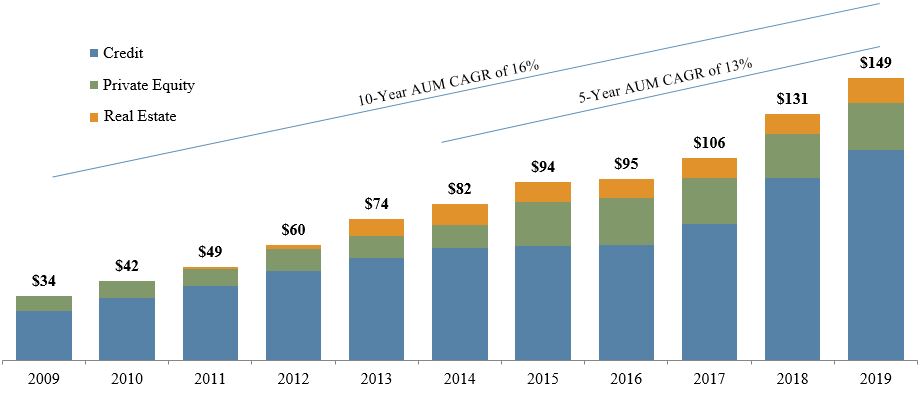
Ares is a leading global alternative investment manager with $148.9 billion of assets under management and over 1,200 employees in over 20 offices in more than 10 countries. We offer our investors a range of investment strategies and seek to deliver attractive performance to an investor base that includes over 850 direct institutional relationships and a significant retail investor base across our publicly traded and sub-advised funds. Since our inception in 1997, we have adhered to a disciplined investment philosophy that focuses on delivering strong risk-adjusted investment returns through market cycles. Ares believes each of its three distinct but complementary investment groups in Credit, Private Equity and Real Estate is a market leader based on assets under management and investment performance. We believe we create value for our stakeholders not only through our investment performance, but also by expanding our product offering, enhancing our distribution channels, increasing our global presence, investing in our non-investment functions, securing strategic partnerships and completing strategic acquisitions and portfolio purchases.
Our AUM has grown to $148.9 billion as of December 31, 2019 from $34.0 billion a decade earlier. As shown in the chart below, over the past five and ten years, our assets under management have achieved a compound annual growth rate (“CAGR”) of 13% and 16%, respectively ($ in billions):
We have an established track record of delivering strong risk-adjusted returns through market cycles. We believe our consistent and strong performance in a broad range of alternative assets has been shaped by several distinguishing features of our platform:
-
Comprehensive Multi-Asset Class Expertise and Flexible Capital: Our proficiency at evaluating every level of the capital structure, from senior debt to common equity, across companies, structured assets, infrastructure, power and energy assets, and real estate projects enables us to effectively assess relative value. This proficiency is complemented by our flexibility in deploying capital in a range of structures and different market environments to maximize risk-adjusted returns.
-
Differentiated Market Intelligence: Our proprietary research on approximately 60 industries and insights from a broad, global investment portfolio enable us to more effectively diligence and structure our products and investments.
-
Consistent Investment Approach: We believe our rigorous, credit-oriented investment approach across each of our investment groups is a key contributor to our strong investment performance and ability to expand our product offering.
-
Robust Sourcing Model: Our investment professionals’ local market presence and ability to effectively cross-source for other investment groups generates a robust pipeline of high-quality investment opportunities across our platform.
-
Talented and Committed Professionals: We attract, develop and retain highly accomplished investment professionals who not only demonstrate deep and broad investment expertise but also have a strong sense of commitment to our firm.
-
Collaborative Culture: We share ideas, relationships and information across our investment groups, which enables us to more effectively source, evaluate and manage investments.
Integrated Investment Platform and Process
We operate our firm as an integrated investment platform with a collaborative culture that emphasizes sharing of knowledge and expertise. We believe the exchange of information enhances our ability to analyze investments, deploy capital and improve the performance of our funds and portfolio companies. We have established deep and sophisticated independent research capabilities in approximately 60 industries and insights from active investments in over 1,700 companies, over 625 alternative credit investments and over 290 properties. In order to better collaborate on the information insights we possess across our investment platform, we formed a Global Markets Committee that meets monthly to share investing activities and market insights across our investment groups and the impact these market trends are having on our global investment strategies. Our extensive network of investment professionals includes local and geographically positioned individuals with the knowledge, experience and relationships that enable them to identify and take advantage of a wide range of investment opportunities.
Our investment process leverages the power of the Ares platform and an extensive network of professionals across our investment areas to identify and source attractive risk adjusted return opportunities while emphasizing capital preservation. We utilize our collective market and company knowledge, proprietary internal industry and company research, third party information and financial modeling to drive fundamental credit analysis and investment selection. We are able to invest up and down a company’s capital structure, which we believe helps us capitalize on out-performance opportunities and assess relative value for a particular investment. The investment committees of our investment groups review and evaluate investment opportunities in a framework that includes a qualitative and quantitative assessment of the key risks of each investment. We do not have a centralized investment committee and instead our investment committees are structured with overlapping membership from different investment groups to ensure consistency of approach and shared investment experience. In addition, each fund, account or other vehicle has investment policies and procedures that generally contain requirements and limitations, such as concentrations of securities, industries, and geographies in which a fund, account or other vehicle will invest, as well as other limitations required by law.
-
Credit**: Our experienced team takes a value-oriented approach and uses market technical analysis and fundamental research to identify investments that offer attractive value in comparison to the fundamental credit risk profile. We use our flexibility, structuring expertise and self-origination capabilities to invest across capital structures to best meet the full spectrum of our clients’ financing needs. Each investment decision involves an intensive due diligence process that includes research into the target company, its industry, its growth prospects and its ability to withstand adverse conditions, as appropriate. Members of our investment committees average approximately 25 years of relevant middle-market lending, alternative credit and liquid credit experience.
-
Private Equity**: Our private equity professionals have a demonstrated ability to deploy flexible capital, which allows them to stay both active and disciplined in various market environments. At the center of our investment process is a systematic approach that emphasizes rigorous due diligence at the company and market level in addition to a risk-adjusted return value assessment. Our investment process is comprised of a five-part process: (1) generate robust pipeline, (2) perform initial screening, (3) conduct due diligence, (4) seek investment approval, and (5) use a systematic approach to value creation. Our Private Equity Group employs a “pull model” with portfolio management whereby a team can access the Ares network for any number of value-creating levers that have been identified.
-
Real Estate**: With our experienced team, along with our expansive network of relationships, our Real Estate Group invests in opportunities across both real estate equity and debt investing. Our Real Estate Group's equity investments focus on implementing hands-on value creation initiatives to mismanaged and capital-starved assets, as well as new
development, ultimately selling s
Showing the first 8K of 81K characters. Open the full section
Item 1A. Risk Factors
Summary of Risks
Our businesses are subject to a number of inherent risks. We believe that the primary risks affecting our businesses and an investment in our shares are:
-
a complex regulatory and tax environment involving rules and regulations (both domestic and foreign), some of which are outdated relative to today’s complex financial activities and some of which are subject to political influence, which could restrict or require us to adjust our operations or the operations of our funds or portfolio companies and subject us to increased compliance costs and administrative burdens, as well as restrictions on our business activities;
-
poor performance by our funds due to market conditions, political actions or environments, monetary and fiscal policy or other conditions beyond our control;
-
the reputational harm that we would experience as a result of inappropriately addressing conflicts of interest, poor performance by the investments we manage or the actual or alleged failure by us, our employees, our funds or our portfolio companies to comply with applicable regulations in an increasingly complex political and regulatory environment;
-
potential variability in our period to period earnings due primarily to mark-to-market valuations of our funds’ investments. As a result of this variability, the market price of shares of our Class A common stock may be volatile and subject to fluctuations; the increasing demands of the investing community, including the potential for fee compression and changes to other terms, which could materially adversely affect our revenues; and
-
an investment in our Class A common stock is not an investment in our underlying funds. Moreover, valuation methodologies for certain assets can be subject to significant subjectivity, and the values of assets may never be realized.
Risks Related to Our Businesses
Difficult market and political conditions may adversely affect our businesses in many ways, including by reducing the value or hampering the performance of the investments made by our funds or reducing the ability of our funds to raise or deploy capital, each of which could materially reduce our revenue, earnings and cash flow and adversely affect our financial prospects and condition.
Our businesses are materially affected by conditions in the global financial markets and economic and political conditions throughout the world, such as interest rates, the availability and cost of credit, inflation rates, economic uncertainty, changes in laws (including laws relating to our taxation, taxation of our investors and the possibility of changes to regulations applicable to alternative asset managers), trade policies, commodity prices, tariffs, currency exchange rates and controls and national and international political circumstances (including wars and other forms of conflict, terrorist acts, and security operations) and catastrophic events such as fires, floods, earthquakes, tornadoes, hurricanes and pandemics. In particular, the recent outbreak of COVID-19 could materially affect our business to the extent it materially affects the Chinese and global economies or global financial markets. These factors are outside of our control and may affect the level and volatility of securities prices and the liquidity and value of investments, and we may not be able to or may choose not to manage our exposure to these conditions.
Global financial markets have experienced heightened volatility in recent periods, including as a result of economic and political events in or affecting the world’s major economies. For example, the June 2016 referendum in the U.K. in favor of exiting the EU and subsequent ongoing uncertainty regarding the terms of the exit, hostilities in the Middle East region, recent U.S. presidential and congressional elections and resulting uncertainties regarding actual and potential shifts in U.S. and foreign, trade, economic and other policies, and concerns over increasing interest rates (particularly short-term rates) and uncertainty regarding the long-term effects of tax reform in the United States, have precipitated market volatility. More recently, market uncertainty and volatility have been magnified as a result of the upcoming 2020 U.S. presidential and congressional elections and resulting uncertainties regarding actual and potential shifts in U.S. and foreign, trade, economic and other policies, as well as rising trade tensions between the United States and China and hostilities between the United States and Iran. Any escalation of such tensions and hostilities would likely exacerbate these dynamics.
In addition, numerous structural dynamics and persistent market trends have exacerbated volatility generally. Concerns over significant declines in the commodities markets, sluggish economic expansion in non-U.S. economies, including continued
concerns over growth prospects in China and emerging markets, growing debt loads for certain countries and uncertainty about the consequences of the U.S. and other governments withdrawing monetary stimulus measures all highlight the fact that economic conditions remain unpredictable and volatile. As a result, growth of major global economies generally slowed in 2019, and there is a high risk of significant ongoing volatility. Trade tensions between the U.S. and China continued to escalate in 2019. Further escalation of trade tensions between the U.S. and China, or the countries’ inability to reach a timely trade agreement, may negatively impact the rate of global growth, particularly in China, which has and continues to exhibit signs of slowing growth. Moreover, there is a risk of both sector-specific and broad-based corrections and/or downturns in the equity and credit markets. Any of the foregoing could have a significant impact on the markets in which we operate and a material adverse impact on our business prospects and financial condition.
A number of factors have had and may continue to have an adverse impact on credit markets in particular. The weakness and the uncertainty regarding the stability of the oil and gas markets resulted in a tightening of credit across multiple sectors. In addition, although the Federal Reserve has recently lowered the federal funds rate following a period of numerous increases, changes in and uncertainty surrounding interest rates may have a material effect on our business, particularly with respect to the cost and availability of financing for significant acquisition and disposition transactions. Furthermore, some of the provisions under the 2017 tax law amendments in the United States, Public Law No. 115-97 (the “Tax Cuts and Jobs Act”) could have a negative impact on the cost of financing and dampen the attractiveness of credit. Moreover, while conditions in the U.S. economy have generally improved since the credit crisis, many other economies continue to experience weakness, tighter credit conditions and a decreased availability of foreign capital. Since credit represents a significant portion of our business and ongoing strategy, any of the foregoing could have a material adverse impact on our business prospects and financial condition.
These and other conditions in the global financial markets and the global economy have resulted in, and may continue to result in, adverse consequences for us and many of our funds, each of which could adversely affect the business of such funds, restrict such funds’ investment activities, impede such funds’ ability to effectively achieve their investment objectives and result in lower returns than we anticipated at the time certain of our investments were made. More specifically, these economic conditions could adversely affect our operating results by causing:
-
decreases in the market value of securities, debt instruments or investments held by some of our funds;
-
illiquidity in the market, which could adversely affect transaction volumes and the pace of realization
Showing the first 8K of 311K characters. Open the full section
Item 1B. Unresolved Staff Comments
None.
Item 2. Properties
Our principal executive offices are located in leased office space at 2000 Avenue of the Stars, 12th Floor, Los Angeles, California. We also lease office space in Culver City, New York, London, and other cities around the world. We do not own any real property. We consider these facilities to be suitable and adequate for the management and operation of our businesses.
Item 3. Legal Proceedings
From time to time we are involved in various legal proceedings, lawsuits and claims incidental to the conduct of our business, some of which may be material. As of December 31, 2019 and December 31, 2018, we were not subject to any material pending legal proceedings. Our businesses are also subject to extensive regulation, which may result in regulatory proceedings against us.
Item 4. Mine Safety Disclosures
Not applicable.
PART II.
Item 5. Market For Registrant’s Common Equity, Related Stockholder Matters And Issuer Purchases Of Equity Securities
Market Information
Our Class A common stock is traded on the NYSE under the symbol “ARES". Our common shares began trading on the NYSE on May 2, 2014. We completed our Conversion from a Delaware limited partnership to a Delaware corporation effective on November 26, 2018. Our Class A common stock continued to trade on the NYSE under our existing symbol following the Conversion.
The number of holders of record of our Class A common stock as of February 21, 2020 was two. This does not include the number of shareholders that hold shares in “street name” through banks or broker-dealers. Ares Management GP LLC is the sole holder of shares of our Class B Common Stock and Ares Voting LLC is the sole holder of shares of our Class C Common Stock.
Stock Performance Graph
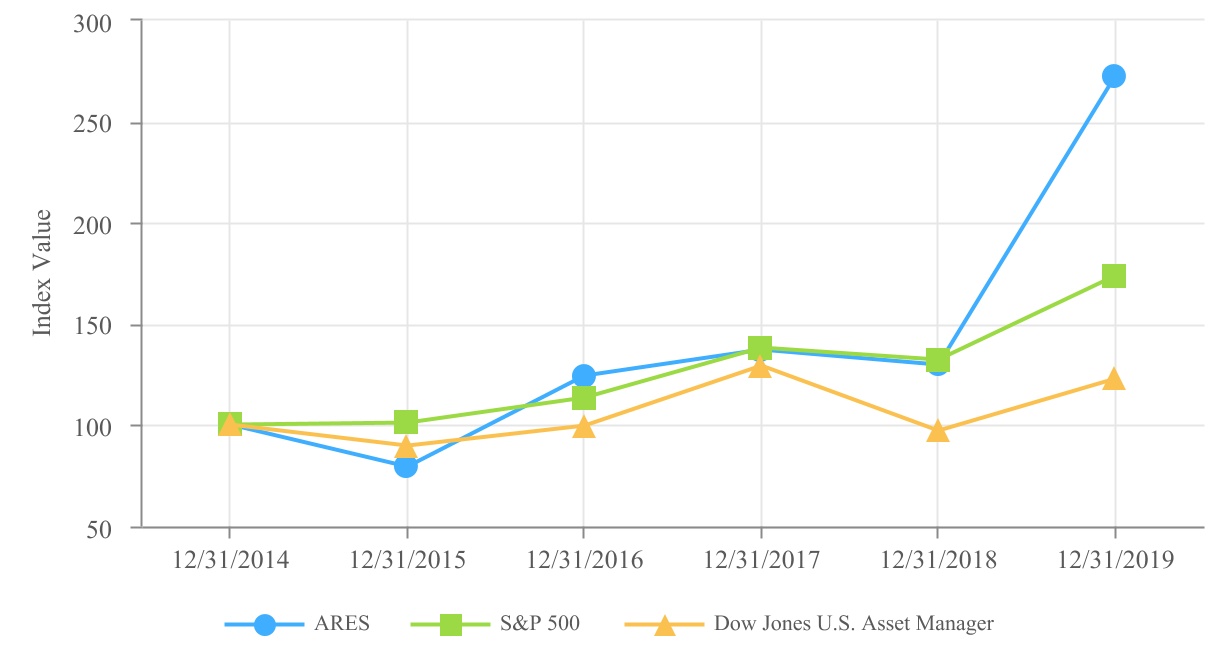
The following graph depicts the total return to holders of our Class A common stock from the closing price on December 31, 2014 through December 31, 2019, relative to the performance of the S&P 500 Index and the Dow Jones U.S. Asset Managers Index. The graph assumes $100 invested on December 31, 2014 and dividends received reinvested in the security or index.
The performance graph is not intended to be indicative of future performance. The performance graph shall not be deemed “soliciting material” or to be “filed” with the SEC for purposes of Section 18 of the Exchange Act, or otherwise subject to the liabilities under that Section, and shall not be deemed to be incorporated by reference into any of the Company’s filings under the Securities Act or the Exchange Act.
Total Return Performance Table
Issuer Purchases of Equity Securities
The table below presents purchases made by or on behalf of Ares Management Corporation or any “affiliated purchaser” (as defined in Rule 10b-18(a)(3) under the Exchange Act) of shares of our Class A Common Stock during each of the indicated periods ($ in thousands; except share data):
| Period | Total Number of Shares Purchased | Average Price Paid Per Share | Total Number of Shares Purchased as Part of Publicly Announced Plans or Programs | Approximate Dollar Value of Shares That May Yet be Purchased Under the Plans or Programs (1) | ||||||||||
| October 1, 2019 - October 31, 2019 | — | $ | — | — | $ | 139,551 | ||||||||
| November 1, 2019 - November 30, 2019 | — | — | — | 139,551 | ||||||||||
| December 1, 2019 - December 31, 2019 | — | — | — | 139,551 | ||||||||||
| Total | — | — |
(1)In February 2019, our board of directors authorized the repurchase of up to $150 million of shares of our Class A common stock. Under this stock repurchase program, shares may be repurchased from time to time in open market purchases, privately negotiated transactions or otherwise, including in reliance on Rule 10b5-1 of the Securities Act. In February 2020, our board of directors approved the renewal of the program and reset the repurchase amount back to $150 million. The program is scheduled to expire in March 2021. Repurchases under the program depend on the prevailing market conditions and other factors.
Dividend Policy for the Series A Preferred Stock
As of December 31, 2019 and 2018, the Company had 12,400,000 shares of Series A Preferred Stock outstanding. When, as and if declared by the Company’s board of directors, dividends on the Series A Preferred Stock are paid quarterly at a rate per annum equal to 7.00%. During 2019 and 2018, we paid quarterly dividends of approximately $21.7 million in each year to holders of record of shares of the Series A Preferred Stockholders, and in February 2020, the Company's board of directors declared a quarterly dividend of $5.4 million payable on March 31, 2020 to holders of record of shares of the Series A Preferred Stock at the close of business on March 15, 2020. As March 15, 2020 falls on a Sunday, the effective record date for the dividend will be Friday, March 13, 2020.
Dividend Policy for Class A Common Stock
During 2018, we declared dividends of $0.40, $0.0933, $0.28, $0.28 and $0.28 (totaling $1.33) per share to Class A common stockholders, or approximately $125.8 million. During 2019, we declared a dividend each quarter of $0.32 (totaling $1.28) per share to Class A common stockholders at the close of business on March 15, 2019, June 14, 2019, September 16, 2019, and December 17, 2019, respectively, or approximately $138.6 million.
In February 2020, the Company's board of directors declared a quarterly dividend of $0.40 per share of Class A common stock, or approximately $47.4 million, with respect to the first quarter of 2020 payable on March 31, 2020 to common stockholders of record at the close of business on March 17, 2020.
Our dividend policy for our Class A common stock is more closely aligned with our core management fee business. We intend to provide a steady quarterly dividend for each calendar year that will be based on our after-tax fee related earnings, with future potential changes based on the level and growth of our after-tax fee related earnings. Subject to the approval of our board of directors, we intend to pay a dividend of $0.40 per share of our Class A common stock per quarter in 2020.
Our fixed dividend will be reassessed each year based upon the level and growth of our after-tax fee related earnings. As fee related earnings reflect the core earnings of our business and consists of management fees less compensation and general and administrative expenses, having our recurring dividend based on this amount removes volatility from our dividend and enables investors to receive what we believe is an attractive after-tax, qualifying dividend yield.
Our dividend policy reflects our intention to retain net performance income. We expect to use such retained earnings for potential stock repurchases and to fund future growth with the objective of accelerating our fee related earnings growth per share. However, the declaration, payment and determination of the amount of future dividends, if any, is at the sole discretion of our board of directors, which may change our dividend policy at any time.
The payment of cash dividends on shares of our Class A common stock is subject to compliance with DGCL. In addition, under the Credit Facility, certain subsidiaries of the Ares Operating Group are prohibited from paying dividends in certain circumstances, including if an Event of Default (as defined in the Credit Facility) has occurred and is continuing.
Because Ares Management Corporation is a holding company and has no material assets other than its indirect ownership of Ares Operating Group Units, we fund dividends by Ares Management Corporation on shares of our Class A common stock, if any, in three steps:
-
first, we cause the Ares Operating Group entities to make distributions to their partners, including Ares Management Corporation and its direct subsidiaries. If the Ares Operating Group entities make such distributions, the partners of the Ares Operating Group entities will be entitled to receive equivalent distributions based on their partnership units in the Ares Operating Group (except as set forth in the following paragraph);
-
second, we cause Ares Management Corporation’s direct subsidiaries to distribute to Ares Management Corporation their share of such distributions, net of any taxes and amounts payable under the tax receivable agreement by such direct subsidiaries; and
-
third, Ares Management Corporation pays such distributions to our holders of our Class A common stock, net of any taxes and amounts payable under the tax receivable agreement, on a pro rata basis.
Because we and our direct subsidiaries that are corporations for U.S. federal income tax purposes may be required to pay corporate income and franchise taxes and make payments under the tax receivable agreement, the dividend amounts ultimately paid by us to holders of our Class A common stock are expected to be generally less, on a per share basis, than the amounts distributed by the Ares Operating Group entities to their respective partners in respect of their Ares Operating Group Units.
In addition, governing agreements of the Ares Operating Group entities provide for cash distributions, which we refer to as “tax distributions,” to the partners of such entities if the general partners of the Ares Operating Group entities determine that the taxable income of the relevant Ares Operating Group entity gives rise to taxable income for its partners. Generally, these tax distributions are computed based on our estimate of the net taxable income of the relevant entity multiplied by an assumed tax rate equal to the highest effective marginal combined U.S. federal, state and local income tax rate prescribed for an individual or corporate resident in Los Angeles, California or New York, New York, whichever is higher (taking into account the non-deductibility of certain expenses and the character of our income). The Ares Operating Group makes tax distributions only if and to the extent distributions from such entities for the relevant year were otherwise insufficient to cover such tax liabilities.
In addition, the cash flow from operations of the Ares Operating Group entities may be insufficient to enable them to make required minimum tax distributions to their partners, in which case the Ares Operating Group may have to borrow funds or sell assets, which could have a material adverse effect on our liquidity and financial condition. Furthermore, by paying cash dividends rather than investing that cash in our businesses, we might risk slowing the pace of our growth, or not having a sufficient amount of cash to fund our operations, new investments or unanticipated capital expenditures, should the need arise.
Although a portion of any dividends paid by us to holders of our Class A common stock may include carried interest received by us, we do not intend to seek fulfillment of any contingent repayment obligation by seeking to have holders of our Class A common stock return any portion of such dividends attributable to carried interest associated with any contingent repayment obligation.
We expect any dividends paid out of current or accumulated earnings and profits to U.S. individuals and certain other qualifying holders of our Class A common stock to constitute “qualified dividend” income that is generally taxed at a more favorable tax rate than the ordinary income tax rate, if the requisite holding periods have been met. If the dividend exceeds current and accumulated earnings and profits, the excess is treated as a nontaxable return of capital, reducing the stockholder’s tax basis in its shares to the extent of such shareholder’s tax basis in such shares. Any remaining excess is treated as capital gain. Because U.S. corporations are taxed on their own taxable income, and because owners of such entities are taxed on any dividends paid from such entities, there are two levels of potential tax upon income earned by such entities.
Unregistered Sales of Equity Securities and Purchases of Equity Securities
None.
Item 6. Selected Financial Data
The following tables present selected consolidated financial information and other data of the Company. The Company, which was formed on November 15, 2013 as a partnership and converted to a Delaware corporation effective November 26, 2018, was formed to serve as a holding company for our businesses. See “Item 1. Business—Organizational Structure.”
We derived the following selected consolidated financial data of the Company as of December 31, 2019 and 2018 and for the years ended December 31, 2019, 2018, and 2017 from the audited consolidated financial statements included in this Annual Report on Form 10-K. The selected consolidated financial data of the Company as of and for the years ended December 31, 2016 and 2015 were derived from the audited consolidated financial statements of the Company, which are not included in this Annual Report on Form 10-K. The consolidated financial statements were prepared on substantially the same basis as the audited consolidated financial statements and include all adjustments that we consider necessary for a fair presentation of the Company’s consolidated financial position and results of operations. The selected historical financial data is not indicative of the expected future operating results of the Company.
The entities comprising our Consolidated Funds are not the same entities for all periods presented. The consolidation of funds during the periods generally has the effect of grossing up reported assets, liabilities and cash flow, and has no effect on net income attributable to the Company or total stockholders' equity. See “Item 7. Management’s Discussion and Analysis of Financial Condition and Results of Operations—Consolidation and Deconsolidation of Ares Funds” and “—Critical Accounting Estimates—Principles of Consolidation” and Note 2, “Summary of Significant Accounting Policies,” to our consolidated financial statements appearing elsewhere in this Annual Report on Form 10-K.
The following selected historical consolidated financial data should be read together with “Item 1. Business—Organizational Structure,” “Item 7. Management’s Discussion and Analysis of Financial Condition and Results of Operations” and our historical consolidated financial statements and related notes included elsewhere in this Annual Report on Form 10-K ($ in thousands):
| Year Ended December 31, | |||||||||||||||||||||||||||||||||||||||||||||||||||||
| 2019 | 2018 | 2017 | 2016 | 2015 | |||||||||||||||||||||||||||||||||||||||||||||||||
| Statements of operations data | As Adjusted | As Adjusted | As Adjusted | ||||||||||||||||||||||||||||||||||||||||||||||||||
| Total revenues | $ | 1,765,438 | $ | 958,461 | $ | 1,479,943 | $ | 1,254,373 | $ | 825,732 | |||||||||||||||||||||||||||||||||||||||||||
| Total expenses | 1,462,797 | 870,362 | 1,504,758 | 1,016,420 | 769,040 | ||||||||||||||||||||||||||||||||||||||||||||||||
| Total other income | 122,539 | 96,242 | 174,674 | 59,967 | 24,792 | ||||||||||||||||||||||||||||||||||||||||||||||||
| Income before taxes | 425,180 | 184,341 | 149,859 | 297,920 | 81,484 | ||||||||||||||||||||||||||||||||||||||||||||||||
| Income tax expense (benefit) | 52,376 | 32,202 | (23,052) | 11,019 | 19,064 | ||||||||||||||||||||||||||||||||||||||||||||||||
| Net income | 372,804 | 152,139 | 172,911 | 286,901 | 62,420 | ||||||||||||||||||||||||||||||||||||||||||||||||
| Less: Net income (loss) attributable to non-controlling interests in Consolidated Funds | 39,704 | 20,512 | 60,818 | 3,386 | (5,686) | ||||||||||||||||||||||||||||||||||||||||||||||||
| Less: Net income attributable to redeemable interests in Ares Operating Group entities | — | — | — | 456 | 338 | ||||||||||||||||||||||||||||||||||||||||||||||||
| Less: Net income attributable to non-controlling interests in Ares Operating Group entities | 184,216 | 74,607 | 35,915 | 171,251 | 48,390 | ||||||||||||||||||||||||||||||||||||||||||||||||
| Net income attributable to Ares Management Corporation | 148,884 | 57,020 | 76,178 | 111,808 | 19,378 | ||||||||||||||||||||||||||||||||||||||||||||||||
| Less: Series A Preferred Stock dividends paid | 21,700 | 21,700 | 21,700 | 12,176 | — | ||||||||||||||||||||||||||||||||||||||||||||||||
| Net income attributable to Ares Management Corporation Class A common stockholders | $ | 127,184 | $ | 35,320 | $ | 54,478 | $ | 99,632 | $ | 19,378 | |||||||||||||||||||||||||||||||||||||||||||
| Net income per share of Class A common stock | |||||||||||||||||||||||||||||||||||||||||||||||||||||
| Basic | $ | 1.11 | $ | 0.30 | $ | 0.62 | $ | 1.22 | $ | 0.23 | |||||||||||||||||||||||||||||||||||||||||||
| Diluted | $ | 1.06 | $ | 0.30 | $ | 0.62 | $ | 1.20 | $ | 0.23 | |||||||||||||||||||||||||||||||||||||||||||
| Dividend declared and paid per share of Class A common stock | $ | 1.28 | $ | 1.33 | $ | 1.13 | $ | 0.83 | $ | 0.88 |
| As of December 31, | |||||||||||||||||||||||||||||||||||||||||||||||||||||
| 2019 | 2018 | 2017 | 2016 | 2015 | |||||||||||||||||||||||||||||||||||||||||||||||||
| Statements of financial condition data | As Adjusted | As Adjusted | As Adjusted | ||||||||||||||||||||||||||||||||||||||||||||||||||
| Total assets | $ | 12,014,196 | $ | 10,154,692 | $ | 8,563,522 | $ | 5,829,712 | $ | 4,321,408 | |||||||||||||||||||||||||||||||||||||||||||
| Debt obligations | 316,609 | 480,952 | 616,176 | 305,784 | 389,120 | ||||||||||||||||||||||||||||||||||||||||||||||||
| CLO loan obligations of Consolidated Funds | 7,973,748 | 6,678,091 | 4,963,194 | 3,031,112 | 2,174,352 | ||||||||||||||||||||||||||||||||||||||||||||||||
| Consolidated Funds’ borrowings | 107,244 | 209,284 | 138,198 | 55,070 | 11,734 | ||||||||||||||||||||||||||||||||||||||||||||||||
| Total liabilities | 10,155,598 | 8,760,351 | 7,103,230 | 4,452,450 | 3,329,497 | ||||||||||||||||||||||||||||||||||||||||||||||||
| Non-controlling interest in Consolidated Funds | 618,020 | 503,637 | 528,488 | 338,035 | 323,606 | ||||||||||||||||||||||||||||||||||||||||||||||||
| Non-controlling interest in Ares Operating Group entities | 472,288 | 302,780 | 358,186 | 447,615 | 397,883 | ||||||||||||||||||||||||||||||||||||||||||||||||
| Total stockholders' equity | 768,290 | 587,924 | 573,618 | 591,612 | 246,917 | ||||||||||||||||||||||||||||||||||||||||||||||||
| Total equity | 1,858,598 | 1,394,341 | 1,460,292 | 1,377,262 | 968,406 | ||||||||||||||||||||||||||||||||||||||||||||||||
Item 7. Management’s Discussion and Analysis of Financial Condition and Results of Operations
Ares Management Corporation is a Delaware corporation, which was formerly a limited partnership formed on November 15, 2013 and which converted to a Delaware corporation effective on November 26, 2018. Unless the context otherwise requires, references to “Ares,” “we,” “us,” “our,” and the “Company” are intended to mean the business and operations of Ares Management Corporation and its consolidated subsidiaries. The following discussion analyzes the financial condition and results of operations of the Company. “Consolidated Funds” refers collectively to certain Ares-affiliated funds, related co-investment entities and certain CLOs that are required under generally accepted accounting principles in the United States (“GAAP”) to be consolidated in our consolidated financial statements included in this Annual Report on Form 10-K. Additional terms used by the Company are defined in the Glossary and throughout the Management's Discussion and Analysis in this Annual Report on Form 10-K.
The following discussion and analysis should be read in conjunction with the audited, consolidated financial statements of Ares Management Corporation and the related notes included in this Annual Report on Form 10-K.
This section of the Annual Report on Form 10-K discusses activity as of and for the years ended December 31, 2019 and 2018. For discussion on activity for the year ended December 31, 2017 and period-over-period analysis on results for the year ended December 31, 2018 to 2017, refer to Part II, Item 7 "Management's Discussion and Analysis of Financial Condition and Results of Operations" in our Annual Report on Form 10-K for the year ended December 31, 2018.
Amounts and percentages presented throughout our discussion and analysis of financial condition and results of operations may reflect rounded results in thousands (unless otherwise indicated) and consequently, totals may not appear to sum.
Managing Business Performance
Non-GAAP Financial Measures
We use the following non-GAAP measures to assess and track our performance:
-
Fee Related Earnings (FRE)
-
Realized Income (RI)
These non-GAAP financial measures supplement and should be considered in addition to and not in lieu of, the results of operations, which are discussed further under “—Components of Consolidated Results of Operations” and are prepared in accordance with GAAP. For the specific components and calculations of these non-GAAP measures, as well as a reconciliation of these measures to the most comparable measure in accordance with GAAP, see Note 15, “Segment Reporting,” to our audited consolidated financial statements included in this Annual Report on Form 10-K.
Operating Metrics
We monitor certain operating metrics that are common to the alternative asset management industry, which are discussed below.
Assets Under Management
Assets under management (“AUM”) refers to the assets we manage. We view AUM as a metric to measure our investment and fundraising performance as it reflects assets generally at fair value plus available uncalled capital. For our funds other than CLOs, our AUM equals the sum of the following:
-
net asset value (“NAV”) of such funds;
-
the drawn and undrawn debt (at the fund-level including amounts subject to restrictions); and
-
uncalled committed capital (including commitments to funds that have yet to commence their investment periods).
NAV refers to the fair value of all of the assets of a fund less the liabilities of the fund.
For CLOs, our AUM is equal to initial principal amounts of notes adjusted for paydowns.
The tables below present rollforwards of our total AUM by segment for the years ended December 31, 2019 and 2018 ($ in millions):
| Credit Group | Private Equity Group | Real Estate Group | Total AUM | ||||||||||||||||||||
| Balance at 12/31/2018 | $ | 95,836 | $ | 23,487 | $ | 11,340 | $ | 130,663 | |||||||||||||||
| Net new par/equity commitments | 6,591 | 3,151 | 2,361 | 12,103 | |||||||||||||||||||
| Net new debt commitments | 10,684 | 25 | 633 | 11,342 | |||||||||||||||||||
| Distributions | (6,268) | (3,813) | (1,689) | (11,770) | |||||||||||||||||||
| Change in fund value | 3,700 | 2,316 | 562 | 6,578 | |||||||||||||||||||
| Balance at 12/31/2019 | $ | 110,543 | $ | 25,166 | $ | 13,207 | $ | 148,916 | |||||||||||||||
| Average AUM(1) | $ | 103,853 | $ | 24,537 | $ | 12,142 | $ | 140,532 |
| Credit Group | Private Equity Group | Real Estate Group | Total AUM | ||||||||||||||||||||
| Balance at 12/31/2017 | $ | 71,732 | $ | 24,530 | $ | 10,229 | $ | 106,491 | |||||||||||||||
| Net new par/equity commitments | 21,105 | 1,498 | 2,847 | 25,450 | |||||||||||||||||||
| Net new debt commitments | 9,340 | 100 | 75 | 9,515 | |||||||||||||||||||
| Distributions | (7,744) | (1,900) | (2,209) | (11,853) | |||||||||||||||||||
| Change in fund value | 1,403 | (741) | 398 | 1,060 | |||||||||||||||||||
| Balance at 12/31/2018 | $ | 95,836 | $ | 23,487 | $ | 11,340 | $ | 130,663 | |||||||||||||||
| Average AUM(1) | $ | 84,647 | $ | 23,784 | $ | 10,793 | $ | 119,224 |
(1) Represents a five-point average of quarter-end balances for each period.
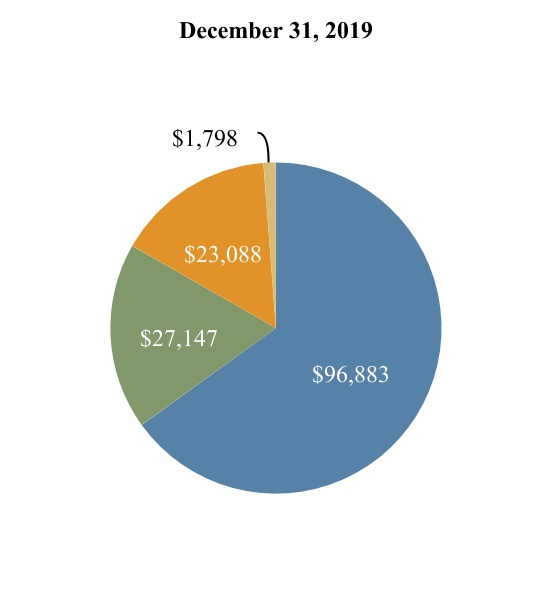
The components of our AUM are presented below as of December 31, 2019 and 2018 ($ in millions):

| AUM: $148,916 | AUM: $130,663 |
| FPAUM | AUM not yet paying fees | Non-fee paying(1) | General partner and affiliates |
(1) Includes $7.9 billion and $6.7 billion of AUM of funds from which we indirectly earn management fees as of December 31, 2019 and 2018, respectively.
Please refer to “— Results of Operations by Segment” for a more detailed presentation of AUM by segment for each of the periods presented.
Fee Paying Assets Under Management
Our FPAUM is generally comprised of the following components:
-
The amount of limited partner capital commitments for certain closed-end funds within the reinvestment period;
-
The amount of limited partner invested capital for the aforementioned closed-end funds beyond the reinvestment
Showing the first 8K of 208K characters. Open the full section
Item 7A. Quantitative and Qualitative Disclosures About Market Risk
Our primary exposure to market risk is related to our role as general partner or investment adviser to our investment funds and the sensitivity to movements in the fair value of their investments, including the effect on management fees, performance income and investment income.
Market Risk
The market price of investments may significantly fluctuate during the period of investment. Investments may decline in value due to factors affecting securities markets generally or particular industries represented in the securities markets. The value of an investment may decline due to general market conditions, which are not specifically related to such investment, such as real or perceived adverse economic conditions, changes in the general outlook for corporate earnings, changes in interest or currency rates or adverse investor sentiment generally. It may also decline due to factors that affect a particular industry or industries, such as labor shortages or increased production costs and competitive conditions within an industry.
Our credit orientation has been a central tenet of our business across our debt and equity investment strategies. We believe the combination of high-quality proprietary information flow and a consistent, rigorous approach to managing investments across our strategies has been, and we believe will continue to be, a major driver of our strong risk-adjusted returns and the stability and predictability of our income.
Effect on Management Fees
Management fees are generally based on a defined percentage of fair value of assets, total commitments, invested capital, net asset value, net investment income, total assets or par value of the investment portfolios we manage. Management fees calculated based on fair value of assets or net investment income are affected by short-term changes in market values.
The overall impact of a short-term change in market value may be mitigated by a number of factors including, but not limited to, fee definitions that are not based on market value including invested capital and committed capital, market value definitions that exclude the impact of realized and/or unrealized gains and losses, market value definitions based on beginning of the period values or a form of average market value including daily, monthly or quarterly averages as well monthly or quarterly payment terms.
For the year ended December 31, 2019, the fund management fees that were recognized from open-ended funds in liquid credit strategies with fees subject to change based upon fluctuations in market values were approximately 4%. As such, a hypothetical 10% decrease in fair value of our managed funds’ investments as of December 31, 2019 would not have a material impact on our management fees.
Effect on Carried Interest Allocation
We earn carried interest allocation from certain of our funds when such funds achieve specified performance criteria. Our carried interest allocation will be impacted by changes in market risk factors. However, several major factors will influence the degree of impact, including, but not limited to, the following :
-
the performance criteria for each individual fund in relation to how that fund’s results of operations are impacted by changes in market risk factors;
-
whether such performance criteria are measured annually or over the life of the fund;
-
to the extent applicable, the prior-period performance of each fund in relation to its performance criteria; and
-
whether each funds’ performance related distributions are subject to contingent repayment.
As a result, the impact of changes in market risk factors on carried interest allocation will vary widely from fund to fund. An overall increase of 10% in the general equity markets would not necessarily drive the same impact on our funds’ valuations, as many of our investments in our funds are illiquid and do not trade on any exchange. Additionally, as a large percentage of our carried interest allocation are paid to employees as performance related compensation, the overall net impact to our income would be mitigated by lower compensation payments.
See Note 9, “Commitments and Contingencies,” to our consolidated financial statements included in this Annual Report on Form 10-K for discussion on amount of performance income, net of tax distributions, subject to contingent repayment if we assumed all existing investments were worthless.
Effect on Investment Income
An investment gain (loss) is realized when we redeem all or a portion of our investment or when we receive cash income, such as interest or dividends. Unrealized investment gain (loss) results from changes in the fair value of the underlying investment as well as the reversal of unrealized appreciation (depreciation) at the time an investment is realized.
Changes in the fair values of our funds’ investments directly impact unrealized principal investment income and unrealized gains on investments. A hypothetical incremental 10% decrease in the fair value of our investments as of December 31, 2019 would result in declines in principal investment income and unrealized gains on investments of $54.7 million and $16.3 million, respectively.
Exchange Rate Risk
Our funds hold investments that are denominated in foreign currencies that may be affected by movements in the rate of exchange between those currencies and the U.S. dollar. Movements in the exchange rate between currencies impact the management fees earned by funds with fee paying AUM denominated in foreign currencies as well as by funds with fee paying AUM denominated in U.S. dollars that hold investments denominated in foreign currencies. Additionally, movements in the exchange rate impact operating expenses for our global offices that transact in foreign currencies and the revaluation of assets and liabilities denominated in non-functional currencies, including cash balances and investments.
We manage our exposure to exchange rate risks through our regular operating activities, wherein we utilize payments received in foreign currencies to fulfill obligations in foreign currencies, and, when appropriate, through the use of derivative financial instruments to hedge the net foreign currency exposure in: the funds that we advise; the balance sheet exposure for certain direct investments denominated in foreign currencies; and the cash flow exposure for foreign currencies.
A portion of our management fees are denominated in foreign currencies that may be affected by movements in the rate of exchange between currencies. We estimate that as of December 31, 2019 a hypothetical 10% decline in the rate of exchange of all foreign currencies against the U.S. dollar would not result in a material change to management fees for the year ended December 31, 2019, and would be largely offset by the currency conversions of the expenses denominated in foreign currencies.
Interest Rate Risk
Our Credit Facility provides a $1.065 billion revolving line of credit with the ability to upsize to $1.35 billion (subject to obtaining commitments for any such additional borrowing capacity) with a maturity date of March 21, 2024. The Credit Facility bears interest at a variable rate based on either LIBOR or a base rate plus an applicable margin with an unused commitment fee paid quarterly, which is subject to change with our underlying credit agency rating. Currently, base rate loans bear interest calculated based on the base rate plus 0.25% and the LIBOR rate loans bear interest calculated based on LIBOR rate plus 1.25%. Our unused commitment fee is 0.15% per annum. As of December 31, 2019, we had $70.0 million of borrowings outstanding under the Credit Facility.
We estimate that in the event of a 100 basis point increase in interest rates, to the extent there is an outstanding revolver balance, we would be subject to the variable rate and would expect our interest expense to increase commensurately.
As credit-oriented investors, we are also subject to interest rate risk through the securities we hold in our Consolidated Funds. A 100 basis point increase in interest rates would be expected to negatively affect the fair value of securities that accrue interest income at fixed rates and therefore negatively impact net change in unrealized gains on investments of the Company and the Consolidated Funds. The actual impact is dependent on the average duration and the amount of such holdings. Conversely, securities that accrue interest at variable rates would be expected to benefit from a 100 basis points increase in interest rates because these securities would generate higher levels of current income and therefore positively impact interest and dividend income. In the cases where our funds pay management fees based on NAV, we would expect our segment management fees to experience a change in direction and magnitude corresponding to that experienced by the underlying portfolios.
Credit Risk
We are party to agreements providing for various financial services and transactions that contain an element of risk in the event that the counterparties are unable to meet the terms of such agreements. In such agreements, we depend on the counterparty to make payment or otherwise perform. We generally endeavor to minimize our risk of exposure by limiting to reputable financial institutions the counterparties with which we enter into financial transactions. In other circumstances, availability of financing from financial institutions may be uncertain due to market events, and we may not be able to access these financing markets.
Item 8. Financial Statements and Supplementary Data
The information required by this item is incorporated by reference to the consolidated financial statements and accompanying notes set forth in the F-pages of this Annual Report on Form 10-K.
Item 9. Changes in and Disagreements with Accountants on Accounting and Financial Disclosure
None.
Item 9A. Controls and Procedures
Evaluation of Disclosure Controls and Procedures
We maintain disclosure controls and procedures (as that term is defined in Rules 13a-15(e) and 15d-15(e) under the Exchange Act) that are designed to ensure that information required to be disclosed in our reports under the Exchange Act is recorded, processed, summarized and reported within the time periods specified in the SEC’s rules and forms, and that such information is accumulated and communicated to our management, including our co-principal executive officers and principal financial officer, as appropriate, to allow timely decisions regarding required disclosures. Any controls and procedures, no matter how well designed and operated, can provide only reasonable assurance of achieving the desired control objectives. Our management, with the participation of our principal executive officer and principal financial officer, has evaluated the effectiveness of the design and operation of our disclosure controls and procedures as of December 31, 2019. Based upon that evaluation and subject to the foregoing, our principal executive officers and principal financial officer concluded that, as of December 31, 2019, the design and operation of our disclosure controls and procedures were effective to accomplish their objectives at the reasonable assurance level.
Changes in Internal Control over Financial Reporting
There have been no changes in our internal control over financial reporting (as defined in Rule 13a-15(f) and 15d-15(f) under the Exchange Act) during the quarter ended December 31, 2019 that have materially affected, or that are reasonably likely to materially affect, our internal control over financial reporting.
Report of Management on Internal Control Over Financial Reporting
Our management is responsible for establishing and maintaining adequate internal control over financial reporting for the Company. Internal control over financial reporting is a process to provide reasonable assurance regarding the reliability of our financial reporting for external purposes in accordance with accounting principles generally accepted in the United States of America. Internal control over financial reporting includes maintaining records that in reasonable detail accurately and fairly reflect our transactions; providing reasonable assurance that transactions are recorded as necessary for preparation of our consolidated financial statements; providing reasonable assurance that receipts and expenditures of company assets are made in accordance with management authorization; and providing reasonable assurance that unauthorized acquisition, use or disposition of company assets that could have a material effect on our consolidated financial statements would be prevented or detected on a timely basis. Because of its inherent limitations, internal control over financial reporting is not intended to provide absolute assurance that a material misstatement of our consolidated financial statements would be prevented or detected.
Management conducted an evaluation of the effectiveness of our internal control over financial reporting based on the framework in Internal Control — Integrated Framework (2013) issued by the Committee of Sponsoring Organizations of the Treadway Commission. Based on this evaluation, management concluded that the Company's internal control over financial reporting was effective as of December 31, 2019. The Company's independent registered public accounting firm, Ernst & Young LLP, has issued an audit report on the effectiveness of the Company's internal control over financial reporting. Their report follows.
Report of Independent Registered Public Accounting Firm
To the Stockholders and Board of Directors of Ares Management Corporation
Opinion on Internal Control Over Financial Reporting
We have audited Ares Management Corporation’s internal control over financial reporting as of December 31, 2019, based on criteria established in Internal Control-Integrated Framework issued by the Committee of Sponsoring Organizations of the Treadway Commission (2013 framework) (the “COSO criteria”). In our opinion, Ares Management Corporation (the “Company”) maintained, in all material respects, effective internal control over financial reporting as of December 31, 2019, based on the COSO criteria.
We also have audited, in accordance with the standards of the Public Company Accounting Oversight Board (United States) (“PCAOB”), the consolidated statements of financial condition of the Company as of December 31, 2019 and 2018, the related consolidated statements of operations, comprehensive income, changes in equity and cash flows for each of the three years in the period ended December 31, 2019, and the related notes and our report dated February 27, 2020 expressed an unqualified opinion thereon.
Basis for Opinion
The Company’s management is responsible for maintaining effective internal control over financial reporting and for its assessment of the effectiveness of internal control over financial reporting included in the accompanying Report of Management on Internal Control over Financial Reporting. Our responsibility is to express an opinion on the Company’s internal control over financial reporting based on our audit. We are a public accounting firm registered with the PCAOB and are required to be independent with respect to the Company in accordance with the U.S. federal securities laws and the applicable rules and regulations of the Securities and Exchange Commission and the PCAOB.
We conducted our audit in accordance with the standards of the PCAOB. Those standards require that we plan and perform the audit to obtain reasonable assurance about whether effective internal control over financial reporting was maintained in all material respects.
Our audit included obtaining an understanding of internal control over financial reporting, assessing the risk that a material weakness exists, testing and evaluating the design and operating effectiveness of internal control based on the assessed risk, and performing such other procedures as we considered necessary in the circumstances. We believe that our audit provides a reasonable basis for our opinion.
Definition and Limitations of Internal Control over Financial Reporting
A company’s internal control over financial reporting is a process designed to provide reasonable assurance regarding the reliability of financial reporting and the preparation of financial statements for external purposes in accordance with generally accepted accounting principles. A company’s internal control over financial reporting includes those policies and procedures that (1) pertain to the maintenance of records that, in reasonable detail, accurately and fairly reflect the transactions and dispositions of the assets of the company; (2) provide reasonable assurance that transactions are recorded as necessary to permit preparation of financial statements in accordance with generally accepted accounting principles, and that receipts and expenditures of the company are being made only in accordance with authorizations of management and directors of the company; and (3) provide reasonable assurance regarding prevention or timely detection of unauthorized acquisition, use, or disposition of the company’s assets that could have a material effect on the financial statements.
Because of its inherent limitations, internal control over financial reporting may not prevent or detect misstatements. Also, projections of any evaluation of effectiveness to future periods are subject to the risk that controls may become inadequate because of changes in conditions, or that the degree of compliance with the policies or procedures may deteriorate.
/s/ Ernst & Young LLP
Los Angeles, California
February 27, 2020
Item 9B. Other Information
Disclosure Pursuant to Section 219 of the Iran Threat Reduction and Syria Human Rights Act
Section 219 of the Iran Threat Reduction and Syria Human Rights Act of 2012 (“ITRA”) and Section 13(r) of the Exchange Act, require an issuer to disclose in its annual and quarterly reports whether it or any of its affiliates have knowingly engaged in specified activities or transactions relating to Iran. On June 20, 2019, certain investment funds managed or advised by U.K.-based affiliates of Ares (the “Ares Entities”) acquired approximately 28.7% of the ordinary shares and 54.3% of the preferred shares of AgriBriefing 1364 Limited (“AgriBriefing”), a company based in London that provides price reporting data on a subscription basis to participants in the agricultural industry. Although the Ares Entities do not hold the largest voting position in AgriBriefing, their holdings of ordinary and preferred shares represent a majority of the outstanding equity interests in AgriBriefing. In addition, the Ares Entities hold certain contractual veto rights and the right to appoint a director to the board of directors of AgriBriefing. As a result, under applicable SEC definitions, the Ares Entities may be deemed to control AgriBriefing; however, this statement is not meant to be an admission that common control exists.
Subsequent to completion of the Ares Entities’ investment in AgriBriefing, in connection with Ares’ routine quarterly survey of its investment funds’ portfolio companies, AgriBriefing informed the Ares Entities that it had subscription contracts with five customers whose billing addresses were based in Iran. We have not been able to verify the identity or affiliations of these customers. As a result, it appears that we are required to provide this disclosure under ITRA and Section 13(r) of the Exchange Act.
These subscriptions generated annual gross revenues of less than €25,000 (less than 1% of AgriBriefing’s revenues) and de minimus net profits.
AgriBriefing confirmed that each of the subscriptions commenced prior to the investment in AgriBriefing by the Ares Entities, and that it terminated these subscriptions in July 2019 and does not intend to engage in any further dealings or transactions with these customers.
Based on currently available information, we and the Ares Entities have no reason to believe that any of the five customers are listed on the U.S. Treasury Department Office of Foreign Assets Control list of Specially Designated Nationals or that AgriBriefing has conducted any dealings in violation ITRA.
This disclosure does not relate to any activities conducted by Ares and does not involve Ares. This disclosure relates solely to activities conducted by AgriBriefing and its consolidated subsidiaries.
PART III.
Item 10. Directors, Executive Officers and Corporate Governance
The information required by this item is incorporated by reference to our definitive Proxy Statement for the 2020 Annual Meeting of Stockholders to be filed with the Securities and Exchange Commission within 120 days of December 31, 2019.
Item 11. Executive Compensation
The information required by this item is incorporated by reference to our definitive Proxy Statement for the 2020 Annual Meeting of Stockholders to be filed with the Securities and Exchange Commission within 120 days of December 31, 2019.
Item 12. Security Ownership of Certain Beneficial Owners and Management and Related Shareholder Matters
The information required by this item is incorporated by reference to our definitive Proxy Statement for the 2020 Annual Meeting of Stockholders to be filed with the Securities and Exchange Commission within 120 days of December 31, 2019.
Item 13. Certain Relationships and Related Transactions, and Director Independence
The information required by this item is incorporated by reference to our definitive Proxy Statement for the 2020 Annual Meeting of Stockholders to be filed with the Securities and Exchange Commission within 120 days of December 31, 2019.
Item 14. Principal Accounting Fees and Services
The information required by this item is incorporated by reference to our definitive Proxy Statement for the 2020 Annual Meeting of Stockholders to be filed with the Securities and Exchange Commission within 120 days of December 31, 2019.
PART IV.
Item 15. Exhibits, Financial Statement Schedules
(a)Documents Filed with Report:
| Report of Independent Registered Public Accounting Firm | ||
| Consolidated Statements of Financial Condition as of December 31, 2019 and 2018 | ||
| Consolidated Statements of Operations for the years ended December 31, 2019, 2018 and 2017 | ||
| Consolidated Statements of Comprehensive Income for the years ended December 31, 2019, 2018 and 2017 | ||
| Consolidated Statements of Changes in Equity for the years ended December 31, 2019, 2018 and 2017 | ||
| Consolidated Statements of Cash Flows for the years ended December 31, 2019, 2018 and 2017 | ||
| Notes to Consolidated Financial Statements |
(b)Exhibits.
The following is a list of all exhibits filed or furnished as part of this report.
| Exhibit No. | Description | |||||||
| 3.1 | Certificate of Incorporation of Ares Management Corporation (incorporated by reference to Exhibit 99.3 to the Registrant’s Current Report on Form 8-K (File No. 001-36429) filed with the SEC on November 15, 2018). | |||||||
| 3.2 | Bylaws of Ares Management Corporation (incorporated by reference to Exhibit 99.4 to the Registrant’s Current Report on Form 8-K (File No. 001-36429) filed with the SEC on November 15, 2018). | |||||||
| 4.1* | Description of Ares Management Corporation's Securities. | |||||||
| 4.2 | Indenture dated as of October 8, 2014 among Ares Finance Co. LLC, Ares Management, L.P., Ares Holdings Inc., Ares Domestic Holdings Inc., Ares Real Estate Holdings LLC, Ares Holdings L.P., Ares Domestic Holdings L.P., Ares Investments L.P., Ares Real Estate Holdings L.P., Ares Management LLC, Ares Investments Holdings LLC and U.S. Bank National Association, as trustee (incorporated by reference to Exhibit 4.1 to the Registrant’s Current Report on Form 8-K (File No. 001-36429) filed with the SEC on October 8, 2014). | |||||||
| 4.3 | First Supplemental Indenture dated as of October 8, 2014 among Ares Finance Co. LLC, Ares Management, L.P., Ares Holdings Inc., Ares Domestic Holdings Inc., Ares Real Estate Holdings LLC, Ares Holdings L.P., Ares Domestic Holdings L.P., Ares Investments L.P., Ares Real Estate Holdings L.P., Ares Management LLC, Ares Investments Holdings LLC and U.S. Bank National Association, as trustee (incorporated by reference to Exhibit 4.2 to the Registrant’s Current Report on Form 8-K (File No. 001-36429) filed with the SEC on October 8, 2014). | |||||||
| 4.4 | First Amendment, dated as of August 7, 2015, to the First Supplemental Indenture, dated October 8, 2014, to the indenture, dated October 8, 2014, among Ares Finance Co. LLC, the guarantors party thereto and U.S. Bank National Association, as trustee (incorporated by reference to Exhibit 10.2 to the Registrant's Current Report on Form 8-K (File No. 001-36429) filed with the SEC on August 7, 2015). | |||||||
| 4.5 | Form of 4.000% Senior Note due 2024 (incorporated by reference to Exhibit 4.3 to the Registrant’s Current Report on Form 8-K (File No. 001-36429) filed with the SEC on October 8, 2014). | |||||||
| 4.6 | Form of 7.00% Series A Preferred Stock Certificate (incorporated by reference to Exhibit 99.5 to the Registrant’s Current Report on Form 8-K (File No. 001-36429) filed with the SEC on November 15, 2018). | |||||||
| 10.1 | Third Amended and Restated Limited Partnership Agreement of Ares Holdings L.P., dated November 26, 2018. | |||||||
| 10.2 | Fourth Amended and Restated Limited Partnership Agreement of Ares Offshore Holdings L.P. dated November 26, 2018. | |||||||
| 10.3 | Third Amended and Restated Limited Partnership Agreement of Ares Investments L.P. dated November 26, 2018. | |||||||
| 10.4 | Investor Rights Agreement. | |||||||
| 10.5 | Second Amended & Restated 2014 Equity Incentive Plan (incorporated by reference to Exhibit 10.1 to the Registrant’s Registration Statement on Form S-8 POS (File No. 333-225271) filed with the SEC on November 26, 2018). # |
| Exhibit No. | Description | |||||||
| 10.6 | Fourth Amended and Restated Exchange Agreement, dated as of November 26, 2018. | |||||||
| 10.7 | Second Amended and Restated Tax Receivable Agreement. | |||||||
| 10.8 | Sixth Amended and Restated Credit Agreement, dated as of April 21, 2014, by and among Ares Holdings LLC, Ares Domestic Holdings L.P., Ares Investments LLC, Ares Real Estate Holdings L.P., the Guarantors party thereto, the Lenders party thereto and JPMorgan Chase Bank, N.A. (incorporated by reference to Exhibit 10.10 to the Registrant’s Registration Statement on Form S-1/A (File No. 333-194919) filed with the SEC on April 28, 2014). | |||||||
| 10.9 | Amendment No. 1, dated as of July 15, 2014, to the Sixth Amended and Restated Credit Agreement, dated as of April 21, 2014, by and among Ares Holdings LLC, Ares Domestic Holdings L.P., Ares Investments LLC, Ares Real Estate Holdings L.P., the Guarantors party thereto, the Lenders party thereto and JPMorgan Chase Bank, N.A. (incorporated by reference to Exhibit 10.1 to the Registrant’s Quarterly Report on Form 10‑Q (File No. 001-36429) filed with the SEC on November 12, 2014). | |||||||
| 10.10 | Amendment No. 2, dated as of September 24, 2014, to the Sixth Amended and Restated Credit Agreement, dated as of April 21, 2014, by and among Ares Holdings LLC, Ares Domestic Holdings L.P., Ares Investments LLC, Ares Real Estate Holdings L.P., the Guarantors party thereto, the Lenders party thereto and JPMorgan Chase Bank, N.A. (incorporated by reference to Exhibit 10.2 to the Registrant’s Quarterly Report on Form 10‑Q (File No. 001-36429) filed with the SEC on November 12, 2014). | |||||||
| 10.11 | Amendment No. 3, dated as of July 23, 2015, to the Sixth Amended and Restated Credit Agreement, dated as of April 21, 2014, by and among Ares Holdings LLC, Ares Domestic Holdings L.P., Ares Investments LLC, Ares Real Estate Holdings L.P., the Guarantors party thereto, the Lenders party thereto and JPMorgan Chase Bank, N.A. (incorporated by reference to Exhibit 10.1 to the Registrant’s Current Report on Form 8‑K (File No. 001-36429) filed with the SEC on July 28, 2015). | |||||||
| 10.12 | Amendment No. 4, dated as of August 5, 2015, to the Sixth Amended and Restated Credit Agreement, dated as of April 21, 2014, by and among Ares Holdings LLC, Ares Domestic Holdings L.P., Ares Investments LLC, Ares Real Estate Holdings L.P., the Guarantors party thereto, the Lenders party thereto and JPMorgan Chase Bank, N.A. (incorporated by reference to Exhibit 10.1 to the Registrant’s Current Report on Form 8‑K (File No. 001-36429) filed with the SEC on August 7, 2015). | |||||||
| 10.13 | Amendment No. 5, dated as of December 16, 2015, to the Sixth Amended and Restated Credit Agreement, dated as of April 21, 2014, by and among Ares Holdings LLC, Ares Domestic Holdings L.P., Ares Investments LLC, Ares Real Estate Holdings L.P., the Guarantors party thereto, the Lenders party thereto and JPMorgan Chase Bank, N.A. (incorporated by reference to Exhibit 10.1 to the Registrant’s Current Report on Form 8‑K (File No. 001-36429) filed with the SEC on December 21, 2015). | |||||||
| 10.14 | Amendment No. 6, dated as of May 23, 2016, to the Sixth Amended and Restated Credit Agreement, dated as of April 21, 2014, by and among Ares Holdings LLC, Ares Domestic Holdings L.P., Ares Investments LLC, Ares Real Estate Holdings L.P., the Guarantors party thereto, the Lenders party thereto and JPMorgan Chase Bank, N.A. (incorporated by reference to Exhibit 10.1 to the Registrant’s Current Report on Form 8-K (File No. 001-36429) filed with the SEC on May 26, 2016). | |||||||
| 10.15 | Amendment No. 7, dated as of February 24, 2017, to the Sixth Amended and Restated Credit Agreement, dated as of April 21, 2014, by and among Ares Holdings L.P., Ares Investments L.P., the Guarantors party thereto, the Lenders party thereto and JPMorgan Chase Bank, N.A. (incorporated by reference to Exhibit 10.15 to the Registrant’s Annual Report on Form 10-K for the year ended December 31, 2016 (File No. 001-36429, filed with the SEC on February 27, 2017). | |||||||
| 10.16 | Restated Investment Advisory and Management Agreement between Ares Capital Corporation and Ares Capital Management LLC, dated as of June 6, 2011 (incorporated by reference to Exhibit 10.11 to the Registrant’s Registration Statement on Form S-1/A (File No. 333-194919) filed with the SEC on April 16, 2014). | |||||||
| 10.17 | Form of Indemnification Agreement. # | |||||||
| 10.18 | Form of Restricted Unit Agreement under the Second Amended & Restated 2014 Equity Incentive Plan (incorporated by reference to Exhibit 10.2 to the Registrant’s Registration Statement on Form S-8 POS (File No. 333-225271) filed with the SEC on November 26, 2018). # | |||||||
| 10.19 | Form of Option Agreement under the Second Amended & Restated 2014 Equity Incentive Plan. # | |||||||
| 10.20 | Form of Phantom Unit Agreement under the Second Amended & Restated 2014 Equity Incentive Plan. # | |||||||
| 10.21 | Form of ARCC Incentive Fee Award (incorporated by reference to Exhibit 10.16 to the Registrant’s Registration Statement on Form S‑1/A (File No. 333-194919) filed with the SEC on April 11, 2014). | |||||||
| 10.22 | Form of Amended and Restated Limited Partnership Agreement of Carry Vehicles (incorporated by reference to Exhibit 10.28 to the Registrant’s Annual Report on Form 10-K for the year ended December 31, 2015 (File No. 001-36429, filed with the SEC on February 29, 2016). |
| Exhibit No. | Description | |||||||
| 10.23 | Form of Supplemental Award Agreement for Carried Interest (incorporated by reference to Exhibit 10.29 to the Registrant’s Annual Report on Form 10-K for the year ended December 31, 2015 (File No. 001-36429, filed with the SEC on February 29, 2016). | |||||||
| 10.24 | Form of Annual Incentive Fee Award Letter (incorporated by reference to Exhibit 10.24 to the Registrant’s Annual Report on Form 10-K for the year ended December 31, 2016 (File No. 001-36429, filed with the SEC on February 27, 2017). | |||||||
| 10.25 | Form of Deferred Restricted Unit Agreement under the Second Amended & Restated 2014 Equity Incentive Plan (incorporated by reference to Exhibit 10.3 to the Registrant’s Registration Statement on Form S-8 POS (File No. 333-225271) filed with the SEC on November 26, 2018). # | |||||||
| 10.26 | Offer Letter for Michael R. McFerran, dated March 10, 2015 (incorporated by reference to Exhibit 10.26 to the Registrant’s Annual Report on Form 10-K (File No. 001-36429) filed with the SEC on March 20, 2015). | |||||||
| 10.27 | Form of Director Restricted Unit Agreement under the Second Amended & Restated 2014 Equity Incentive Plan (incorporated by reference to Exhibit 10.4 to the Registrant’s Registration Statement on Form S-8 POS (File No. 333-225271) filed with the SEC on November 26, 2018). # | |||||||
| 10.28 | Restricted Unit Agreement, dated as of July 31, 2018, by and between Michael J Arougheti and Ares Management, L.P. (incorporated by reference to Exhibit 10.1 to the Registrant’s Quarterly Report on Form 10-Q (File No. 001-36429) filed with the SEC on August 6, 2018). # | |||||||
| 10.29 | Amendment No. 8, dated as of March 21, 2019, to the Sixth Amended and Restated Credit Agreement, dated as of April 21, 2014, by and among Ares Holdings L.P., Ares Investments L.P., the Guarantors party thereto, the Lenders party thereto and JPMorgan Chase Bank, N.A. (incorporated by reference to Exhibit 10.1 to the Registrant's Current Report on Form 8-K (File No. 001-36429) filed with the SEC on March 26, 2019). | |||||||
| 10.30 | Stock Purchase Agreement, dated July 9, 2019, between Aspida Holdco, LLC and GBIG Holdings, Inc. (incorporated by reference to Exhibit 2.1 to the Registrant's Current Report on Form 8-K (File 001-36429) filed with the SEC on July 9, 2019). | |||||||
| 10.31 | Second Amended and Restated Investment Advisory and Management Agreement, dated June 6, 2019, between Ares Capital Corporation and Ares Capital Management LLC (incorporated by reference to exhibit 10.2 to the Registrant's Quarterly Report on Form 10-Q (File No. 001-36429) filed with the SEC on November 6, 2019). | |||||||
| 21.1* | Subsidiaries of Ares Management Corporation. | |||||||
| 23.1* | Consent of Ernst and Young LLP. | |||||||
| 31.1* | Certification of the Chief Executive Officer pursuant to Rule 13a-14(a). | |||||||
| 31.2* | Certification of the Chief Financial Officer pursuant to Rule 13a-14(a). | |||||||
| 32.1* | Certification of the Chief Executive Officer and Chief Financial Officer pursuant to 18 U.S.C. Section 1350. | |||||||
| 101.INS* | Inline XBRL Instance Document. | |||||||
| 101.SCH* | Inline XBRL Taxonomy Extension Schema Document. | |||||||
| 101.CAL* | Inline XBRL Taxonomy Extension Calculation Linkbase Document. | |||||||
| 101.DEF* | Inline XBRL Taxonomy Extension Definition Linkbase Document. | |||||||
| 101.LAB* | Inline XBRL Taxonomy Extension Label Linkbase Document. | |||||||
| 101.PRE* | Inline XBRL Taxonomy Extension Presentation Linkbase Document. | |||||||
| 104* | Cover Page Interactive Data File - the cover page interactive data file does not appear in the Interactive Data File because its XBRL tags are embedded within the Inline XBRL document. |
- Filed herewith.
Denotes a management contract or compensation plan or arrangement.
Item 16. Form 10-K Summary
None.
SIGNATURES
Pursuant to the requirements of Section 13 or 15(d) of the Securities Exchange Act of 1934, the registrant has duly caused this report to be signed on its behalf by the undersigned, thereunto duly authorized.
| ARES MANAGEMENT CORPORATION | |||||||||||||||||
| Dated: February 27, 2020 | By: | /s/ Michael J Arougheti | |||||||||||||||
| Name: | Michael J Arougheti | ||||||||||||||||
| Title: | Co-Founder, Chief Executive Officer & President (Principal Executive Officer) | ||||||||||||||||
Pursuant to the requirements of the Securities Exchange Act of 1934, this report has been signed below by the following persons on behalf of the registrant and in the capacities and on the dates indicated.
| By: | /s/ Antony P. Ressler | ||||||||||||||||
| Name: | Antony P. Ressler | Dated: February 27, 2020 | |||||||||||||||
| Title: | Executive Chairman & Co-Founder | ||||||||||||||||
| By: | /s/ Michael J Arougheti | ||||||||||||||||
| Name: | Michael J Arougheti | Dated: February 27, 2020 | |||||||||||||||
| Title: | Director, Co-Founder, Chief Executive Officer & President (Principal Executive Officer) | ||||||||||||||||
| By: | /s/ Michael R. McFerran | ||||||||||||||||
| Name: | Michael R. McFerran | Dated: February 27, 2020 | |||||||||||||||
| Title: | Chief Operating Officer & Chief Financial Officer (Principal Financial and Accounting Officer) | ||||||||||||||||
| By: | /s/ David B. Kaplan | ||||||||||||||||
| Name: | David B. Kaplan | Dated: February 27, 2020 | |||||||||||||||
| Title: | Director, Co-Founder & Co-Chairman of Private Equity Group | ||||||||||||||||
| By: | /s/ Bennett Rosenthal | ||||||||||||||||
| Name: | Bennett Rosenthal | Dated: February 27, 2020 | |||||||||||||||
| Title: | Director, Co-Founder & Co-Chairman of Private Equity Group | ||||||||||||||||
| By: | /s/ R. Kipp deVeer | ||||||||||||||||
| Name: | R. Kipp deVeer | Dated: February 27, 2020 | |||||||||||||||
| Title: | Director & Head of Credit Group | ||||||||||||||||
| By: | /s/ Paul G. Joubert | ||||||||||||||||
| Name: | Paul G. Joubert | Dated: February 27, 2020 | |||||||||||||||
| Title: | Director | ||||||||||||||||
| By: | /s/ Michael Lynton | ||||||||||||||||
| Name: | Michael Lynton | Dated: February 27, 2020 | |||||||||||||||
| Title: | Director | ||||||||||||||||
| By: | /s/ Judy D. Olian | ||||||||||||||||
| Name: | Dr. Judy D. Olian | Dated: February 27, 2020 | |||||||||||||||
| Title: | Director | ||||||||||||||||
| By: | /s/ Antoinette Bush | ||||||||||||||||
| Name: | Antoinette Bush | Dated: February 27, 2020 | |||||||||||||||
| Title: | Director |
INDEX TO CONSOLIDATED FINANCIAL STATEMENTS
F-1
Report of Independent Registered Public Accounting Firm
To the Stockholders and the Board of Directors of Ares Management Corporation
Opinion on the Financial Statements
We have audited the accompanying consolidated statements of financial condition of Ares Management Corporation (the “Company”) as of December 31, 2019 and 2018, the related consolidated statements of operations, comprehensive income, changes in equity and cash flows for each of the three years in the period ended December 31, 2019, and the related notes (collectively referred to as the “consolidated financial statements”). In our opinion, the consolidated financial statements present fairly, in all material respects, the financial position of the Company at December 31, 2019 and 2018, and the results of its operations and its cash flows for each of the three years in the period ended December 31, 2019, in conformity with U.S. generally accepted accounting principles.
We also have audited, in accordance with the standards of the Public Company Accounting Oversight Board (United States) (“PCAOB”), the Company's internal control over financial reporting as of December 31, 2019, based on criteria established in Internal Control-Integrated Framework issued by the Committee of Sponsoring Organizations of the Treadway Commission (2013 framework) and our report dated February 27, 2020 expressed an unqualified opinion thereon.
Adoption of New Accounting Standard
As discussed in Note 2 to the consolidated financial statements, the Company changed its method for accounting for revenue from contracts with customers in 2018.
Basis for Opinion
These financial statements are the responsibility of the Company's management. Our responsibility is to express a
Showing the first 8K of 366K characters. Open the full section