 filings.tools
American Water Works 2019 10-K Annual Report
AWK · CIK 1410636 · Form 10-K · Fiscal year ended December 31, 2019 · Filed February 18, 2020
21 sections, 640K characters. Original on sec.gov · Markdown · JSON
Risk FactorsBusinessMD&AFinancial StatementsWhat changed vs 2018
Cover and table of contents
UNITED STATES
SECURITIES AND EXCHANGE COMMISSION
Washington, D.C. 20549
FORM 10-K
(Mark One)
| ☒ | ANNUAL REPORT PURSUANT TO SECTION 13 OR 15(d) OF THE SECURITIES EXCHANGE ACT OF 1934 |
For the fiscal year ended December 31, 2019
OR
| ☐ | TRANSITION REPORT PURSUANT TO SECTION 13 OR 15(d) OF THE SECURITIES EXCHANGE ACT OF 1934 |
For the transition period from to
Commission file number: 001-34028
AMERICAN WATER WORKS COMPANY, INC.
(Exact name of registrant as specified in its charter)
| Delaware | 51-0063696 |
| (State or other jurisdiction of incorporation or organization) | (I.R.S. Employer Identification No.) |
1 Water Street**,** Camden**,** NJ 08102-1658
(Address of principal executive offices) (Zip Code)
(856) 955-4001
(Registrant’s telephone number, including area code)
Securities registered pursuant to Section 12(b) of the Act:
| Title of each class | Trading Symbol | Name of each exchange on which registered | ||
| Common stock, par value $0.01 per share | AWK | New York Stock Exchange |
Securities registered pursuant to Section 12(g) of the Act: None.
Indicate by check mark if the registrant is a well-known seasoned issuer, as defined in Rule 405 of the Securities Act. Yes ☒ No ☐
Indicate by check mark if the registrant is not required to file reports pursuant to Section 13 or Section 15(d) of the Act. Yes ☐ No ☒
Indicate by check mark whether the registrant (1) has filed all reports required to be filed by Section 13 or 15(d) of the Securities Exchange Act of 1934 during the preceding 12 months (or for such shorter period that the registrant was required to file such reports), and (2) has been subject to such filing requirements for the past 90 days. Yes ☒ No ☐
Indicate by check mark whether the registrant has submitted electronically every Interactive Data File required to be submitted pursuant to Rule 405 of Regulation S-T (§ 232.405 of this chapter) during the preceding 12 months (or for such shorter period that the registrant was required to submit such files). Yes ☒ No ☐
Indicate by check mark whether the registrant is a large accelerated filer, an accelerated filer, a non-accelerated filer, a smaller reporting company, or an emerging growth company. See the definitions of “large accelerated filer,” “accelerated filer,” “smaller reporting company,” and “emerging growth company” in Rule 12b-2 of the Exchange Act.
| Large accelerated filer | ☒ | Accelerated filer | ☐ | |||
| Non-accelerated filer | ☐ | Smaller reporting company | ☐ | |||
| Emerging growth company | ☐ |
If an emerging growth company, indicate by check mark if the registrant has elected not to use the extended transition period for complying with any new or revised financial accounting standards provided pursuant to Section 13(a) of the Exchange Act. ☐
Indicate by check mark whether the registrant is a shell company (as defined in Rule 12b-2 of the Act). Yes ☐ No ☒
State the aggregate market value of the voting and non-voting common equity held by non-affiliates computed by reference to the price at which the common equity was last sold, or the average bid and asked price of such common equity, as of the last business day of the registrant’s most recently completed second fiscal quarter.
Common Stock, $0.01 par value—$18,615,800,000 as of June 28, 2019 (solely for purposes of calculating this aggregate market value, American Water has defined its affiliates to include (i) those persons who were, as of June 28, 2019, its executive officers, directors or known beneficial owners of more than 10% of its common stock, and (ii) such other persons who were deemed, as of June 28, 2019, to be controlled by, or under common control with, American Water or any of the persons described in clause (i) above).
Indicate the number of shares outstanding of each of the registrant’s classes of common stock as of the latest practicable date: Common Stock, $0.01 par value per share—180,974,719 shares as of February 13, 2020.
DOCUMENTS INCORPORATED BY REFERENCE
Portions of the American Water Works Company, Inc. definitive proxy statement for the 2020 Annual Meeting of Shareholders to be filed with the Securities and Exchange Commission within 120 days after December 31, 2019 are incorporated by reference into Part III of this report.
TABLE OF CONTENTS
FORWARD-LOOKING STATEMENTS
Statements included in Item 1—Business, Item 1A—Risk Factors, and Item 7—Management’s Discussion and Analysis of Financial Condition and Results of Operations, and in other sections of this Form 10-K, or incorporated by reference into this Form 10-K, are forward-looking statements within the meaning of Section 27A of the Securities Act of 1933, as amended, Section 21E of the Securities Exchange Act of 1934, as amended (the “Exchange Act”), and the Private Securities Litigation Reform Act of 1995. In some cases, these forward-looking statements can be identified by words with prospective meanings such as “intend,” “plan,” “estimate,” “believe,” “anticipate,” “expect,” “predict,” “project,” “propose,” “assume,” “forecast,” “likely,” “uncertain,” “outlook,” “future,” “pending,” “goal,” “objective,” “potential,” “continue,” “seek to,” “may,” “can,” “should,” “will” and “could” or the negative of such terms or other variations or similar expressions. Forward-looking statements may relate to, among other things: the Company’s future financial performance; liquidity and future cash flows; rate and revenue adjustments, including through general rate case filings, filings for infrastructure surcharges and other governmental agency authorizations and filings to address regulatory lag; growth and portfolio optimization strategies, including the timing and outcome of pending or future acquisition activity, the completion of the announced sale of New York American Water Company, Inc. and the amount of proceeds anticipated to be received therefrom; the amount and allocation of projected capital expenditures and related funding requirements; the Company’s ability to repay or refinance debt; the ability to execute its current and long-term business, operational and capital expenditures strategies; its ability to finance current operations, capital expenditures and growth initiatives by accessing the debt and equity capital markets; the outcome and impact on the Company of legal and similar governmental and regulatory proceedings and related potential fines, penalties and other sanctions; the ability to complete, and the timing and efficacy of, the design, development, implementation and improvement of technology and other strategic initiatives; the ability to capitalize on existing or future utility privatization opportunities; trends in the industries in which the Company operates, including macro trends with respect to the Company’s efforts related to customer, technology and work execution; regulatory, legislative, tax policy or legal developments; and projected impacts that the Tax Cuts and Jobs Act (the “TCJA”) may have on the Company and on its business, results of operations, cash flows and liquidity.
Forward-looking statements are predictions based on the Company’s current expectations and assumptions regarding future events. They are not guarantees or assurances of any outcomes, financial results, levels of activity, performance or achievements, and readers are cautioned not to place undue reliance upon them. These forward-looking statements are subject to a number of estimates, assumptions, known and unknown risks, uncertainties and other factors. The Company’s actual results may vary materially from those discussed in the forward-looking statements included herein as a result of the factors discussed under Item 1A—Risk Factors, and the following important factors:
| • | the decisions of governmental and regulatory bodies, including decisions to raise or lower customer rates; |
| • | the timeliness and outcome of regulatory commissions’ actions concerning rates, capital structure, authorized return on equity, capital investment, system acquisitions and dispositions, taxes, permitting and other decisions; |
| • | changes in customer demand for, and patterns of use of, water, such as may result from conservation efforts; |
| • | limitations on the availability of the Company’s water supplies or sources of water, or restrictions on its use thereof, resulting from allocation rights, governmental or regulatory requirements and restrictions, drought, overuse or other factors; |
| • | changes in laws, governmental regulations and policies, including with respect to environmental, health and safety, consumer privacy, water quality and water quality accountability, emerging contaminants, public utility and tax regulations and policies, and impacts resulting from U.S., state and local elections; |
| • | weather conditions and events, climate variability patterns, and natural disasters, including drought or abnormally high rainfall, prolonged and abnormal ice or freezing conditions, strong winds, coastal and intercoastal flooding, earthquakes, landslides, hurricanes, tornadoes, wildfires, electrical storms, sinkholes and solar flares; |
| • | the outcome of litigation and similar governmental and regulatory proceedings, investigations or actions; |
| • | the risks associated with the Company’s aging infrastructure, and its ability to appropriately maintain and replace current infrastructure, including its operational and technology systems, and manage the expansion of its businesses; |
| • | exposure or infiltration of the Company’s technology and critical infrastructure systems, including the disclosure of sensitive, personal or confidential information contained therein, through physical or cyber attacks or other means; |
| • | the Company’s ability to obtain permits and other approvals for projects; |
| • | changes in the Company’s capital requirements; |
| • | the Company’s ability to control operating expenses and to achieve operating efficiencies; |
| • | the intentional or unintentional actions of a third party, including contamination of the Company’s water supplies or water provided to its customers; |
| • | the Company’s ability to obtain adequate and cost-effective supplies of chemicals, electricity, fuel, water and other raw materials; |
| • | the Company’s ability to successfully meet growth projections for the Regulated Businesses and the Market-Based Businesses (each as defined in this Form 10-K), either individually or in the aggregate, and capitalize on growth opportunities, including, among other things, with respect to: |
| • | acquiring, closing and successfully integrating regulated operations and market-based businesses; |
| • | entering into contracts and other agreements with, or otherwise obtaining, new customers or partnerships in the Market-Based Businesses; and |
| • | realizing anticipated benefits and synergies from new acquisitions; |
| • | risks and uncertainties associated with contracting with the U.S. government, including ongoing compliance with applicable government procurement and security regulations; |
| • | cost overruns relating to improvements in or the expansion of the Company’s operations; |
| • | the Company’s ability to successfully develop and implement new technologies and to protect related intellectual property; |
| • | the Company’s ability to maintain safe work sites; |
| • | the Company’s exposure to liabilities related to environmental laws and similar matters resulting from, among other things, water and wastewater service provided to customers; |
| • | changes in general economic, political, business and financial market conditions; |
| • | access to sufficient capital on satisfactory terms and when and as needed to support operations and capital expenditures; |
| • | fluctuations in interest rates; |
| • | restrictive covenants in or changes to the credit ratings on the Company or any of its subsidiaries, or on any of their current or future indebtedness, that could increase the Company’s financing costs or funding requirements or affect the ability to borrow, make payments on debt or pay dividends; |
| • | fluctuations in the value of benefit plan assets and liabilities that could increase the Company’s cost and funding requirements; |
| • | changes in federal or state general, income and other tax laws, including any further rules, regulations, interpretations and guidance by the U.S. Department of the Treasury and state or local taxing authorities (collectively, the “Related Interpretations”) related to the enactment of the TCJA, the availability of tax credits and tax abatement programs, and the Company’s ability to utilize its U.S. federal and state income tax net operating loss (“NOL”) carryforwards; |
| • | migration of customers into or out of the Company’s service territories; |
| • | the use by municipalities of the power of eminent domain or other authority to condemn the systems of one or more of the Company’s utility subsidiaries, or the assertion by private landowners of similar rights against such utility subsidiaries; |
| • | any difficulty or inability to obtain insurance for the Company, its inability to obtain insurance at acceptable rates and on acceptable terms and conditions, or its inability to obtain reimbursement under existing insurance programs and coverages for any losses sustained; |
| • | the incurrence of impairment charges related to the Company’s goodwill or other assets; |
| • | labor actions, including work stoppages and strikes; |
| • | the Company’s ability to retain and attract qualified employees; |
| • | civil disturbances or terrorist threats or acts, or public apprehension about future disturbances or terrorist threats or acts; and |
| • | the impact of new, and changes to existing, accounting standards. |
These forward-looking statements are qualified by, and should be read together with, the risks and uncertainties set forth above and the risk factors included in Item 1A—Risk Factors and other statements contained in this Form 10-K, and readers should refer to such risks, uncertainties and risk factors in evaluating such forward-looking statements. Any forward-looking statements the Company makes shall speak only as of the date this Form 10-K was filed with the U.S. Securities and Exchange Commission (“SEC”). Except as required by the federal securities laws, the Company does not have any obligation, and it specifically disclaims any undertaking or intention, to publicly update or revise any forward-looking statements, whether as a result of new information, future events, changed circumstances or otherwise. New factors emerge from time to time, and it is not possible for the Company to predict all such factors. Furthermore, it may not be possible to assess the impact of any such factor on the Company’s businesses, either viewed independently or together, or the extent to which any factor, or combination of factors, may cause results to differ materially from those contained in any forward-looking statement. The foregoing factors should not be construed as exhaustive.
PART I
Item 1. BUSINESS
The Company
With a history dating back to 1886, American Water is the largest and most geographically diverse, publicly-traded water and wastewater utility company in the United States, as measured by both operating revenues and population served. A holding company originally incorporated in Delaware in 1936, the Company employs approximately 6,800 professionals who provide drinking water, wastewater and other related services to approximately 15 million people in 46 states. The Company conducts the majority of its business through regulated utilities that provide water and wastewater services, collectively presented as the “Regulated Businesses.” The Company also operates market-based businesses that provide complementary services. Individually, these businesses do not meet the criteria of a reportable segment in accordance with generally accepted accounting principles in the United States (“GAAP”), and are collectively presented as the “Market-Based Businesses,” which is consistent with how management assesses the results of these businesses.
Throughout this Form 10-K, unless the context otherwise requires, references to “we,” “us,” “our,” the “Company,” and “American Water” mean American Water Works Company, Inc. and its subsidiaries, taken together as a whole. References to “parent company” mean American Water Works Company, Inc., without its subsidiaries.
Regulated Businesses
The Company’s primary business involves the ownership of utilities that provide water and wastewater services to residential, commercial, industrial, public authority, fire service and sale for resale customers. The Company’s utilities operate in approximately 1,700 communities in 16 states in the United States, with over 3.4 million active customers in its water and wastewater networks. Services provided by the Company’s utilities are subject to regulation by multiple state utility commissions or other entities engaged in utility regulation, collectively referred to as public utility commissions (“PUCs”). Federal, state and local governments also regulate environmental, health and safety, and water quality matters. The Company reports the results of the services provided by its utilities in the Regulated Businesses segment. Operating revenues for the Regulated Businesses were $3,094 million for 2019, $2,984 million for 2018 and $2,958 million for 2017, accounting for 86%, 87% and 88%, respectively, of the Company’s total operating revenues for the same periods.
Presented in the table below is a geographic summary of the Regulated Businesses’ operating revenues and the number of customers the Company serves, by type of service, for and as of the year ended December 31, 2019:
| Operating Revenues (in millions) | Number of Customers (in thousands) | |||||||||||||||||||||||||
| Water (a) | Wastewater | Total | % of Total | Water | Wastewater | Total | % of Total | |||||||||||||||||||
| New Jersey | $ | 718 | $ | 42 | $ | 760 | 24.6 | % | 651 | 51 | 702 | 20.4 | % | |||||||||||||
| Pennsylvania | 627 | 62 | 689 | 22.3 | % | 666 | 74 | 740 | 21.6 | % | ||||||||||||||||
| Missouri | 314 | 11 | 325 | 10.5 | % | 470 | 15 | 485 | 14.1 | % | ||||||||||||||||
| Illinois | 281 | 24 | 305 | 9.9 | % | 286 | 51 | 337 | 9.8 | % | ||||||||||||||||
| California | 228 | 4 | 232 | 7.5 | % | 177 | 3 | 180 | 5.2 | % | ||||||||||||||||
| Indiana | 223 | 1 | 224 | 7.2 | % | 314 | 2 | 316 | 9.2 | % | ||||||||||||||||
| West Virginia | 158 | 1 | 159 | 5.1 | % | 166 | 1 | 167 | 4.9 | % | ||||||||||||||||
| Total—Top Seven States (b) | 2,549 | 145 | 2,694 | 87.1 | % | 2,730 | 197 | 2,927 | 85.2 | % | ||||||||||||||||
| Other states (c) | 378 | 22 | 400 | 12.9 | % | 475 | 32 | 507 | 14.8 | % | ||||||||||||||||
| Total Regulated Businesses | $ | 2,927 | $ | 167 | $ | 3,094 | 100.0 | % | 3,205 | 229 | 3,434 | 100.0 | % |
| (a) | Includes other operating revenues consisting primarily of miscellaneous utility charges, fees and rents. |
| (b) | The Company’s “Top Seven States” are determined based upon operating revenues. |
| (c) | Includes the Company’s utilities in the following states: Georgia, Hawaii, Iowa, Kentucky, Maryland, Michigan, New York, Tennessee and Virginia. |
Customers
The Company’s Regulated Businesses have a large and geographically diverse customer base. A customer is defined as a person, business, municipality or any other entity that purchases the Company’s water or wastewater services as of the last business day of a reporting period. One single customer may purchase the Company’s services for use by multiple individuals or businesses, such as homes, apartment complexes, businesses and governmental entities.
The vast majority of the Company’s regulated water customers are metered, which allows the Company to measure and bill for its customers’ water usage, typically on a monthly basis. The Company employs a variety of methods of customer meter reading to monitor consumption. These methods range from meters with mechanical registers where consumption is manually recorded by meter readers, to meters with electronic registers capable of transmitting consumption data to proximity devices or via radio frequency to mobile or fixed network data collectors. The Company’s wastewater customers are billed either a flat rate or based upon their water consumption.
Residential customers make up a substantial portion of the Company’s customer base in all of the states in which it operates. The Company also serves (i) commercial customers, such as food and beverage providers, commercial property developers and proprietors, and energy suppliers, (ii) fire service customers, where the Company supplies water through its distribution systems to public fire hydrants for firefighting purposes and to private fire customers for use in fire suppression systems in office buildings and other facilities, (iii) industrial customers, such as large-scale manufacturers, mining and production operations, (iv) public authorities, such as government buildings and other public sector facilities, including schools and universities, and (v) other utilities and community water and wastewater systems in the form of bulk contracts for the supply of water or the treatment of wastewater, for their own customers.
The following chart depicts the allocation of the Company’s Regulated Businesses’ operating revenue of $3,094 million by type, including a breakout of the total water services revenues by class of customer, for the year ended December 31, 2019:
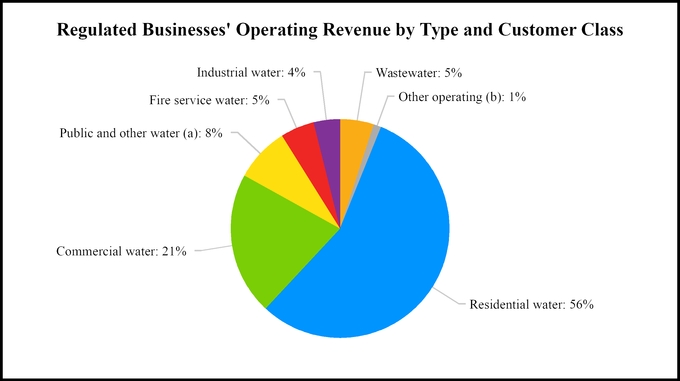
| (a) | Includes water revenues from public authorities and other utilities and community water systems under bulk contracts. |
| (b) | Includes other operating revenues consisting primarily of miscellaneous utility charges, fees and rents. |
Presented in the table below is the number of water and wastewater customers the Company served by class as of December 31:
| | | | | | | | | | | | | | | | | | | | --- | --- | --- | --- | --- | --- | --- | --- | --- |
Showing the first 8K of 83K characters. Open the full section
Item 1A. RISK FACTORS
We operate in a market and regulatory environment that involves significant risks, many of which are beyond our control. In addition to the other information included or incorporated by reference in this Form 10-K, the following factors should be considered in evaluating our business and future prospects. Any of the following risks, either alone or taken together, could materially and adversely affect our business, financial position, results of operations, cash flows and liquidity.
Risks Related to Our Industry and Business Operations
Our utility operations are subject to extensive regulation by state PUCs and other regulatory agencies, which significantly affects our business, financial condition, results of operations and cash flows. Our utility operations also may be subject to fines, penalties and other sanctions for the inability to meet these regulatory requirements.
Our Regulated Businesses provide water and wastewater services to our customers through subsidiaries that are subject to regulation by state PUCs. This regulation affects the rates we charge our customers and has a significant impact on our business and results of operations. Generally, the state PUCs authorize us to charge rates that they determine are sufficient to recover our prudently incurred operating expenses, including, but not limited to, operating and maintenance costs, depreciation, financing costs and taxes, and provide us the opportunity to earn an appropriate rate of return on invested capital.
Our ability to successfully implement our business plan and strategy depends on the rates authorized by the various state PUCs. We periodically file rate increase applications with state PUCs. The ensuing administrative process may be lengthy and costly. Our rate increase requests may or may not be approved, or may be partially approved, and any approval may not occur in a timely manner. Moreover, a PUC may not approve a rate request to an extent that is sufficient to:
| • | cover our expenses, including purchased water and costs of chemicals, fuel and other commodities used in our operations; |
| • | enable us to recover our investment; and |
| • | provide us with an opportunity to earn an appropriate rate of return on our investment. |
Approval of the PUCs is also required in connection with other aspects of our utilities’ operations. Some state PUCs are empowered to impose financial penalties, fines and other sanctions for non-compliance with applicable rules and regulations. Our utilities are also required to have numerous permits, approvals and certificates from the PUCs that regulate their businesses and authorize acquisitions, dispositions, and, in certain cases, affiliated transactions. Although we believe that each utility subsidiary has obtained or sought renewal of the material permits, approvals and certificates necessary for its existing operations, we are unable to predict the impact that future regulatory activities may have on our business.
In any of these cases, our business, financial condition, results of operations, cash flows and liquidity may be adversely affected. Even if rates are sufficient, we face the risk that we will not achieve the rates of return on our invested capital to the extent permitted by state PUCs. This could occur if certain conditions exist, including, but not limited to, if water usage is less than the level anticipated in establishing rates, or if our investments or expenses prove to be higher than the level estimated in establishing rates.
Our operations and the quality of water we supply are subject to extensive and increasingly stringent environmental, water quality and health and safety laws and regulations, including with respect to emerging contaminants, compliance with which could impact both our operating costs and capital expenditures, and violations of which could subject us to substantial liabilities and costs, as well as damage to our reputation.
Our regulated water and wastewater operations and the operations of our Market-Based Businesses are subject to extensive federal, state and local laws and regulations. These requirements include, among others, the Clean Water Act, the Safe Drinking Water Act, the LCR and CERCLA. EPA requirements and similar federal and state laws and regulations. For example, state PUCs and environmental regulators set conditions and standards for the water and wastewater services we deliver. If we deliver water or wastewater services to our customers that do not comply with regulatory standards, or otherwise violate environmental laws, regulations or permits, or other health and safety and water quality regulations, we could incur substantial fines, penalties or other sanctions or costs, as well as damage to our reputation. In the most serious cases, regulators could reduce requested rate increases or force us to discontinue operations and sell our operating assets to another utility or to a municipality. Given the nature of our business which, in part, involves supplying water for human consumption, any potential non-compliance with, or violation of, environmental, water quality and health and safety laws or regulations would likely pose a more significant risk to us than to a company not similarly involved in the water and wastewater industry.
In addition, CERCLA authorizes the EPA to issue orders and bring enforcement actions to compel responsible parties to investigate and take remedial actions with respect to actual or threatened releases of hazardous substances, and can impose joint and several liability, without regard to fault, on responsible parties for the costs thereof. We are also required to obtain various environmental permits from regulatory agencies for our operations.
We incur substantial operating and capital costs on an ongoing basis to comply with environmental, water quality and health and safety laws and regulations. These laws and regulations, and their enforcement, generally have become more stringent over time, and new or stricter requirements could increase our costs. Although we may seek to recover ongoing compliance costs in our Regulated Businesses through customer rates, there can be no guarantee that the various state PUCs or similar regulatory bodies that govern our Regulated Businesses would approve rate increases that would enable us to recover such costs or that such costs will not materially and adversely affect our financial condition, results of operations, cash flows and liquidity.
We may also incur liabilities if, under environmental laws and regulations, we are required to investigate and clean up environmental contamination, including potential releases of hazardous chemicals, such as chlorine, which we use to treat water, or at off-site locations where we have disposed of waste or caused an adverse environmental impact. The discovery of previously unknown conditions, or the imposition of cleanup obligations in the future, could result in significant costs and could adversely affect our financial condition, results of operations, cash flows and liquidity. Such remediation costs may not be covered by insurance and may make it difficult for us to secure insurance at acceptable rates in the future.
Attention is being given to emerging contaminants, including, without limitation, chemicals and other substances that currently do not have any regulatory standard in drinking water or have been recently created or discovered (including by means of scientific achievements in the analysis and detection of trace amounts of substances). Examples of sources of emerging contaminants include, but are not limited to, newly created chemical compounds (including, for example, manufactured nanomaterials); human and veterinary products; perfluorinated and polyfluorinated compounds; bacteria, microbes, viruses, amoebae and other pathogens; and residual by-products of disinfection.
Showing the first 8K of 90K characters. Open the full section
Item 1B. UNRESOLVED STAFF COMMENTS
None.
Item 2. PROPERTIES
The Company’s properties consist primarily of (i) water and wastewater treatment plants, (ii) mains and pipes used for transmission, distribution and collection of water and wastewater, (iii) wells and other sources of water supply, such as reservoirs, (iv) water and wastewater pumping stations, (v) meters and fire hydrants, (vi) general structures, including buildings, dams and treated water storage facilities, (vii) land and easements, (viii) vehicles, (ix) software rights, and (x) other equipment and facilities, the majority of which are used directly in the operation of its systems. Substantially all of the Company’s properties are owned by its subsidiaries, with a large percentage subject to liens of its mortgage bonds. A wholly owned subsidiary of parent company owns the Company’s corporate headquarters, located in Camden, New Jersey, and it leases office space, equipment and furniture from certain of its wholly owned subsidiaries. These properties are utilized by the Company’s directors, officers and staff in the conduct of the business.
The properties of the Company’s Regulated Businesses consist mainly of approximately:
| • | 80 surface water treatment plants; |
| • | 520 groundwater treatment plants; |
| • | 140 wastewater treatment plants; |
| • | 52,500 miles of transmission, distribution and collection mains and pipes; |
| • | 1,000 groundwater wells; |
| • | 1,500 water and wastewater pumping stations; |
| • | 1,300 treated water storage facilities; and |
| • | 76 dams. |
The Company has ongoing infrastructure renewal programs in all states in which its Regulated Businesses operate. These programs consist of both the rehabilitation of existing mains and equipment, and the replacement of mains and equipment that have been damaged or have reached, or are near, the end of their useful service lives. The properties of its Market-Based Businesses consist mainly of office furniture and IT equipment. Approximately 51% of all properties that the Company owns are located in New Jersey and Pennsylvania.
The Company maintains property insurance against loss or damage to its properties by fire or other perils, subject to certain exceptions. For insured losses, the Company is self-insured to the extent that any losses are within the policy deductible or exceed the amount of insurance maintained.
The Company believes that its properties are generally maintained in good operating condition and in accordance with current standards of good water and wastewater industry practice.
Item 3. LEGAL PROCEEDINGS
Alternative Water Supply in Lieu of Carmel River Diversions
Compliance with SWRCB Orders to Reduce Carmel River Diversions
Under the 2009 Order, Cal Am is required, among other things, to decrease significantly its yearly diversions of water from the Carmel River according to a set reduction schedule. The 2009 Order responded to claims that Cal Am had not sufficiently implemented actions to terminate its unpermitted diversions of water from the Carmel River as required by a 1995 order of the SWRCB. In July 2016, at the request of Cal Am and several Monterey County government agencies, the SWRCB issued the 2016 Order approving the 2021 Deadline.
The 2009 Order includes a condition prohibiting Cal Am from diverting water from the Carmel River for new service connections or for any increased use of water at existing service addresses resulting from a change in zoning or use. In 2011, the California Public Utilities Commission (the “CPUC”) issued a decision directing modifications in Cal Am’s tariffs to recognize the moratorium mandated by the 2009 Order, and directing Cal Am to seek written guidance from the SWRCB with respect to any unresolved issues of interpretation or implementation of this condition. In 2012, the Deputy Director of the SWRCB sent a letter to Cal Am providing an interpretation as to the calculation of a baseline to determine increases in use of water at existing service addresses. In March 2018, the MPWMD adopted a resolution directing Cal Am to interpret the baseline in a manner that conflicts with the SWRCB’s written interpretation. In May 2018, Cal Am notified the MPWMD and the SWRCB that it intends to seek declaratory relief concerning the conflicting regulatory interpretations under the 2009 Order. In an attempt to resolve these conflicting interpretations prior to seeking judicial intervention, Cal Am has met with the MPWMD and the SWRCB several times. The SWRCB agreed to circulate revisions to its 2012 interpretive letter, which would be subject to a public comment period. Any failure to follow the MPWMD’s resolution or the SWRCB’s written interpretation, despite these conflicting interpretations, could potentially result in fines, penalties and other actions against Cal Am.
The 2016 Order provides that if the CPUC authorizes Cal Am to acquire more than 1,000 acre-feet per year of water from a source other than the Water Supply Project, proponents of the alternative water source could submit revised milestones to the SWRCB for consideration. In May 2018, certain parties to the Water Supply Project proceeding submitted a petition to the SWRCB to add parallel milestones to the 2009 Order for 2019, 2020, and 2021, based on the proposed expansion of the Pure Water Monterey project, another groundwater replenishment project under construction on the Monterey peninsula. Petitioners claim that compliance with the alternate milestones would still provide for cessation of Cal Am’s unauthorized diversions from the Carmel River by 2021. A preliminary report on feasibility concluded that the expanded Pure Water Monterey project could provide an additional 2,250 acre-feet of water per year. Cal Am believes that (i) the petition is premature, (ii) the expanded Pure Water Monterey project is not yet a sufficiently certain or reliable water supply and, even if construction is successfully completed, would provide an insufficient quantity of water to allow full compliance with the 2009 Order, and (iii) the imposition of parallel milestones would distract from completion of the Water Supply Project. On December 13, 2019, the SWRCB dismissed the petition without prejudice.
Cal Am continues to work constructively with all appropriate agencies to provide necessary information in connection with obtaining required approvals for the Water Supply Project. However, based on the matters discussed below in “Monterey Peninsula Water Supply Project,” there can be no assurance that the Water Supply Project in its current configuration will be completed on a timely basis, if ever. Due to the delay in the approval schedule, Cal Am currently does not believe that it will be able to fully comply with the diversion reduction requirements and other remaining requirements under the 2009 Order and the 2016 Order, including the 2021 Deadline. The CPUC’s final decision approving the Water Supply Project permits recovery of all of Cal Am’s prudently incurred costs associated therewith, subject to the frameworks set forth in the final decision related to cost caps, O&M costs, financing, ratemaking and contingency matters. Cal Am currently believes that its expenditures to date have been prudent and necessary to comply with the 2009 Order and the 2016 Order. Further attempts to comply with the 2009 Order and the 2016 Order, or the 2021 Deadline, may result in material additional costs or obligations to Cal Am, and failure to comply could lead to fines and penalties against Cal Am.
Regional Desalination Project Litigation
Review of CPUC-Approved Settlement Agreement
The Regional Desalination Project (the “RDP”) involved the construction of a desalination facility in the City of Marina, north of Monterey. The RDP was intended to, among other things, eliminate unauthorized diversions from the Carmel River as required under the 2009 Order. In December 2010, the CPUC approved the RDP, which was to be implemented through a Water Purchase Agreement and ancillary agreements (collectively, the “Agreements”) among the Marina Coast Water District (“MCWD”), the Monterey County Water Resources Agency (“MCWRA”) and Cal Am. In 2011, due to a conflict of interest concerning a former member of MCWRA’s Board of Directors, MCWRA stated that the Agreements were void, and, as a result, Cal Am terminated the Agreements. In April 2015, the CPUC approved a settlement agreement among Cal Am, MCWRA and the County of Monterey to resolve these matters among the parties signing the agreement. In March 2016, the Supreme Court of California granted MCWD’s petition for review of the CPUC approval, and following the court’s disposition of a related issue in another case, MCWD’s petition for review of the CPUC-approved settlement agreement was remanded to the CPUC. On September 19, 2019, the CPUC issued a decision affirming its prior decisions with respect to the settlement agreement that resolved matters among the parties thereto associated with the termination of the RDP agreements, after considering the issue remanded by the California Supreme Court.
Cal Am’s Action for Damages Following RDP Termination
In October 2012, Cal Am filed a Complaint for Declaratory Relief against MCWRA and MCWD, which was ultimately transferred to the San Francisco County Superior Court, seeking a determination as to whether the Agreements are void as a result of the alleged conflict of interest. In June 2015, the court entered a final judgment agreeing with Cal Am’s position that four of the five Agreements are void, and one, the credit line agreement, is not void. In November 2016, the Supreme Court of California denied MCWD’s final appeal of this judgment, which allows further proceedings, discussed below, to determine the amount of damages that may be awarded in the proceeding.
In July 2015, Cal Am and MCWRA filed a Complaint in San Francisco County Superior Court against MCWD and RMC Water and Environment (“RMC”), a private engineering consulting firm which has since been acquired by a national engineering, science and operations company, seeking to recover compensatory damages in excess of $10 million associated with the failure of the RDP, as well as punitive and treble damages, statutory penalties and attorneys’ fees. Shortly thereafter, complaints seeking similar damages were filed in the same court by MCWD and RMC against Cal Am and MCWRA in excess of $19 million in the aggregate. In December 2015, the court consolidated all of these complaints into a single action. On February 15, 2019, the court granted Cal Am’s motion for summary judgment, and as a result, no claims remain pending against Cal Am in this action. On February 25, 2019, the court granted RMC’s motion for judgment on the pleadings as to certain of Cal Am’s tort claims against it. On June 20, 2019, the court granted MCWD’s motion for summary judgment related to Cal Am’s tort claims against MCWD, which Cal Am appealed to the California Court of Appeal, and on January 14, 2020, this appeal was denied. On January 17, 2019, a motion filed by MCWD for summary judgment against Cal Am relating to the contract claims in Cal Am’s complaint was denied.
Trial in this lawsuit had been scheduled to take place in January 2020. On January 27, 2020, the parties to this lawsuit reached a tentative agreement, which was entered into the court record and would resolve the litigation in part without trial. Under the terms of this tentative agreement, MCWD and RMC would pay Cal Am an aggregate of $5.2 million in settlement of Cal Am’s contract claims against MCWD and all claims against RMC relating to the RDP. Under this agreement, Cal Am’s and MCWRA’s right to appeal the dismissal of their tort claims against MCWD would be expressly reserved. A draft settlement agreement is being reviewed and negotiated by the parties. Once executed, the settlement agreement would be subject to approval of the San Francisco County Superior Court.
Monterey Peninsula Water Supply Project
CPUC Final Approval of Water Supply Project
Cal Am’s ability to move forward on the Water Supply Project is and has been subject to extensive administrative review by the CPUC and other government agencies, obtaining necessary permits, and intervention from other parties. In September 2016, the CPUC unanimously approved a decision to authorize Cal Am to enter into a water purchase agreement for the GWR Project and to construct a pipeline and pump station facilities and recover up to $50 million in associated costs, subject to meeting certain criteria. If construction costs exceed $50 million, Cal Am would be allowed to seek additional cost recovery.
In September 2018, the CPUC unanimously adopted a final decision finding that (i) the Water Supply Project, based on Cal Am’s request for a 6.4 million gallons per day desalination plant, meets the CPUC’s requirements for a CPCN, (ii) the issuance of the final decision should not be delayed, and (iii) an additional procedural phase was not necessary to consider alternative projects. The CPUC’s decision directs Cal Am to enter into negotiations regarding expansion of the GWR Project between Monterey One Water and the MPWMD and to indicate whether Cal Am plans to file an application for approval of an agreement to purchase additional water from the GWR Project. The decision notes, however, that the CPUC will only consider such an application if the Water Supply Project is delayed such that Cal Am would not be able to meet the 2021 Deadline. The decision accepts Cal Am’s estimates of future water demand in Monterey and concludes that the Water Supply Project is the best project to address those needs, and adopts Cal Am’s most recent cost estimates. The decision also allows Cal Am to earn an allowance for funds used during construction, or AFUDC, at a rate representative of its actual financing costs. The final decision adopted frameworks as to cost caps, O&M costs, financing, ratemaking and contingency matters.
In addition, the CPUC final decision imposes numerous reporting and filing requirements to ensure the expenditures for the Water Supply Project are reasonable, including that the financing is the lowest cost and most beneficial for ratepayers, and that construction is progressing in a timely manner and within the authorized cost caps. The reasonableness of Water Supply Project costs will be reviewed in the first general rate case filed by Cal Am after the Water Supply Project becomes operational. Cal Am is also required to implement mitigation measures to avoid, minimize or offset significant environmental impacts from the construction and operation of the Water Supply Project and comply with a mitigation monitoring and reporting program, a reimbursement agreement for CPUC costs associated with that program, and reporting requirements on plant operations following placement of the Water Supply Project in service.
In February 2019, the City of Marina and MCWD filed petitions for writ of review before the Supreme Court of California challenging the sufficiency of the final Environmental Impact Report/Environmental Impact Statement adopted by the CPUC in September 2018, which the court declined to consider on August 28, 2019.
On July 2, 2019, Cal Am notified MPWMD and Monterey One Water (collectively, the “Agencies”) that an event of default occurred under the water purchase agreement for the GWR Project because the Agencies failed to deliver to Cal Am by July 1, 2019 advanced treated recycled water produced by the GWR Project. Under the water purchase agreement, upon the occurrence of this event of default, Cal Am had the right to terminate the water purchase agreement immediately. Cal Am has elected not to exercise its right to terminate the water purchase agreement at this time, but in its notification to the Agencies, Cal Am expressly reserved its right to terminate the water purchase agreement until such time as the Agencies commence their required delivery of water from the GWR Project. On July 16, 2019, MPWMD and Monterey One Water responded to Cal Am’s event of default notice and estimated that water delivery would begin by mid-October 2019. On December 12, 2019, Cal Am sent a letter to the Agencies requesting a status update with respect to the event of default. On January 2, 2020, Cal Am notified the Agencies that a second event of default occurred under the water purchase agreement because the Agencies failed to achieve the Performance Start Date (the date upon which MPWMD’s performance obligations under the water purchase agreement were to commence) by January 1, 2020. Under the water purchase agreement, upon the occurrence of this event of default, Cal Am had the right to terminate the water purchase agreement immediately. Cal Am has elected not to exercise its right to terminate the water purchase agreement at this time, but in its notification to the Agencies, Cal Am expressly reserved its right to terminate the water purchase agreement until such time as the Performance Start Date has occurred. On January 9, 2020, the Agencies responded to Cal Am’s December 12, 2019 and January 2, 2020 letters. In the response, the Agencies acknowledged they remain in default under the water purchase agreement but indicated that corrective action is being taken to attain the Performance Start Date in the near future.
On April 17, 2019, Water Ratepayers Association of the Monterey Peninsula (“WRAMP”), a citizens’ advocacy group, filed an amended complaint in Monterey County Superior Court asserting a “qui tam” claim under the California False Claims Act on behalf of itself and the State of California against Cal Am and certain environmental consultants who worked on the CPUC’s environmental analysis of the MPWSP. The State Attorney General declined to proceed with this action after it was originally filed in 2016. On July 10, 2019, defendants filed a joint demurrer challenging the legal sufficiency of the allegations of the amended complaint. At an August 27, 2019 hearing on the demurrer, the court dismissed the petition without leave to amend. On October 17, 2019, WRAMP filed motions seeking clarification and a reconsideration of the court’s ruling. A hearing on these motions was set for December 3, 2019, but on November 26, 2019, WRAMP abandoned its motions and instead filed an appeal of the court’s dismissal. This appeal remains pending.
Coastal Development Permit Application
In June 2018, Cal Am submitted a coastal development permit application to the City of Marina for those project components of the Water Supply Project located within the City of Marina’s coastal zone. Members of the City’s Planning Commission, as well as City councilpersons, have publicly expressed opposition to the Water Supply Project. On March 7, 2019, the City of Marina Planning Commission adopted a resolution denying Cal Am’s coastal development permit application. Cal Am appealed the Marina Planning Commission's decision to the City Council, which set a public hearing on the appeal for April 30, 2019. On April 25, 2019, Cal Am submitted a letter to the City challenging the impartiality of the City and three of its council members with respect to the Water Supply Project. On April 29, 2019, the City informed Cal Am that it intended to proceed with the hearing with the participation of the challenged City Council members. As a result, on April 29, 2019, Cal Am notified the City that it was withdrawing its appeal, as Cal Am believes it could not receive a fair and impartial hearing before the City Council.
On May 10, 2019, the City issued a notice of final local action based upon the Marina Planning Commission’s decision. On May 22, 2019, Cal Am appealed this decision to the California Coastal Commission (the “Coastal Commission”), as permitted under the City’s code and the California Coastal Act. On October 28, 2019, staff of the Coastal Commission issued a report recommending a denial of Cal Am’s application for a coastal development permit with respect to the Water Supply Project, largely based on a memorandum prepared by the general manager of the MPWMD that contradicted findings made by the CPUC in its final decision approving the Water Supply Project. Staffs of the CPUC and the Coastal Commission met to discuss the Coastal Commission’s staff recommendation, at which time the CPUC raised questions about the Coastal Commission staff’s findings on water supply and demand, groundwater impacts and other matters. On November 4, 2019, Coastal Commission staff released an addendum to the staff report, concluding that additional groundwater modeling was needed before staff could find that the Water Supply Project would not prevent depletion of groundwater supplies. At its November 14, 2019 hearing on both the appeal from the City of Marina’s denial and Cal Am’s application for a coastal development permit within the Coastal Commission’s original jurisdiction, Coastal Commission staff advised that no vote would be taken at the meeting and that further investigation was required in light of the CPUC staff’s questions. The hearing was continued to a later date. On January 28, 2020, Coastal Commission staff recommended to Cal Am that it withdraw its application for a coastal development permit within the Coastal Commission’s original jurisdiction and resubmit such application at a later date, as the staff believes that its additional investigation could not be completed in time for a vote on Cal Am’s existing application. The staff indicated that such a withdrawal would not affect Cal Am’s appeal of the City of Marin’s denial, which would remain pending. Cal Am has declined to withdraw its application, and instead, on February 12, 2020, Cal Am and the Coastal Commission entered into a stipulation extending by 90 days, to July 24, 2020, the deadline for the Coastal Commission to vote on Cal Am’s original jurisdiction application.
Desalination Plant Development Permit
The proposed desalination plant for the Water Supply Project is to be located in an unincorporated portion of Monterey County, California on a site owned by CEMEX, Inc. (“CEMEX”), and requires a combined development permit from the County of Monterey prior to commencement of construction. On April 24, 2019, the County’s Planning Commission voted to approve the permit. On July 15, 2019, the Board of Supervisors heard appeals filed by MCWD and a public advocacy group, at which time it denied the appeals and approved the permit. On August 21, 2019, MCWD filed a petition in Monterey County Superior Court challenging Monterey County’s approval of Cal Am’s combined development permit application and seeking injunctive relief to enjoin Monterey County and Cal Am from commencing construction of the desalination plant. On October 9, 2019, after a hearing, the court denied, without prejudice, MCWD’s motion for a preliminary injunction, but issued a stay of the County’s approval of the combined development permit, precluding commencement of physical construction of the desalination plant until November 19, 2019, at which time the parties were to advise the court of the Coastal Commission’s decision on Cal Am’s application for a coastal development permit for the slant wells needed to source water for the desalination plant. In the interim, Cal Am is allowed to continue to obtain permits needed for the desalination plant’s construction. On November 19, 2019, the parties informed the court that the Coastal Commission had continued its public hearing on the slant wells and had not yet made a determination about permitting the slant wells. In response, the court continued its stay until March 24, 2020.
Proposed Zoning Changes at CEMEX Site for Slant Wells
In August 2018, the City circulated a public review draft of proposed amendments to its local coastal program and zoning ordinance, and placed the matter for consideration on the Planning Commission’s agenda for its September 2018 meeting. The proposed amendments would change zoning at the CEMEX site to open space and restrict future uses, including with respect to Cal Am’s planned use of the site for the slant wells for the Water Supply Project. Any change to the City's local coastal program must ultimately be approved by the Coastal Commission. Cal Am, CEMEX and the Coastal Commission each submitted letters opposing the proposed amendments. At its November 2018 meeting, the Planning Commission adopted a resolution recommending that the Marina City Council consider approving the amendments.
In December 2018, the Marina City Council considered the proposed amendments. Cal Am, CEMEX and the Coastal Commission again submitted letters opposing the proposed changes, but the City Council unanimously adopted a resolution amending its local coastal plan and a draft amendment to its zoning ordinance. Changes to the ordinance require a second reading before becoming final, which occurred at the City’s December 2018 meeting. The changes to the local coastal plan must be submitted to the Coastal Commission for approval and are not effective until such approval is obtained.
Test Slant Well Permitting
A preliminary step to building the Water Supply Project desalination plant is the construction and operation of a test slant well to confirm the suitability of the property on which intake wells will be located to draw water from under Monterey Bay. In November 2014, the Coastal Commission approved coastal development permits for the test slant well, enabling Cal Am to construct and operate the test slant well. Because Cal Am may use the test slant well as one of the slant wells for the Water Supply Project, Cal Am sought and obtained from the Coastal Commission permit amendments to allow the test slant well to remain in place and be maintained until February 28, 2020. On November 27, 2019, Cal Am filed an application with the Coastal Commission for a permit amendment to allow the test slant well to remain in place and be maintained until February 28, 2021. A required lease obtained from the California State Lands Commission, as amended, will expire on December 16, 2022. Effective February 28, 2018, test slant well pumping ceased, except for minimal maintenance pumping activities, in accordance with Cal Am’s coastal development permits.
In November 2015, MCWD filed a Petition for Writ of Mandate and Complaint for Declaratory and Injunctive Relief in Santa Cruz County Superior Court against the Coastal Commission and Cal Am challenging the amendment of the coastal development permits and seeking an injunction against further test well pumping. In orders issued in September 2016 and October 2017, the court denied MCWD’s challenges. In January 2018, MCWD filed a notice of appeal of the court’s judgment. On June 28, 2019, the California Court of Appeal dismissed MCWD’s appeal. On July 15, 2019, MCWD filed a petition for rehearing with the Court of Appeal, which was denied on July 19, 2019. This decision is now final.
Water Supply Project Land Acquisition and Slant Well Site Use
In July 2017, the Coastal Commission adopted a consent agreement and cease and desist order requiring sand mining operations on the property owned by CEMEX on which intake wells for the Water Supply Project will be located, to cease by the end of 2020 and the property to be sold to either a non-profit or governmental entity. The consent agreement strictly limits future use of the property but preserves Cal Am’s existing property rights and allows uses consistent with existing easements and other rights of record. A permanent easement granted by CEMEX to Cal Am was recorded in June 2018 to allow Cal Am access to the property and to construct, operate and maintain the Water Supply Project intake wells. On November 26, 2019, the City of Marina notified CEMEX that, based on this easement and Cal Am’s proposed use of the site for the intake wells, CEMEX has breached or will soon breach a prior 1996 annexation agreement (to which Cal Am was not a party). The City states that it intends to seek declaratory relief from CEMEX and Cal Am ordering that Cal Am’s extraction is limited to 500 acre-feet per year of groundwater, that Cal Am cannot export extracted water out of the basin, and that the permanent easement granted by CEMEX to Cal Am is void. The City has requested a meeting with CEMEX as part of a mandatory dispute resolution process under the annexation agreement prior to filing a lawsuit. CEMEX has denied the City’s claims and requested indemnification from Cal Am under the terms of the permanent easement. Cal Am and CEMEX believe that there is no valid limitation under the annexation agreement on Cal Am’s right to pump brackish groundwater and seawater at the site for desalination and use by Cal Am’s customers.
Under California’s Sustainable Groundwater Management Act (“SGMA”) enacted in 2015, groundwater basins designated by the state as critically overdrafted must be managed by a groundwater sustainability agency (“GSA”) by 2020 in accordance with an approved groundwater sustainability plan (“GSP”) designed to achieve sustainability by 2040. Under the SGMA, GSAs have broad powers to achieve sustainability including, but not limited to, regulating groundwater extraction by imposing fees on groundwater extractions and controlling groundwater extractions by regulating, limiting or suspending extractions from wells. The 400-acre CEMEX site overlies a small portion of the 180/400 Subbasin of the Salinas Valley Groundwater Basin; the 84,000-acre 180/400 Subbasin has been designated by the state as critically overdrafted, mainly due to seawater intrusion into the subbasin.
In late 2016, the Salinas Valley Basin Groundwater Sustainability Agency (“SVBGSA”) was formed as a joint powers authority to become the GSA for the Salinas Valley Groundwater Basin and prepare a GSP. In April 2018, the City of Marina filed a notice to become the GSA for the CEMEX site, creating an overlap with the SVBGSA’s filing for the 180/400 Subbasin. In 2016, the SVBGSA commenced preparation of a GSP covering the entire 180/400 subbasin, including the CEMEX site, but in August 2019 the City filed a notice that it intends to prepare its own GSP for the CEMEX site with the intent to severely limit or prohibit groundwater pumping at that site. The State Department of Water Resources (“SDWR”) has taken the position that until the overlap is resolved, it will not accept the GSP from either agency, placing the subbasin at risk of being placed in a probationary status and subject to state management. In December 2019, the County of Monterey filed its own notice to become the exclusive GSA at the CEMEX site in order to resolve the overlap, which is permitted under SGMA. SDWR accepted the County’s filing on December 18, 2019, and now lists the County as the exclusive GSA for the site.
On December 30, 2019, the City of Marina filed a lawsuit in the Supreme Court of California challenging the County’s filing, and SDWR’s acceptance of the filing, as the exclusive GSA for the CEMEX site. The City has named the County and its Board of Supervisors, the County GSA, and SDWR and its director as defendants, and the SVBGSA and its Board of Directors as real parties. The City seeks to invalidate the County’s filing, as well as injunctive relief to preserve the City’s status as a GSA for the site. To protect its interest in the matter, Cal Am filed an application to intervene in this lawsuit, which is scheduled to be heard on February 18, 2020.
West Virginia Elk River Freedom Industries Chemical Spill
See Note 16—Commitments and Contingencies—Contingencies—West Virginia Elk River Freedom Industries Chemical Spill in the Notes to Consolidated Financial Statements for information regarding the final court approval of the global settlement with respect to the January 2014 Freedom Industries, Inc. chemical spill.
Dunbar, West Virginia Water Main Break Class Action Litigation
On the evening of June 23, 2015, a 36-inch pre-stressed concrete transmission water main, installed in the early 1970s, failed. The water main is part of WVAWC’s West Relay pumping station located in the City of Dunbar. The failure of the main caused water outages and low pressure to up to approximately 25,000 WVAWC customers. In the early morning hours of June 25, 2015, crews completed a repair, but that same day, the repair developed a leak. On June 26, 2015, a second repair was completed and service was restored that day to approximately 80% of the impacted customers, and to the remaining approximately 20% by the next morning. The second repair showed signs of leaking but the water main was usable until June 29, 2015 to allow tanks to refill. The system was reconfigured to maintain service to all but approximately 3,000 customers while a final repair was completed safely on June 30, 2015. Water service was fully restored on July 1, 2015 to all customers affected by this event.
On June 2, 2017, a complaint captioned Jeffries, et al. v. West Virginia-American Water Company was filed in West Virginia Circuit Court in Kanawha County on behalf of an alleged class of residents and business owners who lost water service or pressure as a result of the Dunbar main break. The complaint alleges breach of contract by WVAWC for failure to supply water, violation of West Virginia law regarding the sufficiency of WVAWC’s facilities and negligence by WVAWC in the design, maintenance and operation of the water system. The Jeffries plaintiffs seek unspecified alleged damages on behalf of the class for lost profits, annoyance and inconvenience, and loss of use, as well as punitive damages for willful, reckless and wanton behavior in not addressing the risk of pipe failure and a large outage.
In October 2017, WVAWC filed with the court a motion seeking to dismiss all of the Jeffries plaintiffs’ counts alleging statutory and common law tort claims. Furthermore, WVAWC asserted that the Public Service Commission of West Virginia, and not the court, has primary jurisdiction over allegations involving violations of the applicable tariff, the public utility code and related rules. In May 2018, the court, at a hearing, denied WVAWC’s motion to apply the primary jurisdiction doctrine, and in October 2018, the court issued a written order to that effect. On February 21, 2019, the court issued an order denying WVAWC’s motion to dismiss the Jeffries plaintiffs’ tort claims. On August 21, 2019, the court set a procedural schedule in this case, including a trial date of September 21, 2020. Discovery in this case is ongoing. On February 4, 2020, the Jeffries plaintiffs filed a motion seeking class certification on the issues of breach of contract and negligence, and to determine the applicability of punitive damages and a multiplier for those damages if imposed. A hearing on class certification is currently scheduled for March 11, 2020.
The Company and WVAWC believe that WVAWC has meritorious defenses to the claims raised in this class action complaint and WVAWC will continue to vigorously defend itself against these allegations.
Chattanooga, Tennessee Water Main Break Class Action Litigation
On September 12, 2019, Tennessee-American Water Company, a wholly owned subsidiary of the Company (“TAWC”), experienced a break of a 36-inch water transmission main, which caused service fluctuations or interruptions to TAWC customers and the issuance of a boil water notice. TAWC repaired the main break by early morning on September 14, 2019, and restored full water service by the afternoon on September 15, 2019, with the boil water notice lifted for all customers on September 16, 2019.
On September 17, 2019, a complaint captioned Bruce, et al. v. American Water Works Company, Inc., et al. was filed in the Circuit Court of Hamilton County, Tennessee against TAWC, the Company and the Service Company (collectively, the “Tennessee-American Water Defendants”), on behalf of an alleged class of individuals or entities who lost water service or suffered monetary losses as a result of the Chattanooga main break (the “Tennessee Plaintiffs”). The complaint alleges breach of contract and negligence against the Tennessee-American Water Defendants, as well as an equitable remedy of piercing the corporate veil. The Tennessee Plaintiffs seek an award of unspecified alleged damages for wage losses, business and economic losses, out-of-pocket expenses, loss of use and enjoyment of property and annoyance and inconvenience, as well as punitive damages, attorneys’ fees and pre- and post-judgment interest.
On November 22, 2019, the Tennessee-American Water Defendants filed a motion to dismiss the complaint for failure to state a claim upon which relief may be granted, and, with respect to the Company, for lack of personal jurisdiction. A hearing on this motion is scheduled for February 18, 2020.
The Tennessee-American Water Defendants believe that they have meritorious defenses to the claims raised in this class action complaint, and they are vigorously defending themselves against these allegations.
CSG — East Palo Alto Water System Voluntary Report
In April 2017, AWE, the parent entity of CSG, voluntarily reported to the Division of Drinking Water of the SWRCB potential violations of the California Safe Drinking Water Act (the “CSDWA”) in connection with AWE’s operation of the City of East Palo Alto’s water distribution system. Upon the resignation of the system’s general manager in March 2017, AWE discovered that it may have operated the system without a properly certified operator for two years, the triennial LCR sampling was not completed, and the 2015 Consumer Confidence Report improperly reported data for lead and copper samples from the system’s upstream water provider. Promptly after discovering these issues, AWE engaged an outside law firm to conduct an internal investigation and reported the results of that investigation to the SWRCB.
On June 15, 2017, the SWRCB issued to AWE a citation that required AWE to, among other things: comply with regulations related to water operator certifications, lead and copper tap sampling requirements and the publishing of a Consumer Confidence Report; provide public notification of the LCR violation; and prepare a corrective action plan to evaluate the causes leading to these incidents and measures to be taken to prevent recurrence of future incidents. The citation did not impose on AWE any monetary penalties, but the SWRCB reserved the right to take additional enforcement action.
In October 2017, the SWRCB advised AWE that it is in compliance with all of the directives and relevant statutory and administrative provisions specified in the SWRCB’s June 2017 citation. In February 2018, the SWRCB referred this matter to the San Mateo County, California District Attorney’s office for further investigation. AWE continues to cooperate with the SWRCB, the City of East Palo Alto and the San Mateo County District Attorney regarding this matter. Proven violations of the CSDWA may result in civil and criminal penalties.
General
Periodically, the Company is involved in other proceedings or litigation arising in the ordinary course of business. Other than those proceedings described in this Item 3—Legal Proceedings, the Company does not believe that the ultimate resolution of these matters will materially affect its financial position or results of operations. However, litigation and other proceedings are subject to many uncertainties, and the outcome of individual matters is not predictable with assurance. It is possible that some litigation and other proceedings could be decided unfavorably to the Company, and that any such unfavorable decisions could have a material adverse effect on its business, financial condition, results of operations and cash flows.
Item 4. MINE SAFETY DISCLOSURES
Not applicable.
PART II
Item 5. MARKET FOR REGISTRANT’S COMMON EQUITY, RELATED STOCKHOLDER MATTERS AND ISSUER PURCHASES OF EQUITY SECURITIES
Since April 23, 2008, the Company’s common stock has traded on the New York Stock Exchange (“NYSE”) under the symbol “AWK.” As of February 13, 2020, there were 180,974,719 shares of common stock outstanding held by approximately 2,546 record holders. Holders of the Company’s common stock are entitled to receive dividends when they are declared by its Board of Directors. See Note 9—Shareholders’ Equity in the Notes to Consolidated Financial Statements for additional information regarding the Company’s dividends.
In February 2015, the Board of Directors authorized an anti-dilutive stock repurchase program to mitigate the dilutive effect of shares issued through the Company’s dividend reinvestment, employee stock purchase and executive compensation activities. The program allows the Company to purchase up to 10 million shares of its outstanding common stock from time to time over an unrestricted period of time in the open market or through privately negotiated transactions. The program is conducted in accordance with Rule 10b-18 of the Exchange Act, and, to facilitate these repurchases, the Company enters into Rule 10b5-1 stock repurchase plans with a third-party broker, which allow the Company to repurchase shares of its common stock at times when it otherwise might be prevented from doing so under insider trading laws or because of self-imposed trading blackout periods. Subject to applicable regulations, the Company may elect to amend or cancel the program or the stock repurchase parameters at its discretion to manage dilution.
From April 1, 2015, the date repurchases under the anti-dilutive stock repurchase program commenced, through December 31, 2019, the Company repurchased an aggregate of 4,860,000 shares of its common stock under the program, including 350,000 shares repurchased during the first quarter of 2019. There were no repurchases of common stock in the last three quarters of 2019.
Item 6. SELECTED FINANCIAL DATA
| For the Years Ended December 31, | |||||||||||||||||||
| (In millions, except per share data) | 2019 | 2018 | 2017 | 2016 | 2015 | ||||||||||||||
| Statement of Operations data: | |||||||||||||||||||
| Operating revenues | $ | 3,610 | $ | 3,440 | $ | 3,357 | $ | 3,302 | $ | 3,159 | |||||||||
| Net income attributable to common shareholders | 621 | 567 | 426 | 468 | 476 | ||||||||||||||
| Net income attributable to common shareholders per basic common share | $ | 3.44 | $ | 3.16 | $ | 2.39 | $ | 2.63 | $ | 2.66 | |||||||||
| Net income attributable to common shareholders per diluted common share | 3.43 | 3.15 | 2.38 | 2.62 | 2.64 | ||||||||||||||
| Balance Sheet data: | |||||||||||||||||||
| Total assets | $ | 22,682 | $ | 21,223 | $ | 19,482 | $ | 18,482 | $ | 17,241 | |||||||||
| Long-term debt and redeemable preferred stock at redemption value | 8,644 | 7,576 | 6,498 | 5,759 | 5,874 | ||||||||||||||
| Other data: | |||||||||||||||||||
| Cash dividends declared per common share | $ | 2.00 | $ | 1.82 | $ | 1.66 | $ | 1.50 | $ | 1.36 | |||||||||
| Net cash provided by operating activities (a) (b) | 1,383 | 1,386 | 1,449 | 1,289 | 1,195 | ||||||||||||||
| Net cash used in investing activities (b) | (1,945 | ) | (2,036 | ) | (1,672 | ) | (1,590 | ) | (1,459 | ) | |||||||||
| Net cash provided by financing activities (a) (b) | 494 | 726 | 207 | 328 | 290 | ||||||||||||||
| Capital expenditures included in net cash used in investing activities | (1,654 | ) | (1,586 | ) | (1,434 | ) | (1,311 | ) | (1,160 | ) |
| (a) | The information for the years ended December 31, 2016 and 2015, has been revised to reflect the retrospective application of Accounting Standards Update 2016-09, Improvements to Employee Share-Based Payment Accounting, which was adopted by the Company as of January 1, 2017. |
| (b) | The information for the years ended December 31, 2016 and 2015, has been revised to reflect the retrospective application of Accounting Standards Update 2016-18, Restricted Cash, which was adopted by the Company as of December 31, 2017. |
Item 7. MANAGEMENT’S DISCUSSION AND ANALYSIS OF FINANCIAL CONDITION AND RESULTS OF OPERATIONS
The following discussion should be read together with the Consolidated Financial Statements and the Notes thereto included elsewhere in this Form 10-K. This discussion contains forward-looking statements that are based on management’s current expectations, estimates and projections about the Company’s business, operations and financial performance. The cautionary statements made in this Form 10-K should be read as applying to all related forward-looking statements whenever they appear in this Form 10-K. The Company’s actual results may differ materially from those currently anticipated and expressed in such forward-looking statements as a result of a number of factors, including those that are discussed under “Forward-Looking Statements,” Item 1A—Risk Factors and elsewhere in this Form 10-K. The Company has a disclosure committee consisting of members of senior management and other key employees involved in the preparation of the Company’s SEC reports. The committee is actively involved in the review and discussion of the Company’s SEC filings. For a discussion and analysis of the Company’s financial statements for fiscal 2018 compared to fiscal 2017, please refer to Item 7—Management’s Discussion and Analysis of Financial Condition and Results of Operations in the Company’s Annual Report on Form 10-K for the year ended December 31, 2018, filed with the SEC on February 19, 2019.
Overview
American Water is the largest and most geographically diverse, publicly-traded water and wastewater utility company in the United States, as measured by both operating revenues and population served. The Company employs approximately 6,800 professionals who provide drinking water, wastewater and other related services to approximately 15 million people in 46 states. The Company’s primary business involves the ownership of utilities that provide water and wastewater services to residential, commercial, industrial, public authority, fire service and sale for resale customers, collectively presented as the “Regulated Businesses.” The Company’s utilities operate in approximately 1,700 communities in 16 states in the United States, with over 3.4 million active customers with services provided by its water and wastewater networks. Services provided by the Company’s utilities are generally subject to regulation by PUCs. The Company also operates market-based businesses that provide complementary services to residential and smaller commercial customers, the U.S. government on military installations, as well as municipalities, utilities and industrial customers, collectively presented as the “Market-Based Businesses.” These Market-Based Businesses are not subject to regulation by state PUCs. See Item 1—Business for additional information.
Financial Results
Presented in the table below are the Company’s diluted earnings per share, as determined in accordance with GAAP, and the Company’s adjusted diluted earnings per share (a non-GAAP measure):
| For the Years Ended December 31, | |||||||||||
| 2019 | 2018 | 2017 | |||||||||
| Diluted earnings per share (GAAP): | |||||||||||
| Net income attributable to common shareholders | $ | 3.43 | $ | 3.15 | $ | 2.38 | |||||
| Adjustments: | |||||||||||
| Loss on sale of Keystone operations | 0.24 | — | — | ||||||||
| Income tax impact | (0.05 | ) | — | — | |||||||
| Net adjustment | 0.19 | — | — | ||||||||
| Freedom Industries settlement activities | (0.02 | ) | (0.11 | ) | (0.12 | ) | |||||
| Income tax impact | 0.01 | 0.03 | 0.05 | ||||||||
| Net adjustment | (0.01 | ) | (0.08 | ) | (0.07 | ) | |||||
| Gain on sale of Contract Services Group contracts | — | (0.08 | ) | — | |||||||
| Income tax impact | — | 0.02 | — | ||||||||
| Net adjustment | — | (0.06 | ) | — | |||||||
| Keystone impairment charge | — | 0.31 | — | ||||||||
| Income tax impact | — | (0.08 | ) | — | |||||||
| Net loss attributable to noncontrolling interest | — | (0.01 | ) | — | |||||||
| Net adjustment | — | 0.22 | — | ||||||||
| Early extinguishment of debt at parent company | — | — | 0.03 | ||||||||
| Income tax impact | — | — | (0.01 | ) | |||||||
| Net adjustment | — | — | 0.02 | ||||||||
| Impact of re-measurement from the TCJA | — | 0.07 | 0.70 | ||||||||
| Total net adjustments | 0.18 | 0.15 | 0.65 | ||||||||
| Adjusted diluted earnings per share (non-GAAP) | $ | 3.61 | $ | 3.30 | $ | 3.03 |
For the year ended December 31, 2019, diluted earnings per share (GAAP) were $3.43, an increase of $0.28 per diluted share compared to the prior year, which includes the net adjustments presented in the table above and discussed in greater detail in the “Adjustments to GAAP” section below.
Excluding the net adjustments presented in the table above, adjusted diluted earnings per share (non-GAAP) were $3.61 for the year ended December 31, 2019, an increase of $0.31 per diluted share compared to the prior year.
These results were driven by continued growth in the Regulated Businesses from infrastructure investment, acquisitions and organic growth, and growth in the Market-Based Businesses, primarily from HOS’s 2018 acquisition of Pivotal and from MSG’s addition of two new military contracts in 2018 (Wright-Patterson Air Force Base and Fort Leonard Wood).
Adjustments to GAAP
Adjusted diluted earnings per share represents a non-GAAP financial measure and, as shown in the table above, is calculated as GAAP diluted earnings per share, excluding the impact of one or more of the following events: (i) a loss on the sale in the fourth quarter of 2019 of the Keystone operations; (ii) previously reported settlement activities related to the Freedom Industries chemical spill in West Virginia; (iii) a gain recognized in the third quarter of 2018 on the sale of the majority of CSG’s O&M contracts; (iv) a goodwill and intangible impairment charge in the third quarter of 2018 related to the Keystone operations; (v) an early extinguishment of debt charge at parent company in the third quarter of 2017; and (vi) non-cash re-measurement charges recorded in the fourth quarters of 2017 and 2018 resulting from the impact of the change in the federal corporate income tax rate on the Company’s deferred income taxes from the enactment of the TCJA.
The Company believes that this non-GAAP measure provides investors with useful information by excluding certain matters that may not be indicative of its ongoing operating results, and that providing this non-GAAP measure will allow investors to better understand the businesses’ operating performance and facilitate a meaningful year-to-year comparison of the Company’s results of operations. Although management uses this non-GAAP financial measure internally to evaluate its results of operations, the Company does not intend results reflected by this non-GAAP measure to represent results as defined by GAAP, and the reader should not consider them as indicators of performance. This non-GAAP financial measure is derived from the Company’s consolidated financial information but is not presented in the financial statements prepared in accordance with GAAP. This measure should be considered in addition to, and not as a substitute for, measures of financial performance prepared in accordance with GAAP. In addition, this non-GAAP financial
Showing the first 8K of 119K characters. Open the full section
Item 7A. QUANTITATIVE AND QUALITATIVE DISCLOSURES ABOUT MARKET RISK
The Company is exposed to market risk associated with changes in commodity prices, equity prices and interest rates. The Company is exposed to risks from changes in interest rates as a result of its issuance of variable and fixed rate debt and commercial paper. The Company manages its interest rate exposure by limiting its variable rate exposure and by monitoring the effects of market changes in interest rates. The Company also has the ability to enter into financial derivative instruments, which could include instruments such as, but not limited to, interest rate swaps, forward starting swaps, swaptions and U.S. Treasury lock agreements to manage and mitigate interest rate risk exposure. As of December 31, 2019, a hypothetical increase of interest rates by 1% associated with the Company’s short-term borrowings would result in a $7 million increase in short-term interest expense.
The Company’s risks associated with price increases for chemicals, electricity and other commodities are reduced through contractual arrangements and the expected ability to recover price increases through rates, in the next general rate case proceeding or other regulatory mechanism, as authorized by each regulatory jurisdiction. Non-performance by these commodity suppliers could have a material adverse impact on the Company’s results of operations, financial position and cash flows.
The market price of the Company’s common stock may experience fluctuations, which may be unrelated to its operating performance. In particular, the Company’s stock price may be affected by general market movements as well as developments specifically related to the water and wastewater industry. These could include, among other things, interest rate movements, quarterly variations or changes in financial estimates by securities analysts and governmental or regulatory actions. This volatility may make it difficult for the Company to access the capital markets in the future through additional offerings of its common stock or other equity securities, regardless of its financial performance, and such difficulty may preclude the Company from being able to take advantage of certain business opportunities or meet business obligations.
The Company is exposed to credit risk through its water, wastewater and other water-related services provided by the Regulated Businesses and Market-Based Businesses. The Company’s Regulated Businesses serve residential, commercial, industrial and other customers, while the Market-Based Businesses engage in business activities with developers, government entities and other customers. The Company’s primary credit risk is exposure to customer default on contractual obligations and the associated loss that may be incurred due to the non-payment of customer accounts receivable balances. The Company’s credit risk is managed through established credit and collection policies which are in compliance with applicable regulatory requirements and involve monitoring of customer exposure and the use of credit risk mitigation measures such as letters of credit or prepayment arrangements. The Company’s credit portfolio is diversified with no significant customer or industry concentrations. In addition, the Regulated Businesses are generally able to recover all prudently incurred costs including uncollectible customer accounts receivable expenses and collection costs through rates.
The Company’s retirement trust assets are exposed to the market prices of debt and equity securities. Changes to the retirement trust asset values can impact the Company’s pension and other benefits expense, funded status and future minimum funding requirements. Changes in interest rates can impact retirement liabilities. The Company aims to reduce risk through asset diversification and by investing in long duration fixed-income securities that have a duration similar to that of its pension liabilities, seeking to hedge some of the interest rate sensitivity of its liabilities. That way, if interest rates fall and liabilities increase, the Company expects that the fixed-income assets in its retirement trust will also increase in value. The Company also expects its risk to be reduced through its ability to recover pension and other benefit costs through rates.
The Company is also exposed to a potential national economic recession or deterioration in local economic conditions in the markets in which it operates. The credit quality of the Company’s customer accounts receivable is dependent on the economy and the ability of its customers to manage through unfavorable economic cycles and other market changes. In addition, there can be no assurances that regulators will grant sufficient rate authorizations. Therefore, the Company’s ability to fully recover operating expense, recover its investment and provide an appropriate return on invested capital made in the Regulated Businesses may be adversely impacted.
Item 8. FINANCIAL STATEMENTS AND SUPPLEMENTARY DATA
INDEX TO CONSOLIDATED FINANCIAL STATEMENTS
Report of Independent Registered Public Accounting Firm
To the Board of Directors and Shareholders of
American Water Works Company, Inc.
Opinions on the Financial Statements and Internal Control over Financial Reporting
We have audited the accompanying consolidated balance sheets of American Water Works Company, Inc. and its subsidiaries (the “Company”) as of December 31, 2019 and 2018, and the related consolidated statements of operations, comprehensive income, changes in shareholders’ equity and cash flows for each of the three years in the period ended December 31, 2019, including the related notes (collectively referred to as the “consolidated financial statements”). We also have audited the Company's internal control over financial reporting as of December 31, 2019, based on criteria established in Internal Control - Integrated Framework (2013) issued by the Committee of Sponsoring Organizations of the Treadway Commission (COSO).
In our opinion, the consolidated financial statements referred to above present fairly, in all material respects, the financial position of the Company as of December 31, 2019 and 2018**,** and the results of its operations and its cash flows for each of the three years in the period ended December 31, 2019 in conformity with accounting principles generally accepted in the United States of America. Also in our opinion, the Company maintained, in all material respects, effective internal control over financial reporting as of December 31, 2019, based on criteria established in Internal Control - Integrated Framework (2013) issued by the COSO.
Change in Accounting Principle
As discussed in Note 2 to the consolidated financial statements, the Company changed the manner in which it accounts for leases in 2019.
Basis for Opinions
The Company's management is responsible for these consolidated financial statements, for maintaining effective internal control over financial reporting, and for its assessment of the effectiveness of internal control over financial reporting, included in Management's Report on Internal Control over Financial Reporting appearing under Item 9A. Our responsibility is to express opinions on the Company’s consolidated financial statements and on the Company's internal control over financial reporting based on our audits. We are a public accounting firm registered with the Public Company Accounting Oversight Board (United States) (PCAOB) and are required to be independent with respect to the Company in accordance with the U.S. federal securities laws and the applicable rules and regulations of the Securities and Exchange Commission and the PCAOB.
We conducted our audits in accordance with the standards of the PCAOB. Those standards require that we plan and perform the audits to obtain reasonable assurance about whether the consolidated financial statements are free of material misstatement, whether due to error or fraud, and whether effective internal control over financial reporting was maintained in all material respects.
Our audits of the consolidated financial statements included performing procedures to assess the risks of material misstatement of the consolidated financial statements, whether due to error or fraud, and performing procedures that respond to those risks. Such procedures included examining, on a test basis, evidence regarding the amounts and disclosures in the consolidated financial statements. Our audits also included evaluating the accounting principles used and significant estimates made by management, as well as evaluating the overall presentation of the consolidated financial statements. Our audit of internal control over financial reporting included obtaining an understanding of internal control over financial reporting, assessing the risk that a material weakness exists, and testing and evaluating the design and operating effectiveness of internal control based on the assessed risk. Our audits also included performing such other procedures as we considered necessary in the circumstances. We believe that our audits provide a reasonable basis for our opinions.
Definition and Limitations of Internal Control over Financial Reporting
A company’s internal control over financial reporting is a process designed to provide reasonable assurance regarding the reliability of financial reporting and the preparation of financial statements for external purposes in accordance with generally accepted accounting principles. A company’s internal control over financial reporting includes those policies and procedures that (i) pertain to the maintenance of records that, in reasonable detail, accurately and fairly reflect the transactions and dispositions of the assets of the company; (ii) provide reasonable assurance that transactions are recorded as necessary to permit preparation of financial statements in accordance with generally accepted accounting principles, and that receipts and expenditures of the company are being made only in accordance with authorizations of management and directors of the company; and (iii) provide reasonable assurance regarding prevention or timely detection of unauthorized acquisition, use, or disposition of the company’s assets that could have a material effect on the financial statements.
Because of its inherent limitations, internal control over financial reporting may not prevent or detect misstatements. Also, projections of any evaluation of effectiveness to future periods are subject to the risk that controls may become inadequate because of changes in conditions, or that the degree of compliance with the policies or procedures may deteriorate.
Critical Audit Matters
The critical audit matter communicated below is a matter arising from the current period audit of the consolidated financial statements that was communicated or required to be communicated to the audit committee and that (i) relates to accounts or disclosures that are material to the consolidated financial statements and (ii) involved our especially challenging, subjective, or complex judgments. The communication of critical audit matters does not alter in any way our opinion on the consolidated financial statements, taken as a whole, and we are not, by communicating the critical audit matter below, providing a separate opinion on the critical audit matter or on the accounts or disclosures to which it relates.
Accounting for the Effects of Rate Regulation
As described in Notes 2 and 7 to the consolidated financial statements, the Company’s consolidated regulatory assets and liabilities balances were $1,128 million and $1,806 million, respectively, as of December 31, 2019. The C
Showing the first 8K of 216K characters. Open the full section
Item 9. CHANGES IN AND DISAGREEMENTS WITH ACCOUNTANTS ON ACCOUNTING AND FINANCIAL DISCLOSURE
None.
Item 9A. CONTROLS AND PROCEDURES
Disclosure Controls and Procedures
The Company, under the supervision and with the participation of its management, including the Chief Executive Officer and the Chief Financial Officer, conducted an evaluation of the effectiveness of the design and operation of the Company’s disclosure controls and procedures as such term is defined in Rule 13a-15(e) and Rule 15d-15(e) under the Exchange Act as of the end of the period covered by this report.
Based on that evaluation, the Chief Executive Officer and Chief Financial Officer have concluded that, as of December 31, 2019, the Company’s disclosure controls and procedures were effective at a reasonable level of assurance. The Company’s disclosure controls and procedures are designed to provide reasonable assurance that the information required to be disclosed by the Company in the reports it files or submits under the Exchange Act is recorded, processed, summarized and reported within the time periods specified in the SEC’s rules and forms, and that such information is accumulated and communicated to management, including the Chief Executive Officer and the Chief Financial Officer, to allow timely decisions regarding required disclosure.
Management’s Report on Internal Control over Financial Reporting
The Company’s management is responsible for establishing and maintaining adequate internal control over financial reporting, as such term is defined in Rule 13a-15(f) of the Exchange Act. The Company’s internal control over financial reporting is a process designed by or under the supervision of the Chief Executive Officer and Chief Financial Officer to provide reasonable assurance regarding the reliability of financial reporting and the preparation of financial statements for external purposes in accordance with GAAP. The Company’s internal control over financial reporting includes those policies and procedures that (i) pertain to the maintenance of records that in reasonable detail accurately and fairly reflect its transactions and dispositions of its assets, (ii) provide reasonable assurance that transactions are recorded as necessary to permit preparation of the financial statements in accordance with GAAP, and that the Company’s receipts and expenditures are being made only in accordance with authorizations of its management and its directors, and (iii) provide reasonable assurance regarding prevention or timely detection of unauthorized acquisition, use or disposition of its assets that could have a material effect on the financial statements.
Because of its inherent limitations, internal control over financial reporting may not prevent or detect misstatements. Also, projections of any evaluation of effectiveness to future periods are subject to the risk that controls may become inadequate because of changes in conditions, or that the degree of compliance with the policies or procedures may deteriorate.
The Company’s management, including the Chief Executive Officer and the Chief Financial Officer, assessed the effectiveness of its internal control over financial reporting, as of December 31, 2019, using the criteria described in Internal Control—Integrated Framework (2013) issued by the Committee of Sponsoring Organizations of the Treadway Commission (COSO).
Based on the Company’s evaluation under the framework in Internal Control—Integrated Framework (2013), its management concluded that its internal control over financial reporting was effective as of December 31, 2019.
The effectiveness of the Company’s internal control over financial reporting as of December 31, 2019 has been audited by PricewaterhouseCoopers LLP, an independent registered public accounting firm, as stated in their report appearing in Item 8—Financial Statements and Supplementary Data of this Annual Report on Form 10-K.
Changes in Internal Control over Financial Reporting
The Company concluded that there have been no changes in internal control over financial reporting that occurred during its last fiscal quarter that have materially affected, or are reasonably likely to materially affect, the Company’s internal control over financial reporting.
Item 9B. OTHER INFORMATION
Approval of CEO Compensation Arrangements with Walter J. Lynch
As previously disclosed, in response to the previously announced retirement of Susan N. Story, the Company’s President and Chief Executive Officer, effective April 1, 2020, and in accordance with the existing succession plan of the Company’s Board of Directors (the “Board”) for the Company’s principal executive officer position, on December 6, 2019, the Board elected Walter J. Lynch, the Company’s current Executive Vice President and Chief Operating Officer, to serve as successor to Susan N. Story, effective April 1, 2020. To provide for Mr. Lynch’s compensation in his new role, the Company and Mr. Lynch have executed an employment offer letter, dated February 12, 2020 and effective April 1, 2020, which was unanimously approved by the independent members of the Board upon the unanimous recommendation of the Executive Development and Compensation Committee and its independent compensation consultant.
The employment offer letter provides for the following terms, effective April 1, 2020:
| • | Mr. Lynch’s annual base salary is to be set at $925,000. |
| • | Mr. Lynch is to receive a 2020 target award under the Annual Performance Plan (the “APP”) as President and Chief Executive Officer. His target award opportunity is to be set at 100% of his annual base salary, which will be prorated to reflect the portions of the year he serves as Executive Vice President and Chief Operating Officer and will serve as President and Chief Executive Officer. His performance goals to be used to determine the corporate performance factor with respect to his 2020 APP award will be the same as those in his 2019 APP award. |
| • | Mr. Lynch was granted LTPP awards under the Company’s 2017 Omnibus Equity Compensation Plan pursuant to the terms of the Company’s 2020 Long-Term Performance Plan (“LTPP”). In addition to standard LTPP awards granted to him on February 11, 2020 in his role as Executive Vice President and Chief Operating Officer (which were based on his current target award opportunity percentage of 165% and annual base salary of approximately $634,000), he was granted additional LTPP awards effective April 1, 2020 equal to the difference between the fair value of LTPP grants he would be eligible to receive as President and Chief Executive Officer as of April 1, 2020 based on a target award opportunity of 275% and his then annual base salary, and the fair value of the February 11, 2020 LTPP grants. The April 1, 2020 LTPP awards have standard terms and vesting conditions substantially similar to those granted to Mr. Lynch in February 2020. All of Mr. Lynch’s 2020 LTPP awards will include the post-retirement continued vesting provisions applicable to the Company’s executives serving in the CEO, CFO and COO roles. |
| • | Mr. Lynch will continue to participate in the Company’s Executive Severance Policy. Under this policy, in the event Mr. Lynch’s employment as President and Chief Executive Officer is terminated by the Company without cause (as determined by the Board of Directors), he would be eligible to receive salary continuation and COBRA benefits, and would continue to participate in any Company-sponsored life insurance plan, for a period of 18 months following the date of termination. In that circumstance, he also would receive a pro rata APP award for the year in which the termination of employment occurs, to the extent such payment is provided for under the terms of the applicable APP award. |
| • | Mr. Lynch will continue to be eligible to receive benefits as provided under the Company’s qualified and nonqualified defined benefit pension plans, as they may be in effect from time to time. |
| • | Mr. Lynch will continue to be eligible to participate in the Company’s employee nonqualified deferred compensation plan and its 401(k) savings plan. |
| • | Mr. Lynch will continue to be subject to the Company’s executive stock ownership guidelines. Beginning April 1, 2020, he will be required to own common stock with a value of at least six times his annual base salary. |
Election of Mr. Lynch to the Board
On February 12, 2020, the Board unanimously approved the election of Mr. Lynch, effective April 1, 2020, to fill the vacancy to be created when Ms. Story retires and steps down from the Board. Mr. Lynch will serve a term to commence April 1, 2020 and ending on the date of the Company’s 2020 Annual Meeting of Shareholders (the “Annual Meeting”), and until his successor has been elected and qualified, or until his earlier death, resignation or removal. Mr. Lynch will not serve on any committees of the Board. On that same day, the Board nominated Mr. Lynch, effective April 1, 2020, as a nominee for election as a director at the Annual Meeting, to serve a term commencing on the date of the Annual Meeting and ending on the date of the Company’s 2021 Annual Meeting of Shareholders, and until his successor has been elected and qualified, or until his earlier death, resignation or removal.
Other than as part of or in connection with the compensatory and other arrangements with Mr. Lynch described above, in connection with his election to the Board, (i) there are no other arrangements or understandings between Mr. Lynch and any other person, pursuant to which Mr. Lynch was selected as a director, (ii) no material plan, contract or arrangement has been entered into with Mr. Lynch, and no such plan, contract or arrangement with Mr. Lynch has been materially amended, and (iii) no grant of any award to Mr. Lynch or modification of an existing award has been made. Also, Mr. Lynch does not have any direct or indirect material interest in any transaction that would require reporting under Item 404(a) of Regulation S-K.
PART III
Item 10. DIRECTORS, EXECUTIVE OFFICERS AND CORPORATE GOVERNANCE
The information required by this item and not given below or in Item 1—Business—Executive Officers of this Form 10-K, is incorporated by reference from the Company’s Proxy Statement for the 2020 Annual Meeting of Shareholders, to be filed with the SEC within 120 days following the end of the fiscal year covered by this report, under the captions entitled “Board of Directors and Corporate Governance” and “Proposal 1—Election of Directors.”
The Company has adopted a Code of Ethics, which applies to directors, officers and employees. The full text of the Code of Ethics is publicly available on the Company’s website at https://amwater.com. The Company intends to post on its website any amendments to the Code of Ethics and any waivers of such provisions granted to certain principal officers.
Item 11. EXECUTIVE COMPENSATION
Information required by this item is incorporated by reference in the Company’s Proxy Statement for the 2020 Annual Meeting of Shareholders, under the captions entitled “Proposal 1—Election of Directors—Director Compensation Table,” “Compensation Discussion and Analysis,” “Executive Compensation,” “Compensation Committee Interlocks and Insider Participation” and “Compensation Committee Report.”
Item 12. SECURITY OWNERSHIP OF CERTAIN BENEFICIAL OWNERS AND MANAGEMENT AND RELATED STOCKHOLDER MATTERS
Information required by this item setting forth the security ownership of certain beneficial owners and management is incorporated by reference in the Company’s Proxy Statement for the 2020 Annual Meeting of Shareholders, under the captions entitled “Certain Beneficial Ownership Matters—Security Ownership of Management,” “Certain Beneficial Ownership Matters—Security Ownership of Certain Beneficial Owners” and “Equity Compensation Plan Information.”
Item 13. CERTAIN RELATIONSHIPS AND RELATED TRANSACTIONS, AND DIRECTOR INDEPENDENCE
Information required by this item is incorporated by reference in the Company’s Proxy Statement for the 2020 Annual Meeting of Shareholders, under the caption entitled “Board of Directors and Corporate Governance—Board Review of Related Person Transactions” and “Proposal 1—Election of Directors—Director Independence.”
Item 14. PRINCIPAL ACCOUNTANT FEES AND SERVICES
Information required by this item is incorporated by reference in the Company’s Proxy Statement for the 2020 Annual Meeting of Shareholders, under the caption entitled “Proposal 3—Ratification of Appointment of Independent Registered Public Accounting Firm—Fees Paid to Independent Registered Public Accounting Firm” and “Proposal 3—Ratification of Appointment of Independent Registered Public Accounting Firm—Pre-Approval of Services Provided by Independent Registered Public Accounting Firm.”
PART IV
Item 15. EXHIBITS AND FINANCIAL STATEMENT SCHEDULES
| (a) | The following documents have been filed as a part of this Form 10-K: |
| 1. | The financial statements listed in the “Index to Consolidated Financial Statements” contained in Item 8—Financial Statements and Supplementary Data of this Form 10-K are hereby incorporated by reference in response to this Item 15(a). |
| 2. | Financial statement schedules have been omitted since they are either not required or are not applicable as the information is otherwise included in the financial statements or notes thereto. |
| 3. | Exhibits. The list of documents contained in “Exhibit Index” below is provided in response to this Item 15(a). The warranties, representations and covenants contained in any of the agreements included or incorporated by reference herein or which appear as exhibits hereto should not be relied upon by buyers, sellers or holders of the Company’s or its subsidiaries’ securities and are not intended as warranties, representations or covenants to any individual or entity except as specifically set forth in such agreement. |
The responses to Items 15(b) and (c) of Form 10-K are included above in response to Item 15(a).
EXHIBIT INDEX
| # | Certain schedules and exhibits to this agreement have been omitted pursuant to Item 601(a)(5) of Regulation S-K. The Company will furnish the omitted schedules and exhibits to the SEC upon request. |
| * | Denotes a management contract or compensatory plan or arrangement. |
Instruments defining the rights of holders of certain issues of long-term debt of the Company and certain of its consolidated subsidiaries have not been filed as exhibits to this report because the authorized principal amount of any one of such issues does not exceed 10% of the Company’s consolidated total assets. The Company agrees to furnish a copy of each such instrument to the SEC upon request.
The Stock Purchase Agreement filed as Exhibit 2.1 herewith has been included to provide investors and security holders with information regarding its terms. It is not intended to provide any other factual information about the parties thereto, or any of their respective subsidiaries or affiliates. The representations, warranties and covenants contained in the Stock Purchase Agreement (i) were made by the parties thereto only for purposes of that agreement and as of specific dates; (ii) were made solely for the benefit of the parties to the Stock Purchase Agreement; (iii) may be subject to limitations agreed upon by the contracting parties, including being qualified by confidential disclosures exchanged between the parties in connection with the execution of the Stock Purchase Agreement (such disclosures include information that has been included in public disclosures, as well as additional non-public information); (iv) may have been made for the purposes of allocating contractual risk between the parties to the Stock Purchase Agreement instead of establishing these matters as facts; and (v) may be subject to standards of materiality applicable to the contracting parties that differ from those applicable to investors.
Investors should not rely on the representations, warranties and covenants or any descriptions thereof as characterizations of the actual state of facts or condition of the parties thereto, or any of their respective subsidiaries or affiliates. Additionally, the representations, warranties, covenants, conditions and other terms of the Stock Purchase Agreement may be subject to subsequent waiver or modification. Moreover, information concerning the subject matter of the representations, warranties and covenants may change after the date of the Stock Purchase Agreement, which subsequent information may or may not be fully reflected in the Company’s public disclosures. The Stock Purchase Agreement should not be read alone, but should instead be read in conjunction with the other information regarding the Company and its New York subsidiary that is or will be contained in, or incorporated by reference into, the reports and other documents that are filed by the Company with the SEC.
SIGNATURES
Pursuant to the requirements of Section 13 or 15(d) of the Securities Exchange Act of 1934, the Registrant has duly caused this report to be signed on its behalf by the undersigned, thereunto duly authorized, on the 18th day of February, 2020.
| AMERICAN WATER WORKS COMPANY, INC. | |
| BY: | /s/ SUSAN N. STORY |
| Susan N. Story | |
| President and Chief Executive Officer |
Pursuant to the requirements of the Securities Exchange Act of 1934, this Annual Report on Form 10-K has been signed on the 18th day of February, 2020, by the following persons in the capacities indicated.
| /s/ SUSAN N. STORY | /s/ JEFFREY N. EDWARDS | |
| Susan N. Story President and Chief Executive Officer (Principal Executive Officer and Director) | Jeffrey N. Edwards (Director) | |
| /s/ M. SUSAN HARDWICK | /s/ MARTHA CLARK GOSS | |
| M. Susan Hardwick Executive Vice President and Chief Financial Officer (Principal Financial Officer) | Martha Clark Goss (Director) | |
| /s/ MELISSA K. WIKLE | /s/ VERONICA M. HAGEN | |
| Melissa K. Wikle Vice President and Controller (Principal Accounting Officer) | Veronica M. Hagen (Director) | |
| /s/ KIMBERLY J. HARRIS | /s/ JULIA L. JOHNSON | |
| Kimberly J. Harris (Director) | Julia L. Johnson (Director) | |
| /s/ PATRICIA L. KAMPLING | /s/ KARL F. KURZ | |
| Patricia L. Kampling (Director) | Karl F. Kurz (Director) | |
| /s/ GEORGE MacKENZIE | /s/ JAMES G. STAVRIDIS | |
| George MacKenzie (Director) | James G. Stavridis (Director) |