 filings.tools
Item 1. BUSINESS
77K characters. Original on sec.gov · Markdown
Item 1. BUSINESS
Overview
American Express is a globally integrated payments company that provides our customers with access to products, insights and experiences that enrich lives and build business success. We are a leader in providing credit and charge cards to consumers, small businesses, mid-sized companies and large corporations around the world. American Express® cards issued by American Express as well as by third-party banks and other institutions on the American Express network permit Card Members to charge purchases of goods and services at the millions of merchants around the world that accept cards bearing our logo.
Our various products and services are sold globally to diverse customer groups through various channels, including mobile and online applications, affiliate marketing, customer referral programs, third-party vendors and business partners, direct mail, telephone, in-house sales teams and direct response advertising. Business travel-related services are offered through our non-consolidated joint venture, American Express Global Business Travel (the GBT JV).
We were founded in 1850 as a joint stock association and were incorporated in 1965 as a New York corporation. American Express Company and its principal operating subsidiary, American Express Travel Related Services Company, Inc. (TRS), are bank holding companies under the Bank Holding Company Act of 1956, as amended (the BHC Act), subject to supervision and examination by the Board of Governors of the Federal Reserve System (the Federal Reserve).
We principally engage in businesses comprising three reportable operating segments: Global Consumer Services Group (GCSG), Global Commercial Services (GCS) and Global Merchant and Network Services (GMNS). Corporate functions and certain other businesses are included in Corporate & Other. Our businesses are global in scope and function together to form our end-to-end integrated payments platform, which we believe is a differentiator that underpins our business model. The COVID-19 pandemic has brought unprecedented challenges to businesses and economies around the world. While our business was significantly impacted by the pandemic in 2020 as further described in this report, we believe our progress in managing through it confirms the resilience of our differentiated business model.
For further information about our reportable operating segments, please see “Business Segment Results of Operations” under “MD&A.”
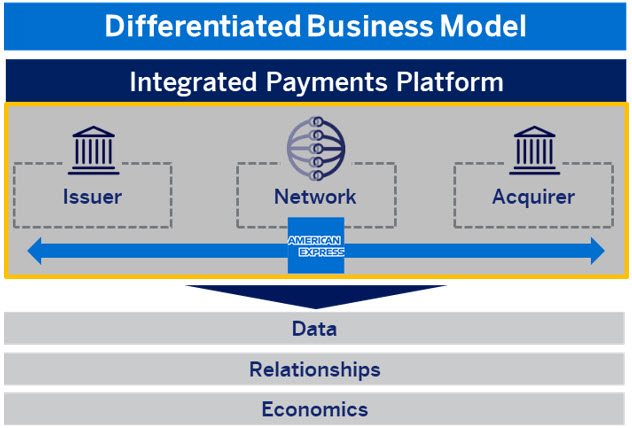
Our Integrated Payments Platform
Through our general-purpose card-issuing, merchant-acquiring and card network businesses, we are able to connect participants and provide differentiated value across the commerce path. We maintain direct relationships with both our Card Members (as a card issuer) and merchants (as an acquirer), and we handle all key aspects of those relationships. These relationships create a “closed loop” in that we have direct access to information at both ends of the card transaction, which distinguishes our integrated payments platform from the bankcard networks.
Our integrated payments platform allows us to analyze information on Card Member spending and build algorithms and other analytical tools that we use to underwrite risk, reduce fraud and provide targeted marketing and other information services for merchants and special offers and services to Card Members, all while respecting Card Member preferences and protecting Card Member and merchant data in compliance with applicable policies and legal requirements. Through contractual relationships, we also obtain information from third-party card issuers, merchant acquirers, aggregators and processors with whom we do business.
Card Issuing Businesses
Our global proprietary card-issuing businesses are conducted through our GCSG and GCS reportable operating segments. We offer a broad set of card products, rewards and services to a diverse consumer and commercial customer base, in the United States and internationally. We acquire and retain high-spending, engaged and creditworthy Card Members by:
-
Designing innovative products and features that appeal to our target customer base and meet their spending and borrowing needs
-
Using incentives to drive spending on our various card products and engender loyal Card Members, including our Membership Rewards® program, cash-back reward features and participation in loyalty programs sponsored by our cobrand and other partners
-
Providing digital and mobile services and an array of benefits and experiences across card products, such as airport lounge access and other travel and lifestyle benefits, which we believe are difficult for others to replicate and help increase Card Member engagement
-
Creating world-class service experiences by delivering exceptional customer care
-
Developing a wide range of partner relationships, including with other corporations and institutions that sponsor certain of our cards under cobrand arrangements and provide benefits and services to our Card Members
During 2020, we enhanced our value propositions on many of our card products, including adjusting our rewards programs and adding limited time offers and statement credits in categories that are relevant in the current environment, such as wireless, streaming services, business essentials and food delivery. We also created a Customer Pandemic Relief Program to provide short-term support for customers impacted by COVID-19, and we enhanced and expanded our longer-term Financial Relief Program for Card Members who need additional financial assistance during this time. Additionally, we participated in the U.S. Small Business Administration Paycheck Protection Program (PPP), designed to provide small businesses with support to cover payroll and certain other expenses.
For the year ended December 31, 2020, worldwide proprietary billed business (spending on American Express cards issued by us) was $870.7 billion and at December 31, 2020, we had 68.9 million proprietary cards-in-force worldwide.
Merchant Acquiring Business
Our GMNS reportable operating segment builds and manages relationships with millions of merchants around the world that choose to accept American Express cards. This includes signing new merchants to accept our cards, agreeing on the discount rate (a fee charged to the merchant for accepting our cards) and handling servicing for merchants. We also build and maintain relationships with merchant acquirers, aggregators and processors to manage aspects of our merchant services business. For example, through our OptBlue® merchant-acquiring program, third-party acquirers contract directly with small merchants for card acceptance on our network and determine merchant pricing. We continue to grow merchant acceptance of American Express cards around the world and work with merchant partners so that our Card Members are warmly welcomed and encouraged to spend in the millions of places where their American Express cards are accepted.
GMNS also provides fraud-prevention tools, marketing solutions, data analytics and other programs and services to merchants and other partners that leverage the capabilities of our integrated payments platform.
During 2020, we adjusted certain policies to back our merchant partners in the current environment, including raising contactless transaction thresholds and reminding them that we do not require Card Members’ signatures at the point of sale. We also launched our largest-ever Shop Small campaign to support small businesses around the world, which have been significantly impacted by the pandemic.
Card Network Business
We operate a payments network through which we establish and maintain relationships with third-party banks and other institutions in approximately 98 countries and territories, licensing the American Express brand and extending the reach of our global network. These network partners are licensed to issue local currency American Express-branded cards in their countries and/or serve as the merchant acquirer for local merchants on our network.
During 2020, our joint venture with Lianlian DigiTech Co., Ltd, a Chinese fintech services company, received approval from the People’s Bank of China for a network clearing license and began processing transactions in mainland China.
For the year ended December 31, 2020, worldwide network services billed business (spending on American Express cards issued by third parties) was $139.9 billion and at December 31, 2020, we had 43.1 million cards-in-force issued by third parties worldwide.
Diverse Customer Base and Global Footprint
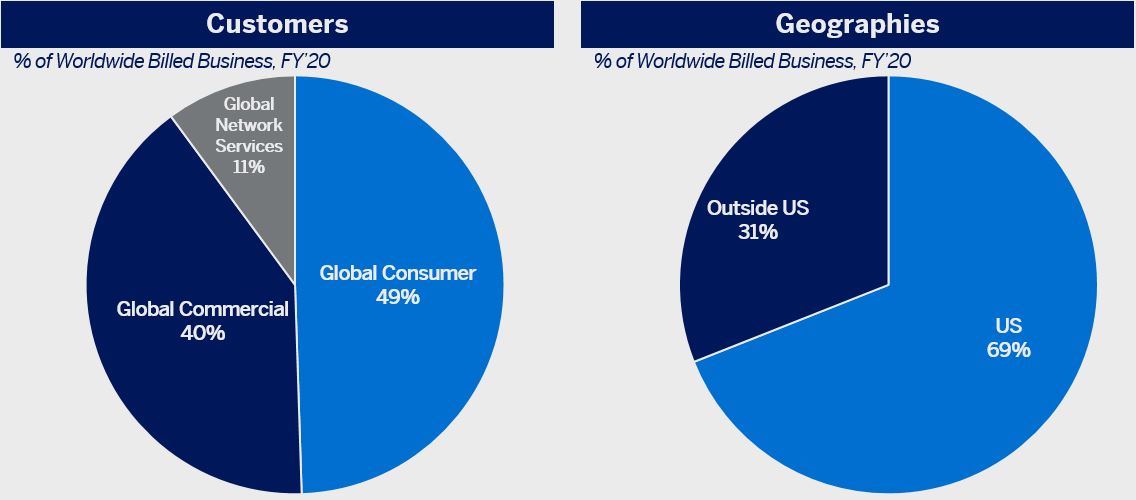
Our broad and diverse customer base spans consumers, small businesses, mid-sized companies and large corporations around the world. The following charts provide a summary of our diverse set of customers and broad geographic footprint based on billed business volumes:
Partners and Relationships
Our integrated payments platform allows us to work with a range of business partners, and our partners in return help drive the scale and relevance of the platform.
There are many examples of how we connect partners with our integrated payments platform, including: issuing cards under cobrand arrangements with other corporations and institutions (e.g., Delta Air Lines, Marriott International, Hilton Worldwide Holdings and British Airways); offering innovative ways for our Card Members to earn and use points with our merchants (e.g., Pay with Points at Amazon.com); expanding merchant acceptance with third-party acquirers (e.g., OptBlue partners); developing new capabilities and features with our digital partners (e.g., PayPal); integrating into the supplier payment processes of our business customers (e.g., Bill.com, SAP Ariba and Coupa); and extending the platform into travel services with American Express leisure and business travel (e.g., Fine Hotels and Resorts).
Delta Air Lines is our largest strategic partner. Our relationships with, and revenues and expenses related to, Delta are significant and represent a significant source of value for our Card Members. We issue cards under cobrand arrangements with Delta and the Delta cobrand portfolio represented approximately 9 percent of our worldwide billed business and approximately 21 percent of worldwide Card Member loans as of December 31, 2020. The Delta cobrand portfolio generates fee revenue and interest income from Card Members and discount revenue from Delta and other merchants for spending on Delta cobrand cards. The current Delta cobrand agreement runs through the end of 2029 and we expect to continue to make significant investments in this partnership. Among other things, Delta is also a key participant in our Membership Rewards program, provides travel-related benefits and services, including airport lounge access for certain American Express Card Members, accepts American Express cards as a merchant and is a corporate payments customer.
Working with all of our partners, we seek to provide value, choice and unique experiences across our customer base.
Our Spend-Centric Model and Revenue Mix
Our “spend-centric” business model focuses on generating revenues primarily by driving spending on our cards and secondarily through finance charges and fees. Spending on our cards, which is higher on average on a per-card basis versus our competitors, offers superior value to merchants in the form of loyal customers and larger transactions. Because of the revenues generated from having high-spending Card Members and the annual card fees we charge on many of our products, we are able to invest in attractive rewards and other benefits for Card Members, as well as targeted marketing and other programs and investments for merchants. This creates incentives for Card Members to spend more on their cards and positively differentiates American Express cards.
We believe our spend-centric model gives us the ability to provide differentiated value to Card Members, merchants and business partners.
The American Express Brand and Service Excellence
Our brand and its attributes—trust, security and service—are key assets. We invest heavily in managing, marketing, promoting and protecting our brand, including through the delivery of our products and services in a manner consistent with our brand promise. The American Express brand is consistently ranked as one of the most valuable brands in the world. We place significant importance on trademarks, service marks and patents, and seek to secure our intellectual property rights around the world.
We aim to provide the world’s best customer experience every day and our reputation for world-class service has been recognized by numerous awards over the years. Our customer care professionals and partners treat servicing interactions as an opportunity to bring the brand to life for our customers, add meaningful value and deepen relationships.
Our Business Strategies
Our framework for managing through the pandemic and the challenging economic environment is built on four principles: supporting our colleagues and winning as a team; protecting our customers and our brand; structuring the company for growth in the future; and remaining financially strong. We remain focused on what we can control in the short term while identifying opportunities across our businesses to position ourselves for growth in the longer term. And we seek to grow our business over the longer term by focusing on four strategic imperatives:
First, we aim to expand our leadership in the premium consumer space by continuing to deliver membership benefits that span our customers’ everyday spending, borrowing, travel and lifestyle needs, expanding our roster of business partners around the globe and developing a range of experiences that attract high-spending customers.
Second, we seek to build on our strong position in commercial payments by evolving our card value propositions, further differentiating our corporate card and accounts payable expense management solutions and designing innovative products and features, including financing and supplier payment solutions for our business customers.
Third, we are focused on strengthening our global network to provide unique value by continuing to help merchants navigate the convergence of online and offline commerce with fraud protection services, marketing insights and digital connections to higher-spending Card Members and continuing to work with our network partners to offer expanded products and services.
Finally, we want to continue to make American Express an essential part of our customers’ digital lives by developing more digital features, solutions and services, expanding our digital partnerships and making targeted acquisitions.
Our Colleagues
We are committed to delivering a great colleague experience every day, cultivating the best talent and developing new ways of working to unlock enterprise value. We work to foster an inclusive and diverse culture and help our colleagues thrive both professionally and personally. When we do, our colleagues are more engaged, committed, creative and effective in driving results. At the heart of our culture is what we call our Blue Box Values – a set of guiding principles that reflect who we are and what we stand for. In 2020, we updated our Blue Box Values to be more explicit about our efforts to create an inclusive and diverse workforce:
| We Back Our Customers | We Embrace Diversity | |||||||
| We Make It Great | We Stand for Inclusion | |||||||
| We Do What's Right | We Win as A Team | |||||||
| We Respect People | We Support Our Communities |
We take a holistic approach to serving our colleagues by offering them a variety of resources that support their physical, financial, emotional, social and overall well-being. Throughout the pandemic, one of our top priorities has been to ensure our colleagues have the flexibility and resources they need to stay safe, healthy and productive.
As of December 31, 2020, we employed approximately 63,700 people, whom we refer to as colleagues, with approximately 22,700 colleagues in the United States and approximately 41,000 colleagues outside the United States. We conduct an annual Colleague Experience Survey to better understand our colleagues’ needs and overall experience at American Express and in 2020, 94 percent of colleagues who participated in the survey said they would recommend American Express as a great place to work. Our 2020 annual company scorecard included talent retention and diversity representation goals to globally increase minority and women representation at management levels and retain our key talent. As of December 31, 2020, female colleagues comprised 52 percent of our global workforce and Asian, Black/African American and Hispanic/Latinx people represented 19.7 percent, 12.0 percent and 13.0 percent, respectively, of our U.S. workforce based on preliminary data for our 2020 U.S. EEO-1 submission.
We regularly review our compensation practices to ensure colleagues in the same job, level and location are compensated fairly regardless of gender globally, and race and ethnicity in the United States. These reviews consider several factors known to affect compensation, including role, level, tenure, performance and geography. In the few instances where a review has found inconsistencies, we have made adjustments. After making these adjustments, we believe we achieved 100 percent pay equity in 2020 for colleagues across genders globally and across races and ethnicities in the United States.
Information About Our Executive Officers
Set forth below, in alphabetical order, is a list of our executive officers as of February 12, 2021, including each executive officer’s principal occupation and employment during the past five years and reflecting recent organizational changes. None of our executive officers has any family relationship with any other executive officer, and none of our executive officers became an officer pursuant to any arrangement or understanding with any other person. Each executive officer has been elected to serve until the next annual election of officers or until his or her successor is elected and qualified. Each officer’s age is indicated by the number in parentheses next to his or her name.
| DOUGLAS E. BUCKMINSTER — | Group President, Global Consumer Services Group | ||||
| Mr. Buckminster (60) has been Group President, Global Consumer Services Group since February 2018. Prior thereto, he had been President, Global Consumer Services Group since October 2015. | |||||
| JEFFREY C. CAMPBELL — | Chief Financial Officer | ||||
| Mr. Campbell (60) has been Chief Financial Officer since August 2013. | |||||
| MARC D. GORDON — | Chief Information Officer | ||||
| Mr. Gordon (60) has been Chief Information Officer since September 2012. | |||||
| MONIQUE HERENA — | Chief Colleague Experience Officer | ||||
| Ms. Herena (49) has been Chief Colleague Experience Officer since April 2019. Ms. Herena joined American Express from BNY Mellon, where she served as the Chief Human Resources Officer and Senior Executive Vice President, Human Resources, Marketing and Communications since 2014. | |||||
| RAYMOND JOABAR — | Chief Risk Officer and President, Global Risk & Compliance | ||||
| Mr. Joabar (55) has been Chief Risk Officer and President, Global Risk & Compliance since September 2019. Prior thereto, he had been President of International Consumer Services and Global Travel and Lifestyle Services since February 2018. He also served as Executive Vice President, Global Servicing Network from February 2016 to February 2018 and Executive Vice President, World Service from November 2015 to February 2016. | |||||
| ANNA MARRS — | President, Global Commercial Services | ||||
| Ms. Marrs (47) has been President, Global Commercial Services since September 2018. Ms. Marrs joined American Express from Standard Chartered Bank, where she served as Regional CEO, ASEAN and South Asia since November 2016 and CEO, Commercial and Private Banking since October 2015. | |||||
| DENISE PICKETT — | President, Global Services Group | ||||
| Ms. Pickett (55) has been President, Global Services Group since September 2019. Prior thereto, she had been Chief Risk Officer and President, Global Risk, Banking & Compliance since February 2018 and President, U.S. Consumer Services since October 2015. | |||||
| ELIZABETH RUTLEDGE — | Chief Marketing Officer | ||||
| Ms. Rutledge (59) has been Chief Marketing Officer since February 2018. Prior thereto, she had been Executive Vice President, Global Advertising & Media since February 2016 and Executive Vice President, Card Products & Benefits since May 2013. | |||||
| LAUREEN E. SEEGER — | Chief Legal Officer | ||||
| Ms. Seeger (59) has been Chief Legal Officer since July 2014. | |||||
| JENNIFER SKYLER — | Chief Corporate Affairs Officer | ||||
| Ms. Skyler (44) has been Chief Corporate Affairs Officer since October 2019. Ms. Skyler joined American Express from The We Company, where she had been Chief Communications Officer from January 2018 to September 2019. Prior thereto, she had been Global Head of Public Affairs from January 2016 to January 2018. | |||||
| STEPHEN J. SQUERI — | Chairman and Chief Executive Officer | ||||
| Mr. Squeri (61) has been Chairman and Chief Executive Officer since February 2018. Prior thereto, he had been Vice Chairman since July 2015. | |||||
| ANRÉ WILLIAMS — | Group President, Global Merchant and Network Services | ||||
| Mr. Williams (55) has been Group President, Global Merchant and Network Services since February 2018. Prior thereto, he had been President of Global Merchant Services and Loyalty since October 2015. |
COMPETITION
We compete in the global payments industry with card networks, issuers and acquirers, paper-based transactions (e.g., cash and checks), bank transfer models (e.g., wire transfers and Automated Clearing House, or ACH), as well as evolving and growing alternative mechanisms, systems and products that leverage new technologies, business models and customer relationships to create payment or financing solutions. The payments industry continues to undergo dynamic changes in response to evolving technologies, consumer habits and merchant needs, some of which have accelerated as a result of the pandemic, such as an increased shift to e-commerce and demand for contactless payments.
As a card issuer, we compete with financial institutions that issue general-purpose credit and debit cards. We also encounter competition from businesses that issue private label cards, operate mobile wallets or extend credit. We face intense competition for cobrand relationships, as both card issuer and network competitors have targeted key business partners with attractive value propositions.
Our global card network competes in the global payments industry with other card networks, including, among others, China UnionPay, Visa, Mastercard, JCB, Discover and Diners Club International (which is owned by Discover). We are the fourth largest general-purpose card network globally based on purchase volume, behind China UnionPay, Visa and Mastercard. In addition to such networks, a range of companies globally, including merchant acquirers, processors and web- and mobile-based payment platforms (e.g., Alipay, PayPal and Venmo), as well as regional payment networks (such as the National Payments Corporation of India), carry out some activities similar to those performed by our GMNS business.
The principal competitive factors that affect the card-issuing, merchant and network businesses include:
-
The features, value and quality of the products and services, including customer care, rewards programs, partnerships, benefits and digital and mobile services, and the costs associated with providing such features and services
-
Reputation and brand recognition
-
The number, spending characteristics and credit performance of customers
-
The quantity, diversity and quality of the establishments where the cards can be used
-
The attractiveness of the value proposition to card issuers, merchant acquirers, cardholders, corporate clients and merchants (including the relative cost of using or accepting the products and services, and capabilities such as fraud prevention and data analytics)
-
The number and quality of other cards and other forms of payment and financing available to customers
-
The success of marketing and promotional campaigns
-
The speed of innovation and investment in systems, technologies, and product and service offerings
-
The nature and quality of expense management tools, electronic payment methods and data capture and reporting capabilities, particularly for business customers
-
The security of cardholder, merchant and network partner information
Another aspect of competition is the dynamic and rapid growth of alternative payment and financing mechanisms, systems and products, which include payment aggregators, digital payment and electronic wallet platforms, point-of-sale lenders, real-time settlement and processing systems, financial technology companies, digital currencies developed by both governments and the private sector, blockchain and similar distributed ledger technologies, prepaid systems and gift cards, and systems linked to customer accounts or that provide payment solutions. Various competitors are integrating more financial services into their product offerings and competitors are seeking to attain the benefits of closed-loop, loyalty and rewards functionalities, such as ours.
In addition to the discussion in this section, see “Our operating results may materially suffer because of substantial and increasingly intense competition worldwide in the payments industry” in “Risk Factors” for further discussion of the potential impact of competition on our business, and “Our business is subject to comprehensive government regulation and supervision, which could materially adversely affect our results of operations and financial condition” and “Legal proceedings regarding provisions in our merchant contracts, including non-discrimination and honor-all-cards provisions, could have a material adverse effect on our business and result in additional litigation and/or arbitrations, substantial monetary damages and damage to our reputation and brand” in “Risk Factors” for a discussion of the potential impact on our ability to compete effectively due to government regulations or if ongoing legal proceedings limit our ability to prevent merchants from engaging in various actions to discriminate against our card products.
SUPERVISION AND REGULATION
Overview
We are subject to extensive government regulation and supervision in jurisdictions around the world, and the costs of compliance are substantial. The financial services industry is subject to rigorous scrutiny, high regulatory expectations, a range of regulations and a stringent and unpredictable enforcement environment.
Governmental authorities have focused, and we believe will continue to focus, considerable attention on reviewing compliance by financial services firms with laws and regulations, and as a result, we continually work to evolve and improve our risk management framework, governance structures, practices and procedures. Reviews to assess compliance with laws and regulations by governmental authorities, as well as our own internal reviews, have resulted in, and are likely to continue to result in, changes to our products, practices and procedures, restitution to our customers and increased costs related to regulatory oversight, supervision and examination. We have also been subject to regulatory actions and may continue to be the subject of such actions, including governmental inquiries, investigations, enforcement proceedings and the imposition of fines or civil money penalties, in the event of noncompliance or alleged noncompliance with laws or regulations. In addition, legislators and regulators in various countries in which we operate have focused on the offering of consumer financial products and the operation of payment networks, resulting in changes to certain practices or pricing of card issuers, merchant acquirers and payment networks, and, in some cases, the establishment of broad and ongoing regulatory oversight regimes.
See “Risk Factors—Legal, Regulatory and Compliance Risks” for a discussion of the potential impact legislative and regulatory changes may have on our results of operations and financial condition.
Banking Regulation
Federal and state banking laws, regulations and policies extensively regulate the Company (which, for purposes of this section, refers to American Express Company as a bank holding company), TRS and our U.S. bank subsidiary, American Express National Bank (AENB). Both the Company and TRS are subject to comprehensive consolidated supervision, regulation and examination by the Federal Reserve and AENB is supervised, regulated and examined by the Office of the Comptroller of the Currency (OCC). The Company and its subsidiaries are also subject to the rulemaking, enforcement and examination authority of the Consumer Financial Protection Bureau (CFPB). Banking regulators have broad examination and enforcement power, including the power to impose substantial fines, limit dividends and other capital distributions, restrict operations and acquisitions and require divestitures, any of which could compromise our competitive position. Many aspects of our business also are subject to rigorous regulation by other U.S. federal and state regulatory agencies and by non-U.S. government agencies and regulatory bodies.
Activities
The BHC Act generally limits bank holding companies to activities that are considered to be banking activities and certain closely related activities. As noted above, each of the Company and TRS is a bank holding company and each has elected to become a financial holding company, which is authorized to engage in a broader range of financial and related activities. In order to remain eligible for financial holding company status, we must meet certain eligibility requirements. Those requirements include that each of the Company and AENB must be “well capitalized” and “well managed,” and AENB must have received at least a “satisfactory” rating on its most recent assessment under the Community Reinvestment Act of 1977 (the CRA). The Company and TRS engage in various activities permissible only for financial holding companies, including, in particular, providing travel agency services, acting as a finder and engaging in certain insurance underwriting and agency services. If the Company fails to meet eligibility requirements for financial holding company status, it and its subsidiaries are likely to be barred from engaging in new types of financial activities or making certain types of acquisitions or investments in reliance on its status as a financial holding company, and ultimately could be required to either discontinue the broader range of activities permitted to financial holding companies or divest AENB. In addition, the Company and its subsidiaries are prohibited by law from engaging in practices that the relevant regulatory authority deems unsafe or unsound (which such authorities generally interpret broadly).
Acquisitions and Investments
Applicable federal and state laws place limitations on the ability of persons to invest in or acquire control of us without providing notice to or obtaining the approval of one or more of our regulators. In addition, we are subject to banking laws and regulations that limit our investments and acquisitions and, in some cases, subject them to the prior review and approval of our regulators, including the Federal Reserve and the OCC. Federal banking regulators have broad discretion in evaluating proposed acquisitions and investments that are subject to their prior review or approval.
Financial Regulatory Reform
In October 2019, the U.S. federal bank regulatory agencies finalized rules that tailor the application of the enhanced prudential standards to bank holding companies and depository institutions (the Tailoring Rules) pursuant to the amendments to the Dodd-Frank Wall Street Reform and Consumer Protection Act of 2010 (Dodd Frank) introduced by the Economic Growth, Regulatory Relief, and Consumer Protection Act. The Tailoring Rules assign each U.S. bank holding company with $100 billion or more in total consolidated assets, as well as its bank subsidiaries, to one of four categories based on its status as a U.S. global systemically important banking organization and five other risk-based indicators: (i) size, (ii) cross-jurisdictional activity, (iii) non-bank assets, (iv) off-balance sheet exposure, and (v) weighted short-term wholesale funding.
Under the Tailoring Rules, the Company (and, pursuant to the Tailoring Rules, its depository institution subsidiary, AENB) is subject to Category IV standards.
Because a firm’s categorization under the Tailoring Rules is determined by, and can change over time dependent upon, how the firm measures against the risk-based indicator thresholds, we are required to monitor and periodically report these risk-based indicators and there can be no assurance that the Company will continue to be a Category IV firm in the future.
Capital and Liquidity Regulation
Capital Rules
The Company and AENB are required to comply with the applicable capital adequacy rules established by federal banking regulators. These rules are intended to ensure that bank holding companies and depository institutions (collectively, banking organizations) have adequate capital given their level of assets and off-balance sheet obligations. The federal banking regulators’ current capital rules (the Capital Rules) implement the Basel Committee on Banking Supervision’s (the Basel Committee) framework for strengthening international capital regulation, known as Basel III. For additional information regarding our capital ratios, see “Consolidated Capital Resources and Liquidity” under “MD&A.”
Under the Capital Rules, banking organizations are required to maintain minimum ratios for Common Equity Tier 1 (CET1), Tier 1 capital (that is, CET1 plus additional Tier 1 capital) and Total capital (that is, Tier 1 capital plus Tier 2 capital) to risk-weighted assets. We report our capital adequacy ratios using risk-weighted assets calculated under the standardized approach. As a Category IV firm, we are not subject to the advanced approaches capital requirements.
In December 2017, the Basel Committee published standards that, among other things, revise the standardized approach for credit risk (including by recalibrating risk weights and introducing additional capital requirements for certain “unconditionally cancellable commitments” such as unused credit card lines of credit) and provide a new standardized calculation for operational risk capital requirements. If adopted in the United States as issued by the Basel Committee and applicable to us, the new standards could result in higher capital requirements for us.
In December 2018, federal banking regulators issued a final rule that provides an optional three-year phase-in period for the adverse regulatory capital effects of adopting the Current Expected Credit Loss (CECL) methodology pursuant to new accounting guidance for the recognition of credit losses on certain financial instruments, which became effective January 1, 2020. In August 2020, federal banking regulators issued a final rule that provides an option to delay the estimated impact of the adoption of the CECL methodology on regulatory capital for up to two years, followed by the three-year phase-in period. We elected to adopt the two-year delay followed by the three-year phase-in period. Therefore, the Company will begin phasing in the cumulative amount that is not recognized in regulatory capital at 25 percent per year beginning January 1, 2022. See "Critical Accounting Estimates" under "MD&A" for additional information on CECL.
The Company and AENB must each maintain CET1, Tier 1 capital and Total capital ratios of at least 4.5 percent, 6.0 percent and 8.0 percent, respectively. On top of these minimum capital ratios, the Company is subject to a dynamic stress capital buffer (SCB) composed entirely of CET1 with a floor of 2.5 percent and AENB is subject to a static 2.5 percent capital conservation buffer (CCB). The SCB equals (i) the difference between a bank holding company’s starting and minimum projected CET1 capital ratios under the supervisory severely adverse scenario under the Federal Reserve's stress tests described below, plus (ii) one year of planned common stock dividends as a percentage of risk-weighted assets.
In August 2020, the SCB requirement for the Company was set at 2.5 percent. A bank holding company’s SCB requirement is generally effective on October 1 of each year and will remain in effect through September 30 of the following year unless it is reset in connection with resubmission of a capital plan, as discussed below. As a result, the effective minimum ratios for the Company (taking into account the SCB requirement) and AENB (taking into account the CCB requirement) are 7.0 percent, 8.5 percent and 10.5 percent for the CET1, Tier 1 capital and Total capital ratios, respectively. Banking organizations whose ratios of CET1, Tier 1 Capital or Total capital to risk-weighted assets are below these effective minimum ratios face constraints on discretionary distributions such as dividends, repurchases and redemptions of capital securities, and executive compensation. The capital distribution restrictions for the first quarter of 2021 discussed under “Stress Testing and Capital Planning” below are in addition to the SCB distribution constraints for bank holding companies at least through March 31, 2021. The Federal Reserve is expected to announce by March 31, 2021 any recalibration of the SCB requirements announced in August 2020.
We are also required to comply with minimum leverage ratio requirements. The leverage ratio is the ratio of a banking organization’s Tier 1 capital to its average total consolidated assets (as defined for regulatory purposes). All banking organizations are required to maintain a leverage ratio of at least 4.0 percent.
Liquidity Regulation
The Federal Reserve’s enhanced prudential standards rule includes heightened liquidity and overall risk management requirements. The rule requires the maintenance of a liquidity buffer, consisting of highly liquid assets, that is sufficient to meet projected net outflows for 30 days over a range of liquidity stress scenarios, and a minimum liquidity coverage ratio (LCR) that measures a firm’s high-quality liquid assets to its projected net outflows. Under the Tailoring Rules, Category IV firms with less than $50 billion in weighted short-term wholesale funding, such as the Company, are not subject to any LCR requirement.
A second standard provided for in the Basel III liquidity framework, referred to as the net stable funding ratio (NSFR), requires a minimum amount of longer-term funding based on the assets and activities of banking entities. Under the final NSFR rule published in October 2020, Category IV firms with less than $50 billion in weighted short-term wholesale funding, such as the Company, are not subject to any NSFR requirement.
Stress Testing and Capital Planning
Under the Federal Reserve’s regulations, the Company is subject to supervisory stress testing requirements that are designed to evaluate whether a bank holding company has sufficient capital on a total consolidated basis to absorb losses and support operations under adverse economic conditions. As a Category IV firm, the Company was subject to the Federal Reserve’s supervisory stress tests in 2020 and will be required to participate in the supervisory stress tests every other year thereafter.
We are required to develop and submit to the Federal Reserve an annual capital plan. In January 2021, the Federal Reserve finalized changes to the capital plan rule, which will, among other things, provide firms subject to Category IV standards additional flexibility to develop their capital plans. In addition, these changes provide that for Category IV firms, such as the Company, the portion of the SCB based on the Federal Reserve's supervisory stress tests will be calculated every other year. During a year in which a Category IV firm does not undergo a supervisory stress test, the firm will receive an updated SCB that reflects the firm's updated planned common stock dividends. A Category IV firm will also be able to elect to participate in the supervisory stress test and consequently receive an updated SCB. The Company must notify the Federal Reserve by April 5, 2021 if it elects to participate in the 2021 supervisory stress test. As part of the Comprehensive Capital Analysis and Review (CCAR), the Federal Reserve evaluates whether the Company has sufficient capital to continue operations by assessing our pro-forma capital position and ratios under a scenario of economic and financial market stress, and uses that information to determine the size of the SCB for each CCAR participating firm.
Due to the continued economic uncertainty from the coronavirus pandemic, in June 2020, the Federal Reserve required all bank holding companies participating in CCAR to resubmit their capital plans in November 2020. In addition, the Federal Reserve prohibited share repurchases in the third and fourth quarters of 2020 for all bank holding companies participating in CCAR and allowed them to pay common stock dividends provided (a) they did not increase the amount of the dividend and (b) the dividends did not exceed the average of a firm’s net income for the four preceding calendar quarters. On December 18, 2020, the Federal Reserve released the results of its second round of supervisory stress tests for all bank holding companies participating in CCAR based on economic scenarios reflecting changes in financial markets and the macroeconomic outlook. The Federal Reserve announced that it would allow bank holding companies participating in CCAR to pay common stock dividends and repurchase common stock in the first quarter of 2021 provided (a) the dividends and repurchases, in the aggregate, do not exceed the average of a firm’s net income for the four preceding calendar quarters and (b) the firm does not increase the amount of its common stock dividends beyond the level paid in the second quarter of 2020. The Federal Reserve also announced that it would permit stock repurchases equal to the amount of share issuances related to expensed employee compensation. For additional information regarding our capital distributions, see “Consolidated Capital Resources and Liquidity” under “MD&A.”
We may be required to revise and resubmit our capital plan following certain events or developments, such as a significant acquisition or an event that could result in a material change in our risk profile or financial condition. If we are required to resubmit our capital plan, we must receive prior approval from the Federal Reserve for any capital distributions (including common stock dividend payments and share repurchases), other than a capital distribution on a newly issued capital instrument.
Dividends and Other Capital Distributions
The Company and TRS, as well as AENB and the Company’s insurance and other regulated subsidiaries, are limited in their ability to pay dividends by statutes, regulations and supervisory policy.
Common stock dividend payments and share repurchases by the Company are subject to the oversight of the Federal Reserve, as described above. The Company will be subject to limitations and restrictions on capital distributions if, among other things, (i) the Company's regulatory capital ratios do not satisfy applicable minimum requirements and buffers or (ii) the Company is required to resubmit its capital plan.
In general, federal laws and regulations prohibit, without first obtaining the OCC’s approval, AENB from making dividend distributions to TRS, if such distributions are not paid out of available recent earnings or would cause AENB to fail to meet capital adequacy standards. In addition to specific limitations on the dividends AENB can pay to TRS, federal banking regulators have authority to prohibit or limit the payment of a dividend if, in the banking regulator’s opinion, payment of a dividend would constitute an unsafe or unsound practice in light of the financial condition of the institution.
Prompt Corrective Action
The Federal Deposit Insurance Act (FDIA) requires, among other things, that federal banking regulators take prompt corrective action in respect of depository institutions insured by the FDIC (such as AENB) that do not meet minimum capital requirements. The FDIA establishes five capital categories for FDIC-insured banks: well capitalized, adequately capitalized, undercapitalized, significantly undercapitalized and critically undercapitalized. The FDIA imposes progressively more restrictive constraints on operations, management and capital distributions, depending on the capital category in which an institution is classified. In order to be considered “well capitalized,” AENB must maintain CET1, Tier 1 capital, Total capital and Tier 1 leverage ratios of 6.5 percent, 8.0 percent, 10.0 percent and 5.0 percent, respectively.
Under the FDIA, AENB could be prohibited from accepting brokered deposits (i.e., deposits raised through third-party brokerage networks) or offering interest rates on any deposits significantly higher than the prevailing rate in its normal market area or nationally (depending upon where the deposits are solicited), unless (1) it is well capitalized or (2) it is adequately capitalized and receives a waiver from the FDIC. A portion of our outstanding U.S. retail deposits are considered brokered deposits for bank regulatory purposes. If a federal regulator determines that we are in an unsafe or unsound condition or that we are engaging in unsafe or unsound banking practices, the regulator may reclassify our capital category or otherwise place restrictions on our ability to accept or solicit brokered deposits.
On December 15, 2020, the FDIC finalized a rule intended to update and modernize the FDIC’s brokered deposit regulations. The final rule, among other things, expands the definition of “deposit broker” and updates the interest rate restrictions for less than well capitalized banks. The final rule is expected to become effective on April 1, 2021.
Resolution Planning
Pursuant to Dodd Frank, certain bank holding companies are required to submit resolution plans to the Federal Reserve and FDIC providing for the company’s strategy for rapid and orderly resolution in the event of its material financial distress or failure. However, in connection with the release of the Tailoring Rules, the Federal Reserve and FDIC finalized rules in October 2019 which, among other things, adjust the review cycles and applicability of the agencies’ resolution planning requirements. Under these rules, Category IV firms such as the Company are not required to submit a holding company resolution plan.
AENB continues to be required to prepare and provide a separate resolution plan to the FDIC that would enable the FDIC, as receiver, to effectively resolve AENB under the FDIA in the event of failure. The FDIC issued an Advance Notice of Proposed Rulemaking on potential revisions to this separate resolution plan requirement for insured depository institutions in April 2019 and temporarily suspended resolution planning requirements for insured depository institutions. In January 2021, the FDIC lifted the moratorium on resolution plan submissions for insured depository institutions with $100 billion or more in assets, including AENB, and will provide at least 12-months advance notice to firms required to submit resolution plans.
Orderly Liquidation Authority
The Company could become subject to the Orderly Liquidation Authority (OLA), a resolution regime under which the Treasury Secretary may appoint the FDIC as receiver to liquidate a systemically important financial institution, if the Company is in danger of default and is determined to present a systemic risk to U.S. financial stability. As under the FDIC resolution model, under the OLA, the FDIC has broad power as receiver. Substantial differences exist, however, between the OLA and the FDIC resolution model for depository institutions, including the right of the FDIC under the OLA to disregard the strict priority of creditor claims in limited circumstances, the use of an administrative claims procedure to determine creditor claims (as opposed to the judicial procedure used in bankruptcy proceedings), and the right of the FDIC to transfer claims to a “bridge” entity.
The FDIC has developed a strategy under OLA, referred to as the “single point of entry” or “SPOE” strategy, under which the FDIC would resolve a failed financial holding company by transferring its assets (including shares of its operating subsidiaries) and, potentially, very limited liabilities to a “bridge” holding company; utilize the resources of the failed financial holding company to recapitalize the operating subsidiaries; and satisfy the claims of unsecured creditors of the failed financial holding company and other claimants in the receivership by delivering securities of one or more new financial companies that would emerge from the bridge holding company. Under this strategy, management of the failed financial holding company would be replaced and its shareholders and creditors would bear the losses resulting from the failure.
FDIC Powers upon Insolvency of AENB
If the FDIC is appointed the conservator or receiver of AENB, the FDIC has the power: (1) to transfer any of AENB’s assets and liabilities to a new obligor without the approval of AENB’s creditors; (2) to enforce the terms of AENB’s contracts pursuant to their terms; or (3) to repudiate or disaffirm any contract or lease to which AENB is a party, the performance of which is determined by the FDIC to be burdensome and the disaffirmation or repudiation of which is determined by the FDIC to promote the orderly administration of AENB. In addition, the claims of holders of U.S. deposit liabilities and certain claims for administrative expenses of the FDIC against AENB would be afforded priority over other general unsecured claims against AENB, including claims of debt holders and depositors in non-U.S. offices, in the liquidation or other resolution of AENB. As a result, whether or not the FDIC ever sought to repudiate any debt obligations of AENB, the debt holders and depositors in non-U.S. offices would be treated differently from, and could receive substantially less, if anything, than the depositors in the U.S. offices of AENB.
Other Banking Regulations
Source of Strength
The Company is required to act as a source of financial and managerial strength to its U.S. bank subsidiary, AENB, and may be required to commit capital and financial resources to support AENB. Such support may be required at times when, absent this requirement, the Company otherwise might determine not to provide it. Capital loans by the Company to AENB are subordinate in right of payment to deposits and to certain other indebtedness of AENB. In the event of the Company’s bankruptcy, any commitment by the Company to a federal banking regulator to maintain the capital of AENB will be assumed by the bankruptcy trustee and entitled to a priority of payment.
Transactions Between AENB and its Affiliates
Certain transactions (including loans and credit extensions from AENB) between AENB and its affiliates (including the Company, TRS and their other subsidiaries) are subject to quantitative and qualitative limitations, collateral requirements and other restrictions imposed by statute and regulation. Transactions subject to these restrictions are generally required to be made on an arm’s-length basis.
FDIC Deposit Insurance and Insurance Assessments
AENB accepts deposits that are insured by the FDIC up to the applicable limits. Under the FDIA, the FDIC may terminate the insurance of an institution’s deposits upon a finding that the institution has engaged in unsafe or unsound practices; is in an unsafe or unsound condition to continue operations; or has violated any applicable law, regulation, rule, order or condition imposed by the FDIC. We do not know of any practice, condition or violation that would lead to termination of deposit insurance at AENB. The FDIC’s deposit insurance fund is funded by assessments on insured depository institutions, including AENB, which are subject to adjustment by the FDIC.
Community Reinvestment Act
AENB is subject to the CRA, which imposes affirmative, ongoing obligations on depository institutions to meet the credit needs of their local communities, including low- and moderate-income neighborhoods, consistent with the safe and sound operation of the institution. In May 2020, the OCC issued a final rule intended to (i) clarify which activities qualify for CRA credit; (ii) update where activities count for CRA credit; and (iii) change the methods for CRA measurement, data collection, recordkeeping and reporting for national banks and federal savings associations. The final rule retains the current community development test for limited purpose banks, such as AENB, which evaluates a bank’s community development performance through its community development loans, investments and services. The final rule requires institutions like AENB to designate additional geographic assessment areas where CRA activities will be measured for significant concentrations of retail domestic deposits. AENB must comply with the final rule by January 1, 2023.
Consumer Financial Products Regulation
In the United States, our marketing, sale and servicing of consumer financial products and our compliance with certain federal consumer financial laws are supervised and examined by the CFPB, which has broad rulemaking and enforcement authority over providers of credit, savings and payment services and products, and authority to prevent “unfair, deceptive or abusive” acts or practices. In addition, a number of U.S. states have significant consumer credit protection, disclosure and other laws (in certain cases more stringent than U.S. federal laws). U.S. federal law also regulates abusive debt collection practices, which, along with bankruptcy and debtor relief laws, can affect our ability to collect amounts owed to us or subject us to regulatory scrutiny.
On October 30, 2020, the CFPB issued a final rule that sets forth additional requirements for third-party debt collection agencies, which we use in the ordinary course of business. See "We are exposed to credit risk and trends that affect Card Member spending and the ability of customers and partners to pay us, which could have a material adverse effect on our results of operations and financial condition" under "Risk Factors" for potential impacts related to legal and regulatory changes on our ability to collect amounts owed to us.
We are also regulated in the United States under the “money transmitter” or “sale of check” laws in effect in most states. In addition, we are required by the laws of many states to comply with unclaimed and abandoned property laws, under which we must pay to states the face amount of any Travelers Cheque or prepaid card that is uncashed or unredeemed after a period of time depending on the type of product.
In countries outside the United States, regulators continue to focus on a number of key areas impacting our card-issuing businesses, particularly consumer protection (such as in the European Union (EU), the United Kingdom and Canada) and responsible lending (such as in Australia, Mexico, New Zealand and Singapore), with increasing importance on and attention to customers and outcomes rather than just ensuring compliance with local rules and regulations. Regulators’ expectations of firms in relation to their compliance, risk and control frameworks continue to increase and regulators are placing significant emphasis on a firm’s systems and controls relating to the identification and resolution of issues.
Payments Regulation
Legislators and regulators in various countries in which we operate have focused on the operation of card networks, including through enforcement actions, legislation and regulations to change certain practices or pricing of card issuers, merchant acquirers and payment networks, and, in some cases, to establish broad and ongoing regulatory oversight regimes for payment systems.
The EU, Australia and other jurisdictions have focused on interchange fees (that is, the fee paid by the bankcard merchant acquirer to the card issuer in payment networks like Visa and Mastercard), as well as the rules, contract terms and practices governing merchant card acceptance.
Regulation and other governmental actions relating to pricing or practices could affect all networks directly or indirectly, as well as adversely impact consumers and merchants. Among other things, regulation of bankcard fees has negatively impacted and may continue to negatively impact the discount revenue we earn, including as a result of downward pressure on our discount rate from decreases in competitor pricing in connection with caps on interchange fees. In some cases, regulations also extend to certain aspects of our business, such as network and cobrand arrangements or the terms of card acceptance for merchants, and we have exited our network businesses in the EU and Australia as a result of regulation in those jurisdictions, for example. In addition, there is uncertainty as to when or how interchange fee caps and other provisions of the EU payments legislation might apply when we work with cobrand partners and agents in the EU. Given differing interpretations by regulators and participants in cobrand arrangements, we are subject to regulatory action, penalties and the possibility we will not be able to maintain our existing cobrand and agent relationships in the EU.
In various countries, such as certain Member States in the EU and Australia, merchants are permitted by law to surcharge card purchases. In addition, the laws of a number of states in the United States that prohibit surcharging have been challenged in litigation brought by merchant groups and some such laws have been overturned. Surcharging is an adverse customer experience and could have a material adverse effect on us if it becomes widespread, particularly where it only or disproportionately impacts credit card usage, our Card Members or our business. In addition, other steering or differential acceptance practices that are permitted by regulation in some countries could also have a material adverse effect on us if they become widespread. See “Surcharging or steering by merchants could materially adversely affect our business and results of operations” under “Risk Factors.”
In some countries, governments have established regulatory regimes that require international card networks to be locally licensed and/or to localize aspects of their operations. For example, the Reserve Bank of India, which has broad power under the Payment and Settlement Systems Act, 2007 to regulate the membership and operations of card networks, has issued a mandate requiring payment systems operators in India to store certain payments data locally. Governments in some countries also provide resources or protection to select domestic payment card networks. The development and enforcement of these and other similar laws, regulations and policies may adversely affect our ability to compete effectively and maintain and extend our global network.
Privacy, Data Protection, Data Governance, Information and Cyber Security
Regulatory and legislative activity in the areas of privacy, data protection, data governance and information and cyber security continues to increase worldwide. We have established and continue to maintain policies and a governance framework to comply with applicable privacy, data protection, data governance and information and cyber security laws and requirements, meet evolving customer and industry expectations and support and enable business innovation and growth.
Our regulators are increasingly focused on ensuring that our privacy, data protection, data governance and information and cyber security-related policies and practices are adequate to inform customers of our data collection, use, sharing and/or security practices, to provide them with choices, if required, about how we use and share their information, and to appropriately safeguard their personal information and account access. Regulators are also focused on data management, data governance and our third-party risk management policies and practices.
In the United States, certain of our businesses are subject to the privacy, disclosure and safeguarding provisions of the Gramm-Leach-Bliley Act (GLBA) and its implementing regulations and guidance. Among other things, GLBA imposes certain limitations on our ability to share consumers’ nonpublic personal information with nonaffiliated third parties and requires us to develop, implement and maintain a written comprehensive information security program containing safeguards that are appropriate to the size and complexity of our business, the nature and scope of our activities and the sensitivity of customer information that we process. We are required to offer expanded privacy rights to California residents who are not covered by GLBA, pursuant to the California Consumer Privacy Act. Various regulators, U.S. states and territories are considering similar requirements or have adopted laws, rules and regulations pertaining to privacy and/or information and cyber security that may be more stringent and/or expansive than federal requirements.
We are also subject to certain privacy, data protection, data governance and information and cyber security laws in other countries in which we operate (including countries in the EU, Australia, Canada, China, Japan, Hong Kong, India, Mexico, Singapore and the United Kingdom), some of which are more stringent and/or expansive than those in the United States. Some countries have also instituted laws requiring in-country data processing and/or in-country storage of data. Compliance with such laws could result in higher technology, administrative and other costs for us, could limit our ability to optimize the use of our closed-loop data, and could require use of local technology services. Certain laws also require us to provide foreign governments and other third parties broader access to our data and intellectual property. Data breach and operational outage notification laws or regulatory activities to encourage such notifications are also becoming more prevalent in jurisdictions outside the United States in which we operate.
In Europe, the EU General Data Protection Regulation (GDPR) imposes legal and compliance obligations on companies that process personal data of individuals in the EU, irrespective of the geographical location of the company, with significant fines for non-compliance (up to 4 percent of total annual worldwide revenue). We continue to rely on our binding corporate rules as the primary method for lawfully transferring data from our European affiliates to our affiliates in the United States and elsewhere globally. The GDPR includes, among other things, a requirement for prompt notice of data breaches, in certain circumstances, to affected individuals and supervisory authorities.
The GDPR was transposed into UK domestic law in January 2021 following the United Kingdom's exit from the EU. This is known as the UK GDPR and it supplements the United Kingdom's Data Protection Act of 2018. The UK GDPR mirrors the compliance requirements and fine structure of the GDPR.
In addition, the European Directive 2002/58/EC (the ePrivacy Directive) will continue to set out requirements for the processing of personal data and the protection of privacy in the electronic communications sector until the approval of the forthcoming ePrivacy Regulation. The ePrivacy Directive places restrictions on, among other things, the sending of unsolicited marketing communications, as well as on the collection and use of data about internet users.
The European Central Bank and the European Banking Authority have enacted or are considering secondary legislation focused on security breaches, outsourcing, resiliency, strong customer authentication and information security-related policies. Likewise, a network and information security directive has been implemented into national laws by Member States in the EU. The Revised Payment Services Directive (PSD2) also contains regulatory requirements on strong customer authentication, open access to customer data and payment capabilities, and measures to prevent security incidents.
Anti-Money Laundering, Sanctions and Anti-Corruption Compliance
We are subject to significant supervision and regulation, and an increasingly stringent enforcement environment, with respect to compliance with anti-money laundering (AML), sanctions and anti-corruption laws and regulations in the United States and in other jurisdictions in which we operate. Failure to maintain and implement adequate programs and policies and procedures for AML, sanctions and anti-corruption compliance could have material financial, legal and reputational consequences.
Anti-Money Laundering
American Express is subject to a significant number of AML laws and regulations as a result of being a financial company headquartered in the United States, as well as having a global presence. In the United States, the majority of AML requirements are derived from the Currency and Foreign Transactions Reporting Act and the accompanying regulations issued by the U.S. Department of the Treasury (collectively referred to as the Bank Secrecy Act), as amended by the USA PATRIOT Act of 2001 (the Patriot Act). The Anti-Money Laundering Act of 2020 (the AMLA), enacted in January 2021, amended the Bank Secrecy Act and is intended to comprehensively reform and modernize U.S. AML laws. Many of the statutory provisions in the AMLA will require additional rulemakings, reports and other measures, the effects of which are not known at this time. In Europe, AML requirements are largely the result of countries transposing the 5th and 6th EU Anti-Money Laundering Directives (and preceding EU Anti-Money Laundering Directives) into local laws and regulations. Numerous other countries, such as Argentina, Australia, Canada, India, Mexico, New Zealand and Russia, have also enacted or proposed new or enhanced AML legislation and regulations applicable to American Express.
Among other things, these laws and regulations require us to establish AML programs that meet certain standards, including, in some instances, expanded reporting, particularly in the area of suspicious transactions, and enhanced information gathering and recordkeeping requirements. Our AML programs have become the subject of heightened scrutiny in some countries. Any errors, failures or delays in complying with federal, state or foreign AML and counter-terrorist financing laws or perceived deficiencies in our AML programs could result in significant criminal and civil lawsuits, penalties and forfeiture of significant assets or other enforcement actions.
Office of Foreign Assets Control Regulation
The United States has imposed economic sanctions that affect transactions with designated foreign countries, nationals and others. The United States prohibits U.S. persons from engaging with individuals and entities identified as “Specially Designated Nationals,” such as terrorists and narcotics traffickers. These prohibitions are administered by the U.S. Department of the Treasury’s Office of Foreign Assets Control (OFAC) and are typically known as the OFAC rules. The OFAC rules prohibit U.S. persons from engaging in financial transactions with or relating to the prohibited individual, entity or country, require the blocking of assets in which the individual, entity or country has an interest, and prohibit transfers of property subject to U.S. jurisdiction (including property in the possession or control of U.S. persons) to such individual, entity or country. Blocked assets (e.g., property or bank deposits) cannot be paid out, withdrawn, set off or transferred in any manner without a license from OFAC. We maintain a global sanctions program designed to ensure compliance with OFAC requirements. Failure to comply with such requirements could subject us to serious legal and reputational consequences, including criminal penalties.
Pursuant to Section 219 of the Iran Threat Reduction and Syria Human Rights Act of 2012, which added Section 13(r) to the Securities Exchange Act of 1934, as amended (the Exchange Act), an issuer is required to disclose in its annual or quarterly reports, as applicable, whether it or any of its affiliates knowingly engaged in certain activities, transactions or dealings relating to Iran or with individuals or entities designated pursuant to certain Executive Orders. Disclosure is generally required even where the activities, transactions or dealings were conducted outside the United States by non-U.S. affiliates in compliance with applicable law, and whether or not the activities are sanctionable under U.S. law.
In 2020, we became aware of credit card accounts opened with American Express International, Inc. (Hong Kong branch) by the Acting Consul General of the Iranian Consulate in Hong Kong, and his predecessor, the now-former Consul General. We believe these cards were used only for personal expenses. The Acting Consul General had two cards, both of which were opened in 2018 and one of which was closed by client request on or about April 3, 2019, and the other of which was cancelled by us on or about June 16, 2020. The former Consul General’s card was issued in January 2019 and cancelled by us on or about March 13, 2019. We had negligible gross revenues and net profits attributable to these accounts. As all of the accounts were cancelled, we do not intend to continue to engage in this activity.
Anti-Corruption
We are subject to complex international and U.S. anti-corruption laws and regulations, including the U.S. Foreign Corrupt Practices Act (the FCPA), the UK Bribery Act and other laws that prohibit the making or offering of improper payments. The FCPA makes it illegal to corruptly offer or provide anything of value to foreign government officials, political parties or political party officials for the purpose of obtaining or retaining business or an improper advantage. The FCPA also requires us to strictly comply with certain accounting and internal controls standards. The UK Bribery Act also prohibits commercial bribery and the receipt of a bribe, and makes it a corporate offense to fail to prevent bribery by an associated person, in addition to prohibiting improper payments to foreign government officials. Failure of the Company, our subsidiaries, colleagues, contractors or agents to comply with the FCPA, the UK Bribery Act and other similar laws can expose us and/or individual colleagues to investigation, prosecution and potentially severe criminal and civil penalties.
Compensation Practices
Our compensation practices are subject to oversight by the Federal Reserve. The federal banking regulators’ guidance on sound incentive compensation practices sets forth three key principles for incentive compensation arrangements that are designed to help ensure that incentive compensation plans do not encourage imprudent risk-taking and are consistent with the safety and soundness of banking organizations. The three principles provide that a banking organization’s incentive compensation arrangements should (1) provide incentives that appropriately balance risk and financial results in a manner that does not encourage employees to expose their organizations to imprudent risks, (2) be compatible with effective internal controls and risk management, and (3) be supported by strong corporate governance, including active and effective oversight by the organization’s board of directors. Any deficiencies in our compensation practices that are identified by the Federal Reserve or other banking regulators in connection with their review of our compensation practices may be incorporated into our supervisory ratings, which can affect our ability to make acquisitions or perform other actions. Enforcement actions may be taken against us if our incentive compensation arrangements or related risk-management control or governance processes are determined to pose a risk to our safety and soundness, and we have not taken prompt and effective measures to correct the deficiencies.
In May 2016, the federal banking regulators, the Securities and Exchange Commission (SEC), the Federal Housing Finance Agency and the National Credit Union Administration re-proposed a rule, originally proposed in 2011, on incentive-based compensation practices. The re-proposed rule would apply deferral, downward adjustment and forfeiture, and clawback requirements to incentive-based compensation arrangements granted to senior executive officers and significant risk-takers of covered institutions, with specific requirements varying based on the asset size of the covered institution and the category of employee. If these or other regulations are adopted in a form similar to what has been proposed, they will impose limitations on the manner in which we may structure compensation for our colleagues, which could adversely affect our ability to hire, retain and motivate key colleagues.
ADDITIONAL INFORMATION
We maintain an Investor Relations website at http://ir.americanexpress.com. We make available free of charge, on or through this website, our annual, quarterly and current reports and any amendments to those reports as soon as reasonably practicable following the time they are electronically filed with or furnished to the SEC.
In addition, we routinely post financial and other information, some of which could be material to investors, on our Investor Relations website. Information regarding our corporate responsibility and sustainability initiatives, including our Environmental, Social and Governance reports, are available on our Corporate Responsibility website at http://about.americanexpress.com/corporate-responsibility.
The content of any of our websites referred to in this report is not incorporated by reference into this report or any other report filed with or furnished to the SEC. We have included such website addresses only as inactive textual references and do not intend them to be active links.
You can find certain statistical disclosures required of bank holding companies starting on page A-1, which are incorporated herein by reference.
Our business as a whole has not experienced significant seasonal fluctuations, although card billed business tends to be moderately higher in the fourth quarter than in other quarters. As a result, the amount of Card Member loans and receivables outstanding tend to be moderately higher during that quarter. The average discount rate also tends to be slightly lower during the fourth quarter due to a higher level of retail-related billed business volumes.
Previous: Cover and table of contents · Next: Item 1A. RISK FACTORS