 filings.tools
Brown-Forman (BF-B) 10-K risk factor changes: FY2020 vs FY2019
The 2020-04-30 10-K against the 2019-04-30 one, compared heading by heading and sentence by sentence. One of these filings carries no fiscal year tag, so its year is the calendar year of the period end.
Item 1A75 rewritten34 added21 removed146 unchanged
All filing items1,109 rewritten535 added680 removed1,425 unchanged
Summary
counted, not written
- Item 1A headings could not be compared: only 0 carried over between the two years, which usually means one filing was read wrongly, so none is reported as new or removed.
- Sentence by sentence, 535 added, 680 removed, 1,109 rewritten and 1,425 unchanged across 19 items that differ.
Sentences by item
22 items, with every count and a link to each item that changed
Underlined words on a shaded ground are new in FY2020; struck-through words were in FY2019. Sentences that are wholly new or wholly gone are labelled rather than marked.
Item 1A. Risk Factors
75 rewritten, 34 added, 21 removed, 146 unchanged
[removed: Our] [added: Our] global business is subject to commercial, political, and financial [removed: risks, including foreign currency exchange rate fluctuations and corruption risk.][added: risks.]
If shipments of our products [removed: –] [added: -] particularly Jack Daniel’s Tennessee Whiskey [removed: –] [added: -] to our global markets were to experience significant disruption due to these risks or for other reasons, it could have a material adverse effect on our financial results.
In addition, we are subject to potential business disruption caused by military conflicts; potentially unstable governments or legal systems; civil or political upheaval or unrest; local labor policies and conditions; possible expropriation, nationalization, or confiscation of assets; problems with repatriation of foreign earnings; economic or trade sanctions; closure of markets to imports; anti-American sentiment; terrorism or other types of violence in or outside the United States; and health [removed: pandemics.][added: pandemics (such as COVID-19).]
For example, [removed: last year,] [added: in 2018,] the United States imposed tariffs on steel and aluminum.
[removed: Such retaliatory tariffs continue to remain in place, and any] [added: Any] further deterioration of economic relations between the United States and other countries or any increase in [removed: tariffs] [added: tariffs, custom duties or other restrictions or barriers on imports and exports] could result in [removed: an increase in] the [removed: price] [added: limited availability] of our products and [removed: could] prompt consumers to seek alternative [removed: products.][added: products or in an increase in the price of our products and to the extent that we absorb the costs of tariffs, result in lower net sales or higher costs of sales.]
[removed: For instance, in June 2016,] [added: On January 31, 2020,] the United Kingdom [removed: voted by referendum to leave] [added: left] the European Union (Brexit), and, until [added: a trade deal between] the United [removed: Kingdom’s exit from] [added: Kingdom and] the European Union is finalized, we face economic and political uncertainty related to the negotiation of any [added: such] successor trading arrangement [removed: with other countries] as well as volatility in exchange rates, risk to supply chains across the European Union, restrictions on the mobility of employees and consumers, or changes to customs duties, tariffs, or industry specific requirements and regulations.
[removed: In addition, any new trade barriers, sanctions, tariffs, or any] retaliatory measures in response to the foregoing could materially and adversely affect our operations.
The more we expand our business globally, the more [added: foreign currency] exchange rate fluctuations relative to the U.S. dollar influence our financial results.
In many markets outside the United States, we sell our products and pay for some goods, services, and [removed: labor] [added: talent] primarily in local currencies.
Over time, our reported financial results [removed: generally] will be hurt by a stronger U.S. dollar and improved by a weaker one.
We [removed: may, from time to time,] attempt to hedge a portion of our foreign currency exposure through the use of foreign currency derivatives or other means; however, even in those cases, we may not succeed in fully eliminating our foreign currency exposure.
Quantitative and Qualitative Disclosures about Market Risk [removed: –] [added: -] Foreign currency exchange rate risk.”
Some [added: of the] countries where we do business have a higher risk of corruption than others.
While we are committed to doing business in accordance with applicable anti-corruption [added: laws, trade sanctions] and [added: restrictions, and] other [removed: laws,] [added: similar laws and regulations, along with] our Code of Conduct, Code of Ethics for Senior Financial Officers, and our other policies, we remain subject to the risk that an [removed: employee will violate our policies,] [added: employee,] or [removed: that any] [added: one] of our many [removed: affiliates or agents, such as importers, wholesalers, distributors, or other] business partners, may take action determined to be in violation of international trade, money laundering, anti-corruption, or other laws, [added: sanctions, or regulations,] including the U.S. Foreign Corrupt Practices Act of 1977, the U.K. Bribery Act 2010, or equivalent local laws.
Any determination that our operations or activities are [removed: not, or were not,] [added: not] in compliance with [removed: U.S. or foreign] [added: applicable] laws or [removed: regulations] [added: regulations, particularly those related to anti-corruption and international trade,] could result in investigations, interruption of business, loss of business partner relationships, suspension or termination of licenses and permits (our own or those of our partners), imposition of fines, legal or equitable sanctions, negative publicity, and management distraction.
Further, our continued compliance with applicable anti-corruption or other [removed: laws,] [added: laws or regulations,] our Code of Conduct, Code of Ethics for Senior Financial Officers, and our other policies could result in higher operating costs.
[removed: National] [added: National] and local governments may adopt regulations or undertake investigations that could limit our business activities or increase our [removed: costs.][added: costs.]
[removed: Unfavorable] [added: Unfavorable] economic conditions could negatively affect our operations and [removed: results.][added: results.]
[removed: Unfavorable economic conditions could cause governments to increase taxes on beverage alcohol to attempt to raise revenue,] reducing consumers’ willingness to make discretionary purchases of beverage alcohol products or pay for premium brands such as ours.
In unfavorable economic conditions, [added: such as those reflected in the current unprecedented levels of unemployment in the United States,] consumers may make more value-driven and price-sensitive purchasing choices and drink more at home rather than at restaurants, bars, and hotels, which tend to favor many of our premium and super-premium [removed: products.][added: products, which negatively impacts our operating margins.]
This could lead to distributor or retailer destocking, disruption in raw material supply, increase [removed: our] [added: in] bad debt expense, or cause us to increase the levels of unsecured credit that we provide to customers.
For details on the effects of changes in the value of our benefit plan obligations and assets on our financial results, see Note [removed: 10] [added: 9] to the Consolidated Financial Statements in “Item 8.
[removed: Tax] [added: Tax] increases and changes in tax rules could adversely affect our financial [removed: results.][added: results.]
New tax rules, accounting standards, or pronouncements, and changes in interpretation of existing rules, standards, or pronouncements could also have a [removed: significant] [added: material] adverse effect on our business and financial results.
[added: This includes potential] changes in tax rules or the interpretation of tax rules arising out of the Base Erosion & Profit Shifting project initiated by the Organization for Economic Co-operation and Development, as well as changes in the interpretation of tax rules arising out of the European Union State Aid investigations.
In [removed: 2018,] [added: fiscal 2020,] we have observed excise tax increases in Australia, [removed: France,] [added: Poland,] and [removed: Turkey.][added: Czech Republic.]
[removed: Our] [added: Our] business performance is substantially dependent upon the continued health of the Jack Daniel’s family of [removed: brands.][added: brands.]
A brand’s reputational value is based in large part on consumer perceptions, and even an isolated incident that causes harm [removed: –] [added: -] particularly one resulting in widespread negative publicity [removed: –] [added: -] could adversely influence these perceptions and erode consumer trust and confidence in the brand.
Given the importance of Jack Daniel’s to our overall success, a significant or sustained decline in volume or selling price of our Jack Daniel’s [removed: products] [added: products, as a result of negative publicity or otherwise,] would have a negative effect on our financial results.
Management’s Discussion and Analysis of Financial Condition and Results of Operations [removed: –] [added: -] Results of Operations [removed: –] [added: -] Fiscal [removed: 2019] [added: 2020] Brand Highlights.”
[removed: Changes] [added: Changes] in consumer preferences and purchases, any decline in the social acceptability of our products, or governmental adoption of policies disadvantageous to beverage alcohol could negatively affect our business [removed: results.][added: results.]
[removed: Consumer preferences] and [removed: purchases may shift, often in unpredictable ways, due several factors, including health and wellness trends; changes in economic conditions, demographic, and] social trends; public health policies and initiatives; changes in government regulation of beverage alcohol products; concerns or regulations related to product safety; legalization of marijuana use on a more widespread basis within the United States, Canada, or elsewhere; and changes in trends related to travel, leisure, dining, gifting, entertaining, and beverage consumption trends.
Our [added: long-term] plans call for the continued growth of the Jack Daniel’s family of brands.
If these plans do not succeed, or if we otherwise fail to develop or implement effective business, portfolio, and brand strategies, our growth, [removed: stock price,] [added: business,] or financial results could suffer.
Our inability to attract consumers to our product innovations relative to our competitors’ products [removed: –] [added: -] especially over time [removed: –] [added: -] could negatively affect our growth, business, and financial results.
If future scientific research [removed: indicate] [added: indicates] more widespread serious health risks associated with alcohol consumption [removed: –] [added: -] particularly with moderate consumption [removed: –] [added: -] or if for any reason the social acceptability of beverage alcohol declines significantly, sales of our products could decrease.
[removed: Production] [added: Production] facility disruption could adversely affect our [removed: business.][added: business.]
The loss of a substantial amount of aged inventory [removed: –] [added: -] through fire, other natural or man-made disaster, contamination, or otherwise [removed: –] [added: -] could significantly reduce the supply of the affected product or products.
Disaster recovery plans may not prevent business disruption, and reconstruction of any damaged facilities could require a significant amount of [removed: time.][added: time.]
[removed: The] [added: The] inherent uncertainty in supply/demand forecasting could adversely affect our business, particularly with respect to our aged [removed: products.][added: products.]
Our business faces various risks related to health epidemics and pandemics, including the COVID-19 pandemic and similar outbreaks, which could materially and adversely affect our business, our operations, our cash flows, and our financial results.
Our business, operations, cash flows, and financial results could be negatively impacted by health epidemics, pandemics, and similar outbreaks.
The COVID-19 pandemic could have negative impacts, such as (i) a global or U.S. recession or other economic crisis; (ii) credit and capital markets volatility (and access to these markets, including by our suppliers and customers); (iii) significant volatility in demand for our products, including our premium and super-premium products; (iv) changes in accessibility to our products due to illness, quarantines, “stay at home” orders, travel restrictions, retail, restaurant, bar, and hotel closures, social distancing requirements, and other government action; (v) changes in behavior and preferences, including trading down to lower-priced products; and (vi) disruptions in our manufacturing operations, or in our distribution and supply chain.
Furthermore, we have been impacted in markets where, in connection with other government actions taken to slow the spread of the COVID-19 pandemic, liquor sales have been restricted or banned outright such as in the state of Pennsylvania in the United States, and in South Africa, India, and other Asian countries.
In addition, we may incur increased costs and otherwise be negatively affected if a significant portion of our workforce (or the workforces within our distribution or supply chain) is unable to work or work effectively, including because of illness, unavailability of personal protective equipment, quarantines, “stay at home” orders, social distancing requirements, other government action, facility closures, or other restrictions.
The impact of the COVID-19 pandemic depends on factors beyond our knowledge or control, including the duration and severity of the outbreak and actions taken to contain its spread and mitigate the public health effects and its short- and long-term impacts on the economy, unemployment, consumer confidence, and the financial health of our distributors, customers, and suppliers.
At this time, we cannot predict with certainty the impact of the COVID-19 pandemic on our business or our future financial or operational results; however, the impact could be material over time.
For further discussion on the impact of the COVID-19 pandemic on our business and financial results, see “Item 7.
Management’s Discussion and Analysis of Financial Condition and Results of Operations - Significant Developments - COVID-19.”
Such retaliatory tariffs, which remain in place, have negatively affected our results of operations through lower net sales and higher cost of sales.
For example, the European Union plans the doubling of current retaliatory tariffs by June 2021 if there is no resolution of the economic relations with the United States.
In addition, any new trade barriers, sanctions, tariffs, or any
A failure to comply with anti-corruption laws, trade sanctions and restrictions, or similar laws or regulations may have a material adverse effect on our business and financial results.
We are a global company that markets and sells our products in over 170 countries.
Because the COVID-19 pandemic has so negatively impacted local economies, government intervention in local economies and businesses has increased, which in turn can create elevated risk and opportunity for corruption.
Fluctuations in foreign currency exchange rates relative to the U.S. dollar could have a material adverse effect on our financial results.
In particular, a significant deterioration in economic conditions, due to the COVID-19 pandemic or otherwise, including economic slowdowns or recessions, increased unemployment levels, inflationary pressures and/or disruptions to credit and capital markets, could lead to decreased consumer confidence and consumer spending more generally, thus reducing consumer demand for our products.
Unfavorable economic conditions could also cause governments to increase taxes on beverage alcohol to attempt to raise revenue,
For example, due to the COVID-19 pandemic and its resulting economic impact, we have received requests for credit extensions from some of our distributors as the financial health of such distributors may have been negatively impacted.
For additional details on the effects of COVID-19 on our operations and financial results, see “Item 7.
Management’s Discussion and Analysis of Financial Condition and Results of Operations - Significant Developments - COVID-19.”.
Consumer preferences and purchases may shift, often in unpredictable ways, due to several factors, including health and wellness trends; changes in economic conditions, demographic,
These shifts in consumption and purchasing channels, which could adversely impact our profitability, have accelerated during the COVID-19 pandemic and the resulting quarantines, “stay at home” orders, travel restrictions, retail, restaurant, bar, and hotel closures, social distancing requirements, and other government action.
In particular, we plan to expand sales of Jack Daniel’s Tennessee Apple internationally.
A consequence of any of these or other supply or supply chain disruptions, including the temporary inability to produce our products due to the closure or lower production levels at one or more of our major distillation or bottling facilities, or at our suppliers as a result of COVID-19, could prevent us from meeting consumer demand for the affected products for a period of time in the near-term as well as in the long-term due to the nature of our aged products.
For example, in connection with the COVID-19 pandemic, disruptions in our manufacturing operations or in our distribution or supply chain, such as with our neutral spirits supplier in France for our Jack Daniel’s flavored whiskies, due to illness, quarantines, “stay at home” orders, social distancing requirements, and other government actions could adversely affect our ability to manufacture our products.
businesses at acceptable prices and terms.
Acquisitions, investments, or joint ventures could also lead us to incur additional debt and related interest expenses, issue additional shares, and result in a reduction in our earnings per share and a decrease on our average invested capital.
In connection with the COVID-19 pandemic and its resulting economic impacts, government actions and interventions in local economies and businesses may create an elevated risk and opportunity for counterfeiting.
We could also experience employment-related class actions, environmental claims, commercial disputes, product liability actions stemming from a beverage or container
As a result of the COVID-19 pandemic, a greater number of our employees are working remotely, which may further increase our vulnerability to the cyber risks described above.
Negative publicity could affect our business performance.
Unfavorable publicity, whether accurate or not, related to our industry or to us or our products, brands, marketing, executive leadership, employees, board of directors, family stockholders, operations, business performance, or prospects could negatively affect our corporate reputation, stock price, ability to attract and retain high-quality talent, or the performance of our business.
Adverse publicity or negative commentary on social media outlets, whether valid or not, particularly any that go “viral,” could cause consumers to react by avoiding our brands or choosing brands offered by our competitors, which could materially negatively affect our financial results.
In the long term, we expect our growth rates in emerging markets, to surpass our growth rates in the United States and more developed markets.
However, we still expect our international developed markets to provide growth opportunities for us.
Financial Statements and Supplementary Data” and “Item 7A.
On December 22, 2017, the U.S. government enacted comprehensive tax legislation commonly referred to as the Tax Cuts and Jobs Act (Tax Act).
The Tax Act significantly revised the U.S. corporate income tax by, among other things, lowering U.S. corporate income tax rates and implementing a territorial tax system.
Shortly after the Tax Act was enacted, the U.S. Securities and Exchange Commission issued Staff Accounting Bulletin No. 118, Income Tax Accounting Implications of the Tax Cuts and Jobs Act (SAB 118) to address the application of GAAP.
SAB 118 directs taxpayers to consider the impact of the Tax Act as provisional when a company does not have the necessary information available, prepared, or analyzed (including computations) in reasonable detail to complete the accounting for the change in tax law.
In accordance with SAB 118, we recorded an original provisional estimate of the effect of the Tax Act in our 2018 consolidated financial statements and have subsequently finalized our accounting analysis based on the guidance, interpretations, and data available as of December 22, 2018.
However, many aspects of the Tax Act are still unclear and may not be clarified for some time.
For additional detail regarding the Tax Act and the final tax amounts recorded in our consolidated financial statements, see Note 13 to the Consolidated Financial Statements in “Item 8.
This includes potential
Shifts in consumption and purchasing channels such as these could adversely impact our profitability.
Demographic forecasts in the United States for the next couple of years after 2018 indicate a slight decrease in the population segment aged 21 to 24; fewer potential consumers in this age bracket could have a negative effect on industry growth rates and on our business.
In particular, we plan to continue to grow Jack Daniel’s Tennessee Honey sales globally and plan to launch Jack Daniel’s Tennessee Apple in the United States in fiscal 2020.
A consequence of any of these or other supply or supply chain disruptions could prevent us from meeting consumer demand for the affected products for a period of time.
Weather, the effects of climate change, fires, diseases, and other agricultural uncertainties that affect the mortality,
For example, we are experiencing increased competition for some of our products from new entrants in the small-batch or craft spirits category.
For example, we are facing an increasingly competitive pricing environment, and our competitors may have more flexibility to adjust to such challenges.
The various uses of these IT systems, networks, and services include, but are not limited to: hosting our internal network and communication systems; ordering and managing materials from suppliers; supply/demand planning; production;
Additionally, companies like ours may face increased labor costs as a result of aggressive hiring and/or inflated levels of compensation offered by other employers, especially in emerging markets – notably, India and other parts of Asia.
We have had
An excerpt. Shown here: 40 of 75 rewritten, all 34 added and all 21 removed. The counts are complete. For every sentence, read Item 1A. Risk Factors in the FY2020 filing and the FY2019 filing.
Item 7. Management’s Discussion and Analysis of Financial Condition and Results of Operations
249 rewritten, 162 added, 278 removed, 240 unchanged
[removed: Introduction][added: Introduction]
| [removed: Table] [added: Table] of [removed: Contents] [added: Contents] | |
| | [removed: Page] [added: Page] |
| [removed: Presentation basis.] [added: Presentation basis.] This MD&A reflects the basis of presentation described in Note 1 “Accounting Policies” to the Consolidated Financial Statements. In addition, we define statistical and non-GAAP financial measures that we believe help readers understand our results of operations and the trends affecting our business. | [removed: [30](#s53E7943973575174BFFE81F203770E56)] [added: [27](#sAC6ABA504F245B01B8D9DEEFA1714B2F)] |
| [removed: Significant developments.] [added: Significant developments.] We discuss developments during the most recent [removed: three] [added: two] fiscal years. Please read this section in conjunction with “Item 1. Business,” which provides a general description of our business and strategy. | [removed: [34](#sE4C0A9688AE65ED28D86B4A5CBC698F6)] [added: [30](#sA411539ABD055BB3B1DA008C97CEA98D)] |
| [removed: Executive summary.] [added: Executive summary.] We discuss (a) fiscal [removed: 2019] [added: 2020] highlights and (b) our outlook for fiscal [removed: 2020,] [added: 2021,] including the trends, developments, and uncertainties that we expect to affect our business. | [removed: [36](#sC134AE28DD1A5533A22B997590F4FA41)] [added: [32](#sFE4349D8F2865FD992F97E4075199B9C)] |
| [removed: Results] [added: Results] of [removed: operations.] [added: operations.] We discuss (a) fiscal [removed: 2019] [added: 2020] results for our largest markets, (b) fiscal [removed: 2019] [added: 2020] results for our largest brands, and (c) the causes of year-over-year changes in our statements of operations line items, including transactions and other items that affect the comparability of our results, for fiscal [removed: year 2019] [added: years 2020] and [removed: 2018.] [added: 2019.] | [removed: [39](#s5DC7914E4C3851D9986C38175E230FE9)] [added: [34](#sE19CEFC3054A533E8ADE96A97232EB8A)] |
| [removed: Liquidity] [added: Liquidity] and capital [removed: resources.] [added: resources.] We discuss (a) the causes of year-over-year changes in cash flows from operating activities, investing activities, and financing activities; (b) recent and expected future capital expenditures; (c) dividends and share repurchases; and (d) our liquidity position, including capital resources available to us. | [removed: [48](#sFE23EA6DE4B6562386FA1B74B4D0B938)] [added: [41](#sA2745723241F5AB38A6F5A9C8C5C8137)] |
[removed: | Off-balance sheet arrangements and long-term obligations. | [50](#sDBFAC08FE2515376B319124C03B9DA51) |][added: Off-Balance Sheet Arrangements]
| [removed: Critical] [added: Critical] accounting policies and [removed: estimates.] [added: estimates.] We discuss the critical accounting policies and estimates that require significant management judgment. | [removed: [51](#s63CE73EB70C458E8814B149F400DB3D1)] [added: [43](#s5B6768C81A9D5DAB83B5DBB0BC82ABE2)] |
[removed: Presentation Basis][added: Presentation Basis]
[removed: Non-GAAP] [added: Non-GAAP] Financial [removed: Measures][added: Measures]
To calculate these measures, we adjust, as applicable, for (a) acquisitions and divestitures, (b) [removed: a new accounting standard, (c)] foreign exchange, [removed: (d)] [added: (c)] estimated net changes in distributor inventories, and [removed: (e) the establishment] [added: (d) a non-cash write-down] of [removed: our charitable foundation.][added: the Chambord brand name.]
| • | [removed: “Acquisitions] [added: *“Acquisitions] and [removed: divestitures.”] [added: divestitures.”*] This adjustment removes (a) any non-recurring effects related to our acquisitions and divestitures (e.g., transaction gains or losses, transaction costs, and integration costs), and (b) the effects of operating activity related to acquired and divested brands for periods not comparable year over year (non-comparable periods). [removed: By excluding] [added: Excluding] non-comparable [removed: periods, we therefore] [added: periods allows us to] include the effects of acquired and divested brands only to the extent that results are comparable year over year. |
This adjustment removes (a) transaction and integration costs related to the acquisition and (b) operating activity for the acquired business for the non-comparable [removed: period.][added: period, which is fiscal 2020 activity for The 86 Company.]
| • | [removed: “Foreign exchange.”] [added: *“Foreign exchange.”*] We calculate the percentage change in certain line items of the statements of operations in accordance with GAAP and adjust to exclude the cost or benefit of currency fluctuations. Adjusting for foreign exchange allows us to understand our business on a constant-dollar basis, as fluctuations in exchange rates can distort the underlying trend both positively and negatively. (In this report, “dollar” always means the U.S. dollar unless stated otherwise.) To eliminate the effect of foreign exchange fluctuations when comparing across periods, we translate current-year results at prior-year rates and remove transactional and hedging foreign exchange gains and losses from current- and prior-year periods. |
| • | [removed: “Estimated] [added: *“Estimated] net change in distributor [removed: inventories.”] [added: inventories.”*] This adjustment refers to the estimated net effect of changes in distributor inventories on changes in certain line items of the statements of operations. For each period compared, we use volume information from our distributors to estimate the effect of distributor inventory changes in certain line items of the statements of operations. We believe that this adjustment reduces the effect of varying levels of distributor inventories on changes in certain line items of the statements of operations and allows us to understand better our underlying results and trends. |
We use the non-GAAP measures “underlying change” to: (a) understand our performance from period to period on a consistent basis; (b) compare our performance to that of our competitors; (c) calculate components of management incentive compensation; (d) plan and forecast; and (e) communicate our financial performance to the board of directors, stockholders, and investment [removed: analysts.][added: community.]
[removed: Definitions][added: Definitions]
[removed: Geographic Aggregations.][added: *Geographic Aggregations.*]
In “Results of Operations - Fiscal [removed: 2019] [added: 2020] Market Highlights,” we provide supplemental information for our largest markets ranked by percentage of total fiscal [removed: 2019] [added: 2020] net sales.
| [removed: •] [added: *•*] | [removed: “Developed International”] [added: *“Developed International”*] markets are “advanced economies” as defined by the IMF, excluding the United States. Our largest developed international markets are the United Kingdom, [removed: Australia,] Germany, [added: Australia,] France, [added: Japan,] and [removed: Japan.] [added: Canada.] This aggregation represents our net sales of branded products to these markets. |
| • | [removed: “Emerging”] [added: *“Emerging”*] markets are “emerging and developing economies” as defined by the IMF. Our largest emerging markets are Mexico, Poland, [removed: Russia,] and [removed: Brazil.] [added: Russia.] This aggregation represents our net sales of branded products to these markets. |
| [removed: •] [added: *•*] | [removed: “Travel Retail”] [added: *“Travel Retail”*] represents our net sales of branded products to global duty-free customers, other travel retail customers, and the U.S. [removed: military] [added: military,] regardless of customer location. |
| • | [removed: “Non-branded] [added: *“Non-branded] and [removed: bulk”] [added: bulk”*] includes our net sales of used barrels, bulk whiskey and wine, and contract [removed: bottling] [added: bottling,] regardless of customer location. |
[removed: Brand Aggregations.][added: *Brand Aggregations.*]
In “Results of Operations - Fiscal [removed: 2019] [added: 2020] Brand Highlights,” we provide supplemental information for our largest brands ranked by percentage of total fiscal [removed: 2019] [added: 2020] net sales.
| [removed: •] [added: *•*] | [removed: “Whiskey”] [added: *“Whiskey”*] includes all whiskey spirits and whiskey-based flavored liqueurs, ready-to-drink (RTD), and ready-to-pour products (RTP). The brands included in this category are the Jack [removed: Daniel's] [added: Daniel’s] family of brands, [added: the] Woodford [removed: Reserve,] [added: Reserve family of brands (Woodford Reserve),] Canadian Mist, GlenDronach, BenRiach, Glenglassaugh, [added: the] Old [removed: Forester,] [added: Forester family of brands (Old Forester),] Early Times, Slane Irish Whiskey, and Coopers’ Craft. |
| • | [removed: “American whiskey”] [added: *“American whiskey”*] includes the Jack Daniel’s family of brands, premium bourbons (defined below), [added: super-premium American whiskey (defined below),] and Early Times. |
| • | [removed: “Jack] [added: *“Jack] Daniel’s family of [removed: brands”] [added: brands”*] includes Jack Daniel’s Tennessee Whiskey (JDTW), Jack Daniel’s RTD and RTP products (JD RTD/RTP), Jack Daniel’s Tennessee Honey (JDTH), Gentleman Jack, Jack Daniel’s Tennessee Fire (JDTF), Jack Daniel’s [added: Tennessee Apple (JDTA), Jack Daniel’s] Single Barrel Collection (JDSB), Jack Daniel’s Tennessee Rye Whiskey (JDTR), Jack Daniel’s Sinatra Select, Jack Daniel’s No. 27 Gold Tennessee Whiskey, and Jack Daniel’s Bottled-in-Bond. |
| • | [removed: “Jack] [added: *“Jack] Daniel’s RTD and [removed: RTP”] [added: RTP”*] products include all RTD line extensions of Jack Daniel’s, such as Jack Daniel’s & Cola, Jack Daniel’s [added: Country Cocktails, Jack Daniel’s] & Diet Cola, Jack & Ginger, Jack Daniel’s [removed: Country Cocktails,] [added: Double Jack,] Gentleman Jack & Cola, Jack Daniel’s [removed: Double Jack,] [added: Lynchburg Lemonade,] Jack Daniel’s American Serve, Jack Daniel’s Tennessee Honey RTD, Jack Daniel’s [removed: Cider (JD Cider),] [added: Berry,] Jack Daniel’s [removed: Lynchburg Lemonade (JD Lynchburg Lemonade),] [added: Cider,] and the seasonal Jack Daniel’s Winter Jack RTP. |
| • | [removed: “Premium bourbons”] [added: *“Premium bourbons”*] includes Woodford Reserve, Old Forester, and Coopers’ Craft. |
| [removed: •] [added: *•*] | [removed: “Tequila”] [added: *“Tequila”*] includes el Jimador, [removed: Herradura,] [added: the Herradura family of brands (Herradura),] New Mix, Pepe Lopez, and Antiguo. |
| • | [removed: “Vodka”] [added: *“Vodka”*] includes Finlandia. |
| [removed: •] [added: *•*] | [removed: “Wine”] [added: *“Wine”*] includes Korbel [removed: Champagne] [added: Champagnes] and Sonoma-Cutrer wines. |
| [removed: •] [added: *•*] | [removed: “Depletions.”] [added: *“Depletions.”*] We generally record revenues when we ship our products to our customers. Depletions is a term commonly used in the beverage alcohol industry to describe volume. Depending on the context, depletions means either (a) our shipments directly to retail or wholesale customers for owned distribution markets or (b) shipments from our distributor customers to retailers and wholesalers in other markets. We believe that depletions measure volume in a way that more closely reflects consumer demand than our shipments to distributor customers do. In this document, unless otherwise specified, we refer to depletions when discussing volume. |
| • | [removed: “Consumer takeaway.”] [added: *“Consumer takeaway.”*] When discussing trends in the market, we refer to consumer takeaway, a term commonly used in the beverage alcohol [removed: industry. Consumer takeaway] [added: industry that] refers to the purchase of product by consumers from retail outlets as measured by volume or retail sales value. This information is provided by third parties, such as Nielsen and the National Alcohol Beverage Control Association (NABCA). Our estimates of market share or changes in market share are derived from consumer takeaway data using the retail sales value metric. We believe consumer takeaway is a leading indicator of how consumer demand is trending. |
| [removed: Net sales | $ | 2,994] [added: *As a percentage of net sales3*] | | | [removed: $] | [removed: —] | | | [removed: $] | [removed: —] | | | [removed: $] | [removed: 2,994] | |
| [removed: Cost] [added: Cost] of [removed: sales | 973 | | | | — | | | | — | | | | 973] [added: Sales] | | |
| [removed: Gross profit | 2,021 | | | | — | | | | — | | | | 2,021] [added: Gross Profit] | | |
| Long-term obligations. | [43](#sE0113AEB8AAD507B8057C07FE1C0785C) |
On July 3, 2019, we acquired 100% of the voting interests in The 86 Company, which owns Fords Gin, for $22 million in cash.
We believe that these adjustments allow for us to better understand our underlying results on a comparable basis.
| • | *“Chambord impairment.”* During the fourth quarter of fiscal 2020, we recognized a non-cash impairment charge of $13 million for our Chambord brand name. See “Critical Accounting Policies and Estimates” below and Note 4 to the Consolidated Financial Statements for details. |
| • | *“Super-premium American whiskey”* includes Woodford Reserve, Gentleman Jack, JDSB, JDTR, Jack Daniel’s Sinatra Select, and Jack Daniel’s No. 27 Gold Tennessee Whiskey. |
| *•* | *“Non-branded and bulk”* includes our net sales of used barrels, bulk whiskey and wine, and contract bottling, regardless of customer location. |
COVID-19
COVID-19 negatively affected our results beginning in the fourth quarter of fiscal 2020.
Year-to-date underlying net sales for the nine months ended January 31, 2020, grew in the low single digits and were adversely affected by COVID-19 during the fourth quarter of fiscal 2020.
This was largely reflected in both on-premise (representing nearly 20% of our business) and Travel Retail channels essentially coming to a halt in March and April.
Solid off-premise gains across some of our developed markets, which reflected an increase in at-home consumption, pantry loading, and strong growth in the e-premise channel only partially offset the on-premise and Travel Retail declines.
While the financial impact of COVID-19 on our results is difficult to measure, it has had an unfavorable impact on our operating income and business operations.
We discuss the estimated effect of COVID-19 on our results where relevant below.
Despite the negative effects of COVID-19 on our results in the fourth quarter and the full year, we ended the fiscal year in a strong financial position, and we believe that our capacity to generate solid operating cash flow remains sound, allowing us to navigate this crisis as circumstances evolve.
Additionally, we have no current or impending shareholder distributions beyond regular dividends and no maturities of long-term debt until our fiscal 2023.
See “Liquidity and Capital Resources” below for details.
Tariffs negatively affected our results beginning in the second quarter of fiscal 2019, and are expected to continue to have a negative impact on our results as long as tariffs are in place.
While our results for fiscal 2020 were negatively affected by tariffs as described below, the year-over-year impact began to ease during the third quarter of fiscal 2020.
| ◦ | In fiscal 2020, we launched Jack Daniel’s Tennessee Apple, which was introduced in the United States in the fall of 2019 and a few select international markets in the spring of 2020. |
| ◦ | We introduced Woodford Reserve Straight Malt and Woodford Reserve Straight Wheat in fiscal 2019 and fiscal 2020, respectively. |
| ◦ | In fiscal 2019, we introduced Old Forester’s first new grain recipe with the launch of Old Forester Rye. |
| • | On July 3, 2019, we acquired 100% of the voting interests in The 86 Company, which owns Fords Gin, for $22 million in cash. |
| ◦ | *Woodford Reserve.* We built two additional new warehouses, to support the brand’s strong growth. |
| ◦ | *Brown-Forman Cooperage.* We invested in the modernization of our cooperage. |
| • | We delivered reported net sales of $3.4 billion, an increase of 1% compared to fiscal 2019. Excluding the negative effect of foreign exchange and an estimated net increase in distributor inventories, underlying net sales were flat. Growth of our premium bourbon brands, the launch of JDTA, and JD RTDs was offset by declines of JDTW and Finlandia. From a geographic perspective, the United States was the largest contributor to our underlying net sales. Declines in Travel Retail, developed international, and emerging markets offset this growth. COVID-19 had a negative impact on our results from both a brand and geographic perspective. |
| • | We delivered reported operating income of $1.1 billion, a decrease of 5% compared to fiscal 2019. Excluding an estimated net increase in distributor inventories and the Chambord impairment, underlying operating income declined 6% reflecting higher input and tariff-related costs (defined above) along with an increase in SG&A expense. |
| • | We delivered diluted earnings per share of $1.72, a decrease of 1% compared to fiscal 2019, as a reduction in reported operating income was only partially offset by a lower effective tax rate and a decline in non-operating postretirement expense. |
| • | Our return on average invested capital decreased to 20.4% in fiscal 2020, compared to 22.0% in fiscal 2019. This decrease was driven by higher average invested capital. |
| --- | --- | --- | --- | --- | --- | --- | --- | --- | --- | --- | --- | --- | --- |
| | | | | | | | | | | | | | |
| | | | | | | | | | | | | | |
| SG&A | 641 | | | | 642 | | | | — | % | | 1 | % |
| | | | | | | | | | | | | | |
| *Total operating expenses2* | *$* | *1,022* | | | *$* | *1,036* | | | *1* | *%* | | *—* | *%* |
| | | | | | | | | | | | | | |
| *Gross profit* | *65.2* | | *%* | | *63.2* | | *%* | | *(2.0* | *pp)* | | | |
| *Operating income* | *34.4* | | *%* | | *32.4* | | *%* | | *(2.0* | *pp)* | | | |
| | | | | | | | | | | | | | |
| *Return on average invested capital4* | *22.0* | | *%* | | *20.4* | | *%* | | *(1.6* | *pp)* | | | |
Since the COVID-19 pandemic began, we have taken a “People First” approach to this crisis, taking numerous measures ensuring the health and safety of our employees.
| | |
| --- | --- |
| Reclassifications. We discuss retrospective adjustments to our prior year statements of operations during fiscal years 2018 and 2017. Please read this section in conjunction with Note 2 to the accompanying financial statements. | [33](#s6BB89F745AF05B95B489905B4637B24E) |
In fiscal 2016, we sold our Southern Comfort and Tuaca brands and related assets to Sazerac Company, Inc. and entered into a related transition services agreement (TSA).
During fiscal 2017, we completed our obligations under the TSA.
This adjustment removes the net sales, cost of sales, and operating expenses recognized in fiscal 2017 pursuant to the TSA related to contract bottling services and distribution services in certain markets.
On June 1, 2016, we acquired The BenRiach Distillery Company Limited (BenRiach).
With respect to comparisons of fiscal 2018 to fiscal 2017, the non-comparable period is the month of May.
| • | “New accounting standard.” Under Accounting Standards Codification (ASC) 606, “Revenue from Contracts with Customers,” we recognize the cost of certain customer incentives earlier than we did before adopting ASC 606. Although this change in timing did not have a significant impact on a full-year basis, there was some change in the timing of recognition across periods. Additionally, some payments to customers that we classified as expenses before adopting the new standard are classified as reductions of net sales under our new policy. See Note 2 to the accompanying financial statements for additional information. This adjustment allows us to look at underlying change on a comparable basis. |
| • | “Foundation.” In fiscal 2018, we established the Brown-Forman Foundation (the Foundation) with an initial $70 million contribution to support the Company’s charitable giving program in the communities where our employees live and work. This adjustment removes the initial $70 million contribution to the Foundation from our underlying SG&A expenses and underlying operating income to present our underlying results on a comparable basis. |
Reclassifications
As discussed in Note 2 to the accompanying financial statements, we retrospectively adjusted our prior year statements of operations in connection with the adoption of Accounting Standards Update (ASU) 2017-07, “Improving the Presentation of Net Periodic Pension Cost and Net Periodic Postretirement Benefit Cost.” We also reclassified some previously reported expense amounts related to certain marketing research and promotional agency costs.
The impact of these changes, which had no effect on net income, was not material.
The following tables reconcile the previously reported amounts to the currently reported amounts in the statements of operations for fiscal years 2017 and 2018.
| | | | | | | | | | | | | | | | |
| --- | --- | --- | --- | --- | --- | --- | --- | --- | --- | --- | --- | --- | --- | --- | --- |
| | Fiscal 2017 | | | | | | | | | | | | | | |
| (Dollars in millions) | Previously Reported | | | | Adoption of ASU 2017-07 | | | | Reclassifications | | | | Currently Reported | | |
| Selling, general, and administrative expenses | 667 | | | | (21 | | ) | | 11 | | | | 657 | | |
| Non-operating postretirement expense | — | | | | 21 | | | | — | | | | 21 | | |
| Interest income | (3 | | ) | | — | | | | — | | | | (3 | | ) |
| Interest expense | 59 | | | | — | | | | — | | | | 59 | | |
| Income taxes | 264 | | | | — | | | | — | | | | 264 | | |
| Net income | $ | 669 | | | $ | — | | | $ | — | | | $ | 669 | |
| | Fiscal 2018 | | | | | | | | | | | | | | |
| Advertising expenses | 414 | | | | — | | | | (9 | | ) | | 405 | | |
| Selling, general, and administrative expenses | 765 | | | | (9 | | ) | | 9 | | | | 765 | | |
| Other expense (income), net | (16 | | ) | | — | | | | — | | | | (16 | | ) |
| Operating income | 1,039 | | | | 9 | | | | — | | | | 1,048 | | |
| Non-operating postretirement expense | — | | | | 9 | | | | — | | | | 9 | | |
| Interest income | (6 | | ) | | — | | | | — | | | | (6 | | ) |
| Interest expense | 68 | | | | — | | | | — | | | | 68 | | |
| Income before income taxes | 977 | | | | — | | | | — | | | | 977 | | |
| Income taxes | 260 | | | | — | | | | — | | | | 260 | | |
| Net income | $ | 717 | | | $ | — | | | $ | — | | | $ | 717 | |
| ◦ | In fiscal 2018, we introduced several new JD RTD products, including Jack Daniel’s Southern Peach Country Cocktails in the United States and Jack Daniel’s Lynchburg Lemonade in Germany. These introductions contributed to our JD RTD growth in those markets. |
| ◦ | In fiscal 2018, we introduced Jack Daniel’s Tennessee Rye (JDTR), the first full-strength whiskey with a different grain recipe from the Jack Daniel’s family of brands in over two decades, in the United States and certain international markets. In fiscal 2019, we expanded JDTR to several additional markets including France, Travel Retail, Germany, and Poland. |
| ◦ | In fiscal 2017, we unveiled new packaging for Woodford Reserve Double Oaked, the most successful line extension from Woodford Reserve to date (first introduced in 2012). The Double Oaked variant of Woodford Reserve continued to contribute meaningfully to the brand’s growth and surpassed 50,000 nine-liter cases in fiscal 2018. We introduced a new in Woodford Reserve Straight Malt in fiscal 2019. |
| ◦ | Five years ago, we introduced the Whiskey Row Series as a platform for high-end, craft expressions from Old Forester. From fiscal 2017 through fiscal 2019, we expanded our Old Forester Whiskey Row Series by adding two new craft expressions. In fiscal 2018, we added another craft expression in Old Forester Statesman. In addition, we launched new packaging for our core Old Forester bourbons in February 2017. In fiscal 2019, we introduced the brand’s first new grain recipe with the launch of Old Forester Rye. |
| ◦ | In fiscal 2017, we introduced our first entirely new bourbon in 20 years, Coopers’ Craft, a super-premium brand now in limited distribution in the United States. In fiscal 2019, we unveiled new packaging for Coopers’ Craft and introduced Coopers’ Craft Barrel Reserve. |
An excerpt. Shown here: 40 of 249 rewritten, 40 of 162 added and 40 of 278 removed. The counts are complete. For every sentence, read Item 7. Management’s Discussion and Analysis of Financial Condition and Results of Operations in the FY2020 filing and the FY2019 filing.
Item 7A. Quantitative and Qualitative Disclosures about Market Risk
11 rewritten, 0 added, 17 removed, 16 unchanged
[removed: Market risks][added: Market risks]
[added: Foreign currency exchange rate risk.] Foreign currency fluctuations affect our net investments in foreign subsidiaries and foreign currency-denominated cash flows.
Our most significant foreign currency exposures include the [removed: euro (EUR),] [added: euro,] the British [removed: pound (GBP),] [added: pound,] the Australian [removed: dollar (AUD),] [added: dollar,] the Polish [removed: zloty (PLN),] [added: zloty,] the Mexican [removed: peso (MXN),] [added: peso,] and the Russian [removed: ruble (RUB).][added: ruble.]
We had outstanding currency derivatives with notional amounts totaling [removed: $1,098] [added: $1,241] million and [removed: $1,241] [added: $1,026] million at April 30, [removed: 2018] [added: 2019] and [removed: 2019,] [added: 2020,] respectively.
We estimate that a hypothetical 10% weakening of the dollar compared to exchange rates of hedged currencies as of April 30, [removed: 2019,] [added: 2020,] would decrease the fair value of our then-existing foreign currency derivative contracts by approximately [removed: $51] [added: $75] million.
[added: Commodity price risk.] Commodity price changes can affect our production and supply chain costs.
Our most significant commodities exposures include corn, malted [removed: barely,] [added: barley,] rye, natural gas, agave, and wood.
[added: Interest rate risk.] Interest rate changes affect (a) the fair value of our fixed-rate debt, and (b) cash flows and earnings related to our variable-rate debt and interest-bearing investments.
As of April 30, [removed: 2019,] [added: 2020,] our cash and cash equivalents [removed: ($307] [added: ($675] million) and [removed: variable-rate debt ($150] [added: short-term borrowings ($333] million) were exposed to interest rate changes.
See Notes [removed: 14] [added: 13] and [removed: 15] [added: 14] to the Consolidated Financial Statements [removed: in “Item 8.][added: for details on our foreign currency exchange rate risk.]
See Note [removed: 6] [added: 5] to the Consolidated Financial Statements for details on our grape and agave purchase obligations, which are exposed to commodity price risk, and “Critical Accounting Policies and Estimates” in “Item 7.
Risk Management Framework
Success in business requires risk-taking, but we must balance risk and reward appropriately.
Within this framework:
| | |
| --- | --- |
| • | Our Board of Directors is responsible for overseeing our enterprise risk assessment and mitigation processes and procedures. The Board itself oversees some strategic enterprise risks and delegates responsibility for other risks to committees that report to the Board regularly on matters within their purview, and to management. |
| ◦ | The Audit Committee oversees policies and processes related to enterprise risk management, compliance with legal and regulatory requirements, and financial reporting and accounting control risks. |
| ◦ | The Compensation Committee periodically reviews our compensation policies and practices to assess whether they could lead to unnecessary risk taking. |
| • | Our Chief Ethics, Compliance, and Risk Officer is responsible for Enterprise Risk Management and reports to the Board at least annually. Our Enterprise Risk Management program includes systematically identifying and evaluating the major |
risks we face, identifying people responsible for managing each risk, ensuring that risk mitigation plans are in place and, together with internal audit, verifying that mitigation plans are being followed.
| • | Our Risk Management function identifies and assesses potential operational hazards and safety and security risks, and facilitates ongoing communication about those risks with our executive leaders. Within Risk Management, our crisis management team facilitates simulations with the appropriate function and executive leaders to increase awareness and preparedness. |
| • | Our Internal Audit Department evaluates the ongoing effectiveness of our key internal controls through periodic audit and review procedures. |
| • | The Chief Ethics, Compliance, and Risk Officer helps ensure that all of our employees’ actions globally comply with all applicable laws, our Code of Conduct, and our internal policies. The Chief Ethics, Compliance, and Risk Officer reports the status of our compliance efforts four times a year to the Audit Committee. |
Foreign currency exchange rate risk.
Commodity price risk.
Interest rate risk.
Financial Statements and Supplementary Data” (the Consolidated Financial Statements) for additional information on our foreign currency exchange rate risk.
Item 1. Business
113 rewritten, 93 added, 117 removed, 82 unchanged
[removed: Overview][added: Overview]
We primarily manufacture, [added: distill,] bottle, import, export, market, and sell a wide variety of alcoholic beverages under recognized brands.
We employ approximately [removed: 4,700] [added: 4,800] people [removed: on six continents] (excluding individuals that work on a part-time or temporary [removed: basis),] [added: basis) on six continents,] including approximately 1,200 people in Louisville, Kentucky, USA, home of our world headquarters.
[removed: Brands][added: Brands]
The most important brand in our portfolio is Jack Daniel’s Tennessee Whiskey, which was ranked in the [removed: 2018] [added: 2019] Interbrand “Best Global Brands” as the most valuable global spirits brand in the world and the [removed: second] [added: third] most valuable beverage alcohol brand.
Jack Daniel’s Tennessee Whiskey is the largest American whiskey brand in the world and the fourth-largest [added: premium] spirits brand of any kind, according to Impact Databank’s “Top 100 Premium Spirits Brands Worldwide” list.
Among the top five premium spirits brands on the list, Jack Daniel’s Tennessee Whiskey was the only one to grow volume in each of the past five [added: calendar] years.
Our other leading global brands on the Worldwide Impact list are Finlandia, which is the tenth-largest-selling vodka; Jack Daniel’s Tennessee Honey, which is the second-largest-selling flavored whiskey; and el Jimador, which [removed: grew to become] [added: is] the [removed: fourth-largest-selling] [added: fifth-largest-selling] tequila.
Woodford Reserve [removed: was] [added: and Old Forester were] once again selected [removed: as an] [added: for the] Impact “Hot Brand,”1 [added: list] marking [removed: six] [added: seven and two] consecutive years on the [removed: list.][added: list, respectively.]
| [removed: Principal Brands] [added: Principal Brands] | | |
| Jack Daniel’s [removed: Tennessee Whiskey] [added: RTDs2] | | el Jimador Tequilas |
| Jack Daniel’s [removed: RTDs2] [added: Tennessee Honey] | | el Jimador New Mix RTDs |
| [added: Gentleman] Jack [removed: Daniel’s] [added: Rare] Tennessee [removed: Honey] [added: Whiskey] | | Herradura Tequilas6 |
| [removed: Gentleman] Jack [removed: Rare] [added: Daniel’s] Tennessee [removed: Whiskey] [added: Fire] | | Sonoma-Cutrer California Wines |
| Jack Daniel’s [removed: Single Barrel Collection3] [added: Tennessee Rye] | | GlenDronach Single Malt Scotch Whisky |
| Jack Daniel’s [removed: Tennessee Rye] [added: Sinatra Select] | | BenRiach Single Malt Scotch Whisky |
| Jack Daniel’s [removed: Sinatra Select] [added: No. 27 Gold Tennessee Whiskey] | | Glenglassaugh Single Malt Scotch Whisky |
| Jack Daniel’s [removed: No. 27 Gold Tennessee Whiskey] [added: Winter Jack] | | Old Forester Kentucky Straight Bourbon Whisky |
| Jack Daniel’s [removed: Winter Jack] [added: Bottled-in-Bond] | | Old Forester Whiskey Row Series |
| Jack Daniel’s [removed: Bottled-in-Bond4] [added: Tennessee Apple4] | | Old Forester Kentucky Straight Rye [removed: Whisky4] [added: Whisky] |
| Woodford Reserve Double Oaked | | Early Times Kentucky Whisky and [removed: Bourbon] [added: Bourbon7] |
| Woodford Reserve Kentucky Straight Malt [removed: Whiskey4] [added: Whiskey] | | Antiguo Tequila |
| [removed: Korbel California Champagnes5] [added: Finlandia Vodkas] | | Coopers’ Craft Kentucky Bourbon |
| [added: Jack Daniel’s Tennessee Whiskey | |] Korbel California Brandy5 | [removed: | |]
| 1Impact Databank, March [removed: 2019.] [added: 2020.] | |
| 2Jack Daniel’s RTDs includes Jack Daniel’s & Cola, Jack Daniel’s & Diet Cola, Jack & Ginger, Jack Daniel’s Country Cocktails, Gentleman Jack & Cola, Jack Daniel’s Double Jack, Jack Daniel’s American Serve, Jack Daniel’s Tennessee Honey RTD, Jack Daniel’s [added: Berry, Jack Daniel’s] Cider, and Jack Daniel’s Lynchburg Lemonade. | |
| 4New brands launched in fiscal [removed: 2019.] [added: 2020.] | |
| 6Herradura Tequilas [removed: comprises] [added: comprise] all expressions of Herradura including Herradura Ultra. | |
Management’s Discussion and Analysis of Financial Condition and Results of Operations – Results of Operations – Fiscal [removed: 2019] [added: 2020] Brand Highlights” for brand performance details.
Our vision in marketing is to be the best [removed: brand-builders] [added: brand-builder] in the industry.
We build our brands by investing in [removed: programs] [added: platforms] that we believe create enduring connections with our consumers.
These [removed: programs] [added: platforms] cover a wide spectrum of activities, including media [added: advertising] (TV, radio, print, outdoor, and, increasingly, digital and social), consumer and trade promotions, sponsorships, and visitors’ center programs at our distilleries and our winery.
[removed: Markets][added: Markets]
The United States, our most important market, accounted for [removed: 47%] [added: 50%] of our net sales in fiscal [removed: 2019.][added: 2020 and the other 50% were outside of the United States.]
[removed: We present] [added: The following represents] the percentage of total net sales [removed: by geographic area] for our [added: largest markets for the] most recent [removed: five] [added: three] fiscal years below:
| [removed: Percentage] [added: Percentage] of Total Net Sales by Geographic [removed: Area | | | |] [added: Area] | | | | | | |
| | Year ended April 30 | | | | | | [removed: | | | |]
| [removed: United States | 46 | % | 48 | %] [added: United States] | [removed: 48] [added: 47] | [removed: %] [added: %] | [removed: 47] [added: 47] | [removed: %] [added: %] | [removed: 47] [added: 50] | [removed: %] [added: %] |
| [removed: Australia | 6 | % | 5 | %] [added: Australia] | [removed: 5] [added: 5] | [removed: %] [added: %] | [removed: 5] [added: 5] | [removed: %] [added: %] | [removed: 5] [added: 5] | [removed: %] [added: %] |
| [removed: Other | 21 | % | 20 | %] [added: Other] | [removed: 21] [added: 32] | [removed: %] [added: %] | [removed: 21] [added: 32] | [removed: %] [added: %] | [removed: 22] [added: 30] | [removed: %] [added: %] |
| Jack Daniel’s Single Barrel Collection3 | | Canadian Mist Canadian Whisky7 |
| Woodford Reserve Kentucky Straight Wheat Whiskey4 | | Slane Irish Whiskey |
| Korbel California Champagnes5 | | Fords Gin8 |
| 7Entered into an agreement on June 12, 2020 to sell these brands to Sazerac Company | |
| 8Acquired in fiscal 2020. | |
| --- | --- | --- | --- | --- | --- | --- |
| | | | | | | |
| 2018 | | 2019 | | 2020 | | |
| United Kingdom | 6 | % | 6 | % | 5 | % |
| Germany | 5 | % | 5 | % | 5 | % |
| Mexico | 5 | % | 5 | % | 5 | % |
Effective May 1, 2020, we launched our own distribution companies in Thailand and the United Kingdom.
In 2020, our two largest customers were Republic National Distributing Company and Breakthru Beverage Group, which accounted for approximately 18% and 13% of consolidated net sales, respectively.
Although the loss of any large customer for an extended period of time would negatively impact our net sales and operating income, we do not anticipate this happening due to consumer demand for our products and our relationships with our customers.
Collectively, these two customers distribute our brands across most of the United States.
No other customer accounted for 10% or more of our consolidated net sales in 2020.
The image on the left illustrates our purpose, “Enriching Life,” and our ambition, “Nothing Better in the Market,” surrounded by the values that have guided us for decades: integrity, respect, trust, teamwork, and excellence.
In addition to these guiding principles, our success is dependent on our strategic priorities, as illustrated in the image on the right: the quality of our brands within our portfolio, our geographic diversification, the caliber of our people, and the investments we make to grow our business.
Moreover, an integrated lens recognizes that many aspects of our company contribute to creating value for our shareholders over the long term, including our commitment to sustainability, responsibility, diversity and inclusion, and supporting and working to solve the health, education, and social inequities, particularly the racial divide, in the communities where we live and work.
In the face of unprecedented business conditions caused by the COVID-19 pandemic, it is important we look to our values and long-term strategy to guide us, while leveraging our agility to quickly adapt to changing business conditions.
We have faced and overcome formidable challenges over the span of a century and a half: two world wars, United States Prohibition, the Great Depression, recessions, and now the COVID-19 pandemic.
Navigating unpredictable economies, weather, market whims, and many more variables have simply been part of the long-term nature of our business.
While the way we work has changed and our business has been affected, we continue to prioritize the health, safety, and well-being of our employees and communities and advance our brands and business despite these challenges.
For the second consecutive year, we are integrating our Corporate Responsibility and Annual Reports not only to provide a more holistic view of Brown-Forman, but also to reflect who we are and our culture.
Our integrated report combines our responsibility and sustainability information alongside financial data to provide a more comprehensive view of our business results.
It is important to us that we pursue brand growth while actively promoting a positive drinking culture to enhance consumer experiences with our brands.
We balance this work while holding steady to our commitment to market our products responsibly.
Regulation of our industry is not new, and external pressure from the World Health Organization and other health bodies has grown over time.
We uphold high standards of self-regulation by adhering to industry guidelines on responsible marketing and advertising.
We work both independently and with industry organizations to promote alcohol responsibility, such as the
International Alliance for Responsible Drinking, the Foundation for Advancing Alcohol Responsibility (responsibility.org) in the United States, The Portman Group in the United Kingdom, DrinkWise in Australia, and FISAC in Mexico.
Different Jack Daniel’s expressions bring new consumers to the franchise, including Honey (2011), Fire (2015), Rye (2018), and our most recent launch, Jack Daniel’s Tennessee Apple (2020), which individually and collectively add great value to the Company and our consumers.
Innovation has had a role in premiumizing both of these brands, including the success of high-end expressions, such as Woodford Double Oaked and the Old Forester Whiskey Row Series.
Outside of our American whiskey brands, our portfolio is well positioned in other high-growth categories with meaningful premium brands and a focus on accelerating our super-premium portfolio.
GlenDronach, BenRiach, Glenglassaugh, and Slane are well positioned in the categories of Scotch and Irish whiskey and are expected to become meaningful contributors over the longer term.
Lastly, we believe our newest acquisition in the summer of 2019, Fords Gin, provides superior access to the fast-growing premium gin category, particularly in the United States, and we look to grow this brand in key gin markets globally.
Part of building all of our brands and engaging our employees is through education, including resources and training on alcohol responsibility – what it means, how to be a good host/hostess, respecting the choice not to drink, preventing drunk/drink driving, and providing support for those in recovery.
Our internal campaign, Pause, launched in the summer of 2019, seeks to elevate responsibility, raise awareness, and inspire more action from our employees.
Our Chambord liqueur brand, through a partnership with the nonprofit group Alteristic, offers training to bartenders and employees on bystander intervention to help prevent sexual assault.
Outside the United States, we continue to increase our competitiveness through improved routes to consumer, with the most recent example being the establishment of our owned distribution organizations in the United Kingdom and Thailand in May 2020.
Old Forester and Pepe Lopez were also named to the 2018 “Hot Brand”1 list.
| Jack Daniel’s Tennessee Fire | | Canadian Mist Canadian Whisky |
| Finlandia Vodkas | | Slane Irish Whiskey |
| | |
| --- | --- |
We generated 53% of our net sales outside the United States in fiscal 2019.
Our largest international markets include the United Kingdom, Mexico, Australia, Germany, France, Poland, Russia, Japan, and Brazil.
| --- | --- | --- | --- | --- | --- | --- | --- | --- | --- | --- |
| | | | | | | | | | | |
| 2015 | | 2016 | | 2017 | | 2018 | | 2019 | | |
| International: | | | | | | | | | | |
| Europe | 27 | % | 27 | % | 26 | % | 27 | % | 26 | % |
| Total International | 54 | % | 52 | % | 52 | % | 53 | % | 53 | % |
Over the past decade, we began distribution operations in several markets outside the United States, most recently in Spain during fiscal 2018.
In the United Kingdom, we partner in a cost-sharing arrangement with another supplier, Bacardi Limited, to sell a portfolio of both companies’ brands.
Nine years ago, we introduced our “Brown-Forman 150” long-term strategy, focused on driving sustainable growth toward our 150th anniversary in 2020.
The B-F Arrow articulates our core purpose as well as the values and behaviors that we expect our employees to embrace and exhibit.
Our purpose, values, and behaviors are a constant, powerful means of connecting our stakeholders to our shared vision of “Building Forever.” We continue to refresh our strategies to reflect current realities and look beyond 2020.
We realize that our people are integral to building our brands and growing our business, and to support this strategy we strive to build a strong, agile workforce emphasizing diversity and inclusion.
The strategic ambitions described below demonstrate both a sustained focus on several drivers of our recent growth and acknowledge today’s emerging opportunities.
We are the global leader in American whiskey.1 We see significant, additional opportunity to promote the mixability, versatility, accessibility, and premiumization of our American whiskey brands around the world.
We believe that we can leverage our whiskey-making knowledge, production assets, trademarks, and brand-building skills to realize this opportunity.
We will always work to keep JDTW strong, healthy, and relevant to consumers worldwide while pursuing the abundant opportunities to grow the Jack Daniel’s family of brands across markets, premium price points, channels, and consumer groups.
New Jack Daniel’s expressions have led innovation in the American whiskey category, including Honey (2011), Fire (2015), Rye (2017), and the recently announced launch of Jack Daniel’s Tennessee Apple, which we expect to introduce in the United States in the fall of 2019.
Following on the success of its high-end expressions, including the Old Forester Whiskey Row Series, we recently added Old Forester Rye to the brand line up.
We believe that super- and ultra-premium whiskeys are an attractive long-term business.
Through our acquisition of The BenRiach Distillery Company Limited in June 2016, we added three world-class single malt Scotch whisky brands to our portfolio: The GlenDronach, BenRiach, and Glenglassaugh.
Since acquiring the Scotch business, we have evolved our portfolio and geographic strategies to ensure that these single malt brands are positioned to become meaningful contributors to Brown-Forman and significant competitors in the fast-growing single malt category over the longer term.
Similarly, Slane Irish Whiskey, which opened its distillery and visitors’ center in 2018 is poised to become a meaningful contributor for the Company in the fast-growing Irish whiskey category over time.
We plan to continue expanding Herradura to reach new consumers in Mexico, the United States, and other high-potential markets.
In addition to the success of the brand’s core expressions, Herradura Ultra – an ultra-premium “cristalino” line extension – continued to accelerate, surpassing 90,000 nine-liter cases in fiscal 2019.
We intend to ensure el Jimador tequila remains a premium brand in Mexico by increasing pricing again in fiscal 2020, and remain encouraged by our prospects for long-term, profitable growth there.
Outside Mexico, we have more than quadrupled el Jimador’s volumes since fiscal 2008.
We remain confident in el Jimador’s potential to improve its position among the world’s leading tequila brands as the category continues to develop.
Finlandia, one of the top-ten selling vodkas in the world,1 is prominent in several of the world’s largest vodka markets, such as Poland, Russia, Ukraine, and Czechia.
We plan to grow Finlandia where its position is strong, including in its largest market, Poland, where Finlandia accounts for one out of every two bottles of imported vodka sold.2
Over the last two decades, our business outside the United States has generally grown faster than our business within it.
Achieving our long-term growth objectives requires us to deliver balanced geographic growth while increasing our competitiveness through improved routes to consumer.
We expect to continue to grow our business in developed markets such as Australia, France, Germany, and the United Kingdom.
We will continue to pursue RTC strategies that will expand our access to and understanding of consumers, with the most recent example being the establishment of our owned distribution organization in Spain during fiscal 2018.
An excerpt. Shown here: 40 of 113 rewritten, 40 of 93 added and 40 of 117 removed. The counts are complete. For every sentence, read Item 1. Business in the FY2020 filing and the FY2019 filing.
Cover and table of contents
61 rewritten, 20 added, 9 removed, 106 unchanged
[removed: UNITED STATES][added: UNITED STATES]
[removed: SECURITIES] [added: SECURITIES] AND EXCHANGE [removed: COMMISSION][added: COMMISSION]
[removed: Washington,] [added: Washington,] D.C. [removed: 20549][added: 20549]
[removed: Form 10-K][added: Form 10-K]
| [removed: (Mark One)] [added: (Mark One)] | |
| [removed: þ] [added: ☑] | [removed: ANNUAL] [added: ANNUAL] REPORT PURSUANT TO SECTION 13 OR 15(d) [removed: OF THE] [added: OF THE] SECURITIES EXCHANGE ACT OF [removed: 1934] [added: 1934] |
[removed: | | For] [added: For] the fiscal year [removed: ended April] [added: ended April] 30, [removed: 2019 |][added: 2020]
| [removed: ¨] [added: ☐] | [removed: TRANSITION] [added: TRANSITION] REPORT PURSUANT TO SECTION 13 OR 15(d) [removed: OF THE] [added: OF THE] SECURITIES EXCHANGE ACT OF [removed: 1934] [added: 1934] |
[removed: | | For] [added: For] the transition period [removed: from to |][added: from to]
[removed: Commission] [added: Commission] File [removed: Number 001-00123][added: Number 001-00123]
[removed: BROWN-FORMAN CORPORATION][added: BROWN-FORMAN CORPORATION]
[removed: (Exact] [added: (Exact] name of registrant as specified in its [removed: charter)][added: charter)]
| [removed: Delaware] [added: Delaware] | | [removed: 61-0143150] [added: 61-0143150] |
| [removed: 850] [added: 850] Dixie [removed: Highway Louisville, Kentucky] [added: Highway] | | [removed: 40210] |
Registrant’s telephone number, including area code [removed: (502) 585-1100][added: (502) 585-1100]
| [removed: Title] [added: Title] of each [removed: class] [added: class] | [removed: Trading Symbol(s)] [added: Trading Symbol(s)] | [removed: Name] [added: Name] of each exchange on which [removed: registered] [added: registered] |
| Class A Common Stock [removed: (voting)] [added: (voting),] $0.15 par value | BFA | New York Stock Exchange |
| Class B Common Stock [removed: (nonvoting)] [added: (nonvoting),] $0.15 par value | BFB | New York Stock Exchange |
Yes [removed: þ] [added: ☑] No [removed: ¨][added: ☐]
Yes [removed: ¨] [added: ☐] No [removed: þ][added: ☑]
Indicate by check mark whether the registrant is a large accelerated filer, an accelerated filer, a non-accelerated filer, [added: a] smaller reporting company, or an emerging growth company.
| Large accelerated filer | [removed: þ] [added: ☑] | | Accelerated filer | [removed: ¨] [added: ☐] |
| Non-accelerated filer | [removed: ¨] [added: ☐] | | Smaller reporting company | [removed: ¨] [added: ☐] |
| | | | Emerging growth company | [removed: ¨] [added: ☐] |
The aggregate market value, as of the last business day of the most recently completed second fiscal quarter, of the voting and nonvoting equity held by nonaffiliates of the registrant was approximately [removed: $16,000,000,000.][added: $22,100,000,000.]
The number of shares outstanding for each of the registrant’s classes of Common Stock on May 31, [removed: 2019,] [added: 2020,] was:
[removed: DOCUMENTS] [added: DOCUMENTS] INCORPORATED BY [removed: REFERENCE][added: REFERENCE]
Portions of the Proxy Statement of Registrant for use in connection with the Annual Meeting of Stockholders to be held July [removed: 25, 2019,] [added: 30, 2020,] are incorporated by reference into Part III of this report.
| | [removed: Table] [added: Table] of [removed: Contents] [added: Contents] | |
| Item 1. | [removed: [Business](#sCE8B497FEE1458AEB9F93DB04B89824A)] [added: [Business](#s2D9F57A98AC8503CA6E60D6385040A1A)] | [removed: [4](#sCE8B497FEE1458AEB9F93DB04B89824A)] [added: [4](#s2D9F57A98AC8503CA6E60D6385040A1A)] |
| Item 1A. | [Risk [removed: Factors](#sB3FA959975D3504DA1C6A78BC13FFF70)] [added: Factors](#s5F79A6F6851E56A88BCE86D51D23F849)] | [removed: [15](#sB3FA959975D3504DA1C6A78BC13FFF70)] [added: [14](#s5F79A6F6851E56A88BCE86D51D23F849)] |
| Item 1B. | [Unresolved Staff [removed: Comments](#s4E32B3BBB1405E099686CC0123A39E9F)] [added: Comments](#s68376940332E52B58FE63C897562D936)] | [removed: [23](#s4E32B3BBB1405E099686CC0123A39E9F)] [added: [22](#s68376940332E52B58FE63C897562D936)] |
| Item 2. | [removed: [Properties](#s1E3D475E477F5026B7543DACD679511A)] [added: [Properties](#sAAE57CC2999D56C3B11190D76FBF2C6F)] | [removed: [24](#s1E3D475E477F5026B7543DACD679511A)] [added: [23](#sAAE57CC2999D56C3B11190D76FBF2C6F)] |
| Item 3. | [Legal [removed: Proceedings](#sDE1E31D180A45C14ACD496C9EF9D9DBA)] [added: Proceedings](#s0A980D04B8C75BE8A6BFEBC92832C736)] | [removed: [25](#sDE1E31D180A45C14ACD496C9EF9D9DBA)] [added: [23](#s0A980D04B8C75BE8A6BFEBC92832C736)] |
| Item 4. | [Mine Safety [removed: Disclosures](#s8E4254E773265EAC8D8D34CED8546C07)] [added: Disclosures](#sA021C78E3C9256268A7C5B0591B3470E)] | [removed: [25](#s8E4254E773265EAC8D8D34CED8546C07)] [added: [23](#sA021C78E3C9256268A7C5B0591B3470E)] |
| Item 5. | [Market for the Registrant’s Common Equity, Related Stockholder Matters, and Issuer Purchases of Equity [removed: Securities](#sACD077A8DA0F5ADEA76DCE8212FF0544)] [added: Securities](#s6CB9BE695407576BB6363B15D92237AE)] | [removed: [26](#sACD077A8DA0F5ADEA76DCE8212FF0544)] [added: [24](#s6CB9BE695407576BB6363B15D92237AE)] |
| Item 6. | [Selected Financial [removed: Data](#s6C82890A1BB650398837FCA1D22E2FEF)] [added: Data](#s51E1816AD9BD579B8B9D244D4471965D)] | [removed: [29](#s6C82890A1BB650398837FCA1D22E2FEF)] [added: [26](#s51E1816AD9BD579B8B9D244D4471965D)] |
| Item 7. | [Management’s Discussion and Analysis of Financial Condition and Results of [removed: Operations](#sFB158F93D2E45D02A0DA726585412C4C)] [added: Operations](#s4581CB472DC356428AAE5689663F6F86)] | [removed: [30](#sFB158F93D2E45D02A0DA726585412C4C)] [added: [27](#s4581CB472DC356428AAE5689663F6F86)] |
| Item 7A. | [Quantitative and Qualitative Disclosures about Market [removed: Risk](#sFDD2C57C89E35DD28AAA6135CCA277D8)] [added: Risk](#sBAE632F6858F535689B3224BF1B12944)] | [removed: [52](#sFDD2C57C89E35DD28AAA6135CCA277D8)] [added: [44](#sBAE632F6858F535689B3224BF1B12944)] |
| Item 8. | [Financial Statements and Supplementary [removed: Data](#sF6E2EAE6D3C8516A9131289A71D6C358)] [added: Data](#sF09C83B040F95669AA63A87219F2DDCA)] | [removed: [54](#sF6E2EAE6D3C8516A9131289A71D6C358)] [added: [45](#sF09C83B040F95669AA63A87219F2DDCA)] |
OR
| Louisville, | Kentucky | 40210 |
Yes ☑ No ☐
Yes ☑ No ☐
Indicate by check mark whether the registrant has filed a report on and attestation to its management’s assessment of the effectiveness of its internal control over financial reporting under Section 404(b) of the Sarbanes-Oxley Act by the registered public accounting firm that prepared or issued its audit report.
Yes ☐ No ☑
| Class A Common Stock (voting), $0.15 par value | 169,039,764 | |
| Class B Common Stock (nonvoting), $0.15 par value | 309,196,858 | |
| [SIGNATURES](#s466BC32C03F95BF19EB718361465A1C2) | | [81](#s466BC32C03F95BF19EB718361465A1C2) |
| • | Impact of health epidemics and pandemics, including the COVID-19 pandemic, and the resulting negative economic impact and related governmental actions |
| • | Failure to comply with anti-corruption laws, trade sanctions and restrictions, or similar laws or regulations |
| • | Significant additional labeling or warning requirements or limitations on availability of our beverage alcohol products |
| | |
| | |
| --- | --- |
| | |
| --- | --- |
| | |
| --- | --- |
Use of Non-GAAP Financial Information. Certain matters discussed in this report, including the information presented in Part II under “Item 7.
10-K 1 bfb-2019430x10kapril.htm 10-K
| OR | |
| Class A Common Stock (voting) | 168,985,878 | |
| Class B Common Stock (nonvoting) | 308,288,977 | |
| [SIGNATURES](#sEB4DAAAD9D6250DEB21C119FB1F5A380) | | [93](#sEB4DAAAD9D6250DEB21C119FB1F5A380) |
Forward-Looking Statement Information.
| • | The impact of U.S. tax reform legislation, including as a result of future clarifications and guidance interpreting the statute |
Use of Non-GAAP Financial Information.
Management’s Discussion
An excerpt. Shown here: 40 of 61 rewritten, all 20 added and all 9 removed. The counts are complete. For every sentence, read Cover and table of contents in the FY2020 filing and the FY2019 filing.
Item 2. Properties
7 rewritten, 1 added, 4 removed, 37 unchanged
Our company-owned production facilities include distilleries, a winery, bottling plants, warehousing operations, sawmills, [added: cooperages, visitors’ centers,] and [removed: cooperages.][added: retail shops.]
We also have agreements with other parties for contract production in Australia, Belgium, Brazil, China, Estonia, Finland, Ireland, Latvia, Mexico, the Netherlands, South Africa, [added: the United Kingdom,] and the United States.
| [removed: Significant Properties] [added: Significant Properties] | | |
| [removed: Location] [added: Location] | [removed: Principal Activities] [added: Principal Activities] | [removed: Notes] [added: Notes] |
| [removed: United States:] [added: United States:] | | |
| [removed: International:] [added: International:] | | |
| Collingwood, [removed: Canada] [added: Canada1] | Distilling, warehousing | Home of Canadian [removed: Mist] [added: Mist1] |
| 1Entered into an agreement on June 12, 2020 to sell this brand and its property to Sazerac Company. | |
Our most significant leased office locations outside Louisville are:
| --- | --- |
| • | United States: Irving, Texas; Irvine, California; Baltimore, Maryland; Atlanta, Georgia; San Rafael, California; and Washington, D.C. |
| • | International: Guadalajara, Mexico; Hamburg, Germany; São Paulo, Brazil; Moscow, Russia; Warsaw, Poland; Sydney, Australia; Paris, France; Prague, Czechia; Amsterdam, Netherlands; London, United Kingdom; Barcelona, Spain; Mexico City, Mexico; Seoul, South Korea; Gurgaon, India; Istanbul, Turkey; Shanghai, China; Hong Kong; Cape Town, South Africa; Dubai, United Arab Emirates; Kiev, Ukraine; and Tokyo, Japan. |
Item 4. Mine Safety Disclosures
1 rewritten, 0 added, 0 removed, 1 unchanged
[removed: PART II][added: PART II]
Item 5. Market for the Registrant’s Common Equity, Related Stockholder Matters, and Issuer Purchases of Equity Securities
12 rewritten, 0 added, 10 removed, 8 unchanged
As of May 31, [removed: 2019,] [added: 2020,] there were [removed: 2,575] [added: 2,552] holders of record of Class A common stock and [removed: 5,271] [added: 5,127] holders of record of Class B common stock.
Because of overlapping ownership between classes, as of May 31, [removed: 2019,] [added: 2020,] we had only [removed: 5,327] [added: 5,270] distinct common stockholders of record.
[removed: Equity] [added: Equity] Compensation Plan [removed: Information][added: Information]
The following table summarizes information as of April 30, [removed: 2019,] [added: 2020,] about our equity compensation plans under which we have made grants of stock options, stock appreciation rights, restricted stock, market value units, performance units, or other equity awards.
| [removed: Plan Category] [added: Plan Category] | | | [removed: Number] [added: Number] of Securities to Be Issued Upon Exercise of Outstanding Options, Warrants and [removed: Rights1] [added: Rights1] | | [removed: Weighted-Average] [added: Weighted-Average] Exercise Price of Outstanding Options, Warrants and [removed: Rights2] [added: Rights2] | | [removed: Number] [added: Number] of Securities Remaining Available for Future Issuance Under Equity Compensation [removed: Plans] [added: Plans] |
| Equity compensation plans approved by Class A common stockholders | | | [removed: 3,141,260] [added: 2,438,446] | | [removed: $33.25] [added: $38.19] | | [removed: 14,141,324] [added: 13,513,565] |
1Includes [removed: 2,583,815] [added: 1,903,124] Class B common shares to be issued upon exercise of stock-settled stock appreciation rights (SSARs); [removed: 175,440] [added: 132,877] Class B performance-based restricted stock [removed: units; 165,579] [added: units (PBRSUs); 156,274] Class A [removed: performance-based restricted stock units; 138,331] [added: PBRSUs; 169,838] Class A common deferred stock units (DSUs); and [removed: 78,095] [added: 76,333] Class B common DSUs issued under the Brown-Forman 2004 or 2013 Omnibus Compensation Plans.
The fair market value of our common stock at fiscal year-end has been used for the purposes of reporting the number of shares to be issued upon exercise of the [removed: 6,851,991] [added: 4,929,581] SSARs outstanding at fiscal year-end.
[removed: Stock] [added: Stock] Performance [removed: Graph][added: Graph]
The information presented assumes an initial investment of $100 on April 30, [removed: 2014,] [added: 2015,] and that all dividends were reinvested.
The graph shows the value that each of these investments would have had on April 30 in the years since [removed: 2014.][added: 2015.]
[removed: ][added: 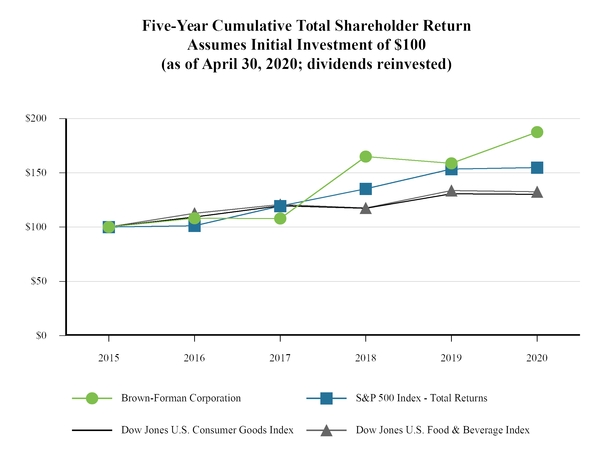]
Share Repurchases
The following table provides information about shares of our common stock (Class A and Class B, in total) that we acquired during the quarter ended April 30, 2019:
| | | | | | | | | | | |
| --- | --- | --- | --- | --- | --- | --- | --- | --- | --- | --- |
| Period | Total Number of Shares Purchased | | Average Price Paid per Share | | | Total Number of Shares Purchased as Part of Publicly Announced Plans or Programs | | Approximate Dollar Value of Shares that May Yet Be Purchased under the Plans or Programs | | |
| February 1, 2019 – February 28, 2019 | 14,204 | | $ | 47.07 | | — | | $ | — | |
| March 1, 2019 – March 31, 2019 | — | | $ | — | | — | | $ | — | |
| April 1, 2019 – April 30, 2019 | 1,490 | | $ | 51.86 | | — | | $ | — | |
| Total | 15,694 | | $ | 47.53 | | — | | | | |
The shares presented in the above table were acquired from employees to satisfy income tax withholdings triggered by the vesting of restricted shares.
Item 6. Selected Financial Data
26 rewritten, 1 added, 2 removed, 15 unchanged
| | [removed: (Dollars] [added: (Dollars] in millions, except per share [removed: amounts)] [added: amounts)] | | | | | | | | | | | | | | |
| | [removed: 2015] [added: 2016] | | | [removed: 2016] [added: 2017] | | | [removed: 2017] [added: 2018] | | | [removed: 2018] [added: 2019] | | | [removed: 2019] [added: 2020] | | |
| Sales | $ | [removed: 4,096 | | $ |] 4,011 | | $ | 3,857 | | $ | 4,201 | | $ | 4,276 | | [added: $ | 4,306 | |]
| Excise taxes | $ | [removed: 962 | | $ |] 922 | | $ | 863 | | $ | 953 | | $ | 952 | | [added: $ | 943 | |]
| Net sales | $ | [removed: 3,134 | | $ |] 3,089 | | $ | 2,994 | | $ | 3,248 | | $ | 3,324 | | [added: $ | 3,363 | |]
| Gross profit | $ | [removed: 2,183 | | $ |] 2,144 | | $ | 2,021 | | $ | 2,202 | | $ | 2,166 | | [added: $ | 2,127 | |]
| Operating income | $ | [removed: 1,045 | | $ |] 1,556 | | $ | 1,010 | | $ | 1,048 | | $ | 1,144 | | [added: $ | 1,091 | |]
| Net income | $ | [removed: 684 | | $ |] 1,067 | | $ | 669 | | $ | 717 | | $ | 835 | | [added: $ | 827 | |]
| Weighted average shares [added: (in millions)] used to calculate earnings per share | | | | | | | | | | | | | | | |
| – Basic | [removed: 529.0 | | |] 507.4 | | | 484.6 | | | 480.3 | | | 479.0 | | | [added: 477.8 | | |]
| – Diluted | [removed: 532.7 | | |] 510.7 | | | 488.1 | | | 484.2 | | | 482.1 | | | [added: 480.4 | | |]
| – Basic | $ | [removed: 1.29 | | $ |] 2.10 | | $ | 1.38 | | $ | 1.49 | | $ | 1.74 | | [added: $ | 1.73 | |]
| – Diluted | $ | [removed: 1.28 | | $ |] 2.09 | | $ | 1.37 | | $ | 1.48 | | $ | 1.73 | | [added: $ | 1.72 | |]
| Gross margin | [removed: 69.7 | | % |] 69.4 | | % | 67.5 | | % | 67.8 | | % | 65.2 | | % | [added: 63.2 | | % |]
| Operating margin | [removed: 33.3 | | % |] 50.4 | | % | 33.8 | | % | 32.3 | | % | 34.4 | | % | [added: 32.4 | | % |]
| Effective tax rate | [removed: 31.7] [added: 28.3] | | % | 28.3 | | % | [removed: 28.3] [added: 26.6] | | % | [removed: 26.6] [added: 19.8] | | % | [removed: 19.8] [added: 18.0] | | % |
| Average invested capital | $ | [removed: 3,196 | | $ |] 3,221 | | $ | 3,591 | | $ | 3,832 | | $ | 4,125 | | [added: $ | 4,387 | |]
| Return on average invested capital | [removed: 22.0 | | % |] 34.1 | | % | 19.8 | | % | 20.0 | | % | 22.0 | | % | [added: 20.4 | | % |]
| Cash provided by operations | $ | [removed: 631 | | $ |] 545 | | $ | 656 | | $ | 653 | | $ | 800 | | [added: $ | 724 | |]
| Dividend payout ratio | [removed: 37.5 | | % |] 25.0 | | % | 40.9 | | % | 107.8 | | % | 37.2 | | % | [added: 39.3 | | % |]
| Total assets | $ | [removed: 4,188 | | $ |] 4,183 | | $ | 4,625 | | $ | 4,976 | | $ | 5,139 | | [added: $ | 5,766 | |]
| Long-term debt | $ | [removed: 743 | | $ |] 1,230 | | $ | 1,689 | | $ | 2,341 | | $ | 2,290 | | [added: $ | 2,269 | |]
| Total debt | $ | [removed: 1,183 | | $ |] 1,501 | | $ | 2,149 | | $ | 2,556 | | $ | 2,440 | | [added: $ | 2,602 | |]
| [removed: 4.] [added: 3.] | See “Item 7. Management’s Discussion and Analysis of Financial Condition and Results of Operation – [added: Presentation Basis –] Non-GAAP Financial Measures” for details on our use of “return on average invested capital,” including how we calculate this measure and why we think this information is useful to readers. |
| [removed: 5.] [added: 4.] | Cash dividends declared per common share include a special cash dividend of $1.00 in fiscal 2018. |
| [removed: 6] [added: 5.] | We define dividend payout ratio as cash dividends divided by net income. |
| Cash dividends declared per common share | $ | 0.5240 | | $ | 0.5640 | | $ | 1.6080 | | $ | 0.6480 | | $ | 0.6806 | |
| Cash dividends declared per common share | $ | 0.484 | | $ | 0.524 | | $ | 0.564 | | $ | 1.608 | | $ | 0.648 | |
| 3. | As discussed in Note 2 to the Consolidated Financial Statements, we adopted Accounting Standards Updates (ASUs) 2016-15 and 2017-07 as of May 1, 2018. The amounts presented above for operating income, operating margin, and cash provided by operations differ from previously reported amounts due to the retrospective application of those ASUs. |
Item 8. Financial Statements and Supplementary Data
509 rewritten, 216 added, 211 removed, 591 unchanged
| [removed: Table] [added: Table] of [removed: Contents] [added: Contents] | |
[removed: | [Reports] [added: Reports] of [removed: Management](#s0BC37A3B4C9459FAAE39B309A5A22873) | [55](#s0BC37A3B4C9459FAAE39B309A5A22873) |][added: Management]
[removed: | [Report] [added: Report] of Independent Registered Public Accounting [removed: Firm](#sC1826A85D327545B97DDE4DD69032FB2) | [56](#sC1826A85D327545B97DDE4DD69032FB2) |][added: Firm]
[removed: | [Consolidated] [added: Consolidated] Statements of [removed: Operations](#s35AE0F70CA905462B016D8384CD5B27D) | [58](#s35AE0F70CA905462B016D8384CD5B27D) |][added: Operations]
[removed: | [Consolidated] [added: Consolidated] Statements of Comprehensive [removed: Income](#s4A004D0D697E548C8AC21F27C8174D26) | [59](#s4A004D0D697E548C8AC21F27C8174D26) |][added: Income]
[removed: | [Consolidated] [added: Consolidated] Balance [removed: Sheets](#s207183E6C7425CC795A96F4F19A2F7A6) | [60](#s207183E6C7425CC795A96F4F19A2F7A6) |][added: Sheets]
[removed: | [Consolidated] [added: Consolidated] Statements of Cash [removed: Flows](#s6946B21E7B3C529E82BFB74F10156E7E) | [61](#s6946B21E7B3C529E82BFB74F10156E7E) |][added: Flows]
[removed: | [Consolidated] [added: Consolidated] Statements of Stockholders’ [removed: Equity](#s9CFC16D37DC6533CB2C3812A4ABBADBD) | [62](#s3182A788D4DE5BD0BC1346E79C2DE1FC) |][added: Equity]
[removed: | [Notes] [added: Notes] to Consolidated Financial [removed: Statements](#sC34BB91AF330588A9CE261E8DEDE7C71) | [63](#sC34BB91AF330588A9CE261E8DEDE7C71) |][added: Statements]
[removed: | [Quarterly] [added: Quarterly] Financial Information [removed: (Unaudited)](#sB68F390D321E5B0983B2D77DCCD13055) | [89](#sB68F390D321E5B0983B2D77DCCD13055) |][added: (Unaudited)]
[removed: Reports] [added: | [Reports] of [removed: Management][added: Management](#s59E6E0CDB34F564E83E725851B2CDEB9) | [46](#s59E6E0CDB34F564E83E725851B2CDEB9) |]
[removed: Management’s] [added: Management’s] Responsibility for Financial [removed: Statements][added: Statements]
[removed: Management’s] [added: Management’s] Report on Internal Control over Financial [removed: Reporting][added: Reporting]
As of the end of our fiscal year, management conducted an assessment of the effectiveness of our internal control over financial reporting based on the framework and criteria in [removed: Internal] [added: *Internal] Control - Integrated Framework [removed: (2013)] [added: (2013)*] issued by the Committee of Sponsoring Organizations of the Treadway Commission.
Based on this assessment, management concluded that our internal control over financial reporting was effective as of April 30, [removed: 2019.][added: 2020.]
PwC, which audited and reported on the Company’s consolidated financial statements, has audited the effectiveness of our internal control over financial reporting as of April 30, [removed: 2019,] [added: 2020,] as stated in their report.
| Dated: | June [removed: 13, 2019] [added: 19, 2020] | | |
[removed: Report] [added: | [Report] of Independent Registered Public Accounting [removed: Firm][added: Firm](#s95F24BFBCF885A6D947BB7E84990C56A) | [47](#s95F24BFBCF885A6D947BB7E84990C56A) |]
[removed: Opinions] [added: Opinions] on the Financial Statements and Internal Control over Financial [removed: Reporting][added: Reporting]
We have audited the accompanying consolidated balance sheets of Brown-Forman Corporation and its subsidiaries (the “Company”) as of April 30, [removed: 2019] [added: 2020] and [removed: 2018,] [added: 2019,] and the related consolidated statements of operations, comprehensive income, stockholders’ equity and cash flows for each of the three years in the period ended April 30, [removed: 2019,] [added: 2020,] including the related notes and [added: financial statement] schedule [removed: of valuation and qualifying accounts] [added: listed in the index appearing under Item 15(a)(2)] for each of the three years in the period ended April 30, [removed: 2019 appearing under Item 15(a)(2)] [added: 2020] (collectively referred to as the “consolidated financial statements”).
We also have audited the Company’s internal control over financial reporting as of April 30, [removed: 2019,] [added: 2020,] based on criteria established in [removed: Internal] [added: *Internal] Control – Integrated [removed: Framework] [added: Framework*] (2013) issued by the Committee of Sponsoring Organizations of the Treadway Commission (COSO).
In our opinion, the consolidated financial statements referred to above present fairly, in all material respects, the financial position of the Company as of April 30, [removed: 2019] [added: 2020] and [removed: 2018,] [added: 2019,] and the results of [removed: their] [added: its] operations and [removed: their] [added: its] cash flows for each of the three years in the period ended April 30, [removed: 2019] [added: 2020] in conformity with accounting principles generally accepted in the United States of America.
Also in our opinion, the Company maintained, in all material respects, effective internal control over financial reporting as of April 30, [removed: 2019,] [added: 2020,] based on criteria established in [removed: Internal] [added: *Internal] Control – Integrated [removed: Framework] [added: Framework*] (2013) issued by the COSO.
[removed: Basis] [added: Basis] for [removed: Opinions][added: Opinions]
[removed: Definition] [added: Definition] and Limitations of Internal Control over Financial [removed: Reporting][added: Reporting]
A company’s internal control over financial reporting includes those policies and procedures that (i) pertain to the maintenance of records that, in reasonable detail, accurately and fairly reflect the transactions and dispositions of the assets of the company; (ii) provide reasonable assurance that transactions are recorded as necessary to permit preparation of financial statements in accordance with generally accepted accounting principles, and that receipts and expenditures of the company are being made only in accordance with authorizations of management and directors of the company; and (iii) provide [removed: reasonable assurance regarding prevention or timely detection of unauthorized acquisition, use, or disposition of the company’s assets that could have a material effect on the financial statements.]
[removed: Brown-Forman] [added: Brown-Forman] Corporation and [removed: Subsidiaries][added: Subsidiaries]
[removed: Consolidated] [added: | [Consolidated] Statements of [removed: Operations][added: Operations](#s914F50FDE5AB5E748E27523618EA2E68) | [49](#s914F50FDE5AB5E748E27523618EA2E68) |]
| [removed: Year] [added: Year] Ended April [removed: 30,] [added: 30,] | [removed: 2017] [added: 2018] | | | | [removed: 2018] [added: 2019] | | | | [removed: 2019] [added: 2020] | | |
| Sales | $ | [removed: 3,857] [added: 4,201] | | | $ | [removed: 4,201] [added: 4,276] | | | $ | [removed: 4,276] [added: 4,306] | |
| Excise taxes | [removed: 863] [added: 953] | | | | [removed: 953] [added: 952] | | | | [removed: 952] [added: 943] | | |
| Net sales | [removed: 2,994] [added: 3,248] | | | | [removed: 3,248] [added: 3,324] | | | | [removed: 3,324] [added: 3,363] | | |
| Cost of sales | [removed: 973] [added: 1,046] | | | | [removed: 1,046] [added: 1,158] | | | | [removed: 1,158] [added: 1,236] | | |
| Gross profit | [removed: 2,021] [added: 2,202] | | | | [removed: 2,202] [added: 2,166] | | | | [removed: 2,166] [added: 2,127] | | |
| Advertising expenses | [removed: 372] [added: 405] | | | | [removed: 405] [added: 396] | | | | [removed: 396] [added: 383] | | |
| Selling, general, and administrative expenses | [removed: 657] [added: 765] | | | | [removed: 765] [added: 641] | | | | [removed: 641] [added: 642] | | |
| Other expense (income), net | [removed: (18] [added: (16] | | ) | | [removed: (16] [added: (15] | | ) | | [removed: (15] [added: 11] | | [removed: )] |
| Operating income | [removed: 1,010] [added: 1,048] | | | | [removed: 1,048] [added: 1,144] | | | | [removed: 1,144] [added: 1,091] | | |
| Non-operating postretirement expense | [removed: 21] [added: 9] | | | | [removed: 9] [added: 22] | | | | [removed: 22] [added: 5] | | |
| Interest income | [removed: (3] [added: (6] | | ) | | [removed: (6] [added: (8] | | ) | | [removed: (8] [added: (5] | | ) |
As discussed in Note 1 to the consolidated financial statements, the Company changed the manner in which it accounts for leases on May 1, 2019.
reasonable assurance regarding prevention or timely detection of unauthorized acquisition, use, or disposition of the company’s assets that could have a material effect on the financial statements.
Critical Audit Matters
The critical audit matter communicated below is a matter arising from the current period audit of the consolidated financial statements that was communicated or required to be communicated to the audit committee and that (i) relates to accounts or disclosures that are material to the consolidated financial statements and (ii) involved our especially challenging, subjective, or complex judgments.
The communication of critical audit matters does not alter in any way our opinion on the consolidated financial statements, taken as a whole, and we are not, by communicating the critical audit matter below, providing a separate opinion on the critical audit matter or on the accounts or disclosures to which it relates.
Quantitative Impairment Assessment of Brand Names Intangible Assets
As described in Notes 1 and 5 to the consolidated financial statements, the other intangible assets balance as of April 30, 2020 was $635 million.
The balance consists of brand names and trademarks, with a significant portion relating to brand names, all of which are considered to have indefinite useful lives.
The Company assesses its brand names for impairment at least annually, or more frequently if circumstances indicate the carrying amount may be impaired.
The Company has the option, before quantifying the fair value of brand names, to evaluate qualitative factors to assess whether it is more likely than not that the 3 brand names are impaired.
If determined that is not the case, there is no requirement to quantify fair value.
Where a quantitative assessment is performed, a brand name is impaired when its carrying amount exceeds its estimated fair value, in which case management writes down the brand name to its estimated fair value.
The fair value of a brand name is typically estimated using either the “relief from royalty” or “excess earnings” method.
As described in Note 1, considerable judgment is necessary to estimate fair value, including the selection of assumptions about future cash flows, discount rates, and royalty rates.
During the fourth quarter of fiscal 2020, the Company recognized a non-cash impairment charge of $13 million for its Chambord brand name.
The Company determined Chambord’s fair value based on the relief from royalty method, using current assumptions.
The principal considerations for our determination that performing procedures relating to the quantitative impairment assessment of brand names intangible assets is a critical audit matter are (i) there was significant judgment by management when developing the fair value measurements of the brand names, which in turn led to a high degree of auditor judgment and subjectivity in performing procedures to evaluate management’s fair value measurements and (ii) there was significant audit effort in performing procedures and evaluating the significant assumptions, including future cash flows, discount rates, and royalty rates.
In addition, the audit effort involved the use of professionals with specialized skill and knowledge to assist in performing these procedures and evaluating the audit evidence obtained.
Addressing the matter involved performing procedures and evaluating audit evidence in connection with forming our overall opinion on the consolidated financial statements.
These procedures included testing the effectiveness of controls relating to management’s annual quantitative impairment analyses and periodic triggering event assessments for brand names, including controls over management’s determination of future cash flows, discount rates, and royalty rates.
These procedures also included, among others, evaluating the appropriateness of the relief from royalty or excess earnings method and the reasonableness of significant assumptions used by management in developing the fair value measurements, including future cash flows, discount rates, and royalty rates.
Professionals with specialized skill and knowledge were used to assist in the evaluation of the appropriateness of the valuation methodologies employed, as well as the reasonableness of the discount rates and royalty rates.
Evaluating management’s assumptions related to the future cash flows involved evaluating whether the assumptions used were reasonable considering (i) the past performance of the brand names, (ii) the consistency with external industry and market data, and (iii) whether the assumptions were consistent with evidence obtained in other areas of the audit.
Brown-Forman Corporation and Subsidiaries
Brown-Forman Corporation and Subsidiaries
Brown-Forman Corporation and Subsidiaries
| Net income | $ | 717 | | | $ | 835 | | | $ | 827 | |
| Non-cash intangible asset write-down | — | | | | — | | | | 13 | | |
Brown-Forman Corporation and Subsidiaries
| Stock split2 | | | | | 14 | | | | (14 | | ) | | | | | | | | | | | | | | — | | |
| Adoption of ASU 2018-02 (Note 1) | | | | | | | | | | | | | 43 | | | | (43 | | ) | | | | | | — | | |
| Balance at April 30, 2020 | $ | 25 | | | $ | 47 | | | $ | — | | | $ | 2,708 | | | $ | (547 | ) | | $ | (258 | ) | | $ | 1,975 | |
2Stock split effected in the form of a stock dividend of one share of Class B common stock for every four shares of either Class A or Class B common stock.
Brown-Forman Corporation and Subsidiaries
1.
Considerable
- ASU 2016-02: Leases.
This update, codified along with various amendments as Accounting Standards Codification Topic 842 (ASC 842), replaces previous lease accounting guidance.
Under ASC 842, a lessee should recognize on its balance sheet a liability to make lease payments and a right-of-use asset representing its right to use the underlying asset for the lease term.
Upon adoption, we recorded lease liabilities and right-of-use assets of $54.
| | |
| --- | --- |
June 13, 2019
| | | | | | | | | | | | |
| --- | --- | --- | --- | --- | --- | --- | --- | --- | --- | --- | --- |
| Additional paid-in capital | 4 | | | | — | | |
| Repayment of short-term obligation associated with acquisition of business | (30 | | ) | | — | | | | — | | |
| Balance at April 30, 2016 | $ | 13 | | | $ | 21 | | | $ | 114 | | | $ | 4,065 | | | $ | (350 | ) | | $ | (2,301 | ) | | $ | 1,562 | |
| Stock split (Note 8) | 12 | | | | 22 | | | | (34 | | ) | | | | | | | | | | | | | | — | | |
| Stock split (Note 8) | | | | | 14 | | | | (14 | | ) | | | | | | | | | | | | | | — | | |
| Cumulative effect of change in accounting principle (Note 2) | | | | | | | | | | | | | (5 | | ) | | | | | | | | | | (5 | | ) |
1.
Principles of consolidation.
Estimates.
Cash equivalents.
Allowance for doubtful accounts.
Inventories.
Revenue recognition.
Cost of sales.
Advertising costs.
Selling, general, and administrative expenses.
Income taxes.
Foreign currency transactions and translation.
Reclassifications.
We have reclassified some previously reported expense amounts related to certain marketing research and promotional agency costs to conform to the current year classification.
These immaterial reclassifications between advertising expenses and selling, general, and administrative expenses had no impact on operating income or net income.
2.
Adoption of Updated Accounting Standards
| • | ASU 2016-09: Improvements to Employee Share-Based Payment Accounting. This new guidance amends certain aspects of the accounting for stock-based compensation, including the income tax consequences. Under the new guidance, we recognize all tax benefits related to stock-based compensation as an income tax benefit in our statement of operations, and include all income tax cash flows within operating activities in our statement of cash flows. Under the previous accounting guidance, we recognized some of those tax benefits (excess tax benefits) as additional paid-in capital and classified that amount as a financing activity in our statement of cash flows. We adopted these provisions of the new guidance on a prospective basis. |
Also, under the new guidance, we recognize the excess tax benefits during the period in which the related awards vest or are exercised.
Under the previous accounting guidance, we recognized those benefits during the period in which they reduced taxes payable.
We adopted this provision of the new guidance on a modified retrospective basis through a cumulative-effect adjustment that increased retained earnings as of May 1, 2016, by $10.
We adopted the following ASUs as of May 1, 2018:
| • | ASU 2014-09: Revenue from Contracts with Customers. This update, codified along with various amendments as Accounting Standards Codification Topic 606 (ASC 606), replaces previous revenue recognition guidance. The core principle of ASC 606 requires an entity to recognize revenue to depict the transfer of promised goods or services to customers in an amount that reflects the consideration that it expects to be entitled to in exchange for those goods or services. ASC 606 also requires more financial statement disclosures than were required by previous revenue recognition standards. |
We adopted ASC 606 using the modified retrospective method.
As a result, we recorded an adjustment that decreased retained earnings as of May 1, 2018, by $25 (net of tax).
The adjustment reflects the cumulative effect on that date of applying our updated revenue recognition policy, under which we recognize the cost of certain customer incentives earlier than we did before adopting ASC 606.
Although this change in timing did not have a significant impact on a full-year basis, there was some change in the timing of recognition across periods.
Additionally, some payments to customers that we classified as expenses before adopting the new standard are classified as reductions of net sales under our new policy.
The following table shows how the adoption of ASC 606 impacted our consolidated statement of operations for the year ended April 30, 2019:
An excerpt. Shown here: 40 of 509 rewritten, 40 of 216 added and 40 of 211 removed. The counts are complete. For every sentence, read Item 8. Financial Statements and Supplementary Data in the FY2020 filing and the FY2019 filing.
Item 9A. Controls and Procedures
3 rewritten, 0 added, 3 removed, 2 unchanged
[added: *Evaluation of Disclosure Controls and Procedures.*] Our management, with the participation of our Chief Executive Officer (CEO) and Chief Financial Officer (CFO) (our principal executive and principal financial officers), has evaluated the effectiveness of our disclosure controls and procedures (as defined in Rule 13a-15(e) under the Securities Exchange Act of 1934, as amended (the “Exchange Act”)) as of the end of fiscal [removed: 2019.][added: 2020.]
[added: *Changes in Internal Control over Financial Reporting.*] There has been no change in our internal control over financial reporting during the quarter ended April 30, [removed: 2019,] [added: 2020,] that has materially affected, or is reasonably likely to materially affect, our internal control over financial reporting.
[removed: Management’s] [added: *Management’s] Report on Internal Control over Financial Reporting and Report of Independent Registered Public Accounting [removed: Firm.][added: Firm.* Management’s report on our internal control over financial reporting as of April 30, 2020, and our independent registered public accounting firm’s report on our internal control over financial reporting are set forth in “Item 8.]
Evaluation of Disclosure Controls and Procedures.
Changes in Internal Control over Financial Reporting.
Management’s report on our internal control over financial reporting as of April 30, 2019, and our independent registered public accounting firm’s report on our internal control over financial reporting are set forth in “Item 8.
Item 9B. Other Information
1 rewritten, 0 added, 0 removed, 1 unchanged
[removed: PART III][added: PART III]
Item 10. Directors, Executive Officers, and Corporate Governance
1 rewritten, 0 added, 0 removed, 1 unchanged
For the other information required by this item, see the following sections of our definitive proxy statement for the Annual Meeting of Stockholders to be held July [removed: 25, 2019,] [added: 30, 2020,] which information is incorporated into this report by reference: (a) [removed: “Election] [added: “Proposal 1: Election] of Directors” (for biographical information on directors and family relationships); (b) “Code of [removed: Conduct” (for information on our] [added: Conduct and] Code of [removed: Ethics); (c) “Delinquent Section 16(a) Reports”] [added: Ethics for Senior Financial Officers”] (for information on [removed: compliance with Section 16] [added: our code] of [removed: the Exchange Act); (d)] [added: ethics); (c)] “Selection of Directors” (for information on the procedures by which security holders may recommend nominees to the Company’s Board of Directors); and [removed: (e)] [added: (d)] “Corporate Governance” (for information on our Audit Committee).
Item 11. Executive Compensation
1 rewritten, 0 added, 0 removed, 0 unchanged
For the information required by this item, refer to the following sections of our definitive proxy statement for the Annual Meeting of Stockholders to be held July [removed: 25, 2019,] [added: 30, 2020,] which information is incorporated into this report by reference: (a) “Compensation Discussion and Analysis”; (b) “Compensation Tables”; (c) “Director Compensation”; (d) “Compensation Committee Interlocks and Insider Participation”; (e) “Compensation Committee Report”; and (f) “Pay Ratio Disclosure.”
Item 12. Security Ownership of Certain Beneficial Owners and Management and Related Stockholder Matters
1 rewritten, 0 added, 0 removed, 1 unchanged
Market for the Registrant’s Common Equity, Related Stockholder Matters, and Issuer Purchases of Equity Securities.” For the other information required by this item, refer to the section entitled “Stock Ownership” of our definitive proxy statement for the Annual Meeting of Stockholders to be held July [removed: 25, 2019,] [added: 30, 2020,] which information is incorporated into this report by reference.
Item 13. Certain Relationships and Related Transactions, and Director Independence
1 rewritten, 0 added, 0 removed, 0 unchanged
For the information required by this item, refer to the following sections of our definitive proxy statement for the Annual Meeting of Stockholders to be held July [removed: 25, 2019,] [added: 30, 2020,] which information is incorporated into this report by reference: (a) “Certain Relationships and Related Transactions”; and (b) “Our Independent Directors.”
Item 14. Principal Accounting Fees and Services
2 rewritten, 0 added, 0 removed, 0 unchanged
For the information required by this item, refer to the following sections of our definitive proxy statement for the Annual Meeting of Stockholders to be held July [removed: 25, 2019,] [added: 30, 2020,] which information is incorporated into this report by reference: (a) “Fees Paid to Independent Registered Public Accounting Firm”; and (b) “Audit Committee Pre-Approval Policies and Procedures.”
[removed: PART IV][added: PART IV]
Item 15. Exhibits and Financial Statement Schedules
24 rewritten, 5 added, 0 removed, 59 unchanged
| | | [removed: Page] [added: Page] |
| | [Report of Independent Registered Public Accounting [removed: Firm](#sC1826A85D327545B97DDE4DD69032FB2)] [added: Firm](#s95F24BFBCF885A6D947BB7E84990C56A)] | [removed: [56](#sC1826A85D327545B97DDE4DD69032FB2)] [added: [47](#s95F24BFBCF885A6D947BB7E84990C56A)] |
| | [Consolidated Statements of [removed: Operations](#s35AE0F70CA905462B016D8384CD5B27D)] [added: Operations](#s914F50FDE5AB5E748E27523618EA2E68)] | [removed: [58](#s35AE0F70CA905462B016D8384CD5B27D)] [added: [49](#s914F50FDE5AB5E748E27523618EA2E68)] |
| | [Consolidated Statements of Comprehensive [removed: Income](#s4A004D0D697E548C8AC21F27C8174D26)] [added: Income](#s3171852D50695A66A7C6F24895421180)] | [removed: [59](#s4A004D0D697E548C8AC21F27C8174D26)] [added: [50](#s3171852D50695A66A7C6F24895421180)] |
| | [Consolidated Balance [removed: Sheets](#s207183E6C7425CC795A96F4F19A2F7A6)] [added: Sheets](#s165A7BD7C1C35218AE6C81805C7D2361)] | [removed: [60](#s207183E6C7425CC795A96F4F19A2F7A6)] [added: [51](#s165A7BD7C1C35218AE6C81805C7D2361)] |
| | [Consolidated Statements of Cash [removed: Flows](#s6946B21E7B3C529E82BFB74F10156E7E)] [added: Flows](#s9193475BF22B5B61AD7CAFFD64EB01FD)] | [removed: [61](#s6946B21E7B3C529E82BFB74F10156E7E)] [added: [51](#s9193475BF22B5B61AD7CAFFD64EB01FD)] |
| | [Consolidated Statements of Stockholders’ [removed: Equity](#s9CFC16D37DC6533CB2C3812A4ABBADBD)] [added: Equity](#sE8FE5D7B99DD555C9B809756E1354651)] | [removed: [62](#s3182A788D4DE5BD0BC1346E79C2DE1FC)] [added: [52](#s17E35803DA5354C89680CD37873053D2)] |
| | [Notes to Consolidated Financial [removed: Statements](#sC34BB91AF330588A9CE261E8DEDE7C71)] [added: Statements](#sB8CCB3453E215C56B13085B598962203)] | [removed: [63](#sC34BB91AF330588A9CE261E8DEDE7C71)] [added: [53](#sB8CCB3453E215C56B13085B598962203)] |
| | [Schedule II – Valuation and Qualifying [removed: Accounts](#s2BA924378D085778999CC31F25041978)] [added: Accounts](#s5270499FC48E5D019C8A80567EDB6336)] | [removed: [97](#s2BA924378D085778999CC31F25041978)] [added: [84](#s5270499FC48E5D019C8A80567EDB6336)] |
(a)(3) [removed: Exhibits:][added: *Exhibits:*]
| [removed: Exhibit Index] [added: Exhibit Index] | |
| 4.1 | [Description of Brown-Forman Corporation’s Class A Common Stock, par value $0.15 per share, and Class B Common Stock, par value $0.15 per [removed: share.](https://www.sec.gov/Archives/edgar/data/14693/000001469319000099/descriptionofcapitalstock.htm)] [added: share.](https://www.sec.gov/Archives/edgar/data/14693/000001469320000066/descriptionofcapitalst.htm)] |
| 4.2 | [Description of Brown-Forman Corporation’s 1.200% Notes due [removed: 2026.](https://www.sec.gov/Archives/edgar/data/14693/000001469319000099/descriptionof1200notesdue2.htm)] [added: 2026.](https://www.sec.gov/Archives/edgar/data/14693/000001469320000066/descriptionof1200notes.htm)] |
| 4.3 | [Description of Brown-Forman Corporation’s 2.600% Notes due [removed: 2028.](https://www.sec.gov/Archives/edgar/data/14693/000001469319000099/descriptionof2600notesdue2.htm)] [added: 2028.](https://www.sec.gov/Archives/edgar/data/14693/000001469320000066/descriptionof2600notes.htm)] |
| 21 | [Subsidiaries of the [removed: Registrant.](https://www.sec.gov/Archives/edgar/data/14693/000001469319000099/bfb-ex21_2019430x10kapril.htm)] [added: Registrant.](https://www.sec.gov/Archives/edgar/data/14693/000001469320000066/bfb-ex212020430x10kapr.htm)] |
| 23 | [Consent of PricewaterhouseCoopers LLP, independent registered public accounting [removed: firm.](https://www.sec.gov/Archives/edgar/data/14693/000001469319000099/bfb-ex23_2019430x10kapril.htm)] [added: firm.](https://www.sec.gov/Archives/edgar/data/14693/000001469320000066/bfb-ex232020430x10kapr.htm)] |
| 31.1 | [CEO Certification pursuant to Section 302 of Sarbanes-Oxley Act of [removed: 2002.](https://www.sec.gov/Archives/edgar/data/14693/000001469319000099/bfb-ex311_2019430x10kapril.htm)] [added: 2002.](https://www.sec.gov/Archives/edgar/data/14693/000001469320000066/bfb-ex3112020430x10kap.htm)] |
| 31.2 | [CFO Certification pursuant to Section 302 of Sarbanes-Oxley Act of [removed: 2002.](https://www.sec.gov/Archives/edgar/data/14693/000001469319000099/bfb-ex312_2019430x10kapril.htm)] [added: 2002.](https://www.sec.gov/Archives/edgar/data/14693/000001469320000066/bfb-ex3122020430x10kap.htm)] |
| 32 | [CEO and CFO Certification pursuant to 18 U.S.C. Section 1350, as adopted pursuant to Section 906 of the Sarbanes-Oxley Act of 2002 (not considered to be [removed: filed).](https://www.sec.gov/Archives/edgar/data/14693/000001469319000099/bfb-ex32_2019430x10kapril.htm)] [added: filed).](https://www.sec.gov/Archives/edgar/data/14693/000001469320000066/bfb-ex322020430x10kapr.htm)] |
| 101 | The following materials from Brown-Forman Corporation’s Annual Report on Form 10-K for the fiscal year ended April 30, [removed: 2019, formatted] [added: 2020,] in [added: Inline] XBRL (eXtensible Business Reporting [removed: Language):] [added: Language) format:] (a) Consolidated Statements of Operations, (b) Consolidated Statements of Comprehensive Income, (c) Consolidated Balance Sheets, (d) Consolidated Statements of Cash Flows, (e) Consolidated Statements of Stockholders’ Equity, and (f) Notes to Consolidated Financial Statements. |
| 3.3 | [By-laws of registrant, as amended and restated [removed: on January 29, 2019,] [added: effective May 21, 2020,] incorporated into this report by reference to Exhibit [removed: 3.2] [added: 3.1] of Brown-Forman Corporation’s Form 8-K filed on [removed: January 30, 2019] [added: May 27, 2020] (File No. [removed: 001-00123).](http://www.sec.gov/Archives/edgar/data/14693/000001469319000004/restatedby-laws.htm)] [added: 001-00123).](https://www.sec.gov/Archives/edgar/data/14693/000001469320000030/brown-formanxamendedan.htm)] |
| 4.9 | [Form of 2.600% Note due [removed: Note due] 2028, incorporated into this report by reference to Exhibit 4.6 of Brown-Forman Corporation’s Form 8-K filed on July 8, 2016 (File No. 002-26821).](http://www.sec.gov/Archives/edgar/data/14693/000119312516644569/d210478dex46.htm) |
| 10.21 | [Letter Agreement between Brown-Forman Corporation and Jill A. Jones dated May 14, 2018, incorporated into this report by reference to Exhibit 10.1 of Brown-Forman Corporation’s Form 8-K filed on May 16, 2018 (File No. [removed: 001-00123).](http://www.sec.gov/Archives/edgar/data/14693/000001469318000055/ex101-letteragreement.htm)] [added: 001-00123).*](http://www.sec.gov/Archives/edgar/data/14693/000001469318000055/ex101-letteragreement.htm)] |
| * | [removed: Indicates] [added: *Indicates] management contract, compensatory plan, or [removed: arrangement.] [added: arrangement.*] |
| 104 | Cover Page Interactive Data File in Inline XBRL format (included in Exhibit 101). |
| Exhibit Index | |
| Exhibit Index | |
| Exhibit Index | |
| 16 | [Letter from PricewaterhouseCoopers LLP to the Securities and Exchange Commission dated February 25, 2020, incorporated into this report by reference to Exhibit 16.1 of Brown-Forman Corporation’s Form 8-K filed on February 25, 2020 (File No. 001-00123).](https://www.sec.gov/Archives/edgar/data/14693/000001469320000014/pwcletter.htm) |
Item 16. Form 10-K Summary
11 rewritten, 3 added, 8 removed, 115 unchanged
[removed: SIGNATURES][added: SIGNATURES]
Date: June [removed: 13, 2019][added: 19, 2020]
Pursuant to the requirements of the Securities Exchange Act of 1934, this report has been signed below by the following persons on behalf of the registrant and in the capacities on June [removed: 13, 2019,] [added: 19, 2020,] as indicated:
[removed: Brown-Forman] [added: Brown-Forman] Corporation and [removed: Subsidiaries][added: Subsidiaries]
[removed: Schedule] [added: Schedule] II – Valuation and Qualifying [removed: Accounts][added: Accounts]
[removed: For] [added: For] the Years [removed: Ended April] [added: Ended April] 30, [removed: 2017, 2018, and 2019][added: 2018, 2019, and 2020]
[removed: (Expressed] [added: (Expressed] in [removed: millions)][added: millions)]
| [removed: Col. A] [added: Col. A] | [removed: Col. B] [added: Col. B] | | | | [removed: Col. C(1)] [added: Col. C(1)] | | | | [removed: Col. C(2)] [added: Col. C(2)] | | | | [removed: Col. D] [added: Col. D] | | | | [removed: Col. E] [added: Col. E] | | |
| [removed: Description] [added: Description] | [removed: Balance at Beginning of Period] [added: Balance at Beginning of Period] | | | | [removed: Additions Charged to Costs and Expenses] [added: Additions Charged to Costs and Expenses] | | | | [removed: Additions Charged to Other Accounts] [added: Additions Charged to Other Accounts] | | | | [removed: Deductions] [added: Deductions] | | | | [removed: Balance at End of Period] [added: Balance at End of Period] | | |
| Allowance for doubtful accounts | $ | [removed: 9] [added: 7] | | | $ | [removed: —] [added: 4] | | | $ | — | | | $ | [removed: 2] [added: —] | | [removed: (1)] | $ | [removed: 7] [added: 11] | |
| Deferred tax valuation allowance | $ | 25 | | | $ | [removed: 5] [added: 2] | | | $ | [removed: 2] [added: —] | | | $ | [removed: 2] [added: 5] | | | $ | [removed: 30] [added: 22] | |
| /s/ Kelli N. Brown | | |
| By: | Kelli N. Brown | |
| 2020 | | | | | | | | | | | | | | | | | | | |
| | | |
| --- | --- | --- |
| | Director | |
| /s/ Paul C. Varga | | |
| By: | Paul C. Varga | |
| /s/ Kelli B. Nelson | | |
| By: | Kelli B. Nelson | |
| 2017 | | | | | | | | | | | | | | | | | | | |