 filings.tools
Biogen 10-K 2015-12-31
Filed 2016-02-03. 21 sections, 623K characters. Original on sec.gov · Markdown · JSON
Cover and table of contents
10-K 1 biib-20151231x10k.htm 10-K
UNITED STATES SECURITIES AND EXCHANGE COMMISSION
Washington, D.C. 20549
Form 10-K
| x | ANNUAL REPORT PURSUANT TO SECTION 13 OR 15(d) OF THE SECURITIES EXCHANGE ACT OF 1934 |
| For the fiscal year ended December 31, 2015 |
or
| o | TRANSITION REPORT PURSUANT TO SECTION 13 OR 15(d) OF THE SECURITIES EXCHANGE ACT OF 1934 |
Commission file number: 0-19311
BIOGEN INC.
(Exact name of registrant as specified in its charter)
| Delaware | 33-0112644 | |
| (State or other jurisdiction of incorporation or organization) | (I.R.S. Employer Identification No.) |
225 Binney Street, Cambridge, Massachusetts 02142
(617) 679-2000
(Address, including zip code, and telephone number, including area code, of Registrant’s principal executive offices)
Securities registered pursuant to Section 12(b) of the Act:
| Title of Each Class | Name of Each Exchange on Which Registered | |
| Common Stock, $0.0005 par value | The Nasdaq Global Select Market |
Securities registered pursuant to Section 12(g) of the Act:
None
Indicate by check mark if the registrant is a well-known seasoned issuer, as defined in Rule 405 of the Securities Act. Yes x No o
Indicate by check mark if the registrant is not required to file reports pursuant to Section 13 or 15(d) of the Act. Yes o No x
Indicate by check mark whether the registrant (1) has filed all reports required to be filed by Section 13 or 15(d) of the Securities Exchange Act of 1934 during the preceding 12 months (or for such shorter period that the registrant was required to file such reports), and (2) has been subject to such filing requirements for the past 90 days. Yes x No o
Indicate by check mark whether the registrant has submitted electronically and posted on its corporate Web site, if any, every Interactive Data File required to be submitted and posted pursuant to Rule 405 of Regulation S-T during the preceding 12 months (or for such shorter period that the registrant was required to submit and post such files): Yes x No o
Indicate by check mark if disclosure of delinquent filers pursuant to Item 405 of Regulation S-K is not contained herein, and will not be contained, to the best of the registrant’s knowledge, in definitive proxy or information statements incorporated by reference in Part III of this Form 10-K or any amendment to this Form 10-K. x
Indicate by check mark whether the registrant is a large accelerated filer, an accelerated filer, a non-accelerated filer, or a smaller reporting company. See the definitions of “large accelerated filer,” “accelerated filer” and “smaller reporting company” in Rule 12b-2 of the Exchange Act.
| Large accelerated filer x | Accelerated filer o | Non-accelerated filer o | Smaller reporting company o | |||
| (Do not check if a smaller reporting company) |
Indicate by check mark whether the registrant is a shell company (as defined in Rule 12b-2 of the Act). Yes o No x
The aggregate market value of the registrant’s common stock held by non-affiliates of the registrant (without admitting that any person whose shares are not included in such calculation is an affiliate) computed by reference to the price at which the common stock was last sold as of the last business day of the registrant’s most recently completed second fiscal quarter was $94,898,425,323.
As of January 29, 2016, the registrant had 218,672,717 shares of common stock, $0.0005 par value, outstanding.
DOCUMENTS INCORPORATED BY REFERENCE
Portions of the definitive proxy statement for our 2016 Annual Meeting of Stockholders are incorporated by reference into Part III of this report.
BIOGEN INC.
ANNUAL REPORT ON FORM 10-K
For the Year Ended December 31, 2015
TABLE OF CONTENTS
NOTE REGARDING FORWARD-LOOKING STATEMENTS
This report contains forward-looking statements that are being made pursuant to the provisions of the Private Securities Litigation Reform Act of 1995 (the Act) with the intention of obtaining the benefits of the “Safe Harbor” provisions of the Act. These forward-looking statements may be accompanied by such words as “anticipate,” “believe,” “could,” “estimate,” “expect,” “forecast,” “intend,” “may,” “plan,” “potential,” “project,” “target,” “will” and other words and terms of similar meaning. Reference is made in particular to forward-looking statements regarding:
| • | the anticipated amount, timing and accounting of revenues, contingent payments, milestone, royalty and other payments under licensing, collaboration or acquisition agreements, tax positions and contingencies, collectability of receivables, pre-approval inventory, cost of sales, research and development costs, compensation and other selling, general and administrative expenses, amortization of intangible assets, foreign currency exchange risk, estimated fair value of assets and liabilities, and impairment assessments; |
| • | expectations, plans and prospects relating to sales, pricing, growth and launch of our marketed and pipeline products; |
| • | the potential impact of increased product competition in the markets in which we compete; |
| • | patent terms, patent term extensions, patent office actions and expected availability and period of regulatory exclusivity; |
| • | the costs and timing of potential clinical trials, filing and approvals, and the potential therapeutic scope of the development and commercialization of our and our collaborators’ pipeline products; |
| • | the drivers for growing our business, including our plans and intent to commit resources relating to business development opportunities and research and development programs; |
| • | the anticipated benefits, cost savings, and charges related to our corporate restructuring initiatives; |
| • | our manufacturing capacity, use of third-party contract manufacturing organizations and plans and timing relating to the expansion of our manufacturing capabilities, including anticipated investments and activities in new manufacturing facilities; |
| • | the impact of the continued uncertainty of the credit and economic conditions in certain countries in Europe and our collection of accounts receivable in such countries; |
| • | the potential impact of healthcare reform in the United States (U.S.) and measures being taken worldwide designed to reduce healthcare costs to constrain the overall level of government expenditures, including the impact of pricing actions and reduced reimbursement for our products; |
| • | the timing, outcome and impact of administrative, regulatory, legal and other proceedings related to patents and other proprietary and intellectual property rights, tax audits, assessments and settlements, pricing matters, sales and promotional practices, product liability and other matters; |
| • | lease commitments, purchase obligations and the timing and satisfaction of other contractual obligations; |
| • | our ability to finance our operations and business initiatives and obtain funding for such activities; and |
| • | the impact of new laws and accounting standards. |
These forward-looking statements involve risks and uncertainties, including those that are described in the “Risk Factors” section of this report, and elsewhere in this report that could cause actual results to differ materially from those reflected in such statements. You should not place undue reliance on these statements. Forward-looking statements speak only as of the date of this report. Except as required by law, we do not undertake any obligation to publicly update any forward-looking statements, whether as a result of new information, future developments or otherwise.
NOTE REGARDING COMPANY AND PRODUCT REFERENCES
Throughout this report, “Biogen,” the “Company,” “we,” “us” and “our” refer to Biogen Inc. (formerly Biogen Idec Inc.) and its consolidated subsidiaries. References to “RITUXAN” refer to both RITUXAN (the trade name for rituximab in the U.S., Canada and Japan) and MabThera (the trade name for rituximab outside the U.S., Canada and Japan), and “ANGIOMAX” refers to both ANGIOMAX (the trade name for bivalirudin in the U.S., Canada and Latin America) and ANGIOX (the trade name for bivalirudin in Europe).
NOTE REGARDING TRADEMARKS
ALPROLIX®, AVONEX®, BENEPALI®, ELOCTATE®, FLIXABI®, PLEGRIDY®, RITUXAN®, TECFIDERA® and TYSABRI® are registered trademarks of Biogen. FUMADERMTM and ZINBRYTATM are trademarks of Biogen. Other trademarks referenced in this report are the property of their respective owners.
PART I
Item 1. Business
Overview
Biogen is a global biopharmaceutical company focused on discovering, developing, manufacturing and delivering therapies to patients for the treatment of neurodegenerative diseases, hematologic conditions and autoimmune disorders.
Our marketed products include TECFIDERA, AVONEX, PLEGRIDY, TYSABRI and FAMPYRA for multiple sclerosis (MS), ELOCTATE for hemophilia A and ALPROLIX for hemophilia B, and FUMADERM for the treatment of severe plaque psoriasis. We also have a collaboration agreement with Genentech, Inc. (Genentech), a wholly-owned member of the Roche Group (Roche Group), which entitles us to certain business and financial rights with respect to RITUXAN for the treatment of non-Hodgkin's lymphoma, chronic lymphocytic leukemia (CLL) and other conditions, GAZYVA indicated for the treatment of CLL, and other potential anti-CD20 therapies.
We support our drug discovery and development efforts through the commitment of significant resources to discovery, research and development programs and business development opportunities, particularly within areas of our scientific, manufacturing and technical expertise and scientific adjacencies. In addition to our innovative drug development efforts, we aim to leverage our manufacturing capabilities and scientific expertise to extend our mission to improve the lives of patients living with serious diseases through the development, manufacture and marketing of biosimilars through Samsung Bioepis, our joint venture with Samsung BioLogics Co. Ltd. (Samsung Biologics).
Key Developments
During 2015 and early 2016, we had a number of key developments affecting our business.
Corporate Matters
Company Name Change
In March 2015, we changed our name from Biogen Idec Inc. to Biogen Inc.
Corporate Restructuring
In October 2015, we announced a corporate restructuring, which includes a reduction in workforce and discontinuation of certain programs. We are reinvesting the resulting savings to support key commercial activities and the advancement of our pipeline candidates.
Capital Allocation
In 2015, our capital allocation strategy included the following elements:
| Share Repurchase Program | l | Returned approximately $5.0 billion to our shareholders through our share repurchase program |
| l | Utilized a portion of the proceeds from our $6.0 billion senior unsecured debt offering completed in September 2015 to fund our share repurchase program | |
| Acquisitions and Collaborations | l | Acquired Convergence Pharmaceuticals (Convergence), a clinical-stage biopharmaceutical company with a focus on developing product candidates for neuropathic pain |
| l | Obtained exclusive worldwide license, excluding Asia, from Mitsubishi Tanabe Pharma Corporation (MTPC) to amiselimod (MT-1303), a late stage experimental medicine with potential in multiple autoimmune indications | |
| l | Entered into a collaboration agreement with Applied Genetic Technologies Corporation (AGTC) to develop gene-based therapies for multiple ophthalmic diseases | |
| Investment in Manufacturing | l | Acquired land in Solothurn, Switzerland, where we plan to build a biologics manufacturing facility in the Commune of Luterbach over the next several years |
| l | Acquired the drug product manufacturing facility and supporting infrastructure of Eisai, Inc. (Eisai) in Research Triangle Park (RTP), North Carolina |
Corporate Responsibility
 |
| Environmental Sustainability |
In 2015, we were named the biotechnology industry leader on the Dow Jones Sustainability World Index, an index that tracks the economic, environmental and social strategy and performance of the 2,500 largest companies in the S&P Global Broad Market Index.
In 2015, we announced that we achieved carbon neutrality, meaning we believe we have effectively neutralized all of the carbon emissions associated with our business.
 |
| Humanitarian Aid |
In 2014, we and Swedish Orphan Biovitrum AB (publ) (Sobi) began working with the World Federation of Hemophilia (WFH) to help people with hemophilia in the developing world through our pledge to donate up to one billion international units (IUs) of clotting factor therapy for humanitarian use, of which up to 500 million IUs will be donated to WFH USA over a period of five years. In 2015, we made the first shipments of hemophilia therapy to WFH USA.
Product/Pipeline Developments
| Multiple Sclerosis | |
| ZINBRYTA (daclizumab high yield process) | |
| l | In March 2015, the European Medicines Agency (EMA) validated our marketing authorization application (MAA) for ZINBRYTA for the treatment of relapsing forms of MS in the European Union (E.U.). |
| l | In April 2015, the U.S. Food and Drug Administration (FDA) accepted our Biologics License Application (BLA) for ZINBRYTA for the treatment of relapsing forms of MS in the United States (U.S.). |
| TYSABRI (natalizumab) | |
| l | In July 2015, the results of ACTION, our Phase 2 trial investigating TYSABRI in acute ischemic stroke, did not demonstrate an impact on change in infarct volume, the primary endpoint. Exploratory endpoints suggested that TYSABRI had a beneficial impact on patient functional deficits. |
| l | In October 2015, the results of ASCEND, our Phase 3 study evaluating TYSABRI in secondary progressive MS (SPMS), did not achieve its primary and secondary endpoints, and the development of TYSABRI in SPMS was discontinued. |
| Anti-LINGO | |
| l | In January 2015, we announced top-line results from RENEW, our Phase 2 acute optic neuritis trial. |
| Hemophilia | |
| ELOCTATE [Antihemophilic Factor (Recombinant), Fc Fusion Protein] | |
| l | In November 2015, the European Commission (EC) approved ELOCTA, the approved trade name for ELOCTATE in the E.U., for the treatment of hemophilia A. |
| l | Sobi has assumed final development and commercialization of ELOCTA in their territory, which essentially includes Europe, North Africa, Russia, and certain markets in the Middle East (Sobi Territory). |
| ALPROLIX [Coagulation Factor IX (Recombinant), Fc Fusion Protein] | |
| l | In June 2015, the EMA validated our MAA for ALPROLIX for the treatment of hemophilia B. |
| l | In July 2015, Sobi exercised its option to assume final development and commercialization of ALPROLIX in the Sobi Territory. |
| Neurodegeneration | |
| Aducanumab (BIIB037) | |
| l | In March 2015 and July 2015, we announced data from pre-specified interim analyses of PRIME, our Phase 1b study of aducanumab. |
| l | In September 2015, we enrolled our first patient in our two global Phase 3 studies, ENGAGE and EMERGE, to assess the efficacy and safety of aducanumab in people with early Alzheimer's disease. In October 2015, we announced that we received FDA agreement on a special protocol assessment on the Phase 3 study protocols. Such agreement constitutes FDA’s concurrence on the design and size of the clinical trials which will form the basis for approval of aducanumab. |
| Other Programs | |
| Nusinersen (ISIS-SMNRx) | |
| l | In June 2015, our collaborator, Ionis Pharmaceuticals, Inc. (Ionis), formerly known as Isis Pharmaceuticals, Inc., announced additional data from two Phase 2 studies of nusinersen for the treatment of SMA in infants and children. There are two ongoing Phase 3 studies of nusinersen. |
| Genentech Relationships | |
| GAZYVA (obinutuzumab) | |
| l | In February 2015, the Roche Group announced positive results from its Phase 3 GADOLIN study of GAZYVA in non-Hodgkin’s lymph |
Showing the first 8K of 105K characters. Open the full section
Item 1A. Risk Factors
We are substantially dependent on revenues from our principal products.
Our current revenues depend upon continued sales of our principal products. We may be substantially dependent on sales from our principal products for many years, including an increasing reliance on sales and growth of TECFIDERA as we further expand into additional markets. Any of the following negative developments relating to any of our principal products may adversely affect our revenues and results of operations or could cause a decline in our stock price:
| • | safety or efficacy issues; |
| • | the introduction or greater acceptance of competing products; |
| • | constraints and additional pressures on product pricing or price increases, due to a number of factors, including governmental or regulatory requirements, increased competition, or changes in reimbursement policies and practices of payors and other third parties; or |
| • | adverse legal, administrative, regulatory or legislative developments. |
If we fail to compete effectively, our business and market position would suffer.
The biopharmaceutical industry and the markets in which we operate are intensely competitive. We compete in the marketing and sale of our products, the development of new products and processes, the acquisition of rights to new products with commercial potential and the hiring and retention of personnel. We compete with biotechnology and pharmaceutical companies that have a greater number of products on the market and in the product pipeline, greater financial and other resources and other technological or competitive advantages. One or more of our competitors may benefit from significantly greater sales and marketing capabilities, may develop products that are accepted more widely than ours or may receive patent protection that dominates, blocks or adversely affects our product development or business.
Our products are also susceptible to competition from generics and biosimilars in many markets. Generic versions of drugs and biosimilars are likely to be sold at substantially lower prices than branded products. Accordingly, the introduction of generic or biosimilar versions of our marketed products likely would significantly reduce both the price that we receive for such marketed products and the volume of products that we sell, which may have an adverse impact on our results of operations.
In the MS market, we face intense competition as the number of products and competitors continues to expand. Due to our significant reliance on sales of our MS products, our business may be harmed if we are unable to successfully compete in the MS market. More specifically, our ability to compete, maintain and grow our share in the MS market may be adversely affected due to a number of factors, including:
| • | the introduction of more efficacious, safer, less expensive or more convenient alternatives to our MS products, including our own products and products of our collaborators; |
| • | the introduction of lower-cost biosimilars, follow-on products or generic versions of branded MS products sold by our competitors, and the possibility of future competition from generic versions or prodrugs of existing therapeutics or from off-label use by physicians of therapies indicated for other conditions to treat MS patients; |
| • | patient dynamics, including the size of the patient population and our ability to attract new patients to our therapies; |
| • | damage to physician and patient confidence in any of our MS products or to our sales and reputation as a result of label changes or adverse experiences or events that may occur with patients treated with our MS products; |
| • | inability to obtain appropriate pricing and reimbursement for our MS products compared to our competitors in key international markets; or |
| • | our ability to obtain and maintain patent, data or market exclusivity for our MS products. |
Similarly, the hemophilia treatment market is highly competitive, with current treatments marketed by companies that have substantially greater financial resources and marketing expertise. Our ability to successfully compete in the hemophilia market and gain share in this market may be adversely affected due to a number of reasons, including:
| • | difficulty in penetrating this market if our therapies are not regarded as offering significant benefits over current treatments; |
| • | the introduction by other companies of longer-lasting or more efficacious, safer, less expensive or more convenient treatments than our therapies; |
| • | our limited marketing experience within the hemophilia treatment market, which may impact our ability to develop relationships with the associated medical and scientific community; or |
| • | if one of several companies that are working to develop additional treatments for hemophilia obtains marketing approval of its treatment in the E.U. before we do, our application for ALPROLIX with the EMA could be barred under operation of the EMA’s orphan medicinal product regulation. |
Sales of our products depend, to a significant extent, on adequate coverage, pricing and reimbursement from third-party payors, which are subject to increasing and intense pressure from political, social, competitive and other sources. Our inability to maintain adequate coverage, or a reduction in pricing or reimbursement, could have an adverse effect on our business, revenues and results of operations, and could cause a decline in our stock price.
Sales of our products are dependent, in large part, on the availability and extent of coverage, pricing and reimbursement from government health administration authorities, private health insurers and other organizations. When a new pharmaceutical product is approved, the availability of government and private reimbursement for that product may be uncertain, as is the pricing and amount for which that product will be reimbursed.
Pricing and reimbursement for our products may be adversely affected by a number of factors, including:
| • | changes in federal, state or foreign government regulations or private third-party payors' reimbursement policies; |
| • | pressure by employers on private health insurance plans to reduce costs; and |
| • | consolidation and increasing assertiveness of payors, including managed care organizations, health insurers, pharmacy benefit managers, government health administration authorities, private health insurers and other organizations, seeking price discounts or rebates in connection with the placement of our products on their formularies and, in some cases, the imposition of restrictions on access or coverage of particular drugs or pricing determined based on perceived value. |
Our ability to set the price for our products can vary significantly from country to country and as a result so can the price of our products. Certain countries set prices by reference to the prices in other countries where our products are marketed. Thus, our inability to secure adequate prices in a particular country may not only limit the marketing of our products within that country, but may also adversely affect our ability to obtain acceptable prices in other markets. This may create the opportunity for third-party cross-border trade or influence our decision to sell or not to sell a product, thus adversely affecting our geographic expansion plans and revenues.
Our failure to maintain adequate coverage, pricing, or reimbursement for our products would have an adverse effect on our business, revenues and results of operation, could curtail or eliminate our ability to adequately fund research and development programs for the discovery and commercialization of new products, and could cause a decline in our stock price.
Drug prices are under significant scrutiny in the markets in which our products are prescribed. Drug pricing and other health care costs continue to be subject to intense political and societal pressures which we anticipate will continue and escalate on a global basis. As a result, our business and reputation may be harmed, our stock price may be adversely impacted and experience periods of volatility, and our results of operations may be adversely impacted.
Our results of operations may be adversely affected by current and potential future healthcare reforms.
In the U.S., federal and state legislatures, health agencies and third-party payors continue to focus on containing the cost of health care. Legislative and regulatory proposals and enactments to reform health care insurance programs could significantly influence the manner in which our products are prescribed and purchased. For example, provisions of the Patient Protection and Affordable Care Act (PPACA) have resulted in changes in the way health care is paid for by both governmental and private insurers, including increased rebates owed by manufacturers under the Medicaid Drug Rebate Program, annual fees and taxes on manufacturers of certain branded prescription drugs, the requirement that manufacturers participate in a discount program for certain outpatient drugs under Medicare Part D and the expansion of the number of hospitals eligible for discounts under Section 340B of the Public Health Service Act. These changes have had and are expected to continue to have a significant impact on our business.
There is also significant economic pressure on state budgets that may result in states increasingly seeking to achieve budget savings through mechanisms that limit coverage or payment for our drugs. In recent years, some states have considered legislation and ballot initiatives that would control the prices of drugs, including laws to allow importation of pharmaceutical products from lower cost jurisdictions outside the U.S. and laws intended to impose price controls on state drug purchases. State Medicaid programs are increasingly requesting manufacturers to pay supplemental rebates and requiring prior authorization by the state program for use of any drug for which supplemental rebates are not being paid. Government efforts to reduce Medicaid expenses may lead to increased use of managed care organizations by Medicaid programs. This may result in managed care organizations influencing prescription decisions for a larger segment of the population and a corresponding constraint on prices and reimbursement for our products. In addition, under the PPACA, as states implement their health care marketplaces or operate under the federal exchange, the impact on drug manufacturers, including us, will depend in part on the formulary and benefit design decisions made by insurance sponsors or plans participating in these programs. It is possible that we may need to provide discounts or rebates to such plans in order to maintain favorable formulary access for our products for this patient population, which could have an adverse impact on our sales and results of operations.
In the E.U. and some other international markets, the government provides health care at low cost to consumers and regulates pharmaceutical prices, patient eligibility or reimbursement levels to control costs for the government-sponsored health care system. Many countries have announced or implemented measures to reduce health care costs to constrain their overall level of government expenditures. These measures vary by country and may include, among other things, patient access restrictions, suspensions on price increases, prospective and possibly retroactive price reductions and other recoupments and increased mandatory discounts or rebates, recoveries of past price increases, and greater importation of drugs from lower-cost countries to higher-cost countries. These measures have negatively impacted our revenues, and may continue to adversely affect our revenues and results of operations in the future.
Adverse safety events or restrictions on use and safety warnings for our products can negatively affect our business, product sales and stock price.
Adverse safety events involving our marketed products may have a negative impact on our business. Discovery of safety issues with our products could create product liability and could cause additional regulatory scrutiny and requirements for additional labeling or safety monitoring, withdrawal of products from the market, and the imposition of fines or criminal penalties. Adverse safety events may also damage physician and patient confidence in our products and our reputation. Any of these could result in liabilities, loss of revenue, material write-offs of inventory, material impairments of intangible assets, goodwill and fixed assets, material restructuring charges and other adverse impacts on our results of operations.
Regulatory authorities are making greater amounts of stand-alone safety information directly available to the public through periodic safety update reports, patient registries and other reporting requirements. The reporting of adverse safety events involving our products or products similar to ours and public rumors about such events may increase claims against us and may also cause our product sales or stock price to decline or experience periods of volatility.
Restrictions on use or significant safety warnings that may be required to be included in the label of our products, such as the risk of developing progressive multifocal leukoencephalopathy (PML), a serious brain infection, in the label for certain of our products, may significantly reduce expected revenues for those products and require significant expense and management time.
If we are unable to obtain and maintain adequate protection for our data, intellectual property and other proprietary rights, our business may be harmed.
Our success depends in part on our ability to obtain and defend patent and other intellectual property rights that are important to the commercialization of our products and product candidates. The degree of patent protection that will be afforded to our products and processes in the U.S. and in other important markets remains uncertain and is dependent upon the scope of protection decided upon by the patent offices, courts and lawmakers in these countries. We can provide no assurance that we will successfully obtain or preserve patent protection for the technologies incorporated into our products and processes, or that the protection obtained will be of sufficient breadth and degree to protect our commercial interests in all countries where we conduct business. If we cannot prevent others from exploiting our inventions, we will not derive the benefit from them that we currently expect. Furthermore, we can provide no assurance that our products will not infringe patents or other intellectual property rights held by third parties.
We also rely on regulatory exclusivity for protection of our products. Implementation and enforcement of regulatory exclusivity, which may consist of regulatory data protection and market protection, varies widely from country to country. Failure to qualify for regulatory exclusivity, or failure to obtain or maintain the extent or duration of such protections that we expect in each of the markets for our products due to challenges, changes or interpretations in the law or otherwise, could affect our revenue for our products or our decision on whether to market our products in a particular country or countries or could otherwise have an adverse impact on our results of operations.
Litigation, interferences, oppositions, inter partes reviews or other proceedings are, have been and may in the future be necessary in some instances to determine the validity and scope of certain of our proprietary rights, and in other instances to determine the validity, scope or non-infringement of certain patent rights claimed by third parties to be pertinent to the manufacture, use or sale of our products. We may also face challenges to our patent and regulatory protections covering our products by manufacturers of generics and biosimilars that may choose to launch or attempt to launch their products before the expiration of our patent or regulatory exclusivity. Litigation, interference, oppositions, inter partes reviews or other similar types of proceedings are unpredictable and may be protracted, expensive and distracting to management. The outcome of such proceedings could adversely affect the validity and scope of our patent or other proprietary rights, hinder our ability to manufacture and market our products, require us to seek a license for the infringed product or technology or result in the assessment of significant monetary damages against us that may exceed amounts, if any, accrued in our financial statements. An adverse determination in a judicial or administrative proceeding or a failure to obtain necessary licenses could prevent us from manufacturing or selling our products. Furthermore, payments under any licenses that we are able to obtain would reduce our profits derived from the covered products and services.
Our long-term success depends upon the successful development of new products and additional indications for existing products.
Our long-term viability and growth will depend upon successful development of additional indications for our existing products as well as successful development of new products and technologies from our research and development activities, our biosimilars joint venture with Samsung Biologics or licenses or acquisitions from third parties.
Product development is very expensive and involves a high degree of risk. Only a small number of research and development programs result in the commercialization of a product. Clinical trials may indicate that our product candidates lack efficacy, have harmful side effects, result in unexpected adverse events, or raise other concerns that may significantly reduce the likelihood of regulatory approval. This may result in significant restrictions on use and safety warnings in an approved label, adverse placement within the treatment paradigm, or significant reduction in the commercial potential of the product candidate.
Clinical trials and the development of biopharmaceutical products is a lengthy and complex process. If we fail to adequately manage our clinical activities, our clinical trials or potential regulatory approvals may be delayed or denied.
Conducting clinical trials is a complex, time-consuming and expensive process. Our ability to complete clinical trials in a timely fashion depends in large part on a number of key factors. These factors include protocol design, regulatory and institutional review board approval, patient enrollment rates, and compliance with extensive current Good Clinical Practices. If we or our third-party clinical trial providers or third-party contract research organizations, or CROs, do not successfully carry out these clinical activities, our clinical trials or the potential regulatory approval of a product candidate may be delayed or be unsuccessful.
We have opened clinical sites and are enrolling patients in a number of countries where our experience is more limited. In most cases, we use the services of third parties to carry out our clinical trial related activities and rely on such parties to accurately report their results. Our reliance on third parties for these activities may impact our ability to control the timing, conduct, expense and quality of our clinical trials. One CRO has responsibility for substantially all of our clinical trial related activities and reporting. If this CRO does not adequately perform, many of our trials may be affected. We may need to replace our CROs. Although we believe there are a number of other CROs we could engage to continue these activities, the replacement of an existing CRO may result in the delay of the affected trials or otherwise adversely affect our efforts to obtain regulatory approvals and commercialize our product candidates.
Successful preclinical work or early stage clinical trials does not ensure success in later stage trials, regulatory approval or commercial viability of a product.
Positive results in a trial may not be replicated in subsequent or confirmatory trials. Additionally, success in preclinical work or early stage clinical trials does not ensure that later stage or larger scale clinical trials will be successful or that regulatory approval will be obtained. In addition, even if later stage clinical trials are successful, regulatory authorities may delay or decline approval of our product candidates. Regulatory authorities may disagree with our view of the data, require additional studies or disagree with our trial design or endpoints. Regulatory authorities may also fail to approve the facilities or the processes used to manufacture a product candidate, our dosing or delivery methods or companion devices. Regulatory authorities may grant marketing approval that is more restricted than anticipated. These restrictions may include limiting indications to narrow patient populations and the imposition of safety monitoring, educational requirements and risk evaluation and mitigation strategies. The occurrence of any of these events could result in significant costs and expenses, have an adverse effect on our business, financial condition and results of operations and cause our stock price to decline or experience periods of volatility.
Even if we are able to successfully develop new products or indications, sales of new products or products with additional indications may not meet investor expectations. We may also make a strategic decision to discontinue development of a product or indication if, for example, we believe commercialization will be difficult relative to the standard of care or other opportunities in our pipeline.
Manufacturing issues could substantially increase our costs, limit supply of our products and reduce our revenues.
The process of manufacturing our products is complex, highly regulated and subject to numerous risks, including:
| • | Risk of Product Loss. The manufacturing process for our products is extremely susceptible to product loss due to contamination, oxidation, equipment failure or improper installation or operation of equipment, or vendor or operator error. Even minor deviations from normal manufacturing processes could result in reduced production yields, product defects and other supply disruptions. If microbial, viral or other contaminations are discovered in our products or manufacturing facilities, we may need to close our manufacturing facilities for an extended period of time to investigate and remediate the contaminant. |
| • | Risks of Reliance on Third Parties and Single Source Providers. We rely on third-party suppliers and manufacturers for many aspects of our manufacturing process for our products and product candidates. In some cases, due to the unique manner in which our products are manufactured, we rely on single source providers of several raw materials and manufacturing supplies. These third parties are independent entities subject to their own unique operational and financial risks that are outside of our control. These third parties may not perform their obligations in a timely and cost-effective manner or in compliance with applicable regulations, and they may be unable or unwilling to increase production capacity commensurate with demand for our existing or future products. Finding alternative providers could take a significant amount of time and involve significant expense due to the specialized nature of the services and the need to obtain regulatory approval of any significant changes to our suppliers or manufacturing methods. We cannot be certain that we could reach agreement with alternative providers or that the FDA or other regulatory authorities would approve our use of such alternatives. |
| • | Global Bulk Supply Risks. We rely on our manufacturing facilities in Cambridge, Massachusetts, RTP, North Carolina and Hillerød, Denmark for the production of drug substance for our large molecule products and product candidates. Our global bulk supply of these products and product candidates depends on the uninterrupted and efficient operation of these facilities, which could be adversely affected by equipment failures, labor shortages, natural disasters, power failures and numerous other factors. |
| • | Risks Relating to Compliance with cGMP. We and our third-party providers are generally required to maintain compliance with cGMP and other stringent requirements and are subject to inspections by the FDA and comparable agencies in other jurisdictions to confirm such compliance. Any delay, interruption or other issues that arise in the manufacture, fill-finish, packaging, or storage of our products as a result of a failure of our facilities or the facilities or operations of third parties to pass any regulatory agency inspection could significantly impair our ability to develop and commercialize our products. Significant noncompliance could also result in the imposition of monetary penalties or other civil or criminal sanctions and damage our reputation. |
Any adverse developments affecting our manufacturing operations or the operations of our third-party suppliers and manufacturers may result in shipment delays, inventory shortages, lot failures, product withdrawals or recalls, or other interruptions in the commercial supply of our products. We may also have to take inventory write-offs and incur other charges and expenses for products that fail to meet specifications, undertake costly remediation efforts or seek more costly manufacturing alternatives. Such developments could increase our manufacturing costs, cause us to lose revenue or market share as patients and physicians turn to competing therapeutics, diminish our profitability or damage our reputation.
We depend on relationships with collaborators and other third-parties for revenue, and the development, regulatory approval, commercialization and marketing of certain products, which are outside of our full control.
We rely on a number of significant collaborative relationships for revenue, and the development, regulatory approval, commercialization, and marketing of certain of our products and product candidates. Reliance on collaborative relationships subjects us to a number of risks, including:
| • | we may be unable to control the resources our collaborator devotes to our programs or products; |
| • | disputes may arise with respect to ownership of rights to technology developed with our collaborator, and the underlying contract with our collaborator may fail to provide significant protection or may fail to be effectively enforced if the collaborator fails to perform; |
| • | our collaborator’s interests may not always be aligned with our interests and a collaborator may not pursue regulatory approvals or market a product in the same manner or to the same extent that we would, which could adversely affect our revenues; |
| • | collaborations often require the parties to cooperate, and failure to do so effectively could adversely affect product sales by our collaborator or the clinical development or regulatory approvals of products under joint control or could result in termination of the research, development or commercialization of product candidates or result in litigation or arbitration; and |
| • | any failure on the part of our collaborator to comply with applicable laws and regulatory requirements in the marketing, sale and maintenance of the market authorization of our products or to fulfill any responsibilities our collaborator may have to protect and enforce any intellectual property rights underlying our products could have an adverse effect on our revenues as well as involve us in possible legal proceedings. |
Given these risks, there is considerable uncertainty regarding the success of our current and future collaborative efforts. If these efforts fail, our product development or commercialization of new products could be delayed or revenues from products could decline.
We may fail to achieve the expected financial and operating benefits of our corporate restructuring and the restructuring may harm our business and financial results.
We face significant risks associated with our corporate restructuring actions that may impair our ability to achieve anticipated savings and operational efficiencies or that may otherwise harm our business. These risks include loss of workforce capabilities, loss of continuity, decreases in employee focus and morale, attrition of necessary or key employees, higher than anticipated separation expenses, litigation and the failure to meet financial and operational targets. In addition, the calculation of the anticipated cost savings and other benefits resulting from our corporate restructuring actions are subject to many estimates and assumptions. These estimates and assumptions are subject to significant business, economic, competitive and other uncertainties and contingencies, many of which are beyond our control. If these estimates and assumptions are incorrect or if we experience delays or unforeseen events, our business and financial results could be adversely affected.
Our business may be adversely affected if we do not manage our current growth and do not successfully execute our growth initiatives.
We anticipate growth through internal development projects, commercial initiatives, and external opportunities, which may include the acquisition, partnering and in-licensing of products, technologies and companies or the entry into strategic alliances and collaborations. The availability of high quality development opportunities is limited and competitive, and we are not certain that we will be able to identify candidates that we and our shareholders consider suitable or complete transactions on terms that are acceptable to us and our shareholders. We may fail to complete transactions for other reasons, including if we are unable to obtain desired financing on favorable terms, if at all. Even if we are able to successfully identify and complete acquisitions and other strategic alliances and collaborations, we may face unanticipated costs or liabilities in connection with the transaction or we may not be able to integrate them or take full advantage of them or otherwise realize the benefits that we expect.
To manage our current and future potential growth effectively, we need to continue to enhance our operational, financial and management processes and to expand, train and manage our employee base. Our growth is also dependent upon our ability to attract and retain qualified scientific, information technology, manufacturing, sales and marketing and executive personnel and to develop and maintain relationships with qualified clinical researchers and key distributors in a highly competitive environment. We may face difficulty in attracting and retaining key talent for a number of reasons, such as the underperformance or discontinuation of one or more late stage programs or recruitment by competitors.
Supporting our growth initiatives and the further development of our existing products and potential new products in our pipeline will require significant capital expenditures and management resources, including investments in research and development, sales and marketing, manufacturing capabilities and other areas of our business. If we do not successfully manage our current growth and do not successfully execute our growth initiatives, then our business and financial results may be adversely affected and we may incur asset impairment or restructuring charges.
A breakdown or breach of our technology systems could subject us to liability or interrupt the operation of our business.
We are increasingly dependent upon technology systems and data. Our computer systems continue to increase in multitude and complexity due to the growth in our business, making them potentially vulnerable to breakdown, malicious intrusion and random attack. Likewise, data privacy or security breaches by individuals authorized to access our technology systems or others may pose a risk that sensitive data, including intellectual property, trade secrets or personal information belonging to us, our patients, customers or other business partners, may be exposed to unauthorized persons or to the public. Cyber-attacks are increasing in their frequency, sophistication and intensity. While we continue to build and improve our systems and infrastructure and believe we have taken appropriate security measures to reduce these risks to our data and information technology systems, there can be no assurance that our efforts will prevent breakdowns or breaches in our systems that could adversely affect our business and operations.
If we fail to comply with the extensive legal and regulatory requirements affecting the health care industry, we could face increased costs, penalties and a loss of business.
Our activities, and the activities of our collaborators, distributors and other third-party providers, are subject to extensive government regulation and oversight both in the U.S. and in foreign jurisdictions. The FDA and comparable agencies in other jurisdictions directly regulate many of our most critical business activities, including the conduct of preclinical and clinical studies, product manufacturing, advertising and promotion, product distribution, adverse event reporting and product risk management. Our interactions in the U.S. or abroad with physicians and other health care providers that prescribe or purchase our products are also subject to government regulation designed to prevent fraud and abuse in the sale and use of the products and place greater restrictions on the marketing practices of health care companies. Health care companies such as ours are facing heightened scrutiny of their relationships with health care providers from anti-corruption enforcement officials. In addition, we along with many other pharmaceutical and biotechnology companies have been the target of lawsuits and investigations alleging violations of government regulation, including claims asserting submission of incorrect pricing information, impermissible off-label promotion of pharmaceutical products, payments intended to influence the referral of health care business, submission of false claims for government reimbursement, antitrust violations, or violations related to environmental matters. These risks may be heightened as we continue to expand our global operations and enter new therapeutic areas with different patient populations, which may have product distribution methods differing from those we currently utilize.
Regulations governing the health care industry are subject to change, with possibly retroactive effect, including:
| • | new laws, regulations or judicial decisions, or new interpretations of existing laws, regulations or decisions, related to health care availability, pricing or marketing practices, compliance with wage and hour laws and other employment practices, method of delivery, payment for health care products and services, compliance with health information and data privacy and security laws and regulations, tracking and reporting payments and other transfers of value made to physicians and teaching hospitals, extensive anti-bribery and anti-corruption prohibitions, product serialization and labeling requirements, and used product take-back requirements; |
| • | changes in the FDA and foreign regulatory approval processes that may delay or prevent the approval of new products and result in lost market opportunity; |
| • | requirements that provide for increased transparency of clinical trial results and quality data, such as the EMA’s clinical transparency policy, which could impact our ability to protect trade secrets and competitively-sensitive information contained in approval applications or could be misinterpreted leading to reputational damage, misperception or legal action which could harm our business; and |
| • | changes in FDA and foreign regulations that may require additional safety monitoring, labeling changes, restrictions on product distribution or use, or other measures after the introduction of our products to market, which could increase our costs of doing business, adversely affect the future permitted uses of approved products, or otherwise adversely affect the market for our products. |
Violations of governmental regulation may be punishable by criminal and civil sanctions against us, including fines and civil monetary penalties and exclusion from participation in government programs, including Medicare and Medicaid, as well as against executives overseeing our business. In addition to penalties for violation of laws and regulations, we could be required to repay amounts we received from government payors, or pay additional rebates and interest if we are found to have miscalculated the pricing information we have submitted to the government. Whether or not we have complied with the law, an investigation into alleged unlawful conduct could increase our expenses, damage our reputation, divert management time and attention and adversely affect our business.
Our indebtedness could adversely affect our business and limit our ability to plan for or respond to changes in our business.
Our indebtedness, together with our significant contingent liabilities, including milestone and royalty payment obligations, could have important consequences to our business; for example, such obligations could:
| • | increase our vulnerability to general adverse economic and industry conditions; |
| • | limit our ability to access capital markets and incur additional debt in the future; |
| • | require us to dedicate a substantial portion of our cash flow from operations to payments on our indebtedness, thereby reducing the availability of our cash flow for other purposes, including business development efforts, research and development and mergers and acquisitions; and |
| • | limit our flexibility in planning for, or reacting to, changes in our business and the industry in which we operate, thereby placing us at a competitive disadvantage compared to our competitors that have less debt. |
Our sales and operations are subject to the risks of doing business internationally.
We are increasing our presence in international markets, particularly emerging markets, subjecting us to many risks that could adversely affect our business and revenues, such as:
| • | the inability to obtain necessary foreign regulatory or pricing approvals of products in a timely manner; |
| • | collectability of accounts receivable; |
| • | fluctuations in foreign currency exchange rates, in particular the recent strength of the U.S. dollar versus foreign currencies which has adversely impacted our revenues and net income; |
| • | difficulties in staffing and managing international operations; |
| • | the imposition of governmental controls; |
| • | less favorable intellectual property or other applicable laws; |
| • | increasingly complex standards for complying with foreign laws and regulations that may differ substantially from country to country and may conflict with corresponding U.S. laws and regulations; |
| • | the far-reaching anti-bribery and anti-corruption legislation in the U.K., including the U.K. Bribery Act 2010, and elsewhere and escalation of investigations and prosecutions pursuant to such laws; |
| • | compliance with complex import and export control laws; |
| • | restrictions on direct investments by foreign entities and trade restrictions; |
| • | greater political or economic instability; and |
| • | changes in tax laws and tariffs. |
In addition, our international operations are subject to regulation under U.S. law. For example, the Foreign Corrupt Practices Act prohibits U.S. companies and their representatives from offering, promising, authorizing or making payments to foreign officials for the purpose of obtaining or retaining business abroad. In many countries, the health care professionals we regularly interact with may meet the definition of a foreign government official for purposes of the Foreign Corrupt Practices Act. Failure to comply with domestic or foreign laws could result in various adverse consequences, including: possible delay in approval or refusal to approve a product; recalls, seizures or withdrawal of an approved product from the market; disruption in the supply or availability of our products or suspension of export or import privileges; the imposition of civil or criminal sanctions; the prosecution of executives overseeing our international operations; and damage to our reputation. Any significant impairment of our ability to sell products outside of the U.S. could adversely impact our business and financial results.
Our effective tax rate may fluctuate and we may incur obligations in tax jurisdictions in excess of accrued amounts.
As a global biopharmaceutical company, we are subject to taxation in numerous countries, states and other jurisdictions. As a result, our effective tax rate is derived from a combination of applicable tax rates in the various places that we operate. In preparing our financial statements, we estimate the amount of tax that will become payable in each of such places. Our effective tax rate, however, may be different than experienced in the past due to numerous factors, including changes in the mix of our profitability from country to country, the results of examinations and audits of our tax filings, adjustments to the value of our uncertain tax positions, changes in accounting for income taxes and changes in tax laws. Any of these factors could cause us to experience an effective tax rate significantly different from previous periods or our current expectations.
In addition, our inability to secure or sustain acceptable arrangements with tax authorities and future changes in the tax laws, among other things, may result in tax obligations in excess of amounts accrued in our financial statements.
In the U.S., there are several proposals under consideration to reform tax law, including proposals that may reduce or eliminate the deferral of U.S. income tax on our unrepatriated earnings, penalize certain transfer pricing structures, and reduce or eliminate certain foreign or domestic tax credits or deductions. Our future reported financial results may be adversely affected by tax law changes which restrict or eliminate certain foreign tax credits or our ability to deduct expenses attributable to foreign earnings, or otherwise affect the treatment of our unrepatriated earnings.
In addition to U.S. tax reform proposals, the adoption of some or all of the recommendations set forth in the Organization for Economic Co-operation and Development’s project on “Base Erosion and Profit Shifting” (BEPS) by tax authorities in the countries in which we operate, could negatively impact our effective tax rate. These recommendations focus on payments from affiliates in high tax jurisdictions to affiliates in lower tax jurisdictions and the activities that give rise to a taxable presence in a particular country.
Our operating results are subject to significant fluctuations.
Our quarterly revenues, expenses and net income (loss) have fluctuated in the past and are likely to fluctuate significantly in the future due to the risks described in these “Risk Factors” as well as the timing of charges and expenses that we may take. We have recorded, or may be required to record, charges that include:
| • | the cost of restructurings; |
| • | impairments with respect to investments, fixed assets and long-lived assets, including in-process R&D and other intangible assets; |
| • | inventory write-downs for failed quality specifications, charges for excess or obsolete inventory and charges for inventory write downs relating to product suspensions, expirations or recalls; |
| • | changes in the fair value of contingent consideration; |
| • | bad debt expenses and increased bad debt reserves; |
| • | outcomes of litigation and other legal or administrative proceedings, regulatory matters and tax matters; |
| • | milestone payments under license and collaboration agreements; and |
| • | payments in connection with acquisitions and other business development activities. |
Our revenues are also subject to foreign exchange rate fluctuations due to the global nature of our operations. Although we have foreign currency forward contracts to hedge specific forecasted transactions denominated in foreign currencies, our efforts to mitigate the impact of fluctuating currency exchange rates may not be successful. As a result, currency fluctuations among our reporting currency, the U.S. dollar, and the currencies in which we do business will affect our operating results, often in unpredictable ways. Our net income may also fluctuate due to the impact of charges we may be required to take with respect to foreign currency hedge transactions. In particular, we may incur higher than expected charges from hedge ineffectiveness or from the termination of a hedge relationship.
Our operating results during any one period do not necessarily suggest the anticipated results of future periods.
We are pursuing opportunities to expand our manufacturing capacity for future clinical and commercial requirements for product candidates, which will result in the incurrence of significant investment with no assurance that such investment will be recouped.
While we believe we currently have sufficient manufacturing capacity to meet our near-term manufacturing requirements, it is probable that we would need additional manufacturing capacity to support future clinical and commercial manufacturing requirements for product candidates in our pipeline, if such candidates are successful and approved. We recently announced our intent to build a biologics manufacturing facility in Solothurn, Switzerland and our acquisition of an additional manufacturing facility in RTP, North Carolina. Due to the long lead times necessary for the expansion of manufacturing capacity, we expect to incur significant investment to build or expand our facilities or obtain third-party contract manufacturers with no assurance that such investment will be recouped. If we are unable to adequately and timely manufacture and supply our products and product candidates or if we do not fully utilize our manufacturing facilities, our business may be harmed.
Our investment in Samsung Bioepis, and our success in commercializing biosimilars developed by Samsung Bioepis, are subject to risks and uncertainties inherent in the development, manufacture and commercialization of biosimilars.
Our investment in Samsung Bioepis, and our success in commercializing biosimilars developed by Samsung Bioepis, are subject to a number of risks, including:
| • | Reliance on Third Parties. We are dependent on the efforts of Samsung Bioepis and other third parties over whom we have limited or no control in the development and manufacturing of biosimilars products. If Samsung Bioepis or such other third parties fail to perform successfully, we may not realize the anticipated benefits of our investment in Samsung Bioepis; |
| • | Regulatory Compliance. Biosimilar products may face regulatory hurdles or delays due to the evolving and uncertain regulatory and commercial pathway of biosimilars products in certain jurisdictions; |
| • | Intellectual Property and Regulatory Challenges. Biosimilar products may face extensive patent clearances, patent infringement litigation, injunctions, or regulatory challenges, which could prevent the commercial launch of a product or delay it for many years; |
| • | Failure to Gain Market and Patient Acceptance. Market success of biosimilar products will be adversely affected if patients, physicians and payers do not accept biosimilar products as safe and efficacious products offering a more competitive price or other benefit over existing therapies; and |
| • | Competitive Challenges. Biosimilar products face significant competition, including from innovator products and from biosimilar products offered by other companies. In some jurisdictions, local tendering processes may restrict biosimilar products from being marketed and sold in those jurisdictions. The number of competitors in a jurisdiction, the timing of approval, and the ability to market biosimilar products successfully in a timely and cost-effective matter are additional factors that may impact our success and/or the success of Samsung Bioepis in this business area. |
Our investments in properties may not be fully realized.
We own or lease real estate primarily consisting of buildings that contain research laboratories, office space, and manufacturing operations. For strategic or other operational reasons, we may decide to further consolidate or co-locate certain aspects of our business operations or dispose of one or more of our properties, some of which may be located in markets that are experiencing high vacancy rates and decreasing property values. If we determine that the fair value of any of our owned properties is lower than their book value we may not realize the full investment in these properties and incur significant impairment charges. If we decide to fully or partially vacate a leased property, we may incur significant cost, including lease termination fees, rent expense in excess of sublease income and impairment of leasehold improvements. Any of these events may have an adverse impact on our results of operations.
Our portfolio of marketable securities is subject to market, interest and credit risk that may reduce its value.
We maintain a portfolio of marketable securities for investment of our cash. Changes in the value of our portfolio of marketable securities could adversely affect our earnings. In particular, the value of our investments may decline due to increases in interest rates, downgrades of the bonds and other securities included in our portfolio, instability in the global financial markets that reduces the liquidity of securities included in our portfolio, declines in the value of collateral underlying the securities included in our portfolio, and other factors. Each of these events may cause us to record charges to reduce the carrying value of our investment portfolio or sell investments for less than our acquisition cost. Although we attempt to mitigate these risks through diversification of our investments and continuous monitoring of our portfolio's overall risk profile, the value of our investments may nevertheless decline.
There can be no assurance that we will continue to repurchase stock or that we will repurchase stock at favorable prices.
Our Board of Directors has approved stock repurchase programs and may approve additional repurchase programs in the future. The amount and timing of stock repurchases are subject to capital availability and our determination that stock repurchases are in the best interest of our stockholders and are in compliance with all respective laws and our agreements applicable to the repurchase of stock. Our ability to repurchase stock will depend upon, among other factors, our cash balances and potential future capital requirements for strategic transactions, results of operations, financial condition, and other factors beyond our control that we may deem relevant. A reduction in, or the completion or expiration of, our stock repurchase programs could have a negative effect on our stock price. We can provide no assurance that we will repurchase stock at favorable prices, if at all.
We may not be able to access the capital and credit markets on terms that are favorable to us.
We may seek access to the capital markets to supplement our existing funds and cash generated from operations for working capital, capital expenditure and debt service requirements, and other business initiatives. The capital and credit markets have experienced extreme volatility and disruption which leads to uncertainty and liquidity issues for both borrowers and investors. In the event of adverse capital and credit market conditions, we may be unable to obtain capital market financing on favorable terms. Changes in credit ratings issued by nationally recognized credit rating agencies could also adversely affect our cost of financing and the market price of our securities.
Our business involves environmental risks, which include the cost of compliance and the risk of contamination or injury.
Our business and the business of several of our strategic partners involve the controlled use of hazardous materials, chemicals, biologics and radioactive compounds. Although we believe that our safety procedures for handling and disposing of such materials comply with state, federal and foreign standards, there will always be the risk of accidental contamination or injury. If we were to become liable for an accident, or if we were to suffer an extended facility shutdown, we could incur significant costs, damages and penalties that could harm our business. Manufacturing of our products and product candidates also requires permits from government agencies for water supply and wastewater discharge. If we do not obtain appropriate permits, including permits for sufficient quantities of water and wastewater, we could incur significant costs and limits on our manufacturing volumes that could harm our business.
The illegal distribution and sale by third parties of counterfeit versions of our products or stolen products could have a negative impact on our reputation and business.
Third parties might illegally distribute and sell counterfeit or unfit versions of our products, which do not meet our rigorous manufacturing, distribution and testing standards. A patient who receives a counterfeit or unfit drug may be at risk for a number of dangerous health consequences. Our reputation and business could suffer harm as a result of counterfeit or unfit drugs sold under our brand name. Stolen inventory that is not properly stored or sold through unauthorized channels could adversely impact patient safety, our reputation and our business. In addition, thefts of inventory at warehouses, plants or while in-transit, which are not properly stored and which are sold through unauthorized channels, could adversely impact patient safety, our reputation and our business.
The increasing use of social media platforms presents new risks and challenges.
Social media is increasingly being used to communicate about our products and the diseases our therapies are designed to treat. Social media practices in the biopharmaceutical industry continue to evolve and regulations relating to such use are not always clear. This evolution creates uncertainty and risk of noncompliance with regulations applicable to our business. For example, patients may use social media channels to comment on the effectiveness of a product or to report an alleged adverse event. When such disclosures occur, there is a risk that we fail to monitor and comply with applicable adverse event reporting obligations or we may not be able to defend the company or the public's legitimate interests in the face of the political and market pressures generated by social media due to restrictions on what we may say about our products. There is also a risk of inappropriate disclosure of sensitive information or negative or inaccurate posts or comments about us on any social networking website. If any of these events were to occur or we otherwise fail to comply with applicable regulations, we could incur liability, face overly restrictive regulatory actions or incur other harm to our business.
Some of our collaboration agreements contain change in control provisions that may discourage a third party from attempting to acquire us.
Some of our collaboration agreements include change in control provisions that could reduce the potential acquisition price an acquirer is willing to pay or discourage a takeover attempt that could be viewed as beneficial to shareholders. Upon a change in control, some of these provisions could trigger reduced milestone, profit or royalty payments to us or give our collaboration partner rights to terminate our collaboration agreement, acquire operational control or force the purchase or sale of the programs that are the subject of the collaboration.
Item 1B. Unresolved Staff Comments
None.
Item 2. Properties
Below is a summary of our owned and leased properties as of December 31, 2015.
Massachusetts
In Cambridge, Massachusetts, we own approximately 508,000 square feet of real estate space, consisting of a building that houses a research laboratory and a cogeneration plant totaling approximately 263,000 square feet and a building that contains research, development and quality laboratories which total approximately 245,000 square feet.
In addition, we lease a total of approximately 1,312,000 square feet in Massachusetts, which is summarized as follows:
| • | 909,000 square feet in Cambridge, Massachusetts, which is comprised of a 67,000 square foot biologics manufacturing facility and 842,000 square feet for our corporate headquarters, laboratory and additional office space; |
| • | 357,000 square feet of office space in Weston, Massachusetts, of which 175,000 square feet has been subleased through the remaining term of our lease agreement; and |
| • | 46,000 square feet of warehouse space in Somerville, Massachusetts. |
Our Massachusetts lease agreements expire at various dates through the year 2028.
North Carolina
In RTP, North Carolina, we own approximately 834,000 square feet of real estate space, which is summarized as follows:
| • | 357,000 square feet of laboratory and office space; |
| • | 175,000 square feet related to a large-scale biologics manufacturing facility; |
| • | 105,000 square feet related to a biologics manufacturing facility; |
| • | 84,000 square feet of warehouse space and utilities; |
| • | 70,000 square feet related to a parenteral fill-finish facility; and |
| • | 43,000 square feet related to a large-scale purification facility. |
In addition, we lease 188,000 square feet of a facility in RTP, North Carolina from Eisai to manufacture our and Eisai's oral solid dose products and 10,000 square feet of warehouse space in Durham, North Carolina.
Denmark
We own a large-scale biologics manufacturing facility totaling approximately 228,000 square feet located in Hillerød, Denmark.
We also own approximately 306,000 square feet of additional space, which is summarized as follows:
| • | 139,000 square feet of warehouse, utilities and support space; |
| • | 70,000 square feet related to a label and packaging facility; |
| • | 47,000 square feet of administrative space; and |
| • | 50,000 square feet related to a laboratory facility. |
Switzerland
In December 2015, we acquired land in Solothurn, Switzerland, where we plan to build a biologics manufacturing facility in the Commune of Luterbach over the next several years.
Other International
We lease office space in Zug, Switzerland, our international headquarters, the United Kingdom, Germany, France, Denmark, and numerous other countries. Our international lease agreements expire at various dates through the year 2023.
Item 3. Legal Proceedings
For a discussion of legal matters as of December 31, 2015, please read Note 20, Litigation to our consolidated financial statements included in this report, which is incorporated into this item by reference.
Item 4. Mine Safety Disclosures
Not applicable.
PART II
Item 5. Market for Registrant’s Common Equity, Related Stockholder Matters and Issuer Purchases of Equity Securities
Market and Stockholder Information
Our common stock trades on The NASDAQ Global Select Market under the symbol “BIIB.” The following table shows the high and low sales price for our common stock as reported by The NASDAQ Global Select Market for each quarter in the years ended December 31, 2015 and 2014:
| Common Stock Price | |||||||||||||||
| 2015 | 2014 | ||||||||||||||
| High | Low | High | Low | ||||||||||||
| First Quarter | $ | 480.18 | $ | 334.40 | $ | 358.89 | $ | 270.62 | |||||||
| Second Quarter | $ | 432.88 | $ | 368.88 | $ | 322.25 | $ | 272.02 | |||||||
| Third Quarter | $ | 412.24 | $ | 265.00 | $ | 349.00 | $ | 298.31 | |||||||
| Fourth Quarter | $ | 311.65 | $ | 254.00 | $ | 361.93 | $ | 290.85 |
As of January 29, 2016, there were approximately 742 stockholders of record of our common stock.
Dividends
We have not paid cash dividends since our inception. While we historically have not paid cash dividends and do not have a current intention to pay cash dividends, we continually review our capital allocation strategies, including, among other things, payment of cash dividends, stock repurchases, or acquisitions.
Issuer Purchases of Equity Securities
In May 2015, our Board of Directors authorized a program to repurchase up to $5.0 billion of our common stock (2015 Share Repurchase Program).
The following table summarizes our common stock repurchase activity under our 2015 Share Repurchase Program during the fourth quarter of 2015:
| Period | Total Number of Shares Purchased (#) | Average Price Paid per Share ($) | Total Number of Shares Purchased as Part of Publicly Announced Programs (#) | Maximum Approximate Dollar Value of Shares That May Yet Be Purchased Under Our Programs ($ in millions) | ||||||||
| October 2015 | 4,976,270 | 275.87 | 4,976,270 | $ | 629.0 | |||||||
| November 2015 | 2,131,417 | 295.12 | 2,131,417 | $ | — | |||||||
| December 2015 | — | — | — | $ | — | |||||||
| Total | 7,107,687 | 281.64 |
As of December 31, 2015, the 2015 Share Repurchase Program was completed and we repurchased and retired approximately 16.8 million shares of common stock at a cost of $5.0 billion during the year ended December 31, 2015.
In February 2011, our Board of Directors authorized a program to repurchase up to 20.0 million shares of our common stock (2011 Share Repurchase Program), which has been used principally to offset common stock issuances under our share-based compensation plans. The 2011 Share Repurchase Program does not have an expiration date. We did not repurchase any shares of common stock under our 2011 Share Repurchase Program during the year ended December 31, 2015 and have approximately 1.3 million shares remaining available for repurchase under this authorization.
Stock Performance Graph
The graph below compares the five-year cumulative total stockholder return on our common stock, the S&P 500 Index, the Nasdaq Pharmaceutical Index and the Nasdaq Biotechnology Index assuming the investment of $100.00 on December 31, 2010 with dividends being reinvested. The stock price performance in the graph below is not necessarily indicative of future price performance.

| 2010 | 2011 | 2012 | 2013 | 2014 | 2015 | |||||||
| Biogen Inc. | 100.00 | 164.13 | 218.30 | 416.96 | 506.26 | 456.90 | ||||||
| NASDAQ Pharmaceutical | 100.00 | 107.59 | 123.00 | 166.89 | 203.30 | 214.35 | ||||||
| S&P 500 Index | 100.00 | 102.11 | 118.45 | 156.82 | 178.28 | 180.75 | ||||||
| NASDAQ Biotechnology | 100.00 | 112.09 | 148.78 | 247.01 | 331.99 | 371.06 |
Item 6. Selected Financial Data
BIOGEN INC. AND SUBSIDIARIES
SELECTED FINANCIAL DATA
| For the Years Ended December 31, | |||||||||||||||||||
| 2015 | 2014 | 2013 | 2012 | 2011 | |||||||||||||||
| (In millions, except per share amounts) | (3) (4) | (1) (2) | (1) | ||||||||||||||||
| Results of Operations | |||||||||||||||||||
| Product revenues, net | $ | 9,188.5 | $ | 8,203.4 | $ | 5,542.3 | $ | 4,166.1 | $ | 3,836.1 | |||||||||
| Revenues from unconsolidated joint business | 1,339.2 | 1,195.4 | 1,126.0 | 1,137.9 | 996.6 | ||||||||||||||
| Other revenues | 236.1 | 304.5 | 263.9 | 212.5 | 215.9 | ||||||||||||||
| Total revenues | 10,763.8 | 9,703.3 | 6,932.2 | 5,516.5 | 5,048.6 | ||||||||||||||
| Total cost and expenses | 5,872.8 | 5,747.7 | 4,441.6 | 3,707.4 | 3,323.9 | ||||||||||||||
| Gain on sale of rights | — | 16.8 | 24.9 | 46.8 | — | ||||||||||||||
| Income from operations | 4,891.0 | 3,972.4 | 2,515.5 | 1,855.9 | 1,724.7 | ||||||||||||||
| Other income (expense), net | (123.7 | ) | (25.8 | ) | (34.9 | ) | (0.7 | ) | (13.5 | ) | |||||||||
| Income before income tax expense and equity in loss of investee, net of tax | 4,767.3 | 3,946.6 | 2,480.6 | 1,855.1 | 1,711.2 | ||||||||||||||
| Income tax expense | 1,161.6 | 989.9 | 601.0 | 470.6 | 444.5 | ||||||||||||||
| Equity in loss of investee, net of tax | 12.5 | 15.1 | 17.2 | 4.5 | — | ||||||||||||||
| Net income | 3,593.2 | 2,941.6 | 1,862.3 | 1,380.0 | 1,266.7 | ||||||||||||||
| Net income (loss) attributable to noncontrolling interests, net of tax | 46.2 | 6.8 | — | — | 32.3 | ||||||||||||||
| Net income attributable to Biogen Inc. | $ | 3,547.0 | $ | 2,934.8 | $ | 1,862.3 | $ | 1,380.0 | $ | 1,234.4 | |||||||||
| Diluted Earnings Per Share | |||||||||||||||||||
| Diluted earnings per share attributable to Biogen Inc. | $ | 15.34 | $ | 12.37 | $ | 7.81 | $ | 5.76 | $ | 5.04 | |||||||||
| Weighted-average shares used in calculating diluted earnings per share attributable to Biogen Inc. | 231.2 | 237.2 | 238.3 | 239.7 | 245.0 | ||||||||||||||
| As of December 31, | |||||||||||||||||||
| 2015 | 2014 | 2013 | 2012 | 2011 | |||||||||||||||
| (In millions) | (5) (6) | ||||||||||||||||||
| Financial Condition | |||||||||||||||||||
| Cash, cash equivalents and marketable securities | $ | 6,188.9 | $ | 3,316.0 | $ | 1,848.5 | $ | 3,742.4 | $ | 3,107.4 | |||||||||
| Total assets | $ | 19,504.8 | $ | 14,314.7 | $ | 11,863.3 | $ | 10,130.1 | $ | 9,049.6 | |||||||||
| Notes payable, line of credit and other financing arrangements, less current portion | $ | 6,521.5 | $ | 580.3 | $ | 592.4 | $ | 687.4 | $ | 1,060.8 | |||||||||
| Total Biogen Inc. shareholders’ equity | $ | 9,372.8 | $ | 10,809.0 | $ | 8,620.2 | $ | 6,961.5 | $ | 6,425.5 |
In addition to the following notes, the financial data included within the tables above should be read in conjunction with our consolidated financial statements and related notes and the “Management’s Discussion and Analysis of Financial Condition and Results of Operations” sections of this report and our previously filed Form 10-Ks.
| (1) | Our share of revenues from unconsolidated joint business reflects charges of $50.0 million in 2011 and $49.7 million in 2013 for damages and interest awarded to Hoechst in Genentech's arbitration with Hoechst for RITUXAN. |
| (2) | Commencing in the second quarter of 2013, product and total revenues include 100% of net revenues related to sales of TYSABRI as a result of our acquisition of all remaining rights to TYSABRI from Elan Pharma International, Ltd (Elan), an affiliate of Elan Corporation, plc. Upon the closing, our collaboration agreement was terminated, and we no longer record collaboration profit sharing expense. We recognized collaboration profit sharing expense of $85.4 million, $317.9 million and $317.8 million during the years ended December 31, 2013, 2012 and 2011, respectively. In addition, product and total revenues includes net revenues related to sales of TECFIDERA. |
| (3) | Other revenues reflects a decrease in royalty revenues due to the December 2014 expiration of U.S. patent rights that gave rise to royalty payments related to ANGIOMAX. |
| (4) | Included in total cost and expenses is a restructuring charge of $93.4 million incurred in connection with our corporate restructuring announced on October 21, 2015, which included the termination of certain pipeline programs and an 11% reduction in workforce. |
| (5) | Notes payable, line of credit and other financing arrangements, less current portion reflects the issuance of our senior unsecured notes for an aggregate principal amount of $6.0 billion on September 15, 2015. |
| (6) | Biogen Inc.'s shareholders' equity reflects a reduction in additional paid in capital and retained earnings totaling $5.0 billion resulting from the repurchase and retirement of our common stock under our 2015 Share Repurchase Program. |
Item 7. Management’s Discussion and Analysis of Financial Condition and Results of Operations
The following discussion should be read in conjunction with our consolidated financial statements and related notes beginning on page F-1 of this report. Certain totals may not sum due to rounding.
Executive Summary
Introduction
Biogen is a global biopharmaceutical company focused on discovering, developing, manufacturing and delivering therapies to patients for the treatment of neurodegenerative diseases, hematologic conditions and autoimmune disorders.
Our marketed products include TECFIDERA, AVONEX, PLEGRIDY, TYSABRI and FAMPYRA for multiple sclerosis (MS), ELOCTATE for hemophilia A and ALPROLIX for hemophilia B, and FUMADERM for the treatment of severe plaque psoriasis. We also have a collaboration agreement with Genentech, Inc. (Genentech), a wholly-owned member of the Roche Group, which entitles us to certain business and financial rights with respect to RITUXAN for the treatment of non-Hodgkin's lymphoma, chronic lymphocytic leukemia (CLL) and other conditions, GAZYVA indicated for the treatment of CLL, and other potential anti-CD20 therapies.
Our current revenues depend upon continued sales of our principal products. We may be substantially dependent on sales from our principal products for many years, including an increasing reliance on sales and growth of TECFIDERA as we continue to expand into additional markets. In the longer term, our revenue growth will be dependent upon the successful clinical development, regulatory approval and launch of new commercial products as well as additional indications for our existing products, our ability to obtain and maintain patents and other rights related to our marketed products and assets originating from our research and development efforts, and successful execution of external business development opportunities. As part of our ongoing research and development efforts, we have devoted significant resources to conducting clinical studies to advance the development of new pharmaceutical products and to explore the utility of our existing products in treating disorders beyond those currently approved in their labels. In addition to our innovative drug development efforts, we aim to leverage our manufacturing capabilities and scientific expertise to extend our mission to improve the lives of patients living with serious diseases through the development, manufacture and marketing of biosimilars through
Samsung Bioepis, our joint venture with Samsung BioLogics Co. Ltd. (Samsung Biologics).
Financial Highlights
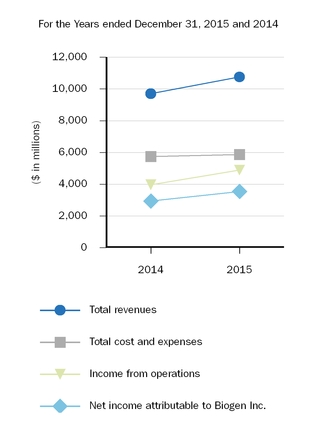
Diluted earnings per share attributable to Biogen Inc. were $15.34 for 2015, representing an increase of 24.0% over the same period in 2014.
As described below under “Results of Operations,” our income from operations for the year ended December 31, 2015, reflects the following:
| • | Total revenues were $10,763.8 million for 2015, representing an increase of 10.9% over the same period in 2014. |
| • | Product revenues, net totaled $9,188.5 million for 2015, representing an increase of 12.0% over the same period in 2014. This increase was driven by a 25.1% increase in worldwide TECFIDERA revenues as well as revenue from our recent product additions PLEGRIDY, ELOCTATE and ALPROLIX, partially offset by a decrease in worldwide AVONEX and TYSABRI revenues. In addition, product revenues, net for 2015, compared to the same period in 2014, were negatively impacted by foreign currency exchange losses of $388.1 million, partially offset by comparative net gains recognized under our foreign currency hedging program of $166.3 million. |
| • | Our share of RITUXAN and GAZYVA operating profits totaled $1,339.2 million for 2015, representing an increase of 12.0% over the same period in 2014. This increase was primarily due to a 4% increase in U.S. product sales of RITUXAN and price increases. |
| • | Other revenues totaled $236.1 million for 2015, representing a decrease of 22.5% from the same period in 2014. This decrease was driven by a 73.1% decrease in royalty revenues primarily due to the expiration of U.S. patent rights that gave rise to royalty payments related to ANGIOMAX, partially offset by a 47.6% increase in corporate partner revenues primarily due to an increase in contract manufacturing activities. |
| • | Total cost and expenses totaled $5,872.8 million for 2015, representing an increase of 2.2% compared to the same period in 2014. This increase was driven by a 6.3% increase in research and development expense, a 5.9% increase in cost of sales, losses recognized on fair value remeasurement of contingent consideration as well as the recognition of a $93.4 million charge related to our recent corporate restructuring. These increases were partially offset by a 21.9% decrease in the amortization of acquired intangible assets and a 5.3% decrease in selling, general and administrative expenses. |
We generated $3,716.1 million of net cash flows from operations for 2015, which were primarily driven by earnings. Cash, cash equivalents and marketable securities totaled approximately $6,188.9 million as of December 31, 2015.
On September 15, 2015, we issued senior unsecured notes for an aggregate principal amount of $6.0 billion.
During the year ended December 31, 2015, we repurchased and retired approximately 16.8 million shares of common stock at a cost of $5.0 billion under our share repurchase programs.
Restructuring
On October 21, 2015, we announced a corporate restructuring, which includes the termination of certain pipeline programs and an 11% reduction in workforce. For additional information, please read Restructuring set forth below in this Management's Discussion and Analysis of Financial Condition and Results of Operations.
Acquisitions
On February 12, 2015, we completed the acquisition of all of the outstanding stock of Convergence Pharmaceuticals (Convergence), a clinical-stage biopharmaceutical company with a focus on developing product candidates for neuropathic pain. For additional information related to this transaction, please read Note 2, Acquisitions to our consolidated financial statements included in this report.
Collaborative and Other Relationships
On July 2, 2015, we announced a collaboration and license agreement to develop gene-based therapies for multiple ophthalmic diseases with Applied Genetic Technologies Corporation (AGTC).
On September 9, 2015, we announced an agreement with Mitsubishi Tanabe Pharma Corporation (MTPC) to exclusively license amiselimod (MT-1303), a late stage experimental medicine with potential in multiple autoimmune indications. Amiselimod is an oral compound that targets the sphingosine 1-phosphate receptor.
For additional information related to these transactions, please read Note 19, Collaborative and Other Relationships to our consolidated financial statements included in this report.
Business Environment
The biopharmaceutical industry and the markets in which we operate are intensely competitive. Many of our competitors are working to develop or have commercialized products similar to those we market or are developing. In addition, the commercialization of certain of our own approved MS products, products of our collaborators and pipeline product candidates may negatively impact future sales of our existing MS products. Our products may also face increased competitive pressures from the introduction of generic versions, prodrugs of existing therapeutics or biosimilars of existing products and other technologies, such as gene therapies.
In addition, sales of our products are dependent, in large part, on the availability and extent of coverage, pricing and reimbursement from government health administration authorities, private health insurers and other organizations.
For additional information related to our competi
Showing the first 8K of 109K characters. Open the full section
Item 7A. Quantitative and Qualitative Disclosures About Market Risk
Market Risk
We are subject to certain risks which may affect our results of operations, cash flows and fair values of assets and liabilities, including volatility in foreign currency exchange rates, interest rate movements, pricing pressures worldwide and weak economic conditions in the foreign markets in which we operate. We manage the impact of foreign currency exchange rates and interest rates through various financial instruments, including derivative instruments such as foreign currency forward contracts, interest rate lock contracts and interest rate swap contracts. We do not enter into financial instruments for trading or speculative purposes. Further, we only enter into contracts with counterparties that have at least an "A" (or equivalent) credit rating. The counter-parties to these contracts are major financial institutions and there is no significant concentration of exposure with any one counter-party.
Foreign Currency Exchange Risk
Our results of operations are subject to foreign currency exchange rate fluctuations due to the global nature of our operations. We have operations or maintain distribution relationships in the U.S., Europe, Canada, Switzerland, Denmark, Japan, Australia, New Zealand and Central and South America. In addition, we receive royalty revenues based on sales of RITUXAN in Canada. As a result, our financial position, results of operations and cash flows can be affected by market fluctuations in foreign exchange rates, primarily with respect to the Euro, British pound sterling, Canadian dollar, Swiss franc, Danish krone, Japanese yen and Australian dollar.
While the financial results of our global activities are reported in U.S. dollars, the functional currency for most of our foreign subsidiaries is their respective local currency. Fluctuations in the foreign currency exchange rates of the countries in which we do business will affect our operating results, often in ways that are difficult to predict. In particular, as the U.S. dollar strengthens versus other currencies, the value of the non-U.S. revenue will decline when reported in U.S. dollars. The impact to net income as a result of a strengthening U.S. dollar will be partially mitigated by the value of non-U.S. expense which will also decline when reported in U.S. dollars. As the U.S. dollar weakens versus other currencies, the value of the non-U.S. revenue and expenses will increase when reported in U.S. dollars.
We have established revenue and operating expense hedging and balance sheet risk management programs to protect against volatility of future foreign currency cash flows and changes in fair value caused by volatility in foreign exchange rates.
Revenue and Operating Expense Hedging Program
Our foreign currency hedging program is designed to mitigate, over time, a portion of the impact resulting from volatility in exchange rate changes on revenues and operating expenses. We use foreign currency forward contracts to manage foreign currency risk, with the majority of our forward contracts used to hedge certain forecasted revenue and operating expense transactions denominated in foreign currencies in the next 18 months. We do not engage in currency speculation. For a more detailed disclosure of our revenue and operating expense hedging program, please read Note 9, Derivative Instruments to our consolidated financial statements included in this report.
Our ability to mitigate the impact of exchange rate changes on revenues and net income diminishes as significant exchange rate fluctuations are sustained over extended periods of time. In particular, devaluation or significant deterioration of foreign currency exchange rates are difficult to mitigate and likely to negatively impact earnings. The cash flows from these contracts are reported as operating activities in our consolidated statements of cash flows.
Balance Sheet Risk Management Hedging Program
We also use forward contracts to mitigate the foreign currency exposure related to certain balance sheet items. The primary objective of our balance sheet risk management program is to mitigate the exposure of foreign currency denominated net monetary assets of foreign affiliates. In these instances, we principally utilize currency forward
contracts. We have not elected hedge accounting for the balance sheet related items. The cash flows from these contracts are reported as operating activities in our consolidated statement of cash flows.
The following quantitative information includes the impact of currency movements on forward contracts used in our revenue, operating expense and balance sheet hedging programs. As of December 31, 2015 and 2014, a hypothetical adverse 10% movement in foreign currency rates compared to the U.S. dollar across all maturities would result in a hypothetical decrease in the fair value of forward contracts of approximately $185.0 million and $160.0 million, respectively. The estimated fair value change was determined by measuring the impact of the hypothetical exchange rate movement on outstanding forward contracts. Our use of this methodology to quantify the market risk of such instruments is subject to assumptions and actual impact could be significantly different. The quantitative information about market risk is limited because it does not take into account all foreign currency operating transactions.
Interest Rate Risk
Our investment portfolio includes cash equivalents and short-term investments. The fair value of our marketable securities is subject to change as a result of potential changes in market interest rates. The potential change in fair value for interest rate sensitive instruments has been assessed on a hypothetical 100 basis point adverse movement across all maturities. As of December 31, 2015 and 2014, we estimate that such hypothetical 100 basis point adverse movement would result in a hypothetical loss in fair value of approximately $43.0 million and $14.5 million, respectively, to our interest rate sensitive instruments. The fair values of our investments were determined using third-party pricing services or other market observable data.
To achieve a desired mix of fixed and floating interest rate debt, we entered into interest rate swap contracts during 2015 for certain of our fixed-rate debt. These derivative contracts effectively converted a fixed-rate interest coupon to a floating-rate LIBOR-based coupon over the life of the respective note. As of December 31, 2015, a 100 basis-point adverse movement (increase in LIBOR) would increase annual interest expense by approximately $6.8 million.
Pricing Pressure
Governments in some international markets in which we operate have implemented measures aimed at reducing healthcare costs to constrain the overall level of government expenditures. These implemented measures vary by country and include, among other things, mandatory rebates and discounts, prospective and possible retroactive price reductions and suspensions on price increases of pharmaceuticals.
In addition, certain countries set prices by reference to the prices in other countries where our products are marketed. Thus, our inability to secure favorable prices in a particular country may impair our ability to obtain acceptable prices in existing and potential new markets and limit market growth. The continued implementation of pricing actions throughout Europe may also lead to higher levels of parallel trade.
In the U.S., federal and state legislatures, health agencies and third-party payors continue to focus on containing the cost of health care. Legislative and regulatory proposals, enactments to reform health care insurance programs and increasing pressure from social sources could significantly influence the manner in which our products are prescribed and purchased. It is possible that additional federal health care reform measures will be adopted in the future, which could result in increased pricing pressure and reduced reimbursement for our products and otherwise have an adverse impact on our financial position or results of operations.
There is also significant economic pressure on state budgets that may result in states increasingly seeking to achieve budget savings through mechanisms that limit coverage or payment for our drugs. Managed care organizations are also continuing to seek price discounts and, in some cases, to impose restrictions on the coverage of particular drugs.
Credit Risk
We are subject to credit risk from our accounts receivable related to our product sales. The majority of our accounts receivable arise from product sales in the U.S. and Europe with concentrations of credit risk limited due to the wide variety of customers and markets using our products, as well as their dispersion across many different geographic areas. Our accounts receivable are primarily due from wholesale distributors, public hospitals and other government entities. We monitor the financial performance and creditworthiness of our large customers so that we can properly assess and respond to changes in their credit profile. We operate in certain countries where weakness in economic
conditions can result in extended collection periods. We continue to monitor these conditions, including the volatility associated with international economies and the relevant financial markets, and assess their possible impact on our business. To date, we have not experienced any significant losses with respect to the collection of our accounts receivable.
Credit and economic conditions in the E.U. continue to remain uncertain, which has, from time to time, led to long collection periods for our accounts receivable and greater collection risk in certain countries.
We believe that our allowance for doubtful accounts was adequate as of December 31, 2015 and 2014, respectively. However, if significant changes occur in the availability of government funding or the reimbursement practices of these or other governments, we may not be able to collect on amounts due to us from customers in such countries and our results of operations could be adversely affected.
Item 8. Financial Statements and Supplementary Data
The information required by this Item 8 is contained on pages F-1 through F-71 of this report and is incorporated herein by reference.
Item 9. Changes in and Disagreements with Accountants on Accounting and Financial Disclosure
None.
Item 9A. Controls and Procedures
Disclosure Controls and Procedures and Internal Control over Financial Reporting
Controls and Procedures
We have carried out an evaluation, under the supervision and with the participation of our management, including our principal executive officer and principal financial officer, of the effectiveness of the design and operation of our disclosure controls and procedures (as defined in Rules 13a-15(e) and 15d-15(e) under the Securities Exchange Act of 1934, as amended), as of December 31, 2015. Based upon that evaluation, our principal executive officer and principal financial officer concluded that, as of the end of the period covered by this report, our disclosure controls and procedures are effective in ensuring that (a) the information required to be disclosed by us in the reports that we file or submit under the Securities Exchange Act is recorded, processed, summarized and reported within the time periods specified in the SEC’s rules and forms, and (b) such information is accumulated and communicated to our management, including our principal executive officer and principal financial officer, as appropriate to allow timely decisions regarding required disclosure. In designing and evaluating our disclosure controls and procedures, our management recognized that any controls and procedures, no matter how well designed and operated, can provide only reasonable assurance of achieving the desired control objectives, and our management necessarily was required to apply its judgment in evaluating the cost-benefit relationship of possible controls and procedures.
Changes in Internal Control over Financial Reporting
There were no changes in our internal control over financial reporting during the quarter ended December 31, 2015 that have materially affected, or are reasonably likely to materially affect, our internal control over financial reporting.
Management’s Annual Report on Internal Control over Financial Reporting
Our management is responsible for establishing and maintaining adequate internal control over our financial reporting. Internal control over financial reporting is defined in Rules 13a-15(f) and 15d-15(f) under the Securities Exchange Act as a process designed by, or under the supervision of, a company’s principal executive and principal financial officers and effected by a company’s board of directors, management and other personnel to provide reasonable assurance regarding the reliability of financial reporting and the preparation of financial statements for external purposes in accordance with
U.S. GAAP. Our internal control over financial reporting includes those policies and procedures that:
| • | pertain to the maintenance of records that, in reasonable detail, accurately and fairly reflect our transactions and dispositions of our assets; |
| • | provide reasonable assurance that transactions are recorded as necessary to permit preparation of financial statements in accordance with U.S. GAAP, and that our receipts and expenditures are being made only in accordance with authorizations of our management and directors; and |
| • | provide reasonable assurance regarding prevention or timely detection of unauthorized acquisition, use or disposition of our assets that could have a material effect on our financial statements. |
Because of its inherent limitations, internal control over financial reporting may not prevent or detect misstatements. Projections of any evaluation of effectiveness to future periods are subject to the risk that controls may become inadequate because of changes in conditions, or that the degree of compliance with the policies or procedures may deteriorate.
Our management assessed the effectiveness of our internal control over financial reporting as of December 31, 2015. In making this assessment, management used the criteria set forth by the Committee of Sponsoring Organizations of the Treadway Commission (COSO) in its 2013 Internal Control — Integrated Framework.
Based on our assessment, our management has concluded that, as of December 31, 2015, our internal control over financial reporting is effective based on those criteria.
The effectiveness of our internal control over financial reporting as of December 31, 2015 has been audited by PricewaterhouseCoopers LLP, an independent registered public accounting firm, as stated in their attestation report, which is included herein.
Item 9B. Other Information
None.
PART III
Item 10. Directors, Executive Officers and Corporate Governance
The information concerning our executive officers is set forth under the heading “Our Executive Officers” in Part I of this report. The text of our code of business conduct, which includes the code of ethics that applies to our principal executive officer, principal financial officer, principal accounting officer or controller, and persons performing similar functions, is posted on our website, www.biogen.com, under the “Corporate Governance” subsection of the “About Us” section of the site. We intend to make all required disclosures regarding any amendments to, or waivers from, provisions of our code of business conduct at the same location of our website.
The response to the remainder of this item is incorporated by reference from the discussion responsive thereto in the sections entitled “Proposal 1 - Election of Directors,” “Corporate Governance,” “Stock Ownership - Section 16(a) Beneficial Ownership Reporting Compliance” and “Miscellaneous - Stockholder Proposals” contained in the proxy statement for our 2016 annual meeting of stockholders.
Item 11. Executive Compensation
The response to this item is incorporated by reference from the discussion responsive thereto in the sections entitled “Executive Compensation and Related Information” and “Corporate Governance” contained in the proxy statement for our 2016 annual meeting of stockholders.
Item 12. Security Ownership of Certain Beneficial Owners and Management and Related Stockholder Matters
The response to this item is incorporated by reference from the discussion responsive thereto in the sections entitled “Stock Ownership” and “Equity Compensation Plan Information” contained in the proxy statement for our 2016 annual meeting of stockholders.
Item 13. Certain Relationships and Related Transactions, and Director Independence
The response to this item is incorporated by reference from the discussion responsive thereto in the sections entitled “Certain Relationships and Related Person Transactions” and “Corporate Governance” contained in the proxy statement for our 2016 annual meeting of stockholders.
Item 14. Principal Accounting Fees and Services
The response to this item is incorporated by reference from the discussion responsive thereto in the section entitled “Proposal 2 — Ratification of the Selection of our Independent Registered Public Accounting Firm” contained in the proxy statement for our 2016 annual meeting of stockholders.
PART IV
Item 15. Exhibits and Financial Statement Schedules
a. (1) Consolidated Financial Statements:
The following financial statements are filed as part of this report:
| Financial Statements | Page Number | |
| Consolidated Statements of Income | F-2 | |
| Consolidated Statements of Comprehensive Income | F-3 | |
| Consolidated Balance Sheets | F-4 | |
| Consolidated Statements of Cash Flows | F-5 | |
| Consolidated Statements of Equity | F-6 | |
| Notes to Consolidated Financial Statements | F-9 | |
| Report of Independent Registered Public Accounting Firm | F-71 |
Certain totals may not sum due to rounding.
(2) Financial Statement Schedules
Schedules are omitted because they are not applicable, or are not required, or because the information is included in the consolidated financial statements and notes thereto.
(3) Exhibits
The exhibits listed on the Exhibit Index beginning on page A-1, which is incorporated herein by reference, are filed or furnished as part of this report or are incorporated into this report by reference.
SIGNATURES
Pursuant to the requirements of Section 13 or 15(d) of the Securities Exchange Act of 1934, the registrant has duly caused this report to be signed on its behalf by the undersigned, thereunto duly authorized.
| BIOGEN INC. | |
| By: | /S/ GEORGE A. SCANGOS |
| George A. Scangos | |
| Chief Executive Officer |
Date: February 3, 2016
Pursuant to the requirements the Securities Exchange Act of 1934, this report has been signed below by the following persons on behalf of the registrant and in the capacities and on the dates indicated.
| Name | Capacity | Date | ||
| /S/ GEORGE A. SCANGOS | Director and Chief Executive Officer (principal executive officer) | February 3, 2016 | ||
| George A. Scangos | ||||
| /S/ PAUL J. CLANCY | Executive Vice President, Finance and Chief Financial Officer (principal financial officer) | February 3, 2016 | ||
| Paul J. Clancy | ||||
| /S/ GREGORY F. COVINO | Vice President, Finance, Chief Accounting Officer (principal accounting officer) | February 3, 2016 | ||
| Gregory F. Covino | ||||
| /S/ STELIOS PAPADOPOULOS | Director and Chairman of the Board of Directors | February 3, 2016 | ||
| Stelios Papadopoulos | ||||
| /S/ ALEXANDER J. DENNER | Director | February 3, 2016 | ||
| Alexander J. Denner | ||||
| /S/ CAROLINE D. DORSA | Director | February 3, 2016 | ||
| Caroline D. Dorsa | ||||
| /S/ NANCY L. LEAMING | Director | February 3, 2016 | ||
| Nancy L. Leaming | ||||
| /S/ RICHARD C. MULLIGAN | Director | February 3, 2016 | ||
| Richard C. Mulligan | ||||
| /S/ ROBERT W. PANGIA | Director | February 3, 2016 | ||
| Robert W. Pangia | ||||
| /S/ BRIAN S. POSNER | Director | February 3, 2016 | ||
| Brian S. Posner | ||||
| /S/ ERIC K. ROWINSKY | Director | February 3, 2016 | ||
| Eric K. Rowinsky | ||||
| /S/ LYNN SCHENK | Director | February 3, 2016 | ||
| Lynn Schenk | ||||
| /S/ STEPHEN A. SHERWIN | Director | February 3, 2016 | ||
| Stephen A. Sherwin |
BIOGEN INC. AND SUBSIDIARIES
CONSOLIDATED FINANCIAL STATEMENTS
| Page Number | ||
| Consolidated Statements of Income | F-2 | |
| Consolidated Statements of Comprehensive Income | F-3 | |
| Consolidated Balance Sheets | F-4 | |
| Consolidated Statements of Cash Flows | F-5 | |
| Consolidated Statements of Equity | F-6 | |
| Notes to Consolidated Financial Statements | F-9 | |
| Report of Independent Registered Public Accounting Firm | F-71 |
F- 1
BIOGEN INC. AND SUBSIDIARIES
CONSOLIDATED STATEMENTS OF INCOME
(In millions, except per share amounts)
| For the Years Ended December 31, | |||||||||||
| 2015 | 2014 | 2013 | |||||||||
| Revenues: | |||||||||||
| Product, net | $ | 9,188.5 | $ | 8,203.4 | $ | 5,542.3 | |||||
| Unconsolidated joint business | 1,339.2 | 1,195.4 | 1,126.0 | ||||||||
| Other | 236.1 | 304.5 | 263.9 | ||||||||
| Total revenues | 10,763.8 | 9,703.3 | 6,932.2 | ||||||||
| Cost and expenses: | |||||||||||
| Cost of sales, excluding amortization of acquired intangible assets | 1,240.4 | 1,171.0 | 857.7 | ||||||||
| Research and development | 2,012.8 | 1,893.4 | 1,444.1 | ||||||||
| Selling, general and administrative | 2,113.1 | 2,232.3 | 1,712.1 | ||||||||
| Amortization of acquired intangible assets | 382.6 | 489.8 | 342.9 | ||||||||
| Restructuring charges | 93.4 | — | — | ||||||||
| Collaboration profit sharing | — | — | 85.4 | ||||||||
| (Gain) loss on fair value remeasurement of contingent consideration | 30.5 | (38.9 | ) | (0.5 | ) | ||||||
| Total cost and expenses | 5,872.8 | 5,747.7 | 4,441.6 | ||||||||
| Gain on sale of rights | — | 16.8 | 24.9 | ||||||||
| Income from operations | 4,891.0 | 3,972.4 | 2,515.5 | ||||||||
| Other income (expense), net | (123.7 | ) | (25.8 | ) | (34.9 | ) | |||||
| Income before income tax expense and equity in loss of investee, net of tax | 4,767.3 | 3,946.6 | 2,480.6 | ||||||||
| Income tax expense | 1,161.6 | 989.9 | 601.0 | ||||||||
| Equity in loss of investee, net of tax | 12.5 | 15.1 | 17.2 | ||||||||
| Net income | 3,593.2 | 2,941.6 | 1,862.3 | ||||||||
| Net income attributable to noncontrolling interests, net of tax | 46.2 | 6.8 | — | ||||||||
| Net income attributable to Biogen Inc. | $ | 3,547.0 | $ | 2,934.8 | $ | 1,862.3 | |||||
| Net income per share: | |||||||||||
| Basic earnings per share attributable to Biogen Inc. | $ | 15.38 | $ | 12.42 | $ | 7.86 | |||||
| Diluted earnings per share attributable to Biogen Inc. | $ | 15.34 | $ | 12.37 | $ | 7.81 | |||||
| Weighted-average shares used in calculating: | |||||||||||
| Basic earnings per share attributable to Biogen Inc. | 230.7 | 236.4 | 236.9 | ||||||||
| Diluted earnings per share attributable to Biogen Inc. | 231.2 | 237.2 | 238.3 |
See accompanying notes to these consolidated financial statements.
F- 2
BIOGEN INC. AND SUBSIDIARIES
CONSOLIDATED STATEMENTS OF COMPREHENSIVE INCOME
(In millions)
| For the Years Ended December 31, | |||||||||||
| 2015 | 2014 | 2013 | |||||||||
| Net income attributable to Biogen Inc. | $ | 3,547.0 | $ | 2,934.8 | $ | 1,862.3 | |||||
| Other comprehensive income: | |||||||||||
| Unrealized gains (losses) on securities available for sale: | |||||||||||
| Unrealized gains (losses) recognized during the period, net of tax | (1.7 | ) | 0.4 | 11.8 | |||||||
| Less: reclassification adjustment for (gains) losses included in net income, net of tax | 1.3 | (6.4 | ) | (10.4 | ) | ||||||
| Unrealized gains (losses) on securities available for sale, net of tax | (0.4 | ) | (6.0 | ) | 1.4 | ||||||
| Unrealized gains (losses) on cash flow hedges: |
Showing the first 8K of 306K characters. Open the full section