 filings.tools
Bristol Myers Squibb 10-K 2024-12-31
Filed 2025-02-12. 24 sections, 667K characters. Original on sec.gov · Markdown · JSON
Cover and table of contents
UNITED STATES
SECURITIES AND EXCHANGE COMMISSION
Washington, D.C. 20549
FORM 10-K
☒ ANNUAL REPORT PURSUANT TO SECTION 13 OR 15(d) OF THE
SECURITIES EXCHANGE ACT OF 1934
For the fiscal year ended December 31, 2024
OR
☐ TRANSITION REPORT PURSUANT TO SECTION 13 OR 15(d) OF THE
SECURITIES EXCHANGE ACT OF 1934
For the transition period from ______ to _______
Commission File Number 001-01136
BRISTOL-MYERS SQUIBB COMPANY
(Exact name of registrant as specified in its charter)
| Delaware | 22-0790350 | |||||||
| (State or other jurisdiction of incorporation or organization) | **(**I.R.S Employer Identification No.) |
Route 206 & Province Line Road, Princeton, New Jersey 08543
(Address of principal executive offices)
(609) 252-4621
(Registrant’s telephone number, including area code)
Securities registered pursuant to Section 12(b) of the Act:
| Title of each class | Trading Symbol(s) | Name of each exchange on which registered | ||||||
| Common Stock, $0.10 Par Value | BMY | New York Stock Exchange | ||||||
| 1.000% Notes due 2025 | BMY25 | New York Stock Exchange | ||||||
| 1.750% Notes due 2035 | BMY35 | New York Stock Exchange | ||||||
| Celgene Contingent Value Rights | CELG RT | New York Stock Exchange |
Securities registered pursuant to Section 12(g) of the Act:
| Title of each class | ||
| $2 Convertible Preferred Stock, $1 Par Value |
Indicate by check mark if the registrant is a well-known seasoned issuer, as defined in Rule 405 of the Securities Act. Yes ☒ No ☐
Indicate by check mark if the registrant is not required to file reports pursuant to Section 13 or Section 15(d) of the Act. Yes ☐ No ☒
Indicate by check mark whether the registrant (1) has filed all reports required to be filed by Section 13 or 15(d) of the Securities Exchange Act of 1934 during the preceding 12 months (or for such shorter period that the registrant was required to file such reports), and (2) has been subject to such filing requirements for the past 90 days. Yes ☒ No ☐
Indicate by check mark whether the registrant has submitted electronically every Interactive Data File required to be submitted pursuant to Rule 405 of Regulation S-T (§232.405 of this chapter) during the preceding 12 months (or for such shorter period that the registrant was required to submit such files). Yes ☒ No ☐
Indicate by check mark whether the registrant is a large accelerated filer, an accelerated filer, a non-accelerated filer, a smaller reporting company, or an emerging growth company. See the definitions of “large accelerated filer,” “accelerated filer,” “smaller reporting company,” and “emerging growth company” in Rule 12b-2 of the Exchange Act.
| Large accelerated filer ☒ | Accelerated filer ☐ | Non-accelerated filer ☐ | Smaller reporting company ☐ | Emerging growth company ☐ |
If an emerging growth company, indicate by check mark if the registrant has elected not to use the extended transition period for complying with any new or revised financial accounting standards provided pursuant to Section 13(a) of the Exchange Act. ☐
Indicate by check mark whether the registrant has filed a report on and attestation to its management’s assessment of the effectiveness of its internal control over financial reporting under Section 404(b) of the Sarbanes-Oxley Act (15 U.S.C. 7262(b)) by the registered public accounting firm that prepared or issued its audit report. ☒
If securities are registered pursuant to Section 12(b) of the Act, indicate by check mark whether the financial statements of the registrant included in the filing reflect the correction of an error to previously issued financial statements. ☐
Indicate by check mark whether any of those error corrections are restatements that required a recovery analysis of incentive-based compensation received by any of the registrant's executive officers during the relevant recovery period pursuant to §240.10D-1(b). ☐
Indicate by check mark whether the registrant is a shell company (as defined in Rule 12b-2 of the Exchange Act). Yes ☐ No ☒
The aggregate market value of the 2,026,400,768 shares of voting common equity held by non-affiliates of the registrant, computed by reference to the closing price as reported on the New York Stock Exchange, as of the last business day of the registrant’s most recently completed second fiscal quarter was approximately $84,156,423,913. Bristol-Myers Squibb Company has no non-voting common equity. At February 6, 2025, there were 2,029,312,023 shares of common stock outstanding.
DOCUMENTS INCORPORATED BY REFERENCE: Portions of the definitive proxy statement for the registrant’s Annual Meeting of Shareholders to be filed within 120 days after the conclusion of the registrant's fiscal year ended December 31, 2024 with the U.S. Securities and Exchange Commission pursuant to Regulation 14A of the Securities Exchange Act of 1934, as amended, are incorporated by reference into Part III of this Annual Report on Form 10-K to the extent described therein.
BRISTOL-MYERS SQUIBB COMPANY
INDEX TO FORM 10-K
December 31, 2024
- Indicates brand names of products which are trademarks not owned by BMS. Specific trademark ownership information is included in the Exhibit Index at the end of this 2024 Form 10-K.
PART I
Item 1. BUSINESS.
General
Bristol-Myers Squibb Company ("we", the "Company", or "BMS") was incorporated under the laws of the State of Delaware in August 1933 under the name Bristol-Myers Company, as successor to a New York business started in 1887. In 1989, Bristol-Myers Company changed its name to Bristol-Myers Squibb Company as a result of a merger.
We operate in one segment engaged in the discovery, development, licensing, manufacturing, marketing, distribution and sale of biopharmaceutical products on a global basis. Our principal strategy is to combine the resources, scale and capability of a pharmaceutical company with the speed and focus on innovation of the biotech industry. Our focus as a biopharmaceutical company is on discovering, developing and delivering transformational medicines for patients facing serious diseases in areas where we believe that we have an opportunity to make a meaningful difference: oncology, hematology, immunology, cardiovascular, neuroscience and other areas where we can also deliver attractive returns for shareholders. Our priorities are to focus on transformational medicines where we have a competitive advantage, drive operational excellence and strategically allocate capital for long-term growth and shareholder returns. For a further discussion of our strategy initiatives, refer to “Item 7. Management's Discussion and Analysis of Financial Condition and Results of Operations—Strategy.” In addition, we expect that our acquisitions of Karuna, RayzeBio and Mirati in 2024 will allow us to expand in neuroscience and oncology, and continue to position us as a leading biopharmaceutical company across our core therapeutic areas.
We compete with other global research-based biopharmaceutical companies, smaller research companies and generic drug manufacturers. Our products are sold worldwide, primarily to wholesalers, distributors, specialty pharmacies, and to a lesser extent, directly to retailers, hospitals, clinics and government agencies. We have significant manufacturing operations in the U.S., Puerto Rico, Switzerland, Ireland, and the Netherlands.
The percentage of revenues by significant region/country were as follows:
| Year Ended December 31, | |||||||||||||||||
| Dollars in millions | 2024 | 2023 | 2022 | ||||||||||||||
| United States | 71 | % | 69 | % | 68 | % | |||||||||||
| International (a) | 27 | % | 29 | % | 30 | % | |||||||||||
| Other (b) | 2 | % | 2 | % | 2 | % | |||||||||||
| Total Revenues | $ | 48,300 | $ | 45,006 | $ | 46,159 |
(a) Beginning in 2024, Puerto Rico revenues are presented as part of International revenues to align with management's review of the Company's financial results. Prior period amounts have been recast to conform to the current presentation.
(b) Other revenues include royalties and alliance-related revenues for products not sold by BMS’s regional commercial organizations.
Refer to the Summary of Abbreviated Terms at the end of this 2024 Form 10-K for definitions of capitalized terms used throughout the document.
Acquisitions, Divestitures, Licensing and Other Arrangements
Acquisitions, divestitures, licensing and other arrangements allow us to focus our resources on growth opportunities that drive the greatest long-term value. Our significant business development activities in 2024 included acquisitions of Karuna, RayzeBio and Mirati in addition to a global strategic collaboration agreement with SystImmune. For additional information relating to our acquisitions, divestitures, licensing and other arrangements refer to “Item 7. Management's Discussion and Analysis of Financial Condition and Results of Operations—Acquisitions, Divestitures, Licensing and Other Arrangements”, “Item 8. Financial Statements and Supplementary Data—Note 3. Alliances”, and “Item 8. Financial Statements and Supplementary Data—Note 4. Acquisitions, Divestitures, Licensing and Other Arrangements”.
Products, Intellectual Property and Product Exclusivity
Our differentiated research platforms support long-term growth across therapeutic areas. Our platforms are comprised of chemically-synthesized or small molecule drugs including protein degraders; drugs produced from biological processes, called “biologics”; ADCs, CAR-T cell therapies, and radiopharmaceutical therapeutics. Small molecule drugs are typically administered orally in the form of a tablet or capsule, although other drug delivery mechanisms are also used. Biologics are typically administered through injections or by intravenous infusion. CAR-T cell therapies are administered by intravenous infusion.
Below is a summary of our significant products, including approved indications. For information about our alliance arrangements for certain of the products below, refer to “—Alliances” below and “Item 8. Financial Statements and Supplementary Data—Note 3. Alliances.”
Growth Portfolio
Opdivo*®* Opdivo (nivolumab) is a biological product and a fully human monoclonal antibody that binds to the PD-1 on T and NKT cells. It has been approved for several anti-cancer indications including bladder, blood, CRC, head and neck, RCC, HCC, lung, melanoma, MPM, stomach and esophageal cancer. The Opdivo+Yervoy regimen also is approved in multiple markets for the treatment of NSCLC, melanoma, MPM, RCC, CRC and various gastric and esophageal cancers..
Opdivo Qvantig**TM Opdivo Qvantig (nivolumab and hyaluronidase-nvhy) is a subcutaneously administered PD-1 inhibitor indicated for most previously approved adult, solid tumor Opdivo indications as monotherapy, monotherapy maintenance following completion of Opdivo plus Yervoy combination therapy, or in combination with chemotherapy or cabozantinib.
Orencia*®* Orencia (abatacept) is a biological product and a fusion protein indicated for adult patients with moderate to severe active RA and PsA. It has indications for (i) reducing signs and symptoms in certain pediatric patients with moderately to severely active polyarticular JIA and (ii) for the treatment of aGVHD, in combination with a calcineurin inhibitor and methotrexate.
Yervoy*®* Yervoy (ipilimumab) is a biological product and is a CTLA4 immune checkpoint inhibitor. Yervoy is a monoclonal antibody for the treatment of patients with unresectable or metastatic melanoma. The Opdivo+Yervoy regimen is approved in multiple markets for the treatment of NSCLC, melanoma, MPM, RCC, CRC and esophageal cancer.
Reblozyl*®* Reblozyl (luspatercept-aamt) is a biological product, and is an erythroid maturation agent indicated for the treatment of anemia in (i) adult patients with transfusion dependent and non-transfusion dependent beta thalassemia who require regular red blood cell transfusions, (ii) adult patients with very low- to intermediate-risk MDS who have ring sideroblasts and require red blood cell transfusions, as well as (iii) adult patients without previous erythropoiesis stimulating agent use (ESA-naïve) with very low- to intermediate-risk MDS who may require regular red blood cell transfusions, regardless of RS status.
Opdualag*®* Opdualag (nivolumab and relatlimab-rmbw) is a combination of nivolumab, a PD-1 blocking antibody, and relatlimab, a LAG-3 blocking antibody, indicated for the treatment of adult and pediatric patients 12 years of age or older with unresectable or metastatic melanoma.
Breyanzi*®* Breyanzi (lisocabtagene maraleucel) is a CD19-directed genetically modified autologous CAR-T cell therapy indicated for the treatment of adult patients with relapsed or refractory LBCL after one or more lines of systemic therapy, including DLBCL not otherwise specified, h
Showing the first 8K of 108K characters. Open the full section
Item 1A. RISK FACTORS.
Any of the risks and uncertainties described below could significantly and negatively affect our business operations, financial condition, operating results (including components of our financial results), cash flows, prospects, reputation or credit ratings now and in the future, which could cause the trading price of our common stock to decline significantly. Additional risks and uncertainties that are not presently known to us, or risks that we currently consider immaterial, could also impair our business operations, financial condition, operating results or cash flows. The following discussion of risk factors contains “forward-looking” statements, as discussed in “Item 7. Management’s Discussion and Analysis of Financial Condition and Results of Operations—Special Note Regarding Forward-Looking Statements.”
Product, Industry and Operational Risks
Increased pricing pressure and other restrictions in the U.S. and abroad continue to negatively affect our revenues and profit margins.
Our products continue to be subject to increasing pressures across the portfolio from pharmaceutical market access and pricing controls, required rebates and other discounts, in the U.S., the EU and other regions around the world that result in lower prices, lower reimbursement rates and smaller populations for whom payers will reimburse. We expect that these market access constraints, pricing controls and discounting and other restrictions will become more acute as public and private payers continue to take aggressive steps to control their expenditures. Our future revenues and profit margins could be negatively affected, including as a result of (i) changes in laws and regulations relating to the pricing and reimbursement of pharmaceutical products (including potential penalties for increasing prices over the rate of inflation and government negotiations/price controls that may change the determination of the "best price" and establish a maximum allowed price/reimbursement rate), as well as other changes relating to federal healthcare programs, such as modifying the federal Anti-Kickback statute discount safe harbor and the IRA, which includes a number of provisions intended to lower the costs of some drugs covered under Medicare Part D and Medicare Part B and to limit Medicare beneficiaries’ out-of-pocket spending under the Medicare Part D benefit, (ii) cost-cutting measures by federal healthcare programs, such as Medicare and Medicaid, MCOs and other institutional and governmental purchasers, (iii) the grant of additional authority to governmental agencies to manage drug utilization and negotiate drug prices (including the implementation of the 2020 regulation issued by the U.S. federal government authorizing states and private parties to develop and implement programs to import certain prescription drugs from Canada and sell them in the U.S., and the American Rescue Plan Act of 2021, which eliminated the Medicaid Prescription Drug Rebate cap as of January 1, 2024), (iv) expanded utilization and pharmaceutical company restrictions under the 340B Drug Pricing Program ("340B program"), (v) competition related to placements on applicable commercial and Medicare Part D formularies; (vi) changes to U.S. federal pharmaceutical coverage and reimbursement policies and practices, (vii) the increased purchasing power of entities that negotiate on behalf of Medicare, Medicaid and private sector beneficiaries, (viii) the increased scrutiny of drug manufacturers (including any additional review of BMS or Celgene by the House Oversight and Reform Committee), (ix) reimbursement delays, (x) government price erosion mechanisms across Europe, Japan and in other countries resulting in deflation for pharmaceutical product pricing, (xi) collection delays or failures to pay in government-funded public hospitals outside the U.S., (xii) developments in technology and/or industry practices that could impact the reimbursement policies and practices of third-party payers, and (xiii) inhibited market access due to real or perceived differences in value propositions for our products compared to competing products.
In particular, the IRA will have the effect of reducing prices and reimbursements for certain of our products, which could significantly impact our business. Under the IRA, the HHS can effectively set prices for units of certain single-source drugs and biologics reimbursed under Medicare Part B, Medicare Advantage and Part D. Generally, these government prices apply nine years (for small molecule drugs) or 13 years (for biological products) following FDA approval and will be capped at a statutory ceiling price that is likely to represent a significant discount from average prices to wholesalers and direct purchasers. In August 2024, as part of the first round of government price setting pursuant to the IRA, the HHS announced the "maximum fair price" for a 30-day equivalent supply of Eliquis, which applies to the U.S. Medicare channel effective January 1, 2026. In January 2025, the HHS selected Pomalyst as a medicine subject to "negotiation" for government-set prices beginning in 2027. It is possible that more of our products could be selected in future years, which could, among other things, accelerate revenue erosion prior to expiry of intellectual property protections. Failure to comply with requirements under the price setting process is subject to an excise tax and/or a civil monetary penalty. The IRA also generally requires drug manufacturers to provide rebates for Medicare Part B and Part D medicines if the price of a Part B or Part D drug increases faster than the rate of inflation. As of January 2025, under the IRA, the Part D benefit redesign replaced the 70 percent CGDP discount with a 10 percent manufacturer discount for all Medicare Part D beneficiaries that have met their deductible and incurred out of pocket drug costs below a $2,000 threshold and a 20 percent discount for beneficiaries that have incurred out of pocket drug costs above the $2,000 threshold under the new Part D benefit redesign. Manufacturers that fail to comply with the IRA may be subject to various penalties, including civil monetary penalties, which could be significant. The IRA has and will continue to meaningfully impact our business strategies and those of others in the pharmaceutical industry. The full impact of the IRA on our business and the pharmaceutical industry, including the implications to us of our or a competitor's product being selected for price setting, remains uncertain.
*At the state level, multiple states have passed, are pursuing or are considering government action via legislation or regulations to change drug pricing and reimbursement (e.g., establishing prescription drug affordability boards, implementing manufacturer mandates tied to the Federal Public Health Service Act drug pricing program, etc.). Some of these state-level actions may also influence federal and other state policies and legislation. Given the current uncertainty surrounding the adoption, timing and implementation of many of these measures, as well as pending litigation challenging such laws, we are unable to predict their full impact on our business. However, such measures could modify or decrease access, coverage, or reimbursement of our products, or result in significant changes to our sales or pricing practices, which could have a material impact on our revenues and results of operations. With respect to the Federal Public Health Service Act drug pricing program, certain states have enacted laws regulating manufacturer pricing obligations under the program to date. Several additional states are considering similar potential legislation or other government actions, and we expect other states may do the same in the future. Further, commercial payers often consider Medicare coverage policy and payment limitations when setting their own payment rates. Any reduction in cost or other containment
Showing the first 8K of 68K characters. Open the full section
Item 1B. UNRESOLVED STAFF COMMENTS.
None.
Item 1C. CYBERSECURITY
Risk Management and Strategy
The Company manages cybersecurity risk as part of our overall enterprise risk management strategy, which is overseen by the Audit Committee and the Board. The Company employs robust cybersecurity and data privacy programs that are designed to assess, identify and manage material risks from cybersecurity threats. These programs are independently assessed every three years against the U.S. National Institute of Standards and Technology Cybersecurity Framework ("NIST").
We are constantly evolving our cyber defenses to minimize impacts from cyber threats by using a multi-pronged approach that helps safeguard our assets and data. We are particularly focused on addressing emerging cybersecurity risks, including human risk, as phishing attacks remain one of the most common causes of data breaches; third-party supply chain risks, as threat actors continue to target supply chains to compromise a greater number of victims; and geopolitical risk, as tensions and conflicts around the world are often accompanied by an increase in sabotage, espionage and cyber attacks. As threat actors frequently target employees to gain access to information and systems, we have a comprehensive global human risk management program that educates our workforce on threats they face as a first line of defense, and includes elements addressing phishing, malware, data handling, device security, cybersecurity education, password security, internet browsing and defenses to physical threats. Our employees are exposed to data-driven cybersecurity awareness campaigns and annual training in order to keep pace with industry standards, evolving challenges and innovative solutions with respect to information security, data privacy, and cybersecurity risks to the organization. In many regions, our employees receive a monthly snapshot of their cyber behaviors and are given a rating for their cyber vigilance. Additionally, we employ a multi-layered approach in our application of cybersecurity technologies to help safeguard our systems, networks, and data from potential cybersecurity threats. For companies that we acquire, our integration plans include, where appropriate, workable timelines for alignment on information security, data privacy, cybersecurity and employee education.
To support our preparedness, we have a cybersecurity incident response plan (“CIRP”) that we regularly update as business needs and the security landscapes change. In the event of a cybersecurity incident, our incident response team refers to our CIRP and existing management internal controls and disclosure processes. Pursuant to this process, designated personnel are responsible for assessing the severity of the incident and any associated threats, containing and resolving the incident as quickly as possible, managing any damage to the Company’s systems and networks, minimizing the impact on the Company’s stakeholders, analyzing and executing upon internal reporting obligations, escalating information about the incident to senior management, as appropriate, and performing post-incident analysis and program enhancements, as needed. We perform multiple tabletop exercises across various levels of the Company each year to test our incident response procedures, enhance our resiliency by seeking to ensure business continuity during potential extended digital outages, identify improvement opportunities and increase employee awareness and preparedness. These tabletop exercises focus on various aspects of cybersecurity events, including patient and employee impact, operational resilience and effectiveness and communication coordination.
We engage with third parties to separately conduct cyber assessments on a recurring basis and assist with containment and remediation efforts. In addition, third-party technology and analytics are utilized to identify potential vulnerabilities. We recognize that third parties that provide services to the Company can be subject to cybersecurity incidents that could impact the Company. To manage third-party risk, we maintain a third-party risk management program, which is designed to assess the security controls of our third parties. The assessment methodology is based on risk and relies on the data, access, connectivity, and criticality of the services that the third-party offers. As noted, we also conduct tabletop exercises to identify improvement opportunities in our supply chain resilience.
We maintain relationships with law enforcement, government agencies, forensic investigators, and legal counsel to inform our cybersecurity and data privacy programs.
While we and our third-party vendors are regularly subject to cybersecurity attacks and incidents, as of December 31, 2024 and through the date of this filing, we are not aware of any material cybersecurity incidents that have impacted the Company in the last three years. However, we have been the target of cyber attacks and expect them to continue as cybersecurity threats have been rapidly evolving in sophistication and becoming more prevalent in the industry. We face risks of incidents, whether through cyber attacks or cyber intrusions through the Cloud, the Internet, phishing attempts, ransomware and other forms of malware, computer viruses, email attachments, extortion, and other scams. Although we make efforts to maintain the security and integrity of our information technology systems, these systems and the proprietary, confidential and personal information that resides on or is transmitted through them, are subject to the risk of a cybersecurity incident or disruption, and there can be no assurance that our security efforts and measures, and those of our third-party vendors, will prevent breakdowns or incidents to our or our third-party vendors’ systems that could adversely affect our business. For a discussion of these risks, see “Item 1A—Risk Factors—Information Technology and Cybersecurity Risks—We are dependent on information technology and our systems and infrastructure face certain risks, including from cybersecurity incidents and data leakage.”
Governance
The Company’s cybersecurity and data privacy programs are implemented and overseen by the Company’s Chief Information Security Officer (“CISO”), the Executive Vice President, Chief Digital and Technology Officer, and senior management. The CISO reports to the Chief Digital & Technology Officer, who in turn reports to the CEO. Collectively, our CISO and senior management team have extensive experience in information security and information technology risk management, including cybersecurity. Our CISO has led our enterprise-wide cybersecurity risk management, strategy, policy, standards and processes since 2018, and the information security team responsible for managing and implementing the Company’s cybersecurity and data privacy programs has many years of valuable business experience effectively addressing cybersecurity risks and developing related robust policies and procedures.
Our Audit Committee, which consists solely of independent directors, oversees the Company’s overall enterprise risk assessment and risk management policies and guidelines, including risks related to cybersecurity matters. Our Audit Committee reviews, discusses with management at least annually and oversees the Company’s information security and data protection programs. In particular, the Audit Committee receives periodic updates from the CISO, internal audit function and other members of management on significant cybersecurity and data privacy threats to our systems and the potential impact on the Company’s business, financial results, operations, and reputation, risk management strategies, including information governance and security policies and programs, program assessments, planned improvements, major legislative and regulatory developments that could materially impact the Company’s cybersecurity and data privacy policies and programs, and status of information security initiatives, including an appropriate threat assessment relating to information technology risks. After each such update, the Chair of the Audit Committee updates the full Board. The Board also receives similar cybersecurity updates directly from the CISO and other members of management at least annually, and as needed from time to time.
Item 2. PROPERTIES.
Our principal executive offices are located at Route 206 & Province Line Road, Princeton, NJ. We own or lease manufacturing, R&D, administration, storage and distribution facilities at approximately 130 sites worldwide. We believe our manufacturing properties, in combination with our third-party manufacturers, are in good operating condition and provide adequate production capacity for our current and projected operations. We also believe that none of our properties are subject to any material encumbrance, easement or other restriction that would detract materially from their value or impair their use in the operation of the business. For further information about our manufacturing properties, refer to “Item 1. Business—Manufacturing and Quality Assurance.”
Our significant manufacturing and R&D locations by geographic area were as follows at December 31, 2024:
| Manufacturing | R&D | ||||||||||
| United States | 4 | 8 | |||||||||
| International | 2 | 2 | |||||||||
| Total | 6 | 10 |
Item 3. LEGAL PROCEEDINGS.
Information pertaining to legal proceedings can be found in “Item 8. Financial Statements and Supplementary Data—Note 20. Legal Proceedings and Contingencies” and is incorporated by reference herein.
Item 4. MINE SAFETY DISCLOSURES.
Not applicable.
PART IA
Information about our Executive Officers
Listed below is information on our executive officers as of February 12, 2025. Executive officers are elected by the Board of Directors for an initial term, which continues until the first Board meeting following the next Annual Meeting of Shareholders, and thereafter, are elected for a one-year term or until their successors have been elected. Executive officers serve at the discretion of the Board of Directors.
| Name and Current Position | Age | Employment History | ||||||
| Christopher Boerner, Ph.D. Chair of the Board and Chief Executive Officer Member of the Leadership Team | 54 | 2015 to 2017 – President and Head of U.S. Commercial 2017 to 2018 – President and Head, International Markets 2018 to 2023 – Executive Vice President, Chief Commercialization Officer 2023 to 2023 – Executive Vice President, Chief Operating Officer 2023 to 2024 – Chief Executive Officer 2024 to present – Chair of the Board and Chief Executive Officer | ||||||
| David V. Elkins Executive Vice President and Chief Financial Officer Member of the Leadership Team | 56 | 2014 to 2017 – Group Vice President and Chief Financial Officer, Consumer and Consumer Medicines, Johnson & Johnson 2017 to 2018 – Worldwide Vice President and Chief Financial Officer, Consumer Products, Medical Development and Corporate Functions, Johnson & Johnson 2018 to 2019 – Chief Financial Officer, Celgene Corporation 2019 to present – Executive Vice President and Chief Financial Officer | ||||||
| Cari Gallman Executive Vice President, Corporate Affairs Member of the Leadership Team | 45 | 2015 to 2018 – Senior Counsel, US Legal 2018 to 2019 – Assistant General Counsel, Oncology Legal 2019 to 2021 – Vice President, Assistant General Counsel, Worldwide Oncology 2021 to 2023 – Senior Vice President, Chief Compliance Officer 2023 to present – Executive Vice President, Corporate Affairs | ||||||
| Benjamin Hickey President, RayzeBio Organization Member of the Leadership Team | 50 | 2014 to 2016 – Vice President, Commercial, Immuno-Oncology 2016 to 2018 – General Manager, UK & Ireland 2018 to 2020 – Senior Vice President, Chief Commercial Officer, Halozyme Therapeutics 2020 to 2024 – Chief Commercial Officer, Head of Business Development, Mirati Therapeutics 2024 to present – President, RayzeBio Organization, Bristol-Myers Squibb Company | ||||||
| Samit Hirawat, M.D. Executive Vice President, Chief Medical Officer, Head of Development Member of the Leadership Team | 56 | 2017 to 2019 – Executive Vice President, Head of Oncology Development, Novartis 2019 to 2023 – Executive Vice President, Chief Medical Officer, Global Drug Development 2023 to present – Executive Vice President, Chief Medical Officer, Head of Development | ||||||
| Lynelle Hoch President, Cell Therapy Organization Member of the Leadership Team | 52 | 2016 to 2019– Vice President, Immuno-Oncology Marketing 2019 to 2021 – General Manager, Ireland & UK, Major Markets 2021 to 2023 – Senior Vice President, Global Cell Therapy Franchise Lead 2023 to present – President, Cell Therapy Organization | ||||||
| Phil Holzer Senior Vice President & Controller | 49 | 2015 to 2018 – Chief Audit Officer 2018 to 2019 – Vice President & Head of Finance, Research & Development 2019 to 2021 – Senior Vice President, Enterprise Integration Management 2021 to 2024 – Senior Vice President, Finance, Tax & Treasury 2024 to present – Senior Vice President & Controller | ||||||
| Adam Lenkowsky Executive Vice President, Chief Commercialization Officer Member of the Leadership Team | 53 | 2016 to 2019 – Head of US Oncology 2019 to 2022 – Senior Vice President, General Manager of U.S. Oncology, Immunology & Cardiovascular 2022 to 2023 Senior Vice President, Head of Major Markets 2023 to present – Executive Vice President, Chief Commercialization Officer | ||||||
| Sandra Leung Executive Vice President, General Counsel Member of the Leadership Team | 64 | 2015 to present – Executive Vice President, General Counsel | ||||||
| Greg Meyers Executive Vice President, Chief Digital and Technology Officer Member of the Leadership Team | 52 | 2014 to 2018 – Corporate Vice President and Chief Information Officer, Motorola Solutions 2018 to 2022 – Group Chief Information and Digital Officer, Syngenta Group 2022 to present – Executive Vice President, Chief Digital and Technology Officer | ||||||
| Robert Plenge, M.D., Ph.D. Executive Vice President, Chief Research Officer, Head of Research Member of the Leadership Team | 54 | 2017 to 2019 – Vice President Inflammation and Immunology, Thematic Center of Excellence Unit, Celgene Corporation 2019 to 2021 – Senior Vice President, Immunology, Cardiovascular & Fibrosis, Thematic Research Center 2021 to 2023 – Senior Vice President, Immunology, Cardiovascular & Fibrosis, Thematic Research Center, and Head of Translational Medicine 2023 to 2023 – Senior Vice President and Head of Discovery and Translational Sciences 2023 to present – Executive Vice President, Chief Research Officer, Head of Research | ||||||
| Amanda Poole Executive Vice President, Chief People Officer Member of the Leadership Team | 50 | 2017 to 2019 – Vice President, Head of Human Resources, Global Product Development & Supply 2019 to 2020 – Vice President, Head of BMS/Celgene Integration 2020 to 2022 – Senior Vice President, Head of Human Resources, Commercialization 2022 to 2024 – Senior Vice President, People Strategy, Solutions & Services 2024 to present – Executive Vice President, Chief People Officer | ||||||
| Karin Shanahan Executive Vice President, Global Product Development & Supply Member of the Leadership Team | 60 | 2013 to 2018 – Senior Vice President and Chief Operating Officer, Global Operations, Teva Pharmaceuticals 2018 to 2022 – Senior Vice President, Global Biologics & Sterile Operations, Merck 2022 to present – Executive Vice President, Global Product Development & Supply |
PART II
Item 5. MARKET FOR THE REGISTRANT’S COMMON EQUITY, RELATED STOCKHOLDER MATTERS AND ISSUER PURCHASES OF EQUITY SECURITIES.
Bristol Myers Squibb common stock is traded on the New York Stock Exchange (Symbol: BMY).
Holders of Common Stock
The number of record holders of our common stock at January 31, 2025 was 29,685.
The number of record holders is based upon the actual number of holders registered on our books at such date based on information provided by EQ Shareowner Services, our transfer agent, and does not include holders of shares in “street names” or persons, partnerships, associations, corporations or other entities identified in security position listings maintained by depository trust companies.
Equity Compensation Plan Information
Information required by this item will be contained in our 2025 Proxy Statement under the heading “Items to be Voted Upon—Item 2—Advisory Vote to Approve the Compensation of our Named Executive Officers—Equity Compensation Plan Information,” which information is incorporated herein by reference.
Performance Graph
The following graph compares the cumulative total stockholders’ returns of our common shares with the cumulative total stockholders’ returns of the companies listed in the Standard & Poor’s 500 Index ("S&P 500 Index") and a composite peer group of major pharmaceutical companies comprised of AbbVie, Amgen, AstraZeneca, Biogen, Gilead, GlaxoSmithKline, Johnson & Johnson, Lilly, Merck, Novartis, Pfizer, Roche and Sanofi. The graph assumes $100 investment on December 31, 2019 in each of our common shares, the S&P 500 Index and the stock of our peer group companies, including reinvestment of dividends, for the years ended December 31, 2020, 2021, 2022, 2023 and 2024. The stock price performance on the following graph is not necessarily indicative of future stock price performance.
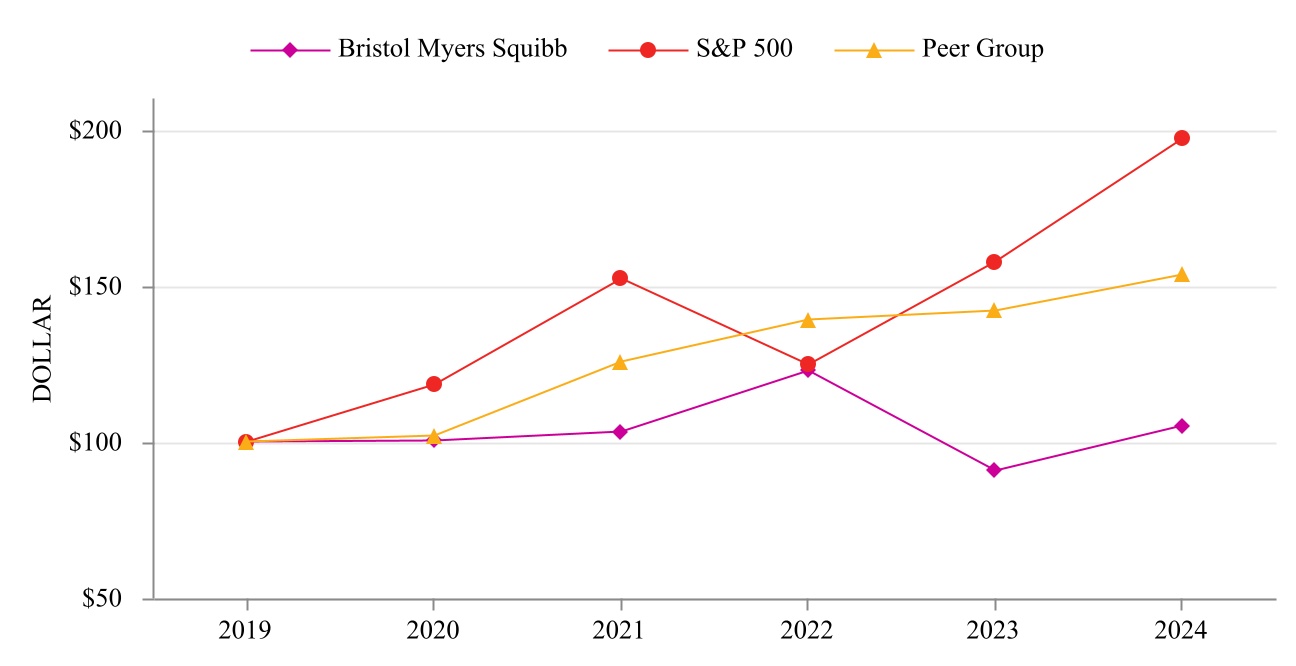
| 2020 | 2021 | 2022 | 2023 | 2024 | ||||||||||||||||||||||||||||
| Bristol Myers Squibb | $ | 100.41 | $ | 103.30 | $ | 122.91 | $ | 90.77 | $ | 105.12 | ||||||||||||||||||||||
| S&P 500 | 118.40 | 152.39 | 124.79 | 157.59 | 197.02 | |||||||||||||||||||||||||||
| Peer Group | 102.02 | 125.57 | 139.06 | 141.88 | 153.64 |
Issuer Purchases of Equity Securities
The following table summarizes the surrenders of our equity securities during the three months ended December 31, 2024:
| Period | Total Number of Shares Purchased**(a)** | Average Price Paid per Share**(a)** | Total Number of Shares Purchased as Part of Publicly Announced Programs**(b)** | Approximate Dollar Value of Shares that May Yet Be Purchased Under the Programs**(b)** | |||||||||||||||||||
| Dollars in millions, except per share data | |||||||||||||||||||||||
| October 1 to 31, 2024 | 79,154 | $ | 53.57 | — | $ | 5,014 | |||||||||||||||||
| November 1 to 30, 2024 | 28,401 | 54.41 | — | 5,014 | |||||||||||||||||||
| December 1 to 31, 2024 | 27,385 | 58.28 | — | 5,014 | |||||||||||||||||||
| Three months ended December 31, 2024 | 134,940 | — |
(a) Includes shares of common stock surrendered to the Company to satisfy tax withholding obligations in connection with the vesting of awards under our long-term incentive program.
(b) In May 2010, the Board of Directors authorized the repurchase of up to $3.0 billion of our common stock. Following this authorization, the Board subsequently approved additional authorizations, including most recently, in February 2020, January and December 2021 and December 2023, in the amount $5.0 billion, $2.0 billion, $15.0 billion and $3.0 billion, respectively, to the share repurchase authorization. The remaining share repurchase capacity under the program was $5.0 billion as of December 31, 2024. Refer to “Item 8. Financial Statements and Supplementary Data—Note 17. Equity” for information on the share repurchase program.
Item 6. [RESERVED]
Item 7. MANAGEMENT’S DISCUSSION AND ANALYSIS OF FINANCIAL CONDITION AND RESULTS OF OPERATIONS.
Management’s discussion and analysis of financial condition and results of operations is provided as a supplement to and should be read in conjunction with the consolidated financial statements and related notes included elsewhere in this 2024 Form 10-K to enhance the understanding of our results of operations, financial condition and cash flows.
The comparison of 2023 to 2022 results has been omitted from this Form 10-K and is incorporated by reference from our Form 10-K for the year ended December 31, 2023 “Item 7. Management’s Discussion and Analysis of Financial Condition and Results of Operations” filed on February 13, 2024.
EXECUTIVE SUMMARY
Bristol-Myers Squibb Company is a global biopharmaceutical company whose mission is to discover, develop and deliver innovative medicines that help patients prevail over serious diseases. Refer to the Summary of Abbreviated Terms at the end of this 2024 Form 10-K for definitions of capitalized terms used throughout the document.
In 2024, we achieved multiple clinical and regulatory milestones across our portfolio including (i) approvals for Breyanzi in the U.S. and Japan for adults with relapsed or refractory FL and in the U.S. for adults with relapsed or refractory CLL/SLL and MCL; (ii) Reblozyl's expanded approval to include the first-line treatment of adult patients with transfusion-dependent anemia due to very low, low and intermediate-risk MDS in the EU and Japan; (iii) FDA approval of Opdivo Qvantig injection for subcutaneous use in most previously approved adult solid tumor Opdivo indications; (iv) FDA approval of Opdivo for the treatment of adult patients with resectable NSCLC, in combination with platinum-doublet chemotherapy, followed by single-agent Opdivo as adjuvant treatment after surgery; and (v) FDA approval and subsequent launch of Cobenfy for the treatment of schizophrenia in adults.
In 2024, we completed the following acquisitions: (i) Karuna, a biopharmaceutical company in the area of developing and delivering medicines, including Cobenfy, for psychiatric and neurological conditions; (ii) RayzeBio, a clinical-stage radiopharmaceutical therapeutics company with a pipeline of potentially first-in-class and/or best-in-class drug development programs; and (iii) Mirati, a commercial stage targeted oncology company, with a commercialized medicine, Krazati, and clinical programs in development. We also entered into a strategic collaboration with SystImmune, to co-develop and co-commercialize izalontamab brengitecan (iza-bren or BL-B01D1), a bispecific topoisomerase inhibitor-based anti-body drug conjugate. Refer to “Item 8. Financial Statements and Supplementary Data—Note 4. Acquisitions, Divestitures, Licensing and Other Arrangements” for additional information.
Financial Highlights
| Year Ended December 31, | |||||||||||||||||
| Dollars in millions, except per share data | 2024 | 2023 | |||||||||||||||
| Total Revenues | $ | 48,300 | $ | 45,006 | |||||||||||||
| Diluted (Loss)/Earnings Per Share | |||||||||||||||||
| GAAP | $ | (4.41) | $ | 3.86 | |||||||||||||
| Non-GAAP | 1.15 | 7.51 |
Revenues increased by 7%, primarily driven by the Growth Portfolio and Eliquis, partially offset by generic erosion in the Legacy Portfolio. We expect continued generic erosion within our Legacy Portfolio in 2025 primarily due to Revlimid, Sprycel and for Pomalyst outside the U.S.
The $8.27 decrease in GAAP EPS in 2024 was primarily driven by a one-time, non-deductible Acquired IPRD charge resulting from the Karuna asset acquisition and SystImmune collaboration, which impacted full-year GAAP EPS by approximately $6.28 and the impact of certain specified items, primarily intangible asset impairments. After adjusting for specified items, the $6.36 decrease in non-GAAP EPS was primarily due to the aforementioned Acquired IPRD charges and higher interest expense partially offset by higher revenues.
Our non-GAAP financial measures, including non-GAAP earnings and related EPS information, are adjusted to exclude specified items that represent certain costs, expenses, gains and losses and other items impacting the comparability of financial results. For a detailed listing of all specified items and further information, reconciliations and changes to our non-GAAP financial measures refer to “—Non-GAAP Financial Measures.”
Economic and Market Factors
Governmental Actions
As regulators continue to focus on prescription drugs, our products are facing increased pressures across the portfolio. These pressures stem from legislative and policy changes, including price controls, pharmaceutical market access, discounting, changes to tax and importation laws and other restrictions in the U.S., EU and other regions around the world. These pressures have resulted in lower prices, lower reimbursement rates and smaller populations for whom payers will reimburse, which can negatively impact our results of operations (including intangible asset impairment charges), operating cash flow, liquidity and financial flexibility. The IRA directs (i) the federal government to “negotiate” prices for select high-cost Medicare Part D (beginning in 2026) and Part B (beginning in 2028) drugs that are more than nine years (for small-molecule drugs) or 13 years (for biological products) from their initial FDA approval, (ii) manufacturers to pay a rebate for Medicare Part B and Part D drugs when prices increase faster than inflation and (iii) the formation of the Part D Manufacturer Program which replaced the Part D CGDP and established a $2,000 cap for out-of-pocket costs for Medicare beneficiaries as of January 2025, with manufacturers being responsible for 10% of costs up to the $2,000 cap and 20% after that cap is reached. In August 2024, as part of the first round of government price setting pursuant to the IRA, the HHS announced the "maximum fair price" for a 30-day equivalent supply of Eliquis, which applies to the U.S. Medicare channel effective January 1, 2026. In January 2025, the HHS selected Pomalyst as a medicine subject to "negotiation" for government-set prices beginning in 2027. It is possible that more of our products could be selected in future years, which could, among other things, accelerate revenue erosion prior to expiry of intellectual property protections. We continue to evaluate the impact of the IRA on our results of operations, and it is possible that these changes may result in a material impact on our business and results of operations.
In addition, in December 2023, the Biden administration released a proposed framework that for the first time proposed that a drug’s price can be a factor in determining that the drug is not accessible to the public and, therefore, that the government could exercise “march-in rights” and license it to a third party to manufacture. We cannot predict whether the Trump administration will finalize the draft framework or if the government will propose other drug pricing policy changes. If pursued and finalized, these policies could reduce prices and reimbursement for certain of our products and could significantly impact our business and consolidated results of operations.
At the state level, multiple states have passed, are pursuing or are considering government action via legislation or regulations to change drug pricing and reimbursement (e.g., establishing prescription drug affordability boards, implementing manufacturer mandates tied to the Federal Public Health Service Act drug pricing program, etc.). Some
Showing the first 8K of 145K characters. Open the full section
Item 7A. QUANTITATIVE AND QUALITATIVE DISCLOSURES ABOUT MARKET RISK.
We are exposed to market risk resulting from changes in currency exchange rates and interest rates. Certain derivative financial instruments are used when available on a cost-effective basis to hedge our underlying economic exposure. All of our financial instruments, including derivatives, are subject to counterparty credit risk considered as part of the overall fair value measurement. Derivative financial instruments are not used for trading purposes.
Foreign Exchange Risk
Significant amounts of our revenues, earnings and cash flow are exposed to changes in foreign currency rates. Our primary net foreign currency translation exposures are the euro and Japanese yen. Foreign currency forward and purchased local currency put option contracts are used to manage risk primarily arising from certain intercompany sales, third party sales and purchases transactions.
We are also exposed to foreign exchange transaction risk arising from non-functional currency denominated assets and liabilities and earnings denominated in non-U.S. dollar currencies. Foreign currency forward contracts are used to offset these exposures but are not designated as hedges. Foreign currency forward contracts are also used to hedge the foreign currency exposures of our net investment in certain international affiliates and are designated as hedges of net investments.
We estimate that a 10% appreciation in the underlying currencies being hedged from their levels against the U.S. dollar (with all other variables held constant) would decrease the fair value of foreign exchange contracts by $455 million and $409 million as of December 31, 2024 and December 31, 2023, respectively, reducing earnings over the remaining life of the contracts.
Cross-currency swap contracts are used to manage risk arising from long-term debt denominated in euros and to hedge the Company's net investment in its foreign subsidiaries. We estimate that a 10% appreciation in the underlying currencies being hedged from their levels against the U.S. dollar (with all other variables held constant) would increase the fair value of cross-currency swap contracts by $49 million as of December 31, 2024 and increase by $46 million as of December 31, 2023, respectively.
For additional information, refer to “Item 8. Financial Statements and Supplementary Data—Note 9. Financial Instruments and Fair Value Measurements.”
Interest Rate Risk
We use fixed-to-floating interest rate swap contracts designated as fair value hedges to provide an appropriate balance of fixed and floating rate debt. We use cross-currency swap contracts designated to manage risk arising from long-term debt denominated in euros and to hedge the Company's net investment in its foreign subsidiaries. The fair values of these contracts as well as our marketable debt securities are analyzed at year-end to determine their sensitivity to interest rate changes. In this sensitivity analysis, if there was a 1% increase in short-term or long-term interest rates as of December 31, 2024 and December 31, 2023, the expected adverse impact on our earnings would not be material.
We estimate that an increase of 1% in long-term interest rates as of December 31, 2024 and December 31, 2023 would decrease the fair value of long-term debt by $3.6 billion and $3.0 billion, respectively.
Credit Risk
We monitor our investments with counterparties with the objective of minimizing concentrations of credit risk. Our investment policy is to invest only in institutions that meet high credit quality standards and establishes limits on the amount and time to maturity of investments with any individual counterparty. The policy also requires that investments are only entered into with corporate and financial institutions that meet high credit quality standards.
The use of derivative instruments exposes us to credit risk if the counterparty fails to perform when the fair value of a derivative instrument contract is positive. If the counterparty fails to perform, collateral is not required by any party whether derivatives are in an asset or liability position. We have a policy of diversifying derivatives with counterparties to mitigate the overall risk of counterparty defaults. For additional information, refer to “Item 8. Financial Statements and Supplementary Data—Note 9. Financial Instruments and Fair Value Measurements.”
Item 8. FINANCIAL STATEMENTS AND SUPPLEMENTARY DATA.
BRISTOL-MYERS SQUIBB COMPANY
CONSOLIDATED STATEMENTS OF EARNINGS
Dollars in millions, except per share data
| Year Ended December 31, | |||||||||||||||||
| 2024 | 2023 | 2022 | |||||||||||||||
| Net product sales | $ | 46,778 | $ | 43,778 | $ | 44,671 | |||||||||||
| Alliance and other revenues | 1,522 | 1,228 | 1,488 | ||||||||||||||
| Total Revenues | 48,300 | 45,006 | 46,159 | ||||||||||||||
| Cost of products sold(a) | 13,968 | 10,693 | 10,137 | ||||||||||||||
| Marketing, selling and administrative | 8,414 | 7,772 | 7,814 | ||||||||||||||
| Research and development | 11,159 | 9,299 | 9,509 | ||||||||||||||
| Acquired IPRD | 13,373 | 913 | 815 | ||||||||||||||
| Amortization of acquired intangible assets | 8,872 | 9,047 | 9,595 | ||||||||||||||
| Other (income)/expense, net | 893 | (1,158) | 576 | ||||||||||||||
| Total Expenses | 56,679 | 36,566 | 38,446 | ||||||||||||||
| (Loss)/earnings before income taxes | (8,379) | 8,440 | 7,713 | ||||||||||||||
| Income tax provision | 554 | 400 | 1,368 | ||||||||||||||
| Net (loss)/earnings | (8,933) | 8,040 | 6,345 | ||||||||||||||
| Noncontrolling Interest | 15 | 15 | 18 | ||||||||||||||
| Net (loss)/earnings attributable to BMS | $ | (8,948) | $ | 8,025 | $ | 6,327 | |||||||||||
| (Loss)/Earnings per common share: | |||||||||||||||||
| Basic | $ | (4.41) | $ | 3.88 | $ | 2.97 | |||||||||||
| Diluted | (4.41) | 3.86 | 2.95 |
(a) Excludes amortization of acquired intangible assets.
CONSOLIDATED STATEMENTS OF COMPREHENSIVE (LOSS)/INCOME
Dollars in millions
| Year Ended December 31, | |||||||||||||||||
| 2024 | 2023 | 2022 | |||||||||||||||
| Net (loss)/earnings | $ | (8,933) | $ | 8,040 | $ | 6,345 | |||||||||||
| Other comprehensive income/(loss), net of taxes and reclassifications to earnings: | |||||||||||||||||
| Derivatives qualifying as cash flow hedges | 374 | (230) | 54 | ||||||||||||||
| Pension and postretirement benefits | 90 | (115) | 145 | ||||||||||||||
| Marketable debt securities | — | 2 | (2) | ||||||||||||||
| Foreign currency translation | (156) | 78 | (210) | ||||||||||||||
| Total other comprehensive income/(loss) | 308 | (265) | (13) | ||||||||||||||
| Comprehensive (loss)/income | (8,625) | 7,775 | 6,332 | ||||||||||||||
| Comprehensive income attributable to noncontrolling interest | 15 | 15 | 18 | ||||||||||||||
| Comprehensive (loss)/income attributable to BMS | $ | (8,640) | $ | 7,760 | $ | 6,314 |
The accompanying notes are an integral part of these consolidated financial statements.
BRISTOL-MYERS SQUIBB COMPANY
CONSOLIDATED BALANCE SHEETS
Dollars in millions, except share and per share data
| December 31, | |||||||||||
| ASSETS | 2024 | 2023 | |||||||||
| Current assets: | |||||||||||
| Cash and cash equivalents | $ | 10,346 | $ | 11,464 | |||||||
| Marketable debt securities | 513 | 816 | |||||||||
| Receivables | 10,747 | 10,921 | |||||||||
| Inventories | 2,557 | 2,662 | |||||||||
| Other current assets | 5,617 | 5,907 | |||||||||
| Total Current assets | 29,780 | 31,770 | |||||||||
| Property, plant and equipment | 7,136 | 6,646 | |||||||||
| Goodwill | 21,719 | 21,169 | |||||||||
| Other intangible assets | 23,307 | 27,072 | |||||||||
| Deferred income taxes | 4,236 | 2,768 | |||||||||
| Marketable debt securities | 320 | 364 | |||||||||
| Other non-current assets | 6,105 | 5,370 | |||||||||
| Total Assets | $ | 92,603 | $ | 95,159 | |||||||
| LIABILITIES | |||||||||||
| Current liabilities: | |||||||||||
| Short-term debt obligations | $ | 2,046 | $ | 3,119 | |||||||
| Accounts payable | 3,602 | 3,259 | |||||||||
| Other current liabilities | 18,126 | 15,884 | |||||||||
| Total Current liabilities | 23,774 | 22,262 | |||||||||
| Deferred income taxes | 369 | 338 | |||||||||
| Long-term debt | 47,603 | 36,653 | |||||||||
| Other non-current liabilities | 4,469 | 6,421 | |||||||||
| Total Liabilities | 76,215 | 65,674 | |||||||||
| Commitments and contingencies | |||||||||||
| EQUITY | |||||||||||
| Bristol-Myers Squibb Company Shareholders’ Equity: | |||||||||||
| Preferred stock, $2 convertible series, par value $1 per share: Authorized 10 million shares; issued and outstanding 2,868 in 2024 and 2,953 in 2023, liquidation value of $50 per share | — | — | |||||||||
| Common stock, par value of $0.10 per share: Authorized 4.5 billion shares; 2.9 billion issued in 2024 and 2023 | 292 | 292 | |||||||||
| Capital in excess of par value of stock | 46,024 | 45,684 | |||||||||
| Accumulated other comprehensive loss | (1,238) | (1,546) | |||||||||
| Retained earnings | 14,912 | 28,766 | |||||||||
| Less cost of treasury stock — 894 million common shares in 2024 and 902 million common shares in 2023 | (43,655) | (43,766) | |||||||||
| Total BMS Shareholders’ Equity | 16,335 | 29,430 | |||||||||
| Noncontrolling interest | 53 | 55 | |||||||||
| Total Equity | 16,388 | 29,485 | |||||||||
| Total Liabilities and Equity | $ | 92,603 | $ | 95,159 |
The accompanying notes are an integral part of these consolidated financial statements.
BRISTOL-MYERS SQUIBB COMPANY
CONSOLIDATED STATEMENTS OF CASH FLOWS
Dollars in millions
| Year Ended December 31, | |||||||||||||||||
| 2024 | 2023 | 2022 | |||||||||||||||
| Cash Flows From Operating Activities: | |||||||||||||||||
| Net (loss)/earnings |
Showing the first 8K of 228K characters. Open the full section
Item 9. CHANGES IN AND DISAGREEMENTS WITH ACCOUNTANTS ON ACCOUNTING AND FINANCIAL DISCLOSURE.
None.
Item 9A. CONTROLS AND PROCEDURES.
Evaluation of Disclosure Controls and Procedures
As of December 31, 2024, management carried out an evaluation, under the supervision and with the participation of its chief executive officer and chief financial officer, of the effectiveness of the design and operation of its disclosure controls and procedures as defined in Exchange Act Rules 13a-15(e) and 15d-15(e), as of the end of the period covered by this 2024 Form 10-K. Based on this evaluation, management has concluded that as of December 31, 2024, such disclosure controls and procedures were effective.
Management’s Report on Internal Control Over Financial Reporting
Management is responsible for establishing and maintaining adequate internal control over financial reporting, as defined in Exchange Act Rule 13a-15(f). Under the supervision and with the participation of management, including the chief executive officer and chief financial officer, management assessed the effectiveness of internal control over financial reporting as of December 31, 2024 based on the framework in “Internal Control—Integrated Framework” (2013) issued by the Committee of Sponsoring Organizations of the Treadway Commission. Based on that assessment, management has concluded that the Company’s internal control over financial reporting was effective at December 31, 2024 to provide reasonable assurance regarding the reliability of its financial reporting and the preparation of its financial statements for external purposes in accordance with United States generally accepted accounting principles. Due to its inherent limitations, internal control over financial reporting may not prevent or detect misstatements. Also, projections of any evaluation of effectiveness to future periods are subject to the risk that controls may become inadequate because of changes in conditions, or that the degree of compliance with the policies or procedures may deteriorate.
Deloitte & Touche LLP, an independent registered public accounting firm, has audited the Company’s financial statements included in this report on this 2024 Form 10-K and issued its report on the effectiveness of the Company’s internal control over financial reporting as of December 31, 2024, which is included herein.
Changes in Internal Control Over Financial Reporting
There were no changes in the Company’s internal control over financial reporting during the quarter ended December 31, 2024 that have materially affected, or is reasonably likely to materially affect, the Company’s internal control over financial reporting.
Item 9B. OTHER INFORMATION.
During the fourth quarter of 2024, no director or officer of the Company adopted or terminated an active "Rule 10b5-1 trading
arrangement" or "non-Rule 10b5-1 trading arrangement," as each term is defined in Item 408(a) of Regulation S-K.
Item 9C. DISCLOSURE REGARDING FOREIGN JURISDICTIONS THAT PREVENT INSPECTIONS.
Not applicable.
REPORT OF INDEPENDENT REGISTERED PUBLIC ACCOUNTING FIRM
To the shareholders and the Board of Directors of Bristol-Myers Squibb Company
Opinion on Internal Control over Financial Reporting
We have audited the internal control over financial reporting of Bristol-Myers Squibb Company and subsidiaries (the “Company”) as of December 31, 2024, based on criteria established in Internal Control — Integrated Framework (2013) issued by the Committee of Sponsoring Organizations of the Treadway Commission (COSO). In our opinion, the Company maintained, in all material respects, effective internal control over financial reporting as of December 31, 2024, based on criteria established in Internal Control — Integrated Framework (2013) issued by COSO.
We have also audited, in accordance with the standards of the Public Company Accounting Oversight Board (United States) (PCAOB), the consolidated financial statements as of and for the year ended December 31, 2024, of the Company and our report dated February 12, 2025, expressed an unqualified opinion on those financial statements.
Basis for Opinion
The Company’s management is responsible for maintaining effective internal control over financial reporting and for its assessment of the effectiveness of internal control over financial reporting, included in the accompanying Management's Report on Internal Control Over Financial Reporting. Our responsibility is to express an opinion on the Company’s internal control over financial reporting based on our audit. We are a public accounting firm registered with the PCAOB and are required to be independent with respect to the Company in accordance with the U.S. federal securities laws and the applicable rules and regulations of the Securities and Exchange Commission and the PCAOB.
We conducted our audit in accordance with the standards of the PCAOB. Those standards require that we plan and perform the audit to obtain reasonable assurance about whether effective internal control over financial reporting was maintained in all material respects. Our audit included obtaining an understanding of internal control over financial reporting, assessing the risk that a material weakness exists, testing and evaluating the design and operating effectiveness of internal control based on the assessed risk, and performing such other procedures as we considered necessary in the circumstances. We believe that our audit provides a reasonable basis for our opinion.
Definition and Limitations of Internal Control over Financial Reporting
A company’s internal control over financial reporting is a process designed to provide reasonable assurance regarding the reliability of financial reporting and the preparation of financial statements for external purposes in accordance with generally accepted accounting principles. A company’s internal control over financial reporting includes those policies and procedures that (1) pertain to the maintenance of records that, in reasonable detail, accurately and fairly reflect the transactions and dispositions of the assets of the company; (2) provide reasonable assurance that transactions are recorded as necessary to permit preparation of financial statements in accordance with generally accepted accounting principles, and that receipts and expenditures of the company are being made only in accordance with authorizations of management and directors of the company; and (3) provide reasonable assurance regarding prevention or timely detection of unauthorized acquisition, use, or disposition of the company’s assets that could have a material effect on the financial statements.
Because of its inherent limitations, internal control over financial reporting may not prevent or detect misstatements. Also, projections of any evaluation of effectiveness to future periods are subject to the risk that controls may become inadequate because of changes in conditions, or that the degree of compliance with the policies or procedures may deteriorate.
/s/ DELOITTE & TOUCHE LLP
Morristown, New Jersey
February 12, 2025
PART III
Item 10. DIRECTORS, EXECUTIVE OFFICERS AND CORPORATE GOVERNANCE.
(a)Reference is made to our 2025 Proxy Statement section "Who We Are: 2024 Director Nominees" with respect to information relating to our Directors, which is incorporated herein by reference and made a part hereof in response to the information required by Item 10.
(b)The information required by Item 10 with respect to our Executive Officers has been included in Part IA of this 2024 Form 10-K in reliance on General Instruction G of Form 10-K and Instruction 3 to Item 401(b) of Regulation S-K, which is incorporated herein by reference and made a part hereof in response to the information required by Item 10.
(c)Reference is made to our 2025 Proxy Statement section “How We Govern and Are Governed – Codes of Conduct” with respect to our code of ethics, which is incorporated herein by reference and made a part hereof in response to the information required by Item 10.
(d)Reference is made to our 2025 Proxy Statement section “How We Are Selected and Elected – Director Succession Planning and Identification of Board Candidates – Shareholder Nominations for Director” with respect to procedures by which shareholders can recommend nominees to our board of directors, which is incorporated herein by reference and made a part hereof in response to the information required by Item 10.
(e)Reference is made to our 2025 Proxy Statement section “How We Are Organized – Committees of Our Board” with respect to our audit committee, which is incorporated herein by reference and made a part hereof in response to the information required by Item 10.
(f)Reference is made to our 2025 Proxy Statement section “How We Govern and Are Governed – Codes of Conduct” with respect to information relating to our insider trading policy, which is incorporated herein by reference and made a part hereof in response to the information required by Item 10.
Item 11. EXECUTIVE COMPENSATION.
(a)Reference is made to our 2025 Proxy Statement section “Executive Compensation,” which is incorporated herein by reference and made a part hereof in response to the information required by Item 11, except that the information under “Executive Compensation – Pay Versus Performance” will not be deemed to be incorporated by reference herein.
Item 12. SECURITY OWNERSHIP OF CERTAIN BENEFICIAL OWNERS AND MANAGEMENT AND RELATED STOCKHOLDER MATTERS.
(a)Reference is made to our 2025 Proxy Statement “Voting Securities and Principal Holders – Common Stock Ownership by Directors and Executive Officers” with respect to the security ownership of certain beneficial owners and management, which is incorporated herein by reference and made a part hereof in response to the information required by Item 12.
(b)Reference is made to our 2025 Proxy Statement section “Items To Be Voted Upon – Equity Compensation Plan Information” with respect to the securities authorized for issuance under equity compensation plans, which is incorporated herein by reference and made a part hereof in response to the information required by Item 12.
Item 13. CERTAIN RELATIONSHIPS AND RELATED TRANSACTIONS, AND DIRECTOR INDEPENDENCE.
(a)Reference is made to our 2025 Proxy Statement section “How We Govern and Are Governed – Related Party Transactions” with respect to certain relationships and related transactions, which is incorporated herein by reference and made a part hereof in response to the information required by Item 13.
(b)Reference is made to our 2025 Proxy Statement section “How We Are Selected and Elected – Director Independence” with respect to director independence, which is incorporated herein by reference and made a part hereof in response to the information required by Item 13.
Item 14. PRINCIPAL ACCOUNTANT FEES AND SERVICES.
Reference is made to our 2025 Proxy Statement sections “Items To Be Voted Upon – Audit and Non-Audit Fees” and “Items To Be Voted Upon – Pre-Approval Policy for Services Provided by our Independent Registered Public Accounting Firm” with respect to the aggregate fees billed to us and services provided by our principal accountant, Deloitte & Touche LLP (PCAOB ID No. 34), which are incorporated herein by reference and made a part hereof in response to the information required by Item 14.
PART IV
Item 15. EXHIBITS AND FINANCIAL STATEMENT SCHEDULE.
| (a) | ||||||||
| Page Number | ||||||||
| 1 | Consolidated Financial Statements | |||||||
| Consolidated Statements of Earnings and Comprehensive Income | 75 | |||||||
| Consolidated Balance Sheets | 76 | |||||||
| Consolidated Statements of Cash Flows | 77 | |||||||
| Notes to Consolidated Financial Statements | 78 | |||||||
| Report of Independent Registered Public Accounting Firm | 123 | |||||||
| 2. | Financial Statement Schedules | |||||||
| All other schedules not included with this additional financial data are omitted because they are not applicable or the required information is included in the financial statements or notes thereto. | ||||||||
| 3. | Exhibits |
The information called for by this Item is incorporated herein by reference to the Exhibit Index in this 2024 Form 10-K.
| (b) | Exhibits Required to be filed by Item 601 of Regulation S-K | 133 |
The information called for by this Item is incorporated herein by reference to the Exhibit Index in this 2024 Form 10-K.
Item 16. FORM 10-K SUMMARY.
None.
SIGNATURES
Pursuant to the requirements of Section 13 or 15(d) of the Securities Exchange Act of 1934, the Registrant has duly caused this Report to be signed on its behalf by the undersigned, thereunto duly authorized.
| BRISTOL-MYERS SQUIBB COMPANY (Registrant) | ||||||||
| By | /s/ CHRISTOPHER BOERNER, Ph.D. | |||||||
| Christopher Boerner, Ph.D. | ||||||||
| Chair of the Board and Chief Executive Officer | ||||||||
| Date: February 12, 2025 |
Pursuant to the requirements of the Securities Exchange Act of 1934, this Report has been signed below by the following persons on behalf of the Registrant and in the capacities and on the dates indicated.
| Signature | Title | Date | ||||||||||||
| /s/ CHRISTOPHER BOERNER, Ph.D. | Chair of the Board and Chief Executive Officer | February 12, 2025 | ||||||||||||
| (Christopher Boerner, Ph.D.) | (Principal Executive Officer) | |||||||||||||
| /s/ DAVID V. ELKINS | Chief Financial Officer | February 12, 2025 | ||||||||||||
| (David V. Elkins) | (Principal Financial Officer) | |||||||||||||
| /s/ PHIL M. HOLZER | Senior Vice President and Corporate Controller | February 12, 2025 | ||||||||||||
| (Phil M. Holzer) | (Principal Accounting Officer) | |||||||||||||
| /s/ PETER J. ARDUINI | Director | February 12, 2025 | ||||||||||||
| (Peter J. Arduini) | ||||||||||||||
| /s/ DEEPAK L. BHATT. M.D. MPH | Director | February 12, 2025 | ||||||||||||
| (Deepak L. Bhatt, M.D. MPH) | ||||||||||||||
| /s/ JULIA A. HALLER, M.D. | Director | February 12, 2025 | ||||||||||||
| (Julia A. Haller, M.D.) | ||||||||||||||
| /s/ MICHAEL R. MCMULLEN | Director | February 12, 2025 | ||||||||||||
| (Michael R. McMullen) | ||||||||||||||
| /s/ MANUEL HIDALGO MEDINA, M.D., Ph.D. | Director | February 12, 2025 | ||||||||||||
| (Manuel Hidalgo Medina, M.D., Ph.D.) | ||||||||||||||
| /s/ PAULA A. PRICE | Director | February 12, 2025 | ||||||||||||
| (Paula A. Price) | ||||||||||||||
| /s/ DERICA W. RICE | Director | February 12, 2025 | ||||||||||||
| (Derica W. Rice) | ||||||||||||||
| /s/ THEODORE R. SAMUELS | Director | February 12, 2025 | ||||||||||||
| (Theodore R. Samuels) | ||||||||||||||
| /s/ KAREN H. VOUSDEN, Ph.D. | Director | February 12, 2025 | ||||||||||||
| (Karen H. Vousden, Ph.D.) | ||||||||||||||
| /s/ PHYLLIS R. YALE | Director | February 12, 2025 | ||||||||||||
| (Phyllis R. Yale) |
SUMMARY OF ABBREVIATED TERMS
Bristol-Myers Squibb Company and its consolidated subsidiaries may be referred to as Bristol Myers Squibb, BMS, the Company, we, our or us in this 2024 Form 10-K, unless the context otherwise indicates. Throughout this 2024 Form 10-K, we have used terms which are defined below:
| 2024 Form 10-K | Annual Report on Form 10-K for the fiscal year ended December 31, 2024 | MAA | Marketing Authorization Application | ||||||||
| 2021 Plan | 2021 Stock Award and Incentive Plan | MCL | mantle cell lymphoma | ||||||||
| 2seventy bio | 2seventy bio, Inc. | MCO | Managed Care Organization | ||||||||
| 340B Program | 340B Drug Pricing Program | MDS | myelodysplastic syndromes | ||||||||
| 2024 Senior Unsecured Notes | Aggregate principal amount of $13.0 billion of unsecured senior notes issued by BMS in February 2024 | Merck | Merck & Co., Inc. | ||||||||
| AbbVie | AbbVie Inc. | MF | myelofibrosis | ||||||||
| ADC | antibody-drug conjugate | Mirati | Mirati Therapeutics, Inc. | ||||||||
| aGVHD | acute graft-versus-host disease | MPM | Malignant Pleural Mesothelioma | ||||||||
| Amgen | Amgen Inc. | MS | Multiple Sclerosis | ||||||||
| Amylin | Amylin Pharmaceuticals, Inc. | MSI-High | microsatellite instability-high | ||||||||
| ANDA | abbreviated New Drug Application | MyoKardia | MyoKardia, Inc. | ||||||||
| ASC | Accounting Standards Codification | NAV | net asset value | ||||||||
| ASR | Accelerated Share Repurchase | NDA | New Drug Application | ||||||||
| AstraZeneca | AstraZeneca PLC | Nimbus | Nimbus Therapeutics, LLC | ||||||||
| BCMA | B-cell maturation antigen | NKT | natural killer T | ||||||||
| Biogen | Biogen, Inc. | Novartis | Novartis Pharmaceutical Corporation | ||||||||
| Biohaven | Biohaven Pharmaceutical Holding Company Ltd. | NSCLC | non-small cell lung cancer | ||||||||
| BLA | Biologics License Application | NVAF | non-valvular atrial fibrillation | ||||||||
| CAR-T | Chimeric Antigen Receptor T cells | OCE | Oncology Center of Excellence | ||||||||
| Celgene | Celgene Corporation acquired by BMS on November 20, 2019 | OECD | Organization for Economic Co-operation and Development | ||||||||
| CERCLA | U.S. Comprehensive Environmental Response, Compensation and Liability Act | oHCM | obstructive hypertrophic cardiomyopathy | ||||||||
| CGDP | Coverage Gap Discount Program | OIG | Office of Inspector General of the U.S. Department of Health and Human Services | ||||||||
| cGMP | current Good Manufacturing Practices | Ono | Ono Pharmaceutical Co., Ltd. | ||||||||
| Cheplapharm | Cheplapharm Arzneimittel GmbH | Orum | Orum Therapeutics | ||||||||
| CHMP | Committee for Medicinal Products for Human Use | Otsuka | Otsuka Pharmaceutical Co., Ltd. | ||||||||
| CLL | Chronic lymphocytic leukemia | PBMs | Pharmacy Benefit Managers | ||||||||
| CML | chronic myeloid leukemia | PCAOB | Public Company Accounting Oversight Board | ||||||||
| COSO | Committee of Sponsoring Organizations of the Treadway Commission | PD-1 | programmed death receptor-1 | ||||||||
| CRC | colorectal carcinoma | PDMA | Prescription Drug Marketing Act | ||||||||
| DLBCL | diffuse large B-cell lymphoma | PDUFA | Prescription Drug User Fee Act | ||||||||
| Dragonfly | Dragonfly Therapeutics, Inc. | Pfizer | Pfizer, Inc. | ||||||||
| DSA | Distribution Services Agreement | PhRMA Code | Pharmaceut |
Showing the first 8K of 63K characters. Open the full section