 filings.tools
Berkshire Hathaway (BRK-B) 10-K risk factor changes: FY2020 vs FY2019
The 2020-12-31 10-K against the 2019-12-31 one, compared heading by heading and sentence by sentence.
Item 1A18 rewritten6 added2 removed90 unchanged
All filing items1,474 rewritten896 added637 removed2,314 unchanged
Summary
counted, not written
- Item 1A headings could not be compared: only 1 carried over between the two years, which usually means one filing was read wrongly, so none is reported as new or removed.
- Sentence by sentence, 896 added, 637 removed, 1,474 rewritten and 2,314 unchanged across 14 items that differ.
Sentences by item
16 items, with every count and a link to each item that changed
| Item | Added | Removed | Rewritten | Unchanged |
|---|---|---|---|---|
| Item 1A. Risk Factors | 6 | 2 | 18 | 90 |
| Item 7. Management’s Discussion and Analysis of Financial Condition and Results of Operations | 421 | 321 | 373 | 414 |
| Item 7A. Quantitative and Qualitative Disclosures About Market Risk | 2 | 2 | 3 | 5 |
| Item 1. Business Description | 48 | 26 | 186 | 538 |
| Item 3. Legal Proceedings | 1 | 0 | 0 | 5 |
| Cover and table of contents | 2 | 1 | 32 | 62 |
| Item 1B. Unresolved Staff Comments | 0 | 0 | 0 | 1 |
| Item 2. Description of Properties | 8 | 4 | 38 | 36 |
| Item 4. Mine Safety Disclosures | 0 | 2 | 7 | 13 |
| Item 5. Market for Registrant’s Common Equity, Related Security Holder Matters and Issuer Purchases of Equity Securities | 8 | 9 | 11 | 16 |
| Item 6. Selected Financial Data | 1 | 1 | 17 | 14 |
| Item 8. Financial Statements and Supplementary Data | 385 | 252 | 698 | 987 |
| Item 9. Changes in and Disagreements with Accountants on Accounting and Financial Disclosure | 0 | 0 | 0 | 1 |
| Item 9A. Controls and Procedures | 0 | 0 | 3 | 2 |
| Item 9B. Other Information | 0 | 0 | 1 | 3 |
| Item 15. Exhibits and Financial Statement Schedules | 14 | 17 | 87 | 127 |
Underlined words on a shaded ground are new in FY2020; struck-through words were in FY2019. Sentences that are wholly new or wholly gone are labelled rather than marked.
Item 1A. Risk Factors
18 rewritten, 6 added, 2 removed, 90 unchanged
Buffett, Chairman of the Board of Directors and Chief Executive Officer, age [removed: 89,] [added: 90,] in consultation with Charles T.
Munger, Vice Chairman of the Board of Directors, age [removed: 96.][added: 97.]
[removed: We] [added: We] need qualified personnel to manage and operate our various [removed: businesses.][added: businesses.]
We concentrate a high percentage of the [added: equity security] investments of our insurance subsidiaries in a relatively small number of equity [removed: securities and diversify our investment portfolios far less than is conventional in the insurance industry.][added: securities.]
Since a large percentage of our equity securities are held by our insurance subsidiaries, significant decreases in the fair values of these investments will produce significant declines in [removed: their] [added: the] statutory [removed: surplus.][added: surplus of our insurance business.]
Most of the contracts remaining at year end [removed: 2019] [added: 2020] will expire by February 2023.
[removed: Competition] [added: Competition] and technology may erode our business franchises and result in lower earnings.
[removed: Deterioration of] [added: Unfavorable] general economic conditions may significantly reduce our operating earnings and impair our ability to access capital markets at a reasonable cost.
Our operating businesses are subject to normal economic [removed: cycles, which affect] [added: cycles affecting] the general economy or the specific industries in which they operate.
In addition, our utilities and energy businesses and our railroad business regularly utilize debt as a component of their capital [removed: structures,] [added: structures] and depend on having access to borrowed funds through the capital markets at reasonable rates.
[removed: Regulatory] [added: Regulatory] changes may adversely impact our future operating [removed: results.][added: results.]
Such initiatives addressed for example, the regulation of banks and other major financial [removed: institutions] [added: institutions, products] and environmental and global-warming matters.
Cyber-attacks could further adversely affect our ability to operate facilities, information technology and business [removed: systems,] [added: systems] or compromise confidential customer and employee information.
Furthermore, instability in the financial markets resulting from terrorism, sustained or significant [removed: cyber-attacks,] [added: cyber-attacks] or war could also have a material adverse effect on our ability to raise capital.
Our estimated unpaid losses arising under contracts covering property and casualty insurance risks are large [removed: ($115.5] [added: ($120.8] billion at December 31, [removed: 2019),] [added: 2020),] and a small percentage increase to those liabilities can result in materially lower reported earnings.
To the extent that changes in government policies limit or restrict the usage of coal as a source of fuel in generating electricity or alternate fuels, such as natural gas, [added: or] displace coal on a competitive basis, revenues and earnings could be adversely affected.
As a common carrier, BNSF is also required to transport [removed: TIH] [added: toxic inhalation hazard] chemicals and other hazardous materials.
Regulations broadly apply and may limit management’s ability to independently make and implement decisions regarding numerous matters including: acquiring businesses; constructing, [removed: acquiring or] [added: acquiring,] disposing [added: or retiring] of operating assets; operating and maintaining generating facilities and transmission and distribution system assets; complying with pipeline safety and integrity and environmental requirements; setting rates charged to customers; establishing capital structures and issuing debt; transacting between our domestic utilities and our other subsidiaries and affiliates; and paying dividends or similar distributions.
General Business Risks
Epidemics, pandemics or other outbreaks, including COVID-19, could hurt our operating businesses.
The outbreak of COVID-19 has adversely affected, and in the future it or other epidemics, pandemics or outbreaks may adversely affect, our operations, including our equity securities portfolio.
This is or may be due to closures or restrictions requested or mandated by governmental authorities, disruption to supply chains and workforce, reduction of demand for our products and services, credit losses when customers and other counterparties fail to satisfy their obligations to us, and volatility in global equity securities markets, among other factors.
We share most of these risks with all businesses.
K-25
K-21
For example, federal legislation, enacted in 2008 and amended in 2015, mandated the implementation of positive train control technology by December 31, 2020, on certain mainline track where inter-city and commuter passenger railroads operate and where toxic-by-inhalation (“TIH”) hazardous materials are transported.
Item 7. Management’s Discussion and Analysis of Financial Condition and Results of Operations
373 rewritten, 421 added, 321 removed, 414 unchanged
| | | [removed: 2019] [added: 2020] | | | | [removed: 2018] [added: 2019] | | | | [removed: 2017] [added: 2018] | | |
| Insurance – underwriting | | $ | [removed: 325] [added: 657] | | | $ | [removed: 1,566] [added: 325] | | | $ | [removed: (2,219] [added: 1,566] | [removed: )] |
| Insurance – investment income | | | [removed: 5,530] [added: 5,039] | | | | [removed: 4,554] [added: 5,530] | | | | [removed: 3,887] [added: 4,554] | |
| Railroad | | | [removed: 5,481] [added: 5,161] | | | | [removed: 5,219] [added: 5,481] | | | | [removed: 3,959] [added: 5,219] | |
| Utilities and energy | | | [removed: 2,840] [added: 3,091] | | | | [removed: 2,621] [added: 2,840] | | | | [removed: 2,033] [added: 2,621] | |
| Manufacturing, service and retailing | | | [removed: 9,372] [added: 8,300] | | | | [removed: 9,364] [added: 9,372] | | | | [removed: 7,282] [added: 9,364] | |
| Investment and derivative gains/losses | | | [removed: 57,445] [added: 31,591] | | | | [removed: (17,737] [added: 57,445] | [removed: )] | | | [removed: 1,377] [added: (17,737] | [added: )] |
| [removed: Other] [added: Other*] | | | [removed: 424] [added: (11,318] | [added: )] | | | [removed: (1,566] [added: 424] | [removed: )] | | | [removed: (485] [added: (1,566] | ) |
| Net earnings attributable to Berkshire Hathaway shareholders | | $ | [removed: 81,417] [added: 42,521] | | | $ | [removed: 4,021] [added: 81,417] | | | $ | [removed: 44,940] [added: 4,021] | |
Our insurance businesses generated after-tax earnings from underwriting of [added: $657 million in 2020,] $325 million in 2019 [removed: compared to earnings of $1.6 billion in 2018] and [removed: after-tax losses of approximately $2.2] [added: $1.6] billion in [removed: 2017.][added: 2018.]
Insurance underwriting results included after-tax losses from significant catastrophe events of approximately [removed: $800] [added: $750] million in [removed: 2019, $1.3 billion] [added: 2020, $800 million] in [removed: 2018] [added: 2019] and [removed: $1.95] [added: $1.3] billion in [removed: 2017.][added: 2018.]
Underwriting results included [removed: after-tax] [added: pre-tax] foreign currency [removed: exchange rate gains] [added: losses] of [removed: $207] [added: $139] million in [removed: 2018] [added: 2020] and [removed: losses] [added: $76 million in 2019 and pre-tax gains] of [removed: $295] [added: $169] million in [removed: 2017.][added: 2018.]
After-tax earnings from insurance investment income in 2019 increased 21.4% over 2018, [removed: which increased 17.2% over 2017.][added: attributable to increases in interest and dividend income.]
[removed: Management’s] [added: Management’s] Discussion and [removed: Analysis] [added: Analysis] *(Continued)*
Earnings in 2019 benefitted from higher rates per car/unit, a curtailment gain related to an amendment to defined benefit retirement plans and ongoing operating cost control initiatives, partly offset by lower freight volumes and incremental costs associated with the persistent flooding conditions and severe winter weather in the first half of [removed: the year.][added: 2019.]
After-tax earnings of our utilities and energy business increased 8.4% in 2019 compared to [removed: 2018 as all businesses produced higher earnings in 2019 versus] 2018.
Earnings [added: in 2020] from our manufacturing, service and retailing businesses [removed: were relatively unchanged from 2018.][added: declined 11.4% versus 2019.]
[removed: Operating results of] [added: Earnings from] our manufacturing, service and retailing businesses in 2019 were [removed: mixed,] [added: relatively unchanged from 2018, reflecting mixed operating results] with several of these businesses experiencing lower earnings in 2019 from a variety of factors.
Investment and derivative gains/losses in [removed: 2019 and 2018] [added: each of the three years presented] included significant [added: gains and losses on our investments in equity securities, including] unrealized gains and losses from market price changes on [removed: our holdings of equity securities.][added: securities we continue to hold.]
Other earnings [added: in 2020] also included [added: after-tax] foreign [removed: currency] exchange rate [removed: gains of $58 million in 2019, $289 million in 2018, and] losses of [removed: $655] [added: $764] million [removed: in 2017] related to non-U.S. Dollar denominated debt issued by Berkshire and its [removed: U.S. based financing] [added: U.S.-based finance] subsidiary, Berkshire Hathaway Finance Corporation (“BHFC”).
We consider investment income as [removed: a] [added: an integral] component of our aggregate insurance operating results.
We believe that such gains and losses are not meaningful in understanding the operating results of our insurance [removed: operations.][added: businesses.]
Generally, we consider pre-tax [removed: catastrophe] losses in excess of $100 million from a current year [added: catastrophic] event [removed: as] [added: to be] significant.
Unpaid loss estimates, including estimates under retroactive reinsurance contracts, were approximately [removed: $115.5] [added: $120.8] billion as of December 31, [removed: 2019.][added: 2020.]
Our periodic underwriting results may also include significant foreign currency transaction gains and losses arising from the changes in the valuation of non-U.S. Dollar denominated [removed: reinsurance] liabilities of our U.S. based insurance subsidiaries due to foreign currency exchange rate fluctuations.
We [removed: engage in both] [added: provide] primary insurance and reinsurance [removed: of property/casualty,] [added: products covering property and casualty risks, as well as] life and health risks.
| GEICO | [removed: |] $ | [removed: 1,506] [added: 3,428] | | | $ | [removed: 2,449] [added: 1,506] | | | $ | [removed: (310] [added: 2,449] | [removed: )] |
| Berkshire Hathaway Primary Group | | [removed: | 383] [added: 110] | | | | [removed: 670] [added: 383] | | | | [removed: 719] [added: 670] | |
| Berkshire Hathaway Reinsurance Group | | [removed: | (1,472] [added: (2,700] | ) | | | [removed: (1,109] [added: (1,472] | ) | | | [removed: (3,648] [added: (1,109] | ) |
| Pre-tax underwriting [removed: gain (loss) |] [added: earnings] | | [removed: 417] [added: 838] | | | | [removed: 2,010] [added: 417] | | | | [removed: (3,239] [added: 2,010] | [removed: )] |
| Income taxes and noncontrolling interests | | [removed: | 92] [added: 181] | | | | [removed: 444] [added: 92] | | | | [removed: (1,020] [added: 444] | [removed: )] |
| Net underwriting [removed: gain (loss) |] [added: earnings] | $ | [removed: 325] [added: 657] | | | $ | [removed: 1,566] [added: 325] | | | $ | [removed: (2,219] [added: 1,566] | [removed: )] |
| Effective income tax rate | | [removed: | 24.2] [added: 21.5] | % | | | [removed: 21.4] [added: 24.2] | % | | | [removed: 32.0] [added: 21.4] | % |
| | [removed: | 2019] [added: 2020] | | | | [added: 2019] | | | | 2018 | | | [removed: | | | | | 2017 | | | | | | |]
| | [removed: |] Amount | | | | % | | | | Amount | | | | % | | | | Amount | | | | % | | |
| Premiums written | [removed: |] $ | [removed: 36,016] [added: 34,928] | | | | | | | $ | [removed: 34,123] [added: 36,016] | | | | | | | $ | [removed: 30,547] [added: 34,123] | | | | | |
| Premiums earned | [removed: |] $ | [removed: 35,572] [added: 35,093] | | | | 100.0 | | | $ | [removed: 33,363] [added: 35,572] | | | | 100.0 | | | $ | [removed: 29,441] [added: 33,363] | | | | 100.0 | |
| Losses and loss adjustment expenses | | [removed: | 28,937] [added: 26,018] | | | | [removed: 81.3] [added: 74.1] | | | | [removed: 26,278] [added: 28,937] | | | | [removed: 78.8] [added: 81.3] | | | | [removed: 25,497] [added: 26,278] | | | | [removed: 86.6] [added: 78.8] | |
| Underwriting expenses | | [removed: | 5,129] [added: 5,647] | | | | [removed: 14.5] [added: 16.1] | | | | [removed: 4,636] [added: 5,129] | | | | [removed: 13.9] [added: 14.5] | | | | [removed: 4,254] [added: 4,636] | | | | [removed: 14.5] [added: 13.9] | |
| Total losses and expenses | | [removed: | 34,066] [added: 31,665] | | | | [removed: 95.8] [added: 90.2] | | | | [removed: 30,914] [added: 34,066] | | | | [removed: 92.7] [added: 95.8] | | | | [removed: 29,751] [added: 30,914] | | | | [removed: 101.1] [added: 92.7] | |
| * | Includes goodwill and indefinite-lived intangible asset impairment charges of $11.0 billion in 2020, $435 million in 2019 and $3.0 billion in 2018, which includes our share of charges recorded by Kraft Heinz. |
There are few centralized or integrated business functions.
As the COVID-19 pandemic accelerated beginning in the second half of March, most of our businesses were negatively affected, with the effects to date ranging from relatively minor to severe.
Revenues and earnings of most of our manufacturing, service and retailing businesses declined considerably, and in certain instances severely, in the second quarter due to closures of facilities where crowds gather, such as retail stores, restaurants and entertainment venues as well as from public travel restrictions and from closures of certain of our businesses.
In each of the third and fourth quarters of 2020, several of these businesses experienced significant increases in revenues and earnings as compared to the second quarter.
Our businesses that were deemed essential continued to operate through the pandemic, including our railroad, utilities and energy, insurance and certain of our manufacturing, wholesale distribution and service businesses.
In response to the effects of the pandemic, our businesses implemented various business continuity plans to protect our employees and customers.
Such plans include a variety of actions, such as temporarily closing certain retail stores, manufacturing facilities and service centers of businesses that were not subject to government mandated closure.
Our businesses also implemented practices to protect employees while at work.
Such practices included work-from-home, staggered or reduced work schedules, increased cleaning and sanitation of workspaces, providing employee health screenings, eliminating non-essential travel and face-to-face meetings and providing general health reminders intended to lower the risk of spreading COVID-19.
We also took actions in response to the economic losses from reductions in consumer demand for products and services we offer and our temporary inability to produce goods and provide services at certain of our businesses.
These actions included employee furloughs, wage and salary reductions, capital spending reductions and other actions intended to help mitigate the economic losses and preserve capital and liquidity.
Certain of our businesses undertook and may continue to undertake restructuring activities to resize their operations to better fit expected customer demand.
We cannot reliably predict future economic effects of the pandemic or when business activities at all of our numerous and diverse operations will normalize.
Nor can we predict how these events will alter the future consumption patterns of consumers and businesses we serve.
In each year, we generated underwriting earnings from primary insurance and underwriting losses from reinsurance.
Underwriting results in 2020 also reflected the effects of the pandemic, arising from premium reductions from the GEICO Giveback program, reduced claims frequencies for private passenger automobile insurance and increased loss estimates for certain commercial insurance and property and casualty reinsurance business.
After-tax earnings from insurance investment income in 2020 declined $491 million (8.9%) versus 2019, reflecting lower interest income primarily attributable to declines in interest rates on our substantial holdings of cash and U.S. Treasury Bills.
After-tax earnings of our railroad business decreased 5.8% in 2020 as compared to 2019.
Earnings in 2020 reflected lower railroad operating revenues from lower shipping volumes, attributable to the negative effects of the COVID-19 pandemic, partly offset by lower operating costs and the effects of productivity improvements.
After-tax earnings of our utilities and energy business increased 8.8% as compared to 2019.
The increase reflected increased tax benefits from renewable energy and increased earnings from the real estate brokerage business.
The effects of the COVID-19 pandemic varied among our manufacturing businesses relative to significance and duration.
Other earnings included after-tax goodwill and indefinite-lived intangible asset impairment charges of $11.0 billion in 2020, $435 million in 2019 and $3.0 billion in 2018.
Such amounts included our share of impairment charges recorded by Kraft Heinz.
Approximately $9.8 billion of the charges in 2020 were attributable to impairments of goodwill and identifiable intangible assets recorded in connection with Berkshire’s acquisition of Precision Castparts in 2016.
Underwriting results in 2020 of certain of our commercial insurance and reinsurance businesses were negatively affected by estimated losses and costs associated with the COVID-19 pandemic, including estimated provisions for claims and uncollectible premiums and incremental operating costs to maintain customer service levels.
The effects of the pandemic in the future may be further affected by judicial rulings and regulatory and legislative actions pertaining to insurance coverage and claims and by its effects on general economic activity, which we cannot reasonably estimate at this time.
| --- | --- | --- | --- | --- | --- | --- | --- | --- | --- | --- | --- |
| --- | --- | --- | --- | --- | --- | --- | --- | --- | --- | --- | --- | --- | --- | --- | --- | --- | --- | --- | --- | --- | --- | --- | --- |
2020 versus 2019
GEICO’s pre-tax underwriting earnings for 2020 reflected significant declines in losses and loss adjustment expenses attributable to lower claims frequencies from the effects of less driving by policyholders during the COVID-19 pandemic offset by the effects of the GEICO Giveback program (see following paragraph) on earned premiums.
Premiums written decreased 3.0% compared to 2019.
The GEICO Giveback program provided for a 15% premium credit to all voluntary auto and motorcycle policies renewing between April 8, 2020 and October 7, 2020, as well as to any new policies written during the same period.
The GEICO Giveback program reduced premiums written in 2020 by approximately $2.9 billion.
Premiums earned decreased 1.3% in 2020 compared to 2019, which included reductions of approximately $2.5 billion attributable to the GEICO Giveback program.
Voluntary auto policies-in-force at the end of 2020 increased approximately 820,000 (4.6%) compared to the end of 2019.
The increase reflected a 7.3% decrease in new business sales and a 2.5% decrease in non-renewals and policy cancellations.
Losses and loss adjustment expenses decreased $2.9 billion (10.1%) in 2020 compared to 2019.
The decrease in the loss ratio reflected declines in claims frequencies, partly offset by increases in claims severities and the impact of lower premiums earned attributable to the GEICO Giveback program.
| --- | --- | --- | --- | --- | --- | --- | --- | --- | --- | --- | --- | --- |
| Tax Cuts and Jobs Act of 2017 | | | — | | | | — | | | | 29,106 | |
There are essentially no centralized or integrated business functions and there is minimal involvement by our corporate headquarters in the day-to-day business activities of the operating businesses.
Beginning in 2018, our periodic net earnings include changes in unrealized gains and losses on our investments in equity securities.
These gains and losses have been very significant given the size of our holdings and the inherent volatility in securities prices, producing extraordinary volatility in our reported net earnings for 2019 and 2018.
Prior to 2018, the changes in unrealized gains and losses pertaining to such investments were recorded in other comprehensive income.
The new accounting treatment has no effect on our consolidated shareholders’ equity.
Net earnings in 2017 included approximately $29.1 billion attributable to a one-time net benefit from the enactment of the Tax Cuts and Jobs Act of 2017 (“TCJA”) on December 22, 2017.
This benefit included approximately $29.6 billion related to a one-time non-cash reduction of net deferred income tax liabilities from the reduction in the statutory U.S. corporate income tax rate from 35% to 21%, and a net benefit of approximately $900 million primarily attributable to our earnings from Kraft Heinz, partly offset by a one-time income tax expense of approximately $1.4 billion on the deemed repatriation of certain accumulated undistributed earnings of foreign subsidiaries.
Due to the significance, we presented these one-time effects as a distinct item in the preceding table.
Accordingly, the after-tax figures presented for 2017 in the discussion of our various operating businesses and other activities exclude the one-time effects of the TCJA.
After-tax earnings of our business operations in 2019 and 2018 were favorably affected by lower U.S. income tax expense compared to 2017, primarily attributable to a reduction in the statutory U.S. corporate income tax rate from 35% to 21%.
The effect of the lower U.S. statutory income tax rate on the comparative after-tax earnings of our various business operations varied, reflecting the differences in the mix of earnings subject to income tax, income tax credits and the effects of state and local income taxes.
Earnings from primary insurance operations were lower in 2019 and losses from reinsurance were higher than in 2018.
After-tax underwriting earnings in 2019 included lower earnings from reductions of estimated ultimate liabilities for prior years’ property/casualty loss events as compared to 2018 and losses of $92 million from foreign currency exchange rate changes on certain non-U.S. Dollar denominated liabilities of U.S. subsidiaries.
These increases reflected increases in interest and dividend income.
K-32
All key routes impacted by flooding resumed service by the third quarter.
Our railroad business generated a 31.8% increase in after-tax earnings in 2018 compared to 2017, reflecting an increase in unit volume, higher average revenue per car/unit and a lower effective income tax rate, partly offset by increased fuel and other operating costs.
Our utilities and energy businesses produced higher after-tax earnings in 2018 compared to 2017, primarily due to the effects of losses incurred in 2017 in connection with the prepayment of certain long-term debt, increased earnings at the natural gas pipelines and other energy businesses and the TCJA income tax benefits recognized in 2018.
After-tax earnings in 2018 of our manufacturing, service and retailing businesses increased 29% over 2017, due to lower effective income tax rates and a 13% increase in pre-tax earnings.
After-tax unrealized gains on equity securities were approximately $53.7 billion in 2019 compared to after-tax losses of $20.6 billion in 2018.
After-tax investment gains in 2019 also included after-tax realized gains on sales of equity and fixed maturity securities of $2.6 billion compared to $3.1 billion in 2018.
After-tax other earnings included equity method investment earnings of $1.0 billion in 2019, losses of $1.4 billion in 2018 and earnings of $1.1 billion in 2017.
The losses in 2018 were attributable to Kraft Heinz, partly offset by earnings from other equity method investments.
We incurred estimated pre-tax losses of approximately $1.0 billion in 2019, $1.6 billion in 2018 and $3.0 billion in 2017 from significant catastrophe events.
In primary insurance activities, we assume defined portions of the risks of loss from persons or organizations that are directly subject to the risks.
In reinsurance activities, we assume defined portions of similar or dissimilar risks that other insurers or reinsurers have subjected themselves to in their own insuring activities.
| Underwriting gain (loss): | | | | | | | | | | | | |
| --- | --- | --- | --- | --- | --- | --- | --- | --- | --- | --- | --- | --- | --- | --- | --- | --- | --- | --- | --- | --- | --- | --- | --- | --- |
The loss ratio increase in 2019 reflected continuing increases in loss severities, slightly offset by lower storm-related losses.
Losses and loss adjustment expenses regularly include changes in the ultimate claim loss estimates during the period for prior years’ loss events, which produce pre-tax underwriting earnings or losses in the period of the change.
GEICO increased ultimate claim loss estimates for prior years’ loss events by $42 million in 2019 compared to a decrease of $222 million in 2018.
Premiums written were $34.1 billion in 2018, an increase of 11.7% compared to 2017.
The increase reflected voluntary auto policies-in-force growth of 3.3% and increased premiums per auto policy of approximately 6.4%.
The increase in premiums per policy was attributable to rate increases, coverage changes and changes in state and risk mix.
The rate increases were in response to accelerating claim costs in previous years.
Although policies-in-force increased 540,000 during 2018, the rate of increase slowed, as voluntary auto new business sales decreased 4.7% compared to 2017.
Losses and loss adjustment expenses in 2018 were $26.3 billion, an increase of $781 million (3.1%) compared to 2017.
GEICO’s losses and loss adjustment expenses ratio for 2018 was 78.8%, a decline of 7.8 percentage points compared to 2017.
An excerpt. Shown here: 40 of 373 rewritten, 40 of 421 added and 40 of 321 removed. The counts are complete. For every sentence, read Item 7. Management’s Discussion and Analysis of Financial Condition and Results of Operations in the FY2020 filing and the FY2019 filing.
Item 7A. Quantitative and Qualitative Disclosures About Market Risk
3 rewritten, 2 added, 2 removed, 5 unchanged
Under the supervision and with the participation of our management, including our principal executive officer and principal financial officer, we conducted an evaluation of the effectiveness of the Company’s internal control over financial reporting as of December 31, [removed: 2019] [added: 2020] as required by the Securities Exchange Act of 1934 Rule 13a-15(c).
Based on our evaluation under the framework in *Internal Control—Integrated Framework* (2013), our management concluded that our internal control over financial reporting was effective as of December 31, [removed: 2019.][added: 2020.]
The effectiveness of our internal control over financial reporting as of December 31, [removed: 2019] [added: 2020] has been audited by Deloitte & Touche LLP, an independent registered public accounting firm, as stated in their report which appears on page [removed: K-63.][added: K-67.]
February 27, 2021
K-66
February 22, 2020
K-62
Item 1. Business Description
186 rewritten, 48 added, 26 removed, 538 unchanged
[removed: It also] [added: Berkshire’s senior management] is [added: also] responsible for establishing and monitoring Berkshire’s corporate governance practices, [removed: including, but not limited to, communicating the appropriate “tone at the top” messages to its employees and associates,] [added: including] monitoring governance efforts, including those at the operating businesses, and participating in the resolution of governance-related issues as needed.
While the IAIS standards do not have legal effect, the states and the NAIC are [removed: implementing, and are expected to continue to implement,] [added: implementing] various regulatory tools and [removed: mandates.][added: mandates that are responsive to certain IAIS standards.]
Collectively, the combined statutory surplus of Berkshire’s [removed: U.S. based] [added: U.S.-based] insurers was approximately [removed: $216] [added: $237] billion at December 31, [removed: 2019.][added: 2020.]
The aggregate deductible in [removed: 2020] [added: 2021] for Berkshire’s insurance group is expected to approximate [removed: $1.3] [added: $1.4] billion.
Berkshire insurance subsidiaries are located in several countries, including Germany, the United [removed: Kingdom,] [added: Kingdom (“UK”),] Ireland, Australia and South Africa, and also maintain branches in other countries, including Canada, various members of the European [removed: Union,] [added: Union (“EU”),] Australia, New Zealand, Singapore, Hong Kong, Macau and Dubai.
On June 23, 2016, the [removed: United Kingdom (“UK”)] [added: UK] voted in a national referendum to withdraw from the EU (“Brexit”), which resulted in the UK’s withdrawal from the EU on January 31, 2020.
In anticipation of the UK leaving the EU, Berkshire Hathaway European Insurance DAC in Ireland was established to permit property and casualty insurance and reinsurance businesses to continue to operate in the [removed: European Union] [added: EU] following Brexit.
Following the withdrawal of the UK from the EU as [added: a] result of Brexit, Berkshire expects to continue to maintain a substantial presence in London.
Berkshire’s insurance businesses [removed: employ] [added: employed] approximately [removed: 50,000 people.][added: 51,000 people at the end of 2020.]
GEICO also [removed: insures] [added: provides insurance for] motorcycles, all-terrain vehicles, recreational vehicles, boats and small commercial fleets and acts as an agent for other insurers who offer homeowners, renters, life and identity management insurance to individuals who desire insurance coverages other than those offered by GEICO.
GEICO competes for private passenger automobile insurance customers in the preferred, standard and non-standard risk markets with other companies that sell directly to the customer as well as with companies that use agency sales forces, including State Farm, [removed: Allstate (including Esurance),] [added: Allstate,] Progressive and USAA.
[removed: Significant] [added: GEICO’s] advertising campaigns and competitive rates contributed to a cumulative increase in voluntary policies-in-force of approximately [removed: 35%] [added: 36%] over the past five years.
According to [added: the] most recently published A.M. Best data for [removed: 2018,] [added: 2019,] the five largest automobile insurers had a combined market share in [removed: 2018] [added: 2019] of approximately [removed: 57%,] [added: 58% based on written premiums,] with GEICO’s market share being second largest at approximately [removed: 13.4%.][added: 13.8%.]
[removed: Berkshire] [added: Berkshire] Hathaway Primary [removed: Group—The] [added: Group—The] Berkshire Hathaway Primary Group (“BH Primary”) is a collection of independently managed insurers that provide a wide variety of insurance coverages to policyholders located principally in the United States.
Berkshire Hathaway Specialty Insurance (“BH Specialty”) [removed: provides] [added: offers] commercial property, casualty, healthcare professional liability, executive and [removed: professional lines,] [added: professional,] surety, travel, medical stop loss and [removed: homeowners insurance.][added: homeowner’s insurance through Berkshire Hathaway Specialty Insurance Company and other Berkshire insurance affiliates.]
BH Specialty writes [removed: business] [added: primary and excess policies] on [removed: both] an [removed: excess] [added: admitted] and surplus [removed: lines] basis [removed: and an admitted basis] in the U.S., and on a [removed: locally admitted] [added: local or foreign non-admitted] basis outside the U.S. BH Specialty is based in Boston, Massachusetts, with regional offices currently in several [removed: cities in the] U.S. [removed: and international offices located in Australia, New Zealand, Canada and several countries in Asia and Europe.][added: cities.]
Additionally, MedPro provides HCL insurance solutions [removed: in Europe,] [added: to the international markets through other Berkshire insurance affiliates,] delivers liability insurance to other professionals, and offers specialized accident and health insurance solutions to colleges and other customers through its subsidiaries and other Berkshire affiliates.
Central States Indemnity Company of Omaha, based in Omaha, Nebraska, primarily writes [added: credit card credit insurance,] Medicare Supplement [added: insurance and agricultural equipment] insurance.
[removed: MLMIC distributes its policies mostly on a] direct basis to medical and dental professionals, health care providers and hospitals.
In October 2019, Berkshire sold its 81% interest in Applied Underwriters, Inc. [removed: (“Applied”).]
[removed: *Property/casualty*][added: Property/casualty]
IAG is a multi-line insurer in Australia, New Zealand and other [removed: Asia Pacific] [added: Asia-Pacific] countries.
General Re Group’s international reinsurance business is conducted on a direct basis through General Reinsurance AG (“GRAG”), based in [removed: Cologne] [added: Cologne,] Germany, and through several other subsidiaries and branches in [removed: 23] [added: 22] countries.
Approximately [removed: 27%] [added: 35%] of the aggregate life/health net premiums written by the General Re Group were in the [removed: United States,] [added: Asia Pacific] compared to [removed: 18%] [added: 26%] in [added: the United States, 22% in] Western Europe and [removed: 55%] [added: 17%] throughout the rest of the world.
BHLN and its affiliates have also periodically reinsured certain guaranteed minimum death, income, and similar benefit [removed: coverages] [added: risks] on closed-blocks of variable annuity reinsurance contracts.
Coverages under such contracts are provided on an excess basis (above a stated retention) or for losses payable [removed: immediately] after the inception of the [removed: contract.][added: contract with no additional ceding company retention.]
Contracts are normally subject to aggregate limits of [removed: indemnification and are occasionally] [added: indemnification, which can be] exceptionally large in amount.
The concept of time-value-of-money is an important element in establishing retroactive reinsurance contract prices and [removed: terms,] [added: terms] since loss payments may occur over decades.
[removed: *Periodic] [added: Periodic] payment [removed: annuity*][added: annuity]
[removed: Similar to] [added: Consistent with] retroactive reinsurance contracts, time-value-of-money concepts are an important factor in establishing [removed: such] [added: annuity] premiums and underwriting losses are expected from the periodic accretion of time-value discounted liabilities.
Investment portfolios are [added: primarily] managed by Berkshire’s Chief Executive [removed: Officer and other in-house investment managers.][added: Officer.]
On a consolidated basis, float has grown from approximately [removed: $84] [added: $88] billion at the end of [removed: 2014] [added: 2015] to approximately [removed: $129] [added: $138] billion at the end of [removed: 2019, primarily through internal growth.][added: 2020.]
[removed: Over] [added: In four of] the past five years, [removed: with the exception of 2017,] Berkshire’s cost of float was negative, as its insurance businesses produced net underwriting gains.
BNSF Railway had approximately [removed: 40,750] [added: 35,000] employees at the end of [removed: 2019.][added: 2020.]
For the year ending December 31, [removed: 2019,] [added: 2020,] approximately [removed: 35%] [added: 37%] of freight revenues were derived from consumer products, [removed: 27%] [added: 26%] from industrial products, [removed: 21%] [added: 24%] from agricultural products and [removed: 17%] [added: 13%] from coal.
[removed: Regulatory Matters][added: *Regulatory Matters*]
Rail operations are subject to the regulatory jurisdiction of the Surface Transportation Board [removed: (“STB”)] [added: (“STB”),] the Federal Railroad Administration of the United States Department of Transportation (“DOT”), the Occupational Safety and Health Administration (“OSHA”), as well as other federal and state regulatory agencies and Canadian regulatory agencies for operations in Canada.
[removed: *Environmental Matters*][added: Environmental Matters]
BNSF’s rail operations, as well as those of its competitors, are also subject to extensive federal, state and local environmental regulation covering discharges to [removed: water,] [added: the ground or waters,] air emissions, toxic substances and the generation, handling, storage, transportation and disposal of waste and hazardous materials.
In order to remain competitive, BNSF [added: Railway] and other railroads seek to develop and implement operating efficiencies to improve productivity.
There are few centralized or integrated business functions.
Berkshire’s Board of Directors is responsible for assuring an appropriate successor to the Chief Executive Officer.
The Berkshire Code of Business Conduct and Ethics emphasizes, among other things, the commitment to ethics and compliance with the law and provides basic standards for ethical and legal behavior of its employees.
Berkshire and its consolidated subsidiaries employed approximately 360,000 people worldwide at the end of 2020.
Human capital and resources are an integral and essential component of Berkshire’s businesses.
Consistent with Berkshire’s decentralized management philosophy, Berkshire’s operating businesses establish specific policies and practices for their businesses concerning the attraction and retention of personnel within the organizations.
Such policies and practices generally address, among other things: maintaining a safe work environment for employees, customers and other business partners, offering competitive compensation to employees, including health insurance and retirement benefits and incentives, providing learning and career development opportunities, and hiring practices intended to identify qualified candidates and promote diversity and inclusion in the workforce.
Since that data was published, GEICO’s management estimates its current market share may have declined, depending on how the effects of pandemic-related premium credit programs will be reflected in A.M. Best’s measurements.
BH Specialty also maintains international offices located in Australia, New Zealand, Canada and several countries in Asia, Europe and the Middle East.
MLMIC distributes its policies mostly on a
For instance, an excess contract written in January 2017 provides indemnification for 80% of up to $25 billion in excess of $25 billion retained by the ceding company.
BHE GT&S was acquired on November 1, 2020.
BHE GT&S, based in Virginia, operates three interstate natural gas pipeline systems that consist of approximately 5,400 miles of natural gas transmission, gathering and storage pipelines and operates seventeen underground natural gas storage fields in the eastern region of the United States.
BHE GT&S’s large underground natural gas storage assets and pipeline systems are part of an interconnected gas transmission network that provides transportation services to utilities and numerous other customers.
BHE GT&S is also an industry leader in liquefied natural gas solutions through its investments in and ownership of several liquefied natural gas facilities located throughout the eastern region of the United States.
*Regulatory Matters*
The United States completed its withdrawal from the Paris Agreement on November 4, 2020.
President Biden accepted the terms of the climate agreement on January 21, 2021, and the United States completed its reentry on February 19, 2021.
Berkshire’s manufacturing businesses employed approximately 179,000 people at the end of 2020.
PCC has several significant customers, including aerospace original equipment manufacturers (Boeing and Airbus) and aircraft engine manufacturer suppliers (General Electric, Rolls Royce and Pratt &Whitney).
In 2020, delay requests increased due to the COVID-19 pandemic.
The effects of the COVID-19 pandemic and the grounding of the Boeing 737 MAX produced significant adverse effects on the PCC aerospace business in 2020.
The sudden and material reductions in air travel led to aircraft build rate reductions and customer destocking at extraordinary rates.
Aircraft build rates have not yet begun to recover in any meaningful way.
During 2020, PCC significantly reduced its worldwide workforce by about 40% since the end of 2019 to help align operations to reduced aircraft build rates.
The restructuring actions taken began to improve margins in late 2020 from the low margins experienced earlier in the year and further margin improvements are expected going forward.
Lubrizol leverages its scientific and applications knowledge to meet and exceed customer performance and sustainability requirements.
While Lubrizol typically has patents that expire each year, it invests resources to protect its intellectual property and to develop or acquire innovative products for the markets it serves.
Lubrizol operates its business on a global basis through more than 100 offices, laboratories, production facilities and warehouses on six continents, the most significant of which are North America, Europe, Asia and South America.
In 2020, the global pandemic had an adverse effect on many of the markets that Lubrizol serves, including the transportation and industrial markets.
This was offset in part by strong demand for Lubrizol’s technology that is used in personal care applications, such as hand sanitizers.
Lubrizol also makes a significant investment in its human capital to ensure that it attracts, develops and retains a talented and diverse employee workforce.
As of December 2020, off-site backlog was $1.3 billion, up 237% from prior year.
The soft floor covering industry is highly competitive with only a handful of key players domestically where the majority of Shaw’s business occurs.
There are numerous manufacturers, domestically and internationally, that are engaged in hard surface floor covering production, distribution and sales.
Benjamin Moore & Co. (“Benjamin Moore”), headquartered in Montvale, New Jersey, is one of North America's leading manufacturers of premium quality residential, commercial and industrial maintenance coatings.
Benjamin Moore is committed to innovation and sustainable manufacturing practices.
The Benjamin Moore premium portfolio spans the brand’s flagship paint lines including Aura®, Regal® Select, Ultra Spec®, ben®, ADVANCE®, ARBORCOAT® and more.
The Benjamin Moore diversified brands include specialty and architectural paints from Coronado®, Insl-x® and Lenmar®.
These orders may be picked up at the customer’s nearest retailer or delivered.
There are essentially no centralized or integrated business functions (such as sales, marketing, purchasing, legal or human resources) and there is minimal involvement by Berkshire’s corporate headquarters in the day-to-day business activities of the operating businesses.
Berkshire and its consolidated subsidiaries employ approximately 391,500 people worldwide.
Since the publication of that data, GEICO’s management estimates its current market share is approximately 13.6%.
BH Specialty currently intends to further expand its operations.
The NICO Group periodically participates in underwriting placements with major brokers in the London Market through Berkshire Hathaway International Insurance, Ltd., based in Great Britain.
Business is written through intermediary brokers or directly with the insured or reinsured.
For instance, in January 2017, NICO entered into a retroactive reinsurance agreement with various subsidiaries of American International Group, Inc. (collectively, “AIG”).
Under the agreement, NICO agreed to indemnify AIG for 80% of up to $25 billion in excess of $25 billion retained by AIG, of losses and allocated loss adjustment expenses with respect to certain commercial insurance loss events occurring in years prior to 2016.
On June 1, 2017, President Trump announced the United States would begin the process of withdrawing from the Paris Agreement.
Under the terms of the Paris Agreement, withdrawal cannot occur until four years after entry into force, making the United States’ withdrawal effective in November 2020.
In October 2012, HomeServices acquired a 66.7% interest in one of the largest residential real estate brokerage franchise networks in the United States, which offers and sells independently owned and operated residential real estate brokerage franchises.
In April 2018, HomeServices acquired the remaining 33.3% interest.
Lubrizol operates facilities in 27 countries (including production facilities in 17 countries and laboratories in 14 countries).
Marmon acquired the Colson Medical Companies as of October 31, 2019, which comprise Marmon’s Medical sector.
Berkshire’s industrial products manufacturers employ approximately 83,000 persons.
In 2016, Shaw acquired USFloors, Inc., which is a leading innovator and marketer of wood-plastic composite luxury vinyl tile flooring, as well as cork, bamboo and hardwood products.
The floor covering industry is highly competitive with more than 100 companies engaged in the manufacture and sale of carpet in the United States and numerous manufacturers engaged in hard surface floor covering production and sales.
Benjamin Moore & Co. (“Benjamin Moore”), headquartered in Montvale, New Jersey, is a leading formulator, manufacturer and retailer of a broad range of architectural coatings, available principally in the United States and Canada.
Products include water-based and solvent-based general-purpose coatings (paints, stains and clear finishes) for use by consumers, contractors and industrial and commercial users.
Products are marketed under various registered brand names, including, but not limited to: *Aura®, Natura®, Regal® Select*, *Ultra Spec®*, *ben®, Eco Spec®, Coronado®, Corotech®, Insl-x®, Lenmar®, Super Kote®, Arborcoat®, Super Hide®, Century®, SCUFF-X® and Notable®™.*
The independent retailer channel offers a broad array of products including *Benjamin Moore®, Coronado®* and *Insl-x®* brands and other competitor coatings, wall coverings, window treatments and sundries.
Selected Benjamin Moore products are currently sold at approximately 1,000 Ace Hardware (“Ace”) stores.
Berkshire’s building products manufacturers employ approximately 57,500 people.
Berkshire’s consumer products manufacturers employ approximately 55,000 persons.
A curtailment of purchasing by Walmart or its other significant customers could have a material adverse impact on McLane’s periodic revenues and earnings.
The Buffalo News and BH Media Group, Inc. are publishers of 31 daily and 43 weekly newspapers.
An excerpt. Shown here: 40 of 186 rewritten, 40 of 48 added and all 26 removed. The counts are complete. For every sentence, read Item 1. Business Description in the FY2020 filing and the FY2019 filing.
Item 3. Legal Proceedings
0 rewritten, 1 added, 0 removed, 5 unchanged
K-28
Cover and table of contents
32 rewritten, 2 added, 1 removed, 62 unchanged
For the fiscal year ended December 31, [removed: 2019][added: 2020]
| Class A Common Stock Class B Common Stock 0.750% Senior Notes due 2023 1.125% Senior Notes due 2027 1.625% Senior Notes due 2035 [removed: 0.500% Senior Notes due 2020] 1.300% Senior Notes due 2024 2.150% Senior Notes due 2028 [removed: 0.250%] [added: 0.625%] Senior Notes due [removed: 2021 0.625%] [added: 2023 0.000%] Senior Notes due [removed: 2023] [added: 2025] 2.375% Senior Notes due 2039 [added: 0.500% Senior Notes due 2041] 2.625% Senior Notes due 2059 | | BRK.A BRK.B BRK23 BRK27 BRK35 [removed: BRK20] BRK24 BRK28 [removed: BRK21] BRK23A [added: BRK25] BRK39 [added: BRK41] BRK59 | | New York Stock Exchange New York Stock Exchange New York Stock Exchange New York Stock Exchange New York Stock Exchange New York Stock Exchange New York Stock Exchange New York Stock Exchange New York Stock Exchange New York Stock Exchange New York Stock Exchange New York Stock Exchange |
State the aggregate market value of the voting stock held by non-affiliates of the Registrant as of June 30, [removed: 2019: $417,300,000,000*][added: 2020: $336,500,000,000*]
| February [removed: 13, 2020—Class] [added: 16, 2021—Class] A common stock, $5 par value | [removed: 700,396] [added: 640,586] shares |
| February [removed: 13, 2020—Class] [added: 16, 2021—Class] B common stock, $0.0033 par value | [removed: 1,385,994,959] [added: 1,336,348,609] shares |
Portions of the Proxy Statement for the Registrant’s Annual Meeting to be held May [removed: 2, 2020] [added: 1, 2021] are incorporated in Part III.
| * | This aggregate value is computed at the last sale price of the common stock as reported on the New York Stock Exchange on June 30, [removed: 2019.] [added: 2020.] It does not include the value of Class A common stock and Class B common stock held by Directors and Executive Officers of the Registrant and members of their immediate families, some of whom may not constitute “affiliates” for purpose of the Securities Exchange Act of 1934. |
| Item 1A. | [Risk Factors](#ITEM_1A_RISK_FACTORS) | [removed: K-21] [added: K-22] |
| Item 1B. | [Unresolved Staff Comments](#ITEM_1B_UNRESOLVED_STAFF_COMMENTS) | [removed: K-25] [added: K-26] |
| Item 2. | [Description of Properties](#ITEM_2_DESCRIPTION_PROPERTIES) | [removed: K-25] [added: K-26] |
| Item 3. | [Legal Proceedings](#ITEM_3_LEGAL_PROCEEDINGS) | [removed: K-27] [added: K-28] |
| Item 4. | [Mine Safety Disclosures](#ITEM_4_MINE_SAFETY_DISCLOSURES) | [removed: K-27] [added: K-29] |
| Item 6. | [Selected Financial Data](#ITEM_6_SELECTED_FINANCIAL_DATA) | [removed: K-31] [added: K-32] |
| Item 7. | [Management’s Discussion and Analysis of Financial Condition and Results of Operations](#ITEM_7_MANAGEMENTS_DISCUSSION_ANALYSIS_F) | [removed: K-32] [added: K-33] |
| Item 7A. | [Quantitative and Qualitative Disclosures About Market Risk](#ITEM_7A_QUANTITATIVE_QUALITATIVE_DISCLOS) | [removed: K-62] [added: K-66] |
| Item 8. | [Financial Statements and Supplementary Data](#ITEM_8_FINANCIAL_STATEMENTS_SUPPLEMENTAR) | [removed: K-63] [added: K-67] |
| | [Consolidated Balance Sheets— December 31, [removed: 2019] [added: 2020] and December 31, [removed: 2018](#CONSOLIDATED_BALANCE_SHEETS)] [added: 201](#CONSOLIDATED_BALANCE_SHEETS)9] | [removed: K-66] [added: K-70] |
| | [Consolidated Statements of Earnings— Years Ended December 31, [removed: 2019,] [added: 2020,] December 31, [removed: 2018,] [added: 2019,] and December 31, [removed: 2017](#CONSOLIDATED_STATEMENTS_EARNINGS)] [added: 201](#CONSOLIDATED_STATEMENTS_EARNINGS)8] | [removed: K-68] [added: K-72] |
| | [Consolidated Statements of Comprehensive Income— Years Ended December 31, [removed: 2019,] [added: 2020,] December 31, [removed: 2018,] [added: 2019,] and December 31, [removed: 2017](#CONSOLIDATED_STATEMENTS_COMPREHENSIVE_IN)] [added: 201](#CONSOLIDATED_STATEMENTS_COMPREHENSIVE_IN)8] | [removed: K-69] [added: K-73] |
| | [Consolidated Statements of Changes in Shareholders’ Equity— Years Ended December 31, [removed: 2019,] [added: 2020,] December 31, [removed: 2018,] [added: 2019,] and December 31, [removed: 2017](#CONSOLIDATED_STATEMENTS_CHANGES_IN_SHARE)] [added: 201](#CONSOLIDATED_STATEMENTS_CHANGES_IN_SHARE)8] | [removed: K-69] [added: K-73] |
| | [Consolidated Statements of Cash Flows— Years Ended December 31, [removed: 2019,] [added: 2020,] December 31, [removed: 2018,] [added: 2019,] and December 31, [removed: 2017](#CONSOLIDATED_STATEMENTS_CASH_FLOWS)] [added: 201](#CONSOLIDATED_STATEMENTS_CASH_FLOWS)8] | [removed: K-70] [added: K-74] |
| | [Notes to Consolidated Financial Statements](#NOTES_TO_CONSOLIDATED_FINANCIAL_STATEMEN) | [removed: K-71] [added: K-75] |
| Item 9. | [Changes in and Disagreements with Accountants on Accounting and Financial Disclosure](#ITEM_9_CHANGES_IN_DISAGREEMENTS_WITH_ACC) | [removed: K-112] [added: K-116] |
| Item 9A. | [Controls and Procedures](#ITEM_9A_CONTROLS_PROCEDURES) | [removed: K-112] [added: K-116] |
| Item 9B. | [Other Information](#ITEM_9B_OR_INFORMATION) | [removed: K-112] [added: K-116] |
| Item 10. | [Directors, Executive Officers and Corporate Governance](#PART_III) | [removed: K-112] [added: K-116] |
| Item 11. | [Executive Compensation](#PART_III) | [removed: K-112] [added: K-116] |
| Item 12. | [Security Ownership of Certain Beneficial Owners and Management and Related Stockholder Matters](#PART_III) | [removed: K-112] [added: K-116] |
| Item 13. | [Certain Relationships and Related Transactions and Director Independence](#PART_III) | [removed: K-112] [added: K-116] |
| Item 14. | [Principal Accountant Fees and Services](#PART_III) | [removed: K-112] [added: K-116] |
| Item 15. | [Exhibits and Financial Statement Schedules](#ITEM_15_EXHIBITS_FINANCIAL_STATEMENT_SCH) | [removed: K-112] [added: K-116] |
| [Exhibit Index](#EXHIBIT_INDEX) | | [removed: K-116] [added: K-120] |
Indicate by check mark whether the registrant has filed a report on and attestation to its management’s assessment of the effectiveness of its internal control over financial reporting under Section 404(b) of the Sarbanes-Oxley Act (15 U.S.C. 7262(b)) by the registered public accounting firm that prepared or issued its audit report.
| [Signatures](#SIGNATURES) | | K-122 |
| [Signatures](#SIGNATURES) | | K-118 |
Item 2. Description of Properties
38 rewritten, 8 added, 4 removed, 36 unchanged
As of December 31, [removed: 2019,] [added: 2020,] the total BNSF Railway system, including single and multiple main tracks, yard tracks and sidings, consisted of over 50,000 operated miles of track.
Support facilities for rail operations include yards and terminals throughout its rail network, system locomotive shops to perform locomotive servicing and maintenance, a centralized network operations center for train dispatching and network operations monitoring and management, [removed: regional dispatching centers,] computers, telecommunications equipment, signal systems and other support systems.
BNSF owns or holds under non-cancelable leases exceeding one year approximately [removed: 8,000] [added: 7,700] locomotives and [removed: 70,000] [added: 66,000] freight cars, in addition to maintenance of way and other equipment.
In [removed: 2019,] [added: 2020,] BNSF recorded approximately $2 billion in repairs and maintenance expense.
Properties of BHE’s natural gas businesses include natural gas distribution facilities, interstate pipelines, storage facilities, [added: liquefied natural gas facilities,] compressor stations and meter stations.
BHE or its affiliates own or have interests in the following types of operating electric generating facilities at December 31, [removed: 2019:][added: 2020:]
| Natural gas | | PacifiCorp, MEC, NV Energy and BHE Renewables | | Nevada, Utah, Iowa, Illinois, Washington, [added: Wyoming,] Oregon, Texas, New [removed: York, Arizona] [added: York] and [removed: Wyoming] [added: Arizona] | | | [removed: 10,938] [added: 11,171] | | | | [removed: 10,659] [added: 10,892] | |
| Coal | | PacifiCorp, MEC and NV Energy | | Wyoming, Iowa, Utah, [removed: Arizona,] Nevada, Colorado and Montana | | | [removed: 13,641] [added: 13,249] | | | | [removed: 8,593] [added: 8,198] | |
| Wind | | PacifiCorp, MEC and BHE Renewables | | Iowa, Wyoming, Texas, Nebraska, Washington, California, Illinois, [removed: Oregon and] [added: Oregon,] Kansas [added: and Montana] | | | [removed: 8,883] [added: 10,302] | | | | [removed: 8,883] [added: 10,302] | |
| Nuclear | | MEC | | Illinois | | | [removed: 1,821] [added: 1,815] | | | | [removed: 455] [added: 454] | |
As of December 31, [removed: 2019,] [added: 2020,] BHE’s subsidiaries also have electric generating facilities that are under construction in Iowa, Wyoming and Montana having total Facility Net Capacity and Net Owned Capacity of [removed: 1,816] [added: 603] MW.
PacifiCorp, MEC and NV Energy own electric transmission and distribution systems, including approximately [removed: 25,200] [added: 27,600] miles of transmission lines and approximately [removed: 1,690 substations,] [added: 1,650 substations and] gas distribution facilities, including approximately [removed: 27,500] [added: 27,600] miles of gas mains and service lines.
[removed: The electricity distribution network of] Northern Powergrid (Northeast) and Northern Powergrid (Yorkshire) [added: operate an electricity distribution network that] includes approximately [removed: 17,400] [added: 17,300] miles of overhead lines, approximately [removed: 42,300] [added: 42,800] miles of underground cables and approximately 770 major substations.
Northern Natural’s pipeline system consists of approximately [removed: 14,600] [added: 14,500] miles of natural gas pipelines, including approximately [removed: 6,100] [added: 6,000] miles of mainline transmission pipelines and approximately 8,500 miles of branch and lateral pipelines.
Kern [removed: River owns the entire mainline section,] [added: River’s system consists of approximately 1,400 miles of natural gas pipelines,] which extends from the system’s point of origination in Wyoming through the Central Rocky Mountains into California.
[removed: Material] [added: Significant] physical properties used by Berkshire’s other [removed: significant] business segments are summarized below:
| GEICO | | U.S. | | | | Offices and claims centers | | | 10 | | | | [removed: 117] [added: 122] | |
| BHRG | | U.S. | | | | Offices | | | 1 | | | | [removed: 29] [added: 30] | |
| | | Non-U.S. | | Locations in [removed: 18] [added: 22] countries | | Offices | | | 1 | | | | [removed: 33] [added: 37] | |
| BH Primary | | U.S. | | | | Offices | | | 7 | | | | [removed: 48] [added: 51] | |
| | | Non-U.S. | | Locations in 7 countries | | Offices | | | — | | | | [removed: 12] [added: 16] | |
| Manufacturing | | U.S. | | | | Manufacturing facility | | | [removed: 499] [added: 485] | | | | [removed: 114] [added: 119] | |
| | | | | | | Offices/Warehouses | | | [removed: 200] [added: 88] | | | | [removed: 403] [added: 448] | |
| | | | | | | Retail/Showroom | | | [removed: 228] [added: —] | | | | [removed: 225] [added: 4] | |
| | | | | | | Housing communities | | | [removed: 311] [added: 312] | | | | — | |
| | | Non-U.S. | | Locations in [removed: 64] [added: 63] countries | | Manufacturing facility | | | [removed: 233] [added: 199] | | | | [removed: 138] [added: 124] | |
| | | | | | | Offices/Warehouses | | | [removed: 71] [added: 207] | | | | [removed: 468] [added: 443] | |
| | | | | | | [removed: Retail/Showroom] [added: Leasing/Showroom/Retail] | | | [removed: —] [added: 31] | | | | [removed: 10] [added: 48] | |
| Service | | U.S. | | | | Training facilities/Hangars | | | [removed: 20] [added: 19] | | | | [removed: 139] [added: 94] | |
| | | | | | | Offices/Distribution | | | [removed: 55] [added: —] | | | | [removed: 178] [added: 48] | |
| | | | | | | Production facilities | | | [removed: 23] [added: 4] | | | | 3 | |
| | | | | | | [removed: Leasing/Showroom/Retail] [added: Retail/Showroom] | | | [removed: 28] [added: 261] | | | | [removed: 59] [added: 213] | |
| | | Non-U.S. | | Locations in [removed: 35] [added: 18] countries | | Training facilities/Hangars | | | [removed: 17] [added: 2] | | | | [removed: 14] [added: 12] | |
| | | | | | | Offices/Distribution | | | [removed: 1] [added: 15] | | | | [removed: 33] [added: 144] | |
| McLane Company | | U.S. | | | | Distribution centers | | | [removed: 57] [added: 59] | | | | [removed: 28] [added: 26] | |
| | | | | | | Offices | | | 4 | | | | [removed: 2] [added: 1] | |
| Retailing | | U.S. | | | | Offices/Warehouses | | | [removed: 30] [added: 21] | | | | 26 | |
| | | Non-U.S. | | Locations in 6 countries | | Offices/Warehouses | | | 1 | | | | [removed: 8] [added: 9] | |
| | | | | Total | | | 39,912 | | | | 33,051 | |
The BHE GT&S pipeline system consists of approximately 5,400 miles of natural gas transmission, gathering and storage pipelines.
BHE GT&S provides natural gas storage and transportation service to on-system customers in Maryland, New York, Ohio, Pennsylvania, South Carolina, Virginia and West Virginia.
Additionally, through multiple interconnects with other pipelines, BHE GT&S provides services to off-system customers broadly in the Northeast, Southeast and Mid-Atlantic regions.
Storage services are provided through the operation of 17 underground natural gas storage fields located in Pennsylvania, West Virginia and New York.
BHE GT&S also operates, as the general partner, and owns a 25% limited partnership interest in one liquefied natural gas export, import and storage facility in Maryland and operates and has ownership interests in three modular liquefied natural gas facilities in Alabama, Florida and Pennsylvania.
K-27
| | | | | | | Retail/Showroom | | | 142 | | | | 543 | |
K-25
| | | | | Total | | | 38,658 | | | | 31,795 | |
Kern River’s system consists of approximately 1,700 miles of natural gas pipelines, including approximately 1,400 miles of mainline section, including 100 miles of lateral pipelines, and approximately 300 miles of common facilities.
| | | | | | | Retail/Showroom | | | 141 | | | | 563 | |
Item 4. Mine Safety Disclosures
7 rewritten, 0 added, 2 removed, 13 unchanged
[removed: Executive] [added: Executive] Officers of the [removed: Registrant][added: Registrant]
| Warren E. Buffett | | [removed: 89] [added: 90] | | Chairman and Chief Executive Officer | | 1970 |
| Charles T. Munger | | [removed: 96] [added: 97] | | Vice Chairman | | 1978 |
| Gregory E. Abel | | [removed: 57] [added: 58] | | Vice Chairman – Non-Insurance Operations | | 2018 |
| Ajit Jain | | [removed: 68] [added: 69] | | Vice Chairman – Insurance Operations | | 2018 |
| Marc D. Hamburg | | [removed: 70] [added: 71] | | Senior Vice-President – Chief Financial Officer | | 1992 |
The principal risk factors that could cause our actual performance and future events and actions to differ materially from such forward-looking statements include, but are not limited to, changes in market prices of our investments in fixed maturity and equity securities, losses realized from derivative contracts, the occurrence of one or more catastrophic events, such as an earthquake, hurricane, act of terrorism or cyber attack that causes losses insured by our insurance subsidiaries and/or losses to our business operations, [added: the frequency and severity of epidemics, pandemics or other outbreaks, including COVID-19, that negatively affect our operating results and restrict our access to borrowed funds through the capital markets at reasonable rates,] changes in laws or regulations affecting our insurance, railroad, utilities and energy and finance subsidiaries, changes in federal income tax laws, and changes in general economic and market factors that affect the prices of securities or the industries in which we do business.
K-27
K-28
Item 5. Market for Registrant’s Common Equity, Related Security Holder Matters and Issuer Purchases of Equity Securities
11 rewritten, 8 added, 9 removed, 16 unchanged
Berkshire had approximately [removed: 1,750] [added: 1,600] record holders of its Class A common stock and [removed: 19,200] [added: 18,900] record holders of its Class B common stock at February [removed: 13, 2020.][added: 16, 2021.]
Record owners included nominees holding at least [removed: 411,000] [added: 351,000] shares of Class A common stock and [removed: 1,405,000,000] [added: 1,332,000,000] shares of Class B common stock on behalf of beneficial-but-not-of-record owners.
[removed: Common] [added: Common] Stock Repurchase [removed: Program][added: Program]
[removed: In 2018,] Berkshire’s [removed: Board of Directors authorized an amendment to the program, permitting] [added: common stock repurchase program permits] Berkshire to repurchase [added: its Class A and Class B] shares [added: at] any time that Warren Buffett, Berkshire’s Chairman of the Board and Chief Executive Officer, and Charles Munger, Vice Chairman of the Board, believe that the repurchase price is below Berkshire’s intrinsic value, conservatively determined.
Information with respect to Berkshire’s Class A and Class B common stock repurchased during the fourth quarter of [removed: 2019] [added: 2020] follows.
| Period | [removed: |] Total number of shares purchased | | | [removed: |] Average price paid per share | | | [removed: |] Total number of shares purchased as part of publicly announced program | | | [removed: |] Maximum number or value of shares that yet may be repurchased under the program |
| October [removed: 1 through October 9:] | | | | | | | | | | | [removed: | | | |]
| November [removed: 11 through November 29:] | | | | | | | | | | | [removed: | | | |]
| December [removed: 2 through December 31:] | | | | | | | | | | | [removed: | | | |]
The following chart compares the subsequent value of $100 invested in Berkshire common stock on December 31, [removed: 2014] [added: 2015] with a similar investment in the Standard & Poor’s 500 Stock Index and in the Standard & Poor’s Property – Casualty Insurance [removed: Index.][added: Index.]
[removed: ][added: 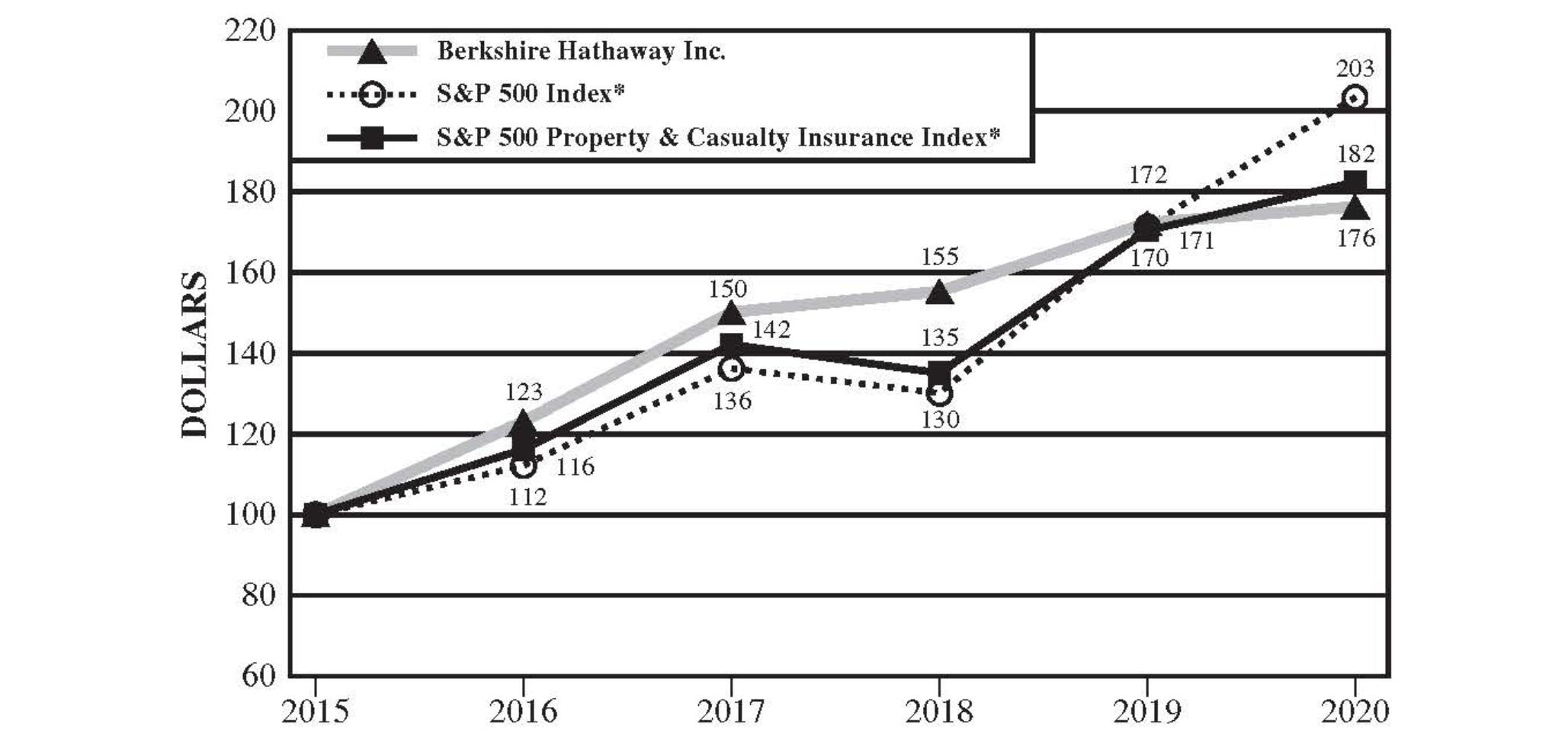]
| --- | --- | --- | --- | --- | --- | --- | --- | --- | --- | --- |
| Class A common stock | | 1,894 | | $ | 316,292.44 | | | 1,894 | | * |
| Class B common stock | | 11,097,536 | | $ | 209.92 | | | 11,097,536 | | * |
| Class A common stock | | 2,244 | | $ | 341,117.06 | | | 2,244 | | * |
| Class B common stock | | 7,423,729 | | $ | 219.12 | | | 7,423,729 | | * |
| Class A common stock | | 1,787 | | $ | 342,577.29 | | | 1,787 | | * |
| Class B common stock | | 12,605,335 | | $ | 225.73 | | | 12,605,335 | | * |
K-31
For several years, Berkshire had a common stock repurchase program, which permitted Berkshire to repurchase its Class A and Class B shares at prices no higher than a 20% premium over the book value of the shares.
| --- | --- | --- | --- | --- | --- | --- | --- | --- | --- | --- | --- | --- | --- | --- |
| Class A common stock | | | 688 | | | $ | 306,086.60 | | | | 688 | | | * |
| Class B common stock | | | 1,497,623 | | | $ | 204.07 | | | | 1,497,623 | | | * |
| | | | | | | | | | | | | | | |
| Class A common stock | | | 1,326 | | | $ | 328,974.91 | | | | 1,326 | | | * |
| Class B common stock | | | 3,657,884 | | | $ | 218.62 | | | | 3,657,884 | | | * |
| Class A common stock | | | 674 | | | $ | 333,298.06 | | | | 674 | | | * |
| Class B common stock | | | 953,070 | | | $ | 221.67 | | | | 953,070 | | | * |
Item 6. Selected Financial Data
17 rewritten, 1 added, 1 removed, 14 unchanged
| | | [removed: 2019] [added: 2020] | | | | [removed: 2018] [added: 2019] | | | | [removed: 2017] [added: 2018] | | | | [removed: 2016] [added: 2017] | | | | [removed: 2015] [added: 2016] | | |
| Insurance premiums earned | | $ | [removed: 61,078] [added: 63,401] | | | $ | [removed: 57,418] [added: 61,078] | | | $ | [removed: 60,597] [added: 57,418] | | | $ | [removed: 45,881] [added: 60,597] | | | $ | [removed: 41,294] [added: 45,881] | |
| Sales and service revenues | | | [removed: 134,989] [added: 127,044] | | | | [removed: 133,336] [added: 134,989] | | | | [removed: 130,243] [added: 133,336] | | | | [removed: 123,053] [added: 130,243] | | | | [removed: 110,811] [added: 123,053] | |
| Leasing revenue | | | [removed: 5,856] [added: 5,209] | | | | [removed: 5,732] [added: 5,856] | | | | [removed: 2,552] [added: 5,732] | | | | [removed: 2,553] [added: 2,552] | | | | [removed: 1,546] [added: 2,553] | |
| Railroad, utilities and energy revenues | | | [removed: 43,453] [added: 41,764] | | | | [removed: 43,673] [added: 43,453] | | | | [removed: 40,005] [added: 43,673] | | | | [removed: 37,447] [added: 40,005] | | | | [removed: 39,923] [added: 37,447] | |
| Interest, dividend and other investment income | | | [removed: 9,240] [added: 8,092] | | | | [removed: 7,678] [added: 9,240] | | | | [removed: 6,536] [added: 7,678] | | | | [removed: 6,180] [added: 6,536] | | | | [removed: 6,867] [added: 6,180] | |
| Total revenues | | $ | [removed: 254,616] [added: 245,510] | | | $ | [removed: 247,837] [added: 254,616] | | | $ | [removed: 239,933] [added: 247,837] | | | $ | [removed: 215,114] [added: 239,933] | | | $ | [removed: 200,441] [added: 215,114] | |
| Investment and derivative gains/losses | | $ | [removed: 72,607] [added: 40,746] | | | $ | [removed: (22,455] [added: 72,607] | [removed: )] | | $ | [removed: 2,128] [added: (22,455] | [added: )] | | $ | [removed: 8,304] [added: 2,128] | | | $ | [removed: 10,347] [added: 8,304] | |
| Net earnings attributable to Berkshire Hathaway (1) | | $ | [removed: 81,417] [added: 42,521] | | | $ | [removed: 4,021] [added: 81,417] | | | $ | [removed: 44,940] [added: 4,021] | | | $ | [removed: 24,074] [added: 44,940] | | | $ | [removed: 24,083] [added: 24,074] | |
| Net earnings per share attributable to Berkshire Hathaway shareholders (2) | | $ | [removed: 49,828] [added: 26,668] | | | $ | [removed: 2,446] [added: 49,828] | | | $ | [removed: 27,326] [added: 2,446] | | | $ | [removed: 14,645] [added: 27,326] | | | $ | [removed: 14,656] [added: 14,645] | |
| Total assets | | $ | [removed: 817,729] [added: 873,729] | | | $ | [removed: 707,794] [added: 817,729] | | | $ | [removed: 702,095] [added: 707,794] | | | $ | [removed: 620,854] [added: 702,095] | | | $ | [removed: 552,257] [added: 620,854] | |
| Insurance and other | | | [removed: 37,590] [added: 41,522] | | | | [removed: 34,975] [added: 37,590] | | | | [removed: 40,409] [added: 34,975] | | | | [removed: 42,559] [added: 40,409] | | | | [removed: 26,550] [added: 42,559] | |
| Railroad, utilities and energy | | | [removed: 65,778] [added: 75,373] | | | | [removed: 62,515] [added: 65,778] | | | | [removed: 62,178] [added: 62,515] | | | | [removed: 59,085] [added: 62,178] | | | | [removed: 57,739] [added: 59,085] | |
| Berkshire Hathaway shareholders’ equity | | | [removed: 424,791] [added: 443,164] | | | | [removed: 348,703] [added: 424,791] | | | | [removed: 348,296] [added: 348,703] | | | | [removed: 282,070] [added: 348,296] | | | | [removed: 254,619] [added: 282,070] | |
| Class A equivalent common shares outstanding, in thousands | | | [removed: 1,625] [added: 1,544] | | | | [removed: 1,641] [added: 1,625] | | | | [removed: 1,645] [added: 1,641] | | | | [removed: 1,644] [added: 1,645] | | | | [removed: 1,643] [added: 1,644] | |
| Berkshire Hathaway shareholders’ equity per outstanding Class A equivalent common share | | $ | [removed: 261,417] [added: 287,031] | | | $ | [removed: 212,503] [added: 261,417] | | | $ | [removed: 211,750] [added: 212,503] | | | $ | [removed: 171,542] [added: 211,750] | | | $ | [removed: 154,935] [added: 171,542] | |
| *(1)* | Includes after-tax investment and derivative gains/losses of [added: $31.6 billion in 2020,] $57.4 billion in 2019, $(17.7) billion in 2018, $1.4 billion in [removed: 2017, $6.5 billion in 2016] [added: 2017] and [removed: $6.7] [added: $6.5] billion in [removed: 2015.] [added: 2016.] Beginning in 2018, investment gains/losses include the changes in fair values of equity securities during the period. Previously, investment gains/losses of equity securities were recognized in earnings when securities were [removed: sold or were other-than-temporarily impaired.] [added: sold.] Net earnings in 2017 includes a one-time net benefit of $29.1 billion attributable to the enactment of the Tax Cuts and Jobs Act of 2017. |
K-32
K-31
Item 8. Financial Statements and Supplementary Data
698 rewritten, 385 added, 252 removed, 987 unchanged
We have audited the accompanying consolidated balance sheets of Berkshire Hathaway Inc. and subsidiaries (the “Company”) as of December 31, [removed: 2019] [added: 2020] and [removed: 2018,] [added: 2019,] the related consolidated statements of earnings, comprehensive income, changes in shareholders’ equity, and cash flows, for each of the three years in the period ended December 31, [removed: 2019,] [added: 2020,] and the related notes (collectively referred to as the “financial statements”).
We also have audited the Company’s internal control over financial reporting as of December 31, [removed: 2019,] [added: 2020,] based on criteria established in *Internal Control — Integrated Framework (2013)* issued by the Committee of Sponsoring Organizations of the Treadway Commission (COSO).
In our opinion, the financial statements referred to above present fairly, in all material respects, the financial position of the Company as of December 31, [removed: 2019] [added: 2020] and [removed: 2018,] [added: 2019,] and the results of its operations and its cash flows for each of the three years in the period ended December 31, [removed: 2019,] [added: 2020,] in conformity with accounting principles generally accepted in the United States of America.
Also, in our opinion, the Company maintained, in all material respects, effective internal control over financial reporting as of December 31, [removed: 2019,] [added: 2020,] based on criteria established in *Internal Control — Integrated Framework (2013)* issued by COSO.
[removed: REPORT] [added: REPORT] OF INDEPENDENT REGISTERED PUBLIC ACCOUNTING [removed: FIRM (Continued)][added: FIRM (Continued)]
The Company’s unpaid losses and loss adjustment expenses (“claim liabilities”) under short duration property and casualty insurance and reinsurance contracts are [removed: $73,019] [added: $79,854] million as of December 31, [removed: 2019.][added: 2020.]
Given the subjectivity of estimating these key assumptions, performing audit procedures to evaluate whether claim liabilities were appropriately recorded as of December 31, [removed: 2019,] [added: 2020,] required a high degree of auditor judgment and an increased extent of effort, including the need to involve our actuarial specialists.
The Company’s unpaid losses and loss adjustment expenses (“claim liabilities”) for property and casualty retroactive reinsurance contracts are [removed: $42,441] [added: $40,966] million as of December 31, [removed: 2019.][added: 2020.]
The key assumptions affecting certain claim liabilities and related deferred charge reinsurance assumed assets (“related [removed: assets”),] [added: assets”)] include expected loss [added: and] expense (“loss”) ratios, expected loss payment emergence patterns and expected loss reporting emergence.
Goodwill and Indefinite-Lived Intangible Assets — Refer to Notes [removed: 1, 13,] [added: 1] and [removed: 27] [added: 13] to the financial statements
The Company primarily uses discounted projected future [added: net] earnings or [added: net] cash [removed: flow methods] [added: flows and multiples of earnings] to estimate fair value, which requires management to make significant estimates and assumptions related to forecasts of future revenue, earnings before interest and taxes (“EBIT”), and discount [removed: rate.][added: rates.]
Given the significant judgments made by management to estimate the fair value of [removed: this] [added: the PCC] reporting unit and [removed: the] [added: certain] customer relationships [removed: and] [added: with indefinite lives along with] the difference between their fair values and carrying values, performing audit procedures to evaluate the reasonableness of management’s estimates and assumptions related to forecasts of future revenue and EBIT and the selection of the discount [removed: rates] [added: rate] required a high degree of auditor judgment and an increased extent of effort, including the need to involve our fair value specialists.
Our audit procedures related to forecasts of future revenue and EBIT and [added: the] selection of the discount [removed: rates] [added: rate] for the [added: PCC] reporting unit and [added: certain] customer relationships included the following, among others:
| | • | We tested the effectiveness of controls over goodwill and indefinite-lived intangible assets, including those over the forecasts of future revenue and [removed: EBIT.] [added: EBIT and the selection of the discount rate.] |
| | • | With the assistance of our fair value specialists, we evaluated the valuation methodologies, the long-term growth rates and discount [removed: rates,] [added: rate,] including testing the underlying source information and the mathematical accuracy of the calculations, and developed a range of independent estimates and compared those to the long-term growth rates and discount [removed: rates] [added: rate] selected by management. |
| | | [added: 2020 | | | |] 2019 | | | | 2018 | | |
| Cash and cash equivalents* | | $ | [removed: 61,151] [added: 44,714] | | | $ | [removed: 27,749] [added: 61,151] | |
| Short-term investments in U.S. Treasury Bills | | | [removed: 63,822] [added: 90,300] | | | | [removed: 81,506] [added: 63,822] | |
| Investments in fixed maturity securities | | | [removed: 18,685] [added: 20,410] | | | | [removed: 19,898] [added: 18,685] | |
| Investments in equity securities | | | [removed: 248,027] [added: 281,170] | | | | [removed: 172,757] [added: 248,027] | |
| Equity method investments | | | [removed: 17,505] [added: 17,303] | | | | [removed: 17,325] [added: 17,505] | |
| Loans and finance receivables | | | [removed: 17,527] [added: 19,201] | | | | [removed: 16,280] [added: 17,527] | |
| Other receivables | | | [removed: 32,418] [added: 32,310] | | | | [removed: 31,564] [added: 32,418] | |
| Inventories | | | [removed: 19,852] [added: 19,208] | | | | [removed: 19,069] [added: 19,852] | |
| Property, plant and equipment | | | [removed: 21,438] [added: 21,200] | | | | [removed: 20,628] [added: 21,438] | |
| Equipment held for lease | | | [removed: 15,065] [added: 14,601] | | | | [removed: 14,298] [added: 15,065] | |
| Goodwill | | | [removed: 57,052] [added: 47,121] | | | | [removed: 56,323] [added: 57,052] | |
| Other intangible assets | | | [removed: 31,051] [added: 29,462] | | | | [removed: 31,499] [added: 31,051] | |
| Deferred charges under retroactive reinsurance contracts | | | [removed: 13,747] [added: 12,441] | | | | [removed: 14,104] [added: 13,747] | |
| Other | | | [removed: 13,232] [added: 14,580] | | | | [removed: 9,307] [added: 13,232] | |
| Cash and cash equivalents* | | | [removed: 3,024] [added: 3,276] | | | | [removed: 2,612] [added: 3,024] | |
| Receivables | | | [removed: 3,417] [added: 3,542] | | | | [removed: 3,666] [added: 3,417] | |
| Property, plant and equipment | | | [removed: 137,838] [added: 151,216] | | | | [removed: 131,780] [added: 137,838] | |
| Goodwill | | | [removed: 24,830] [added: 26,613] | | | | [removed: 24,702] [added: 24,830] | |
| Regulatory assets | | | [removed: 2,881] [added: 3,440] | | | | [removed: 3,067] [added: 2,881] | |
| Other | | | [removed: 15,167] [added: 21,621] | | | | [removed: 9,660] [added: 15,167] | |
| | | [added: | | | | | | | | | | | |] $ | [added: 873,729 | | | $ |] 817,729 | | | $ | 707,794 | |
| * | [removed: Cash and cash equivalents includes] [added: Includes] U.S. Treasury Bills with maturities of three months or less when purchased of [removed: $37.1] [added: $23.2] billion at December 31, [removed: 2019] [added: 2020] and [removed: $3.9] [added: $37.1] billion at December 31, [removed: 2018.] [added: 2019.] |
[removed: BERKSHIRE] [added: BERKSHIRE] HATHAWAY [removed: INC.][added: INC.]
| Unpaid losses and loss adjustment expenses | | $ | [removed: 73,019] [added: 79,854] | | | $ | [removed: 68,458] [added: 73,019] | |
Given the subjectivity of estimating these key assumptions, performing audit procedures to evaluate whether claim liabilities were appropriately recorded as of December 31, 2020, required a high degree of auditor judgment and an increased extent of effort, including the need to involve our actuarial specialists.
The Precision Castparts Corp. (“PCC”) reporting unit reported approximately $31 billion of goodwill and indefinite-lived intangible assets as of December 31, 2019.
During the second quarter of 2020, the Company performed an interim reevaluation of the goodwill and indefinite-lived intangible assets at the PCC reporting unit.
This determination was made due to disruptions arising from the COVID-19 pandemic that had an adverse impact on the industries in which PCC operates.
As a result of the reevaluation, the Company recognized goodwill and indefinite-lived intangible asset impairment charges in the amount of approximately $10 billion, as the fair values of the PCC reporting unit and indefinite-lived intangible assets were less than their respective carrying values.
As a result, PCC reported goodwill and indefinite-lived intangible assets of approximately $21 billion as of December 31, 2020.
February 27, 2021
| | | | 664,021 | | | | 630,572 | |
| | | | 209,708 | | | | 187,157 | |
| | | $ | 873,729 | | | $ | 817,729 | |
| | | 2020 | | | | 2019 | | |
| | | | 250,223 | | | | 234,570 | |
| | | | 98,072 | | | | 87,797 | |
| | | $ | 873,729 | | | $ | 817,729 | |
| Goodwill and intangible asset impairments | | | 10,671 | | | | 96 | | | | 382 | |
| Unrealized appreciation of investments | | | 74 | | | | 142 | | | | (438 | ) |
| Net earnings | | | — | | | | — | | | | 42,521 | | | | — | | | | 732 | | | | 43,253 | |
| Adoption of new accounting pronouncement | | | — | | | | — | | | | (388 | ) | | | — | | | | — | | | | (388 | ) |
| Other comprehensive income, net | | | — | | | | 1,000 | | | | — | | | | — | | | | 19 | | | | 1,019 | |
| Balance December 31, 2020 | | $ | 35,634 | | | $ | (4,243 | ) | | $ | 444,626 | | | $ | (32,853 | ) | | $ | 8,172 | | | $ | 451,336 | |
| Net earnings | | $ | 43,253 | | | $ | 81,792 | | | $ | 4,322 | |
| Other, including asset impairment charges | | | 11,263 | | | | (1,254 | ) | | | 2,957 | |
December 31, 2020
The novel coronavirus (“COVID-19”) spread rapidly across the world in 2020 and was declared a pandemic by the World Health Organization.
The government and private sector responses to contain its spread began to significantly affect our operating businesses in March.
COVID-19 has since adversely affected nearly all of our operations, although the effects are varying significantly.
The duration and extent of the effects over longer terms cannot be reasonably estimated at this time.
The risks and uncertainties resulting from the pandemic that may affect our future earnings, cash flows and financial condition include the time necessary to distribute safe and effective vaccines and to vaccinate a significant number of people in the U.S. and throughout the world as well as the long-term effect from the pandemic on the demand for certain of our products and services.
Accordingly, significant estimates used in the preparation of our financial statements including those associated with evaluations of certain long-lived assets, goodwill and other intangible assets for impairment, expected credit losses on amounts owed to us and the estimations of certain losses assumed under insurance and reinsurance contracts may be subject to significant adjustments in future periods.
For securities in an unrealized loss position, we recognize a loss in earnings for the excess of amortized cost over fair value if we intend to sell before the price recovers.
Otherwise, we evaluate as of the balance sheet date whether the unrealized losses are attributable to credit losses or other factors.
We consider the severity of the decline in value, creditworthiness of the issuer and other relevant factors.
We record an allowance for credit losses, limited to the excess of amortized cost over fair value, along with a corresponding charge to earnings if the present value of estimated cash flows is less than the present value of contractual cash flows.
The allowance may be subsequently increased or decreased based on the prevailing facts and circumstances.
The portion of the unrealized loss that we believe is not related to a credit loss is recognized in other comprehensive income.
Trade receivables, insurance premium receivables and other receivables are primarily short-term in nature with stated collection terms of less than one year from the date of origination.
Reinsurance recoverables are comprised of amounts ceded under reinsurance contracts or pursuant to mandatory government-sponsored insurance programs.
Reinsurance recoverables relate to claims for unpaid losses and loss adjustment expenses arising from property and casualty contracts and claim benefits under life and health insurance contracts.
As of January 1, 2020, we adopted a new accounting pronouncement that affects the measurement of allowances for credit losses.
In measuring credit loss allowances, we primarily utilize credit loss history, with adjustments to reflect current or expected future economic conditions when reasonable and supportable forecasts of losses deviate from historical experience.
Change in Accounting Principle
As discussed in Note 1 to the financial statements, the Company has changed its method of accounting for investments in equity securities (excluding equity method investments) in 2018 due to the adoption of *ASU 2016-01 “Financial Instruments – Recognition and Measurement of Financial Assets and Financial Liabilities.”*
K-63
K-64
A reporting unit within the Manufacturing reportable segment, which had goodwill at acquisition date of $16,011 million, was an acquisition made by the Company in 2016.
This subsidiary also has certain customer relationships that are intangible assets with indefinite lives.
These customer relationships are a significant portion of the $18,965 million of indefinite-lived intangible assets the Company reported as of December 31, 2019.
The fair values of the reporting unit and customer relationships exceeded their carrying values as of the annual evaluation date; therefore, no impairments were recognized.
February 22, 2020
K-65
| | | | 630,572 | | | | 532,307 | |
| | | | 187,157 | | | | 175,487 | |
K-66
| | | | 234,570 | | | | 222,488 | |
| | | | 87,797 | | | | 81,431 | |
| --- | --- | --- | --- | --- | --- | --- | --- | --- | --- | --- | --- | --- |
| Derivative contract gains (losses) | | | 1,484 | | | | (300 | ) | | | 718 | |
| | | | 72,607 | | | | (22,455 | ) | | | 2,128 | |
| Net change in unrealized appreciation of investments | | | 204 | | | | (185 | ) | | | 30,450 | |
| Reclassification of investment appreciation in net earnings | | | (62 | ) | | | (253 | ) | | | (1,399 | ) |
| Applicable income taxes | | | 155 | | | | 143 | | | | (45 | ) |
| --- | --- | --- | --- | --- | --- | --- | --- | --- | --- | --- | --- | --- | --- | --- | --- | --- | --- | --- | --- | --- | --- | --- | --- | --- |
| Balance December 31, 2016 | | $ | 35,689 | | | $ | 37,298 | | | $ | 210,846 | | | $ | (1,763 | ) | | $ | 3,358 | | | $ | 285,428 | |
| Net earnings | | | — | | | | — | | | | 44,940 | | | | — | | | | 413 | | | | 45,353 | |
| Investment gains/losses | | | (71,123 | ) | | | 22,155 | | | | (1,410 | ) |
| Other | | | (1,254 | ) | | | 2,957 | | | | 458 | |
If the fair value of a fixed maturity security is less than cost, we evaluate the security for other-than-temporary impairment.
We recognize an other-than-temporary impairment if we (a) intend to sell or expect to be required to sell the security before its amortized cost is recovered or (b) do not expect to ultimately recover the amortized cost basis even if we do not intend to sell the security.
Under scenario (a), we recognize the loss in earnings and under scenario (b), we recognize the credit loss component in earnings and the remainder in other comprehensive income.
Prior to January 1, 2018, substantially all of our equity security investments were classified as available-for-sale and were also carried at fair value.
However, we recorded the periodic changes in fair value of these securities as components of other comprehensive income.
In addition, we recorded gains and losses in the Consolidated Statements of Earnings when equity securities were sold (on a specific identification basis) or were other-than-temporarily impaired.
Substantially all of our loans and finance receivables are secured by real or personal property or by other assets of the borrower.
Allowances for credit losses on loans include estimates of losses on loans currently in foreclosure and losses on loans not currently in foreclosure.
We estimate losses on loans in foreclosure based on historical experience and collateral recovery rates.
Estimates of losses on loans not currently in foreclosure consider historical default rates, collateral recovery rates and prevailing economic conditions.
Allowances for credit losses also incorporate the historical average time elapsed from the last payment until foreclosure.
The excess of the estimated fair value of the reporting unit over the current estimated fair value of net assets establishes the implied value of goodwill.
The excess of the recorded goodwill over the implied goodwill value is charged to earnings as an impairment loss.
On January 1, 2018, we adopted Accounting Standards Codification (“ASC”) 606 “Revenues from Contracts with Customers.” Except as described in Note 1(x), our revenue recognition practices for contracts with customers under ASC 606 do not differ significantly from prior practices.
An excerpt. Shown here: 40 of 698 rewritten, 40 of 385 added and 40 of 252 removed. The counts are complete. For every sentence, read Item 8. Financial Statements and Supplementary Data in the FY2020 filing and the FY2019 filing.
Item 9A. Controls and Procedures
3 rewritten, 0 added, 0 removed, 2 unchanged
The report called for by Item 308(a) of Regulation S-K is incorporated herein by reference to Management’s Report on Internal Control Over Financial Reporting, included on page [removed: K-62] [added: K-66] of this report.
The attestation report called for by Item 308(b) of Regulation S-K is incorporated herein by reference to Report of Independent Registered Public Accounting Firm, included on page [removed: K-63] [added: K-67] of this report.
There has been no change in the Corporation’s internal control over financial reporting during the quarter ended December 31, [removed: 2019] [added: 2020] that has materially affected, or is reasonably likely to materially affect, the Corporation’s internal control over financial reporting.
Item 9B. Other Information
1 rewritten, 0 added, 0 removed, 3 unchanged
Except for the information set forth under the caption “Executive Officers of the Registrant” in Part I hereof, information required by this Part (Items 10, 11, 12, 13 and 14) is incorporated by reference from the Registrant’s definitive proxy statement, filed pursuant to Regulation 14A, for the Annual Meeting of Shareholders of the Registrant to be held on May [removed: 2, 2020,] [added: 1, 2021,] which meeting will involve the election of directors.
Item 15. Exhibits and Financial Statement Schedules
87 rewritten, 14 added, 17 removed, 127 unchanged
| [Report of Independent Registered Public Accounting Firm](#ITEM_8_FINANCIAL_STATEMENTS_SUPPLEMENTAR) | | [removed: K-63] [added: K-67] |
| [Consolidated Balance Sheets— December 31, [removed: 2019] [added: 2020] and December 31, [removed: 2018](#CONSOLIDATED_BALANCE_SHEETS)] [added: 201](#CONSOLIDATED_BALANCE_SHEETS)9] | | [removed: K-66] [added: K-70] |
| [Consolidated Statements of Earnings— Years Ended December 31, [removed: 2019,] [added: 2020,] December 31, [removed: 2018,] [added: 2019,] and December 31, [removed: 2017](#CONSOLIDATED_STATEMENTS_EARNINGS)] [added: 201](#CONSOLIDATED_STATEMENTS_EARNINGS)8] | | [removed: K-68] [added: K-72] |
| [Consolidated Statements of Comprehensive Income— Years Ended December 31, [removed: 2019,] [added: 2020,] December 31, [removed: 2018,] [added: 2019,] and December 31, [removed: 2017](#CONSOLIDATED_STATEMENTS_COMPREHENSIVE_IN)] [added: 201](#CONSOLIDATED_STATEMENTS_COMPREHENSIVE_IN)8] | | [removed: K-69] [added: K-73] |
| [Consolidated Statements of Changes in Shareholders’ Equity— Years Ended December 31, [removed: 2019,] [added: 2020,] December 31, [removed: 2018,] [added: 2019,] and December 31, [removed: 2017](#CONSOLIDATED_STATEMENTS_CHANGES_IN_SHARE)] [added: 201](#CONSOLIDATED_STATEMENTS_CHANGES_IN_SHARE)8] | | [removed: K-69] [added: K-73] |
| [Consolidated Statements of Cash Flows— Years Ended December 31, [removed: 2019,] [added: 2020,] December 31, [removed: 2018,] [added: 2019,] and December 31, [removed: 2017](#CONSOLIDATED_STATEMENTS_CASH_FLOWS)] [added: 201](#CONSOLIDATED_STATEMENTS_CASH_FLOWS)8] | | [removed: K-70] [added: K-74] |
| [Notes to Consolidated Financial Statements](#NOTES_TO_CONSOLIDATED_FINANCIAL_STATEMEN) | | [removed: K-71] [added: K-75] |
| [Report of Independent Registered Public Accounting Firm](#REPORT_INDEPENDENT_REGISTERED_PUBLIC_ACC) | | [removed: K-113] [added: K-117] |
| [Schedule I—Parent Company Condensed Financial Information Balance Sheets as of December 31, [removed: 2019] [added: 2020] and [removed: 2018,] [added: 2019,] Statements of Earnings and Comprehensive Income and Cash Flows for the years ended December 31, [removed: 2019,] [added: 2020,] December 31, [removed: 2018] [added: 2019] and December 31, [removed: 2017] [added: 2018] and Note to Condensed Financial Information](#SCHEDULE_I) | | [removed: K-114] [added: K-118] |
See the “Exhibit Index” at page [removed: K-116.][added: K-120.]
We have audited the consolidated financial statements of Berkshire Hathaway Inc. and subsidiaries (the “Company”) as of December 31, [removed: 2019] [added: 2020] and [removed: 2018,] [added: 2019,] and for each of the three years in the period ended December 31, [removed: 2019,] [added: 2020,] and the Company’s internal control over financial reporting as of December 31, [removed: 2019,] [added: 2020,] and have issued our report thereon dated February [removed: 22, 2020;] [added: 27, 2021;] such consolidated financial statements and report are included elsewhere in this Form 10-K.
| | | [added: 2020 | | | |] 2019 | | | | 2018 | | |
| Cash and cash equivalents | | $ | [removed: 15,004] [added: 12,329] | | | $ | [removed: 3,437] [added: 15,004] | |
| Short-term investments in U.S. Treasury Bills | | | [removed: 25,514] [added: 29,773] | | | | [removed: 22,957] [added: 25,514] | |
| Investments in and advances to/from consolidated subsidiaries | | | [removed: 392,162] [added: 411,826] | | | | [removed: 328,898] [added: 392,162] | |
| Investment in The Kraft Heinz Company | | | [removed: 13,757] [added: 13,336] | | | | [removed: 13,813] [added: 13,757] | |
| Other assets | | | [removed: 131] [added: 108] | | | | [removed: 80] [added: 131] | |
| Accounts payable, accrued interest and other liabilities | | $ | [removed: 320] [added: 369] | | | $ | [removed: 1,507] [added: 320] | |
| Income taxes, principally deferred | | | [removed: 1,554] [added: 1,174] | | | | [removed: 2,104] [added: 1,554] | |
| Notes payable and other borrowings | | | [removed: 19,903] [added: 22,665] | | | | [removed: 16,871] [added: 19,903] | |
| Berkshire Hathaway shareholders’ equity | | | [removed: 424,791] [added: 443,164] | | | | [removed: 348,703] [added: 424,791] | |
| | | [removed: 2019] [added: 2020] | | | | [removed: 2018] [added: 2019] | | | | [removed: 2017] [added: 2018] | | |
| Dividends and distributions | | $ | [removed: 15,603] [added: 26,110] | | | $ | [removed: 9,658] [added: 15,603] | | | $ | [removed: 5,367] [added: 9,658] | |
| Undistributed earnings (losses) | | | [removed: 65,237] [added: 17,402] | | | | [removed: (3,952] [added: 65,237] | [removed: )] | | | [removed: 37,832] [added: (3,952] | [added: )] |
| | | | [removed: 80,840] [added: 43,512] | | | | [removed: 5,706] [added: 80,840] | | | | [removed: 43,199] [added: 5,706] | |
| Investment gains (losses) | | | [removed: (125] [added: (24] | ) | | | [removed: (4] [added: (125] | ) | | | [removed: (1] [added: (4] | ) |
| Equity in net earnings (losses) of The Kraft Heinz Company | | | [removed: 493] [added: 95] | | | | [removed: (2,730] [added: 493] | [removed: )] | | | [removed: 2,938] [added: (2,730] | [added: )] |
| Other income | | | [removed: 780] [added: 328] | | | | [removed: 649] [added: 780] | | | | [removed: 350] [added: 649] | |
| | | | [removed: 81,988] [added: 43,911] | | | | [removed: 3,621] [added: 81,988] | | | | [removed: 46,486] [added: 3,621] | |
| General and administrative | | | [removed: 122] [added: 194] | | | | [removed: 216] [added: 122] | | | | [removed: 159] [added: 216] | |
| Interest expense | | | [removed: 591] [added: 489] | | | | [removed: 601] [added: 591] | | | | [removed: 522] [added: 601] | |
| Foreign exchange (gains) losses on non-U.S. Dollar denominated debt | | | [removed: (193] [added: 970] | [removed: )] | | | [removed: (366] [added: (193] | ) | | | [removed: 1,008] [added: (366] | [added: )] |
| Income tax expense (benefit) | | | [removed: 51] [added: (263] | [added: )] | | | [removed: (851] [added: 51] | [removed: )] | | | [removed: (143] [added: (851] | ) |
| | | | [removed: 571] [added: 1,390] | | | | [removed: (400] [added: 571] | [removed: )] | | | [removed: 1,546] [added: (400] | [added: )] |
| Net earnings attributable to Berkshire Hathaway shareholders | | | [removed: 81,417] [added: 42,521] | | | | [removed: 4,021] [added: 81,417] | | | | [removed: 44,940] [added: 4,021] | |
| Other comprehensive income attributable to Berkshire Hathaway shareholders | | | [removed: (228] [added: 1,000] | [removed: )] | | | [removed: (2,211] [added: (228] | ) | | | [removed: 21,273] [added: (2,211] | [added: )] |
| Comprehensive income attributable to Berkshire Hathaway shareholders | | $ | [removed: 81,189] [added: 43,521] | | | $ | [removed: 1,810] [added: 81,189] | | | $ | [removed: 66,213] [added: 1,810] | |
| Net earnings attributable to Berkshire Hathaway shareholders | | $ | [removed: 81,417] [added: 42,521] | | | $ | [removed: 4,021] [added: 81,417] | | | $ | [removed: 44,940] [added: 4,021] | |
| Investment gains/losses | | | [removed: 125] [added: 24] | | | | [removed: 4] [added: 125] | | | | [removed: 1] [added: 4] | |
| Undistributed earnings of consolidated subsidiaries | | | [removed: (65,237] [added: (17,402] | ) | | | [removed: 3,952] [added: (65,237] | [added: )] | | | [removed: (37,832] [added: 3,952] | [removed: )] |
February 27, 2021
| | | 2020 | | | | 2019 | | |
| | | $ | 467,372 | | | $ | 446,568 | |
| | | | 24,208 | | | | 21,777 | |
| | | $ | 467,372 | | | $ | 446,568 | |
| Non-cash dividends from subsidiaries | | | (8,296 | ) | | | — | | | | — | |
In 2020, the Parent Company repaid €1.0 billion of maturing senior notes and issued €1.0 billion of 0.0% senior notes due in 2025 and ¥195.5 billion (approximately $1.8 billion) of senior notes with maturity dates ranging from 2023 to 2060 with a weighted average interest rate of 1.07%.
As of December 31, 2020, the Parent Company’s non-U.S. Dollar denominated borrowings included €6.85 billion and ¥625.5 billion par value senior notes.
The Parent Company guarantees certain debt of subsidiaries, which in the aggregate, approximated $14.4 billion at December 31, 2020 and included $13.1 billion of debt issued by Berkshire Hathaway Finance Corporation.
K-119
K-120
K-121
| /S/ KENNETH I. CHENAULT Kenneth I. Chenault | Director | February 27, 2021 Date |
K-122
K-112
Change in Accounting Principle
As discussed in Note 1 to the financial statements of the Company, the Company has changed its method of accounting for investments in equity securities (excluding equity method investments) in 2018 due to the adoption of ASU 2016-01 “Financial Instruments – Recognition and Measurement of Financial Assets and Financial Liabilities.”
February 22, 2020
K-113
| | | $ | 446,568 | | | $ | 369,185 | |
| | | | 21,777 | | | | 20,482 | |
K-114
Berkshire acquired 50% of the outstanding common stock of Heinz Holding Company in 2013.
After a series of transactions in 2015, that interest represented 26.8% of the outstanding common stock of The Kraft Heinz Company (“Kraft Heinz”).
In 2019, the Parent Company issued ¥430.0 billion of senior notes with various maturities and interest rates.
For each of the three years ending December 31, 2019, Parent Company borrowings also included €6.85 billion senior notes.
At December 31, 2019, Parent Company guarantees of debt obligations of certain of its subsidiaries were approximately $12.2 billion.
In December 2017, the Tax Cuts and Jobs Act of 2017 (“TCJA”) was enacted, which reduced the Parent Company’s income tax expense in 2017 by $550 million, primarily due to the reduction in deferred tax liabilities attributable to the lower U.S. statutory rate, partly offset by a one-time income tax expense on certain accumulated undistributed earnings of foreign subsidiaries.
The effects of the TCJA on income tax expense of consolidated subsidiaries is included in undistributed earnings in consolidated subsidiaries.
K-115
| /S/ WILLIAM H. GATES III William H. Gates III | Director | February 22, 2020 Date |
An excerpt. Shown here: 40 of 87 rewritten, all 14 added and all 17 removed. The counts are complete. For every sentence, read Item 15. Exhibits and Financial Statement Schedules in the FY2020 filing and the FY2019 filing.