 filings.tools
Cardinal Health 10-Q 2021-12-31
CAH · CIK 721371 · Form 10-Q · Period ended December 31, 2021 · Filed February 3, 2022
Revenue rose 9.4% to $45.5 billion. Operating margin was -2.1%, against 1.1% a year earlier. Net income was $49.0 million.
7 sections, 242K characters. Original on sec.gov · ·
| Measure | Quarter ended Dec 31, 2021 | Quarter ended Dec 31, 2020 | Change |
|---|---|---|---|
| Revenue | $45.5B | $41.5B | +9.4% |
| Operating income | -$950M | $461M | -306% |
| Net income | $49.0M | $629M | -92.2% |
| Cash and equivalents | $3.16B | n/a | n/a |
| Operating margin* | -2.1% | 1.1% | -3.2 pts |
From the XBRL facts tagged to this filing; both columns are as reported in this filing. * Computed by filings.tools: free cash flow is operating cash flow less capital spending; operating margin is operating income over revenue.
Cover and table of contents
| Table of Contents |
UNITED STATES
SECURITIES AND EXCHANGE COMMISSION
Washington, D.C. 20549
Form 10-Q
| ☑ | QUARTERLY REPORT PURSUANT TO SECTION 13 OR 15(d) OF THE SECURITIES EXCHANGE ACT OF 1934 |
For the quarterly period ended December 31, 2021
or
| ☐ | TRANSITION REPORT PURSUANT TO SECTION 13 OR 15(d) OF THE SECURITIES EXCHANGE ACT OF 1934 |
For the transition period from ________ to ________
Commission File Number: 1-11373
Cardinal Health, Inc.
(Exact name of registrant as specified in its charter)
| Ohio | 31-0958666 | |||||||||||||||||||
| (State or other jurisdiction of incorporation or organization) | (IRS Employer Identification No.) | |||||||||||||||||||
| 7000 Cardinal Place | , | Dublin | , | Ohio | 43017 | |||||||||||||||
| (Address of principal executive offices) | (Zip Code) | |||||||||||||||||||
| (614) | 757-5000 | |||||||||||||||||||
| (Registrant’s telephone number, including area code) |
| Securities registered pursuant to Section 12(b) of the Act: | ||||||||
| Title of each class | Trading Symbol(s) | Name of each exchange on which registered | ||||||
| Common shares (without par value) | CAH | New York Stock Exchange |
Indicate by check mark whether the registrant (1) has filed all reports required to be filed by Section 13 or 15(d) of the Securities Exchange Act of 1934 during the preceding 12 months (or for such shorter period that the registrant was required to file such reports), and (2) has been subject to such filing requirements for the past 90 days. Yes þ No o
Indicate by check mark whether the registrant has submitted electronically every Interactive Data File required to be submitted pursuant to Rule 405 of Regulation S-T (§232.405 of this chapter) during the preceding 12 months (or for such shorter period that the registrant was required to submit such files). Yes þ No o
Indicate by check mark whether the registrant is a large accelerated filer, an accelerated filer, a non-accelerated filer, a smaller reporting company, or an emerging growth company. See the definitions of “large accelerated filer,” “accelerated filer,” “smaller reporting company” and "emerging growth company" in Rule 12b-2 of the Exchange Act.
| Large accelerated filer | ☑ | Accelerated filer | ☐ | ||||||||||||||
| Non-accelerated filer | ☐ | Smaller reporting company | ☐ | ||||||||||||||
| Emerging growth company | ☐ | ||||||||||||||||
| If an emerging growth company, indicate by check mark if the registrant has elected not to use the extended transition period for complying with any new or revised financial accounting standards provided pursuant to Section 13(a) of the Exchange Act o |
Indicate by check mark whether the registrant is a shell company (as defined in Rule 12b-2 of the Exchange Act). Yes ☐ No þ
The number of the registrant’s common shares, without par value, outstanding as of January 31, 2022, was the following: 277,061,392.
| Cardinal Health Q2 Fiscal 2022 Form 10-Q |
Table of Contents
About Cardinal Health
Cardinal Health, Inc. is an Ohio corporation formed in 1979 and is a globally integrated healthcare services and products company providing customized solutions for hospitals, healthcare systems, pharmacies, ambulatory surgery centers, clinical laboratories and physician offices. We provide pharmaceuticals and medical products and cost-effective solutions that enhance supply chain efficiency. We connect patients, providers, payers, pharmacists and manufacturers for integrated care coordination and better patient management. We manage our business and report our financial results in two segments: Pharmaceutical and Medical. As used in this report, “we,” “our,” “us,” and similar pronouns refer to Cardinal Health, Inc. and its subsidiaries, unless the context requires otherwise. Our fiscal year ends on June 30. References to fiscal 2022 and fiscal 2021 and to FY22 and FY21 are to the fiscal years ending or ended June 30, 2022 and June 30, 2021, respectively.
Forward-Looking Statements
This Quarterly Report on Form 10-Q for the quarter ended December 31, 2021 (this "Form 10-Q") (including information incorporated by reference) includes "forward-looking statements" addressing expectations, prospects, estimates and other matters that are dependent upon future events or developments. Many forward-looking statements appear in Management’s Discussion and Analysis of Financial Condition and Results of Operations ("MD&A"), but there are others in this Form 10-Q, which may be identified by words such as "expect," "anticipate," "intend," "plan," "believe," "will," "should," "could," "would," "project," "continue," "likely," and similar expressions, and include statements reflecting future results, trends or guidance, statements of outlook and expense accruals. These matters are subject to risks and uncertainties that could cause actual results to differ materially from those made, projected or implied. The most significant of these risks and uncertainties are described in this Form 10-Q, including Exhibit 99.1, and in "Risk Factors" in our Annual Report on Form 10-K for the fiscal year ended June 30, 2021 (our “2021 Form 10-K”). Forward-looking statements in this Form 10-Q speak only as of the date of this document. Except to the extent required by applicable law, we undertake no obligation to update or revise any forward-looking statement.
Non-GAAP Financial Measures
In the "Overview of Consolidated Results" section of MD&A, we use financial measures that are derived from our consolidated financial data but are not presented in our condensed consolidated financial statements prepared in accordance with U.S. generally accepted accounting principles ("GAAP"). These measures are considered "non-GAAP financial measures" under the United States Securities and Exchange Commission ("SEC") rules. The reasons we use these non-GAAP financial measures and the reconciliations to their most directly comparable GAAP financial measures are included in the “Explanation and Reconciliation of Non-GAAP Financial Measures” section following MD&A in this Form 10-Q.
| 1 | Cardinal Health | Q2 Fiscal 2022 Form 10-Q |
Item 2. Management's Discussion and Analysis of Financial Condition and Results of Operations
| MD&A | Overview |
Management's Discussion and Analysis of Financial Condition and Results of Operations
The discussion and analysis presented below is concerned with material changes in financial condition and results of operations between the periods specified in our condensed consolidated balance sheets at December 31, 2021 and June 30, 2021, and in our condensed consolidated statements of earnings for the three and six months ended December 31, 2021 and 2020. All comparisons presented are with respect to the prior-year period, unless stated otherwise. This discussion and analysis should be read in conjunction with the MD&A included in our 2021 Form 10-K.
| 2 | Cardinal Health | Q2 Fiscal 2022 Form 10-Q |
| MD&A | Overview |
Overview of Consolidated Results
Revenue
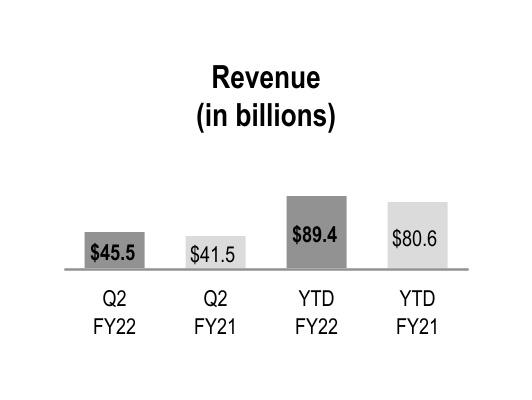
During the three and six months ended December 31, 2021, revenue increased 9 percent and 11 percent to $45.5 billion and $89.4 billion, respectively, primarily due to sales growth from pharmaceutical distribution and specialty pharmaceutical customers, which largely consisted of branded pharmaceutical sales to large customers.
GAAP and Non-GAAP Operating Earnings/(Loss)
| Three Months Ended December 31, | Six Months Ended December 31, | ||||||||||||||||||||||||||||||||||
| (in millions) | 2021 | 2020 | Change | 2021 | 2020 | Change | |||||||||||||||||||||||||||||
| GAAP operating earnings/(loss) | $ | (950) | $ | 461 | N.M. | $ | (535) | $ | (163) | N.M. | |||||||||||||||||||||||||
| Surgical gown recall costs/(income) | 1 | (1) | 1 | (2) | |||||||||||||||||||||||||||||||
| State opioid assessment related to prior fiscal years | — | — | — | 41 | |||||||||||||||||||||||||||||||
| Restructuring and employee severance | 7 | 20 | 25 | 57 | |||||||||||||||||||||||||||||||
| Amortization and other acquisition-related costs | 79 | 116 | 158 | 234 | |||||||||||||||||||||||||||||||
| Impairments and (gain)/loss on disposal of assets | 1,295 | — | 1,293 | 9 | |||||||||||||||||||||||||||||||
| Litigation (recoveries)/charges, net | 34 | 32 | 52 | 1,070 | |||||||||||||||||||||||||||||||
| Non-GAAP operating earnings | $ | 467 | $ | 628 | (26) | % | $ | 994 | $ | 1,246 | (20) | % |
The sum of the components and certain computations may reflect rounding adjustments.
We had GAAP operating losses of $950 million and $535 million during the three and six months ended December 31, 2021, respectively, due to a $1.3 billion pre-tax non-cash goodwill impairment charge related to the Medical segment. See "Critical Accounting Policies and Sensitive Accounting Estimates" section of this MD&A and Note 4 of the "Notes to Condensed Consolidated Financial Statements" for additional detail.
We had a GAAP operating loss of $163 million during the six months ended December 31, 2020 due to the $1.02 billion pre-tax charge recognized for the estimated liability associated with lawsuits and claims brought against us by states and political subdivisions relating to the distribution of prescription opioid pain medications. See further description of opioid lawsuits and claims in the Significant Developments in Fiscal 2022 and Trends section in this MD&A and Note 6 of the "Notes to Condensed Consolidated Financial Statements."
Non-GAAP operating earnings during the three and six months ended December 31, 2021 decreased 26 percent and 20 percent, respectively, due to the decrease in Medical segment profit resulting from increased inflationary impacts, primarily related to commodities and transportation, global supply chain constraints, the adverse impact of the net positive impact of PPE in the prior year and the impact of the divestiture of the Cordis business.
| 3 | Cardinal Health | Q2 Fiscal 2022 Form 10-Q |
| MD&A | Overview |
GAAP and Non-GAAP Diluted EPS
| Three Months Ended December 31, | Six Months Ended December 31, | ||||||||||||||||||||||||||||||||||
| ($ per share) | 2021 (2) | 2020 (2) | Change | 2021 (2) | 2020 (2) | Change | |||||||||||||||||||||||||||||
| GAAP diluted EPS (1) | $ | 0.17 | $ | 2.13 | N.M | $ | 1.12 | $ | 1.27 | (12) | % | ||||||||||||||||||||||||
| State opioid assessment related to prior fiscal years | — | — | — | 0.10 | |||||||||||||||||||||||||||||||
| Restructuring and employee severance | 0.02 | 0.05 | 0.07 | 0.15 | |||||||||||||||||||||||||||||||
| Amortization and other acquisition-related costs | 0.21 | 0.29 | 0.41 | 0.60 | |||||||||||||||||||||||||||||||
| Impairments and (gain)/loss on disposal of assets (3) | 0.77 | — | 0.78 | (0.02) | |||||||||||||||||||||||||||||||
| Litigation (recoveries)/charges, net (4) | 0.10 | (0.73) | 0.15 |
Showing the first 8K of 88K characters. Open the full section
Item 3. Quantitative and Qualitative Disclosures about Market Risk
Quantitative and Qualitative Disclosures About Market Risk
There have been no material changes in the quantitative and qualitative market risk disclosures included in our 2021 Form 10-K since the end of fiscal 2021 through December 31, 2021.
Item 4. Controls and Procedures
Controls and Procedures
Evaluation of Disclosure Controls and Procedures
We evaluated, with the participation of our principal executive officer and principal financial officer, the effectiveness of our disclosure controls and procedures (as defined in Rule 13a-15(e) under the Securities Exchange Act of 1934 (the "Exchange Act")) as of December 31, 2021. Based on this evaluation, our principal executive officer and principal financial officer have concluded that as of December 31, 2021, our disclosure controls and procedures were effective to provide reasonable assurance that information required to be disclosed in our reports under the Exchange Act is recorded, processed, summarized, and reported within the time periods specified in the SEC rules and forms and that such information is accumulated and communicated to management as appropriate to allow timely decisions regarding required disclosure.
Changes in Internal Control Over Financial Reporting
As explained below, there were changes in our internal control over financial reporting during the quarter ended December 31, 2021 that have materially affected, or are reasonably likely to materially affect, our internal control over financial reporting.
Pharmaceutical Segment Information Technology Initiative
The Pharmaceutical segment is in a multi-year project to implement a replacement of certain finance and operating information systems. During the three and six months ended December 31, 2021, we transitioned selected processes to the new systems which affected our internal control over financial reporting. It is possible that ongoing transitions to new systems may adversely impact internal control over financial reporting.
| 21 | Cardinal Health | Q2 Fiscal 2022 Form 10-Q |
| Other |
Legal Proceedings
In addition to the proceeding described below, the legal proceedings described in Note 6 of the "Notes to Condensed Consolidated Financial Statements" are incorporated in this "Legal Proceedings" section by reference.
In June 2019, Melissa Cohen, a purported shareholder, filed an action on behalf of Cardinal Health, Inc. in the U.S. District Court for the Southern District of Ohio against certain current and former members of our Board of Directors alleging that the defendants breached their fiduciary duties by failing to effectively monitor Cardinal Health's distribution of controlled substances and approving certain payments of executive compensation. In December 2019 and January 2020, similar complaints were filed in the U.S. District Court for the Southern District of Ohio by purported shareholders, Stanley M. Malone and Michael Splaine, respectively. In January, 2020, the court consolidated the derivative cases under the caption In re Cardinal Health, Inc. Derivative Litigation and in March 2020, plaintiffs filed an amended complaint. The amended consolidated derivative complaint seeks, among other things, unspecified money damages against the defendants and an award of attorneys' fees. In February 2021, the court granted in part and denied in part defendants' motion to dismiss. The court dismissed the claim with respect to executive compensation but declined to dismiss the failure to monitor claim.
Subject to definitive documentation and court approval and notice process, the parties have reached an agreement in principle to resolve these lawsuits. Under this agreement, our director and officer's liability insurance carriers, on behalf of the defendants, would pay Cardinal Health $124 million, less any attorneys' fees and expenses awarded by the court to plaintiffs' counsel. This settlement does not include any admission of liability.
| 22 | Cardinal Health | Q2 Fiscal 2022 Form 10-Q |
Item 1A. Risk Factors
| Other |
Risk Factors
You should carefully consider the information in this Form 10-Q, including the risk factors below, and the risk factors discussed in "Risk Factors" and other risks discussed in our 2021 Form 10-K and our filings with the SEC since June 30, 2021. These risks could materially and adversely affect our results of operations, financial condition, liquidity, and cash flows. Our business also could be affected by risks that we are not presently aware of or that we currently consider immaterial to our operations.
The public health crisis involving the abuse of prescription opioid pain medication and our efforts to resolve related claims could have additional or unexpected material negative effects on our business.
Our Pharmaceutical segment distributes prescription opioid pain medications. In recent years, the abuse of prescription opioid pain medication has become a public health crisis.
A significant number of states, counties, municipalities and other governmental entities have filed lawsuits against pharmaceutical manufacturers, pharmaceutical wholesale distributors (including us), retail chains and others relating to the manufacturing, marketing or distribution of prescription opioid pain medications. In July 2021, we announced that, as a result of the previously disclosed settlement framework, we and two other national distributors have negotiated a Proposed Settlement Agreement and settlement process that, if all conditions are satisfied (including the approval of the Board of Directors), would result in the settlement of the vast majority of opioid lawsuits filed by state and local governmental entities. This Proposed Settlement Agreement is subject to contingencies and there is no assurance that a sufficient number of states and subdivisions will agree to the proposed settlement agreement or that the required contingencies will be satisfied. It is possible that the settlement will not become effective.
West Virginia subdivisions and Native American Tribes are not a part of this settlement process. In September 2021, we announced that we, along with two other national distributors, had reached an agreement with the Cherokee Nation in connection with ongoing negotiations toward a broader agreement with Native American tribes. In January 2022, we, along with two other national distributors, agreed to a term sheet with the Native American tribes. We have had negotiations with the West Virginia subdivisions from time to time. For more information on the proposed settlement and other opioid-related litigation matters, see Note 6 to the Consolidated Financial Statements.
A bench trial before a federal judge in West Virginia brought by Cabell County and City of Huntington against us and two other national distributors concluded in July 2021. The judge has not yet issued a decision. In addition, a bench trial in the case brought by the Washington Attorney General against us and the same two other national distributors began in November 2021 in Washington state court. It is also possible that, even if the Proposed Settlement
Agreement becomes effective, we could have trials for lawsuits brought by other states or subdivisions as well.
In addition to claims brought by governmental entities, we are also being sued by private plaintiffs, such as unions, other health and welfare funds, hospital systems, other healthcare providers and individuals alleging personal injury for the same activities and we could be named as a defendant in additional lawsuits. A trial in Georgia in a lawsuit brought by private plaintiffs against us and two other distributors is scheduled to begin in March 2022. We are vigorously defending ourselves in all of these matters; however, trials are inherently unpredictable and it is possible that the outcome of these trials or any future opioid-related trials, either individually or in the aggregate, could materially negatively impact our financial results, cash flows or results of operations.
We have received federal grand jury subpoenas issued in connection with investigations being conducted by the U.S. Attorney's Office for the Eastern District of New York and the Fraud Section of the U.S. Department of Justice ("DOJ"). We have also received civil requests for information from other DOJ offices. We believe that these investigations concern operation of our anti-diversion program, our anti-diversion policies and procedures, and distribution of certain controlled substances.
The defense and resolution of current and future lawsuits and investigations are subject to uncertainty and could have a material adverse effect on our results of operations, financial condition, cash flows, liquidity, or our ability to pay dividends or repurchase our shares, beyond the amounts accrued. In addition, they could have adverse reputational or operational effects on our business.
Other legislative, regulatory or industry measures related to the public health crisis involving the abuse of prescription opioid pain medication and the distribution of these medications could affect our business in ways that we may not be able to predict. For example, several states have now adopted or proposed taxes or other fees on the sale of opioids. These laws and proposals vary in the tax amounts imposed and the means of calculation. Liabilities for taxes or assessments under any such laws could have an adverse impact on our results of operations unless we are able to mitigate them through operational changes or commercial arrangements where permitted.
Ongoing unfavorable publicity regarding the abuse or misuse of prescription opioid pain medications and the role of wholesale distributors in the supply chain of such prescription medications, as well as the continued proliferation of the opioid lawsuits, investigations, regulations and legislative actions, and unfavorable publicity in relation to those lawsuits could have a material adverse effect on our reputation or results of operations.
| 23 | Cardinal Health | Q2 Fiscal 2022 Form 10-Q |
| Other |
We depend on direct and indirect suppliers to make their products and raw materials available to us and are subject to fluctuations in costs, availability and regulatory risk associated with these products and raw materials.
Our manufacturing businesses use oil-based resins, pulp, cotton, latex and other commodities as raw materials in many products. Prices of oil and gas also affect our distribution and transportation costs. Prices of these commodities are volatile and can fluctuate significantly, causing our costs to produce and distribute our products to fluctuate. Beginning in the fourth quarter of fiscal year 2021, we have experienced higher supply chain costs, primarily related to international freight and commodities, which had a negative impact on Medical segment profit in fiscal 2021 and the first two quarters of fiscal 2022. Supply chain constraints have also had a negative impact on sales within our Medical segment. We expect these cost increases and supply chain constraints to continue to have a negative impact on segment profit, primarily in the Medical segment, in fiscal 2022. Due to competitive dynamics and contractual limitations, we may be unable to pass along cost increases through higher prices. If we continue to have challenges sufficiently offsetting these cost increases through other cost reductions, or recovering these costs through price increases or surcharges, Medical segment profit could be negatively impacted to a greater extent than we currently anticipate.
We depend on others to manufacture some products that we market and distribute. Our operations are also dependent on various components, compounds, raw materials and energy supplied by others. We purchase many of these components, raw materials and energy, and source certain products from numerous suppliers in various countries. In some instances, for reasons of quality assurance, cost effectiveness, or availability, we procure certain components and raw materials from a sole supplier. Our supplier relationships could be interrupted, become less favorable to us or be terminated and the supply of these components, compounds, raw materials or products could be interrupted or become insufficient. These supply interruptions or other disruptions in manufacturing processes could be caused by events beyond our control, including natural disasters, supplier facility shut-downs, defective raw materials, the impact of epidemics or pandemics, such as COVID-19, and actions by U.S. or international governments, including export restrictions or tariffs.
In addition, due to the stringent regulatory requirements regarding the manufacture and sourcing of our products, we may not be able to quickly establish additional or replacement sources for certain components, materials or products. A sustained supply reduction or interruption, and an inability to develop alternative and additional sources for such supply, could result in lost sales, increased cost, damage to our reputation, and may have an adverse effect on our business.
Potential employee attrition due to COVID-19 vaccine mandates or otherwise may have an adverse impact on our business and results of operations.
In August 2021, we announced that we would be requiring certain groups of U.S. and Canadian employees, including salaried and office-based employees and sales teams, to be fully vaccinated against COVID-19 by December 2021.
In September 2021, an executive order was issued requiring all employers with U.S. Government contracts to ensure that their U.S. based employees, contractors and subcontractors that work on or in support of U.S. Government contracts are fully vaccinated against COVID-19. While effectiveness of this executive order has been stayed, if it goes into effect, it would increase the number of our employees who will be required to be vaccinated against COVID-19 and is applicable to certain employees working in distribution centers and manufacturing facilities who would not have otherwise been covered by our company's vaccination requirement. Implementation of these mandates may result in attrition, including attrition of key or critical employees, and difficulty in attracting or securing new employees, which could have an adverse impact on our business, financial condition or results of operations.
Additionally, the global labor market is competitive and it is possible that our ability to attract and retain employees in key functions, including in our distribution centers and manufacturing facilities, could be negatively impacted.
Our goodwill may become further impaired, which could require us to record additional significant charges to earnings in accordance with generally accepted accounting principles.
U.S. GAAP requires us to test our goodwill for impairment on an annual basis, or more frequently if indicators for potential impairment exist. As a result of adverse financial results in our Medical Unit resulting from inflationary impacts and global supply chain constraints, we performed interim goodwill impairment testing for the Medical Unit for the period ended December 31, 2021. As a result of this interim test, we recorded a $1.3 billion impairment to goodwill related to our Medical Unit. This testing involves estimates and significant judgments by management. We believe our assumptions and estimates are reasonable and appropriate; however additional adverse changes in key assumptions, including a failure to meet expected earnings or other financial plans, unanticipated events and circumstances such as changes in assumptions about the duration and magnitude of increased supply chain and commodities costs and our planned efforts to mitigate such impacts, further disruptions in the supply chain, the impact of the Cordis divestiture, estimated demand and selling prices for PPE, an increase in the discount rate, a decrease in the terminal growth rate, increases in tax rates (including potential tax reform) or a significant change in industry or economic trends could affect the accuracy or validity of such estimates and may result in an additional goodwill impairment in our Medical Unit. It is also possible that we may record significant charges related to other reporting units. Any charge or charges could adversely affect our results of operations. See "Critical Accounting Policies and Sensitive Accounting Estimates" in MD&A above for more information regarding goodwill impairment testing.
| 24 | Cardinal Health | Q2 Fiscal 2022 Form 10-Q |
| Other |
Unregistered Sales of Equity Securities and Use of Proceeds
Issuer Purchases of Equity Securities
| Period | Total Number of Shares Purchased (1) | Average Price Paid per Share (2,3) | Total Number of Shares Purchased as Part of Publicly Announced Programs (2,3,4) | Approximate Dollar Value of Shares That May Yet be Purchased Under the Program (4) (in millions) | |||||||||||||||||||
| October 2021 | 2,023,918 | $ | 49.45 | 2,022,057 | $ | 243 | |||||||||||||||||
| November 2021 | 4,771,889 | 50.30 | 4,771,372 | 3,003 | |||||||||||||||||||
| December 2021 | 256 | 49.88 | — | 3,003 | |||||||||||||||||||
| Total | 6,796,063 | $ | 50.05 | 6,793,429 | $ | 3,003 |
(1)Reflects 1,861, 517, and 256 common shares purchased in October, November, and December 2021, respectively, through a rabbi trust as investments of participants in our Deferred Compensation Plan.
(2)On August 19, 2021, we entered into an accelerated share repurchase ("ASR") program to purchase common shares for an aggregate purchase price of $500 million and received an initial delivery of 7.8 million common shares using a reference price of $51.53. The program concluded on October 4, 2021 at a volume weighted average price per common share of $51.10 resulting in a final delivery of 2.0 million common shares. See Note 10 of the "Notes to Condensed Consolidated Financial Statements" for additional information.
(3)On November 10, 2021, we entered into an ASR program to purchase common shares for an aggregate purchase price of $300 million and received an initial delivery of 4.8 million common shares using a reference price of $50.30. The program concluded on January 31, 2022 at a volume weighted average price per common share of $49.39 resulting in a final delivery of 1.3 million common shares. See Note 10 of the "Notes to Condensed Consolidated Financial Statements" for additional information.
(4)On November 7, 2018, our Board of Directors approved a $1.0 billion share repurchase program that expired on December 31, 2021. On November 4, 2021, our Board of Directors approved a new $3.0 billion share repurchase program, which will expire on December 31, 2024. The ASR program with an aggregate purchase price of $300 million concluded on January 31, 2022, which reduced the amount remaining under our existing share repurchase authorization to $2.9 billion.
| 25 | Cardinal Health | Q2 Fiscal 2022 Form 10-Q |
| Financial Statements |
Item 1. Financial Statements
Condensed Consolidated Statements of Earnings
(Unaudited)
| Three Months Ended December 31, | Six Months Ended December 31, | ||||||||||||||||||||||
| (in millions, except per common share amounts) | 2021 | 2020 | 2021 | 2020 | |||||||||||||||||||
| Revenue | $ | 45,457 | $ | 41,541 | $ | 89,425 | $ | 80,606 | |||||||||||||||
| Cost of products sold | 43,841 | 39,765 | 86,167 | 77,115 | |||||||||||||||||||
| Gross margin | 1,616 | 1,776 | 3,258 | 3,491 | |||||||||||||||||||
| Operating expenses: | |||||||||||||||||||||||
| Distribution, selling, general and administrative expenses | 1,151 | 1,147 | 2,265 | 2,284 | |||||||||||||||||||
| Restructuring and employee severance | 7 | 20 | 25 | 57 | |||||||||||||||||||
| Amortization and other acquisition-related costs | 79 | 116 | 158 | 234 | |||||||||||||||||||
| Impairments and (gain)/loss on disposal of assets, net | 1,295 | — | 1,293 | 9 | |||||||||||||||||||
| Litigation (recoveries)/charges, net | 34 | 32 | 52 | 1,070 | |||||||||||||||||||
| Operating earnings/(loss) | (950) | 461 | (535) | (163) | |||||||||||||||||||
| Other (income)/expense, net | (13) | (12) | (17) | (19) | |||||||||||||||||||
| Interest expense, net | 37 | 46 | 77 | 91 | |||||||||||||||||||
| Loss on early extinguishment of debt | — | — | 10 | 1 | |||||||||||||||||||
| (Gain)/Loss on sale of equity interest in naviHealth | (1) | — | (1) | — | |||||||||||||||||||
| Earnings/(loss) before income taxes | (973) | 427 | (604) | (236) | |||||||||||||||||||
| Benefit from income taxes | (1,022) | (203) | (925) | (613) | |||||||||||||||||||
| Net earnings | 49 | 630 | 321 | 377 | |||||||||||||||||||
| Less: Net earnings attributable to noncontrolling interests | — | (1) | (1) | (1) | |||||||||||||||||||
| Net earnings attributable to Cardinal Health, Inc. | $ | 49 | $ | 629 | $ | 320 | $ | 376 | |||||||||||||||
| Earnings per common share attributable to Cardinal Health, Inc.: | |||||||||||||||||||||||
| Basic | $ | 0.17 | $ | 2.14 | $ | 1.13 | $ | 1.28 | |||||||||||||||
| Diluted | 0.17 | 2.13 | 1.12 | 1.27 | |||||||||||||||||||
| Weighted-average number of common shares outstanding: | |||||||||||||||||||||||
| Basic | 279 | 294 | 283 | 293 | |||||||||||||||||||
| Diluted | 281 | 295 | 285 | 295 | |||||||||||||||||||
| Cash dividends declared per common share | $ | 0.4908 | $ | 0.4859 | $ | 0.9816 | $ | 0.9718 |
See notes to condensed consolidated financial statements.
| 26 | Cardinal Health | Q2 Fiscal 2022 Form 10-Q |
| Financial Statements |
Condensed Consolidated Statements of Comprehensive Income
(Unaudited)
| Three Months Ended December 31, | Six Months Ended December 31, | ||||||||||||||||||||||
| (in millions) | 2021 | 2020 | 2021 | 2020 | |||||||||||||||||||
| Net earnings | $ | 49 | $ | 630 | $ | 321 | $ | 377 | |||||||||||||||
| Other comprehensive income/(loss): | |||||||||||||||||||||||
| Foreign currency translation adjustments and other | (18) | 21 | (43) | 33 | |||||||||||||||||||
| Net unrealized gain/(loss) on derivative instruments, net of tax | (6) | 13 | (8) | 18 | |||||||||||||||||||
| Total other comprehensive income/(loss), net of tax | (24) | 34 | (51) | 51 | |||||||||||||||||||
| Total comprehensive income | 25 | 664 | 270 | 428 | |||||||||||||||||||
| Less: comprehensive income attributable to noncontrolling interests | — | (1) | (1) | (1) | |||||||||||||||||||
| Total comprehensive income attributable to Cardinal Health, Inc. | $ | 25 | $ | 663 | $ | 269 | $ | 427 |
See notes to condensed consolidated financial statements.
| 27 | Cardinal Health | Q2 Fiscal 2022 Form 10-Q |
| Financial Statements |
Condensed Consolidated Balance Sheets
| (in millions) | December 31, 2021 | June 30, 2021 | |||||||||
| (Unaudited) | |||||||||||
| Assets | |||||||||||
| Current assets: | |||||||||||
| Cash and equivalents | $ | 3,161 | $ | 3,407 | |||||||
| Trade receivables, net |
Showing the first 8K of 113K characters. Open the full section
Item 6. Exhibits
| Exhibits |
Exhibits
Cardinal Health Website
Cardinal Health uses its website as a channel of distribution for material company information. Important information, including news releases, financial information, earnings and analyst presentations and information about upcoming presentations and events is routinely posted and accessible at ir.cardinalhealth.com. In addition, the website allows investors and other interested persons to sign up automatically to receive e-mail alerts when we post news releases, SEC filings and certain other information on its website.
| 45 | Cardinal Health | Q2 Fiscal 2022 Form 10-Q |
| Form 10-Q Cross Reference Index |
Form 10-Q Cross Reference Index
| Item Number | Page | |||||||
| Part I. Financial Information | ||||||||
| Item 1 | Financial Statements | 26 | ||||||
| Item 2 | Management's Discussion and Analysis of Financial Condition and Results of Operations | 2 | ||||||
| Item 3 | Quantitative and Qualitative Disclosures about Market Risk | 21 | ||||||
| Item 4 | Controls and Procedures | 21 | ||||||
| Part II. Other Information | ||||||||
| Item 1 | Legal Proceedings | 22 | ||||||
| Item 1A | Risk Factors | 23 | ||||||
| Item 2 | Unregistered Sales of Equity Securities and Use of Proceeds | 25 | ||||||
| Item 3 | Defaults Upon Senior Securities | N/A | ||||||
| Item 4 | Mine Safety Disclosures | N/A | ||||||
| Item 5 | Other Information | N/A | ||||||
| Item 6 | Exhibits | 45 | ||||||
| Signatures | 47 |
| N/A | Not applicable |
| 46 | Cardinal Health | Q2 Fiscal 2022 Form 10-Q |
| Additional Information |
Signatures
Pursuant to the requirements of Section 13 or 15(d) of the Securities Exchange Act of 1934, the registrant has duly caused this report to be signed on its behalf by the undersigned, thereunto duly authorized.
| Cardinal Health, Inc. | ||||||||
| Date: | February 3, 2022 | /s/ MICHAEL C. KAUFMANN | ||||||
| Michael C. Kaufmann | ||||||||
| Chief Executive Officer | ||||||||
| /s/ JASON M. HOLLAR | ||||||||
| Jason M. Hollar | ||||||||
| Chief Financial Officer |
| 47 | Cardinal Health | Q2 Fiscal 2022 Form 10-Q |