 filings.tools
Item 2. Management's Discussion and Analysis of Financial Condition and Results of Operations
88K characters. Original on sec.gov ·
Item 2. Management's Discussion and Analysis of Financial Condition and Results of Operations
| MD&A | Overview |
Management's Discussion and Analysis of Financial Condition and Results of Operations
The discussion and analysis presented below is concerned with material changes in financial condition and results of operations between the periods specified in our condensed consolidated balance sheets at December 31, 2021 and June 30, 2021, and in our condensed consolidated statements of earnings for the three and six months ended December 31, 2021 and 2020. All comparisons presented are with respect to the prior-year period, unless stated otherwise. This discussion and analysis should be read in conjunction with the MD&A included in our 2021 Form 10-K.
| 2 | Cardinal Health | Q2 Fiscal 2022 Form 10-Q |
| MD&A | Overview |
Overview of Consolidated Results
Revenue
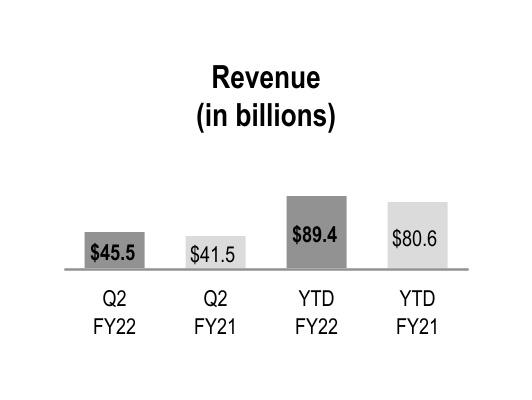
During the three and six months ended December 31, 2021, revenue increased 9 percent and 11 percent to $45.5 billion and $89.4 billion, respectively, primarily due to sales growth from pharmaceutical distribution and specialty pharmaceutical customers, which largely consisted of branded pharmaceutical sales to large customers.
GAAP and Non-GAAP Operating Earnings/(Loss)
| Three Months Ended December 31, | Six Months Ended December 31, | ||||||||||||||||||||||||||||||||||
| (in millions) | 2021 | 2020 | Change | 2021 | 2020 | Change | |||||||||||||||||||||||||||||
| GAAP operating earnings/(loss) | $ | (950) | $ | 461 | N.M. | $ | (535) | $ | (163) | N.M. | |||||||||||||||||||||||||
| Surgical gown recall costs/(income) | 1 | (1) | 1 | (2) | |||||||||||||||||||||||||||||||
| State opioid assessment related to prior fiscal years | — | — | — | 41 | |||||||||||||||||||||||||||||||
| Restructuring and employee severance | 7 | 20 | 25 | 57 | |||||||||||||||||||||||||||||||
| Amortization and other acquisition-related costs | 79 | 116 | 158 | 234 | |||||||||||||||||||||||||||||||
| Impairments and (gain)/loss on disposal of assets | 1,295 | — | 1,293 | 9 | |||||||||||||||||||||||||||||||
| Litigation (recoveries)/charges, net | 34 | 32 | 52 | 1,070 | |||||||||||||||||||||||||||||||
| Non-GAAP operating earnings | $ | 467 | $ | 628 | (26) | % | $ | 994 | $ | 1,246 | (20) | % |
The sum of the components and certain computations may reflect rounding adjustments.
We had GAAP operating losses of $950 million and $535 million during the three and six months ended December 31, 2021, respectively, due to a $1.3 billion pre-tax non-cash goodwill impairment charge related to the Medical segment. See "Critical Accounting Policies and Sensitive Accounting Estimates" section of this MD&A and Note 4 of the "Notes to Condensed Consolidated Financial Statements" for additional detail.
We had a GAAP operating loss of $163 million during the six months ended December 31, 2020 due to the $1.02 billion pre-tax charge recognized for the estimated liability associated with lawsuits and claims brought against us by states and political subdivisions relating to the distribution of prescription opioid pain medications. See further description of opioid lawsuits and claims in the Significant Developments in Fiscal 2022 and Trends section in this MD&A and Note 6 of the "Notes to Condensed Consolidated Financial Statements."
Non-GAAP operating earnings during the three and six months ended December 31, 2021 decreased 26 percent and 20 percent, respectively, due to the decrease in Medical segment profit resulting from increased inflationary impacts, primarily related to commodities and transportation, global supply chain constraints, the adverse impact of the net positive impact of PPE in the prior year and the impact of the divestiture of the Cordis business.
| 3 | Cardinal Health | Q2 Fiscal 2022 Form 10-Q |
| MD&A | Overview |
GAAP and Non-GAAP Diluted EPS
| Three Months Ended December 31, | Six Months Ended December 31, | ||||||||||||||||||||||||||||||||||
| ($ per share) | 2021 (2) | 2020 (2) | Change | 2021 (2) | 2020 (2) | Change | |||||||||||||||||||||||||||||
| GAAP diluted EPS (1) | $ | 0.17 | $ | 2.13 | N.M | $ | 1.12 | $ | 1.27 | (12) | % | ||||||||||||||||||||||||
| State opioid assessment related to prior fiscal years | — | — | — | 0.10 | |||||||||||||||||||||||||||||||
| Restructuring and employee severance | 0.02 | 0.05 | 0.07 | 0.15 | |||||||||||||||||||||||||||||||
| Amortization and other acquisition-related costs | 0.21 | 0.29 | 0.41 | 0.60 | |||||||||||||||||||||||||||||||
| Impairments and (gain)/loss on disposal of assets (3) | 0.77 | — | 0.78 | (0.02) | |||||||||||||||||||||||||||||||
| Litigation (recoveries)/charges, net (4) | 0.10 | (0.73) | 0.15 | 1.16 | |||||||||||||||||||||||||||||||
| Loss on early extinguishment of debt | — | — | 0.03 | — | |||||||||||||||||||||||||||||||
| Non-GAAP diluted EPS (1) | $ | 1.27 | $ | 1.74 | (27) | % | $ | 2.56 | $ | 3.26 | (21) | % |
The sum of the components and certain computations may reflect rounding adjustments.
(1)Diluted earnings per share attributable to Cardinal Health, Inc. ("diluted EPS").
(2)The reconciling items are presented within this table net of tax. See quantification of tax effect of each reconciling item in our GAAP to Non-GAAP Reconciliations in the "Explanation and Reconciliation of Non-GAAP Financial Measures."
(3)Impairments and (gain)/loss on disposals of assets, net includes a pre-tax impairment charge of $1.3 billion related to our Medical segment recorded in the second quarter of fiscal 2022. For fiscal 2022, the estimated net tax benefit related to the impairment is $92 million and is included in the annual effective tax rate. As a result, the amount of tax benefit in the current quarter increased by approximately $1.0 billion and is expected to significantly increase the provision for income taxes during the remainder of the fiscal year.
(4)Litigation (recoveries)/charges, net, includes a tax benefit recorded during the three months ended December 31, 2020 related to a net operating loss carryback. Our wholly-owned insurance subsidiary recorded a self-insurance pre-tax loss in its fiscal 2020 statutory financial statements primarily related to opioid litigation. This self-insurance pre-tax loss, which did not impact our pre-tax consolidated results, was deducted on our fiscal 2020 consolidated federal income tax return and contributed to a significant net operating loss for tax purposes. The net operating loss was carried back and adjusted our taxable income for fiscal 2015, 2016, 2017 and 2018 as permitted under the Coronavirus Aid, Relief and Economic Security (“CARES”) Act. During the three months ended December 31, 2020, the total benefit from the net operating loss carryback was $420 million; however, for purposes of Non-GAAP financial measures, we allocated $394 million of the benefit to litigation (recoveries)/charges, net, which is excluded from non-GAAP measures, based on the relative amount of the self-insurance pre-tax loss related to opioid litigation claims versus separate tax adjustments. The tax benefit allocated to the separate tax adjustments of $26 million is included in non-GAAP measures.
During the three and six months ended December 31, 2021, GAAP diluted EPS was adversely impacted by the goodwill impairment charge related to the Medical segment, which had a $(0.77) and $(0.76) per share after-tax impact, respectively. See "Critical Accounting Policies and Sensitive Accounting Estimates" section of this MD&A and Note 4 of the "Notes to Condensed Consolidated Financial Statements" for additional detail. During the six months ended December 31, 2021, GAAP diluted EPS was also adversely impacted by the factors impacting non-GAAP operating earnings.
During the three and six months ended December 31, 2020, GAAP diluted EPS included a tax benefit from the net operating loss carryback primarily related to a self-insurance pre-tax loss. Refer to Note 7 of the "Notes to Condensed Consolidated Financial Statements" for additional detail. During the six months ended December 31, 2020, GAAP diluted EPS was adversely impacted by the opioid litigation charge recognized for the estimated liability associated with lawsuits and claims brought against us by states and political subdivisions relating to the distribution of prescription opioid pain medications, which had a $(2.38) per share after-tax impact on GAAP diluted EPS. See the Significant Developments in Fiscal 2022 and Trends section in this MD&A and Note 6 of the "Notes to Condensed Consolidated Financial Statements" for additional information.
During the three and six months ended December 31, 2021, non-GAAP diluted EPS decreased 27 percent and 21 percent to $1.27 and $2.56 per share, respectively. This decrease was primarily due to the factors impacting non-GAAP operating earnings and the prior-year tax benefit from the net operating loss carryback, partially offset by lower share count as a result of share repurchases.
Cash and Equivalents
Our cash and equivalents balance was $3.2 billion at December 31, 2021 compared to $3.4 billion at June 30, 2021. During the six months ended December 31, 2021, net cash provided by operating activities was $549 million, which includes the payment into escrow of the majority of our first annual settlement payment under the Proposed Settlement Agreement related to state and local governmental opioid claims, and we deployed $800 million for share repurchases, $592 million for debt repayment, and $289 million for cash dividends. We also received proceeds of $927 million, net of cash transferred, from the divestiture of the Cordis business.
| 4 | Cardinal Health | Q2 Fiscal 2022 Form 10-Q |
| MD&A | Overview |
Significant Developments in Fiscal 2022 and Trends
Opioid Lawsuits Development
In July 2021, we announced that we and two other national distributors have negotiated a proposed settlement agreement (the “Proposed Settlement Agreement”) and settlement process that, if all conditions are satisfied, would result in the settlement of the vast majority of opioid lawsuits filed by state and local governmental entities.
The Proposed Settlement Agreement includes a cash component, pursuant to which we would pay up to approximately $6.37 billion, the majority of which would be paid over 18 years. The exact payment amount will depend on several factors, including the participation rate of states and political subdivisions, the extent to which states take action to foreclose opioid lawsuits by political subdivisions (e.g., laws barring or limiting opioid lawsuits by political subdivisions), and the extent to which political subdivisions in participating states file additional opioid lawsuits against us after the Proposed Settlement Agreement becomes effective.
The Proposed Settlement Agreement also includes injunctive relief terms related to distributors’ controlled substance anti-diversion programs, including with respect to: (1) governance; (2) independence and training of the personnel operating controlled substances monitoring programs; (3) due diligence for new and existing customers; (4) ordering limits for certain products; and (5) suspicious order monitoring. A monitor will be selected to oversee compliance with these provisions for a period of five years. In addition, we and the two other settling distributors will engage a third-party vendor to act as a clearinghouse for data aggregation and reporting, which distributors will fund for ten years.
In September 2021, the three distributors determined that a sufficient number of states had agreed to participate in the Proposed Settlement Agreement to proceed to the next phase of the settlement process, which was the subdivision sign-on period. The subdivision sign-on period ended January 26, 2022. Each participating state will now make a determination as to whether a sufficient number of its political subdivisions have agreed to the Proposed Settlement Agreement (or otherwise had their claims foreclosed) to proceed with the Proposed Settlement Agreement. Following that determination by participating states, each of the three distributors will independently determine whether a sufficient number of subdivisions, including both those litigating and those that have not sued, have agreed to participate in the Proposed Settlement Agreement (or otherwise had their claims foreclosed) to proceed to execution. This process is currently contemplated to end in February 2022. The Proposed Settlement Agreement remains subject to contingencies. It is possible that a sufficient number of states and subdivisions will not agree to the Proposed Settlement Agreement or that other required contingencies will not be satisfied.
If the required contingencies are satisfied, the Proposed Settlement Agreement is expected to become effective in April 2022. During the period between the satisfaction of contingencies and the effective date, the participating states and the distributors would cooperate to obtain consent judgments embodying the terms of the Proposed Settlement Agreement in each participating state and dismissing lawsuits of participating states and subdivisions.
In connection with the negotiations of the Proposed Settlement Agreement, we and the two other national distributors have entered into a settlement with each of the States of Florida, New York, Ohio and Rhode Island and their participating subdivisions. If the Proposed Settlement Agreement becomes effective, these states and their participating subdivisions will become a part of it.
West Virginia subdivisions and Native American tribes are not a part of this settlement process and we have been involved in separate negotiations with these groups. In September 2021 we announced that we, along with two other national distributors, had reached an agreement with the Cherokee Nation in connection with ongoing negotiations toward a broader agreement with Native American tribes. In January 2022, we, along with two other national distributors, executed a term sheet with the Native American tribes.
A bench trial before a federal judge in West Virginia brought by Cabell County and City of Huntington against us and two other national distributors concluded in July 2021. The judge has not yet issued a decision. In addition, a bench trial in the case brought by the Washington Attorney General against us and the same two other national distributors began in November 2021 in Washington state court. A trial in a case brought by private plaintiffs is scheduled to begin in state court in Georgia in March 2022. Trials are inherently unpredictable and it is possible that the outcome of these trials, either individually or in the aggregate, could materially negatively impact our financial results, cash flows or results of operations.
During the six months ended December 31, 2021, we paid into escrow the majority of our first annual payment under the Proposed Settlement Agreement. We also made certain payments under the separate New York and Ohio settlements. In total, we have $6.68 billion accrued at December 31, 2021, of which $480 million is included in other accrued liabilities, and the remainder is included in deferred income taxes and other liabilities in our condensed consolidated balance sheets. Because loss contingencies are inherently unpredictable and unfavorable developments or resolutions can occur, the assessment is highly subjective and requires judgments about future events. We regularly review these opioid litigation matters to determine whether our accrual is adequate. The amount of ultimate loss may differ
| 5 | Cardinal Health | Q2 Fiscal 2022 Form 10-Q |
| MD&A | Overview |
materially from this accrual, whether as a result of settlement discussions, a judicial decision or verdict or otherwise. See Note 6 of the "Notes to Condensed Consolidated Financial Statements" for additional information.
Inflationary Impacts and Global Supply Chain Constraints, and Medical Goodwill
Medical segment profit was negatively impacted by increased inflationary impacts, primarily related to commodities and transportation (including ocean and domestic freight), and global supply constraints during the three and six months ended December 31, 2021. Due to the risks and uncertainties related to these impacts, we performed interim goodwill impairment testing, which resulted in a pre-tax non-cash goodwill impairment charge of $1.3 billion, included in impairments and (gain)/loss on disposal of assets in our condensed consolidated statements of earnings. See "Critical Accounting Policies and Sensitive Accounting Estimates" section of this MD&A and Note 4 of the "Notes to Condensed Consolidated Financial Statements" for additional detail. For fiscal 2022, the estimated net tax benefit related to the impairment is $92 million and is included in the annual effective tax rate. As a result, the amount of tax benefit in the current quarter increased by approximately $1.0 billion and is expected to significantly increase the provision for income taxes during the remainder of the fiscal year. Refer to Note 7 of the "Notes to Condensed Consolidated Financial Statements" for additional detail.
We expect these inflationary impacts and global supply chain constraints to continue to adversely impact Medical segment profit. In order to partially mitigate the impact, we are taking cost-savings measures and intend to implement price increases. If these increased costs and the adverse impact of supply chain disruptions are greater than we expect, continue beyond our expectations, or we are unable to increase prices or achieve the cost-savings measures that we expect, our results of operations will be adversely impacted to a greater extent than we currently anticipate.
We also experienced increased costs in the Pharmaceutical segment, primarily related to transportation and labor, during the three and six months ended December 31, 2021. However, we do not expect the impact to be meaningful to Pharmaceutical segment profit for fiscal 2022.
COVID-19
The COVID-19 pandemic ("COVID-19") had a net negative impact on our consolidated operating earnings during the three and six months ended December 31, 2021.
In the Pharmaceutical segment, volumes within our generics program were lower compared to levels prior to COVID-19, which negatively impacted Pharmaceutical segment profit during the six months ended December 31, 2021. However, volumes within our generics program continued to improve and approximated levels prior to COVID-19 during the three months ended December 31, 2021. On a year-over-year basis, the impact to segment profit was favorable due to improvement in volume during the three and six months ended December 31, 2021.
Medical segment profit was negatively impacted by COVID-19 during the three and six months ended December 31, 2021 and on a year-over-year basis primarily due to the net impact of personal protective equipment ("PPE"), which we expect to improve during the remainder of fiscal 2022. During the three months and six ended December 31, 2021, demand for surgical products related to elective procedures was comparable to levels in the prior year. Higher volumes in our laboratory business continued to positively impact Medical segment profit, but did not have a meaningful impact on a year-over-year basis due to relatively higher volumes in the prior periods.
We currently anticipate that the negative impact of the COVID-19 pandemic on consolidated operating earnings will be less in fiscal 2022 than in the prior year, which included an inventory reserve of $197 million for certain Medical segment PPE during the fourth quarter of fiscal 2021. As a result, we expect the COVID-19 impact for fiscal 2022 will be positive in comparison to prior year. However, we cannot estimate the length or severity of the COVID-19 pandemic or of the related U.S. or global economic consequences on our businesses and results of operations, including whether and when historic economic and operating conditions will resume, or its impact on our business, financial position, results of operations or cash flow. Its impact may be greater or less than we anticipate.
Cordis Divestiture
In August 2021, we sold our Cordis business to Hellman & Friedman for proceeds of $927 million, net of cash transferred, and we retained certain working capital accounts and certain liabilities. The purchase price is subject to adjustments based on working capital requirements as set forth in the agreement. Cardinal Health will retain product liability associated with lawsuits and claims related to inferior vena cava
| 6 | Cardinal Health | Q2 Fiscal 2022 Form 10-Q |
| MD&A | Overview |
("IVC") filters in the U.S. and Canada, as well as authority for these matters discussed in Note 6 of the "Notes to Condensed Consolidated Financial Statements." In connection with the closing, we entered into a Transition Services Agreement ("TSA") with the buyer to provide support functions for a period of up to twenty-four months following the sale. See Note 2 of the "Notes to Condensed Consolidated Financial Statements" for additional information.
As anticipated, Medical segment revenue and Medical segment profit were adversely impacted during the three and six months ended December 31, 2021 due to the divestiture of the Cordis business. We expect the divestiture will decrease Medical segment revenue by approximately $700 million and adversely impact Medical segment profit by approximately $70 million in fiscal 2022. The divestiture of the Cordis business resulted in a decrease in amortization of acquisition-related intangible assets during the three and six months ended December 31, 2021, which we expect to continue for the remainder of fiscal 2022. The divestiture of the Cordis business is subject to risks and uncertainties that may further adversely impact Medical segment profit. For example, the TSA period may be extended beyond our current expectations or could have unintended consequences, and the costs associated with the exit or disposal activities and stranded costs could be greater than anticipated.
| 7 | Cardinal Health | Q2 Fiscal 2022 Form 10-Q |
| MD&A | Results of Operations |
Results of Operations
Revenue

| Three Months Ended December 31, | Six Months Ended December 31, | ||||||||||||||||||||||||||||||||||
| (in millions) | 2021 | 2020 | Change | 2021 | 2020 | Change | |||||||||||||||||||||||||||||
| Pharmaceutical | $ | 41,375 | $ | 37,236 | 11 | % | $ | 81,197 | $ | 72,348 | 12 | % | |||||||||||||||||||||||
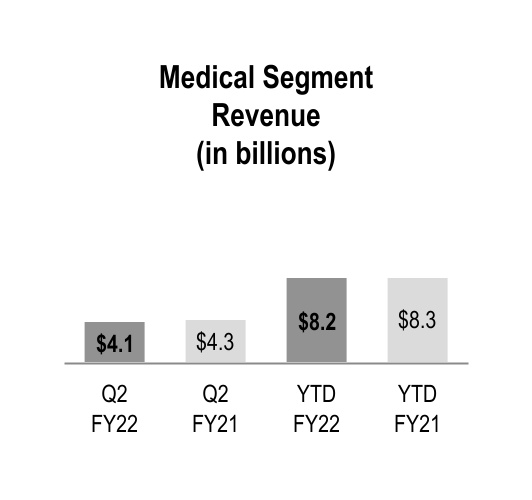
| Medical | 4,085 | 4,310 | (5) | % | 8,234 | 8,267 | — | % | |||||||||||||||||||||||||||
| Total segment revenue | 45,460 | 41,546 | 9 | % | 89,431 | 80,615 | 11 | % | |||||||||||||||||||||||||||
| Corporate | (3) | (5) | N.M | (6) | (9) | N.M | |||||||||||||||||||||||||||||
| Total revenue | $ | 45,457 | $ | 41,541 | 9 | % | $ | 89,425 | $ | 80,606 | 11 | % |
Pharmaceutical Segment
During the three and six months ended December 31, 2021, revenue increased primarily due to sales growth from pharmaceutical distribution and specialty pharmaceutical customers, which together increased revenue by $4.1 billion and $8.8 billion, respectively, and largely consisted of branded pharmaceutical sales to large customers.
Medical Segment
Medical segment revenue decreased during the three months ended December 31, 2021 primarily due to the impact of the divestiture of the Cordis business.
Medical segment revenue was flat during the six months ended December 31, 2021. The adverse impact of the divestiture of the Cordis business was offset primarily due to the positive impact of PPE within products and distribution and sales growth in at-Home solutions.
Cost of Products Sold
Cost of products sold for the three and six months ended December 31, 2021 increased 10 percent to $43.8 billion and 12 percent to $86.2 billion, respectively, compared to the respective prior-year periods as a result of the factors affecting the changes in revenue and gross margin.
| 8 | Cardinal Health | Q2 Fiscal 2022 Form 10-Q |
| MD&A | Results of Operations |
Gross Margin

| Three Months Ended December 31, | Six Months Ended December 31, | ||||||||||||||||||||||||||||||||||
| (in millions) | 2021 | 2020 | Change | 2021 | 2020 | Change | |||||||||||||||||||||||||||||
| Gross margin | $ | 1,616 | $ | 1,776 | (9) | % | $ | 3,258 | $ | 3,491 | (7) | % | |||||||||||||||||||||||
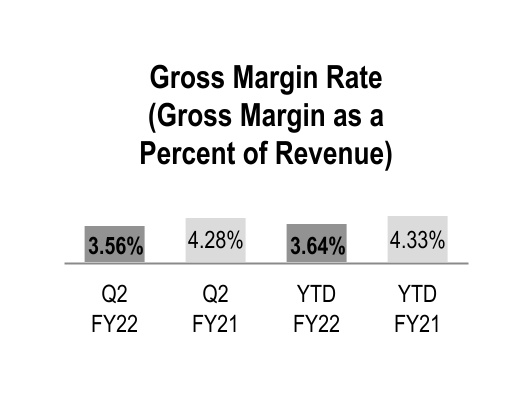
Gross margin during the three and six months ended December 31, 2021 was adversely impacted due to the divestiture of the Cordis business and increased costs in the Medical segment due to inflationary impacts and global supply chain constraints.
Gross margin rate declined 72 basis points and 69 basis points during the three and six months ended December 31, 2021, respectively, mainly due to changes in product mix resulting from pharmaceutical distribution branded sales, which have a dilutive impact on our overall gross margin rate. The performance of Medical segment products and distribution, which reflects the divestiture of the Cordis business and increased costs due to inflationary impacts and global supply chain constraints, also had an adverse impact on gross margin rate.
Distribution, Selling, General and Administrative ("SG&A") Expenses
| Three Months Ended December 31, | Six Months Ended December 31, | ||||||||||||||||||||||||||||||||||
| (in millions) | 2021 | 2020 | Change | 2021 | 2020 | Change | |||||||||||||||||||||||||||||
| SG&A expenses | $ | 1,151 | $ | 1,147 | — | % | $ | 2,265 | $ | 2,284 | (1) | % |
During the three and six months ended December 31, 2021, SG&A expenses were flat primarily due to increased expenses related to investments in information technology infrastructure and higher operations expenses, mostly offset by the divestiture of the Cordis business.
During the six months ended December 31, 2021, the year-over-year comparison was also favorably impacted by the prior-year $41 million accrual for our estimated portion of the assessment on prescription opioid medications that were sold or distributed in New York state in calendar year 2017 and 2018, which was recognized during the three months ended September 30, 2020. See Note 6 of the "Notes to Condensed Consolidated Financial Statements" for additional information on the New York Opioid Stewardship Act.
| 9 | Cardinal Health | Q2 Fiscal 2022 Form 10-Q |
| MD&A | Results of Operations |
Segment Profit
We evaluate segment performance based on segment profit, among other measures. See Note 12 of the "Notes to Condensed Consolidated Financial Statements" for additional information on segment profit.
| Three Months Ended December 31, | Six Months Ended December 31, | ||||||||||||||||||||||||||||||||||
| (in millions) | 2021 | 2020 | Change | 2021 | 2020 | Change | |||||||||||||||||||||||||||||
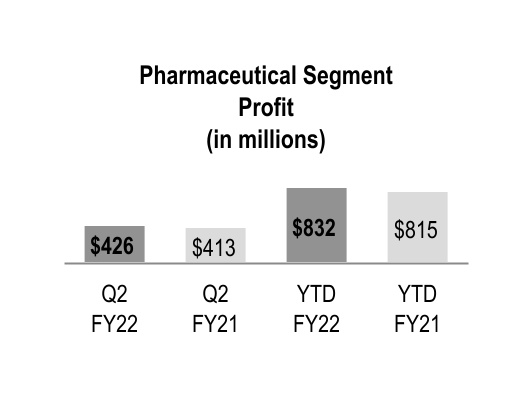
| Pharmaceutical | $ | 426 | $ | 413 | 3 | % | $ | 832 | $ | 815 | 2 | % | |||||||||||||||||||||||
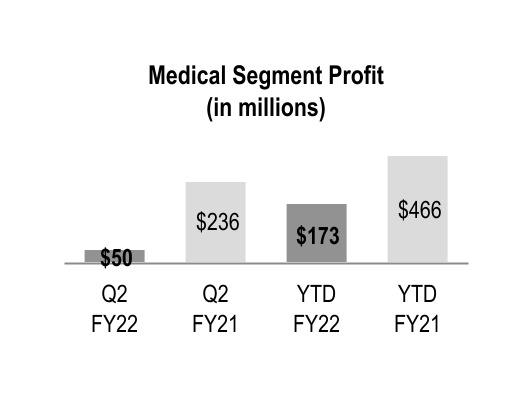
| Medical | 50 | 236 | (79) | % | 173 | 466 | (63) | % | |||||||||||||||||||||||||||
| Total segment profit | 476 | 649 | (27) | % | 1,005 | 1,281 | (22) | % | |||||||||||||||||||||||||||
| Corporate | (1,426) | (188) | N.M. | (1,540) | (1,444) | N.M | |||||||||||||||||||||||||||||
| Total consolidated operating earnings/(loss) | $ | (950) | $ | 461 | N.M. | $ | (535) | $ | (163) | N.M |
Pharmaceutical Segment Profit
During the three and six months ended December 31, 2021, Pharmaceutical segment profit increased primarily due to the performance of our generics program, including an improvement in volumes compared to the prior year, which were adversely impacted by COVID-19. This was partially offset by increased expenses related to investments in information technology infrastructure. During the three months ended December 31, 2021, Pharmaceutical segment profit was also adversely impacted by higher operations expenses.
Pharmaceutical segment profit during the three and six months ended December 31, 2021 was positively impacted by a $16 million judgment for lost profits related to an ordinary course intellectual property rights claim.
Medical Segment Profit
Medical segment profit decreased during the three and six months ended December 31, 2021 largely due to increased inflationary costs, primarily related to commodities and transportation, and the adverse impact of global supply chain constraints. Medical segment profit also reflects an adverse impact related to the prior-year net positive impact of PPE and the impact of the divestiture of the Cordis business.
Corporate
The changes in Corporate during the three and six months ended December 31, 2021 were due to the factors discussed in the Other Components of Consolidated Operating Earnings/(Loss) section that follows.
| 10 | Cardinal Health | Q2 Fiscal 2022 Form 10-Q |
| MD&A | Results of Operations |
Other Components of Consolidated Operating Earnings/(Loss)
In addition to revenue, gross margin and SG&A expenses discussed previously, consolidated operating earnings/(loss) were impacted by the following:
| Three Months Ended December 31, | Six Months Ended December 31, | ||||||||||||||||||||||
| (in millions) | 2021 | 2020 | 2021 | 2020 | |||||||||||||||||||
| Restructuring and employee severance | $ | 7 | $ | 20 | $ | 25 | $ | 57 | |||||||||||||||
| Amortization and other acquisition-related costs | 79 | 116 | 158 | 234 | |||||||||||||||||||
| Impairments and (gain)/loss on disposal of assets, net | 1,295 | — | 1,293 | 9 | |||||||||||||||||||
| Litigation (recoveries)/charges, net | 34 | 32 | 52 | 1,070 |
Restructuring and Employee Severance
Restructuring and employee severance during the three and six months ended December 31, 2021 and 2020 was primarily related to the implementation of certain enterprise-wide cost-saving measures. Restructuring costs during the three and six months ended December 31, 2021 also included costs related to the divestiture of the Cordis business.
Amortization and Other Acquisition-Related Costs
Amortization of acquisition-related intangible assets was $79 million and $113 million for the three months ended December 31, 2021 and 2020, respectively, and $157 million and $228 million for the six months ended December 31, 2021 and 2020, respectively. The decrease in amortization of acquisition-related intangible assets was primarily due to the divestiture of the Cordis business.
Impairments and (Gain)/Loss on Disposal of Assets, Net
During the three and six months ended December 31, 2021, we recognized a $1.3 billion pre-tax non-cash goodwill impairment charge related to our Medical segment, as discussed further in the "Critical Accounting Policies and Sensitive Accounting Estimates" section of this MD&A and Note 4 of the "Notes to Condensed Consolidated Financial Statements."
Litigation (Recoveries)/Charges, Net
During the six months ended December 31, 2020, we recognized a pre-tax charge of $1.02 billion associated with certain opioid matters. See the Significant Developments in Fiscal 2022 and Trends section in this MD&A and Note 6 of the "Notes to Condensed Consolidated Financial Statements" for additional information.
We recognized estimated losses and legal defense costs associated with the IVC filter product liability claims of $13 million and $18 million during the three months ended December 31, 2021 and 2020, respectively, and $39 million and $28 million during the six months ended December 31, 2021 and 2020, respectively. See Note 6 of the "Notes to Condensed Consolidated Financial Statements" for additional information.
During the six months ended December 31, 2021, we recognized income of $17 million for recoveries in class action antitrust lawsuits in which we were a class member.
During the three and six months ended December 31, 2020, we recognized a $13 million charge in connection with a civil investigation by the United States Attorney’s Office for the District of Massachusetts related to discounts and rebates offered or provided to certain Specialty Solutions customers, as described further in Note 6 of the "Notes to Condensed Consolidated Financial Statements."
Earnings/(Loss) Before Income Taxes
In addition to the items discussed above, earnings/(loss) before income taxes were impacted by the following:
| Three Months Ended December 31, | Six Months Ended December 31, | ||||||||||||||||||||||||||||||||||
| (in millions) | 2021 | 2020 | Change | 2021 | 2020 | Change | |||||||||||||||||||||||||||||
| Other (income)/expense, net | $ | (13) | $ | (12) | N.M | $ | (17) | $ | (19) | N.M | |||||||||||||||||||||||||
| Interest expense, net | 37 | 46 | (20) | % | 77 | 91 | (15) | % | |||||||||||||||||||||||||||
| Loss on early extinguishment of debt | — | — | N.M | 10 | 1 | N.M | |||||||||||||||||||||||||||||
| (Gain)/Loss on sale of equity interest in naviHealth | (1) | — | N.M | (1) | — | N.M |
Interest Expense, Net
The decrease in interest expense during the three and six months ended December 31, 2021 was primarily due to less debt outstanding.
| 11 | Cardinal Health | Q2 Fiscal 2022 Form 10-Q |
| MD&A | Results of Operations |
Loss on Early Extinguishment of Debt
During six months ended December 31, 2021, we recognized a $10 million loss in connection with the debt redemption as described further in Note 5 of the “Notes to Condensed Consolidated Financial Statements.”
Provision for/(Benefit from) Income Taxes
During the three months ended December 31, 2021 and 2020, the effective tax rate was 105.0 percent and (47.6) percent, respectively. The effective tax rate for the three months ended December 31, 2021 reflects the impact of the tax effect of the goodwill impairment charge being included in our estimated annual effective tax rate. The estimated annual effective tax rate for the three months ended December 31, 2020 included a benefit from the net operating loss carryback primarily related to a self-insurance pre-tax loss, partially offset by the treatment of the tax impacts of the opioid litigation accrual.
During the six months ended December 31, 2021 and 2020, the effective tax rate was 153.1 percent and 259.7 percent. The effective tax rate for the six months ended December 31, 2021 reflects the impact of the tax effect of the goodwill impairment charge being included in our estimated annual effective tax rate. The effective tax rate for the six months ended December 31, 2020 included a benefit from a net operating loss carryback primarily related to a self-insurance pre-tax loss and the net tax benefit related to the treatment of the tax impacts of opioid litigation charges.
Tax Effects of Goodwill Impairment Charge
During the six months ended December 31, 2021, we recognized a $1.3 billion pre-tax charge for goodwill impairment related to the Medical Unit. The net tax benefit related to this charge is $92 million for fiscal 2022.
Unless an item is considered discrete because it is unusual or infrequent, the tax impact of the item is included in our estimated annual effective tax rate. When items are recognized through our estimated annual effective tax rate, we apply our estimated annual effective tax rate to the earnings/(loss) before income taxes for the year-to-date period to compute our benefit from income taxes for the current quarter and year-to-date period. The tax impacts of discrete items are recognized in their entirety in the period in which they occur.
The tax effect of the goodwill impairment charge during the three months ended December 31, 2021 was included in our estimated annual effective tax rate because it was not considered unusual or infrequent, given that we recorded goodwill impairment in prior fiscal years. The impact of the non-deductible goodwill significantly increased the estimated annual effective tax rate for fiscal 2022. Applying the higher tax rate to the current quarter loss resulted in recognizing an interim tax benefit of approximately $1.0 billion, which impacted the benefit from income taxes in the condensed consolidated statements of earnings during the three months and six months ended December 31, 2021 and prepaid expenses and other assets in the condensed consolidated balance sheets at December 31, 2021. This interim tax benefit will reverse in future quarters of fiscal 2022.
| 12 | Cardinal Health | Q2 Fiscal 2022 Form 10-Q |
| MD&A | Liquidity and Capital Resources |
Liquidity and Capital Resources
We currently believe that, based on available capital resources (cash on hand and committed credit facilities) and projected operating cash flow, we have adequate capital resources to fund working capital needs; currently anticipated capital expenditures; currently anticipated business growth and expansion; contractual obligations; tax payments; current and projected debt service requirements, dividends and share repurchases; and opioid litigation settlement payments associated with the Proposed Settlement Agreement, the state agreements and Cherokee Nation and Native American tribes agreements. If we decide to engage in one or more acquisitions, depending on the size and timing of such transactions, we may need to access capital markets for additional financing.
Cash and Equivalents
Our cash and equivalents balance was $3.2 billion at December 31, 2021 compared to $3.4 billion at June 30, 2021. At December 31, 2021, our cash and equivalents were held in cash depository accounts with major banks or invested in high quality, short-term liquid investments.
During the six months ended December 31, 2021, net cash provided by operating activities was $549 million, which includes the payment into escrow of the majority of our first annual settlement payment under the Proposed Settlement Agreement related to state and local governmental opioid claims, and we deployed $800 million for share repurchases, $592 million for debt repayment, and $289 million for cash dividends. We also received proceeds of $927 million, net of cash transferred, from the divestiture of the Cordis business.
Changes in working capital, which impact operating cash flow, can vary significantly depending on factors such as the timing of customer payments, inventory purchases, and payments to vendors in the regular course of business, as well as fluctuating working capital needs driven by customer and product mix.
The cash and equivalents balance at December 31, 2021 includes $722 million of cash held by subsidiaries outside of the United States.
Other Financing Arrangements and Financial Instruments
Credit Facilities and Commercial Paper
In addition to cash and equivalents and operating cash flow, other sources of liquidity at December 31, 2021 include a $2.0 billion commercial paper program, backed by a $2.0 billion revolving credit facility. We also have a $1.0 billion committed receivables sales facility. At December 31, 2021, we had no amounts outstanding under our commercial paper program, revolving credit facility, or our committed receivables sales facility.
Our revolving credit and committed receivables sales facilities require us to maintain a consolidated net leverage ratio of no more than 3.75-to-1. As of December 31, 2021, we were in compliance with this financial covenant.
Long-Term Debt and Other Short-Term Borrowings
At December 31, 2021 and June 30, 2021, we had total long-term obligations, including the current portion and other short-term borrowings, of $5.6 billion and $6.2 billion, respectively. During the six months ended December 31, 2021, we redeemed $572 million of the 2.616% Notes due 2022 with available cash. In connection with this redemption, we recorded a $10 million loss on early extinguishment of debt. The early redemption was funded with available cash.
| 13 | Cardinal Health | Q2 Fiscal 2022 Form 10-Q |
| MD&A | Liquidity and Capital Resources |
Anticipated Capital Resources
Tax Effects of Self-Insurance Pre-tax Loss
In connection with a tax benefit from the net operating loss carryback primarily related to a self-insurance pre-tax loss as described further in our 2021 Form 10-K, we have filed for a refund of $974 million, which we expect to receive within 12 months. Accordingly, we have a current asset for this amount on our condensed consolidated balance sheets at both December 31, 2021 and June 30, 2021.
Capital Deployment
Proposed Opioid Litigation Settlement Agreement
We had $6.68 billion accrued at December 31, 2021 related to certain opioid litigation, as further described within the Significant Developments in Fiscal 2022 and Trends section in this MD&A and Note 6 of the "Notes to Condensed Consolidated Financial Statements." We expect the majority of the payment amounts to be spread over 18 years. During the six months ended December 31, 2021, we paid into escrow the majority of our first annual payment under the Proposed Settlement Agreement, which is reflected in prepaid expenses and other assets in our condensed consolidated balance sheets. If the Proposed Settlement Agreement does not become effective, this payment will be returned to us. We also made certain payments under the separate New York and Ohio settlements. We expect to pay the remainder of our first annual payment into escrow in February 2022 and, if the Proposed Settlement Agreement becomes effective, to make subsequent annual payments under the Proposed Settlement Agreement every July for the term of our agreement beginning in July 2022. The amounts of these future payments may differ from the payment made during the six months ended December 31, 2021.
Capital Expenditures
Capital expenditures during the six months ended December 31, 2021 and 2020 were $141 million and $174 million, respectively.
Dividends
On each of May 5, 2021, August 4, 2021, and November 4, 2021 our Board of Directors approved a quarterly dividend of $0.4908 per share, or $1.96 per share on an annualized basis, which were paid on July 15, 2021, October 15, 2021 and January 15, 2022 to shareholders of record on July 1, 2021, October 1, 2021 and January 3, 2022 respectively.
Share Repurchases
During the six months ended December 31, 2021, we repurchased $800 million of our common shares, in the aggregate, under accelerated share repurchase ("ASR") programs. See Note 10 of the "Notes to Condensed Consolidated Financial Statements" for additional information.
On November 4, 2021, our Board of Directors approved a $3.0 billion share repurchase program, which will expire on December 31, 2024. As of January 31, 2022, we had $2.9 billion remaining authorized for share repurchases under this program.
| 14 | Cardinal Health | Q2 Fiscal 2022 Form 10-Q |
| MD&A | Other Items |
Other Items
The MD&A in our 2021 Form 10-K addresses our contractual obligations and off-balance sheet arrangements, as of and for the fiscal year ended June 30, 2021. There have been no subsequent material changes outside the ordinary course of business to those items.
Critical Accounting Policies and Sensitive Accounting Estimates
The discussion and analysis presented below is a supplemental disclosure to the critical accounting policies and sensitive accounting estimates specified in our consolidated balance sheet at June 30, 2021. This discussion and analysis should be read in conjunction with the Critical Accounting Policies and Sensitive Accounting Estimates included in our 2021 Form 10-K and our Form 10-Q for the quarter ended September 30, 2021.
Critical accounting policies are those accounting policies that (i) can have a significant impact on our financial condition and results of operations and (ii) require the use of complex and subjective estimates based upon past experience and management’s judgment. Other people applying reasonable judgment to the same facts and circumstances could develop different estimates. Because estimates are inherently uncertain, actual results may differ, including due to the risks discussed in "Risk Factors" and other risks discussed in our 2021 Form 10-K and our other filings with the SEC since June 30, 2021.
Inventory
A portion of our inventories are valued at the lower of cost, using the last-in, first-out ("LIFO") method, or market. These are primarily merchandise inventories at the core pharmaceutical distribution facilities within our Pharmaceutical segment (“distribution facilities”).
Our remaining inventory, including inventory in our Medical segment, that is not valued at the lower of LIFO cost or market is stated at the lower of cost, using the first-in, first-out method ("FIFO"), or net realizable value. We reserve for the lower of cost or net realizable value using the estimated selling prices in the ordinary course of business, less reasonably predictable costs of completion, disposal and transportation. Due to the unprecedented demand for certain PPE as a result of COVID-19, our Medical segment manufactured and sourced inventory at higher costs than
in periods prior to COVID-19. As selling prices and customer demand decreased compared to the peak of COVID-19, we recorded a reserve of $197 million in fiscal 2021, primarily related to certain categories of gloves, to reduce the carrying value of certain PPE to its net realizable value.
We continued to monitor and assess changes in selling prices and customer demand related to PPE during the six months ended December 31, 2021. While we consider that our assumptions continue to be reasonable and appropriate, our estimates for selling prices and demand are inherently uncertain and if our assumptions decline in the future, additional inventory reserves may be required.
Goodwill
Purchased goodwill is tested for impairment annually or when indicators of impairment exist. Goodwill impairment testing involves a comparison of the estimated fair value of reporting units to the respective carrying amount, which may be performed utilizing either a qualitative or quantitative assessment. Qualitative factors are first assessed to determine if it is more likely than not that the fair value of a reporting unit is less than its carrying amount. If it is determined that it is more likely than not that the fair value does not exceed the carrying amount, then a quantitative test is performed. The quantitative goodwill impairment test involves a comparison of the estimated fair value of the reporting unit to the respective carrying amount. A reporting unit is defined as an operating segment or one level below an operating segment (also known as a component).
Our reporting units are: Pharmaceutical operating segment (excluding our Nuclear and Precision Health Solutions division);
Nuclear and Precision Health Solutions division; Medical operating segment (excluding our Cardinal Health at-Home Solutions division) (“Medical Unit”); and Cardinal Health at-Home Solutions division.
Goodwill impairment testing involves judgment, including the identification of reporting units, qualitative evaluation of events and circumstances to determine if it is more likely than not that an impairment exists, and, if necessary, the estimation of the fair value of the applicable reporting unit. Our qualitative evaluation considers the weight of evidence and significance of all identified events and circumstances and most relevant drivers of fair value, both positive and negative, in determining whether it is more likely than not that the fair value of a reporting unit is less than its carrying amount.
| 15 | Cardinal Health | Q2 Fiscal 2022 Form 10-Q |
| MD&A | Other Items |
Medical Unit Goodwill
During the three months ended December 31, 2021, the Medical Unit continued to experience adverse financial results related to inflationary impacts and global supply chain constraints. Due to the risks and uncertainties related to these impacts, we elected to bypass the qualitative assessment and perform interim goodwill impairment testing for the Medical Unit. We updated our assumptions from prior periods to include the increased magnitude and breadth of the inflationary impacts to supply chain and commodities costs as well as adverse impacts due to supply chain disruptions. In addition, our planned price increases did not impact the second quarter of fiscal 2022 and therefore, we updated our assumptions to reflect a longer duration to implement such actions.
Our determination of the estimated fair value of the Medical Unit is based on a combination of the income-based approach (using a discount rate of 9 percent and a terminal growth rate of 2 percent), and the market-based approach. The carrying amount exceeded the fair value, which resulted in a pre-tax impairment charge of $1.3 billion for the Medical Unit, which was recognized during the three months ended December 31, 2021 and is included in impairments and (gain)/loss on disposal of assets in our condensed consolidated statements of earnings. The carrying value of the Medical Unit at December 31, 2021 after recognizing the impairment charge was $8.1 billion, of which $2.8 billion was goodwill. See Note 4 of the "Notes to Condensed Consolidated Financial Statements" for further discussion.
While we consider these assumptions to be reasonable and appropriate, they are complex and subjective, and additional adverse changes in one key assumption or a combination of key assumptions may significantly affect future estimates. These assumptions include, among other things, a failure to meet expected earnings or other financial plans, or unanticipated events and circumstances, such as changes in assumptions about the duration and magnitude of increased supply chain and commodities costs and our planned efforts to mitigate such impact, including price increases or surcharges; further disruptions in the supply chain; the impact of the Cordis divestiture; the COVID-19 pandemic, including estimated demand and selling prices for PPE; an increase in the discount rate; a decrease in the terminal growth rate; increases in tax rates (including potential tax reform); or a significant change in industry or economic trends. Adverse changes in key assumptions may result in further decline in fair value below the carrying value in the future and therefore, an impairment of our Medical Unit goodwill in future periods, which could adversely affect our results of operations. For example, if we were to increase the discount rate by a hypothetical 0.25 percent or decrease the terminal growth rate by a hypothetical 0.70 percent, the fair value for the Medical Unit would have further decreased by approximately $225 million.
| 16 | Cardinal Health | Q2 Fiscal 2022 Form 10-Q |
| Explanation and Reconciliation of Non-GAAP Financial Measures |
Explanation and Reconciliation of Non-GAAP Financial Measures
The "Overview of Consolidated Results" section within MD&A in this Form 10-Q contains financial measures that are not calculated in accordance with GAAP.
In addition to analyzing our business based on financial information prepared in accordance with GAAP, we use these non-GAAP financial measures internally to evaluate our performance, engage in financial and operational planning, and determine incentive compensation because we believe that these measures provide additional perspective on and, in some circumstances are more closely correlated to, the performance of our underlying, ongoing business. We provide these non-GAAP financial measures to investors as supplemental metrics to assist readers in assessing the effects of items and events on our financial and operating results on a year-over-year basis and in comparing our performance to that of our competitors. However, the non-GAAP financial measures that we use may be calculated differently from, and therefore may not be comparable to, similarly titled measures used by other companies. The non-GAAP financial measures disclosed by us should not be considered a substitute for, or superior to, financial measures calculated in accordance with GAAP, and the financial results calculated in accordance with GAAP and reconciliations to those financial statements set forth below should be carefully evaluated.
Exclusions from Non-GAAP Financial Measures
Management believes it is useful to exclude the following items from the non-GAAP measures presented in this report for its own and for investors’ assessment of the business for the reasons identified below:
-
LIFO charges and credits are excluded because the factors that drive last-in first-out ("LIFO") inventory charges or credits, such as pharmaceutical manufacturer price appreciation or deflation and year-end inventory levels (which can be meaningfully influenced by customer buying behavior immediately preceding our fiscal year-end), are largely out of our control and cannot be accurately predicted. The exclusion of LIFO charges and credits from non-GAAP metrics facilitates comparison of our current financial results to our historical financial results and to our peer group companies’ financial results. We did not recognize any LIFO charges or credits during the periods presented.
-
Surgical gown recall costs or income includes inventory write-offs and certain remediation and supply disruption costs, net of related insurance recoveries, arising from the January 2020 recall of select Association for the Advancement of Medical Instrumentation ("AAMI") Level 3 surgical gowns and voluntary field actions (a recall of some packs and a corrective action allowing overlabeling of other packs) for Presource Procedure Packs containing affected gowns. Income from surgical gown recall costs represents insurance recoveries of these certain costs. We have excluded these costs from our non-GAAP metrics to allow investors to better understand the underlying operating results of the business and to facilitate comparison of our current financial results to our historical financial results and to our peer group companies’ financial results.
-
State opioid assessments related to prior fiscal years is the portion of state assessments for prescription opioid medications that were sold or distributed in periods prior to the period in which the expense is incurred. This portion is excluded from non-GAAP financial measures because it is retrospectively applied to sales in prior fiscal years and inclusion would obscure analysis of the current fiscal year results of our underlying, ongoing business. Additionally, while states' laws may require us to make payments on an ongoing basis, the portion of the assessment related to sales in prior periods are contemplated to be one-time, nonrecurring items. Income from state opioid assessments related to prior fiscal years represents reversals of accruals when the underlying assessments were invalidated by a Court or reimbursed by manufacturers.
-
Restructuring and employee severance costs are excluded because they are not part of the ongoing operations of our underlying business.
-
Amortization and other acquisition-related costs, which include transaction costs, integration costs, and changes in the fair value of contingent consideration obligations, are excluded because they are not part of the ongoing operations of our underlying business and to facilitate comparison of our current financial results to our historical financial results and to our peer group companies' financial results. Additionally, costs for amortization of acquisition-related intangible assets are non-cash amounts, which are variable in amount and frequency and are significantly impacted by the timing and size of acquisitions, so their exclusion facilitates comparison of historical, current and forecasted financial results. We also exclude other acquisition-related costs, which are directly related to an acquisition but do not meet the criteria to be recognized on the acquired entity’s initial balance sheet as part of the purchase price allocation. These costs are also significantly impacted by the timing, complexity and size of acquisitions.
| 17 | Cardinal Health | Q2 Fiscal 2022 Form 10-Q |
| Explanation and Reconciliation of Non-GAAP Financial Measures |
-
Impairments and gain or loss on disposal of assets are excluded because they do not occur in or reflect the ordinary course of our ongoing business operations and are inherently unpredictable in timing and amount, and in the case of impairments, are non-cash amounts, so their exclusion facilitates comparison of historical, current and forecasted financial results.
-
Litigation recoveries or charges, net are excluded because they often relate to events that may have occurred in prior or multiple periods, do not occur in or reflect the ordinary course of our business and are inherently unpredictable in timing and amount. During fiscal 2021, we incurred a tax benefit related to a carryback of a net operating loss. Some pre-tax amounts, which contributed to this loss, relate to litigation charges. As a result, we allocated substantially all of the tax benefit to litigation charges. Additionally, during fiscal 2022 our Pharmaceutical segment profit was positively impacted by a $16 million judgment for lost profits. This judgment was the result of an ordinary course intellectual property rights claim and, therefore, is not adjusted in calculating the litigation recoveries or charges, net adjustment.
-
Loss on early extinguishment of debt is excluded because it does not typically occur in the normal course of business and may obscure analysis of trends and financial performance. Additionally, the amount and frequency of this type of charge is not consistent and is significantly impacted by the timing and size of debt extinguishment transactions.
-
(Gain)/Loss on sale of equity interest in naviHealth was incurred in connection with the sale of our remaining equity interest in naviHealth in fiscal 2020. The equity interest was retained in connection with the initial sale of our majority interest in naviHealth during fiscal 2019. We exclude this significant gain because gains or losses on investments of this magnitude do not typically occur in the normal course of business and are similar in nature to a gain or loss from a divestiture of a majority interest, which we exclude from non-GAAP results. The gain on the initial sale of our majority interest in naviHealth in fiscal 2019 was also excluded from our non-GAAP measures.
-
Transitional tax benefit, net related to the Tax Cuts and Jobs Act is excluded because it results from the one-time impact of a very significant change in the U.S. federal corporate tax rate and, due to the significant size of the benefit, obscures analysis of trends and financial performance. The transitional tax benefit includes the initial estimate and subsequent adjustments for the re-measurement of deferred tax assets and liabilities due to the reduction of the U.S. federal corporate income tax rate and the repatriation tax on undistributed foreign earnings.
The tax effect for each of the items listed above, other than the transitional tax benefit item, is determined using the tax rate and other tax attributes applicable to the item and the jurisdiction(s) in which the item is recorded. The gross, tax and net impact of each item are presented with our GAAP to non-GAAP reconciliations.
Definitions
Growth rate calculation: growth rates in this report are determined by dividing the difference between current-period results and prior-period results by prior-period results.
Non-GAAP operating earnings: operating earnings/(loss) excluding (1) LIFO charges/(credits), (2) surgical gown recall costs/(income), (3) state opioid assessment related to prior fiscal years, (4) restructuring and employee severance, (5) amortization and other acquisition-related costs, (6) impairments and (gain)/loss on disposal of assets, and (7) litigation (recoveries)/charges, net.
Non-GAAP earnings before income taxes: earnings/(loss) before income taxes excluding (1) LIFO charges/(credits), (2) surgical gown recall costs/(income), (3) state opioid assessment related to prior fiscal years, (4) restructuring and employee severance, (5) amortization and other acquisition-related costs, (6) impairments and (gain)/loss on disposal of assets, (7) litigation (recoveries)/charges, net, (8) loss on early extinguishment of debt and (9) (gain)/loss on sale of equity interest in naviHealth.
Non-GAAP net earnings attributable to Cardinal Health, Inc.: net earnings attributable to Cardinal Health, Inc. excluding (1) LIFO charges/(credits), (2) surgical gown recall costs/(income), (3) state opioid assessment related to prior fiscal years, (4) restructuring and employee severance, (5) amortization and other acquisition-related costs, (6) impairments and (gain)/loss on disposal of assets, (7) litigation (recoveries)/charges, net, (8) loss on early extinguishment of debt and (9) (gain)/loss on sale of equity interest in naviHealth, each net of tax, and (10) transitional tax benefit, net.
Non-GAAP effective tax rate: provision for/(benefit from) income taxes adjusted for (1) LIFO charges/(credits), (2) surgical gown recall costs/(income), (3) state opioid assessment related to prior fiscal years, (4) restructuring and employee severance, (5) amortization and other acquisition-related costs, (6) impairments and (gain)/loss on disposal of assets, (7) litigation (recoveries)/charges, net, (8) loss on early extinguishment of debt and (9) (gain)/loss on sale of equity interest in naviHealth, each net of tax, and (10) transitional tax benefit, net divided by (earnings/(loss) before income taxes adjusted for the first nine items).
Non-GAAP diluted earnings per share attributable to Cardinal Health, Inc.: non-GAAP net earnings attributable to Cardinal Health, Inc. divided by diluted weighted-average shares outstanding.
| 18 | Cardinal Health | Q2 Fiscal 2022 Form 10-Q |
| Explanation and Reconciliation of Non-GAAP Financial Measures |
GAAP to Non-GAAP Reconciliation
| (in millions, except per common share amounts) | Operating Earnings/(Loss) | Operating Earnings Growth Rate | Earnings/(Loss) Before Income Taxes | Provision for/ (Benefit from) Income Taxes | Net Earnings****1 | Net Earnings****1 Growth Rate | Diluted EPS****1 | Diluted EPS****1 Growth Rate | ||||||||||||||||||||||||||||||
| Three Months Ended December 31, 2021 | ||||||||||||||||||||||||||||||||||||||
| GAAP | $ | (950) | N.M. | $ | (973) | $ | (1,022) | $ | 49 | N.M. | $ | 0.17 | N.M. | |||||||||||||||||||||||||
| Surgical gown recall costs/(income) | 1 | 1 | — | 1 | — | |||||||||||||||||||||||||||||||||
| Restructuring and employee severance | 7 | 7 | 2 | 5 | 0.02 | |||||||||||||||||||||||||||||||||
| Amortization and other acquisition-related costs | 79 | 79 | 20 | 59 | 0.21 | |||||||||||||||||||||||||||||||||
| Impairments and (gain)/loss on disposal of assets, net 2 | 1,295 | 1,295 | 1,080 | 215 | 0.77 | |||||||||||||||||||||||||||||||||
| Litigation (recoveries)/charges, net 3 | 34 | 34 | 6 | 28 | 0.10 | |||||||||||||||||||||||||||||||||
| (Gain)/Loss on sale of equity interest in naviHealth | — | (1) | — | (1) | — | |||||||||||||||||||||||||||||||||
| Non-GAAP | $ | 467 | (26) | % | $ | 443 | $ | 86 | $ | 357 | (31) | % | $ | 1.27 | (27) | % | ||||||||||||||||||||||
| Three Months Ended December 31, 2020 | ||||||||||||||||||||||||||||||||||||||
| GAAP | $ | 461 | 38 | % | $ | 427 | $ | (203) | $ | 629 | N.M | $ | 2.13 | N.M | ||||||||||||||||||||||||
| Surgical gown recall costs/(income) | (1) | (1) | — | (1) | — | |||||||||||||||||||||||||||||||||
| Restructuring and employee severance | 20 | 20 | 5 | 15 | 0.05 | |||||||||||||||||||||||||||||||||
| Amortization and other acquisition-related costs | 116 | 116 | 29 | 87 | 0.29 | |||||||||||||||||||||||||||||||||
| Litigation (recoveries)/charges, net 4 | 32 | 32 | 248 | (216) | (0.73) | |||||||||||||||||||||||||||||||||
| Non-GAAP | $ | 628 | (3) | % | $ | 594 | $ | 79 | $ | 514 | 15 | % | $ | 1.74 | 14 | % | ||||||||||||||||||||||
| Six Months Ended December 31, 2021 | ||||||||||||||||||||||||||||||||||||||
| GAAP | $ | (535) | N.M. | $ | (604) | $ | (925) | $ | 320 | (15) | % | $ | 1.12 | (12) | % | |||||||||||||||||||||||
| Surgical gown recall costs/(income) | 1 | 1 | — | 1 | — | |||||||||||||||||||||||||||||||||
| Restructuring and employee severance | 25 | 25 | 6 | 19 | 0.07 | |||||||||||||||||||||||||||||||||
| Amortization and other acquisition-related costs | 158 | 158 | 41 | 117 | 0.41 | |||||||||||||||||||||||||||||||||
| Impairments and (gain)/loss on disposal of assets, net2 | 1,293 | 1,293 | 1,070 | 223 | 0.78 | |||||||||||||||||||||||||||||||||
| Litigation (recoveries)/charges, net 3 | 52 | 52 | 10 | 42 | 0.15 | |||||||||||||||||||||||||||||||||
| Loss on early extinguishment of debt | — | 10 | 3 | 7 | 0.03 | |||||||||||||||||||||||||||||||||
| (Gain)/Loss on sale of equity interest in naviHealth | — | (1) | — | (1) | — | |||||||||||||||||||||||||||||||||
| Non-GAAP | $ | 994 | (20) | % | $ | 934 | $ | 205 | $ | 728 | (24) | % | $ | 2.56 | (21) | % | ||||||||||||||||||||||
| Six Months Ended December 31, 2020 | ||||||||||||||||||||||||||||||||||||||
| GAAP | $ | (163) | N.M. | $ | (236) | $ | (613) | $ | 376 | N.M. | $ | 1.27 | N.M. | |||||||||||||||||||||||||
| Surgical gown recall costs/(income) | (2) | (2) | (1) | (1) | — | |||||||||||||||||||||||||||||||||
| State opioid assessment related to prior fiscal years | 41 | 41 | 10 | 31 | 0.10 | |||||||||||||||||||||||||||||||||
| Restructuring and employee severance | 57 | 57 | 14 | 43 | 0.15 | |||||||||||||||||||||||||||||||||
| Amortization and other acquisition-related costs | 234 | 234 | 58 | 176 | 0.60 | |||||||||||||||||||||||||||||||||
| Impairments and (gain)/loss on disposal of assets, net | 9 | 9 | 16 | (7) | (0.02) | |||||||||||||||||||||||||||||||||
| Litigation (recoveries)/charges, net 4 | 1,070 | 1,070 | 728 | 342 | 1.16 | |||||||||||||||||||||||||||||||||
| Loss on early extinguishment of debt | — | 1 | — | 1 | — | |||||||||||||||||||||||||||||||||
| Non-GAAP | $ | 1,246 | 2 | % | $ | 1,174 | $ | 212 | $ | 960 | 16 | % | $ | 3.26 | 16 | % |
| 19 | Cardinal Health | Q2 Fiscal 2022 Form 10-Q |
| Explanation and Reconciliation of Non-GAAP Financial Measures |
1 Attributable to Cardinal Health, Inc.
2 Impairments and (gain)/loss on disposals of assets, net includes a pre-tax impairment charge of $1.3 billion related to our Medical segment recorded in the second quarter of fiscal 2022. For fiscal 2022, the estimated net tax benefit related to the impairment is $92 million and is included in the annual effective tax rate. As a result, the amount of tax benefit in the current quarter increased by approximately $1.0 billion and is expected to significantly increase the provision for income taxes during the remainder of the fiscal year.
3 Litigation (recoveries)/charges, net for the second quarter of fiscal 2022 does not include a $16 million judgement for lost profits related to an ordinary course intellectual property claim, which positively impacted Pharmaceutical segment profit in the quarter.
4 Litigation (recoveries)/charges, net includes a pre-tax charge of $1.02 billion recorded in the first quarter of fiscal 2021 related to the opioid litigation. For fiscal 2021, the amount of tax expense increased by approximately $150 million during the three months ended December 31, 2020 while the amount of tax benefit increased by approximately $300 million during the six months ended December 31, 2020 compared to the tax impacts that would have been recognized without the opioid litigation charge. The net tax benefit associated with the opioid litigation charges was $228 million for fiscal 2021.
Litigation(recoveries)/charges, net also includes a tax benefit recorded during the three months ended December 31, 2020 related to a net operating loss carryback. Our wholly-owned insurance subsidiary recorded a self-insurance pre-tax loss in its fiscal 2020 statutory financial statements primarily related to opioid litigation. This self-insurance pre-tax loss, which did not impact our pre-tax consolidated results, was deducted on our fiscal 2020 consolidated federal income tax return and contributed to a significant net operating loss for tax purposes. The net operating loss was carried back and adjusted our taxable income for fiscal 2015, 2016, 2017 and 2018 as permitted under the Coronavirus Aid, Relief and Economic Security (“CARES”) Act. During the six months ended December 31, 2020, the total net benefit was $420 million; however, for purposes of reconciling Non-GAAP financial measures, we allocated $394 million of the benefit to litigation (recoveries)/charges, net, which is excluded from non-GAAP measures, based on the relative amount of the self-insurance pre-tax loss related to opioid litigation claims versus separate tax adjustments. The tax benefit allocated to the separate tax adjustments of $26 million is included in non-GAAP measures.
The sum of the components and certain computations may reflect rounding adjustments.
We apply varying tax rates depending on the item's nature and tax jurisdiction where it is incurred.
| 20 | Cardinal Health | Q2 Fiscal 2022 Form 10-Q |
| Other |
Previous: Cover and table of contents · Next: Item 3. Quantitative and Qualitative Disclosures about Market Risk