 filings.tools
Item 1. Business
38K characters. Original on sec.gov · Markdown
Item 1. Business
Overview
We own, operate and lease shared communications infrastructure that is geographically dispersed throughout the U.S., including (1) approximately 40,000 towers and other structures, such as rooftops (collectively, "towers"), and (2) approximately 65,000 route miles of fiber primarily supporting small cell networks ("small cells") and fiber solutions. Our towers, fiber and small cells assets are collectively referred to herein as "communications infrastructure," and our customers on our communications infrastructure are referred to herein as "tenants." Our core business is providing access, including space or capacity, to our shared communications infrastructure via long-term contracts in various forms, including lease, license, sublease and service agreements (collectively, "contracts"). We seek to increase our site rental revenues by adding more tenants on our shared communications infrastructure, which we expect to result in significant incremental cash flows due to our low incremental operating costs.
Below is certain information concerning our business:
| • | Over the last two decades, we have assembled a leading portfolio of towers predominately through acquisitions from large wireless carriers or their predecessors. More recently, through both acquisitions (see note 3 to our consolidated financial statements) and new construction of small cells and fiber, we have extended our communications infrastructure presence by investing significantly in our Fiber segment. Through our product offerings of towers and small cells, we seek to provide a comprehensive solution to enable our wireless tenants to expand coverage and capacity for wireless networks. Furthermore, within our Fiber segment, we are able to generate cash flow growth and stockholder return by deploying our fiber for both small cells' and fiber solutions' tenants. |
| • | Below is certain information regarding our Towers segment: |
| ◦ | Approximately 56% and 71% of our towers are located in the 50 and 100 largest U.S. basic trading areas ("BTAs"), respectively. Our towers have a significant presence in each of the top 100 BTAs. |
| ◦ | We derive approximately 40% of our Towers site rental gross margin from towers residing on land and other property interests (collectively, "land") that we own, including fee interests and perpetual easements, and we derive approximately 60% of our Towers site rental gross margin from towers residing on land that we lease, sublease, manage or license. |
| ◦ | The contracts for the land under our towers have an average total remaining life of approximately 35 years (including all renewal terms at our option), weighted based on Towers site rental gross margin. |
| • | Below is certain information regarding our Fiber segment: |
| ◦ | The majority of our small cells and fiber are located in major metropolitan areas, including a presence within every major U.S. market. |
| ◦ | The vast majority of our fiber assets are located on public rights-of-way. |
| ◦ | We operate as a REIT for U.S. federal income tax purposes. See "Item 1. Business—2018 Industry Highlights and Company Developments—REIT Status" and note 10 to our consolidated financial statements. |
Certain information concerning our tenant and site rental contracts is as follows:
| • | Our largest tenants include AT&T, T-Mobile, Verizon Wireless and Sprint, which collectively accounted for 73% of our 2018 site rental revenues. |
| • | Site rental revenues represented 87% of our 2018 consolidated net revenues, of which approximately 66% and 34% were from our Towers segment and our Fiber segment, respectively. |
| • | The vast majority of our site rental revenues are of a recurring nature and are subject to long-term contracts with our tenants. |
| • | Our site rental revenues derived from wireless tenants typically result from long-term contracts with (1) initial terms of five to 15 years, (2) multiple renewal periods at the option of the tenant of five to 10 years each, (3) limited termination rights for our tenants, and (4) contractual escalations of the rental price and, in some cases, an additional upfront payment. |
| • | Our site rental revenues derived from our fiber solutions tenants (including from organizations with high-bandwidth and multi-location demands), typically result from contracts with (1) initial terms that generally vary between three to 20 years and (2) a fixed monthly recurring fee and, in some cases, an additional upfront payment. |
| • | Exclusive of renewals at the tenants' option, our tenant contracts have a weighted-average remaining life of approximately five years and represent $23 billion of expected future cash inflows. |
As part of our effort to provide comprehensive communications infrastructure solutions, we also offer certain services primarily relating to our towers and small cells, predominately consisting of (1) site development services relating to existing or new tenant equipment installations, including: site acquisition, architectural and engineering, or zoning and permitting (collectively,
"site development services") and (2) tenant equipment installation or subsequent augmentations (collectively, "installation services"). The large majority of our services revenues relate to our Towers segment.
Strategy
As a leading provider of shared communications infrastructure in the U.S., our strategy is to create long-term stockholder value via a combination of (1) growing cash flows generated from our existing portfolio of communications infrastructure, (2) returning a meaningful portion of our cash provided by operating activities to our common stockholders in the form of dividends and (3) investing capital efficiently to grow cash flows and long-term dividends per share. Our U.S. focused strategy is based, in part, on our belief that the U.S. is the most attractive market for shared communications infrastructure investment with the greatest long-term growth potential. We measure our efforts to create "long-term stockholder value" by the combined payment of dividends to stockholders and growth in our per share results. The key elements of our strategy are to:
| • | Grow cash flows from our existing communications infrastructure. We seek to maximize our site rental cash flows by working with our tenants to provide them quick access to our existing communications infrastructure and entering into long-term contracts. Tenant additions or modifications of existing tenant equipment (collectively, "tenant additions") enable our tenants to expand coverage and capacity in order to meet increasing demand for data, while generating high incremental returns for our business. We believe our product offerings of towers and small cells provide a comprehensive solution to our wireless tenants' growing network needs through our shared communications infrastructure model, which is an efficient and cost-effective way to serve our tenants. Additionally, we believe our ability to share our fiber assets across multiple tenants to deploy both small cells and offer fiber solutions allows us to generate cash flows and increase stockholder return. We also believe that there will be considerable future demand for our communications infrastructure based on the location of our assets and the rapid growth in demand for data. |
| • | Return cash provided by operating activities to common stockholders in the form of dividends. We believe that distributing a meaningful portion of our cash provided by operating activities appropriately provides common stockholders with increased certainty for a portion of expected long-term stockholder value while still retaining sufficient flexibility to invest in our business and deliver growth. We believe this decision reflects the translation of the high-quality, long-term contractual cash flows of our business into stable capital returns to common stockholders. |
| • | Invest capital efficiently to grow cash flows and long-term dividends per share. In addition to adding tenants to existing communications infrastructure, we seek to invest our available capital, including the net cash provided by our operating activities and external financing sources, in a manner that will increase long-term stockholder value on a risk-adjusted basis. These investments include constructing and acquiring new communications infrastructure that we expect will generate future cash flow growth and attractive long-term returns by adding tenants to those assets over time. Our historical investments have included the following (in no particular order): |
| ◦ | construction of towers, fiber and small cells; |
| ◦ | acquisitions of towers, fiber and small cells; |
| ◦ | acquisitions of land interests (which primarily relate to land assets under towers); |
| ◦ | improvements and structural enhancements to our existing communications infrastructure; |
| ◦ | purchases of shares of our common stock from time to time; and |
| ◦ | purchases, repayments or redemptions of our debt. |
Our strategy to create long-term stockholder value is based on our belief that additional demand for our communications infrastructure will be created by the expected continued growth in the demand for data. We believe that such demand for our communications infrastructure will continue, will result in growth of our cash flows due to tenant additions on our existing communications infrastructure, and will create other growth opportunities for us, such as demand for newly-constructed or acquired communications infrastructure, as described above.
Company Developments, REIT Status and Industry Updates
Company Developments. See "Item 1. Business—Overview," "Item 1. Business—The Company," "Item 7. MD&A" and our consolidated financial statements for a discussion of certain recent developments, activities, and results, including the increase in our quarterly common stock dividend and our recent debt and equity financing activities.
REIT Status. We commenced operating as a REIT for U.S. federal income tax purposes effective January 1, 2014. As a REIT, we are generally entitled to a deduction for dividends that we pay and therefore are not subject to U.S. federal corporate income tax on our net taxable income that is currently distributed to our stockholders. We may also be subject to certain federal, state, local, and foreign taxes on our income or assets, including (1) taxes on any undistributed income, (2) taxes related to our taxable REIT subsidiaries ("TRSs"), (3) franchise taxes, (4) property taxes and (5) transfer taxes. In addition, we could, in certain
circumstances, be required to pay an excise or penalty tax, which could be significant in amount, in order to utilize one or more relief provisions under the Internal Revenue Code of 1986, as amended ("Code"), to maintain qualification for taxation as a REIT.
The Tax Cuts and Jobs Act, enacted in 2018 ("Tax Reform Act"), made substantial changes to the Code. Among the many changes impacting corporations are a significant reduction in the corporate income tax rate, the repeal of the corporate alternative minimum tax for years beginning in 2018 and limitations on the deductibility of interest expense. In addition, under the Tax Reform Act, qualified REIT dividends (within the meaning of Section 199A(e)(3) of the Code) constitute a part of a non-corporate taxpayer's "qualified business income amount" and thus our non-corporate U.S. stockholders may be eligible to take a qualified business income deduction in an amount equal to 20% of such dividends received from us. Without further legislative action, the 20% deduction applicable to qualified REIT dividends will expire on January 1, 2026. The Tax Reform Act has not had a material impact on the Company.
The vast majority of our assets and revenues are in the REIT. See note 10 to our consolidated financial statements. Additionally, we have included in TRSs certain other assets and operations. Those TRS assets and operations will continue to be subject, as applicable, to federal and state corporate income taxes or to foreign taxes in the jurisdictions in which such assets and operations are located.
Our foreign assets and operations (including our tower operations in Puerto Rico) most likely will be subject to foreign income taxes in the jurisdictions in which such assets and operations are located, regardless of whether they are included in a TRS.
To remain qualified and be taxed as a REIT, we will generally be required to annually distribute to our stockholders at least 90% of our REIT taxable income, after the utilization of our NOLs (determined without regard to the dividends paid deduction and excluding net capital gain) (see notes 2 and 10 to our consolidated financial statements). Our quarterly common stock dividend will delay the utilization of our NOLs and may cause certain of the NOLs to expire without utilization.
Industry Update. Consumer demand for data continues to grow due to increases in data consumption and increased penetration of bandwidth-intensive devices. This increase in data consumption is driven by growth in factors such as (1) mobile entertainment (such as mobile video, mobile applications, and social networking), (2) mobile internet usage (such as email and web browsing), (3) machine-to-machine applications or the "Internet of Things" (such as smart city technologies), and (4) the adoption of other bandwidth-intensive applications (such as cloud services and video communications). As a result, consumer wireless devices are trending toward bandwidth-intensive devices, including smartphones, laptops, tablets and other emerging devices, and, during the next several years, U.S. wireless carriers are expected to be among the first carriers in the world to offer commercial 5th Generation ("5G") mobile cellular communications services to further support such growth.
We expect the following anticipated factors to contribute to potential demand for our communications infrastructure:
| • | Consumers' growing wireless data consumption likely resulting in major wireless carriers continuing to upgrade and enhance their networks, including through the use of both towers and small cells, in an effort to improve network quality and capacity and tenant retention or satisfaction; |
| • | Prior and future potential spectrum auctioned, licensed or made available by the Federal Communications Commission ("FCC") enabling additional wireless carrier network development; |
| • | Next generation technologies and new uses for wireless communications may potentially result in new entrants or increased demand in the wireless industry, which may include companies involved in the continued evolution and deployment of the Internet of Things (such as connected cars, smart cities and virtual reality); and |
| • | The continued adoption of bandwidth-intensive applications could result in demand for high-capacity, multi-location, fiber-based network solutions. |
The Company
Virtually all of our operations are located in the U.S. Our operating segments consists of Towers and Fiber. For more information about our operating segments, see "Item 7. MD&A—General Overview" and note 15 to our consolidated financial statements. Our core business is providing access, including space or capacity, to our shared communications infrastructure in the U.S. We believe our communications infrastructure is integral to our tenants' networks and organizations. See "Item 1. Business—Strategy."
Towers Segment. We believe towers are the most efficient and cost-effective solution for providing coverage and capacity for wireless carrier network deployments. We acquired ownership interests or exclusive rights to the majority of our towers directly or indirectly from the four largest wireless carriers (or their predecessors) through transactions consummated since 1999, including transactions with (1) AT&T in 2013 ("AT&T Acquisition"), (2) T-Mobile in 2012 ("T-Mobile Acquisition"), (3) Global Signal Inc. in 2007 ("Global Signal Acquisition"), which had originally acquired the majority of its towers from Sprint, (4) companies now part of Verizon Wireless during 1999 and 2000 and (5) companies now part of AT&T during 1999 and 2000.
We generally receive monthly rental payments from our Towers tenants, payable under long-term contracts. We generally negotiate initial contract terms of five to 15 years, with multiple renewal periods of five to 10 years each at the option of the tenant, and our contracts typically include fixed escalations (which generally exceed expected non-renewals, as discussed below) and, in some cases, an additional upfront payment. We continue to endeavor to negotiate with our existing tenant base for longer contractual terms, which often contain fixed escalation rates.
Our Towers tenant contracts have historically had a high renewal rate. With limited exceptions, our Towers tenant contracts may not be terminated prior to the end of their current term, and non-renewals have averaged approximately 2.5% of site rental revenues over the last five years (inclusive of non-renewals as a result of the decommissioning of the former Leap Wireless, MetroPCS and Clearwire networks ("Acquired Networks")). In general, each tenant contract which is renewable will automatically renew at the end of its term unless the tenant provides prior notice of its intent not to renew. See note 4 to our consolidated financial statements for a tabular presentation of the minimum rental cash payments due to us by tenants pursuant to lease agreements without consideration of tenant renewal options.
The average monthly rental payment from a new tenant added to towers can vary based on (1) aggregate tenant volume, (2) the different regions in the U.S., or (3) the physical size, weight and shape of the antenna installation or related equipment. When possible, we seek to receive rental payment increases in connection with contract amendments, pursuant to which our tenants add additional antennas or other equipment to our towers on which they already have equipment pursuant to preexisting contracts.
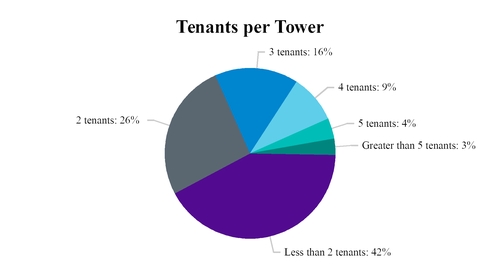
As of December 31, 2018, the average number of tenants (calculated as a unique license together with any related amendments thereto) per tower is approximately 2.2. The following chart sets forth the number of existing tenants per tower as of December 31, 2018 (see "Item 7. MD&A—Accounting and Reporting Matters—Critical Accounting Policies and Estimates" for a discussion of our impairment evaluation and our towers with no tenants).
Fiber Segment. Our Fiber segment includes both small cells and fiber solutions.
| • | We offer certain fiber solutions to organizations with high-bandwidth and multi-location demands, such as enterprise, government, education, healthcare, wholesale, financial, legal, media and entertainment, content distribution, and energy and utilities tenants. Our fiber solutions provide essential connectivity resources needed to create integrated networks and support organizations. |
| • | Our small cells offload data traffic from towers and bolster capacity in the areas of wireless networks where data demand is the greatest. Our small cells are typically attached to public right-of-way infrastructure, including utility poles and street lights. |
Our fiber assets include those acquired from: (1) NextG Networks, Inc. in 2012 ("NextG Acquisition"), (2) Quanta Fiber Networks, Inc. in 2015 ("Sunesys Acquisition"), (3) FPL FiberNet Holdings, LLC and certain other subsidiaries of NextEra Energy, Inc. in 2017 ("FiberNet Acquisition"), (4) Wilcon Holdings LLC in 2017 ("Wilcon Acquisition") and (5) LTS Group Holdings LLC in 2017 ("Lightower Acquisition"). The FiberNet Acquisition, Wilcon Acquisition, and Lightower Acquisition are collectively referred to herein as the "2017 Acquisitions."
We generally receive monthly recurring payments from our Fiber tenants and, in some cases, receive upfront payments, payable pursuant to contracts. The amount of the monthly payments can also be influenced by the amount or cost of (1) construction for initial and subsequent tenants, (2) fiber strand requirements and supply, (3) equipment at the site and (4) any upfront payment received.
Additional site rental information. For both of our Towers and Fiber segments, we have existing master agreements with our largest tenants, including AT&T, T-Mobile, Verizon Wireless and Sprint; such agreements provide certain terms (including economic terms) that govern our tenants' right to utilize our communications infrastructure entered into by such carriers during the term of their master agreements.
Approximately half of our site rental cost of operations consists of Towers ground lease expenses, and the remainder includes fiber access expenses (primarily leases of fiber assets and other access agreements to facilitate our communications infrastructure), property taxes, repairs and maintenance, employee compensation or related benefit costs, and utilities. Assuming current leasing activity levels, our cash operating expenses generally tend to escalate at approximately the rate of inflation. The addition of new tenants to existing communications infrastructure assets is achieved at a low incremental operating cost, delivering high incremental returns to our business. Once constructed, our communications infrastructure portfolio requires minimal sustaining capital expenditures, including maintenance or other non-discretionary capital expenditures, which are typically approximately 2% of net revenues. See note 14 to our consolidated financial statements for a tabular presentation of the rental cash payments owed by us to landlords pursuant to our contractual agreements.
Services. As part of our effort to provide comprehensive communications infrastructure solutions, we also offer certain services primarily relating to our towers and small cells, predominately consisting of (1) site development services and (2) installation services. The large majority of our service revenues relate to our Towers segment. For 2018, approximately 60% of our services and other revenues related to installation services, and the remainder predominately related to site development services. We seek to grow our service revenues by capitalizing on increased volumes that may result from carrier network upgrades, promoting site development services, expanding the scope of our services, and focusing on tenant service and deployment speed. We have the capability and expertise to install, with the assistance of our network of subcontractors, equipment or antenna systems for our tenants. We do not always provide the installation services or site development services for our tenants on our communications infrastructure as third parties also provide these services (see also "—Competition" below). These activities are typically non-recurring and highly competitive, with a number of local competitors in most markets. Typically, our installation services are billed on a cost-plus profit basis and site development services are billed on a fixed fee basis.
Customers. Our Towers customers are primarily comprised of large wireless carriers that operate national networks.
Our Fiber customers are generally large wireless carriers and organizations with high-bandwidth and multi-location demands, such as enterprise, government, education, healthcare, wholesale, financial, legal, media and entertainment, content distribution, and energy and utilities customers.
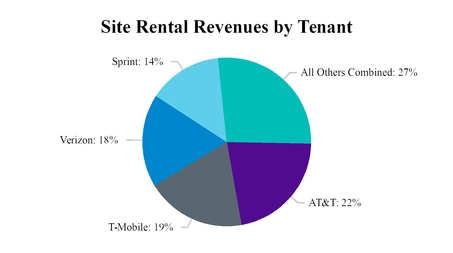
Our four largest tenants are AT&T, T-Mobile, Verizon Wireless and Sprint. Collectively, these four tenants accounted for 73% of our 2018 site rental revenues. Also see "Item 1A. Risk Factors" and note 15 to our consolidated financial statements. For 2018, our site rental revenues by tenant were as follows:
Sales and Marketing. Our sales organization markets our communications infrastructure with the objective of contracting access with tenants to existing communications infrastructure or to new communications infrastructure prior to construction. We seek to become the critical partner and preferred independent communications infrastructure provider for our tenants and increase tenant satisfaction relative to our peers by leveraging our (1) existing unique communications infrastructure footprint, (2) tenant relationships, (3) process-centric approach, (4) technological tools and (5) construction capabilities and expertise.
Our sales team is organized based on a variety of factors, including tenant type (such as wireless carriers and organizations) and geography. A team of national account directors maintains our relationships with our largest tenants. These directors work to develop communications infrastructure contracts, as well as to ensure that tenants' communications infrastructure needs are efficiently translated into new contracts on our communications infrastructure. Sales personnel in our local offices develop and maintain relationships with our tenants that are expanding their networks, entering new markets, seeking new or additional communication infrastructure offerings, bringing new technologies to market or requiring maintenance or add-on business. In addition to our full-time sales or marketing staff, a number of senior-level employees spend a significant portion of their time on sales and marketing activities and call on existing or prospective tenants.
Competition. We face competition for site rental tenants from various sources, including (1) other independent communications infrastructure owners or operators, including competitors that own, operate, or manage towers, rooftops, broadcast towers, utility poles, fiber (including non-traditional competitors such as cable providers) or small cells, (2) tenants who elect to self-perform or (3) new alternative deployment methods for communications infrastructure.
Some of the larger companies with which we compete for Towers segment business opportunities include American Tower Corporation and SBA Communications Corporation. Our Fiber segment business competitors can vary significantly based on geography. Some of the larger companies with which we compete for Fiber segment business opportunities include other owners of fiber, as well as recent and potential entrants into small cells and fiber solutions. We believe that location, existing communications infrastructure footprint, deployment speed, quality of service, expertise, reputation, capacity and price have been and will continue to be the most significant competitive factors affecting our businesses. See "Item 1A. Risk Factors."
Competitors to our services offering include site acquisition consultants, zoning consultants, real estate firms, right-of-way consulting firms, construction companies, tower owners or managers, radio frequency engineering consultants, telecommunications equipment vendors who can provide turnkey site development services through multiple subcontractors or our tenants' internal staff. We believe that our tenants base their decisions on the outsourcing of services on criteria such as a company's experience, record of accomplishment, reputation, price and time for completion of a project.
Employees
At January 31, 2019, we employed approximately 5,000 people. We are not a party to any collective bargaining agreements. We have not experienced any strikes or work stoppages, and management believes that our employee relations are satisfactory.
Regulatory and Environmental Matters
We are required to comply with a variety of federal, state, and local regulations and laws in the U.S., including FCC and Federal Aviation Administration ("FAA") regulations and those discussed under "—Environmental" below. To date, we have not incurred any material fines or penalties or experienced any material adverse effects to our business as a result of any domestic or international regulations. The summary below is based on regulations currently in effect, and such regulations are subject to review or modification by the applicable governmental authority from time to time. If we fail to comply with applicable laws and regulations, we may be fined or even lose our rights to conduct some of our business.
Federal Regulations. Both the FCC and the FAA regulate towers used for wireless communications, radio, or television broadcasting. Such regulations control the siting, lighting, or marking of towers and may, depending on the characteristics of particular towers, require the registration of tower facilities with the FCC and the issuance of determinations confirming no hazard to air traffic. Wireless communications devices operating on towers are separately regulated and independently licensed based upon the particular frequency used. In addition, the FCC and the FAA have developed standards to consider proposals for new or modified tower or antenna structures based upon the height or location, including proximity to airports. Proposals to construct or to modify existing tower or antenna structures above certain heights are reviewed by the FAA to ensure the structure will not present a hazard to aviation, which determination may be conditioned upon compliance with lighting or marking requirements. The FCC requires its licensees to operate communications devices only on towers that comply with FAA rules and are registered with the FCC, if required by its regulations. Where tower lighting is required by FAA regulation, tower owners bear the responsibility of notifying the FAA of any tower lighting outage and ensuring the timely restoration of such outages. Failure to comply with the applicable requirements may lead to civil penalties.
Local Regulations. The U.S. Telecommunications Act of 1996 amended the Communications Act of 1934 to preserve state and local zoning authorities' jurisdiction over the siting of communications towers and small cells. The law, however, limits local zoning authority by prohibiting actions by local authorities that discriminate between different service providers of wireless communications or ban altogether the provision of wireless communications. Additionally, the law prohibits state and local restrictions based on the environmental effects of radio frequency emissions to the extent the facilities comply with FCC regulations.
Local regulations include city and other local ordinances (including subdivision and zoning ordinances), approvals for construction, modification and removal of towers and small cells, and restrictive covenants imposed by community developers. These regulations vary greatly, but typically require us to obtain approval from local officials prior to tower construction. Local zoning authorities may render decisions that prevent the construction or modification of towers or place conditions on such construction or modifications that are responsive to community residents' concerns regarding the height, visibility, or other characteristics of the towers. Over the last several years, there have been several developments related to FCC regulations and legislation that assist in expediting and streamlining the deployment of wireless networks, including establishing timeframes for reviews by local and state governments. Notwithstanding such legislative and FCC actions, decisions of local zoning authorities may also adversely affect the timing or cost of communications infrastructure construction or modification.
Certain of our Fiber related subsidiaries hold authorizations to provide intrastate telecommunication services as competitive local exchange carriers ("CLEC") in numerous states and to provide domestic interstate telecommunication services as authorized by the FCC. These Fiber subsidiaries are primarily regulated by state public service commissions. CLEC status, in certain cases, helps promote access to public rights-of-way, which is beneficial to the deployment of our small cells on a timely basis. Status as a CLEC often allows us to deploy our small cells in locations where zoning restrictions might otherwise delay, restrict, or prevent building or expanding traditional wireless tower sites or traditional wireless rooftop sites. See "Item 1A. Risk Factors."
Environmental. We are required to comply with a variety of federal, state, and local environmental laws and regulations protecting environmental quality, including air and water quality and wildlife protection. To date, we have not incurred any material fines or penalties or experienced any material adverse effects to our business as a result of any domestic or international environmental regulations or matters. See "Item 1A. Risk Factors."
The construction of new towers and small cells or, in some cases, the modification of existing towers in the U.S. may be subject to environmental review under the National Environmental Policy Act of 1969, as amended ("NEPA"), which requires federal agencies to evaluate the environmental impact of major federal actions. The FCC has promulgated regulations implementing NEPA, which require applicants to investigate the potential environmental impact of the proposed tower or small cells construction. Should the proposed tower or small cells construction present a significant environmental impact, the FCC must prepare an environmental impact statement, subject to public comment. If the proposed construction or modification of a tower poses a significant impact on the environment, the FCC's approval of the construction or modification could be significantly delayed.
Our operations are subject to federal, state, and local laws and regulations relating to the management, use, storage, disposal, emission, or remediation of, or exposure to, hazardous or non-hazardous substances, materials, or wastes. As an owner, lessee, or operator of real property, we are subject to certain environmental laws that impose strict, joint-and-several liability for the
cleanup of on-site or off-site contamination relating to existing or historical operations; or we could also be subject to personal injury or property damage claims relating to such contamination. In general, our tenant contracts prohibit our tenants from using or storing any hazardous substances on our communications infrastructure sites in violation of applicable environmental laws and require our tenants to provide notice of certain environmental conditions caused by them.
As licensees and communications infrastructure owners, we are also subject to regulations and guidelines that impose a variety of operational requirements relating to radio frequency emissions. As employers, we are subject to Occupational Safety and Health Administration and similar guidelines regarding employee protection from radio frequency exposure. The potential connection between radio frequency emissions and certain negative health effects, including some forms of cancer, has been the subject of substantial study by the scientific community in recent years.
We have compliance programs and monitoring projects to help assure that we are in substantial compliance with applicable environmental laws and regulations. Nevertheless, there can be no assurance that the costs of compliance with existing or future environmental laws will not have a material adverse effect on us.
Other Regulations. We hold, through certain of our subsidiaries, spectrum licenses, which are subject to additional regulation by the FCC. We also hold a nationwide FCC license relating to the 1670-1675 MHz spectrum ("1670-1675 Spectrum"), which we have leased to a third party through 2023, subject to the lessee's option to purchase the 1670-1675 Spectrum.
Available Information
We maintain a website at www.crowncastle.com. Our annual reports on Form 10-K, quarterly reports on Form 10-Q, current reports on Form 8-K (and any amendments to those reports filed or furnished pursuant to Section 13(a) or 15(d) of the Securities Exchange Act of 1934, as amended ("Exchange Act")), proxy statements and other information about us are made available, free of charge, through the investor relations section of our website at http://investor.crowncastle.com and at the SEC's website at http://sec.gov as soon as reasonably practicable after we electronically file such material with, or furnish it to, the SEC.
In addition, our corporate governance guidelines, business practices, ethics policy and financial code of ethics and the charters of our Audit Committee, Compensation Committee and Nominating & Corporate Governance Committee are available through the investor relations section of our website at http://www.crowncastle.com/investor/corporateGovernance.aspx, and such information is also available in print to any stockholder who requests it. We intend to post to our website any amendments to or waivers from each of the ethics policy and financial code of ethics applicable to our Chief Executive Officer, Chief Financial Officer and Controller that are required to be disclosed.
Previous: Cover and table of contents · Next: Item 1A. Risk Factors